The Clara Grant Primary School Address: Knapp Road, Bow, London, E3 4BU Unique reference number (URN): 144699
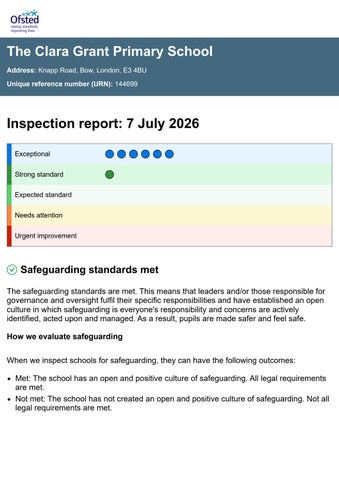
Inspection report: 7 July 2026 Exceptional Strong standard Expected standard Needs attention Urgent improvement
Safeguarding standards met The safeguarding standards are met. This means that leaders and/or those responsible for governance and oversight fulfil their specific responsibilities and have established an open culture in which safeguarding is everyone's responsibility and concerns are actively identified, acted upon and managed. As a result, pupils are made safer and feel safe. How we evaluate safeguarding When we inspect schools for safeguarding, they can have the following outcomes: Met: The school has an open and positive culture of safeguarding. All legal requirements are met. Not met: The school has not created an open and positive culture of safeguarding. Not all legal requirements are met.
Exceptional Achievement
Exceptional
Leaders have ensured that all pupils, including those who are disadvantaged and those with special educational needs and/or disabilities, make excellent progress in learning the curriculum. This is seen through pupils' work for subjects such as geography, art and religious studies. Leaders work has ensured that pupils' performance in national tests and assessments is consistently significantly above national averages. Additionally, the strength of the pupils' achievement is very well exemplified by disadvantaged pupils consistently achieving outcomes in national tests and assessments that are much higher than their national nondisadvantaged peers. Pupils develop very deep and secure foundational knowledge and skills in English and mathematics, as demonstrated by their outcomes in their reading and mathematics assessments at key stage 2. This supports them to learn their primary curriculum extremely well and, therefore, pupils are incredibly well prepared for beginning and being incredibly successful in secondary school and their future education. Curriculum and teaching
Exceptional
Leaders have carefully researched how to ensure that their curriculum is both developing on the prior and cultural learning of their community and filling in any gaps in knowledge and skills that pupils might have. They have, therefore, developed a broad and ambitious curriculum. All pupils learn two languages, French and Mandarin, to support them having a wider world view. In other subjects, learning is seen to go above and beyond the national curriculum, such as in science where pupils learn in detail how the eye works. In history, they can explain the causes and consequences of the industrial revolution and in music pupils learn how to use technology to create and record compositions. Leaders carefully track the impact of this curriculum and then modify it where appropriate so that teaching remains consistently highly effective in supporting pupils' learning. To ensure that pupils are able to successfully learn this curriculum, pupils are supported to successfully develop strong foundations in English and mathematics. This is achieved through well established and understood teaching practices. Inside and outside of lessons all staff skilfully deliver key knowledge to pupils in a step by step manner that supports them to build upon their prior learning. Pupils' understanding is checked through a variety of different methods by staff. This allows gaps in pupils knowledge to be identified swiftly and precisely and filled. Leaders ensure that all staff have the skills and knowledge to successfully adapt the curriculum and their teaching, when appropriate, for pupils, including those who are disadvantaged and pupils with special educational needs and/or disabilities. Early years
Exceptional
Leaders have designed an ambitious curriculum that is well sequenced, and based on what children need to know and do. As a result, children achieve consistently well and develop
the knowledge and skills to be extremely well prepared for learning in Year 1. The focus in the early years on developing skills such as planning, focusing, how to remember knowledge and how to manage emotions, and the methodical way in which these are is taught to children, allows them to make transformational progress in their learning. For instance, children are taught to learn how to avoid distractions and to plan how they will complete a task. This supports them to be highly successful in their leaning. Children make excellent progress by the end of Reception and are very well prepared for the next stages of their learning. This is, in part, because they are taught phonics extremely well and so they make remarkable progress in learning to read. Leaders have made the decision to extend the curriculum beyond what might be expected in the early years through the introduction of formal religious education, art and language lessons. This supports children to be 'ready to fly' when they enter key stage 1. Leaders have ensured that staff use a range of strategies for the early identification of children with special educational needs and/or disabilities (SEND). Teachers adapt the physical environment, routines and teaching to ensure children with SEND achieve alongside their peers. Leaders have developed the provision for children with SEND by providing pre-teaching modules for parents. This enables parents to understand what their children will be learning and how to support them at home. Children join the early years with lower starting points than are typical for their age. By the end of Reception class, as a result of highly effective teaching and skilfully designed provision, children make rapid progress. Most have achieved at least the standards expected for their age in all the different areas of learning. Inclusion
Exceptional
Leaders have thought very carefully and clearly on how to support disadvantaged pupils to learn. They have introduced a knowledge rich curriculum with continuous assessment across all subject areas. This detailed monitoring process allows gaps in pupils' knowledge to be swiftly identified and filled. Leaders' use of pupil premium funding is carefully planned and evaluated to ensure that it has the biggest possible impact. This is seen through disadvantaged pupils performing better at key stage 2 than non-disadvantaged pupils nationally. Leaders have made sure that pupils with special educational needs and/or disabilities (SEND) are identified quickly. Leaders put plans in place, in conjunction with parents, carers and external services, to ensure that pupils learn the curriculum well. These plans are regularly monitored and adjusted to secure the success of pupils. The success of this is seen in pupils' outcomes in national tests and assessments. Leaders have identified an increased SEND need at the school. This has led to them introducing a 'stage, not age pathway'. This support pupils very well by meeting needs and overcoming pupils' barriers to learning. They have shared this approach with other schools to help them to support their pupils as well. Leaders have created an environment that allows all pupils, including the most disadvantaged and vulnerable, to feel safe and happy at the school and want to attend
everyday. This inclusive environment supports them to be ready to be successful in their future lives. Leadership and governance
Exceptional
Leaders at the school know and care for their pupils extremely well. The work that they do is transformational in breaking down the barriers to learning for pupils, many of whom are disadvantaged and/or have special educational needs and/or disabilities (SEND). Leaders have gained the trust of the local community because they understand its context very well. This means that they work in close partnership with parents and carers to support their children to be extremely well prepared for the next stages of their education and their future lives. Leaders have ensured that the curriculum and teaching are rooted in research about what works best in helping pupils to learn. They have refined the curriculum skilfully to support their pupils' context and the local community. Leaders identify experiences that pupils would not get without the support from the school and find funding through charities to support pupils to take part in international trips and visits to museums theatres in the United Kingdom. The trust, trustees and local governors provide excellent support for the leaders in school. They uphold their obligations regarding the equalities act and safeguarding. Staff report very well considered support for their workload and wellbeing. Staff play a key role in leaders' work to continuously improve the already high quality of provision in the school. Leaders ensure that staff have opportunities to further develop their expertise and share ideas about how to make all aspects of the school's work even better. Leaders continually evaluate the impact of their work. They make adjustments to further improve their offer to the pupils and, therefore, pupils' outcomes. Leaders' actions have a transformational impact on pupils' outcomes and experiences . This is especially the case for disadvantaged pupils, pupils with SEND and those barriers to their learning/and or wellbeing. Personal development and wellbeing
Exceptional
Leaders know that many pupils are from disadvantaged backgrounds. They also understand that within their local community that there can be a tendency to be inward looking rather than having the confidence to take advantage of the opportunities that come from living in a multi-cultural city like London. Leaders have made it their responsibility to address this through a carefully constructed, highly coherent personal development programme. Leaders know pupils, their families and their communities incredibly well. They target pupils for activities that will develop qualities such as gaining self confidence and speaking skills. This is done through well considered opportunities such as a poetry slam and the lead role in school stage productions. Trips that build cultural capital by visiting abroad to countries such as Belgium, France and Italy have been developed by the school. Leaders secure funding through their close partnerships with charitable institutions to make sure that these opportunities are available to all.
Pupils develop an excellent understanding of the personal, social and health education curriculum, this includes pupils with special educational needs and/or disabilities. Pupils have a thorough knowledge of fundamental British values, such as tolerance and democracy, and the different characteristics that are protected by law. They demonstrate this knowledge through their work, for example in writing an anti-racism charter and promoting the '5Cs' of commitment, care, consideration, courtesy and cooperation. Pupils know how to live safe and healthy lives. They make well-informed choices, such as what to eat at lunchtime and how to behave online, which demonstrates this knowledge. Through carefully considered careers learning, leaders have inspired pupils to become the doctors and architects of their local community. Pupils know that those future jobs are available to them, what they need to do to achieve them and that they will be supported to realise their ambitions.
Strong standard Attendance and behaviour
Strong standard
Leaders have done, and are doing, all that they can to improve attendance. This has led to improvements in the attendance of all pupils. Disadvantaged pupils now attend significantly more regularly than their national peers. Leaders have taken effective action to prevent pupil absence due to term time holidays. This has had a positive impact on reducing absence. Leaders have provided effective support for pupils who have previously poor attendance. This has has resulted in improved, more regular attendance. Fewer pupils are frequently absent from school. Staff set high expectations for behaviour from the very start. Pupils' behaviour around the school, both inside and outside of lessons, is incredibly positive. This provides excellent support for pupils' learning and promotes positive relationships. Pupils have strong positive relationships with each other and staff. Pupils demonstrate consistently positive attitudes to learning. They learn in classes with a calm, purposeful atmosphere. Little learning time is lost and pupils' behaviour rarely disturbs learning. Bullying occurs incredibly rarely. When it does occur, staff deal with it swiftly and well. Pupils who need support to manage their own behaviour get very effective support. This means that they meet the school's high expectations for behaviour.
What it's like to be a pupil at this school Pupils are incredibly happy to come to school each and every day. They feel amazingly well supported by their teachers and other adults. They have strong and positive relationships with their classmates that support their learning and wellbeing. In lessons, they encourage each other to master the curriculum. They develop into very resilient learners who relish the opportunity to embrace all of the learning opportunities at this school.
Pupils enjoy their learning. Pupils with special educational needs and/or disabilities and disadvantaged pupils are supported to learn the curriculum extremely well. They are all well prepared for the next stages of their education. Leaders have successfully ensured that all barriers to learning are broken down. Pupils enjoy the additional learning experiences that are part of the curriculum. These support them to learn additional languages and understand the ancient cultures, such as those from Rome, that they learn about. Pupils experience the wider world through a range of educational visits, including trips to Italy, France and Belgium. They benefit from carefully crafted opportunities to widen their experience and to see and learn about communities different from their own. Pupils feel safe at the school they know that staff and their peers will support them. They have trusted adults. They know how to keep themselves fit and healthy (and do so) and they know about, and develop, healthy relationships with their peers. Pupils say that bullying is not an issue at the school and that if it were to happen it would be dealt with swiftly. Pupils' love of school and their appreciation of their education is well expressed through their desire to attend school each day. When any pupils' attendance needs support leaders are quick to intervene and this shows a positive impact.
Next steps Leaders and those responsible for governance should maintain and build upon the school's highly effective work to promote high rates of attendance, including intervening swiftly to support and challenge parents and carers with children whose attendance needs to improve.
About this inspection This school is part of the Boleyn Academy Trust, which means other people in the trust also have responsibility for running the school. The trust is run by the chief executive officer (CEO), Tom Canning, and overseen by a board of trustees, chaired by Nina Panayis. Inspectors carried out this full inspection under section 5 of the Education Act 2005. Following our renewed inspection framework, all inspections are now led by His Majesty’s Inspectors (HMI) or by Ofsted Inspectors (OIs) who have previously served as HMI. Inspectors spoke with the CEO, other representatives from the trust, the executive principal and other leaders during the inspection. Inspectors confirmed the following information about the school: The school currently uses no alternative provision.
The school has undergone a significant change since the last inspection and now has a new principal. Principal: Rubel Aloum
Lead inspector: Luke Stubbles, His Majesty's Inspector Team inspectors: Sara Morgan, Ofsted Inspector Rutinderjit Mahil-Pooni, Ofsted Inspector Jenny Lewis, Ofsted Inspector Lucy Nutt, Ofsted Inspector
Facts and figures used on inspection This was the data available at the time of the full inspection, taken from different sources. More recent data may have been published since the full inspection took place. The inspector(s) used this data during the full inspection on 7 July 2026
School and pupil context Total pupils
427 Above average What does this mean? The total number of pupils currently at this school and how this compares to other schools of this phase in England. National average: 272 School capacity
467 Well above average What does this mean?
The total number of pupils who can attend the school and how this compares to other schools of this phase in England. National average: 300 Pupils eligible for free school meals (FSM)
55.87% Well above average What does this mean? The proportion of pupils eligible for free school meals at any point in the last 6 years. National average: 26.3% Pupils with an education, health and care (EHC) plan
7.03% Well above average What does this mean? The proportion of pupils with an education, health and care plan. This covers pupils with more support than is available through special educational needs support. National average: 3.5% Pupils with special educational needs (SEN) support
11.24% Below average What does this mean? The proportion of pupils with reported special educational needs support at the school. National average: 15% Location deprivation
Well above average What does this mean?
Based on the English indices of deprivation (2019) and the school's location, we have calculated whether the school is located in a more or less deprived area. Resourced provision or SEND Unit (if applicable)
No resourced provision What does this mean? Whether school has Resourced provision or SEND unit (if applicable).
All pupils' performance Pupils reaching the expected standard in reading, writing and mathematics The percentage of pupils meeting the expected standards in a combined reading, writing and mathematics measure. Year
This school
National average
Compared with national average
Latest 3 year average
70%
61%
Above
2024/25 (final)
80%
62%
Above
2023/24 (final)
68%
61%
Close to average
2022/23 (final)
63%
60%
Close to average
Pupils reaching the expected standard in reading The percentage of pupils meeting the expected standard in reading. Year
This school
National average
Compared with national average
Latest 3 year average
81%
74%
Above
2024/25 (final)
88%
75%
Above
2023/24 (final)
83%
74%
Above
2022/23 (final)
72%
73%
Close to average
Pupils reaching the expected standard in teacher-assessed writing The percentage of pupils meeting the expected standard in teacher-assessed writing. Year
This school
National average
Compared with national average
Latest 3 year average
77%
72%
Close to average
2024/25 (final)
86%
72%
Above
2023/24 (final)
78%
72%
Close to average
2022/23 (final)
68%
71%
Close to average
Pupils reaching the expected standard in mathematics The percentage of pupils meeting the expected standard in mathematics. Year
This school
National average
Compared with national average
Latest 3 year average
81%
73%
Above
2024/25 (final)
84%
74%
Above
2023/24 (final)
83%
73%
Above
2022/23 (final)
77%
73%
Close to average
Disadvantaged pupils' performance Disadvantaged pupils are those who have been eligible for free school meals at any point in the last six years and children looked after. Disadvantaged pupils reaching the expected standard in reading, writing and mathematics The percentage of disadvantaged pupils meeting the expected standard in reading, writing and mathematics.
Year
This school
National average
Compared with national average
Latest 3 year average
65%
46%
Above
2024/25 (final)
73%
47%
Above
2023/24 (final)
66%
46%
Above
2022/23 (final)
56%
44%
Close to average
Disadvantaged pupils reaching the expected standard in reading The percentage of disadvantaged pupils meeting the expected standard in reading. Year
This school
National average
Compared with national average
Latest 3 year average
77%
62%
Above
2024/25 (final)
82%
63%
Above
2023/24 (final)
80%
62%
Above
2022/23 (final)
69%
60%
Close to average
Disadvantaged pupils reaching the expected standard in teacher-assessed writing The percentage of disadvantaged pupils meeting the expected standard in teacherassessed writing. Year
This school
National average
Compared with national average
Latest 3 year average
71%
59%
Above
2024/25 (final)
79%
59%
Above
2023/24 (final)
74%
58%
Above
2022/23 (final)
59%
58%
Close to average
Disadvantaged pupils reaching the expected standard in mathematics The percentage of disadvantaged pupils meeting the expected standard in mathematics. Year
This school
National average
Compared with national average
Latest 3 year average
75%
60%
Above
2024/25 (final)
76%
61%
Above
2023/24 (final)
80%
59%
Above
2022/23 (final)
69%
59%
Close to average
Disadvantaged pupils' performance gap Disadvantaged pupils are those who have been eligible for free school meals at any point in the last six years and children looked after. The school disadvantage gap is the difference between the performance of the school's disadvantaged pupils compared to the performance of all non-disadvantaged pupils nationally. Disadvantaged pupils reaching the expected standard in reading, writing and mathematics The percentage of disadvantaged pupils meeting the expected standard in reading, writing and mathematics, including the disadvantaged gap. Year
This school
National nondisadvantaged score
School disadvantage gap
Latest 3 year average
65%
68%
-3 pp
2024/25 (final)
73%
69%
4 pp
2023/24 (final)
66%
67%
-2 pp
2022/23 (final)
56%
66%
-10 pp
Disadvantaged pupils reaching the expected standard in reading The percentage of disadvantaged pupils meeting the expected standard in reading and the disadvantaged gap.
Year
This school
National nondisadvantaged score
School disadvantage gap
Latest 3 year average
77%
80%
-3 pp
2024/25 (final)
82%
81%
1 pp
2023/24 (final)
80%
80%
0 pp
2022/23 (final)
69%
78%
-10 pp
Disadvantaged pupils reaching the expected standard in teacher-assessed writing The percentage of disadvantaged pupils meeting the expected standard in teacherassessed writing and the disadvantaged gap. Year
This school
National nondisadvantaged score
School disadvantage gap
Latest 3 year average
71%
78%
-7 pp
2024/25 (final)
79%
78%
1 pp
2023/24 (final)
74%
78%
-3 pp
2022/23 (final)
59%
77%
-18 pp
Disadvantaged pupils reaching the expected standard in mathematics The percentage of disadvantaged pupils meeting the expected standard in mathematics and the disadvantaged gap. Year
This school
National nondisadvantaged score
School disadvantage gap
Latest 3 year average
75%
80%
-5 pp
2024/25 (final)
76%
81%
-5 pp
2023/24 (final)
80%
79%
1 pp
Year
This school
National nondisadvantaged score
School disadvantage gap
2022/23 (final)
69%
79%
-10 pp
Absence Overall absence The percentage of all possible mornings and afternoons missed due to absence from school (for whatever reason, whether authorised or unauthorised) across all pupils. Year
This school
National average
Compared with national average
2024/25 (3 term)
6.4%
5.2%
Above
2023/24 (3 term)
6.1%
5.5%
Close to average
2022/23 (3 term)
7.1%
5.9%
Above
Persistent absence The percentage of pupils missing 10% or more of their possible mornings and afternoons. Year
This school
National average
Compared with national average
2024/25 (3 term)
16.4%
13.0%
Close to average
2023/24 (3 term)
18.3%
14.6%
Above
2022/23 (3 term)
24.4%
16.2%
Above
Our grades explained Exceptional Practice is exceptional: of the highest standard nationally. Other schools can learn from it. Strong standard The school reaches a strong standard. Leaders are working above the standard expected of them. Expected standard
The school is fulfilling the expected standard of education and/or care. This means they are following the standard set out in statutory and non‑statutory legislation and the professional standards expected of them. Needs attention The expected standards are not met but leaders are likely able to make the necessary improvements. Urgent improvement The school needs to make urgent improvements to provide the expected standard of education and/or care.
The Office for Standards in Education, Children's Services and Skills (Ofsted) inspects services providing education and skills for children and learners of all ages, and inspects and regulates services that care for children and young people. If you would like a copy of this document in a different format, such as large print or Braille, please telephone 0300 123 1231, or email enquiries@ofsted.gov.uk. You may reuse this information (not including logos) free of charge in any format or medium, under the terms of the Open Government Licence. To view this licence, visit www.nationalarchives.gov.uk/doc/open-government-licence, write to the Information Policy Team, The National Archives, Kew, London TW9 4DU, or email: psi@nationalarchives.gsi.gov.uk. This publication is available at https://reports.ofsted.gov.uk. Interested in our work? You can subscribe to our monthly newsletter for more information and updates: http://eepurl.com/iTrDn. Piccadilly Gate Store Street Manchester M1 2WD T: 0300 123 1231 Textphone: 0161 618 8524 E: enquiries@ofsted.gov.uk W: www.gov.uk/ofsted © Crown copyright 2026
© Crown copyright