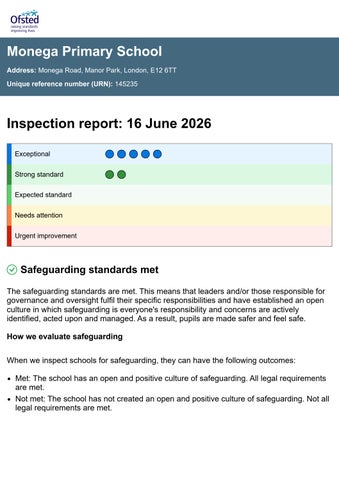
Monega Primary School Address: Monega Road, Manor Park, London, E12 6TT Unique reference number (URN): 145235
Inspection report: 16 June 2026 Exceptional Strong standard Expected standard Needs attention Urgent improvement
Safeguarding standards met The safeguarding standards are met. This means that leaders and/or those responsible for governance and oversight fulfil their specific responsibilities and have established an open culture in which safeguarding is everyone's responsibility and concerns are actively identified, acted upon and managed. As a result, pupils are made safer and feel safe. How we evaluate safeguarding When we inspect schools for safeguarding, they can have the following outcomes: Met: The school has an open and positive culture of safeguarding. All legal requirements are met. Not met: The school has not created an open and positive culture of safeguarding. Not all legal requirements are met.
Exceptional Achievement
Exceptional
Pupils secure their important foundations in learning with astounding speed. From the early years onwards, highly skilled staff make sure every pupil progresses swiftly through steps in learning that are just right for them. Older pupils use this remarkable foundation in their language skills to read and write with precision and depth. This has a marked impact on pupils' sustained, high levels of achievement. Pupils who face disadvantage in their lives routinely attain significantly above all pupils nationally in reading, writing and mathematics. When pupils join the school midway through their education, they secure important learning remarkably quickly. Pupils with special educational needs and/or disabilities achieve astonishingly well. In both cases, pupils benefit from the same precise learning as their peers. When pupils face barriers to learning, leaders dismantle them. Teachers help pupils to rapidly address any gaps in knowledge that they have. This leads to sustained, high levels of achievement across the curriculum subjects that pupils study. By the time pupils leave this school, they have the skills they need to sustain their own learning into the future. Early years
Exceptional
Leaders have crafted a remarkably precise curriculum in the early years. From the moment that children join the Nursery, they benefit from astutely designed learning and care that help them to make astonishing progress. Leaders provide staff with exemplary professional learning. Staff acquire impressive expertise in children's early development. Central to this expertise is leaders' systematic framework for adapting learning for pupils with special educational needs and/or disabilities (SEND). Teachers apply this approach with impressive clarity. All staff know the exact steps in learning that each child will make. Teachers provide highly tailored support so that every child moves rapidly through the learning that is set out for them. Children, including those with SEND or who face other barriers to their learning, become highly confident learners. Over time, children consistently achieve to remarkably high levels. Staff use their impressive knowledge of every child to structure precise interactions that help children to rapidly acquire the language that they need. Children swiftly develop their application of phonics, letter formation and numbers. They become fluent readers, writers and mathematicians. Children thrive because of the expertly designed activities that teachers provide for them. By the time children complete their early years education, they have the knowledge, skills and attitudes to learning that they need for the rest of their education. Fundamentally, teachers ensure that every child experiences multiple moments of success every day. Children in the early years find learning irresistible. Inclusion
Exceptional
Leaders provide a clear framework for teachers to adapt learning to meet pupils' needs. This helps pupils to develop confidence and fluency in their learning. If pupils face barriers to their learning, they swiftly catch up with their peers. Some pupils who join the school have limited spoken English. They benefit from the same astonishingly clear curriculum as their
peers. Pupils acquire the language that they need incredibly quickly. The same is true for pupils with special educational needs and/or disabilities (SEND). Leaders have established guidance so that every teacher adapts learning for pupils with SEND with notable precision. Some pupils have complex needs and require a different curriculum. This curriculum is no less precise. All pupils with SEND flourish because teachers guide them incredibly well through each stage in their learning. Leaders have established deep trust with parents. The support that leaders provide for pupils and their families is pivotal in helping pupils to be safe and well cared for. Leaders use additional funding incredibly well. They have established a set of tools for learning so that every pupil experiences a high degree of success every day, regardless of their needs. It is this daily, consistent and positive experience that results in pupils having high levels of wellbeing and the confidence to meet any challenges that they might face. Leadership and governance
Exceptional
Leaders have realised their ambition to help pupils acquire the skills that they need to become life-long learners. Since the last inspection, leaders' continual cycle of refinement has resulted in a remarkable impact on pupils. Those who contribute to the governance of the school use their considerable expertise to support leaders in their continual pursuit of excellence. For instance, governors' focus on improving attendance has led to considerable gains. Governors fulfil their statutory duties incredibly well. For example, their work with leaders to promote equality has led to a curriculum that helps pupils to transcend any barriers that they face. Governors' checks on the quality of the school's work are anchored to a shared vision that is abundantly realised. Leaders are role models of excellence. They seek to continuously develop their own expertise and staff's professional learning. Leaders and staff routinely contribute to school improvement locally and nationally. This directly informs the continuous refinement of the school's work and the considerable, high-quality professional learning that staff receive from the school and the trust. Leaders have established a culture of learning in which adults and pupils alike thrive. Leaders establish close relationships with parents and carers. Families trust the school to act as co-parents for their children. Often, these relationships are pivotal in helping pupils and their families to develop the habits for future success. The levels of trust and mutual support that leaders have established across the school are impressive. Leaders never lose sight of staff’s workload and wellbeing. Staff feel very well supported and valued for the significant contribution that they make. Personal development and wellbeing
Exceptional
Leaders have established a personal, social, health and economic curriculum carefully designed around their pupils. Pupils acquire exemplary knowledge about the impact of social media on body image. They understand who might face discrimination and why. They link this to their remarkable knowledge of British values and the part these play in allowing people to be themselves. Older pupils learn about issues such as forced marriage and domestic abuse. They recognise the signs of an unsafe relationship. Pupils deeply understand gender equality and that different careers are open to all. They approach these
issues with impressive maturity. Leaders build on pupils' knowledge in these areas by igniting their aspirations for the future. Pupils routinely learn about different careers and the skills that they need to realise their aspirations. Leaders routinely check pupils' participation in the carefully chosen experiences available to them. Each school leader oversees groups of learners that may face barriers to participation. Leaders take imaginative action to dismantle these barriers. For instance, they provide several opportunities each year for pupils to participate in regular overnight camping events at school. Leaders use their relationships with families to help them to become more comfortable for their children to participate. Similarly, if pupils are unable to attend clubs, leaders design additional experiences at different times of the school day. Because of leaders' actions, pupils who face barriers sustain their participation in the rich offer provided for them. Leaders use their close relationships with families to shape support and care for each pupil. Pupils feel comfortable to share their worries. Staff provide immediate support that helps pupils to overcome the challenges that they face. Pupils thrive, with high levels of wellbeing. Many pupils serve in pupil leadership roles. For example, older pupils help younger pupils to learn to read. Pupils, including those facing challenges in their lives, swiftly develop the skills and behaviours that help them to make a highly positive contribution to their school and each other. Because of leaders' carefully designed offer, pupils leave this school ready to flourish in the world.
Strong standard Attendance and behaviour
Strong standard
Leaders leave no stone unturned in their analysis of behaviour and attendance. Some pupils, including those who join the school midway through their education, require additional help to attend well. Leaders take remarkably effective action. Pupils' attendance improves dramatically as a result. While historic published data shows that attendance improved over time, it is now above national averages. A smaller number of pupils are persistently absent than is the case nationally. Leaders' success is the result of their careful checks and actions to help everyone in the school community to understand the importance of attending school regularly. Pupils' behaviour is exemplary. In the early years, adults help children to become avid learners. Children follow well-established routines and swiftly acquire highly positive attitudes to their learning. Children leave early years with the skills that they need to manage their own behaviours consistently well. Older pupils use the skills that they have learned to act as fantastic role models for their younger friends. Bullying is extremely rare. If it occurs, leaders deal with it swiftly and effectively. Leaders have established a school culture where discrimination is simply not permitted. This informs the remarkable care and kindness that pupils show to each other and those around them.
Curriculum and teaching
Strong standard
Leaders have established a very ambitious curriculum for pupils to study. Leaders ensure that teachers have the deep knowledge and understanding that they need to teach the curriculum consistently well. Expert teachers carefully check what pupils know and take highly effective action to address any gaps that pupils might have. If pupils join the school midway through their education, teachers make sure that pupils rapidly acquire the language skills that they need to learn the curriculum. Pupils with complex special educational needs and/or disabilities receive a curriculum that is just right for them. Expert teachers carefully guide their learning so that they acquire important social and communication skills. Teachers make sure that pupils routinely use their secure foundations in reading and writing to enhance their broader learning. Teachers use the well-defined curriculum and their deep understanding of each subject to help pupils acquire impressive knowledge. For example, pupils secure a deep understanding of the function of plate tectonics in geography. In history, pupils gain equally impressive knowledge about the impact of the Magna Carta on King John, or the impact of the Industrial Revolution on an agricultural economy. Occasionally, staff do not make clear enough to pupils the important connections between the knowledge that they are taught. Nevertheless, teachers make sure that pupils develop a notably advanced body of knowledge.
What it's like to be a pupil at this school A warm welcome awaits every pupil who attends this school. Leaders have established a vision for pupils to become enthusiastic life-long learners. This vision inspires pupils to become avid learners. Pupils thoroughly enjoy their lessons. They benefit from a notably well-considered curriculum that guides their learning remarkably well. Many pupils join the school midway through their education. Staff swiftly get to grips with finding out precisely what pupils know and can do. Pupils flourish because leaders have set out well-structured 'learning pathways' for them to follow. Pupils swiftly acquire the vocabulary, reading skills and writing skills that they need to succeed. They sustain high levels of achievement across the curriculum subjects. Leaders have established a school culture of inclusion and belonging. Some pupils with special educational needs and/or disabilities have complex needs that require specialist support. Leaders ensure that highly trained staff provide a bespoke curriculum that helps pupils with complex needs to thrive. They quickly develop important social and communication skills. Pupils' behaviour is exemplary, and bullying is not a problem. Pupils are safe. From the Nursery onwards, pupils display impressive attitudes to their learning. Pupils collaborate closely and support each other well. Older pupils are impressive role models for younger pupils. Some pupils, including some that join the school midway through their education, struggle to attend well. Leaders take highly effective action so that their attendance improves swiftly.
Leaders provide a rich range of opportunities that bring learning to life. For instance, pupils participate in regular camping experiences, residential visits to a farm, visits to museums and trips overseas. If pupils face barriers to participation, leaders remove these barriers. Older pupils find out about different careers. This ignites their aspirations for the future. Pupils are not just ready for secondary school, they are ready for their future lives.
Next steps In some curriculum subjects, the school should refine its approach to helping pupils to make explicit connections between important knowledge so that their learning deepens further.
About this inspection This school is part of The Boleyn Trust, which means other people in the trust also have responsibility for running the school. The trust is run by the chief executive officer (CEO), Tom Canning CBE, and overseen by a board of trustees, chaired by Nina Panayis. Inspectors carried out this full inspection under section 5 of the Education Act 2005. Following our renewed inspection framework, all inspections are now led by His Majesty's Inspectors (HMIs) or by Ofsted Inspectors (OIs) who have previously served as HMIs. Inspectors spoke with the headteacher, deputy headteacher and other senior leaders. Inspectors also spoke with leaders in the trust, including the CEO and deputy CEO. The lead inspector spoke with governors and trustees, including the chair of the trust board. The inspectors confirmed the following information about the school: The school does not make use of alternative provision. The school runs a breakfast club for pupils in the school. Headteacher: Elizabeth Harris
Lead inspector: Jen Sloan, His Majesty's Inspector Team inspectors: Christopher Birtles, Ofsted Inspector Daniel Burton, Ofsted Inspector Tom O'Donnell, His Majesty's Inspector
Facts and figures used on inspection This was the data available at the time of the full inspection, taken from different sources. More recent data may have been published since the full inspection took place. The inspector(s) used this data during the full inspection on 16 June 2026
School and pupil context Total pupils
584 Well above average What does this mean? The total number of pupils currently at this school and how this compares to other schools of this phase in England. National average: 272 School capacity
730 Well above average What does this mean? The total number of pupils who can attend the school and how this compares to other schools of this phase in England. National average: 300 Pupils eligible for free school meals (FSM)
30.75% Close to average What does this mean? The proportion of pupils eligible for free school meals at any point in the last 6 years.
National average: 26.3% Pupils with an education, health and care (EHC) plan
3.08% Close to average What does this mean? The proportion of pupils with an education, health and care plan. This covers pupils with more support than is available through special educational needs support. National average: 3.5% Pupils with special educational needs (SEN) support
10.45% Below average What does this mean? The proportion of pupils with reported special educational needs support at the school. National average: 15% Location deprivation
Well above average What does this mean? Based on the English indices of deprivation (2019) and the school's location, we have calculated whether the school is located in a more or less deprived area. Resourced provision or SEND Unit (if applicable)
No resourced provision What does this mean? Whether school has Resourced provision or SEND unit (if applicable).
All pupils' performance Pupils reaching the expected standard in reading, writing and mathematics
The percentage of pupils meeting the expected standards in a combined reading, writing and mathematics measure. Year
This school
National average
Compared with national average
Latest 3 year average
81%
61%
Above
2024/25 (final)
83%
62%
Above
2023/24 (final)
79%
61%
Above
2022/23 (final)
81%
60%
Above
Pupils reaching the expected standard in reading The percentage of pupils meeting the expected standard in reading. Year
This school
National average
Compared with national average
Latest 3 year average
87%
74%
Above
2024/25 (final)
85%
75%
Above
2023/24 (final)
93%
74%
Above
2022/23 (final)
85%
73%
Above
Pupils reaching the expected standard in teacher-assessed writing The percentage of pupils meeting the expected standard in teacher-assessed writing. Year
This school
National average
Compared with national average
Latest 3 year average
83%
72%
Above
2024/25 (final)
85%
72%
Above
2023/24 (final)
81%
72%
Above
2022/23 (final)
83%
71%
Above
Pupils reaching the expected standard in mathematics The percentage of pupils meeting the expected standard in mathematics. Year
This school
National average
Compared with national average
Latest 3 year average
88%
73%
Above
2024/25 (final)
90%
74%
Above
2023/24 (final)
92%
73%
Above
2022/23 (final)
84%
73%
Above
Disadvantaged pupils' performance Disadvantaged pupils are those who have been eligible for free school meals at any point in the last six years and children looked after. Disadvantaged pupils reaching the expected standard in reading, writing and mathematics The percentage of disadvantaged pupils meeting the expected standard in reading, writing and mathematics. Year
This school
National average
Compared with national average
Latest 3 year average
72%
46%
Above
2024/25 (final)
81%
47%
Above
2023/24 (final)
67%
46%
Above
2022/23 (final)
69%
44%
Above
Disadvantaged pupils reaching the expected standard in reading The percentage of disadvantaged pupils meeting the expected standard in reading.
Year
This school
National average
Compared with national average
Latest 3 year average
83%
62%
Above
2024/25 (final)
84%
63%
Above
2023/24 (final)
88%
62%
Above
2022/23 (final)
76%
60%
Above
Disadvantaged pupils reaching the expected standard in teacher-assessed writing The percentage of disadvantaged pupils meeting the expected standard in teacherassessed writing. Year
This school
National average
Compared with national average
Latest 3 year average
73%
59%
Above
2024/25 (final)
81%
59%
Above
2023/24 (final)
70%
58%
Close to average
2022/23 (final)
69%
58%
Close to average
Disadvantaged pupils reaching the expected standard in mathematics The percentage of disadvantaged pupils meeting the expected standard in mathematics. Year
This school
National average
Compared with national average
Latest 3 year average
83%
60%
Above
2024/25 (final)
91%
61%
Above
2023/24 (final)
85%
59%
Above
2022/23 (final)
72%
59%
Above
Disadvantaged pupils' performance gap
Disadvantaged pupils are those who have been eligible for free school meals at any point in the last six years and children looked after. The school disadvantage gap is the difference between the performance of the school's disadvantaged pupils compared to the performance of all non-disadvantaged pupils nationally. Disadvantaged pupils reaching the expected standard in reading, writing and mathematics The percentage of disadvantaged pupils meeting the expected standard in reading, writing and mathematics, including the disadvantaged gap. Year
This school
National nondisadvantaged score
School disadvantage gap
Latest 3 year average
72%
68%
5 pp
2024/25 (final)
81%
69%
12 pp
2023/24 (final)
67%
67%
-1 pp
2022/23 (final)
69%
66%
3 pp
Disadvantaged pupils reaching the expected standard in reading The percentage of disadvantaged pupils meeting the expected standard in reading and the disadvantaged gap. Year
This school
National nondisadvantaged score
School disadvantage gap
Latest 3 year average
83%
80%
3 pp
2024/25 (final)
84%
81%
4 pp
2023/24 (final)
88%
80%
8 pp
2022/23 (final)
76%
78%
-2 pp
Disadvantaged pupils reaching the expected standard in teacher-assessed writing The percentage of disadvantaged pupils meeting the expected standard in teacherassessed writing and the disadvantaged gap.
Year
This school
National nondisadvantaged score
School disadvantage gap
Latest 3 year average
73%
78%
-4 pp
2024/25 (final)
81%
78%
3 pp
2023/24 (final)
70%
78%
-8 pp
2022/23 (final)
69%
77%
-8 pp
Disadvantaged pupils reaching the expected standard in mathematics The percentage of disadvantaged pupils meeting the expected standard in mathematics and the disadvantaged gap. Year
This school
National nondisadvantaged score
School disadvantage gap
Latest 3 year average
83%
80%
3 pp
2024/25 (final)
91%
81%
10 pp
2023/24 (final)
85%
79%
5 pp
2022/23 (final)
72%
79%
-7 pp
Absence Overall absence The percentage of all possible mornings and afternoons missed due to absence from school (for whatever reason, whether authorised or unauthorised) across all pupils. Year
This school
National average
Compared with national average
2024/25 (3 term)
6.5%
5.2%
Above
2023/24 (3 term)
7.3%
5.5%
Above
2022/23 (3 term)
9.7%
5.9%
Above
Persistent absence The percentage of pupils missing 10% or more of their possible mornings and afternoons. Year
This school
National average
Compared with national average
2024/25 (3 term)
19.6%
13.0%
Above
2023/24 (3 term)
19.2%
14.6%
Above
2022/23 (3 term)
31.2%
16.2%
Above
Our grades explained Exceptional Practice is exceptional: of the highest standard nationally. Other schools can learn from it. Strong standard The school reaches a strong standard. Leaders are working above the standard expected of them. Expected standard The school is fulfilling the expected standard of education and/or care. This means they are following the standard set out in statutory and non‑statutory legislation and the professional standards expected of them. Needs attention The expected standards are not met but leaders are likely able to make the necessary improvements. Urgent improvement The school needs to make urgent improvements to provide the expected standard of education and/or care.
The Office for Standards in Education, Children's Services and Skills (Ofsted) inspects services providing education and skills for children and learners of all ages, and inspects and regulates services that care for children and young people. If you would like a copy of this document in a different format, such as large print or Braille, please telephone 0300 123 1231, or email enquiries@ofsted.gov.uk.
You may reuse this information (not including logos) free of charge in any format or medium, under the terms of the Open Government Licence. To view this licence, visit www.nationalarchives.gov.uk/doc/open-government-licence, write to the Information Policy Team, The National Archives, Kew, London TW9 4DU, or email: psi@nationalarchives.gsi.gov.uk. This publication is available at https://reports.ofsted.gov.uk. Interested in our work? You can subscribe to our monthly newsletter for more information and updates: http://eepurl.com/iTrDn. Piccadilly Gate Store Street Manchester M1 2WD T: 0300 123 1231 Textphone: 0161 618 8524 E: enquiries@ofsted.gov.uk W: www.gov.uk/ofsted © Crown copyright 2026
© Crown copyright