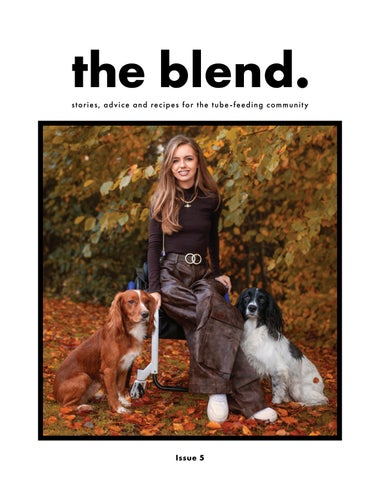
s tor i e s, a d vic e a n d re c ip e s fo r t he t u b e - fe e d i n g c o m m u n i t y
Issue 5
leading the change in whole food enteral nutrition Our silky smooth whole food meals bring comfort, confidence and joy back into tube feeding. They nourish you so you can keep showing up for the moments that matter like family dinners, sunny adventures, late night conversations and early morning starts. With no artificial sugars, preservatives, additives or nasties, our easy to pour 280 gram pouches are free from GMOs, soy, dairy, lactose, gluten, nuts and eggs. Pure nourishment made simple. Made by our family for your family. Because the ability to choose what we eat should never be a luxury. It is a human right.
Made in Australia, with national & worldwide distribution www.blendedbysarah.au
HEALTH EQUIPMENT & CONSUMABLE SUPPLIES AUSTRALIA
SERVICE AS IT SHOULD BE Founded in 2019, HECSA’s guiding principle is to bring back old-fashioned service to the medical consumables industry. Every decision we make is focused on solutions that provide better outcomes for you. Improving your comfort and health is our business.
www.hecsa.com.au 1300 087 786
Brisbane — Townsville — We Deliver Nationally
Brisbane team
• Continence Townsville team
• Skin Care • Wound Care • Nutrition • Respiratory • PPE • Janitorial • Hospitality
Image: Debi Brett Photography
Tube feeding accessories to support all ages
tubiefun.com.au tubiefun
@tubiefunau
@tubie.fun
THE BLEND ISSUE FIVE WAS CREATED IN PARTNERSHIP WITH...
HEALTH EQUIPMENT & CONSUMABLE SUPPLIES AUSTRALIA
11
the blend.
the blend. Disclaimer All information, advice and content contained within this publication is provided for general information purposes only, and does not constitute medical, dietitian, psychological or other professional advice. All care is taken in the preparation of the information included in this publication. The publisher does not make any representations or give any warranties about its accuracy, reliability, completeness or suitability for any particular purpose. To the extent permissible by law, the publisher will not be liable for any expenses, losses, damages (including indirect or consequential damages) or costs that might be incurred as a result of the information being inaccurate or incomplete in any way and for any reason or your reliance on the information, advice or content contained within this publication. Credits The Blend is founded and edited by Melanie Dimmitt, with creative direction by Edie Swan. Issue Five is designed by Rowena New. The cover photo is by Chloé Fuller. Acknowledgement of Country The Blend creators acknowledge the Aboriginal and Torres Strait Islander peoples of Australia. We acknowledge the Gundungurra, Tharawal, Garigal and Wangal peoples, the traditional custodians of the lands on which The Blend was made. We pay our respects to ancestors and Elders, both past, present and emerging.
the blend.
12
45
COVER STORY
13
the blend.
CONTENTS
ISSUE 5
17
Editor’s letter 19
Featured contributors
PROFILES 23
SWEET DREAMS
Coffee, watermelon and a feeding tube: Germany’s Anna Dorina shares her life with chronic illness through candid content and hand-sewn hope.
39
29
MOTHER OF INVENTION
WILD AT HEART
With a million followers, a fashion label and a son who starts every day with a smile, Filipino mum Jana Berenguer is turning influence into impact. 33
LIFE
Beth Gore nearly lost her home to medical bills. Now, as CEO of The Oley Foundation, she’s fighting for fellow families who rely on nutritional support.
57
LEADING WITH LOVE
39
WILD AT HEART
“Fired” by her doctor for blending real food, Autumn Cullen turned her kitchen experiments into a million-dollar company – and took her five kids hiking.
COVER 45
BEST IN SHOW
Pet nutritionist and presenter Chloé Fuller had never seen a nasal feeding tube on screen. So she put hers on national TV.
BRAIN FOOD
Four families, multiple school systems, one mission: making sure their tube-fed kids can learn, play and eat alongside their friends. 65
MIND OVER MATTER
With motor neurone disease and a crew of mates rallying behind him, young father Peter “Evo” Eveleigh is proving the power of community. 69
MAGIC IN THE MAYHEM
Alongside her tube-fed son, podcast host Effie Parks embraces the mess, eyeballs the measurements and lives in a Wild West of her own making.
the blend.
14
75
ROCK ON
With tattooed knuckles, nine guitars and a feeding tube hung from a guitar head, Tim Lloyd is living his best muso life.
79
A DAY AT THE BEACH
79
PHOTO SERIES — A DAY AT THE BEACH Sun’s out, tubes out – this bunch does summer right.
INNOVATION 91
HOME TRUTHS
Sarah Thomas built a blended-food empire on one belief: people who tubefeed deserve choice, real food, and a say in what goes in their bodies. 95
NOT A PHASE
“They’ll eat when they’re hungry.” “Don’t pressure them.” “They’ll grow out of it.” Dr Tessa Taylor has heard it all and she’s shutting it down with science. 98
TURNING POINT
They battled years of vomiting, failed formulas and sleepless nights – then dietitian Simone Wright showed up and changed everything for these families.
CULTURE 105
LIFE OF THE PARTY
Dating app confessions, Taylor Swift concerts and cheese-platter blending. These tube-fed women are rewriting the rules on going out, falling in love, and having a damn good time. 111
BUEN CAMINO
Peter Macaione walked 800km across Spain with a feeding pump strapped to his back and a knee that shouldn’t have lasted. We’re tucking into his travel diary. 119
RECIPES
119
RECIPES 15
the blend.
Everyday deliciousness – blended, ready and totally doable thanks to dietitian Hilarie Geurink. 133
DIRECTORY
Your tube-feeding holy grail – brands, products and clever solutions that really work.
The only 100% real food meals with no synthetic ingredients that are ready-to-feed for people WITH feeding tubes Nutritional Variety • Offers a variety of fruits, vegetables, whole grains, fat and protein sources across 8 different meals and a snack from real foods • Can be used in addition to commercial tube feeding formula plans or as a primary source of nutrition, per healthcare professional recommendation
100% real food ingredients • No added salt** or sugar† • No added color, flavor, or synthetic ingredients • No dairy, nut, or soy ingredients
Nutrition You Can Stomach Blenderized tube feeding may improve common symptoms of formula intolerance
Nausea and vomiting
Gagging/ retching
Reflux associated with tube feeding
Bowel Irregularity
Learn more at realfoodblends.com *Compared to other blenderized enteral formulas **Not a sodium-free food †Not a low-calorie food ©2025 Nutricia North America
EDITOR’S LETTER
A message from the editor, Melanie Dimmitt PHOTOGRAPHY // ABBIE MELLE
I
really had no idea. Working on the first issue of The Blend, I thought we’d struggle to find enough stories to fill a magazine. But I’d soon discover that an infinite number of people and families need nutritional support through feeding tubes and intravenous lines. Scratch the surface of this global and glorious group and out pours a stream of glittering and gutsy stories waiting to be told. We could publish this baby every week. All in good time, eh? This fifth issue is a total banger. We’re trekking the Camino through Spain — the whole 800km of it — with tube-feeding musician Peter Macaione on page 111. We’re
17
the blend.
talking with a mum who holds the power, with just one social media post, to clear the shelves of a nutritional formula across the whole of the Philippines (hello, Jana Berenguer on page 29). We’re hearing from Autumn Cullen (page 39) and Sarah Thomas (page 91), parents who’ve invented products and founded companies because the status quo didn’t cut it for their kids. We’re meeting a young dad raising awareness through his journey with motor neurone disease (say hi to Peter Eveleigh on page 65) and chatting with Beth Gore, CEO of research and advocacy giant the Oley Foundation (page 33). Our cover star, Chloé Fuller, a tube-feeding TV presenter and pet nutrition expert, was first brought to my attention by our creative director, Edith Olsen — and we couldn’t quite believe that such a person existed. See Chloé’s phenomenal story on page 45 — and find out just how far a “f**k it, let’s do it” attitude can take you.
On a personal note, Edie finding our cover star is especially meaningful as, right before we started production on this issue, her own major health battle emerged out of the blue. During her treatment, she said: “I’m counting down the hospital days with the greatest admiration for our Blend families, who are all-too familiar with this.” Edie will be back for our next issue and, on the pages to follow, you’ll see the work of designer Rowena New, who has made her own beautiful mark on our mag. As ever, it’s been our absolute favourite thing to share words and wisdom from our community. Thank you for being a part of it.
theblendmag.com @the_blend_mag
NEW
MY NUTRITION. MY CHOICE. Plant-based formula to support personal choice with complete nutrition! Ideal for vegans, vegetarians and flexitarians. KOSHER
DAIRY FREE
HALAL
LACTOSE FREE
GLUTEN FREE
CHOLESTEROL FREE
@fresubin_anz
LEARN MORE
Check out "Where To Buy Fresubin" on our website
Fresubin is a Food for Special Medical Purposes, to be used under medical supervision Fresenius Kabi Australia Pty Limited Level 2, 2 Woodland Way, Mount Kuring-gai NSW 2080 Phone: 1300 732 001 www.fresubin.com/au I www.strengthhen.com.au
CONTRIBUTORS
Contributors
Some of the creatives behind The Blend Issue Five share why they love making content around tube-feeding
K ATE TH O MAS
CH LO É FU LLE R
K ATH RYN LE AN
She may one day need a feeding tube herself. So rural NSW writer Kate Thomas was especially interested to learn how others have a good time, tube-feeding included, for our ‘Life of the Party’ feature on page 105. “Chatting with people who party with feeding tubes felt like entering a room where everyone had found – or was still finding – their groove,”says Kate. “There was talk of ideal parties that involved blending wine and cheese, and awkward moments, like when a stranger asks to ‘try on’ your nasojejunal (NJ) tube. There was even talk of a feeding pump with a danceparty mode. Completely my kind of crowd.”
It’s not every day you find a cover star who wants to do their own cover shoot. But as you’ll read on page 45, Manchesterbased TV presenter and pet nutrition expert Chloé Fuller isn’t shy on either side of the camera. On why she speaks openly and candidly about her experiences with a feeding tube, Chloé says: “I love to be able to honour people’s curiosity.” “It’s totally natural for people to want to know and understand. As long as they’re polite, I have no objections to answering. I think this is especially true for kids, who shouldn’t be scolded for asking these questions. It creates this culture of tiptoeing and anxiety around disabled people that I hate. In sharing about my life, I hope to help people feel more comfortable around the concept of disability.”
Once again our pages are graced by incredible new works from Newcastle artist Kathryn Lean, which you can find throughout this issue. When asked why she chooses to create pieces inspired by her life with a feeding tube, Kathryn responds: “Making art about tube-feeding has served as a method of storytelling and as a cathartic process to express my lived experience of illness. “When I first got my tube, art became an outlet and a place where I could gain understanding of my feelings surrounding illness and its impacts on identity.”
19
the blend.
Intimate conversations with people sparking change.
PRO FILES 21
the blend.
Photograph by Sarah Aurora Kaufmann.
23
the blend.
D R EA M S
PROFILES
sweet
She’s lived with PAIN for as long as she can remember. But for this SEAMSTRESS and STORYTELLER, hope springs ETERNAL.
PHOTOGRAPHY // SARAH AURORA KAUFMANN
WORDS // MELANIE DIMMITT
It’s watermelon season when Anna Dorina dials in from Wuppertal, a German city known for its century-old suspension railway, the Schwebebahn, which hangs from its tracks like a bat. “It’s like a train that’s flying in the air,” says Anna. “It’s cool, but I get so nauseous when I’m on the Schwebebahn.” Watermelons also make her feel sick. But, as is her approach to living with conditions including Hypermobile EhlersDanlos syndrome (hEDS), gastroparesis and postural orthostatic tachycardia syndrome (POTS), Anna endures the bad to enjoy the good. “I love to eat watermelon and I’m ignoring that it’s going to hurt,” she says. “It gives me »
the blend.
24
horrible symptoms, but it’s pretty hard not to eat the stuff you love.” The 26-year-old applies the same attitude to her daily coffee — “because coffee is a must, even if my stomach doesn’t like it” — but not everything she loves comes at a cost. Six years ago she married her summer-camp sweetheart, Johannes, and the pair share their home with a golden, mixed-breed pup named Mogli. Anna’s family has supported her through medical challenges they first became aware of when she was three. Eating food has always caused her pain and, for many years, this pain was disregarded by medical professionals. “It was always like, ‘oh, it’s growing pain’ or ‘it’s psychosomatic’ and every answer you could imagine,” she says. At five, Anna was tested for Ehlers-Danlos syndrome (EDS) and told she didn’t have it. As a child she struggled to breathe while playing sports and, at 13, she was diagnosed with coeliac disease. Anna’s symptoms worsened as she reached her 20s, “right around the time I got married”, she says. “Johannes and I were the first people to leave our wedding because of my back pain — and that was such a big thing for me. I decided then that I didn’t want to talk to any more doctors. I was going to research this by myself because nobody was going to believe me.” Anna kept pushing. At 21, the same doctors who told her she didn’t have EDS delivered her official diagnosis of hEDS, soon followed by gastroparesis and POTS. “In a very short time I got so many answers I’d been waiting for my whole life, all while asking myself, am I just crazy? Is it so bad? Does everybody get pain when they eat food? I wasn’t sure of myself after all these dismissive experiences I’d had with doctors.”
No one in Wuppertal would treat her gastroparesis. One doctor, however, pointed out that it wasn’t just her stomach — her whole digestive system was affected. “He referred me to a special clinic in Germany — it’s the only clinic in Germany, to be honest, that is able to treat stuff like this.” A five-hour drive from her home, here is where Anna would receive a nasojejunal (NJ) feeding tube and, before long, a gastro-jejunal (GJ) tube. After switching to a button-style tube, her J port repeatedly migrated into her stomach, so two separate feeding tubes — a gastrostomy (G) for her stomach and jejunal (J) tube for her jejunum — were placed. Eventually, even with feeding tubes, Anna wasn’t able to get sufficient nutrition. Her doctors placed a central line so she could receive the majority of her intake intravenously, through total parenteral nutrition (TPN), which carries a significant risk of sepsis. “My small intestines are a little bit dramatic and won’t tolerate the internal feeding, so that’s a bit disappointing,” she says. “I would love to be only tube-fed because it’s so much easier and much more risk-free.” All of this — from her hEDS diagnosis to starting TPN — happened over three years. And it landed her in unfamiliar territory. “In Germany, most people don’t know stuff like this even exists,” she says. “If you look at feeding-tube awareness, you see so many social media posts but they’re all from English-speaking people. There is so little German stuff.” Anna is changing this. Across TikTok and Instagram she shares candid moments and musings from her life with chronic illness. She also showcases her creations – beautiful hand-sewn accessories, many designed to »
Am I just crazy? Is it so bad? Does everybody get pain when they eat food? I wasn’t sure of myself after all these dismissive experiences I’d had with doctors.
25
the blend.
PROFILES
the blend.
26
accompany feeding tubes, which she sells through her Etsy store. “The idea of my shop started right after I got my feeding tube,” she says. “I was in the hospital with another girl who got all the same stuff about one week ahead of me, so we went through the same thing and it was great to have her beside me.” One night in hospital, while scrolling their phones, the duo found several online stores selling tubefeeding accessories. But shipping costs to Germany were high. “So I thought, okay, I love to sew – I’ve been sewing since I was 10 – and I started sewing feeding-tube stuff,” says Anna. “I think it was my coping mechanism at that time. I got a feeding tube and I didn’t know how to handle it, so my way of dealing with it was starting to sew.” Anna’s social media platforms grew alongside her shop, placing her in the unexpected role of content creator. “It’s pretty amazing how quickly my life has changed,” she says. And her sense of identity has changed along with it. “I was able to say ‘I’m a chronically ill and disabled person’ when I got the feeding tube placed. I got many chronic diagnoses before that, but I still considered myself ‘healthy’.” For a long time, Anna was more comfortable with the English word ‘disabled’ than the German equivalent, ‘behíndert’. “It’s changing, but when I was a kid, ‘du bist behíndert’ [you are disabled] was hateful stuff you say in school to one another,” she says. Currently studying early childhood development, Anna is learning about inclusion and, one day, hopes to bring this knowledge and her own experiences to working with disabled children. “I’m always dreaming of the future — and mostly I dream about the future while ignoring the part that is problematic,” she says. “When I’m being honest, I know if I want to have my own children someday, for example, it’s going to be pretty medically involved. Or if I want to live in another country, maybe the insurance companies there aren’t going to pay for my food.”
27
the blend.
PROFILES
On some days I feel like absolute shit about it and I hate it and I’m crying and I’m angry. And on other days, it doesn’t bother me at all.
In her home country, the vast majority of Anna’s medical supplies are covered. “I’m not going broke because I have to pay for IV nutrition — and that’s a very privileged thing that I’m thankful for. But it’s holding me in Germany. I can’t travel to Asia for half a year and go backpacking,” she says. While many of Anna’s peers are seeing the world and starting families, comparison can be a struggle. One that she felt deeply during a hospital stay, when a close friend called to check in. “I talked to her about how my pain treatment is pretty intense and she listened to me. Then she told me that she’s pregnant,” Anna recalls. “I’m so happy for her – I’m so happy for all my healthy friends because they live such amazing lives that I’m invested and interested in. I don’t want to lose them. But sometimes it’s hard, because I see their reality and mine is so different.” In many ways, though, Anna feels her dreams have come true. “I always wanted to be married to Johannes,” she says. “I’ve always wanted a dog, someday I want to be a mum and maybe this is going to happen for me. I don’t know yet, so I’m going to be hopeful.” Having found a happy place in her apartment with Johannes and Mogli — sewing, studying and sharing stigma-shifting content with the world — Anna says that therapy has strengthened her mental health and taught her how to claim a hold on life, illness and all. “On some days I feel like absolute shit about it and I hate it and I’m crying and I’m angry. And on other days, it doesn’t bother me at all,” she says. “We can’t decide how we are going to react to things emotionally, so I try to welcome every emotion and be okay with all of the mess behind it.”
the blend.
28
29
Mother of invention
the blend.
PROFILES
Amid financial instability, the stresses of growing a business and the struggles of single parenthood, JANA BERENGUER shines a light on her beautiful son. WORDS // MELANIE DIMMITT
Jana Berenguer made an innocent but impactful mistake. When her social media community asked how her tube-feeding son, Alonzo, had gained some much-needed weight, she gave them the honest truth. Posting a video to her followers, the Filipino mum revealed exactly which enteral feeding formula was responsible for Alonzo’s chubby cheeks – and exactly where she got it from. The formula? PediaSure. The only local stockist? S&R – the ‘Costco of the Philippines’. “And in a span of two weeks, three branches sold out,” says Jana. “I was crying my heart out, because now I’m out of stock!” Jana and Alonzo live in Antipolo City, just east of Manila. And because of that
one video, all across the three main islands of the Philippines, families have been travelling hours to their nearest S&R. “They will message me saying, ‘it’s out of stock here!’ and I want to say, ‘I don’t own S&R – I’m also having trouble looking for the freaking milk!’” Jana has more than a million followers and, evidently, a lot of influence. But even without the effects of a viral endorsement, the Filipino tubefeeding community is accustomed to scarcity. Jana says she can only source Alonzo’s MIC-KEY gastrostomy (G) tube and extension sets from online marketplaces and, sometimes, through bidding wars against other families. It’s a constant scramble for the single mum who runs her own fashion line, J+A The Label. Through this business, Jana supports local children who share Alonzo’s diagnosis of cerebral palsy, helping fund therapies, mobility aids and feeding supplies. She also helps run her family’s catering business – and lends a hand to her five siblings. “My morning has been chaotic because I have two brand collaborations that I need to film but my sister just recently gave birth, so I had to rush and help her out,” says Jana. “A chaotic morning – but a normal morning for me.” Alonzo did his mum a favour by sleeping through the night and waking, true to form, in high spirits. “He always smiles,” says Jana. “He’s such a morning person. It’s lovely to see him smile every morning.” The pair have been through a lot in Alonzo’s five years. Soon after he was born in the northern city of Baguio, Jana noticed Alonzo would vomit when she breastfed him at certain angles. The vomiting continued as he transitioned to solids and, when Alonzo began having seizures, he was diagnosed with Sandifer syndrome. This condition tends to ease with treatment as the digestive system develops. But Alonzo’s symptoms continued – and he wasn’t gaining weight. After multiple hospital admissions with aspiration pneumonia, a modified barium swallow x-ray showed food and drink were going straight into his lungs. »
the blend.
30
“So they told me he needs to be tubefed,” says Jana. “They said we could do a nasogastric (NG) tube and I thought, this doesn’t seem so bad. Then they placed it in him and I had to stay strong because all the doctors were there in the room. As soon as they left, my tears just fell.”
31
the blend.
Jana says G-tubes are not commonly used in the Philippines. Of the 200 children she supports through her business, only a couple who rely on tube-feeding have a G-tube. The others all have NG tubes — as Alonzo did, for two months. “It was horrifying,” says Jana, who was trained to replace Alonzo’s NG at home. “I was the one putting it in and pulling it out and I was just so sad, seeing his face crying. This was not something I wanted my son to go through every week. So I called the doctor and I said, ‘I don’t care how much it costs, just do the [gastrostomy] surgery’.” While all of this was happening, Jana was also finding her feet as a sole parent. Alonzo’s father left when he was just one. “It was really, really hard mentally because I had nothing,” says Jana. “I had zero money. My parents can’t help me financially. So I decided to focus on my son and give 101 per cent of my energy to this kid.” Jana moved back to her parents’ home in Manila and found ways to make an income. Having launched a successful cookie shop in her early 20s, she rallied the fellow cooks in her family, got in the kitchen and started selling meals and baked goods. Cocina Berenguer, a comfort-food restaurant and catering service, now has its own premises in Antipolo City. Above this you’ll find J+A The Label, a fast-growing brand of inclusive, all-ages apparel. While Jana works hard on this new venture, her parents and siblings help with caring for Alonzo. When J+A began to take off, she was able to hire two caregivers – one of whom was her own childhood nanny. Jana’s family has lived in the Philippines since her great-grandmother arrived in the Spanish colonial period. Now, Jana is applying for Spanish citizenship, with plans to possibly relocate. “We are hoping for a change in our medical supplies and expenses,” she says. “I did my research and apparently, in Madrid, it’s all free.” Jana currently pays for all of Alonzo’s medical and support needs and, as a result, has around ₱400,000 (about $AU10,000) of credit card debt. “Our government does not give [anything for] free,” she says. “Even the biggest medical supplier here in the Philippines doesn’t provide G-tubes.
PROFILES
So I have to buy them on Amazon, eBay or sometimes on Facebook.” Providing essential supplies is just one role social media has played in Jana and Alonzo’s story. Soon after Alonzo was diagnosed with cerebral palsy, Jana decided to use her accounts to raise awareness. “I love to talk, I love to edit, I love to share my story – why not start my TikTok [account]?” she says. “At the time I found out [about Alonzo’s diagnosis], I was like, ‘huh, what?’ I’d heard about autism and I’d heard about Down syndrome… what’s cerebral palsy? I couldn’t understand – and that’s what pushed me to do and share my videos and our story of Alonzo.” While showcasing the highs and lows of medically complex life, these channels also allow Jana to better support Alonzo. One of Jana’s followers – a nurse in Canada – introduced her to the formula that saw Alonzo rapidly gaining weight and, subsequently, sparked a buying frenzy. On the morning of this interview, Jana’s dad visited two S&R branches on the hunt for his grandson’s PediaSure – both entirely cleared of stock. “So tomorrow, after Alonzo’s therapy, I’ll be going to Marikina – another city here,” says Jana. “We’ll check, because there’s an S&R there.” The chaos continues. And while Jana builds a hopeful future for her family, a new face has found its way into her social media videos. Jana’s partner, a divorcee and fellow parent. “He has four kids and they love Alonzo, so we are a blended family,” says Jana. “We actually barely see each other because he lives in another part of the Philippines, but he’s someone I can talk to.” Even in the most hectic of times, Jana says that when she’s with Alonzo, everything else disappears. Not long after this chat, during a “rough couple of weeks”, she shared this
message for her son with her online community: “Thank you for being my reason to keep going on the days I felt like giving up. For showing me a love so pure it softened even the hardest part of me. For teaching me that strength isn’t about never breaking, but about always finding the courage to heal. For making me believe in myself when I couldn’t see my own worth. You saved me in ways you’ll never understand, and for that, I love you so much.”
the blend.
32
LO VE LEADING WITH
WORDS // MELANIE DIMMITT
As CEO of the Oley Foundation, BETH GORE drives major change for those who rely on nutritional support. She shares how her family’s journey propelled her into advocacy and celebrates the power of connecting with others who have “been there, done that”.
33
the blend.
PROFILES
When Beth Gore’s son, Manny, was put on total parenteral nutrition (TPN), doctors warned it would shorten his life. He was just two years old – and his mother was no stranger to a heartwrenching prognosis. Manny spent his first nine months in hospital in Orlando, Florida, before Beth and her husband, Dan, brought him home to join their family in Tampa. Like his five brothers and sisters, Manny was adopted by the Gores. And, like all of his siblings, he has complex needs. Beth knew this baby faced significant challenges, stemming from what would later be identified as merosin-deficient congenital muscular dystrophy — a progressive neuromuscular condition that impacts mobility and respiratory function. Doctors had given Manny one year to live – 18 months at most. A swallow study had already revealed he was silently aspirating on his feeds, so he left hospital with a gastrostomy (G) tube. “Those first few days and weeks were really harrowing for us,” Beth recalls.
“I noticed almost immediately that Manny did not do well with tube feeds. Every time he’d be fed, his lungs started to sound wet. He sounded like he was drowning — and his big, beautiful brown eyes were begging me, ‘please don’t let me drown’.” So began 12 months of trying different formulas and feeding rates. Eventually, Manny switched to a gastrojejunostomy (GJ) tube as a possible solution but, as Beth says, “he never was thriving on tube-feeds”. “And the whole time, I felt like a failure of a mum because I couldn’t figure it out.” Manny was two when he first received TPN, a method of delivering nutrition intravenously and directly into the bloodstream, bypassing the digestive system. “The doctors had said in hushed tones that this was a ‘life-limiting’ decision,” says Beth. “Then I walked into an Oley Foundation meeting and I met somebody who had been on parenteral nutrition for over 40 years. And I’m like... we’re fine!” »
the blend.
34
We just wanted to be a place where kids had a home
and were loved.
Manny, now 16, flourished on TPN while Beth stepped into leadership roles at the Oley Foundation, co-founded in 1983 by gastroenterologist Lyn Howard and her patient Clarence “Oley” Oldenburg, who was also on TPN. The nonprofit supports tens of thousands of people who rely on enteral and parenteral feeding, and its annual flagship conference draws hundreds from around the world. “That’s all I needed — to see that there is life beyond nutrition support,” says Beth, remembering her first encounter with the organisation she would come to helm. “I just needed to see with my own eyes that somebody else has learned how to navigate it. That means I can too. “So, don’t do it alone – that’s my advice – do it with friends.” In Manny’s early years, while he was still tube-feeding, Beth first found those friends in the digital realm. “We had already adopted a little girl from China, so I knew there was an online, ‘been there, done that’ group of mums for Chinese adoption,” she says. “I figured there must be something like this for tube-feeding, so I found that and started asking all the questions.” Beth’s China-born daughter, Zoe, was a teenage dream come true. At 15, Beth had read a Reader’s Digest article about Chinese baby girls being abandoned under the country’s former One-Child Policy — “and it was put into my heart, at that point, that I would adopt”. Five years into their marriage, Beth and Dan were ready to start a family but, due to age restrictions, were too young to adopt from China. Learning that children with disabilities in the US were less likely to find permanent homes, they began by adopting siblings Jacob and Kaley, aged two months and eighteen months, through
35
the blend.
foster care. A few years later, newborns Luke and Sam joined the family the same way, followed by two-year-old Zoe, adopted from China. While raising five children, Beth — who holds a PhD in training and statistics — taught evening classes on the relationship-building principles outlined in Dale Carnegie’s bestselling book, How to Win Friends and Influence People. She was also speaking with Christian church leaders, advocating for adoption and learning that many parents of disabled children had stopped attending church because they felt excluded. “I was creating programs to help churches welcome these families when we stumbled across Manny,” she says. Beth’s own parents were pastors. Her mother had a daughter from a previous marriage before marrying Beth’s father, who officially adopted Beth’s sister when the girls were 10 and seven. A few years later, after a tragic event in their church, the family fostered a baby boy, Mark, for two years. “That story didn’t go happily ever after, but we loved Mark with all intensity,” says Beth, reflecting on how these past experiences shaped her own version of parenthood. “We just wanted to be a place where kids had a home and were loved. We have two AfricanAmerican children, two Caucasian, one Chinese, and one Hispanic — Manny is from Guatemala — so we’re quite the United Nations family. We didn’t set out to be heroic, we just wanted to be parents and they needed family. That was why we adopted.” Having welcomed children with congenital conditions, renal failure, heart complications, autism, schizophrenia and bipolar disorder, Beth and Dan were confidently navigating the healthcare system and supporting a vast array of needs when Manny came along. »
PROFILES
the blend.
36
“We felt like we had a fate to bring in a more complicated child — we thought we knew a thing or two, but we were surprised,” says Beth. She took time out from work while Manny found his way from tubefeeding to TPN — a process which involved several lengthy hospital admissions and health scares. On a single income, mounting medical bills and nutrition expenses put huge financial strain on the Gores, almost costing them their home. Amid all of this, in an effort to keep germs at bay, Beth and Dan also homeschooled all six of their children which, as Beth says, “is a whole other story”. Once Manny turned a corner on TPN, Beth worked part-time as a patient safety advocate before joining the Oley Foundation — first as president, then as executive director and, from 2022, in the role of CEO. Here, she represents families like her own, campaigning for affordable access to essential nutrition supplies and therapies. “There are things that, as a mum, I wish I didn’t know but as a CEO, I do know — and it’s a burden,” says Beth. “The biggest fight right now in America for long-term chronic illness is the reimbursement of services that are necessary in order to keep the people alive.” Education is another focus for the foundation — one that also runs deep for Beth. Soon after Manny came home with his G-tube, a homecare nurse arrived to teach Beth “everything and anything” she needed to know. The nurse kept her car running while handing over a package of supplies, then bolted out the door.
We felt like we had a fate to bring in a more complicated child – we thought we knew a thing or two, but we were surprised.
37
the blend.
PROFILES
“That was my education for tube-feeding — and I’m like, what the…?” Beth recalls. “We’re working nationally with organisations that are in charge of patient discharge and patient education, looking into, how do we partner earlier and sooner in the process in order for patients to safely go home? “Oley is very much about making sure that everybody has access to all of the information. We’re not going to push one organisation over another, or one process over another, or one therapy over another, or one type of formula. “We’re pushing for every person to have everything they need in order to make a good, educated decision for themselves.” This July in Madison, Wisconsin, the Oley Foundation’s annual conference will once again bring together members of the tube-feeding and TPN community alongside caregivers, medical professionals and innovators in the sector. The 2025 event had 50 exhibitors including newcomers Tubie Tech – a family business building 3D-printed, USB-powered feeding pump chargers. “I thought that was really cool,” says Beth. “Another highlight was the keynote address by [Canadian wheelchair fencing Paralympian] Trinity Lowthian, who spoke on dualities because, at any given moment, there are highs and lows. And she really captured that in her journey to Paris as the only Olympian or Paralympian who’s ever been on TPN.” This was Trinity’s first experience of the Oley Foundation. “She said, ‘I never knew this kind of community existed’,” says Beth. “Now, she’s hooked for life.” While the speakers, stories and educational sessions are world-class, Beth credits the lasting
We’re pushing for every person to have everything they need in order to make a good, educated decision for themselves.
impact of these conferences to what happens “in between” the scheduled events. “It’s riding up in the elevator,” she says. “It’s sitting at lunch with somebody who’s ‘been there, done that’. There’s nothing like finding your people — and the number one thing people say about Oley is, ‘I wish we had found you sooner in my journey’.” To families who are new to enteral or parenteral nutrition, Beth says “you are not alone”. “Early on I would think, if only I had gone to a better hospital. If only I had articulated things better, if only I had found a better doctor, hospital, or insurance — or if I had fought harder — and that’s the number one thing people struggle with. They feel like they’re doing something wrong. They feel like they’re failing when the truth is, this is a really hard world to navigate. “It’s challenging even for the most talented specialists — and there aren’t enough specialists in the world who focus on this community. But there are amazing people and families across the globe who would love to come alongside you and say, ‘you got this’.”
the blend.
38
Wild at
HEART
AUTUMN CULLEN wanted all five of her children — including her disabled daughter — to have every opportunity to thrive and explore. So when those opportunities didn’t exist, she set out to create them herself. WORDS // MELANIE DIMMITT
39
the blend.
PROFILES
the blend.
40
T
here is a girl who loves burrowing her fingers through Carmel-by-the-Sea’s white sand. A girl who hikes through forests, chases waterfalls and glides on lakes. She basks in sunshine, sleeps under the stars and dances when fireworks fill the sky. This girl cannot walk, talk, or eat with her mouth. She has chromosomal differences, is legally deafblind and medically complex. Life is not easy for this girl who has defied the odds and prevailed over her prognosis. But it’s brimming with joy and beauty, because of her mother. In 2014, Autumn Cullen was at the 20-week ultrasound of her fifth child – and only daughter – when she learned her baby was missing part of her brain. In the weeks prior, Autumn had happened across a scrap of paper where she’d scrawled potential baby names during a previous pregnancy with her twins. One of those names stood out to her. It was Story. Not long after that ultrasound, Autumn was told by a doctor that her unborn baby was unlikely to survive. “When that happened I was like, well, maybe she’ll just be our little story of grace,” remembers Autumn, speaking from her home in California’s capital, Sacramento. “We’re naming her Story Grace and we’re going to start talking about it. She’s going to be our story of grace, no matter what comes. We’re going to celebrate her and be thankful for whatever she brings to us.” Story Grace is now 11. She’s also the reason Autumn founded her business, Whole Story Meals, which offers nutritious, powdered real-food options for people who, like Story Grace, rely on tube-feeding. Back when her brain anomalies first started showing in ultrasounds, potential feeding issues were flagged. But Autumn wasn’t buying it. “I was just convinced that it didn’t matter what was going on, I could nurse anything,” she laughs. “I had four boys within four years, okay? I was practically a human heifer at this point. We’re not going to have nursing issues – I am a
41
the blend.
professional here. But my gosh, that could not have been further from the truth.” After seven months of feeding on pumped breastmilk through a nasogastric (NG) tube, Story Grace transitioned to a gastrostomy (G) tube. Once she was ready for solids, she started having commercial, synthetic formula. And nearconstant diarrhoea. “So I was like, this isn’t going to work,” says Autumn. “I started blending real food for her – making my own stuff – and I remember going into the doctor and saying, ‘here’s what I’m making for her. Can you just take a look at it and see if everything looks okay?’” That doctor told Autumn, “no”. She also said that if they weren’t going to follow her recommendation, their family would be “fired” from her clinic. “I went home, sat in a chair and held my child. I was shaking, because I was afraid that the doctor was going to call social services on us,” says Autumn. “She didn’t, but that absolute terror went through me of, oh my gosh, I’m not following the doctor’s orders.” Autumn kept feeding her daughter blended food. She found support elsewhere, through a dietitian and naturopath – and from fellow tubefeeding families as one of the first members of the Facebook Group, Blenderized RN. Having grown up in Griggsville, Illinois, riding horses with her father through the Wyoming wilderness, Autumn was raised to be independent and self-sufficient. Traits she would muster even more so after becoming a single parent, when Story Grace was just one. Autumn endured a “brutal” divorce while battling her own health struggles and caring for five young children – one with significant, aroundthe-clock needs. “I was mentally and physically at rock bottom,” she says. “I had zero confidence.” At this time, even going on a walk with a friend through a section of their local town park that was “a little more wooded than the rest of it” seemed impossible.
PROFILES
“But I did it – I went on this hike,” says Autumn. “It was 6am on New Year’s Day and there was frost on the leaves. I remember the sun coming up and I was like, this is what I need, this is what is feeding and nourishing my soul.” Slowly, with her four boys at her feet and her daughter secured to her chest, she started venturing into Sacramento’s forests. “I took my kids carcamping first and we went on some hikes. Then we did one overnight hike about a quarter of a mile in, just a little way so we could get a feel and taste for it. And they loved it. It was the best thing that I could have done for my family.” As their confidence grew and they wandered further, Autumn found that, in liquid form, Story Grace’s blended meals were a heavy load to haul. She sought out an equivalent, light-weight powdered meal replacement. Without success. “Everything was ‘peas and oats and added vitamins’. And I was like, I’m not going to feed my kid peas and oats for her meal. Who eats that, right?” Back in her own kitchen, Autumn began making powdered meals by cold-pressing raw whole foods like kale, berries, sweet potato and zucchini. “I started doing research and saw that you retain 97 per cent of the nutritional value when you’re freeze-drying versus dehydrating, which was more like 70 per cent,” she says. “I was trying to figure out,
okay, how much protein does she need? How much carb? I have all these chicken scratches of writing out formulas and changing stuff on paper.” While hiking with her kids, Autumn began mixing her whole-food, freeze-dried ingredients with filtered stream water to make tube-fed meals for Story Grace. Then her entrepreneurial roots began to show. “My dad was a third-generation chiropractor and my mum owned a nutrition store. I come from a background that was very much like, ‘your job is to meet your own needs’. So seeing there wasn’t an option for Story Grace, I was like, okay, I’m going to create an option for us. »
I remember the sun coming up and I was like, this is what I need, this is what is feeding and nourishing my soul.
the blend.
42
“And then it turned into, everyone else needs that as well, you know?” It didn’t matter that Autumn – who was first employed as a combat medic in the Illinois Army National Guard at age 17, before a turn as a political fundraiser – had been out of the workforce for a decade while raising her children. She leaned into her network, ignored every naysayer and started building a business. “I struggled watching my kid not being fed well and my heart hurts for other people that are in that same situation. So anything that I can do to help prevent someone else going through that same pain, I really want to do. And I get pretty fired up about it.” In 2018, Autumn launched Whole Story Meals with the first of its nutrient-dense powdered meals for the tubefeeding community. Today, her company hires a team of workers who, like their founder, work from home. It also generates over $US1 million in annual sales. “When I started, I was in line at the food pantry,” says Autumn. “There was some time there where I wasn’t getting child support. I couldn’t go to work because no one could care for my daughter and my church was helping feed us while I was over here creating a formula. It was hard to imagine that life would change.”
43
the blend.
I struggled watching my kid not being fed well and my heart hurts for other people that are in that same situation.
PROFILES
At the helm of a brand currently changing lives for countless families – including some being prescribed Whole Story Meals by the very same doctor who “fired” her – Autumn relies on her boys, now in their teens, helping out at home. The eldest, Kipp, began insisting on changing Story Grace’s G-tube when he was eight. “The boys adore her and they do a very good job taking care of her,” says Autumn. “She does four feeds a day now and we all take turns. I don’t want them to feel like they have to take all the weight of the work – but she can’t do these things for herself. So it looks a little bit different in our household and that’s just part of how we function.” This inclusive approach to family life remains central to Whole Story Meals, which Autumn hopes will one day reach global markets. She wanted her daughter to benefit from the same breadth of nutrition as her sons. She wanted her sons to not miss a moment of childhood fun. She wanted all her kids to live full, adventurous lives. “I don’t have just one child, I have five,” she says. “Five children that need to be loved, fed and given experiences. That’s why at Whole Story Meals we talk about freedom. We still get to go to baseball games. We get to go canoeing. We get to fly places and it makes everything easier. It creates freedom for a whole family.”
the blend.
44
best in show
COVER STORY
PHOTOGRAPHER // CHLOÉ FULLER
From the brink of death to small-screen stardom, dogs have been a lifeline for this sparkling talent. And she says the same about her feeding tube. UK pet expert and television presenter CHLOÉ FULLER tells MELANIE DIMMITT how being disabled has fuelled her rise to fame — and why she’s proudly representing nasoenteric tubes in the media. the blend.
46
C
I no longer had to worry about dying. I no longer had to worry about the pressure to eat and, suddenly, I had so much more energy than I’d had in years.
hloé Fuller got her big break on the eve of what she calls “heaven on Earth” — Crufts. The world’s most prestigious dog show has been held annually in the UK since a young man, Charles Cruft, turned his heel on the family jewellery business to follow canine pursuits, debuting the celebrated event in 1891. Well over a century later, 20-year-old Chloé – a lifelong Crufts fan – was taking part in the festivities for the first time. In 2019 she and her mum, Nicola, were in Birmingham, gearing up for four days of obedience contests, breed judging and dog-and-handler dance routines. Staying at a nearby hotel, on the night before it all unleashed, the duo visited a local bar. Here, they saw leading broadcast journalist Clare Balding, who covers Crufts for Channel 4. “And I was like, what do I do?” recalls Chloé from her home in Manchester, snuggled with her assistance-dog springer spaniels Cinnabar and Mr Ted – the latter of whom was by her side in that Birmingham bar when her mum said: “You know what you’ve got to do. You go over and you say hi.” They’d come a long way to get here. Just six months prior, Chloé had departed a lengthy hospital stay with her first nasojejunal (NJ) tube. This meant she could receive nutrition directly into her jejunum – part of her small intestine – bypassing a stomach which had caused her lifelong pain. At age 13, Chloé was diagnosed with Ehlers-Danlos syndrome, postural orthostatic
47
the blend.
tachycardia syndrome (POTS) and several other conditions. By the time she was 16, she was a fulltime wheelchair user. By the time she received her feeding tube, she had almost entirely lost the ability to eat and was dangerously underweight. “My stomach had never been great but when it started declining, it happened quickly, over the course of nine months,” says Chloé. “I was really aware of the fact that I didn’t have weight to lose. So I put a lot of pressure on myself to eat, which would then send me into a flare-up with my stomach, which would then mean that I couldn’t eat for four to five days. I was entering into this boom-bust cycle.” It didn’t help that Chloé is dairy intolerant, ruling out the majority of meal replacement formulas. She’s also allergic to many fruit-based alternatives. “I had spreadsheet upon spreadsheet of all of the different foods that I could have and I would rank them by calories and try and figure out a way that I can get the most in. It completely and utterly dominated my life,” she recalls. At the tail end of a three-month hospital admission, placing an NJ tube was a “last-ditch attempt” to turn things around. “And when I became tube-fed, there really was a sense of relief because I was like, I don’t have to stress anymore,” she says. “I no longer had to worry about dying. I no longer had to worry about the pressure to eat and, suddenly, I had so much more energy than I’d had in years.” Chloé now has Nutrison Soya formula through her tube and eats small meals orally. Roast broccoli is her favourite but she suffers after eating it. Her best bet is sugary tea and biscuits. »
COVER STORY
the blend.
48
Chloé shares expert pet health and nutrition advice on Steph’s Packed Lunch and The One Show. Her work has been featured across the BBC, ITV News, Channel 4, Teen Vogue, The Daily Mail and more.
49
the blend.
COVER STORY
“It’s an abysmal, appalling diet but it’s the safest way that I can keep myself on a level,” she says. Once, while waiting for a broken tube to be replaced, Chloé existed on sweet brews and bikkies for a month. Her medical care hasn’t always met the mark but, otherwise, she says tube-feeding “has only been positive”. “When I was in hospital, when the tube was placed, it very much felt like a turning point in my life because I had this appreciation of how close to the edge I came. And I came out with a ‘fuck it’ attitude where I would basically just be like, you know what? I should just go and do the things I love. I should just go and do them.” Which is how Chloé found herself at Crufts. And, on that fateful evening, steering her wheelchair toward a famous television presenter. “Shaking like a leaf I went over and introduced myself. Like, ‘hi, my name is Chloé. I just want to say I’m such a huge fan of Crufts and it’s amazing to meet you. I’m coming tomorrow for the first time ever. This is my assistance dog, Mr Ted, and he’s given me my life back’. We got chatting and Clare Balding basically said, ‘I’m going to have you on TV tomorrow’.” Chloé and Mr Ted joined Clare in the studio, telling the story of how her canine companion helped her find new purpose in assistance-dog training and studying pet nutrition. That interview was televised to millions of worldwide viewers, with Chloe showcasing a level of on-screen confidence on par with seasoned broadcasters. An extensive list of canine health qualifications and a propensity to “yap”, as she puts it, have since seen her presenting as a pet expert and advocate on programs including ITV’s This Morning and BBC’s The One Show. She also tours her own act, The Super Spaniels, to dog shows across the country.
Six years after her Crufts debut, this interview takes place over Zoom and features cameos from Mr Ted, Cinnabar and mum Nicola who, at one point, discreetly takes Chloé’s empty mug and hands her a fresh cup of tea. Have you always been a dog person? Always. When I was younger I was surrounded by dogs and throughout my entire life they’ve played pivotal roles for me. I grew up with a springer spaniel before Mr Ted and then, when I became disabled and realised that I wanted to train my own assistance dog, I felt like spaniels had everything I needed. They’re not necessarily the most typical choice for an assistance dog, but I found you, and you were absolutely perfect for it — weren’t you, Mr Ted? He’s also fantastic in a television studio – much like his owner. Where does your confidence come from? I was very nerdy and did great in school, but my reports all said the same thing: “If Chloé could just know when it was and wasn’t appropriate to talk, that would be great.” And I always played the narrator in the school plays, that was never up for debate. From the age of three I was having full-blown conversations with my mum. She’s a single parent and I was the only person she had, so she used to talk to me like an adult. We had regular backand-forth adult conversations. I also grew up in a golf club that we ran and lived in. So if you think about the demographic of a golf club, it’s rich middle-to-upper-class white men who all think that their opinion is the most important opinion. These men felt that children should be seen and not heard – and I certainly wasn’t having that at the age of five. »
These men felt that children should be seen and not heard — and I certainly wasn’t having that at the age of five.
the blend.
50
So you’ve always had this confidence… When I became disabled, I couldn’t find it – and the tube was the catalyst for it coming back. Because the thing that I found the hardest to contend with after I became disabled was that everybody stared. As a young, seemingly healthy looking girl in a wheelchair it just felt like the world was staring. When I got an assistance dog, they stared even more. Add the tube, everybody looks at me – that’s not me being paranoid, that is a fact of life. And so my brain went, well, they’re already staring so I might as well give them a reason to. And now, if I do TV or events or anything like that, I’m already used to people staring. So in the weirdest way, being disabled made it so
it’s barely noticeable, you still look great, it doesn’t have any impact”. They should be championing what is best for your care. The fact that the only reason my doctor can advocate for me to have major abdominal surgery is the aesthetic of my face – while I have a health condition which means that I don’t heal and I’m more susceptible to infections – is appalling.
Have you ever been encouraged to transition to a less-visible feeding tube? My consultant has consistently wanted me to have surgery to have one placed in my abdomen. And for many different reasons, I don’t want that. His only reason is that, “surely a young pretty thing like you who works in TV doesn’t want it on her face”.
Aside from the health risks, what are the other reasons you’re sticking with a nasoenteric tube? One of the things that I like about having a visible tube is that I don’t get the option of feeling like I should hide it. It’s there and I own it. I’ve even joked with people that if I go on a night out, should I wrap a necklace around it and decorate it? Why not? If it was hidden underneath clothes, for me, I’d feel like it was something to hide. And I don’t like that. Another reason is that my nasal tube works fine. I’m lucky, right? I don’t have problems with it. I find the placements totally fine if I have a skilled radiographer. I know a lot of people who find that it blocks and kinks quite regularly but for me, I usually get six to 18 months out of the feeding tubes. Ultimately, if the only justification that my consultant has is to get it off my face, it’s not even a conversation to have. That’s my personal experience – and if someone else made a different decision based on their experiences, I would be a champion in their corner. What is most important is that you make the right call for you. That’s all that matters.
Well that’s horrendous of him. I’m ballsy enough that I heard that and I went, wow, what an arsehole. What upsets me is the other young women who might go in there and be self-conscious about it. They need their doctors to go, “it’s giving you life,
Like you mentioned, some people could be selfconscious about having a feeding-tube on their face. How do you feel about it? In all honesty, I don’t care that it’s on my face. I don’t have a feeling about it.
My consultant has consistently wanted me to have surgery to have one placed in my abdomen... His only reason is that, ‘surely a young pretty thing like you who works in TV doesn’t want it on her face’. much easier. And if I get recognised – which does happen – I’m pleasantly surprised that that’s why they were looking.
51
the blend.
COVER STORY
how?” And she said, I did an absolutely “just don’t give up”. And fascinating exercise to be honest I didn’t do once where I took a anything with it. But I photo of myself and took away the fact that I photoshopped the somebody who was tube out and sent it to probably considered my family and friends one of the most iconic asking, “what do you TV presenters in the UK guys think of this photo believed in me. I kept of me?” that in my back pocket. All of them were like, Then I went into the “oh, that’s such a lovely world of events and I photo”. None of them kept that attitude of, realised and I had to fuck it, what’s the worst say, “guys, there’s no that can happen? I tube”. And they were devised a show sharing like… “Holy shit, there’s 24 hours in the life of no tube!” an assistance dog in a The thing is, it’s 30-minute arena slot part of your face. It’s and I took it around like a nose piercing, events. I then posed it’s like glasses. Have to those events, “you you ever had a family know, I can also do pet member who wears nutrition talks at the glasses every single show”. So they were day and then they take getting two lots of the glasses off and Chloé and her spaniels Ted and Cinnabar content for one. you’re like, something’s tour the country as the Super Spaniel Show, I got a contract different, but I don’t showcasing assistance dog life and attracting millions of views on social media. with a show called know what? It’s like that. Dogfest and, So I’m not going to unbeknownst to me, a TV producer had come to sit here and go “I’m proud to wear it on my face” one of those events to scout talent. She watched when it’s just part of my face. But what I am proud of is the fact that it is representation — especially in my nutrition talk and she approached me saying, “hey, I think you’re really good and I think this the media — in a way that I’ve never seen before. would work really well in our TV show. Have you I’ve never seen anyone on TV with a nasotube. got much TV experience?” Never. And I hope that if people have a similar Realising that this was my one shot, I said “oh arsehole doctor who makes a comment like that to yeah, I’ve got loads!” And she was like “amazing!” them, they see me and go, maybe it isn’t so bad. It was total bullshit. I winged it entirely and did not have a clue what I was doing but I made it How did your career progress after that interview happen. I went and did that one TV segment and at Crufts with Clare Balding? She said to me they thought I did great. So then they called me the afterwards, “you were amazing”. And I was like next week, and the next week, and suddenly I had “oh, no, I just enjoyed chatting with you”. She was a weekly slot on the second-biggest daytime TV like “no, you should pursue TV”. I said “thank you show in the UK. » for the encouragement, I really appreciate it, but…
the blend.
52
After I’d worked for that TV show for 18 months, I wrote out an entire two-hour episode with all different disabled talent. But they didn’t need to talk about their disability – they could be there as an expert in their own right, like what I do. I sent it to the producer thinking they’d say no, but they said, “knock yourself out, kiddo, do it!” and we made it happen. That was one of my proudest moments.
the most amazing thing to be able to give back to her. You’re an incredible family unit. Have you got any siblings? Yeah I do. I have two siblings and they’re both younger than me. One is called Jack and he’s 20 and then the youngest is Luca. He’s autistic and there are lots of things that he really struggles with. And through the experiences that me and my mum have had, we are now in a better position to be a champion for him. I love the fact that we can present that united front for him. He’s not got a tube and he’s not in a wheelchair, but sometimes he feels like he’s weird. And I’m like: “Buddy, you think you’re weird? Take a look at me. I prance around in a field wearing a Superwoman costume with a tube on my face with a wheelchair that looks like a tank and two dogs that wear Superman costumes. You ain’t weird, kiddo. If anybody’s weird out of the pair of us, it’s me. And I own that shit. I think I look cool. So you don’t need to worry.”
Some days I’m in a right foul mood and I Pretty cool that this all don’t want to go out came about because your mum made you go and chat for a meal. But most to someone in a bar. None of it would happen without her. of the time I’m like, Mum’s great at making me look like it’s all me. She’ll very slyly ‘yeah, I’d love to’. pass me something that makes me go, oh yeah, I’ve not drunk anything or I’ve not pissed or I’ve not flushed my tube. There will be so many things that I’ve forgotten to do because I’ll be so focused on work. And she’s the one ferrying me around the country, because I can’t yet drive. Any TV stuff, any event, she’s always alongside me. It’s a massive help for me, but I also think that both of us always have in the back of our minds that one year where everything went wrong and we spent more time in hospital than we spent out of it. And it just seemed like there was no light at the end of the tunnel. It really felt, for that period of time, that it was us against the world. So now, the most beautiful thing for me is not only to be able to have her by my side, but also that she’s had so many cool experiences she would never have had without me and the career that I’ve built. I think there’s always guilt, as a disabled person, about what you put your parents through. And while I can never take that away, I can now sit there and go, yeah, I did put you through hell, but you also have done some really cool shit because of me. That’s been
53
the blend.
You’re an advocate at home — and also to the world. What do you wish everyone knew about feeding tubes? Number one, I can still eat. Don’t exclude me. Let me make that decision. Some days I’m in a right foul mood and I don’t want to go out for a meal. But most of the time I’m like, “yeah, I’d love to”. And I’ll have a small little bite to eat and enjoy the atmosphere. I’ll enjoy talking with everybody. I might have a cocktail because, thankfully, I’ve never had problems with fluids. So that’s number one: I can still eat, don’t exclude me. And number two – which I would say both to the general public and also people who are facing a feeding tube – is that it is so far from the end of the world. For me, it was the beginning of a whole new one. And in the best possible way.
COVER STORY
the blend.
54
Artwork by Kathryn Lean.
LIFE
Extraordinary wisdom found in the everyday.
the blend.
56
LIFE
brain food Every child deserves to learn, play and eat alongside their friends — no matter how they’re lunching and snacking. POWERED BY //
Is that the school bell? For families who tube-feed, term time comes with some extra bits to sort – packing the gear, passing on knowledge to educators and, sometimes, fielding questions from curious classmates. Four families share how they’ve made it work across preschools, mainstream classrooms and specialist settings, the challenges they still face, and how they’ve pushed for change. »
the blend.
58
The Stephenson family.
Don’t be scared In Crookwell, NSW, Ali Stephenson lives with her husband, Adam, and three children – Harriet, 7, Noah, 5, and Mabel, 1. Noah has Down syndrome and began tube-feeding in early 2025. Why did tube-feeding become a part of Noah’s life? Noah mainly needed the tube for drinking. He made it until about 18 months, then decided he was done with the whole drinking thing. So he was breastfed,
59
the blend.
bottle-fed afterwards and then, yeah, just one day decided he was done. He hasn’t drunk since. We fumbled our way through a good few years before it was a major issue. But when he wasn’t gaining weight, alongside our dietitian, we decided that a gastrostomy (G) tube was the way to go. And yeah, we haven’t looked back so far. It’s been good. What does Noah’s tube-feeding routine look like? We use Noah’s G-tube four to five times a day. He has two to three serves of fluid – just water – with his forkmashed meals. Then for morning and afternoon tea, we have formula made from PediaSure* powder. That’s definitely helping with the weight gain, so PediaSure* is our best friend.
How have you supported three different sets of educators to help Noah tube-feed? He doesn’t need to be tube-fed during his half-days at early intervention. But his regular preschool did some training and they invited us along, which was amazing. So my husband, my mother-in-law, my sister-in-law and I all went. They were gracious enough to invite four members from the public school, as well. So they are now trained, ready for next year. I couldn’t have asked for better support. The daycare was a little bit trickier. They did an online course, which was great, but then they needed to be signed off by a private nurse. That took a bit of processing and we ended up getting a nurse to come up from Canberra, about an hour and a half’s drive away. They’ve been great too. It just took a bit longer to get there, but we’re there now. And we were pretty much sorted before the G-tube arrived, which was wonderful.
Photography previous page by Rebecca Zaal on Pexels.
What does school look like for Noah? He goes to three different places – regular preschool, an early intervention preschool and daycare with his younger sister. We’re in a small town, so attending both daycare and preschool options is giving him a well-rounded presence in the community. Next year he’ll go mainstream, where a good chunk of the school is going to know him before we get there. That was very important to us.
LIFE
So Noah’s teachers have followed your lead – even if it’s not by the book? Most of the time. There was a little help from our dietitian with the prescription. Originally, we had 180ml here, 120ml there, 180ml somewhere else. When we readjusted to a smaller dose, someone said, “oh, that’s not what the prescription says from the dietitian. Can we get a new letter?” So we talked to our dietitian and she said, “I’m just going to put between 100ml and 200ml. Ali and Adam have been trained, please take their advice”. We haven’t had problems since. How have Noah’s classmates responded to the way he eats? Lots of questions, lots of curiosity. When we first started I let them have a little push of the syringe and talked them through it and showed them that it wasn’t hurting him. And Noah just generally sits there singing, laughing or playing around. Now it’s all just part of life – for him and his friends. We’ve just worked out a bit of a sign that we’re going to use – two little circles around his G-tube – which means he wants more to drink. Our speech therapist worked it out with him during preschool and all the kids are now starting to pick up on it. It’s very inclusive. What does Noah tend to be singing while he’s having his tube-feed? He is not really singing – he’s usually shouting
away! Noah loves country music, so if you need him to be on his best behaviour, you just put some country music on. If it’s a calm environment, Chris Stapleton’s the way to go – he just relaxes straight into it. He also loves stuffed toys, so he’ll have one up around his face as a sensory comfort. Sometimes the arms go up behind the head – just whatever he’s comfortable with. I recently picked him up from daycare and his carer said she had tried to feed him behind a bookshelf while the other kids read. He wasn’t having it. “Nuh, uh. I’m not missing out.” So she fed him among all the children. It’s nice to see those little indicators of him having choice
in what he wants to be doing during meals. What advice do you have for other parents supporting their child to tube-feed at school? Be a strong advocate and be confident. And don’t forget that while it might not fit neatly into their school day, this is your child and they need to eat. It shouldn’t matter what eating looks like. Also, don’t be scared until you have a reason to be. Anxiety of the unknown is always so much worse than the reality. And obviously, follow your medical advice – but everyone’s different. You’ve got to do what fits in with your life. » * Food for Special Medical Purposes. Use under medical supervision.
Noah Stephenson.
the blend.
60
Be strong and speak up In Goulburn, NSW, Teresa Andrew’s granddaughter Karma, 11, has relied on tubefeeding and total parenteral nutrition (TPN) since birth. Teresa Andrew’s granddaughter Karma.
Why does Karma need nutritional support? Karma only has 28cm of small intestine and half a colon. At the 20-week ultrasound, they thought she had a growth. She was rushed to Canberra when my daughter went into labour four weeks early. Karma ended up with gastroschisis due to malrotation of the bowel. The doctors told us to expect the worst — they didn’t expect her to live past six months. Then at six months they said two years. In those two years she had three bouts of septicemia and pneumonia. Eventually they said: “She’s a fighter. We’re not giving her an expiry date anymore.” And here she is, 11 years old.
a backpack with a pump and bottle on continuous feeds. During gym one day, they were learning somersaults. She tried to do them with her backpack on and got stuck. Everyone was laughing at her, calling her a turtle! By Year 3, Karma came home upset because she couldn’t keep up with her friends. She was carrying 2kg of equipment. So I converted an old wheelie suitcase, but then she kept tripping over it during volleyball. The issue was that the original letter from her dietitian to the school said “continuous feeds throughout the day”, and I hadn’t sent a letter saying she could be disconnected during sports.
What does Karma’s tube-feeding routine look like? She’s on TPN and enteral feeds through her G-tube. For years she was on a soy formula, but she kept vomiting. I eventually wondered if she might be soy intolerant. Maybe she’d been intolerant all her life? We switched to PediaSure* powder about a month ago and she’s put on 2kg already. It’s been incredible.
How did you overcome these challenges? I switched to bolus feeding and had to keep getting letters from her dietitian every time we made changes. Our dietitian eventually sent me a document I could edit whenever we needed to adjust formula, volume or amount. Though even then, if we changed timing, they’d want another letter. The bigger issue is that the Education Department classes formula as medication, so it has to be done in the office. Karma can eat lunch with her peers, but then has to go to the office alone for her tubefeed. She also can’t tube-feed herself, even though she’s capable, because the policy says students can’t administer medications themselves.
How did Karma’s school journey with tube-feeding begin? When she first started kindergarten she wore
61
the blend.
LIFE
How have Karma’s classmates responded to her tube-feeding? In kindergarten, for her first news day, Karma said, “I want to teach everybody what’s different about me”. So I went into the classroom with her and we explained short gut syndrome. She showed them her central line and G-tube. The kids asked wonderful questions and those same kids would meet her at the gate every day saying, “let me carry your backpack! Let me help you up the stairs!” They’re still checking on her years later.
when you know what works for your child. Our kids teach us so much. They’re here to educate everyone around them, including the specialists.
Jackson Ford.
Where is Karma now with school? She’s doing distance education because she’s developed a rare condition – it’s affecting her blood vessels and clotting up her veins. She’s on a high dose of Clexane and, if she falls, it could cause a brain bleed. Her school has so many stairs, it’s just too risky. But this way, when she goes to high school next year, she still has her spot in the support class. What advice do you have for fellow caregivers? Just advocate for your kids. Find a principal who cares enough to research and learn about your child’s condition and involve the other kids early. When you educate classmates, they become your child’s biggest supporters. And remember, your child might not be a textbook case. We even had to educate the gastro team. Don’t be afraid to be strong and speak up
Ethan Ford.
Set the example In Sunbury, Victoria, Natasha Mancini’s boys, Ethan, 9, and Jackson, 7, both rely on G-tubes — Ethan since he was six, and Jackson since he was five.
Why did tube-feeding become a part of your family’s life? Ethan has a rare epileptic genetic disorder which means he has epilepsy, autism and intellectual disability, among other things. Due to this, Ethan doesn’t feel the urge to eat and drink, so can go weeks without eating. He also has oral myofunctional disorder and struggles to chew and swallow, which makes oral eating and taking medication a challenge. Jackson is autistic and has many sensory needs. He doesn’t like to eat or drink and, as a result, was malnourished and not growing. » * Food for Special Medical Purposes. Use under medical supervision.
the blend.
62
Being confident yourself shows educators it’s actually quite easy... And praise them — because they’re amazing. He likes to be in a small room with his aide and they support him to tube-feed while he talks about his day and, sometimes, does his work. Both kids get water through their tubes throughout the day.
The Ford family.
What do meals at school look like for Ethan and Jackson? At lunchtime, Ethan will have some two-minute noodles and, while he does his schoolwork, has his tube-feed with one bottle of PediaSure Compact Vanilla 125ml*. Jackson gets two feeds throughout the school day – one when he arrives at school and one at lunch. His meals consist of one pouch of Blended by Sarah – either chicken, pork or cocoa cherry flavour – blended with two bottles of PediaSure*. This makes around 600ml in total, which we split into two meals.
63
the blend.
How did you introduce Ethan and Jackson’s educators to their tube-feeding routine? Ethan goes to a specialist school that is well equipped. All we needed to do was get a dietitian plan and then they were ready to go. Jackson goes to a mainstream Catholic school and we had nurses from the Royal Children’s Hospital come and train four staff members over two days. We also needed to have a doctor’s approval and forms, plus the dietitian plan. It was a surprisingly quick and easy experience. The staff were so willing and excited to learn a new skill. What challenges, if any, have come up in supporting your kids to tube-feed at school? We’ve heard a few funny stories from their educators. One time a staff member called and was scared because they saw bile come out of Jackson’s tube.
They thought his insides were coming out and that he was seriously ill – and Jackson was pretending to be scared to trick them. Another time, Jackson’s syringe got stuck with air and they couldn’t get the food up. Eventually, it popped and feed went everywhere – all over the staff member’s white dress. She just laughed and said she shouldn’t be wearing white! How have your kids’ classmates responded to the way they eat? Ethan’s classmates watch his feeds with great interest, while Jackson’s two close friends sometimes sit with him and think he’s super cool for having a hole in his tummy. Why is PediaSure* the right choice for your family? We tried so many formulas that were harsh on their tummies. Jackson couldn’t tolerate any of them and wasn’t growing at all, no matter how much we used. When we switched to PediaSure Compact*, for the first time in 18 months he put on weight and grew a couple of centimetres. It’s been absolutely lifechanging. The high-calorie
LIFE
compact version also means less time feeding and more time learning and playing.
PACK LI KE A PRO
What advice can you share with parents to support their child’s tube-feeding at school and set educators up for success? Being confident yourself shows educators it’s actually quite easy. Make yourself available to guide the teachers when they have questions. And praise them — because they’re amazing.
With Eliana Joseph
* Food for Special Medical Purposes. Use under medical supervision.
My four-year-old son, Luke has been tube-fed since birth – first with an NG and now, with a G-tube – due to his rare genetic muscular condition. Luke has two formula tube-feeds a day at daycare and the key to us getting this right has been organisation and making it as easy as possible for his educators. I rely on Luke’s Tubie Fun insulated lunchbox to keep everything together. Inside, I pack premade formula in reusable Tubie Fun pouches, along with his Tubie Fun syringe roll containing all the syringes and extensions Luke needs. I also include his snacks – custard and chips – plus two water bottles, one with thickened water
for drinking and another with regular water for flushes. Luke wears his Tubie Fun backpack during feeds, so he can continue on with whatever he’s doing at daycare and doesn’t have to be pulled away to sit at certain times. The system wasn’t always this streamlined. Over time, I realised I could make things easier for everyone by taking on the prep work myself. I was like, you know what, I’m just going to pre-mix the formula so all they need to do is press start on the feeding pump. My advice for other families? Just try and be as open and honest with educators as you can. Find a daycare centre that’s truly welcoming and willing to train staff. Ideally one where educators volunteer for tube-feeding training rather than being forced to do something that they may not be comfortable doing, which can lead to mistakes and accidents. You also want to find a place that has an open door to you coming in and supporting the team to learn about your child and what they need. That makes all the difference in creating a safe, inclusive environment.
This article was made in partnership
Eliana Joseph’s four- year-old son Luke.
with Abbott. To explore their full range of
science-based nutrition products for people of all ages, visit abbottnutrition.com.au
the blend.
64
MIND over MATTER 65
the blend.
WORDS // MELANIE DIMMITT ARTWORK // KATHRYN LEAN
Peter “Evo” Eveleigh on life with a terminal condition, tube-feeding and the stuff that truly matters.
LIFE
O
ne of Peter Eveleigh’s favourite things to do is watch his young son, Oliver, zoom around on his scooter. “Especially down the car ramp,” says Peter from his Exeter home in Devon, South West England. “One of the unexpected perks of having a wheelchair!” In November 2022, at 30 years old, Peter was diagnosed with motor neurone disease (MND), a rapidly progressing condition that causes muscles to weaken, stiffen and waste, which can impact how you walk, talk, eat, drink and breathe. MND is not yet curable and significantly shortens life expectancy. “It’s been a rollercoaster couple of years since my MND diagnosis, but we’ve found a rhythm that works for us,“ says Peter, known as “Evo” to his large and loving community of family and friends. “My wife Jess and I make a good team and Oliver keeps us on our toes — and laughing.” Alongside Team Evo, Peter started the awareness-raising project, Mind over MND. Here is where you’ll discover that MND is not, as it is often referred to, a “rare” condition. There’s a one in 300 chance of getting MND across a lifetime. And while it’s more likely to affect those over 50, it can appear in adults of any age. At 33, with an unknown future ahead, Peter is enjoying story time, trips to the park and the “little everyday moments” with his family. Here, he reflects on lessons from recent years and his experience with tube-feeding.
due to swallowing issues, so I’ve been tube-fed for about six months now. It’s a relentless disease, but I try to focus on what I can still do – and how I can use my experience to help others. When did tube-feeding come into your life and how does it help you? I had my PEG [percutaneous endoscopic gastrostomy] feeding tube placed in 2023 and we’ve gotten into a solid routine with it, so it’s working well for now. Before that, eating became really difficult – not just physically, but mentally and emotionally too. I was exhausted after meals and constantly worried about choking. Tubefeeding has taken that fear away and made nutrition manageable again. It’s not the path I expected, but it’s given me a sense of safety and stability.
We explained that Daddy’s muscles don’t work the way they used to, including the ones that help with eating, so now my tummy gets food through a special tube instead.
MND impacts everyone differently. What does it look like for you? For me, MND has gradually taken away the ability to speak and move independently. I now use a wheelchair full-time and communicate using eye-gaze technology and a custom digital voice. Eating by mouth became too dangerous
How did you and Jess feel about the prospect of you having a feeding tube? At first, it felt like a really confronting step. It made everything feel a bit more real, like we were entering a new phase of the illness. There was also some fear around the procedure itself and how it might affect our day-to-day life. But once we got past that and saw the benefits, it became just another tool – one that helps me stay healthy and present. Jess, as always, took it in stride and became a total pro at managing it all. How did you explain the concept of tube-feeding to your young son, Oliver? We try to be really open with Oliver. We explained that Daddy’s muscles don’t work the way they used to, including the ones that help with eating, so now my tummy gets food through a special tube instead. He was curious at first but accepted it quicker than most »
the blend.
66
I’d only just been told I was dying a few weeks earlier and it felt like yet another blow. adults would. Sometimes he even helps bring over my blends — it’s just normal life to him now. Kids are amazing that way. What does tube-feeding look like for you nowadays? Most of my nutrition comes from Wilbo’s Blends – high-calorie, whole-food meals that Jess prepares in advance. We don’t use the standard feeds provided by the health service, which I find a bit odd, to be honest. The government is constantly promoting healthy eating, yet when someone can no longer swallow, the default is basically a bottle of milk and chemicals. That just doesn’t sit right with me. I totally get that those feeds work for others – and that’s great – but for me, real food feels better, both physically and mentally. We hook me up a few times a day using a syringe. Jess has got it down to a fine art now and we’ve built our days around a routine that works.
67
the blend.
Thinking back on your early days and weeks of tube-feeding, how do your feelings about your feeding tube compare now? In the beginning, it felt like giving up something important – like a piece of my independence or identity. I remember early on getting a phone call from a dietitian who very matter-offactly said, “eventually we’ll fit a PEG”. There was no warmth or sensitivity – just clinical language, like it was just another job on his list. But for me, it wasn’t routine. I’d only just been told I was dying a few weeks earlier and it felt like yet another blow. That moment really stuck with me. But over time, my perspective shifted. Now I see the feeding tube as empowering. It keeps me strong, nourished and less anxious about something that used to be a daily struggle. I don’t think of it as a symbol of decline anymore – it’s just part of how I live, and thrive, with MND. What has helped you – both practically and emotionally? Jess has been incredible – she’s my rock and my carer and handles so much behind the scenes. Having the right equipment makes a huge difference too – pre-prepped blends and proper storage help make it manageable.
LIFE
Emotionally, talking to others who’ve been through it helps a lot. That’s why I share so much online – it creates connection and reminds people they’re not alone. Advocacy has become a huge part of your life – and that of your friends and family as part of Team Evo, too. What advice do you have for people who want to rally support and raise awareness, as you are doing? Start small – share your story with honesty and heart. People connect to realness. I started Mind Over MND with a few friends as a way to stay positive and push back against the fear that can come with this diagnosis. And it’s grown into something really special. Whether you’re raising money, spreading awareness or just making people feel seen – it all matters. Community is everything. How has navigating MND with your family and friends shifted your perspective on life? MND has stripped away a lot – but in its place, it’s revealed what truly matters. I’ve learned to live in the present, to appreciate the quiet joys and to let go of things I used to stress about. Seeing life through Oliver’s eyes keeps me grounded. He doesn’t see MND – he sees Dad. And honestly, that’s been the biggest lesson of all: love isn’t limited by ability.
A big shift for us recently was the completion of our home extension, which has made life significantly safer and easier. Thanks to support from the local council, we now have accessible entry, a downstairs wet room and more space to move around – especially important as my needs have changed. But the council grant didn’t cover everything, and we were incredibly lucky that people stepped in to help fund the rest. Friends, family and even strangers doing their bit made a massive difference. It’s a humbling reminder of the power of community and kindness. What advice do you have for people who are new to the experience of tube-feeding? Give yourself time to adjust. It’s okay to grieve the change but don’t let fear or stigma stop you from embracing the benefits. Learn as much as you can, ask questions and lean on others who’ve been through it. It doesn’t define you – it just supports your life. If there’s one thing I’ve learned it’s that the brain is more powerful than most people realise. Even when your body starts to fail, your mind, your heart and your sense of purpose can keep going. Always have hope – because there’s always something worth holding on to.
the blend.
68
POWERED BY //
magic in the mayhem INTERVIEW // MELANIE DIMMITT PHOTOGRAPHY // TY KELLY
The Once Upon a Gene podcast host gets honest on the messy reality of tubefeeding your child — and making it work. This particular predicament was new to Effie Parks. Her son, Ford, has a MIC-KEY* gastrostomy (G) tube that’s been pulled out plenty of times in his nine years. But here was a different dilemma. “For the first time ever, the extension piece broke in his tube,” says the founder of Once Upon a Gene, a podcast dedicated to families raising children with rare genetic conditions. Ford’s own neurodevelopmental syndrome impacts his development and mobility. He uses a wheelchair and relies on significant support to go about his day. “I’d shifted Ford in a way I shouldn’t have and the extension broke,” Effie continues. “The end still attached to his G-tube was just spewing out food. It was like a geyser coming out of his tummy.” Ford’s younger sister, Esme, was also on the formula-soaked scene in the Parks’ family home on Mercer Island in Lake Washington. Moaning of “the stink”, stoically, the seven-yearold held a towel over the stream while Effie ran and grabbed supplies for a speedy tube change. “Ezzy was like my partner – I don’t know what I would have done without her,” says Effie. “I mean, you just have to laugh at it, because it’s so ridiculous.” »
69
the blend.
Humour is a source of comfort for this award-winning advocate. Her candour around the challenges of medically complex life has seen Once Upon a Gene become a global community for caregivers. Alongside the hardships and heartaches of a path less travelled, in chatting with other parents, the stories she tells also beam with happiness and hope. Much like the podcast host herself. Chatting with The Blend, Effie shares some of her own stories of tube-feeding with Ford – and advice for families who are finding their way.
71
the blend.
LIFE Ford was born super small. I mean, he was like five pounds, two ounces, and he left the hospital at four pounds, five ounces. And he never latched – not once – not even a single little bit. So I went home with this baby who wouldn’t eat. I bought at least $1000 worth of breastfeeding equipment and we were feeding him and feeding him and all he was doing was throwing up. We started seeing lactation specialists two times a week. My husband Casey and I would both say, ‘our kid isn’t eating, he’s not swallowing any of this. There’s milk everywhere and if he gets anything in, he vomits’. When Ford was almost four months old, our pediatrician said we needed to take him to the children’s hospital. We took him in and, when no one could get him to eat, they gave Ford a nasogastric (NG) feeding tube. They finally believed me.
another loss. It was just, finally, some help. It was the greatest gift. It took years to get the formula thing figured out with Ford. When I say that he has projectile vomited at least three times a day, every day, up until he was about eight years old, I am not exaggerating. He’s now nine and he’s just started keeping his food down. He’s on [Functional Formularies] Nourish Peptide and I toy with other things in my Vitamix. Sometimes I give Ford a smoothie and I add protein powders to it. I’ve also found that yoghurt is really good for his tummy. But I’m not like one of those really organised people. Nothing is pretty or meal-planned and Ford doesn’t have his own freezer full of blended food. It’s kind of the Wild West – like everything else is that I do. »
We were sent home with a weighing scale. My schedule was, first I had to weigh Ford, then I tried to feed him with my breast, then I had to weigh him, then I had to feed him with the NG-tube and weigh him again. Twenty-four hours a day, I had to weigh him, feed him, pump, weigh him, feed him, pump. I can’t even believe they made me do that. A few months into this, the doctor was like, “Ford can’t have an NG tube for that long”. And I was like, yeah, I know. I’m the one who brought that up. So he got a G-tube at about eight months old. It took so long for someone to understand that there was something wrong. Ford was sick. He was hurting. He screamed 24 hours a day. I have so many vivid memories of standing up, in the middle of the night, just singing him songs and trying to get him to stop screaming. He was in so much pain, because he was so hungry. So when I got told he was getting a G-tube, it was such a relief for me. I didn’t really grasp that this was another hard thing. I also didn’t even really have time to process whether or not this was
the blend.
72
The thing with Ford is, if he’s in his wheelchair, he’s not in one place. Period. We’ve been making some progress lately, with an ABA [Applied Behaviour Analyst] therapist, to have Ford come to the table with us while we have a meal and hang out. He’s been doing a much better job and staying for around 10 minutes – and it’s amazing. We’re really trying to have a family dinner together because, for years, it’s all been crazy and mayhem around here. But we’re trying to change that. Other tube-feeding families tell me it’s hard not having typical typical dinner table experiences. They also say it’s hard having 15 boxes of tube-feeding supplies arriving at your door every 30 days. Unpacking it all and putting it away – which shouldn’t feel like that big of a deal – can sometimes be so exhausting and you just don’t want to do it. So you just let it sit there, for days and days and days. Sometimes you just go and grab one food bag out of it and don’t
73
the blend.
unpack it. Sometimes, you just don’t have the bandwidth to deal with stuff like that because it’s just constant, right? Then there’s how it takes up so much counter space and cupboard space. I’ve got cupboards in my kitchen that I wish I could put my glass dishes in. But instead, they’re stacked up and heavy on another shelf. Some families are uncomfortable about tube-feeding in public. They feel like people are staring at them while they feed their kid. I used to really have some strong opinions about the smash cake birthday parties I had to go to for the first couple of years with Ford. Man, that used to just break my heart in the beginning. It’s like any time that you just go, ugh, oh yeah, it’s different for us. But then, we come to realise the difference is good, right? It makes us appreciate life even more – how much more fully and luxuriously we can really sit in it when things are going well. We notice it deeply.
LIFE I love Ford’s feeding tube. Sometimes, it’s just the handiest thing. If Ford has the flu or a fever or whatever, I can put water in his belly. I can give him medicine that tastes like ass and he has no idea. Those struggles just get lifted away from us – and that’s a big deal. There are so many benefits to tubefeeding. And in sharing our stories and – if we’re in the mood for it – answering questions, we can show people how it’s not scary. That it’s such a simple thing and it doesn’t need to be as medicalised as it is. A monkey could feed a kid with a feeding tube. And we’ve all accidentally ripped our kid’s tube out. It’s good for people to know how quickly and how easily you can fix it – and that it’s all fine.
You have to find your people as soon as you possibly can. And you can find them on podcasts, in books and through social media. Even if you aren’t actually talking to them, once you’ve found families who are going through similar experiences, you immediately feel a huge sense of relief. You are not alone. And I promise you, you’re going to find a lot more joy out of this feeding tube than utter despair. That’s for sure. Mess around with it – really feel it out and do what’s best for your kid. Pay attention to when you think they are too full, or if they have had enough calories, or if maybe today’s an electrolyte day. Really pay attention to your kid. And don’t take all the math that the nutritionist does in the office as the law. Kids don’t eat an exact amount at every moment of every day. You don’t have to do it that way. Talk to your friends, talk to other parents and just work it out with your kid. There are a bazillion different ways to do this.
This article was made in partnership with Avanos. For information about the MIC-KEY* feeding tube, visit TubeFed by Avanos at avanos. com.au/solutions/digestive-health/enteralfeeding/#mic-key Please refer to your healthcare professional for Indications, Cautions, Warnings, and Contraindications for products mentioned in this article. Always follow the Instructions for Use. For specific questions regarding the procedure, please contact your healthcare professional. * Registered Trademark or Trademark of Avanos Medical Inc., or its affiliates.
the blend.
74
POWERED BY //
ROCK
LIFE
“The sun shines in the bedroom. When we play.” ― KURT COBAIN
ON WORDS // MELANIE DIMMITT
T
im Lloyd is the owner of no fewer than nine guitars. He also has four ukuleles. “Plus, I’m inventing my own instruments,” says the dreadlocked 36-year-old from Benalla, Victoria, who has ‘ROCK GOD’ tattooed across his knuckles. “I play guitar every day – I’m a muso.” Behind him, posters of Metallica and Kurt Cobain – Tim’s favourite musician – decorate his bedroom walls. One of his guitars sports the signatures of Australian rock band, Grinspoon, who he joined on stage at Melbourne’s Hi-Fi bar in 2008. “I got up and sang ‘Hard Act to Follow’ with them,” says Tim. His mum, Mandy Whitechurch, sits beside him and says that during the performance »
the blend.
76
77
the blend.
“We tried our best to keep him on thickened fluids and pureed food. We were feeding him half a teaspoon at a time – which was what we were allowed to do, safely – but it was exhausting for Timmy. He wasn’t eating as much, so he wasn’t gaining back weight.” Doctors scheduled a percutaneous endoscopic gastrostomy (PEG) in Wangaratta hospital to place a feeding tube, but the procedure had to be stopped within minutes when surgeons found Tim’s enlarged spleen – a common feature of his condition. “So he then had to go down to Epping and they did it there – and that succeeded,” says Mandy. “Then, about three years ago, he got very sick.” Mandy noticed that when she inserted Tim’s extension set into his G-tube, a black substance would run out into the tube. “It wasn’t long after Christmas – I remember that, because I cheated and gave him a bit of
Photography previous page by Edward Eyer on Pexels.
– his Starlight Wish – Tim threw his hat into the crowd of hundreds. “And they gave him the drum sticks from the concert!” Above Tim in his wheelchair, his feeding-tube extension set hangs from the pegs of a guitar head fixed to his door frame. He’s relied on enteral nutrition through his MIC-KEY* button gastrostomy (G) tube for almost a decade. Both Tim and his older brother, Matthew, were diagnosed with a rare, progressive genetic condition in their late teens. People with this condition often develop dysphagia and have difficulty swallowing, which can lead to aspiration and pneumonias. “In 2016, Timmy had pneumonia,” says Mandy. “He ended up with pericarditis [inflammation of the membrane surrounding the heart] and needed to be airlifted down to the Royal Melbourne Hospital. He then had a pericardial window surgical procedure to remove fluid from around his heart.” While recovering from surgery, Tim battled a second dose of pneumonia. “You fought through that,” says Mandy to Tim. “He lost about 16kg and was very weak. They did a video fluoroscopy. He was already on a pureed diet, but that showed he was silently aspirating on everything.
LIFE
“Since we’ve been using that – touch wood – the issues have pretty much stopped,” says Mandy. “Yeah,” Tim agrees. “It’s been good.” Even, so it seems, with the occasional orally consumed treat. “Pavlova is my favourite,” says Tim. “I’ve liked it ever since I was a little kid.” “And he loves oysters, don’t you?” Mandy adds. “Actually, the last time he had pneumonia, we had to go down to Royal Melbourne Hospital for a consultation. Timmy was okay, so I went to the Queen Victoria Market and bought him one oyster, because I knew it would slide down – and he already was on antibiotics, anyway!” Dementia is another feature of Tim’s condition. Mandy says it’s heartbreaking when he forgets that he is tube-fed and asks for breakfast, lunch and dinner. “That’s the hardest part,” she shares. “But look, if we hadn’t had his PEG, I don’t think we’d be having this conversation. It saved his life.” When asked what concert he’ll next be attending, Tim says there’s nothing booked as yet. “But we’ll probably go to some heavy rock band somewhere down the line,” he assures. “I hear Lenny Kravitz is coming,” hints Mandy. With any luck, this rock god will be back in the arena soon.
That’s the hardest part... But look, if we hadn’t had his PEG, I don’t think we’d be having this conversation. It saved his life. chocolate ripple cake for Christmas,” she says. “I thought I was paying the price for doing that and that the black stuff was the chocolate ripple cake, but it wasn’t.” Tim became very unwell with another bout of pneumonia and, this time, also sepsis. The black substance persisted, so his rate of feed was significantly reduced. “And he was pretty much always hooked up to the pump,” says Mandy. “It felt like it robbed him of any freedom.” Things took a turn for the better when Tim’s dietitian at Gateway Health, Chadia Bastin, recommended he try the FARRELL* Gastric Decompression System, which allowed excess gas to be removed from his stomach.
This article was made in partnership with Avanos. For information about the FARRELL* Gastric Decompression System, visit TubeFed by Avanos at tubefed.com.au/ enteral-feeding-solutions/farrell-decompression-system/ Please refer to your healthcare professional for Indications, Cautions, Warnings, and Contraindications for products mentioned in this article. Always follow the Instructions for Use. For specific questions regarding the procedure, please contact your healthcare professional. * Registered Trademark or Trademark of Avanos Medical Inc., or its affiliates.
the blend.
78
A day at the beach PHOTO SERIES
We’re all going on a summer holiday with this sun-chasing, tube-feeding crew. Towels packed, hats on, let’s go. PHOTOGRAPHY // DEBI BRETT FOR TUBIE FUN AND AVANOS
79
the blend.
LIFE
Clare Avery
the blend.
80
Tyler Christensen
81
the blend.
LIFE
Tyler Christensen & Callum Phillips
the blend.
82
Austin Messemaker
83
the blend.
LIFE
Drew Palmer the blend.
84
Henry Blood 85
the blend.
LIFE
(L-R) Kaitlin Bender, Callum Phillips, Rachael Moore, Clare Avery
the blend.
86
Easier feeding, easier living. As the exclusive distributor of Danumed products, Mediplast Australia is here to support you every step of the way.
With its revolutionary apple-shaped balloon, Danumed sets a new standard for enteral feeding. • Supports easier feeding and healthier skin • More comfortable for an active lifestyle • Fewer clogs, less stress, more consistent feeding
We are here to support you with competitive prices and smart solutions for your enteral feeding needs. Scan to check out our full range.
Smart.
Simple.
Supported.
Better outcomes begin with better detail. Danumed combines a fully radiopaque shaft for precise placement with an apple-shaped balloon and anti-reflux valve to enhance stability and help prevent dislodgement and leakage. With its ultra-low profile and German-made quality trusted worldwide, it’s designed for reliability and peace of mind.
Crafted from soft, biocompatible silicone and completely free from irritants like latex, PVC, DEHP and BPA, Danumed is designed to support healthier skin, day after day. Combined with smart innovations like an anti-clog internal profile and the handy ENSwivel™ ring, it ensures a smooth, kink-free flow —even with complex or blended feeds — offering greater comfort, freedom, and confidence for everyday life.
We’re more than a product — we’re your partner in care. As a long-standing NDIS provider, we can help you navigate funding and offer flexible support through our clinical nurse team and a library of practical resources. By buying directly from Mediplast, you avoid thirdparty mark-ups, saving money while still receiving expert service along with fast and free nationwide delivery.
Mediplast understands that starting on enteral feeding is a big step and we want you to know, you are not alone.
Now shipping throughout Australia. Shop online at shop.mediplast.com
IN NO VA TI ON
Bold minds revolutionising enteral nutrition.
89
the blend.
Artwork by Kathryn Lean.
Photography by Hugh Stewart
POWERED BY //
91
the blend.
HOME
INNOVATION
The founder of Blended by Sarah on de-medicalising meals, challenging myths and championing choice for tube-fed families.
They say actions speak louder than words. And while talking about her nourishing, nutrient-packed products, Sarah Thomas is scoffing a chocolate cupcake that she salvaged from a school lunchbox. “Yes, our blends are made with natural, wholefood ingredients – but I don’t want everyone just eating our food,” says the Brisbane-based founder who, on this typical afternoon of running a global business and tending to teenage twin boys, has barely stopped to eat all day. “It’s all about choice. And I want people to eat naughty things too, you know?” Launched in 2018, Blended by Sarah (formerly Wholesome Blends) creates a range of shelfstable pouches filled with puréed meals made from fresh ingredients, delivered to thousands of homes in Australia, New Zealand and beyond. Its founder has become a force in the blenderised enteral meals space – a champion for families having knowledge and, as she says, choice in their nutrition. After years of working alongside likeminded healthcare professionals, in recognition of her advocacy and leadership,
in 2025 she was appointed an Industry Fellow by the University of Queensland. Sarah first entered the tube-feeding scene by way of her son Lewis who, at age three, had a haemorrhagic stroke that impacted his chewing and swallowing. Years of intensive therapies and nasogastric (NG) tubes later, Lewis was nine when he received a gastrostomy (G) tube and was prescribed a standard commercial formula. “For our family, at that time, commercial formulas didn’t meet the mark,” says Sarah. At home in her kitchen, she began blending the food she was preparing for Lewis’ twin brother, Cohan, so the pair could still share meals. “Those commercial formulas kept my son alive when he first got sick and they certainly have a place. But they had the only place back then – and that didn’t sit well with me.” With a background in food and events, Sarah poured her expertise into Australia’s first whole-food offering for enteral feeding. In 2024 she published a cookbook, Blended, with recipes that can be blenderised and enjoyed by a whole family. »
TRUTHS the blend.
92
INNOVATION
One of the biggest shifts I’ve seen is that families now have a say. They’re empowered to make choices because of the work that, collectively as a massive army, we have done together. Families now are not frightened to give their child real food. They don’t know a world where that was scary, where we were threatened and told we were wrong. That’s the biggest shift and I’m so incredibly proud of how strong that is now – to the point where people are shocked when we talk about those times. Many more real-food products for enteral feeding have come along. I love this, because it means choice. And hopefully we get to a point where all cultures are covered and all ingredients of various countries are available to us. This excites me so much as a business owner in the enteral-feeding market.
93
the blend.
Unfortunately, we’re still hindered by antiquated thinking and education. Some health professionals claim that blended real food will clog a feeding tube. I’ve been feeding my son through a feeding tube for 14 years now and I’ve never clogged a tube. If the viscosity [thickness and consistency] is right, then blended food will go down any size of G-tube. It will go down an NG tube as well, provided the viscosity is correct. The “risk of bacterial infection” is also thrown around as a barrier. But again, in 14 years of tube-feeding, we’ve never had an issue and we’ve never sterilised Lewis’ extension sets or syringes. We practice general food safety and we treat his feeding equipment like we do our plates, cups and cutlery. It gets a good wash in the sink – and that’s that. I’m trying to de-medicalise the simple art of having a meal. Many in the medical profession have not caught up with the fact that, tube-fed or not, we are eating food. And we should be allowed to choose what we want that food to be. Yes, there’s been a shift and the guidelines have changed. The medical sector is saying that blenderised food for enteral feeds is supported. But that’s not always the experience for people in our community. Some healthcare professionals are just talking the talk – but I want to see them also walking the walk. We need those words put into action for our families.
Photography by Hugh Stewart.
“I realised I was in a position where I could make a difference for people that didn’t have as loud a voice as I had,” she says. “Life as a medically complex family is hard. And if I could help reduce just one part of a family’s stress, it was worth it.” Having recently added three new plant-based options to her range, Sarah reflects on how things have changed since she launched her business – and why she’s still working to bolster awareness and education for the tube-feeding community.
“Blended feeds have been a game-changer for our family.” Perth-based dad David Balfe shares why blenderised meals are the winning choice for his son, Conor, and the role Blended by Sarah has played along the way. Tube-feeding first happened for us in 2015. Conor was taken to our local hospital one evening and discharged from ED with gastro. The next morning, he woke up vomiting brown liquid so he was rushed back to ED and we were transferred to Princess Margaret Hospital (PMH). Here, Conor spent five-and-a-half weeks undergoing test after test with no clear results. Ten years later, we still have no formal diagnosis. The theory is that gastro attacked his gastrointestinal tract, causing delayed gastric emptying, constipation, and slow motility – even in his oesophagus, where food often remains stuck. We have no prognosis, but we’re working with a motility expert
who’s ordered tests – and we’re hoping for answers soon. It was early in that first hospital stay that doctors made a decision to insert a bag to remove bile from his stomach. About one litre of bile flowed out in about thirty seconds. From there, it was decided to insert an NG tube and start a diet of commercial formula. When Conor left PMH he had dropped from the 95th percentile for weight down to the 15th percentile. At this time, my wife Lisa was pregnant with our daughter, Caoimhe. Conor was still constantly vomiting which meant many sleep-deprived nights and tonnes of washing. After two years with an NJ tube, Conor finally had PEG surgery but received a PEG-J [percutaneous endoscopic gastrostomy-jejunostomy tube] so we were still on continuous feeds for a few years. Eventually his condition improved to the point that his PEG-J was changed to a regular PEG, which is great, as we can now do bolus feeds instead of continuous feeds. After years of trying different formulas, with the guidance of a wonderful dietitian, we transitioned to a blended diet. We had amazing results straight away. Less nausea, stomach pain, vomiting and constipation. Better concentration and mood. The only downside is that we’ve struggled with Conor’s weight — there’s a fine line between making the blend thin enough for him to tolerate, but not so thin that it becomes diluted and reduces his nutritional intake. But we have reached a good place now where his weight is stable and steadily increasing. We found our way to Blended by Sarah while preparing for a
family trip to Albany, since we couldn’t keep our own blends cold on the four-and-a-half-hour drive. A delivery mishap – not at all Sarah’s fault, and she was endlessly apologetic! – led to us chatting with her on the phone and we’ve been friends ever since. A couple of years ago, Sarah asked us to man her stand at a Perth disability exhibition and we jumped at the opportunity. It was simply amazing to be able to give our knowledge to other families who were on – or interested in starting – their own blended feed journey. Blended feeds have been a game-changer for our family. When Conor was on commercial formula he would vomit a lot more often. Through kindergarten and into year 1, there were times when we would collect him from school and he’d be asleep in the corner. Since changing to a blended diet, his energy levels have increased significantly. He’s more active and even plays football for the mighty High Wycombe Bulldogs AFL team. It’s definitely been a journey, but we have a beautiful, empathetic and resilient young man who starts high school this year. We have all learnt so much throughout it all, including Conor. We are so proud of him and love him to bits.
This article was made in partnership with Blended by Sarah. To explore their full range of blended enteral
meals, distributors and resources, visit blendedbysarah.au
the blend.
94
NOT A PHASE DR TESSA TAYLOR, founder of Paediatric Feeding International, provides some clinically-backed rebuffs for unhelpful comments and advice. 95
the blend.
“They’ll eat when they’re hungry” If only it were that simple. Feeding tubes and supplements exist for a reason. Contrary to common advice, some children will ‘starve themselves’. Those unfamiliar with feeding disorders might find it unfathomable that a child won’t eat. But whenever I’m out and about watching kids spear a cherry tomato with a fork, drinking from a cup, or biting into a sandwich by themselves and chewing it like it’s nothing, I’m in awe. Many children with feeding issues don’t know how to do these things because they didn’t get to practice at the right time, so they need lots of support to learn these complicated skills. Other children may have these skills but, when faced with seemingly trivial differences in meals – like a different colour wrapper or food shape – completely shut down or struggle with meltdowns. Simply taking away these children’s lifelines – like feeding tubes – without alternatives does not teach them how to eat or drink.
Photography by Yan Krukau on Pexels.
“Let’s not ‘wait and see’. Instead, let’s cut the distance between empirically supported treatment and practice.” Dr Tessa Taylor is a clinical psychologist and behaviour analyst who has spent decades helping families navigate paediatric feeding disorders. In that time, she’s heard every unfounded theory and brush-off. “People may mean well and feel like they are providing comfort or relief to people with feeding concerns, however, families tell us it does the opposite,” says Tessa. “They are so glad to finally be heard rather than dismissed – and to learn about real help. Access to life-changing treatment backed by research, not generic advice, is what actually reduces caregiver stress and guilt, as well as a child’s anxiety.” Here, Tessa shares her responses to some of the wayward words heard by parents and caregivers of kids who need nutritional support.
INNOVATION “It’s the child’s choice, don’t pressure them” Parents may hear that children have an intrinsic motivation to eat. That you just need to minimise distractions and not give praise or rewards. However, for many kids with feeding issues, eating and drinking has been paired with discomfort rather than pleasure. Learning these new skills can be hard and some kids require a lot of support before they get to the point of experiencing the joy of food. Children need their parents to make critical life choices around sustenance. We don’t let kids decide on the medical consequences of feeding issues, like needing a feeding tube, or taking a suppository for constipation, or taking medication. This might avoid tantrums at the dinner table, but it can also decrease eating and can be harmful. Guidance needs to be tailored to each child and family, not based on a blanket philosophy.
socially. You can’t get those early developmental and brain years back – and feeding problems, along with their impact, often become worse over time and with age. Eating and drinking are intertwined with other aspects of development like toileting, sleep, communication and learning. Imagine trying to do toilet training when a child won’t drink, or has pain from straining and constipation? And it’s hard to have a sleep routine with irregular energy levels or getting up for bottles in the night. If feeding challenges aren’t present from birth, they typically start just after a year old – and that’s when families should get effective support. A child should only be deemed ‘not ready’ or ‘not able’ to eat orally if there’s an actual risk to safety – aspiration, for example. We can’t assume a child can’t learn skills when they haven’t been given the chance, with proper support. Generally speaking, professionals who don’t specialise in feeding aren’t seeing the long-term and everyday impact of misinformation delaying vital, effective treatment. I encourage parents or caregivers who are feeling unheard to seek out experts using well-established, empirically-supported treatments for paediatric feeding disorders. You know your child best. Go with your gut and get the help your family needs.
Access to life-changing treatment backed by research, not generic advice, is what actually reduces caregiver stress.
“It’s just a feature of their diagnosis” It’s not okay to generalise and leave feeding problems untreated, regardless of a child’s diagnosis. A few years ago, a sevenyear-old boy in the UK collapsed and died after a cardiac arrest. His mother said she had “spent years going crazy” seeking help for his feeding challenges, but was told they were just part of his autism. Only after this boy’s death was it discovered that his bones were deteriorating due to avoidant/ restrictive food intake disorder (ARFID). This is an extreme – and harrowing – example of how a lack of effective support can be life-threatening. “They’ll grow out of it” Often, feeding challenges are not ‘just a phase’. And even if they are, it’s not okay to go through critical developmental years without nutrition and hydration, or learning the many mealtime skills we need to be independent and participate
This story was made in partnership with
Paediatric Feeding International. Connect with Dr Tessa Taylor and her team at paediatricfeedingintl.com
the blend.
96
‘Our kids come as they are. Now it’s up to us to get with the program.’ Melanie Dimmitt, Special: Antidotes to the obsessions that come with a child’s disability.
AVAILABLE TO PURCHASE ONLINE AT MELANIEDIMMIT T.COM.AU AND AT ALL GOOD BOOKSELLERS.
POWERED BY //
Turning Point The right support changes everything. Three parents share how, alongside the team at Kids Feeding Specialists, dietitian and feeding therapist SIMONE WRIGHT rewrote the story for their tube-feeding children.
INNOVATION
Bikesh & Evelyn Baju
My wife Reena and I moved from Nepal to Kogarah, NSW, seven years ago. We never imagined our journey here would include navigating the complexity of tube-feeding a micropreemie – but that’s exactly where life led us. Our daughter Evelyn was born at just 25 weeks, weighing only 427g. From birth, she was fed entirely through nasogastric (NG) and nasojejunal (NJ) tubes. Chronic lung disease meant she needed oxygen support until she was one year old – and feeding by mouth just wasn’t possible during that time. Because Evelyn never had the opportunity to drink or eat orally as a baby, she didn’t develop eating skills. Tube-feeding became essential to her survival and growth. Initially, the hospital provided speech pathology, occupational therapy and dietetics support but, once our National Disability Insurance Scheme (NDIS) funding was approved, we transitioned to Simone’s team at Kids Feeding Specialists. From the first conversation, we felt convinced we were in the right hands. Simone changed Evelyn’s formula, which dramatically reduced her vomiting. She also suggested commencing reflux medication to her medical team and it made a world of difference to her oral feeding progression. Evelyn had severe food aversion – she refused to eat anything. Simone and her team introduced us to something we’d never considered: food play. She encouraged us to let Evelyn explore food independently and engage through role play. No pressure, just play. Progress happened with persistence. At first, Evelyn wouldn’t even touch the food during play sessions. But we kept going, despite the setbacks. After a couple of weeks, she finally put food in her mouth by herself. It took even longer for her to swallow – but eventually, she did. She began exploring more foods and, slowly, eating them. Today, at two years old, Evelyn eats three meals a day by herself. This journey hasn’t been easy but, with proper guidance and support, we now have hope that one day our baby won’t require a tube at all – and will eat entirely by mouth. »
the blend.
98
Sarah & daughter Charlotte Charlotte My is four years old Matthews and has Cockayne
syndrome, a type of childhood dementia that affects multiple systems in her body and will get worse over time. It’s a life-limiting diagnosis that was nothing short of traumatising to receive. But it also meant we could make informed decisions about her care. Our tube-feeding journey began before Charlotte turned one. We’d noticed she wasn’t growing well and struggled to feed – coughing and spluttering through most feeds. Tests revealed severe dysphagia. She was inhaling liquid into her lungs, risking pneumonia. One minute we were breastfeeding, the next minute a nasogastric (NG) tube was inserted through her nose. That process was shocking and heartbreaking to endure. The adjustment was overwhelming. After months of investigations and a barrage of tests including full genetic analysis, we received Charlotte’s Cockayne syndrome diagnosis. We decided to move from the NG tube to something more permanent – a gastrostomy (G) tube directly into her stomach. She had surgery just before Christmas at 18 months old. Tube-feeding became fundamental to Charlotte’s life, both to protect her airways and to optimise her growth. We managed with formula feeds for a while, but Charlotte vomited regularly and it was complex to manage. Growth problems are another feature of Cockayne syndrome – and Charlotte will effectively stop growing altogether around age six. Having the Kids Feeding Specialists team involved in her care has been crucial in ensuring we maximise her growth while we can. Everything changed when blended tubefeeds came on to our radar as an alternative to formula. Not everyone would feel confident navigating the unknown, especially with a rare condition like Charlotte’s, but our dietitian Simone is interested and engaged in complex cases.
99
the blend.
She has the depth of expertise to guide us through uncharted territory. When we were advised that blended feeds were an option, we switched over and never looked back. For Charlotte, it has been a much better outcome. The vomiting improved dramatically. We also gained confidence in what we were doing. Having experts who understand rare conditions and are willing to think differently has made all the difference. Simone takes an entirely different approach than you would with a typically-developing child, and that’s exactly what Charlotte needs. Tube-feeding will always be part of Charlotte’s life. And knowing we’re giving her the best possible nutrition through real, blended food brings me peace in an otherwise uncertain journey.
Photography by Max Mason-Hubers for The Australian.
INNOVATION
Sara & my daughter, Josephine Josie, is 13 now. She has syndrome, Fishwick FOXG1 a rare genetic disorder
that means she uses a wheelchair and is non-speaking. She also experiences seizures and cortical visual impairment. Josie has been tube-fed since she was seven months old, first with an NG tube, then a G-tube at 15 months. Tube-feeding literally saved her life – she was a skeleton before we got the tube. But for the first few years of her tube-feeding journey, we struggled. The hospital handed us a commercial formula and sent us on our way. We tried many different formulas – and none of them were right for her. Josie had constant reflux, vomiting and loose bowels. She was growing but she was always irritable, always uncomfortable. She wasn’t healthy. Then came the turning point. Josie needed major hip surgery and would be in a full-body plaster for six weeks. I was terrified. How would I manage her diarrhea and vomiting in a cast?
That’s when Simone from Kids Feeding Specialists suggested something revolutionary: a plant-based, whole-food formula called Nourish [by Functional Formularies] from the United States. The change was immediate. Josie had formed bowel motions! The rattly cough in her chest disappeared. The reflux improved and we were able to halve her reflux medication. Everything improved. After four years of hell, we’d finally found something that worked. She thrived on Nourish from 2016 until now, growing beautifully with amazing hair, skin and nails. Before Nourish, Simone had suggested something even simpler: “You could just blend food and put it in.” I remember thinking, what? Why had I not thought of that? I feed my other kids healthy food. I’m a healthy person. Why wasn’t I doing that for her? We tried a blended diet when Josie was little, but she couldn’t handle the volume. Now, as a teenager, she’s thriving on it. Since switching to a combination of real food and Nourish, she’s come off her motility medication completely. We hope she may soon need no reflux medication at all. My advice to other parents? If you’re not happy with what you’re being told, get a second opinion. Don’t just accept whatever the doctor hands you. Ask questions: what do other people do? Are there alternatives? I wish someone had told me, years ago, that there were other options besides formula from a bottle. Simone opened my eyes to possibilities I never knew existed. That changed everything for Josie – and for our whole family.
This story was made in partnership
with Kids Feeding Specialists. For more
information about their multidisciplinary offering and to connect with the team, head to kidsfeeding.com.au
the blend.
100
Gastrostomy Button Care: Your Questions Answered with Kim Lunardi, Accredited Practising Dietitian Gastrostomy credentialed Kim Lunardi is an Accredited Practising Dietitian with more than 17 years’ experience in clinical nutrition and gastrostomy care. As a senior dietitian at a major metropolitan hospital and in private practice, Kim is committed to empowering people, carers, and clinicians with practical, evidence-based approaches to nutrition support. She believes her greatest learning comes from working alongside people living with feeding tubes, whose experiences continue to shape and inspire her practice. Q: From your experience, when is the right time for a patient to move from a PEG tube to a low-profile button, and what benefits do they usually notice?
Low profile buttons sit flush to the skin, are discreet and provide greater comfort than a long “dangler” or standard gastrostomy tube. They are also helpful for people who may pull at their PEG tube, as the extension A: Usually, the initial PEG tube that set (the tube used for feeding) can be is inserted stays in for at least 3 attached and removed as needed. months to give the new gastrostomy stoma (the hole in the stomach) Q: How do you determine time to heal – think of it like an the correct size and fit for a earring hole. After this time, it may gastrostomy button, and how be suitable to replace the initial tube does proper sizing impact with a low-profile button tube. Timing comfort and leakage prevention? depends on the type of initial PEG A: There are two parts to sizing: the tube used, how long the treating tube diameter or French (e.g. 20Fr) health professional recommends – usually the same as the initial PEG keeping it in place and if your weight and stoma length - the distance from is stable (fluctuations may affect fit). the inside of the stomach to the skin www.intermedmedical.com.au 1300 123 633
(e.g. 2.5cm). A special device is used to measure stoma length however sometimes this device isn’t available, so an estimate can be made using the centimetre markings on your PEG. Sometimes even with the measuring device it can take some trial and error to find the best fit. A good fit will mean the button sits comfortably on the skin – not digging in causing pressure areas and not sticking out too far which can get caught on clothing or pull. A button that is too long can also move in and out of the stoma tract, leading to leakage or granulation tissue (“proud flesh”).
Q: What practical tips do you share with patients (and carers) for checking balloon volume and maintaining it at home? A: If you’ve been advised to check the button balloon volume, make sure you’ve had training, feel confident and know how often to check. Set up all the equipment you
“A good fit will mean the button sits comfortably on the skin”
need before starting – remember the syringe to check the balloon is different to the one used for feeding. Use cooled boiled or sterile water and check the manufacturer’s guide for how many ml the balloon takes before you start – different tubes have different balloon fill volumes.
Plug
Stomach wall
Always keep a spare gastrostomy A low-profile gastrostomy button. tube on hand just in case something Image for educational purposes unexpected happens. And never only. Always consult your healthcare professional about let go of or turn your back on a device choice and suitability. gastrostomy tube when the balloon is deflated - keep one hand on it at all times so it doesn’t jump tube size, this is usually a last extension sets in warm soapy out! If the person with the tube is resort. It’s important to find the water (like you would your dishes), able, ask them to hold it in place underlying cause – get in touch rinse and air dry. Some people while you prepare to reinflate it. with your doctor, nurse, dietitian store them in a clean zip-lock bag Finally, make sure the tube remains or a stomal therapist for a review. between uses. Avoid boiling or fully inserted through the length of Q: What advice do you sterilising extension sets as this the stoma tract before re-inflating give patients about keeping can cause damage and shorten their lifespan. Cleaning is a time the balloon. Imagine an earring extension sets clean, unblocked, to check the extension set for any being pushed all the way though and in good condition, and how damage, cracking or parts you the earring hole… don’t inflate the often should they be replaced? are unable to clean – if you notice balloon in the stoma tract as it can cause pain and other problems. A: Regular water flushing is the this, replace it regardless of time. Q: If a patient is experiencing best way to keep extension sets working well. Flush before and leakage around the stoma, what’s after feeds (sometimes also during). your step-by-step approach to Most blockages are caused by 1. Keep a spare button handy identify the cause and resolve it? medication – crush tablets well 2. Check balloon volume as recommended by your health A: Leakage can have many and give a water flush before, professional causes – I assess gastrostomy between and after each medication. 3. Inflate with cooled boiled tube size and fit within the stoma, Using warm water and a pushor sterile water balloon volume, stoma health and pull technique with a small syringe 4. Flush before and after feeds/ consider if constipation or delayed (e.g. 10mL ENFit syringe) can help meds gastric emptying (feed or fluid with blockages. Some services 5. Don’t inflate balloon inside the sitting in the stomach longer than provide long thin cleaning brushes stoma tract normal) is contributing. A small for extension sets to dislodge 6. Wash extension sets in warm amount of leakage is normal for any build up in the set or small soapy water, rinse, air-dry some people, so long as it is not port that connects to the button. 7. Replace sets if cracked or damaged irritating skin or causing problems. Check the manufacturer’s guidelines 8. Minor leakage can be normal monitor skin It’s also important to identify the for replacement. I suggest washing type of leakage – is it feed, gastric This information is for general educational purposes only. It is not juice or pus (which would suggest a substitute for medical advice. Patients and carers should always infection)? And does it happen at a consult their healthcare professional regarding device choice, care, particular time of day, or when in a and suitability. certain position? While it’s tempting to consider simply increasing the
Practical Tips
CULT URE Artwork by Kathryn Lean.
Come dance, dine and travel the world.
the blend.
104
POWERED BY //
PARTY LIFE OF THE
INTERVIEWS // KATE THOMAS AND MELANIE DIMMITT
W
hen The Blend first spoke with Sydneybased nurse and content creator Stephanie Kelly, she was days away from marrying a man who had seen her life take a drastic turn. Years before, Steph’s chronic health challenges came to a head when she was injured in a car crash. That was in 2018 and, ever since, she’s relied on her MIC-KEY* jejunal (J) and gastrostomy feeding tubes, along with total parenteral nutrition (TPN). Steph did get married — but this wasn’t her happy ever after. In the past 18 months, she’s navigated divorce, celebrated singledom, turned 30 and done the dating scene. None of which will be news to her 650k+ social media following. Here, Steph shares how she’s had all kinds of fun with her feeding tubes in tow – be it dining out with mates, going to concerts or finding new love.
105
the blend.
From 2019 to 2021, I didn’t really eat much at all. I had a very limited number of safe foods so it was hard to socialise. If I went out, I would get kids’ meals. I’d talk to the people working at the restaurant and say, “hey, I have a limited diet, I’m tube-fed. I can only eat mashed potatoes and chips and these specific drinks”. And that’s how I would do it. I was also super open and honest with my friends. Most of the time, we would just need to adapt a little bit. Looking back, I struggled with eating out, but doing it kept me sane. At that point in time I was on 22-hour tube-feeds. So I would spend the money to get a nicer bag – it was quite fun, actually, having an excuse to buy a bag – that could hold the pump, the tube feeds, extra tubie pads, gauze, my venting tube and all of my antiemetics. No one ever notices it. I’ve never had one person be like, “what is in that bag?”
I have this list in my head of nice places that have really good accessible bathrooms. One of my criteria is the entrance. Because as someone who looks able-bodied and “not disabled”, I have so much fear about walking in and out of disabled bathrooms and who’s going to see me. Some days, I’m just not up to having that conversation. So I love a discreet entrance. I’m also after one that has a decent lock, because I’m in there venting my tube with my dress hitched up. I also like a hook to put my bag on and a bit of counter space. There are so many things that factor into it.
I went to three of Taylor Swift’s Eras Tour shows. And really, it makes sense that I ended up in hospital afterwards. I had an ulcer at my JEJ [jejunostomy] site – which I didn’t know about – and I screamed and strained »
What does a good time look like when you’re tube-fed? These women prove it’s anything you want it to be.
something. And I was like, “I have a feeding tube”. And he was like, “oh… cool!”
I didn’t put my feeding tubes on my dating profile.
Stephanie Kelly
so hard at the concert that it made the ulcer bleed. At that point, I was on TPN six nights a week and tube-feeds three to four nights a week. Leading up to the concerts, I did TPN and tube-feeds every single night – so I was really, really over-nourished. After the first concert, I was too exhausted to hook up my feeds. But the second night I did and I made a TikTok video about it. I was like, “just got back from the Eras tour, it’s midnight, and I’m setting up my TPN to run til 10am!” I actually saw a TikTok this morning saying something like, “shout out to all the girls who
107
the blend.
were going through a divorce or a break-up during The Tortured Poets Department album release who are now listening to The Life of a Showgirl with new love”. Just like Taylor finding Travis - I get it!
Initially, dating as a person with feeding tubes was terrifying. I just remember lying on the lounge in my cousin’s house and I was, like “I can’t even think about dating. Like, how am I going to have that discussion?” On my first date with a guy post-divorce, we were kissing and I was like, “I need to tell you something”. I think he thought I was going to say I had a child or
As a society, unfortunately, we’re not there yet. I didn’t see any other disabled person on an app – not one. I don’t think anyone discloses that when they’re trying to show their best self, which is so sad, because I’m my best self when I’m getting tube-fed. At first, I hesitated about bringing it up on the first date. But once I brought it up a few weeks in, it made it sound a lot worse than it is. Like it was a terminal illness, or something tragic was happening. When I went on the first date with my boyfriend, an hour or two in I was like, “just so you know, I’m tube-fed. I’ve got feeding tubes and they saved my life”. I think it really helped to just own it. And if the person that I’m dating thinks feeding tubes are gross, I don’t want to be with them. Sure, you can think that, I don’t care. Just go think that on your own time.
CULTURE
Dating was a big learning curve, because I didn’t ever expect to be doing it again. But it’s actually been really fun to educate and have my tubes received in a curious, caring way. I remember when I was with my ex-partner, people would comment on my posts: ”You’re so lucky that he stayed with you after the accident.” And I’m like, okay, so you’re saying he only did because he knew me without my tubes. What message is that sending to teenagers who have feeding tubes? But for the most part, people have been celebrating with me. When I first posted, “who’s ready for the disabled dating diaries!?”, people were like, “on the day that Taylor Swift got engaged?!” and I was like, yes! I mean, me and Taylor, we’re in sync!
My dating advice? Don’t be ashamed. The more open you are about your feeding tubes, the quicker you’ll know the response. And you will gain confidence just by being open – in person, that is, don’t go into deep conversations online. Build some rapport, then on the first or second date be like, “hey, this is the way it is”. It’s not like I’m never selfconscious about my tubes. Insecurities still creep in and I don’t expect they’ll ever fully go away, because this is still a foreign object in my body and not everyone has one. But I’ve learned that burying those feelings only makes them come back bigger. I accept them – and just keep being myself.
Here for the meaningful moments At 20, Adelaide university student and health advocate Olivia Stead has a gastrojejunal (GJ) tube and, like any uni student, she’s figuring out her preferred style of partying. At university, a lot of people are into pub crawls, but that’s not really me. What I love are the meaningful moments, like dancing without a care, playing pool, or just sitting around chatting about life. Those moments feel really meaningful and enjoyable without needing to drink. For me, the best kind of party is one where I’m surrounded by my friends and we’re just doing something together. So if you’re going to a party, make sure the people who are going are good friends, and you’ll have a good time! Sometimes my tube does make for awkward or funny
moments. Back when I had a nasal tube, someone once asked if they could “try it on.” I had to explain that it goes all the way down inside my body and needs to be put in at a hospital. People can be curious, but my friends never second-guess inviting me. They don’t worry that my eating and drinking looks different, they just invite me along and I figure out what I need to do. If I need to know what food’s being served or if I’ll have to adapt something, I can sort that out myself. If I could design my ideal party, it would have plenty of places to sit, great music, and all my friends around me. At home, I actually have something I call ‘dance party mode’. I use tube extenders so I can move freely around my room while my pump stays put. I want people to see feeding-tubes as tools, something that gives people freedom and independence. Whilst they are not perfect, for me, my tube means I can do all the things I want to do.
Olivia Stead
the blend.
108
Brad understood because he has type 1 diabetes. My previous boyfriends made fun of how much I’d sleep or how I couldn’t do what other people could. But Brad just got it. The social side is still hard. Eating is such a social thing – and you don’t realise how much until you can’t do it. I’m lucky now that I can eat a little bit by mouth. For our wedding, instead of plated meals, we had big platters in the middle of the tables. That way, no one could tell if I just took a little bit. When we go out, if I’m connected to my pump, it goes in a backpack. But I had to learn to ignore the stares. At a fancy restaurant once, some older ladies gave me this look like,
Rachael Moore, 30, connected with Brad during the hardest time in her life. They’ve since built a life together while she’s continued to tube-feed – first with a nasojejunal (NJ) tube and now a MIC-KEY* gastro-jejunal (GJ) tube. I met Brad in a young adult chronic illness support group at our local hospital. Doctors had taken my NJ tube out and, as they’d done several times before, they were refusing to put it back in – even though I was literally starving. Rachael Moore Brad was there every single day and never left my side. He saved my life. When I got my tube put back in, I panicked. Brad had met me without a tube on my face. I remember asking him: “Are you still gonna like me? Are you still gonna think I’m pretty?” He said he didn’t even notice it. He saw me, not the tube. When my NG tube became dislodged once, he offered to pull it out and I was like, “you’re gonna want gloves, it’ll have stomach acid and whatnot all over it. It’ll be disgusting.” And he was like, “I don’t care” and pulled it out bare-handed. That’s when I knew.
109
the blend.
“should you even be here with that tube?” People have said, “if I had a tube, I’d never leave the house”. But, am I supposed to stay home for the rest of my life? You have to keep going. The hardest part has been figuring out everything myself. My surgeon gave me no information about aftercare. Everything I learned came from YouTube videos. That’s what makes me passionate about feeding tube awareness. As a nurse, I know what’s in the curriculum – it’s basically nothing. Brad and I are now working on starting a family. It’s something I never thought would be possible. If I could tell young people one thing: it gets better. Find the right people who see you, not just your tube. I never expected to find my biggest support when I was at my lowest. But Brad and I are now married – proof that you can find love, build a life and have a future, even when everything feels impossible.
Photographer Rachel Cutler.
Love in a hopeless place
CULTURE Kaitlin Bender
Friends who just get it Kaitlin Bender is a 30-something from Brisbane with a MIC* gastrostomy and jejunostomy tube, a sharp sense of humour, and a knack for redefining what socialising looks like – from park picnics and couch chats to joking about cocktails through a tube. When you’re in your 30s, almost everything social seems to revolve around food and that can really suck when you’re living with a feeding tube. At first it was hard, but I’ve been lucky to have friends who just get it. We’ve found new ways to connect. With friends who have kids, we’ll grab a coffee or smoothie and head to the park for a picnic. With my lawyer friend – who I call my “fine dining friend”
– we’ve swapped fancy restaurants for wine bars, bushwalks, or even sitting on top of a mountain with a good view. We’ve redefined what “social” looks like. Sometimes it’s even simpler than that. I love a craft afternoon, or what my friend Stacey and I call “no expectation couch chats”. We just sit on her couch while her kids run wild, watch a movie and talk about life. There’s no pressure to make it an event or centre it around food. I think what’s made it easier is that I already had strong, genuine friendships. By the time I got my tube, I’d sifted out the people who brought drama or negativity. That’s important, because one thing I’ve learned is that I’m responsible for my actions towards others, and not others’ feelings about what I do. If someone feels uncomfortable watching me tube feed, that’s their issue, not mine. I’ll never forget my 30th birthday when I was so hell bent to hide my NJ [nasojejunal] tube with natural-tape and makeup. I was praying that it’d fall out. Looking back, I wish I’d just worn some pretty tape
and hadn’t bothered, because nobody cared. My friends were too busy betting on how fast I’d get drunk if we poured alcohol down my J-tube. They normalised it for me – and that’s the kind of energy I want to keep around. Honestly, if I could design my ideal party, I imagine a room full of tube-feeders pulling out their blenders, mixing cheese and wine and making it completely normal. But really, it’s any space that’s inclusive where you’re seen as a person first, not your disability. That’s the dream.
This article was made in partnership with Avanos. For information about the MIC-KEY* and MIC* feeding tubes, visit TubeFed by Avanos at avanos.com.au/solutions/ digestive-health/enteral-feeding Please refer to your healthcare professional for Indications, Cautions, Warnings, and Contraindications for products mentioned in this article. Always follow the Instructions for Use. For specific questions regarding the procedure, please contact your healthcare professional. *R egistered Trademark or Trademark of Avanos Medical Inc., or its affiliates.
the blend.
110
POWERED BY //
Let’s take a trip along Spain’s legendary Camino de Santiago — an epic pilgrimage — tube-feeding all the way.
T
here’s a guitar hanging on the wall of a bar in northern Spain and Peter Macaione can’t take his eyes off it. He’s walked hundreds of kilometres to get here, his knee is screaming and a feeding tube snakes from beneath his shirt. But right now, all he wants is to hold that guitar in his hands. He lifts it from the wall and, unwittingly, starts a bar-wide singalong to Paul Kelly.
111
the blend.
Buen Camino
The Camino Francés – the most famous of the pilgrimage routes to Santiago de Compostela – has been walked by millions since medieval times. It stretches 800km from the French Pyrenees through northern Spain, crossing misty mountains, the sun-scorched Meseta desert and green peaks of Galicia. A couple of decades before embarking on this endeavour, Peter, a 63-year-old guitarist, underwent aggressive radiation
therapy for head and neck cancer. The treatment left him struggling to speak and swallow, leading to a chronic lung condition and dangerous weight loss. In 2023, Peter had a gastrostomy (G) tube placed and has used Abbott’s nutrition products ever since. He has also depended on his Abbott Homecare Connect nurse, Sarah Jane Van Oosterhout, to support his tube-feeding – and to help with his travel planning.
CULTURE Peter walked the Camino with two FreeGo pumps, weekly pharmacy pickups of nutrition products, spare feeding tubes and, as his travel diary details, a busted knee that his doctor later said should never have held up. The Blend caught up with Peter before he set off accompanied by his wife, Jo, and a group of their dearest friends for the adventure of a lifetime. Peter, you’ll be on the Camino soon. How are you feeling? Honestly? Anxious, but excited. The last few months have been tough – I was losing weight, struggling to maintain fitness with my [chronic lung condition] COPD, and the stars just weren’t aligning. But everything changed about two weeks ago when Jo said something had to change and my nurse, Sarah, suggested switching from syringe feeding to a pump system. It’s been absolutely lifechanging. I’ve already gained two kilos, I’ve got colour back in my face, and I’m training with five-hour walks. Sarah’s definitely on my Christmas card list now! That’s incredible timing. What’s the biggest challenge you’re facing? Getting my nutrition formula delivered to pharmacies along the Camino route. The logistics have been complex, to say the least. I need about 10-15kg per week and we’ve arranged six or seven pick-ups at selected pharmacies near our hotels. Sarah worked with an Abbott representative in Spain to co-ordinate everything, and we’re getting there. It’s crucial that each
Each morning started early, with magnificent sunrises.
Peter at a distance marker about half way along the Camino, near Léon.
The last few months have been tough — I was losing weight, struggling to maintain fitness with my [chronic lung condition] COPD, and the stars just weren’t aligning. But everything changed about two weeks ago...
pick-up goes smoothly – that’s definitely keeping me on my toes as we approach departure. You mentioned training – what does that look like? I’m doing five-hour walks with my pump in a backpack, feeding and hydrating the whole time. The travel company is moving my extra gear between hotels each day, which helps enormously. We’re six people walking initially with more joining down the track — so I’ll have plenty of support. The distances vary from 17km to 32km per day. What are you most excited for? The challenge, honestly. I’m not one to sit still – I like to participate in life. This is another chance to lift my chin and say, “hey, there’s nothing to worry about, you’re living life”. »
the blend.
112
Literally crawled on all fours, dragging luggage, one step at a time up four flights of steps. Never thought I’d have the use of my legs again!
Peter’s Camino Diary DAY 2 , M A D R I D, S PA I N
Arrived safely and settled into the hotel for a good night’s sleep. Now up and keen to explore central Madrid. At the beginning of each of the six weeks of this Camino adventure, arrangements have been made to pick up the week’s supply of nutrition from a designated pharmacy. Disaster!!! It’s closed on Sundays!!! Pickup number one fails, but I have enough supply to ration over a day and a half, which will get me to Pamplona where I can visit the pickup number two pharmacy, which hopefully has stock on site.
DAY 3 , PA M P LO N A , S PA I N
Just chillin’ pre-walk in the home of the annual bull run and bull fights. A really nice city. Relieved to solve my nutrition supply problem with help from Sarah back home and a wonderfully helpful pharmacist here in Pamplona.
DAY 4 , SA I N T-J E A N - P I E D D E - P O R T, F R A N C E
It’s the day before we start – a little nervous but excited. The rest of the crew joined and we’re all getting prepped for Day One walking on what is recognised as one of the hardest days on this long journey.
DAY 5 , A K E R R E TA , S PA I N
Another long tough walk on Day Two. I was broken when we arrived at a beautiful old hotel – once a farmhouse and a bakery – without a lift.
113
the blend.
DAY 7, PA M P LO N A , S PA I N
Second time in Pamplona in the last week. Really nice 14km walk from Akerreta. After yesterday I never thought I’d be able to walk again. Trip to the pharmacy on arrival to pick up prearranged prescribed nutrition products. These are pumped directly into my stomach using a FreeGo pump. I’m hooked up while walking and can switch between nutrients as well as water for hydration. It is brilliant and is a life-changer for me. Sarah, Jo and a handful of other medical professionals are the reason I have any chance of completing the Camino.
DAY 9, P U E N T E L A R E I N A /GA R E S , S PA I N
Great walk out of Pamplona city yesterday with absolutely beautiful panoramas as we walked up to about 700m. We even came across a film crew making the sequel to The Way. Coming down into Puente La Reina was extreme in terms of heat. It sapped it out of me and the pump just couldn’t get it in quick enough. About 5km out, I made the mistake of trying to drink too quickly out of a water bottle and things went pear-shaped when it triggered an aspiration episode. Had to stop and try to calm it. I was on my own as the others detoured 2km up a hill to a church. Eventually got into the hotel and went straight to bed with what I’m sure was sunstroke, as I couldn’t control the shivering. Ordered to have a day off today – Jo insisted – to recoup. The others left early this morning. I’ve slept in and will now taxi to Estella to spend the day relaxing and reading my book. Until tomorrow…
DAY 1 0, LO S A R C O S/AY E G U I , S PA I N
Managed a 21km walk today really well in a little less heat. I prepped better with more hydration and less clothes. Great landscapes and landmarks again. Walked for a bit with Jo today, which was nice. I’m normally way ahead of her!
DAY 1 3 , SA N TO D O M I N G O D E L A CA L Z A DA , S PA I N
A nice, easy 21km today. Over the nine days walking so far, I have met some really wonderful people from all over the world, as well as Australia
CULTURE
– including a retired nurse who noticed my feeding tube. She asked about it and I filled her in on my story. Ran into her again a day or two later and she related how she had told her daughter – a speech therapist with an interest in head and neck cancer patients – about me and the feeding pump and nutritional supplies. She was amazed at the logistical miracle that has been achieved.
DAY 14 , B E LO R A D O, S PA I N
Above: Peter walking with his wife, Jo. Right: Most of the group pose for a photo in Sarria, about 100k from the finish. Below: The group dined together at local restaurants each night, Peter with his pump in a backpack under the table.
An ‘easy’ 22km walk today... or so said the description. A lot of it was beside a highway so the scenery wasn’t as spectacular. I’m down about 600ml on my feed quota today as my stomach is playing up. Hopefully okay tomorrow. Tomorrow’s walk involves a pretty hefty climb and I’m hoping my stomach settles so I can get the required nutrition in to be able to do it.
DAY 1 5 , BA R R I O S D E C O L I N A , S PA I N
A really nice day walking today. My body is getting used to the daily drudge and now seems on autopilot... even though I’m down four toenails and having to manage various aches and pains.
DAY 1 6 , B U R G O S , S PA I N
Arrived in Burgos mid-afternoon – broken! Unfortunately, I have injured my knee. Woke up with it swollen and very sore. Everyone is tired and happy to have a rest day tomorrow. I’m off to find a physio.
DAY 1 8 , I SA R , S PA I N
The start of the Meseta and the knee failed again. Failed to find a physio but did find painkillers and a knee brace. One rest day was not enough so have decided to have a couple more to give it a chance and reduce the swelling and hopefully relieve pain. We were transferred from Hornillos at the end of the walk today to our hotel in the small town of Isar. Very interesting bathroom configuration and the bedhead décor is… a lot. And there’s just one long pillow for both Jo and me. Wish us luck!
DAY 2 2 , C E RVATO S D E L A C U E Z A , S PA I N
Back on the road and happy to be walking again. Two of my oldest friends and I have been dubbed “The Three Amigos” and I’m Ned, apparently » (Martin Short in the movie). I don’t like being
the blend.
114
The Three Amigos – plus Jo – walk the track.
typecast. This area known as the Meseta desert region between Burgos and Leon is actually not that bad. The changing colours of the landscape are beautiful.
DAY 2 4 , E L B U R G O R A N E R O, S PA I N
Easy walk on my own for the whole time today. The nice pace and reflective time was good for me. Along the way I wrote a few guitar riffs in my head as well as a poem for our grandchildren Ollie, Frankie and Freddie. Gosh I miss them.
DAY 2 5 , M A N S I L L A D E L AS M U L AS , S PA I N
The Three Amigos at a church in León.
This is getting too easy. 19km on a flat track. It’s “the calm before the storm” with about the same tomorrow taking us into big city León by midday for some R&R for a couple of days. Then it’s climbing our way out of the flat desert of the Meseta and on to new forested landscapes of uphills and downhills for the next 300+ km. It will be a big test for my knee and for those of many other pilgrims. I’ve enjoyed the opportunity to meet so many people on this trip. It’s interesting that you barely get any reply to “good morning” when encountering others on walks in Australia whereas here, people are more than willing to spill their life stories at the drop of a hat! Many are curious when they see me stopping to manage whatever I have to do with my feeding or pump. Or they hear it beeping every 30 seconds when it needs attention. Or they just see the tube coming out of my collar. It tends to spark curiosity and conversation.
DAY 2 7, L E Ó N , S PA I N
Made it! Mesata done and dusted. Rest day tomorrow, then it gets harder as we climb up into mountains and forested environments.
DAY 3 0, AS TO R G I A , S PA I N
Wasn’t feeling great this morning so I took a day off walking. The others did the 31km to Astorga while I taxied with a couple of injured ladies. We spent the
115
the blend.
CULTURE
day exploring a little of this beautiful city and had a great time at the Gaudi-designed bishop’s palace and chatting over a drink or two. Hopefully I can sort a little issue I’ve got with my feeding tonight and then get back on track in the morning.
Due to damage to my voice box from radiation, I’m finding it’s just too hard for me to compete so for the first time in my life I’m developing better listening skills!
DAY 31, RANAL DE CAM INO, SPAIN
A really nice walk today with some stunning scenery looking out from the tops of mountains through valleys below. Only six walking days left. Then home to our beautiful children, grandchildren, family and friends.
A little bit of fiddling with my feeding tube and I solved the issue. I was back on the walk today and I was on fire. Knee held up and I was able to average 10min 48sec kilometre splits and could have gone beyond the 21km. So, I used my stored energy to consume more drinks in one night than I’ve consumed over the last three months. Even pulled a display guitar off the wall in a bar and entertained patrons for a bit!
DAY 3 2 , M O L I N AS E CA , S PA I N
Well today was a tough 25km. Though painful, my knee held up and has been on ice for a couple of hours. It will recover but my spirit took a beating. Anyway, it’s another day tomorrow and I’ll walk the 31km with my head held high... I hope.
DAY 33, VILLAFRANCA DEL BIERZO, SPAIN
31km nailed today. Got out of bed with a spring in my step and set out full of confidence. We broke the ‘200km to go’ marker and realised we just left 600km behind us. Everyone is still in good spirits. Goal today was to find a guitar somewhere... anywhere... I was desperate but, despite efforts, failed. Quickly got over that because soon after arriving in Villafranca we were surprised by the early arrival of four long-time friends from home who are joining us for the last part of the journey. So that meant 10 of us at the restaurant table and celebrations were lively. Hoping all are okay for the 21km tomorrow.
DAY 3 6 , T R I ACAS T E L A , S PA I N
DAY 37, SA R R I A , S PA I N
Didn’t walk today. Unfortunately it’s Saturday and pharmacies in Spain don’t tend to open on weekends. I had to make sure I got to a particular pharmacy this morning before closing time for a scheduled food products pickup – and I had no chance if I walked. So I took a taxi, picked up my food products and sat around drinking coffee and reading my book. I’ll be back on track tomorrow and looking forward to it.
DAY 3 8 , P O R TO M A R Í N , S PA I N
Knee good and, despite toes looking like they’ve been in a fight with a chainsaw, it was just a blissful day walking. Even had the football grand final streaming on the phone while walking! My team lost but good job, Brisbane. »
Peter, Jo and her sister Chris crossing the French/Spanish border.
DAY 34 , H E R R E R I AS , S PA I N
Relatively easy 21km today along mainly flat sealed pathways. Calm before the storm as tomorrow’s 11km of climb is apparently a real tester.
DAY 35 , A M BAS M E S TAS TO O C E B R E I R O, S PA I N
A long way up but took my time and it was great! Quite a party of us now. It gets very crowded for the last 150km so it’s a little noisy.
the blend.
116
The Debrief Most days ended with walking down into villages in valleys.
DAY 4 0, A R Z ÚA , S PA I N
Peter, welcome home! What was the highlight of your Camino walk? The best part was really challenging myself. I spent a lot of time on my own, even though I was travelling with a group. Everyone walks at different paces, so you’re not in each other’s pockets. You spread out and do your own thing. Some days I’d walk with Jo for a couple of hours and other days I wouldn’t see her until the end. It gave me time for self-reflection – and I met wonderful people who we are still in contact with.
Long 30km today. Took a toll on both knees, calves and hips... ageing ain’t easy! Loved it anyway. Highlights: Not racing away and taking time to walk with Jo and our friends for a lot of the day, and listening to a young lady who had perched herself on a stool and was playing her classical guitar and singing original songs. Only two days to go.
What was the biggest physical challenge? My knee was the real battle. I got an MRI when I returned home and it showed complex meniscus tears. The doctor called me and said it was an absolute miracle that I was able to stay on my feet and complete the walk. But you know what? 800km puts a toll on your body. It was absolutely worth it.
DAY 41 , R UA , S PA I N
Did you get a chance to play much music along the way? I have to tell you about this one night in a bar. I was having a drink with some mates and there was a guitar hanging on the wall. I just couldn’t take my eyes off it, so I asked the barman if I could play it. He said yes, but warned me it was pretty out of tune. Well, I know what I’m doing with guitars, so I tuned it up and started playing. I played some Paul Kelly – you know, How to Make Gravy — and people started singing along. I also met a busker and got to try her guitar. And I played in a restaurant where they had a guitar with only two or three strings. I told the waitress, “I can make do with one!”
A pleasant 18km today to Rua which is our last stop before we end our journey in Santiago de Compostela tomorrow. We generally start walking when it’s still dark as sunrise is not until about 8:30. I am getting so used to the routine of living out of a suitcase and soon it will end.
DAY 4 2 , SA N T I AG O D E C O M P O S T E L A , S PA I N
We completed this journey yesterday. Walking into the Cathedral square to the sound of the bagpipes was a teary experience – and all the experiences of the last six weeks just welled up. I’m glad I was able to challenge myself and succeed. So grateful to the wonderful people that I met along the way. Particularly to the ones I will continue to converse with and, hopefully, even visit in the various parts of Australia and the world in the coming years.
How did you go with tube-feeding while you were travelling? Overall it was a success, despite some speed bumps. And I gained a further 6kg, which is amazing! My advice? Plan well, contact pharmacies in advance – and don’t let being tube-fed hinder you from doing anything.
This article was made in partnership with Abbott Homecare Connect. To learn about their nation-wide
team of registered nurses offering comprehensive home support for patients, caregivers and healthcare professionals, visit abbotthomecareconnect.com.au
117
the blend.
The story doesn’t stop here.
Fancy a browse through our back catalogue? Every issue of The Blend is available to read online. theblendmag.com
Photography by Adobe Stock.
RECIPES A collection of blended meals by paediatric registered dietitian, HILARIE GEURINK. 119
the blend.
RECIPES
“I
didn’t realise how much I was missing this, I feel like a parent again.” This was the email I received from the first mum I helped with a blended diet. Her words reshaped how I saw tube-feeding and sparked a fire in me to be part of a healthier food revolution. For too long, parents have had to sift through scattered advice, trying to piece a blended diet together on their own. I wanted to change that by creating an organised, zero-judgment community that makes blending feel doable and even enjoyable. Blended Tube Feeding Made Simple takes away the guesswork. Our online community is designed to reduce decision fatigue and ease the fear of “getting it wrong”. And now, with our new interactive recipe app, BlendBuddy, blending just got even easier. You can explore a large database of recipes, customise them to your needs and instantly see nutrition information, all while saving your favourites and generating grocery lists with a few clicks. Our mission is simple: to give families knowledge, choice and confidence – all while bringing a fresh perspective to what’s possible with tube feeding.
Readers can explore the Blended Tube Feeding Made Simple community, recipe app and other resources at blendedtubefeeding.com
Happy blending! Hilarie instagram @blendedtubefeeding
the blend.
120
121
the blend. Photography by Valeria Boltneva, Alleksana, Julia Filirovska and Marta Dzedyshko from Pexels.
RECIPES
Chicken, Apple & Sweet Potato
Ingredients
Method
1 small apple, sliced 145g chicken breast/ thigh, cooked ½ cup sweet potato, cooked 1 ½ tbsp avocado oil 1 cup whole milk or high-calorie plant milk
Prepare and measure out food and liquids as listed above. Add food and liquid to a high-powered blender and blend for 2-3+ minutes, or until completely liquified and with no chunks.
Optional add-in: 1-2 tsp thyme or rosemary
Beginner-friendly A community favourite, this gentle blend represents the simpler recipes families often start with to make the move to real food feel approachable.
Note: If you need to change the consistency, you can add more or less liquid. Keep in mind that blended food tends to thicken over time, particularly if it contains starches. If you adjust the amount of fluid, the nutrition information will no longer be accurate.
Nutrition This will make approximately: VOLUME 600ml
CALORIES 750 calories (1.3 calorie per ml)
FAT 34g
PROTEIN 55g
CARBOHYDRATE 55g
FIBRE 7g
SODIUM 250mg
the blend.
122
123
the blend. Photography by Eva Bronzini from Pexels.
RECIPES
Iron-Rich Chocolate Smoothie Breakfast-inspired
Ingredients
Method
85g extra firm tofu, uncooked 1 medium banana ⅓ cup spinach, raw 2 tbsp pepitas 2 tbsp cocoa powder, unsweetened 1 ½ tbsp honey ⅔ cup water Small pinch sea salt
Prepare and measure out food and liquids as listed above. Add food and liquid to a high-powered blender and blend for 2-3+ minutes, or until completely liquified and with no chunks.
Designed for flexibility, this blend is one of many offered in three calorie levels so families can choose what fits best, without overthinking it.
Note: If you need to change the consistency, you can add more or less liquid. Keep in mind that blended food tends to thicken over time, particularly if it contains starches. If you adjust the amount of fluid, the nutrition information will no longer be accurate.
Nutrition This will make approximately: VOLUME 390ml
CALORIES 420 calories (1.1 calorie per ml)
FAT 14g
PROTEIN 19g
CARBOHYDRATE 63g
FIBRE 7.5g
SODIUM 315mg
the blend.
124
125
the blend. Photography by karola-g from Pexels.
RECIPES
Peanut Butter & Jelly Sandwich Lunch-inspired
Ingredients
Method
2 slices wholewheat bread 3 tbsp peanut butter 2 tbsp jelly ¼ cup Greek yogurt, plain, whole milk ¼ cup sweetened cherries, from frozen ¾ cup whole milk or high calorie plant milk
Prepare and measure out food and liquids as listed above. Add food and liquid to a high-powered blender and blend for 2-3+ minutes, or until completely liquified and with no chunks.
Optional add-in: 1 tsp cinnamon
A familiar favourite that proves real meals can still meet calorie and consistency needs, making blending feel less medical and more like mealtime.
Note: If you need to change the consistency, you can add more or less liquid. Keep in mind that blended food tends to thicken over time, particularly if it contains starches. If you adjust the amount of fluid, the nutrition information will no longer be accurate.
Nutrition This will make approximately: VOLUME 540ml
CALORIES 810 calories (1.5 calorie per ml)
FAT 36g
PROTEIN 32g
CARBOHYDRATE 95g
FIBRE 8.5g
SODIUM 440mg
the blend.
126
127
the blend. Photography by Eva Bronzini, Alleksana, Jvalenciazz Jhon and Alesia Kozik from Pexels.
RECIPES
Kale Salad with Maple Tahini Dressing
Ingredients
Method
¾ cup kale, raw 85g chicken breast, cooked 2 tbsp dried sweetened cranberries 2 tbsp almonds, chopped 2 tbsp tahini 1 tbsp maple syrup ½ tbsp olive oil 1 cup broth
Prepare and measure out food and liquids as listed above. Add food and liquid to a high-powered blender and blend for 2-3+ minutes, or until completely liquified and with no chunks.
Dinner-inspired Many of my recipes are inspired by meals I love, built on the belief that tube feeding can include flavour and variety, just like any regular diet.
Note: If you need to change the consistency, you can add more or less liquid. Keep in mind that blended food tends to thicken over time, particularly if it contains starches. If you adjust the amount of fluid, the nutrition information will no longer be accurate.
Nutrition This will make approximately: VOLUME 480ml
CALORIES 630 calories (1.3 calorie per ml)
FAT 39g
PROTEIN 38g
CARBOHYDRATE 39g
FIBRE 6g
SODIUM 1020mg
the blend.
128
129
the blend. Photography by Los Muertos Crew from Pexels.
RECIPES
Crockpot Chuck Roast Tacos Family meal style
Ingredients
Method
2 corn tortillas (6 inch diameter) 100g shredded chuck roast (beef), cooked* ¼ cup diced white onion or cilantro (or mix of both) 1 avocado (30g) 2 tsp olive oil 1 cup bone broth
Prepare and measure out food and liquids as listed above. Add food and liquid to a high-powered blender and blend for 2-3+ minutes, or until completely liquified and with no chunks.
Family favourites can still be part of the plan, and this crockpot meal lets everyone enjoy the same food while making it easy to meet calorie goals.
Note: If you need to change the consistency, you can add more or less liquid. Keep in mind that blended food tends to thicken over time, particularly if it contains starches. If you adjust the amount of fluid, the nutrition information will no longer be accurate.
*INSTRUCTIONS FOR TENDER CROCKPOT CHUCK ROAST:
Ingredients
Method
1.8kg chuck roast (beef) 2 tbsp olive oil 3 tbsp taco seasoning ¼ cup broth ¼ cup pickled jalapeños (optional) Salt and pepper
Generously season chuck roast with salt and pepper. Heat oil in a pan over medium heat and sear roast, 2–3 minutes per side. Transfer roast to crockpot. Stir broth, taco seasoning and jalapeños (if using) together, then pour over roast. Cover and cook on low for 6–8 hours, or until the meat is tender and easy to shred.
Nutrition This will make approximately: VOLUME 360ml
CALORIES 530 calories (1.5 calorie per ml)
FAT 30g
PROTEIN 39g
CARBOHYDRATE 26g
FIBRE 5g
SODIUM 510mg
the blend.
130
131
the blend. Photography by Polina Tankilevitch, Ruxanda Photography, Eva Bronzini and Antoni Shkraba Studio from Pexels.
RECIPES
Blend to Promote Bowel Regularity
Ingredients
Method
¼ cup pumpkin, canned ¼ cup pear, sliced 5 dried prunes ¼ cup beets, cooked, sliced 1 tbsp blackstrap molasses or date syrup 1 tbsp olive oil ½ cup aloe vera juice or water
Prepare and measure out food and liquids as listed above. Add food and liquid to a high-powered blender and blend for 2-3+ minutes, or until completely liquified and with no chunks.
Digestive support For many tube-feeders, keeping bowel movements regular can be a tricky balance, but this blend is a tried-and-true favourite for helping things move smoothly.
Note: If you need to change the consistency, you can add more or less liquid. Keep in mind that blended food tends to thicken over time, particularly if it contains starches. If you adjust the amount of fluid, the nutrition information will no longer be accurate.
How families use this recipe Start slow. Give 30-60ml per day and gradually increase as needed. Some give a portion of this recipe daily, every few days, or as needed. The amount needed may vary from person to person, and this may not improve everyone’s bowel movements.
Nutrition This will make approximately: VOLUME 360ml
CALORIES 385 calories (1.1 calorie per ml)
FAT 14g
PROTEIN 4g
CARBOHYDRATE 66g
FIBRE 8.5g
SODIUM 90mg
the blend.
132
133
the blend.
Photography by Anna Evans on Unsplash.
DIR EC TORY tb.
DIRECTORY
Welcome to your tube-feeding cheat sheet. With clever inventions by families who’ve lived it and trusted global brands, this is your shortcut to products that actually work and make your life easier. So you can quit your Googling.
FreeArm Tube Feeding Assistant Misti and Will Staley created a ‘helping hand’ for tubefeeding their son, Freeman. The FreeArm holds gravity syringe meals and pump meals to make eating at home, hospital or on-the-go a breeze. The FreeArm bends up easily for travel, frees your hands, takes the place of an IV pole and is NDIS purchasable through Tubie Fun, Surgical House, InterMed Medical and more. FreeArm is also billable for insurance coverage in the US. visit freearmcare.com
instagram @freearm.tube.feeding.assistant facebook FreeArm
Organic Peach
Growing Tots Growing Tots creates adaptive bodysuits with abdominal access for kids with gastrostomy tubes. Smart, comfy everyday undergarments that prevent irritation and rubbing. Available at The Royal Children’s Hospital Melbourne, Launceston General Hospital and through specialist suppliers across Australia. visit growingtots.com.au
instagram @growingtots.clothing
Organic Peach creates waterproof fitted sheets designed to make bed changes faster, easier and way less stressful – especially during those 2am accidents. Made from 100% GOTS certified organic cotton with a built-in TPU waterproof layer, they’re soft, durable and beautiful. Available in sizes from bassinet through to queen. visit organicpeach.com.au instagram @organicpeach_ facebook Organic Peach
the blend.
134
Tubie Fun
Mobility+ Mobility+ was created by founder Tomás Thompson to make tube feeding fit an active life. Available in the US for individuals aged two and above with G, J, or GJ-tubes, this discreet, lightweight, portable enteral feeding system empowers freedom, delivering nutrition silently and without gravity, supporting everyday life at school, work and recreation. visit rockfieldmd.com
instagram @rockfieldmedicaldevices
facebook Mobility+ Enteral Feeding System
An Australian owned and operated, award-winning family business celebrating a different way of feeding, Tubie Fun knows the highs, lows and everything in between that this lifestyle brings. They provide a wide range of personalised, high-quality products for all ages – we’re talking button pads, reusable pouches, modified bags, Boon drying racks and much more. visit tubiefun.com.au
instagram @tubiefunau facebook Tubie Fun
Wonsie Wonsie creates largersized cotton bodysuits for kids and adults with tube-feeding access built right in. Their range includes adaptive swimwear, incontinence aids and bedding protection – practical solutions designed to make daily life easier. They’re also registered NDIS providers offering worldwide shipping. visit wonsie.com.au instagram @wonsie
facebook WonsieKids
Abbott Abbott provides an extensive range of nutritional products for tube-feeding including Ensure, Glucerna and PediaSure. From high-calorie formulas for weight management to diabetes-specific options, their nutritionally complete solutions support adults and children with various medical needs. Trusted, widely available options to suit different requirements. visit abbottnutrition.com.au
135
the blend.
DIRECTORY
Blended by Sarah Blended by Sarah (formerly Wholesome Blends) delivers award-winning, whole-food nutrition for medically complex individuals who are tube-fed or have dysphagia. Their commercially sterile blends are natural, nourishing, allergen-friendly and easy to use – empowering families to share meals with confidence. Designed for individuals over 12 months, Blended by Sarah products are available through national and global medical distribution channels. visit blendedbysarah.au
instagram @blendedbysarah.au facebook Blended by Sarah
Fresubin Since 1975, Fresubin has supported over 300 million patients in 75+ countries. Its comprehensive range of oral nutritional supplements and tube feeds with over 230 formulas and 30 flavours address diverse needs, from chronic illness to recovery and healthy aging. Grounded in science and compassion, Fresubin empowers patients with evidencebased nutrition for every stage of care. visit fresubin.com/au
instagram @fresubin_anz facebook Fresubin_anz
Functional Formularies Functional Formularies creates organic, plant-based blenderised formulas using whole food ingredients for tube-feeding and oral meal replacements. Available for both adults and children, each pouch is carefully formulated to deliver well-balanced, nutritionally optimised nutrition made from real food.
Real Food Blends Real Food Blends is a ready-to-feed, 100 per cent real-food option for people with feeding tubes. Enjoy nutritional variety with eight different meals and one snack made with real protein sources, fruits, vegetables, whole grains and fat sources. Each pouch is made of five to eight ingredients – and that’s it. Available in the US only.
visit functionalformularies.com
visit realfoodblends.com
facebook FunctionalFormularies
facebook realfoodblends
instagram @functionalformularies youtube @functionalformularies
instagram @realfoodblends youtube @RealFoodBlends
the blend.
136
Wilbo’s Blends
WHOLE Enteral, founded by a tube-feeding family and speech pathologist Dr Emily Lively, creates nutritionally formulated meal replacements. Their debut product ENRICH is plant-based and free from nuts, soy, dairy, eggs and gluten, suiting adults and children with digestive challenges. Ready-made, shelf-stable and nutritionally balanced for home, holiday, school or hospital.
Wilbo’s Blends champions the power of real food, offering organic meals that deliver natural goodness, variety and convenience. More than just meals, they support every step of the blended diet journey. From eLearning, blenders and pumps to their innovative Bo-dapt system, Wilbo’s Blends helps families and professionals to confidently embrace blended diets as a positive, everyday choice.
visit whole.net.au
visit wilbosblends.com
facebook @whole.en
facebook Wilbo’s Blends
WHOLE Enteral
instagram @whole_en
instagram @wilbosblends
BlendBuddy app Blended: Sharing recipes for love and stories for life Blended is an award-winning, pioneering cookbook dedicated to home blended tube-feeding and enteral nutrition. Created by Sarah Thomas, founder of Blended by Sarah (formerly Wholesome Blends), it provides practical guidance and lived experience to support safe home blend preparation. With adaptable recipes and personal stories, it empowers families and individuals to share meals with confidence, connection and heart. visit blendedbysarah.au
instagram @blendedbysarah.au facebook Blended by Sarah
137
the blend.
A dietitian-powered, medical-mum-tested app that makes blending real food easier for families. Customise recipes, create grocery lists, get DIY support and easily track nutrition to be sure blends meet your goals – all in one place. Available now through our community membership and coming to the app store in March 2026. visit blendedtubefeeding.com
instagram @blendedtubefeeding
DIRECTORY
Your Tube Dietitian Lina Breik’s comprehensive book demystifies nutrition jargon and makes tube-feeding accessible. It bridges the gap between you and your feeding tube, empowering you to understand and discuss your nutritional needs confidently with your care team. visit tubedietitian.com
Feeding Tube Aware Run by Australian advocacy organisation ausEE, Feeding Tube Aware raises awareness and unites the tube-feeding community through information, resources and support. Their website offers support groups, education videos and connections for caregivers and individuals who tube-feed. visit feedingtubeaware.com.au
The Original Natural Tube Feeding Recipe eBook Dietitian Claire Kariya shares 20 tried-andtested blended meal recipes in this photo-filled, downloadable ebook. Each recipe includes detailed nutritional information, making it easy to track what you’re feeding and ensure balanced nutrition. A practical, visual guide for confident home blending.
Are you in? Get in touch to join The Blend directory. hello@heartoutmedia.com
visit naturaltubefeeding.com
instagram @naturaltubefeeding facebook @naturaltubefeeding
the blend.
138
Photography by Debi Brett for Tubie Fun and Avanos.
The Blend magazine is an independent publication Founder & Editor Melanie Dimmitt Acting Creative Director Rowena New Head of Growth Luisa Gidaro Published By Printcraft Pty Ltd Legal Stuff No part of this publication may be reproduced by any means without prior written permission of the editor. Views expressed with The Blend magazine are not necessarily those of the editor. theblendmag.com
139
the blend.
LIKE WHAT YOU SEE? Find original artworks and prints from Kathryn Lean at etsy.com/shop/KathrynLean @kathryn.lean.artist