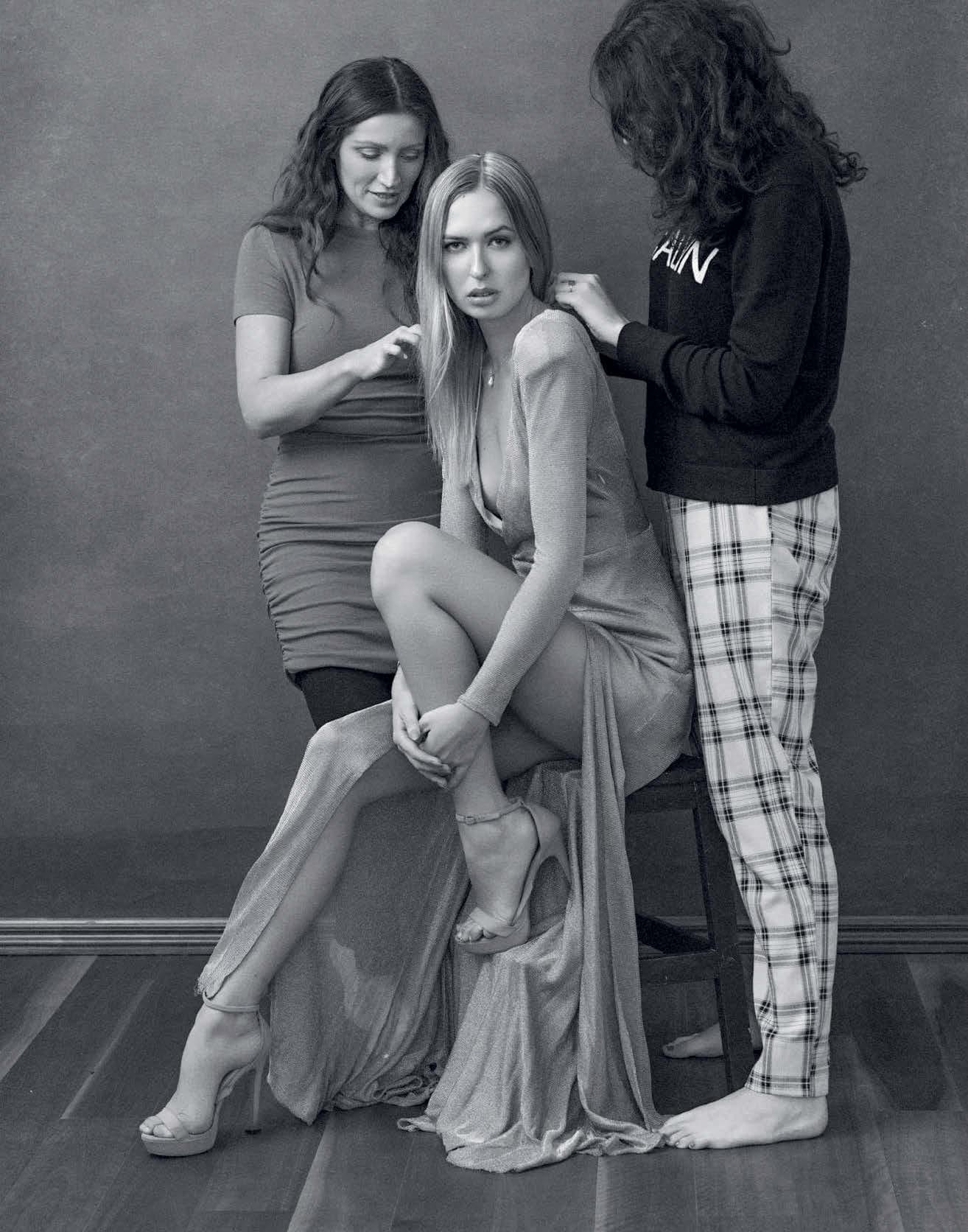
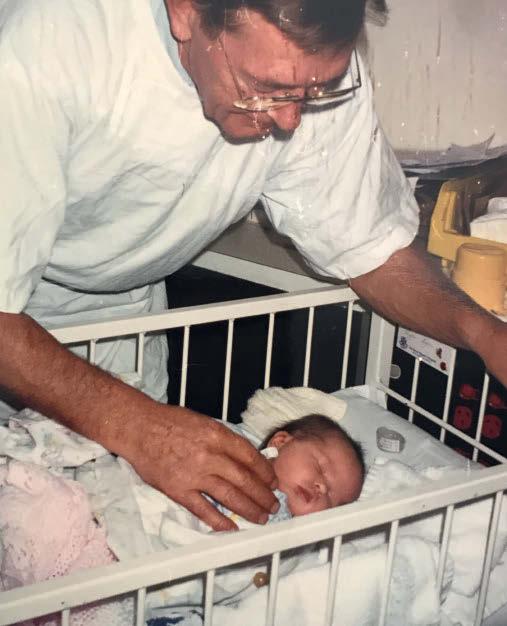
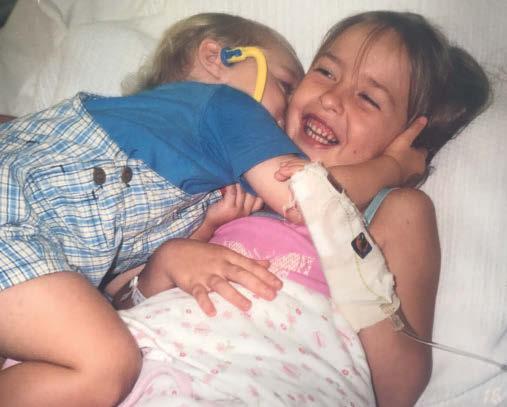
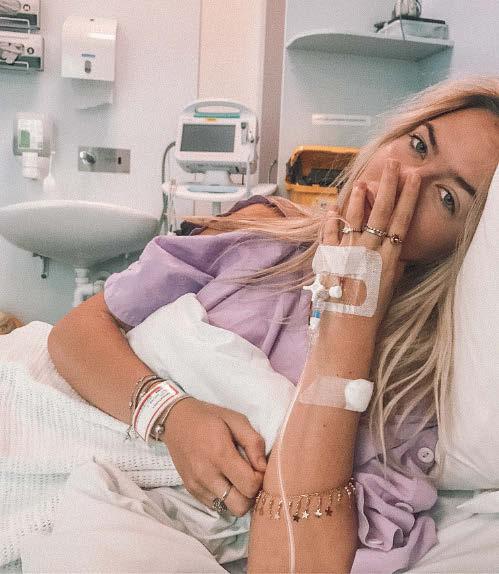
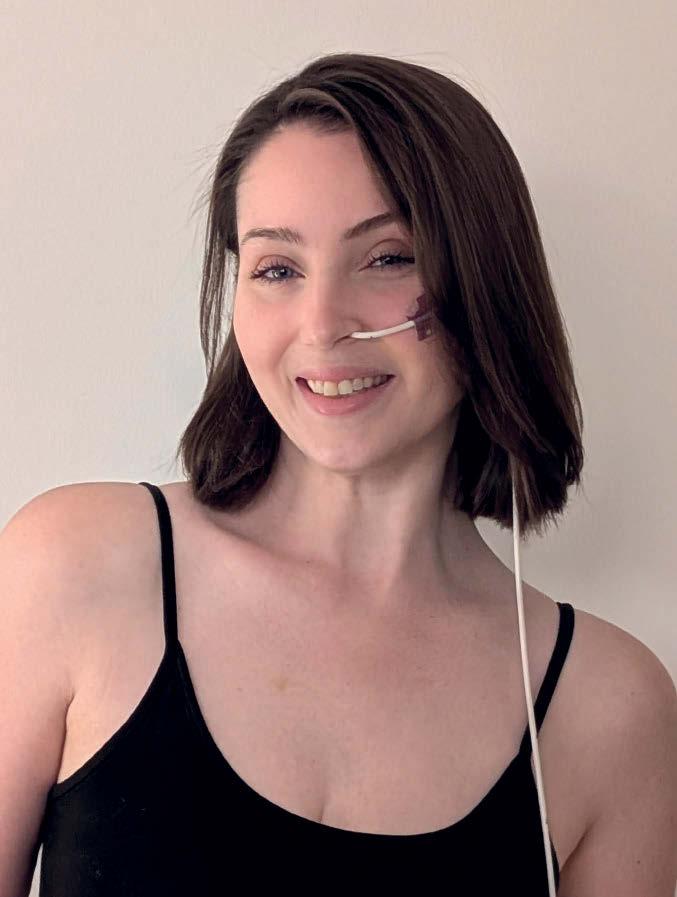
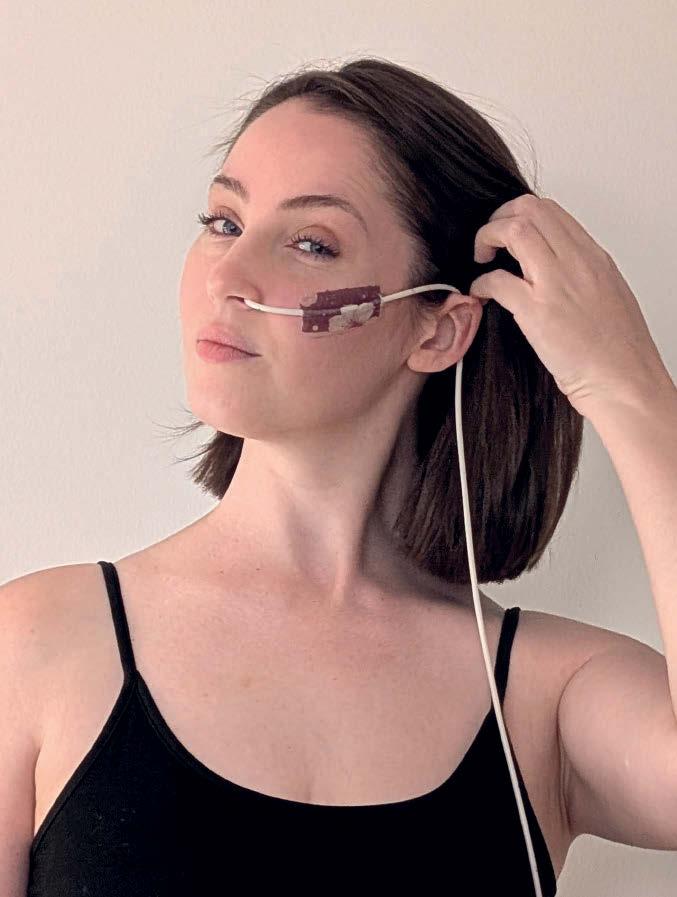
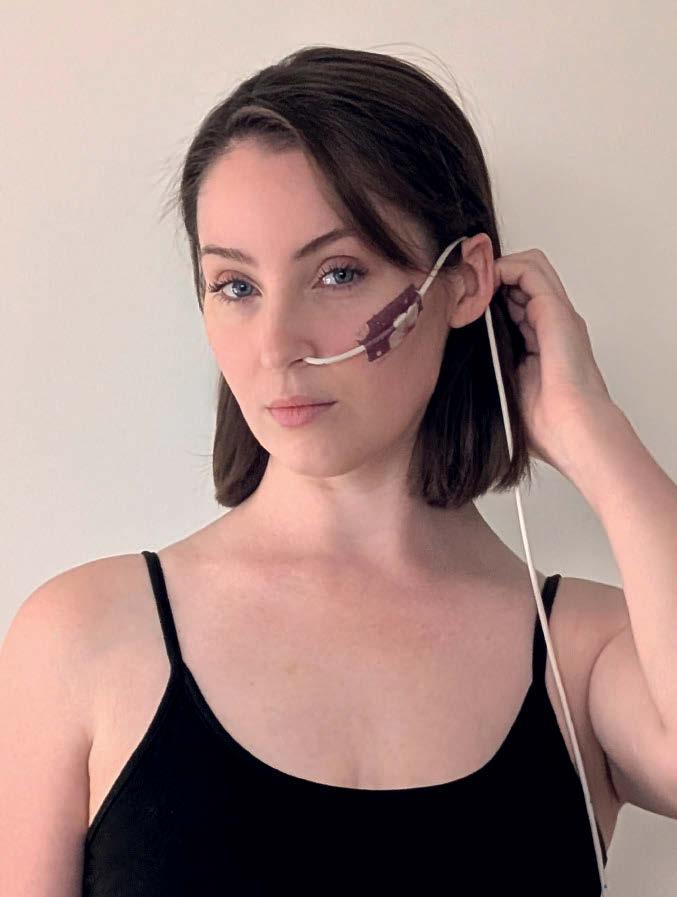
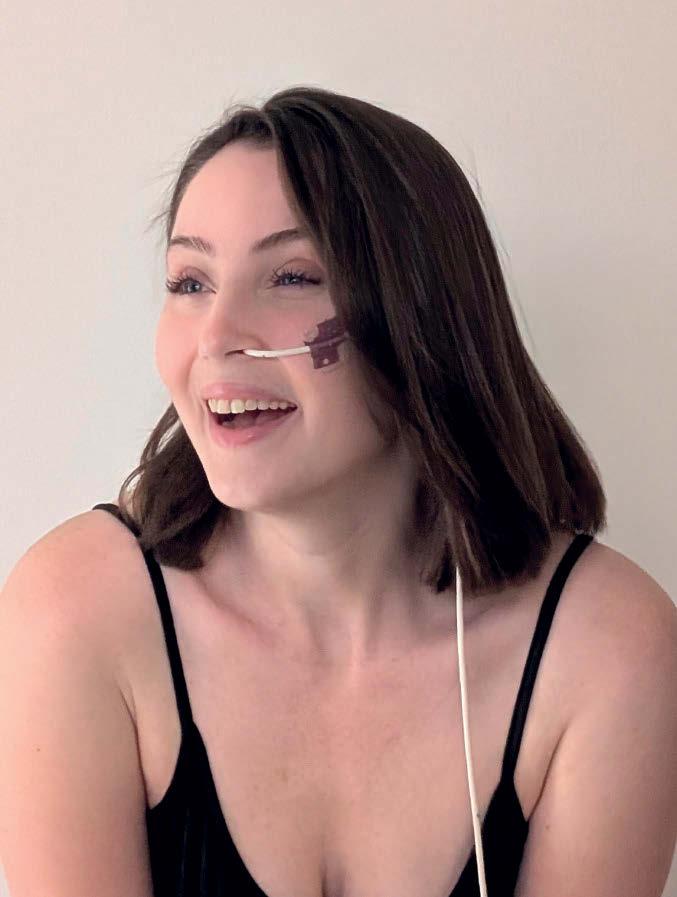
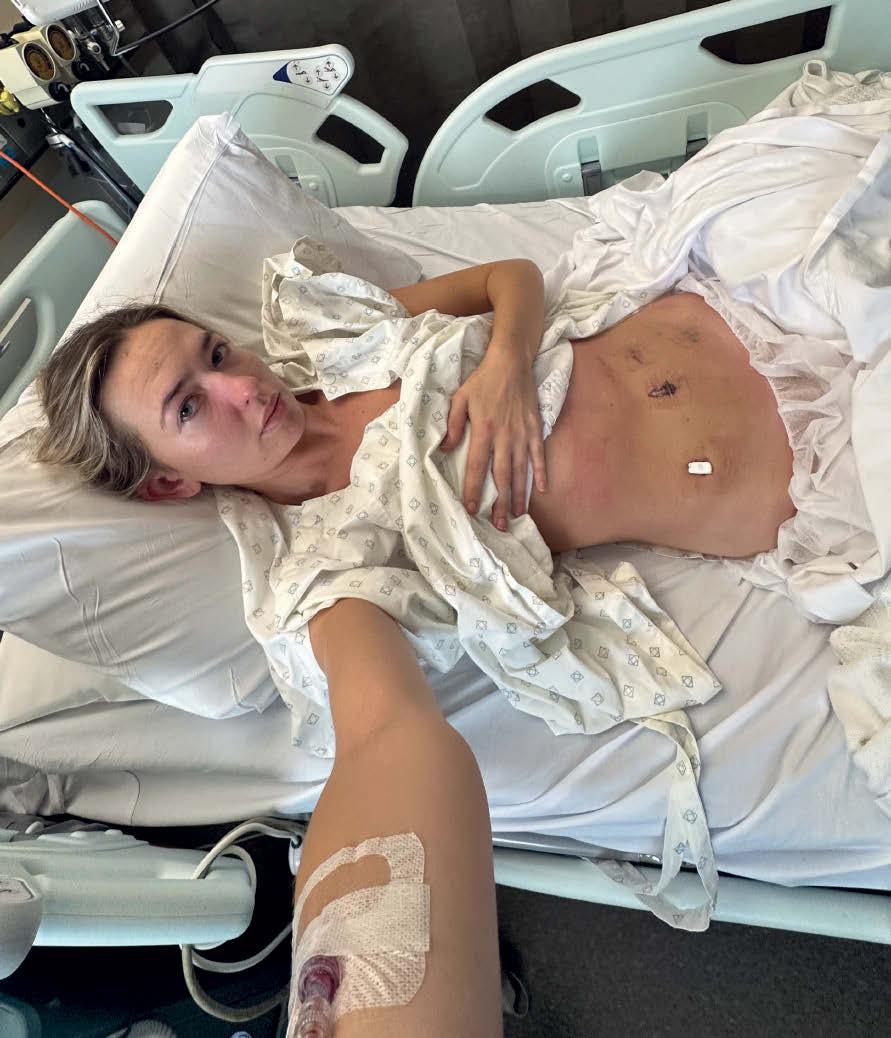
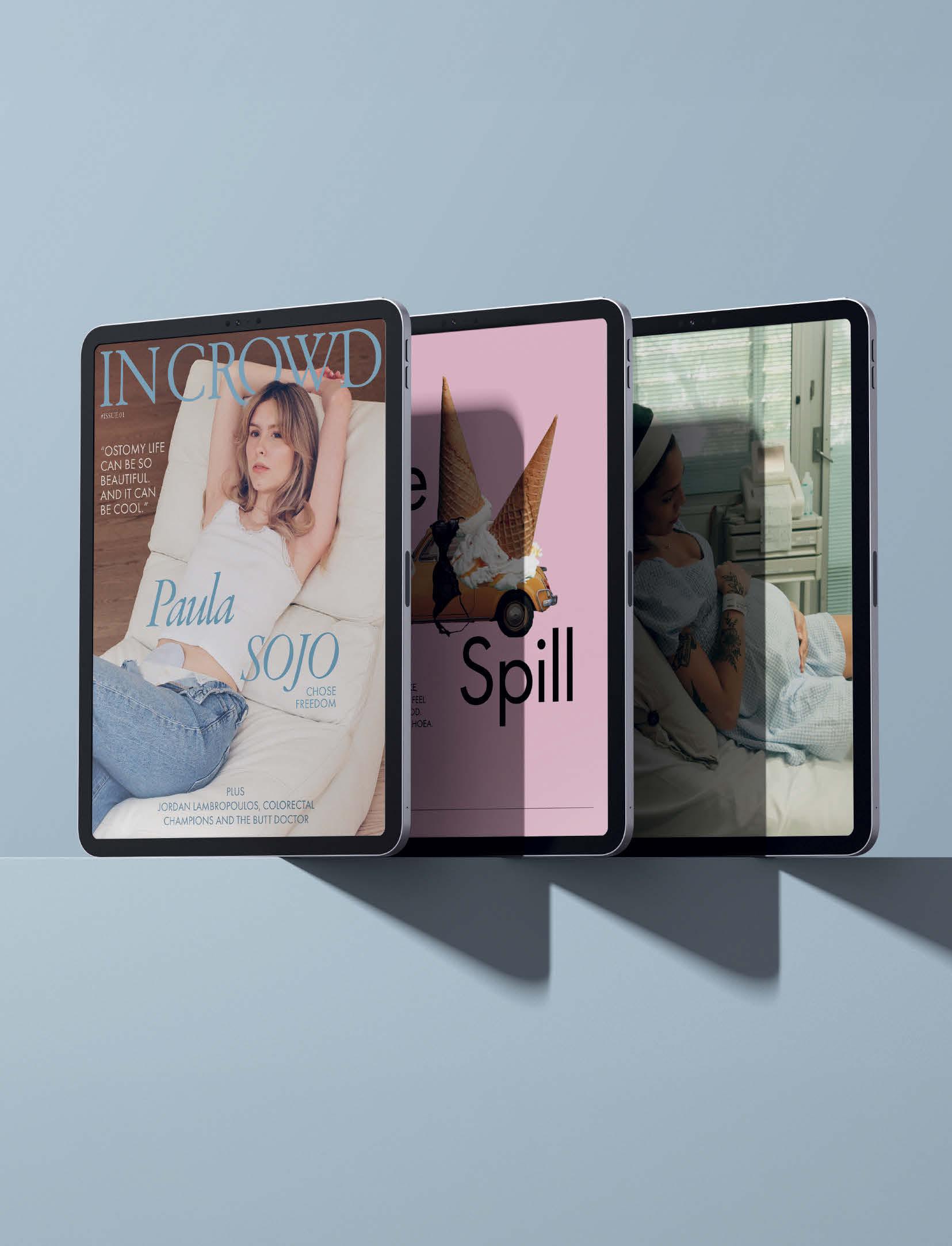
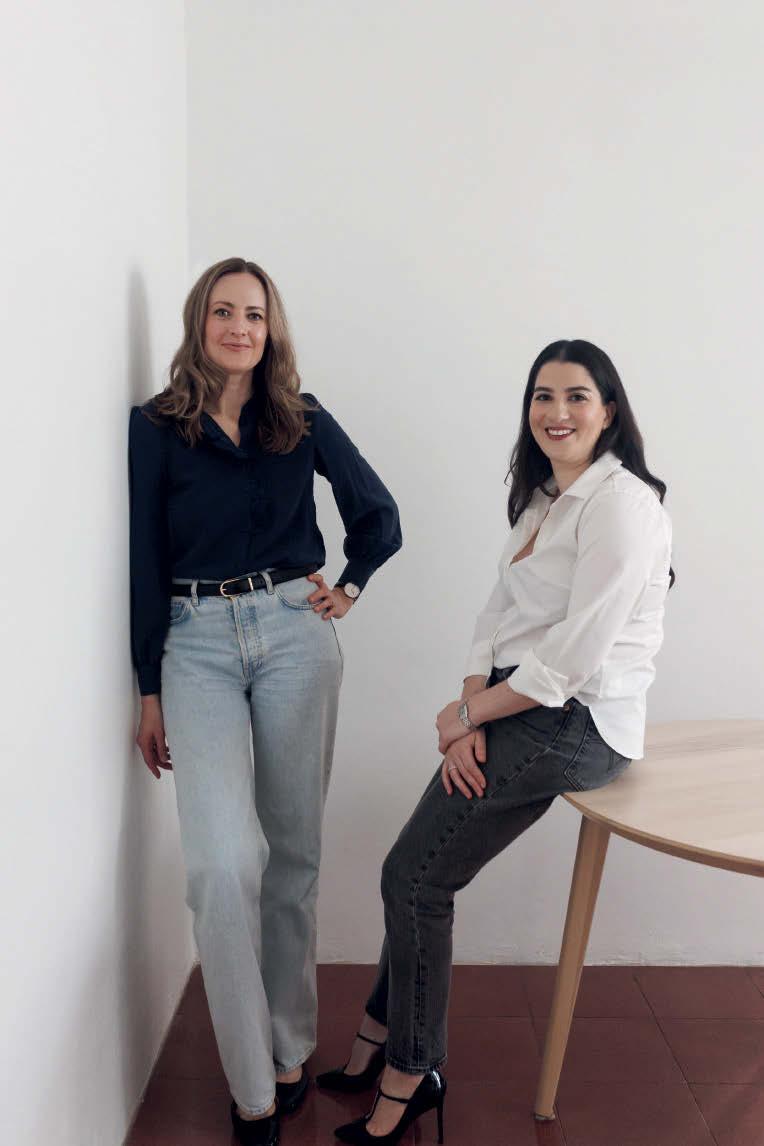
In Crowd editor Anja Christoffersen collects the most mortifying, most relatable accident stories from our community. 18
The Girl With No Booty Hole
For 15 years, Canadian model Sara Levitt made sure nobody saw her ostomy bag. Today, she’s flaunting it in the fashion world.
22 Let Them Stare
Celebrity photographer Angelea Yoder has spent a decade behind the lens. Her new project turns the camera on bodies with differences.
26 Against All Odds
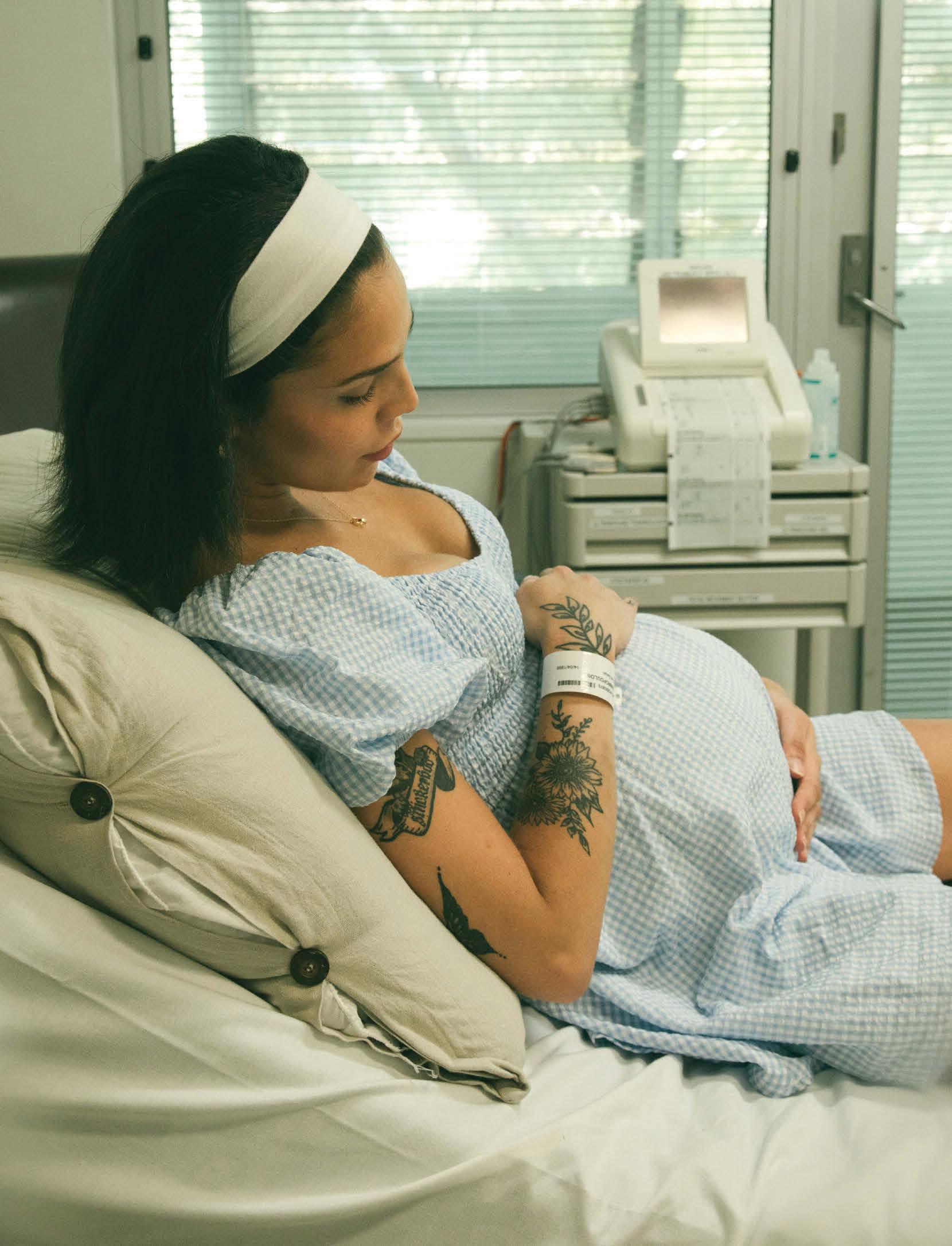
Jordan Lambropoulos chose survival over motherhood when she underwent a stem cell transplant for Crohn’s disease. The universe, it turned out, had other plans.
30 Warts And All
Former Olympian, mother of six, obstetrician-in-training. Dr Jana Pittman spent her early career outrunning the conversation around incontinence. Now she’s leading it.
34 The Pied Piper Of Parasports
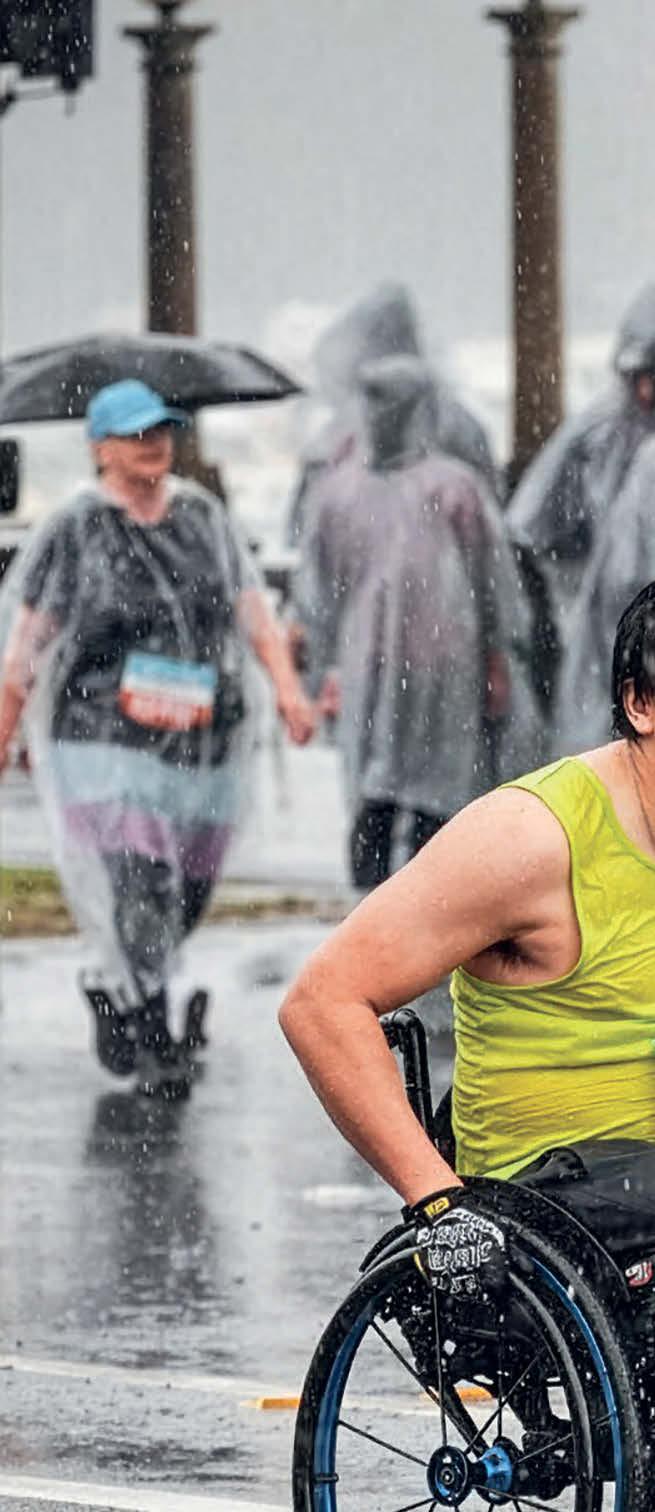
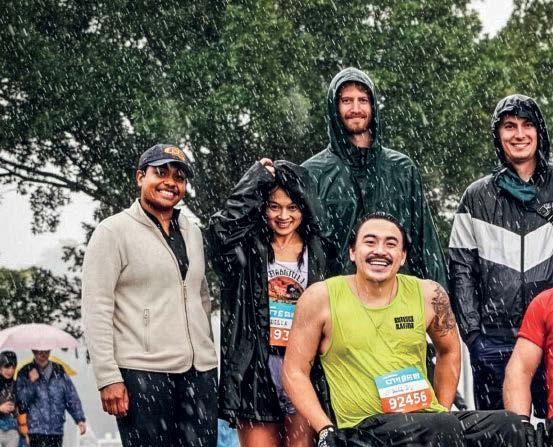
Within months of his spinal cord injury, Jolly Duong signed up for a race. Now he’s making sure nobody has to navigate parasport alone.
38 The Butt Doctor
Brisbane colorectal surgeon
Dr Bradley Morris has zero filter and one mission: to make bowel health less taboo. You asked. He answered.
42 Set Yourself Free
When Paula Sojo got her ostomy at 19, her mum told her she had two choices. She picked the bold one – and built a fashion brand to help others do the same.
48 What’s In My Bag
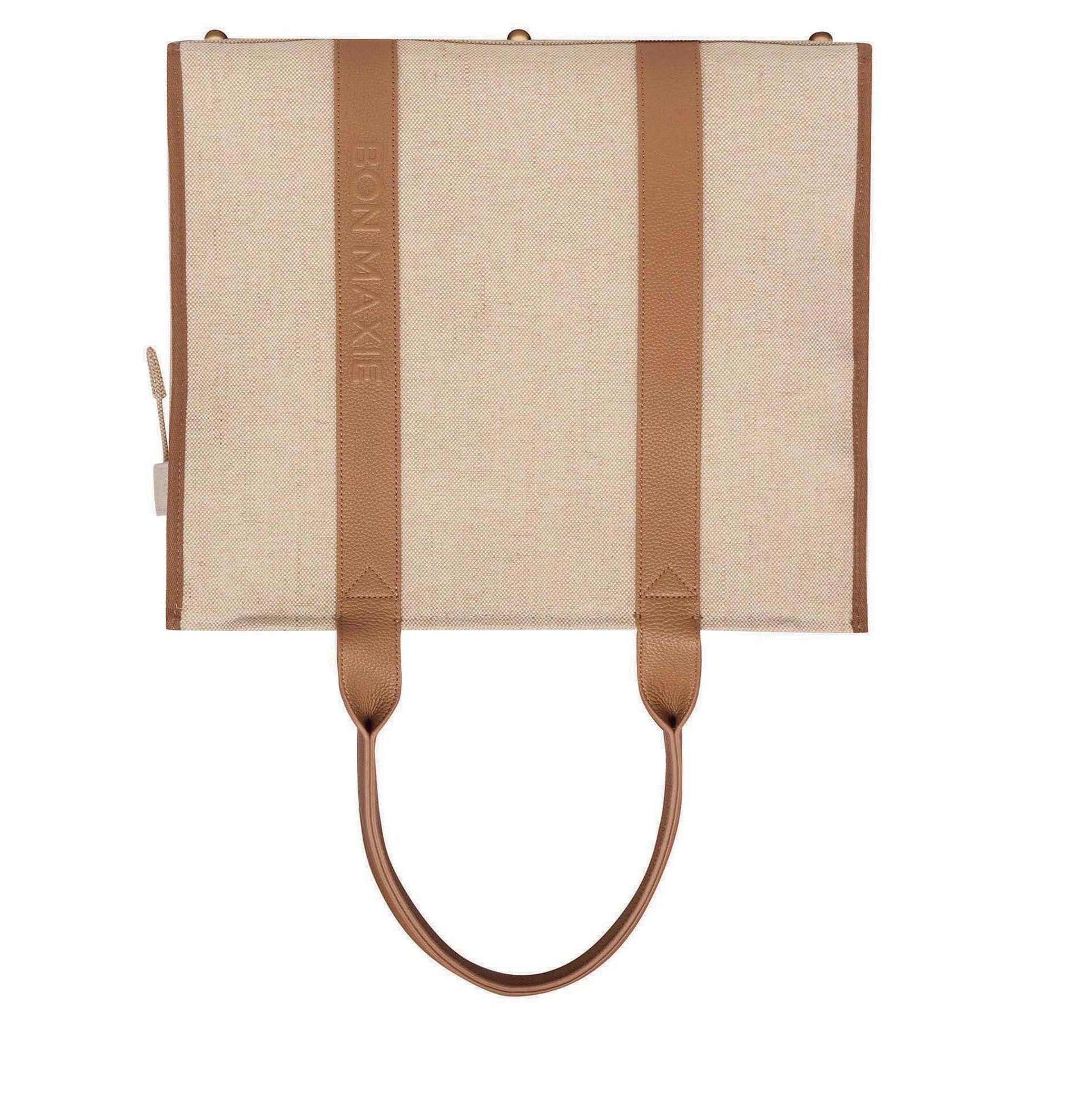
Spare undies, lip oil and a spill kit. Three women living with bladder and bowel leaks show us what they’re carrying.
EDITOR’S LETTER
Dear In Crowd,
You’re about to have your perspective irreversibly changed. Or at least I have, while putting our first issue together.
On these pages you’ll find stories of people and families living with bowel and bladder conditions – shedding light on an often unspoken, highly stigmatised reality. In Crowd doesn’t only unpack the medical side. It shares lessons on living to the fullest alongside uncertainty and adversity. It breaks down deeply held norms and beliefs.
This magazine isn’t actually about bladder and bowel health. It’s about something so much bigger: turning the cards we are dealt into a winning hand. Not feeling ashamed of what we can’t control. Finding our greater purpose. Building strength through vulnerability. Freedom. Community.
Our cover star, ostomy advocate and founder of Osto·me Fashion, Paula Sojo, realised hiding would not only mean shrinking her life, it would mean shrinking herself.
“I am so tired of just putting myself down when this is my truth, this is who I am,” Paula shared with me during our interview. “And I figured, if I’m going to show up, I’m going to show up authentically.”
That mindset shift ushered in her first viral TikTok, dancing with her new ostomy in hospital. Through this leap of faith, Paula found community and purpose – or perhaps they found her, once she was open to them. You’ll learn more in her story, ‘Set Yourself Free’, on page 42.
Like Paula, I too have found freedom and purpose through sharing my lived experience. And I’ve seen the power it has to change the trajectory of other people’s lives.
I see In Crowd – if you’ll forgive the analogy –as the pad the bowel and bladder community was missing. It might be your landing pad in hard times. Or your launching pad into a world of opportunity. Either way, it’s a reliable, staple item that can set us free. It has been that for me.
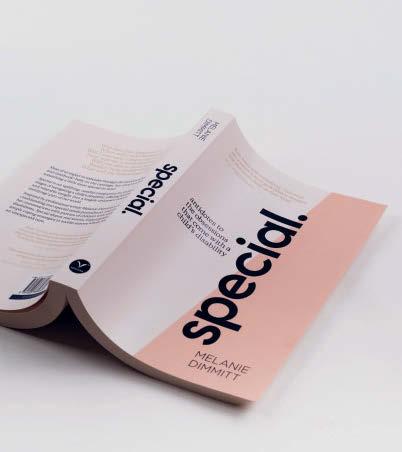
Less than a week before surgery to get my first ostomy in adulthood, I got a text from Melanie Dimmitt, publisher of The Blend, a magazine that revolutionised the tube-feeding space. She wanted to make another title – this time for the bowel and bladder community. And she asked me to be its editor.
As you’ll learn on page 22, from my friend and Nashville photographer, Angelea Yoder, sometimes you’ll get a text out of the blue and it’ll change everything. This was one of those moments for me.
A fortnight earlier, I’d exited a business I’d been building for almost three years to focus on my health and pay forward the gifts my lived experience has given me. Doing something with and for the bowel and bladder club, where my advocacy began, feels like coming back home.
Within days of Mel’s text, I was meeting with her and Luisa Gidaro, the duo behind Heart Out Media who’ve made In Crowd possible. I’ll forever be grateful to them because I’ve lived with the stigma of incontinence since I was born.
At 28 weeks of my mother’s pregnancy, they picked up significant abnormalities pointing to VACTERL-G (at the time known as VATER) Association. As a child, my parents told me I was born with a “plumbing problem”. At birth, there was no way to get food or water into, or out of, my body.
At five hours old, my food pipe and airpipe were reconstructed. A colostomy and vesicostomy were also created to drain my bowel and bladder. At seven months old, I had a full pelvic reconstruction to create the three ‘typical’ openings. In the following months, I had my two ostomies closed to function ‘normally’.
I had the basic infrastructure sorted. But the functional aspects stopped at the door. I lacked colon motility and had no anal sphincter, no muscle control, no nerve feeling, or rectum for storage.
At first I managed my bowels through a cocktail of laxatives and rectal enemas. Then I moved to transanal irrigation systems and, more recently, to an appendicostomy with a temporary chait tube. As I grew post-reconstruction, my urethral placement moved to be within my vaginal opening, causing recurrent UTIs and periods of intermittent self-catheterisation.
It’s been quite the journey – but the next generation doesn’t have to go through what I did.
On page 62 we hear from two determined mothers, Seija Keeble and Sarah McArthur, about building and saving the first multidisciplinary Centre for Pelvic Reconstruction Service in the southern hemisphere, designed for kids with bowel malformations like mine.
I grew up in a time that didn’t have much positive representation of scars and differences, let alone ostomies and medical devices. Like model and ostomate Sara Levitt, who you’ll meet on page 18, I decided to be what I couldn’t see. ->
The Girl With NoHoleBooty
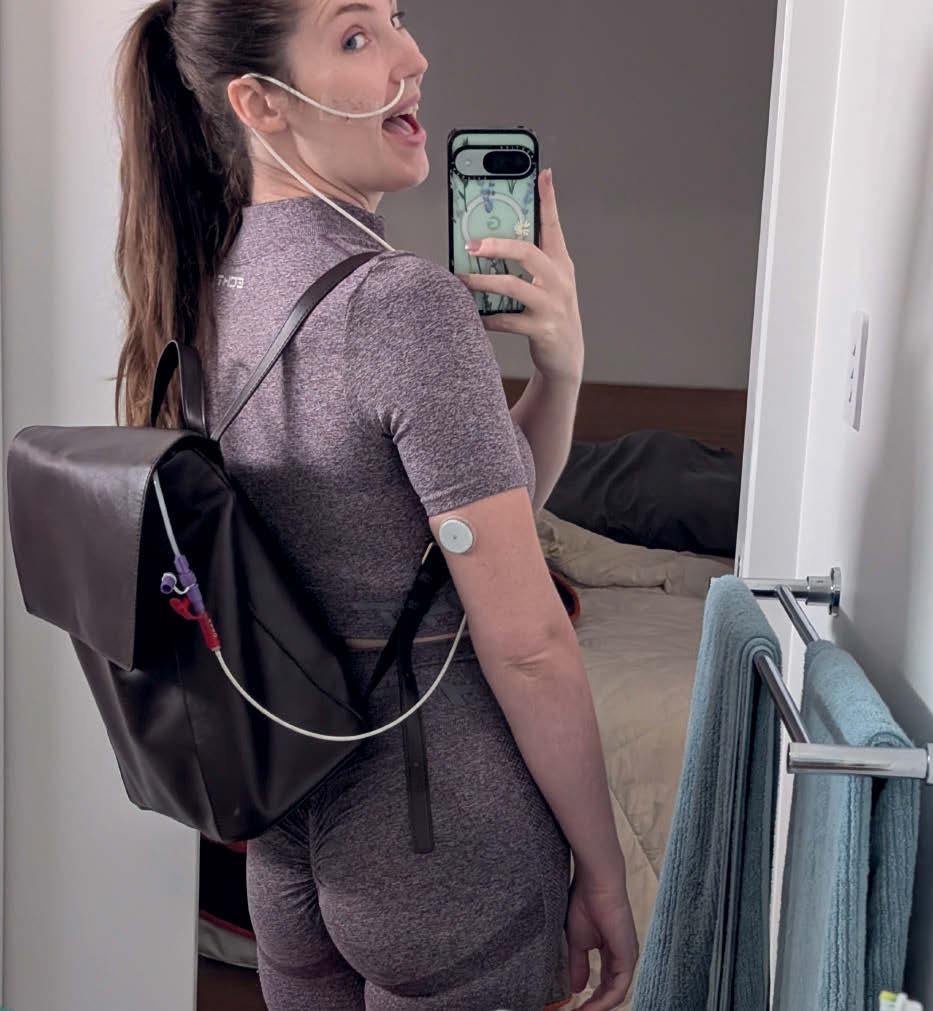
Sara Levitt spent 15 years making sure nobody saw her ostomy bag. These days, the celebrated model and social media influencer is known for sharing it with the world.
Interview: Anja Christoffersen
Words: Melanie Dimmitt
Inher teens and early 20s, when Sara Levitt got cosy with some new partners, she’d tell them point blank: “Don’t move my sweater. If you want this to happen, just leave it.”
Under that sweater was Sara’s ostomy bag. A small pouch on her abdomen that, through a surgically created stoma, has been collecting her bodily waste since she was 13.
“I kept my ostomy secret from the majority of the world besides my closest friends, my family and a select number of partners,” Sara tells In Crowd.
“Sometimes I would get intimate with one night stands or casual partners – completely
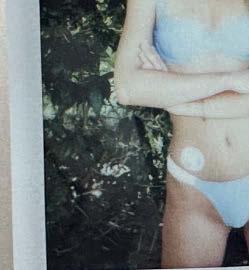
Sara and her ostomy bag – which she calls ‘Liv’ – have now walked international runways including New York Fashion and Miami Swim weeks. They’ve also starred in global fashion campaigns for a number of labels.
With her story featured across People and Time magazines, Sara has gone from hiding her life-saving device to sharing it with the world, often signing off her social media posts as “a girl with no booty hole”.
“Little me would never have imagined, when she was told ‘you’re gonna go poop in a bag on your stomach for the rest of your life’, what this would amount to,” she says. “I’m
“I was extremely sick,” says Sara. “I was on a cocktail of IV medication, doing tonnes of exams, ultrasounds, MRIs, CT scans and colonoscopies. I was significantly underweight, not able to eat by mouth and fed by nose tube. I was living with excruciating stomach pain and had zero quality of life.”
While suffering her physical symptoms, Sara also grappled with social stigma.
“Poop is a taboo topic – it shouldn’t be, we all do it – but it’s something we don’t traditionally talk about,” she says. “So already that was playing a massive role in who I was as a person. Like, oh my god, I don’t want to
That was the first photo shoot that I’d done where my bag was visible. I had no idea what I was doing.
concealing my ostomy and keeping a sweater on, holding my arm around my stomach and saying, ‘I’ve had surgery, I have scars’. And really just living in fear of what others would think of me.”
It wasn’t until she was almost 29, just a couple of years ago, that this Montreal-based model would reveal her whole self. And she did so in a big way.
In 2024, Sara became the first ostomate to grace the pages of Maxim Australia and, the following year, the first contestant to compete in Miss Universe Canada with her ostomy bag on display, strutting her way into the top 15.
grateful that I can be the voice, the hope and the image that little me needed years ago.”
Sara was three years old when she was diagnosed with ulcerative colitis – a chronic bowel disease that causes ulcers and inflammation in the lining of the large intestine.
For much of her childhood, her symptoms could be managed with medication. This changed in March 2006 when, at age 11, Sara was diagnosed with severe Crohn’s disease impacting her small and large intestine and her rectum. Two years of lengthy hospital admissions followed as her medical team scrambled to find the right treatment plan.
talk about this with any of my friends, but my entire life revolves around it.”
In May 2008, age 13, Sara had emergency colostomy surgery and her first ostomy bag was placed.
“It was the last thing I wanted,” she says. “Even after having just gone through the worst two years of my life, the ostomy felt way worse than that. Life with a bag of poop on my stomach, 24/7, seemed like the worst possible outcome ever.”
Entering her teens, Sara was faced with a list of unknowns. ->
“Like, who am I now? How am I gonna dress? How am I gonna tell friends? How am I going to go to school? What if it makes a sound? People are gonna think I’m gross, disgusting, that I smell. How am I gonna date? Like, my life is over – this is how I felt,” she says.
At this stage, Sara’s ostomy was only meant to be temporary. Her doctors had left her rectum intact for potential reconnection in the future.
“I held on to that for so long,” she says. “This played a massive role in me wanting to hide and conceal my ostomy from the world, because I was like, well, if I’m gonna have it for like six months, eight months – a year tops – I’ll be fine. I’ll be ‘normal’ again.”
A further four surgeries later, Sara transitioned from a colostomy to a permanent ileostomy.
“So I lost my colon,” she says. “And then, in my early 20s, I had proctectomy surgery –which is permanent and meant saying ‘rest in peace’ to my booty hole. It’s called ‘Barbie butt surgery’ for obvious reasons. No exit, no entry.”
By this point, Sara had hiding her ostomy down to an art. She’d cut nylon stockings into shorts to wear under her clothes and keep it tucked in. As she started wearing more figure-hugging clothes, she’d craft cardboard squares to place on top of her ostomy and hide its circular outline.
“I was like, nobody can know that I have this, this has to be undetectable,” Sara recalls. But once it became lifelong, things started to shift.
“Every challenging conversation I had with a new friend or a guy, trying a new outfit, slowly wearing bikinis, were all small steps to rediscover my self-love, rediscover my confidence and figure out, who is Sara with an ostomy?”
In 2019, Sara had visited Cuba with her family and, for the first time, wore a bikini in public. In 2023, she returned for a solo holiday. “And I felt very different,” she says.
“I felt really comfortable and confident in my own skin. And I had reached a point where I was physically and mentally drained of keeping it a secret.”
A few months later, on her 29th birthday, Sara’s public advocacy began with a social media post from a campaign she’d shot in Los Angeles with swimwear brand Farago the Label.
“That was the first photo shoot that I’d done where my bag was visible,” she says. “I had no idea what I was doing. Everybody around me was super supportive and engaged, but I was still a little bit shy and nervous – and very cautious about my bag staying flat.”
Sara’s next shoot was with Maxim Australia in Tulum, a coastal town on Mexico’s Caribbean coast. By then, she’d given her ostomy its name, ‘Liv’, which means ‘life’ in Swedish.
“After I had shared my story, I felt liberation and freedom,” says Sara. “I was on a rooftop in a hotel with the sun. I was shooting, I was moving and I felt like my full self because I’d finally embraced my ostomy. It was out there and I wasn’t scared. I was doing this because I wanted to show it.”
This experience pushed Sara to leave her corporate marketing career and pursue better representation of people like her in fashion and media.
“I wasn’t doing social media. I wasn’t modelling. This was all new to me,” she says. “But I thought, if I can do this, which other brands can I work with to create ostomy content, and fight for diversity and normalisation, and de-stigmatise this?”
Today, Sara’s portfolio makes ostomies look right at home in luxury fashions and dreamy destinations. But amid the beachside snaps and five-star service, she shares a steady stream of reality.
“Having poop drip down your leg – that is a part of ostomy life,” she laughs.
“Situations like that can pick away at your confidence, but you need to feel those feelings and you need to grow through it. Yes, you can live a completely normal, fulfilled life with lots of sparkles. But it’s a constant, adapting journey.”
Sara’s style has also evolved. One of the first brands she worked with was Peppermayo Australia. As she scrolled their collection, she caught herself thinking, ‘I can’t wear that’. But then she challenged herself, choosing a matching low-waisted jean and denim top set.
“I was looking at it and thinking, this is so flipping cute. I would never wear this, but I’m getting it and I’m gonna do it,” she says. “I wore it on a date with a guy that I was seeing at that time and we went to a sushi restaurant.”
And here is where the girl with no booty hole said goodbye to the girl in the sweatshirt.
“I remember walking to the restaurant being like, oh my god, everybody’s probably staring at me right now. But I felt in control. I felt empowered. I felt like I wasn’t hiding it – like it was just there. I’m showing up like I am, you see all of me – and this is it.”
Image credit: Donat Photography
“ It’s a constant, adapting journey. ”
LetThem Stare
Photographer Angelea Yoder has spent over a decade capturing celebrities and fashion models, with a client list featuring Reese Witherspoon, NASCAR, Sony Music and New York Fashion Week. Now, she’s stepping into the spotlight with a project that changes the way differences are perceived – as she tells In Crowd editor Anja Christoffersen.
Angelea and I first met in 2018 at a conference in Phoenix, Arizona, where we were both presenting. It was there that she introduced me to her then-fiancé, now-husband, Tim.
“Like all millennials, we met on an app,” Angelea told me, adding that in the early days of their online courtship, she’d sent him a photo that would “weed out someone real fast”. It was a picture of her back, showing her scars and disfigurement. As Tim remembers it, he didn’t see her differences – he simply saw her. Ang.
Now, global audiences are seeing her too.
Both Angelea and I were born with VACTERL-G, a collection of rare medical conditions that are individually complex and occur in approximately one in 10,000 to 40,000 births. A person is typically diagnosed when they have three or more linked physical differences affecting areas such as the spine, heart, kidneys, limbs and genitalia.
“My parents always pushed me to take part in activities and such, and so I never felt excluded in that way. But I was just so nervous that I was going to have an accident in class or something, because anxiety can trigger a response to need to go to the restroom.”
Angelea has navigated a lot of these challenges privately. It wasn’t until she and Tim got engaged that she revealed to him the extent of her bladder and bowel management.
“It was really perfect to represent the arts and the photography world by being a disabled artist.”
Angelea has vertebral (V) difference through congenital scoliosis. She also has anorectal (A) difference through anal atresia, renal (R) difference with a single kidney and gynaecological (G) difference with two uteri.
While the majority of these conditions aren’t visible, Angelea’s 4’7” (139cm) stature attracts stares and comments. But this doesn’t hinder Angelea’s lifestyle. Incontinence does.
Talking about her childhood, she reflects on the mental load that comes with not being in control of your bladder and bowel.
“You know, just not having the motility and muscles to hold urine or bowel [contents],” she tells me now, speaking from her home in Nashville (and yes, I do know).
“Something as vulnerable as an anorectal malformation, or not being able to hold urine… that is so different from disclosing that you have to wear glasses,” she says.
Angelea lives with neurogenic bladder which, for her, results in incontinence. In the fourth grade, she began learning to selfcatheterise for better control of when she emptied her bladder. Though tricky to manoeuvre, Angelea describes intermittent-catheterisation as providing her some freedom. But accidents remained commonplace until much more recently.
“I now get Botox injections in my bladder, which have absolutely changed my life,” she says. “I’ve had maybe one accident since having those injections – which I wish I’d found out about in school.”
Angelea’s anorectal reconstructive surgery and subsequent nerverelated issues left her with a combination of slow motility and incontinence. Seeking relief from an invasive rectal enema routine, she had a Malone [antegrade continence enema] created, which allows her to administer antegrade flushes from the top of her large intestine.
“The Malone just gave me a sense of independence and a way to relieve myself privately. I was in elementary school when I got it, as things started getting busier.” ->
When Angelea went to college, due to her incontinence challenges, she was unable to stay in any of the campus dorms. Instead, she lived in a nearby house with a roommate.
“[That roommate] didn’t know every detail, she just knew I would have to be in the bathroom for a couple of hours and she was completely understanding,” Angelea recalls. “That was probably the beginning of me realising that, oh, there are people out there who aren’t going to make fun of me for this.”
While at college, Angelea made the “really bad decision” to stop doing her Malone flushes.
“Because I was like, I’m going to be like everyone else. And I just don’t want to do it anymore. I want to start dating. I want to hang out with friends and go out and have fun. So I didn’t do it for a long time. And I ended up getting sick… lots of kidney infections, UTIs and obstructions. I learned the hard way that you’ve got to do this not-fun thing in order to have fun.”
Angelea took a film photography course as part of her PR major. She was appointed Editor-in-Chief of the college newspaper –a role that came with a new camera to take home for the summer.
“I started taking pictures of friends and family and just fell in love with it,” she recalls – and from there, pursued photography as a career. Moving from her hometown of Janesville, Wisconsin, to Nashville in 2014 was a major step in building her business. “The industry here is very small,” she says. “It seems bigger, but everyone here kind of knows each other once you’re in it.”
Angelea recalls how, at one point, a producer she’d met while shooting stills on music videos asked if she was free to work on a certain day.
“I actually didn’t know what it was for. And then I got the call sheet the day before and it said ‘Reese’. And I was like, oh my goodness, this is happening!”
Reese Witherspoon was, indeed, happening. Within 24 hours, the A-list actor and founder of Hello Sunshine was seated, smiling before Angelea’s camera.
“She was just an idol. Like, an iconic idol,” Angelea recalls, sharing that she was nervous
to photograph the star. “I think if you don’t get nervous, then it’s a bad thing. [Getting nervous] means you care about something.”
Another career highlight was shooting New York Fashion Week.
“It was for the ‘Runway of Dreams’, which is a runway show for individuals with disabilities, and to showcase adaptive fashion,” says Angelea. “It was really perfect to represent the arts and the photography world by being a disabled artist and actually photographing that show.”
Since then, while continuing to work in fashion and with actors and musicians, Angelea has been travelling across the United States, photographing a new range of talent for her own project, Let Them Stare.
“The title has been with me for maybe 10 years now,” she says. “I just loved that line, ‘let them stare’, because it’s kind of saying… yes, let them stare, because you know you’re beautiful on the inside and out.”
Let Them Stare began as a fashion show. Then, after catching up with her good friend and children’s book author, Laura, the idea evolved.
“We started talking about how we had not seen a children’s book with actual photographs in it. It’s always been illustrations or cartoon animations, and that’s when I was like, wow, if kids open up a book and see real photographs of children who look like them, that could be such a message and resilience tool.”
Angelea’s first children’s book, Look At Me, Look What I Can Do, will feature 30 children and adolescents with both visible and invisible differences. Each photo will be accompanied by the subject’s story of what they love doing beyond their differences.
“There’s so much more than what the doctors have told them or what they’re labelled as,” says Angelea. “Whether they have a really beautiful smile or a cute laugh or they like to be a brother or sister – I just wanted to capture that in a photo.”
Angelea is also currently shooting for a second title, Let Them Stare, featuring 100 teens and adults. One of them is 16-year-old Gage, who has striking facial differences.
book and I wrote it down,” says Angelea. “It’s: ‘People want to be heard, they want to be understood, and you can’t do that until you get past the surface’.”
2027, and the Let Them Stare project has already been celebrated with a feature on Angelea by
complete 180 on confidence,” she says. “Growing up, always getting stared at, having accidents, having to do enemas, there’s a sense of shame and secrecy – and just feeling like no one else in the world does this. Like, I’m gross, this is not fun.
“Going into the Good Morning America interview, when they sent me an email saying it was going to be published that day, I started having a panic attack, because I thought all those really negative things were going to come back.”
Angelea was happy to be wrong. The comments her segment received were filled with positivity, acceptance and kindness.
“And I was like, oh, so it’s actually okay. Sharing something like this isn’t bad. It’s not gross anymore. I went from a panic attack to, okay, this is really cool.”
With many eyes now on Let Them Stare, Angelea plans to publish both of her books annually, each time with new people, children and stories. Eventually, she also hopes to open a modelling agency that promotes wellness and personal development, furthering her mission to increase representation and change perceptions of differences and disabilities.
“My differences shaped who I am as a person and gave me the perspective that a lot of people don’t have in life,” she says. “Being different taught me to have compassion for other people. Everyone has a story inside, and they might be struggling but also thriving.”
“I went from a panic attack to, okay, this is really cool.”
Top to bottom: Angelea and her husband, Tim, Angelea age three
When did your Crohn’s symptoms begin –and what did they look like?
I had symptoms from birth. I was always just generally unwell, very fatigued, failure to thrive, anaemic, losing a lot of weight and not able to eat a whole lot without feeling overly full afterwards. I was diagnosed when I was nine because, by chance, I happened to have pneumonia and they did some bloods. They showed that I was really, really anaemic and my white cells were high. I had a colonoscopy and all sorts of other testing afterwards to diagnose it formally.
How has your Crohn’s been managed over time?
I tried all the medications and therapies available in Australia – steroids, exclusive enteral nutrition and seven or eight bio
logics [biological medical products] that failed. Including one that wasn’t available in Australia for Crohn’s that was given to me under special access.
Crohn’s disease. I had a lot of fistula tracts and was requiring surgery every 2-3 weeks to drain abscesses and change my seton drains in my fistula tracks.
For years, my doctor was exploring the possibility of a stem cell transplant as something to treat the underlying autoimmune disease and potentially put me in remission. It was very much a last resort – but it reached a point where I was unlikely to see my next birthday. We had to try something. My doctor wasn’t just going to let me die.
Before then, we’d never thought about an ostomy because my Crohn’s was everywhere. There was no part of my bowel that they could just disconnect and give it a rest,
pregnant – and very quickly had to make the decision between having a baby or having the surgery. By the time I found out I was actually having two babies, my mind was already made up.
The fact I was pregnant – with twins, no less – was an absolute miracle. I’d gone through IVF egg retrieval, but my AMH levels were diminished. There was a very good chance I may never get pregnant down the track again naturally.
So I chose to go ahead with the pregnancy. Little did I know this meant my stoma might not ever end up being reversed. Because who has the time for that, as a mum?
By age 22, I had three surgeries and had lost over a foot and a half of my small intestine. At age 23, the doctors looked at me and were like, ‘you know, we don’t really have any other options’. I’d had more bowel resections by this point and had lost quite a lot of my bowel. I was steroid dependent – and even high doses were no longer keeping my Crohn’s at bay.
Not once in my life had I ever actually been in remission. It was constantly trying different things to manage the disease but I formed scar tissue very quickly, so we would constantly be going in and doing surgeries to remove that. In early 2022 I started developing perianal
help others?
By the time I got my ostomy I had already started to gain a following on social media. I really enjoyed sharing my own story because when I was going through this, I couldn’t find a whole lot online from people my age who were also experiencing it. That’s where I started to realise that advocacy was kind of my thing.
You were preparing to have your ostomy reversed when you discovered you were pregnant...
Yes, I was 11 days away from getting my ostomy reversed when I found out I was
With the way that my life looks now, having it reversed is just not feasible because
my fistula tracts are still open and I would end up draining faeces through them. And that’s just not a life I want for myself at the moment. I don’t want to go from incontinence to then having a stoma, then back to incontinence.
How did Crohn’s influence the way you approached pregnancy and motherhood?
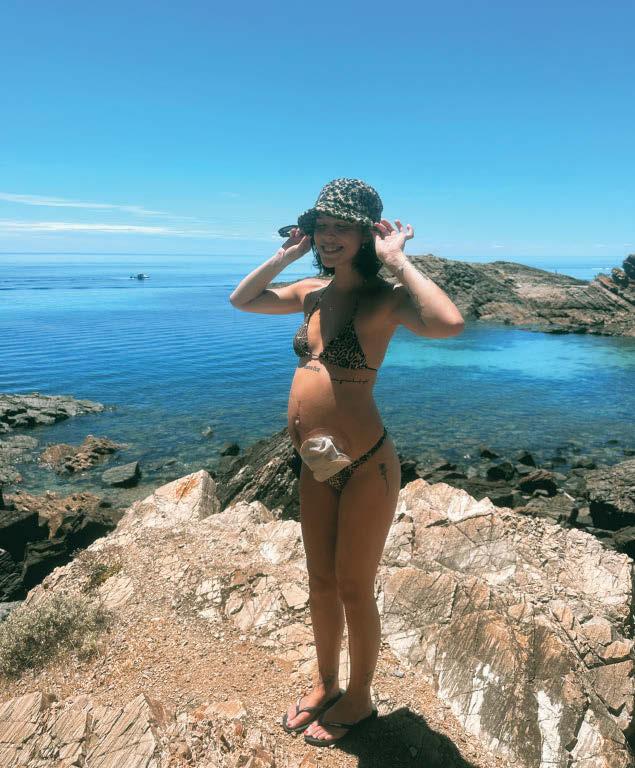
I was a bit upset, at first, because I thought I wasn’t going to have this stereotypically beautiful pregnant belly because I had a stoma. In the end, I just had to learn to embrace that my pregnant belly was going to look very different from other people’s pregnant bellies. As long as I was safely and healthily growing my babies, that was all that mattered.
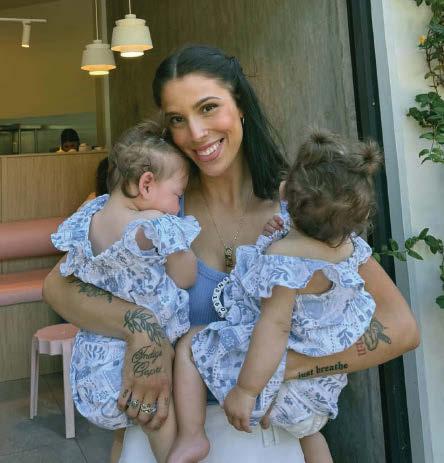
In terms of my motherhood experience, it’s a bit of a challenge when you’ve got two babies and a colostomy bag that’s bursting on the regular because you don’t get time to change it. You can’t exactly sit on the toilet holding a baby. You have to get down on the floor and change your bag properly – and it’s not something you can do while multitasking. I need to give my full attention to my stoma at times, which can be really challenging when you’ve got two babies on your own.
How did your ostomy change throughout pregnancy?
The stoma grew with my belly. It got to a point where it was very swollen and always bleeding from increased blood supply during pregnancy. It became really challenging to find products that suited my body because it was constantly changing. I also found it hard to get bags to stick to my pregnant belly.
Did your medical team have to modify your pregnancy care because of your ostomy?
Yes. Originally the plan was for me to have a caesarean because I have perianal disease and a vaginal birth could lead to tearing and to issues with that. But the caesarean option did mean we had to think carefully about the incision and what the surgery was going to look like.
My colorectal surgeon was meant to be there on the day, however, I ended up having an emergency C-section and that wasn’t possible. There were over 25 people in the room because we had the general surgeons in there ready to operate on my bowel if need be. There were no actual complications with the C-section itself. Everything went swimmingly.
You’ve described 2025 as one of the hardest but most rewarding years. How has motherhood reshaped your life?
The focus is no longer on me and my health. I have to give that focus to my daughters, so I find I have a lot less time to spend taking care of myself. I also have a lot less time to take care of my ostomy,
so there are moments where we have malfunctions – my stoma bursts or I don’t get time to change my bag in time and it leaks everywhere. I’ve definitely run into more issues with my stoma!
Motherhood has also made me reflect a lot on my own childhood, growing up in a hospital with a chronic illness. Those experiences have helped me be a really good advocate for my children because I was already so used to being my own advocate over all these years.
“
Just because something needs to be carried doesn’t make it a burden.
”
But yes, it was the most rewarding year of my life. I got to meet my two little best friends. And honestly, if you’d asked me twoand-a-half years ago, I wouldn’t have thought this was ever possible. I am living my dream. Are there specific routines or adjustments you’ve put in place to make caring for your children easier, while also caring for yourself?
Honestly, I can’t really say that there’s been any specific routines or adjustments because I’m just ‘go, go, go’ 24/7. There are no breaks in between because my daughters have disabilities themselves. So that has been a challenge.
For the first 14 months I did everything alone. As the girls have gotten older and their disabilities have evolved, we’ve found in-home supports that allow me to take care of myself as well, because I did run myself down to the point of burnout. Your advocacy has likely shifted over time. What conversations matter most to you now?
Disability advocacy, accessibility and, I guess, conversations surrounding how we speak about people with disabilities. And that comes from not only my own experience, but my daughters’ experiences as well.
When you tell people “I’ve got a stoma” or “my child has cerebral palsy”, they tend to say, “oh, I’m so sorry”. And it’s like, as people, we are born exactly who we’re meant to be. We can’t change those things. And wishing that things were any different would be wishing that we were different. Saying “I’m sorry” is like saying we’re not enough – and we are absolutely enough.
I also take issue with disabilities and differences being spoken about as ‘burdens’. I don’t see my stoma as a burden. I don’t see my disability as a burden. Just because something needs to be carried doesn’t make it a burden.
What does the next chapter look like for you, Indigo and Capri?
I am a full-time carer to my daughters but now that I have a little bit more support, I’m hoping to branch out and start to get a little bit of Jordy back.
I’m looking forward to returning to some of the things that made me ‘me’ before I was a mum. Potentially going back to study –and I’d like to start a business at some point. I don’t know what, when, or how, but it’s something I’d like to do. I really just want to be able to set my children up as best as I possibly can for success in the future.
All Warts
From elite sport to the delivery room, Dr Jana Pittman is leading a new conversation around incontinence. The Olympian, women’s health doctor and mother of six speaks with Melanie Dimmitt.
DrJana Pittman won a lot of races while losing control of her bladder. Even as a very young athlete, the two-time world champion hurdler and Olympic athlete would experience a little leakage during her final push to the finish line. But she didn’t mention this to anyone because, as she says, it was embarrassing.
“And I just assumed that was normal because I was working really hard and trying really hard – and I certainly wasn’t going to lose a race,” she tells In Crowd.
Today, as her honorific hints, Jana is midway through completing her specialist training in obstetrics and gynaecology. Not long before this interview, she conducted five births in a single night shift. She speaks with every woman she supports in the delivery room about the possibility of incontinence because, now, she doesn’t shy from the topic. Professionally, or personally.
In 2006, 23-year-old Jana had married her coach – British hurdler Chris Rawlinson – and was pregnant with her first child. The morning before she gave birth to her son, Cornelius, she’d smashed out a 20-minute 10km run. Three days later, she was climbing up and down the hospital stairs. Three months later, she was back to elite training and competitions. At which point, there was nothing little about that leakage.
incontinence, Jana was also sustaining significant lower-limb injuries.
“I met this amazing physio up in Queensland who said, ‘look, I actually think it’s to do with your pelvic floor’, ” says Jana. “They said, ‘I think you’ve got a levator injury [a tear where the pelvic floor muscles detach from the pubic bone] and the imbalance in your system is creating your injuries’. And she was definitely right.”
The way this physiotherapist spoke with Jana would shape how she would later support her own patients. There was no beating around the bush. She asked Jana, plainly, do you ever wet yourself? How much bladder leakage do you have? Is it every day?
&“I don’t think a doctor had ever asked, ‘do you have any problems with incontinence?’,” says Jana. “Not once had anyone ever thought of joining the dots of, okay, you’ve got multiple hamstring injuries, it’s not just a piriformis injury, it’s not nerve entrapment. There could be an instability in your vagina and in your pelvic floor muscles –even from before you had babies.
“After having my first child, it became almost my whole bladder,” says Jana. “I would lose control around 80m to go before the end of the race and I remember thinking, this is not normal.”
In an effort to hide what was happening, at training and in competition, Jana made a habit of drenching herself from the waist down with her water bottle.
“You can’t wear a pad when your outfit is the size of a bikini – and it’s not like your period, which you can use a tampon for,” she says. “There’s no actual way to disguise the bulk of something in there to support the volume of urine that’s coming out. It just trickles down, so I’d spray myself so it just looked like water.”
Jana tried to bring the issue up with her sports doctor at the time, who put it down to her being postpartum. A couple of years later, still experiencing frequent
“We see women all the time now with really tight pelvic floors and vaginismus and problems with intercourse and things like that, where we are joining those dots and thinking, okay there’s something wrong with the way that the pelvic floor is functioning. But it just wasn’t a conversation back then.”
That physiotherapist appointment marked a new chapter for Jana. “Over the next 15 years, it became a passion of mine to be vocal about incontinence –but also try and seek solutions.”
Jana began studying medicine while also training for the two-person bobsleigh event at the 2014 ->
Sochi Winter Olympic Games. After becoming the first Australian woman to compete in both the Summer and Winter Olympics, she retired from professional sport.
Jana and Chris had also divorced and, after being treated for cervical intraepithelial neoplasia grade 3 (CIN 3) – a pre-cancerous cervical condition with severely abnormal cells – she faced uncertainty around her fertility future and wanted to grow her family. She welcomed her daughters Emily and Jemima, in 2015 and 2016, as a single mother through IVF with an anonymous sperm donor.
In 2020, Jana married her now ex-husband, Paul Gatward, and the pair added three more children to her brood – a son, Charlie, and boy-girl twins Quinlan and Willow. It was right in between these arrivals, not long after Charlie was born, that Jana competed in the second season of SAS Australia, a reality series that puts high-profile Aussies through a military-grade Special Forces selection course.
“I remember going on to the show worrying about it – actually thinking, do I even do this show? Because there’s going to be stuff that’s going to push me and I’m going to pee myself,” says Jana.
“I knew that they gave you one pair of pants and three pairs of underpants – and that’s all you had for the whole show. So I knew what might happen and I thought, if it was gonna be really obvious, then it would be something that I’d be comfortable sharing in the hope that it would do exactly what it did, which was open a conversation for women.”
While on-set, after completing a gruelling combination of a 5km run, hundreds of burpees and a whole lot of “throwing tyres around”, Jana whispered audibly to a fellow contestant: “I just pissed myself on that run.”
“I knew they would air it,” she says now. “I was probably, for the last kilometre of that run, just constantly leaking, but I wasn’t going to stop. I think a lot of people would go okay, I’m going to pee myself, I’m going to slow down. But I was like, no, I want to win this thing. So it’s just gonna be part of this chapter.”
A flurry of media coverage followed Jana’s revelation on national television – all of which she took as an opportunity to share about her personal challenges with incontinence and the importance of healing and restoring your pelvic floor after giving birth.
This was a highly publicised example of Jana’s advocacy – but it wasn’t the first time she’d shared honestly about wetting herself in front of an audience. Before Australia, she was giving a speech at an event in Melbourne, talking about how she won the 400m hurdling World Championship title only eight months after having a baby.
“For a long time I used that as an inspiring story without actually realising that, yes it’s inspiring, but it also made a lot of women feel like they weren’t doing enough,” she says.
“Something in that room made me recognise that you need to tell both sides of the story. And so I think I just sort of casually said, ‘but guys, it wasn’t all smooth sailing. I literally lost control of my entire bladder as I finished the race’. The whole room laughed and you could see it relaxed. And I thought, oh, that’s interesting.”
After her speech, several women ap proached Jana with tears in their eyes, thanking her for sharing the full picture of her victory.
“One of them said, ‘I’m just so grateful to you for saying that because I remember watching you run that race and I was sitting there, watching from home, thinking how inadequate I felt that I wasn’t even back in the gym yet after having my first baby’,” Jana recalls.
“I sat there realising that my whole life has always been about inspiring and making women feel better about themselves and pushing them to step outside their comfort zone. And inadvertently, I was almost doing the opposite.
“That was a pivotal moment because I decided, from that point onwards, every single wart I have in women’s health, I will share.”
Jana’s truth continues to resonate. Around one in three women experience urinary incontinence after childbirth, often due to weakened pelvic floor muscles.
“Now I’m training to be a gynaecologist, so I work with women every day going through the same thing,” says Jana. “There are lots of causes. Some people are just prone to it – and if you’re a young woman, asking your mum, ‘do you have incontinence?’ is a big thing because it’s very genetics-dependent.”
“I think I just sort of casually said, ‘but guys, it wasn’t all smooth sailing. I literally lost control of my entire bladder as I finished the race’. The whole room laughed and you could see it relaxed.”
Rapid-fire round with Dr Jana Pittman
What should women know about incontinence?
“They are not alone – this is a very common condition. It’s also one that we can make enormous inroads into changing, but it takes work. A lot of women come in and say, ‘I’d like an operation to have it fixed. But there is no silver bullet.”
Is it ever too late to improve your pelvic floor?
“No. I’ve just started teaching my mum and she’s approaching 80 and she has had reduced symptoms. So there’s definitely a space for that.”
What’s your message for women rushing back to exercise after birth?
“You could do a lot of damage in those first few weeks if you don’t retrain your chassis [supporting structure of the vagina]. Take a good 10-12 weeks to do it really slowly, really re-engage that pelvic floor.”
How often should we be doing Kegels?
“Five times a week. Have a cue – for me, it’s traffic lights. If you pull up to a traffic light, just do a pelvic floor exercise. But it has to be the right ones. A lot of people aren’t doing them particularly well. It’s a very light contraction.”
Are there medications that can help?
“Some people have what’s called an overactive bladder – the bladder just tells them it’s constantly needing to pee. We have things that can help that. If your GP isn’t sure, get a referral to a women’s GP or a gynaecologist to have a conversation around what medical options can sometimes help with incontinence.”
his stairs and as he transferred into his car, his bowels suddenly opened with ferocious urgency.
“It was everywhere – in every single nook and cranny of that driver’s seat,” he recalls. “And that was the lesson that I learned – you can’t rush it. You just need to take your time. You need to plan accordingly.”
Today, Jolly laughs as he shares that a biohazard team needed to clean out and disinfect his car. But at the time, he was crushed.
“I felt like crap. I felt defeated. I cried in the shower,” he says.
“There are all these basic functions that you thought you would never need to relearn, but you’re in a position where you actually have to relearn everything from scratch.”
Two years on from his bike accident, Jolly has developed an ability to, as he says, “micro-grieve” what he has lost.
“Instead of doing the full chunk all in one go, it’s grieving the small part as it arises,” he explains, unpacking a concept he’s explored with his therapist.
“There are still things where I’m like, ‘oh shit, I used to be able to do x, y, z’. Well, I can’t really do that anymore. Feel sad in that moment, go through the feeling, just sit with it. And then be able to let go and say, you know what? Yeah, I can’t do that anymore, but there are other things that I can do.”
Jolly attributes his resilience and persistence to an athletic mindset. Before his injury, he snowboarded in winter, cycled with friends and completed an Olympicdistance triathlon after only three months of training. This mammoth feat of endurance taught him that “mental resilience can far exceed your physical limitations”.
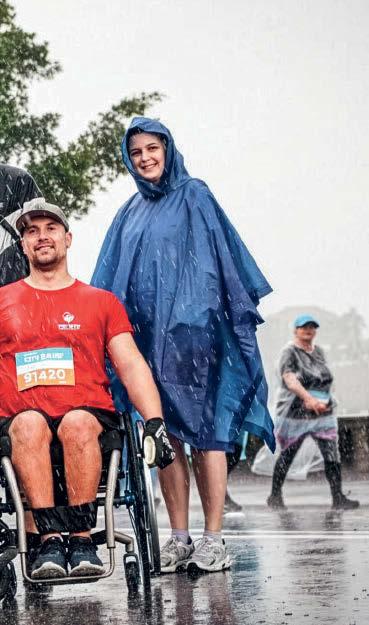
A month after his accident, Jolly signed up to Sydney’s City to Surf – a 14km running event – with just four months to train as a new wheelchair user.
He completed it in three hours, despite being diagnosed with bilateral carpal tunnel a week before the race, due to the increased training load.
“But you know what, carpal tunnel, for most spinal cord injury people, it’s just one of those Pokemon that you’ve got to collect… I just caught it earlier.”
Jolly crossed the City to Surf finish line with a renewed sense of purpose.
“Being with friends and being in a community that prioritises wellbeing, or selfimprovement, is the space that I really felt I resonated with,” he says.
This is why Jolly created Second Chance Support Services, an organisation helping people with disabilities build confidence and connections through sports like archery, powerlifting and personal training.
“ ANYONE THAT WANTS TO PARTICIPATE IN A SPECIFIC SPORT, THEY REACH OUT, I’LL FIND AND DEVELOP THE PATHWAY.
”
“Adaptive sports and parasports were really hard to navigate. So I decided, you know what, if it was this hard for me – and I’m a resilient person – it would be so much harder for a person that, if you get told ‘no’ a few times, you give up,” says Jolly.
“The whole premise of Second Chance is to give everyone a second chance. Anyone that wants to participate in a specific sport, they reach out, I’ll find and develop the pathway.”
Nicknamed the ‘Pied Piper’ in parasport circles for his community building, Jolly connects people with support workers specifically trained in how to help them play their sport of choice.
“[And] when you’re getting that assistance, you’re getting assistance for engagement, not just for observation,” he says. “Because it’s
no fun watching someone shoot an arrow. It’s much more fun shooting the arrow.”
Jolly’s own interests lie in a diverse range of parasports. He has trained in track and arm-cycling, with a current, elite-level focus on para-archery, powerlifting and swimming, which he says, chuckling, “I had no business doing pre-injury. That’s me chasing that new experience”.
Jolly describes his former self as much like any other 30-year-old corporate professional. Outside of working hours, he volunteered time to things he cared about. But this couldn’t be his main gig.
“You don’t get to live out your full values – what brings you passion and fills your cup up – all the time. And I didn’t realise this was where I was going to land, but I’m certainly happy that I did,” he says.
“I’ve always been a chaser of new experiences. I’ve been a chaser of community and creating that unity. And I get to live to that standard for myself now.”
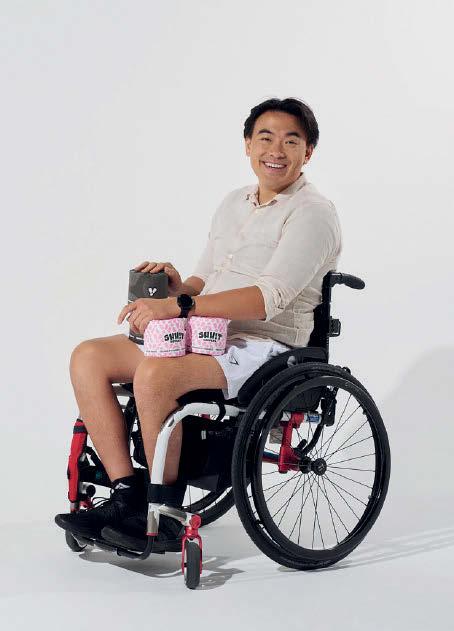
Jolly for social enterprise Shh!t Happens
A better way to order your Coloplast products
At Coloplast, we know managing your continence needs is personal and can distract you from living your life to the fullest. That’s why we challenge ourselves to set new expectations on what better could look like – making millions of lives easier by doing so and supporting you to live your life to the fullest.
And now we’ve applied that thinking to take the personal care we deliver to a whole new level. You’ll get friendly and fast service, free express shipping, free clinical support, and easy product alternatives when needed.
SET YOUR- FREE
To a 15-year-old Paula Sojo, getting an ostomy was a fate worse than death. Eight years later she’s been featured as an ostomate in Teen Vogue and co-founded Osto • me Fashion, a Canadian brand transforming ostomies into fashionable, functional accessories worn with pride.
SELF
Words: Anja Christoffersen Images: Paula Sojo
Paula Sojo’s first encounter with the word ‘ostomy’ came at age 15, when her high school boyfriend mentioned his cousin had one. “I literally said, ‘I would rather die’,” she recalls.
In the years that followed, Paula – now based in Ontario – was loving life as a college student and had kicked off her dream career, working with small brands as a food photographer. Then, at 18, she was diagnosed with the chronic inflammatory bowel condition, Crohn’s disease.
“Everything was going so well and then, unfortunately, I got sick and I was forced to put my life on pause,” she says. “Things were just so severe that I had to receive the diagnosis in order to get the life-saving care that I needed.”
In and out of hospital for two years, Paula had seven surgeries to address perianal Crohn’s, where the disease attacks the anus area and forms fistulas – tunnels leading out of the rectum canal and into the vagina.
“I was getting infections because I would pass stool through my bum and it would hit a certain tunnel and go into a pocket that was created,” Paula explains. “Then all the bacteria would sit there and pool there until it would go into my bloodstream and I would go septic.”
After several near-death scares, Paula’s mum insisted they seek out specialised treatment in Toronto. This led to another 10 surgeries – the most significant of which was in April 2021, when Paula had her first ileostomy and ostomy bag placed just before turning 19.
“I had a horrible, horrible concept of what ostomies were because I wasn’t educated. But I was so desperate to live and to have a healthy life that, at the end of the day, I was like, I would rather not die. I would very much rather live – and that was that.”
A further surgery in March 2022 made the ileostomy permanent. But by then, Paula’s whole outlook had changed. Reflecting on her year-long adjustment, she explains that, initially, the addition to her abdomen was tricky to come to terms with.
“I think it was just so hard to see it as more than just – I hate saying this – but more than just a bag of poo. Because that’s essentially what it is,” she says. “In the hospital, the
ostomy bags were clear post-op, and to have to physically see this bag of poo on my stomach was just so jarring.”
It was then, in those early days of recovering on the ward, that Paula’s mum again stepped up with some game-changing guidance.
“She said, ‘you can either hide this thing –but you’ll exhaust yourself in the process – or you can tell the world and you’ll set yourself free’,” Paula recalls.
“That was a very pivotal moment for me. A lightbulb went off in my head and I was like, you know what, you’re so right. I am so tired of just putting myself down when this is my truth. This is who I am. I figured if
“
I was like, wait, so it’s not just me? ”
I’m going to show up, I’m going to show up authentically, so I pulled out my phone and I posted a TikTok of me dancing. And it got like 20,000 views.”
As soon as Paula started sharing online, other young women navigating inflammatory bowel disease began engaging with her content.
“Some people in the comments were like, ‘is that an ostomy bag? I have one too!’ And I realised that they were girls my age, and I was like, wait, so it’s not just me?” she recalls.
“At the time, on a hospital ward, I was the only person below the age of 70 with an ostomy. And then I posted on social media and I suddenly opened up the door to the possibility of meeting hundreds of thousands of people just like me, going through the same thing.”
Something else happened while Paula was still in hospital, recovering from her surgery. A close family friend, Jenny – who Paula calls her “Canadian grandma” – sent her a bundle of hand-sewn ostomy bag covers.
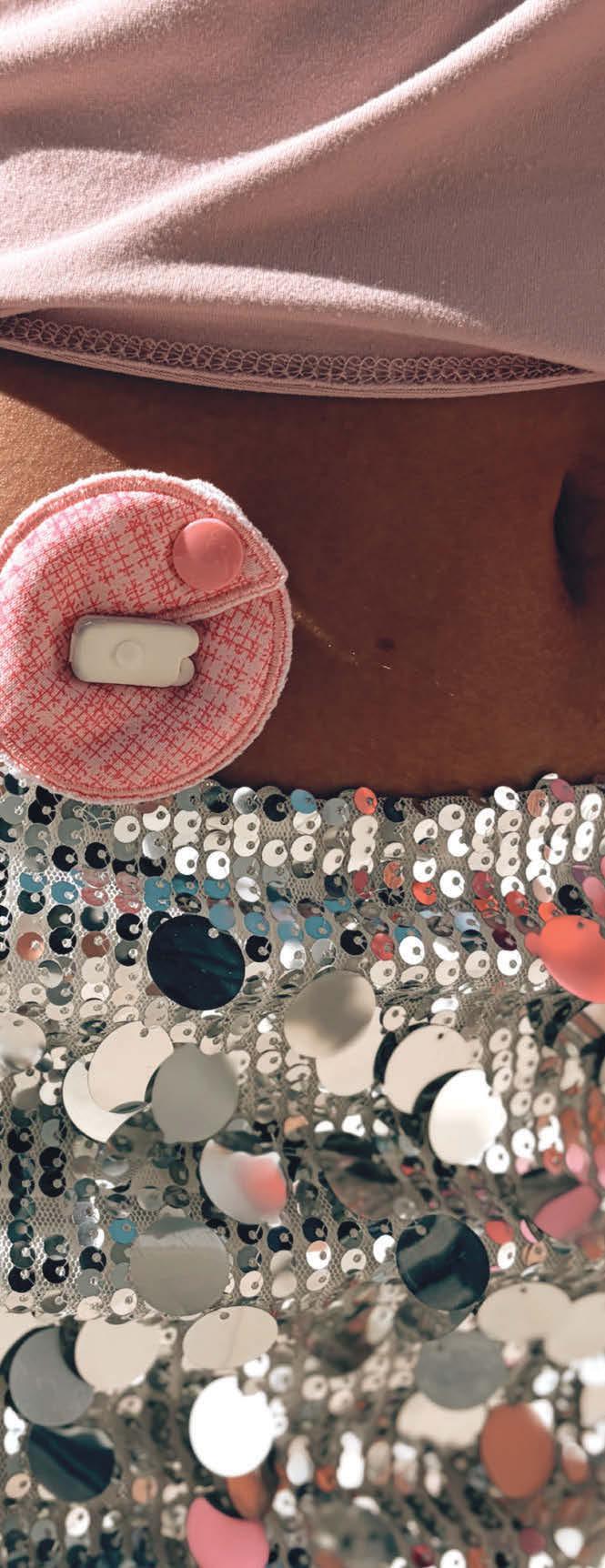
“When I opened up that package I was just so excited,” says Paula. “In that moment I was like, this could definitely be an accessory – and not just a medical device.”
Paula had never sewn a stitch before. But as soon as she was back home and feeling well enough, she bought a sewing machine and recruited Jenny to teach how to craft an ostomy cover.
“I got the hang of it and, eventually, I became really creative with the different fabrics I chose and different tops that I would style it with,” she says.
“I started sharing about it on social media and people loved that approach because, again, it broke that stigma down. It showed people this is something that allows you to live your life. It’s even something that can look cool.”
Putting together an outfit had become a refuge for Paula – one part of her life she felt she could control. “I honestly don’t think I would be where I am today if I didn’t have fashion to lean on,” she says. “I call it my ‘dopamine dressing’.”
One of her first TikTok videos to go viral sees Paula making an ostomy cover out of vibrant blue fabric she’d found that perfectly co-ordinated with her Zara halter top.
“It got like three million views,” she says. “I think I nailed it in that moment, and I felt so good. I felt like I had accomplished exactly the vision I had when I first opened up the ostomy covers in the hospital.”
Paula’s early designs were simple, usually using just one fabric. As her skills grew, so did her imagination.
“I kind of got funky with it and I started adding lace around the borders, embroidered flowers on to them. I added some beading at one point as well,” she says. “Recently I’ve been making covers that look and function like purses, with a pocket in the front and a purse strap, as well. And they really look like a purse!”
Since her first post as an ostomate, Paula’s TikTok community has grown to 350k+ ->
“In South Asian culture, you don’t talk about what makes you different.” Nikita Patel is talking anyway.
Interview: Melanie Dimmitt
Sari,
WE TO
Two cancer diagnoses before 30, more than a dozen surgeries and the loss of most of his bowel could have broken Hugo Toovey. Instead, it gave him something to say. The Australian Army Major reflects on resilience, life with a stoma and why sharing the messy truth matters.
Words: Anja Christoffersen
For Hugo Toovey, advocacy began with someone else’s story.
Years ago, he was listening to a podcast featuring a young melanoma advocate named Natalie Fornasier. She chatted candidly about living with advanced cancer – not with forced optimism, but with a kind of disarming honesty.
“She was so articulate,” Hugo says from his home in Sydney. “She spoke about living with stage 4 melanoma and why she wanted to share her story –and what she wanted others to learn about sun safety and looking after your skin.”
At the time, Hugo wasn’t someone who spoke openly about his own health. But Natalie changed that.
“I connected with her down the track and we became really close,” he says. “She was one of those people that really got me into sharing my story more and creating awareness.”
Natalie died in 2023, in her late 20s.
NEED TALK
“She was an advocate right to the end,” Hugo says.
“She was just so vulnerable in how she spoke, whether it was about approaching dying or living with terminal cancer. She was so candid and raw. And that was the moment I realised it’s important to be open, honest and vulnerable in how we talk about this. You don’t always have to be super inspiring or positive.”
What stayed with Hugo most wasn’t Natalie’s courage. It was her honesty. Her bucking the trend of illness narratives looking a certain way.
“You’d hear things like, ‘you’re so inspiring, mate. I don’t know how you do it.’ And that’s nice. But we all know you can’t be like that the whole time,” he says.
“If everything you share is just super positive, it’s almost unrealistic to what people are actually going through. There are so many people following along quietly who are really struggling.”
When Hugo first discovered a lump at 21, cancer was the furthest thing from his mind. ->
At the time, Hugo was early in his military career – fit, young and newly trained.
“I just had that army stoic mentality,” he says. “I thought I was bulletproof, I was invincible.”
Hugo ignored the lump for six months until, with encouragement from his father, he saw a doctor. The diagnosis was testicular cancer. Even then, the seriousness didn’t fully sink in.
“I was just this young bloke saying, ‘yeah, I’ve got cancer, starting chemo next week,’” he says. “But when people hear the words cancer and chemotherapy, they think, holy shit.”
By the time treatment began, the cancer had spread. “I had to have chemotherapy and major surgery just because I put it off.”
Five years later, Hugo received the all-clear. He remembers shaking his oncologist’s hand, relieved. And for a few months, he lived life
as “pre-cancer Hugo”. Then his bowels started playing up.
“I’d always had an inconsistent gut, so it didn’t seem unusual,” he says. But after years of cancer vigilance, Hugo decided to get checked.
A colonoscopy revealed large polyps. The specialist called Hugo back immediately. The diagnosis: colorectal cancer.
“I remember saying to him, ‘are you sure you’ve got the right person? I’ve just had my five-year all clear’.”
This wasn’t a recurrence. It was a completely new primary cancer.
“I was genuinely confused. One moment I was back to normal. The next moment I was right back in the thick of it,” he says.
“That weight was too much for me to carry. And that’s when I got really emotional for the first time in a long time and had a proper
cry… guilt, anger, all these different emotions all boiled into one and I just thought, nah, I can’t do this.”
What followed were eight years of medical intervention: major surgeries, complications, a Crohn’s disease diagnosis and repeated bowel resections. Hugo’s colon and rectum were eventually removed. Large sections of his small bowel followed. Today he has only 1.8m of bowel (the average adult bowel is 7.5m to 9m) and a permanent ileostomy.
Before his ileostomy, Hugo lived with severe bowel dysfunction and incontinence.
“Leaving the house created anxiety. I always had to know where the toilet was,” he says. “If I was at someone’s house and there was only one toilet, my anxiety would go through the roof.”
Life with a stoma has dramatically changed that. “I’ve gone to social situations now where I’ve got no anxiety. I can just empty my bag
“
I’m proud of what those scars represent. This body has endured so much.
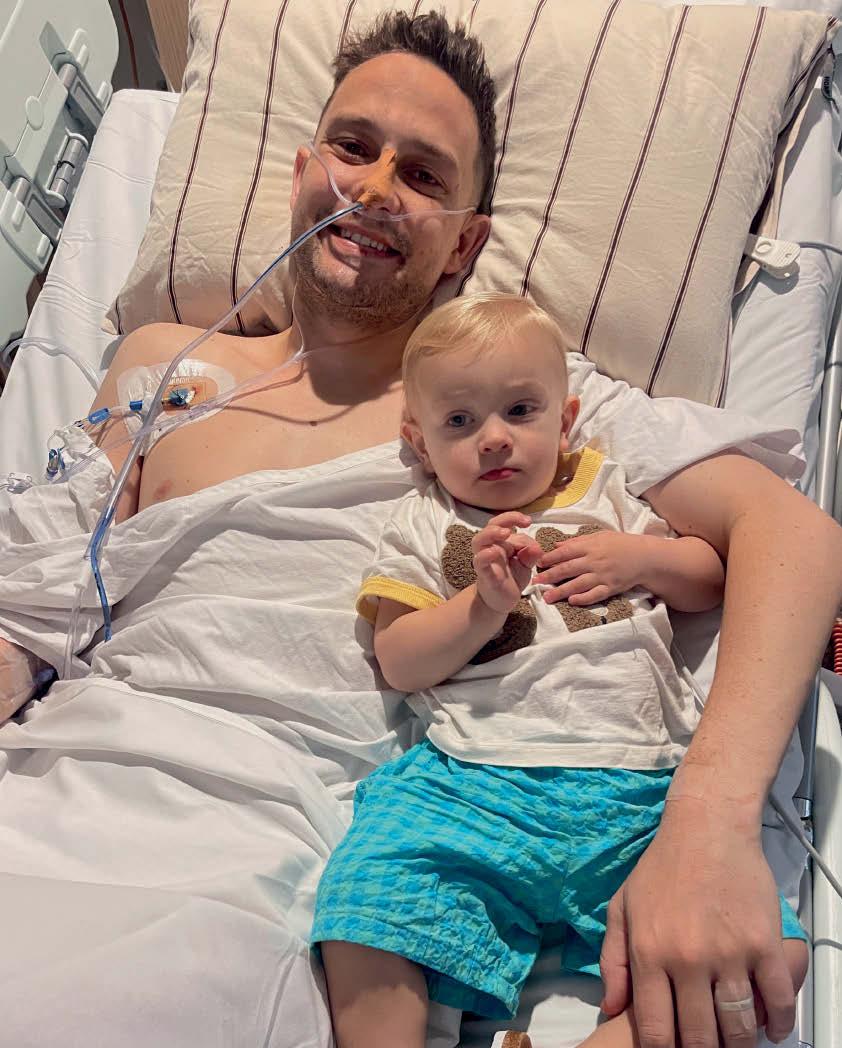
Left to right: Hugo after surgery with his son Teddy, Hugo and his wife Amber
”
and it takes 30 seconds.” Though it’s not without its challenges – and the occasional night-time leak.
“It’s not ideal waking up covered in shit,” Hugo laughs. “But it’s significantly better than what it was.”
Years of surgeries changed Hugo’s body dramatically – something he has come to accept. Today, he doesn’t hide his scars or his stoma.
“I’ll happily go to Bondi Beach with my shirt off,” he says. “I know people will look. But I’m proud of what those scars represent. This body has endured somuch. The fact I’m still here – I’m proud of that.”
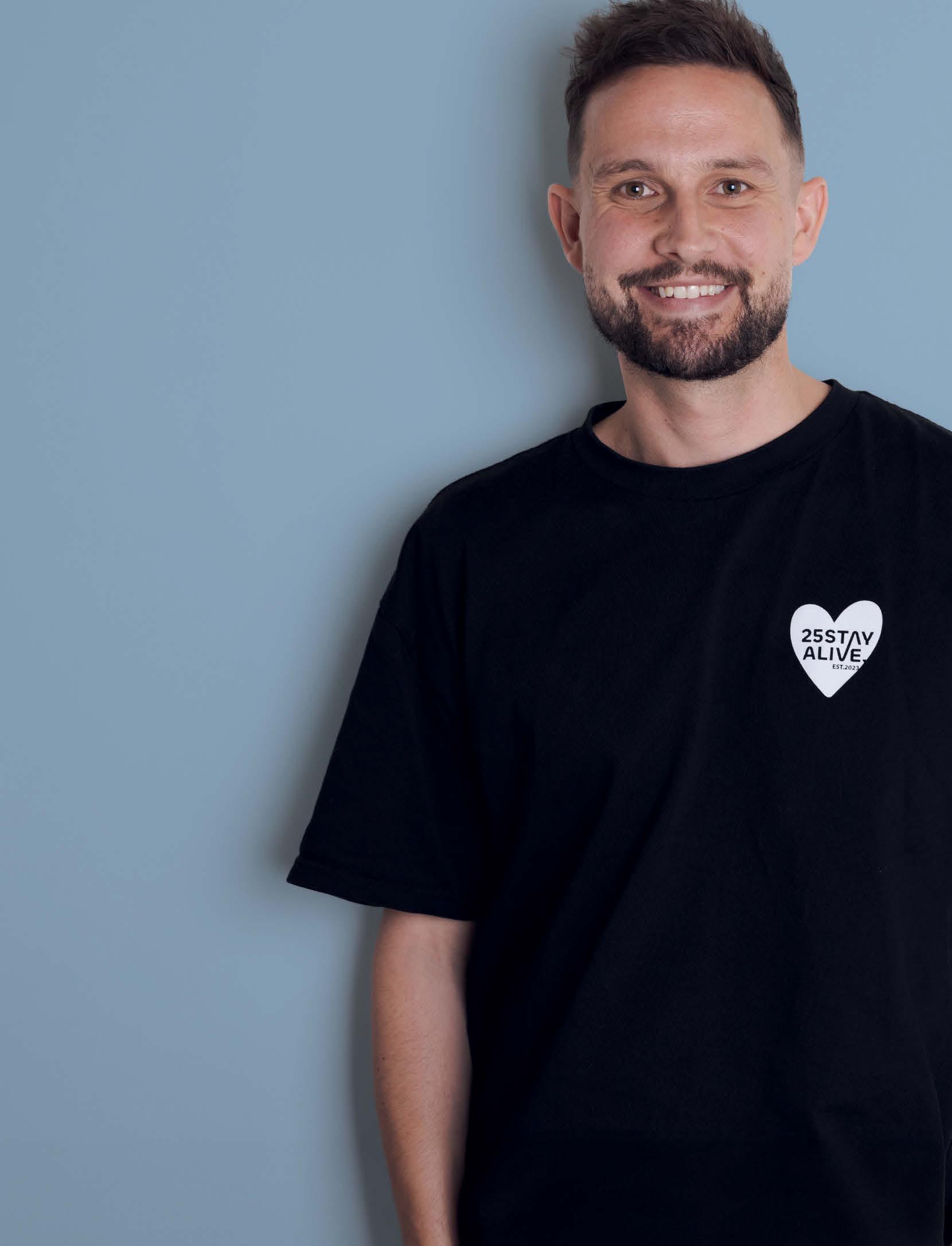
Hugo has a lot to live for – his wife, Amber, and their son, Teddy. Then there’s his advocacy work, which saw him receiving the 2025 Australian Mental Health Lived Experience Prize.
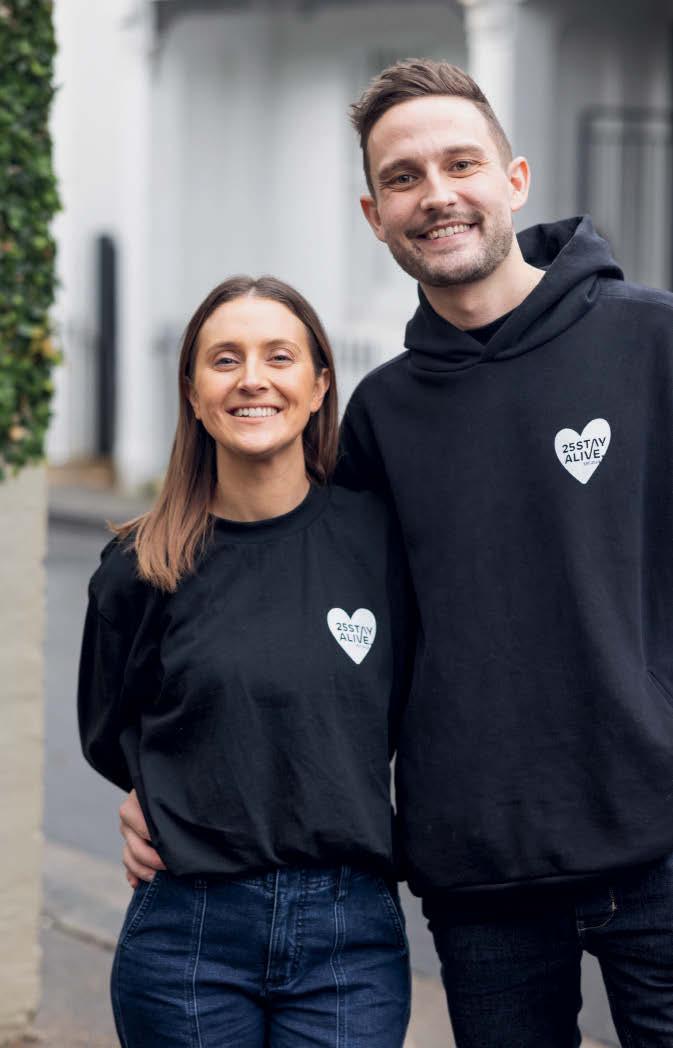
In 2023, Hugo founded 25StayAlive, a charity focused on promoting testing and early detection among young adults.
“People would always say, ‘geez, you’re so young for this’,” he says – but the statistics tell a different story.
Bowel cancer is rising among young adults.
Testicular cancer is a young man’s disease. Melanoma remains one of Australia’s most common cancers in younger people.
“Yet, young adults often get dismissed,” Hugo says.
His solution is simple: encourage Australians to treat 25 the way many treat 50 – as the age to start paying attention to health.
“We want people to have a baseline health check at 25,” he explains. “Then every year after that.”
Hugo’s organisation runs workshops, community programs and health literacy
campaigns across Australia. “We want young people to understand their bodies,” he says. “But we also want clinicians to listen to them.”
If there’s one message Hugo wants people living with bowel or bladder conditions to hear, it’s this: don’t suffer silently.
“These aren’t sexy conversations. Bowels and bladders aren’t great dinner-party topics. That’s why young people are dying of bowel cancer – because people don’t talk about it,” he says.
His advice is to start small: “Let your village in – your close friends and family. By sharing your story, you can have power over what you are going through. You can control that narrative. And most importantly, you can connect with so many other people who can say, ‘hey, I get it’. That’s a really powerful thing.”
A brief HISTORY
This is the fun-sized origin story of the modern-day disposable nappy. It starts, as you might guess, with a woman who was fed up.
Before the supermarket aisle, before the overnight ultra-dry with the wetness indicator strip, before the biodegradable bamboo option that costs roughly the same as a small car – there was just a square of cloth, a safety pin, and some hope.
The nappy, in one form or another, has been with us forever. Ancient civilisations wrapped their babies in moss, animal skins and leaves, making do with whatever the natural world could offer. The Romans used linen. The Victorians, flannel. For most of human history, keeping a body dry came down to ingenuity, improvisation and a heroic tolerance for laundry.
Some problems never go out of fashion.
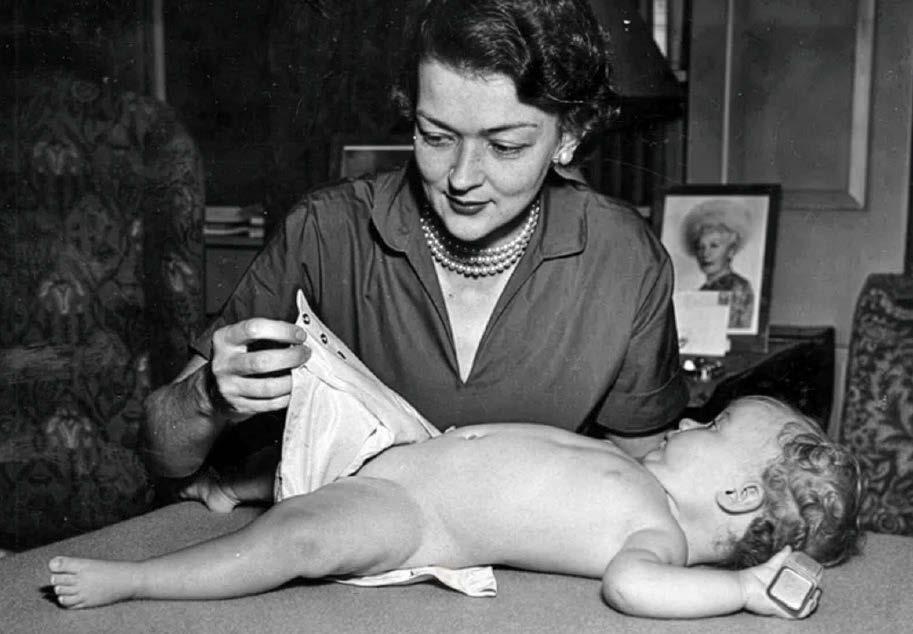
The modern nappy was born in the 1940s. The woman behind it was America’s Marion Donovan – mother, inventor, and someone who was thoroughly done with other people’s design failures.
By 1946, Marion was on to her second baby, trapped in an endless cycle of soggy cloth, leaked-through sheets and rubber “baby pants” that, while keeping things contained, caused rashes and chafing.
Not satisfied with the status quo, Marion took matters into her own hands. First from a shower curtain, then from nylon parachute material, she cut and sewed her way to something better – a breathable, waterproof cover that actually worked. Then she went further, turning the cover into a container that could hold absorbent paper lining inside. She called it the Boater.
Marion’s guiding philosophy, as she’d later tell legendary journalist Barbara Walters, was: “What do I think will help a lot of people and most certainly will help me?”
When she took the idea to manufacturers, they laughed her out of the room. The need barely registered with the men who controlled the industry. But when Marion debuted her product at Saks Fifth Avenue and sold her patent for a tidy US$1 million – the equivalent of US$13.7 million today – the manufacturers stopped laughing and started paying attention.
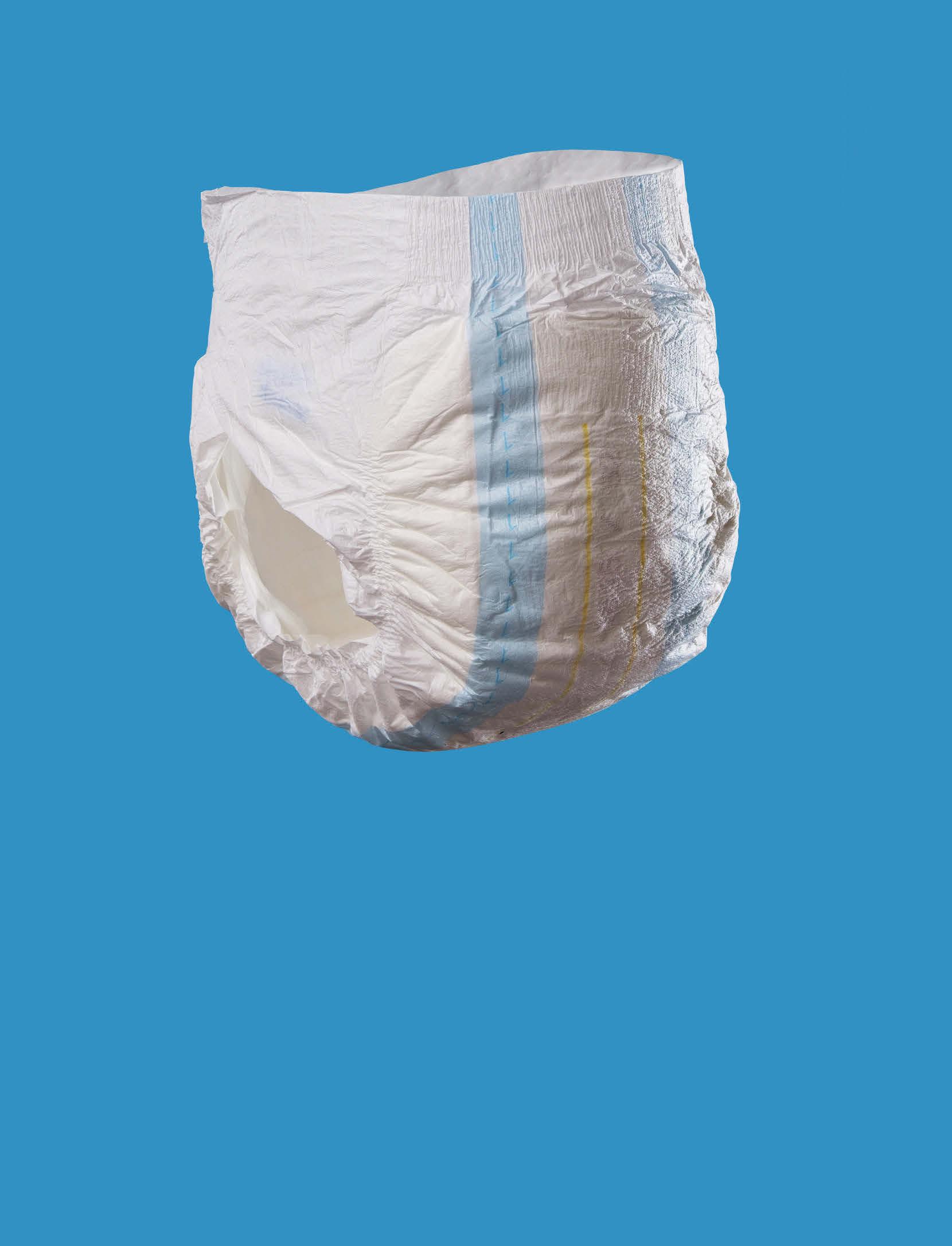
In 1961, Procter & Gamble launched Pampers – developed by company engineer Victor Mills – and the disposable nappy entered the mainstream. Competitors including Huggies followed, turning the category into a fast-moving race of design, comfort and absorbency.
Decades of new developments followed – gels that lock everything away, elastic that moves with you, tabs that stay put, liners designed with skin in mind. Innovations that would go on to serve not just babies, but people at every stage of life. Each one solving the same, ancient problem – just smarter, sleeker and with increasingly snazzy marketing.
Today, 95 per cent of American babies wear disposables, with an estimated 27 billion used annually (and taking up to 500 years to decompose, which is a whole other story). Meanwhile, adult incontinence products are one of the fastest-growing segments in hygiene worldwide. The global market is worth billions. And we’re doing a whole lot less laundry.
Marion Donovan demonstrates the “Boater,” around 1950.
Image credit: Smithsonian Institution
oorecta
When Australia's leading childhood colorectal service lost its funding, the Melbourne-based hospital said nothing had changed. The families it supported knew otherwiseand weren't prepared to settle for substandard care.
Words:Anja Christojfersen
Over the past year, Seija Keeble's almost five-year-old daughter (pictured) has beenworkingtowardssocialcontinence-the ability to avoid having accidents in public. Thismilestonesits quietlyin the background ofmost childhoods, but for Seija's daughter, it was hard won.
"It has taken a lot oftrial and error to find the right laxative-enema balance - including near-constant stooling and severe skin breakdown, without being able to access timely clinical support:' says Seija.
Within moments ofgiving birth, nurses recognised that her daughter's abdomen was distended and she had no anal opening.
"I was still being stitched up from my caesarean when I first heard. It was distressing andfrightening, especiallygiventhe impact of the surgery and everything that comes with it. Before I was able to hold her, she was transferred by ambulance to The Royal Children's Hospital."
Seija's daughter is one ofmore than 500 children in Australia being treated for complex colorectal conditions - the most common ofwhich are anorectal malformations and Hirschsprung disease.
Untilrecently, shewasin thespecialistcare ofthe Colorectal and Pelvic Reconstructive Service (CPRS) at The Royal Children's Hospital in Melbourne (RCH).
"Fromtheverybeginning, itbroughtareal sense of steadiness to be told we were now under the care ofthe CPRS -that not only
Last year, this service closed when a $5.9 million 2019 federal grant came to an end.
"Withoutthe CPRS, everything justfeels more fragmented and slower:' says Seija. "It's made a complex situation feel much heavier to manage on our own:'
The service didn't just treat different anatomy, it helpedentire familiesthroughthe complexiry ofgrowing up with a colorectal condition. The CPRS was a one-stop shop for wraparound colorectal care, co-ordinated between specialist surgeons and nurses, psychologists,dietitians, stomalnurses, child life therapists and case co-ordinators.
UPSETTING.
THE THOUGHT OF FAMILIES NAVIGATING THESE DIAGNOSES ON THEIR OWN WAS EXTREMELY
did someone understand what our daughter had, but there was a dedicated team ready to look afi:er her:' says Seija.
"Meeting the multidisciplinary team by video call from the other hospital - and hearing there was a clear plan in place for our newborn daughter - gave us a strong sense ofstructure and reassurance at adeeply uncertain and distressingtime."
"Our daughter was born into the CPRS model of care, so from the very beginning it was all we knew:' says Seija. "In many ways, we took that level of integrated, co-ordinated support for granted. It was only when the service ended that we truly understood how exceptional it was."
Sarah McArthur'sexperience echoes this.
"From day seven of my son's life, the CPRS team provided excellent and consistent clinical care for my son and support for my husband and I upon his diagnosis of➔
of care required,” Sarah says. “Children and their parents do their best to hide all of this, because poo is taboo.”
Seija adds: “Before, we had a co-ordinated team who understood her and could guide us quickly. Since the closure, there’s a lot more falling back on us as parents.”
The RCH said at the time that while the federal grant had ended, there had been
own was – and still is – extremely upsetting.”
In April 2025, after being told CPRS was closing, these mothers took matters into their own hands.
They had just emerged from a meeting with the hospital’s CEO, where parents were again told the clinic would be closing due to a lack of dedicated funding.
Through The Royal Children’s Hospital Foundation auxiliary model, Seija and Sarah founded Colorectal Champions, an initiative focused on supporting The RCH to deliver excellence in colorectal care.
For over a century, The RCH Auxiliaries have raised more than $50 million, driven by a shared purpose of making life better for sick children. For Colorectal
She won’t let this condition hold her back.”
The CPRS showed what is possible when care is connected and consistent. Colorectal Champions is making sure that possibility isn’t lost.
SHE WON’T LET THIS CONDITION HOLD HER BACK. “ “
Left to right: Sarah’s son and Seija’s daughter, Sarah and her son
THERE WILL BE TIMES WHEN SHE’S HAVING A REALLY GOOD LAUGH AND OUR WHOLE FAMILY WILL BE LIKE, ‘GO TO THE TOILET! GO TO THE TOILET!’ “ “
Giggle incontinence is, as you might guess, an involuntary bladder release brought on by laughter. Mainly impacting girls and young women, for Emma* and her family, it’s just part of life. Here, her mum shares how sometimes, the best moments call for the heavy-duty undies.
Irecentlyfell over at home, hit my head on a door and couldn’t get up. My daughter – let’s call her Emma – was with me. And on seeing me go horizontal, she was losing it with laughter.
Emma is a young adult with physical and intellectual disabilities. And on that particular day, moments before I took that tumble, I’d just finished getting her dressed for her work party.
I couldn’t move, but I was more worried about Emma having an accident, as I wasn’t sure I’d be able to change her. With my face flat on the floor, I urgently commanded: “Don’t laugh! Don’t wet your pants!”
My daughter has giggle incontinence.
There will be times when she’s having a really good laugh and our whole family will be like, “go to the toilet! go to the toilet!” Everyone is on high alert. Always.
Emma wears Bond’s continence undies. She puts the hardcore ones on when she goes out with her friend who makes her laugh a lot. She’ll say, “I have to put those undies
on because I’m going out with Ben*”. And then I’ll tell Ben’s mum, “she’s got her heavyduty undies on!”
I’m very used to it now, after all these years. And I’m going through continence stuff myself, at nearly 50. I’ll tell Emma, “well, I wet my pants laughing too, sometimes”. She finds that really funny. When she’s not in hysterics, her continence challenges are different to when she was little. She has matured – and she’s pretty reliable now. Unless she’s absolutely busting.
On Emma’s worst day, if she doesn’t go to the toilet before leaving her workplace, she’ll wet her pants when she gets home. It’s difficult for her to plan, like, maybe I should go to the toilet before I get in the car to come home?
Her clothes might also be the culprit. Emma’s weight fluctuates and she’s only got the use of one hand, so if her pants are a bit too tight, it can be hard to pull them down. She’s a tracksuit-pants kind of lady.
Another obstacle can be the state of the bathroom. Emma has high standards. At one
point, her school was having renovations so they had portaloos. She did not want to go in those. We pretty much chose her after-school program because she said that she really liked their toilets. I told them this and they said, “oh, thank you!”
Even in the caregiver community, it can feel like kids and young adults are either in nappies full-time or not. And no one really talks about the in-between. This makes sense – you’re protecting your child and you don’t want to embarrass or shame them.
Perhaps because of her intellectual disability, Emma doesn’t seem to get embarrassed about her mishaps. But she does get upset if her siblings are embarrassed by them.
If they have a sleepover with friends and she’s really cacking herself – and we’re all like, “don’t wet your pants! Don’t wet your pants!” – I have to explain to the friends what’s going on. Our house is a constant shemozzle. That’s all I can say.
*Names have been changed
The Sh*t
Nobody Told Me
Hisloved ones discovered his diagnosis at the same time the world did, when he launched his now globally celebrated book, More Than Meets the Eye.
“I hid it from my friends, my family,” says Liam Robertson, whose debut title shares his experiences of living with ulcerative colitis (UC). “I told people I’d been unwell, but I didn’t really go into the extent of how serious it was. I think a lot of my friends just thought I had a stomach bug when I was ill … until I wrote and published that book.”
That was in 2020, a full 10 years after receiving his UC diagnosis in his early 20s. The diagnosis came at the end of three years in and out of hospital, by which point Liam was desperate to get out of the doctor’s office and Google his condition.
“It felt like I was the only person in the world who had UC,” he says. “I was so alone and isolated – which was part of the reason why I kept it quiet for so long.”
Google, however, didn’t come up with the goods.
“It was a lot of medical jargon,” he explains. “Nobody told me that I was going to probably shit myself one day, or I was going to be losing friends, or it would affect my career, or I’d have relationship breakdowns. Nobody ever had that conversation with me.”
As Liam navigated the realities of life with UC – all the while working as an offshore oil and gas technician – he began taking notes about things that happened. During
This Scottish advocate hid his ulcerative colitis diagnosis from everyone he knew for a decade. Then he wrote a book – and accidentally built a global community. Speaking with In Crowd editor Anja Christoffersen, Liam Robertson talks motorway mishaps and finding new confidence.
Covid lockdowns in 2020, he revisited these notes and started shaping them into a book.
“I thought, maybe this book could help someone. Because when I was diagnosed, there was nothing like that. There was nothing that told a personal story,” he says. “It was really an off-the-cuff kind of thing, it wasn’t a plan to tell the world I have UC. It was more out of boredom in lockdown. And now, here I am.”
Six years, global book sales and thousands of messages later, Liam’s online community, @livingwithulcerativecolitis, brings together people from all over the world navigating chronic illness and the unpredictable realities that come with it. Conversations with his followers, he says, are a form of “two-way therapy”.
“I felt like UC made me feel weak and like less of a man, like it somehow decreased my value as a human being,” he says. “I realised when I started chatting to new people I met through social media, that a lot of them had felt the same. Opening up and speaking to people helped me learn that I’m strong, and start to value myself in different ways.”
Liam’s path to confidence took time. At first, he felt “like I just wasn’t a good human”.
“When you’re having accidents, you’re bleeding a lot, and you can’t do all the normal stuff you want to do, you feel like you’re worthless,” Liam says. ->
Masterclass A
in Self Advocacy
“Everything hurts, everything bloats, nothing moves.” Brisbane’s Megan Wood spent sixteen years being told by medical professionals that her laundry list of symptoms and suffering was “normal”. Here, she tells Anja Christoffersen what she’s learned about surviving –and challenging – a system that kept failing her.
When did you first notice something wasn’t right with your bowels and bladder?
I’ve had digestive problems for as long as I can remember. As a baby I experienced severe colic, and in early childhood this progressed to ongoing constipation and epigastric (upper abdominal) pain. I didn’t have the language to explain what was happening at the time, but I clearly remember the constant stomach aches, “stitches”, and reflux-like symptoms that simply became my normal.
Things escalated significantly in my teens and early 20s when symptoms I had always lived with became much more severe. I did everything I could to seek help, but spent over a decade being dismissed, misdiagnosed and cycled through a revolving door of assumptive treatments. Along the way I encountered a great deal of medical gaslighting and misogyny – a lack of curiosity, a reluctance to investigate further and, at times, a clear absence of care from those who were meant to support me. I would present to hospital appearing heavily pregnant, when in reality my abdomen was severely distended due to extreme constipation. At other times, I would be hospitalised after days of uncontrollable diarrhoea and vomiting.
These days, I experience constipation more often than not, and it is incredibly difficult to manage, particularly as many of the contributing factors are anatomical and largely outside of my control.
My first bladder-related issue occurred when I was 16, during a severe cardiac event that resulted in a complete loss of continence. Following this, I began to notice mild bladder leakage, which gradually progressed into urgency and an inability to fully empty my bladder – something that was painful, frustrating and, again, largely dismissed.
It’s only very recently that I’ve been able to piece together a full understanding of what’s been happening. Due to my underlying condition, hypermobile Ehlers–Danlos syndrome (hEDS), my connective tissue abnormalities have led to multiple significant vascular compressions, along with associated Mast Cell Activation syndrome (MCAS).
In addition, I have multi-organ pelvic prolapse and bowel intussusception, which together create a mechanical bowel obstruction that is only visible on dynamic imaging. This explains the severe slow-transit constipation, the strain on my organs, and the cascade of secondary complications I’ve experienced. ->
At this point, I’m unable to meet my nutritional needs orally. Eating causes pain, bloating and nausea, and my digestive system is not functioning effectively. As a result, I now rely on a nasojejunal feeding tube. My bladder and bowel issues are further complicated by endometriosis and adenomyosis – because, it seems, the list wasn’t quite long enough already.
When did you first seek help?
I first went to the doctors seriously seeking answers and support when I was about 13 or 14 years old. I cannot begin to count how many doctors and specialists I have seen, or how many hospital visits and admissions I have been through. I’m 31 this year, and only got my hEDS diagnosis confirmed formally two years ago.
Was it uncomfortable talking to your doctors about your challenges?
It definitely was in the beginning. Talking about anything to do with poo, pee, or bodily functions felt awkward and embarrassing, especially when I was younger and still desperately trying to be “polite” and not make people uncomfortable.
But honestly? After everything I’ve been through, I’m past the point of caring – I don’t give a fuck anymore. I’ve been suffering for so long and had to advocate so fiercely for myself that I’ve learned to be direct, clear and unapologetically honest about what I’m experiencing. These days, I lay everything out in plain English. If something is leaking, blocked, prolapsing, twisted or otherwise misbehaving, I say so.
I also turn up prepared. I bring peerreviewed research, relevant information and whatever evidence might help my medical team understand what’s going on. Thankfully, the team I have now appreciates that – they actually value my involvement and that’s exactly how healthcare should be. Patients shouldn’t be passive passengers in their own bodies.
Looking back, could anything have made your experiences with medical professionals better?
“I’d leave an appointment thinking things went okay and then a few days later it would hit me – wait, they talked over me the whole time.”
In the early days, absolutely. Going into appointments prepared made a huge difference – having notes, questions, symptoms written down. And most importantly, having a support person I trusted. Someone who could speak up for me when I couldn’t, or when I froze, or when the conversation drifted off track.
These conditions come with a huge amount of medical trauma, and even when you think you’ve rehearsed the whole interaction in your head, the moment you’re triggered, it can all fall apart.
For a long time, I didn’t even realise I was being triggered. It wasn’t until my mid-20s that I started recognising the signs and was later diagnosed with complex post traumatic stress disorder (C-PTSD). I’d leave an appointment thinking things went okay and then a few days later it would hit me – wait, they talked over me the whole time. Or they never answered any of my questions. Or, why did I walk out with zero follow-up tests or treatment options after paying hundreds of dollars and spending half an hour explaining myself?
It’s actually funny in a not-funny way –I’m a strong advocate for other people, but advocating for myself has been a long, ongoing work-in-progress as a result of C-PTSD. In your interactions with medical professionals, how was incontinence framed to you?
For most of my life, it was completely dismissed. I was repeatedly told things like:
“IBS [irritable bowel syndrome] is very common, sweetheart. Bloating isn’t the end of the world. You still have a pretty face, you’ll be fine.”
That is an actual quote from a former gastro-enterologist and, for years, that was the tone: minimising, patronising and implying that what I was experiencing was either “normal” or something I just needed to tolerate. There was no real investigation, no curiosity, no validation.
Only recently has the framing shifted into something more realistic and helpful. It has now been explained to me that some aspects of my incontinence and motility issues can be managed or improved through physiotherapy and medication, while other parts may require continence aids. Surgical intervention might be also an option – with the caveat that surgery is not a guaranteed or permanent solution.
What initial investigations happened?
I’ve had pretty much every investigation under the sun. It started with routine blood tests, then moved into more specific panels as things progressed. From there it became a parade of imaging: X-rays, CTs, MRIs –honestly, I’m amazed I’m not glowing in the dark at this point.
I’ve also had specialised tests and multiple colonoscopies, sigmoidoscopies and gastroscopies. I’ve undergone two laparoscopic surgeries and now get regular pelvic floor Botox to help calm down hyperactive muscles and manage the associated pain. I recently had a celiac plexus block to assist with pain. I have had catheters inserted to empty my bladder in hospital settings on many occasions, too.
that they basically stopped being flare-ups and just became my everyday baseline. Once all the symptoms blurred together like that, it became pretty obvious that this wasn’t a bunch of separate issues, but one big interconnected mess.
Now that I have actual confirmed diagnoses, that hunch has been proven right: none of it was standalone. It was all part of the broader picture of my chronic condition. Pesky connective tissues and angry mast cells – causing chaos everywhere!
How does navigating the healthcare system impact your lifestyle and finances?
The impact on my life has been enormous. It has touched every part of who I am and how I live. I’ve lost friends, strained relationships with family who didn’t understand and even lost jobs because I didn’t yet have a diagnosis or the evidence I needed to justify absenteeism or request reasonable adjustments.
My dating life also took a hit, for years, before I met my wonderful husband. I’ve had to pause or abandon studies. Truly, pick an area of life and this has affected it in some way, shape or form.
Everything is so intertwined that there’s no clean separation between “me” and “my medical stuff”. Anyone in my inner circle has to be comfortable with the reality that sometimes I’ll need to cancel plans, or I’ll suddenly run out of stamina and have to leave early, or I’ll end up in hospital unexpectedly. That’s just the terrain.
“Formal support is the next critical step if I’m going to maintain any kind of stability or quality of life.”
How did you determine whether your challenges were a standalone issue, or a symptom of a broader chronic condition?
Honestly, for a long time it didn’t feel connected. Everything seemed like its own isolated problem popping up at random – until the flare-ups started happening so frequently
Miraculously, I’m still working full-time – and the only reason that’s possible is because I have an incredibly supportive, understanding and flexible employer. They’ve allowed me access to disability leave, flexible arrangements and full-time work from home. I would love to move to parttime hours, but with the enormous cost of healthcare, that simply isn’t financially viable right now.
I’m in the process of applying for the NDIS [Australia’s National Disability Insurance Scheme] but, given the changes to access,
I’m anxious about being rejected multiple times. I’m at a point where I desperately need support, but I can’t rely on the public system at all – I spent the better part of a decade running in circles there with no answers. My stamina is in the toilet – pun intended –and I’m really struggling to keep up.
But I’m still moving. Still scraping by. One foot in front of the other.
What medical-related interventions have you tried, and did they work?
I’ve tried a wide range of interventions over the years, with very mixed results. Various elimination diets and food restrictions offered minimal benefit. I’ve also trialled numerous laxatives and motility medications – some provided short-term relief, but none have addressed the underlying cause and their effectiveness often diminishes over time, requiring ongoing changes in approach.
I’ve also trialled different exercise routines, which largely had no impact on my symptoms, along with heat packs and TENS (transcutaneous electrical nerve stimulation) machines. These can help take the edge off pain, but they don’t address the cause. Similarly, topical gels and creams have provided only limited relief.
For continence management, I’ve relied on pads, nappies, reusable continence underwear and bed protectors when ->
needed – practical supports, but not solutions.
More recently, I’ve found significant benefit from IV (intravenous) hydration therapy. In addition to supporting my severe postural orthostatic tachycardia syndrome (POTS) and associated hypovolaemia, it has improved overall hydration and, in turn, helped support better bowel motility.
At this point, it’s about managing the day-to-day reality as best as I can.
What options are on the table for you now?
Surgery is becoming more and more likely for me. I’ve also been advised to look into a pessary to help support my bladder due to the cystocele. Alongside that, I’ll continue with longterm supportive therapies – physiotherapy, psychology and psychiatry – all of which are helping to keep me functional.
I’m also at a point where I ugently need NDIS support to help me manage day-to-day living at home. I simply can’t keep up on my own anymore – even with the incredible help I get from my husband, family and friends when they’re available. The care burden on them is huge, and it’s not sustainable for any of us. Formal support is the next critical step if I’m going to maintain any kind of stability or quality of life.
How do you weigh up making decisions about your medical care?
When I’m facing a medical decision, I tend to hyperfocus on the issue at hand and research as much as I possibly can. My starting point is always peer-reviewed literature so I can understand the actual science, the data, and what the research shows. Then I look to support groups and people with similar lived experience to understand what the real-world outcomes look like. Lived experience often fills in the gaps left by medical papers.
There was a time when I would simply trust whatever a doctor told me. I don’t do that anymore. After years of mismanagement, dismissal and incorrect assumptions and diagnoses, I’ve learned that I need to be an active
participant in my own care. Researching gives me control, helps me advocate for myself, and ensures I’m not blindsided or pushed toward decisions when I’ve only been given part of the story.
For big decisions – especially surgeries that are elective or have uncertain outcomes –I talk everything through with my husband, close friends, family and mental health professionals. I want to make sure I’m in the right headspace, fully informed, and emotionally prepared for whatever comes next. What could have better prepared you to navigate the healthcare system?
A reality check. The knowledge that the real world is nothing like the medical dramas on TV. You don’t walk into a hospital and magically get a whole team of specialists trying to solve your case overnight. You don’t get instant answers. And nobody hands you a neat binder of “here’s what’s wrong and here’s how we’ll fix it”.
I wish I’d known how expensive, exhausting and emotionally brutal the system can be. That not every doctor will be a good fit – or even particularly informed – and that some genuinely cannot help you, no matter how nicely you ask. That some things don’t have cures. That miracle solutions advertised by alternative therapy providers are, more often than not, just expensive snake oil aimed at desperate people.
I wish I’d understood earlier that the public system isn’t just “under strain” – it’s fundamentally broken in a lot of ways. Sometimes you get lucky, but often you’re only seen at surface level unless you happen to land with a specialist team that has the time, capacity and curiosity to look deeper. And private healthcare is often the only route to get taken seriously or even properly investigated.
I wish someone had told me to request and keep copies of everything – every scan, every blood test, every letter and report. To insist that doctors document in my file when they refuse investigations I’ve asked for, so there’s a record of it. To keep my own detailed notes
or ask to take recordings, so I’m not relying on memory when I’m overwhelmed or unwell.
I wish someone had prepared me for the fact that I won’t always have an advocate with me in healthcare settings. That medical misogyny is alive and well. That I would be told “no” a million times. But if my body is screaming that something is wrong, I’m allowed – and entitled – to keep pushing.
ADDENDUM
Since this interview, Megan underwent a ventral rectopexy with biological mesh and graft to treat high-grade bowel intussusception of her sigmoid colon and a rectocele. She has recovered well and is already experiencing significant improvements in bowel motility and nutrient absorption, along with a noticeable reduction in bloating and digestive-related pain.
Although the procedure may not provide a permanent solution, Megan is optimistic about the increased capacity it has given her for the time being, and hopes to gain many years of relief before any future surgical review is required.
Megan and her husband Chris with their dog Chip
Always looking for the nearest toilet?
1 in 4 Australians experience
No matter your age or stage of life, many bladder and bowel control issues can be managed, treated or even cured. Call the National Continence Helpline to speak with a nurse continence specialist for free, confidential advice.
TROUBLESHOOTING FOR FREEDOM
Two experts and a whole lot of cathing and irrigation questions answered.
Startingself-catheterisation or bowel irriga-
tion can feel like the world just got a lot harder. It doesn’t have to. Bev Collins, clinical excellence manager at Wellspect HealthCare UK, and Annie Craig, national clinical and product educator at Mediplast Australia, are specialist nurses who’ve helped hundreds of people live a full life with continence support.
“Getting into an established routine is everything,” says Bev. And here’s what else she and Annie want you to know.
STARTING OUT WITH SELF-CATHETERISATION CAN FEEL DAUNTING. WHERE DO YOU EVEN BEGIN?
Bev Collins: It can be intimidating – and it’s okay to acknowledge that. But it’s also something that can be learned, and what we’d like to offer is some reasurance that, actually, this can fit into your daily life. Take the advice of your healthcare professional
who’s doing the teaching, because it can be a bit of a minefield.
Annie Craig: Having too many catheters to choose from, initially, can be overwhelming. Starting off by trialling just one or two and really working out what fits you best is a great place to begin.
WHAT IF WE’VE ONLY BEEN SHOWN HOW TO SELF-CATH WHILE LYING DOWN?
BC: When people are initially taught –particularly women – they’re very often taught on a bed or a couch, which can limit how you learn. One of the biggest barriers is being able to locate the urethra, but that doesn’t have to be done lying down. That’s just a starting point.
The really important thing is that transition – getting on to the toilet, a chair, a commode or even doing it from a wheelchair.
A mirror can help in a sitting position. And touch is also a great way of learning, building that muscle memory so you know exactly where you need to be. It’s amazing how quickly the light bulb comes on and it becomes natural to do.
I support a woman who was taught on the bed and lived her life that way for a very long time – always having to race back to her hotel room on holidays. We’ve now taught her to sit on the toilet and do it. That freedom is everything.
AC: It’s almost like contact lenses – trying to put them in to start with is always a bit difficult. But once you get the routine and once you know how to do it, it does get a lot easier over time.
WHAT ACTUALLY MAKES THE DIFFERENCE WHEN WE’RE OUT IN THE WORLD AND NEED TO CATH?
AC: The overall design of a catheter can make such a huge difference. Hydrophilic catheters, like the LoFric™ range, are activated by fluid to create a silky surface. That helps reduce discomfort and supports a gentler insertion and removal process.
For women with reduced hand and wrist function, the LoFric Elle™ has a unique L-shaped handle. It’s pre-lubricated, really easy to insert and gives you that extra dexterity and line of sight to the urethra.
For men, the LoFric Origo™ has an insertion grip that helps you guide the catheter without touching the catheter surface, so you’re inserting it under clean conditions. The coating also helps protect the urethra from infection and strictures.
Some of the best positioning tips we’ve picked up have actually come from the people we support. I work with a woman with
multiple sclerosis who was really struggling to get enough separation to insert the catheter. We tried placing a physio ball between her upper thighs – just enough to hold them apart – and it made all the difference.
BC: And I have a patient who puts one leg up on a small stool, stands and leans over it, places a mirror on the toilet seat to locate her urethra, then moves it aside when the urine starts to flow. She can do that in any toilet, anywhere. And when you’re out and about, just a small bit of preparation goes a long way.
Make sure you’ve got your supplies, some hand wipes or hand gel – you never quite know what you’re going to get when you walk into a public bathroom. Do consider using a disabled toilet if you need more space – not all disabilities are visible, and it’s absolutely okay.
AC: If you’re somewhere you really can’t control the toilet situation – on a plane, at a
concert, the footy, a nightclub – an all-in-one intermittent catheter with a bag attached is a game-changer. It’s the same process as usual but instead of going into the toilet, it goes into a bag that can be tied off and discarded. And it’s still completely discreet.
WHAT IF WE’RE SELF-CATHING BUT STILL HAVE ACCIDENTS OVERNIGHT?
AC: Continue doing that last catheter before bedtime – keeping to a good routine is key. Initially, it can help to keep a chart of how many times you’ve cathed throughout the day. And think about what the accident actually is – is it that you can’t get to the toilet in time? Having an all-in-one catheter on the bedside table can really help.
If you have reduced mobility and don’t have an all-in-one catheter, having something similar to a urine bottle to catheterise into may be a good solution overnight. ->
BC: Also consider whether the bowels are affected – a full bowel puts pressure on the bladder when you’re lying down, and the bladder and bowel are very closely situated anatomically. Sorting the bowel routine can actually help with overnight bladder accidents too. And think about fluids – maybe you’ve had a bit more alcohol than usual. Caffeinated drinks can be a mild irritant to the bladder. It’s worth looking at the whole picture.
LET’S TALK BOWELS. WHO IS IRRIGATION ACTUALLY FOR?
BC: Transanal irrigation can be used for people who’ve got constipation or faecal incontinence. Within the neurogenic group – spinal cord injury, multiple sclerosis, Parkinson’s, spina bifida, diabetes, post-stroke – the bowel transit can be anything up to double the normal 30 to 36 hours. The longer the faeces is in the large bowel, the harder it gets, because that’s where all the reabsorption of fluid takes place. Dry poo means constipation – and that means bloating, discomfort and distension.
When somebody uses high-volume irrigation, the water goes in high enough to stimulate peristalsis – that natural wave-like contraction that moves everything along. It causes a stretch, stimulates the natural peristalsis and starts to put water back into the stool to soften it. So by the time it gets to the rectum, it’s actually in a state that’s easier to pass – and all of that just using water, not medication. WHAT IF WE JUST CAN’T GET COMFORTABLE WITH IT?
AC: Starting with something like the Navina Mini system with an extension tube and a cone can be a little bit easier – just to get yourself into that routine inserting the cone, instilling the water and allowing time for the water to release. Then you can work your way up to a rectal catheter where you can inflate the balloon and be completely hands-free to focus on irrigating. It’s about taking things really slowly and having really achievable goals.
It’s also important to discuss the volume of water you will need to irrigate with your healthcare provider, as this will help tailor the therapy to you and achieve the best outcomes.
BC: Set the expectation at the beginning –this is not a magic wand, and you need to work at it. The majority of people can take up to 12 weeks to establish a routine, and that’s okay. Those first seven to 10 days, just concentrate on learning the equipment.
AC: And don’t try to do it all by yourself. If you’re worried about how your bathroom setup will work, call us. We can go through where to position everything – could you hang it here, could you put it on a table? People send me photos of their bathrooms and we work it out together like we’re building a Sims house! This sets them up in the best position for the irrigation process.
IT SHOULD JUST BE A VERY NATURAL THING, SO PEOPLE CAN GET ON AND LEAD A VERY ’NORMAL’ LIFE. “ “
HOW DO WE GET PAST THE PSYCHOLOGICAL BLOCK OF STICKING SOMETHING UP OUR BOTTOM?
BC: Sometimes we just give somebody the cones or catheters to take home and gently try inserting on their own first, before we add the water. It shouldn’t be painful – it might feel slightly strange, but not painful.
The key is that bowels love habits. Over that ten to 12-week period, people start to find their own way. By week four or five, they might find that every other day all they’re getting back is clear water, so they don’t need to do it daily. People start to learn that for themselves.
HOW DO WE KNOW WHEN WE’RE DONE?
AC: Twenty to 30 minutes is usually a good routine. This factors in time for the setup and getting yourself into a comfortable position. A gentle abdominal massage while
SOMETIMES THE BOWEL JUST NEEDS THAT KICKSTART.
you’re sitting can help facilitate movement. Make sure you’re in a comfortable position and not straining. And stay hydrated – sometimes you can absorb the water, so hydration matters. Doing it after a meal also helps.
BC: The actual instillation is just a couple of minutes – it’s waiting for the peristalsis to do its work. And remember, the more water you put in, the more you have to wait to come out. Stick to the volumes your healthcare professional has set for you.
WHAT IF IT STOPS WORKING – OR JUST STOPS WORKING AS WELL?
BC: This is not uncommon and you’re not doing anything wrong. We literally strip it right back to the beginning – start with a lower volume, then build back up again. Sometimes the bowel just needs that kickstart. It may also be that someone has come off all their laxatives, so we might need to reintroduce one briefly just to get bowel stimulation going again. And then you’ll find it kickstarts and you can start the journey again.
ANY TRAVEL TIPS FOR USING CATHETERS OR BOWEL IRRIGATION SYSTEMS ON THE GO?
AC: Plan ahead and pack more than you think you need, just in case one drops on the floor or you misplace any. Keep supplies in your carry-on in case your checked bag is delayed. Get a letter from your clinician describing what’s in your medical bag – this can be really useful to provide to airline staff or at security checkpoints.
If you’re on a high-volume system like the Navina Classic, the Navina Mini at 185ml is perfect for travel – it’s a simple bulb you can take away and top up to reach higher volumes. The travel pack just looks like a toiletry bag, so everything stays discreet.
“ “
BC: Contact your airline or cruise line –you’re entitled to a free medical bag for your equipment. You may need a travel certificate, which is just a signed letter confirming you have medical products. Keep that bag strictly medical – I’ve learned that lesson the hard way travelling with sports teams!
WHEN IT ALL CLICKS, WHAT CHANGES?
BC: These products allow people to have independence and freedom. We talk about making a real difference every day – and that’s ultimately why I do this job. It shouldn’t be, “oh, that person there uses a catheter”. It should just be a very natural thing, so people can get on and lead a very ‘normal’ life.
AC: Yes, this builds independence for people – and they can also empower others. They can be the person that gets someone else saying, “I heard this from someone who’s doing it and it changed my life”.
This article was made in partnership with Mediplast Australia. You can access support from their clinical team at shop.mediplast.com.au. In Australia, Mediplast represents the globally trusted continence range by Wellspect HealthCare – the unique hydrophilic urinary catheter range LoFric™, and the convenient Navina systems for bladder and bowel management respectively. Always follow the advice of your healthcare professional before making any changes to your catheter or bowel management routine. Product suitability varies from person to person – your clinical team is best placed to guide you.
5 shades prostate cancer of0
While it affects one in six Australian men, the realities of recovering from prostate cancer remain largely untold. Alan and Fiona White are changing that. They speak with In Crowd Editor Anja Christoffersen about sex, shame, catheters and why honesty might be the best medicine.
“Having missed a PSA blood test a year previously, I was pretty pissed off about the diagnosis and determined not to lose my prostate – and then have to deal with incontinence and erectile dysfunction.”
The surgeon recommended removing his prostate. Alan said no. Instead, he chose active surveillance.
With a background in nutrition and natural therapies, Alan focused on lifestyle changes and regular monitoring. For years, cancer remained something he hoped would stay quietly in the background of his life. But by 2011, the situation changed.
Alan’s biopsy results showed a more aggressive cancer. Active surveillance was no longer an option. “I felt I was between a rock and a hard place,” he says.
After exploring alternatives like brachytherapy – a type of internal radiation –
Alan chose surgery. His wife, Fiona, was beside him through all of this. And the cancer’s progression shook her deeply.
“When I realised the urologist was serious, my first thought was: ‘oh my god, my husband is going to die’,” she recalls.
The couple had married just two years earlier. “I wanted him to book surgery straight away,” says Fiona. “Alan wanted time to think.”
It was Alan’s decision in the end. However, like many couples facing a cancer diagnosis, they would soon discover that the real challenges begin after treatment.
Following his prostatectomy in February 2011, a referral to a continence physiotherapist helped Alan begin pelvic floor rehabilitation. But much of what came next –the realities of sexual function, intimacy, fatigue and emotional adjustment – was barely discussed.
“I was told by the surgeon that due to my age and good health, my erections would come back in the next two years,” says Alan, who was 59 at the time.
“I was prescribed Viagra and instructed how to use injections to get my erections back. But there was no discussion about the impact on my marriage and relationship.”
The possibilities of pain and climacturia (urine leakage during orgasms) and libido changes didn’t get a mention during Alan’s aftercare.
“No one really talks about sex and intimacy,” says Alan. So he and Fiona took this aspect of his recovery into their own hands, in what Alan jokingly calls “50 Shades of Grey for prostate cancer”.
“Intimacy has continued to evolve for both of us,” he explains. “We’ve been willing to experiment and did a six-week course on ->
re-establishing connection, touching, pleasure and, for me, not focusing so much on penetration.”
Fiona chimes in here. “Our sex life changed forever after the prostate cancer treatment,” she says, adding that following the surgery, Alan had a temporary urinary catheter placed to help with emptying his bladder at night.
“After the catheter was removed, Alan’s penis looked really sad – tiny, cold and blue,” she says. “I gave it a little affection and we were amazed to discover that men can experience an orgasm without needing an erection. We had no idea!”
Achieving an erection, Fiona says, has taken a lot of trial and error. Medications didn’t work, but penile injectable Trimix has proved reliable.
“However, his erections now are not truly rigid,” says Fiona. “It’s a bit like comparing a stick of Cabana to an uncooked sausage – both fill out their casing, but one is still a bit wobbly.”
The couple hasn’t only had to navigate the changes in Alan’s body. In 2014, Fiona had radiation treatment for cancer of her stomach lining that caused sudden onset menopause and vaginal dryness.
“If he can achieve an erection and if my vagina is okay, we still face the issue of his ‘loose wiring’,” says Fiona.
“Sometimes we ask each other if we’re up for sex,” says Alan. “Other times it just happens when we’re in the right space.”
Alongside the physical adjustments, much of Alan’s emotional reckoning happened outside of the bedroom.
“There was a sense of loss and grief, but for a while I couldn’t quite put a feeling or emotion to what I was experiencing,” he says.
“I took myself off to the veterans’ counselling service to get my head around what
was going on, as my emotions and reactions were impacting on Fiona and the relationship. It was to do with how I saw myself as a man, sexually, and how to function differently. There were certainly tears at those counselling sessions.”
Beyond its impact on his sex life, urinary incontinence was one of the biggest challenges Alan faced after surgery. There are many things he wishes he’d known to expect.
IT WAS TO DO WITH HOW I SAW MYSELF AS A MAN, SEXUALLY, AND HOW TO FUNCTION DIFFERENTLY. “ “
“That you may ‘leak’ at night if you drink too much liquid – especially alcohol!” he says, naming one. “I felt embarrassed and angry at what I felt was a lack of control over my body.”
Returning to swimming and cycling helped Alan rebuild his confidence, as did honest conversations – with his continence physiotherapist, Fiona, and eventually, fellow survivors. Talking openly made things like wearing pads feel normal. It also revealed a gap he couldn’t ignore.
Speaking at men’s health events and prostate cancer support groups, Alan kept hearing the same thing: men weren’t getting the full story.
“They weren’t hearing about the various side effects that can occur,” he says. “It’s important for men to hear from another male who had to deal with this issue – the good, bad and ugly of incontinence.”
Alan had long been involved in men’s health promotion through the Department of Veterans’ Affairs and the Prostate Cancer Foundation of Australia – even before his own diagnosis. Since then, he’s shared his perspective as a consumer advocate with the Peter MacCallum Cancer Centre and Continence Health Australia, and received a Victorian ministerial award for outstanding volunteer work in public healthcare.
In 2015, Alan and Fiona self-published a book, We’ve Lost My Prostate Mate… and Life Goes On, which now ranks among the top prostate cancer books internationally. The couple recently presented at the Multinational Association for Supportive Care in Cancer conference in Nara, Japan, as the first Australian consumer advocates invited to speak.
Over the years, Alan has seen the conversation around prostate cancer shift. What was once shrouded in silence and shame is becoming more openly discussed.
“Now people will start talking about it in a shop,” he says. “Someone will say, ‘my father had it’ or ‘my brother is being treated.’”
But stigma remains. Many men still delay seeking help, adopting the familiar “she’ll be right” attitude.
Alan’s message is simple: “If you maintain your car or machinery, why wouldn’t you maintain your health?”
To men newly diagnosed with prostate cancer, he says: “You’re not on your own.”
For Fiona, the message to partners is equally important. “This is not a sprint,” she says, “it’s a long-distance trail.”
From the trenches
Let’s sit in the shit together for a moment. Even with confidence, acceptance and incredible experiences, the hard moments don’t disappear – they ebb and flow at every stage. These are some of mine.
My goal over Christmas and New Year’s in 2025 was simple: go to the beach. It’s only 2km from my front door to the sand. It had been beautiful over the summer – rolling, crystal-clear waves and the buzz of excited tourists discovering local beaches for the first time.
That’s what I’d been told, at least. The barrier, for me, wasn’t geographical. It was my bowels. My non-stop, unpredictable bowels.
I had enough energy to go to the beach, but not enough energy to endure a spectacular accident in my bikini, in front of holidaymakers. This wasn’t guaranteed to happen – but it wasn’t a risk I was willing to take.
I never made it to the beach. I barely even made it to my family Christmas.
While I’ve been faecally incontinent my entire life, this was my first family gathering since early childhood where I found myself in a nappy. And it wasn’t even one of the cool
Image credit: Anthony Byron Photography
Words: Anja Christoffersen
ones. It was a bulky, male diaper designed for seniors that we’d tried to push on my dad. He’d refused to use it, so I relied on his stash for holidays.
Seeing myself standing in front of the mirror in this grey, pillowy thing was demoralising. I didn’t feel sexy. I hardly felt comfortable. The only good thing I can say is it made for a cheap Brazilian butt lift.
I soften the blow by making jokes like that – and saying things like ‘I’m glad I have regular accidents, as it keeps me down to earth’. It’s hard to grow an ego with shit dripping down your legs – and for that I am grateful. But there are sides to living with incontinence – having bowel and bladder conditions – that people on the outer wouldn’t believe.
I can’t count the number of times I’ve had a stranger’s fingers up my bum. Or had to sit on a toilet after a rectal enema with a nurse I’ve met that very day, supervising me and examining the toilet bowl afterwards. Holding a conversation and eye contact while your
bowels uncontrollably release, sound and all, is an art I have perfected. A quick cure for social anxiety.
I’m very difficult to cannulate so I have sigmoidoscopies – procedures to examine my lower colon – without medication or sedation. Seeing three huge screens broadcasting the insides of my bowel wasn’t as weird as watching them insert the sigmoidoscope tube. I should have looked away.
Each examination reminds me of what I can’t feel. Most days I forget about my lack of pelvic nerves, but watching clinicians put fingers, catheters and tools inside me without feeling anything is terrifying. Although I know I should count myself lucky.
Doctors wanted to be sure I didn’t have feeling. I remember laying on my side, during anal electrical stimulation testing, with sensors on my thighs to detect muscle reactions and a catheter with electrodes in my bottom. I watched on as they turned up the ->
voltage to the max, realising they’d already started minutes earlier.
Most people don’t know about getting electric shocks in your anus.
After enough years on doctors’ tables, your body is just a body. It’s not private. It doesn’t really feel like it’s yours anymore.
After enough nights in hospital beds, an ordinary life can feel out of grasp.
Every day I seek opportunities to make my life feel like mine – rather than shared with a medical team, or dictated by illness. Even when it feels relentless, and hopeless, your infinite ability to adapt will conquer all.
I know this because I’ve been there. Time and time again.
I’ve laid in my bathtub with a mirror and catheter, stabbing it in every direction until I finally found my bladder. The pee
“It hasn’t always been easy, but I’ve always found a way. You will, too.”
that spilled all over me was gross but the victory was sweet. I’d taught myself how to self-catheterise.
In one appointment I went from rectal enemas of 60ml to colonic irrigation of a full litre – a new device, a new catheter, a balloon inflated inside me. The first time was so overwhelming. I cried the entire way home. Within a few days, it became normal.
I navigated hypergranulation only two weeks into having an appendicostomy. I attempted my first 750ml flush through my chait all by myself. It took me a few weeks before I could handle the chait with confidence, without cringing at the sight and touch of it. But now, I can’t imagine my life without it.
Through some of my hardest challenges – new routines and constant adjustments with my health – I’ve always worked it out.
It hasn’t always been easy, but I’ve always found a way. You will, too.
We all want a life full of sunshine and rainbows – and maybe even a pot of gold at the end of them. But we are hesitant to welcome, accept and endure the rain. Something that doesn’t only precede rainbows, but gives us the polarity to appreciate the sun when it’s here.
So I say let it rain until the clouds are empty. Dance in it. Float in the floodwater until it recedes. But don’t forget that rain doesn’t last forever. The sun is on its way.
GLOSSARY
ADENOMYOSIS
ANAL ATRESIA (IMPERFORATE ANUS)
A condition where the tissue that normally lines the uterus (womb) starts growing into the muscular wall of the uterus. It can cause heavy periods, pelvic pain and bladder pressure, and sometimes contributes to urinary urgency or frequency.
A condition some babies are born with where the opening of the bottom (anus) hasn’t formed properly, or is missing altogether. Surgery is usually needed to create or repair the opening so the bowel can work as it should.
ANORECTAL MALFORMATION (ARM)
APPENDICOSTOMY / MALONE / MACE
A group of birth differences affecting the bottom end of the bowel and sometimes the urinary tract. The rectum (the last part of the bowel) may not connect to the anus in the typical way. There are different types, and most need surgery. Many people with an ARM continue to manage bowel and sometimes bladder function throughout their lives.
A surgical procedure (also called the Malone Antegrade Continence Enema, or MACE) where the appendix is used to create a small channel from the skin of the tummy into the bowel. This allows a flush of fluid to be put directly into the bowel to help clear it out on a regular schedule, giving people more control over when they go.
BIOLOGICS
BOWEL INTUSSUSCEPTION
A type of medication made from living cells, often used to treat inflammatory bowel diseases like Crohn’s and ulcerative colitis. They work by targeting specific parts of the immune system that drive inflammation, rather than suppressing the whole thing.
When one part of the bowel slides inside the section next to it, a bit like a telescope folding in on itself. It can cause pain, blockages and sometimes bloody stools. It’s most common in young children but can happen at any age.
BRACHYTHERAPY A type of radiation treatment where a small radioactive source is placed inside or very close to the area being treated. It’s sometimes used for cancers of the prostate, cervix or bowel. Because of where these cancers sit, brachytherapy can sometimes affect bladder or bowel function.
A guide to some of the words, procedures and conditions you’ll come across on these pages and beyond.
CATHETER A thin, flexible tube inserted into the bladder to drain urine, or into the bowel in transanal irrigation. There are different types depending on what someone needs (see also: Indwelling Catheter, Intermittent SelfCatheterisation, Suprapubic Catheter).
CHASSIS In ostomy product terms, the chassis is the base of the bag system. It’s the wafer or flange that sticks to the skin around the stoma. Getting the right chassis fit matters a lot for comfort and leak prevention.
CLIMACTURIA Urine leakage that happens during orgasm or sexual arousal. It’s most commonly experienced by men after prostate surgery (radical prostatectomy). It doesn’t get talked about much, but it’s more common than people think and there are ways to manage it.
COLONOSCOPY A procedure where a doctor uses a long, thin camera (a scope) to look inside the entire large bowel. It’s used to investigate symptoms, screen for bowel cancer, and check on conditions like inflammatory bowel disease. You’ll need to do a bowel prep beforehand to clear things out.
COLOSTOMY A surgical opening (stoma) made in the abdomen where part of the colon (large bowel) is brought to the surface of the skin. Waste leaves the body through this opening into a pouch, instead of passing through the rectum and anus. A colostomy can be temporary or permanent.
CONGENITAL A word that simply means ‘present from birth’. A congenital condition is something a person is born with, whether or not it’s diagnosed straight away.
CONSTIPATION When bowel movements are infrequent, hard to pass, or feel incomplete. It’s extremely common and can be caused by diet, medications, nerve conditions, or pelvic floor issues, among other things. Chronic constipation can also contribute to bladder problems and overflow incontinence.
CONTINENCE / INCONTINENCE
Continence is the ability to control when and where you wee or poo. Incontinence is the loss of that control, whether it’s a small leak or something more significant. Incontinence comes in many forms and affects people of all ages.
CROHN’S DISEASE A type of inflammatory bowel disease (IBD) that can affect any part of the digestive tract, from the mouth to the anus. It causes inflammation that can lead to pain, diarrhoea, bleeding, fatigue, and sometimes fistulas or the need for surgery, including stoma formation.
CYSTOCELE When the bladder drops down from its usual position and pushes into the front wall of the vagina. Also called a prolapsed bladder or anterior prolapse. It can cause a feeling of heaviness, difficulty emptying the bladder and urinary leakage.
ENCOPRESIS Repeated soiling or passing poo in inappropriate places (like underwear) in children over the age of four, often linked to chronic constipation. It’s usually involuntary and more common than people realise and very treatable.
ENDOMETRIOSIS A condition where tissue similar to the lining of the uterus grows outside the uterus, often on the bowel, bladder or pelvic organs. It can cause pain, heavy periods and bladder or bowel symptoms including urgency, frequency and pain when going to the toilet.
ENTERAL NUTRITION A way of getting nutrition directly into the stomach or small bowel through a tube, when someone can’t eat enough by mouth. Also called tube-feeding. It’s used across all ages and for many different reasons.
FAECAL INCONTINENCE A common, long-term condition affecting the gut that causes symptoms like cramping, bloating, diarrhoea and constipation. It’s different from inflammatory bowel disease (IBD) because it doesn’t cause visible damage to the bowel, but it can still significantly impact daily life.
FISTULA An abnormal tunnel or connection that forms between two body parts that aren’t usually connected, like between the bowel and the urethra, or between the bowel and the skin. Fistulas can develop from Crohn’s disease, surgery, childbirth injury or infection. Treatment can include a seton drain – a piece of surgical thread placed through the fistula to allow it to drain and heal gradually.
GASTROSCOPY A procedure where a thin camera is passed through the mouth and down into the stomach and upper small bowel. It’s used to investigate symptoms like pain, reflux, swallowing difficulties or bleeding.
GIGGLE INCONTINENCE
Involuntary, complete bladder emptying triggered by laughing. It usually starts in childhood (from around age five) and mostly affects girls, though boys can experience it too. Some people grow out of it. For others, it continues into adulthood.
GLEASON SCORE A grading system used to describe how aggressive prostate cancer cells look under a microscope. The score ranges from six to 10, with higher numbers indicating faster-growing cancer. It helps doctors and patients make decisions about treatment.
HIRSCHSPRUNG DISEASE (HD)
HYDROPHILIC CATHETERS
A condition present from birth where nerve cells (ganglion cells) are missing from part of the bowel, usually the end section. Without these nerve cells, the bowel can’t push waste through properly, leading to severe constipation or blockages. Surgery is needed, and ongoing bowel management is common.
Catheters that come pre-coated with a slippery surface that activates with water. They’re designed to reduce friction and make catheterisation more comfortable. Many people who self-catheterise prefer them for everyday use.
HYPERGRANULATION
HYPERMOBILE EHLERS-DANLOS SYNDROME (hEDS)
Overgrowth of moist, red tissue that can develop around a stoma, feeding tube or wound site. It looks like a small, raised, bumpy area and can bleed easily. It's treatable and your stoma or continence nurse can help.
A connective tissue condition that causes unusually flexible joints, stretchy skin and a range of symptoms across the body. Many people with hEDS experience bladder and bowel issues including urgency, frequency, incomplete emptying and prolapse, because the connective tissue supporting these organs is affected too.
ILEOSTOMY
INDWELLING CATHETER (IDC)
A surgical opening (stoma) made in the abdomen where part of the ileum (the end of the small bowel) is brought to the skin surface. Waste empties into a pouch. The output is usually more liquid than a colostomy, because it bypasses the large bowel where water is normally absorbed.
A catheter that stays in the bladder continuously, held in place by a small balloon. It drains urine into a bag. Some are inserted through the urethra, others go through the abdomen (see Suprapubic Catheter). They can be used short-term or long-term.
INFLAMMATORY BOWEL DISEASE (IBD)
INTERMITTENT SELF-CATHETERISATION (ISC)
An umbrella term for conditions that involve chronic inflammation of the digestive tract, mainly Crohn’s disease and ulcerative colitis. IBD can cause pain, diarrhoea, bleeding, fatigue and sometimes the need for surgery or a stoma.
A technique where a person inserts a catheter into their own bladder several times a day to drain urine, then removes it. It gives people independence and control over their bladder management, and is used by people of all ages, including children.
IRRITABLE BOWEL SYNDROME (IBS)
LAPAROSCOPIC SURGERY
A common, long-term condition affecting the gut that causes symptoms like cramping, bloating, diarrhoea and constipation. It’s different from inflammatory bowel disease (IBD) because it doesn’t cause visible damage to the bowel, but it can still significantly impact daily life.
Surgery done through several small cuts in the abdomen, using a camera and specialised instruments, rather than one large incision. Often called keyhole surgery. Recovery is usually faster, with less pain and scarring.
MEGARECTUM / MEGACOLON
NASOJEJUNAL FEEDING TUBE
When the rectum or colon becomes abnormally stretched and enlarged, often from long-term constipation. The bowel loses its ability to sense fullness and push waste out effectively, which can cause soiling, overflow incontinence and significant discomfort.
A thin tube passed through the nose, down through the stomach and into the jejunum (the second part of the small intestine). It’s used for people who need nutrition delivered past the stomach, often because of vomiting, reflux or delayed stomach emptying.
NEUROGENIC BOWEL / NEUROGENIC BLADDER
When the nerves that control the bowel or bladder are damaged or don’t work properly, affecting the ability to store or empty wee or poo. Common causes include spinal cord injury, spina bifida, multiple sclerosis and stroke. Management usually involves a combination of techniques, medications and sometimes surgery.
NOCTURIA Needing to wake up one or more times during the night to wee. It’s common and becomes more frequent with age, but it can also be a sign of other conditions. It affects sleep quality and can have a real impact on daily life.
OVERACTIVE
BLADDER (OAB)
A condition where the bladder squeezes (contracts) without warning, causing a sudden, strong urge to wee that can be hard to hold. It may or may not involve leaking. It’s not about how much you drink, it’s about how the bladder muscle behaves.
PELVIC FLOOR The group of muscles that sit like a hammock across the base of the pelvis. They support the bladder, bowel and uterus (in women), and play a key role in controlling when you wee, poo and pass wind. Pelvic floor muscles can be too weak or too tight, and both can cause problems.
PELVIC PROLAPSE When one or more of the pelvic organs (bladder, uterus, bowel) drops down from its normal position and pushes against the walls of the vagina. It can feel like a heaviness, dragging sensation or a lump. It's common after childbirth and with ageing, and there are many ways to manage it.
PESSARY
A removable device, usually made of silicone, that is inserted into the vagina to support the pelvic organs. Pessaries are used to manage prolapse and can also help with stress urinary incontinence. They come in many shapes and sizes.
POST-VOID RESIDUAL (PVR)
PROSTATECTOMY
The amount of urine left in the bladder after you’ve finished weeing. A high PVR can mean the bladder isn’t emptying properly, which can lead to infections, leakage and other issues. It’s usually measured with a quick ultrasound scan.
Surgical removal of all or part of the prostate gland, usually to treat prostate cancer. Because the prostate sits so close to the bladder and the muscles that control urine flow, continence changes after surgery are common, though many people recover well over time.
PSA (PROSTATESPECIFIC ANTIGEN)
A protein produced by the prostate gland. A PSA blood test measures the level of this protein and is used as a screening tool for prostate cancer, though raised levels can also be caused by other things. It’s often part of the conversation that leads to diagnosis and treatment decisions.
RECTOCELE When the rectum (the last part of the bowel) bulges forward into the back wall of the vagina. It can make it hard to fully empty the bowel and may cause a feeling of pressure or incomplete evacuation. It’s a type of pelvic organ prolapse.
SIGMOIDOSCOPY
A procedure where a doctor uses a short camera scope to look at the lower part of the large bowel (the sigmoid colon and rectum). It’s less extensive than a colonoscopy and is often used to investigate bleeding, inflammation or changes in bowel habits.
STOMA A surgically created opening on the abdomen where part of the bowel or urinary tract is brought to the skin surface. Waste is collected in a pouch worn over the stoma. There are different types depending on which part of the body is involved (see Colostomy, Ileostomy, Urostomy).
STRESS URINARY INCONTINENCE (SUI)
SUPRAPUBIC CATHETER (SPC)
Leaking urine when there’s physical pressure on the bladder, like when you cough, sneeze, laugh, exercise or lift something heavy. It happens when the pelvic floor or urethral sphincter isn’t strong enough to hold the urine in during those moments.
A catheter that goes into the bladder through a small hole in the lower abdomen below the belly button, rather than through the urethra. Some people find it more comfortable and easier to manage than a urethral catheter, especially for long-term use.
TRANSANAL IRRIGATION (TAI)
ULCERATIVE COLITIS (UC)
URGE INCONTINENCE
URODYNAMICS
A method of managing bowel function by introducing water into the bowel through the anus using a specialised system. It helps empty the bowel at a planned time, giving people more control and reducing episodes of constipation or soiling.
A type of inflammatory bowel disease (IBD) where the lining of the large bowel (colon) and rectum becomes inflamed and develops tiny ulcers. Symptoms include bloody diarrhoea, urgency, pain and fatigue. Treatment ranges from medication to surgery, which may include stoma formation.
Leaking urine that comes with a sudden, strong need to go. You might feel like you can’t get to the toilet in time. It’s related to overactive bladder and can be caused by nerve conditions, infections, or sometimes there’s no obvious cause at all.
A group of tests that measure how well the bladder, sphincters and urethra are storing and releasing urine. It can involve filling the bladder with fluid while measuring pressure. It helps doctors understand what’s causing bladder symptoms.
UROSTOMY A surgical opening (stoma) created to divert urine away from the bladder, usually because the bladder has been removed or can no longer function. A small piece of bowel is used to create a channel, and urine drains into a pouch on the abdomen.
VACTERL / VATER ASSOCIATION
VESICOSTOMY
A group of birth differences that tend to occur together. The letters stand for Vertebral, Anal, Cardiac, Tracheal, Esophageal (or Oesophageal), Renal and Limb. For diagnosis, three elements must be present. Not everyone has all of these, but the anal and renal components mean that many people with VACTERL live with long-term bowel and bladder management needs. New research has added ’-G’ for gynaecological malformations that can co-occur.
A surgical opening made in the bladder that allows urine to drain directly through a small hole in the lower abdomen, without a tube. It’s most often done in babies and young children whose bladders can’t empty safely on their own, as a way to protect the kidneys while they grow.