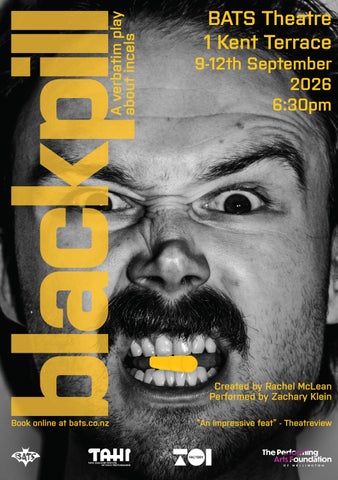
programme
production team Creator, Writer and Director Rachel McLean Performer Zachary Klein Production and AV Design, Operator Rebekah de Roo Sound Design Ben Kelly Lighting Design Lucas Neal Marketing Design Matilda Klein Producer Ace Dalziel Executive Producer Nathan Mudge, Toi Factory
mihi
To Angus Lindsay and Dylan Sofa, for your generosity in lending your expertise, mentorship and encouragement. To Kate Whitaker for bringing your perspective and experience to the post-show panel. To the development season production team, whose contributions to blackpill are numerous and instrumental: Sean Burnett Dugdale-Martin, Michiel van Echten, Tasman Hughes, Salomé Grace, Sam Hearps and Angela Pelham. To The Performing Arts Foundation for their invaluable support. And to Sally Richards and TAHI Festival, BATS Theatre, Alex Dickson and Playmarket.
about BATS
BATS Theatre is a not-for-profit theatre that aims to light up lives with live art. For over 35 years BATS has nourished various artistic communities, played a key role in developing new creative voices in Aotearoa, launched many successful careers, and become a second home for people on and off stage. Join us in our mission to create safe spaces for artists and audiences to expand possibilities. BATS has always been the place to take a risk, so why not take a stab at what's coming up... check out bats.co.nz for more info.
blackpill: offline a resource for audiences
It may surprise you to learn that the term incel, a portmanteau of ‘involuntary celibate’, did not originate from the communities and forums examined in blackpill. It was originally coined in 1997 by a woman from Toronto, whose blog ‘Alana’s Involuntary Celibacy Project’ discussed and offered support to people who struggled to find romantic partnerships. In the following 10 years several more incel discussion boards were founded, including on far-right forums like 4chan. By the time the 2010s rolled around, incel communities were almost entirely male and heterosexual, and ‘shitposting’ (ironic and low quality posts, often deliberately created to offend), trolling and far-right ideologies became commonplace. Incel sites slowly shifted from support for a condition that was not considered permanent to resignation, hatred and hopelessness. In 2014, the first
act of named incel motivated mass violence was committed in Isla Vista, California USA. Today, the incel worldview is generally defined by two key beliefs: • Women have perpetuated a hierarchical society where success in forming relationships is mostly determined by genetically predisposed physical characteristics, and; • That women are inherently superficial, and make judgements around dating based solely on these physical characteristics regardless of personal character. This, in turn, creates a dating pool that incels do not have access to.
To fully accept these beliefs, and the hopelessness of overcoming the hierarchy to achieve a romantic or sexual relationship, is to be ‘blackpilled’.
Down the pipeline Misogynistic and extremist content is readily available on mainstream social media platforms like Instagram and TikTok. Through targeted advertising, platforms profit from content that keeps users scrolling, which can lead to content pipelines of increasing extremes. Influencers like Clavicular have exploited social media algorithms to popularise ideas relating to misogynistic and incel ideology such as looksmaxxing. People who end up on incel forums may move to them from mainstream social media platforms in search of looser moderation to express and engage with more extreme content. They may also migrate to incel forums from more generic websites related to dating advice, support for shyness, and forums for self-identified ‘ugly’ people; or from other misogynistic spaces
within the wider manosphere.
Staying put Users of incel forums receive a constant stream of content that validates and reinforces their real world experiences of rejection, hopelessness and anger. Studies have linked social media use to increased isolation, and this relationship is exacerbated by social media use that encourages comparison and envy in the same way that incel forums do. Additionally, men may be hesitant to discuss their failures at meeting perceived expectations of masculinity with people in their offline lives. The forums that incels frequent can therefore become their only accessible outlet for social interaction and connection. The echo chamber that leaves them in, where only ideas that validate the blackpill philosophy are permitted, exacerbates depression, hostility and hatred. Despite only a small number of individual instances of violence linked to inceldom, the number of fatalities has surpassed 50 since 2014.
However, both in New Zealand and internationally, individual motivations for threats and acts of extremist violence are trending towards a boiling pot of ideologies, with misogyny frequently in the mix. While many forum posts may endorse violence, especially those that are shitposts or trolling, it is widely rejected by incel communities as a whole. In contrast, as many as two-thirds of incel forum users report suicidal ideation.
Getting out The history of incel forums demonstrates that misogyny is not intrinsically linked to experiences and discussions of involuntary celibacy. Incels who engage in misogynistic content have chosen to do so, but this decision is mediated by a lack of alternative spaces and narratives. Some research suggests that alternative pathways for connection may allow men experiencing involuntary celibacy to refuse or cease to engage in misogynistic ideas. Moreover, forums such as r/incelexit on Reddit show promise in providing ‘counter-spaces’, allowing men
to disengage with misogynistic beliefs and ideas through alternative communities. There is evidence to suggest that even men who navigate out of misogynistic incel communities encounter difficulties talking about and sharing their experiences due to persistent stigma associated with inceldom. The worries that incels often start their journey to extremism preoccupied with—Will I be loved? Are women attracted to me? Will I be alone forever?— are profoundly human. Stigmatising, belittling or invalidating these worries, which are fuelled by real pressures like online dating and body image standards, risks increasing the allure of a validating philosophy that assigns an enemy to blame— and to hate.
further reading Get Help and Support Mental Health Foundation of New Zealand A directory for accessing mental health support for yourself or someone else. Conversation Starters About Harmful Content Online Te Mana Whakaatu Classifications Office Useful conversation starters for talking to children of various ages about harmful content online. Keep it Real Online New Zealand Department of Internal Affairs A resource on how to keep children safe online, available in sections for educators, parents and youth. Kia Mataara ki ngā tohu - Know the Signs New Zealand Security Service A guide to help members of the public identify behaviour which may indicate that a person is on the pathway towards committing an act of extremist violence. Level Up Safely The Christchurch Call A resource for the parents, caregivers, and educators of children who may encounter harmful content in online gaming spaces. Note: This resource has not yet been localised to an Aotearoa New Zealand context. Scan the QR code for an online version of this resource with links to the guides listed above.
bibliography Hoffman, B., Ware, J., & Shapiro, E. (2020). Assessing the threat of incel violence. Studies in Conflict and Terrorism, 43(7), 565-587. https://doi.org/10.1080/1057610X.2020.1751459 Keum, B. M. (2025). Paths not taken: Early history of incel communities, 1997–2014. Internet Histories, 10, 1-19. https://doi.org/10.1080/24701475.2026.2663680. Lindsay, A. (2022). Swallowing the Black Pill: Involuntary celibates’ (incels) anti feminism within digital society. International Journal for Crime, Justice and Social Democracy, 11 (1), 210-224. https://doi.org/10.5204/ijcjsd.2138 Lounela, Emilia. (2025). What makes an incel? An interview study of current and former incels. Critical Studies on Terrorism, 19, 35-56. https://doi.org/10.1080/17539153.2025.2590848. Te Mana Whakaatu - Classification Office. Online Misogyny and Violent Extremism: Understanding the landscape (Summary Report). Retrieved August 26, 2026, from https://www.classificationoffice.govt.nz/media/documents/20240 513_Online_Misogyny_and_Violent_Extremism_understanding_the _landscape_sum_hbk6q0J Smith, D. S., Butler-Warke, A., & Stevens, G. (2025). “Even though I’m not an incel, I’m still an involuntary celibate”: A journey in and out of inceldom. The Communication Review, 28(1), 1–25. https://doi.org/10.1080/10714421.2024.2383814
The blackpill Collective theblackpillcollective@gmail.com @blackpill_theatre The blackpill Collective