NEVER PRINTED - YOUR GREEN CHOICE


From the heart of the Blackmore Vale

FEBRUARY ‘23
ISSN 2634-8810
Page 20.
OBE is coming to Dorset next month - he spoke to the BV about his new tour. Page 54


Should second home owners pay a premium on Council Tax in Dorset? Will it prove to actually benefit Dorset residents?

Page 4
Foaling has begun on

The Glanvilles Stud.
Yes of COURSE we have many, many pictures.
Page 34
Anyone who has had to read bedtime stories in the last 25 years is very likely to have had illustrator Jane Chapman’s work in their hands. Page 42.

The truth behind the rumours.
Following a local outcry based on inaccurate information, BV editor Laura spoke to Luke Rake, principal of Kingston Maurward college about the rumours. Page 6.
Front cover: A hungry nuthatch by Kate Fry
The BV magazine - February ‘23
IN THIS ISSUE
A Dorset man Tim Laycock answers the Random 19 questions
My Dear Old Thing! Legendary cricket commentator and broadcaster Henry Blofeld
INDEX
We know, it’s a HUGE magazine. So we make it easy for you - just like grabbing the sections you like best from the Sunday papers, you can click the number to jump straight to the section you want. Or, y’know, just make yourself a coffee and read from the beginning...
A quick apology to everyone looking at our website on their phone for the last few weeks. It probably hasn’t escaped your attention that we’ve been proudly titled ‘Newsweek’ since Christmas. We’re not, I assure you, in the midst of a grand takeover bid. Rather, we have a new website, and the simple task of tracking down why we were called Newsweek when looking at it on a phone utterly escaped me.
But through grit, perseverance (and a lot of YouTube watching) I fixed it.
GO ME. *high five*
But that fix promptly broke the menu. In fixing the menu I broke the sections page. And then I managed (and I still don’t know how) to put the sections page all over the home page.
By this time, in a flustered frustrated panic, very very bored with my own incompetence and frankly raging at the dark and evil arts of website maintenance generally, I hit the big server switch which resets the website to the day before.


Aaannndddd ... hello Newsweek. Sigh.
Anyhoo. Suffice to say I was ultimately victorious. The website works, and we are no longer Newsweek. We’ve big things in this issue; Dorset Island Discs and Random 19 have returned with two pillars of our Dorset community. I interviewed Henry ‘Blowers’ Blofeld, who’s coming to Dorset next month. Luke Rake gave us an exclusive on the damaging rumours that have been circulated in some areas about the cancellation of apprenticeships at Kingston Maurward College. Local man Steve Tarrant has been awarded motorsports’ highest honour – an award reserved for the likes of Stirling Moss and Sir Jackie Stewart. Farmer James Cossins tells us about his horrifically stressful January, and we take a look at whether second home owners should pay additional Council Tax in Dorset. Plenty to get your teeth into this month – go make a coffee. And don’t let the websites grind you down.
PS CONGRATULATIONS to our farming journalist Andrew Livingston and his wife Ellie on the birth of their son Charlie this week.
PPS special mention to our German-speaking daughter in law Sally who provided the correct phrasing for the lucky pig Valentine’s traditions in Germany. Who knew? Apart from flower columnist Charlotte Tombs. And all the Germans, obviously...
PPPS Thanks to fellow business owner and websitebattler James for his support through the disasterstrewn Website Of Doom. His helpful advice extended to “You’re still Newsweek? It’s been a month. May as well stick with it now, just change your Facebook name”.
3 The BV magazine, February ‘23 LETTER FROM THE EDITOR
28 A Country Living - Richard Lee 114 Announcements 42 Art 97 Book corner 110 Business news 91 Community 24 Dorset Island Discs - Pauline Batstone 34 Equestrian 75 Farming 101 Food & Drink 107 Health 116 Jobs 86 Letters to the Editor 62 Local history 4 News 67 Night Sky 79 Out of doors 84 Politics 93 Puzzles 21 Random 19 - Tim Laycock 48 Reader's photography 98 School news 71 Take a hike 54 What's on 73 Wildlife
Contact The BV Team: Editor: Laura Hitchcock editor@theblackmorevale.co.uk Advertising: Courtenay Hitchcock advertising@theblackmorevale.co.uk Sub-editors: Gay Pirrie-Weir Fanny Charles Everything else: Try Courtenay, he’s the organised one...
Should second home owners pay a premium on Council Tax in Dorset?
Second homeowners may soon see council tax double in Dorset – but

Rachael Rowe reports
Coastal towns have hit the headlines in recent years with bans on second homes, especially in places where local key workers can no longer afford to live. Dorset has one of the highest rates of second homes in England, at one in every 34 homes, and the Government’s Levelling Up and Regeneration Bill presents an interesting opportunity for councils to impose a council tax premium on second homes; something Dorset Council is currently debating. But at a time when councillors have challenging decisions to make on budgets, is targeting second homes the right thing to do?
There’s a catch
The Levelling Up and Regeneration Bill was first presented to Parliament in May 2022. It is designed to devolve
power and give local leaders and communities the tools they need to make better places and reduce inequalities. One of the components is the opportunity to implement a premium council tax payment on second homes; in effect a double council tax. With 5,722 second homes in Dorset, the Council report that could potentially generate an additional £9.5 million in income for the county budget. However, there’s a catch. Dorset Council has to give the government 12 months’ notice of their intentions, and the Bill still requires Royal Assent by April this year.
Dorset Councillor Peter Wharf was set to present the ‘Council tax premiums on second homes and empty properties’ report (read it here) at 23rd January’s Cabinet meeting. However, the
Cabinet agreed that it should be discussed by as many councillors as possible before it is taken to a vote at Full Council. The report has now be added to the Place and Resources Overview Committee on Thursday 9 February to consider before providing recommendations to Cabinet on Tuesday 28 February. If agreed, it will then go to the Full Council meeting in March. West Dorset MP Chris Loder has spoken in support of the proposal, saying it would ‘make it fairer for local people. Firstly, it will provide much needed income for the council for a fairer tax policy. And secondly, it will encourage property owners to think again before leaving their houses empty at a time when there are hard working local people struggling to find a home. ‘I have always maintained that
NEWS 4 The BV magazine, February ‘23
is that good for the county’s residents?
Okeford Fitzpaine in Dorset’s AONB. Second homeowners typically choose older, characterful property in prime locations and small communities
to sustain our community infrastructure, we need to incentivise and support local people to stay and live in our communities.’
Behind the scenes at Dorset Council, any proposal of this nature requires discussion and agreement before notifying the Government of their intentions. And of course, it depends on the Bill being agreed upon.
It all feels a bit chicken and egg –but what benefits, if any, will this premium bring to Dorset? I spoke to Peter Wharf.
What is a second home?
Some people will naturally wonder whether the property they own and rent to key workers will also be eligible for this stealth tax, so I asked Peter to clarify what the council means by the phrase.
‘A second home is a second home. If someone has more than one property, then it is a second home. We have a list of homes that are potentially eligible for council tax; however, if someone is letting the property permanently, for example, that is not a second home.
‘We’re talking about the furnished properties that are left empty or used as holiday lets and rented on sites like Airbnb.’ Dorset Council has previously levied higher rates on empty properties. How has that worked? ‘That’s quite difficult to determine. It is difficult to see and assess all the properties, obviously. However, other councillors tell me anecdotally that it has sped up plans and building in some areas.’
According to the Council’s background paper on second homes in 2021, Dorset’s Coast, the AONB that runs to the north of the county and much of West Dorset have a particularly high proportion of second homes (see image right). There’s a lot of negative publicity about second

homeowners, but does Peter think they bring any benefit to a local economy?
‘Well, there are benefits and disbenefits. One disadvantage is the schools don’t get enough pupils, and there is a lack of community in some areas. However, there is a counterargument. People come here and eat out in the restaurants, visit the beaches and go to the attractions. So they may add to the economy but detract from communities as they only live here sometimes.’ While the new proposal to double council tax may potentially help with house prices and the housing demand, I’m wondering what else councils can do to stop communities from becoming overwhelmed with second homes. Peter has a view: ‘There is very little we can do as it’s all about a free housing market and what people choose to do. However, it is possible to get an agreement that new housing should not be used for second homes. What we don’t want to see is a situation where second home owners are made to feel very unwelcome in Dorset. We don’t want that here.’
Airbnb wins
So how could doubling the council tax affect tourism?
‘It is possible that second home owners won’t come here if we charge a premium. There is a possibility some will sell up. We also don’t know whether the £9.5 million quoted in the report will be realised because some people may sell up. I have spoken to some second homeowners who tell me they can get far more with Airbnb-ing their property than they can renting. It isn’t easy to generalise as people will choose what they want to do.
‘We are presenting this proposal now because it is an opportunity to regenerate communities in Dorset. It will go to the Place and Resources Overview committee, the Cabinet, and then the full Council. The public has an opportunity to attend.’
Second homes are like Marmite in rural and coastal communities and are guaranteed to stir up a debate. But, like them or loathe them, all councils are under pressure to find ways of funding core services.
Details of the process and discussion on this proposal are on the Dorset Council website. If you have strong views, contact your local Councillor.
• Dorset Council has 82 councillors, of whom 24 have disclosed second properties and are therefore excluded from this vote
NEWS 5 The BV magazine, February ‘23
The truth behind the rumours
Following a local outcry based on inaccurate information, BV editor Laura spoke to Luke Rake, principal of Kingston Maurward college about the rumours

News that Kingston Maurward College has removed apprenticeships from its course offerings, with immediate effect, recently reached local media. This caused a number of inaccuracies to be shared locally. The BV spoke to the college principal Luke Rake to discover the truth behind the potentially harmful rumours that were causing his phone to ring.
‘Apprenticeships at the college have been in decline for some time.’ Luke says. ‘The numbers are down partly because the numbers of young people in the county as a whole are going down, but also because more and more students are choosing full time education. Simultaneously, our full time agriculture student numbers are growing.
‘We have also seen a reduction in the number of employers offering to take on apprentices, mostly due to the way the government made changes to the systems. It has basically become more onerous for smaller employers and so the numbers went down.
The other major factor is the funding itself. We got to a point where the college was losing a huge amount of money running apprenticeships.
‘The funding has been reduced significantly over recent years. For example, in the farming sector, there were governmentimposed changes a few years ago. Previously we received £10,000 a year for a farmworkers apprenticeship; this was moved to a stockpersons apprenticeship. It’s basically the same course, but now we get just £5,000 for it.

‘In addition to which, 20 per cent of that funding isn’t operational money during the course of the provision – we only get it if they pass, when they complete the course, which could be 18 months after they start.
‘Financially, it just doesn’t work. The land-based sector nationally was furious over the changes, and land based colleges across the country for a while refused to run the new farm-oriented apprenticeships because of the change in funding. In the end, they decided (quite rightly): “It
is needed in our area, we can manage to run it, we’ll just have to do it at a loss”.
Rural challenges
‘So now, unless you’re doing apprenticeships at real scale – hundreds of them, and we weren’t, we had 65 apprentices when we made this decision – it
NEWS 6 The BV magazine, February ‘23
Luke Rake, principal of Kingston Maurward College
Kingston Maurward College, near Dorchester
just doesn’t work.
‘We were effectively having to subsidise every apprenticeship we took on from other parts of the college. Had we continued, in the next 12 months we would have lost roughly £150,000. That’s money which could have been spent on, for example, staff pay – we haven’t made a cost of living award to our staff for two years, purely because we can’t afford to. The college, like almost all further education colleges in England, is in a difficult financial position, and our first duty is always to the survival of the whole. Therefore, as a lossmaking entity, we had to let apprenticeships go.
‘This is also a specifically rural challenge. If you have an apprentice working for Rolls Royce, you probably have 40, 60 maybe 100 apprentices all in one place – which means you can teach them all in one place and assess them all in one place. Here, we might have one apprentice working on a farm near Sturminster Newton, one the other side of Gillingham, one at Evershot, one near Dorchester … and they all need visiting regularly, they all need assessing individually. So the sheer mileage costs and practicality involved was a major challenge.
‘It’s not unique to us, it’s a challenge for any rural provider – every local family knows that


rural people struggle because of the additional cost of living in a sparsely populated area.
No one left behind What happens now to the young people currently midapprenticeship? Are they simply left to start again?
‘Not in the least. Those who are close to the end of their course will be finishing off with us.
‘Those who are at an earlier stage in their apprenticeships are still employed, that doesn’t change, but the provider responsible for their training will either be Bicton College if they are in the west of Dorset, or Sparsholt College if
they are in the east and north of the county. Both are high-quality land-based colleges, and every single student has had meetings with staff and employers. We have worked very hard with both colleges to ensure those learners are looked after.
‘In a couple of cases students have decided they would actually prefer to stay at Kingston Maurward, and have moved on to a full time programme, which means they’re coming here three days a week instead of just one.’
Poor timing?
Could this not have been put in place before the school year started in September?
‘It’s something we have been discussing for a while, but apprenticeships do not have a school year – they can start at any time, and roll continuously. There is no natural break, so whenever we had made this decision, it would have been difficult. Ultimately, we didn’t want to close the apprenticeships, but our main responsibility is to the financial security of the whole institution. It was a regrettable, but entirely necessary, thing we had to do.’
NEWS 7 The BV magazine, February ‘23
Kingston Maurward students
There’s been a complaint ...
 John Hoskins keeps sheep on Maiden Castle, and gets 50,000 visitors a year across his land
British winter is synonymous with sideways rain, muddy fields and non-existent grass. We humans may hate it, but the livestock across Dorset doesn’t really notice the inclement weather. For millennia, animals have lived on the picturesque pastures of our county all year round.
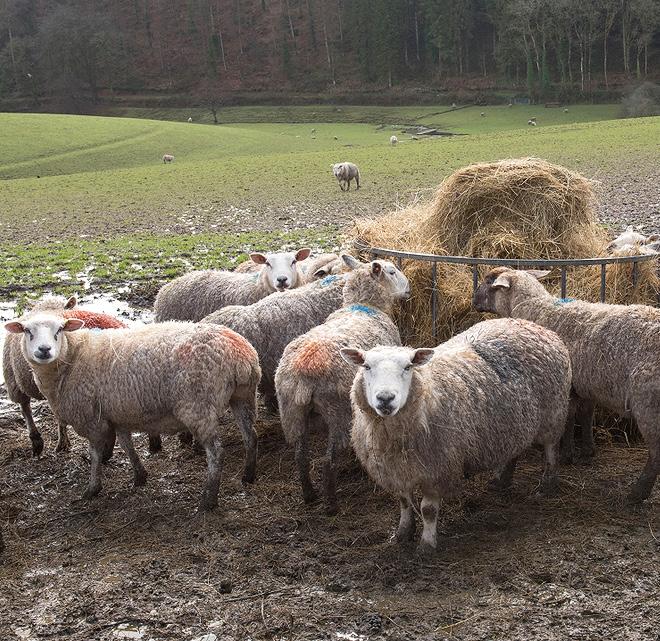
Unfortunately, for a lot of the public, winter farming in the UK doesn’t match the glossy Countryfile version of farming they like. Because of this, bodies such as the RSPCA, the APHA (Animal Plant Health Agency) and Trading Standards get a seasonal influx of complaints. ‘Things just don’t look very good when it’s constantly raining and the fields are muddy,’ says Neil, manager of the Animal Health and Welfare team for Dorset Council Trading Standards.
‘Most calls that we get from members of the public are well meaning, but entirely unfounded – the welfare of the animals is fine. It just doesn’t look particularly pretty.’ With the high volume of complaints Neil and his team can receive, they have to trust their judgement with a lot of the local farmers.
‘We do probably visit the vast majority of them, but it’s a kind of risk assessment basis. If we know the farmer and we’ve been going there for a long time, we can deal with it via a phone call initially, just to see if there is a problem? Are they aware of it? Quite often that can resolve it.
‘To give you one example, we had a complaint about sheep in a field where a number of them were lame. It was a good sheep farmer that we’ve known for many years and we don’t

have any welfare concerns with the farm, so rather than waste limited resources going out for a visit, we phoned him and he freely admitted, “Yes, I know that they are lame. I’m desperate to do something about it but at the moment the ground is too wet to get the handling system out there to get them in the crush to sort the feet out.”
Mistakes have been made Neil has been with Trading Standards for 30 years but isn’t from a farming background. He was moved ‘kicking and screaming’ into animal health because the previous manager wanted to go back to mainstream trading standards work.
‘While I haven’t got a farming background myself, the people who are in the team that actually go out and do the visits understand farming and farmers, who are very different from the usual business owners that I had was experienced in dealing with.
‘I freely admit I’ve made mistakes before – I’ve been out in the field with cows in the pouring rain. They looked bedraggled and miserable and thin. So I got a vet out to look at them with me the following day. Of course, by then it was bright and sunny, and the cows looked completely different!’
Neil has had to deal with a vast number of complaints about one farm in particular –
NEWS 9 The BV magazine, February ‘23
With our national newly-sanitised view of ‘Countryfile-d’ farming, complaints about animal welfare are on the increase, reports Andrew Livingston
Cattle are hardy. They have managed to live outdoors for 5,000 years
Well cared-for livestock is able to withstand an average British winter
Maiden Castle Farm. The farm includes the Maiden Castle hill fort, and although it is owned by the Duchy of Cornwall, it is John Hoskins who is the tenant farmer with his wife and son.
‘We have Maiden Castle hill fort within the farm itself,’ John explains. ‘And with it we get some 50,000 visitors a year. As well as tourists, we get all the general public from Dorchester coming to walk their dogs. And we get all sorts of complaints at this time of the year.
‘We have cattle grazing behind an electric fence with stubble turnips and feeders with hay and straw in. But of course it’s wet and muddy, and all [the public] think is that the animals should all be living indoors.’
John is quick to make the point clear that even though their downland farm is open to the elements, their cattle are hardy and have managed to live outdoors for 5,000 years.

Oh no, it’s definitely dead
With the constant footfall over his land, John and his family have had to deal with
complaints either to Trading Standards or direct to their face.
‘A year or two back we had a cow calving. We keep an eye on them all the time when they are calving and this lady stormed up to my wife and said “you’ve got a cow with its body all coming out”.
‘‘I suspect it’s calving,” my wife said. “Oh no, it’s definitely dead. There’s steam coming out”. When my wife got there, a calf was born, struggling to get up but alive and well. And my wife said: “Look, what you saw was the pre birth coming out”. But the woman would not have it.’ John is grateful to Neil and the Trading Standards team who act as gatekeepers. He says: ‘They know where we are. And [Trading Standards] actually come out, not on a complaint, just to see what we have on stubble turnips, or what cattle we have grazing.
‘And if somebody rings them, say two days in a row, saying,
‘John has got a sheep with a bad foot’. If on the second day we haven’t done anything, Trading Standards will call me and say, “John can you go and see about that sheep? It’s on the Castle” and we respond.’
It’s a welltrodden path to talk about how farming is portrayed in the media. Unfortunately, what the general public sees is either unrealistic ‘Countryfile farming’ or alarmist hidden camera footage on the news or social media showing the one per cent of farmers who mistreat their animals..
Neil has for the last six years been on the board of management for the Dorset County Show. He is a believer that educating the next generation is key.
‘The show has got a separate charity called Fabulous Food and Farming and its purpose is to promote agriculture. One way we do that is to invite
NEWS 10 The BV magazine, February ‘23
It’s either unrealistic
‘Countryfile farming’ or alarmist hidden camera footage on the news
Mud may look alarming, but is a fact of life in a winter field, especially around gateways and feeding stations
school groups out to farms. We provide them with visits and we also provide funding for the transport to get them out there.
‘Good farmers are very keen to show off farming and the importance of what they’re doing. It’s difficult to get the public out and interested, but we can do that through things like the agricultural shows.’
The odd rogue Maiden Castle Farm hosts a local school throughout the year to try and help educate children. They have even converted a calf house into a classroom.

John Hoskins says: ‘We have a local school here once or twice a year just to show them what’s happening on the farm.
‘Everybody’s looking over our shoulder to see that we do things correctly and 99 per cent of farmers do that or more. But there’s always the odd rogue farmer that lets us down.’
There was a recent case of one of these ‘rogue’ farmers in the county, who ended up being prosecuted (Dorset farm fined £52,000 for causing unnecessary suffering- The BV, Nov 22) – and this is why Neil doesn’t want to discourage the public from picking up the phone if they are worried about the welfare of any livestock they see.
‘It is incredibly rare that we have to go as far as court action. On a complaint visit, we always try and work with farmers to improve things. It’s a collaborative process that involves visiting, advising, giving an improvement notice if necessary and making sure that’s complied with.’
The local ‘rogue’ farmer in
question had been having visits from Trading Standards for ten years and he was found to be doing the bare minimum. ‘We regard court action as the very last resort. We will always try to work with the farmer and their vets to make improvements. But ultimately, if things are ignored or things get to an unacceptable level, then we will be forced to take action.’
John Hoskins felt that the farmer in question was let off lightly.
‘It was disgusting. I can tell you, every farmer who knew about that wished he’d had a heavier sentence. Every single farmer you spoke to said he was a disgrace to our industry.’ But Neil has dealt with a
lot of these cases of poor animal management and he understands that causing harm is rarely anyone’s intention. He says: ‘In most of these cases I would say there’s an element of the farmer having mental health issues that, in turn, result in their animals suffering. ‘We’re always mindful of that. And again, if we’re aware that the farmer’s struggling himself, we try and get him support through charities like the Farming Community Network.’ If you see an animal you believe to be in distress, please contact the correct authority. For agricultural animals such as pigs, cattle, sheep, goats and poultry contact Dorset Trading Standards. If you have concerns about the welfare of domestic animals such as cats and dogs please contact the RSPCA
NEWS 11 The BV magazine, February ‘23
Everybody’s looking over our shoulder to see that we do things correctly –99 per cent of farmers do that or more
Dorset County Show’s Fabulous Food and Farming charity funds school trips to help educate children about farming. Image: George Hosford
Highest honour in motorsport recognises local man’s bravery
Steve Tarrant, who suffered life-changing injuries at Goodwood in 2000, has been awarded for his courage and commitment. Rachael Rowe reports

‘You haven’t seen the last of me yet,’ Steve Tarrant famously said, after an accident at the 2000 Goodwood Festival of Speed resulted in the amputation of his right leg.
He returned to marshalling in a wheelchair, and has worked
at leading motoring events. At this year’s annual Night of Champions at the RAC Club in London’s Pall Mall, Motorsport UK recognised Steve’s 30-plus years as a race steward with a Lifetime Achievement Award –the highest honour bestowed by

the Motorsport UK board. Steve describes the moment he got the news: ‘Initially, it was a shock. You don’t expect something like that coming through the door! And you certainly don’t expect them to recognise a marshal like me when you see the other names on the awards list.’
Previous winners of the Lifetime Achievement Award have included Stirling Moss and Sir Jackie Stewart – and now Steve Tarrant of King’s Stag. Locals may have seen him at the annual Sturminster Newton New Year’s Day Vintage Car Rally, busily marshalling the cars from the middle of the road. But Steve has marshalled at other, rather more glamorous, places like Le Mans, Goodwood and Silverstone. Marshals are all volunteers who play a critical role in motorsport racing.
NEWS 12 The BV magazine, February ‘23
Steve Tarrant with his Motorsport UK Lifetime Achievement Award, after the ceremony at the RAC Club in Pall Mall
Awards night on Pall Mall
‘It was a wonderful evening, and I wish they had filmed it from start to finish.’ says Steve. ‘Although getting me to the RAC Club was quite an ordeal for the taxi driver! They handed out 35 awards for winners of national championships, and then they had the special awards. There were actually two Lifetime Achievement Awards. One went to Ron Dennis, the former owner of McLaren Formula 1 ... and the other went to me! It was a bit surreal seeing all these people you read about, on the track or on TV, and they were coming up and shaking my hand.’
Steve’s main career has been in IT but he has always loved motorsports. He jumped at the opportunity to volunteer as a steward, excited to enjoy the experience of motorsport racing from a different perspective.
His life changed dramatically following his accident. He was standing near the finish line with
the black and white chequered flag when a car travelling at 140 miles an hour crashed into him. ‘I was in the right place but at the wrong time. And I was the lucky one. The driver was killed and another steward died later in hospital.’ Two years later, Steve was back on the track marshalling, now in his TGA Vita Scooter. He was also invited back to Goodwood – this time as a VIP.
‘The letter was a shock. You don’t expect something like that coming through the door!’
Initially, Steve had to fight for recognition as a wheelchairbound marshal – somewhat unusual in the world of motorsports. His mobility scooter also featured in his success at becoming a Guinness World Record holder in 2014. The award was for the longest distance travelled in 24 hours on a mobility scooter. Steve’s 190.2 miles was completed with more than 1,800 laps at Goodwood, only stopping briefly for battery changes.
He now inspires other wheelchair users to become stewards. ‘There are plenty of jobs out there that you don’t need two arms or two legs for,’ says Steve, a photojournalist with a lifetime of unique experiences. Is there a stand-out moment in Steve’s career as a marshal? ‘There are several, especially after three decades. Being on the 24 Hour Le Mans race’s grid before the start was momentous. And meeting drivers like Lewis Hamilton or Tom Kristensen and chatting about racing because they want to talk to you just as much as you want to talk to them.’

If you would like to congratulate Steve on such a well-deserved award you can find him on Twitter @leglessmarshal or as motorsportmarshal on Facebook.

NEWS 13 The BV magazine, February ‘23
Steve’s a wellknown (and easily recognisable!) orange-clad figure at the Sturminster Newton New Year’s Day Vintage Car Rally
Previously the award has gone to Stirling Moss, Sir Jackie Stewart – and now Steve Tarrant of King’s Stag
The Dorset surgeon who changed the worlds of art and science
Hogarth paintings are undergoing restoration in London, but what do they have to do with a surgeon from North Dorset? Rachael Rowe reports

St Bartholomew’s, the oldest hospital in England, is celebrating its 900th anniversary this year. It was founded in London by King Henry I’s courtier Rahere in 1123. The hospital is famous for many innovative medical developments, including the discovery of blood circulation in 1628 by William Harvey –today it is one of the largest cardiovascular centres in Europe. As part of the Barts 900 celebrations, a major restoration programme is under way, funded by a £5m award from the National Lottery Heritage Fund and focused on the Georgian North Wing. The building is famous for its paintings by William Hogarth, but what is their connection with North Dorset?
A local lad
John Freke (1688-1756) was born in Okeford Fitzpaine, the son of the village rector. He grew up in the North Dorset countryside and was educated locally. At 17 he was apprenticed to Richard Blundell, a prominent London barber-surgeon. In the days before medical schools became widely established, apprenticeships were often the only route into the profession. Blundell had a prolific practice and also attended the Court of Queen Anne.
Freke went on to marry Richard Blundell’s daughter Elizabeth in 1713, and having served a long apprenticeship he qualified as
a barber-surgeon in 1720. Four years later, at the age of 36, he was appointed as assistant surgeon at St Bartholomew’s Hospital. In the 18th century, physicians were considered the experts in medicine. Barber-surgeons were seen to perform the ‘dirtier’ side of medical treatments; lancing boils, applying leeches and performing amputations. Anaesthetics had not yet been invented,, so the job was harrowing (as were the treatments). They also cut hair, including monks’ tonsures, and
were known for styling beards. Today, traditional barber shops have red and white poles signifying the blood and bandages – the legacy of the days of the barber-surgeon.
A surgical pioneer
During the early part of the 18th century, the surgical profession we know today began to specialise and develop formal standards in training. Freke was asked by the governors at Barts to pioneer eye surgery. Through the development of a technique called couching for cataracts,
NEWS 14 The BV magazine, February ‘23
The Hogarth stair is part of a £5m restoration of the North Wing at 900-year-old St Barts hospital in London. Image: Rachael Rowe
Open Mornings
Art morning (2-7 years): Saturday 25th February 2023
Nursery & Pre-Prep: Wednesday 1st March 2023
Prep School: Saturday 11th March 2023


John Freke became the first ophthalmic surgeon in 1727. He was also responsible for a number of other discoveries; he modernised obstetric forceps, making them safer, and he was the first to recognise the importance of removing lymphatic tissue in breast cancer. Freke also wrote about electricity, rickets, and recognised the importance of studying the body. He became the first curator of the pathology museum at Barts, which acted as a study resource for the hospital’s medical students.

With fellow surgeon Percivall Pott, Freke was instrumental in establishing the College
of Surgeons (later the Royal College of Surgeons). This move distinguished the surgical profession and its modern, stringent standards from the old barber-surgeons – who returned to cutting hair. It was a pioneering move, and his legacy has saved thousands of lives through safer training standards.
Art and Science
John Freke became a governor of St Bartholomew’s Hospital at a time when it was being redesigned by James Gibbs. Part of the 18th century restoration of the already 500-year-old hospital was to the North Wing, and Italian artist

NEWS 16 The BV magazine, February ‘23
The Pool of Bethesda was started in a studio in St Neil’s Lane before being hung on the staircase in 1736. The figures were painted by Hogarth, but George Lambert – who made his name from painting scenery at Covent Garden – is thought to have painted the landscape. © Barts Heritage
Jacopo Amigoni was about to be commissioned to complete the decoration of the stairs. However, William Hogarth, a local artist and friend of John Freke, stepped in, incensed that an Italian had (almost) got the job. Hogarth offered his services without charge. He lived on nearby Bartholomew Close and had married a Dorset girl – Jane Thornhill, the daughter of Sir James Thornhill of Stalbridge, himself a distinguished artist. Barts Heritage chief executive Will Palin says: ‘We know from the archives that Freke was an advisor to the workings of the hospital building and we can be certain he knew Hogarth.’
Sickness in the paintings
Hogarth created two large paintings which still adorn the stairway – now known as the Hogarth stair – which leads to the Great Hall. The Pool of Bethesda and The Good Samaritan were completed in 1736 and 1737 respectively and both depict healing scenes from the Bible at huge scale, featuring figures around seven feet high.

But there is more to the artwork than meets the eye. Within the paintings are people with medical conditions, thought to have been modelled by patients from the hospital. It is thought that Freke advised Hogarth on the accuracy of the appearance of some of these diseases. Unusually for an artist known for caricatures, none of the illnesses are exaggerated, and they reflect what would have been seen regularly at the hospital at the time. Within the art are signs of gout, jaundice, rickets, breast cancer (possibly another connection to Freke’s work), and the body language of fear and anxiety. There is also a
blind man in the foreground of the Pool of Bethesda, possibly alluding to John Freke’s role as first ophthalmic surgeon. The paintings have served as a unique teaching aid for medical students and nurses for 300 years. They are still used today.
The legacy continues Hanging above the paintings on the Hogarth Stair is an elaborately carved gilded chandelier which was commissioned by John Freke and given to the hospital. It is inscribed with ‘ John Freke, surgeon of this hospital’ in Latin around the centre. Hogarth had specifically requested that the completed canvases never be varnished, but when they were cleaned in the 1930s, seven coats of varnish were removed. As an indication of how much dirt the paintings accumulate, when they were again cleaned in the
1960s it was only then that an inscription in the foundation stone in the second tableau was discovered. Will Palin says: ‘The Hogarth Stair is one part of a much bigger project. The £5m grant will restore the entire North Wing, including the Great Hall. Freke’s chandelier will also be getting a careful clean as part of the project and it will look splendid.’
Today, as the hospital celebrates the past and looks forward to the future, the legacy of John Freke lives on in safer surgical professional standards that have saved thousands of lives.
St Barts has a small museum open to the public, and there are also guided tours of the historic hospital including the Hogarth Stair. More information about the paintings is on the Barts Heritage site.
NEWS 17 The BV magazine, February ‘23
The Good Samaritan was painted on site, with scaffolding erected so that the artist could reach the full height of the canvas. It was completed in 1737. © Barts Heritage
By Chris Whitfeld
Wanted: Umbrellas for hymn singers (and cash for a new roof)
The village of Shillingstone is rolling up its sleeves - a huge community effort is required to save the village church
Worshippers in Shillingstone could soon be looking for umbrellas and buckets; the roof of their parish church of the Holy Rood is in a worrying condition. Where tiles have slipped there is already a 20ft hole in part of it which has had to be covered with tarpaulin to protect the church’s north aisle. The Parochial Church Council (PCC) has called in architects and other experts to assess the damage and risks. Their verdict is the need for a complete re-roofing of this ancient grade 1 listed building dating back to the 12th century. The estimated bill the village faces?
In the region of £340,000
Major fundraising efforts are now under way to enable the first phase of works, which is estimated to cost some £140,000 and must go ahead as a matter of urgency.
Phase two, the main part of the roof, is expected to require the additional £200,000.
A place for a thousand years
An appeal has been launched, grants are being sought, and fundraising events are being planned. Appeal leaflets have gone to every household in Shillingstone and to as many people as can be found who have had connections with the parish in
the past; perhaps through the former girls school, Croft House, the village school, those with family links, and former villagers who have moved away. PCC treasurer Anne Powell says: ‘It’s a daunting prospect, but I am optimistic that the money can be raised to hold the weather at bay for another 100 years or more.’
PCC member Ray Suter said in a message appealing for villager’s help - in cash or kind: ‘Our Parish Church has served as a vital meeting place for a thousand years. Not just for worship but for a millennia of Shillingstone’s weddings, baptisms and funerals as well as national celebrations. ‘During war and peace it has served as a place for private prayer and thanksgiving. The church bells have rung out across the village to celebrate notable events down the ages. Our ancestors are buried around our church and their graves are a precious reminder of how much they contributed to the village we now call home. It must be unthinkable that we could lose this precious, historic building which has been loved and preserved by so many.’
Before any work can begin on the church roof, however, the small matter of the bats has to be resolved! Experts have said there are, quite rarely, at least four different varieties of these protected mammals present, all of which have called Shillingstone church their home for years.


NEWS 18 The BV magazine, February ‘23
The parish church of The Holy Rood, Shillingstone
The roof of Shillingstone’s church has a 20ft hole
2 & 3 SEPT 2023

rural life in Dorset


NEW FOR 2023: MONSTER TRUCKS AXEMEN CRAFTS VILLAGE £15 PERADULT
A Dorset man – Tim Laycock answers the Random 19 questions
Folk musician, singer, actor, storyteller, historian, Thomas Hardy expert ... Dorset’s Tim Laycock is a man of many talents. He was a founder member of Hambledon Hopstep band and his CV includes writing music and playing for the National Theatre’s production of Lark Rise to Candleford, leading The New Scorpion Band, and playing William Barnes in The Year Clock, his own one-man show. He has written community plays and song cycles and is actively involved with the New Hardy Players, for whom he has adapted and directed several Hardy novels.
He is co-founder, with multi-instrumentalist Phil Humphries, of the Ridgeway Singers and Band, who continue the West Gallery tradition of carols and songs. Tim will lead the merriment at the Ridgeways’ annual Barnes tea party in Cerne Abbas village hall, at 3pm on Sunday 19th February. This is a celebration of the dialect poetry of the Dorset writer and polymath, who was born near Sturminster Newton. There are readings, songs and a cream tea – quintessential Dorset. And so, to the questions ...
1. What’s your relationship with Dorset?
I came to Dorset when I was three, so I don’t actually remember arriving! My father had got a job as headmaster at Fontmell, in the Blackmore Vale, and we moved here from Wiltshire. So I grew up in North Dorset, and went to the old grammar school in Shaftesbury. I moved away for probably ten or 12 years, but I came back in the 80s and have lived here since.
Basically, Dorset is the inspiration for everything I do – all the traditional music and stories and to a large extent the drama is all connected to Dorset and the oral history of the county.

2. What was the last song you sang out loud in your car?
It’s an old song, part of the play that I’m working on at the moment (Spinning the Moon, 4th-15th April, Hardye Theatre Dorchester), which is set in the aftermath of the battle of Bosworth Field. One of the songs is a drinking song of the time, and I’ve been driving around the county singing at the top of my voice ‘bring us in good ale, good ale, bring us in good ale!’ The song lists all the different
foods that were eaten at the time, and most were … not very good. But you could always rely on ale!
3. The last film you watched? I’d certainly recommend it. I saw it on TV over Christmas –Sam Mendes’ 1917. It’s the story of two soldiers who are given a mission to cross no man’s land during the First World War, across enemy lines, to take a vital message to another group of soldiers who are about to be trapped. They have to get this message through – and that’s it. It’s just the story of their journey – but it’s so well done. It’s tremendous.
4. It’s Friday night – you have the house to yourself, and no work is allowed. What are you going to do?
I suppose it depends whether you think it’s work
20 The BV magazine, February ‘23 THE RANDOM 19 QUESTIONS
Interview
Jennie Devitt
by
Tim Laycock at a William Barnes party. Image: Tony Gill
or not for me … I’ve been learning the cello for a long time, and during lockdown I really got stuck into it. So what I absolutely love to do, if there’s no one else around, is to play it – as loud as I like! In fact, we live in a semi-detached cottage, and our neighbours have moved out, so with no one next door I can really go for it!
Playing my cello out loud, accompanied by a small glass of scotch … that is a very good way to spend a Friday night.
5. What is your comfort meal? Chicken curry of some sort!
6. What would you like to tell 15 year-old you? I think I would like to tell myself to get on and learn to play the piano. It’s the one thing I regret – if I’d learned when I was much younger, it would have been so very useful.
7. The best crisps flavour?
Well now. I do like crisps, but recently I have discovered vegetable crisps, and I really really like them. So I would just go for a nice bag of veggie crisps please!
8. And the best biscuit for dunking? Oh, it’s got to be a Bourbon!
9. What book did you read recently that stayed with you?
The one that has stayed with me was Natasha Solomons’ Mr Rosenblums List.* She’s actually a local author, and this book is partly based on her grandfather who was Jewish and came to this country just before Second World War. When Mr Rosenblum and his wife arrived in England, he was handed a list as he got off the boat; things he had to do to become a proper Englishman (including join a golf club!). He moved into London, set up a business in the East End, then promptly got moved to an internment camp when the war started. But he came down to Dorset when he was released and he fell in love with the place. He came to somewhere which sounds very much like it’s in the Ibberton area, and the book is about how this Jewish business man becomes integrated into the local rural community.
It’s such a delightful book. It’s poignant, and it’s funny, there’s lots of humour in it. But the thing I love about it is that there’s so much folklore in it. Some is real folklore that I already knew about, but quite a lot of it Natasha has tweaked a bit because I’ve never heard it before in relation to Dorset! The book quietly builds up a wonderful picture of this rather eccentric chap who moves to
a quiet Dorset village, and how the locals relate to him and his wife. And he does in fact solve the problem of the golf course (none of the London ones would accept a Jew, of course) by building one for himself on the side of Bulbarrow.
10. What would you like to be remembered for?
I think I’d most like to be remembered for helping to keep alive the flame of Dorset oral history. So many people over the years have given me stories and songs and taught me things, generally people of an older generation.

Now I feel that I’m in a position to do the same. I love it when other people become enthused by the old stories and customs and songs of the county. That I find deeply rewarding.
11. Your most annoying trait?
I’m told, even though I don’t regard it as annoying myself at all, that it is ‘leaving heaps of stuff about the house’. It might be heaps of clothes to other people, but they are, in fact, simply clothes prepared and ready for use the next day. Or it could be (and to be fair, it usually is) heaps of scripts and writing paper etc. Which are actually laid out carefully, in order, ready to be worked on.
21 The BV magazine, February ‘23
RANDOM 19
Tim is a popular storyteller at festivals and other events around Dorset.
‘Heaps’ are a source of annoyance, apparently!
12. What shop can you not pass by?
Very easy – just down the valley (I now live in the Bride Valley) is the Modbury farm shop. And it’s just wonderful – a lovely range of produce, loads of it is local, and it’s a very social place to go, too; you nearly always meet someone you know. I recommend it to everyone – and it’s extremely hard to pass without going in!
13. Your favourite quote?
I thought hard about this. It’s probably the last line of William Barnes’ famous poem Praise of Dorset. Barnes wrote wonderful poetry in the Dorset dialect, nearly all of it inspired by friends and faces and people he know in the Sturminster Newton area. I think this is just wonderful:

‘Vor Do’set dear, Then gi’e woone cheer; D’ye hear? woone cheer!’
14. Tell us about one of the best evenings you’ve ever had?
This was fantastic! Last year the Commonwealth Games were held in Birmingham, and we were lucky to get some tickets to the closing ceremony. We took two of our grandchildren, and it was just the most fantastic celebration of Birmingham. All the athletes were there and relaxing, and it was
a whole string of (mostly) singers and dancers from all sorts of cultural backgrounds, and all connected to Birmingham. The whole audience had come for a good time, and you felt the entire city was patting itself on the back. It was just a real celebration of a city. I’ve been to Birmingham so many times to sing in folk clubs, but I saw it in a different light that night. Everyone was so friendly, so exuberant. It really was a wonderful evening.
15. What was the last gift you either gave, or received?
The last gift I received was yesterday! We’d lent a little electric freezer to someone in the village, and when they brought it back they gave us a small framed photo of a cat. We both initially thought ‘oh, well, that’s quite nice, but not sure why they gave us that’! But then when we looked more closely, we realised it was a photo that they had taken of our last cat.
We don’t have any cats at the moment, but outside our house we’ve got a stone statue to our last cat, Bimport (named after the place in Shaftesbury). And they had a photo of Bimport which they’d taken years before – it was such a touching thing to receive and to be unexpectedly reminded of a very, very dear pet.
16. Your top three most-visited websites?
Um, my top three are all the same one – YouTube. I absolutely love YouTube, I use it more than anything else. There’s so much wonderful music, and history, and I admit I very often use the ‘how to’ repair guides!
It’s that or the news, I’m afraid.
17. What in life is frankly a mystery to you? Computers! I’m constantly thinking that I really ought to be better at them than I am.
18. Chip Shop Chips or Home Baked Cake? Cake, definitely.
19. You have the power to pass one law tomorrow, uncontested. What would you do?
I think I would pass a law that every child ought to be able to study art and music at school to the level they would like to. It’s being eroded, isn’t it?
You can hear some of Tim’s folk music on Spotify here and keep up with his latest projects on TimLaycockMusic.
*Natasha Solomons was a previous Random 19 guest of the BV (June 22) - you can read her answers here.
22 The BV magazine, February ‘23
19
THE RANDOM
QUESTIONS

Register today clayesmore.com
Reggae, Strauss and Gershwin –it must be Dorset Island Discs
Pauline Batstone has spent a lifetime working with ex-offenders as a probation officer, and spends retirement working for her community
Pauline Batstone was born a stone’s throw from Dorchester. Her parents moved to Mappowder when they were offered a tenancy on a small council farm.
‘My parents were delighted to have their own farm – father was a dairyman when they took it on in 1954. Although it wasn’t considered a ‘small’ farm in those days – they were all that size back then! There were a number of council-owned farms around Mappowder; most were about 40 acres. Ours was about 70 acres.
‘Now I find myself chairman of the committee which deals with the management of Dorset Council farms. I have come full circle!’
Having moved away in the late 1960s as she entered her working life, Pauline returned to Dorset as a probation officer in 1975 – a job she held in various forms until she retired in 1990.

‘I seemed to change roles every three years – that was the way it what was done in those days. My first probation officer job was working with the families of offenders in the middle of Bournemouth. There followed three years in West Howe, again
with families. Then I moved on to Poole where I covered some very difficult cases and was regularly in court. A three year spell at The Verne prison on Portland was next, which was a fascinating experience. I did two years doing Duke of Edinburgh’s Award with

offenders, which meant plenty of VERY cold nights on Dartmoor, and trying to drag offenders out for walks and away from the pubs! Next was my time as a senior probation officer, managing the probation centre and officers in West Dorset. I went from there to managing a charity that worked closely with the probation service, overseeing seven projects. Then finally as a senior officer I was managing the two probation hostels in Dorset, initially the one in Boscombe for a year and subsequently the Weymouth Hostel as well.
I was particularly working with drug offenders during that time, and together with Dr Peter Turnbull and Cllr Steve Spiegel we set up The Providence Projects, an addiction treatment centre in Bournemouth, which is still going strong and which has had some quite well known people going through it’
24 The BV magazine, February ‘23 DORSET ISLAND DISCS
Interview by Courtenay Hitchcock
As part of her long career as a probation officer Pauline Batstone spent three years working at The Verne prison on Portland
Providence success stories include footballer Paul Gascoigne. Matt Willis from the band Busted also credits Providence with his own recovery; “I tried three other private rehab centres but this was perfect. I had a life-changing experience here,” he says.
‘Finally, I had ten years to set up and manage the Youth Offending Team for Bournemouth and Poole and for three of those years I was national chair of Association of Youth Offending Team Managers. I stayed there until I retired! Alongside my probation work I became involved in local politics – between 1983 and 1999 I was a district councillor in East Dorset, and a county councillor from ‘90 to 1999. So I’d be at meetings in County Hall in the morning, and then would start work at midday and work through the evening on my probation officer stuff!’
‘In 1999 I stood down from local politics – but I came back when I retired, first as a town councillor, then as a county councillor, then as North Dorset district councillor. Now I’m a town councillor for Sturminster Newton, and also a district councillor.’
A life in music
And so to Pauline’s eight music choices, along with how and why they have stuck in her life:
The Marching Strings Ray Neil And His Concert Orchestra

We used to listen to the request programme, Uncle Mac’s Children’s Favourites on the radio, and as a
six-year-old I took it upon myself to write in to ask for Marching Strings which was played for ME. Much to the shock of my parents and family members as I had apparently done it all on my own –precocious brat!
Singin’ The Blues
Tommy Steele

Aged around ten, I would argue with my best friends Mary and Sheila about the merits of their idol, Elvis Presley, against my favourite, Tommy Steele. Interestingly, just yesterday I saw a programme on Tommy Steele, who’s now 86. I’m still a fan – even more so since I saw the documentary and learned more about him and his career.
Love Me Do The Beatles
When the Beatles came on the scene it was such a different music from anything that had gone before. It was so distinctive. They
were the musical experience to my generation – we were suddenly blasted apart hearing them for the first time….”Love Me Do” I think was the first track I heard, I remember grooving away to it with my classmates in the hockey sticks shed at Lord Digby’s School. Come on, you can’t not. Everyone loves the Beatles!
Blue Danube Waltz
Johan Strauss II
This is just wonderful, and always makes me think of my parents, who loved dancing and especially loved Viennese music. As a small child, I remember being waltzed around the garden by my father to the Blue Danube.
When I was studying for my A-levels, it was me staying at home in the evening and they would be out dancing somewhere until one in the morning. Me calling ”what time do you call this to come home?”. Even worse, one night they locked their keys in the car down in Weymouth, phoned me, and I set off across deepest Dorset in my old Morris Eight on my own to rescue them with the spare keys!
We still had the farm at that time, so they would get home in the small hours and then get up at 5.30a.m to do the milking!
Do The Reggae
Toots & the Maytals
Reggae music was the soundtrack of my time in Bristol. I went to secretarial college down in Bridport, where they
25 The BV magazine, February ‘23 DORSET ISLAND DISCS
‘provided young ladies with a good education…’ I learned to do shorthand, typing and bookkeeping, and went on to work in Bristol in 1968. There were a lot of West Indians living or arriving in St Pauls in the years after the Windrush. I used to help with an Anglo-West Indian youth club, and made some great friends. I still have my steward’s badge from the first St. Paul’s Festival. My new friends were also country people who had moved to a big city –we were all constantly locking ourselves out thanks to Yale locks which none of us were used to! Although their countryside roots were very different from mine, obviously, our experiences in Bristol held many similarities.
Waltzing Matilda

Christina Macpherson
My uncle was living in Australia when I was a child, and I grew up constantly hearing about it. My own first trip to Australia was in 1971, to visit uncle, aunt and cousins in Fremantle. I was on a British Council Scholarship and had two months working in the immigration department at Canberra before travelling to the other side of the country to my relations in Fremantle, crossing the Nullarboor Plain by bus. It was before the roads were made up with hard surfaces all the way! Subsequently I discovered that my great grandparents had migrated to Australia (NSW) in 1867 and I had family there. My great great grandmother (originally from
Winfrith Newburgh) was actually called Matilda. I have since linked up with the cousins on the eastern side of Oz as well and I think I have been over to visit at least ten times now. It’s my second home.
Rhapsody in Blue Gershwin

I just ... love it. The Jazz Age – the fashion, the music ... Gershwin brings so many memories. And it’s such a moving piece of music.
Beethoven’s 9th Symphony Movement IV - Ode to Joy
It’s just fantastic! It is beautiful in its own right, and makes me think of being in church (I’m the church warden at Mappowder) when we sing the Gloria. As a politician it also reminds me of the utter stupidity of Brexit …
A book for a castaway
I think I’d take Robert Young’s The Poems of Rabin Hill.
Robert Young was the son of a tailor in Sturminster Newton, and by the 1880s he was a prosperous businessman and property owner, affluent enough to build one of Stur’s finest houses, The Hive, to live in. He owned several others in town, including the one in which Thomas Hardy lived. He was known for writing comic poems in the local dialect – Rabin Hill was one of his characters. Robert wrote an account of Rabin Hill coming down from Stoke Wake in a trap; he’s never seen a train before, and is determined to see the train at Stur. He goes on a train ride to Templecombe and back, and can’t believe how quickly they were back again. He also thinks he sees the devil on the train but it was the stoker, black from the coal and the smoke! I recommend it, the poems are fascinating.
A luxury item?
A satellite phone. I don’t care if it’s cheating, I’m smuggling it in anyway.
One to keep?
And if a giant wave was coming, and there was only time to snatch ONE record, which would Pauline save from the water?
‘Gershwin. Always the Gershwin. It’s the most moving of them all.’
Click here to listen to Pauline’s playlist on YouTube

26 The BV magazine, February ‘23
DORSET ISLAND DISCS


That special Some thing. rset Care www.somersetcare.co.uk 0800 817 4990 Get in touch to discover how we can support your nursing care needs. Discover your home from home at Somerset Care. At Somerset Care, we o er all of the care and support you need to live the life you choose, including specialist nursing care in an environment where you can feel at home.
Specialists in nursing care.
Cooksons Court | Yeovil
Wessex House | Somerton
Meet the master hut-maker shepherding success

Tracie Beardsley meets Richard Lee, Dorset craftsman, founder of Plankbridge and pioneer of a global revival of shepherd’s huts
In a moment of quiet reverie, she’s rolled out to greet the bright winter sunlight. A majestic diva, she is a super-hut – the shepherd’s hut equivalent of an executive home. This is a luxury lodge made from English oak, insulated with Lakeland sheep’s wool with very modern fittings. Six weeks in the making from chassis to chimney, behind her stands a 37-strong ‘making team’ of skilled Dorset craftspeople - carpenters, joiners, painters, metalworkers and more.
This is the Plankbridge family; they are makers of fine shepherd’s huts, the only ones boasting the prestigious endorsement of the Royal Horticultural Society.
It’s a rural business that enjoyed a 30 per cent increase in turnover with the sudden growth of working from home during the pandemic. As well as garden offices, these shepherds huts are used for accommodation and treatment rooms by the upmarket hotel chain The Pig, by the National Trust for offices and visitor meet and greets, for glamping, as B&Bs, and they are sold to celebrities including TV’s countryside champion Kate Humble, a 90s rock star (whose name must remain a secret) and even, occasionally, to shepherds!
Hardy country huts
At the top of the family tree are Richard Lee and his partner Jane,
who started Plankbridge 23 years ago, initially working out of a converted chicken shed. By 2007, they had recruited their first employee, ‘part-time and a big step’.
With 37 employees including Richard’s brother, who makes the chassis units, plus a further dozen ‘crucial’ subcontracted electricians, plumbers and powder coaters, Plankbridge works out of a huge converted grainstore in Piddlehinton, deep in Thomas Hardy territory.. And it’s thanks to Dorset’s most famous author that the idea of building 21st century shepherds huts came about.
Richard says: ‘We live in the heart of Far From The Madding Crowd
28
A COUNTRY LIVING
Richard Lee, founder of Plankbridge, inside his office – a 1921 Bournemouth tram All images: Courtenay Hitchcock
Plankbridge’s 50-strong team of crafts and trades people simultaneously works on a number of huts in various stages of build

29 The BV magazine, February ‘23 A COUNTRY LIVING
country. Waterston Manor, the inspiration for Bathsheba’s Weatherby Farm is just down the road. Smitten Farmer Boldwood was at nearby Druce Farm and Hardy’s own cottage at Higher Bockhampton is near us too. ‘Walking my dog near Hardy’s cottage I spotted a dilapidated shepherd’s hut and I started researching. I was self-employed at the time, making kitchen and garden furniture, but it wasn’t really satisfying my creative bent. Back then, lots of people were restoring old huts but I wanted to make my own from scratch, be true to the original style, but with all the modern qualities of a timber-framed building.’


30 The BV magazine, February ‘23
A COUNTRY LIVING
The home of Plankbridge is a huge converted grainstore in Piddlehinton
With an on-site forge, even the hut wheels are made by Richard’s team of craftsmen

Richard did just that; his first hut incorporated cavity insulation, a breather membrane and electrics. He kept and used the hut in his garden, and later advertised it and sold it easily. ‘Then a lady from Wells called me wanting to buy it. I told her I’d already sold it but could make her another one – and that’s how the business began!’
Plankbridge now ships much further afield than Wessex. The latest super-hut is bound for the Channel Islands. Huts have been shipped to America and across Europe. One customer, a real shepherd in Scandinavia, needed her hut as protection from wolves! Continuing the Hardy

31 The BV magazine, February ‘23 A COUNTRY LIVING
link, Plankbridge also worked on Gabriel Oak’s shepherd’s hut in the 2015 film of Far from the Madding Crowd. Look closely and you may even spot Richard Lee in his role as an extra!
Sitting in the 1921 Bournemouth tram which is now his quirky office, Richard is currently planning his latest creation – The Gardener’s Bothy. Designs are under wraps until the big reveal at RHS Chelsea Flower Show in May, but it will be made from home-grown ash, chestnut and oak.


‘The show is a great launchpad for innovation,’ he says. Richard trained in woodcraft at Hooke Park in Beaminster, the brainchild of renowned furniture maker John Makepeace.
‘Makepeace was ahead of his time – he wanted to make us entrepreneurs in wood. You didn’t just learn to make things. You learned about British timbers, marketing, accounting, running a business. We used to get high-powered furniture designers from London to lecture us, which I found enthralling.
‘I’m really driven by the Arts & Crafts Movement and it’s incredible to think shepherds huts, which historians date back as far as 1596, are still evolving and are now a familiar sight. But now it’s not just in fields – they’re in many back gardens too.’
Quick fire questions:
Dinner party guests around a campfire by your hut?
Musicians Mike Scott from The Waterboys and Paul McCartney, actress Kate Winslet, biological anthropologist Prof Alice Roberts, rewilding expert Derek Gow, American politician and activist Alexandria Ocasio-Cortez and comedian Billy Connolly. That should be an interesting mix!
Current reading list?
A biography of Terry Pratchett – I’m not a particular fan of his work but I like finding
biographies of people I don’t know much about. I’m also reading Lee Scofield’s A Wild Fell – Fighting for Nature on a Lake District Farm. Rewilding and nature books are a bit of a passion of mine.
See more on the Plankbridge website: plankbridge.com
Richard is on Facebook as PlankbridgeHutmakers and on Instagram as Plankbridge
32 The BV magazine, February ‘23 A COUNTRY LIVING
Richard’s tram-cumoffice sits inside the old grainstore
Inside an original shepherd’s hut that the team is currently renovating.
Join the journey to brilliant broadband Say hello to a connection you can depend on with ultrafast full fibre broadband. Up to 900Mbps Up to 11x faster than the UK average broadband speed. From £29 a month Packages from just £29 per month with free installation.* Local friendly support If you need us, speak to our friendly support team based in Dorset. wessexinternet.com *Free installation to properties where government subsidy is available. Subject to survey. Register your interest at
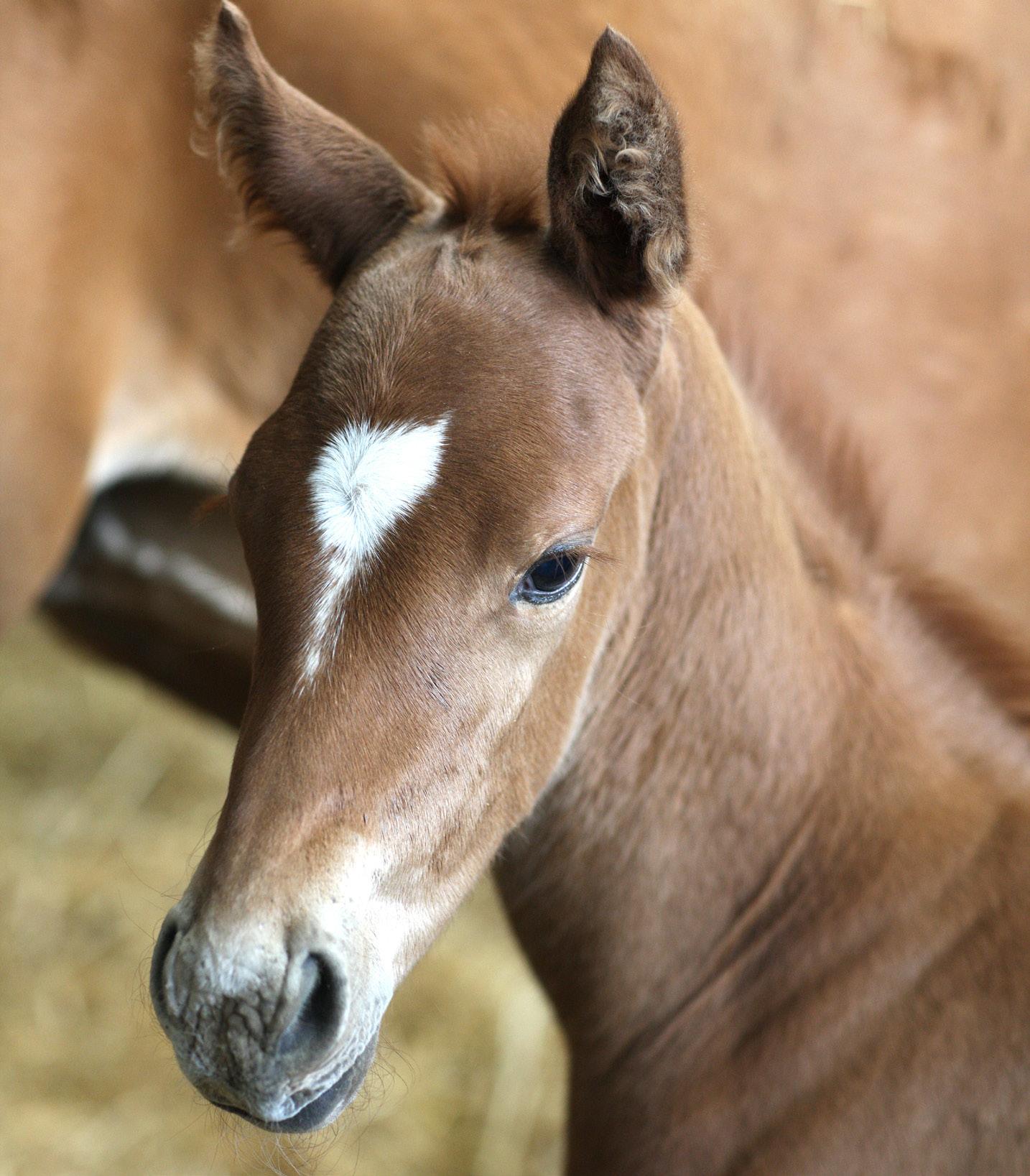
Solitairy Girl and her Jack Hobbs filly, foaled 22nd January, 18 days before her due date.

Foaling season has begun, but between the all night camera duty shifts Lucy and Doug have managed to go and see some of ‘their’ foals on the track
Confident that the mare we had been watching on the foaling cameras all night was quietly finishing up her breakfast and knowing that the girls would be arriving shortly to start work for the day, at 7.30am I relaxed my vigil and went to tack up the first horse I had planned to ride. Not long after, I heard a shout of ‘Sway’s foaled!’ and sure enough, in that short time from having shown no outward signs that foaling was imminent, Glanvilles Guest had got on with it on her own, and
there in the straw was a lovely, big, chestnut colt. This season’s first foal had arrived the week before, but with the more usual fanfare warning signs that a mare is in labour. At 11.00pm we watched on camera as Solitairy Girl started pacing the box, lying down and then getting up again. At 11.30pm she was starting to get sweaty, at 11.45pm we could see the bag appear and by 11.58 there was a filly foal,
lying in the straw being busily licked by her dam. Again, a nice easy foaling with very little help required. This was the seventh foal out of the mare. Her first foal is a 6yo, 128 rated gelding called Soul Icon, who is in training with Kieran Burke and who has won an impressive seven of the eleven hurdle races he has run so far.
Stretch the legs
There is another early February foal due to a mare called Seemarye, who is in foal to the champion British jumps sire, Nathaniel. The mare’s pregnancy is looking huge, and being fat and unwieldy she goes into the allweather turnout and just stands

34 The BV magazine, February ‘23 EQUESTRIAN
being fat and unwieldy she just stands in one place and munches hay all day
All images: Courtenay Hitchcock

35 The BV magazine, February ‘23
EQUESTRIAN
in one place and munches hay all day. Her lack of movement is meaning that her legs are beginning to fill and, as she is too heavily in foal to put on the walker, we are leading her up the track for a really good leg stretch, before she comes back into her stable in the afternoon, just to get her moving and get her circulation going. No more mares are due until early March, so once Seemarye has foaled, Doug and I should get a couple of weeks break from constant night-time camera watching. We might even take the rare opportunity to go away for a few days!
TGS foals at the races
At the same time as the first foal was being born on the stud, Doug was up in Doncaster selling three foals and an infoal broodmare. You may recall I’d talked about their being prepared for the sales in the January column. We had
bought the mare, Spirit of Rome, in 2017 as a maiden 3yo filly (which means she was a young horse, had raced on the flat but not won) with a good pedigree. She had since been leased to trainers to add form to her page (a horse’s page in a sales catalogue describes the quality of its racecourse performance plus that of its relatives, going back three or four generations. You can see Spirit of Rome’s here), winning twice and placing seven times over hurdles. We were now trading her on. The foals and the mare were all sold – although some for not as much as we had hoped – and we look forward to following the racing careers of the foals in a few years. From our breeder’s point of view, racing at Wincanton today, Thursday 2nd February* was a real pleasure, with a number of TGS-connected horses running. In the second race, a novices’ handicap steeplechase, Triple
Trade, a 7yo Norse Dancer that we bred out of Doubly Guest came a very good second to a horse carrying 23lbs less than him. As this race was a novice handicap, horses are allotted a weight to carry that is proportionate to how good their previous performances have been. The theory being, if the handicapper does his job perfectly, all the runners will dead heat as the weight they are carrying gives all horses an equal chance. So, if today they had been running off level weights (all carrying the same weight) the finishing positions would likely have been very different. But it was a good race nonetheless and the winner did well to beat the other horses in the race with better form.
The last race, an open, maiden mares National Hunt flat race, saw another TGS-bred horse running: the 6yo Sam’s Amour, a Black Sam Bellamy mare out of the recently retired Aphrodisias (who incidentally is grandma to our first foal born this year!). A second mare in this race, the 4yo Tique, whom we had foaled for her owner Heather Royle and who quickly became a yard favourite due to her extreme friendliness and beauty, was also running. Both ran good races and although they finished out of the placings today, I will never tire of seeing the foals we help bring into the world out doing their jobs on the racetrack.
Breeding a racehorse is just the start of the journey and there are so many pitfalls along the route to their first (and subsequent) races that we always say, ‘Just getting a horse to the racetrack is a win in itself. Actually getting that horse to then win a race is the icing on the cake!’
* yes, I do tend to send in late copy, apologies editor! (Luckily for you - as usualI’m now gripped and have therefore forgotten how late you submitted. Again. - Ed)
36 The BV magazine, February ‘23
EQUESTRIAN
Glanvilles Guest’s Planteur colt, foaled 30th January, six days early.

37 The BV magazine, February ‘23 EQUESTRIAN
Point-to-point is back at Badbury!

Tickets for the ever-popular Countryside Alliance point-topoint, which will take place at Badbury Rings on Sunday, 19th February, are now available to buy online – with the option to purchase Patrons’ tickets, with a number of exclusive benefits. Gates open at 10a.m., with the Countryside Alliance Club Members Conditions race the first contest of the day, starting at 12 noon. This allows plenty of time for racegoers to peruse
the shopping stands, enjoy the entertainment and make the most of the selection of food stalls and licensed bar, as well as, perhaps, a visit to the bookmakers for a flutter. Another firm favourite of this annual event is the family dog racing, so get those pet pooches in training now!
Patrons’ tickets offer a thrilling raceday experience which includes entry and parking, of course, plus all day access to
the Patrons’ tent, positioned in a prime location. Patrons ticket holders enjoy seating, a welcome aperitif and buffet lunch, refreshments throughout the day and a complimentary race card. We look forward to welcoming you to enjoy a great day’s racing at Badbury Rings; always a popular and highly-regarded point-to-point course. As well as a men’s and a ladies’ race –both of which are usually hotly contested – the six-race card includes two Countryside Alliance Club Members contests, where entered horses must be owned by Alliance members.
To secure your Patrons’ tickets for a fantastic day’s racing please click here. Applications for Patrons’ tickets close at 9am on Friday 10th February.
Further details can be found on the point-to-point website; just click on ‘Buy Racegoer Tickets’. View the full list of point-topoint meetings here.

38 The BV magazine, February ‘23 EQUESTRIAN ADVERTORIAL
Badbury Rings point-to-point. Image: Tim Holt

39 The BV magazine, February ‘23 EQUESTRIAN
January is a tough month to be motivated
I think I can speak quite confidently for the entire Eventing community that January isn’t anyone’s favourite month! It’s a month that likes to test our determination and motivation when it comes to working outside. I have definitely broken my record for the number of layers worn at one time over the last couple of weeks! With temperatures going down to around -7º and generally not reaching 1º throughout the day, we have had to develop and adapt our riding plan to avoid the icy roads and frozen arenas. I have been incredibly lucky and blessed to be able to base myself at William Fox-Pitt’s yard for the last year. To have access to an indoor school and an allweather gallop means we have been much more fortunate than others and have been able to keep our horses safely in work. With the yard being purposebuilt with rubber matting everywhere in the purpose-built yard means we have been able
to carry on safely and get every horse out of the stables.
A new plan
With the 2023 season creeping up slowly, all my horses have had their winter holidays; they are rested and recovered and are now all back in work. At this time of year we are mainly working on correct muscle building, increasing strength through their
core and back, and fine-tuning any small details which were off last season. We are yet to get them out competing or round a course of jumps, but are focusing hard on polework to improve their strength and flexibility. The first draft of the 2023 season plan has been drawn up, and we can start looking at the details. I tend to work backwards from our spring event goals to make sure we are focused and ready to achieve our hopes and dreams for the coming season.
It’s not one general team plan: each horse has its own individual season plan tailored to suit its own strengths and preferences, targeting different events and classes for each.
I have been forcing myself back into the gym as well, to ensure I am just as fit and strong for the upcoming season as my horses –it will help to increase the chances of success.

It’s a very exciting season ahead. We have lost some local events, due to rule changes, but we have gained exciting classes at top venues, including the recent news of the addition of the Chard BE to the South West fixture list.

40 The BV magazine, February ‘23 EQUESTRIAN
At the start of the year, each horse has a plan laid out for the coming season and the building work begins, says eventer Toots Bartlett
Toots and Freestyle R, both wearing ALL the layers to work in the frozen
weather
Toots knows she is ‘lucky and blessed’ to have access to the purpose-built all weather facilities at the Fox-Pitt yard
S p e c i a l i s t s i n S t o r a g e , T r a n s p o r t , I n s t a l l a t i o n , C o n s e r v a t i o n a n d R e s a l e
> S h o r t a n d l o n g - t e r m s t o r a g e s o l u t i o n s w h e t h e r y o u a r e m o v i n g h o u s e , r e n o v a t i n g o r j u s t n e e d t o s t o r e y o u r c o l l e c t i o n

> P e r s o n a l i s e d s p a c e t a i l o r e d t o y o u r n e e d s , f r o m g e n e r a l a r t s t o r a g e f o r c r a t e d a r t w o r k t o b e s p o k e a r t r a c k i n g s e r v i c e s i n a c l i m a t e c o n t r o l l e d r o o m a t c o m p e t i t i v e r a t e s
> W e o f f e r a f u l l a r t i n s t a l l a t i o n a n d d e - i n s t a l l a t i o n s e r v i c e f o r g a l l e r i e s a n d p r i v a t e c l i e n t s
> I f y o u a r e a r e s e l l e r o r a r t i s t l o o k i n g f o r o r d e r c o m p l e t i o n s e r v i c e s i n c l u d i n g p a c k i n g a n d s h i p p i n g

F o r f u r t h e r i n f o r m a t i o n i n c l u d i n g c o n s e r v a t i o n , r e s a l e a n d q u o t e p l e a s e c o n t a c t u s : i n f o @ m w a r t s e r v i c e s . c o m


Storage Installation Logistics Conservation Resale www mwartservices com
In the studio with children’s book illustrator Jane Chapman


Anyone who has had to read bedtime stories in the last 25 years is very likely to have had Jane Chapman’s work in their hands. Edwina Baines reports.
Jane Chapman is an incredibly successful illustrator of children’s books with almost 150 publications to her name. Her paintings do not simply illustrate the words – they tell
their own story, allowing even the youngest non-readers to understand and follow. From an early age, we interpret complex expressions and emotions through drawings,
in ways we cannot do with language or the written word. It’s the old adage, ‘a picture paints a thousand words.’ Children’s picturebook characters can become
42 The BV magazine, February ‘23
ART
All images: Courtenay Hitchcock

43 The BV magazine, February ‘23 ART
grippingly alive and transformed into living, breathing beings who, as Jane says, ‘you might meet on a walk in the woods.’ I met Jane on a grey, wet, windswept January morning in her beautiful house tucked away in Cheselbourne.
Toys to books
Having successfully completed science and maths A Levels, a chemistry degree was nearly Jane’s chosen path. After a foundation art course, however, science was soon left behind. Illustration seemed a more sensible, practical option for her academic and business mind and she graduated with a first class honours degree from Brighton University.

Initially a portrait painter in the 1990s, Jane moved through soft toy design before landing a children’s book publisher; commissions soon flowed in. She has been illustrating for Little Tiger Press (now owned by Penguin Random House) for more than 25 years and has produced many best-selling and award-winning titles. In recent years Jane has taken to writing as well as illustrating and so far has had 15 books of her own published. She showed me some of the charming initial draft drawings of a frog and a mouse for her next book, which would soon be sent off to the publisher. She says: ‘The whole creative process for the book is a collaboration between the editor, designer, sales team and illustrator.’ Other recent books include Together, a tender story about a tiny gorilla who is finding a way through sadness, conveying the importance of compassion and connection in a big and challenging world. Mole’s Quiet Place is a moving tale of friendship and understanding that encourages

44 The BV magazine, February ‘23 ART
New artwork for Jane’s next manuscript, waiting to be shipped to the publisher
Jane Chapman working in the converted garage which is now her printing room
empathy, teaching children to consider the needs of others. But Jane is most proud of her recent book Goodbye Bear, which tackles the difficult subject of bereavement for children. ‘Beaver and Mole miss Bear very much, but they find a way to celebrate him with the help of all their friends.’
To be able to write and illustrate with such sensitivity, I wondered if Jane had to find her own inner child? She says: ‘What I’m trying to do in my work is to reach adults as well as children. I try to get some solid truths into my books. I don’t want to preach nor do anything scary. I want to create a safe world where things are resolved. Picture books are like haiku – the story doesn’t work without the pictures. In a good book, the child (without reading the words) should be able to tell the story through the pictures and be given time to talk about the images.’
Timeless style
Jane’s
Another successful series published by Simon and Schuster has been a collaboration with Karma Wilson, who is the author of the bestselling Bear books illustrated by Jane. They include Bear Snores On, Bear Stays Up and Bear Can’t Wait. They also include other memorable
and recognisable characters including a wren, mouse, mole, badger, raven, rabbit, and owl. For these books, Jane says that she ‘settled on a traditional, timeless style’, which has remained popular. The books sell well in the United States and have been translated into numerous languages. Jane’s characters generally emerge from the animal kingdom and come to life in beautiful original acrylic illustrations. Her bright colour palette creates the mood for each painting. However, every individual page must contain a more muted, lighter section for the text insertion and this will have been agreed upon beforehand when the rough draft is submitted. She says: ‘I have very specific ideas about my characters and what sort of personalities they have. They become real in my head, living an alternative life when we’re not there!’

It is a painstaking way of

45 The BV magazine, February ‘23 ART
cast iron 19th century Albion press.
Nero, who ‘invariably walks over the paint palette, leaving green splodges everywhere’


46 The BV magazine, February ‘23 ART
Jane’s next book centres on a frog and a mouse
‘The whole creative process for a book is a collaboration between the editor, designer, sales team and illustrator.’
working: Jane will paint from 60 to 70 hours a week to meet her deadlines, leaving little time to explore other genres of art. However, she also showed me her printmaking room which boasts a splendid cast iron 19th century Albion press – beloved by all printmakers. Jane uses the Albion for relief printing; another press in her studio is for intaglio printing, a method where ink is lifted from below

the surface of the plate. Last summer, a series of lino prints were made for the Look Up exhibition at Sculpture by the Lakes, where some of Jane’s intaglio images from the book Together were also on show. After meeting Nero the cat (‘he invariably walks over the paint palette, leaving green splodges everywhere’), I was left with the impression that Jane puts her heart and freedom of
expression into every aspect of not only her art, but also her busy family life and garden. She is passionate in her belief that children’s picture books will always have a place. ‘It is such an intimate thing to read with a child. There will always be hope at the end of my books, a feeling of safety. That all is right with the world.’

janekchapman.com

47 The BV magazine, February ‘23 ART
A page from Goodbye Bear
‘Picture books are like haiku – the story doesn’t work without the pictures’
Jane Chapman at her home in Cheselbourne
Red Squirrel on Brownsea Island

Fieldfare eating spindleberries

READER’S PHOTOGRAPHY
Roly Barth
John Bishop
We welcome photography submissions from readers - the only rule is that they must have been taken locally in the last month. Our cover shot is usually selected from our submissions pile. If you’d like to join in, please share it in the BV community Facebook Group or simply email it to us here.


READER’S PHOTOGRAPHY
Droplet David Pook
Winter reflections Jane Adams


50 The BV magazine, February ‘23 READER’S PHOTOGRAPHY
Bearded tit Leslie Lawrence
A lone tree just outside Wincanton Simon Lewis
Frosty Knowlton sunrise

Nicky Newman
Frozen Knowlton Robin Goodlad

51 The BV magazine, February ‘23 READER’S PHOTOGRAPHY


READER’S PHOTOGRAPHY
River Stour Kate Fry
Hen blackbird Mr P Holloway


53 22 & 23 APRIL 2023 TURNPIKE SHOWGROUND, SP7 9PL B��n� S���n� t� Li�� EARLY BIRD TICKETS ON SALE NOW! www.springcountrysideshow.co.uk
Blowers in Dorset, my dear old things!
Legendary cricket commentator and broadcaster, Henry Blofeld OBE, known amongst his many fans as Blowers and famed for his plummy tones and all-round good humour, invites you to join him in a brand new show, My Dear Old Things - coming to the Exchange in Sturminster Newton next month.

I asked him what made him head out on tour again – did he not think, at 83, he might be ready to retire from the rigours of touring?
‘I don’t know what you mean? I don’t recognise this word ‘retirement’. No, I shall never retire. I have a number of friends who retired at 60, and they were either dead at 65 or spend their days drunk and playing bad bridge. Not me. You can cut that one out, pretty quick. You’ve GOT to keep your little grey cells going. You can’t give up. If you retire, what do you do? Drink? ‘Doing nothing bores me to death. I enjoy what I do hugely. I wondered if the audience need to be cricket fans to enjo... I didn’t even get the rest of the question out before Henry chips in: ‘NO! I hate the phrase “cricket fan”, actually. People will know me because of cricket, of course, but it’s not a cricket evening at all. It’s humour and anecdotes. The same way an awful lot of avid
listeners to Test Match Special didn’t particularly like cricket. Four years ago I did the Marigold Hotel programme in India. There were some splendid behind-thescenes stories, but COVID came around and I couldn’t share them with anyone. So for the first hour I’m talking - I hope quite amusingly ... I think quite amusingly, anyway – about the stories from India that couldn’t be seen on camera. And the
second act is Test Match Special stories – there are some really funny ones to share. Hopefully everyone leaves just having had an excellent time!’
Henry will be appearing at the Tivoli Theatre in Wimborne on 8th March, at The Exchange in Sturminster Newton on 16th March and the Memorial Theatre in Frome on 17th March.
Free entry to Snowdrops at Springhead
Visit Springhead’s first open gardens of the year – as well as having the chance to wander around the lakeside gardens you will be able to see some of the many named varieties held at Springhead as you enjoy the beautiful drifts of snowdrops. The gardens will be open from Monday 6th until Sunday 12th February from 11am to 3pm.
In addition, the gardens will be open on Saturday 18th February from 1 pm until 4.30 pm as part of Shaftesbury’s annual snowdrop celebrations (times are of course weather dependent). Entry to the gardens will be free but donations would be appreciated. Light Refreshments will be available throughout the day on Saturday 11th and Sunday
12th provided by, and in aid of, St Andrew’s Primary School, Fontmell Magna. Dogs on leads are welcome and there is assisted wheelchair access.
6th-12th February, 11am to 3pm and 18th February 1 to 4pm For more information email info@springheadtrust.org.uk or call 01747 811853.
54 The BV magazine, February ‘23 WHAT’S ON
Run away with the circus this February half term at the Fleet Air Arm Museum
It’s an action-packed February half term at the Fleet Air Arm Museum with amazing circus tricks from StrongWomen Science and the Great British Take Off. Be wowed by naval aircraft in four halls, including the thrilling new family-friendly Carrier Experience. Refuel in the recently refurbished Warnefords Café, and let the little ones try out the mini play area. FREE activities included with a museum ticket:
Matchstick Fleet
11th and 12th February, 10am to 3pm


A display of Philip Warren’s Matchstick Fleet, a culmination of a lifetime’s work. The collection, built entirely from matches and matchboxes, spans 525 ships
and 1,000 aircraft. It includes the ships of the Royal Navy and beyond, illustrating the development of warships from the end of WWII right up to the present day.
StrongWomen Science Circus
14th and 15th February, 11am, and 1:30pm Ever wanted to know how to balance a chair on your chin? Or if it’s possible to juggle liquid? StrongWomen Aoife (an engineer) and Maria (an environmental scientist) reveal the amazing science behind their astounding tricks.
The Great British Take Off 16th and 17th February, 10am to 2pm. Get involved building and
launching a balsa wood aircraft from the museum’s own model aircraft carrier. Choose a type of wing from a Swordfish to a Seafire or even a new F-35 Lightning and watch it go! Who can design the one which flies the furthest?
The New Carrier Experience Blending the best of technology with the scale of a carrier flight deck to transport visitors from the pioneer years of WWI all the way to the modern HMS Queen Elizabeth class carriers of today. Virtually meet a cast of characters to get a taste –and feel - of what those serving onboard experienced.
Fleet Air Arm Museum tickets can be purchased online here
55 The BV magazine, February ‘23 WHAT’S ON


56 The BV magazine, February ‘23 WHAT’S ON SHERBORNE SCHOOLS’ CHORAL SOCIETY Mendelssohn’s ELIJAH SHERBORNE ABBEY Wednesday 8 February 2023 at 7.30pm Tickets £15, £12, £10. Scan the QR code to book online T: 01935 812249 E: tickets@sherborne.org Sarah-Jane Morris — Soprano Susan Legg — Alto Andrew Morris — Tenor Peter Grevatt — Bass-Baritone Dan Marks — Conductor
Friday Lunchtime Recitals





57 The BV magazine, February ‘23 WHAT’S ON

58 The BV magazine, February ‘23 WHAT’S ON

59 The BV magazine, February ‘23 WHAT’S ON
BARD IN THE YARD: THE SCOTTISH PLAY
THUR MAR 2ND
William Shakespeare is stuck The King will have his head on a stick if Will dares show his quill in London without a Scottish play. Can you help the greatest playwright of all time overcome his writer’s block?
PHONEY TOWERS
SAT 4TH MAR
A hilarious stage show tribute to Fawlty Towers. Starring BGT star Drew Cameron
An Evening with: HENRY BLOFELD

THUR 16TH MAR

An evening of fun and games with legend 'Old Blowers.' Backed by film and rare personal pictures on our big screen, My Dear Old Things is an absolute treat for the cricket connoisseur and a wonderfully engaging evening for all.
FOREVER IN BLUE JEANS: The Final Tour SAT 18TH MAR

The best in Country Music and Rock ‘n’ Roll. Don't miss your last chance to see this incredible band.
CARA DILLON
SAT 25TH MAR
The extraordinary voice of Cara Dillon sharing classics and tracks from her new album Wanderer.

“Quite possibly the world’s most beautiful female voice” (Mojo).
THEATRE MUSIC CINEMA VENUE HIRE
DANCE COMEDY GALLERY CAFE
60 The BV magazine, February ‘23
Lewis-Manning Hospice Care


2km & 4km obstacle course for all abilities!


Sunday 26th March 2023 10am - 4.30pm
Upton Country Park, Poole

MUDDY DOG DASH
Registered Charity No. 1120193 Kindly sponsored by
Flood damage in Wyke Bridge Street, Gillingham, proves a popular attraction for the townsfolk. Picture from the Barry Cuff Collection, published in Lost Dorset: The Towns, by David Burnett
The day the dam burst
In this month’s Looking Back column, Roger Guttridge describes a disastrous –and yet miraculous – day in North Dorset’s memory
To those who’ve suffered water damage recently it will be no consolation, but Dorset has rarely seen flooding like that which hit the county’s northernmost reaches 106 years ago. The event was both a disaster and a miracle – the latter because there was no loss of human life, although there were numerous narrow escapes. It all began at 6pm on 28th June, when the mother of all thunderstorms deposited 10 inches of water on Bruton in Somerset, and 5.75 inches on Bourton here in Dorset. The rainfall proved too much for the dam at Gasper Bridge, which
held back 18 acres of water to form Stourhead’s lower lake. During the night of June 28-29th, the lake suddenly burst through, destroying both bridge and dam and releasing millions of gallons into the valley. Witnesses likened the roar of rushing water to ‘continuous thunder’.
... Heavy machinery, a steam lorry and a 15cwt safe overturned, a large boiler swept from one workshop to another...
The force of the water gouged a 30-feet-deep chasm from the roads on either side, uprooted trees and washed out the foundations of Gasper Mill. As it entered Dorset, the flood first encountered Hindley’s Bourton Foundry, a former mill which traditionally manufactured heavy machinery.
Since the outbreak of the First World War it had produced three million hand grenades known as Mills bombs.
The Western Gazette reported that a ‘great wave’ swept through the workshops, causing ‘damage of a most extraordinary character’.
Sheds and outbuildings were ‘swallowed up’ by the torrent, walls demolished, heavy machinery, a steam lorry and a 15cwt safe overturned, a large boiler swept from one workshop to another and 200 to 300 tons of coal washed away. A large cart was carried several hundred yards downstream along with fences, posts and other objects.
The main part of a flatbed lorry was later found half a mile away. The water and mud were up to 10ft deep in parts of the foundry

62
and the caretaker – the only person on site at the time – only escaped by climbing on to a roof.
When pigs swim
The bridge that carried the London to Exeter road over the river collapsed, but in doing so probably saved the life of one Bourton resident, a Mr Tufts. His cottage was flooded up to its ceiling but would almost certainly have been demolished had not the main force of water been released by the bridge collapse. Many other houses flooded to depths of three or four feet, including the police station. The impact on the community was ably described by Bourton Parish Council chairman B. Pope Bartlett in an appeal for money to help residents.

He wrote: ‘In many cases their homes have been flooded out, their furniture, clothes and food washed away or destroyed, and their gardens and allotments, on which they had spent so much time, wrecked beyond repair.’
As it headed for the village of Milton, the floodwater continued to wash away ricks and freshly cut hay, poultry from their pens and even pigs from their sties, though some pigs swam to fight another day.
Evacuation
At Gillingham, a supplementary drama unfolded at Plank House, which the Red Cross had taken
over as a hospital for wounded soldiers from the front.
Miss Brock, the night nurse, first noticed the rising water at 1.40am.
It was only ankledeep at that point but by the time Dr Farnfield arrived it was chest-high.
As Miss Brock and Sister Jones continued to evacuate the downstairs wards, the doctor and two relatively-able patients raced to rescue others from shelters and summer houses. ‘Half-swimming, half-walking, one by one these three men rescued the helpless patients from the open-air shelters,’ reported the Western Gazette. ‘Only just in time were all rescued, for by 3am the flood
had risen to a depth of 4ft 6ins in the house and 6ft outside.’
The water also washed away an oak tree and 16yds of stone wall. It flooded numerous houses, shops and other Gillingham businesses to depths of up to five feet. Grocer Mr Hayden and butcher Mr Toogood were among those hardest hit, along with Wilts United Dairies whose engine room was flooded and churns and equipment washed out of the yard. At Town Mills, the water reached one of the highest levels ever recorded.
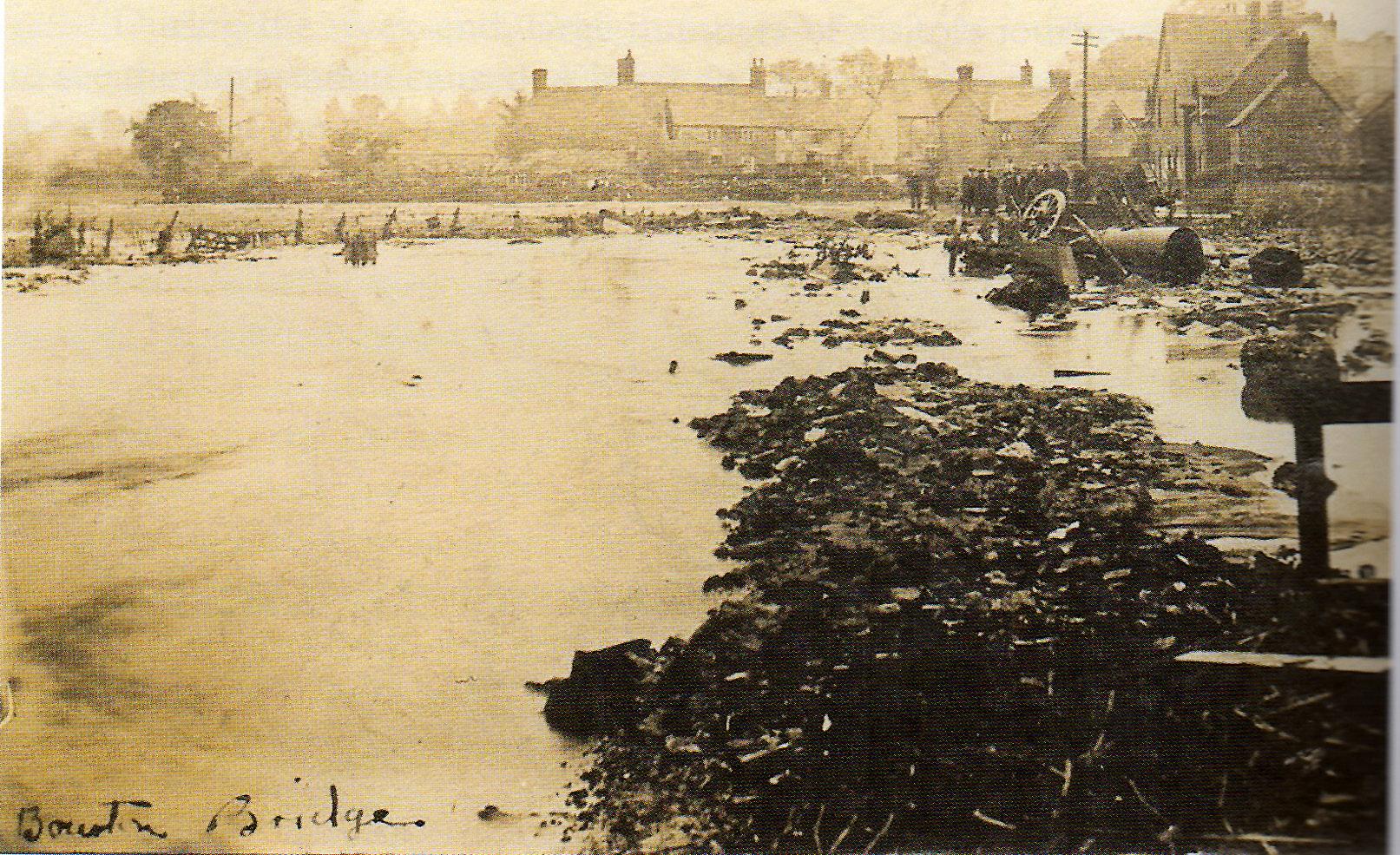
In the immediate aftermath, Gillingham Grammar School head Alfred Mumford loaded a 25lb joint of beef and all the trimmings on to a farm wagon and delivered it to Plank House to feed patients and staff. Repairs to many of the bridges and buildings took months but production of Mills bombs at Bourton Foundry resumed with lightning speed due to their importance to the war effort.
• In 2017, the Bourton Players performed a play that followed the fortunes of five women Mills bombs makers at the foundry.
63 The BV magazine, February ‘23 Roger welcomes questions and comments - rogersguttridge@gmail.com LOOKING BACK
... Half-swimming, half-walking, one by one these three men rescued the helpless patients...
Locals survey damaged Bourton bridge from a temporary structure. Picture from Maggs and Hindley, by Robert Mullins
The road to Bourton bridge on the day after the flood. Picture from Maggs and Hindley, by Robert Mullins
Postcards from a Dorset Collection

The BV first featured Barry Cuff’s collection in The Gardener with 10,000 postcards in April 2022. Each month the local postcard collector shares a selection of rarely-before seen images from his archive. This month Barry has picked local photographer Clarke & Son from Stalbridge.

64 The BV magazine, February ‘23 POSTCARDS FROM A DORSET COLLECTION
Stalbridge High Street is still recognisable today
What is now the A357, just along from Sturminster Newton bridge


65 The BV magazine, February ‘23
POSTCARDS FROM A DORSET COLLECTION
in Marnhull
Photographer Clarke & Sons printed their location as Sturminster Newton and Stalbridge on the reverse of the cards. They are listed in Kelley’s 1895 directory as being in Stalbridge, but there is no entry for them in the 1910 directory. All four of these cards are marked 1905 to 1907. Two were never sent in the post, and one was not posted locally.
Nash
The Jubilee Oak crossroads at Stourton Caundle.
Tales of a Blandford blizzard
Roger Guttridge recalls a Victorian snowstorm that cut the town off – and the local newspaper publisher who abhorred the evils of drink
A light dusting of snow on my lawn today prompted me to dig out this Victorian picture as a reminder of what a serious dose of the white stuff can look like.
The eminently recognisable location, of course, is the point in Blandford where Salisbury Street divides and Whitecliff Mill Street peels off to the left. The horse-drawn cart appears to be loaded up not with the latest issue of the Blandford Express that was printed in the building behind it but with snow, shovelled from the streets outside.
Whether the boys lined up outside the office window were waiting for copies to deliver or just posing for the camera, we will probably never know.
Printer J. A. Bartlett launched the Blandford Express in 1869 (some sources say 1859) and it continued to roll off the press until its closure in 1894. Bartlett was a devout Christian, and he used his professional situation to further the campaign against alcohol abuse that was ruining so many lives in Victorian Britain. His newspapers also included the Dorset Abstainer and the enticingly-entitled Dorset County Temperance Advocate.
Bartlett lived at The Plocks and died in 1900 aged 73. At some point the Blandford Express building’s original attic area was extended with the addition of three gable windows and, in keeping with Bartlett’s views on the evils of drink, became a coffee house and temperance hotel.

The date of the photograph is disputed. Most sources date it to 9 March, 1891, when a blizzard produced 10ft snow drifts and cut off the town from the outside world. The Blandford Express’s competitor the Dorset County Chronicle reported: ‘The snow storm made its appearance on Monday afternoon and continued with increased severity until just after 11pm Tuesday.’ The railways and the postal service ground to a halt – so no change there then.

Dissenters from the 1891 date are Mark Ching and Ian Currie, authors of The Dorset Weather Book, published
in 1997. They claim – unconvincingly in my view – that the picture dates from 18-19 January, 1881, when a ‘furious blizzard’ swept Dorset, claiming three lives. Henry Hawker was fatally entombed in a snowdrift within sight of his home at Thorncombe and two children suffered a similar fate while trying to walk from Hamworthy to Morden.
The perennial struggle of local media
The Blandford Express did well to survive as long as it did. Its other rivals included the Blandford Weekly News, which published from 1885 to 1892; the Blandford, Wimborne and Poole Telegram, which appeared from 1874 to 1886; and the Blandford Gazette and Three Shires Advertiser, which survived barely five months from August to December 1903.
Throughout this period the Blandford papers also had to compete with the Dorset County Chronicle and two big regionals, the Western Gazette and the Salisbury and Winchester Journal, both of which survive to this day. More than 130 years later, the former Blandford Express building is now a hairdresser’s.
66 The BV magazine, February ‘23 THEN AND NOW
The Blandford Express office in 1891 (or possibly 1881). Image from the Barry Cuff Collection
A similar view today minus the snow. Note the addition of the second-floor gable windows.
Image: Roger Guttridge
UFOs – or something else tonight?
Richard Miles, Dark Skies Adviser for Dorset CPRE, was chatting with fellow astronomers over a coffee – all missing the fireball shooting overhead!
Have you been tucked up safe and warm at home these long dark winter nights? I have for the most part, but occasionally –when a cold, clear, crisp evening presents itself – I will venture out for a little stargazing. Staying indoors with curtains drawn will guarantee I’ll miss what’s going on every night overhead!
The night sky is a busy place, partly thanks to all the artificial satellites that glide silently by, looking like stars in search of a new constellation until they disappear from view in the earth’s shadow.
One of the most spectacular sights is that of a bright meteor, or fireball, as it bursts into view for a few seconds, soon to vanish after hitting our upper atmosphere and burning up more than 50 miles high. Bright fireballs appear every few nights but most go unreported. One exception occurred over the Blackmore Vale on the evening of 9th January 2023. More than 200 people across the country reported it to the International Meteor Organization.

As this bright meteor burst into view, I was sitting indoors chatting with some astronomer friends, oblivious to what had passed overhead! Fortunately my colleague John Savage operates an all-sky meteor video camera, which secured a view of its trail.
Go stargazing
If you hope to see a fireball then try venturing outside for a bit of stargazing. GoStargazing is great for finding stargazing venues - we advertise our own Cerne Abbas events on there. I also refer you to Rob Nolan’s piece on the next page where he gives details of what is visible in the night sky

this month, including a new comet with the unwieldy name of comet C/2022 E3 (ZTF) that passed about 10 degrees from the Pole Star on 31st January. It is now heading south towards the constellation of Taurus, and will best be seen in a NW direction around 6.30pm on 7th February, before the brilliant moon rises. I should add that fireballs have to be extremely bright for them to
produce meteorites that hit the ground. Given the odds of many billions to one against, there is no danger of being hit by such an object or any other ‘UFO’ for that matter!
Do always wear plenty of warm clothing, take a Thermos flask with a hot drink in it and watch how you go at night by using a torch when needed. Wishing you clear skies!
Report your light pollution
You may have seen the report last month on the BBC website about an increase in light pollution. Monitoring our night skies is important; consider taking part in Star Count 2023. Organised by Emma Marrington, it is the CPRE annual citizen science project to map the nation’s view of the night sky and monitor the impact of light pollution across the country. It’s easy to take part, whether you live in town or country: just look to the night sky between 17th and 24th February and see how many stars you can see in the constellation of Orion. Then enter your postcode and report the star count for your location on the CPRE website.

67
RURAL MATTERS - the monthly column from the CPRE
Fireball captured by video at 8pm on 9th January near Sturminster Newton. Image made available by John Savage and the Allsky7 Fireball Network.

A nugget of purest green ... ice!
January usually feels like a long month for most of us, but for astronomers this particular one felt really long! We were blessed with a spate of crisp clear and moonless nights, so that meant not a lot of sleep for many of us, including me.
Those of you familiar with Blackadder, the 1980s TV show, may recall Lord Percy trying to create gold, and ending up with a ‘nugget of purest green’? Well I hoped last month that I would be able to share with you a very special once-in-alifetime capture of a green comet that has not passed our way for thousands of years. As you can see opposite, I’m happy to say, I got it! It really is a great feeling when you try to capture a rare target, those first images start coming in and you see the object for yourself in glorious detail. Comet C/2022 E3 (ZTF) is a long-period comet from the Oort cloud and is approximately 1km in diameter. It was discovered as a very faint 17.3 magnitude smudge in the constellation of Aquilla, and the 1.2m telescope at Zwicky Transient Facility
(ZTF) is credited with the comet’s discovery. What is remarkable about this comet is that it last appeared in our skies 50,000 years ago, when Neanderthals roamed the Earth.
There’s talk in the science community about the comet currently moving in an open parabolic orbit; it may move into deep space and never pass this way again. This would mean we would be the only humans to have ever witnessed this comet in our skies with the ability to image it. Amazing!
C/2022 E3 passed within 26 million miles of Earth on 1st February, and should be visible as a faint smudge in the sky to those out looking for it well into mid-February – a pair of binoculars or a small telescope will help.
This image was captured with my 350mm refractor telescope and the ZWO ASI2600MM Pro Astro camera with RGB filters. Only 30 minutes of capture time was needed to bring out the detail of the comet’s tail due to its apparent brightness.
The night sky, February 2023 – Rob’s guide for your stargazing this month:
Comet C/2022 E3 (ZTF) continues to grace our skies into February, having passed closest to the Earth on the first of the month and should be visible with the naked eye! It is visible near the north celestial pole and located within the Camelopardalis constellation. Our local neighbours Venus, Mars and Jupiter continue to shine brightly in the evening skies throughout February, alongside some pretty high profile stars. The month ahead sees Orion drifting further west with the constellations Leo and Boötes continuing to rise higher in the east.
Canis Major, the larger of Orion’s hunting dogs, is in full view towards the East in the evening, crowned by the dog star Sirius, the brightest star in our night sky, hot on the heels of Lepus (the Hare).
Other nearby stars to take a look at are Mirzam – The Announcer in Arabic, due to the fact it rises just before Sirius – and Adhara which, five million years ago, held the crown for the brightest star in the night sky due to its relative position to the sun.
Nestled in Canis Major is M41, a relatively small star cluster of around 100 young stars. It is quite possibly the subject of the earliest known description of a deep-sky object, made by the Greek Philosopher Aristotle in 325 BC, though we can’t say for certain
that this is what he referred to when he described ‘a cloudy spot’ in the constellation. You can observe M41 through binoculars or with the unaided eye. I’m told Comet C/2022 E3 will appear to pass close to Mars on the night of the 11th, which would be a fantastic sight to behold, involving our local planetary neighbours dancing with the Moon in a neverending stellar waltz.
Other events to watch out for besides the comet? On the 15th February, Venus appears close to Neptune, which will help stargazers find the outermost planet in our solar system. Find Venus, and then look to the lower right of the brightest planet to bring into view the dimmest. Compared side by side, Venus is 60,000 times brighter than Neptune. On the 22nd, look west after sunset to see the crescent Moon adorned by Venus and Jupiter. The following night you’ll witness a similar entanglement, with Venus and Jupiter below the crescent Moon. And since we have a short month in February, why not finish off on the 27th with a look at the Moon’s first quarter with Mars close by and the star Aldebaran shining brightly.
Until next time, clear skies!
69 The BV magazine, February ‘23
NIGHT SKY by Rob Nolan Find Rob on Facebook as RPN Photography here
Some clear skies towards the end of December meant astrophotographer Rob Nolan finally managed to capture a much-wanted Christmas tree
Dancing with the Moon in a neverending stellar waltz
Take a Hike: From Cheselbourne around Nettlecombe Tout | 6.3 miles
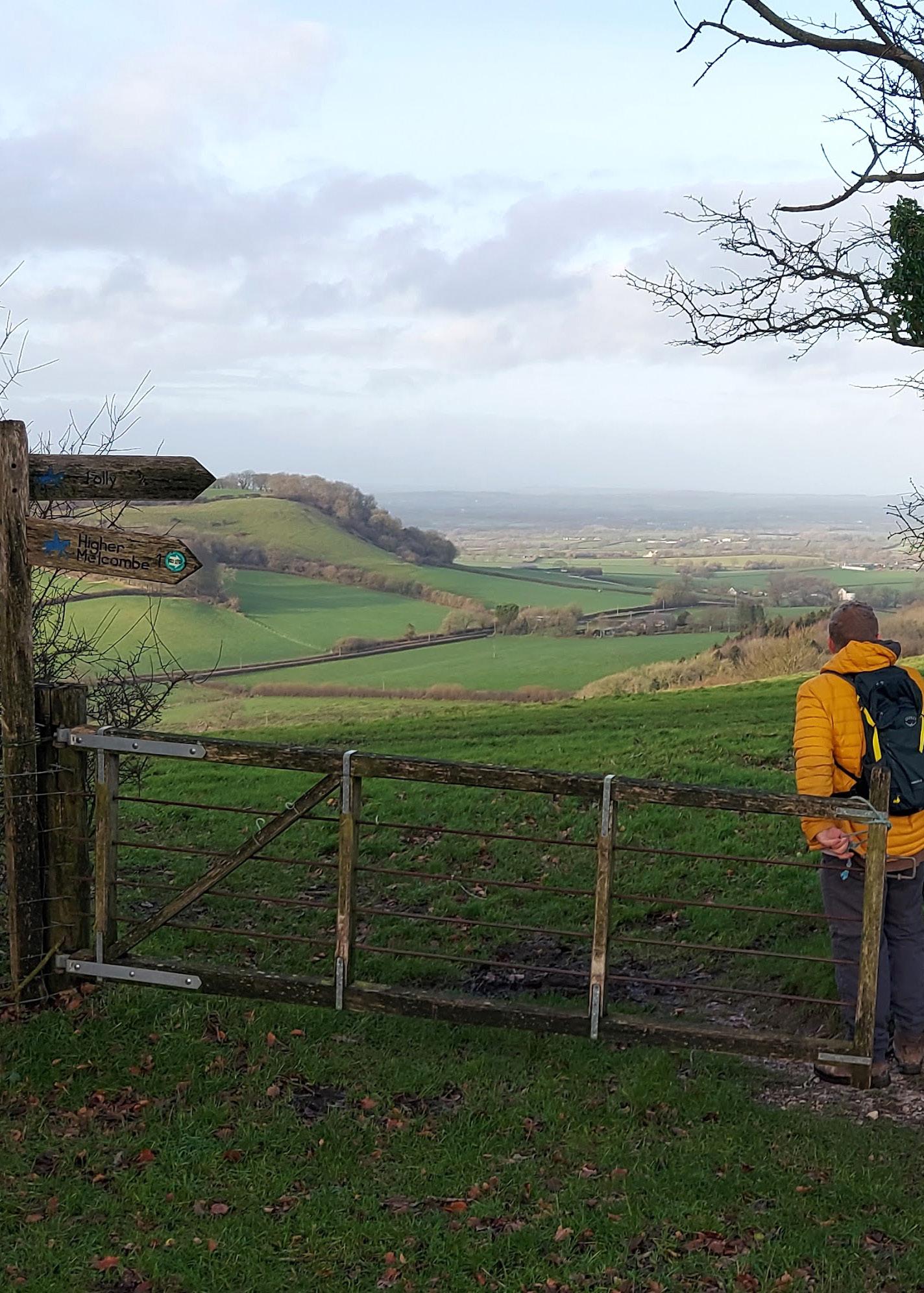
Starting just outside Cheselbourne on Drake’s Lane, this is a wonderful route with endless views, incorporating our favourite track over Lyscombe Hill and across Dorsetshire Gap. It’s a shorter circuit perfect for a winter’s afternoon. Pick a fine day, and you’ll be rewarded with some of the most stunning views across the Blackmore Vale and beyond. It really is a special place for a walk in North Dorset.
The path is straightforward, well signed and easy to follow. Dorsetshire Gap is a meeting of ancient holloways – this was the only arm of the crossroads we’ve never walked before. Not ashamed to say we plotted the whole route in order to walk one short lane!
As you circle the bottom of Nettlecombe Tout, keep an eye on the map. The obvious path goes straight ahead through a wide gate, but instead you want the narrow, dark path that cuts closer to the foot of the hill, up through the trees. Do NOT miss it – it’s not a disaster, you can work around, but you’d miss a stunning green holloway which was beautiful even in a grey, drizzly January.
We parked on the side of the green lane the route begins in – please park considerately and do not block farmer access. If it’s not possible, the next suggestion would be to add a little to the mileage and park in Cheselbourne or Melcombe Bingham and simply walk to the route.
We have always created and recently walked the routes we feature (See all previously published routes here), so you know you can trust them. We aim for unpopulated routes with no roads and BIG VIEWS! You can see all our routes (including many which are unpublished in The BV) on Outdoor Active, and all include a downloadable gpx file. All images © Laura Hitchcock
Dorsetshire Gap is an ancient crossroads


71 The BV magazine, February ‘23 CLICK THE MAP to see the interactive map and download a gpx file
The wonderful lane around the base of Nettlecombe Tout.
The uninterrupted view from Bowdens to the coast
The song thrush’s chest speckles are more streak-like – often shaped like upside-down hearts or arrowheads –compared to the spots of the mistle thrush.
The song thrush
Wildlife writer Jane Adams is missing her early morning alarm call – but feels there may be signs of hope for mavis

72 The BV magazine, February ‘23 WILDLIFE
Every year, around this time, the sound of a bird would pull me from sleep. Perched at the top of a neighbour’s rowan tree, its silhouette would gradually emerge. With head flung back, spiralling columns of condensing breath would rise from its beak, and I’d become lost in the phrases of its repeated song. It was a song thrush. Fifty years ago, its song would be heard all over Dorset (play the video above right with the sound ON to listen to a Dorset song thrush singing in my garden some time ago), but, like so many of our songbirds, its numbers have steeply declined by more than 50 per cent. The last time I was woken by a song thrush was more than five years ago. Some people have blamed their decrease on sparrowhawks and magpies, but this doesn’t stack up. Research by the British Trust for Ornithology has found that over the last 30 years, the proportion of predated thrush nests has actually decreased. Thrushes are just as likely to have declined in areas where hawks and magpies are missing. Sadly, human interference is the real culprit. We’ve taken away hedgerows, woods and wet ditches, increased drainage and tillage on the land and there are now fewer permanent pastures. We’ve removed the food and the nesting sites which song thrushes need to survive.
A way back
Still, there is hope. By planting new woodlands, careful management of hedges and wildflower strips on farms, they – along with our other British songbirds – can thrive again. In
some places where this land management has already been taking place, there are signs that song thrushes are making a tentative recovery. We need to help them. For centuries, this blackbirdsized brown bird with its spotted chest has been a part of our culture. Shakespeare and Chaucer called them mavis, but in more recent literature it’s probably better known from the poem by local lad, Thomas Hardy (see right). Written at the end of the 19th century, The Darkling Thrush starts with a haunting, bare winter scene, full of hardship and sadness. It could have been written about the last few years we’ve had. Then a song thrush sings. As dusk fell tonight, a song thrush was singing in my neighbour’s garden. Maybe Hardy’s darkling thrush can teach us something in 2023? Listening to, and being in, nature has a canny knack for helping our sense of wellbeing. So this February, try getting out into the countryside at dawn or dusk and listen for the hopeful song of a song thrush.
The Darkling Thrush

Thomas
Hardy, 1900
I leant upon a coppice gate
When Frost was spectre-grey, And Winter’s dregs made desolate
The weakening eye of day. The tangled bine-stems scored the sky
Like strings of broken lyres, And all mankind that haunted nigh
Had sought their household fires.
The land’s sharp features seemed to be
The Century’s corpse outleant, His crypt the cloudy canopy, The wind his death-lament. The ancient pulse of germ and birth
Was shrunken hard and dry, And every spirit upon earth
Seemed fervourless as I.
At once a voice arose among The bleak twigs overhead
In a full-hearted evensong
Of joy illimited; An aged thrush, frail, gaunt and small, In blast-beruffled plume, Had chosen thus to fling his soul
Upon the growing gloom.
So little cause for carolings
Of such ecstatic sound
Was written on terrestrial things
Afar or nigh around, That I could think there trembled through His happy good-night air
Some blessed Hope, whereof he knew And I was unaware.
73 The BV magazine, February ‘23
WILDLIFE
We’ve taken away hedgerows, woods and wet ditches, increased drainage and removed permanent pastures
The mistle thrush is larger and greyer than the song thrush, whose song is somewhat ‘squeakier’
Listen for the mistle thrush
The mistle thrush may be the first to hatch eggs if you’re lucky enough to have one in your garden, says communications officer Alex Hennessey
The mistle thrush (Turdus viscivorus) is a large songbird, commonly found in parks, gardens, woodland and scrub. The mistle thrush is also known as the ‘rain bird’ and ‘stormcock’ as it can often be heard singing loudly from the top of tall trees after heavy rain - typical weather for this time of year.
Visually, the mistle thrush is easily mistaken for the common song thrush (see Jane Adams article in this issue), whose song is somewhat ‘squeakier’ and includes repeating phrases. The mistle thrush is pale greyishbrown above, with a white belly covered in round, black spots. It is also larger and greyer than the song thrush.
The common name ‘mistle

thrush’ is likely inspired by this bird’s love of mistletoe. It enjoys the sticky berries found on that and other plants and, once it has found a berry-laden tree, an individual mistle thrush will guard it from any wouldbe thieves such as other mistle thrushes as well as species such as fieldfares who also feed on berries. In turn, the songbird helps mistletoe to thrive by accidentally ‘planting’ its seeds while wiping its bill on the tree bark to remove sticky residue. It also helpfully disperses the seeds in its droppings!
A mistle thrush’s diet isn’t confined to its favourite berries, however, and they will happily devour worms and other insects, as well as seeds and fallen fruit.

Adding seeds and fruit to your bird-feeding selection may help attract these birds to your patch. The mistle thrush is one of the earliest songbirds to breed and may lay a clutch of three to six eggs as soon as February. It’s normal for a mistle thrush to breed twice in a year, and while the male and female share the burden of feeding, the task of building the nest in a fork of a tree, from moss, roots, grass and mud, is the sole responsibility of the female.
To find out more about this fascinating species and what you can do to help the county’s wildlife, visit dorsetwildlifetrust.org.uk.
74 The BV magazine, February ‘23 WILDLIFE
Beef is beef. Except when it neighs.
This may be a testament to how quickly time seems to have sped up since the pandemic, but I was amazed to see the other day that it is the ten-year anniversary of the horsemeat scandal.
In my head, being petrified of lasagne was a noughties thing, like updating your Bebo, listening to the Black Eyed Peas or sitting down to watch Robot Wars on the TV (it really wasn’t a decade of high culture).
The scandal started in the November of 2012 when the Irish Food Safety Authority started testing cheap frozen beef burgers and ready meals. Results came back and horsemeat was found in over one-third of the burgers and pig in the ready meals.
The horsey burgers were made in three factories –two from Ireland and one from Yorkshire. Two of the factories were a subsidiary of ABP Food Group, the largest beef processor in Europe.
ABP was quick to pass on the blame to their continental suppliers, stating that they had no knowledge of the contamination, but as more and more products were tested the issue snowballed.

ASDA ‘beef’ bolognese was soon found with horsemeat, the first case of it found in fresh meat. It was starting to seem like no one was safe.
French manufacturer Comigel had its frozen beef lasagnes and bologneses, which it supplied to Tesco and Aldi, tested.
The result came back at 100 per cent horsemeat. Now, I don’t bring this up to simply remind everyone of the time they gnawed on Black Beauty, Red Rum and My Little Pony.
Food contamination scandals like this occur in most decades. Less than ten years before the Horsemeat Scandal, the UK had an outbreak of BSE (Mad Cow Disease), when infected meat from cattle went into the food chain and resulted in 176 human deaths.
Dorset cows don’t neigh

Since Brexit, the risk of another food scandal has increased. Great Britain is no longer a part of the food safety network of Europe, meaning food entering the large European ports destined for the UK is waved through without inspection.
Staggeringly, 40 per cent of the food we eat is imported – it is susceptible to tampering and contamination, but does not receive any proper checks when it reaches our borders. In an ideal world, the UK would be 100 per cent self-sufficient, of course, but unfortunately people love eating
avocados too much. I do however believe that the horsemeat scandal should be a lesson that British beef is best. I guarantee the beef found on our Dorset hillsides spends a lot less time neighing than the meat in your frozen lasagne or burger ...
Unfortunately, the UK government has an aversion to taking British farming seriously – and, frankly taking food seriously at all. A crashed egg market, pigs being slaughtered on farms and their meat thrown away, and a global pandemic that left shelves bare have all left our government with egg on their face.
Yet our MPs continue to leave agriculture at the bottom of their To Do list.
75 FARMING
A decade after the horsemeat scandal, how have we ended up in a place with more risks than ever to our food, asks Andrew Livingston
Definitely a cow on the banks of the Stour. Image: Laura Hitchcock
The weight of accusation
As I write this in the middle of January, once again the weather has been the main topic of conversation on the farm. In the last four weeks we have received nearly a third of this year’s annual rainfall, with rain nearly every day. The Tarrant is now flowing strongly, with parts of the meadows flooded – it’s difficult to believe that, right up to the beginning of October, parts of the Tarrant were barely flowing at all on the farm. With the recent record of extreme weather, it will be interesting to see what weather patterns 2023 decides to throw at us. Apart from the heavy rain over the Christmas period, the plan for everyone on the farm having some time off worked well, with a timetable in place to ensure everyone took their turn for the cows to be milked and the feeding and bedding up duties to be carried out. We had no
major breakdowns, but it was interesting to see over the festive period which carried on in a small way and which shutdown completely; most of our agricultural suppliers continued in some form or another.

Animal welfare at Rawston
The farm did have some disturbing news – which we only discovered via social media – of perceived animal welfare issues on the farm.
The first call we received was from the NFU, reporting that they thought our cattle had been videoed apparently showing them in a poor state (although the NFU agreed this appeared not to be the case). Then our local vets called to warn me the farm had been targeted with complaints to them – but again they could see no issue with the cattle. Next our milk buyer called and advised
his animal care
me that their farm liaison officer would come and visit us; he arrived the next day and again could see no problems, but suggested that we should have a full Arla farm audit within the next seven days to give us a clean bill of health.
Ordinarily this would have been fine, but during that seven day period I was due to have a hip operation (just to add to all the stress...). The audit was scheduled for the day after I returned from hospital. Still hobbling on crutches, I delegated to my son and the whole farm team got involved in showing the auditor around the cattle and the buildings. The cattle were given a clean bill of health with no issues. The final visit I had was from an officer of the government’s Animal and Plant Health Agency; we were once again inspected, and once again no issues found. This particular visit did save us from a subsequent visit from the RSPCA as there was nothing to report.
Whoever put up the original
76
Farmer James Cossins looks back at the strain of the last month – caused almost entirely by a complaint about
Our cattle had been videoed, apparently showing them in a “very poor state”
Rawston Farm’s milking cows in April 2022
social media post could perhaps have saved a considerable amount of anxiety by just calling into the local vets for a chat rather than putting an ill-informed opinion out into the world and hiding behind its potentially damaging effects.
The strain
This single social media post has obviously caused me, my family and the entire farm team a considerable amount of mental stress. With a hip operation in the middle of it, I had the added pleasure of a large amount of physical stress too, and I was beginning to feel I was heading for a dark place – who was going to contact me next?
Thankfully I have my family, close farming colleagues and the whole farm team, who have all been incredibly supportive. But the experience has made
me look at what mental health support there is for others in such circumstances, feeling as though there is unbearable pressure from external sources. I know that agriculture as an industry is not alone in having mental health pressures as an industry, but it is a growing concern in the community. Farmers are working alone, dealing with huge outsidetheir-control issues such as the weather, animal diseases like Bovine TB and bird flu, the constant financial pressures and often even the stress of working as a family – and those are just off the top of my head! The NFU provides good support for members through the group secretary network and also The Farming Community Network, the RABI (the Royal Agricultural Benevolent Institution is a national charity providing local support to the farming community) and YANA (You are
not alone, a rural mental health charity) to name but a few other sources of help.


Sadly, agriculture has one of the highest suicide rates of most industries and at long last it is now being recognised as a problem, so help is out there. Please use it. As I look out of the window the sun is shining, which makes us all feel better. Before long it will be spring again – all us farmers and growers will be out in the fields and smiling once more!
77 The BV magazine, February ‘23 FARMING
James Cossins assessing the harvest at Rawston
The importance of the UK’s Livestock system
Around 70 per cent of the total land area of England is used for farming. As well as being custodians of the iconic British landscape, the agricultural sector provides the foundations for the country’s largest manufacturing sector – food and drink. It is central to a thriving rural economy and is essential to the country’s net zero ambitions.
Livestock plays an important role in this and in the South West we have some excellent livestock systems producing high quality, nutritious products in the form of meat and dairy, produced in very low greenhouse gas systems, comparative with others around the world.
The NFU was therefore disappointed in December when Exeter City Council backed a
motion calling on the authority to ‘raise awareness of the benefits of plant-based foods’ and provide only plant-based food at internal meetings. In their debate they failed to recognise the vital role that the livestock sector in Devon plays in the economy and in managing the landscape, as well as ignoring the role of meat and dairy in a balanced diet.

The NFU has worked hard to engage with Exeter City Council on this issue, writing to highlight the positive role that livestock and the fact that the agricultural industry has a key role in delivering Net zero for the


country as a whole.
In January our Devon team met Exeter city councillors to discuss the motion, making it very clear that everyone should have access to a sustainable, nutritious diet and that meat and dairy play a key role in this. In Devon, just as in the rest of the South West, there is an abundance of producers able to fulfil the demands for a healthy and sustainable diet, including livestock producers as well as some excellent farming businesses who grow fruit, vegetables and grains. We know that there are town councils across Dorset looking at their own food and sustainability strategies. The NFU has a range of literature and support on the subject. If you would like more information, or a conversation with me, or one of our fantastic Dorset farmers on the subject then please do get in touch.
78 The BV magazine, February ‘23
When a city council takes a plant-based first approach, there are implications far beyond food at city hall, says NFU county advisor
Gemma Harvey
FARMING
Recognise the vital role that the livestock sector plays in the economy and in managing the landscape
Cows on Lyscombe Hill, looking out over the agricultural landscape of North Dorset. Image: Laura Hitchcock
The Voice of the Allotment January forced a rest on the allotment
For the first time in many years we have not been able to carry out much work during January. Roughly five inches of rain and 12 days of frost have kept us off the soil. We have managed to cut down the raspberry canes and prune the currants and gooseberries. At least all the bare ground had been manured back in November and December, including the areas of green manure killed off by the hard December frosts.

Of course we continued harvesting the hardy vegetables – sprouts, leeks, parsnips and carrots – as needed. We picked our first purple sprouting broccoli mid month and despite the weather there were still some usable oriental mustards and Mizuna for salads. We dug the last blue moon radish as well. We have really enjoyed these Asian radishes (Blue Moon, Red Moon and Accord round Daikon) and intend to sow a larger area in August. From the store we have been using onions, potatoes, winter squash and garlic, and from the freezer peas, French beans, broad beans, and sweetcorn.
Our November-planted garlic has survived the winter and is looking good. However, for the first time in about 30 years we have no spring
cauliflowers; all were lost during the hard frosts in December. We now believe these were lost to a combination of below-freezing temperature and Boron deficiency which can occur on high pH soils. The deficiency causes the stems to become hollow, which affects the water availability to the plant. We have now ordered a supply of Boron foliar feed for the coming season!
Shopping for spuds
We made our annual trip to Mill House Nurseries at Owermoigne to buy our seed spuds for the coming season; there were about 70 varieties to choose from, all laid out loose in trays. This year we chose Maris Bard for our first early, and bought our tried-and-tested favourites Charlotte, Picasso and Rooster, along with a new variety Sagitta which did exceptionally well last year. Each year we try a line of something new so we bought five tubers of each of Caledonian Rose, British Queen and Marvel. The nursery also sells loose legume seed, and for £3 we bought about 1,800 seeds of Hurst Green Shaft peas, which is very good value. We now look forward to the beginning of the growing season.

79
Choosing from the 70 varieties on offer from Mill House Nurseries at Owermoigne Image: Barry Cuff
OUT OF DOORS
Between the rain and the frozen ground there’s been little to do this month, says Barry Cuff, but now’s the time for some potato shopping
Enjoy a little outdoor pottering
Gardener Pete Harcom says that February is far from free of jobs to do, so make the most of a dry day and get outside to be ahead for the year Spring is just around the corner … the crocuses will be out soon, honestly! February is a good time to look back and evaluate what went well last year and plan for this spring and summer, while getting on with some useful jobs:
• Check recently-planted trees and shrubs, as these may have been loosened by wind
• There is still time to plant bare-rooted plants – February is regarded by some as the best time to do this, as the soil will soon be starting to warm up and this will give the plants a good start when the sap starts to rise.

• Clean up and wash all pots in the greenhouse – this will help keep pests under control.
• How about installing a water butt now, ready for the summer (it’s too late once it stops raining!)? Rainwater is particularly useful for watering acid-loving, ericaceous plants.
• Find out what type of soil you have. Invest in a soil testing kit to help you choose the right plants for your garden.
• Stock up on some organic fertilisers – there are many different types, each with different characteristics. Some of the more common examples are your own garden compost, well-rotted cow, horse and/or poultry manure, blood, fish and bone meal. Seaweed fertiliser is also worth looking for, as it is one of the most beneficial fertilisers and is also good for soil conditioning.
• All potted plants will benefit from a top dressing with some of that organic fertiliser.
Pruning
• Prune all your winterblooming shrubs such as mahonia, winter jasmine and heathers once they’ve finished flowering. Be careful not to cut back into old wood.
• Check your wisteria and cut side shoots to three buds from the base to encourage flowers in the spring.
• Prune Buddleia davidii (butterfly bush) and Elder hard back to the base to keep these vigorous shrubs to a reasonable size.
• Before the birds start nesting, trim back any ivy and deciduous hedges, Virginia creeper and other climbers.
• Prune summer-flowering clematis towards the end of the month, before active
growth begins, cutting stems back to healthy buds about 30cm from the base.
• Cut back old stems of herbaceous perennials.
• If you have a cold greenhouse you can start potted Fuchsias back into growth. Prune overwintered fuchsias back to one or two buds on each shoot. For the next few months, if you pinch out the lead bud on every shoot, you will have lots more flowers in the summer.
Feed the birds
February can be a particularly hard time for birds. Ensure your bird feeders are kept clean and regularly stocked. Maybe put up some nest boxes for garden birds to pick themselves a home.
80
OUT OF DOORS
It won’t be long before the spring bulbs show their faces

Both images show UK-grown Valentine’s Day bouquets. Flowers and images by Katie Priestly of Dorset Flower Co

Why not put your rose out of joint?
There’s no need to fly a bouquet of sad roses a thousand miles for Valentine’s Day this year, says flower farmer Charlotte Tombs
Not all cultures around the world celebrate St Valentine’s Day (obviously), but for those that do, why do it with the gift of roses –and why red?
Red can be seen everywhere in nature, from a holly berry to a red snapper fish. Of course it signals danger, but in western countries red is also a symbol of martyrs and sacrifice, particularly because of its association with blood. Red is the colour most commonly associated with heat, activity, passion, sexuality, anger, love and joy – quite a powerful colour all in all!
Roses have been on Earth for 30 million years. When questioned, 90 per cent of people, regardless of their nationality, will answer “rose” as their favourite flower. Civilisations from the ancient Greeks, Romans and Persians to the present day have shown a passion for the rose, thanks to its transient beauty, its colour and of course its scent.
Since the 1940s it’s easy to see why roses and carnations have led florists’ sales as we Brits give red roses on Valentine’s Day to our sweethearts. But prior to Second World War, British florists mostly sold violets in heart shaped boxes. These were grown in Victorian greenhouses and conservatories because of the season; mid-winter is simply not great for growing flowers in the UK – unless you want a bunch of daffodils or snowdrops!
International Valentine’s The Germans exchange pigs. No, not real ones! Cute cartoon ones on cards or keepsakes. Pigs are considered good luck bringers (Glücksbringer) in Germany and are as common at this time of year as seeing Cupid is in the USA.
The sensible Finnish celebrate Friends Day instead, choosing to honour both friends and significant others.
In Japan, it’s the women’s turn to give gifts to men in the form of a homemade chocolate honmei choco (true-feeling chocolate). Men return the gesture on the 14th March by giving white chocolate and white gifts as a sign of their affection. Historically the French celebrated Valentine’s Day with une loterie d’amour. Single French men and women would shout in the streets until they were paired off. The man then had the option to ditch the woman. The left-over women would naturally then get together and vent their anger by lighting a huge fire (so French!) and burning images of the men who had abandoned them. This event could get out of hand
and the French government eventually had to ban it. A woman scorned and all that ...
Say NO to roses in February
Regular readers know there is no need to buy imported roses (or any flowers). They are quite literally costing the earth. Flowers from the Farm has a clever search bar that will direct you to a grower in your area who will be able to send flowers. You can support a small business, help the planet and make all involved happy –what’s not to love?
The brilliant Dorset Flower Co based near Dorchester and Eveline’s Flowers based in Sturminster Newton are both Members of Flowers From the Farm. Go on – make someone do a happy dance!

83 The BV magazine, February ‘23 OUT OF DOORS Charlotte
the
for further details.
offers workshops throughout
year - please see northcombe.co.uk
Please can we just STOP the same-old?
The clarion call has gone up for “prosperity and the nation” in order to inspire us all with confidence in this government’s aims and objectives ... we’re back to cake and eating it, again, eh? ... last-century philosophies, ill-suited to our future, with a sprinkle of nationalism, a thirst for economic leadership for a selected few, a desire to be first among equals (Boris, that translates as primus inter pares) and the natural position of an Englishman
What utter tosh!
What do you suppose is the response of our neighbours, allies and friends across the world, other than, “There they go again. Who do they think they are? Best ignore them.”?
The only halfway-benign future for this planet, including the flora and fauna on which we all depend, lies in consensus, in co-operation, in integrative action. Straightforward, undeniable, gold-plated, copperbottomed fact: the environment – qua global warming and genetic diversity – requires a global approach. Migration
requires global interventions, not temporary barriers. Energy and supply-chain interdependencies show there are no national-only economic solutions.
There are only co-operative solutions. Of course, we could sort it all out with a war or two. That has been the typical response to such challenges from time immemorial. Couldn’t happen, today, you say?
It is happening. Right now. We need to smell the coffee or, better, sniff the cordite carried on a cruel, cold east wind. The solutions lie in finding ever better ways of working together: locally, regionally, devolutionarily (I may have just made that word up), nationally and internationally. There is no way back to the neo-imperialist, elitist world sought by the right wing of certain real and other not so real, parties. The Lib Dem line says we need to recognise and understand the social and geo-physical constraints on human activity, find sustainable ways of working
within those constraints and then use all our talents, technologies and resources available to do just that and do it fairly.
This isn’t soggy or woke. It is very, very challenging and hugely demanding of the professionalism, integrity and accountability (sic) of all of us.
It is not just the outfall of Brexit or the first-past-the-post electoral system that needs challenging, it is the mindset of “apart is better, separate is better, different is better, better-than is better … yesterday was better” that needs to be confronted.

It isn’t easy, though. There is a seductiveness about that old Lifemanship line, “if you are not one-up, you’re one-down”. It plays out in so many of our own local, parochial, personal and familial interactions. We all rue our many petty actions on a daily basis, and it is the same at governmental level. We need to look at our behaviours and ask the question; do we need to win and come out on top?
Or do we simply need to do better together?
Mike Chapman North Dorset Lib Dems
84 The BV magazine, February ‘23
POLITICS
This isn’t soggy or woke. It is very, very challenging and hugely demanding
A New Year revolution is on my wishlist
The Prime Minister (Rishi Sunak as I write ...) has laid out the government’s resolutions for the coming year, listing five issues they’re determined to tackle, with “no tricks” and “no ambiguity”. The five ‘people’s priorities’, as he described them, are halving inflation, growing the economy, reducing debt, cutting NHS waiting lists and stopping small boat crossings to the UK. Critics have observed that these are all just vague aspirations and somewhat light on details such as ‘by how much’ and ‘by when’. They also involve events that are likely to happen anyway, to some extent, with inflation already forecast to fall and the economy to grow. It has further been suggested that Sunak’s choices are partly aimed at pacifying the increasingly vocal Tory hard right in order to try and hold the party together. Our local MP Simon Hoare thinks it was a ‘really good’ speech, perhaps because it avoided mentioning the part played by 12 years of Tory government in creating much of the mess we’re currently in. More importantly, there was no mention of the
worsening environmental situation, with ever more extreme weather chaos and a continuing decline of our already severely depleted natural world. Surveys show a clear majority of people is concerned about climate change, but the government’s own advisors say still not enough action is being taken. They are failing us ... disastrously.
Failing to rapidly decarbonise our economy, failing to stop the pollution of our waterways, failing to make older houses cheaper and warmer to live in, failing to ensure that all new homes are fit for the future and so on and so on ...
Instead they continue to do things like subsidising tree burning by a Drax power station, encouraging more fossil fuel extraction and approving a new coal mine in Cumbria.
It’s not New Year’s resolutions we need, it’s revolutions. A revolution in the way we do politics, to be inclusive and focussed longer term on the common good. And a revolution in our economic system, with our country’s wealth shared equitably instead of relentlessly moving upwards to line the pockets of the already rich. That really would be a Happy New Year!
Ken Huggins North Dorset Green Party
Strikes are another learning opportunity
As parents of two kids in primary school, it’s fair to say that the teachers strikes are inconvenient for me and my partner. For me it means taking time off work at a really busy time. For my wife, who runs her own business, it means rearranging appointments and potentially missing out on a few days’ pay. Similarly, as someone who values education, I don’t want my kids to miss out on valuable learning time. But we both wholeheartedly support the striking teachers.
Anyone who tried, as we did, to grapple with home schooling during lockdown, will know how challenging it is to try to encourage your own kids to sit down and learn for an hour or two a day. Our kids’ teachers
are expected to achieve this every day, often more than 30 kids, all with different needs, in supersized classes with ever fewer teaching assistants (TAs) to support them. There is a crisis in teaching. More teachers and TAs are needed to deal with demand, but more than 12 years of Tory austerity have meant real-terms pay cuts, and the cost of living crisis has made things harder still. Burned out, undervalued and underpaid, teachers are understandably leaving the profession in their droves, making the situation even more difficult for those who remain – and increasingly undesirable
for talented people who might otherwise have considered joining the profession. All of this affects our kids, damaging them much more deeply than a day or two off school – and that means much more to me than the inconvenience of a day off work. This article will be published after the first day of strike action (1st Feb), and our plan is that we will have thanked the teachers standing on picket lines and headed down to Weymouth for the TUC’s Protect the Right to Strike rally. They may not be in school, but that doesn’t mean they won’t be learning a valuable lesson from their teachers on how to express their democratic right to withdraw their labour and stand up for what is right and fair.
85 The BV magazine, February ‘23 POLITICS
Pat Osborne North Dorset Labour Party
A clear majority of people is concerned about climate change
Teachers are expected to achieve this every day, often with more than 30 kids
Letters to the Editor
Want to reply? Read something you feel needs commenting on? Our postbag is open! Please send emails to letters@theblackmorevale.co.uk. When writing, please include your full name and address; we will not print this, but do require it.
Re. A motorway in Dorset: Andrew Livingston’s article in the Jan issue (read it here) on the potential for a motorway in Dorset raised a number of emails:
In response to Mr Livingston’s article on the need for a motorway, perhaps he could inform us as to which ancient holloways, protected AONB’s or productive farmland he might like to plough up? The fact that we have no motorway has actually preserved so much of our county from overdevelopment – and the presence of one would actually detrimentally impact the very local producers he’s trying to help.
Sheila Grange, Dorchester
Is Mr Livingston seriously suggesting that Devon’s local producers are assisted by people flying along the M3 to London? The success of ANY business lies in the quality of its product and in its marketing. In fact, many a weak product has succeeded thanks to its marketing strength. If local producers need more success, they need to learn how to be better at their business, not blame it on the lack of easy access to big roads.
Jack Pleacher, Wimborne
If we must have a motorway in Dorset, Mr Livingston, let’s at least make it end at Dorchester. I, for one, am sick and tired of Dorset being a Jurassic Coast and nothing else; three quarters of the county is a fair drive from the coast, and yet the

beautiful rural majority is consistently overlooked in terms of funding and services. Bring us people, and the County’s eye may finally turn upon us.
Julie Nokes, by email
On solar panels: Hear, hear Rupert Hardy (Rooftops vs Fields, BV Jan 23). It is astonishing that for far too long there has been a seemingly broad acceptance to the quick and easy fix of letting private landowners and developers opt for huge scale solar farms when the rooftop solution bears so much scientific evidence for success and does so little visual harm. WHY is no one in authority paying attention to this?
Karen Bowen, by email
Thank you for your illuminating article from Rupert Hardy on the solar farms vs rooftop panels debate. It has always been my instinct that fields of reflective panels are WRONG, but at a time when we must begin to generate more green energy it has been difficult for me to argue my case effectively; the horror of discovering oneself to be a NIMBY! Your article provided such a clear case with published evidence to support my instinctive understanding. Why oh why are we NOT implementing rooftop solar as a matter of urgency?
Rita Madeley, Blandford
On the politics
It has slowly become apparent that the representative for the Labour Party in North Dorset
Foodbanks
We know times are tough for many people, but it’s important not to skip meals. If you need help to access food, find your nearest foodbank here: Food Banks and Affordable Food Projects in Dorset. Foodbanks are an essential resource for many – if you can spare something for others, most supermarkets have a collection point, or contact a local food bank directly and see what they need.
86 The BV magazine, February ‘23 LETTERS TO THE EDITOR
tends to veer towards haranguing those in charge of our very broken country, while not suggesting any alternative solutions from his own party. This is, I feel, no reflection of him as a person, but rather is symptomatic of the party as a whole. North Dorset may be a permanently blue seat, but that doesn’t mean that every constituent votes that way. We can all see, hear and feel that it’s broken. What many of us want is to hear what other parties might actually DO. The point of these columns is surely to understand a different point of view if we are tired and frustrated by the current crop of blues in charge, and to raise discussions on local and national issues?
Alan Wills, Wimborne

On the haunting of Sandford Orcas manor (Britain’s most haunted house? BV Jan 23): We were lucky – I think it was about 30 years ago we took our son [to Sandford Orcas manor] when he was a small boy. We cheekily knocked on the door and Sir Mervyn himself answered. Instead of getting rid of us he asked us in and gave us a personal tour, during which he told us of all the facts in the attached article.
We thanked him very much, it made our day. What a lovely man!
Barry Wraight, via Facebook
We were privileged to be given a superb guided tour of this fascinating house by Sir Mervyn Medlicott in 2019. He really brought the history to life and the group we were in was spellbound!
Joss Mullinger, via Facebook
Are you related to Roger Ridout?
I have been reading your article about Roger Ridout (The BV, November 2020) with great interest. I am not a Ridout but I am descended from the Fords of Shillingstone. I have a will left by Thomas Ford in 1805, and in it he leaves ‘the Roger Ridout house’ to his wife:
WILL OF THOMAS FORD (1719-1805)
ffebruary 7? .4.1805
THIS IS MY LAST WILL AND TESTAMENT
I give to my wife late Roger Ridouts house and Orchard and ten pounds a year for her life she might receive it herself if my son dont pay her she might go to Mr Tice of Blandford and
A letter from Val Singleton is always welcome in the BV postbox: Lovely photo of Stourhead on the last issue! I have attached a photo I took when I was living in Corton Denham of a little owl that spent the summer perched on a post that led into part of the garden. I would love you to use it! Roll on spring! Val
receive it but if she marry again she is to lost it directly to James or his ffamily/
I thought Roger Ridout died in 1811 so I am now very puzzled. Could this be a house belonging to his father or another older relative who died before 1805? Thomas’ son, James, died two years later in 1807 and he left the house to his own son, James: ”and also a dwelling house with offi…? and all unto belonging called and known by said name of Ridouts during my said term therin unoccupied it being located and situate in the parish of Shillingstone or Shilling Okeford”. I can’t find a Shilling Okeford and wonder if it is actually Okeford Fitzpaine? I can see on an 1885 map that there is a mill on the road between Shillingstone and Okeford Fitzpaine, and another one in Fiddleford, but I am wondering which house Thomas and James Ford are referring to and how did they come to own it in the first place? Were they part of the smuggling gang I wonder?
I wonder if Roger Guttridge or any of your readers could shed any light on it for me please?
Veronica Barrett, Guildford
Roger Guttridge comments:
Veronica’s puzzlement is based on the assumption (which I had also made until now) that Roger Ridout remained at Okeford Fitzpaine Mill until his death, which was indeed in 1811. But we don’t know that and my guess now is that he and his wife Mary (died 1809) must have left there at some point between 1787 and 1805, probably selling the house to the Fords. I say ‘1787’ because he is listed in the Dorchester Jail Registers that year as a ‘miller’ of Okeford Fitzpaine (and his crime as ‘smuggling’), so was presumably still there then. He was a wellknown character in North Dorset so it’s no surprise that his old house was effectively named after its association with him.
I’m guessing that the stream which once powered the waterwheel here may also have marked the Okeford Fitzpaine-Shillingstone parish boundary. The property, which last time I passed still had the old millstones on show as ornaments, probably sat in both parishes, which may explain any confusion there. Shilling Okeford or Ockford is an old name for Shillingstone, making it the third of the ‘three Okefords’, the others being Okeford Fitzpaine and Child Okeford.
87 The BV magazine, February ‘23
LETTERS TO THE EDITOR
Roger Ridout’s father (born 1708) was William not Roger and he lived at Farringdon in the parish of Shroton. Roger the smuggler effectively introduced their surname to Okeford Fitzpaine.
Roger’s mother was a Fiddleford girl, Susannah Appowell, and in 1746, as a boy of ten, Roger inherited a leasehold house and land there from his maternal grandfather. Fiddleford Mill was where the Ridout gang stored their contraband in later years and may also have been where Roger learned his milling skills, though that is speculation on my part.
Veronica’s information about the Fords adds another piece to a Roger Ridout jigsaw that has been gradually growing since I interviewed my grandfather Jim Ridout of Fiddleford about the family legends for a school project in 1967.
Thank you, Veronica!
Roger Guttridge - rogersguttridge@gmail.com

Neglect of Newell house in Sherborne
Sherborne CPRE are deeply concerned at the parlous state of Newell House – a Grade 2 historic building, which stands in an exceptionally prominent position at the junction of the A30 and the Marston Road. The western side of the house is thought to date back to the 17th century, and the house was listed in 1950.

However, in recent years the fabric has been allowed to deteriorate, as the photo shows, and is now on the SAVE At Risk register. Alongside the house, there is a listed barn dated as being built in the early to mid16th century; no access is permitted to either building. Sherborne CPRE have repeatedly raised their concerns with the conservation team at Dorset Council, but while seemingly sympathetic to our case, they seem totally unable or unwilling to do anything to reverse the decline of this important feature of the Sherborne townscape. Offers to engage with the owner have also been fruitless.
It is clear that our county representatives are either powerless or disinclined to take any positive action to preserve our precious heritage buildings. We find it disappointing that a house listed seventy-two years ago by an official government agency is then effectively abandoned by local authorities when it deteriorates. It is sadly ironic that as Sherborne House is being
88 The BV magazine, February ‘23 LETTERS TO THE EDITOR
The neglected, Grade I listed, Newell House in Sherborne
transformed into a remarkable asset for the Town centre, another, even older, much-loved building has been allowed to become derelict. Something must be done before it is too late; and with some 350 listed buildings in Sherborne, this needs to be a wake up call for us all. By raising further our concerns, I am confident that all residents and our Town Council will then call for urgent action from Dorset County Council.
Sir Christopher Coville
Sherborne CPRE Chairman
The image below was sent in from Mike LloydJones in Shaftesbury, who said:
‘This was tree surgery in St James’ today –not sure I’d fancy it!’

You can trust our team to give you the best advice how, where and when it suits you.

Whether you need legal advice on commercial or personal matters, we’re here to help.
We can help with:
• Divorce and relationship breakdown
• Wills, inheritance tax planning and lasting powers of attorney
• Care funding and appealing continuing healthcare decisions
• Buying or selling your home
• Buying or selling commercial property
• Buying, running or selling a business
• Dispute resolution
• Employment matters
Why not give us a call to see how we can help you?
89 The BV magazine, February ‘23 LETTERS TO THE EDITOR
01823
www.porterdodson.co.uk
Bridport 01308 555630 Dorchester 01305 262525 Sherborne 01935 813101 Taunton 01823 625800 Wellington
666622 Yeovil 01935 424581 info@porterdodson.co.uk
Life’s
complicated - instructing a solicitor shouldn’t be
This month’s news from the unofficial capital of the Blackmore Vale...
Take an hour for a browse in Stur
Sturminster Newton is always a great place to come and have a browse; potter round our niche shops, pubs and cafés. SturAction is the Community Benefit Society which runs a number of shops in town, the profits of which all gets funnelled back into supporting the town and its people.

If you haven’t visited yet, then start your visit with a wander round 1855, the new artisan’s market in the former NatWest Bank. There are over 40 local traders offering a range of wares – there’s a new treasure to find on every visit!

The Emporium and Art Gallery are exactly what it says on the tin. Inside there is a treasure trove of interesting pre-loved items at very reasonable prices, as it’s all donated goods.
The Dapper Chaps Gentleman’s Boutique is inside The Emporium - a sorely needed source of preloved men’s clothing in the town. And upstairs is the Art Gallery with its ever-changing eclectic display.
The Furniture Store is in the old Barclays Bank building at the other end of the town – and it’s filled with pre-loved furniture at knock down prices, ready to furnish en empty corner or to take on for an upcycling project (donations are always welcome).
On the opposite street to 1855, is The Boutique, which is filled with pre-loved good quality ladies and children’s clothes and accessories. Always a first port of call when you want a fun upgrade of your wardrobe.
Meet the traders
There is a special late night opening at 1855 on the last Friday of every month, when the shop will stay open until 8pm. There may be wine tasting,
some of the artists, traders and makers will be present to talk to and it is rapidly building into a regular social evening in the town.
Dates for the diary:
• Wedding Fair
4th February, 10am to 2pm
Sturminster Newton invites couples & families to a unique town event, where they can discover enticing offers for all occasions. Visit wedding and special occasions exhibitors in The Exchange – everything you need to make your event wonderful. Then follow the trail through Sturminster Newton and visit the wedding exhibitions in some of our independent shops on your way to St. Mary’s to view the wedding dress display.
• The monthly car and bike enthusiasts event
4th February, 9am to 12pm
A great family friendly event with a huge variety of vehicles from vintage to modern supercars, and vintage to modern bikes. Occasionally we’re lucky to get classic buses or lorries too. This month’s event is in Station Road car park.
• North Dorset Schools Career Day
9th March, 10am to 6pm
Calling all Dorset employers! Exhibit for free and showcase your key roles, apprenticeships, and career progression. Meet and engage with young people from five schools in years 8 to 11. The twilight session is open to other schools, year groups and parents. The event will be at The Exchange in Sturminster Newton, and you can register as an exhibitor here.
90 The BV magazine, February ‘23 ADVERTORIAL
1855, the new artisan’s market in Sturminster Newton
Employ My Ability is evolving in Gillingham
Thorngrove Garden Centre’s EmployMyAbility (EMA) campus is expanding to offer more opportunities to young people with special needs
Regular visitors to Thorngrove and readers of our BV column will be aware that our garden centre and café also function as a campus for young people with special educational needs and disabilities. They study across a number of programmes and gain valuable work experience in our hospitality and retail sectors of the business. Our unique learning environment allows them to build confidence and skills in a real-world scenario, as they complete their qualifications and prepare for adulthood.
This academic year we’ve made additions to – and continue to develop – the Thorngrove campus, to allow for a much wider scope of opportunities for the young people who join us. One of the most exciting developments is the imminent arrival of animals – starting with guinea pigs and rabbits! One of our external students even built a house for two female ferrets who will soon be joining us too. Working with the plants and retail stock, serving customers in the shop and in the café have previously been the key areas of vocational qualifications for our students, but soon they’ll be hands-on with furry friends for animal studies right here in Gillingham.
This is a key factor in our vision for Thorngrove as ‘more than a garden centre’, and we’re proud to offer these kinds of courses and diverse environments for young people as they gain experience and look to employment in the community in future.
Our students and social care day service users also venture out on external work experience placements to brilliant businesses in the wider
community such as The Ancient Technology Centre, Cranborne Chase Cider, Dorset and Somerset Animal Rescue, the Walled Garden café at Castle Gardens, and one budding journalist, Maddie, writes for the very magazine you’re reading right now (see Maddie’s column on P.92)! Working in partnership with these businesses proves beneficial both for them and for the young people.


If you’re a local business interested in working with us at Employ My Ability and think you might be able to offer work experience to our students, please don’t hesitate to get in touch. We love to show the progress on our website and social media too, which always brings such positive comments and feedback from those who follow our story.

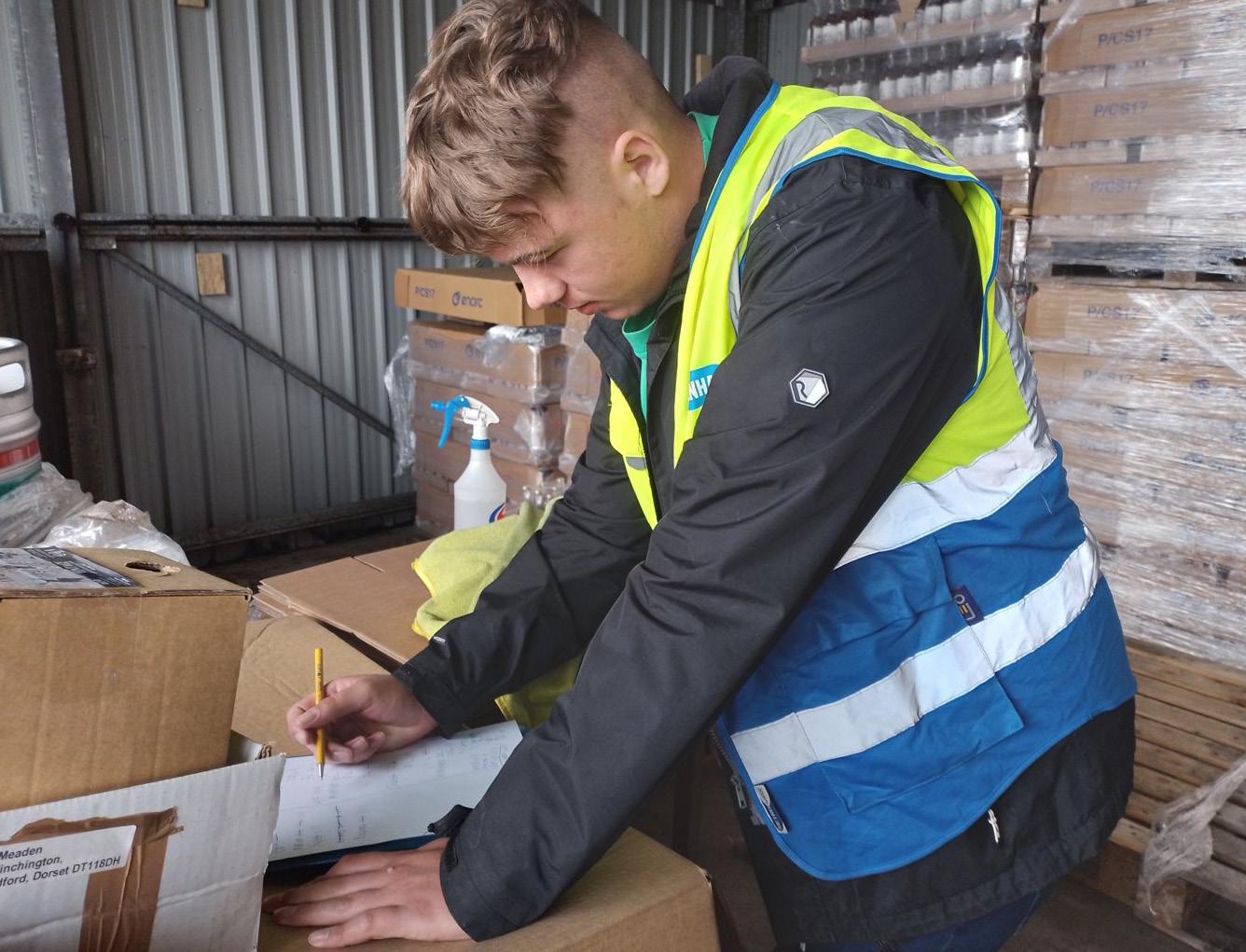
91 The BV magazine, February ‘23 COMMUNITY
Working in the Secret Garden Cafe
Animal studies will be a popular new course at Thorngrove
EMA students enjoy
realworld
placements at businesses such as Cranborne Chase Cider
Monthly updates from the various North Dorset Police Teams. This month’s news from Gillingham’s PC Vicky Biggs
Neighbourhood policing
The
At the end of January your North Dorset Neighbourhood Policing Teams (NPT) participated in the national Neighbourhood Policing Week of action. We held drop-in surgeries with our partners in Blandford, Shaftesbury and Gillingham, speaking to our communities about local concerns. We continue our community engagement opportunities going into February, with other drop-ins (see details of these on our social media).


During the week we used community intelligence as well as our local knowledge to plan our patrols, resources and target antisocial behaviour (ASB) hotspots throughout North Dorset. By working with partners and working together with NPTs throughout North & East Dorset we are able to use our resources to complete targeted hotspot patrols. We have also conducted welfare checks on vulnerable residents, seizure of drugs, stop checks on vehicles
We have also been highlighting our NPT Priority surveys, which allow the local community to feed into our local priorities. We have been completing these at our dropin events as well as advertising them on social media, and through our Dorset Alert messaging system. (Remember you can still sign up for Dorset Alert here dorsetalert. co.uk)
Whilst this week was used to highlight some of the work we complete, be assured we continue this throughout the year. As always, for current updates on the work the team undertake please follow our social media page:
• Remember to continue to report any concerns online at www.dorset.police.uk/Contact-Us
Always use 999 in an emergency.

92 The BV magazine, February ‘23 COMMUNITY
end of January sees the annual Neighbourhood Policing Week, says PC Vicky Biggs, when the local teams work on targeted hotspot patrols
Neighbourhood PC Tom Harness on foot patrol in Blandford
Foot patrol in the ASB hotspot of the Barnes Close area of Sturminster Newton due to reports of drug dealing.
Angus Woods in Blandford - due to increasing anti social behaviour volunteers have removed lots of rubbish and a bench to prevent youths gathering
Crossword Simply click to complete on your tablet, computer or phone - or there’s a download option if you prefer pen and paper.


Jigsaw
This month, for your puzzling pleasure, we have... a pile of sticks. They are authentic Dorset ones though! Just click to complete! If you get stuck, there’s an icon at the top of the screen which reveals the completed picture for you to refresh your memory.

93
PUZZLES
A local expert from Citizen’s Advice provides timely tips on consumer issues. This month:

Can I be forced onto a pre-payment energy meter?
Q: “I currently pay for my electricity via direct debit but recent fuel price increases mean that some months I am struggling to afford to pay my bill. I read in the newspaper that my energy supplier might try to force me onto a prepayment meter. Can they do this?”

A:“Yes they can in some circumstances, and this can have devastating consequences for people who then cannot afford to top-up their meters. Citizens Advice knows that some people prefer to be on prepayment meters for budgeting reasons or because it stops debt collection, including threats of bailiff visits and unexpected bills but last year, 3.2 million people across Great Britain ran out of credit because they couldn’t afford to top up their meter.
When a prepayment meter isn’t topped up the household electricity or gas supply is completely disconnected. From its latest work, Citizens Advice knows that more than two million people are being effectively disconnected at least once a month and that almost one in five prepayment meter customers who were cut off in the past year then spent at least 24 hours without gas or electricity. This is particularly dangerous for disabled and otherwise vulnerable customers.
Your supplier can’t make you move to prepayment if it wouldn’t be safe or practical. This means you can refuse to move to prepayment if an
illness or disability means you’d be harmed if your gas or electricity was cut off. However, research shows that the rules are not always being followed. As a result, Citizens Advice asked the government to put in place new protections to stop people being fully cut off from gas and electricity and the Business Secretary is now calling on suppliers to do more to protect vulnerable energy users.
If you are struggling to top up a prepayment meter, please talk to your energy provider as soon as possible. You might be able to get temporary credit or your supplier might add this to your meter automatically. If you run
out of temporary credit you should explain your situation to your supplier. They might give you extra temporary credit under certain circumstances, including if you’re disabled, have a long-term health condition or if you are above the state pension age. For more help with this, please check the information on the Citizens Advice website on the prepayment rules your supplier has to follow or contact your local Citizens Advice office. Information is correct at time of writing.
94 The BV magazine, February ‘23 COMMUNITY
Scope’s disabled artists range now online
The disability equality charity Scope now has displays in its shops with some outstanding artwork that talented disabled artists have created. But if you don’t have a Scope shop near you, they have also now opened an online store so you can buy the art that way. It’s not just prints – they sell the beautiful designs on cotton and recycled plastic-bottle wash bags, art prints, candles and mugs too. I think it is colourful and bold and interesting. In the Gillingham shop, where I volunteer, one customer saw a collection by artist Kate Boyce and said “Wow that’s fantastic!”
Vivian Nutt, Head of Customer Proposition, Retail at Scope, says: ‘We’ve really had to be more creative and ingenious in our fundraising since the start of the
pandemic and the cost of living crisis and this is an incredibly exciting development for us. Scope puts disabled people at
the heart of everything we do and, working with four superbly talented disabled artist and designers, our collaboration has produced a stunning range of unique products that are perfect for yourself or make a truly special gift for anyone.
‘I encourage everyone to visit our shop – either in person or online – and see the beautiful ranges for themselves. Every purchase helps fund our vital support services that are a lifeline for disabled people and helps us to campaign for a fairer society.’

One of my personal favourite pieces is called Boats Ahoy!

The artist, Mahlia Amanita, has Asperger’s syndrome and her work has been displayed in seven countries. This design is currently available on a range of items as well as available to purchase as a print. Be sure to check out the wonderful work that all the artists have made.
You can find the Disabled Artists collections on the Scope website here shop.scope.org.uk
95 The BV magazine, February ‘23
This month Maddie is looking at the stunning range of art and products available through Scope’s collaboration with talented disabled artists
The Kate Boyce Kitchen Textiles Collection is
available in four of her designs
COMMUNITY
Maddie’s favourite Boats Ahoy! by Mahlia Amanita
Mosaic are a Dorset based charity supporting bereaved children and young people, their families and the professionals working with them.
Founded in 2007, Mosaic was created to fill the gap in bereavement provision across the county. Prior to this, support for bereaved children and young people was limited – the only support available was from hospices offering support after the death of someone suffering from a long-term illness. Mosaic support children and young people who have been

bereaved of someone special –perhaps a parent, sibling, friend or extended family. This includes all causes of death such as sudden death, suicide, murder or road traffic accident, not just long-term illness.
If you require further information about Mosaic’s service, please do not hesitate to contact us:
01258 837071
info@mosaicfamilysupport.org
mosaicfamilysupport.org
Diverse Abilities is on the hunt for volunteers
Dorset’s disability charity, Diverse Abilities, is looking for volunteers for the coming year to help with ongoing projects and a series of community events throughout the year. Events on the 2023 calendar include:
• Diverse Abilities own events: Dorset Neon Run Country Challenge
Rugby Lunch
Gala Ball
Christmas Carol Service
the charity’s annual Christmas tree collection service
• Community events including Grooves on the Green, Wimborne Folk Festival and Camp Bestival, as well as street collections throughout the year, with further events to be confirmed.

Laura Stanley, fundraising officer at Diverse Abilities, commented: ‘We’ve got an exciting calendar of events this year where we need the help of our local community in order to take on a variety of tasks including bucket collections, running stalls, and handing

out flyers, as well as raising awareness of Diverse Abilities. You’ll have a great time, as well as helping to raise money to support children and adults with disabilities in the local area.’ As well as events, Diverse Abilities are also on the lookout for volunteers on more a regular basis, for roles such as a transport assistant at the Beehive to support students getting to and from the centre, and gardening or decorating roles across the charities’ services.
Volunteers are crucial to the work charities like Diverse Abilities carry out, and donating free time is just as valuable as giving money. In turn, the opportunities give volunteers a chance to learn new skills, meet new people, enhance CVs, gain experience, discover new interests and improve mental wellbeing. Visit the website here for more information about the roles available. Contact Laura on volunteer@diverseabilities.org.uk if you would like to get involved.
96 The BV magazine, February ‘23
COMMUNITY
Barrie at the Neon Run Volunteers Briefing
The end of an era and a final splash for Abbey Swimming Club
It is with great sadness that the Abbey Swimming Club has had to permanently close after more than 30 years as a community swimming club. Located at the Milton Abbey School pool, the club had its first swimming session on Tuesday 14th June 1988. The club was run solely by volunteers – including the lifeguards, swimming teachers and all committee members. For almost 32 years (the pandemic forced a closure in March 2020) the club held four swimming sessions per week – members were aged from a few months to the over-80s.
The club ran children’s and adult’s swimming lessons, and for many years diving lessons, toddler swimming lessons, and aquafit. There were also regular galas at the pool – both competitive ones, and those for fun. The club had close links with Milton Abbas surgery and offered ‘back to fitness’ sessions for many surgery referrals.
But it wasn’t all about swimming – it was also a valued social club for its members. There were regular events to raise funds, such as New Year’s Eve barn dances, summer barbecues, skittles evenings and quiz nights. Since 2001 they have run the cream tea stall at the Milton Abbas Street Fair. The whole swimming community came together at these events. After COVID the club was hoping to re-open as before. Unfortunately, under new safeguarding rules Milton Abbey School could only allow the club to access the pool during some school holidays. Much searching couldn’t find another pool that offered the ‘community club’ facilities. In September 2022 the members reluctantly voted to wind up the club. On the evening of 18th January 2023, a farewell reception was held at the Milton Abbas Reading
Rooms. The club assets were distributed to the local charities chosen by club members and the following cheques were presented during the evening:

• £7,000 to Wimborne Wagtails – A Dorset based swimming club for the disabled. The cheque was received by the club chairman, Julian Vernon.
• £7,000 to Dorset and Somerset Air Ambulance. The cheque was received by Becky Heath.
• £7,000 to Weldmar Hospicecare – A Dorset based charity providing specialist end of life care. The cheque was received by Marie Notley.
• £2,000 to Milton Abbas Street Fair. Cheque was received by chairman, Freddie Robinson.
Family support charity launches Cost-of-Living Crisis Appeal
Home-Start Wessex is standing alongside local families with a new appeal launched this month. In a recent survey by Home-Start UK, 74 per cent of families said they were expecting to need financial support this winter. In 2022, Home-Start Wessex helped a record 300 families across Dorset and the borders of Wiltshire and Hampshire. Demand increased by 30 per cent as more families struggled to cope and needed their help. Volunteers provide practical, compassionate and emotional support to parents whose worries about finance are adding to the challenges of post-natal depression, isolation, physical health problems and bereavement. Alongside one-toone support, they also run five family groups and weekly ‘Wellness Walks’ to help families get outside and connect with others whilst having fun
and getting some exercise.
Kathy Fryatt-Banks, Chief Executive of HomeStart Wessex, said, ‘Parents from across the area are telling us how they are worried – heating is unaffordable, and they are missing meals to buy nappies and food for their babies. Times are tough for many, but please give whatever you can. Even a small amount will make a huge difference this winter.’
To donate, please visit their Just Giving page. You can also support families by becoming a Home-Start volunteer, ensuring that a family has the support they need. No qualifications are necessary, and full training will be provided. Contact Michelle by email, or via the website – homestartwessex.org.uk
97 The BV magazine, February ‘23 COMMUNITY
Becky Heath (left) accepting the £7,000 cheque on behalf of Dorset and Somerset Air Ambulance
Firstly, I want to take the opportunity for a huge thank you to all our customers who have supported us over the past year – both by coming to the shop and also attending our author events. We really appreciate your custom. For this month’s selection I thought I’d suggest two titles that came out late last year which may have been overlooked among the tinsel. They are well worth a look. Wayne.

ZEALS A biography of an English Country House by
 Jennie Elias (£20)
Zeals, an English country manor house in Wiltshire, was filled with life, dogs, books, flowers and a grand piano in the Great Hall. It was a house for landed gentry – but is now on Historic England’s ‘At Risk’ register. The house has medieval origins, but there were later additions; predominately those from the 19th century by Victorian architect George Devey, but also earlier changes in the 17th and 18th centuries. This fascinating house naturally has a rich history. Charles II took refuge at Zeals House on his flight to the coast. A family member was beheaded by Oliver Cromwell for daring to confront his parliamentary troops. The Chafyn-Grove family, later Troyte-Bullock inheriting in a sideways move, lived at Zeals House for 500 years until the mid20th century, when the fate of the estate mirrored that of many others in England.
Jennie Elias charts the joys and tragedies of generations of Zeals House residents, with characters ranging from haughty to charming and eccentric to prejudiced. There were of course failures through political levelling down and cultural change, but there were also many entirely of their own making. This definitive history also explores and celebrates the architecture of Zeals.
The Story of Art Without Men
by Katy Hessel (£30)
Can you name 20 women artists? If not, read this book. Who makes art history?

Did women even work as artists before the 20th century? And what is the Baroque anyway?
Prepare to have your sense of art history overturned, and your eyes opened to many art forms often overlooked or dismissed. From the Cornish coast to Manhattan’s east side, Nigeria to Japan, this is the story of art for our times – one with women at its heart, brought together for the first time by the creator of the website The great women artists. (if you’re on Instagram, do follow @thegreatwomenartists) “The Story of Art Without Men should be on the reading list of every A-level and university art history course and on the front table of every museum and gallery shop.” – Laura Freeman, The Times. “Passionate, enthusiastic and witty, this spirited history celebrates female artists without any dreary finger wagging.”
Signed copies available at Winstones, Sherborne.
98 The BV magazine, February ‘23 BOOK CORNER
by Wayne Winstone, of Winstone’s book shop in Sherborne
Three Oxford blues for Clayesmore
Three students at Clayesmore School are celebrating after they all received Oxbridge offers. Seth, who now has a place to read German at St Hilda’s College, was quick to say that none of the friends felt confident in their applications: ‘We were all expecting to be rejected. Reaching the Christmas holiday was a relief, but then it was a very long wait!’
‘It was a really long, hard process, and you have to do it on top of your already-packed A level studies’ says Tamsin, who was offered a place to read Chemistry at Hertford College.

‘By the time we had done everything we could and it was out of our hands, we were shattered!’ agrees Evie, who is thrilled with a place to read English at Balliol College. So what made them stand out from thousands of applicants?
‘It’s not as predictable as you’d think’ says Tamsin ‘another Chemistry student in my year got the same predicted grades as me, does as much extra-curricular activity as I do, and yet they weren’t offered a place.’
‘I think it’s a lot to do with you as a person, how you come across in an interview’ agreed Evie ‘most students should have the same level of subject knowledge and the part of the personal statement that allows for describing your extra-curricular activity is tiny. It never even came up in my interview.’
‘Nor mine’ agrees Seth, ‘but I think that all my extra activities and my job in Tescos have built me as a person, and that’s what shines through. I was originally applying for a different college, and it was suggested I’d fit better at St Hildas – it was more of a personality fit, and it was absolutely the right decision.’
Tamsin added ‘I don’t think
they’re looking for specifics so much as an inquisitive and cando attitude. I actually said in my interview – which was filled with impossibly hard maths – that 2x1 equals two, so they’re obviously not looking too hard at the interview specifics!‘
Thank you Mr Carpenter
Do the teenagers all have a firm career plan mapped out?
‘Journalism, or perhaps a documentary maker’ says Evie. Tamsin added, ‘You’ll end up in politics, you’ll be great!’
Seth is aiming for a probable career as an academic, following a traditional Masters-PhDlecturer route, though he acknowledges he’s also drawn to education as a career.
Tamsin cheerfully admits she’s open to what the future holds ‘Chemistry often leads to law or politics, as it aligns with the analytical thinking, but I’ve no fixed ideas yet.’
Were the Clayesmore staff keen to push the teenagers on to the Oxbridge route from the start?
‘Not in the least - we had to ask for it!’ says Evie
‘The school have been amazing.’ agrees Seth. ‘Absolutely no pressure, but once we decided it was the right plan they just scooped us up and supported us the whole way.’
‘We couldn’t have managed without their amazing support’ says Tamsin. ‘I’m not even an English student, but Mr Carpenter (senior deputy head and English teacher) gave me so much time and help. He even let me take over his office to practice in the week running up to my interview.’
‘Mr Carpenter was amazing!’ Seth and Evie exclaim simultaneously in agreement. Clayesmore are proud to be a school that doesn’t focus on a traditional academic route, but instead ‘celebrates future thinkers, makers and creators’. Other student’s have offers from Durham, Warwick, Exeter, Nottingham and the Royal Agricultural University, to name but a few, with an excitingly diverse range of courses including History, Nursing, Architecture, International Festival and Events Management, Journalism, Fashion Marketing and Management and Global Sustainable Development. Jo Thomson, head of Clayesmore, says, ‘As ever, I’m incredibly proud of all our pupils. Their success is a direct result of their hard work and commitment, and their teachers’ unwavering belief in every single student’s potential.’
99 The BV magazine, February ‘23 SCHOOL NEWS
From L-R: Tasmin J (Chemistry at Hertford, Evie A (English at Balliol) and Seth C (German at St Hilda’s)
Sherborne Primary wins international reading award!
Sherborne Primary pupils and staff are celebrating an outstanding year of reading by pupils throughout the school. Competing with schools from around the world, they have been declared winners of the Renaissance Award for Success and Achievement.

The award recognises educators across the globe for their dedication to teaching, and celebrates whole school achievements. The Renaissance software, called Accelerated Reader, helps track a pupil’s reading age and ability throughout their time at school. Children can keep track of how many books, and even words, they have read each year.
Felicity Griffiths, deputy headteacher at Sherborne Primary says: ‘Our children love reading – we’re lucky to have a vast selection of books in our library, and they know they can read what they love and what interests them.
We centre our English curriculum around sharing
amazing reads and promoting a love of literature, and I think it’s because of this that we achieve amazing results. Over 95 per cent of children in Years 2 to 4 are meeting or exceeding their expected reading age, which is truly fantastic!
Last year, children in our school read 9,922 books, totalling nearly 64 million words! Pupils can earn awards for the number of books they read, and earn ‘millionaire’ badges when they exceed that many words.’.
Could you buy a book?
Sherborne Primary has also teamed up with local bookshop, Winstone’s in Sherborne, to further enrich their library. With such keen readers it is important to have a supply of new books to keep them interested, so the school have created a ‘Buy a book for the school’ wishlist, where families or members of the local community can donate a book to the school via the shop. If you are interested in donating a book, see the wishlist here
Forum School marks its 25th anniversary
The Forum School (TFS) is tucked away in Shillingstone, near Blandford, and is both a school and a home for children and young people aged seven to 19 who are diagnosed with Autism Spectrum Disorder.

Sitting behind big gates in the middle of the village, the interior is often unknown to locals, but the school combines specialist education on an adapted national curriculum with therapies for speech and language, behaviour and psychology. With 24 hour care, the pupils are also able to enjoy acres of land for play, as well as facilities such as a theatre, sports hall, indoor and
outdoor riding areas, a climbing wall and a swimming pool. Headteacher Daniel Pitt says ‘This will be a year of celebration for us as we mark our silver anniversary – we want to really celebrate what it means to live and work at TFS. We plan to create a book of stories and news from students and staff, past and present. There will be many activities (during
the warmer months!) and we will enjoy time for reflection of the past 25 years and look ahead to the next 50.
‘In addition, we are delighted to see the commencement of our extensive plans to improve the site. We have high aspirations, not just for our current students but also for those we’ll meet in the future.’
100 The BV magazine, February ‘23
The Forum School.
SCHOOL NEWS
Image: Courtenay Hitchcock
St Andrew’s Primary celebrates athletic success!
St Andrew’s Primary School, Fontmell Magna, returned triumphant after competing in the Dorset Athletics tournament at Gillingham School.
On Tuesday 17th January, St Andrew’s Primary pupils participated in a physically demanding competition that required them to compete in numerous athletic events that tested their agility, strength

and fitness as well as their perseverance and courage. The tenacious young people endeavoured to succeed in events including relays, speed bounce, triple jump, long jump, vertical jump, obstacle course, chest push and javelin; and were delighted to emerge victorious!
Headteacher Debbie Brown said ‘Watching our young people thrive in this competitive
environment was an absolute pleasure and highlighted so many talented individuals – many of whom lacked confidence and doubted their own capabilities. Yet they prevailed!’
Winning the Dorset Athletics tournament propels the children of St Andrew’s into the County Athletics final, hosted at Purbeck School later this year. They cannot wait to shine once again!
King Arthur’s School recognised for strong improvements in latest Ofsted report
Staff at King Arthur’s School in Wincanton are thrilled that OFSTED have recognised the progress the school has made since it’s last inspection. The inspector and her team were keen to highlight the school’s huge ambition for all students and the excellent curriculum. The school secured a ‘good’ judgement for personal development, a strength across the whole school, where young people are supported to develop the key skills and qualities to thrive for life. The inspectors also praised students, saying that they are “active citizens, who contribute to the community”, something of which the King Arthur’s team are rightly proud.
Previously inadequate
The school was previously rated as Inadequate in 2017, when it was still a local authority maintained school. It joined the Sherborne Area Schools’ Trust (SAST) in April 2019, and headteacher
Jen Jacklin was appointed the
following September. The school has since been on a journey of rapid improvement with a new leadership team in place, expert support and funding from SAST and a broadened range of subjects on offer to students. In terms of exam outcomes, the school has made considerable and significant progress since the last nationallycomparable exams data was published.
Jen Jacklin said, ‘We have been on an amazing journey at King Arthur’s and have achieved so much. We are thrilled that the inspectors have recognised the swift progress we have made and validated all the hard work of leaders, staff, students and our families. We are proud of our school and its place in the community. We have worked hard to ensure the very best education in all we do, every day. We look forward to taking the next step in our journey.’
In this latest inspection, the school has been upgraded across all four OFSTED inspection areas,
with the new overall grading of ‘Requires Improvement’ sitting in line with the school’s long term improvement plan. Colin Sinclair, CEO of SAST, said, ‘We are incredibly proud of our team at King Arthur’s, they have shown such ambition and determination against the backdrop of the pandemic and an unprecedented teacher recruitment and retention crisis. They have turned the school around and are only midway through implementing its strong improvement plan. ‘The school continues to go from strength to strength, with admission numbers rising 20 per cent in the last year. We are excited that our local families have recognised the fantastic educational experience that King Arthur’s offers, and are actively choosing King Arthur’s for their children. We look forward to welcoming even more students in September 2023.”
A copy of the report can be found on the King Arthur’s website.
101 The BV magazine, February ‘23 SCHOOL NEWS
Countdown to the big night
the Love Local Trust
When the Love Local Trust Local (LLTL) journey began in 2018, it was because I was so fed up with hearing visitors at our Open Farm Sunday say they wanted to support the British farmer – but didn’t know who to trust any more. This was the time of some food mislabelling scandals, alongside the story that fake farms were appearing on ‘own brand’ products on supermarkets shelves. Some supermarkets have faced legal challenges over the practice. Cheap imported meats were – and still are – coming into our country labelled with the Union flag because the item has been re-packaged or processed in the UK, not grown or reared here. It’s all so misleading. We British farmers need to stand up, get ourselves heard and explain the important facts about farming and food production to the general public and the people eating these foods.
Hairy Bikers
The new series of The Hairy Bikers Go Local has become an unexpected ambassador for everything our LLTL food label and movement stands for. The series is all about what is grown and produced locally in each county around the UK, helping viewers understand what comes from which part of the UK and at what time of
Awards
year. This is something LLTL have talked about before. The series is also highlighting the importance of trusting local businesses producing excellent food and drink close to where you live. Music to our ears! One of the key objectives of LLTL has always been to help tell the stories of local Dorset food and drink businesses, letting people know where they are and how to buy their products. Social media has been terrific for spreading the word of what our hardworking Dorset producers are doing.

Roll on awards night!
During the 2022 judging, I’ve had the pleasure of hearing so many wonderful stories. I’m still meeting fantastic new producers and learning from them. We will be celebrating their achievements on Thursday 9th February with a gala dinner at Kingston Maurward College in Dorchester.
I would like to thank all our sponsors – especially Laura and Courtenay at The BV, who have been supporting LLTL from the very beginning. Next month we will be showcasing the award winners and in the months to come we are delighted to be sharing their stories.
102 The BV magazine, February ‘23 FOOD & DRINK
As
Local
night approaches, founder Barbara Cossins looks back at where it all began – and why
Cheap imported meats are coming into our country labelled with the Union flag
Meet your local – Okeford Village Store

Vince and Sharne have made Okeford Store the villagers’ favourite, Rachael Rowe reports.
Village shops are a vital part of the rural infrastructure of the Blackmore Vale. They kept services going during the pandemic when everyone was in lockdown and are always there when you have forgotten to buy something. But like all local independent businesses, they need regular support from the community.
I visited Okeford Village Stores in Okeford Fitzpaine (Sturminster

What brought you here?
‘We have been here for six and a half years. We ran the Red Barn in Hazelbury Bryan and turned it around to be a successful business, but it was a leasehold arrangement on the property. We wanted to do the same thing, but with a freehold property, so we moved to Okeford Fitzpaine. We’ve got the shop and Post Office here and have now created a small cafe in what was a derelict building,’ says Vince.
Tell us about the team?
‘There’s Sharne and me! We also have Nicky, who works at weekends.’
What’s selling right now?
‘I shouldn’t really say this, but the alcohol is popular! And our bags of logs are literally flying out of the door. Our bread –from Taylors of Bruton – also does well, and the hot foods
(sausage rolls and pastries) are good sellers in cold weather. And we have cakes made by Rob Corben*.’
Who are your local suppliers?
‘We have bread from Taylors of Bruton, meats from Else’s in Stalbridge, Mere Trout, Dorset Charcoal, and our eggs are from Bishops Caundle.’
Using lots of local food suppliers means the shop is in its turn supporting the local economy. However, Sharne pointed out a couple of things. ’People think a village shop is going to be very expensive, but we have some products that are cheaper than the supermarket. For example, Heinz tomato soup is cheaper here than at a nearby supermarket. We also have the equivalent of an own-brand basics range (Jack’s) which is very good.’
What is your big challenge?
‘Right now, just maintaining the turnover during the cost of living
103 The BV magazine, February ‘23
Newton) and spoke to owners Vince Lee and Sharne Ferris.
MEET YOUR LOCAL
Okeford Fitzpaine village store
All images: Rachael Rowe
crisis and coping with the huge electricity bills.’
Looking around, the shop has several chillers and freezers, required to supply fresh and frozen food to the community. While we’re all finding the rise in energy costs a challenge at home, so imagine the impact on our village shops at the moment.
What are you most proud of?
‘Resurrecting the shop after it almost disappeared from the village. It’s the same sense of pride we had when we took over the Red Barn.’
I remember the dark days of the village shop in Okeford Fitzpaine before Vince and Sharne took over – it was much less welcoming. Today, it is an asset to the village and surrounding area and has become a community hub. Sharne added: ‘We really want to leave a legacy of successful and thriving village shops for the local community.’

So what’s next?
Vince says what many local storekeepers are saying: ‘At the moment, we’re just aiming to survive the winter on a monthto-month basis, making sure we can pay our energy bills.’
When was the last time you used your village shop? If you haven’t visited for a while, pop in and buy something – or save a few items from your supermarket shopping list to purchase in the village shop. They were here for us during the lockdown, and now we all need to support them as they face the huge pressures of the current economy.
* If you haven’t sampled a fruit cake made by Okeford local Robert Corben – you don’t know what you’re missing! And his date and walnut cake is very moreish - RR
104 The BV magazine, February ‘23 MEET YOUR LOCAL
Robert Corben (left) with co-owner Vince Lee
The stores has a small cafe attached
Owner Sharne Ferris
Contrary
to expectations, Vince and Sharne try to stay competitive on many household basics
Love is definitely in the air
Planning to impress your beloved with gourmet food at home this Valentine’s Day? This month we’re going green for our take on a three-course menu idea from the Watercress Company –bursting with flavour, simple, and delicious. Perfect for Valentine’s Day or just for treating your beloved or bestie to something a little bit special. Start with a classic watercress soup, served with homemade bread you learned to make for Real Bread Week! Follow with Pesto Linguine, and if you still have room for dessert, then a Pavlova Roulade with seasonal fruit, and perhaps a chocolate or two. Our top picks are Chococo’s Valentine assorted caramels and delectable Dark Chocolate Love Bar. If your Valentine is into shoes, then this funky chocolate Leopard Print Milk Chocolate Stiletto from Chocolate Arthouse is sure to please! New on the Dorset chocolate scene are Poco Chocolate. We’ve been working with them at a few of the Dorset Farmers Markets, and their handmade small batch chocolates always go down a storm.
Going out – drinking in
Remember that supporting your local pub, café or restaurant is a super cool way to eat locallysourced food and drink.
We love this Valentine’s menu from Weymouth 51, starring four courses of Dorset loveliness. Booking is essential; places at these fabulous feast night pop ups sell out fast!
Perhaps treat your Valentine to a glass of classically elegant locally-made wine. Romance in a glass! Whether you’re having a bottle with dinner, or
pouring a glass after a date night, a delicious wine is the perfect way to get into the romantic mood. Because Dorset has such a warm climate and good quality soil, it’s an ideal place for growing grapes. Check out our great selection of Dorset wines here. If you prefer something without alcohol, then how about Kombucha? It’s a fermented organic green tea, lightly effervescent, delicious, and available with a range of delectable flavours. Whatever your tipple of choice, have a fabulous Valentine’s Day!
Using up your ingredients
If you still have a jar of mincemeat lurking in your cupboard from the festive season, then this Jalousie from Liz Crow aka Lizzie Baking Bird will be just the job!
Flippin’ good fun
Shrove Tuesday (Pancake day!) is Tuesday 21st February. Savoury or sweet. Traditional, or something with a nod to those fluffy American pancakes? The choice is yours, but we like this smorgasbord of toppings to give them a Dorset twist. The sweet stuff - Passion Fruit Curd From Dorset With Love. Dorset Sea Salted Caramel Sauce from A JarOf and Lemon Curd from Neil’s awardwinning Chutneys & Preserves. Buy online or check the websites for stockists.

Spring is just around the corner, so hold that thought. But until next time, keep spreading the Dorset Food & Drink ‘lurve’!

105 The BV magazine, February ‘23 FOOD AND DRINK
It’s February, so obviously Caz Richards of Dorset Food & Drink is thinking love, romance ... and pancakes.
Heather’s Mum’s cottage pie ... ish
This cottage pie is my own adaptation of my mum’s recipe. I remember happily sitting down to eat it with some gravy, some garden peas and a large spoonful of Branston pickle ... I’m not sure if that’s entirely normal, but I promise it really does work! If you wanted to make this recipe a little fancier, you could add some full-flavoured cheddar cheese to the mash, or even some softened, chopped leeks. I usually serve it simply with some peas or sweetcorn, but any fresh veg would go well. You can also ‘hide’ lots of extra veg inside the pie (peppers, courgettes, carrots etc) – just grate or chop them very small and add them with the onions to cook down gently at the start of the process.
Heather x
Cottage Pie
(serves 4)
Mashed Potatoes
• 6-8 large potatoes, peeled
• 2-3 tbsp milk
• 4 tbsp butter
• Salt to taste
Meat Filling
• 500g lean steak mince
• 1tsp oil
• 1 large white onion
• 10 to 12 mushrooms
• Black pepper
• 1/2 tsp dried thyme
• 1 beef stock cube
• 25ml port or 50ml red wine
• 1tbsp soy sauce
• 1tsp honey
1. Boil a large saucepan full of salty water (it should taste like sea water). Roughly chop your potatoes and add to the boiling water. Boil for about 15 minutes, or until starting to soften to the touch.
2. While the potatoes are boiling, preheat the oven to 200º fan (Gas 6).
3. Drain the potatoes, leaving them in the pan. Using a potato masher mash the potatoes, adding in all of the butter. Keep mashing! Then add the milk until the mixture is smooth, a little at a time. I find that potatoes always need more mashing than I thought!
4. Place a large frying pan over a medium heat and add the oil. Peel and chop the onion and add to the pan. Then chop and add the mushrooms and cook for 4-5 minutes, stirring so that the onions and mushrooms begin to colour.
5. Add the mince and stir thoroughly as it cooks. (Tip - if you are making this recipe for more than four people, you can cook the mince in the oven first - just lay the mince out in a thin layer over a large baking sheet and cook in the oven for 5 to 10 minutes until it begins to brown, then add to the pan and continue cooking the recipe as normal)
6. When the beef is cooked through and beginning to colour, add the red wine/port and stir through. This will also take any delicious crispy bits off the bottom of the pan (this is called deglazing).
7. Add the soy sauce, honey, a couple of grinds of black pepper and the thyme and give it a good mix through.
8. Mix the beef stock cube with 100ml boiling water and add to the pan. Stir this through and allow the flavours to mix together, letting the sauce reduce slightly.
9. Time to put the pie together. In a medium-sized, oven-proof dish, tip in the mince mixture. Then carefully spoon the mashed potato on top (one heaped spoonful at a time – it is easier to spread out that way). Once all the mash is on the pie, run a fork through the top to give it lots of peaks to get crispy in the oven.
10. Cook in the oven for 20 to 30 minutes until the top is golden and crispy. This pie can also be made ahead and reheated – just pop it back into a hot oven for 10 minutes or so.
106 The BV magazine, February ‘23 FOOD AND DRINK
Heather Brown is a food writer, photographer and stylist. A committee Member of The Guild of Food Writers, she also knows a thing or two about websites. Heather runs Dorset Foodie Feed, championing Dorset’s food and drink businesses, as well as working one-to-one with clients.
 Image: Heather Brown
Planning your health beyond 2023
It seems counterintuitive to me to set new year resolutions or goals in January. I like to work with the natural rhythm of the earth, and given it has poured with rain for most of January, I have remained in hibernation mode as long as possible, enjoyed it immensely and am not feeling remotely guilty. I slept an extra hour a night too. For me, the spring equinox is the time to start implementing new health goals – when the earth begins to wake up. I have been giving them quite some thought while catching up with a few health-related podcasts when out walking.
I recently listened to two longevity experts with two very different perspectives on nutrition; one advocating high quality protein intake from good quality meat sources, coupled with a high plant intake (but not grains) and supplements (nutraceuticals), as the way to go. The other advocated a mostly plant-based diet, with beans every day. It was a respectful discussion and actually they have much in common. They both said that a high plant intake, time-restricted
feeding, good sleep, a sense of purpose and strong social connections are all supported by science. All true.
Work backwards
Then I listened to a third longevity expert who, in my opinion, made the most sense of all. He challenged his listeners to think about how long they wanted to live, what they hoped to be doing, and then to work backwards in order to achieve those goals.
This approach may differ depending upon how old you are now and how long you want to live! If, for example, you want to be playing with your grand/great grandchildren in your 90s, you need a particular level of fitness to be running around, so it might not be a bad idea to get a better handle on how fit you are now (you can be checked by a fitness professional who can calculate your bio-age from a few well-known exercises and put a plan together for you). For this speaker, fitness was more important than nutrition. What he meant by that

108 The BV magazine, February ‘23
January is never the best time for goal setting – and we need to think far wider than our diet, says nutritional therapist Karen Geary
There are five things we should do every day – and there is no replacement for these
by Karen Geary, Nutritional Therapist DipION, mBANT, CNHC at Amplify
is that you can have a fabulous diet, but if you are not physically fit, what’s the point if you can’t lift yourself out of your armchair?
A consistent plan
There are five things we should be aiming to do every day to maintain both our physical and mental health. There is no replacement for these things. How many of these do you already do and where do you need to put the work in?
• Sleep
I have written about sleep on these pages before (‘three surprising ways to sleep better’ The BV, Apr 22) and my website has lots of tips on how to optimise it. Most people need between six and eight hours a night. Teenagers more. Coupled with sleep is sunlight, sometimes known as circadian light therapy. Get out in the sunlight, ideally in the morning. Exposing your eyes to sunlight helps to align your circadian rhythm and produce serotonin, which in turn helps to make melatonin, the darkness hormone. This helps you feel more tired in the evening, improves sleep and helps you to feel more awake in the morning.
• Hydration
It is not that well known that we need to increase our hydration as we get older. It plays an essential role in many health issues. Good hydration plays a key role in mental health, sleep quality and cognitive ability.
Dehydration in the elderly is very common. Between the age of 20 and 80 years, there is a 15% reduction in water volume in our bodies, which is why the elderly get dehydrated faster. Lower water volumes mean a poorer response to temperature regulation and an increased strain on the heart.

• Movement
Ideally an hour a day. Learn about NEAT (non exercise activity thermogenesis – spontaneous activities that occur every time you perform some sort of physical exertion, such as standing up from a seated position, running to catch the bus or even simply fidgeting). Try to do something every day that gets your breathing rate up. You will live longer and you will feel better. Get assessed professionally if you can to get focused.
• Nutrition
Try and get 75 to 80 per cent of your food from minimally processed foods. As we age, the need for protein increases. This is because we are less efficient at using protein compared to younger adults. If we don’t meet these increased needs we can lose muscle and lean mass and have a lower immune function, all of which play a role
in increased risks of frailty and illness. Consult a professional for personalised goals or where you have specific health concerns.
• Social connection
Do what you can to make the interactions that you have with friends, family, as well as online, as healthy as possible. Some people are more introverted than others, so do what is meaningful for you to maintain high-quality social connections. I guarantee that if you do these five things, your health will benefit.
Now set your long term goals!
109 The BV magazine, February ‘23 HEALTH
It’s time we learned to talk
As February heralds Time to Talk day, Dorset Mind’s Ash Langwith looks at how we can make it easier to talk and to listen, breaking the stigma
Time to Talk Day is an annual celebration of mental health, organised by the two charities Mind and Rethink to encourage people of all ages to start a conversation, whether it be at work, a place of study or at home. The important thing is to be open with your friends, families and colleagues. The aim is to normalise talking about mental health whenever you need to – at any time of year.
Why is talking important?
Talking honestly about our mental health helps to create supportive communities and an understanding environment. It will also reduce the stigma surrounding these conversations, which can be a massive barrier to seeking support. If someone in your circle doesn’t have the courage to speak up, seeing you take that first step might be the reassurance they need, letting them know they are in a safe space and have allies they can turn to.
As someone with several mental health conditions, I find that it’s important to express how I feel. And talking doesn’t have to mean over-sharing. If you’re nervous about talking about mental health for the first time, simply mentioning how you feel in the moment is a good stepping stone for further discussion.
Talking doesn’t have to mean over-sharing
when you need it. Sometimes talking is easier when you have something you can do to take the pressure off. I find starting a conversation while walking, making a coffee, cooking or some other simple activity helps. However, it’s important to remember that some people cannot seek support from family or colleagues. In situations like these there are still people you can turn to! Dorset Mind offers 1-2-1 services such as counselling and mentoring. There are also wellbeing groups, where talking and making connections is encouraged to build a sense of belonging and self-confidence. Visit the website dorsetmind.uk for more information.
How can you help people who need to talk?

Who can you talk to?
When talking about mental health, it’s easiest to talk to people you trust. Friends, family or colleagues can be the easiest people to approach for a chat

If you aren’t struggling with your own mental health but would like to support those who are, there are definitely ways you can help. If you think someone is showing signs of struggle, ask how they’re
really feeling; and ask twice because the first time you’ll likely get an automatic ‘I’m OK.’ Politely asking if someone would like to talk and if they’re really OK might be the push they need. If someone does open up, listen to what they’re saying. Asking questions is a great way of proving that you’re listening, and it will help to dispel assumptions about certain mental illnesses.
• If you need emotional support, call the Samaritans FREE on 116 123, at any time.
• Dorset residents or visitors can also call Dorset’s Connection Helpline on NHS 111 or 0800 652 0190
• If phone calls aren’t your thing, text SHOUT to 85258.
• If you’re having a crisis, it’s important to get help as soon as possible. If you’re in a mental health crisis and need urgent help, call 999 or head to your nearest A&E if you can do so safely.
110 HEALTH
Talking with friends and colleagues breaks the ice
Hello and welcome to my February column! I am so pleased to see the evenings starting to draw out and even see the first signs of spring in my garden – one of my favourite times of year.
Christmas already seems like a long time ago and business in Dorset has quickly got back to full-speed. Many businesses I speak to are optimistic about the future. But there is no doubt we are still seeing some challenges: access to finance is still a problem for many businesses, Brexit has had an extremely negative impact on export activities and many are still facing severe recruitment problems. And of course the energy cost crisis continues, genuinely threatening to put many out of business. However, it was encouraging to see that inflation has dipped to just over 10%; nowhere near the 17 to 20% that was predicted not that long ago. The sharp intervention of raising interest rates to 3.5% by the Bank of
England, the highest rate for 14 years, seems to be working. Although this brings much pain for many with mortgages and loans, interest rate rises are one of the primary weapons for tackling inflation by decreasing money circulating in the economy.
It’s a hard pill to swallow but one that we must. Despite this, I still see much optimism from the business community; many are simply switching off from the constant negative messaging in the media and just want to get on with things.
I totally understand this; we must maintain a positive approach, look for solutions if we encounter problems and, crucially, not be afraid to seek help and ask for advice and guidance.
Research shows that businesses that take advice at an earlier stage have a far greater chance of survival than those that leave it until later. There is help out there and if Dorset Chamber can support in any way, don’t hesitate to contact us.

Dorset Apprenticeship Awards
National Apprenticeship Week begins on 6th February and I am delighted to announce that once again we will be running our Dorset Apprenticeship Awards in partnership with the Dorset and Somerset Training Provider Network.

The awards are completely free to enter and open to people of all ages on apprenticeship programmes and all sectors. They naturally celebrate the contributions of apprenticeships to business but also the personal journey and achievements of apprentices themselves. From Monday you can apply for the awards on our website (dorsetchamber.co.uk) – we will celebrate finalists and winners at a special ceremony on 16th May. If you are on an apprenticeship programme, or employ an apprentice, I’d really encourage you to enter!
Until next time, Ian.
111 The BV magazine, February ‘23 BUSINESS NEWS
The times are challenging, says Dorset Chamber CEO Ian Girling, but businesses are ignoring the negativity and keen to move forward again
You can’t suppress the optimism
DorsetBizNews loses its Diprose
Andrew Diprose took the plunge and started an upbeat local business news website – three years later, he’s sold it to Black Ox. Laura Hitchcock reports
Dorset Biz News was launched in October 2019 as Dorset’s first and only journalist-owned-andrun business news website. After three years, founder and editor Andrew Diprose is hanging up his notepad after selling the business to Black Ox Ltd for an undisclosed sum.

Andrew says: ‘It will be wonderful to finally have the time to just sit still with a book!
‘The last three years have been so full, and by last autumn I began feeling the time was right to stop. But I didn’t just want to write a goodbye post and hang up the “we’re closed” sign. It deserved more than that.’
Andrew approached his preferred purchaser, Black Ox, in November 2022, and the contract was signed last month. ‘I love their plan to spread the BizNews brand to every county,’ says Andrew. ‘To be honest, if I was 30 years younger I’d have loved to do it myself. But after 44 years in the business, it was time.
‘It was a very odd experience, sitting around the board table with the Black Ox team, listening to their enthusiasm and plans for MY business, this brand that I created. Anyone who has created a business from scratch knows it’s intrinsically “yours”.’
No crime, no bad news
‘I remember so clearly watching the clock count down on 2nd October 2019, waiting for 9pm and the site to go live. The very next day the phone started ringing, and it hasn’t stopped. There was such a need and a desire for upbeat, interesting journalism. In the twilight of my career I went right back to my roots – in 1979 my job was going out and interviewing people, writing their stories.’
Richard Thompson, Black Ox Chief Executive Officer, said: ‘We love what Andrew has built at DorsetBizNews.co.uk. It is a positive and dynamic news site which has become a voice for Dorset business, celebrating the people and the companies. We have exciting plans to expand the BizNews brand, always keeping it as a voice for business at the county level and with a commitment to quality content.’
To what does Andrew attribute the success of his rule-breaking news business?
‘I don’t do crime, I don’t do bad news, and therefore I’m not searching for the same story as everyone else. The general impression is that “business is boring” – the websites’ too corporate, the images too bland. I use lots of bright colour, lots of faces. Because business is integral to all our lives. It’s just people. It’s not “business” news when it’s about your friend or your local café. It’s just news.’
Neville the pig
‘The most popular stories were always a new business start-up. A story about someone – anyone –who had decided to just go for it,
no matter what the business was. Which of us hasn’t dreamed of doing that? I certainly did!
‘Of the 3,600 plus stories one of the most unusual? Neville the pig. I ran a story for a local animal charity. Neville the pig was looking for a new home. It wasn’t a business story. It had no place on the website really. But I had a slot to fill and the charity needed a little push. Obviously it was the most viewed story not only that day, but that week. And every now and again Neville pops back up on the revolving ticker, more people click on him, and his stats just keep on climbing …’
So what now?
I’’ll be doing a handover until the summer, and then I’ve been invited to stay as brand ambassador for three years, helping with the expansion. ‘I plan to read a lot and to sleep a bit. I am going to have adventures with my wife. But to just stop? No. That would be odd for someone who’s worked six days a week for three years. I’ve already had some interesting offers and I can safely say I won’t be bored.’
112 The BV magazine, February ‘23 BUSINESS NEWS
dorsetbiznews.co.uk
Andrew Diprose on the day he launched Dorset Biz News in 2019
Hall & Woodhouse awards £50,000 in the annual Community Chest
Among the 35 awards from the local family brewery were 18 Dorset charities and community groups who will receive vital funds
Hall & Woodhouse has announced the successful recipients of its annual Community Chest grants – 18 of which are Dorset organisations. In total, the company has awarded more than £50,000 to worthy causes.

Each year, Hall & Woodhouse (H&W) invite applications from charities and community groups across the south of England, largely from Dorset to Devon. This year, a wide variety of charities were awarded funding, and over £25,000 was awarded to the 18 charitable organisations in Dorset, with a further four charities in Wiltshire, Hampshire, and Devon being recognised at the awards ceremony held at The Brewery Tap in Blandford. Mark Woodhouse, Family Director of H&W, said: ‘Our Community Chest was founded over 20 years ago to support and strengthen the local communities which make Hall & Woodhouse such a vibrant company. This year, we have found the need
to provide people with food, warmth, and shelter to be extremely high.
‘With costs rising during a financially difficult time for many, being able to offer necessary support for those in desperate need is more important now than ever before. We are proud to make it our duty to help where we can with this critical fund.’
The Vale Pantry, which provides food aid and support to struggling families in North
Dorset, was awarded £3,000. The grant will be used to purchase fresh food to ensure the charity is able to continue making food packages to meet the increased demand for this service.
Since 2002, the Hall & Woodhouse Community Chest has donated over £760,000 to more than 850 causes across the south of England. The fund works in close partnership with both the Dorset and Sussex Community Foundations.
‘Super six’ promotions at Ellis Jones Solicitors
A Dorset law firm has rewarded rising stars in what it has called a ‘super six’ promotions boost.
Ellis Jones Solicitors announced the appointments as it continues to develop talent from within.
Andy Kirby who specialises in wills, trust and probate, has become the first non-lawyer partner in Ellis Jones’ history. An accountant by profession, he has been with the firm six years, with 25 years in the legal sector.
Jennie Hedges, who has more than 20 years’ conveyancing
experience with particular expertise in shared ownership and Help to Buy, has become a senior associate. There were promotions to associate positions or Conor Maher, Georgina Emmerson and Rosemary Drew, who all trained at Ellis Jones, and also Tim McMahon, who joined in 2021. Nigel Smith, managing partner, said: ‘‘We are proud to make Andy our first non-lawyer partner and the 22nd partner overall at the firm while Jennie’s promotion
is another example of the fact that you don’t have to be a solicitor to progress at the firm. ‘Our new associates are the next generation of committed and talented lawyers, and I am excited to see how their careers progress.’
The appointments come as Ellis Jones was licensed by the Solicitors Regulation Authority as an Alternative Business Structure, allowing it to appoint nonlawyers as Partners and explore opportunities to grow.
113 The BV magazine, February ‘23
BUSINESS NEWS
by Andrew
First Shaftesbury Business Awards winners are celebrating gongs
‘A great success’ was the verdict on the first Shaftesbury Business Awards after 15 of the town’s finest businesses and individuals, were singled out for recognition. The Grosvenor Arms hosted the event with more than 60 business leaders celebrating the range and quality of businesses in the town.
Cllr Piers Brown, mayor of Shaftesbury joined the sponsors to present the awards which were spread over 15 categories. Shirley Allum Boutique Fashions & Lingerie was named as the overall Business of the Year.
Nigel Reeve, of Marketing West, organisers of the awards, said: ‘We knew there was great interest in the awards from local businesses when we received over 150 entries and nominations.
‘Supporting local businesses has never been more important.
‘They drive the local economy, they innovate and they create jobs. We hope, in a small way, these awards help build their profile and make people realise
what a great choice of businesses they have on their doorstep. ‘I’d also like to thank the sponsors, many of which are Shaftesbury businesses, for making these awards possible.’ The awards concluded with the announcement that Gillingham is next in line to

have its own business awards, and that the second year of the Shaftesbury Business Awards was also confirmed with the final scheduled for January 2024.
Details of all winners and sponsors, with links, can be seen on our facebook post.

114 The BV magazine, February ‘23 BUSINESS NEWS
Winners of the inaugural Shaftesbury Business Awards held at the Grosvenor Arms. Image: Paul Collins/PC Visuals.
DorsetBizNews
Diprose,


116 The BV magazine, February ‘23 ANNOUNCEMENTS

117 The BV magazine, February ‘23 JOBS

118 The BV magazine, February ‘23 JOBS

119 The BV magazine, February ‘23 JOBS

120 The BV magazine, February ‘23 JOBS

121 The BV magazine, February ‘23 JOBS

122 The BV magazine, February ‘23 JOBS

123 The BV magazine, February ‘23 JOBS
P R O D U C T I O N
S C H E D U L E :
N e x t P u b l i c a t i o n D a t e :
3 r d M a r c h
S u b m i s s i o n D e a d l i n e :


2 7 t h F e b r u a r y
N e x t P u b l i c a t i o n D a t e s :
7 t h A p r i l
5 t h M a y
F u r t h e r f o r w a r d s - p u b l i c a t i o n a l w a y s f i r s t F r i d a y o f t h e m o n t h . C o p y b o o k i n g d e a d l i n e a l w a y s t h e F r i d a y p r i o r t o p u b l i s h i n g
G O T S O M E N E W S ?
G e t i n t o u c h w i t h L a u r a o n e d i t o r @ t h e b l a c k m o r e v a l e . c o . u k
W A
N T T O A D V E R T I S E ?
G r e a t n e w s ! I f y o u k n o w w h a t y o u w a n t , t h e n s i m p l y h e a d t o h t t p s : / / w w w t h e b l a c k m o r e v a l e c o u k / a d v e r t i s e / t o b o o k o n l i n e O r g e t i n t o u c h w i t h C o u r t e n a y t o c h a t a b o u t w h a t y o u ' r e l o o k i n g f o r :
a d v e r t i s i n g @ t h e b l a c k m o r e v a l e . c o . u k
0 1 2 5 8 4 7 2 5 7 2
Hill in January
Courtenay Hitchcock
Okeford
Image:
