Curriculum Guide
Version 1.0 03.04.2026
Dear Bishop’s Students and Families,
We are pleased to share with you the Bishop’s Curriculum Guide for the upcoming 2026-2027 school year. This guide is designed to inform students and families about the diverse curricular offerings and to assist in choosing the most engaging and appropriately challenging slate of courses for the upcoming school year. Additionally, we have included valuable information about the School’s academic mission, program and policies.
We encourage you to take some time to familiarize yourself with the layout and contents of this guide. Additional guidance and support with the School’s academic program can be accessed through the Well-Being Information Guide. Students are urged to read this material carefully and to consult with teachers, department chairs, advisors, college counselors or an academic administrator prior to making final selections.
A balanced and sustainable schedule, a diversity of interests, and a love of learning are essential for student well-being in the short- and long-term. We caution students against overloading themselves by taking too many courses or too demanding a program while, at the same time, trying to participate in other activities as well as maintaining their personal health and relationships.
Brian Ogden Assistant Head of School for Curriculum and Academics
858-875-0738
brian.ogden@bishops.com
Mission Statement
Bishop’s is an Episcopal school that nurtures students of intellect and character to think independently, learn collaboratively, grow their sense of self and act with greater purpose.
Vision
Our vision is the pursuit of the question, “How do our students learn and grow best?” Everything we do must return to this fundamental question.
Diversity Statement
Bishop’s is an inclusive community that believes our differences are a source of strength. We are committed to the pursuit of diversity, equity, inclusion and justice. We respect the dignity of every human being and aspire to be a school where all are known, cared for and feel that they belong.
Core Values
Bishop’s core values are the fundamental beliefs that allow us to live fully into our mission and vision.
Integrity
We commit to self-examination and honest reflection. Our moral compass informs our thoughts, words and actions, and brings forth our best selves.
Compassion
We foster a spirit of humility, empathy and concern for the well-being of ourselves and others, and we seek to love and serve our neighbors as ourselves.
Inclusion
We welcome all identities, family structures, religious beliefs and backgrounds. We value our differences and embrace the responsibility for creating an inclusive community where all feel that they belong.
Intellect
We believe that inquiry and critical reasoning are essential to an active, engaged mind and the pursuit of knowledge and truth. We encourage curiosity as the motivation that kindles a life of joyful, purposeful learning.
Excellence
We hold high expectations for ourselves and each other to develop our fullest potential in our work, deeds and intentions.
Justice
We respect the dignity and rights of every human being and we act courageously to make life a little better for others to live.
Summary of Course Request Procedures
1. Read the Curriculum Guide carefully. Look out for updates and additions to this guide.
2. Check for required courses for the school year; this varies from grade to grade.
• Rising seventh-grade students: Complete online form expressing world language requests.
• Rising eighth-grade students: Attend grade-level meetings to learn about the course request process and offerings for the upcoming year. Complete online forms expressing elective and world language requests. Ensure that grade-level requirements are being met.
• Rising ninth- through twelfth-grade students: Attend grade-level meetings to learn about the course request process and offerings for the upcoming year. Read this guide. Follow the directions shared in email communications about the course request process closely. Check teacher recommendations/placements for courses. Ensure that grade-level requirements are being met.
> Rising ninth- and tenth-grade students seeking academic counsel should contact the assistant head of school for adolescent learning and development for support with academic planning.
> Rising eleventh- and twelfth-grade students should consult with their college counselor for academic planning.
3. Once the course signup portal is open, select classes through the Bishop’s website Student Login under “course requests.” Detailed instructions on this process are sent to students in the spring along with notification that the portal is open.
4. Students who wish to request reconsideration of any course recommendations or placements, must complete the Student Recommendation or Placement Reconsideration Form located in Blackbaud by Thursday, March 26, 2026. Check your email after you submit to ensure that your form was properly submitted.
5. Student course requests for current students should be finalized by Tuesday, April 21, 2026. Enrolling students for grades 6 through 12 will be counseled by a member of the administration. Any requests to revise course requests should be made no later than mid-June, as the scheduling program uses the course selection data available then to build the master schedule and set enrollments. While changes to course requests can be made throughout the summer and even during the first few weeks of the following school year, any changes made after mid-June are not taken into account by the scheduling program when it builds the schedule. In order to maximize the probability that one’s requests are accommodated, students should make their selections by the course request deadline.
Please note that all selections are requests. Staffing availability, facility/resource availability, overall student demand, and conflicts with other courses may impact enrollment outcomes. Further, since not all courses can be offered every period, students must be prepared with alternative choices for elective courses in case of scheduling conflicts. All courses are contingent upon sufficient enrollment and staffing availability; undersubscribed/understaffed courses may be canceled for the year. While all efforts are made to enroll students in the courses they have requested, it is possible that some requests cannot be accommodated.
Grade 6
Grade 7
Grade 8
Program Overview
Middle School Grades 6-8
Students in grades 6 through 8 take a prescribed course of study designed for their academic background and achievement level.
Students perform community service projects with their classes.
Course Requirements
English 6
Math (placement determined by department)
History 6
Science 6
World Language Rotation (Spanish, French, Chinese, Latin)
Sixth-Grade Art Rotation
Sixth-Grade Physical Education
English 7
Math (placement determined by department)
Social Studies 7
Science 7
World Language 1A (student’s choice of language)
Seventh-Grade Art and Computer Science Rotation
Seventh-Grade Physical Education
English 8
Math (placement determined by department)
American History 8
Science 8
World Language 1B
World Religions (one semester)
Eighth-Grade Semester Elective(s)
Eighth-Grade Physical Education
Upper School Grades 9-12
Graduation Requirements
Specific details regarding these requirements can be found in each department’s section of this guide. All graduation requirements must be completed during grades 9-12; no coursework completed prior to grade 9 may fulfill these requirements.
The Sample Four-Year Course Planner at the end of this guide can be used by students in grades 9-12 to chart a plan for high school coursework, including graduation requirements.
English
History & Social Sciences
Mathematics
Science
World Language
Religion & Ethics
Arts
Health
Physical Education
Service Learning
4 years
3 years including Modern World History in grade 9, U.S. History in grade 10, and at least one semester of a history-specific course in grade 11
3 years and at least through completion of Math 5 Core, Math 5 or Math 5 Enriched
3 years: Conceptual Physics or Conceptual Physics Enriched in grade 9, followed by Chemistry or Honors Chemistry and Biology or Honors Biology (in that order)
2 years and through Level 3 in one language
1 year: one semester of Biblical Literature taken before the beginning of grade 11 followed by one other semester course from the department
2 semesters in one medium/discipline; semesters do not need to be consecutive
1 semester: taken in grade 9 (or grade 10 for students who join Bishop’s after ninth grade and who have not completed a high school health class)
2 trimesters per year in grades 9-10 and 1 trimester in grades 1112
By the end of each school year students are required to meet these minimums:
Grade 9: 20 hours off-campus and/or at Bishop’s, any combination
Grade 10: 40 hours off-campus and/or at Bishop’s, any combination
Grade 11: 60 hours off-campus and/or at Bishop’s (20 hours must be off-campus)
Grade 12: 80 hours off-campus and/or at Bishop’s (40 hours must be off-campus)
Graduation Requirements
• Students must earn a minimum of 20 credits during grades 9 through 12. A semester course is worth 0.5 credits and a yearlong course is worth 1.0 credit.
> Global Online Academy (GOA) courses earn credits but do not satisfy departmental diploma requirements.
• The minimum course load each semester for grades 9 through 12 is five courses. One of the five courses may be a Global Online Academy course. P.E. does not count toward the five-class minimum.
> In grade 12, students who are on track to fulfill their graduation requirements may petition to be enrolled in four classes in the second semester. To be approved, seniors must initiate that conversation with their college counselor before the start of the second semester.
> In grade 12 one of the five courses per semester may be an approved Independent Study course.
• The maximum course load is seven courses per semester. Students may only be approved for seven courses by the assistant head of school for adolescent learning and development. Global Online Academy courses and courses at other institutions that require the School’s permission to enroll count toward this maximum.
• Students who enter Bishop’s after grade 9 may receive credit for coursework at previous school(s). Credit is determined by placement exams, transcripts and in consultation with the assistant head of school for adolescent learning and development.
Community Service
The Bishop’s School has a strong commitment to community service. As such, students are required to dedicate a specified amount of time to community service each year. The Upper School Guide for Service outlines the program in detail and offers project ideas in several categories.
Upper school students are required to complete 20 hours of community service each year. At least half of the total four-year, 80-hour requirement must be completed in the off-campus community. Up to 50 percent of the total hours required may be done for the Bishop’s community, but none are required in this category. The 80hour requirement is adjusted for new students entering Bishop’s after grade 9.
Any community service performed during regularly scheduled school hours must be pre-approved by the dean of students and the director of service and social innovation before a student receives credit for the work. Hours may be carried forward from year to year. However, by the end of each school year students are required to meet these minimums:
Grade 9: 20 hours off-campus and/or Bishop’s, any combination
Grade 10: 40 hours off-campus and/or Bishop’s, any combination
Grade 11: 60 hours off-campus and/or Bishop’s, with a minimum of 20 hours off-campus
Grade 12: 80 hours off-campus and/or Bishop’s, with a minimum of 40 hours off-campus
Advanced Courses
Academic Policies
Course-Related Policies
Advanced coursework is designed with an expectation of higher-order thinking, advanced skill development and mastery of essential knowledge in the discipline. It places emphasis on depth of inquiry, open-ended assessments and work, and student initiative. Advanced coursework is consistent with University of California criteria for an advanced course in an academic discipline.
Advanced coursework is indicated by the inclusion of Honors or Advanced Honors in course titles. Advanced Honors courses may be offered after the successful completion of departmental Honors courses. The criteria for recommendation or placement into advanced level courses varies by department. Advanced coursework is demanding and as such, students must consider their total responsibilities and obligations before committing to such courses.
Advanced courses receive weighted grades. See Grade Point Average Calculations for more information.
Course Placement
Departments evaluate students for Honors and Advanced Honors courses based on performance within the discipline. This may include course and exam grades, mastery of course content and commitment to learning, among other criteria.
Recommendations and Placements: These are decisions made by a teacher, group of teachers, and the department chair about the specific course(s) or level of course(s) into which a student may be enrolled, based on that teacher’s or group’s judgment of the student’s habits, skills, knowledge, mindset and capabilities. The specific criteria or diagnostic assessments for recommendation and placement vary from course to course and from department to department. Some departments and courses may recommend that a student is qualified for advanced coursework but that other options should be considered based on student interest. Other departments and courses may place a student into a particular course or level which is deemed most suitable based on the student’s previous performance and commitment in the discipline. Students may request that a recommendation or placement be reconsidered.
Even if recommended for or placed into advanced coursework, students are encouraged to consider all curricular and extracurricular commitments during the course selection process. Based on these commitments and other personal factors, it may be best for a student to select course(s) different than one(s) for which they have been recommended or placed.
The School reserves the right to limit the number of Enriched, Honors and Advanced Honors courses that a student may take in a given year based on student well-being and success.
Recommendation or Placement Reconsideration Process: Students who wish to take a course different than one for which they are recommended or placed in are encouraged to speak with their teacher. In some cases, the teacher may be able to provide specific feedback that addresses the student’s questions. For some recommendation or placement decisions, such as those made by application and committee, the student should go to the department chair.
To initiate a formal reconsideration of a recommendation or placement, students should complete the Student Recommendation or Placement Reconsideration Form, which is also located in Blackbaud. This form will be sent to the appropriate department chair who will follow up with their department’s reconsideration process. To ensure that the form has been properly submitted, the student should check their email for confirmation after they click submit.
The final outcome of a reconsideration request could include a confirmation of the original recommendation or placement, a deferred decision until the end of the second semester, or a new recommendation or placement. Given the thoughtfulness with which teachers/committees make placements, it is not common for decisions to be revised.
If a recommendation or placement is revised, it is the responsibility of the student to inform their college counselor or the assistant head of school for curriculum and academics regarding any revision to their course requests.
Dropping, Adding or Changing Courses
If students wish to make revisions to their courses at the start of a semester, they should speak to the assistant head of school for curriculum and academics (grades 7-9), the assistant head of school for adolescent learning and development (grade 10), or their college counselor (grades 11-12).
• To add an honors or advanced honors course, students must add the course within the first five full class meetings.
• To add all other courses, students must add the course within the first eight class meetings (or first two cycles of the semester).
• To change a seventh-grade world languages course or an eighth-grade elective, students must initiate a change within the first eight class meetings (or first two cycles of the semester).
• To drop a course, students must do so within the first four cycles of the semester. Courses dropped after the deadline are indicated on the transcript with a WP (Withdraw Passing) or WF (Withdraw Failing), based on the student’s academic standing at the time of the drop.
Students cannot drop below the required minimum program without the approval of the assistant head of school for adolescent learning and development.
Course Level Changes and Drops
A level change from an Advanced Honors, Honors or Enriched course to an on-level course and from an on-level course to a Core course may be requested by the student, teacher, advisor or college counselor. Student-initiated level changes must be requested by the end of the first cycle after receipt of the semester midterm progress report. In the event of a level change, the student’s transcript will show only the course in which the student is enrolled at the end of the semester.
Global Online Academy
Global Online Academy (GOA) is a not-for-profit consortium of leading independent schools around the world dedicated to developing 21st-century skills while preserving the academic excellence that is the hallmark of its member schools. The Bishop’s School is a member of GOA and thus offers limited enrollment in its classes. The rich course offerings greatly enhance opportunities to learn and explore topics that are not covered or not conveniently scheduled in the program on campus.
GOA courses and grades appear on the Bishop’s transcript, though GOA grades are not included in the Bishop’s GPA calculation. GOA classes may be taken pass/fail and count toward the five-course per term minimum and seven-course per term maximum. GOA credits count toward Bishop’s graduation requirements but do not satisfy departmental diploma requirements.
Students who wish to register for a GOA course should do so in Blackbaud during the course request process, or speak to their college counselor or the assistant head of school for curriculum and academics if the course request window has closed.
Independent Study
Independent Study is a course option available to a student who wishes to pursue an academic interest or passion in a specific area outside of standard courses at Bishop’s or the GOA.
Independent Study must be sponsored by a faculty member and is assigned credit based upon its intellectual substance and duration. Students must arrange to meet with the faculty sponsor a minimum of two times per cycle. Independent Study courses must be taken for a letter grade and do not receive any honors weight. Independent Study courses appear on the transcript and are included in the Bishop’s GPA calculation.
Independent Study cannot be used to fulfill a diploma/graduation requirement or be taken as an eighth class and is not intended to address schedule conflicts by creating an alternate section of a scheduled course. Students who wish to undertake an Independent Study course must review this information sheet then complete an application and receive approval from a committee comprised of department chairs and administrators.
Students are strongly encouraged to consult with their college counselor or the assistant head of school for curriculum and academics for advice.
University of California Approved Courses
The Bishop’s School is committed to providing a curriculum that is both innovative and rigorous, meeting the highest external standards for college preparation. Each year, the School engages in a comprehensive annual process to maintain and submit a list of updated and new courses for the approval of the University of California. This external validation ensures that our departmental programs and individual course requirements are consistent with UC standards.
Only courses approved by the University of California are considered in the UC application process, which evaluates student achievement based on specific “a-g” distribution requirements. Because Bishop’s is a California school and many of our students seek to be eligible for UC admission, our faculty members, academic departments and department chairs share the responsibility of ensuring our curriculum remains fully aligned with these expectations. Each year we aim to have all academic courses UC-approved, providing our students with a transcript that is widely recognized for its excellence and breadth by the University of California system and other premier institutions worldwide.
Study Abroad Policy
Students entering grades 10-12 are eligible to study abroad in accredited programs such as those sponsored by School Year Abroad if the following conditions are met:
• Students may apply for a full year abroad program only. Semester study abroad programs do not align with the curricular program of the School and should not be considered.
• Students must notify The Bishop’s School Director of Admissions in writing of a pending application to a study abroad program before the midterm of the second semester.
• Students who study abroad must fulfill The Bishop’s School’s graduation requirements to receive a Bishop’s diploma.
• The School may require a fee to cover the cost of college counseling, re-admission and administration. Questions or inquiries about School Year Abroad or similar programs should be directed to the assistant head of school for curriculum and academics.
Off-Campus Credit
In general, Bishop’s does not grant diploma/graduation credit for coursework taken outside of the School except for transfer students who complete work at a different high school prior to joining Bishop’s. If a student plans to take a summer course at any school or college other than Bishop’s and wishes to have it meet a diploma/ graduation requirement, the student must obtain the prior permission of the department chair and the assistant head of school for curriculum and academics. If approved, the department reserves the right to administer an examination or other assessment to determine whether or not the student will be granted credit for the course. No course taken at another school or college will factor into the Bishop’s calculated GPA, and an official transcript from the external institution will be attached to the Bishop’s transcript for the purposes of college application. Courses completed outside of Bishop’s are not listed on the Bishop’s transcript, with the exception of Global Online Academy courses.
Grading-Related Policies
Grade Reports and Transcripts
Student progress is reported at the midpoint and end of each semester. Midterm progress reports are not official grades but rather a snapshot of a student’s performance to-date and are accompanied by personalized narrative comments. End of semester grades are official grades and are transcripted.
For students in grades 9-12, semester grades are recorded at the end of the semester and become a part of a student’s official transcript. The transcript is the School’s official high school record of a student’s academic performance. It includes the academic courses taken by year from grades 9-12 as well as grades and credits earned and academic courses in progress. Official transcripts may be requested from the school registrar on the Bishop’s website.
Excepting courses typically taken in grades 6 and 7, academic work for individual courses in grades 8-12 are assigned traditional letter grades according to the following ranges:
A: 93-100%
A-: 90-92%
B+: 87-89%
B: 83-86%
B-: 80-82%
C+: 77-79%
C: 73-76%
C-: 70-72%
D+: 67-69%
D: 63-66%
D-: 60-62%
F: Below 60%
I: Incomplete
Unless placed in courses in math and world languages that are beyond grade-level, student progress in grades 6-7 is reported using rubrics that communicate more detailed information about content knowledge and work habits.
Incomplete Work
A grade of Incomplete (I) may be entered by the teacher on the grade report in circumstances when a student, due to extended excused absence or other approved mitigating circumstances has failed to complete a major or several minor assignments. Students with incomplete grades are given the equivalent of two full cycles within which to complete the work so that a grade can be assigned. If the incomplete work is not submitted by the end of the second cycle, that work may be assigned a failing grade and the marking period grade calculated accordingly. Major assignments must be completed at a passing level, regardless of the grade that they may receive, in order for credit to be earned for the class.
Pass/Fail
Students in grades 10 through 12 are permitted to take one course per semester on a pass/fail basis, regardless of setting (at school or through Global Online Academy). Independent study courses may not be taken pass/ fail and must be taken for a letter grade. Classes that are pass/fail only, with no option for a letter grade, do not count toward this maximum. For yearlong courses, students are not permitted to change the pass/fail status at the end of the first semester. Pass/fail is not an option for courses required for graduation or Honors or Advanced Honors courses. Students taking the pass/fail option must have permission from the teacher and must submit a form declaring their desire for pass/fail to the assistant head of school for curriculum and academics within the first two cycles of the course.
Failing Grades
Mathematics and World Language Courses: Students who receive a grade of C- or below for the second semester may not continue on to the next consecutive level without remedial work at a passing level (summer classes at Bishop’s or another school, tutoring, etc.). The department and assistant head of school for curriculum and academics must approve the remedial work. In some instances, the department may require that a student take a cumulative exam and pass it with a C or higher.
Students ending a course with a D grade of any type may NOT move into the subsequent level of that subject without remedial work completed at a passing level, as determined by the department chair.
Ds are not college-recommended grades and can jeopardize acceptance to the University of California and California State systems, as well as to other universities. Any semester grade lower than a C- should be considered for remediation and validation. Students should see their college counselor for details.
Students who fail one of the minimum graduation requirements must make it up by taking an additional program during the next academic semester or year or by earning the credit in summer school. Students wishing to take a summer course must receive department approval prior to enrollment.
Major assignments must be completed at a passing level in order to earn credit in a course, regardless of the grade earned in that course or the grade that that assignment might receive (e.g., even if the assignment will receive an F due to lateness, a passing-level version of the assignment must be submitted). Students cannot skip major assignments and earn credit for a course. Students are not permitted to advance to subsequent courses in a department until credit is earned in preceding courses. Seniors will not receive a diploma until major assignments for all courses are completed at a passing level.
Re-enrollment contracts are typically issued in late January or early February and may be withheld from students for a variety of reasons. From an academic standpoint, should a student earn multiple grades that, in the aggregate, will make it difficult or impossible to graduate on time, their re-enrollment contract for the subsequent school year may be withheld. Every attempt will be made to provide warning
that a student may be in danger of not receiving a re-enrollment contract, but this may not be possible if a student suffers a sudden and calamitous drop in performance.
Grade Appeals
Students who wish to appeal a semester grade must first discuss their concerns with the teacher, providing specific evidence of a miscalculation or misapplication of grading standards. This process must be initiated within one month of the published date of grades. If a resolution is not reached at this level, the student may escalate the appeal to the department chair for further review.
Grade Point Average Calculations
To calculate the GPA, the appropriate grade point equivalent noted below should be multiplied by the amount of course credit (0.5 for most semester courses and 1.0 for most yearlong courses – exceptions are noted in course descriptions), added together for a grand total and divided by the total number of credits.
Bishop’s Criteria
Bishop’s GPA includes semester grades for courses from ninth through twelfth grades. Global Online Academy (GOA) course grades are not included in the Bishop’s GPA. Beginning with the Class of 2027 and onward, any grade other than GOA that appears on the school transcript will be included in the Bishop’s GPA calculation.
Courses taken outside of Bishop’s can become part of a student’s academic record if a transcript is sent to Bishop’s, but are not included on the Bishop’s transcript or in the Bishop’s GPA calculation. At the time of college application, the transcript from the external institution will be included with materials sent to colleges. Courses completed outside of Bishop’s are not listed on the Bishop’s transcript.
Unweighted Grades
The unweighted GPA calculation does not confer a weight for honors or advanced honors courses. In other words, all letter grades are worth the same amount regardless of the level of the course.
Weighted Grades
In a weighted GPA calculation, a weight is added for any honors and advanced honors level courses taken; such courses are measured against a 5.0 scale whereas all other courses are measured against a 4.0 scale. Thus, for honors and advanced honors courses, one point is added to each grade when calculating the GPA (e.g., an A is worth 5.0 points rather than 4.0 and a B is worth 4.0 points rather than 3.0, etc.). Enriched courses do not receive a weighted grade.
College Criteria
While colleges and universities may use Bishop’s GPA in their deliberations, most admission offices will recalculate an applicant’s GPA using their own standards. For this reason, excessive focus on GPA is often counterproductive. It is more important that students select appropriate courses for them and learn and do as well as they can in them.
The University of California (UC) system uses semester grades from tenth and eleventh grades without pluses and minuses. Only specified UC-approved courses are included in the calculation and only up to eight semesters of AP or honors courses receive a weight in the UC’s calculation of GPA. While UC schools count only tenthand eleventh-grade grades in their calculations, ninth-grade courses and grades and twelfth-grade courses are viewable by admissions personnel.
Other Academic Policies
Absences
• If a student knows they will miss school for reasons other than illness, it is the student’s responsibility to contact their teachers ahead of time to make arrangements for missed schoolwork. An absence form must be filled out and signed by all of the student’s teachers and turned in to the attendance office prior to the absence. Failure to do so may result in loss of School privileges for five consecutive school days for each day of school missed. This form can be found outside the academic administrative assistant’s office and on the Resources page online. Parental approval may be given if a student needs to miss school for personal reasons. The attendance office must be notified by 8:30 a.m. but no specific reasons need be given.
• Students who miss nine meetings of a particular class in a semester will not receive credit for that class unless permitted by a committee which may include the assistant head of school for adolescent learning and development, assistant head of school for curriculum and academics, dean of students, advisor, teacher of the class and the head of school. The committee will review the absences for validity and allow the student to continue in the class or withdraw the student from the course. All excused and unexcused absences are included in this rule (meetings, sports, school trips, tours, sickness, etc.).
• Students missing five meetings of a particular class will be issued a warning advising them that they are liable for loss of credit at nine absences. EXCEPTION FOR SECOND SEMESTER SENIORS ONLY: The number of absences per class increases to seven before a warning is issued advising the student that they are liable for a loss of credit at eleven absences.
• A student who misses school due to illness or family emergency shall be entitled to the equivalent homework, testing and grading opportunities as those students who were present.
Guidelines for Scheduling Make-Up Tests
• No student shall be required to take a make-up test without at least one day’s notice. However, students who have been absent for only one day, either the day preceding or on the day of a previously scheduled test, may be required to take it on the day of their return to school.
• A student who has been absent for two or more consecutive days and thus missed a test, or who returns to school on the day of the test, shall not be required to take the make-up test on that day.
• In general, a teacher may not require a student to take a make-up test until a reasonable time has elapsed. Should there be any difficulty, or in the case of unusually long absences, arrangements and dates will be agreed upon by both teacher and student in consultation, if necessary, with the assistant head of school for adolescent learning and development.
• Make-up tests for planned absences must be arranged prior to the absence. It is the student’s responsibility to initiate conversations about such arrangements. If such arrangements have not been made, teachers can require students to take tests with the rest of the class as originally scheduled.
Homework Philosophy
Homework plays an integral role in the overall success and growth of students. Homework should be intentionally developed in accordance with learning objectives and community well-being.
Bishop’s follows a learner-centered pedagogy that puts the student at the center of the learning process. Learnercentered education acknowledges that each student brings their own successes, challenges and experiences to class, all of which impact current learning. It focuses on the student’s growth, progress and interests as they intersect with the curriculum.
To this end, homework serves three purposes: preparation, practice and personal edification.
• Preparation includes reading, writing, or review in advance of a class activity or assessment.
• Practice allows students to reinforce skills they have learned in class, such as math, grammar and world language exercises.
• Personal edification enables students to delve deeply into a subject of their own interest through assignments such as pleasure reading or extension activities.
Homework Policies
Approximate homework workload by class meeting period for each academic cycle should be posted on Blackbaud by the start of each cycle. Homework assignments are subject to change at the teacher’s discretion. The majority of homework assignments are formative in nature, not assessed with a grade, and intended to help the student meet course learning objectives. However, some homework assignments, such as an outline for a paper or studying for a test, are components of summative assessments, intended to allow students to demonstrate their progress.
Since homework is posted at the beginning of the cycle, we encourage students and families to plan ahead and reach out for assistance when needed. Members of the Bishop’s community may consult the Student Homework Roles and Responsibilities and the Family Homework Roles and Responsibilities documents for more information.
No homework will be given over Thanksgiving, winter or spring breaks except when remedial work is needed. One night of homework during other scheduled breaks is permitted.
Assessment Policy
Most minor assessments (usually quizzes) are timed in-class assessments that allow teachers to assess student progress on a limited amount of recent course material. Minor assessments may be announced or unannounced and are normally completed in less than half of the class period (35 minutes). Major assessments such as tests, quests, in-class writing, projects and papers, require additional work outside of the regularly allotted homework and/or consume at least 50 percent of a class period. Any major assessment should be assigned at least a cycle in advance of its due date. No class may require more than two major assessments per cycle. Preparatory materials and grading rubrics for major assessments should be posted on Blackbaud.
No student is required to complete more than two major assessments in one academic day. It is the student’s responsibility to inform teachers as far in advance as possible about upcoming tests or major papers, so they can plan their assignments as carefully as possible; it may not be possible to honor last-minute requests. Once informed, the student and teacher should work together to honor reasonable, timely requests to reschedule or extend due dates that coincide with school events such as artistic or athletic performances or significant religious holidays as described in Blackbaud.
In the event of an overschedule of major assignments, precedence will generally be given to those assignments posted first. A student’s advisor or an assistant head of school can help students to reschedule work if it is determined that too much work is due on a single day. Members of the Bishop’s community may consult the Homework Roles and Responsibilities document for more information.
Cumulative and Exam Periods
A period of time is set aside at the end of each semester when teachers may choose to give cumulative assessments. Teachers may determine whether or not to give an end-of-semester cumulative examination or another form of cumulative assessment. Information about the cumulative assessment will be communicated to students at least one month in advance of the cumulative due date. Should teachers choose to assign a traditional exam, preparation for that exam will be integrated into the class and homework schedule for the course. If a cumulative assessment is planned, it should be given on the day assigned. No homework or other assessments (quizzes, essays, papers, etc.) in that class are to be given during this period other than on the day assigned to each department.
Students with Diagnosed Learning Differences
It is The Bishop’s School policy to reasonably accommodate students with documented and diagnosed learning challenges. These challenges include, but are not limited to, learning and attentional disabilities and/ or impairments in motor functioning. Accommodations are granted on a case-by-case basis after the Learning Center director receives documentation and consults with the student and family. Please see the Student and Family Handbook for further guidelines on the accommodations process.
CIF, Co-Curricular and Extracurricular Eligibility Guidelines
If a student falls below a 2.0 GPA in all classes in any grading period in which he or she is competing, the following criteria must be met in order to restore eligibility:
• The student may not participate on a Bishop’s freshman/novice, junior varsity or varsity team or major school co-curricular or extracurricular event until the mid-point of the quarter. At that time the assistant head of school for adolescent learning and development will check with teachers for approximate grades, which must be at the 2.0 GPA level or above. If the GPA is below 2.0, the student is ineligible for the remainder of the quarter.
• While the student is ineligible, no participation is allowed in any team activities, including practices, until eligibility is confirmed.
Private Tutoring
Private tutoring should be considered only after exhausting the academic support resources offered at The Bishop’s School. It is not the School’s practice to recommend or require that families seek the support of private tutors. That said, there may be a variety of unique reasons why a private tutor makes sense for a student. It is not necessary for students who work with private tutors to share that information with the School, but teachers may not communicate with or share information or feedback with private tutors unless a release of information form is signed by a parent or guardian and provided to the director of teaching and learning. It is always recommended that students seek support from their teachers first and foremost, and in addition to any support they receive externally.
Within the first five full-class meetings:
Key Dates
• Honors and advanced honors courses may be added.
Within the first cycle of the year (for yearlong courses) or semester (for semester long courses):
• Independent Study applications are due.
Within the first two cycles of the year (for yearlong courses) or semester (for semester-long courses):
• Enriched, on-level and core courses may be added.
• Pass/Fail applications are due.
• Seventh-grade world language courses and eighth-grade electives may be changed.
Within the first four cycles of the year (for yearlong courses) or semester (for semester-long courses):
• Courses can be dropped and the schedule change will not appear on the transcript.
Courses can be dropped after the first four cycles, but the change will appear on transcripts.
Key Academic Personnel
Assistant Head of School for Adolescent Learning and Development ….. Janice Murabayashi
Assistant Head of School for Curriculum and Academics ………………. Brian Ogden
Dean of Faculty …………………………………………………………... Ian Hayden
Dean of Students …………………………………………………………. Michelle Shea
Associate Dean of Students for Middle School …………………………... Jasmyn Tanner ’98
Director of Athletics ……………………………………………………… Paula Conway
Director of Service and Social Innovation ………………………………… Jackie Gomez
Director of College Counseling …………………………………………… Jim Sargent
Global Online Academy Site Director …………………………………… Karri Woods
School Year Abroad Site Director ………………………………………… Brian Ogden
Registrar and Testing Coordinator………………………………………… Rachael Garcia
Assistant to the Academic Program……………………………………….. Eva Flores Department Chairs
Computer Science ………………………………………………………… Darren Cameron
English ……………………………………………………………………. Catherine Michaud
History & Social Sciences ………………………………………………… Karri Woods
Mathematics ………………………………………………………………. Catherine Beamer ’95
Performing Arts …………………………………………………………… Kristen Tregar
Physical Education & Health …………………………………………….. Meghan Carr
Religion & Ethics ………………………………………………………… Regina Ballard
Science …………………………………………………………………… Laura Cummings
Visual Arts ……………………………………………………………….. Elizabeth Wepsic
World Languages ………………………………………………………… Leo Landrey
Learning Services
Director of Teaching & Learning..………………………………………… Stephanie Ramos
Learning Resource Specialist ……………………………………………... Jennifer Miller
Learning Resource Specialist ……………………………………………... Kaitlin Alessi
Comprehensive Listing of Courses Offered
Grades 6-8
Courses in Computer Science, Performing Arts, Religion & Ethics and Visual Arts are semester-length courses. All other courses are yearlong courses.
Computer Science
Experimental Programming 8 (fall or spring)
Robotics 8 (spring)
English
English 6
English 7
English 8
History & Social Sciences
History 6
Social Studies 7
American History 8
Mathematics
Mathematics 1
Mathematics 1 Enriched
Mathematics 2
Mathematics 2 Enriched
Mathematics 3
Mathematics 3 Enriched
Performing Arts
Art Rotation 6
Art Rotation 7
Chorus 8 (spring)
Dance 8 (spring)
Jazz Band 8 (fall or spring audition required)
Musical Theater 8: Performance (fall)
Musical Theater 8: Technical (fall)
Theater 8 (spring)
Technical Theater 8 (spring)
Physical Education & Health
PE 6
PE 7
PE 8
Religion & Ethics
World Religions 8 (fall or spring)
Science
Science 6
Science 7
Science 8
Visual Arts
Art Rotation 6
Art Rotation 7
Design 8 (spring)
Ceramics 8 (fall)
Studio Art 8 (fall)
Digital Media 8 (spring)
World Languages
World Languages Rotation 6
Chinese IA
Chinese IB
French IA
French IB
Latin IA
Latin IB
Spanish IA
Spanish
In addition to the above, a number of sports, arts and other engaging activities are available to middle school students during X period.
Comprehensive Listing of Courses Offered
Grades 9-12
0.5 credit: semester course
1.0 credit: yearlong course
9/10/11/12: Course open to listed grade level(s)
Fa: Fall semester
Sp: Spring semester
Su: Summer
new course or name change for 2026-2027
R: Course may be repeated for credit
P/F only: Pass/Fail only
A: Satisfies UC and Bishop’s arts requirement
a: Satisfies Bishop’s arts requirement only
L: two additional “lab” meetings per cycle
*: see course description for special conditions
Not offered in 2026-2027
Art, Media & Design
Architecture
Arts Entrepreneurship
Creative Nonfiction Writing
Digital Photography
Fiction Writing
Filmmaking
Graphic Design
Music Composition and Production
Business, Economics & Design
Business Problem Solving
Capitalism: Past, Present and Future
Introduction to Blockchain and Cryptocurrency
Introduction to Branding and Marketing
Introduction to Economics
Investing I
Investing II
10-12 / Fa Sp
10-12 / Sp
10-12 / Fa
10-12 / Sp
10-12 / Sp
10-12 / Fa
10-12 / Fa Sp
10-12 / Sp
10-12 / Fa Sp
10-12 / Sp
10-12 / Sp
10-12 / Fa Sp
10-12 / Fa Sp
10-12 / Fa Sp
10-12 / Fa Sp
Personal Finance 0.5 10-12 / Fa Sp
Computer Science & Engineering
Computer Science I: Computational Thinking
Computer Science II: Analyzing Data with Python
Computer Science II: Game Design
Cybersecurity
Introduction to Artificial Intelligence
10-12 / Fa Sp
10-12 / Fa Sp
10-12 / Sp
10-12 / Fa
10-12 / Fa Sp Problem Solving with Engineering and Design
Global Studies
Applying Philosophy to Global Issues
10-12 / Fa Sp
10-12 / Fa Climate Action and Sustainability
Entrepreneurship in a Global Context
International Relations
Health Science
Anatomy and Physiology
Biochemistry: Medicine, Drugs and Addiction
Bioethics
Global Health
Health and Fitness
Introduction to Organic Chemistry I
10-12 / Fa
10-12 / Fa Sp
10-12 / Fa Sp
10-12 / Fa
10-12 / Sp
10-12 / Fa Sp
10-12 / Fa
10-12 / Fa
10-12 / Fa
Introduction to Organic Chemistry II 0.5 10-12 / Sp
Medical Problem Solving I 0.5 10-12 / Fa Sp
Medical Problem Solving II
10-12 / Fa Sp
Global Online Academy (cont.)
Justice, Ethics & Human Rights
Mathematics & Quantitative Reasoning
Psychology & Neuroscience
World Language & Culture
History Electives The
Genocide and the Holocaust
/ Sp
/ Fa Sp
/ Sp
11-12 / Fa Sp Honors African American Studies
Honors War on Terror
Honors Global Cold War
11-12/ Fa
11-12 / Fa Sp
11-12 / Sp Honors Western Thought and Culture
History & Social Sciences (cont.)
Performing Arts (cont.)
Credits Notes
Honors Theater Production 1.0 10-12 / A / R *
Chorus I/II 0.5 each 9-12 / A *
Chorus III/IV 0.5 each 10-12 / A *
Honors Chorus: Bishop’s Singers 1.0 10-12 / A / R *
Jazz Band I/II 0.5 each 9-12 / A *
Jazz Band III/IV 0.5 each 9-12 / A * Honors Jazz Band 1.0 10-12 / A * Honors Music Theory 1.0 10-12
Physical Education & Health
Credits Notes
Health 0.5 9-10 / Fa Sp Su
Bishop’s Team Sports (see below) 1-2 seasons 9-12
General Fitness 1-2 seasons 9-12
Optimal Performance 1-2 seasons 9-12
Independent PE 1-2 seasons 10-12
Alternative credit options
Dance I/II 1-2 credits 9-12
Spring Musical 1 credit 9-12
Fall Team Sports Winter Team Sports Spring Team Sports
B Beach Volleyball*
B/G Cross Country
G Field Hockey
Football
G Golf
B/G Sailing *
G Tennis
G Volleyball
B Water Polo
B Basketball
G Basketball
B/G Sailing *
B Soccer
G Soccer
B/G Squash *
B/G Surfing *
G Water Polo
B Baseball
G Softball
B Golf
B Lacrosse
G Lacrosse
B/G Sailing *
B/G Swimming
B Tennis
B/G Track & Field
B Volleyball
*Club-sanctioned sports/activity with Bishop’s affiliation; may or may not run depending on student interest. Students and their families are responsible for club fees and other associated costs.
Religion & Ethics
Biblical Literature
Christian Scriptures in the 21st Century
Social Justice in American Society
The Philosophy of Human Rights
Honors Philosophy of Religion
Not offered in 2026-2027
Feminism: A Biblical Perspective
The Holocaust: Religious Questions
Race and Religion in America
Credits Notes
9-10 / Fa Sp Su
10-12 / Fa Sp
10-12 / Fa
10-12 / Sp Su
11-12 / Fa
10-12
10-12
10-12
/ Fa
11-12 / Sp
/ Sp
/
9-12 / A Fa
9-12 / A Sp
10-12 / Fa
10-12 / Sp Digital Media I
9-12 / A Fa Digital Media II
Digital Media III
Digital Media IV
9-12 / A Sp
10-12 / Fa
10-12 / Sp
Studio Art I 0.5 9-12 / A Fa
Studio Art II 0.5 9-12 / A Sp
Studio Art III 0.5 10-12 / Fa
Studio Art IV
10-12 / Sp Honors Art History
9-12
World Languages (cont.)
Student Activities Credits Notes Academic Teams
Advanced Speech and Debate 10-12 Mock Trial 9-12
Student Leadership
Associated Student Body 9-12 Peer Support 10-12
Student Publications
The Tower 9-12
Yearbook 10-12
Computer Science
The computer science program at Bishop's offers courses ranging from introductory to advanced levels, comparable to those offered at many undergraduate institutions. Some of our students go on to specialize in computer science in college, while others apply their computing skills to fields such as biology, engineering, business, and political science. We seek to meet students where they are, and offer them room to grow in their knowledge and understanding. Our curriculum encourages students to bring their creativity and personal interests to their work, helping them draw connections between computer science and other disciplines. Beyond each course’s learning objectives, we challenge our students to think hard about not just what they can accomplish, but also the ethical and societal implications of their work, ensuring that values and responsibility remain central to their learning.
Graduation requirement: none
Sixth Grade
Grades 6-7
All sixth-grade students will engage with Lego Robotics in their Science 6 course. They will participate in a quarter-long exploration of robotics using the Lego Spike Prime platform. They will learn skills in engineering and design thinking, in prototyping, testing and revision, and in programming, using sensors to evaluate the environment around them and make decisions about how to respond based on what they find there.
Seventh-Grade Computer Science Rotation (quarter; grade 7)
All seventh-grade students will take a quarter-long course in Computer Science as part of their Arts Rotation. Students explore the basics of how technology is used around campus while learning coding logic and design skills. Students investigate ways to interact with the real world through both text-based and block-based programming languages as they create their own hands-on projects that connect coding with maker space tools like 3D printing, laser cutting and electronics.
Grade
8
Experimental Programming 8 (semester; grade 8)
This beginner-level, Python-focused course introduces students to the fundamentals of computer programming while developing core concepts applicable across all areas of computer science. Students learn through a variety of fun, hands-on projects, including graphics programming, game development, Minecraft programming, and interactive physical computing using programmable electronics and sensors. Good basic algebra skills are necessary but no previous experience in computer programming is required for this course. This course may also be helpful to students who are considering enrolling in the Software Development course in the upper school.
Robotics 8 (semester; grade 8)
This course offers students the opportunity to learn and apply mathematical, scientific, engineering and computer programming skills through robot design and construction. Students learn and illustrate different technical skills by building and programming a variety of robots and may use LEGO, VEX, SeaPerch or other robotics equipment. Students are expected to work in teams of two to four on different prototypes. Students are required to work with a variety of power and hand tools. No previous tool handling or computer programming experience is necessary.
Grades 9-12
The Computer Science Department offers a four-year sequence of courses that covers a range of branches of Computer Science. Software Development covers similar concepts and skills as that of the AP Computer Science A curriculum using the Python language in place of the Java programming language. Full Stack Web Development then puts the concepts into practical use in the development of data-driven web applications. The two Honors courses are yearlong courses that study specific advanced concepts in depth, such as algorithms, data structures and machine learning.
The Bishop’s School also supports academic teams in both Robotics and Cybersecurity, with participants in grades 6-12. In recent years, the School has also supported Bishop's-sponsored teams competing in RoboCup, FIRST LEGO League (FLL), FIRST Tech Challenge (FTC), SeaPerch and CyberPatriot.
Software Development
(year; grades 9-12; prerequisites: none, some prior coding experience is recommended)
This year-long course provides students with a solid foundation in software development using Python. Important concepts covered include algorithms, control structures, loops, blocks, functions, scopes, methods, attributes and objects. It continues with programming core topics and features including implementing lists, dictionaries, searching, sorting, enumerated types, inheritance and exception handling. Students use appropriate development tools, environment and design methods to support the software development process. Much of this course is project-based. Daily assignments focus on writing and developing efficient algorithms, utilizing good design and applying best practices and standards. This course covers many of the concepts and skills in the AP Computer Science curriculum, but using the Python language in place of the Java programming language.
Full-Stack Web Development
(year; grades 10-12; prerequisites: Software Development)
This year-long course provides an overview of full-stack web development. Students use HTML, CSS, JavaScript, SQL and the Django framework in Python in this course as they learn about developing static and dynamic elements for web platforms. In this software development course, students learn new tools and materials that are imperative to becoming a proficient member of a software team to develop complete web-based solutions. A strong emphasis is placed on understanding the different layers of web development, and producing efficient, quality code when completing each assignment. Topics include analyzing data solely through computational means, applying software engineering techniques and processes and exploring current technology trends. Students should have access to a Mac or Windows laptop to run the software development tools.
Honors Algorithms and Data Structures
(year; grades 11-12; prerequisites: Full-Stack Web Development)
This course expands the broad introduction to computer science offered by Software Development and Full Stack Web Development providing a general background for further study in the field. The first half of this course is an in-depth study of object-oriented programming (OOP) in Python, studying details of how OOP is implemented in Python as compared to other languages. Students will examine how OOP allows them to develop more complex applications more easily, and helps organize code by level of abstraction. The second half of the course is taught primarily in C++ and will cover details of how high-level functions are implemented. Students will move up and down the levels of abstraction, going from memory pointers and binary representation of data, through classes and C++ tools in OOP.
Honors Artificial Intelligence and Computer Vision
(year; grades 11-12; prerequisites: Full-Stack Web Development)
This course delves into the expanding realm of machine learning and artificial intelligence at various levels. Students will learn how images, sound and language are represented when developing machine learning algorithms, and how those are used to make predictive models. Evaluation techniques for dataset quality and strategies for augmentation are examined. Analysis of machine learning layers and their synergistic utilization in model development is a focal point. Additionally, the course investigates the utilization of GPU computing to amplify machine learning training, with hands-on practice during sessions. Supplementary topics, such as natural language processing, audio processing, and generative AI, are explored based on availability and interest. Access to a Mac, Linux, or Windows laptop for software development tool execution is necessary.
English
In the Bishop’s English Department, we read to explore the breadth and complexity of our human stories, and the ways we tell them, in order to expand our hearts and sharpen our minds. We discuss to harness the wisdom of multiple perspectives in knowledge-making. We write to gain clarity, to advance understanding, to discover the possibilities of language so that we may share our unique perspectives and insights. The goal of the department is for students to use the strategies they learn in English class to guide lifelong learning. Our graduates pose and pursue essential questions; they articulate their own original perspectives; they traverse the terrain of the unsettled and uncertain with curiosity and courage.
Students studying English at Bishop’s approach reading as an interactive, creative process, engage complex texts with curiosity, tenacity and critical thought, alert to content and craft, and learn to appreciate the power of literature to mirror our experiences as well as to broaden our awareness and understanding of the vast diversity of life. In discussion around the table, students learn to express themselves effectively, listen actively, and disagree productively. Graduates from the English department approach collaboration with confidence, humility and open minds in service of understanding themselves, others and the world. As writers, students strive to know and express their own voices on the page. They use the composing process to think, search, reflect and create. They practice and imagine, they generate and refine, mindful of the audience for whom they write.
While discussion is the principal method of instruction, many class meetings also involve journal writing, performances of dramatic scenes, student presentations, small group work and writing workshops. Small class sizes allow teachers to adapt their styles to meet the needs and interests of individual students, and one-onone conferences outside class are common. The basic strategy is one of active engagement of students in the learning process.
While all sixth- through eleventh-grade students take the same English courses, the department offers a variety of elective courses to students in grade 12. English III and IV Honors courses, to which students may apply, offer the opportunity to read challenging texts and take on complex writing projects.
Graduation requirement: four years; students must always be enrolled in English
Grades 6-8
English 6 (year; grade 6)
This course is designed to lay the foundation of intellectual habits and academic skills that students need in order to read a variety of texts with confidence, appreciation, comprehension and critical insight, and to write and speak in a variety of modes. Students read both fiction and non-fiction, including such works as “New Kid,” “American Born Chinese,” and “The Giver.” They also learn and practice the writing process by generating formal and informal compositions that include critical, personal, creative and historical writing, as well as visual and oral presentations. Students also receive explicit instruction in the conventions of standard English grammar, which they apply to their own writing. The course requires summer reading and regular outside reading.
English 7 (year; grade 7)
This course focuses on developing the fundamental skills of critical reading, creative and expository writing, vocabulary and grammar. Reading a variety of texts by writers of diverse backgrounds and identities, students learn the basic elements of fiction, poetry, and drama. In addition to works which may include “Refugee,” “The Trouble with Heroes,” and “A Midsummer Night’s Dream,” students also read a selection of poetry and short stories featuring works by Langston Hughes, Amy Tan, Oscar Wilde, Robert Frost, Gary Soto, Edward P. Jones, Li-Young Lee, and Billy Collins. Summer and regular outside reading are required.
English 8 (year; grade 8)
In anticipation of English I, students build reading independence and write longer compositions, deepening their creative and analytical thinking through a variety of written responses to texts. Continued study of grammar supports this work. Students develop an understanding of discussion techniques, practicing supportive listening skills while sharing ideas of their own. Readings include poetry, myths, Shakespearian monologues and longer works by diverse writers such as “Haroun and the Sea of Stories” (Salman Rushdie), “Manahatta” (Mary Kathryn Nagle), and “Everything Sad Is Untrue” (Daniel Nayeri). Summer and regular outside reading are required.
Grades 9-12
English course progression:
Grade 9: English I
Grade 10: English II
Grade 11: English III: American Literature or Honors English III: American Literature
Grade 12: English IV or Honors English IV: Writing or Advanced Honors English
Note: Honors English III: American Literature and Advanced Honors English courses are by application.
English I: The Writing Process
(year; grade 9)
English I is a writing-intensive course that asks students to analyze a variety of literary texts through a writer’s lens. Students read and write in the following genres: fiction, drama, creative nonfiction, and poetry. Making frequent use of their journals, students try their hand at a variety of written forms (monologue, short fiction, personal essay, closed and open-form poetry, personal narrative, and literary analysis) shaping at least one entry into a fully-processed composition per quarter. In this course, students learn how to develop an authentic voice, how to assess and revise their writing, and how to make thoughtful, sound choices as writers.
Nothing is more central to the work we do in English I than cultivating each student’s personal relationship with reading and writing.
English II: The Reading Process
(year; grade 10)
Building on the skills taught in English I, this course teaches students how to read increasingly complex and challenging texts actively, closely, and analytically. Students study major literary works from different genres across a range of periods, cultures and experiences. Texts may include William Shakespeare’s “Macbeth,” Mary Shelley’s “Frankenstein,” Jamaica Kincaid’s “A Small Place,” Mohsin Hamid’s “Exit West,” and Margaret Atwood’s “The Handmaid’s Tale,” as well as selected short stories and poems. While students continue to practice writing creatively, the focus of English II is literary analysis. Students write several essays each semester, as well as frequent shorter reading responses. Writing and discussion serve as mutually enhancing practices for exploring and articulating independent thinking. Through both mediums, students develop greater confidence in discovering their own compelling questions and inquiries, and in crafting original arguments.
English III: American Literature
(year; grade 11)
English III is an American literature course, with a focus on three overlapping categories: immigrant experiences, stories of self-invention, and dissenting voices. Students read closely, discuss, and respond in writing, both formally and informally. Course texts are drawn from the 19th, 20th, and 21st centuries, offering diverse answers to the question, “What is an American?” Core texts may include “The Joy Luck Club,” “Their Eyes Were Watching God,” “The Scarlet Letter,” “Sweat,” “The Great Gatsby” and “Passing”; these are paired with poems and other short works from across the American tradition. Writing in English III builds on skills practiced in English I and II – writing in the genres, literary analysis, and developing the writer’s voice – while introducing greater complexity: analysis of multiple texts, hybrid forms, and exploratory essays incorporating analysis, research and personal narrative. In the closing weeks of the course, students undertake an independently designed capstone project that addresses a question of their choice arising from their study of American literature – for example, “How do you both love your country and question it?”
Honors English III: American
Literature
(year; grade 11; prerequisites: by application and departmental placement.)
This accelerated, college-level, year-long course offers a survey of American literature organized thematically to assure student exposure to a variety of voices, styles and genres. Through Harkness discussions, students analyze literary works on both the micro level (a close reading of content and structure) and the macro level (a consideration of the larger historical milieu). Although the assigned writing both in and outside of class is primarily analytical, students write in a variety of forms that emphasize voice, creativity, clarity and vision.
Representative authors include Ta-Nehisi Coates, Herman Melville, Nathaniel Hawthorne, Emily Dickinson, Maxine Hong Kingston, Ralph Waldo Emerson, Harriet Jacobs, Walt Whitman, Kate Chopin, James Baldwin, William Faulkner, Wallace Stevens, Flannery O’Connor, Toni Morrison, Tommy Orange, Raymond Carver, and Sylvia Plath.
English IV Courses
These courses are one-semester classes open to students in grade 12. During the course selection process, each student identifies their top choices, ranked in order by number. These courses are listed on the transcript as English IV.
This list of courses is provisional; only a selection of those listed are offered in any given year. Fall semester English IV courses will focus on theme and identity. Spring semester courses will center on genre and creative writing.
Creative Nonfiction
(semester; grade 12)
Where does the boundary lie between fact and fiction? Is there one? In Creative Nonfiction, we consider not just the border between fact and fiction but also what becomes of genre when we push that line. Working from texts such as “The Touchstone Anthology of Creative Nonfiction,” “Bending Genre” and “The New Yorker,” this writing-intensive course aims to help students sharpen their skills as thinkers and writers. Students concentrate on two principal types of creative nonfiction: that which seeks to represent the experiences of the writer (meditative essay, memoir, cultural criticism) and that which seeks to document the experiences of others (reportage, interview, biography). Students study representative works of literature and film such as: “In Cold Blood,” “Citizen,” “The Lifespan of a Fact,” “Maus,” “The Thin Blue Line,” and “Killers of the Flower Moon.”
Dramaturgy
(semester; grade 12)
Dramaturgy is most easily defined as the process of in-depth literary, historical, sociocultural and theoretical analysis applied to a range of performance types, in order to facilitate the work of the cast, crew and production team. This course will offer an introduction to the work of the dramaturg for both pre-existing and new works. The texts we explore will come from a range of historical periods, aesthetic styles and cultures. We will study works by playwrights such as Lynn Nottage, Sarah Ruhl, Brian Friel, Luis Alfaro, Suzan-Lori Parks, Chantal Bilodeau and Anupama Chandrasekhar. In the second quarter, students in the course will write their own short plays with the dramaturgical assistance of their peers. The work will culminate in a staged reading of the plays during cumulatives.
Epic Epics
(semester; grade 12)
Who are the heroes upon whose actions depend the fates of tribes, nations, even the human race? You’ll meet them in Epic Epics. This course investigates the stories that have shaped cultural notions of identity, tragedy and human purpose. Epic Epics aims to read heroic narratives, study universal archetypes, consider the effects cultural mythologies have on a society, and discover the ways 20th and 21st century works of art reprise ancient epic storylines, themes and motifs. Students explore these issues via Harkness discussion, small and large group activities, and varied writing assignments. Texts for this course will draw from literature as well as film, television, and comic books. Readings may include Beowulf, excerpts from the Bible, Milton’s “Paradise Lost,” Homer’s “Iliad” and “Odyssey,” Atwood’s “Penelopiad,” Miller’s “Circe,” selected works from Marvel Comics, and films such as “The Wizard of Oz” (1939); “Star Wars” (1977); Disney’s “Mulan” (1998); “O Brother, Where Art Thou?” (2000); and “The Return” (2024).
Memory is Fiction
(semester; grade 12)
Memories shape our identity; they give us a story, a purpose, a clarity about who we are. We would not be ourselves without them. Yet the narratives we construct from memory rest on a faulty foundation weakened by inaccuracy, unreliability, and confabulation. In this course, we explore the functions and failures of memory through stories. In addition to analyzing contemporary novels, short fiction and film, we read recent psychological studies on memory to develop a conceptual framework for examining the role of memory in literature, focusing on episodic, cultural, absent and false memory. We spend our days reading, thinking, discussing and writing in this course. Discussion is run Harkness style.
Narrative Fiction
(semester; grade 12)
Narrative Fiction is a study of short fiction. This course aims to read, experience, consider, interrogate, create, share and respond to brief works of fiction. We will read widely, write regularly, and consider carefully. The
voices of canonical, contemporary and student writers will shape the work we do. Readings from this course will stem from collections such as “The Best American Short Stories”; “The Penguin Book of the Modern American Short Story”; “The Oxford Book of American Short Stories”; and “Sudden Fiction,” as well as contemporary work in publications such as “The Atlantic,” “Harper’s,” lithub.com, mcsweeneys.net and The New Yorker.
Page to Stage
(semester; grade 12)
Students in this interdisciplinary course learn and practice the two essential approaches to drama − close reading of text and performance on stage. Using a selected text, students begin with the traditional work of literary analysis, reading the play closely in the classroom. Then students become actors, memorizing lines, blocking scenes and exploring possibilities while developing their own performances that engage with the written word. The course is designed for both the experienced actor and the student who likes plays but has not yet performed in one.
Poetry: Past, Present and Future
(semester; grade 12)
Poetry isn’t a dead art − it’s a vibrant, living craft that, like music and film, has undergone surprising evolutions thanks to the digital age. This course introduces students to modern and contemporary poetry in all its forms while paying heed to the great poets and poems of the past. Using a modern anthology, we begin by exploring the last century of American poetry (Pound, Eliot, Stevens, Armantrout, Moore, Ryan and more). We then move on to single-author collections of contemporary poetry, one of which is the work of our annual visiting poet, who will meet with the class to discuss our responses to their book and offer writing advice. Students write analytical essays, but this course also functions as an incubator for students’ own creative work. Students can expect to workshop eight to ten of their own poems over the course of the semester.
Women Writers
(semester; grade 12)
Women writers are a crucial, though often neglected, cornerstone of the Western literary canon. This course provides an opportunity to question what it means to write as a woman and to celebrate expression and voice in the female literary tradition from the 19th century to today. Seeking a global understanding of what it means to write from a feminine perspective, this course aims to foster a dialogue of diverse student voices about significant works by women, questioning to what extent a woman’s writings are acts of claiming personal identity, vessels of defiance and liberation in themselves. Formal and informal writing is central to the course; students approach writing as a process and platform for analysis, discovery and personal reflection. Provisional readings include “The Woman Warrior” by Maxine Hong Kingston, “The Awakening” by Kate Chopin, “Persepolis” by Marjane Satrapi, “The Bell Jar” by Sylvia Plath, and “Oranges Are Not the Only Fruit” by Jeanette Winterson. Additional readings in short fiction, poetry and nonfiction by authors such as Emily Dickinson, Charlotte Perkins Gilman, Margaret Atwood, and others are explored.
Honors English IV Courses
Honors English IV: Writing (year; grade 12; prerequisites: none)
This accelerated, college-level, yearlong writing course explores how literature and rhetoric work, collectively and respectively. Through extensive inquiry-based writing, students engage with challenging readings from a variety of time periods and genres and begin putting others’ ideas into conversation with their own. Students focus initially on personal writing, genre distinctions, literary elements and techniques, and then later explore exposition and argument, focusing on close reading, methods of composition and the link between form and function. Students also hone their analytical skills in seeing the ways that authors use specific rhetorical
strategies and devices to sway an audience. By the year’s end, students have tried their hand at varied modes of analytical and creative writing, all while having engaged – in both an intellectual and mechanical sense – with a rich and diverse selection of literature, from writers such as James Baldwin, Italo Calvino, Anne Carson, Joan Didion, David Mamet, George Orwell, Claudia Rankine and Rebecca Solnit. Students must notify the department of their intent to enroll and submit a statement about why they wish to take the course
Advanced Honors English IV
(year; grade 12; prerequisites: by application and departmental recommendation) This course offers the most accomplished seniors advanced literary analysis of representative works of poetry, fiction and drama by such writers as Akbar, Aeschylus, Blake, Calvino, Coetzee, Díaz, Eliot, Faulkner, Goethe, Kushner, Milton, Morrison, Murakami, Rankine, Rich, Shakespeare, Tolstoy, Woolf, Wright and others. In addition, students exercise both their analytical writing skills and their power of invention in assignments that range from writing sophisticated literary criticism to composing and delivering a personal meditation.
Elective Courses
Elective courses do not meet English graduation requirements.
Journalism I
(semester; grades 9-12)
In this course, students learn and practice core concepts in scholastic journalism, including journalistic principles, news gathering, and reporting. Students work both independently and collaboratively as part of a newsroom, producing journalism for print and digital media. Through hands-on practice, students develop fundamental journalistic skills, including generating story ideas, shaping angles, conducting interviews, researching, drafting, revising, copy-editing, fact-checking, and meeting deadlines. Students become familiar with AP style and introductory layout and design tools, including InDesign. Students enrolled in Journalism I contribute work to “The Tower,” the school’s student news publication, as part of their coursework. This is a rigorous, writing-intensive course that requires consistent effort, timely completion of assignments, regular attendance, and full participation. Some reporting assignments may require students to attend school or community events, such as athletic contests, performances, or speakers.
Journalism II
(semester; grades 9-12; prerequisite: Journalism I)
Journalism II continues and deepens the work begun in Journalism I. Students further develop their reporting, writing, and editorial skills through sustained participation in a newsroom environment and regular production of journalism for print and digital media. Emphasis is placed on increasing initiative, consistency and collaborative work. Students are expected to take greater responsibility for pitching and developing more newsworthy stories, managing longer or more complex reporting processes, and meeting publication deadlines independently. Students read, analyze, and discuss current journalism and media coverage to strengthen their understanding of journalistic standards, ethics, and the role of the press. Students enrolled in Journalism II continue contributing written articles to “The Tower” as part of their coursework. This is a rigorous, writingintensive course that requires consistent effort, timely completion of assignments, regular attendance, and full participation. Some reporting assignments may require students to attend School or community events, such as athletic contests, performances, or speakers.
Global Online Academy
Global Online Academy (GOA) is a nonprofit consortium of leading independent schools around the world dedicated to developing 21st-century skills while preserving the academic excellence that is the hallmark of its member schools. The Bishop’s School is a member of GOA and thus offers limited enrollment in its classes. The rich course offerings greatly enhance opportunities to learn and explore topics that are not covered or not conveniently scheduled in the program on campus.
GOA courses and grades appear on the Bishop’s transcript, though GOA grades are not included in the Bishop’s GPA calculation. GOA classes may be taken pass/fail and count toward the five-course per term minimum and seven-course per term maximum. GOA credits count toward Bishop’s graduation requirements but do not satisfy departmental diploma requirements.
GOA classes are taught at a high level by faculty from member schools. Students should anticipate a workload comparable to a non-honors course at The Bishop’s School (approximately 5–7 hours per week) and should be prepared to use their open period consistently for GOA coursework. Because GOA courses are conducted online with teachers and classmates from around the world, successful students demonstrate strong time-management, communication, and independent learning skills.
If you would like to register for a GOA course listed below, you may request a class during the course request process, speak to your college counselor or the assistant head of school for curriculum and academics. Enrollment opens in April and is first-come, first-served to students in grades 10-12, so register early!
Graduation requirement: none
Abnormal Psychology (semester, grades 10-12)
Discover the Complexities of the Human Mind: Ever wondered why society views certain behaviors “abnormal”? As you learn about Western abnormal psychology, you’ll explore the complex forces behind human behavior by studying conditions like anxiety, depression, eating disorders and schizophrenia. Through engaging readings, videos, thought-provoking discussions, and a student-led project centered on your local community, you’ll dive into the symptoms, diagnoses and responses to these disorders. You’ll also examine how mental health is influenced by cultural differences and global perspectives, gaining insight into the stigma surrounding psychological disorders.
American Sign Language Through Culture I (year, grades 10-12)
Immerse Yourself in ASL and Deaf Culture: In this course, you’ll build expressive and receptive American Sign Language (ASL) skills while gaining a deeper understanding of Deaf culture. Designed for beginners, the course emphasizes visual engagement through storytelling, conversation and cultural exploration. You’ll develop vocabulary, grammar and conversational techniques by practicing fingerspelling, non-manual signals (facial expressions and body language), classifiers, spatial grammar and the use of signing space. Along the way, you’ll explore Deaf history, community values and cultural norms to understand ASL as both a language and a reflection of a vibrant cultural identity.
Anatomy and Physiology (semester, grades 10-12)
Uncover How the Human Body Works: Have you ever wondered how your heart keeps beating, how your lungs absorb oxygen, or how your brain sends signals that allow you to move and think? In this course, you’ll explore
the body’s major systems – skeletal, muscular, nervous, cardiovascular, respiratory, digestive, urinary, and reproductive – and discover how they work together to sustain life and health. Along the way, you’ll connect your learning to real-world health issues such as sports injuries, asthma, strokes, and diabetes.
Applying Philosophy to Global Issues
(semester, grades 10-12)
Think Like a Philosopher: What would Socrates, Confucius, and Kant have to say about today’s global issues? In this applied philosophy course, you’ll uncover how great thinkers from many traditions and centuries tackled social and political challenges across the world – both successfully and unsuccessfully. You will challenge your perspective through an interdisciplinary approach, pulling in concepts, models and methods related to history, journalism, literary criticism and media studies.
Arabic Language Through Culture I
(year, grades 10-12)
Journey Through Language and Culture: In this yearlong course, you’ll immerse yourself in Modern Standard Arabic (MSA) and spoken dialects from the Levant, Egypt and North Africa while exploring the rich cultural landscapes of the Arabic-speaking world. You will start with the basics of the Arabic writing system and progress to spontaneous conversations on topics like family, food, preferences, history, music, social media and environment. You’ll master everyday expressions, build listening and reading skills, and learn to form structured sentences – all with a focus on real-life conversation. This course (or its equivalent) is a prerequisite to Advanced Arabic Language Seminar at GOA.
Advanced Arabic Language Seminar
(year, grades 10-12; prerequisite: Arabic Language Through Culture I)
Expand Your Conversation and Perspective: Ready to take your Arabic skills further? Building on your Arabic foundation, this yearlong course guides you into more complex reading and speaking, allowing you to tell stories and even write full paragraphs in Arabic. Focusing on Modern Standard Arabic (MSA) and spoken dialects of Levant, Egypt and North Africa, you’ll immerse yourself in even more real-life conversations and interactive group projects that cover new cultural topics such as ordering food, discussing travel and the weather, and sharing your goals for the future.
Architecture
(semester, grades 10-12)
Design the Future, Shape the World: This is your chance to think like an architect, transforming abstract concepts into tangible spaces with other students from around the world. In this hands-on course, you’ll master the fundamentals of architectural design – from exploring building materials and analyzing structures to creating 3D models and developing spatial awareness. Discover how architecture drives the evolution of contemporary styles and shapes our culture as you design innovative architectural solutions for real-world challenges. Your journey will end with a final project that showcases your unique vision and design process.
Arts Entrepreneurship
(semester, grades 10-12)
Create Your Future in the Arts: Ready to turn your creativity and passion for the arts into a thriving career? This course will help you develop real-world strategies for building a personal brand, networking and launching a career in fields like design, music and filmmaking. You’ll learn directly from industry insiders, analyze successful (and not-so-successful) artistic ventures, and gain practical skills to kickstart your own arts business.
Biochemistry: Medicine, Drugs and Addiction
(semester, grades 10-12)
Unlock Medicine and Drug Design: Discover the fascinating science behind medicine and drug interactions, exploring how drugs impact the human body at the molecular level. You’ll dive into the chemistry and biology behind drug design, effectiveness and safety; learn how drugs interact with molecules, such as receptors and enzymes, to create therapeutic effects; and tackle complex topics like tolerance, addiction and withdrawal. You’ll also investigate the processes of drug testing, legalization and regulation, gaining a well-rounded view of the pharmaceutical world.
Bioethics
(semester, grades 10-12)
Navigate the Ethical Questions of Medicine and Science: How do we know what’s right and wrong in medicine, public health and life sciences? In this course, you’ll explore some of today’s most pressing ethical dilemmas that significantly impact the medical field. Through engaging debates on topics like the “right to die,” vaccination policies, organ transplants, genetic technology, and animal research, you’ll learn how to discuss differing views with respect. Innovative research projects and interactive discussions will help you develop critical-reasoning skills and think deeply about how we balance individual rights, societal needs, and scientific advancement. The course ends with a deep dive into a bioethical issue of your choosing, helping you understand the crucial role bioethics plays in shaping the future.
Business Problem Solving
(semester, grades 10-12)
Tackle Real-World Challenges in Business: How does climate change impact supply chains? Are tariffs a threat or an opportunity? Is your company’s cybersecurity strong enough? In today’s fast-paced business landscape, problem-solving is essential. In this course, you’ll analyze relevant, real world case studies from global corporations and innovative startups, and you’ll collaborate with peers to develop creative solutions to challenges in operations, marketing, finance, sustainability and more.
Capitalism: Past, Present and Future (semester, grades 10-12)
Understand the Economic System That Shapes Our World: Is capitalism the source of society’s problems or one of the grandest achievements in human history? In this thought-provoking course, you’ll examine perspectives from both sides, exploring capitalism’s components and impact on social, political, and economic systems worldwide. Through engaging case studies and historical examples, you’ll dive into how capitalism has evolved and influenced societies.
Climate Action and Sustainability (semester, grades 10-12)
Build a Just and Sustainable Future: Explore the critical issues of climate change and its wide-reaching impacts on communities and ecosystems. In this course, you’ll examine essential topics like climate justice, agriculture, wildfires, renewable energy, sea level rise, and invasive species – all through the lenses of equity and sustainability. Engage in hands-on projects to understand the causes and effects of climate change, dive into public policy and equity debates, and analyze how these issues shape the experiences of diverse populations around the world. Your journey will finish with a student-led project, creating an action plan for change in your community.
Computer Science I: Computational Thinking
(semester, grades 10-12)
This course (or its equivalent) is a prerequisite to all Computer Science II classes at GOA. Problem-Solve in a Digital World: Unlock the power of solving problems, designing systems, and understanding human behavior in this beginner-friendly course. You’ll learn to think like a computer scientist, developing skills that go beyond programming and apply across fields. Starting with the basics of computer science, you’ll learn how to read code and pseudocode as well as develop strategies for debugging programs –all without prior programming experience.
Computer Science II: Analyzing Data with Python
(semester, grades 10-12; prerequisite: Computer Science I: Computational Thinking)
Turn Data Into Insight: Gain hands-on experience with the Python programming language as you learn to read, analyze and visualize real-world data. Using Python’s powerful data structures and clear syntax, you’ll work with large, messy datasets – just like those in scientific computing. Discover how Python makes data analysis accessible and see firsthand why it’s one of the most popular tools in fields like biology, engineering and statistics.
Computer Science II: Game Design and Development
(semester, grades 10-12; prerequisite: Computer Science I: Computational Thinking)
Create Your Own Games: Do you love to play video games? Ever wanted to make your own? Explore what makes a game exciting and how game developers create games from scratch. In this immersive and hands-on course, you’ll start creating your own games from the ground up by tackling design challenges and refining the game’s theme and structure. Gain experience with Unity, a professional game development tool, as you build games using graphics, sounds, and effects and control events and behaviors with the C++ programming language.
Creative Nonfiction Writing
(semester, grades 10-12)
Craft True, Engaging Stories: Are you a storyteller at heart? In this course, you’ll learn how to transform real experiences into captivating narratives, all while strengthening core writing skills. You’ll explore diverse forms of creative nonfiction – personal narratives, opinion pieces, profiles and more. Along the way, you’ll create a library of inspiring texts, consider publishing opportunities, and establish sustainable writing habits. Connect with a global community through video chats and online discussions, where you’ll participate in a supportive workshop model, receive valuable feedback, and grow as a writer in today’s exciting nonfiction genre.
Cybersecurity
(semester, grades 10-12)
Safeguard the Digital World: Cybercrime is on the rise, and this is your chance to be part of the solution. Go beyond the basics of cybersecurity, as you explore the inner workings of computer components, network design, DNS, TCP/IP, and how cybercriminals exploit both technology and human behavior to breach systems. Examine ciphers, encryption, data security and malware anatomy, while also considering the complex balance between privacy and tracking. You’ll emerge with the expertise to defend both personal and organizational data, equipped with knowledge in data recovery, enterprise security, and the latest trends in cybersecurity.
Data Visualization
(semester, grades 10-12)
Turn Numbers Into Narratives: In a world flooded with data, visualizations cut through the noise to reveal meaning. This course teaches you to collect, organize, interpret and effectively communicate massive amounts of information. You’ll master data wrangling in spreadsheets, harness the power of charts, and learn to spot
both effective and misleading visuals. Using principles from information graphics, visual art, graphic design and cognitive science, you’ll create your own compelling visualizations using tools like Datawrapper, Tableau Public and Python.
Developmental Psychology (semester, grades 10-12)
Understand the Journey of Human Growth: Why do we think, learn and behave the way we do? In just a few years, humans transform from infants to individuals capable of complex thought, communication and moral reasoning. Through engaging readings, observations, case studies and hands-on activities, this course will introduce you to the fascinating study of human development, focusing on significant physical, emotional, cognitive and social changes from birth through adolescence. You’ll explore key questions like heredity vs. environment, stability vs. change, and continuity vs. discrete stages of development.
Digital Photography (semester, grades 10-12)
Tell Stories Through the Lens: Are you ready to see the world through a new lens? In this digital photography course, you’ll learn to capture moments, places and people in a way that tells a story only you can tell. From exploring your neighborhood to capturing diverse cultural perspectives, you’ll create powerful images that showcase your creativity and refine your unique style. Along the way, you’ll study the building blocks of photography, including composition and the exposure triangle, while experimenting with editing tools to bring your vision to life. You will examine the work of great photographers and experiment with techniques to turn ordinary scenes into extraordinary stories.
Discourse Across Difference
(semester, grades 10-12)
Navigate Today’s Complex Issues: How do you engage in conversations when you don’t agree? In today’s interconnected world, complex social, political and ethical issues demand thoughtful dialogue. This course will equip you with the skills to engage thoughtfully and effectively through structured conversations, debates, rhetorical analysis and guided reflection. You’ll learn to navigate challenging discussions and foster understanding across differences on pressing topics like technology’s impact on privacy, environmental sustainability, and social justice reform.
Entrepreneurship in a Global Context
(semester, grades 10-12)
Turn Your Ideas Into Global Impact: How does an entrepreneur think? What skills are essential to stay competitive and relevant in today’s fast-paced market? This course will push you to step beyond the classroom and into real-world environments to understand how global markets work. Collaborating with peers worldwide, you’ll dive into essential topics like customer development, value propositions, brand strategy and funding sources. Using the business model canvas, you’ll build a viable framework and ultimately develop, refine and present your own online startup pitch.
Fiction Writing
(semester, grades 10-12)
Find Your Voice in Fiction: Love telling stories? In this course, you’ll dive into the art of fiction writing, focusing on short stories, character development and intricate plot-building. You will gain hands-on experience with the workshop model, learning how to provide and receive constructive peer feedback and discuss each other’s work in a supportive online setting. You’ll encounter masterful works by authors from around the world. Through engaging in discussions and exchanging feedback, you will develop your unique writing style and sharpen your skills as both a writer and a critic.
Filmmaking
(semester, grades 10-12)
Express Your Vision: If you’ve ever dreamed of being behind the camera and bringing your stories to life, this course will help you master the technical and creative skills you need for visual storytelling. You’ll learn from inspiring short films, applying new techniques to create your own short experimental pieces. This practical and collaborative environment will provide opportunities to screen your work, give and receive constructive feedback, and develop critical thinking skills to refine future projects.
Game Theory
(semester, grades 10-12)
Solve Real-World Problems Like a Mathematician: What can mathematical models teach us about decisionmaking? This course will show you how dilemmas and conflicts – ranging from international diplomacy to sports scheduling – can be approached as mathematical games. You’ll analyze real-world events in fields like political science, anthropology, philosophy, economics, and even popular culture through two-person zero-sum games, two-person non-zero-sum games, sequential games, multiplayer games, linear optimization and voting theory.
Genocide and Human Rights
(semester, grades 10-12)
Learn From the Past to Protect the Future: Why does genocide happen, and how can societies prevent it? In this course, you’ll explore some of the most significant tragedies of the 20th century, including the Holocaust and the Armenian, Cambodian and Rwandan genocides. You’ll analyze the role of the international community in responding to and preventing further genocide, with a focus on the Nuremberg Tribunals, as well as investigate ongoing human rights crises around the globe. Through engaging discussions, brief papers and documentaries, you will gain a deeper understanding of global issues related to justice and humanity.
Global Health
(semester, grades 10-12)
Help Solve the World’s Health Challenges: What makes people sick? Why do health disparities persist both locally and globally? In this course, you’ll explore the social and political factors that influence health and the biggest challenges in global health today. Using an interdisciplinary approach, you’ll engage in analytical reading and writing, research and collaborative projects. You’ll examine case studies, present your findings and gain a deeper understanding of the biology of diseases, the social determinants of health, and the roles of public and private organizations. Additionally, you’ll learn how global health statistics shape our understanding of health inequities and critically analyze how the distribution of healthcare resources and access impact health equity worldwide.
Graphic Design
(semester, grades 10-12)
Unleash Your Visual Voice: What makes a message persuasive and compelling? How do audiences interpret and make sense of information? This course dives into the powerful relationship between information and influence from a graphic design perspective. You’ll gain the skills to create impactful visual content, exploring design principles, infographics, social media, digital search strategies, social activism and multimedia storytelling. Through a case study and design-based approach, you’ll work on individual and collaborative projects, content curation, writing, peer critiques and online presentations.
Health and Fitness
(semester, grades 10-12)
Chart Your Path to Lifelong Fitness: What factors influence our bodies as we strive to maintain an active and healthy lifestyle? In this course, you’ll learn about fitness components, exercise principles, training methods, movement phases, and athletic performance. You’ll set personal fitness goals, track your progress, and engage in weekly exercises to target various areas of fitness. Through reflection and feedback, you’ll understand how your efforts lead to improvement. The course ends with a student-led project where you will choose and explore topics that matter to you, such as nutrition, mental health in sports, exercise science, biomechanics, careers in sport, or community-based sports initiatives.
International Relations
(semester, grades 10-12)
Understand Global Conflict and Cooperation: Are China and the U.S. on a collision course for war? Can Israel and Palestine reach a peaceful solution to a long-term conflict? Will North Korea launch a nuclear weapon? Can India and Pakistan find a way to share the subcontinent in peace? In this course, you’ll go beyond soundbites and daily news headlines to examine the context, causes and consequences of today’s most pressing global issues. Working alongside classmates from around the world, you’ll learn strategies to prevent, mediate and resolve conflicts, equipping you with the knowledge and skills to engage with global challenges thoughtfully and effectively.
Introduction to Artificial Intelligence
(semester, grades 10-12)
Explore AI’s Impact on Our World: Artificial intelligence is everywhere, powering your favorite apps and influencing daily life in ways you may not see. How much do you really know about how generative AI works and how it’s impacting our world? In this course, you’ll dive into the history of AI research, from the early dreams of artificial general intelligence to the development of AI technologies like neural networks, machine learning, deep learning, generative AI, natural language processing, and facial recognition. You’ll explore how AI systems are trained, understand the biases that arise from datasets, and learn about responsible AI principles like fairness, transparency, human-centeredness and data privacy.
Introduction to Blockchain and Cryptocurrency (semester, grades 10-12)
Discover the Tech Shaping Tomorrow: The skyrocketing value of Bitcoin and the rise of meme tokens have captured the world’s attention, but there’s more to cryptocurrency than market capitalization and dog-themed coins. This beginner-friendly course dives into the fascinating world of blockchain and cryptocurrency, exploring how we got here and where the technology might be heading. You’ll learn how crypto markets work, examine real-world applications, and consider the potential future of crypto through the perspectives of creators, consumers and governments. Plus, you’ll explore blockchain’s far-reaching potential to revolutionize government, business, the arts and more.
Introduction to Branding and Marketing (semester, grades 10-12)
Build Brands That Stand Out: Ever wonder what gives your favorite brands their unique edge? In today’s digitized world, we’re constantly bombarded by ads and content, making it harder for brands to capture and keep our attention. This course reveals what it takes to build an effective brand that authentically connects with consumers and leaves a lasting impact. You’ll explore the core elements of branding – from visual identity and advertising strategy to content marketing and the nuances of the customer journey. You’ll also explore how addressing ethical, social and environmental issues can influence a brand’s success.
Introduction to Economics
(semester, grades 10-12)
Explore the Forces That Shape Economies: How do individuals, businesses and governments make decisions in a world of limited resources? In this course, you’ll explore how consumers and producers interact to form markets, why governments sometimes step in, and an introduction to how economists measure and interpret national economic activity. Through discussions, debates, problem-solving and reflective writing, you’ll build a strong foundation in economic theory and apply it to real-world issues.
Introduction to Legal Thinking
(semester, grades 10-12)
Think Like a Lawyer: Step into the shoes of a lawyer in this engaging, case-based course that offers much more than just an introduction. You’ll dive into real legal cases, sharpening your research, persuasive writing and public speaking skills as you navigate the complex challenges lawyers face every day. From crafting legal briefs and advising fictional clients to delivering compelling trial statements, you’ll immerse yourself in the rules and practices that define the profession. Along the way, you’ll examine big ideas like justice, fairness, jurisprudence and ethics, uncovering insights that will deepen your understanding of the legal world.
Introduction to Organic Chemistry I (semester, grades 10-12)
This course is a prerequisite for Introduction to Organic Chemistry II at GOA. Master the Building Blocks of Life: Prepare for university-level organic chemistry with this in-depth course focused on the mechanisms and reactions that form the basis of all living things as well as the principles of carbon chemistry. You’ll discover the magnificent world of complex molecules, their properties, and reactions through real-world applications. This course is packed with engaging hands-on activities that will equip you with essential skills to address today’s most pressing scientific challenges. You’ll learn to predict electron movement for organic reactions, understand molecular structures, bond angles, shapes, polarity and resonance, and master the fundamentals of organic nomenclature.
Introduction to Organic Chemistry II
(semester, grades 10-12; prerequisite: Introduction to Organic Chemistry I)
Solve Global Challenges With Carbon Chemistry: What should we think about when creating materials so they don’t hurt the environment when we throw them away? What types of energy can we use that are more sustainable and can help us move away from relying on fossil fuels? These are just some of the critical questions you’ll tackle as you continue your journey into the fascinating world of carbon chemistry, deepening your understanding of the organic world and its impact on global challenges. You’ll expand your knowledge of the language of organic chemistry as you learn about additional functional groups, classes of organic molecules, and advanced nomenclature and reaction types. You will also dive into topics like sustainable materials, medical technology advancements, and the creation of better energy sources. With a focus on the important structures of organic molecules, you’ll master predicting chemical outcomes from specific precursors and gain insights into the chemistry that impacts our everyday lives.
Introduction to Psychology (semester, grades 10-12)
Understand the Human Mind: What does it mean to think like a psychologist? In this course, you’ll explore three main perspectives – behavioral, cognitive and sociocultural – to develop a well-rounded understanding of the human mind and behavior. You’ll also examine how psychologists put what they know into practice through research methods, ethics and real-world applications. Engage in hands-on projects like analyzing adolescent psychology and creating a case study on depression. The course wraps up with a dive into positive psychology, giving you tools to understand how to live mentally healthy and fulfilling lives.
Investing I
(semester, grades 10-12)
This course is a prerequisite to Investing II at GOA. Make Smart Financial Decisions: Step into the shoes of an investor using real-world tools, theories and decision-making practices to make smart financial choices. You’ll explore key finance concepts like valuation and risk management, and apply them to portfolio management, venture capital, and social investing. You’ll learn how to manage and grow an investment portfolio by simulating investments in stocks, bonds, and options. Take on the role of a venture capital investor, analyzing startups and forecasting their potential before they go public, as well as exploring social investing to see how finance can be a powerful force for positive change.
Investing II
(semester, grades 10-12; prerequisite: Investing II)
Master Diverse Investment Strategies: Deepen your understanding of smart investment practices and explore finance concepts across four key contexts: fixed-income investments, foreign exchange and cryptocurrency, commodities, and real estate. After an introduction to behavioral finance theories, you will simulate scenarios to strategically expand your equity portfolio. Discover how to hedge risk with bonds, navigate the volatility of forex and crypto markets, grasp the economic impact of commodity prices, and explore strategic approaches to real estate investing.
Japanese Language Through Culture I
(year, grades 10-12)
This course (or its equivalent) is a prerequisite to Japanese II and III at GOA. Journey Through Language and Tradition: Immerse yourself in the fascinating world of Japanese culture and language with this full-year course. You’ll learn the basics of Japanese grammar, vocabulary and the writing systems Hiragana and Katakana, while also diving into cultural topics like literature, art, lifestyle and the economy. Through engaging assignments and hands-on projects, you’ll develop your speaking, listening, reading and writing skills. Cultural dynamic and relevant discussions conducted in English will deepen your understanding of Japan along the way.
Japanese Language Through Culture II
(year, grades 10-12; prerequisite: Japanese Language Through Culture I)
This course (or its equivalent) is a prerequisite to Japanese III at GOA.
Expand Your Voice and Perspective: Building on your foundational skills, this course will take your Japanese language abilities to the next level, enhancing your speaking, listening, writing and reading skills while immersing you further into Japanese culture. You’ll engage in interpreting authentic Japanese material, practicing communication through speaking and writing, and delivering impactful oral and written presentations. Each unit explores fascinating cultural topics, such as design and expression, ecology, entertainment, East meets West, harmony, and nature, with opportunities to explore your own interests. Y ou’ll learn advanced grammar forms typical of second- and third-year high school Japanese, progressing from simple sentences to more complex, coherent paragraphs.
Japanese Language Through Culture III
(year, grades 10-12; prerequisite: Japanese Language Through Culture II)
Communicate Naturally and Confidently: Take your language and grammar skills to new heights as you develop your ability to understand the nuances of the Japanese language. Through face-to-face conversations and recorded messages, you’ll practice informal styles, gaining confidence in using the Plain Form in conversations with your peers and teacher. You’ll also dive into authentic, real-world Japanese by curating and interpreting materials like TV commercials, news articles, movies, children’s books, and cooking recipes.
Linear Algebra
(semester, grades 10-12)
Transform Math Into Meaning: Explore the algebra of vector spaces and matrices through real-world applications in computer graphics and social network analysis. Starting with how images and objects are transformed in the plane and space, you will gain hands-on experience with core concepts. You’ll dive into the practical side of math by modeling social networks and analyzing connections on platforms like Facebook and Google.
Medical Problem Solving I
(semester, grades 10-12)
This course is a prerequisite to Medical Problem Solving II at GOA.
Think Like a Doctor: This course puts you in the role of a medical detective as you investigate mysterious cases, identifying symptoms, making diagnoses, and exploring treatments – just like in medical school. You’ll work both individually and collaboratively, sharpening your critical thinking skills as you analyze data, diagnose illnesses, and develop treatment plans for patients. Dive into anatomy, physiology, disease process, demographics of disease, and treatment protocols while also debating current health issues and evaluating the factors that influence patient care.
Medical Problem Solving II
(semester, grades 10-12; prerequisite: Medical Problem Solving II)
Explore Global Medicine and Social Justice: Building on the problem-based approach of Medical Problem Solving I, this course will take you deeper into the world of global medicine, medical ethics and social justice. You’ll collaboratively analyze medical cases from around the world and your own community, uncovering the challenges patients face due to limited healthcare access, systemic discrimination, and the unequal distribution of medical resources. Tackle real-world medical dilemmas and engage in a culminating project, where you’ll research a local health issue, go beyond the classroom to consult local sources, and propose actionable solutions for positive change.
Multivariable Calculus I: Vector and Differential Calculus
(semester, grades 10-12)
This course is a prerequisite for Multivariable Calculus II: Integral Calculus at GOA. Explore the Math of Higher Dimensions: Embark on an exciting journey into multivariable calculus through vector and differential calculus, setting the groundwork for advanced study in three-dimensional space. You’ll begin with parametric equations, polar coordinates, and space curves to explore movement and paths in higher dimensions. Then you’ll progress into three-dimensional coordinate systems, mastering vectors, dot and cross products, and equations of lines and planes in space. Dive deeper into vector functions, derivatives, integrals, arc length, and curvature to quantify the behavior of curves in space. Then you will be ready to analyze functions of several variables, using tools like limits, continuity, partial derivatives and the gradient vector, and you’ll apply these skills to optimization problems, including constrained optimization with Lagrange multipliers.
Multivariable Calculus II: Integral Calculus
(semester, grades 10-12; prerequisite: Multivariable Calculus II: Integral Calculus)
Master Integrals, Theorems and Beyond: In this advanced course, you’ll dive deeper into multivariable calculus with a focus on integral calculus in multiple dimensions. Start with double integrals over rectangles and irregular regions, leveraging polar coordinates for applications like surface area, then advance to triple integrals in cylindrical and spherical coordinates. You’ll also apply the change of variables technique to simplify complex integrations across various coordinate systems and explore vector fields, line integrals, Green’s Theorem, curl, divergence, and parametric surface calculus. The course ends with surface integrals, leading to Stokes’ Theorem and the Divergence Theorem – powerful tools in mathematics and physics.
Music Composition and Production
(semester, grades 10-12)
Tell Stories Through Music: In this course, you’ll learn how to shape sound into songs that spark imagination and emotion. You’ll experiment with melody, rhythm, harmony, texture and form while using digital tools for recording, sequencing, sampling, arranging and editing. Along the way, you’ll explore how music functions across genres and cultures, drawing ideas from classical composers like Mozart and Ravel to contemporary DJs and digital artists. Weekly creative challenges will build your technical skills and artistic voice as you work toward a culminating project that showcases your unique style.
Neuropsychology
(semester, grades 10-12)
Understand the Brain-Behavior Connection: Have you ever wondered how the anatomy of the brain shapes behavior? Discover the fascinating connections as you learn about neural function as well as cognitive and behavioral disorders. Explore how neural communication works and examine how environmental factors like smartphone use impact the nervous system and human behavior. You’ll have the chance to choose research subjects that interest you and dive further into topics like Alzheimer’s disease, addiction, neuroplasticity and neurodegenerative diseases as you share your findings with your peers in creative ways.
Number Theory
(semester, grades 10-12)
Discover the Math Running Digital Security: Once considered the most abstract and least practical area of mathematics, number theory is now essential to our everyday digital world: every second, millions of secure internet transmissions rely on number theory for encryption. In this course, you’ll explore the world of mathematical reasoning and proof, learning the tools needed to understand the RSA algorithm - the backbone of global internet security. You’ll also invent your own encryption schemes and encounter games that use number theory. Alongside practical applications, you’ll get a taste of the rich history of this subject, from legendary mathematicians to the proof of Fermat’s Last Theorem (a famous problem solved just 20 years ago after 350 years of effort).
Personal Finance
(semester, grades 10-12)
Manage Money to Make an Impact: Ready to plan for your financial future? In this course, you’ll explore financial responsibility and social consciousness, diving into personal finance topics like budgeting, credit scores, career and earning potential, insurance, real estate, investments, retirement savings, charitable giving and taxes. Through experts with diverse perspectives and simulating real-life financial scenarios, you’ll learn to weigh the costs and benefits of your decisions and build confidence in managing your money.
Perspectives on Gender And Culture
(semester, grades 10-12)
Explore Identity Across Cultures and Time: How does gender shape the world around us? This dynamic course uses the concept of gender to explore a wide range of current topics, from feminism and LGBTQ+ studies to popular culture and politics. You’ll investigate how gender intersects with other social identifiers like class, race, sexual orientation, culture and ethnicity. Through engaging readings, thoughtful writing and lively discussions, you’ll analyze gender issues and reflect on how they have shaped both your experiences and those of your global peers.
Positive Psychology
(semester, grades 10-12)
Unlock the Secrets to a Meaningful Life: What does it take to live a happy, meaningful and fulfilling life? While traditional psychology often focuses on diagnosing human suffering, positive psychology flips the script and explores what truly makes life worth living – love, creativity, humor, mindfulness and more. In this course, you’ll dive into fascinating research about the ingredients for happiness and the science behind fulfilling relationships, creativity, mindfulness and even the brain’s response to art, music and physical activity. You’ll learn from experts, including Martin Seligman’s well-being theory, Mihaly Csikszentmihalyi’s concept of flow, and Angela Lee Duckworth’s research on grit. But it doesn’t stop at theory – you’ll put your knowledge into action by learning how to conduct ethical research and experiments with subjects like yourself, your peers and your family.
Prisons and Criminal Justice Systems
(semester, grades 10-12)
Balance Rights and Power: What determines who goes to prison and for how long, and how do legal systems shape justice – or fail to? In this course, you will gain a practical understanding of legal systems while confronting mass incarceration as a pressing legal, ethical and societal challenge. You will also explore the various stages of the U.S. criminal justice system – arrest, prosecution, adjudication, sentencing and imprisonment – and dive into key topics like policing practices, prosecutor reform, sentencing guidelines and the role of AI in justice.
Problem Solving with Engineering and Design
(semester, grades 10-12)
Design Creative Solutions: Dive into the exciting intersection of science, technology, engineering and mathematics by tackling meaningful, real-world challenges. In this project-based course, you’ll develop essential engineering skills like design principles, modeling and presentation techniques while leveraging a variety of computer hardware and software tools. Collaborating in teams, you’ll design prototypes and explore practical applications of science and math to address issues in your home, community and beyond.
Race, Culture and Community
(semester, grades 10-12)
Explore the Dynamics of Social Construct: What is race? Is it something we’re born with, or is it an idea created by society? Is it an identity we perform? A privilege for some? And how do the ways people understand race vary around the world? In this course, you’ll dive into these essential questions, examining race as a social construct that has a profound impact on societies and cultures. Why take this course? Through thought-provoking readings, films and guest speakers from fields like history, sociology, anthropology and literature, you’ll research, reflect on, and discuss the intricate dynamics of race and society across different times and places.
Social Psychology
(semester, grades 10-12)
Decode Human Influence: Are your thoughts, feelings, and actions truly your own, or are they shaped by the people around you? Social psychology explores how the real, imagined or implied presence of others influences what we think, feel and do. From understanding why we obey stop signs at intersections when no one is around or why we buy certain products, to exploring dramatic phenomena like mass discrimination or extreme group behavior, you will examine the principles that shape human behavior in this course. You will explore, investigate and apply key concepts in social psychology, culminating in a public exhibition of your own self-designed research project on a topic that interests you.
History & Social Sciences
The History & Social Sciences department seeks to inspire a passion for investigating our past and making sense of human behavior. We aim to help students become strong critical thinkers, effective communicators, and globally minded, civically engaged individuals. In order to do this, we have designed courses that actively develop our students’ abilities to read critically, compare sources, analyze and distinguish theories, and create arguments based on solid evidence. Critical reading, research and writing skills are reviewed and reinforced at each grade level. This sustained practice allows students to grow increasingly comfortable and confident in exploring competing narratives, crafting compelling arguments, and engaging in nuanced discussions about complex ideas and challenges, both from the past and in the world today.
Graduation requirement: Three years total, including one year of world history in grade 9, one year of U.S. history in grade 10, and at least one semester of history in grade 11.
Grades 6-8
History 6 (year; grade 6)
The sixth-grade history curriculum is designed to foster curiosity for the ancient world through inquiry-based learning. Students ask questions arising from political, economic, social or moral issues in society, past or present. They develop the ability to read, interpret and evaluate the features of nonfiction text, in addition to maps, artifacts, artwork, architecture, primary and secondary sources, and literature. Students explore several of the world’s oldest civilizations in depth, examining their rise and decline, the beliefs and values at the heart of each culture, and the lasting impact these civilizations have had on world history.
Social Studies 7
(year; grade 7)
Social Studies 7 is designed to help students learn to think like social scientists and geographers as they develop 21st-century skills that help them investigate our world. Beginning with the study of migration, students investigate patterns of movement that have shaped human history and explore the historical roots of present-day debates about migration. From the movement of people, students turn to the movement of goods and ideas, as they explore patterns of trade and technological innovations that have contributed to globalization. Finally, in a unit on environment and resources, students explore the effects of contemporary consumption patterns, while considering natural resource needs and use. Throughout the year, students continue to develop their reading, note-taking, research, writing and discussion skills. As a culminating project, all students complete a research paper focusing on an environmental issue that is important to them. Throughout the course, students focus on reaching their own answers to key questions that confront all of us today as global citizens, such as, “What does responsible citizenship mean to you?”
American History 8
(year; grade 8)
This course provides students with a foundational understanding of early American history. The coursework begins with an exploration of the events leading up to and through the Revolutionary War. The focus then shifts to civics and the establishment of the United States of America under a constitution and its new institutions. In the second semester, we explore the geographic, social and economic transformations of the United States, regionalism, and the great crisis of the 19th century. The year culminates with an investigation into the nation’s growing sectionalism and the causes of the Civil War. This course emphasizes students’ research, primary source analysis, note-taking and discussion skills.
History & Social Science course progression:
Grade 9: Modern World History
Grades 9-12
Grade 10: U.S. History or Honors U.S. History
Grade 11: Various elective classes available; 1 semester of History required (an additional semester of H&SS department classes is required for graduation, and may be taken in 11th or 12th)
Grade 12: Various elective classes available; Optional if a full year of H&SS was taken in 11th
Honors courses require a teacher recommendation in grades 10 and 11.
Grades 9-10 History Courses
Modern World History
(year; grade 9)
This survey course examines the history of Africa, the Americas, Asia and Europe from the 19th century to the present day. Students investigate historical continuity and change from imperialism in the 19th century, through the world wars, revolutions and ideological conflicts of the 20th century, to the new opportunities and challenges of the 21st century. As they develop their understanding and awareness of modern world history, students also research contemporary problems that demand creative and thoughtful solutions. Students analyze a variety of primary and secondary sources and participate in seminar work. Skills emphasized include analytical writing, source evaluation, analysis and synthesis of conflicting viewpoints, collaborative learning and problem-solving.
United States History
(year; grade 10; prerequisite: Modern World History)
This course examines the political, economic, social, and cultural developments that have shaped our nation. It is centered around the following questions: “What is the American experience?” “Who are Americans?” “Who gets to participate in American society?” Through analyzing documents that help to sharpen reading, writing and critical thinking skills, students will come to understand that Americans were not given their civil rights freely at any time in the nation’s history. Rather, Americans have fought and died in wars, challenged unjust laws in courtrooms across the country, and organized protests in the streets to gain equality and demand justice. Current political events will be interwoven in discussion throughout the school year as students will be encouraged to become aware of contemporary political issues while highlighting the importance of their own civic duty and participation in the democratic process.
Honors United States History
(year; grade 10; prerequisite: Modern World History and departmental recommendation)
This college-level course explores United States history from precolonial times to the modern era with an emphasis on the political, economic, social and cultural forces that have given shape to the nation. In addition to gaining a deeper understanding of American history, students will develop critical skills in interpreting primary and secondary sources in order to better comprehend the past and make meaningful connections to the present. Students will also construct substantive arguments related to key concepts of American identity, including equality, justice, diversity and citizenship. By the end of the course, students will have gained a solid command of U.S. history, and will have thoroughly explored and grappled with the nation’s ongoing struggle to live up to its ideals of “life, liberty, and the pursuit of happiness” for all. Although this course is not specifically designed to prepare students for the AP exam, students who do well in the course will have a strong foundation for success on the exam. Additional independent study will be required for students planning to take the AP exam in this subject.
Grades 11-12 On-Level History Courses
The American West (semester; grades 11-12; prerequisite: United States History or Honors United States History)
The American West explores the myths and realities of life on the frontier from the early 19th century through the early 20th century. We will examine the process of settling the frontier by examining iconic figures like the cowboy in addition to other stakeholders including pioneer women, Native Americans, African Americans and immigrants. Using historical documents, literature and film, students will analyze how western life was contested, romanticized, and ultimately mythologized.
Global Issues
(semester; grades 11-12; prerequisite: United States History or Honors United States History)
Global Issues provides a broad, interdisciplinary look at contemporary global challenges, encouraging students to analyze how political, economic, social and cultural systems influence our world. The course affords students time and space to investigate two-to-three major issues facing our world today, including but not limited to border security, immigration policy, climate change justice and political extremism.
History and Hollywood (semester; grades 11-12; prerequisite: United States History or Honors United States History)
This course invites students to explore pivotal moments in history through the lens of Hollywood films. Students will analyze a selection of films that depict historical events and examine how filmmakers balance historical accuracy with artistic interpretation, and what these portrayals tell us about the events being depicted and the time in which they were made. Through readings, presentations, film screenings and discussions, students will learn to critically assess the portrayal of history in cinema and understand the impact of historical narratives on public memory and culture.
Racism, Genocide and the Holocaust (semester; grades 11-12; prerequisite: United States History or Honors United States History)
This course examines key historical questions raised by some of the most consequential episodes of violence and exclusion in modern history. Students explore the origins of racism and antisemitism, the conditions under which societies adopt extremist ideologies, and the ways political, social and industrial systems have been used to marginalize and eliminate targeted groups. Emphasis is placed on careful historical analysis and attention to the enduring legacies of prejudice and discrimination. Using the Holocaust as a central case study, alongside events such as the Armenian Genocide, the mistreatment of racial minorities in the United States, and various modern genocides, the course asks students to examine how these histories unfolded and why they continue to matter today.
Grades 11-12 Social Sciences On-Level Courses
Applied Economics (semester; grades 11-12)
Economics is the study of choice. This course is designed to explore decision-making at all levels as students explore how individuals and societies manage scarce resources in an attempt to satisfy unlimited wants. This course covers several topics designed to introduce students to basic microeconomic theories, but also covers some historical economics, personal finance, business ethics, and behavioral economics. Students are encouraged to apply micro and behavioral economic theories and principles to real world examples through simulations. The broad coverage of economic behavior in this course prepares students to be more knowledgeable participants in the world around them.
Applied Psychology
(semester; grades 11-12)
This course examines how biological, psychological, and social-cultural factors intersect to shape the thoughts and actions of individuals and groups. Students engage with core concepts from developmental, social and clinical psychology, and consider the extent to which psychological theories, models and research can be applied to complex, real-world contexts. Course topics range from individual-level applications, such as making sense of personality and developing better habits, to broader societal contexts, encouraging students to examine how psychological concepts operate within and across various social systems.
Grades 11-12
Honors History Courses
Honors African American Studies
(semester; grades 11-12; grade 11 prerequisite: department recommendation)
This course explores the dynamic interplay between Afro-American artistic, academic and literary works, situating them within the historical context of their creation. Through an interdisciplinary approach, students will examine recurring themes of consciousness, creativity and justice, analyzing how these ideas evolve across different eras and mediums. A central focus will be the ongoing discourse surrounding the Afro-American experience, including both shared artistic and literary motifs and the debates over their meaning and purpose. Students will engage with historical and contemporary interpretations, critically assessing how these works have been understood and repurposed over time. Special attention will be given to historiography and the political use of cultural narratives, encouraging thoughtful deliberation on interpretation and meaning. Success in this course requires an enthusiasm for reading, a willingness to consider diverse perspectives, and a commitment to purposeful dialogue.
Honors Global Cold War
(semester; grades 11-12; grade 11 prerequisite: department recommendation)
On its surface, the Cold War appears to have been a series of ideological, political and military battles between the United States and the Soviet Union. However, the conflicts between these two superpowers often played out in lands beyond the United States and Europe – in Africa, Asia and Latin America. By examining case studies from places such as the Congo, Afghanistan, Cuba and more, this course considers how “cold” the Cold War really was and the extent to which it was a global conflict. Students are expected to possess an enthusiasm for engaging in class discussion and a strong interest in reading and writing.
Honors War on Terror
(semester; grades 11-12; grade 11 prerequisite: department recommendation)
This course will examine the roots of the September 11th terrorist attacks on the United States and place them in a global context. It will also consider American policy formulation and responses to 9/11 with an emphasis on the wars in Afghanistan and Iraq and the broader implications of those conflicts. Students will begin by exploring the Middle East’s diverse cultural, ethnic and religious landscape, then survey the region’s history regarding the Cold War, decolonization, Salafism, foreign intervention and terrorism. Success in this course requires an enthusiasm for reading, a willingness to consider diverse perspectives, and a commitment to purposeful dialogue.
Honors Western Thought and Culture
(year; grades 11-12; grade 11 prerequisite: department recommendation)
For better and for worse, Western culture and thought have been dominant forces in the making of the modern world. Beginning with the Renaissance and ending at the present day, this year-long course will trace the intellectual, cultural, scientific and philosophical history of post-medieval Western civilization. In order
to become more engaged citizens of the world and advocates for change, our students will investigate the development of the ideas, structures and values which help underpin our existing global society. In this course, special attention will be given to the ways in which Western ideas have upended and transformed cultures outside of Europe.
Grades 11-12 Honors Social Sciences Courses
Honors Comparative Government and Politics
(semester; grades 11-12; grade 11 prerequisite: department recommendation)
This course explores the rich diversity of political systems in our world. As part of this exploration, students are introduced to the essential theories and concepts used by political scientists and historians to assess the various strengths and weaknesses of differing governmental structures. To provide students with an in-depth understanding of these structures, this course focuses on the history and politics of six core countries: Great Britain, China, Russia, Mexico, Iran and Nigeria. By using these countries as models for analysis, this course moves the discussion of political concepts from abstract definitions to concrete examples. By the end of the course, students will be thoroughly familiar with our world’s diverse governmental systems and be able to propose viable solutions to real-world problems. Although this course is not specifically designed to prepare students for the AP exam, students who do well in the course will have a strong foundation for success on the exam. Additional independent study will be required for students planning to take the AP exam in this subject.
Honors U.S. Government and Politics
(semester; grades 11-12; grade 11 prerequisite: department recommendation)
This course examines the structure and operation of the United States government, emphasizing its constitutional foundations, key institutions, political beliefs, political parties, interest groups and civil rights issues. Students explore core principles of government through general concepts and case studies, particularly at the national level, to understand how these ideas shape law, policy and political debate. The course includes close reading and discussion of foundational texts such as the U.S. Constitution, the Federalist Papers, and Supreme Court opinions, along with current essays and political commentary. While not specifically designed to prepare students for the AP exam, successful students will develop a strong foundation for success; additional independent study is required for those planning to take the AP exam.
Honors Psychology
(year; grades 11-12; grade 11 prerequisites: concurrent enrollment in Honors Biology and department recommendation; enrollment priority is given to students in grade 12)
This course examines human behavior through biological, cognitive and social lenses, with particular attention to the dynamic relationship between mind and body. Students investigate how and why behavior emerges from underlying psychological and neural mechanisms, applying core concepts to a range of human experiences. Topics include the biological bases of behavior, learning and motivation, sensation and perception, memory and cognition, consciousness, emotion, and mental health. Students frequently engage with psychological research and develop their analytical thinking and writing skills so they can critically evaluate psychological claims encountered in academic, media and everyday contexts. Although this course is not specifically designed to prepare students for the AP exam, students who do well in the course will have a strong foundation for success on the exam. Additional independent study will be required for students planning to take the AP exam in this subject.
Honors Microeconomics:
(semester; grades 11-12; grade 11 prerequisites: Honors Precalculus and department recommendation; grade 12 prerequisite: Honors Precalculus or department recommendation)
This course is designed to give the students an opportunity to gain a deeper understanding of the science of decision-making. They will first analyze the behavior of individuals in choice-making and go on to examine basic economic principles like supply and demand, comparative advantage and opportunity cost. The course will then build upon those foundations to develop a broader perspective of the theory of the firm by examining different market types and efficiencies. The course will culminate in a focus on market failures and labor markets. Although this course is not specifically designed to prepare students for the AP exam, students who do well in the course will have a strong foundation for success on the exam. Additional independent study will be required for students planning to take the AP exam in this subject.
Honors Macroeconomics:
(semester; grades 11-12; prerequisites: Honors Microeconomics)
In this course, students learn how to analyze the big picture of the economy by interpreting macroeconomic statistics as they relate to economic growth and economic fluctuations. Upon gaining an understanding of how the broader economy works, students evaluate policies for economic growth and macroeconomic stabilization. Then, students learn to use this foundation to examine international trade and disputes in macroeconomic theory. Although this course is not specifically designed to prepare students for the AP exam, students who do well in the course will have a strong foundation for success on the exam. Additional independent study will be required for students planning to take the AP exam in this subject.
Advanced Honors Economics
(semester; grade 12; prerequisites: Honors Microeconomics and Honors Macroeconomics or concurrent enrollment in Honors Macroeconomics)
In this discussion-based course, students explore complex economic frameworks and debates that shape modern economic life. Drawing on the analytical tools developed in Honors Macroeconomics and Microeconomics, the course examines how economic systems operate in practice, how economic ideas evolve over time, and how power, incentives and institutions shape outcomes. Students engage with academic sources that present multiple perspectives on contemporary and historical issues, including market behavior, inequality, technological change, financial systems and competing economic theories. Projects and writing assignments emphasize applying economic reasoning to real-world problems and evaluating economic arguments with nuance and evidence.
Social Sciences Electives
Social Science elective courses do not meet the minimum History & Social Sciences department graduation requirements.
Public Speaking
(semester; grades 9-12)
In this course, students build critical communication skills through research, preparation and delivery of persuasive speeches. To prepare students for a wide range of speaking opportunities in their academic and professional careers, the course covers the basic principles of oratory, various styles of debate and tools for extemporaneous speaking. Students are required to participate in two local speech and debate Saturday competitions where they have a chance to hone their newly developed skills. This class can also serve as an excellent introduction for those students interested in participating in the School’s Speech and Debate Team.
Mathematics
The mathematics curriculum teaches Bishop’s students to think logically, critically and analytically, and maintain a positive, open attitude toward solving unfamiliar problems. Students learn to work with resourcefulness and creativity, both independently and in collaborative settings. They learn to communicate math concepts effectively, to assess correctness and appropriateness of solutions, and to use technology as an aid to understanding while appreciating its power and limitations.
All new students take a mathematics placement test to assist with placement in an appropriate course and sequence. Most students are placed in the on-level course sequence. All three sequences (Core, On-Level, Enriched) provide an excellent foundation for college and for standardized college admission tests such as the ACT and SAT.
The Bishop’s School participates in the California Mathematics League (six contests per year), American Mathematics Competitions (AMC 8, AMC 10, AMC 12, AIME, etc.) and the UCSD Honors Mathematics contest. All middle school students participate in Math Olympiad (MOEMS) contests five times a year and have the opportunity to compete in MATHCOUNTS.
Graduation requirement: Three years and through Math 5 Core, Math 5 or Math 5 Enriched
Enriched or Honors courses are offered at all levels beginning with Math 1 Enriched. These classes cover more material in greater depth than the on-level classes, and they require students to be more self-directed learners who enjoy solving unfamiliar problems and presenting their work to their peers. Most Bishop's students find success in the on-level courses. Students who are passionate about pursuing math topics at a higher level of difficulty and at a faster pace may prefer the enriched and honors classes. To continue in the enriched sequence, students need to earn grades of at least B+ or have teacher approval.
Students hoping to advance during the summer beyond the next recommended course in their sequence are expected to have scores of at least 95% on all assessments during the school year and their current teacher’s recommendation to be considered. They should receive approval from their current teacher before speaking with the department chair. Summer work must be completed in advance of assessment dates, which coincide with the end of the two summer sessions. Students may not skip 5E during the summer
A TI-84+ graphing calculator (CE Edition preferred) is required in all of Bishop’s mathematics courses.
On-Level Sequence A
Math 1
Math 2
Math 3
Math 4 Core
Math 5 Core
Precalculus Core
Calculus or Honors Statistics
On-Level Sequence B
Math 1
Math 2
Math 3
Math 4
Math 5
Precalculus
Calculus or Honors Calculus AB
Enriched Sequence
Math 1 Enriched
Math 2 Enriched
Math 3 Enriched
Math 4 Enriched
Math 5 Enriched
Precalculus Honors
Honors Calculus BC or Honors Statistics or Honors Statistics
Advanced Honors Math
Grades 6-12
Mathematics 1
(year; grade 6)
This course is designed to consolidate student understanding of arithmetic while developing the organization, communication and problem-solving skills necessary for further study of mathematics. Students are expected to consider multiple approaches to each problem. Beginning with the order of operations, properties of arithmetic, and observations and classifications of numbers and patterns, the class progresses to ratios, proportions, percents and solving multi-step linear equations. The course continues with a study of two and three-dimensional geometry and finishes with a focus on introductory combinatorics, probability, and statistics. Technology, hands-on activities, puzzles, games and Math Olympiad contest problems are used to further develop students’ understanding of the concepts and their applications.
Mathematics 1 Enriched
(year; grade 6; prerequisite: departmental placement)
This course emphasizes problem solving and is designed to prepare students for success in the enriched track in subsequent years. Its content includes all that is covered in Mathematics 1, but in greater depth and at a faster pace. Further emphasis includes algebraic notation, sequences and series, graphing linear equations, and preparation for math contests like the AMC 8. Students are expected to be self-starters and risk-takers who assume greater responsibility for their learning. Strong oral and written communication of mathematics is a focus, as is familiarity with multiple problem-solving processes.
Mathematics 2
(year; grade 7; prerequisite: Mathematics 1 and/or departmental placement)
This course prepares students for the study of algebra and is designed to nurture the growth of an individual as a problem solver as well as to help them become comfortable and confident with the tools and techniques that are needed to master algebra. Starting with the properties of arithmetic, the class progresses to examine the rules of exponents, elementary number theory, operations with fractions and decimals, solving multi-step linear equations and inequalities, ratios, proportions, percents, square and cube roots, geometry involving angles, perimeter and area, along with a detailed exploration of the process of graphing linear equations, inequalities, systems of equations, and factoring trinomials.
Mathematics 2 Enriched
(year; grade 7; prerequisite: Mathematics 1 Enriched and/or departmental placement)
Like Math 2, this course prepares students for the study of algebra, but it is more demanding, considering a greater number of problem types, and providing less instruction and support before homework is assigned. This course emphasizes problem solving and is designed to prepare students for success in the enriched track. Math 2E is problem-centered and uses a spiraling curriculum, meaning that students study multiple concepts simultaneously. Pre-algebra and algebra skills and knowledge are developed in the context of problem solving as the course progresses. Students should be self-starters, willing to take risks, and interested in studying and attempting multiple approaches to a given problem. There is an emphasis on communication, both written and verbal.
Mathematics 3
(year; grade 8; prerequisite: Mathematics 2 and/or departmental placement)
Math 3 is the first course in the integrated Algebra I/Geometry/Algebra II sequence. The content is predominantly introductory algebra with additional work in representing and interpreting data, geometric constructions, rigid motion transformations and congruence. Students are introduced to functions and function notation as they explore linear equations, inequalities and systems as well as exponential functions both
graphically and algebraically. Problem-solving skills are developed systematically through textbook examples and problem sets, and student projects reinforce course concepts through real-world applications.
Mathematics 3 Enriched
(year; grade 8; prerequisite: Mathematics 2 Enriched and/or departmental placement)
Unlike the topic-based Math 3 course, Math 3E is problem-centered and more demanding, considering a greater number of problem types, moving at a faster pace, and providing less instruction and support before homework on any given topic is assigned. Students should be self-starters, prepared to generalize and apply previously encountered concepts and problem-solving techniques to novel situations, should welcome challenging problems and should be comfortable with abstraction. The course uses problem sets from Phillips Exeter Academy along with selected problems from supplementary texts. Algebra and geometry skills and knowledge are developed in the context of problem solving as the course progresses.
Mathematics 4 Core
(year; grades 9-10; prerequisite: Mathematics 3 and/or departmental placement)
Math 4 Core covers most of the topics in Math 4, focusing on the fundamental concepts and working at a more moderate pace. In algebra, students dive deeply into quadratic expressions, equations and graphs, including applications with the position function. Students are introduced to the complex number system by studying imaginary numbers. In geometry, students review congruence, parallel lines and transversals, and two-column geometric proofs. Students study similarity, quadrilaterals, surface area and volume of regular polygons and irregular shapes. Problem-solving skills are developed systematically through textbook examples, class notes, worksheets and class activities.
Mathematics 4
(year; grades 9-10; prerequisite: Mathematics 3 and/or departmental placement)
Math 4 is the second course in the integrated Algebra I/Geometry/Algebra II sequence with introductory work in trigonometry. In algebra, students dive deeply into quadratic expressions, equations and graphs, including applications with the position function. Students are introduced to the complex number system by studying imaginary numbers. In geometry, students review congruence, parallel lines and transversals, and two-column geometric proofs. Students study similarity, quadrilaterals, surface area and volume of regular polygons and irregular shapes. Problem-solving skills are developed systematically through textbook examples, class notes, worksheets and class activities.
Mathematics 4 Enriched
(year; grade 9; prerequisite: Mathematics 3 Enriched and/or departmental placement)
The unifying subjects for this course of advanced algebra and geometry are straight lines and the figures they produce − polygons and polyhedra. From the beginning of the course, vectors and parametric equations are used to model motion in two and three dimensions. This course uses problem sets from Phillips Exeter Academy with a course format modeled after the Harkness style. Math 2E and 3E used a format designed to prepare students for this approach. Students are expected to spend the majority of class time discussing and verifying their solutions to exercises from the problem sets. They routinely encounter problems for which they do not have a model solution and are expected to work both independently and collaboratively to find their answers.
Mathematics 5 Core
(year; grades 10-11; prerequisite: Mathematics 4 Core and/or departmental placement)
Math 5 Core covers most of the topics in Math 5, focusing on the fundamental concepts and working at a more moderate pace. The content is predominantly advanced algebra, with additional work in statistics and trigonometry. Students gain facility with linear, quadratic, polynomial, radical, exponential, logarithmic and trigonometric functions, and equations are approached both graphically and algebraically. Problem-solving
skills are developed systematically through textbook examples and problem sets, and student projects reinforce course concepts through real-world applications.
Mathematics 5
(year; grades 10-11; prerequisite: Mathematics 4 and/or departmental placement)
Math 5 is the third course in the integrated Algebra I/Geometry/Algebra II sequence. The content is predominantly advanced algebra, with additional work in statistics and trigonometry. Students gain facility with linear, quadratic, polynomial, radical, exponential, logarithmic and trigonometric functions, and equations are approached both graphically and algebraically. Problem-solving skills are developed systematically through textbook examples and problem sets, and student projects reinforce course concepts through real-world applications.
Mathematics 5 Enriched
(year; grade 10; prerequisite: Mathematics 4 Enriched and/or departmental placement)
This course completes the study of advanced algebra and geometry begun in Mathematics 4 Enriched and prepares the students for Precalculus Honors. As in Mathematics 4 Enriched, this course uses the problem sets from Phillips Exeter Academy with a course format modeled after the Harkness style. Students are expected to spend the majority of class time discussing and verifying their solutions to exercises from the problem sets. They routinely encounter problems for which they do not have a model solution and are expected to work both independently and collaboratively toward their answers.
Precalculus Core
(year; grades 11-12; prerequisite: Mathematics 5 Core and/or departmental placement)
This course prepares students for the Calculus course by continuing the concepts from Mathematics 5 Core through a concentration on the study of functions: linear, quadratic, polynomial, rational, exponential, logarithmic and trigonometric. The course includes a more thorough development of trigonometry than students will have encountered in previous Core classes.
Precalculus
(year; grades 11-12; prerequisite: Mathematics 5 and/or departmental placement)
Precalculus is a full-year course covering a rich array of concepts and challenging exercises designed to develop problem-solving and reasoning abilities in a wide range of areas. Students will improve these abilities through both individual and cooperative work with their peers. Topics covered in the course include: graphing techniques, equations, inequalities, functions (including polynomial, rational, exponential and logarithmic), trigonometry, and sequences and series. This course prepares students for the Honors Calculus AB course.
Precalculus Honors
(year; grade 11; prerequisite: Mathematics 5 Enriched and/or departmental placement)
This honors version of Precalculus completes the study of advanced algebra and geometry topics begun in Mathematics 5 Enriched. It includes an introduction to the study of calculus and prepares the students for the Honors Calculus BC course and beyond. This course uses problem sets from Phillips Exeter Academy with a course format modeled after the Harkness style. Students are expected to spend the majority of class time discussing and verifying their solutions to exercises from the problem sets. They routinely encounter problems for which they do not have a model solution and are expected to work both independently and collaboratively toward their answers.
Calculus
(year; grade 12; prerequisite: Precalculus Core and/or departmental placement)
In this course students will explore limits, derivatives and integrals, and develop the skills necessary to solve
problems within these topic areas. Students will gain an understanding of how calculus can be used to analyze situations and relationships, and they will further develop their problem-solving ability as they explore new and challenging concepts and contexts. In their individual problem solving and cooperative work, students will be encouraged to think creatively, build on previous knowledge, communicate effectively, read carefully, progress patiently, display perseverance, reason critically and logically, and tolerate uncertainty.
Honors Calculus AB
(year; grade 12; prerequisite: Precalculus and/or departmental placement; this course includes two additional class periods each cycle for labs)
Building on the advanced algebra work completed in Precalculus, this is a college-level course on differential and integral calculus, but not including power series. Students who take this course will be prepared for the AB version of the AP Calculus examination.
Honors Calculus BC
(year; grade 12; prerequisite: Precalculus Honors and/or departmental placement; this course includes two additional class periods for labs)
Building on the advanced algebra and introductory calculus topics covered in Precalculus Honors, this is a college-level course on differential and integral calculus. It includes power series and topics, such as the calculus of polar graphs, that go beyond the scope of the AB syllabus. Students who take this course will be prepared for the BC version of the AP Calculus examination.
Honors Statistics
(year; grades 10-12; Grade 10 prerequisites: Math 5E and departmental recommendation; Grade 11 and 12 prerequisites: Math 5 and departmental recommendation)
This college-level course introduces students to the discipline of statistics as a science of collecting, understanding and analyzing data. Students learn how to create and interpret graphical and tabular representations of data. They learn how to use sample statistics to make reliable inferences about population parameters along with probability concepts and laws to enable them to understand the validity of statistical inference procedures. This course may be taken concurrently with another math course and it prepares students for the College Board's AP Statistics exam.
Advanced Honors Mathematics: Multivariable Calculus
(year; grade 12; prerequisite: Honors Calculus BC and departmental placement)
Recommended students may take this course after completing Honors Calculus BC. Multivariable Calculus takes the concepts covered in single-variable calculus and extends them to multiple dimensions. Topics include dot and cross product, conversions to polar, cylindrical, and spherical coordinates, continuity, differentiation and integration of vector-valued functions with applications that include volume, surface area, mass and moments of inertia. The study of vector fields includes line integrals, divergence, curl and flux. Stokes’ Theorem and the Divergence Theorem are both treated in this course.
Advanced Honors Mathematics: Linear Algebra
(year; grade 12; prerequisite: Advanced Honors Multivariable Calculus and departmental placement)
Recommended students may take this course after completing Advanced Honors Multivariable Calculus. In this course, students begin by studying the following topics in linear algebra: vector spaces, bases for finite dimensional vector spaces, dimension, linear maps, matrix factorizations, vector subspaces induced by linear maps, eigenvalues and eigenvectors, inner product spaces, operators on inner product spaces, and determinants. After learning the foundations, students have a choice of topics on which to concentrate, such as: complex vector spaces, singular value decomposition, tensor products, applications to optimization, and applications to statistical analysis.
Performing Arts
The Performing Arts Department strives to provide the entire School community with a well-rounded arts education – one that exposes every student to performance and to a personal exploration of the creative process. We believe that the performing arts are an essential part of a complete education and that they contribute to a rewarding life.
Classes in the performing arts are available from grades 6-12. The upper school (Grades 9-12) program offers classes at introductory (I/II), intermediate (III/IV), and Honors levels. Students who participate in the performing arts are encouraged to sing, act, dance, play and design. Students in all areas of the arts are encouraged to grow and create in their ensembles, with the goal of being given the opportunity to conduct, choreograph or direct during their advanced-level participation.
In addition to scheduled class time, Honors ensembles meet once a week in the evening:
Monday 5-7 p.m. Honors Theater Arts, Honors Theater Production
Tuesday 4:30-7 p.m. Honors Dance
Wednesday 5-7 p.m. Honors Chorus
TBD Honors Jazz
An extracurricular Chamber Orchestra meets weekly on Thursdays from 5:30-7:30 p.m.
Graduation requirement: One year in the same sub-discipline of visual OR performing arts; may be two consecutive OR non-consecutive one-semester courses, or a single year-long course.
Grades 6-8
Sixth-Grade Art Rotation (year; grade 6)
The purpose of the Sixth-Grade Arts Rotation is to introduce students to varied means of artistic expression in a safe and exploratory environment. With an assortment of offerings in both Visual and Performing Arts, students will have opportunities to both literally and metaphorically “roll up their sleeves,” to get creative and get their hands dirty! Grade 6 artists are encouraged to step out of their comfort zone, take risks and work collaboratively to create original pieces of art. The Art Rotation is a place for students to discover new passions while further developing their social and emotional skills. Emphasis is placed on self-identity and expression through tapping into one's imagination through the arts.
Seventh-Grade Art Rotation (year; grade 7)
The Seventh-Grade Art Rotation emphasizes joyful skill building and creative expression in all of our art disciplines. Students get to know teachers from the creative sciences, performing and visual arts while showcasing their work, and building a sense of belonging within the various studios and art-making spaces. This unique offering encourages students to step out of their comfort zone, take risks and work collaboratively, while digging into deeper concepts of artistic creation. The teachers work together to know the students and support their appreciation of art. This time becomes a memorable, shared experience where confidence and belonging are found.
Dance 8
(semester; grade 8)
Students in this course explore a variety of world dance styles based on what styles of dance the students do not have experience in, and what areas they would like to learn. Genres explored include: tap, jazz, contemporary and world dance styles like salsa, merengue, West African, etc. Students begin to make small pieces of choreography and learn elements of structured improvisation. Students will learn one-two pieces of full choreography in different styles.
Jazz Band 8
(semester; grade 8; prerequisite: audition)
This course introduces students to the fundamentals of jazz performance in a supportive and engaging ensemble setting. Students perform a variety of jazz and contemporary repertoire while developing skills in rhythm, tone production, articulation, ensemble balance and basic improvisation. No prior experience with contemporary styles or improvisation is required, though students should have at least two years of experience on their instrument. The ensemble performs in School concerts and other performance opportunities as scheduled. Audition information: New students to the program complete a brief audition before enrollment, which includes prepared scales and a short excerpt in any style. Guitarists will demonstrate familiarity with fundamental chords, and drummers will demonstrate basic time feel and familiarity with their instrument. Students may select their own excerpt. All other audition materials are provided in advance.
Musical Theater 8: Performance (semester; grade 8)
The focus of this semester course, which is team-taught by Performing Arts faculty, is the production of a musical revue. Students develop and hone their singing, acting and dancing skills in preparing a musical theater performance in the Taylor Performing Arts Center with staging, lights and costumes. This course involves afterschool rehearsals, including a week of tech rehearsals and evening performances in the last week of the fall semester.
Musical Theater 8: Technical (semester; grade 8)
In this course, students learn the skills necessary to build stage sets and props, sew basic costumes, and create stage lighting and sound. At the end of the semester, the students serve as the production crew for the final Musical Theater 8 Performance class production. This course involves after-school rehearsals, especially right before the performance.
Theater 8
(semester; grade 8)
This course combines skill development in acting with an exploration of theater’s power to inspire social change. Students will refine their vocal, physical and improvisational techniques while engaging with a diverse range of plays and performances from different time periods and cultures. Students will reflect on storytelling that has shaped their own perspectives, culminating in performances that showcase their growth as actors and critical thinkers.
Technical Theater 8 (semester; grade 8)
In this course, students learn the skills necessary to construct stage sets and props, create simple costumes, develop stage lighting, and participate in the design of sets, props and costumes for the spring middle school production. The students also serve as the production crew for the middle school show performances. This course involves after-school rehearsals, especially right before the performance, but does not interfere with the middle school athletic program.
Chorus 8
(semester; grade 8)
This choral performance group is open to all eighth-grade students who enjoy singing and would like to continue building and improving their solo and ensemble singing technique. Rehearsals will focus on building foundational skills, including proper breath support for singing, healthy vocal production, techniques for continuing singing through the voice change, and developing aural skills for multi-part singing. This chorus performs in the spring choral concert. Students are expected to attend an after-school dress rehearsal to prepare for the concert. Attendance at performances is a requirement of the course.
Grades 9-12
Choral Music
Students in the Bishop’s Choral Music program develop their vocal technique and musicianship through learning and performing a variety of choral music repertoire from the Renaissance through present-day popular choral music. Through structured ensemble rehearsals and individual coaching, students build their singing skills through work on breath support and control, vocal placement, diction, and vowel shape. Music reading is a central component of the program, with students learning to read music and improve their sight-singing abilities over the course of their participation in chorus.
Chorus I
(semester; grades 9-12)
This introductory choral performance group is open to all upper school students who enjoy singing and would like to improve their singing technique. Singers build foundational skills, including healthy vocal production, music theory, sight reading and developing aural skills for multi-part singing. This chorus performs in the fall choral concert and at the December Tree Lighting ceremony. Students are expected to attend after-school dress rehearsals for two days after school to prepare for concerts. Attendance at performances is a requirement of the course.
Audition information for Chorus II, III, IV and Honors Chorus
Students interested in auditioning for the advanced choral ensembles may contact the director of choral music for an audition appointment. To audition for Chorus II, III, and IV, students must prepare an agreed-upon solo to sing for the director of choral music, which demonstrates their singing technique and ability.
Students taking Bishop’s Chorus II will prepare in class for the Honors Chorus audition. Honors Chorus auditions usually take place in March for the following school year for returning Bishop’s students. New students may contact the director of choral music to audition by appointment before scheduling classes for the upcoming school year. The audition consists of singing a major scale, a minor scale, and a chromatic scale, as well as an Italian art song or aria. Students will also be asked to sight-sing a short excerpt of music to assess their level of musicianship, but they do not necessarily need to be able to sightread to be accepted in the ensemble.
Chorus II
(semester; grades 9-12; prerequisite: Chorus I or by audition)
A continuation of Chorus I, this choral performance group is open to all upper school students who enjoy singing and would like to continue building and improving their singing technique and music knowledge. Singers build foundational skills, including healthy vocal production, music theory, sight reading and developing aural skills for multi-part singing. Singers in this course will be prepared to audition for Honors
Chorus the following year. This chorus performs in the spring choral concert. Students are expected to attend after-school dress rehearsals (one or two days after school) to prepare for the concert. Attendance at performances is a requirement of the course.
Chorus III
(semester; grades 10-12; prerequisite: by audition)
This course is an intermediate, audition-only choral ensemble for singers who already read music, have had introductory experience with singing in a choral ensemble, and wish to expand their experiences by continuing to learn and perform. This course is designed to further develop musical and performance skills through singing choral literature from a variety of periods and musical styles. This chorus performs in the fall choral concert and at the December Tree Lighting ceremony. Students are expected to attend after-school dress rehearsals (one or two days after school) to prepare for the concert. Attendance at performances is a requirement of the course.
Chorus IV
(semester; grades 9-12; prerequisite: by audition)
This course is an intermediate, audition-only choral ensemble for singers who already read music, have had introductory experience with singing in a choral ensemble, and wish to expand their experiences by continuing to learn and perform. This course is designed to further develop musical and performance skills through singing choral literature from a variety of periods and musical styles. This chorus performs in the spring choral concert. Students are expected to attend after-school dress rehearsals (one or two days after school) to prepare for the concert. Attendance at performances is a requirement of the course.
Honors Chorus: Bishop’s Singers
(year, grades 10-12; prerequisite: by audition)
This course is an audition-only mixed choral ensemble for the more serious singers who already read music, have had experience singing in a choral ensemble, and wish to expand their experiences by learning and performing more advanced repertoire. This course is designed to develop more advanced musical and performance skills through singing choral literature from a variety of periods and musical styles. Students must demonstrate competency in reading music, singing in an ensemble, musical independence, and advanced vocal production and development. This ensemble represents the School community at a wide variety of events throughout the year, both on and off campus. Rehearsals outside of class time occur one evening per week, and two after-school technical rehearsals in preparation for winter and spring concerts. Additionally, there are a number of performances scheduled throughout the year, including participation in choral festivals and trips. Students are informed of the dates and time commitment before committing to the ensemble.
Dance
We believe that dance is for everyone and is an artistic way to learn about other cultures, offering an opportunity to grow as a performer and creator. Through exposure to a world dance curriculum at all levels, students work toward the goal of artistic and aesthetic communication and expression. At each level, students are challenged to connect intellectual concepts from other areas of study (science, history, literature, etc.) to their artistic creation. In addition to dance techniques, Bishop’s dance students also have the opportunity to delve into choreographic composition, improvisation, somatic integration, dance history, costuming and lighting.
Upper school dance classes receive both arts and physical education credit.
Dance I
(semester; grades 9-12)
This course focuses on the development of introductory theatrical dance vocabulary. Students begin each class with a set warm-up that emphasizes correct body placement, strength, flexibility and control. The process of combining skill with theatrical aesthetics is addressed and constantly reiterated. This course progresses with movement phrases utilizing full-body motion and musicality. This semester course ends with a final in-class informal performance.
Dance II
(semester; grades 9-12; prerequisite: Dance I or by audition )
This is an intermediate-level continuation of Dance I. Students are exposed to new styles of dance and learn the basic vocabulary to begin choreographing in various genres. Emphasis is placed on being well-rounded dancers and choreographers as we work toward a final performance where students will demonstrate their versatility and performance quality.
Audition information for Dance III and Dance IV
Students auditioning for Dance III/IV must be entering grades 9-12. They are required to attend a dance audition that consists of phrase-work and creative dance-making. To earn a spot, they must dance at an intermediate level or higher.
Dance III
(semester; grades 9-12; prerequisite: by audition)
This performance-based course is a continuation of dance technique work. Students will work in three or four different genres of dance, learning choreography in each. This course is designed for students who want more performance opportunities, while still working on the techniques needed to perform at the highest levels available at The Bishop’s School. Students in this course perform in the fall dance concert, which requires additional rehearsal time outside of class, tech rehearsals and performances. Entrance into this course is a great preparation for the versatility, creativity and commitment needed for Honors Dance, but is not a prerequisite.
Dance IV
(semester; grades 9-12; prerequisite: by audition)
This performance-based course is a continuation of dance technique work. Students will work toward increased technical precision, and explore choreographic approaches and improvisational skills. This course is designed for students who want more performance opportunities, while still working on the techniques needed to perform at the highest levels available at The Bishop’s School. Students in this course perform in the spring dance concert, which requires additional rehearsal time outside of class, tech rehearsals and performances. Entrance into this course is a great preparation for the versatility, creativity and commitment needed for Honors Dance, but is not a prerequisite.
Audition information for Honors Dance
Students auditioning for Honors Dance must be entering grades 10-12. They are required to attend a dance audition that consists of phrase-work and creative dance-making. To earn a spot, they must dance at an advanced level.
Honors Dance: Performing Dance Group
(year; grades 10-12; prerequisite: Dance I/II or Dance III/IV and by audition)
This advanced dance class requires dedication and openness to trying many new styles of dance as the students work with guest teachers and choreographers to further expand their world dance horizons. Students continue to develop advanced technique and artistry while rehearsing or performing in several different dance genres
including ballet, tap, jazz, modern and world dance forms. Emphasis is placed on depth of movement quality, requiring students to connect with an internal motivation as a source of expression. This course is designed for advanced students, passionate about dance and choreography. Students choreograph solos, duets and group pieces which are featured in the fall and spring concerts. Rehearsals outside of class time are required, including a weekly evening meeting, tech rehearsals and performances.
Instrumental Music
Bishop’s instrumental ensembles are open to all Bishop’s students with at least two years of private lesson experience. The curriculum emphasizes musical and technical development and includes elements of music history, theory, composition and improvisation. Offerings include jazz ensembles, chamber music, and Bishop’s Rocks, a middle school rock band. All classes are featured in two formal concerts per year with additional performance opportunities throughout the year.
Jazz Band I
(semester; grades 9–12; prerequisite: by audition)
Jazz Band I is an introductory upper school jazz ensemble for students with prior instrumental experience who are new to jazz or developing their improvisation skills. Students perform standard and contemporary repertoire while studying basic jazz theory concepts, scales, chord/scale relationships, swing style, and rhythmic accuracy. Emphasis is placed on building confidence as ensemble musicians and soloists, as well as fluency in reading syncopated rhythms and jazz articulations. Students should demonstrate basic competence on their instrument and the ability to read music; no prior improvisation experience is required. Audition information for Jazz Band I: New students to the program complete a brief audition prior to enrollment. Auditions include scales, a short prepared excerpt and sight-reading. Rhythm section players demonstrate basic groove, steady time, and fundamental accompaniment skills. Students may select their own excerpt; all other audition materials are provided in advance.
Jazz Band II
(semester; grades 9–12; prerequisite: Jazz Band I or by audition)
Jazz Band II continues the development of ensemble performance and improvisation skills introduced in Jazz Band I. Students perform more challenging repertoire and expand their understanding of harmony, form, style and groove across a range of jazz and contemporary styles. Improvisation is developed through focused study of scales, chord progressions, motivic ideas and rhythmic vocabulary. Students are expected to demonstrate increasing independence as readers, section players and soloists. Audition information for Jazz Band II: Students perform one-octave major blues and minor blues scales and bebop scales in C, F, B-flat and E-flat from memory, improvise using these scales over a 12-bar blues in F and B-flat, and sight-read syncopated rhythms. Guitarists and pianists demonstrate familiarity with common jazz chords and basic comping using standard jazz vocabulary. Drummers demonstrate swing, Latin, rock and funk grooves with a strong time feel.
Jazz Band III
(semester; grades 9–12; prerequisite: Jazz Band II or by audition)
Jazz Band III is an advanced ensemble for students with strong instrumental technique and prior experience performing and improvising in jazz settings. Repertoire includes traditional and contemporary big-band and small-group literature of increasing technical and musical complexity. Students deepen their understanding of chord/scale relationships, voice leading, form and stylistic interpretation, and are expected to contribute regularly as soloists. Leadership within sections and consistent rehearsal preparation are emphasized. Occasional after-school rehearsals are required. Audition information for Jazz Band III: Students demonstrate all Jazz Band II requirements, perform major blues, minor blues and bebop scales in all keys from memory,
and perform and improvise over the standards “Now’s the Time” and “Blue Bossa.” Rhythm section players demonstrate stylistically and harmonically accurate comping or groove patterns, facility with common jazz chords in all keys, strong time feel, and the ability to follow form independently.
Jazz Band IV
(semester; grades 9–12; prerequisite: Jazz Band III or by audition)
Jazz Band IV is a highly advanced performance ensemble for experienced jazz musicians seeking continued growth as performers and improvisers. Students perform demanding repertoire across multiple styles, refine their personal improvisational voice, and develop advanced rhythmic, harmonic and ensemble skills. Members are expected to model professionalism in rehearsal, serve as musical leaders within the ensemble, and contribute at a high level to performances both on and off campus. Occasional after-school rehearsals are required. Audition information for Jazz Band IV: Students demonstrate all Jazz Band III requirements, including scales in all keys and improvisation over standard forms, and perform an additional jazz standard of contrasting style. Rhythm section players demonstrate advanced comping or groove vocabulary, stylistic flexibility (swing, Latin, funk, ballad), strong interaction with soloists, and reliable ensemble leadership.
Audition information for Honors Jazz Band
Students must have successfully completed Jazz Band III and Jazz Band IV and receive a recommendation from the instrumental music faculty. Auditions include advanced scale requirements, including modes of the melodic minor scale, multiple jazz standards in various styles performed from memory, and highly proficient sightreading. Rhythm section players must demonstrate professional-level time feel, stylistic versatility, comping or accompaniment fluency, and ensemble leadership skills.
Honors Jazz Band
(year; grades 10–12; prerequisite: by audition)
Honors Jazz Band is the School’s premier jazz ensemble for highly motivated and accomplished student musicians. This course emphasizes advanced ensemble performance, stylistic authenticity, and sophisticated improvisation across a wide range of jazz and contemporary styles, primarily in a small-combo setting. Students study advanced harmony, form, rhythmic concepts and expressive interpretation while performing challenging repertoire. The ensemble represents the School at concerts and community events throughout the year. This course includes mandatory weekly after-school rehearsals and required performances. Private lessons and participation in extracurricular performance ensembles are strongly encouraged.
Theater Performance
Our theater performance courses offer students an opportunity to develop their understanding of the actor’s craft. These classes also include extensive study of theater history, directing, improvisation and collaboration with technical theater students. Honors Theater Arts: Acting Workshop, the most advanced theater performance class, gives students a more in-depth exploration of character study, playwriting and theater history. Cocurricular plays are produced throughout the year, with auditions open to all grades. An upper school musical is produced every other year.
Theater Arts I
(semester; grades 9-12)
This course provides a basic foundation in theater arts and sets the stage for more advanced high school theater performance courses. The focus of this class is on the basics of theater and exposure to a wide range of performance and dramatic traditions. Emphasis is placed on text analysis and explorations of style, genre and historical influence on performance. Each student will select a monologue for extended study, allowing for further exploration of character development. Attendance may be required at a live theater production during the term.
Theater Arts II
(semester; grades 9-12; prerequisite: Theater Arts I or by audition)
This course builds on the foundation laid in Theater Arts I with additional study of historical periods and cultures. Students will gain experience with textual analysis and the process of taking text from script to performance. Finally, the students will practice extending their skills to scene work in pairs or small groups. These scenes will be presented in an open culminating performance at the end of the semester. There are no rehearsals required outside of class.
Theater Arts III
(semester; grades 10-12; prerequisite: Theater Arts II or by audition)
This course provides an opportunity for students to build upon their knowledge of theater developed in Theater Arts I and II. In addition to reviewing content from these prerequisite courses, students will continue to explore a range of theatrical cultures and techniques and will begin to develop more refined content knowledge. Coursework includes exploration of theatrical adaptation, interviews with local theater professionals and practice leading vocal and full-body physical warm-ups, as well as study of additional techniques from practitioners including LeCoq, Delsarte, Linklater and Callery. There are no rehearsals outside of class.
Theater Arts IV
(semester; grades 10-12; prerequisite: Theater Arts III or by audition)
In this course, students continue to cultivate the skills learned in previous theater classes. Text analysis will begin the semester. Each student will also have the opportunity to develop a monologue for use in future auditions. Coursework includes study of directing techniques, as students will each have the opportunity to direct a scene which will be presented in an open culminating performance at the end of the semester. There are no rehearsals outside of class.
Audition information for Honors Theater Arts
Students auditioning for Honors Theater Arts should have taken Theater I and Theater II, or have significant production experience at or outside The Bishop’s School. With two equally-qualified auditions, students who have taken Theater I and II are given preference. The audition consists of a written application and the performance of two monologues (one classical, one contemporary) selected from a list provided by the instructor.
Honors Theater Arts: Acting Workshop
(year; grades 10-12; prerequisite: by audition)
This is an audition-based course for the serious acting student. Coursework includes advanced study of characterization, improvisation, scene study, directing, Shakespeare and other areas of theater and performance that vary from year to year. These additional areas may include: character study; scene study; applied theater; focused work on a specific acting style, including the Method; directing; dramaturgy; devised theater; theater history; experimental theater; performance studies; playwriting; acting for the camera; theater for social change; and study of a particular theatrical style including but not limited to Classical Greek drama, Theater of the Absurd, Irish drama, French comedy or Indigenous theater. For each year in the class, students deepen their understanding of specific aspects of the actor’s craft. All students complete a capstone project that is developed over the course of the year and presented at a symposium in the spring. This course requires attendance at a weekly evening class meeting, as well as some rehearsal times and performances outside of class.
Technical Theater, Design and Costuming
A variety of courses in technical theater are available. Advanced Theater Production, the most advanced technical theater class, gives students a more in-depth exploration of design and stage management. Cocurricular plays are produced throughout the year, and the technical theater students assist in all aspects of production work, including stage management, scenic and costume construction, and design.
Theater Production I
(semester; grades 9-12)
This course offers students hands-on training in the behind-the-scenes world of performing arts productions. Primary emphasis is on basic tool usage and stagecraft, along with basic understanding of lighting and painting techniques. Students gain practical knowledge and experience in set and props construction, basic scenic techniques, stage lighting, and theatrical painting techniques. This class follows the United States Institute for Theatre Technology (USITT) standards and procedures. This course involves some after-school commitments, including technical rehearsals and performances. Attending a Bishop’s Performing Arts production is required, as is running crew for one production before the end of the semester.
Theater Production II
(semester; grades 9-12; prerequisite: Theater Production I or by audition)
This course continues the hands-on element of Theater Production I, with students continuing to further their knowledge and expertise in all areas of theatrical production. In addition, they are introduced to the process of set, audio and lighting design. They learn the beginnings of both lighting and sound design and complete both an audio design and a lighting design project near the end of the semester. Students also learn stage management responsibilities and practices. This class follows USITT standards and procedures. Attending a Bishop’s Performing Arts production is required. This course is designed to be taken with Theater Production I to complete one full year of arts credit. Students are required to run a crew for one production. This course involves some after-school commitments, including technical rehearsals and performances.
Costume Design and Construction I
(semester; grades 9-12)
This class is designed to introduce students to basic construction techniques and elements of costume design. Students learn the tools of clothing construction, including sewing machines. They also learn stitching techniques for both hand-sewing and machine-sewing. Throughout the course, students construct clothing items and/or other basic sewing projects, and learn how to use patterns. Students learn about the costuming process, the people involved, and how these roles translate to the stage, as well as backstage procedures and wardrobe care. A final project includes designing costumes for a play or musical, including fabric choices, colors, pictures and presenting this to the class. Attendance at one Bishop’s performance is required.
Costume Design and Construction II
(semester; grades 9-12; prerequisite: Costume Design and Construction I or by audition)
This course builds on the construction techniques and information learned in Costume Design and Production I. Adding to the Procedures Notebook started in the previous class, the students are introduced to zipper applications and other advanced closures such as buttonholes. Advanced fabric manipulation such as gathers, pleats and ruffles are taught for shaping garments and adding design details. Building on the previous class’s background in fabric, students learn to work with some of the more difficult fabrics used in costuming, including sewing with velvets and satins, making machine changes for these fabrics, and matching patterns and plaids. The design portion of the course concentrates on historical dress and how these shapes can be put on stage. Students also explore techniques for fitting actors (i.e. making muslins), and techniques that are used in fashion sewing and also used in making costume pieces for the stage that do not have to last forever.
Theater Production III
(semester; grades 10-12; prerequisite: Theater Production II or by audition)
This course provides an opportunity for students to build upon their knowledge of technical theater developed in Tech I and II. In addition to reviewing content from these prerequisite courses, students will continue to explore a range of design areas and production roles and will begin to develop more refined content knowledge. Coursework includes exploration of scenic, lighting and sound design from a range of theatrical styles and eras. This class follows USITT standards and procedures. Attending a Bishop’s Performing Arts production is required, as is running crew for one production before the end of the semester. This course involves some after-school commitments, including technical rehearsals and performances. Students may earn arts and physical education credit.
Theater Production IV
(semester; grades 10-12; prerequisite: Theater Production III or by audition)
In this course, students continue to cultivate the skills learned in previous technical theater classes. Coursework includes study of color theory, design aesthetics, safety and stage management protocols. This class follows USITT standards and procedures. Attending a Bishop’s Performing Arts production is required, as is running crew for one production before the end of the semester. This course involves some after-school commitments, including technical rehearsals and performances. Students may earn arts and physical education credit.
Application/audition information for Honors Theater Production
During the audition, students are asked to share their design aspirations, schedule availability, and main area of focus. Given the chosen focus, students will then need to demonstrate a series of skills related to the area of focus. For carpentry, students build a flat which is painted in an advanced scenic texture (i.e., marble, laid brick, etc.). For the lighting section, students are required to hang, focus, patch a lighting instrument, and record a cue. For the sound section, students are required to identify the components, patch a basic sound system, and create a sound cue.
Honors Theater Production
(year; grades 10-12; prerequisite: Theater Production IV or Costume Design II and by audition)
This course is for serious technical theater students who wish to continue their development as theater technicians and artisans. Continued hands-on work in all facets of theater production as well as design projects prepare them for leadership roles in major productions. Students may focus more heavily on one or more of the following areas: stage management, set design, lighting design, props design, sound design/engineering and technical direction, but they continue to work in all areas. In addition to meeting one evening per week, students are required to participate in the run crew for two productions during the year: one stage management role and one designer/operator role. Students may earn arts and physical education credit.
Performing Arts Electives
Performing Arts elective courses do not contribute toward the minimum Performing Arts department graduation requirements.
Honors Music Theory
(year; grades 10-12; prerequisite: levels I and II of any performing arts course)
This course offers students an opportunity to delve deeper into musical understanding through exploring music through the components of reading (sight-singing), writing (composition), analysis and performance. The goal is to develop students’ abilities to recognize, understand and describe the materials and processes of music that are heard and presented in score. Aural, analytical and compositional skills are enhanced through written and listening exercises. Building upon this foundation, this course includes more creative tasks, such as the harmonization of melody by selecting appropriate chords in composing a musical bass line to provide two-voice counterpoint, or the realization of figured-bass notation. Students are encouraged to compose original works based on their knowledge of music theory. Through the work completed in this course, students will be prepared for the AP Music Theory Exam.
Physical Education & Health
Bishop’s varied physical education and health program promotes the enjoyment of physical activity while helping students improve their fitness level, develop their athleticism and increase their body awareness. The curriculum strives to build a sense of pride and self-discipline and encourages each student to reach their potential, regardless of natural ability. The instructional course in health provides students with information and activities that have a lifelong, positive impact on students' attitudes, behaviors and choices in health matters.
Graduation requirement: Two trimesters of PE/athletics per year in grades 9-10 and one trimester in grades 11-12 AND completion of Health in grade 9 (or grade 10 for students new to Bishop’s in grade 9 who have not completed a high school health class)
Grades 6-8
PE 6 / PE 7 / PE 8 (year; grades 6-8)
The department presents a varied and flexible program in which students develop physical fitness, physical skills and socially desirable habits of good sportsmanship and teamwork, as well as an interest in recreational activities. This program, scheduled by grade, consists of varied activity units that include both team and individual sports. Those units may include but are not limited to aerobics, baseball, basketball, field hockey, flag football, indoor hockey, lacrosse, soccer, softball, swimming, tennis, volleyball and water polo.
Seventh-grade students will participate in a mini Health unit delivered during Physical Education classes over a three-week period. Instruction will be taught collaboratively by Physical Education teachers and school counselors. During this time, students will receive instruction in the following health units: Healthy Habits, Boundaries, Peer Pressure, Nutrition, Substance Abuse, Human Sexuality and Reproduction, Media Messages, and Media Safety.
Participation in PE and Health education is required of students in each grade, each year.
Middle School Sports During Period X (Optional)
In addition to PE classes, students may choose to do one of the following during their X period: sport, study hall, arts or enrichment classes. Some students are able to participate both in a sport and another Period X activity. The sports offerings are as follows:
Fall Season
B/G Cross-Country
Flag Football
G Lacrosse
G Volleyball
Winter Season
B Basketball
G Field Hockey
B Soccer
G Soccer
G Softball
Spring Season
B Baseball
G Basketball
B Lacrosse
B/G Tennis
B/G Water Polo
B/G Track
Grades 9-12
Physical Education and Health Requirements:
Grade 9: Health (must be completed on campus for one semester or during the summer) and two trimesters of an approved physical activity completed on-campus.
Grade 10: Two trimesters of a Physical Education activity (see below) completed on or off campus. If a sport is offered on campus, students must participate on a Bishop’s team to earn a second credit for the same sport off-campus.
Grades 11-12: One trimester of a Physical Education activity (see below) completed on or off campus. If a sport is offered on campus, students must participate on a Bishop’s team.
Health
(semester; grade 9)
The health curriculum is designed to encourage active student involvement in the development of a healthy lifestyle. The formal units studied are: Who am I; the adolescent brain; nutrition; first aid and CPR; alcohol and drugs; and sexuality. All of the units encourage taking responsibility for one’s own actions through the practice of skills in the areas of communication, decision-making and conflict resolution.
Physical Education
The physical education portion of the upper school PE and Health requirement can be met in many ways. The requirement follows the three seasons of sports (fall trimester, winter trimester, spring trimester). PE courses do not count toward the total minimum and maximum course thresholds for full-time students.
Option 1: Bishop’s Athletics
Practices and games are five-to-six days per week for approximately two hours each day. Teams do not practice on Sundays. Tryout and practice information is available prior to the start of each season. Varsity, junior varsity, freshman and novice team participation may be offered during the following seasons:
Fall Team Sports
B Beach Volleyball*
B/G Cross Country
G Field Hockey
Football
G Golf
B/G Sailing *
G Tennis
G Volleyball
B Water Polo
Winter Team Sports
B Basketball
G Basketball
B/G Sailing *
B Soccer
G Soccer
B/G Squash *
B/G Surfing *
G Water Polo
Team Sports
B Baseball
G Softball
B Golf
B Lacrosse
G Lacrosse
B/G Sailing *
B/G Swimming
B Tennis
B/G Track & Field
B Volleyball
*Club-sanctioned sports/activity with Bishop’s affiliation; may or may not run depending on student interest. Students and their families are responsible for club fees and other associated costs.
Option 2: General Fitness
These classes meet Monday through Thursday from 3:30 to 4:15 p.m. during the fall and spring athletic seasons. This curriculum includes various introductory-level activities related to fitness. Sign-ups for this course are announced in the School’s Daily Bulletin shortly after the start of each season/trimester.
Option 3: Optimal Performance
Optimal Performance is an in-depth functional training program designed to improve strength, speed, flexibility/ mobility, agility and overall health and well-being for any student regardless of their sport, activity or ability. These classes meet three days per week during a regular class period in the Coleman Fitness Center and two days per week after school on the Hunte Athletic Fields for speed development. A student who may qualify for a modified optimal performance schedule due to after school commitments, if that is the case they can make an appointment with the Physical Education Department Chair.
Option 4: Bishop’s Dance Classes, Honors Theater Production Or Bishop’s Spring Musical
Bishop’s dance classes and the Honors Theater Production class may earn both physical education and art credit. One semester of dance or Honors Theater Production = one PE credit; two semesters of dance or Honors Theater Production = two PE credits. The Bishop’s School Spring Musical = one PE credit.
Option 5: Off-Campus Physical Education Activity
Grades 10-12
Off-Campus Independent PE is allowed in grades 10-12 for sports not offered on campus, examples of which have included rowing, fencing and archery. Students may also earn one credit in grades 10-12 for a club sport, but they must participate on the Bishop’s team in that same sport to receive credit. All off-campus activities require an approved application with the understanding that the student meets the minimum requirement of four hours a week on three different days.
Grade 9 Waiver for PE and/or a Combination PE Credit. The Waiver applies to students who meet the criteria for one or both of the following:
• For students participating at the highest level of their sport, which may include competing as a member of a national team and/or a national ranking at the elite level.
• For students competing at a high level in a sport not offered at Bishop’s, where participation in that sport is combined with a modified Optimal Performance class (e.g., three days of Optimal Performance class per week, a fourth cardiovascular session during the school day or after school sports participation).
• To be eligible for a waiver, students are required to complete an on-campus Physical Education activity during the fall or winter trimester prior to waiver approval.
All questions regarding the upper school P.E. requirement and options to fulfill it should be directed to the department chair for P.E.
Religion & Ethics
The goal of Bishop’s Religion & Ethics department is the development of “religious literacy” – to nurture students who can understand and think intelligently and critically about the nature and role of religion in human experience. The word “religion” comes from a Latin verb which means to bind or tie together – the same root as the word “ligament.” So often we think of religion dividing and separating people from one another, but religion is also about what unites us in our common humanity and within communities, both locally and globally.
More than four-fifths of people around the world turn to religion as the primary way of making sense of their experience of life. In many ways, the study of religion is the academic discipline par excellence because it integrates all other spheres of human existence and experience – history, mythology, art and music, literature, culture, anthropology, psychology, politics, sociology and even science. The study of religion and religious beliefs allows one to seek out connections and linkages across multiple disciplines.
Because religious ideas form the basis of many cultures, the study of various religions’ traditions enables students to form a better understanding of not only their own but also other cultures. As our students become citizens in a globalized world, an intelligent understanding of diverse religious traditions and the ability to approach issues of religious conflict in a sophisticated way are vital tools in bridging cultural divides. It is ignorance and misunderstanding that build walls between people.
Students in Religion & Ethics courses are enabled to strengthen their foundational studies in the humanities, with a special emphasis in grades 9-12 on familiarity with the Judeo-Christian tradition. Bishop’s looks at the Scriptures and religion through a critical-historical lens, which gives students a broader context about the nature of religion, but also a deeper appreciation for what the significance of religion is in a wider sense: part of the human quest for meaning and fulfillment. Students raise valuable and stimulating questions and concerns in lively class discussions. Our courses allow students to appreciate the value and values of religion, and to develop both a questioning and critical approach to the discipline.
Graduation requirement: Two semesters: one semester of Biblical Literature taken before the beginning of eleventh grade and one other semester course from the Religion and Ethics Department taken after Biblical Literature
Grade 8
World Religions 8
(semester; grade 8)
This course introduces students to the origins of five of the world’s major religious and philosophical traditions and the cultures that produced them. The class examines the ways in which religious and philosophical thought may evolve and creates a dialogue between the ways in which religion may help to shape culture and culture may help to shape religion. The religions studied are Hinduism, Buddhism, Judaism, Christianity and Islam. Among the themes discussed are sacred images, scriptural texts, ethics, the three life-cycle rituals of birth, marriage and death, food and clothing customs, the calendar, religious architecture, worship and pilgrimage. A range of reading materials and writing assignments have been chosen to provide a framework within which to engage a variety of religious issues and to understand the significance and relevance of religion in world history as well as in the 21st century. This course must be completed by the end of eighth grade.
Grades 9-12
Upper School Religion & Ethics course progression:
Grade 9: Biblical Literature
Grades 10-12: one semester of an additional Religion & Ethics department course
Biblical Literature (semester; required; grades 9-10)
Biblical Literature takes students on an engaging exploration of the many writings that make up the Bible, covering a wide range of topics including politics, public life, popular culture, religious beliefs and practices, spirituality, race, gender, sexuality, social movements and ethics. Whether one is religious or not, biblical literacy is a crucial tool for the 21st century. It equips students to engage in well-reasoned and informed discussions about the role of religion and sacred scripture in contemporary life as well as to understand history, art, literature and social changes especially as related to Western civilization. Note: this course may not be taken prior to the first semester of grade 9 and must be completed before the first semester of grade 11.
Christian Scriptures in the 21st Century
(semester; grades 10-12; prerequisites: Biblical Literature)
This course offers an in-depth study of the Christian Scriptures using historical, literary and theological methods. Students examine these texts within the context of Second Temple Judaism and the emergence of early Christian communities, with attention to the diversity of early Christian thought and key theological debates. In addition to historical analysis, the course explores how Christian Scriptures continue to inform contemporary life in the 21st century. Students investigate how these texts have been interpreted and contested in modern discussions of ethics, gender, power, race, suffering and social justice, as well as their influence on political discourse, cultural norms and religious identity. Through close reading of primary sources and engagement with scholarly secondary literature, students develop skills in critical analysis, research-based interpretation, and thoughtful evaluation of how ancient texts function in modern contexts.
The Philosophy of Human Rights
(semester; grades 10-12; prerequisites: Biblical Literature)
This class is an applied philosophy course that uses the United Nations Universal Declaration of Human Rights of 1948 as a way of connecting pressing contemporary issues with a broad range of philosophical ideas and controversies, drawn from multiple traditions and many centuries. We will explore some of the most important, searching questions: Who am I? Why am I here? What is the right thing to do? What does it mean to live a “good life”? Do I have rights and responsibilities? How can rights be enforced? The topics explored in this class are at the center of great philosophical, political and ethical debates today concerning the role of government, the rights of the individual, national security in an age of terrorism and the competing interests of diverse cultures in a globalized world. Using the lens of philosophy to examine human rights, during the course students will become acquainted with rudimentary aspects of philosophical analysis, and acquire the intellectual skills and tools necessary for understanding some of the most pressing human rights issues facing the world today − issues that will continue to shape public debate nationally and globally, through the early decades of the 21st century. This course aims to be richly interdisciplinary, introducing not only basic philosophical concepts and forms of reasoning and argumentation, but also incorporating models and methods from diverse fields including history, journalism, literary criticism, media and cultural studies, biology, anthropology, psychology and religious studies.
Social Justice in American Society (semester; grades 10-12; prerequisites: Biblical Literature)
Transformative justice is fundamental to the nature of God; it seeks to restore relationships and community and to ensure that every human being has what they need to live a dignified life. Ultimately, it is measured by how well the most vulnerable fare in society. This course is about discovering how students can be engaged in the work of transformative justice, using their “power for good in the world” to be a voice for the voiceless, to advocate for human rights, to engage in works of mercy, compassion and justice, and to do your part to create a sustainable global society founded on respect for nature, universal human rights, economic justice and a culture of peace. The course focuses on three justice issues: extreme poverty; hunger and homelessness; the global refugee crisis; and race, the criminal justice system and the death penalty. Throughout the course, students engage in fundamental questions, such as: What does it mean to be both human and humane? What is my personal responsibility to critique and challenge systemic structures that create and perpetuate poverty and injustice? What is the difference between charity and justice and how can I be involved in both types of activism? How do encounters with “the other” increase my compassion for the suffering of others? How can I embrace my responsibility to create a socially just world? For the final project, students research a human rights issue and design a nonviolent direct-action campaign to raise awareness and educate our community as well as work for change.
Advanced Religion & Ethics Courses
Honors Philosophy of Religion
(semester; grades 11-12; prerequisites: Biblical Literature and one semester of an additional Religion & Ethics department course)
The questions “What is God? Does God exist? What does it mean to believe in God?” are investigated against the background of modern philosophy and theology through instruction in a variety of media. This class introduces students to basic philosophical concepts and forms of argumentation. Particular emphasis is placed on the problem of suffering and evil, and how that affects belief in the existence and nature of God (Theodicy). This class provides as much opportunity as possible for multimedia learning – not just through class lectures and Socratic discussion on selected philosophical and theological texts, including novels and plays, but also through movies, art and music that illustrate and express the central themes of the class.
Science
The Bishop’s School Science Department believes that all students should experience an environment that promotes intellectual growth and fosters imagination, curiosity and responsibility. These goals are achieved within the context of developing scientific skills and understanding scientific principles.
As a function of studying science at Bishop’s, students will be confident using the scientific method, as defined by the practices below.
Students will be able to:
• Apply what is known about the fundamental processes and phenomena that rule the natural world, and know that the prevailing understanding of those processes changes over time.
• Actively question the world around them, and feel empowered to investigate answers to those questions.
• Feel confident approaching the unknown, both independently and collaboratively.
• Remain open-minded to further investigation and alternate solutions as new data comes to light.
• Appreciate failed hypotheses and experiments as essential components of learning.
• Evaluate evidence and arguments in the lab setting and in their broader lives as citizens.
• Communicate effectively in multiple modalities, and support their ideas appropriately with data.
Graduation requirement: Three years: conceptual physics or conceptual physics enriched in grade 9 and two lab sciences (chemistry followed by biology) in grades 10 through 12
Grades 6-8
Science 6
(year; grade 6)
The sixth-grade science curriculum is designed to lay the foundation of intellectual character and academic skills that students need to productively engage with questions, problems, uncertainties and enigmas through science and engineering. Students design experiments, hone their logic through argument, and practice design thinking to engineer effective and innovative solutions. The primary focus of the course is to increase students’ scientific literacy by challenging them to imagine, explore, question and ultimately navigate the increasingly complex and changing world around them with intelligence, appreciation and wonder.
Science 7
(year; grade 7)
The seventh-grade science curriculum focuses on life science as it relates to humans and the environment. Students learn fundamental scientific principles through engaging inquiry-based activities that are rooted in science and engineering practices. Topics covered include the human body, cell biology, genetics, ecology and evolution. Basic laboratory techniques are introduced and practiced throughout the course. Students are encouraged to develop responsible independence using scientific processes to explore phenomena and develop possible solutions to real-world problems. Students leave Science 7 with a respect for the natural world and a solid foundation of scientific practices and skills.
Science 8
(year; grade 8)
Science 8 builds on students’ foundational scientific knowledge while deepening their understanding of the physical world and their place within it. Through an integrated study of physical and Earth sciences – including origins of the universe, atomic structure, chemistry, electricity, and plate tectonics – students investigate how
fundamental scientific principles shape natural systems and human experiences. The course emphasizes handson laboratory experiences that build proficiency with scientific tools and techniques, preparing students for higher-level inquiry. Students also engage in engineering design challenges – such as building water rockets, electric motors, and real-world environmental solutions – that promote curiosity, collaboration and critical thinking. Throughout the course, students actively apply the scientific and design-thinking processes to analyze problems, test ideas and develop evidence-based solutions, preparing them for the rigor and expectations of upper school science.
Grades 9-12
Upper School Science Course Progression:
Grade 9: Conceptual Physics or Conceptual Physics Enriched
Grade 10: Chemistry or Honors Chemistry
Grade 11: Biology or Honors Biology
Grade 12: Optional; different courses available
Note: Enriched, Honors (excluding Honors Physics) and Advanced Honors courses require departmental recommendation.
Conceptual Physics and Conceptual Physics Enriched (year; grade 9; prerequisites, Conceptual Physics: completion of Math 3 or equivalent recommended; prerequisites, Conceptual Physics Enriched: lab practical exam and departmental recommendation) All ninth-grade students are placed into Conceptual Physics or Conceptual Physics Enriched. The content in both courses is similar; both courses introduce students to the basic physical mechanisms that govern our universe. Students in both courses investigate light, waves, motion, forces and energy. Both courses emphasize laboratory investigation. Through lab work, students collect results that can be used to build models of the physical world.
Conceptual Physics is the on-level version of the course, and is a good fit for students who enjoy learning at a more moderate pace, where they can see many different examples of a given topic to understand the idea and how it connects to the real world, or for students who appreciate teacher guidance when approaching an experiment or data analysis. Compared to Conceptual Physics, Conceptual Physics Enriched covers each topic in more depth and requires a greater degree of student independence. Students in the enriched science course must be confident observers and reasoners and are expected to learn from their peers at least as much as from their teacher. There is a higher level of mathematical reasoning expected in the enriched version of the course, and more preparation outside of class may be required.
Several factors are considered when placing students: performance in Science 8, performance on the lab practical placement exam, eighth-grade teacher recommendations, mathematics level and performance in mathematics. Completion of Conceptual Physics Enriched is not a prerequisite for Honors Chemistry in tenth grade. All ninth-grade students are recommended for either Honors Chemistry or Chemistry in tenth grade based on their performance in their ninth-grade science course.
Chemistry
(year; grade 10; prerequisite: Conceptual Physics or Conceptual Physics Enriched)
This course introduces students to the fundamental principles that govern chemical processes in the world around us. Students investigate essential questions about the nature of matter and the changes it undergoes. A strong emphasis is placed on developing problem-solving skills, abstract modeling, experimental analysis, scientific writing and critical thinking. As the year progresses, students’ understanding of chemistry’s role
in everyday phenomena grows in both complexity and nuance. The course begins with an exploration of the building blocks of matter, as students develop a foundational understanding of atoms, isotopes and nuclear chemistry. Students then examine the principles that explain why atoms combine to form larger structures and investigate how the composition of matter gives rise to physical properties and chemical reactions, including the conditions under which reactions occur and associated energy changes. Throughout the course, connections to students’ daily lives are emphasized, integrating chemistry with environmental science, biology and physics to highlight how these disciplines work together to explain natural phenomena.
Honors Chemistry
(year; grade 10; prerequisite: Conceptual Physics or Conceptual Physics Enriched and departmental recommendation; concurrent enrollment in Math 5 Enriched or higher is strongly recommended) This course emphasizes laboratory investigation and making connections between seemingly disparate topics within chemistry, applying our students’ understanding of the physical world formed in physics to chemistry, while refining a strong foundation in chemistry for application to biological systems. Students in this course apply rigorous mathematical models to chemical processes and are required to consistently work and learn independently. Successful students need to have excellent time-management skills and be comfortable with uncertainty. Topics covered include energy conservation, thermodynamics, atomic structure, intermolecular forces and bonding, stoichiometry, kinetics and equilibrium. This course includes two additional class periods per cycle for labs. This course is not closely aligned to the AP Chemistry examination and significant outside independent study would be required.
Biology
(year; grade 11; prerequisite: Chemistry or Honors Chemistry)
This course provides a thorough introduction to the increasingly important field of biology, covering the core concepts of biochemistry, genetics, natural selection and ecology. This challenging laboratory course allows students to experience biology as a scientific process involving inquiry-based work and collaborative activities. There is a strong emphasis on the development of skills, including experimental skills, critical thinking, cooperative learning and study skills. This course includes two additional class periods per cycle for labs.
Honors Biology
(year; grade 11; prerequisite: Chemistry or Honors Chemistry and departmental recommendation) This advanced course is rigorous, fast-paced and equivalent to a first-year college biology course and is taught with a college textbook. Core concepts include evolution, cellular processes, genetics and ecology. Coursework requires advanced critical thinking and analysis and a great deal of independent learning through an inquirybased investigative laboratory component. This course is designed for students who have already demonstrated both a genuine interest in science and the requisite skills to confidently meet the challenges of an advanced course. This course includes two additional class periods per cycle for labs. With adequate and independent preparation and review, this course prepares students to tackle the AP Biology exam.
Elective Courses
Astronomy: Solar Systems, Stars and Motion (semester, grades 10-12; prerequisite: Conceptual Physics or Conceptual Physics Enriched and Math 4) This course explores the solar system, the life cycles of stars, and the forces that govern celestial motion through experiments, data collection, and mathematical modeling. Students explore questions such as: What is the cause of gravity? How do planets form? What provides the power for a star’s furnace? How can objects escape the Earth, and the solar system? In addition to answering these questions, the course examines historical perspectives and how ancient civilizations measured the Earth’s size, offering context for modern discoveries.
Students develop skills in observation and analysis, applying scientific methods to understand how planets and solar systems form and evolve. Hands-on activities and real-world applications ensure students leave with a strong foundation in astronomy and astrophysics. Students should have an interest in applying basic algebra and graphing skills to the workings of the universe.
Cosmetic Science
(semester; grades 11-12; prerequisite: Chemistry or Honors Chemistry)
This course integrates chemistry, anatomy and biology through the scientific study of skincare, haircare and makeup. Students investigate how ingredients and formulations function at the molecular level to create effective products, while also exploring the anatomy and physiology of the skin and hair structures that products are designed to work with. This course examines both aesthetic and medical treatments, ranging from active ingredients used to treat common skin concerns to diagnostic and treatment approaches for skin cancers. Through student-driven, inquiry-based investigations, students design and carry out experiments to evaluate product performance, such as testing the waterproof properties of foundations or the efficacy of bond-building treatments on hair. Emphasis is placed on scientific literacy as students develop the background knowledge and skills necessary to evaluate claims propagated in a social media-driven cosmetics industry. This course also addresses consumer awareness, sustainability and ethics, empowering students to apply scientific reasoning to informed decision-making in an everyday area of their lives.
Electrical Engineering
(semester; grades 10-12; prerequisite: Conceptual Physics or Conceptual Physics Enriched)
This course is a hands-on introduction to building and understanding electronic devices. The goal of this course is to teach students to work with breadboards and basic circuit elements to design circuits, and to provide a foundational understanding of why circuits work the way they do. Students in this course learn the fundamentals of circuit building on breadboards with resistors, capacitors, op amps and other circuit elements. Both direct and alternating current sources are used, and students learn to use oscilloscopes and function generators to explore changes in circuit behavior over time. All students complete a final project in this course to design, build and explain the operation of an electronic device of their choosing.
Environmental Science: Global Issues
(semester; grades 11-12; prerequisites: Chemistry or Honors Chemistry)
This semester course offers a comprehensive examination of environmental issues through a global lens. Thematic units are structured around the exploration of human impacts on the environment, encompassing both beneficial and detrimental aspects. Key units include investigations into climate indicators and evidence of climate change, the utilization of proxy data for understanding historical climate patterns, analysis of available energy sources with associated challenges and opportunities, a comparative study of biodiversity between San Diego and the Galapagos Islands, examination of border environmental issues at the Tijuana-San Diego border, and an assessment of the environmental ramifications of past and present wars and conflicts. Guest speakers from various academic institutions and research facilities will complement the curriculum, alongside field trips to prominent sites such as the General Atomics National Fusion Facility, Scripps Institute of Oceanography and the Tijuana River National Estuarine Research Reserve.
Food Science: Why Food Matters to Us
(semester; grades 11-12; prerequisite: Chemistry or Honors Chemistry)
The students in this course will explore the complex relationship between food, culture, the environment and social justice. Students examine how what we eat reflects who we are and how food choices impact the planet. Through scientific inquiry and culinary methodology, students investigate the science behind cooking and the environmental and cultural forces that shape global food systems. The course also analyzes how power and access influence food availability and equity, encouraging students to think critically about their role in the food system.
Forensic Science
(semester; grade 12; prerequisite: Biology or Honors Biology)
Guilty or not guilty? The criminal justice system relies on forensic evidence to answer this question. From DNA analysis and blood spatter patterns to firearms analysis and fingerprinting, this course introduces students to areas of biology, chemistry, and physics that are applied in analyzing evidence found at a crime scene. Students will discuss the strengths and weaknesses of different types of evidence through lab work and analysis of actual forensic cases. Participation and collaboration are stressed through a laboratory component, presentations, and debates.
Marine Biology
(semester; grade 12; prerequisite: Biology or Honors Biology)
This course provides a basic introduction to the patterns and processes found in marine systems and the relationships between living things and their marine environment. Topics emphasized are basic oceanography, structure and function of marine ecosystems, identification and classification of marine organisms, anatomical and physiological adaptations of marine organisms, and a survey of the human impact on the marine environment at local and global levels.
Advanced Science Courses
Honors Physics
(year; grades 11-12; prerequisites: Chemistry or Honors Chemistry and Math 5)
Honors Physics is a college-level, algebra-based physics course which is designed to have students investigate fundamental principles of physics with hands-on, inquiry-based labs. Students use the majority of class time developing mathematical models of physical phenomena. While the description of many concepts in physics is mathematical, the approach is to tie these quantitative formalisms to their conceptual foundations. Much of the course focuses on the study of Newtonian mechanics, including translational and rotational systems, oscillations, and fluid statics and dynamics. Labs, group work, problem sets and class discussions are conducted throughout the course to develop and augment understanding of the topics. This course includes two additional class periods for labs.
Advanced Honors Biology
(year: grade 12; prerequisite: Biology or Honors Biology and by application and departmental recommendation)
This advanced level course builds on the topics from Biology and Honors Biology with a focus on learning science through hands-on, inquiry-based laboratory experimentation. The course features substantial independent and self-guided units. Students are taught to read and process primary research source material and are expected to become ‘experts’ on Nobel Prize-winning discoveries of their own choosing. The laboratory section of the course provides open-ended prompts in which the students design experimental approaches and conduct semester-long independent research projects using model organisms. The content of this course is comparable to an introductory advanced-level course in cellular and molecular biology. However, it is taught more in the style of a graduate-level course with respect to the independence expected. This course includes two additional class periods for labs.
Advanced Honors Chemistry
(year; grades 11-12; prerequisite: Chemistry or Honors Chemistry and by application and departmental recommendation)
In this second-year exploration of advanced chemistry topics, students will investigate organic chemistry (nomenclature, reaction mechanisms, thermodynamics) with applications to organic research and analytical
chemistry. The course includes complex laboratory investigations and techniques (including extraction, chromatography, IR, spectrophotometry and NMR) related to organic synthesis with a student-led three-to-five step synthesis project. This course includes two additional class periods for labs.
Advanced Honors Physics
(year; grades 11-12; prerequisite: Chemistry or Honors Chemistry and by application and departmental recommendation; prior completion of or concurrent enrollment in Honors Calculus AB required) This is the department’s most advanced physics course and explores topics in mechanics, electricity and magnetism from a calculus-based perspective. This course emphasizes problem solving and mathematical modeling of physical phenomena. Topics are explored experimentally using computer-based measurement probes that allow the collection of highly accurate data, allowing students to experimentally quantify the basic laws of energy conservation, linear and angular momentum, electric circuits and magnetism in their own data analysis. This course includes two additional class periods for labs.
Visual Arts
The visual arts department values each person as they discover their unique expression and interest in art. Every course is taught by experienced and talented professionals in the arts who, by their enthusiasm and expertise, not only inspire their students but also nurture lifelong creativity and innovation. The visual arts department provides a student-centered, hands-on and meaningful visual art curriculum. The School’s facilities support art making in drawing, painting, printmaking, photography, silk screening, ceramics, mixed media, airbrush, 3D printing, laser cutting, filmmaking, animation, virtual reality, web design, graphic design, illustration and interdisciplinary approaches to art. A student’s sense of belonging and well-being are core to the environment and philosophy of the visual arts at The Bishop’s School.
In grades six through eight, students receive a diverse foundation that introduces all of our art studios and facilities. They are given the opportunity to work in 2D, 3D and digital media along with gaining a foundation in art history and art theory. Having fun and building confidence are also primary goals in all of the classes.
In courses offered to ninth grade through twelfth grade, students choose a primary studio practice for their introductory visual arts course. Once that is completed, students are then encouraged to advance in subsequent levels of art to create art portfolios, exhibitions and projects that can be collaborative, interdisciplinary and unique to their needs.
The Bishop’s School partners with local art museums and galleries to provide in-person and virtual exposure to visual art. Student art is displayed and shown both on and off campus in exhibitions, publications and competitions. Art clubs are student-run with teacher support, providing open studio time, skill tutoring and a social atmosphere for art making. EVA (Eye on Visual Arts) is a student-run art publication, which provides a resource for art to be seen and ideas to be shared. Visiting artists are often selected by the visual arts faculty to meet students and bridge the concept of making art to professional careers. Alumni are also frequently welcomed back into the studios to share about their experiences in the visual arts and how Bishop’s art education impacted their lives.
Graduation requirement: One year in the same sub-discipline of visual OR performing arts; may be two consecutive OR non-consecutive one-semester courses or a single yearlong course.
Grades 6-7
Sixth-Grade Art Rotation (year; grade 6)
The purpose of the Sixth-Grade Art Rotation is to introduce students to varied means of artistic expression in a safe and exploratory environment. With an assortment of offerings in both Visual and Performing Arts, students will have opportunities to both literally and metaphorically ‘roll up their sleeves,’ to get creative and get their hands dirty! Sixth-grade artists are encouraged to step out of their comfort zone, take risks and work collaboratively to create original pieces of art. The Art Rotation is a place for students to discover new passions while further developing their social and emotional skills. Emphasis is placed on self-identity and expression through tapping into one’s imagination through the arts.
The visual arts portion of the rotation familiarizes students with the principles and elements of art and design. Through the exploration of concepts and theories in art, students are encouraged to make personal connections to the subject matter and to make creativity a part of their educational routine. The class covers traditional and non-traditional art-making approaches. Students complete a variety of hands-on activities in 2D and 3D such as printmaking, painting, drawing, digital media, ceramics and wire.
Seventh-Grade Art Rotation (year; grade 7)
The Seventh-Grade Art Rotation emphasizes joyful skill building and creative expression in all of our art disciplines. Students get to know teachers from the creative sciences, performing and visual arts while showcasing their work and building a sense of belonging within the various studios and art-making spaces. This unique offering encourages students to step out of their comfort zone, take risks and work collaboratively while digging into deeper concepts of artistic creation. The teachers work together to know the students and support their appreciation of art. This time becomes a memorable shared experience where confidence and belonging are found.
In the visual arts portion of the rotation, students employ a variety of drawing, painting, printing, and sculpture methods, with materials both familiar and new, to create works of art. Using keen observation and boundless imagination, students discover the many ways art can be a vehicle for communication and connection. Students also continue to develop necessary art and design vocabulary, which not only brings relevance but also reinforces conceptual and technical skills. Throughout the course, students build a portfolio of work that reflects their critical thinking and close observation.
Grade 8
Ceramics 8
(semester; grade 8)
This course is designed to foster a basic understanding of ceramics materials with a hands-on approach. In this class the student learns clay construction techniques that include hand-building and learning to use the potter’s wheel. Students learn vocabulary and basic chemistry in the context of a ceramic studio. Projects focus on pottery and sculptural form.
Digital Media 8
(semester; grade 8)
This course explores how students can use the tools of digital art to both artistically document and express themselves. Students will learn basic photography techniques, such as how to compose their images, as well as
explore photo editing using Adobe Photoshop. Students will also learn how photography can inspire in creating illustrations and collages while highlighting individual interpretation and problem-solving. Additional topics may include stop-motion animation, short film creation, video game design, and interactive art. By the end of the course, students will have a diverse collection of digital media projects that showcase the elements of art and principles of design and their new understanding of technical skills.
Design 8
(semester; grade 8)
This course explores how patterns, colors and shapes are used mindfully to communicate in the media and different forms of visual art. From low art to high art, design is at the center of it all. In this hands-on course, students will have an opportunity to make objects that utilize 2D and 3D tools to design their projects. Multiple projects spanning design, art and architecture will be prototyped with an emphasis on designing for good and having a positive impact on our local and global communities.
Studio Art 8
(semester; grade 8)
This course is designed to expose students to a variety of materials and techniques in art making, allowing them to develop their drawing, painting and art-making skills. Although primarily an active and collaborative class, students who are passionate about drawing and painting may be supported to work alongside the class but have more independence and flexibility with the assignments. Students are encouraged to work together, know each other and tap into their creative minds. Problem solving and critical thinking are the foundation of all activities in this class.
Grades 9-12
Ceramics I
(semester; grades 9-12)
This is an entry-level class that is designed for students’ self-expression, using clay as the medium. Class time is spent immersed in the hands-on creation of projects. All skill levels and abilities are welcome. The course begins with an introduction to hand-building construction, basic glazing techniques (dipping, pouring and slip trailing), and how the ceramic process transforms with kiln firing. The course then progresses to learning the potter’s wheel in the second quarter and students will learn basic proficiency with form making (cylinder, bowl and plate). Throughout the semester, technical demonstrations relating to building with clay, glazing and kiln firing will be presented with contemporary and historical examples of ceramics that best illustrate these techniques (Mingei and Funk movement).
Ceramics II
(semester; grades 9-12; prerequisite: Ceramics I)
This course expands on the technical foundation of Ceramics I by introducing more advanced and complex clay construction (teapot, form stacking, figure sculpting). Emphasis is placed on giving the student greater freedom to select a personalized program and students may focus on any handbuilding construction technique in ceramics or potter’s wheel. Projects are initiated with themes relating to self-identity and expressive styles.This is done through prompts that are open to interpretation to allow the student to develop a project in a unique and personalized way.
Ceramics III
(semester; grades 9-12; prerequisite: Ceramics II)
This course is designed for students who are self-directed and committed to their personal expression in
ceramics. This class allows for the creation of projects that need more time. An emphasis is placed on the exploration and experimentation of ceramic materials and kiln firing. Students will research more advanced construction techniques and learn basic chemistry as it applies to making ceramic glazes. Individual goals are set along with the intention of constructing a photographed portfolio of work that can help the student access exhibitions and opportunities for public display.
Ceramics IV
(semester; grades 9-12; prerequisite: Ceramics III)
This course is a continuation of a student’s artistic and technical development with ceramics. Students will take their artistic expression to the next level by creating a strong body of work consisting of 10-15 pieces to be used for a portfolio for college applications and visual art exhibitions. There will be opportunities for the student to display artwork and engage with professionals in the field of ceramics, as well as mentor and present to students in the Bishop’s community.
Digital Media I
(semester; grades 9-12)
This course is an introduction to lens-based media with a focus on both photography and video production. Through a series of assignments and independent projects, students will learn about the technical, historical and artistic elements associated with photography and filmmaking. Throughout the semester, students become acquainted with lens types and camera controls of DSLR cameras, learn computer workflow for Adobe Photoshop and Premiere Pro, and explore how editing, composition and sound design can enhance projects. With an emphasis on proper use of equipment, students will be able to check out cameras, lenses and sound equipment for use in the course.
Digital Media II
(semester; grades 9-12; prerequisite: Digital Media I)
This course expands on Digital Media I. Students will advance their editing and shooting techniques with animation, special effects, professional lighting and sound. This hands-on project-based course is designed to encourage an awareness of the visual environment and ways to transfer what you see and envision to artistic completion. Students will have the option of creating projects in still photography, film, video, animation, installation and sound art. Cameras, lenses, lighting and sound equipment will be available to check out for use in the course.
Digital Media III
(semester; grades 10-12; prerequisite: Digital Media II)
This course expands on Digital Media II. Students will have the option of advancing their skills and creating projects in still photography, film and interactive art. Semester themes of focus vary based on year and student interest and may include Virtual Reality, Animation, Graphic Design, Motion Graphics, Projection Mapping and Experimental Photography. Cameras, lenses, lighting and sound equipment will be available to check out for use in the course.
Digital Media IV
(semester; grades 10-12; prerequisite: Digital Media III)
This advanced lens-based media course is designed for students developing their personal portfolio while focusing on an in-depth exploration of photography, filmmaking or interactive art. While continuing to advance their technical skills, students focus on their own creative vision and personal conceptual themes. Cameras, lenses, lighting and sound equipment will be available to check out for use in the course.
Studio Art I
(semester; grades 9-12)
This course connects students to art making in a powerful way. It provides a strong foundation of technical drawing along with the freedom to branch out into different media. Every person has a unique personality and this is reflected in their art. The first part of the semester provides a baseline awareness of art media both dry (graphite, pastel, charcoal, etc.) and wet (watercolor, ink and acrylic). This is done through the lens of art history, culture and theory. Students work daily in sketchbooks, are given instructional demonstrations and are given support to expand on individual expression.
Studio Art II
(semester; grades 9-12; prerequisite: Studio Art I)
This course builds on the students’ understanding of drawing and painting while challenging the use of mixed media and process oriented art. Students are encouraged to question and to manipulate materials. Overall, the emphasis in this class is to think outside of the box and to trust the creative process. Students continue to learn about art history and examine how to communicate and express themselves through visual language. The final outcome is a student who knows they can make art and values its importance in the world around them.
Studio Art III
(semester; grades 10-12; prerequisite: Studio Art II)
The primary goal of this course is to foster the development of emotional intelligence and critical thinking through art. We expand into printmaking and silk screening, encouraging students to know and understand the wider offering of tools and facilities available to them on campus. This course is designed for the student who is committed to the development of their technical skills and mastery of drawing and painting media. They are provided with an in-depth exploration of how to achieve detail and precision in their art, regardless of their chosen style.
Studio Art IV
(semester; grades 10-12; prerequisite: Studio Art III)
This course enables students to take their artistic expression to the next level in their chosen expression in studio art and assemble a strong body of work to use toward college applications and visual art exhibitions. Students are encouraged to find their unique voice and gain confidence in the presentation of their work. Some collaboration is encouraged but not required. This is a time to hone in on your interest and examine your artistic process. Art theory is applied in evaluations and critiques.
Advanced Visual Arts Electives
Honors-level visual arts courses offer a deeper engagement with artistic practice, critical analysis and personal expression. Students in these courses have demonstrated mastery of foundational techniques and possess the ability to apply their skills independently to complex, open-ended projects. Emphasizing higher-order thinking, these courses require students to analyze, interpret, and synthesize artistic works, while exploring the historical and cultural contexts that shape artistic practices. Honors students engage in inquiry-driven, student-led projects that promote experimentation, risk-taking, and the development of a unique personal voice. Reflective practice is a key component, with students refining their work through self-assessment, feedback, and thoughtful revisions, culminating in portfolios, exhibitions, or critiques. These courses reflect the rigor and depth of advanced coursework at the School, aligning with University of California standards for honors fine arts, and admission may require a portfolio review, application, or departmental recommendation.
Honors Art History
(year; grades 10-12; prerequisites: Ceramics II, Digital Media II or Studio Art II)
This course teaches art history through the critical analysis of art movements, theories and works of art. Students discover that the interplay between culture, history, technology and personal expression have all been present through the evolution of art. This class provides students with fun art-making experiences that connect to art history with limitless possibilities for their creativity and connection to art. They will be able to walk through any art museum and not only identify important works of art but will also be able to discuss its meaning and value. Although this course is not specifically designed to prepare students for the AP Art History exam, students who do well in the course may have a strong foundation for success on the exam. Additional independent study will be required.
Honors Ceramics
(year; grades 11-12; prerequisites: Ceramics IV, or Ceramics III and one semester of another Visual Arts course)
This course provides the structure, in-depth support and rigor to develop an advanced art portfolio. Students will learn to photograph their art to emphasize its detail, scale and form, which empowers them to share their work beyond an in-person setting. The class projects are centered on personal interest and expression. They incorporate research into ceramic materials, craft and technique, and cultural studies within functional and sculptural art of ceramics. There are opportunities to work on larger projects that need more time and space requirements to create. Although this course is not specifically designed to prepare students for the AP Art and Design 3D exam, students who do well in the course may have a strong foundation for success on the exam. Additional independent study will be required.
Honors Digital Media
(year; grades 11-12; prerequisites: Digital Media IV, or Digital Media III and one semester of another Visual Arts course)
This is an advanced, interdisciplinary course that expands on the skills learned in Digital Media III/IV, focusing on photography, filmmaking and interactive digital art. Students will work with advanced equipment and software to create their own student-driven projects that blend technical proficiency with artistic expression. Individual and collaborative work will be refined and discussed during class critiques and reflections. Through the study of a range of digital media works, students will gain historical and contemporary context for their own projects. Along with creating an individual artist statement, students will also develop a professional portfolio, showcasing their advanced skills and unique creative voice. Cameras, lenses, lighting and sound equipment will be available to check out for use in the course. Although this course is not specifically designed to prepare students for the AP Art and Design 2D exam, students who do well in the course may have a strong foundation for success on the exam. Additional independent study will be required.
Honors Studio Art
(year; grades 11-12; prerequisites: Studio Art IV, or Studio Art III and one semester of another Visual Arts course)
This course teaches in-depth ways in which process, experimentation and revision impact the creation of art. Students construct an art portfolio of 20 images consisting of final artworks and documentation images. Although everyone is doing the same assignments, their art will serve different purposes, investigate different questions, and will look different from each other. Each student should be confident in their art practice and committed to working at an advanced level of both technique and willingness to learn. There is an expectation that the students communicate openly and directly within the class, encouraging one’s growth and development in art. This outcome is not only a sophisticated and advanced art portfolio but a mature understanding of having the identity of being an artist. Although this course is not specifically designed to prepare students for the AP Art and Design 2D or AP Drawing exams, students who do well in the course may have a strong foundation for success on the exam. Additional independent study will be required.
World Languages
While the World Languages department approaches language as an academic discipline, requiring thorough mastery of vocabulary and structures, the primary goal for the modern languages is to provide students with the tools to communicate effectively with the world beyond their immediate surroundings and to interact within the cultural context of the target language. To this end, world language courses center around communicative activities to develop oral proficiency while developing other skills such as listening, writing and reading. Engaging with authentic sources also provides the opportunity to study the cultural and historical realities of the target language. Classical language courses in particular offer learners the opportunity to read great works of ancient literature within the context of the history and culture of the times.
Beginning in seventh grade, World Languages department courses align with proficiency guidelines established by the American Council of Teachers of Foreign Languages (ACTFL). Following these guidelines, teachers evaluate proficiency in speaking, reading, writing and comprehension using a universal rubric. ACTFL guidelines describe the continuum of proficiency, identifying five major proficiency levels: Novice, Intermediate, Advanced, Superior and Distinguished. The levels Novice, Intermediate and Advanced are further divided into Low, Mid and High sub-levels. These guidelines present the levels of proficiency as ranges and describe what students can do with language at each level. They are an instrument for the evaluation of functional language ability. (For more information, see the ACTFL Proficiency Guidelines.)
Policy on Summer Study: On occasion, students may be able to advance past 1B with sufficient summer study. For other courses, with the exception of Latin, the window for summer study is not sufficient to allow students to master the skills required (speaking, writing, listening and reading) to progress past their next recommended level in the upper school. As a result, upper school students may not take a placement test in Chinese, French and Spanish solely on the basis of their summer study. Middle school students who wish to advance beyond 1B or Latin students who wish to advance beyond 1B, I, II or III Honors must speak with their teacher and the department chair no later than the start of Spring Break. In order to be considered, they must have at least an “exemplary” or a 93% on all major assessments (tests). If the department chair approves, they will sit for a placement test at the end of the summer. Although this test may occur in early August, it must be scheduled by July 31.
Graduation requirement: Through Level 3 in one language with a minimum of two years taken in grades 9 through 12
Grade 6
World Languages 6
(year; grade 6)
Sixth-grade students rotate through four out of five modules devoted to honing their study skills and to exploring the four languages taught at Bishop’s: Chinese, French, Latin and Spanish. The modules in the language sequence introduce students to the basic characteristics of each language in a proficiency- and communication-focused classroom environment. In addition, students learn the core habits and behaviors essential to language learning success. By the end of the language modules, students will understand the core concepts of language acquisition and language proficiency, and will have established clear acquisition goals for their language studies at The Bishop's School. Some students may also have an option to take a rotation that focuses on developing executive functioning skills that may support them and their academic growth. This rotation will help students understand their learning and how they can be an effective student throughout middle school and beyond. Students will develop ways to use their strengths to mitigate challenges as they gain and demonstrate mastery while they practice integral academic strategies.
Chinese
Grades 7-8
Mandarin Chinese is the official language of the People’s Republic of China and Taiwan. Though learning Chinese can seem very challenging for Westerners, the language has the advantage of having no declensions, gender, conjugations or verb tenses. The middle school Chinese program is designed as a two-year introduction to the study of Chinese language and culture and provides the basic skills necessary for the acquisition of any world language. These classes are conducted in Chinese except for grammar explanations. At Bishop’s, we teach simplified characters, but the textbooks we use also include a traditional character version of each lesson.
Chinese IA
(year; grade 7)
In this course, students learn the fundamentals of the four language modalities (listening, speaking, reading and writing) in the Chinese language using the Pinyin Romanization system and simplified characters. Students gain familiarity with basic sentence patterns and expressions, and are able to converse on topics such as basic personal information, family, hobbies and simple social situations. This course is taught primarily in Chinese and students are expected to use Chinese in all interactions. Upon completion of the course, students should attain the Novice-Mid level on the ACTFL proficiency scale and master a minimum of 200 simplified characters.
Chinese IB (year; grade 8; prerequisite: Chinese IA)
In this course, students continue the study of listening, speaking, reading and writing begun in Chinese IA. Students explore themes such as making appointments, school life, studying Chinese, shopping and transportation. Chinese IB students continue the study of grammar, including measurement words, sentence patterns and comparative statements. Students will acquire a greater appreciation for the cultures of Chinesespeaking countries, and develop a deeper understanding of the relationship between language and culture. This course is taught primarily in Chinese and students are expected to use Chinese in all interactions. Upon completion of the course, students should attain the Novice-High Level on the ACTFL proficiency scale and master approximately 360 simplified characters.
Grades 9-12
The upper school Chinese program includes courses that are a continuation of the middle school program or are designed for students beginning their Chinese studies. Starting with level III, all Chinese classes are conducted entirely in Chinese.

Chinese I
(year)
This course is an introduction to Chinese language and culture and as such, stresses developing Chinese speaking and listening skills in everyday situations. In addition, we work on building basic reading comprehension and writing skills. Chinese art, calligraphy and cuisine are also integrated into the course. The vocabulary is presented topically and within a cultural context. Grammatical and structural components are integrated into the topical units. Topics include greetings, family, dates and time, hobbies, visiting friends, making appointments, studying Chinese, school life, shopping and transportation. By the end of the year, students learn to write a minimum of 300 characters by hand and will be familiar with basic sentence patterns and expressions. Students will be able to converse on topics such as family, hobbies, school life, shopping and transportation. This course is taught primarily in Chinese and students are expected to use Chinese in all interactions. Upon completion of this course, students will gain listening, speaking, reading and writing skills in standard Chinese, with the aim of attaining the Novice-High level on the ACTFL proficiency scale.
Chinese II
(year; prerequisite: Chinese I, Chinese IB, or departmental placement)
Building on the skills developed in Chinese I or Chinese IA and IB, Chinese II is a theme-based course designed to further students’ communicative competence in handling uncomplicated tasks and predictable transactions within familiar contexts. In addition to reinforcing themes introduced in Chinese I, the course introduces eight new thematic units, including weather, dining, location and directions, birthday celebrations, visiting a doctor, dating, housing and sports. Instructional time is devoted to activities that strengthen students’ interpretive, interpersonal and presentational communication skills through structured discussions, role-plays, oral presentations and other interactive tasks. Short video clips and songs are incorporated to supplement the textbook and enhance cultural and linguistic understanding. Major grammatical concepts and sentence structures are systematically integrated into each thematic unit. By the end of the academic year, students will have learned to write a minimum of 250 additional Chinese characters by hand and will demonstrate familiarity with intermediate-level sentence patterns and commonly used expressions. The class is conducted primarily in Chinese, and students are encouraged to take risks and use the target language creatively. Upon successful completion of the course, students will demonstrate increased proficiency in listening, speaking, reading and writing in standard Chinese, with the goal of achieving the Novice High to Intermediate Low range on the ACTFL proficiency scale.
Chinese III
(year; prerequisite: Chinese II or departmental placement)
This course prepares students to engage and produce paragraph-length discourses on topics relating to the immediate environment and the greater community. This course implements a spiral approach to strengthen all four language modalities (listening, speaking, reading and writing) by revisiting the contemporary and dailylife topics covered in Chinese I and II such as weather, dining, dating and sports, while introducing new themes such as travel, starting a new school year, etc. Class activities and assignments aim to strengthen students’ skills in the three modes of communication (interpersonal, interpretive and presentational) with a variety of reading material, role-play situations, in-class discussion and oral presentations. Class is conducted entirely in Chinese, and students are encouraged to take risks and be creative in the target language at all times. Upon completion of this course students will gain listening, speaking, reading and writing skills in standard Chinese, with the aim of attaining the Intermediate-Mid level on the ACTFL proficiency scale.
Honors Chinese III
(year; prerequisites: Chinese II or departmental placement)
This course covers the material of Chinese III in greater depth and at an accelerated pace. Students who complete this course build practical skills in communicating in Chinese in all four language modalities (listening, speaking, reading and writing). This course prepares students to communicate and absorb information within each unit theme, which include school life, dorm life, choosing classes and eating at a restaurant. Many supplementary materials from magazines, films, newspapers and various online resources are used. Class is conducted entirely in Chinese, and students are encouraged to take risks and be creative in the target language at all times. Upon completion of the course, students should reach the Intermediate-Mid to Intermediate-High Level on the ACTFL proficiency scale.
Chinese IV
(year; prerequisite: Chinese III or departmental placement)
This course continues the work of Chinese III, deepening student’s ability to engage with greater proficiency in each of the three modes of communication (interpersonal, interpretive and presentational). Students will further develop their skills in all four language modalities (listening, speaking, reading and writing), ultimately producing multiple paragraph-length discourse on topics relating to the immediate environment and the greater community. Class activities and assignments aim to strengthen students’ proficiency through reading material, role-play situations, in-class discussion and oral presentations on various topics such as relationships, technology, education, Chinese geography and traditional holidays. Class is conducted entirely in Chinese, and students are encouraged to take risks and be creative in the target language at all times. Upon completion of the course, students should reach the Intermediate-Mid on the ACTFL proficiency scale.
Honors Chinese IV
(year; prerequisite: Chinese III Honors or Chinese IV and departmental placement)
This is an accelerated and rigorous course designed to further develop students’ language skills across the three communicative modes (interpersonal, interpretive and presentational). Students strengthen proficiency in speaking, listening, reading and typing through advanced language functions such as summarizing, narrating and reporting. Through authentic texts and discussions, students explore topics such as Chinese festivals, health and wellness, education, and history, as well as express opinions on social issues such as gender equality and environmental protection. The course is conducted in Chinese and requires significant independent study. Upon completion, students are expected to reach the Intermediate-High to Advanced-Low level on the ACTFL proficiency scale.
Advanced Honors Chinese Language and Culture
(year; prerequisite: successful completion of Chinese IV Honors and departmental placement)
In this course, students will build upon the foundation of Chinese IV Honors and will become more deeply immersed into the language and culture of the Chinese-speaking world. This course aims to enable students to master advanced-level Chinese language structures, expressive styles and conventions of communication through topics reflecting multiple aspects of Chinese society and culture. Students will explore topics such as environmental protection and energy conservation, Chinese history and globalization. Students will develop increased proficiency in all four language modalities: listening, speaking, reading and writing. Instruction is conducted exclusively in Chinese, and students are required to sign a language pledge affirming their commitment to using Chinese for all classroom communication. This immersive learning environment promotes linguistic accuracy, communicative competence, and the confident use of the target language. Although this course is not specifically designed to prepare students for the AP exam, students who take the course will
develop foundational skills and knowledge integral to success on the exam. Additional independent study, however, will be required for students planning to take the AP exam in this subject. Upon completion of the course, students should reach the Advanced-Low level on the ACTFL proficiency scale.
French
Grades 7-8
The middle school French program is designed as a two-year introduction to the study of French language and culture and provides the basic skills necessary for the acquisition of any world language. These classes are conducted primarily in French.
French IA
(year; grade 7)
In this course, students learn the fundamentals of the four language modalities (listening, speaking, reading and writing) in the French language. Vocabulary and structures are presented in cultural context and students acquire basic knowledge of the diverse cultural aspects of the Francophone world. Vocabulary includes greetings, personal descriptions, time and weather, leisure activities, articles of clothing, colors and school-related terms. This course is taught primarily in French and students are expected to use French in all interactions. Upon completion of the course, students should reach the Novice-Mid level on the ACTFL proficiency scale.
French IB
(year; grade 8; prerequisite: French IA or department placement)
In this course, students continue to build proficiency and confidence in the four language modalities (speaking, listening, reading and writing). Speaking and writing tasks include sharing personal information and opinions, talking about daily routines and activities, as well as asking and answering questions using simple sentences within the context of familiar topics such as sports, food, family life and travel. Class activities emphasize oral communication through daily conversations, role-playing situations and oral presentations. This course is taught primarily in French and students are expected to use French in all interactions. Upon completion of the course, students should reach the Novice-High level on the ACTFL proficiency scale.
Grades 9-12
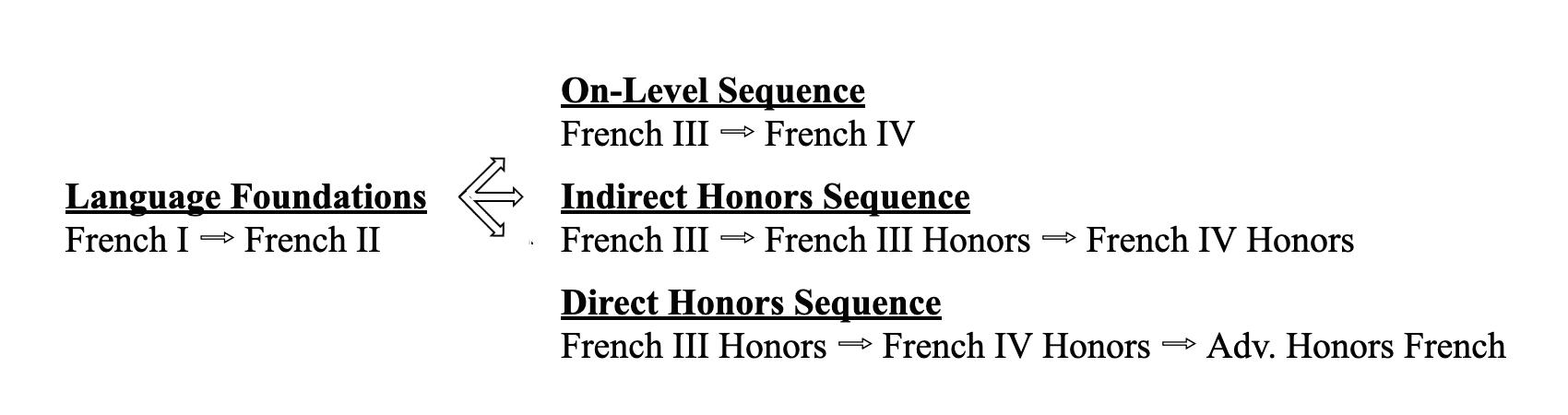
The upper school French program includes courses that are a continuation of the middle school program or are
French I
(year)
French I is a foundational language course. Students acquire strong fundamentals in the four language modalities (listening, speaking, reading and writing). Vocabulary and structures are presented in cultural and geographical context and students develop basic knowledge of the Francophone world. Through thematic units that include project-based learning, speaking, listening, reading, and grammar exercises, at the end of the year students are able to handle daily communicative situations. Thematic units include greetings, personal descriptions, time and weather, leisure activities, articles of clothing, colors, school-related terms, food items and meals, chores and the home, the family, and getting around town. This course is taught primarily in French and students are expected to use French in all interactions. Upon completion of the course, students should reach the Novice-High level on the ACTFL proficiency scale.
French II
(year; prerequisite: French I, French IB or departmental placement)
In French II, students continue to develop all four language skills (speaking, listening, reading, and writing) through small-group conversations, full-class discussions, role plays, games and other interactive activities. They engage with a variety of real-life topics, including sports and hobbies, school and community life, daily routines, health, food and travel, making meaningful connections between the language and their own experiences. Language skills are reinforced through authentic resources, such as viewing a video-based ongoing story, reading novels and completing writing tasks, which allow students to apply the language in realistic and relevant contexts. Over the course of the year, students build confidence expressing themselves in the present, past and future tenses in both oral and written forms, while also expanding their use of more complex grammatical structures and developing a richer vocabulary. Classes are conducted primarily in French, with students encouraged to participate actively, take risks, and engage fully in all language activities. Upon completion of the course, students should reach the Novice-High level to Intermediate-Low on the ACTFL proficiency scale.
French III
(year; prerequisite: French II or departmental placement)
This course continues to build on the skills acquired in French II. All four skills (speaking, listening, reading and writing) as well as cultural competency are emphasized through group discussions, role-play, oral presentations, reading and writing assignments. Students’ language acquisition will be contextualized within the diverse cultures of the Francophone world to expand their familiarity with the cultural specificities tied to the French language. Students will develop a higher level of accuracy in their use of the major verb tenses and complex grammatical structures, and will also acquire a more nuanced active and passive vocabulary. Through the use of authentic sources such as TV, video, audio, nonfiction and fiction texts, we discuss a variety of topics such as school and academics, the arts, family and friends, travel, and how to navigate everyday life when shopping, going to the bank and finding housing. Class is conducted entirely in French, and students are encouraged to take risks and be creative in the target language at all times. Upon completion of the course, students should reach the Intermediate-Low to Intermediate-Mid level on the ACTFL proficiency scale.
Honors French III
(year; prerequisites: French II, French III, or departmental placement)
In this course, students expand their proficiency across the three communicative modes (interpersonal, interpretive and presentational). This course is designed to further develop accuracy as well as spontaneity in the four language modalities (speaking, reading, writing and listening) through group discussions, role-play, oral presentations, extensive reading and essay-length writing assignments. Students’ language acquisition will be contextualized within the diverse cultures of the Francophone world. They will develop increasing accuracy in their use of the major verb tenses and complex grammatical structures, and will also acquire a more nuanced
active and passive vocabulary. Through the use of authentic sources such as TV, video, audio, nonfiction and fiction texts, students engage with various topics such as studying in a French speaking country, finding housing and navigating everyday life, the arts (cinema, music, literature, theater), and current geo-political issues. Class is conducted entirely in French, and students are encouraged to take risks and be creative in the target language at all times. Upon completion of the course, students should reach the Intermediate-Mid to Intermediate-High level on the ACTFL proficiency scale.
French IV
(year; prerequisite: French III or departmental placement)
In this course, students expand on the knowledge acquired in previous courses and incorporate new strategies that improve their skills across all four language modalities (speaking, listening, reading, writing), through a variety of readings, films, writing activities, role play situations, in-class discussions and oral presentations. Discussion topics such as news and media, relationships, human rights, technology, leisure activities and the environment are designed to enhance students’ knowledge of the diversity of the French-speaking world. A complete review of key grammar structures helps students sharpen their linguistic accuracy. This class is conducted entirely in French and students speak exclusively in French. Students are encouraged to take risks and be creative in the target language at all times. Upon completion of the course, students should reach the Intermediate-Mid level on the ACTFL proficiency scale.
Honors French IV
(year; prerequisites: French III Honors or French IV and departmental placement)
In this course, students continue to expand and deepen their ability across all four language modalities (speaking, listening, reading, writing), through a variety of course materials drawn from authentic sources. Students read and write extensively, engage in discussions, make oral presentations, read newspapers, emails, literary texts, watch films and listen to radio and music content. At the end of the year, students can apply the skills and knowledge they have acquired in the classroom to diverse communicative situations in the real world and will have achieved substantial awareness of the world’s Francophone cultures. Students are expected to dedicate a significant amount of independent study time outside of the classroom to this course, as the class moves at a rapid pace. Class is conducted entirely in French, and students are encouraged to take risks and be creative in the target language at all times. Although this course is not specifically designed to prepare students for the AP exam, students who take the course will develop foundational skills and knowledge integral to success on the exam. Upon completion of the course, students should reach the Intermediate-High to Advanced-Low level on the ACTFL proficiency scale.
Advanced Honors French
(year; prerequisite: successful completion of French IV Honors and departmental placement)
This course is designed for students with highly developed language skills who are interested in continuing to deepen and refine their mastery of French in an advanced seminar format. Students will explore and analyze a wide range of French and Francophone contemporary novels and films. The movies and readings engage students in class discussions about topics that are relevant to their age group. Students are exposed to vocabulary in context in order to talk about friendship, religion, cultural differences, stereotypes and adolescence, among other topics. Students also enrich their ability to express themselves on paper through research and essay writing, and receive individual feedback on a regular basis. Students expand and deepen their proficiency across the three communicative modes (interpersonal, interpretive and presentational) and further refine their skills across the four language modalities (speaking, listening, reading, writing). Class is conducted entirely in French, and students are encouraged to take risks and be creative in the target language at all times. Upon completion of the course, students should reach the Advanced-Low level on the ACTFL proficiency scale.
Latin Grades 6-8
The middle school Latin program is designed as a two-year introduction to the study of the Latin language and ancient Roman culture and provides students with the basic skills necessary for the acquisition of any world language. These classes are conducted in both Latin and English.
Latin IA (year; grade 7)
This course covers material equivalent to the first semester of the Latin I upper school course. The aim of the course is to develop foundational knowledge of Latin sentence structure and vocabulary, as well as to establish core reading competency and fluency through reading, composition, and both verbal and written exercises. Topics covered include the first three declensions, all cases including the locative, all four conjugations in the present tense, active and passive voices, and demonstrative adjectives and pronouns. The history, culture and legacy of Rome and the Latin language in Western culture are studied throughout the course. Upon completion of the course, students should reach the Novice-Mid level in Reading and Writing on the ACTFL proficiency scale.
Latin IB (year; grade 8; prerequisite: Latin IA)
This course is a continuation of Latin IA and covers material equivalent to the second semester of the Latin I upper school course. The aim of the course is to continue developing foundational knowledge of grammar, syntax and vocabulary, while further honing reading competency and fluency. Topics covered include declensions three, four and five, third declension adjectives, comparatives and superlatives, deponents, participles, accusative and infinitive constructions, and indirect speech. Roman history and culture and the legacy of Latin continue to be explored in this course. Upon completion of the course, students should reach the Novice-High level in Reading and Writing on the ACTFL proficiency scale.
Grades 9-12
The upper school Latin program includes courses that are a continuation of the middle school program or are designed for students beginning their Latin studies. Latin classes are conducted in both Latin and English.
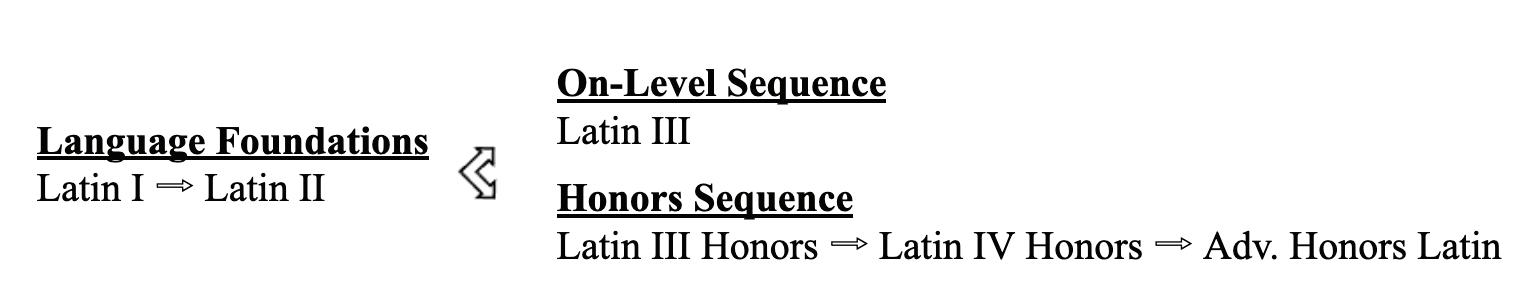
Latin I (year)
This course combines the material covered during the two years of middle school introductory Latin. The aim of the course is to develop foundational knowledge of Latin sentence structure and vocabulary, as well as to establish core reading competency and fluency through reading, composition, and verbal and written exercises. The history, culture and legacy of Rome and the Latin language in Western culture are studied throughout the course. Upon completion of the course, students should reach the Novice-High level in Reading and Writing on the ACTFL proficiency scale.
Latin II
(year; prerequisite: Latin I or Latin IB or departmental placement)
This course continues with the introduction to Latin grammar and vocabulary begun in Latin I or Latin IA/ IB by building upon student knowledge of nouns and adjectives and adding a core understanding of Latin verb forms and mood constructions. The course expands the exploration of sentence structure and vocabulary while developing fluency through reading, composition and verbal exercises. Cultural and historical material is routinely integrated into the course to provide a heightened sense of context for the students’ linguistic studies. Upon completion of the course, students should reach the Intermediate-Low level in Reading and Writing on the ACTFL proficiency scale.
Latin III
(year; prerequisite: Latin II or departmental placement)
Latin III extends the foundation laid down in Latin II by completing the survey of Latin verb constructions, with particular focus on the subjunctive mood. Throughout the course vocabulary building and techniques of effective reading are stressed through the reading and writing of Latin. The first semester involves intense review and solidification of Latin grammar, practice with excerpts of authentic Latin authors, and extensive expansion of Latin vocabulary. The second semester introduces intensive reading of lightly adapted passages from Livy and Vergil. Upon completion of the course, students should reach the Intermediate-Low to Intermediate-Mid level in Reading and Writing on the ACTFL proficiency scale.
Honors Latin III
(year; prerequisites: Latin II and departmental placement)
Latin III Honors serves as a bridge course between the textbook-based learning of grammar in Latin II and the extensive reading of ancient texts in Latin IV Honors: Caesar and Vergil. The course completes the survey of Latin verb constructions, with particular focus on the subjunctive mood. Throughout the course, vocabulary building and techniques of effective reading are stressed through the reading and writing of Latin. The first semester involves intense review and solidification of Latin grammar, practice with excerpts of authentic Latin authors, and extensive expansion of Latin vocabulary. The second semester introduces intensive reading of lightly adapted passages from Livy and Vergil. Upon completion of the course, students should reach the Intermediate-Mid to Intermediate-High level in Reading and Writing on the ACTFL proficiency scale.
Honors Latin IV
(year; prerequisites: Latin III Honors or departmental placement)
The primary focus of Latin IV Honors is the prescribed syllabus for the AP Latin exam, which comprises a detailed study of works of two important literary figures of Latin literature: Pliny’s “Epistulae” and Vergil’s epic masterpiece “Aeneid.” Attendant work in mythology, Roman history, rhetorical devices and metrical patterns enable students to understand the meaning and significance of these important works in Western literature. Upon completion of the course, students will be prepared to take the AP exam in this subject. In addition, students should reach the Intermediate-Mid to Intermediate-High to Advanced-Low level in Reading on the ACTFL proficiency scale.
Advanced Honors Latin: Literature
(year; prerequisite: Latin IV Honors or departmental placement)
Students planning to enroll in this course next year meet with the instructor this spring to select a set of texts they want to explore in Advanced Honors Latin. At minimum two separate texts by two separate authors will be read; prose and poetry are offered in alternating years. This includes seeking answers to significant questions about Latin literature and developing a nuanced understanding of the course texts’ artistic, historical and cultural components. Evaluations include translation quizzes and at least two analytical papers, written in English. At least four classes are dedicated each marking period to support students in writing their analytical papers. Upon completion of the course, students should reach the Advanced-Low level in Reading on the ACTFL proficiency scale.
Spanish
Grades 6-8
The middle school Spanish program is designed as a two-year introduction to the study of Spanish language and culture and provides the basic skills necessary for the acquisition of any world language. These classes are conducted primarily in Spanish.
Spanish IA
(year; grade 7)
In this course, students learn the fundamentals of the four language modalities (listening, speaking, reading and writing) in the Spanish language. Vocabulary includes greetings and farewells, personal information, the alphabet, the calendar, numbers and telling time, leisure activities, school supplies, colors and other-school related terms, family members, description and activities, as well as parts of the home and chores. The course presents the parts of speech, gender and article usage, noun-adjective agreement, the present tense of regular and a few irregular verbs, question formation, interrogative words, affirmative, negative and interrogative sentences. Students use these tools to communicate effectively in spoken and written Spanish. This course is taught primarily in Spanish and students are expected to use Spanish in all interactions. Upon completion of the course, students should reach the Novice-Mid level on the ACTFL proficiency scale.
Spanish IB
(year; grade 8; prerequisite: Spanish IA)
In this course, students continue to build proficiency and confidence in the four language modalities (speaking, listening, reading and writing). Speaking and writing tasks include sharing personal information and opinions, talking about daily routines and activities, as well as asking and answering questions using simple sentences within the context of familiar topics such as clothing, food, family life and travel. Class activities emphasize oral communication through daily conversations, role-playing situations and oral presentations. This course is taught primarily in Spanish and students are expected to use Spanish in all interactions. Upon completion of the course, students should reach the Novice-High level on the ACTFL proficiency scale.
Grades 9-12
The upper school Spanish program includes courses that are a continuation of the middle school program or are designed for students beginning their Spanish studies. Starting with level III, all Spanish classes are conducted entirely in Spanish.
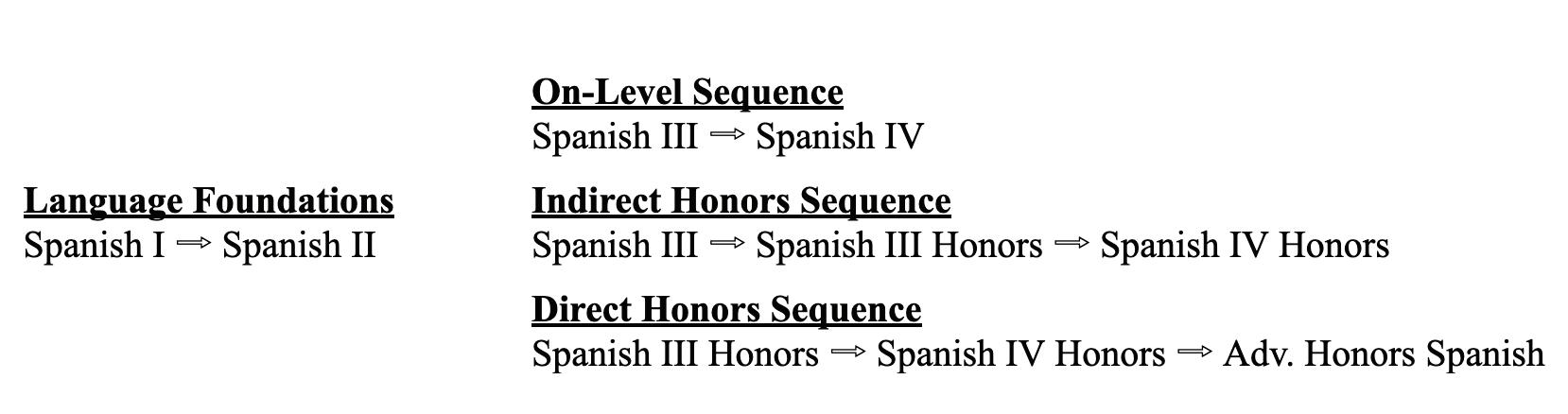
Spanish I
(year)
Spanish I is a foundational language course. Students acquire strong fundamentals in the four language modalities (listening, speaking, reading and writing). Vocabulary and structures are presented in cultural and geographical context and students develop basic knowledge of the Spanish-speaking world. Through thematic units that include project-based learning, speaking, listening, reading and grammar exercises, at the end of the year students are able to handle daily communicative situations. Thematic units include greetings, personal descriptions, time and weather, leisure activities, articles of clothing, colors, school-related terms, food items and meals, chores and the home, the family, and getting around town. This course is taught primarily in Spanish and students are expected to use Spanish in all interactions. Upon completion of the course, students should reach the Novice-High level on the ACTFL proficiency scale.
Spanish II
(year; prerequisite: Spanish I or Spanish IB or departmental placement)
Building on the skills mastered in Spanish I or Spanish IA and IB, in this course students further develop their proficiency in the three communicative modes (interpersonal, interpretive and presentational). Class time focuses on speaking and listening skills through small group conversations, full class discussion, individual and group presentations and debates. Through this course, students perfect their ability to express themselves in the present tense and become more proficient in their ability to express ideas in the past and future, while studying topics such as the environment, technology, current events, health/medicine and the arts. Class is conducted entirely in Spanish, and students are encouraged to take risks and be creative in the target language at all times. Upon completion of the course, students should reach the Novice-High level to Intermediate-Low level on the ACTFL proficiency scale.
Spanish III
(year; prerequisite: completion of Spanish II or departmental placement)
In this course, students will engage in a thorough review of the fundamentals of Spanish I and II, with the aim of improving their communicative proficiency across a range of time frames (past, present and future) and across all three communicative modes (interpretive, interpersonal and presentational). Class time focuses on speaking and listening skills through small group conversations, full class discussion, and individual and group presentations. Students explore the Spanish language in the context of thematically-oriented units such as the environment, technology, current events, health/medicine, the economy/business and publicity/ propaganda. Class is conducted entirely in Spanish, and students are encouraged to take risks and be creative in the target language at all times. Upon completion of the course, students should reach the Intermediate-Low to Intermediate-Mid level on the ACTFL proficiency scale.
Honors Spanish III
(year; prerequisite: Spanish II, Spanish III, or departmental placement)
In this course, students expand their proficiency across the three communicative modes (interpersonal, interpretive and presentational). This course is designed to further develop accuracy as well as spontaneity in the four language modalities (speaking, reading, writing and listening). At this level, class activities engage students through a variety of readings, role-play situations, in-class discussion, and oral presentations. Topics such as historical events, immigration and social issues are discussed together with various cultural traditions in the Spanish-speaking world. The use of videos, novels and literature, music and film provides students with opportunities to hone their listening skills as well as to explore perspectives from authentic voices. In addition, short writing assignments, longer essays and selected grammar topics help students sharpen their ability to express their ideas with precision and in both personal and academic contexts. Students are expected to dedicate a significant amount of time to independent study outside of the classroom, as the class moves at a rapid pace and new grammar topics are studied using a flipped classroom model. Class is conducted entirely in Spanish, and students are encouraged to take risks and be creative in the target language at all times. Upon completion of the course, students should reach the Intermediate-Mid to Intermediate-High level on the ACTFL proficiency scale.
Spanish IV
(year; prerequisite: Spanish III or departmental placement)
In this course, students expand on the knowledge acquired in previous courses and incorporate new strategies that improve their skills across all four language modalities (speaking, listening, reading, writing), with a particular focus on speaking and writing. Learners will explore advanced grammar structures, vocabulary, literature, and deeper levels of communication. Students will communicate about topics that include friendship, cultural traditions, art and contemporary issues, and will continue to increase their understanding of the cultures and traditions of Spanish-speaking countries enabling them to make connections between themselves and the world around them. Class is conducted in Spanish, and students are encouraged to take risks and be creative in the target language at all times. Upon completion of the course, students should reach the Intermediate-Mid level on the ACTFL proficiency scale.
Honors Spanish IV
(year; prerequisites: Spanish III Honors or departmental placement)
This course advances students’ Spanish proficiency across the interpersonal, interpretive and presentational modes of communication. Students develop skills in description, narration, analysis and argumentation through exploration of six themes: identities, families and communities, contemporary life, science and technology, global challenges and beauty and aesthetics. Instruction includes extensive reading and listening, advanced grammar review through a flipped classroom model, and analysis of art and literature, supported by activities such as debates, essays, presentations and improvisation. The course moves at a rapid pace and requires significant independent study. Conducted entirely in Spanish, the course encourages risk-taking and creativity in the target language. While not designed specifically for AP exam preparation, it builds foundational skills for exam success. Students completing the course are expected to reach the Intermediate-High to Advanced-Low level on the ACTFL proficiency scale.
Advanced Honors Spanish: 20th Century Short Fiction
(year; prerequisite: successful completion of Spanish IV Honors and departmental placement)
This course is designed for students with highly developed language skills who are interested in fostering their understanding of Latin American, Peninsular and U.S. Hispanic literature and culture through the analysis and discussion of short stories, theater plays and poetry produced in the 20th century. This advanced honors class will guide students to read critically and reflect on the many voices and cultures represented in the rich and diverse body of literature written in Spanish. The course will consist of six thematic units that will explore literary works from diverse geographical locations, including the United States, Mexico, Colombia, the Caribbean, the South Cone (Chile and Argentina) and Spain. In addition, the course will draw connections to other forms of artistic expression, including painting, music, cinema and architecture. Classroom discussions, cultural presentations, debates and writing assignments will all be integral components of the course. The class will be conducted entirely in Spanish. By the end of the course, most students reach or progress past the Advanced-Low level of the ACTFL proficiency scale.
Advanced Honors Spanish: Contemporary Film (year; prerequisite: successful completion of Spanish IV Honors and departmental placement)
This course is designed for students with highly developed language skills who are interested in continuing to deepen and refine their mastery of Spanish in an advanced seminar format. In this course, students explore various cultural, social and political topics through the study of Spanish and Latin American film and literature. Students advance their language studies and develop their academic language skills as they compare the themes presented in the films to various sources, such as literary works, videos, newspaper articles and historical artifacts. The course aims to improve both speaking and writing skills at an academic level; therefore, it relies heavily on active participation in class discussions, journal writing and in-depth analysis in small group discussions. At the end of each unit, students integrate this knowledge into
written and oral analyses of the particular aspects of a literary piece and/or a film excerpt of their choice. Class is conducted entirely in Spanish, and students are encouraged to take risks and be creative in the target language at all times. By the end of the course, most students reach or progress past the Advanced-Low level of the ACTFL proficiency scale.
Student Activities
These activities are non-academic but are scheduled into the academic school day. If students meet the prerequisites of the activity, they may request to take the activity during the course request process. Activities do not appear on the School’s academic transcript and do not receive a grade.
Academic Teams
Advanced Speech and Debate
(semester or year; grades 10-12; prerequisites: see below; meets on designated days during a class period and outside school hours on a pre-set schedule)
This activity is open to students with at least one year of experience on the Bishop’s Speech and Debate Team. In the class, students continue to refine their oratorical skills as well as prepare for specific extemporaneous and prepared events. Advanced Speech and Debate meets during speech and debate practices which occur on designated days during period X and after school. Requirements: Students are expected to join in at least 50 percent of practices, attend at least two tournaments per semester, participate in at least one state qualifying tournament, and take part in our Bishop’s Spring Classic Tournament on campus. Previous enrollment in the Public Speaking course is not required.
Mock Trial
(year; grades 9 -12; prerequisites: see below; meets on designated days during a class period and outside school hours on a pre-set schedule)
Mock Trial is an activity that gives students the opportunity to develop critical thinking, public speaking and teamwork skills. Students play the roles of lawyers, witnesses, bailiffs and clerks in a simulated court case. Students present arguments, testify and manage a courtroom before a real judge and attorney scorers. The team is coached by volunteer attorneys and Bishop’s teachers and students spend their time preparing for the simulated program during the fall and winter seasons, culminating in a competition that takes place in February. The team will have the opportunity to compete against teams from different schools all over San Diego County at the Superior Court Central Courthouse in Downtown San Diego. Students are expected to attend some practices that take place outside of school hours, be engaged in team collaboration, attend scrimmages and participate in the final competition in February. After the county competition, students spend time reflecting on their performance and building next year’s team.
Student Leadership
Associated Student Body
(non-academic; year; grades 9-12; prerequisite: by election; meets during X period and after school)
This is a non-academic leadership group that meets two periods per cycle for the entire school year. ASB provides a conceptual and practical understanding of student government and leadership for elected members of the Associated Student Body (ASB). Members learn what it takes to be a student leader – the responsibilities,
functions, tasks and challenges. Students are introduced to parliamentary procedure while developing personal leadership styles. A student also learns to use their influence effectively, develop practical action plans to represent the concerns and needs of a student body, guide and direct the work of others, solve problems, make effective decisions and build teamwork. Members of the council apply the concepts formally addressed in class as they hold their ASB meetings, direct social and spirit activities, and fulfill service opportunities to the School. With the mantra, “all-for-one, and one-for-all,” a significant amount of time commitment is required in addition to formal class meetings.
Peer Support
(non-academic; year; grades 10-12; prerequisites: by application; meets during X period)
This is a non-academic activity that meets once per cycle for the entire school year. Students may also be asked to participate in activities that occur outside of the designated X period. In this case, students will be given prior notice. This course is both reserved and required for members of the Peer Support Team, and it is necessary to apply for this class. The Peer Support Team’s mission is “to better educate ourselves and our community on issues and matters relevant to well-being, self-reflection and vulnerability. We strive to be models for younger Bishop’s students through direct one-on-one interactions and larger advisory and grade-level activities.” To accomplish this goal, the peers receive training in basic peer counseling and support, communication skills, and educational outreach opportunities. Team members learn to create, organize and lead presentations for both middle and upper school students.
Student Publications
The Tower (semester or year; grades 9-12; prerequisites: Journalism I or II, or concurrent enrollment)
The Tower is The Bishop’s School’s student-run news publication, producing content for a monthly news magazine, a regularly updated news website, and a weekly newsletter. Students collaborate to produce timely, ethical and engaging journalism for the school community. Students take on roles of staff writers and editors, working together as a staff to plan, report, edit and publish content. The publication is largely student-led, with an emphasis on leadership, collaboration, accountability and meeting real-world deadlines. Students develop skills in reporting, writing, editing, visual storytelling and newsroom management. Students are expected to meet professional standards of ethical reporting, collaboration, responsibility and communication. Students wishing to participate must be concurrently enrolled in or have completed Journalism I and Journalism II.
Yearbook
(year; grades 10-12; prerequisites: by application; occasionally meets after school)
In this largely student-led activity, students produce The Bishop’s School annual, El Miradero. Students use Microsoft Word and InDesign software to produce all of the copy and layout. Organization, graphic design, copywriting, photography, the value of a deadline, and the teamwork and leadership skills needed to work together to publish a 260+ page book are taught and encouraged. Students who wish to take Yearbook must submit an application in the spring in order to select the activity during the course request period.
Grade 9 Planner
Students must have at lease five courses per semester. Seven courses per semester must be approved. P.E./Athletics are required but do not count toward the five course minimum/seven course maximum.
Be sure to read the “Notes for the Four-year Planner” handout, it contains a lot of info and tips!
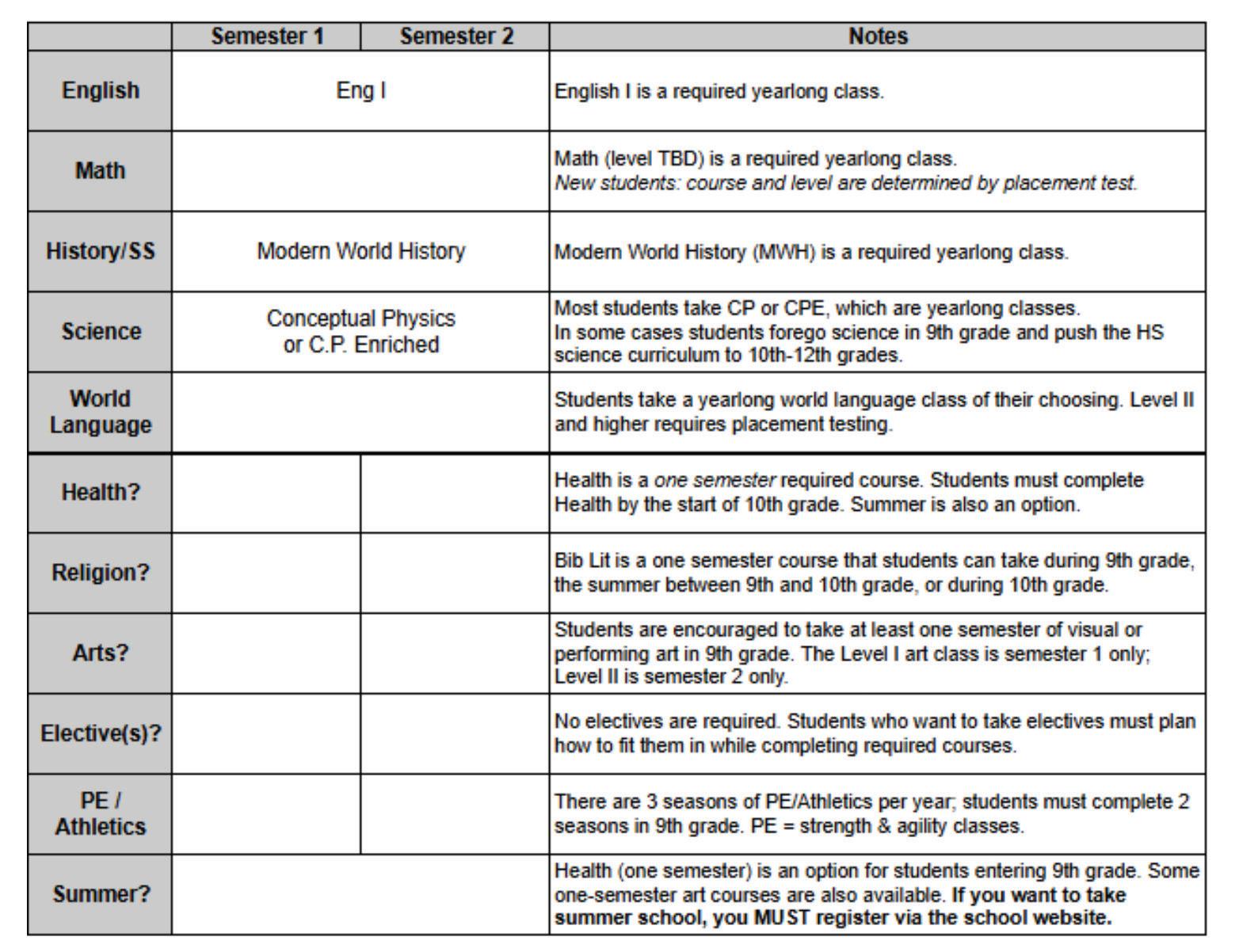
Keep other activities in mind (club sports, etc.) as you make your selections - there are only 24 hours in a day and you can only do so much!
Arts Options
You can choose a performing or visual arts class. You must complete two semesters in one type of art.
Performing Arts
Chorus I/II
Jazz Band I/II
Dance I/II
Theater Arts I/II (acting)
Technical Theater I/II
Costume Design I/II
Visual Arts
Ceramics I/II
Studio Art I/II (drawing and painting)
Digital Media I/II (photo and video)
English: 4 years
Graduation Requirements and Planner
Math: 3 years and through Math 5
World Language: 2 years and through Level 3
Religion: Bib Lit (sem.) and elective (sem.)
History/SS: 3 years including MWH, U.S. History and Arts: 2 semesters in the same type of art
1 sem history in eleventh grade
Science: 3 years of lab instruction
P.E. 2 seasons in grades 9-11, 1 season in grade 12
Health: (sem.) required before tenth grade
Students must have at least five courses per semester. Seven courses per semester must be approved.
“Rec’d” refers to the recommended number of years in each subject for college application purposes. This number may be higher than the graduation requirement.
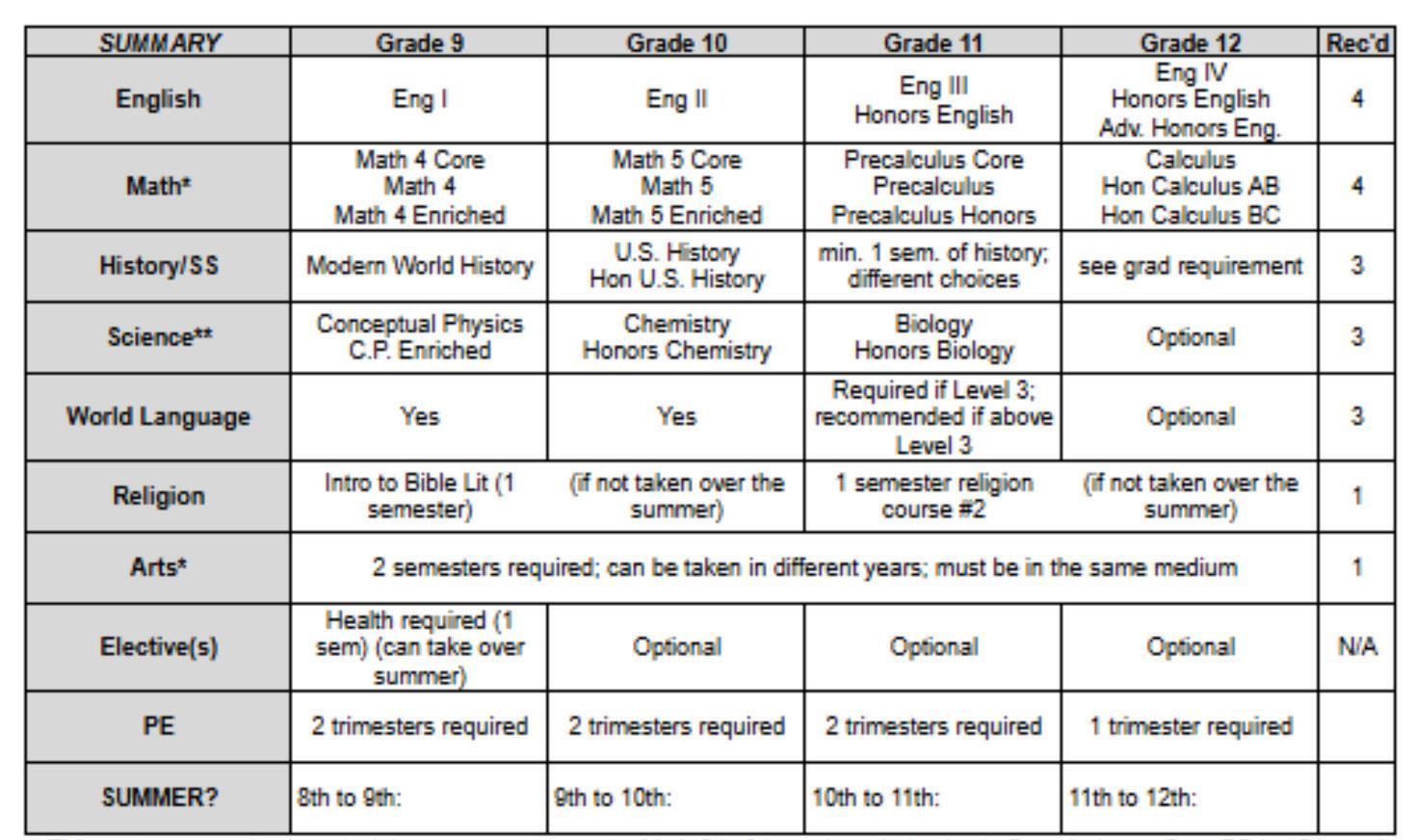
*This math progression is typical, but some students take Math 3 in ninth grade, culminating in precalculus or Core PC in twelfth grade.
**In some cases, students might forego science in ninth grade and push their science to tenth-twelfth grades.
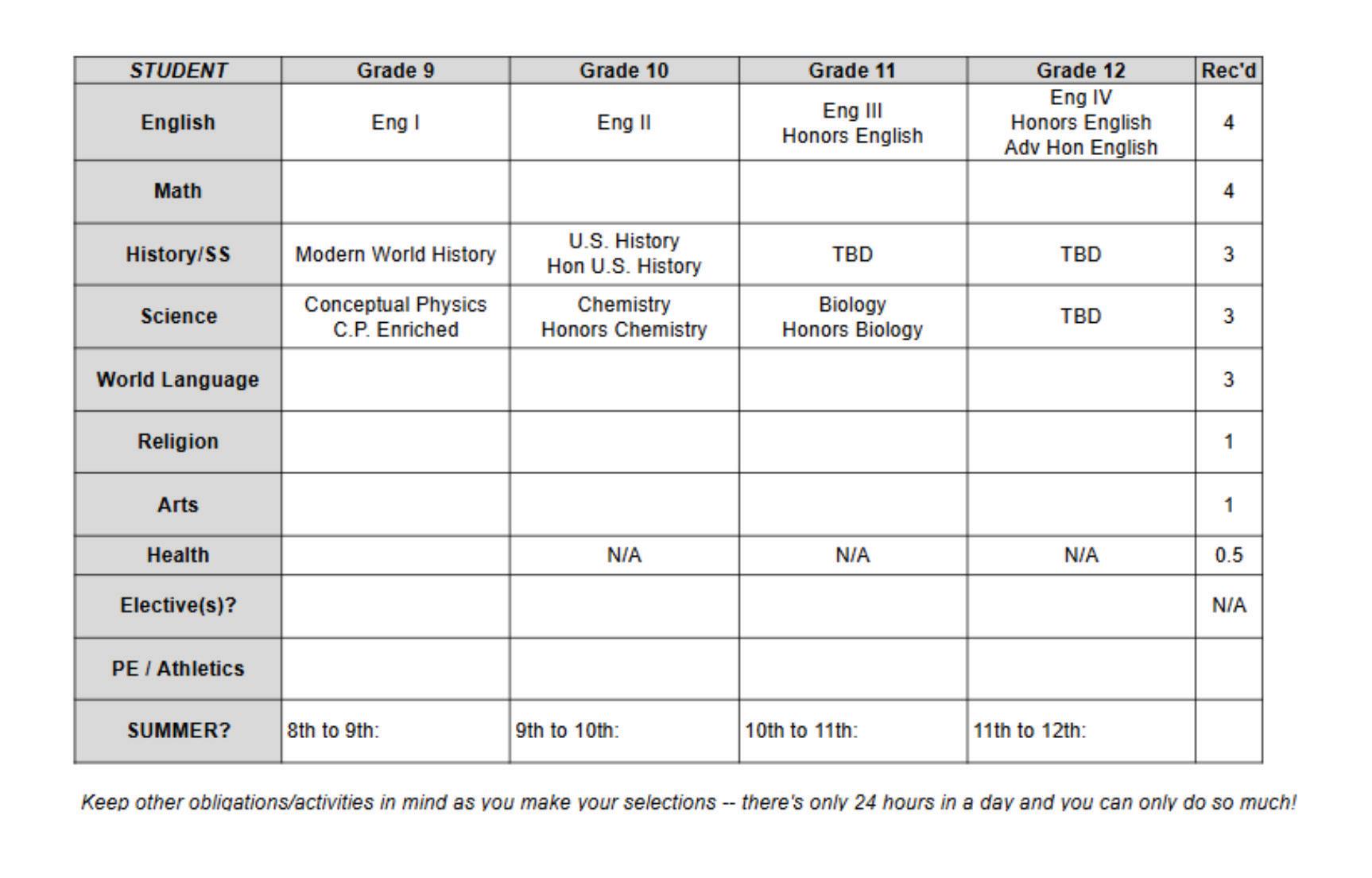
Blank Four-year Planner