The Berkeley Beacon | February 28, 2021
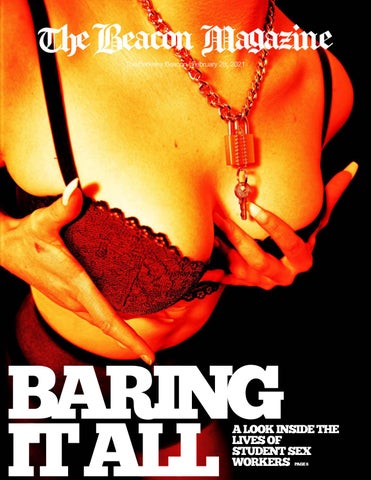
BARING IT ALL
A LOOK INSIDE THE LIVES OF STUDENT SEX WORKERS PAGE 6
February 28, 2021
H ar me out Sabine Waldeck
“Craving your touch” Page 4
Beacon columnist Sabine Waldeck weighs in on the difficulty of wanting to get as close as possible when its best to stay away
Features Dana Gerber, Ann. E. Matica
“Bodies of work” Page 6
Domenico Conte Magazine Editor Katie Redefer Editor-in-Chief Dylan Rossiter Operations Managing Editor
The Beacon’s news and deputy news editor report on four student’s jobs as sex workers. Student identites are left anonymous.
Maximo Aguilar Lawlor Visual Managing Editor Madison Goldberg Content Managing Editor Charlie McKenna Content Managing Editor
Any and all comments on articles can be directed to Magazine@BerkeleyBeacon.com Pitches can be emailed directly to the magazine editor at domenico_conte@emerson.edu
All photos for this edition are courtesy photos.
The only student newspaper of Emerson College. Editorially independent, Founded in 1947. 172 Tremont Street, Room 309 Boston, MA 02117
Also Included... Gary Sowder
“Stop shivering and start cooking” Page 14
Gary Sowder’s remedy for the COVID first dates that can’t keep up with the cold weather.
Lucia Thorne
“Visual Dating,” an illustration Page 15
Illustration by Beacon living arts editor Lucia Thorne.
(617) 824-8687 Contact@BerkeleyBeacon.com
Letter from the Editor The Beacon Magazine is back for 2021, and I’ll be the first to admit that not many people expected that to be the case this semester. Not a single person applied for the position when it was posted at the end of the fall 2020 semester, and at the time I viewed myself as someone far from capable of putting out a magazine each month in the spring. I definitely did not expect to be bringing about the edition that makes up the next 13 pages. I found out that news editors Dana Gerber and Annie Matica were working on a story about student sex workers here at Emerson. Dana, as the news editor, really wanted the story for her own section in the Beacon, but I knew this magazine could hold the 5,000 words that the newspaper couldn’t and make a great cover story. When I assumed last fall that I wasn’t capable of making a magazine, I clearly counted out the fact that I’d have great contributors to make it a whole lot easier for me. I think the story the two of them came up with is one of the best student-reported stories I’ve read during my time at Emerson. The former magazine editor, Jakob Menendez, said I ought to write something in this space, and despite my reluctance to do so, I think I’ve used enough full page photos. So to those who pick this up, if you’re interested in what you see, or the idea of a newspaper magazine in general, I’m here to tell you these pages aren’t exclusive. I’d be happy to put any idea you have either on a page, on the website, or both. If you have a long story you want to tell, photos that are more than just an image, or any other form of nonfiction to share that may lend itself more to a magazine than a newspaper, I’ll do my best to make it more than just an idea. I hope you enjoy what follows this letter, and look out for another Beacon Magazine, a much different one, around this time next month. Making a magazine has been the most recent role I’ve had at Emerson that I didn’t see coming. I’ve had a pretty hard time predicting a lot of the positions I’ve found myself in the past three years at Emerson—but each one has landed me in a place where I can work with other students to make something that we end up being proud of. I can’t help but want to tell any potential first year student reading this that there are a bunch of paths at Emerson you could head down that you probably don’t know are ahead of you.
Domenico Conte Magazine Editor
3
H ar me out Emerson’s premier destination for sharing opinions
Facing the consequences of physical distance By Sabine Waldeck
W
hen was the last time you were able to run into your friend’s arms and give them a big hug? Last time you were able to kiss your partner? Embrace your Grandma? For the safety of the people around you, I am hoping you did not answer recently. For about a year now, we have been told to stay six feet apart from one another. For those that abide by these guidelines, it has been difficult. People are very tactile—a big way we share love is through physical touch. Tiffany Field, director of the Touch Research Institute at the University of Miami, found in a survey conducted during the first COVID-19 shutdowns that 68 percent of participants felt like they were touch deprived, and within a month the symptoms they were experiencing increased by 50 percent. Over winter break I went to visit my boyfriend. I was not able to get a test before I went because all the testing facilities near me were completely booked, so I drove five hours just to stare at him from six feet apart, masks on. His father is immunocompromised, so with the rise in cases around the holiday season we were taking extra precautions. Even though we weren’t able to snuggle up and kiss, we tried our best to make it seem normal, but it wasn’t. It was awkward. My partner is someone I never feel uncomfortable around. I can act like a complete idiot around him and not feel fazed. However, the physical distance between us seemed like it caused a psychological divide as well. I noticed we kept on interrupting each other after trying to fill spouts of silence; similar to what you experience when first meeting someone and trying to make small talk. This injection of awkwardness into a conversation was not a one-time occurrence. The first time I noticed this physical space getting in the way of emotional connection was when I saw my best friend over the summer. My first instinct when I saw her was to wrap my arms around her little 5’ 2” body and squeeze as tight as I could. I caught myself before I did that; I practically hit an invisible barrier the moment I remembered I couldn’t get any closer than I already was. Instead, I violently
flapped my hand around in excitement, making something that barely resembled a wave. Our typical hangouts pre-pandemic would consist of us climbing all over each other trying our best to annoy one another and laughing until our lungs hurt. Instead, our time together was spent on two separate picnic blankets in her backyard, trying to catch each other up on our lives, but not having enough content to have a full conversation. With six feet of grass between us, it felt like our relationship was off. Not being able to touch my friend brought me down in a surprising way. After leaving her, I felt an emptiness. That feeling is there every time I wave goodbye, instead of hugging now. This lack of physical touch made me realize how important it is to share space with the people you love. How much a handhold, a knee brush, a squeeze of the shoulder means to your connection with someone. “Touch starvation increases stress, depression and anxiety, triggering a cascade of negative physiological effects. The body releases the hormone cortisol as a response to stress, activating the body’s “flight-or-fight” response,” said the Texas Medical Center. Sure, people have tried to recreate the sensation of physical touch, but that new elbow-tap greeting is just downright uncomfortable, and my distaste for it has only increased throughout the pandemic. Would it have been easier to just stay home and Facetime? Absolutely. But after only having physical contact with my parents for months, the idea of being within the vicinity of someone else is enticing. My most recent experience with being touch deprived was two weeks ago, when my partner was dragged to the Paramount building, along with his other suitemates, after one of them tested positive for COVID-19. I still had people around me. I had my two suitemates to sit next to and grab my arm when something funny was said. However, I still found myself walking into my suitemate’s room at midnight asking for a hug because I just needed one. While physical touch is not always sexual, I would be lying if I said that was not a factor when it comes to a romantic
relationship. Missing that aspect for days, weeks, or months leaves you with a physical craving more identifiable than the psychological one. There has been an increase in people watching porn online, and even a threefold increase in vibrator sales since the lockdowns began worldwide. Stripping away physical touch in romantic love, friend love, or sexual love impacts your mental health. To the people who are following CDC guidelines, we are all touch-deprived. If you want some ways you can try to combat this touch starvation, touch yourself. Not exactly in the way that sounds, but more literally. Give yourself a hug, a massage, or squeeze your arms. It is in your hands to give yourself the physical contact others can not right now. Trevor Roberts, a psychotherapist from Bournemouth, England, suggests “seeking out different textures—caressing and concentrating on the feeling of silky, furry, smooth and even rough surfaces,” can help with touch deprivation by exposing your senses to new experiences that your body is lacking. This longing for physical affection has proven itself difficult, but hopefully someday soon we will be able to run into each other’s arms like they do at the end of every sappy romantic comedy.
Sabine Waldeck is a junior journalism student at Emerson College and an opinion columnist for The Berkeley Beacon. She can be reached at sabine_waldeck@ emerson.edu
5
BODIES OF WORK Some are strapped for cash, some use it to heal, and some just like the power. With all stigmas stripped away, this is an intimate look into the lives of student sex workers.
O
By Ann E. Matica and Dana Gerber
n the fifth floor of the Colonial residence hall, every Sunday night around 6:30 p.m., Jenna got ready for work. She stripped off her clothes, found a good angle, and snapped some nude photos of herself. In her suite, one of her suitemates tracked her earnings and spendings in a spreadsheet, while another fielded the steady stream of Snapchat messages from “thousands” of clients asking for content, often until 3 a.m. She paid each of them $300 a week. “My friends in Colonial—they did it like homework,” Jenna, a junior journalism major, says of the sex work she did her first semester. “We literally became a little business, and we had the best time doing it.” The enterprise was second nature to Jenna, who has sold pictures of herself since she was a student at a high school where “nobody dated” and she craved male attention. She started a private Snapchat under the pseudonym Jenna Stares—the same day, she made $2,500 from 10 faceless photos of herself. “I realized how lucrative this is, and then I started making ridiculous amounts of mon-
ey—like, drug dealer amounts of money,” she says. With her parents covering her tuition expenses, Jenna bought a Mercedes-Benz, a Gucci bag, Balenciaga shoes, and fancy sushi dinners for her friends. When a friend’s car broke down, she paid to have it fixed. Once, she went to Fajitas and ’Ritas a few blocks from campus with friends, ordered eight pitchers of margaritas, and texted a client: Hey, I’m out to dinner with my friends, and they want my sugar daddy to pay for it. He sent her enough money over Apple Pay to cover the entire bill. “It was great,” she recalls. “What am I going to do, start a 401k? I’m just gonna blow that money.” As the dollars poured in, she learned to be savvier, saving half and spending half. She developed a fanbase, and clients began sending her money unprompted—just because. Go get a nice dinner, or go get your nails done, they would say. She had to start using Apple Pay because CashApp and Venmo flagged her account for “suspicious activity.” Grossing about $9,000 a month, Jenna estimates she’s earned upward of $120,000 since high school. “It was super transactional,” she says. “A
*Some names in this story have been changed to protect students’ identities
sale could be done in three messages.” The newfound riches, she says, went to her head. “The biggest reason why I would spend that money so quick is because I could make it back in 10 minutes, easy,” she says. She lost motivation to apply for internships. To focus on her journalism career, she tapered off on selling photos. Now she’s down to just four or five long-term clients she can offer content to any time she needs a jolt of cash. Pulling back on sending photos has had its upsides. “Ever since I stopped, I became much closer to my parents because I wasn’t on my phone as often,” she says. “I used to always be on my phone messaging these dudes and making sales.” With her friends, sex work was “the topic of discussion every time I was around people,” Jenna says. “Once I broke away from that, I definitely felt like I made more genuine friendships with people and because people weren’t being my friend because I could buy them DoorDash, [or] I could buy their dinner.” Quitting altogether, Jenna says, has a hard deadline: “When I get a job,” she says. “When I get like an actual HR, signed signature, payroll job. That’s the time.”
7
For now, she’s content with her work-life balance. “I’m trying to be more of a regular college student, not like the Princess of Dubai, taking money and spending it,” she says. “I used to be overwhelmed, and now I’m cruising.” Sex work is a surprisingly unsurprising line of work for college students. The Student Sex Work Project, a three-year study led by Swansea University that interviewed 6,773 students in the U.K., found the top three reasons students opted for sex work were good money, flexible hours, and sexual pleasure. The study found that about five percent of students surveyed had somehow worked in the sex industry, ranging from webcam services to working in a topless bar to prostitution. The move of some sex work to an online format has made entering the industry that much easier. OnlyFans—a platform that charges “fans” a monthly fee to subscribe to a creator—has caused the popularity of sex work to balloon, especially after the pandemic limited in-person jobs or made them substantially riskier. Founded in 2016, OnlyFans surged from 120,000 users in 2019 to more than 90 million by December 2020, according to the New York Times. At colleges like Emerson—where the average financial aid award is $17,000 compared to a $70,000 a year tuition, room, and board charge—students often need a straightforward and sustainable way to generate income. Sex work, for some people, fits the bill. One Emerson junior, who uses the alias WeekndWrrior on her OnlyFans account, began her expedition into sex work in September 2020. She’d dabbled in selling pictures online, but the combination of staying home because of the COVID-19 pandemic, her diagnosis of psychogenic non-epileptic seizures, and the necessity of a steady income spurred her to make an OnlyFans account. “I love getting dressed up. I love being creative. I love to make content,” she says. “It’s nothing ever that I have to push myself to do … it’s stuff I do on the daily. I love to do it.” After holding a minimum wage job in Copley Square, WeekndWrrior says she can’t imagine affording tuition at Emerson without the money she makes from sex work. “I live alone, and I don’t have any support from [my] family. So I absolutely use this money for living expenses, school, textbooks, all of that,” she says. In a statement to The Beacon, Emerson urges those who felt they couldn’t afford
tuition to access available college resources. “We are deeply concerned to learn that students may feel that sex work is their only option to cover their expenses while enrolled at Emerson,” wrote Michelle Gaseau, Emerson’s director of communications and media relations. But it’s not all about the money. WeekndWrrior’s recent diagnosis with PNES, a seizure disorder that can arise after experiencing a traumatic event, makes staying out for long periods of time or holding service jobs all but impossible. “That diagnosis, going forward with that in sex work, it really goes hand in hand with my treatment, because it just is having me be more open and empowering myself and taking control of my mind and my body,” she says. As a survivor of sexual trauma, WeekndWrrior turned to sex work as a beacon of hope when her body no longer felt like her own. She says it felt like a piece of herself had been taken against her will. “A lot of my trauma and my mental health, the way that it was panning out, it seemed just like a good time for me to get into something that would start to heal me,” she says. WeekndWrrior says trying sex work for the first time instilled her with a newfound autonomy over herself and her image. “Before I did sex work, there were things that people could do to stop me. There were traumas that people could inflict on me or others to stop me from either embracing my sexuality or just embracing sex in general,” she says. “It feels like a piece is taken from you, so to take it back—and not only take it back but use it to your advantage and create this little business empire and having that creative outlet—of course I’m going to do that.” Jesse Battilana, a nurse practitioner for Emerson’s Center for Health and Wellness says WeekndWrrior’s perspective is a positive one, though it might not be universally applicable. “A patient being in control of their own body is an important component of trauma-informed healthcare,” she wrote in an emailed statement. “I would be very happy to hear it if someone’s sex work impacts them positively and reinforces their sense of control over their body and their right to consent. That said, I also would not discount the potential for a triggering or traumatic situation in this job.” Annabelle, a junior creative writing major at Emerson, wore a red turtleneck and a star necklace as she recounted her entry into sex work. A self-described “hypersexual being,” she says she’s been “very erotic-minded” since she was a child, and was always drawn to the idea of sex work. “It was associated
with pleasure, so I was like, ‘That must be awesome, having fun all the time,’” she says. Annabelle says she was hypersexualized as a child by a family member who groomed her. “Because of that and because I already had thoughts about sex at the time, it propelled me into this hypersexual being that I am now,” she says. She is proud of her work, but does “understand that at the time, the reason I had this idea was definitely not from the best place.” As soon as she turned 18, she seized the opportunity to begin selling her nude photos through platforms like a private Snapchat, Fancentro, and OnlyFans. She posted a “menu” of content, and hundreds of messages piled up each day. Some of the men were trying to “save her” from sex work or were “time wasters” trying to get free content. She posted an order form on Reddit for customers to fill out. Her premium Snapchat cost $12 a month or $100 for a “lifetime” subscription, and she sent out more than five premade, impromptu pictures, and videos weekly. She uploaded daily to her OnlyFans, which cost fans $15 a month. Most of her content was shot in her Piano Row suite—one of the rooms was empty, and she preferred taking photos and videos with as little identifying information as possible. She didn’t want any of her customers to associate her with Emerson, or even with Boston. The standard wooden doors and bed frames, however, were a telltale sign of campus living. “They would love the dorm thing. They would think it’s part of the young girl gimmick,” Annabelle says. “Being a college girl is a really attractive thing to them ... [It] definitely helped me make a lot more money.” Some of her content featured her now ex-boyfriend, another Emerson student, who often did camerawork for her. Her suitemates helped out too. “It wasn’t unexpected for them to walk in and I’d be taking a photo of myself naked. They’d be like, ‘Oh, let me help,’” she recalls. “The extra hands really help and definitely take some of the responsibility off.” Her job was not a point of contention in her relationship with her boyfriend, and Annabelle says jealousy was not an issue. However, she says he was uncomfortable with her video-chatting clients after a particularly awkward Skype call with someone who sent her a Hitachi wand vibrator. But they came to a mutual agreement on that boundary (though she still “swears by” the vibrator). Annabelle introduced WeekndWrrior to the world of virtual sex work. They became
friends during their first year at Emerson, sharing an interest in makeup and bonding over their struggles with mental health. Eventually, WeekndWrrior’s blossoming curiosity in sex work came up. The unapologetic content that Annabelle posted on her OnlyFans was fearless. It upended WeekndWrrior’s preconceived notions about what sex work could look like. She says Annabelle taught her to make content she wanted, not what she thought others wanted from her. “She still goes about her life the way she normally would,” WeekndWrrior says. “Just the way that she powered through and the way she did things—it really inspired me.” Becoming part of the online community of sex workers has been a formative experience, WeekndWrrior says. “I love women being empowered and men, I love everyone who is out here doing it and loving it,” she says. “For me, online it’s the safest community. It’s a happy place when people are uplifting each other.” Solidarity between sex workers, Annabelle says, is essential. “That’s what I think sex workers need the most is just the idea that we can unite in a community, and support each other in that way,” she says. “I actually had no idea that there were more than just the two of us.” By every measure, sex work is work. It’s business. It’s a painstaking analysis. Most of Jenna’s clients lived in California, so she learned to work on their time. “From trial and error, I have marketed and researched that Sundays are when everyone’s home. Nobody’s really doing anything.That’s when I would make the most money,” she says. “It’s [a] science, without a doubt.” On Friday nights, when none of Jenna’s friends had class, they would meet in a study room in the Iwasaki Library to gameplan new picture, rate, and menu ideas, while munching on Halal Guys or Chipotle. “It all was so gradual and so effortless,” she says. “Everybody’s talents came together. I had a friend who was a comedy major, and she would help me with witty posts and witty responses to these dudes. I had a VMA major who would edit my pictures ... my one friend that made the analytical chart was a [BCE] major, so he helped with how to profit ... and how to pay.” At the end of January, WeekndWrrior was hospitalized for five days due to her increasing struggles with PNES. While OnlyFans has allowed her to create her own schedule and prioritize her mental and physical health, she felt like her time in the
9
hospital offset the countless hours of work she puts into prepping her outfits, doing her makeup, taking photos, and marketing herself on social media apps. “I have to do things on time because I have planned posts and I have planned videos,” she says. “I do have to find specific things for specific looks, and I have to spend time making plans or talking to people and most importantly, dealing with my taxes.” Content creators on OnlyFans are required to keep track of their own taxes, meaning every transaction must be diligently tracked through receipts and spreadsheets. “I need to keep tabs on everything,” WeekndWrrior says. But it’s worth it, she says, because of the steady income it provides her, and the peace of mind she gets knowing every “fan” must prove they are over 18. On average, she says she makes between $300 and $400 a week off tips and her $4.99 monthly subscription fee. After OnlyFans takes its 20 percent cut from her earnings, the money collects in an OnlyFans checking account from which creators can receive weekly payouts or set up manual withdrawals. The OnlyFans platform isn’t for everybody, though. “I didn’t want to be tied down to a subscription because then people expect content, at a certain time, however many times a month or a week,” Jenna says. “I really didn’t want to be held down to that.” Annabelle made a separate bank account so her father wouldn’t find out (her mother passed away years ago). The money mostly went into savings and purchasing nice meals, as her grandmother had set aside money for her college tuition. “It was technically my first real job,” Annabelle says. “This was entirely a new venture for me, making money, and that’s partly why I enjoyed it so much. It was my first opportunity to really be self-sufficient.” Students like Jenna are tasked to design their own boundaries and schedules around their classes and work. Jenna, who maintains a 4.0 GPA, never lets her clientele get in the way of her courseload. “Fuck the money-making process—I need to get an A on this test,” she says. “I’ve had a couple of internships, but this job has been the best job I’ve ever had. I worked at a fro-yo place when I was 16 ... that job sucked, obviously. This doesn’t even compare to it.” Annabelle also made sure classwork was her priority. “If I did have assignments due, I would always make sure I did them first before my orders, because it was academics before anything else for me,” she says.
“That’s why I’m here.” Ace, a junior journalism student, says sex work offers a flexible schedule, allowing him to pursue creative endevors in fashion and journalism. Although his tuition is covered by his grandmother and scholarship money, he longed for extra cash to fund trips to New York City. There, he would collaborate with other young artists in the fashion industry. “I didn’t think it was going to become a part of my experience in college,” he says. “But it coincides with my Emerson experience because it allows me to really work on all of these things here and then do this little job here, and it has made my college experience so easy.” Inspired by Lifetime movies he watched growing up depicting the lives of sugar babies, Ace decided to make a profile on Seeking Arrangements, a dating website for sugar babies, during his first year at Emerson. He would meet up with 50 or 60-yearold men, and get paid to spend a few hours talking to them. “This one time, I got paid $700 to go to this guy’s hotel to talk to him for three hours,” he says. “Most of it was just me talking and him asking about my aspirations.” After that interaction, Ace had an epiphany: What if I start having sex with these guys? “Because those offers were definitely higher,” he says. Ace set a minimum of $500 per client, but always encouraged clients to send extra money if they enjoyed their time with him. “That’s when it actually turned into sex work for me,” he says. One of Ace’s fears was that his self-perception would change once he started sleeping with clients. “There’s such a negative stigma attached to [sex work], and I wish that wasn’t a fucking thing,” he says. “That was my mindset before. ‘Oh I feel dirty doing this.’ But then when I started doing [it], I was like, ‘Okay I don’t feel dirty doing this.’ Fuck these negative stigmas that surround the industry of being a sex worker … ‘Fuck it. I feel good doing this, it feels empowering, and I’m getting paid to do it.’” Ace also turned to Grindr, a hookup app specifically for gay, bisexual, trasngender, and queer identifying individuals, to find clients. To skirt legal restrictions, he would message men on Grindr asking if they were “gen”—a common phrase that stands for “generous”—to determine if users were willing to pay for sex. In Massachusetts, and every state excluding parts of Nevada, engaging in sex for a fee is illegal and punishable by up to a year of imprisonment, a fine of up to $500, or both. It doesn’t matter if the sexual encoun-
ter occurs or not, only if it’s agreed upon. The Human Rights Watch, based on extensive worldwide research, recommends the decriminalization of all consensual adult sex work, an act they say would maximize the workers’ legal protection, increase their access to health care services, and establish their agency and dignity. Yet only 35.5 percent of those surveyed in the Student Sex Project thought prostitution was an acceptable way to make money. “I have a lot of people in my contacts, on my Snapchat and stuff, so it’s very consistent,” Ace says. “I have an entire Google Doc of all of these guys’ names that they’ve given me, so if I’m like ‘Oh I need something,’ I’ll hit up one of those people on the list.” The reality of sex work, Ace says, is worlds away from the Hollywood images that inspired him. “It’s not as glamorous as you fucking think it is,” he says. “My personal experience, it’s not like it’s depicted in movies. That’s what I expected but it’s not what I got. I’m still pleased with my experience in it.” Ace stopped meeting up with men during the pandemic and shifted to selling pictures of himself or talking with clients over FaceTime for $150 a session. While he says business has dipped since he made the switch, “I personally don’t feel comfortable meeting up with them because I want to be safe. My safety comes first in any scenario,” he says. “I know I can ask for more money from these people, but I just want to be humble about it.” Though it can bring in big paychecks and self-esteem boosts, sex work isn’t always a rosy picture. Annabelle says she feared repercussions from Emerson should any faculty or higher-ups find out. “I was concerned that if it ever reached the head, they’d be like, ‘Holy shit there’s a sex worker at my school—expelled,’” she says. Jenna periodically combatted revenge porn, or her photos and videos being distributed online without her consent. “When I was in the height of my career, that’s when it really popped up a lot,” Jenna says. This came mostly in the form of people posting screengrabs of her photos on sites dedicated to revenge porn, trying to score more free pictures. “It would be an issue for me for a couple of days and I would get it taken care of, and then just move on to the next,” Jenna says. “I keep monitoring my stage name on Google to see if anything else has popped up. But since I haven’t been doing it in a while, it’s at
a standstill—I want to keep it that way.” In some cases, sex work can turn dangerous. The Student Sex Work Project study indicated that 36 percent of respondents says “fear of violence” was among the chief downfalls of working in the industry, with only 41 percent saying they “always” felt safe while working. Ace says he followed a set of strict guidelines when meeting up with men. He messaged back and forth with potential clients for days to make sure they were legitimately interested in meeting him and would pay. He asked for photos of them holding up three fingers to be sure of their identity, and sometimes requested $200 before meeting them. Once he felt safe, he met up with them at a hotel within a five-mile radius of Emerson’s campus. Starting off in the hotel lobbies and chatting for a bit at the bar, they would head up to a hotel room. After reaching the room, he always sent a trusted friend his location. One night last year, things were different. Strapped for cash and looking for a quick buck, Ace decided to meet a new client at a hotel almost 30 miles away from campus. “That night, for some reason, I felt extra risky,” he says. At 2 a.m. he arrived at the hotel, sent his location to his two roommates, and followed the client into his hotel room. The hotel room was disheveled, littered with alcohol bottles and empty syringes. The man turned to him and asked, “Do you party and play?” referring to having sex under the influence of drugs. “When he asked me that, I was like, ‘No,’ but then he started shooting up,” Ace says, recalling the man promptly injecting a needle of meth. “I was like, this is fucking weird, and then he started getting super weird, super touchy.” As the man became physical, Ace felt increasingly uncomfortable and sick. Ace desperately texted his friends, asking them to call him and act like there was an emergency to give him an excuse to leave. The man had a car at the hotel and had promised to drive Ace home. “I stayed for an extra hour. I was like, ‘Okay, I’m going to wait this out,’ but I felt so uncomfortable the entire time,” he says. No longer wanting to have sex, Ace called a $50 Uber back to his residence hall before the situation escalated further. Ace says even though that experience made him more cautious moving forward, it didn’t sully the wonderful experiences he’s had with other clients. “The guys that you meet through it, they’re some of the nicest, most genuine people that I’ve met in my fucking life,” he says. “Sometimes, when I
do have a good experience with them, I’m like, ‘Don’t pay me, I don’t need it, I enjoyed my time with you,’ but that’s only on dinner dates and when they’ll pay for a hotel for us to have a conversation.” Beyond the occupational hazards, keeping their job under wraps is another common drawback for these students.The Student Sex Work Project cited “secrecy” as the primary negative aspect of working in the industry for more than half of the respondents. Only 58.7 percent of the study participants agreed that they perceive internet and webcam services as an acceptable way of making money. “The only instances where I felt like I’m dirty or like I’m doing bad stuff is when people ... made me feel like that,” Jenna says. “But it never was internal. It made me the person who I am today.” Though the stigma of sex work is a real and present threat, Annabelle says she’s been open and honest with students who’ve asked about her work. “I feel like the modern-day college student is way more open than any modern-day adult, so telling someone that you sell your photos online is as commonplace as saying that you waitress,” Annabelle says. “The fact that it’s so familiar to our generation allows me to be more open about it ... I also do take pride
in it. I feel like I like being objectified to an extent.” Being objectified is the main draw of sex work for Annabelle. “Being an object for a man to look at is just exciting for me,” she explains. “I spend hours on my makeup, and I pick my outfits just so I can get stared at walking down the street. So for me, it’s not too much of a leap to present myself naked on the internet and be like, ‘give me praise.’” But reaffirming her own power and agency is a necessary task. “Even if I do like being objectified, that definitely weighs on me sometimes. Being able to ... reword and rethink of myself as a business owner really helps,” she explained. “It’s hard, because technically you are the commodity.” Annabelle’s father found out about her sex work when she had a mental breakdown. There was activity on her bank account she couldn’t explain away, and she felt she had to tell him since her work was one of her stressors. “He told me, ‘Mentally unstable people can’t do sex work,’” she remembers. “I honestly disregarded that at the time, because I thought that I could do whatever I wanted ... Not all of what he says was true, but being of a sound mind definitely helps because it does weigh on you, a little more than expected.”
11
For Jenna, her parents finding out is the nightmare scenario. When she came home with a $3,000 bag she’d bought with the money from selling pictures, she told her mom it was a knockoff. “That would kill me,” she says. “My parents are my best friends. If they found out, it wouldn’t be the end of the world, but I just can’t risk losing respect … The biggest downfall of this whole situation is people respecting me less.” Self-love is an unstable commodity within the hallowed halls of a college campus. Students’ identities are constantly in flux, and clutching to a sense of confidence within the chaos is no small feat. Sex work, Jenna says, made her feel like the one in control. “I felt extremely empowered because I felt like a queen. Like, these dudes are coming to me. I’m setting the rules. I’m setting the prices. I didn’t have a shortage of men—if a deal didn’t work out, if I didn’t get $100, it’s on to the next. I don’t give a shit,” Jenna says. “I felt like a queen, like I could step on men. I could do whatever I wanted. I felt like a boss bitch.” Annabelle says empowerment often has to come from within, because of the deep societal stigma she says is constantly imposed on sex workers. “A lot of times people believe that sex workers don’t have self worth because they post their naked bodies on the internet ... [but] you don’t have to believe whatever that person is saying you’re worth, just because you’re doing something that you enjoy,” Annabelle says. “Just because I am proud of my body, and I know that I can make a lot of money off of my body doesn’t make me worth any less than any other woman—or any other person.” WeekndWrrior says that even after graduating with her degree in journalism, she can’t envision giving up sex work for good. “If this blew up and I was able to make a full-time living off of sex work, I wouldn’t put it aside because of my degree. And to
be completely honest, I would continue to do it because it’s really something I love,” she says. “I’m never going to set myself aside from journalism, especially because I would love to tell the truth about sex work and to put that out there and to advocate.” Annabelle, on the other hand, largely stopped selling her photos in October 2019, when some of her emotional issues hit their peak and her old body image habits relapsed. “I didn’t understand the true responsibility of a sex worker. It was something that I really didn’t think about because I was so young getting into the industry,” she says. “The emotional toil of having to do all those orders and also be a student and a daughter and have all these other responsibilities was really hard.” Since then, she says, she’s been “working on herself,” but hopes to get back into selling pictures once she’s more emotionally stable. Her dream is to be an escort, or a “modern-day courtesan,” as she puts it. She’s considering sex work more and more as a full-time career after she graduates. Before, she wanted to design and build theme parks as a Walt Disney Imagineer. But pandemic-era layoffs make the lucrative business of sex work a more viable career option. Getting back to that point, though, will be a journey for her. “To be a sex worker I have to be healthy myself,” she says. “To feel like you’re fulfilling not only your job, but also feeling like you’re doing a good job and feeling fulfilled in what you do — to do that you have to be of a sound mind. My goal is to hopefully work to feel like I can look at my body again and feel like I can sell pictures and feel good about it.” The likes, the upvotes, and the worshipful comments fuel Annabelle. But the hateful comments stick with her far longer. “One guy said that my boobs looked like baseballs in tube socks, and I just straight up cried,” she says, adding that she continues to struggle with her body image. “It not only hurts your feelings, but it feels like you’re losing a customer.”
Hateful comments, though, are few and far between. On her Reddit posts, comments like “hot” and “stunning” abound. In one “Ask Me Anything” post, one user asked what her thoughts on anal sex were, but others asked questions like, “What makes you happy?” or “Just wondering, what’s your thoughts on horror movies?” “The negative comments on my posts would usually go into ... downvotes. They would even disappear, and people would respond and be like, ‘Shut the fuck up, you idiot. Don’t you even know how to be respectful?’” Annabelle says. “Obviously, there were guys there who cared about the fact that I was presenting myself naked to them.” Despite the bouts of positive attention, Annabelle says the key is not to be overwhelmed by clients’ demands. “I would put a lot of responsibility on myself to service the customer when really, they’re the one asking me for the service,” she says. “Whenever I talk about sex work, I always want to make sure that whoever’s listening understands that it’s a bigger responsibility and has to do more with yourself than you realize.” Making it about herself is the primary sell of the job for WeekndWrrior. Finding sex work and using it as a way to heal from past trauma makes her feel unstoppable. “Instead of hiding myself and hoping that person doesn’t expose me or hoping that person doesn’t feel as if they have power over me, I can put myself out there and say, ‘Hey, I literally have all the power. I’m putting this out here. You don’t have a part of me anymore. You don’t have that anymore because I took it back,’” she says. “There’s nothing anyone can do to stop me.”
Ann. E. Matica is a senior journalism student and The Beacon’s deputy news editor. Dana Gerber is a junior journalism student and the The Beacon’s news editor.
He’s got spunk: Stop shivering and start cooking A solution to pandemic-era first dates away from the cold
I’m from New York, which is not a very endearing way to start any sentence, but stay with me. When I moved up to Boston for college, I thought I was completely prepared for the harsh Massachusetts winters. Holy shit was I wrong. My apartment is always freezing, I have to wear my puffer coat in the laundry room, and the sidewalks are so cold they turn the rain to ice, making my walk to Trader Joe’s unexpectedly dangerous. This weather has pushed us all back indoors, leaving us to shiver in front of our space heaters, and worst of all: I can’t go on any dates! I know, I know, Kim, there’s people that are dying, but I am not a scientist. In the past––Fall of last year––a COVID-safe date could consist of a peaceful walk-and-talk on the Esplanade, a socially distanced picnic, or a stroll to get some coffee. These were chances to meet people safely, get to know someone, build up that layer of trust before inviting someone into your bubble and, more importantly, into your apartment. None of this is possible when the mere temperature of the air literally makes me cry. Now, without the luxury of the outdoors, dates take planning, dates take trust, dates take a timestamped negative COVID-19 test before the planning even begins. And, after grilling your potential suitor about their safety habits, there’s still the ever-important question: What should we do? Dates nowadays have to take place in our apartments, we can’t grab drinks, see movies, or go to museums, we’re confined to our couches, our beds, and our tiny little kitchens with severely limited counter-space. Apartment-dates don’t really pack much variety into them. Playing video games or watching a movie is just, in essence, sitting on the couch and looking at something, no matter how engaging that something is. And those kinds of low-effort activities typically result in the first-date-hookup––which I am very not opposed to, my column is named after cum––but when you’re trying to get to know someone, you want a little more build up before you start getting naked. That is why, all you spunkers––yes you have a name now someone feel free to Yolanda me––I’m proposing that all of our first dates this winter are cooking dates. Let me explain, the cooking date is obviously when you cook a meal together, but it’s so much more than that. In January,
I went on my first official date of 2021. It was at the onset of this deep-freeze we’re currently enduring so, naturally, he came to my apartment. His name was Hunter, he is a college dropout, just my height, and a romantic so-hopeless that he only asked for a couple dick pics while we were texting. We decided to make a vegan curry, which we would prepare over my skinny little stove and a bottle of white wine. This is where the magic of the cooking date starts. You see, cooking can be like a dance. The mechanical movements which Hunter used to crush garlic cloves or the fluidity of him drizzling oil into a pan, these things have a rhythm to them, creativity, spontaneity. There’s a kind of magic that comes when two people work together to accomplish something, it’s the exact kind of magic many of us long for on a first date. In my hallway of a kitchen, which was smelling strongly of garam masala, turmeric, and freshly minced ginger, Hunter and I created a kind of emotional closeness. A comfortable closeness. That’s the beauty of the cooking date, it pushes us together, not physically but emotionally. It’s a special kind of intimacy. This intimacy, while lovely, is just one aspect of the cooking date. The perfect first date recipe includes a lot of silence, the silence that can give way to those comfy moments. Cooking gives us something to talk over, or talk about. Waiting for supremely salted pasta water to boil gives room for conversation, an incorrect onion chopping technique can lead to playful bickering, and when there is a lull, when a joke doesn’t land or an awkward comment hits too strangely, the opportunities to change the subject are endless. Just when our conversation started to flicker out Hunter rushed to my dutch oven, worried about the curry burning. In a pinch, simply asking “is it done yet?” can jumpstart any dull moment. Now, not all of us are marvelous chefs––I myself have absolutely desecrated several Barefoot Contessa recipes––but what you make on this cooking date isn’t really what’s important. Okay it is kind of important. On this cooking date, boxed macaroni and cheese won’t cut it, although the food isn’t of great consequence it needs to be active, and a touch complicated. The best date reci-
pes require four hands, someone to do the chopping, someone to make sure whatever’s on the stove isn’t burning. My editor––who is straight and a man, so his cooking skills are questionable––suggested a simple baked mac and cheese, which, in all honesty, I think is a perfect first date meal. Picture it: one of you is preparing the cheese sauce, carefully whisking the rioux while the other aggressively shreds some cheddar. It’s active, but repetitive enough to give way to some light chit-chat, the surface level getting to know you. As the water starts to boil things get more intense, more frantic. Cheese is melting, pasta is doing whatever pasta does in boiling water. Ideally, the cheese and the mac are ready at the same time, but they never are, which gives one of you the opportunity to meander into the other person’s chef-duty. A chance to make that emotional intimacy you’ve been cultivating a bit more physical. And then, working together, the two of you can scrape the mac and the cheese into a Pyrex and, as the breadcrumbs brown, you two can talk over two glasses of wine. Breaking that surface-level just a little. Jesus. I started my sex column career talking about getting choked and now I’m romanticizing mac and and cheese. I digress. So when the two of you are done, you firstly can eat, which is always a delight, and you also have the opportunity to get to know one another over a meal you cooked together. An intimacy you created equally. A connection you’re starting to form. With one meal, you’ve laid a solid foundation for a second date.
Gary Sowder is a senior visual and media arts student at Emerson College. He can be reached at gary_sowder@emerson.edu
13
Dating apps boom through COVID Despite the societal benefits of staying apart from others, the pandemic brought a surprising boom to the dating app market. Several popular dating apps, including Tinder, Bumble, Hinge, OkCupid, and Plenty of Fish, saw dramatic increases in users and revenue. In March 2020 alone, the month the pandemic imposed strict limitations on social activity, Tinder recorded its highest ever number of swipes on a single day…a whopping 3 billion. Many apps have introduced virtual options for users, to help combat the difficulty and potential danger of meeting someone in person. Grindr, Tinder, Hinge, and others now offer video dating. From March to May of 2020, Bumble video calls increased by 70 percent, giving user a safe way to meet other users while also adding the benefit of a real-time interaction.
Yearly revenue up 18%
25% increase in users in 2020
Global downloads up 63% in 2020
30% more messages sent, April 2020
5.5M livestreams through 2020 *Data distributed by MatchGroup, Blackstone Group
15 Illustration by Lucia Thorne
The Berkeley Beacon | February 28, 2021