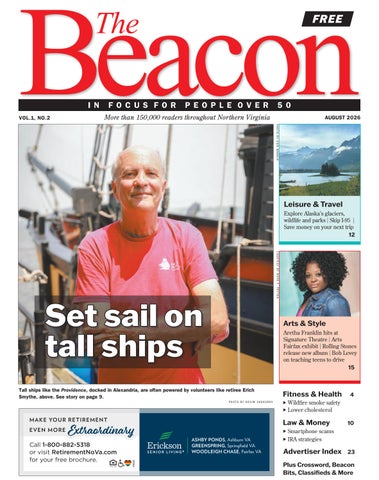
They douse the sails and throw the lines. They operate the whipstaff and capstan, mastering terms like yardarms and spars. That’s part of the fun and challenge of volunteering on a tall ship — and volunteers over 50 are the heart of many tall ships’ operations.
Four tall ships docked on the Alexandria waterfront this summer for Sails on the Potomac, wowing landlubbers. And an international fleet of tall ships anchored in Baltimore in June for the Sail250 tour.
Rigged with sails on masts, most tall ships are replicas of those that sailed the seas before the 20th century, powered by the wind and human brawn.
“There’s nothing better than being on a boat and having the feeling of the ocean underneath you — and the sound. It’s a great thing,” said Anne Kuh, a local grandmother who volunteers on the Kalmar Nyckel, a 140-foot, square-rigged ship with eight sails that docked in Alexandria this summer.
Today’s tall ships have modern technology, like computerized navigation systems, instant worldwide communication and refrigeration, but their basic functions are the same as they always have been.
“If a sailor from the 1700s came on board, he would know what to do, like how to use mechanical advantage to move a 3,200-pound wooden rudder,” said Sharon Dounce, captain of the Kalmar Nyckel, a replica of the earliest Swedish ship to arrive in America in 1638.
Retirement project
Alexandria retiree Erich Smythe says he’d rather be on the water than on a golf course.
“Volunteering on tall ships is my staybusy-in-retirement project,” said Smythe, who managed science and technology national security programs during his working career.
For the last three years, Smythe volunteered on Alexandria’s tall ship, the Providence, a replica of a sloop in the American colonies’ Revolutionary War campaigns, commanded by John Paul Jones. Before that he helped on a schooner called the Alexandria.
Sadly, on June 25, the Tall Ship Providence Foundation announced that due to budget shortfalls, the Providence would suspend operations. Smythe got a two-day notice is now pursuing volunteer gigs on another ship.
In hopes of reopening the ship, the foundation is exploring a merger with the U.S. Maritime Museum proposed for the Alexandria waterfront, according to a statement released in June.
On the Providence, Smythe was a deck hand, handling dock lines and sails. “It’s fun as all get out,” he said. He also was a volunteer docent, giving
deck tours of the ship when docked in its home port of Alexandria. He told sea stories, explained how the ship worked and answered questions like “Why is the toilet called a head? How long is the ship? Where does the crew sleep?” (His answer to the last query: “Down below deck, where it’s crowded and smelly.”)
Looking back on his volunteer sailing career, Smythe recalls one scary moment on the Potomac River when he woke up from a nap because the ship was taking on water near the Maryland-Virginia Route 301 bridge.
At first, the crew wondered, “Do we sink on the Maryland or Virginia side?” Smythe quipped. Fortunately, they kept the ship afloat, using gas pumps and then hand pumps.
In the off season, Smythe, a boat owner who describes himself as “handy with tools,” helped with maintenance, like taking care of gun parts, sanding, painting and doing repairs.
Off-ramp to retirement
When on watch on the Kalmar Nyckel, local software engineer Connie Li has to be very aware of the ship’s “best side, not where the wind is blowing hard. I don’t want to get blown off,” she said.
Li also keeps an eye out for other vessels, especially on the busy Chesapeake Bay. She takes turns with other crew members at the helm, watching for approaching ships or obstacles.
For the last four years Li has been one of 20 volunteers on the ship, which docks in Wilmington, Delaware. She volunteers
for one- to two-week legs of voyages, from Wilmington to Norfolk, Virginia, or perhaps Wilmington to Provincetown, Massachusetts. She also pitches in on day-long or weekend sails.
Li, the mother of two grown children, is looking forward to spending even more time aboard the ship when she stops working. “Sailing is the off-ramp to my retirement in a few years,” she said.
The work can be demanding. Before they sail, the crew cleans the ship, readies the sails and check the ropes, which are called lines in sailor lingo. Each of the four decks has a chief, and crew members are assigned to a chief.
Together they handle the sails, a task which requires people on both sides of the sail. Releasing a sail takes two to eight people for big sails, and when they cast off, they must release lines in a sequence according to the chief’s commands.
When they return to dock, they haul four docking lines to hold the boat in place. Since these lines are heavy, it can take three people working on one station, Li explained.
To refresh her skills, she practices knot tying every year. She also helps manage guests, passengers and children’s games, like scavenger hunts on the ship.
“I have a lot of respect for the craft,” she said. “I am drawn to the community where everyone shares their expertise. A lot can go wrong, but you’re always learning something.”
Lifelong learning
Kuh also appreciates the people she’s met during her four years sailing on the
Kalmar Nyckel up and down the East Coast. She too helps with the dock lines, sets sails (puts them up) and douses sails (takes them down). Everything requires teamwork, she emphasized.
The ship’s captain calls down commands and relies on volunteers on the main deck to be at the helm. The captains are very “safety aware,” she noted.
“As a volunteer, you put your life in their hands, but I’ve never had a doubt. The captains are very good at their jobs,” Kuh said.
An accountant, Kuh grew up in Washington, D.C., and has two grown children and a grandchild.
She finds time to join day sails 30 to 40 times a year from Wilmington. This year she is also sailing on two voyages, from Boston to Long Island, New York, and from Mystic, Connecticut, to Wilmington, Delaware, the latter trip taking a week. In the winter, she works in the wooden ship’s shop, doing maintenance tasks like sanding and varnishing.
Kuh puts in the volunteer hours because her colleagues are a fun bunch, she said, and sailing is a good way to get outdoors and be physically active. Another perk: spotting whales and dolphins feels like “a great adventure,” she said.
While sailors on today’s tall ships don’t have to rely on sextants, compasses and the stars above, nor sleep in hammocks amid rats and rotting waste, they’re as invigorated by the sea as sailors of the past.
“You learn new things every time you sail,” Kuh said. “It is a time of lifelong learning.”
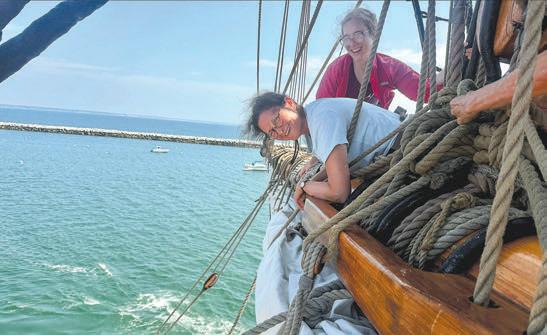
Anne Kuh and Victoria Astley take a break from working on the deck of the Kalmar Nyckel, a replica of a historic 1638 ship. The tall ship has a pool of 250 volunteers, ages 14 to 85, who volunteer for a day to a week at sea.
PHOTO COURTESY OF ANNE KUH
Money Law &
If you’re getting remarried later in life, consider a prenup. See story on opposite page.
Prevent the latest smartphone scams
By Feature Impact
The first sign is unexpectedly losing access to your cell phone. Soon after, when you connect to Wi-Fi, the gravity of the situation sinks in: A criminal has gained access to your cell phone number and is trying to siphon money from your credit cards and bank accounts.
The scam is called SIM swapping, or SIM hijacking, and it’s a concern for law enforcement in the United States and abroad. More than 5,000 people have reported SIM swapping scams to the FBI since 2022.
Older adults, caregivers and families can benefit from understanding the warning signs of SIM swapping and taking simple security steps to prevent it from happening.
How SIM swapping works
A SIM (Subscriber Identity Module) card, or its digital version known as an eSIM, helps connect a phone number to a carrier network.
In a SIM swapping scam, a criminal gathers basic information about their victim, such as their name, birthdate and address, to try to move the victim’s phone number to a SIM card or eSIM profile the criminal controls.
Once complete, the scammer gains access to accounts you may be logged into on your phone, such as bank accounts or credit card apps, without touching your phone or being near you.
How to protect yourself
Preparation is the best protection against SIM swapping.
• Cell phone users should use strong, unique passwords for each online account — password managers are a helpful tool in creating complex and randomized passwords.
• Use two-factor authentication where it’s offered. Two forms of identification add an extra layer of security when accessing sensitive accounts.
• Next, consumers should protect personal information they share online, whether on social media or in texts or emails asking for identifying data, such as PIN numbers, birthdates or one-time security codes.
• Be wary of anyone pushing you to share personal information, particularly if they’re pushy with their request or make it sound urgent.
• Check your mobile carrier to see if it
offers SIM protection. For example, Verizon customers can toggle on a protection feature on the carrier’s website or app to lock lines on their account to help prevent SIM changes.
If you get an unprompted notification that your SIM has been changed, or otherwise suspect you’ve been targeted in a SIM swapping scam, contact your banks immediately and have them freeze your accounts, including ones the criminals may not have targeted yet.
Next, work with your cell phone provider to help regain access to your mobile device. If you’re able, share as much information as possible with law enforcement so they can investigate, or at least document trends in how often this scam occurs.
To find more advice to protect against smartphone scams, visit Verizon.com.
How to educate your IRA beneficiaries
By Elliot Raphaelson
Many readers of my column ask me specific questions regarding beneficiaries of their individual retirement accounts. I do my best to answer the questions.
However, it’s important that owners of IRAs themselves take steps to inform and educate their beneficiaries about what their options will be once they inherit the accounts.
The regulations that apply to individuals who inherit IRAs are complex. The regulations that apply to spouses are very different from other beneficiaries. Owners of IRAs should explain to their beneficiaries the importance of knowing their options about withdrawals, as well as what reliable resources are available to help them invest their inheritance.
ments. Regulations about required distributions were significantly changed by the SECURE Act of 2019 and the SECURE 2.0 Act of 2022.
By Elliot Raphaelson
Surviving spouses retained the option to roll over their inherited IRA to their own IRA, which allows them to make withdrawals based on their life expectancy. However, they have other options, such as keeping the inheritance as an inherited IRA if they are younger than 59½, which would enable them to take money out of the account without incurring an early withdrawal penalty. After reaching 59½, they would still be able to roll over the inherited IRA to their own IRA.
For example, if the deceased owner of the IRA had already reached the age at which yearly minimum distributions were required (known as RMDs), then the non-spouse beneficiary would be required to take yearly withdrawals based on their age, and after the 10-year period, all of the remaining assets would have to be withdrawn.
If the deceased owner had not reached the age of RMDs, then the beneficiary would not have to make yearly withdrawals, but would still have to withdraw all the assets remaining in the inherited IRA account by the end of the 10-year period.
to that heir to wait until the end of the 10year period before making withdrawals from the Roth IRA account. This simply maximizes the tax-free income and appreciation potential during the 10-year period.
Original owners of IRA accounts have the advantage of receiving RMDs (if required) from the account custodians — i.e., the financial institution that maintains the IRA account.
First, beneficiaries should understand when they are required to make withdrawals in order to satisfy IRS require-
Most non-spouse beneficiaries, however, are now required to withdraw all the assets in the inherited IRA within 10 years, starting from the year after the inheritance. In some cases, they are required to make yearly withdrawals.
If the inherited IRA is sizable, and withdrawal at the end of 10 years would push the beneficiary into a high marginal tax bracket, that individual might be better off making yearly withdrawals at a lower marginal tax rate rather than making a large withdrawal at the end of the 10-year period.
Beneficiaries who inherit Roth accounts and are subject to the 10-year rule would also be required to withdraw all the assets remaining in the IRA account at the end of the 10-year period.
However, because there would not be any income tax liability associated with the withdrawal of assets in a Roth account, it would likely be most beneficial
Generally, by February each year, custodians notify the owner of each IRA the yearly minimum distribution required by the IRS. By contrast, custodians of inherited IRAs are not required by law to advise beneficiaries regarding RMDs.
Reliable sources: Individuals who inherit IRAs and want advice regarding RMDs and/or investment advice can hire a competent certified financial adviser, on a one-time or recurring basis. You can contact IRA expert Ed Slott’s group at irahelp.com if you want a referral in your geographic area.
A free source of information regarding inherited IRAs is available at a one-time cost from Bob Carlson’s “Guide to Inherited IRAs” at RetirementWatch.com.
Q: I told my sister my boyfriend recently brought up the M-word (marriage) and she asked if he also brought up getting a prenup. He didn’t; should he have? We met a few years ago after going through rough divorces and both swore we’d never get married again. I think my sister has a lot more money than I do, if that makes any difference. She’s a widow.
like to pass on to your children or grandchildren, you’ll likely want a prenup.
LOVE AFTER 50
By Laura Stassi
Deborah Anne, Virginia
A: Exciting news about the M-word conversation, Deborah Anne, especially considering it once was a loaded word for you and your boyfriend. It seems like you have a lot more talking to do, and yes, at some point you both should ponder the P-word: prenup.
A prenuptial agreement is a legally binding contract that enables couples to spell out how and to whom they want their assets distributed when the marriage ends in death or divorce.
When I was younger and married, I thought prenups were only for wealthy people, and usually to protect the family money from perceived gold-diggers. (Wasn’t this the plotline of an “LA Law” episode?)
Now that I’m older, divorced and back in the dating pool, I’ve decided if I ever walk down the aisle again, I’ll have a prenup in place. It’s not because I’m wealthy but because I have two grown kids and a house I’d like them to inherit.
Legally, spouses trump children unless there’s something in writing to indicate otherwise. If you have assets you’d
18
Laurie Israel is an attorney and mediator based in Massachusetts, and she’s become a nationally recognized expert on prenups and post-nups. She’s also the author of three books on the topic: The Generous Prenup, The Marriage-Friendly Prenup and Mediating Prenups
I talked with Israel for a Dating While Gray podcast episode. She told me that despite her credentials, “I’m not necessarily a proprenup person. And for young couples just starting out in their careers and who aren’t bringing children or significant assets to the marriage, a prenup probably isn’t needed. But I think for second marriages, they can be extremely useful.”
Israel added that “when people get married late in life, there’s kind of a delicate issue about how the children will feel about your marriage, especially if you’re going to marry somebody younger. Not that you’d necessarily involve [kids] in the [prenup crafting] ahead of time. But you may want to assure them, ‘I’ve thought about you.’”
I asked followers of the Dating While Gray Facebook page if anyone had an experience with a prenup they wanted to share.
Liz, who lives in Florida, said she and her partner, Mike, negotiated a cohabitation agreement when they moved in together. They’re leaning toward marriage and if they finally decide to walk down the aisle, they’ll turn the prenup into a post-nup.
GUIDE TO MEDIGAP INSURANCE
Come to a free class provided by the Arlington County’s Virginia Insurance Counseling and Assistance Program to learn more about Medigap plans, what they cover and related costs. The virtual class takes place on Tues., Aug. 18 from 10:30 a.m. to noon. Call (703) 228-1725 for more information or to register.
“The purpose of the agreement is to define what’s his/mine/ours, protect our individual estates for our children, and ensure that in the event of death or a disability requiring a move to a care facility, the remaining partner can stay in the house as long as they want to, even until death,” Liz said.
“That was necessary, because we bought the house as joint tenants in common,” Liz added, “meaning we each retain ownership of our 50% of the house. That equity becomes part of our individual estates upon our deaths.”
Fortunately, Liz said, “figuring this stuff out was remarkably easy for us, compared to similar decisions I made in my first marriage. It’s one more sign that I have a good partner in Mike.”
Susan in California also responded to the Facebook page callout. She said she and her partner, Mark, “updated our trusts to protect and take care of each other. We talked about a prenup and then decided to have a marriage ceremony and reception but not sign the documents to become legally married.”
“With his business and disabled son, it’s easier this way,” Susan added. “We get to celebrate our love and commitment without any potential financial complications down the road.”
Laura Stassi is host of the podcast Dating While Gray: The Grown-Up’s Guide to Love, Sex and Relationships and author of Romance Redux: Finding Love in Your Later Years. Send your questions to Laura at newloveafter50@gmail.com.
Venture into Alaska’s wilderness refuge
By Don Mankin
There is more to Alaska than Denali and the cruise up the Inside Passage. In the Kenai National Wildlife Refuge, a vast but accessible wilderness region in south central Alaska just a three-hour drive from Anchorage, you’ll see some of the most beautiful scenery in the state.
Nearly two million acres in size, Kenai is like a mini version of Alaska, with spectacular lakes, glaciers and mountains — perfect for hiking, kayaking and wildlife viewing, especially eagles, moose, whales and bears.
I traveled to Kenai in June to explore some of its most remote attractions via Alaska Wildland Adventures’ weeklong tour. Our group of a dozen people, from three multigenerational families, ranged in age from 11 to 84. As the oldest, I was traveling with my 28-year-old grandnephew, Aaron, on the latest in a series of joint adventures.
We stayed in three remote lodges built by the tour company: the Kenai Riverside on the Kenai River, the Kenai Backcountry on Skilak Lake and the Kenai Fjords Glacier, the only lodge in Kenai Fjords National Park. The last two are the only human-built structures for miles around.
Kenai Riverside Lodge
Our journey started with a drive in a roomy van down the Turnagain Arm, a long fjord lined by mountain peaks and dense forest. We arrived in the late afternoon at the Kenai Riverside Lodge on the banks of the fast-flowing Kenai River. Situated just off the highway, it’s the largest and busiest of Alaska Wildland Adventures’ lodges.
Although most guests were there to fish, we used it as a convenient jumping-off point to visit the other two lodges.
We began our trip by floating on a raft down the Kenai River to the Backcountry Lodge, past dozens of fishermen in chesthigh waders standing in the glacier-fed river, casting their lines and hoping to hook the much-prized king salmon.
It was a mellow float, with occasional runs of Class II whitewater, past thick forests with the occasional eagle surveying the scene from a high perch in the trees. In the distance, mountain ridges were still streaked with the remnants of
the past winter’s ice and snow.
Kenai Backcountry Lodge
When we reached Skilak Lake, we transferred to a small boat to take us across to the Backcountry Lodge, a rustic retreat accessible only by boat. The lodge was originally built in 1935 as a hunting cabin and expanded many years later. In the two days we spent at the lodge, I saw no other signs of human life except for one other boat.
The lodge and nine guest cabins are scattered throughout the edge of forest near the beach. The log buildings are basic but comfortable, with heat, private baths, comfortable beds, a deck with rocking chairs and at least a partial view of the lake.
On the beach are chairs and tables for hanging out. I spent the rest of that first day lounging by myself on one of the chairs with an ice-cold beer, gazing at the 15-mile-long lake, lush, forested hills and snowy mountains.
After dinner, I moved to the rocking chair on our porch. There were no sounds other than birds chirping and waves lapping on the beach. It is for moments like this that I work so hard to reach the planet’s most isolated places.
That night I slept very well.
The main activity the next day was an uphill hike on a rough, rocky, root-strewn trail through the forest to a scenic overlook above the tree line. We kept our eyes peeled for bears and moose and were both relieved and disappointed that we didn’t see any. Our guides carried bear spray just in case.
After a mile or so, the geezers in the group, including me, decided to head back to the lodge. The others continued uphill for a view of the lake.
When they returned, I asked a very tired Aaron about the rest of the hike. “We were the only people in sight,” he said. “It was a lot of work getting there, but it was worth it.”
Kenai Fjords Glacier Lodge
On the last two days of the trip, we stayed at Kenai Fjords Glacier Lodge in the heart of Kenai Fjords National Park.
In Seward, the gateway to the park, we hopped on a small private boat for a four-
hour ride to the lodge, pausing along the way to check out otters, whales, mountain goats, puffins and the Gulf of Alaska’s coastline of jagged cliffs, sheer sea stacks and yawning sea caves.
We landed on a beach and walked a mile to the lodge on a sandy, rocky trail. On the way, we spotted a bear in the tall grasses and weeds less than 50 yards away. Fortunately, he was more interested in the grass and weeds than us, so our guides’ bear spray stayed holstered.
On the deck of the main lodge, rocking chairs overlook a lagoon with a glacier and a line of mountain peaks in the distance — one of the best views of the trip.
It wasn’t long before we were in a canoe, paddling around the lagoon. We spotted at least three bears on the shore during our one-hour paddle. Another bear moseyed on the lawn in front of the lodge shortly after dinner.
The highlight of our visit to the lodge, and possibly the entire trip, was our allday kayak to Aialik Glacier, a massive tidewater glacier about a mile wide and 300 feet tall. We ate lunch in view of the vast glacier, swathed in silence except for subdued chatter and the occasional thunderous crack as huge chunks of ice calved off the face of the glacier and crashed into the water.
The eerie pall of the cloudy day cast a surreal glow over our surroundings. The
quiet, broken up by occasional claps of glacial thunder, the rhythm of the long paddle back, the satisfying weariness of muscles exerted for a good cause — days like that are the reason I travel great distances and endure physical pursuits that sometimes make me feel as if my lungs will burst.
Every time I start to think I’ve had enough travel — enough packing, airports, crowded flights and jet-lagged sleepless nights in strange beds — I take a trip like this that reminds me there is more to see, more wonders to experience, more beauty to contemplate. Then I start thinking about my next adventure. I am sure there will come a time when I’ve had enough. But not quite yet, not quite yet.
If you go
Roundtrip airfare to Anchorage with one stop is about $700, while a nonstop flight on United is almost $1,200 in the summertime. We stayed at the quaint, conveniently located Copper Whale Inn in Anchorage before and after the trip (copperwhale.com).
The cost of the seven-day Alaska Wildland Adventure Collection trip starts at $6,995 for adults, $5,695 for children (alaskawildland.com/adventures/alaska-wildland-collection). Aaron and I were hosted by Alaska Wildland Adventures.
Skip I-95 for a more leisurely trip on Route 301. See story on opposite page.
PHOTO BY FAMARTIN
Pedersen Glacier and the Kenai mountains create a picture-perfect view from the Kenai Fjords Glacier Lodge, an ecotourism hotel in coastal Alaska. Located in a national park, the 3,000-square-foot lodge and its eight cabins are accessible only by sea.
PHOTO BY DON MANKIN
For a peaceful drive, swap I-95 for 301
By Glenda C. Booth
Interstate highway 95 between Washington, D.C., and Richmond, Virginia, is notorious for its near-constant congestion. Flanked by monstrous heavy-duty trucks, white-knuckled drivers must navigate the notorious Occoquan bottleneck, often through construction zones.
I prefer the less ulcer-generating Route 301 from Maryland through Virginia’s Northern Neck peninsula. Stretching from Delaware to Florida, the highway passes through small towns, bucolic countryside and many historic sites.
Lincoln history
For an interesting start, begin in Waldorf, Maryland, at Dr. Samuel Mudd’s farm. There, the doctor treated President Abraham Lincoln’s fleeing assassin, John Wilkes Booth, and set his broken leg bone. Most of the furnishings in the 1830s farmhouse are original from 1859 to 1911, including the bed where Booth slept.
Route 301 generally tracks Booth’s attempted escape. You can follow Booth’s route south to Port Tobacco, Maryland, where he bought a wagon.
Much earlier, in 1608, Captain John Smith encountered the indigenous village of Potopaco here, and English settlers later anglicized the name. By 1729, Port Tobacco was a thriving Colonial town with a tobacco inspection station, exporting the product to England. During the Revolutionary War, “It was a happening place,” historian Alison Bode told me. “Baltimore was nothing then.”
Visitors can tour three of Port Tobacco’s remaining 18th-century buildings: a replica of the 1727 courthouse, Stagg
Hall and the restored Burch House. Stagg Hall, built in 1766, was a store selling British goods, like candles, fabrics, dishes and sugar, all on display today.
The Burch House, home of Henrietta and Washington Burch, a prominent Black bailiff, has a striking white exterior of milk paint.
Today’s motorists cross the Potomac River on the Harry Nice Bridge, a much easier feat than Booth’s erratic paddle in the dark of night. Confused, he ultimately ended up near Port Royal, Virginia, at the Garrett Farm, where he died from a gunshot wound. Today, a roadside Virginia historical marker titled “Where Booth Died” stands near the former farm just south of Route 17.
In King George, Virginia, stop by the Dahlgren Heritage Museum, which showcases U.S. Navy history. There I learned about inventions conceived, produced and tested at Dahlgren during the last century, like a Norden bombsight, which sat in the nose of World War II planes and calculated a bomb’s drop point.
“Engineers come up with a gizmo to solve a problem,” Mike Barker, a retired base physicist and volunteer, told me.
Off the beaten path
There’s more history at Belle Grove Plantation in King George. Built in 1791 on the Rappahannock River and the birthplace of President James Madison, the mansion is now a bed and breakfast.
The property smacks of the plantationera Old South; 275 people were enslaved here. But its current owners have given the place an offbeat spin: tea and bingo with an Elvis impersonator and paranormal workshops.
Quirky Americana greets travelers in Port Royal, Virginia. A roadside dinosaur, bear and tin man looming alongside Route 301 lured me in. I explored oodles of paraphernalia in Port Royal’s three antique shops: the Trading Post, the Minnow Bucket and the General Store, all crammed with miscellany from multiple dealers.
At the Port Royal Museum, I absorbed more history, studying fossilized poop likely from a crocodile-like animal, as well as the more modern White House china dishware collection from multiple U.S. presidents, one of the largest of these collections anywhere. The small museum also displays Civil War weapons and Confederate money.
Home cooking
Horne’s Restaurant & Gifts at the intersection of routes 301 and 17 is irresistible. It is a 1950s throwback with a formica counter, stools and booths and a hodgepodge of “novelties, sundries and gifts” like Virginia peanuts, plush toys, suncatchers, rabbits’ feet, magnetic bracelets, wind chimes, coconut macaroons, gum drops and candy cigarettes, for example.
“All the food is good. It’s real home cooking,” Karen Arnest, who lives near Hornes, told me. Another local recommended country-fried steak, beef liver and onions, meatloaf and the Virginian:
Our modern 55+ senior apartment community is coming to Dumfries, Virginia, in Summer 2026. The Harbor at Quantico Creek will offer spacious one and two bedroom apartments in close proximity to shopping, hospitals, and places of worship. Ideally situated near I-95, our community offers seamless access to everything the region has to offer. With amenities right outside your door and opportunities for social connection, The Harbor at Quantico Creek supports an active, engaging lifestyle in a place you’ll be proud to call home.
See SKIP I-95, page 14
Ways to save money on your next trip
By Jim Miller
Dear
Savvy Senior,
My husband and I are retiring later this year and hope to travel more while we’re still healthy and active. Our budget will be tighter, so every dollar counts. Are there worthwhile senior travel discounts you can tell us about, and at what age do they begin?
—Ready to Roam
Dear Ready,
Retirement is the perfect time to start checking destinations off your wish list. Senior travel discounts can make a real difference. Whether it’s airfare, hotels, cruises, train tickets or attractions, the savings can add up — sometimes hundreds of dollars per trip — if you know where to look and compare.
Ways to save
One of the best ways to uncover senior travel deals is through membership organizations. AARP, with membership starting at 50, offers the deepest travel dis-
Skip I-95
From page 13
quail with slab of country ham. “It’s a good place to sit, talk and eat,” he said. I bought some honey jalapeno bacon jam when I was there and moved on.
The 10-mile drive through the Army’s Fort A.P. Hill near Bowling Green is a peaceful stretch with only towering oaks, sycamores and pines as distractions, a good time to recoup from the stimulation of Horne’s.
Civil rights history
Next, I explored Caroline County,
counts, including savings on hotels, rental cars, cruises and vacation packages. AAA also provides travel-planning services and member savings on lodging and car rentals to adults of any age.
Another simple but often overlooked strategy is to ask. Many hotels, tours and attractions don’t advertise senior discounts but may offer one if you inquire.
Keep in mind, though, that the “senior rate” isn’t always the lowest price. Promotional sales, advance-purchase fares and seasonal specials can sometimes be cheaper, so compare before booking.
Flexibility is another money-saving tool. Traveling midweek, avoiding peak holidays, booking during shoulder seasons, or adjusting your dates slightly can significantly lower costs. You may also find last-minute deals on cruises, rail trips and guided tours, especially during slower travel periods when companies are eager to fill unsold space.
Here’s a rundown of some different discount deals currently available:
home to Richard and Mildred Loving, an interracial couple who married in 1958. They were arrested and convicted of violating Virginia’s 1924 Racial Integrity Act banning interracial marriages. To stay together and avoid prison, they left Virginia but won their right to be married and return to their hometown after their historic win in the U.S. Supreme Court in 1967.
In February, three sites here associated with the Lovings became part of the U.S. Civil Rights Trail: the jail, sheriff’s office and courthouse.
Caroline County proudly touts its famous “native son,” the champion thoroughbred Triple Crown winner race -
Airlines: Senior airfare discounts are less common than they once were, but some still exist. AARP members can get discounts on select British Airways flights, about $65 off economy and up to $200 off business class. United and Delta may offer limited fares for travelers 65 and older on select routes if booked by phone or using “senior” search tools.
Trains: Amtrak offers about 10% off for travelers 65-plus on many routes, with some cross-border discounts starting at 60. Rail passes and multi-city tickets may provide additional savings.
Rental cars: AARP members can save up to 30% with companies like Avis and Budget, often with perks like a free additional driver and reduced rates on optional coverage. Hertz offers discounts through its 50 Plus Program.
Hotels: Many hotel brands offer senior or AARP rates, typically 10% to 15% off. Examples include Wyndham Hotels & Resorts and Choice Hotels. Booking directly or through AARP usually ensures the rate.
horse, Secretariat. Today fans can visit his foaling shed at The Meadow (now called The Meadow Event Park). In the visitors center, I watched videos of his three famous races under the skeleton of a Miocene baleen whale found in 1990 in the Carmel Church quarry.
Restored tavern, antiques
Take a break at one of America’s oldest taverns, Hanover Tavern in Hanover, to sip Martha Washington’s favorite libation, Cherry Bounce. Originally built in 1733 on a former stagecoach route across from the courthouse, the tavern was the center of 18th- and 19th-century social life.
Today the renovated building is a 155seat theater and restaurant serving corn fritters, fried green tomatoes and Virginia oysters. Tavern-goers can see the cage bar, typical of those in the 18th century, designed to keep people from stealing liquor.
Cruises: Some lines offer discounted fares for travelers 55-plus on select sailings, including Royal Caribbean, Carnival, Norwegian, MSC and Viking River Cruises. AARP members may receive additional onboard credits through affiliated providers. Off-peak sailings often provide the best value.
Restaurants: Many chains offer senior menus, complimentary beverages or discounts for ages 55 or 60-plus, including Applebee’s, Arby’s, Burger King, Chili’s, Chick-fil-A, Denny’s, IHOP, Boston Market and Cicis Pizza. Participation varies by location.
Entertainment: Museums, theaters, zoos, aquariums and golf courses often offer reduced admission for those over 65 or sometimes even over 60; just ask.
One of the best bargains is the America the Beautiful Senior Pass from the National Park Service. For $20 per year or $80 for a lifetime pass (available at 62), it provides access to more than 2,000 federal recreation sites
As 301 approaches Richmond, you’ll find more antique stores, including the West End Antiques Mall on Staples Mill Road with 250 booths of furniture, art and collectibles.
I ended my sojourn in Richmond, home to many excellent museums, including the free Virginia Museum of Fine Arts, the Valentine and the Poe Museum. I got some rest in Richmond’s Quirk Hotel, a 1916 dry goods store with a sunny lobby of soaring arches and large windows. The hotel is convenient for exploring on foot the city’s famous Broad Street, restaurants, shops and sites like the Virginia Repertory Theatre, the Maggie Walker statue, the Elegba Folklore Society and the Institute for Contemporary Art.
Snug in my Richmond hotel, I was grateful that I had avoided the headaches of Interstate 95 by taking Route 301.
Style
The Rolling Stones, who are 83, 82 and 79 years old, have a new album. See story on page 17.
Arts & Soprano performs Aretha Franklin’s hits
By Luke Sanelli
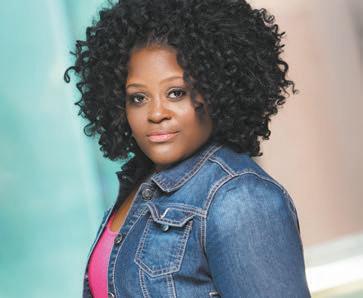
Nova Y. Payton’s first exposure to musical legend Aretha Franklin was as a child, when her mother would sing along to Franklin’s songs on the record player. The first song she remembers hearing was Franklin’s powerful 1967 cover of Otis Reddings’ “Respect.”
“[Franklin’s music] always felt like church to me,” Payton, 46, said. “Her voice always just screams church, gospel, and she would always kind of put that feel on her music.”
Now, decades later, the Washington, D.C., native is honoring Franklin, who passed away in 2018, by creating and starring in “Respect: Aretha Franklin,” a celebration of Franklin’s music at Signature Theatre. Running from August 11 to 30, the show will feature Payton’s renditions of some of Franklin’s most popular songs, including “(You Make Me Feel Like) A Natural Woman,” “Amazing Grace” and “Think.”
Franklin, regarded as the “Queen of Soul,” was an 18-time Grammy Award-winner and is widely considered one of the greatest performers in American music history. She performed at Dr. Martin Luther King Jr.’s funeral and for former President Barack Obama and Pope Francis.
Curating a performance that honors Franklin’s indomitable legacy is no small task.
“Aretha is an icon,” Payton said. “There has never been anyone like her before.”
Preparing for the Cabaret
Payton, a soprano, has appeared on PBS on the American Pops Orchestra series and in concerts in the United States, Europe, Asia and the Middle East. She’s been in tributes to Franklin before, but this next show requires a bit more curating on her part, she said. “It’s been a hard, hard task to try to figure out how I really want this.”
To prepare for the show, Payton said she has been diving into Franklin’s catalogue, deciding which songs to sing and how to perform and connect them to one another. Payton said she’s still in process of choosing the set list.
“There are certain songs that I just have to do because she’s just well-known for them, and then there are songs that I’m tussling with,” Payton said. “Do I want to introduce songs that are not as well known, just to leave the audience with something to go back and say, ‘Oh wow, I didn’t know she did that song’ or ‘Now this is making me want to go and
turn on an Aretha Franklin CD’?”
Three-concert series
Payton has experience performing in Signature’s Cabaret series, a “more intimate, concert-like performances with typically only one or two performers and musicians performing songs within a theme,” according to Signature’s website. Three cabaret performances take place during a season.
Payton stressed that she hopes to honor Franklin’s work and her music while also expressing who she is through the music.
“Our job as artists is to be able to express ourselves in a way that people can leave with who we are as artists as well, so I want people to be able to get to know me, also in a different light,” Payton said.
Payton wants people to come out of her performance “feeling like they’ve been to church,” she said, just like how
she felt all those years ago, hearing Franklin for the first time on her mother’s record player.
“I would love for people to just come and be immersed in the beautiful music of Aretha, and go back down memory lane with me, and then bring it on forward,” Payton said.
“Because she definitely was an icon, and she was also a trendsetter, and she didn’t take no for an answer. So I would love for people to come and just sit and enjoy and be on the ride with me.”
Respect: Aretha Franklin will be on stage at Signature Theatre from Aug. 11 through Aug. 30. The next Cabaret performance, “Something Wonderful: Broadway’s Leading Ladies,” will begin on Sept. 8. Tickets for all three Cabaret concerts are $150. Purchase tickets online at sigtheatre.com, call the box office at (703) 8209771 or visit in person at 4200 Campbell Ave., Arlington.
Please tell our advertisers, “I saw you in the Beacon!”
Nova Y. Payton will take center stage at Signature Theatre this month to sing some of Aretha Franklin’s famous tunes, with some surprises.
Payton has performed in The Color Purple and Ain’t Misbehavin’, among other shows.
PHOTO BY JIM
PIETRYGA
ArtsFairfax exhibit features older artists
By Margaret Foster
One December evening, photographer Renée Ruggles and two of her sons decided to go to Mount Vernon for some holiday cheer. A George Washington impersonator gave a surprisingly moving speech, and then fireworks lit up the dark sky, reflecting in the Potomac below.
“My son was very moved by the speech, and he put one arm around me and another around my other son,” said Ruggles, who snapped a photograph of that moment.
“Everyone felt welcomed and inspired. That photo captures that moment in time.”
Ruggles’ photograph is now on display in Alexandria in a new exhibit by ArtsFairfax, part of the nonprofit’s series “ArtsFairfax Presents.” Launched last
year at Springfield Town Center, the program seeks to present art in public spaces throughout Northern Virginia.
The current exhibit, titled “Images of America,” includes 16 works by 10 artists, several of whom came to their craft later in life.
Teacher and photographer
Ruggles, now 59 and living in Burke, received a digital camera as a gift years ago and began taking photographs of musicians and concerts. She soon picked up assignments from several local publications, but they didn’t pay the bills. She went back to school, got a master’s degree, and began teaching.
“My entire life has been about overcoming,” said Ruggles, a former military wife who is now divorced. “I’ve had to start over more than once.”
Today she teaches work skills to special-education students in middle school. That’s her day job, but the selftaught photographer exhibits her work locally, at Glen Echo Park and in a solo show last year at Brookside Gardens in Silver Spring, Maryland.
“I connect differently, and I see things differently, and the lens lets me do that,” Ruggles said.
Accountant by day
J. Pamela Stills is an Alexandria accountant who started taking photographs during the pandemic. She’d walk around her neighborhood, snapping photos of cars, wildlife — anything that caught her eye.
“I leaned on [photography] to give me the means of staying stable when we were all locked down,” Stills said.
Stills, 60, adds an artistic quality to some of the prints she displays, enhancing or subtracting details in the image to make it a work of art.
On the photojournalism side, she shoots photographs for local newspapers. She also takes photos for community and business events, such as a recent a documentary film screening.
“Accounting is so structured, and when you get into photography you can get so creative,” Stills said. “It’s so opposite to what I’m doing day-to-day.”
Art can slow aging
Engaging with the arts can slow biological aging as much as exercise can, according to a UK study published in May, of more than 3,500 people.
Art may be why Cynthia K. Miller of McLean is still going strong at 82. Eleven years ago, she was a retired federal worker who was coaching executives on their career paths. One day Miller sat in the interviewee’s chair at an event that changed her life.
“I agreed to be the guinea pig in one of
See ARTSFAIRFAX, page 17
Try a local art class
The Art League: Beginner and advanced art classes are available at the Torpedo Factory in Old Town Alexandria. See theartleague.org or call (703) 683-2323.
Washington Photo Focus: Former Corcoran School of Art professor Eliot Cohen teaches students how to better use digital cameras and edit photos. Group classes and oneon-one sessions often take place on Zoom. See washingtonphotofocus.
com or call (571) 282-3778.
Art House 7: Located in Arlington, Art House 7 offers classes in drawing, painting, photography and other mediums. Check Arthouse7. com or call (703) 269-0946.
Northern Virginia Community College: With a variety of art and photography classes, NOVA welcomes people over 60, who can audit classes for free or, if eligible, receive a tuition waiver for credit classes.
Rolling Stones expand on a late creative burst
By Jocelyn Noveck
“When I was oh so young I used to want to go to Mars,” sings Mick Jagger — that staccato voice still remarkably sharp and clear — on Foreign Tongues, the Rolling Stones’ 25th studio album.
“Now I’m older,” the frontman notes a few lines later. “I would like to ask you if tonight we could stay at home.”
Say what?
Are these the Stones, our perennial bad-boy Brits with yet-full heads of hair, our proud Peter Pans of rock ‘n’ roll, singing about growing old?
But we’ll allow this slight nod to mortality in the tune called “Mr. Charm,” especially because plans for this evening at home do sound nice — with the promise of cocktails and wine. “You see I’m really quite polite,” the song goes.
Polite is not always the word associ-
ArtsFairfax
From page 16
the segments, where a senior coach came in and interviewed another coach,” she recalled. “By the end of the session, I was in tears, and said, ‘I really want to become an artist.’”
Miller signed up for painting classes at McLean Project for the Arts and the Art League in Alexandria’s Torpedo Factory. She started with watercolor and moved on to acrylic, painting on canvas, paper and even wood.
“I was just starting completely fresh,” she said. “It was very freeing.”
Now an abstract artist who shows her work throughout the area, Miller has three works in the current exhibit, including some that feature red, white and blue or stars and stripes in honor of our 250th anniversary.
ated with this 64-year-old band — remember the run-ins with various police departments? These days, Jagger, Keith Richards and Ronnie Wood are neither rebels nor degenerates — they’re natty multimillionaires. But they’re cheeky enough to add a jab, in “Mr. Charm,” at “mad mogul Mr. Musk.” A compliment, it is not.
More seriously, the Stones get downright political in one song on the excellent and eminently listenable Foreign Tongues, an album that expands on an improbable late burst in creativity launched by Hackney Diamonds , their 2023 Grammy-winning album.
“Well I was madly in love with you before we ever met,” the song about America goes. “Watched all your movies,
See ROLLING STONES, page 19
She works most days in her Falls Church studio. Every day is different because she “paints by intuition,” she said, envisioning a color or subject and then letting the work take shape.
Miller is always amused to hear what other people see in her abstract images. Recently a friend told her, “I just love this painting — it looks like hockey sticks,” she said, laughing. “Hockey was the last thing I was thinking of. That’s one of the joys of being an abstract artist.”
Because she didn’t start painting until her 70s, Miller understands the fear of learning something new. But she said if you’re intrigued by the idea of creating art, try it out: “You’ve got to follow your gut.”
“Images of America” is on display in the lobby of the Lincolnia Senior Center, 4710 N Chambliss St, Alexandria, until Sept. 11. To see the artists’ work, visit lookingformagic.com, jpamelastills.com and cynthiakmillerart.com.
Look for another “ArtsFairfax Presents” exhibition at the Springfield Town Center this October through early next year.
Age in Place
Find a New Space?
The Positive Aging Sourcebook has helped thousands of individuals and families find the right answers — whether planning for safe and accessible living at home, exploring communities for the future, or navigating a loved one's health care crisis.
Mick Jagger, Ronnie Wood, Keith Richards and Charlie Watts, who passed away in 2021, take a bow after a show in London in 2018.
PHOTO BY RAPH_PH/FLICKR
Light reading for music lovers
By Joshua Z. Rokach
August means vacation (or staycation). These three books can help us unwind and understand the Grand Ole Opry and MTV, and how music is intertwined with American history.
100 Years of Grand Ole Opry: A Celebration of the Artists, the Fans and the Home of Country Music, by Craig Shelburne, Harry N. Abrams 2025, 352 pages Nashville, Tennessee, resident Craig Shelburne’s first book underlines the iconic role of the Grand Ole Opry on the American music scene.
We learn of the expanding repertoire and costume innovations, along with vagaries of diversification: a theme park, television station and museum.
The Opry started in 1925 on WSM 650 AM in Nashville as a venue for an insurance company’s ads. George Hay, its radio host, recoiled from canned music; every Saturday night, Barn Dance (which Hay renamed the Grand Ole Opry) staged live shows. Sometimes the required Saturday night performances sometimes kept stars from joining or shortened their tenures.
Shelburne presents chronological chapters on the Opry’s eras, from its relocation to a historic former church and un-airconditioned Ryman Auditorium to its current Grand Ole Opry House (at whose opening Richard Nixon appeared).
The book captures the stories of members who realized their dreams listening to WSM or watching TV, from Black musicians DeFord Bailey and Charley Pride to the Jewish group The Isaacs. Best of all, the book contains a chapter on the fans, the main ingredient.
Unplugged: Adventures from MTV to Timbuktu, by Tom Freston, Gallery Books 2025, 320 pages
This month, the 45th anniversary of the launch of the music television channel MTV, we have the pleasure of reading an inside account straight from the horse’s mouth: MTV cofounder Tom Freston, 80. His engaging memoir contains a travelogue of Asia and Africa as well as business insights.
Both a flower child and straight arrow, Freston excelled in business school while absorbing the 60s revolution. After quitting his traditional job, he moved to India to find himself and ended up inventing a global supply
chain from Asian craftsmen to American department stores.
When protectionism returned, Freston, with his innate people skills, talked his way into a job at what became Warner Communications at the dawn of cable television. There, he pushed two brilliant insights: “narrowcasting” (targeting demographic and geographic submarkets) and music videos.
Acquisition of MTV by Viacom’s narcissistic, authoritarian Sumner Redstone in 1987 led to Freston’s departure. The author provides a vivid, enjoyable account of Redstone and other personalities, Viacom’s business failures and the threat streaming poses to cable. He maintains honesty without settling scores.
Now retired and living in New York and Los Angeles, Freston retraces some of his youthful travels and compassionately describes his current charitable work.
On the Record: Music that Changed America, by Anna Harwell Celenza, W. W. Norton & Company 2026, 352 pages
As part of a larger cultural history, Johns Hopkins faculty member Anna
Harwell Celenza charmingly details how the wives of prominent politicians pushed to censor lyrics. In turn, their husbands forced record companies to attach warning labels, with mixed results for artists. Celenza traces this tradition back to the founding of the Republic. Who knew that a drinking song became John Adams’s campaign melody and the tune for the “Star-Spangled Banner”? Its martial spirit competed with more benign compositions for the national anthem. On the eve of U.S. entry into World War I, Woodrow Wilson chose the song as the anthem by executive order.
We learn how introvert Charles Ives’s musical ruminations inspired post 9/11’s “Migration of Souls;” George Gershwin’s absorption of New York culture became “Rhapsody in Blue” and how Duke Ellington responded; Aaron Copland’s evocation of an idyllic past spurred humanitarianism; and the U.S. government’s role in popularizing jazz globally. Sadly, she points out, Leonard Bernstein’s laziness in creating West Side Story contributed to mistreatment of Puerto Ricans.
Celenza ends the book on a happy note: Lin-Manuel Miranda’s rap musical Hamilton emerged as a force to unify America.
Let grandparents teach kids to drive
The worry lines beside his eyes gave him away.
Right after I asked my friend Jeff how he was doing, and he said he was fine, I glimpsed the lines. “No, you aren’t,” I said. “Tell all.”
Then came the truth. He’s been teaching his 16-year-old daughter how to drive.
It has not gone well.
The toll so far: One fender dented in a shopping center parking lot, one near-murder of the transmission when she shifted into reverse while still moving forward — and many scream sessions.
around the neighborhood with my friends aboard, as we blasted top-40 music. Great stuff!
Of course, I still had no solid idea of how to drive, because no 16-year-old has experienced all the hazards of the modern road.
HOW I SEE IT
By Bob Levey
“When my dad taught me how to drive, it wasn’t this hard,” he said.
Whether that was ever true, Jeff has decided to dip into his past. He has asked his father to take over driving lessons for Miss 16-Years-Old.
Grandpa has leapt into the job with enthusiasm, Jeff told me. He has been patient and soothing. He has never shouted, “We’re all going to die!” as his granddaughter fails to brake when she should.
“It has been a godsend,” Jeff said.
Could this be a signpost for other families? When a parent tries to teach a child to drive, much more is on the table than using your directional signals. It can be an emotional minefield.
Getting a driver’s license is all about freedom and power. When I got mine at 16, I can still remember the thrill of backing the family Ford out of the driveway, waving ta-ta to my mother and heading off toward glory.
No longer would my parents supervise my every move, or expect to. I couldn’t drink or vote yet, but hey, I could tool
BEACON BITS
Aug. 22
GARDEN TOUR AND ICE CREAM
A docent will lead a tour of Green Spring Gardens’ summer gardens and historic house on Sat., Aug. 22 from 9:30 to 10:30 a.m. at Green Spring Gardens and Horticultural Center, 4603 Green Spring Rd., Alexandria. Tour the 18th-century manor house, with its hidden door and rotating staircase, then meet on the lawn to enjoy ice cream. Tour costs $15 per person. For more information and to sign up, visit bit.ly/FairfaxAugust (I7Q.PK1U) or call (703) 642-5173.
I had never merged onto a jam-packed freeway at 60 miles an hour. I had never driven in snow. I had never had to decide in a split second what to do as I was about to miss a turn. Cut across three lanes of traffic and try to survive? Hope? Pray?
Unlike Jeff’s family, I had no grandfatherly options. My mother-instructor was camped in the shotgun seat, her hands clasped with tension.
Her lack of faith in me was clear. As she spilled instructions — too many instructions — she was actually making the lessons less safe. Her torrent of anxi-
ety (“Slow down!” “Watch out!”) kept me from focusing as well as I should have. Apparently, I survived (she did, too). But what a gift it would have been to have had a grandfather to my right.
For my grandfathers, a car was a tool, not a passport to chasing girls and challenging strangers to a drag race at a red light.
My grandpas always looked both ways before crossing a railroad track. They always made sure that they had enough gas. They never, ever violated the speed limit. They drove the right way and would have made sure that I did, too.
Nor would they have brought to driving lessons all the baggage that a birth parent brings.
Trust between father and teenaged child is a fragile balance. It can fray over the smallest things, especially as the child becomes taller than the papa. If the kid doesn’t pick up her dirty clothes from the floor, the pop quietly wonders if that kid is truly ready to pilot a two-ton car, no
ONE BIG HAPPY
By Rick Detorie
matter what a birth certificate might say.
Grandpas don’t fall as deeply into those pits of doubt. They’ve been around the block, both figuratively and in cars. They know, better than anyone, that a 16-year-old’s sharp reflexes are exactly what she’ll need to prosper as a driver. They know, most of all, that a steady teaching hand is the key to a good outcome. No threats or ultimatums. Just tell the grandchild, calmly, to adjust the seat and the mirrors, take a deep breath and start the engine.
Jeff admits he feels like a failure. “My daughter should have been able to learn how to drive from me,” he said. “But I just couldn’t calm down enough.”
Luckily, he found a better path. His dad was not only equal to the task, but eager to perform it.
Bottom line: “She got her license last week,” Jeff said. Hooray for all three generations.
Bob Levey is a national award-winning columnist.
CLASSIFIEDS
The Beacon prints classified advertising under the following headings: Business & Employment Opportunities; Caregivers; Computer Services; Entertainment; For Sale; For Sale/Rent: Real Estate; Free; Health; Home/ Handyman Services; Miscellaneous; Obituaries; Personals; Personal Services; Vacation Opportunities; and Wanted. For submission guidelines and deadlines, see the box on page 23.
CAVEAT EMPTOR!
The Beacon does not knowingly accept obscene, offensive, harmful, or fraudulent advertising. However, we do not investigate any advertisers or their products and cannot accept responsibility for the integrity of either. Respondents to classified advertising should always use caution and their best judgment.
EMPLOYMENT & REAL ESTATE ADS:
We will not knowingly or intentionally accept advertising in violation of federal, state, and local laws prohibiting discrimination based on race, color, national origin, sex, familial status or handicap in connection with employment or the sale or rental of real estate.
Caregivers
MOBILE HAIR & NAIL SERVICES — WE COME TO YOU. Senior Stylist provides licensed & insured professional hair and nail services in the comfort of your home. Women’s & Men’s Haircuts, Styling, Sets, Color, Manicures & more. Serving senior living communities and private homes throughout the region for over 10 years. Visit SeniorStylist.com or call 3013388251.
Financial
UP TO $15,000.00 OF GUARANTEED
LIFE INSURANCE! No medical exam or health questions. Cash to help pay funeral and other final expenses. Call Physicians Life Insurance Company 8662121092 or visit www. Life55plus.info/beacon
For Sale
NATIONAL MEMORIAL PARK, two burial lots, and a desirable location. Next to each other block AA. One lot valued at $9,945. selling both for $12,000 or exchanging for a Honda or Toyota SUV. Call Vina at 703 655 2043.
NEW WINDOWS FROM WINDOW NATION. Special money saving offer zero down, zero payments, zero interest for TWO years AND buy 2 windows and get 2 FREE! Offer is valid for select models. Labor not included. Other restrictions apply. Call Window Nation today! 8559092278.
Health
DENTAL INSURANCE from Physicians Mutual Insurance Company. Coverage for 400 plus procedures. Real dental insurance NOT just a discount plan. Do not wait! Call now! Get your FREE Dental Information Kit with all the details! 18443661003 www.dental50plus. com/320 #6258
Home/Handyman Services
NO MORE CLEANING OUT GUTTERS. Guaranteed! LeafFilter is the most advanced gutter protection for your home, backed by a noclog guarantee and lifetime transferable warranty. Call today 18559776078 to schedule a FREE inspection and no obligation estimate. Plus get 20% off! Seniors and military save an additional 10%. Restrictions apply, see representative for warranty and offer details.
THE BATHROOM OF YOUR DREAMS in as little as 1 day. Limited Time Offer $1000 off or No Payments and No Interest for 18 months for customers who qualify. BCI Bath & Shower. Many options available. Quality materials & professional installation. Senior & Military Discounts Available. Call Today! 18556530087. DON’T LET THE STAIRS LIMIT YOUR MOBILITY! Discover the ideal solution for anyone who struggles on the stairs, is concerned about a fall or wants to regain access to their entire home. Call AmeriGlide today! 18663655170.
Miscellaneous
BECOME A PUBLISHED AUTHOR. We want to Read Your Book! Dorrance PublishingTrusted by Authors Since 1920. Book manuscript submissions currently being reviewed. Comprehensive Services: Consultation, Production, Promotion and Distribution. Call for Your Free Author’s Guide 18339920110 or visit dorranceinfo.com/beacon
Miscellaneous
CONSUMER CELLULAR - the same reliable, nationwide coverage as the largest carriers. No longterm contract, no hidden fees and activation is free. All plans feature unlimited talk and text, starting at just $20/month. For more information, call 18337421303.
TV/Cable
DIRECTV - All your entertainment. Nothing on your roof! Sign up for Directv and get your first three months of Max, Paramount+, Showtime, Starz, MGM+ and Cinemax included. Choice package $84.99/mo. Some restrictions apply. Call DIRECTV 18885724953.
Wanted
WILL BUY MILITARY, WWII, WWI, Civil War memorabilia items. Uniforms, weapons, helmets, photos, war souvenirs, medals, photos or any other items associated with U.S., German, Japanese or other military history. Call Dave (2404640958) or email (david.obal63@gmail.com).
WE PURCHASE ESTATES — Large or small. House calls made seven days a week. Buying furniture, art, glassware, pottery, decorative arts, jewelry, silver, coins, etc. Highend vintage preferred. Call Tom, anytime, day or night. All calls returned. 3016548678.
BEACON BITS
Aug. 15
Wanted
ALWAYS BUYING Comic Books (1930’s to 1990’s), costume jewelry (pre1980’s), old coins & paper money....U.S. & Foreign and stamp collections.....hey.... almost anything before 1980 I can hold in my arms... Call or Text Me Now: Alex at 5714265363.
PAYING TOP CASH FOR ANTIQUES AND COLLECTIBLES. Housecalls made with prompt, courteous service seven days a week and 25 years of experience! Buying toys, trains, militaria, glassware, advertising merchandise, paper items and much more! Contact Mason or Megan at: 4433068816.
WANTED: OLDER VIOLINS, GUITARS, BANJOS, MANDOLINS, UKULELES. Musician/collector will pay cash for older string instruments. Jack (240) 7315353, please leave message & phone number.
CASH FOR ESTATES; moving, downsizing, single item, or whole estate. I buy a wide range of items. Gary Roman, TheAtticLLC.com. 3015200755.
LADY LOVES PRETTY AND INTERESTING THINGS: art, bricabrac, dishes, figurines, jewelry, pottery and silver. One item or entire estate. Personal favorites include Herend, Royal Copenhagen, Scandinavian pottery and glass and vintage Christmas and Halloween. Call Susan (301) 7851129. MD PML 2753.
SYMPHONY ORCHESTRA OF NOVA
Join Fairfax County Public Libraries for a special musical concert from Symphony Orchestra of Northern Virginia (Sonova) on Sat., Aug. 15 from 3 to 4 p.m. at the John Marshall Library, 6209 Rose Hill Dr., Alexandria. Registration is required for this free performance. For more information and to register, visit librarycalendar.fairfaxcounty.gov/calendar or call (703) 971-0010.
TACKETT’S MILL COMMUNITY MARKET
Aug. 22
Come to Tackett’s Mill in Woodbridge to shop from vendors selling handmade clothing, jewelry and more. The market is held every third Saturday of the month; the next market is scheduled for Sat., Aug. 22 from 10 a.m. to 2 p.m. at 2241 Tackett’s Mill Dr., Woodbridge.
Whether it’s strolling winding paths or socializing in sunny courtyards, residents of Assisted Living at Brooke Grove experience a warm, vibrant lifestyle and delight in our charming setting of open meadows and airy trees.
OUR AMENITIES
Private rooms filled with sunshine from over-sized windows and skylights
24-hour on-site clinical support from licensed and caring nurses
Secure courtyards and walking paths
Ornamental koi pond
Manicured flower and sensory gardens
Playground for visiting kids
MEMORY SUPPORT PROGRAM
For residents with Alzheimer’s or dementia, we offer a special assisted living option with:
Specially trained memory support staff
An interactive lifestyle that maximizes choice and independence
Tailored LIFE® enrichment programming that connects each resident to his or her past Group activities that allow residents to enjoy the outdoors and a thriving social life
Ask about our limited-time discount of up to $10,000 for qualified applicants.