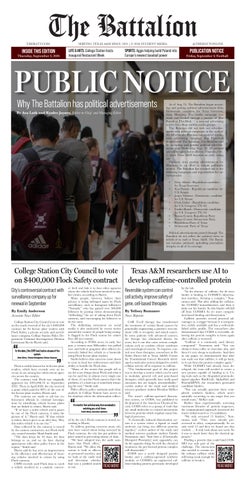
The Battalion
THEBATT.COM
INSIDE THIS EDITION
Thursday, September 3, 2026
@THEBATTONLINE
SERVING TEXAS A&M SINCE 1893 | © 2026 STUDENT MEDIA
LIFE & ARTS: College Station hosts inaugural Restaurant Week
SPORTS: Aggie helping build Poland into Europe’s newest baseball power
PUBLICATION NOTICE
Friday, September 4: Football
PUBLIC NOTICE Why The Battalion has political advertisements
By Ava Loth and Kynlee Joyner, Editor-in-Chief and Managing Editor
As of Aug. 25, The Battalion began accepting and posting political advertisements from Democratic candidate for Texas Governor, Gina Hinojosa. The media campaign was made and booked through a partner of The Battalion, FlyteDesk — a national advertising service for college student media groups. The Battalion did not seek out advertisements with political campaigns at the start of the fall semester. Hinojosa was a part of a statewide advertising campaign that FlyteDesk booked with The Battalion. The Battalion will be accepting and posting political advertisements until Wednesday, Sept. 30. All political ads will be taken down effective Thursday, Oct. 1, when Texas A&M becomes an early voting site. However, since posting advertisements for Hinojosa, in an effort to remain politically neutral, The Battalion has reached out to the following campaigns and organizations for advertisements: • • • • • • • • •
Greg Abbott - Republican candidate for Texas Governor Ken Paxton - Republican candidate for U.S. Senate James Talarico - Democratic candidate for U.S. Senate Chris Gober - Republican candidate for U.S. Congress (TX-10) Caitlin Rourk - Democratic candidate for U.S. Congress (TX-10) Brazos County Republican Party Brazos County Democratic Party Republican Party of Texas Democratic Party of Texas
Political advertisements posted through The Battalion do not reflect the political views or beliefs of its staff or Texas A&M. The Battalion remains unbiased, upholding journalistic integrity in all of its coverage.
College Station City Council to vote on $400,000 Flock Safety contract City’s controversial contract with surveillance company up for renewal in September By Emily Anderson Associate News Editor College Station City Council is set to vote on the yearly renewal of the city’s $400,000 contract for 84 license plate readers with Flock Safety, a private security and surveillance company, College Station Police Department Criminal Investigations Division Lieutenant Kevin Harris said.
Flock is widely known for its license plate readers, which have recently seen an increase in use among law enforcement agencies across the country. The contract with Flock was originally approved for $395,098.10 in September 2025. Then, in April 2026, the city received a grant which paid for 80% of the cost of the license plate readers, Harris said. The cameras are made to aid law enforcement officials in criminal investigations by identifying vehicle license plates that are linked to crimes, Harris said. “If we have a stolen vehicle and it passes by one of the Flock cameras, it takes the picture of it,” Harris said. “If that vehicle is stolen, then it gives us an alert that, ‘Hey, this stolen vehicle is in our city.’” Data collected by the cameras is owned by the camera contractors, not Flock itself, city council member Mark Smith said. “The data keeps for 30 days, the data belongs to us, and we do have sharing agreements with other police forces in the region,” Smith said. Harris said he has seen an improvement in the efficiency and effectiveness of locating vehicles involved in crimes by using Flock cameras. CSPD recently used Flock data to catch a vehicle involved in a catalytic convert-
er theft and link it to four other agencies where the vehicle had been involved in similar crimes, according to Harris. Many people, however, believe their privacy is being infringed upon by Flock surveillance, such as Instagram influencer “Nomark,” who has gained over 500,000 followers by posting videos demonstrating “deflocking,” the act of taking down Flock cameras, and encouraging his followers to do the same. The deflocking movement on social media is also motivated by recent stories around the country of people being wrongly flagged in the Flock system for crimes they did not commit. According to FOX6 news, in early August, a woman near Milwaukee was pulled over and held at gunpoint after officers incorrectly linked her vehicle to a homicide using Flock license plate readers. Smith believes that concerns come down to trust in local law enforcement and their ability to handle the Flock data. “Many of the stories that people tell to say the scary things about Flock and what it can be used for, in almost every single one of those, it’s not the Flock camera that’s the problem, it’s a bad cop or somebody misusing the tool,” Smith said. Police officers, police assistants and crime analysts in College Station have access to the database where the information collect-
ed by the city’s Flock cameras is stored, according to Harris. To address growing concerns many citizens have voiced about being surveyed by Flock cameras, the city has put policies in place aimed at preventing misuse of data. “We have adopted into the audit assistance that Flock offers,” Harris said. “We allow the system to look at officers or personnel searches, and we look at the audit trail and determine whether that was a justified search READ MORE! or not.
Texas A&M researchers use AI to develop caffeine-controlled protein Reversible system can control cell activity, improve safety of gene, cell-based therapies By Yelisey Romanov News Reporter CAR T-cell therapy has transformed the treatment of certain blood cancers by genetically engineering a patient’s own immune cells to recognize and attack cancer. In some patients with advanced cancers, the therapy has eliminated disease for years, but it can also cause serious complications such as cytokine release syndrome and neurological toxicity. To improve control over these therapies, researchers in Dr. Yubin Zhou’s lab at Texas A&M’s Center for Translational Cancer Research developed a molecular system designed to switch cellular activity off in response to caffeine. “The fundamental goal of this project was to develop a system which can be used to modulate general cell and gene-based therapies, which generally have really good outcomes but are largely uncontrollable,” co-first author of the study and medical sciences graduate student Brendan McKee said. The team’s caffeine-operated dissociation system, or CODS, was published in the Journal of the American Chemical Society. CODS refers to a group of tools that use small molecules to control interactions between proteins which regulate many biological processes. “A chemically induced dimerization system is a system where a ligand or small molecule can bring two different proteins together,” co-first author of the study and medical sciences graduate student Tatsuki Nonomura said. “And then a [Chemically Disrupted Proximity] tool, oppositely, can do the opposite thing. So with the chemical treatment, the pre-formed protein complex will disassemble.” CODS uses a newly designed protein binder and a caffeine-operated synthetic module, or COSMO, an engineered caffeine-binding protein previously developed
by the lab. “In the absence of caffeine, the de novo binder is binding to COSMO’s dimerization interface, forming a complex,” Nonomura said. “But after adding the caffeine, the COSMO homodimerizes and then it kicks out the binder. So this binder will fall off from COSMO. So it’s more competition-based binding and dissociation.” Caffeine provides several practical advantages as a trigger because it is inexpensive, widely available and has a well-established safety profile. The researchers also demonstrated that CODS is reversible, allowing the protein complex to form again after caffeine is removed. “Caffeine is a commonly used dietary compound,” Nonomura said. “You can obtain it from coffee or chocolate also, and then it’s very cheap to synthesize. And then in our paper, we demonstrated that after you wash out that caffeine, it will go back, so it can form the protein complex again.” While COSMO had already been developed, the team still needed to create a new protein capable of binding to it. Using tools such as the AI-guided protein-designed pipeline BindCraft, AlphaFold and ProteinMPNN, the researchers generated candidate binders. “You can actually generate these completely synthetic binders, which aren’t naturally occurring, to any target that you would want,” McKee said. Rather than experimentally screening enormous libraries of protein sequences, the computational approach narrowed the team’s initial search to 13 candidates. “We only screened 13 binders,” Nonomura said. “They were already prescreened in silico, computationally. So we only tried 13 and then we found one that worked. … It only took about one week. So it was so much faster than the classical approach.” Finding a protein that could bind COSMO was only part of the challenge. The interaction also needed to remain stable without caffeine while still being weak enough for caffeine to break it.
READ MORE!
A2
LIFE & ARTS
09.03.2026
Aggie co-authors book over infrastructure
Photos courtesy of Benjamin Dierker
Clockwise from left: Photo of the cover of Benjamin Dierker’s book “Holding Back Disaster”. A local TV anchor, Todd Flanagan, Gino Diamonte, Benjamin Dierker and Rob Bannon pose for a photo while promoting the musical on local TV. Rob Bannon and Benjamin Dierker pose for a photo in front of the US Capitol while Dierker attends law school. A sign promoting “Corps of Cadets, the Musical” is displayed in Rudder Auditorium ahead of the event on May 1, 2016.
10 years after leading A&M’s satirical newspaper, Benjamin Dierker ‘16 shifts directions By Sophia Munoz Life & Arts Editor The young man sits in front of his computer, typing away on a piece soon to be published anonymously through Texas A&M’s satirical newspaper. Ten years later, the former editor-in-chief of the Mugdown switched out his satirical writing for a more serious matter: co-authoring a book with damage prevention leader Scott Landes on
United States infrastructure. Switching out satirical writing for pipeline policies, Benjamin Dierker ‘16 found the inspiration for “Holding Back Disaster: Protecting Lives and Infrastructure Through Excavation Damage Prevention” through his career in policy making. “A lot of what I do now is educating policymakers and executives on complicated subjects, but everyone’s different and people respond to things differently,” Dierker said. The book examines the industry protecting the roughly 50 million miles of pipes, cables and wires beneath American cities, infrastructure most people wouldn’t think about until something goes wrong. During his time as a public administration graduate student at A&M, Dierker interned with the Alliance for Innovation and Infrastructure, or AII, of which he now serves as full-time executive director of AII. In the spring of 2016, even between juggling running the Mugdown, a stacked class schedule and side hobby with a satirical musical, Dierker met with the former dean of A&M’s School of Law, Andrew Morriss ‘18, to discuss his interest in the legal field. Morriss remembers Dierker’s ambition as something that distinguished him from other students. “I think one of the things that he brought … that was immediately clear was his in-
terest in these infrastructure issues that he’s now written the book about,” Morriss said. “He was very clear about what he wanted to do and he wanted to figure out how to get there.” Morriss connected Dierker with faculty at George Mason University’s Antonin Scalia Law School, where Dierker ultimately studied. From there, Dierker clerked for the U.S. House Judiciary Committee and worked in congressional fellowships before returning to AII full time. However, Dierker said the infrastructure industry kept pulling him back because it touches everyone and yet is almost entirely invisible. “I think the average person misses everything that’s underground,” Dierker said. “You don’t see it, so you don’t think about it.” Dierker said preventable accidents can range from a severed cable line to a fatal gas explosion, the latter of which is the kind of incident he examines in “Holding Back Disaster,” including the Olympic Pipeline explosion in Bellingham, Washington, the root cause of which can be traced back five years before it turned fatal. Dierker hopes the book, peer-reviewed by roughly 15 industry professionals, reaches college students weighing career paths they may not know exist. He points to A&M specifically, citing its engineering strength and what he called the university’s “camaraderie and brotherhood” culture, the same mutual reliance he said the damage prevention industry depends on to function safely. For Morriss, the book itself is evidence of how far Dierker’s interests in the subject of infrastructure have developed. “I think what is great is that he looked at
the problem and realized there was a lack of a systematic evaluation of the problem,” Morriss said. Unlike the shorter policy briefs common in Washington, Morriss said Dierker’s book represents a deeper examination of an issue that has largely gone unnoticed. “This is a really deep dive into very hard to compile information and putting all that information in a systematic framework is an incredible accomplishment,” Morriss said. Looking back on his life’s trajectory from the graduate student who rehearsed in a parking garage to the now-author who balances a full-time career with a newly published book, Dierker sees more similarities than differences. “I think the sameness of me is taking on tons of projects and relying on a lot of help from other people,” Dierker said. “ … I would say surprisingly similar is I’m still taking on a lot of big projects and continually taking on new things that seem insurmountable but still get done. I don’t think I can do any of that myself.” Bannon, who has stayed close friends with Dierker in the decade since, agreed Dierker’s pattern of personality still holds. “I describe Ben as a leader under the radar,” Bannon said. “He excels in leadership positions where he might not necessarily take all the credit or receive all the visibility, but he’s pulling the levers, influencing others. ... He likes to, I say his gifts are in connecting the dots between people and ideas. ... Even though this [“Holding Back Disaster”] is a very different endeavor than putting on a musical, it has Ben’s fingerprints all over it.”
Local fine dining helps fight food insecurity College Station hosts inaugural Restaurant Week with 8 participating establishments By Adhithi Shankar Associate Life & Arts Editor During the week of Aug. 24-30, eight local restaurants headlined College Station’s inaugural Restaurant Week, marking seven continuous days of curated prix fixe menus set at $25 for lunch and ranging from $45 to $65 for dinner. At the end of Restaurant Week, 10% of all restaurant proceeds, excluding alcohol sales, were donated to the Brazos Valley Food Bank, according to Visit College Station. Participating restaurants included Casa do Brasil, an upscale Brazilian steakhouse, and Porters Dining + Bar, a contemporary Western scratch kitchen located in Century Square. While the cost of a full lunch at
Casa do Brasil is generally upward of $46, during Restaurant Week the establishment offered a $25 lunch menu with unlimited access to the salad bar, hot side dishes and a choice between three desserts. The $55 dinner menu also included hand-carved cuts of aged sirloin, chicken and pork. Other restaurants followed the same outline, creating special menu options at discounted prices for Restaurant Week patrons. The event was organized by Visit College Station, the City of College Station’s official destination marketing organization. Visit College Station Events Coordinator Sadie Martinez explained the intention behind the lineup of the eight participating restaurants. “We kind of wanted to establish our programming this first year, so we really focused on a variety of higher-end local restaurants,” Martinez said. “That way, diners can try places that they’ve never thought they would go to, or something that they may not be able to afford on a regular basis.” In addition to providing new patrons for
local restaurants and new meal options for College Station locals and visitors, Restaurant Week was, at its core, designed around supporting the cause of alleviating hunger. The Brazos Valley Food Bank is a nonprofit organization based in Bryan that serves Brazos County and the five surrounding counties, where over half of residents live in rural areas. The donations from Restaurant Week will be utilized to support the organization’s mission to distribute nutritious food and dietary education to local families and individuals in need. “We wanted a way to give back to the community while also supporting our local diners or our local restaurants,” Martinez said. “So we thought that this would be a fun way for people — locals and visitors — to get out and also feel good about going out while they’re giving back to the local community and helping out their neighbors.” Visit College Station’s official Instagram page partnered with College Station-based content creator Meg Reily to promote
Restaurant Week. Reily documented her visits to Juanita’s Tex Mex Cantina, De Baca Steakhouse and other participating establishments, reviewing the menu items she ordered and encouraging her 720,000 followers to support local businesses by participating in the event. “Restaurant week was the perfect excuse to eat my way through College Station, try some amazing local hotspots, and support a great cause along the way!” Reily wrote in an Instagram caption. Reily’s posts were part of a broader push to get the word out about this debut event, which relied heavily on digital marketing and word of mouth. According to Martinez, Restaurant Week’s organizers are looking ahead to next year, with hopes of expanding both the restaurant lineup and the overall reach of the event. “We’re hoping … that we can continue growing this for future years,” Martinez said. “Hopefully, after this year, we’ll have some more restaurants involved, and we want this to be something that our community can look forward to every year.”
09.03.2026
OPINION
A3
Opinion: Majoring in good college advice with a minor in studious philosophy If ever there was a time to actually take notes, this is it By The Battalion Opinion Staff In a day and age where tipping culture has objectively gotten very much out of hand, the opinion staff is nonetheless trusting you won’t mind us paying forward our best college-related tips, from discovering your people to finding your academic groove. Opinion Editor Maeva Elizabé A bad grade doesn’t necessarily mean you’re dumb or didn’t put in the work, just that what you prepared for didn’t align with what the professor expected Shoutout to my older brother, who gifted me with this nugget of wisdom when my green freshman self was spiraling after having been dealt the practically universal reality check of flunking the first goodbye-golden-age-of-high-school, welcome-to-college exam. Now, if we’re being honest, I would without a doubt have the same reaction today — even being a veteran universitarian — as I did back then because yes, the grade was truly that bad, but that’s beside the point. Do as I say, not as I do and all that. Except do do as I do, because with my brother’s reassurance and my own panicky two hands, I pulled myself up by my bootstraps and oriented myself in a new direction. It’s so important to push past the impostor syndrome siren call because there’s more than one way to crack an egg and more than one egg in a carton. After all, you can’t make an omelette without breaking a few eggs, just like you can’t expect to earn that degree without going through a few rough patches here and there — though try not to trial and error the whole dozen.
nitive offloading — the delegation of mental tasks to external resources in order to lower mental demand — is in full swing. AI tools are both so ubiquitous and so efficient that it is hard not to use them. Though I suspect we young 20-somethings use AI not explicitly for learning purposes, but coping ones. We desire so much to not feel like an impostor, to not lack skill or knowledge in our own fields of study. We want to present ourselves as intelligent and are deathly afraid when we “fail” to. However, the real existential threat isn’t that AI will take over the world and its institutions, but that we will sign away our lives, so to speak, to the large language models that supposedly already have all the answers. It cannot be overstated how AI corporations know about and, therefore, take advantage of the public’s insecurities to sell their products. If we keep trying to present as perfect and coast our way through life’s challenges, we also avoid the struggle of be
times you have to study, work, sleep or simply stay home. But don’t be so quick to say no. Say yes to the random side quest. Try to make it to that organization meeting. Go to the event you almost skipped or talk to someone you don’t know. College is a short chapter of your life, even when some days feel like they will never end. So make the memories. Meet as many people as you can, make mistakes and take the random opportunity. You may not remember every assignment or exam, but you might remember the random pizookie run on a Tuesday night you almost said “no” to. The days are long, but the years are short. Opinion Columnist Thea Findlay Rejection isn’t reflection The college lifestyle can be seen as an adult trial
Senior Opinion Columnist Sidney Uy You are not an impostor Why care about a college education if ChatGPT can do your education for you? Why contribute to a group discussion if you’re not expected to participate? Why desire to become more when everyone else expects you to stay the same, conform and be sufficiently intelligent? Because otherwise you don’t belong? Instead of attempting to do work on your own, it is all too tempting to use AI. Cog-
coming human altogether. Instead of obeying that first impulse to use AI and confirm your intelligence, find a little trust in yourself that you already are and that you are in control of your own life. Opinion Columnist Prachi Arora The days are long, but the years are short The best college advice I have ever received came from a random Instagram post. It wasn’t from a professor, parent or some profound influencer. It was a simple message telling me one thing: Never say “no.” Not always say “yes” — that’s impossible. Some-
Opinion Writer Marie Kneeland Favorable conditions never come The best thing anyone ever told me during my freshman year was that “favorable conditions never come.” Not the cheeriest piece of wisdom, sure. But that was what I needed to hear. You see, coming to college opens a lot of doors. There are so many clubs, FLOs and random groups to join that it can feel overwhelming. On top of all that, you have grades and tests to worry about! I felt like I never would have the chance to do anything fun, to join any organization, because I was so stressed about an exam on Tuesday or an essay due Friday. That’s when, over the phone, my parents reminded me of a C.S. Lewis quote: “Favorable conditions never come.” If we waited for the “perfect time” to do something, a time when life slows down or things aren’t busy, we would never do anything. There is no such thing as a perfect time. But college is a short time. You only get four years to try everything you want to pursue. So, whether or not you feel like it’s the right time, you should go for it. It was that advice that got my feet out the door to meet new people and try new things. Opinion Writer Abby Morris Do not sacrifice your academics for your social life
Associate Opinion Editor Wyatt Pickering The Aggie Network will be your net worth For many college students — myself included — getting an internship was a non-negotiable. While getting good grades and being as involved as possible on campus are all great qualities to have during your internship search, most companies are not filling positions from traditional sources such as public job boards anymore. Networking and relationship building are the greatest opportunities you have as a college student to utilize your qualifications so you can receive that coveted internship and turn the temporary summer employment into a full-time job offer post-graduation. The Aggie Network is a real thing, and I have witnessed how one simple conversation or DM on LinkedIn can completely alter the course of your job search. However, the Aggie Network is something that works for you and the conscious decision to utilize it has to be made. Otherwise, it is just a glorified name for a network of alumni.
there, to forge your own path even if you don’t get a gold star anymore.
period, and with that, gold stars and participation awards are no longer handed out — and no one tells you this. After receiving the dreaded rejection email titled “Thank you for your time” from both a student org and job application in the same week, my ego took a hit when it felt like it was the universe screaming that my personality and professional prospects were at rock bottom. Yet, as I spiraled on the phone to my mother about all the ways these decisions would ruin my Future — with a capital “F” for failure — there was the reminder that rejection is simply a natural part of life everyone faces, no matter how isolating it feels. While it is okay to feel sad and disappointed that you missed out on a dream internship, do not dwell on the word no; instead, move forward with the lessons you have learned. A rejection email doesn’t signify you are a lesser person — it is proof that you have the courage to put yourself out
Unfortunately, I was not given this advice — I learned it the hard way. When I was a freshman, I constantly stayed out until 2 a.m. to hang out with my friends and attend every social event I could. Needless to say, this behavior bit me in the behind. I realized the error of my ways when I received aB in an extremely easy introductory political science course. Now, I’m not saying to only focus on academics in college, but balance is crucial. You should be able to go out and have fun, but it shouldn’t come at the cost of your grades. After all, you’re paying for the education, and that degree is what’s going to help you in the future. I don’t blame my younger self for enjoying the fun. This was the first time that I had such a close-knit group of friends, and college didn’t seem too hard compared to my high school IB classes. If anything, it was a great learning experience that taught me to be much more organized with my academics. Since then, my grades have flourished — without completely having to cut out my social life. Opinion Writer Bethany Mann You’re a student before anything else This was one of the first things said to me when I started my on-campus job. While originally meant as a way for me to manage both my school and work schedules, I have found this piece of advice the most useful when balancing my day-to-day life. College is often sold as the most social time of your life, boiled down to partying on the weekends and sleeping through 8 a.m. classes. Unfortunately, prioritizing the fun parts of college is why C’s so often get degrees. Don’t get me wrong, I love the occasional function, but I can’t spend every Sunday recovering from the night before when I have three books to read and two essays to write by the end of the week. Yes, I love hanging out with my friends, but the reason I even met them in the first place is because I’m here to learn and prepare myself for my future career. Even though I might not want to, I sometimes have to make the decision to save my social life for another night.
As you’re gearing up for a new semester, I wanted to welcome you back to campus. I grew up in Brownsville and went to UT Austin. What I found on campus was Texas itself. Panhandle kids and Houston kids, Valley kids and rural kids, people who had worked their way through school and people who had never worried about money. I learned just how big and complicated this state is, and how much promise it holds. That’s the part of my education that stayed with me most. You are about to inherit Texas, and each of you has some idea of the life you want to build here. Maybe you will start a company, teach in a classroom, be an engineer, work in public service, or do something you haven’t quite figured out yet. Whatever your piece of the American Dream looks like, I am running for governor to make sure Texas is the place where you can go for it. You are doing your part but right now, Texas is not holding up its end. State government has spent decades working for insiders and donors while public schools are starved and ordinary Texans pay the corruption tax. Follow the money and you find the answer to almost every question about why things here are harder than they should be. I have spent my career fighting that. College students across Texas have real power in this election. Power follows participation, and yours will help decide what Texas becomes and who it belongs to. I believe Texas belongs to all of us. And in November, we prove it. It’s time for a change. Register by October 5th. Check your status at IWillVote.com/tx. Vote on November 3rd. Bring somebody with you. Gina Hinojosa Candidate for Governor
POL. ADV. PAID BY GINA HINOJOSA CAMPAIGN
The Battalion
SPORTS
SERVING TEXAS A&M SINCE 1893 | © 2026 STUDENT MEDIA
Trinity Hindman — THE BATTALION
Adriano Espinosa — THE BATTALION
Rocio Salgado — THE BATTALION
Adriano Espinosa — THE BATTALION
Anna Haley — THE BATTALION
Clockwise from top left: Redshirt sophomore quarterback Marcel Reed (10) sacked during Texas A&M football’s game against Miami in the College Football Playoff at Kyle Field on Saturday, Dec 20, 2025. Sophomore wide receiver Terry Bussey (2) evades defenders during Texas A&M football’s game against Samford on Saturday, Nov. 22, 2025. Wide receiver Isaiah Horton (7) runs with a caught ball during Texas A&M football’s Maroon &White game at Kyle Field on Saturday, April 18, 2026. Wide receiver Mario Craver (1) makes a catch during Texas A&M Football’s game against Florida at Kyle Field on Saturday, Oct. 11, 2025. Offensive lineman Mark Naboy Jr. (54) sets the ball before a play during Texas A&M football’s Maroon & White game at Kyle Field on Saturday, April 18, 2026.
Crossing bylines: Missouri State at Kyle Field Previewing A&M season-opener with The Springfield News-Leader’s Liam Keating By Ian Curtis Senior Enterprise Reporter As No. 8 Texas A&M football opens its season against Conference USA’s Missouri State, it will be the first time the Aggies and Bears have faced off against one another on the gridiron in either school’s history. With enough questions surrounding how A&M will respond after last season’s playoff run — and Missouri State being a relative newcomer to the FBS scene and still an unknown for many college football fans — a sizable chunk of the 12th Man is likely wondering exactly who it’ll be cheering against this weekend. So why not talk to the expert? With that in mind, I sat down with The Springfield News-Leader’s Liam Keating to get a better understanding of Missouri State as the Bears venture south to Kyle Field to begin their season. New faces, new places Keating may be new to the Missouri State beat having just taken the job this summer after a stint with The Topeka Capital-Journal, but that’s fitting for a program in the midst of its own era of change. The Bears are entering their second FBS season and seeking back-to-back bowl game appearances after former head coach Ryan Beard left to take the Coastal Carolina job. Beard led the Bears to a 7-5 regular season record and an appearance in the Xbox Bowl last season. Keating said that early success means that “vibes are high” heading into the season. “I think if coach Beard and Missouri State go 2-10 last year, then people aren’t
really as excited,” Keating said. “But a bowl game last year got people jacked up, and that’s the expectation for this year. The goal is to go 6-6 and get back to another bowl game.” To replicate last season’s success, the Bears turned toward a name that may be familiar to college football fans in Texas by hiring Casey Woods, who spent the last four seasons as an offensive coordinator and tight ends coach at SMU under head coach Rhett Lashlee, where the Mustangs made a College Football Playoff appearance in 2024. While it’s Woods’ first head coaching job, Keating said that he brings plenty of Power Four experience to Missouri State. “He’s been around so many successful programs, and I think that’s why this hire is so good,” Keating said. “He just has so much experience and knows how to build culture, and that’s what he’s doing really well right now. Especially at a Group of [Six] team, where you’re getting transfers, but those transfers still need to be developed. … That’s one of his truly great qualities: being able to develop players.” Offense preview There’s a new face under center for the Bears this season, as Woods’ named UTEP transfer fifth year quarterback Skyler Locklear as Missouri State’s starter this season after fall camp. Keating said that Locklear’s skillset as a dual-threat QB fits in with Woods’ vision of a high-tempo offense. “He can throw the ball for sure, but there’s going to be a lot of option plays — a lot of read option, a lot of RPO stuff with Casey Woods’ offense,” Keating said. “And so that’s why I think Skyler Locklear won the job is because of his ability to run the ball. … Casey last week said that Skyler had the best practice of his career at Missouri State so far, so that got people really fired up.” Missouri State’s backfield is worth keeping an eye on, Keating said, especially senior running back — and Texas native
— Breezy Dubar, who transferred from Boise State where he shared a backfield with Heisman finalist Ashton Jeanty in 2024. Keating also highlighted fifth year wide receiver Jmariyae Robinson, who is a rarity in college football nowadays in that he’s entering his fifth season at the same school. His longevity with the program and loyalty throughout the transition to the FBS has him primed to set several school records in career receiving marks, Keating said. “He’s another key player on the offensive side where it’s like, get him the ball in open space, and he can do some big things,” Keating said. “And who knows if that will happen against Texas A&M. … But that’s the goal come [the] Conference USA schedule, is these guys can be clicking in Week 5 when that occurs.” Defense preview According to Keating, Missouri State’s secondary is something that the 12th Man should watch out for as it’s arguably the Bears’ strongest defensive unit. He also said to keep an eye on fifth year linebacker Jared “Bird” Lloyd, who has become a vocal leader on Missouri State’s defense after starting all 13 games last season, leading the team in tackles with 77. “He’ll make a big play at Texas A&M, and he’s going to celebrate like no other, just because that’s the personality he is,” Keating said. “And so he’s going to be a guy that’s going to be flying around and trying to make big hits.” Another storyline Keating said that Aggies should watch out for is the sudden career shift of fifth year defensive lineman and tight end Michael Osei-Bonsu. A former All-CUSA basketball player for the Bears, Osei-Bonsu decided to make the change from the hardwood to the gridiron when his last year of basketball eligibility ran out in March. It’s the first time he’s ever played organized football. “He’s never played football in his entire life, and so he’s literally on step one right
now,” Keating said. “Who knows if he’s not going to play at Texas A&M? But he’s a guy that they’re trying to work toward being ready for conference play during practices and scrimmages and stuff like that. … He’s kind of the guy [that] maybe the broadcast will pick up for fun storylines for Missouri State.” Wild card While Keating acknowledges that you never know what can happen in a season opener like this one — and indeed, fifth year center Isaiah Villanueva called his shot this week by saying that everyone will know where Springfield, Missouri is “when we win on Saturday” — he said it’s important to acknowledge what a realistic goal for the Bears is this week: stay healthy and put together some solid drives. Keating said that the Bears’ fans have plenty of passion, and have a goal to be mentioned alongside Boise State, James Madison and others that have risen to the top of the Group of Six. “This is a very passionate fanbase, and they have high expectations for this team,” Keating said. “Like, 6-6 doesn’t sound good to Texas A&M fans. It doesn’t sound good to Ohio State fans. But 6-6 would be huge for Missouri State. … It might be a 50 to 60-point loss or whatever, but a bad game won’t define this Missouri State team and they know it.” And while the 12th Man will inevitably show those Bears fans around Aggieland this weekend, Keating had a final tip for any Aggies who happen to find themselves in Springfield: Give Black Sheep Burgers and Shakes a try. “You can get your crazy burgers, but you can also just get a solid regular cheeseburger,” Keating said. “[They’ve] got milkshakes; you can get a beer there. It’s a really cool place, a lot of people in Springfield love it. The students love going there. Downtown Springfield is kind of a hidden gem.”
SPORTS
B2
Photo courtesy of Tomas Romo
09.03.2026
Photo courtesy of Markos Romo
Left to right: Tomas Romo (9) celebrates with members o fthe Polish national team. Markos Romo throws a pitch while playing for the Polish national baseball team in July 2026 in Wroclaw, Poland.
Aggie helps forge Poland’s path toward becoming Europe’s newest baseball power Inside Markos Romo’s journey with the Polish national team By Ian Curtis Senior Enterprise Reporter The future of baseball in Poland rests inside of one Aggie’s computer. The spreadsheet itself is a marathon of over 1,500 names, ranging from the most obscure Division III athlete to stars of Major League Baseball, all with one thing in common: enough Polish blood to — in theory — represent the nation on an international level. “Anyone that has Polish heritage that I’ve been able to discover, they’re on that list,” economics graduate student and assistant general manager of the Polish national baseball team Markos Romo ‘26 said. “A lot of my work is trying to get in contact with them personally, or contacting their teams, PR, media offices — someone that can put me in touch with them — and basically show them that Poland does have a national team, and that we’re working on growing something big.” Poland on the rise According to Polish baseball lore, the first baseball glove in Poland was purchased from Czechoslovakia in the early 1970s in exchange for a bottle of vodka. Of course, the game has come a long way since then. Gone are the days when equipment was largely imported from Cuba, when Poland was behind the Iron Curtain during the Cold War. In recent years, the nation has become competitive on the European level, and this summer, with Markos and his brother Tomas both playing, Poland finished as runner-up in the European Baseball Championship B Pool qualifier — a tournament played on Polish soil — after losing the final to Slovakia in extra innings. “This year, for the first time ever, there was a buzz around the Polish team, where there was almost an expectation that they were going to be great at the B-Pool level,” Gabriel Fidler, Mister-Baseball.com’s managing editor, said. “ … There was an
expectation that Poland ought to be one of the best teams in those pools. That’s never happened before, and there’s never really been a time when even those of us who are more aware of things on the ground would have considered Poland a big favorite.” Fidler, who grew up a baseball fan in England, has covered European and African baseball for just shy of 20 years. He had a front-row seat to Poland’s development, he said, through a stint as coach of Hungary’s U18 national team, where he faced off against the neighboring Poles. “There’s just a lot of interesting talent coming out of Poland,” Fidler said. “They have a very strong league system that seems to reward young players, and those young players are now looking at college scholarships in the [United States]. And a few have gotten signed, and a few have played abroad in higher-caliber leagues than the Polish league.” Fidler said a large part of that growth has come from a — comparatively — strong Little League program and other domestic development initiatives. But Poland has another secret weapon in Markos. Fidler said that Markos’ role with the federation could set a precedent across Europe for similar nations looking to grow their baseball infrastructure and national team recruitment. “I think that Poland has actually done something really interesting with giving Markos the reins as much as they have,” Fidler said. “The way to move your young developing core who are U15, U18, to the next level is partly through great coaching. … But it’s also having someone on the ground in the U.S. who is a similar age to the younger group of players, but is connected to the American and maybe the global scene in a way that in this case, Polish players could never possibly be.” Brothers in baseball Like so many kids growing up in the Houston area, baseball was a massive part of both Markos’ and Tomas’ lives, they said. Both could have had opportunities to play at a
collegiate level, but they opted to attend Texas A&M for academic reasons and continue their playing careers with A&M’s club baseball program instead. It was Tomas who first had the idea to play the sport abroad when he graduated with All-American honors from the National Club Baseball Association, he said. Poland was a natural choice given the family’s Polish heritage. The brothers are half Polish by way of their grandparents, who emigrated from the country. “The World Baseball Classic was going on, and I was seeing these guys play for Nicaragua or smaller countries’ teams throwing like 85, 86 miles an hour,” Tomas Romo ‘23 said. “I’m like, ‘Man, I see this, and I can throw this fast. There’s got to be a team that Poland is putting together.’” That initial spark led to a meeting with John Dobkowski, president of the Polish American Baseball & Softball Foundation and a leader within the nation’s official baseball federation, who advised Tomas on how to acquire the Polish citizenship needed to represent the nation on an international level. As Tomas arrived in Poland in 2024 and began his playing journey, Markos began getting involved with the federation on a behind-the-scenes level. That included working with the program’s leadership to recruit players, secure sponsorships, handle the teams’ social media presence and a plethora of other duties as assigned. “Really, just sending out a lot of messages, a lot of phone calls,” Markos said. “ … Not a lot of people know that Poland has a baseball team. If you’re really into the sport, you might, but the majority of Polish-Americans, they didn’t know, right? And so our job is to go out there and be an ambassador for the team, the program, collect donations [and] find ways to connect with people in the Polish community that would be interested in helping grow our program, which is really fun.” Fortunately for Markos — who plans to pursue a business career, he said — the brothers’ journey to the Polish
national team coincided with the arrival of Paul Bragiel. A venture capitalist of Polish descent himself, Bragiel has been involved in sports ventures varying from an attempt to qualify for the Olympic Games as a cross-country skier to a long-term investment in Poland’s baseball program, including time as a bench coach. “I’ve been working for him the last three years, baseball and other non-baseball related things,” Markos said. “ … He’s a Silicon Valley guy from Chicago, and he’s just always been passionate about Polish sports and Polish baseball being one of them.” Markos said that Bragiel has given him opportunities to be involved in both his venture capital exploits and further his role with the Polish federation. He also said that Bragiel played a role in one of Poland’s biggest off-the-field accomplishments yet by helping facilitate the hiring of former Seattle Mariners manager — and international baseball journeyman — John McLaren to lead the program. McLaren, who described himself as an “international-guru type” to MLB.com’s Michael Clair this summer before Poland’s latest tournament, has coached baseball in 30 countries over a 50-year coaching career. For Markos, the opportunity to work with — and play for, after a tryout that Tomas said impressed the federation that “had no expectations for him” as a pitcher — McLaren has been invaluable. “He’s a baseball lifer, a true brainiac of the game,” Markos said. “Having someone like that in our corner is great for our fans in the program and everyone watching from outside. They see that we have highlevel coaching. … He’s coached at the highest levels, and he’s willing to come out here and spend time with our team and make us better.” That’s helped Poland’s players stay motivated throughout the year, Markos said. “When the players realize that and recognize that, I think it turns them to another level,” Markos said. “They want to go out there. They want to be the best in the offseason.
READ MORE!
2/26 Crossword
ees anne d
PuzzleJunction.com
ENTERTAINMENT
09.03.2026 1
2
3
13
14
17
e
nd
6
7
8
9
15
21 24
27
32
33
37
38
50
31
35
36
39
Copyright ©2026 PuzzleJunction.com
42
Texas A&M46Battalion 9/2/26 Sudoku
44 47
30
34
56 Contrite 31 Mountain lakes Across 60 Cereal grass 32 Stitch up 1 Casino action 61 Bowie’s last Texas stand 33 Sweden neighbor 4 Ballgame attendees A&M Battalion 9/2/26 Sudoku PuzzleJunction.com 62 Ancient Greek portico (Abbr.) 9 Gilbert of Roseanne 63 Keats creatins 34 Harem room 13 French girlfriend 64 Heiress type 36 E.R. personnel 15 Western show 65 Compass pt. 39 Chides 16 The Emerald Isle 4 1 5 8 41 Scorch 17 Gang boss 6 Down 426 Soft drinks 19 Depend 8 3 1 7 1 Slot machine symbol 44 Vistas 20 Type of sleeve 2 Dubai dignitary 48 Scarecrow stuffing 21 Perfect 9 1 7 2 3 Loise of Gilligan’s Island 49 Cupid’s projectile 23 Tibetan beast of 6 8 3 4 Haunted house sound 505 Battery contents burden 5 Horse color 51 Fine 24 Get into shape 2 3 fabric 9 4 6 Eccentric 52 Hot Diggity singer Perry 26 Physics class topic 1 7 Diminutive 53 New newts 28 Sugar suffix 8 Sunken ship Andrea 54 Pairs 29 Musical interval _____ 55 Box office sign 32 Round Table character 9 Tranquil 57 Inventor Whitney 35 Driveway surface 10 Region 58 Certifiable 37 Estrada of CHiPs Solution 11 Streamlet 59 Bar topic 38 Group of eight 12 “____ takers?” 39 Kind of loser 9 7 4 6 1 5 3 2 8 1 3 8 2 7 9 5 4 6 14 Cake ingredient 40 Cyst 6 5 2 8 4 3 1 9 7 2 8 5 4 3 1 6 7 9 41 Shrimp and lobster, e.g. 18 Guanaco’s cousin 3 9 1 7 2 6 8 5 4 7 4 6 5 9 8 2 3 1 22 Scuttlebutt 43 Plate 5 1 9 3 8 7 4 6 2 24 Dangerous African 45 Filmmaker Spike 8 2 3 9 6 4 7 1 5 4 6 7 1 5 2 9 8 3 pests 46 Table scraps 25 Tell puzzle, a story 47 Flings To solve the Sudoku each row, column and 26 Broadcast 49 Menu phrase box must contain27the 1 to 9. Lemonnumbers Tree singer Lopez 50 Argus-eyed 28 Supernatural 52 Boxed up 30 Brown ermine 55 Glance over To solve the Sudoku puzzle, each row, column and box must contain the numbers 1 to 9.
22
29
41 43
12
25
28
40
11
19
23 26
10
16
20
pic
ster,
5
18
e
ce Ps
4
B3
45 48
49
51
52
55
56
60
61
63
64
57
53
54
58
59 62 65
Puz
Copyright ©2026 PuzzleJunction.com
Dr. Doctor saves Aggieland
Down
1 Slot machine symbol 2 Dubai dignitary 3 Louise of Gilligan’s Island 4 Haunted house sound 5 Horse color 6 Eccentric 7 Diminutive 8 Sunken ship Andrea ___ 9 Tranquil 10 Region 11 Streamlet
12 “___ takers?” 14 Cake ingredient 18 Guanaco’s cousin 22 Scuttlebutt 24 Dangerous African pests 25 Tell a story 26 Broadcast 27 Lemon Tree singer Lopez 28 Supernatural 30 Brown ermine 31 Mountain lakes 32 Stitch up 33 Sweden neighbor (Abbr.) 34 Harem room
36 E.R. personnel 39 Chides 41 Scorch 42 Soft drinks 44 Vistas 48 Scarecrow stuffing 49 Cupid’s projectile 50 Battery contents 51 Fine fabric 52 Hot Diggity singer Perry 53 New newts 54 Pairs 55 Box office sign 57 Inventor Whitney 58 Certifiable 59 Bar topic
4
1 5
6
3 1
8
9 1 7 2 6 8
3
5 2 3 9 1
4
Copyright ©2026 PuzzleJunction.com
Solution on next page
Solution
The Battalion Ava Loth Editor-in-Chief
Kynlee Joyner Managing Editor David Swope
Maeva Elizabé
Tanner Brown
Ian Curtis
News Editor
Opinion Editor
Design & Graphics Editor
Senior Enterprise Reporter
Emily Anderson
Wyatt Pickering
Julius Sjolie
Kynlee Joyner
Associate News Editor
Associate Opinion Editor
Social Media Editor
Business Manager
Sophia Muñoz
Trey Bohne
Rocio Salgado
Tiffany Vasquez
Life & Arts Editor
Associate Sports Editor
Photo Chief
Business Manager
Adhithi Shankar
Brody Vaughn
Steve Carrasco IV
Sara E. Gonzales
Associate Life & Arts Editor
Associate Sports Editor
Photo Chief
Associate Director of Student Media
The Battalion is published Thursdays in Fall 2026 (except university holidays and exam periods) at Texas A&M University, College Station, TX 77843. Offices are in Suite L400 of the Memorial Student Center. The Battalion is managed by students at Texas A&M University in Student Media, a unit of the Division of Student Affairs. Newsroom Phone: 979-845-3315 Email: editor@thebatt.com Website: http://www.thebatt.com Advertising: Publication of advertising does not imply sponsorship or endorsement by The Battalion. For campus, local and national display advertising, email battads@thebatt.com. Office hours are 8 a.m. to 5 p.m. Monday through Friday.
9 1 6 2 3 7 5 8 4
7 3 5 8 9 4 1 2 6
4 8 2 5 1 6 9 3 7
8 6 7
6 2 8 4 7 5 3 9 1
1 7 4 3 2 9 8 6 5
5 9 3 1 6 8 7 4 2
3 5 1 6 8 2 4 7 9
2 4 9 7 5 3 6 1 8
8 6 7 9 4 1 2 5 3
YOU’RE INVITED TO A
FREE PANEL EVENT! 7 p.m. . . Rudder Theatre Q&A | Screening | Book Signing
Featuring
Andrew Miano
Chris Weitz
“Murderbot” Showrunner/Creator
Martha Wells ’86
“The Murderbot Diaries” Author “Murderbot” Co u t Producer
tx.ag/MurderbotEvent
“Murderbot” Execut e Producer