The Battalion
THEBATT.COM
INSIDE THIS EDITION
@THEBATTONLINE
SERVING TEXAS A&M SINCE 1893 | © 2026 STUDENT MEDIA
Thursday, October 8, 2026
SPORTS: After 4-game homestand, A&M volleyball heads to Arkansas
NEWS: Regents consider possible on campus scooter, micromobility ban
PUBLICATION NOTICE
Ring Day: Friday, October 9, 2026
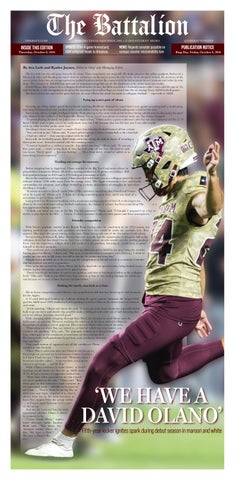
By Ava Loth and Kynlee Joyner, Editor-in-Chief and Managing Editor His feet sink into the soft grass beneath his cleats. Three steps back; two steps left. He looks ahead to the yellow goalpost, flashes of a black-and-white ball flooding his mind while he reminisces on the soccer jersey he once wore. As he prepares to kick, the memory of his soccer jersey fades into an orange-and-white padded uniform before the contact with the ball reminds him it’s maroon and white he now dons. The screams of 108,000 fans and rush of teammates snap him out of the daydream as he settles back into reality. David Olano didn’t plan to be a collegiate football kicker. In fact, the fifth-year kicker’s football journey didn’t start until the age of 16, and his family is still attempting to decipher the meaning when yellow flags are tossed into the air during Texas A&M football games. But don’t let his late start to the sport fool you, because Olano has made his mark in collegiate football — especially at A&M. Tying up a new pair of cleats Growing up, Olano didn’t spend his weekends watching RedZone. Instead, he tuned into 6 a.m. games occurring half a world away, watching Liverpool from the comfort of his couch before lacing up his cleats and heading onto a field of his own. Soccer was, and is, a staple in Olano’s family. From playing on the same team as his brother during adolescence to discussing the sport over dinner in the confines of his Naperville, Illinois, home, soccer was always a constant until, one day, things changed. “I started playing [football] my junior year of high school,” Olano said in a press conference after the win over Arkansas on Oct. 2. “I knew I didn’t want to play soccer my sophomore year, but I did because that was the last year I was able to play with my older brother on the same team.” Deciding to leave soccer wasn’t a simple choice, but choosing football seemed all but certain. “You can look at me,” Olano said. “I wasn’t gifted enough to shoot a basketball or hit a baseball. … I had one talent — that was my contact with the ball.” Even still, his football journey didn’t begin with him taking the field in hopes of securing a three-point score. Instead it started with him running routes. “I started football as a wideout actually; that didn’t last long,” Olano said. “It was my first game and … coach seeing kind of how the ball came off my foot. He kind of said, you know, ‘You’re good. … Just stay kicking.’ … Then from there, it kind of sailed on to something I never expected.” Trading out orange for maroon Before stepping foot in Aggieland, Olano resided in the Big Ten Conference where he played three seasons for Illinois. He held a starting position for 26 games, recording a .860 field goal percentage in 2024 and a .870 field goal percentage in 2025. But at the conclusion of last season, Olano decided in his final year as a collegiate player he would relocate almost 1,000 miles away from his orange roots. The Aggie community’s love and loyalty surrounding the program, and college football as a whole, streamlined all thoughts he had when deciding to transfer. “It means so much to [head] coach [Mike] Elko, and that’s something that I loved and I wanted to be a part of,” Olano said. “I think he’s doing something great here, and it was kind of a no-brainer to get to Texas A&M.” Going from Gies Memorial Stadium, with a maximum seating capacity of 60,670, to the largest stadium in the most dominant college football conference, the change of scenery has been something Olan o has appreciated being a part of. “I think, you know, my time in the Big Ten was awesome,” Olano said. “I thought it prepared me a lot, so much, to play here in the SEC. … I mean it’s been awesome to play in these games and these atmospheres.” Friendly competition With former graduate student kicker Randy Bond leaving after the conclusion of the 2025 season, the starting position was vacant and questions swarmed over who would be under the spotlight next. Rest assured, Elko knew the queue waiting at the door, Olano being only one of the few talented individuals. Second-string freshman K Asher Murray has only recently had the opportunity to bring his skill to the collegiate-level, but that doesn’t mean there was a definite answer on who would earn the starting position. Even with his experience, Olano didn’t feel entitled to the position, knowing he would have to prove himself in the new program. “You could rest and, you know, kick your feet up when you get to A&M in my spot, being the transfer, having played at Illinois,” Olano said. “But man, it was awesome to compete with [Murray]. I think he pushes me, not only in fall camp, but still to this day he pushes me every day.” Despite being decided on as the go-to guy, the competition on his tail served as a constant reminder that his position was never a guarantee. Now, as he has earned his cleats, Olano has had a dual role on special teams, being looked to as a reliable leg for extra points and perfectly placed punts. “David was clearly the better at both in our opinion, and then he had done it before at the collegiate level,” Elko said. “And so you didn’t have that concern or fear of him lasting through the whole season because we’ve seen it done that way for him before.” Making his mark, one kick at a time His in-house competition with Murray only propelled his skill that has shown up in vital moments for the Aggies. A 57-yard field goal leading into halftime during the game against Arkansas, the longest field goal for A&M since 1999, marked a 6-of-6 opening record for Olano in his debut season in maroon and white. “It felt amazing,” Olano said about the goal. “I mean you want those moments, especially before half, to go out there and double dip, possibly make a field goal and come out of half knowing that we’re on offense, but man, that felt good.” With changing winds whipping through Kyle Field, the decision to send Olano onto the field wasn’t an easy one. However, realizing the wind was in his favor, and with Olano in his peripheral giving a nod of approval, Elko returned Olano with a nod of his own. “Depending on which flag you looked at, or kind of which way you leaned, you couldn’t tell anything,” Elko said. “We ultimately settled on it being behind him, which gave us the confidence to send him out there and go do it. … He’s been really, really good since he got here, and, you know, obviously that was huge.” That small motion of approval was all the confidence Olano needed to take the field. “Once [Elko] called that time out, I kind of tried to get in his peripheral and nod my head, because I knew I wanted it; I knew I had it in me,” Olano said. “Honestly, when I heard my number called … to go out there, it was pretty surreal to get to go … and hit that.” While Olano continues to make history as 6-of-6 opening record marks the first for an A&M since 2018, he has a swarm of supporters behind him. “More than often, [specialists] are not regarded; we’re pushed to the side,” Olano said. “But those guys on this team have made everyone in the [specialist] room … feel like we’re a part of the team. … They’re there in our big hits, in their lows and highs, whatever it is, they’re always there for us. It’s been awesome to have that support from the group within … so I’m just super fortunate to be a part of this group.” And not for a second has the team questioned whether Olano is where he is meant to be. “I love David Olano,” sophomore defensive tackle Landon Rink said. “You know the Avengers meme where it’s like, ‘We have a Hulk’? We have a David Olano.”
‘WE HAVE A DAVID OLANO’
Fifth-year kicker ignites spark during debut season in maroon and white
SPORTS
A2
10.08.2026
Crossing bylines: A&M at Missouri Previewing Aggies’ road trip to face Tigers at Faurot Field with Columbia Missourian football writer Dylan Heinrich By Ian Curtis Senior Enterprise Reporter Fans of both Texas A&M and No. 14 Missouri football are no doubt riding high after last week’s action — though for slightly different reasons. A&M got back into the win column with a 34-7 drubbing of an — admittedly, below average — Arkansas squad, while Missouri had a pick-me-up of its own with a 4517 rout of then-No. 8 Florida that broke a nine-game losing streak against AP Top 25 foes. To find out what the 12th Man can expect when the Aggies take on the Tigers, I spoke with football writer Dylan Heinrich of the Columbia Missourian. Heinrich, who made his way to Mizzou by way of Fort Collins, Colorado, said that the fans’ perception of the team has shifted after the win, away from widespread pessimism following an early loss to Mississippi State. “Following the Florida win, things have completely flipped on its head,” Heinrich said. “There’s a lot more confidence and a lot more high hopes for this team. Some people have been talking about [the] College Football Playoff, talking about this being the best team since 2023. … So now the question is, ‘Can they keep this up?’” Simmons, Roberts lead the way on offense After the departure of current Virginia quarterback Beau Pribula to the transfer portal following last season’s 8-5 mark, Mizzou acquired former Ole Miss starter senior QB Austin Simmons from the transfer portal. Simmons, who began last season as the Rebels’ starter before injury woes derailed his final season in Oxford, Mississippi, has excelled for the Tigers so far. He ranks third in passing yards in the Southeastern Conference and threw for 340 yards and a pair of touchdowns against the Gators. “He’s very good at looking through his progressions, making good throws in the tight windows, which is something that Mizzou hadn’t necessarily had for the last couple of years,” Heinrich said. “ … He’s been arguably the best quarterback that Mizzou has had in terms of at least success since Brady Cook, and some people have said he’s had the best talent since Drew Lock back in 2017, when he was a second rounder.” Another Missouri star making waves so far this season has been senior running back Jamal Roberts, who stepped into the starting role after last season’s starter, Ahmad Hardy, suffered a gunshot wound in May. Roberts currently sits second in the SEC in rushing yards with just over 600, and he led the Tigers with 211 yards and three scores on the ground against the Gators thanks to his ability to make explosive plays, Heinrich said. “They’ve suffered a lot of short runs, averaging two, three, four yards per carry instead of that five-plus,” Heinrich said. “But what we’ve noticed from Roberts is his ability to go on those long runs and those breakout plays. So what coach Eliah Drinkwitz has talked about is that all those yards count the same. If you have a couple of those two or three yard runs, but you’re able to break out those 70 or 80 yard ones, it all evens out.” Defense and wild card Heinrich said that Missouri’s defense has had its ups and downs, specifically in terms of its secondary — which, he pointed out, was exposed by Mississippi State QB Kamario Taylor, who threw for 380 yards and three scores against Mizzou this year. “Kamario Taylor really exposed it on some deep long balls where they were able to meet deep Mizzou in one-on-one coverage,” Heinrich said. “The safeties had looked suspect at times, so those sort of long, chunk pass plays have been a weakness for Mizzou.” But Heinrich also noted that Mizzou’s run defense has been its strength so far, as the Tigers held the SEC’s leading rusher in Florida junior RB Jadan Baugh to just 13 yards on 12 carries. “They were able to completely stuff the line of scrimmage, and so I know if A&M wants to get the offense going, they’ll have to open up the pass game to open up the run game,” Heinrich said. “Otherwise, I think Mizzou is just going to stuff them at the line like they did for [Florida].”
Chris Swann — THE BATTALION
Photo Courtesy of USA Baseball
Clockwise from top: Former Texas A&M baseball right-handed pitcher Bryce Miller (32) struck out 10 batters in six innings during the Aggies’ second game against Arkansas on Saturday, April 17, 2021. Former Texas A&M baseball right-handed pitcher Michael Wacha pitches for Team USA against Brazil during the World Baseball Classic at Daikin Park in Houston, Texas, on Friday, March 6, 2026. Former Texas A&M baseball outfielder Braden Montgomery (6) reacts after hitting a home run during Texas A&M’s game against Arkansas at Olsen Field on Saturday, May 18, 2024.
March to October: How Maroon and White’s finest fared this MLB season Aggies set new mark with 12 big leaguers making impact By Matthew Almand Sports Writer It’s a bittersweet time of year for baseball fans. With the end of September comes the end of the regular season, with no shortage of disappointing finishes and postseason faltering, Texas’ own pair of teams included. But there is no time of the year quite like October for baseball enthusiasts. Despite the dropping temperatures, the postseason features the hottest teams in the league, while the gauntlet weeds out teams not worthy of the Commissioner’s Trophy. No matter how your team fared over the past seven months, there is plenty to be excited about. Twelve former Texas A&M baseball players took the field on the biggest stage in the sport this year, setting a school record for Aggie appearances in a single MLB season. Braden Montgomery, Chicago White Sox Right-fielder Braden Montgomery wasted no time making his name heard this season. In his major league debut against the Atlanta Braves, with his team down to its last out, trailing by a run in the bottom of the 10th and a runner on third, the rookie launched a changeup, sending it 343 feet and over the left field fence. With one swing of the bat, the 23 year old from Madison, Mississippi, became a fan favorite. Montgomery continued to earn his place in the lineup, appearing in 93 games and producing 113 total bases for the White Sox. Montgomery and the Southsiders look to continue their success from this season, currently facing the Cleveland Guardians in the American League Divisional Series. Michael Wacha, Kansas City Royals Right-handed pitcher Michael Wacha has quite the opposite story compared to Montgomery, the 35-year-old having just wrapped up his 14th season in the majors, his sixth with the Royals. The veteran continues to prove that he still has gas in the tank, starting in 32 games this year and
completing over 200 innings, both marking career highs. Wacha leads all Aggies in multiple career MLB statistics, with 120 wins and 1,574 strikeouts. A.J. Minter, New York Mets Left-handed pitcher A.J. Minter, another Aggie with plenty of tenure and best known for his time with the Braves, recently joined a new club as well. The Tyler native began the year playing for the New York Mets, before he was traded to the Minnesota Twins at the trade deadline on July 31. The reliever has continued his steady performance in the majors, appearing in 48 games this year with a WHIP of 1.05, just below his career average of 1.17. Bryce Miller, Seattle Mariners RHP Bryce Miller spent the season in Seattle rounding back into form. The starter out of Mount Pleasant, who was drafted in 2021, had an impressive year in 2024, boasting a sub-three ERA across 31 starts, accompanied with a WHIP of just 0.98 and 171 strikeouts. In 2025, however, Miller struggled with injuries. The 2026 season was spent getting back on track, knocking that ERA and WHIP back down. Brandyn Garcia, Arizona Diamondbacks LHP Brandyn Garcia proved his value this year with the Diamondbacks, dropping his WHIP from 1.81 in 2025 all the way down to 0.74 this season. The 26-year-old reliever appeared in 57 games and finished second on the team in both WHIP and ERA, helping the squad to an 86-win season and finishing just two games short of making it to the Wild Card with the chance to extend its season. Braden Shewmake, Houston Astros Shortstop Braden Shewmake had quite the journey this season. The shortstop began the year with the New York Yankees before being traded to the Astros in April, who then traded him to Milwaukee in July, only for him to spend 16 days with the Brew Crew before returning back to Houston. In all, Shewmake appeared in 34 games with a .259 average and knocking eight extra base hits.
Christian Roa, Houston Astros RHP Christian Roa had a similar story this year. After earning his spot on the Astros’ roster during spring training, the righthander made three other stops around the nation, and was then re-signed by Houston in July. The Houston native saw limited action in the majors, appearing in just seven games and throwing 8.2 innings. Nolan Hoffman, Stephen Kolek, Kansas City Royals RHP duo Nolan Hoffman and Stephen Kolek, both of whom were drafted in 2018, have found their way back to each other in Kansas City, Missouri. The Aggie pair combined to pitch over 60 innings this season, issuing only 15 walks and punching out 44. Corbin Martin, Chicago Cubs RHP Corbin Martin struggled to find his stride with the Cubs this year, spending most of the season with the Iowa Cubs, the Chicago Cubs’ Triple-A squad. In the time he did spend in Chicago, he appeared seven times and only let up five hits. Michael Helman, Texas Rangers Center fielder Michael Helman spent most of his time this year in Round Rock playing Triple-A ball, producing 54 total bases in 42 games. In the majors, the out fielder had just 30 at-bats in 16 games, tallying five hits. Brooks Raley, Philadelphia Phillies LHP Brooks Raley started the year strong with the Mets, posting a sub-two ERA and a WHIP of 1.09, before being traded to Philadelphia in August in an attempt for the Phillies to gear up for a run at the postseason. After arriving in Philadelphia, however, the reliever struggled, jumping his WHIP to 1.94. The Aggies’ impact on the diamond was undeniable — 12 players making the active rosters this year ties for sixth most amongst all colleges. From rookie debuts to veterans showcasing their growing skill, there was no lack of excitement for those who once suited the Maroon and White. A&M will hope to see more familiar faces called up to the show next spring.
10.08.2026
VOLLEYBALL
A3
Photos by CJ Smith — THE BATTALION
Clockwise from top: The Aggies react after a point during Texas A&M volleyball’s game against Mississippi State at Reed Arena on Sunday, Oct. 4, 2026. Setter Kirra Musgrove (14) and Mississippi State outside hitter Lindsey Mangelson (3) battle for the ball during Texas A&M volleyball’s game against Mississippi State at Reed Arena on Sunday, Oct. 4, 2026. Outside hitter Megan Fitch (20) passes the ball during Texas A&M volleyball’s game against Alabama at Reed Arena on Friday, Oct. 2, 2026. Middle blocker Lolufe Adedeji (16) gets a kill during Texas A&M volleyball’s game against Alabama at Reed Arena on Friday, Oct. 2, 2026. Libero Gabi Rodriguez (1) dives for a dig during Texas A&M volleyball’s game against Alabama at Reed Arena on Friday, Oct. 2, 2026.
Aggies aim to extend conference dominance A&M volleyball looks to make Barnhill Arena its ‘home’ in road match versus Arkansas By Kynlee Joyner Managing Editor If head coach Jamie Morrison was looking for his team to make an early mark in conference play, he has definitely exceeded expectations. No. 12 Texas A&M volleyball opened its Southeastern Conference slate with not one, not two but three sweeps of in-conference foes. This feat didn’t merely replicate but bested last season’s national championship team, which opened SEC play with 3-1, 3-0, 3-1 wins over its opponents. “We’re a new team,” senior outside hitter Kyndal Stowers said in a press conference after the win over Mississippi State on Oct. 4. “We went into preseason, and it was a bit of a gauntlet playing a lot of really good teams. … We learned a lot and that has paid off significantly as we’ve started conference. … Being able to continue to grow on that
as we continue to go through conference is what we’re looking for.” After riding a high with a six-game winning streak — including a four-game sweep streak in front of the 12th Man — the Aggies will pack their bags and board a flight to Fayetteville, Arkansas, to take on the Razorbacks. In contrast to A&M, prior to its matchup against No. 9 Texas, Arkansas endured a three-game losing streak to open SEC play. “We weren’t doing the simple things well,” Arkansas head coach Jason Watson said after the Razorbacks’ loss in their SEC opener to the Auburn Tigers. “And then it just kind of spiraled from there. It’s disappointing, especially at home. You’ve got to close these out, and especially because you knew you could. Now you’ve got to go on the road again, then you come home and play the four best teams in the conference.” Unfortunately for Arkansas, a two-game road trip would only deflate spirits even more as it dropped both matches. Now the Razorbacks are left to face the four aforementioned teams, with the Aggies second in line. But a rocky start doesn’t mean that Arkansas doesn’t have a weapon in its
arsenal. Sophomore OH Parker Duncan has shaken up defenses left and right with her 157 kills on the season. The Austin native isn’t only efficient from the pin, though, often attacking from the back row, making it difficult for blockers across the net to defend. Needless to say, A&M junior middle blocker Kaia Castle is up to the test. After watching two sets from the sidelines, the 6-foot-4 wall at the net stepped back into action on Oct. 2. Prior to the match against Oklahoma on Oct. 7, Castle had notched 41 blocks on the season, disrupting offenses with her strong hands at the net. Her counterpart, junior MB Eliza Sharp, who has a team-high 59 blocks, has yet to return to the court after suffering an ankle injury on Sept. 20. Prior to the injury, Sharp had found her groove on the slide, recording 29 kills in her last three games. However, in her absence, Stowers has been on a tear, recording 76 kills in the five games that Sharp has missed. In the sweep over Mississippi State on Oct. 4, Stowers broke the program record for most points scored in a three-set match with 26.5. “If I’m having a great night, that means [sophomore setter] Kira [Musgrove’s]
having a great night, that means our passers are having a great night,” Stowers said. “If I’m not having a great night, they’re probably all doing great and I’m just a little bit behind.” Being the only returning starter from last season’s roster, Stowers said often people can assume that it comes with a lot of pressure. She made sure to let them know that’s not the case. “There’s five other girls on the court that are out there with me,” Stowers said. “It’s great to be able to rely on everybody … obviously I can’t do it by myself.” After the four-game homestand, A&M prepares to hit the road with the goal of continuing its winning performance, even if it’s not in front of the 12th Man. “SEC is great across the board, so just being able to stay consistent on the road [is the hope],” Stowers said. “ … Just being able to go in and make other places our home like we’ve been trying to do all season. … I think each week we’ve just steadily improved on different things, so [just continuing] on that track.” A&M will face Arkansas at Barnhill Arena in hopes of extending its winning streak on Sunday, Oct. 11, with first serve set for noon.
NEWS
A4
10.08.2026
Regents warn of potential micromobility vehicle ban Micromobility crashes on campus increased 37% last year despite safeguards put in place By Poojasai Kona News Reporter The Texas A&M University System Board of Regents warned that micromobility vehicles on campus could face a potential ban if the number of crashes doesn’t decrease. The issue was discussed during the Regents’ quarterly meeting on Sept. 3, where Chief Operating Officer Peter Lange presented the Board with details of crashes involving micromobility vehicles on campus, stating that they had increased 37% in the last year. There were 52 incidents recorded with approximately half resulting in injury. Since hearing about accidents involving micromobility vehicles, political science sophomore Isabella Toth felt discouraged from returning to campus with her scooter this year. “I fell a couple times,” Toth said. “A&M’s a huge campus, and there’s so many bikers, scooters, pedestrians and actual traffic. It creates an environment where it’s scary to [be] on a scooter.” To create a safer environment with micromobility vehicles, A&M implemented dismount zones in 2018. Dismount zones, or No Wheels Zones are designated areas on campus where people on micromobility vehicles must get off and walk their equipment to ensure the safety of pedestrian traffic. However, Toth stated that “no one dismounts.” “We’re all college students and all thinking about getting to class quickly,” Toth said. “Safety is not at the very top of everyone’s minds. But [even] when you’re going short distances, those are still times where you can get into an accident.” A&M Transportation Services noticed an increase in use of micromobility vehicles in 2022. By 2024, less than 4% of micromobility vehicles were registered as electric. In 2026, that figure surged to 44%. But international affairs freshman Audrey Moody, an avid scooter user, thinks that the blame doesn’t fall solely on micromobility vehicle users. “It’s not only the people who use scooters [but] pedestrians in bike lanes,” Moody said. “Especially in the tunnel by Kyle Field — there’s a very clear bike point, and I have had to sweep through people [who] have 25 feet of open space they could be walking [in], but decide to walk on the scooter lane.” Moody is the youngest of three Aggie sisters. Her family decided to invest in a micromobility vehicle for Moody ever since her older sister was given a scooter. “When my sister originally got to A&M, she was walking nine miles between her classes one day, and 11 miles on another,” Moody said. “It wasn’t sustainable, [as] her physical health couldn’t [handle] much walking, so we got her a scooter.” Byron Prestridge, the Sustainable Transportation Manager of A&M Transportation Services, recognizes micromobility vehicles in all forms as an important part of the transit system. “It helps provide a stopgap in our transit system,” Prestridge said. “In the beginning of our fall and spring semester, our transit system is flooded with new users, and we know that parking isn’t one-to-one. [Micromobility] is an opportunity for other users to try something different. We need [it] to provide last-mile connections.” Moody can attest to such last-mile connections. Required to be on campus for 8 a.m. Ranch Horse Team practices and 9 a.m. classes, she finds her scooter has been beneficial in helping her get to and from her classes in tight windows. “The bus system doesn’t work for everyone,” Moody said. “It’s still super flawed. With my scooter, I’m able to not worry, because I can go long distances and get to places in time without having to wait on buses or walk.” Even though Toth might not use her scooter anymore, she still believes banning micromobility vehicles isn’t the answer. “I think they should mandate helmets,” Toth said. “I barely see people wearing helmets on scooters on campus. [It’s] easy to think, ‘No one else is READ MORE HERE doing it, why should I?’”
Ashely Bautista — THE BATTALION
A participant goes over their lighting cues during 2026 Draggieland Dress Rehearsal at Rudder Theater on Wednesday, March 4, 2026.
Court hears arguments over drag ban
Court heard en banc in case brought by Texas A&M Queer Empowerment Council By Callie Graves News Reporter The 5th U.S. Circuit Court of Appeals heard en banc oral arguments over Texas A&M Queer Empowerment Council v. Mahomes et al. and Spectrum WT v. Wendler on Sept. 23. The hearing was part of an ongoing legal battle over the System’s policies restricting drag performances. The case, filed by A&M’s Queer Empowerment Council, or QEC, could have implications for how public universities regulate expressive activity on campus. The hearing was en banc, meaning all 17 judges were present to address the Board of Regents’ appeal and review concerns about the extent of First Amendment rights. “When a court takes a case en banc, it’s trying to decide legal rules that will bind not only the court in future cases, but all the states that the court covers,” JT Morris, an attorney representing the QEC and deputy director of litigation at the Foundation for Individual Rights and Expression, or FIRE, said. “Here you have a campus free speech
case that could potentially affect hundreds of public universities and colleges across those states.” Founded in 2023, the QEC serves as an umbrella organization for existing LGBTQIA+ student organizations. The QEC took over the production of Draggieland — an annual drag show performed at A&M — leading the challenge against the System’s policy in February 2025 after the A&M University System Board of Regents announced a ban on drag shows at special event venues on campus. The policy banned drag show events involving “biological males dressing in women’s clothing,” “wearing exaggerated female makeup and/or exaggerated prosthetics meant to parody the female body type,” and that were open to the public, involved “sexualized, vulgar or lewd conduct” or involved conduct that “demeans women.” The announcement brought up concerns for Title IX violations and cited President Donald Trump’s 2025 executive order concerning “gender ideology” and Gov. Greg Abbott’s 2025 letter urging state agencies to recognize that there are “only two sexes — male and female.” Following the ban, the QEC sued the Regents under alleged infringement on the organization’s First Amendment rights. The QEC was granted a preliminary injunction on March 24, 2025, with the court claiming the drag was expressive conduct and that the QEC had a substantial likelihood of
success with its First Amendment claims, days before Draggieland was scheduled to occur. Draggieland proceeded on March 27, but the Regents appealed, with an en banc hearing scheduled for Sept. 23, 2026. “This is a case about a student group wanting to take the stage for a theatrical performance, something the First Amendment protects,” Morris said. The 5th Circuit heard the oral arguments with William Cole, principal deputy solicitor general in the Texas Attorney General’s Office, representing the System and Morris representing FIRE and the student groups. Cole argued the System’s actions were controlling student conduct, not expression, while Morris argued that the prohibition of expression was primarily viewpoint-based. One judge asked Cole about the motivation behind the Regents’ concerns for drag prompting “gender ideology,” while another questioned whether there had been reported complaints from women feeling objectified or harassed by drag shows. Cole argued that universities should not have to wait for complaints before enacting anti-discrimination policies.
READ MORE HERE
Creatine researchers make discovery A&M study finds that creatine helps preserve, increase muscle in middle-aged adults, even in cases without exercise By Josh Li News Reporter Researchers from Texas A&M’s Exercise and Sport Nutrition Lab have found that creatine may play a larger role in weight loss and muscle maintenance than previously thought — especially among middle-aged and older adults. Creatine is a natural compound that aids the human body in storing and using energy effectively. Due to this, it has long been used by athletes to boost strength and performance — a 1999 NCAA Division I survey found that 28% of athletes reported using creatine. However, the A&M lab is shifting its focus from athletic performance to aging and weight loss. In this area, its recent study has shown creatine can help users lose weight while maintaining muscle. Principal investigator Richard Kreider, Ph.D., who has over 30 years of experience researching creatine, explained that for many people trying to lose weight, the issue is not losing mass. Rather, the issue is muscle catabolism, where the body breaks down muscle along with fat.
“We call it thinny,” Kreider said. “A little skinny, but they’re thinny, and they need muscle. The muscle is what drives energy expenditure to help maintain weight loss, and the muscle is what helps to keep you strong so you don’t fall. … It’s extremely important to keep muscle.” The study aimed to address this issue of muscle loss. Researchers randomly assigned adults aged 45 to 65 to a combination of different groups: exercising or non-exercising, dieting or non-dieting and creatine-using or placebo. The researchers then tracked the subjects’ body composition, blood samples and cognitive abilities over a period of 12 weeks. The findings, which Kreider found surprising, may provide a new solution to the problem of muscle catabolism. The research lab found that for exercisers and non-exercisers alike, creatine aids in weight loss while preserving the muscle. “What we actually found is, not only did it preserve [muscle mass], it increased [it],” Kreider said. “[And it increased] not only in the people who [were] training, [but] even people who weren’t training” The researchers plan to take this finding further by combining creatine with existing medications, supplements and higher protein diets in order to refine the weight loss process. “We’ve already done three studies in the series,” Kreider said. “We’ve had 10 planned over the next number of years. … The next step is to apply this to GLP-1, with and without training. We’ll probably
Wesley Kwan — THE BATTALION
Creatine is scooped out of a container next to a shaker cup lid on Monday, Oct. 5, 2026.
add protein [and] maybe HMB, so you can really slow down that [muscle] loss and optimize it.” In addition to the new discoveries, researchers also corroborated existing studies showing that creatine promotes increased muscle strength, muscle endurance and cognitive performance. For those in the non-exercise group, creatine also improved blood sugar and blood fat levels. Kreider argued that creatine is important for all individuals — especially as they age. “The thought was, ‘Creatine is just for people training, just for people who are athletes,’” Kreider said. “The reality is, creatine is important throughout your lifespan, probably more important as you get older. There are studies showing that if you have low creatine in your diet, you have issues like more cognitive decline or neurodegeneration as you age.” Although creatine helps adults maintain muscle, supports cognition and reduces fat mass, it plays an equally important role earlier in life, too. For adolescents, creatine supports essential growth and development. “Kids who have low creatine in their diet are shorter, [have] more fat and have less muscle,” Kreider said. He also highlighted that without enough creatine, girls going through puberty have more developmental issues. Kreider expressed concern that people suffer from these effects because they don’t have enough creatine in their diet, a problem worsened by low-creatine diets such as vegetarian diets, which don’t contain any creatine-rich meat. To address this, he suggests daily creatine supplementation. “I don’t think you need a lot,” Kreider said. “For the cognitive and training benefits, it’s like 0.1 grams [of creatine] per kilogram [of body mass] per day. For a smaller individual that would be five grams a day, and for a 220 pound person it’s 10 grams a day. … A little bit of creatine monohydrate in a drink is probably one of the easiest and most convenient methods to do it.” For those tempted by creatine’s benefits, Kreider says there is no need to worREAD MORE HERE ry about potential side effects.
10.08.2026
OPINION
A5
Opinion: Colleges are a revolving door for sexual abuse Cornell, DA’s office botched investigation, failed Jane Doe By Sidney Uy Senior Opinion Columnist Editor’s note: This article contains detailed descriptions of sexual assault that may be uncomfortable to some readers. Reader discretion is advised. At a moment of national reflection, the gang rape and sexual assault allegations against seven Cornell Chi Phi Fraternity brothers are horrifying, but nothing fictional for survivors retraumatized by what happened to Jane Doe. Female students at Texas A&M know all too well about the frat parties their littles should avoid, or to instinctively watch their friend’s drink while she steps away to use the restroom. From the moment she walks onto campus to the moment she walks that stage at Reed Arena, the university is entirely adept at making perpetrators and accomplices successful career men and making survivors regret they even reported their assault in the first place. For survivors, their future may collapse the moment when they report their case to university police and the Title IX office. In Jane Doe’s case, Cornell decided to effectively seal her initial testimony for two years, leading her to eventually drop out from the institution. What may be equally as horrifying as the alleged gang rape is Cornell’s suppression of the intital investigation and its current attempt to victim-blame Jane Doe and, by and large, the students who stand in support of her in condemnation of rape culture.
The botched investigation Cornell University Police initially handled the report. On Nov. 14, 2024, Jane Doe reported to campus police investigators and said, “I can say with 100% confidence I was raped” when describing her encounter. However, the full transcript with this statement wasn’t handed to the DA’s office. The DA’s office decided not to pursue charges and concluded the sexual encounters were “voluntary, conscious and consensual,” but only relied on the Cornell University Police transcripts that omitted key parts of her testimony. The investigation was hardly a real one at all. The hours-long interview with police where Jane Doe described being attacked by several men — one which amounted to 120 pages of transcript — was sized down to a neat six-page statement and signed by Jane Doe only after her writing extensive corrections. When the DA’s office knew about Doe’s allegations, they did not decide to at least investigate further or request the full transcript. Tompkins County District Attorney Matthew Van Houten claims that he never saw the full transcript of Jane Doe and only relied on the submitted six-page statement that stated she had consented to parts of the night. The DA’s office decision to not pursue a criminal investigation was entirely contingent on the curated and bogus transcript the Cornell University Police handed over. Not inquiring further into her claims, both
parties already deciding in their minds that either Jane Doe was not raped or didn’t spend another thought on it. In essence, both parties already decided she was unbelievable before having all the facts. The revolving door New reports reveal that the Cornell University Police made a drug-related arrest at the same frat house, meaning that Cornell was fully aware of drug abuse at the Chi Phi house nearly 22 hours before Doe arrived, effectively sanctioning the party. Cornell likely knew exactly what they had on their hands and how this would look: horrifying. As students across the United States feel especially appalled that essays were seen as adequate punishment for the defendants, the university vehemently denies that essay writing was the only consequence sanctioned by Cornell for the defendants. On Sept. 28, Cornell Vice President for University Relations Kyle Kimball issued a statement that two defendants were expelled. Kimball stated that the nation’s “false narrative” in their support of Jane Doe would “make survivors feel less safe and supported, and will perpetuate the underreporting of sexual assault.” Not only is Kimball outlandishly wrong — since survivors feel like they can share their stories away from institutional pressure — he is insincere through his moral posturing. A majority of the 57 students in
that Snapchat group chat remain enrolled as well, as do some defendants. Did Kimball ever self-reflect on whether allowing them to be on campus actually made Cornell “less safe” rather than the disillusioned Cornell students? Kimball might need to write a reflection essay on that. That statement did not reverse the damage that had been done or teach him or us anything, so what reason is there to believe that writing an essay as punishment would work? What Cornell doesn’t seem to accept is that the cultural firestorm this story has taken is not due to manufactured outrage, but because they were complicit. There is absolutely no recognizable hard ceiling at any college in which a man’s predatory behavior prevents him from having a successful career down the line when everyone eventually forgets or moves on. Reporting a sexual assault case to a Title IX office doesn’t guarantee that it will be handled properly by campus police or taken seriously by the local county DA’s office. Because the police did not seek further investigation, the students present at the Chi Phi house party could have easily deleted crucial evidence for determining what really happened. The Cornell 7 case makes it clear that Title IX campus investigators may bury a case altogether. What students need from their institution right now is action, not condolences only after a student loses their future to sexual assault. Never again should a student experience what Jane Doe went through and be told by her former friends-turned-assaulters, her college or her local district attorney that she’s unbelievable. Sidney Uy is a philosophy major and a senior opinion columnist for The Battalion.
Opinion: What have we learned in 150 years? From acronyms to traditions and Core Values, 150 years of A&M has taught us quite a few things By Prachi Arora Opinion Columnist Texas A&M has been teaching students for 150 years. That is a lot of time to accumulate knowledge. Some of it comes from classrooms. Some of it comes from professors or textbooks. And some of it comes from just walking across campus in 100-degree weather while trying to remember to look nonchalant when you get your picture taken by random TikTokers. A&M opened its doors in 1876 with six students and six faculty members. Today, the university has over 74,000 students, more than 4,300 faculty members and more than 1,300 student organizations. A lot has changed in 150 years, but plenty of things have remained Aggie-coded. So in honor of 150 years, here are some lessons Aggieland has taught us, with a little help from the 12th Man. 1. “Howdy” is less of a greeting and more of a reflex At some point, “Howdy” stops sounding like a word and starts sounding like punctuation. You say it to professors, strangers, people you know and people you are fairly certain you have never seen before. Someone says “Howdy” while passing you on the sidewalk and your brain responds before you have even registered the person exists.
What makes The uniit strange is versity is how normal enor mous, it becomes. w h i c h At most placmakes it es, randomespecially ly greeting a impressive stranger might that it can earn you a sussometimes picious look. feel like a At A&M, not small town. saying it back You meet almost feels someone at rude. After an org event enough time, and find out Illustration by Susana Lazcano — THE BATTALION “Howdy” beyou have comes less about school spirit and more four mutuals on Instagram. You mention about muscle memory. A&M somehow your hometown and, lo and behold, their took a simple hello and turned it into one freshman-year roommate went to the same of the most recognizable parts of being an high school as you. Aggie. With hundreds of thousands of former students spread across the world, the Aggie 2. Free food is a legitimate schedulNetwork is huge. Somehow, it can still feel ing consideration like everyone is nonetheless connected. At some point, you stop being surprised when Free food can turn an event you have an Aggie connection appears somewhere it never heard of into an event you suddenly absolutely should not. cannot miss. You might not know what the organization does, who is speaking or why 4. You can learn a lot about a univeryou were invited, but if the email says pizsity from what it refuses to forget za, you are at least considering it. Eventually, you learn that campus runs For all the jokes about Aggie traditions, on a simple economic system: show up, some of them exist because forgetting get food, pretend you are interested in the would be worse. presentation. Sometimes you actually are A&M has spent generations preserving interested, and other times you just come the memory of people and events that for the cookies. Either way, you are proba- shaped the university. Muster remembers bly leaving with a plate in one hand and an Aggies who died in the preceding year; Silorganization flyer in the other. ver Taps honors students who died while enrolled. Bonfire remembers the 12 stu3. There is always someone who dents who died in the 1999 collapse. These knows someone traditions do not exist simply to make A&M
feel old. They exist because the university has decided that some people and moments are too important to forget. That is one of the more serious things a university can teach: Progress does not require forgetting what came before it. Sometimes moving forward means knowing exactly what you refuse to leave behind. 5. You are only here a few years, but you are part of something much older This might be the strangest lesson of all. As students, we experience A&M in semesters. We worry about next week’s exam, next month’s deadline and whether we have enough time to get across campus before our next class. Four years can feel both impossibly long and ridiculously short. Then you look around and remember that A&M has been here for 150 years. The students who walked these sidewalks before us had their own classes, friends, traditions and versions of Aggieland. Most of them probably never imagined that students generations later would still be using the traditions they helped carry forward. That is what makes 150 years worth celebrating. A&M is not simply a university with a long history. It is a university made up of generations of people who each spend a relatively short amount of time here before handing it to the next group. We learn the campus, the language, the traditions and the strange little rules that make no sense until suddenly, they do. And then we leave, and the university keeps going for another 150 years. Prachi Arora is a political science sophomore and opinion columnist for The Battalion.
ENTERTAINMENT
A6
Across 1 Panhandles 2 Astern 8 Skillful 12 Dutch export 13 Midleg 14 Princess topper 15 Debate side 16 Inactive 17 Slipped up 19 Powerful vortex 20 Dispatched 21 Consumed 22 Catch all abbr. 23 Waste maker 25 Sunrise to sunset 29 Jailbird 30 Blacker 33 Exclude 34 Church instrument 36 Psychic power 37 Small goose 38 Between ports 39 Couch 41 Force unit 42 Land characteristics 44 Helpers 46 Movie holder, briefly 47 Carriage 49 Four-star review 51 Fill again
10.08.2026 55 Back tooth 56 Leisure 57 Stage solo 58 Cut short 60 After paper or lumber 61 Raise a stink 62 Polo Ground legend 63 Bone (Prefix) Down 1 Laser light 2 Giant author Ferver 3 Box office take 4 Express pleasure 5 Auto pioneer Citroen 6 Smuggler, e.g. 7 Swarm 8 Movie VIP 9 Deserve 10 Worry 11 Tiny amount 13 Young pet 14 Ill-tempered 19 Lustrous fabric 22 Wax collector 23 Cowboy’s companion 24 Choler 25 Part of USDA (abbr.) 26 Public persona 27 Goes for the gold? 28 Femmine suffix
Dr. Doctor gets some food Title Title
The Battalion Ava Loth Editor-in-Chief
Kynlee Joyner Managing Editor David Swope
Maeva Elizabé
Tanner Brown
Ian Curtis
News Editor
Opinion Editor
Design & Graphics Editor
Senior Enterprise Reporter
Emily Anderson
Wyatt Pickering
Julius Sjolie
Kynlee Joyner
Associate News Editor
Associate Opinion Editor
Social Media Editor
Business Manager
Sophia Muñoz
Trey Bohne
Rocio Salgado
Tiffany Vasquez
Life & Arts Editor
Associate Sports Editor
Photo Chief
Business Manager
Adhithi Shankar
Brody Vaughn
Steve Carrasco IV
Sara E. Gonzales
Associate Life & Arts Editor
Associate Sports Editor
Photo Chief
Associate Director of Student Media
The Battalion is published Thursdays in Fall 2026 (except university holidays and exam periods) at Texas A&M University, College Station, TX 77843. Offices are in Suite L400 of the Memorial Student Center. The Battalion is managed by students at Texas A&M University in Student Media, a unit of the Division of Student Affairs. Newsroom Phone: 979-845-3315 Email: editor@thebatt.com Website: http://www.thebatt.com Advertising: Publication of advertising does not imply sponsorship or endorsement by The Battalion. For campus, local and national display advertising, email battads@thebatt.com. Office hours are 8 a.m. to 5 p.m. Monday through Friday.
29 Ulster 31 Razor-sharp 32 Follower (suffix) 35 Termine destroyer 37 Neutral shade 39 Half-brother of Tom Sawyer 40 Young rapter 43 Stave off 45 Generator 47 Humdinger 48 Knock down 49 Bench wear 50 Balm ingredient 51 Make over 52 Camera part 53 River deposit 54 Healthy 55 Deface