The Battalion
THEBATT.COM
SERVING TEXAS A&M SINCE 1893 | © 2026 STUDENT MEDIA
@THEBATTONLINE
INSIDE THIS EDITION
NEWS: OPM director talks federal work- OPINION: A&M’s oldest tradition stays force hiring changes while on campus hidden in lieu of camoflauge uniforms
PUBLICATION NOTICE
Thursday, October 1, 2026
150th Anniversary
Former student supplies Ukraine amid conflict Carol Austin Snowden ‘82 finds passion in providing aid to Poland, Ukraine during crisis By Adhithi Shankar Associate Life & Arts Editor
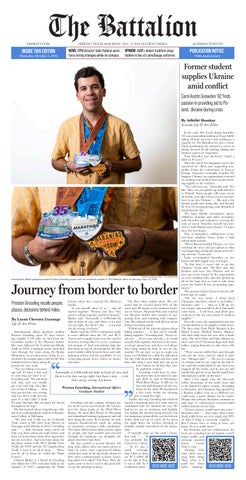
Photos by Isabella Torres — THE BATTALION
International affairs graduate student Preston Grossling poses with his marathon medals in The Battalion office on Monday, Sept. 14, 2026.
Journey from border to border Crown when they reached the Mexican border. “It was actually three of us … that all started together: Preston and Ian, they went to college together, and then I joined,” Barker said. “Essentially a 3,000-mile-ish hike in front of you, and there’s a lot that can go right, but there’s also … a lot that can go wrong, you know.” Barker said the CDT’s remoteness made it more difficult than the AT and PCT. Towns and resupply stops were few and far between, leaving hikers to carry a substantial amount of food and putting help farther away in case of an emergency. He also noted sudden shifts between heat and cold, lightning storms and the possibility of encountering grizzly bears, wolves or mountain lions.
The Poet often walked alone. He estimates that he covered about 90% of the route solo. He began at the northern terminus in Glacier National Park and reached the Mexican border after months of separating from and reuniting with companBy Lasan Ukwatta Liyanage ions. But solitude on the trail did not mean Life & Arts Writer doing everything alone. “I think one of the misconceptions about International affairs graduate student hiking together … is that you’re actually Preston Grossling spent 97 days travelhiking together,” Grossling said. “You’re reing roughly 2,720 miles on foot from the ally not. … Every now and then, we would Canadian border to the Mexican border. actually hike together, but most of the time, His route followed the Continental Divide you’d get spread out, and then we’d all get Trail, or CDT, a national scenic track that into camp within an hour or two of one runs through five states along the Rocky another. I’d say once we got to camp, you Mountains. As an ultrarunner today, he reknow, we’d bullshit for a little bit, talk about members the people, places and the life that the day. Talk about the highs and lows, and unfolds between them along the then after that, it gets dark and you go to journey he once took. bed. I know we all had, like, a lit“You are hiking at an avertle nighttime routine.” age [of] 30 miles a day, and Grossling could hear ice movEssentially a 3,000-mile-ish hike in front of you, and so your legs get used to it,” ing above him as he laid on a narthere’s a lot that can go right, but there’s also … a lot Grossling said. “We call them row shelf of rock in Wyoming’s that can go wrong, you know. trail legs, and you usually Wind River Range. A cliff rose on get your trail legs after, like, one side and dropped all the way Preston Grossling, International Affairs two weeks of hiking. … Your down on the other. He had placed Graduate Student legs just become very strong, a few rocks beside his sleeping and you don’t really feel the spot to mark the edge. pain of a day’s hike. I think Earlier that day, Grossling had climbed I’d gone through, like, six pairs [of shoes] Grossling said the country changed un- toward a mountain pass on a route with no throughout my trip.” der his feet as he moved south. He remem- established trail. Ice blocked the way. He He first learned about long-distance hik- bers the sharp peaks of the Wind River had no ice axe or crampons, and daylight ing as an undergraduate student at Kalam- Range, the open Red Desert of Wyoming was fading. He decided going forward was azoo College in Michigan. and abandoned mining equipment and rail too dangerous; going all the way back down “My first trail I did was the Colorado lines along the route. In Colorado, he said, before dark was out of reach. So he spent Trail, which is 500 miles from Denver to summer thunderstorms made the timing the night above the treeline, listening to Durango, and I did that in 2019,” Grossling of mountain crossings a daily calculation. boulders tumble somewhere on the mounsaid. “ … And obviously when you’re on The route offered more than scenery; signs tain. trail, you learn about the trail culture and of people who had worked and traveled “I basically slept on this rock,” Grossthen you learn about what other opportuni- through the landscape sat alongside the ling said. “ … It ties are out there. And you learn about the places that drew him there. was probably like big three, which is the PCT [Pacific Crest He also carried a second identity. On 6 [feet] by 4 [feet]. Trail], the CDT and the AT [Appalachian long trails, hikers often use names given to … So it’s just a Trail]. I want to do all of those. … When them by other, more experienced hikers, small rectangle you do all of them, it’s called the Triple which they write in the log books whenever that I had to sleep Crown.” they enter a national park or forest. Gross- on. If I rolled off Clayton Barker is a friend of Grossling ling asked to be called “The Poet.” How the to the side of that, who hiked the CDT with him back in the name came to be is a secret only great hik- it was a cliff. So I READ MORE HERE summer of 2021, completing his Triple ers get the privilege to know. would have died.”
“
“
Preston Grossling recalls people, places, decisions behind miles
In the early ‘80s, Carol Austin Snowden ‘82 was a journalism student at Texas A&M, taking 18-hour semesters and working as a reporter for The Battalion five days a week. Upon graduating, she pursued a career in media, focused on the writing, editing and business aspects of magazines. Now, Snowden says she hasn’t “made a dime in 30 years.” After the end of her magazine career, she narrowed her efforts into supporting nonprofits. Using her connections in Eastern Europe, Snowden eventually founded We Support Ukraine, an organization centered on sending vital medical and morale-boosting supplies to the warfront. “The call went out,” Snowden said. “It’s like, ‘Hey, can you gather up stuff and fly it to Poland? Some people will come across the border and take it from you so you don’t have to go into Ukraine.’ … Me and a few friends would start doing this, and literally fly 10 to 20 50-pound bags with all kinds of humanitarian aid.” The bags include tourniquets, gauze, children’s vitamins and other necessities, with Snowden and volunteers covering the costs of travel. Snowden herself has traveled to both Poland and Ukraine 14 times since the war began. One of Snowden’s collaborators is her next-door neighbor Laura Louis, a high school math teacher. “When Russia invaded Ukraine, we were watching the news and just aghast at what was happening, seeing this [democracy] being overrun,” Louis said. Louis accompanied Snowden on her fourth and fifth supply runs to Europe. “At that time, it wasn’t safe to go into Ukraine,” Louis said. “We flew once into Krakow and once into Warsaw, and we were met at the airport by the organization we were working with, and they picked up all of the bags that we had to take them across the border. It was an amazing experience.” The journey back to Texas involved a different type of cargo. “On my way home, I bring back Ukrainian chocolate, which is incredible,” Snowden said. “ ... And so I fill up my now-empty suitcases full of all of that and I come back. … I sell them, and all the proceeds go to buy my next round of medical supplies.” Over the years, the organization saw one crucial addition to its supplies: teddy bears. The idea came from Emily Morgan at the Harris County Medical Society Alliance, who had teddy bears left over after a fundraiser. She tied yellow and blue ribbons on them and sewed Ukrainian flags onto their bellies, urging Snowden to take them with her. “There was one soldier that came through and saw the bears, and he asked to have one,” Morgan said. “ … He was in a group of vehicles, and he saw a girl on the side of the road that looked kind of sad. And so he stopped all the trucks, and he got out and handed the girl the bear. And he [said] later that had put a smile on her face.” After a few supply runs, the blue-andyellow decoration of the teddy bears had to be halted for safety reasons. According to Snowden, any Ukrainian flag spotted by a Russian soldier, even on a children’s toy, could pose a grave danger for its owner. Despite this setback, Snowden continues to take bags of undecorated vacuum-sealed stuffed animals on her trips. “Grown women would burst into tears,” Snowden said. “ ... Ever since then, I have [had] teddy bears on every single trip. 98% of what I bring is extremely valuable. … But I always have to bring at least, you know, 25 or so teddy bears.” For Snowden and her collaborators, the bears are a small gesture set against a much larger conflict, and everyone involved knows exactly what it costs. “During Vietnam, there was a song [that sang,] ‘War, what is it good for? Absolutely nothing,’” READ MORE HERE
METRO
A2
10.01.2026
OPM director discusses federal workforce’s hiring overhaul during campus visit to Texas A&M Director Scott Kupor talks government cuts, AI use in interviews in sit-down with The Battalion prior to speaking event By Ian Curtis Senior Enterprise Reporter Scott Kupor, director of the Office of Personnel Management, paid a visit to Texas A&M on Sept. 22 as part of a college speaking tour to discuss why he feels current students should consider working in the public sector and to detail recent changes in federal hiring practice. In a sit-down interview with The Battalion before his “fireside chat,” Kupor said he embarked on the college tour because of the federal government’s inability to attract young people into the public sector. “We as the federal government have done a really poor job of attracting early career people into government,” Kupor said. “ … I don’t think we’ve gone out to college campuses and, quite frankly, told people a compelling reason for why they should join the federal government. And personally, I think that’s a huge miss.” Kupor — who was named head of the agency that manages and guides hiring and human resource practices across the federal government — said that roughly 7% of the federal workforce is under the age of 30, much lower than the national average in the private sector.
While Kupor was appointed by President Donald Trump in July 2025 following a career as a venture capitalist and after the Department of Government Efficiency, or DOGE, cut thousands of government jobs in March 2025, he said there are elements of the DOGE era that he believes should continue to apply as the workforce in its present state is reshaped into a leaner, more focused system. “Number one is asking questions like, ‘What are the high-priority projects?’” Kupor said. “Unfortunately, with a $40 trillion deficit, we can’t do everything that we’ve always done. So a lot of those hard decisions were, ‘Hey, we might be doing 20 things, but unfortunately, there’s only 18 that we can do [moving] forward.’ … We are in the second part of the reshaping mode, which is, ‘How do we identify the skill gaps that we have?’” In a recent interview with right-wing political commentator Benny Johnson, Kupor said that the federal government needs more workers like Edward Coristine — better known by his digital alias, “Big Balls” — a former DOGE staffer who made headlines during the agency’s cuts to the workforce. In the interview with Johnson, Kupor specifically mentioned Coristine’s willingness to take on a role in the government early in his career despite lacking more traditional qualifications. That sentiment of looking at tangible skills rather than on-paper qualifications is something that Kupor said should have college students excited about the possibility of working in the public sector, even if it’s just for a short period of time before making a transition to the private sector.
“College is wonderful, but having a college degree may or may not necessarily be indicative of your ability to be successful,” Kupor said. “What I want to know is, obviously, ‘What did you learn in that college degree? What are the skills that you bring, whether technical or softer skills?’ And so we’re trying to avoid proxies and actually get to the heart of ‘What is merit?’” Part of the recent changes to the federal workforce have include implementing merit-based promotion and focusing on skillbased hiring — continuing a goal advanced by the Biden administration — while eliminating tenure as the “primary basis of promotion,” Kupor said. “What the new federal government looks like, to me, is what I would describe as a high-performance culture,” Kupor said. “A place where, if we can get great, smart people to do great work, they can be rewarded financially. They can be rewarded in terms of promotions, and they could really move through the organization in a much more seamless way than historically has been the case.” On a cultural level, Kupor said he wants to see the federal government be willing to embrace innovation on a wide scale. “We are trying to make the hard judgements around, again, what we can afford to do and unfortunately what we can’t afford to do,” Kupor said. “Secondly, we’re trying to make it a much more innovative workforce, and the use of technology historically has been very limited in government. Quite frankly, even the willingness to take any kind of risk or innovate has been very, very limited.” Kupor — who issued a memorandum in August detailing how federal agencies
should incorporate AI into their respective hiring processes — said that it should be a tool that increases hiring managers’ efficiency rather than controlling the decision-making itself. The example he brought up was using an AI agent to ask five standards that all candidates for a specific job would be asked during an interview and having the AI provide transcripts of those answers to a hiring manager for them to review. “I would say, right now, it’s an augment to the process,” Kupor said. “It’ll be a very, very long time before it actually drives the process. But I think of it like any other technology, which is, ‘Can you increase the efficiency of the process by using technology?’ And I think there’s limited cases like this interview-use case that we can do.” When asked about his comments to Bloomberg in 2025 about wishing the entire federal workforce could be made up of at-will employees that could be fired at their superiors’ discretion — a shift that Kupor acknowledged could only be made via an act of Congress — Kupor said that civil service protections have harmed government efficiency. “I want to create a high-performance culture, and I think that sometimes the civil service protections, while well meaning, have created scenarios where we can’t,” Kupor said. “It’s very difficult to remove people who are underperforming, and so in that respect I believe very strongly [that] if you can’t perform the minimum skills required — and we’ve given you an opportunity to address that, and you still can’t do that — then yes, it should not take the entire set of civil service protections to remove someone.”
Photos by Yuki Soda — THE BATTALION
Clockwise from top left: U.S. Office of Personnel Management Director Scott Kupor listens as a Texas A&M student asks a question during his fireside chat on Tuesday, Sept. 22, 2026. U.S. Office of Personnel Management Director Scott Kupor gestures while speaking during his fireside chat at Texas A&M University on Tuesday, Sept. 22, 2026. CEO of the George Barbara Bush Foundation, Alice Gonzalez Yates ‘99, listens as U.S. Office of Personnel Management Director Scott Kupor speaks during his fireside chat at Texas A&M University on Tuesday, Sept. 22, 2026. Attendees raise their hands after being asked who is considering a career in the federal government during a fireside chat with U.S. Office of Personnel Management Director Scott Kupor at Texas A&M University on Tuesday, Sept. 22, 2026. U.S. Office of Personnel Management Director Scott Kupor smiles during his fireside chat at Texas A&M University on Tuesday, Sept. 22, 2026.
Boonville Days: Reviving local history through festivities Brazos Valley Museum of Natural History to host festival celebrating local history, traditions By Tejas Murali Life & Arts Writer
Laurie Pottier — THE BATTALION
A rebuilt 19th-century Peters Chuck Wagon is displayed at the Brazos Valley Museum of Natural History on Friday, Sept. 25, 2026.
A few miles east of Bryan lies Boonville; the original county seat of Brazos County and a prosperous town, today it is survived by the Boonville Heritage Park and Cemetery. The Brazos Valley Museum of Natural History aims to bring some of its Texan old-town magic back with its family-friendly Texas Heritage Festival, Boonville Days. The 21st annual Boonville Days will be held at the museum from 9 a.m. to 4 p.m. on Saturday, Oct. 10, with free admission for all visitors. The festival will feature various aspects of the town’s heritage, including period attire, reenactments, demonstrations and authentic chuck wagon-cooked meals available for purchase. In addition, attendees can learn more about Boonville’s history by visiting the Boonville Heritage Park
for its historical buildings and educational activities, facilitated by a shuttle service between the museum and the park. “We are a natural history museum, but there is a precedent for natural history museums to also engage in cultural history,” museum Executive Director Deborah Cowman, Ph.D., said. “So [Boonville Days] got its humble beginnings 21 years ago. … It has since morphed into the largest free public event that we do for the community every year. It’s really grown from that interest in preserving the heritage and information about the town of Boonville.” Boonville was an important town between 1841 and 1866, with wealthy settlers such as the “Father of Brazos County” Harvey Mitchell, who purchased land and developed the area into an agricultural hub and recreational town. However, the 1866 advent of railroads in nearby Bryan marked the beginning of Boonville’s decline. “After [1866], Boonville becomes a bit of a back-burner community,” museum Education Administrator Garret Leopold said. “So here at this site in Boonville Heritage Park, as well as in Boonville Days, it’s extremely important for us to be able to remember that heritage. … At the museum, we’ll be having a location known as Boonville Village, and that site will be focused on reenactors from the time period of Boonville. And we’ll have different volunteer groups dressed up in period garb focusing on some of the educational things that we do out here.” The festival will kick off with a five-kilometer race dubbed “Buffalo Stampede” as well as a one-mile “Fun Run” starting at 7:30 a.m., followed by various period-reminiscent activities. A standout feature of Boonville Days will be the historical reen-
actments aimed at bringing local history to life. “It’s one thing to read and see a movie, but to stand there and talk to someone who’s in period garb and is knowledgeable about what they’re dressing up as in the time period is, I think, a really cool experience,” museum Executive Associate Hunter Johnson said. “I remember going to places as kids and seeing living history and reenactors, and being so fascinated by them. I think it’s really important to have the physical appearance and hearing someone tell you these things.” Furthermore, over 30 volunteers will demonstrate frontier and pioneer skills like blacksmithing, weaving, animal-rearing and traditional music and dances. Many of them will be community members and returning participants of the festival. “My favorite part is just seeing all the local community members come together to demonstrate the various skills that they have that are things that people would have done in the 19th century here,” Cowman said. “For example, we have one lady coming and she’s going to make pinch pots with children and show them how to do that. So it’s like having all these old friends come together for this wonderful party to celebrate our local history.” Boonville Days aims to entertain and educate children and adults alike with a variety of activities, including a pony photo booth, a petting zoo and child-friendly demonstrations. “We try to make that connection for kids that all these things were handcrafted by people,” museum Associate Director and Education Coordinator Maria Lazo said. “It’s like seeing a wagon wheel and a blacksmith demonstrating how it was made, and
then leading about transportation and how it’s different now than it was back then. Or seeing weavers making fabric and transforming it into the clothes that they wear. It’s about getting to the roots of how these skills were so important to helping shape a life.” Although Boonville is no longer the seat of Brazos County, its history remains relevant to that of Bryan-College Station. Boonville Days volunteer Henry Mayo, a retired land surveyor, believes that informing people about the origins of their hometown is a major aspect of the festival. “I’ve surveyed the land and learned all of this and know where all of the rural cemeteries and people’s farms were before the town grew out into those areas,” Mayo said. “It’s fascinating that it was established on a prairie, on top of a hill in the middle of the county in 1841, and all of that written record in Brazos County is mostly preserved and intact. … So it’s fascinating to me to be able to share that with people and tell them where their home is in Bryan-College Station.” According to Cowman, the Brazos Valley Museum of Natural History is the only museum of natural history in a 100-mile radius, thus emphasizing the importance of preserving the area’s cultural history and traditions through educational programs like Boonville Days. “It’s a real labor of love, because it’s our opportunity to have everybody come in for free and learn about our local history and have fun at the same time,” Cowman said. “It’s awfully hard to understand your local identity, and it’s hard to know where you’re going if you don’t know where you’ve been. So I just feel that preserving history is really important.”
SPORTS
10.01.2026
A3
Opinion: A&M covers tradition with camouflage If only A&M had a 150-year-old uniform to pull inspiration from By Julius Sjolie Social Media Editor
what the 12th Man expected from it. And 13 years later, we still haven’t recovered. Senior quarterback Marcel Reed led A&M to an 11-0 start in 2025 — its best since 1992 — and the program’s first-ever College Football Playoff appearance. He has continuously climbed A&M’s career passing lists, surpassing quarterbacks remembered fondly in Aggieland such as Stephen McGee and Ryan Tannehill. Yet four games into 2026, Reed is hearing a much different tune. Some of that is deserved. A&M is 2-2 and 0-2 in SEC play, and Reed just completed only 10-of-26 passes for 106 yards with no touchdowns and an interception against LSU. Criticize him; expect better. But remember what happened two years ago, in 2024, when Kyle Field chanted Reed’s name when then-sophomore QB Conner Weigman struggled: Aggies wanted the next guy then, too. At some point, the grass isn’t always greener. The bigger problem is that somewhere in the back of our minds, A&M fans are still waiting for No. 2 to come running out of the tunnel again. Stop waiting. Johnny Manziel was lightning in a bottle — a once-in-a-generation combination of talent and chaos that transformed A&M’s football program. There may never be another Johnny Football in College Station, and there doesn’t need to be.
For a football program so steeped in history and tradition — our last national championship being before World War II, after all — and a multitude of iconic uniforms at our disposal, you would think finding something to wear for our 150th anniversary would be nothing short of an easy task. If only there were some kind of historic uniform-wearing organization that has partnered with Texas A&M Athletics for uniform designs before that could serve as inspiration for this momentous event, pairing the deep symbolism of service and sacrifice that were pivotal to the foundation of our university. But A&M Athletics has instead released the most eyesore-inducing, cornea-burning, should’ve-stayed-hidden camouflage and maroon uniform that (last camouflage pun) does anything but keep a low profile. Now, past organization involvement aside, I think it’s pretty obvious that the Fightin’ Texas Aggies missed a huge opportunity to pay homage to the Corps of Cadets with a uniform similar to A&M baseball or basketball’s tan patch-laden uniforms that were released within the last five years. Now, I am not going to sit here and tell you that I want to see parachute pants and knee-high brown socks (sorry Aggie baseball) on Kyle Field this Saturday, but it’s hard to believe I am the only person who drew this obvious connection between history, traditions and uniforms — and Adidas didn’t even have to pay me $47 million to come up with that. I don’t even think it would necessarily be that hard. Because really… that’s the best we could come up with? Just do something to support the most committed part of the student section you have at every game. I wouldn’t even be mad if they did something to support the band; they certainly seem to have better luck when it comes to getting across the field. But this comparison between, or union of, the Corps and Aggie football is actually a lot closer than you might think. John David Crow ‘58, A&M’s first Heisman Trophy winner, was a member of the Corps when head coach Bear Bryant led him on his 1957 Heisman season and E. King Gill 1924, the very first 12th Man, was a member of the Corps when he donned the uniform and stood patiently on the sidelines of the Dixie Classic in January 1922. And for those of you who haven’t yet caught my drift, every A&M football player before the fall semester of 1963 was a member of the Corps, and while we can all agree that this change has been beneficial for the university and athletics department whole, especially with the rise of NIL and the historic football records of Army, Air Force and Navy, it is almost ironic for a school that prides itself on its military history to produce these “Honor and Support” uniforms — ones that seem to pull more inspiration from the strikingly similarly named “Honor and Support” uniforms from Miami. Though even they had the common sense to go with black helmets and equally uninspired green pants. This isn’t to say that I'm not a fan of camouflage — I plan to spend a good portion of the next five years in it — I’m just saying that I’m not a fan of the bad thinking that leads to bad camouflage. And trust me, the U.S. Military is not unfamiliar with bad camouflage. But never once did they try to match Digital Tiger Stripe or Universal Camouflage Pattern with red pants. And while A&M athletics may insist that its color choice doesn’t actually stem from hearing “camel” instead of “camo,” it offers the idea that its inspiration actually lies in the “Corps khaki uniforms, dried grasslands and the rolling hills of Aggieland,” but it all just feels like the cover-up of a poor decision and maybe a chance to hide that someone’s next eye doctor appointment is overdue. But rest assured, Maroon U and C.C. Creations, these jerseys will do numbers on the Instagrams of our Hunter demographic — and by that I mean our agricultural economics or business majors named Hunter who need something else in their closet besides their white shirt, red tie, blue sports coat and khakis. With decisions of Arkansas and the 150th uniform in the rearview, just like the quarterback situation in the games against Kentucky and LSU, I’m not asking for changes. Changes only go so far in hindsight. I’m just asking for evidence of thought … maybe some historical Corps recognition … and to do a little bit better than 6-6 this season.
Trey Bohne is a communication senior and associate sports editor for The Battalion.
Julius Sjolie is an industrial distribution senior and social media editor for The Battalion.
Photos by Adriano Espinosa — THE BATTALION
Clockwise from top left: LSU running back Dilin Jones (13) fights a horde of Aggies during Texas A&M football’s game against LSU at Tiger Stadium on Saturday, Sept. 26, 2026. Kicker David Olano (24) braces before a field goal during Texas A&M football’s game against LSU at Tiger Stadium on Saturday, Sept. 26, 2026. Running back KJ Edwards (0) runs through a tackle during Texas A&M football’s game against LSU at Tiger Stadium on Saturday, Sept. 26, 2026. Wide receiver Kelshaun Johnson (11) runs amid a foul during Texas A&M football’s game against LSU at Tiger Stadium on Saturday, Sept. 26, 2026
Crossing bylines: Arkansas at A&M Previewing Aggies’ rivalry showdown against Razorbacks By Ian Curtis Senior Enterprise Reporter When fans venture into Kyle Field as Texas A&M football welcomes Arkansas to town this week, they’ll find two teams in turmoil. On one hand, A&M is looking for a chance to get back on its feet after a 35-6 loss to then-No. 10 LSU that dropped the Aggies to 0-2 in Southeastern Conference play. On the other hand, the Razorbacks are looking to keep up their momentum, having just snapped a 12-game losing streak to FBS opponents with a win over Tulsa in the first year of head coach Ryan Silverfield’s tenure. To get an idea of what the 12th Man can expect from this year’s rivalry matchup, I spoke to Anthony Kristensen of WholeHogSports.com about how things have gone for Arkansas so far this year. Kristensen, who made his way to Arkansas after graduating from Missouri and working for a team as a beat reporter covering Evansville and Southern Indiana, said that fans entered this season with realistic goals. But the team’s sluggish season-opening win over FCS foe North Alabama and
lackluster showings in blowout losses to No. 2 Georgia and then-No. 20 Utah have drawn ire from fans — not necessarily at Silverfield and his players, but at athletic director Hunter Yurachek, given the program’s funding woes. “The expectations for the team this year entering the season were not high,” Kristensen said. “ … Obviously those are two phenomenal programs and phenomenal teams, but just to be completely non-competitive in those games, there was a lot of fire and fury from the fanbase, and understandably so, right?” Familiar face Arkansas will be bringing a star back to Kyle Field that many Aggies might recognize — although it won’t necessarily bring back positive memories. The Razorbacks’ leading receiver this season is fifth-year wide receiver Chris Marshall, who made his way to Fayetteville, Arkansas, after two seasons at Boise State. But before his time on the Smurf Turf, Marshall was a freshman on A&M’s 2022 team under former head coach Jimbo Fisher — where he was one of four players suspended for a game against Miami before being suspended for a second time later that season, this time indefinitely. Marshall — who had nine catches for 195 yards and a touchdown against Tulsa last week — has become Arkansas’ clear star, Kristensen said. “He’s going to be the first option every
time [junior quarterback] KJ Jackson drops back to pass,” Kristensen said. “He’s going to be the first guy he looks for, and a lot of times, I think, you know, sometimes it’s going to be, ‘Chris Marshall can go up and get that ball.’ … If he’s not the heart and soul [of the offense], maybe he’s the blood running through the veins.” Jackson, who is in his first full season as the Razorbacks’ starter, has had his fair share of struggles this season, Kristensen said. “Sometimes his decision-making has left a little bit to be desired,” Kristensen said. “He keeps rolling to his right despite being a left-handed quarterback, which puts him in tough spots at times. Is that him kind of overanalyzing a situation, putting himself into more pressure? Is that play calling? I’m not exactly sure, but that just keeps happening, and you can tell that people are frustrated by that.” The Razorbacks have struggled to find success on the ground, ranking last in the SEC in rushing offense while averaging less than three yards per carry. Kristensen said he sees that as the most glaring issue Arkansas needs to fix on Saturday. “You have to establish a run game,” Kristensen said. “A&M has obviously struggled the past couple of weeks, and you want to take advantage of that. You don’t want to be the rebound game, right? You have to establish some sort of ground game to give yourself a chance to keep up and keep up with something that you set the foundations with against Tulsa.”
Opinion: Manziel is not the standard Expecting Marcel Reed to be Johnny 2.0 is part of the problem By Trey Bohne Associate Sports Editor Johnny Manziel was never supposed to happen.Before taking a snap for Texas A&M, the redshirt freshman had already been arrested and jailed following a fight on Northgate. According to his longtime friend and former right-hand man Nate Fitch, he hardly touched the playbook. Ahead of a 2012 matchup with Mississippi State, Manziel showed up to the pregame walkthrough hungover and pouring in sweat. “You better f-ing play good,” then-offensive coordinator Kliff Kingsbury told him. And he did. Manziel completed 30-of-36 passes and accounted for 440 yards and two touchdowns in the 38-13 victory. A week later, he marched to Tuscaloosa, Alabama, and handed then-No. 1 Alabama a 29-24 loss. That was Johnny Football; none of it made sense. In A&M’s first season in the Southeastern Conference, Manziel threw for 3,706 yards and 26 touchdowns while rushing for another 1,410 yards and 21 house calls. The Aggies went 11-2 and finished No. 5 nationally as Manziel became the first freshman to win the Heisman Trophy; then somehow he got better. Manziel threw for 4,114 yards and 37
touchdowns in 2013, finishing his two-year career in College Station with 9,989 yards of total offense and 93 touchdowns. A university-commissioned study estimated that A&M received $37 million in media exposure following the Aggies’ inaugural SEC season and Manziel’s Heisman run. During the 2012-13 fiscal year, A&M raised over $740 million in donations — $300 million more than its previous record — amid the university’s move to the SEC and football success. Months after Manziel’s Heisman victory, A&M approved a $450 million renovation of Kyle Field that pushed the stadium’s capacity past 100,000. Johnny Manziel didn’t just change A&M football; he changed
A4
OPINION
10.01.2026
Opinion: We don’t know how to be curious anymore We’ve never had more answers at our fingertips, but society has forgotten the value of questions By Prachi Arora Opinion Columnist We have somehow reached a point where watching a movie without knowing the ending feels like a personal challenge. Between TikTok spoilers, movie recaps and the endless stream of short-form content, we have grown accustomed to getting the payoff without experiencing the buildup. Why spend two hours watching a movie when you can watch the highlights in 60 seconds? This habit extends beyond entertainment. We Google questions before trying to answer them ourselves, search for explanations before forming our own opinions and investigate strangers online simply because we can. I do it too; it’s easy to look something up the second it crosses my mind, even when I might enjoy figuring it out for myself. The internet has made information more accessible than ever, but somewhere
along the way, we have started treating curiosity as something to satisfy as quickly as possible. We want the answer, but we rarely want to wait for it. There is a reason suspense makes a good story. The uncertainty, anticipation and theories we come up with along the way are part of what makes the ending satisfying. When we look up a movie’s conclusion before watching it, we trade that experience for a shortcut. We might still enjoy the story, but we have already taken away the possibility of being surprised. And the habit does not stop when the credits roll.
The option to consult someone else’s explanation before developing our own has become increasingly available. A confusing scene, an unfamiliar idea or a complicated issue can be met with an immediate search for what it means. Other people’s interpretations can be useful, but when we reach for them too quickly, we risk skipping the process of figuring out what we think for ourselves. Not every question needs an immediate answer, and not every mystery needs to be solved. Sometimes, the interesting part is sitting with uncertainty, imagining possibilities or realizing that we do not know enough yet. Curiosity is not just about
Illustration by Tanner Brown — THE BATTALION
reaching a conclusion — it is also about the experience of getting there. Of course, instant access to information is not an inherently bad thing. The internet makes it easier to learn, explore unfamiliar subjects and understand the world around us. There is nothing wrong with looking something up when we genuinely want to know. But there is a difference between using information to explore our curiosity and using it to avoid the discomfort of not knowing. Maybe, the problem is not that we have too many answers: It’s that we have become less willing to wait for them. I know I’m not immune to it. The next time I’m tempted to look up a movie ending, search for an explanation or uncover every detail about something unfamiliar, I should let myself wonder a little longer. What might I discover if I stopped treating uncertainty as something I have to get past as soon as possible? In a world where we can find out almost anything in seconds, we should relearn how to enjoy not knowing. Prachi Arora is a political science sophomore and opinion columnist for The Battalion.
Review: The Love Hypothesis Another rom-com leads to audience disappointment By Thea Findlay Opinion Columnist Rating: 4/10
Illustration by Susana Lazcano — THE BATTALION
Opinion: Mom and Dad, I’m not a child anymore Apparently, leaving the nest doesn’t fly with everybody By Abby Morris Opinion Writer Parenting is hard, but being an adult with parents who still see you as a child might be harder. There’s nothing worse than having proved you’re a capable, responsible adult and still having your parents treat you like a child. Yet, this is a common problem young adults today face, and instead of our parents pushing us out of the nest, we’re now having to force our way out. I have personally struggled with this and understand how challenging it can be to navigate this new dynamic because I love my parents — they provided me with a great life, and I’m incredibly grateful to them for all of their love and support — but it took a long time for them to let go and finally see me as an adult. It didn’t matter that I was 21 years old with great grades and two out-of-state internships; it still felt like I was in high school and having to ask for permission or be worried about getting in trouble. To a degree, I understand. We’re all used to a certain way of life after having spent 18 years under one roof together where we were dependent on them and had to follow their rules. But expecting this dynamic to continue throughout college is harmful and, unfortunately, the reality for younger generations. Instead of allowing their children to become independent, many parents continue to hold on. This has shifted college from a place to be free of parental oversight to an extension of high school. For some parents, it’s about not having control over their child’s actions. For others, it’s excessively worrying about potential danger. Take, for example, college parent Facebook groups, where posts range from “How do I make sure my daughter doesn’t have boys in her dorm?” and “Where can I get a list of professors’ emails to establish a
line of communication?” to “How do I ask the college to install cameras in my child’s dorm room?” These posts might seem like the innocent anxieties or old habits of a parent, but they’re really just blatant proof that parents today are too involved. There’s always going to be the parent-child dynamic and, sometimes, there will be moments when you need your Mom and Dad’s help. That’s okay. But this unhealthy dynamic is far from that I am referring to. Research has shown that helicopter parenting has negative outcomes such as poor coping skills, inadequate life skills and low self-esteem and self-image. Additionally, being too strict or overprotective is more likely to make your child lie to you or feel like they can’t tell you anything. Parents need to realize it’s no longer their responsibility to remind their adult children of deadlines or tell them what they’re “supposed” to do. That’s what the past 18 years were for, and at some point, they’re going to have to trust that all those years of parenting taught their child right from wrong. We cannot become functioning adults after college if our parents still hold us on a leash. College is the time to make mistakes and learn from them — it’s still a relatively safe and protected environment. Yes, these mistakes might make our parents mad. Some might even significantly alter your life, but isn’t that part of growing up? If we don’t have the freedom to live, will we go through life afraid of making mistakes, not knowing how to do things on our own or how to form healthy relationships? I truly doubt this is what parents want for their children. No parent wants to let their kid go, but it’s a crucial part of life. Being overprotective and babying adult children won’t help; it’ll only create resentment. So, on behalf of the adult children struggling with this, I say to the parents, “Let us go.” Abby Morris is an English honors and political science senior and opinion writer for The Battalion.
Spoilers ahead for “The Love Hypothesis.” Oh boy! Thank you Amazon Prime for another subpar romcom. Let me start by saying I adore both mediocrity and Lili Reinhart, so I was thrilled going into this movie, even though I had consistently refused to ever pick up the book. “The Love Hypothesis” was most certainly an experiment, so let me be the first to warn you: This movie does not go to show without its bumps — namely, the male protagonist and love interest, Adam, played by Tom Bateman. Before I dive into the issues of his character, I want to preface that I was thoroughly impressed by Reinhart’s performance as Olive. She is a strong female lead who has actual deep friendships with the people around her and a passion for biology. Since I’m a self-proclaimed feminist, I have to support a woman in STEM. All around, if Olive’s worst character flaw was ordering a velvet caramel and white chocolate bliss with extra whipped cream and chocolate sprinkles, I’m okay with her — I’ve watched much worse. I will give this movie credit for keeping me entertained. Reinhart and Bateman had great comedic chemistry, and while watching her put sunscreen on him gave me sec-
ond-hand embarrassment, the beginning of their fake dating was truly hilarious. Unfortunately, this sums up the few positives the movie had — also known as me laughing in the awkward second-hand embarrassment way. Low bar, I know. Tragically, this cinematic nightmare came to life just to ruin any moment of a cute romantic comedy. Oh, Adam. Why was everyone always sobbing and screaming when walking out of his office? I get that his nickname is “Mr. Evil,” but this made him straight-up unlikeable. Who actually wants a boyfriend — even a fake one, for that matter — who is terribly rude in a blunt, emotionless way? It’s embarrassing. Plus, on their first fake coffee shop date, I am supposed to believe that the entire school of Stanford knows the infamous Mr. Evil, aggressively stares at them and weirdly takes photos to post online. I totally get that our generation may have blurred the lines between privacy and the ability to film strangers, but yikes, this was weird and unrealistic. Then, to make matters worse, Olive’s questionable coffee order is literally thrown away by him in passing and replaced with a green smoothie. Am I meant to think it’s adorable he cares so much about her health, despite the fact that she — an adult woman — bought her very own drink, which probably cost $9 in this economy? Absolutely not, and I will not fall for this evil man propaganda. My second question for this movie is: Why did Adam have a double room previously booked for the conference? Does Adam like to push two beds together when he sleeps? Does he like sleeping by an empty bed? Rotate which one he sleeps in each night? So many questions and so few answers. While this movie has lots of “com,” the “rom” was impossible to take seriously when Olive felt like a full-fledged woman, and Adam was a two-dimensional black hole of a human. Dear Amazon Prime, the main guy can’t just take his shirt off, show off his abs and call it a day. He needs to be semi-bearable as a person too. My lasting thoughts are this: I miss Conrad Fisher’s yearning, and I want more of Lili Reinhart on my screen. Thea Findlay is a communication senior and an opinion columnist for The Battalion.
Photos by Laurie Pottier — THE BATTALION
Copies of “The Love Hypothesis” by Ali Hazelwood are displayed at Barnes & Noble in College Station on Monday, Sept. 28, 2026.
10.01.2026
NEWS
A5
Bush School hosts Texas-Mexico cooperation forum Event brings research experts, leaders together to examine future of cross-border relations By Ariadni Maria Pappa News Reporter Texas A&M’s role in connecting academia, business and public policy was a central focus at the Sept. 22 forum held by the Mosbacher Institute for Trade, Economics and Public Policy, examining the economic and broader transnational relationship between Texas and Mexico. The one-day leadership forum, “Security and Prosperity in North America: Advancing Texas-Mexico Commerce and Cooperation,” brought together university researchers, business leaders, government officials and other stakeholders from both sides of the border to discuss areas of collaboration across disciplines. For Cory Arcak, Ph.D., director of international and high impact experiences at The Bush School of Government and Public Service, the forum demonstrated the inherent role of universities in conversations that extend classroom discussions. “The biggest success was that business approached the university asking for guidance, so that they would understand better how to influence public policy for the betterment of society and economics and trade between Texas and Mexico,” Arcak said. “It was said multiple times that the universities need to be involved, and it just shows the relevance that we have, not only to our government, but also to our private sector.” The idea for the event emerged from conversations between Texan and Mexican business figures, with Arcak spearheading the initiative at A&M and shaping its direction. “Interestingly, it was brought to us from our friends and our International Advisory Board members in Mexico,” Arcak said. “Two businessmen were sitting together, lit-
erally having lunch, and one of those businessmen happened to be an International Advisory Board member who said, ‘why don’t we have this discussion at Texas A&M University?’” Interim Director of Mosbacher Institute Michelle Taylor-Robinson, Ph.D., emphasized the importance of connecting sectors shaped by deep-rooted interdependencies across the border. “Bringing together people in diverse aspects of business and academia who are involved in the enormous economy that is on both sides of the Rio Grande is very important,” Taylor-Robinson said. “Seeing
Arcak said the relationship remains relevant to Texas today, tomorrow and in the future. “We are two supply chains that are integrally and completely connected,” Arcak said. “We hear on the news all the negative impacts about the relationship, yet there’s so much positive happening, and we wanted to share that. At the end of the day, it impacts our state and our people so deeply.” Echoing Arcak’s point, John B. Sherman ‘92, dean of The Bush School, illustrated that the forum was intended to broaden the conversation to other areas where Texas and Mexico depend on one another. “Homeland security matters, as the Sec-
Jenna Isbell — THE BATTALION
Signage outside the Bush School of Government and Public Service on Monday, Sept. 30, 2024.
the conversations that were going on all day, and between all the events, really makes me think that not only was this a fantastic educational experience for the people in attendance, but in terms of building cross-border communication, it was actively happening in those rooms.” Arcak finds that the partnership between Texas and Mexico surpasses economic statistics and government policy, affecting communities throughout the state. With about 40% of Texas’ population being Hispanic, much of it with Mexican heritage,
retary of State indicated,” Sherman said. “You have to start from the premise of a secure border, but that can’t be our sole focus. I think as a university here and with the stakeholders, to be able to look at all the other dynamic aspects here on oil, agriculture, manufacturing, is not only desirable, but critical for us to be able to look beyond the here and now on some near-term issues that are worthy of attention.” Taylor-Robinson sees the relationship between Texas and Mexico as one that can be strengthened through continued engage-
ment. Bringing researchers, businesses and other experts together cultivates opportunities to link ideas across fields and apply them to challenges shared by both parties. “I think it has to extend beyond simply an academic partnership,” Taylor-Robinson said. “It’s more than just a research connection, but we still need these important academic and research exchanges. This is the kind of situation where universities can really help the discussion occur because we are supposed to be neutral. Our research can inform decisions whether it’s for business, agricultural problems or policy challenges, so it really is a synergy.” Rather than ending with the forum, organizers and participants are working to carry the conversation forward through cross-border projects aimed at producing tangible results. “We started this project seven months ago, working cross-border with our partners, and the intent was to have tangible action outside of it,” Arcak said. “They didn’t want the traditional conference where we’re just talking about academics. Now, they actually want to see follow-through on different projects.” Rabi Mohtar, Ph.D., a TEES professor and water-energy-food nexus expert who participated as a panelist, believes future collaboration should also involve students and communities directly affected by cross-border policy. “This could be a crucial step because it creates a platform for A&M students and Mexican students to collaborate,” Mohtar said. “I proposed high-impact service learning, where students could actually go into communities, especially the colonias, and meet with them to find out what their needs are. From there, they could build capstone experiences, including the Bush School from the policy side and engineering from the technology side.”
READ MORE HERE
Dementia researchers earn innovation award ‘Digital Human’ detects early signs of cognitive decline By Callie Graves News Reporter The Texas A&M School of Public Health won a global award for an AI-powered “digital human” that helps with early dementia screening. Mark E. Benden ‘90, Ph.D., and his team at the School of Public Health were awarded a 2026 Innovation by Design Award from Fast Company on Sept. 14, for the digital human that tracks speech, facial expressions and biometric data to detect signs of apathy associated with the early stages of dementia. Fast Company is a business media brand focused on innovation, technology, leadership, creativity and design that awards more than 300 Innovation by Design Awards annually. The awards recognize innovative research, projects and services across industries that address real-world problems. Fast Company’s award highlights the program’s potential to transition from clinical research into a widely accessible tool for the public and scale for integration into health systems. Benden’s research team in A&M’s Dementia and Alzheimer’s Research Initiative, or DARI, developed a virtual interface de-
signed to closely resemble a human while screening patients by asking apathy-related questions and analyzing patient behavior. “A digital human, that device could potentially pick up on some things from you that you don’t even know you’re doing,” Benden said. “We are just trying to apply it in a healthcare setting to capture information about humans today that may help us with diagnosis and potentially, again, treatment and cure later.” The digital human, known as Cassie, interviews patients to screen for changes in apathy levels. This data can then be compared with one patient over time or multiple patients to better compare and understand dementia progression. Typically associated with early signs of cognitive decline, changes in apathy can be detected through the digital human’s ability to pick up on behavioral indicators. The digital human detects differing speech patterns, response times, facial expressions and biometric data to track behavioral and emotional changes that can help identify signs that lead to dementia. “If we can understand it earlier, we might be able to diagnose and potentially someday treat and or cure,” Benden said. “And for our team, the chance to see that research get used by people to help folks is a real positive.” More than 7 million Americans, with almost half a million in Texas alone, live with dementia-related illnesses. In November
2025, Texas voters approved Proposition 14 with 69% support, creating a $3 billion dementia research fund. Proposition 14 created the Dementia Prevention and Research Institute of Texas, or DPRIT, allowing researchers the opportunity to collaborate across industries to study the causes, prevention and treatments associated with dementia research. Despite a suit against Proposition 14 that halted DPRIT’s funding, A&M launched DARI in May 2025 to align with the Texas Dementia Initiative, committing $1.325
million to fund 11 multidisciplinary research projects focused on brain health and medical innovations related to dementia. One of the 11 research projects was Benden’s digital human. Benden considers the Fast Company recognition as an acknowledgement for the work his team has done, the impact it has made and a reminder of the steps ahead of them. “It’s a nice combination of ‘Good job so far,’” Benden said. “It’s just encouraging because we all know there’s 19 more steps. We realize that. Baby steps.”
Kelly Johnson — THE BATTALION
Industrial Engineering Ph.D. student Sarah Allahvirdi runs tasks using different monitors created to watch body responses to stress at Emerging Technologies Building on Wednesday, Sep. 23, 2026.
ENTERTAINMENT
A6
Dr. Doctor goes avant-garde
The Battalion Ava Loth Editor-in-Chief
Kynlee Joyner Managing Editor David Swope
Maeva Elizabé
Tanner Brown
Ian Curtis
News Editor
Opinion Editor
Design & Graphics Editor
Senior Enterprise Reporter
Emily Anderson
Wyatt Pickering
Julius Sjolie
Kynlee Joyner
Associate News Editor
Associate Opinion Editor
Social Media Editor
Business Manager
Sophia Muñoz
Trey Bohne
Rocio Salgado
Tiffany Vasquez
Life & Arts Editor
Associate Sports Editor
Photo Chief
Business Manager
Adhithi Shankar
Brody Vaughn
Steve Carrasco IV
Sara E. Gonzales
Associate Life & Arts Editor
Associate Sports Editor
Photo Chief
Associate Director of Student Media
The Battalion is published Thursdays in Fall 2026 (except university holidays and exam periods) at Texas A&M University, College Station, TX 77843. Offices are in Suite L400 of the Memorial Student Center. The Battalion is managed by students at Texas A&M University in Student Media, a unit of the Division of Student Affairs. Newsroom Phone: 979-845-3315 Email: editor@thebatt.com Website: http://www.thebatt.com Advertising: Publication of advertising does not imply sponsorship or endorsement by The Battalion. For campus, local and national display advertising, email battads@thebatt.com. Office hours are 8 a.m. to 5 p.m. Monday through Friday.
10.01.2026