The Battalion
THEBATT.COM
INSIDE THIS EDITION Thursday, November 12, 2026
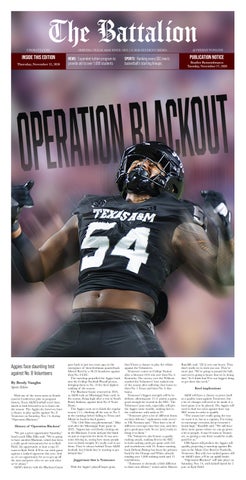
Aggies face daunting test against No. 8 Volunteers By Brody Vaughn Sports Editor With one of the worst starts to Southeastern Conference play in program history, Texas A&M football won’t have much to look forward to as it closes out the season. The Aggies do, however, have a chance to play spoiler against No. 8 Tennessee on Saturday, Nov. 14, during “Operation Blackout.” History of ‘Operation Blackout’ “We got a great opportunity Saturday,” head coach Mike Elko said. “We’re going to have another Blackout, which has been a really good environment for us in Kyle Field. An opportunity to host a top-10 team in Kyle Field. It’ll be our sixth game against a ranked opponent this year. And so, it’s an opportunity for us to get up off the mat and prove who we are and what we’re about.” A&M’s history with the Blackout Game
SERVING TEXAS A&M SINCE 1893 | © 2026 STUDENT MEDIA
NEWS: Expanded tuition program to provide aid to over 1,000 students
SPORTS: Ranking every SEC men’s basketball’s starting lineups
goes back to just two years ago, in the emergence of then-freshman quarterback Marcel Reed in a 38-24 beatdown against then-No. 8 LSU. The matchup propelled the Aggies back into the College Football Playoff picture, bringing them to No. 10 for their highest ranking of the season. The Blackout Game returned in 2025, as A&M took on Mississippi State early in the season, flying high after a win in South Bend, Indiana, against then-No. 8 Notre Dame. The Aggies went on to finish the regular season 11-1, climbing all the way to No. 3 in the rankings before falling to Texas and Miami in back-to-back games. “The 12th Man was phenomenal,” Elko said after the Mississippi State game in 2025. “Appreciate everybody coming out in the Blackout. I went and put the black on just to represent for them. It was awesome driving in, seeing how many people were in black tonight. It’s really cool to see them. They’re always behind Texas A&M football, but I think they’re starting to get behind this.”
they’ll have a chance to play the villain against the Volunteers. Tennessee comes to College Station after a blowout 34-6 win over then-No. 6 Kentucky. The victory over the Wildcats marked the Volunteers’ first ranked win of the season after suffering close losses to then-No. 1 Texas and then-No. 6 Alabama. Tennessee’s biggest strength will be its defense, allowing just 15.11 points a game, good enough for second in the SEC. The Volunteers’ pass rush, especially, will give the Aggies some trouble, ranking first in the conference with sacks at 39. “Tennessee gives a lot of different fronts on their defense,” sophomore wide receiver TK Norman said. “They have a lot of different coverages that they run, and they got a good pass rush. So we [are] ready to bring it to them.” The Volunteers also feature a quality rushing attack, ranking first in the SEC in both rushing yards per game with 216 and touchdowns with 24. Senior running back DeSean Bishop has been the primary back for the Orange and White, already totaling over 1,000 rushing yards and 13 touchdowns. “Tennessee is obviously a little different to their own offense,” senior safety Marcus
Juggernaut that is Tennessee With the Aggies’ playoff hopes gone,
@THEBATTONLINE
PUBLICATION NOTICE Bonfire Remembrance: Tuesday, November 17, 2026
Ratcliffe said. “[It’s] very run heavy. They don’t really try to trick you out. They’re more just, ‘We’re going to pound the ball, and you’re going to know that we’re doing that.’ So I think that’ll be our biggest thing to get done this week.” Bowl implications A&M will have a chance to prove itself as a quality team against Tennessee, but a lot of changes will need to be made if a bowl game is to be played. The Aggies will need to find two wins against three top SEC teams in order to qualify. “The season isn’t really going the way we want it to, but as a captain, I’m trying to encourage everyone, keep everyone’s heads high,” Ratcliffe said. “We still have three more games where we can go prove a lot to people. A top-10 team in Tennessee, so getting a win there would be really good for us.” CBS Sports still predicts the Aggies will qualify, projecting a matchup against Illinois in the Music City Bowl in Nashville, Tennessee. But with two ranked games still on A&M’s slate, it’ll be an uphill battle. “Operation Blackout” will take place on Saturday, Nov. 14, with kickoff slated for 2 p.m. at Kyle Field.
SPORTS
A2
Crossing bylines: Tennessee
11.12.2026
Sitting down with The Daily Beacon as Aggie football hosts Vols By Ian Curtis Senior Enterprise Reporter As Texas A&M football hosts this year’s “Operation Blackout” game, it’ll be facing stiff competition from the No. 8 Tennessee Volunteers. Sitting at 7-2, the Vols have their eyes on a spot in the College Football Playoff, while the Aggies at 4-5 need to win 2 of their last 3 matchups just to reach bowl eligibility. But anything can happen in the Southeastern Conference, which has had its fair share of upsets this season. Tennessee itself already fell to then-unranked South Carolina earlier this season. To get an idea of what Aggie fans can expect from the Vols, I sat down with Trevor McGee, the sports editor of The Daily Beacon, the student newspaper at Tennessee. McGee, a Tennessee native himself, said that while vibes from the Vols’ fanbase were high as usual to begin the year, the team has exceeded most reasonable expectations coming off of last year’s 8-5 season under head coach Josh Heupel. “There was a little bit of gloom over the program just because it seemed like it would be a transition year with a defense under a new coordinator and a quarterback that probably needed to grow in Year 1,” McGee said. “ … Things have definitely changed as the year has progressed. And now it’s just whether they can finish things up over these final three games.” That success this season has come despite troubles on the quarterback front. Freshman quarterback Faizon Brandon started this year before suffering an injury during a game against Texas, when he was replaced by sophomore QB George MacIntyre. While MacIntyre has been the starter since Brandon’s injury, McGee said, the freshman is now cleared to be used sparingly as of last week, when he contributed to a 34-6 win over then-No. 6 Kentucky. “They are designing certain packages for Faizon to get more involved again and still won’t officially name who a starter is going to be until whoever trots out there on Saturday,” McGee said. “And so now it’s like almost leaning toward the two-quarterback system, where George handles the game management side of things but Faizon handles the rest when he wants to get fancy and add that additional running threat that Brandon brings in.” Making up for Tennessee’s issues under center has been senior running back DeSean Bishop, the star of the Vols’ Heisman Trophy campaign this season. Bishop, who leads the conference’s topranked rushing offense while being the SEC’s second-leading rusher as an individual, is the type of running back who slowly takes over a game, McGee said. “It’s a shocking thing to watch, because you’ll sit there in the first half and you’ll watch him get eight, 10, 12 carries for 30, 35 yards and you’ll wonder one, why they’re not giving him the ball more and two, why he’s not more successful,” McGee said. “And then out of nowhere, you’ll check the stat sheet at the end of the game and he’ll be at 30, 35 carries for 120, 150 yards and a pair of scores. … He doesn’t slow down as the game goes on, he gets better.” After last season, Heupel made the decision to fire defensive coordinator Tim Banks, replacing him with Penn State DC Jim Knowles. It’s a decision that’s paid off in spades so far, McGee said. The Vols are holding opponents to less than 16 points per game, the second fewest in the SEC. “What isn’t working for them?” McGee said. “Every level of the defense has some insane playmakers. … It’s hard to single one guy out, because the defense has been so good and the way Jim Knowles schemes things up is just so interesting to watch.” While he noted that the Vols will be without sack leader senior defensive lineman Tyree Weathersby after he suffered a season-ending injury, McGee said that A&M senior QB Marcel Reed’s recent struggles may continue against Tennessee — not because of his own abilities, but because of the Vols’ tendency to confuse opposing quarterbacks. “It won’t just be because of Marcel Reed, it’ll be because it’s funky watching what Jim Knowles will throw at an opposing quarterback,” McGee said.
CJ Smith — THE BATTALION
Jayden lorizzo — THE BATTALION
Jayden lorizzo-THE BATTALION
Clockwise from top left: Outside hitter Kyndal Stowers (37) reacts after a kill during Texas A&M volleyball’s game against Tennessee at Reed Arena on Friday, Oct. 30, 2026. Opposite hitter Taryn Morris (6) hypes up her team after coming back in the fourth set during Texas A&M volleyball’s game against Tennessee at Reed Arena on Friday, Oct. 30, 2026. Libero Gabi Rodriguez (1) dives for a serve during Texas A&M volleyball’s game against Tennessee at Reed Arena on Friday, Oct. 30, 2026.
Starting ‘from zero and zero’
Analysis of A&M’s 3 straight losses late in conference play By Kynlee Joyner Managing Editor Conference play is nearing its end, and all eyes are on No. 21 Texas A&M volleyball as it tries to crawl out of the 0-3 hole it has put itself in late in the season. Following a national-championship rematch against then-No. 4 Kentucky on Oct. 25, the 12th Man was filled with hope as it watched A&M repeat its 2025 masterclass performance with a sweep of the top-10 opponent. Hopes remained high when the Aggies defeated then-No. 6 Tennessee only five days later. However, since then the Maroon and White have recorded not one, not two but three losses in a row. Despite what head coach Jamie Morrison described as a “valley” that the team is in, he believes the errors seen over the last three games can be fixed by one thing: consistency. “It seems like it’s been a different problem at different times, and it’s like trying to plug a hole over here, and there’s another one over here,” Morrison said in a press conference on Nov. 9. “ … I think it’s consistency of effort; consistency in the way we play; consistency in the way we pass; consistency in the way that we see space and go attack it.” As the Aggies work to plug the holes in their game, here’s a breakdown of what fans have seen over the last two weeks of conference play. Behind the service line Despite a lack of consistency, one thing has been persistent for the Aggies: service errors. Over the course of the last five matches, A&M has averaged 10.2 service errors a game compared to its opponents’ mean of 9.6. The Aggies recorded 15 aces across the five-game stint, however, a combined 51 errors overshadowed the aforementioned statistic, even serving as a determining
factor of sets, as fans watched a service error seal Set 1 in favor of Missouri on Nov. 8. First set struggles That service error proved to be a game changer as A&M is yet to win a match this season in which it dropped the first set — a stat which Morrison joked his wife keeps reminding him of. “I don’t think there’s something to that,” Morrison said in response to the stat. “I will say this: I think how we’ve started matches — like … again, the way we played against Missouri in that first set, it wasn’t like we were slightly off, it was like, ‘Hey, we were a ways off,’ and then you’re having to get better and better with that — so it’s one of those things where, again, going back to those consistency pieces, it can’t be like a 10-foot roller coaster in each direction.” In the three recent losses, A&M mustered only one set win after dropping the first, an issue that will have to be addressed moving into tournament play. “We’ve got two more opportunities in SEC play to move ourselves up the rankings and prepare ourselves for … a clean slate,” Morrison said. “An opportunity to go into one tournament with the opportunity to win the SEC, which is a crazy thing, and then the opportunity to go into another and, again, start from zero and zero.” Defensive plays A&M had reception errors — three against Missouri and a total of 14 through the three losses — something that Morrison says must be addressed heading into the final stretch of conference play. “There’s different types of errors that I see,” Morrison said. “There’s errors where the ball touches your platform and goes that way, and there’s some technique stuff that can be fixed there. Then there’s errors where the ball just lands on the floor and we’re staring at it; there’s some communication stuff that can be fixed. … We gotta make sure we’re understanding like when a ball’s in and out, when it’s dropping, when we’re doing those things, so I think that consistency piece is one of
the things we’ve talked about and we’re trying to address right now.” But, starting from zero and zero means putting the past behind them, and fans did see some improvement in adjustments during the Aggies’ most recent match against the Tigers. Though Morrison addressed that such adjustments are not reflected in the box score, the 12th Man watched as Missouri took advantage of the holes in A&M’s coverage early in Set 1 of the match. However, a timeout to address the issues led to better coverage, putting a stop to dropped short tips and allowed the Aggies to get more free balls to senior setter Margot Manning to get the offense rolling. “That’s where we started to get a little bit better against Missouri is like, ‘Can we recognize when they’re going short and doing these different things; and can we get a free ball where we need to every single time; and can we get a little bit of consistency on that so that we can get some consistency in our offense?’ But I think when that is going … it settles everything down and allows us to flow a little bit more.” The team knows it has adjustments to make, with senior outside hitter Kyndal Stowers even taking to social media on Nov. 7 addressing her journey this season through injury and where the Aggies now stand. She addressed both athletes and fans, encouraging them to look past the sport and remember that athletes, too, are still human. “Volleyball is a large part of my life, but will never be my life,” Stowers wrote. “I’m called to be a Child of God, not an AllAmerican. … To the fan, understand that we go through tough times. Understand that as much as we would love to be perfect all the time, that isn’t realistic. Understand that we are human just like you and we make mistakes. Understand that your words make an impact, so choose grace.” With only two matches left of conference play, A&M will return home to play in front of the 12th Man in hopes of bouncing back with its first matchup of the weekend on Friday, Nov. 13, for “Operation Blackout” against LSU, with first serve set for 6:30 p.m.
11.12.2026
SPORTS
Jayden lorizzo — THE BATTALION
A3
Adriano Espinosa — THE BATTALION
Ashely Bautista — THE BATTALION
David Moran — THE BATTALION
Ashely Bautista — THE BATTALION
Clockwise from top left: Guard Lukas Walls (24) swats the ball away from forward Donovan Rakotonanghgry (10) during Texas A&M men’s basketball game against Northern Kentucky at Reed Arena on Friday, Nov. 6, 2026. Forward Rashaun Agee (12) prepares to rebound a free throw during Texas A&M men’s basketball’s game against Florida at Reed Arena on Saturday, Feb 7, 2026. Kentucky guard Otegg Oweh (00) dribbles the ball away from Texas A&M guard Marcus Hill (0) during Texas A&M men’s basketball’s game against Kentucky at Reed Arena on Tuesday, March 3, 2026. Mississippi State forward Achor Achor (99) blocks Texas A&M guard Rubén Dominguez (9) during Texas A&M men’s basketball’s game against Mississippi State at Reed Arena on Wednesday, Jan. 21, 2026. Guard Ruben Dominguez (9) defends South Carolina guard Mike Sharayjamts (55) as the crowd chants during Texas A&M’s men’s basketball’s game against South Carolina at Reed Arena on Saturday, Jan. 24, 2026.
Ranking SEC basketball’s starting rosters No. 1 Florida leads conference, while A&M lands 7th in evaluation of team talent By Elon Jent Sports Writer The Southeastern Conference’s strongest starting fives offered several ways to win. Interior scoring, perimeter shooting and defensive presence shaped these rankings. Rankings have evaluated early-season starting units through Nov. 8, weighing scoring, defense, experience and positional fit. Only the five starters are assessed, and placements reflect analysis rather than projected finishes. 1. Florida Starting five: Senior forwards Thomas Haugh and Alex Condon, senior center Rueben Chinyelu, junior guard Boogie Fland and fifth-year G Denzel Aberdeen. Frontcourt balance earned No. 1 Florida first in the rankings. Haugh and Condon supplied scoring and passing around Chinyelu’s rebounding, giving the guards multiple options. That combination allowed Florida to create offense through its big men without sacrificing size. Reliable outside shooting remained important against defenses packing the paint. 2. Texas Starting five: Junior C Matas Vokietaitis, junior F David Punch, sophomore G Isaiah Johnson, junior G/F Elyjah Freeman and freshman G Austin Goosby. No. 7 Texas’ interior pairing established its top-tier case. Punch’s 14.1 points, 6.8 rebounds and 1.9 blocks last season complemented Vokietaitis’ scoring. Johnson added perimeter creation. The remaining question was secondary playmaking, with Goosby and Freeman needing to create opportunities when defenses concentrated on Johnson and the big men. 3. Tennessee Starting five: Senior G Dai Dai Ames, sixth-year G Tyler Lundblade, sophomore G Jalen Haralson, sophomore F DeWayne Brown II and senior C Miles Rubin. Rubin’s rim protection and Lundblade’s shooting gave No. 8 Tennessee complementary strengths. Brown’s 17-point, 17-rebound opener suggested more than his previously limited role revealed. Maintaining his effectiveness over a larger workload remained Brown’s next test after averaging 14.7 minutes per game last season.
4. Vanderbilt Starting five: Junior G Tyler Tanner, sophomore G Ace Glass, sophomore F Chandler Bing, senior F Berke Buyuktuncel and sophomore F Sebastian Williams-Adams. Tanner’s playmaking and Glass’ 16.4 points per game last season gave No. 24 Vanderbilt two established offensive threats. Buyuktuncel supplied interior defense after leading Nebraska with 34 blocks. That balance supported a top-four placement, although Bing and Williams-Adams still needed to establish larger scoring roles to make the offense less dependent on its backcourt. 5. Arkansas Starting five: Junior Gs Billy Richmond III and Jeremiah Wilkinson, freshman G Jordan Smith Jr., freshman F Miikka Muurinen and senior F Cooper Bowser. Wilkinson’s established scoring gave No. 12 Arkansas an offensive foundation alongside Richmond’s athleticism and Smith’s attacking potential. Bowser provided an experienced interior option. The case for fifth rested partly on its freshmen’s ceiling, though Smith and Muurinen still had to translate their talent into consistent college production. 6. Alabama Starting five: Senior G Aden Holloway, sophomore G Amari Allen, sophomore F London Jemison and senior Fs Drew Fielder and Brandon Garrison. Fielder’s 40.9% 3-point shooting expanded No. 20 Alabama’s spacing, while Allen offered scoring, rebounding and playmaking. Garrison’s defensive contributions mattered beyond his modest scoring average in a mostly reserve role. Sustaining that impact over more minutes was central to balancing the lineup’s shooting with dependable interior defense. 7. Texas A&M Starting five: Graduate Gs PJ Haggerty and Jordan Pope, junior F Jalen Shelley and senior Fs Mackenzie Mgbako and Cade Phillips. Haggerty’s scoring and Pope’s shooting established A&M’s backcourt strength, while Shelley added scoring and rebounding. The concern was spacing: Shelley shot 28.7% from beyond the arc last season, and Phillips operated inside. That combination could give defenders more freedom to crowd Haggerty’s drives, increasing the importance of Mgbako’s outside shooting. 8. Kentucky Starting five: Sophomore C Malachi Moreno,
senior F Milan Momcilovic, junior G Zoom Diallo, sophomore G Alex Wilkins and junior F Ousmane N’Diaye. Momcilovic’s 48.7% 3-point shooting and Moreno’s rebounding gave No. 23 Kentucky complementary strengths. Wilkins brought proven scoring and playmaking, averaging 17.8 points and 4.7 assists last season at Furman. Wilkins and Diallo needed to turn that spacing into dependable offense against SEC pressure, particularly when opponents denied Momcilovic’s open shots. 9. Auburn Starting five: Junior G Tahaad Pettiford, senior G Kevin Overton, freshman G Caleb Williams, senior F Thomas Dowd and senior C Narcisse Ngoy. Pettiford’s playmaking and Overton’s 41.3% 3-point shooting established Auburn’s offensive foundation. Dowd and Ngoy supplied size inside. Consistent interior scoring from that pair could reduce the burden on the guards, especially against defenses designed to limit Pettiford’s penetration and Overton’s perimeter looks. 10. Missouri Starting five: Freshman G Jason Crowe Jr., senior G/F Trent Pierce, freshman F Toni Bryant, sophomore F Bryson Tiller and fifth-year G/F Mark Mitchell. Mitchell’s 18.3-point average gave Missouri an established scorer alongside Crowe, while Pierce supplied perimeter shooting. Bryant and Tiller added size. Crowe’s ability to handle pressure and create shots for teammates remained central to making those scoring options work together. 11. Georgia Starting five: Senior Gs Marcus “Smurf ” Millender and Blue Cain, junior F Kanon Catchings, sophomore F Kareem Stagg and senior F James Scott. Cain, Millender and Catchings each averaged double figures last season, while Scott supplied 1.3 blocks in 17.9 minutes per game. That combination of scoring options and interior defense supported a middle-tier placement. Perimeter consistency limited the ceiling: Cain and Stagg each shot 30% from behind the arc, making Millender and Catchings particularly important in maintaining spacing. 12. Ole Miss Starting five: Senior Gs Ilias Kamardine and Adam “Budd” Clark, sophomore guard Patton Pinkins, fifth-year G Corey Stephenson and sophomore F Roman Siulepa.
Clark’s distribution and Pinkins’ shooting supplied an offensive foundation, with Kamardine offering another creator. Inside, however, this smaller unit lacked a traditional center. Defending post scorers and securing defensive rebounds against larger frontcourts presented potential matchup problems. 13. LSU Starting five: Fifth-year Gs Donovan Dent and Skyy Clark, junior F Saliou Niang, senior F Mo Dioubate and fifth-year C Brice Dessert. Dent’s 20 assists without a turnover through two games demonstrated efficient playmaking, while the frontcourt offered size and scoring options around the basket. With Niang, Dioubate and Dessert together, reliable perimeter shooting was essential to keep defenders out of Dent’s driving lanes. 14. Oklahoma Starting five: Senior G Xzayvier Brown, junior F Derrion Reid, fifth-year G Pop Isaacs, junior F Khani Rooths and fifth-year F Duke Brennan. Brennan’s 10.3 rebounds per game last season supplied an interior foundation alongside Brown and Isaacs’ ball handling. The offensive balance depended on Reid and Rooths turning the guards’ creation into consistent scoring. Without those contributions, opponents could devote more attention to Brown and Isaacs without being punished elsewhere. 15. Mississippi State Starting five: Senior Gs Josh Hubbard and RJ Johnson, sophomore F Thomas Bassong, fifth-year F Kimani Hamilton and fifth-year C ND Okafor. Hubbard’s 22.1-point average supplied a proven offensive centerpiece, while Johnson offered perimeter shooting. The question was how effectively the frontcourt could support them. Bassong, Hamilton and Okafor needed to finish scoring chances and create second-chance opportunities through offensive rebounds when defenses concentrated on the guards. 16. South Carolina Starting five: Senior G Kory Mincy, senior F Jakub Necas, sophomore F Aleksas Bieliauskas and fifth-year Fs Camden Heide and Juan Fernandez. Mincy’s scoring and Heide’s 45.4% 3-point shooting gave South Carolina perimeter threats, while Fernandez supplied professional experience inside. Secondary playmaking was less established — Necas and Bieliauskas averaged 1.1 and 0.9 assists last season, respectively. Their previous roles offered less evidence of secondary creation, leaving Mincy central to organize the offense.
NEWS
A4
11.12.2026
Samuel Falade — THE BATTALION
Texas A&M Jack K. Williams Administration Building as seen on Oct. 11, 2023.
Texas A&M expands free tuition program Aggie Assurance aids over 1,000 students with income, assets below $100,000 By Ariadni Maria Pappa News Reporter Texas A&M’s expanded free tuition program, Aggie Assurance, is opening the door to a college education for more Texas families across incomes; however affordability is only one part of ensuring student success in this process. The university’s affordability proceedings also coincide with a higher share of graduates completing their degrees without student debt. Beginning Fall 2026, the university expanded its Aggie Assurance program to cover tuition and required fees for incoming Texas resident undergraduates whose family income and assets total less than $100,000. The expansion brings the number of students receiving tuition and fee coverage through the program to 1,062. According to university data, approximately 63% of 202425 graduates finished debt-free, compared to 45% of college graduates nationally. Justin Jeffery, Ph.D, associate vice president and dean of students, affirmed that this
enlarged access is only the beginning of the university’s responsibility to its attendees. “Expanding access to an A&M education is an important first step, but our responsibility is to help students thrive once they arrive,” Jeffery wrote in an email to The Battalion. “In the Division of Student Affairs, we recognize that student success extends beyond the classroom.” Jeffery mentioned that student affairs works to connect students with resources that support their academic, personal and professional trajectories, including health and well-being services, student organizations, leadership opportunities and career development programs. He added that while Aggie Assurance addresses tuition and required fees, other expenses that can affect the broader ability to fully integrate into university life still persist. “The cost of attending college transcends tuition and fees,” Jeffery said. “Expenses such as housing, meals, textbooks and transportation can create financial challenges, as can costs associated with participating in student organizations, traditions and other campus experiences.” Through resources such as the Aggie Experience Fund and Student Assistance Services, the Division of Student Affairs furthers its mission to connect Aggies experiencing financial hardships with
additional support. The division also aims to keep cost prohibitive engagement and leadership opportunities accessible regardless of socioeconomic status. Beyond financial assistance, Jeffery said helping the navigation process in a student’s first weeks at A&M is equally important for those who may be unfamiliar with the university experience. “The first few weeks at a university as large as ours can be both exciting and overwhelming,” Jeffery wrote. “This is seen particularly for first-generation students who may be navigating the college experience without the benefit of family members who have done so before.” In this effort to alleviate monetary barriers, Jeffery affirmed that the goal is for students to root themselves at A&M, rather than feel isolated because of individual constraints. “I hope expanding financial access helps more students see this university as a place where they can pursue their education and career aspirations,” Jeffery said. “Removing financial barriers can open doors, but we also recognize that access and belonging are not necessarily the same thing.” In addition, the division uses the Aggie Well-being Survey, students’ engagement data and service utilization trends to assess trajectories throughout their studies. “For me, the ultimate measure is whether
students are not just earning their degree,” Jeffery wrote. “We want to see if they are fully experiencing what it means to be an Aggie and are equipped with the skills, relationships and confidence to thrive in the future.” Since 2022, A&M has kept undergraduate tuition and required fees at 2021 rates, saving students more than $61 million collectively. The university estimates students would have paid approximately $4,225 more over four years if tuition and fees had increased with inflation. Through its sustained investment in affordability, A&M is working to ensure that a family’s financial circumstances do not determine whether a student can pursue a college education. The expansion of Aggie Assurance is simply another step in that effort, increasing the chances for youth across the state to attend university. In that regard, this highlight means making an Aggie education a possibility for more Texas families, regardless of where they begin, Jeffery said. “Our goal is to ensure that financial circumstances do not unnecessarily limit a student’s opportunities,” Jeffery wrote. “[The Division of Student Affairs] works continuously to identify barriers that prevent students from accessing available resources and experiences while also working proactively to make the Aggie experience accessible to all.”
Aggies participate in international forum Scholars, students join international leaders at 2026 Borlaug International Dialogue By Ariadni Maria Pappa News Reporter More than 1,200 leaders from over 65 countries gathered in Des Moines, Iowa, from Oct. 20-22 for the 2026 Norman E. Borlaug International Dialogue, marking the 40th anniversary of the World Food Prize Foundation. The annual conference brought together individuals from various backgrounds, including government officials, Nobel and World Food Prize laureates, researchers, farmers and advocates, all united to address challenges in global food security. Under the lights of the theme “Before Hunger Wins,” this year’s dialogue featured discussions on agriculture innovation, international cooperation, climate pressures and the much-debated future of food systems. Texas A&M faculty, former students and current students participated in the forum, representing the university’s connection and inherent commitment to agricultural research, food security initiatives and the foundation’s youth programs. Among the participating Aggies was horticulture junior Justine Chavez, who returned to the dialogue for the third consecutive year, only this time serving as a member of the Reserve Corps. Chavez’s involvement began during her sophomore year of high school, when her biology teacher encouraged her to engage with A&M’s Texas Youth Institute. From there on, she followed an upward trajectory, being selected as a Borlaug-Ruan International Intern in Taiwan, before returning as a contributor in the event’s organization. “Due to my involvement with the [World Food Prize], I have always wanted to give
back because I believe in their mission,” Chavez said. “I think they are doing great things, especially when it comes to bringing the youth and passions together.” For Chavez, the most valuable aspect of this event is the opportunity for youth to exchange ideas and gain knowledge from individuals they would otherwise never encounter in their lives. The objective lies in the notion to expose the next generation, characterized as “future hunger-fighters,” to what she states is the most pressing issue of our time: hunger. “Part of the goal is that we become more well versed in these agricultural topics like policy and science but, above all, how they affect people,” Chavez said. “That’s what the World Food Prize Foundation does every single year. We bring people together to talk because that’s where the exchange of ideas and stories comes from.” Given the constraints of academic research, Chavez believes that the opportunity to hear directly from figures across continents provides a perspective she considers unattainable in any other setting. “Our participants are coming from all corners of the world and they bring a lot more depth to the conversation than what you can find in research,” Chavez said. “These people are on the ground. They’re doing things in their own respective countries, in their own respective fields and making an impact that may not necessarily be highlighted in today’s world.” As a Reserve Corps member, Chavez was assigned to backstage management, 1 of 3 primary groups responsible for supporting the dialogue. Her responsibilities demonstrated how work that takes place behind the scenes can influence the flow of a high-stakes event. “People notice and they care,” Chavez said. “Even the movements that are not apparent on the surface leave an impression because [our role] makes what they get to see more impactful and memorable.” This role allowed her to encounter many of the individuals appearing on the main
stage, including prime ministers, members of royal families, Nobel laureates like Malala Yousafzai, World Food Prize laureates and more. Although their interactions remained brief, Chavez understood the importance of international contributions and the gravity of the event. “As impactful and as important prominent speakers are, sometimes it seems as though they wonder how we know their names,” Chavez said. “Being able to be surrounded by people like these that I would never have if I had not been a part of the World Food Prize Foundation is very eye-opening.” The conversations that echoed throughout the week have influenced Chavez’s academic direction at A&M as a horticulture student. Initially driven by her high school research on dwarf crop varieties, the forum directed her toward the nutritional dimensions of food security. “This event was meant to continue Norman Borlaug’s vision,” Chavez said. “[Borlaug’s] mission was to feed the world, and this always comes up as a discussion in my classes here.
He aimed to fix the calorie problem, to feed the people. Now, we have enough calories in this world to further these efforts.” Chavez currently works with the university’s potato breeding program and previously worked at its pecan orchard, gaining handson experience across disciplines. She credits the College of Agriculture & Life Sciences with supporting her involvement in the World Food Prize Foundation, including helping fund her travel to Iowa. Additionally, she acknowledged professional development opportunities throughout the university, particularly Cargill University’s THRIVE Program with AgriLife. “Without [the university’s support], even their involvement in my high school life and now my college career, I would not be where I am today,” Chavez said.
READ MORE HERE
Photo courtesy of Matthew Putney
11.12.2026
LIFE & ARTS
A5
Jeeo helps Aggies find community New campus-life app combines class schedules, transportation, student events in single place By Luana Pangaio Life & Arts Writer
Photo courtesy of Jake Silver
Behind origin of BetterCampus assignment management and a GPA calcula- note-taking tool that lets students record lecTool uses student feedback, tor, making it a broader platform for students. tures and organize notes. personalization to make school For Silver, the goal has always been to make “You can record lectures, style your notes the educational experience less standardized. and even generate games from the notes you “It makes school fun,” Silver said. “It gives take,” Silver said. “There are a lot of cool platforms more engaging
By Alyssa Shung Life & Arts Writer For students who navigate their classes online, keeping track of assignments can sometimes feel like another class of its own. During the COVID-19 pandemic, one student decided not to accept this frustration and committed to building something to make the experience better. That idea grew into BetterCampus, an educational technology platform created to make learning systems more engaging and personalized. The company was co-founded by Jake Silver and George Mills and has expanded from a browser extension for Canvas into a full-on platform offering tools like completed tasks, flashcards and note-taking. According to Silver, BetterCampus now has 2.5 million users, with its development guided by the feedback of the students who use it. The idea of this extension started when Silver’s co-founder, Mills, was sent home when schools went into lockdown and transitioned to online learning. Silver said the sudden shift made school difficult in a lot of different ways. “He got really depressed when that happened, because, I don’t know, looking at a blank white screen all day kind of sucks,” Silver said. Mills also struggled to keep track of assignments as he tried adapting to remote learning. So, using his coding skills, he created a browser extension that allows students to customize Canvas and make upcoming assignments more visible through a to-do list. After sharing this extension with friends and posting on Reddit, his user base began to grow. Silver said the project went from helping 15,000 students to 100,000, eventually catching his attention. After connecting with Mills, the two recognized an opportunity to expand the project beyond its original purpose. “‘You and I are gonna blow this up,’” Silver recalled telling Mills. “‘We’re gonna go build something.’” The two of them started to develop additional tools, including flashcards, note-taking,
students a reason to return back to their learning platforms. We wanted to add a little flair and let students make it their own.” Instead of traditional marketing, Silver said much of BetterCampus’ growth has come from students sharing the platform with one another. “What’s cool about ours is you might go make a theme,” Silver said. “You might post it on TikTok, and you might apply it while you’re in class.” He described users as becoming unofficial promoters of the platform as they introduce it to their friends and other students through social media. As more students began using the extension, the company also faced requests to expand beyond Canvas. BetterCampus eventually expanded to Brightspace, Blackboard and Google Classroom, a move partly driven by student requests and partly by the company’s need to establish an identity beyond its previous Canvas-focused name. “There were concerns about our name being BetterCanvas,” Silver said. “So there was an internal push to move away from that name, along with students asking us to build for Brightspace and Blackboard.” As the company purchased its domain it rebranded to more appropriately embody its name of BetterCampus, the platform had to be adapted to different systems by making its code more flexible. The transition was not especially difficult, however it did come with some setbacks. “There were still platform-specific features we had to work through,” Silver said. “I remember one point when our to-do list wasn’t working on Blackboard for an entire week. We got hammered with bad reviews.” For Silver, the experience reinforced how important it is to ensure that the platform works consistently across all systems. While theming and assignment management are the most popular features, Silver said the company has expanded its offerings for users. Students can make flashcards, quizzes and study games using AI or by manually entering their own information. Other features allow students to import materials that professors upload to platforms to create their own study resources. Silver said the platform also offers a
things happening.” Development for these features are based on student feedback, Silver said, with approximately half of the company’s team consisting of students. Through BetterCampus’ Discord community, the company is able to connect with over 10,000 members. “We have a Discord with over 10,000 students that we’ve listened to all the time,” Silver said. “I read every single email, so we are just good at building what students give a shit about.” That connection to students comes from Silver’s own experience with education. He said he is dyslexic and struggled with school when he was younger before figuring out the methods that worked for him. Silver said those experiences helped him understand how differently students learn and why educational tools should be adaptable to personal needs. Looking ahead, the company has plans to continue making its platform accessible while also developing new features. Silver revealed some upcoming ideas, which include digital pets, virtual focus rooms and a space of shared study materials. “We literally build for a 13-year-old,” Silver said. “Whether you’re a kid in Idaho or someone attending Harvard, everyone should be able to use this platform.” Beyond student-focused features, Silver said the company is also considering creating tools for educators and ways for schools to purchase accounts for their students. “I don’t want to charge students,” Silver said. “What I really want to do is charge universities and schools because students are already paying tuition. It should honestly be the school’s responsibility to ensure student access.” Despite the platform’s extension, BetterCampus’ central mission has not changed since the beginning. “Our tool is built by students and for students,” Silver said. “We’re really good at listening.” Silver said that the mission is personal because of his experience with dyslexia and emphasized how important it is to find the right tools and support. “It’s difficult to figure out exactly how somebody learns best,” Silver said. “But once you crack that code, the world is your oyster.”
Though thousands of students walk around campus daily, college can still feel like a lonely place. Between finding the right classroom, catching the bus and trying to meet new people, adjusting to college life isn’t always easy. But what if there was an app that could help with all of it? Jeeo, a new campus life app available to Texas A&M students on iPhone, brings transportation, class schedules, campus events and social networking together in one place. Created by Founder Bradley Sherman, the app aims to make college life easier by helping students navigate campus, discover activities and connect with others who share similar interests. The idea came to Bradley while he was visiting College Station to help his son move into a new place for the school year. While trying to find a nearby bus stop, the two realized it wasn’t as easy as they expected. After looking into the different resources available to college students, Bradley began thinking about how he could make navigating campus easier. “So early this summer, I was actually in College Station with my son, looking at a place that he was moving into for the new year, and realized that we couldn’t figure out where the bus stops were,” Bradley said. With a background in advertising and experience working for companies such as the Houston Chronicle and OpenTable, Bradley began developing the app. What started as a way to help students find bus stops soon grew into something much bigger. Through Jeeo, students can upload their class schedules, receive reminders about when to leave for class, check bus arrival times and find events happening around campus. The app also suggests nearby places to eat, grab coffee or study during breaks between classes. But Bradley wanted Jeeo to do more than help students get from one place to another. He also wanted to address another challenge many college students face: making friends. “I think the biggest thing is just finding their crew, right?” Bradley said. “Finding their people.” When students first join Jeeo, they create a profile with information such as their interests, major and class year. The app uses that information to help connect them with students who share similar interests. “So you could say, ‘I want to go grab coffee in one hour,’” Bradley said. “And if other people are on the app, you can quickly say, ‘Yeah, I’ll join you,’ or if you want to go work out or grab a yoga class in 30 minutes, you can. You can do that that way.” For students who are new to college, meeting people can be especially difficult. According to a 2026 survey by student housing company Yugo, 67% of respondents reported feeling lonely at least occasionally, while 15% said they struggled to make friends. Texas Tech advertising sophomore Ellie Sherman knows what that adjustment can feel like. As the founder’s daughter, she helped with Jeeo’s logo and branding and has also used the app herself. “I would say [college is] definitely a change from high school,” Ellie said. “There’s a lot more people. Some people come alone, not knowing anyone. So it’s just kind of easier having an app like this to meet people and get more involved.” Ellie got involved with Jeeo when her father asked her to help create a logo. She also helped set up Jeeo’s social media accounts and came up with the name. “So the name, it was the first letter of me and my siblings’ names — the J-E-E, and then the O, in Jeeo is a location pin,” Ellie said. The J stands for her older brother, Josh, while the two E’s represent Ellie and her twin brother, Evan. The name is also a play on the word “geo,” reflecting the app’s location-based features. Ellie said they went through several logo designs and color combinations before settling on the final version. “For the colors, we wanted bright colors to make it pop so it would stand out to people, and we wanted to make sure that none of the color schemes were the same as any university,” Ellie said. “We didn’t want it to resemble any one university since it’s meant to be for all.” Although Jeeo was inspired by Bradley’s experience at A&M, the app wasn’t designed exclusively for Aggies.
READ MORE HERE
A6
LIFE & ARTS
11.12.2026
Photos by CJ Smith — THE BATTALION
Clockwise from top: Customers play the custom Texas A&M Ice Collegiate Hoops game at Dave & Buster’s at the Post Oak Mall on Friday, Nov. 6, 2026. The gaming floor at Dave & Buster’s at the Post Oak Mall on Friday, Nov. 6, 2026. The food court at Dave & Buster’s at the Post Oak Mall on Friday, Nov. 6, 2026.
Aggieland welcomes new Dave & Buster’s International sports bar, entertainment chain opens new location at Post Oak Mall By Chasston Garcia Life & Arts Writer Within College Station’s newly opened Dave & Buster’s, over 150 new, neon-glowing arcade cabinets fill the location’s game floor, commonly referred to as the midway. Among the attractions are UFC Challenge, Stranger Things Arcade and the Human Crane. Across the floor, large screens feature live sports to those dining in or seated at the bar. The location opened its doors on Oct. 26 at the Post Oak Mall. The facility offers a blend of sports bar features and arcade game entertainment. According to management, a priority in establishing the location in Aggieland was not only to bring new entertainment to the Bryan-College Station area but to engage with the community. While Dave & Buster’s has over 170 locations across the United States, its reception in Aggieland has been special for General Manager Matt Shoemaker. “There’s Dave & Buster’s all across the
United States, but there is nothing like this College Station community,” Shoemaker said. “And so, just being a part of this community and just seeing it from chamber events to different events that I’ve gotten to see, a couple of football games and things like that, nothing beats this atmosphere in this community, honestly.” Shoemaker reflected on the process of developing a Dave & Buster’s in College Station and emphasized the detailed tailoring of the location toward Texas A&M. “We’re the only Dave & Buster’s that have collegiate hoops,” Shoemaker said. “And it’s got the Texas A&M logo on there. Because we understand how the university is just so involved in this community. And every other Dave & Buster’s has NBA hoops with an NBA team, and I was like, ‘No, we have to get a college team.’” Although the College Station location is influenced by A&M, returning and new visitors can still anticipate the distinct Dave & Buster’s experience. Senior Manager Tyler Bullpit explained what visitors can expect. “No matter what, they’re gonna have fun,” Bullpit said. “Whether it’s having a drink, playing games, hanging on the human crane, shooting hoops, racing or joining our Super Smash Bros. tournament, there’s all kinds of fun that they can expect. At the end of the day, it’s all about fun in this building. Our food
is great, our drinks are great, our atmosphere is great. The team is amazing. The guests are perfect. Overall, it’s a fun experience.” Bullpit also said the College Station location features exclusive arcade games such as Sega’s Maimai DX, a dynamic rhythmbased game. “We have a game called Maimai,” Bullpit said. “It’s the only one in a 45-mile radius. So we have groups coming in just for that game. And personally, I think that’s the coolest thing ever.” Despite having been open to the public for only a few weeks so far, Shoemaker said the venue is already looking to the future. “We have over 150 brand-new games,” Shoemaker said. “And every year, we’ll swap out about six to eight of them, just to keep it refreshed here. So it’s not gonna be the same old, same old, every single year. We’re gonna change the menus. We’re gonna change the drinks. We’re gonna change the games to keep people wanting to come back.” Alongside Dave & Buster’s entertainment and food, the venue also aspires to create a space for Aggies to gather. Area Operations Manager Xavier Santiago expressed his hopefulness for the location to attract fans and Aggies alike. “If [Aggies] don’t go out to Kyle Field, then they’ll be over here watching the game with us,” Santiago said. “So, you know, that
we always show the Aggies’ game, that being football, that being baseball, even volleyball. We just want to make sure everybody knows we’re here. We’re welcoming everybody.” Santiago said the location hopes to launch special offers aimed at Aggies as part of the company’s effort to become involved in the community. “We are trying to do an Aggie type of promotion,” Santiago said. “So it’s something we’re working on, we just have to get approvals and all that.” The venue is further committed to connecting to Aggieland through supporting Aggies beyond its entertainment. “But also for the Aggies here if they need a part-time job,” Shoemaker said. “If they need something, we want to help them out in that way. Our busiest time is usually when school is out. So if they’re local, they’re more than welcome to apply, but we’re excited to be a part of this community.” According to Shoemaker, Dave & Buster’s intends to build a relationship with the community as it brings new entertainment to Bryan-College Station. “We’re not just your normal corporation,” Shoemaker said. “We like to be involved with the community. The community has shown a great backing of us, and so all we’re gonna do is support the community as best as we can moving forward.”
11.12.2026
OPINION
A7
Illustration by Josie Six
Opinion: Being a hater is a lost art Leave all your takes on the table By Bethany Mann Opinion Writer There are several things I should be doing instead of following a grown man’s dispute over being called a type of baked good, but unfortunately, none of them are as entertaining. A couple of weeks ago, TikTok creator Molly Brown called fellow TikToker Bryce Hall fat while discussing his domestic violence charges on an episode of her podcast. Hall had a warrant issued for his arrest on Sept. 10 for domestic violence with threat or use of physical force in Las Vegas. Hall then responded to the comment about his appearance, putting a picture of Brown on the screen to turn the insult back on her. The two then started back-and-forth beef online, which was mainly just Brown making quick videos to keep the joke going and coining a new name — Poundcake — for Hall. Of all the things Hall had reason to worry about, I would have put a podcast host’s joke about his weight at the bottom of the list, but
I’m not him. What made the whole situation entertaining was how seriously Hall responded to this embarrassing nickname when he should be more worried about his criminal record, while Brown was having an incredibly good time posting in rapid-fire succession. Brown’s continued heckling of Hall for the “love of the game” has proven our need to be haters again. We have, in some ways, become too concerned with an individual’s feelings. Every negative opinion has turned intoƒ something to process and defend. You can’t simply find someone annoying and call it as it is anymore — you have to explain why. Sometimes, though, after careful reflection, you might realize the behavior triggering all the internal hatred is simply a desire for that person to stop talking. It doesn’t have to be complicated. calling someone fat is hardly the height of comedy and is a fairly lazy insult. What made this particular exchange so entertaining was Brown’s commitment to the joke — which is exactly the kind of passionate hating we need to bring back, especially when the person being the butt of the joke is someone like Hall.
Within this new form of hating, it’s perfectly acceptable to kick someone while they’re down. In fact, it’s necessary to keep the egos of people like Hall, whose actions have time and time again proven he is not a good person, down. I’m willing to make fun of a guy whose response to an insult was to invite his audience to judge the appearance of the woman who insulted him. Influencer culture encourages a strange expectation that the visibility content creators receive should come with admiration. When these influencers find themselves in controversy, they must do everything in their power to protect their image. Hall saw an opportunity to gain attention when he stitched Brown’s original video, and while it worked, it definitely wasn’t the attention he wanted. Without Brown’s perfected art of hating, Hall’s ego would have been left unchecked. I’m not saying we should attack every person we deem to be morally gray. There’s a difference between what Brown has done and essentially bullying someone for no reason. A joke is only funny if it does not cause real harm to a person. That being said, poking fun at someone can make an uncomfortable situation actually more
enjoyable. Everyone takes themselves a little too seriously sometimes, and harmless jokes remind us that we can relax. My relationship with my best friend consists almost entirely of us making fun of each other, and we constantly create bits where one of us is at the butt of the joke. They get funnier every time, and it is almost a competition to see who can be a meaner friend. Not to mention, we’re the most violent offenders when it comes to beating a dead horse. The shared hatred we have for all nouns — persons, places and things — has bonded us in a way only sharing our most inner thoughts can do. This is what Brown was doing with Hall, and her hating on him bonded a whole side of the internet together. So, please, give your pettiest opinions the time and attention they deserve. Brown certainly did. If you or someone you know is facing domestic violence, call the National Domestic Violence hotline for help at (800) 799 - SAFE (7233) or go to www.thehotline. org for more. Bethany Mann is a history junior and opinion writer for The Battalion.
Opinion: No fall break is breaking us It’s up to us to advocate for the return of an October break By Marie Kneeland Opinion Writer If you’ve been anywhere on campus recently, you’ve felt something in the air, and I don’t mean the nonexistent cold front or the dust from the construction on the Academic Building. I’m talking about the depressingly low morale of the student body. Forget the long winter, because Aggies have been bravely trudging through the long fall, that doleful drudgery between Labor Day weekend and Thanksgiving break. This situation hasn’t always been the case. As recently as last year, Texas A&M gave its students Oct. 13-14 off to catch up on schoolwork, visit family back home or simply just relax. Now, instead of a mid-semester fall break, the Board of Regents have simply pushed back the start of spring semester classes to January 19, giving students a longer winter break. The argument for this switch seems to flow from the idea that non-Texan residents would prefer a longer winter break so that their travels home are more economical. Such students make up about 10% of our student population. And while their college experience is important — we love all Aggies! — it should not overshadow the 90% of the student population that is locally based. Furthermore, there is no law requiring any given fall break to be used to “go home.” Students are free to stay in their on- or offcampus housing and use their break time to study, sleep or watch paint dry. For the percentage of students who do choose to travel home, they get to experience the joys of seeing family, their own beds and a break from academic pressure. Ask any college student — that pressure is real! Studies show that on most weeknights, over 42.2% of college students sleep less than seven hours. More than 1 in 4 college students say they feel burnt out and overwhelmed. If that isn’t enough, take a quick stroll down Military Walk and listen to the students that surround you. Most are silent, their deadeyed stares marking out the location of their next class or study spot, counting down the
Illustration by Susana Lazcano
days until Thanksgiving. Those who do speak seem to have added a few new phrases to their constantly cycling vocabulary; namely, “I’m so tired” and “I’m dying.” Worse, Aggie morale is at a new low. We are known for our enthusiasm and “never sit down” mantra during football games as the 12th Man. I myself have written about the increasingly depressing and rampant spread of Battered Aggie Syndrome across campus. Who can blame us? We are overwhelmed, sleep-deprived and desperate for a break that is not coming. Aggies are known for many things, but, most of all, we are known for always sticking to our Core Values: Respect, Excellence, Leadership, Loyalty, Integrity and Selfless Service.
I think I speak for all of us here in College Station when I say that it is far more difficult to excel, lead and serve when our own tanks are running on empty. Instead, we must use our free time during the brief weekends to study and complete homework. There is no respite from the never-ending grind. Fall is supposed to be a time to slow down, enjoy the changing weather and take time for ourselves. Breaks serve the same purpose. So why is the Office of the Registrar running our students ragged? It seems like it is the new norm for fall break to be erased from our calendars, even though student body presidents in the past have constantly advocated for it. The benefits of having a break in the fall during these long months is substantial. But
don’t just take my word for it. Numerous studies prove that after having a fall break, over 90% of students report that their stress levels decreased. Most subjects in these studies perceived a significant drop in anxiety and a positive impact on their school-related stressors after fall break. That’s just the numbers, but the science backs it up. Our brains — especially young, collegeaged brains — need downtime. The human mind requires about 20% of the energy our body produces. Breaks give our brains time to rest and replenish that energy, which helps us consolidate information and increase our productivity. So if the dour student faces rimmed by dark circles isn’t enough to change your mind about fall break, take a look at the research. It proves time and time again there are tangible benefits to a break in the month of October. As students, what can we do? After all, we are not in charge of the academic calendar. The answer lies, in part, with our student government. Last year, the student body elected industrial engineering senior Duncan Poling as the 202627 student body president. Poling’s mission? In his own words: “Our primary mission is people over policy … we want to be an advocate for student voices when they aren’t always heard.” The student body president, as well as the rest of the executive cabinet, serves as a representative and advocate for A&M students. If, as Poling said, he truly “want[s] to know the student experience and understand what students care about,” then the issue of fall break is extremely relevant. Students care about succeeding. And the quickest, healthiest route to success is through breaks that are absent of the stress of deadlines and 11:59 p.m. Canvas assignments. There are so many avenues to get this to the right ears. As cliche as it sounds, join the conversation! Email your student body president. Share and comment on posts about the issue. Most of all, talk about it. Morale is important. We Aggies are known for our school spirit. I know it. You know it. No fall break is breaking us. It’s time to bring it back. Marie Kneeland is an English honors sophomore and an opinion writer for The Battalion.
ENTERTAINMENT
A8
‘Tis a new beginning
Comic by David Swope — THE BATTALION
The Battalion Ava Loth Editor-in-Chief
Kynlee Joyner Managing Editor Rocio Salgado
David Swope
Maeva Elizabé
News Editor, Comics Editor
Opinion Editor
Photo Chief
Emily Anderson
Wyatt Pickering
Tiffany Vasquez
Associate News Editor
Associate Opinion Editor
Business Manager
Sophia Muñoz
Brody Vaughn
Ian Curtis
Life & Arts Editor
Sports Editor
Senior Enterprise Reporter
Kynlee Joyner
Adhithi Shankar
Tanner Brown
Associate Life & Arts Editor
Design & Graphics Editor
Business Manager
Steve Carrasco IV
Julius Sjolie
Sara E. Gonzales
Photo Chief
Social Media Editor
Associate Director of Student Media
The Battalion is published Thursdays in Fall 2026 (except university holidays and exam periods) at Texas A&M University, College Station, TX 77843. Offices are in Suite L400 of the Memorial Student Center. The Battalion is managed by students at Texas A&M University in Student Media, a unit of the Division of Student Affairs. Newsroom Phone: 979-845-3315 Email: editor@thebatt.com Website: http://www.thebatt.com Advertising: Publication of advertising does not imply sponsorship or endorsement by The Battalion. For campus, local and national display advertising, email battads@thebatt.com. Office hours are 8 a.m. to 5 p.m. Monday through Friday.
11.12.2026
Scurry project
Comic by Chi-Chi Zhang — THE BATTALION