
Aggie saves life at Houston Livestock Show and Rodeo
By Caroline Wilburn @carolinewilbDuring a medical emergency at the Houston Livestock Show and Rodeo, one Texas A&M student used his training and experience to save a life.
The Houston Livestock Show and Rodeo, hosted Feb. 28 to March 19, provides attendees with a variety of live entertainment, including competitions between local athletes, horse shows and arena concerts from more than a dozen music artists. The event is supported by over 35,000 volunteers, including the Junior Rodeo Committee, which allows members to gain experience working with
some of the 110 committees at the rodeo.
Community health sophomore and Junior Rodeo Committee member Ryan Vu was shadowing the health committee on March 12 when a man alerted the group that he had witnessed an individual at the rodeo portraying the symptoms of a seizure. Vu, who has past medical training, said he was interested in locating the individual and providing assistance with the medical emergency.
When a bystander said the individual didn’t have a pulse, Vu said he jumped into action.
“I guess a switch flipped in my head,” Vu said. “Maybe it’s just all the training and education or hours of practice, but I immediately remember ‘Oh my god, there’s an AED inside
of the clinic.’”
As a health committee nurse began to perform CPR on the individual, Vu said he ran back to the rodeo clinic to get the AED. After the AED analyzed the individual’s heart rhythms and alerted that he needed a shock, Vu said he performed a shock to revive the pulse. Rodeo EMS then arrived to provide additional equipment followed by an on-site ambulance which took the individual to a nearby hospital where he received open-heart surgery.
“Thankfully, he’s alive,” Vu said. “The doctor was able to perform surgery without even having to stop his heart, which is pretty amazing.”
Newton under fire
Meeting the individual’s family was a humbling experience, Vu said, and prepared him for his future career.
“It’s an honor to have been the ones to be there for them,” Vu said. “I want to do this. I want to be a nurse and everything, I want to be an Aggie nurse.”
It was a surreal experience and despite not knowing the individual, Vu said he wanted to help him to care for him.
“I guess this is my way of embodying the university Core Values,” Vu said. “It’s just Selfless Service, Loyalty toward fellow human beings.”
Republicans aim to ban CRT, eliminate tenure
By Nicholas Gutteridge @nico_gjcWith the 88th Texas Legislative Session in full swing, Lt. Gov. Dan Patrick has released the top 30 priorities the establishment will focus on. No. 16 and 18 focus on banning critical race theory, or CRT, in higher education and eliminating tenure in academic institutions. This comes in addition to a bill passed in 2021 that limited what K-12 public school teachers could include in their curriculums.
“I believe Texans support our priorities because they largely reflect the policies supported by the conservative majority of Texans,” Patrick said in an official statement. “We will pass over 600 bills this session. As I like to say, every bill is a priority to someone, otherwise, we would not pass it.”
These priorities are a continuation of the last legislative session, where Patrick announced a plan to combat what he views as ideas that “poison the minds of our next generation.”
SBP candidate testifies in front of A&M Judicial Court
 By Caroline Wilburn @carolinewilb
On Wednesday, March 22, biomedical sciences junior Christian Newton orally argued against public health junior and Election Commissioner Yasawi Gogineni regarding his disqualification in the 2023-24 student body president election in front of the Texas A&M Judicial Court. Newton was disqualified as a student body president candidate on March 3 for allegedly violating Article VI, section III of the spring 2023 Election Regulations. Specifically, violations #46 and #47 accused Newton of falsifying documents regarding $21 in donated supplies from multiple fake shell companies including “Devin’s Price is Right Store,” “Kylee’s Sorority Supplies” and “Pedram’s Playhouse.”

The A&M Student Government Association, or SGA, originally provided four points of reason for the disqualification of Newton, which have since been removed from the reported violation spreadsheet:
“With the conglomeration of the identical invoices, 2 of which have identical customer ID’s (invoices 5 & 7), it can be deduced that the invoices were not created by three separate vendors as was stated.
After further investigation, the Commission has also concluded that the invoices (most notably, invoice 5) were created after the items were utilized in campaign material. They were not sold prior to their usage. Therefore, these items are ‘donated material.’ According to Article VII. Section 1. (b) (3) All donated materials are to be expensed at fair market value, regardless of quality. There are over 20 items that should have been expensed at Fair Market Value.
Rather than a single instance, after viewing the multiple invoices, it was deemed that over 20 purchases were intentionally and substantially undervalued for the purpose of undermining
Agricultural innovations
A&M professor works to improve crop quality
By Ayden Castillo @ayeitsayden_With an estimated world population of 9.7 billion by 2050, the demand for higher crop yields has only increased. The number of farmers around the world has decreased. More of the world population is becoming unfamiliar with where their food comes from. Regardless, farmers and scientists still work around the clock to improve food production and solve the challenges that hang over agriculture’s future.
Scientists are working proactively to solve modern agricultural problems through the study of crop breeding. This practice combines the best characteristics of each plant in hopes of passing strong traits down to the next generation. This practice creates superior lineages of plant species that will be able to withstand changing climate, various crop diseases and produce higher yields.
David Stelly, a cotton breeder and professor at the Department of Soil and Crop Sciences, said he has been working to improve the quality of cotton produced not only in Texas, but around the world. Stelly works with the genus Gossypium, some of the genes he focuses on are hirsutum,
tomentosum, mustelinum and babadense.
“What my job is, is to bring new genetic variation into the one we have cultivated,” Stelly said. “We transfer genes from other cotton species into the cultivated species.”
Stelly and his team take genetic material and place segments of that particular species’ chromosomes into upland cotton. They then observe how these segments react. Their hope is to pinpoint the more advantageous genes.
“It’s like finding a needle in a haystack,” Stelly said.
Their science is crucial in helping feed the world through better understanding of crop breeding.
“You try to stave off constantly evolving pathogens and pests,” Stelly said.
Breeders are trying to create crops that are responsive and adaptable to the environment around them. On top of stronger plant species, breeders “try to enhance yield and quality,” Stelly said.
“Small differences in quality make big economic impacts,” Stelly said. “Those are really important principles for breeders, a lot of what breeders are doing is ratcheting up performance a little bit every year.”
Amir Ibrahim, a wheat breeder and professor at the Department of Soil and Crop Sciences, helps lead wheat breeding in Texas, along with researcher Jackie Rudd to develop hard winter and soft winter wheats, which are used for different baked products.
the equal budget given to all candidates and transparency of the elections.
With the conglomeration of the three invoices, and the status of the items being ‘donated material’ rather than ‘purchased material’, the Commission is provided with ample evidence that the candidate has, on multiple occasions, abused the financial fairness of the fair market value and elections process.”
Judge Advocate General Richa Shah began with 12 minutes of opening remarks on behalf of Newton and argued against the justifications for Newton’s disqualification.
“The first [justification] being that there’s a conglomeration of the identical invoices, however, the invoices are not identical,” Shah said. “The information on them is different. Do two of them use the same template? Absolutely.”
Shah went on to defend Newton against the other justifications and claimed her client did not break any election regulations with his submission of the invoices.
“Universities across Texas are being taken over by tenured, leftist professors, and it is high time that more oversight is provided,” Patrick said during a press conference last year. “During the upcoming 88th Legislative Session, one of my priorities will be eliminating tenure at all public universities in Texas. To address already-tenured professors, we will change tenure reviews from every six years to annually. Additionally, we will define teaching critical race theory in statute as a cause for a tenured professor to be dismissed.”
Many have voiced their concerns about these changes and the impact they may have, such as Jon Bond, a political science professor at the Bush School of Government & Public Service.
“[Eliminating tenure] would completely undermine Texas’ ability to compete in the academic market,” Bond said. “Texas A&M would no
Racks of bread at the 99 cent store on March 18, 2023. Fayobami Taiwo — THE BATTALION

“The ultimate goal is to develop wheat cultivars that we can give to the producer,” Ibrahim said. “We are in the service of the clientele, we work with the farmers, we listen to the farmer.”
Ibrahim also discussed the goals that breeders must meet when developing new wheat cultivars.
“My goal is to have an incremental gain in yield every year,” Ibrahim said. “We have to increase yield annually to meet the needs of a growing population.”
Ibrahim said his work doesn’t stop at in-
creasing yield, he must also prevent new diseases.
“Even though you release a new cultivar that has resistance to diseases and pests, we have a concept in pathology and entomology that is called the gene-for-gene concept,” Ibrahim said. “It means that for every gene of resistance, pathogens and pests try to come up with new genes of vigilance … It’s a continuous war with these biotic stressors. Which is why we constantly have to maintain that resistance.”
THURSDAY, MARCH 23 | SERVING TEXAS A&M SINCE 1893 | © 2023 STUDENT MEDIA
Election Commissioner Yasawi Gogineni speaks at the A&M Judicial Court on Wednesday, March 23, 2023.
Ahsan Yahya — THE BATTALION
CRT ON PG. 3
NEWTON ON PG. 3
ON PG. 3
CRT
Fan-favorite roleplaying game inspires original novel


 By Sameeksha Sharma @sharma_248


Dungeons and Dragons, or D&D, is one of the most renowned fantasy board games with over 50 million players. It offers a unique arena for adventure and creativity as players participate in epic quests of their imagination. Due to the low creative constraints on the game, it has stoked the curiosity of millions of players since its launch in 1974. This is the story of how a fantastical campaign can shape an ambitious passion project in art, designing digital comics and authoring a novel.
Materials science and engineering sophomore Leo Driggers began drawing simply because he wanted to bring his D&D characters to life. He is the dungeon master of the group, designing the concept for each quest so he naturally became inquisitive about his characters. However, since D&D campaigns take place in a fantastical realm, to quench his curiosity he had to take matters into his own hands.
“The world of Cerellia is all my concept,” Driggers said. “My pull into art began because I wanted to draw my characters. I wanted to see what my characters looked like and I figured that I would just have to do it myself. It started out with paper and pen, but as I saw a lot of new artists using digital tools, so I decided to give digital art a shot.”
The magical realm that Driggers created is five years in the making and began when he started playing D&D with his friends. He said he then rehashed a new campaign once he got to Texas A&M in 2021. In fact, his campaign took off with such fervor that he had to create the map of the realm where the campaign was based and resurrect characters from his high school days.
One of the characters that he revitalized and still includes in most of the quests is Rayla, a warm and wise elf who wanders in search of adventure while helping people along the way.

“Rayla is the character that my friends and I love the most, and the campaign I’ve been running has been going strong for a year and a half now,” Driggers said. “It started small with Rayla sending the party on a quest to find a magical fungi that would help grow crops for a refugee camp but then the lore and the quest kept getting bigger and bigger.”
Watermelon royalty
As his campaign grew, Driggers said he began focusing on producing the lore to support each character and the overall realm. Through art, he found that he loved investing himself into his characters and following the unexpected ways in which their adventures developed during his D&D campaigns.
“I spent a lot of time on creating detailed lore for each element in my stories,” Driggers said. “All the characters have Utevekam, which are beautiful markings on their body that radiate the mood of the character. Some characters are more confident while others are shy. Some are better at hiding their emotions and others struggle to hide their emotions like Rayla. It’s like a nonverbal cue that can give insight into a character’s decisions and intentions. Characters from IO also have Taynyyn which are specific magical abilities. They take some unique characteristic of the character and blow it out of proportion to give each power a magical quality.”
Unknowingly, Driggers created a magical world that he wishes to share with other artists and readers through web comics and writing.
“I started the web comics at home one summer evening,” Driggers said. “I challenged myself to draft out one episode. I posted it right off the bat, and then, I started following a two week release schedule. I’m currently on a break as I work on putting together my first novel.”

His latest passion project is writing “Silver Fox,” his first novel that dives into Rayla’s back story. Driggers follows a regimented writing schedule and wants to eventually publish his novel.
“The premise is that after a certain age each elf must leave the Old Wood to experience cultures outside their own,” Driggers said. “They can only return once they learn more about themselves. Rayla leaves the Old Wood, but something causes her to not be able to return and embrace a life of adventure outside the Old Wood.”
Although Driggers has a fleshed-out concept for each quest that his D&D party goes on, he doesn’t force the quest to bend in his planned creative direction. In fact, he said he includes the way the players behave during the game into his novel, so his stories guide the quests and each quest shapes his novel. This results in a refreshing method of writing that leverages the synergy between careful plot planning and the unconstrained development of the story. This begs the question whether allowing art to take a direction of its own can elevate it.
 By Rashid Eldoma @rashideldoma
Aggie royalists have reason to rejoice. The Texas A&M student body now includes a newly-crowned royal. In lieu of representing a body politic, however, she represents the entire domestic watermelon industry.
The National Watermelon Association crowned nutrition sophomore Olivia Johnson the 2023 National Watermelon Queen at their 108th convention. She previously served as the 2022 Texas Watermelon Queen, but her watermelon roots run deep.

“My dad is a sixth-generation watermelon farmer in my hometown of Center, Texas, and a bunch of his good buddies are members of the Texas Watermelon Association,” Johnson said. “So if you’ve ever bought a watermelon at your HEB, Kroger or your local grocery store, there’s a very good chance that before I was queen, I knew those people.”
Johnson’s royal tour will take her throughout the continental United States and Mexico, serving as a spokesperson for the watermelon industry.
“Our job is to educate the public on watermelons, health benefits, versatility, really just kind of tell the watermelon story and promote it to the consumer,” Johnson said. “I like to look at it as we’re translators. We hear from the actual watermelon industry and then put it in a language that consumers can understand.”
As the Texas queen, Johnson used social media to help promote watermelon by posting recipes. However, she said nothing beats watermelon as it grows on the vine.
“The watermelon lemonade was my favorite,” Johnson said. “But like I said, I think watermelon should be eaten as it is, with maybe a little salt.”
Watermelon is second nature to Johnson. Whereas queens are trained on how to pick out the best watermelon, Johnson said she can tell a good melon by its sound.
“I do the thump,” Johnson said. “I know what noise to listen for. I’ve been selling watermelons since I was five years old. So I know how to take those out and I do the thump method, but you can’t really teach that.”
Johnson thumps, some people knock, but


both techniques search for a specific sound which is hard to describe.


“You look for a hollow bounce,” Johnson said. “It’s hard to explain. But once you get the hang of it, you got it.”


For those of us who did not grow up around watermelons, Johnson said she was taught an alternative, beginner-friendly way of inspecting watermelons at queen training: the look, lift, turn method.
“‘Look’ refers to making sure there are no cuts or bruises on the melon,” Johnson said. “‘Lift’ means making sure the watermelon is heavy, given that it is 92% water, and finally, ‘turn’ means making sure the watermelon has a yellow, buttery spot which shows that the melon is ripe and sweet, kind of like a sun tan.”
Johnson emphasized how interrelated the watermelon industry is across the supply chain.

“What you learn in the agriculture industry is that they truly are all our family, everyone in this type of industry that is so hard to make in our days,” Johnson said. “They just want to support each other and help each other.”
Johnson said she is very thankful for the support she has gotten from her professors and the university at large.
“A&M has been very helpful with this experience, working with me with school and makeup exams,” Johnson said. “They’re very understanding that this role means so much to me, and that it’s not just a yearlong role for me, this is the industry I want to spend the rest of my life in.”
The best way to support the watermelon industry is to buy locally, Johnson said.

“Most people think of summer when you think of watermelon, but watermelon is available year-round,” Johnson said. “You can eat it in so many different ways. And the main way to support it is just buy locally.”
Johnson and the current Texas Watermelon Queen, horticulture sophomore Savannah Carr, are currently planning on serving watermelon to the Aggie baseball team.
“We are in contact with the assistant coach and dietician,” Johnson said. “We are pretty much waiting for Texas watermelons to be ready.”
By bringing local watermelon to America’s pastime, Johnson said she hopes to keep watermelon in the forefront of people’s minds.
“I truly mean it when I say the entire industry is one family who’s just trying to help keep a good American tradition alive,” Johnson said.

2 The Battalion | 03.23.23 L&A THE OTHER SIDE OF THE BORDER: TIES THAT BIND AND ISSUES THAT DIVIDE Assessing Chinese & Russian Influence in Latin America & the Caribbean Thursday, March 30 Reception 5:15 p.m. Lecture 6:00-7:15 p.m. Annenberg Presidential Conference Center 1002 George Bush Drive West College Station, Texas Register at bush.tamu.edu/events/
&
the Argentina-US Strategic Forum
for Strategic and International Studies
War College
Studies
Senior Boot Bag Price Includes Embroidered Logo and Name (More logos available) Shop for Little Aggies and Much More etsy.com/shop/aggiesandbows by Charlotte, Reveille’s Dressmaker Aggie Mom & Grandma For A&M Sterling Jewelry: stores.ebay.com/charboeg979 979-778-2293 | charboeg@yahoo.com 1711 N Earl Rudder Fwy Bryan, TX 77803
MR. JUAN CRUZ Senior Advisor of the Americas Program
Director of
Center
DR. EVAN ELLIS Research Professor of Latin American Studies US Army
Strategic
Institute
A&M student named national watermelon spokesperson, embarks on tour
2023 National Watermelon Queen Olivia Johnson (left) poses with the 2022 queen, Bethany Barfield (right).
Photo courtesy of Olivia Johnson
In return, Judge Advocate General and respondent Jose Portela III claimed the election commission upheld a free and fair election by determining the invoices submitted by Newton were unethical.
“If you aren’t to side with the petition on this, think about the precedent that sets down the line,” Portela said. “How can this system be used? I could, in essence, buy $2,000 worth the limit for a student body president worth in items from one person for $1, because that’s what we’re seeing. We’re seeing a use and manipulation of the system.”
During Portela’s speech, Gogineni was questioned by the justices about what aspects of Newton’s invoices raised red flags. Gogineni mentioned the beads, hat collection, t-shirt collection, sunglasses, feathered boas and sorority letters purchased from Kylee’s Sorority Supplies that were listed on one line, rather than as separate items.
CRT CONTINUED FROM PG. 1
longer be viewed as a legitimate academic institution. It would be very difficult for any department to hire a faculty member if we abolished tenure in Texas.”
Banning critical race theory and eliminating tenure are two separate issues that each threaten higher education in Texas in their own way, Bond said.
“It’s an academic theory that academicians use to put lots of information and explanations into a logical framework to present,” Bond said. “I suspect that Lt. Gov. Dan Patrick is concerned about the way we present the history of America and the tradition of slavery and the aftermath of slavery. He shouldn’t [interfere in university curriculums], and the First Amendment protects the rights of American citizens to speak and publish what they want.
There are many factors Mother Nature introduces into the agricultural field that keep farmers and breeders on their toes.

“Appreciate where the food comes from,” Ibrahim said.
Consumers go into the supermarket, get their food, go home and think nothing of it. There is more to the story than that. Bread, for example, comes from wheat. That wheat has been bred, planted, harvested — so much labor invested in what people consume every day.
Seth Murray, a corn breeder and professor at the department of soil and crop sciences has been focusing on developing and producing
“All of that should have been individual lines with individual prices,” Gogineni said. “That’s what you find in normal receipts from Walmart or Hobby Lobby, you don’t … buy things in bulk and expense it all.”

Following Portela, Fawaz Syed also testified on behalf of Newton and argued the date of purchase for an item after the date of usage was not a violation of election regulations. Syed also claimed Newton has suffered damage to his name due to the commissioner’s claims.


“That is why we come before the judicial court to ensure there is not just the petitioner saying things, but having the judicial courts backing that he did follow the rules as written in the law,” Syed said.
In his rebuttal, Portela repeated his point from earlier that the election commissioner is a non-voting member in violation decisions, but it is instead decided on by the commission as a whole.
“We’ve heard so much fear-mongering about the power that the election commissioner would have if we stay with this deci-


Any government law that prohibits professors from universities from expressing their views is probably unconstitutional.”
Tenure is meant to protect professors from political retribution for teaching or saying things that the government may disagree with.


This was especially important during McCarthyism in the 1950s, where professors who taught Marx and similar ideas would lose their jobs, Bond said.
Banning CRT in universities also limits the free spread of ideas, said kinesiology junior Axel Cruz.
“I could kind of see an argument with lower [grade levels], but, university students my age, I don’t agree with [banning CRT],” Cruz said. “If we want to know more about how race affects everyday life or any sort of the more nuanced factors, we should be able to learn about that.”
more corn while using the least amount of land. One major tool Murray said he has been using to help conduct his research is aerial drones. Aerial drones help collect data that can help improve the breeding of corn.
“We have become the world leaders in using [Unmanned Aerial Vehicles, or] UAVs for plant breeding,” Murray said. “We do this in the context of trying to improve corn for farmers in the state of Texas.”
Getting support for innovative breeding can be difficult especially when many consumers are not familiar with food production, Murrary said.
“Many have become disconnected,” Murray said. “You have people that have become totally disconnected from their food system.
READY. SET. SAVE!
sion, but that’s not true,” Portela said. “It’s just simply not.”

Referencing the separate instances of disunified facts, Portela said the commission came to a conclusion the reports submitted by Newton were unethical and violated the free and fair nature of the elections.
“We have a bunch of puzzle pieces, and we need to put them together,” Portela said. “We have missing names and signatures. We have numbers and spaces left blank. We have figures that are simply incorrect or wrong. We have dates, which are all lining up at the same time. We’re missing tax, which is either an omission of tax and the document is wrong, or they’re committing a crime against the state of Texas.”
During the closing statements, Shah argued Newton’s previous experience as class president makes him aware of the election rules and asked the court to reverse the charge of disqualification.
“Christian Newton has been chosen as class president more than once for a reason,” Shah
While no bill has been filed in the Senate, Rep. Cody Harris, Class of 2006, filed House Bill 1607 late January. Instead of banning the theory outright, it proposes cutting all state funds to universities that teach theories and ideas pertaining to CRT, such as the idea that “slavery and racism are anything other than deviations from, betrayals of, or failures to live up to the authentic founding principles of the United States, which include liberty and equality.” These bills would be a large reaction to something a majority of students will never encounter, said race, gender and ethnicity senior Anna Bonner.
“I think that is a poor choice,” Bonner said. “I had a professor last semester who talked about it, and she said it was something that we only learned in top, or higher-level classes. I don’t know why they’re so worried about

The levels of consumption have increased but the number of farmers has gone down.”
The takeaway is the importance of “food security, making sure that we continue to have enough food to feed people, sustainability, doing things that do not erode top soil,” Murray said. “Our land is being developed to build new high rises and strip malls so we are going to have less land but still have more people to feed.”
Murray’s advice to consumers is to get educated on where the products they consume come from, and work on sustainability.
“Sustainably feeding people and doing so in a way that does not pollute the air and water or contribute to climate change,” Murray said.
said. “He plays by the election rules and ensures that he serves the student body to the best of his ability. Newton is no stranger to the election regulations.”
Gogineni took the stand for closing remarks and stated Newton did not uphold election regulations with the submission of his financial records. The election commission will make necessary approaches to rectifying any holes in the regulations that may have led to issues.
“At the end of the day, the election commission exists to enforce fairness into the elections, and the extent to which this was done is not fair to any of the other candidates in this election,” Gogineni said.
Editor’s Note: Richa Shah is a life & arts writer for The Battalion but was not involved in the writing, editing or publication of this article.

We’re hiring lifeguards for our pools, instructors for swim lessons, and coaches for the Tsunami Swim Team.

PAY STARTS AT $12/HOUR!
Not certified? No problem! We have American Red Cross certification programs available. If you’re hired and work all summer at College Station pools, your certification costs are reimbursed at the end of the season.

it. I just don’t like the censoring and where Texas is heading with that.”

Both students agreed that the Texas government should not be getting involved in what universities teach, but Patrick’s power in the legislature is likely to trump any such opposition, Bond said.
“The lieutenant governor in Texas does have more power than lieutenant governors in other states because he presides over the senate,” Bond said. “He has real chair powers, and that’s an important power.”
Whether these bills are passed or not is up for question, however.
“Well, political scientists are notoriously bad at predicting, so I’m not going to predict,” Bond said. “So I’m just going to say it would be an enormous mistake to pass either one of those bills into law.”
3 The Battalion | 03.23.23 NEWS
SCAN TO LEARN MORE & APPLY: CSTX.GOV/POOLS 979.764.3540 NEWTON CONTINUED FROM PG. 1
CROPS CONTINUED FROM PG. 1
Community couple plants brick and mortar roots in Aggieland
By Anna Deardorff @annardeardorffWith 6,000 square feet of plants to browse, Texas Plant Connection offers a wide variety of rare indoor houseplants, local pottery and homemade soil unique to the Bryan-College Station area.

Co-owners Sarah and Chris Quinn, who got married six years ago, opened the plant nursery in November of last year. The store is open every day from 10 a.m. to 7 p.m. in Bryan and sells a mixture of hoyas, philodendrons, monsteras and more, according to their website.
Sarah, Class of 2013, began photographing homes for Chris’ real estate business around
five years ago. She said she noticed all the same fake plants in the listings and saw an opportunity for change.
“I was like, ‘What if we incorporate real plants into selling homes?’ It brought such a dimension and sense of life that faux plants can’t do,” Sarah said.
That moment sparked the creation of Pretty Little Plant Company in 2020, where the Quinns sold plants from their home through monthly pop-ups, porch pickups and shipments. After two and a half years, Sarah said the high demand led them to open up Texas Plant Connection.
“We opened the store without a true checkout center,” Chris said. “We were like, ‘We just wanna sell the plants.’ None of our customers cared. It’s been so well received.”
Before opening the building, Chris said they added a reverse osmosis system, a drainage system and hydroponically run tables for the
Review: Paying homage to immigrant experiences
Girls Lost Their Accents”
9.6/10
By Richa Shah @WhoIsRichaShahPublished in 1991, “How the García Girls Lost Their Accents” exemplifies the experiences many immigrants moving to the United States can relate to. American poet and essayist Julia Alvarez tells the story of four Dominican-American sisters and their struggle to find their identities in a country they were not born in.

Hispanic studies professor Stephen Miller, Ph.D., said he included Alvarez’s work in the course reading list for Latino/a Literature, or HISP/ENGL 362, because he recognized the benefits of an urban setting as well as exploring another Hispanic identity, besides the Mexican American experience.
“Part of what a classic text is; it speaks to successive generations,” Miller said. “Migration or immigration is one of the outstanding characteristics of [humanity’s] social lives.”
Coming to the United States at different ages, the girls feel varying amounts of yearning for the extended family and the life they left behind in the Dominican Republic. Being a

non-white female immigrant is a meshing of identities at every step and the García girls display each facet of that struggle.
With each chapter from the perspective of a different sister — Carla, Sandra, Yolanda and Sofia — the story is narrated in reverse chronological order from the birth of the first grandbaby to childhood games. As any classic coming-of-age tale, the book uses teenage rebellion and a parent’s struggle between assimilating and being connected to their roots to exemplify the differences in the ‘immigrant experience.’
Rebelling against your parents is the quintessential teenage experience. Regardless of one’s cultural background or nationality, going against your parents’ or guardians’ wishes is an expected part of growing up. The sisters partake in these traditions in both countries and at all ages. In the United States, the girls smoke marijuana and have sex — much to their parents’ disappointment. In the Dominican Republic, they have unchaperoned dates with men and spend time reading.
Though the differences in their so-called rebellions is a statement in and of itself, the reasoning behind each appears to vary. In the former, the sisters are exploring what it means to be an American. They see their peers engaging in behavior their parents — Carlos and Laura — disapprove of; however, they are determined to fit in. Though their parents
CLOTHES
4 The Battalion | 03.23.23 TREN
, D E SIGNER
2410 Texas Ave S, College Station, TX 2022
Welcome Aggies!!
DY
& VIN TAGE
EARN CASH FOR
Seeds
sown for selling
Valerie Hinojosa (CC BY-SA 2.0)
A variety of plants on display at Texas Plant Connection in Bryan, Texas on Saturday, March 18, 2023.
LIFE&ARTS
Kyle Heise — THE BATTALION
Author: Julia Alvarez Release Date: 1991
‘How the García
ALVAREZ ON PG. 6 PLANTS ON PG. 6
Opinion: Let’s talk about women in the Corps of Cadets
Opinion writer Lilia Elizondo looks within the Corps of Cadets, particularly the struggles and triumphs women have to face

ple is disrespectful and isolates and ostracizes women from their peers.
Another cadet who requested anonymity, “Cara,” said she had a conversation with a male cadet about one of the targets of “the seven” harassment.
“I jokingly ask him, ‘Oh, how’s it feel being in the class with one of the seven?’ and he talked about it like a bragging point and was trying to set up one of his friends with that girl,” Cara said. “You don’t even think about the fact that knowing someone in ‘the seven’ is something that guys wish they had because ‘You know, you could look at them.’”
Beyond being degrading, “the seven” perpetuates dehumanizing stereotypes.
Cara said women are grouped into four main categories by their male peers: women who are seen as weak, “one of the guys,” women who are only respected in professional contexts and those who are seen as sexual objects.

Lilia Elizondo @LiliaElizondo5


Editor’s Note:The names of sources who requested to be anonymous due to fear of retaliation have been removed to protect their identities, in accordance with The Battalion’s anonymity policy.
When I think of Texas A&M, I think of the “Keepers of the Spirit and the Guardians of Tradition” — the Corps of Cadets.
The Corps has gone through a multitude of challenges and changes. One of the most important being the integration of women in to the Corps in 1975.
With the introduction of women came the battle against inequality and the testing of an important Corps value: unity. Indeed, Andrea Abat, the first woman in the Aggie band — an outfit in the Corps and the official band of A&M — described the importance of her “buddies” or fellow outfit members in overcoming adversity.
“My buddies faced tremendous pressure from some upperclassmen to try and push me out to get me to quit,” Abat said. “That was where I first learned about integrity, honor and courage because those guys stood by me.”
This instance of “integrity, honor, and courage” represent what cadets strive to achieve — their Corps Brass.
Although to some it may appear a small
metal pin worn on the left shoulder of cadets, it’s a symbol of what it means to be a “soldier, statesman and knightly gentleman.”
Etched on the brass are two phrases “Per Unitatem Vis” or “Through unity, strength.”
Unfortunately, not all of those in the Corps understand what it takes to earn their brass. If they did, the sexualization of women would not be an active issue.
The relationship between women and men in the Corps has always been complicated. While the sexualization of women is a complex topic, I hope we can all agree that ranking women’s attractiveness is blatantly immoral.
“The seven” is an inside “joke” amongst cadets which posits that there are only seven attractive women in the Corps. Some outfits and individuals make their own personal lists online and in person.
“Diana,” a cadet who requested anonymity, was listed as one of “the seven” in an online list and said the harassment negatively affected her experience in the Corps.
“People just assume or try to get with you for the purpose of being with who is on the list,” Diana said. “Within a couple of weeks of school, there was one of my upperclassmen who came up to me and told me to be careful because I now have a target on my back and not to follow specific online accounts … then there’s outfits who have their freshmen make a powerpoint [regarding ‘the seven’].”
In what world does this behavior align with that of a “knightly gentleman?” Ranking peo-
“There are definitely women who they see as serving one purpose and one purpose only, and that is to be an object for men to look at,” Cara said. “And the seven list is the best example of that. If you’re on the seven, that is the one purpose you serve.”
Similarly, biological and agricultural engineering junior Hannah Taylor, a woman in the Corps, said some cadets find it difficult to conceptualize a female cadet’s individuality.
“They either get completely ignored and guys look right through them because they are women in the Corps,” Taylor said. “Or the complete opposite, and some guys just won’t leave them alone and they are hypersexualized. There’s never really a happy medium.”
Beyond their value as individuals and women, these are also members of the Corps. If you don’t recognize women as fellow cadets, where is the unity? It is not the behavior of a statesman to stereotype and use appearances as a basis of judgment.
These two issues come down to the normalization of disrespectful comments hidden as jokes. When online accounts post about some cadets being “down devious” for women, women getting their “back blown out,” comparing units with large numbers of women to middle school drama and even freshmen getting sexually harassed by upperclassmen, you know this behavior is getting too comfortable.
This behavior is frequent enough that even other cadets acknowledge it and talk about it in the context of inside humor.
It’s particularly important to realize that if this “joke” is explicitly sexual or degrading, it’s harming an institution that expressly values teamwork and only isolates you from your other cadets. As “discreet” some people may think
these jokes are, it’s important to recognize that a lot of people, especially women, know they are being made.
On the most extreme level, there are even alleged threats of violence against women.
“There has been an incident recently where someone has been calling and contacting female cadets, describing them to them from an unknown number,” Taylor said. “It’s freaky and it all narrows down to that hyper sexualization.”
Ultimately what this proves is that these foul attempts at humor go beyond “laughs” and demonstrate an underlying view of women that mirrors these more violent acts.
Thankfully, there are still more than plenty of people in the Corps who look out for one another and a different set of online accounts are spreading safety and awareness in protecting their fellow women.
Although this negative behavior persists, so do people with integrity. Women continue to love the Corps, and through their fellow cadets and A&M’s support, they succeed.
In fact, A&M currently has a female Corps Commander, making her the third woman in history to accomplish this amazing feat. Nevertheless, we need more cadets with that same integrity, honor and courage described by Abat to continue the fight toward justice and unity.
It’s difficult to call out anyone, especially in an environment as described by Taylor, one that values not “snitching” and where the unworthy cadets are “so loud” as Cara says. However, to be a soldier, you need to fight for your fellow soldiers too.
Learning to care about your team, despite differences, is what makes bonds even stronger. In the real military, and everywhere you go in life, you will meet people who are different from you. It only makes sense to learn how to navigate diverse environments.
“They hide behind their phones and their meme pages and their little boy groups and they say this stuff behind closed doors,” Cara said. “But the second a woman asks about it, they can’t say it, and it’s just like if you’re going to believe this, say it to my face, and we’ll talk about it”
So, let’s all talk about. These issues are worth fighting for.
The Corps needs to have this conversation, stand against this immoral behavior and prove to A&M why they are Guardians of Tradition: Through unity, strength.

Lilia Elizondo is an English senior and opinion writer for The Battalion.

Opinion: It’s cool to try
Opinion columnist Ana Sofia Sloane says students shouldn’t feel like try-hards for putting effort into classes. Isn’t the whole point of college to learn?
 Ana Sofia Sloane @AnaSofiaSloane
If there’s anything that screams America better than deep-fried Twinkies and rampant consumerism, it’s the classic smart vs. popular trope found in Hollywood movies.
Think character clashes in The Breakfast Club; Peter Parker vs. Flash Thompson in The Amazing Spider-Man; high school rivalries in Stranger Things or Ross’s entire persona in Friends.
In these plots, and countless others, smart predictably equals automatic uncoolness, while popularity is defined by social clout and a lack of academic interest. But those are simply fictional films, created for entertainment purposes and box office breakthroughs. In the real world — where parents, teachers and leaders alike all emphasize the importance of an education — any “not caring is cool” sentiments hold little power … Right?
Wrong.
Unfortunately, this anti-intellectual theme isn’t solely confined to the fictional world of screens and scripts. No, this detrimental culture is equally powerful in real life, an inescapable plague for even a 20-year-old college student such as myself.
I’m a political science major. My entire degree is built on reading, writing papers, reading, text analyses, reading, discussions … did I mention reading? A typical study session looks like hours spent in Evans annotating articles and textbooks, taking notes, outlining papers and drinking about three cups of coffee to fight off the devious clutches of sleep.
Sometimes I find the material fascinating. Other times, I’m convinced a twenty-page terms and conditions agreement or car manual could present more interesting content. Nonetheless, I stay up to date on all assignments and try my best to attend lectures.
Arguably the bare minimum, yet this dedication somehow never fails to appall or amuse others:
“You go to class? I haven’t been in weeks.”
“You spent more than an hour writing the 1600-word paper? I started it the night it was due.”
“You don’t need to do the readings. I haven’t even looked at one since the semester started.”
To preface, I’m perfectly aware that every student has different studying habits, schedules, priorities and lives. Motivation is elusive, and Canvas dashboards can stir a Pavlovian trauma response.
Regardless, I will never understand the point of comments like these. As a recipient of such remarks, what irks me is the undertone of scoffing surprise. Belittling in nature, they imply that effort in academics is unnecessary or laughable — which couldn’t be further from the truth.
My deepest apologies for sounding like an insufferable helicopter parent, but isn’t the entire point of pursuing higher education to learn? Skimming through four years of classes and gaining basically nothing from the experience sounds like a waste of time and thousands of tuition dollars. As current Aggies, we’re privileged to have the means to attend college. Why not make the most out of it? Making students feel like try-hards for wanting to do so is nothing short of ridiculous.
Not to mention, imagine if the script were flipped:
“You haven’t been to class in weeks? I go every day.”

“You wrote the 1600-word paper the night it was due? I started a week in advance.”
“You should do the readings; I’ve read every one.”
If some person turned to you and said these things in the middle of class or while studying, you’d feel patronized. Annoyed. Judged. Understandably, it might become a personal mission to avoid sitting next to them for the rest of the semester.
Though both serve the same purpose — commenting on someone else’s study habits — one is considered common and amusing while the other is condescending and a little cringe. This double standard highlights a curious phenomenon, which is that we students seem to feel more comfortable admitting to and even glorifying our indifference to academics.
Ironic.
Exploring the causes of such an attitude may be beyond the scope of an opinion article, but what I can say with certainty is we can do better.
Trying is cool. Giving your 100% is cool. Wanting to learn is cool. Showing up is cool. Being passionate about your studies is cool. Not to sound like a Dhar Mann inspirational video or mega-woke-motivational Tiktok, but at the end of the day, any other narrative only harms personal potential.
After all, who was ultimately able to invent high-tech suits, swing between skyscrapers and become NYC’s most beloved superhero: Peter or Flash? Ana Sofia Sloane
5 The Battalion | 03.23.23 OPINION
FILE
is a political science
and opinion columnist for The
sophomore
Battalion.
Graphic by Ana Sofia Sloane — THE BATTALION
The Quad, home of the Texas A&M Corps of Cadets.
finding out these antics always gets them in trouble, the sisters have learned what it means to be an independent woman — a luxury not available in their homeland — and are unwilling to let go of that. What started as a quest to be like other young Americans soon became a lifestyle the sisters wholeheartedly believed in.
On the flip side of the sisters’ struggle to fit in is their parents being torn between embracing a new life in America while still being connected to their Dominican roots. On one hand, Carlos fights to make sure his daughters remain ‘pure’ and Catholic in America. He
PLANTS CONTINUED FROM PG. 4

benefit of the plants. 99% of their plants come from Florida, Sarah said, from greenhouses that have been growing plants for the past 30 to 40 years.
“We’ll sell everything from a small little two-inch succulent for $3.99, all the way up to a very large, rare variegated, monstera for $3,000,” Sarah said. “We have a lot of customers that come in like, ‘Oh my gosh, I’ve
goes so far as to sneakily rifle through Sofia’s drawers in search of evidence of ‘inappropriate’ behavior. His wife, on the other hand, is determined to ensure that the girls fit into American life.

Before dinner with the doctor responsible for Carlos’ career in America, Laura aggressively prepares the girls to behave politely and rigidly.Though Laura dislikes going from a life of luxury to a middle class existence, she works hard to make sure her family maintains a close relationship and her daughters succeed. She helps Yolanda with her poetry and her speech for the nuns at her school. She has favorite stories about each of the girls that she tells time and again. To Laura, no matter where her
never actually seen this plant in real life.’”
Catering to indoor house plants and partnering with local artists sets the store apart from others, Sarah said. Lindsey Norman of Wild Nectar Studios sells handmade concrete pots, and Emily Gerka of Mossed and Confused creates moss wall art, according to their websites. Chris said the in-person aspect of the store allows customers to browse these items and interact with workers.
“The most common question we get when they check out is, ‘How do I take care of it?’
family is, she wants them to blend in and win.
That desire, in varying degrees, is universal in immigrants. The sisters had many difficult and horrifying experiences. Carla was bullied mercilessly by racist classmates and told to ‘return to her own country.’ Sandra had a breakdown where she believed she was regressing through evolution. Yolanda had her sexual awakening later in life, married an unappreciative man and also had a breakdown where she only spoke in quotes. Sofia left home to establish her independence and ended up living with and marrying a German she had met recently. Though Sofia’s story did end with a comfortable home
We want to set you up for success because you’re gonna be a long time customer if you’re succeeding versus if you’re failing,” Chris said.
The 22-year-old employee Aubrey Mayborn has seen the business evolve firsthand, going from a loyal customer to their longest standing employee. She said she realized during COVID-19 that she needed a hobby, and plants seemed like the perfect fit.
“I just attached myself to plants; I threw all of my energy into them,” Mayborn said. “I want everyone to come into the shop and
life with her husband, Otto, and baby, her relationship with her father appeared to be irrevocably damaged as he refused to acknowledge her in any meaningful way.
It is heartbreaking that the García de la Torre family did not succeed in any substantial financial or social manner. In the latest section written about in the book, they have not achieved the American Dream.
My only other complaint with the novel is that it is too short. I could not get enough of the girls.To Julia Alvarez, please write a sequel.
experience it at least once because it’s totally different from anything that’s around here.”
Indoor plants are the focus now, but Chris said they would like to expand their inventory in the future. For now, the couple is preparing for their baby girl due in May.
“It’s really hard to have a bad day when you’re in a place like this,” Chris said. “Even though all our customers come from all walks of life, it seems like we really all have something in common when we’re enjoying what plants have to offer.”
Student barbers make cuts on pricing
Barbershops’ increase in costs steers students to alternate options
By Diego Valle @jvalle88As inflation increases the price of everyday necessities, Texas A&M students look for affordable grooming services through the practices of their fellow scholars.
In College Station, local barbers are raising prices for haircuts, while student barbers have decided to lower costs for customers. Most local barber shops have decided to raise prices by $10-20 to keep up with the current wave of inflation. Meanwhile, student barbers are lowering costs to make hair expenses more affordable for their peers.

Forensic science and investigations senior Fernando Ontiveros is one of the student barbers in the area who cuts hair in his apartment.
“I have a lot of friends who were barbers, and they kind of motivated me to do it,” Ontiveros said.
Ontiveros said at the beginning of this semester, he started cutting hair because he enjoys it as a hobby, and decided it was best to make his prices affordable for the average student.
“I am a student [and] barber so I know what it is like to pay $40 for a haircut, and it doesn’t allow you to get a haircut every two weeks,” Ontiveros said. “It is kind of expensive, especially with tuition.”
The reason most barbers have been charging more for haircuts is because the quality of the products and machines they buy are expensive, Ontiveros said.
“People are used to seeing the low end to the machines and products, but the stuff we use [is] pretty high quality,” Ontiveros said.
“For example, one of the machines is $150 and I have around four machines which is $600.”

The whole setup including products can add up to $1,000 to $1,500 which includes lights and a chair.
Level 1 barber Jacob Cervantes works at 4.0 Cuts barber shop in the Memorial Student Center on campus and became a professional
barber last October.
“I actually started cutting hair while I was in the Marine Corps just because we were waiting four hours in line just to get haircuts,” Cervantes said. “I just watched a lot of Youtube and taught myself how to cut hair.” Cervantes said when he moved to College Station, he could not find a good quality hair cut without paying 4.0 Cuts’ prices.
“The barbering game took off a lot faster than what the prices were reading, if anything we are still catching up to what our quality is,” Cervantes said.“People will pay high prices, that’s just the way inflation is. If they want or expect good quality they will pay those prices.”
4.0 Cuts staffs barbers with a system ranking them from level one to four with prices ranging from $27 for entry level and $50 for the best quality they offer.
Loyal 4.0 Cuts customer, business sophomore Cooper Flint at Blinn University, has been going to the same barber for most of his life in College Station.
“I don’t really feel any type of way about it because it is their profession,


and they can charge how much they think they are worth,” Flint said. “At any point in time anyone can go somewhere else and get a cheaper haircut at another place.”
Flint said his haircuts cost around
$35 to $40 at 4.0 Cuts and, before they increased their prices, he used to pay around $25 to $30.
NEED A FAST eBIKE? Talaria Sting eBike -- in stock in Bryan. Electric mountain bike, no pedals! 50 MPH and runs up to 6 hours on a charge. See our Facebook page at E-Bikes of BCS.
TEACHERS NEEDED AT DAYCARE: Now Hiring teachers for infant and 2yr classroom. Apply in Person at FFK, 3609 E29th, Bryan TX

Local Artist: seeks paid posers for portrait practice.
Vincent Campise 979-778-9072
6 The Battalion | 03.23.23 LIFE&ARTS thebatt.com FOR SALE TheBattalion www.thebatt.com News Sports Opinion Multimedia Life & Arts Photos Maroon Life Classifieds IN PRINT • ONLINE Sudoku Solution 7214 958 36 5946 381 27 8631 274 95 6 5 8 9 4 1 2 7 3 2195 736 48 4378 625 19 9 8 2 7 1 6 3 5 4 1453 897 62 3762 549 81 Copyright ©2023 PuzzleJunction.com TX A&M Battalion 3/23/23 Crossword PuzzleJunction.com 39 Entreat 40 Judicious 41 Blue cheese 42 Respectful 43 Musical compositions 46 Post-op time 47 It comes from the heart 48 Easy mark 51 Guinea pigs, maybe 52 Deck material 54 Ardent 55 Soaks, as flax 57 Bit of butter 58 Lady’s title 1234 56789 10111213 14 15 16 17 18 19 20 21 22 23 2425 2627 282930 31 32 33 34 35 36 373839 40 41 4243 44 45 46 47 48 49 505152 53 5455 56 57 58 59 60 61 62 63 64 Across 1 Sawbucks 5 Shade of blue 10 Brings to a close 14 Double-reed instrument 15 Oranjestad’s island 16 Booty 17 Service organization 19 Vein 20 Big mess 21 Congeal 22 Arête 23 Preschooler 24 Office machine 26 Wynken, Blynken and Nod, e.g. 28 Do film work 31 Stair part 32 Golf club 33 Lot 35 Part of B.Y.O.B. 36 New Orleans 37 Apply gently 40 Gift 41 It’s under a foot 42 Jeopardy 44 Wild blue yonder 45 Bit of kindling 46 Capitol feature 48 Transgression 49 Shake off 50 Be decisive 53 Church part 56 Tanning need 57 Kind of strike 59 Solar disk 60 Fragrant oil 61 Exclude 62 Vanquish 63 Duties 64 Beatty and Buntline Down 1 Rocky peaks 2 Black, to Blake 3 Footnote 4 Restaurant type 5 Beam of light 6 Tolkien creatures 7 Time for eggnog 8 Borders on 9 Big pooch 10 Oval 11 Pasta 12 L.A. athlete 13 Have the helm 18 Furrow 22 Wet, weatherwise 25 Reliable 26 Low card 27 Propel a boat 28 Off the mark 29 Gear teeth 30 Ashes, e.g. 34 Aquarium 36 Pickling liquid 37 Web host’s problem 38 ___ Baba TX A&M Battalion 3/23/23 Sudoku PuzzleJunction.com Sudoku Solution Copyright ©2023 PuzzleJunction.com To solve the Sudoku puzzle, each row, column and box must contain the numbers 1 to 9. 14 9 56 2 61 7 5 5 4 2 3 8 47 2 5 87 37 9 STORAGE UNITS CLOSE TO CAMPUS. $50 10x10 Call 979-696-4464 FOR RENT TUTORS WANTED for all subjects taught at Texas A&M, Blinn College and Sam Houston State. Pay starts at $15 an hour. Apply online at www.99tutors.com. Call 979-255-3655 with questions. HELP WANTED LEGAL SERVICES NEED AN ATTORNEY?: Brazos Valley Criminal Defense Attorney, including DWIs and drug cases, call 979-775-1780 for a free consulation. ATTORNEY NEEDS ASSISTANT: Boutique Law Office in downtown Bryan is hiring a Part-Time Office Assistant. Candidate must be a Notary Public. Pay is commensurate with experience. Candidate must have a high school diploma and reliable transportation. Bilingual speaker preferred. Please e-mail the cover letter and resume to: assistant@peslaw.com.
GARCIA CONTINUED FROM PG. 4
Barber Jacob Cervantes cuts a client’s hair at 4.0 Cuts in the Memorial Student Center on Saturday, March 18.
Diego Valle — THE BATTALION
Commentary: ‘A season to remember’
that the five-year streak of missing the NCAA Tournament would stretch to six.
It
just means more
To the victor go the spoils

did not get a long plane ride and bus trip back to brood over the loss.
It had a selection show to watch.
By Hunter Mitchell @HunterM1001Texas A&M men’s basketball, fresh off of an NIT finals appearance in 2022, came into the 2022-23 season with lofty expectations for the Buzz Williams era. With the only major departure from the program being guard Quenton Jackson, and the additions of players like junior forward Julius Marble and reigning AAC Defensive Player of the Year graduate guard Dexter Dennis from the transfer portal, it was NCAA Tournament or bust for the Aggies.
Marred by Myrtle Beach
After easily handling LouisianaMonroe and Abiliene Christian to start the season, A&M headed to the Myrtle Beach Invitational in hopes of securing what Aggie faithful thought would be the first of many accolades that season.
The Murray State Racers had other plans. In a game that, on paper, should have been a cakewalk, A&M was stunned by the Racers. Only a few days after cracking the AP poll for the first time since 2018, A&M found itself on the wrong side of a newsworthy upset.
However, the Invitational was a tournament, so the Aggies had a chance to right the ship against Colorado the next day.
The Buffaloes beat A&M by 28 points, shooting 16-32 from deep, and the doubt already began creeping into not only Aggie fan’s minds but the nation. Was a team that was a shot away from an NIT championship last year, a team picked to finish sixth in a strong SEC slate, overrated?
Dog days of December
The noise got louder in December.
After taking care of business against Depaul and SMU, A&M faced what many considered to be its biggest test so far in the young season at the Battlegrounds 2K22 event in Fort Worth against Boise State.
The Broncos came into Texas and treated Dickies Arena like their home court, beating the Aggies by 15 and firmly placing the hands of Aggie fans on the panic button. But with the only real nonconference test coming from Memphis, it appeared A&M could tend to its wounds before conference play.
This was before Wofford dealt another devastating blow to the Aggies’ resume.
On Tuesday, Dec. 20, the Terriers came into Reed Arena as heavy underdogs. They did not bow down and shocked the Aggies to give them their fifth loss on the season. It appeared to many, at this point,
Going into conference play, A&M was not on anyone’s tournament radar. An 8-5 team with two Quad 4 losses shouldn’t have been. It took a lot for the Aggies to play themselves into the field.
As if a brand new team suited up in maroon and white, A&M opened SEC play on fire, beating Florida twice, LSU, Missouri and South Carolina.
The Aggies, a team that seemed dead in the water, were suddenly surging back to life. A loss to Kentucky on the road gave A&M its first conference loss, but also meant they had still yet to secure a quality win for its resume.

The Aggies would get their chance against Auburn. Going into the first matchup against the Tigers, Auburn was riding the No. 1 home winning streak in the country, a challenge that showed if the Aggies were contenders or pretenders.
One broken record and 16-point road victory later, and for the first time since the beginning of the season, Aggie fans had something they hadn’t had since the start of the season: hope.
That hope, in conjunction with students returning from Christmas break, served as a call to action to current and former A&M students. Reed Arena needed to be rowdy.
And rowdy it was. From the Pink Out game against Vanderbilt to the season finale against No. 2 Alabama, Reed Arena averaged 12,021 fans, helping to make it one of the most formidable environments not just in the SEC, but in the country.
In almost the blink of an eye, the Aggies went from one of the worst, to vying for first. With a road win against Mississippi State, A&M had the chance for first place in the SEC with a win against Alabama the following Sunday.
The Bulldogs, who themselves were fighting for an NCAA Tournament spot, snuffed out not only the Aggies’ offense, but any shot they had at a regular season title in the 69-62 loss. This meant that the final conference home game against No. 2 Alabama was for nothing more than resume building and pride.
In front of a sold-out Reed Arena crowd, A&M closed out the regular season with its toughest challenge of the year, as they attempted to control the Crimson Tide and future lottery pick in freshman forward Brandon Miller.
Led by sophomore point guard Wade Taylor IV’s career-high 28 points, the Aggies made history. Not only did A&M knock off No. 2 Alabama 67-61, but it also reached 15 conference wins for the first time in the school’s history.
Due to their efforts in conference play, the Aggies went from 8-5 with no shot of postseason play, to 23-8 with a No. 2 seed in the SEC Tournament and an NCAA Tournament berth all but locked up.
After leading A&M to a 15-3 conference record, coach Buzz Williams earned a share of the SEC Coach of the Year award, his second in his tenure as the head coach for the Aggies.
Taylor, after ending the season with a team-leading 16.6 points per game, found himself on the first-team all SEC team. This honor marked the first time since 2018 that an Aggie has made the first team.
Alongside Taylor, senior shooting guard Tyrece “Boots” Radford found himself on with second-team all SEC honors. Once again, this marked the first time multiple Aggies have earned all-SEC honors since the 2018 season.
Making noise in the Music City
After detouring to Tampa, Florida last year, the SEC Tournament was back in Nashville, and the Aggies looked to get back to the championship game once more. Their first opponent was a familiar foe in the Arkansas Razorbacks, a team A&M split its regular season matchups with. Led by two future lottery picks in freshman point guard Anthony Black and freshman shooting guard Nick Smith Jr., the Aggies had to overcome a lot of talent if they wanted to move on. The Aggies found themselves outplayed at halftime, down 13 points and seemingly gearing themselves for an early exit.
A&M stormed back in the second half, outscoring the Razorbacks by 19 points. In an all-around team effort, four Aggies scored in double figures to send A&M on to the next round.
Its next foe was the hometown team, the Vanderbilt Commodores. Led by coach Jerry Stackhouse, who shared Co-SEC Coach of the Year honors with Williams, the Commodores were in a position the Aggies found themselves in the year prior. Vanderbilt needed to win to get in the NCAA Tournament and many smelled an upset on the horizon.
A&M shattered Cinderella’s slippers, ending Vanderbilt’s hopes for making the big dance, as the Aggies went into half in this contest with a 24-point lead. A&M never looked back, and kept its eyes forward to the next day, where they were due for a rematch against the Crimson Tide.
For the second straight year, the Aggies found themselves in the championship game, albeit with more favorable circumstances this year. Despite this, A&M still looked to slay the giant once more.
Unfortunately, for Aggie fans, the SEC Tournament ended with another fruitless championship, with Alabama having control of the game throughout to secure both an SEC regular season and tournament title. Unlike last year, A&M
The historic run ends in Iowa
Anticipating their matchup, the Aggies and their faithful fans held bated breath. For the first time in five years, “Texas A&M” would be said aloud on Selection Sunday.
The expectation was a five or six seed, and as the Midwest region came to a close with Miami as the five seed and Iowa State as the six, most anticipated hearing A&M’s name in the next region.
Seven seed, Texas A&M.
In a flurry of confusion, Aggie fan’s social media pages erupted in hysterics. How did a team who finished second in the SEC get a seven seed? It wasn’t until the two seed matchup was announced that it began to make sense.
Two seed, Texas.

This meant that if A&M won the next round, they would be most likely facing off against its bitter rival. What should have been a celebratory occasion turned into a call for accountability from the NCAA. Despite all of this, the Aggies had a game to play against the 10 seed, the Penn State Nittany Lions.
In the early minutes of the opening round game, it seemed the Aggies and the Nittany Lions would be in for a slugfest. The tide quickly turned, and the early season began flooding back into the minds of the Aggie faithful.
In almost an instant, A&M found itself in a hole, fueled by Penn State’s electric 3-point shooting. The Aggies were outshot, outhustled and outplayed. Their historic season would be cut short, and A&M’s season came to a close in bittersweet fashion.
Thanks for the memories
As the Aggies’ season closed out, fittingly, a torrential downpour rolled into College Station. Aggie fans took the time to reminisce on what was a historic season for Aggie basketball. A team that appeared as if they failed to meet expectations rose to new heights.
New faces, like Dennis, Marble and junior forward Andersson Garcia captured the hearts of the 12th Man.
Familiar faces took their game to the next level, earning accolades A&M has not seen in the Buzz Williams era.
The Aggies set records, played in front of sold out Reed Arena crowds and took the campus by storm.
Despite what was a disappointing loss to Aggie fans, the 2022-23 A&M men’s basketball team will be one that is forever cemented in the history books. And with almost all its pieces expected to return next year, Aggie basketball will look to use the experiences gained this year and take not just the SEC, but college basketball by storm next year.
7 The Battalion | 03.32.23 SPORTS
Sports writer Hunter Mitchell reflects on a chaotic but successful Aggie basketball season
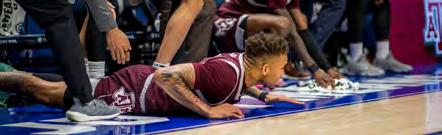
Graduate G Dexter Dennis (0) on the floor supporting the team during a game vs. Alabama on Sunday, March 12, 2023 at Bridgestone Arena in Nashville, Tennessee.
Ishika Samant — THE BATTALION
Rocky Top road test
Aggies travel to Knoxville for second SEC series against Volunteers
By Luke White @lukewhite03Orange is a color seldom found in College Station, yet the No. 21 Texas A&M baseball team will take on two shades of the hue within the next five days, as the maroon and white will hit the road to battle No. 12 Tennessee from March 24-26, before returning home for a rivalry matchup with Texas on Tuesday, March 28.
A&M kicked off conference play last weekend with a three-game tilt with top-ranked LSU at Olsen Field, where the Tigers backed up their No. 1 ranking by taking two games from the Aggies. After dropping the first two games 9-0 and 12-7, A&M used a come-frombehind effort in Sunday’s game to salvage the series with an 8-6 victory.
While a 1-2 start to SEC action isn’t ideal, the good news for the Aggies is that they likely won’t face a team matching the depth and caliber of LSU. The Tigers boast the likely No. 1 overall pick of June’s MLB Draft in junior outfielder Dylan Crews, as well as arguably the nation’s top pitcher in junior Paul Skenes. Those two are just the tip of the iceberg that is LSU’s powerful, versatile lineup.
But the Volunteers are no cupcakes, and the road won’t get easier with an emotional contest with the Longhorns up next, as well as a series against No. 13 Ole Miss the following weekend. With nine other SEC teams ranked in the AP Top 25, there are no sure victories in the conference, as if there ever were.

“I think the entire league’s daunting,” coach Jim Schlossnagle said. “It’s not necessarily daunting to me, because all the teams are good, but at the same time, if we play well, we’ll be fine, or we’ll give ourselves the best chance [to win]. If we throw some more strikes on Saturday, we’re sitting here talking about a series win.”
Like A&M, Tennessee will be hungry for wins after being swept on the road by then-unranked Missouri last weekend, costing the Volunteers their No. 2 ranking. While it was the top team in the country in 2022 before falling in the Super Regionals, Tennessee retained just two of its top 10 hitters from that season. What it does bring back is
an entire starting pitching rotation that went a combined 26-3 with a sub-3.00 earned run average last year.
The unit is headlined by junior RHP and 2023 Perfect Game Preseason Pitcher of the Year Chase Dollander, who enters with a 3-2 mark, 3.90 ERA and averages 16.8 strikeouts per nine innings. He’s followed by sophomore RHPs Chase Burns and Drew Beam, who are a combined 5-2 with ERAs of 3.41 and 2.25, respectively. The trio each landed spots on the 2023 Golden Spikes Award Preseason Watch List.
“The pitching we faced from LSU and some of the other guys we’ve seen throughout the course of the season … those guys are good preparation for us,” Schlossnagle said.
On the contrary, Schlossnagle will switch up the Aggies’ rotation ahead of the matchup, bringing in freshman LHP Justin Lamkin as the Sunday starter in place of sophomore RHP Chris Cortez. The latter carries a 1-0 record, albeit with a 6.52 ERA in 19.1 innings after giving up three earned runs in 1.2 frames versus LSU on Sunday, March 19.

Lamkin has operated primarily out of the bullpen, accruing a 1-1 mark with a 1.33 ERA in 20.1 innings. The Corpus Christi native has also made two starts in midweek tilts with Rice and Houston, allowing just one run in nine combined frames with 11 strikeouts.
“Lamkin’s been the most, really the most consistent starting pitcher in the opportunities he’s gotten,” Schlossnagle said. “We’ve been looking for other right-handed options out of the bullpen, and Chris, hopefully, can go down there and give us something that way. I’m not out on him as a starting pitcher both this year and in his career, but right now it’s a pretty obvious need on both ends.”
A&M’s starting lineup will receive an addition as well, as junior third baseman Trevor Werner returns to action after suffering a hamstring injury on March 7. The Houston native looked great at designated hitter in the team’s 8-7 victory over Rice on Tuesday, going 2-for-4 with two runs batted in, including a 412 foot home run. Schlossnagle also discussed senior right fielder Brett Minnich’s return to action after injuring his hand in the first game of the season.
“The doctor said if everything progresses, [he could return] as early as Tuesday, [March 28], potentially, depending on how he feels, if he doesn’t have any setbacks,” Schlossnagle said. “Six full weeks is [the date of the] Ole Miss [series], so I would say more likely that

would be the time you’d see him back.”
In the pair’s absence, freshmen such as utility Kaeden Kent and outfielder Kasen Wells have stepped up to fill its position, batting .269 and .281, respectively, with Kent adding 19 RBIs. The duo joins freshman outfielder Jace LaViolette as key pieces of the A&M lineup.
“It’s awesome to see that coach Schloss trusts in the freshmen to be able to come out here and perform and succeed at a high level,” LaViolette said. “Honestly, that’s all you could ask for; he trusts us and we trust him, and whatever happens, happens.”
The Volunteers feature a familiar face for Schlossnagle, as head coach Tony Vitello served as assistant coach and recruiting coordinator on Schlossnagle’s TCU teams from 2011 to 2013, where they made the NCAA Tournament twice. In 2012, the Horned Frogs reached a Super Regional, the height of Vitello’s success with the team.
“Tony came from Missouri and did an awesome job for us, signed a lot of really good players,” Schlossnagle said. “It doesn’t surprise me, his success as a head coach … he’s always had a real good idea of what he wanted his team and program to look like, and that’s certainly come to fruition.”
First pitch between A&M and Tennessee is set for 5:30 p.m. on Friday at Lindsey Nelson Stadium in Knoxville, Tennessee. Junior RHP Nathan Dettmer will start on the mound for the Aggies, while sophomore LHP Troy Wansing will get the nod on Saturday at 11 a.m.
A&M will return to Aggieland for a rivalry bout with Texas next Tuesday at 6 p.m at Olsen Field. After a 4-7 start to the season, the burnt orange and white have built up plenty of momentum with an 11-game win streak, albeit with series against Manhattan, North Dakota State and New Orleans.
R E T H I N K I N G RETHINKING A M E R I C A N AMERICAN I N T E R V E N T I O N INTERVENTION



8 The Battalion | 03.32.23 SPORTS
Junior LHP Evan Aschenbeck (53) pitches from the mound during Texas A&M’s game against Texas Tech at Minute Maid Park in Houston, Texas, on Monday, March 6, 2023.
Robert O’Brien — THE BATTALION