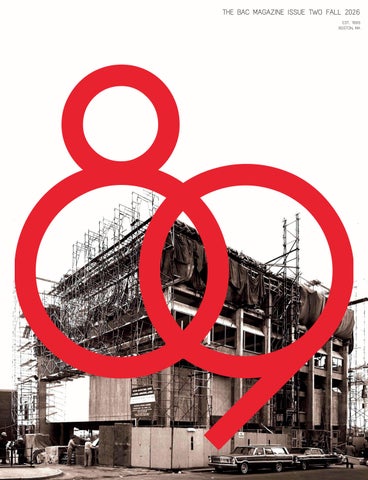
THE BAC MAGAZINE ISSUE TWO FALL 2026 EST. 1889 BOSTON, MA
1889
1966
Boston Architectural Club founded.
320 Newbury Street becomes the BAC’s permanent home.
President’s Perspective 89.2
FROM THE FUTURE
Dear BAC Community, One hundred and thirty-seven years ago, in 1889, the
American architect Clarence Blackall and eleven other founders launched the Boston Architectural Club, setting in motion a future institution they could not have imagined. I sometimes think of it as our own Voyager spacecraft. It traveled through world wars, economic depressions and recessions, industrial transformation, the information age, and profound changes in architecture, cities, technology, and education. Sixty years ago in 1966, the BAC dedicated 320 Newbury Street as our permanent home. Now in 2026, we gather to rededicate something much larger: the institution itself, and our shared responsibility for what comes next. That forward motion brings us to the present day, when we mark seven consecutive years of enrollment growth—expanding access to excellence in design education despite a challenging period for higher education nationally. Recently, the U.S. Department of Education's College Scorecard ranked our Bachelor of Architecture first and our Master of Architecture second for five-year median earnings among architecture programs. We will never stop pushing the boundaries on where learning happens, how practice and education connect, and who gets access to excellence in design education. As we come to the close of BAC to the Future, the 2022-2027 11
strategic plan that helped carry the BAC beyond its walls—rooted in Boston, but reaching increasingly outward to a global community. It has helped shape a college with a home here at 320 Newbury, but a growing presence there and anywhere. Now the new voyage begins with our next strategic vision, BAC From the Future, setting our course through 2033. While BAC to the Future asked where we needed to go, BAC From the Future asks us to imagine the institution in 2033 and begin making the choices that will take us there. Along the way, the Mixed Reality Master Planning will look further out, to 2037, at the physical, digital, experiential, and global environments of the BAC. This work has already begun. Held in Cascieri Hall, the ThinkWrong visioning retreat brought together nearly sixty members of the BAC community to challenge assumptions, imagine possibilities, and ask, boldly, what the BAC could become.
2026
2027
2033
2037
2089
BAC RED. Sixty years at 320.
BAC to the Future concludes / next strategic cycle begins.
BAC From the Future horizon.
Mixed Reality Master Planning horizon.
Two hundred years. Another generation decides where the voyage leads.
Over the coming year, we look forward to hearing from students, faculty, staff, alumni, trustees, and partners. Our rededicated BAC should carry the ideas, hopes, experience, and ambition of the people who care about this institution and what it can become.
Home and walls are not the same thing. What made 320 Newbury the BAC was never the building alone. It was the people who filled it with purpose. The generations who learned here, taught here, worked here, supported the College, and kept imagining a future larger than the one they inherited.
That is the idea behind BAC RED: rededicating our home, and with it the institution, to what comes next. On October 29, we will come together for BAC RED 2026 to celebrate sixty years at 320 Newbury Street. This issue of 89 carries that red with it, as a color of rededication, continuity, and forward motion. I hope you will join us. In 1966, one generation gave the BAC a permanent home. In 2026, our generation inherits that gift and accepts the responsibility that comes with it.
WHAT COMES NEXT IS OURS TO DESIGN.
And somewhere beyond what we can currently see, another generation will decide where the voyage leads.
Mahesh Daas, DPACSA
President and ACSA Distinguished Professor
22
In 1889, alongside a group of peers, he helped establish the Boston Architectural Club (Club). The Club drew inspiration from the Architectural Association in London and Cooper Union in New York. It offered young practitioners access to studio space, lectures, mentorship, and exhibitions. C.H. served as its first president, from 1888 to 1893. Under his leadership, the Club promoted a work-integrated model of education where students trained while employed in architectural offices. It combined practice and theory in a way that set the foundation for what would later become the BAC’s signature educational model.
WE CAME FROM
C.H.’s professional work reshaped Boston in numerous other ways. As one of America’s leading theater architects, designing more than 300 theaters, his projects included the Colonial Theatre (1900), Wilbur Theatre (1913), Yale University’s School of Drama (1926), and Metropolitan Theatre (now the Wang, 1925). These buildings featured strong acoustics, audience flow, and structural innovations combined with elegant design. He also designed the Carter Building in 1894—Boston’s first steel-framed skyscraper—along with numerous churches, hotels, and office buildings known for their clarity and technical strength.
Left and right: C.H. Blackall. Courtesy of Clarence Blackall's Family
In 2006, we acquired the 951 Boylston building from the previous owner, the Institute of Contemporary Art, marking the culmination of a journey that began with C.H.’s travels in 1886 and ultimately led to the establishment of the esteemed institution he helped create.
SOMEWHERE How BAC founder C.H. Blackall built a towering model for design education In 1893, C.H. Blackall imagined a 29-story, 200,000-square-foot tower for the Boston Architectural Club, with studios, offices, exhibition spaces, and an architectural library. The financial panic of that year kept it from being built. But the proposal tells us something about the scale of his ambition. He was already imagining architectural education as an institution with a visible place in the life of the city. The tower never rose, at least not yet. The idea did. As a founding member and first President of the Boston Architectural Club, C.H. Blackall brought vision, range, and a strong sense of purpose to everything he did. He was a builder—not just of buildings—but of institutions and ideas. He cared deeply about details, whether in design, in writing, or in how he shaped the communities around him. C.H. was born in Chicago in 1857, to a Baptist minister father and a mother from a musical and scholarly Boston family. 3
He graduated from the University of Illinois Urbana-Champaign in 1877 with a degree in architecture. C.H.'s education combined engineering, classical studies, and Beaux-Arts design principles, and he developed a strong interest in medieval stonework and monastic buildings—early signs of the architectural interests that would define his future travels and professional work. As the first recipient of the Rotch Traveling Scholarship from the Boston Society of Architects, C.H. and his wife, Emma, spent two years traveling through Spain during the 1880s while he studied Romanesque and Moorish buildings in detail. These weren’t just casual observations; instead, he measured, sketched, wrote, and reflected. His insights influenced the appetite in Boston for Romanesque revival styles, while his drawings helped sharpen the lens through which others, like Henry Hobson Richardson and Arthur Vinal, viewed Iberian architecture. The shape of 951 Boylston owes something to the forms and ideas that he helped carry across the Atlantic.
As we celebrate 60 years at our Brutalist home on 320 Newbury Street and, next year, 140 years of the 951 Boylston Street building, his legacy continues to be felt— not only in buildings—but in how architecture was taught and practiced. Blackall never saw his 29-story tower rise over Boston. What did rise was the institution he helped imagine. Today, as we look ahead, we inherit that same responsibility: to imagine the BAC before it fully exists. We came from somewhere. What comes next is ours to build.
Make no little plans; they have no magic to stir men's blood and probably themselves will not be realized. Make big plans; aim high in hope and work, remembering that a noble, logical diagram once recorded will never die, but long after we are gone will be a living thing, asserting itself with ever-growing insistency. Remember that [the next generations] are going to do things that would stagger us. Let your watchword be order and your beacon beauty. - Daniel H. Burnham, quoted by C.H. Blackall in Seed Time and Harvest
The people governing the BAC bring different paths, professions, and perspectives to one shared responsibility: helping shape what comes next.
One thing that surprises some of its peers is that the BAC is an independent private institution governed by a fiduciary Board of Trustees, entrusted with the BAC’s stewardship. 24 members carry legal and fiduciary responsibility for its academic, financial, and institutional future. That makes who sits around the table consequential. “The BAC is a very special place, and I don't know anything that's quite like it in the country,” said David Manfredi, Trustee, and CEO and Founding Principal, Elkus Manfredi Architects. “In many ways, higher education is in crisis; you see small schools disappearing often. But the BAC keeps marching on and getting better every year.”
What the BAC does best Board Secretary Elizabeth “Liz” Minnis B.Arch'89, architect and planner, spent over 25 years in the public sector at the Massachusetts Division of Capital Asset Management and Maintenance. With experience juggling work and earning a degree, Liz’s belief in the BAC stems from what its students do best: “Connecting the work you’re doing in school with the education you’re receiving. Integration of practice, combined with excellence and accessibility, results in a judgment-building experience that’s grounded yet progressive.”
What access really means While Trustee Kishore Varanasi’s introduction to the BAC was through his firm, CBT Architects, it was his personal connection to its commitment to open admission and access that drew him in. “BAC students aren’t your typical students. Many are working, studying, supporting families, and navigating very different paths into the profession, and that brings a perspective that is incredibly valuable to architecture and to our cities,” Kishore said. “Ensuring those voices are part of the profession helps broaden the perspectives represented in design and makes architecture more responsive to the communities and geographies it serves.”
An active experiment When Trustee Samira Ahmadi walked past 320 Newbury for the first time in 2011, she was drawn in to explore an exhibition of student work in the McCormick Gallery. As Founding Principal of enviENERGY Studio LLC, she ultimately became an adjunct professor. Her expertise in building performance and sustainability made her an integral member of the Board’s Facilities Committee, where she helped spearhead the decarbonization of 320 Newbury by connecting the nearby underground geothermal wells to power a portion of its energy system. “Through decarbonization work, we’re providing another example of how the BAC is a living laboratory for the architecture industry, giving students another touchpoint of participation while they’re pursuing their education.” Samira explained.
What comes next In recent years, the Board has guided the BAC through a transition to a top-ranked choice for design. With the appointment of Mahesh Daas, the school’s eighth president, it has expanded from a Boston institution to a global design center with a community spanning 50 states and 74 countries. Trustees like David, who founded Elkus Manfredi in 1988 alongside the late Howard Elkus and has served on the board for over a decade, have worked to expand the network of like-minded advocates to join the BAC’s community. President Mahesh Daas, who serves as a trustee, sees the Board as one of the few places where the BAC can hear from many different worlds at once. “Trustees are a unique treasure because they see the BAC from places I cannot,” Mahesh said. “Around one table, you have people shaped by different professions, communities, generations, and life experiences. That gives us something immeasurable: a range of advice that reflects the breadth of the society we ultimately serve.” For Mahesh, that breadth is valuable. “The Board’s job is to ask what must be protected, what has to evolve, and what we owe the people who will inherit the BAC after us.”
///////////////////////////////////////////////////////////////////////////////////////////////////////////////////////////////////////////////////////////////////////////////////////////////////
Around the table
Trustee David Manfredi, CEO and Founding Principal of Elkus Manfredi Architects
Samira Ahmadi, Founding Principal, enviENERGY Studio LLC
Elizabeth Minnis, B.Arch ’89
Kishore Varanasi, Urban Design Principal, CBT Architects
BAC BOARD OF TRUSTEES Marilyn Swartz-Lloyd, Board Chair · James Barrett, AIA, B.Arch’87, Board Vice Chair · Elizabeth Minnis, AIA Emeritus, B.Arch’89, Board Secretary · Courtney Woods, MSA, CPA, Board Treasurer Samira Ahmadi, BEMP, LEED AP BD+C, ID+C, Homes, WELL AP · Joshua Best, AIA, B.Arch’14 · David Bunis, Esq. · Valerie Fletcher · Katia Lucic, AIA, LEED AP · David Manfredi, FAIA, LEED AP · Srinivas Reddy · Richard Snyder, Esq., Hon’24 · Kevin Sullivan · John Swift, PE, CEM, LEED BD+C · Kishore Varanasi, AICP · Bridgette Wallace, AICP · Gianfranco Zaccai, FIDSA, B.Arch’78, Hon’15
EXPLORE MORE HERE 4
320 newbury more than a building
entries, judged January 24–26, 1964 The jury deliberates among the entries. [date credit]
Image credit BAC Archives Sixty years after 320 Newbury Street became the BAC's iconic Back Bay home, its story is still unfolding. A competition led to the creation of 320 Newbury, but six decades of people learning and connecting inside it made the building the heart of the BAC.
1960
1958-61
1963 — Competition launched
01 The need
02 The site
03 The competition
The BAC moved to 320 Newbury after its longtime home at 16 Somerset Street in Boston's Beacon Hill neighborhood was taken by the City of Boston in 1960 to make way for a state office building. The College needed a new home to continue its work.
1958
320 Newbury Street first considered as possible new quarters.
1960
BAC's 16 Somerset Street home taken by eminent domain; Board votes to pursue 320 Newbury.
The answer came through a BAC-facilitated design competition in 1963 that asked architects to envision more than a building-it asked them to envision a future for the College, then called the Boston Architectural Center.
1961
5
BAC moves into the existing threestory building at 320 Newbury.
Eighty-nine proposals were submitted by Massachusetts-based firms, including designs by Fumihiko Maki, Michael Graves, and Peter Eisenman.
04 The Jury
Jan. 24–26, 1964—Jury deliberation
Left and right: C.H. Blackall. Courtesy of Clarence Blackall's Family
Image credit BAC Archives The jury: Lawrence B. Anderson, AIA, chair, MIT Department of Architecture; Pietro Belluschi, FAIA, dean, MIT School of Architecture; Arcangelo Cascieri, FAIA, dean, Boston Architectural Center; James Lawrence Jr., FAIA, president, Boston Society of Architects; Ralph Rapson, FAIA, dean, University of Minnesota School of Architecture; Josep Lluis Sert, FAIA, dean, Harvard Graduate School of Design; Benjamin Thompson, AIA, chair, Harvard GSD Department of Architecture; with William LeMessurier, consulting engineer, as non-voting technical adviser. [Photo date, credit]
05 The winner
Feb. 1964—Winner announced
ASHLEY MYER & ASSOCIATES Now Arrowstreet Inc.
Ultimately, Boston-based Ashley Myer & Associates (now Arrowstreet Inc.) was selected as the competition winner in February 1964.
AMONG THE 89 ENTRIES
Image credit BAC Archives
Left: Flansburgh, Eisenman and Graves, 1963, Canadian Centre for Architecture Right: Chapman & Goyette (Fumihiko Maki, et al), 1963, BAC Archival Collection.
6
06 The building
May 8,1966 New 320 Newbury Street building officially dedicated.
The winning design responded to questions that remain relevant today: How should a building support architectural education, and what relationship should it establish with Newbury Street and the city? A transparent, double-height gallery opened the College to the public; student lounge space
March 1965 Existing 320 Newbury building demolished; BAC temporarily disperses classes to Harvard, MIT, and Berklee. 1965–66 New building constructed.
emphasized community; and the library at the top suggested the “head” of the school as a body of knowledge. At 320 Newbury, the building itself became part of the learning process. Studios, stairs, corridors, and shared spaces supported critique, collaboration, and informal encounters.
320 Newbury shortly after its completion, 1966. Zimberg, BAC Library archival collection. 7
1965-1966
07 ARCHITECTURE AND EDUCATION
1966-
Interior, 1966. Reens, BAC Library archival collection. Image credit BAC Archives
The gallery, 1966. Photo: George Zimberg. Image credit BAC Archives
A studio. Image credit BAC Archives
The stair. Image credit BAC Archives
Richard Krauss, a seasoned principal at Arrowstreet who was a young architect at the time of the competition reminisced: “We were a young firm, working in Jack Myer’s garage, under his direction, with Bob Goodman and the rest of us working long hours. Winning the competition was a major factor in developing what came to be called Arrowstreet. Our hope was
that the BAC could become a major player in the growing, newer Western edge of the city - giving its students a hangout and contemporary services. Looking back, I am amazed at how much the BAC has grown in both stature and size; and still, the building, with its added properties, major growth, and outstanding curricular development, seems to be a suitable form.”
08 THE REDEDICATION
October 29, 2026 “320 Newbury was once meant to be the entirety of the BAC, our permanent home. Today, it is something different,” Mahesh Daas, the BAC’s eighth president said. “The building also stands for something larger: access, progress, and an institution that has learned how to grow far beyond its walls without losing its center.” Today, the BAC’s work extends beyond a single address through the BAC Cloud Canopy. Caring for 320 Newbury now means addressing accessibility, infrastructure, sustainability, decarbonization, and geothermal energy while adapting spaces for digital and mixed-reality learning. The BAC RED (rededication) event offers an opportunity to connect the building’s history with its future. The next chapter is about ensuring that 320 Newbury can support a College whose reach —and sense of possibility—continues to grow.
320 Newbury, 2026
We invite you to share your favorite memories of 320 Newbury on social media, feel free to tag us on LinkedIn and @thebacboston on Instagram with the #320Newbury. To learn more about how you can contribute to the BAC’s campaign for the campus, scan the QR code below:
DONATE HERE 8
/////////////////////////////////////////////////////////////////////////////////////////////////////////////////////////////////////////////////////// Felice L. Silverman, FIIDA, MID ’14, and David J. Silverman, FAIA, B.Arch ’94 Image credit STA Design
design was easy to get into, but hard to get out of.
9
David J. Silverman, FAIA, B.Arch ‘94
Felice Silverman, FIIDA, MID'14, and David Silverman, FAIA, B.Arch'94, found more than a school at The Boston Architectural College (BAC). They found a path into design, a professional community, a way of working, and each other. Now, they are
helping make that same opening possible for future students. Through a three-year scholarship commitment and a seven-figure planned gift through their estate, Felice and David are establishing the Felice L. Silverman FIIDA and David J. Silverman FAIA Scholarship. Their gift will support students now and grow into endowed scholarship support for future generations.
TWO PATHS INTO DESIGN. ONE POWERFUL BELIEF.
Without it, I probably wouldn’t have gone in that direction,” said Felice. Both eventually found their way to the BAC and its accessible, practice-based model of education. The College helped launch their careers and ultimately led to the creation and growth of STA Design, the firm Felice founded with fellow BAC alum Tom Trykowski. David joined the firm in 2012.
David’s path began early. At age 10, on a field trip to downtown Providence, he remembers being fascinated by the skyscrapers. “I knew right then that I wanted to be a part of the design world,” he said.
For both, the ability to work in the profession while studying was equally important. The BAC was also where they built relationships and a professional network they would rely on throughout their careers, as well as where they met each other.
Felice’s path was less direct. She came from a creative family, loved graphic design, and only near the end of high school began to consider architecture.
BUILDING A LEGACY NOW AND FOR THE FUTURE
“Having open access to the BAC is what makes the College so unique. The fact that I didn’t need a portfolio or prior experience, and the low cost of enrolling made it possible for me to explore design.
Felice L. Silverman, FIIDA Image credit STA Design
Their connection to the BAC began as students and has grown into a lifelong commitment as alumni, instructors, employers, volunteers, and members of the College’s governance.
“Felice and David understand the BAC from the inside,” said Dr. Mahesh Daas, President. “They know what access to design education made possible in their own lives, and they are now helping keep that door open for future students. Their commitment supports students today, while building endowed scholarship support for tomorrow.” For Felice and David, what makes the BAC unique should continue to shape its future: giving students the opportunity to enter the design professions, learn through professional practice, and use design to make a positive impact in the world. Their scholarship opens that opportunity today, and their planned gift ensures it continues for generations to come.
READ THE FULL STORY the-bac.edu/silvermans
Image credit STA Design 10
the answer isn’t the answer The point is not to protect students from AI. As AI makes answers easier to produce, a BAC education develops the judgment to know what to do, when, and why. By Mahesh Daas, DPACSA
What is Judgment? CONCEPT
QUESTION IT ANSWERS
NATURE
EXAMPLE
knowledge
What do I know?
Facts, concepts, principles
Building codes, finance, theory
Skill
What can I do?
Ability to perform a task
Sketching, negotiating, coding
competency
Can I reliably perform?
Reliable application of knowledge and skill
Managing a project, leading a meeting, designing a building
judgment
What should I do here, now, and why?
Weighing context, consequence, values, and uncertainty to decide what to do
Choosing among competing constraints, values, consequences, and imperfect information
Source: Daas, Mahesh. “Judgment.” In the Lead: The Journal for Higher Education Leaders, Fall 2026.
Knowledge can answer what. Skills can answer how. Competencies demonstrate that an expert can reliably deliver results. But judgment answers whether one should even try in the first place and why. And the ability to exercise judgment under uncertainty lies at the heart of a BAC education. A designer may have all the technical skills needed to produce a particular design solution and be fully capable of executing that project. But the harder question remains: What should I do here, now, and why should I do that? That is judgment, and the BAC has been cultivating it for 137 years because of the way our educational model works. In the age of AI, that ability will only become more valuable and in-demand. Our students study and practice concurrently. Our students do not acquire knowledge within the four walls of the school and wait until graduation to test it in the world. They do both at once, almost from day one. They carry the pressures of practice back into the 11
classroom, and they take ideas from the academic setting back into professional settings, day in and day out. We build workplace learning into the academic requirements of a professional degree. It is tracked, measured, assessed, reflected upon, and connected to academic learning. The real value lies in the reflection that takes place with faculty mentors and peers. Students act, learn, reflect, revise, and learn to make judicious decisions. A difficult client meeting, for example, can inform the direction of a classroom project. A design decision made under pressure in the workplace can be reexamined through classroom critique. Practice exposes the limits of academic knowledge. Learning in a studio challenges the habits of practice and pushes students to think about the future with the luxury of time that only an academic setting can provide. Each setting has its advantages and limitations. Reflecting on both kinds of learning is the hinge that develops judgment. I explored the notion of judgment more fully in my essay, Reading the Field, published earlier this
year in In The Lead magazine. I have also previously described the BAC’s model as An Inconvenient Education. The inconvenience is deliberate. It comes from refusing to isolate learning from responsibility. Our students encounter uncertainty, ambiguity, the consequences of their decisions, competing demands, real-world budgets, mistakes, and a range of personalities while they are still learning to make sense of them all. Artificial intelligence makes this learning especially important. AI is radically changing the relationship between knowledge, skill, competency, and professional work, and it is doing so very quickly. AI can retrieve information, produce hundreds of answers, generate images, write code, analyze reams of data, and summarize vast bodies of precedent. All of that once took considerable time. What we have traditionally associated with competence can now be produced very quickly and inexpensively, and reliably, with human verification. And that shifts the center of value in education.
8X
BAC students complete NCARB’s Integrated Path to Architectural Licensure at eight times the national average.
Finding answers is getting easier. Knowing whether it is the right answer, or even the right question, in a given situation is entirely different. Someone still has to decide whether the question is even worth asking in the first place, which constraint or consideration deserves greater weight, whether a design solution or technical decision is sound, what is produced and what is left out, and who will bear the consequences. In design, choices about accessibility, preservation, beauty, affordability, carbon, history, community, and lived human experience do not neatly collapse into one easy answer. AI can give you options. Judgment is what you bring to them.
46%
At the BAC, we build that cycle into the curriculum.
The client is not a professor. And a problem is very rarely handed to the designer already predefined. Decisions affect people who are not in the room when those decisions are made. Design theorist Horst Rittel and urban planner Melvin Webber described these as “wicked problems” in their landmark 1973 article, Dilemmas in a General Theory of Planning, where even defining the problem is part of the work.
But when a decision carries consequences for safety, ethics, culture, community, or the lives of other people, someone still has to exercise judgment and take responsibility for the choice. The framework I have been using in discussions about AI and architectural practice places human judgment precisely where judgment and consequence are both high.
Think about the kinds of questions a young designer can encounter: Should this building be preserved or replaced? Is reducing carbon worth the higher initial cost? When should a designer challenge a client? Even if something is technically feasible, is it responsible? What happens when competing constraints and criteria lead the design in a different direction?
Experience alone does not create judgment. If it did, everyone would become wiser simply by getting older. Judgment is honed by examined experience. It is about understanding what happened, questioning the assumptions behind a decision, and seeing what was missed.
Knowing more is, of course, helpful. So is technical ability. But neither chooses you. BAC students do not advance through the curriculum simply by obtaining good grades in a classroom. Reflective portfolio reviews require them to clearly
There is also evidence that this model prepares students to advance into their careers at an accelerated rate. BAC students complete NCARB’s Integrated Path to Architectural Licensure, or IPAL, at eight times the national average. Internal BAC surveys indicate 46 percent of our graduating students from the class of 2026 already hold management positions on graduation day.
LOW JUDGMENT
Increasingly, the harder work in our industry will require determining what needs to be done and taking responsibility for those decisions. That may be the real professional shift AI is producing. As machines become better at generating an initial selection of answers, the human professional moves further toward framing, choosing, verifying, interpreting, and taking responsibility. Education has to move there too. The point is not to protect students from AI. It is to teach them how to use it inside a cycle of action and reflection. Let AI accelerate routine work. Then interrogate what it produces. Verify it. Challenge it. Revise it. And when the decision carries real consequences, understand that the ultimate responsibility still belongs to you. That is why the BAC education has enduring value. What BAC graduates know will change quickly. What they can produce will change too.
Judgment and consequence
High CONSEQUENCE
demonstrate what they learned from the distinct practice and academic settings and from the relationship between the two before they can progress.
However, none of these numbers measure judgment. Judgment does not fit neatly into a salary figure or a job title. What they do show is that employers and the profession value BAC students and entrust them with consequential work.
The useful distinction is not simply between work done by humans and work done by AI. It is also between work that carries little consequence and work in which the consequence of a decision is high. Routine production can be automated. Analysis can be accelerated and verified. AI can be a powerful partner in generating possibilities.
LOW CONSEQUENCE
Internal BAC surveys indicate that 46 percent of the Class of 2026 held management positions on graduation day.
HIGH JUDGMENT
AUTOMATE
AI Partner
Formatting | Documentation | Repetitive Modeling
Ideation | Option Generation | Visualization
ai analysis/human verification
human Judgment
Code checks | Cost Estimate | Performance Analysis
Safety | Ethics | Context + Culture
What should I do here? Right now. And why should I do that? That is judgment.
12
Everywhere at Once
The BAC Cloud Canopy reimagined where the College resides: here, there, and anywhere. Today, it is the infrastructure connecting BAC students across the country and around the world.
The cloud is the new ground of the college. Cloud Lab: seven cloud regions U S E as t • O re go n • Fr an kfu r t • Mu mbai • Seoul • Sã o Pa ulo • Syd ne y
M O RE PH Y SIC AL
MORE VIRTUAL
1
2
3
4
Physical reality
Augmented reality
Mixed reality
Virtual reality
Studios, classrooms, fabrication, galleries, reviews, workplaces, and face-to-face community.
Digital information layered onto physical space through phones, tablets, glasses, or other interfaces.
¤ǕɬȷǛƤƇdz٪ƇǾƫ٪ƫǛǍǛɅƇdz٪ environments interacting in real time, including digital twins and shared immersive workspaces.
Fully digital environments for visualization, collaboration, simulation, critique, and community.
Ask where The Boston Architectural College (BAC) is, and most people will point to Back Bay: 320 Newbury Street, the studios, the galleries, the address on the letterhead. That answer is accurate. It is also incomplete. In any given week, the BAC is also in Ƈ٪ǕȉǼƲ٪ȉnj˚ƤƲ٪ǛǾ٪¤ƲǾǾȷɬdzɥƇǾǛƇؙ٪ɦǕƲȯƲ٪ adjunct professor Jason Detwiler ’15 logs on to teach. It is in cities along the West Coast of the United States, and in Sydney, Australia, where his students join him. All of them are in the same course, with the same software, in the same institutional environment. For the length of that class, the BAC occupies all those places at once. This is The BAC Cloud Canopy™, and its central proposition is simple: the cloud is the new ground of the college.
01
A vision, then a test
Cloud Canopy grew out of BAC to the Future, the College’s vision of itself as a global network. The pandemic turned that vision into an urgent test. In the spring of 2020, the College went virtual nearly overnight, and the proposition behind Cloud Canopy had to work at full scale, immediately. gɬȯƇ٪½ƇǾ٪ׂؙ׀ى٪t ؘȯƤǕ٪ؙ׆׀ى٪ɦƇȷ٪ǛǾ٪ɅǕƲ٪˚ȯȷɅ٪ year of her bachelor’s degree in interior architecture when the pandemic hit. An international student from China, she watched classmates return to their home countries while their studies continued. “When COVID happened, it was the ˚ȯȷɅ٪ɅǛǼƲ٪U٪ȷɅƇȯɅƲƫ٪Ʌȉ٪ȯƲƇdzdzɬ٪ɍǾƫƲȯȷɅƇǾƫ٪ the meaning of a ‘global network.’ I had 13
classmates who were also international students who had to return to their home countries, and everything was virtual. But when we joined a class online, we could still learn together and use the same resources. It helped me feel less alone and closed the distance between us,” Kyra said
STUDENT
KYRA TAN ’24, M.ARCH ’28
Student. Works at JCBT Architect, Quincy, Massachusetts.
“It helped me feel less alone and closed the distance between us.”
02
One college, many places
FACULTY
Jason Detwiler ‘15
Adjunct professor. Design technologist, Symmes Maini & McKee Associates
“Cloud Canopy gives them access to resources they need, when it works best for them.”
Jason’s Introduction to Autodesk Revit course shows what that infrastructure makes possible. Wherever they are working, students enter the same BAC computing environment through a browser, with the same resources and industry-standard tools. “As BAC students are juggling their work-school balance, Cloud Canopy gives them access to the resources they need, when it works best for them,” said Jason, who is also a practicing design technologist at Symmes Maini & McKee Associates. “When I was studying at the BAC, we had to be physically on campus to use the programs we needed to complete our assignments. Cloud Canopy eliminates that requirement and gives students more control over their schedule.” Cloud Lab, which is a place within Cloud Canopy, is a virtual mirror of the oncampus desktop computers, carrying professional design software including Autodesk programs, Adobe Creative ¯ɍǛɅƲؙ٪ ȯƤGU¯٪¤ȯȉؙ٪§ǕǛǾȉؙ٪¯ǯƲɅƤǕÄȬؙ٪ƇǾƫ٪ V-Ray. The environment is distributed across seven cloud regions: US East, Oregon, Frankfurt, Mumbai, Seoul, São ¤Ƈɍdzȉؙ٪ƇǾƫ٪¯ɬƫǾƲɬؘ Fȉȯ٪ ٪ȷɅɍƫƲǾɅȷؙ٪ɅǕƇɅ٪˛ƲɫǛƣǛdzǛɅɬ٪Ǜȷ٪ structural. More than 85% work in a professional capacity while earning their degrees. Kyra, now pursuing her M.Arch while working at JCBT Architect in Quincy, Massachusetts, is one of them. “My commute to campus is four hours round trip. I wouldn’t be able to keep my position at JCBT Architect while completing my Master’s degree without Cloud Lab. It gives me access to
MIXED REALITY MASTER PLANNING INSTITUTION = PHYSICAL + VIRTUAL + CONNECTED EXPERIENCE
BOSTON
GLOBAL HUBS
ANYWHERE
NEWBURY STREET
PARTNER LOCATIONS
ANY DEVICE * ANY PLACE • ANYTIME
everything I need, no matter what location I’m in, on my own time,” Kyra said.
03
A college without walls
The BAC has long dissolved the walls between school and work. Its practiceintegrated model treats the professional environments as part of the classroom. “You can now be a part of the technology, the software, and the hardware as a ɥǛȯɅɍƇdzǛɶƲƫ٪ƲɫȬƲȯǛƲǾƤƲؙ٪ǛǾ٪ɅǕƲ٪ȷƇǼƲ٪ɦƇɬ٪ that a professional would be utilizing it. So students are not only getting ƲɫȬƲȯǛƲǾƤƲ٪ǛǾ٪ɦǕƇɅ٪ɅǕƲɬىdzdz٪ƣƲ٪ƲɫȬƲƤɅƲƫ٪ to know upon graduation, they’re also ƲɫȬƲȯǛƲǾƤǛǾǍ٪ɅǕƇɅ٪ƇƤƤƲȷȷ٪ǛǾ٪ɅǕƲ٪ȷƇǼƲ٪ ɦƇɬ٪ɅǕƇɅ٪ȬȯȉnjƲȷȷǛȉǾƇdzȷ٪ƇȯƲهؙ٪¤ƲɅƲȯ٪ Ʌɦȉȉƫؙ٪ Director of Digital Media, said. ¤ȯƇƤɅǛƤƲ٪ǛǾɅƲǍȯƇɅǛȉǾ٪ƫǛȷȷȉdzɥƲƫ٪ɅǕƲ٪ boundary between school and work. Now, Cloud Canopy dissolves the boundary between campus and elsewhere. The question now reaches beyond online learning: What is a college when its campus is no longer bound by its real estate? At the BAC, the answer is beginning to take shape. We are deeply rooted here in Boston, where 320 Newbury Street remains our home and the center of our community. We are soon going to be there in the emerging, partnership-based global hubs located in Canada, South America, Europe, and ȷǛƇؙ٪ɅǕƇɅ٪ƲɫɅƲǾƫ٪ɅǕƲ٪ ٪Ʌȉ٪ɦǕƲȯƲɥƲȯ٪ɅǕƲ٪ȷɅɍƫƲǾɅȷ٪ƇȯƲ٪ situated. And we are ever-present anywhere, anytime, and on any device through BAC Cloud Canopy.
Here. There. EVERYwhere. ½ȉǍƲɅǕƲȯؙ٪ɅǕƲȷƲ٪ƲǾɥǛȯȉǾǼƲǾɅȷ٪ƲɫɅƲǾƫ٪ƇƤƤƲȷȷ٪Ʌȉ٪ƲɫƤƲdzdzƲǾƤƲ٪ǛǾ٪ƫƲȷǛǍǾ٪ education while preserving what has always distinguished the BAC: learning integrated with practice. The College is no longer limited by where its walls end. Its reach now follows its students.
Scan to read the full article 14
320 Newbury Street, Boston, MA 02115
From Bostonwhere ideas don’t sit still.
This has always been an experiment. Still is.
THE EXPERIMENT CONTINUES.
A 137-YEAR-OLD STARTUP. SINCE 1889. STILL IN PROGRESS.
Not a finished story. And that’s the point.
OUTWARD SINCE 1889