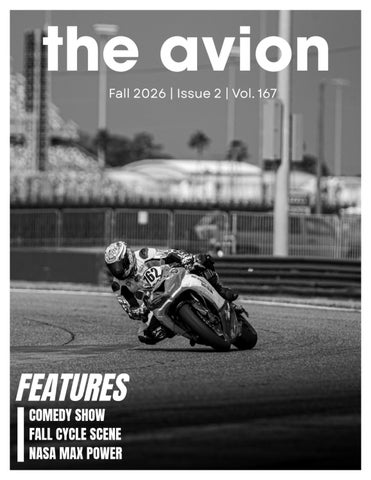
FALL CYCLE SCENE Is speed and endurance all it takes?
NASA MAXPOWER AIRSHOW
NASA’’s first ever airshow at KSC
DID MY VOTE COUNT? The struggles of voting as a college student out of state
STUDENT VETERAN ORGANIZATION From Emo Night to an art gallery full of emotion
COMEDY SHOW: LAUGHS WITH LAWSON
Keep the laughs rolling with more about the night
CMA CONFERENCE RECAP Follow along with the adventures of the team at the national conference
DEAN FEATURE: DEAN GIBNEY
Learn more about the College of Business Dean
CRS-35: A JELLYFISH PHENOMENON
A glowing jellyfish in the night sky? Discover the science behind this launch phenomenon
The Avion is produced by a volunteer student staff. Student editors make all content, business and editorial decisions. The editorial opinions expressed in The Avion are solely the opinion of the undersigned writer(s), and not those of Embry-Riddle Aeronautical University, the Student Government Association, The Avion, or the student body. Letters appearing in The Avion are those of the writer, identified at the end of the letter. Opinions expressed within are those of the identified writer. Letters may be submitted to The Avion for publication, provided they are not lewd, obscene or libelous. Letter writers must confine themselves to less than 1200 words. Letters may be edited for brevity and formatted to newspaper guidelines. All letters must be signed. Names may be withheld at the discretion of the Editor-in-Chief. The Avion is an open forum for student expression. The Avion is a division of the Student Government Association. The Avion is a member of the Associated Collegiate Press. The costs of this publication are paid by both the Student Government Association and through advertising fees. The Avion distributes one free copy per person. Additional copies are $0.69. Theft of newspapers is a crime, and is subject to prosecution and Embry-Riddle judicial action. This magazine and its contents are protected by United States copyright law. No portion of this publication may be reproduced, in print or electronically, without the expressed written consent of The Avion.
Noelle Cover
Grace Hamilton
News Editor
Managing Editor
Daphne Sierra Aquiningoc
Business Manager
Photo Editor
Antonia Vital
Kylie Pearson
Copy Editor
Copy Editor
Nikunj Bhatia
Elanna Heller
Contributor
Contributor
E
Jayden Vaughan
Belle Holck
Design Editor
K
Angel Gregorio
Senior designer
Giancarlo Estrada
Maida Ometlic
Av
Senior Designer
Contributor
Brianne Weathers
Rachel Collinson
Public Relations Manager
Contributor
Emilee Imler
Staff photographer
William Dressler
Matthew Mazan
Kaden McVerry
Photo Service Coordinator
Staff Photographer
Editor-in-chief
Briana Black
Joanna Jose
Contributor
Senior Reporter
Jintao Hear
Kate Caling
Charlie Wilkins
Contributor
Senior Reporter
Contributor
Brandon Badraoui
Liam John
Staff
contributor
Louis Mikulecky
very Alexander
STAFF
Operations Coordinator
Roy Su
staff photographer
WORDS: JAYDEN VAUGHAN | PHOTO EDITOR PHOTOS: JAYDEN VAUGHAN | PHOTO EDITOR DESIGN: GRACE HAMILTON | MANAGING EDITOR
Fall Cycle Scene from the American Sportbike Racing Association brought its season-ending Race of Champions to Daytona International Speedway on Oct. 15-18, as motorcycle racers competed on a 3.51-mile road course during a four-day event that brought superbikes and sidecars to the staple of racing. This event featured championship racing, including the Barnett National Sidecar championship and the inaugural Dunlop Superbike Shootout. This weekend brought amateur and expert competitors for a final opportunity to compete at one of motorcycle racing’s most recognizable venues. Saturday’s racing, Oct. 17, featured the second round of the Barnett National Sidecar Challenge and the Unlimited Superbike Shootout. The shootout placed amateur and expert riders together, with results and prize money awarded separately for each division. Sidecar racing also highlighted the weekend, with teams competing in the Barnett National Sidecar Challenge on Friday and Saturday. The discipline requires close coordination between the driver and passenger, as they navigate and turn in sync throughout the circuit.
Racing continued through Sunday, Oct. 18, with ASRA championship classes including the 500 Cup, Thunderbike, Heavyweight, Superstock 1000 and Supersport. The weekend marked the conclusion of the 2026 ASRA season. In addition to the on-track competition, Fall Cycle Scene featured a motorcycle marketplace with vendors, displays and activities for motorcycle enthusiasts. The event combined national-level motorcycle competition with the larger Fall Cycle Scene gathering, bringing racers and fans to Daytona International Speedway for a weekend centered on the sport.
Community Feature: Cars & Coffee in daytona Beach WORDS: JAYDEN VAUGHAN / PHOTO EDITOR
DESIGN: GRACE HAMILTON / MANAGING EDITOR & MAIDA OMETLIC / STAFF PHOTOGRAPHER PHOTOS: BRANDON BADRAOUI / STAFF PHOTOGRAPHER
K
nown for its motorsport history, Daytona has more to offer than professional racing to those with an interest in motorsports. Throughout the more recent years, local car meets, cruise-ins and Car's & Coffee events have grown giving residents and visitors alike an opportunity to connect over a shared interest or hobby. From restored classics and American muscle cars to modified imports and exotic vehicles, the Daytona car scene brings together a variety of cars and enthusiasts outside the grandstands of Daytona International Speedway.
8 | COMMUNITY
Across Daytona there are reoccurring car meets like the ones that occur at the One Daytona or Hanks Garage where all different car scenes come together. From Mustangs to
freshly wrapped BMW's there's a meet for everyone to enjoy. These meets offer something for nearly every type of enthusiast. Some may arrive in carefully restored classics, while others showcase their project cars, modern performance vehicles or their imports. Regardless of the cars, these meets create an environment for everyone to feel welcome no matter what they drive.
collector vehicles, car vendors, swap meet displays and cars available for purchase. It brings an opportunity to explore automotive history, discover unique cars and connect with collectors from across the country.
Beyond the traditional car shows, Cars & Coffee has become a very popular way for enthusiasts to spend their Saturday mornings. These community meets combine coffee and cars for a calmer more social The annual Daytona Turkey meet compared to other meets. Run at Daytona International Speedway is a large meet. This For students and young enthusiasts, meet features thousands of local car meets can also provide
opportunities to explore interests in automotive photography, restoration, mechanical work and motor sports. They offer an accessible way to become involved in the automotive community and learn from people with different levels of experience. Daytona Beach may be best known for what happens on the racetrack, but its automotive identity extends well beyond race weekends. Through local gatherings and community events, enthusiasts continue to celebrate the vehicles, craftsmanship and shared interests that make the area's car culture unique.
COMMUNITY | 9
T
he roar of jet engines filled the air as aerial demonstrations by NASA, the U.S. military, and the U.S. Air Force Thunderbirds took to the skies in celebration of America’s 250th birthday. -NASA’s MAX POWER, a combined air show and aerospace expo, took place Nov. 7-8 at the historic Shuttle Landing Facility runway. NASA collaborated with Air Dot Show, Space Florida, UP.Summit, Delaware North, and Purpose Entertainment to produce and fund MAX POWER. The event combined thrilling aerial demonstrations with interactive exhibits to celebrate aviation, aerospace innovation and STEM education. “MAX POWER was created to showcase the innovation and dedication of those teams while inspiring the next generation of explorers, engineers and innovators,” said NASA Administrator and Embry-Riddle alumnus Jared Isaacman. Administrator Isaacman spoke on the anticipation of NASA’s future employees, and highlighted Embry-Riddle’s place in the space industry. “Many future space pioneers, leaders and achievers will come from Embry-Riddle Aeronautical University, an institution that played a significant role in my own journey.”
WORDS: NOELLE COVER /NEWS EDITOR
DESIGN: ANGEL GREGORIO / SENIOR DESIGNER PHOTOS: MATTHEW MAZAN / STAFF PHOTOGRAPHER, EMILEE IMLER / STAFF PHOTOGRAPHER
10 | MAXPOWER
Throughout the day, visitors watched flight performances from the U.S. Air Force Thunderbirds, NASA’s Freedom 250 Aerial Team, the F-18 Super Hornet Demo, the C-17 Globemaster III Demo, the MiG-29 Demo and NASA’s F-15D Eagle. Administrator Isaacman surprised the crowd with multiple special appearances during the show. He flew with NASA’s Freedom 250 Aerial Team, piloted the MiG-29 and parachuted into the show. The aerial demonstrations stopped many spectators in their tracks as aircraft thundered overhead. Lt. Tim “Debbie” Walsh, an F-18 Super Hornet demo pilot, spoke about how surreal it felt to be a part of the air show. “It’s incredible, Kennedy is such a historic, iconic place in aeronautical history. To get here and to come represent the United States Navy is a huge honor,” said Lt. Walsh. Along with the air show, visitors could attend UP.Summit, MAX POWER’s aerospace expo. Exhibits featured next-generation aircraft, drones, robots, autonomous vehicles and emerging space technologies. The air show featured educational exhibits and handson activities at the Kennedy Space Center. Visitors also heard from NASA speakers at the air show, including Crew-12 astronauts and the Artemis III crew.
Carlos García-Galán, manager for the Moon Base Program, announced eight companies selected for the next phase of lunar delivery contracts. The conference also revealed NASA’s plans for surface infrastructure, launch and orbital transfer services and power generation. The projects are intended to expand the Moon Base’s ability to support sustained human presence on the lunar surface.
NASA’s Moon Base news conference took place Nov. 7 and shared further details of NASA’s plans for a sustained human presence on the moon. NASA aims to build a lunar outpost near the south pole with the help of a nuclear-powered rover, PROMISE.
MATTHEW MAZAN
EMILEE IMLER
12 | VOTE
A
college student can vote in one federal general election during a two-year degree, and two during a four-year, plus primaries and local races along the way. In theory, they can vote every single time, but in practice, they likely miss one or more because voting is effectively out of their control once they’ve left their home precinct. Most students keep their permanent address at home while they’re in their undergraduate degree. Voting in person can mean a three-hour drive or a flight back home, which takes time and money most students don’t have. Election day falls right in the middle of a semester, and study time is non-negotiable. While some students do register their local addresses and can vote online, many want a say in their elections back home or don’t know they can register with their school address. Some schools may not even have a voting event. For those that don’t, student absentee-by-mail is the way to go.
“
“In theory, it’s simple. Request a ballot, fill it out, and send it back. In reality however, every step is dependent on someone or something else.”
Photo by Jason Hawke/Unsplash
Then there’s the post itself. A ballot can be sent out late, mailed to a wrong address, or even have a mistyped address- all of which are reasonable things for a human or system to make a mistake on. Tens of thousands of mail-in ballots are handled each election across multiple stages, meaning it is statistically likely for at least one of them somewhere to get messed up. Ballot tracking can catch the issue, but it’s up to the voter to both know about it and set a time that’s acceptable for a ballot to be late. By then, it already may be too late. Solving the problem can be done by calling your board of elections, but the process of delivery starts again, and still has risk on the backend.
Rules vary by state, though. Some prepay postage returns, some don’t require witnesses, some have grace periods, some reject ballots over envelope errors. The result is the same no matter which issue arises, though. A student who The first hurdle is the cost. Return postage for the 2026 is capable and legally able to vote, does not have their vote North Carolina election was $1.98. It’s cheaper than counted. When the issue stems from a federal or state rule coffee but it’s still not free. One could argue it’s a form or service, it feels like mandatory disenfranchisement. of poll tax, despite courts rejecting that idea. The top reason it’s not legally classified as one is because there The deadline leaves little to no room for error, either. If is a free option to vote in-person, but good luck freely the ballot shows up in the days leading up to election traveling to your polling station hundreds of miles away. day, a student will need to purchase emergency point to point shipping via a third-party service or The next is paperwork. North Carolina requires voters a Priority Mail Express box ($38.25) for it to even to mark, seal, and sign ballots in front of a notary, have a chance at arriving. Contingent, of course, or two witnesses who must sign and list their full on if the state has postmarked-by-election grace address. Not all universities provide notary services, periods or allows ballots to be sent via third parties. however, and of those that do, not all are free either. Additionally, finding two people who are available Maybe it’s understandable then that nearly half of and willing to write home addresses on someone’s college students didn’t vote in the 2024 election. ballot isn’t always easy. More states are requiring Not all students will vote in every one, and not photo ID, too. Should it be miscopied, missing, it’s every issue was postal. It makes you wonder how highly likely the ballot will be held up or won’t be many didn’t because of the tedium of the process. counted, and still results in extra steps for the student. WORDS: LIAM JOHN / STAFF DESIGN: EMILEE IMLER / STAFF PHOTOGRAPHER VOTE | 13
nization a g r O s on Veteran Night o m tudent E hosted from 6 to 10 ) O V S ( 026, usic, r 23, 2 ening of m e b o t c O offering an ev ks, r o f drin nd p.m. wind a and n u o t d o fo nce . s a cha another e student n o h t e wi socializ
S
Emo X Night X X
bridge : helping e s o p r u p By another civilians. d e v d r n e a s o s unity, It als eteran ent comm etween v d b tu s p r a e g id ns w the onversatio c ent to the v e e e g th a r g encou . openin to ise happen d e w r p e o h th o t o SVO ight n tions that m c e n n o c d an
14 | SVO - EMO NIGHT
encourage The idea behind Emo Night was to Whether that freedom of expression. uting their students were singing along, sho time with favorite lyrics or simply spending opportunity friends, the event offered an supportive to let their emotion out in a environment.
Falling Apart One of his favorite pieces, Falling Apart, was inspired by watching a close friend struggle with difficulties within her social circle. The piece explores how people can present themselves one way while treating others differently behind that appearance.
ART
words: joanna jose / Staff Reporter
+ Gallery
PHOTOS: CHRISTOPHER O’NEILL DESIGN: AVERY ALEXANDER / Operations Coordinator
C
reated by student veteran Chris O’Neill, the art exhibition touches on the experience beyond military services, exploring themes of memory, grief, betrayal and personal struggles. Drawing from both his time in the military and experiences in his personal life, the artist uses his work to explore how certain moments can leave a lasting impression.
ef and ts on gri c e fl e r t he , the artis ng someone. As u o Y s is ying f losi In I M ccompan t, impact o a g n n i t o i s t la the escrip emen in the d annot be a replac s n i la but p x e “There c e gone, , ’r k r y e o h w t t r ause the a too.” just bec t o n u is gone d o y an f o t r that pa because
ft.
s i r Ch
l l i e O’N
AGAINST darkness
I Miss you
SVO - ART GALLERY | 15
Touch-n-go Comedy Show From AGT to ERAU L
aughter echoed throughout the ICI center at Embry-Riddle as comedian Preacher Lawson took the stage. Nearly 600 students filled the seats on Saturday, Nov. 7, excited to see the high-energy performer known for appearances on America’s Got Talent and late-night television. Hosted by Touch-N-Go Productions, the students an opportunity to exchange busy schedules and stress with a moment to laugh and relax. Lawson first gained national recognition as a finalist on America’s Got Talent (AGT) Season 12 in 2017. Since then, he has appeared on The Tonight Show Starring Jimmy Fallon, The Ellen DeGeneres Show, AGT: The Champions and many more. Lawson continues to entertain millions online and in person with his contagious jokes and smiles.
16 | COMEDY SHOW
In an interview before the show, Lawson told students to persevere no matter what the challenge is. “You throw stuff at the wall and you keep going, and sometimes it sticks.” He also spoke about the value of overcoming difficult experiences, “We should be grateful for hardship because at the end of it you’re like, ‘Oh man, I made it through’.” Throughout the evening, Lawson kept the audience engaged with his quick wit, energetic storytelling and interactions with students. One memorable moment came when he swapped shirts with an audience member, which prompted an uproar of laughter, a sea of students clutching their stomachs from laughter. The show ended with everyone’s spirits lifted, plastered smiles on every student’s face as they reminisced on their favorite part of the show as they left the event center. As his career continues to grow, Lawson said his purpose has stayed simple and fulfilling. “I just want to keep making people laugh... I think laughing is the final boss of smiling.”
words: noelle cover / News Editor
photos: jayden vaughan/ Photo Editor, william dressler/ Photo Service Coordinator, louis mikulecky/ Staff design: jintao hear / Staff
COMEDY SHOW | 17
WORDS: NOELLE COVER /NEWS EDITOR DESIGN: ANGEL GREGORIO / SENIOR DESIGNER PHOTOS: WOMEN’S BAJA / CONTRIBUTORS
At first glance, Embry-Riddle’s Women’s Baja team might look like any other engineering organization on campus. Members spend countless hours designing, manufacturing and testing an off-road vehicle in preparation for the international Baja SAE competition. But beneath the steel, tracks and tools is a team carrying on a legacy that has lasted for more than two decades. Baja SAE is a worldwide collegiate engineering competition where students design, build and compete with off-road vehicles while gaining hands-on experience in engineering, manufacturing, business and project management. However, Embry-Riddle’s team brings something unique to the competition: “The Tank.” Unlike traditional Baja SAE vehicles, which use four wheels, Embry-Riddle competes with a tracked vehicle. The team is currently the only Baja SAE team in the world using this design, creating unique engineering challenges and opportunities for innovation. The organization was founded in 2005 as an allwomen Baja SAE team and has since become coed while maintaining its name to honor its history. Today, Women’s Baja’s executive board remains entirely women-led, allowing members to develop leadership skills while contributing to a competitive engineering project. 18 | CLUB FEATURE
“Diversity brings different perspectives, ideas and approaches to problem-solving,” said Emily Parker, PR and Business Lead for Women’s Baja. “Engineering is built on innovation, and having people with different backgrounds and experiences helps create stronger teams and better solutions.”
Women’s Baja also participates in community outreach events, where members share their passion for engineering with younger generations and encourage interest in STEM fields. For students interested in joining, Parker encourages them to take the opportunity, even without prior experience.
“ You don’t need to know everything before joining a team or pursuing something you’re interested in,” Parker said. “A large part of the experience is learning along the way, asking questions and being willing to try new things.”
CLUB FEATURE | 19
O
n Oct. 29, one of the most anticipated annual philanthropic events, the Halloween Fashion Show, or HFS, brought on all the Halloween funk in the form of service and dance. Held by the Sigma Sigma Sigma sorority, HFS provides a platform for the Fraternity and Sorority Life (FSL) community to band together to perform for a night to remember. This year’s theme, “Night at the Museum,” brought on creativity unlike any other. Security guards battled against animatronics, Vikings and pirates brawled, and a worm even did the worm. There’s no shortage of excitement when you can watch dancing airplanes or the Founding Fathers breaking it down on stage. It just goes to show how the FSL community serves harder when it comes to serving their community.
20 | FASHION SHOW
Behind the costumes and choreography, HFS serves a greater purpose. The Tri Sigma Halloween Fashion Show supports the Robbie Page Memorial Fund, which focuses on providing grants for programs revolving around the care of children in hospitals. Another fundraising effort held alongside HFS was the Power Prize ticket raffle. This year’s winner, Austin Gardner, generously gave back all his earnings to support AdventHealth aid and scholarship initiatives.
WORDS: KATE CALING / SENIOR REPORTER DESIGN: ANGEL GREGORIO / SENIOR DESIGNER PHOTOS: JAYDEN VAUGHAN / PHOTO EDITOR
Keeping with tradition, one contestant from each FSL organization is selected to represent their COLLINSON fraternity or sorority WORDS: RACHEL in a competition for the titles of Mr. / STAFF DESIGN: EMILEE IMLER / STAFF PHOand Mrs. Halloween. For the second TOGRAPHGER & LIAM JOHN / CONTRIBconsecutive year, the contestants of UTOR Beta Theta Phi and Theta Phi Alpha, Jacob Schwamb and Aris Dhuka, brought home the titles once again. WORDS: RACHEL COLLINSON / STAFF
DESIGN: EMILEE IMLER / STAFF PHOTheTOGRAPHGER 19th annual Halloween Fashion & LIAM JOHN / CONTRIBShow helped Tri Sigma raise UTOR more than $17,000. Although the spooky season has come to an end, this entertaining spectacle and other traditions are expected to return next year.
On Oct. 23, a day like any other, Embry-Riddle’s Campus Activities and other Student Engagement groups hosted an event comprising every Halloween-themed social event imaginable. From candy apples to pumpkin carving, the Student Union had it all! From
5 to 8 p.m., students were able to partake in activities such as coloring by candlelight, getting temporary tattoos or face paint, and getting their very own psychic r e a d i n g . Of course, Halloween
and snacks, the costume contest became center stage within the Student Union. Ranging in categories of creativity and style, the costumes were judged on how funny, scary, and well-received they were by the audience. With princesses, witches, and the undead,
there was no doubt that the contest would be a frightfully smashing hit. The Spooktacular brought together the campus community for an evening of Halloween fun and friends, and many hope for it to come back with the same high spirits next year!
would not be complete without its fair share of sweet treats. Students could paint their own chocolate lollipops, try a fried apple twist, and even munch on some street corn. Despite the abundance of activities SPOOKTACULAR | 21
22 | HOBBIES
T
he ever-looming presence of assignments, quizzes and exams typically eat up an average college student's free time. It’s easy to get so caught up in earning a degree that self-care and recreational time can be cast to the wayside while hustling to turn in homework on time or studying for midterms. Hobbies can be a good way to relieve some of the intensity of college work, allowing students to break away from their academic persona and explore their identities outside of school. The transition into college is hard enough already. It is challenging to adapt to the demands of harder classes as well as living alone. Students tend to prioritize academics over everything else, but it is worth noting that making time for hobbies, clubs and extracurriculars are surefire ways to make the most out of the college experience.
Whether it’s reading, playing an instrument, exercising, or learning something new, engaging in hobbies can provide much needed breaks from academic pressure. Shifting from staring at a screen to doing something enjoyable for a short period of time can help students return to schoolwork feeling refreshed. Hobbies can also improve mental wellbeing and cognitive function by positively affecting both memory and attention span. During stressful academic periods like exams, having an enjoyable activity or hobby to fall back on can make a large difference in mental wellbeing and overall success. Other than personal benefits, hobbies also help connect students to communities of like-minded people. The best way to combat the sense of loneliness and isolation that often accompanies college students who invest all of their energy into schoolwork is by picking up a hobby. Students can form connections and build relationships through hobbybased clubs and communities. The basis of any good relationship is common ground, andthere is no better way to establish common ground than through the built-in connection that comes with a shared hobby.
When picturing a hobby-based community, many people think of groups of people building a car, working on a model rocket or engaging in other activities that require every member to work on the same project. This isn’t always the case. Even solo hobbies like reading or running can create opportunities to connect with likeminded people through social gatherings such as book clubs or marathons. Sometimes, the best connections happen when people pursue their own interests alongside others. A common reason why students tend to avoid finding and pursuing hobbies is a lack of free time. The good news is that most hobbies do not require much time. All it takes is dedicating anywhere from 15 to 30 minutes every couple of days to learning a new hobby or picking an old hobby back up. There is no need to wholly neglect academic duties to focus on hobbies; hobbies should complement a student's college experience, not overtake it. College is a journey of self-discovery, transitioning into adulthood and preparing for the future. While succeeding academically is an important goal to have, the college experience should be more than what happens in the classroom. The friendships made, interests explored and unimportant, just-for-fun side quests are all integral to this phase of life. Being a successful student and having a life outside of school do not have to be mutually exclusive. Students make the most out of their college years through finding a good balance of academics and hobbies.
WORDS: RACHEL COLLINSON / STAFF DESIGN: EMILEE IMLER / STAFF PHOTOGRAPHGER & LIAM JOHN / STAFF
HOBBIES | 23
24 | ACP
The Avion went to Kansas City for the ACP/CMA College Media Convention. Check out some of our favorite spots around the city and historic landmarks around from the Western Auto Sign to an exclusive tour inside the PBS station. The team brought home four awards this semester and is beyond proud of all the hard work the team has put in.
Grace, our Managing Editor got the opportunity to present in her session about how to manage a newsroom. Over 100 people in attendance.
Western Auto Sign atop old Coca-Cola factory from 1952
The team that attended this fall: Kaden, Brianne, Grace, and Brittany
ACP | 25
W
hen students think about careers in aviation and aerospace, they often picture pilots, mechanics, or engineers. According to O’Maley College of Business Dean Joseph Gibney, that’s only a piece of the puzzle. Since becoming dean, Gibney has focused on expanding students’ understanding of the opportunities available within the aviation and aerospace industries while helping prepare them for successful careers beyond graduation. Throughout his time as a dean, Gibney says the most rewarding part of his role has been working directly with students.
Gibney said. “In that fairly crowded space of business schools, we are the most highly differentiated college of business in the world.” Building on that distinction, Gibney says the college’s goal is to create “the most compelling degree in aviation and aerospace,” combining classroom learning with practical experience and strong industry connections. One of the biggest misconceptions he hopes to change is how students view careers in the industry.
“I think most young people think of careers in aviation “To be able to participate in their and aerospace as three things: growth and development has build, fly and fix,” Gibney said. just been a real joy,” Gibney said. Instead, he encourages students From helping students prepare for to think beyond those traditional their first professional experiences paths. The aviation and aerospace to celebrating internships and full- industry also relies on professionals time job offers, Gibney believes those in airport management, finance, moments make his role especially marketing, supply chain, logistics, meaningful. Looking ahead, Gibney government and defense, has a clear vision for the future of business aviation, commercial the O’Maley College of Business. airlines, manufacturing and He believes Embry-Riddle occupies the growing space economy. a unique position within higher education because of its specialized Outside the classroom, Gibney focus on aviation and aerospace. encourages students to become involved through organizations “We are the only residential and campus opportunities that college of business in the world help them discover new interests dedicated exclusively to aviation and build professional skills. and aerospace business education,” 26 | DEAN FEATURE
Those experiences, combined with internships and industry certifications, help graduates stand out in a competitive job market. For students still considering their degree, Gibney offers simple but meaningful advice: be intentional. Taking advantage of opportunities, building experience early and staying engaged throughout college can make a significant difference after graduation. As the O’Maley College of Business continues to grow, Gibney hopes students leave with more than just a degree. His vision is to equip graduates with the knowledge, experience and confidence to succeed in one of the world’s fastest-evolving industries while helping them recognize that aviation and aerospace extend far beyond the cockpit.
WORDS: NOELLE COVER | NEWS EDITOR
PHOTOS: JAYDEN VAUGHAN | PHOTO EDITOR DESIGN: GIANCARLO ESTRADA | SENIOR DESIGNER
A Jellyfish in the Sky The Science Behind CRS-35 WORDS: GRACE HAMILTON | MANAGING EDITOR PHOTOS: MATTHEW MAZAN | STAFF PHOTOGRAPHER DESIGN: KADEN MCVERRY | EDITOR-IN-CHIEF
T
he early morning sky over Florida transformed into something out of science fiction on Oct. 13, when SpaceX launched its Falcon 9 rocket from Cape Canaveral Space Force Station. The launch of NASA’s 35th Commercial Resupply Services mission, known as CRS-35, produced a glowing, jellyfish-shaped formation that captured attention across the East Coast. While the display looked otherworldly, the science behind it is rooted in sunlight, rocket exhaust and atmospheric conditions. The phenomenon, commonly called a “space jellyfish,” occurs when sunlight illuminates a rocket’s expanding exhaust plume during a launch near sunrise or sunset. Although the ground may still be dark, the rocket climbs high enough to catch sunlight above the horizon. The exhaust gases expand in the thin upper atmosphere, creating a broad, luminous shape that resembles a jellyfish floating through the sky. According to NASA, the sunlight illuminating CRS-35’s exhaust plume created the distinctive formation visible during the Oct. 13 launch. The effect is a reminder that rocket launches do more than send spacecraft into orbit. They also create temporary interactions between human technology and Earth’s atmosphere, producing unusual visual displays that can be seen hundreds of miles away.
Among the mission’s most significant deliveries were the final pair of International Space Station Roll-Out Solar Arrays. Once installed, these arrays will help increase the station’s available electrical power, supporting continued research and daily operations. Dragon also carried experiments involving artificial retina manufacturing, three-dimensional heart tissue models, brain organoids and the formation of glass in microgravity. These investigations could contribute to advances in medicine, biotechnology and materials science on Earth. Getting this cargo to orbit requires extensive planning, engineering and coordination. Before launch day, teams must prepare the spacecraft, integrate its payload, verify vehicle systems and coordinate safety and weather requirements. SpaceX’s published countdown begins 38 minutes before liftoff, when the launch director verifies readiness for propellant loading. Fuel loading, engine preparations and final computer checks follow in the minutes leading up to launch. This countdown represents only the final stage of preparations, not the full timeline required to develop and execute the mission.
CRS-35 demonstrates how a brief moment in the sky can represent months or years of scientific planning and technological development. The glowing plume may have been the most visible part of the launch, but the experiments and equipment aboard Dragon will continue However, the spectacle was only one part of the contributing to research long after the spectacle mission. At 6:33 a.m. EDT, the Falcon 9 lifted off disappears. carrying a Dragon spacecraft loaded with more than 6,300 pounds of supplies, equipment and For observers across Florida and beyond, the scientific investigations for the International space jellyfish offered a striking reminder that Space Station. The spacecraft arrived at the space exploration is not confined to distant station on Oct. 15 following an approximately laboratories or orbiting spacecraft. Sometimes, 52-hour journey. science unfolds directly above us. 28 | CRS-35
4
CARGO DRAGON
3
3 SECOND STAGE
2
Powered by one Merlin Vacuum engine, the second stage accelerates Dragon into orbit. Its engine ignites shortly after separation, typically around 50 miles above Earth.
2 INTERSTAGE A carbon-fiber composite structure connecting the rocket’s two stages. It houses the pneumatic separation system, which releases the first stage approximately 50 miles above Earth.
1
SpaceX Falcon 9
Carries food, supplies, and scientific experiments to the International Space Station. After reaching orbit, its Draco thrusters guide it toward the ISS, approximately 250 miles above Earth.
4
1 FIRST STAGE Powered by nine Merlin engines producing more than 1.7 million pounds of thrust, it lifts Falcon 9 off the ground. After separation, the booster can return to Earth for a controlled landing and reuse.
CRS-35 | 29
Q
The Avion Asks... What is YOur Favorite memory from this semester?
Hey Eagles! The Fall 2026 semester has brought new experiences, events, and memories for Eagles across all majors. Halloween marks the start of the second half of the semester, and by then many students have made friends, gotten involved in campus communities, and tried all sorts of new things. At this year’s Halloween Spooktacular, hosted by Student Engagement at the Student Union, I noticed plenty of creative group and couples’ costumes. I wanted to hear about the experiences and memories these Eagles have shared so far!
WORDS: BRIANNE WEATHERS | PUBLIC RELATIONS MANAGER PHOTOS: ROY SU | MEMBER DESIGN: GRACE HAMILTON | MANAGING EDITOR 32 | AVION ASKS
Noelle Cover Meteorology Sophomore “Watching Crew 13 walk out right before the launch. It was emotional seeing them say goodbye totheir family members.”
Joey Costello Space Operations Senior “ Helping with the Job Fair with the CCPD. I was able to help leadership-wise and got a lot of skills from it. “
Aditi Reddy, Agamya Rao & Amanda King Aeronautical Science, Aerospace Engineering, & Engineering Physics Freshman “During orientation week, we wandered to the puzzles and games event and kept a lot of the puzzles around our dorm. This was our first suitemate bonding experience.”
Mallory Bryant & Christian Minerva Aerospace Engineering Sophomores “Line dancing night, we also loved the lessons during it too. It was sponsored by our club, which is how we met.”
Ann, Lindsey & Gwy Aerospace Engineering, Space Operations, Aeronautical Science Juniors “Dressing up as Pitbull for the Halloween Spooktacular this year” AVION ASKS | 33
A
s we welcome readers to our second issue of the semester, we are excited to share another collection of stories, photography and designs that capture the people, experiences and moments that make up life here at Embry-Riddle.
This issue takes a look at a variety of topics, from the science behind the CRS-35 launch to the excitement of the fall cycle scene, NASA MAX POWER Airshow, and everything in between. Each story offers a different perspective on the people, events and interests that make our campus community unique. This semester has also brought some exciting accomplishments for The Avion. At the Associated Collegiate Press (ACP) conference, our publication was recognized with four awards, including first place for Magazine Front Cover Design for our Fall 2025 Issue 2 cover. We also received tenth place for our Homecoming and Family Weekend magazine design spread, ninth place for our advertising media kit, and an honorable mention in the Best of Year Feature Photo category for our Daytona 500 flyover photograph. These recognitions are a reflection of the creativity, dedication and hard work that our staff puts into every issue, and we are incredibly proud to see those efforts recognized. Most importantly, we want to thank everyone who makes The Avion possible. To the students, faculty and staff who pick up our magazine, read our stories and continue to support student media, thank you. Your interest and support remind us why we do what we do. We are equally grateful to our writers, photographers, designers, editors and everyone behind the scenes who dedicate their time and energy to bringing each issue together. Every story, photograph, layout and late night contributes to the finished product you hold in your hands. We hope you enjoyed this issue as much as we have enjoyed putting it together. Thank you for continuing to make The Avion part of your campus experience.
Issue 2 Fall 2026 Editor-in-Chief
Kaden McVerry
Managing Editor
Grace Hamilton
Business Manager
Belle Holck
Design Editor
Daphne Sierra Aquiningoc
News Editor
Noelle Cover
Photo Editor
Jayden Vaughan
avioneditor@erau.edu
avionmanaging@erau.edu
avionbusiness@erau.edu
avioneditor@erau.edu
avionnews@erau.edu
avionphoto@erau.edu
....................... ........................
Contributors & Page Editors Avery Alexander Daphne Sierra Aquiningoc Brandon Badraoui Nikunj Bhatia Briana Black Kate Caling Rachel Collinson Andrew Comparetta Noelle Cover William Dressler Giancarlo Estrada Angelica Jade Gregorio Grace Hamilton Jintao Hear Elanna Heller
Belle Holck Emilee Imler Liam John Joanna Jose Matthew Mazan Kaden McVerry Louis Miculecky Maida Ometlic Kylie Pearson Roy Su Jayden Vaughan Antonia Vital Brianne Weathers Charles Wilkins
....................... ........................
Front Cover
Jayden Vaughan
Back Cover
Grace Hamilton
....................... ........................
Advisor
Brittany Knowles Associate Director of Student Government
....................... ........................
SGA Executive Board President
Isaac Reyna
Vice President
Nathaniel Wrobel
Treasurer
Anthony Cafiso
Chief Justice
Nicola Kaehler
EIC, The Avion
Kaden McVerry
GM, WIKD 102.5
Ben Redmond
Chairperson, TNG
Bryan Wiebe
sgapres@erau.edu sgavpres@erau.edu sgatres@erau.edu sgachfj@erau.edu avioneditor@erau.edu dbgmwikd@erau.edu dbtngchr@erau.edu
....................... ........................
free photography equipment for all students attend events as credentialed media