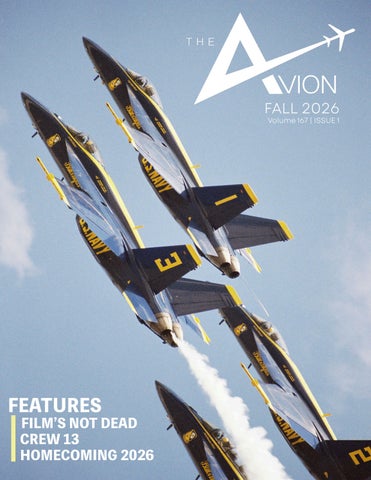
FALL 2026 Volume 167 | ISSUE 1
FEATURES
FILM’S NOT DEAD CREW 13 HOMECOMING 2026
Features 6
Roman Space Telescope
8
Film Isn’t Dead
22 Wishbone Vintage 30 Restaurant Feature
Campus & Community 12 Homecoming Week Recap 14 Crew 13 20 Student Feature 24 Club Feature - Makerspace 28 9/11: Honoring One Step at a Time
From the Team 4
Contributors
30 Avion Comics 34 Letter From the Editors
4| CONTRIBUTORS
Thank you for all of your contributions and support.
CONTRIBUTORS |5
K
ENNEDY SPACE CENTER, Fla. — On Aug. 30, 2026, NASA’s Nancy Grace Roman Space launched onboard a SpaceX Falcon Heavy Rocket on a mission decades in the making. Its mission is simple: to survey deep space at an unprecedented speed and scope. Named after NASA’s first chief astronomer, Nancy Grace Roman, the telescope is expected to usher in a new era of cosmic discoveries due to its 2.4-meter telescope, unique orbital placement, and advances in technology. One of these advances is the Wide Field Instrument, a 300 Megapixel camera which allows Roman to survey and image areas more than 100 times wider than that of Hubble at 1000 times the speed. By producing wide-field infrared images capable of revealing millions of previously unseen celestial objects, it can help answer some of astronomy’s largest unanswered questions regarding dark energy, dark matter, and the transformation of planetary systems. Roman lifted off from historic Launch Complex 39A at 7:26 a.m. onboard the semi-reusable Falcon Heavy Rocket generating over 5 million pounds of thrust. The immense thrust was necessary to deliver Roman to its destination: Sun-Earth Lagrange point two, more commonly known as L2. L2 is a gravitational equilibrium point located behind earth where the combined gravitational force of the earth and sun allow objects to maintain the same orbital period as earth while remaining at the same relative position. Roman’s L2 orbit will allow it a continuous unobstructed view of deep space where it will not be blocked by the earth. Once arriving at its permanent orbit, Roman will conduct wide-field surveys, pointing at large patches of space.
words: noelle cover / News Editor photos: matthew mazan / Member DESIGN: ANGEL GREGORIO / Senior Designer
6| ROMAN SPACE TELESCOPE
Those images will pick up stars, distant galaxies, and other objects across the visible and infrared spectrum. Roman will be utilized in concert with its sister observatory, the James Webb Space Telescope which also resides at an L2 orbit. Together, Roman will survey larger areas for targets and Webb will be used to examine individual bodies of interest. One of Roman’s key missions is the Galactic Bulge Time Domain Survey (GBTDS), a mission to complete a cosmic census of exoplanets and stellar remnants. To conduct this survey, Roman will also utilize a phenomenon called gravitational microlensing, which is created when a body of interest passes between the telescope and a more distant star. The gravitational pull of the body of interest warps the light from the distant star creating a measurable spike in brightness. This method will help astronomers detect new planets and even “rogue planets” which have no orbit and are free-flying. NASA expects this mission to lead to the discoveries of more than 1,000 new planets. Roman will also conduct the High Latitude Wide-Area Survey (HLWAS) to map hundreds of millions of galaxies and observe the effects of dark matter on them to understand the distribution of dark matter in the universe as well as the High Latitude Time Domain Survey (HLTDS) which will discover supernovae to be used to measure cosmic distance and the acceleration of universal expansion by dark energy. All processed images from Roman will be made available to the scientific community, allowing astronomers to search for objects and stars of interest.
ROMAN SPACE TELESCOPE | 7
words: grace hamilton / Managing Editor
PHOTOS: CAYLOR BRANHAM, CHARLES WILIKINS, DUSTIN COLOMBO / Contributors DESIGN: GRACE HAMILTON / Managing Editor ILLUSTRATION: EMILEE IMLER / Staff
F
ilm photography has survived more than one supposed replacement. Digital cameras made it possible to take hundreds of photos without changing a roll and smartphones put a camera in nearly every pocket. Still, film is being produced, old cameras are being put back into use and new photographers are learning a process that predates the screens they are used to shooting with.
The format also has a long history behind it. Some of the most recognizable photographs in history were captured on film, including the iconic Apollo 11 moon landing, which was captured using a modified Hasselblad and Kodak film. Today, the same basic process can happen with a camera found at a thrift store. What keeps photographers interested is partly the result. Different film stocks have their own color, contrast and grain, and the imperfections associated with film have become part of its recognizable look. Digital presets and filters regularly imitate those characteristics, from visible grain to faded colors and softer images. Actually shooting film is a different experience too. A standard roll of 35 mm film usually provides 24 or 36 exposures. There is no SD card to fill and clear, and there is no screen to check afterward. Simply take the photo, advance the film and move on. For beginners, those limitations can be useful. A manual film camera requires an understanding of aperture, shutter speed, focus and available light. With fewer exposures available, there is more reason to consider those settings before
8|FILM ISN’T DEAD
pressing the shutter. Not every frame will turn out, but an underexposed or blurry photo makes for a learning experience that can be applied to the next roll.
Charles Wilkins
Of course, making those mistakes can get expensive. Popular vintage cameras can sell for hundreds or even thousands of dollars, while film and processing create an ongoing expense. However, an expensive camera is not a requirement. eBay, Facebook Marketplace, thrift stores and antique shops are full of older point-and-shoots and SLRs. There may even be one sitting in a family member’s closet. For a first camera, the name on the front matters less than whether the shutter fires, the film advances and the lens is in useable condition. Choosing film does not have to be complicated either. ISO 400 color film is a versatile starting point for everyday Caylor Branham
A Crowded Alley, Fujifilm 400 35mm, Canon 650, Canon EF 35-80mm F/4-5.6
A Matter of Scale, 35mm Kodak Gold Film with a Pentax ME shooting. Lower ISO films generally work better with plenty of light, while higher ISO options provide more flexibility in low-light conditions. Once the roll is finished, labs such as Reformed Film Lab in Ormond Beach can develop the negatives and provide digital scans within a few days. Buying film in multipacks and skipping physical prints can help control costs as well. For those interested in the entire process, developing and scanning at home is another skill to learn. Film is not as fast, predictable, or convenient as digital photography, and it does not need to be. For someone interested in trying it, a working camera, a roll of film
Dustin Colombo
Artemis 2 Space Launch System vehicle Fuji 400 35mm film
FILM ISN’T DEAD | 9
Dustin Colombo
Maida Ometlic
Student Union Double Exposure | Kodak 35mm Gold 200 ISO
“photographers capturing life one frame at a time”
Cinestill 800T-15 Falcon 9 Streak w Landing | CineStill 800T 35mm
Charles Wilkins
Woman in the Square, Fujifilm 400 35mm, Canon 650, Canon EF 35-80mm F/4-5.6 Caylor Branham
Lost in the Mist | 35mm Kodak Gold Film with a Pentax ME 10|FILM ISN’T DEAD
HomecomT ing Week
he Tri Sigma Sorority started off Family and Homecoming Week with one of their farmers markets on Oct. 2. The event provided a platform for small local businesses, food trucks and vendors, offering a wide variety of goods. The vendors carried various baked items, handmade clothing and jewelry, flavorful lemonade and other homemade products like honey products, laserengraved and 3-D printed goods. For Riddle Students, the market offered a unique opportunity to support the community while enjoying a fun and engaging campus event.
E
mbry-Riddle Aeronautical University’s annual Brewfest brought students, alumni and families together Friday of Homecoming and Family Weekend for an evening of craft beverages, live music, and Eagle spirit. Held inside and outside of the Student Union, the event featured beers, food trucks and a fun atmosphere perfect for enjoying time with friends, family and other alumni. “Despite the rain, the event has delicious beer, food options and a great time playing pool with my son,” said a parent visiting their student for the weekend.
12| FAMILY & HOMECOMING
E
mbry-Riddle’s Homecoming volleyball game brought lots of energy and school pride to the ICI Center on Friday night as fans filled the stands to cheer on the Eagles in a Sunshine State Conference matchup against Nova Southeastern. After the completion of the second set, Student Government Association President Isaac Reyna and Vice President Nathaniel Wrobel crowned this year’s Homecoming King and Queen, Asher Baggaley and Faith Lee. They were met with cheers from the crowd as students, families and friends celebrated with them.
T
he Heroes’ Legacy 5K, an event honoring fallen eagles Ashley Guindon and Zack Capra. The event brought EmbryRiddle students, alumni and the community members together to commemorate those who fell for their service and sacrifice. Participants were allowed to run, walk or ruck as a way to show their support. The event served as an opportunity for the community to come together, remember the lives of two fellow eagles and recognize the lasting impact of Guindon and Capra’s legacies. words: kaden mcverry / Editor In Chief, jayden vaughan / Photo Editor PHOTOS: JAYDEN VAUGHAN / Photo Editor DESIGN: ANGEL GREGORIO/ Senior Designer
FAMILY & HOMECOMING |13
Matthew Mazan
K
ENNEDY SPACE CENTER, Fla. – At 11:10 a.m. on Oct. 1, 2026, NASA’s SpaceX Dragon spacecraft lifted atop a Falcon 9 rocket from Space Launch Complex 40. On board were NASA astronauts Jessica Watkins and Luke Delaney, Canadian Space Agency astronaut Joshua Kutryk and Roscosmos cosmonaut Sergey Teteryatnikov. There, the team will spend six months researching advancements in medicine, astronaut health, food and deep-space science to help prepare for human exploration on the Moon and Mars. Crew-13 lifted from Space Launch Complex 40 at Cape Canaveral Space Force Station. Following stage separation, the Falcon 9 booster separated and landed at SpaceX’s Landing Zone 40. Just 7 hours and 55 minutes after the launch, at 7:05 p.m., the Dragon spacecraft docked to the International Space Station (ISS). The rapid rendezvous set a record as the fastest launch-to-docking time for a U.S. spacecraft in the history of the orbiting laboratory. The record-setting flight highlights modern efficiency in Low-Earth Orbit (LEO), but the crew’s six-month mission aboard the ISS represents a far larger strategic objective: forging the technological, medical and operational foundation for human exploration of the Moon and Mars. While aboard the ISS, Crew-13 will work side by side with the crew of Expedition 75 to explore scientific questions regarding how to keep the crews healthier, how to grow food reliably in space, and how to advance technology to better future missions into deep-space.
Crew-13 brings together a blend of seasoned leadership and new perspectives. Although Delaney, Kutryk and Teteryatnikov are embarking on their first spaceflights, Commander Jessica Watkins made history as the first NASA astronaut to launch aboard a SpaceX Dragon spacecraft twice, having flown on Crew-4 in 2022. Crew-13 exemplifies how international collaboration and scientific curiosity overlap to push the boundaries of human spaceflight. By uniting astronauts from NASA, the Canadian Space Agency and Roscosmos aboard a single mission, the crew highlights space exploration as a powerful platform for global diplomacy and shared purpose. Aboard the ISS, their research into astronaut health, in-space agriculture and life-support technology directly feeds the insistent human curiosity driving NASA forward, transforming every experiment in Low-Earth Orbit into a steppingstone toward deep-space discovery on the Moon and Mars. Matthew Mazan
Crew-13 arrives at launchpad
words: noelle cover / News Editor
PHOTOS: MATTHEW MAZAN / Contributor DESIGN: GRACE HAMILTON / Managing Editor, EMILEE IMLER / Staff
CREW-13 | 15
16 | COKE 400
COKE ZERO SUGAR 400
Andrew Comparetta COKE 400 | 17
The victory continues Daytona’s long history of unpredictable finishes. The summer Cup Series race has been held at the Speedway since 1959, when it debuted as the Firecracker 250. Although the event has changed names and moved from its traditional Fourth of July date, dramatic finishes and fireworks have remained part of its identity.
Jayden Vaughan
18 | COKE 400
For Preece, Saturday’s race delivered both: his first Cup Series win and a place in the playoffs. “It feels really good to win at Daytona, a place that I’m not being dramatic, but three years ago could have been life-changing. That’s the risk you take as a race car driver.”
D
AYTONA BEACH, Fla. - Ryan Preece turned a chaotic night at Daytona International Speedway into the biggest victory of his NASCAR Cup Series career Saturday, winning the Coke Zero Sugar 400 in overtime and beating Shane van Gisbergen for the final spot in the 2026 NASCAR Cup Series playoffs. Preece entered the regular-season finale outside the 16-driver playoff field, while van Gisbergen held the final position. With both drivers fighting for a postseason opportunity, every position became increasingly important as the race moved into its closing laps. Preece survived multiple incidents throughout the night and moved into contention late in the race. A major crash with five laps remaining, triggered when Carson Hocevar lost control entering the east banking, shuffled the running order and set up a dramatic overtime finish. Tyler Reddick had taken the lead with 15 laps remaining after several frontrunners made pit stops. The Daytona 500 winner appeared to have an opportunity to sweep both Daytona Cup Series races in 2026, but the late caution changed the complexion of the race. Preece was at the front when another caution flew during the second overtime lap. The yellow flag froze the field and secured Preece’s first career Cup Series victory.
Jayden Vaughan
More importantly, the win moved Preece into the playoff field while knocking van Gisbergen out. Van Gisbergen had entered the night in 16th and final playoff position and even won the opening stage, but could not hold onto the spot through the race’s chaotic conclusion.
Jayden Vaughan
Andrew Comparetta Andrew Comparetta
COKE 400 | 19
words: grace hamilton / Managing Editor PHOTOS: FAITH LEE / Contributor DESIGN: GIANCARLO ESTRADA / Senior Designer
F
or Faith Lee, finding her place in engineering has not been about following one straight path. Instead, her journey has been about exploring new opportunities, being willing to change direction and discovering what truly excites her. Growing up in Houston, Texas, Lee was surrounded by aviation and space. With NASA’s Mission Control and George Bush Intercontinental Airport nearby, aerospace was always a familiar part of her world. That early exposure eventually led her to Embry-Riddle Aeronautical University, where she began exploring what she wanted her own place in the industry to look like. When Lee first arrived at Embry-Riddle, she planned to study Aeronautical Science and pursue her private pilot’s license. However, she soon realized that her passion was not necessarily in the cockpit. While working on a class project that involved building a miniature glider, Lee discovered a different side of aviation that caught her attention: engineering. That experience encouraged her to make a change and pursue Aerospace Engineering. Her journey did not stop there. Lee also explored Civil Engineering, giving her the opportunity to learn about another side of the engineering field and further understand where her interests and strengths fit best. For Lee, changing programs was not a setback. It was part of figuring out what she was passionate about. Her journey has since become an example
20 | STUDENT FEATURE
Lee’s own experience shows that students do not have to be afraid to switch programs, explore a different field or admit that something they once wanted is no longer their passion. Sometimes, finding the right career means being willing to take a step in a new direction.
for other students who may find themselves questioning whether the path they started on is really the right one. Her engineering experience has extended well beyond the classroom. Lee completed an internship with Spirit AeroSystems and later earned a co-op opportunity with Delta Air Lines as a liaison engineer in Tech Ops. These experiences gave her the chance to see how engineering principles are applied in the aviation industry and how engineers contribute to the systems and operations that keep aviation moving.
That willingness to explore is something Lee encourages in the students around her. Get involved. Talk to people. Try something new. Take the opportunity to go somewhere or meet someone you normally would not. You never know which experience might introduce you to something you are passionate about. From Houston to Embry-Riddle and from the classroom to the aviation industry, Lee has continued to follow that mindset. Her path has taken her through aerospace and civil engineering, industry experience and student leadership, but perhaps her greatest impact has been showing other students that it is okay not to have everything figured out. Sometimes, finding your passion starts with simply being willing to look somewhere new.
But Lee’s impact at Embry-Riddle goes beyond her own career. As the current president of the Society of Women Engineers, Lee has become a leader within the university’s engineering community. Through SWE, she helps create opportunities for students to connect with professionals, explore engineering careers and build relationships with others who share their interests. Her leadership has also made her an inspiration to students who may not have everything figured out yet.
STUDENT FEATURE | 21
Wishbone Vintage: Keeping Style Accessible words: grace hamilton / Managing Editor PHOTOS: EMILEE IMLER / Staff DESIGN: GRACE HAMILTON / Managing Editor, EMILEE IMLER / Staff
W
alking into Wishbone Vintage in New Smyrna Beach feels less like stepping into a traditional clothing store and more like entering a haven for creativity and community. From vintage dresses and jewelry to local art and handmade goods, the store offers something different and exciting around every corner. Owner Emily Williams opened Wishbone Vintage in August 2024 with the goal of creating an affordable and welcoming space for the community. Williams first became interested in vintage wear while selling thrifted clothing through Depop in college. She quickly fell in love with the uniqueness and sustainability of vintage fashion and eventually decided to channel her passion into running a storefront. “I just wanted to make a fun, inclusive space,” This vision of fun and inclusivity has become the backbone of Wishbone’s identity. Williams said she wanted to create a place where people could hang out with friends, go on a date or simply browse without feeling pressured to buy anything. The store also provides a space for local creatives to sell and display their work. Jewelry, pottery, art and other handmade products from Williams’ friends and fellow artists fill the store alongside its vintage clothing. She is also planning to host monthly craft nights at Wishbone, featuring workshops for activities such as junk journaling, pottery, and cyanotype printing. “I just like connecting with people,” Williams’ emphasis on connection extends beyond the store. Wishbone frequently partners with other local businesses through pop-ups and events, creating opportunities for customers to discover other small businesses in the area. The store has also hosted a local coffee cart, successfully bringing new customers to Wishbone and supporting another growing business at the same time. Williams says she wants Wishbone to create more opportunities for younger people living in New Smyrna Beach to find community, especially in an area where many businesses cater to older generations and seasonal visitors. Notably, Wishbone hosts an impressive collection of vintage wedding dresses. Williams offers appointments for future brides to browse the store’s catalogue of bridal gowns. These vintage wedding dresses have even drawn customers from outside Florida through the reach of Wishbone’s website and social media. As Wishbone grows in popularity, Williams also hopes to grow the store’s inventory to include a larger bridal section, a more extensive assortment of clothing and an increase in products from both independent artists and small businesses. Whether someone comes in searching for a vintage dress, a new piece of jewelry or simply a place to hang out, Williams hopes they leave feeling like they are part of a community. At Wishbone Vintage, style is not about following one trend. It is about finding something unique, having fun and making space for individuality. “You can wear whatever you want,” Williams said. “You can have more fun.”
22 | WISHBONE VINTAGE
D
Beyond the Club
AYTONA BEACH, Fla. — Following the duck prints into the Lehman Building, Embry-Riddle students will find the makerspace lab. Chances are, some will stumble upon the makerspace discovery program. It looks like a club on the outside, but on the inside, it’s a training program that helps students become certified and gain experience in additive manufacturing.
A
The makerspace is a department in the College of Engineering that provides low-cost additive manufacturing services to all faculty, staff and students. Not to be confused with the physical makerspace itself, the makerspace discovery program, uses the lab and its equipment for formal training on how to safely and effectively use the space. For a small club fee, students are trained and earn many practical certifications. Currently six disciplines are offered, including FDM, SLA, recycling, composite printing, post-processing and 3D scanning.
Aquiningoc is currently trained in SLA, as well as industrial additive manufacturing, a discipline expected to be offered in the upcoming year that includes training with Markforged 3D printers. She said there is a likelihood that students in the club could be offered an on-campus job at the makerspace to help teach other students in the disciplines they are proficient and certified in. For many members, including Gomez and Aquiningoc, working at the makerspace is a common goal.
“It’s definitely worth joining,” said Oswaldo Gomez, a sophomore studying aerospace engineering. “It’s very hands-on, and I feel like it’s one of the most freshman-friendly clubs because you just learn everything.” Gomez has taken the program classes for FDM, composites, and scanning, and is currently taking another for his fourth certificate. He joined last year because of his interest in learning carbon fiber layups through the composite printing class, but stayed because of the numerous opportunities the discovery program had to offer. “In the discovery program, it is really all about you and your efforts,” said Daphne Sierra Aquiningoc, an officer of the discovery program and an employee of the makerspace club.
words: kate caling / Senior Reporter PHOTOS: BRIAN WANGEL / Member DESIGN: DAPHNE SIERRA AQUININGOC / Design Editor 24| MAKERSPACE DISCOVERY PROGRAM
benefit that many engineering students find appealing about this club is the opportunity to strengthen their resumes through training and potential work experience.
Within Makerspace
N “If you join the club and get your certifications, that means you’re a qualified person to use that equipment, and then you can go from the club to work in the department,” said Aquiningoc. Beyond the professional aspects of the club, the discovery program also aims to create a welcoming and collaborative environment where students can learn from one another. Although safety and education remain the primary priorities of the program, the makerspace discovery program focuses on having a casual and friendly relationship between the members and the department. “It doesn’t matter what is your background or your major, you are more than welcome to start utilizing the makerspace,” said director Granizo. “If you want to develop something tangible—a project or product you want to create and prototype—you can make it happen through the makerspace.” Whether students want to earn certificates backed by the College of Engineering or gain hands-on experience using and learning machinery in the makerspace, the Makerspace discovery program is designed to support the interests and growth of all students at Embry-Riddle. The makerspace and the discovery program are located in room 133 of the Lehman Building, and are accessible on weekdays from 8 a.m. to 9 a.m.
ow in a permanent location within the College of Engineering, the makerspace gives students a place to let their creativity roam while still providing guidance and emphasizing professionalism. The recent exponential growth of the program serves as a reflection of the increased interest and participation engineering students have had on both the discovery program and the makerspace. “As an undergrad student, I always lacked the possibility to have the accessibility to build something with my hands,” said Juan Granizo, an associate professor for engineering fundamentals in the College of Engineering. Granizo, now the director of the COE makerspace, envisions it as an open and collaborative space where students can develop, strengthen and expand their technical skills. Within the shared space, students are able to ask for help and collaborate with other RSOs such as Design Build and Flight (DBF), Unmanned Aircraft Systems (UAS), and the American Society of Mechanical Engineers (ASME). Granizo mentioned that through makerspace, the COE is able to prepare the newer engineers to be ready for the rapidly advancing industry with handson experience, opportunities to earn technology certifications and valuable connections within the field. “It’s not just necessarily for your profession, but it’s also for your life—it builds and enhances the skill sets for your daily life,” said Granizo.
MAKERSPACE DISCOVERY PROGRAM |25
F
OOD ON FINAL
O
n this issue’s edition of Daytona Foodies, we are looking at Pink Fryday. Located at Shoppes at ONE DAYTONA, next to Crumbl, they are a fun, young, energetic cafe that has an inviting design, ready for anyone to spend the afternoon studying with their free WiFi, playing games or just hanging out with friends. Opening earlier this year, they have a wide variety of tasty treats, ranging from fried chicken to donuts to boba tea and much more. With this unique combination of foods, you can fulfill any craving, sweet or savory. Although their popularity grew with summertime vacationers, they want to open their space to locals and be the spot where students can chill after a long day of classes. Their donuts are cake-like, true to flavor and endlessly enjoyable. If you have a fun craving, or something you saw online that you want to try, bring your ideas here, where they can make customizable donuts. Some of our standouts include Strawberry Cheesecake, Dubai Chocolate, Biscoff Cream and Lotso. Our favorite is Strawberry Cheesecake. words: elanna heller & rachel collinson / Members photos: jayden vaughan / Photo Editor DESIGN: BELLE HOLCK / Business Manager
26 | FOOD ON FINAL
Dubai Chocolate The Dubai Chocolate Mochi donut has pistachio shavings, sweet pistachio paste and a sweet chocolate drizzle that gives it an adorable look.
Strawberry Cheesecake Biscoff Next up is the Biscoff Cream. This donut gives you a Delta Air Lines experience that makes you feel like you are on the plane, with Biscoff frosting and crumbles, whipped cream and topped with the cookie itself.
The Strawberry Cheesecake donut has cheesecake flavored frosting, strawberry glaze, whipped cream, cheesecake crumble, and a strawberry on top, making it taste exactly like a strawberry cheesecake.
Lotso We want to highlight the Lotso, which is unique from the others because they are shareable donut holes. Instead of the cakelike donuts you get with the others, they are light and airy and taste just like the Dubai Chocolate Mochi donut.
Pink Cloud Boba Made by their knowledgeable barista, their drinks range from matcha to coffee to boba. Their signature drink, the Pink Cloud, is a milk tea with strawberry syrup and a pink cold foam topped with sprinkles that is the perfect drink to feel like summer never ended. They also have a matcha latte that comes in different flavors, notably mango and strawberry, and is made traditionally for an authentic taste that you can’t get anywhere else.
If you are craving something savory, the chicken is the item to get. Their fried chicken is different from what you might expect due to a specialized flavor that was brought back from the owner’s experience in China. Their chicken tenders and wings are crispy on the outside and juicy on the inside. There are multiple sauce options, like their signature Pink Bomb, which is similar to yum yum sauce with some sweet and sour to give you a nice kick. If you are looking for something healthy, look no further than their signature bowls. If that’s not your vibe, they also have chicken sandwiches.
Savory Options FOOD ON FINAL | 27
Steven Sobel
Learning From the Past
F
ew people understand the events of September 11 from the perspective of air traffic control better than Dr. Michael McCormick. Today, he works as the associate professor and program coordinator of Air Traffic Management at the Embry-Riddle Aeronautical University Daytona Beach Campus. On September 11, 2001, Dr. McCormick served as the FAA’s air traffic manager at New York Center, where he made the unprecedented decision to declare “ATC Zero” and shut down the center’s airspace as the attacks unfolded.
Twenty-five years after the attack, Dr. McCormick held a live presentation for Riddle students at all campuses. He reflected on ten important lessons that he learned that morning, emphasizing leadership, community, and resilience. “The advice I would give to… the future traffic controllers of the world is…
“If you see something say something. That’s the only way you’re gonna fulfill your mission of being the guardian of the skies”
-Dr. Michael McCormick
28 | 9/11 - 25 YEARS
NEVER FORGET
words: noelle cover / News Editor
PHOTOS: NOELLE COVER / News Editor DESIGN: AVERY ALEXANDER / Operation Coordinator
Steven Sobel
25 Years Later: Remembering 9/11 Through Those Who Lived It
T
his year marks the 25th anniversary since the attacks on September 11, 2001. It was a day in history that changed family lives, security, and the aviation industry as we know it today. Across Embry-Riddle’s campus, students continue to honor the lost lives through annual acts of remembrance that reinforce the importance of service, sacrifice, and resilience. Cadets from all branches came together to honor the lost innocent lives and the first responders who risked their lives. The annual tribute was held by Embry-Riddle’s ROTC program at the Daytona International Speedway. The cadets took 2,100 steps in remembrance of the heroes that showed courage, sacrifice, and strength in the wake of a tragedy.
Outside of the Mori Hosseini Student Union, Embry-Riddle’s Delta Chi student chapter displayed flags for the commemoration. The flags made out the shapes of the Twin Towers, the Pentagon, and flight ninety-three, the visual reminder evident to every Riddle student that walked by. 9/11 - 25 YEARS|29
words: grace hamilton / Managing Editor
ILLUSTRATIONS: DAPHNE SIERRA AQUININGOC / Design Editor DESIGN: DAPHNE SIERRA AQUININGOC / Design Editor
B
etween early-morning classes, late-night study sessions and everything in between, college students rarely seem to run on a normal sleep schedule. To help navigate the chaos, The Avion’s mascots are here to experience it all alongside you. Throughout this semester, our mascots find themselves caught in the unpredictable cycle of college life. From fighting through an early morning after staying up too late, to trying to catch a few extra hours of sleep between responsibilities, they represent the many ways students balance rest with busy schedules. While they may only exist on the pages of The Avion, our mascots bring a little personality and humor to the story. Their experiences are exaggerated, but the struggle is familiar: trying to figure out when to sleep, when to work and when to simply make it through the day. Think of them as your unofficial companions through the ups, downs and questionable sleep decisions of college life. As you follow along, you might even recognize a little bit of yourself in them.
30 | AVION COMICS
AVION COMICS|31
Q
The Avion Asks...
What is One thing that You can’t survive college without? Hey Eagles!
Here at Embry-Riddle, students work hard and aim high. To succeed academically, we know the basics such as completing assignments, having a laptop and maintaining a study plan. Sometimes, our necessities are major specific. To find out what students rely on beyond academics, I interviewed students at the Student Organization Showcase to gather input from students of different majors and interests. Despite our differences, students have a lot more in common than we think. The most common replies included food, entertainment, connection, and caffeine - the college staples that help us take off into our careers.
words: brianne weathers / Public Relations Manager PHOTOS: ROY SU / Member DESIGN: GRACE HAMILTON / Managing Editor 32 | AVION ASKS
Kritika Subramaniam Mechanical Engineering Sophomore “My calendar, because I love staying organized.”
Janith Kanaganayagam Aerospace & Occupational Safety Senior “My Qdoba, because I can’t survive without my calories.”
Benjamin Ramos Aeronautical Science Freshman “I couldn’t survive without my rollerblades. I would be late to class every day.”
Allison Simmons Aeronautical Science Senior “Red bull every morning before class.”
Jordan Stynes Communications Senior “Communication, because it is important to network with others.”
AVION ASKS | 33
A Letter From the Editors
T
hank you for reading the Fall 2026 Issue 1 of The Avion. Our team of students works incredibly hard to showcase our university, the surrounding community and the interests that shape our campus culture. At a university without journalism, visual arts or digital media majors, The Avion provides a unique place for students to learn, create, collaborate and share their voices. This issue features the coverage you have come to expect from us, including stories about the aviation and space industries, major campus events such as Homecoming and Family Weekend, NASCAR races and Avion Asks. Behind every page are students who have spent countless hours reporting, photographing, designing, editing and working together to create something that represents the Embry-Riddle community. As you read, I encourage you to look beyond the pictures and stories. Celebrate the students, clubs, local businesses and restaurants featured throughout these pages. Each one contributes to the community we share. The Avion exists not only to document what happens on campus, but also to recognize the people and organizations making an impact within it. Our work also extends beyond this magazine. Through online articles, event coverage, professional headshots, photo booths, equipment loans and other media services, we support students and organizations across campus. Whether your story appears in print or online, or you requested a service, we are here to help amplify the people, organizations, ideas and accomplishments that make our community special. The Avion is also a place where students can gain handson experience. Whether you are interested in writing, photography, design, video, social media, business operations or simply want to try something new, there is a place for you on our team. No previous experience is required, only a willingness to learn and contribute. If you are wondering how to get involved, come to our meetings Tuesdays at 7 p.m. in Student Union 210, The Chamber. Catch you in the next issue!
words: kaden mcverry / Editor In Chief, grace hamilton / Managing Editor PHOTOS: JAYDEN VAUGHAN / Photo Editor DESIGN: GRACE HAMILTON / Managing Editor
34 | EDITOR’S LETTER
Until then, keep showing up, getting involved and making memories.
Issue 1 Fall 2026 Editor-in-Chief
Kaden McVerry
Managing Editor
Grace Hamilton
Business Manager
Belle Holck
Design Editor
Daphne Sierra Aquiningoc
News Editor
Noelle Cover
Photo Editor
Jayden Vaughan
avioneditor@erau.edu
avionmanaging@erau.edu
avionbusiness@erau.edu
avioneditor@erau.edu
avionnews@erau.edu
avionphoto@erau.edu
....................... ........................
Contributors & Page Editors Avery Alexander Daphne Sierra Aquiningoc Caylor Branham Kate Caling Rachel Collinson Dustin Colombo Andrew Comparetta Noelle Cover William Dressler Giancarlo Estrada Angelica Jade Gregorio Grace Hamilton Elanna Heller
Belle Holck Emilee Imler Faith Lee Matthew Mazan Kaden McVerry Maida Ometlic Kylie Pearson Roy Su Jayden Vaughan Antonia Vital Brianne Weathers Brian Wangel Charles Wilkins
....................... ........................
Front Cover
Dustin Colombo
Back Cover Emilee Imler
....................... ........................
Advisor
Karin Gollin Executive Director of Student Engagement and Student Union
....................... ........................
SGA Executive Board President
Isaac Reyna
Vice President
Nathaniel Wrobel
Treasurer
Anthony Cafiso
Chief Justice
Nicola Kaehler
EIC, The Avion
Kaden McVerry
GM, WIKD 102.5
Ben Redmond
Chairperson, TNG
Bryan Wiebe
sgapres@erau.edu sgavpres@erau.edu sgatres@erau.edu sgachfj@erau.edu avioneditor@erau.edu dbgmwikd@erau.edu dbtngchr@erau.edu
....................... ........................
free photography equipment for all students attend events as credentialed media