RESULTS magazine A PUBLICATION BY THE AUSTIN COMPANY
On The Hunt
For Top Notch Bidders
World-Class Building Interview with Matt Eddleman
Reclaim 52 Minutes
Worker Utilization and Efficiency Study
CONTRIBUTORS
VOLUME 2 - ISSUE 2
PUBLISHER Tamara Zupancic EDITOR IN CHIEF Susan Riffle
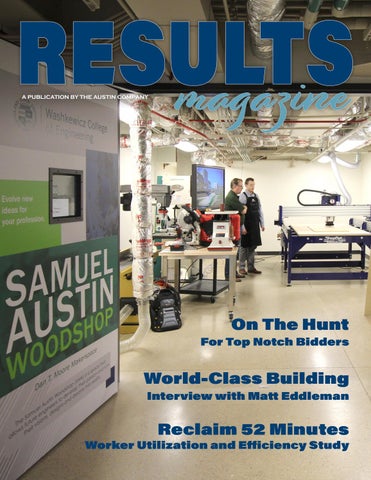
CONTRIBUTING WRITERS Cover Photo: Cleveland State University Washkewicz College of Engineering, Dan T. Moore Makerspace. For more than a year, The Austin Company worked behind the scenes at Cleveland State University’s College of Engineering to create a hands-on woodshop where future engineers (students) would be able to work with their hands, increase their understanding of the trades and turn their visions into reality. Now known as the Samuel Austin Woodshop, the space pays homage to The Austin Company founder’s origins as a builder, community advocate and inventor of the design-build delivery method. Back Cover Photo: Concrete pour at Franz Bakery in Springfield, Oregon.
Bonny Block & Jim Cathcart My Old ‘57: You Can Drive Home Again Brandon Davis Finding Project Success in Mexico: Lessons Learned Amy Hewis On the Hunt for Top Notch Bidders Chris Jackson Planning for Early Career Preconstruction Professionals Kyle Johnson & Charles Slife Getting Familiar with the New River Valley Nicole Rosario Making a Home for Critical Pharmaceutical Products Ken Stone Doubling Capacity for Automotive Parts Manufacturer in Mexio Steve Van Wormer & Charles (Chas) Hammond A Study in Worker Utilization and Efficiency, Part 1
ART DEPARTMENT Tamara Zupancic & Brittany Scheckelhoff
RESULTS MAGAZINE VOLUME 2 ISSUE 2 FALL/WINTER 2018 IS PUBLISHED BY THE AUSTIN COMPANY Social icon
Rounded square Only use blue and/or white. For more details check out our Brand Guidelines.
2
RESULTS MAGAZINE
6095 PARKLAND BOULEVARD, CLEVELAND, OH 44124
the
austin
all stars Exemplifying Austin Family Values
In celebrating The Austin Company’s 140th anniversary this year, it is also a time for reflecting on our founding and the values on which our Company is built. Samuel Austin, our founder, firmly believed in honest work, well done and providing clients a square deal—a business built on ethical dealings, mutual respect and professional excellence. While many years have passed since Samuel instilled those values in his team, we carry them closely with us in our work today. Across Austin, we regularly recognize team members who demonstrate excellence in living our values – below are just a few of the many All Stars who have been identified by their peers and leaders.
Matt Bedee
“
att’s reliability and commitment to providing safety and quality plays a significant role to the success of our department, as well M as the entire Austin team. He consistently demonstrates enthusiasm and willingness to take on additional responsibilities within and outside the office, which shows the true nature of his character. This demonstrates how committed he is to the success of the team and Company.
Dave Houston
“
ver the years, Dave has worked hard and developed himself into not only one of the best Supervisory Electrical Designers O at Austin, he has become, in my opinion, one of the best designers in the Engineering Department for The Austin Company. Dave combines his considerable electrical knowledge with his excellent CAD skills to be a highly productive and competent electrical designer.
Jonathan Gemmen
“ “ “ “ “
J onathan has a ‘client first’ mentality and continuously demonstrates a willingness to invest the time and make the personal sacrifices necessary to meet client’s needs and schedule deadlines. Moreover, Jonathan exhibits high character and has built strong relationships with clients that place a great deal of confidence and trust in his abilities and advice.
Billiejo LeSage Billiejo always has a can-do attitude such that when others say ‘we can’t,’ she says ‘we can’ and provides the leadership needed to move the project forward. Billiejo works to promote a cooperative team environment to deliver our services as efficiently as possible.
Steve Lotz nsuring a safe work environment for our employees, clients and partners is the expectation. There may be several approaches in E how this can be achieved. Steve’s passion, however, and ability to help others learn how to create a safe environment, is nothing short of exceptional.
Brian Paciorkowski rian excels at customer-focused communications and client satisfaction. Brian is a quick read on food-grade sanitary systems B and materials of construction, and when in doubt, he is quick to ‘reach across the aisle’ to his Austin colleagues to get it right, the first time. Brian treats trade subcontractors with respect and holds them to task on their scope, quality and schedule commitments.
Mark Price Mark can always be counted on to do his best with each task he is given. He works hard and meticulously to calculate, and recalculate, as necessary, to produce the best solutions for each project.
As we look to the future, we are excited to honor others who share such passion for and dedication to our clients and Company.
1
RESULTS MAGAZINE
RESULTS MAGAZINE
1
CONTENTS
VOLUME 2 - ISSUE 2
Snipchats 1 The Austin All Stars: Exemplifying Austin Family Values President’s Pen 5 Reflections on 2018 by Mike Pierce Spotlights 4 Doubling Capacity for Automotive Parts Manufacturer in Mexico 6 Austin Sanitary Roofing System 7 Making a Home for Critical Pharmaceutical Products 10 Interview with Matt Eddleman: Precise Engineering, Quality Construction: How World-Class Facilities Get Built 22 My Old ‘57: You Can Drive Home Again 27 Experience Austin's Hospitality Construction Features 12 Planning for Early Career Preconstruction Professionals 16 On the Hunt for Top-Notch Bidders 20 Lessons Learned: Finding Project Success in Mexico 24 Lean Design & Construction: A Study in Worker Utilization and Efficiency, Part 1 Blog Log 14 Austin Consulting FAM Tour: Getting Familiar with the New River Valley Global Gallery 27 Pictures from Across Austin Published: November 2018
2
RESULTS MAGAZINE
PRESIDENT’S PEN
REFLECTIONS ON 2018
As we close in on the end of 2018, I share some reflections with you on the year, where we are and where we are going. For a variety of reasons, this was an interesting year for us. Despite a remarkable economy and dynamic trends, we did not benefit from those trends early in the year. Uncertainty about trade wars and tariffs led to hesitation on the correct strategies on major capital projects by many of our clients. Often, after some time, the uncertainty gets resolved or the need for the benefits of the planned investment grows to the point where the commitment is made. So, we started slower than expected, but sales and revenues have consistently grown throughout the year and we are on track to exceed our Sales Plan and enter 2019 with a solid backlog position. Optimism aside, there is an old adage about plan for the worst, hope for the best. I think the saying is incomplete—it should be: Plan for the worst. Hope for the best. Be prepared for both. If we are not prepared for the best, we will be unable to properly rise to the occasion, and that might be the worst of all. I believe we have properly accomplished this as we have continued to be opportunistic when we find the right people for the right seats on our bus. As we have brought on many new faces, we have done so with a heightened awareness of getting leaner in our operations, staffing and processes we use. Becoming lean is not a destination, but a journey. All organizations go through cycles of growth and maturity, and as such, they can become bureaucratic and complacent. We stay on constant guard against that, periodically looking at where we are, and assessing what can be done to make us better, leaner, more efficient and responsive. Our clients, our trade partners and our teammates expect us to offer a clear and coherent set of processes and expectations. Being lean helps us be more nimble and responsive to changing market conditions, whether they are up or down. When you have a clear and coherent vision, strategy and set of priorities that are understood throughout the organization, you can have a clear set of expectations and accountabilities. We work to assure this is in place to ensure future success. It is about continuous improvement in all we do; organizational clarity and purpose are always areas that need to be assessed, as improvement in them improves the entire organization. In addition, there are many new faces on the Austin Team. We welcome you and understand and appreciate that you bring a lot to our future, while at the same time we need to help you understand what our polices, processes, expectations and accountabilities are. We are entering 2019 with a strong backlog of great clients and exciting and challenging projects. Every project is a new opportunity to continually improve our craft and expertise. It is a journey of growth and experience. As we work to improve our focus, alignment and efficiency as an organization, we are grateful to have you with us. We will be prepared no matter what the future holds. We are entering 2019 with a strong backlog of great clients and exciting and challenging projects. Every project is another opportunity to hone our craft and expertise. It is a journey of growth and experience. As we continue to improve our focus, alignment and efficiency as an organization, we are grateful to have you with us. We will be prepared, no matter what the future holds. “You cannot change your future. But you can change your habits. And surely your habits will change your future.”
Mike Pierce, President
A.P.J. Abdul Kalam
RESULTS MAGAZINE
3
PROJECT SPOTLIGHT
AUTOMOTIVE
DOUBLING CAPACITY for Automotive Parts Manufacturer in Mexico
Owner: Y-Tec Keylex Mexico, S.A. De C.V. - Salamanca, Guanajuato, Mexico Facility Type: Automotive Parts Manufacturing | Project Size: 324,000 SF | Solutions Provided: Design-Build The Austin Company designed and built the initial Y-Tec Keylex Mexico, S.A. de C.V. (YKM) automotive parts manufacturing and assembly plant in 2013. Within three years, however, the plant—part of Mazda’s automotive complex in Salamanca, Guanajuato, in central Mexico—was already reaching its initial phase production capacity. YKM needed more space to sustain their commitment to supply vehicle parts to Mazda and in late 2015 announced plans to enlarge the plant. Austin was again selected to design and construct the Phase 2 expansion, which began in August 2016. The project was implemented on an accelerated schedule to meet the growing production demands. Essentially a planned mirror of Phase 1, the expansion includes approximately 324,000 square feet (30,100 square meters) of manufacturing space, of which 283,000 square feet is designated for production and 41,000 square feet set aside for receiving, cutting, maintenance, stamping, assembly, paint and shipping areas. CROSS-CULTURAL TEAMWORK The design-build project team included members from the United States, Japan and Mexico. In addition to logistics challenges due to the varying locations of team members, managing three distinct languages (Japanese, Spanish and English), business cultures and organizational variances were significant cornerstones to the project’s overall success. Construction documents were completed in both English and Spanish, while meetings were regularly held in all three languages. Ken Stone, Vice President and Project Executive, explains this distinction: “The drawings were prepared in both languages because the client reviewing them could understand English, but the construction workers implementing the work were Spanish speaking. So, the documents needed to be in Spanish for the workers to understand them. All three languages were spoken during project meetings, however, to facilitate brief, impromptu breakout sessions to ensure clarity and coordination.”
4
RESULTS MAGAZINE
To meet YKM’s design objectives, the design and engineering followed international standards, while taking into consideration construction approaches and practices in Mexico.
Daily work plans were shared and coordinated with plant management as one of the strategies used to guard against employee injury while working in an active construction site.
FACING CHALLENGES FOR PROJECT SUCCESS
Facility tie-ins occurred during extended weekends and plant shutdowns, which were strategically planned to coincide with plant maintenance. In addition, permanently relocating the product shipping docks and doors to the side of the plant was scheduled around operating hours to minimize disruptions.
YKM leased an additional site area to accommodate the expansion, doubling the size of the plant to approximately 648,000 square feet (60,200 square meters), with an additional 33,200 square-foot office and cafeteria building. Working around the existing facility’s two-shift, six-day-a-week operations without disruption was critical. To facilitate construction, the team started at the far edge of the expansion and worked back toward the existing building’s exterior wall – the originally planned mirror point.
Completed in July 2013, Phase 1 was subsequently selected by Engineering News Record as a 2014 Global Best Project Award winner.
Ken Stone explained the strategy. “The exterior wall provided the temporary separation we needed to keep new construction separate from existing manufacturing until the expansion was complete. The wall remained in place until structural, utility and service tie-ins were completed to avoid risk of impacting plant safety or operations.”
Heavy rain storms, typical of central Mexico, impacted initial site work. However, the application of Lean Construction practices, such as Pull Plan meetings with all trade partners and weekly Last Planner meetings established clear lines of communication, which enabled the project team to mitigate impact on the overall project schedule.
The final hurdle involved the compressed air and processed gas tie-ins. To facilitate equipment installation, the team turned over each section of the building to YKM as it was completed.
By October 2017, approximately 12 months after its August 2016 groundbreaking, Phase 2 was completed. The expanded facility was fully ready for production in January 2018. As with Phase 1, the expansion was completed on budget and on time. Stone concluded, “If you’re looking to build in Mexico, having an engineering team that clearly understands project objectives and how to achieve and manage them in Mexico is a must. Otherwise, an Owner may not wind up with the intended result, because the skill level and attention to design don’t always translate. That’s why having a U.S. partner with Mexico presence and experience, like Austin, offers a distinct advantage.”
IN THE SPOTLIGHT
AUSTIN INNOVATION
AUSTIN SANITARY ROOFING SYSTEM
Creating Safe Plants for Safe Products In regulated facilities (USDA, FDA, sanitary or clean facilities), the roof of the building is often flat and supported by many horizontal steel girders and joists. The regulatory and best practice requirements for these facilities demand that the entire area, including the steel girders and joists, be cleaned and sanitized regularly. In the current approach, these girders and joists have many flat surfaces, crevices and areas where dust, grease, microbial growth and other particles can settle. Because of these conditions, it is difficult to effectively and efficiently remove these elements from all surfaces, creating the dangerous risk of bacterial growth and contamination. In response, The Austin Company has developed a system that improves operating conditions, reduces the use of natural resources, and lowers the cost of building and maintaining a sanitary facility. The Austin Sanitary Roofing System has received provisional U.S. patent protection and has patents pending around the world. Austin’s invention, a roof support system, involves a joist comprising a hollow top and bottom chord and a plurality of web members connecting the top chord to the bottom chord, a rectangular lateral cross section, and ends which are sealed. The Austin Sanitary Roofing System is a new approach to the design and construction of sanitary production and support facilities that dramatically improves the ability to effectively and efficiently maintain sanitary facilities, with a decrease in cost to the plant owner. This System dramatically minimizes the number of flat surfaces, crevices and areas associated with the roof and roof support system, making the facility easier to wash, clean and sanitize. This reduces resources and costs expended by the plant owner to operate and maintain their facility, and significantly lowers the risk of non-sanitary conditions, improving product safety and the safety of the consumer.
6
RESULTS MAGAZINE
PROJECT SPOTLIGHT
PHARMACEUTICAL
Making a Home for Critical Pharmaceutical Products
Owner: Pharmaceutical Company - Midwest USA Facility Type: Storage | Project Size: 98,000 SF | Solutions Provided: Design-Build
EXPANSION BLUES A confidential pharmaceutical client asked The Austin Company to assist in expanding their pharmaceutical storage and distribution operations. The client experienced rapid growth and needed to increase their capability to handle more product. The expansion needed to be built to tie into an existing legacy building. The challenge was blending the addition seamlessly with the original, while maintaining the strict quality control required for the pharmaceutical industry. The client was committed to maintaining the architectural style of the building, since it personified the promise the company made to improve its local community. RAISING THE BAR Since the expansion was to improve warehousing capacity, the material being used to construct the interior needed to meet strict cleanliness standards. Material that would stay clean was a must, given the amount of product that was going to be stored.
“We created space in our existing facilities to do more production,” the Owner said. “We’re basically full. We know we needed to free-up space to grow and the best place to do it was with the warehouse, because we also needed the additional pallet capacity.”
From the beginning, Austin ensured that the building addition matched the aesthetics of the legacy building. A point that was proven by using a matching brick veneer on
RESULTS MAGAZINE
7
the 65-foot-tall precast backup panels. Honoring the history did not stop there. Entries were defined with brick features, matching the legacy gateways of the existing buildings. Constructing a clean space was critical to the success of the project. While brick veneer handled the outside of the expansion, a smooth
finish of the precast panels was chosen for the inside. This allowed for ease of maintenance and clear visibility. Full-height precast wall panels were selected as the most efficient option when compared to the other wall systems. This saved the client time and money by maximizing time efficiency while erecting the walls during winter months. Maintaining strict temperature parameters to maintain a Controlled Room Temperature (CRT) environment can be a persistent adversary to a facility that houses pharmaceutical products. Austin designed the facility to exceed these requirements, including giving each interior dock an airlock. This provided temperature control even during product transfer to trailers for shipment.
8
RESULTS MAGAZINE
THE RESULT Upon completion of the expansion, the client gained the capacity to handle up to 9,500 pallets of finished goods or workin-process pharmaceutical products. The 65-foot high ceiling allows for the creation of two cold storage rooms capable of housing 1,000 pallets each. As a bonus, the floor is so perfectly flat (to keep highrising seven-pallet-tall forklifts steady) that it won a Golden Trowel award. This pharmaceutical client proved, that with the right planning and analysis from construction management experts, even complex industry standards can be met and exceeded. The warehouse operates with roughly 26 employees, 24 hours a day, 7 days a week. The keys to success for this project were a combination of innovation and complete understanding of the complex standards within the pharmaceutical industry.
PRECISE ENGINEERING QUALITY CONSTRUCTION
How World-Class Facilities Get Built An Interview with Matt Eddleman, Senior Vice President of Operations
How long have you been with The Austin Company and in what capacity have you worked for them? I started with Austin in 1988, and except for a brief break in the early 1990s, have been with the company ever since. I began in purchasing and have worked in estimating, project management, business development, regional management and now as a Corporate Officer. How have manufacturing facilities evolved in recent years (or since you have been in the industry)? Several changes come to mind, including increased automation, “smarter” buildings, lean manufacturing, and sustainable construction and operational processes. In addition, reshoring: manufacturing previously shifted to lower-cost labor parts of the world are now returning to the U.S. What are some notable projects you have worked on over the years? Due to The Austin Company's breadth of industry experience, I’ve had the opportunity to work on food processing facilities, pet food plants, bottling facilities, rocket factories, television studios, newspaper production facilities, aircraft manufacturing facilities, aircraft paint facilities, laboratories, office buildings, engine and turbine plants, and more. Overall, I’ve been involved in projects totaling more than 5.5 million square feet of special use facilities, valued at over $1.3 billion. What was a particularly challenging project you worked on and how did The Austin Company overcome the challenges you were presented with? When building the rocket plant, the overall scope of the project was drastically changed two weeks after we mobilized on-site and began preparing for foundations. Due to the size of the rocket, certain portions of the manufacturing process could not be performed anywhere else in the world – it had to be manufactured at the new facility. Due to the dramatic scope changes, the schedule was in jeopardy. Working with the team of designers from around the country and the local construction team, we reorganized and re-sequenced portions of the work. Along with a lot of overtime, we maintained the original completion date, so that the rocket production and ultimate launch could proceed on schedule. What do you think is unique about the way The Austin Company operates or approaches a project? One of the unique differences of Austin is the full integration of design, engineering and construction. We are not a group of companies that enter a contractual relationship to perform a project, but rather, we are a group of individuals bound by a shared set of values and mission to deliver the results we promise to our clients. Our designers are better because we build what we design, and our builders are better because we design what we build. Another is that our work is focused on some sector of the manufacturing industry, often unique and special use facilities.
10
RESULTS MAGAZINE
RESULTS MAGAZINE
10
IN THE SPOTLIGHT
INTERVIEW WITH MATT EDDLEMAN
Typically, Austin engages with a client to provide preliminary concept or feasibility studies to determine if a project is viable or not. As the project progresses to advanced stages of design and ultimately into construction, Austin is never assured that the next step will be awarded. Our clients are under no obligation to move to the next step with Austin. It is up to our team to earn the right to be the service provider for the next step. Austin offers a flexible approach to contracting. We are comfortable with lump sum or open book contracting where we serve as an extension of our client’s organization. What are the main goals you seek to achieve when taking on a project? How do you go about doing this? Our primary goal is to achieve the objectives we establish with our clients early in the project development process. Once we have defined the solution that will solve the problem identified by the client – the scope of service – we create a customized Project Execution Plan that contains a variety of critical information, such as key metrics for safety, quality, cost, schedule and client satisfaction. Each of these key metrics are monitored and evaluated to ensure we are meeting the established project goals. How do you align site selection and design with a client’s strategic goals? Austin’s site location consultants take into consideration a client’s strategic needs when conducting a detailed site location study. The outcome is to recommend the best property and community for an organization to maximize profits while minimizing annual operating and one-time costs. Operating costs typically include a thorough analysis of the client’s transportation, labor, utility, taxation and other important costs factors that can be influenced by geographic location. These factors also consider future growth projections forecasted by the client to assure the recommended location will serve them well into the future.
What in-house subject matter expertise does The Austin Company have for different industries and how does that help create complex facilities unique to specific industries or products? Because of our long history (140 years this year!), Austin has established subject matter expertise across multiple industries. With regard to different specialties for food plants, this includes food processing, baking and snack, and meat and poultry. In addition, Austin also has extensive expertise in aerospace manufacturing facilities and recently celebrated 100 years of serving this industry. Austin has designed and built more facilities in this sector than any other firm. Austin has growing expertise in automotive manufacturing, as well —both in OEM and Tier suppliers. Within each of these industries, some Austin team members have expertise in both the design and construction of these types of facilities and working within the specific industry from the owner’s perspective. This level of knowledge with specific facility types allows our team to bring experience gained from related projects, along with knowledge of what works well and what may not work so well. Experience working within the various industries offers an understanding of and empathy for the challenges faced by operations personnel who maintain and operate these facilities on a daily basis. As a result, we can design and build better projects that meet the needs of today, while considering and allowing for expansion capabilities in the future.
Originally published by Generis Group for the 2018 American Manufacturing Summit
Matt Eddleman, Senior Vice President of Operations, is responsible for Austin’s operations, including the overall success of Austin’s operating units and the Company’s performance on projects. Since joining Austin in 1988, Matt has served as Estimator, Scheduler, Purchasing Agent, Purchasing Manager, Project Manager and Manager of Construction Management on many projects for a variety of industries. Matt has also served as Manager of Business Development, securing projects with clients such as Northrop Grumman, Interbake, Coca Cola Enterprises, Media General and others. Most recent roles include Senior Vice President of Sales and Marketing and Vice President and General Manager.
RESULTS MAGAZINE
11
FEATURE
CAREER DEVELOPMENT
PLANNING FOR EARLY CAREER
The Austin Company Preconstructio Design
4
Engineering Manager
Director of Preconstruction Serv
Chief Architect / Engineer
Supervisory Estimator
Senior Architect / Engineer
Senior Estimator
Architect / Engineer
Estimator
S Alternate Path
In response to a growing need to have team 7 members experienced in supporting both office and field operations and provide a clear vision for potential employees, interns and early career individuals, The Austin 6 Company developed a Preconstruction Services Career Progression Chart to provide a visual representation of potential 5 career paths throughout the Company and how they are interconnected.
Preconstruction Services
Interns enter the group with exposure to all facets of preconstruction. They are submerged in the soliciting of bidders, Associate Architect Alternate Path Associate Estimator 3 attending pre-bid meetings, writing scopes Pool Employees / Engineer of work, performing quantity take offs, and assembling bid spreadsheets as is routinely performed by Austin’s estimating and preconstruction staff. Interns are assigned Preconstruction 2 to projects, work hand-in-hand with the and will be provided the Coordinator preconstruction team, and are given responsibility for tasks with opportunity to take part in direct oversight. the project they helped to secure by executing work Preconstruction Intern 1 on board with the in the field along with experienced Entry-level, full-time hires are brought understanding they may travel up to 75% of their time. Once on field personnel. It is expected that board, they reside within the light blue box on our Progression the skills developed during the preconstruction stage will be Chart, or “Pool Employees.” These individuals can experience applied to the execution of the project. Conversely, once a pool different career paths before choosing which path best fits their employee executes a project in the field, it is expected that they personality and skill sets. bring their experiences back to the preconstruction group to make their bidding efforts that much more valuable. This cycle continues In this role, entry-level hires experience the design aspects of to ensure we develop fully rounded individuals who can add value a design-build project, what it takes to effectively bid a project, to nearly any of Austin’s day-to-day operations.
12
RESULTS MAGAZINE
PRECONSTRUCTION PROFESSIONALS
on Services Career Progression Chart
s
Operations Project Management (Office)
Construction Management (Field)
Supervisory Precon Manager
Senior Project Manager
Construction Manager
Senior Precon Manager
Project Manager
Superintendent
vices
Precon Manager
Associate Precon Manager
Alternate Path
Alternate Path
Construction Project Engineer
THE PATH AHEAD Once an individual has achieved 2-3 years’ experience operating in the pool environment, most find the path that fits best and carry that flag forward—whether on the design side, in operations, or in preconstruction. Some choose to stay in the Pool Employee cycle for the balance of their careers and bring great value to the organization in doing so.
Our Estimating Path focuses on the details of a particular trade or group of trades. Austin’s estimators are specialized in specific disciplines. These individuals are proficient in their discipline, whether it be civil, structural, architectural, mechanical, electrical or process. They understand the ins and outs of their trade and excel at estimating conceptually based on experience. Our Preconstruction Management Path focuses on an overall understanding of all trades, an ability to see the big picture, and ensure that all scopes of work are covered without any overlaps or gaps. Austin’s preconstruction managers are excellent relationship-builders, with both subcontract trade partners and our clients, are capable schedulers, and are experts at risk management when assembling lump sum and guaranteed maximum price bids.
Through this program, Austin is further developing a well-rounded team that not only knows the opportunities available along their career path, but also the has ability to understand and support a project from multiple angles—providing even greater value to our clients.
CONTRACT TYPES DEFINED Lump Sum = A single 'lump sum' price for all the work is agreed upon before the work begins. While carrying the highest risk, lump sum also carries the highest reward. Cost Plus = A contractor is paid for all allowed expenses, plus additional payment to allow for a profit. This approach carries the least amount of risk.
GMP/Guaranteed Maximum Price = Not-to-exceed price (NTE), is a cost-type contract (AKA open-book contract) where the contractor is compensated for actual costs incurred, plus a fixed fee subject to a ceiling price. This approach has a fairly balanced risk/reward arrangement.
RESULTS MAGAZINE
13
Getting Familiar
with with the New River Valley
Originally published on Austin’s blog: https://www.theaustin.com/getting-familiar-new-river-valley
Location consultants often participate in community familiarization (FAM) tours to be able to learn about local communities, their economies and the opportunities that they offer to prospective businesses. On May 23, 2018, we were invited to visit the New River Valley by Onward New River Valley and the Virginia Economic Development Partnership. The geographic area of the New River Valley contains four counties and one independent city located in southwest Virginia, between Roanoke and Wytheville, that is bisected by Interstate 81. During the visit, we learned about available sites and buildings throughout the New River Valley, including the 1,000-acre New River Valley Commerce Park. This information helps Austin understand assets that communities offer and assist clients with unique needs.
14
RESULTS MAGAZINE
BLOG LOG
AUSTIN CONSULTING FAM TOUR
We began our day at the Volvo Trucks Customer Experience Center in Dublin, Virginia. Located on the campus of the Volvo Trucks North America manufacturing facility, the Customer Experience Center provides a space where new products are launched and where customers can interact with Volvo equipment, ensuring that unique specifications are met. Behind the Customer Experience Center are two test tracks—a 1.1-mile paved roadway and an off-road gravel/dirt track. During the visit to Volvo, we met with company executives and test drove semi-trucks and dump trucks on the test tracks, which gave us insight into Volvo’s unique business model. We also learned who has the best driving skills – we’ll just say one of us stalled the dump truck. Volvo is a significant asset to the New River Valley and demonstrates the community’s ability to provide companies with a modern, skilled manufacturing workforce – Volvo emphasized the quality of the local workforce repeatedly. Workforce is often a critical factor for location decisions for companies and having discussions with local employers helps Austin understand the local labor market in a region.
To see how Virginia has positioned itself as a leader in self-driving vehicle research, we toured the Virginia Tech Transportation Institute and its network of test tracks, which allow unmanned autonomous vehicles to be tested under a variety of conditions. The Institute includes the multi-mile Virginia Smart Road, a secure facility that is being expanded to allow for the testing of vehicles under urban and rural scenarios. The Institute has interesting workforce needs because it hires a plethora of backgrounds, from computer software engineers to psychologists, to serve the organization’s mission. This is an important asset for the automobile industry and learning about this operation positions Austin to better inform automotive companies on other considerations to include in their location decisions. We ended our day at Virginia Tech, home of the Hokies. We toured the university’s football facilities and Lane Stadium, where the field has a unique vacuum system that pulls moisture away from the playing surface. This prevents water from damaging the field’s Bermuda grass and disrupting play.
In the afternoon, we toured TORC Robotics, a firm in Blacksburg, Virginia, that specializes in technology for autonomous vehicles. To see TORC’s technology in action, we rode in a self-driving car (automated vehicle) with a “safety driver” and experienced how vehicles can adapt to complex and changing traffic conditions. We also learned more about the connection of this company to the New River Valley and how the region continually meets the company’s workforce needs through talent at Virginia Tech and Radford University. Visits like this keep Austin consultants informed on the newest technology and trends, and add to our knowledge in the advanced manufacturing sector.
Because of this visit, we are now more informed on the strategic assets available to companies in the New River Valley, including its transportation connectivity, proximity to major universities, and skilled workforce. This allows us and our team to better advise clients who are considering locating to this region.
To learn more about the unique expertise in site location that Austin Consulting provides, visit our website at www.theaustinconsulting.com
RESULTS MAGAZINE
15
16
RESULTS MAGAZINE
FEATURE
TOP NOTCH BIDDERS
ON THE HUNT For Top-Notch Bidders
Imagine for a moment… you’ve been tasked with finding the best subcontractors in the Panhandle of Texas for a town that boasts a population of 4,000 people; many of whom work in the very facility you’re trying to bid a job for? Add in that the top result in your Google Search are the dates for the town’s next Cheeseburger Festival and that the next closest city is over an hour away. This scenario is just one of many situations Austin’s preconstruction team has responded to when bidding an Austin job. And while the festivals change, people’s accents fluctuate, populations vary, and the rules of engagement change, one thing that remains constant is the goal of engaging top-notch subcontractors to bid and perform our work.
RESULTS MAGAZINE
17
Austin’s Top-Notch Vendor Program started in 2016; around the same time Austin implemented Procore, a web-based construction management software. All engineering releases, submittals, RFI’s, job photos, schedule and more are kept in Procore, along with Austin’s subcontractor database.
around the country. These showcases allow general contractors to have a booth and promote their organization. Each show is filled with three-to-four hours of non-stop networking. The minute the doors open, it’s like a piece of sugar has been dropped by an ant hill, as every contractor’s booth is a swarm of activity and conversation.
After every job is bid, all companies who provided a proposal or with whom we are developing a relationship are added to our company directory and tagged with key words. Details such as the type of work they do, the states they’ll bid, and – most importantly – the jobs they’ve bid to Austin, are all key word tags.
Not every contractor who visits our booth can immediately bid on a job. What has been increasingly helpful, however, is collecting their business cards and adding their information to our Procore directory with the appropriate tags and Blue Book Show we met at. It has helped Austin’s preconstruction team identify those “90 bidders” much more quickly and has led to finding some great partners.
Having this information available offers valuable insight into the strength of our contacts in certain areas of the country. The information then serves as a guide to determine how much time it may take to secure three bids for each scope of work – the goal for every project our preconstruction team bids. Multiply this by the amount of scopes needed (an average of 30 scopes of work per job) and a bid time of approximately two weeks, which means that on average, our team needs to procure 90 qualified bidders in 10 to 12 business days. Not to mention, the first five days are crucial to provide subcontractors enough time to review the documents and put their bid together. This “numbers game” is exactly why it’s important for Austin to secure Top-Notch Bidders and why the ability to track them in a single system is crucial. Top-Notch Bidders are companies willing and able to work in multiple geographical locations, can maintain an open and honest mutually beneficial relationship, and who Austin can partner with to secure successful projects. HOW DO WE FIND TOP-NOTCH BIDDERS? Finding and building relationships with Top-Notch Bidders is done in many ways, starting with attending Blue Book Who’s Who Showcases
18
RESULTS MAGAZINE
Along with the ability to find enough contractors, it’s equally important that the subcontractor be right for the job – not only in verifying what they do, but also that they do it well. So, along with scouring the Blue Book Shows, there is an extensive amount of research done to ensure a subcontractor is a good fit for the type of work and working with Austin. Our preconstruction team does this by reviewing subcontractor websites, having phone conversations and asking each company to complete our prequalification paperwork – an 8-page form that asks for basic company and contact information, financial and insurance details, and data on their health and safety programs. Once a completed form is received, it is reviewed, “tags” are added, and the form is filed in the Procore Directory under their profile. When a job is bidding, the preconstruction team will also run Dun & Bradstreet (D&B) reports to certify a company’s credit is in good standing. Other ways to find Top-Notch Bidders is to put online research and technology to full use. We utilize the search features provided within Blue Book’s One Team and Building Connected; both of which are free online preconstruction software programs. They offer search capabilities to find bidders in specific trades, or who “are willing to travel” to a certain location. While these programs are excellent starting points to find Top-Notch Bidders, it is still important to
connect with them by phone, email and social media and ensure they are capable and qualified to perform the type of work Austin pursues. Top-Notch Bidders can also be acquired in the most obvious of ways by keeping our ears and eyes open and business cards handy at all times! It may sound simple, but some of our most interesting subcontractor leads have come from answering a random sales call, accepting their solicitation
mail, and even agreeing to do a presentation—which Chris Jackson and I (Amy Hewis) did in Dallas, Texas, last May for the Advancing Building Estimation (ABE) Conference.
“Plumbing,” “Fire Sprinkler,” “Site Utilities,” “Medical Gas Systems,” “Pipe Hangers,” “Potential Top-Notch,” opportunity in “SC,” “TN,” and/or “FL” to give them a call back.
Our presentation was called, “Exploring What General Contractors are Doing to Optimize their Subcontractor Relationships & Improve Bidder Responsiveness.” The audience was filled primarily with general contractors and potential clients, but there were also several subcontractors there—one of whom was a mechanical contractor who approached us after the presentation to see about potentially working with Austin. Their prequalification form has been received and is now waiting for the next “Mechanical,” “HVAC,”
Ultimately, Austin needs dependable subcontractors and while the locations we bid in, the clients we bid for, and the facilities we create will continue to change – the hunt for Top-Notch Bidders will not. Want to better understand how Austin’s Procore Subcontractor Directory works? Do you have a subcontractor you feel is qualified to be a potential Top-Notch Bidder with Austin? Contact Amy Hewis at amy.hewis@theaustin.com to discuss further!
RESULTS MAGAZINE
19
CONTENTS FEATURE
VOLUME 1 LEARNED LESSONS - ISSUE 2
Finding Project Success in Mexico Designing and building projects in Mexico requires unique considerations that may differ from what many from the U.S., Asia and Europe think. Most of the projects Austin delivers in Mexico are for U.S., Asian, or European owners. Setting a project up for success is difficult, and doing so outside your home country can prove even more challenging. With more than 50 years’ experience delivering projects in Mexico and more than 8.5 million square feet (0.8m M2) of industrial plants and facilities completed in the past six years in Mexico, Austin team members have gained many lessons learned. Austin’s team includes members who have previously worked on the owner’s side of the owner-contractor equation, so below are two lessons learned from the owner’s perspective, and two from the contractor/design-builder perspective.
Lessons Learned from the Owner’s Perspective
1
SELECT THE RIGHT CONTRACTOR. Selecting a contractor to complete a project in Mexico is complex. To ensure you select the right one, interview the contractor in person, ideally in Mexico, to evaluate their presence, team members committed to the project, and how the work will be executed.
Beware of assumptions. Don’t assume that a Mexico-based contractor can save money or that going with a Mexico-based contractor makes sense. On the other hand, a U.S.-based contractor with reference projects in Mexico also might not give you the result you want. Do your due diligence by asking these questions: 1. Do they have a physical presence in Mexico? 2. Who will be performing the work and how and where will the work be performed? 3. When were their reference projects completed and what were the results (safety, schedule, budget, etc.)? 4. What were their roles and responsibilities on those projects? It’s critically important to vet your contractor, no matter where they are located, and lock in their delivery approach. This will help avoid a project that gets turned over to a Mexican operation without what you thought would be American quality and project management protocols, or a project executed from the U.S. that does not leverage Mexican resources, knowledge, standards and practices – leaving you with the same problems as hiring someone that has no real presence in Mexico.
2
THERE ARE RULES, LOTS OF THEM. You might think it’s a lot easier to complete projects in Mexico compared to the U.S. or your native country. After all, its Mexico, right? No regulation, no permits, possibly no environmental permitting barriers like back home? Not the case.
Many U.S. contractors use a “parachute” method to execute projects in Mexico. Under this approach, they don’t have a Mexican presence aside from an office and administration; most, if not all, of the engineering work is performed in the U.S.; and U.S. staff “parachute” in to run the construction. This method works, but you may not get the best overall pricing and you may experience challenges in communication, translation and other miscommunications, even if the American or European contractor speaks Spanish.
In fact, Mexico has most of the same regulations and environmental permitting as the U.S., and in some ways, can be more burdensome. Coupled with the fact that you may not have connections like you do in your home country to get answers, guidance or an understanding of the permitting processes and procedures. You will want to hire an engineering or design-build firm, and possibly an independent environmental consultant if the engineering provider doesn’t have environmental, that can speak intelligently about these topics and help guide you through the process.
20 20
RESULTS RESULTS MAGAZINE MAGAZINE
Lessons Learned from the Contractor/Design-Builder’s Perspective
1
REAL DESIGN IS CRITICAL, NOT JUST A COMMUNICATION OF DESIGN INTENT. First, design must be detailed. If you leave things as “field selected” or “field directed,” you are leaving it to whatever someone in Mexico decides they want to do in the field, potentially without supervision, and that may be different from what a craftsman would do in the U.S. in the field.
Second, ensure the design is Mexico-based. On occasion, Austin receives design packages that are completed in other parts of the world that include materials or equipment that are not standard or aren’t available in Mexico. Third, Spanish is important. Outside the most senior level management within the trades, the ability to read and understand English, especially technical language, drops dramatically. Trade management can’t be one-on-one with every craftsman and still provide competitive pricing. Make sure you have Spanish-based drawings and specifications. Fourth, translation tools are not viable solutions. Many times, Austin receives design packages completed in the U.S. or other parts of the world that were translated using software (e.g., Google Translate) and the translation was simply not right. Have the drawings and specifications created or translated by a native Mexican Spanish speaker. Or, develop your own in-house design operation in Mexico with native Spanish and English-speaking designers and engineers to complete the design.
2
BE PRERPARED TO STAY ON GUARD IN THE FIELD. Safety and quality practices are not the same country to country. First, the “norms” in Mexico are different. Most of the time, especially on industrial projects, the bidding process drives pricing down. If nothing else is said and the field is not proactively managed, a craftsman may execute to the lowest cost Mexico “norm,” based on previous reductions to their cost and schedule. Second, the Mexican construction market is busy. Most projects are fast-track, the workforce is stretched, and not the best craftspeople may be assigned to your project. Be engaged to catch this issue as soon as you see it. Also, these conditions cause field supervisors and managers to push their tradespeople more, which can lead to unsafe behavior and impacts to quality.
Successful Projects in Mexico Designing and constructing projects in Mexico involves special requirements and unique considerations that are different from projects in the U.S. or other parts of the world. However, there are strong construction leaders in Mexico and talented craftspeople. The trick is making sure those are the people on your project. With the right experienced contractor who understands how to execute projects in Mexico and the owner’s active involvement in the vetting and execution of the process, projects in Mexico can be as successful and enjoyable as they are in the U.S.
RESULTS MAGAZINE
21
“Driving a race car is like dancing with a chain saw.” – Cale Yarborough, former NASCAR Winston Cup Series driver and owner
“It’s even harder when you’re wearing parachute pants.” – Jim Cathcart, Senior Director of Project Planning
My Old ’57:
You Can Drive Home Again This story begins in 1980, when Senior Director of Project Planning Jim Cathcart got his first taste of the open road, race tracks, and the freedom and exhilaration hot rods can bring. A student at Gardena High School in Southern California, he became enamored with the (occasionally dubious) yarns spun by his friend Cliff on the highs of racing at the Lions Drag Strip, a raceway near Long Beach. The now-defunct track was named after sponsor Lions Clubs International and featured many races sanctioned by the American Hot Rod Association. Cliff introduced Jim to a racing driveline components expert named Jack Chrisman, and a love affair with automotive restoration was born. Cliff purchased the chassis of a 1957 Chevy Bel Air (purporting it to be a gasser running at Lions), and Jim spent his free time at Cliff’s house. Working nights and weekends, they added a 327-small block and driveline components. Two years later, Cliff moved away, offering to sell the car to Jim via a two-year payment plan. By now a high school junior, Jim worked part-time as a custodian, socking away every penny of his minimum wage paycheck. He never missed a payment and received the title in 1984. “It was a really proud moment,” Jim says. “It was years of hard work that came to fruition.” Jim drove his beloved Bel Air through high school and into college, until a fateful day in 1986 when he attempted to light up the tires. The axle snapped and the rear tire took out a quarter panel. The wounded car was towed home and remained that way until Jim sold it to Rick Cross, a regular at Harold Drake’s 55-57 restoration in Torrance, in December 1989.
IN THE SPOTLIGHT
“By this time, I was married and we had our second baby on the way,” Jim explained. “I needed the cash for family responsibilities. As the years passed, though, I always wondered what happened to my car.” In 2015, many Google clicks later, Jim found the car’s VIN – and its current owner, Harry Burkholder (aka “Burk”). They connected and Jim learned of the many amazing modifications Burk, a selfdescribed lifelong drag racer and “car guy,” had made to the car. The car was well taken care of and the two kept in touch.
JIM CATHCART
at this time. If you are interested, let me know. A summary of the equipment follows: 350 Chevy 4-bolt 300 HP crate engine. Edelbrock manifold w/600 CFM Holley, small dia. HEI distributor and a Tremic 5 speed trannie with 18% OD and changed the rear Ford 9" rear gears to 3:50 (runs 2,200RPM at 65 MPH), the car has 2" dropped spindles with disk brakes, new power brake cylinder. It would be cool to have it back to its high school owner.”
On June 27, 2017, during an ordinary morning of coffee drinking and email reading, Jim was astonished to find an email from Burk in his inbox: “Jim, just wanted to check in with you and bring you up-todate on what's going on up here. My wife and I have just purchased a home in Nampa, ID. … I wanted you to know I will have to let the ‘57 go and you are the first person I wanted to let know. It's a sad thing to do, but with moving and running a new race car, it makes sense
On July 12, 2017, Jim Cathcart once again took possession of both title and keys of his beloved Bel Air 2 Door Hardtop. While he declines to list his track history of speeding tickets, his car remains his pride and joy and he enjoys his hobby as much as he ever has. He likes to cruise on the Pacific Coast Highway and attend car shows in his free time. A few more miles, a few more modifications—but without the mullet and parachute pants.
24
RESULTS MAGAZINE
FEATURE
LEAN INITIATIVE
A Study in Worker Utilization and Efficiency, Part 1 The Austin Company teamed with Western Michigan University to study the potential for increasing ‘wrench-time’ for Austin’s 100+ trade persons who typically complete thousands of assignments per year at Pfizer, Inc.’s 139-building manufacturing complex in Kalamazoo, Michigan. As a Lean initiative, the purpose of the study was to determine ways to improve output from Austin’s existing capable tradespeople. Productivity can be increased through better efficiency and avoidance of downtime. Given the shortage of skilled labor, additional tradespeople are not always a realistic option without putting safety and quality at risk. Another benefit of the study was to increase Austin’s responsiveness and improve competitiveness through reduced cost to the client.
Multiple approaches to find causes of inefficiency were investigated and potential recommendations were provided for areas of improvement based on preliminary survey results. One scheduling component studied (based on timesheet data) was the number of times a crew was ‘moving’ or changing projects per day. These moves were then categorized to determine the causes of the moves, such as: Job Complete, Emergency Job, Deliveries, and Non-Value-Added moves. A root-cause analysis to investigate the origins of the crew movement was completed using an Ishikawa (fishbone) diagram, which looked at things like: inaccurate scheduling, unavailable tools or equipment, client requests, weather issues, safety concerns, completion of the project, lack of materials, client production, and so on.
RESULTS MAGAZINE
25
WOULD YOU LIKE TO HAVE NEARLY AN EXTRA HOUR IN YOUR DAY? The amount of time lost during each of these moves was also studied. Through these time-studies, it was found that each time a crew moved, approximately 52 minutes of time was used to cleanup the original job, gather or replace tools, move to the new job, setup materials and equipment for the new job, and then get back to work. 52 minutes! Based on the root-cause and time lost analyses, the research team then studied the scheduling efficiency for the tradespeople. The number of moves were being caused by multiple factors, and a decision structure was needed for when they would, or wouldn’t, be moved. To establish the scheduling efficiency needed, a new scheduling system and priority matrix was created to determine whether the trades-people should be moved (considering the 52 minutes lost), or left to continue their current job. Priority Scheduling matrix factors included: safety concerns, production delays, delaying other jobs, security risks, product damage and assigned due date. If the requested move didn’t meet these priority factors, it would be determined non-value-added and not take place. Ultimately, the recommendation from the research team for the Tradesperson Utilization Study was to use the Prioritized Scheduling Method to define and cancel any moves that are non-value-added, thereby reducing the overall number of job moves.
26
RESULTS MAGAZINE
The study continues to move forward. The metrics are being further defined and applied to compare the Prioritized Scheduling Method to actual utilization. The research team is also working to reduce the number of unplanned moves and the time required for each move. Currently, the research team, in partnership with Kajima’s IT department, is developing an application to simplify the Prioritized Scheduling Method. The results are also being shared with the Pfizer, Inc. to help them optimize other projects’ trades-person demands. Stay tuned for Part 2 of the study results coming soon!
PROJECT SPOTLIGHT
E
e c n e i r e p x
HOSPITALITY
Austin's Hospitality Construction 250 4TH STREET (POTENTIAL VIRGIN HOTEL) Facility Type: Luxury Hotel Client: Paradigm Hotels Location: San Francisco, CA Austin Services Provided: Construction Management Square Footage: 78,000 SF
Project includes a 12-story hotel with 4,265 square-foot restaurant, bar and retail shops, and 1,600 square foot rooftop bar.
CONTINENTAL BUILDING HOTEL (HILTON) Facility Type: Boutique Hotel Client: TCG Hospitality International Location: Los Angeles, CA Austin Services Provided: Preconstruction & Preliminary Structural Design Square Footage: 91,000 SF Project involves the adaptive re-use of a 1904 historic building into a boutique hotel.
DUAL-BRANDED HAMPTON INN & HOMEWOOD SUITES Facility Type: Standard and Executive/Extended Stay Hotel Client: S3 Hotel Group Location: Lake Forest, CA Austin Services Provided: General Contracting Square Footage: 156,000 SF Project includes construction of 200+ room blended-brand hotel.
GLOBAL GALLERY
PICTURES FROM ACROSS AUSTIN
KettleBell Design Charrette. Austinites shown working with the client include: Jassi Grewal and Judi Szabo at monitor, Eric Bockmuller and Anca Amaiei seated.
Team members from Austin's Consulting Group greet attendees at the Select USA Investment Summit held in Washington DC.
Using any excuse to come together, Austinites from our Cleveland, Ohio office enjoy celebrating International Breakfast Day, National Lollipop Day and National Pretzel Day.
28
RESULTS MAGAZINE
Austin's West Michigan operations also includes a steel fabrication workshop. Shown here are: Burke Doerfer and Ken Darner (left), Brad Echitaw (middle) and Brad, Burke, and Joe Meisterheim (right).
Proudly embracing our brand and 140 history, our Irvine, California office has a custom work table graphic of the original blueprint detailing the elements of Austin's iconic logo.
Construction continues at a fast pace on a 48,000 SF expansion project for a confidential client (West Michigan operations).
A mighty group of Austinites attended Pack Expo 2018 in Chicago. In attendance were: Mike Pierce, Matt Eddleman, Brandon Davis, Eric Bockmuller, Sean Barr, Bonny Block, Greg Carr, Jim Cathcart, Rafael Garcia, Ed Wright and Tamara Zupancic.
RESULTS MAGAZINE
29
CONSULTANTS ▪ DESIGNERS ▪ ENGINEERS ▪ CONSTRUCTORS
Social icon
Rounded square Only use blue and/or white. For more details check out our Brand Guidelines.
www.theaustin.com
ATLANTA ▪ CLEVELAND ▪ IRVINE ▪ KALAMAZOO ▪ MEXICO CITY