The Safety Net L O C AT I O N C O N S U LT I N G
DESIGN & ENGINEERING
DESIGN-BUILD
IT’S ALWAYS SAFETY FIRST. CONSTRUCTION & CONTRACTING
AUGUST 2019
VOLUME 13 ISSUE 8
What Is The Anti-Road Rage Act? https://www.alabamanews.net/2019/06/13/what-is-the-anti-road-rage-act/ | 06.13.19
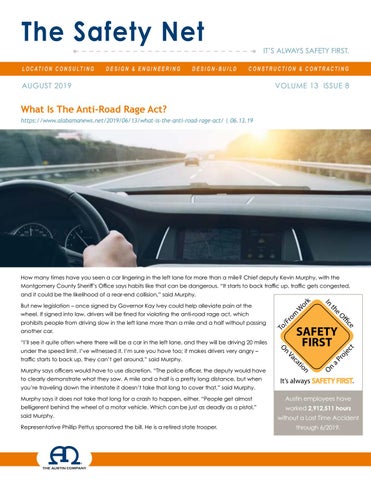
How many times have you seen a car lingering in the left lane for more than a mile? Chief deputy Kevin Murphy, with the Montgomery County Sheriff’s Office says habits like that can be dangerous. “It starts to back traffic up, traffic gets congested, and it could be the likelihood of a rear-end collision,” said Murphy. But new legislation – once signed by Governor Kay Ivey could help alleviate pain at the wheel. If signed into law, drivers will be fined for violating the anti-road rage act, which prohibits people from driving slow in the left lane more than a mile and a half without passing another car. “I’ll see it quite often where there will be a car in the left lane, and they will be driving 20 miles under the speed limit. I’ve witnessed it. I’m sure you have too; it makes drivers very angry – traffic starts to back up, they can’t get around,” said Murphy. Murphy says officers would have to use discretion. “The police officer, the deputy would have to clearly demonstrate what they saw. A mile and a half is a pretty long distance, but when you’re traveling down the interstate it doesn’t take that long to cover that,” said Murphy.
SAFETY FIRST.
Murphy says it does not take that long for a crash to happen, either. “People get almost
Austin employees have
belligerent behind the wheel of a motor vehicle. Which can be just as deadly as a pistol,”
worked 2,912,511 hours
said Murphy. Representative Phillip Pettus sponsored the bill. He is a retired state trooper.
without a Lost Time Accident through 6/2019.
4 Things Most Texans Don’t Know About Distracted Driving Distracted Driver Accident.com | 07.18.19 | Jack Monroe
Nearly everyone in the United States is aware that texting and operating a phone while driving is a major risk. Distracted driving has led to OVER 3,166 DEADLY ACCIDENTS in 2017 according to NHTSA. In the state of Texas, distracted drivers were responsible for over 95,000 CAR ACCIDENTS in 2018. Currently, distracted driving has been responsible for countless auto accidents and accidents that ended in fatalities. Yet, there are many people who may not understand what counts as a driving distraction or what is considered illegal “activity” when operating a motor vehicle. With regard to new distracted driving laws, people ask many questions about what is considered a distraction. These questions include:
1. Is eating and driving illegal? 2. Is my GPS a distraction? 3. Is it ok to use a phone when at a red light? 4. How can you prove distracted driving? Here are the answers to what most people ask about distracted driving.
2
1.
IS EATING AND DRIVING ILLEGAL?
Eating and driving is distracted driving, and it’s the most common distraction and safety risk most drivers commit. But, is it illegal?
In the state of Texas, it is. In fact, it could land you a ticket. In most other states, if a highway patrolman saw you eating or drinking a beverage while driving, he would have no reason to pull you over. But in Texas, it’s against the law. Still, this does not mean it’s ok to do if it’s not illegal in other states. It’s usually what follows this action that gets drivers pulled over or causes accidents. A distraction can increase
3.
IS IT DANGEROUS TO USE YOUR PHONE AT A RED LIGHT?
We all understand how dangerous it is to text and drive. But many drivers question if it’s ok to send a text or look at your phone when stopped at a red light. If the car isn’t in motion, how much of a danger can that be? In Texas, the recent texting and driving ban resulted in drivers receiving a traffic violation ticket if they are caught texting at a stoplight. The danger of texting at a stoplight comes from the same types of mental and physical distractions when a car is in motion.
the likelihood for a driver to commit a traffic violation or put
Drivers can potentially risk holding up other cars or
other drivers’ lives in danger.
accidentally mistaking the gas for the brake. You also risk
If you break it down, eating requires some attention and manual work. Eating behind the wheel hits the mark for all 3 ability impairments for drivers: • Visual Distraction: Anything that makes you take your eyes of the road. • Manual Distraction: Wheel in one hand and food/drink in the other. • Cognitive Distraction: Any other task, even if it is as menial as eating, can impair cognitive abilities to
2. some extent.
IS A CAR GPS OR NAVIGATION A DISTRACTION?
These days, handsfree NAVS and audible GPS systems make it better to drive and get directions. But are they still
being aware of your environment. What if you were looking down at your phone and another vehicle that lost control starts coming at you?
4.
The only safe and legal time a driver can operate a phone is when the vehicle is legally parked or completely shut off.
HOW CAN PEOPLE PROVE DISTRACTED DRIVING?
If you were involved in an accident caused by a distraction here’s a way law enforcement or prosecutors could prove distracted driving.
If a driver was suspected of causing an accident by texting and driving, the cell phone records can be used as evidence to prove that a driver was texting at the time the accident occurred.
a distraction? Referring back to the previous answer, they
But, without a court order, the cellphone company
can be.
cannot legally release the data or texting records. A car
It all depends on the device. There are still many devices
accident attorney or prosecutor would be capable of
that require cognitive and visual attention. Unless they are
retrieving these records to use as proof if the accident
handsfree, they can also count as a manual distraction.
were to go to court.
3
Recent Heat Wave Spurs OSHA to Warn of Dangers of Heat Illness on the Job Construction Junkie | 08.22.19 | Shane Hedmond
QUICK QUICK CARD QUICK QUICK CARD QUICK CARD QUICK CARD Protecting Workers QUICK CARD Protecting Workers CARD
TM TM TM TM TM TM
from HeatWorkers Stress Protecting CARD Protecting Workers from Heat Stress Protecting Workers Heat Illness from Heat Stress Protecting Workers Exposure to heat can cause illness and death. The from Heat Stress Heat Illness Protecting Workers most serious heat illness is heat stroke. Other heat from Heat Stress Heat Illness Exposure to heat can cause illness and death. The from Heat Stress illnesses, such as heat exhaustion, heat cramps and Heat Exposure to heat cause illness and death. The mostfrom serious heatcan illness isIllness heat stroke. Other heat Heat Stress heat rash, should also be avoided. Heat Illness Exposure to heat cause illness and The most serious heat illness is heat stroke. Other heat illnesses, such as can heat exhaustion, heatdeath. cramps and
Many areas throughout the country saw their hottest temperatures of the year over the weekend. In response to the forecasts, OSHA issued a reminder to employers about the dangers of heat illness. OSHA has led a campaign for heat illness prevention since 2011 and has a very simple message:
Water. Rest. Shade. They suggest taking frequent water breaks, about every 15 minutes, in extreme heat situations. Employers should develop an emergency plan, train workers on heat exposure hazards, and allow workers to build a tolerance to working in the heat. Those who are new to working in the heat are more susceptible to being affected by heat illness. Last year, OSHA and NIOSH launched a smartphone application called the OSHA NIOSH Heat Safety Tool. Not only does it provide an hourly forecast of heat index, it determines whether your area is at minimal, low, moderate, high or extreme risk, and offers suggestions for precautions to take and tips for first aid. The app is free and can be downloaded for both Android and Apple devices. There are some great free toolbox talk documents available, including an OSHA Quick Card on Heat Stress and CPWR Toolbox Talk on Hot Environments. Both are available in both English and Spanish.
Heat Illness Exposure to heat cause illness and The most serious heat illness is heat stroke. Other illnesses, as can heat exhaustion, heatdeath. cramps and Thererash, aresuch precautions that can be taken any heat heat should also be avoided. Heat Illness Exposure to heat cause illness and death. The most serious heat illness is heat stroke. Other heat illnesses, such as can heat exhaustion, heat cramps and heat rash, should also be avoided. time temperatures are high and the job involves There aresuch precautions that can be taken any heat Exposure to heat cause illness and The most serious heat illness is heat stroke. Other illnesses, as can heat exhaustion, heatdeath. cramps and heat rash, should also be avoided. physical work. There aresuch precautions that can taken any heat time temperatures are be high andbe the job Other involves mostrash, serious heat illness is heat stroke. illnesses, as heat exhaustion, heat cramps and heat should also avoided. There arework. precautions that can be taken any time temperatures are be high and the job cramps involves physical illnesses, such asFactors heat exhaustion, heat and heat rash, should also avoided. Risk for Heat Illness There arework. precautions that can taken any time temperatures are be high andbe the job involves physical heat rash, should also avoided. •time High temperature and humidity, direct sun There are precautions that can be taken any temperatures are high and the job involves physical work. Risk Factors for Heat Illness exposure, no breeze or wind There are precautions that can be taken any time temperatures are high and the job involves physical work. Risk Factors for Heatdirect Illness • High temperature and humidity, sun time temperatures are high and the job involves • Heavy physical labor physical work. Risk Factors for Heat Illness High temperature and humidity, direct sun exposure, no breeze or wind physical work. Risk Factors forworkplaces Heatdirect Illness •• High temperature and sun exposure, no breeze orhumidity, wind No recent exposure to hot Heavy physical labor Risk Factors for Heatdirect Illness •• High temperature and sun exposure, no breeze orhumidity, wind Heavy physical labor Low liquid intake Risk Factors forworkplaces Heatdirect Illness No recent exposure to hot ••• High temperature and humidity, sun exposure, no breeze or wind Heavy physical labor No recent exposure to hot workplaces Waterproof clothing • High temperature and humidity, direct sun Low liquid intake exposure, no breeze or wind Heavy physical laborto hot workplaces ••• No recent exposure no breeze or wind Low liquid intake Waterproof clothing •• exposure, Heavy physical laborto No recent exposure workplaces Symptoms ofhot Heat Exhaustion •• Low liquid intake Heavy physical labor Waterproof clothing •• No recent exposure to hot workplaces Low liquid intake Headache, dizziness, or fainting •• Waterproof clothing to Symptoms ofhot Heat Exhaustion No recent exposure workplaces Low liquid intake ••• Waterproof clothing Weakness and wet skin Symptoms of Heat Exhaustion Headache, dizziness, or fainting Low liquid intake Waterproof clothing Symptoms of Heat Exhaustion •• Headache, dizziness, or fainting Irritability or confusion Weakness and wet skin •• Headache, Waterproof clothing Symptoms of dizziness, or fainting •• Weakness and wet skin Heat Exhaustion Thirst, nausea, or vomiting Irritability or confusion Symptoms of Heat Exhaustion •• Weakness Headache, dizziness, or fainting and wet skin •• Irritability or confusion Symptoms of Heat Exhaustion Thirst, nausea, or vomiting Headache, dizziness, or fainting Weaknessor and wet skin of Heat Stroke Symptoms ••• Irritability confusion Headache, dizziness, or fainting Thirst, nausea, or vomiting • Weakness and wetunable skin to think clearly, pass out, Irritability or confusion May benausea, confused, ••• Thirst, or vomiting Symptoms and wet skin of Heat Stroke •• Weakness Irritability or confusion collapse, orSymptoms have (fits) Thirst, or seizures vomiting ofto Heat May benausea, confused, unable thinkStroke clearly, pass out, •• Irritability or confusion Thirst, nausea, or vomiting stop sweating Symptoms of Heat Stroke • May be confused, unable to think clearly, pass out, collapse, or have seizures (fits) •• Thirst, nausea, or vomiting Symptoms ofto Heat May confused, unable thinkStroke clearly, pass out, or have seizures (fits) • collapse, May be stop sweating Symptoms of Heat Stroke •• May May be confused, unable to think clearly, pass out, To Prevent Heat Illness: collapse, have seizures (fits) stopor sweating Symptoms ofto Heat Stroke ••• May be confused, unable think clearly, pass out, collapse, or have seizures (fits) Establish a complete heat illness May be stop sweating To Prevent Illness: • May confused, unableHeat to think clearly, pass out, collapse, or have seizures (fits) program. •• prevention May stop sweating To Prevent Illness: Establish or a complete heatHeat illness collapse, have seizures (fits) May stop •• Establish Provide training aboutheat theHeat hazards To Prevent Illness: asweating complete illness prevention program. •• May stop sweating To Prevent Heat Illness: leading to heat stress and how to Establish a complete heat illness program. • prevention Provide training about theHeat hazards To Prevent Illness: •• Provide Establish a complete heat illness prevent them. prevention program. training aboutand theHeat hazards leading to heat how to To stress Prevent Illness: Establish alot complete heat illness prevention program. •• leading Provide a of stress cool water to workers training about the hazards to heat and how to prevent them. • Establish a program. complete heat illness prevention • prevent Provide training about the hazards close to them. theheat work area.and At least one leading how to pint Provide to a lot of stress cool water to workers program. •• prevention Provide training about the how hazards leading to heat stress and to of water per hour is needed. prevent them. •• Provide a lotwork of cool water to workers close to to the area. At least one Provide training about the hazards leading heat stress and how to pint prevent them. • close Provide a lot of cool water to workers to the work area. At least one pint of water per hour is needed. leading to heat stress and how to For more information: prevent them. • of Provide a lotwork of cool water to workers close to the area. At least one pint water per hour is needed. them. Occupational • prevent Provide lotwork of cool water to workers close to athe area. Atmore least one pint For information: of water per hour is needed. Safety and Health • Provide lotwork of cool water to workers close to athe area. Atmore least one pint For information: of water per hour is needed. Occupational Administration close to the area. Atmore leastinformation: one pintand Health For of water perwork hour is needed. Occupational www.osha.gov (800)Safety 321-OSHA (6742) Administration of water per hour is needed. For more information: Safety and Health Occupational Administration www.osha.gov 321-OSHA (6742) For more (800) information: Safety and Health Occupational For more (800) information: Administration www.osha.gov 321-OSHA (6742) Safety and Health Occupational Administration www.osha.gov (800)Safety 321-OSHA (6742) Occupational and Health Safety and Health www.osha.gov (800)Administration 321-OSHA (6742) www.osha.gov (800)Administration 321-OSHA (6742) www.osha.gov (800) 321-OSHA (6742)
4
OSHA OSHA 3154-06R OSHA 3154-06R OSHA 3154-06R OSHA 2017 3154-06R 2017 OSHA 3154-06R 2017 3154-06R OSHA 20172017 3154-06R 2017 2017
TM
How To Reduce the Risk of Vandals Graffiti Tagging Your Construction Site Construction Junkie | 07.18.19 | Shane Hedmond
Patrick Barthet is founder and principal of The Barthet Firm,
hand style in graffiti culture. Hand styles are unique to each
a 12-lawyer construction practice that has been serving
tagger. Using a large marker or more likely an aerosol spray
South Florida’s construction industry for over 25 years.
paint, something easy to carry and maneuver, the tagger
Publisher of the award winning blog, thelienzone.com, he
works quietly, generally in the shadows, but hoping to make
provides weekly advice to construction professionals. Also
a big splash.
instructive is thelienzonepodcast.com, regularly presented by fellow principal, Alex Barthet.
Some 12 billion dollars are spent annually in the United States alone to clean up graffiti. Moreover, in most every
We’re all familiar with graffiti. There’s been plenty of it
state, marking public or private property without permission
around for a long time. Those of us who live in Miami have
is considered a criminal act. The placement of graffiti
even seen it develop into an art form. Wynwood Walls has
in Florida is an act of criminal mischief and considered
been transformed into an international tourist attraction,
vandalism. Depending on the extent of the damage, it can
exhibiting spectacular and visually stunning outdoor murals
be classified a misdemeanor or felony, punishable by a fine,
by a variety of aspiring artists.
community service and even jail time.
Of all the forms of graffiti, tagging may be the most popular
The surge in construction activity in South Florida has
– spray painting one’s name, initials or symbols on someone
increased the likelihood that taggers keen on making their
else’s property, often times a building, a highway sign, or
mark will visit your job site. Any place with the potential for
even a piece of construction equipment – any place where
a visual impression becomes their canvas. Sometimes it is a
it can be readily seen by as many folks as possible.
newly constructed bock wall or that bright yellow backhoe
Tagging is usually the distinctive, albeit illegal, depiction of
parked on-site.
the artist’s name, a personalized signature referred to as
...continued on next page
5
How To Reduce the Risk...(continued)
Five OSHA Regulation Changes That Could Impact Your Facility This Year
So, how do you minimize the potential for
OH&S Occupational Health And Safety | 06.25.19 | Karen Dziekan
tagging at your construction project?
1. Secure your site with adequate chain link fencing, strong locks and “No Trespassing” signage in all the right places.
OSHA’s $5 million budget increase could suggest an increase in regulatory actions, inspections and citations, as the organization has regulatory changes in store for the year ahead.
2. Light up your site with motion-activated outdoor LED security floods and spots.
3. Monitor your site 24/7, with both security guards and surveillance cameras, and restrict access to only authorized personnel.
4. Clean up your site, get rid of debris, and remove any prior tagging or graffiti, thus reducing the likelihood of repeat offenses.
Whether your project is large or small, your equipment new or old, tagging is something you want to discourage if not eliminate. It devalues your project, emboldens vandals, and costs you time and money to clean up.
The Occupational Safety and Health Administration’s (OSHA) fiscal year 2019 budget, according to Industrial Safety and Hygiene News, increased by $5 million over 2018 to reach a $557.8 million total. This increase could suggest an increase in regulatory actions, inspections and citations, as the organization has regulatory changes in store for the year ahead. While these safety regulation updates and additions are spread across several industries, here are five that workers and facilities should be prepared for.
IEEE 1584-2018 Published just before December of last year, this Institute of Electrical and Electronics Engineers guide for performing arc flash hazard calculations was significantly updated from IEEE 1584-2002. Related to the method for calculating the arc flash hazard distance and the incident energy to which employees could be exposed during work on or near electrical
6
employers cited for safety violations. The annual penalty increases are required by the Federal Civil Penalties Inflation Adjustment Act Improvements Act of 2015 (ACT) and apply to Federal OSHA states. Information on the change can be found here.
Random Inspection Late last year, OSHA announced it would implement its Site-Specific Targeting 2016 Inspection Plan, which applies to non-construction workplaces with more than 20 employees. Employers who failed to provide 2016 Form 300A data to OSHA will be selected at random and added to an inspection list combined with employers who reported high rates of days away, restricted, or transfer in 2016. OSHA will include a random sample of employers with low rates to the list. The collected data will be used to create inspection lists.
Drone Inspection Midway through 2018, OSHA began gradually implementing a new policy of workplace inspections utilizing drones. The organization issued a memo authorizing compliance officers to inspect areas that are inaccessible or pose a safety risk, with 2019 being the first full year of this practice being implemented. Compliance officers must obtain consent from an employer and notice must be provided to employees before the drone is launched.
Tracking of Workplace Injuries and Illnesses equipment, designers and facility operators in facilities where live work is performed on electrical equipment need to become especially familiar with this change. With arc flash hazard calculations being implemented in most plants because of OSHA regulations, this new model accurately accounts for a wide variety of setup parameters.
For workplaces with 250 or more employees, OSHA now only requires an electronic submission of OSHA Form 300A. Facilities should continue to record workplace injuries and illnesses and follow reporting requirements, but OSHA amended its record-keeping regulation to remove the requirement to electronically submit information from OSHA Form 300 (log of work-related injuries and illnesses) and
Employers should be sure to confirm that an arc flash
OSHA Form 301 (injury and illness incident report). However,
risk assessment has been done within the last five years.
the requirement to keep and maintain OSHA Forms 300,
Calculations are most often listed on arc flash and
300A and 301 for five years is not changed.
equipment labels and are used as part of an arc flash risk assessment. Updates to labels to reflect new calculation requirements may be necessary depending on the results of the arc flash assessment.
Keeping up with regulations and requirements is key to avoiding shutdowns and lost business costs. By implementing policies, holding staff accountable, and staying abreast of safety regulations you can positively
Increased Fines
contribute to your business’ bottom line.
To adjust for inflation, and as required by the Federal Civil
For more tips on how to optimize safety practices in
Penalties Inflation Adjustment Act Improvements Act of 2015, OSHA has increased the maximum civil penalties on
your facility, read our white paper Six Keys to Managing Workplace Electrical Safety.
7
Safety With Saws: Powerful Tools Require Caution To Operate Concrete Construction | 07.19.19 | Bill Palmer Have you ever had to cut concrete without a saw? Perhaps in the old days there were craftsmen who could use a chisel and hammer and get a decent finished surface, but today most of us would leave a jagged mess. That’s why a cutoff saw is an essential tool for every concrete contractor. Today, you have lots of choices in saws: early entry saws for cutting flat-work, wall saws or wire saws for big cuts, handheld cutoff saws, and chainsaws. Saws come with electric motors (even cordless options), gas engines, or are powered by hydraulics or pneumatics. There are the typical cutoff saws with a disc blade, ring saws and chain saws, abrasive blades or diamond. All of these, by their very nature, are dangerous tools if not used properly—anything meant to cut concrete will cut through flesh without even slowing down. Safety, therefore, is one of the most important issues you need to consider before picking up a saw.
Safety Issues What may seem obvious to one person may be less so to another, so never take it for granted that anyone operating a saw will understand safe procedures. Every saw comes with a whole list of general power tool safety rules that must be followed, from making sure electrical tools are unplugged before changing blades to simply using the tool for its intended application instead of something else.
Blade Application Codes The blade code has three letters: X-X-X • First position: indicates wet use only (W), or wet or dry use
The blade on a saw is one of the most dangerous parts, although it's also the most essential because it does all the work. Proper procedures must be followed to ensure operator safety.
(D). • Second position: indicates the application, such as cured concrete (C), green concrete (G), or block/brick (B). • Third position: indicates the saw type, such as handheld saw (H), wall saw (W), or stationary saw (S). For saws, the most critical issues include making sure guards are well-maintained and properly positioned, blades are straight and tight, and the right blade is being used. For dry cutting concrete or masonry, silica dust becomes a paramount concern. Cutting concrete with an abrasive blade or a diamond blade generates dust, some of it silica dust that is fine enough it can be drawn deeply into the lungs. Breathing in fine crystalline silica can lead to silicosis—an incurable lung disease that results in lung fibrosis. The National Institute for Occupational Safety and Health (NIOSH) estimates that nearly 300 construction workers die annually from silicosis. Workers who spend years in an environment where there is free silica dust in the air are more likely to end up with silicosis unless something is done to prevent them from breathing it. That’s why OSHA has established a Permissible Exposure Limit (PEL) for airborne crystalline silica. The PEL defines how much silica a worker can be exposed to during a given shift. OSHA has a rather complicated formula
8
for determining the PEL in units of million parts per cubic foot of air—a simpler limit is recommended by NIOSH of 0.05 mg/m3. There has been a move in California to reduce the PEL from its current 0.10 to 0.01 mg/m3. In practice, if you can see the dust in the air, then it’s probably too much to be breathing. What that means to a saw operator is that measures must be taken to prevent silica from becoming airborne, workers must be kept out of dusty areas, or workers must use respirators. Preventing silica dust from getting into the air is accomplished by what are called “engineering controls,” such as using wet saws or vacuum systems. “The vacuum systems around right now are difficult to work with,” said Becky Gallert, Wacker’s product manager for demolition products. “The main reason people use a cutoff saw is because it’s easy to use and versatile, so to drag around a vacuum hose defeats the purpose.” Water creates similar problems, especially indoors. We’ll cover respirators in more detail later.
Blades The blade on a saw is obviously one of the most dangerous parts, although it’s also the most essential because it does all the work. Diamond blades almost always are used for concrete cutting today, since the price has come down and because they cut so much better than abrasive blades. For detailed information on diamond blade safety, the Masonry & Concrete Saw Manufacturers Institute (SMI, a bureau of the Association The most critical issues include making sure saw guards are well maintained and properly positioned, blades are straight and tight, and that the right blade is being used.
of Equipment Manufacturers) has developed an excellent brochure located at www.aem.org/CBC/ProdSpec/SMI/Pubs.asp. The most important place to start when looking into blades is to check that you are using the right blade for the application. SMI and the Concrete Sawing & Drilling Association (CSDA) have developed a blade application code that most diamond blade manufacturers will follow. Blades also will be marked with a maximum RPM and a direction of rotation—make sure the saw doesn’t exceed that blade speed and that
the blade is turning in the intended direction. Always make sure a wet blade (W) is used with cooling water; dry blades (D) can be used with or without water, although trying to use water on a saw intended to be dry can lead to electrocution with electric saws. Before starting to cut with a blade, carefully look to ensure it’s not damaged. Damaged blades can break during cutting, ejecting hot steel pieces—never a good thing. Check that the blade isn’t missing segments, that it isn’t cracked, and that it doesn’t appear to have been overheated. One way to tell if a blade is cracked is to bang it with a piece of wood to see if it rings. Inspect the blade regularly to guarantee it remains in good condition. The SMI brochure has a lengthy listing of blade problems and remedies to help your blades last longer and stay safer. Proper mounting of the blade may seem simple but can be critical to its safe operation. First, of course, before mounting a blade, completely turn off the power to the saw—make sure the cord is unplugged or the engine is off. Use the proper tools to tighten the arbor so the blade doesn’t wobble. And never operate a saw without the blade guard in position. When using a new blade for the first time, spin it at top speed for a minute to make sure it doesn’t come apart.
Keeping non-construction personnel at least 100 feet away from sawing operations helps ensure a safe environment. ...continued on next page
9
Safety With Saws...(continued)
Kickback and Lock-In The term kickback is used a bit differently by different saw manufacturers, but basically it refers to when the saw jumps back toward the operator. Lock-in is when the blade jams in the concrete and pulls the saw away from the operator. With proper use neither of these should happen. Kickback can be caused by using the upper part of the cutting blade or when a cut is interrupted. It also can happen when putting the blade back into a cut that’s already been started. If you must do that, make sure the blade is spinning at top speed before continuing the cut. Lock-in is similar and often is caused by the workpiece shifting and pinching the blade. Make sure it is supported and clamped so this can’t happen. Another cause of lock-in is trying to cut too deeply too quickly or trying to cut a radius. These can lock the blade or can cause a diamond segment to pop off. Sometimes a safe practice is to make a shallow guide cut then come back for a deeper cut.
Other General Saw Safety All reputable saw manufacturers have extensive safety sections in their owner’s manual. “Our safety committee looks carefully at each product,” said Gallert, “and we make sure the operator’s manual is very clear.” “The biggest trend in saw safety I’m seeing,” said Bosch’s Jason Feldner, “is education—training people to use the saw properly. Most of the time, they know what they should be doing, so we have to convince them to not pin back the guard and to keep both hands on the saw.” Maintaining a safe environment is another important safety factor. Keep non-construction people at least 100 feet away and make sure other workers who are closer have proper personal protective equipment (PPE). Saws are dangerous and maintaining control of the situation and focus on the work goes a long way toward safe operation. Another good source for safety information on cutting is the CSDA. They have developed online courses in saw safety and toolbox talks. For information visit www.csda.org.
Personal Protective Equipment OSHA standard 1926 has detailed requirements for personal protective equipment for construction available on the Web (www.osha.gov/SLTC/constructionppe/ standards.html). For concrete sawing, the most important PPEs include safety glasses, respirators and hearing protection. Of course, proper clothing, footwear and hard hats also are necessary and sensible for most construction sites. If you employ workers, it is your responsibility to provide proper PPE and ensure your workers use them correctly. For an excellent article on PPE for saw operators, go to the list of safety articles on the CSDA website. Safety glasses or goggles are a must during cutting. The glasses must meet OSHA standard 1926.102 and be stamped as ANSI approved under Z-87.1. Glasses must be comfortable enough that your workers will keep them on and you should require that they be worn at all times. For workers doing a lot of cutting, a full-face respirator The ideal safety PPEs for a worker using a cutoff saw includes face shield, respirator and gloves.
is a good option. If a worker is dry-cutting concrete without any kind of dust control system, a respirator is a must. There are several types of respirators on the market, ranging from dust masks to full-body supplied-air respirators. MSA has an excellent guide to
10
OSHA Safety Meeting Requirements Weeklysafety.com | 07.23.19 selecting the proper respirator, in addition
OSHA requires that every employer make safety and health a top priority
to a guide to setting up a respiratory
and ensure a safe working environment. OSHA’s job is to provide leadership
protection system, which is a required part
and encouragement to employers to take that responsibility seriously and
of your safety program.
provide educational or awareness opportunities to employees, so they
For silica exposure, the first step must
know their rights to a safe workplace.
be to try to control the silica dust with
Employers have a duty to protect workers from injury and illness on the job
engineering controls. If that’s not enough,
by developing and implementing a safety and health program. According
then go to respirators. The respirator
to OSHA, there are five components every effective safety program should
needed depends on how much dust
have.
is in the air (for details, go to the OSHA website and look up crystalline silica). The minimum respirator is a half-mask model
1. Management Leadership & Employee Participation 2. Workplace Analysis
with a P-100 filter; face masks are not
3. Hazard Prevention and Control
enough protection against silica.
4. Safety & Health Training and Education
“Silica requires a P-100 filter, that’s the
5. Program Evaluation
NIOSH designation,” said MSA’s John Hierbaum. “Those used to be called HEPA filters, but NIOSH discontinued that terminology. P-100 means that it’s 100%
Holding regular safety meetings, like on-site toolbox talks, tailgate meetings or longer pre-shift all hands safety meetings, can satisfy many requirements for most of these components.
efficient against particulates—actually 99.7%. You also have to do a fit test of the respirator by exposing the wearer to banana oil or another material that the respirator would filter out so if the person can smell it you know you’ve got a leak.” Hearing protection is another important consideration while cutting. Ear plugs or earmuffs should be provided to workers. There are many good low-cost earplugs on the market today that are effective at reducing noise levels. Muffs also can be effective, but are less so when glasses or respirators affect the fit over the ears. Employers should provide training in the proper way to insert earplugs—pulling up on the top of the ear during insertion helps them to fit better and to more effectively reduce noise. Keeping yourself or your workers safe when cutting makes good sense. Take safety seriously and your company will prosper.
Great example of an on-site crew safety meeting. ...continued on next page
11
OSHA Safety...(continued)
MANAGEMENT LEADERSHIP & EMPLOYEE PARTICIPATION Employer and employee involvement and communication on workplace safety is essential. To foster this positive communication, OSHA recommends that employers show their commitment by investing time, effort and money into the safety program and hold safety meetings that focus on employee safety and health.
WORKPLACE ANALYSIS Employers and employees must participate to identify and eliminate existing or potential hazards in the workplace. In addition to having an adequate system for reporting hazards by implementing regular safety meetings, this
Don’t let this happen at your workplace. #safetyfail.com
will provide a casual forum for employees to speak up regarding potential workplace hazards. During safety meetings, employees should be free to add to the dialogue
SAFETY & HEALTH TRAINING AND EDUCATION
of the meeting, report current hazards, and discuss
It is important that every employee receive proper
potential solutions as a team.
and adequate training to ensure they can safely and competently perform their jobs. This also applies to temporary, part-time and contract employees.
HAZARD PREVENTION AND CONTROL
Regular safety meetings should be documented, and
After hazards are identified, it is important that employees
attendance should be recorded. In addition to on-the-job
follow safe working procedures. Regular safety meetings
(OTJ) and compliance training, safety meetings provide
should be held on topics such as:
a valuable safety training mechanism on a more regular
• How to regularly and thoroughly maintain equipment • Review of the hazard reporting procedure • Reminders of the hazard correction procedures • PPE requirements and proper PPE wear, use and maintenance • Safe work procedures for the current work performed • Health safety like cold stress, heat stress, asbestos, lead, etc.
basis to teach and remind all employees of daily safety awareness and hazard prevention. Adding regular safety meetings to your company’s safety and health program is guaranteed to improve workplace safety, boost team morale, lower insurance premiums, strengthen safety compliance and lower the risk of safety violations. Holding regular safety meetings with your crews, teams and staff is also the best way to ensure that your company is off to a great start meeting and exceeding OSHA’s compliance standards.
12
Preventing Human Error in the Workplace KOL Weekly Update | 07.22.19 According to recent studies, 80-90 percent of serious injuries are caused by human error. Today, employers emphasize the importance of safety and accident prevention and yet every year, many workers are seriously injured or die while on the job. While many incidents may be caused by poor work environments or machine and equipment failure, other factors such as human behavior are likely to also play a key role. That doesn’t mean the employee is to blame whenever an incident occurs, but rather, that underlying factors exist that may contribute to employees’ unsafe actions.
The Factors Workers learn many habits throughout their careers and sometimes those habits can be dangerous. A few factors that contribute to human error in the workplace include: • Complacency • Horseplay • Over-confidence • Drug or alcohol use • Overexertion • Mental health • Tiredness and lack of sleep • Haste and rushing work Remember, the factors above may contribute to an incident, but that doesn’t mean the employee is always at fault.
Drug and Alcohol Use Let’s use drug and alcohol use in the workplace as an example. Many employers are familiar with OSHA’s recent improved tracking of work-related injuries and illness rule that addresses drug and alcohol testing requirements. That rule does not prohibit drug and alcohol testing. But it does say that employers must limit post-incident testing to situations where drug use is likely to have contributed to the incident AND where a drug test can accurately identify impairment caused by drug use. For example, say a shelf was overloaded and its contents fell on an employee. In this case, the faulty shelving is the cause of the injury, not the employee’s impairment. Now on the other hand, if the employee were weaving while he walked and used a forklift and crashed into the shelving, you may have reason to believe that substance abuse was the cause.
Your Responsibility Employers must take caution before conducting post-incident drug tests and limit them to situations where drug use is likely to have played a role. In any case where incidents and even near-misses occur, try to identify where the employee may lack knowledge of safety protocol and train him or her accordingly.
13