NOVEMBER 20-26, 2026 • Vol. 61 Issue 28 • FREE
IN THIS ISSUE
I Wanted to Save Black Students. Then I Became a Teacher PAGE 4
Follow us on all of our social media platforms @theatlantavoice
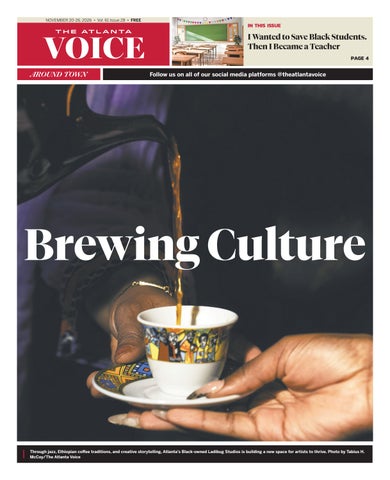
Brewing Culture
Through jazz, Ethiopian coffee traditions, and creative storytelling, Atlanta’s Black-owned Ladibug Studios is building a new space for artists to thrive. Photo by Tabius H. McCoy/The Atlanta Voice
Page 2 • NOVEMBER 20-26, 2026 • theatlantavoice.com
Entertainment
Buna and Blues: How Ladibug Studios Builds Space for Atlanta Creatives By LAURA NWOGU
S
ultry notes of jazz croon through swaying bodies washed in purple light. The bright aroma of freshly brewed Ethiopian coffee fills the room as it’s poured into small, handless cini cups, while strangers and friends mingle easily across the floor. That’s the magic of Buna Blues, a signature event hosted by Ladibug Studios, a Black-owned full-service creative studio in Atlanta. Since 2023, the studio, owned by young creatives, has been bringing cultural storytelling to life through visuals and experiences that capture the core of the community. The partnership between Ladibug Studios co-founders Lydia Asmerom-Hall and Sydney Seabron began at the Savannah College of Art and Design (SCAD), Atlanta campus, where both women were finding their footing in filmmaking. Pushing each other forward, Asmerom-Hall developed a deeper love for directing and Seabron for cinematography, and their collaborations came naturally, built on mutual respect and a shared understanding of each other’s vision. After filming their senior project in Ethiopia, the duo knew their ambition meant they could pull off anything else they imagined. Every time they were on set, Asmerom-Hall said, a ladybug would land on one of them, a sign of good fortune to come. From there, Ladibug Studios was born. “The fact that we were able to do that, I was like, ‘We can do this too.’ I don’t think we imagined it
even being where it is today,” Asmerom-Hall said. “You know when you just have that conviction of something you’re supposed to do, you just gotta figure it out and do it. So we’re still figuring it out, but we’re doing it.” The Buna Blues concept took shape when Asmerom-Hall and Seabron began brainstorming an activation for Resonant Studios, a production and event space for Atlanta’s creative community. As multi-hyphenate creatives, Asmerom-Hall and Seabron wanted to merge their storytelling backgrounds with event curation to build something music-driven, accessible, and affordable. “I think Atlanta sometimes gets a bad rap for events that are pretty redundant. So, we were just trying to think of something different that’s a good in between,” Asmerom-Hall said. Jazz had woven itself into Seabron’s life early on through her parents, who were fans of the genre. Meanwhile, Asmerom-Hall, who has roots in Eritrea, grew up around the communal aspect of traditional coffee ceremonies, a daily ritual centered on hospitality and welcoming guests. Pairing elements of the Eritrean-Ethiopian coffee ceremony—known as “buna”—with the bluesy magic of jazz, they decided to merge the two worlds. What began as a humble trial run for 50 friends and family that they captured on their phones soon went viral on social media. “We were like, ‘OK, I guess we have to do this again. Let’s try to be a little bit more organized. How can we
A pianist performs during Buna Blues, Ladibug Studios’ signature event blending live jazz, East African culture and creative expression in Atlanta. Photo by Tabius H. McCoy/The Atlanta Voice
(From left to right, top to bottom) Oluwatimilehin Faderin, Immanuel Powell, Eric Kamusau, Lydia Asmerom-Hall, Sydney Seabron, and Deana Griffin are the driving forces behind Ladibug Studios. Photo by Tabius H. McCoy/ The Atlanta Voice
expand this to serve more people too?’ So we bumped up capacity to 100 and sold out within two weeks as soon as we dropped tickets,” Asmerom-Hall said. The heightened interest came at a time when they were in discussions to merge with Color Co., a local equipment rental group and creative collective. They soon brought Oluwatimilehin Faderin, the creative producer/post-producer; Deana Griffin, the executive producer and cinematographer; Eric Kamusau, the marketing director and photographer; and Immanuel Powell, the director of operations and photographer, into the fold. The idea that Asmerom-Hall and Seabron had talked about had flourished into a full-blown team. Since then, Buna Blues has become a popular monthly staple in Atlanta’s creative scene, offering a welcoming space to experience live jazz, art and community. It has also introduced people to cultural traditions that define the Habesha diaspora. At the start of every Buna Blues event, the team explains the significance of the
Mama Genet pours freshly brewed Ethiopian coffee for guests during Buna Blues, a monthly cultural gathering hosted by Ladibug Studios that celebrates music, heritage and community. Photo by Tabius H. McCoy/ The Atlanta Voice
Eritrean-Ethiopian coffee ceremony, letting guests know that Mama Genet, their resident buna lady from Ethiopia, will walk around pouring fresh cups of coffee and welcoming them to Buna Blues. Mama Genet is often seen wearing a habesha kemis, a traditional
white dress with colorful embroidery, and when she isn’t pouring coffee and greeting guests, she can often be found seated beside a low, decorative setup where raw beans are roasted and brewed.
See LADIBUG STUDIOS on page 11
theatlantavoice.com • NOVEMBER 20-26, 2026 • Page 3
Community
Boys & Girls Clubs Gala Raises $1 Million By STAFF REPORT
B
oys & Girls Clubs of Metro Atlanta (BGCMA) celebrated its annual Youth of the Year Gala Nov. 6 at the InterContinental Buckhead Atlanta. Presented by Open Arc Corporate Advisory, the event raised more than $1 million to support youth development programs across the region. Jannaco S. of Warren Boys & Girls Club was named the 2026-2027 Youth of the Year,the organization’s highest honor for youth leadership and achievement. Da’Shawn C. from At-Promise South Boys & Girls Club was this year’s Runner-up. “The Club has helped me grow, step outside my comfort zone, and realize what I’m capable of,” said Jannaco S. “I want other young people to see that their dreams are within reach and that they shouldn’t let anything stand in the way of what they want to accomplish.” Leading up to the gala, 16 BGCMA teen finalists representing their respective clubs dedicated months to refining their speeches, attending leadership workshops, and serving in their local communities.
Boys & Girls Clubs of Metro Atlanta raised more than $1 million for youth programs at its annual gala. Photo Credit: Courtesy of Boys & Girls Club of Metro Atlanta
Jannaco distinguished himself throughout the competition through his academic excellence, service, and advocacy. Proceeds from the evening directly fund BGCMA’s out-of-school programs,
expanding access to initiatives focused on academic success, healthy lifestyles, and character development. “Through our strategic plan, Lasting Impact 2030, our ambition is clear: to drive
economic mobility by cultivating young people who are ready for the real world,” said Libby Saylor Wright, President and CEO of Boys & Girls Clubs of Metro Atlanta. “Tonight, we are celebrating extraordinary young people, but we are also investing in the future of Metro Atlanta.” Veteran Atlanta media personality Monica Pearson co-hosted the gala alongside Boys & Girls Clubs alumnus Keith D. Robinson, an actor and singer known for his roles as Dr. Ted Richardson on the CBS drama Beyond the Gates and in the Oscar-nominated film Dreamgirls. “I hope they take from my story that it does not matter where you are from—you can dream as big as you want,” said Robinson, an alumnus of the Boys & Girls Clubs of Greater Augusta. “The Boys & Girls Clubs give that structure and foundation. It allows you to dream and figure out what you want to do in life.” From their local clubs to the gala stage, Jannaco S. and his fellow candidates demonstrate the impact of sustained mentorship and community support, proving that today’s Club members are tomorrow’s changemakers.
NOW LEASING
IN THE MECHANICSVILLE AREA
1 BEDROOM STARTING AT $765 PER MONTH
NEWLY RENOVATED
QUALIFICATIONS
PROPERTY FEATURES Near downtown Atlanta On MARTA line Close to Publix plaza & restaurants Total electric with central air/heat Stove & refrigerator included Rent includes water, sewer & trash No Pets No Smoking
$45 application fee (money order only) Income must be at least 3 times the monthly rent. Credit/Background Check Required Security deposit to be paid with 1st month’s rent
(404) 527-5465 ext. 20
Email us at info@summechcdc.org
Page 4 • NOVEMBER 20-26, 2026 • theatlantavoice.com
Voices
I Wanted to Save Black Students. Then I Became a Teacher By JULIENNE LOUISANDERSON
R
eading Nikole Hannah-Jones’s reflection on her daughter’s education, I kept thinking about Emily Paige, the New York City schools administrator she references throughout the article. I recognized Paige’s efforts and her sacrifices to improve the education system from within. And while the internet uses Hannah-Jones’ article to giddily criticize teachers — especially Black ones — it rarely asks what it costs us to do this work when we cannot give our Black students what they need. I spent a decade teaching humanities to fourth through eighth graders in New Orleans. The teacher who walked into the classroom on my first day was fundamentally different from the one who left on my last. I hadn’t stopped caring, but I’d learned that people who say they care about the education of poor Black children are comfortable with leaving the teachers of those children to make impossible choices alone. Crippled System Every year, I taught between 60 and 120 children. Like Paige, I struggled to focus my energy on all my students because their cognitive, academic, and social needs were immense. After graduating from Howard University in 2016, I came home to teach with a political science degree and a secondary education teaching certification. I wanted to bring history to life through the stories behind the stories, alternative narratives, and Socratic seminars. I wanted to pair the academic rigor I’d experienced in my education coursework with cultural affirmation and the freedom to teach differently than I’d been instructed as a child. Instead, I entered a poor, mostly Black school system crippled by a revolving door of educators, administrators, and years of experimentation on Black children and their families. Students and parents had every reason to doubt my promises would change anything I was determined to prove that mine would. Then I had to figure out how. Hannah-Jones writes about her daughter’s frustration with teachers
who seemed to give achieving students a fraction of the attention, care, and support they needed. I thought about the times I was that teacher — the one who overinvested in the small few, leaving the others to fend for themselves. It is painful to recognize yourself in a student’s disappointment when you know how hard you were trying. ‘Effort is Not Mastery’ Each year I worked harder, but effort is not mastery. I felt less certain that my teaching could give my students what they needed. That loss of confidence is difficult to admit when you are a Black teacher who entered the classroom determined to do right by Black children.
underachievers widening, even as I tried everything: interventions, combined classes, classroom support, engaging lessons, and incentives. I earned my master’s degree in Teaching and Educational Leadership, hoping to find answers to the questions that kept me up all night. Instead, I learned about the “invisible tax”: shorthand for the extra demands placed on Black educators who care so deeply about Black students they go above and beyond the job requirements to make sure they don’t fail. For me, the invisible tax was also the knowledge I carried about an unequal school system into every decision.
Black teachers are often expected to overcome inequity through dedication and sacrifice. A former New Orleans educator argues that love matters — but it cannot substitute for the systemic change Black students deserve. Photo Credit: iStock.com/Torphong Surunna
Every classroom decision carried more weight than it appeared to. How could I send a child out of my room for misbehaving when I knew exclusion could push them farther into the school-to-prison pipeline? But how could I ignore disruptive behavior that was interrupting everyone else’s learning? For a while, I assigned homework because my students needed more time with the material I taught in class. Then I had to confront the truth. Children who struggled to take in lessons at school went home with even less support to understand it there. I could see the academic gap between the achievers and the
I pushed back when a charter school leader wanted to punish students for wearing hoodies in the building. I was cited after reporting “creative spelling” as racially inequitable. I refused to sign off on an oppositional defiant disorder diagnosis for a student. Each time, I protected a child from a decision I believed could do harm. Then I had to return to my classroom and teach. Sometimes Black teachers’ commitment to Black children is dismissed as “saviorism.” I blanch at the word because I knew how few people, Black or white, felt responsible for my students. I looked at those children and saw my siblings and cousins. I
see them now the same way I see my 4-year-old daughter, knowing that Black children need people willing to fight for them—not out of paternalism, but out of a sense of community. Work Magic, Stay Humble Yet society places a heavy burden on teachers, expecting us to save children from illiteracy, poverty, and helplessness. We’re supposed to work magic with what little we have and stay humble while doing it. I missed vacations and family events because they conflicted with the school calendar. I lived with four roommates my first year because my pay was so low I could not afford my own place. When a student or their caregiver died, I grieved along with their friends and loved ones. And I kept teaching even as I realized the promise I’d made to parents, children, and myself—that one good teacher could be enough—was not true. By the end of that decade, I understood how the promise that brought me into the classroom let everyone else off the hook. Surely a child will encounter at least ONE teacher who can make the difference. Surely someone else will take care of it. Aabiana, the other little girl in Hannah-Jones’s story, proves it doesn’t; neither does Hannah-Jones’s daughter, Nayja. Both children show that years of compounded educational neglect corrodes the self-esteem and confidence of both teacher and student—a fundamental requirement for engaging with schooling. I still believe a teacher can change a child’s life. But I am not a savior. I can work until my eyes are tired and I am burned out, but the intractable structural dysfunction of low-performing, mostly Black public schools means the work may not matter much at all. The teacher I wanted to be could not do it alone; neither can the teachers who are there now. Black children deserve our deepest care, and they deserve more than the think pieces blaming them for their poor education. They deserve a country that cares about their success, and that doesn’t depend on one teacher, one administrator, and one parent to do it themselves. Julienne Louis-Anderson is a former educator and OpEd Fellow who writes about the intersection of culture and politics with education and human development.
FOUNDED May 11, 1966
FOUNDER/EDITOR Ed Clayton Immortalis Memoria
PUBLISHER/EDITOR J. Lowell Ware
Immortalis Memoria The Atlanta Voice honors the life of J. Lowell Ware. PUBLISHER EMERITUS Janis Ware PRESIDENT/ GENERAL MANAGER James A. Washington 2018-2024 ––– COO Richard Dunn publisher@theatlantavoice.com CHIEF STRATEGY OFFICER Jazmine Brazier jbrazier@theatlantavoice.com EXECUTIVE DIRECTOR FOR EDITORIAL & ADVERTISING Chia Suggs csuggs@theatlantavoice.com GENERAL ASSIGNMENT REPORTERS Laura Nwogu lnwogu@theatlantavoice.com Noah Washington nwashington@theatlantavoice.com BUSINESS REPORTER Tabius H. McCoy tmccoy@theatlantavoice.com SPORTS REPORTER Tarohn Finley tfinley@theatlantavoice.com EDITOR AT LARGE Stan Washington swashington@theatlantavoice.com ––– SALES RDW Jackson rdwadman@gmail.com advertising@theatlantavoice.com SUBMISSIONS editor@theatlantavoice.com DIRECTOR OF PUBLIC RELATIONS Martel Sharpe msharpe@theatlantavoice.com ––– CONTACT INFORMATION 633 Pryor Street, S.W. Atlanta, GA 30312 Office: 404-524-6426 info@theatlantavoice.com
theatlantavoice.com • NOVEMBER 20-26, 2026 • Page 5
State
Gov.-elect Keisha Lance Bottoms announces seven policy committees for her Georgia’s Promise transition on Tuesday, Nov. 17, 2026, from the South Steps inside the Georgia Capitol in Atlanta. Photo by Noah Washington/The Atlanta Voice
Bottoms Names 7 Committees to Shape Georgia’s Promise By NOAH WASHINGTON
O
n Tuesday, Gov.-elect Keisha Lance Bottoms named seven policy committees to shape her first term, introduced new transition staff and invited Georgians to apply for jobs in her administration. “It has been two weeks since Election Day, and during this time we have been super hard at work on this transition,” Bottoms said from the south steps inside the Georgia State Capitol building, where dozens of committee members stood behind her.
Students from Hampton L. Daughtry Elementary School in Jackson, Georgia, wearing pink bows, watch Gov.-elect Keisha Lance Bottoms’ news conference Tuesday, Nov. 17, 2026, at the Georgia Capitol. Bottoms paused her remarks to greet the group. Photo by Noah Washington/The Atlanta Voice
Among them were The Gathering Spot co-founder Ryan Wilson, rappers Killer Mike and T.I., tech entrepreneur Isaac Hayes III, and entertainer Kandi Burruss. Bottoms said the transition, called Georgia’s Promise, has met every day since the Nov. 3 election. The committees will make recommendations issue by issue, help evaluate state government operations and identify people for key posts. The seven committees are: • Strong Schools for Our Future: early childhood, K-12 and higher education. • Lower Costs, Creating Opportunity: economic development, housing and the state’s resources. • Better Care, Healthier Georgia: health and human services. • Keeping Georgia Moving: infrastructure, transit and transportation. • Safer Neighborhoods, Stronger Communities: public safety, justice and veterans affairs. • Good Jobs, Rural Strength: workforce development, apprenticeships, technical colleges and broadband. • Government That Works: general government services. “Again, this is just a start, and it’s very likely to expand,” Bottoms said, adding that work on the arts, criminal justice and youth mental health will continue. A full member list will be released later. She also introduced transition staff, including John King, the former Atlanta chief operating officer. Bottoms named King on
Nov. 6 to lead Georgia’s Promise operations. “I’m not making any permanent announcements as it relates to my office or to any departments within state government,” she said. Applying to serve Bottoms asked Georgians who want to serve to apply at georgiaspromise.com, where they can also submit policy ideas. Openings range from staff positions and state jobs to appointments on boards and commissions. The future of Georgia Students from Hampton L. Daughtry Elementary School in Jackson and from Hightower Trail Leadership Academy watched the news conference while attending a planned field trip. Bottoms paused to greet the Daughtry students, who wore pink bows, noting they had traveled a long way. Asked what message she had for students seeing a governor-elect for the first time, Bottoms recalled her own elementary years. She said she dropped out of the Brownies in third grade because her family could not afford the Girl Scout uniform, and changed schools in the middle of fourth grade. She told them that whatever is in their hearts, “whatever that thing may be, it’s all in you to be able to achieve it, even when it looks like it’s impossible.” Beyond metro Atlanta Asked by The Atlanta Voice how a group
drawn heavily from metro Atlanta would address problems across the state, Bottoms pushed back. “We’ve got leaders from across the state who came in this morning,” she said, pointing to members from Augusta, Rome and Macon. “We want to make sure that we have geographical diversity for the reasons that you just asked,” she said. Bottoms added that the committees will keep adding members to make sure that all of the necessary voices are reflected. Bottoms called affordability “the number one issue,” pointing to proposals to let local governments eliminate grocery taxes, lower insurance costs and fully fund the state’s affordable housing trust fund. Fully funding foster care will also be a priority as her team builds its budget. She said voters should get a referendum on sports betting and casino gambling, citing projections of $300 million to $500 million that could support education. Bottoms warned that “bootleg flyers,” listing a Jan. 11 inauguration at the Capitol, are wrong. The inauguration will likely be Jan. 12 at a larger venue to be announced, she said. She thanked Gov. Brian Kemp and his team for their cooperation on the transfer of leadership. “We know that we have families struggling across the state with everyday necessities,” Bottoms said. “We know those challenges simply won’t wait.”
Page 6 • NOVEMBER 20-26, 2026 • theatlantavoice.com
Local
Black Press at 200: A Legacy Worth Fighting For By LAURA NWOGU
T
he Black press will soon celebrate its 200th anniversary in 2027, and on the eve of that milestone, National Association of Black Journalists President Errin Haines and The Gathering Spot CEO Ryan Wilson led a discussion Tuesday night on the state of Black media. While outlets and Black journalists remain dedicated to delivering trusted, community-focused coverage, mounting internal and external pressures and attacks have left the industry’s future and power in a fragile position. Nearly 100 Black media professionals and journalists filtered into the Gathering Spot on Tuesday to not only hear what Haines and Wilson would discuss, but to also share their comments and concerns on the state of the industry. Clark Atlanta University students and aspiring journalists were also in attendance, seeking advice on what they could do to prepare themselves for a future in journalism. The conversation was earnest and direct, with Wilson asking the NABJ president about topics such as the impact of layoffs, holding people accountable to protect the profession, the shift from traditional newsrooms toward independent media and entrepreneurship, growing tension between trained journalists
and digital content creators, and the future of the profession amidst ongoing systemic challenges. Freedom’s Journal became the first Black-owned newspaper in the United States when Samuel Cornish and John Russwurm founded it in March 1827. In its opening editorial, Cornish and Russwurm wrote: “We wish to plead our own cause. Too long have others spoken for us.” Since then, Black journalists and media outlets have shaped culture, preserved history, questioned the unquestionable and laid the foundation for what community journalism should look like on a local and national scale. “The blueprint is there. They understood that our freedom was bound up in our ability to get information to the people who need us to tell the truth on their behalf. That is what these people are doing out here right now. It doesn’t look like it looked 200 years ago, but thank God, because we need new ways to reach people,” Haines said. “The ethos of the Black Press lives in the hearts and the work of so many Black journalists, not only in Atlanta, but across this country.” Haines shared that she campaigned for the job of NABJ president because she knew that there needed to be someone to fight for Black media to be able to “build and lead and own inside existing spaces.”
“All kinds of institutions, including journalism, are bending the knee to this administration in the face of attacks on DEI and attacks on press freedom. I didn’t see anybody in our profession fighting back and standing up in the way that I knew that NABJ had the righteous moral authority to be doing,” Haines said. “We know that when Black people lead, others follow. When Black institutions lead, others follow.” The media has faced growing attacks across the globe, a fact that has been highlighted even more acutely in the U.S. in the last decade during Donald Trump’s two terms as president. When it comes to minority and women reporters, those attacks have ranged from online and on-air abuse to federal persecution and lack of press access. Public media and organizations have faced millions of dollars of budget cuts, and media consolidations, downsizes and Diversity, Equity and Inclusion (DEI) rollbacks have led to layoffs that disproportionately affect Black journalists. Black journalists make up 6% of U.S. journalists overall, according to data from the Pew Research Center. That disparity comes into play when you examine how layoffs disproportionately affect them. For example, in February 2026, The Washington Post laid off roughly one-third of its workforce,
eliminating dedicated race and diversity coverage. The Washington Post Guild reported that 45% of Black guild members lost their jobs in those cuts, compared with 37% of white guild members. “That is a story about who and where we are as a country. Not telling the story of the hundreds of thousands of Black women who were dismissed from the workplace as a result of these harmful DEI policies targeting race, targeting gender, in the first days of this administration. When we don’t tell that story, we tell a less honest and accurate story about what is happening in our democracy right now,” Haines said. “When you are talking about pushing out institutional memory, when you are talking about pushing out the people that get to make the decisions about which stories get told. That story doesn’t get told. Somebody’s making a choice, and they are saying that that journalism doesn’t matter. That is the thing that we are up against.” Haines and Wilson also touched on internal attacks within journalism, referencing NABJ’s annual “thumbs-down” award, which was given to journalist Stephen A. Smith, broadcast executive DuJuan McCoy, FCC Chairman Brendan Carr, CBS and The Washington Post at this year’s convention.
Ahead of the Black press’s 200th anniversary, NABJ President Errin Haines (right) called for investment and action as layoffs and attacks strain Black media. Photo by Noah Washington/The Atlanta Voice
Haines stood firm that fighting for the Black press also meant holding their own and those in power accountable. The conversation also turned to the distinction between content creators and journalists. Haines appreciated and acknowledged the power of content creators in platforming the work journalists do and the importance of welcoming them into the fold, but cautioned that “not all creators are messengers of the truth, even though they may be trusted messengers.” When Atlanta Voice reporter Noah Washington asked Haines why Black media isn’t being invested in despite the trillions of dollars in buying power Black households hold, she noted that Black outlets have historically been undervalued and unsupported. She called for a shift in the tide, emphasizing the need for investment, advertising and support for Black media. While examining the attacks on Black media, Haines also looked to the future, commending the courage, professionalism and excellence required to get up and go to work every day amid uncertainty. She said her own courage to fight comes from representing those journalists every day with them at her back. “Even in a time of profound challenge for Black journalists, for this profession in general, but especially for Black people and Black journalists, there’s also just this profound moment of opportunity for us to think about not just what it means to defend the places and spaces where our journalists absolutely have the right to be legacy mainstream media, but also to think about what it is that we need to build for what is coming next.” She thanked the Black press in the room as well as those who were just supporters of the Black press. “They’re trying to erase us. They’re not just trying to erase history. They’re trying to erase those of us who are writing the first draft of history, who are telling the first draft of history. This is a group project. Journalism does not succeed on its own; it succeeds with the support of folks like the people in this room of spaces like this,” Haines said. “I don’t believe that the erosion of legacy media necessarily means the end of journalism. I think it is the beginning of a new era, and I think that we are in a battle to shape the future of information.”
theatlantavoice.com • NOVEMBER 20-26, 2026 • Page 7
Sports
Hawks Return Home for Matchups Against Hornets and Pistons By TAROHN FINLEY Report for America Corp
recorded 27 points and 33 points in consecutive performances before making NBA history with a 52-point, 11-assist performance without committing a turnover against the Washington Wizards. Atlanta will need to make Cunningham work for his opportunities and limit his ability to create offense for himself and his teammates. Daniels and Dort could once again be tasked with handling much of the defensive responsibility against Detroit’s star guard.
Hawks Return Home for Matchups Against Hornets and Pistons This weekend, the Atlanta Hawks return to State Farm Arena following a three-game road stretch to take on the Charlotte Hornets and Detroit Pistons. The Hawks went 2-1 during their road trip, earning victories over the Oklahoma City Thunder and Milwaukee Bucks while suffering a loss to the Chicago Bulls. Atlanta enters the weekend with a 9-6 overall record and an opportunity to build on its recent success in front of the home crowd. Let’s take a closer look at both matchups and what the Hawks will need to do to come away with two more wins. Hawks’ Injury Report and Lineup Questions Before previewing each matchup, one of the biggest questions surrounding Atlanta is who will be available. The Hawks were without several players in their most recent outing, a 117-112 victory over the Thunder. CJ McCollum is expected to miss the next four weeks after suffering a left calf strain in Sunday’s 113-106 win over the Bucks. His absence is a significant loss for an Atlanta team that ranks tied for fifth in the NBA, averaging 117.8 points per game. After a slow start to the season, the 35-yearold guard had started to find his rhythm, scoring at least 20 points in each of his last three games. Rookie guard Kingston Flemings also missed his second consecutive game with a back injury. Big man Jock Landale was unavailable for Wednesday’s contest, while Asa Newell, Mouhamed Gueye and Henri Vessar remain sidelined with injuries. With several players potentially unavailable, Atlanta will need contributions from across the roster as it prepares for two challenging matchups. Matchup 1: Charlotte Hornets The Hawks open their weekend homestand Friday against the Charlotte Hornets. Charlotte has struggled to find consistency early in the season, entering the matchup with a 4-10 record. The Hornets have gone 1-9 over their last 10 games and are just 1-6 on the road. Atlanta already dominated the first meeting between these teams, earning a 128-81 victory on Oct. 23. Key to the Game: Balanced Scoring With McCollum sidelined, Atlanta’s depth and scoring ability will be tested. One of the biggest keys to this matchup will be maintaining balanced offensive production. Jalen Johnson and Aaron Wiggins led the
Atlanta returns home at 9-6 after a 2-1 road trip, facing Charlotte before a tougher test against Detroit while CJ McCollum and other injured players remain sidelined. File Photo
way in the first meeting against Charlotte with 19 points apiece, as seven Hawks players finished in double figures. Atlanta also received balanced production in its victory over Oklahoma City, with six players reaching double digits, including the entire starting lineup and Dort. The Hawks will likely need a similar collective effort Friday. Johnson, Wiggins, leading scorer Nickeil Alexander-Walker and Onyeka Okongwu could all be counted on for increased offensive responsibility. Flemings, who practiced Wednesday, could also provide a boost if he is available. Charlotte is still searching for its identity after dealing with several key absences, including LaMelo Ball and Miles Bridges, while Kon Knueppel has missed all but one game with a leg injury. Defensive Matchup to Watch On the defensive end, Atlanta’s biggest priorities will be slowing down Brandon Miller, Naz Reid and Charlotte’s perimeter shooting. Miller is averaging 19.9 points per game and is coming off a 28-point performance against the Los Angeles Lakers on Tuesday, shooting 10-of-19 from the field in Charlotte’s 118-114 overtime loss. The Hawks could look to use defensive specialists such as Dyson Daniels and Lu Dort to make things difficult for Miller throughout the game. Reid has also gotten off to a strong start in an expanded role, averaging career-high numbers of 17.6 points and 8.4 rebounds per game. Against the Lakers, he finished with 23 points, 11 rebounds, four assists, two steals and two blocks. The matchup between Reid and Jalen Johnson could be particularly important, especially with Johnson’s ability to impact the
game on both ends of the floor. Charlotte’s perimeter shooting is another area to monitor. The Hornets knocked down 18 three-pointers against Boston, demonstrating their ability to get hot from beyond the arc. They also rank fifth in the league in rebounding, averaging 46.9 per game. That could present a challenge for an Atlanta frontcourt that has already been tested by injuries. Matchup 2: Detroit Pistons Atlanta’s second home game of the weekend comes against the Detroit Pistons. Detroit enters the matchup with a 10-4 record and is coming off a win over the New Orleans Pelicans. This will be the first meeting between the Hawks and Pistons this season. Unlike Charlotte, Detroit presents a much tougher challenge on both ends of the floor. The Pistons have established themselves as one of the league’s strongest defensive teams, meaning Atlanta will need to be efficient offensively and take care of the basketball. Key to the Game: Breaking Down Detroit’s Defense One of the biggest challenges for Atlanta will be finding ways to score against Detroit’s physical, defensive-minded roster. Ausar Thompson is a major part of that defensive identity, averaging 1.7 steals and 8.7 rebounds per game. His athleticism and ability to disrupt opposing offenses make him an important player to watch. The Hawks will also have to account for Cade Cunningham, who is averaging 25.8 points, 7.8 assists and 5.2 rebounds per game. Cunningham missed the Pelicans game with right knee soreness. Before missing Wednesday’s matchup against New Orleans, Cunningham had been on an impressive scoring stretch. He
Frontcourt Matchup to Watch: Onyeka Okongwu vs. John Collins Another intriguing storyline is the matchup between former Hawks teammates Onyeka Okongwu and John Collins. Collins spent six seasons in Atlanta from 2017-2023 and is now in his first season with Detroit. With Jalen Duren missing time because of a hamstring injury, Collins has stepped into a starting role at center. Okongwu is coming off one of his strongest performances of the season against Oklahoma City, leading Atlanta with 28 points and nine rebounds while shooting 11-of-21 from the field and 5-of-13 from three-point range. He is averaging 14.1 points and 8.1 rebounds per game while shooting 49.7% from the field. Before the Thunder game, Okongwu was one of just three NBA players since Nov. 2 averaging at least 16.0 points and 9.0 rebounds while shooting 50% from the field and 35% from three-point range. He was joined by Karl-Anthony Towns of the New York Knicks and Alperen Sengun of the Houston Rockets. Okongwu’s continued development and ability to stretch the floor could be especially important against Detroit’s frontcourt. If he can build on his recent performances, Atlanta could have an important advantage in this matchup. Final Thoughts The Hawks have an opportunity to make a statement during their return home. A matchup against a struggling Charlotte team presents a chance to build momentum, while Sunday’s contest against Detroit will provide a much tougher test against one of the Eastern Conference’s strongest teams. With McCollum and several other rotation players dealing with injuries, Atlanta will need its depth to step up. Johnson, Alexander-Walker, Okongwu and the rest of the roster will have important roles to play. If the Hawks can maintain their offensive balance, continue defending at a high level and get consistent production from their frontcourt, they have a chance to make the most of their two-game homestand. Two games, two different challenges, and an important opportunity for the Hawks to continue building their identity early in the season.
Page 8 • NOVEMBER 20-26, 2026 • theatlantavoice.com
Sponsored Content
Open Enrollment is Here: Anthem Can Help Georgia Shopping for Marketplace Health Plans By AMANDA FREE President, Anthem Blue Cross and Blue Shield in Ohio
W
e all want good health, for ourselves and for our families. That’s why many of our choices are centered around how we improve our health and well-being. Open Enrollment is the annual period of time during which you can sign up for health coverage through the Georgia Access. Created under the Affordable Care Act (ACA), Marketplace health plans are specifically for those who do not have access to an employer-sponsored health plan and do not qualify for Medicaid or Medicare. To ensure you have health coverage beginning in 2027, it’s important to find a plan that meets your needs and your budget. Anthem Blue Cross and Blue Shield in Georgia (Anthem) offers affordable plans that provide access to quality doctors and hospitals to meet the diverse needs of our state. Anthem has almost 90 years of experience in Georgia and cares for the whole health of members in the Peach State. Selecting a health plan can feel like a daunting task, but we can help you choose the right plan. Preventive care is available at no additional cost Anthem’s health plans offer different options for care, and your premium and deductible will depend on the plan you choose. Our website outlines the available options based on coverage needs and pricing It’s important to remember health plans cover preventive health care, such as mammograms, colonoscopies, regular check-ups and other important services, at no cost to consumers. Chronic health conditions that negatively impact quality of life and significantly increase healthcare costs can often be prevented or managed through these early detection screenings. Most enrollees qualify for financial assistance You may also be eligible to receive financial help through ACA subsidies, which can help lower or eliminate monthly premiums and decrease out-of-pocket costs. You
Amanda Free, President, Anthem Blue Cross and Blue Shield in Ohio
may recall the enhanced premium tax credit (EPTC) subsidies that expired at the end of 2025. Even with the EPTC expiration, 87% of Marketplace 2026 enrollees still qualified for financial assistance. Based on the 2026 income guidelines from the Department of Health and Human Services, a single person in the continental U.S. with an income as high as $63,840 may qualify for financial assistance. A family of four in the continental U.S. with a household income as high as $132,000 may qualify as well. Visit Anthem’s website for more information about financial assistance. The high cost of no benefits According to the Federal Reserve, 45% of uninsured adults went without medical treatment in 2024 because they could not afford it, compared to 26% of those with health insurance. While foregoing health insurance may seem like a way to save money in the short term, unexpected medical expenses can quickly create a significant financial burden. In fact, nearly one in four adults reported experiencing major, unexpected medical expenses in 2024, with a median cost between $1,000 and $1,999. Without health insurance, individuals may face substantial outof-pocket expenses when they need medical care, increasing their risk of medical debt and financial instability. Research from the Commonwealth Fund found that nearly half (48%) of working-age adults with medical debt owed $2,000 or more,
Photo Credit: svetikd
with approximately half reporting that their debt stemmed from hospital care. These findings underscore the importance of health insurance in helping individuals and families manage unexpected medical expenses and protect their financial well-being. Inflation is still challenging for many household budgets, but securing healthcare coverage now
can help you really save money in the long run. Next steps Anthem offers decades of experience and knowledgeable support to help people create a path to better health and wellness. Anthem can be a resource to help you through this process, regardless of what health plan you
eventually choose. Visit our website to easily compare the available plans as you determine what will best work for you and your budget. Be sure to enroll by December 15 for coverage to begin January 1 or enroll by January 15 for coverage that begins February 1. Get ahead of the new year by exploring Anthem health plans today.
theatlantavoice.com • NOVEMBER 20-26, 2026 • Page 9
Arts
Spelman Celebrates 50 Years of ‘for colored girls’ By NOAH WASHINGTON
F
ifty years ago, Aku Kadogo stood on a Broadway stage as the original Lady in Yellow in Ntozake Shange’s “for colored girls who have considered suicide/when the rainbow is enuf.” Five decades later, she returned to the groundbreaking work, this time from the director’s chair. Kadogo, a senior lecturer at Spelman College, directed the choreopoem’s 50th anniversary production, staged Nov. 11–15 at the college’s LaTanya Richardson Jackson and Samuel L. Jackson Performing Arts Center. “Yes, we are celebrating the 50th anniversary of when it appeared on Broadway,” Kadogo said. “And yes, I appeared on Broadway 50 years ago in it as well.” For Kadogo, revisiting the production was more than a celebration of its theatrical legacy. It was an opportunity to introduce the work’s powerful exploration of Black womanhood to a new generation. ‘This is women talking about us’ When the show debuted, Kadogo said some people believed it was aimed at men. “And I always was like, no, this is women talking about us,” she said. “It’s about women. It’s about how we’re moving through the world.” She said those themes remain relevant
today. The show opens with a poem about the “dark phrases of womanhood,” and Kadogo believes young women continue to navigate many of the same uncertainties, even as the world around them changes. “They got a lot on the plate,” she said. “They got climate, they got AI, they got, you know, things moving fast. They got social media.” ‘I didn’t know I was going to grow up with you’ When the anniversary production came up during season planning, Kadogo admitted she initially worried the work might feel dated. But rehearsals with the young cast changed her perspective. “I see exactly how timely it is,” she said. “What we’re doing is a version that represents today, and I’m really proud of it.” Kadogo recalled graduating from university the same day the show opened at the Public Theater. Now, looking back on five decades with the production, she said her understanding of the work has deepened. “I didn’t know I was going to grow up with you. That’s what I would say to this show,” she said. “I didn’t know we were going to grow up together.” The nine-woman cast featured seven Spelman students and two from Clark Atlanta University, bringing their own perspectives
DECEMBER 2-13 FOX THEATRE BroadwayInAtlanta.com
and experiences to Shange’s words. “I think I’ve made a very celebratory production of these young Southern sassy women now who have something to say,” Kadogo said. “You’re going to listen. You’re going to laugh,” she added. “I have teared up at the end of this show. And remember, I’m looking at the work every day. I looked at my cast the other day. I said, ‘Ooh, y’all gonna make some people cry.’” Honoring a theatrical legacy The anniversary celebration also brought together artists whose contributions helped shape the production’s history. A special panel featured Oz Scott, who directed the original Broadway production; Trazana Beverley, the original Lady in Red; choreographer Dianne McIntyre; Tendayi Kuumba, a 2010 Spelman graduate who portrayed the Lady in Brown in the 2022 Broadway revival; and Kadogo. Freelance journalist Ronda Penrice served as moderator. The gathering highlighted the lasting cultural significance of Shange’s work and its continued place in conversations about Black women’s experiences. For Kadogo, the anniversary also offered an opportunity to reflect on her own journey, from a young performer making Broadway history to an educator guiding the next
Original Broadway cast member Aku Kadogo brings the groundbreaking production to a new generation of Black women.
generation of artists. Asked what advice she would give her younger self, the woman who first stepped onto the stage in yellow 50 years ago, Kadogo offered a simple message. “Trust the path,” she said. “Trust the path even though it’s unchartered.”
Page 10 • NOVEMBER 20-26, 2026 • theatlantavoice.com
Entertainment
Mariah Carey’s Holiday Bar Opens at Pullman Yards By LAURA NWOGU
I
t’s time! Bucket Listers, an event discovery and ticketing platform, has teamed up with Mariah Carey to bring its annual holiday bar to Atlanta for the holidays. From Nov. 19 through Jan. 3, locals can enjoy a curated host of Christmas-themed cocktails, bites and photo opportunities all centered around the queen of Christmas at Pullman Yards. “It felt like a natural fit for an experience like Mariah Carey’s Holiday Bar. There’s such a deep appreciation for music and entertainment here, which makes
bringing an experience inspired by one of the most iconic voices in music especially exciting,” Berry said. “We’re thrilled to bring a little extra Mariah magic to the city this holiday season.” “It felt like a natural fit for an experience like Mariah Carey’s Holiday Bar. There’s such a deep appreciation for music and entertainment here, which makes bringing an experience inspired by one of the most iconic voices in music especially exciting,” Berry said. “We’re thrilled to bring a little extra Mariah magic to the city this holiday season.” “I’m most excited for that
A festive sleigh, Christmas trees and larger-than-life images of Mariah Carey set the scene at Mariah Carey’s holiday-themed pop-up bar at Atlanta’s Pullman Yards. Photo by Tabius H. McCoy/The Atlanta Voice
first moment when guests walk through the doors and realize they’re stepping into something much more than a traditional
An assortment of appetizers and desserts showcases the festive food offerings at Mariah Carey’s holiday-themed pop-up bar at Pullman Yards. Photo by Tabius H. McCoy/The Atlanta Voice
holiday bar. There’s something really special about being in a room full of people who all share that same excitement for Mariah at the holidays,” Berry said. “Whether you’re a lifelong fan, planning a festive date night, or getting your friends together, we want the experience to feel completely transportive.” Berry said that he hopes Mariah Carey’s Holiday Bar can be a space where people can step away from or escape their everyday routines.
“The holidays can be such a magical time, but they can also be incredibly busy,” Berry said. “Mariah’s music already signals the start of the holiday season for so many people. I’d love for Mariah Carey’s Holiday Bar to become an equally anticipated tradition, something friends, couples, and families look forward to celebrating year after year.” Tickets start at $26 and are available for purchase at mariahsholidaybar.com.
Holiday-inspired cocktails and colorful cotton candy add a playful touch to the seasonal experience at Mariah Carey’s pop-up bar at Pullman Yards. Photo by Tabius H. McCoy/The Atlanta Voice
Page 11 • NOVEMBER 20-26, 2026 • theatlantavoice.com
NOVEMBER 20-26, 2026 • www.theatlantavoice.com
CLASSIFIEDS
SENIORS SENIOR (62+) Spacious 1-Bedroom Affordable! Rent Based on Annual Income Amenities, Great Location, and Convenient to Marta Please call for detailed information
(404) 586-9098
OPPORTUNITIES
HANWHA Q CELLS GEORGIA, INC. (WHITE, GA) SEEKS:
• Manufacturing Quality Engineer II: Set global mfg. qty stds by estab. CTQ controls, & PQC/FQC/OQC criteria; monitor IWCM CTQs, QMP, Cpk/Ppk, MES/QIS data; mng EL, OSC, electr perform stands, sampling, accept crit, compl; audits, risk ctrls, analy, escalate, correct. Req: BS/ for eq (ind eng’g/ rel) + 5 yr exp. • Purchasing Specialist I: Forecast w/ prod plans/ mrkt demand; vendor mngmt; prep purchase plans/ POs; SAP invent, PR/GR/IV, ship, supply/ dem, safety stock; import customs docs, suppl paymnts, HQ report. Req: BS/for. eq. (biz mgmt/ supp chain mgmt/ rel) + 6 mo exp + 2 college class on global biz, int’l logist, or other global biz. • Head of Utility: Oversee utility ops & maint. of ind. Manuf facility & sys. (HVAC, PCW, CDA, chillers, scrubbers, gas/ chem, wastewater & fire systs); Lead team/ vendors (hire/ train/ perf); Impl. maint, analy, improve, commiss’g & capacity expansions; lead emergency responsed; tech docs; mng CAPEX/ OPEX budgets, energy efficiency, infra upgrades. Req: BS/ for eq (mech or rel eng’g) + 5yr exp (incl mng utility ops in lg indust facil or oversee cmplx plant ops. • Mechanical Staff Engineer: ensure stable util supply/ EHS, prod’y, qual, cost, avail targets; mng PM/SOP compl, perform monitor’g, repairs, upgrades (UPW, PCW, chilled water, CDA, HVAC, exhaust, gas/ chem & wastewater systs); maintain PM, tests, fire suppr recs; plan wastewater chem invntry; superv/ train engs/ techs, WOs, reg compl. Req: BS/ for eq (mech eng’g) + 5yr exp. • Cell Equipment Engineer: analy equip data/ issues; improv autom/ PLC logic; track maint parts/ invntry; analy comp life/ longevity recs; research adv solar cell manuf tech; dev equip/ util specs incl mat use/ hookups; EHS risk assess; maint/ op SOPs, maint equip/ test records. Req: BS/for. eq. (mech/ electr eng’g or rel) + 6 mo exp. • Sr. Utility Engineer: inspect util ops, HVAC, safety systs; trblshoot; mng util budgets, maitn resources, asset records, PM scheds, perform metrics; coor contr/ vendor/ maint/ emerg repairs/ contracts/ serv compl; facility upgrade/ expand, proj budgets/ status report, safety audits, train. Req: BS/ for eq (chem/ electr/ mech eng’g or rel) + 5 yr exp mng lg. chem. plant facilities, chem. plant, const. proj. ot ind. util. proj. OR MS/ for eq (same) + 3 yr same exp • Ingot Production Engineer: ID prod issues, causes, resolvs; trblshoot equip, process improvs; supp sr engrs (budget, prod’y, qual, safe goals, prod data, mgmt reps); assist manuf’g initiatives, resource alloc, good manuf’g practice, efficiency improvs; prod plan/ scheds, team assigns, priorities, prog monitor, records/ reports. Req: BS/for. eq. (chem/ mech eng’g or rel) + 2 college class process optimiz • Utility Staff Engineer: superv mech techs, WOs, train, PM, repair, facil equip maint; mng util ops, EHS, prod’y, qual, reliablty, availblty; mng UPW, PCW, HVAC, CDA, cooling water, exhaust, gas/ chems, wastewater systs. Dev CAPEX/ op budget, monitor cost/ qual KPIs, impl cost saves, mng spare part/ chem invntry; compl; maint/ train records, resp plant emergencies. Req: BS/ for eq (mech eng’g) + 5 yr exp OR MS (same) + 3 yr exp • Purchasing Specialist (Materials): track PR, PO, GR, PO-to-delivery, goods recpt, article updates, AP close in SAP; sales forecast, stock lvls, purchas cost, annl spend/ save; mng invntry, stockout risks, prod capacity; mng supplrs, sourcing, negots, lead time, reliablty, pays, supp chain coor; optimiz logist, transp costs, supplr perform; prep purchas/ cost analy reprts. Req: BS/for. eq. (supp chain mgmt/ biz mgmt/ rel) + 2 college class global biz/ int’l logist/ other global biz • Finance Manager: prep reports (compl w/ DOE Loan Programs Office fin); track milestones, cost verify, regltry file, fin models, cash flow; mntr treasury, liquidity, cash mgmt, capital alloc; transfrbl clean energy tax credit transacts (IRA); coor fed-fund clean energy invests; follow procs/ escalate to sr fin. Req: MS/for. eq. (biz admin/ fin mgmt/ rel) + 1 yr exp OR BS (same) + 3 yr exp • Module Production Planning Specialist: analy prod stats, KPIs, costs, time/ motion study, machine capacity, scheds; verify prod logs/ specs; monitor process qual/ prod’y, equip startup, characteriztn, qualifctn, release; supp engrs w/ prototypes, tests, cost reduc, improvs; SOPs, batch records, invntry, KPI report, CAD layouts; train techs. Req: AS/ for eq (any eng’g) + 1 yr exp OR HS/ GED/ for eq + 3 yr exp • Module Development Engineer: dev test plans/ validtn protocol (IEC/ industr stands); test (qualifctn, thermal, climate chamber, durablty, reliablty) modules/ compnnts for eng’g, qual, safe compl; analy test data; optimiz lab proceds/ equip (accurcy, repeatblty, efficncy); supp NPD, risk assess, design verify; rep eng’g finds, design improvs, correct act; lab safe/ stands compl. Req: BS/for. eq. (mech/ mats eng’g or rel) + 6 mo exp CV: HR, Hanwha Q Cells Georgia, Inc., 100 QCells Pkwy. STE 250, White, GA 30184
LADIBUG STUDIOS Continued from page 2 “I always like to think about my family and my ancestors. Even though it may be in a way that they would have never imagined, I know that they would be proud of me. It’s just how I was raised. I honestly didn’t even think about it this deeply until more recently once we started this event because everything we do is so communal,” Asmerom-Hall said. “That is just ingrained in the culture. It’s so normal to me. So, when I see that not being the case in others, it’s just weird to me. I just want other people to feel that honestly, so it just means a lot that other people have been receiving it in the same way that I intended them to.” While Atlanta has fewer dedicated jazz clubs than storied hubs like Chicago and New York, fresh energy from younger artists and cross-genre collectives has helped keep the spirit of jazz alive in the city. Through Buna Blues, the team at Ladibug Studios has been able to platform and amplify local jazz bands such as Yubá! and Arkose, contributing to a youth-led cultural renaissance in Atlanta that’s galvanizing jazz, poetry and spoken word. “It means the world. Even if it is stressful leading up, because that’s the nature of events, by the end of it, I just feel so full. Anytime I feel like I am doubting anything, I just know every time I do this event I’m honoring my culture and I get to work with people I actually enjoy and I actually respect. I get to create a platform for other people who are also up and coming too outside of my own field of work,” Asmerom-Hall said. “One of the bands had mentioned that there’s some kind of jazz renaissance happening right now in today’s time, and somehow we’ve managed to be a part of that, which was crazy for him to say that because they’re also a really big band right now. I just love the fact that we’ve been able to be a part of amplifying other creatives too, who also are like-minded.” Beyond Buna Blues, Ladibug Studios has continued to craft safe spaces and tools for creatives through events such as “The Culture Exhibit,” an annual exhibit bringing together local photographers to showcase their works and unique perspectives, alongside short film festivals highlighting East Africa’s global diaspora. Asmerom-Hall said the ability to craft these sorts of events lies in the diversity of the team. “I think it’s always the intent for us to create safe spaces. Because our team is so
diverse in experiences and cultures, we’re able to offer different perspectives that create this collage of what togetherness could look like that feels more universal than just our own experience. So I think that, for one, definitely helps a lot. And I think another thing too is we always try to put ourselves in the consumer’s point of view,” Asmerom-Hall said. “Putting ourselves in their shoes. Would we want this? Would we like this? And I think that just keeps everything that we do grounded as well.” “We care about people genuinely, and we want other people to feel that when they come to our event, yes, there is money involved, but like it’s also more than that. Y’all are trusting us with this experience. You’re trusting us with your dollars too. So we just want to show people that we care. We want it to be a safe space for people who don’t even look like us, too.” For Asmerom-Hall and Seabron, two young Black women entrepreneurs, Asmerom-Hall shared that the trials and tribulations they’ve experienced in elevating Ladibug Studios have been “insane.” “Atlanta is very much a Black city, and I love it for that. It’s unapologetically Black in so many different ways, and I think that’s one of the reasons why we’ve been able to grow so fast here, but we’ve also run into a lot of issues because of that too,” Asmerom-Hall said. “People who underestimate us because we’re young, or even just because we’re women, or because we’re Black women. So we’ve definitely run into that a lot, but we always just have to look at it as a redirection towards something better.” From sold-out events to nights that linger long after the music stops, Asmerom-Hall hopes that as Ladibug Studios continues to grow and the team curates new experiences, it stays a supportive home for creatives to tell their stories in authentic ways. ”I don’t want to say something cliche like, ‘It means the world to me,’ but like it really does. And honestly, it’s just affirming because I’m not crazy. My ideas aren’t crazy. It’s possible, you know. I don’t have to do what other people think I should do. The things that come out of my brain can be realized and can be an actual way of living that’s productive, and also to the betterment of society,” Asmerom-Hall said. “I hope that Ladibug honestly just continues to be a safe space for ourselves as creatives, as co-owners, but also as people who we do work with, people who we experience through the things that we do. I think I just hope that it continues to be that safe space and also be a platform. I feel like that’s kind of what it’s growing and evolving into is this platform for even other artists who work in our field or who don’t. I just hope that we never stop pushing the boundaries of what we can do because I feel like we can do any medium and tell a story.”
Buna Blues features an Eritrean-Ethiopian coffee ceremony, a cultural tradition that defines Habesha culture and welcomes guests. Photo by Tabius H. McCoy/The Atlanta Voice
Page 12 • NOVEMBER 20-26, 2026 • theatlantavoice.com
Thousands of local electricians are gaining new skills and job opportunities with support from the electrical training ALLIANCE and Google.
The electrical training ALLIANCE (etA) is partnering with Google to train existing electrical workers and new apprentices in Georgia. Through the etA, electricians will be prepared for long-term careers building energy infrastructure in communities across the state. Sign up at goo.gle/ga-impact