OCTOBER 16-22, 2026 • Vol. 61 Issue 23 • FREE
IN THIS ISSUE
Dear Black Men: We Still Need You to Teach
PAGE 4
Follow us on all of our social media platforms @theatlantavoice
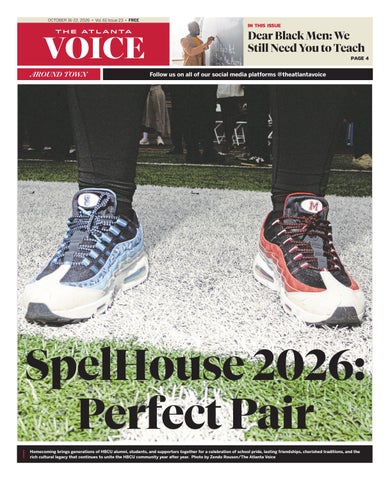
SpelHouse 2026: Perfect Pair Homecoming brings generations of HBCU alumni, students, and supporters together for a celebration of school pride, lasting friendships, cherished traditions, and the rich cultural legacy that continues to unite the HBCU community year after year. Photo by Zendo Rouson/The Atlanta Voice
Page 2 • OCTOBER 16-22, 2026 • theatlantavoice.com
Metro
More Than a Game: SpelHouse Homecoming Celebrates Legacy and Tradition By TAROHN FINLEY Report for America Corp
E
very year, SpelHouse Homecoming brings together current students, alumni and supporters of Morehouse College and Spelman College. Despite uncertainty surrounding this year’s annual celebration because of Hurricane Isaias, members of the two college communities gathered Sunday to watch the Morehouse-Savannah State football game and celebrate the traditions that make homecoming special. This year’s celebration brought together current members of Morehouse’s Band and Mahogany N Motion dance line, Miss Spelman and her court, and alumni from generations past, including members of Morehouse’s 1991 Southern Intercollegiate Athletic Conference (SIAC) championship football team. Each group brought its own stories and memories, demonstrating how homecoming connects the past with the present. Morehouse got off to a strong start, scoring 21 points in the first quarter. But for those waiting to perform and those returning to celebrate their alma mater, the day was about more than the score. They would have to wait until halftime and beyond to take center stage. Freshmen Justin Truell and Braxton Lester were excited to experience their first homecoming as members of Morehouse College’s “House of Funk” Marching Band. Lester danced along as the music played, while the two performers
waited on the sideline for their opportunity to showcase the routines they had spent the week preparing. After reporting at 8:30 a.m., they had spent hours anticipating the moment they could perform before the homecoming crowd. “Performing is my favorite part,” Truell said. “We work the whole week and come out on Saturday or Sunday and record in front of these people, seeing their reaction.” For Truell and Lester, the performance offered a first taste of a tradition that alumni have cherished for decades. Piper Williams, who founded Mahogany N Motion in 1990, was also excited to see the dancers perform. The dance line was created for Morehouse College’s Marching Band, with a name intended to celebrate the beauty of Black women of all shades in motion. A former Jackson State J-Sette, Williams established the group at Spelman College, bringing her dance experience and vision to the Morehouse band’s performance tradition. Williams wore a Mahogany N Motion jersey featuring the group’s tagline, “Pass the Grits,” a phrase that evokes the family and sisterhood formed around a table sharing a home-cooked meal. The jersey also displayed the years 1990, when the group was founded, and 1881, when Spelman College was established. For Williams, watching the current dancers perform meant seeing a legacy she helped establish continue to grow. Mahogany N Motion head coach Deanna Lanier shared that
Dressed in their Spelman and Morehouse College gear, two homecoming attendees show off their school pride as alumni and supporters reunite for a celebration of HBCU culture and tradition. Photo by Zendo Rouson/The Atlanta Voice
appreciation. In her first year as head coach, Lanier has experienced homecoming from a new perspective after previously dancing with the program as a student. “The homecoming experience is just nostalgic,” Lanier said. “As a student, I didn’t really appreciate what it felt like to see everyone coming back to support. As a coach, seeing everyone come back every year to support the girls and celebrate these amazing institutions feels the same but different. Now, you want to pour into what the new girls are doing.” Lanier said it was meaningful to see alumni travel back to campus, attend practices and support the team. One of her favorite traditions is the “backup,” when alumni from the band, dance line and flag line return to participate in the festivities. Although the event took place after the game rather than at halftime this year, it remained a highlight for Lanier. What she once experienced as a dancer, she now gets to witness as a coach, helping a new generation create memories of its own. The celebration also welcomed back members of Morehouse’s 1991 SIAC championship football team. Wearing jerseys bearing their last names, positions and numbers, the former players returned with stories of perseverance, brotherhood and a season that helped define their legacy. Walter Brathe, an All-Conference cornerback from Atlanta, joined
Spelman and Morehouse supporters come together to celebrate school pride, shared traditions, and the enduring bond between the two institutions during homecoming festivities. Photo by Zendo Rouson/The Atlanta Voice
Morehouse’s football team after serving in the military. His path to the team began with a chance encounter with a player during the season. “I met one of the football players around the third game of the season, got to meet the coaching staff,” Brathe said. “They worked me out, trained me and made me work out
with the other fellas. Once they saw me, they said, ‘I see you got talent.’” Brathe briefly left the team in 1990 to serve in the Gulf War. He returned just weeks before the school year began and had to compete for his position under a new coaching staff.
See HOMECOMING on page 9
A homecoming attendee flashes a smile and a hand gesture while enjoying the festivities, capturing the excitement, fashion, and energy that make HBCU homecoming celebrations memorable. Photo by Zendo Rouson/The Atlanta Voice
theatlantavoice.com • OCTOBER 16-22, 2026 • Page 3
Politics
Bottoms outlines priorities at solo gubernatorial debate as Georgia voters head to polls By NOAH WASHINGTON With Republican Rick Jackson absent, the former Atlanta mayor addressed Medicaid expansion, affordability, abortion rights and her plans for Georgia. As Georgians head to the polls for the first week of early voting, Democratic gubernatorial nominee Keisha Lance Bottoms is making her case to voters following a debate in which her Republican opponent, Rick Jackson, declined to participate. The former Atlanta mayor appeared alone Monday, Oct. 12, at Georgia Public Broadcasting’s studios for the Atlanta Press Club’s Loudermilk-Young Debate Series. Under the series’ rules, candidates who decline to participate are represented by an empty podium. Bottoms criticized Jackson’s absence, saying he was the first gubernatorial candidate in 32 years to skip the debate. “He’d rather hide behind his billions than explain to you his record of making billions off the taxpayers of Georgia,” Bottoms said. “While he is running to enrich himself, I am running to be your governor.” The debate took place one day before early voting began Tuesday, Oct. 13. Voters can cast their ballots early through Friday, Oct. 30, ahead of Election Day on Tuesday, Nov. 3. Throughout the debate, Bottoms outlined her plans for Medicaid expansion, education funding, affordable housing, reproductive rights and economic relief for Georgia families. Affordability and Medicaid expansion take center stage Bottoms said her first state budget would prioritize Medicaid expansion, full funding for public education and pre-K, and the creation of an affordable housing trust fund. To help fund those initiatives, she proposed ending the Georgia Pathways program and reviewing tax incentives for data centers. Bottoms argued that Georgia has missed out on hundreds of millions of dollars in federal funding by refusing to fully expand Medicaid. When WABE politics reporter Rahul Bali questioned the potential state costs of expansion, citing a fiscal note projecting expenses could reach approximately $600 million, Bottoms pointed to her financial
Former Atlanta Mayor Keisha Lance Bottoms speaks with reporters following the first Atlanta mayoral debate earlier this election season. Photo by Noah Washington/The Atlanta Voice
record as Atlanta’s mayor. She said her administration balanced a nearly $2 billion city budget for four consecutive years without raising taxes. Bottoms also proposed reviewing state contracts, including a contract she alleged was awarded without competitive bidding to a company associated with Jackson. On affordability, Bottoms called for suspending the state gas tax, eliminating state income taxes for teachers and allowing local governments to remove sales taxes on groceries if their budgets could absorb the lost revenue. Data centers and community concerns Georgia’s rapidly expanding data center industry was another major focus of the debate. Asked by WSB-TV’s Condace Pressley about her proposed statewide moratorium on new
data center construction, Bottoms said she would temporarily halt new projects while state and local leaders evaluate their environmental, health and economic impacts. She said the review would include community leaders, developers and environmental and public health experts. “We will pause for as long as it takes for us to make an informed and responsible decision as to how we move forward as a state,” Bottoms said. Abortion rights and public safety Bottoms also criticized Georgia’s six-week abortion law, directing her remarks toward Jackson’s empty podium during the portion of the debate reserved for candidates to question one another. “This six-week abortion ban has had catastrophic consequences in the state, and Rick Jackson takes
sole responsibility for it,” she said. Following the debate, Bottoms cited the case of Adriana Smith and described a conversation with a Columbus physician who expressed concerns about potential criminal penalties when treating patients experiencing miscarriages. “Government needs to get out of the exam room, plain and simple,” Bottoms said. On public safety, Bottoms defended her record as Atlanta mayor, noting that violent crime increased in cities nationwide during 2020. She also highlighted what she described as the largest pay raise for Atlanta police officers and firefighters in the city’s history. Asked about automated license plate readers, Bottoms called for stronger oversight, including access logs, training requirements and penalties for misuse. “The technology has gotten ahead of the policy,” she said.
Working across party lines Bottoms said she would seek opportunities to work with Republican lawmakers if elected governor, particularly on education and health care. She acknowledged that Republicans could retain control of at least one chamber of the Georgia General Assembly and said she would use the governor’s veto authority when necessary. “So where necessary, it may mean line item vetoes, but ideally, we’ll be able to reach common ground to be able to deliver for the people of Georgia,” she said. Asked how she would approach the Trump administration, Bottoms said she would support federal policies she considers beneficial to Georgia while challenging those she believes would harm residents, including certain immigration enforcement measures and federal funding cuts. “I have never been afraid to push back against the Trump administration,” she said, adding that she would “take the Trump administration to court where appropriate.” Speaking with The Atlanta Voice after the debate, Bottoms said her experience working in the Biden administration, including her time at the White House, prepared her to navigate political differences and work across party lines. An absent opponent as voting begins Jackson’s decision not to participate remained a central theme throughout the evening. In her closing remarks, Bottoms criticized her opponent for campaigning elsewhere rather than appearing before the debate panel. Speaking with reporters afterward, she called Jackson “a coward” and criticized his scheduled appearance with President Donald Trump at a Friday rally in Dalton. “He’s willing to go and stand with Donald Trump, but he is not willing to face the people of Georgia and answer unscripted questions,” Bottoms said. The debate was moderated by Jeff Hullinger, with questions from Bali and Pressley. With early voting now underway, Georgia voters have until Oct. 30 to cast ballots in person before Election Day on Nov. 3.
Page 4 • OCTOBER 16-22, 2026 • theatlantavoice.com
Voices
Dear Black Men: We Still Need You to Teach By SHARIF EL-MEKKI
D
ear Brothers, On our podcast “Freedom Friday,” Chris Stewart, Ismael Jimenez, and I spoke with Dr. Jamaal Bowman, a former New York congressman and educator. Inevitably, Black men educators came up. That conversation inspired this letter, a decade after our opinion piece was published inviting Black men to become teachers. The invitation remains. We also owe the brothers answering it serious preparation, support to stay in the classroom and accountability for what our children learn. I recognize from my own experience the desire to build, help others be heard, and lead. Someone invited me to understand teaching Black children well as the highest, purest form of activism. One of the cleanest ways to kick the oppressor in the teeth, they told me, was to ensure our communities’ children were highly literate. When our high school students said, “We need Black teachers,” we asked permission to use their words as our tagline. Listening required designing opportunities for them to become the teachers they wished they had and knew they needed. At the Center for Black Educator Development, that means preparation and teaching practice beginning in high school, with mentorship and support as young people continue toward the profession. Bryce Thompson, a member of our first Future Teachers of Excellence Fellowship cohort, is now an assistant teacher in Baltimore. He says our work together “helped me realize that my voice has volume. My story has weight.” A student has already told Bryce he wants to follow his path. In 2023, Jayden Latimer, a student at Science Leadership Academy at Beeber in Philadelphia, was helping younger students learn, although he wasn’t planning to pursue education as a career. “I just feel like the system needs more truth to the youth,” he said. We should welcome that judgment and prepare young people to act on it, whether they become teachers or contribute in other ways to our community.
A decade after calling on Black men to teach, the invitation remains — along with a responsibility to prepare, support and retain them. Photo by iStock.com/mediaphotos
Teaching Well Is Our Responsibility Our ancestors were endangered for learning to read; our children are imperiled by low literacy today. We should approach teaching with some understanding of what it cost our ancestors to learn. That responsibility requires study of Black educational history and practice, including Caroline LeCount’s advocacy for Black educators and Carter G. Woodson’s challenge to miseducation. We need to understand how educators organized with families to confront and change systems, resisted oppression and taught children to know themselves. Dr. Constance Lindsay and her colleagues found that Black students in Tennessee’s STAR experiment who were randomly assigned at least one Black teacher in kindergarten through third grade were 9 percentage points more likely to graduate from high school and 6 points more likely to enroll in college. We also need teaching that cultivates positive racial identity. Our children deserve to know themselves and recognize their intellect and beauty without measuring either against whiteness. Our preparation must also equip us to accelerate learning. Dr. Alfred Tatum calls for rejecting
slow-growth models and low expectations for Black boys’ literacy. The Black Literacy Matters conference offers an opportunity to strengthen that work. Black girls deserve our intellectual care and advocacy as fully as Black boys do. A parent leaves a child with a teacher they barely know, expecting protection and excellent instruction. Our “expertise” must be demonstrated with children. A degree ain’t always expertise on a child. Families bring deep expertise, starting with their own children. Many Philadelphia teachers surveyed in a 2018 Temple University study felt unprepared for urban classrooms despite graduating from local preparation programs. We should include community-based certification and endorsements that require students, families, and accomplished educators to examine our body of work: What children learned, how their work improved, and how we treated them. We earn trust by listening, explaining our instruction, keeping promises and giving families an accurate account of their children’s progress. Shared race does not make trust automatic or place our decisions beyond question.
Give Brothers Reasons to Stay Dr. Bettina Love challenges schools to retain, protect and value the Black teachers they recruit. Young people watch how teachers are treated when deciding whether to join us. Schools must provide affirming workplaces and opportunities to lead, alongside mentorship, collegial support and respect for culturally responsive teaching. Our love for children must not become permission to assign us extra responsibilities because of our race. Brothers, no one owes a harmful school his health or silence. And Black children are far too often behind enemy lines in schools that demean them, deny them strong instruction, or punish their Blackness. We must support educators working inside those schools while organizing outside them to change conditions. Leaving a harmful school does not require abandoning our children. We need Black men leading classrooms, coaching teachers, writing standards and developing curriculum. Curriculum writers should see students experience their lessons; coaches should help improve the instruction children receive. Malcolm X compared racism to a Cadillac, with a new model every year. Oppression will keep changing its methods. Our students are future vanguards who need advanced literacy, discernment, creativity and the capacity to organize. The Nguzo Saba gives us principles for practicing self-determination and collective responsibility. Brothers, bring your love for our people and your desire to build. Visit a classroom, learn from excellent teachers and seek preparation with substantial supervised practice. Those of us already teaching must invite you personally and help you act on it. Teaching is sacred civic leadership. We are responsible to our ancestors and descendants, beginning with the children and families in front of us. Whether inside a school or adjacent to them, let’s build. Together. With love and responsibility, S. El-Mekki Sharif El-Mekki is the founder and chief executive officer of the Center for Black Educator Development.
FOUNDED May 11, 1966
FOUNDER/EDITOR Ed Clayton Immortalis Memoria
PUBLISHER/EDITOR J. Lowell Ware
Immortalis Memoria The Atlanta Voice honors the life of J. Lowell Ware. ––– PUBLISHER Janis Ware PRESIDENT/ GENERAL MANAGER James A. Washington 2018-2024 COO Richard Dunn rdunn@theatlantavoice.com CHIEF STRATEGY OFFICER Jazmine Brazier jbrazier@theatlantavoice.com EXECUTIVE DIRECTOR FOR EDITORIAL & ADVERTISING / EXECUTIVE ASSISTANT TO PUBLISHER Chia Suggs csuggs@theatlantavoice.com GENERAL ASSIGNMENT REPORTERS Laura Nwogu lnwogu@theatlantavoice.com Noah Washington nwashington@theatlantavoice.com BUSINESS REPORTER Tabius H. McCoy tmccoy@theatlantavoice.com SPORTS REPORTER Tarohn Finley tfinley@theatlantavoice.com EDITOR AT LARGE Stan Washington swashington@theatlantavoice.com ––– SALES RDW Jackson rdwadman@gmail.com SUBMISSIONS editor@theatlantavoice.com DIRECTOR OF PUBLIC RELATIONS Martel Sharpe msharpe@theatlantavoice.com ––– CONTACT INFORMATION 633 Pryor Street, S.W. Atlanta, GA 30312 Office: 404-524-6426 info@theatlantavoice.com
theatlantavoice.com • OCTOBER 16-22, 2026 • Page 5
Politics
Ossoff, Collins Clash as Voting Begins By NOAH WASHINGTON
A
s Georgians head to the polls for early voting, Democratic U.S. Sen. Jon Ossoff and Republican challenger U.S. Rep. Mike Collins are offering sharply different positions on affordability, racial inequality and political accountability. During an Atlanta Press Club debate Monday, Oct. 12, the candidates traded heated accusations over their records and positions on issues affecting Georgia families. The rising cost of living took center stage as Ossoff challenged Collins’ support for President Donald Trump’s tariffs, pointing to increases in grocery prices. Collins defended the administration’s economic approach, while both candidates sought to position themselves as advocates for working families. Housing affordability and the racial wealth gap emerged as particularly consequential issues. Panelist Faith Jessie of 11Alive cited Census Bureau figures showing
that approximately 80% of white Georgians own their homes, compared with 53% of Black Georgians. Asked how he would address the disparity, Collins proposed expanding empowerment zones and limiting corporate ownership of residential properties. Ossoff disputed Collins’ characterization of his voting record on legislation targeting corporate homeownership. “I voted for the bill to crack down on corporate home ownership. It was Donald Trump who refused to sign it,” Ossoff said. Questions about racial representation also fueled a tense exchange when Jessie asked Collins about reports linking former staff members to white nationalists. “Are you a white nationalist, and what do you say to Black Georgians who question whether you will represent them?” Jessie asked. “I condemn any sort of hate speech, anti-Semitism, hate of any kind,” Collins responded.
U.S. Sen. Jon Ossoff addresses supporters during a campaign rally in Georgia. Ossoff faces Republican challenger U.S. Rep. Mike Collins in the Nov. 3 general election, with early voting underway across the state. Photo by Donnell Suggs/The Atlanta Voice
Ossoff challenged Collins over reported neo-Nazi propaganda associated with his political operation. Collins rejected the attacks and accused Ossoff of inflammatory rhetoric. The candidates also sparred over the war in Iran, immigration, the Jeffrey Epstein files and a congressional ethics investigation involving Collins. Collins characterized the ethics inquiry as politically motivated and maintained that he had cooperated. As voters consider their choices, the race presents competing approaches to economic opportunity, government accountability and representation in Washington.
Early voting continues through Oct. 30, with Election Day set for Tuesday, Nov. 3. ELECTION 2026 | YOUR VOTE, YOUR VOICE Early Voting: Through Friday, Oct. 30 Election Day: Tuesday, Nov. 3, 2026 Check your voter registration, polling location and sample ballot: mvp.sos. ga.gov Remember: Early voting locations and hours may differ from your Election Day polling place. Check with your county elections office before heading to the polls.
Opening More Doors to
Homeownership An FHA Loan could be the key to making your first home a reality.
FHA Loans are designed to help more people become homeowners. Backed by the Federal Housing Administration, this loan option offers flexibility and support for your homebuying journey. • Low down payment options (as low as 3.5%) • Flexible credit and income requirements • Competitive interest rates • Great for first-time buyers Let’s explore your options together!
866.229.5628 Mortgage@SouthStateBank.com SouthStateBank.com/AtlantaVoice All loans are subject to credit approval and program guidelines. SouthState Bank N.A. NMLS ID # 403455. Member FDIC. Equal Housing Lender.
OctNovPrint-TheAtlantaVoice-FHA.indd 1
10/7/26 2:41 PM
Page 6 • OCTOBER 16-22, 2026 • theatlantavoice.com
Health
Cash for Moms: As Medicaid Cuts Loom Cities Test a New Approach to Black Maternal Health By JENNIFER PORTER GORE Word In Black
on diaper insecurity, supplied 300 diapers and eight packs of wipes a month, plus a car seat and other essentials. The Georgia Black Doula Network encouraged, but didn’t require, participants to hire doulas. Early results from Emory’s evaluation, as described by Mason, show a 20% decrease in financial stress and a 66% decrease in hopelessness, a figure she called striking. Prenatal outcomes trended better than average. Mason was careful not to oversell what $1,000 a month can fix. Several participants lost housing; one or two dealt with domestic violence. Even though GBI reduced financial stress, “it still is one piece of the puzzle,” Mason said.
B
y now, there’s little question that a maternal health crisis is rocking the Black community. The data tells the story: Black moms are dying during childbirth at three times the rate of white moms, a disproportionately high percentage of Black children are born prematurely, and Black infants are about twice as likely to die as white infants in states like Louisiana. But new data from a handful of pilot projects also suggests a potential solution that could significantly improve outcomes for Black mothers and their babies: cash payments, no strings attached. Studies show the unrestricted money led to fewer preterm births, higher newborn birth weights, and fewer critical-care infant hospitalizations. It also reduced stress among new moms who would otherwise struggle to attend prenatal check-ups, pay for food and formula, or keep a roof over their heads. “This makes so much sense to me,” says Tamara Mason, an official with the nonprofit March of Dimes who worked on an Atlanta project distributing money to low-income pregnant women. “Why isn’t everyone doing this?” Sen. Cory Booker, a New Jersey Democrat, is among several sponsors of legislation that would provide direct financial aid to new mothers, similar to the expanded child tax credit in 2021. The credit sent monthly payments of up to $300 per child straight to most families’ bank accounts; experts credit it with lifting millions of children out of poverty. When it expired, child poverty rose again. “I believe that we need to, for moms, flood resources to them through things like the child tax credit,” Booker said during an August press briefing on the Black Maternal Health Momnibus Act. “We were able to cut child poverty virtually in half for our communities, and that actually does affect child outcomes.” Those positive outcomes in part spurred the March of Dimes to launch trial programs providing universal basic income, or UBI, to pregnant women and new moms in two cities: Atlanta, which Bloomberg ranked as the most
Guaranteed income pilot projects have bet on cash support for new mothers. With maternal health on the ballot the issue can’t be ignored. Photo by iStock.com/Djavan Rodriguez
economically unequal large city in the country, and New Orleans, which March of Dimes gave an F grade. No strings attached In Atlanta, the Guaranteed Basic Income Program gave each participant $1,000 a month during pregnancy and her baby’s first year. Women most likely to live in poverty in that city are Black women of reproductive age; 25 pregnant women in two of the area’s highest-need ZIP codes received the cash. March of Dimes ran the pilot through an Atlanta collective-impact partnership known as the collaborative. It is modeled on San Francisco’s Abundant Birth Project and, organizers say, rooted in an idea the Rev. Martin Luther King Jr. championed decades ago. Funders Skeptical at First— Then All In Mason said she spent months pitching foundations on the idea,
which some considered outside her organization’s lane. “I was honestly surprised that a couple of foundations,” Mason says. “Funders were like, ‘Why is March of Dimes in this space? You all are the birth defects people. You’re the preterm birth people.’” The Community Foundation for Greater Atlanta signed on as the primary funder. The Liz Blake Giving Fund and the Jesse Parker Williams Foundation funded data gathering and evaluation Emory University conducted. The nonprofit Center for Black Women’s Wellness handled recruitment, and more than 110 women applied for the 25 spots, Mason said. Applicants had to live in one of the two ZIP codes, earn no more than 200% of the federal poverty level, and be 12 to 28 weeks pregnant. Cash, Diapers and a Network Stipends were paid through a prepaid card, letting evaluators track spending without restricting it. Helping Mamas, a nonprofit focused
New Orleans: Overcoming Crisis March of Dimes runs a similar program in New Orleans, GBI Rx, offering pregnant patients in their first or second trimester $12,000, as a lump sum or $1,000 a month. Two partner medical clinics enroll patients for healthcare, and the payment card blocks cash withdrawals and spending on liquor and gambling. In Louisiana, “we have a maternal and infant health crisis — specifically, a Black maternal and infant health crisis,” said Robin Gruenfeld, director of collective impact for March of Dimes in New Orleans. ”And it’s been that way for a long time.” Black infants there died at about twice the rate of white infants from 2021 to 2023. Gruenfeld said Orleans Parish has the state’s lowest prenatal care utilization rate. Gruenfeld said the program’s city seed money, federal pandemic relief funds, and foundation funding were “zeroed out” without notice. Most funds were later restored at a lower level, forcing organizers to scale down to 94 participants instead of the 100 planned. They also enrolled on a first-come, first-served basis. Recipients spent lump sums on housing, cars and insurance. But spending priorities for the participants changed when the federal government stopped paying out SNAP food benefits during last fall’s federal shutdown. “During that time, more than a quarter of the funds that we gave folks was going to groceries,” Gruenfeld said. Several New Orleans city government officials are now weighing a program modeled on Michigan’s
Rx Kids, which a study credits with nearly halving neonatal deaths in Flint, one of the poorest cities in the state. “We are seeing policies pushed by the political will of predominantly Black women come into effect, and then also the backlash,” says Danielle Atkinson of Mothering Justice Action Fund, a nonprofit advocacy organization. “In Michigan, we have Rx Kids, which is extremely popular [and] the data on the impact is undeniable.” But recent changes are endangering the success of such programs, particularly amid President Donald Trump’s hostility towards programs focused on diversity, equity and inclusion. “We’re getting this pushback around identifying race and parental status as systemic areas of oppression,” Atkinson says. It remains to be seen, she says, “whether or not we are going to be able to prevail with the political power and the popular will of these issues, or the rhetoric and the history of racism in our country.” Washington Looks Elsewhere That includes the Republican-controlled Congress, which has shown little appetite for cash aid tied to pregnancy. The Black Maternal Health Momnibus Act, which Booker reintroduced along with Democratic Reps. Lauren Underwood of Illinois and Alma Adams of North Carolina, bundles 14 bills on housing, nutrition, WIC and the perinatal workforce, but not direct cash. Still, signs suggest the issue — providing cash aid to low-income mothers and their babies — may stay on the front burner as the midterm elections approach in November. This month, former Vice President Kamala Harris and Michigan Senate nominee Abdul El-Sayed, both Democrats, hosted a Black maternal health roundtable in Detroit. Danielle Atkinson of Mothering Justice took part. “Black mamas deserve access to quality healthcare that sees us, listens to us, and understands us at every step of the way,” Atkinson said afterward. “The responsibilities we carry do not end at pregnancy, nor do they disappear when we give birth and want to spend time with our newborn. They stay with us throughout all that we experience.”
theatlantavoice.com • OCTOBER 16-22, 2026 • Page 7
Arts
Atlanta Art Fair Showcases Artists’ Journeys of Hope By NOAH WASHINGTON
S
ome came from across an ocean. Others came from across town. From Oct. 1-4, galleries and artists from Atlanta, London, Lagos, Seoul and beyond filled Pullman Yards for the annual Atlanta Art Fair, and many arrived carrying something personal: a loss, a buried history or a long-awaited first. Gabriel Tendai Choto traveled from West Yorkshire in northern England for a solo presentation with Atlanta’s Memento gallery. His paintings trace what he called a journey of self-discovery and hope.
His “Whispers of Imperfection” belongs to a series of about 15 works first shown in London roughly two years ago. Choto said the series documented a personal loss tied to fatherhood and a long struggle to accept a life that had changed completely. “I started realizing, you know what? I became my worst enemy,” he said. As the series progressed, he said, the work moved from hopelessness toward hope, shaped by people he met who were walking the same path. Tasanee Durrett also found her way to the canvas through pain. Raised on Chicago’s South Side,
Portrait by Tasanee Durrett. Photo by Noah Washington/The Atlanta Voice
she became a licensed architect after childhood museum trips with her mother. She did not pick up a paintbrush until she was leaving an abusive relationship of nearly eight years. Painting began as a release, she said, then became something larger once she saw how her work affected others. “I’m architect by day and artist all day, every day,” she said. Durrett attended last year’s fair as a collector. This year she returned as an exhibitor with Dallas-based Daisha Board Gallery, bringing two works drawn from Black maritime history. “Beneath the Surface” pairs metallic golds and copper with raffia and silkworm cocoons, a symbol of transformation, to suggest that Black American history, like the ocean, remains largely undiscovered. “Tides of Liberation” honors William T. Shorey, a 19th-century Black whaling captain who rose from cabin boy to captain. Her line work is drawn as one continuous line, which she said is a reminder that everyone is connected. “I just hope they take something and feel it within themselves, and it becomes their own story,” Durrett said. Durrett was one of several artists Serene Agency championed during fair week, alongside a four-artist presentation from New York’s Jessica Ann Peavy Gallery. On Oct. 3, the agency hosted a dinner and reception at Koncept House for Rashad A. Muhammad, whose new series confronts HIV with candor, tenderness and hope. The venue’s entire first floor was given to the work for the night. For Brazilian painter Brendon Reis, simply getting to Atlanta took persistence. The trip was his first outside Brazil, and he said he nearly stayed home because he did not have a visa. “You need to fight for your presence,” Reis said. He came for his first U.S. solo exhibition, presented by One Contemporary and Gerber Fine Art. The two Atlanta galleries began planning the collaboration after meeting at last year’s fair. At the booth, a large painting titled “Sweet Dreams” showed a man embracing a woman who appears completely at ease. Faron Manuel, founder and curator of One Contemporary, called it hypnotic. “This is almost like unreal to me,” Manuel said of the weekend.
Oyè Diran, “Blue Thoughts”, 2016. Archival pigment print, 50 × 40 in. Edition of 5 + 1 AP. Photo by Noah Washington/The Atlanta Voice
On Oct. 2, the galleries hosted a conversation with Reis at One Contemporary on Edgewood Avenue. Paul A. Rogers, founder of BlackArtThinks.com, and Kara Blackmore, chief curator of Borderlands Art in Uganda, joined him. Much of the talk centered on blue, the color that dominates Reis’ figures. Reis said he once repainted his existing work entirely in blue because the originals did not reflect how he felt. Rogers compared that blue to the way Kerry James Marshall uses black, and Blackmore pointed to the stars Reis paints in his figures’ eyes. “There’s something really beautiful about the stars and the eyes, and the way in which that creates a sort of constellation to connect diasporas,” Blackmore said. Reis said Black Brazilians remain largely absent from television, film and museums. He waited six or seven years for his first
museum acquisition, he said, and found the donor himself through Instagram. Blue also anchored the booth of another first-timer. Arnika Dawkins Gallery has operated in Atlanta’s Cascade area since 2012, but this was its first year at the fair. Dawkins brought a solo booth of work by Oye Diran, a Nigerian-born New Yorker whose blue-saturated prints celebrate his Yoruba heritage. Dawkins said she built the gallery on a simple rule: show only work she would buy herself. She said some visitors were moved to tears by Diran’s prints. “I love work that moves me, that engages me intellectually, that engages my heart, and is visually pleasing,” Dawkins said. “I think the work allows people to have their own interaction with it, and I think that’s a wonderful gift from the artist.”
Page 8 • OCTOBER 16-22, 2026 • theatlantavoice.com
Sponsored Content
Want to stay grounded this season? These 4 tips can help you plan a holiday “staycation” in Atlanta SPONSORED CONTENT PROVIDED BY JPMORGANCHASE
H
oliday travel can be exciting, but winter weather, crowded airports and packed schedules can sometimes make the idea of staying at home much more appealing. If you still want to get away without the hassle of an actual getaway, consider a holiday staycation. By remaining close to home, you can experience Atlanta from a fresh perspective without the stress of a long trip. Whether you book a night at a local hotel, check out a new neighborhood or just finally get around to seeing that landmark attraction that’s been on your to-do list, you can make staying at home feel like a real getaway. Here are 4 tips you can use to create an amazing holiday at home this season: 1. Treat your hometown like a destination One common theme surrounding area attractions is that they’re more likely to be packed with tourists than locals. If that popular museum, tour or other institution is always “there,” it can be easy to avoid it and say you’ll get there eventually. A staycation provides a great opportunity to approach those kinds of places in Atlanta like a tourist. Start by making a short list of places or experiences you’ve always wanted to try but never seem to prioritize. You might include a museum, holiday market, historic site, restaurant or neighborhood, or you might attend a holiday-related performance that’s an annual late fall or winter tradition in your area. “A great staycation starts when you treat your hometown like a destination - book one ‘anchor’ experience, stay somewhere that changes your scenery, and leave room for a little spontaneity,” said Steve Orens, President of FROSCH by Chase Travel, a leading travel agency. “My favorite staycation tip is to make it easy on yourself: choose a walkable
area, plan one highlight each day, and let the hotel do the heavy lifting - warm beds, quick breaks, and fewer logistics.” 2. Spend the night away A hotel stay can provide a change of scenery that makes you feel like you’re enjoying a getaway. Consider a traditional hotel, bed and breakfast or rental property where you can walk to restaurants, shopping, entertainment or holiday activities. An upscale hotel can also be the centerpiece of your staycation, allowing you to enjoy fine dining, a fitness center, spa services or other on-site experiences. If you want a quieter, more relaxed experience, find a hotel “off the beaten path,” but still close to home, to enjoy the rhythms and sounds of nature. 3. Be flexible If your schedule allows, plan your staycation for a weekday or less crowded period — like the days between Christmas and New Year’s Eve — rather than a peak weekend. Hotel rates in the middle of the week tend to be cheaper, and it might be easier to grab a restaurant reservation or performance tickets. Locations might be less crowded as well during the week, making it easier to get around. Book some experiences in advance to save money but stay open to spontaneous opportunities once you arrive. You might find some great last-minute deals. 4. Try something new Even if you think you’ve seen everything your hometown has to offer, there’s always something new to explore or discover. Check out a neighborhood you usually drive through and visit the local shops and other businesses. You can also try a new cuisine at a neighborhood restaurant or kitchen. Sometimes what’s old can be new again during the holiday season, so if you want to go back to your favorite restaurants and other popular spots, do so with fresh eyes. Order from the eatery’s holiday menu
Skip holiday travel hassles with an Atlanta staycation. Four tips can help you explore local attractions, book a nearby hotel and find seasonal experiences close to home. Photo Credit: andreswd
or take a walk when lights, decorations and seasonal programming transform many communities. Other helpful tips Although staying at home can eliminate major travel costs, expenses can still add up quickly. Make a staycation budget and then consider ways to help keep costs down. “A ‘smart’ staycation is one you can pay for comfortably: choose dates with better rates, book flexible options, and keep a small buffer for surprises,” added Orens. “The goal of a staycation is a real reset. Even if you’re close to home, give yourself permission to unplug and find moments to treat yourself - say yes to room service, a spa hour, or a new restaurant you’ve been saving for ‘someday.’” If you have rewards points from credit cards or loyalty programs, put them toward your hotel to get a free or cheaper night’s stay. Local
museums, cultural institutions and attractions often have resident discounts, reduced-price admission days or seasonal offers. Community calendars can provide information about free or low-cost events like holiday concerts, light displays, markets, park activities and other events. If a performance doesn’t normally sell out, wait until the day before or day of to buy tickets, as prices are often reduced and you can find great seats. With a little creativity, you might find Atlanta offers everything you’d want in a holiday vacation. You can enjoy good food, new experiences and an escape from your daily routine — all right at home. For more financial health tips, visit https://www.chase.com/travel/guide For informational/educational purposes only: Views and strategies described in this article or provided via links may not be appropriate for everyone and are not intended as
specific advice/recommendation for any business. Information has been obtained from sources believed to be reliable, but JPMorgan Chase & Co. or its affiliates and/or subsidiaries do not warrant its completeness or accuracy. The material is not intended to provide legal, tax, or financial advice or to indicate the availability or suitability of any JPMorgan Chase Bank, N.A. product or service. You should carefully consider your needs and objectives before making any decisions and consult the appropriate professional(s). Outlooks and past performance are not guarantees of future results. JPMorgan Chase & Co. and its affiliates are not responsible for, and do not provide or endorse third-party products, services, or other content. Deposit products provided by JPMorgan Chase Bank, N.A. Member FDIC. Equal Opportunity Lender. © 2026 JPMorgan Chase & Co.
theatlantavoice.com • OCTOBER 16-22, 2026 • Page 9
HOMECOMING Continued from page 2 Brathe still wears his championship ring as a reminder of the team’s historic season and the hard work it took to reach the top. Decades later, the ring remains a symbol of the perseverance and brotherhood that defined the 1991 team. His return became another chapter in a season marked by determination. Kevyn Giggers described the championship team’s run as an underdog story. After opening the season with three consecutive losses, the team rallied to win six straight games, including a matchup against previously undefeated Savannah State. The team also became the first in Morehouse football program history to earn a national ranking. The perseverance that defined the team extended beyond the football field for Giggers. After briefly stepping away from school, he returned to complete bachelor’s degrees in international studies and political studies at age 35. Giggers is also working on a documentary titled Remember the Tigers, which focuses on former teammates who have died from causes and circumstances including diabetes and mental health struggles. The team honors fallen members with a jersey patch featuring angel wings above the numbers on the side of each jersey. The championship team’s legacy also includes academic achievement. Morehouse took pride in having 50 football players earn GPAs of 3.0 or higher. Jimmy Mickenn, from Washington in Wilkes County, Georgia, was
A homecoming attendee sports a custom “Go Tigers” jacket, showcasing the creativity, fashion, and school spirit on display throughout the celebration. Photo by Zendo Rouson/The Atlanta Voice
among those athletes. Mickenn initially planned to attend the University of Tennessee before his cousin, a Morehouse graduate, helped change his mind. His cousin brought the former head coach, athletic director and players to meet with him and convince him to attend Morehouse instead. The impact of Morehouse also extended across generations. Louis Negron, a Morehouse graduate, returned to watch his son, sophomore football player Enrique Negron, take the field. “That’s my legacy,” Negron said. “I didn’t know he was coming, but he decided to come here, so I have a different experience and love for Morehouse now.” At halftime, members of the 1991 championship team were honored for their contributions to the college’s athletic history. The
NOW LEASING
IN THE MECHANICSVILLE AREA
1 BEDROOM STARTING AT $765 PER MONTH
NEWLY RENOVATED
QUALIFICATIONS
PROPERTY FEATURES Near downtown Atlanta On MARTA line Close to Publix plaza & restaurants Total electric with central air/heat Stove & refrigerator included Rent includes water, sewer & trash No Pets No Smoking
$45 application fee (money order only) Income must be at least 3 times the monthly rent. Credit/Background Check Required Security deposit to be paid with 1st month’s rent
(404) 527-5465 ext. 20
Email us at info@summechcdc.org
Morris Brown College supporters represent their alma mater in purple and gold during homecoming festivities, celebrating the school’s legacy, brotherhood, and enduring HBCU pride. Photo by Zendo Rouson/The Atlanta Voice
celebration also recognized Miss Spelman, Jillian Collier, and her court members, Sarah Sloan, Madison Corzine and Zaria Samuel, highlighting the people and traditions that make SpelHouse Homecoming a celebration of both institutions. Morehouse went on to defeat Savannah State, earning its third consecutive victory. But the final whistle did not signal the end of the festivities. Long after the game ended, fans, students, alumni and players remained together as the band performed. Children danced along the sideline, football players joined in, and the music kept the crowd moving. As the band made its way through the surrounding streets, a crowd followed, turning the postgame celebration into a procession of music, dancing and shared memories. For the freshmen experiencing their first homecoming, the alumni returning to honor
Two women celebrate HBCU traditions and sisterhood during homecoming festivities, proudly representing Morehouse College and Alpha Kappa Alpha Sorority, Incorporated. Photo by Zendo Rouson/The Atlanta Voice
their legacy and the families watching the next generation take the field, the day offered a reminder of what makes SpelHouse special: the traditions that endure, the people who sustain them and the community that comes together year after year.
Page 10 • OCTOBER 16-22, 2026 • theatlantavoice.com
Sports
A Championship Dream Comes to Atlanta By TAROHN FINLEY Report for America Corp
T
he Dream and Hawks will share State Farm Arena for a basketball doubleheader that day, with the Hawks hosting the Houston Rockets at 8:30 p.m. ET, 30 minutes later than originally scheduled. “We are grateful for the efforts made by numerous stakeholders, including the Dream, the Valkyries, the Hawks, State Farm Arena, and NBC Sports and USA Sports,” WNBA Commissioner Cathy Engelbert said. “The change of venue dramatically expands the seating capacity and ensures that the Dream will be able to provide an extraordinary atmosphere for the first WNBA Finals game to be played in the Atlanta market since 2013. We are pleased that thousands more fans across the Southeast region will have the opportunity to experience the ultimate WNBA action – the WNBA Finals – in person.” Atlanta Dream majority owner Larry Gottesdiener also praised the collaborative effort to bring the championship games to the larger venue. “This is what the players and the fans deserve,” Gottesdiener said. “We are grateful to all of the stakeholders who worked together to resolve the conflicts and make this happen.” Andrew Saltzman, president of business enterprise and chief commercial officer of the Atlanta Hawks and State Farm Arena, said the venue is ready to welcome the Dream during their championship run. “We are thrilled that we will be able to accommodate the Dream as they host Games
The Atlanta Dream will host WNBA Finals Games 3 and 4 at State Farm Arena, giving thousands more fans a chance to attend the franchise’s first Finals home games in Atlanta since 2013. Photo by Tabius H. McCoy/The Atlanta Voice
3 and 4 of the WNBA Finals at State Farm Arena. Playing for a championship is special, and we want the Dream to feel the full support of the city during this amazing run,” Saltzman said. State Farm Arena to Welcome the Dream Back The Finals games mark another return to
The move represents a significant change for the franchise, which has played most of its home games at Gateway Center Arena in College Park since 2021. Photo by Tabius H. McCoy/The Atlanta Voice
State Farm Arena for the Dream, who announced earlier this month a new multiyear agreement making the downtown venue their home beginning in 2027. The move represents a significant change for the franchise, which has played most of its home games at Gateway Center Arena in College Park since 2021. Gateway Center Arena seats approximately 3,500 fans for basketball games, a capacity the Dream have consistently reached. The franchise has sold out its games at the venue over the past three seasons while also drawing significantly larger crowds for games at State Farm Arena, including multiple record-setting appearances with more than 17,000 fans in attendance. Under new ownership, the franchise has reportedly experienced more than 400% growth in season-ticket memberships and expanded its reach to ticket buyers from all 50 states. State Farm Arena is familiar territory for the Dream. The franchise played there when it was known as Philips Arena from its inaugural season in 2008 through 2016. The team then moved to Georgia Tech’s McCamish Pavilion for the 2017 and 2018 seasons before returning to the downtown arena in 2019. The Dream relocated to Gateway Center Arena in 2021, where the smaller setting provided an intimate home-court atmosphere but limited attendance as interest in the franchise grew. The upcoming Finals games also continue a history of WNBA playoff contests being relocated because of scheduling conflicts or arena renovations. The last time the Dream hosted a WNBA Finals game, in 2013, the team played at the Arena at Gwinnett Center in Duluth, now
known as Gas South Arena, which seats approximately 13,000. This year’s move to State Farm Arena allows thousands more fans to attend the championship series while providing a preview of the franchise’s next chapter in downtown Atlanta. Dream and Valkyries Set for First Finals Meeting The Dream enter the Finals after sweeping the New York Liberty in the semifinals and extending their winning streak to 10 games. Atlanta has not lost since Aug. 28, although that stretch included a two-week break for the FIBA Women’s Basketball World Cup. The Valkyries also advanced with a semifinal sweep, defeating the defending champion Las Vegas Aces. Golden State finished the regular season as the WNBA’s second seed with a 32-12 record and defeated Atlanta in all three of their regular-season meetings. The series opens at Chase Center in San Francisco on Saturday, Oct. 17, at 3:30 p.m. ET (12:30 p.m. PT), with coverage on NBC and Peacock. Game 2 follows Monday, Oct. 19, at 8 p.m. ET (5 p.m. PT) on USA Network, CNBC and Peacock. The series will then shift to Atlanta for Games 3 and 4, giving the Dream an opportunity to compete for a championship in front of a significantly larger home crowd. For Atlanta, the venue change represents more than a scheduling adjustment. It offers the franchise an opportunity to showcase its growing fan base on one of basketball’s biggest stages while preparing for its permanent return to State Farm Arena in 2027.
theatlantavoice.com • OCTOBER 16-22, 2026 • Page 11
42
nd
Heritage Days
Celebration ST. HELENA ISLAND, SOUTH CAROLINA
NOVEMBER 12-14, 2026 Founded in 1862 as one of the first schools in the South for formerly enslaved people, Penn Center is where Dr. Martin Luther King Jr. came to plan and reflect. For more than four decades, Heritage Days has brought families home for the food, music, faith and traditions of the Sea Islands.
Come Home to the Heart of Gullah Geechee Culture 12 T H U R S D A Y
13 F R I D A Y
14 S A T U R D A Y
History, theater & faith
Film, art & fish fry
Parade, music & food
Heritage Symposium for
A screening of Daghters
America's 250th, Youth
of the Dust, Artists &
The Heritage Days
Day and theThe Road to
Authors Row, vendors,
Remembrance play, and
and an evening fish fry
an old-fashioned Praise
with stories, music, and
House service
performances
Parade at 9 AM, then allday performances, Gullah food and the Vendors Market
Just outside Beaufort, SC, about 4.5 hours from Atlanta. Make it a weekend in the Lowcountry. PENNCENTER.COM
Most events free and open to the public.
Page 12 • OCTOBER 16-22, 2026 • theatlantavoice.com
OCTOBER 16-22, 2026 • www.theatlantavoice.com
CLASSIFIEDS
SENIORS
OPPORTUNITIES
SENIOR (62+)
(404) 586-9098
HR Operations Specialist – JD: Coordinate HR operations between the U.S. company and its Korean parent, including expatriate support, staffing, benefits, and employee records.Req: Master’s/for.eq deg in Human Resources Mgmt. or rel. fld. & 1 yr. exp. coordinating international HR ops. & providing HR support for a construction engineering co. Exp. must incl. managing expatriate immigration matters. CV: HR, KB Link, Inc., 6475 East Johns Crossing, Duluth, GA 30097.
REQUEST FOR BIDS
OPPORTUNITIES
Spacious 1-Bedroom Affordable! Rent Based on Annual Income Amenities, Great Location, and Convenient to Marta Please call for detailed information
FULTON COUNTY ADVERTISEMENT FOR RFP Sealed RFP Solicitation for 26RFP1645291A-ST AI Powered Digital Water Operations Platform for Fulton County Pubic Works will be received And accepted by the Department of Purchasing & Contract Compliance via BidNet Direct at https://www.bidnetdirect.com/georgia/ fultoncounty on Friday, November 13, 2026. All Proposal(s) submitted must be received no later than 11:00 A.M. local (Eastern) time on the stated due date. Proposals names will be publicly read at 11:05 a.m., via a Zoom Web Conference. Please see zoom link noted in the Solicitation Document of Section 3. Scope of Work: Fulton County, Georgia (“County”) Fulton County Public Works (FCPW) is soliciting qualifications from experienced firms capable of providing, implementing, and supporting an AIpowered digital wateroperations platform. The County intends to procure a software solution that enhances operational decisionmaking, im proves system visibility, strengthens crossdepartment collaboration, and supports longterm in frastructure planning. The detailed scope of work and technical specifications are outlined in the Scope of Work, Section 4 of this proposal document. In order to obtain complete information about this solicitation, please click the link below where this document and supporting documents can be downloaded, https://www.bidnetdirect.com/georgia/fultoncounty Fee: N/A Contract Term: 1 Year with (4) One-Year Renewal Options. Pre-Proposal Conference: A Pre-Proposal Conference will be held via a zoom Web-Conference to provide proponents on information regarding this project and to address any questions. Date: Wednesday, October 21, 2026 Time: 10:00 A.M. Eastern Standard Time Web Link: https://zoom.us/j/96292622910?pwd=DQW0BaP4SZExTMjaXhjrKpnCqbeo jQ.1 Meeting ID: 962 9262 2910 Passcode: 233378 If you have any questions regarding this project please contact Shondra Turner, APA, (404) 612- 1100 or Email: shondra.turner@ fultoncountyga.gov. Fulton County reserves the right to accept or reject any and all applications and to waive technicalities.
3... 2... 1... New Career!
Senior Director of Construction - JD: Lead construction operation. - Req: BA/for.eq. deg. in Construction Mgmt., Architectural Eng’g, or rel. engineering fld. & 7 yrs.’ exp. in industrial & plant construction mgmt. and cost & subcontract mgmt. for international mega construction projects. CV: HR, Jun America LLC, 6475 East Johns Crossing, Ste. A-3, Duluth, GA 30097.
REQUEST FOR BIDS FULTON COUNTY ADVERTISEMENT FOR BID Sealed Bid for 26ITB1691317A-JWT Cosmetology & Aesthetic Services for Seniors for the Department of Public Works will be accepted by the Fulton County Department of Purchasing & Contract Compliance, online via Bidnet Direct https://www. bidnetdirect.com/georgia/fultoncounty.gov on Tuesday, November 10, 2026 at 11:00 A.M. local (Eastern) standard time. Bids will be received and pricing totals will be publicly read aloud online virtually via a Web Conference at 11:05 A.M.. Web Conference Link: https://zoom.us/j/95907022806 Meeting ID: 959 0702 2806 One tap mobile +14702509358,,95907022806# US (Atlanta) +14703812552,,95907022806# US (Atlanta) SCOPE OF WORK: Fulton County, Georgia (“County”) New request from qualified cosmetologists, barbers and/or nail technicians to deliver on-site services to seniors ages 55 and older in FY27. This is a revenue neutral contract. FEE: N/A TERM OF CONTRACT: One (1) Year, with two (2) one (1) year renewal options. PRE-BID CONFERENCE: Will be held virtually online via a Web Conference to provide the bidders with information regarding this project and to address any questions. Date: Tuesdat, October 27, 2026 Time: 10:00 A.M. Local Time Join Zoom Meeting: https://zoom.us/j/92230908373 Meeting ID: 922 3090 8373 One tap mobile +14703812552,,92230908373# US (Atlanta) +14702509358,,92230908373# US (Atlanta) If you have any questions regarding this project please contact Janelle Tanner, APA, MBA, CPPB at 404-612-7969 or janelle. tanner@fultoncountyga.gov. Fulton County reserves the right to accept or reject any or all bids and to waive technicalities.
Your news. Your Way.
www.theatlantavoice.com