OCTOBER 9-15, 2026 • Vol. 61 Issue 22 • FREE
IN THIS ISSUE
Converse, Target and the Cost of Who Isn’t in the Room PAGE 4
Follow us on all of our social media platforms @theatlantavoice
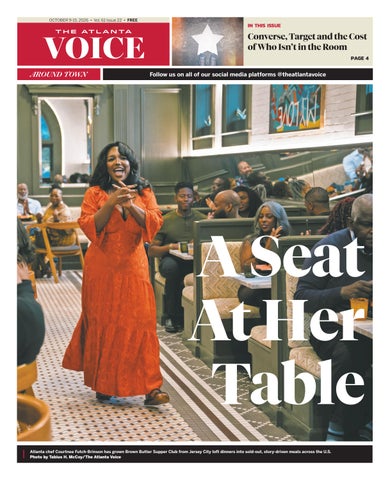
A Seat At Her Table Atlanta chef Courtnee Futch-Brinson has grown Brown Butter Supper Club from Jersey City loft dinners into sold-out, story-driven meals across the U.S. Photo by Tabius H. McCoy/The Atlanta Voice
Page 2 • OCTOBER 9-15, 2026 • theatlantavoice.com
In the Black
Inside the Rise of Chef Courtnee Futch-Brinson’s Brown Butter Supper Club By LAURA NWOGU
T
he smells of heaping plates of food wafted from the tables inside Station 11 in Atlanta as family-style meals featuring East Asian preserves and Persian broths were passed from hand to hand. Music and conversations between strangers serenaded the room, and cocktails decorated the evening, giving life to the Brown Butter Supper
A family-style dish is served during a Brown Butter Supper Club dinner, where seasonal ingredients, bold flavors and global influences shape Futch-Brinson’s menus. Photo by Tabius H. McCoy/The Atlanta Voice Pasted markdown
Club’s summer theme: “Golden Ours.” In a bright red dress, Courtnee Futch-Brinson, the founder, chef, and culinary creative behind Brown Butter Supper Club, walked between tables as she passionately described and explained the meaning behind each meal, transporting guests to the memories that inspired the dishes. From turmeric focaccia and mango lassi margaritas to smoked ginger and apricot chicken, gochujang-grilled steak, and saffron and coconut sweet corn risotto, the Atlanta native has created a cultural culinary experience that leaves guests fed in both body and spirit, turning a room full of strangers into a community gathered around a shared table. From a Jersey City Loft to SoldOut National Tables Through Brown Butter Supper Club, an intimate five-course dinner experience named in honor of her favorite ingredient, Futch-Brinson has served over 4,000 people since its launch in Atlanta in 2024. With hospitality at the forefront, the dinners have become one of the premier supper club experiences. When Futch-Brinson started hosting dinners in her Jersey City loft in 2017, she didn’t know that it would grow into sold-out dinners across the U.S. and
a loyal community. Back then, it was all about scraping her resources together to feed 30 strangers in her room by herself. Food prep was done four days in advance, and menus were playful, taking inspiration from pop culture moments like a Megan Thee Stallion freestyle. When guests arrived, they’d often find Futch-Brinson still at the stove, whipping up a dish, turning nights into part cooking demonstration, part dinner. Dinners that started at 5 p.m. would often stretch until 3 a.m., with Futch-Brinson eventually slipping into her pajamas and telling guests to just lock up on their way out. She recalled running into a former guest who reminded her of the time she’d built a massive square table setup, only to realize she’d forgotten to leave herself a path to enter the middle. It forced her to improvise and crawl under the tables to describe the menu at the center of the action. It was moments like that that defined the ingenuity and playful charm that carried the chef. In that loft, she hosted over 125 dinners before moving back to Atlanta in 2023. Looking back, Futch-Brinson still isn’t quite sure how she pulled those early supper club dinners off. “If I’m being completely honest,
Guests gather over a family-style meal at Brown Butter Supper Club in Atlanta. The intimate dinner series uses food and hospitality to turn a table of strangers into a shared community. Photo by Tabius H. McCoy/The Atlanta Voice
Courtnee Futch-Brinson, founder and chef behind Brown Butter Supper Club, hosts an evening of food and community in Atlanta. Photo by Tabius H. McCoy/The Atlanta Voice
I was so scrappy. Everything and all the things in the world were like a challenge to me. I was very curious about the world at that time, and I think I still am. But now, I’m not as curious about the world. I’m curious about people, and that’s sort of the shift,” Futch-Brinson said. “But at the time, I was like, well, how do I bring the world into my food? What does it look like for me to play? And so every dinner really was me playing, and you would get there to my house, and I’d still be cooking the food, and the vibes would be on, and people would crowd around my kitchen island, and we would talk, and drink.” A Seat at the Table Like many before her, her love and appreciation for food began with her mother’s cooking. At 6, she remembered telling people she wanted to be a chef just like her mother. “They were like, ‘Your mom works in insurance. She’s not a chef.’” But the love stuck with her, and her mother’s passion for baking turned into her own passion for baking. She honed her instincts in the kitchen from high school through college, eventually opening her bakery, ThunderCakes, in Syracuse, New York. “I became a part of people’s celebrations, and I liked being attached to a joyous thing. When I got to college, there could be a probate, a birthday, or a friend who’s having a hard time. It was the evidence that someone cared about you in real time and somebody’s willingness to spend those hours, which I really,
really valued.” As a self-taught chef, Futch-Brinson said she fought hard to carve out a lane for herself, especially as she made the transition from creating sweet to savory dishes. She traveled to France for training, built her corporate skills at food brands in New York City, worked in test kitchens, and taught home cooks along the way. “The huge shift for me was understanding that baking was a science, and that cooking is an art, and there’s creativity in both. But at some point, you have to also make art science again, so that other people can repeat it. And I had never been good at that until I’d say maybe 2022,” Futch-Brinson said. “I felt like I was just trying to carve out a little niche for myself. I wanted the respect. I also had to show people that I was willing to earn it, and so in a lot of ways, the additional training that I’ve done has been to be a student in other people’s spaces, because I feel like that’s the thing that gets respected the most.” When Futch-Brinson moved back to her hometown with her husband, she knew that things had to evolve. Her capabilities, capacity, exposure to different foods and cooking styles, as well as her understanding of Atlanta, had changed so much since she was hosting supper clubs in her Jersey loft. “I pushed a little harder, and I dreamed a little bigger, and I said, ‘OK, what does it look like to deliver five courses with eight total dishes?’” What was only supposed to be a
See SUPPER CLUB, page 6
theatlantavoice.com • OCTOBER 9-15, 2026 • Page 3
State
Bottoms Pushes Tax Cuts as Gas Nears $4.50 By NOAH WASHINGTON
S
tanding beneath a gas station sign advertising regular gasoline at $4.49 a gallon, Democratic gubernatorial candidate Keisha Lance Bottoms on Wednesday laid out a plan she says would lower the cost of driving in Georgia by cutting state fuel taxes and eliminating a state tax on auto insurance premiums. The former Atlanta mayor, who faces Republican nominee Rick Jackson in the Nov. 3 general election, calls the proposal the DRIVE plan. She announced it at a gas station across the street from the Georgia Department of Transportation building, joined by several Democratic state lawmakers. Bottoms said the issue is personal, recalling that she missed the first two days of middle school because her family’s car was not working. “While this is something that I can think of and even chuckle about, for so many families across the state, it is no laughing matter,” she said. “This is their reality each and every day.” The plan would eliminate Georgia’s 2.25% premium tax on private passenger auto insurance and require insurers to pass the
Former Atlanta Mayor and current Democratic gubernatorial candidate Keisha Lance Bottoms (above) stood in front of an Atlanta gas station and held a press conference on Wednesday, Sept. 30. Photo by Noah Washington/The Atlanta Voice
full savings to drivers as a visible credit on their bills. Campaign materials estimate the change would save the average driver about $69 a year, based on an average annual premium of $3,050 that the campaign attributes to Experian. It would also roll the state gasoline tax back from 33.3 cents to 28 cents per gallon, reduce the diesel tax from 37.3 cents to 31.3 cents per gallon, and end automatic annual increases to the fuel tax. The campaign estimates the gas tax reduction would save the
average driver about $39 a year, for combined savings of roughly $108. According to the plan, the cuts would apply only to the state excise tax, leaving local motor fuel tax revenue unchanged. The announcement came two days after Gov. Brian Kemp, a Republican, declared a state of emergency and suspended the state’s motor fuel tax for 30 days, through Oct. 29. Asked by The Atlanta Voice about the timing of the governor’s action, Bottoms, who had publicly urged a suspension, said relief was overdue. “People have been hurting,” she said. “It should have been a no-brainer. We are sitting on a multi-billion-dollar reserve in this state, and if this is not the time that you tap into the rainy day fund, I don’t know what you do.” Beyond the tax cuts, the plan proposes limiting insurers to one private passenger auto rate increase per calendar year, with an exception for documented emergencies approved by the state insurance commissioner. It would also create an independent Georgia Insurance Consumer Advocate, require refunds when insurers’ profits substantially exceed their projections, offer a low-cost basic policy for safe, income-eligible drivers, and cap or prohibit certain installment,
XFINITY SHIELD
A forcefield for your home Get built-in WiFi features that protect from threats at home and online
reinstatement, and processing fees. The plan also calls for the Georgia Department of Insurance to track whether tort law changes the state enacted in 2025 lower insurance costs, and would allow the commissioner to order new rate filings if insurers’ costs fall but premiums do not. Supporters of the 2025 legislation argued it would help stabilize insurance costs. State Rep. Inga Willis, who chairs the Atlanta delegation in the Georgia House, questioned whether those savings have materialized. “We were told last legislative session that tort reform would bring down insurance costs,” Willis said. “Well, I got news for you: we’re still waiting on those prices to go down.” Campaign materials, citing recent reporting, put the share of uninsured Georgia drivers at about 18%, compared with roughly 15% nationally. Asked how the state should address uninsured motorists, Bottoms said they drive up rates for everyone and pointed to proposed programs to help drivers who cannot afford coverage. “Certainly the responsible thing to do would be to have car insurance,” she said. “It is the law of the state.”
WiFi Motion Detect movement with the Xfinity Gateway, giving you peace of mind wherever you are. No cameras needed.
Xfinity CyberSecure Protect your devices from threats as soon as you connect them.
1-800-xfinity xfinity.com/shield Visit a store today
Restrictions apply. Not avail. in all areas. Xfinity Internet & compatible equip. req. NPA401587-0020
Page 4 • OCTOBER 9-15, 2026 • theatlantavoice.com
Voices
Converse, Target and the Cost of Who Isn’t in the Room By JOSEPH WILLIAMS Word In Black
expertise. And sometimes its value is measured by what never happens. That’s what makes Target an especially interesting case. In January 2025, not long after President Donald Trump took office and declared the end of “wokeness” and diversity, the retailer announced it would shut down several of its internal DEI initiatives, including its three-year racial-equity program and its supplier-diversity efforts. Dozens of corporations bowed to pressure and followed suit. That, however, doesn’t prove eliminating those programs caused the Halloween debacle or the Klanthemed shoe ad. Correlation isn’t causation, and it would be irresponsible to pretend otherwise. But the juxtaposition is hard to ignore.
A
s the saying goes, you never know about the accident you prevent; you only know about the accident that happens. For a multimillion-dollar corporation, it means that, before an ad campaign hits a screen or a product lands in a catalogue, somebody with a different viewpoint — a senior executive, a junior copywriter, perhaps a mailroom clerk — looks at it with a critical eye. If that critic sees something objectionable or offensive, the ad campaign gets reworked or the product is pulled. Then, nothing happens. No one is offended or outraged, no one blasts the company on TikTok, no one has to issue a damagecontrol apology. Judging by what happened this week to Converse, the iconic sneaker brand owned by Nike, nobody critically reviewed the ad campaign for its collaboration with K-pop star Karina, which contains imagery that struck people as racially offensive. And if somebody did double-check the ad, odds are they weren’t Black. Firestorm, Then Damage Control Converse officials apologized after an advertisement featuring triggered an immediate backlash. In the photograph, Karina holds a pair of black Chuck 70 X sneakers while light creates a large, pointed white shape beside her. A lot of Black folks, and a fair number of white people, looked at the photo and saw something else: a pointy Ku Klux Klan hood next to a pair of dangling feet, as if from a lynching. After a social media firestorm, Converse eventually saw it, too — or at least understood why others did. The company removed the advertisement and issued a statement acknowledging that it had gotten it wrong. But by then, the damage was done, consumers were outraged and Converse, a brand that dates back to 1908, had to ride out a tough news cycle that lasted several days. Converse isn’t alone. Just weeks earlier, Target apologized for selling a children’s Halloween costume
Converse and Target both faced backlash over imagery critics connected to racist history. Diversity can help companies see what they otherwise miss. Photo credit: iStock.com/Natasa Adzic
depicting a Black boy dressed as a clown. The child wore black gloves, a harlequin-patterned jumpsuit and a mask with an enormous grinning mouth, exaggerated lips, and big white teeth. Again, people saw something the company apparently hadn’t anticipated: The grotesque caricature of Black people from blackface minstrel shows. Another online firestorm, another round of damage control, another embarrassed company choking down nearly a week of bad press. Target pulled the image from its website and the costume from its stores, saying it was offensive and should never have seen the light of day. Two enormous American corporations. Two things that, presumably, traveled through layers of designers, marketers, managers, and decision-makers. Two seemingly preventable racial controversies. Two apologies that didn’t have to happen. Taken together, or as individual case studies, the Converse and Target snafus raise an important question, particularly as corporate America runs away from diversity, equity, and inclusion: Who was in the room when executives decided to go ahead with the ad or produce the costume?
Why Diversity Matters To be clear, we don’t know who greenlit the Target costume or the Converse ad, and Black employees shouldn’t automatically be a company’s racism early-warning system. They should not be made responsible for scanning every new idea for racially offensive material. Instead, it’s about why diversity matters. It’s about having people with different experiences at the table when important decisions are made, fresh perspectives that can see past blind spots and prevent bad decisions. It’s a widely accepted principle in other areas. Corporate legal departments exist, for example, because lawyers can identify risks that executives might miss. Companies hire cybersecurity experts to spot vulnerabilities that a web designer isn’t trained to see. Accountants are important because they see numbers differently than the sales team. Yet when the expertise comes from lived experience — from being Black, Latino, Asian, gay, disabled, Muslim, poor, an immigrant, or simply from growing up in a world dramatically different from others around a boardroom table — suddenly, we’re told that diversity has trumped merit. Sometimes lived experience is
Can’t Measure Prevention Civil rights attorney Nekima Levy Armstrong, one of the organizers of a boycott of Target over its DEI retreat, put the problem succinctly. She told CNN the clown costume, which looked like it had come from an antebellum minstrel show, had passed through an entire corporate decision-making process, and “nobody stopped it.” Angry Black consumers killed it from the outside, in the process making perhaps the most compelling arguments for corporate diversity. Not because every Black employee would have recognized the problem, but somebody might have. That’s how prevention works — and why it’s extraordinarily difficult to measure. Companies can calculate what diversity programs cost in salaries, recruiting budgets, consultants,, and employee resource groups. But there’s no spreadsheet column for Disasters We Avoided Because Somebody Saw Something No One Else Did. t’s worth remembering as DEI itself remains the target of an aggressive political and corporate backlash. There is plenty of room to debate what DEI should look like, which programs work and which don’t. But the Target and Converse debacles offer a useful reminder of something much simpler. Sometimes the value of having different people in the room isn’t what they create; it’s what they prevent.
FOUNDED May 11, 1966
FOUNDER/EDITOR Ed Clayton Immortalis Memoria
PUBLISHER/EDITOR J. Lowell Ware
Immortalis Memoria The Atlanta Voice honors the life of J. Lowell Ware. ––– PUBLISHER Janis Ware PRESIDENT/ GENERAL MANAGER James A. Washington 2018-2024 COO Richard Dunn rdunn@theatlantavoice.com CHIEF STRATEGY OFFICER Jazmine Brazier jbrazier@theatlantavoice.com EXECUTIVE DIRECTOR FOR EDITORIAL & ADVERTISING / EXECUTIVE ASSISTANT TO PUBLISHER Chia Suggs csuggs@theatlantavoice.com GENERAL ASSIGNMENT REPORTERS Laura Nwogu lnwogu@theatlantavoice.com Noah Washington nwashington@theatlantavoice.com BUSINESS REPORTER Tabius H. McCoy tmccoy@theatlantavoice.com SPORTS REPORTER Tarohn Finley tfinley@theatlantavoice.com EDITOR AT LARGE Stan Washington swashington@theatlantavoice.com ––– SALES RDW Jackson rdwadman@gmail.com SUBMISSIONS editor@theatlantavoice.com DIRECTOR OF PUBLIC RELATIONS Martel Sharpe msharpe@theatlantavoice.com ––– CONTACT INFORMATION 633 Pryor Street, S.W. Atlanta, GA 30312 Office: 404-524-6426 info@theatlantavoice.com
theatlantavoice.com • OCTOBER 9-15, 2026 • Page 5
Local
From ‘96 to LA28: Olympic flame will begin its U.S. journey in Atlanta By NOAH WASHINGTON “The road to LA28 starts here today,” Coca-Cola CEO Henrique Braun told a crowd at Atlanta City Hall on Tuesday, “but soon it will be in towns across America.” Atlanta will be the first U.S. stop for the Olympic flame when it arrives from Greece ahead of the 2028 Los Angeles Games, city and LA28 officials announced. Beginning in spring 2028, the relay will travel through all 50 states on its way to Los Angeles. Organizers said that hasn’t been attempted in more than a century of Olympic history. “What we are announcing today is the most ambitious relay this country has ever seen,” said Casey Wasserman, LA28 chairperson and president. The announcement, held in the City Hall atrium and opened by Clark Atlanta University’s marching band, brought together figures from Atlanta’s 1996 Centennial Olympic Games. Among them were Lonnie Ali, widow of Muhammad Ali; four-time Olympic gold medalist Janet Evans; and Billy Payne, who led the Atlanta Committee for the Olympic Games.
Mayor Andre Dickens said the 1996 Games introduced a modern Atlanta to billions of people and proved the city could compete on the biggest international stage. Atlanta remains the only city on the East Coast of the United States to host the Summer Olympics, he said. Dickens noted that in 1996, the flame traveled from Greece to Los Angeles, where Atlanta’s torch relay began its cross-country journey. The 2028 relay reverses that route. He also pointed to the phoenix, the city’s longtime symbol of rebuilding after being burned during the Civil War. “So when that flame arrives from Greece, it will come to a city that knows what fire can represent,” Dickens said. Wasserman named Coca-Cola, JPMorgan Chase, Allstate, and Xfinity as the relay’s presenting sponsors. He said 2028 will mark the 100th anniversary of Coca-Cola’s involvement with the Olympic Games. “Today is only the beginning,” Wasserman said. “In the months ahead, we will welcome more cities and more partners to this journey because a relay this big and this important
will belong to the whole country.” Braun said his own career began at the 1996 Games, where he worked as a Coca-Cola intern. The company has been headquartered in Atlanta for 140 years. “It’s about opening the games to more people in more places, in a way that feels local and personal,” Braun said. Evans, now LA28’s chief athlete officer, was the second-to-last torchbearer at the 1996 opening ceremony and the final woman to carry the flame. She said Payne called and asked her to take part, but she initially turned him down, worried about running in front of more than a billion viewers. He talked her into it. “I climbed those steps, and who was standing there but Muhammad Ali?” Evans said. “And I looked in his eye, and I watched him light that cauldron, and I knew what the Olympics mean.” Evans said the 2028 relay will pass through big cities and small towns “in the hands of everyday people who show up for their communities the same way this city showed up for the Olympics in 1996.”
Atlanta will be the first U.S. stop for the Olympic flame ahead of the 2028 Los Angeles Games, launching a relay set to travel through all 50 states. Photo by Noah Washington/The Atlanta Voice
Lonnie Ali recalled the secrecy surrounding her husband’s role in 1996. The family flew in quietly and stayed in their hotel room for days, which she said was difficult for a man who wanted to be out in the community. When the cauldron failed to light right away because of a mechanical delay, she said, Ali held steady. “I was in the production booth, and I was panicking,” she said.
NOW LEASING
IN THE MECHANICSVILLE AREA
1 BEDROOM STARTING AT $765 PER MONTH
NEWLY RENOVATED
QUALIFICATIONS
PROPERTY FEATURES Near downtown Atlanta On MARTA line Close to Publix plaza & restaurants Total electric with central air/heat Stove & refrigerator included Rent includes water, sewer & trash No Pets No Smoking
$45 application fee (money order only) Income must be at least 3 times the monthly rent. Credit/Background Check Required Security deposit to be paid with 1st month’s rent
(404) 527-5465 ext. 20
Email us at info@summechcdc.org
Page 6 • OCTOBER 9-15, 2026 • theatlantavoice.com
Food
Restaurant Roundup: Black Pizza Brings NY-Style Slices to Bankhead, Luga Heading to Decatur By LAURA NWOGU
P
art of Atlanta’s charm lies in its diverse food scene, from the rich culture to the bold flavors. The saying often goes that “Atlanta isn’t a real place,” and what makes it unique is the bustling dining and drinking spots on every corner of the city’s neighborhoods, built to satisfy every palate. Lucky for locals and tourists alike, there’s never a shortage of places to visit, especially when new businesses are rolling in every month. However, the landscape of the restaurant industry is constantly in flux, and with grand openings, the city is also seeing a wave of closures from small businesses to legacy and popular restaurants. Here is a roundup of updates on your local favorites, recently-opened restaurants, and incoming restaurants.
SUPPER CLUB Continued from page 2 one-night-only dinner with 35 guests in Atlanta then became two dinners, and soon Brown Butter Supper Club was born under her culinary creative agency, Maillard Creative. Now she’s serving 500 guests in a month, many of whom travel near and far for the chance to dive into the culinary journey. The menus are a sacred part of the Brown Butter Supper Club’s magic, a reflection of Futch-Brinson’s travels, the concept of farmto-table dining, and a testament to her personal and professional growth. Each menu starts the same way with her looking at what produce is in season, the access she has to certain ingredients, and the price point. Once that framework is set, she weaves in bold flavors, storytelling, and her global influences. From mouth-numbing Thai flavors and Burmese cuisine to the versatility of brown butter and the umami richness of a dab of soy sauce, Futch-Brinson uses her culinary lineup to educate and challenge the idea that French technique is the sole benchmark of cooking excellence. The supper club has shaped itself into a love letter of all of her passions: storytelling, language, creative direction, and cooking. Every piece of the puzzle has her touch, from the playlist to how pictures are taken at the events. When she’s not narrating the story behind a dish, she’s in the back cooking and helping her team of chefs deliver the perfect dish. Futch-Brinson said she knew she wanted to give people reasons to believe in
Local Updates
Recently-opened restaurants
Black Pizza Bankhead 2079 Joseph E. Boone Blvd NW
Roux Kitchen 537 Edgewood Ave SE
Since opening in May, Black Pizza Bankhead has been bringing New York-style pizza to the Westside. Founded by Natnael Giorgio and Co-Founder Selam Afeworki, the Black-owned pizzeria features specialty pizzas such as the BBQ Bird, Garlic Pesto Chicken, and Mama’s Lasagna, as well as wings, fries and combo meals. With a focus on feeding the community, Black Pizza is also all about culture, hospitality, community, and impact. The pizzeria hosts local community events, givebacks and daily deals.
Roux Kitchen, a New Orleans-inspired seafood lounge, is Edgewood’s newest addition. The restaurant is currently in its soft-opening phase but is giving the neighborhood a taste of what’s to come with Creole cuisine, fresh seafood deals, handcrafted cocktails, brunch experiences, and live entertainment such as jazz nights. Hours: Dinner: Tuesday-Wednesday, 5-10 p.m.; Thursday-Sunday, 5 p.m.-11 p.m. Brunch: Saturday-Sunday, 11 a.m.-3 p.m.
Incoming restaurants 4 Hens Creole Kitchen 5145 Peachtree Pkwy NW Ste 455, Peachtree Corners
Luga 855 Commerce Dr., Decatur
After sharing that its Atlanta location has not been doing well since it opened, 4 Hens Creole Kitchen in Politan Row at the Forum in Peachtree Corners has permanently closed. Chef Brandi Artis attributed the poor sales to the location, saying in a social media video that “a lot of vendors have come and gone in that space,” and “a lot of people don’t know that that food hall is there.” This was 4 Hens’ third location, with one in St. Louis and another in Orlando.
Decatur will soon welcome a new modern Italian restaurant on Oct. 5. Luga will feature a chef-driven menu led by Executive Chef Robbie Pacheco and his team, focusing on quality, seasonal ingredients used to create handmade pastas, pizzas, seafood, and composed plates. Its cocktail program will feature Italian-inspired cocktails, spritzes, wines, amari, and zero-proof drinks. Luga will join a popular slate of Italian restaurants in Downtown Decatur, adding even more options for an inspired coastal Mediterranean meal. Hours: Monday - Thursday: 5-10 p.m.; Friday - Saturday: 5- 11 p.m.; Sunday: 5-10 p.m.
the experience of community around food. Many come as strangers, leaving with a piece of someone they didn’t know before walking through the doors. It’s a safe space that encourages intimacy and interaction while also extending grace. “The supper club is kind of a handwritten note to all of the guests. And then what they leave with, I think, is the feeling of being deeply, deeply considered, of being remembered when they come back, of caring to learn their names, of taking time at the end of the night to compliment them as we’re grabbing a photo. All of those things are the way that I care for people.” Earned, Not Given This summer, she launched a 60-seat soldout tour that took Brown Butter Supper Club on the road to Brooklyn, D.C., Los Angeles, and Chicago, with dates in Atlanta as well. She sums up the feeling of seeing her success in one word: earned. And she wants to keep earning it. “I try to stay away from words like grateful and humble, and the reason for that is it is what people expect Black women to say. I just don’t feel that way,” Futch-Brinson said. “I feel like my guests and I are in a really trusting relationship with each other, and so they trust that I am going to give them what they came there to get. If they came for community, you are likely to find it at the Brown Butter Supper Club, if for nothing else than the fact that everybody there just wants a meal. “But then, as you come with an open mind, I create an environment where the music is playing, and it’s a vibe. You might
find that you and one person across the table are bopping at the same time, and sort of bridging all these little gaps that we didn’t know were there over the years. I feel like it is my purpose to be doing this in this way.” But Futch-Brinson said she didn’t always feel that way. She expressed that she is very aware of how much work goes into pulling off these dinners time after time. Delivering five courses with eight total dishes looks like consecutive 10-hour days of prepping and cooking, eight to nine-hour cooking shifts on event days, and three to four hours of load-in/ load-out time per venue. Futch-Brinson said there’s minimal profit in running a supper club. For every $175 ticket, $165 is going back into the guest experience and recommitted to the dinner. She refuses to shortchange her dinners and the experience of her guests, unwilling to decrease her staff ’s pay and cut back on photo/video or having a generous drink program. She shared that she hasn’t even paid herself from the tour, so she can make sure her staff comfortably travels with her. “Black women cannot do work for me for free. That’s like my whole thing. Some businesses are running on volunteers. To me, that is not a way to run a business. You have to build in infrastructure so that people can support what you’re doing and support themselves too. “So if everybody was standing around helping me build my dream up, and I was shortchanging them at every turn, I wouldn’t be able to sleep at night. So, we pay what I know is above market rate for event chefs.” It’s taught her the biggest lesson: There is no soft way to feed as many people as she
does. But it’s a sacrifice that she said is worth it because of the lives she touches and the legacy she hopes to leave. Having fought for her place at the table, she takes pride in the ones she’s built herself and remains determined to earn her success with every dinner. “I think people need to be disabused of the notion that it’s easy and seamless and you can AI and outsource your way through it. You really can’t. Not if you want to care, not if you want to build something that outlives you. I think the spirit of the supper club will go on to live a very long life because of all the attention that I’m putting into it right now. But there is no soft way to do this work. I’m literally pouring from my body. My team is pouring from their body,” Futch-Brinson said. “There isn’t a soft way to do, only a soft place to land.” In the future, she envisions Brown Butter Supper Club becoming a platform for other chefs who have stories to tell and a way for them to benefit from the operational framework and audience she’s built. “The ability to cook for 80 people is literally some people’s dream. If you want to get in front of them for a night or two, what does it look like for you to do that with the safety net of the supper club behind you? Then it’s ‘Brown Butter Supper Club Presents,’ and we’re able to introduce chefs who, mind you, probably did not learn in a traditional way, in the same way that I did not. “I’d like to think of the supper club as an engine and a platform, probably more than just a dinner, and that could be a little fluffy. I don’t know, but I think if anybody were capable of doing it, it’s probably me.”
theatlantavoice.com • OCTOBER 9-15, 2026 • Page 7
Arts
‘Martin Puryear: Nexus’ Makes Final Stop at Atlanta’s High Museum By NOAH WASHINGTON
T
he High Museum of Art opens “Martin Puryear: Nexus” on Friday, bringing the most comprehensive presentation of the sculptor’s career in more than two decades to Atlanta for its final stop. The exhibition, on view through Jan. 17, 2027, features more than 70 works spanning roughly five decades. They range from drawings Puryear made in Sierra Leone during his Peace Corps service to sculptures from “Liberty/Libertà,” his U.S. Pavilion exhibition at the 2019 Venice Biennale. The High is the show’s exclusive Southeast venue following stops at its co-organizers, the Museum of Fine Arts, Boston, and the Cleveland Museum of Art. Michael Rooks, the High’s Wieland Family senior curator of modern and contemporary art, said the Boston and Cleveland curators approached him with a prospectus “a little over two years ago.” For Rooks, bringing the show to
Atlanta was about craft. “This artist’s connection to craft traditions is really important,” he said. “And in the Southeast, I think craft traditions are still very much alive.” He also wanted to introduce Puryear to a younger audience. “We’re a young city, and among emerging generations, he’s not as well known as he is to people of my generation,” Rooks said. “So I wanted more people to get to know this body of work because it’s so incredibly important.” Rooks said he kept the original curators’ structure, which moves from materials and technique to outdoor and monumental sculpture before arriving at Puryear’s recent work through Venice. He also expanded the Atlanta presentation with additional pieces, including “The Load,” a large wagon sculpture on loan, which changed how works sit alongside one another in the galleries. Emily Liebert, the Cleveland Museum of Art’s Lauren Rich Fine curator of contemporary art, said the
The High Museum of Art opens “Martin Puryear: Nexus” on Friday, bringing the most comprehensive presentation of the sculptor’s career in more than two decades to Atlanta for its final stop. Photo by Noah Washington/The Atlanta Voice
High’s larger space and differently shaped galleries brought a few additional works and new conversations among them. “The other real difference at the High is that this is the first venue that has the yurt,” Liebert said, referring to “Night Flight/ Sleeping Mews,” an installation featuring the falcon effigy, a form Rooks said Puryear returns to often. Asked about the exhibition’s most seminal works, Rooks named “A Column for Sally Hemings” and “Big Phrygian.” The column was made for the Venice pavilion, a Palladian-style building modeled on Thomas Jefferson’s Monticello, and is topped with iron shackles. Its title refers to Hemings, the enslaved woman with whom Jefferson had at least six children. “It’s this incredibly powerful confrontation between this beautiful material, with this crude form and object that’s made for subjugation, enslavement,” Rooks said. “Big Phrygian,” made of painted red cedar, takes the shape of the Phrygian cap, a headdress that marked formerly enslaved people in ancient Rome and later became a symbol of resistance during the French and American revolutions. Rooks said Puryear does not use sandpaper, finishing surfaces instead with a very sharp steel blade that leaves uneven marks, almost like fingerprints, that shimmer as visitors move around works like “Big Phrygian” and “Alien Huddle.” In the first gallery, “Bask” was built through strip planking, an old shipbuilding technique in which thin, mitered strips of wood are fitted over a skeletal frame. Puryear later turned to cold molding, which relies on modern adhesives. Rooks said he hopes visitors leave with a sense of “how vital craft traditions still are,” and with a lesson drawn from the way the sculptures change as light catches them from different angles. “If we just change our perspective, just walk around the objects in life, change your perspective, and you can see the world in different ways,” he said. “It’s a great metaphor that I hope people will get as they walk through the show.”
C.F.A.O., 2006-2007, painted and unpainted pine and found wheelbarrow. Photo by Noah Washington/The Atlanta Voice
A Column for Sally Hemings, 2021, marble and cast iron. Photo by Noah Washington/The Atlanta Voice
Page 8 • OCTOBER 9-15, 2026 • theatlantavoice.com
Health
Black Patients Aren’t Avoiding Clinical Trials. They Often Aren’t Asked By JENNIFER PORTER GORE Word In Black
B
lack Americans remain underrepresented in clinical trials for new drug and medical treatments, and a panel discussion at the Congressional Black Caucus Foundation’s Annual Legislative Conference on Friday explored how to change that. The session, “Let’s Talk Trials: Why Representation in Clinical Research Matters,” took place at the Walter E. Washington Convention Center. Panelists examined the barriers that keep Black people and other historically underrepresented populations from participating in cutting-edge research, and the actions key stakeholders can take to make clinical research more accessible and inclusive. Why It Matters Diseases can impact people differently based on their age, gender, weight, race, ethnicity and other factors. That’s why it’s important for clinical trials to include people from a wide variety of backgrounds. Roughly 1 out of 4 of clinical trial participants are from communities of color, even though those communities make up more than 40% of the U.S. population, according to the pharmaceutical company Merck. These findings echo other research showing that Black Americans make up nearly 14% of the U.S. population but account for only 8% of clinical trial participants, according to the National Academies of Sciences, Engineering and Medicine. Representation in clinical trials helps researchers gain a more complete picture of how investigational medicines work across populations. Representation is often lower for specific diseases. A 2022 report from the National Academies concluded little progress has been made during the past three decades toward increasing participation by racial and ethnic minority groups. The same report found that willingness is not the main obstacle. It said Asian, Black and Latinx Americans and American Indian and Alaska Native people are no less likely, and in some cases more likely, to take part in research if they are asked. Fueled by a Personal Passion Merck began a grassroots effort to improve clinical trial representation in 2018. Dr. Adrelia Allen, who is executive director of representation in clinical trials at Merck, has been with the company for 27 years and in her current role since 2020. As both a pharmacist and a medical doctor who specialized in clinical research, she noticed who was missing from studies. “I had my own trials that I was managing and recognized that the patients that I was
Black Americans remain underrepresented in medical research, even as studies show they are willing to participate when given the opportunity. Photo Credit: iStock.com/SeventyFour
enrolling in my trials didn’t look like me,” she told Word In Black. Issues occurring in her own family underscored the problem. There were some indications that her father may have prostate cancer but he was delaying treatment because he would need an MRI. “He didn’t want to be treated as a guinea pig. And it was triggering for him,” Dr. Allen said. Her family, she said, “would not have considered joining a clinical trial at the time because of past atrocities.” A Historical Moment Presses the Issue Dr. Allen said the COVID-19 pandemic also drew heavy attention to the lack of representation in trials. The history-making moment helped propel Merck toward “having a team that’s accountable for representation in our clinical trials” and working with clinical teams to be intentional about it. “It is better for us to understand how the drug works in a controlled environment before it is made available to the general public,” Dr. Allen said. Since drugs can work differently in different populations, “we need to have all patients involved in our clinical trials to make sure that the science is what we need and it’s the right thing to do,” she says. Merck is working to expand access to information and resources through educational initiatives such as Let’s Talk Trials, which offers brochures, videos, frequently asked questions and questions patients can discuss with
their health care providers. “The biggest part for me right now is awareness,” Dr. Allen said. She said trials also must consider families and caregivers. “We recognize that it’s not just the patient,” she said, noting that someone often has to take off work to take the patient to visits. Transportation issues and language barriers also can keep people from participating in clinical trials. She described an African American mother whose daughter was newly diagnosed with a serious disease. The mother researched the drug being prescribed, saw that the clinical trials lacked diversity and did not want her daughter to take it. “That’s the power of an empowered patient leveraging the resources that are available to really do the work to see who were the patients that were included in the trial,” Dr. Allen said. Cancer— lung and prostate cancer in particular — illustrate just how high the stakes are for Black people. Black men are 1.5 times as likely to develop prostate cancer and 2.2 times as likely to die from it as white men. And while Black men account for roughly 30% of U.S. prostate cancer deaths, fewer than 3% of participants in prostate cancer clinical trials are Black. The numbers aren’t much better regarding lung cancer, where Black men are 10% to 12% more likely to develop lung cancer than white men. In 2023, just 4.4% of Black patients took part in clinical trials compared with 7.2% of white lung cancer patients.
A Survivor’s Story Barry Nelson, a lung cancer survivor and patient advocate, told the audience how a clinical trial changed his experience of treatment. “When [I] was diagnosed, I was given six months to live,” Nelson said. After months participating in a clinical trial, Nelson said, he was able to ride his bicycle to his chemotherapy appointments. He said his research team provided emotional support in addition to cutting-edge medical treatment. At times, he said, his oncologist patiently listened to the unconventional treatments, medications or theories friends shared with him, then explained the importance of efficacy testing and success rates. That made him feel heard and seen. “I knew that I had real partners,” Nelson said. “Sometimes people just need to know that someone is there—that someone is with me as I’m going through this.” The experience inspired him to speak publicly. “That’s one of the reasons why I like to do this…to lend my voice.” How to find a trial Educational materials about clinical trials are available at Merck’s Let’s Talk Trials page. Patients should ask their health care providers whether a trial might be right for them. Anyone interested in participating also can search for studies on ClinicalTrials.gov, the federal registry of clinical studies. The Prostate Health Education Network also has a search site.
theatlantavoice.com • OCTOBER 9-15, 2026 • Page 9
Politics
Medicaid, Data Centers Take Center Stage By NOAH WASHINGTON
R
epublican Rick Jackson and Democrat Keisha Lance Bottoms met Tuesday night in the only debate both candidates for Georgia governor have agreed to, clashing over Medicaid, data centers and President Donald Trump four weeks before Election Day. The Atlanta News First town hall, broadcast on Gray Media stations from Assembly Studios in Doraville, put the candidates before undecided voters. Station anchor Rick Folbaum, host of “On the Record,” moderated the debate, giving each candidate 60 seconds per answer. “What we do in this moment will echo through history,” Bottoms said in the first opening statement. “While my opponent is running to enrich himself and be Trump’s favorite governor, I want to be yours, Georgia.” Voters’ questions spanned a range of issues, beginning with how the candidates would lower costs for young Georgians. Jackson said that in 2021 “we had the worst
inflation that we’ve ever had.” U.S. inflation peaked in June 2022 at 9.1%, its highest in about four decades, according to the Bureau of Labor Statistics. Bottoms proposed an affordable housing trust fund and a crackdown on corporate landlords. She also proposed cutting the roughly 2.25% insurance tax passed on to auto and homeowners policyholders and suspending grocery taxes. Jackson countered that he would freeze and then reduce property taxes. “I had committed to cut the income tax in half the first term, or I won’t run again,” Jackson said. That pledge resurfaced when the conversation shifted to health care. Both candidates said they support expanding Medicaid, but Bottoms said Jackson opposed expansion until recently and accused his health care staffing company of luring workers away from hospitals. “I am going to expand Medicaid to cover everybody,” Jackson said, adding that he wants to avoid losing about $4.5 billion in federal money the state now receives. He
Henry County Sheriff Reginald Scandrett, left, Jared Leopold, communications adviser to the Bottoms campaign, and campaign manager Tharon Johnson speak with reporters after the Atlanta News First gubernatorial town hall Tuesday, Oct. 6, 2026, at Assembly Studios in Doraville, Ga. “This debate was clearly a disaster for Rick Jackson,” Leopold said. “If he’d like to come do it again, he’s welcome to come to the press club next week.” Photo by Noah Washington/The Atlanta Voice
Democratic gubernatorial nominee Keisha Lance Bottoms speaks with reporters after the Atlanta News First town hall debate Tuesday, Oct. 6, 2026, at Assembly Studios in Doraville, Ga. “You heard undecided voters ask about Medicaid expansion because the people of Georgia need it and they’re hurting,” Bottoms said. Photo by Noah Washington/The Atlanta Voice
also said he would not seek reelection if he cannot reduce health care costs. When next asked about data centers and water supplies, Bottoms called for a pause on new data center construction and said Jackson has invested in at least four companies that build them. Jackson said he would support a data center only if the local community wants it, first needing to meet strict environmental standards, with residents receiving lower power bills and property taxes. He said he does not own a data center and that Bottoms approved three in Atlanta as mayor. “You are what your record says you are, not what you say you’re going to do,” Jackson said. Bottoms said the project he referenced was part of a larger Georgia Tech development and was not a hyperscale data center. Bottoms also sought a moratorium on new license plate reader cameras such as those made by Flock Safety, saying “the technology has gotten ahead of the policy.” “I am not asking that they be shut off,” she said. Jackson said privacy should not be sacrificed for safety but would not support a moratorium because he does not want crime to rise. Trump returned to the debate when a DeKalb County voter who lost her job after federal funding cuts asked about Georgia’s share of federal money. Bottoms said
Jackson has said there is not a single Trump policy he disagrees with, and she cited layoffs at the Centers for Disease Control and Prevention. “I will stand up to Donald Trump when necessary,” Bottoms said. “I’m not running to be his favorite governor.” Jackson said he wants a good relationship with any president to secure federal money for Georgia. “I’ll stand up to anybody, just like Brian Kemp has done,” Jackson said. On public safety, Jackson repeated a line he used more than once: “A bad mayor doesn’t make for a good governor.” Bottoms responded that she gave Atlanta law enforcement the largest pay increase in the city’s history. On election security, Bottoms said Jackson has said the National Guard would be called in during the election. Jackson called that “a complete falsehood.” In August, The Atlanta Journal-Constitution published audio of Jackson telling a Columbus rally attendee that Gov. Brian Kemp was “going to get the National Guard” for the election. Jackson’s campaign told the AJC he never suggested deploying troops at polling places, and Kemp’s office said there are no plans for a deployment. A Big Data Poll survey of likely voters conducted Sept. 21 through 23 found Jackson at 48.7% and Bottoms at 46.7%. Early voting begins Oct. 13, and Election Day is Nov. 3.
Page 10 • OCTOBER 9-15, 2026 • theatlantavoice.com
Sports
Falcons Find Their Footing Ahead of Ravens Test Sunday By TAROHN FINLEY Report for America Corp
A
fter a rocky 0-2 start to the season, during which the Atlanta Falcons scored the fewest points in the NFL through the first two weeks, the team has turned things around in a hurry. The Falcons have won two consecutive games in primetime, led the NFL in scoring over Weeks 3 and 4 combined, and now sit tied with the Carolina Panthers atop the NFC South. Perhaps most importantly, they are having fun while doing it. “Some of the most fun I’ve had in my career,” Falcons running back Brian Robinson said after a career-high three-touchdown performance. While the Falcons are enjoying their recent success, the message inside the locker room has remained consistent: flush the previous game, focus on the next one, keep working, stack good days and understand that this team is far from a finished product. Despite dual-threat quarterback Lamar Jackson reportedly having only an outside chance to play after suffering an ankle sprain against the Tennessee Titans last Sunday, the 3-1 Baltimore Ravens could present one of the Falcons’ biggest challenges of the season. If Atlanta wants to extend its winning streak, these will be the keys to the game. Bijan and Brian Robinson Falcons running backs Bijan Robinson and Brian Robinson are not related and bring different styles to the backfield. But after Atlanta’s 45-24 victory over the NFC South rival New Orleans Saints, it was difficult to tell them apart. Bijan is the more elusive of the two. He has the ability to stop and start on a dime and has also developed into a reliable weapon in the passing game. Robinson made yet another strong impression in primetime against the Saints, scoring a 59-yard touchdown on his first carry of the game while nearly going untouched. It was the third 50-plus-yard touchdown of his career, with all three coming on Monday Night Football. Bijan finished the game with 147 scrimmage yards and two touchdowns, following up his 213-yard, two-touchdown performance against the Green Bay Packers the week before. Through four games, Robinson has 494 rushing yards and four rushing touchdowns. He has also added 120 receiving yards and a
receiving touchdown. When Bijan needed a breather, Brian Robinson stepped in and finished the drive. Brian, the more physical, powerful downhill runner of the two, rushed for 62 yards and three touchdowns against New Orleans, repeatedly running through defenders on his way to the end zone. He now has four touchdowns this season, all coming over the last two games. That is already more than he scored in either of his first two seasons, and he is on pace to surpass his career-high of eight touchdowns, which he set in 2024. After beginning his career as a bell-cow back with the Washington Commanders and spending last season behind San Francisco 49ers star Christian McCaffrey, Brian Robinson joined the Falcons this offseason to help spell Bijan and give Atlanta another physical presence in the backfield. The production from the Falcons’ rushing attack has been historic. Atlanta has scored three or more rushing touchdowns in consecutive games for the first time in franchise history and rushed for 200-plus yards in consecutive games for the first time since 2010. For the first time since 1977, multiple Falcons running backs recorded multiple touchdowns in the same game. Atlanta also tied the franchise record for rushing touchdowns in a game, matching marks set in 1973 and 2008. Michael Penix Jr. and the passing attack Brian Robinson called quarterback Michael Penix Jr. “phenomenal” when asked about his performance. “I appreciate his attitude and how he comes and takes the field
Penix has helped lead Atlanta to consecutive victories after the team opened the season 0-2. Photo by Tarohn Finley/The Atlanta Voice
and is ready,” Robinson said. “He’s not letting nothing that he has been through in his past get in the way of his goals and what he wants in the future.” Penix has also shown why Atlanta has remained patient with him and continued to believe he can be the long-term answer at quarterback, even after the team underwent a coaching and organizational transition. “I’ve proven that I’m healthy,” Penix said when asked what he believes he has shown through his first two starts of the season. After turnovers plagued the Falcons through their first two games, Penix has been efficient since entering the lineup. He went 18-of-25 for 256 yards, one touchdown and one interception against the Packers before completing 15 of 20 passes for 223 yards and a touchdown against the Saints. Penix credited his ability to put the offense in manageable situations, particularly on early downs, as one reason for the team’s recent success. Staying out of third-and-long situations has given Atlanta more options between the run and pass. Penix has also appeared increasingly comfortable operating Kevin Stefanski and offensive coordinator Tommy Rees’ offense. He has gone under center more frequently this season than he did during his first two seasons, when he primarily operated out of the pistol. “Part of playing this position is operating, and Mike has done a great job operating,” Stefanski said. No Falcons player may have benefited more from Penix returning from his third ACL surgery than wide receiver Drake London. After recording six catches through his first two games, London exploded for 10 catches and 194 yards against Green Bay before following that performance with six catches for 96 yards against New Orleans. The Falcons also did a better job of spreading the ball around against the Saints. Wide receiver Jahan Dotson and tight end Kyle Pitts were more involved than they had been in previous games. Dotson finished with two catches for 54 yards and a touchdown, while Pitts added three catches for 47 yards. The Falcons are controlling the line of scrimmage After the Saints game, Stefanski asked his team a rhetorical question in the locker room.
“If you want to be a physical football team, how you run the ball and stop the run says who you are as a physical football team,” Stefanski said. For Atlanta, establishing that identity starts with the offensive and defensive lines. The offensive line is led by veteran offensive line coach Bill Callahan, who is in his first season with the Falcons after spending the previous two seasons with the Tennessee Titans under his son, former Titans head coach Brian Callahan. Bill Callahan has long been regarded as one of the best offensive line coaches in the NFL, and his impact has been evident over the last two weeks. The Falcons rank second in the NFL in rushing, averaging 181 yards per game. In pass protection, the offensive line has also kept Penix upright, allowing just one sack over the last two games. Atlanta did, however, lose 13-year veteran left tackle Jake Matthews to a groin injury in the first quarter against the Saints. Monday’s game was particularly significant for Matthews, who played in his 200th consecutive game. He now trails only Hall of Famers Randall McDaniel, Will Shields and his uncle Bruce Matthews for the most consecutive games played by an offensive lineman. Matthews’ status was still unknown Tuesday heading into Sunday night’s game. If he is unable to play, it would be his first missed game since 2014, with Michael Jerrell expected to start in his place. Despite the Falcons’ success on the ground, left guard Matthew Bergeron believes there is still plenty to clean up. “There is a lot of stuff to clean up, a few negative runs, a few missed IDs,” Bergeron said after the Saints game. “If we clean those up, we can be a very dangerous offense in this league.” The Falcons’ defensive line has been just as important to their turnaround. After finishing second in the NFL in sacks per game last season, Atlanta has made stopping the run its calling card this year. The Falcons currently lead the NFL in rushing defense, allowing just 48.3 rushing yards per game. Through four games, opponents have rushed for only 193 yards and two touchdowns against Atlanta. The defensive front, led by defensive coordinator Jeff Ulbrich and defensive line coach Nate Ollie, has
Robinson has recorded 494 rushing yards and four rushing touchdowns through the first four games of the season. Photo by Tarohn Finley/ The Atlanta Voice
helped establish the physical identity Stefanski has emphasized since arriving in Atlanta. Maason Smith, Brandon Dorlus and recently extended defensive tackle Gervon Dexter are among the players helping anchor the Falcons’ interior defensive line. Stopping Derrick Henry Sunday night’s matchup with Baltimore will test the Falcons’ run defense in a way it has not been tested yet this season. The Ravens rank fourth in the NFL in rushing, averaging 153.5 yards per game. And regardless of Jackson’s availability, Atlanta will have to find a way to slow down four-time All-Pro running back Derrick Henry. Henry has rushed for 374 yards this season and is tied for the league lead with seven rushing touchdowns. If Jackson is unable to play, veteran Tyler Huntley is expected to start at quarterback. While Huntley does not present the same challenge as Jackson, he can still add a dual-threat element to Baltimore’s offense. For Atlanta, the formula remains simple: run the football, stop the run and continue playing physical football. Stefanski has emphasized that good teams do not dwell on what happened in the previous game. They come back to work and prepare for the next challenge. Now the Falcons have a chance to prove they are becoming that kind of team. Sunday night will provide their biggest test yet.
Page 11 • OCTOBER 9-15, 2026 • theatlantavoice.com
Community
Atlanta Police Honored as Chief Highlights Drop in Crime By NOAH WASHINGTON
A
tlanta Police Chief Darin Schierbaum told more than 1,000 business, civic, and law enforcement leaders on Tuesday that his officers worked through one of the most demanding years in department history, securing eight FIFA World Cup matches while crime kept falling across the city. Schierbaum spoke at the 2026 Crime is Toast awards breakfast at the Georgia World Congress Center, where the Atlanta Police Foundation, the Atlanta Police Department, and the City of Atlanta presented 17 departmental awards and commendations. He said the selection committee received 157 nominations, and that those still did not capture all the work officers did over the past year. “There is always a season for politics, ladies and gentlemen. But the season of protecting the city never ends,” Schierbaum said. The numbers behind the celebration arrived on the same day. Atlanta police told City Council members Tuesday that overall crime is down 13% so far this year and shootings are down 23%. The decline builds on 2025, when APD investigated 98 homicides, down 32% from 126 the year before. Schierbaum said in January that the city had not recorded fewer than 100 homicides since 2019. The early months of 2026 pushed the trend further.
By mid-March, department data showed homicides down 48% from the same point in 2025, with robberies and burglaries each down about 35%. Schierbaum credited the department’s focus on gangs, guns, and drugs. He said APD has shut down 56 drug operations so far this year and 357 over the last 48 months, removing 591 guns during those operations. Investigators have arrested or secured warrants for 81 gang members this year, he said, and 576 over four and a half years, members the department alleges committed 2,831 crimes. He said officers have recovered 2,030 guns this year and 14,851 since 2022. “If you possess a gun illegally in our city or use it to commit crimes, you will meet the Atlanta Police Department, and it won’t be over breakfast,” Schierbaum said.
the city’s 911 center averaged a 5.7-second answer time and that crime dropped 18% over the six-week tournament window. The backup 911 center handled 122,004 calls during that period. “There was no public disorder on our streets, any of our streets,” Schierbaum said. He told the room that the next test is already on the calendar. “In just 16 months and two weeks, we will be hosting Super Bowl 62, and so we will need your assistance once again,” he said. Not every category is moving in the right direction. Aggravated assaults climbed above 3,000 in 2025, and in March, Schierbaum told the Atlanta City Council that aggravated assault was the one category up year to date, driven by knife attacks, people pointing guns at each other, and shootings into homes.
World Cup test The breakfast doubled as a look back at the World Cup, which Schierbaum called a six-week test of the entire department. “For six weeks, I saw the men and women of the Atlanta Police Department work harder than I’ve ever seen them work before,” he said. APD deployed more than 1,800 sworn officers on 12-hour shifts, backed by 500 civilian staff running two 911 centers and support from 33 outside law enforcement agencies. Schierbaum said Tuesday that
Honoring the force Awards presented Tuesday included the Medal of Honor, Purple Heart, Officer of the Year, and Meritorious Service Award, according to the Atlanta Police Foundation. Honorees included officers who responded to last year’s active shooter attack at the Centers for Disease Control and Prevention, an officer who entered a collapsing, burning apartment building to rescue a trapped victim, and two citizens who saved the life of a wounded APD officer. The foundation also presented its Legacy
OCTOBER 9-15, 2026 • www.theatlantavoice.com
CLASSIFIEDS
OPPORTUNITIES
SENIORS
FINANCE MANAGER
SENIOR (62+) Spacious 1-Bedroom Affordable! Rent Based on Annual Income Amenities, Great Location, and Convenient to Marta Please call for detailed information
(404) 586-9098
Tarkett USA (Atlanta, Georgia) seeking Finance Manager responsible for analyzing financial information, generating reports, and providing accurate and timely financial reporting and analysis to management for decision making purposes. Will compile and publish regular sales reporting, create and maintain P&Ls, and monthly and quarterly financial reports. Requires bachelor’s degree in accounting, finance or closely related (foreign equivalent accepted) and 5 years’ finance analyst experience within a manufacturing environment including utilization SAP and IFRS. Send cover letter and resume to Tarkett, Attn: J. Trivelli, 30000 Aurora Rd, Solon, OH 44139.
LOGISTICS SPECIALIST I
HELP IS HERE BROTHER JOHN
Your news. Your Way.
IF YOU HAVE PROBLEMS WITH:
LOVE MARRIAGE DIVORCE HEALTH
MONEY CAREER FAMILY INTIMACY
CALL BROTHER JOHN TODAY
407-579-6487 CONFIDENTIAL • PERSONAL • CALL NOW
Req: BA/for.eq deg in Bus., Logistics, Global Sustainability, or X rel fld & 2 yrs’ exp in coordinating transportation ops, inventory control, procurement support, distribution planning, & supply mgmt to ensure operational readiness & efficiency. CV: HR, Hanwha Q Cells Georgia, Inc., 100 QCells Pkwy, Suite 250, White, GA 30184.
SENIOR EDUCATION PROFESSIONAL
www.theatlantavoice.com
Champion Award to former Atlanta Mayor Shirley Franklin and Sam Pettway, who launched the public-private partnership nearly 25 years ago. The event marked the second year of the foundation’s $108 million Safest City Campaign, which supports the city’s goal of making Atlanta the safest large city in America. Schierbaum closed by recognizing a milestone that did not come with a formal award. Officer Charles Smith was one of three officers shot on May 12, 2024. The other two recovered and returned to duty. Smith was struck multiple times, including in his dominant right hand, and learned he would never again be able to properly fire his service weapon with it. Rather than move to a civilian role or leave policing, Smith set out to qualify with his left hand, something Schierbaum said “has been attempted many times before in our organization and rarely accomplished.” On Sept. 24, 865 days after he was shot, Smith passed the state-required firearms qualification left-handed with a score of 266, 26 points above the passing mark, Schierbaum said. “They could be doing 1,000 other jobs for a lot more money and less stress, less missed birthdays from their family,” Schierbaum said of APD officers. “But they choose to protect the city and serve in this worthy profession.”
Development (NiCE Systems, Inc; Atlanta, GA): Design and develop technical instructor-led training (ILT), virtual ILT, and eLearning content for company Analytics and Quality Central platforms. Telecommuting permitted pursuant to company policy. Apply online at https:// job-boards.eu.greenhouse.io/nice/jobs/4983312101?gh_ jid=4983312101 or send resume to Marian.Alvarado@ nice.com. Ref: 11774
REQUEST FOR BIDS FULTON COUNTY ADVERTISEMENT FOR RFP RFP Solicitation for 26RFP1702546C-MH Annual Audit for the Fulton County Finance Department and will be accepted by the Fulton County Purchasing & Contract Compliance Department electronically, via BidNet Direct on Tuesday, October 30, 2026 at 11:00.A.M., at https://www.bidnetdirect.com/georgia/ fultoncounty. All Proposal(s) shall be publicly viewed via BidNet Direct, only the names of the Proposers shall be disclosed at the opening. Scope of Work: Fulton County, Georgia (“County”) is soliciting competitive sealed proposals from qualified consultants for the Provision of Annual Audit Services on a Multi-year contract for the Department of Finance. Scope of work as described within Section 3. The detailed scope of work and technical specifications are outlined in the Scope of Work of the bid document. Fee: N/A Contract Term: One (1) Year with two (2) renewable years. PRE-PROPOSAL CONFERENCE: will be held virtually via a Zoom Web Conference to provide proposers with information regarding this project and to address any questions. Date: Wednesday, October 14, 2026 Time: 10:00 A.M. Link: https://zoom.us/meeting/register/bAOXS9QBR5aT0S_rA1iExA If you have any questions regarding this project please contact Mark Hawks, CAPA Email: mark.hawks@fultoncountyga.gov. Fulton County reserves the right to accept or reject any or all bids and to waive technicalities.
Page 12 • OCTOBER 9-15, 2026 • theatlantavoice.com
Made to be shared. We honor the many ways legacy is passed down and preserved, from cherished recipes and timeless wisdom to the moments that become unforgettable memories. “Food is our history on a plate. It’s the creativity, resilience, and love that carried us through generations.” – S. Daley, Florida
“Tradition was passed down by being included in the cooking process, from a young age until a young adult. I am writing down the recipes in a cookbook to share with my children as they get older.” – Christina S., Georgia
“My grandmother cooked with lots of love. Her food brought the family together— nourished the soul. Watching her prepare and cook was almost magical to me as a kid.” – M. Moses, Georgia