AUGUST 7-13, 2026 • Vol. 61 Issue 13 • FREE
IN THIS ISSUE
We Can’t Be Silent About the Voices of Youth in Foster Care PAGE 4
Follow us on all of our social media platforms @theatlantavoice
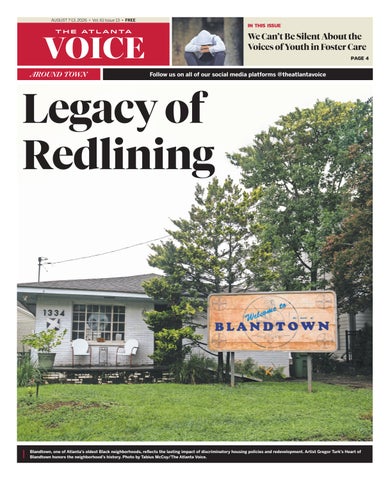
Legacy of Redlining
Blandtown, one of Atlanta’s oldest Black neighborhoods, reflects the lasting impact of discriminatory housing policies and redevelopment. Artist Gregor Turk’s Heart of Blandtown honors the neighborhood’s history. Photo by Tabius McCoy/The Atlanta Voice.
Page 2 • AUGUST 7-13, 2026 • theatlantavoice.com
Local
Rooted: How Decades of Discriminatory Housing Policy Shaped Atlanta’s Housing Crisis By LAURA NWOGU Over the next 12 months, The Atlanta Voice will publish “Rooted,” a solutions-oriented print and multimedia series examining the housing affordability crisis across metro Atlanta. The series will investigate displacement, rising rents and property tax burdens that disproportionately affect communities of color and other underserved communities, while equipping readers with actionable insights and strategies to advocate for stable, affordable housing. To better understand the roots and impact of Atlanta’s housing crisis, the series will be divided into four phases. Phase one will explore how we got here. Phase two will examine who is being left out and why. Phase three will look at what is working and what is not. Phase four will provide readers with tools to build power and take action. There is the continuous hum of cars speeding along I-75/85 on Atlanta’s East and South sides. Multistory luxury buildings sit next to aging houses whose residents established roots long ago. High-end grocery stores stocked with fresh produce give way to food deserts and fast-food chains farther south and west of the city. Atlanta’s famous tree canopy gives way to asphalt and vacant lots. Zoom in on a modern picture of Atlanta, and the close-up reveals a history of racially discriminatory housing policies that continue to affect the city and its Black residents today. The echoes of these practices have
‘other’ coming into their space.” When examining how Atlanta’s housing crisis has affected its Black and low-income residents, the past is key. Among other issues, rising property taxes, the continued rejection of MARTA expansion, the wealth gap between Black and white households and the racial divide between North and South Atlanta can be directly linked to urban planning efforts that took hold in the early 1900s.
Old and new meet on an Atlanta street, where new housing development continues to reshape neighborhoods amid the city’s affordability crisis. Photo by Tabius McCoy/The Atlanta Voice
shaped Atlanta’s neighborhoods, from redlining that marked Black communities as “hazardous” in the 1930s to highways deliberately routed through thriving Black neighborhoods. Urban renewal displaced tens of thousands of people and encouraged disinvestment, while exclusionary and racial zoning widened the separation between the city’s low-income and wealthy residents. Dr. Rhana Gittens Wheeler, an assistant professor of communication studies at Oglethorpe University and author of “Atlanta: Cultural Gentrification of the Black Mecca,”
The intrastate highway system, particularly within Atlanta’s perimeter, was partly created to separate white and Black neighborhoods. Photo by Tabius McCoy/The Atlanta Voice
said these historical policies laid the foundation for what can be seen in Atlanta’s housing landscape today, particularly among Black Atlantans. “It created a practice of creating spaces around race and racializing the way we do space and neighborhoods in the United States. That practice has basically continued to be supported, but now in less overt ways. A lot of the habits from those time periods didn’t necessarily just go away. We have created a society where we have decided that different races and different cultures are supposed to be separated,” Wheeler said. “Because of some of the systems
and policies that we’ve created around land value that come from redlining and exclusionary zoning and segregation in Jim Crow, the spaces that are historically Black are undervalued. Even though, you know, owning a home is supposed to be, in many ways, the way to the American dream, once Black people become the majority in the ZIP code, their home values greatly decrease because they’re living in it. All of that is because of the habits and the systems that we created during periods of redlining and exclusionary zoning that continue to this day, and how we value someone’s neighborhood, and also in how individuals react to the
The practice of redlining is as old as America itself. The echoes of these practices have shaped Atlanta’s neighborhoods, from redlining that marked Black neighborhoods as “hazardous” in the 1930s to highway construction deliberately routed through thriving Black communities. Photo by Tabius McCoy/The Atlanta Voice
History of Redlining, Racially Exclusionary Zoning and Highway Construction After the Civil War, Atlanta developed into a sort of safe haven for formerly enslaved people. What is now known as Atlanta’s status as a Black Mecca began when Black Atlantans built successful businesses, advanced Black education and culture, and gained economic and political visibility. But with that prominence came racial tensions among white residents, some of whom lived near Black residents at the time despite racial segregation laws. The 1906 Atlanta Race Massacre, a four-day outbreak of racial violence by white mobs against Black residents, further pushed Black Atlantans and their families out of mixed neighborhoods and into areas such as Sweet Auburn and the West End out of fear for their safety. As Black residents withdrew, white urban planners established Atlanta’s first citywide racial zoning ordinance, dividing the city into racial zones. R-1 was designated for white residents, and R-2 was designated for Black residents, making it illegal for a Black person to buy a home in a white zone. When the Georgia Supreme Court struck down the racial zoning components of the municipal zoning plan in 1924, city leaders found a workaround: single-family exclusionary zoning and redlining. City leaders prohibited housing such as starter homes, apartments, townhouses, duplexes and quadruplexes from being built on certain parcels of land, allowing one large, expensive house instead of more affordable housing. The zoning ordinance limited options for low-income families, seniors, young people and single residents. It also reduced the housing
See ROOTED on page 11
theatlantavoice.com • AUGUST 7-13, 2026 • Page 3
Politics
‘Who Are You?’: Local Faith Leaders Call Out Mike Collins By DONNELL SUGGS
J
effrey Gresham, wearing a purple t-shirt with the words “Jesus Christ” above a depiction of the white version of the Son of God, stood in the background and waited his turn to talk. He wasn’t one of the featured speakers, but he had something to say. “Donald Trump made white supremacy more popular,” Gresham, a middle aged man, said. He was quickly ushered away, but his point was already made by then. Local faith leaders such as Reverend Timothy McDonald III of First Iconium Baptist Church and a small group of people associated with Big Bethel AME Church gathered for a press conference outside of the iconic Black church in the Sweet Auburn District. The purpose of the meeting was simple, said McDonald III, they wanted to get Republican senatorial candidate Mike Collins to explain whether or not he has links to white supremacy groups. Collins is currently campaigning for current Georgia Senator Jon Ossoff’s seat. Collins won the Republican nomination over former college football head coach Derek Dooley in June. “Today, we’re asking you, Mr. Mike Collins, who are you? Are you with a white nationalist group? McDonald III said. “We are asking him to answer questions about his ties or commitments to any form or racist group.” Any connection between Collins and racist groups isn’t particularly personal. The allegations are more familial and work-based in this case. Collins’ son-in-law, social media influencer David Alan Scheer II is the focal point of the questions being asked of Collins. Scheer II has been connected to racist posts and white nationalist groups, but it’s Collins who is being asked to come to the pulpit and
Reverend Dr. Gerald L. Durley, Pastor Emeritus of the Providence Baptist Church of Atlanta (above) opened the press conference. He said the most important thing for Collins’ campaign will be complete clarity. Photo by Tabius H. McCoy/The Atlanta Voice
speak his piece. “I’m a native Georgian, and I know what racism looks like,” McDonald III said. “I know what white supremacy looks like. That is what we’re asking Mike Collins about.” McDonald III made sure to express his support of Ossoff’s campaign, but said he felt it was necessary for all Georgia voters to know where Collins stood. “Georgia voters deserve to know now,” McDonald III said. “If we’re going to cast an intelligent vote, we need to know now.” Not all Georgia voters are interested in Collins’ alleged affiliations with white supremacists. Alvin Watson, a local business owner, watched the press conference take place on the corner of Jesse Hill Jr. Drive and Auburn Avenue and shook his head. “I don’t care about that,” said Watson, the founder of Kids-R-Chefs Academy, which is located across the street from the church. “The most important thing, as far
Local faith leaders, like Rev. Timothy McDonald III of First Iconium Baptist Church (above), want Republican gubernatorial candidate Mike Collins to explain whether or not he has links to white supremacist groups. Photo by Tabius H. McCoy/The Atlanta Voice
Reverend Dr. Gerald L. Durley, Pastor Emeritus of the Providence Baptist Church of Atlanta, along with Rev. Timothy McDonald III and other faith leaders. Photo by Tabius H. McCoy/The Atlanta Voice
as locally, is to make sure the people in the community get fair and equal treatment.” Reverend Dr. Gerald L. Durley, Pastor Emeritus of the Providence Baptist Church of Atlanta opened the press conference. He said the most important thing for Collins’ campaign will be complete clarity.
“Maya Angelou once said, ‘If you want to know who somebody is, ask them.’ So today we’re asking you, Mr. Mike Collins—who are you? Who do you represent? We cannot stand–-not with all the diversity in this city— for you to be connected, or even have ties,” said Durley.
YOUR MONEY, YOUR WAY
From everyday banking to big plans. Our flexible options are designed to help you meet your financial goals, backed by exceptional service. Personal Banking Checking | Savings | Credit Cards | Consumer Lending
BankWithUnited.com | Member FDIC United Bank DBA United Bankshares
Page 4 • AUGUST 7-13, 2026 • theatlantavoice.com
Voices
We Can’t Be Silent About the Voices of Youth in Foster Care By SHANTAY ARMSTRONG
E
FOUNDER/EDITOR Ed Clayton Immortalis Memoria
very year, hundreds of thousands of young people from every background, every community, and every part of our country pass through the U.S. foster care system. Though each of their stories is different, they have one thing in common: their futures are shaped by decisions they did not make and cannot control. As the leader of an initiative to improve outcomes for kids in U.S. foster care — particularly young people facing added barriers because of race, identity, or circumstance — I know how easily their voices are silenced at moments that matter most. Now is one of those moments. Barriers to Basic Needs Recent federal policy changes affecting SNAP, the federal food assistance program, and Medicaid have created new reporting requirements for young adults aging out of foster care. While intended to encourage self-sufficiency, these requirements often have the opposite effect. Every six months, young people already navigating housing instability, limited support networks, and the transition to adulthood will have to prove they’re employed, in job training, or enrolled in school, just to maintain 3 months of access to federal assistance. These administrative hurdles can become real barriers to meeting basic needs. Whatever our political views, most of us agree on one basic principle: young people leaving foster care should not face hunger or homelessness because of timing, paperwork, or lack of support. Data Tells the Story Stories matter—especially now. When we stop listening to the stories of young people and families touched by foster care, we risk reducing them from human beings with hopes and dreams to numbers on a spreadsheet. Data is essential, but it cannot fully capture the lived realities of trauma, separation, instability, and resilience. Stories are how people connect, how understanding grows, and how policies improve. The data itself tells a concerning story.
FOUNDED May 11, 1966
PUBLISHER/EDITOR J. Lowell Ware
Immortalis Memoria The Atlanta Voice honors the life of J. Lowell Ware. ––– PUBLISHER Janis Ware PRESIDENT/ GENERAL MANAGER James A. Washington 2018-2024 COO Richard Dunn rdunn@theatlantavoice.com DEVELOPMENT SPECIALIST Jazmine Brazier jbrazier@theatlantavoice.com
As federal policy tightens, Black and LGBTQ youth aging out of foster care face higher risks of hunger, homelessness, and invisibility. iStock.com/Ievgen Chabanov
• Black or African American children account for roughly one-quarter of children in foster care, compared with about 14% of the U.S. child population, according to federal child welfare data from the U.S. Department of Health and Human Services. • Black children are also underrepresented in adoption rates. According to several studies, Black children represented 23% of the foster care population but only 16% of adoptions. They face longer waiting times to reach permanency • LGBTQ youth are also disproportionately represented. National research from UCLA’s Williams Institute estimates that roughly 19% of youth in foster care identify as LGBTQ, far higher than in the general population. These young people face higher rates of placement instability, discrimination, and adverse outcomes. These are the voices society most often doesn’t hear. These numbers aren’t about blame. They reveal where systems are falling short. But it’s the voices and stories of young people and families that show us how to fix them. What Succeeds and What Doesn’t We can start by amplifying the voices of former foster youth so
more people know about the inner workings of foster care and how it affects kids and families. Take Camelia, who entered foster care at age 2. She grew up in foster care and credits a caring, consistent adult mentor with helping her gain the confidence and stability to forge a positive path in life. Stories like Camelia’s offer insight into what actually helps young people succeed — and where systems fail. Their perspectives should inform future policies that reflect their priorities and affirm their value with real resources. Then, we must focus more intentionally on prevention: keeping kids out of foster care by reducing bias in decision-making, addressing economic instability, and ensuring that struggling families have the support they need to safely care for their own children. According to data from the Bureau of Labor Statistics,hundreds of thousands of Black women lost their jobs or exited the workforce in 2025.Given that women are typically primary caregivers — and that Black women are more likely to head single-parent households — the profound loss of income puts families with young children at risk of being separated. Keeping families together when it is safe to do so is not a partisan idea; it’s a child-centered one. Children should not be removed from their families simply because they are
poor. Cultural Identity Has Value Finally, we can support approaches to foster care that recognize and affirm a child’s racial and cultural identity. Simple, relationship-based approaches, such as sharing cultural traditions, ensuring proper haircare support, attending community events, or helping a child feel seen and understood, can have lasting impacts on a young person’s sense of belonging and well-being. When care is rooted in cultural affirmation and humanity, both our children and our communities flourish. When children and families are at stake, we cannot be silent. We must keep telling the stories of the children and families we serve— with courage, strength, and truth. Stories don’t disappear just because they aren’t told. Numbers help measure the impact of child welfare policies, but when we silence stories, we erase people, reducing human lives to statistics and stripping them of their voice and dignity. Shantay Armstrong is a Black biracial mother of two and manager of the EMBRACE Project at Kidsave. She works at the intersection of foster care, identity, and belonging to support Black, Brown, and LGBTQ+ youth as well as the families who care for them.
EXECUTIVE ASSISTANT TO PUBLISHER Chia Suggs csuggs@theatlantavoice.com EDITOR IN CHIEF Donnell Suggs editor@theatlantavoice.com GENERAL ASSIGNMENT REPORTERS Laura Nwogu lnwogu@theatlantavoice.com Noah Washington nwashington@theatlantavoice.com BUSINESS REPORTER Tabius H. McCoy tmccoy@theatlantavoice.com SPORTS REPORTER Tarohn Finley tfinley@theatlantavoice.com EDITOR AT LARGE Stan Washington swashington@theatlantavoice.com –––
ADVERTISING, SALES & CIRCULATION ADVERTISING ADMINISTRATOR Chia Suggs advertising@theatlantavoice.com SALES RDW Jackson rdwadman@gmail.com SUBMISSIONS editor@theatlantavoice.com DIRECTOR OF PUBLIC RELATIONS Martel Sharpe msharpe@theatlantavoice.com ––– CONTACT INFORMATION 633 Pryor Street, S.W. Atlanta, GA 30312 Office: 404-524-6426 info@theatlantavoice.com
theatlantavoice.com • AUGUST 7-13, 2026 • Page 5
Entertainment
Atlanta’s One Musicfest announces a pause for 2026 festival By LAURA NWOGU
O
ne Musicfest, the Southeast’s largest annual urban progressive music festival, will not return in 2026. The founder Jason L. Carter and festival organizers made the announcement on Friday, a few months before the star-studded music event usually takes place. An email statement read: “For 16 years, One Musicfest has never been content to just throw another music festival. We’ve pushed culture forward, brought generations together, and built something that didn’t exist before we created it. That same commitment to innovation is why we’re pausing One Musicfest in 2026. Rather than produce the same festival we’ve done in the past, we’re taking this year to build the next iteration of ONE Musicfest with the same bold vision and a commitment to giving you the very best.”
The statement went on to reflect on its growth, from 1,500 people at the first OMF to more than 100,000 music lovers each year. In 2025, The Dungeon Family, Future, Doechii, Kehlani and more headlined the festival, with a weekend full of electric hip-hop and R&B performances and special guests. The 2025 festival marked a return to Piedmont Park after OMF tested a move to Atlanta’s Historic Central Park in 2024. It is not the first time an Atlanta-based festival has faced a cancellation. Music Midtown, traditionally held annually at Piedmont Park, was abruptly canceled in 2022 due to legal and safety concerns regarding Georgia’s open carry gun laws on public land at the park. After returning in 2023, organizers announced an indefinite hiatus starting in 2024. “To every artist, fan, and supporter who made One Musicfest what it is: thank you,” the email statement read in conclusion.
One Musicfest will pause in 2026 as organizers plan a new iteration of Atlanta’s annual hiphop and R&B festival after 16 years of growth. Photo by Tabius McCoy/The Atlanta Voice
THE FUTURE OF COMMUNITY MEDIA BEGINS HERE
Professional studio space for your next video production, photo shoot, or creative project. WAREhouse Studio is The Atlanta Voice’s bold new home for digital storytelling, podcasting, and civic-powered content.
SCAN THE QR CODE TO BOOK NOW! https://theatlantavoice.com/warehouse-studios/
Page 6 • AUGUST 7-13, 2026 • theatlantavoice.com
Entertainment
Poetry on Peter celebrates five years of empowering Atlanta artists By LAURA NWOGU
W
hen Miyana Sarver wrote down her fiveyear plan for Poetry on Peter (POP), one of her only goals was to see the biweekly event spread and expand from its beginnings at Peter’s Street Station. For years, Atlanta’s creatives packed the space at 333 Peters St. SW, surrounded by music, art, and talented poets and musicians who stood up on the
sacred stage every other Monday to serenade, soothe, and put soul and poetry in motion. What started as a passion project turned into the heartbeat of Peters Street and became a launchpad for the city’s emerging Black talent. Now the poetry event is celebrating five years, and Sarver said she has exceeded the hopes and dreams she first wrote down. POP has relocated from Peters Street Station after outgrowing the space’s capacity, and Sarver has established a POP branch in Birmingham that hosts
For years, Atlanta’s creatives packed the space at 333 Peters St. SW, surrounded by music, art, and talented poets and musicians who took the sacred stage every other Monday to serenade, soothe, and put soul and poetry in motion. What started as a passion project became the heartbeat of Peters Street and a launchpad for the city’s emerging Black talent. Photo by Tabius McCoy/The Atlanta Voice
To commemorate five years of Poetry on Peter (POP), Sarver and her team organized an anniversary special featuring POP veterans, local poets, and a musical performance from Sarver herself. A marquee outside of Vinyl at Center Stage welcomed guests as they trickled into the live music space on a Monday night. Photo by Tabius McCoy/The Atlanta Voice
its own shows. Beyond expansion, POP has made a name for itself within Atlanta’s entertainment and arts scene, becoming its own Night at The Apollo as it creates a safe and brave space for Atlanta’s most promising artists. “Our ancestors and the previous generations before us had these places where they could go often, and people just knew it was like a household name, and I feel like Poetry on Peter has become that. Anywhere I go and I mention Poetry on Peter, even if they don’t know I’m the founder, they’re like, ‘Oh yeah!’ Now people are walking up to me in the grocery store like, ‘You’re the founder of POP,’ or I’ve been out of town in a completely different state, and somebody’s walked up to me to tell me they follow the page,” Sarver said. “So, it’s just really nice. To see it grow into what it is now, I feel like it’s just unbelievable. I feel blessed. It’s humbling. It’s really exciting to be celebrating such a big milestone. I’m just really grateful, and it just makes me feel if I can accomplish that in five years, then whatever I write down for my seven-year plan is going to be even better.” To commemorate five years of POP, Sarver and her team organized an anniversary special featuring POP veterans, local poets, and a musical performance from Sarver herself. A marquee outside of Vinyl at Center Stage welcomed guests as they trickled into the live music space on a Monday night. Familiar blue and red hues lit the stage while POP’s in-house band Vibe Ktrl did just what their name alluded to, bringing the romantic, neo-soul vibes that immersed every guest and poet in their own “Love Jones” soundtrack. While the space was new and an indication of just how much the event had grown, the energy was still the same. Strangers became family and music and poetry were the elements that bonded everyone together. The rules stayed the same: have fun, give the poets energy, and mingle. The night was filled with explosive to gentle poets who waxed poetic about everything from love to heartbreak, healing to emotional baggage, and growing up to chasing dreams. The audience swayed, bobbed their heads and yelled when
The poetry series grew from a small passion project into a major platform for Atlanta’s emerging artists. Photo by Tabius McCoy/The Atlanta Voice
the cadence of words written on paper were given life on POP’s sacred stage. What POP takes, it also gives, providing a safe and inclusive space of vulnerability and acceptance. “I kind of keep my head down so much working that I don’t really look up to see the success. But sometimes I look up sometimes and I’m like, ‘Oh, people are making names for themselves.’ It just makes me understand that what we’re doing is important, it’s impactful, and that the formula is working. As an entrepreneur, that means a lot to me,” Sarver said. That’s what keeps the founder and curator going. Sarver said she recognizes that artists are depending on POP for advancement and to achieve equity that they didn’t have before. What other corporations overlook when it comes to Atlanta’s tastemakers, POP embraces and lifts up. “It helps me understand that it’s bigger than me. Beyond what I feel, I have to keep it going because it is impacting people. People are thriving. Artists are coming here. Labels are reaching out, like, ‘Hey, we need them to come here.’” Throughout it all, Sarver has kept the majority of the same team she started with and it’s a loyalty she doesn’t take for granted. Bittersweetness filled her tone when she
reflected back on the early days of POP. From the hard days of running a, then, weekly event to trying to organize the best possible show for their growing audience, Sarver said it means the world that she can look over her shoulder and see the same people that have seen so much of her tears, frustrations, joy and confusion. The anniversary celebration was also a moment for Sarver to shine as she performed songs from her upcoming debut R&B album “Stories of the Yearner” for the first time. At the end of the performance, Sarver was in tears as the community she helped build chanted her name. “Lately, I’ve been getting feedback from a lot of peers. I prayed for something very specific, and I guess God’s formula made me understand it was to tell every person that has been impacted by POP to reach out. Knowing how it’s impacted people, how it’s formed relationships, marriages, successful business partnerships, saved people’s lives from depression and suicide ideation, and made people who were really being affected by the loneliness and solitary epidemic connect back back with their community and creativity is one of the things I’m most proud of about POP.”
theatlantavoice.com • AUGUST 7-13, 2026 • Page 7
Community
NABJ 2026: Golden anniversary convention in Atlanta
Photos from the 1984 NABJ Conference in Atlanta. All photos courtesy of Wayne Dawkins
By WAYNE DAWKINS
T
his month marks the golden anniversary of annual conventions for the National Association of Black Journalists. The inaugural gathering took place in Houston. This year, for the fourth time, Atlanta is the venue this year for the fourth time in the association’s lifetime. Here are highlights, past and projected: 1984, in ATL, was NABJ’s first go’round in the city. Convention attendees interrogated Milton Coleman, then of the Washington Post, about his reporting on presidential candidate Jesse Jackson’s referring to New York City as “Hymietown.” Jackson himself delivered a memorable banquet speech. Former Atlanta Mayor Andrew Young’s “Smart Ass white boys” comment attracted the first network TV coverage of an NABJ convention. 1994, journalists at the first Unity, Journalists of Color [Black, Hispanic, Asian, Native American] convene in ATL. Atlanta TV news producer Sidmel Estes-Sumpter, NABJ’s first woman president from 1991-1993, lay much of the
groundwork for the gathering at the Georgia International Congress Center. Native American and Black journalists walk the Cherokee “Trail of Tears” from the 19th century and recounted some of the complicated historical connections between both groups. Then-NAACP president Ben Chavis skips town to avoid journalists’ questions about a breaking news scandal over alleged sexual discrimination. 2005, with three Black organization conventions in town: NABJ, Black book clubs, and Bishop TD Jakes’ 100,000-strong MegaFest, the headline on page one of the Atlanta Journal-Constitution playfully shouts: “BADGES? WE DON’T NEED NO STINKIN’ BADGES” 2026, No front-page mirth this time as NABJ readies to arrive in Atlanta on Aug. 12. The AJC shuttered its print edition and went digital-only at the end of 2025. NABJ’s members, pummeled the previous year by the Trump administration’s DEI assaults, are showing up in record numbers. Hotel bookings sold out months in advance, and the characteristic
swagger and style that only an NABJ crowd can generate are on the way to HotLanta.
Page 8 • AUGUST 7-13, 2026 • theatlantavoice.com
Arts
High Museum of Art hosts “Paper Trees” exhibition spanning 150 years By NOAH WASHINGTON
F
or more than a century, American artists have returned again and again to a single subject that never gives up its secrets easily: the tree. That obsession is the premise behind “Paper Trees,” a new exhibition at the High Museum of Art that takes its name from the very challenge it explores, translating the natural world onto paper and canvas. The show, on view in the Works on Paper Gallery in the Lower Level of the High’s Wieland Pavilion, spans nearly 150 years of American art through roughly 45 objects, including drawings, etchings, lithographs, paintings, and sculptures. Anni Pullagura, the High’s Margaret and Terry Stent associate curator of American art, said the tree became a natural lens for the exhibition because of how technically demanding it is to render. “Every element in the tree, from
“Paper Trees,” a new exhibition at the High Museum of Art that takes its name from the very challenge it explores, translates the natural world onto paper and canvas. Photo by Noah Washington/The Atlanta Voice
leaf to branch to trunk to root, was so distinct, and you have to really
The High Museum of Art’s “Paper Trees” exhibition showcases approximately 45 artworks spanning nearly 150 years of American art history, exploring the technical challenges and diverse interpretations of trees through various media.
understand each singular property to be able to communicate the whole idea of the tree as a subject altogether,” Pullagura said. The exhibition unfolds largely in chronological order. It opens in the mid-19th century with artists working en plein air, or drawing directly from nature, before moving into the etching revival of the late 1800s, when printmakers began treating etching as an art form in its own right rather than a reproductive tool. From there, the show moves into the 20th century, when modernist movements gave artists new vocabularies for depicting the natural world. Among the works on view is Joseph Stella’s “The American Chestnut, Obliterated by Blight,” which takes as its subject a tree species largely wiped out across the eastern United States in the early 20th century. The exhibition also includes David C. Driskell’s “Two Pines #2,” painted in 1964, one of many works Driskell made over more than 45 years meditating on the pine tree. He first took up the subject during a 1953 residency at Maine’s Skowhegan School of Painting and Sculpture, drawn to the pine trees surrounding him there. In the decades that followed, Driskell, who died in 2020, used bold color and heavy brushwork to suggest the pine’s evergreen resilience, breaking the image into fractured shapes to convey a sense of movement. Driskell approached the tree not as a single fixed form but as something to be broken apart and studied from every angle, aiming to push past its surface likeness toward a broader sense of its presence and atmosphere. Also featured is Bessie Harvey’s “Jacob Wrestling with the Angel,” a sculpture from around 1990 made from tree roots, paint and plastic beads. Harvey shaped the found wood into a rendering of the Abrahamic story of Jacob and the angel, with one root forming the angel’s hair and another arching backward like Jacob’s body. Harvey approached her materials as though they held a presence of their own, treating the wood less as raw material to be carved than as something already inhabited, waiting
Curator Anni Pullagura notes that the technical difficulty of rendering trees makes them a compelling subject. Photo by Noah Washington/The Atlanta Voice
to be revealed. The exhibition draws heavily on the High’s own American collection but also includes loans from two Atlanta institutions, Clark Atlanta University Art Museum and the Robert C. Williams Museum of Papermaking at Georgia Tech. The Clark Atlanta loan includes an early Driskell pine study, while the papermaking museum contributed wood samples and a copy of “The American Woods,” a 19th-century encyclopedia compiled by botanist Romeyn B. Hough documenting tree species across North America. Pullagura said partnering with
local institutions felt essential for a show built around trees in a city known for its tree canopy. “Atlanta is a city in the forest,” Pullagura said. “We want to recognize how distinctive we are as a city that is meant to protect its natural environment.” She said she hopes the exhibition changes how visitors see the trees they pass every day. “I hope it inspires them to create something,” Pullagura said. “Whatever might inspire you to create or to work with the medium of your choosing, I hope you’re inspired to do that in this exhibition.”
theatlantavoice.com • AUGUST 7-13, 2026 • Page 9
Sports
‘Need to get through the next couple days: Falcons see Robinson sign record-setting deal By TAROHN FINLEY Report for America Corp
that it could still be another four weeks before he advances to the next phase of his recovery.
D
espite star running back Bijan Robinson signing a record-setting contract extension on Tuesday, Day 6 of Atlanta Falcons training camp ended on a sour note. Falcons outside linebacker Jalon Walker was carted off the field with a lower-leg injury. According to NFL Network’s Ian Rapoport and Steve Wyche, the injury is feared to be a torn ACL. The second-year pass rusher out of the University of Georgia recorded 36 tackles, 5.5 sacks, and two forced fumbles during his rookie season. With training camp in its second week, here are the biggest takeaways so far. Unclear when Robison will fully practice after extension Despite agreeing to a three-year contract extension worth up to $75 million with Robinson, it remains unclear when the star running back will return to full practice or whether he will play in the Falcons’ preseason opener against the Denver Broncos next Friday. “Need to get through the next couple days,” Falcons head coach Kevin Stefanski said Tuesday. “I think it’s important that we do have a plan. I feel really good about that and ramping him up over the next few days. As we get into Week 1, I’ll share with you guys what the plan is regarding who’s playing, how much they’re playing, and those types of things. But I don’t have that just yet.” At the end of practice on Tuesday, Robinson was seen on the sideline with quarterback Michael Penix Jr. taking handoffs. Falcons continue investing in offensive core In the first year of the Ian Cunningham-Kevin Stefanski era, the Falcons have made it a priority to lock up their offensive foundation for the foreseeable future. Atlanta signed wide receiver Drake London to a four-year, $141 million extension and tight end Kyle Pitts Sr. to a three-year, $54 million extension after previously placing the franchise tag on him earlier this offseason. After signing offensive guard Matthew Bergeron to a four-year, $96 million extension on Saturday, the
Atlanta Falcons running back Bijan Robinson (above, at training camp on Wednesday, August 5, 2026) took questions from the media a day after signing a team record 3-year-$75-million extension. Photo by Tabius McCoy/The Atlanta Voice
Falcons followed by extending Robinson on Wednesday morning. Stefanski said he is excited about keeping the team’s core together and described the extensions as rewarding players who embody what the Falcons want to build. “I just feel like we’re always looking at our players and what makes sense for us short-term and longterm,” Stefanski said. “I don’t care who your quarterback is, those guys want great players around them, stalwarts around them. It only makes their job easier.” Each of those players is 26 years old or younger, and their contracts have either reset the market or rank among the richest at their respective positions. Robinson surpassed Philadelphia Eagles running back Saquon Barkley for the highest average annual value ever for a running back at $22.25 million per season. Bergeron is tied with Dallas Cowboys guard Tyler Smith for the highest average annual value among offensive guards. Pitts’ deal is the largest three-year contract ever given to a tight end, while London’s average annual value ranks third among wide receivers behind Seattle Seahawks receiver Jaxon Smith-Njigba and Cincinnati Bengals star Ja’Marr Chase.
Quarterback battle beginning to take shape The biggest question entering the season remains who will win the starting quarterback job. Because of injuries to Tua Tagovailoa before training camp and Michael Penix Jr.’s continued recovery from the torn ACL he suffered last season, the competition was difficult to evaluate during the first week of camp, temporarily turning what had become a left-handed quarterback room into
a right-handed one. On Tuesday, Tagovailoa logged his most extensive practice work since back flare-ups limited or sidelined him during the opening days of camp. He told reporters he feels good and hopes to return to full practice Wednesday. Penix has also continued progressing, participating in warmups and 7-on-7 drills. Stefanski said he does not believe Penix is limited from a mobility standpoint despite the quarterback saying last week
WR2 competition heating up Another major storyline is who can emerge as the No. 2 wide receiver and help take pressure off London, Pitts and Robinson. Veteran Olamide Zaccheaus, who spent last season with the Chicago Bears, has stood out early in camp. One of the oldest players in the receiver room, Zaccheaus has already earned praise from London for stepping into a leadership role. Rookie Zachariah Branch is another player generating buzz. The former Georgia receiver has showcased elite speed throughout camp, particularly on deep routes, and becomes dangerous whenever the ball is in his hands. Branch has also been taking reps as a return specialist on special teams and has expressed a willingness to contribute in any role. The Falcons have even used him on designed rushing plays, with him being seen running the ball on an end-an-around. The Falcons also signed wide receiver Jahan Dotson to a two-year, $15 million extension this offseason. Although Dotson is coming off a career-low 18 receptions, he spent last season in a crowded Philadelphia Eagles receiving corps featuring A.J. Brown and DeVonta Smith. Atlanta hopes a larger role will allow the former first-round pick to rediscover the production he showed earlier in his career.
The Atlanta Falcons are done with the first two weeks of training camp in Flowery Branch and preparing for the preseason. Photo by Tabius McCoy/The Atlanta Voice
Page 10 • AUGUST 7-13, 2026 • theatlantavoice.com
Sports
Atlanta Falcons’ secondary will have to play at higher level this season By DONNELL SUGGS
Atlanta’s veteran secondary, led by Jessie Bates III and A.J. Terrell, faces a playoffs-or-bust season as Bates approaches free agency and young contributors return. Photo by Donnell Suggs/ The Atlanta Voice
FLOWERY BRANCH, GA. - Atlanta Falcons rookie Avieon Terrell stepped up and took his position for the next drill. He was doing what defensive backs do, size up the receiver in front of them and prepare for the offense to make the next move. On this particular play, the ball ended up in the hands of running back Nathan Carter, so Terrell could have taken the play off, but he didn’t. Finishing his run, Terrell played till he heard a whistle and ended up stripping Carter. The hustle play elicited cheers from his teammates. The rookie, at least on this play, was the veteran. Carter, beginning his second season, was the rookie. Moments later Terrell was getting high-fives and Carter could be seen knocking out 10 push-ups on the sideline. Welcome to training camp. That play aside, Terrell won’t be a major factor during the regular season. If he is, then something is wrong. The Falcons are coming into the 2026 season with
one of the most experienced secondaries in the National Football League. Safety Jessie Bates III and cornerbacks A.J. Terrell, Jr., Mike Hughes, C.J. Henderson, and Clark Phillips III, all are well regarded players. Bates III and the elder Terrell are two of the best players on the Falcons roster. Add young players like safety Xavier Watts and defensive back Billy Bowman, Jr. and this could be the team that ends the seven-year playoff drought. After practice on Friday, Falcons head coach Kevin Stefanski said he was pleased with what he had seen from the secondary. “I think the secondary and the front feed off each other,” Stefanski said. “I think it’s a really good mix of talent, it’s a versatile mix of talent.” That mix of talent includes Watts, a top-five finisher for defensive rookie of the year after a stellar first season in Atlanta (five interceptions, 59 solo tackles in 17 starts). The former Notre Dame standout and third round pick is key to how Falcons secondary
coaches Justin Hood and Ricky Manning will need that unit to play. Bowman, Jr, is on the physically unable to perform list (PUP) at the moment, but 2026 will be a big season for him when he returns to action. Even though he only played in six games last season, his high level of play far exceeded his draft position as a fourth round pick out of Oklahoma. A healthy Bowman, Jr. makes the Falcons secondary the best in the NFC South. And it’s not even close. The 2026 season will be a big one for Bates III. The leader of this defense in many ways, both on and off the field, he is approaching the final year of what was a fouryear contract. Bates III is only 29 years old and playing at a high level. He will be a highly sought after unrestricted free agent. The clock is ticking on the current version of the Falcons secondary. This unit has all of the ingredients for a successful campaign. What constitutes a successful season? Playoffs or bust.
Sports
TOUR Championship and Chipotle team up to give back to veterans and students By DONNELL SUGGS
T
he TOUR Championship is less than a month away, and Atlanta’s East Lake Golf will once again be home to one of the biggest PGA tournament stops on the golf calendar. Along with the tournament, which takes place from August 2630, there are also opportunities for the TOUR Championship to effect change off the golf course. TOUR Championship and Chipotle, the Denver, Colorado-based fast-casual restaurant chain, have partnered to support military members and their families, and college students. This is the first year Chipotle will be one of the event’s sponsors, according to TOUR Championship Vice President & Executive Director
Alex Urban, who added that the TOUR Championship is always looking to find ways to support the military community. “It means a lot. The TOUR Championship means a lot to a lot of people,” said Urban. “AQs a tournament, we care a lot about the military community. We owe so much to our men and women in uniform.” Chipotle will provide complimentary and discounted ticket opportunities to veterans and college students who want to witness the TOUR Championship up close. Discounted admission will be provided to veterans and one dependent on Wednesday, August 26, ($15 plus taxes and fees) and up to two (2) discounted tickets for one of the competition days from Thursday, August 27 to Sunday,
August 30 ($45 plus taxes and fees). With every military ticket purchase for Thursday-Sunday, Chipotle will provide a “Buy-OneGet-One” code that can be used at checkout on the Chipotle app or Chipotle.com, while supplies last. There are 16 Chipotle locations in Atlanta city limits, some of which are within minutes of East Lake Golf Club. As a part of the University Student Ticket program, college students can get 25% a ticket with a presentation of a legitimate .edu email address. There is a limit of four tickets per transaction. The first 500 unique purchasers of the University Student Ticket Offer presented by Chipotle will receive a Chipotle-branded divot repair
Along with the TOUR Championship, which takes place from August 26-30, there are also opportunities for the TOUR Championship to effect change off the golf course. TOUR Championship and Chipotle, the Denver, Colorado-based fast-casual restaurant chain, have partnered to support military members and their families, and college students. Photo by Donnell Suggs/The Atlanta Voice
tool post-event. “This is a good way to get students out here,” said Urban. Stephanie Perdue, Senior Vice President of Brand Marketing at Chipotle, said in a release that the TOUR Championship “brings people together.” “Our mission to Cultivate a
Better World is rooted in creating meaningful opportunities for the people we serve. By recognizing military members and welcoming more college students to the championship, we’re helping make the tournament more accessible and inspiring the next generation of golf fans.”
Page 11 • AUGUST 7-13, 2026 • theatlantavoice.com
ROOTED Continued from page 2 supply, driving up prices. The policy disproportionately affected Black Atlantans, who faced limited access to capital and a racial wealth gap that effectively kept them out of white neighborhoods such as Buckhead. During the Great Depression, the Home Owners’ Loan Corp., or HOLC, created Atlanta’s color-coded redlining map as part of an effort to stabilize the housing market. The map graded neighborhoods from A, shown in green, to D, shown in red. Neighborhoods with Black residents were marked red and deemed hazardous. This designation created consequences that continue to affect those communities today. It cut Black residents off from federally backed mortgages and bank loans, forced them into areas zoned for high-density or industrial use, and caused neighborhoods such as Summerhill, Mechanicsville and the Old Fourth Ward to suffer from disinvestment. “When you see the developments happening in the West End or Old Fourth Ward or Summerhill or any of those places where they go in and they start digging up and trying to build something new, they’re like, ‘Oh, well, this land has a lot of pollution. We’ve got to clean up the land.’ It’s like, yeah, but people have been living here forever in this land that you disinvested in and didn’t care anything about for decades. People have been existing and eating the food and water from this space, and you’re wondering why they’re getting sick and all these illnesses are happening,” Wheeler said. Todd Michney, an associate professor in the School of History and Sociology at the Georgia Institute of Technology, focuses on urban history, African American history, housing finance and residential development. Michney said one factor that distinguished a red neighborhood from
a yellow neighborhood was the presence of hazardous facilities such as railroad tracks, factories, dumps and junkyards. “These kinds of hazards were considered undesirable. Those tended to be cited in places where people of color lived because they were forced into those areas because they were made to feel unwelcome, they couldn’t get financing and they were generally poorer as a population,” Michney said. “It’s like blaming the victim. You force people into these areas and then say it’s an undesirable area. And if someone from that area moves into your neighborhood and you’re a well-off white person, they’re going to spread that whole cycle of deterioration.” I-20 and I-75/85 are part of the everyday commute for Atlanta residents, but the original intent behind the routes was rooted in racism. I-20 was built in part to prevent the expansion of Black neighborhoods in South Atlanta into predominantly white areas of North Atlanta. When I-75/85 was constructed, it snaked through the heart of the city, destroying homes and businesses in historically Black neighborhoods such as Summerhill and Sweet Auburn. The latter was once considered “the richest Negro street in the world.” With their homes gone and no replacement housing provided, tens of thousands of Black Atlantans were displaced and forced into high-density public housing projects in South and West Atlanta. “A lot of times, we talk about redlining as a basket of different practices that are used to exclude people and shape where they can move and live in the city. Something like freeway construction is not technically redlining, but it’s related. Planning routes that go through certain areas where people either have less political and economic power to oppose them or to create a barrier. I-20 was built specifically to slow Black people from moving further northward,” Michney said.
“It created a practice of creating spaces around race and racializing the way we do space and neighborhoods in the United States,” said Dr. Rhana Gittens Wheeler, an assistant professor of communication studies at Oglethorpe University and author of “Atlanta: Cultural Gentrification of the Black Mecca.” Photo by Tabius McCoy/The Atlanta Voice
“Even if it’s not racial zoning, you can use other proxies for race, like, you know, mandating a minimum lot size or that you can’t have any apartment houses, you can’t have guest quarters or two-family houses. These are all ways of disadvantaging people who might otherwise not live there because they can’t afford to buy a large half-acre lot with a single-family home on it. “All these kinds of measures work together to push people around the metropolis and to take people’s property away. Even with all the challenges, Black people are able to buy houses, and then all of a sudden, you’re getting designated as a route for a freeway, and you’re completely losing your investment because the property value goes down in that area designated for the freeway.” Cultural Gentrification In neighborhoods severely affected by these housing policies, the blatant disinvestment in some areas is juxtaposed with rapid redevelopment in others, bringing high-end grocery stores, sit-down restaurants, fitness classes, craft breweries and bars. However, as the city grows, gentrification and the displacement of legacy residents often follow, with formerly
AUGUST 7-13, 2026 • www.theatlantavoice.com
SENIORS SENIOR (62+) Spacious 1-Bedroom Affordable! Rent Based on Annual Income Amenities, Great Location, and Convenient to Marta Please call for detailed information
(404) 586-9098
redlined neighborhoods undergoing dramatic demographic changes. Studies from the National Community Reinvestment Coalition show that Atlanta’s historic Old Fourth Ward is now majority-white after decades of gentrification. Wheeler noted that these changes and the reinvestment occurring in these areas are further indications that redlining was based on false assumptions rather than fact. “Once you start to see the yoga studios and the craft breweries start to appear, in some ways, it’s already too late. The decisions have already been made. A vision has already been set in place to transition that neighborhood, and it’s probably being said more covertly than overtly. Other things you might notice are a school closure or a reduction in services for the school. Also, hospital closures, like what happened in the Old Fourth Ward,” Wheeler said. “I would argue that Blandtown is an example of what can happen to the West End and to Peoplestown, all these neighborhoods that are already in this space of gentrification right now. Today, we don’t have any of the former residents who were in this Black neighborhood. None of them live there anymore. Much of the
history is and has already been lost. I don’t want to see that happen to these other neighborhoods, but Blandtown is an example of what could happen if changes in policy don’t occur.” In her book, Wheeler discusses cultural gentrification and how a neighborhood can lose its Black culture and identity even before longtime residents are physically priced out. Wheeler argued that displacement and gentrification affect not only the geography and demographics of a place, but also its history and memory. One example she cites is Blandtown, one of the first Black settlements around Atlanta after the Civil War. The neighborhood was annexed and zoned for industrial use and is now filled with craft breweries and luxury homes. “Black people who live in those spaces are not owners. They’re not necessarily gaining economic power or value from the wealth that is coming into the space. They might be getting a chance to join in on some of the fun, but they’re not having the opportunity to influence the space, have power in that space and get a piece of the economic power that is now starting to come into that space, and that’s some of the greatest loss,” Wheeler said. “When people lose their memory of those who came before them, who worked in this space and turned it into the space that we all want to live in now, that’s when they start to lose their cultural anchors. A lot of what is happening to the Black community is, I think, deliberate forms of forcing us to have amnesia, deliberate forms of erasure of history, so that we don’t know the past or what was here before, or what grandmama did to get this house, or that this street used to be named for your great-great-granddaddy, but they changed the name and now you never knew the connection it had in your family. “So, you don’t understand the importance of it anymore, and I think these are deliberate ways to erase Black history and Black work in these spaces.”
CLASSIFIEDS
OPPORTUNITIES
LEGAL NOTICE
AUTOMATION ENGINEER
Following vehicles will be auctioned for charges owed August
Avistatech, Inc. seeks Automation Engineer in Atlanta, GA. Resp include: collab across depts to id/implmnt RPA solutns; devlp objs using Blue Prism 7.x+, .NET 4.0+, VB.NET, JS, HTML, C#; integ w/ DBs, APIs, legacy apps; use OCR/data scraping; doc PDD/SDD; lead automtn mtgs; trblsht & enhnc workflows. Req: MS in CompSci or rel fld (or foreign equiv) + 24 mos exp as RPA Dev. May work at various unanticipated locations throughout the US. Mail résumés to: Avistatech, Inc., 3423 Piedmont Rd NE, Atlanta, GA 30339.
29, 2026 at 10 am at 52072 IN-933, South Bend, IN 46637: 2015 VW Jetta 3VWD17AJ6FM283554 $2300 and 2021 Toyota Camry 4T1F11AK5MU429514 $2335.
Page 12 • AUGUST 7-13, 2026 • theatlantavoice.com
Thousands of local electricians are gaining new skills and job opportunities with support from the electrical training ALLIANCE and Google.
The electrical training ALLIANCE (etA) is partnering with Google to train existing electrical workers and new apprentices in Georgia. Through the etA, electricians will be prepared for long-term careers building energy infrastructure in communities across the state. Sign up at goo.gle/ga-impact