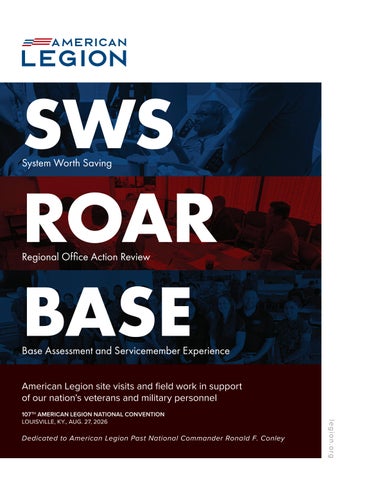
SWS ROAR BASE System Worth Saving
Regional Office Action Review
Base Assessment and Servicemember Experience American Legion site visits and field work in support of our nation’s veterans and military personnel
Dedicated to American Legion Past National Commander Ronald F. Conley
le gio n .org
107TH AMERICAN LEGION NATIONAL CONVENTION LOUISVILLE, KY., AUG. 27, 2026
Dedicated to American Legion Past National Commander Ronald F. Conley This publication assembles field reports conducted by The American Legion between 2024 and 2026 to guide the organization’s legislative priorities and policy positions to improve conditions for U.S. military veterans and those now serving in the U.S. Armed Forces. Each report offers a unique insight into the challenges, best practices and opportunities faced by the Department of Veterans Affairs and the Department of Defense in their efforts to provide care and quality of life for those who have made the commitment to serve our nation in uniform. It is also a tribute to American Legion Past National Commander Ronald F. Conley of Pennsylvania whose dedication to quality healthcare, benefits and fairness for America’s veterans set an unparalleled national standard in veteran advocacy. As a U.S. Air Force MP on Guam in the mid-1960s, Conley encountered a young soldier freshly evacuated from a Vietnam War battlefield. The soldier had been badly wounded in a mortar attack. He couldn’t see. “I was on duty at the time and had the opportunity to talk with him,” Conley later remembered. “He wanted to know who was going to take care of him when he came back to the United States.” From that point forward, Ron Conley’s life mission was to be that person, and to lead others, to care for veterans. He executed that mission through The American Legion, leading from the front at every level of the organization. As a relentless advocate for veterans who use VA healthcare services, his post-service life was defined by a passion that hit an apex during his year as national commander in 2002-03. The VA healthcare system was strained nationwide at that time. Demand for care exceeded VA’s ability to fulfill it. More than 360,000 veterans were waiting 30 days or longer for primary care appointments. The backlog of undecided VA disability claims filled office buildings, floor to ceiling. As he traveled the nation during his year as national commander, Conley vowed to spend every official department visit personally meeting with VA officials and the veterans they served. He brought with him a list of questions. He demanded to know the numbers and the reasons facilities were not keeping up. What were the wait times? What was the bed count? Did the facility have adequate resources for mental health and long-term care? Where were they short of providers? What were the nurse-to-patient ratios? Why were so many VA hospitals and clinics in disrepair?
American Legion Past National Commander Ronald F. Conley Photo by Tom Strattman
He diligently interviewed VA administrators, doctors, nurses, staff and local veterans to fully understand the problems. He recorded their responses into a template still largely in use. “The VA health-care system,” he wrote in the May 2003 American Legion Magazine, “is a system worth saving.” Thus was born the System Worth Saving program. Teams of staff and volunteer leaders with expertise have continued to visit VA facilities, adding to the equation Regional Office Action Review (ROAR) site visits in 2011 to learn why the VA claims backlog continued to grow and what steps were being taken to reverse the trend. In 2022, in response to concerns about living conditions for our nation’s troops at military installations, the Legion’s Base Assessment and Servicemember Experience (BASE) program debuted under the leadership of the National Security Commission. SWS. ROAR. BASE. These are more than acronyms. Each program addresses a different concern of the nation’s largest veterans service organization. Collectively, they symbolize The American Legion’s unwavering resolve to answer the question a wounded, blinded soldier begged Ronald F. Conley to answer during the Vietnam War. The American Legion will take care of you and learn from government agencies what their facilities and installations need to do to improve. Dozens of bills, resolutions and policy positions have been enacted by Congress, The American Legion, the White House and the Pentagon, driven by fact-based field assessments of VA healthcare systems, regional offices and military installations, as a result of this approach. This 2026 report is dedicated to Ronald F. Conley and all he has done to set a standard by applying firsthand knowledge to policies and practices in need of change for nearly three decades.
TABLE OF CONTENTS SYSTEM WORTH SAVING/ROAR April 27 – May 1, 2026/Oregon and Washington . . . . . . . . . . . . . . . . . . . . . . . . . . . . . . . 2 Portland, Ore., VA Medical Center . . . . . . . . . . . . . . . . . . . . . . . . . . . . . . . . . . . . . 4 Seattle VAMC Regional Amputation Center . . . . . . . . . . . . . . . . . . . . . . . . . . . . . . . 13 Seattle Regional Offices . . . . . . . . . . . . . . . . . . . . . . . . . . . . . . . . . . . . . . . . . . . 18
SYSTEM WORTH SAVING Sept. 22-24, 2025/West Haven, Conn., VA Medical Center . . . . . . . . . . . . . . . . . . . . . . . . 25 June 9-11, 2025/New Orleans VA Medical Center . . . . . . . . . . . . . . . . . . . . . . . . . . . . . 32 Aug. 4-6, 2025/Captain James A. Lovell Federal Health Care Center North Chicago, Ill. . . . . . . . . 38
ROAR March 9-11, 2025/San Juan Puerto Rico . . . . . . . . . . . . . . . . . . . . . . . . . . . . . . . . . . . 44 May 19-21, 2025/Louisville, Ky. . . . . . . . . . . . . . . . . . . . . . . . . . . . . . . . . . . . . . . . . 49 June 22-24, 2025/Chicago, Ill. . . . . . . . . . . . . . . . . . . . . . . . . . . . . . . . . . . . . . . . . . 53
BASE Feb. 10-11, 2026/Joint Base San Antonio-Fort Sam Houston, Texas . . . . . . . . . . . . . . . . . . . 56 April 14, 2026/Naval Station Great Lakes, North Chicago, Ill. . . . . . . . . . . . . . . . . . . . . . . . 64 Jan. 23 – Feb. 2, 2025/ North Carolina, South Carolina, Georgia, Florida and Virginia . . . . . . . . . 71 Oct. 24, 2024/Shaw Air Force Base, S.C. . . . . . . . . . . . . . . . . . . . . . . . . . . . . . . . . . . . 76
The American Legion | SWS/ROAR/BASE Unified Reports | 2025-2026
1
SYSTEM WORTH SAVING
REGIONAL OFFICE ACTION REVIEW
OREGON AND WASHINGTON DATE: April 27 – May 1, 2026
Executive Summary The American Legion’s Spring 2026 joint SWS and ROAR visits in the Pacific Northwest included on-site research at facilities in Portland, Ore., and Seattle, Wash., as well as town-hall meetings to learn firsthand from local veterans and their families. The American Legion took a new approach for these site visits. In the past, SWS and ROAR visits had been conducted separately by two different policy teams, resulting in separate reports. In an effort to capture a more holistic picture of how the Veterans Health Administration (VHA) and the Veterans Benefits Administration (VBA) work together regionally, the American Legion’s Health and Benefits Policy Teams under the Veterans Affairs & Rehabilitation (VA&R) Commission worked as one unit. Additionally, a representative from the national Legislative Division accompanied the team to better understand how laws were being implemented at the local level and to identify areas that could be improved through legislation and regulatory changes. The Legislative Division also assisted the VA&R team in coordinating the local town halls and integrating congressional district staff and local VA officials into the discussions. The following report is a culmination of these two programs operating in unison and is designed to highlight best practices as well as areas in need of improvement.
Origins of SWS In 2002 and 2003, American Legion National Commander Ronald F. Conley visited and assessed the delivery of healthcare at more than 60 VA medical facilities across the country. He believed VA healthcare was indeed a “System Worth Saving.” The following year, The American Legion passed a resolution making System Worth Saving (SWS) a permanent program. Since then, The American Legion has conducted more than 300 System Worth Saving visits to VA/VHA medical facilities in the United States, its territories and the Philippines. Over the course of those visits, The American Legion has played an integral role in shaping
2
federal legislation that improves delivery and quality of healthcare at VA/VHA medical facilities. Furthermore, each System Worth Saving visit culminates with a report that informs members of The American Legion and provides additional insight to the President of the United States, members of Congress, the Secretary of Veterans Affairs and other senior VA/ VHA leaders about the challenges faced by VA medical centers in local communities, as well as best practices that can be replicated elsewhere.
SWS Scope The American Legion conducts between five and eight SWS visits per year. To choose facilities, national staff members create a list of locations by looking at government and congressional reporting, media reports, veteran feedback and VA hospital public data. They synthesize the information to create a complete picture of a facility and then look at the possible impact from conducting a visit. Once approximately 10 locations have been identified, the list is reviewed again to narrow it down to a final decision on locations for the year. Each SWS visit follows a triangular review model. The American Legion requests data from the VA Medical Center (VAMC) via emailed questionnaires which cover 18 - 20 offices, depending on location. Also requested are reports such as employee and patient satisfaction survey results, among others, for review. This information is then analyzed and allows the SWS team the ability to construct a comprehensive inperson questionnaire which is used during interview sessions with the executive leadership team, department managers and other staff. The SWS visit starts with a town hall meeting, typically at a local American Legion post, where veterans gather to tell the SWS volunteer team about the successes and obstacles they encounter in receiving care from the selected medical center. Typically, the town halls include representatives from the VAMC, the regional benefits office, local Legion posts, and when available, congressional staff. The town hall is followed by two
The American Legion | SWS/ROAR/BASE Unified Reports | 2025-2026
envato
days of structured interviews, a facility tour, and is completed with an exit brief.
Origins of ROAR In 2011, The American Legion conducted a nationwide survey which revealed widespread dissatisfaction with the performance of VA Regional Offices (VAROs). Respondents overwhelmingly described the system as “inefficient and untimely.” At that time, only 6% of VA claims were completed within 120 days. To uncover the root causes of these delays, The American Legion launched the ROAR (Regional Office Action Review) initiative under the Veterans Affairs & Rehabilitation Commission, deploying national staff to VAROs across the country. By combining on-site evaluations, data collection and stakeholder interviews, ROAR has become a cornerstone in The American Legion’s efforts to achieve accountability at the community level. The study required extensive data collection and analysis to determine the factors leading to delayed VA claims at regional offices. The ROAR program and the survey report forged a partnership between The American Legion and VA. Veterans and families helped with the ROAR study by filling out an online survey to rate the performance of their local VAROs. Among the findings: frequently expressed frustration about VA’s failure to communicate clearly about the status of claims.
Having proven effective at highlighting claims-backlog issues, the ROAR initiative became established as a permanent, independent component of the System Worth Saving (SWS) Program. This joint report employs a multi-faceted approach to assessing operational challenges faced by VAROs. The American Legion’s review includes a combination of data collection, qualitative case analyses, in-person site visits and stakeholder interviews. The result is a comprehensive evaluation, both quantitative and qualitative, of each office’s performance.
Regional Overview of VISN 20 The VA system is divided into 18 Veterans Integrated Service Networks, or VISNs. VISN 20 (or the VA Northwest Health Network) encompasses 817,417 square miles (approximately 23% of the United States), to include Alaska, Oregon, Washington, the majority of Idaho, and one county each in Montana and California. VISN 20 provides care to more than 463,500 enrolled veterans, 39% of whom reside in rural or highly rural areas. With the VISN office established in Vancouver, Wash., it manages a budget of $5.6 billion and 17,800 employees working at its rehabilitative and long-term care at its six domiciliary programs and six Community Living Centers (CLCs), 46 Community Based Outpatient Clinics (CBOCs), eight VA medical centers (VAMCs), or one Health Care Center.
Schedule of Events: Date
Event
Facility/Building
Location
4/27/26
SWS Site Visit
Portland VAMC
Portland, OR
4/27/26
Town Hall
American Legion Post 104
Aloha, OR
4/29/26
ROAR Site Visit
Seattle RO
Seattle, WA
4/30/26
SWS Site Visit
Seattle VAMC
Seattle, WA
4/30/26
Town Hall
Bellevue City Hall
Bellevue, WA
The American Legion | SWS/ROAR/BASE Unified Reports | 2025-2026
3
VA photo
PORTLAND, ORE., VA MEDICAL CENTER Overview The American Legion visited Portland, Ore., April 27-29, 2026, to conduct the first leg of the Pacific Northwest trip. Staff toured the Portland VA Medical Center, met with facility leadership and conducted interviews with staff in the following areas of service: • Office of Community Care • Polytrauma • Caregiver Support Programs • Suicide Prevention/Mental Health • Nursing/Surgical Teams • Oncology • Patient Advocates • Coordinators for LGBTQ, minority veterans, MST survivors and rural/Native American veterans On April 29, The American Legion conducted a town hall at Post 104 in Aloha, Ore., to receive firsthand accounts of the system’s performance from the veterans it serves.
The VA Portland Healthcare System The VA Portland Healthcare System (VAPORHCS) is comprised of two medical campuses in Portland, Ore., and Vancouver, Wash., as well as 10 CBOCs across a 30,000-square-mile catchment area centered in northern Oregon. On an annual operational budget of $1.3 billion, it is home to more than 4,000 employees, 500 volunteers, 750 medical residents, and annually 4
rotates through more than 1,400 trainees from various healthcare fields (e.g., nursing, psychology, social work, optometry, medicine and dentistry). VAPORHCS annually serves more than 95,000 unique veterans and manages roughly 950,000 outpatient visits. In addition, it operates an 80-bed Community Living Center, a 35-bed Residential Rehabilitation Treatment program, a transitional lodging unit and a downtown Community Resource and Referral Center (CRRC) to serve the homeless veteran population. Due to time constraints, The American Legion was only able to visit the medical center located in Portland. For the purposes of this report, VAPORHCS will be referred to as the Portland VAMC. Built in 1928, the Portland VAMC sits atop Marquam Hill overlooking the city. VA shares space on Marquam Hill with Oregon Health & Science University (OHSU), which has a sprawling campus. Due to the location and geography, Portland VAMC is limited in how it can expand, despite the growing demand for care. A stark example of its limitations is seen through the availability of on-site parking at the top of the hill. Patients are permitted to park in the two-story garage that connects to the hospital, but most employees are required to park elsewhere.
Highlights To deliver for a region that is as diverse and large as Oregon, Portland VAMC adopts a wide variety of practices that adapt to its veterans’ needs.
The American Legion | SWS/ROAR/BASE Unified Reports | 2025-2026
Oregon Assistant Department Service Officer Mike Surrett talks during the System Worth Saving town hall. Photo by Steven B. Brooks
Taking Great Pride in Academic Excellence Portland VAMC’s executive leadership team (ELT) informed The American Legion that many OHSU Faculty Directors, as well as a good majority of the residency staff, are also VA employees. For instance, Portland VAMC’s Chief of Staff also serves as Associate Director of OHSU psychiatry and geropsychiatry residency training programs, while Portland’s Chief of Medicine also serves as a Dean at OHSU. The VA ELT stated that this symbiotic relationship is made possible because VA is adamant about providing “protected time” so that VA doctors and physicians may teach. Another key element is the skybridge, allowing easy access to OHSU’s hospital for residents and interns to rotate in and out. This skybridge helps facilitate the VA Nursing Academic Partnership (VANAP) program, as many VA employees are also on the OHSU faculty staff and need access to both hospital systems. The VA ELT stated that its close nursing partnership programs with OHSU provide a “strong formula to expose nurses to military care and dispel rumors as not all veterans are in a wheelchair.” Portland VAMC provides follow-on financial support for first-year graduates, which has resulted in a 60% retention rate in its RN residency program with OHSU.
A Culture of Pride and Caring During a walkthrough of the hospital, it was apparent that its RN staff and specialty doctors were extremely proud of the jobs they perform. One doctor/reservist reported that the rewards were more intrinsic, being able to work with comrades. “There are darn good people here
doing a darn fine job.” While the ELT acknowledged that some specialists could be paid 30% more if working in the private sector, the ELT touted some of the incentives that made specialists overlook this drawback, such as the opportunity to participate in research or provide academic mentorship, as Portland VAMC serves as a training hub for residents. Another incentive, starting in January 2026, is an employee-of-the-month recognition program that includes a free parking pass, since parking is at a premium here. The ELT takes pride in ensuring top performers are recognized and that morale remains high.
Drive for Excellence in its Nursing Program For demonstrating RN excellence, Portland VAMC received the 2024 SECVA’s Excellence Award for Nursing. Additionally, Portland was one of only two VA sites in the nation to receive the Magnet Hospital for the fifth “I’m just here to consecutive time. In help veterans. comparison, less than 0.01% of private-sector That’s what I do.” facilities receive this – American Legon Department designation. Portland’s of Oregon Assistant Service nurses consistently Officer Mike Surrett, after a outperform on widowed spouse of a veteran at the nurse/patient the town hall at Aloha American satisfaction rating, Legion Post 104 in Beaverton, which helped Ore., gave an emotional garner the Magnet testimony about the work Surrett recognition. A key did to secure Death Indemnity criterion in earning this Compensation for her nursing recognition
The American Legion | SWS/ROAR/BASE Unified Reports | 2025-2026
5
“This (town hall) is the part where we hear directly from you. We want to hear from you what’s working well and what can be improved. We’re going to take everything you said and address it with the VAMC.” – American Legion Benefits Policy Analyst Kenneth Harman, explaining to the crowd the purpose of the System Worth Saving/ROAR visit in Portland
Photo by Jennifer Blohm
is demonstrating that the organization’s strategic goals improved patient outcomes. Heavy emphasis is placed on education, career development and designing action plans to achieve higher performance for that organization. The ELT stated that a key factor in their success was offering a three-year Magnet residency program at this site with protected time to work with their assigned Magnet coordinator. Furthermore, nursing leadership stated that its nursing staff was always looking for ways to improve, and that their practice flows and change improvements were grounded by evidence-based data.
Portland VAMC is home to the Mental Disorder Resource Center, which is one of its 11 Centers of Excellence (CoE). When interviewing various mental health professionals, it was learned that Portland VAMC was an early adopter of tele-health to reach rural veterans even prior to the COVID pandemic. The ELT estimates that 60-70% of its users prefer telemental health services. However, this preference is not universal. Staff spoke on the need to be flexible in certain areas, such as the city of Bend. In Bend, there is a 2:1 preference for face-to-face appointments rather than virtual.
Suicide Prevention
The Portland VAMC ELT felt that a best practice in suicide prevention was hosting its WISE Warrior Group. The WISE Warrior Group offers nine different types of support groups, with some being held within the inpatient psychiatric unit. Many veterans can be enrolled after a veteran is identified via the Veteran Crisis Line (VCL). Various groups, such as a “Dungeons and Dragons” therapy support group, exist to provide safety planning and social support for high-risk veterans identified. Portland VAMC’s mental health providers proudly informed The American Legion that the ingenuity and flexibility of its WISE Warrior model were being looked at by other VISNs to emulate.
Portland VAMC’s ER wait-time average to be seen is 11 minutes. It has two dedicated mental health rooms with mental health staff on hand 24 hours a day to assist with evaluations. Its suicide prevention team (SPT) is comprised of one psychologist, eight licensed social workers/counselors, and one prevention-awareness educator. As two members of the SPT are also part of the VA Community Engagement Partnership Coordinators (CEPC), SPT was able to conduct five community outreach events per month. The SPT is tasked with placing and maintaining patient record flags (PRFs) for veterans deemed a higher risk for suicidality and ensuring that high-risk veterans, with an average of 60-70 flags, receive enhanced mental health care and safety planning. SPT responded to 3,078 cases in FY24. Despite seeing a 30% increase in patients in 2025, 99.9% of SPT’s responses were conducted within one business day. 6
A Mecca Center for Research While VA has around 110 research sites nationwide, Portland consistently ranks No. 6 in aggregate funding, which Portland researchers said was unusual for a city that lacks a big flagship university with 40,0000 or more enrolled students nearby, such as in Boston, Ann Arbor, Mich., Palo Alto, Calif., or San Diego. Researchers
The American Legion | SWS/ROAR/BASE Unified Reports | 2025-2026
attributed the affordability and location of being in a smaller-sized city with a vibrant community, and great collaborative support from, and physical skybridge access to, OHSU. Of Portland’s roughly 150 independent scientists (Principal Investigators, or PIs), most are also physicians while being part-time researchers. A handful are clinical or non-clinical PhDs (such as audiologists or psychologists). Additionally, Portland hosts a research support staff of 600+, paid from PIs’ grant funding. To accommodate such a large staff, Portland VAMC has a dedicated 98,000-square-foot laboratory on site. Its research has led to more than 500 manuscripts in just the past two years alone.
and mental wellness. The American Legion would encourage other VISNs to adopt this practice for areas that lie between two VA healthcare systems.
This research site has received VA royalties for the creation of a new drug to address treatment-resistant malaria for civilians and deployed troops alike and devised new ways to reverse the often-fatal airway closure seen during fentanyl overdoses. The site has also created novel experiments using morning bright light therapy to improve sleep disorders, tested new pain-management models to address long-term opioid dependency, repurposed a common cholesterollowering drug to possibly prevent melanoma skin cancer from metastasizing and conducted groundbreaking human psychedelic studies to treat methamphetamine-use disorder, depression and posttraumatic stress disorder (PTSD).
The VAMC has a robust and dedicated program targeting the post-9/11 cohort or newly VHA-enrolled veterans. Fielding a dedicated outreach team for connectivity of the most recent cohort of veterans will ensure that VA remains a viable healthcare system to turn to for future generations to come.
The Research Team felt that one key to its success was having a specially dedicated support staff of 13-15 personnel to lower the administrative burden for researchers when preparing the budget, procurement, Institutional Review Board (IRB) or Research for Applications (RFAs), committee coordination, or animal safety and compliance. Research leadership stated that investing in its PIs was crucial and that VAMCs that do not conduct research onsite will not attract the talent of inquisitive researchers or clinicians. They find their recruits all have a passion for science and want to be like their mentors, wishing to pass on this knowledge by teaching.
Minority Health & Outreach to New Veterans Portland VAMC admitted that operations slowed down due to the COVID pandemic. However, it stated that Oregon and Washington have seven recognized tribes in the region and that it had recently conducted two outreach events on reservations. Furthermore, it relaunched its annual outreach event in Grand Ronde and collaborated with Seattle VAMC to conduct an outreach event in Cowlitz County, Wash. Additionally, Portland VAMC pools resources with a neighboring VAMC when providing outreach events concerning VA enrollment, suicide prevention
Portland VAMC’s Veterans Experience Officer (VEO) disclosed that its social work service workgroup embedded in its Military2VA (M2VA) program for OEF/OIF veterans, conducts numerous outreach events throughout the catchment area to deliver many services including, but not limited to: suicide prevention/ mental health, healthy eating, whole health, enrollment and voluntary services. Additionally, the VEO said the Newly Enrolled Veteran Orientation (NEVO) was offered each quarter.
Areas of Opportunity To best serve the veteran community in Portland’s catchment area, The American Legion has identified the following opportunities for improvement:
1. Address Community Care Provider Adequacy Town hall attendees reported waiting anywhere from three to nine months for a community referral for certain specialty care services such as urology, gynecology and oncology. Part of this could be explained by the increased demand for community care. Portland VAMC saw a 40% increase in community-care consults in the last two years (nearly 100,200 in 2023, 123,300 in 2024, and 69,000 in the first half of FY25), improving its appointment scheduling by eight days in year 2023-2024, and by an additional day in year 2024FY25. Portland VAMC now offers three options for community care. Veterans may self-schedule, allow VA to schedule, or directly schedule with Community Care Network providers for certain services using the newly created External Provider Scheduling (EPS) tool. Portland Office of Community Care (OCC) touted the benefits of having community providers sign up for EPS, as it eliminated the need for fax coordination, which OCC stated was a big contributor to cutting down scheduling wait times. While EPS seeks to bring more transparency and direct access to available appointment timeslots, Portland OCC stated that it was still much easier to work within the VA healthcare system to internally route prerequisite medical files and prescreening images. This is because when going
The American Legion | SWS/ROAR/BASE Unified Reports | 2025-2026
7
outside for community care, VA OCC is at the mercy of the pace of a competitors’ healthcare systems, as well as their waiting queue, scheduling pace and availability. When Portland OOC contacts a community provider, it falls upon the community provider to schedule the veteran; and oftentimes, the community provider still schedules a prescreening meeting with VA first. While Portland OCC touted the benefits of signing up for EPS, the OCC team reported that TriWest is tasked with building the community network and having difficulties getting TriWest providers in the local area to sign up for EPS, especially specialty care providers such as endocrine, GI track, rheumatology and orthopedic providers. The OCC team stated that it conducts a bi-monthly conference with TriWest to discuss these provider adequacy issues regularly. Portland OCC also requested that The American Legion convey to its constituents the reasons for such a delayed process when seeking care outside of the VA healthcare system and the advantages of seeking care in-house, as care coordination is less fragmented. Improved outreach coordination will help address and better manage waittime expectations.
2. Address Hiring and Retention Practices One town hall attendee said in the meeting that his VA primary care provider recently retired and that this care was now provided by a physician assistant in Boston via telehealth. This is troubling. The general consensus that emerged at the town hall was that local area veterans would like more personnel stability at Portland VAMC, especially after being established and developing rapport with their assigned health providers. Portland’s VEO confirmed when later interviewed and stated that their “V- signals” surveys also reveal that veterans want VA to hire more local doctors. When it comes to hiring and retention, the Portland ELT and many section leads felt that national VA leadership may not realize how rural this area is and how hard it is to attract specialty care personnel who want to work in Oregon, especially at the CBOCs. They requested ideas or help conveying this to VA leadership in Washington, D.C. The ELT explained that VA currently uses the RuralUrban Commuting Area (RUCA) codes provided by the U.S. Department of Agriculture to classify geographic areas. This formula ultimately dictates staffing and resource allocation to these areas. Many providers interviewed felt that this was a flawed process. One example they gave was that Bend, Ore., is categorized as 65%-35% rural-urban due to an urbanized cluster at Bend. Being designated with such an urban designator works against the many providers who work on the home-based nursing care team or the Caregiver 8
Support Program (CSP) team. This is because the RUCA did not account for the fact that it was still very time-consuming to reach clients living outside the greater Portland area, as they often have to take many backroads, some of which are primitive and unpaved. A reassessment of the current RUCA designator code and apportionment process may reflect a more accurate picture of health-provider coverage needed to prevent provider burnout.
3. VISN Restructuring and VISN-Imposed Cap VA has already begun a phased process to reduce the number of VISNS from 18 to eight over a six-year time span. This reorganization has placed a VISNwide cap on the number of medical and non-medical personnel (such as custodians). Through the interview process, The American Legion learned how disruptive this reorganization has been. For instance, it has affected its education pipeline for primary care and psychiatric nurses. Portland VAMC was unable to issue scholarships with “agreements to hire” upon graduation, as vacancies to hire no longer existed. The Portland ELT also informed The American Legion of pulling its Gap/Surrogacy program from Primary Care Units due to nursing staff shortages to provide extra bodies for coverage such as walk-ins. The oncology department lost two full-time equivalent (FTE) Licensed Practical Nurses (LPNs) in the chemo department due to this new mandated cap, and many Medical Support Assistant (MSA) positions were eliminated or not backfilled. This led to front-facing clinicians taking more time away from patients to complete more behind-the-scenes administrative duties. The Caregiver Support Program (CSP) has also been hurt by hiring caps. Portland VAMC submitted an expansion plan request in 2020 and was denied. By 2024, its capacity was halved. The Program of General Caregiver Support Services (PGCSS) shrank from a staff of five to just two, while the Program of Comprehensive Assistance for Family Caregivers (PCAFC) staff currently only has 10 members (with only four of them being home assessors). The American Legion was informed that this was less than the national model. With the VISN reorganization and CSP’s shifted focus to concentrate more on the administrative processes/ assessments of PCAFC applicants, the CSP team stated that fewer resources are available to focus on the quality of encounters and around-the-clock emotional support care for family caregivers. Additionally, the CSP team now requires family caregivers to schedule appointments in advance if requesting support, as the CSP team juggles back-to-back home site visits for PCAFC assessments. The CSP team informed needing
The American Legion | SWS/ROAR/BASE Unified Reports | 2025-2026
to work overtime on the weekends to meet the surge in PCAFC applications. Despite all of this, Portland’s CSP performed well in a recent inspection with zero error findings. While clinical guidelines provide for a minimum number of clinicians, the current VISN-wide FTE cap places the Caregiver Support Program below the minimum standard established by VA staffing models. Currently, the CSP relies on pulling support staff from other programs, specifically social work services, to help with coverage areas over which CSP should have dominion for one-on-one support, check-ins and wraparound support services. After numerous interviews with other health departments, there was a growing consensus that the new FTE cap placed by national VA leadership inhibited Portland VAMC from being able to make the right hiring moves to best serve its veteran community. Additional examples include: • Portland’s Polytrauma Unit uses an interdisciplinary staffing model in which fulltime clinicians from several specialties dedicate a portion of their time to the unit. A social worker assigned to the ALS/Oncology department works part-time with the Polytrauma Unit. When interviewed, they reported that the recent loss of a spinal cord social worker shifted the caseload and screenings for speech/audiology to the trauma social worker and psychiatrist. Additionally, due to its limited staffing (with many having other primary assignments), and the new VISN restructuring, its plans to incorporate more of a whole-health concept (for a Brain Wellness Center) at its TBI center were stymied. • The Mental Health Team faces “unending demand” for services. Again, while clinical policies provide guidelines for the minimum number of clinicians, mental health professionals explained that the new VISN restructuring (with FTE caps being placed), its mental health staff strength numbers were below the minimum level set. While employment with VA’s Suicide Prevention team is highly sought, due to the new VISN restructuring, VA was only able to post a single vacancy, despite it receiving more than 30 qualified applicants. • There are new limits on academic scholarships to become a mental health nurse practitioner. VA’s restructuring limited the number of mental health scholarships available, negatively affecting a useful pipeline for recruiting mental health providers. • Mental health providers revealed that while Portland VAMC was already appropriating specialpurpose funds for its Substance Abuse Treatment
Program (SATP), it could not fill these positions as it would hit against the FTE cap imposed by the new VISN restructuring. One interviewee stated it best when describing VHA’s new reorganization model: “There is a disconnect between the clinical policy and the business model.” • Lastly, an unintended consequence discovered of this new reorganization has been the limitations placed on its research department's ability to support home-grown VA researchers. By offering career-development research awards for those in the last half of their post-doctorates, Portland VAMC can onboard scientists into its Not to Exceed (NTEs) billets for three years and then rehire them on a temporary NTE appointment. Roughly 3% of the research department’s NTEs are due for renewal each month. With the new personnel caps imposed by the VISN restructuring, Portland VAMC disclosed that it has to “make hard choices, the choice to hire a custodian or capitalize on a scientist with collaborators already at OHSU.” The American Legion proposes an FTE policy waiver to ensure that special-purpose funds are spent as intended, and the need for a strategic pause so that VA can review current staffing models so that minimum levels set within various programs are met.
4. Insulate Research from Funding Interruptions Portland VAMC researchers said that, unlike many other lines of services, medical research was not “a mandate” and as such, its funding was not sheltered from spending cuts or insulated from government shutdowns. With a complicated political environment, researchers reported that certain research topics may draw more or less unfavorable media attention under different administrations (such as health-disparity studies, or psychedelic research to treat PTSD), and that it was harder to weather the public scrutiny and controversy during a government shutdown. Many of the NIH-funded grants that it received were interrupted during the latest government shutdown. Additional protections for non-clinical researchers and research funds are required. Researchers are hired on three-year Not To Exceed contracts. NTE contracts are an industry standard, allowing research directors to be nimble in assigning researchers to projects. When a researcher is due for contract renewal during a hiring freeze, their contract is automatically terminated, regardless of the progress or funding of their research. Even research that is entirely funded by private entities and brings additional funding to VA is subject to such disruptions. In addition, partial continuing resolutions
The American Legion | SWS/ROAR/BASE Unified Reports | 2025-2026
9
have failed to fund VHA research, interrupting critical work related to veteran care. VA identified this as the most significant impact to VHA during lapses in appropriations, affecting projects regardless of funding source. Because this work often has direct clinical application, such disruptions can negatively affect veterans. As stated previously, Portland PIs are conducting much published, cutting-edge work, and securing uninterrupted funding is imperative. Researchers mentioned lengthy delays due to the Buy American Act (1933), which requires federal agencies to provide preference to domestically constructed materials or end products first. As certain sensitive measuring instruments are only produced in other countries, critical time is lost waiting for the waiver process to play out, as a PI's three-year NTE contract countdown continues, regardless if all necessary instruments for the study are already secured. Portland VAMC researchers requested that a more expedited waiver process be established to ensure that research timelines could be maintained. In addition, for predictable and sustained growth, The American Legion recommends that all VA-associated research funding be recategorized from discretionary appropriations to mandatory spending to automatically fund and shelter critical, and possibly life-saving, research from funding disruptions.
5. Address Morale & Welfare The Portland ELT and many interviewed section leads brought up that several specialty care doctors took 30% pay cuts when compared to working in the private sector, due to federal statutes placing a pay cap on federal employees. While the recent Sen. Elizabeth Dole 21st Century Veterans Healthcare and Benefits Improve Act granted 300 salary-cap waivers for the recruitment or retention of critical skill positions departmentwide, these waivers would not spread far, as VISN 20 alone has 70 billets deemed as “critical hires.” The ELT touted many incentives already in place to attract employees to overlook this pay disparity, such as the opportunity to participate in research, training or academic mentorship. Furthermore, many mental health professionals interviewed cited the previous work-from-home (WFH) policy during the COVID pandemic was a major perk, as their line of work allowed them to provide tele-health regardless whether delivered from a VA office or a home office. Furthermore, many nursing professionals noted the need to update 38 USC § 7456A, (or the “72/80 hour rule”), so that other members on the nursing team (i.e., LPNs or Certified Nursing Assistants - CNAs), can also be placed on the same schedule rotation of having 10
six regularly scheduled 12-hour tours of duty within a 14-day period be considered as working a full 80-hour pay period. VA Registered Nurses (RNs) stated that this legislation has already boosted nurse retention and prevented burnout, but it needs to be applied to other members of their crew. Additionally, per 38 USC. § 7456, RNs who opt into the 72/80 hour rule are considered 0.90 FTEs. As such, these RNs are not considered full-time employees, and none of their time served under the 72/80 hour contract would count toward VA retirement benefits. Many of the employees at the facility requested The American Legion advocate for a sensible hybrid approach to bring back the WFH option, as it is already an industry standard, and a good recruitment incentive tool to work at VA. For retention and recruitment purposes, The American Legion recommends VA to bring back a sensible hybrid WFH policy to certain professions where feasible, and for Congress to introduce technical fixes under 38 USC § 7456 to address the many concerns noted above. Lastly, one interviewee stated that if VA could not match a competitive private-sector salary, then at least VA national leadership could invest in modernization projects to make their work at VA feel important and cutting-edge. A follow-on interview with the facility manager revealed the last major construction project at the facility was for its outpatient clinic in 1998. Since then, Portland has, under minor projects, remodeled to convert its nursing modules from quads to doubles on the ninth floor for its 21-bed ward. Additionally, it had remodeled its 150-bed CLC units so that each bedroom has its own bathroom sink and privacy. However, Portland VAMC is built upon a hill, and space is very limited for any future major project. The Portland ELT has been wanting a new building to house all outpatient services (e.g., dermatology, ENT, ophthalmology and outpatient surgery) and free up space to triple the size of its current 20-bed ER unit, which currently sees 25,000+ visits per year. An approved expansion would also allow for a closer, dedicated scanning unit to be used by ER personnel. Their Phase 2 project to build a new parking garage and Special Care Unit Building to encompass all outpatient care programs was halted due to rising costs. The facility manager also reported that even minor projects, such as stripping and waxing the floor, were hard to secure due to antiquated law. The Davis-Bacon Wage Act (DBA) dictates that all federally funded or assisted construction contracts over $2,000 must be done in accordance with appropriate Davis-Bacon labor wages (or labor union rates determined for that county). The facility manager suggested raising DBA’s threshold to $10,000 to account for the rising
The American Legion | SWS/ROAR/BASE Unified Reports | 2025-2026
Consumer Price Index. (Note: the H.R.144, Adjusting Davis–Bacon for Inflation Act (118th), calls for a $50,000 ceiling before federal contracts are subjected to prevailing union wages). To attract and retain top talent, VA should also invest in major and minor modernization projects alike. The American Legion recommends the MILCON committee fully fund all construction projects and reintroduce and pass the Adjusting Davis–Bacon for Inflation Act.
6. Improve Community Outreach New Outreach Constraints: When interviewing the Minority Health, Women’s Health, and LGBTQ care coordinators, it was learned that Portland VAMC implemented a new vetting policy when seeking approval to conduct an outreach event. They said the length of time to receive approval to work with any outside agency averaged 45-90 days, necessitating months of advance notice. An unintended consequence of this new communication-coordination policy is that Portland VAMC is unable to coordinate with the VBA office in time for MST claims presentation. The need for improved outreach coordination was supported by the fact that no one in attendance of the town hall had heard of VA’s Solid Start program, nor the fact that Portland VAMC was hosting a Whole Health Clinic that very week. When fielding other concerns at the town hall, such as troubles navigating through the ID.me setup, no one was aware that a MyHealthy.e.Vet office (with office hours) existed on the second floor to assist veterans and families navigating potential digital barriers and hurdles. In addition, attendees expressed increasing mistrust with the ID.me and other thirdparty software to verify login information when initially creating a VA account, and the consensus was that they would not mind extra assistance from a trusted source. Of note, a small subgroup of Guardsmen and Reservists reported that the state of Oregon was unique in that it does not have any active-duty federal base, and as such, returning Reservists and Guardsmen do not have a medical facility to turn to after deployments for mental wellness and suicide prevention. Upon further investigation into this matter, it was learned that since COVID pandemic, The American Legion’s service officers no longer reside within the Chaplain Suite #3B100 to assist with information flow and VA claims or paperwork assistance. During the SWS site visit, VAMC personnel had already reached out to accredited service officers beforehand, requesting a more significant and visible American Legion presence on the medical campus. However, The American Legion will still recommend improved coordination with the Department of Labor
so that National Guardsmen or Reservists (and the whole military community in general) are aware of their available resources, including comprehensive wraparound services to assist with mental health challenges, financial issues, and benefits, when returning from a deployment. The American Legion has heard that this Oregon issue was not an isolated incident, as members from the state of Iowa have reported similar lack of VA reintegration outreach and supports when their National Guardsmen or Reserve members return to the civilian workforce. Legislation may be required a study the current processes that National Guard and Reserve components use to transition back to civilian life to measure a state’s effectiveness, highlight best practices and make recommendations to improve the process. Additionally, The American Legion recommends the Portland VAMC review its current MyHealtheVet enrollment policy to better help new enrollees and their caregivers overcome mistrust or digital challenges when creating an id.me/login.gov account. Also, in conjunction with the Department of Labor and the governor’s office, The American Legion recommends evaluating current outreach efforts to reach recently deployed National Guardsmen and Reservists for certain VA programs, to include education benefits and transitional/mental health supports.
7. Address critical vacancies The American Legion was unsuccessful in gaining access to the Vet Center’s Outreach Coordinators. It was also unable to connect with the Community Engagement & Partnership Coordinator (CEPC), as this position was vacant. The Veteran Experience Officer (VEO), who was also in charge of the Patients Advocacy (PA) office, stated that Portland VAMC does engage with the governor’s Oregon Department of Veterans Affairs (ODVA) through a bi-monthly call-in with Portland VAMC’s Public Affairs office. These calls facilitate discussion on an array of veteran issues, such as veteran homelessness. Having a more direct line of communication would allow veterans and family members to learn firsthand the geographic limitations existing at the VAMC. After having direct access to the Portland ELT, the SWS team found that Portland VAMC does not host an on-site radiation therapy floor or even a mammography unit (with dedicated scanning equipment and technician staff), as it was more cost-effective to simply refer women veterans across the skybridge to OHSU next door. This exact women’s health issue was approached during the town hall and on site at the medical facility by an American Legion member who was visiting the
The American Legion | SWS/ROAR/BASE Unified Reports | 2025-2026
11
hospital. More direct interface with Portland VAMC leadership and outreach coordinators would alleviate many concerns that arise due to miscommunication. As community nonprofits and Veterans Service Organizations (VSOs) may notify VA of an upcoming event at the very last minute, The American Legion advocates for a more liberated policy, so that community stakeholders are able to engage and keep abreast on how to best support veterans in their communities. Also, to improve information dissemination, The American Legion recommends for the Community Engagement & Partnership Coordinator (CEPC) vacancy to be filled as soon as possible and for more targeted in-person or virtual town halls at American Legion posts (or other appropriate Aging Agency locations). Finally, providing more open lines of communication and direct access to VAMC decision makers (or outreach coordinators) would allow veterans and their families to be more informed about the reasons for their current healthcare deliveries and better manage their expectations.
Process & Policy Recommendations Process Recommendations 1. Evaluate the strategy in addressing health provider adequacy in rural areas. 2. Address the current provider apportionment formula in rural areas, as geographic barriers add driving distance and time to reach clients. Disparate areas also reduce the number of clients a provider may visit per day. 3. For community care, provide incentives for WellHive when getting more TRICARE providers to join External Provider Scheduling (EPS). 4. For VA care, offer financial/moving incentives for VA providers who are willing to work in rural areas. 5. Improve outreach and coordination with the VSO community: » Fill the current VA Community Engagement & Partnership Coordinator (CEPC) vacancy. » Host more in-person or virtual town halls at American Legion posts or appropriate local Aging Agencies. » Liberalize the current vetting policy for outside agencies placed on VA Outreach Coordinators when engaging with community stakeholders. 12
» Continuing to pool resources with other VAMCs when conducting outreach events for rural areas that fall between two different VAMCs. 6. Expedite the procurement process of critical research equipment only available overseas. » Review the current Buy American Act waiver process to see if the approval process can be expedited for already-known research instruments that are domestically unavailable and only foreign-made.
Policy Recommendations 1. Address morale, recruitment and retention issues » If possible, re-implement a work-from-home (WFH) policy. Offer a hybrid or matching approach to meet what local competing healthcare providers are offering. » Call upon Congress to enact legislation allowing employees who conduct telehealth appointments (more than 50% of their workday) the opportunity to utilize a hybrid work schedule. » Implement a strategic pause on VA’s current nationwide VISN reorganization efforts, as many departments voiced concerns that special-authority funds or staffing models were unable to be spent/maintained as they would hit against the new FTE caps imposed on each VISN. » Provide waivers for special program funds (such as SATP), to not count toward the set cap. » Pass technical fixes to 38 U.S.C. § 7456, to offer other members on the same nursing crew shift (i.e., LPNs, CNAs) the “72/80 hour” option and allow time accrued under this contract to also count toward VA retirement benefits. 2. Fully fund all major/minor expansion and beautification construction projects. » Appropriate all necessary funds, to include additional funds to account for any increased infrastructure and labor costs, to ensure that Portland VAMC can carry out all construction phases outlined in its strategic capital investment plan (SCIP) » Pass legislation to adjust the Davis–Bacon Act to account for inflation 3. Fully fund all research endeavors » Reclassify research funding as mandatory spending
The American Legion | SWS/ROAR/BASE Unified Reports | 2025-2026
» Insulate non-clinical researchers from erroneous termination during hiring freezes. » Ongoing NTE contract renewals shall be exempt from resource limitations during Federal Civilian Hiring Freezes. These are not new or vacant positions; they are current employees who have unique contracts due to the nature of their work. 4. Improved warm-hand offs and outreach/ coordination efforts » Evaluate VAMC’s current MyHealtheVet enrollment office outreach and assistance
policy when assisting new enrollees and their caregivers. Evaluate digital literacy challenges and technology trust issues when assisting veterans and families with the profile creation on id.me/login.gov. » In conjunction with the Department of Labor and the governor’s office, evaluate current outreach efforts to reach recently deployed National Guardsmen and Reservists for certain VA programs, to include education benefits and transitional/mental health supports.
VA photo
APRIL 30, 2026/ SEATTLE VAMC REGIONAL AMPUTATION CENTER Visit Overview The American Legion visited the Seattle VA Medical Center on April 30, 2026. The visit consisted of a presentation and discussion with facility leadership, as well as a tour of the Mobile Prosthetic and Orthotics Care unit, prosthetics fabrication, rehabilitation gym and pool, X Labs 3D Printing center and the Center for Limb Loss and Mobility (CLiMB). In the evening, the American Legion Department of Washington hosted a town hall in Bellevue, Wash. Leadership from the Seattle VAMC attended and answered questions from the audience. Legionnaires were able to discuss their unique challenges and better understand Seattle’s offerings.
The purpose of the visit was to learn from the Seattle VAMC, as a global leader in prosthetics research and patient care. The wrap-around services available to veterans is unparalleled. As one veteran interviewed by the team said: “The difference between VA and care in the community is astonishing, the things that I see. I’m astonished by things that are said (by other providers) that the VA would never say. There are horror stories. Where I was offered two weeks (of inpatient Community Living Center rehabilitation) versus a couple months, a lot of people are almost outpatient, and they’re expected to rehab from home. I don’t know what I would have done.”
The American Legion | SWS/ROAR/BASE Unified Reports | 2025-2026
13
VA Puget Sound Health Care System Prosthetics Lab Chief Kelly Walling briefs the Legion’s System Worth Saving group. Photo by Steven B. Brooks
Seattle VAMC and Puget Sound Health Care System
• Mental Illness Research, Education and Clinical Center (MIRECC)
The Seattle VAMC is the largest facility in the Puget Sound Health Care System, and together with partnered facilities serves 160,000 enrolled veterans across 14 counties in western Washington. The Seattle VAMC is a crucial part of VISN 20, the geographically largest VISN in the country, spanning across Washington, Oregon, Alaska, Idaho and parts of Montana and northern California. As the largest facility in the most rural VISN, Seattle VAMC is tasked with hosting complex and specialty care cases from across the region. The healthcare system maintains the fourth largest research and development program at VA, with 750 active research projects funded by 95 entities. This strong research foundation is attributed to a close partnership with the University of Washington, which began in 1951 and has been crucial for VA to recruit clinical and research talent. In 2021, Seattle VAMC trained approximately 1,900 health-care professionals through its 130 active academic affiliates. Due to these long-standing partnerships, the healthcare system has established numerous VA Centers and Special Emphasis Programs, including: • Alzheimer's Research Center • Center of Excellence for Substance Abuse Treatment & Education (CESATE) • Diabetes/Endocrinology Research Center • Epidemiologic Research & Information Center (ERIC) • Geriatric Research, Education and Clinical Center (GRECC) 14
• Multiple Sclerosis Center of Excellence • Northwest Hepatitis C Field Based Resource Center • RR&D Center for Limb Loss and MoBility (CLiMB) • Seattle-Denver Center of Innovation for VeteranCentered & Value-Driven Care • The Northwest Parkinson’s Disease Research, Education and Clinical Center • Regional Amputation Center (RAC) The American Legion’s visit focused on the Seattle VAMC’s specialty prosthetic care, including the Mobility and Prosthetics Outcomes Center (MoPOC), CLiMB, water-therapy rehabilitation, and traditional and experimental prosthetic manufacturing. The VA Amputation System of Care (ASoC), established by VHA Directive 1172.03, provides lifelong amputation rehabilitation and prosthetics services for veterans across a continuum of care. Seattle VAMC is one of seven Regional Amputation Centers (RAC) which provide the highest level of comprehensive care in the hub and spoke model.
The Seattle VAMC Amputation and Prosthetic Ecosystem When a veteran enters the Seattle VAMC, they are provided with a myriad of services throughout the rest of their care journey. These services act as an ecosystem which cares holistically for veterans from the time amputation is identified as a clinical option, to years after limb loss.
The American Legion | SWS/ROAR/BASE Unified Reports | 2025-2026
Pre-Amputation and Limb Preservation Services The Seattle VAMC supports approximately 1,000 veterans with major amputations, but care begins before an amputation takes place. Approximately 90% of veterans served have limb loss associated with circulatory issues, not combat-related trauma. For these veterans, preventing amputation is the first step, as restoring health to the limb is always preferred to amputation. The Preventing Amputations in Veterans Everywhere (PAVE) program is critical to pre-amputation care, identifying veterans who are at risk for amputation and preventing amputation where possible.
VA/DOD CLINICAL PRACTICE GUIDELINES Rehabilitation of Lower Limb Amputation Module A: Pre-Amputation 1) Patient is considered for lower limb amputation No 2) Is a lower limb amputation surgery urgently needed?
3) Refer to Module B
Yes
No 4) Comprehensive Pre-Amputation Evaluation (See Sidebars A and B) • Consider implications of amputation for every level being considered and for alterative lower limb management strategies (e.g., alternate surgical approach or conservative management) • Consider how timing of amputation may affect functional outcomes. 5) Are there structural barriers, equipment needs, or other therapy goals that could improve anticipated function after amputation?
Yes
6) Refer to appropriate therapy discipline(s)
No 7) Does the patient have psychosocial/behavioral health concerns related to amputation?
Yes
No 9) Are there medical factors impacting function that could be addressed? No
Yes
8) Refer to SW or BH and treat 10) Refer to appropriate medical providers and treatments
11) If a lower limb amputation is performed, continue to Module B: Post-Amputation (See Box 12)
Abbreviations: BH: behavioral health; SW: social work
Limb-loss prevention research is a primary goal of CLiMB, focusing on reducing functional and anatomical loss by investigating two veteran
populations: veterans with musculoskeletal impairment at the foot and ankle, and those at risk of amputation due to diabetes and foot ulcerations. Three laboratories are key to this research: • Cadaveric Flatfoot Simulator: This laboratory studies cadaveric feet in a controlled environment to test the mechanical behavior of biological lower limbs. • Robotic Gate Simulator (RGS): The RGS analyzes the walking gate of both cadaverous and live subjects using various observational tools. • Motion Analysis Capture Lab: The Motion Analysis Capture Lab laboratory is fitted with dozens of motion capture cameras and floor force sensors to research how best to optimize prosthetic fits and alignments.
Early Limb Loss Rehabilitation Early rehabilitation for limb-loss patients is crucial for their long-term recovery. In recognition of this, Seattle VAMC includes an in-house Community Living Center (CLC) which staffs a limb-loss-focused inpatient rehabilitation team. A critical component of rehabilitation for lower limb loss is the aquatic center. It is a goal of the rehabilitation team to begin aquatic exercise as soon as clinically possible and will enter a new patient into the pool as soon as they have no open wounds and no continence issues. For most low-limb amputation patients, standing in the pool will be the first time they are able to stand unassisted since experiencing limb loss.
Prosthetic Fitting Approximately one month after limb loss, prosthetic fitting can begin. The Seattle VAMC uses traditional casts to create prosthetic sockets and handheld 3D scanners to digitally model them. These first sockets are considered “test sockets” intended to last one month. Test sockets usually are formed with plastic, but the Seattle VAMC has begun a pilot program through VA’s Office of Health Innovation and Learning (OHIL) to 3D print temporary sockets. A residual limb changes significantly early in the healing process, and the prosthetic lab can produce as many temporary test sockets as the patient requires. Once the residual limb stabilizes, a “definitive” socket is made. These sockets can be made of fiberglass composite or carbon nanofiber. These sockets generally last for three years but can last up to 15 years for longterm patients. OHIL houses an external research lab (X Lab) within the VAMC which is piloting 3D printing prosthetics and
The American Legion | SWS/ROAR/BASE Unified Reports | 2025-2026
15
has completed 56 successful trials to date. In addition to prosthetics, X Lab prints individualized 3D organs to prepare surgeons without the need for exploratory surgery. Veterans may be prescribed multiple prosthetic devices to meet different functional needs, including everyday use, occupational activities, recreation, cosmetic appearance and specialized hygiene prostheses designed for use in the shower or bath.
Mental Health Supports Mental health care is identified as a core component of comprehensive amputee care. Seattle VAMC is home to the VA’s Northwest Mental Illness Research, Education and Clinical Center, a flagship center for mental health care and suicide prevention. While the center is not amputation-specific, the proximity provides patients with easy access to world-class care. Mental health intervention begins before amputation occurs. As part of PAVE, veterans are provided with counseling and education before surgery to develop realistic goals and have informed consent before their life is impacted by amputation. The RAC team was most proud of its peer-support programs. Two programs were identified during our visit. • Certified Amputee Peer Visitor Program: Trained volunteers, veterans who have experienced limb loss, visit with patients facing the difficult decision of limb loss. These volunteers help patients weigh the pros and cons of amputation, and are invaluable. At Seattle, eight veterans are certified to provide such services and visit with patients across the country.
“Our wait times are long for mental health care. In particular, it’s waiting for psychotherapy. You’re talking 12 to 16 weeks. And a therapist can only carry so many cases at once. And that is also true of the State of Washington. We are one of the least per-capita areas for mental health in the country. The reality is we don’t have enough mental health providers.” – VA Puget Sound Health Care System Chief of Staff Jesse Markman at the American Legion System Worth Saving town hall April 30 in the Bellevue, Wash., City Hall
16
• Traditional Peer Support Group: The Seattle amputee peer support group meets twice a month. The group is managed by a rehabilitation psychologist and uses a mix of recreational activities and talk therapy. As part of the Be The One initiative, The American Legion recognizes the healing power of peer support, and during the SWS visit, the delegation was reminded that a strong community of veterans can be a critical factor in a successful recovery.
Long Term Supports Veterans with prosthetics face unique challenges. In a previous SWS visit, The American Legion identified the need for at-home services for veterans. Due to the nature of lower limb amputations, when prosthetics fail, travel becomes difficult. Seattle VAMC is home to, and origin of, the Mobile Prosthetic & Orthotic Care (MoPOC) program. Mobile units are staffed by certified prosthetists/orthotists and equipped with a suite of tools to deliver onsite care. This care can be as simple as providing additional sleeves to repair prosthetics. In addition to the MoPOC mobile unit, the RAC has focused heavily on developing the ability to quickly deploy replacement prosthetics when a prosthesis is damaged beyond repair. The current goal for replacements is a two-week delivery time, but with the X_Lab focus on fast 3D printing, a future goal of one week is possible. Recreational support is an important component for long-term quality of life. In recognition of this, the VAMC has local partnerships with the National Football League’s Seattle Seahawks to provide veterans who have prosthetic limbs with easier access to the facilities. As part of the Puget Sound Health Care System, veterans have access to the American Lake Veterans Golf Course. Golf is a particularly effective rehabilitation activity because it combines physical activity, balance, mobility, coordination, social interaction and time outdoors. The American Lake Veterans Golf Course is not a traditional golf course and is focused on accessibility for disabled veterans, including paralyzed veterans, veterans with major amputations, and even blind veterans.
Challenges and Recommendations Challenge: A recent policy change to the Beneficiary Travel program has caused a barrier for veterans receiving specialty care. The Beneficiary Travel program pays for the travel of veterans receiving care that is not available at their local VAMC. Due to the rurality of VISN 20, the Seattle VAMC experiences high utilization of this program. Until recently, the Beneficiary Travel
The American Legion | SWS/ROAR/BASE Unified Reports | 2025-2026
teams have paid directly for travel, but 38 CFR 70.32 requires the payment be made as a reimbursement after the travel has occurred. Prevailing 38 U.S.C. § 111 does not bar direct purchase of travel by VA. Even if reimbursement happens in a reasonable time frame, low-income veterans can face significant barriers finding the initial funds for travel. Recommendation: Amend 38 CFR 70.32 for additional flexibility for direct purchase of beneficiary travel, to be in line with past practices by VAMC beneficiary travel teams. Challenge: VISN 20 spans over 817,417 square miles, and 39% of enrollees reside in rural or highly rural areas. Staff at Seattle VAMC cited transportation as a main barrier for veterans accessing care. Whether a veteran’s health limits ability to travel, they have unreliable access to transportation, or the veteran is simply unable to operate a vehicle, these common challenges impact a veteran’s ability to access care through VA. Recommendations: • Pass legislation like H.R. 1288/S. 599, the Driver Reimbursement Increase for Veteran Equity (DRIVE) Act, to increase the beneficiary travel mileage reimbursement rate for veterans traveling for VA care to match the current rate for federal employees (as set by the General Services Administration). • Pass legislation to require VA to pay for beneficiary travel upfront, instead of reimbursing the veteran on the backend. • Adequately fund innovative programs, such as Mobile Prosthetic and Orthotics Care, so the program can expand and serve more communities. Challenge: The Seattle VAMC identified multiple cases of success from its rehabilitation programs, including adaptive gardening, kayaking, fishing and golfing. Despite the benefits, these programs do not receive adequate funding because they are not clinical in nature. The lack of funding has caused the American Lake campus to discontinue its fishing program, as the dock is unsafe for use and needs repairs. Additionally, the golf course is run and maintained exclusively through community volunteers. Recovering from injuries or adjusting to a new lifestyle following the onset of a disability is a multifaceted process and is more nuanced than simply treating symptoms. These rehabilitation programs help veterans return to the activities they enjoy by learning how to accommodate for their needs. By focusing on the whole health of a veteran and reinforcing a sense of belonging and purpose, rehabilitative programs are worth the investment.
Recommendations: • Submit an amendment to the Fiscal Year (FY) 2027 Military Construction, Veterans Affairs, and Related Agencies (MilCon-VA) Appropriations Act, to appropriate additional funding for non-clinical programs that assist veterans with rehabilitation. • Pass legislation to publish a study to evaluate the effectiveness of non-clinical rehabilitation programs and identify best practices of facilities that are using these programs successfully. Challenge: Through multiple SWS trips and veteran interviews, The American Legion has recognized a care gap for veterans with limb loss. Prosthetics require regular maintenance, but that maintenance is specialized and due to the nature of lower limb amputation, when maintenance is required, travel is difficult. This issue has been nearly solved by the Puget Sound HCS MoPOC program. The program staffs a prosthetist and a coordinator. The prosthetist travels throughout the catchment area in a specially designed mobile lab to deliver care directly to veterans. This program greatly improves the quality of life for affected veterans. Recommendation: Expand the MoPOC program to a national model.
Conclusion The Seattle VAMC Regional Amputation Center has shown an extraordinary ability to provide veterans with comprehensive and world-class amputation care. Throughout this visit, leadership, clinicians, researchers, prosthetists and support staff demonstrated a commitment to veterans. Hospital leadership has developed strong personal relationships with staff, creating an environment of trust and shared purpose which is reflected in every level of the patient experience. What distinguishes the Puget Sound Health Care System is a truly holistic approach to amputation care. From limb preservation and pre-amputation planning to rehabilitation, peer support and lifelong prosthetic maintenance, veterans are shown a clear pathway to recovery and independence. These practices are further supported by the integration of CLiMB, X Labs, University of Washington, and the Northwest Mental Illness Research, Education and Clinical Center. Seattle's leadership and staff have built a culture of excellence that should be recognized throughout the Veterans Health Administration. Many of the operational practices, interdisciplinary partnerships and patient-centered principles observed during this visit should be considered for adoption by other facilities seeking to improve outcomes for veterans living with limb loss.
The American Legion | SWS/ROAR/BASE Unified Reports | 2025-2026
17
REGIONAL OFFICE ACTION REVIEW
VA photo
SEATTLE REGIONAL OFFICES DATE: April 29, 2026
About the Seattle Regional Office The Seattle Regional Office consists of the downtown Regional Office and the Decision Review Operations Center. Special missions include: Higher Level Reviews (HLRs), Integrated Disability Evaluation System (IDES), Disability Rating Activity Sites (DRAS) – which manages all the Army IDES or medical evaluation board (MEB) claims. Additionally, the downtown Regional Office is comprised of its Veteran Service Center staff who provide direct connection between veterans and VA.
Visit Overview Interviews conducted with staff and leadership at the Regional Office revealed several consistent operational themes shared by both locations, despite differences in mission, scope, specialization and shifting productivity requirements. The most common and most important theme is both locations demonstrate immense technical and operational proficiency and a strong commitment to serving veterans first. Consistently, all staff convey complete trust in leadership, pride in 18
their missions and the execution of their core work functions. During the interviews, staff consistently described their efforts to accommodate veterans and maintain service-delivery standards despite stress, increased workloads, mandatory overtime, staffing shortages, training deficiencies and the growing complexity in claims processing.
Overall Impressions Areas of Concern • Unreasonably high production quotas impact claims quality and morale • Mandatory overtime and/or burnout remain a problem • National level training remains inadequate, inefficient, and is not necessarily applicable to certain staff with a special mission focus • Shifting PACT Act guidance and increased claim complexity continue to cause workflow issues • Proper staffing
The American Legion | SWS/ROAR/BASE Unified Reports | 2025-2026
• Errors and delays in the compensation and pension (C&P) exam process are caused by examination mistakes and clarification requests • Inconsistent reasonable accommodation and teleworking enforcement does not accurately support staff concerns • Administrative burden associated with attorney fee claims continues to contribute to rework and a growing backlog of appeals • There is a lack of transparency and quality assurance in the deployment of some automation tools Best Practices • The Regional Office has high ratings for claims quality, outreach and operational efficiency • The Visitor Engagement Reporting Application (VERA) Self Scheduling System has been successful and well received • Automation tools, when properly tested and implemented, are viewed positively • Coaches and mentors were praised for their experience and identified as crucial resources
Veteran Service Center • Completed 68,279 for fiscal year 2025, exceeding the outstanding target by 7%, with 32,951 completed for the year to date • Achieved a 96.7% quality rating, including 97% for RVSRs and 95% for VSRs • Conducted 942 hours of outreach, resulting in more than 3,000 direct engagements • Conducted 41 hours of rural outreach and participated in 48 rural engagements events, which promoted VA programs and services to more than 1,500 veterans • Conducted 22 hours of justice-involved outreach, attended 22 events, and briefed more than 800 veterans
DROC • The Higher-Level Review (HLR) Self-Scheduling pilot was launched in June 2025 in participation with the Office of Administrative Review • To date, the Seattle DROC has conducted 370 VERA Self-Scheduling campaigns resulting in 34,859 scheduling appointments out of its 42,403 claims inventory • The Claims Accuracy Request (CAR) program received 4,522 requests, with only 573 being
deemed ineligible. A total of 3,949 CARs were completed in 35.2 days on average
DRAS • Delivered preliminary rating decisions within an average of 19 days from the Army’s request • Delivered final rating decisions within an average of 17.6 days from the servicemember’s discharge date • Completed 11,622 claims in fiscal year 2025, and 6,130 year to date
Case Review Fifty cases were randomly selected by the VA Regional Office before the visit. The American Legion’s review team reviewed the 50 cases. The top three categories of errors for Veterans Service Representatives (VSRs) were: inadequate medical exams and DBQs (20%), failure to consider favorable lay evidence and legal errors, such as failure to apply continuous pursuit rules and the application of regulations and case law (19%). Sixty percent of the cases reviewed have no major issues identified. Findings include: • Incomplete nexus opinions • Inconsistent exam findings and an overreliance on the checkbox portions of the DBQ while ignoring narrative findings • Several decisions relied on the absence of service treatment record documentation while disregarding competent lay statements and historical evidence The case analysis reinforced the operational concerns raised by the leadership and staff. The findings indicate that factors like increasing claims complexity, evolving training needs, vendor quality concerns and production demands may be contributing to systemic issues with claims adjudication rather than being solely attributed to employee error. Many identified errors involve PACT Act, TERA, mental health and multi-contention claims. Additionally, there were multiple instances where raters displayed excellent instinct in critically evaluating inadequate exams instead of accepting the mistakes at face value.
Interview Findings Across Both Offices Quality vs. Productivity One of the most consistent themes highlighted in the interviews was a constant tension and indifference between these two contradictory ideas. Regional Office staff are rated and criticized using the same quality metrics that determine overall station pass or fail. The
The American Legion | SWS/ROAR/BASE Unified Reports | 2025-2026
19
same metrics used to dictate whether a staff member must undergo additional training and can even be the deciding factor if they are eligible for overtime. Decisions that must be made by leadership using these criteria carry financial consequences that could impact morale and employee performance. Quality and productivity create a conflict because quotas incentivize speed over accuracy in most other industries. The enactment of the PACT Act added layers of procedural nuance, legal guidelines and administrative burden that is an undervalued aspect of the development process that is undervalued in quota calculations. Quotas contribute to the staff consensus of moving on from the claim quickly to hit their daily quotas. For example, an employee stated that “complex claims are graded as simple claims, and higher-level reviews aren’t necessarily worth more points despite them being more difficult.” Another employee noted that to meet strict productivity standards, they often skip breaks and eat lunch at their desk. Morale and Burnout Burnout and declining morale were also a dominant theme across both locations. Mandatory overtime was not required or available to all staff due to differences in mission or critical nature of the role. Staffing shortages continue to be a large contributor to negative morale. Staff are required to do more with less, and there is a shortage of experience in critical roles. One employee poignantly stated: “Some days, we just need a break. Not all days, but work-life balance has been a struggle the last year trying to break the backlog.” Productivity goals have forced leadership and staffing resources to focus on claims-processing goals established at the department level. One employee responsible for developing military sexual trauma (MST) claims reported that time available for emotional support and mental health resource time had been limited as a result. Second, commute times for those bound by the returnto-work mandate have caused additional stress. Staff who were originally hired to work remotely in places like Kitsap County or Bainbridge were now forced to travel by car, ferry and bus. One employee stated that depending on weather, traffic and ferry delays, “My commute is one to two hours one way. At most, it has taken me five hours to get to work.” Automation Employees and leadership identified multiple-use cases where automation efforts have improved their 20
ability to do their job more effectively. Automation has reduced uncertainty and mistakes during development. Automation also processed 20% of claims correctly for simple claims. The VERA pilot was also viewed very positively. It reduced the scheduling burden on staff increasing their capacity while contributing to an 80% scheduling rate. When properly tested and staff were adequately trained, the automation tools proved they can truly aid in claims adjudication and accuracy. Concerns regarding automation were also mentioned during the interviews. Staff reported concerns with some automation-related decisions that lacked transparency and were implemented without front-line staff input. This complicated workflow and created more rework time. Staff also felt there should be longer testing periods and a more intentional deployment of oracle updates that would improve implementation and help maintain the positive reception of automation overall. Contracted Exams Exam quality was the most criticized operational problem because it creates duplicative work and forces the reordering of exams. Contracted exam errors typically included clarification requests, cancellations by vendors who did not communicate to veterans or the Regional Office, and poor medical opinions. For example, one employee stated that “30% of our exams are cancelled by the vendor themselves due to miscommunication and long travel distances due to provider shortages.” Attorney Fee Claims The rise in claims agents, fraud and misinformation have become a burden at the decision review level. Employees reported additional work for attorney fee claims that add three times the amount of work and quality checks, including bringing in finance. These claims add an additional 65 days of processing time for a mandatory due-process and withholding period. Staff reported a rise in new firms and representatives joining the claims industry. Most of these representatives are non-accredited, poorly trained, or have no familiarity of the claims process or VA procedure. According to staff feedback, this has also contributed to increased calls and emails to DROC staff who must put aside production to manage inexperienced representatives. In some cases, staff indicated these representatives provided little service on behalf of the veteran but were eligible for a payout under an existing contracted fee agreement. For example, multiple staff stated: “We should not be in the attorney-fee business. It is not our job to withhold or collect fees. That should be handled between the agent and the veteran.”
The American Legion | SWS/ROAR/BASE Unified Reports | 2025-2026
Policy and Process Recommendations Process Recommendations: Change quota to reflect claim complexity 1. Account for claim complexity 2. Clarification workload 3. Appeals complexity 4. Special mission requirements 5. Training and mentorship responsibilities Expand Helpdesk 1. Increase training consistency 2. Reduce coach’s workload 3. Improve policy change interpretation Mental health support 1. Increase resources and counseling access for MST processors 2. Appeals staff Automation Rollout 1. Require frontline staff testing 2. A documented quality check 3. Clear communication 4. Feedback loops Telework and Reasonable Accommodations 1. Implement remote-work eligibility based on geographic challenges and commute times 2. Standardize reasonable accommodation approvals 3. Implement reasonable hybrid schedule Training 1. Training should be reflective based on positive production 2. Training should not affect production expectations 3. Improve time for coaches to mentor staff
Policy Recommendations Improve contract exam accountability 1. Standardize exam requirements 2. Implement vendor scoring system 3. Improve cancelling and scheduling communication 4. Allow veterans to schedule or reschedule C&P exams to pick an exam date based on individual and provider availability 5. Create a faster clarification resolution process
6. Improve quality checks and before exams are accepted Pass the GUARD Act 1. There are trends in unregulated claims agents 2. Added burden on VA staff 3. Veterans have been harmed by predatory practices 4. Excessive VBA resources have been devoted to fee processing Accreditation standards and aAttorney fee structure 1. Claims agents should be required to follow the same laws, eligibility criteria, training, and compliance standards as accredited attorneys and veteran service officers 2. Veteran and attorney fee responsibility should be shifted from VBA directly to the veteran and attorney Modernize Gulf War/MUCMI Regulations 1. Simplify Gulf War and MUCMI language to reduce errors, complexity, training barriers, and legacy terminology issues Increase staff and protect training resources 1. Congress should authorize funding for: a. Dedicated training staff b. Hiring managers specialized in claim development personnel
Conclusion The Seattle Regional Office and SEATAC Processing Center have demonstrated a deep commitment to the mission and serving veterans. There was expressed pride in outcomes, outreach and justice-involved support. Despite operational challenges, the Seattle leadership and staff remain one of the most efficient and successful Regional Offices that The American Legion has visited. Their leadership has created a work environment and culture that has withstood challenges in society, workforce reductions and newly implemented systems. This Regional Office, including the SEATAC Processing Center, should be highlighted and recognized, and many of their operational standards should be adopted by other Regional Offices with the ability to do so.
Portland/Seattle Policy Recommendations Based on the staff ’s observations in the field, interviews with VA personnel, and feedback from the town halls, The American Legion offers the following recommendations for new legislation, appropriations requests, and regulatory change:
The American Legion | SWS/ROAR/BASE Unified Reports | 2025-2026
21
Challenge: The Portland VAMC had a three-phase infrastructure plan to improve the availability of onsite parking, build a new outpatient specialty/primary care center, and to seismically retrofit the facade. This project was requested in VA’s FY19 Construction and Long-Range Capital Plan, and the request was for $650,000,000 to begin in FY22. Due to cost, the outpatient center and parking plans were halted.
• Exempt ongoing Not to Exceed (NTE) researcher employment contracts from hiring freezes. These are current employees, not new hires, but due to the nature of their work, they face termination whenever a hiring freeze coincides with their contract renewal.
Furthermore, onsite facility manager informed that minor projects, such as stripping and waxing the floor, were hard to secure due to the Davis-Bacon Wage Act (DBA) which dictates that all federally funded or assisted construction contracts over $2,000 must be done in accordance with local county labor union rates.
Challenge: Section of the Dole Act that allows for overtime compensation can’t be implemented because of a processing error in DFAS.
Recommendation:
Challenge: Both VAMCs cited a recent policy change to the Beneficiary Travel program which has caused a barrier of care for veterans receiving specialty care. The Beneficiary Travel program pays for the travel of veterans receiving care that is not available at their local VAMC. Due to the rurality of VISN 20, both the Portland VAMC and Seattle VAMC experience high utilization of this program. Until recently the Beneficiary Travel teams have paid directly for travel, but 38 CFR 70.32 requires the payment be made as a reimbursement after the travel has occurred. Prevailing USC does not bar direct purchase of travel by VA. Even if reimbursement happens in a reasonable timeframe low-income veterans can face significant barriers finding the initial funds for travel.
• Submit an amendment to the Fiscal Year (FY) 2027 Military Construction, Veterans Affairs, and Related Agencies (MilCon-VA) Appropriations Act, to appropriate additional funding for the project to account for increasing infrastructure and labor costs and ensure that Portland VAMC can carry out all phases of their infrastructure plan. • To speed up minor touch-up projects, reintroduce legislation such as the Adjusting Davis–Bacon for Inflation Act to account for inflation and raise the ceiling before federal contracts are subjected to prevailing union wages. Challenge: For the Portland VAMC location, the VA Secretary has authorized 72/80-hour work schedule for only three types of RNs. Any other nursing personnel who work alongside these RNs (such as LPNs or CNAs) are ineligible. Furthermore, those who opt into the 72/80 work schedule are considered 0.9/0.8 FTEs, and their time does not count toward retirement benefits. Recommendations: • Pass legislation to offer other nursing professionals the option to take advantage of alternate schedule. • Pass technical corrections to 38 U.S.C. § 7456, so that those who opt into the 72/80 work schedule have their time count toward their retirement benefits. Challenge: Due to the structure of VA research, ongoing research is particularly vulnerable to government shutdowns and hiring freezes. Even research which is fully funded from outside sources (DOD, NIH, private funding, etc.) may be severely disrupted during political uncertainty. Recommendations: • Exempt ongoing research from government shutdowns or reclassify research funding as
22
mandated appropriations. Delays in research will delay future care.
Recommendation: • Improve DFAS so it can process overtime.
Recommendation: • Amend 38 CFR 70.32 for additional flexibility for direct purchase of beneficiary travel, to be in line with past practices by VAMC beneficiary travel teams. Challenge: American Legion staff heard from multiple departments and facilities that the Returnto-Work (RTW) orders have caused significant morale issues amongst staff, increased strain on VAMC infrastructure, and exacerbated the rising cost of living that vastly outpaces VA salaries. One clinician who was originally hired for remote work had been assigned to a repurposed janitor closet to adhere to RTW requirements. Additionally, many clinicians who see patients mainly through telehealth and who otherwise could work effectively from home are required to report to the VAMC. Despite federal workers being offered VERA and DRP, VA facilities were forced to deny these requests due to the cost. Recommendation: • Pass legislation allowing employees who conduct telehealth appointments (more than 50% of their workday) the opportunity to utilize a hybrid work schedule.
The American Legion | SWS/ROAR/BASE Unified Reports | 2025-2026
Challenge: As VA continues to increase use of id.me and other third-party software to verify login information, many veterans are growing increasingly distrustful of these platforms. VA’s online systems, such as My HealtheVet, work well for those who utilize them, but the rise of scams targeting the veteran community leads to veterans becoming increasingly distrustful of these platforms. Recommendation: • Pass legislation that requires a VAMC’s enrollment office to assist new enrollees and their caregivers, as applicable, with creating a profile on id.me/login. gov to increase the legitimacy of these third-party platforms and give veterans peace of mind. Challenge: At the town hall in Aloha, Ore., a Legionnaire raised concerns about the transition period for National Guard/Reservists after they return home from deployment. The Legionnaire was concerned that there were not enough resources – both at the federal and state level – to adequately support their return home and adapt to life after deployment. Recommendations:
• Housing complexes should be incentivized to reserve a certain number of units for HUD-VASH users in exchange for business/tax incentives. Challenge: Veterans who go through the criminal justice system are often those who have unfavorable discharge statuses and are distrustful of VA/the federal government. On average, veterans serve longer sentences than their civilian counterparts. The Seattle Regional Office works with the Washington Corrections Center and the Washington Corrections Center for Women to identify veterans who are being processed and works with them to process a recission of their VA benefits to prevent overpayment. This model should be adopted at the federal level in order to better identify veterans (regardless of if they use VA), provide them with appropriate resources, and assist with benefits. Recommendation: • Pass legislation to direct the Department of Justice and/or Federal Bureau of Prisons to identify veteran status upon intake and coordinate with the Department of Veterans Affairs to provide the following:
• VA should coordinate with the Department of Labor to build a curriculum to adequately bring a National Guardsman or Reservist back into the civilian workforce. This should include comprehensive wrap-around services to assist with mental health challenges, financial issues and benefits.
» Coordination and tracking of veterans nationwide, especially those who do not utilize the VA system or have negative perceptions due to an unfavorable discharge status
• Pass legislation to require a study of the current process the National Guard and Reserve use to transition back to civilian life after employment to measure effectiveness, highlight best practices and make recommendations to improve the process.
» Recission of benefits to account for their incarcerated status
Challenge: In Seattle, veterans utilizing HUD-VASH have fewer housing options due to the rising costs of living in the area. HUD-VASH vouchers have caps for the cost of rent, and many veterans in the area are finding that once-reliable buildings are no longer affordable. Recommendations: • Pass legislation requiring a study on rising housing costs compared to the rates authorized under the HUD-VASH program to understand how specific regions are impacted and whether rates should be adjusted accordingly. • Pass legislation to ensure HUD-VASH rates are in line with regional costs of living and be adjusted as needed, and/or
» Access to veteran treatment courts, if appropriate » Healthcare as needed
Challenge: In Seattle, VBA employees cited challenges with processing benefits that were due to, in part, the frequently changing policy surrounding presumptive conditions. When there is a policy change, VA’s Office of Field Operations (OFO) electronically notifies the Executive Director of the Regional Offices. The Executive Director’s office is expected to pass down these changes, which are sent multiple times a week, creating delays and uncertainty about which regulations are current. Recommendations: • OFO should create an online internal dashboard with live updates on effective dates and locations for presumptive conditions • OFO should notify all VBA employees once a week of any changes of effective dates and locations for presumptive conditions. Challenge: Medically Unexplained Chronic MultiSymptom Illness (MUCMI), also known as Gulf War Syndrome, is a chronic disorder notable for its wide
The American Legion | SWS/ROAR/BASE Unified Reports | 2025-2026
23
range of symptoms and associated illnesses. OIG conducted an investigation of MUCMI claims in 2023 which found a 23% error rate. OIG recommendations addressed the overpayments, but not underlying issues which caused the errors. MUCMI claims appear to be especially vulnerable to error because the framework differs significantly from standard disability claims, causing errors to cascade through multiple levels of the process. The American Legion visit revealed that the errors are being caught by higher level review, but because the initial error rate has not been reduced, decisions are delayed and additional resources are diverted to MUCMI oversight. Recommendation: • VBA should modernize internal and external MUCMI-related training and procedures to better align with other decision models, including the MUCMI-specific DBQ form and M21, Adjudication Procedures Manual. The American Legion recognizes MUCMI, by its nature, is unique. However, that uniqueness does not necessitate a high error rate. Challenge: More quality reviews every month. Seattle RO only does three a week. Recommendation: • Pass legislation to require VA to do quality reviews more often Challenge: VISN 20 spans over 817,417 square miles, and 39% of enrollees reside in rural or highly rural areas. Staff at Seattle VAMC cited transportation as a main barrier for veterans accessing care. Whether a veteran’s health limits their ability to travel, they have unreliable access to transportation, or the veteran is simply unable to operate a vehicle, these common challenges impact a veteran’s ability to access care through VA. Recommendations: • Pass legislation like H.R. 1288/S. 599, the Driver Reimbursement Increase for Veteran Equity (DRIVE) Act, to increase the beneficiary travel mileage reimbursement rate for veterans traveling for VA care to match the current rate for federal employees (as set by the General Services Administration). • Pass legislation to require VA to pay for beneficiary travel upfront, instead of reimbursing the veteran on the backend.
24
• Adequately fund innovative programs, such as Mobile Prosthetic and Orthotics Care, so the program can expand and serve more communities. Challenge: The Seattle VAMC identified multiple cases of success from its rehabilitation programs, including adaptive gardening, kayaking, fishing and golfing. Despite the benefits, these programs do not receive adequate funding because they are not clinical in nature. The lack of funding has caused the American Lake campus to discontinue its fishing program, as the dock is unsafe for use and needs repairs. Additionally, the golf course is run and maintained exclusively through community volunteers. Recovering from injuries or adjusting to a new lifestyle following the onset of a disability is a multifaceted process and is more nuanced than simply treating symptoms. These rehabilitation programs help veterans return to the activities they enjoy by learning how to accommodate for their needs. By focusing on the whole health of a veteran and reinforcing a sense of belonging and purpose, rehabilitative programs are worth the investment. Recommendations: • Submit an amendment to the FY 2027 Military Construction, Veterans Affairs, and Related Agencies (MilCon-VA) Appropriations Act, to appropriate additional funding for non-clinical programs that assist veterans with rehabilitation. • Pass legislation to publish a study to evaluate the effectiveness of non-clinical rehabilitation programs and identify best practices of facilities that are using these programs successfully. Challenge: Through multiple SWS trips and veteran interviews, The American Legion has recognized a care gap for veterans with limb loss. Prosthetics require regular maintenance, but that maintenance is specialized and due to the nature of lower limb amputation, when maintenance is required, travel is difficult. This issue has been nearly solved by the Puget Sound HCS MoPOC program. The program staffs a prosthetist and a coordinator. The prosthetist travels throughout the catchment area in a specially designed mobile lab to deliver care directly to veterans. This program greatly improves the quality of life for affected veterans. Recommendation: • Expand the MoPOC program into a national model.
The American Legion | SWS/ROAR/BASE Unified Reports | 2025-2026
SYSTEM WORTH SAVING
VA photo
WEST HAVEN VA MEDICAL CENTER, WEST HAVEN, CONN. DATE: Sept. 22-24, 2025
Executive Summary The American Legion conducted a System Worth Saving visit to the Connecticut Healthcare System in West Haven, Conn., with the intended purpose of determining the quality of care provided to veterans in the facility’s catchment area. The visit was used to gain insight into how the facility serves veterans, to recognize best practices and identify challenges.
August 2025. Although telehealth is a widely available option for veterans in Connecticut, they can receive outpatient care at one of the eight CBOCs located in Danbury, New London, Orange, Stamford, Waterbury, Willimantic, Winsted and West Haven. The newest outpatient care clinic is located in New London.
An estimated 152,000 veterans reside in the state of Connecticut, according to the National Center for Veterans Analysis and Statistics. Connecticut has two VA campuses: a primary VA medical center in West Haven and an outpatient facility in Newington.
The West Haven VA Medical Center is in proximity to Yale University, and it is affiliated with the Yale School of Medicine, which promotes a high standard of training, recruitment and evidence-based practice. The VA Connecticut Healthcare System takes pride in its role as a teaching hospital. The facility trains more than 600 medical providers each year and maintains academic affiliations that include Yale University School of Medicine, the University of Connecticut School of Medicine and Dentistry and Fairfield University School of Nursing. The VA Connecticut Healthcare System is recognized for its single-photon emission-computed tomography program (SPECT) and Blind Rehabilitation Center.
The Newington campus originated as a hospital but now serves as a community-based outpatient clinic (CBOC). The Newington facility has a brand-new primary care clinic, which was renovated and opened in
The West Haven medical center is an 80-bed inpatient facility with the capability to house a maximum of 180 patients. There is a 25-bed community living center (CLC) facility, and 10 of those beds are reserved
West Haven was chosen prior to 2025 after input from local Legionnaires and The American Legion Department of Connecticut, in addition to other stakeholders.
Overview
The American Legion | SWS/ROAR/BASE Unified Reports | 2025-2026
25
for hospice care. When a veteran passes away, this facility conducts an honor walk to the morgue. Veterans at the CLC enjoy local trips, like visiting the PEZ Candy factory. One member of the CLC staff received a congressional award from U.S. Sen. Richard Blumenthal for her continuous dedication to the veteran community. This medical facility falls under VISN 1 which includes other New England states like Maine, Massachusetts, New Hampshire, Vermont and Rhode Island. This VISN is home to VA Health Connect, which provides 24/7 virtual care support, administrative support, nurse advice and virtual visits with medical providers. According to the patient-satisfaction survey, this medical facility achieved an 87% patient-satisfaction score, ranking seventh in the country. In 2022, Sen. Blumenthal requested $500 million to fund construction projects at West Haven VA Medical Center, and Congress appropriated $153 million for construction at this facility. So far, this funding has created a new 96,000-square-foot parking garage, and there are plans to build a new 161,000-square-foot surgical and clinical care tower. The original West Haven VA Medical Center was built in the 1950s. The West Haven facility is one of only 10 VA medical centers nationwide equipped with a specialized emergency department dedicated exclusively to mental health crises. This unit is designed to provide immediate, comprehensive care for veterans experiencing psychiatric emergencies, including those related to post-traumatic stress disorder (PTSD), depression, anxiety or suicidal thoughts. By offering a dedicated mental health emergency room, the facility ensures that veterans receive timely, compassionate and expert care in a safe and supportive environment.
Town Hall Meeting The town hall was hosted by K. Robert Lewis, Department Service Officer for the Department of Connecticut American Legion, at American Legion Post 127. There were about 21 veterans in attendance and five VA employees who participated in answering the questions and fielding concerns of the attendees. Past American Legion National Commander James A. LaCoursiere Jr. also shared his mixed experience with the CBOC in New London. Commander LaCoursiere Jr. addressed the high turnover rate at VA, stating that he had been assigned to a new primary care doctor every year for the past six years, with minimal to no advanced notice. One attendee shared that they believe there is a lack of psychiatrists and mental health therapists to accommodate veterans within the area and believes that the widespread practice to address mental health 26
issues is through medication due to the lack of staff and subsequent rushed nature in receiving mental health care. One of the most consistent complaints addressed in the town hall was the lack of handicapped-accessible parking in the garage. Veterans also expressed their frustration with the phone system, which has made it difficult to speak to nurses and appropriate VA staff by phone, also noted as an issue within the 2025 Inspection of the VA Connecticut Healthcare System in West Haven published by the Office of the Inspector General. Veterans also noticed a drop in quality of care, which most believe is due to the recent hiring freeze, early retirement and employee layoffs. VA officials informed attendees that the hiring freeze was set to expire on Oct. 15, 2025. VA has removed the hiring freeze, and a reorganization plan will be rolled out shortly. VA also addressed the difficulties of the phone system and that improvements will continue to be a work in progress. VA instructed attendees to send an email to VA administrators when they come across phone extensions that no longer work. Additionally, VA employees expressed the need for extended dental services and would like to see increased dental coverage for all veterans. The Orange CBOC was specifically identified for providing quality care and services. It was revealed that most nurses will sit down with veterans and review medications and address important needs. The hope is that this practice can be implemented across the state and its VA medical centers. Many veterans shared that they were extremely happy with the care that they receive at VA, with one veteran sharing that they were able to be enrolled for VA healthcare on the spot. The VA Connecticut Healthcare System seems to be very accommodating when it comes to meeting the needs of veterans. One veteran said that VA secured a hotel for him and his wife after they left his appointment, as it was too dark for his wife to drive them home safely.
Interviews Interviews were conducted with representatives from several key departments, including Executive Leadership Team, Veterans Outreach, Quality Management, Financial Operations, and Veterans Access and Community Care. Each office provided valuable insight into the facility’s operations, priorities, and ongoing initiatives aimed at improving veteran care and organizational efficiency.
Areas of Focus Facility Best Practice: The West Haven VA Medical Center has an invasive procedure complexity designation as an inpatient complex designation.
The American Legion | SWS/ROAR/BASE Unified Reports | 2025-2026
“We have a lot of opportunities for improvement. We're work in progress. We have work to do. We have some phenomenal people doing really great work. But I want to hear if you have success stories, we'll take them all down, too. I hope that there are opportunities for improvement that you all can tell us about. And if it's something I've never heard about before, we will take it down for action.” – VA Connecticut Executive Director Dr. Becky Rhoads at the Sept. 27, 2025, System Worth Saving town hall
Photo by Henry Howard
There is a capacity to provide the highest complexity of invasive procedures offered by VA. An inpatient complex designation requires 24/7 coverage for procedures, daily rounds and an operating room that is available for emergency and salvage procedures. Facility Best Practice: Preconstruction is underway for the new surgical tower. The surgical tower funding is in two phases, and the first phase has been fully funded. Facility Challenge: There are plenty of infrastructural concerns with the West Haven VA Medical Center’s age, being over 70 years old, and that last major improvements were 20 years ago. Employees often deal with building malfunctions that often cause workflow challenges and interruptions to operations. VISN 1 is aware of the unique infrastructure needs of this facility and is supporting new projects and fixing items that are in need of repair. Fisher House Best Practice: There is a Fisher House on the West Haven campus that opened in 2018. The facility remains busy and offers free housing to families of veterans receiving inpatient care at Yale New Haven Hospital or West Haven VA Medical Center. The facility features 16 private suites and a fully equipped gourmet kitchen.
campuses, which provide safety resources for all women veterans to enhance their healthcare experiences. Women Veterans Best Practice: Both campuses provide dedicated women’s health providers and coordinators who ensure consistent specialized care. Women veterans have access to mental health clinicians who promote early intervention and holistic treatments such as group therapy and music therapy. The women’s health space has been upgraded to ensure privacy, safety and a supportive environment. This facility provides access to contraception, fertility counseling and maternity care coordination. These services reflect a full spectrum of reproductive health services. Women Veterans Challenge: There are ongoing efforts to recruit more female clinicians, particularly in OB/ GYN and mental health. In-person specialty care can often present veterans with logistical barriers due to travel distances from West Haven and Newington. Research This facility offers the following clinical programs: • Primary care • Specialty care
Women Veterans
• Surgical services
Women veterans are the fastest-growing population at this facility, and the West Haven VAMC continues to strengthen its Women Veterans Health Program. Comprehensive gender-specific care for women veterans in this region is robust and caters to the specific needs of women veterans here. Primary care, mental health, maternity care coordination, gynecology, preventative screenings and other specialty services for women veterans are provided in this facility.
• Oncology
Women’s Health Primary Care Teams (PACTS) are embedded at both the West Haven and Newington
• Cardiology • Neurology • An extensive rehabilitation program The medical center continues to serve as a regional referral hub for complex cases, particularly in oncology, psychiatry and prosthetics. Research Best Practice: The integrated clinical and research operations provide the ability to coordinate patient care and research efforts, allowing significant
The American Legion | SWS/ROAR/BASE Unified Reports | 2025-2026
27
advancements in evidence-based treatment approaches, particularly in mental health and rehabilitation medicine. The medical center’s broad scope of specialty care reduces the need for veterans to seek external providers and strengthens continuity of care. Multidisciplinary teams have been established to support veterans with complex conditions, resulting in improved outcomes and patient satisfaction. Research Best Practice: An active Human Papillomavirus (HPV) study is in progress in the women’s health department. This research allows the patient to self-swab on their own. The ability to self-swab reduces the fear of the Papanicolaou test (pap) exam. This program is still actively recruiting participants and has a cap of 40 patients.
Safety Challenge: Large-scale emergency responses are limited by the aged facility layout and building design. Due to the limited capacity of the building, space constraints and bed availability reduce the facility’s ability to increase patient volume. One of the priorities of capital improvement is to upgrade the emergency power systems and communication infrastructure. The facility has also struggled to recruit a permanent Chief of Safety, relying on the Associate Director of the facility to oversee these duties.
Whole Health
Research Challenge: Mammograms are not offered onsite at Connecticut VA medical facilities because there are not enough women using VA services in this state. There is a mammography team that takes care of scheduling, coordination and tracking results. Veterans are supposed to receive mammography results within 30 days. Mammography appointments can be expected to be made three months in advance.
The VA Connecticut Healthcare System has many whole-health offerings for its veterans to include equine therapy, a wellness center that offers nutrition consultants, music therapy and exercise specialists. Dieticians also meet veterans at the grocery store and provide nutritional guidance in practice. The wholehealth department does more than just focus on the veterans; the facility has recently hosted a staff retreat.
Research Challenge: The aging clinical facilities, particularly within the West Haven campus, present ongoing barriers to efficient service delivery and expansion of specialty care programs. Recruiting and retaining high-demand specialists, such as psychiatrists and surgeons, continues to challenge the facility due to competitive local labor markets. Limited space restricts the expansion of certain clinical programs, particularly research operations and outpatient services.
Community Care
Safety The Connecticut VA Medical Center maintains a proactive and well-coordinated Emergency Management Program designed to protect patients, staff and facilities during crises. The Emergency Management team collaborates closely with state and local agencies to ensure readiness for natural disasters, mass-casualty events and public health emergencies. Emergency operations plans are reviewed regularly, and staff participate in scheduled training exercises to maintain operational readiness. The facility’s strong coordination with local emergency responders contributes to effective incident response and recovery. Safety Best Practice: The facility’s emergencymanagement program remains in compliance with the Department of Veterans Affairs’ directives and Joint Commission standards. There is regular engagement with state and local emergency management offices, which strengthens community-wide preparedness. Training and drills are providing for staff in order to optimize emergency-response capabilities across clinical 28
and non-clinical departments. Established continuity of operations planning ensures continued delivery of essential services during emergency events.
The VA Connecticut Healthcare System has successfully implemented community partnerships and VA’s standard of care with local hospitals and health networks to ensure veterans maintain access to urgent and specialized care in their home communities. The facility has also made substantial progress in aligning community care operations with VA’s standards of quality and safety. This facility has established efficient communication channels between VA clinicians and non-VA providers to ensure continuity of care. Improved turnaround times for community care referrals have minimized delays for veterans in need of specialty services. Fax and digital image sharing has provided efficient avenues for tracking community-care authorizations and outcomes and allow for clear oversight and quality assurance. Staff members prioritize veteran satisfaction by ensuring veterans receive timely updates on community-care appointments and diagnostic results. Upon completion of the community-care appointment, VA makes three attempts to request medical documentation and any pertinent lab or image studies from the community-care provider. Community care consultants are not closed out until VA receives the visit documentation from the community care provider. VA uses third-party vendors to manage the payments and documentation exchange between VA and community care partners. Optum is the third-party vendor that is responsible for completing the administrative actions for community care in this VISN.
The American Legion | SWS/ROAR/BASE Unified Reports | 2025-2026
Community Care Best Practice: The Community Care Program at the VA Connecticut Healthcare System continues to evolve under the MISSION Act, allowing eligible veterans to access non-VA healthcare providers when VA services are not readily available. The program is overseen by a multidisciplinary team responsible for authorization, care coordination and monitoring of outcomes. The community care threshold is lower at this facility as only 9% of the veterans utilize care in the community. Veterans can schedule a community-care appointment about 14.5 days after the community-care consult has been received. Some of the most common community care appointments are mammograms, home health and skilled care. Community Care Challenges: Administrative complexities under the MISSION Act continue to pose challenges for staff managing community-care referrals. Receipt and integration of medical documentation from community partners remain inconsistent, impacting timely care coordination. Staffing shortages within the Community Care Office occasionally delay processing times during periods of peak workload. This also leads to a delay in payment processing for community providers, which has led to a reduction in the number of community providers willing to take veterans through VA’s community care. One of the hardest community-care appointments to obtain is In Vitro Fertilization (IVF). IVF has a new approval requirement by the IVF interdisciplinary group. As of this visit, there are five veterans and two veteran spouses using IVF. This region created an IVF task force about 12 months prior to this visit, which had reviewed about 20 cases at that time.
Infrastructure The West Haven VAMC’s physical infrastructure presents ongoing challenges due to the age of the buildings, particularly at the West Haven campus. Several facilities date back decades and require modernization to meet evolving standards of care, accessibility and technology integration. The facility is able to provide: • Physical therapy • Dialysis • Emergency medicine • Pre- and post-operation care • Sterile processing • Blood bank • Pharmacy • Biomedical engineering services
• Pulse oximetry Infrastructure Best Practice: The clinical teams have managed to optimize room configurations and biomedical equipment to maximize service capacity. Infrastructure Best Practice: The area is susceptible to snowstorms and provides pre-messaging to vulnerable patients in preparation for storms. Food and water supplies are able to be maintained for 96 hours, and key personnel are the only ones authorized into the facility during severe storms. This year, the West Haven VAMC plans to implement VETtext, a mobile communications effort currently being used by the Long Island VA Medical Center. Infrastructure Best Practice: During COVID, the medical center never had any personal protective equipment (PPE) concerns. This facility never had to use contingency supplies and was able to procure 140 positive airway pressure (PAP) units from an agency that was giving them away. They were able to assist with respiratory protection by providing mask fittings by an industrial hygiene team. Infrastructure Challenge: The heating, ventilation and air conditioning (HVAC) system malfunctions quite often, and repair timelines can be arduous due to a gap in the HVAC contract. As a result of the faulty HVAC system, the Community Living Center activity room is unavailable for winter use due to the cold temperature. Infrastructure Challenge: The Emergency Department remains operationally effective but is constrained by limited physical space and outdated design. Modernization is necessary to increase patient capacity and improve flow between emergency care, inpatient care, and outpatient services. However, the age of the building continues to provide challenges for patients and staff. Although leadership has developed a strategic plan that identifies the infrastructure priorities, critical upgrades have been delayed due to funding shortages and lengthy approval processes.
Mental Health and Suicide Prevention The VA Connecticut Healthcare System maintains one of the most comprehensive mental health programs in the VA system, emphasizing early intervention, continuity of care and suicide prevention. The mental health service line encompasses outpatient clinics, inpatient psychiatry units and specialized programs for post-traumatic stress disorder (PTSD), substance use disorders (SUD), and serious mental illness (SMI). The medical center demonstrates strong leadership commitment to suicide prevention, aligning with national VA priorities and The American Legion’s “Be the One” initiative. Staff continue
The American Legion | SWS/ROAR/BASE Unified Reports | 2025-2026
29
to expand outreach, crisis intervention and peer-support programs for veterans at risk. Mental Health and Suicide Prevention Best Practices: The facility’s multidisciplinary approach aligns with the goals of VA, ensuring that prevention efforts are embedded across all service lines. There are full spectrums of inpatient and outpatient treatment options that enable veterans to receive individualized, evidencebased care like music therapy, equine therapy and other innovative mental health care. This facility offers substance-use care and homeless-patients aligned care. All residential treatment programs are VA-approved community care programs. This facility has developed strong relationships with local crisis centers and veteran organizations to enhance outreach and referral pathways for veterans in need. Community partnerships include the Connecticut Veteran Legal Center, which is the first legal center in the country to offer free civil legal services to veterans only. Yale Law School also provides legal assistance for veterans. This VA medical center values ongoing staff training on suicide prevention, crisis management and trauma-informed care to remain equipped to respond effectively to veterans in distress. Mental Health and Suicide Prevention Challenges: Like VA medical centers nationwide, this facility struggles with the recruitment and retention of mental health professionals. There are persistent staffing shortages in psychiatry, psychology and social work, and there is limited physical room space for program expansion. Veterans are experiencing extended wait times, especially those who reside in rural areas, due to an increased demand for behavioral health services. There are barriers to the coordination of suicideprevention data across service lines. These barriers limit the visibility of suicide-risk indicators.
LGBTQ The VA Connecticut Healthcare System offers an LGBTQ+ health care coordinator that will assist with the needs of people in this community. There is a psychology fellowship that focusses on challenges in the LGBTQ+ community.
Recruitment and Retention The VA healthcare system has a history of recruitment and retention challenges, and the VA Connecticut Healthcare System is no exception. The Human Resources (HR) service line is working to streamline hiring processes, reduce onboarding delays and strengthen recruitment of high-demand professionals. The HR team has also implemented several modernization efforts including digital onboarding tools and targeted recruitment campaigns for critical shortage occupations. 30
Recruitment and Retention Best Practice: The leadership team is committed to demonstrating transparency, accountability, and performance improvement. The team’s main focus is scheduled communication, coordination and data-driven decisions strategically put in place in order to ensure patient safety throughout the facility and meet the needs of veterans. There continues to be a large focus on professional development and career advancement for VA employees. Recruitment and Retention Challenge: VA continues to implement new and improved onboarding procedures, but new staff onboarding continues to take several months to complete the process. Additionally, the lengthy onboarding process slows operational workflow, efficiency, and often leads to the loss of excellent talent. Retention in VA healthcare systems remains a challenge due to competing local markets that can pay more competitive salaries for clinicians, nurses and IT professionals. Many VA clinicians are nearing retirement; this particular workforce reduction requires proactive planning and a forward-thinking hiring process. Recruitment and Retention Challenge: Employee stress and burnout continue to be some of the main contributors to medical staffing shortages. The most recent hiring freeze and budgetary restrictions continue to exacerbate anxiety and uncertainty among staff. An article released on Aug. 14, 2025, confirmed 28 critical positions reporting staff shortages.
Education Research and training are particularly important at the VA Connecticut Healthcare System. The strong integration between clinical operations and academic research enhances the quality of care and supports medical innovation. This medical facility offers clinical trials and a wet research lab. This is the only VA medical facility that offers Magnetic Brain Stimulation treatments including the Vivi stim system, a Micro Transponders paired VNS used to the vagus nerve for stroke recovery and Transcranial Magnetic Stimulation (TMS) for mood disorders. The facility ranks No. 7 as one of the nation’s top medical training courses and is academically affiliated with the Yale School of Medicine and more than 200 allied health education institutions. The VA Connecticut Healthcare System serves as a premier teaching hospital within VA’s network. It consistently hosts residents, fellows and students in medicine, nursing, pharmacy, psychology and social work. Education and training remain central to VA Connecticut Healthcare System’s mission of delivering high-quality, evidence-based care while developing the next generation of health professionals. Education Best Practice: Yale University is known for having some of the strongest medical residencies
The American Legion | SWS/ROAR/BASE Unified Reports | 2025-2026
and remains a strong recruitment tool for up-andcoming medical talent. The University of Connecticut offers robust dermatology, rheumatology, and nursing residencies for recent graduates and nursing students. Nursing residency is a one-year program that allows graduates to enter into VA healthcare upon completion. Other programs offered at this facility include the primary-care practitioner and mental-health practitioner nurse practitioner programs. Education Challenge: Residency recruitment efforts are challenged by competition for other top medical residency programs in the area. To expand medical training at this facility, the New Haven VA Medical Center is looking to hire a Chief of Staff of education. Emergency Preparedness and Surge Capacity Challenge: Physical and operational limitations restrict surge capacity during mass casualty or public health emergencies. Congress should consider dedicated funding for modernization of emergency departments, power systems and facility resilience improvements.
Recommendations for Congressional Consideration While the VA Connecticut Healthcare System demonstrates strong performance and commitment to veterans, several systemic challenges persist that require continued oversight and potential legislative or funding support. The American Legion presents the following recommendations for consideration by Congress and the Department of Veterans Affairs: Infrastructure: Congress should prioritize funding for capital-improvement projects, including modernization efforts of inpatient wards that mirror other VA facilities, expansion of the emergency department, and upgrades to utilities and communication systems. Mental Health: Increase targeted funding for mentalhealth expansion, including telehealth.
Infrastructure: Create more robust recruitment of mental health professionals; and outreach programs aligned with suicide prevention initiatives. Women’s Health: The West Haven facility is challenged by infrastructure and staffing limitations. These limitations restrict the full expansion of women’s health services. The American Legion urges Congress to continue oversight and increase funding for the modernization of the women’s health clinic and increase recruitment efforts.
Conclusion The American Legion’s System Worth Saving assessment of the VA Connecticut Healthcare System finds a facility deeply committed to the health and well-being of veterans through innovation, collaboration and service excellence. During the town hall meeting, veterans and staff at the VA Connecticut Healthcare System were open and forthcoming about their experiences and ongoing challenges. The visit highlighted numerous best practices across areas such as mental health, medical training and research. Patients at the VA Connecticut Healthcare System display a powerful sense of community and pride in their care and express that this facility remains their preferred choice for medical care. Despite aging infrastructure and workforce challenges, the West Haven VAMC remains a leader in academic integration, mental health services and community care coordination. Targeted congressional support, especially in the areas of infrastructure modernization, workforce recruitment and system integration will be critical to ensure this facility continues to provide world-class care to veterans. Overall, the VA Connecticut Healthcare System remains a valuable provider for high-quality veteran care veterans throughout the state.
“At The American Legion, we care about the quality of life. We care about the health care for all of our veterans. This is very important. If there are issues, bring them to the surface so we can work together to find solutions. If you have praises for the VA, we would like to hear that as well.” – American Legion Past National Commander James LaCoursiere Jr., at a Sept. 27, 2025, System Worth Saving town hall at American Legion Post 127 in Orange, Conn.
The American Legion | SWS/ROAR/BASE Unified Reports | 2025-2026
Photo by Jennifer Blohm
31
SYSTEM WORTH SAVING
VA photo
NEW ORLEANS VA MEDICAL CENTER, NEW ORLEANS, LA. DATE: June 9-11, 2025
Overview The state of Louisiana has three VA hospitals. They are located in Shreveport, Alexandria and New Orleans. The New Orleans medical facility has five communitybased outpatient clinics (CBOCs). The Baton Rouge location will consolidate two clinics into one to include special services such as MRIs, imaging, prosthetics and increased dental capacity. To serve increasing demand, Hammond has been identified as the site for a new CBOC which has already broken ground this year and will take 14 months to construct. During the scheduled interviews, the Southeast Louisiana VA Medical Center executive leadership team (ELT) shared how the newly designed building has allowed them to navigate and overcome natural disasters and global pandemics. The SWS team learned about the facility’s history, recent modernization efforts and best practices. The team was informed that the VA Southeast Louisiana Health Care facility was completed in 2016 with the input of local veterans. The land for the new construction was granted to VA by the City of New Orleans. The original VA medical facility was donated to 32
the City of New Orleans in a land-swap agreement. The facility is designed to withstand a Category 3 hurricane and function on its own electrical and water supply for up to seven days. All essential services are located 20 feet above ground. A blizzard in January 2025 shut down the city, and the hospital continued to thrive. The emergency-management program conducts hurricane exercises once a year. In 2021, this building survived a category 3 hurricane. The medical center falls under Veterans Integrated Services Network (VISN) 16. Fernando Rivera is the acting VISN director. The fiscal year (FY) 2024 patient trust score at this facility was 91.7% and increased to 95% in FY25. This facility has provided 360,000 outpatient visits since the start of FY25. The top three patient issues include asking for a new provider and scheduling or rescheduling appointments. This facility provided 802,822 outpatient in-person visits and 66,655 outpatient virtual visits. Outpatient community-care appointments have increased by 19.8%, totaling 67,080 patients. The facility houses on average 114 inpatients a day. Community care utilization is projected to grow in the future.
The American Legion | SWS/ROAR/BASE Unified Reports | 2025-2026
A 60-bed domiciliary is being constructed for the Southeast Louisiana Medical Center. The new domiciliary will focus on veterans who suffer from substance abuse or homelessness and will house veterans for 90 days. There are 12 beds in the domiciliary reserved for women veterans. This new facility will free up a significant number of inpatient beds in the main medical center, which is currently handling social admissions. This new domiciliary will work with the mobile homeless unit that travels around the city.
Town Hall Meeting The town hall was hosted by American Legion Post 397 Commander Mark Duran. VA provided a mobile van in the parking lot to provide privacy and offer on-thespot claims assistance. Southeast Louisiana VA provided representatives from VBA and VHA leadership. There were about 30 veterans in attendance, and many of them shared their concerns. The acting VA medical director, Jack Gootee, who was promoted into this position on June 1, 2025, shared that VA’s goal is to put the veterans first. Gootee receives all of his care at VA, as well. A woman veteran who is an MST survivor shared concern about her safety while navigating through the facility to the women’s health clinic and some of her other appointments. One Legionnaire suggested that VA always provide this veteran with escorts so that she can comfortably walk through the facility. A few veterans praised the weekly pottery classes and drum circles offered at VA. The American Legion received praise for helping a veteran navigate her benefits. One Legionnaire shared that the State of Louisiana offers free toll cards for veterans with disability ratings of 50% or more.
Some veterans were frustrated with the pharmacy program. The in-person wait time for prescriptions can take 1.5 hours, and when you receive medications in the mail, they often come from different locations and are packaged in multiple boxes. One veteran was offered a position on the Veteran Experience Board. A veteran shared challenges he has faced with the mental health department. The veteran stated that he has often had appointments canceled, and new appointment dates are usually three months later. He is able to receive appointments at the medical facility, but his mental health is missing the continuity of care. Gootee mentioned that they are in the process of hiring more mental health professionals. Many veterans shared that their VA disability claims have been denied for years. VA offered on-site assistance to multiple veterans at the town hall. A woman veteran voiced that VA is losing a lot of good medical professionals, and access to on-site mammography, and questioned why the women’s health clinic is on the 7th floor. The veterans were very appreciative of the town hall because they felt that it allowed them to be heard. They also appreciated the fact that the new director is a veteran as well. The day after the town hall, VA leadership informed the SWS team that they were already rectifying some of the issues that were brought to their attention at the town hall meeting.
Interviews Interviews were conducted with the following offices: Executive Leadership; Veteran Outreach; Quality Management; Financial Operations; and Veteran Access and Community Care. The SWS team has identified and discussed several best practices and challenges identified at this facility.
Jack Gootee, acting director of the New Orleans VA Medical Center, speaks during the American Legion System Worth Saving town hall at Post 397 in Harahan La. Photo by Henry Howard
The American Legion | SWS/ROAR/BASE Unified Reports | 2025-2026
33
Areas of Focus Facility Facility Best Practice: After Hurricane Katrina, the City of New Orleans donated land to VA for the construction of SLVHCS. VA had to agree to keep four historic homes in place on the property and as much of the Dixie Brewery intact during construction of the research building. The Dixie Brewery is now used as the main research facility. This medical facility was rebuilt in 2016, 10 years after it was destroyed by flooding caused by Hurricane Katrina. VA continued to provide care to veterans without a medical center following the storm. Care was provided in local CBOCs; parking lots were also converted into temporary medical facilities with tents; and community care was used. This facility has incorporated many infrastructure updates to prevent damage from future natural disasters. All of the machinery needed to keep this building operational is located on the 5th floor. There is a central energy plant that supplies water and electricity that will allow the facility to run on its own grid for up to seven days. The emergency room has a ramp that can be used as a boat ramp if the city is to experience flooding in the future. The facility has nine buildings and four historic homes on the campus that have to be preserved. Facility Best Practice: Lowest outsourcer of primary care in the VISN and maybe the country. Facility Best Practice: There are eight CBOCs, three of which are contracted. The contracted CBOCs provide care through a VA model. CBOCs are located within every region. There are three mobile medical units in this region. Facility Best Practice: Morning Report is very expansive; you get everything that you need to know within a half hour. Every service chief participates on Webex, 120 slides a day, roll call of every section, and every section has a part on the slide show. Dr. Richard Stone, who was VHA’s acting Under Secretary for Health in 2021, received a demonstration of the Morning Report through the tiered huddle system. The tiered huddle system allows bidirectional communication. These meetings are short safety huddles that include front-line staff, one to two service chiefs, Tier 3 service
chiefs, and up. Bidirectional, at 7:30 am, Tier 3 huddles are due; Tier 1 and Tier 2 huddles are before 7:30 am. The Morning Report is used in other VISNs, but it was created at this medical facility. This has been adopted throughout VISN 16 and other VA systems. Organizations that have adopted the tiered huddle system: VAMC Shreveport; CBOC Jackson; CBOC Alexandria; VISN 1; Denver VAMC; St. Louis VAMC; GHAPT Graduate Health Administration training program. Fisher House Best Practice: The Fisher House was built in 2017 and is a beautiful 16-suite home managed by a VA employee. This home stays occupied. As of May 2025, they had taken care of 1,983 families – 3,571 guests. This house has provided an estimated cost savings of $2,313,750 since it opened. There is an agreement with Fisher Foundation to house active-duty members receiving care at the local hospitals. A contract hotel for veterans traveling to the area has closed because there is now a Fisher House. The hotel is used as an overflow if the Fisher House is full.
Services Services Best Practice: VA realizes that employees need to maintain their health as well. This facility offers a free wellness center to staff that is open 24 hours a day. There are also multiple employee break rooms throughout the facility and employee offices are away from clinical offices. Services Best Practice: The physical therapy department offers an outpatient clinic that is open from 6 a.m. to 7 p.m. There are two smart homes that have been designed to help veterans acclimate back into the home setting upon discharge. The humpback homes consist of a chair lift, typical two-story New Orleans homes, a kitchen, laundry facility, grocery store and airplane. One of the newest services that this facility will offer is chiropractic services. Prosthetics Best Practice: Since 2020, this facility has had two prosthetics labs on site and 3D printing capability that allows onsite prosthetic production. During the pandemic, the prosthetics lab was able to fabricate face shields. Prosthetics do not require a contract; they are the exception to the contractprocurement process and have their own prime vendor.
“Most of the questions were answered, and the ones that were not answered, VA staff is going to go back and get the answers.” Photo by Kathleen Flynn
34
– Baton Rouge, La., American Legion Post 502 member Oliver Moore, department commander at the time, during the June 9, 2025, System Worth Saving Town Hall at American Legion Post 397 in Harahan, La. The American Legion | SWS/ROAR/BASE Unified Reports | 2025-2026
Canines Best Practice: Zeus’ Pet Rescue. A veteran had to be admitted for inpatient care, and Zeus’ Pet Rescue came and took care of the patient’s animal while the patient was in the hospital. SLVHCS has a fenced-in area behind the emergency room, a dog relief center. Mobile Units Best Practice: There is a mobile unit that looks for Vietnam veterans around the city and provides services and a mobile medical unit that serves homeless veterans. The mobile medical unit has a PACT team that consists of a nurse practitioner, nurse, social worker and psychiatrist. This PACT team can provide primary care and mental health services. The mobile homeless unit offers seven services to homeless veterans. The new domiciliary unit will assist with housing them. Eye Clinic Best Practice: During the SWS town hall, one of the veterans shared that the eye clinic is fantastic. The eye clinic provides many options in terms of eyewear. There are two eyeglass distributors in this clinic; one distributor is the veteran canteen; the other one is a private distributor that is contracted through VA. Eye Clinic Challenges: During the SWS town hall, one veteran shared that the eye clinic failed to provide safety eyewear after they dilated his eyes. Luckily, his spouse was able to transport him home that day. VA contacted the eye clinic, and this issue was overlooked on that particular day, and they are working to ensure that veterans do not experience that in the future. Suicide Prevention Best Practice: There are five suicideprevention coordinators. Each provider is trained to use the Columbia University screening program. Cancer Care Best Practice: The Oncology Clinic has a physical infusion center for chemotherapy, using teleoncology for the management of breast cancer. On-site radiation is coming soon (2028). The radiation building will be between the employee parking garage and the loading dock, allowing it to be shielded. There will be a parking area that will allow dedicated parking for radiation patients.
Transportation Transportation Best Practice: This facility was one of the pilot sites for Uber Health in 2023. Uber Health has provided more than 15,000 Uber rides. Veterans who are 30% or more disabled can utilize Uber Health for their VA appointments and community care appointments. There is also a grant with Lyft for cancer care. The facility has three wheelchair-capable vans and three drivers that provide transportation through the veteran transportation network. There is a shuttle service from CBOCs. Air ambulance is available for veterans who need to be transported to other facilities (i.e., organ-transplant facilities or trauma facilities). There have been six airambulance transports in the first half of 2025. Most of the
air-ambulance transports take veterans to Houston where liver and kidney transplants are performed. Transportation Best Practice: There are two companies contracted to provide medical transportation for veterans. Acadian provides gurney/stretcher transport, and Navarre provides wheelchair transport. There are different locations around the facility for drop-offs to give veterans dignity. You will not see a bedbound patient in the main hospital. The hospital has special areas where patients are transported. Transportation Challenge: Travel kiosks were removed from all VA medical centers. This facility shared that the contract cost to maintain travel kiosks was the reason they were removed. Many patients would like to have the travel kiosks back. Electronic submission makes Benefit Travel Self Sufficiency (BTSS) easier, but many veterans are not comfortable with this process. There is a Patient Check-In (PCI) app that allows veterans to check-in to their VA appointment and file a travel claim in the app.
Women Veterans Women Veterans Best Practice: Women veterans are the fastest growing demographic in this area. This facility offers a separate entrance for female veterans in their clinic, located on the seventh floor of the medical facility. There are currently (June 2025) 76 women veterans in the maternity care program. There are multiple nursing pods throughout the medical facility for nursing mothers. Women Veterans Challenge: The women’s health clinic is located on the seventh floor of the medical center. Some women veterans are challenged with traveling through the facility and interacting with male veterans. Women Veterans Recommendations: Offer an elevator dedicated to women veterans or offer an escort for women veterans who are uncomfortable navigating the facility. Women Veterans Best Practice: New Orleans is the only VA facility in Louisiana that offers a closed women’s health department (i.e., women-only waiting facility). Women Veterans Challenge: Women’s health programs are growing, and this VAMC is trying to expand the women’s health program and improve the space-usage efficiencies on the seventh floor. Women’s health needs more wrap-around services, and VA wants to keep them all on the seventh floor. Women’s health currently offers gynecology and pelvic floor physical therapy.
Research Research Best Practice: The Dixie Brewery was donated to the Southeast Louisiana VA Medical Center to be converted into a research facility. This facility has produced many innovative medical solutions. One
The American Legion | SWS/ROAR/BASE Unified Reports | 2025-2026
35
of the previous SLVHCS research projects received a Nobel Prize. Research Best Practice: There are 120 active VA-approved research projects going on at this facility. Fourteen of the research projects are funded by VA. In 2025, SLVHCS received a VA research career scientist award.
Whole Health Whole Health Best Practice: This facility hosted the National Veterans Wheelchair Games with Paralyzed Veterans of America. Whole health is part of recreationtherapy programs, agreements with a local yacht club that teaches sailing, music therapy, golf, yoga, creative arts festival, pickle ball, Golden Age Games and winter sports clinic. Whole Health Best Practice: Graduated MOVE program: healthy living, pool-therapy exercises, to standing equipment in gym. When you are discharged from the MOVE program, VA works with local gyms to keep you moving. New Orleans Recreation Department facilities are free to the public.
Innovation Innovation Best Practice: An innovation specialist role started in January 2025; the innovation specialist works with VA’s national innovation program. There is growing use of virtual reality applications in the clinical setting. Mental health and pain management use virtual reality applications the most. Innovation Best Practice: This facility had a winner of Shark Tank: Written exposure therapy for PTSD. There was also a winner for the internal innovation program. Inpatient mental health unit: medical care, medication, group therapy, developed an abbreviated treatment that can be done as evidence-based psychotherapy or PTSD. Innovation Best Practice: The patient-education resource center helps veterans with phone apps. There is a travel office that helps with BTSSS. There is a BTSS app for travel reimbursement.
Finance
Benefits
Finance Best Practice: Medline is the prime vendor for medical supplies at this facility. This VAMC is able to use purchase cards for some supplies. Most purchases for supplies are made locally. Contracts are paid electronically under national negotiated agreements.
Benefits Best Practice: This is the only VA facility where VHA and VBA are co-located. The VBA customer contact center allows the veteran to enroll and apply for benefits. This allows a one-stop shop for veterans. The benefits office also goes out to CBOCs and is part of the outreach team.
Community Care Community Care Challenge: Pharmacy is the largest cost. The consolidated prescription mail-order pharmacy program costs $98 million. Community Care Challenge: There have been changes in the contracting process with the new administration. Approval is much harder. Executive orders and government efficiency requires a review for any new contracts on the national level. Most contracts are one year long with a four-year option. Contracts are vetted at the facility level and then go to the VISN deputy director. The VISN can approve up to $250,000. The first-level central office can approve up to $3 million. Anything over that must go to a VHA senior adviser. Each VISN has a network procurement team. Community Care Challenge: The largest cost at this VAMC is payroll. Community-care costs are the second largest at $300 million. The nursing department has the largest budget. The pharmacy budget is $400 million. Funding comes from congressionally approved agencies, appropriations, medical direct care, infrastructure; 10% of revenue is from third-party insurance vendors. Infrastructure Challenge: Over-ordering supplies is still a challenge that this facility is working on. One of the 36
reasons why supplies are often over-ordered is due to the many different specialists. Each specialist has a supply preference, and many of the supply preferences differ.
LGBTQ LGBTQ Best Practice: Care for members of the LGBTQ+ community hasn’t stopped. Veterans who have been receiving hormone replacement through VA prior to the executive order will continue to receive their treatments. Those who wish to start hormone replacement after the executive order are unable to do so. LGBTQ Challenge: Prior to executive orders there was a strong LGBTQ+ presence. VA has not been able to participate in Pride Month due to the new executive order. Specialty groups have been removed.
Recruitment and Retention Recruitment and Retention Best Practice: VA has 300,000 positions that are exempt from the hiring freeze; 150 additional positions have been filled at the New Orleans VA facility. VHA hasn’t been affected by the hiring freeze. Recruitment and Retention Challenge: Many VA directors have retired. There are currently 25 vacancies for medical center directors across the country.
The American Legion | SWS/ROAR/BASE Unified Reports | 2025-2026
“We can always find ways to make the VA health system better to help veterans. As a commander and a user of VA myself, I hear people say, ‘This is great,’ or ‘This is bad.’ This is a place where people can come in and talk openly so that The American Legion can help make improvements.” – American Legion Post 397 Commander Mark Duran during a System Worth Saving town hall June 9, 2025, in Harahan, La.
Recruitment and Retention Challenge: The onboarding process takes a long time, which allows new hires to find work elsewhere due to the long process. Recruitment and Retention Challenge: The hiring freeze is expected to cause issues in the future because it takes 200 days to hire. This VAMC has been trying for years to recruit. VA gives the budget to hire, and HR takes so long to hire and then VA gets a memo that says stop hiring. VA is not nimble. VA just can’t compete for administrative staff and nursing staff. In the past, VA would have many applicants line up for positions; now, there aren’t as many trying to work at VA. Ochsner (local hospital) pays more. This is a hospital-rich region, and there is a lot of competition with local healthcare systems. Internal recruiting doesn’t help. Recruitment and Retention Recommendations: VA is well equipped with resources and should be able to proactively hire. The amount of time from application to hiring staff needs to be condensed, and the onboarding process should be re-evaluated for timely completion by new hires and the facility. Other facilities are recruiting for positions before the positions are open. Recruitment and Retention Challenge: The hiring freeze is expected to cause issues in the future because it takes 200 days to hire. This VAMC has been trying for years to recruit. VA gives the budget to hire, and HR takes so long to hire and then VA gets a memo that says stop hiring. VA is not nimble. VA just can’t compete for administrative staff and nursing staff. In the past, they would have a lot of people line up for positions; now, there aren’t as many people trying to work at VA. Ochsner (local hospital) pays more. This is a hospitalrich region, and there is a lot of competition with local healthcare systems. Internal recruiting doesn’t help.
Education Education Best Practice: This facility is the third largest medical residency training program within VA, enabling it to support a large range of specialty clinics. This allows more veterans to be treated internally, reducing the need to refer veterans to community care. The VA medical center is affiliated with LSU and Tulane University, which allows the medical students to rotate
throughout both facilities during the entirety of their programs. Most recently, VA agreed to partner with Xavier University’s College of Osteopathic Medicine, creating another university medical teaching affiliation. The growth in external partnership was expected to increase the number of trainees to 2,300 in fiscal year 2025. This has improved VA’s effectiveness because the programs allow for $40 million in annual support for medical residency programs. Education Best Practice: The 40-chair dental clinic has given more veterans access to dental healthcare, allowing VA to complete more dental care. Education Challenge: The dental residency program is, however, currently on pause due to recruitment challenges that have prevented hiring a medical director.
Veteran Access, Community Care, Choice, Mission Act Best Practice: The New Orleans VA Medical Center offers Uber Health at this facility. Uber Health is used to transport veterans to community care visits and appointments at the VA medical facility. Veterans must meet administrative eligibility for beneficiary travel. Veterans who are 30% disabled or more, or have a VA pension or fit income criteria, qualify for Uber Health.
Conclusion This facility has implemented lessons learned from previous natural disasters to provide unique care for veterans in the area that saw disruption due to infrastructure damage. During this visit, veterans who attended the town hall, and the staff at the Southeast Louisiana VA were willing to share their experiences, efforts and challenges with The American Legion’s SWS team. There were many best practices identified. These include patient support, mental health, homeless veteran support and innovation. Trends identified in previous SWS visits, such as hiring new medical staff and extended onboarding requirements, continue to be challenges. Overall, Southeast Louisiana VA continues to be an extremely innovative medical facility and is a great example to follow.
The American Legion | SWS/ROAR/BASE Unified Reports | 2025-2026
37
SYSTEM WORTH SAVING
VA photo
CAPTAIN JAMES A. LOVELL FEDERAL HEALTH CARE CENTER, NORTH CHICAGO, ILL. DATE: Aug. 4-6, 2025
Overview On Oct. 1, 2010, the Captain James A. Lovell Federal Health Care Center (Lovell FHCC) was stood up as the nation’s first fully integrated VA and Department of Defense medical facility. It combines the healthcare delivery mission of the former North Chicago VA Medical Center and Naval Health Clinic Great Lakes. Lovell FHCC is named after former Apollo and Gemini astronaut and retired Navy Captain James A. Lovell, who recently passed away at the age of 97. Lovell was a local resident who fully supported the facility, frequently participating in many Lovell FHCC events over the years. The hospital is in its 14th year of service as the DoD and VA Medical Facility Demonstration Project and serves as an essential resource in identifying and recommending solutions to integration issues regarding healthcare delivery, information management and information technology, regulatory changes in legislation, policy and financial matters. Approximately 3,200 VA civilians, contractors and active-duty Navy personnel work at Lovell FHCC. The approximately 750 active-duty personnel assigned to Navy Medicine Readiness and Training Command Great Lakes support Lovell FHCC’s main hospital and its four Naval Station 38
Great Lakes clinics, which include three Recruit Training Command clinics that provide medical and dental care to all of the Navy’s recruits. The main medical facility includes: • 34 Medical/Surgical Beds • 10 Intensive Care Unit (ICU) Beds • 15 Emergency Department Beds • 5 Post-Anesthesia Care Units • 5 Operatories • 1 Cystoscopy Room • 64 Household Based Long-Term Care Beds • 40 Green House Home Beds • 10 Short-Term Rehab Beds • 60 Domiciliary Beds • 26 Residential Post Traumatic Stress Disorder Beds • 39 Resident Treatment Substance Abuse Beds • 32 Acute Psychiatric Beds The facility also operates two community-based outpatient clinics (CBOCs), in Evanston and McHenry, and one outpatient clinic in Kenosha, Wis. All three CBOCs provide health services to eligible veterans.
The American Legion | SWS/ROAR/BASE Unified Reports | 2025-2026
Lovell FHCC is part of the Veterans Integrated Service Network (VISN) 12, which includes Jesse Brown VA Health Care System; Hines VA Hospital; Milwaukee VAMC; Madison VA Hospital; Tomah VAMC; and Iron Mountain VAMC. Lovell FHCC is also a part of the Military Health System (MHS) as a treatment facility supporting the Defense Health Agency (DHA). Lovell FHCC provides comprehensive medical care for all eligible DoD beneficiaries across a 16-state region for active-duty and reserve members. Lovell FHCC’s annual budget is approximately $748.4 million (70%VA and 30% USN). It has approximately 80,000 unique/ enrollees per year – 27,057 veterans, 11,753 TRICARE enrollees, 33, 841 USN recruits and 3,400 USN students.
Town Hall Meeting The Chicago System Worth Saving town hall took place on Aug. 4 at American Legion Post 771 in Gurnee, Ill. It was attended by around 40 veterans, family members, VA employees including American Legion Past National Commander Marty Conatser, American Legion Department of Illinois Commander Roy Smith, Department of Illinois Senior Vice Commander Celeste Latham, Lovell FHCC Director Dr. Robert Buckley, and Laura Hoyne, veterans caseworker from the office of Congressman Brad Schneider. Dr. Buckley spoke to the audience about the newly opened Fisher House on the Lovell campus. The 100th Fisher House in the nation, it was opened on July 29, 2025, shortly before The American Legion’s SWS visit. The opening was attended by VA Secretary Doug Collins and Chairman and CEO of the Fisher House Foundation Kenneth Fisher. The facility has more than 14,000 square feet and is open to veterans and military family members at no cost while family members are undergoing medical treatment. It has 16 fully accessible
private suites, with large shared communal living, dining, laundry, family rooms and a patio. One concern for town hall attendees was the timeliness of follow-up appointments at the facility. One guest stated that it took him over a year to get an appointment for a torn muscle. Dr. Buckley explained that a likely reason for that was the shortage of staff during the COVID-19 pandemic and staff shortages that the facility has faced periodically. He encouraged attendees to use the myhealthevet system for appointments, stating that it is the best system available for veterans to make and check appointments. Another issue with timely appointments was the lack of certain specialists. Some of these specialties are short-handed in general, even leading to civilian facilities struggling with staffing them at times. The audience also focused on alternative therapy availability. Dr. Buckley informed them about the facility’s offerings that include hypnosis therapy, biofeedback therapy, recreation therapy, residential treatment and addiction therapy, acupuncture, electroconvulsive therapy, and are also now offering ketamine therapy. It was also mentioned that there is a new rule in the Federal Register regarding medicinal marijuana that could be promising.
Interviews Summary On June 24-27, 2025, the SWS team interviewed staff and leadership from the following offices: Supply Chain Management, Pharmacy, Patient Advocate, Behavioral Health and Addiction Care, Homeless Veterans Program, Suicide Prevention, Community Care, Quality, Lab and the Simulation Center. Through these interviews with Lovell FHCC staff, The American
Air Force veteran Genevieve Petruzzelli, a member of American Legion Post 771 in Illinois, shares her VA experiences during a System Worth Saving town hall on Aug. 4. Photo by Henry Howard
The American Legion | SWS/ROAR/BASE Unified Reports | 2025-2026
39
Legion gained great insight into how the hospital operated as an individual entity and as part of the larger VA system.
Areas of Focus Supply Chain Management Best Practices: The new Electronic Health Records Management (EHRM) system has been a boon to the supply-chain management of the hospital. With the new system, everything is tied together into one database. When items are used or prescribed, it’s as easy as scanning a barcode to add it to a patient’s medical record. This also helps them keep better track of materials, as now there aren’t as many overlapping systems. The department is also relatively well-staffed. There are a few full-time employee (FTE) slots that are unfilled, but this doesn’t seem to be causing any major issues at the facility. Challenges: While staffing is adequate, the facility currently limits how many FTEs can be added in a given time period, which makes filling positions a slow process. This could lead to problems down the road if the department loses employees faster than it can fill open slots. The mandatory return-to-office mandate was also mentioned as a difficulty at the facility. While staffing is mostly adequate, the facility has a lack of physical office space in some areas. People who have jobs that could be done from home are back in the office now, leading to some difficulty in situating all employees. Recommendations: The limit on how many employees the hospital can hire in a given month is detrimental to running the facility. Downsizing to reduce expenses should focus on positions that are unnecessary or
redundant, not slowing down the hiring of muchneeded staff for all departments.
Pharmacy Best Practices: One of the notable best practices at Lovell Federal Health Care Center is that it has a full-time patient advocate pharmacist, Dr. Michelle Albert. Dr. Albert works with patients helping them manage their medications and making sure that they are getting the proper treatment. She also works to resolve concerns patients have about their medications and educates patients about them. The hospital also has a full-time pharmacist specializing in pharmacoeconomics. This position looks at the costs of certain drugs compared to the effects. This has proven to be a huge money saver for the facility, with less money used on costly treatments with low effect. The facility has further been working with VA’s Medication Center for Safety and Aging to improve its pharmaceutical practices in regard to elderly care. With that assistance, the pharmacists are working to ensure that elderly patients are only receiving medication that fits their conditions and works best for their age range. Challenges: Onboarding new employees was cited as a challenge for the pharmacy department as well. Priority positions take about four months to fill. Non-priority positions take about 10 months. This is an extremely long process that often results in good candidates taking other positions while waiting on VA. Recommendations: Like supply-chain management, the pharmacy department is being held back by the low number of employees the hospital will onboard each month. The American Legion would recommend an alternative approach to cost savings that doesn't affect veteran healthcare.
Patient Advocates Best Practices: The new Patient Advocate Tracking System Replacement (PATS-R) has greatly helped patient advocates track and resolve patient concerns. The system uses a modern interface to track and prioritize cases, with advocates able to easily bring up cases and track what has been worked on. This has increased efficiency of the department and allowed for better customer care.
VA photo
40
Another best practice is that patient advocates are situated together in one office space. This allows them to work more closely together and to share helpful information across
The American Legion | SWS/ROAR/BASE Unified Reports | 2025-2026
“It's a huge opportunity because we've had people at meetings complaining about the VA. It was nice having the director come here and talk about it and talk through the problems. As we saw, there's a few people who had big problems and there's a lot of people who said they receive excellent care. It’s really nice that the director addressed all the problems that were brought up.”
therapists leads to long wait times between appointments for patients seeking mental health care. Currently, the wait between appointments can be months long. This often leads to patients discontinuing their care.
Recommendations: Despite the intentions of VA, efforts to cut down – American Legion Post 771 Commander Jim Walsh, an Air Force on employees is hurting veteran, at the System Worth Saving town hall Aug. 4, 2025 veteran care. Too many specialties seem to be included in the hiring the department. In many VAMCs, the advocates are slowdown. The Department of Veterans Affairs should spread out across the facility, leading to a disconnected give guidance to facilities on how to meet department department. employment goals without hurting patient care. Challenges: The biggest challenge facing the department is the current environment and culture. Homeless Veterans Program Patients seem more elevated emotionally and quicker Best Practices: In dealing with homeless veterans, to anger due to uncertainty and rumors about staffing. very often this also means dealing with justiceThey can be quick to blame changes from the top of the involved veterans. In dealing with their issues that led Department of Veterans Affairs, even when the issue is to homelessness, such as substance abuse, homeless not affected by any of those changes. veterans often end up involved with law enforcement. Recommendations: Better communication with veterans from VA would help greatly in reducing patient anxiety and stress. VA Secretary Collins has repeatedly expressed that VA does not intend to cut areas that involve patient care or safety. This message is not being communicated well enough, leaving veterans afraid and confused about potential changes.
Behavioral Health and Addiction Care Best Practices: The Behavioral Health and Addiction Care (BHAC) department has a good relationship with the Emergency Room department. When patients present showing symptoms related to mental illness or addiction, referrals to the BHAC are done as soon as any medical situations have been resolved. The ER department is most likely to interact with these patients, so the pipeline to the BHAC department is important to address underlying issues these patients are facing. Challenges: Dr. Jenifer Gunther, psychiatrist in the Behavioral Health and Addiction Care department, has found that many in the veteran community do not want to take drugs for their treatment. Therefore, they require the help of a therapist over a psychiatrist. However, the facility has experienced difficulties with hiring additional therapists. While candidates are not hard to find, the current slowdown in facility hiring makes onboarding a long process, from six to eight months, as seen in other departments. This lack of
Due to their veteran status, they are eligible for certain programs to address those underlying issues. Lovell FHC maintains relationships with law enforcement and the courts in its catchment area. This often allows justice-involved and at-risk veterans to be funneled into treatment at the hospital, instead of incarceration. Many of these veterans end up in the substance-abuse treatment program, and the facility does special graduation ceremonies for those who complete it.
Challenges: Employees of the Homeless Veterans Program (HVP) cited a lack of social workers as one of their main challenges. This is due partially to the hiring freeze, but also due to the nature of the work. The HVP is heavy on outreach, and when given the choice between that and working in a civilian hospital with a more clinical setting, social workers often chose the civilian hospitals. Recommendations: VA should look into its practices regarding social workers. They are an important part of caring for at-risk veterans and are much needed at VA facilities. Incentives for social workers to work at VA should be looked at, to include pay-grade level.
Suicide Prevention Best Practices: The suicide-prevention team at Lovell operates under a philosophy of being proactive, not just
The American Legion | SWS/ROAR/BASE Unified Reports | 2025-2026
41
“We’re always trying to get kind of a learning lab here for integration between the two departments.” – Capt. James A. Lovell Federal Health Care Center Director Dr. Robert Buckley, a retired Navy captain, during an Aug. 4 System Worth Saving town hall at American Legion Post 771 in Gurnee, Ill., regarding the joint VA-DoD facility north of Chicago
reactive. They work hard on their community outreach program, sending staff out into the community to form relationships with veterans and veteran organizations. They give information on how to deal with challenges and access resources. The facility has a full-time community-engagement coordinator, which is key to its proactive approach. The department is fully staffed, with several general coordinators, along with a lead coordinator, a Compact Act coordinator, and a staff member who works between the suicide-prevention team and the homeless veteran program. The team works closely together and communicates often. Challenges: Staff find that the systems they use are not integrated well with the rest of VA software architecture. It is difficult, for example, for staff on the suicideprevention team to easily check with the Veterans Benefits Administration to see if a veteran has benefits. Some of this is due to the EHRM. Staff on the team feel that Oracle/Cerner does not quite understand their role the way they understand traditional medical departments. Recommendations: VA should look at making sure that software suicide-prevention teams use is tied in with the rest of VA’s software architecture. While the systems may not be a part of the EHRM upgrades, functioning with the rest of the systems is integral to having a good suicide-prevention system. This fix may need to involve new legislation.
Community Care Challenges: Staff at the facility described the current staffing situation as “horrible.” The current staffing model is based off referral volume, circa 2020. There have been many changes since then, including the PACT Act, and the numbers that the facility is using are no longer accurate. Due to shortages, the Community Care staff felt that they were struggling and playing catch-up and did not have any insight they felt they could give into best practices. Even based on the outdated staffing needs information, the department is still understaffed. More staff are scheduled to leave in the coming months. Most of the staff regularly works 42
overtime, and they have had to have staff from other departments assigned to their office in a situation staff described as “robbing Peter to pay Paul.” Filling vacancies is slow when the department is allowed to fill them, taking around six months in an ideal situation. This is further exacerbated by the sitewide monthly hiring limit, leaving many positions unfilled for now and the process of filling them not started. Recommendations: The Community Care Department needs particular attention when it comes to staffing. Care in the community is an important pipeline to help VA when dealing with lack of providers. By keeping the Community Care Department understaffed, this important relief valve is kept partially closed, resulting in backups and further repercussions to the entire facility.
Quality Best Practices: The Quality Department focuses on continuous improvement to hospital practices, tracking metrics on patient safety, utilization management, risk, infection control and more. Staff at the facility have found specific areas to focus on for their facility that best helps improve operations. Department staff also look at practices of other VA facilities to develop and improve their own best practices. Challenges: Leigh Ann Deitrich, the Director of the Quality Department, noted that the age of the facility’s buildings can be a hinderance to keeping up with current standards for environment for care. Some of the campus buildings are very aged and need extensive reworking in order to meet care standards. The facility’s buildings are also split in ownership, with the DoD in charge of some facilities and VA in charge of others. The DoD buildings use a separate military contractor for maintenance, which can make coordination on upkeep difficult. Recommendations: VA should take a close look at facility infrastructure not only at FHC Lovell but at other facilities to ensure that standards on environment of care can be maintained. Degrading older buildings often simply cannot be brought up to the standards of today’s healthcare. A modern VA that provides worldclass healthcare to veterans requires modern facilities.
Lab Best Practices: The Lab Department at Lovell FHC has extensive safety procedures in place. It has established a system to make sure that samples and results are double checked, ensuring that results are correct. It also has a mentoring program, putting more experienced staff with new ones. As many staff are active-duty military just out of their training, the increased guidance helps with their career development.
The American Legion | SWS/ROAR/BASE Unified Reports | 2025-2026
Challenges: While a lot of technology has gotten smaller in many areas over time, counter-intuitively many of the machines that the lab uses have actually gotten bigger. This has caused a shortage of space. The space is currently being renovated to provide more room, but even this will leave the lab short on space. Currently, just the analyzer machines take up half of the lab’s main room.
only exacerbated by the facility’s monthly hiring limit. While hiring slowdowns for budgetary reasons aren’t automatically negative, this administration has stressed repeatedly that veteran care would not be affected by any budget cuts. The American Legion can see firsthand that this has not been the case. These measures to lower VA costs are absolutely affecting veteran care, and they are on full display at Lovell FHC.
Another challenge, one that has greatly affected morale, is that VA recently reclassified certain lab jobs. Lab techs were upgraded on the GS scale; however, phlebotomists were downgraded. This has led to a harder time finding phlebotomists with the now lower pay, especially when VA wasn’t considered a top choice for salaries even before the reclassification.
In July, VA was given a list of general questions to help this report before American Legion staff made their SWS visit. In early August, when the visit was made, staff at the facility confirmed that they had gotten the questions and wrote extensive answers. By late October 2025, VA had still not provided those answers. It would greatly help veterans service organizations to help VA if groups could get input from them in a timely manner. The System Worth Saving Program is a collaboration between The American Legion and the Department of Veterans Affairs, and it is hard for The American Legion to assist in helping keep VA a world-class healthcare provider when we cannot get answers from VA.
Recommendations: The most glaring area for improvement in the Lab Department is reversing the reclassification of phlebotomists to a lower GS scale. Phlebotomists are in fairly high demand, and the decision to lower their rating was a misguided one. As it was done across VA, this is surely affecting recruiting at other facilities.
Conclusion Time and time again, staffing comes up as an issue at every level at FHC Lovell. Nearly every department mentioned staffing concerns as a detriment to patient healthcare. Across-the-board limits on hiring regardless of the position is contrary to what Secretary Collins’ stated approach to cost-cutting at VA has been. These limits absolutely affect veteran care, with key departments remaining understaffed and struggling through a lengthy process to hire that is
There is some light on the horizon regarding the EHRM project. Lovell FHC has completed the conversion to the new system, and it appears to be running well. While employees spoke of difficulties in the process, they appeared better prepared overall than previous facilities in the rollout. This is supported by statistics, with no critical incidents due to the changeover. After veterans were killed by complications with the software change in locations like Spokane, Wash., this is an extremely positive advancement.
“We are honored to be one of the few facilities around the country to be selected for a System Worth Saving visit. It's really an honor, a privilege, and it's been great. When you have The American Legion, people show up.” – Capt. James A. Lovell Federal Health Care Center Director Dr. Robert Buckley, a retired Navy captain, during an Aug. 4, 2025, System Worth Saving town hall at American Legion Post 771 in Gurnee, Ill., regarding the joint VA-DoD facility north of Chicago VA photo
The American Legion | SWS/ROAR/BASE Unified Reports | 2025-2026
43
REGIONAL OFFICE ACTION REVIEW
VA photo
SAN JUAN, PUERTO RICO DATE: March 9-11, 2025
Overview
Preliminary Findings
The San Juan, Puerto Rico, Regional Office Action Review (ROAR) site visit was conducted March 9-11, 2025, by American Legion Veterans Affairs & Rehabilitation Division Deputy Director Philip Du and Policy Analyst Brandon McClain to assess the operational efficiency, training, quality control, productivity and employee relations. The site was chosen due to its geographically insular location highlighting the operational challenges unique to veterans living in Puerto Rico as well as its catchment area of the U.S. Virgin Islands (St. Croix, St. Thomas, St. John).
Virgin Islands
The team met with Acting Executive Director Andy Lindstrom, currently the Decision Review Operations Center (DROC) Director in Washington, D.C. He was appointed to assist the Regional Office (RO) in December of 2024. Assistant Director Rafael De Los Santos, who was previously the DROC director in St. Petersburg, Fla., has been a part of the San Juan leadership since May 2023.The team also met with key claims-processing staff, as well as local American Legion Department of Puerto Rico leadership. The office has processed a high number of claims, demonstrating efficiency and success, particularly in outreach and claims-accuracy rates.
44
During the visit, local officials and volunteers from the Veteran Service Officer (VSO) community came together for a town hall to address the confusion surrounding the Reduction in Force (RIF) and how it was going to impact veterans and federal workforce on the island. The town hall revealed that VA and contracted remote staff of 1,066 (this number includes Military Sexual Trauma special operations yet to be officially transferred to Montgomery, Ala., VARO) comprised of roughly 531 members of retirement age. This poses two distinct problems as the federal government recently implemented an agency-wide return-to-office (RTO) mandate and a VA hiring freeze. First, before the RTO, some hired staff at the Puerto Rico Regional Office (RO) were authorized to work remotely, and requiring all staff members to return to the office poses logistical and workspace challenges for RO leadership. Second, without the ability to hire new staff due to pending retirements, the VARO could face significant employment and workload challenges that could stress existing staff and limit the ability to improve the claims backlog. Veterans and VA staff in the Virgin Islands noted a lack of outreach and staff visits from the San Juan VARO. Current travel restrictions create a lack of outreach and institutional support that has created barriers for the elderly veteran population on the Virgin Islands. VA has created virtual help centers to communicate
The American Legion | SWS/ROAR/BASE Unified Reports | 2025-2026
directly to the San Juan VARO at local Veterans Health Administration (VHA) facilities.
future exams, fiduciary, and End Product Code (EP) 930 corrections).
Technology limitations across the U.S. Virgin Islands and limited claims staff have forced Virgin Islands VHA healthcare staff to assist veterans with forms and claims support, taking them away from their own duties and responsibilities. Moreover, the Virgin Islands continues to face challenges attracting or retaining staff which has increased frustrations and wait times for veterans who need healthcare services.
Note – San Juan is no longer the specialty case team responsible for adjudicating MST cases. MST claims processors now report to VARO Montgomery, Ala.
VARO challenges and key areas of concern include: 1. Compensation and Pension (C&P) medical examination inaccuracies 2. Incomplete documentation 3. Procedural inconsistencies (clarifications) 4. Training gaps
Case Analysis Fifty cases were randomly selected by the VARO before the visit. The American Legion’s review team reviewed the 50 cases. The top three categories of errors for Veterans Service Representatives (VSRs) were: systems compliance, duty to assist and legal errors. There was a noted inconsistency in rating decisions across the sample, like granting service connection for some cases (hearing loss), and denying service connection for others (tinnitus) while conceding traumatic noise exposure for the veteran during service. Additionally, the ROAR review found VA will deny veterans benefits for not appearing at Compensation & Pension examinations when adequate evidence exists in the file to generate a positive finding and issue benefits. Errors were identified in 22 of the 50 cases. The following errors were identified: • Ten cases had VA duty-to-assist errors. • Nine had legal errors. • Nine had incomplete findings or ignored evidence. The case analysis was shared with San Juan Regional Office leadership, including the assistant director and Veterans Service Center manager. The case samples indicate a 44% accuracy rate. Fifty-six percent had legal/procedural errors.
Director’s Questionnaire Prior to the visit, a questionnaire was sent to the Regional Office director. In response to the questionnaire, the director provided information as follows: • The San Juan Regional Office adjudicated 23,390 VA benefits claims Fiscal Year to Date (FYTD). • The total included 12,956 new entitlements, 3,296 supplemental claims, 6,448 award adjustments and 980 others (e.g., predetermination notices, routine
Interviews During the visit, the ROAR Team conducted 10 interviews with VA employees. The roles of the interviewees were: • Veterans Service Representative (VSR) • Supervisory Veteran Service Representative Coach (SVSRC) • Rating Veterans Service Representative (RVSR) • Supervisory RSV Coach • Authorization Veterans Service Representative (AVSR) • Authorization Quality Review Specialist (AQRS) • Quality Review Team Coach/Supervisor • Assistant Veterans Service Center Manager • Veteran Service Center Manager and Regional Office Director
Overall Impressions The San Juan VA Regional Office appears to be high functioning with a keen sense of promoting a healthy work environment with an emphasis on veterancentric outcomes. The executive team and mid-level managers received high praise for their dedication to staff continuity, morale, training and achieving all their goals to meet or surpass the key performance metrics (KPMs) and goals set the previous year. Most notably, monthly Systematic Technical Accuracy Review (STAR) report, a national quality-review program which measures the processing accuracy of pension C&P claims achieved a 95.5% accuracy rate. This number indicates a statistical quality measure over a fiscal year period and is not subject to real-time changes. Errors reported in STAR are only errors impacting a benefit entitlement (M21-4; 3.3.b). The National Contact Center (NCC) earned a 93% quality rating with an average wait time of just 10 seconds. Additionally, they expanded their outreach efforts, increasing from 202 events in 2024 to 81 more in 2025.
Best Practices: Training and Outreach Training and outreach were the most effective areas of the RO. The local training conducted at every level seems to be the largest contributor to the high claims accuracy numbers the RO is producing. The coaches, supervisors and quality team managers can conduct focused training based on internal error findings to improve the mistakes
The American Legion | SWS/ROAR/BASE Unified Reports | 2025-2026
45
made by their service representatives and raters. Despite the training emphasis at the local level, most employees noted a desire for more VA training. The overreliance on online Talent Management System (TMS) training is stunting the professional growth of the staff. The inconsistent training frequency and lack of practical application make it difficult, specifically for new hires or newly promoted staff, to grasp. The “One VA” outreach approach on the island has been quite successful. In 2025, the Veteran Service Center served as many as 11,000 veterans personally and virtually. This was made possible by the information spread via town hall meetings, job and benefits fairs and radio distribution through approved sponsors. Despite their efforts and success stories, veterans residing in U.S. Virgin Islands, which falls within the jurisdiction of San Juan RO, have expressed a need for more focused outreach efforts on the smaller disparate islands. Additionally, USVI veterans face a language discrepancy when reporting to contract VA C&P examinations in Puerto Rico.
Areas of Needed Improvement The top categories of recommended improvements were: • Claims/vendor quality issues • Training development and workforce readiness • Artificial Intelligence improvement • Systems updates/compliance
Claims/Vendor Quality Issues The most pressing issue identified in the claims process at the San Juan RO involved widespread problems with requesting and completing C&P medical examinations, particularly those handled by contract vendor Leidos QTC Health Services. VA staff stated that many contracted clinicians refuse to provide secondary medical opinions for claims, resulting in incomplete Disability Benefits Questionnaires (DBQs). These DBQs are used by the VA to evaluate service-connected disabilities, but due to their length and complexity, vendors often omit critical sections or fail to review the complete medical examination request. As a result, only primary medical opinions are being rendered, while crucial secondary medical opinions are missing, forcing RVSRs to adjudicate claims with partial or insufficient examinations. Compounding this issue is the lack of verification from VA raters to ensure that these exams are fully completed before adjudication. The two most common and problematic trends in delayed claims at the RO are incomplete or incorrect forms related to mental health conditions, particularly Post Traumatic Stress Disorder (PTSD), Military Sexual 46
Trauma (MST) and the release of private medical records. Forms such as VA form 21-0781 and VA form 21-4142 are frequently not filled out correctly, which can add two weeks or more to a veteran’s claim-processing time. Another critical issue lies in the language used by VA contract providers in their evaluations. The providers often use vague, ambiguous language rather than the definitive statements preferred by VA. Generalities lack the specificity needed for RVSRs, leading to returning exams to the vendors for clarification, causing unnecessary delays and increasing the returned workload. In some cases, rather than simply clarifying the initial report, vendors request entirely new examinations, which result in wasted time and resources. Additionally, some contracted medical examiners are making changes to a veteran’s diagnosis without providing adequate justification for explanation. For instance, a veteran may be diagnosed with a skin condition, but the medical examiner may have noted a suspicion of cancer progression without confirming a definitive diagnosis of skin cancer. These ambiguities lead to improper rating decisions or outright denials, undermining fairness and accuracy of the entire process. The cumbersome structure of DBQs also presents systemic challenges. These forms are often excessively long and include questions that are irrelevant to the specific claim. For example, the DBQ for migraines can extend to four pages but could be condensed to one or two. Moreover, vendors lack the capability to bookmark specific sections of the DBQs, which could help RVSRs quickly locate key evidence. This inefficiency only hampers productivity and increases risk of errors or oversight during adjudication. Additionally, the DBQ process allows for extremely effective Accepted Clinical Evidence (ACE) Exams and allows qualified VA physicians to review existing medical evidence in a veteran’s Service Treatment Record (STR) without requiring an in-person visit, which is extremely effective. However, the electronic records-only review exams become problematic when veterans are primarily treated by private providers and VA must request access to private medical records, often delaying the disability claims process due to slow responses from private physicians’ offices. Recent changes and errors have surfaced concerning favorable findings under the PACT Act and updates to the rating scale for conditions such as Gastroesophageal Reflux Disease (GERD). For instance, some claims failed to incorporate previously connected toxic exposure, and inconsistencies exist in whether veterans are rated under the old or new GERD rating criteria. Since VA’s systems do not automatically update internal changes to the rating code sheets, veterans may receive inaccurate or outdated evaluations (incorrect ratings) of their conditions.
The American Legion | SWS/ROAR/BASE Unified Reports | 2025-2026
“With an average tenure of about 18 months, many staff are handling complex claims for which their only preparation has been passive online training modules. The lack of real-time scenario-based instruction has created procedural inconsistencies and growing claims backlogs. While virtual instruction offers convenience, many employees feel that it significantly diminishes the effectiveness of training, particularly for new employees and newly promoted personnel. There is a strong consensus that onboarding and role-specific training should be far more comprehensive to support employees transitioning into higher levels of responsibility.” – American Legion Veterans Affairs & Rehabilitation Policy Analyst Brandon McClain, in a Statement for the Record before Congress following the March 2025 ROAR site visit to San Juan, Puerto Rico
One of the most frequently cited errors by coaches and quality control involves the development phase, pointing to a lack of experience among VSRs. DBQs are not being thoroughly read or fully completed, forcing RVSRs to return claims for clarification. Persistent issues with QTC include inconsistent accuracy, poor-quality exams and a lack of attention to detail, particularly due to the overly lengthy and repetitive DBQ format. This results in a rushed, impersonal approach during appointments, where providers are more focused on form completion than engaging with the veterans’ actual medical concerns. The most voiced complaint from staff centers on vendor-related issues with QTC. These include the use of incorrect terminology on DBQs, mis-ordered exams and improper rejections of claims due to minor wording discrepancies and grammatical mistakes. Additionally, doctors sometimes request new exams instead of providing simple clarifications when asked by RVSRs. Last, the quality of exams provided by hospital-based exam contractors is superior to those conducted by non-hospital QTC staff. Staff have suggested that the Medical Disability Examination Office (MDEO) consider providing a direct contact line for elderly veterans who often miss important phone calls from QTC contractors due to caller ID labels such as “SPAM” or “Unknown.” This communication barrier causes missed appointments and delays, especially in an environment where scams are rising and veterans are increasingly unsure which contacts are legitimate. This problem stands in direct conflict with VA modernization and digitization efforts, highlighting a need for more personalized and accessible communication.
Training, Development and Workforce Readiness A key concern raised by VARO San Juan staff relates to the current state of training and professional
development for VSRs and RVSRs. Currently, national and local training is delivered entirely through remote platforms. While virtual instruction offers convenience, many employees feel that it significantly diminishes the effectiveness of the training – particularly for new hires and newly promoted personnel. There is a strong consensus that onboarding and role-specific training should be extended to a structured year-long program to better support employees transitioning into new responsibilities. Staff expressed that the current model does not adequately prepare them for the complexity and volume of claims they are expected to process. Because raters often encounter a wide variety of claims, many of which they see infrequently, this variability erodes their confidence in processing claims accurately and efficiently. Although the existing claims staff average two years of experience, they report the current Training Management System (TMS) courses are sporadic, repetitive and insufficient. These modules are often described as “lacking in relevance to day-to-day challenges.” The sentiment among employees is clear: a more consistent, rigorous and interactive training curriculum is urgently needed. Additionally, staff noted that the in-person training provided prior to the COVID-19 pandemic was far more engaging and comprehensive. In contrast, today’s virtual training offerings have become stale, disengaging and overly reliant on passive learning methods. The average tenure of raters is 13 to 18 months, a period during which they are still developing confidence and proficiency. Coupled with ongoing staff shortages and increasing workloads, this limited experience often leads to employees feeling overwhelmed and unsupported. In some instances, training deficiencies are even more pronounced. One employee stated they had received formal training only once after assuming
The American Legion | SWS/ROAR/BASE Unified Reports | 2025-2026
47
their role, highlighting a critical gap in continuous professional development.
Artificial Intelligence RVSRs have expressed significant concerns regarding the effectiveness of Artificial Intelligence (AI) in the claims-adjudication process. Specifically, AI is often unable to accurately interpret handwritten information submitted by servicemembers on VA form 526. As a result, critical data is not being extracted or autopopulated into the system, requiring the RVSRs to spend additional time manually reviewing and inputting information that should otherwise be automated. This undermines the efficiency of automated decision support tools and reduces the overall effectiveness of digital claims processing. In addition, while the AI is programmed to recognize common key words such as “lower back” or “hypertension,” it struggles to identify more nuanced and complex secondary conditions, including neuropathy, muscular disorders or conditions linked to primary service-connected disabilities. This limitation frequently results in partial rather than complete claims being submitted which subsequently delays and contributes to the underdevelopment of claims. Another key issue involves AI-powered translation of benefits letters, particularly English to Spanish correspondence. The current AI translation method performs literal, word-for-word translations, which do not consider regional dialects, cultural nuances or colloquial phrasing. As a result, many letters are difficult for Spanish-speaking veterans to understand, forcing them to visit the regional office in person to have their correspondence interpreted or clarified. This reduces trust in the system and increases administrative burdens on the veteran and VA staff alike.
Systems Updates/Compliance During the interviews, a VSR with approximately two years of experience noted several systemic and compliance challenges. The VSR’s core responsibilities include developing claims for submission to the RVSRs, reviewing submitted forms for completeness and accuracy, and cross-referencing the veteran’s STRs to ensure that claims can be properly connected to documented in-service injuries or conditions. One major challenge identified is the frequency with which veterans submit incomplete documentation. In many cases, the supporting evidence or medical records required to substantiate a claim are missing or insufficient. This creates a bottleneck in claims development, requiring claims processors to spend more time requesting additional documentation or clarification. 48
Moreover, a recurring issue involves claims submitted for conditions presumed to be service-connected such as those related to toxic exposure, and the veteran’s service records do not support the assertion. For instance, some veterans claim eligibility based on deployment status; however, their military records contain no documentation of such a deployment, making it difficult to connect the claimed condition to service. These discrepancies not only delay claims but also raise questions about the completeness and accessibility of military service records. Recommendations: • Improve training programs • Enhance medical exam quality • Increase claims proficiency • Improve communication and outreach • Provide more institutional support for U.S. Virgin Island staff • Improve communication with local VSOs • Improved transportation and technological support for elderly veterans • Optimize work environment • Provide co-located VSOs with VA-approved workstations for claim submission • Improve communications/include co-located service officers in meetings and outreach events
Conclusion Overall, the San Juan RO serves as a positive example for other regional offices to model to improve claims country wide. Their outreach, accuracy and contact quality are some of the best The American Legion has evaluated in some time. However, improvements can always be made. In-person training should be mandatory and more frequent, alleviating dependence on virtual training only. Also, extending training and onboarding to one year for new hires should improve confidence, decrease burnout and aid in continuity. Second, establishing a direct line for vendor communication for exam clarifications can improve workflow efficiency for VARO San Juan and VBA, if implemented nationwide. DBQ updates to simplify instructions will reduce errors and improve vendor accountability and oversight. Direct veteran engagement will reduce duplicate claim submission and prevent veterans from missing appointments while increasing trust in VA. Lastly, VBA hybrid working models should be reviewed and allow for increased flexibility. Allowing exemptions from returnto-office directives for employees hired specifically for remote work will reduce workspace limitations and maintain production efficiency.
The American Legion | SWS/ROAR/BASE Unified Reports | 2025-2026
REGIONAL OFFICE ACTION REVIEW
LOUISVILLE, KY. DATE: May 19-21, 2025
Overview The Louisville Regional Office Action Review (ROAR) site visit was conducted May 19-21, 2025, by American Legion Veterans Affairs & Rehabilitation Division Policy Analyst Brandon McClain to assess operational efficiency, training, quality control, productivity and employee relations. The site was chosen due to its special mission identifier: Camp Lejune toxic-exposure claims. This Regional Office (RO) specifically highlights that the claims staff faces challenges uniquely specific to veterans who served at Camp Lejune from Aug. 1, 1953, to Dec. 31, 1987. The team met with Executive Director Michael Fairchild and key claims-processing staff, as well as local American Legion Department of Kentucky leadership. The office has processed a high number of claims, demonstrating efficiency and success, particularly in outreach and claims accuracy rates.
Preliminary Findings and Observations Veterans Affairs Regional Office (VARO) challenges and key areas of concern include: 1. Compensation and Pension (C&P) medical examination inaccuracies 2. Effective date errors and special issue annotations related to Toxic Exposure Risk Activity (TERA) and the PACT Act 3. Procedural inconsistencies in training and delivery 4. Morale and burnout driven by 25 hours of mandatory overtime and staffing Constraints
Case Analysis Fifty cases were randomly selected by the VARO before the visit. The American Legion’s review team reviewed the 50 cases. The top three categories of errors for Veterans Service Representatives (VSRs) were: • Effective date errors and special issue annotations • Duty to assist • Legal errors
Findings indicated a high error trend related to TBI claims, improper ratings for secondary conditions and the handling of bilateral conditions. A lack of consistent examiner guidance and conflicting interpretations of internal policy were also noted. Errors were identified in 18 (40%) of the 50 cases. Additionally, The American Legion review found VA will deny veterans benefits for not appearing to C&P examinations when adequate evidence exists in the file to generate a positive finding and issue benefits. Errors identified included: • Eleven cases had VA duty-to-assist errors. • Four cases had ignored evidence. • Nine cases had incomplete findings or ignored evidence. The case analysis was shared with Louisville Regional Office leadership, including the assistant director and Veterans Service Center manager. The case samples indicate a 56% accuracy rate; 44% had legal/procedural errors.
Director’s Questionnaire Prior to the visit, a questionnaire was sent to the Regional Office director. In response to the questionnaire, the director provided information as follows: • The Louisville Regional Office reported no anticipated budget shortfalls for fiscal year 2025 and confirmed it has been authorized to meet all essential needs and contractual obligations, with a process in place to request additional funding if necessary. Veterans Benefits Administration Regional Offices do not manage or allocate funds for community care. Debt mitigation and community care, for instance, are out of scope and are typically managed by the Veterans Health Administration. The RO maintains full training compliance and even supplements mandated training with monthly station improvement training (SIT) focused on administrative updates, claims challenges and error trends seen in development. • The RO maintains a 93% quality rating.
The American Legion | SWS/ROAR/BASE Unified Reports | 2025-2026
49
• There is a rotational return-to-office (RTO) plan in place for 86 employees, to mitigate overcrowding due to logistical and operational challenges of RTO mandate. This seemed to have an impact on morale among the staff. • Ninety-day mentorship program for new hires.
Interviews During the visit, the ROAR Team conducted 10 interviews with VA employees. The roles of the interviewees were: • Veterans Service Representative (VSR) • Supervisory Veteran Service • Representative Coach (SVSRC) • Rating Veterans Service Representative (RVSR) • Supervisory RSV Coach • Authorization Veterans Service Representative (AVSR) • Authorization Quality Review Specialist (AQRS), Quality Review Team Coach/Supervisor • Assistant Veterans Service Center Manager • Veterans Service Center Manager
With the creation of an internal quick reference training library, Question & Answer Portal, the RO has been able to amplify its training impact by creating training materials that directly support areas of concern for VSRs and RVSRs in real time. Training nearly benefits everyone equally due to gaps in claims experience and ever-changing internal rules that govern PACT Act claims. This is what enables the Q&A portal to be so effective. It allows the quality team and coaches to respond to questions, providing real-time feedback and direct evidence from public law and federal regulation that will improve claims efficiency and confidence. The ongoing informal training done by the RO has served as a consistent professional development tool and improvement tool for leadership. The use of informal training and correction can serve to redirect and educate claims staff without them obtaining derogatory reviews that impact productivity and efficiency requirements that are required for employment. Micro-training and informal process review (IPR) have focused primarily on the rating side, as well as on new hires, to promote efficiency.
• Regional Office Director
Overall Impressions The Louisville RO has a healthy work environment in which its employees describe the office as a good place to work that prioritizes its employees’ needs. The executive team and mid-level managers received high praise for their dedication to staff continuity, morale, training and achieving all their goals to meet or surpass the key performance metrics (KPMs) and goals set the previous year. Despite the recent changes to the VA organizational structure, early-retirement submissions and the hiring freeze across the entire federal government, the RO has managed to maintain a 93% quality rating with an average day pending (ADP) of about 117 days. The claims backlog seems to be manageable and under control. However, the wide gap in institutional claims knowledge, improper development of Camp Lejune/Agent Orange claims, TERA memo inconsistencies and the mandatory 25-hour overtime could have an impact on the RO’s productivity and efficiency in the near future.
Best Practices Training & outreach Training is the most effective area the RO focuses on and is clearly shown in the internal knowledge shared 50
across the different sections. In addition to the monthly, quarterly and yearly mandated VA training through the Training Management System (TMS), the RO has implemented SIT training which focuses on individual areas of improvement for VSRs and RVSRs that include error trends identified by coaches and quality-review staff.
The RO has also improved its outreach in the community and has strengthened its relationship with veteran service organizations. The RO had participated in two conventions and provided claims clinics that allowed it to adjudicate claims on the spot for veterans. The RO also expressed an interest in including veteran service officers in its training courses so that pointof-service delivery can improve. High-quality claims clinics and VSO collaboration, with on-site submission and completion within 72 hours, were also noted.
Areas of Needed Improvement The Louisville Regional Office continues to experience a variety of persistent problems, that if not addressed, have the potential to undermine its capacity to provide prompt and accurate benefits to veterans. Among the most significant problems is the persistent variability in the quality of medical examinations that are contracted out. Staff consistently reported problems with non-bilateral exams, inconclusive results and diametrically conflicting conclusions requiring revisions, delaying adjudication, and undermining confidence in the examination process. These defects are not only procedural but systemic, demonstrating a breakdown in training examiners and monitoring vendors specific to VA standards.
The American Legion | SWS/ROAR/BASE Unified Reports | 2025-2026
Added to this issue is the overdependence on online training modules, particularly in the aftermath of the COVID-19 pandemic. Even with mandatory Training Management System (TMS) requirements coupled with complementary Station Improvement Training (SIT), employees at all levels have pointed out that these formats do not meet the complexities and dynamics of claims development under the PACT Act. The lack of scenario-based, face-to-face training has denied many claims processors, particularly newly appointed ones, the pragmatic mechanisms, or statutory context necessary to effectively adjudicate complex claims involving toxic exposure TERA memos, and multidimensional conditions such as Traumatic Brain Injury. Automation and artificial intelligence, while having theoretical promise, have introduced more layers of inefficiency rather than resolving existing workflow problems. Automated Decision Support (ADS) systems are not designed to manage the legal complexity or evidentiary nuance required in most claims. Far from streamlining processing, they instead generate incomplete or irrelevant outputs that contribute to staff workload and result in unnecessary development delays or additional exams. For example, while automated decision letters have helped expedite some aspects of the development process, they have done nothing to aid in easing the bottlenecks further downstream in the lifecycle of a claim. Systemic inconsistency in the application of evolving policies, particularly with respect to TERA memo guidelines and Military Occupational Specialty (MOS) exposure determinations, is a major obstacle. Staff suggested there was no clear, centralized policy on the conditions and process for applying TERA criteria, especially for National Guard and Reserve veterans for whom periods of exposure may not necessarily align with active-duty service thresholds. This lack of clarity has resulted in lopsided exam referrals, missed service connections and a cascade of unnecessary denials, exacerbating an already heavy workload. Additionally, Systematic Technical Accuracy Review (STAR) review and quality-assurance feedback loops that enable performance improvements do not seem to be consistently utilized. Most RVSRs indicated that they have never received feedback on reoccurring errors, making them unaware of how to enhance their accuracy of decision rules. Coaches concede that although Informal Process Reviews (IPRs) are in place, they do not reach the leadership with sufficient regularity to achieve lasting change. Lastly, the effect of Return to Office (RTO) mandates, and increasing overtime cannot be de-emphasized or overlooked. Although leadership has put a rotational schedule in place and made some accommodations,
most staff members conveyed that the transition has decreased morale, raised commuting expenses and presented new obstacles for caregivers and employees. Some employees reported being provided with little notice of 25-hour overtime requirements, which interfered with childcare arrangements, imposed a financial burden through longer parking fees and increased burnout. Morale issues are compounded by personnel attrition and apparent loss of institutional knowledge through early retirements and vacant positions.
Recommendations These inefficiencies in operations, training deficits and work stressors constitute a high-risk setting that could further exacerbate the backlogs and undermine confidence in the claims process. For the Louisville RO to sustain progress and ensure timely, accurate and consistent outcomes for veterans, it needs to implement reforms in training, vendor management, automation policy and support systems for personnel. To address the challenges noted during the ROAR visit, The American Legion makes the following recommendations: 1. Provide focused retraining on PACT Act, TERA and bilateral condition examinations. 2. As complicated as claims are, VBA should mandate required refresher training sessions, both in person and online, specifically addressing PACT Act provisions and adjudications. The training courses must be scenario-based and tiered to meet staff levels of experience to benefit new and seasoned employees alike. 3. Increase quality control and oversight of contracted C&P examinations. VA must institute a more robust oversight structure for third-party exam vendors. This would include regular audits of exam quality, examiner compliance with DBQ procedures and diagnostic and nexus opinion accuracy. A centralized complaint-tracking system should be established to document exam deficiencies received from staff and veterans alike, and vendor contracts need to have performancebased metrics with penalties for low-quality exams or excessive rework. 4. Improve transparency of procedural change and issue clearer implementation guidance. Staff consistently expressed frustration with unclear or constantly evolving procedural expectations, particularly automation, TERA criteria and workload prioritization. VBA needs to publish internal guidance explaining procedural changes in understandable language, outlining
The American Legion | SWS/ROAR/BASE Unified Reports | 2025-2026
51
rationale for change, and describing expected operational impacts. Clear and readily accessible implementation guidance will reduce confusion, facilitate accountability and enhance employee trust. 5. Reconsider increasing overtime requirements. Enforcement of the RTO policy and 25 hours mandatory overtime have decreased morale and challenged staff ’s ability to maintain a healthy work-life balance. VBA should reconsider telework possibilities for top-performing employees and investigate alternative models for overtime that are more flexible. When overtime cannot be avoided,
52
workers should have advanced notice and parking allowances.
Conclusion The Louisville Regional Office is an overall great model for best practices in internal training, community outreach and operational innovation. However, these strengths are offset by chronic structural problems in development validity and staff sustainability. By addressing these challenges with scheduled reforms in training, process oversight and employee morale, the office can be more effective in conducting its mission to deliver timely and accurate compensation benefits to veterans.
The American Legion | SWS/ROAR/BASE Unified Reports | 2025-2026
REGIONAL OFFICE ACTION REVIEW
CHICAGO, ILL. DATE: June 22-24, 2025
Overview The Chicago Regional Office Action Review (ROAR) was conducted June 22-24, 2025, by American Legion Veterans Affairs & Rehabilitation Division Director Cole Lyle and Policy Analyst Brandon McClain to assess operational efficiency, training, quality control, productivity and employee relations. The site was chosen due to its central location, high veteran population, and strategic location in the Midwest. The team met with Executive Director Donna MeyerHickel, her management team, key claims-processing staff, as well as American Legion Department of Illinois leadership. This Regional Office (RO) site-visit report specifically highlighted staffing issues, training inconsistencies, high performance demands and logistical challenges.
Preliminary Findings and Observations Veterans Affairs Regional Office (VARO) challenges and key areas of concern include: • Compensation and Pension (C&P) medical exam inaccuracies • Veterans Service Representatives (VSRs) and Rating Veterans Service Representatives (RVSRs) inexperience and constant requests for clarifications • Effective date errors • Procedural and training inconsistencies • Claims guidance shifted in pursuit of performance metrics over quality • Training was virtual or remote and not particularly helpful for claims not seen frequently • Low morale and burnout driven by overtime and staffing constraints
Case Analysis In June 2025, 50 cases were randomly selected and reviewed by The American Legion. The goal was to assess quality, identify patterns of errors and provide practical feedback to support improved outcomes for veterans. The review covered rating decisions
involving original claims, increased rating claims and supplemental claims across a range of service-connected conditions. The top three categories for errors were: 1. Duty to assist 2. Legal errors that undermined accuracy 3. Incomplete reasoning or ignored evidence
Overall Quality Observations Approximately 40% of the decisions reviewed contained one or more significant errors affecting the outcomes. Medical opinion adequacy continues to be a major issue. Many examinations lacked clear rationales, failed to address secondary service connections or disregarded lay reports of symptom history. Effective communication remains a challenge. Several decisions omitted explanations that are necessary to comply with fair notice and informed review. Positive use of favorable findings was inconsistent. In some cases, VA properly acknowledged supportive evidence but failed to apply it to the outcome. The Chicago VARO has demonstrated areas of improvement but continues to show inconsistency in development, application of legal standards and quality of medical opinions. These findings reinforce the need for ongoing training in legal accuracy, recognizing parameters which would trigger duty-to-assist obligations and the requirement to explain decisions clearly and thoroughly. The American Legion stands ready to support efforts that ensure veterans receive fair, timely and accurate decisions.
Director’s Questionnaire Prior to the visit, a questionnaire was sent to the Regional Office director. In response to the questionnaire, the RO director provided information as follows: 1. The Chicago Regional Office reported no anticipated budget shortfalls for fiscal year (FY) 2025 and confirmed it has been authorized to meet all essential needs and contractual obligations, with a process in place to request additional funding if necessary.
The American Legion | SWS/ROAR/BASE Unified Reports | 2025-2026
53
2. The RO maintains full training compliance and even supplements mandated training with monthly station improvement training (SIT) focused on administrative updates, claims challenges and error trends seen in development. 3. The RO maintains a 93% claims quality rating which includes claims adjudicated under 125 days. 4. There is a rotational return-to-office (RTO) plan in place for 86 employees, mitigating overcrowding due to logistical and operational challenges of the RTO mandate. This had a negative impact on morale among the staff. 5. There was an implemented 90-day mentorship program for new hires.
Interviews During the visit, the ROAR team conducted 10 interviews with VA employees. The roles of the interviewees were: • Veterans Service Representative (VSR) • Supervisory Veteran Service • Representative Coach (SVSRC) • Rating Veterans Service Representative (RVSR) • Supervisory RSV Coach • Authorization Veterans Service Representative (AVSR) • Authorization Quality Review Specialist (AQRS) • Quality Review Team Coach/Supervisor • Assistant Veterans Service Center Manager • Veteran Service Center Manager • Regional Office Director
Overall Impressions The Chicago RO has a healthy work environment in which its employees describe the office as a good place to work that prioritizes its employees’ needs. Despite the high praise, certain staff expressed concern about return-to-office difficulties, the hiring freeze, anxiety, stress and unsustainable performance metrics. Despite recent changes to VA’s organizational restructure, automation implementation, early retirement submissions, and the hiring freeze, the RO has managed to maintain a 93% quality rating with an average day pending (ADP) of about 100 days. The claims backlog is manageable and under control. However, the wide gap in institutional claims knowledge, the inexperience of the development staff, TERA (Toxic Exposure Risk Activity) memo inconsistencies and mandatory
54
overtime could have an impact on the RO’s productivity and efficiency in the future.
Areas of Improvement Staffing & Accountability: Staffing levels were reported to have been strained due to the hiring freeze and staff inexperience. While some staff had been hired before the freeze, supervisors reported that rushed onboarding was implemented. The insufficient coaching capacity, coupled with the 90-day mentoring structure, remains insufficient for the complexity of the work. This has led to knowledge deficits that have compounded quality issues and claims rework. Workspace and logistical issues related to RTO mandates have also strained productivity. • Example: Fourteen new employees were recently onboarded. The staff development plan consisted of three to six months of training, followed by yearly check-ins on development. • Example: Electronic Service Request (ESR) Tool not being used properly, and staff are not holding others accountable for its lack of use. • Example: Out of 100 RVSRs, most of them are new and average about three years of experience. • Example: More experienced staff prefer to work from home because they believe their productivity increases. Cites that most meetings or communications are virtual through Teams and do not require in-person attendance to conduct meetings. This, however, does not represent the sentiment of new hires who believe working in office is crucial to their development. Innovations & Process: Automation tools that were implemented and designed to make claims more efficient are flawed and sometimes create inefficiencies, duplicative work and procedural and process-flow inconsistencies. Routine claims have been automated and improved monotony but were reported as being far away from streamlining a substantial portion of the day-to-day work. Instead, it forces VSRs to reconstruct claims manually. • Example: Staff fear mistakes in the claims process will affect their performance reviews and affect their employment, so staff continuously develop claims to “play it safe.” Productivity and volume are prioritized over accuracy in most cases. • Example: Exam clarifications continue to be an issue between staff and medical providers. Paid private opinions have been copied and pasted at times. • Example: TERA memos are being ordered even though direct medical opinions reflect diagnosis
The American Legion | SWS/ROAR/BASE Unified Reports | 2025-2026
and medical evidence in the service treatment record. VSRs are taking shortcuts and not searching for the most up-to-date TERA memos. • Example: VA Form 526EZ has 15 available slots for contentions, and VSRs are reporting that “automation is causing duplicative work.” Handwritten lay evidence is not being properly captured by automation tools. Morale & Burnout: Morale was reported as average to low, with mandatory overtime and rigid RTO policies as the problem. Most of the senior and experienced staff prefer distraction-free telework to maximize output, while newer staff preferred in-office work. Morale is variable to low. The current policies have also exacerbated low morale and burnout because staff were instructed to prioritize claims-adjudication output which would unintentionally sacrifice quality. • Example: VA Central Office established a goal of 250 claims per day. One-third of ratings have at least one deferred issue. When a claim is deferred, the station does not receive credit. Processing goals continue to move, leaving staff to feel shifting goals are becoming unobtainable. • Example: Staff can work up to 35 hours of overtime; most do between 15 and 20 hours from home. • Example: Most coaches and training staff are unavailable outside of scheduled teaching blocks. An interviewed coach says they manage 19 employees, while another coach manages 22. Training & Mentorship: Training inconsistencies plagued all regional offices visited in 2025, as overreliance on virtual modules became the preferred method of training. This training preference was not suitable for inexperienced staff who had not been suited for more complex claims. Staff mentioned a desire for more case discussions that focused on military sexual trauma (MST), pension and some toxic exposure claims. This is currently unobtainable due to limited mentorship capacity and high demand for younger staff. Contractor Exams: Medical examinations from contractors have led to DBQ inconsistencies which required consistent requests for clarification. This often ended in reordered examinations that required redevelopment and delays that impacted veterans. Staff
were frustrated with a lack of authority to escalate exam inadequacies.
Recommendations 1. More targeted training VA must evaluate the experience of all inexperienced staff and properly identify training needs that will improve workflow and morale. The emergence of digital training has been a valuable tool but has not proven to be the perfect answer for the regional office. Staff would like more in-person, live training sessions that mirror real-time scenarios to help improve overall confidence. More targeted training should improve staff confidence and improve overall office morale.
2. Mentorship improvement The current coach-to-trainer ratio is imbalanced, which leads to uneven mentorship and training opportunities. The high productivity demand often forces mentors to prioritize claims processing over development, which is an ineffective approach because the average experience for staff is about three years. Prioritizing mentorship in addition reasonable productivity goals should reduce the problems with employee development.
3. Improve exam quality review VA staff have continued to report reoccurring vendor issues that continue to appear year after year, with no clear enforcement mechanisms to disincentivize poor exam quality. To address this, VA must implement clear actionable guidelines to report vendor errors and correct contractor deficiencies, outline mechanisms to report and rectify contractor mistakes. Current inconsistencies in the claims process, such as rework, clarification issues and overlooked medical evidence highlight the need for more consistent application of process guidance that would improve quality.
Conclusion Chicago VARO has shown systemic challenges that can be fixed, as well as plenty of possibilities for positive change. With training improvements and morale improvements, the Chicago Regional Office could be a place where veterans continue to receive timely, accurate and fair claims processing commensurate with their service.
The American Legion | SWS/ROAR/BASE Unified Reports | 2025-2026
55
BASE ASSESSMENT AND SERVICEMEMBER EXPERIENCE
DoD photo
JOINT BASE SAN ANTONIO-FORT SAM HOUSTON, TEXAS DATE: Feb. 10-11, 2026
Executive Summary The American Legion’s Base Assessment and Servicemember Experience (BASE) visit to Joint Base San Antonio – Fort Sam Houston (JBSA-FSH) Feb. 10-11, 2026, revealed robust quality-of-life practices centered upon healthcare services, child development and community engagement. Fort Sam Houston is part of the larger Joint Base San Antonio, home to the Medical Education and Training Campus (METC), the Army Medical Center of Excellence (MEDCoE) and the flagship Brooke Army Medical Center (BAMC). Consistent with infrastructure-maintenance challenges across the DoD, Fort Sam Houston has aging and historic infrastructure, requiring greater funding for facility sustainment. Historic underfunding of facility sustainment, restoration and modernization has created a growing infrastructure burden, with several dorms and barracks requiring Military Construction (MILCON)-level reinvestment of about $4 billion. The American Legion delegation also identified numerous best practices, to include high standards of healthcare at the flagship Brooke Army Medical Center. The Child Development Center (CDC) is slated to open a new facility later in 2026 to increase its capacity. JBSA-FSH also provides subsidized off-base childcare options for parents on the CDC’s waitlist. Through its deep bonds with the local community, JBSA-FSH offers integrated employment opportunities for transitioning servicemembers and military spouses. 56
Overall, the visit revealed a high level of commitment from JBSA-FSH’s leadership toward addressing qualityof-life matters for servicemembers and military families. Ultimately, the long-term success of addressing the evolving needs of servicemembers and their families will require predictable funding and sustained infrastructure investment.
Introduction The American Legion Base Assessment and Servicemember Experience (BASE) Program was established in 2022 to address quality-of-life challenges of servicemembers and military families. The American Legion’s mission is to work with the Department of Defense (DoD), congressional leaders and various stakeholders to bring about legislative and policy solutions or reforms that improve the quality of life for servicemembers and their families. To achieve this, The American Legion conducts military installation visits with servicemembers, families, command teams, and base support personnel to gather perspectives on quality-of-life challenges and identify best practices to share across the DoD. The American Legion National Security Division conducted a BASE Program visit to Joint Base San Antonio-Fort Sam Houston (JBSA-FSH) in Texas Feb. 10-11, 2026. Supported by the American Legion’s Department of Texas, the visit began with a command in-brief and installation tour of key quality-of-life
The American Legion | SWS/ROAR/BASE Unified Reports | 2025-2026
“No. 1, this is in my backyard. When you look at the installations in San Antonio, this is very much our family. We have a lot of members who were part of these installations, who need the services they provide, and I have a hard time finding someone who hasn’t gotten care at BAMC (Brooke Army Medical Center) or one of the clinics.” Photo by Jennifer Blohm
– San Antonio American Legion Post 10 Commander Eric Mayer, who participated in the February 2026 BASE site visit at Joint Base San Antonio-Fort Sam Houston
facilities to include barracks, family housing, a medical center, a dining facility, a fitness center, a childcare facility and the transition-assistance program office. Later in the evening, The American Legion delegation hosted a quality-of-life town hall on the installation for servicemembers and their families. The second day consisted of a command out-brief, where The American Legion briefed the Public Affairs Office Chief of the visit’s findings.
Overall Assessment 1. Premier medical readiness training for the DoD: every enlisted medic in the DoD is trained at JBSAFSH, home of the Medical Education and Training Campus (METC) and the Army’s Medical Center of Excellence (MEDCoE), developing medical professionals and integrating medical capabilities across the joint force. JBSA-FSH is home to the DoD’s flagship medical center, Brooke Army Medical Center (BAMC), the only DoD level-one trauma center in the country. 2. Deep-rooted history of robust community relations with the surrounding greater city of San Antonio. The Military Transformation Task Force (MTTF) is the San Antonio region’s forum where JBSA senior military commanders inform key public officials and community stakeholders of challenges and opportunities to increase readiness, protect installations from urban encroachment and improve the region’s military-friendly environment. 3. Displacement Home “Flex Homes” Program provides alternate, on-base accommodations to military families when repairs are made to their homes, minimizing disruption to the family and providing cost savings compared to off-base lodging. 4. JBSA’s Transition Alliance Program fosters relationships between government and nongovernmental agencies, veteran and non-profit service organizations and employers to provide
opportunities for transitioning military members, spouses, dependents and caregivers. This report captures the delegation’s observations and documented feedback from various servicemembers, their families, civilian staff and installation leadership. Existing challenges were consistent with the National Security Division’s research on various quality-of-life topics, such as an aging housing stock, infrastructure maintenance issues and childcare accessibility. Participating in this BASE visit were American Legion National Security Director Sean Counihan; Joshua Crisostomo, BASE Program Manager; American Legion Department of Texas Commander Richard Huntley; American Legion Department of Texas Adjutant Bill West; American Legion 20th District Commander Eric Mayer; and Steve Brooks of the national American Legion Media & Communications Division. Before the installation visit, Counihan and Crisostomo spoke with Maj. Gen. (retired) Juan Ayala, Director of Military and Veteran Affairs Department (MVAD) for the City of San Antonio. MVAD collaborates with military partners to enhance mission readiness, protects installations, advocates for military issues at all levels of government and supports veterans and their families. During this meeting, Gen. Ayala described how his office maintains a positive relationship through aligned interests with JBSA and local governmental jurisdictions. San Antonio is Texas’ second most populous city, and the country’s seventh largest city. JBSA is the largest employer in the city, accounting for approximately 242,000 direct and indirect jobs. In 2017, through efforts by the city’s Office of Military Affairs, the City of San Antonio officially trademarked “Military City, USA” as a nickname to honor the military’s 300-year history with the city. As San Antonio continues to grow in population, new communities expand closer to JBSA’s boundaries. San Antonio retained its military installations over the past two decades, in part because MVAD opposed
The American Legion | SWS/ROAR/BASE Unified Reports | 2025-2026
57
Command In-Brief with Chief of Staff Mark Tharp Photos from JBSA PAO
urban encroachment that threatened compatible land use at JBSA. Gen. Ayala championed the Military Transformation Task Force, which meets once a quarter with the City of San Antonio. This task force is chaired by a councilmember, a county official, VA, utility companies and universities to ask the military community what resources they need. Additionally, this task force facilitates the Defense Community Infrastructure Fund to address JBSA’s infrastructure-related needs to include utility redundancy, road improvement and EMS/EMT inter-governmental support agreements. The City of San Antonio invested city funds and secured state and federal grants totaling more than $140 million supporting military commander mission priorities for infrastructure projects, enhancing energy resiliency, force protection, and military spouse and transitioning servicemember employment. Supporting military spouses directly impacts retention and overall military readiness. The U.S. Chamber of Commerce’s Hiring our Heroes Program supports transitioning servicemembers and military spouses and works closely with San Antonio across public, private and nonprofit sectors to bridge the civilian-military divide within the business community. Through city funding, the Military-Spouse Fellowship program exposes companies to military spouses, resulting in above-average income for them. This funding is now a permanent part of the City of San Antonio’s budget. Brooke Army Medical Center (BAMC) has a close relationship with the surrounding community, as it serves the greater San Antonio area and region in Texas as a Level I Trauma Center. To address the low patient volume at BAMC, the city organized an agreement with BAMC to treat civilian trauma patients. As a mutually beneficial arrangement between the city and the military hospital, civilians receive access to world-class trauma treatment, while the military enhances its readiness. 58
Gen. Ayala expressed that cities generally lose military installations because of a lack of political will. By engaging heavily with political officials, educating new officials about the importance of JBSA, and utilizing empirical data to articulate the economic impact of the base, Gen. Ayala cultivates a strong coalition of supporters for the military and veteran community in San Antonio.
Command In-Brief The Command in-Brief, led by Chief of Staff Mark Tharp and supported by the Public Affairs Team, provided the delegation with a comprehensive overview of the base’s mission, its mission partners, challenges and best practices. Established in 1845, Fort Sam Houston contains some of the oldest structures on any U.S. Army installation. Fort Sam Houston (FSH) is a medium-sized installation in San Antonio, Texas, part of the larger JBSA, supporting approximately 36,000 active-duty and DoD civilians and some 48,000 family members. JBSA is the DoD’s largest joint base, which also includes Randolph Air Force Base (AFB), Lackland AFB, and Camp Bullis. San Antonio provides funds for early childhood childcare, allowing military families on waitlists to utilize childcare options in the local community. JBSA’s Transition Alliance Program builds and fosters relationships between government, non-governmental agencies, veteran and non-profit service organizations, and employers to provide opportunities for transitioning military members, spouses, dependents and caregivers. FSH is the home of the Army’s Medical Center of Excellence (MEDCoE), one of the Army’s Training and Doctrine Command’s 10 Centers of Excellence. MEDCoE develops medical professionals, integrates medical capabilities, and drives change in Army
The American Legion | SWS/ROAR/BASE Unified Reports | 2025-2026
medicine. MEDCoE is comprised of several organizations: the 32d Medical Brigade is the MEDCoE training brigade; the Medical Noncommissioned Officers Academy; the U.S. Army Medical Test and Evaluation Activity; and the Directorate of Simulation. The 2005 Base Realignment and Closure Commission (BRAC) combined medical training for all enlisted military personnel at one location at FSH to increase efficiency, save money and allow all service branches to learn from one another. FSH’s Medical Education and Training Campus (METC), graduates more than 16,500 students from 49 medical programs annually. Brooke Army Medical Center (BAMC) serves as the largest military healthcare organization within the DoD, providing safe, quality care to servicemembers, their families, veterans and civilian emergency patients. The 502nd Air Base Wing (502 ABW) provides installation support and services for JBSA, including civil engineering, logistics, security, force support and safety. The wing also manages and provides oversight for major projects, facilities, and infrastructure on JBSA.
The American Legion BASE team tours Family Housing at the Watkins-Terrace Family Housing on Fort Sam Houston.
Across the Air Force enterprise, funding for Facility Sustainment Restoration and Modernization (FSRM) program is not fully resourced. As one of 11 operating locations under JBSA, FSH is equally underfunded in FSRM, placing JBSA leadership with difficult decisions on which facilities to fund mission-critical repairs. In order of priority, 502 ABW focuses its scarce FSRM resources toward maintaining dorms, child development centers, dining facilities, tech training facilities, utilities, cyber infrastructure and airfields.
Installation Tour The delegation toured several key facilities, ranging from on-base family housing, barracks, the medical center, the childcare development center (CDC), a fitness center, the Transition Assistance Program (TAP) office and a dining facility. Visit locations and associated issues recorded from the base tenants during the tour are captured under three categories: Housing, Infrastructure and Support Services.
Housing Family Housing: FSH provides various on-base housing options for officer and enlisted ranks alike. Managed by Hunt Military Communities, family housing at FSH offers 925 new, renovated and historic single-family homes for military families. The American Legion delegation toured a home in the Watkins Terrace neighborhood, which was built in 1988. Homes in this neighborhood consist of 3-to-4-bedroom homes with attached garages and central air conditioning.
The American Legion delegation touring a barracks room.
Basic Allowance for Housing (BAH) rates for JBSAFSH have decreased yearly since 2023. These BAH rates sometimes fall short of covering safe, affordable housing options for junior enlisted soldiers in San
The American Legion | SWS/ROAR/BASE Unified Reports | 2025-2026
59
The Center for the Intrepid, part of BAMC on JBSA-FSH. DoD Photo
The American Legion delegation in front of Brooke Army Medical Center. Left to right: Joshua Crisostomo, Sean Counihan, Bill West, Richard Huntley and Eric Mayer. Photo from PAO
Antonio. Among military families, a common concern is the need for increased BAH rates to ensure access to safe neighborhoods. Although housing options directly outside JBSA-FSH are more affordable than other San Antonio neighborhoods, many military families prefer to live in more distant neighborhoods because of safety concerns with neighborhoods surrounding the base. Barracks: The American Legion delegation toured the Unaccompanied Enlisted Personnel Housing, which opened in 2024. Planning for this barracks began in 2013, costing about $39 million to build and accommodating up to 192 personnel. The U.S. Army Corps of Engineers built this facility in partnership with the 502d Air Base Wing. The facility also features a central mail kiosk, an outdoor boot wash and exterior bike racks. Each room consists of a shared kitchenette, allowing soldiers to cook their own meals. Each room also has a shared bathroom, with two private bedrooms.
Infrastructure Brooke Army Medical Center: The Brooke Army Medical Center is staffed by approximately 8,500 combined military and civilian personnel, serving more than 250,000 beneficiaries. BAMC has the highest volume and serves the most complex cases in 60
comparison to other military hospitals. BAMC’s Level I Trauma Center accepts civilian trauma patients from San Antonio and the greater South Texas region for care through the Secretary of the Army’s Designee Program. BAMC sees more than 4,000 military and civilian trauma patients and 80,000 emergency department visits annually. About 85% of BAMC’s trauma admissions are community members without military affiliation. Approximately 4,000 patients visit BAMC or one of its six separate outpatient clinics daily. BAMC is also home to the U.S. Army Institute for Surgical Research (USAISR) Burn Center, which provides state-of-the-art surgery, critical care and rehabilitation to provide optimal restoration of function, recovery and community reintegration of burn survivors. The Burn Center is verified jointly by the American Burn Association (ABA) and the American College of Surgeons Committee on Trauma (ACS COT). BAMC additionally has the Center for the Intrepid (CFI), an outpatient facility staffed by active-duty Army medical staff, Department of the Army civilians, contract providers and nine full-time Department of Veterans Affairs employees. CFI’s mission is to provide rehabilitation for servicemember casualties who have sustained amputation, burns or functional limb loss; to provide education to DoD and VA professionals on cutting-edge rehabilitation modalities; and to promote research in the fields of orthopedics, prosthetics and physical/occupational rehabilitation.
Support Services Dining Facility (DFAC): Dining facilities on JBSAFSH are supported by contracts with Cantu Services, which provide staff support to multiple dining facilities. The American Legion delegation toured and dined
The American Legion | SWS/ROAR/BASE Unified Reports | 2025-2026
at the Rocco Dining Facility, which was built in 2003 and has not undergone any renovations since. FSH Dining Facilities experienced a significant increase in headcount over the past three years, contributing to ongoing wear and tear of the dining facilities as usage exceeds their original design throughout and a lack of historical reinvestment. Due to aging, FSH Dining Facilities are experiencing infrastructure issues in their plumbing, HVAC and electrical systems. Child Development Center (CDC): Part of the broader effort to improve affordable childcare for servicemembers, the existing Child Development Center (CDC) is slated to be replaced by a new CDC, which was under construction at the time of the BASE visit, expected to be opened in the spring of 2026, to accommodate more than 300 infants and children ages six weeks through five years old. The Child Development Centers at JBSA-FSH are nationally accredited by the National Association for the Education of Young Children (NAEYC). Mandated across the DoD, all CDCs are required to maintain accreditation with a national agency. This accreditation ensures that CDCs meet rigorous, research-based standards for early childhood education, health, safety and staff qualifications. JBSA-FSH offers the Military Child Care in Your Neighborhood (MCCYN), a program which subsidizes the cost of using off-base, state–licensed childcare providers. This program is helpful for parents who need
flexible childcare when they are unable to get a CDC slot right away. CDC staff expressed the need to have more child behavioral therapists as there is a great demand for child behavioral therapists to provide quality care for children with special needs. Currently, the CDC staff consult with Air Force partner Kids Included Together (KIT), which consults virtually with staff to provide helpful solutions to the specific child. These solutions are then incorporated by CDC staff to help a child assimilate or positively interact with the group. Transition Assistance Program (TAP) Office: The American Legion delegation visited the TAP Office during its “Employer Days” Event, a monthly networking event with employers offering potential interviews and job opportunities on-site. These Employer Days Events host up to 60 employers, and a recent Employer Day resulted in 10% of participants receiving jobs on-site and 20% of participants receiving interviews. The TAP office partners with high-value employers to ensure that a wide variety of industries is represented at each event. To align employment opportunities with servicemember interests, the TAP Office periodically surveys participants and uses the results to shape the mix of industries represented at subsequent employer events. Fitness Center: The American Legion delegation toured the Jimmy Brought Fitness Center, one of three fitness centers on FSH. This fitness center is open 24 hours a day and features free and machine weight rooms and an indoor pool. The indoor pool is used for both
Meeting with JBSA Fort Sam Houston TAP Manager Shane Anderson Photo from PAO
The American Legion | SWS/ROAR/BASE Unified Reports | 2025-2026
61
recreational use and military unit training. Frequent water leaks from the roof caused damage to the gymnasium floor. The gymnasium recently upgraded to stadium seating, which would allow it to host large events, such as sports tournaments. Unfortunately, due to the warped and damaged hardwood floor, the gymnasium has parts of the floor sectioned off with caution tape and a section for aerobic machines. The fitness center’s HVAC system and roof repairs are funded for Fiscal Year 2026.
Town Hall The American Legion delegation hosted a town hall on the installation’s Military Family Readiness Center (MFRC), allowing for a convenient location for servicemembers and military families to attend. A military spouse acknowledged that FSH’s Child and Youth Program (CYP) offers a wide variety of programs for young children, but it lacks programs geared for teenagers to keep them busy. A security concern was also shared about the low height of perimeter fencing around installation housing where a resident noted how easy it is to scale and hop over. Additionally, a military spouse mentioned that the lack of an on-base food pantry negatively affects servicemembers and military families accessing nutritious foods.
Best Practices JBSA Workforce and Transition Alliance Program: Established in 2016, JBSA’s Transition Alliance Program fosters collaborative relationships between government, non-governmental agencies, veteran and non-profit service organizations, and employers in order to provide opportunities for transitioning military members, spouses, dependents and caregivers. JBSA’s Transition Alliance creates mutually beneficial outcomes for local and regional employers and transitioning populations seeking career opportunities. The Alliance also connects servicemembers, military spouses and dependents with education, credentialing and entrepreneurship opportunities and resources. This Alliance additionally hosts DoD SkillBridge EXPOs, which provide servicemembers from all branches of
“We’re here to collect the facts so we can go back and get you what you need.” – American Legion Department of Texas Commander Richard Huntley, who spent most of his 30 years in the Marine Corps as a pilot, during the February 2026 BASE site visit at Joint Base San Antonio-Fort Sam Houston 62
service to connect directly with more than 40 approved DoD SkillBridge industry partners, offering real-world, hands-on training. These events allow servicemembers to explore in-demand career pathways and to translate their military experience into civilian career fields. Some of these industry partners include USAA, The Boeing Co., Visa, Amazon, Methodist Healthcare Systems, Southwest Research Institute and Hiring Our Heroes. With the help of the City of San Antonio and local counties, the Alliance fosters a climate of zero competition among its partners. The supportive community that this alliance has fostered is a testament to its active involvement and commitment to benefiting the quality of life for servicemembers, military spouses and dependents who seek career opportunities. Flex Homes: Displacement Homes, commonly called “flex-homes”, have been used at Fort Sam Houston for several years. Privatized Housing Providers are required to provide alternate, fully-furnished accommodations to families when repairs to the home require it to be vacant. Flex homes are used every time a servicemember and their family are displaced for repairs. These homes additionally serve as a cost-saving measure, as hotel and per-diem costs are typically much higher for extended displacements. BAMC Free Childcare: BAMC opened the Armed Forces YMCA’s Children’s Waiting Room in 2025, providing free childcare for active-duty servicemembers and their dependents while attending medical appointments. The facility is open from 8 a.m. to 4 p.m. Monday through Friday. This facility enhances BAMC’s family-centered care, reducing the number of appointment cancellations because servicemembers can’t find or afford childcare. High Standard of Patient Safety: In the fall of 2025, BAMC received an “A” Leapfrog Hospital Safety Grade, which evaluates hospitals on patient safety to help patients understand the safety standards of their healthcare facilities. The Leapfrog Hospital Safety Grade was created and is administered by The Leapfrog Group, a not-for-profit national organization advocating for greater hospital transparency. The Safety Grade uses up to 32 evidence-based measures of patient safety, which produces a single letter grade representing a hospital’s overall performance in keeping patients safe from preventable harm and medical errors. The program is peer-reviewed, fully transparent and free to the public. Recommendation to Congress & DoD: The military construction (MILCON) program enables the DoD to plan, program, design and build infrastructure to support U.S. military forces at home and abroad. The lengthy process can take multiple years to identify, prioritize and pass. Current MILCON projects in construction have been identified in advance planning from over five years
The American Legion | SWS/ROAR/BASE Unified Reports | 2025-2026
Out-Brief Meeting with Lt. Col. Misty White, Director of Public Affairs, JBSA 502d Air Base Wing. Left to right: Bill West, Richard Huntley, Summer Shuler, Lt. Col. Misty White, Eric Mayer and Joshua Crisostomo. Photo from PAO
ago. On FSH, annual facility-sustainment needs are $50 million to $70 million to keep aging Army and Navy facilities operable, with an additional $50 million to $70 million needed for recapitalization annually. Several barracks and dorms require MILCON-level reinvestment of around $4 billion. Without steady and predictable funding, the military’s MILCON priorities backlog will continue to grow. To work within the constraints of the MILCON process, Congress and the DoD should leverage Operation and Maintenance (O&M) funding options for the renovation or repair of existing facilities identified as needing renovations. O&M funds may be used for MILCON projects executed under MILCON authorities. The DoD should allocate unspecified Minor Military Construction accounts for improving FSH’s installation perimeter fencing. The Air Force’s Fiscal Year 2026 O&M budget increased overall by $3.6 billion to $78.6 billion. This budget increases funding for childcare programs, prioritizes childcare support, expands family advocacy and optimizes the civilian workforce. Even with an increase to the O&M budget, the DoD should allocate greater funding for facility sustainment to address aging infrastructure on installations like JBSA-FSH. To better serve servicemembers through the Transition Assistance Program, Congress should pass H.R. 1845, TAP Promotion Act, which requires a presentation that promotes VA benefits. It also requires VA to annually report on the presentation of veterans benefits and to identify veterans service organizations (VSOs) that participate, the number of servicemembers who attend and to provide recommendations for changes.
Conclusion The BASE Program visit to JBSA-Fort Sam Houston provided a clear snapshot of joint installations’ military quality-of-life challenges consistent with the National
Security Division’s research and requiring congressional redress. The American Legion applauds the Defense Department and Congress for continuing to make military quality of life a primary area of concern. During the visit, each mission partner was frank in expressing challenges and promoted an atmosphere of open dialogue throughout the entirety of the tour. The cost of fixing the identified challenges requires Air Force or DoD-level engagement and increased appropriations from Congress. These challenges may take several years or longer to resolve. The American Legion delegation is grateful to the 502nd Air Base Wing Commander, Brig. Gen. Randy P. Oakland; Chief of Staff for the 502nd Air Base Wing Mark Tharp; the JBSA Public Affairs Office; and military and civilian staff for their cooperation and professional engagement throughout the visit. This research report is based on findings gathered during a site visit conducted by The American Legion Feb. 10-11, 2026. The purpose of the site visit was to collect firsthand information and observations related to military quality of life. It is important to note that the information presented in this report is a result of the observations and data collected during the specific timeframe of the site visit. Site conditions, circumstances, and dynamics may change over time, and the findings may not fully capture all aspects of the subject matter. This report is meant to capture a sample of quality-of-life challenges that coincide with our American Legion research that can be reformed or resolved through legislative or executive solutions. The research team acknowledges there may be additional factors or developments that could impact the subject matter, and therefore, the report should be considered as a snapshot of the situation during the specified period. The findings and recommendations are intended to serve as a contribution to the understanding about military quality of life and should be used in conjunction with other relevant sources.
The American Legion | SWS/ROAR/BASE Unified Reports | 2025-2026
63
BASE ASSESSMENT AND SERVICEMEMBER EXPERIENCE
DoD photo
NAVAL STATION GREAT LAKES, NORTH CHICAGO, ILL. DATE: April 14, 2026
Introduction The American Legion National Security Division conducted its BASE Program visit to Naval Station Great Lakes (NSGL) in North Chicago, Ill. Supported by the American Legion Department of Illinois, American Legion national staff visited NSGL on April 14, 2026, for an installation tour and an in-brief from the command team. The tour included visits to a recruit training center (RTC), barracks, a child development center (CDC), fleet and family support services, the medical center, training schools and a luncheon at the galley with a handful of sailors.
Overall Assessment 1. NSGL requires additional renovated barracks to accommodate the many recruits, as it is the Navy’s only boot camp. 2. NSGL has an impressive training program and a variety of morale, welfare and recreation facilities, including a library and three gyms. 3. The extreme climate conditions present unique difficulties for sailors, permanent personnel and families.
64
This report aims to record the delegation’s observations and compile feedback from servicemembers, their families, civilian staff and installation leadership. The challenges identified align with the National Security Division’s research on quality-of-life issues, such as staffing shortages and infrastructure maintenance. Participants in this BASE visit were: American Legion National Security Division Deputy Director Ariel De Jesus Jr.; National Security Division Policy Analyst Hanna Begun; American Legion Department of Illinois Commander Roy Smith; American Legion National Executive Committeeman Ron Hoffman; American Legion Department of Illinois Adjutant Joshua Thielen; and John Raughter of the national Media and Communications Division of The American Legion.
Command In-Brief with Capt. Steven Yargosz The command in-brief, led by the command team and supported by the NSGL public affairs team, gave the delegation a comprehensive overview of the base’s mission, challenges and best practices. Established in 1911, NSGL is the Navy’s only boot camp and home to the Navy Recruit Training Command, which trains all new enlistees. Located on Lake
The American Legion | SWS/ROAR/BASE Unified Reports | 2025-2026
Command In-Brief with Capt. Steven Yargosz Photos by John Raughter
Michigan, it offers a large, protected, strategic training area away from coastal threats. By the end of 2026, about 50,000 young Americans and international recruits will join, with roughly 45,000 completing training. NSGL’s attrition rate is 8-10%. Of those who graduate, about 30% (13,000) will attend technical training to learn surface warfare skills.
clinics, predominantly serving military personnel, particularly those on the RTC side. NSGL responds to approximately 16% of the Navy’s firefighting calls; however, it is hindered by insufficient staffing levels and inadequate equipment relative to its workload. This imbalance results in high operational pressure and persistent understaffing. Despite continuous recruitment efforts, NSGL continues to experience a shortage of firefighters. Additionally, the security forces are also understaffed, with no assistant security officer currently assigned to support security operations.
The installation is home to several major commands and training activities, including RTC Surface Warfare Engineering School Command and Surface Combat Systems Training Command (SCSTC). NSGL also hosts an Explosive Ordnance Disposal Diver Preparatory School, which serves as a key component Installation Tour of the Navy’s specialized training pipeline. In addition to these, NSGL supports 47 other Tenant Commands, The delegation visited several key facilities, including ranging in size and scope from Naval Service the medical center and various barracks. The locations Training Command and the Department of War's U.S. Military Entrance Processing Command to local elementary schools, the Navy Reserve Center, and a small detachment of the U.S. Army Corps “At any given time, we have 20,000 to of Engineers. The Captain James A. Lovell Federal Health Care Center (FHCC), located adjacent to NSGL, is the nation’s first and only fully merged, single-command federal health-care facility, uniquely combining a joint VA and DOW facility with a comprehensive hospital. This VA hospital primarily serves veterans in the local community and provides access to active-duty military personnel. It offers a wide range of advanced medical services, including surgical procedures, diagnostic imaging, mental health care, and other specialized treatments. In addition, the base is equipped with 234
22,000 recruits or students. And so, we look at this as where everything starts for sailors. And so, we have to make sure that we get (it) done right … (if) we don’t do housing right so all the barracks are right, if we don’t do galleys and food right, if we don’t do commissaries right, it sours sailors for the rest of their lives … which is bad for everybody.” – Naval Station Great Lakes Commanding Officer Capt. Steve Yargosz, during the April 15, 2026, BASE visit there
The American Legion | SWS/ROAR/BASE Unified Reports | 2025-2026
65
The American Legion delegation toured barracks for personnel stationed at Naval Station Great Lakes. Photos by John Raughter
visited and the issues identified during the tour are systematically categorized into three areas: Housing, Infrastructure and Support Services.
establishing an additional internet connection is projected to cost around $1.2 million, as others are linked to the Navy/Marine Corps Intranet.
Housing
Hunt Family Housing (PVV Housing): The delegation spoke with the Director of Hunt Family Housing, which manages 1,365 units, including 32 on the installation. The housing wait list typically ranges from 30 to 90 days. Hunt Family Housing is responsible for landscaping and maintenance and conducts comprehensive housing inspections –approximately four to five inspections per day during the permanent change-of-station season. The homes in their portfolio were constructed between 1908 and 2008. They do not have plans to expand or demolish existing homes; instead, their focus remains on renovating and maintaining their current properties to ensure quality and longevity.
Student Dormitories: The delegation toured several barracks, including the USS Essex, built in the 1970s. These barracks do not meet the required square footage and have communal bathrooms. The main concern was ventilation and overall air quality in the barracks. Originally, the barracks relied on natural airflow, with occupants opening windows to allow fresh air to circulate. Now, no HVAC system introduces outside air, and rooms have only recirculating wall units. When shared, air recirculates, raising CO2 levels and lowering air quality. Features like transoms for cross-ventilation have been sealed for fire safety, removing airflow mechanisms. Though these changes improve fire safety, they reduce ventilation, risking occupant health and comfort. The latest barracks, USS McCain, constructed in 2020, feature increased spaciousness and include private bathrooms, communal areas and modern furnishings for servicemembers. NSGL intends to build additional barracks and upgrade infrastructure to accommodate the rising number of recruits, though this will entail significant costs. They require six more barracks similar to USS McCain, with an estimated price of approximately $22 million each. To create space for students, they have had to relocate enlisted permanent personnel from the installation, which is particularly concerning because the majority of these personnel are junior enlisted service members (E1-E4). Furthermore, 66
Infrastructure Dining Facilities – Galley: The galley offers a variety of food options, prepared by dedicated, hardworking staff. In 2026, NSGL allocated a $70 million budget specifically for galley operations, excluding food costs. During a recent visit, the delegation spoke with LCDR Braulio Medina, who oversees the barracks. He noted that sailors attending mandatory night classes face limited food choices and stressed the importance of keeping the galley open late into the night. Maintaining galley services and supporting staff working past midnight requires approximately $444,000 annually. Since sailors are required to attend classes at night, their access to food is severely limited. Off-base options like Burger King and McDonald’s are not open late enough, and most sailors lack personal transportation.
The American Legion | SWS/ROAR/BASE Unified Reports | 2025-2026
Recruit Training Center sleeping arrangements. Photos by John Raughter
Consequently, the only on-base food source during night hours is the mini-mart, which mainly offers microwaveable meals. Currently, sailors receive bagged meals with items such as salami, cheese and carrots, yet they are charged as if receiving full, nutritionally balanced meals. This situation impacts quality of life, as sailors cannot skip their night classes but are left with inadequate nutritional food choices.
Support Services Recruitment Training Centers (RTCs): All recruits train together initially, then are separated by gender to ensure hygiene, proper dressing and sleep arrangements, helping to prevent inappropriate behavior. This setup is analogous to living conditions on ships, where sailors typically share a stateroom with three to six others, depending on the bunk configuration. Trainees need to adjust to living in close proximity, managing different sleep schedules and waking for watches without disturbing each other. This method effectively simulates the living environment on a ship, which can vary from vessel to vessel. The delegation expressed their admiration for the cleanliness of the RTC they visited. Part of the training recruits receive occurs at the fire trainers, where a simulated ruptured pipe is utilized to replicate the intense hydrostatic force and flooding conditions of a high-pressure piping failure. This tactical setup closely mimics actual shipboard pipe ruptures, although physical limitations differ slightly from live, high-pressure shipboard systems. Additionally, specialized live-fire training simulates shipboard fires, enabling recruits to wear their
Recruit Training Center Photos by John Raughter
Firefighting Ensemble and Self-Contained Breathing Apparatus. This experience exposes them to extreme heat, physical exhaustion and spatial disorientation (claustrophobia) typical of shipboard firefighting, all while practicing proper hose line handling. These high-fidelity simulations prepare recruits mentally and physically for shipboard emergencies, ensuring rapid and effective response under pressure. Recruits perform repetitive drills to build stress resilience and maintain situational awareness, ensuring fleet readiness for diverse emergency scenarios. Childcare Facilities: The delegation was warmly received by a courteous staff member who eagerly addressed inquiries. The CDC currently has 24 vacancies for staff positions, with 114 children enrolled, a maximum capacity of 174, and a waiting list that varies from 90 days to as much as six months. Despite ongoing resource and staffing shortages, staff members have shown a strong dedication to supporting military families. CDC leadership clarified that enrollment capacity is directly linked to staffing levels, as classroom operations and child-to-caregiver ratios (maintaining four infants per staff member) must conform to established safety and accreditation standards. Recruiting staff remains a significant challenge because many applicants either do not meet the rigorous background checks and certification requirements or are unwilling to accept the job’s demands. Consequently, the center cannot fully staff classrooms or optimize its enrollment capacity. The facility, built in 1991, was not designed for the Midwest’s severe seasonal weather. During harsh winter freezes or extremely hot summers, outdoor activities
The American Legion | SWS/ROAR/BASE Unified Reports | 2025-2026
67
endodontics, along with high dentist turnover rates, which collectively "I didn’t think they asked for anything reduce capacity by an estimated 15%, that wasn’t truly needed. I would say that heightening operational risks, and contributing to clinician burnout. they would certainly be happy to see us The expanded student population has again if we can have a positive effect.” increased average treatment time by – American Legion National Executive Committeeman Ron Hoffman approximately 30%, impacting dental following the April 15, 2026, BASE visit to Naval Sation Great Lakes readiness and requiring significantly more chair time and follow-up procedures. Additionally, coordination are often curtailed, forcing children to remain indoors issues with school leadership and limitations in for extended periods. Staff have noticed that the limited electronic health records hinder effective readiness indoor space tends to contribute to increased behavioral tracking and management. The clinic annually issues and adds strain to caregivers and classroom serves roughly 2,400 to 4,500 military beneficiaries, management. Despite these challenges, staff works representing 18-24% of all patient encounters, which diligently to provide a safe, nurturing and engaging diverts considerable resources – estimated to be over environment for children and families. $2 million annually – from Navy priorities. Conflicting Medical Center: The Captain James A. Lovell Federal DoD and Defense Health Agency (DHA) policies Health Care Center offers medical services on base, further complicate operations, causing confusion and including primary care, mental health, specialty care reducing appointment availability, particularly when and social programs. It has east and west campuses: the mandatory physical training schedules interfere with east for active-duty servicemembers and recruits, the DHA productivity standards. west for DOW and VA patients. Staff are concerned that Family and Fleet Support Center: The Family and the center is held to two different standards, blurring Fleet Support Center staffs eight facilities, staffed by lines of expectation. They have nurse managers who 56 personnel, dedicated to providing comprehensive understand these nuances and provide stability to suicide-prevention training and resilience-building those who work hand in hand with civilian providers. programs aimed at supporting young sailors in various It was also the last to switch from the MHS GENESIS aspects of their mental health and well-being. These electronic health record system, part of the VA’s efforts centers also offer a range of counseling services, to modernize its health care system. including specialized advocacy for victims of child The Fisher Dental Clinic operates with a complex abuse, relationship issues and sexual assault, ensuring mission, serving a widely diverse beneficiary that individuals receive appropriate support and population. It functions as the sole dental provider guidance. Furthermore, they facilitate personal financial for two Navy “A” schools and delivers care to all management education through workshops led by beneficiaries. The clinic provides routine and two experienced financial advisers, whose schedules specialty services to RTC staff, including periodontal are usually booked two to three weeks in advance, and prosthodontic care for recruits and supports highlighting the high demand for this resource. The contingency operations as needed. Between March 2025 Department of Labor has established a memorandum and February 2026, the clinic recorded a total of 18,070 of understanding with the Navy to deliver financial patient encounters, performed 82,005 procedures, and training directly to sailors, further strengthening generated $7.63 million in revenue, reflecting at least financial literacy efforts. Additionally, NSGL maintains a 17% increase from the previous year. As of April a dedicated spousal program designed to provide 13, 2026, the clinic supports a total of 7,182 service meaningful support and resources to sailors’ families, members, including 5,448 students at the “A” schools although participation in these groups can sometimes and 1,734 staff and tenant command personnel. The be challenging due to the dynamics of a training facility’s staff comprises 65 personnel, with 45 military environment that may affect engagement. Fleet and members and 20 civilian employees. Family Services expand support networks through various resources for spouses and families, including The clinic is currently experiencing significant staffing shortages, with staff levels falling below optimal models, monthly ombudsman assemblies that serve as forums for providing updates, addressing concerns, and resolving coupled with a sharp increase in patient volume – from issues. Overall, Fleet and Family Support Services deliver 2,700 students to more than 5,500 students – leading to high-quality, accessible programs tailored to the needs of a substantial rise in treatment demands. Administrative servicemembers and their families, actively promoting challenges are compounded by gaps in specialties such as Oral and Maxillofacial Surgery, exodontia, and 68
The American Legion | SWS/ROAR/BASE Unified Reports | 2025-2026
The BASE delegation enjoyed lunch with sailors at the Naval Station Great Lakes galley. Photos by John Raughter
awareness and ensuring that community members are informed of the resources available to them.
Luncheon with Sailors The delegation shared a meal in the galley with several sailors, engaging in discussions about the notable differences between the older and modern barracks. One sailor explained that in the older barracks, sharing a small space with three others frequently led to disagreements and fights, whereas the newer barracks accommodate only two sailors, reducing conflicts. Another sailor highlighted that the older barracks are prone to flooding, and with carpeted floors, mold and odors can develop over time. These issues were the only concerns raised by the sailors. Additionally, two sailors expressed their enjoyment of various training programs, such as firefighting and engineering. One of them shared her inspiration to pursue higher education in engineering after having a positive experience at NSGL. Overall, despite some concerns about living conditions, the sailors felt they had a good quality of life at NSGL.
Best Practices The Navy Child and Youth Programs (CYP): CYP certifies and trains childcare providers prior to allowing them to offer services on military bases. The program places a strong emphasis on continuous oversight through regular inspections, comprehensive evaluations and thorough compliance reviews. It also involves training providers to better support the unique needs of military families, including children experiencing relocations, stress and other challenges. This standardized approach guarantees safe, dependable childcare across Navy installations. Additionally, it promotes professionalism through a structured onboarding process, ongoing educational opportunities, and access to resources that aim to improve childdevelopment outcomes and strengthen family readiness. School Training: The delegation had the opportunity to tour various schools, including those specializing in engineering disciplines. A particularly notable feature
was the virtual training and simulation facilities, which utilize an onboard trainer designed to replicate the environment of a combat information center (CIC). This setup enables students to practice essential skills in a highly realistic setting that closely mirrors real operational conditions. For example, lookouts play a vital role in identifying ships at a distance and accurately relaying this information to the CIC, thereby enhancing situational awareness and communication efficiency. The training also includes hands-on drills simulating real-life scenarios, such as man-overboard rescue exercises, that emphasize teamwork, quick decision-making and effective coordination under pressure. These exercises are designed to replicate the dynamic, unpredictable nature of actual maritime emergencies. The culmination of this training program is a capstone event held before graduation, during which students engage in complex, realistic scenarios based on real-world situations and classified information. This experience helps them become familiar with the equipment, procedures and environmental conditions they are likely to encounter aboard their ships. Furthermore, plans include upgrading the training system to Windows 11 and incorporating additional features in the future to enhance simulation fidelity and operational capabilities. Efficient Dental Clinic: The dental clinic is highly adaptable and responsive, able to quickly adjust to fluctuating staffing levels and changing patient needs. This is achieved through effective cross-coverage strategies and swift operational modifications. Additionally, robust logistics and equipment support systems are in place to minimize downtime, ensuring the clinic remains consistently prepared to provide highquality care across all services. The clinic maintains a high dental health index by delivering expert preventive care, conducting regular patient education, scheduling timely appointments and offering routine and specialized treatments alike for RTC staff and recruits. Opening of a Library: The library recently reopened after an 18-month closure, providing essential support
The American Legion | SWS/ROAR/BASE Unified Reports | 2025-2026
69
primarily for military families through comprehensive summer reading programs and a variety of community literacy activities. Students and servicemembers utilize the library for standard resources such as books and reference materials, as well as computer access, printing services and administrative tasks including printing orders and official documents. This is particularly valuable because the common spaces in the barracks often lack printers. The library thus serves as a third space for servicemembers and their families, fostering community engagement and significantly contributing to the NSGL community and overall quality of life.
Recommendations to Congress The military construction (MILCON) program enables the DOW to plan, program, design and build infrastructure essential for supporting U.S. military forces both at home and abroad. This complex process often takes multiple years and involves the identification, prioritization and approval of numerous projects. Over the past five years, the Navy’s budget requests for military construction have not included any projects in the state of Illinois. This sustained lack of investment has severely restricted opportunities to strengthen critical facilities and to bolster long-term operational readiness within the state. By addressing the pressing needs outlined in NSGL’s funding priorities – such as organizational structure issues and modernizing outdated infrastructure – federal support can be significantly enhanced. Increased funding is essential not only for maintaining and upgrading aging facilities but also for ensuring that NSGL can effectively carry out its mission and support the personnel who depend on these critical resources. Congress must act now to prioritize these investments and allocate the necessary funds to support NSGL’s vital military infrastructure. To ensure effective operation within the inherent constraints of the MILCON process, Congress and the DOW should prioritize the immediate use of Operation and Maintenance (O&M) funds for the urgent renovation and repair of existing facilities identified as in critical need. O&M funds should be conclusively allocated to MILCON projects under MILCON authorities without delay. Additionally, the DOW must urgently designate specific Minor Military Construction funds solely dedicated to immediate enhancement of perimeter fencing at key military installations to bolster security and readiness.
Conclusion The BASE Program visit to NSGL provided an exceptionally detailed and insightful overview of military qualityof-life issues related to the Navy’s 70
only boot camp. This comprehensive examination aligns closely with research conducted by the National Security Division and underscores the critical need for congressional intervention. The American Legion commends the Department of War and Congress for their unwavering commitment to prioritizing well-being and quality of life of our servicemembers, recognizing that as fundamental to the overall welfare, morale and readiness of the U.S. Armed Forces. Throughout the visit, every staff member demonstrated remarkable willingness to openly share their challenges, fostering an environment of trust and transparency. Their professionalism, dedication and transparency greatly enhanced the value of the visit. Addressing the issues identified will require continued involvement and leadership from the DOW, supported by increased funding and resources from Congress. The American Legion delegation is grateful to the commanding officer, Capt. Steven Yargosz; the executive officer, Commander Julius Dabu; the Public Affairs Officer, Matt Mogle; and all military and civilian staff for their exceptional cooperation, transparency and professionalism. Their commitment to excellence and constructive engagement greatly contributed to the success of this visit and the ongoing effort to improve military quality of life. This research report is based on findings gathered during a site visit conducted by The American Legion on April 14, 2026. The purpose of the site visit was to collect firsthand information and observations related to military quality of life. It is important to note that the information presented in this report is a result of the observations and data collected during the specific timeframe of the site visit. Site conditions, circumstances and dynamics may change over time, and the findings may not fully capture all aspects of the subject matter. This report is meant to capture a sampling of quality-of-life challenges that coincide with American Legion research that can be reformed or resolved through legislative or executive solutions. The research team acknowledges that there may be additional factors or developments that could impact the subject matter, and therefore, the report should be considered as a snapshot of the situation during the specified period. The findings and recommendations are intended to serve as a contribution to the understanding about military quality of life and should be used in conjunction with other relevant sources. `
“It’s important that we can build these relationships through actions.” – American Legion Department of Illinois Adjutant Josh Thielen following the April 15, 2026, BASE visit to Naval Station Great Lakes
The American Legion | SWS/ROAR/BASE Unified Reports | 2025-2026
BASE ASSESSMENT AND SERVICEMEMBER EXPERIENCE
7-INSTALLATION MILITARY SITE VISIT IN NORTH CAROLINA, SOUTH CAROLINA, GEORGIA, FLORIDA AND VIRGINIA DATE: Jan. 23 – Feb. 2, 2025
Executive Summary From Jan. 23 through Feb. 2, 2025, Delegate to the U.S. House of Representatives Aumua Amata Coleman Radewagen, American Samoa, conducted a multi-state engagement visit across North Carolina, South Carolina, Georgia, Florida and Virginia. The visit included military installation engagements and American Legion town halls designed to hear directly from servicemembers, veterans, family members, installation leadership and local American Legion representatives. The American Legion accompanied the Congresswoman throughout the trip and supported the effort by organizing town halls, facilitating dialogue, gathering feedback and identifying recurring issues requiring legislative, administrative or programmatic follow-up. The engagements produced valuable insight into servicemember quality of life, veterans healthcare, disability claims, citizenship pathways, travel burdens for those from U.S. territories and opportunities to expand The American Legion’s BASE (Base Assessment Servicemember Experience) Program. Among the findings: • Citizenship and immigration concerns were repeatedly raised by U.S. nationals, Pacific Islander servicemembers and green-card holders serving in uniform.
Legion, installation leadership and veteran communities.
Purpose and Mission Objectives The purpose of the engagement was to provide Congresswoman Radewagen with direct access to servicemembers, veterans and military communities while also allowing The American Legion to support and document concerns that align with its national security, veterans affairs and quality-of-life advocacy priorities.
Primary Objectives 1. Engage directly with servicemembers and military families on quality-of-life concerns, citizenship questions and military support issues. 2. Conduct town halls with American Legion members and veterans to identify local and regional concerns involving VA healthcare, benefits and disability claims. 3. Increase awareness of pending legislation and congressional initiatives related to veterans, servicemembers and U.S. territories. 4. Strengthen coordination between congressional offices, installation leadership, The American Legion and local veteran communities.
• Veterans expressed persistent dissatisfaction with local VA healthcare access, facility conditions, disability claims backlogs and reductions in ratings.
5. Identify potential installations for future implementation of The American Legion’s BASE Program.
• Many veterans lacked awareness of the VA MISSION Act and community care options available when local VA care is not timely or accessible.
6. Capture recurring concerns and translate them into actionable follow-up for congressional and American Legion advocacy.
• Military quality-of-life concerns included childcare, equipment maintenance, aging facilities and travel costs for servicemembers from U.S. territories. • The trip strengthened relationships among Congresswoman Radewagen, The American
Strategic Significance The visit was significant because it created a direct feedback loop between military communities and a member of Congress with a unique perspective on U.S. territories, Pacific Islander servicemembers, veterans affairs and national security in the Indo-Pacific region.
The American Legion | SWS/ROAR/BASE Unified Reports | 2025-2026
71
The presence of The American Legion further amplified the value of these engagements by connecting local concerns to national-level advocacy.
• Some soldiers were reluctant to speak openly due to their initial training status and the presence of drill sergeants.
The discussions also reinforced the strategic importance of U.S. territories and Pacific Island communities to national defense. At Fort Gregg-Adams, the Congresswoman addressed the importance of U.S. territories in the Indo-Pacific and referenced broader foreign policy concerns associated with Chinese aggression, while noting that certain details could not be discussed in an open forum.
• A separate town hall with 17 Legionnaires focused on local VA healthcare concerns and the VA MISSION Act. Many attendees were unaware of the act’s community care provisions.
Operational Overview The trip included installation engagements, roundtable discussions, American Legion town halls and large-group briefings. The American Legion’s role included event support, coordination with local posts, engagement with installation representatives, documentation of concerns and follow-up planning.
Chronological Engagement Summary Fort Liberty, N.C. – Jan. 23, 2025
An American Legion town hall was held with approximately 25 Legionnaires, including Past National Vice Commander Mark Shreve. Attendees raised significant concerns about VA healthcare, conditions at local facilities, disability claims backlogs and reductions in disability ratings. • Congresswoman Radewagen took extensive notes for follow-up with House Veterans’ Affairs Committee leadership. • The engagement reflected deep dissatisfaction with healthcare access and administrative responsiveness. • The session lasted approximately 55 minutes.
The delegation departed Washington, D.C., and traveled to Fort Liberty, N.C., where a roundtable dinner was held with approximately 14 servicemembers and battalion-level leadership. Congresswoman Radewagen addressed the group, including remarks in her native language, and highlighted pending legislative efforts intended to support veterans, particularly those from American Samoa and the broader U.S. veteran community. • Questions centered on U.S. citizenship for U.S. nationals and whether a change in status would affect benefits. • The session lasted approximately 90 minutes. • This first engagement established citizenship and immigration uncertainty as a recurring theme throughout the trip. Fort Jackson, S.C. – Jan. 24, 2025 A breakfast meeting was held with approximately 24 servicemembers and leadership. Questions again focused on citizenship, particularly among Pacific Islander soldiers. One soldier asked about bringing family members to the United States after basic training. Three soldiers from the Philippines, all green-card holders, asked about timelines for obtaining U.S. citizenship. • Congresswoman Radewagen addressed visaprocess concerns and referenced legislation intended to ease pathways for overseas family members. 72
Hinesville, Ga. – Jan. 25, 2025
MacDill Air Force Base, Fla. – Jan. 29, 2025 After traveling to Miami for separate meetings, Congresswoman Radewagen reconnected with The American Legion at MacDill AFB. A planned meeting with airmen was canceled due to insufficient communication and operational commitments. • The cancellation highlighted the need for earlier confirmation with installation military liaisons. • Future trips should include more formalized confirmation checkpoints and backup plans. Fort Moore, Ga. – Jan. 30, 2025 A major American Legion town hall was held with 31 Legionnaires, district and post commanders, PNVC Mark Shreve, Congresswoman Radewagen, Congressman Sanford Bishop Jr., and a representative from Sen. Jon Ossoff ’s office. • Discussion included the Major Richard Star Act, the Restore VA Accountability Act, the VA MISSION Act and bipartisan veterans legislation. • Attendees discussed expanding Veterans Court programs for offenses linked to PTSD or serviceconnected injuries. Congressman Bishop is committed to examining the issue further. • Congresswoman Radewagen discussed veteran suicide and family suicide, aligning the conversation with The American Legion’s Be the One campaign.
The American Legion | SWS/ROAR/BASE Unified Reports | 2025-2026
• A separate meeting with approximately 29 soldiers focused on childcare, equipment maintenance and high travel costs for servicemembers returning to U.S. territories in the Indo-Pacific. Fort Eisenhower, Ga. – Jan. 31, 2025 The American Legion town hall included 19 Legionnaires and five non-Legionnaire veterans. Concerns included disability claims backlogs and anxiety about potential disruptions to VA benefits and grants. • Congresswoman Radewagen reassured attendees that House Veterans Affairs Committee review had found no current planned disruption to benefits. • An attempted impromptu tour of a local VA medical facility was denied due to protocol, though surface-level observations raised concerns about cleanliness in public areas. • Legionnaires raised the need for a closer VA cemetery due to the large veteran population and the 2-3-hour distance to the nearest VA cemetery. Fort Eustis, Va. – Feb. 1, 2025 Congresswoman Radewagen met with 31 Pacific Islander soldiers. The discussion centered on the difference between U.S. national status and U.S. citizenship, and she encouraged active-duty members to pursue citizenship while still serving. • After a brief Q&A period, the remainder of the engagement included cultural discussion and a traditional American Samoan dinner. • The engagement strengthened rapport and provided a culturally meaningful forum for servicemembers.
Fort Gregg-Adams, Va. – Feb. 2, 2025 The final large-scale briefing included approximately 115 soldiers, family members, and leadership representing multiple U.S. territories. • Congresswoman Radewagen discussed the strategic importance of U.S. territories in the Indo-Pacific region. • The discussion referenced foreign-policy initiatives intended to counter Chinese aggression. • Certain classified details could not be disclosed in the open forum.
Cross-Cutting Themes and Findings Citizenship and Immigration Concerns Questions about citizenship were repeatedly raised by soldiers of Pacific Island descent, U.S. nationals and green-card holders. The most common areas of uncertainty involved military naturalization timelines, whether citizenship changes could affect benefits, and how servicemembers could bring family members to the United States. VA Healthcare and Benefits Veterans in multiple locations expressed dissatisfaction with local VA healthcare facilities, access to care, cleanliness, disability claims delays and rating reductions. The repeated nature of these concerns suggests the need for continued congressional oversight and American Legion advocacy. VA MISSION Act Awareness Gap Many veterans were unaware of the VA MISSION Act and its provisions allowing eligible veterans to seek community care when VA services are not readily available or timely. This presents an opportunity for The American Legion to educate veterans on available healthcare options.
"We know that mental health is something that needs to be focused on because it is the ‘War Within.’ And we need to get ahead of that. Those men and women (Global War on Terrorism veterans) will be suffering. We need more mental health facilities available to those who are in crisis. We need everybody’s help and that includes Congress.” Photo by Stew Milne
– American Legion Past National Vice Commander Mark Shreve, at a Jan. 30. 2025, town hall in Columbus, Ga., during Congresswoman Aumua Amata Coleman Radewagen’s multi-state tour of military installations
The American Legion | SWS/ROAR/BASE Unified Reports | 2025-2026
73
Military Quality of Life Servicemembers raised concerns involving childcare availability, equipment maintenance, aging facilities and personal travel costs. These concerns directly affect morale, readiness, family stability and retention. Travel Costs for Servicemembers from U.S. Territories High airfare costs between Hawaii, American Samoa, Guam, the Northern Mariana Islands and the continental United States were identified as a financial burden for servicemembers from U.S. territories. Veterans Court Expansion At Fort Moore, veterans and congressional representatives discussed the potential need for additional Veterans Court programs to address cases involving veterans whose offenses may be linked to PTSD or other service-connected injuries. BASE Program Interest Base leadership expressed interest in The American Legion’s BASE Program, though most installations required additional higher-command authorization before proceeding. Fort Moore appeared particularly receptive to potential pilot planning.
Legislative and Policy Issues Identified • Major Richard Star Act: Discussed as a bipartisan priority related to military retirees and disability compensation. • Restore VA Accountability Act: Raised during the Fort Moore town hall as part of broader discussions on VA accountability and veterans’ services. • VA MISSION Act: Frequently discussed due to local healthcare concerns and the need for greater awareness of community care options. • Citizenship and immigration legislation: Congresswoman Radewagen referenced legislation intended to ease pathways for overseas family members and improve support for servicemembers from U.S. territories.
• Travel-cost legislation: The Congresswoman discussed co-sponsored legislation intended to reduce high flight costs for servicemembers traveling to and from U.S. territories. • Veterans Court expansion: Congressman Bishop is committed to further examining the possibility of expanding Veterans Court programs. • VA cemetery access: The need for a closer VA cemetery near Fort Eisenhower was identified as a potential legislative and VA coordination issue.
The American Legion Role and Impact The American Legion’s participation significantly enhanced the trip’s effectiveness by connecting congressional outreach to local veteran communities and installation concerns. The organization provided credibility, structure and continuity for the engagements. The American Legion: • Coordinated American Legion town halls and supported local post engagement. • Facilitated dialogue between servicemembers, veterans, congressional representatives and installation leadership. • Captured recurring concerns for follow-up with Congress, VA, DoD and The American Legion leadership. • Elevated awareness of The American Legion’s Be the One mission and the BASE Program. • Strengthened relationships with Congresswoman Radewagen and demonstrated the value of collaborative congressional-VSO engagement.
Challenges and Lessons Learned • Advance coordination must begin earlier to maximize participation by local Legionnaires, military liaisons and installation leadership. • Engagements in initial-entry training environments may limit candid discussion if drill sergeants or chain-of-command representatives are present.
“I want to find out things they are happy with and particularly things they are unhappy with. I also urge them to talk with their own members of Congress.” – Congresswoman Aumua Amata Coleman Radewagen during her multi-state, American Legion-coordinated tour of seven military installations in early 2025 74
Photo by Stew Milne
The American Legion | SWS/ROAR/BASE Unified Reports | 2025-2026
• Backup plans should be established for installation events in case operational commitments require cancellation. • VA facility visits should be coordinated in advance through proper channels to allow meaningful access and avoid protocol barriers. • Participants would benefit from standardized informational materials on citizenship, VA benefits, VA MISSION Act eligibility and available American Legion resources.
Strategic Recommendations Early Promotion and Coordination: Begin publicizing future congressional trips earlier and establish a confirmed coordination timeline with military liaisons, posts, districts and departments. Targeted Citizenship Outreach: Create standardized information packets or briefings addressing military pathways to citizenship, U.S. national status, green-card holder naturalization and family immigration support. VA MISSION Act Education: Develop a focused awareness campaign to educate veterans on community care eligibility and how to access care when local VA services are unavailable or delayed. Legislative Follow-Up: Maintain contact with Congresswoman Radewagen, House Veterans Affairs Committee leadership and other relevant offices on healthcare, claims backlogs, travel costs, Veterans Courts and VA cemetery access. BASE Program Implementation: Continue outreach to interested installations and prioritize Fort Moore for potential pilot planning due to demonstrated receptiveness. VA and DoD Engagement: Seek official VA facility visits and installation assessments to better identify gaps and support evidence-based advocacy. Territorial Veterans Data Inclusion: Work with territorial representatives to ensure veterans in U.S. territories and the District of Columbia are appropriately reflected in official Department of Labor unemployment statistics.
Proposed Follow-On Actions • Prepare a formal follow-up memorandum to Congresswoman Radewagen’s office summarizing the major concerns identified during the trip. • Develop a citizenship-resource one-pager for servicemembers from U.S. territories, U.S. nationals and green-card holders. • Coordinate with American Legion departments and posts in visited areas to continue collecting information on VA healthcare concerns. • Request structured feedback from Fort Moore leadership regarding interest in the BASE Program pilot. • Compile VA MISSION Act awareness materials for dissemination through American Legion channels. • Track congressional action on travel-cost legislation affecting servicemembers from U.S. territories. • Explore engagement with VA officials regarding cemetery access and regional healthcare concerns near Fort Eisenhower.
Conclusion The Jan. 23 - Feb. 2, 2025, engagement visit with Congresswoman Radewagen was highly beneficial for The American Legion, servicemembers, veterans and military families. The trip provided direct insight into recurring challenges involving citizenship, healthcare, benefits, disability claims, quality of life, travel costs and national security concerns affecting U.S. territories. The American Legion’s participation strengthened the Congresswoman’s outreach efforts while expanding the organization’s visibility and advocacy impact. The trip also reinforced the importance of sustained collaboration between Congress, The American Legion, military installations, VA stakeholders and local veteran communities. Moving forward, The American Legion should continue working with Congresswoman Radewagen and relevant federal partners to address the concerns identified during the visit, advance legislative solutions where appropriate, and pursue implementation of the BASE Program at receptive installations, with Fort Moore serving as a strong candidate for future pilot engagement.
The American Legion | SWS/ROAR/BASE Unified Reports | 2025-2026
75
BASE ASSESSMENT AND SERVICEMEMBER EXPERIENCE
Photo by Senior Airman Meghan Hutton
SHAW AIR FORCE BASE, S.C. DATE: Oct. 24, 2024
Introduction The American Legion National Security Division conducted its second Base Assessment and Servicemember Experience (BASE) Program visit to Shaw Air Force Base in South Carolina. Supported by the Department of South Carolina, the American Legion national staff visited Shaw on Oct. 24, 2024, for an installation tour and an in-brief from the command team. The tour included key quality-of-life facilities, such as dormitories, family housing, medical facilities, the child-development center and other essential areas. Discussions with military and civilian personnel covered various topics, including transition and educational services, youth and family support, health and wellness, professional development, and overall family care.
Overall assessment of the base • Strategic national security importance of the Wild Weasel mission “First in, last out” • Great community relations with the surrounding city 76
• Peer-to-peer (P2P) program for mental health intervention • Shaw Air Force Base exemplifies various best practices, including the P2P mental health program, an on-base food bank and equipmentlending service, the Military Childcare in Your Neighborhood (MCCYN) program and strong community partnerships. On a larger scale, the Air Force addresses challenges with a proactive, holistic approach that should serve as a model for other organizations to emulate. Challenges identified at Shaw AFB align with the National Security Division’s research, including access to affordable childcare, shortages of mental health providers and flight doctors, difficulties stemming from the Defense Health Agency personnel transition and lack of dining facility access for junior airmen. Participants in this BASE visit were: American Legion Department of South Carolina Commander Bruce Donegan; American Legion Department of South Carolina 2nd Vice Commander Jack Lonergan; American
The American Legion | SWS/ROAR/BASE Unified Reports | 2025-2026
Legion BASE Program Manager Alyson Stapleton; American Legion National Security Division Deputy Director Ariel De Jesus; and John Raughter of The American Legion Media and Communications Division
Command In-Brief The Command in-brief, led by the command team and supported by the Public Affairs team, provided the delegation with a comprehensive overview of the base’s mission, its challenges and best practices in place at the installation. Shaw Air Force Base is a medium-sized installation in central South Carolina, supporting approximately 7,100 active-duty personnel and 8,000 family members. The base’s mission, known as “Wild Weasel,” is a specialized task designated by the U.S. Air Force for aircraft responsible for the Suppression of Enemy Air Defenses, particularly targeting and neutralizing enemy surfaceto-air missile sites. Currently, Shaw hosts three F-16C/D squadrons, two of which were deployed during this visit. Additionally, the installation supports key U.S. Central Command elements, including Army Central and Air Force Central. It houses eight major commands alongside 25 tenant units stationed on base and 33 geographically separated units.
incoming families. Hunt Military Communities also offers the Hunt Heart Program to support families with deployed spouses by providing practical assistance such as lawn care, furniture moving, picture hanging and seasonal decoration setup or removal. For those living off base, housing can be costly. Basic Allowance for Housing (BAH) rates sometimes fall short of covering safe, affordable housing options for junior enlisted airmen in Sumter. Among airmen, a common concern is the need for increased BAH rates to ensure they can access safe neighborhoods nearby. Sometimes, servicemembers choose to live 40 miles away near Columbia because of the abundance of housing options, even if their BAH is not enough to cover the cost of living. Dormitories: Most dormitory facilities at Shaw Air Force Base feature kitchens or kitchenettes, allowing airmen to cook their meals. Additionally, some dormitories provide 24-hour access to a small PX for convenience. Maintenance requests can be submitted easily through a mobile app, ensuring prompt resolution of any issues. Facilities maintenance also manages dormitory key check-outs through the dormitory office, where a photo of the requestor is taken, and time stamps are recorded to enhance security by tracking when keys are issued and returned.
Installation Tour
Infrastructure
The delegation toured several key facilities. Visit locations and associated issues during the tour are captured under three categories: Housing, Infrastructure and Support Services.
The 20th Medical Group (20 MDG), part of the 20th Fighter Wing in Air Combat Command, comprises 334 military, civilian and contractor personnel who deliver a wide range of patient-centered services. Striving for a Trusted Care with Zero Harm environment, the 20 MDG is guided by a vision of “Unified ready medics delivering Trusted Care!” and a mission to develop medics, ensure readiness, and deliver exceptional care for all.
Housing Family Housing: Shaw Air Force Base provides various on-base housing options for officer and enlisted ranks, meeting a high demand due to the elevated cost of living off-base. Managed by Hunt Military Communities, family housing at Shaw has an average turnaround time of two weeks or less to minimize wait times for
Defense Healthcare Agency The Defense Health Agency (DHA) recently eliminated the base’s dietician position, requiring servicemembers
“Because of not enough affordable/safe houses and the lack of quality schools, a large portion of our airmen live over an hour away in Columbia. The problem is that they do not earn the BAH for where they live but for where they are stationed. Ultimately this leads them to have to sometimes pay a considerable amount of money out of pocket.” – Shaw Air Force Base Chief Master Sgt. Christopher Griste during the October 2024 American Legion BASE site visit there The American Legion | SWS/ROAR/BASE Unified Reports | 2025-2026
Photo by Airman Will Sherwood
77
The late 2024 BASE visit to Shaw Air Force Base provided firsthand knowledge of housing challenges for airmen. Photos by John Raughter
to seek dietary assistance at Fort Jackson. Despite this setback and ongoing staffing shortages, the medical center continues to provide high-caliber care. A key strength is the in-house dental team and laboratory, capable of delivering same-day crown production – often within 30 minutes – significantly enhancing mission readiness. Several measures are recommended to address the challenges of losing the on-base dietician. First, establishing a formal referral process or partnership with Fort Jackson’s dietician would streamline servicemember access to nutritional counseling and reduce scheduling hurdles. Second, telehealth or virtual dietician consultations should be explored to mitigate the impact of losing the on-base position. Finally, conducting a thorough review of medical staffing levels and resource usage will help prioritize essential services and identify any additional support required.
Mental Health Services Mental health care is under considerable strain, with servicemembers facing up to a three-week wait time for appointments. The base’s chapel team is instrumental in providing supplementary support, yet mental health staff operate at only 60% capacity. Meanwhile, recent funding and contract reductions by the DHA further complicate efforts to expand these critical services. Potential solutions include advocating for increased staffing and funding through DHA to fill current vacancies and reduce wait times, leveraging partnerships with local mental health organizations to broaden on-base coverage and expanding tele-mental health programs to improve access for servicemembers with limited off-base transportation options. Additionally, implementing enhanced mental health awareness and resilience training can encourage early identification 78
and self-referral, helping mitigate the strain on existing resources and ensuring more timely care.
Pharmacy Services No major issues have been noted in pharmacy operations. Servicemembers can readily pick up medications during clinic visits, and a satellite pharmacy is available for refills, ensuring convenience and timely access to prescriptions. To maintain this level of service, patient feedback and waiting times should be routinely monitored and evaluated. This allows the clinic to preserve efficient operations and address emerging concerns promptly. Additionally, contingency plans – such as expanding automated dispensing systems – will help uphold service quality and readiness in anticipation of potential staffing or funding challenges.
Support Services Dining Facility (DFAC): Closed in May 2023 due to an HVAC issue, the installation’s DFAC was set to remain out of service until February 2026. As observed at other military installations, extended DFAC closures incur higher costs as the Defense Department implements short-term measures to maintain meal access for servicemembers. Some airmen living in dormitories now receive BAS II – a $920.50 monthly allowance for personnel residing in government quarters without adequate food storage or preparation facilities – impacting approximately 600 airmen on base. Because the DFAC is projected to be closed for at least 32 months, an initial $1.4 million construction project will ultimately result in an additional $17 million expenditure on BAS II. The American Legion’s recommendation to Congress is to fund military construction projects without the
The American Legion | SWS/ROAR/BASE Unified Reports | 2025-2026
threat of looming budget shortfalls so these essential repairs can be completed on time. To address these challenges, Congress should fully fund military construction projects without relying on continuing resolutions. This would allow installations to complete critical repairs or renovations on schedule and avoid costly stopgap measures such as BAS II. It is also crucial to conduct thorough planning and contingency reviews before awarding construction contracts, including expedited timelines and performance milestones, to mitigate future closures and curb budget overruns. Childcare: The installation operates a top-quality Child Development Center (CDC), which is currently undergoing HVAC improvements. These renovations have resulted in the closure of half the facility, creating a waiting list for military families seeking childcare. To help mitigate this shortage, the base participates in the DoD pilot program, Military Childcare in Your Neighborhood (MCCYN). Participants strongly support MCCYN, emphasizing its positive impact and their hope for continued implementation. To further address CDC capacity challenges, three key actions are recommended: 1. Accelerate facility upgrades by exploring expedited HVAC renovation timelines or interim solutions (e.g., portable HVAC units) 2. Expand MCCYN Participation to increase the number of local providers offering affordable, convenient childcare options 3. Conduct regular needs assessments to periodically evaluate potential staffing or infrastructure issues that may limit the CDC’s operational capacity, particularly during renovation periods Transition Assistance: The Transition Assistance Program (TAP) manager noted that Shaw Air Force Base offers multiple transition-focused classes, including a specialized track for senior enlisted personnel and officers. This differentiated approach addresses higher-ranking servicemembers’ unique challenges and needs, recognizing that their transition may involve more complex career pathways or leadership considerations. Implementing a similar customized format departmentwide could greatly enhance the TAP experience, providing tailored support for all ranks during the transition process. To refine the program across all installations, stakeholders could adopt a tiered approach accommodating junior, senior and officer needs. Additional modules on civilian leadership, executivelevel networking, and advanced financial planning would prove especially beneficial for officers and senior NCOs. Establishing a continuous feedback loop would
also allow TAP teams to collect participant input, monitor post-transition outcomes and adjust course content and delivery methods accordingly. Lending Locker: The base’s Lending Locker provides essential household items and canned goods to newly arrived servicemembers and their families, ensuring immediate access to basic necessities. Although nonperishable food items are not formally required, they are generously donated by staff, servicemembers and the local community. This collaborative and communitydriven initiative is an exemplary practice that could be replicated across the Department of Defense to support better transitioning servicemembers. To strengthen this initiative’s impact, formalizing donation processes through clear guidelines and scheduled contribution drives would ensure a dependable supply of essential goods. Additionally, increased communication via newcomer briefings, base newsletters and social media would broaden awareness of Lending Locker’s services. Finally, by sharing best practices – such as donation strategies and inventory management – other DoD installations could replicate this community-driven approach, further enhancing support for servicemembers and their families.
Best Practices P2P Program: The Peer-to-Peer (P2P) program was developed to strengthen resilience and mental health support by training airmen and civilians to serve as peer supporters for those facing crises. This one-day, in-person training covers essential topics such as equal opportunity, sexual assault prevention and response, victim advocacy, mental health and access to a wide range of resources. Graduates of the program wear a P2P patch, making them easily identifiable and reducing any hesitation in seeking support. What sets the P2P program apart is its volunteer base – participants are passionate about being a resource for mental health readiness. With many volunteers involved, individuals needing support can connect with someone they feel comfortable talking to, breaking down barriers to accessing mental health care. Military Childcare in Your Neighborhood (MCCYN): Shaw AFB was selected as a participant in the DoD pilot program MCCYN, which seeks to reduce military childcare waiting lists and lower the cost of affordable childcare off the installation. Servicemembers and their families at Shaw shared abundant positive feedback for the program and expressed their desire to see it implemented nationwide. Community relations: Shaw AFB maintains a good working relationship with the surrounding city of Sumter. The Sumter Chamber of Commerce offers
The American Legion | SWS/ROAR/BASE Unified Reports | 2025-2026
79
discounted membership to servicemembers and their families and hosts several events on and off the installation to support the air base. Shortages in healthcare providers: The Department of Defense struggles with ongoing recruitment and retention. This issue is particularly acute for flight doctors, whose expertise is essential to maintain the medical readiness of an aircrew, and for mental health professionals, who provide crucial support across the force. Without adequate staffing in these key roles, combat readiness is directly compromised, especially considering that medical readiness underpins sustaining combat superiority. The absence of sufficient providers can lead to downstream effects, including reduced monthly flight hours, further eroding overall operational capacity. In addition to filling flight doctor billets, mental health care remains a significant concern for the DoD. We strongly recommend continuing the P2P program, promptly filling all mental health care provider billets and expanding telehealth services to increase accessibility and reduce wait times. At the same time, providing targeted incentives – such as sign-on bonuses or loan repayment – can boost recruitment and retention in these critical areas. Embracing modernized telehealth practices in primary care and mental health, particularly in remote or understaffed regions, will improve continuity of care and reduce patient wait times. Finally, strengthening partnerships with civilian healthcare facilities and academic institutions can help create broader staffing pipelines, potentially through shared programs or training rotations, to ensure the military healthcare system remains robust, responsive and prepared for any contingency. Budget constraints on military construction and continuing resolutions: As seen at many military installations worldwide, bases grapple with the effects of continuing resolutions and the resulting second and third-order impacts on military construction projects.
Unpredictable budget environments delay project completion, as illustrated by the drawn-out construction of the Shaw AFB Dining Facility (DFAC). Lengthy project timelines lead to higher costs, and mandated meal allowances such as BAS II often reduce funding for other essential Defense Department resources, including enlistment bonuses or training for National Guard and Reserve units. In response, The American Legion recommends that Congress pass a fiscal year budget promptly, providing stable and predictable appropriations that reduce the need for stopgap measures. Moreover, the Department of Defense should adopt a multi-year construction and modernization plan with built-in contingencies supported by transparent and consistent funding streams. Finally, protocols for temporary allowances like BAS II should be reviewed and adequately funded through distinct budget lines, minimizing the impact on other critical defense allocations. By implementing these recommendations, DoD leadership and Congress can better manage construction timelines and healthcare staffing challenges, ultimately improving overall readiness and the quality of life for servicemembers.
Conclusion The BASE Program visit to Shaw Air Force Base provided a snapshot of military quality-of-life challenges consistent with the National Security Division’s research and requiring congressional redress. The American Legion applauds the Defense Department and Congress for continuing to make military quality of life a top-of-mind concern going forward. The American Legion delegation is grateful to the 20th Air Wing Commander and his military and civilian staff for their cooperation and professional engagement throughout the visit.
“Today is an all-volunteer military, and we are having problems recruiting able and experienced men and women to man our ships, fly our planes and use all the equipment we have today to have a more efficient military. We have to maintain our readiness but will not get the type of young people we need if living conditions and other issues and concerns are not taken care of.” Photo by Staff Sgt. Kelsey Owen
80
– American Legion Department of South Carolina Commander Bruce Donegan during the October 2024 BASE site visit to Shaw AFB The American Legion | SWS/ROAR/BASE Unified Reports | 2025-2026
P.O. Box 1055 Indianapolis, IN 46206 1-800-433-3318 legion.org Connect with The American Legion
Artwork# 75VAR0826