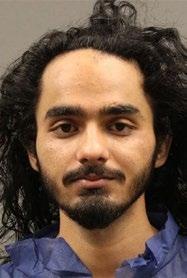
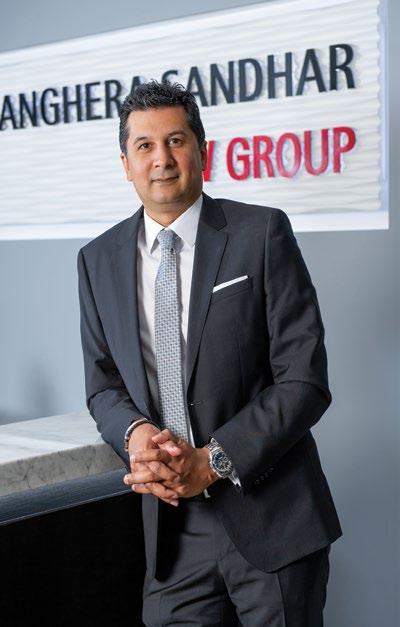
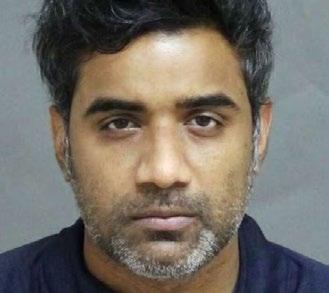
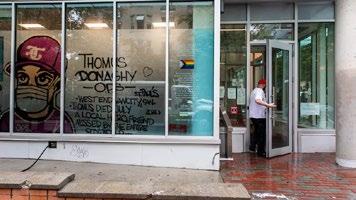
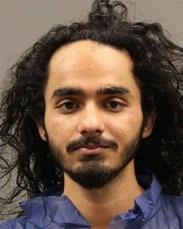
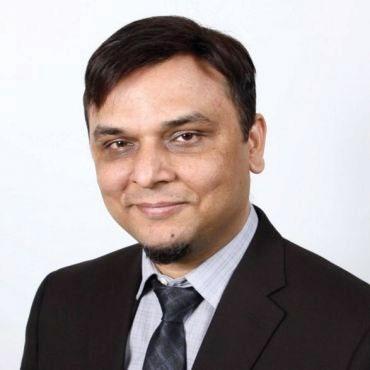
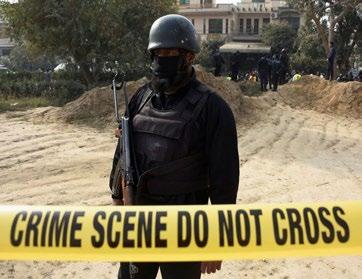
A 22-year-old is facing several firearms and arson charges in connection with three extortionrelated attacks in Surrey and Abbotsford.
Gursewak was initially arrested by Abbotsford police on Dec. 17, 2025, shortly after a business in the 31000-block of King Road was shot. He was charged with unlawfully discharging a firearm. Continued on Page 10...
A delegation from India, which Canada’s government is billing as the largest ever, will arrive this week to discuss trade and investment.
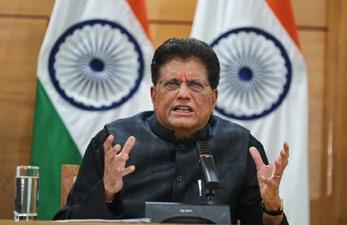
Indian Commerce and Industry Minister Piyush Goyal will be accompanied by more than 100 senior business representatives from industries such as mining, energy, automotive and aerospace during the visit, which takes place Monday to Wednesday, according to a release from his ministry.
The release says Goyal will meet with Canada’s minister of international trade, Maninder Sidhu, to continue discussions about a Comprehensive Economic and Partnership Agreement between the two countries, and explore new opportunities.
“Both countries are committed to fast-tracking the negotiations,” says the release.
Goyal is also expected to meet with Prime Minister Mark Carney and Foreign Affairs Minister Anita Anand, as well as CEOs of leading companies, startups and pension funds.
Global Affairs Canada says Sidhu is scheduled to meet with Goyal on Monday morning in Ottawa. Continued on Page 7...
www.theasianstar.com
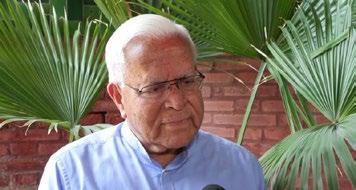
Indian Miniter Piyush Goyal pays
Union Commerce Minister Piyush
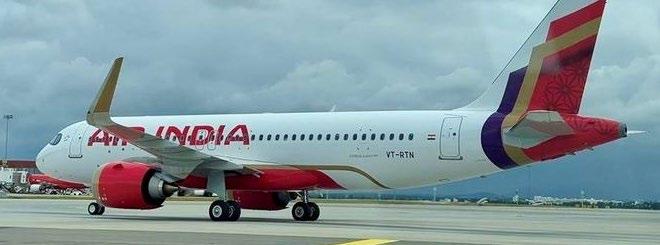
paid tribute to the victims of the Air India Flight 182 bombing at the Kanishka Memorial and met the families of the victims.
Air India Flight 182 bombing one of the deadliest acts of aviation terrorism in history, in which all 329 passengers and crew were killed. The aircraft, also known as Kanishka, exploded over the Atlantic Ocean off the coast of Ireland after a bomb had been placed on board. The flight was operating from Toronto to India via Montreal and London.
Goyal, meeting with the families of the victims, reaffirmed the shared commitment of India and Canada to strengthening cooperation to ensure such a tragedy is never repeated. Continued on Page 14...
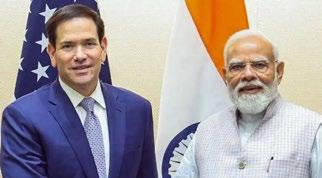
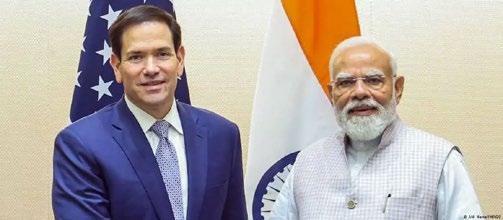
US Secretary of State Marco Rubio's four-day visit to India last week took place amid lingering tensions stemming from Washington's "America First" approach under President Donald Trump. Trade frictions between Washington and New Delhi, including tariffs on Indian exports and intense pressure over India's purchase of discounted Russian oil, have contributed to deep economic and political unease in India. Analysts say these developments have shifted the bilateral relationship from a broadly upward trajectory over the past two decades to a more transactional and contested phase.
Navtej Sarna, a former Indian ambassador to the US and a retired diplomat, cautioned that a single diplomatic tour cannot paper over a fundamental erosion of trust.
Continued on Page 10...
from the world's highest peak.
descent
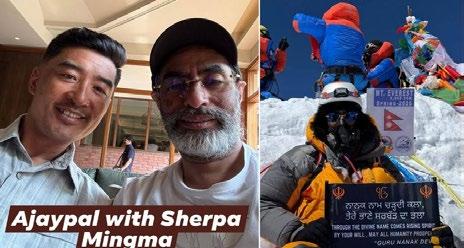
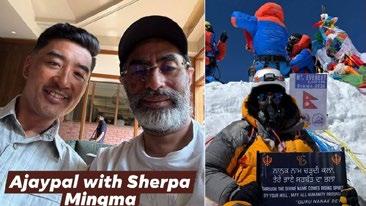
Dhaliwal reached the 8,848.86-metre summit on May 20 as part of a record-breaking day when 274 climbers scaled Everest from the Nepal side. He was one of three Indians who summited that day, along with Tulasi Reddi Palpunoori and Sandeep Are.
The Expedition Operators’ Association of Nepal confirmed the single-day record of 274 summits, aided by favourable weather conditions.
Continued on Page 10...
Goyal
Ajaypal Singh Dhaliwal, a Canadian of Punjabi origin based in Brampton, Ontario, has become the first Canadian Punjabi to summit Mount Everest, surviving a near-fatal
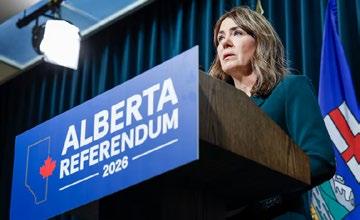
As an October referendum on the future of Alberta separation looms, new polling finds three in five Albertans say they would vote to stay in Canada, while more than half of Albertans feel Premier Danielle Smith has handled the issue “poorly."
On Thursday, Smith announced she is planning to put a question on the fall referendum ballot that will ask Albertans if they want the province to remain in Canada or if they want a future binding referendum on separation.
According to a poll from the Angus Reid Institute released Monday, 60 per cent of respondents would vote no to the official referendum question, compared to 35 per cent who would vote yes. But when asked a simpler hypothetical question about whether to leave Canada or stay, support for
separation decreased and federalist sentiment grew, with 30 per cent choosing to leave and 67 per cent opting to stay. Shachi Kurl, president of the Angus Reid Institute, told CBC’s Aarti Pole the responses to both poll questions “indicate overwhelming majorities” don't want to leave Canada.
“One of the biggest takeaways here is when you ask a simpler question, and albeit hypothetical … you see the number of people who say they'd vote to stay [in Canada] shoot right up to 67 per cent.”
The latest survey by Angus Reid was conducted online from May 22-24. It polled a randomized sample of 800 Albertan adults and has a margin of error of plus or minus three percentage points, 19 times out of 20.
A little more than half of Albertans polled said they found the official question confusing.
"Question wording matters,” said Lisa Young, a professor of political science at the University of Calgary, in reference to the discrepancy between the response to the official question and Angus Reid’s simplified one.
The official 37-word question will ask, "Should Alberta remain a province of Canada or should the Government of Alberta commence the legal process required under the Canadian Constitution to hold a binding provincial referendum on whether or not Alberta should separate from Canada?” Young warned that could potentially influence how people vote in October.
"People are reading their own interpretation into what the question means. Now, we're going to have the next five months to talk about what the various options actually mean, so that may move people a little bit," she said.
“I wonder if some people who are just tuning into this conversation think that, well, there's no harm in having another referendum and keeping the conversation going." Fifty-six per cent of poll respondents said Smith has handled the issue “poorly,” including nearly a third of UCP voters.
“If you're someone who is already inclined to not want to vote for the UCP and Danielle Smith, you're
going to say that she's done a bad job, and we see that,” Kurl said, with the poll showing most Alberta NDP voters responding “very poorly/poorly.”
At the same time, she said, there is a significant segment of UCP voters who feel that this has been mishandled, so Smith is being squeezed by criticism from both sides.
The poll also found that decided voters were nearly split on the party they'd vote for in the event that an election were called today, with 46 per cent provincewide choosing the UCP and 45 per cent choosing the NDP. On Monday, Prime Minister Mark Carney said Smith's referendum question is "not helpful" and that votes like this are a "dangerous bluff," citing the Brexit referendum of 2016 as an example.
The Supreme Court of Canada has upheld a ruling that Aboriginal title cannot be declared over private land, in a decision the federal government says will have an impact on the Cowichan Tribes case in British Columbia.
The refusal by Canada’s High Court to hear a First Nation’s appeal against the decision in New Brunswick establishes a precedent that First Nations can seek compensation for loss of traditional lands, but they will not be able to assert ownership. The Crown-Indigenous Relations Department says the ruling will inform arguments in other cases, including Cowichan, adding that “private property rights are fundamental.” The B.C. Supreme Court’s ruling in favour of the Cowichan Nation found it had “established Aboriginal title” to more than 5.7 square kilometres of land along the Fraser River in Richmond.
The provincial and federal governments and
The man killed in a rare fatal bear attack in northern Saskatchewan on May 8 wanted to be a professional mixed martial arts fighter, according to his brother.
Originally from Kerala, India, Hrishikesh Koloth, 27, was working at a uranium exploration site when he was attacked by a black bear.
He had trained in MMA for over a decade, first in India and then in Canada after moving here three years ago. He had been living in Penticton, B.C., with his older brother Arjun Koloth.
Hrishikesh had been working on contract as a technician at the Zoo Bay property operated by Vancouver-based UraniumX Discovery Corp. The site is near Nordbye Lake, roughly 850 kilometres northeast of Saskatoon.
Arjun said Hrishikesh was a fighter and a dreamer.
"That was his dream. That's why he came here," Arjun said. "He wanted to fight in the UFC."
He trained with Skoden Martial Arts in Penticton, and "everybody had high hopes on him," Arjun said. "It shouldn't have been like this." Arjun said a knock at his door at 4 a.m. PDT turned his world upside down.
“An RCMP came to my door and knocked and let me know that your brother has passed away in Saskatchewan,” he said.
A civilian on site shot and killed the bear. The
other First Nations are appealing that decision.
B.C.’s Attorney General, Niki Sharma, told reporters on Thursday that B.C.’s argument is essentially what the court found in New Brunswick.
“So we think it is very interesting that the Supreme Court of Canada decided not to hear that case, so therefore leave that law in place,” she said. “I think that it bodes well for our legal issues here and what we are trying to sort out and our arguments that we made before the courts here.”
Sharma said she thinks the ruling gives the province a clear path to an appeal in B.C.
“It’s an interesting state right now where the Supreme Court has decided to not take a look at that law, so not to overturn that decision in New Brunswick when it’s the same legal issues that we’re dealing with here,” she added.
“I think that bodes well for our arguments and the appeals that we are seeking in B.C.”
animal has since been transported to the Western College of Veterinary Medicine in Saskatoon for a necropsy. The company, UraniumX Discovery Corp, confirmed one of its contractors was killed and extended its thoughts and prayers to the family. He described Hrishikesh as humble, fearless, and fiercely loving to his family — someone who spoiled his parents and wanted to do everything for them. "He's not scared of anything," Arjun said. "Two days notice before a fight? Doesn't matter. Opponent heavier than him? Doesn't matter. Win
or lose, he just wanted to fight."
is now in
family.
"I want him to be remembered for what he does. Innocent heart, fighter's soul. Warrior. And I'd just like to say he fought [the] bear. That's all … bear didn't attack him. He attacked the bear."
Arjun
Kerala for his brother’s funeral and to be with the rest of his
South Asian man given 33-year sentence for sexually exploiting over 140 children in U.S.
A Canadian man has been sentenced in the United States to more than 30 years in prison for what American officials described as a widespread, yearslong sextortion scheme targeting more than 100 children across the country.
A statement on Wednesday said Ramanan Pathmanathan, 40, was sentenced in U.S. District Court to 33 years behind bars after pleading guilty to two separate charges earlier this year.
"This defendant spent years methodically hunting children online. He targeted more than 145 victims, some as young as six, and subjected them to horrors no child should ever experience," U.S. Attorney Jeanine Ferris Pirro wrote in the statement.
When victims blocked Pathmanathan or declined to co-operate, the man threatened to send images to the children's friends or family.
He pleaded guilty in January to one count of production of child pornography and one count of coercion and enticement of a minor.
Court documents said the investigation began when one victim's mother contacted local police, who tracked Pathmanathan's IP address to a Canadian home.
Investigators said Pathmanathan, who is from Toronto, primarily used Instagram and Facebook accounts to contact young girls and boys online. He pretended to be a teenage boy from New Jersey online for seven years, the statement said.
After establishing contact, Pathmanathan "demanded the minor victims engage in sexually explicit conduct while they participated in video chats with him. He directed them to expose their genitals, and to engage in sexual acts with dogs, siblings and other relatives," the statement said.
"In almost all the video chats with his minor victims, Pathmanathan sent the children images of adults engaged in sexual acts to show them how to do what he was requesting." Prosecutors said Pathmanathan recorded his victims' sexually explicit conduct and saved the files to his computer.
In a sentencing memorandum filed last week, Pirro said Pathmanathan targeted victims from a desktop computer he kept in his bedroom while living in the house with his brother and his parents.
Canadian authorities searched the home on March 10, 2021. Pirro said Pathmanathan sexually exploited his final victim earlier that day, saving a file about a 13-year-old girl at 5:09 a.m.
"The seriousness of the defendant's conduct cannot be overstated," Pirro wrote.
Pathmanathan was previously sentenced to 12 years in prison after pleading guilty to similar crimes in Canada in 2022. The new sentence from the U.S. will be served consecutively, meaning the 33-year term will begin after the previous 12 years are up.
The judge ordered Pathmanathan to serve 10 years of supervised release once he leaves prison. He will also be a registered sex offender.
Prosecutors had recommended a 40-year sentence, which would have amounted to more than three months in prison for each victim.
Carney says Canada will buy European surveillance planes over two American options
Canada will buy early warning radar planes built by Sweden’s Saab and Canada’s Bombardier over two American options, Prime Minister Mark Carney announced Wednesday.
Carney said his government has entered negotiations to procure Saab’s Airborne Early Warning & Control Aircraft, which is built on the Canadian-manufactured Bombardier Global 6500 aircraft and will support domestic production.
Carney also noted it is made with 20% U.S. content. The federal government has previously said it’s in the market for six radar aircraft.
Carney has made a point of diversifying its military spending away from the United States. Equipped with powerful radar, the Saab planes
provide situational awareness about aircraft and missile movements for hundreds of miles (kilometers). They can detect hostile activity in the air or from ships are able to direct fighter jets to their targets.
“Saab’s GlobalEye will be a key resource for the Canadian Armed Forces to detect and deter threats across the Arctic,” Carney said.
The other options would have been to buy the E-7A Wedgetail surveillance planes built by U.S. aircraft manufacturer Boeing or the Aeris X by L3Harris. NATO is also considering the Saab plane over the American options.
Carney has previously said that no more will over 70 cents of every dollar of Canadian military capital spending go to the U.S.
Alcohol consumption in B.C. hits 20-year low, but we’re still drinking more than average
A new report has found that people in B.C. are drinking less alcohol, but it is still slightly more than the national average.
The report, released by the Office of the Provincial Health Officer, provides the latest trends about alcohol consumption.
“When it comes to drinking alcohol, less is best,” Dr. Bonnie Henry, B.C.’s provincial health officer, said in a release on Wednesday.
The recommended standard is one to two drinks a week to avoid most alcohol-related health risks. In B.C., the report found that male seniors consume the most alcohol, with an average of 15 standard drinks per week, and this group has a higher rate of alcohol-attributable deaths and hospitalizations than the rest of the population.
Alcohol use spiked during the COVID-19 pandemic, the report states, and has now reached a 20-year low in B.C. and youth are drinking less.
“Drinking less alcohol is better for overall health, as has been confirmed by research and alcohol guidance in Canada. While it is important for people to be able to make informed decisions about alcohol, government has a key role to play in addressing factors that shape drinking behaviour through policy shifts.”
The latest trends in B.C. show that people are drinking less in recent years, consuming an average of 8.8 standard drinks a week, as of 2023, which is higher than the national average of 8.2 drinks a week.
However, 38 per cent of youth aged 12 to 19 report having tried alcohol. “We’re seeing a shift toward lower overall alcohol use, which is encouraging from a health perspective,” said Dr. Martin Lavoie, deputy provincial health officer, in a release.
“But people in B.C. are still drinking more than the national average. That’s why it’s important to keep focusing on population-level measures like helping people understand the health impacts of alcohol, so they can make informed choices.”
The Interior, Northern and Island Health regions have the highest levels of drinking per person, the report states. The report offers recommendations to the government to help make people more aware of the health risks of alcohol and to implement changes at the point of sale, such as requiring warning labels on packaging and adjusting the price of alcohol so that it is based on alcohol content rather than volume.
Anguished family speaks at sentencing hearing for 3 men who murdered B.C. seniors
“I am disgusted. Disgusted that none of the three guilty parties had mercy on my parents.”
Those are the words of Kimberley Coleman, one of the daughters of Arnold and Joanne De Jong, two Abbotsford seniors brutally murdered in their own home in May 2022.
“They killed a man with pancreatic cancer, a man who gave their young roof-cleaning business a chance, and a loving woman who would have fed them if needed,” Coleman said in her victim impact statement at the sentencing hearing for Abhijeet Singh, Khushveer Toor and Gurkaran Singh. The three men were earlier found guilty of firstdegree murder.
They sat with their heads down in the prisoners’ box as anguished family members described the impact the deaths of the De Jongs had on them.
“Did they call out for help? Did they have a chance? Were they terrified? Did they suffer? In their last moments, did they know how much we loved them?” she asked. She said that many times in her life, she had seen her father, a man of faith, kneeling beside his bed praying.
“That image is how I remember him. Kneeling. Faithful. Devoted. And now, I cannot unsee my father kneeling beside that same bed, pleading for mercy, bound, tortured and suffering, left to die in the very posture that once represented faith, surrender and devotion in his life. The same posture, the same plea, but under unimaginable cruelty,” she said in court.
“I am filled with grief and anger. Shock, despair and sadness consume me. I am scarred and brokenhearted,” Coleman said.
“The fear, pain and evil that my parents experienced that night at the hands of these three men has been passed on to me,” she said.
Her sister, Sandra Barthel, told the court:
“Having to sum up in words how I have been impacted by the murder of my mom and dad feels like an impossible feat. How does one describe hell in words?
“What happened to my parents did not simply take two lives. It fractured our entire family and permanently altered every part of who I am,” she said.
“I am unable to uderstand how something so immensely evil could happen to such loving people,” Barthel told the court. She said that for four years, sleep had become a battle as her mind repeatedly returned to thoughts of what her parents’ final moments may have been like.
Barthel also said: “No one needed to die in that house that night. My parents were helpers. Had a true need been expressed, my parents would have stepped in to help, the same way they stepped in to support many family members and members of our community.” Crown counsel argued the home-invasion murders were motivated by money and greed.
Another of the De Jongs’ daughters also provided a victim impact statement.
Heather Hoogland said her entire foundation had been shattered by the killings.
She said the murders “took the world we knew, stole our future and rewrote our story without our permission.”
Hoogland said her parents were her rock.
“My mom and dad were my best friends, and I miss them so very much. What I would do for more time, for even one more moment just to hug them again, tell them what I never got to say.”
On the day the De Jongs were found murdered, she called her husband and asked him to go to the house to check on her parents because they could not be reached.
Overdose prevention site in Vancouver's Yaletown not reopening: minister
B.C.'s health minister said Thursday that an overdose prevention site (OPS) in Vancouver's Yaletown neighbourhood will not be proceeding, after backlash from the city's mayor and business groups.
The site, which was set to be the new location for the OPS serving Vancouver's downtown core, was to be located on 900 Helmcken St. Its lease was scheduled to start on June 1, with Vancouver Coastal Health (VCH) saying services at the site — which would see trained staff watch people using drugs and preventing deaths — would have started shortly after.
But Vancouver Mayor Ken Sim and local business associations said there was little consultation before the location was announced, and Sim even passed a motion to use city resources to block the site. On Thursday, Health Minister Josie Osborne said in a statement that she had heard concerns from the city, local businesses and community partners on the relocated OPS.
"Vancouver Coastal Health will not proceed with the overdose-prevention site at 900 Helmcken St. at this time, and there is currently no planned date for opening," she said.
Osborne said that the province would take steps to engage with local stakeholders, including the city, before any new site would open. When the Helmcken Street site was announced as the new location earlier this month, Jane Talbot of the Downtown Vancouver Business Improvement Association said safety was the top concern of association members.
"As conditions persist and street disorder
intensifies, many are reaching a breaking point, running low on compassion and struggling to
operate their businesses," Talbot said at a news conference on May 5.
Sim had said at the same news conference that OPS services played a role in saving lives, but shouldn't be treated as a standalone solution, and asked for the province to invest in more treatment and recovery options for drug users. Health officials had said at the time that the downtown core has the second-highest rate of overdose deaths in the VCH region, and 94 people had died in the region last year.
"This is an essential health service. It's there to save lives of people who live in the neighbourhood," said VCH Chief Medical Health Officer Dr. Patricia Daly at the time.
Osborne said in her statement that OPS services would continue to be provided in the area by a mobile site that provides limited services.
"Vancouver Coastal Health ... recognizes the importance of ensuring these services support both vulnerable people in need of care and the businesses, residents and workers in surrounding neighbourhoods," the statement read.
Ph: 604-591-5423
Fax: 604-591-8615
editor@theasianstar.com
Editor:
Umendra Singh
Marketing and Sales: Ravi Cheema
604-715-3847
Shamir Doshi
604-649-7827
Harminder Kaur
778-708-0481
Parminder Dhillon
604-902-2858
Pre-Press: Avee Waseer
Production: Ozmo Media
www.theasianstar.com
Reforming Parliament seat distribution could help douse Western separatist flames
A new report proposes establishing a 350-seat Parliament in an effort to correct for imbalances in the House of Commons that have long left Ontario, Alberta and B.C. underrepresented compared with other provinces.
In the study, the Calgary-based Aristotle Foundation for Public Policy points out that Alberta currently has the lowest representation among provinces in the House, with one member of Parliament for every 134,057 citizens, when compared against 2025 population numbers. British Columbia has one MP per 133,077, while Ontario has one per 132,645. That is well higher than Prince Edward Island (44,820), Quebec (116,816), Saskatchewan (89,351) and other Canadian provinces. “Political representation in Canada at present is not representative of the actual populations in each province,” it said.
The report comes as resentments over a range of issues — including a lack of federal representation in the House of Commons and Senate — has fed separatist sentiments in Alberta in particular.
Alberta Premier Danielle Smith has proposed a referendum in October that will ask, among other things, whether Canada should amend the Canadian constitution to “abolish the unelected federal Senate.”
The Aristotle study, called “It’s 2026, not 1867: A 21st-century review of population and representation in the House of Commons,” compared representation in both the federal chambers over the last 50 years, and found that under-representation in Ontario, Alberta and B.C. has remained constant.
As of 2025, British Columbia was the most underrepresented province in the Senate compared to its population, with 953,720 people per senator. Alberta was the next highest at 826,683. P.E.I., by comparison, had one per 44,820 people, Nova Scotia had one per 107,963 and Quebec had one senator per 379,651 people.
“One part of our rationale for change is that continued imbalances in representation will exacerbate Western alienation and feed potential separatist sentiment in Western Canada,” the
authors said. “Another part of the rationale for change is that the principle of representation by population is critically necessary for legitimacy in a democracy, and Canadians deserve a House of Commons that reflects 21st-century realities, not those of 1867 or even 1982.”
The report was co-authored by Mark Milke, the head of Aristotle Foundation and former Canadian Taxpayers Federation director; Ven Venkatachalam, an economist; and Gordon Campbell, a former Canadian diplomat and premier of B.C. from 2001 to 2011.
“Canada’s House of Commons should reflect 21stcentury population realities and restore a greater sense of fairness across the country,” Milke said in a statement.
The imbalance in the House of Commons or Senate is the result of a number of legal provisions, including a clause that stipulates that provinces should not have fewer MPs than they have senators. That, combined with another clause that ensures
provinces have no fewer MPs than they had under a pre-set benchmark (which the Liberal government recently updated to 2019 levels), has led to “chronic underrepresentation” among some provinces, the report said.
Under such a scenario — which the authors note would require legal and constitutional changes — Ontario would gain 12 seats, British Columbia would gain five, and Alberta would gain four. Saskatchewan, meanwhile, would lose three seats, Manitoba would lose one, and Quebec and the Atlantic provinces would all forgo two seats apiece. Graphic showing how sets could be redistributed Article content
The seat count in the House would be capped at 350, combined with regular redistribution to ensure fair representation according to population.
The authors acknowledge that cutting back representation for many provinces is “not a middle reform,” but argue it could be necessary for dampening Western separatist frustrations.
Pilot involved in fatal B.C. helicopter accident distracted by cellphone, TSB finds
A Transportation Safety Board of Canada investigation into a fatal B.C. helicopter accident states the pilot missed important steps on a safety checklist and was distracted by his cellphone.
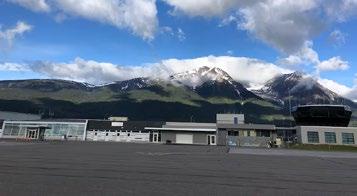
One pilot and two workers were conducting maintenance ground run operations on the helicopter at Smithers Airport on May 6, 2023, when the aircraft unexpectedly rotated approximately 540 degrees.
The report released Wednesday said both workers on the ground were struck by the helicopter's tail rotor, killing one and severely injuring the other.
The investigation found that after the first maintenance ground run, the pilot abbreviated the operator’s checklist to expedite operations as this type of maintenance is routine and repetitive.
"Part of the sadness in all of this for me is that it really wouldn't have saved very much time," said TSB investigator Dan Clarke. "It's really, you know, inconsequential."
By the third time the aircraft's engine was started, one of the helicopter's pedals was engaged, which went undetected, and it began rotating quickly. Both ground workers tried to get out of the way, but were stuck multiple times by the tail rotor.
TSB said the pilot was not expecting the helicopter’s rapid rotation and was looking down when the rotation began. The report said the pilot’s attention was split between the maintenance operations and his cellphone, which was connected to a Bluetooth earpiece.
The board's report said it has identified the risks of cellphone use in past accidents.
"There are no current regulations about their use in the cockpit of smaller aircraft. There are for large aircraft, the big airliners and things like that, but there are not for smaller aircraft," said Clarke.
"We've done our best to unearth the details and I think that if nothing else, maybe it's the start of a conversation about cellphone usage and cockpits."
While the report doesn't make specific recommendations, Clarke said he hopes it serves to raise awareness about the importance of properly following a startup and shutdown checklist.
"What I've learned in this investigation is that that may not be occurring in industry, in the field, at different locations around Canada," he said. "A young fellow lost his life and we're trying to make sure that doesn't happen again."
India's trade delegation billed as ‘largest ever’ in Canada this week
Continued from Page 1...
A social media post from Canada Trade, which provides updates from the government on international trade, says Goyal has called the group “the largest-ever business delegation to go from India to any country.”
“Canada and India are strong economic partners, with an aim to double our trade to $70 billion by 2030,” said the post on Saturday.
pounds of uranium to India for nuclear energy generation, as well as 10 commercial agreements worth more than $5.5 billion.
Sidhu said earlier this month that Indian Prime Minister Narendra Modi won’t be travelling with the delegation. India’s release says energy security and transition are key to the relationship, and were also a big part of the discussions when Carney visited Mumbai and New Delhi in March.
The trip concluded with a meeting with Modi and signing a series of agreements, including a strategic energy partnership.
The agreements announced included a $2.6-billion deal to supply around 22 million
At the time, Carney said the two sides were aiming to conclude a broader deal by the end of the year.
“This is not merely the renewal of a relationship. It is the expansion of a valued partnership with new ambition, focus, and foresight,” Carney said in March.
A Canadian delegation was in New Delhi in May to conduct a second round of negotiations on the Comprehensive Economic and Partnership Agreement, the Indian government’s release says. Canada and India have been in trade talks since 2010. Talks were shut down by Ottawa in 2023, after the federal government accused New Delhi of playing a role in the assassination of a Canadian Sikh activist in Surrey, B.C. However, Carney made it a priority to reset relations after he became prime minister in 2025.
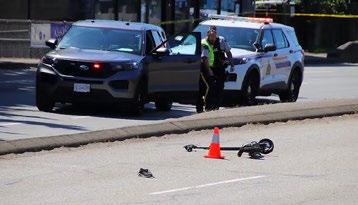
75-year-old man struck in alleged Vancouver vehicle ramming dies: police
A 75-year-old man who was struck while riding his motorized scooter in what Vancouver police say was a "vehicle ramming" earlier this month has died of his injuries.
The incident happened around 5:30 a.m. PT on May 15 in the city's West End, and left the victim with critical injuries.
Two police officers, one of them a recruit constable on his second day of work, were also injured. On Wednesday, police confirmed the man had died on May 24.
The victim was identified by family members as
Johnny Sudds.
In a statement, Sudds's family said that the family was grieving "in the shadow of the strange violent act" that saw him killed.
"During this time, we ask others to keep their thoughts on Johnny, the loss many of us feel, and the journey toward healing," the statement reads. Family members said in the statement that a small shrine at the corner of Comox and Bute streets, where Sudds was struck, saw friends and neighbours leaving notes and flowers in honour of Sudds.
Report recommends warning labels on booze as B.C. alcohol use above national levels
Alcohol use in British Columbia has reached a 20-year low after spiking during the COVID-19 pandemic, but a new report from the provincial health officer says consumption is still above both national and recommended levels.
The report released Wednesday says that as of 2023, people in B.C. average 8.8 drinks per week, compared with the national average of 8.2 and significantly above the recommended one to two drinks per week to avoid most alcohol-related health risks. Among health regions, the Interior, Northern and Island Health have the highest levels of drinking per person. Provincial Health Officer Dr. Bonnie Henry said that when it comes to alcohol "less is best."
"Drinking less alcohol is better for overall health, as has been confirmed by research and alcohol guidance in Canada," said Henry in a statement. The report says alcohol use leads to harm, and as of
2023, an estimated six per cent of all deaths in B.C. were caused by alcohol use.
"Hospitalization and death rates related to alcohol are highest in regions that have greater alcohol consumption levels," read the report.
"Male seniors are more likely to die or be hospitalized for reasons attributable to alcohol than female seniors and B.C. residents of other ages." Men in B.C. are drinking more than women and a higher proportion of males are "drinking heavily," with consumption highest among male seniors in B.C., who average 15 drinks per week, the report says. In B.C., more than 60 per cent of people report drinking alcohol regularly, meaning they have consumed at least once a month in the last 12 months.
The report says that while youth are not drinking as much as they have historically, 38 per cent of people aged 12 to 19 report having tried alcohol.
SATURDAY, MAY 30, 2026
Vancouver's Oakridge Park shopping mall opens
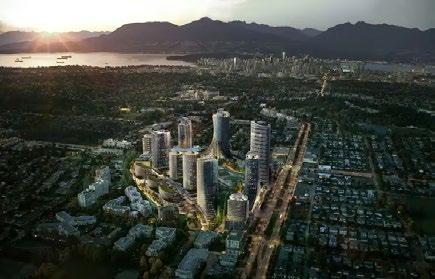
After nearly a decade in the works, the Oakridge Park shopping mall in Vancouver will open its doors to the public on Thursday as part of a phased opening of a huge retail and residential redevelopment.
The $6.5-billion project was first pitched a decade ago, as part of a five-million-square-foot redevelopment of the Oakridge Centre mall. Once complete, it will include luxury condos, office space and a public park across eight city blocks.
On Thursday, 650,000 square feet of retail space — with premium brands such as Louis Vuitton, Versace and Dior — will open alongside almost 1,400 residential units and 720,000 square feet of offices.
Vancouver and they're going to be interested in this. Are there enough of them to sustain the traffic on an everyday, every-season basis?" Gray said while retailers and malls in general were seeing healthy foot traffic across Canada, there could be hesitancy among some retailers to commit to longterm leases at the new mall.
"We're seeing a little bit of a wait-and-see for the next round of tenanting," he said.
"But basically, for this to work, they've got to get it launched pretty soon and they are doing so. And then we'll see how well the luxury aspect fits, and they may have to pivot that in future."
Adrian Beruschi, a real estate agent with CBRE Vancouver, said the previous Oakridge Centre mall featured very high sales and was well-attended.
Retail analysts say it remains to be seen if the massive redevelopment's targeting of luxury consumers will work in a market strained by inflation and the cost-of-living crisis. David Ian Gray, an instructor at the Capilano University business school, said Oakridge Park was conceived in the mid-2010s in Vancouver — a time when mixed-use retail was in vogue and luxury retail was a major strength of the city.
"I don't know if Vancouver has the base right now in this current economic climate," he said.
"There are wealthy people, for sure, in
"Now with the ... reimagined Oakridge, it's coming at us at a scale that I'm not sure most Canadians have ever seen," he said, with the mall being one of North America's largest retail and residential construction sites.
"It's definitely the most ambitious retail project in British Columbia's history."
Developers QuadReal and Westbank have pitched the redevelopment as Vancouver's second town centre, though Beruschi says he's skeptical of that.
"The gravitational pull is the centre itself. It's not going to make a massive amount of change in the immediate neighbourhood, in my opinion," he said.
Beruschi and Gray both said they're intrigued by the mall's inclusion of a unique food court — Time Out Market — which will see luxury chefs from the Metro Vancouver area all in one place, as opposed to the usual chain restaurants that are mall staples.
Burnaby tightens e-scooter rules on major roads amid safety concerns
E-scooter riders in Burnaby are facing tighter restrictions after the city adopted new rules this month that make it illegal to ride on many major roads. Council adopted the bylaw changes on May 12, about four months after the city joined B.C.’s electric kick scooter pilot project.
The provincial government has been carrying out the pilot to examine the use of electric kick scooters on public roads in 36 communities, including Burnaby, Vancouver, Victoria, Kelowna and Prince George.
The project allows e-scooters in participating communities under specific rules. On roads with speed limits of 50 km/h or less, riders are allowed to use a designated cycling lane if one exists, or stay as far right as safely possible.
They ban e-scooters on major road networks and arterial roads unless riders are using a separated cycle lane or multi-use pathway. That means e-scooters are now restricted on major road networks such as Hastings Street and Kingsway, even where the speed limit is 50 km/h or less.
The bylaw also bans riders from using headphones and prohibits e-scooters on sidewalks unless a sign allows them and in local parks “unless the park or portion thereof has been specifically designated for such use.” Amy Choh, Burnaby’s director of engineering transportation, says e-scooters are not a good fit for some of the city’s busiest roads where riders can be moving quickly, close to traffic. “[It] comes with inherent risks and people do need to recognize … those risks,” she said. “When you’re using the electric power scooters, you are riding at much higher speed.”
Choh says scooters can also pose risks in shared spaces because they are quiet and travel faster than many pedestrians expect, which can be a concern around families with young children and people with mobility issues.
The changes come amid growing concern about e-scooter injuries.
Data released last year by the Canadian Institute for Health Information found hospitalizations from e-scooter falls rose 22 per cent across Canada in one year. Among children aged five to 17, hospitalizations rose 61 per cent.
In Burnaby, two children were seriously injured in a collision involving an e-scooter on Hastings Street earlier this month.
Under provincial regulation, e-scooter riders
must be at least 16 and wear a helmet. Riders can face a $109 fine, impoundment or other penalties for breaking those rules. But Vic Leach, a member of the pedestrian advocacy group Walker's Caucus, says those rules are not being enforced and he believes the current penalties are too low.
“I think the fines should be higher,” he said. “I think that there should be more accountability.”
Burnaby RCMP Cpl. Mike Kalanj says officers are actively enforcing rules, pointing to an enforcement action on May 1 where they issued three violation tickets.
Leach says he worries the problem could worsen through the summer as more people use e-scooters, including during the FIFA World Cup in Vancouver. The city is now focusing on education and outreach so riders understand the new restrictions. Kalanj says RCMP officers will use their discretion on whether education or enforcement is needed, based on the circumstances of each case.
Daughter tells of B.C. murder suspect's message as mom vanished
The daughter of murder suspect Vitali Stefanski says he left her a Russian voice message saying her mother had "made life hell," the day she went missing from her home in British Columbia's Interior.
A recording of the WhatsApp message has been played in court at Stefanki's murder trial in Kamloops, B.C., with daughter Selina Martin translating and saying he told her she and her younger brother were "going to be alone" and they should "hang onto each other tight, like stay together."
A B.C. Supreme Court jury has heard that 44-year-old Tatjana Stefanski was found stabbed to death on April 14, 2024, a day after the voicemail.
Eighteen-year-old Martin, who goes by her mother's maiden name instead of her legal surname of Stefanski, says her father called her endearing names and wasn't speaking normally, telling her he wanted to see her but it "hadn't worked out."
Martin did not look at her father as he watched her in court, even as she walked past the Plexiglass defendant's box.
the day of the disappearance, she had missed a call from her mother, who texted her saying her father was "leaving."
She said she later got a call from Gaudreault, who told her that both her parents had disappeared.
"I didn't believe it at first," she said. "I didn't think she would willingly do that. It was very out of character."
Crown lawyer Rigel Tessmann told the court Tuesday that Tatjana Stefanski's body was located six kilometres from where Vitali Stefanski's abandoned black Audi was found on a forest road.
A bent and bloodied knife that carried both their DNA was found near the body, Tessmann said.
Vitali Stefanski has pleaded not guilty to seconddegree murder in the death of his ex-wife.
The court has heard that Martin lived with her mother, brother, Tatjana Stefanski's boyfriend Jason Gaudreault, and his son, in the village of Lumby, about 25 kilometres east of Vernon.
Martin told the court on Wednesday that on
Tessmann told the jury Vitali Stefanski emerged shoeless from the forest and admitted to police that he had killed his ex-wife.
He said evidence would show Tatjana Stefanski suffered 21 "sharp force wounds" to her legs, arms and hands as well as seven stab wounds to her chest and ribs that injured her heart and lungs and led to her death.
Man formerly accused of two murders in N.B. now wanted on new charges in B.C.
A New Brunswick man formerly charged with murder in two cases is now wanted on new, different charges out of British Columbia.
Joshua John McIsaac had previously faced firstand second-degree murder charges in the deaths of two people before the charges were stayed by a judge last summer because of an evidentiary error by Fredericton police that has not been publicly disclosed. RCMP Const. Olivier Nelis, a spokesperson for the Penticton South Okanagan Similkameen Regional District in B.C., said in a phone interview that McIsaac was wanted for forcible entry, assault and mischief under $5,000.
Nelis said he could not give any further details, including information about what happened that led to the charges, where the alleged incident took place or if McIsaac was a B.C. resident.
Nelis said the charges against McIsaac were
sworn on Nov. 12, 2025, meaning that the charges have been formally approved by the courts in B.C. He also said the warrant for McIsaac's arrest is only valid for the province.
The murder charges that McIsaac had previously faced in New Brunswick involved two deaths. One was of Brandon Donelan, whose body was found in a wooded area between Minto and Chipman on March 31, 2022, after being reported missing two months earlier.
McIsaac and three other people, Erica Lea Ann Blyth, Devon Mark Hill Hood and Matthew David LeBlanc, faced first-degree murder charges in Donelan’s death. McIsaac and another man, Travis James Snowsell, had also faced second-degree murder charges in the death of Corey Christopher Markey, who was shot in Fredericton in 2021 and later died.
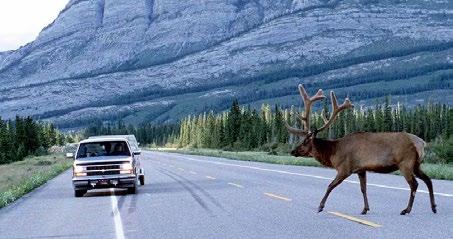
Motorcyclist dead in B.C.'s Kootenays after hitting elk on highway
A motorcycle rider has been killed in B.C.'s Kootenay region after hitting an elk.
Trail RCMP say the crash happened at around 4:25 a.m. local time on Monday on a stretch of Highway 3B in Montrose, about 400 kilometres east of Vancouver.
Police say they were called to the scene after witnesses reported seeing the motorcycle collide with the animal.
A 27-year-old man from Fruitvale was riding the motorcycle and he was declared dead at the scene after sustaining serious injuries.
Woman dead, 2 seriously hurt after highway collision with elk, head-on crash
Police say the elk was also killed in the crash.
Investigators have turned the case over to the B.C. Coroners Service after determining there was no criminality involved.
Data from the Insurance Corporation of British Columbia says crashes involving wildlife rose to more than 12,500 in 2024, up significantly from the 10-year average of 11,600. There have been 24 fatal crashes in B.C. involving wildlife between 2015 and 2024.
Ladner woman who killed her mother found not criminally responsible
A Ladner, B.C., woman who killed her mother two and a half years ago pleaded guilty to seconddegree murder, but was found not criminally responsible on Wednesday due to a mental disorder.
In December 2023, Sarbjit Panesar died of blunt force trauma.
She was killed in the Lander home she and her daughter, Preety Panesar, shared.
Preety was 28 years old at the time of the murder.
Both mother and daughter suffered from schizophrenia,
but Preety was undiagnosed. On Wednesday, the court heard how the daughter had delusions that her mother was going to harm her.
Continued from Page 1...
Abbotsford’s internal extortion task force continued to investigate Singh, who now faces additional charges relating to the Dec. 17 shooting. Sgt. Paul Walker said the new charges include “extortion using a firearm, possession of a restricted firearm, possession of a firearm without a licence and occupying a vehicle knowing a firearm is present.”
Abbotsford investigators worked with the Surrey Police Service, Walker said, “sharing evidence obtained during the arrest of Gursewak Singh to support two separate SPS investigations.”
Singh has also now been charged with several counts related to a shooting in Surrey on Dec. 14 and an arson attack on Dec. 15, 2025. Both occurred after 2 a.m. A gunman opened fire in the 8000-block of 120 Street at a business
that had also received extortion threats. Staff were inside, but no one was injured.
The arson took place 24 hours later in the parking lot of a business in the 12400-block Old Yale Road. Two vehicles were lit on fire, causing significant damage. This business had also received extortion threats.
The Surrey charges include reckless discharge of a firearm, possession of a loaded prohibited or restricted firearm, extortion using a firearm, occupying a vehicle knowing there was a firearm present, arson and extortion. Singh remains in custody.
non-emergency number at 604-599-0502 or the extortion tip lineat 236-485-5149.
Surrey police Sgt. Ali Gailus said investigators want to hear from anyone with additional information about Singh. They can contact SPS’s
Start
to your child’s RESP
When your child turns six, they can receive an additional $1,200 from the B.C. Government.
B.C. Solicitor General Nina Krieger praised the arrest in a social media post, thanking both the Abbotsford and Surrey police. She said Singh’s alleged crimes are “the kind of violent intimidation we are determined to see stopped.”
“Let this be clear: People using threats, fire and firearms to terrorize businesses and families will be pursued by police, put before the courts, and held accountable,”
Krieger said. Last week she told an online community forum that the extortion crisis remains the B.C. government’s top priority, even though extortion cases have declined so far this year.
Continued from Page 1...
"Trust is in the deep red, interests are misaligned," Sarna told DW. "US actions, policies and unpredictability have impacted us deeply on trade, energy, immigration and so on."
He added that "India's position in America's strategic vision — regional or global — is no longer a given," and cautioned that New Delhi can no longer take its partnership with Washington for granted.
“Through recent arrests and removals from Canada, police and the Canada Border Services Agency are making meaningful progress in holding extortionists to account,” Krieger said.
RCMP Deputy Commissioner Dwayne McDonald told the May 12 forum that the provincial extortion task force, and efforts by investigative partners, had contributed to the decrease in cases.
“I think this is directly attributable not only to the work of the provincial task force, but the coordinated effort by all of the partners here,” he said. “We have had significant success in terms of charges laid, of removal of suspects, of suspects leaving the province of their own volition, but we’ve also seen an incredible increase in cooperation from victims, from community, and an increased awareness of just how these crimes occur.”
own strategic autonomy through engagement with multiple partners.
Former Indian high commissioner to Pakistan Ajay Bisaria said that these underlying geopolitical anxieties have created persistent irritation behind the scenes.
"Several irritants continue to weigh on the relationship. Washington's recent outreach to Pakistan's military leadership after the elections has not gone unnoticed in New Delhi," Bisaria, currently in the US, told DW.
"A reset will take much more work than just a visit," he said. "We must see what happens on the ground on our core interests."
Meera Shankar, another former Indian envoy to the US, notes that Rubio's visit followed "a period of strain in India–US ties marked by higher tariffs, tighter visa regimes and questions in New Delhi over Washington's reliability as a balancing power in the Indo-Pacific."
At the same time, US tensions with Iran and its outreach to Pakistan and China have reinforced New Delhi's concerns about Washington's consistency, even as India continues to pursue its
During a joint press briefing with Indian External Affairs Minister S Jaishankar, Rubio defended Washington's aggressive trade policies as a global necessity rather than a targeted strike on India.
"The president did not say let's figure out a way to create friction with India over trade," Rubio said. "The president approached it and said we have to rebalance US trade."
Rubio added that he wasn't speaking specifically about India.
"I'm speaking more globally," he said.
Rubio paired this defense with an olive branch, adding that the two nations are "on the verge" of finalizing a sustainable trade agreement "very soon."
However, the true benchmark of success for Rubio's visit was never a grand breakthrough — it was merely steadying a relationship showing visible strain.
Canadian Punjabi climber Ajaypal Dhaliwal becomes 1st from community to summit Everest
Continued from Page 1...
While the summit marked a major personal milestone for Dhaliwal after years of preparation, the descent turned into a life-threatening ordeal in the ‘Death Zone’ above 8,000 metres.
According to a widely shared Facebook post by his friend Mohan Pal Randhawa, Dhaliwal was left stranded during the descent with critically low oxygen supplies after being abandoned by his Sherpa guide. Two climbers from the same expedition group — Sandeep Are and Arun Kumar Tiwari — died while descending. Randhawa wrote: “This accomplishment belongs entirely to him... Not because he summited Everest. Many climbers dream of doing that. But because he came back alive from a place where some never do.”
In the extreme conditions of freezing winds, exhaustion and depleting oxygen, Dhaliwal reportedly improvised his descent by sliding down dangerous icy slopes using his safety belt. During one such manoeuvre, he crashed and lost consciousness.
Upon regaining awareness in darkness and brutal cold, he signalled for help by flicking his headlamp. A team of four climbers, including Mingma Tenzi Sherpa, spotted the signal, shared oxygen and assisted him continue the descend to safety.
Randhawa highlighted Dhaliwal’s resilience, saying, “Everest was not just testing his body. It was testing his courage to keep taking risks when fear had every reason to win.”
Dhaliwal’s journey from a known risk-taker to a focused mountaineer has been widely shared in the Punjabi and Canadian diaspora as an inspiring story of determination and survival.
Master Agreement offers 3% wage increase for workers
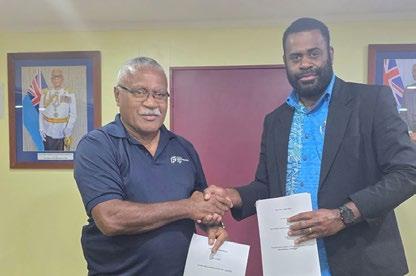
Sixty-nine employees of Government commercial company Food Processors Fiji Limited (FPFL) are now benefitting from a salary increment, and improved employment terms and conditions thanks to recently agreed bargaining agreements between the company and the National Union of Factory and Commercial Workers (NUF&CW).
The Masters Agreement was signed between the two parties on Wednesday at the company’s headoffice in Vatuwaqa, Suva.
Among agreed clauses in the agreement is the 3 per cent increment for wages staff, $6 increment for workers meal allowance, $0.50 cents increase in the WET allowance and 7 per cent increase in monetary allowances including offensive work allowance and height allowance.
According to the company, these increments came into effect on January 1 this year where they will pay wages above the national minimum wage rate, positioning the company as a preferred employer.
Union general secretary Sosiceni Bainivuwai said through their annual negotiations, the company engaged with the union to introduce improvements to employment terms and conditions as it progressed.
He said the decision to grant the increment was made to recognise the dedication, hard work, and loyalty of existing
employees who had consistently supported the company’s operations over many years. “Whatever we reflected in the agreement was what we had agreed to during an acquisition, basically pay rise and the working condition that we have agreed to and will need to improve,” Mr Bainivuwai said.
FPFL deputy chairperson Nacanieli Waka said they acknowledged their workforce was central to their success and sustainability, and the wage increment reflected the company’s appreciation for employees who continued to demonstrate commitment and reliability in their roles.
He said the normal processes were meeting with the workers where they tabled the claims based on their experiences and their cost of living, which was then tabled to the company’s management for negotiation and later resulted in the Master Agreement signed this week.
Chaudhry accuses EFL of exploiting fuel crisis
Fiji Labour Party has accused Energy Fiji Ltd (EFL) of using the global fuel crisis as an excuse to push for higher electricity charges – while threatening nationwide power rationing.
Party leader Mahendra Chaudhry said EFL had no justification for the proposed outages after receiving Government fuel subsidies under the recent $56million relief package aimed at stabilising the country’s power supply.
“EFL should stop holding the country to ransom by threatening power rationing while seeking a 11c surcharge on tariffs using the current global fuel crisis as a pretext,” Mr Chaudhry said.
The subsidy package included a 20 cent per litre rebate on industrial diesel and 12 cents per litre on heavy fuel oil.
Mr Chaudhry said EFL was not facing financial
difficulties, pointing out the company recorded a $7million profit last year despite repeatedly pushing for tariff increases.
“If the EFL board and management don’t have the skills and the ingenuity to handle complex situations, they must step down.”
He warned that power rationing would hurt businesses, reduce working hours and wages, and place further strain on the tourism industry and ordinary households.
Mr Chaudhry also claimed the 11 cent increase in electricity tariffs would worsen inflation and deepen the cost-of-living crisis.
According to the consumer council, the increase would add about $33 a month to the electricity bills of average-income families.
The Fiji Labour Party has called on Government to reject EFL’s proposed fuel surcharge.
EFL urges MSMEs to apply for fuel surcharge subsidy
Energy Fiji Limited is urging eligible Micro, Small and Medium Enterprises to complete subsidy registration forms following Government approval to absorb the interim electricity fuel surcharge for qualifying businesses and low-income households.
EFL Chief Executive Officer Fatiaki Gibson said the Government support measure followed the Fiji Competition and Consumer Commission’s approval of a 5.91 cents per kilowatt hour interim electricity fuel surcharge which came into effect on Tuesday.
Under the initiative, Government will fully cover the surcharge cost for subsidised domestic customers earning household incomes of $30,000 or below.
The subsidy has also been extended to eligible MSMEs with an annual gross turnover of less than $30,000.
“EFL advises all qualifying MSME customers to contact their nearest EFL Customer Services Centre to complete the required Micro, Small and Medium Enterprise Government Subsidy Registration Form,” Gibson said. He said completed applications must be supported by gross income verification using the most recent 2024 or 2025 Fiji Revenue and Customs Service return or assessment documents.
“EFL will work closely with the Ministry of Finance, FRCS, and relevant Government stakeholders to verify eligibility requirements and facilitate the implementation of the subsidy arrangement in an efficient and transparent manner,” he said.
According to EFL, the subsidy will only apply from the customer’s next billing cycle after successful approval and verification of the application.
The company is encouraging businesses to submit applications early to avoid delays in processing. Police
POLICE investigators are zeroing in on the military officers who were allegedly involved in the death of Jone Vakarisi last month.
Commissioner of Police Rusiate Tudravu said police have yet to charge the officers as they continue their investigations.
“Our teams are now at the camp and they have been there for the last few days,” said Mr Tudravu.
“Our investigations have gone on well and we are happy that the Commander has given their support towards the police investigations.
“I have not been briefed if anyone has been taken in for questioning but as of now their statements have been recorded and the investigation team is zeroing in to that area and
I will come to that with an update if we come to that line.”
He said military officers at the Nabua camp’s medical centre have also been questioned.
“As I have stated we are heading there and we are following up on the processes and procedures that need to be done well in terms of the investigation.”
Commissioner Tudravu added the Vakarisi investigations were conducted together with the alleged breach of two military armories.
“There are two teams that are covering that and all investigations are going on well.” Mr Vakarisi died in military custody in April after being detained for alleged national security breaches.
A retail businesswoman has invested $100,000 in her fourth shop located in the heart of Suva City.
Paradise Exclusives Fiji, which specialises in skincare products, jewellery, cosmetics, clothes and electrical appliances, already operates in Nausori, Namaka in Nadi, and Lautoka.
Business director Sharin Dutt said the high demand from customers had pushed her to expand her business. She said this new outlet has created five new job opportunities. She said this was one of their most awaited openings because of the growing customers in the Suva region.
“We have a lot of customers who are working in the city, and it was hard for them to visit the Nausori branch. Now they can come and buy things during their lunch hour as well and don’t have to travel too far and get stuck in the traffic,” Ms Dutt said. She said acquiring National Fire Authority (NFA) and occupational health and safety (OHS) certifications were some of the challenges she encountered that delayed the opening.
Ms Dutt had initially started her second clothing business in 2016 in Nausori, but was closed down because it was not doing well. “Despite the challenges I had in life, I did not give up.”
Businesswoman opens fourth retail outlet
SATURDAY, MAY 30, 2026
India rejects unwarranted references to J-K in China-Pakistan joint statement
India on Tuesday mounted a sharp diplomatic rebuttal to a joint statement issued by China and Pakistan, categorically rejecting references to Jammu and Kashmir and strongly opposing renewed Chinese backing for projects under the "so-called" China-Pakistan Economic Corridor (CPEC) in Pakistan-occupied territories.
The Ministry of External Affairs (MEA) said the union territories of Jammu and Kashmir and Ladakh “have been, are and will always remain integral and inalienable parts of India”, asserting that no other country had the “locus standi” to comment on the matter. The strong response came after Beijing and Islamabad, in a joint statement issued during Pakistan Prime Minister Shehbaz Sharif’s visit to China, reiterated support for deeper cooperation under CPEC and referred to the Kashmir issue while calling for enhanced “trans-boundary water resources cooperation”.
Reacting to the development, MEA
spokesperson Randhir Jaiswal said India “categorically rejects unwarranted references” to Jammu and Kashmir in the China-Pakistan statement. India also reiterated its longstanding objection to CPEC projects passing through PoK, saying such initiatives violated India’s sovereignty and territorial integrity. “As regards the so-called China-Pakistan Economic Corridor (CPEC) projects, some of which are in India’s sovereign territory, we resolutely oppose and reject any moves by other countries to reinforce or legitimise Pakistan’s illegal and forcible occupation of these territories,” Jaiswal said.
The latest exchange comes amid renewed efforts by Beijing and Islamabad to accelerate work on what they described as “high-quality development” of CPEC 2.0, including infrastructure upgrades, industrial cooperation and expanded regional connectivity projects linked to Gwadar port and the Belt and Road Initiative.
NHRC recommends probe against 17 lawmakers from Balen's party
National Human Rights Commission (NHRC) has recommended that the government investigate 17 sitting lawmakers from Prime Minister Balendra Shah's party over violence during the Gen-Z movement.
The NHRC, in its report made public on Wednesday, named Rabi Lamichhane, Sudhan Gurung, Ganesh Karki, Sulabh Kharel, Hari Dhakal, Bablu Gupta, Toshima Karki, Rajiv Khatri, KP Khanal, Deepak Bohara, Manish Jha, Jwala Sangroula, Purushottam Yadav, Ashika Tamang, Shiva Yadav and Amit Khanal as people to be investigated for violence during the September uprising. Lamichhane is the President of Balen's
Rastriya Swatantra Party (RSP), which gained a super-majority in the election held six months after the Gen-Z movement of September last year.
The human rights body states there are grounds for a "micro-level investigation" into their roles before, during and after the protests, based on their public statements, social media activity, media reports and information collected by the National Investigation Department.
According to the report, the investigation should determine whether their statements or actions contributed to public anger or agitation, affected public peace and order, or constituted any form of incitement.
SOUTH ASIA
Armed men kill five after opening fire on locals in Pakistan's Harnai district
At least five people were killed and three others injured after unidentified armed men opened indiscriminate fire on a group of locals in the Shahrag area of Balochistan's Harnai district, Ary News reported, citing local police.
According to police, the armed assailants had set up a picket near Sheikh Musa Baba Chowk and were checking the Computerised National Identity Cards (CNICs) of passersby.
According to Ary News, the police said an altercation broke out when some locals resisted the checking, following which the unidentified gunmen opened fire on the crowd.
Four people died on the spot, while another critically injured victim succumbed to injuries while being shifted to Quetta for medical treatment.
The deceased have been identified as Zaman Shah, Zia-ul-Haq, Abdul Qahir, Jamiat Ulemae-Islam (JUI) leader Maulvi Zahid Shah, and Ikramullah Shah. The injured were identified as Nasir Shah, Mullah Samad, and Saqib Shah.
The bodies and injured were shifted to Shahrag Hospital, where the wounded were provided initial medical treatment before being referred to Quetta for further care, Ary News reported.
Earlier, a newlywed couple was brutally gunned down in Karachi on Monday. The deadly ambush occurred moments after they exited a local courtroom to validate their marriage, Dawn reported.
The victims were returning from their legal proceedings when armed attackers pursuing their vehicle intercepted them. The suspects unleashed a volley of bullets in the Saudabad locality near the RCD playground, according to Korangi Senior Superintendent of Police (SSP) Fida Hussain Janwari. Prior to the targeted execution, the bride's relatives had approached
law enforcement to register a missing person's case. Dawn reported that the woman's family had lodged a complaint at Sachal Police Station over her disappearance.
Defying her family's orthodox pressures, the woman had actively defended her marital choice before judicial authorities. She recorded a statement before the Malir court that she had married of her own free will. The couple had also
submitted their Nikahnama in court to prove their union was legal.
The brazen daylight assault left no room for survival. "The couple suffered critical injuries and died on the spot," the senior police official confirmed regarding the immediate aftermath of the shooting.
A preliminary investigation has laid bare the direct involvement of the woman's immediate household in orchestrating the killings. SSP Janwari added that the suspected assailants had been identified as the woman's relatives, and concerted efforts were underway to arrest them. The deceased originally belonged to Sindh's Dadu district. They had relocated to the volatile urban sprawl of Karachi, specifically residing in the Sachal Goth neighbourhood, in a desperate bid to build a life together.
Kapurthala 'Maharaja' property dispute: SC says private properties to devolve on heirs and successors as per
Hindu Succession Law
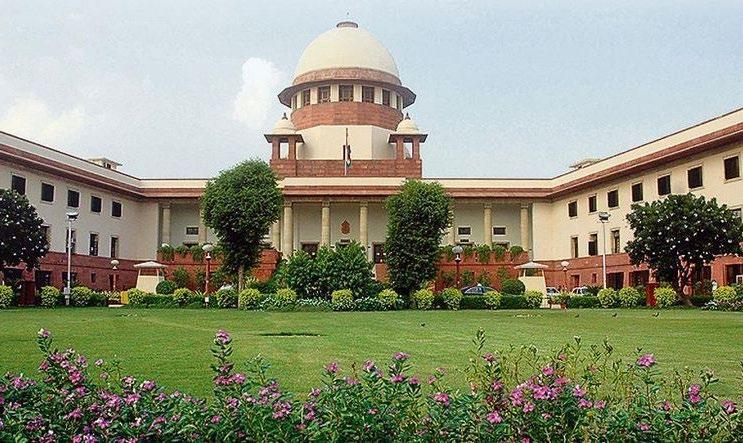
The personal private properties of a titular ruler would devolve on his successors in accordance with the Hindu or Muslim personal law, instead of the customary law of primogeniture, under which the eldest male lineal descendant inherited all properties, the Supreme Court ruled on Wednesday.
While dealing with a civil dispute between Brigadier Sukhjit Singh, the governmentrecognised titular 'Maharaja' of Kapurthala, and his estranged wife Gita Devi and their children, a Bench of Justice Pankaj Mithal and Justice SVN Bhatti said though the rule of primogeniture could apply to the symbolic throne (gaddi) and titles, it did not extend to personal private properties declared during the merger of princely states.
Singh claimed that as the eldest male lineal descendant, he was the sole owner of all family properties under customary law and that the Hindu Succession Act did not apply to his ‘impartible estate’.
as the personal private properties of the Maharaja, only the perceived throne devolved according to the rule of primogeniture, but not the personal private properties of the ruler.
"Following the lapse of British paramountcy and the signing of the agreement of merger, the Maharaja assumed the status of the ruler only for the namesake to succeed to the gaddi and to enjoy certain privileges attached to it," it said.
The Bench clarified that the personal private properties declared by the ruler would devolve upon his successors in accordance with the Muslim/Hindu personal law, or in the present case, in accordance with the Hindu Succession Act and not by the rule of primogeniture.
Of the disputed four immovable properties, three are in the joint names of the family members, and hence liable to division between the joint holders, the top court said.
“In light of the joint statement made by the counsel for the parties and the admissions in the written statement of the Brigadier, all the above three properties held in joint names are open for division, at least between the joint owners. Therefore, the Brigadier cannot deny partition with respect to these assets,” the top court said.
The top court said that upon signing the merger covenant by princely states, the then ruler ceased to be an absolute sovereign and assumed the status of an ordinary citizen of India.
"The recognition of the Maharaja as the Ruler by the President under Article 366 (22) of the Constitution was a political or an executive act for ceremonial purposes entitling the Maharaja to receive privy purse and other connected privileges, but it was not an indicium of ownership of property," the top court said. It said that there was a general presumption in the country that the estate of the ruler and monarch of a princely state, according to custom, stands governed by the rule of male lineal primogeniture.
The tp court said that after signing the merger agreement and notification of certain properties
"Lastly, the only immovable property which remains is the property at Mussoorie, ie, Kapurthala Chateau and St Helens, Mussoorie, would devolve upon the successors under Hindu Law and are divisible amongst the family members,” the Bench said, spelling out how the properties of the erstwhile ruler would devolve on his heirs and successors.
“All other properties which are immovable in nature have not been declared to be the private properties and would not devolve upon the family members,” it said.
“Insofar as jewellery lying in Sociétés Générale, Boulevard Haussmann, Paris, France, and the shares in joint stock companies lying in the safe custody with the First National City Bank, Fort, Bombay, they are not the properties that have been declared to be the private personal properties of the ruler. Therefore, these properties would not devolve upon the family members under Hindu Law,” the court ordered.
Punjab clears four private digital open universities; one approved, another three in pipeline
At least four private digital open universities are setting up base in Punjab. The Empowered Committee of Higher Education, Punjab, has already cleared the project of PhysicsWallah, an education company, to set up a digital university on a three-acre site in Patiala.
A senior government functionary said three more proposals are in the pipeline. These include MS University, Patiala; a cloud university in Hoshiarpur; and Amity University, Mohali. After approval by Empowered Committee, legislation for each university will be sent for approval in the upcoming session of the Punjab Vidhan Sabha.
The digital universities will have physical campuses, but these will serve as administrative headquarters only. No classes will be held on campus.
broad objective of a private digital open university is “to provide teaching and training in higher education through digital, online, distance, or open modes and to make provisions for research and innovation through technology-enabled systems”.
To open doors for private players in digital education, Punjab Higher Education Department framed the “Punjab Private Digital Open Universities Policy 2026” in January this year. The policy enables students to complete degree courses from home via online education. Punjab claims to be the first state in India to introduce a policy allowing end-to-end digital full-degree and diploma programmes.
The initiative allows private institutions to set up fully digital universities in the state, using modern tools such as AI-enabled learning pathways, AI-proctored examination systems, and virtual laboratories to meet the evolving needs of students and professionals. While Tripura set up a digital university earlier, it did so without a formal, comprehensive policy. Punjab’s policy will regulate and promote private digital open universities offering online and open distance learning (ODL) programmes. It aligns with established global digital-first institutions.
A senior government functionary said the
What will be taught at the digital open universities
The universities will offer undergraduate, postgraduate, and professional programmes through online classes, digital assessments, and other technology-enabled tools, using the internet to bridge the gap between teacher and learner. Regulations for digital universities
As part of the regulatory policy, interested private players must have at least five years of credible experience in online learning, maintain a corpus fund of at least Rs 20 crore, and submit a processing fee of Rs 5 lakh to Punjab’s Department of Higher Education with the application. Once approval is received, another Rs 20 lakh must be paid to the government.
To safeguard the interests of Punjab residents, the government has stated that at least 15 per cent of seats in each university will be reserved for Punjab domiciles. The state government may impose penalties of up to Rs 25 lakh if any UGC or other norms are violated by private players. Fatehgarh Sahib celebrates Lt Gen Harjeet Singh Sahi’s new military appointment
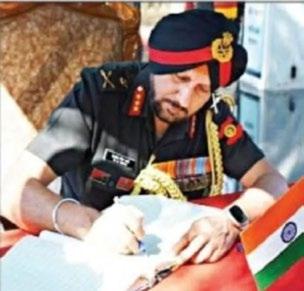
Lt Gen Harjeet Singh Sahi has taken over as the Chief of Staff of the Western Command at Chandimandir Military Station, bringing immense pride to his native district and Punjab.
A native of Nabipur village (Sadhugarh), Lt Gen Sahi is a highly decorated officer. For his distinguished service, he has been awarded the Param Vishisht Seva Medal (PVSM), Uttam Yudh Seva Medal (UYSM), Ati Vishisht Seva Medal (AVSM), Yudh Seva Medal (YSM), and Sena Medal (SM).
An alumnus of Punjab Public School, Nabha, and the Indian Military Academy, he was commissioned into the 23rd Battalion of the Rajput Regiment in December 1988. He currently
holds the prestigious appointment of Colonel of the Rajput Regiment. Residents of Nabipur celebrated the milestone by distributing sweets. Expressing the family’s joy, his elder brother, Surjit Singh Sahi — a prominent businessman and President of the Press Club, Fatehgarh Sahib — said, “This is a proud moment not just for our family, district and state, but for the entire nation. His achievement will undoubtedly inspire the local youth to serve the country with dedication and commitment.” Congratulatory messages have been pouring in from across the district, with locals hailing his elevation as a matter of immense pride for the region.
Very positive outcomes during Delhi Quad Foreign Ministers' meeting: Former diplomat Sajjanhar
There have been very positive movements in the Quad Foreign Ministers' meeting hosted by India including on marine surveillance, former senior diplomat Ashok Sajjanhar has said and noted that the focus of the four-nation grouping will be also be on the Indian Ocean apart from West Pacific.
In an interview with ANI, Ashok Sajjanhar, said that the United States had not got expected results from President Donald Trump's China visit and that could be a reason for revived interest in Quad grouping. Quad Foreign Ministers' meeting was held on Tuesday.
"As the MEA stated in its briefing yesterday, there have been 11 meetings since the Quad was established in 2017. Over the past nine years, eight meetings were held, and in the last one and a half years, there have been three meetings. I think that's a good record...there have been numerous reports that as far as Quad is concerned, it has lost its
dynamism because the US has not been keen to take it forward, not invested much political capital in it," he said.
"Mr Trump in his first term, he had characterized China as a systemic rival during his first term...but right now, he seems to be looking at China only as an economic competitor and so there has been some sort of winding down as far as focus on taking Quad forward is concerned. The fact that Quad was revived in November 2017 during first presidency of Mr Trump, it was basically to push back against aggressive stance of China particularly in South China Sea but also elsewhere," he added.
Sajjanhar, a former ambassador of India to Kazakhstan Sweden and Latvia, said if Trump's assessment of China is becoming different that would also have an impact on how US wants to take part in Quad. "The fact that MrTrump has
just been to China, and he had several asks. He wanted China to pressure Iran to open the Strait of Hormuz, ensuring that Iran does not go in for a nuclear weapon etc or exporting more of technology to China. He had taken huge number of CEOs of all major US technology firms. None of that has helped. In fact, China did not come forward in providing any solace to Mr Trump," he said.
"On the other hand, Chinese President Xi mentioned only about the Thucydides trap, saying
we should not be fighting each other and the US should not take a very strong stand on Taiwan. These were the only two messages he gave. So maybe the interest of the US in the Quad might have got revived," he added.
He said there have been "very positive movements, not only in marine domain awareness, but also in marine surveillance" and also lauded the decision of Quad countries working in coordination with the Government of Fiji, to advance port infrastructure and associated activities in the country.
"Earlier the focus used to be on West Pacific. Now the focus is also going to be on Indian ocean. India, of course, occupies a very important position as far that is concerned. There has been some positive moves and greater trust, greater confidence that US is goving to stand fully behind the Quad forum," he said.
Air India trims operations by 22%, IndiGo 7% amid
costlier fuel, low demand
India’s top airlines have decided to reduce their domestic operations from June 1 for a period of three months due to the sharp rise in aviation turbine fuel (ATF) costs following the outbreak of the US-Iran war. Air India has temporarily reduced 22 per cent of its domestic flights as it grapples with the impact of soaring fuel prices, while IndiGo too has announced reduction in operations by 5-7 per cent.
ATF accounts for nearly 40 per cent of an airline’s operating expenses. The decision comes two weeks after Tata Groupowned Air India announced a 27 per cent reduction in its international operations due to airspace restrictions and higher jet fuel prices, which have sharply increased operating costs for global airlines.
on routes, including Delhi-Chicago, DelhiNewark, Mumbai-New York, Delhi-Shanghai, Chennai-Singapore, Mumbai-Dhaka and DelhiMale till August. According to data issued by Singapore Airlines Group in its annual financial report for 2025-26 released on May 14, Air India’s loss for the financial year ending March 2026 stood at more than SGD 3.56 billion (over Rs 26,700 crore).
IndiGo, meanwhile, said it would reduce 5-7 per cent of its domestic operations. An airline source
Air India currently operates over 4,400 flights every week, including around 3,600 domestic and 800 international services.
“In continuation of our previously announced adjustments to select international services between June and August 2026, we have temporarily rationalised operations on certain domestic routes during the same period, with a reduction in frequencies on select routes,” Air India said in a statement.
“Air India will continue to monitor demand and operating conditions closely, with a view to restoring frequencies as conditions stabilise,” the statement added.
The airline will temporarily suspend operations
said occupancy levels were usually lower in the months following school holidays and the airline would cut operations from June 1 in anticipation of weaker demand.
Given that IndiGo operates nearly 1,950 flights daily, even a small percentage reduction would result in a substantial number of cancellations, the source added.
The aviation industry has also been impacted by recent changes in state-level jet fuel taxes. Delhi has reduced VAT on ATF from 25 per cent to 7 per cent for six months, while Maharashtra has announced a temporary reduction to 7 per cent till November.
Indian minister Piyush Goyal pays tribute to Air India bombing victims in Canada
Continued from Page 1...
Speaking with ANI, the sister of one of the victims said, "It is very important that the Minister is here in remembrance. Of all the people who were just taken away, so sadly, so suddenly, I am glad they are remembered. I really appreciate the Minister coming and paying respect."
Executive Director of the Air India Victims' Families Association, Deepak Khandelwal, also appreciated the Minister's decision to show respect to the victims. "It's great that the Minister came here today to lay a wreath in memory of the innocent people who were murdered 41 years ago. It's good that he's coming to show respect, and the family members are here with him," he said.
Goyal is in Canada for a three-day official visit from May 25-27, taking place as New Delhi and Ottawa aggressively push ahead with negotiations for the proposed Comprehensive Economic
Partnership Agreement (CEPA), viewed as a vital step in rejuvenating economic relations between the two nations.
During his visit, he met Canada's Prime Minister, Mark Carney; Foreign Minister, Anita Anand; Minister of Agriculture and Agri-Food, Heath MacDonald and Minister of International Trade, Maninder Sidhu, among others.
He also met prominent Canadian industry leaders during his three-day visit to Canada to discuss investment avenues and expand bilateral economic partnerships.
The high-level interactions focused heavily on enhancing collaborations in financial services, infrastructure, sustainable agriculture, and critical minerals processing.
He noted during his meetings how the talks between them emphasised the importance of trade, investment and tech linkages for the strategic partnership between the two countries.
An
Indian bride dies. Rival claims of murder and suicide set off media frenzy
In India, where thousands of young women are murdered every year for bringing in insufficient dowries, a dowry death rarely makes news.
But the death of Twisha Sharma in the central city of Bhopal on 12 May has sparked a huge media frenzy, with the case making headlines every day.
The 33-year-old model and actor had been married for just five months to lawyer Samarth Singh when she was found dead in her matrimonial home.
Twisha's parents and siblings have alleged that she was tortured by Singh and his mother - retired judge Giribala Singh - over dowry demands and that she was murdered.
Giribala Singh has called the accusations "baseless" and alleged that Twisha had mental health issues and that she killed herself.
surrender by 23 May.
Giribala Singh has said she doesn't know where her son is, but added that he will seek bail in the high court and will surrender if it's rejected.
"Our lawyer advised him to stay away. He told him you'll be lynched if you came out. There's a tirade against him, people are calling for his hanging," she told video platform Mojo Story.
Police official Rajnish Kashyap Kaul told BBC Hindi that they have lodged a case of dowry death against the Singhs and are investigating whether Twisha's death was murder or suicide.
Police say they are also trying to find Samarth who is absconding - a cash reward has been announced for any information on him and a lookout notice has been issued to ensure he does not leave the country. A court in Bhopal has given anticipatory bail to Giribala Singh but rejected Samarth's bail application. He's been asked to
Modern
"You must remember that my son has lost a deeply loved one, he's lost his companion in life. And we can't even grieve… Everyone is against us," she said.
Twisha's family, meanwhile, have refused to cremate her body and sought a second post-mortem - the first autopsy report, which the BBC has seen, said she died by hanging, but it also spoke of injuries sustained before her death. On Friday, the high court accepted their request.
With Samarth still absconding, Twisha's family making grave allegations against the Singhs and the former judge giving interviews about the deceased's alleged mental health issues, there has been relentless media coverage of the case. A "justice for Twisha Sharma" page has come up on Instagram and has found its way into the media coverage.
world can’t run on 1945 power structure, India tells
India mounted a forceful case for urgent reform of the United Nations Security Council (UNSC), warning that the world body’s credibility and effectiveness were being eroded by an “archaic” structure frozen in the realities of the 1940s, even as it launched a sharp counterattack on Pakistan over cross-border terrorism.
Addressing the UN Security Council Open Debate on “Upholding the Purposes and Principles of the UN Charter and Strengthening the UN-centered International System”, India’s Permanent Representative to the UN, Ambassador Parvathaneni Harish, said the UN was facing growing questions over its legitimacy, efficacy and relevance amid rising geopolitical fragmentation and confrontation.
“The UN Security Council must be a living instrument, not a fossil,” Harish said, calling for expansion of the permanent membership category to reflect contemporary geopolitical realities and alter the Council’s decision-making structure.
UN
Drawing a historical parallel, the Indian envoy said running today’s global governance architecture on a 1945-era framework was “akin to running advanced AI technologies on the 1945 version of the computer called the Electronic Numerical Integrator.”
Harish noted that despite a mandated review conference under the UN Charter in 1955, no comprehensive reform had ever taken place except limited expansion in the number of elected UNSC members and ECOSOC seats decades ago. He argued that sacrifices made during World War II alone could not justify preserving an outdated power structure indefinitely.
Recalling India’s role during the Second World War, Harish said over 2.5 million Indian soldiers had fought alongside Allied forces and more than 87,000 had laid down their lives.
“This was not our war, but we paid dearly for it,” he said, adding that India’s participation as a founding member of the UN reflected its enduring commitment to peace and multilateralism despite colonial-era injustices. Harish asserted that India had every right to defend itself against terrorism and warned that Pakistan “will have to accept that there are consequences to its sponsorship of crossborder terrorism.”
India also accused Pakistan of harnessing “terrorism, religious extremism and violent radicalism” since its creation and called on Islamabad to end support for all forms of terrorism in a “credible and irrevocable” manner.
Over 60% manpower boost for ED
The Centre on Wednesday sanctioned a significant manpower boost for the Enforcement Directorate (ED), authorising more than 1,200 additional investigators and staff for the antimoney laundering agency.
According to sources, the Finance Ministry approved the much-awaited cadre restructuring of the agency after 15 years, enhancing its workforce by more than 60 per cent — from 2,029 to 3,256. The ministry revised the ED’s strength by 1,227
Frustrated Indian youth flock to a political party led by a cockroach
It began as a satirical online project. Now millions of young Indians are flocking to it as an outlet for their frustration.
A parody political party called the Cockroach Janta Party, with the insect as its symbol, has exploded across India’s social media by turning absurdist humor into protest. Memes and short videos mocking corruption, joblessness and political dysfunction have flooded social media sites, where millions of users are embracing the cockroach — known for its ability to survive harsh conditions — as a tongue-in-cheek symbol of endurance.
The online movement’s rise has been unusually rapid. The Cockroach Janta Party, or CJP, set up its website and social media accounts on Saturday. By Thursday, its Instagram page had amassed more than 15 million followers, far surpassing the 8.8 million followers of Prime Minister Narendra Modi’s governing Bharatiya Janata Party on the platform.
“Nothing of this was intentional,” CJP founder Abhijeet Dipke told The Associated Press, saying the movement’s rise reflected mounting frustration among young Indians.
“It is the younger people who were actually very frustrated. They didn’t have any outlet. They were really angry at the government,” said Dipke, a political communications strategist and Boston University student. The CJP emerged online after remarks by Supreme Court Chief Justice Surya Kant triggered backlash among young Indians angered by unemployment, rising living costs and recent government exam paper leaks that have disrupted job recruitment drives.
During a hearing last week, Kant criticized what he described as “parasites” attacking institutions and compared some unemployed young people and activists to cockroaches.
“There are youngsters like cockroaches, who don’t get any employment or have any place in the profession,” Kant said. He said that some turned to social media activism, journalism or public interest campaigns and “start attacking everyone.”
personnel across its six cadres, which include the executive, legal and adjudication verticals that form the core of its investigation setup, officials said.
Of this total, 803 additional officials have been added to the rank of Assistant Enforcement Officer, 606 to Enforcement Officer and 531 to Assistant Director of Enforcement.
The agency’s last cadre restructuring was undertaken in 2011.
The comments quickly spread online, where many users saw them as dismissive. Kant later clarified that his remarks referred to people obtaining fraudulent degrees and said that he didn’t intend to insult India’s youth.
But the controversy soon led to the creation of the parody CJP account on Instagram, which adopted the cockroach as its political symbol and began posting memes, mock campaign slogans and satirical commentary targeting Modi’s government.
Within days, it drew tens of thousands of online volunteers through a Google form submission, alongside endorsements from some opposition leaders.
“We have to understand that five years ago nobody was ready to speak up against Modi or the government. The times are changing,” said Dipke, who has previously worked with the Aam Aadmi Party, which emerged from India’s anti-corruption movement in 2012.