U.S.-bound flight from Paris diverted to Montreal over Ebola restrictions
An Air France flight from Paris to Detroit was diverted to Montreal Wednesday afternoon after United States authorities barred it from entering the U.S., citing new restrictions for people who who have recently travelled to three East Africa countries, where a deadly Ebola outbreak has taken hold.
A passenger disembarked at Pierre Elliot Trudeau International Airport, was assessed by a quarantine officer, and flew back to Paris, said Mark Johnson, a spokesperson for the Public Health Agency of Canada, in a statement.
Health officials determined the passenger was asymptomatic, Johnson added. The U.S.-bound plane then continued on to Detroit. Continued on Page 4...
The 2026 World Cup is a fiscal disaster for Canada
The 2026 World Cup was sold to Canadians as a manageable public expense with major economic benefits. Instead, Toronto and Vancouver are now staring at more than $1 billion in combined costs, while taxpayers are once again being told the overruns are worth
it. When Toronto’s city council originally considered a World Cup bid back in 2018, they were told it would cost no more than $45 million. That figure is now $380 million. Vancouver’s story is no different. Despite an original price tag of $240 million, it’s now expected to cost $624 million.
None of this should surprise anyone, least of all the politicians who signed off on it. Governments consistently understate costs and overstate benefits. From roads to recreation centres, international sporting events are no different.
Initial estimates are kept low to make projects politically palatable.
Continued on Page 10...
US prosecutors drop fraud charges against Indian billionaire Gautam Adani Indian origin Aaron Rai wins Golf's top prize
He’d just finished off a 1-foot putt that secured the biggest win of his professional life, having emerged from a peloton of heavyweights and left them in the dust thanks to a highlight-reel back nine that sent roars bouncing around Aronimink Golf Club. But the moment the job was finished, his first major championship secured, Rai seemed suddenly lost. He didn’t fist pump or wave. Instead he sort of wobbled in one direction, then another, and then, as the Philadelphia faithful cheered his win, Rai did what felt most natural.
He turned to his playing partner, took off his cap and offered his hand.
“He’s just so polite,” said Ludvig Aberg a few minutes later, chuckling at the moment.
Continued on Page 10...
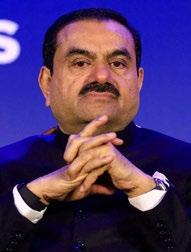
US prosecutors asked a judge on Monday to dismiss criminal fraud and conspiracy charges against Indian billionaire Gautam Adani, who had been accused of duping investors in a major solar project in India.
Adani, one of the world’s richest people, was accused in 2024 of paying massive bribes to ensure the project’s success. He was charged with conspiracy, securities fraud and wire fraud charges in connection with a
lucrative arrangement for Adani Green Energy and another firm to sell 12 gigawatts of solar power to the Indian government to light millions of homes and businesses. “The Department of Justice has reviewed this case and has decided, in its prosecutorial discretion, not to devote further resources to these criminal charges against individual defendants,” prosecutors wrote in a court filing.
Continued on Page 10...
"We were flabbergasted at how expensive the tickets are and how much people are seemingly paying for them," he said in an interview.
All four men in his group entered the FIFA selection draws, but he said when they were given the opportunity to buy about a month ago, the prices were "crazy."
Continued on Page 7...
Chris Van Brockhoven booked his trip to Vancouver last summer in the hopes of
attending a World Cup match, but after learning the cost of admission, his group felt forced to pivot.
Aaron Rai with his wife Gaurika
CRTC
The Canadian Radio-television and Telecommunications Commission (CRTC) issued a new decision requiring digital streaming giants to pay three times as much of their Canadian revenue to domestic content as before, as the United States continues to mark the Online Streaming Act as a trade irritant.
Digital streaming giants, including American companies like Netflix or Disney, were previously required to contribute five per cent. No money has been collected yet, however, as a number of streaming companies are fighting the decision in court. Thursday’s decision by the CRTC sees that five per cent jump to 15 per cent.
The Online Streaming Act was the first major reform of the Broadcasting Act, and has been repeatedly noted as a trade irritant by the Trump
administration. A Republican congressman introduced a bill looking to investigate whether it discriminates against or burdens American commerce in March.
“We’re not involved in trade negotiations… we are not in touch with the government about the status of trade negotiations. We’re applying Canadian law in Canada,” said Scott Shortliffe, CRTC vicepresident of broadcasting.
“We believe that (the new requirements) will be respected by these companies, whether they choose to challenge them through any of the measures that are available in Canadian law, is of course totally up to them.” Nearly a year ago, the Carney government cancelled the also contentious Digital Services Tax the day before the first payment from tech giants was due, after U.S. President Donald
Trump announced he was ending trade talks with Canada because of it and threatened new tariffs. Thursday’s move by the CRTC is part of a massive modernization of the Broadcasting Act and aims to build a $2-billion fund that supports Canadian and Indigenous content. The framework comes three years after the introduction of the Online Streaming Act.
The CRTC is also creating a new fund “to support services of exceptional importance,” which it defines as channels such as the Canadian Public Affairs Channel and The Weather Network that serve Canadians.
The spending requirements only apply to traditional and online broadcasters with revenues above $25 million, with an aim to reduce red tape and administrative burdens, according to the CRTC. The requirements also do not apply to music streaming services like Spotify.
There are several rules around how to spend the money. “We’re saying that we will work with each group, whether it is a domestic broadcast group or a streaming group, to say, how can you best fulfill these general principles, and that will be forthcoming.”
A 40-year-old Quebec man from Lévis has been arrested as part of a national security investigation by the RCMP.
Mohamed Ali Ben Chaoua was taken into custody Thursday morning by the RCMP’s Federal Policing Eastern Region. Investigators said they had reasonable grounds to fear he may commit terrorism offences.
The RCMP say the suspect was not previously on their radar, and that the investigation was sparked by a tip from the public, launching a yearlong national security probe.
Authorities say the investigation began in March 2025 following an online tip to the RCMP’s National Security Information Network.
Officers say they arrested him at his home and searched the residence and seized electronic devices.
Police allege he made numerous posts on TikTok expressing support for the Islamic State and that he operated multiple TikTok accounts used to promote extremist material.
Officers are seeking a terrorism peace bond
under Section 810.011 of the Criminal Code, which would allow authorities to impose monitoring conditions and other tools aimed at preventing potential offences.
The peace bond would give investigators broader authority to monitor Ben Chaoua and ensure any alleged illegal activity stops, police say.
The investigation remains ongoing, and police say further charges could be laid.
Ben Chaoua is scheduled to appear Friday at the Québec City courthouse.
Police say he was not previously known to them and had no criminal record prior to this investigation.
Experts warn the broader threat remains. Former CSIS analyst Phil Gurski says ISIS continues to be an active global organization and is using ongoing wars, including in Gaza and Iran, to attract new recruits.
The RCMP says countering religiously motivated violent extremism remains a top priority and is urging the public to report suspicious activity.
Should Canada consider travel bans like U.S. is doing amid Ebola outbreak?
After U.S. travel restrictions stemming from the Ebola outbreak forced a commercial flight to divert to Montreal while carrying a passenger from one of the countries facing those new rules, Canadians may be wondering whether Canada should impose its own travel restrictions.
The World Health Organization (WHO) declared the Ebola disease outbreak caused by a rare virus in Congo and Uganda a public health emergency of international concern on Sunday, with at least 139 suspected deaths and more than 600 suspected cases.
Tedros Adhanom Ghebreyesus, directorgeneral of the World Health Organization, said on Wednesday that “we expect those numbers to keep increasing.”
The U.S. Centers for Disease Control (CDC) and Prevention and the Department of Homeland Security imposed a U.S. entry ban on foreign travelers who have been in Congo, Uganda, or South Sudan in the past 21 days “effective immediately.”
“At this time, CDC assesses the immediate risk to the general U.S. public as low, but we will continue to evaluate the evolving situation and may adjust public health measures as additional information becomes available,” a statement from the CDC reads.
Currently, the Canadian government advises Canadians to avoid all travel to Ituri and North Kivu provinces, citing safety and security concerns.
However, the government has issued a level two travel notice for Congo, which is set to indicate
“an increased risk to travellers or certain groups of travellers (for example, pregnant women, campers, people visiting friends and relatives) and reminds them to practice enhanced health precautions.”
There is currently no travel notices surrounding South Sudan and Uganda in relation to Ebola outbreaks.
The notice advises Canadians to “practice enhanced health precautions” such as:
- The use of personal protective equipment
- Delaying travel until risk is lower
- Additional recommended vaccinations for some groups
- Avoiding higher-risk activities
Global News reached out to infectious disease experts to ask whether travel bans can be effective and whether Canada should follow suit.
Dr. Gerald Evans, a professor of medicine and infectious diseases at Queen’s University, believes that Canadian travel restrictions are not necessary.
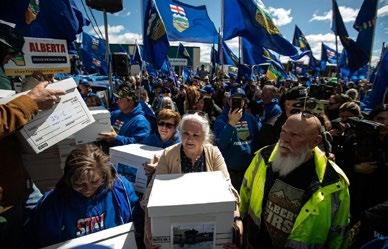
Should we stay or go? Albertans to vote on separatism in referendum
Albertans will go to the polls this fall to answer a series of referendum questions, including whether or not to vote — at a future date — to leave Canada.
Premier Danielle Smith, in a paid televised speech Thursday night, said the province will be adding a question to the Oct. 19 referendum she announced the last time she took to the airwaves back in February.
The additional question will be: “Should Alberta remain a province of Canada or should the government of Alberta commence the legal process required under the Canadian constitution to hold a binding provincial referendum on whether or
not Alberta should separate from Canada?”
But why hold a vote on a future vote?
The added question addition comes after Smith said she disagreed with the ruling of a Court of King’s Bench judge who quashed a separatist petition last week, saying the provincial government had a duty to consult with First Nations before Stay Free Alberta was allowed to gather signatures.
“Because this proposed referendum question does not directly trigger separation, but if successful would ask Alberta’s government to commence the legal process necessary to hold a binding referendum on the matter, the recent court
ruling would not be applicable and the referendum question I outlined could proceed,” Smith said.
Smith rejected the judge’s decision as incorrect in law and anti-democratic, pledging the province would appeal it — something she said during her televised speech could take months or years if it goes all the way up to the Supreme Court of Canada.
Until then, the ruling is binding law.
So, the new question is a workaround — but only the beginning of the process.
Smith said it ensures the 700,000 people who signed either the Forever Canada petition to stay in the country or the Stay Free Alberta petition to leave are respected.
“Kicking the can down the road only prolongs a very emotional and important debate and muzzling the voices of hundreds of thousands of Albertans wanting to be heard is unjustifiable in a free and democratic society.
Smith also used her 15-minute televised address to reiterate her party’s longstanding grievances with the federal government and what she said is Ottawa’s interference in areas of provincial jurisdiction.
She called on other provincial leaders and MPs to help “undo the extensive damage that centralization of power in Ottawa has done to our country economically and with respect to national unity.”
“I am fiercely loyal to both Alberta and Canada,” Smith said.
“But I truly believe our country is so much stronger and more prosperous when we respect the rights of provinces and empower them to govern themselves with minimal federal interference.”
Smith acknowledged the relationship has improved since Mark Carney was elected prime minister last year.
Canadians still shunning U.S. travel according to new StatCan data
Canadians’ boycott of U.S. travel still appears to be strong. Canadian residents made fewer trips to the United States in March, new Statistics Canada data suggests, marking the 15th straight month of year-over-year declines. Canadian residents returned from 2.6 million trips to the U.S. in March, a 6.4 per cent dip from the same month last year, according to a StatCan report published Thursday. Return trips from the U.S. by air fell 10.8 per cent to 934,100 in the same period.
Meanwhile, return trips by automobile from the U.S. declined 3.3 per cent to 1.6 million. Most of these trips, or 63.7 per cent, were same-day travel.
The downward trend in the number of Canadians returning from visits south of the border has been occurring since early 2025 amid
political tensions, according to StatCan.
Many Canadians have supported the “Buy Canadian” movement and boycotted U.S. travel in protest of the Trump administration’s tariffs and 51st state rhetoric.
The decline in the number of Canadian return trips from the U.S. was even steeper at 28 per cent, when comparing the data from March 2026 with March 2024. Over that time, automobile trips fell by 33.7 per cent and trips by air were down 15.3 per cent. Some Canadians may not be visiting the U.S. for another reason, said Martin Firestone, president of Travel Secure Inc., a travel insurance brokerage in Toronto. He said his clients are mainly snowbirds who own or rent accommodation, and regularly visit the warmer parts of the U.S.
Advocacy groups calling on RCMP to release more information on guns used in Tumbler Ridge mass shooting
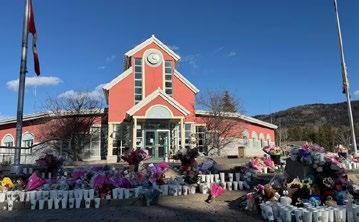
Gun control advocacy groups renewed their calls this week for the RCMP to release more information about the firearms used in February's mass killing in Tumbler Ridge, B.C., in which eight people were killed and two more were sent to hospital.
PolySeSouvient and Danforth Families for Safe Communities say it's been 100 days since the tragedy and important questions remain unanswered, including the types of guns used and how the shooter obtained them.
Ken Price, a spokesperson with Danforth for Safe Communities, said police have been slow to offer facts publicly, with unverified information about the shooting still circulating on social media.
"My biggest fear is that a lot of this stuff gets filled in," he said. "If you don't have authorities speaking quickly and factually about what they've discovered, people draw their own conclusions."
Both groups say the lack of information by police is leaving the public in the dark and prevents an informed debate about Canada's gun control laws and enforcement.
Heidi Rathjen is a coordinator for PolySeSouvient and was a student at l'Ecole Polytechnique during the 1989 massacre in Montreal.
She says basic information about what happened in Tumbler Ridge should be disclosed by RCMP, including why guns were returned to the family's
home with an individual experiencing mental health issues.
"When it comes to saving lives, there is no time to wait when information will not compromise any investigation, but it will inform the political debate about what to do," said Rathjen.
RCMP previously said there was a history of police attendance at the shooter's family residence, with some calls related to mental health issues.
In one instance, Van Rootselaar was apprehended under the Mental Health Act and taken to hospital for assessment.
RCMP also said Van Rootselaar had a firearms licence which expired in 2024, and firearms were seized two years ago from the family home under the Criminal Code, but later returned after being petitioned for by the lawful owner. Two additional firearms were seized from the residence for priority assessment, with the firearm used in the deaths at the family home not previously known to police, according to RCMP.
Van Rootselaar shot her mother and half-brother before killing five students and an educational assistant at Tumbler Ridge Secondary School. She then killed herself.
"All firearms remain part of an active criminal investigation, including tracing ownership and origin," wrote B.C. RCMP spokesperson Staff Sgt. Kris Clark by email.
Clark said RCMP provided information regarding the firearms used within a day of the shooting. Previously, RCMP shared that they were investigating four firearms — two retrieved from the shooter's home and two from the school, one of which was an unregistered shotgun and another was a modified rifle.
"We are mindful of other independent processes underway and will therefore limit our comments accordingly," he wrote.
B.C. man trapped upside-down in truck for 2 days rescued and hospitalized
A British Columbia man is recovering in hospital after being trapped in his vehicle for two days.
RCMP say he was rescued May 19 along a remote forest service road near Chase, about 60 kilometres northeast of Kamloops.
He had been driving on May 17 when his truck went off road and rolled down a steep embankment.
He remained trapped inside until he was reported missing by family two days later, and was taken to hospital in serious condition, police say.
The man was identified as a member of the Adams Lake Indian Band by the band's natural resources operations manager, Jennifer Pooley.
Pooley says he was pinned upside down and unable to access food or water, but is making progress on his recovery.
"He was kind of starting to lose hope," she said.
"So, I'm sure when he heard them [rescuers] call out to him, he was pretty happy."
Fire departments from three different communities including Chase, Sun Peaks and Adams Lake were involved in the rescue, which lasted nearly four hours, according to Chase fire chief Brian Lauzon.
"This was a challenging situation in a remote area, and we are relieved the individual was located alive," Cpl. Brett Urano said in a release.
Lauzon said the rescue was hindered by the challenging terrain, which made it difficult to get
equipment to the site of the truck.
"The vehicle was a fair distance from the road," he said. "It took a fair amount of manpower to [extricate him]."
Pooley said when the family reported the man missing, a search was organized by members of her office.
One of the searchers caught a glimpse of a tire "off in the distance," she said, and first responders were called.
"They had search and rescue, police, ambulance, everybody there. There was a lot of people on site to help," she said.
She also said that the man's elderly dog was with him at the time but was not trapped in the vehicle, and her well-being was the first thing he asked about.
Fortunately, she said, his pet was found by someone else and has been identified.
"The dog is fine and waiting for [her] owner to come back," she said.
McDonald’s worker charged after allegedly contaminating french fries
A former McDonald’s employee in Massachusetts has been charged with selling or distributing food with a foreign substance after allegedly grabbing a handful of french fries, putting them in her mouth and then serving them to a drive-thru customer, according to police.
Police began investigating the incident after footage allegedly showed the employee putting the fries in her mouth and spitting in the fry carton before serving them to a customer.
In statement to Global News, the Southbridge Police Department said it had concluded its investigation into the incident, involving alleged food contamination at the McDonald’s restaurant in Southbridge.
“As a result of the investigation, a 22-year-old female employee from Southbridge, MA, will be charged with one felony count of selling or distributing food with a foreign substance,” police said, adding that the individual’s name will not be released at this time pending arraignment
proceedings. “The Southbridge Police Department would also like to acknowledge the exceptional cooperation provided by the ownership and management of the Southbridge McDonald’s throughout the course of this investigation. Their assistance and professionalism were instrumental in bringing this matter to a conclusion,” police added in a statement.
The employee’s arraignment proceedings in Dudley District Court are currently scheduled for June 5.
diverted to Montreal over Ebola restrictions
Continued from Page 1...
In a statement, Air France said the plane diverted to Montreal at the request of U.S. authorities after a Congolese national on board was denied entry into the United States.
The World Health Organization (WHO) has declared the Ebola outbreak in Congo and Uganda one of international concern. The WHO says there are about 600 suspected cases and at least 139 suspected deaths from the Bundibugyo strain of the Ebola virus. The outbreak was first confirmed by health authorities in those regions on Friday. The United States has said it will increase screening for people arriving from affected regions and also restrict people with nonU.S. passports from entering the country if they have been in Uganda, Congo or South Sudan in the past 21 days.
U.S. authorities say the passenger on the Air France flight Wednesday was from the Congo and said the airline boarded the passenger in error.
"The passenger should not have boarded the plane," U.S. Customs and Border Protection said in a written statement.
"CBP took decisive action and prohibited the flight carrying that traveler from landing at Detroit Metropolitan Wayne County Airport, and instead, diverted to Montreal," the statement said. Meanwhile, the White House angrily denied a report that it resisted the transport of American citizen Peter Stafford, a doctor, back to the U.S. for treatment. The Washington Post's report was based on interviews with a Centers for Disease Control official and another individual familiar with the situation, who each spoke on the condition of anonymity to discuss the response.
Ph: 604-591-5423
Fax: 604-591-8615
editor@theasianstar.com
Editor: Umendra Singh
Marketing and Sales: Ravi Cheema
604-715-3847
Shamir Doshi 604-649-7827
Harminder Kaur 778-708-0481
Parminder Dhillon 604-902-2858
Pre-Press: Avee Waseer
Production: Ozmo Media
www.theasianstar.com
Canada’s local news collapse is a threat to political accountability
In
too many communities, Facebook outrage is replacing real news
By David Macdonald: Senior economist
with the Canadian Centre for Policy Alternatives, specializing in Canadian public policy and fiscal analysis.
Canada is losing both local newsrooms and the journalism programs that train future reporters, deepening a growing crisis in democratic accountability. Unless governments step in, more communities will be left without reliable local coverage or meaningful scrutiny of public institutions.
Langara College in Vancouver is now considering pausing its journalism program, and faculty believe the pause could become permanent. It is the latest in a long list of such closures. More than 40 journalism programs in Canada have been suspended or shuttered since 2020, according to the Durham Chronicle.
These cuts in training and education are happening at the same time that local news in Canada is collapsing, and millions of Canadians are living with little or no local journalism coverage. Together, the disappearance of local newsrooms and of the programs that train journalists are threatening democratic life in Canada.
The collapse of local news in Canada is not itself news. My research shows that nearly 2.5 million Canadians live in areas with only one or no local news outlets, and the collapse of the funding model is to blame.
Similarly, the funding model for postsecondary journalism programs has faltered.
As those universities and colleges came to rely on high international student tuition—because provincial governments failed to ensure that funding kept up with rising costs or they actively cut it—they became dependent on a single and uncertain source of income.
When the federal government drastically cut the number of international student visas in 2024, university and college budgets began to
run dry.
Journalism training programs are essential to maintain. They produce the local reporters, editors and writers whose work informs Canadians about their government and society. Closing journalism schools during a local news crisis deepens democratic decline. And pivoting training programs away from journalism and toward communications, as Langara College has said it may do, risks supplanting the public-service mission of journalism with the market-driven priorities of public relations.
Without trusted local journalism, community oversight diminishes and misinformation spreads more easily online. Statistics Canada says nearly half of Canadians índ it diïcult to distinguish between true and false news. This will only worsen.
Experts warn this is already becoming a serious threat to Canadian democracy and stability.
The Toronto suburb of Vaughan already shows us what the future without journalism looks like. It is among the cities in Canada with the most news deprivation. It houses a third of a million people, and yet has only one print outlet. In the place of local reporters who would once have broken stories about gaps in protections for new homebuyers due to faulty building codes, it’s now left to Vaughan’s local residents to pen outraged posts on Facebook. This shows how the lack of consistent, dedicated, professional news coverage allows developers and special interests to inîuence municipal policy with minimal oversight.
Reversing this trend is essential to preserve Canadian democracy and stability.
B.C. resident dies after falling into glacier crevasse in Jasper National Park
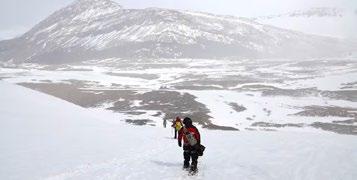
A 38-year-old man is dead after falling into a crevasse at the Columbia Icefield on May 12.
RCMP did not send a release at the time of the incident, but later told CBC that three friends were skiing and snowboarding recreationally when one fell 25 metres into a crevasse on the Athabasca Glacier, which is located in Jasper National Park.
Mathew Howell, a public information officer for the RCMP, said that in situations “of this magnitude,” police attend the scene with safety crews. He said RCMP were notified around 5:30 p.m. by Parks Canada, and about 90 minutes later police met safety crews at the scene.
Howell said the Jasper National Park visitor safety team told RCMP members “they had visual confirmation on the patient and they could confidently say that he was deceased.”
Due to weather and the remote location of the deceased, RCMP said recovery of the man’s body was not immediately possible.
Howell said RCMP records state the man’s body was retrieved two days later on May 14. He said the man who died was a citizen of the Czech Republic, and was living in Revelstoke, B.C., at the time of the incident.
His two friends were also living in Revelstoke. RCMP spoke to them at the scene, but Howell said he was unsure if there had been any follow-
up interviews.
The incident is being treated as a sudden death, with no foul play expected, said Howell.
Parks Canada is leading the primary investigation into the incident, with the Jasper RCMP providing assistance.According to the Parks Canada website, the Columbia Icefield is rated on the Avalanche Terrain Exposure Scale as Class 3.
On a glacial landscape, Class 3 terrain indicates overlapping avalanche paths, large expanses of steep terrain, and “complicated glacier travel with extensive crevasse bands or icefalls.”
Parks Canada warns on its website that a “considerable level of skill and knowledge” is necessary for that type of terrain, and everyone in the group should be equipped with and familiar with safe glacier travel, crevasse rescue techniques and whiteout navigation skills.
It is not known what specific gear or skill level the group had at the time of the accident.
Some FIFA World Cup fans 'flabbergasted' by ticket prices in Vancouver
Continued from Page 1...
He said he has also been scrolling social media and resell pages, but the tickets he has seen are about $2,000 each. "We'd pay that for a season ticket over here for a top English club. We just can't justify that sort of spend," said Van Brockhoven, who lives in London, England.
Jarrett Vaughan, an adjunct professor at the University of British Columbia's Sauder School of Business, said "one of the biggest challenges that visitors have when coming to Vancouver is just simply the cost."
He highlighted the accommodation industry, which he said is likely pricing some visitors out of the market.
"Hotel accommodations are very expensive in Vancouver no matter what's happening, and so you then add this layer of [more] visiting guests and this added pressure drives obviously room rates higher," he said.
To become an Airbnb host in Vancouver, the listing must be your principal residence and you must obtain a City of Vancouver short-term rental business licence and register with the province. Vaughan said the application process is likely a deterrent for many, as it costs about $1,200 annually and "there's significant risk because you
might not be able to rent it out."
World Cup Facebook forums are filled with people listing their homes for rent during the games, seemingly under the table.
"What people do is they kind of black market or grey market or backdoor the system by renting out your place in exchange for tickets or renting it on Facebook and taking the kind of the insurance risk on something like that," he said.
Destination Vancouver says June hotel bookings in the city are down 20 per cent this year when compared with the same time in 2025. However, it said in a statement that it remains hopeful they will fill up closer to kickoff.
"Data is dynamic and we’re optimistic of a late surge," it said, noting that air arrivals to Vancouver between June and August are up six per cent from last year.
The British Columbia Hotel Association did not immediately respond to requests for comment.
Van Brockhoven said his group was luckily not affected by high accommodation costs, which he credits to booking almost a year in advance.
"There was plenty available, and I wouldn't say they were like astronomical," he said, noting the Airbnb cost amounts to about $125 per night per person for the four members of his group.
2 dead in separate drownings in Nanaimo
Nanaimo RCMP say two people are dead after unrelated drowning incidents Wednesday evening, one at Departure Bay Beach and the other near the Brechin boat ramp.
Officers responded to a call for a well-being check on an adult woman at Departure Bay Beach just before 6 p.m. PT, RCMP said in a news release Thursday.
Nanaimo Search and Rescue (NSAR), two aircraft from the Royal Canadian Air Force base in Comox, and Nanaimo Harbour Patrol also responded, according to the release.
The woman was found around 9 p.m. and was pronounced dead, despite life-saving efforts.
Police do not suspect foul play, according to the release.
While police and first responders searched for the missing woman, another report came in at
about 7:30 p.m. of an adult man who appeared to be in distress while swimming near the 1200 block of Stewart Avenue.
First responders pulled him from the water, but he could not be resuscitated, according to RCMP, and he was pronounced dead at the scene.
"Early indications suggest no foul play, and the circumstances are being examined in conjunction with the B.C. Coroners Service," RCMP said.
Police said members of the public witnessed both incidents and urged anyone affected by what they saw to seek support.
"Witnessing a sudden medical emergency or loss of life can have a significant emotional impact, even for those not directly involved," said Nanaimo RCMP Reserve Const. Gary O’Brien in the release. He said Nanaimo RCMP victim services can provide confidential assistance.
Ottawa to cover $1.1M for unpaid taxes by disgraced mayor of Laval, QC
Federal Finance Minister François-Philippe
Champagne is authorizing an ex gratia payment of $1.1 million to the Canada Revenue Agency on behalf of the City of Laval and its residents.
The amount will be disbursed to settle an obligation the City of Laval owes to the Canada Revenue Agency (CRA) following corruption allegations against its former mayor, Gilles Vaillancourt.
Vaillancourt served as mayor of the Montreal suburb from 1989 to 2012. He was arrested in 2013 by Quebec's anti-corruption unit.
In 2016, Vaillancourt pleaded guilty to conspiracy, breach of trust and fraud after $7 million he stole was found hidden in a Swiss bank
account. After he returned the money to the City of Laval, the municipality became responsible for paying the $1.1 million in taxes on the sum. In an email sent Thursday, John Fragos — press secretary for Champagne — said the finance minister contacted Laval Mayor Stéphane Boyer on Thursday to confirm that "in the interest of fairness and in keeping with the Quebec government’s own handling of the tax matter at the time," the minister would authorize the payment.
"I would like to thank Minister FrançoisPhilippe Champagne for his collaboration in this matter and his willingness to find a solution in the best interest of our population," Boyer added.
Surrey mayor proposes 200,000 sq. ft. convention centre for Cloverdale Fairgrounds
With just months to go before the October 2026 civic election, Surrey mayor Brenda Locke took the opportunity during her annual State of the City address today to announce a number of sweeping new initiatives.
Among the largest promises is Locke’s proposal to build a convention centre with up to 200,000 sq. ft. of meeting and exhibition space at the Cloverdale Fairgrounds, providing major additional capacity to host events, conferences, and trade shows. There would also be a major hotel to help establish the vision for a year-round entertainment hub at the fairgrounds.
In contrast, Vancouver Convention Centre — a facility owned and operated by provincial Crown corporation PavCo — has about 470,000 sq. ft. of usable meeting and exhibition space, while the PNE fairgrounds’ two old main exhibition hall buildings, excluding the Pacific Coliseum and Agrodome, offer over 110,000 sq. ft. of space.
Surrey’s mayor emphasized that the point of creating a major convention centre within her jurisdiction is to provide South of Fraser residents with the option of not having to travel to Vancouver for such events.
“For too long, Surrey residents have had to drive to Vancouver for those kind of facilities, for conference and trade show facilities. But Surrey is large enough, central enough, and strong enough
to host all of those events right here in Surrey,” said Locke during her speech today to Surrey’s business community.
Locke made a similar major events venue announcement during her 2024 State of the City address, when she first revealed her proposal to build a new 12,000-seat indoor arena or outdoor stadium, and that a feasibility study would be conducted to examine the concept and possible locations in Surrey City Centre and the Cloverdale Fairgrounds.
Since then, this effort has zeroed in on pursuing a new 10,000-seat indoor arena on the City-owned site of the BC Lions training facility in Surrey City Centre. The bid process seeking a developer, operator, and anchor sports tenant was launched early this year, and it will close later this month, with Locke noting an announcement could be made early this summer. The City is preparing to set aside up to $200 million to help fund the project, which would also include a hotel, conference space, retail/restaurant space, and possibly residential and office uses.
She also announced today her proposal to build a new complex of three ice rinks next to the existing Grandview Heights Aquatic Centre in South Surrey, which she says will help serve one of the fast-growing areas of the city, and a 15-acre public safety campus in the Anniedale-Tynehead area, which would provide a citywide consolidated hub for training more specialized police, fire, and emergency personnel.
“It will support police training, fire services, emergency preparedness, search and rescue, bylaw operations, forensics, special support, specialized support, drone operations, and other public safety partnerships. That will be centrally located with access to key corridors, and it gives Surrey the space and the structure to plan for the next generation of public safety services,” said the mayor.
Here’s why best before dates are costing Canadians billions in avoidable food waste
Confusion over best before dates is causing billions of dollars-worth of safe, edible food to be wasted every year in Canada, according to a recent report. The report from food rescue organization Second Harvest shows $12.3 billion worth of food doesn’t make it to the grocery store shelves or is pulled prematurely due to “arbitrary best before dates.”
“Nobody produces food or makes food or buys food to throw it away, so let’s stop doing that,” said Second Harvest CEO Lori Nikkel.
Pre-packaged foods with a shelf life of 90 days or less are required to have either a best before date or packaged on date, according to the Canadian Food Inspection Agency.
Products with a shelf life over 90 days are not required to have a best before date, according to Nikkel, but she says many products are moving towards the practice.
“Best before dates are about peak quality. They have nothing to do with safety,” Nikkel said. Best before dates are not the same as expiration dates.
Expiration dates are required on a handful of products, including baby formula. Those products should not be consumed beyond the expiry date.
Research out of Dalhousie University suggests most Canadians rely on best before dates to determine if food is safe, leading to unnecessary food waste.
“We believe that best before dates are costing households anywhere between $150 to $300 a year just because they’re throwing away perfectly safe food,” said Sylvain Charlebois, director of AgriFood Analytics Lab at Dalhousie University.
Second Harvest wants to see clarity around labelling to help consumers distinguish between safety and quality. The group is calling for unnecessary dates to be removed from certain shelf-stable foods and a national strategy for food waste reduction.
Naomi Hansen was throwing slimy cucumbers into her compost bin when it struck her that she had something to learn about food waste reduction.
The Saskatoon-based food writer and author actively tries to reduce food waste in her everyday life. It’s been a goal of hers for the last five years and it’s something she literally wrote the book on.
The first chapter of her new book, “Building a Sustainable Kitchen,” focuses on food waste reduction.
Hansen takes inventory of everything in her kitchen to make sure she knows what she has and when she needs to eat it. She freezes food before it goes bad and uses vegetables discards, like peels and stems, to make broth. “Those are just types of things that you practice them and they become habits,” she told CTV News.
“It saves you money and in terms of some other climate actions, I would say it’s kind of relatively easy to tackle.”
Hansen will use food beyond its best before date as long as it’s been stored properly. But she often doesn’t get to that point, because of the way she keeps tabs on her food.
“I write down the things that need to be used and the things that are maybe going to go bad faster,” she said. “Then I refer to that list regularly. Before I go to the store, before I buy more food, I look at the list.”
RCMP won’t release China policing pact despite Conservative, NDP pressure
The RCMP says it won’t release the full agreement it signed with China’s Ministry of Public Security without Beijing agreeing to do so, despite demands from the federal Conservatives and NDP for answers on what it contains.
In a statement to Global News on Wednesday, RCMP spokesperson Robin Percival said the memorandum of understanding signed in January “outlines specific forms of mutual collaboration” on policing, the exchange of information and investigative assistance, but did not give further details.
“The RCMP will not unilaterally make public or share the contents of an MOU with a third party without the concurrence of the other party,” Percival said.
“As such, the RCMP is not releasing the contents of the MOU at this time.”
The statement added that such agreements are “a very common practice between national law enforcement agencies” seeking new or enhanced co-operation, and the RCMP has many MOUs in place with agencies around the world.
under the agreement. She noted China’s Ministry of Public Security has been linked repeatedly by international human rights organizations, journalists and democratic governments to intimidation campaigns abroad, and demanded to know if safeguards are in place to prevent Canadian information from being used against dissidents, human rights defenders, journalists or diaspora communities.
The MOU was one of several signed during Prime Minister Mark Carney’s trip to China in January, which included new co-operation agreements on forestry, trade, tourism, energy and food safety.
While the full text of many of those MOUs has been released, the one with China’s Ministry of Public Security has not.
A joint statement from Carney and Chinese President Xi Jinping after their meeting said the two sides had “committed to strengthening law enforcement cooperation to combat corruption and transnational crimes, including telecommunication and cyber fraud and illegal synthetic drugs in accordance with their respective laws.”
“The two sides committed to continuing their bilateral law enforcement cooperation annual working group meeting mechanism, under which a counternarcotics dialogue is a key part, and securing more concrete achievements to ensure the security and safety of the two peoples,” the statement added. Conservative public safety critic Frank Caputo and NDP public safety critic Jenny Kwan have separately written letters to Public Safety Minister Gary Anandasangaree calling for the MOU’s release, saying the details deserve to be scrutinized by MPs and Canadians.
In her letter dated May 12, which was also addressed to Foreign Affairs Minister Anita Anand, Kwan said Canadians should know what information the RCMP is sharing with Beijing
“Combatting fentanyl trafficking, cybercrime, and transnational organized crime is unquestionably important,” Kwan wrote.
“However, these objectives cannot come at the expense of democratic transparency, public trust, or the safety of vulnerable communities who already face intimidation from authoritarian state actors.” She added that organizations including Hong Kong pro-democracy activists in Canada, as well as the Uyghur and Tibetan diasporas, have said the secrecy around the agreement has created fear and uncertainty in their communities.
Caputo said last Thursday that he has yet to receive a response from Anandasangaree to his own letter dated Feb. 9, which highlighted the need for parliamentary oversight on issues of public security.
“At a time when Beijing is targeting democratic institutions and intimidating Canadians on our own soil, secrecy is unacceptable,” Caputo said in a statement that again called for the MOU’s release.
“Canadians deserve to know exactly what the Liberals agreed to behind closed doors.”
Both Caputo and Kwan are also seeking briefings from ministers and department officials on the RCMP-China agreement to Parliament and relevant committees.
The memorandum prescribes that all cooperation is to be undertaken in accordance with the domestic laws, international conventions and the internal policies of each party, and is guided by the principles of sovereignty, equality and mutual benefit, the response added.
Missing B.C. actor believed to be victim of homicide
The search for a missing Lions Bay man has turned into a homicide investigation.
Squamish RCMP were notified on May 18 that Stewart McLean, 45, has not been seen since May 15. RCMP Sgt. Vanessa Munn said police were told that McLean was last seen at his residence in Lions Bay.
McLean is an actor who has appeared in TV series such as Virgin River and Murder in a Small Town.
On May 19, police asked the public’s assistance in locating McLean, saying there were concerns for his health and well-being. Lions Bay Search and Rescue led the search for McLean on May 20.
Search manager Maria Masiar said they began searching around 9 a.m. and stood down in the afternoon.
"Squamish RCMP initiated an investigation and,
652 victims in Canada's 'most prolific case of voyeurism ever prosecuted'
A Vancouver Island man pleaded guilty in what police are calling the "most prolific case of voyeurism ever prosecuted in Canada."
The Saanich Police Department said investigators identified at least 652 women and girls as victims.
Saanich police say Yin Yeung Derek Chan, 39, was handed a 4.5-year prison sentence on Thursday after pleading guilty to multiple voyeurism-related charges.
Those charges include surreptitiously recording people in a place where they reasonably expect privacy, observing and recording for a sexual purpose, making child pornography and publishing a recording that was obtained in the commission of a crime.
Chan has also been added to the long-term sex
offender registry.
"One thing I think that is important to recognize is just the effect that something of this level can have on a community, with 652 women and girls identified as being victims," Saanich Deputy Police Chief Damian Kowalewich told CBC News.
"We're alive to the fact that this has a greater effect than just even on those folks, it's just the community itself can get affected by something like this." Police said they began investigating in January 2024 after discovering someone was uploading voyeuristic photos and videos to social media from somewhere in Saanich.
That led police to Chan, who had previously been convicted for voyeurism when he was caught filming a woman in a Victoria-area mall change room.
through investigative efforts, uncovered evidence that led investigators to believe Mr. McLean was the victim of a homicide," Munn said.
On the same day that the search was started, B.C.'s Integrated Homicide Investigation Team (IHIT) assumed conduct of the investigation.
"Squamish RCMP continues to work closely with IHIT and the Integrated Forensic Identification Service (IFIS) to advance the investigation," Munn said.
No further details have been provided about where or if McLean’s body has been found.
IHIT is responsible for investigating homicides, suspicious deaths, and high-risk missing persons where foul play is suspected.
IHIT is asking anyone with information to contact police.
“He’s got a putt to win his first major and he still said ‘good putt’ to me? He’s taking time to look me in the eye and say well done? That stands out. That’s really impressive.
“If there’s one guy I’d love to lose to, it’s probably him.”
If you’re a golf fan, you likely know the story. He’s the only high-profile pro who uses them, in part because they’re broadly considered lame, making his a bold choice in a sport that’s mostly same. But that’s also the point. That’s how they serve to explain Aaron. The iron covers tell his story. Here’s a concise version he offered to ESPN:
“My mom and dad worked extremely hard to support me, and my dad used to buy me the best equipment that he could, and he brought me a really nice set of irons, which he paid a lot
of money for. And after every practice session he used to come home and he used to clean each groove with baby oil and a pin to get all the dirt and grime out, and then he started to put iron covers on those soon after to look after them and take care of them. So the reason I [use them] now is to remember what I came from — and also to respect the things that I have.”
It’s a remarkable telling. We could leave this piece here and you’d get the idea. Rai is different. He’s grateful. He’s humble. And he’s proud of where he came from. Also he can spin a neat parable.
But plenty of sons learn habits from their fathers and then discard them once they realize they’re uncool. Not Rai. So how’d he dodge the pressures of conformity and sameness? Why isn’t he wearing a single white golf glove, a brand-name hat logo, a too-cool-for-school attitude, the status quo for
Start
to your child’s RESP
When your child turns six, they can receive an additional $1,200 from the B.C. Government.
Tour uniform? He pondered the question in his post-round press conference, then returned to his father.
“I think my dad played a really big role in that,” he said. It was the two of them for most of his childhood, he said. They’d practice together, read about golf, watch Tiger Woods VHS tapes. Amrik implored Aaron to stay in his lane, to control the things he could control.
“And I didn’t really mix with a lot of other junior golfers, which didn’t give me a perspective of what was normal,” Rai added. “So I think he kind of sheltered me to be able to develop in a way that made sense for me, in a way that I guess was a little bit unique — with two gloves, with iron covers, et cetera.” By the time Rai was a teenager, playing more serious competitive golf and ultimately at the pro level, he had enough self-belief to stay the
Continued from Page 1...
Then, once the commitment is made, costs escalate and budgets bloat. That isn’t bad luck. That’s government.
Costs have gotten so out of hand that the federal government, having already committed $220 million to support the tournament, recently announced another $145 million, plus a further $100 million for impacted federal departments. That’s on top of what Ontario and British Columbia have already kicked in.
All told, what was supposed to cost a few hundred million dollars has metastasized into more than a billion dollars in public spending.
If FIFA came to Canada, covered its own costs and ran its operation like any other private event organizer, that would be one thing. But that’s not the arrangement.
Host countries are expected to foot the bill, promised that tourists will flood in, hotels will fill up, restaurants will overflow and GDP will surge. The historical record shows those promises of economic invigoration are consistently, embarrassingly wrong.
Before the 1994 World Cup, U.S. host cities were promised a $4-billion economic boost. Instead, they ended up with losses between $5.5 billion and $9.3 billion. South Africa spent $6 billion on the 2010 tournament, notwithstanding a $650-million budget, generating revenues of $513 million despite projections of $900 million. Brazil paid $15 billion to host the 2014 edition, promising huge economic gains, only to experience negative economic growth in the years that followed. Yes, restaurants will be busy and hotels will fill, but that doesn’t make the country
course, to double down on himself.
“I felt like I was strong enough in why I did certain things,” he said. “I knew the reasons why I do them. I believe in the reasons why I do them. So I had no reason to really shift from that as I got older.”
No, he wasn’t the major champ we expected. We entered this week on a run of brand-name winners. Rory McIlroy and Scottie Scheffler had won four of the last five, the last decade of PGA champs are all multiple major winners and there was every reason to believe that, like them, this week’s winner would come from the Tour’s tier of top-ranked, big-hitting alpha dogs.
Even with Sunday’s traffic-jam leaderboard — 30 players within five shots of the lead — there were enough big names in the mix that it seemed likely one would end up on top.
any better off. Much of that spending is money that would have been spent anyway elsewhere in the economy, and none of it comes close to justifying a $1-billion public outlay. Which raises the question: why do politicians keep agreeing to host these events? The answer has less to do with economics than with optics.
Hosting an international tournament comes with its fair share of political perks. For ambitious politicians looking to boost their status or cement a legacy on the world stage, the ribbon-cuttings and photo ops are simply too tempting to pass up.
Of course, if they actually wanted a legacy, they could start with the basics: homes people can afford, transit that actually runs, communities that are safe to live in. Yet somehow, despite these longstanding issues, which governments have failed to address, they still managed to find a $1-billion budget for their political vanity project.
And make no mistake about who is actually paying for this. Every Canadian taxpayer, including those who will never attend a game, is subsidizing an event that primarily benefits FIFA and its corporate sponsors, the hospitality industry in two specific Canadian cities, and the affluent who can afford $1,000 tickets to watch 90 minutes of soccer in the middle of a workday. There are few more regressive uses of public money than that. But with kickoff weeks away, there’s no stopping it now. All we can do is remember exactly how we got here: politicians who couldn’t resist the spotlight, governments that couldn’t stay on budget, and a public too swept up in the excitement to worry about the bill.
Conrad Eder is a policy analyst at the Frontier Centre for Public Policy.
US prosecutors drop fraud charges against Adani
Continued from Page 1...
The Adani Group denied the allegations at the time, calling them baseless.
Judge Nicholas Garaufis must still approve the request. Lawyers for Adani and his co-defendants consented to the request, prosecutors said.
Adani was never arrested in the case or brought to the US to face trial and some in India long expected the case would be shelved after US President Donald Trump last year suspended enforcement of the Foreign Corrupt Practices Act, a US law banning business bribes overseas.
The move to drop the charges comes after the US Securities and Exchange Commission said it was settling a related lawsuit against Adani.
Adani built his fortune in the coal business in the 1990s and, over time, the Adani Group embraced a diverse portfolio, investing in industries such as renewable energy, defence and agriculture.
The company amassed a clean energy portfolio that included one of the world’s largest solar power plants and had set a goal of becoming the country’s biggest player in the space by 2030. Adani had
close ties with India’s government and Prime Minister Narendra Modi.
But the company also had its critics.
Short-seller Hindenburg Research, a US-based financial research firm, has accused Adani and his company of “brazen stock manipulation” and “accounting fraud”. The Adani Group labelled the claims “a malicious combination of selective misinformation and stale, baseless and discredited allegations”.
When they charged Adani in 2024, US prosecutors in New York said he and others played two sides of the solar deal, enticing Wall Street investors with a rosy portrayal to pour several billion dollars into the project over five years while offering US$265 million in bribes to Indian government officials to secure lucrative contracts. After the case was announced, Kenya’s president cancelled multimillion-dollar airport expansion and energy deals with Adani. Adani Green Energy withdrew its wind energy projects from Sri Lanka after the country sought to renegotiate prices, while a French oil giant also paused new investments.
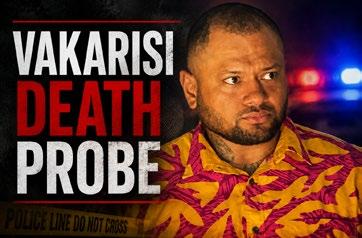
Police still chasing leads in Vakarisi murder case
NO arrests have been made in the alleged murder of the Jone Vakarisi. Police Commissioner Rusiate Tudravu reassured the public that this was not because of a delay in investigations, but because investigators still had extensive grounds to cover.
“To date, house-to-house inquiries, gathering of witnesses’ statements, uplift of forensic samples, and digital forensic analysis are being carried out by the investigation team,” Mr Tudravu said.
“No arrests have been made yet as inquiries continue.” Mr Tudravu said investigators needed to
cover all areas properly before identifying a suspect.
He also gave an update on investigations into breaches of RFMF security installations in Lautoka and Nabua, which were earlier linked to Mr Vakarisi.
Mr Tudravu said police were following several lads based on intelligence, information gathered, and digital and forensic analysis already conducted.
He said the Fiji Police Force acknowledged public concerns about the lack of updates on the investigations.
However, he urged members of the public to understand that police could not disclose every step of the investigation process.
“Doing so jeopardises the integrity of investigation and the justice process.
“I’m calling for patience and understanding and the support of the joint task force and the investigation team.”
He said major developments would be released in due course.
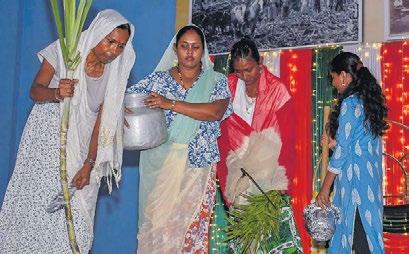
Indians are not guests in Fiji, says Tui Nayau
THE Gone Turaga Bale na Tui Nayau Ratu Tevita Mara has honoured the girmitiya and their descendants, saying they were not guests but an integral part of the country’s history and future.
In a statement commemorating Girmit Day, Ratu Tevita, saluted all Indo-Fijians, saying their story was not only an Indo-Fijian history but was a shared national history.
The Tui Nayau highlighted his late father Ratu Sir Kamisese Mara’s recognition of Indo-Fijians and their journey to Fiji.
race, any single province, any single faith.
“The multiracial covenant he championed throughout his life was a moral conviction, shaped by the wisdom of his vanua – that a chief’s mana grows by the breadth of those he shelters. He extended that shelter to all of Fiji.
“His partnership with the leaders of the IndoFijian community, built across decades of dialogue, trust, and shared purpose, stands as one of the greatest gifts to this nation. It is a covenant the people of Lau hold sacred, and today we reaffirm it.”
“The late Turaga Tui Nayau and first Prime Minister of Fiji, Ratu Sir Kamisese Mara understood, perhaps more deeply than any leader of his generation, that Fiji’s greatness could only ever be a shared greatness,” said Ratu Tevita. “He was a paramount chief of the iTaukei, yet he governed always for a Fiji larger than any single
He said they honoured not only those who arrived in 1879 but every generation that followed.
“Those who stayed when they could have left, who invested in Fiji when others lost faith, who raised their children to love this land as their own.
“Their loyalty to Fiji has been tested many times. Their resilience is a source of national pride.
“In these trying times in our nation, when division is easily sown and unity must be actively tended, Fiji’s diversity is not a burden to be managed – it is a blessing to be celebrated.”
The Tui Lau also made a plea to Indo-Fijians and the iTaukei community.
“To our Indo-Fijian brothers and sisters, you are not guests in Fiji. You are Fiji.
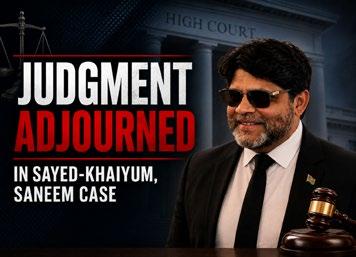
Judgment adjourned again in Sayed-Khaiyum, Saneem case
Judgment in the high-profile case involving former attorney-general Aiyaz Sayed-Khaiyum and former Supervisor of Elections Mohammed Saneem has been adjourned to June 26.
The matter was scheduled before Chief Justice Salesi Temo at 10.30am today in High Court Room No.1 in Suva.
Justice Temo said he has all the evidence and is now “putting pen to paper”.
The case centres on allegations that an unauthorised tax benefit was granted to Mr Saneem in 2022.
Mr Sayed-Khaiyum faces one count of abuse of office. The State alleges that while acting as Prime Minister, he approved a Deed of Variation authorising Government to pay about $55,944 in back taxes owed by Mr Saneem.
Mr Saneem is charged with receiving a corrupt benefit, with prosecutors alleging he sought and obtained the tax relief without lawful authority.
The prosecution has argued the agreement was a “replacement deed” designed to bypass constitutional oversight processes involving the Constitutional Offices Commission and the President.
However, defence lawyers maintain the payment was a lawful reimbursement of withheld earnings and argued the matter was employment-related rather than criminal in nature.
The case has attracted significant public attention because of the senior public positions previously held by both accused.
Mr Sayed-Khaiyum and Mr Saneem are represented by R. Patel Lawyers, while the Office of the Director of Public Prosecutions is leading the prosecution.
Murder proceedings against Constable Racagi suspects discontinued
The legal proceedings against two men from Qauia in Lami charged for the murder of Police Constable 8012 Peniasi Racagi have been discontinued.
Keni Salawai, 42, and Jope Seniloli, 20, appeared before Justice Daniel Goundar this morning.
Theresa State led by Senior Legal Officer Sadaf Shameem issued a Nolle prosequi.
Justice Goundar explained to both men that the State, under the law, is not required to provide reasons for its decision to discontinue the proceedings.
However, he reminded them that although they had been discharged, the State could recharge them in the future.
Night curfew for accused
The Suva Magistrate’s Court has imposed a night curfew from 8pm to 5am as a condition of bail for a man charged with the abduction and assault of a military officer’s son.
In granting bail, Magistrate Shageeth Somaratne stated that the restriction was necessary to ensure the safety of both the public and the accused,
Laisiasa Bavai.
While police prosecution objected to bail on the grounds of public interest and the accused’s safety, defence lawyer Kevin Skiba countered that Mr Bavai would be secure residing at his home with his family.
Mr Bavai is charged alongside another individual in relation to an incident that allegedly occurred on May 2 at Mead Rd, Nabua in Suva.
He has been released on a $1000 bail bond with standard conditions. Mr Somaratne warned Mr Bavai that any failure to comply with these terms would result in his bail being revoked.
Mr Bavai had earlier pleaded not guilty to the charges, and the court heard that no admissions had been made.
The case has been adjourned to June 15 for a pretrial conference.
Chinese J-35 stealth jets set to give Pakistan edge over India in fifth-generation tech
A year after fending off a massive Indian air assault with the help of Chinese warplanes and missiles, the Pakistan Air Force (PAF) on Thursday unveiled plans to upgrade its fleet through further acquisitions of Chengdu J-10C fighters and substantial upgrades to the JF-17s co-produced by the two allies.
The PAF further confirmed that it has signed an “initial collaborative agreement” for the acquisition of fifth-generation Shenyang J-35 stealth fighter, without disclosing any details about the scope of the deal.
Speculation is rife that Pakistan could take delivery of an initial batch of J-35s by the end of this year, following the airing of a video by CCTV last week showing the first fully operational export version of the warplane. As the only overseas customer to date, the PAF is the obvious destination.
According to analysts, the PAF’s induction of Chinese fifth-generation warplanes into service would alter the balance of air power with India, which has a much larger fleet of 4.5-generation fighters bought from France and Russia but is lagging behind Pakistan in the acquisition of stealth warplanes.
The J-35s would also boost the PAF’s ability to project military power into the Persian Gulf. Pakistan last month deployed a squadron of fighters – including JF-17s – to Saudi Arabia under a mutual defence pact signed last September. At a press conference in Islamabad, PAF deputy chief of air staff Air Vice-Marshal Tariq Ghazi said “foundations have been laid for the acquisition of advanced capabilities” – including long-range precision weapons (LRPW), next-generation platforms, “additional” J-10C aircraft and “much upgraded” JF-17s.
Will geopolitical shifts push India, Pakistan towards cautious diplomacy?
Calls by hardline Indian political figures to resume backchannel talks with Pakistan, a year after their latest conflict, reflect the realisation that both countries cannot afford another war for the time being, analysts say.
Rashtriya Swayamsevak Sangh (RSS) secretary general Dattatreya Hosabale’s push earlier this week for so-called Track 2 diplomatic engagement with Pakistan has raised hopes for a reduction in the tensions between the two countries.
In an Indian media interview on Wednesday, Hosabale said there “should always be a window for dialogue” between New Delhi and Islamabad. Though non-political, RSS has a lot of clout as the ideological inspiration for Indian Prime
Minister Narendra Modi’s Hindu nationalist Bharatiya Janata Party.
Hopes were further raised after former Indian army chief of staff Manoj Naravane endorsed Hosabale’s call for “people-to-people” contact between civil society organisations of both countries. Since their brief air skirmish in May last year, India and Pakistan have reportedly held four rounds of backchannel talks between quasi-official representatives. “It’s too soon to say whether the recent indications of openness to engagement will translate to meaningful steps, but it is notable that the two sides seem inclined to find quiet means of communicating,” said Elizabeth Threlkeld, director of the South Asia programme.
2 killed protecting polio workers in Pakistan
Two police officers died in Pakistan's northwestern Bajaur tribal district while protecting health workers who were administering the polio vaccine to children on Monday, a security official said.
The two separate attacks took place in Bajaur, a district in Khyber Pakhtunkhwa province bordering Afghanistan.
The killings came on the first day of Pakistan's nationwide campaign to counter rising cases of polio.
"During the polio campaign in the tribal district of Bajaur District, two police officials assigned to protect vaccination teams were shot dead by motorcycle-riding militants in two separate attacks," a senior security official based in Peshawar told the AFP news agency.
Interior Minister Mohsin Naqvi condemned Monday's attacks and offered condolences to the families of the officers who were killed.
Polio is a highly infectious virus that mainly affects children under five. If caught, the virus can result in lifelong paralysis.
The disease is easily prevented by a vaccine, which can be administered orally with a few drops.
Prior to the development of the first vaccine in 1955, the poliomyelitis virus paralyzed and killed up to half a million people every year.
Bajaur came as Pakistan kicked off a week-long vaccination campaign in 79 high-risk districts, where authorities hope to administer polio drops to more than 19 million children.
Pakistan and neighboring Afghanistan are the only countries in the world where polio remains endemic, but militants have targeted hundreds of police officers and health workers over the past decade as part of a campaign against the Pakistani state.
Pakistan has spent an estimated $10 billion (8.5 billion euros) on polio immunization programs in
the region since 2011.
But misinformation about the vaccine has circulated in rural Pakistan and been spread by militants, who falsely claim the vaccination drives are part of a Western conspiracy to sterilize Muslim children.
More than 200 polio workers and police officers who have protected them have been killed in Pakistan since the 1990s. The killings in
Despite two decades of challenges, including political instability, drone strikes in its tribal areas and conflict in Afghanistan, mass immunization programs had Pakistan on the brink of eradicating polio in 2023, with just six remaining cases of the wild form of the virus.
But the virus remains present, with a resurgence of cases. Some 73 were reported in 2024, 31 in 2025 and one case so far in 2026.
Haryana RERA orders jail for five TDI directors over buyer dues
In a major setback to real estate firm TDI Infrastructure Limited, the Haryana Real Estate Regulatory Authority (HRERA), Panchkula, has ordered civil imprisonment of five of its directors in an execution case arising out of non-compliance of its orders in a homebuyer dispute.
by Narender Kumar against TDI Infrastructure Limited. The authority observed that the company and its directors repeatedly failed to comply with directions issued under Order XXI Rule 41 of the Code of Civil Procedure despite being granted opportunities to respond and settle the matter.
The order assumes significance as it marks one of the strongest coercive actions initiated by HRERA against senior functionaries of a major real estate developer operating across Punjab and Haryana.
As per a copy of the order issued on May 15 made available to The Tribune on Thursday, HRERA member Chander Shekhar directed that managing director Kamal Taneja, directors Devki Nandan Taneja, Ravinder Kumar Taneja, Renu Taneja and Ved Prakash be sent to civil imprisonment for three months for “intentional violation” of the authority’s orders.
The order was passed in Execution no. 1208 of 2024 linked to Complaint no. 2950 of 2019 filed
HRERA held that the directors neither filed replies in person to the show-cause notices nor paid the costs imposed by the authority and the decree-holder. The authority termed the company’s plea for more time and recall of previous orders as a tactic to delay execution proceedings.
The regulator said the directors had shown “no respect for the judicial system” by ignoring orders issued on October 31, 2025, and April 24. It further observed that the company appeared to have resources to make payment but was intentionally delaying compliance to prejudice the decree-holder.
The authority ruled that once the decree-holder deposits the subsistence allowance at the rate of Rs 100 per day for each director before July 10, arrest warrants would be issued against the directors. The imprisonment would continue for three months from the date of arrest unless the company satisfies the order under execution in accordance with the law.
HRERA also imposed costs of Rs 5,000 payable to the decree-holder and Rs 10,000 payable to the authority.
Panthic convention at Baba Bakala on May 31
Before the Akal Takht’s 15-day deadline to the government to remove objectionable clauses from the anti-sacrilege law ends on May 23, the SGPC has convened a Panthic convention at Baba Bakala, about 40 km from here, on May 31.
Akal Takht officiating Jathedar Kuldip Singh Gargaj has already conveyed the objection to Punjab Assembly Speaker Kultar Singh Sandhwan when he appeared in person at the Akal Takht secretariat on May 8.
In order to mobilise Panthic bodies against Bhagwant Mann-led AAP government for ignoring their appeal before amending the Jaagat Jot Sri Guru Granth Sahib Satkaar (Amendment) Act-2026 and now its reluctance to withdraw some
clauses from the law, SGPC president Harjinder Singh Dhami announced that they would campaign against the new anti-sacrilege law, which was passed without consulting Sikh bodies.
Dhami made it clear that the convention was in no way an attempt to provoke confrontation but to protect the autonomy and religious rights of Sikh institutions.
Reiterating the SGPC and Akal Takht’s stand that there was no opposition to punishing those responsible for desecration under the amended Act, he said they had objections to certain provisions and terminology relating to Sikh maryada (religious code of conduct), which they believed were against Sikh sentiments.
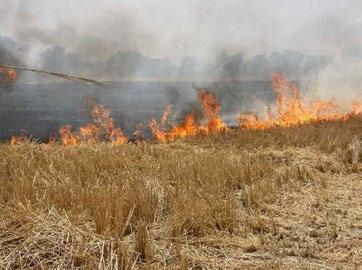
Punjab wheat straw fires worsen heatwave pangs
Even as the region grapples with an intense heatwave, Punjab is simultaneously witnessing an alarming surge in farm fires, with 9,615 incidents reported so far this season.
The advancing of paddy sowing date to June 1 has aggravated the menace as farmers have been rushing to clear their fields for the next crop cycle.
Though the Punjab Pollution Control Board has managed to significantly curb paddy residue burning--only 5,114 incidents were reported in 2025 compared to nearly a lakh a few years ago-wheat residue burning has emerged as a new headache for the authorities.
However, the total number of farm fires this season remains marginally lower compared to 9,845 incidents till May 21 last year. Overall, Punjab reported 11,256 farm fire incidents in 2024, while the count stood at 11,264 in 2023. District-wise this year, Ferozepur topped the list with 909 incidents of stubble burning, followed by Moga (746), Bathinda (741), Tarn Taran (713), Amritsar (684), Gurdaspur (633) and Ludhiana (617). The spike in farm fires was witnessed in phases. After an initial surge in the first week of May, incidents declined briefly before rising sharply again in the second and third weeks. The highest single-day count of 1,447 was recorded on
Punjab to launch drive against stray dogs posing threat to human life on May 22
Following the Supreme Court's decision, the Punjab government will launch a massive campaign starting Friday to eliminate stray and killer dogs that endanger the lives of children and pedestrians.
Estimates by the state's veterinary and research institutions indicate that there are approximately 5.19 lakh stray dogs in Punjab, prompting urgent government action.
Under the plan, municipal corporation commissioners and the additional deputy commissioners would be asked to take immediate, coordinated and result-oriented action to effectively tackle the growing issue of stray dogs across Punjab.
Officially, the unchecked population growth of stray dogs is largely due to a lack of systematic sterilisation and improper waste management, which provides easy access to food sources.
Punjab-origin delivery driver jailed for over 11 years in UK
An Indian-origin man has been sentenced to over 11 years in a hit-and-run crash involving a husband and wife in the West Midlands region of England.
Harinderpal Athwal, 41, was driving a car along Soho Road in Birmingham in December last year when he hit the pedestrian couple, killing the husband and seriously injuring the wife.
The Uber Eats delivery driver pleaded guilty to a string of dangerous driving offences and was sentenced to 11 years and three months at Birmingham Crown Court this week.
“This was a tragic incident that has left a family without their father and loved one,” said Detective Sergeant Julie Lyman from the Serious Collision Investigation Unit at West Midlands Police.
“Our thoughts remain with all his family and his wife who is still suffering with injuries that will
affect her for the rest of her life. Athwal’s actions in driving away and refusing to help and report the incident were cruel and heartless, and showed his complete disregard for what he had done in killing and seriously injuring innocent people. The man, 54, and his wife, 47, were walking along the pavement hand in hand when “for reasons still unknown”, Athwal’s car swerved into oncoming traffic and mounted the pavement, West Midlands Police said. “CCTV footage then showed Athwal reversing away from the injured man before placing the car back into forward drive, hitting the man again and driving away. Sadly, the man died at the scene from his injuries. His wife was taken to hospital and suffered life-changing injuries.” AÂ “thorough and detailed investigation” led to the arrest of Athwal less than 24 hours later, who claimed he was unaware anyone had died.
May. Collectively, 4,198 incidents were reported between May 7 and May 10.
Experts believe the actual number of wheat residue burning incidents could be much higher, alleging that many farmers deliberately set fields on fire during evening hours to evade satellite detection.
Recent scientific studies, including by the Indian Space Research Organisation and NASA, indicate that farmers in Punjab and Haryana have increasingly shifted stubble burning to late afternoons and evenings. By igniting fires after 3 pm or 4 pm, they reportedly avoid the scheduled overhead passes of polar-orbiting satellites, resulting in underreporting in official data.
In Indian companies, AI strategic presentations have reached a high level of sophistication. Alignment across leadership on the use cases, investments, and transformation journey is established. Organizations have developed an understanding of how they plan to integrate AI into their business model going forward.
But for all the strategic clarity, there is little tangible impact being generated. What's missing is execution despite having a good strategy in place. What is needed is operational ownership of these strategies which can make AI deliver results consistently and repeatedly. Organizations have shown success in running AI pilots, thus proving its feasibility within the confines of the experiment. Accuracy gains, cost savings, and efficiency increases are just some of the factors that can be seen through such experiments. Yet, as the implementation of these pilots shifts towards
India has enough AI strategies, it needs AI operators
more complex production environments, issues surrounding data inconsistency, systems, and processes become apparent.
This issue arises from the fact that while pilot runs may prove to be successful, their applicability to the business environment itself becomes challenging. Many pilot implementations exist without thinking about other systems, user adoption, or maintenance in the future.
There is certainly no shortage of people proficient in AI in India, be it engineers, data scientists, or analysts. But the problem is that most of this talent focuses on model development but not on running those models. The paradox is that although the expertise is there, the ownership and responsibility are scattered around. Solutions are built, but ownership for their performance, monitoring, and adjustments is not clearly defined.
The solution here would be to create roles of AI operators, people who have knowledge of both technology and organizational processes and make sure that an AI system continues to perform. The enterprise usually assumes that the process of implementing artificial intelligence starts with the development of models; however, the implementation actually starts from the data. Today, enterprises suffer from data fragmentation, inconsistency, or siloing. This becomes a problem when applying AI, since models need clean, consistent, and continually refreshed data sources. The conflict emerges because the strategic vision collides with the current operational state.
It is not unusual for an enterprise to lack clarity on data ownership and inconsistent governance policies in all business units. It is important to establish unified data architectures
As the
world
and governance policies to support reliable functioning of AI algorithms.
In most companies, artificial intelligence projects are managed as crossfunctional endeavors rather than being internal competencies.
Management oversees the idea and the development process, while technologists develop AI solutions and business units benefit from its results. Still, no department is responsible for ensuring their continuous functioning and optimization.
The issue lies in the existence of overlapping responsibilities without proper ownership of processes and tasks. The transformation should include defining new roles and responsibilities within the lifecycle of the AI product, including its development, implementation, management, and optimization.
gets taller, Indians are getting shorter
Despite economic progress, the average height of the Indian population has either stagnated or declined, while globally, people have grown taller. This unequivocal finding emerged from various reports of the National Family Health Survey, conducted since the early 1990s, providing the most comprehensive data on demography, health and nutrition in India.
In the country, the average height for men is 165 cm, while for women it is around 152 cm. Many researchers have examined the causes and are nearly unanimous: while genetics play a role, factors such as environment, health, diet and access to healthcare significantly influence the population's height.
In a study published in 2021, researchers from Jawaharlal Nehru University compared the results of three National Family Health Surveys between 1998 and 2015. Their conclusion was clear: Men in the 15-25 and 26-50 age groups showed a significant decrease in average height – by 1.1 cm and
0.86 cm, respectively.
The average height of women in the 15-25 age group decreased by 0.12 cm, with an even sharper decline among the poor (−0.57 cm) and among women from Scheduled Tribes (−0.42 cm). On a more positive note, for women aged 26-50, average height increased by 0.13 cm, except among those from Scheduled Tribes, where a decrease was noted.
India eyes trade pact with Oman amid turmoil, FTA starts June 1
Amid the Strait of Hormuz blockade and uncertainty over peace talks between Iran and the US, the Commerce and Industry Ministry Monday said the India-Oman free trade agreement (FTA) signed in December could enter into force as early as June 1.
The likely implementation, within months of signing, comes as Delhi pushes for faster operationalisation of the deal since Omani ports, mainly Salalah and Duqm, fall outside the Strait and could help India reroute exports for West Asia and Africa.
Commerce Ministry officials said several meetings have been held with exporters to explore opportunities for pushing food and other lowmargin, labour-intensive products, given Oman’s geographic advantage during the current crisis.
While Oman’s annual demand is limited, the pact offers a transit window. Officials said that only two UAE ports, Khor Fakkan and Fujairah, are not currently facing operational difficulties. Overall trade with UAE, India’s largest trading partner in the Gulf, has declined over 35% in April. “Oman’s
ports offer an advantage that the Government is planning to leverage. There are several products which would be prioritised, but Muscat’s annual demand is barely $40 billion, and there is no alternative to trade with, say, the UAE. Besides, currently not many shipping lines are taking that route, and freight rates have more than doubled, which is a bigger challenge,” an exporter said.
Trade data showed that while commerce with West Asian countries has come under pressure since the Strait of Hormuz was closed on March 2, trade with Oman has picked up. Energy imports from Iraq, Qatar and the UAE declined sharply in April, but shipments from Oman jumped 246.42% to $1.48 billion last month, compared to $429.58 million in April last year.
Before the war, India’s trade had been heavily dependent on the UAE and Saudi Arabia. The two countries accounted for 8.4% and 2.7% of India’s total exports respectively in FY25, while Oman’s share stood at just 0.9%. On the import side, the UAE and Saudi Arabia comprised 8.8% and 4.2% of India’s total imports, with Oman again at 0.9%, Commerce Ministry data showed. The pact with Oman also assumes significance given its role in the ongoing West Asia conflict.
Iran’s Deputy Foreign Minister Kazem Gharibabadi said last week that Tehran is working on arrangements to determine what services “Iran and Oman are providing in the Strait of Hormuz”. Iranian Foreign Minister Abbas Araghchi also said Iran was coordinating with Oman on the future management of the strait.
India and Norway agree to 'green strategic partnership'
Indian Prime Minister Narendra Modi and his Norwegian counterpart agreed on Monday to a "green strategic partnership" deal aimed at promoting a clean-energy transition and sustainable development.
"From clean energy to climate resilience, from the blue economy to green shipping, in every sector, India's scale, speed and talent will combine with Norway's technology and capital, and our companies will develop global solutions," Modi said on the first day of a two-day visit to the Norwegian capital.
India, the world's third-largest importer of oil, has seen its supplies severely disrupted by the closure of the Strait of Hormuz during the war in the Middle East.
Meanwhile Norway, Europe's largest oil and gas producer excluding Russia, derives almost all of its electricity from renewable sources, primarily hydroelectric facilities.
The new partnership is "beneficial for the entire world", Modi said in a statement to the press. His Norwegian host, Prime Minister Jonas Gahr Store, told broadcaster NRK that India had "a lot to contribute" on the matter.
"The country is currently making significant progress in the fields of renewable energy, solar, wind, and energy storage technologies," he said.
This is the first visit to Norway by an Indian prime minister since Indira Gandhi in 1983.
The two countries have also signed partnership agreements in the fields of health and digital technology.
Roughly half of India's crude imports usually pass through the strait.
After announcing a cut in fuel taxes to curb a surge in prices at the pump, the country -— where 73 percent of electricity generation currently comes from coal-fired power plants -- has announced it will speed up approvals for wind power plants and battery-powered energy storage systems.
They have boosted their economic ties since the entry into force in October 2025 of a free-trade agreement between the Asian giant and the member countries of the European Free Trade Association (Norway, Switzerland, Iceland, Liechtenstein).
"Whether in Ukraine or West Asia, many parts of the world are witnessing conflict. In such a situation, India and Europe are entering a new golden era in their relations," Modi said.
The Indian leader, who arrived from Sweden in the morning, was to take part in a Norway-India business conference in the afternoon.
On Tuesday, he is due to meet with the heads of government of the Nordic countries and participate in the third Nordic-India summit, before winding up his European tour with a visit to Italy.
ASML, Tata Electronics partner on India's first semiconductor fab
Tata Electronics and ASML (ASML.AS), opens new tab on Saturday signed an agreement to build India's first front-end semiconductor fabrication plant in the state of Gujarat, as the country accelerates efforts to develop a domestic chip industry.
The Dutch chipmaking equipment maker's technology will support Tata Electronics’ planned 300-millimetre semiconductor fabrication plant in Gujarat, the companies said in a joint statement.
"India's rapidly expanding semiconductor sector represents many compelling opportunities, and we are committed to establishing longterm partnerships in the region," ASML CEO Christophe Fouquet said.
Tata Electronics is developing the plant in Dholera, Gujarat, with an investment of $11 billion, aimed at producing chips for applications ranging from automotive and mobile devices to AI, the statement said.
The deal was signed in the presence of Indian Prime Minister Narendra Modi and Dutch Prime Minister Rob Jetten, India's Ministry of External Affairs said, adding the two leaders also met chief executives from leading Dutch companies across sectors including energy, ports and technology.
Modi urged Dutch companies to invest in areas such as semiconductors, renewable energy, digital technologies and healthcare, while both leaders called for early implementation of an IndiaEuropean Union free trade agreement.
India has pledged billions of dollars in subsidies to attract semiconductor fabrication plants and related manufacturing, with eight projects underway including a $14 billion Tata Electronics facility in Gujarat. Meanwhile, Dutch semiconductor firms are seeking new markets and geographical diversification amid export controls and trade restrictions linked to U.S.-China technology rivalry.
Fifa officials head to India as fears over World Cup blackout grow amid TV deal dispute
Millions of football fans across India face the prospect of missing next month’s World Cup, as Fifa officials are currently in the country attempting to finalise a broadcast deal.
The global governing body has yet to secure an agreement for the tournament, largely due to significant differences over pricing.
The deadlock means that, with the World Cup kicking off on 11 June, only three weeks remain to establish broadcast infrastructure and sell advertising inventory. This situation contrasts with China, where a broadcasting deal was struck last week, ending a similar standoff. Sources familiar with Fifa’s plans confirm that media rights executives are in India, though the specifics of their meetings and agenda remain undisclosed. Fifa, in
Indian politics has acquired an unusual mascot: the cockroach.
A satirical collective that takes inspiration from the insect – stubborn, reviled and considered indestructible – has attracted millions of online followers and mainstream media attention in less
than a week, making even veteran politicians sit up and take notice. The cockroach was thrust into the spotlight last week after controversial comments made by India's Chief Justice Surya Kant. During a hearing, he allegedly compared unemployed young people drifting towards journalism and activism with cockroaches and parasites.
But by then the comments had already spread widely online, triggering outrage, jokes - and a humorous political idea called the Cockroach Janta Party (Cockroach People's Party), or CJP.
The name is a parody of Prime Minister Narendra Modi's Bharatiya Janata Party (BJP), which has been in power since 2014. Critics and rights groups have alleged that press freedom and civil liberties have declined since then, which the BJP denies.
The CJP is not a formal political party but an online movement built around political satire. Its tongue-in-cheek membership criteria include being unemployed, lazy, chronically online and having "the ability to rant professionally".
It was created by Abhijeet Dipke, a political
communications strategist and student at Boston University. He says the idea came as a joke. Before moving to the US, he worked with the Aam Aadmi Party (AAP), a political organisation that emerged from an anti-corruption movement in India more than a decade ago, and is known for its strong social media presence. "I thought we should all come together, maybe just start a platform," he told BBC Marathi. What followed was much bigger than he expected. Within days, the CJP amassed tens of thousands of sign-ups through a Google form, inspired the hashtag #MainBhiCockroach ("I too am a cockroach") and endorsements from opposition leaders. On Wednesday, top opposition leader Akhilesh Yadav posted on X: BJP v CJP.
The discourse also spilled offline, with young volunteers turning up dressed as cockroaches at clean-up drives and protests, in a theatrical embrace of the label.
On Thursday, the CJP's Instagram account crossed 10 million followers, overtaking the official account of the BJP - widely described as the world's largest political party by membershipwhich has around 8.7 million Instagram followers.
However, the CJP's X account, with more than 200,000 followers, is currently not visible in India, with people trying to view it being told that it has been withheld "in response to a legal demand".
The pace and scale of the CJP's rise has taken many by surprise, but there is little evidence so far that this will spill over into political change on the ground in India. Although the CJP has outpaced political parties on social media, the BJP and the opposition Congress remain the country's dominant political forces, with millions of active members nationwide.
Still, the CJP's momentum continues to grow.
a statement to Reuters, confirmed it has concluded agreements in over 180 territories, adding that discussions in India regarding media rights were ongoing and "must remain confidential at this stage". Previous reports indicate that discussions between the Reliance-Disney joint venture, India’s largest media company, and Fifa have stalled. Reliance-Disney joint venture offered $20 million for the Fifa rights. That led to a disagreement because Fifa had initially sought $100 million but was last looking for around $60 million at least, Reuters has reported. Sony, another major player in the Indian market, has refrained from bidding. The Reliance-Disney venture, led by billionaire Mukesh Ambani, declined to comment on whether a meeting with Fifa is scheduled.