CBSA says efforts to ‘disrupt extortion networks’ led to 70 removal orders
The Canada Border Services Agency says it has opened 372 immigration investigations in an effort to “disrupt extortion networks” across the country.
It says the CBSA began formally monitoring immigration enforcement cases potentially linked to extortion in the Pacific and Prairie regions last August before expanding the work to the Greater Toronto Area in November. The agency says that as of last Thursday, it had issued a total of 70 removal orders on various inadmissibility grounds, and 35 have been enforced.
Continued on Page 10...
www.theasianstar.com
Second Indian diaspora day in Vancouver
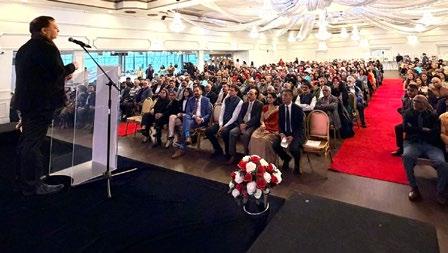
His Excellency Dinesh K. Patnaik, High Commissioner of India to Canada; David Eby, BC Premier; and Consul General Masakui Rungsung at the 2nd Diaspora Day in Vancouver on 15th March 2026
2 Punjabi youth from Edmonton deported to India for Extortion
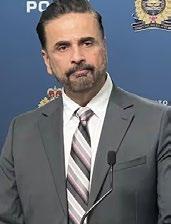
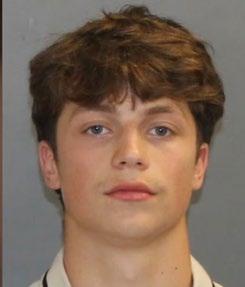
A joint operation involving Edmonton police has led to the deportation of two men, over what police say is a wave of extortions targeting the city's South Asian community.
Edmonton Police Service along with officials from the Lower Mainland District RCMP and Canada Border Services Agency (CBSA) provided new details Thursday during a news conference. CBSA said at the news conference it deported a 22-year-old man who was allegedly the ringleader in carrying out extortions in the Edmonton area. A 25-year-old man was also removed from Canada and three others are
being investigated. CBSA later confirmed to CBC News that the two men in question are Indian nationals Arshdeep Singh, Sukhnaaz Singh Sandhu.
Officials said some of the suspects are connected to extortions in Calgary, the B.C. Lower Mainland and Ontario.
According to Immigration and Refugee Board (IRB) records obtained by CBC News, Arshdeep Singh and Sukhnaaz Singh Sandhu were known to each other — and to the alleged "prime conspirator" behind a series of extortion-linked shootings at a Surrey, B.C., café.
Continued on Page 4...
Why Punjabi builders in Canada are living under extreme fear
On 15th March 2026, the Consulate General of India, Vancouver celebrated its 2nd Diaspora Day in Vancouver, recognizing the contributions of the Indian diaspora to Canada’s social, economic and cultural life. More than 600 members of the Indian diaspora community attended the event, which brought together political and business leaders, professionals, students and representatives from community organizations.
The evening was attended by several dignitaries including British Columbia Premier Honorable David Eby, High Commissioner of India to Canada H.E. Dinesh Patnaik, Legislative Assemble Speaker Raj Chauhan, Minister Jagrup Brar, Parliamentary Secretary Sunita Dhir, MLA Rohini Arora, and VPD chief Steve Rai. Continued on Page 8...
India could soon get a lot thinner - at least in theory.
On Friday the patent on semaglutidethe molecule behind Danish drugmaker Novo Nordisk's blockbuster weight-loss drugs Wegovy and Ozempic - expires in the country.
This will allow domestic pharmaceutical companies to release cheaper copies or generics, triggering a rush of competition that could slash prices by more than half and rapidly expand access for people in India, and eventually in other countries too.
Investment bank Jefferies has called it a potential "magic-pill moment" for India, predicting the semaglutide market could eventually reach $1bn domestically with the right pricing and uptake.
Continued on Page 10...
OTTAWA: The rising extortion threats faced by Punjabi builders in Canada's Vancouver are a clear warning that unchecked organised crime does not remain confined to a suburb or group but spreads across communities, erodes trust, stifles growth, and weakens the nation, a report highlighted on Tuesday. According to a report in Khalsa Vox, what began as isolated incidents in Surrey city, involving cash demands often communicated via phone calls, social media, or letters, has metastasised into a broader issue.
Continued on Page 4...
4 charged in New Westminster stabbing
More than six months after a man was found with stab wounds in the Queensborough neighbourhood of New Westminster, authorities announced Thursday that charges have been laid.
The investigation began just after midnight on Aug. 1, 2025, when officers responding to a 911 call about a fight found a man with stab wounds in the 800 block of Ewen Avenue, according to the New Westminster Police Department.
“The Major Crime Unit took conduct of the investigation and over the next several months worked to collect evidence and obtain approval for numerous search warrants,” the statement from police said.
Four people were arrested last month and have since been charged with robbery, assault with a weapon, and aggravated assault. Three of the suspects are youths and can not be named due to the federal Youth Criminal Justice Act. The fourth is being identified by police as 18-year-old Arman Rajani.
The relationship between the suspects and the victim, if any, is not known, police said.
“This was a source of concern for many Queensborough residents,” New Westminster Police Department spokesperson Sgt. Andrew Leaver said, in the statement.
“There was a relentless effort to follow the evidence and identify these suspects. Justice will be served.”
B.C. funds
20 mini soccer pitches with Whitecaps and viaSport in World Cup legacy project
The B.C. government is partnering with Vancouver Whitecaps FC and viaSport to fund the construction of 20 mini soccer pitches across the province as part of a legacy project tied to the 2026 FIFA World Cup.
Officials say the initiative aims to improve access to sport and encourage youth participation, particularly in underserved, rural and remote communities.
Tourism, Arts, Culture and Sport Minister Anne Kang says the project is focused on ensuring longterm benefits from the international tournament, which will see Vancouver host seven matches over a 25-day period.
“This moment is about far more than what happens during the tournament,” said Kang. “It’s about what happens because of it and the legacy we leave behind.”
The Whitecaps will manage the program, with communities able to apply through the club’s website. The team has previously supported similar efforts, including building mini pitches in nine Indigenous communities through a past partnership.
Whitecaps CEO Axel
Schuster says the fields will give young people more opportunities to stay active and engaged.
“Kids that are on mini pitches and play with their friends are not sitting at home in front of a screen living in a virtual world and seeing content that might be right or not right for them,” he said.
The project carries a $13-million price tag, with roughly $4.5 million paid for by the province, $5.5 million by viaSport and $3 million in in-kind contributions from the Whitecaps.
Each mini-pitch will be 60 by 120 feet, with an enclosed, level surface built to accommodate a variety of sports throughout the year.
Kang says the province will be releasing a report in late spring regarding the updated cost of hosting the World Cup.
B.C. RCMP highlight ‘unbelievably’ high number of violations by single commercial driver
Police are shining a spotlight on one commercial truck driver who was recently fined for an “unbelievably” high number of violations during an enforcement blitz in Metro Vancouver.
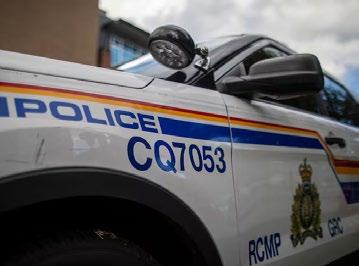
The Lower Mainland Commercial Vehicle Enforcement group carried out the one-day operation last month in Burnaby, inspecting 67 vehicles and pulling more than half of them off the road, the RCMP said in a news release Thursday.
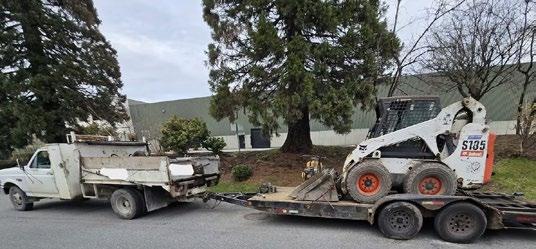
The driver of a dump truck towing a trailer carrying a bobcat was cited for six violations and fined $1,215, according to authorities, who provided examples and photos of the infractions.
“A fuel cap was missing and covered with a sandwich bag, which was secured with a charging cable,” police said.
tank housing that was cutting into the strap,” the statement continued. The truck’s emergency brake was “inoperative,” and its steering mechanism was “defective,” police said, adding that the axels were bent from “repeated overloading.”
The truck and its licence plates were seized on site. “There are many professional drivers and companies that follow road safety laws. This
is clearly not one of them,” said Burnaby RCMP Const. Kevin Connolly.
“A fuel tank was secured to the vehicle by two non-rated straps; one was damaged and the other was pressing against a broken piece of the fuel
“This is not an accurate representation of every commercial vehicle on our roadways, it is, however, a good example of why we do these inspections.”
Man in ‘serious but stable’ condition as police respond to accidental shooting in Burnaby
Mounties say a 39-year-old man was transported to hospital Wednesday night after police were called to investigate a report of an accidental shooting in Burnaby, B.C.
Officers responded to a condo building near the intersection of Douglas Road and Lougheed Highway just before 10:15 p.m.
A victim was found suffering injuries consistent with a gunshot wound, Cpl. Mike Kalanj of the Burnaby RCMP said in an emailed statement Thursday.
“Emergency Health Services transported the man to the hospital, and he is currently in stable condition,” the police spokesperson added.
“Investigators have spoken to witnesses and neighbours and while it is early in the investigation,
police do not believe there is any further risk to the public because of this incident.”
A spokesperson for B.C. Emergency Health Services says paramedics treated the victim on scene before transporting him to hospital in “serious, but stable condition.”
Police remained at the scene of the shooting Thursday morning and the investigation is ongoing.
Sikh organization calls for hate crime investigation after deadly daytime shooting on Alberta highway
RCMP investigating the death of an international student in a daytime shooting on an Alberta highway say a possible motive for the killing remains unclear.
A national Sikh organization is calling for the homicide to be investigated as a possible hate crime.“Whether it would be hate motivated or not, our investigation remains the same. It's a homicide," Alberta RCMP Cpl. Troy Savinkoff, an agency spokesperson, told CBC News Thursday.
“It's the worst type of offences that we investigate. But whether it was hate motivated or not, it's not off the table.”
Birinder Singh, a 22-year-old student who moved to Edmonton from India, died near Leduc, Alta., last Saturday, after someone in a nearby pickup truck opened fire on Highway 2, just south of Edmonton near Township Road 490.
Police said, just before 3 p.m. MT, a pick-up truck pulled up alongside Singh’s car, then someone began shooting toward Singh in the driver seat. The truck, described as dirty white or grey, then sped from the scene.
Singh managed to pull over to the side of the highway as the other driver fled, but died from his injuries, police said.
An autopsy of Singh's remains was completed
Tuesday, but police declined to provide further details on his injuries or the number of shots fired.
In a statement issued Wednesday, the World Sikh Organization of Canada (WSO) said its members are disturbed by the circumstances of the killing.
The organization, which promotes and protects the rights of Sikhs in Canada, has urged Edmonton police to explore whether the crime was motivated by discrimination. The statement noted that Singh’s death comes amid a rise of anti-Sikh hate nationwide, including targeted crimes and incidents.
“Given the current rise in anti-Sikh hate we are seeing, it is critical that investigators and the RCMP examine whether Birinder Singh was targeted because of his Sikh identity,” WSO President Danish Singh said in the statement.
“When communities are repeatedly targeted and demonized, it increases the likelihood of acts of violence such as this. This must be taken seriously by law enforcement and government.”
RCMP continue to search for a suspect and ivestigate the chain of events leading up to the shooting, Savinkoff said.
He added that police are focused on gathering evidence and identifying who is responsible, regardless of their motive.
Singh’s family members could not be reached for comment. His brother has launched an online fundraising campaign to help pay to return Singh's body to India. According to Savinkoff, witnesses have told RCMP that the suspect vehicle had been driving aggressively for some time before the shooting, and then “happened upon” Singh’s vehicle — a black 2012 Honda Civic.
Nothing so far suggests the two vehicles had a previous interaction on the highway before the killing, he said. It's unclear if the shooting was targeted, he added.
B.C. CRA employee charged after taxpayer information allegedly ‘compromised’
A years-long investigation into a Canada Revenue Agency employee in British Columbia has resulted in several criminal charges, authorities announced Tuesday.
The case was launched in March 2022 following a complaint from the CRA that an employee had “compromised taxpayer information,” the RCMP’s Federal Policing Pacific Region said in a news release. After nearly four years, members of the FPPR’s Sensitive Investigations Unit arrested Yoan Zola in Vancouver on Jan. 29.
Authorities said the 35-year-old has been charged with identity theft, fraud under $5,000, fraudulent personation, trafficking in identity information, breach of trust, and using a credit card obtained by crime. The FPPR has not shared any further details on the alleged breach of taxpayer information, but said all “victims impacted by this matter have been
informed.” “As this investigation is now before the courts, no further details will be provided,” the FPPR added.
A CRA spokesperson confirmed Zola is no longer with the agency, but did not respond to questions about when his employment ended, or how. “Any allegations or suspicions of employee misconduct are taken seriously and are promptly and thoroughly investigated. When wrongdoing or misconduct is founded, appropriate measures are taken,” the spokesperson told CTV News in an email. Maintaining the public’s trust is “of the utmost importance” to the CRA, the spokesperson added, and there are measures in place to “ensure the highest standard of employee conduct is upheld.” Authorities said the accused was released on bail conditions, and is scheduled to appear in court next on April 16.
home sales fell but CREA still hopeful for strong spring market
The Canadian Real Estate Association says home sales continued moving at a slow pace in February but activity started to pick up near the end of the month.
A total of 30,244 homes changed hands throughout the country last month, which was 8.1 per cent lower than February 2025. Sales also fell 1.3 per cent month-over-month on a seasonally adjusted basis. Despite a quiet start to the year, CREA senior economist Shaun Cathcart said the association still expects pent-up demand from first-time buyers will translate to sales in 2026. “They’ve had to wait a long time for mortgage rates to find a bottom, but some will no doubt continue to hold off for a bottom in prices in some Ontario and British Columbia markets,” he said in a news release. In its most recent forecast to kick off the year, the association said it expected national home sales to grow 5.1 per cent in 2026. CREA also projected a 2.8 per cent bump in the national average home price to $698,881.
In February, the national average sale price ticked 0.2 per cent lower from a year ago to $663,828. CREA’s home price index, which aims to represent the sale of typical homes, edged 0.6 per cent lower between January and February and was down 4.8 per cent on a year-over-year basis.
With the spring market approaching, it could be ill-advised for buyers to hold out for even lower prices, said Shawn Zigelstein, a broker for Royal LePage Signature Realty. He warned the longer buyers sit on the sidelines, the more “aggressive” the market could be once sentiment turns a corner.
“Buyers really want to know … ‘Is it the right time to make a move or do I wait?’ A lot of people in the past, they were like, ‘We timed the market perfectly, we sold at the exact right time, we bought at the exact time,'” Zigelstein said.
“No offence to all of those people, but that was luck. You cannot time a market perfectly because nobody has that crystal ball to know exactly what the market is going to do.”
Regionally, prices remained down on a year-overyear basis last month in B.C., Alberta and Ontario, offsetting gains in other provinces.
“For a first-time buyer, it’s a great opportunity to get into the market right now, especially … if we’re talking (Greater Toronto Area) market, if we’re talking Vancouver market,” said Zigelstein.
“You’ve got markets across the country that are not in the same situation.”
CREA said activity was particularly slow last month in the stretch of Ontario between Windsor and Toronto. While some are likely waiting for spring to make their move, BMO senior economist Robert Kavcic said weak sales numbers so far this year can’t be solely attributed to seasonal trends.
“Tough winter weather has probably played a role to start the year, but that shouldn’t distract from soft underlying demand,” he said in a note.
“When the market eventually awakens for spring, there will no doubt be some pent-up demand, but also likely a wave of pent-up listings that didn’t sell since the fall. How those two sides interact will determine if the market can tighten up through the rest of the year.”
The association said there were 151,850 properties listed for sale on all Canadian MLS systems at the end of February, up 3.7 per cent from a year earlier but 12.3 per cent below the long-term average for that time of year.
The number of newly listed properties fell 3.9 per cent month-over-month, erasing the jump recorded in January.
This report by The Canadian Press was first published March 17, 2026.
VICTORIA — British Columbia’s credit rating has been downgraded, but Premier David Eby said government made a “very clear choice” between making cuts to “meet a credit rating” and “prioritizing British Columbians.”
“We have to meet people where they’re at,” Eby said at an unrelated event in Metro Vancouver. “They are sicker, and they stay in hospital longer. We need to ensure high-quality health-care services and services for British Columbians generally. We have to build these projects to get our province moving.” Moody’s Ratings said Thursday it has lowered B.C.’s baseline credit rating to Aa1 from Aa2, among other changes in creditworthiness.
The agency said it has seen a “marked deterioration in the province’s credit fundamentals” and expects “sizable and entrenched deficits” for the next three years.
“This deterioration is driven by continued growth in operating and capital spending, resulting in large, structural deficits and rising leverage,” it said in a statement.
While B.C. is looking for ways to raise more revenues and cut costs, “uncertainty related to global and U.S. trade conditions adds risks to the
Continued from Page 1...
Police said Thursday that another 51 suspects are linked to criminal network believed to be responsible for orchestrating alleged extortions in Edmonton.
EPS, together with the Alberta Law Enforcement Response Team (ALERT), RCMP and CBSA, have created a joint forces operation to investigate a string of reported extortion attempts.
EPS Supt. Robinder Gill, with the Criminal Investigations Division of EPS, said this latest investigation comes after an uptick in extortion cases after the EPS investigation Project Gaslight ended in 2024.
“In the spring of 2025 we saw a cluster of these extortion events now re-emerge,” Gill said.
“We know that this crime type is evolving here in Canada. We also know that these organized crime groups are highly adaptable, and they are
Continued from Page 1...
Analysts expect around 50 branded semaglutide generics to enter the market within months - a familiar pattern in India's fiercely competitive pharmaceutical industry. When the diabetes drug sitagliptin went off patent in 2022, about 30 branded versions appeared within a month and nearly 100 within a year.
Affluent Indians drive boom in weight-loss drugs India's pharmaceutical industry, currently worth about $60bn, is expected to double by 2030. Much of it is built on generics - a manufacturing muscle that now sets the stage for fierce competition over semaglutide. What has until now been an expensive injection largely confined to affluent patients could soon become far more common.
Originally developed to treat diabetes, these drugs are now being hailed as game changers for weight loss, offering results that few previous treatments could match. Semaglutide belongs to a class of medicines known as GLP-1 receptor agonists, which mimic a hormone that regulates appetite and blood sugar.
By boosting insulin release and slowing the emptying of the stomach, the drugs make people feel full sooner and stay full longer. Originally
fiscal outlook,” it added.
This year’s budget forecasts a record deficit of $13.3 billion, and Eby said the budget was “incredibly challenging” for a number of reasons, including rising health-care and infrastructure costs.
“Were we going to, as the Conservatives suggested, make health-care bear the brunt of cuts to be able to meet a credit rating?” Eby said. “Or were we going to make sure that we were doing all we can to deliver services for British Columbians, find efficiencies in government and grow the economy to make sure that we’re able to pay for the services British Columbians deserve?”
Interim B.C. Conservative leader Trevor Halford said financial markets are telling the government that “B.C. is going broke,” and he said it is time for government to table a budget that restores confidence. He said B.C.’s fifth credit downgrade in four years puts the provincial finances at risk, because of the growing interest costs.
“Bond rating agencies are giving the NDP budget the equivalent of an F,” Halford said. “The government needs to take this seriously, go back to drawing board, and table a budget that will restore confidence in world financial markets.”
constantly evolving in their tactics.” Gill said the structure of these groups is a tiered, predatory network of organized crime where “the risk is local, the revenue is global, and the fallout is the erosion of the very trust that holds the Southeast Asian community together.”
Kristine Conroy, an enforcement manager with the CBSA, said the federal agency started 372 extortion related immigration investigations and 51 of those are directly tied to the investigation in Edmonton.
“The success of this co-ordinated operation in Edmonton is a testament to the dedication of the CBSA, the Edmonton Police Service alert, and the RCMP, to stopping this evolving threat of extortion within our communities nationwide,” Conroy said.
As of March 12, the CBSA has issued 70 removal orders, and of those, 35 people have already been removed from Canada, Conroy said.
developed for diabetes, they have become some of the most sought-after weight-loss treatments in the world. Several Indian drugmakers are already preparing to make the move. According to Sheetal Sapale, vice-president at research firm Pharmarack, major firms including Cipla, Sun Pharma, Dr Reddy's Laboratories, Biocon, Natco, Zydus and Mankind Pharma are readying branded generics, with many more likely to follow. Prices are expected to fall sharply.
Current monthly treatment costs are steep: Ozempic typically sells for 8,800 - 11,000 rupees ($95-$119; £71-£89), while Wegovy can cost 10,000-16,000 rupees ($108-$173). Sapale expects generic competition to push that down to roughly 3,000-5,000 rupees ($36-54) per month. Lower prices could transform the market.
Ph: 604-591-5423
Fax: 604-591-8615
editor@theasianstar.com
Editor:
Umendra Singh
Marketing and Sales: Ravi Cheema
604-715-3847
Shamir Doshi 604-649-7827
Harminder Kaur
778-708-0481
Parminder Dhillon 604-902-2858
Pre-Press: Avee Waseer
Production: Ozmo Media
www.theasianstar.com
Canada has the knowledge to prevent
Dr. Adeera Levin: Chronic kidney disease affects millions of Canadians, yet it rarely commands the public attention given to other chronic illnesses.
Often progressing silently until advanced stages, it carries a heavy toll for individuals, families and the health-care system — particularly for Indigenous Peoples and other populations facing social and economic barriers. Indigenous communities in Canada are three to four times more likely to develop chronic kidney disease. The sad truth is that much of this burden is preventable. In Canada, advances in research and a deeper understanding of how social determinants shape health outcomes mean we know more than ever about what works to improve kidney health. The challenge is acting on what we know.
In 2025, the World Health Organization passed a formal resolution calling on countries to strengthen awareness, prevention, early detection and health system responses to chronic kidney disease. Yet in practice, kidney disease is still too often detected late, when treatment options are limited and costly.
Our health system has historically focused on managing end-stage disease rather than preventing it. Decades of research show that early detection, culturally safe care and community-centred approaches can slow or even prevent disease progression, but these approaches aren’t consistently embedded in routine care.
One example of how evidence can be translated into action is Kidney Check, a mobile, communityled kidney screening program operating in First Nations communities in B.C., Alberta and Manitoba. Designed in partnership with communities, Kidney Check brings early detection directly to people who face barriers to accessing care. It demonstrates what is possible when research, lived experience and culturally safe approaches are aligned. mportantly, Kidney Check isn’t simply a standalone project. It also offers practical lessons for how health systems can embed prevention and early detection into routine care, particularly for populations at highest risk. Similar initiatives across the country are generating evidence that can inform provincial and national policy decisions. Progress is being driven by collaboration. National research
kidney disease — now we need to put it into action
networks, provincial renal programs, professional societies, organizations such as the Kidney Foundation of Canada, nursing and pharmacy groups, and Indigenous partners are working to close the gap between evidence and care. No single organization owns the solution — lasting change depends on co-ordinated action. Canada’s kidney research community increasingly recognizes that health outcomes are shaped not only by biology, but also by where people live, their access to care and
the conditions that influence health. Research that meaningfully includes patients and communities leads to more relevant, implementable solutions and helps ensure that innovation doesn’t deepen existing inequities. As a nephrologist and researcher working alongside patients, communities and health systems across Canada, I see both the human cost of kidney disease and the growing opportunity to prevent it. Treating chronic kidney disease as a preventable public health priority means integrating routine screening into primary care for those at risk, expanding access to medications that slow disease progression, supporting Indigenous-led and community-driven models of care, and embedding prevention into health policy before patients reach crisis. These are practical steps within reach — if we choose to make prevention a priority. Kidney Awareness Month is an opportunity to move beyond awareness alone. We already know what works to improve kidney health. The question is whether we are willing to reorganize our system to do so.
Here
are Canada's biggest points of leverage in tariff and trade talks with the U.S.
While Canada's economy is far more reliant on exports to the U.S. than vice versa, Canadian negotiators have crucial ammunition in their efforts to land a trade deal that reduces or eliminates tariffs imposed by U.S. President Donald Trump. Before Trump launched his tariff war, roughly 76 per cent of Canada's exported goods went to the U.S., while just 17 per cent of U.S. exported goods were destined to Canada.
The U.S. hunger for Canadian exports exposes the falsehood in Trump's repeated claims that his country doesn't need anything from Canada. Meanwhile, U.S. industries have told the administration that cross-border trade is essential to their success. Canada's attempts to negotiate relief from Trump's tariffs on such exports as steel, aluminum, automobiles and softwood lumber are now wrapped into fresh talks on renewing the Canada-U.S.-Mexico Agreement (CUSMA). Here's a look at what leverage the Canadian side
has in trying to carve out the best possible deal.
The Canadian market
U.S. companies don't want to miss out on the opportunity to sell products to an affluent market of some 40 million people right on their country's doorstep.
U.S. exports of goods to Canada totalled about $350 billion US in 2024, and exports of services were worth another $90 billion US, according to figures from the U.S. Trade Representative. Barry
Appleton, a Canadian American lawyer, says Canada needs to shift its strategy in negotiating with the Trump administration by exerting its leverage as a crucial U.S. customer.
"We are the biggest consumer for the United States in the services economy," said Appleton, who holds posts at both the New York Law School's Center for International Law and the Balsillie School of International Affairs in Waterloo, Ont.
Vancouver International Airport ranked best in North America, 10th in world
For the 15th time in 17 years, Vancouver International Airport has been ranked as the best airport in North America by an influential consumer survey.
Skytrax has been surveying airport users annually since 1999 and publishing rankings based on the results. This year, YVR ranked 10th in the world, up three spots from 2025.
The rest of the top 10 airports are located in Asia and Europe, with Singapore Changi taking the top spot overall.
After YVR, the next highest-ranked North American airport was Houston George Bush, at number 29.
Only two other Canadian airports made the top 100, with Montreal’s Trudeau International Airport placing 46th and Toronto’s Pearson International Airport placing 55th.
Skytrax says it surveyed travellers of more than 100 different nationalities between August 2025 and February 2026 to determine this year’s rankings.
The number of travellers surveyed is not specified in the company’s news release, but in a statement touting its achievement, YVR said more than 13 million passengers participated in the survey.
YVR was Canada’s second-busiest airport in 2025, serving a record 26.9 million travellers and moving more than 365,000 tonnes of “high-value or time-sensitive cargo,” according to the airport’s statement.
“For YVR to continue to be recognized as the best airport in North America while at the same time breaking records for passengers and cargo is something for our teams and our community to be proud of,” said Tamara Vrooman, YVR’s president and CEO, in the statement.
“This honour is a tribute to the tireless work of our dedicated employees, our airline and partner agency teams, and of course the support of our passengers, customers, and the community that we are here to serve.”
The full 2026 airport rankings can be found on Skytrax’s website.
B.C. councillor says permanent time change will make dark school mornings dangerous
A councillor in Langford, B.C., on Vancouver Island is expressing her concern about the recent B.C. time change.
British Columbia is adopting year-round daylight saving time, meaning that clocks went forward by one hour for the last time in early March.
However, Langford Coun. Kimberley Guiry said she is concerned about darker mornings as kids head to school.
From November to February, when kids are making their way to school around 8 a.m., it will be in the dark.
“We should be thinking about what it’s going to look like on rainy days like today when there’s high reflection on your windshield and how hard it is to see in some neighbourhoods that don’t have that infrastructure that protects pedestrians,” Guiry told Global News. She brought forward a motion to council on Monday for council “to direct staff to prepare a letter to the Minister of Education and Childcare, the Minister of Transportation and Transit, and the Premier’s Office, with a copy to all local governments in British Columbia, outlining Council’s concerns regarding the impacts of adopting year-round Pacific daylight
time on children who would be required to walk to school in the dark. ” Guiry said she would like to see the reopening of B.C.’s Active Transportation Infrastructure Grant Program, which provides safe routes to schools and establish a program to give students high-res vests and objects.
She would also like to see the expansion of The Society for Children and Youth of BC (SCY)’s Walking School Bus program.
B.C. Premier David Eby said on Wednesday that traffic safety will be increased and the province will monitor this to make sure it’s being done. He also said that going to permanent daylight saving time helps the province avoid more negative health outcomes that come from changing the clocks, such as an increase in crashes.
Second Indian diaspora day in Vancouver
Continued from Page 1...
During his remarks, High Commissioner Patnaik highlighted that India and Canada share common values of multiculturalism, democracy and global peace and called the renewed partnership between the countries as “relaunch” not just reset. He also noted that Indian Diaspora continues to act as a bridge connecting the two countries through trade, innovation, culture and people-to-people exchanges.
BC’s Premier David Eby, in his keynote address reiterated that BC was well positioned to cater to India’s increasing energy needs. He was optimistic about an India Canada trade deal to take place soon.
The audience was also addressed by BC’s former Premier and recipient of Pravasi Bhartiya award Ujjal Dosanjh; former Deputy Premier of Alberta Leela Aheer, and other business and community leaders Bob Behari, AJ Gill, Ron Mundi, Lovleen Gill and Mekha Korothu.
A panel discussion focused on how the Indian diaspora continues to play an important role in strengthening connections between India and communities across Canada was also organized. The panelists included business and community leaders Anita Huberman, Jatinder Dhir, Ravi Prakash Singh, Dr. A.R. Elangovan and Moderator Sukesh Kumar.
The event also featured special exhibition stalls displaying art and craft of various Indian states, a Vande Mataram exhibition to commemorate 150 years of Vande Maharam.
Vancouver closing out first no-snow winter in 43 years. There may be more on the way
Vancouver is poised to close out its first official snow-free winter in 43 years, in what environmental researchers say may become a new norm for southwestern British Columbia rather than an anomaly.
Friday marks the start of spring, and with temperatures forecast around 12 degrees, the city is sure to see out winter without having experienced the one centimetre of accumulation at the airport that is required to mark an official snowfall.
It’s the city’s first official no-snow winter since 1982-83, although Environment Canada meteorologist Brian Proctor says there were three days this winter with trace snowfall.
Vancouver’s snowless winter is also on pace
to be the city’s second-warmest on record, with Environment Canada saying the mean temperature at the airport weather station was 6 degrees from December to February, well above the seasonal average of 4.3 C and only bested by the 6.3 degrees reported in 1958.
It’s been a stark contrast to Central Canada, where Toronto-based Environment Canada meteorologist Geoff Coulson says Ontario was hit with weather colder and snowier than usual, with Pearson International Airport receiving 188.8 centimetres of snow this winter.
University of British Columbia assistant professor Rachel White says a snow-free winter is visible evidence of climate change and its impact on daily life.
Crown highlights contradictions in accused’s statements in Starbucks stabbing trial
Under cross-examination by the Crown, an expert witness called by the defence in a seconddegree murder trial called contradictions in the accused’s statements “troubling.”
Dr. Johann Brink, a forensic psychiatrist, has been on the stand for two days testifying about his opinion on the mental state of Inderdeep Singh Gosal in March of 2023, when Gosal got into a verbal altercation outside a downtown Vancouver Starbucks with Paul Schmidt.
The confrontation turned physical after Schmidt approached Gosal on the patio and was fatally stabbed six times. The court has already heard testimony about Gosal’s diagnosis of schizophrenia, which caused paranoia, delusions and hallucinations. Brink told the court the case is nuanced and complex, and he couldn’t attribute all of Gosal’s alleged actions to his psychosis.
“If I believed that all this was purely the result of psychosis, then I would have recommended to counsel a defence of NCR,” Brink testified. NCR refers to Not Criminally Responsible Due to Mental Disorder under section 16 of the Criminal Code. It has not been raised in this case. Under cross-examination, the Crown pressed Brink on contradictions in Gosal’s various statements about the day of the alleged crime and other aspects of his life and mental health. Gosal testified that he found the knife on a dumpster earlier on the day of the fight. He had also told the psychiatrist in an earlier interview that he had never previously owned a knife. But the court has heard police found Gosal carrying a knife during interactions in 2016 and 2017. Brink told the court if Gosal habitually walked around with a knife, it changes the scenario in his opinion.
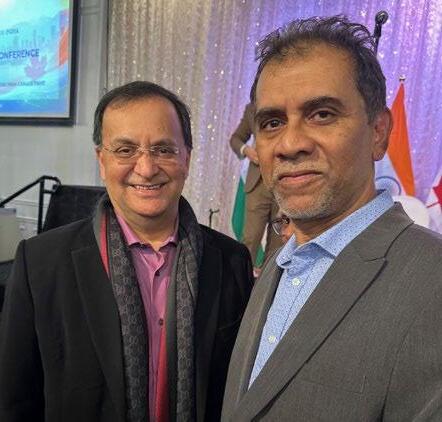
Indian High Commissioner Dinesh Patnaik (left) with The Asian Star Editor Umendra Singh
Video shows B.C. teen’s Highway 1 joyride, ending in crash with parked dump truck
A video released by BC Highway Patrol aims to show the consequences of poor driving choices, especially for young drivers.
Cellphone video shared by the highway patrol, which was voluntarily given to police, shows an Abbotsford, B.C., teen and two friends driving down Highway 1 at Popkum on July 21, 2025.
The BMW sedan, which belonged to the 16-yearold driver’s stepmother, according to police, was recorded going 180 km/h in a 100 zone.
The video shows the teen driver deciding not to stop for the police and instead speeding off, with the collision ending in a crash with a parked dump truck. “Nobody likes getting stopped by police, but this video shows the alternative is usually much worse,” Cpl. Michael McLaughlin with BC Highway Patrol said in a statement. “You can see how quickly the teen’s friends went from enjoying the ride to ‘don’t kill us.’”
After the crash, the driver can be heard saying, “Run!” with one of the passengers saying, “Run where?” The 16-year-old Class 7 learner driver is
now serving a 12-month licence suspension and was found guilty of excessive speed, with a fine of $483; driving without due care and attention, with a fine of $368; driving contrary to restrictions (too many passengers), with a fine of $109; driving contrary to restrictions (no supervisor), with a fine of $109; driving without a “L” sign, with a fine of $109; failing to obey a stop sign, with a fine of $167; passing on the right side of the roadway, with a fine of $109; and an improperly equipped motor vehicle, with a fine of $109.
Actual fines can still vary as they can be increased or reduced at sentencing.
“We hope this video stimulates parents to talk with their children about how badly this could have ended,” McLaughlin said.
“We all need to do more to prevent tragic outcomes.”
The car was towed and impounded for seven days, and the driver’s stepmother was also left responsible for paying the associated costs as well as any collision deductible or repairs.
Firearms charges laid 1 year after Kelowna search warrant, RCMP say
A man and a woman from Kelowna have been charged with weapons offences, one year after police arrested them while executing a search warrant as part of a drug trafficking investigation.
Police arrested 41-year-old Lindsey Smith and 25-year-old Austin Pederson in March 2025, but released them pending further investigation, Kelowna RCMP said in a news release Wednesday. The detachment said charges have now been approved against both individuals, who have been re-arrested and are in custody awaiting a bail hearing.
Smith has been charged with two counts of possession of a prohibited or restricted firearm and ammunition without a licence, as well as one count each of the following:
Possession of a prohibited device without a licence
Possession of a firearm while prohibited
Possession of ammunition while prohibited
Possession of a prohibited device while prohibited.
Pederson has been charged one count each of possession of a prohibited or restricted
firearm without a licence, possession of a firearm while prohibited and possession of ammunition while prohibited.
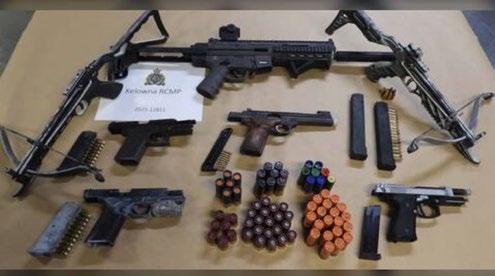
Police did not say where in Kelowna the pair was originally arrested. They shared a photo of the weapons seized during the search, which included five guns and two crossbows.
“Our investigative teams are committed to completing thorough, evidence-driven files,” said Staff Sgt. Desmond Kiehlbauch, in the release.
“This case required careful, detailed work to ensure we could present the strongest possible evidence before the courts. Our focus remains on public safety and holding individuals accountable through a comprehensive investigative process.”
Warrant issued for 19-year-old, one of five accused in B.C. kidnapping, extortion case
Mounties in Mission are asking the public for help locating a teenager wanted for a variety of offences, including robbery, extortion and assault with a weapon.
Dayton Zahn, 19, is wanted for those charges, as well as forcible confinement, Mission RCMP said in a news release Wednesday.
The charges stem from an incident that allegedly occurred in June 2025, the detachment said. It did not provide any additional details about the incident.
Online court records show Zahn is one of five people accused in connection to the same police file. Three others— Remi Ajayi, Ahmed Aziz Bangura and Cash William Lorman—remain in custody, while the fourth—Christian Ehrlich Von Bruck—does not.
Charges were laid against
Ajayi and Bangura on March 6 and against the other three people on March 10.
All five have been charged with kidnapping without the use of a firearm, extortion, assault with a weapon and robbery, according to court records. Bangura is additionally charged with one count of sexual assault.
All of the accused are listed as born in 2005 or 2006, making them 21 years old at the oldest.
The alleged offence dates are June 29 for the kidnapping charge and June 30 for the other offences.
Mounties shared a photo of Zahn with their release Wednesday. They’re asking anyone who sees him or has information on his whereabouts to contact them at 604-826-7161 and reference file number 20257674.
Quebec father who drowned his 2 children found guilty of murder
A jury has found a man who drowned his two children in their Laval, Que., family home in October 2022 guilty on all charges.
Kamaljit Arora, 49, was found guilty of firstdegree murder in the deaths of his 11-year-old son and 13-year-old daughter, whose names are covered by a publication ban. The jury also found Arora guilty of attempted murder of his eldest daughter and of strangulation of his wife, Rama Rani Arora, who survived the attack.
In a written admission at the
beginning of the trial, the accused admitted to drowning his youngest children, but his lawyers argued the acts were not premeditated and he was experiencing a relapse of depression first diagnosed in 2020. The Crown had maintained the evidence pointed to a well-thought-out plan to commit the crimes.
While first-degree murder conviction carries an automatic life sentence without possibility of parole for 25 years, the case will return to court in May for sentencing on the other counts.
Why Punjabi builders in Canada are living under extreme fear
Continued from Page 1...
“Builders in Vancouver are now pulling down jobsite signs, scrubbing phone numbers and addresses from websites, delaying projects, and living in fear that their success makes them prime targets. These are not abstract threats: they come backed by the real risk of violence — shootings, arson, drive-by attacks — that has already claimed lives and shattered families in the region," the report detailed. “One builder, speaking anonymously to media, captured the dread: many believed the problem was confined ‘south of the Fraser,’ yet extortion calls are now reaching deep into Vancouver’s Punjabi business community, forcing entrepreneurs to hide their identities and scale back operations,” it added.
The report noted that this is not just a ‘community issue’ — but a warning sign of organised crime infiltrating and exploiting Canada’s openness, with transnational networks — often connected to groups like the Lawrence Bishnoi gang, designated a terrorist entity by the Canadian government — operating with impunity.
“These criminals exploit diaspora ties, use cryptocurrency for untraceable payments, and escalate to gunfire when demands go unmet. The result? A surge in extortion cases that has seen hundreds reported in B.C. alone in recent years, with spikes of over 200 per cent in some areas since the mid2010s. Similar patterns plague Brampton, Edmonton, and Toronto, where Punjabi and South Asian business owners face the same terror,” it mentioned. “Canada’s reputation as a safe, welcoming nation is eroding before our eyes. Successful immigrants who came here to build lives and contribute to the economy — through construction, real estate, and small businesses — are now fleeing cities or curtailing their ambitions out of fear. Projects stall, economic activity slows, and entire neighbourhoods live under a shadow of intimidation. When law-abiding citizens must erase their public presence to avoid becoming victims, something fundamental has failed,” it stated. The report underscored the urgent need for decisive action before “more lives, livelihoods, and the Canadian dream itself are held hostage”.
B.C. hikes damage limit to $75,000 for those whose intimate images were posted online
The British Columbia government has raised the ceiling to $75,000 for potential damages over intimate-image abuse, where people’s photos have been shared online without their consent.
The provincial government has made amendments to the Intimate Images Protect Act that will allow a victim to ask for the damages through the Civil Resolution Tribunal.
The previous limit was $5,000, but Attorney General Niki Sharma says the
taken down, to stop further distribution and claim compensation from the person, social media company or website that shared or threatened to share the image.
Since the act came into force in January 2024, the tribunal has resolved 389 of the 486 submissions that it has received, while the remainder of the cases are in progress.
Jennifer Blatherwick, B.C.’s parliamentary secretary for gender equity, says sharing, or threatening to share, intimate images of someone without their consent is an act of sexual violence and abuse that carries deep harm.
increased threshold sends a “clear message that non-consensual sharing of intimate images is unacceptable in B.C. and carries serious consequences.”
The act allows people to apply through the tribunal to have their intimate images
“Survivors of sexual violence may experience stigma that can cause intense shame and helplessness and isolation, and lead to long-term trauma. These changes to the act give survivors better protections and access to justice so they can regain a sense of autonomy and safety,” Blatherwick says in a statement. That government says that people who need help navigating the process can reach out to the Intimate Images Protection Service, which offers resources and help communicating the tribunal’s orders to platforms and those who have posted the images.
CBSA says efforts to ‘disrupt extortion networks’ led
to 70 removal orders
Continued from Page 1...
Among the communities most impacted by extortion is Surrey, B.C., where there were 133 reported cases of extortions in 2025 and police are looking into 64 cases so far this year.
The CBSA says it is investigating people alleged to be engaged in extortion, operating a tip line where it encourages people to share information or directly report the “whereabouts of those who are inadmissible to Canada.”
A followup email from the agency says as of March 12, 34 removal orders were issued in Pacific region, which includes B.C. and the Yukon, and 25 people have already been removed from Canada. It says the Pacific region’s first extortion-related immigration investigation began on August 26, 2025, ahead of the September announcement of B.C.’s Extortion Task Force.
Federal Conservative shadow minister for immigration Michelle Rempel Garner said in a statement that there were more than 13,000 reported incidents of extortion in Canada in 2024. “While not all extortion incidents involve individuals who should be deported, the fact that CBSA has still only managed to enforce 35 removal orders does not denote progress,” she said. The agency’s president, Erin O’Gorman, says in the news release that extortion “empowers organized criminal groups, targets vulnerable people and inflicts lasting harm on Canadian communities.”
“The CBSA is committed to using every tool we have to counter this threat,” she says.
“By increasing our removal capacity and deepening our partnerships with police, we have made significant progress toward ensuring these criminals cannot remain in Canada.” The CBSA says he was removed from Canada under escort in January.
BC faces long-term care shortage, and decision to delay facilities is drawing fire
James Wolfe, who lives in B.C.’s Fraser Valley, spent the last year and a half looking for a longterm care bed for his 68-year-old brother Brian, who has Down syndrome and non-verbal dementia.
Mostly, it involved a back-and-forth with local health administrators. “They are great people,” he said. “They are very compassionate doing their job.” But there was simply a lack of appropriate facilities, and Wolfe said his brother was in and out of hospital as his health declined.
“At Christmas, he was really sick in the hospital,” Wolfe said, and while his brother was eventually discharged, he was back in hospital with pneumonia and sepsis in January.
Wolfe’s advocacy has now finally landed his brother in a group home for adults living with disabilities.
Looking back, Wolfe said he wondered where his brother would be without family support, and he criticized a recent B.C. government decision to delay construction of seven long-term care projects. The decision, announced in the February budget, comes amid a shortfall of long-term care beds that is projected to soar over the next decade as the population ages.
“I think it’s horrendous,” Wolfe said of the delays. “You are essentially putting people in danger, if you do not have a place to put them.”
The facilities being put on hold are in Squamish, Abbotsford, Campbell River, Chilliwack, Delta, Kelowna and Fort St. John. They involve 1,223 beds, although some of those would replace current beds in existing facilities.
The Squamish project is a planned 152-bed facility that was originally set for construction in 2027. The government hasn’t offered a new
timeline.
The Sea to Sky Hospice Society had been planning to move into the new facility and the open-ended delay has stressed board chair Marya Hackett.
“We have a population of seniors that is aging, and is going to need long-term care. What are you going to do with them?” she asked.
Hackett said that even if it proceeds, the new project would not be keeping up with the need in the region. Eight of its beds have been slated for hospice care, although only four of them are new, with the others being transferred from an existing facility in Squamish.
The same could be said for the rest of the province. Figures released by the Office of the Seniors Advocate in January pegged the shortfall of long-term care beds at 2,000.
Government numbers released last year, meanwhile, show B.C. will need 16,000 new longterm care beds over the next decade to make up the gap between the projected supply of publicly subsidized beds and projected demand.
B.C.’s senior population, aged 65 and older, is projected to increase by 26 per cent in the next 10 years, and wait-lists for long-term care have “ballooned,” according to a report released by the seniors advocate in July 2025.
It shows that the number of people on the waitlist for long-term care tripled from 2,381 to 7,212 between 2016 and 2025. Wait times doubled from 146 days in 2018, the first year of data collection, to 290 days in 2025.
“Without significant additional investment in building more new long-term care beds, wait-lists and wait times will continue to rise to unsustainable levels,” it reads.
3 university students arrested in murder case
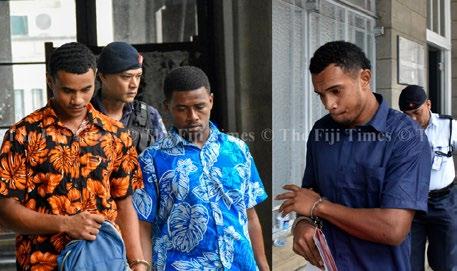
Three tertiary students have been remanded in custody for 14 days over the alleged murder of a 30-year-old man in Suva.
Alexander Vatia Leweniqila, 19, Manoa Vakavunivalu, 19, and Aisake Lovobalavu, 20, appeared before the Suva Magistrate’s Court yesterday charged with the death of Jone Vuinakelo. They have been ordered to reappear on March 27. The matter is expected to be transferred to the High Court as murder is an indictable offence. Police allege the victim was found at Nauluvatu Settlement on
Sunday, March 15, with severe facial injuries. No plea was taken.
Fijian man admits murdering partner in Sydney domestic violence case
A young woman was threatened with death weeks before she was fatally stabbed by her partner in Sydney’s west, a Sydney court has heard.
The New South Wales Supreme Court was told that Nunia Kurualeba, 21, had been warned by her partner Jeremaia Tuwai that he would one day kill her.
“One day, I will kill you,” Tuwai allegedly told Ms Kurualeba in the weeks leading up to the attack. Prosecutors said the threats escalated
shortly before the killing on July 8, 2024, at a home in Kingswood, where Tuwai dragged Ms Kurualeba into her bedroom and fatally stabbed her with a knife he had hidden under her pillow.
The court heard that the day before the murder, Tuwai told Ms Kurualeba to “start saying goodbye to your family”. He also allegedly told her cousin: “Tell that girl I will suicide her.”
Tuwai, who was 22 at the time, has admitted to murdering Ms Kurualeba and told police he was driven by “anger and jealousy.”
Following the attack, he was arrested later that same day at another address in Kingswood.
During police interviews, Tuwai said the couple had argued and he stabbed her because he was “so angry”. He also claimed he had seen Ms Kurualeba speaking with other men on Facebook, which fuelled his jealousy.
When asked why he grabbed the knife, Tuwai reportedly told police: “I want to end her life there.”
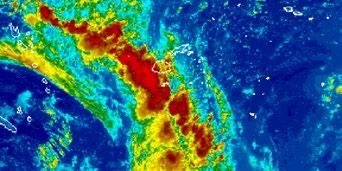
Trough to bring rain, risk of flash flooding across Fiji
A trough of low pressure to the west of Fiji is expected to bring cloudy conditions, showers and isolated heavy rainfall across parts of the country until tomorrow.
The Fiji Meteorological Service says a moist north to northeast wind flow is currently prevailing over the group, contributing to unsettled weather conditions.
“Associated cloud and showers are expected to affect some parts of the group till tomorrow,” the advisory stated.
Areas likely to be affected include Navua, Suva, Nausori, Tailevu, Naitasiri, Ra, Rakiraki, eastern Macuata, Cakaudrove, Taveuni, the Lau and Lomaiviti groups, as well as Kadavu and nearby smaller islands.
with conditions expected to ease slightly from tomorrow.
“Showers easing to some showers from tomorrow,” the advisory said.
Elsewhere across the country, cloudy periods with some showers and afternoon or evening thunderstorms are expected.
Forecasters say occasional showers, including isolated heavy falls, are expected over these areas,
The Met Office also warned that afternoon thunderstorms with heavy rainfall are likely over both Viti Levu and Vanua Levu.
Authorities are cautioning the public about the risk of flash flooding. “Localised heavy falls may lead to flash flooding of low-lying areas,” the advisory warned. People living in flood-prone areas are being advised to remain vigilant and take necessary precautions as weather conditions continue to develop.
Passport systems upgrade
FIJI’S passport system is undergoing a major upgrade aimed at improving efficiency, reducing waiting times and making immigration services more convenient for the public.
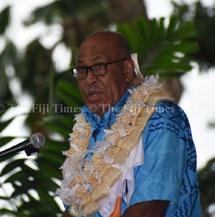
Minister for Immigration Viliame Naupoto made the announcement in Parliament on Wednesday while outlining the government’s commitment to strengthening immigration services, saying the upgrade would be the first since the passport system was introduced in 2019. “This is the first upgrade since acquiring
this passport system in 2019 – it is a little overdue, but it is being done now,” Mr Naupoto said. “This upgrade, when completed, will significantly improve the quality and efficiency of our passport service delivery to the public.” He said the upgraded system would allow applicants to begin the passport enrolment process online.
“Individuals will be able to complete their passport enrolment online, wherever they are, even from the comfort of their homes, and only first-time passport applicants will be required to book an appointment date, to visit the nearest immigration office for their biometric capture.
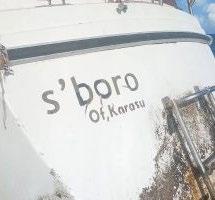
Abandoned yacht found in Cakaudrove waters identified as ‘S boro of Karasu’
Authorities are investigating an abandoned yacht, “S’boro of Karasu,” discovered in waters off Cakaudrove.
The vessel was spotted floating near Ucunipotu waters on Monday before being towed and safely anchored at the Yasawa Village foreshore.
A joint operation involving the Fiji Police Force, Criminal Investigations Department (CID), Fiji Revenue and Customs Service (FRCS), village officials and local divers was carried out on Tuesday to assess the situation.
Investigations are ongoing, with authorities expected to release further details once assessments are completed.
Minister orders probe in yaqona drinking ban for women
The Government has ordered an inquiry into the controversial lawa ni Qoibau, as concerns grow over a ban preventing women from drinking yaqona in the vanua.
iTaukei Affairs Minister Ifereimi Vasu said he had directed the Roko Tui Macuata to visit the area and engage with traditional leaders following media reports.
“We have asked the Roko Tui Macuata to visit the village and speak with the traditional leaders of the vanua o Qoibau,” he said.
The law, agreed to during a meeting in Nakorowiri Village last month, is part of a wider written code aimed at restoring discipline and reinforcing community order across villages under the vanua o Qoibau. The decision to ban women from drinking yaqona has drawn mixed reactions from members of the public with some raising queries about fairness and human rights.
Mr Vasu said he was only made aware of the development through media reports.
“I was only made aware of the lawa ni Qoibau when I read the newspaper.” He said the Government was now trying to determine whether proper consultations were carried out before the laws were introduced.
“We are not sure whether proper consultations were conducted before the lawa ni Qoibau was made.” He also questioned the gender-specific nature of the ban. “If there was a ban, it should not be only on women but on men also. “We need to remember that there are human rights in place. “Stopping someone from drinking kava should be a decision made by that individual.”
The lawa also outlines strict controls on alcohol consumption, noise levels, dress standards and yaqona use, in an effort to strengthen traditional authority within the vanua.
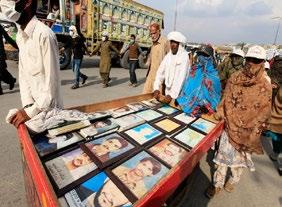
Enforced disappearances in Pakistan continue as two Baloch men go missing in Karachi
Balochistan [Pakistan], March 19 (ANI): Two individuals from Balochistan have reportedly been forcibly disappeared in separate incidents in Karachi, according to family members and local sources, further intensifying concerns about the alleged enforced disappearances of Baloch citizens in Pakistan. The most recent incident involves Asim, son of Asghar, who belongs to Panwan in Jiwani. Family members allege that he was taken into custody by personnel of the Pakistan Rangers during the late hours of March 16. Relatives said that the incident occurred around midnight in the Shah Ali Sharafi Goth locality of Karachi, as reported by The Balochistan Post.
According to The Balochistan Post, Asim, who
"Pakistan
works as a trader, was reportedly picked up from the area and taken away by security personnel. Since the reported detention, his family says they have not received any information about his whereabouts or legal status. Relatives are deeply worried about his safety and have appealed to authorities to disclose his location and ensure his safe return. In a separate case that has recently come to public attention, another Baloch man, identified as Shabbir Baloch, has reportedly been missing since November last year.
Shabbir, son of Haji Qadir Bakhsh and a resident of Zehri in Khuzdar district, was allegedly detained on November 13 from a nursing hostel in Karachi, where he had been staying.
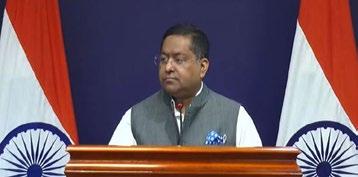
has history of clandestine nuclear proliferation": MEA after US Intel chief Tulsi Gabbard's statement
New Delhi [India], March 19 (ANI): The Ministry of External Affairs (MEA) on Thursday said that the recent US intelligence report, flagging Islamabad as a nuclear threat, highlights the risks posed by Pakistan due to the country's "clandestine history of nuke proliferation."
Pakistan, China pose N-threat to US: Tulsi Gabbard
US intelligence chief Tulsi Gabbard on Wednesday said Pakistan, along with Russia, China and North Korea, currently posed the most significant nuclear threat to the country.
Gabbard, Director of National Intelligence, was briefing the US Senate on Iran. Speaking on the evolving threat landscape, she said the US “obliterated” Iran’s nuclear enrichment programme in June last year.
She said the US had since seen no effort to rebuild Iran’s enrichment capabilities.
Gabbard said the US intelligence assessed a sharp rise in the number of missiles capable of striking the US.
According to estimates, the figure is expected to grow to over 16,000 by 2035, a significant increase
from the current assessed number of around 3,000, Reuters reported. During the briefing, Gabbard also named Iran, China, Russia and North Korea, saying they were actively developing new missile delivery systems, including both nuclear and conventional warheads, which put the US within range.
“The intelligence community assesses that Russia, China, North Korea, Iran and Pakistan have been researching and developing an array of novel, advanced or traditional missile delivery systems, with nuclear and conventional payloads, that put our homeland within range,” Gabbard said. During the briefing, the US intelligence chief also said North Korea was strengthening its partnership with Russia and China.
Nepal investigating burning of Xi Jinping’s book at university
On March 18, a report issued by the Office of the Director of National Intelligence in the US classified Pakistan, along with major powers such as Russia and China, as posing a significant nuclear threat to the US.
Addressing a regular press briefing here, the official spokesperson of the MEA, Randir Jaiswal, stated that Pakistan has a history of clandestine nuclear proliferation, and such observations once again bring attention to concerns surrounding its track record. "As far as Pakistan is concerned, they have a history. They have a history of clandestine nuclear nonproliferation, and statements like this again make it clear what kind of threat they pose to the world because of their clandestine nuclear operations," Jaiswal said.
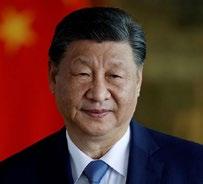
Nepal is investigating how some copies of a book authored by Chinese President Xi Jinping were burned at a university in the east of the country after the Chinese embassy expressed concern over the incident, officials said on Thursday.
Yuvaraj Kattel, chief district officer of Morang where the incident took place last Saturday, said a five-member panel had been given 15 days to find out how copies of Xi’s book “The Governance of China” were burned at the district’s Manmohan Technical University (MTU).
Beijing is a major trading partner
and donor, and has invested in infrastructure such as airports, roads and health in Nepal, a natural buffer between China and India, both of which jostle for influence in the Himalayan nation.
“The Governance of China” is a multi-volume collection of Xi’s speeches and writings outlining his political philosophy and vision for government.
“It has been asked to find out who was responsible for this and recommend measures to ensure that such incidents are not repeated in future,” Kattel told Reuters.
Sidhu Moosewala to become first Indian artiste to have hologram world tour
Slain Punjabi singer Shubhdeep Singh, popularly known as Sidhu Moosewala, is set to become the first Indian artiste to have a hologram-based world tour. The teaser of his ‘Signed to God World Tour’ has already created a buzz online.
The tour will use hologram technology to recreate Moosewala’s stage presence for fans across the world. A hologram is a 3D projection that makes a person or object appear real without any physical presence. It uses light and visual effects
to create the illusion that someone is on stage, even when they are not. A 42-second teaser shared on his official Instagram account gives a glimpse of the project. It shows Moosewala opening his eyes, followed by scenes of a packed stadium, creating the feel of a live concert. It also features a photo of his younger brother, also named Shubhdeep Singh and known as Nikka Sidhu, wishing him a happy birthday.
Nikka Sidhu turned two on March 17.
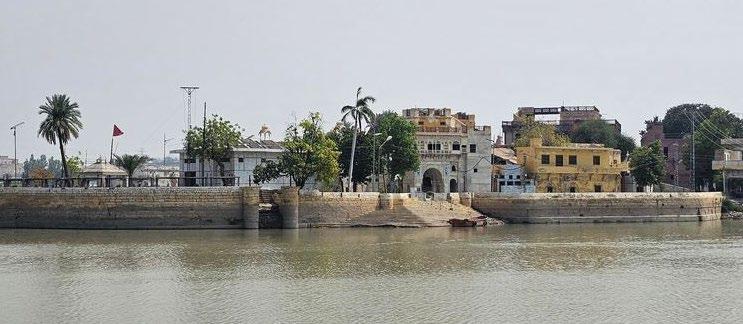
Journey to Pakistan's Sadhu Bela, an Udasi shrine bridging Hindu-Sikh traditions on river island
Earlier this week, I travelled South from Lahore, past Multan, beyond Punjab, to Sindh to celebrate Eid with my friend's family.
I have never been to an Udasi Dera (temple complex), so I was fascinated by the opportunity to visit one in the middle of an island on the mighty Indus river (locally called Mehran in Sindhi) near Sukkur, Sindh. Several of my Muslim friends, who are fasting for Ramzan, accompanied me. The temple island is reachable by a short boat ride from the bank of Sukkur city. As the boat moved towards the temple complex, I reflected on its history. This island was once a forested island called Menak Parbat. An Udasi saint, Baba
Bankhandi Maharaj, came here in 1823 from Nepal since this place was then a major trading hub on the Indus river. He settled here and renamed it Sadhu Bela, meaning the woods of the saint. He is said to have worshipped the Hindu deity Annapurna. However, according to some sources, Sadhu Bela is named after an Arab commander named "Saeed", who occupied and was stationed on the island much before the arrival of the Udasi saint. Baba Bankhandi died in 1883. His descendant, Sant Harnam Das, built the main temple, adorned with white marble, in 1899. The complex features intricate marble carvings and murals depicting Hindu mythology, including statues of Hindu deities Radha and Krishna.
Many of the plaques are in Gurmukhi, Hindi, Sindhi and Landae.
At Partition, the Dera leadership first moved to Kashi and then to Bombay in India. There are Sadhu Bela temples now in both places since then.
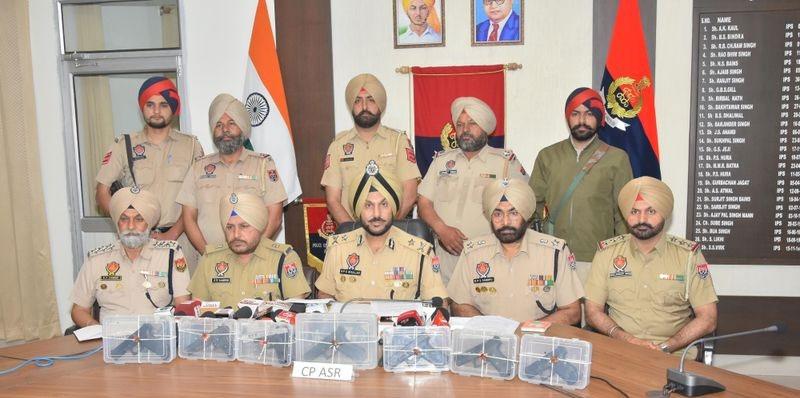
Amritsar police bust cross-border arms smuggling module; juvenile among 6 held
The Amritsar police commissionerate busted yet another cross-border illegal arms smuggling module and arrested six accused, including one juvenile.
Acting on specific intelligence inputs, the police launched a targeted operation, leading to the apprehension of the accused and recovery of a cache of sophisticated weapons.
The accused have been identified as Gurpreet Singh alias Gopi, Munish Kumar alias Jerry, Saroop Singh alias Roop, Chamkaur Singh, Vansh Sharma, and a minor.
Police Commissioner Gurpreet Singh Bhullar said a total of seven firearms were seized from their possession, including five Glock 9mm pistols and two .30 bore pistols. The recovery is considered significant, as such high-end weapons are often linked to organised crime networks, he
Chandigarh Sector 9 firing: 2 suspects arrested after encounter with Punjab AGTF in Kaithal
Two suspects allegedly involved in the murder of Chamanpreet Singh alias Chini, a property dealer, in Chandigarh on Wednesday have been arrested following a brief shootout with Punjab AGTF in Kaithal, police said on Thursday.
According to police, both were apprehended after an exchange of fire during a joint operation.
Who are the accused?
The accused have been identified as Piyush Pehelwan, a native of Ferozepur, and Pritam Shah, a resident of Nawanshahr.
Both are two key associates of fugitive gangster Lucky Patial of the Bambiha gang. Officials said weapons and the motorcycle used in the Chandigarh crime have been recovered from their possession. Entered India illegally via Nepal
accused sustained injuries and were immediately shifted to the hospital for treatment, Punjab DGP Gaurav Yadav said.
Preliminary investigation reveals that Rajan, alias Piyush Pehalwan, was also wanted in the high-profile murder of Yadwinder Singh, driver of Jiwanjot Singh, alias Jugnu.
Sources revealed that one of the accused, Rajan alias Piyush Pehelwan, had recently entered India illegally from Malaysia via Nepal. Both suspects have a criminal history, with multiple cases registered against them in the past.
"During the operation, the accused opened fire on police teams. In the retaliatory exchange, both
pointed out. Preliminary investigations revealed that the accused were in direct contact with a foreign-based handler operating from Portugal.
The handler is suspected to have played a key role in facilitating the smuggling of illegal arms from across the Pakistan border into India. The accused allegedly acted as local conduits, further supplying these weapons to criminal elements in the region.
Efforts are underway to trace forward and backward linkages, including identifying other associates and beneficiaries of the smuggled weapons. A case has been registered at Police Station Cantonment, Amritsar, under relevant sections of the BNS and Arms Act. Further investigation is in progress to dismantle the entire network and ascertain the full extent of the operation.
Arrested in less than 30 hours
The AGTF Punjab has unmasked the module and arrested the accused in less than 30 hours. Three weapons (PX 5 .30 caliber pistol, .30 caliber chinese pistol, .32 caliber pistol) and other cache have been recovered, the DGP said.
Who was killed?
31-year-old Chamanpreet Singh was shot dead in a brazen daylight attack near a gym in Sector 9 on Wednesday.
A property dealer from Kubaheri village in Mullanpur, Singh had arrived in his black fortuner in a parking area, when two bike-borne assailants opened fire at him. The attackers fired at least 8-11 rounds and fled the scene on a motorcycle.
Haryana govt shuffles top bureaucrats, 23 IAS officers transferred
The Haryana Government today effected a major reshuffle, issuing transfer and posting orders for 23 IAS officers. Prominent among them are Anurag Agarwal, who will be the new ACS, Town and Country Planning Department, while AK Singh has been posted as ACS, Higher Education, and ACS, Public Works (B&R) and Architecture Department.
Neha Singh is the new Deputy Commissioner of Sonepat.
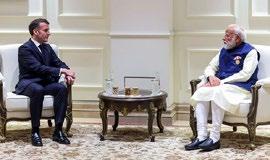
PM Modi, French President Macron call for 'urgent need for de-escalation' of West Asia conflict during talks
New Delhi [India], March 19 (ANI): Prime Minister Narendra Modi on Thursday held a conversation with French President Emmanuel Macron on the evolving situation in West Asia, with both leaders emphasising the urgent need for de-escalation and a return to dialogue and diplomacy to end the conflict.
Sharing the details of the conversation in a post on X, the Prime Minister described President Macron as a "dear friend" and said the two leaders exchanged views on the ongoing conflict and its broader implications for regional and global stability. "Spoke with my dear friend, President Emmanuel Macron, on the situation in West Asia and the urgent need for de-escalation, as well as a return to dialogue and diplomacy. We look forward
to continuing our close coordination to advance peace and stability in the region and beyond," the post read. The conversation comes amid heightened tensions in West Asia, with several countries in the region witnessing disruptions and security challenges.
Earlier today, PM Modi held a "productive conversation" with the Sultan of Oman, Haitham bin Tariq Al Said, during which the two leaders discussed the evolving situation in West Asia and emphasised the importance of dialogue and diplomacy in order to de-escalate the conflict.
In a post on X, the Prime Minister stated that during the discussion, he conveyed advance Eid greetings to Tariq Al Said and the people of Oman and reaffirmed India's strong ties with the Gulf nation.
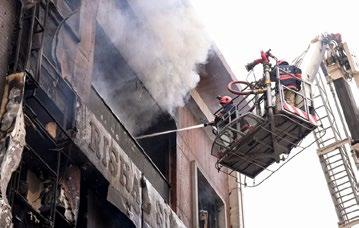
'System failed us', says man who lost 9 family members; revisits inferno site
A day after a devastating fire claimed nine lives in southwest Delhi's Palam, a grieving father returned to the charred remains of his home on Thursday, alleging that systemic negligence had taken away everything he held dear.
Rajender Kashyap, who lost nine members of his family in the blaze, entered the gutted structure near Ram Chowk Market along with police and forensic science laboratory (FSL) teams as part of the ongoing investigation.
Overcome with grief after stepping out, he
SC
broke down and blamed the authorities.
“This is the system's failure. Had there been a timely response, my family would have been alive,” Kashyap claimed. The four-storey building, located in a congested lane near Palam Metro Station, housed a cloth and cosmetics business in the basement, ground and first floors, while the family lived on the upper levels. The fire broke out around 6.15 am on Wednesday, spreading rapidly through the structure and killing nine people, including a 70-year-old woman and three young girls, one of whom was just three years old. Three others were injured while attempting to escape.
Eyewitnesses had earlier alleged delays in rescue operations, claiming that the first hydraulic crane deployed at the spot malfunctioned and that a second crane took nearly an hour to arrive, costing crucial time. On Thursday, neighbours gathered outside the building for a condolence meeting, as questions arose regarding the cause of the fire and the effectiveness of the emergency services.
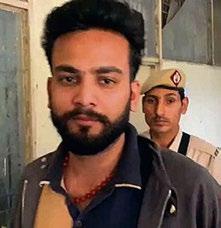
quashes case against YouTuber Elvish Yadav over snake venom allegations, cites lack of evidence
The Supreme Court on Thursday quashed an FIR and subsequent proceedings against YouTuber Elvish Yadav over alleged use of snake venom at a rave party in Noida in 2023, saying the case cannot be sustained in law. The case against Yadav was registered on November 22, 2023, and he was arrested on March 17, 2024. The top court had stayed proceedings in the trial court against Yadav in the case on August 6, 2025. A bench of Justices MM Sundresh and N Kotiswar Singh passed the order on Thursday after senior counsel Mukta Gupta and advocate Raman Yadav submitted that the alleged psychotropic substance i.e. snake venom antidote recovered from a co-accused did not fall within the Schedule of the Narcotic Drugs and Psychotropic Substances (NDPS) Act, 1985.
been filed. The bench clarified that it has confined itself to two specific questions — applicability of Section 2(23) of the NDPS Act, and the validity of proceedings under Section 55 of the Wildlife (Protection) Act, 1972.
Noting that Section 55 said a prosecution can be initiated under the Wildlife Protection Act only through a complaint filed by a duly authorised officer, the bench pointed out that the complainant was a former employee of Wildlife Board of India and therefore not an authorised person under the Act to lodge a complaint.
However, it granted liberty to the competent authority to initiate appropriate proceedings in accordance with law by filing a proper complaint under Section 55 of the 1972 Act.
The bench noted that the substance in question was not covered under the statutory schedule and that no recovery had been made from Yadav himself as the chargesheet only alleged that he placed orders for it through an associate.
The bench also took note of the fact that the offences under the IPC invoked in the FIR against Yadav were based on an earlier FIR registered in Gurugram, in which a closure report had already
Holding that the case against YouTuber Elvish Yadav cannot be sustained in law, the top court quashed the FIR and subsequent proceedings, including filing of the chargesheet and cognisance order of the trial court.
The YouTuber had challenged an Allahabad High Court order refusing to quash the chargesheet and the cognisance order of the trial court terming it a serious offence.
New Delhi [India], March 19 (ANI): The Ministry of External Affairs (MEA) on Thursday said that around 280,000 people have returned to India from West Asia since February 28, amid evolving airspace restrictions and operational challenges in the region as the conflict in the region escalates.
Addressing an inter-ministerial briefing on recent developments in West Asia, Aseem Mahajan, Joint Secretary (Gulf) in the MEA, noted that despite disruptions in some countries, the overall flight situation is gradually improving.
"While there have been operational closures in some countries, overall the flight situation continues to improve with additional flights operating. Since February 28, around 280,000 passengers have returned from the region to India," Mahajan said.
destinations in India today," Mahajan said.
He further informed that Kuwait's airspace has remained closed since February 28. In response, Kuwait's Jazeera Airways has announced special non-scheduled flights from Al Qaisumah International Airport in Saudi Arabia to India, with the first flight scheduled to Kochi on Friday. Similarly, Bahrain's airspace continues to remain closed, with Gulf Air operating special flights from Dammam Airport in Saudi Arabia to facilitate travel to India, and more such flights are expected in the coming days.
He added that airlines are continuing to operate limited non-scheduled flights between the UAE and India, depending on operational feasibility and safety considerations.
Mahajan stated that on March 18, around 75 flights operated between the two countries, while approximately 90 flights are expected to operate today, indicating an upward trend amid the conflict. "Flights continue to operate from Oman and Saudi Arabia to India. Qatar airspace remains partially open, with Qatar Airways operating non-scheduled commercial flights to India. Qatar Airways is operating nine flights to various
"In view of the flight restrictions from Kuwait, Bahrain and Iraq, we continue to facilitate transit of stranded Indian nationals and for emergency cases via Saudi Arabia," Mahajan added.
This development comes amid the escalating conflict that began on February 28 with the killing of 86-year-old Iran's Supreme Leader, Ayatollah Ali Khamenei, in joint military strikes by the US and Israel, after which Iran, in its retaliation, targeted Israeli and US assets in several Gulf countries and Israel, causing disruption in the waterway and affecting international energy markets and global economic stability. Due to the conflict in the region, Iran has virtually closed the Strait of Hormuz, a critical transit route for global energy supply. Following the death of Ali Khamenei, Mojtaba Khamenei, son of the former leader, was appointed as the new Supreme Leader of the Islamic Republic.
Armed Forces Tribunal quashes action against officer accused of extra-marital affair, says interim orders are no basis
Setting aside a ‘severe displeasure’ awarded to a Lieutenant Colonel for allegedly developing a relationship with a woman and entering into a plural marriage the Armed Forces Tribunal (AFT) has ruled that action cannot be initiated on the basis of interim findings of an inquiry where the complainant has failed to depose.
“An incomplete court of inquiry (COI) cannot be relied upon for taking action against the delinquent individual and thus interim findings and interim opinion are illegal and deserve to be quashed,” the AFT’s Chandigarh Bench comprising Justice Sudhir Mittal and Lt Gen Ranbir Singh said in their order of March 18 while rapping a Lieutenant General for bias and failure to take into account all factors pertaining to the case.
has been testing time, not just for us, but for entire global community: MEA on West Asia war
As the conflict in West Asia widened with global ramifications, India on Thursday said the situation has been a "testing time", not just for the country, but for the entire global community.
At an inter-ministerial briefing here on the West Asia situation, MEA spokesperson Randhir Jaiswal said, "We continue to remain in touch with the countries concerned to ensure our energy security needs are met."
The raging conflict in the region entered its 20th day on Thursday.
The West Asia conflict began on February 28 when the US-Israel combine launched military strikes on Iran. In retaliation, Tehran has targeted Gulf countries hosting US military bases.
"Yes, it has been testing time, not just for us, but for the entire global community. Our leaders have been in touch with their counterparts, as I just spoke about the conversation between our prime minister
In a significant move aimed at strengthening oversight of the energy sector, the Ministry of Petroleum and Natural Gas has notified the Petroleum and Natural Gas (Furnishing of Information) Order, 2026, making it mandatory for all entities in the petroleum and natural gas value chain to furnish detailed operational data to the Central Government.
The order has been issued under Section 3 of the Essential Commodities Act, 1955, which empowers the Centre to regulate production, supply and distribution of essential commodities in public interest.
The notification builds upon existing regulatory frameworks, including the Petroleum Products (Maintenance of Production, Storage and Supply) Order, 1999, and the recently issued Natural Gas (Supply Regulation) Order, 2026.
The new order introduces a Centralised institutional mechanism to monitor crude and
natural gas stocks. Recognising the need for real-time and structured data to ensure efficient supply chain management, the government has designated the Petroleum Planning and Analysis Cell (PPAC) as the nodal agency for monitoring. PPAC will be responsible for the collection, compilation, maintenance, and analysis of sector-wide data, enabling more informed policy decisions and timely interventions.
The order casts a wide net, covering all entities engaged in production, processing, refining, storage, transportation, import, export, marketing, distribution, and even consumption of petroleum products and natural gas.
This includes crude oil producers and importers, oil refineries, oil marketing companies, LNG importers and terminal operators, natural gas pipeline operators, city gas distribution entities, and petrochemical plants.
Equity investors’ wealth eroded by Rs 12.87 lakh crore on Thursday as stock markets went into a tailspin, with the benchmark Sensex plunging over 3 per cent, pressured by a spike in crude oil prices due to increasing attacks on energy infrastructure in West Asia. Investors have lost over Rs 37 lakh crore since the West Asia crisis erupted on February 28.
Snapping its three-day winning run, the 30-share BSE Sensex tanked 2,496.89 points or 3.26 per cent — its biggest single-day plunge since
June 2024 — to settle at 74,207.24, a level not seen since April 7, 2025. During the day, it dived 2,753.18 points or 3.58 per cent to 73,950.95. The market capitalisation of BSE-listed companies dived sharply by Rs 12,87,273.89 crore to Rs 4,26,13,557.95 crore (USD 4.61 trillion) in a single day. “Indian equity markets witnessed a sharp reversal today, breaking their three-day recovery rally and closing significantly lower, with benchmark indices declining by nearly 3.3 per cent.
and the Crown Prince of Kuwait. Similarly, we have been in touch with several other leaders," Jaiswal said.
He was asked if the West Asia conflict situation has proved to be a test of New Delhi's diplomatic approach in challenging global scenarios.
"A couple of days back, you saw that because of our engagement, we were able to...and with talks and diplomacy with several of the stakeholders, we were able to get two of our LPG ships through the Strait of Hormuz," he added.
The MEA spokesperson said India "continues to remain in touch with several stakeholders in this matter, so that we can ensure our energy security needs, as also at the same time, ensure wellbeing and safety of our Indian nationals, diaspora, present in large number in this region".
"So, our diplomatic efforts continue, and we are committed to taking care of our interests," he asserted.