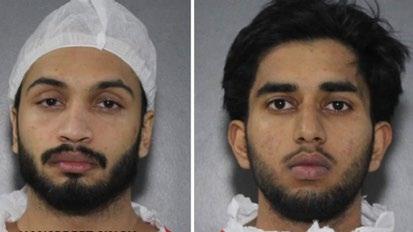
Additional charges have been laid against two foreign nationals suspected of committing an extortion-related shooting in Surrey earlier this year.
Continued on Page 10...
billion-dollar-plus condo bailout that socializes losses and privatizes profits South Asian corrections officer avoids jail on breach of trust charges Police issue arrest warrant for former provincial correctional officer charged with breach of trust More extortion charges laid against Punjabi students
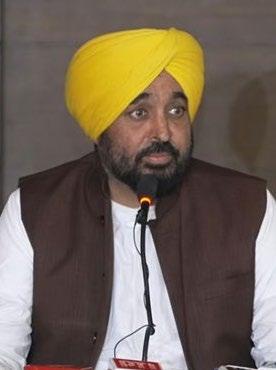
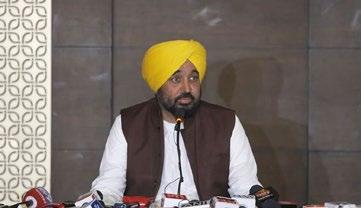
Punjab CM Mann claims bogus sacrilege video made in Abbostford to shame him
Punjab Chief Minister Bhagwant Mann has reiterated that the alleged sacrilege video was a "malicious attempt by the opposition parties to defame" him and his government. This is the second time in two days that the CM has tried to distance himself from the "religious" controversy.
Earlier, Mann had contended that it was an AIgenerated video, but today, he claimed that a prosthetic mask and sunglasses were
used to hide the real identity of the person in the said video. Playing out the purported video at a press conference in Mohali, Mann said, "The actor is wearing a prosthetic mask in the video. The scar on my throat is missing in the actor's throat in the video and his physical features do not match with mine. The actor has deliberately put up sunglasses to hide his eyes as it exposes his real identity."
Continued on Page 13...
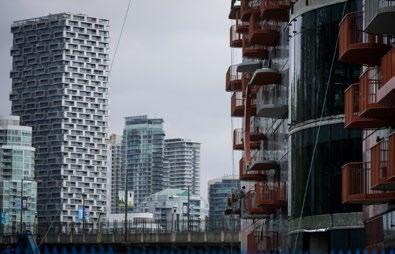
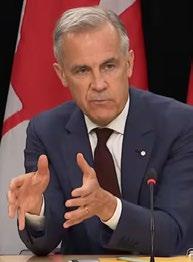
After Parliament has risen, in the dead of summer, the federal government has decided it wants to get into the condo business. Prime Minister Mark Carney has announced his government plans to enter into an arrangement with British Columbia Premier David Eby to purchase potentially thousands of unsold condominiums in Vancouver, with a combined federal and provincial commitment that could add up to billions of dollars. The money is borrowed. The money is yours. And the economic rationale, on the evidence so far, is spurious. Continued on Page 7...
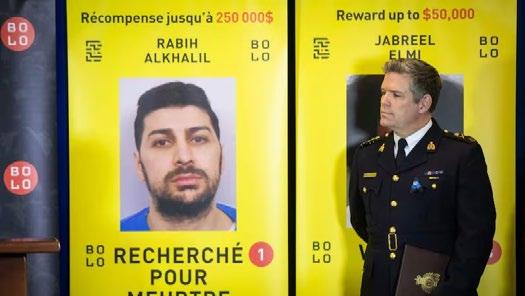
B.C. police have issued an arrest warrant for Naila Sheikh, a former correctional officer in the province who documents appear to indicate was the case manager for a convicted gang murderer at the time of his brazen escape from the Port Coquitlam prison in July 2022.
Sheikh, who formerly worked as a correctional officer at the North Fraser Pretrial Centre, has been charged with breach of trust, personation with intent to gain advantage, and unauthorized use of a computer. Continued on Page 10...
Former B.C. correctional officer Ramandeep Rai has been handed a two-year conditional sentence to be served in the community for breach of trust.
She failed to report that an inmate, with whom she was having a romantic relationship, had a cellphone.
“Anytime you’re in a position of trust, you have to respect and honour that right and this is a case where you know my client agreed that she made a mistake, she’s not denying her role and she is going to pay the consequences for the next two years with this house arrest community jail sentence and a criminal record,” defence counsel Gagan Nahal said.
The relationship took place at the North Fraser Pretrial Centre in Port Coquitlam.
Continued on Page 10...
A leading gun control advocacy group is calling on the federal government to end new sales of SKS rifles, days after days after three people were killed in a shooting in Montreal, including the shooter.
Montreal police have not said what kind of gun was used in Monday’s shooting but photographs circulated on social media show what appears to be a long gun lying on the ground at the scene. Experts believe the weapon is likely a semi-automatic Soviet-era rifle known as an SKS.
“It’s not a very clear photo, it’s kind of fuzzy, but the SKS has a very distinctive feature,” said AJ Somerset, author of the book Arms: The Culture and Credo of the Gun.
“It has an integral bayonet that folds underneath the barrel and you can see, on the rifle in the picture, what appears to be that integral bayonet.
So, for that reason, I’d say it is likely an SKS,” Somerset said.
The SKS, semi-automatic rifle dates back to the Soviet Union in the 1950s although other countries including China and Yugoslavia (a former country in the Balkans) also manufactured the SKS. Experts say when the Soviet Union collapsed, many former Soviet nations sold off their stocks of SKS rifles to consumers in many countries including Canada. Experts say the rifle is very popular among legal gun owners in Canada and among Indigenous hunters. “One time in Canada, we are talking probably over 10 years ago, you could buy these things by the crate,” Somerset said. “They were quite inexpensive, I bought one for $160 and consequentially, all kinds of people bought them.”
Since 2020, the federal government has
introduced a ban on about 2,500 firearms. The SKS is not one of them.
Following Monday’s shooting, the prominent gun control advocacy group PolySeSouvient wants to see the federal government implement an immediate ban on new sales of the SKS rifle.
The advocacy group says the SKS has been linked to a number of shootings and police killings over the years, including in Canada. They also say it is a firearm commonly seized by police forces in Canada.
“End the sale of new SKSs,” said Heidi Rathjen of PolySeSouvient. “That’s not taking anything away from anybody, that’s just not allowing the problem to get even worse and it will also prevent gun owners who are participating in the buyback program from using taxpayer money to buy a new assault weapon.”
Asked a similar question, Conservative Leader Pierre Poilievre said it’s time to question whether the government’s gun control policies are working.
Royal Bank of Canada ordered to
$4.25M penalty for consumer violation
The Royal Bank of Canada has received an administrative monetary penalty of $4.25 million, applied by The Financial Consumer Agency of Canada for a violation of the Bank Act.
According to a summary of proceeding released Thursday by the federal agency, RBC violated a consumer provision by failing “to transfer credits from deactivated credit card accounts to customers’ new accounts.”
“As a result, these customers received inaccurate monthly credit card statements, and some customers incurred additional charges,” the Financial Consumer Agency (FCAC) said.
The FCAC said the violation occurred when RBC deactivated and migrated customer’s credit card accounts to a new one when fraud was reported.
Between 2001 to 2024, a total of 227,947 accounts were impacted by the violation, the federal agency said. According to the summary, the accounts were
affected by statements that contained inaccurate information on the amounts credited or charged, including interest rates, and which dates credit amounts were posted to the accounts.
As a result, RBC transferred and refunded $22,427,774.30. RBC also made a charitable donation of $299,000 for the customers that could not be located. “The root cause of the violation was inadequate and ineffective control and oversight procedures and operational challenges with processes and proper reporting,” the FCAC wrote.
The administrative penalty was paid by RBC on April 17, after the FCAC issued a Notice of Violation to the bank on March 18.
The FCAC says accurate disclosure is a “foundational element of the consumer protection provisions of the Bank Act” and that customers “must be provided information that is accurate” in order to make informed financial decisions.
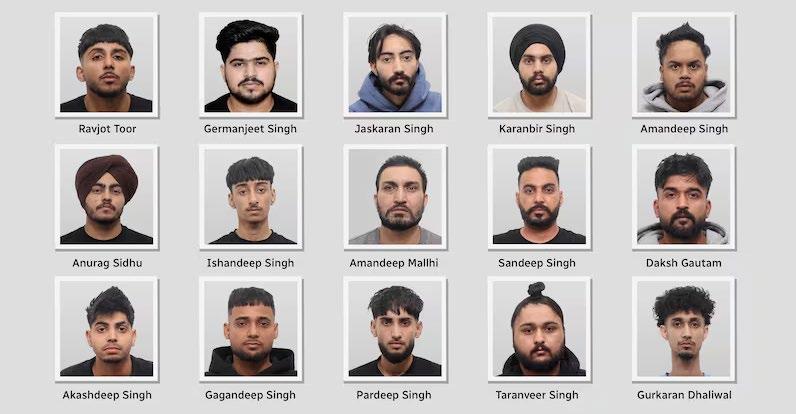
16 arrested in Calgary probe into South Asian extortion; all but one are out on bail
Of the 16 people that Calgary police have charged in extortion incidents against the city's South Asian community, only one remains in custody; the rest have been released on bail.
None of the accused are Canadian citizens. Supt. Jeff Bell says the suspects are largely in the country on a mix of student or work visas. Together, they face a total of 56 charges.
Bell says police are making progress, but they still need the public's help. To get it, they have released mugshots of 15 suspects in hopes of jogging the memories of anyone who might have interacted with them.
"What we need now is more information about these people, who they're associating with, where they're spending their time, whether they are working anywhere, or any other details that may seem small but could be very significant," said Bell. Bell says people have known the suspects under different aliases. In one case, he noted a roommate did not know the real name of one of the suspects
until informed by police.
The release of the photos is a "relief" to the community, said Rishi Nagar, news director at Red FM, a South Asian radio station in Calgary. "We have been demanding that there should be some pictures," Nagar said. "[Without them,] I don't know the person sitting by my side in a bus is the person who has been charged or not — I don't know."
Bell finds the release of the suspects into the community "concerning."
It's up to the Crown to argue against a charged person's release. Bell also noted that bail falls under federal jurisdiction. Next month, new federal legislation will kick in that aims to toughen bail and sentencing laws. Justice studies professor Doug King said he understands granting release for lesser charges, like possession of a firearm. But it's more of a head-scratcher as to why those with serious charges like extortion or discharging a firearm might get bail.
2 men face shooting charges amid wave of extortion violence in Surrey
Two foreign nationals have been arrested and charged in a case of shots fired at a Surrey, B.C., home linked to the recent wave of extortion violence in the city.
Police say officers, border agents, and a tactical response team raided two homes on June 12 following an investigation of the shooting that took place the day before.
will next appear in court on Monday. The two other men arrested have not been charged but are in the custody of the Canada Border Services Agency.
The latest figures show there have been 128 reported cases of extortion violence in Surrey this year, including 20 cases of shots fired and two arsons.
The shooting that led to the latest arrests was reported on June 11 at 5:30 a.m. PT at a home near 96 Avenue and 133A Street, where the building's exterir was damaged by gunfire.
Police say they arrested four men, all foreign nationals, with two of those facing extortionviolence-related charges.
The accused are 21-year-old Arman Singh and 22-year-old Simarjeet Singh, who are both facing a single charge of reckless discharge of a firearm and
Police say the home was occupied at the time but no one was injured. Meanwhile,
British Columbia's extortion task force says a 22-year-old man has been arrested and charged with offences linked to ongoing extortion violence in the province.
Police say the man was identified by Metro Vancouver Transit officers in August 2025 during a traffic stop in Surrey, B.C., where two loaded handguns were found in his car. Extortion investigators then looked into the information collected during the stop and found possible links to extortion violence in the Metro Vancouver area.
The man was charged June 17 with two counts of occupying a vehicle with a firearm, and he was arrested in Abbotsford, B.C., on Tuesday.
Police did not say which specific case of extortion violence the arrest was linked to.
Foreign national charged in B.C. extortion task force investigation
A young man arrested during a traffic stop last summer has been charged following an investigation by B.C.’s Provincial Extortion Task Force.
Authorities said the 22-year-old foreign national was found with two loaded handguns in his vehicle when officers from the Metro Vancouver Transit Police stopped him in Surrey on Aug. 10.
The task force was launched the following month, and took over the case due to “a possible nexus to extortion-related activities,” the B.C. RCMP said in a news release Wednesday.
Months later, on June 17, prosecutors approved two counts of occupying a vehicle with a firearm present against Daljot Rehal.
In a statement, Chief Supt. Duncan Pound of the RCMP’s Lower Mainland District said the charges
highlight the “effectiveness of close collaboration among policing partners.”
“By maintaining a strong presence in communities and a co-ordinated, strategic approach to intelligence sharing, we’re able to gather critical information, get guns off the streets and advance investigations,” Pound said.
An RCMP spokesperson told CTV News the force could not comment on whether investigators are still looking into potential ties to extortion activity.
After Rehal was charged, a warrant was issued to bring him back into custody. Authorities said they located the accused in Abbotsford and arrested him Tuesday.
He remains in custody pending his next court appearance, the RCMP said.
41,000 attend FIFA World Cup Fan Festival in Vancouver during Canada's historic win
Canadian fans turned up in droves at the PNE fairgrounds in Hastings Park for the free official FIFA Fan Festival Vancouver on Thursday, June 18, coinciding with the highly anticipated FIFA World Cup match between Canada and Qatar, which ended as a sports history maker for this country.
Upon inquiry, local organizers told Daily Hive Urbanized the match saw FIFA Fan Festival Vancouver’s highest attendance yet, with 40,943 attendees passing through the gates of the fairgrounds on the sixth day of the festival. There were live match broadcasts of Switzerland vs. Bosnia and Mexico vs. South Korea, but many were at the venue specifically to watch BC Place Stadium’s second match of the tournament — Canada vs. Qatar, ending with a 6-0 win for the host nation.
This was nearly 9,500 higher than the secondhighest attendance day of 31,481 on Saturday, June 13 (Brazil vs. Morocco; Haiti vs. Scotland; and Australia vs. Turkey), when BC Place Stadium hosted Vancouver’s first match of the tournament between Australia and Turkey. The lowest attendance day so far was Wednesday, June 17 (Portugal vs. Congo; England vs. Croatia; and Ghana vs. Panama), when 11,480 attendees passed through the gates.
The fan festival’s opening day on Thursday, June
11, attracted 16,036 attendees (Mexico vs. South Africa and South Korea vs. Czechia). This was followed by 19,839 visitors on Friday, June 12 (Canada vs. Bosnia & Herzegovina and U.S.A. vs. Paraguay), which was the day of the opening matches and ceremonies of Canada and the United States. Attendance on Sunday, June 14 (Germany vs. Curacao; Netherlands vs. Japan; and Cote D’Ivoire vs. Ecuador) reached 20,024.
Daily attendance at FIFA Fan Festival Vancouver has varied, ebbing and flowing throughout the operating hours based on local and visitor interest in specific match pairings. So far in the tournament period, the weather conditions have been ideal.
Unlike the annual PNE Fair, there is no admission to enter the PNE fairgrounds; it is free. Across the fairgrounds, the fan festival has 10 giant screens for free live match broadcasts, including three screens inside the new amphitheatre, which has a combination of free access — free for 2,600 people on the general admission standing-only floor area on a first-come, first-served basis — and capacity for thousands of people in fixed seating as a premium paid ticketed experience.
Cumulatively, over the first six operating days of Vancouver’s official fan festival through the end of Thursday, the fan festival has seen a combined total of 139,803 attendees, or an average of over 23,000 per day. Vancouver’s fan festival is open on 28 select days of the 39-day tournament period, with the event closed earlier this week on Monday and Tuesday.
Yesterday, FIFA also shared that, across the 13 of the 16 host cities staging full-scale FIFA Fan Festivals anchored by live match screenings, a combined total attendance of 1.992 million has been recorded as of the end of Wednesday. FIFA specifically noted that fan festivals in cities such as Atlanta, Dallas, Houston, Kansas City, Miami, and Vancouver have been “well-attended events.”
Backlash over rental prices at Senákw development in Vancouver
Online backlash over asking rental prices at the Indigenous-led Senákw development in Vancouver may reflect a disconnect between market rental prices and what renters can actually afford, experts say.
The prices — posted online by Vancouver real estate journalist Howard Chai and others — included $9,070 per month for a three-bedroom, two-bathroom unit.
Senákw's largest units, the 1,570-squarefoot four-bedroom, four-bathroom units, were listed at $12,500 per month.
The prices have since been removed from the Senákw website, with a spokesperson for the development telling CBC News they represented a "sample" of market rental rates, and select floor plans and prices would be live again soon. Real estate experts say there may be a disconnect between the (Squamish Nation) led project's advertising and reality, with only 20 per cent of the units being set aside for affordable housing and the rest being market rental rates — with the latter increasingly unaffordable for the average renter.
Rai said the project likely would have to work on its rental rates to entice prospective tenants.
"The ones that ... will rent are the ones with the views because the location is great, and the views are great," he said. He was also critical of some of the floor plans in the listed units.
"They are almost 1,300 square feet, which is generally a good size for three-bed," he said.
Suraj Rai, a real estate agent who has posted walk-through videos of some of the units at Senákw, also pointed to the sustained backlash against the project from some nearby residents — who went as far as filing a lawsuit to attempt to stop its construction. Many people in [Kitsilano] weren't happy about it, and they've been watching it go up, and I think the affordable housing angle was pushed on it," he said.
"And then, when you find out that it's not only market pricing — but what looks to be well over market pricing — that's a lot of the where the anger comes from."
Fans
"But the floor plans are angled, and they don't make for good living. I don't even know where you hang your art. But yeah, the the floor plans in those units leave a lot to be desired." Senákw comprises more than 6,000 rental units and 1,200 homes across 11 towers on 4.2 hectares of Squamish Nation land adjacent to Vanier Park.
The Squamish Nation began building the development in 2022, after a decades-long court battle that began in the 1970s and ended in 2002 with a $92-million deal that returned a prime, Y-shaped slice of land back to the nation.
At groundbreaking ceremony, the Squamish Nation said the development is the largest Indigenous-led housing and retail development in the history of Canada. The federal government provided the Squamish Nation with a $1.4-billion loan to build 3,000 of the units.
frustrated Canada being forced to play next World Cup match in United States
Following Canada’s 2-1 defeat to Switzerland on Wednesday, the team’s World Cup journey will now shift away from home soil and down to California for a Round of 32 match against South Africa.
Kick-off for that match is Sunday at noon PT from Los Angeles Stadium.
Had Canada come away with a win or draw in their final group stage match, they would have played their match at BC Place in Vancouver instead.
It’s a historic accomplishment for Canada to qualify for the knockout rounds for the first time at a men’s World Cup, but some are left wondering why Canada isn’t playing at home.
TSN analyst Kristian Jack spoke about it following the match on the OneSoccer show “For the Win,” and expressed his frustrations at FIFA for the scheduling of the tournament. “There are three countries that are co-hosting this World Cup,” Jack said. “There’s other games that are happening in the Round of 32 that are happening in this country.”
He says that FIFA could have easily organized the bracket of the knockout round would have assured the host nation would not have needed to play away from home at this stage of the tournament.
“If you are a co-host and are having two games in the last 32, it could have easily been organized where Canada may have had to go to Toronto if it wasn’t Vancouver,” said Jack.
Mexico, which won Group A with a perfect three wins in as many matches, will play their first knockout game in their home stadium.
If Mexico had failed to top their group, they would have ended up in the same situation, playing in the United States, while also hosting a second Round of 32 match in Guadalupe.
Jack said since the schedule was announced, he has been talking about this exact scenario, and suggests it could have been easily avoided.
“We would not have to talk about these contrasting emotions of qualifying for a World Cup last 32, but not letting go of that home advantage,” he said.
“You’re either a co-host or you’re not.”
Coach Jesse Marsch told reporters Thursday that travelling south of the border may eliminate some of the distractions around the World Cup for Canada, but the home field advantage will certainly be missed.
“Of course, we would have loved to stay in Vancouver, we’re not kidding anyone on there,” defender Alistair Johnston said.
Canada will now have a much smaller contingent of fans in the next round with the game being played in a neutral site. However, tickets released Thursday morning for the match through Canada Soccer sold out in less than half an hour.
“We’re playing in LA, we’re not playing on Mars or something, you know what I mean,” Johnston said.
“I’m expecting a decent chunk of Canadian fans to get there.”
As for Canada’s supporters group, the Voyageurs, it’s a disappointing outcome, but the extra travel won’t stop them from cheering on their side.
“It is what it is, we’re travelling to the U.S. and now it’s about getting organized and getting our members down there,” said Matt Serson, who is on the board of directors for the Voyageurs.
Ph: 604-591-5423
Fax: 604-591-8615
editor@theasianstar.com
Editor: Umendra Singh
Marketing and Sales: Ravi Cheema
604-715-3847
Shamir Doshi
604-649-7827
Harminder Kaur
778-708-0481
Parminder Dhillon
604-902-2858
Pre-Press: Avee Waseer
Production: Ozmo Media www.theasianstar.com
India’s quiet return to Afghanistan as Pakistan-Taliban ties fray
By Saima Afzal:
Few developments since the Taliban’s return to power have been as surprising as India’s gradual re-emergence in Afghanistan. In 2021, most observers assumed Islamabad would be the principal beneficiary of the new political order in Kabul. Geography, historical ties, and decades of engagement with Afghan actors appeared to guarantee Pakistan enduring influence. Four years later, that assumption is increasingly difficult to sustain.
Instead of moving closer together, Pakistan and the Taliban government have experienced growing friction over security concerns, border management, and regional diplomacy. As relations between Kabul and Islamabad have become increasingly strained, India has quietly expanded its engagement with Afghanistan, creating a new dynamic that is reshaping regional calculations.
The result is not a dramatic geopolitical realignment, but a gradual shift in which India has regained relevance in a country where its future role once appeared uncertain.
From Strategic Expectations to Strategic Friction
One of the defining features of the post-2021 regional landscape has been the deterioration of Pakistan-Taliban relations. Many policymakers expected the Taliban’s return to power to strengthen cooperation between the two sides. Instead, disagreements surrounding the activities of Tehreeke-Taliban Pakistan (TTP), cross-border security incidents, and border management have become persistent sources of tension.
Pakistan has repeatedly argued that TTP militants continue to operate from Afghan territory and pose a direct threat to its security. Taliban officials have rejected accusations that Afghanistan is responsible for Pakistan’s internal security challenges. The disagreement has periodically escalated into diplomatic confrontations and military action.
Relations reached a particularly difficult phase in October 2025, when tensions intensified following a series of security incidents and renewed accusations regarding militant sanctuaries. Relations reached a particularly difficult phase by February 2026 when Pakistan launched coordinated strikes against
targets it identified as TTP and ISIS-K sanctuaries inside Afghanistan. Kabul condemned the operation as a violation of its sovereignty, and the resulting escalation further deepened mistrust between the two governments, underscoring the widening gap in their security priorities and strategic outlooks. These developments have weakened assumptions that Pakistan would automatically retain privileged influence over Afghan decision-making. More importantly, they have encouraged Taliban leaders to diversify Afghanistan’s external partnerships and reduce dependence on any single regional actor. For Kabul, maintaining relations with a broader range of countries provides diplomatic flexibility at a time of economic hardship, declining foreign assistance, and continued international isolation.
For India, this changing environment has created an opportunity to re-establish influence through engagement rather than confrontation. India’s Afghanistan policy since 2021 has been characterized by caution and pragmatism. While
New Delhi has refrained from formally recognizing the Taliban government, it has steadily expanded diplomatic contacts, humanitarian assistance, and development cooperation.
A significant step came in June 2022 when India reopened its technical mission in Kabul after withdrawing diplomatic personnel during the Taliban takeover. Since then, contacts between Indian and Taliban officials have gradually increased. Meetings involving Taliban Foreign Minister Amir Khan Muttaqi and senior Indian representatives have demonstrated a willingness on both sides to maintain dialogue despite political differences. Humanitarian assistance has played a central role in India’s approach. Since 2021, India has supplied large quantities of wheat, medicines, vaccines, and emergency relief assistance to Afghanistan. New Delhi has also continued supporting selected development initiatives and infrastructure projects that were originally launched during previous Afghan governments.
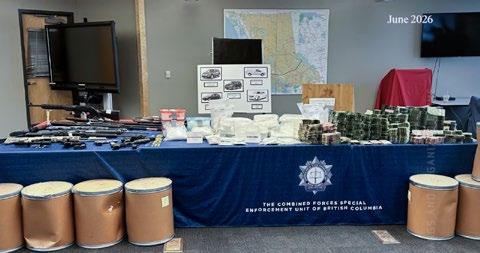
Searches in Metro Vancouver in organized crime case net drugs, weapons
Police in British Columbia say a multi-year investigation into an organized crime case has uncovered a large stash of illicit drugs as well as $1.5 million in cash.
Investigators say they began looking into the interprovincial drug trafficking case in December 2024, making smaller drug seizures and gathering evidence before identifying five places to serve search warrants.
Then, on May 3, police arrested a commercial truck driver in Delta, B.C., during an alleged “drug-related exchange” where 10 one-kilogram cocaine bricks were seized.
The arrest touched off raids across Metro Vancouver at locations including houses, a condo and a storage facility, resulting in the seizure of 26
kilograms of cocaine and seven kilograms of methamphetamine.
The cash was also discovered at the sites along with five vehicles, a commercial tractor trailer and 16 firearms.
Police say criminal charges are expected in the case, and investigators are linking the seized items to people who police believe “pose a significant threat to public safety.”
The billion-dollar-plus condo bailout that socializes losses and privatizes profits
Continued from Page 1...
As interest rates rose, market demand for condos in Toronto and Vancouver fell. Prices declined.
In many cases, buyers simply walked away from deposits they had placed years earlier, leaving developers holding units they assumed they had already sold. The temptation for governments to lift that inventory off developers’ books was always going to prove difficult for federal and provincial politicians to resist. And so it has. The question is not whether governments should buy units.
It is the price. Developers are reportedly refusing to clear the market, holding out at roughly $1,000 per square foot or more—a figure that does not reflect today’s prices, which might be hundreds of dollars per square foot lower. The billiondollar-plus question is whether taxpayers will pay yesterday’s price to keep developers whole. After 72 hours of online blowback, the federal government has said nothing. As the saying goes, silence speaks a thousand words.
Consider what these units actually are. The majority of unsold condos are what mortgage broker Ron Butler of Butler Mortgage has described as “dog crate” condos—tiny studio apartments in the sky built and priced on a square-foot basis to optimize for investors, not for people who wanted somewhere to live. The speculative boom that produced them made developers hundreds of millions; a few became billionaires. Those investments have now turned out to be bad. That is not a market failure. That is the market working. This is the
heart of the matter. Capitalism runs on a profit and loss system. As Milton Friedman put it, profits incentivize risk-taking and losses punish excessive risk. Developers have lobbied both governments, warning that selling at today’s market price could push some out of business. But that is precisely the discipline a correction is supposed to impose. If governments step in to spare firms that made the wrong bets, they distort the market and prevent the correction Canada needs—a correction not only in price but in the kind of homes we build.
There is a more insidious cost still. At a clearing price, many of these units would find buyers— Canadians who want to own a home but not at $1,000 a square foot, because the units are not worth it.
This policy denies them that option. Instead, the government becomes the owner in their place, and would-be homeowners are offered one path: government-subsidized and dependent tenancy. In a country where principal residences enjoy a 100 percent capital gains exemption—the golden goose that lays the golden egg—that is the difference between a secure retirement and something much more precious. The defence that the government cannot build cheaply does not rescue the scheme. Perhaps Carney and Eby are quietly conceding that the public system cannot build affordable housing affordably. But that only deepens the doubt: if markets were left to correct, the demand for social housing might be far smaller than assumed. Spare a thought, too, for the buyers who honoured their contracts.
Court hears details about 2023 shooting death of B.C. RCMP officer
Crown began wrapping its case in the firstdegree murder trial of a man accused of fatally shooting RCMP Const. Rick O’Brien in 2023.
Graphic autopsy photos were shown and the court heard that O’Brien was likely shot three times in the head.
He was killed during a drug raid at a Coquitlam condominium in September 2023.
Defence is claiming self-defence for the accused, Nicholas Bellemare, who they said did not know the people on the other side of the door were officers and that Bellemare was asleep and woke up to a bang. “There was a knock and
announcement by the police…. And there was no answer,” Crown stated in court.
“They waited… and then they breached the door as they are entitled to do.”
Court heard that O’Brien and five other officers broke down the door to enter the condo and that’s when Crown alleges Bellemare fired 10 shots with a prohibited AR-15-style rifle.
Bellemare is charged with one count of firstdegree murder and one count of attempted murder. The defence is expected to deliver closing arguments starting on Thursday.
Regina mosque targeted by threats after broadcasting call to prayer
Last Friday, Regina City Jamia Masjid broadcast their first live outdoor Athan, or Islamic call to prayer.
The City of Regina granted the mosque a permit for one month to deliver their call to prayer every Friday before Jummah, also known as noon prayer and lasts a few minutes. The call to prayer is recited five times a day for Muslims, reminding them to gather for worship.
The act itself was shared online which prompted threats through email and social media. The comments range from Islamophobia to threats against the mosque’s speaker. Regina police say they will be looking into the threats as possible hate crimes and will increase RPS presence at Muslim gatherings.
“The City of Regina, they’re trying to bring multicultural diversity in the heart of downtown,”
says
M Anisur Rahaman, director of Regina City Masjid.
This isn’t the first time a city in North America practiced broadcasting the Islamic call to prayer.
A few years ago, Minneapolis was the first major U.S city to deliver the prayer five times a day and received a mixed response.
Regina City Jamia Masjid is currently undergoing renovations and preparing to welcome more people in the upcoming months. They also hope to welcome those with concerns to the mosque to answer questions and have a conversation about what the call to prayer means to Muslims.
Regina police say the permit will be in place until July 10, 2026, based on the city’s noise abatement bylaw, and will be reviewed accordingly once the month is completed.
8 Surrey and White Rock students receive leadership awards
Grade 12 students from five different schools have been bestowed with a leadership award.
The South Surrey and White Rock Conservative Association has awarded the 22nd annual Sir John A. Macdonald Leadership Award to eight local secondary school graduates on June 13.
A celebratory ceremony was held at the Semiahmoo Fish and Game Club in South Surrey. In a release provided by the SSWR Conservative Association, it states that the Sir John A. Macdonald Leadership Award is presented to students in their graduating year who have demonstrated excellence in their studies and outstanding leadership qualities enabling them to confidently assume roles in student government.
“Their ability to work with others in a balanced and mature fashion will allow them to follow their dreams, a journey we hope will be filled with happiness and achievement,” notes the release.
This award was established in 2004 by local conservatives wanting to recognize the achievements of the future leaders in the White Rock and South Surrey community.
“Sir John A. Macdonald built a strong sense of community while successfully negotiating Confederation and assembling practically all the lands of modern Canada,” shared the Conservative Association. “This award was created in his name to help inspire the next generation to pursue their studies and achieve their very best in whatever field of endeavour they might choose.”
Students who receive this award are given a $1000 cash scholarship.
This year’s recipients are:
• Alejandra Alvarado – St. John Paul II Academy
• Cohen Bridger – Earl Marriott Secondary School
• Rebecca Gootgarts – Elgin Park Secondary School
• Corrina Li – White Rock Christian Academy (awarded in absentia)
• Shohei McIntosh – Semiahmoo Secondary School
• Lauren Neustaedter – White Rock Christian Academy (awarded in absentia)
• Philip Potashov – Semiahmoo Secondary School
• Stephanie Yoon – Semiahmoo Secondary School
Carney defends $1.45B plan to convert unbought
B.C. condos to affordable rent-to-own
Prime Minister Mark Carney says the provincial and federal governments have done a poor job of explaining their plan to buy unsold, vacant condos in British Columbia and turn them into affordable housing.
"I don't think we've done — myself included — a particularly good job of rolling this out," Carney said at a news conference in Ottawa Thursday.
Carney and B.C. Premier David Eby announced the plan last week, saying they would leverage "innovative financing tools" to turn more than 2,200 vacant condo units into affordable homes.
Opposition Leader Pierre Poilievre has called the plan a "bailout" for big developers and "a transfer of wealth from the have-nots to the have-yachts."
On Thursday, Carney defended the plan, which he said will help young families and people who don't have money for a down payment "build in" equity over time through a rent-to-buy program. He said the federal government would put up 10 per cent of roughly $1.45 billion in total potential spending to convert the units, with the B.C. government sharing the rest of the bill.
However, Eby said later in the day that the provincial government would roughly match the feds for a total of $300 million, with the rest of the money coming from financing.
The federal Ministry of Housing said in a statement that the condos will be purchased at below-market rates.
Carney stressed it was the province that came up with the idea. -"No developer asked for this from me directly," he said.
He said the plan would include buying the "distressed condos" at a discount "at the right
time." But he did not expand on whether all the homes would be rent-to-own. Carney said the plan is a "more effective way of getting affordable housing immediately into people's hands" than building anew. "If and when there are transactions, then judge those transactions on the basis of the economics of that, not on the concept."
Eby said at a separate news conference Thursday that the federal government was "enthusiastic" to announce the program when the prime minister was in town, before the details were out. "I think in hindsight, we should have waited and made sure that all the details were available," Eby told reporters. But he defended the proposed program and addressed the critique that it functions as a developer "bailout."
"If you are a condo developer that took a bet on the high end of the market, and you're facing significant potential loss of profits, what we are proposing will not assist you," Eby said.
And it won't help Vancouver-based developers either, Eby said, because the numbers don't work for units in the City of Vancouver.
He suggested the program would work inregions such as the Fraser Valley, Okanagan and Vancouver Island. "Ultimately we'll be buying below the cost of construction. No developers will be profiting from this."
He said it's possible for the government to purchase the homes at a lower cost because they can buy more than one unit at a time.
Buildings in various stages of bankruptcy protection also create the opportunity for governments to buy in a way that individual consumers wouldn't be able to, he added.
Intoxicated car thief arrested with help from Tesla
An intoxicated man who stole a car and caused a collision was arrested with the help of a driver whose vehicle he crashed into in Vancouver, according to authorities.
Officers were called to the intersection of Nanaimo Street and Kingsway at 7 p.m. Tuesday for reports the driver of a Dodge Charger had crashed into a Kia and a Tesla, the Vancouver Police Department said in a statement.
“When officers arrived, they found the Tesla driver restraining the suspect from the stolen vehicle. Police learned the suspect was intoxicated and had attempted to run from the scene but was stopped by the Tesla driver,” police said, in the statement.
“The suspect was treated for minor injuries. Police thanked the Tesla driver for
Homicide
driver
their assistance.”
Police soon learned the Dodge Charger had been reported stolen and the driver was banned from being behind the wheel Canada-wide. Several charges are being recommended to Crown counsel.
team investigating after man found dead, relative arrested in West Vancouver
Police in West Vancouver, B.C., are investigating a suspected homicide early Wednesday morning.
A statement from the West Vancouver Police Department says officers responded shortly after
midnight to reports of an altercation at a residence in the Squamish Nation village of X̱wemelch’stn, near the Lions Gate Bridge. One man was pronounced dead at the scene “despite the efforts
of first responders” after suffering injuries in the incident, police said.
A second man was later arrested by the Vancouver Police Department.
“There is no ongoing risk to public safety,” the statement said. The Lower Mainland’s Integrated Homicide Investigation Team has taken conduct of the case. In a statement Thursday, the homicide team said the 43-year-old victim and the 35-yearold suspect are related to one another.
“There are no outstanding suspects and no ongoing risk to the public,” IHIT spokesperson Sgt. Freda Fong said.
“Our thoughts remain with the victim’s loved ones and the community as this investigation progresses.” Anyone with information related to the death is asked to contact homicide investigators at 1-877-551-4448.
Unregistered immigration consultant made nearly $500K over 3 years and never told the CRA
An unregistered Canadian immigration consultant has been fined for failing to declare nearly $500,000 in income, the Canada Revenue Agency (CRA) reported Thursday morning.
“Between 2013 and 2015, (Qi Wang of Roberts Creek, B.C.) did not report the income from payments he received from foreign nationals to help with their applications for permanent residence in Canada,” wrote the CRA in a press release.
Wang was fined a total of $112,627.33 after pleading guilty to two counts of tax evasion under the Income Tax Act, the agency said. The
undeclared income amounted to $494,891.75 between 2013 and 2016, of which $472,891.75 was earned “while operating as an unregistered immigration consultant.”
In addition to the fine, he was handed a sixthmonth conditional sentence order as part of his June 24 sentencing. His case was heard by a court in Regina, Sask., following an investigation prompted by a referral from the Canada Border Services Agency.
“Cheating on your taxes affects the services and programs we all rely on to improve our quality of life,” the CRA wrote in its release.
Supreme Court of Canada won't hear U.S. stock fraud case involving B.C. man
The Supreme Court of Canada will not hear the appeal of a former B.C. lawyer contesting a US$30 million judgment for allegedly masterminding a transnational securities fraud.
The top court’s decision comes years after the United States Securities and Exchange
Teen badly hurt in latest in a series of electric dirt bike, scooter crashes in BC
A teenage boy has been seriously injured in a crash in Metro Vancouver involving an electric dirt bike, in the second such collision in two days.
Police in Burnaby, B.C., say the latest crash happened between the e-bike and a vehicle on Tuesday afternoon on the Barnet Highway near Cariboo Road North. The rider, a 15-year-old boy, was taken to hospital with serious injuries, while the driver of the other vehicle remained at the scene.
The crash comes a day after a 13-year-old was also badly injured in Maple Ridge when an
Commission obtained a default judgment against West Vancouver’s Frederick Sharp for the purported stock fraud.
The U.S. Attorney’s Office for District of Massachusetts said in 2021 that Sharp and others allegedly executed a sophisticated global con that bilked investors out of tens of millions of dollars.
In 2024, the B.C. Supreme Court granted a judgment recognizing and enforcing the ruling of a Massachusetts court that required Sharp to repay the alleged profits.
The B.C. Court of Appeal dismissed Sharp’s appeal last year.
The Supreme Court of Canada, following its usual practice, gave no reasons for declining to review Sharp’s case.
Audi pulling into traffic collided with the teenager riding an e-scooter. Police in Abbotsford, B.C., have also issued a warning to riders after two teens were caught driving an e-dirt bike at speeds reaching 55 kilometres an hour and weaving through traffic before they were stopped by an officer.
Abbotsford police say BC Children’s Hospital has reported 81 e-bike- or e-scooter-related visits to its emergency department in the year between April 2025 and ending in March 2026.
Continued from Page 1...
Harshdeep Singh and Hanspreet Singh were arrested in January after shots were fired at a home near 129 Street and 84 Avenue.
The incident occurred around 3:50 a.m. on Jan. 26, and the Surrey Police Service said officers in the area quickly located a suspect vehicle and stopped it, arresting the driver and a passenger.
Police allegedly found a loaded handgun inside the vehicle, and the two arrested men—20-yearold Harshdeep and 21-year-old Hanspreet—were each charged with occupying a vehicle knowing a firearm was present.
Harshdeep was also charged with dangerous operation of a motor vehicle.
On Tuesday, additional charges were laid against each man, according to a statement from
the SPS.
Harshdeep was charged with one count of intentionally discharging a prohibited or restricted firearm into a place, while Hanspreet was charged with the same offence, as well as possessing a loaded firearm.
Both men remain in custody. Their next court appearances are scheduled for Thursday, according to police.
Metro Vancouver remains under Stage 3 water restrictions, but a small U.S. pene-exclave that has access to the same water is not under any restrictions.
Point Roberts receives water from Canada under a 50-year agreement that was signed in 1987.
The contract between the Greater Vancouver Water District (GVWD) and Point Roberts Water District provides the community with 700,000 imperial gallons a day for about $800,000 annually.
It is the same rate that is charged to Canadians, but the difference is that the contract is in Canadian dollars.
“If you could go back in time, you’d shake your head at the contract that was signed, because you need to be able to revisit these things regularly,” Port Coquitlam Mayor Brad West said.
“From where I sit, we should be taking care of
our residents. I’m not really interested in providing our water to the U.S. We have to ensure we’re looking after the people who are paying the bills in our region, full stop.”
Metro Vancouver says water usage in Point Roberts this May was .07 per cent of daily usage for the region, noting that “as Point Roberts is not a member of the GVWD, it is not subject to the restrictions outlined in Metro Vancouver’s drinking water conservation plan.”
Point Roberts has suffered since U.S. President Donald Trump launched a trade war with Canada.
The community of about 1,100 people is located just south of Tsawwassen, however, it relies on British Columbia for much of its commerce.
The lack of Canadian visitors has forced longterm businesses to close and has offered special exchange rates to lure shoppers across the border.
B.C. police issue arrest warrant for former provincial correctional officer charged with breach of trust
Continued from Page 1...
Documents obtained by CBC News appear to indicate that Sheikh was directly assigned as a case manager for Rabih Alkhalil, whose escape from the facility on July 21, 2022, is still under investigation.
According to B.C. court documents, the three counts Sheikh faces stem from incidents that occurred between February and March of 2024,
The first, Ramandeep Rai, faced two breach of trust charges that Coquitlam RCMP later clarified were unrelated to the prison break.
but it's not clear if the charges against her are related to the escape. Sheikh is accused of a breach of trust related to her duties as a correctional officer in Port Coquitlam, unauthorized use of the corrections system on a province of B.C. computer, and also with impersonating Shamaila Sheikh in or near Victoria for personal gain.
CBC News reached out to Naila Sheikh for comment but did not hear back before publication.
She is the second former B.C. correctional employee to be charged in the last year.
On Wednesday, Rai was given a twoyear conditional sentence to be served in the community for failing to report that an inmate, with whom she was having a romantic relationship, had a cellphone. After a three-year hunt, Alkhalil was arrested in Qatar in September 2025, where he had been living under an alias, Cpl. Sarbjit Sangha with the Combined Forces Special Enforcement Unit of B.C. (CFSEUB) confirmed at a news conference last year. Around the time Alkhalil was arrested, police also charged three men with prison breach and conspiracy to commit prison breach for allegedly posing as contractors to help Alkhalil walk out of the facility. Those charged included Ryan Van Gool, 46, of Harrison Hot Springs, B.C., Edward Ayoub, 48, of Ottawa and John Potvin, 49, also of Ottawa. Potvin was later arrested in Spain and extradited back to Canada in January 2026.
Acting communications counsel Ann Seymour for the B.C. Prosecution Service confirmed the charge was sworn on May 28. She says there have been no court appearances as "there is a warrant outstanding" for Sheikh's arrest.
Continued from Page 1...
The court heard that the two would communicate through the prison phone system and the cellphone.
It’s unclear how the inmate got the cellphone, but Rai would advise him not to hide it in certain places in case of inspections. The judge said in court, “I accept Miss Rai deeply and profoundly regrets her actions.
“In addressing the court, she sincerely acknowledged this was not a minor infraction, that she put her colleagues at risk… That she undermined the public trust and the important work of corrections officers.”
The inmate also used the phone for the drug trade, but Rai was unaware of this and the court acknowledged she had no financial gain.
“She offered a genuine apology on multiple occasions and you know she owned up to her mistake,” Nahal said.
“She entered a guilty plea; she spared the court from running a trial.”
The judge addressed Rai, saying, “I accept that you have lived with guilt and shame and that you started serving a form of sentence imposed by your conscience long ago… I accept that this lapse in judgment does not define who you are.”
Rai has several conditions imposed, including a curfew and community service. She will also continue counselling.
FRCS uncovers $400m in unpaid taxes
The Fiji Revenue and Customs Service (FRCS) has issued $400million worth of tax intervention notices after mining electronic invoicing data to detect undeclared income and non-lodgements.
Mining electronic invoicing data by customs is the process of using automated software, data analytics, and machine learning to scan digital invoices for tax evasion, smuggling, and fraud
FRCS chief executive officer Udit Singh told participants of the recent Fiji New Zealand and New Zealand Fiji Business Councils’ 2026 Joint Conference that Fiji remains one of the few nations in the region operating an e-invoicing framework, which tracks real-time trade transactions between commercial entities. “Recently, we mined this information, and we sent out statements of
assistance to the tune of about $400million,” he said.
“This is information of lodgments not being made or taxes not being paid, so, these data repositories are actually providing a lot of information.” Mr Singh acknowledged that while the digital system has streamlined operations for the majority of compliant entities, it remains “the bane of the life of some others” who fail to declare income accurately. The data mining initiative forms part of a broader shift toward automated tax risk profiles. Mr Singh pointed to Australia’s transition to assured assessments where advanced analytics run automated checks to nudge taxpayers when figures do not align as the benchmark for future Pacific tax enforcement.
Officers investigated over alleged $100
bribe
Gas poisoning suspected as crew members rescued
from vessel hull
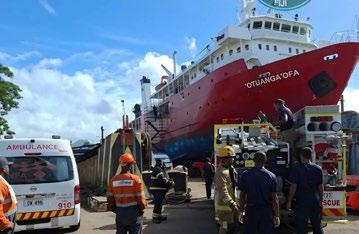
Five Tongan nationals were rushed to hospital after suffering suspected carbon monoxide poisoning while trapped in the bottom hull of a vessel at Walu Bay. The National Fire Authority (NFA) said Emergency Ambulance Service first responders and operational crews mounted a joint
3 Labasa-based police officers are under investigation for allegedly accepting a bribe from a suspect held in custody.
The Fiji Independent Commission Against Corruption (FICAC) has taken over the criminal element of the case following a direct referral from the Commissioner of Police, Rusiate Tudravu.
The investigation stems from allegations that the three officers accepted a sum of more than $100 from an accused person locked up at the Labasa Police Station in Namara.
According to police sources, the individual who
Singh:
PALM
came forward to report the complaint is a serving police officer. Commissioner Tudravu has since ordered a concurrent internal probe to determine exactly what transpired and whether any force regulations were breached.Police confirmed that the matter is being treated with the utmost seriousness, noting that both the internal affairs unit and the independent anti-corruption agency will investigate simultaneously. “FICAC will investigate any possible criminal offences, while the internal affairs unit will handle disciplinary action if needed.” The investigations remain ongoing.
worker still missing
Efforts are underway to place former Pacific Australia Labour Mobility (PALM) scheme workers with new employers where possible, as authorities continue searching for a Fijian worker who disengaged from the program and is reportedly homeless in Australia.
Employment Minister Agni Deo Singh provided the update while discussing the case of an iTaukei worker who travelled to Australia under the PALM scheme before leaving his employment.
The case, which was highlighted by a Fijian blogger has raised concerns about welfare support available to workers who disengage from the scheme. Mr Singh said the Ministry’s country liaison officer was tasked to locate that individual.
Department of Workplace Relations.” According to Mr Singh, the worker had disengaged from the scheme about a year ago and had since been working elsewhere.
“We believe that he was not in the best of healthy habits. It’s rather unfortunate that he went that way.”
“He was sighted and unfortunately, he disappeared from there. We are still trying to locate him, and we are also asking for assistance from the
Mr Singh said the ministry was continuing its efforts to assist Fijians who had left their approved employment arrangements under the scheme. He added that some former workers were being matched with alternative employers where their immigration status allowed.
“We are also in the process of reengaging some of them with other employers if they have a valid visa. “Those who don’t have a valid visa, of course, they will have to come back.” Mr Singh also encouraged Fijians working overseas not to disengage from their employment arrangements.
‘Not on our land’
“NOT on our land”. These were the strong words of the landowners from Lauwaki Village in Vuda, Lautoka, where the developers of a $1.4billion Waste to Energy power plant plan to build the facility.
Tokatoka o Wadigi headman Apimeleki Nasalo claimed landowners were not properly consulted about the proposed project.
“We were very disappointed when we learned that part of our land would be used for this development,” said Mr Nasalo.
“None of them came to us or to our tokatoka members about this project.
“We are thinking about our children and future generations who will have to be dealing with this.”
Mr Nasalo said he had written a letter to government with approval from their tokatoka members opposing the project and called for government’s intervention.
was land that has been leased to a major resort developer.
“We have signed the paperwork. They want to build the resort near this place,” said Mr Tora.
“It does not look good to have this resort near a waste burning facility.
“As the native landowners of this area where we want to have tourists visiting, we don’t want a waste managing factory in the same place where tourists come to.” An Environmental Impact Assessment (EIA) on the proposed project was released on March 23. Members of the public have been given 21 days since the release to submit their feedback to the Ministry of Environment.
“We want government to step in. We want them to stop this project.” Tokatoka o Wadigi member Inoke Tora said near the proposed facility site
Meanwhile, Environment Minister Lynda Tabuya has clarified the $5 per page charge on a copy of the report fee was mandated under the current environment legislation. She said amendments to the regulation were being undertaken by the ministry.
rescue operation after the men were exposed to the toxic gas in the confined space.
A height rescue operation was carried out to safely extract the crew members from the vessel before they were transported for medical treatment. Carbon monoxide is a colourless and odourless gas that can be deadly when inhaled in large amounts, particularly in enclosed spaces with poor ventilation. The NFA confirmed all five men survived the incident, suffered no injuries, recovered after receiving medical attention and have since returned to work.
The authority said the successful outcome reflected the importance of rapid emergency response, preparedness and teamwork in lifethreatening situations.
Reddy criticises ‘longest pool project’
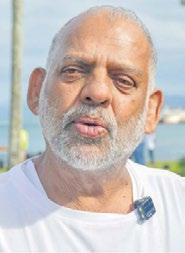
The Lautoka swimming pool is one of the longest swimming pool projects in the world, says Residents and Ratepayers Association president Narayan Reddy.
He said there were a lot of promises made that the swimming pool would be opened in October this year.
“The way we are looking at it, I doubt that it will ever be done in the term of the current government. It will not be completed,” he said.
“Because whatever money was promised in the budget, it has never reached the construction of the swimming pool.”
Mr Reddy said the association had gone out of their way in trying to secure a donor to complete the construction of the swimming pool.
“The donor was also willing to put a stadium around it.
“Basically, the donor was willing to spend
$20million to really turn the swimming pool into an international standard and all they wanted was that they will operate it for the next 15 years.
“Unfortunately, the special administrators did not want to discuss that proposal further so that was stopped.”
Meanwhile, Lautoka Board of Special Administrators chairperson Taitusi Rasoki said the construction work would undergo a fresh start.
“We’re only waiting for the Solicitor General’s confirmation before we sign the contract with the contractor that will continue the construction work,” Mr Rasoki said.
A budget of $1.9million was allocated under the 2025-2026 National Budget to complete the longdelayed swimming pool project which was first approved in 2017 but stalled because contractor issues.
SOUTH ASIA
Balochistan erupts in protest after controversial convictions of BYC leaders
Widespread protests and a shutdown strike swept across Balochistan following the conviction of prominent Baloch Yakjehti Committee (BYC) leaders Dr Mahrang Baloch and Shah Jee Sibghatullah, triggering debate over human rights, political dissent and the treatment of activists in Pakistan, as reported by The Balochistan Post.
According to The Balochistan Post, demonstrations were reported in several districts after the court verdict, with thousands of people taking to the streets to denounce what they described as a politically motivated judgment. Protesters accused authorities of using legal
mechanisms to suppress peaceful political activism and silence voices advocating for Baloch rights. Before the verdict, the BYC had announced a province-wide strike and urged traders, transport workers, students and political groups to participate in peaceful demonstrations.
The strike call received a significant response across the province, leading to market closures and public gatherings in multiple towns and cities.
Large rallies and protest marches were witnessed in Quetta, Khuzdar, Surab, Mastung, Noshki, Turbat, Kalat and Gwadar, among other areas.
Conviction of global rights voice Mahrang Baloch sparks outrage over Pakistan's crackdown on dissent
Human rights defender Fariba Balouch has strongly condemned the life imprisonment of Baloch activist Dr Mahrang Baloch and other members of the Baloch Yakjehti Committee (BYC), calling the verdict a serious blow to human rights, justice and the rule of law in Pakistan.
In a video statement, Fariba Balouch described Dr Mahrang Baloch as a prominent human rights advocate from Balochistan who spent years campaigning for families of victims of enforced disappearances. A medical doctor by profession, Mahrang became internationally recognised for her peaceful advocacy, earning a place on the BBC's 100 Women list, the Time100 Next list of emerging global leaders and a nomination for the Nobel Peace Prize.
Expressing shock over the verdict, Fariba said it was alarming that a figure known globally for advocating justice and human dignity had been sentenced to life imprisonment. She alleged
that Mahrang Baloch and fellow BYC member Sibghatullah Baloch were convicted by a Pakistani anti-terrorism court on what she described as fabricated charges following a "faceless trial".
Fariba argued that the punishment sends a disturbing message to peaceful activists who campaign against enforced disappearances and other alleged human rights violations in Pakistan. She claimed that while human rights defenders are being imprisoned, those responsible for abuses continue to enjoy impunity.
She also criticised what she described as the public celebration of the verdict by some government officials, saying such reactions undermine respect for human rights and democratic values. According to Fariba, many rights advocates believe the proceedings failed to meet the standards of a fair trial and were inconsistent with Pakistan's international legal obligations.
Bangladesh attaches "special importance" to ties with India: President Shahabuddin
The newly appointed High Commissioner of India to Bangladesh, Dinesh Trivedi, presented his credentials to President Mohammed Shahabuddin at Bangabhaban on Thursday.
Upon his arrival at Bangabhaban at noon, a smartly turned-out contingent of the President Guard Regiment accorded him a guard of honour. Following the formal presentation of credentials, the High Commissioner held a courtesy meeting with the President.
After the meeting, the President's Press Secretary, Md Sarwar Alam, briefed journalists, stating that the President welcomed the newly appointed Indian High Commissioner and expressed hope that his tenure would help further strengthen mutual relations between Bangladesh and India, yield fruitful results and make them more people-oriented.
The President gratefully recalled the participation of India's Lok Sabha Speaker, Om Birla, in the swearing-in ceremony of the new democratic government, which was formed after winning more than a two-thirds majority in the free, fair and neutral national elections held in February this year.
The President noted that Bangladesh attaches special importance to its relations with India as a close neighbour and a key trade and development partner. He emphasised that Bangladesh is committed to maintaining an honourable and forward-looking partnership with India while upholding sovereign equality, national interest, dignity and the welfare of the people. In this regard, the High Commissioner remarked that a friendly and cordial relationship naturally exists between the two sovereign nations.
India to resume tourist visas for Bangladesh nationals from Sunday: High Commissioner Trivedi
Indian High Commissioner Dinesh Trivedi on Thursday announced that tourist visas for Bangladesh nationals will resume on June 28 from five visa centres, including Dhaka.
The development comes after the High Commision of India was forced to scale down visa operations two years ago. "I am very happy to announce that we are resuming our normal visa applications for tourist visas, which can be submitted from Sunday, 28th June 2026. We will continue to facilitate medical visas on urgent visas on humanitarian consideration and grounds," he said at the Indian Visa Application Centre (IVAC) at Jamuna Future Park. He said that the visas will be issued from five centres - Dhaka, Rajshahi,
Chittagong, Sylhet, and Khulna - across the country and will be further expanded in the future.
"We hope that this wil further strengthen the people to people ties between our soverign nations," Trivedi said. Trivedi, the newly appointed Indian high commissioner in Dhaka earlier today presented his credentials to the Bangladesh President, Mohammed Shahabuddin at the presidential palace, Bangabhaban. He was welcomed to Bangabhaban with a ceremony, including a guard of honour. Shahabuddin welcomed the new Indian High Commissioner to the country and expressed hope that he would contribute to the development of bilateral ties during his tenure.
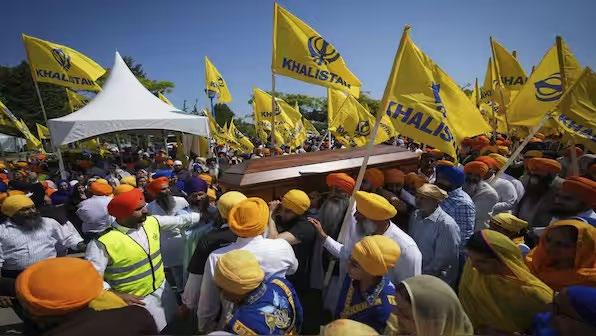
Punjab’s moment of truth: Time to confront the Khalistani challenge head-on
There was a mini-social media storm which carried over to Marathi dailies too. A senior minister from Maharashtra had gone to Amritsar and attended a function at Damdami Taksal, a very important Sikh learning centre. Unfortunately, Damdami Taksal has a negative tinge, as it was the headquarters of Jarnail Singh Bhindranwale before he moved into the Golden Temple — Shri Durbar Sahib — during the turbulent times of Khalistan 1.0. It became a centre of militant extremist ideology. In recent times, it had stayed away from the news as the chief of the spiritual centre has kept a moderate profile.
courageous Congress Chief Minister, Beant Singh. Both Mrs Gandhi and Beant Singh paid a heavy price.
The problem was not the Maharashtra minister’s visit to Damdami Taksal, probably at the invitation of the head of the centre. The problem is that he chose the occasion to pay homage to Jarnail Singh Bhindranwale, calling him a Sant and putting the entire blame for the Khalistani violence of the 1980s and 1990s on the then Central government and Indira Gandhi. It is widely accepted that making Bhindranwale a counter to Akali Dal politics was hard-ball politics on the part of Mrs Gandhi. However, it is equally true that this divide-and-rule idea went horribly wrong. Neither Mrs Gandhi nor the then Akali Dal leaders could control him. Bhindranwale had tasted the heady concoction of militant Sikhi, moralism and violence. The Akalis had thought they could use him to pressurise the Centre and win back Punjab with more powers from the Central government, but they lost the plot. I have written a section on the Punjab problem and the RSS’s role in calming society there in my book, Conflict Resolution: The RSS Way. It runs into nearly 100 pages. It is important to point out that the violent separatist movement was eventually snuffed out completely under the dynamic DGP, KPS Gill, and the
Indira Gandhi and Beant Singh were not the only ones who lost their lives. Thousands of Hindus and Sikhs lost their lives too. According to SATP (South Asia Terrorism Portal), of the 11,694 people officially killed by militants in Punjab between 1981 and 1993, 7,139 were Sikhs and 4,555 were Hindus. The real numbers could be higher. As a Punjabi, I would visit Punjab every two to three months even during those days, and it was routine to hear of a murderous attack on a train somewhere, or on buses somewhere else. There is enough documented evidence that Bhindranwale was the chief instigator of this orgy of violence. He would openly threaten the government, the police and the people. He turned the Golden Temple into a military barracks while the state and Central Governments twiddled their thumbs, not knowing how to handle the monster of Khalistani terror they had created.
RSS shakhas were attacked, and swayamsevaks were killed mercilessly in Punjab simply for saying that Hindu-Sikh relations are like nail and skin and cannot be separated. I come from a village near Moga where 25 swayamsevaks were gunned down. Did Indira Gandhi force Bhindranwale and the Khalistanis to perpetrate such crimes?
I had written in my book that though the first Khalistani movement had died, the stirrings of new attempts could be felt. Unless governments were very firm and the people alert, we could see big trouble. The last movement was more in Punjab than outside, except for small groups in the UK and Canada. However, the new phase of this movement is, so far, more outside than inside. But slowly, local militants are coming out of the woodwork, celebrating Bhindranwale openly and giving him the status of a demigod. His pictures have been on display in many Indian gurdwaras and overseas. The AAP Government’s soft, or perhaps cowardly, attitude towards these violent separatist elements is there for all to see. Random killings have been going on, and the state and Centre have been quiet; so too have the political parties.
'Prosthetic mask, sunglasses used to hide actor's identity': Punjab CM Mann on sacrilege video
Continued from Page 1...
The Punjab CM alleged that the conspiracy was the handiwork of Jagman Samra, "a blackmailer" who got a prosthetic mask — a sculpted, wearable makeup appliance made of foam latex or silicone — made and shot this viral video in Canada. "He has also made a mask of Arvind Kejriwal. A joint forum (of opposition parties) is behind this targeted attack which will be revealed in the days to come," he said. Mann asserted that he would submit the facts in a video to the Akal Takht and the police so that action could be taken against people responsible for it.
On mediapersons' query if Samra was his friend, Mann bluntly replied, "Samra is not my friend, he had met me only once but I know that he has a tainted past. He lives in Abbotsford, Canada.” He added that he did not go to Canada after 2016 whereas the opposition was claiming that the video was from 2018-19.
Mann, 52, recounted the works done by his government for the religious institution and said that he was being vilified by the political masters of a religious institution. "Everyday, new edicts are being issued to defame me. For putting up boards to boycott me, I want to ask the SGPC why such boards were not put up against Sukhbir
HC denies bail to accused in murder case of Shaurya Chakra Awardee Balwinder Singh Sandhu
Less than six years after Shaurya Chakra Awardee Comrade Balwinder Singh Sandhu was killed at his residence-cum-school in Bhikhiwind in Tarn Taran district, the Punjab and Haryana High Court has refused regular bail to Gurwinder Singh alias Baba.
It was alleged that Baba had collected and delivered not only arms and ammunition at various locations in Punjab, but also indulged in smuggling narcotic substances and collection of cash. The weapons used for killing Comrade Balwinder Singh Sandhu were made available by Baba to the main assailants, it was further alleged.
“The material available on record indicates the involvement of the appellant in furtherance of terrorist activities, backed up by banned terrorist organization. Precisely, on this account, there are serious allegations, where the safety and security of the country is being sought to be put on peril
with there being, prima facie, material indicating involvement of the appellant,” the Bench asserted. Alleging false implication, his counsel contended Baba was not named in the FIR. There was no incriminating evidence against him to substantiate the version put forth by the investigating agency. The trial was going on at snail’s pace and he was in custody since August 25, 2022. “Long custody, in such circumstances, was a good ground for grant of bail, while invoking Article 21 of the Constitution of India,” the counsel contended. The Special Prosecutor, on the other hand, resisted the claim for bail. He submitted sufficient evidence was collected during the investigation to prove his incriminating role. “The provisions of Section 43-D of UAP Act are completely applicable to this case and, therefore, bail has very rightly been denied to the appellant,” the Special Prosecutor submitted.
Kapurthala youth's abduction, murder case: Police arrest main accused from Uttarakhand
The Kapurthala police have arrested the main accused in a high-profile abduction and murder case.
The accused, Navjot Singh, alias Mani Baba, of Mushakved, Kapurthala, was arrested from Uttarakhand on Wednesday.
Addressing a press conference, Superintendent of Police (Investigation) Harinder Singh Gill said that the case was registered on April 23 following a complaint by Jaspal Singh, who alleged that his son, Deepak, was at Gillani Gas Agency on Aujla Road, when Navjot Singh alias Mani Baba, along with Lovepreet Kumar alias Preet alias Lala, Rajandeep Singh, and one or two unidentified associates, assaulted him, forcibly abducted him in
a Swift car (registration number PB 08 FM 4042), and later murdered him.
Based on the complaint, an FIR was registered at Kapurthala police station under Sections 103, 140(1), and 191(3) of the Bharatiya Nyaya Sanhita (BNS), along with Sections 25, 54, and 59 of the Arms Act.
During the investigation, co-accused Lovepreet Kumar alias Preet alias Lala of Dyalpur, Jalandhar district, and Lucky of Lakhan Kalan, Kapurthala district, were arrested earlier, while the prime accused, Navjot Singh alias Mani Baba, had been absconding. Police said further investigation is underway to uncover additional facts and identify the remaining accused involved in the case.
Badal when he was declared a 'tankhayyia'. I am a humble Sikh who respects the Akal Takht. I am not in that video. My physical features do not match with the figure in the video."
A political row had erupted over an alleged objectionable video of the CM, over which the Akal Takht had issued an edict against Mann on June 15. Since then, both the Akal Takht and AAP have come up with contradicting forensic reports.
The Gurugram police, meanwhile, have arrested two suspects after a complaint by a forensic expert in connection with a viral "sacrilege" video involving CM Mann. In the FIR it is alleged that employees of two private facilities, Cipher Sentinel Lab and Cyberyan Labs, were coerced into producing a predetermined "clean chit" report to exonerate the CM from the purported video.
In India, The Catholic Church Becomes An Unlikely Sanctuary For Trans People
The room is small. It’s a modest space inside the parish in southern India. But when church leaders unveiled a dedicated “Catholic Desk” for transgender people there earlier this year, the gesture carried outsized weight.
The parish, Kadarkarai Sagaya Madha Church in Ennore, a coastal working-class district of Chennai, is quietly welcoming people who are transgender amid a culture and a larger global atmosphere that has often hostile.
It was, by most accounts, the first structured pastoral ministry of its kind in the archdiocese, and one of the most visible signs yet that the Catholic Church in India, long cautious and defensive about its minority status, is quietly positioning itself as a refuge for one of the country's most marginalized communities. The desk is an office that offers job placement assistance and professional counseling. It is led by Leo Joseph, a priest, alongside Inba
Ignatius, founder of the Snegidhan Snegidhi Trust, an organization with years of experience providing shelter and livelihood support to transgender persons in Chennai. Ignatius, who was raised Catholic but felt excluded from the church following her gender transition, finds herself at the center of its most inclusive pastoral initiative in the region. The timing is not incidental.
The inauguration in Ennore came weeks before the Indian Parliament passed the Transgender Persons (Protection of Rights) Amendment Act, a legislation that rights advocates say has dismantled the most fundamental protection that Indian transgender persons had won.
The 2014 Supreme Court ruling in National Legal Services Authority v. Union of India guaranteed the right to self-identify one's gender. The new amendment strips that away, requiring the approval of a government-appointed medical
board instead before the state will legally recognize a transgender person’s identity.
The new law also narrows the legal definition of transgender so radically that trans men, nonbinary people and many who did not fit into socioculturally legible categories like hijra or aravani ( terms meaning third-gender and usually referring to transgender women, intersex individuals or eunuchs) are no longer recognized under Indian law at all.
Amnesty International called the amendment “a serious setback for human rights in India.” Medical groups condemned it as “scientifically inaccurate, medically unsound and incompatible with contemporary standards of transgender healthcare.”
Despite protests, it received presidential assent on March 30 and pushed through both houses of parliament in under two weeks. Against this backdrop, the church’s pastoral turn looks less like
a coincidence and more like a countermovement, even if uncoordinated. The Chennai desk is the newest node in a network that has been forming slowly and largely without fanfare across India. In Guwahati, the commercial capital of Assam in Northeast India, Sister Prema Chowallur of the Sisters of the Cross of Chavanod has been accompanying the Hijra community since 2016, a ministry that began, she said, when she took a seat on a city bus next to a transgender woman no one else would sit beside. That encounter eventually became the Rainbow Home of the Seven Sisters, a shelter home in the Christianbasti area of Guwahati that now provides housing, skill training in trades like tailoring and embroidery and support for the admission of transgender children into the formal education system. The Archdiocese of Guwahati gave the initiative its backing, a rare and significant institutional imprimatur.
How India aims to break China's solar monopoly with new policy
India has taken another step in its long-running effort to reduce dependence on China in the solar sector. After targeting imported solar modules and cells over the last few years, the Centre has now moved further upstream. The Ministry of New and Renewable Energy (MNRE) has extended the Approved List of Models and Manufacturers (ALMM) framework to include solar ingots and wafers -- two critical components that sit at the heart of the solar manufacturing value chain.
The new ALMM framework will come into effect from June 1, 2028. Once implemented, all solar projects, including net-metering and openaccess projects, will have to use wafers listed under the approved domestic framework.
The move is being seen as India's most direct attempt yet to challenge China's overwhelming dominance in the global solar supply chain.
Solar panels may be the most visible part of a solar project, but they are only the final product in a long manufacturing chain.
Polysilicon is converted into ingots. Ingots are sliced into wafers. Wafers are then turned into solar cells, which are assembled into modules or panels.
India has made rapid progress in module manufacturing and is expanding cell production. But wafers and ingots remain a major weak spot.
That dependence has given China enormous leverage over global solar supply chains.
China's dominance in solar manufacturing is unlike almost any other industrial sector.
According to the International Energy Agency (IEA), China controls more than 80 per cent of global manufacturing capacity across every major stage of solar panel production, including polysilicon, ingots, wafers, cells and modules. The country has invested more than $50 billion in solar manufacturing capacity over the past decade. The dominance becomes even more pronounced in wafers.
Industry estimates cited by global energy researchers show China accounts for roughly 9597 per cent of global wafer production capacity, making it the undisputed king of the most critical upstream segment of the solar industry.
China's manufacturing scale, low-cost financing, subsidies and integrated supply chains have enabled it to become the world's cheapest supplier of solar equipment. In the first half of 2024 alone, the country exported a record 120 GW of solar modules after aggressively cutting prices.
Resilience becomes energy's new currency as India navigates post-Hormuz market shifts: S&P
Global energy markets are adjusting after the June 17 MOU between the US and Iran, with the reopening of the Strait of Hormuz expected to enhance energy flow recovery and market confidence. Experts from S&P Global Energy noted the necessity of diversified supply chains and resilient infrastructure, emphasising that adapting to geopolitical changes is crucial for long-term energy security.
Despite the closure of the Strait leading to a 15 million b/d reduction in Gulf liquids production, price reactions have been minimal, attributed to global inventory and demand management, including reduced crude imports by China and Japan and increased US exports.
“The effective closure of the Strait of Hormuz was the largest oil supply disruption in history. It was—and for the moment, still is—extraordinary. But what is surprising—even extraordinary—is the limited price reaction,” said Jim Burkhard, Vice President and Head of Research for Oil Markets, Energy and Mobility, S&P Global Energy. “If flows via Hormuz and Gulf production do begin to recover, it will take time—and global
oil inventories will continue to fall through June and July. This means upward price pressure could return as inventories fall to even lower levels.”
India’s energy security is increasingly tied to upstream access and international portfolio diversification as global upstream markets focus on resource security and disciplined investment. India’s LNG market displayed significant resilience amidst a supply disruption from the Strait closure, which affected 17 per cent of global LNG supply. By diversifying import sources, including Oman, the US, Nigeria, and Angola, India’s LNG imports experienced only minimal declines of 5 and 2 per cent year-over-year in April and May 2026, respectively.
“Looking ahead, the current environment reinforces a clear directional shift for both global and Indian upstream sectors: resilience is becoming the defining metric of value. Access to stable resources, accelerated project timelines, and diversified supply portfolios are taking precedence over pure scale or cost optimisation,” said Nick Sharma, Executive Director, Upstream Energy, S&P Global Energy.
Passport was never proof of citizenship, says government; cites law, court rulings
Amid a political row over the Ministry of External Affairs' recent assertion that a passport is not proof of citizenship, top government sources on Thursday said the position was neither new nor a policy change, maintaining that Indian law has never treated a passport as conclusive evidence of citizenship. The clarification came a day after the remarks made during Passport Seva Divas triggered debate and opposition criticism, with some leaders questioning the rationale behind describing a passport as a travel document rather than proof of citizenship. Senior government sources told The Tribune that "it was not decided yesterday that the passport is not proof of citizenship" and stressed that "it was not even decided in the last 12 years". According to sources, a passport has never been treated as proof of citizenship under the legal framework governing its issuance.
Sources pointed to provisions of the Passport Act, 1967, which allow the government to issue passports and travel documents even to persons who are not Indian citizens under specific circumstances.
Sectin 20 of the Act states that "the Central
Government may issue, or cause to be issued, a passport or travel document to a person who is not a citizen of India" if it considers such action necessary in the public interest.
Government sources argued that the provision itself demonstrates that possession of a passport cannot automatically establish citizenship.
Sources also cited judicial precedents, including judgments of the Bombay High Court dating back to 2013, which, they said, had clarified that a passport by itself is not proof of citizenship.
Seeking to counter criticism following Wednesday's remarks, sources urged media organisations to educate the public about the distinction between citizenship and travel documentation rather than portraying the government's position as a fresh decision.
The Ministry of External Affairs had stated on Passport Seva Divas that passports are issued after extensive verification and remain secure travel documents that establish identity and nationality for international travel. Officials had, however, underlined that the document's primary purpose is to facilitate travel abroad.
Centre restores commercial LPG supplies, lifts curbs as West Asia crisis eases
In a major relief to industrial and commercial LPG consumers, the government on Thursday removed all sectoral restrictions on the supply of non-domestic packed LPG and restored supplies to the levels prevailing prior to the West Asia crisis. Further, the supply of bulk LPG, which had been suspended at the onset of the crisis, has been relaxed to 50 percent of the pre-crisis consumption levels, providing significant relief to commercial and industrial consumers. The restoration follows the recent improvement in the LPG supply situation. During the West Asia crisis, to augment domestic LPG production, the government had issued orders
under the Essential Commodities Act requiring C3-C4 streams to be utilised exclusively for LPG production, diverting them from petrochemical and other downstream uses.
Taking note of the improved indigenous LPG production and the projected availability of imported LPG cargoes, the government has also decided to reduce the diversion of C3/C4 streams to the LPG pool. The allocation of C3-C4 streams for non-LPG uses will be implemented while ensuring that the domestic LPG availability remains unaffected and aggregate indigenous LPG production is maintained at not less than 40 TMT per day.
Curbs on religious conversion, no registration for NGOs headed by non-Indians
The Union Ministry of Home Affairs, under Amit Shah, have notified a number of amendments in the Foreign Contribution (Regulation) Act, tightening the noose around vague operations by non-governmental organisations (NGOs). The FCRA amendments have long been proposed as the Government sought to prevent the misuse of foreign funding. The new norms seeks greater accountability from the NGOs on their foreign funding and use of the mone in India. The new rules also demand that NGOs furnish the purpose of their registration and disclose their donors. These amendments aim to enhance transparency, ensure the active utilisation of funds, and refine the eligibility criteria for foreign contributions. Under the new framework, associations are now required to align their operations with a predefined schedule of purposes, disclose ultimate donors, and adhere to stricter financial and reporting mandates.
Definition of Key Functionaries: The definition has been broadened to include company directors, partners, trustees, the 'Karta' of a Hindu Undivided Family, and any individual exercising management control.
Restriction on Foreign Nationals: Associations
Sonam Wangchuk announces indefinite hunger strike from Sunday at Delhi's Jantar Mantar
Education reform activist Sonam Wangchuk on Thursday announced that he would join the ongoing protest at Delhi's Jantar Mantar with an indefinite fast from Sunday if the Centre failed to respond to his demands concerning education reforms and Ladakh. In a video message recorded from what he described as the "Jantar Mantar of Geneva", the designated protest site outside the United Nations office, Wangchuk said he had returned to assess whether the government had
acted on the issues he had raised before leaving for Switzerland. Standing with the United Nations office and the Broken Chair monument behind him, which he described as a symbol of the struggle for rights, Wangchuk said, "You may remember that I had said I would return from Switzerland, meet you and see whether our demands had been fulfilled."
Repeating the appeal he made last Saturday, he said, "The government should take responsibility, whether it is your voice in the field of education or Ladakh's voice on environment and culture. If no such responsibility is taken, I will sit on an indefinite fast with all of you at Jantar Mantar in the coming week." Wangchuk said there was still no accountability on either of the two issues. "By the time Saturday ends, I will go on a fast from Sunday. If even one of these demands is accepted, I will not have to go on a fast. At least one issue should be resolved," he said.
Mahesh Dixit to replace Himachal cadre IPS Tapan Deka as Intelligence Bureau chief
Mahesh Dixit, a 1993-batch IPS officer from Andhra Pradesh cadre, has been named the new chief of the Intelligence Bureau (IB).
The Appointments Committee of the Cabinet has cleared his appointment.
Mahesh Dixit is currently Special Director in the IB. He will replace Himachal Pradesh cadre officer Tapan Deka who has been serving as the IB director since 2022 and whose extension of term ends on June 30.
Dixit has been chief of the IB’s Subsidiary Intelligence Bureau (SIB) in Srinagar. He is a seasoned Jammu and Kashmir hand and has also
overseen Leh.
Dixit contributed immensely to the maintenance of peace and law and order in the aftermath of the August 2019 Government move to abrogate Article 370 in Jammu and Kashmir.
with foreign nationals (excluding those of Indian origin) as key functionaries will generally not be eligible for registration or prior permission, though the government retains the power to grant exceptions via official orders.
Predefined Activity Schedule: Applicants must now select their area of operation and specific purposes from a "Schedule" covering religious, cultural, economic, educational, and social categories.
Proselytisation Clause: While various religious activities (such as construction of religious places or conducting satsangs) are permitted, the rules explicitly exclude 'proselytisation' from categories like religious education, documentation of faith traditions, and preservation of indigenous beliefs.
Operational Spending Requirements: To prevent inactive NGOs from holding licenses, a minimum spending limit of Rs 10 lakh of foreign contribution over the last two financial years has been introduced.
Fund Utilisation & Monitoring: For NGOs under "Prior Permission," subsequent fund installments will only be released after at least 75% of the previous installment has been utilized, subject to government field inquiry verification.
Social Media: Applications must now include details of the organisation's social media accounts.
Ultimate Donor Disclosure: NGOs must disclose the original source of funds if contributions arrive via intermediary remittance vehicles or Donor Advised Funds.
Detailed Reporting: Annual returns must now be accompanied by a "detailed activity report" in addition to standard financial statements.