A South Asian man, has been killed in Surrey in an incident of shooting allegedly related to organised crime, local media reported. The shooting incident was reported from a townhouse complex in Surrey’s Sullivan Heights on Saturday night, in which a man was shot dead, Global News reported. The Integrated Homicide Investigation Team (IHIT) said in an update on Monday that the victim has been identified as 27-year-old Jasman Sekhon, CTV News reported.
“Sekhon had previous interactions with the police and was believed to be involved in the drug trade. Early indications suggest this was a targeted incident related to organised crime," the report said, quoting the IHIT’s statement.
According to witnesses, Sekhon was first chased by a dark SUV after which two men stepped out of it and started shooting at him, the report said. Officials found Sekhon with gunshot wounds when they arrived and failed to revive him, it added. A burning vehicle was found nearby after the shooting incident, which police say is the hallmark of gang killings.
Continued on Page 8...
with the Taliban Judge stops deportation of woman who murdered stepson
As tensions simmer along the PakistanAfghanistan frontier – fuelled by disputes over the contested Durand Line, recurring
A Jamaican woman ordered deported from Canada more than five years ago after she was convicted of killing her stepson has won a reprieve.
Rowe argued successfully that the immigration officer who refused to stay her removal last November didn’t properly consider an expert report on how deportees are treated in Jamaica when he turned down her pre-removal risk assessment (PRRA) — Rowe’s last-ditch bid to stay in Canada — and her separate bid to regain her Canadian permanent resident status, based on humanitarian and compassionate (H&C) grounds. Continued on Page 7...
cross-border strikes and the persistent threat of Tehreek-i-Taliban Pakistan (TTP) fighters operating from Afghan soil – a subtle but consequential geopolitical shift is under way. India is quietly but steadily stepping up its engagement with the Taliban.
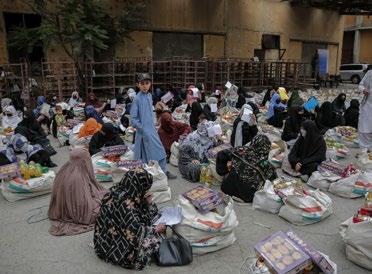
The urgency of this recalibration was underscored on March 16, when Pakistani military forces carried out one of the deadliest strikes on civilians in Afghanistan, hitting a drug rehabilitation centre in Kabul.
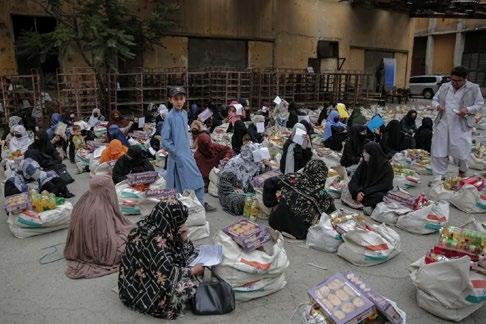
In a swift humanitarian response, India dispatched a 2.5 tonne consignment of emergency medicines, medical supplies and equipment. Continued on Page 4...
As the world's richest cricket tournament Indian Premier League (IPL) returns on Saturday, there will be a lot of attention on the big names. Some of it will also be on a teenager.
A day before the IPL starts on 27 March, Rajasthan Royals batter Vaibhav Suryavanshi turns 15. And with that, one of Indian cricket's most intriguing questions sharpens into focus: is he ready for the big stage?
Suryavanshi first turned heads three years ago when he was a 12-year-old batter taking bowlers old enough to be his father to the cleaners.
Since then, however, the quality of his batting, consistency and hunger for tall scores at an extreme strike rate have taken centre-stage. Continued on Page 10...
India imports nearly 90% of its crude oil— largely from Russia and the Middle East. With geopolitical trouble making both of those sources less reliable and leaving it vulnerable, the world’s most populous country is inviting more foreign investment to help it boost its domestic oil and gas supply, a top energy executive from India told Fortune.
While India is acquiring more alternative supplies to help it ride out the war in Iran, it typically imports most of its oil from Saudi
Nanaimo RCMP investigating vandalism of Iranian community’s roadside signs
Police are investigating after a pair of roadside signs in Nanaimo were vandalized last month.
The signs, which are “associated with a federal petition from the Iranian community,” are believed to have been spray painted black sometime between between 6 p.m. on March 18 and the same time the following day, Nanaimo RCMP said in a news release Thursday.
Both signs were located on Island Highway North, one at Departure Bay Road and the other at Aulds Road, according to police.
Mounties said the damage was reported to them on March 23. They shared two photos of the vandalism.
“Investigators are asking anyone who may have observed suspicious activity in the area during the time periods noted, or who may have dash camera or security camera footage, to please contact police,” the release reads.
The non-emergency number for Nanaimo RCMP is 250-754-2345, and the file number for this investigation is 2026-8683.
BC faces ‘complete opposition’ after telling First Nations of plan to suspend DRIPA
British Columbia Premier David Eby says he will stake his government on suspending sections of the Declaration on the Rights of Indigenous Peoples Act for up to three years.
Speaking after a meeting with First Nations leaders, Eby says his government will pass legislation this session to suspend sections of the law that place the province at the greatest legal risk, in light of a court ruling that cited DRIPA and raised questions about B.C.’s mining rules.
A source who attended the meeting says there was “complete opposition” to the suspension plan from First Nations in attendance.
Eby says the suspension will be a confidence vote on his government, and he hopes First Nations leaders will at least tolerate the pause as the government appeals the mineral tenure case to the Supreme Court of Canada.
Eby did not identify which sections would be suspended, but says a pause is the “least invasive way possible” to find a path forward, while protecting the province from immediate legal exposure.
DRIPA has been cited by First Nations involved in two landmark court victories last year that sparked concern about implications for private land ownership and the province’s mining rules.
One of the sources told The Canadian Press that the proposal “effectively places every section of DRIPA” that the government wanted to replace under suspension for three years, and that changes to the legislation would be made later.
The source said the plan was to give time for
He says other sections of DRIPA will remain in effect. Two sources attending the meeting had earlier told The Canadian Press of the suspension plan. This report by The Canadian Press was first published April 2, 2026.
British Columbia’s government has proposed suspending its Declaration on the Rights of Indigenous Peoples Act, according to two sources in a meeting between Premier David Eby and First Nations leaders.
One of the sources says a three-year suspension of the legislation has been proposed, while the other didn’t give a time frame.
Eby said on Wednesday it was “non-negotiable” that the legislation designed to reflect the United Nations Declaration on the Rights on Indigenous Peoples would be changed.
the Supreme Court of Canada to weigh in, while the second source who confirmed the suspension proposal says there was “complete opposition” from First Nations at the meeting.
First Nations leaders have warned of legal action if Eby’s government proceeds with amending DRIPA.
More than 130 civil society organizations, including the B.C. Federation of Labour, have also called on Eby to leave the bill alone.
DRIPA is based on the United Nations Declaration on the Rights of Indigenous Peoples, which requires free, prior and informed consent from Indigenous Peoples on matters affecting their rights, lands, territories and resources.
Eby’s government proposed changes to the bill in a letter and document in late March shared with some First Nations leaders under a confidentiality agreement.
Investigators believe that B.C. cold case could have been random murder
ICBC/Personal Injury
Immigration
It has been 17 years since a woman was killed in a B.C. park and no one has been arrested for her murder.
Wendy Ladner-Beaudry was jogging near 41st Avenue and Camosun in Pacific Spirit Regional Park on April 3, 2009, when she was attacked.
Her body was later discovered on St. George’s Trail, just nine blocks from her home.
Over the years, investigators have identified and thoroughly examined hundreds of persons of interest, all of whom have ultimately been ruled out, the RCMP said in an update on Thursday.
They said that at this stage, the possibility that Ladner-Beaudry’s death was a random act of violence cannot be ruled out.
“All of Wendy’s family and friends have been ruled out,” Her brother, Peter Ladner, told Global News on Thursday.
and there’s no connection that any of us can figure out between the killer and Wendy,” he said.
“And so without those data points, it’s pretty hard to find people.”
Ladner said it would have been his sister’s 70th birthday on March 30.
“We just miss her dearly and hang on to some kind of frustration about the outcome, the fact that no one’s been held to account for that horrible crime and we just carry on.”
“We’ve all been through lie detectors and suspicions. And I’ve only got one thing to say to the armchair experts who watch TV shows and say, ‘Oh, I know it’s always this person or that person.’ Just shut up until you know something, because there’s no evidence of any of that.”
Ladner said he is convinced his sister’s death was a random homicide with no reason behind it.
“And that’s the reason, one of the reasons it’s been so hard to solve, is because there’s no motive
“Seventeen years is a long time, but our commitment to finding the person responsible for Wendy’s death has never wavered,” Supt. Bal Hansra said in a statement.
“We continue to pursue every lead, no matter how small, because Wendy and her family deserve answers. We believe someone out there still holds information that could help move this case forward.”
Ladner said the family deserves answers.
“More of my message would be that if someone knows this person, or knows what happened, for those people to step forward and maybe we can get some resolution to this,” he said.
Anyone who has not yet spoken with police and may have information, no matter how small it may seem, is urged to contact the RCMP at 778-290-5291 or 1-877-543-4822. To remain anonymous, reach out to Crime Stoppers at 1-800-222-8477.
PST expansion set to hurt BC businesses
Business owners and advocates say the B.C. government's plan to expand the provincial sales tax to include professional services could kill some businesses and real estate projects.
Worse is that the tax changes could hurt the broader B.C. economy when it is already sputtering, advocates such as Greater Vancouver Board of Trade (GVBOT) CEO Bridgitte Anderson told Business in Vancouver.
That could translate into the B.C. government collecting less tax revenue, not more, because dormant businesses and languishing real estate projects would not generate taxable activity, she said.
Businesses in certain professional-services sectors are set to particularly feel pain.
"It is for accounting, security services and geoscience—there are a bunch of those affected," Anderson said. "We are trying to calculate what that will look like."
Starting Oct. 1, B.C. plans to apply its seven per cent PST will to:
Accounting and bookkeeping services; Security services, including private investigation services; and
Non-residential real estate services, including trading services, rental property management services, strata management services and commissions related to the purchase and sale of
non-residential real estate.
In addition, the province plans to charge that seven per cent PST on 30 per cent of the purchase price for architectural, engineering and geoscience services.
B.C. Finance Minister Brenda Bailey explained the move, saying she wants to align B.C. with how other provinces tax those services.
That rationale fell flat with Anderson, however.
"Alberta doesn't have a PST," she said.
Ontario is different too.
The harmonized sales tax combines Ontario's provincial tax with the federal GST. That province’s businesses that pay the HST on professional services are later able to "recover" that tax paid on the provincial portion, McCarthy Tetrault LLP partner Simon Douville told BIV.
"Quebec is very similar to Ontario," he said.
"There will be an increased cost of doing business in British Columbia."
Exact details on how the tax will be applied has not yet been spelled out in regulations.
Security services to newly be taxable
Provident Security Corp. CEO Mike Jagger said he has never liked the PST.
"It's the worst tax," he said. "It creates so much hassle and it has always been such a convoluted mess."
He voted to end the tax in 2011 and bring the HST to the province when the B.C. government held a referendum on the matter, which failed.
Nearly three-quarters of Jagger's business is service-oriented and has not yet been subject to the PST. He does charge PST on some security devices, which has caused confusion.
Years ago, he laid out 16 motion detectors on a table for auditors and asked them which ones were subject to the PST.
He recalled that they said, "they all look the same."
Indeed, he said, "they do."
BC Appeals Court sides with First Nation over Aboriginal title on Nootka Island
The B.C. Court of Appeal has overturned a lower-court ruling after finding the judge used an “arbitrary boundary” to determine a First Nation’s Aboriginal title over a swath of Nootka Island off western Vancouver Island.
A three-judge panel says the B.C. Supreme Court made three legal errors when limiting the Nuchatlaht Nation’s claim over a 201 square kilometre portion of the island, finding the nation had met the test for “sufficient occupation” when the British Crown asserted sovereignty.
The Nuchatlat’s lawyer, Jack Woodward, said in an interview Thursday that they are “jubilant” about the recognition of the ownership of their land. He said the Nuchatlaht is a small, remote community that has been “somewhat ignored and neglected by the rest of society for a very long time.” “They had to sit by helplessly and watch their ancestral
heritage being industrialized and logged,” he said. Woodward said the Nuchatlaht has always asserted its ownership over the area, but the provincial government has been managing Crown land like it with “only one objective, which is forestry.”
He said it’s been “heartbreaking” for the Nuchatlaht to see their ancient territory logged and now they’ve scored more than just a victory, likening it to winning an inheritance to which they were always entitled.
The 2024 lower court ruling found the Nuchatlaht had established title over coastal areas of the island, but the Appeal Court found the judge had relied too much on the findings of an anthropologist about the nation’s use of “remote inland” areas before and after 1846.
Continued on Page 9...
Sting operation from Vancouver police catches Pokémon card thief
Up until someone started using bear spray on unsuspecting victims trying to sell their Pokémon trading cards online, Vancouver police say they weren't aware of a recent spike in interest in card collecting.
Staff Sgt. Ryan Campbell says thefts occurred on five consecutive days from March 23, with victims saying they were bear-sprayed and robbed after arranging meetings on Facebook Marketplace.
Campbell says officers arranged a sting operation by posting a card for sale online and meeting the suspect in person.
He says the suspect, who is in his 20s and is believed to have acted alone, was taken into custody on March 27 without incident. Campbell says police recovered two cards, valued at about $2,000 together, while the combined value of the stolen cards is about $6,000.
Capbell says police will be recommending at least four charges of robbery in the case.
He says the investigation is ongoing, and the suspect has been released with conditions.
Police say that in each robbery, someone contacted the sellers online and arranged a meeting in a public space, where the sellers were bearsprayed after being asked to produce their cards for
inspection.
Campbell told a news conference on Thursday that there has been a rise in Pokémon card thefts in the Lower Mainland, but the phenomenon wasn't on police radars until recently.
"You know, I'm not gonna lie to you. I'm really unfamiliar with Pokémon cards up until now."
Some rare Pokémon cards sell for hundreds of thousands of dollars, with influencers like Logan Paul getting in on the act. Paul recently sold a rare Pikachu Illustrator card for $16 million US.
A spate of robberies targeting collectible card shops in the Lower Mainland has led to stores ramping up security.
Brandon Chreptyk, the owner of House of Cards in Abbotsford, saw his store burgled in early March.
He said he's put in at least $40,000 in security measures since and a security guard is posted outside at night.
"The eyes on Pokémon, specifically these days, is so big. It's in its 30th year," he said.
"There's tons of celebrities and influencers that are involved in the hobby and they really pump up the, like, the glorious side."
Chreptyk says, however, that most people that collect the cards are knowledgeable and store owners are usually able to sniff out when someone is trying to unload stolen merchandise on them.
Chreptyk even said that one of the victims of the alleged Vancouver robber reached out to House of Cards to tell them to be on the lookout for their stolen card.
"We've, like, essentially confiscated collections — where people ... come in with something, their story does not make sense. We'll call the police quickly and just pretend, like, we'll just, like, slow roll them," the store owner said.
BC mother and daughter released from ICE custody in Texas after being held 19 days
A Canadian mother and daughter who spent more than two weeks detained at an immigration facility in Texas were released from custody Thursday after posting bond of $9,500 US.
"It did not feel real," said Tania Warner in a video she sent to CBC News. She was speaking while on her way home moments after being released, as her seven-year-old daughter smiled from the backseat
to argue that she had filed all the necessary documents and had been given approval by the federal government to legally extend their stay in the United States.
They now have several hearings to determine if they can stay in the U.S., or if they will be deported.
of their vehicle.
Warner insists she and Ayla are living in the United States legally after moving to Texas to be with Tania's husband, a U.S. citizen, four and a half years ago.
She said the judge decided they are not a flight risk. However, she has been fitted with an ankle monitor.
Warner said her immigration lawyer was able
Warner and Ayla were taken into custody on March 14 at a state border patrol checkpoint in Sarita, Texas, while on their way home from a baby shower. She said they have been through similar checkpoints many times before without issue, and did not expect to be detained.
Warner, who is originally from Penticton, B.C., was going through the process to get a green card, which required her to spend thousands of dollars and undergo a criminal record check, but her husband says she kept her immigration paperwork up to date.
Warner and Ayla were first held in a processing centre in McAllen, Texas, but were later transferred to an immigrant detention centre for families in the state.
Warner said she has been appalled by the conditions in the facilities and that the families she talked to had all been attempting to follow proper channels in their efforts to live in the United States.
Why India is quietly deepening its engagement with the Taliban
Continued from Page 1...
This is not an isolated gesture. In February, New Delhi raised its aid allocation to Afghanistan in the 2026-27 budget to 1.5 billion rupees (US$16 million) from 1 billion rupees – signalling a sustained commitment to developmental support for the war-ravaged country.
For a nation that refused to recognise the Taliban in the 1990s during its first stint in power, this shift is not a volte-face but a pragmatic adjustment to new realities. India’s renewed footprint in Kabul – marked by the reopening of its diplomatic mission and a steady flow of aid – reflects a clear-eyed embrace of realpolitik. The Taliban, however contentious, are the de facto authority in Afghanistan. Ignoring them is no longer a viable option.
This shift is driven by three converging imperatives: security, strategy and connectivity. First, security. India’s primary concern has always been the possibility of Afghanistan again becoming a haven for antiIndia terror groups. Engagement with the Taliban, however limited, offers New Delhi a channel to press its red lines directly.
Its humanitarian aid – wheat shipments, medical supplies and earthquake relief – has been both a goodwill gesture and a strategic signal. It underscores India’s long-standing image as a development partner in Afghanistan. Unlike more transactional players, India is positioning itself as a stabilising force.
India is also recalibrating its diplomatic language. The insistence on isolating the Taliban has been replaced by a more nuanced vocabulary described
There is precedent: the Taliban has shown a degree of responsiveness to countries willing to engage without hostility. For India, long a target of cross-border terrorism, marginal influence is preferable to strategic absence. Second, the regional balance is shifting in India’s favour, at least temporarily.
Pakistan, historically the Taliban’s principal backer, is facing strained ties with Kabul. Escalating border clashes and the TTP’s resurgence have eroded trust. This fraying relationship presents India with a rare opening to rebuild its footprint in Afghanistan without directly confronting Pakistan’s interests.
New Delhi has moved cautiously but deliberately.
as “engagement without endorsement”. Indian officials have held rounds of talks with Taliban representatives in regional forums, indicating a willingness to keep channels open without crossing into formal recognition.
Third, connectivity. Afghanistan sits at the crossroads of Central and South Asia, and India’s long-term strategic vision hinges on access to these markets. With Pakistan denying overland transit, New Delhi has invested in alternative routes, most notably via Iran’s Chabahar Port. Engagement with the Taliban keeps these options alive.
There is also an economic subtext. Afghanistan’s modest but strategically located markets –spanning minerals, dry fruit and transit trade –offer niche opportunities for Indian businesses. More importantly, stability in Afghanistan could unlock broader regional trade corridors linking India to Central Asia and beyond.
Ph: 604-591-5423
Fax: 604-591-8615
editor@theasianstar.com
Editor: Umendra Singh
Marketing and Sales: Ravi Cheema
604-715-3847
Shamir Doshi
604-649-7827
Harminder Kaur
778-708-0481
Parminder Dhillon
604-902-2858
Pre-Press: Avee Waseer
Production: Ozmo Media
www.theasianstar.com
B.C. Premier David Eby to pause implementation of some parts of DRIPA
B.C. Premier David Eby says he shared plans to put a "temporary pause on a number of sections" of the Declaration on the Rights of Indigenous Peoples Act, known as DRIPA, for up to three years in a meeting Thursday morning with First Nations leaders.
The premier says this proposal comes in response to concerns voiced by First Nations leaders opposed to draft amendments to the landmark reconciliation legislation that the government originally shared with them in confidential documents viewed by CBC News.
"We heard loud and clear that this approach was totally unacceptable to First Nations leaders, that it reflected government unilaterally drafting changes to a law that we had worked on together to write, and they felt the process was rushed and that the entirety of that approach was wrong," he said.
"My hope is that this pause approach is one that is met with, if nothing else, at least tolerance by the Indigenous leaders."
In a one-hour 45-minute Zoom meeting between the premier and First Nations leaders Thursday, Eby said the proposal he shared sought to respond to leaders' concerns about preserving the act, while protecting the province from legal liabilities created by recent court decisions.
"The very specific sections that we are proposing to put a temporary pause on relate directly to the Gitxaała decision," he said, though he did not detail exactly which sections the amendments would be focused on.
However, Eby clarified that Sections 6 and 7 of the act would not be paused.
The premier has faced mounting pressure from Indigenous leaders who have expressed frustration over draft amendments to DRIPA, which they said would "gut" the legislation and walk back reconciliation in B.C.
The draft amendments first shared with some chiefs on March 23, viewed by CBC News, would effectively limit which laws DRIPA applies to.
That document proposed changing the stated purpose of the act, removing an affirmation of "application of the declaration to the laws of British
Columbia." Instead, it would be replaced with the intention to provide for the government working "towards aligning enactments with the Declaration" in an ongoing co-operation and consultation process with Indigenous peoples in B.C.
The government also planned to remove "measures to align laws" with the United Nations Declaration on the Rights of Indigenous Peoples, a section that says B.C. "must take all measures necessary " to ensure the province's laws are consistent with UNDRIP.
"He took that away," said Judith Sayers, president of the Nuu-Chah-Nulth Tribal Council.
"What he’s proposing now is to amend DRIPA to put the provisions he’s concerned about on hold for up to three years" or until the Supreme Court of Canada hears two major court cases related to DRIPA and Aboriginal title.
Eby said Wednesday the amendments are "nonnegotiable" in response to two recent court cases the government is appealing. The first is known
as the Cowichan Tribes decision. A B.C. Supreme court judge awarded Aboriginal title over a swath of property in Richmond, B.C., last year. That decision has sparked confusion about how Aboriginal title intersects with private property rights.
The other is a B.C. Court of Appeal ruling in favour of the Gitxaała First Nation, which found that the province’s system of granting mineral rights was inconsistent with DRIPA.
The NDP government will have to introduce amendments in order to suspend the relevant sections. That will be a confidence motion, which raises the prospect that the government will fall if it fails to pass.
Eby insists his caucus is united and brushed off concerns that he might not have the votes to pass the changes. He has committed to introducing amendments to the legislation before the end of May, so it can be debated in the spring session.
He says nations cannot afford to "pause" efforts to protect their title and rights.
School teachers and first responders fill West Vancouver's new
affordable rental housing project
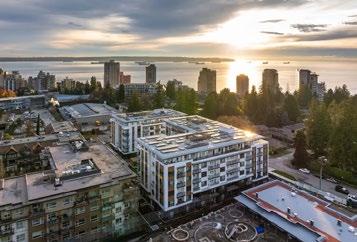
A newly completed housing development in West Vancouver has added 156 secured purposebuilt, below-market rental homes aimed at helping local workers and families remain in the community — avoiding longer commutes from elsewhere on the North Shore or across the two congested bridges from south of Burrard Inlet.
Kiwanis Village West, a two-building project at 950-970 22nd St. within the western area of the Ambleside neighbourhood, officially opened after finishing construction ahead of schedule late last year.
The development is already fully occupied, with 316 residents having moved in by early 2026. The property is located adjacent to École Pauline Johnson Elementary School, West Vancouver School District headquarters, and West Vancouver’s civic hub of the aquatic centre, community centre, ice arena, and seniors’ activity centre. It is also near West Vancouver Secondary School and the District’s municipal hall, main police station, and a fire hall.
The six-storey buildings offer a range of unit sizes, from studios to three-bedroom homes, with rents set at roughly 75 per cent of average market rates. Eligibility requirements prioritized people already living, working or studying in West Vancouver who do not own property. In addition to residential units, the development
includes an adult day centre operated by Vancouver Coastal Health. The facility is intended to support people living with dementia and other cognitive conditions while providing relief for caregivers.
West Vancouver mayor Mark Sager says Kiwanis Village West is an “important milestone” for his municipal government, as “it helps people who keep West Vancouver running and supports Council’s priority that those who work here can afford to live here.” Stefan Baune, CEO of Kiwanis North Shore Housing Society, added that this development enables his non-profit organization to “expand our reach to serve a new group — families and working individuals seeking homes close to jobs and schools. Affordable projects like this create lasting impact by supporting a more vibrant, inclusive community in West Vancouver.”
Judge stops deportation of woman who murdered stepson
Continued from Page 1...
Rowe “asserts that the officer failed to engage with a July 2021 expert report she had submitted in support of her applications concerning the treatment of deportees in Jamaica.
Nichelle Nikiss Rowe, who was stripped of the permanent residence status she obtained here in 2005 due to her second-degree murder conviction, applied to Federal Court for a stay of removal from Canada, which was scheduled for March 27. This report, authored by Luke de Noronha, provides an analysis of various issues affecting deportees in Jamaica, including access to health care, housing, employment, vulnerability to violence, stigma, and the lack of resources, social assistance or programs,” according to the March 25 decision out of Toronto.
“Here, however, the immigration officer fails to even mention the de Noronha Report which (Rowe) relied upon in support of her H&C and PRRA applications.”
In the decision on the latter, the immigration officer states Rowe “specified a risk as a deportee with no support network,” and lists the evidence she submitted “but there is no mention of the de Noronha Report,” said the judge.
On top of that, Turley found that Rowe “has also raised two other serious issues on the underlying H&C application. First, the immigration officer failed to address the alleged hardship (she) would face based on her medical conditions. In that regard, she submitted medical evidence from her primary care physician detailing the various medical conditions she suffers, including endometriosis, depression and anxiety, and post-traumatic stress disorder. The (October 2024) letter further explains the numerous medications she takes to manage her medical conditions.” Rowe’s “community mental health care worker also provided a letter addressing the mental health counselling and case management supports she has been receiving since June 2024. As a victim of intimate partner violence, the letter states that with this counselling, (Rowe) has made great strides and the loss of these services ‘would have a profound negative impact’ on her mental and physical health.”
“Furthermore, the de Noronha Report addressed the lack of supports for mental health in Jamaica…. Again, the immigration officer could have discounted this evidence (the applicant’s own medical evidence and the expert report), if they did not agree, but they failed to even assess it.”
Carney's China stance on Uyghur forced labour draws criticism: HRW Report
Canadian Prime Minister Mark Carney's reluctance to explicitly denounce forced labour in China could weaken international pressure on Beijing to halt its repression of ethnic Uyghurs, according to a Human Rights Watch (HRW) report.
Responding to remarks by Member of Parliament Michael Ma, who questioned reports of forced labour in China, Carney told the media on March 30 that Canada "takes issues of forced labour and child labour incredibly seriously." However, when directly asked whether forced labour exists in China, Carney stated only that "there are parts of China that are higher risk," as cited in the report by Human Rights Watch.
"the most rigorous set of engagements" on issues related to child and forced labour. However, the report stated that his government has not effectively enforced laws banning imports produced through forced labour, nor has it advanced proposed supply chain due diligence legislation partly modelled on European Union frameworks.
The report noted that Carney's comments overlook extensive and well-documented evidence of state-sponsored forced labour involving Uyghurs and other Turkic Muslim communities across China's supply chains, including sectors such as cotton, automotive manufacturing, solar energy, and critical minerals. For several years, the United Nations, Human Rights Watch, and other organisations have reported that Chinese authorities have committed crimes against humanity in the Xinjiang region. It further added that Carney's stance departs from earlier positions taken by the Canadian government, including a January 2021 advisory from Global Affairs Canada warning businesses about forced labour risks in Xinjiang.
Carney further asserted that Canada maintains
It also pointed out that Canada's import restrictions do not include a presumption that goods produced in Xinjiang are tied to forced labour and therefore prohibited, an approach adopted by the United States under the Uyghur Forced Labour Prevention Act. The report added that US authorities recently launched a review of forced labour import controls in 60 countries, including Canada.
Amid rising tensions with US President Donald Trump, Carney has been seeking to deepen Canada's economic ties with China as part of efforts to diversify trade. However, the report cautioned that any such shift must prioritise human rights. Failing to do so, it warned, could contribute to the growth of a "low-rights" economic environment, posing increased risks to Canadian businesses, security, and governance standards.
The report concluded that as Prime Minister Carney navigates Canada's role in an evolving multipolar global order, he should ensure that the country's foreign and trade policies remain firmly rooted in human rights principles, including by clearly condemning the use of forced labour against Uyghurs.
New 189-suite Hilton hotel opens in Surrey Land rights issues boost B.C. Conservatives: poll
Leaderless, the BC Conservative Party would still give the governing NDP a run for their money if an election was called today a new poll suggests.
Angus Reid Institute data gathered March 11 to 17, indicates the NDP are statistically tied in vote intention with the BC Conservative Party, despite the latter lacking a permanent leader and having lost six MLAs in recent months to defections and ongoing issues.
At the heart of this shift, Angus Reid polling suggests there’s a growing public reaction to court decisions affecting Indigenous land rights, particularly in resource development.
"Former Premier John Horgan’s government’s decision to pass the Declaration on the Rights of Indigenous Peoples Act (DRIPA) to guide the province towards aligning its laws with the United Nations Declaration on the Rights of Indigenous Peoples (UNDRIP) continues to have ripple effects," the latest from the polling agency said.
"Increasingly, British Columbians believe DRIPA goes too far in limiting provincial authority. In August 2025, 44 per cent said that was the case; 53 per cent say so now."
The Angus Reid data indicates that half of respondents said the province is paying “too much” attention to Indigenous issues, up 14 points since August 2025.
Meanwhile, trust remains fragile regarding agreements involving Indigenous land and rights.
A majority (58 per cent) say they have little or no confidence in assurances from the federal government and Musqueam Indian Band that a recent February agreement will not affect private property rights.
Regardless of these issues, the BC Conservative party has yet to select a new leader following the resignation of its previous head after the narrow 2024 election loss.
Among potential leadership figures, a few names are emerging with relatively strong support among past Conservative voters, including Caroline Elliott and Peter Milobar.
There is more likability of the candidates among past BC Conservative voters than recognition. Once they were offered information on the candidates, three-in-five said they like the candidacies of Elliott (59%), MLAs Harman Bhangu (59%), and Milobar (58%). Kerry-Lynne Findlay (54%) is close behind.
South Asian man shot dead in Surrey
Continued from Page 1...
Officials are trying to confirm if the burning vehicle is related to the shooting incident. “Investigators are working diligently to determine the circumstances surrounding the homicide and identify all parties involved," the report quoted Sgt Freda Fong as saying. There have been four shootings in Surrey in the past 48 hours.
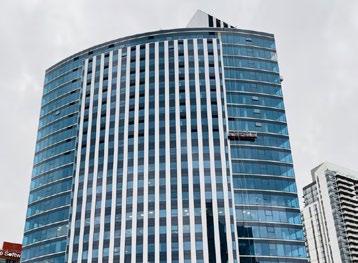
Surrey City Centre will gain a sizeable new Hiltonbranded hotel, when it officially opens on Monday, March 30, 2026.
Homewood Suites by Hilton Surrey occupies the top nine floors of the newly completed 25-storey City Centre 4 tower at 9686 137 St., located just steps from Surrey Memorial Hospital and about an eight-minute walk south from SkyTrain’s King George Station and bus exchange.
The 189-suite hotel is part of a broader effort to support Surrey’s growth as a hub for healthcare, education, and innovation. This represents the latest additional anchor tenant for Lark Group and ICT Group’s Health and Technology District’s (HTD) complex of primarily office and institutional buildings in the area.
“The opening of Homewood Suites Surrey reflects the continued growth and momentum of Surrey as a centre for healthcare, education, and innovation,” said Kirk Fisher, CEO of Lark Group, in a statement.
“Located within the Health & Technology District and close to Surrey Memorial Hospital, this hotel adds an important hospitality component that supports the professionals, organizations, and visitors contributing to the region’s dynamic economy.” To support the hotel component, the Health & Technology District’s developers partnered with Aquilini Group, which is best known for its ownership of the NHL’s Vancouver Canucks and has experience operating accommodations through eight existing hotel properties across the country. Aquilini Group will operate the Surrey hotel.
The property is designed for both traditional short-term stays and long-term stays, with studio and one-bedroom suites that include full kitchens and workspaces.
Amenities include a rooftop gathering area spanning approximately 6,000 sq. ft., featuring barbecue stations, fire pits, and landscaped
complimentary breakfast, Wi-Fi, a fitness gym, and pet-friendly accommodations.
“Expanding our hospitality portfolio in Surrey is an exciting step for Aquilini Hospitality as we continue to grow across Canada,” said Walther Lauffer, vice president of hospitality for Aquilini Properties.
“Homewood Suites offers travelers spacious, comfortable accommodations designed for extended stays while providing convenient access to the many businesses, institutions, and attractions in the surrounding area.”
City Centre 4 tower already includes the Stong’s Market grocery store and floral shop, with additional businesses — including Maharaja, a new Indian cuisine restaurant — expected to open later in 2026. Post-secondary education institutions are also expanding in the area, contributing to increased demand for nearby accommodations. Within the lower floors of City Centre 4, there is also space for Western Community College, Valley Surgical, Fraser Health Authority, and a childcare facility. The University of British Columbia already has a presence in HTD, and has long-term plans to establish a significant satellite campus in the area. As previously reported by Daily Hive Urbanized in July 2024, the developers submitted an application to the City of Surrey midway through construction to amend the City Centre 4 building’s
Man sentenced to 8 years in prison for homeinvasion killing of 19-year-old in Burnaby
A man has been sentenced to eight years in prison for manslaughter in connection with the June 2023 death of a 19-year-old in Burnaby, B.C. Ryan Nagy was killed in an apparent home invasion on June 29. Police said they found him fatally injured when they arrived at a home on the 7600 block of 17th Avenue.
Four people have pleaded guilty to manslaughter in the killing, according to the B.C. Prosecution Service.
In a judgment posted online Tuesday, one
of them received a sentence of eight years for manslaughter, as well as two-and-a-half years for firearms charges. Ali Shamkhi, 22, pleaded guilty to the charges last October and will serve just under eight years in prison with credit for time served.
Justice Warren Milman wrote that Shamkhi, along with the three others who pleaded guilty in the killing, had planned to break into the home and steal firearms.
"Mr. Shamkhi brought a knife with him on that occasion. Mr. Nagy was killed by knife wounds he sustained during the home invasion," the justice wrote.
The three others who have pleaded guilty in the case — Rhoda Diabikulu, Ousmaine Keita and Rais Usman — have sentencing dates scheduled later this year, according to a spokesperson for the B.C. Prosecution Service.
B.C. youth charged over alleged school shooting threats in chats with U.S. teen
Police on Vancouver Island say a youth who lives in Sooke, B.C., has been charged after allegedly making threats about a school shooting in online chats with a 15-year-old in the United States.
Sooke RCMP said in a statement Monday that the investigation was spurred after police in Louisville, Ky., made contact earlier this month about a 15-year-old there who had been communicating with “someone from Canada” over the gaming platform Discord.
Mounties said the B.C. youth is a student at Edward Milne Community School, and the arrest was made on Saturday. Police said they searched the youth’s home and seized electronic devices and the investigation is ongoing. They said the homeland security unit of the Louisville Metro Police Department started investigating the alleged threats in July 2025. RCMP said the Canadian youth is in custody before a bail hearing, and the case is subject to court-ordered publication bans.
The charges come after a spate of threats against schools in B.C. this year and the deadly school shooting in Tumbler Ridge last month.
Burnaby RCMP said this month that two threats were made against Burnaby North Secondary School within a week, prompting lockdowns.
Campbell River RCMP said this month that “a series of online threats” escalated between a group of youths, and rumours “took off like wildfire” on social media about shootings at two schools in the city, but there was “no credible threat” to staff or students at the schools. Elk Valley RCMP in southeastern B.C. also responded to online threats against a school in February, but they were found to have been made by a man well known to police there who was more than 1,000 kilometres away at the time. Coquitlam RCMP also reported a series of threats against schools in February, but they found no evidence that the threats were credible.
Life sentences of teen killers in Surrey mechanic’s death overturned
The life sentences of two teens convicted in the murder of a well-known Surrey mechanic have been overturned.
Paul Prestbakmo was stabbed to death near Semiahmoo Centre on Aug. 16, 2019.
The well-known mechanic was on his way to McDonald’s to grab a pop when he was stabbed. He was stabbed 42 times in 26 seconds.
The teens, who were 15 and 16 at the time, were found guilty of second-degree murder.
They were later sentenced as adults and given life sentences with no chance of parole for at least seven years. However, on Friday, the teens won an appeal and had their sentences reverted to the maximum allowed under the Youth Criminal Justice Act, which is seven years, including four in custody.
“I believe now that it’s more of a slap on the wrist,” Elizabeth Prestbakmo, Paul’s sister, told Global News on Monday. “People that have committed other crimes will now just be using the system to appeal.”
Elizabeth said her brother was a kind and generous man.
“He was a very giving man, he was gentle, he was kind, he would do anything for his friends, he was very loyal,” she said.
BC Appeals Court sides with First Nation over Aboriginal title on Nootka Island
Continued from Page 3...
The ruling says the trial judge drew an “arbitrary boundary” in granting title over a portion of the area claimed, which wasn’t “based upon the Nuchatlaht’s manner of life, material resources, and technological abilities.”
It says the lower court’s adoption of the boundary didn’t reflect the nation’s use of the lands as evidenced by the presence of thousands of “culturally modified trees” dating back to the late 18th century.
The Appeal Court says the Nuchatlaht identified territory that it “exclusively” occupied and used for hunting, fishing and gathering activities, in addition to other evidence that established its
“strong presence on or over the land claimed.”
Woodward said the Nuchatlaht can now come up with a land-use plan that addresses the community’s needs for infrastructure, roads and housing.
“The Court of Appeal did what judges are supposed to do. They looked at the facts and they looked at the law and they applied the law to the facts,” he said. “You know, if you don’t get your uncle’s inheritance, you expect the judge to fix that. These people didn’t get their inheritance and the judges have fixed it. That’s the right thing to do.”
Respondents to the appeal included the federal and provincial governments and Western Forest Products Inc.
Elizabeth believes her brother’s killers will be released into the community in November — four years after they were initially sentenced.
The appeal court ruling is rooted in a Supreme Court of Canada ruling from last July, Rex v. IM, which overturned an adult sentence imposed on a youth who had been convicted of first-degree murder. The court ruled that the Crown failed to prove, beyond a reasonable doubt, that the youth had the maturity of an adult when the crime was committed.
Monday-Friday
Energy
‘vulnerable’ India seeks U.S. help to produce more oil and wean itself off Russia, Middle East
Arabia, Iraq, and Russia. At present, those Russian barrels are flowing only under a temporary waiver from the U.S., after President Trump had used higher tariffs to get India to stop buying from Russia.
As part of reforms to open the country up to more domestic oil and gas exploration, India is seeking to attract $100 billion in investment by 2030. Recently, the chairman of India’s top private oil and gas producer, Cairn, made the trek to Houston for the CERAWeek by S&P Global conference with government officials to meet with many of the top American companies specializing in shale and offshore drilling.
Billionaire industrialist Anil Agarwal, who chairs mining giant Vedanta Resources and its subsidiary, Cairn Oil & Gas, said he personally made the trip “with a shopping list to spend $5 billion.”
India remains “vulnerable” and lacking in energy security until it can produce at least 50% of its own oil, Agarwal told Fortune. He believes India can grow to produce enough oil to meet 30% of its domestic demand within a few years. He wants to help create a “mini Houston” in India.
“It’s a greater opportunity to be an explorer in India because India is fundamentally oil rich, as far as the reserves are concerned,” he said. “But you have to do the exploration, make investment, and this is the great opportunity to develop the hydrocarbons in India.”
India may have surpassed China as the world’s most populous nation, but it produces less than 1% of the world’s oil and gas. India also imports more than half of its natural gas.
Cairn has ambitious plans to increase its production capacity from roughly 110,000 barrels of oil per day to 500,000 barrels daily over the next several years. Close to 70% of the vast country
has never been explored for potential oil and gas reserves.
India is becoming friendlier to domestic oil and gas production and foreign investment, with legal reforms eliminating some barriers, and Cairn aims to take advantage, Agarwal said. More than 70% of India’s industry is still composed of state-owned companies. “That mindset is changing,” Agarwal said, arguing that businesses should be run by businesspeople.
Cairn already works with top U.S. oilfield services companies, including Halliburton and Baker Hughes, but the company also is looking for exploration joint venture partners. The government’s current round of bids for onshore and offshore exploration blocks has been extended to the end of May.
Lots of opportunities remain with newer technologies, including the onshore Digboi, Assam, region, which was the birthplace of India’s oil sector, but sees little activity today. “There is hardly any production there,” Agarwal said.
India counts quadruple the population of the U.S. and rising, and its middle class is growing.
“This will be the highest [energy] demand in the world,” he said. Agarwal sees aligned entrepreneurial spirits between the U.S. and India.
“The collaboration between America and India is very strong. We think alike, we work alike, and we can adjust with each other and trust each other,” he said. “America is very important for us. America can give us all the technology.”
India and Vedanta also are eager to partner more with the U.S. on critical minerals to help the U.S. build up supply from partners outside of China. Vedanta is strong in the production of copper, zinc, rare earths, and much more.
“I use the words, ‘Drill, baby, drill’ for the hydrocarbons, and I use the words, ‘Dig, baby, dig,’ for the minerals,” Agarwal said with a laugh.
Fewer than one-third of Canadians think Lewis's NDP is 'relevant,' poll finds
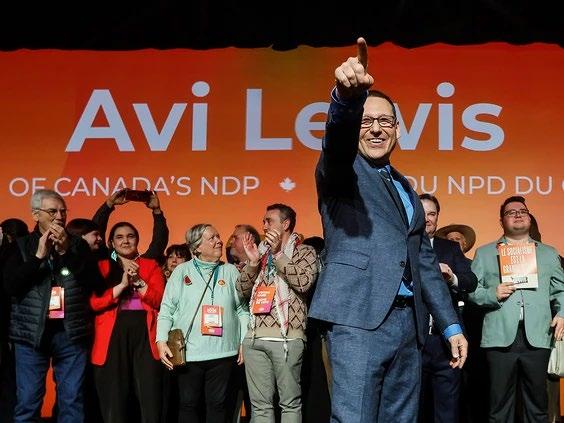
Avi Lewis may be flush off a convincing victory within his party, but a new poll suggests the new NDP leader has a steep hill to climb with the broader electorate with more people thinking the party is irrelevant than relevant.
Not quite a third of Canadians believe that the left-leaning party is even relevant, never mind if they would consider voting for the New Democrats, a Postmedia-Leger poll released Wednesday found.
The poll, conducted between March 27 and 30 as NDP supporters gathered in Winnipeg to choose their new leader, found that 42 per cent of respondents said Lewis’s party is not relevant, and 26 per cent said they were unsure. That compares with just 32 per cent of respondents who said that the NDP is relevant.
Andrew Enns, Leger’s executive vicepresident, said the latest poll results are further evidence of the NDP’s declining support over the last few years, particularly since agreeing to a deal to support Justin Trudeau’s Liberals in 2022.
The deal meant that the NDP would back the Liberals, who had a minority government, on key votes such as federal budgets and other confidence votes in exchange for legislative action on issues such as dental care, pharmacare and affordability.
The NDP’s decline in the polls lines up with last year’s inauguration of U.S. President Donald Trump, who almost immediately after taking office began threatening Canada’s economy and sovereignty. The NDP was supported by 16 per cent of Canadians near the end of January 2025 and had consistently polled between 15 and 20 per cent since the end of 2021.
Perhaps the biggest short-term challenge for the NDP and the other opposition parties is that most Canadians (57 per cent), according to the new Leger poll, are satisfied with the federal government’s performance, compared to 34 per
But the agreement seemed to affect NDP support, said Enns, with some voters viewing Jagmeet Singh’s party as a “subsidiary” of the Liberals. “It kept them on the sidelines.”
The new poll also shows the NDP’s challenge from a wider view with just six per cent of voters’ support, up one percentage point from the previous Leger poll in early March but miles behind the governing Liberals at a lofty 48 per cent and the Conservatives at 34 per cent, both down one percentage point. The NDP is even behind the Bloc Québécois, the sovereigntist party that runs candidates in just one province and which sits at seven per cent, up two percentage points. The Green Party remains at three per cent.
cent who say they’re dissatisfied. And a majority (58 per cent) say they approve of Prime Minister Mark Carney, while 33 per cent disapprove. Lori Turnbull, a political scientist at Dalhousie University in Halifax, said political parties often make quick gains in the polls after a new leader has been elected, but it’s unclear if that will happen this time with the NDP. Lewis needs to build support within his caucus and throughout the national party as first steps, Turnbull said.
Lewis has already shown signs that he intends to try to build bridges, saying on the weekend after his win that he’d be delighted to take advice from Singh, even though his predecessor was at the helm as the party was reduced to seven seats during the last federal election.
The 15-year-old Indian that cricket can no longer ignore
Continued from Page 1...
Standing tall at the crease, Suryavanshi is an instinctive aggressor - he attacks the ball rather than waiting for it, and at his best, his strokeplay carries a flourish that many have likened to the great Garry Sobers.
In 2020, the International Cricket Council (ICC) drew a line - introducing minimum age rules in the name of "safeguarding of players". Even at the Under-19 level, the message was clear: no-one below 15 would step onto the international stage.
This was the first time the ICC had put in a minimum age requirement, with Pakistan's Hasan Raza holding the record for being the youngest male Test cricketer at 14 years and 227 days when he made his debut in 1996.
While Raza's record remains safe, one barrier has quietly fallen: Sachin Tendulkar's benchmark - an international debut at 16 years and 205 daysis no longer out of reach for Suryavanshi.
It would be a surprise if India's selectors waited long. Plenty of young talents have been fasttracked since Tendulkar, but few have carried this
kind of inevitability so early. Suryavanshi doesn't just look promising - he looks preordained for India colours. Oddly enough, Suryavanshi's fasttracking in 2023 owed as much to chance as to talent.
A Vinoo Mankad Trophy game in Chandigarh - the Board of Control for Cricket in India's (BCCI's) domestic Under-19 competition, and one that selector Thilak Naidu had been assigned to watch - was washed out.
With time on his hands, and having already heard murmurs about a gifted boy from Bihar, Naidu headed to another match being played simultaneously.
Fiji Airways to fly 3 times a week from Vancouver to Fiji
April’s weather forecast for the region is starting off with rain, and the rest of the month isn’t looking so hot either. That’s why news of Fiji Airways increasing its services in Vancouver has got travellers ready to pack their bags.
The national airline of Fiji announced that Vancouver services will increase to three flights per week starting on June 16 and lasting year-round, with additional flights being added during peak travel periods.
Fiji Airways also revealed that it was expanding its codeshare partnership with British Airways to include the Nadi–Vancouver route, giving passengers more ways to get to the South Pacific country’s main transportation hub. Paul Scurrah, Fiji Airways managing director and chief executive officer, said the expansion of the airline’s Vancouver services and the extension of the codeshare partnership with British Airways are proud milestones for the company as they continue to grow in North America.
“We are excited by the opportunities this creates for our guests, offering greater choice, convenience and seamless connectivity across our network, said Scurrah in a release.
“These developments reflect our ongoing commitment to delivering a world-class travel experience, while sharing the warmth, care and spirit of Fiji with every journey.”
Fiji is renowned as a tropical paradise with gorgeous beaches and cultural experiences that attract visitors from around the world. Guests
Six cops charged in
SIX police officers based at the Namaka Police Station in Nadi have been charged in relation to the death of Richard Mock.
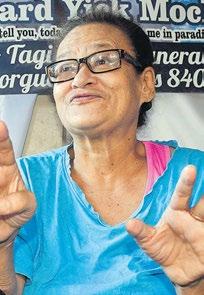
The charges come after the Office of the Director of Public Prosecutions (ODPP) handed the case file to police on Friday, prompting immediate arrests. Richard Mock’s mother, Seraphine Mock, said the development represented a step toward justice although the emotional toll remained.
She said she was informed of the charges by Criminal Investigation Department officers.
“I’m going there (Nadi Magistrate’s Court) tomorrow (today) to see the faces of the men,” Mrs Mock said. She described the past year as deeply painful for her
flying on the Nadi–Vancouver route will also get to experience Fiji Airways’ recently introduced World Class service standard, which was recognized with the APEX World Class 2026 Award.
“We’re pleased to see Fiji Airways expand its presence in Vancouver with increased service and an enhanced partnership with British Airways,” said Mike McNaney, vice-president and chief external affairs officer of Vancouver International Airport, in a statement.
“Expanding the number of flights to Fiji from Vancouver further strengthens our role as Canada’s Asia-Pacific gateway, while offering travellers more choice and seamless connectivity across the South Pacific.”
Fiji Airways isn’t the only airline making moves in the skies above Vancouver.
Harbour Air is gearing up for its largest seasonal expansion ever, with several new routes from Vancouver to popular B.C. destinations and a major U.S. city.
murder of a prisoner
and her family, noting her son was 35 years old and a father of three children.
Four of the officers, all in their 20s, have been jointly charged with one count of manslaughter arising from a breach of duty.
A fifth accused, a 57-year-old retired police officer who left the force days after Mock’s body was discovered, faces one count of accessory after the fact to manslaughter.
The sixth is a 33-year-old police officer charged with one count of manslaughter. A seventh suspect is a police officer now based in Lau, with arrangements underway to bring him to Nadi.
The six accused are scheduled to appear in the Nadi Magistrate’s Court today.
Fiji Airports executive and director pay surge over 100% increase
Fiji Airports has recorded a rise in both executive and board remuneration, with key management compensation and directors’ pay more than doubling, according to its 2024 annual report. The annual report, tabled in Parliament recently, shows key management personnel received $1,054,731 in short-term benefits in 2024, up from $485,170 in 2023 — an increase of more than 117 percent.
Key management personnel include senior executives responsible for planning, directing and controlling the company’s operations, including the Chief Executive Officer, General Manager Air Traffic Management, General Manager Assets and Infrastructure, General Manager Airports,
Dr Reddy proposes measures to tackle fuel crisis
The Government must take immediate action to reduce national fuel consumption and stockpile supplies until the Middle East conflict is resolved.
Dr. Mahendra Reddy, Senior Fellow at the USP Graduate School of Business, warns that inaction could halt economic activity, whereas strategic cuts will only slow it. He suggests the state procure and ration up to 60 percent of new in-country fuel stocks to manage potential shortages.
As escalating tensions threaten global supply chains, Pacific Island Countries face severe risks of high inflation and reduced public services.
Dr. Reddy argues that governments must lead by example, suggesting they ground at least 65 percent of their public fleets. To further mitigate the crisis, he encourages a three-to-four-day work-fromhome policy for non-essential businesses.
Education should also transition to online or self-
directed learning, limiting physical attendance to one day a week to allow bus companies to suspend operations and save fuel.
Other recommendations include delaying nonessential, high-consumption industries like logging, cutting large-scale diesel generator use by 90 percent, and reducing domestic air travel through higher pricing.These measures aim to preserve fuel for essential services like hospitals. Dr. Reddy maintains that tax cuts or price cushioning should not be considered. Instead, he argues the public must face the true cost of fuel to drive the behavioral changes necessary to reduce consumption. Collectively, these policies are designed to prevent panic buying and stabilize the economy. In the long term, such a crisis serves as a catalyst for the Ministry to accelerate the transition toward renewable energy and enhance national resilience.
Goundar Shipping calls for accountability over Ellington Jetty scheduling
Goundar Shipping Limited (GSL) has called for greater transparency and accountability in the management of Ellington Jetty, amid ongoing disruptions affecting passenger services.
In a statement, the company urged the public not to be misled by what it described as inaccurate or unverified information surrounding the situation at the jetty. GSL questioned why an approved berthing schedule — issued under the authority of the Maritime Safety Authority of Fiji — was not being followed.
“Why is the approved schedule not being followed as required?” the company asked.
The company also called on MSAF to take responsibility for the ongoing issues.
“This schedule was approved under your authority, so why are vessels being cleared to
sail despite knowing the likely outcome?” the statement said.
GSL further claimed that decisions were being made without transparency, adding that the public deserved clear leadership on the matter.
The company released an email it says was issued by the acting MSAF acting chief executive outlining an agreed operational schedule for vessels using Ellington Jetty.
The email shows Interlink is to depart Ellington at 5am and arrive at Nabouwalu at 8am for a quick turnaround and depart Nabouwalu by 9am for Ellington.
The MSAF email indicates when arriving at 12pm at Ellington, Interlink is to discharge anchor out to allow space for Goundar to load for their afternoon trip.
General Manager Finance, Projects Director and General Manager Commercial.
In addition to salaries, the company provides non-cash benefits to its senior executives. Fiji Airports noted that all transactions with key management personnel are conducted on standard market terms and are no more favourable than those offered to third parties.
Meanwhile, directors’ remuneration also rose significantly in 2024.
Total payments to directors increased to $155,140, up from $71,771 in 2023 — a rise of approximately 116 percent.
Director fees more than doubled from $50,038 to $101,283, while other benefits increased from $21,733 to $53,857. The other benefits are not stipulated in the report.
Board members during the period included chairman Hasmukh Patel, along with Naushad Ali, Mark Morris Halabe, Bhavick Kapadia, Jona Sevura, Emele Sima Duituturaga and Arvind Singh.
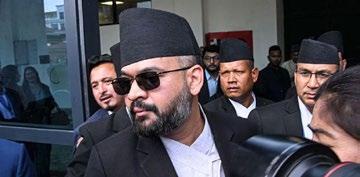
Nepal court grants two-day remand to former PM KP Oli in Gen-Z protest case
A court in Nepal has granted two-days remand to former Prime Minister KP Sharma Oli for the atrocities committed during the Gen-Z protest last September.
The bench of Judge Purushottam Khatiwada Kshetri at the Kathmandu District Court issued the order allowing investigators to continue the probe.
Oli, who was arrested last Saturday, has begun giving his statement on Thursday in connection
with the casualties that occurred during the Gen-Z Movement held on September 8 and 9, 2025.
Currently undergoing treatment at Tribhuvan University Teaching Hospital, Oli is being questioned by a joint team from the Kathmandu District Police Range and the District Government Attorney's Office.
Since his statement recording has not been completed, the court has permitted authorities to keep him in custody for two additional days.
Nepal swears in ex-rapper as new prime minister
Rapper-turned-politician Balendra Shah has been sworn in as Nepal's prime minister after a landslide victory in the country's first election since last year's youth-led protests.
The 35-year-old's rise marks an important shift in Nepali politics. His promise of change resonated with an electorate that was angry at corruption, nepotism and elite rule.
Before taking office on Friday, Shah, popularly known as Balen, released a song filled with optimism about Nepal's future.
"Undivided Nepali, this time history is being made," he rapped in a track that garnered more than two million views within hours of its release.
The song harks back to his roots in the
underground rap scene, where he used music to call out corruption and other social problems in Nepal. After just three years as mayor of the capital Kathmandu, Shah teamed up with the Rastriya Swatantra Party (RSP) as its prime-ministerial candidate, scoring a decisive victory in general elections this month.
Indian Embassy in Kathmandu signs MoUs to undertake 7 High Impact Community Development Projects Pakistan, Afghanistan hold truce talks in China
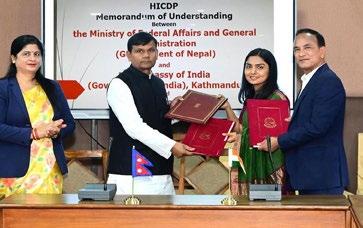
The Embassy of India in Kathmandu on Thursday signed Memorandums of Understanding (MoUs) for undertaking 7 High Impact Community Development Projects in Nepal.
The Indian Embassy signed the MoU with the Ministry of Federal Affairs and General Administration, Government of Nepal, and Project Implementing Agencies to implement grant assistance from the Government of India in sectors such as Education, Health and Agriculture with a total estimated cost of NRs. 473 million.
"Since 2003, Government of India has undertaken 598 HICDPs in Nepal, including the
7 projects for which MoUs were signed today. Out of these, 506 projects have been completed in the areas of health, education, agriculture, drinking water, connectivity, sanitation and creation of public utilities. These projects are spread across all 7 provinces of Nepal. The remaining projects are at various stages of implementation," the Indian Embassy in Kathmandu stated. As per the release, the seven projects are being in carried out in Nawalpur, Terhathum, Mustang, Kailali, Rautahat, Dolpa and Banke District of Nepal.
All the projects "shall be implemented through local authorities and institutions of the Government of Nepal including Municipalities and Rural Municipalities," the press statement noted. As close neighbours, India and Nepal are engaged in wide-ranging and multi-sectoral cooperation. The implementation of HICDPs reflects the continued support of the Government of India in strengthening the efforts of the Government of Nepal in promoting growth and development, apart from augmenting infrastructure in priority sectors.
Pakistan and Afghanistan are holding talks in China to try to end the worst conflict between the neighbours since the Taliban returned to power in 2021, both sides said on Thursday. Senior officials from both countries were meeting in the northwestern Chinese city of Urumqi, trying to find ways to end cross-border attacks, Pakistan’s
'Examining
foreign ministry spokesperson
said.
The fighting has killed scores of people on both sides — mainly on the Afghan side — since it started in October. Islamabad accuses the Afghan Taliban of harbouring Islamist militants who launch attacks inside Pakistan.
request from Bangladesh for supply of diesel': MEA
Amid the conflict in West Asia and the Gulf region, which has resulted in a fuel crisis in several countries across the world, India on Thursday said that it has received a request from Bangladesh for the supply of diesel, which is currently being examined by the government. Other countries from the neighbourhood, including the Maldives and Sri Lanka, have also approached India.
The inputs were shared by the Ministry of External Affairs Spokesperson Randhir Jaiwal during a weekly presser here in the national capital on Thursday.
Speaking about India's energy assistance to countries in the neighbourhood, on the request by Dhaka, Jaiswal said, "India is a major exporter of refined petroleum products especially to our neighborhood. We have received a request from the government of Bangladesh for supply of diesel which is being examined."
Underlining the people-centric and development-oriented approach to relations with Bangladesh, Jaiswal recalled how India has been supplying diesel from the Numaligarh refinery to Bangladesh since 2017 through various modes.
Tahir Andrabi
State Congress president and Ludhiana MP Amrinder Raja Warring on Thursday alleged that his microphone was switched off in the Lok Sabha when he mentioned SAD president Sukhbir Singh Badal while raising the sacrilege issue.
Warring said 11 years had passed since the 2015 incidents in Punjab, yet justice remained elusive.
He said Badal, who was serving as the deputy chief minister then, had allegedly “acknowledged his
role”, but no concrete action followed. He said the Sikhs had been seeking justice for over a decade, but successive governments failed to deliver.
The Punjab Congress chief said the Sikh community had been seeking justice for over a decade, but successive governments failed to deliver it. He also recalled that two individuals protesting against the sacrilege were killed in a police firing during that period.
60L tonne basmati produced by state stuck at ports
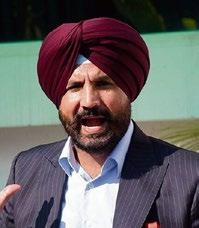
Sabha MP Vikramjit Singh on Thursday claimed Punjab was facing a severe crisis with 60 lakh tonnes of the premium basmati rice produced by the state stuck at ports and high seas due to the West Asia tensions.
The MP said exporters were under stress due to blocked consignments, delayed payments, rising freight and insurance costs, and growing security concerns after a reported drone strike near Dubai. India’s government is stepping up to help basmati rice exporters. With freight rates shooting
up and containers in short supply, shipping out basmati, especially to West Asia (which buys most of it), has become a real challenge.
Singh also demanded the revival of Asian Clearing Union )ACU)-based barter mechanism with Iran, urgent financial relief and subsidies to offset losses. The ACU, established in 1974 and headquartered in Tehran, acts as a regional, multilateral payment clearinghouse for central banks in Asia to settle trade payments. It promotes trade by allowing members to use local currencies.
Weekly days off for cops to combat stress
Taking a welfare initiative for the police force and to help personnel combat work stress, the Khanna district police have implemented a provision of weekly off.b With this, the Khanna police have reportedly become the first police district in Punjab to implement the provision. The development is being seen as a big relief for the police force, which remains overburdened due to long duty hours.
The move has been implemented from Thursday as per an order issued by Khanna SSP Dr Darpan Ahluwalia.
The order states: “In compliance with the instructions of the office of the Director General of Police, Punjab, dated August 8, 2003, regarding the ‘weekly one-day off’ to reduce the workload of police personnel and keep them mentally strong, the police station heads have been directed
to ensure the facility is provided to the police personnel posted under them. DSP-rank officers will implement the order for cops working in other police units.”
The SSP’s order further states that the weekly off would not be construed as a holiday or leave. The police personnel on weekly off would remain available at their respective places of posting, won’t leave the station and could be called for duty in case of any emergency.
Punjab Govt fixes accountability to fast-track building plan nod
To cut on delays in the sanctioning of building plans across the 167 urban local bodies in the state, Local Government Department has taken major steps to fix accountability and streamline the approval processes.
Similarly, planning and design committees have been constituted at the state-level to give clearance at the government level. Local Government Minister Sanjeev Arora told The Tribune that the government has repositioned assistant town planners (ATPs) at the district-level under the direct control of additional deputy commissioners (urban development).
The ministers said the ADCs would have regularly hold meeting with the staff concerned to ensure that the building plans and other related approvals were granted in a time-bound manner. For the case coming up before the minister and the secretary, a similar mechanism has been set up at the state headquarters here. At a recent review of the functioning of the town planning
wing and the offices of the ADC, it was found that despite the creation of the ADC (UD) posts, adequate professional capacity in town planning was yet to be built at the district-level. This has forced ADCs to rely heavily on the municipal council staff, whose inputs sometimes lack a wider planning perspective or are influenced by local vested interests, thereby compromising the core objectives of planned urban development.
To overcome this, the government has ordered that one ATP (or more, depending on the workload in some districts) from the already sanctioned posts in municipal councils will now head the town planning branch at the district headquarters.
These ATPs will work under the ADC (UD) and provide professional assistance in handling critical issues such as change of land use (CLU) cases. They will also extend support to all municipal councils and nagar panchayats in the district for complex town planning matters, regulatory functions and effective monitoring.
Now, the government has made it clear that no official other than the designated ATP will deal with town planning matters, except with explicit permission from the state government. All building Inspectors in the district will now report to the ATP at district headquarters, who will scrutinise and put up cases to the competent authority — the executive officer of the concerned ULB or the ADC (UD), as the case may be.
High Court halts Haryana’s S+4 floor policy, flags crumbling infra
The Punjab and Haryana High Court on Thursday stayed the operation of Haryana’s ‘stiltplus-4 (S+4) floor’ policy for residential plots after holding that the state apparently prioritised revenue over public safety while ignoring basic infrastructure realities.
Coming down heavily on the state’s approach, the Bench of Chief Justice Sheel Nagu and Justice Sanjiv Berry observed: “It appears that Haryana merely to earn more revenue has put the safety and security of members of general public at stake.”
The Bench added that the state and its functionaries gave a go by to all “important aspect of conducting `infrastructure capacity audit’ before implementing the S+4 floor policy” while turning a Nelson’s eye towards the desperate shortage of infrastructural requirement in Gurugram city.
“It thus seems that the state has abdicated its constitutional duty of ensuring clean and healthy urban environment for the citizens of Gurugram,” the Bench added. The interim order came during the hearing of a public interest litigation. Among other things, the PIL-petitioner had challenged notification dated July 2, 2024, issued by the Additional Chief Secretary, Town and Country Planning Department. It permitted the construction of S+4 floors on residential plots — raising the earlier cap of S+3 floors — and also introduced a composition mechanism even where building plans had not been approved.
Clarifying that the stay was being granted without expressing a final opinion on the policy’s legality, the Bench asserted: “Since, the arguments are taking long time to conclude, it is deemed appropriate by this court, at this stage, without commenting on the validity of the impugned order or notification to pass interim directions.”
A crucial factor that weighed with the court was the stark mismatch between planning norms and ground realities. During the final hearing, the Bench took note of photographs prima facie showing narrow internal roads in DLF Phase-I, Sector 28, Gurugram. This led to the appointment of a local commission to verify the actual road width.
The report revealed that while the prescribed width of internal roads was 10 to 12 metres, the “motorable road area available for plying of traffic and pedestrians is only 3.9 metres to 4.8 metres.” Referring to the causes, the Bench observed: “This shrinkage is attributed to various reasons, which essentially are lack of adequate infrastructure of sanitation and sewerage, over-population, defective town planning, inadequate garbage disposal, blocking of aquifers by indiscriminate paving of roads, rampant construction activities thereby preventing recharging of groundwateretc.” The petitioner alleged that the government petitioner while passing the impugned order dated July 2, 2024, should have considered the report regarding S+4 floor policy submitted by an expert committee, recommending the formulation of a standard operating procedure. “Only thereafter, the proposal of stilt-plus-4 floor policy could be adopted”, it was added.
Rajya
BC Helps Parents Boost their Education Savings!
Export of defence equipment, items and systems touched an all-time high of Rs 38,424 crore in the financial year 2025-26, amounting to a rise of Rs 14,802 crore (62.66 per cent), over the previous fiscal’s exports of Rs 23,622 crore.
Defence public-sector undertakings (DPSUs) and the private sector have contributed 54.84 per cent and 45.16 per cent, respectively, to the exports, the Ministry of Defence said on Thursday.
The growth in defence exports has happened even as India continues to be the world’s second-largest importer of weapons. It accounted for 8.3 per cent of global arms sales for a five-year block (2021-2025), according a report titled, Trends in International Arms Transfers, 2025, released last month by international think-tank, Stockholm International Peace Research Institute (SIPRI).
On Thursday, Defence Minister Rajnath Singh lauded the export performance and added that India was marching ahead towards becoming a global manufacturing hub for defence equipment. Defence PSUs’ exports surged by 151 percent in comparison to the previous year, while private firms also recorded an increase of 14 percent. In terms of value of contribution, the private sector accounted for Rs 17,353 crore worth of defence exports, while DPSUs contributed Rs 21,071 crore. Their respective figures in the previous financial year stood at Rs 15,233 crore and Rs 8,389 crore. The figure indicates an increase by around three times in the last five years. The Ministry of Defence said, “The rise in exports highlights the increasing global acceptance of Indian-made defence products and the sector’s growing integration into the international supply chains.”
Customs duty on 40 petrochemical products cut to nil amid West Asia crisis
A day after Prime Minister Narendra Modiled Cabinet Committee on Security (CCS) reviewed the impact of the West Asia crisis on Indian economy, the Centre today granted full customs duty exemption on 40 categories of petrochemicals, plastics and industrial raw materials.The move brings effective import duty down to nil on listed goods for three months and will roughly cost the government Rs 1,800 crore. The Ministry of Finance notified the exemption under Section 25(1) of the Customs Act, 1962, citing public interest, on Thursday. It takes force from today and will be effective through June 30, 2026.
The goods covered it include critical industrial inputs such as anhydrous ammonia, toluene, styrene, methanol, acetic acid, and monoethylene glycol (MEG); Chlorinated compounds;
Engineering plastics and specialty resins. Ammonium nitrate is covered and will also receive a simultaneous exemption from the Agriculture Infrastructure and Development Cess. The blanket zero-duty window on such a broad basket of chemicals and polymers signals the government’s intent to provide short-term cost relief to downstream industries — including packaging, automotive, textiles, construction, and agriculture — that depend heavily on these raw materials. Many of these inputs are not produced domestically in sufficient quantities, making import costs a significant burden on manufacturers. The simultaneous AIDC exemption on ammonium nitrate — a key input in fertiliser production — underscores the government’s sensitivity to agricultural input costs ahead of the kharif sowing season.
HP cuts entry tax on truckers, exempts all state light vehicles
The Taxes and Excise Department, Himachal Pradesh, today reduced the entry tax on truckers across three categories in the range of Rs 30 to Rs 250 while exempting all light vehicles — whether commercial or private — registered in the state from this levy.
As per a notification issued today by the Commissioner, State Taxes and Excise, a 12-seater passenger vehicle will now be required to pay Rs 100 against Rs 130 fixed earlier. Trucks with up to two axles and a gross vehicle weight (GVW) between 12,000 kg and 25,000 kg have been given a sizable relaxation as their levy has been reduced from Rs 570 to Rs 320 while for threeaxle vehicles, the levy now stands at Rs 570, down from Rs 600.
The reduced levy has come as a sizable relief for tempo, threewheeler and pick-up owners as they had been brought under the purview of this entry tax. They had served a 24-hour ultimatum yesterday to notify the revised rates or face an impasse like last evening when no vehicle was permitted to leave or enter the Baddi-Barotiwala industrial cluster for hours.
neighbouring states residing within a 5 km radius by extending concessional passes, besides reducing their tax from Rs 130 to Rs 100. The toll licensees have also been intimated about the revised levy to avoid confusion. This is a key step to ensure seamless implementation of the revised rates as allegations of overcharging were levelled yesterday. Despite relaxing the levy for private vehicles of other states from Rs 130 to Rs 100 on March 31, the toll staff allegedly charged a higher rate at various entry points like Baddi and Parwanoo.
In a bid to quell discontent, the government
India stands alone against China-led investment pact at
WTO meet
India has opposed the incorporation of the China-led Investment Facilitation for Development (IFD) agreement into the World Trade Organisation framework, standing as the sole dissenting voice at the ongoing 14th WTO Ministerial Conference in Yaounde, Cameroon.
India’s lone stand
India’s Commerce and Industry Minister Piyush Goyal announced the country’s position on Saturday. While invoking the philosophy of Mahatma Gandhi, Goyal framed the proposal a contentious systemic issue.
“Drawing inspiration from Mahatma Gandhi ji’s philosophy of Truth prevailing over conformity, India showed the courage to stand alone on the contentious issue of the IFD Agreement and did not agree to its incorporation into the WTO framework as an Annex 4 Agreement,” Goyal wrote on social media. Goyal warned that incorporating the IFD Agreement risks eroding the functional limits of the WTO and undermining its foundational principles.
New Delhi believes that this key concern has not been adequately addressed by the broader membership.
What is IFD agreement?
The IFD agreement was first proposed in 2017 by China. It is supported mainly by those nations that are heavily reliant on Chinese investments.
The proposal seeks to ‘streamline and facilitate foreign investment flows among signatory nations’. Crucially, it would be binding only on those WTO members that choose to accept it, similar to other Annex 4 Plurilateral
Trade Agreements, which unlike mandatory multilateral agreements, apply exclusively to signatories.
New Delhi’s concerns
India has continuously objected against the tendency to allow plurilateral agreements to be integrated into the WTO framework without adequate guardrails. New Delhi has argued that WTO reform discussions must first establish robust legal safeguards before any specific plurilateral outcome is formally incorporated.
However, India has signalled a willingness to engage constructively. Goyal said New Delhi remained open to “good faith, comprehensive discussions” under the broader WTO Reform Agenda.
A consistent position
This is not the first time India has pushed back on the IFD pact. At the MC13 ministerial conference in Abu Dhabi, India had similarly opposed the agreement, making Saturday’s stand a continuation of a firm and consistent policy position.
America refuses support to India in case of war against Pakistan
The United States of America has conveyed to India that, despite New Delhi being a strategic partner, Washington won’t unconditionally support if a conflict breaks out against Pakistan, said a report by the Sunday Guardian. According to critics, this again underlines the fact that the US cannot be a reliable partner for India in times of military conflicts. Notably, even during Operation Sindoor, the United States had refused to back India while claiming to mediate the ceasefire. Critics say that this is one of the main reasons India chose partners like France and Russia for defence collaborations, rather than America.
According to the report, the US officials have conveyed to India that its decision will be guided by Washington’s national interests. The officials made it clear that while India sits at the centre of America’s Indo-Pacific policy, New Delhi shouldn’t expect unconditional backing in a conflict scenario with Pakistan. It said that the US is prioritising a rule-based international order over supporting
hard-nosed national priorities. Notably, even during the 2019 India-Pakistan conflict, Islamabad deployed American fighter jet F-16 Falcon against India, which cannot have happened without the US permission, feel experts.
It may be recalled that the US provides F-16s to Pakistan to use for counter-terrorism and internal purposes and not to use as an offensive strategy. The F-16s are regulated under the End-Use Monitoring (EUM) under the US supervision and thus, it’s clear that America will keep supporting Pakistan against India. This comes at a time when Pakistan is acting as a conduit for America to mediate a ceasefire in the Iran war. The US officials have not stated that Washington will push for regional stability and de-escalation even if there is a terror attack on India.
According to critics, the key takeaway for New Delhi is that while America wants to use India as a counterweight against China, it doesn’t want to get involved in a ‘secondary’ subcontinental conflict.
Russian Deputy PM meets PM Modi
India and Russia on Thursday signalled a renewed push to deepen their time-tested strategic partnership, with a flurry of high-level engagements spanning executive, economic and parliamentary domains, underscoring the resilience of bilateral ties amid a shifting global order.
Prime Minister Narendra Modi held talks with Russian Deputy Prime Minister Denis Manturov in New Delhi, as the two sides advanced discussions under the framework of the IndiaRussia Intergovernmental Commission (IGC) on Trade, Economic, Scientific, Technological and Cultural Cooperation.
The IGC meeting, co-chaired by External Affairs Minister S. Jaishankar and Manturov, focused on expanding collaboration across key sectors including trade, energy, technology and industrial
India on Thursday underscored the human and strategic costs of the escalating West Asia crisis, telling a high-level gathering of over 60 countries that it remains the only nation to have lost mariners in attacks on merchant vessels in the Gulf, even as it pressed for urgent deescalation and restoration of maritime security.
Representing New Delhi at the meeting convened by UK Foreign Secretary Yvette Cooper, Foreign Secretary Vikram Misri emphasised that freedom of navigation and unimpeded transit through international waterways were nonnegotiable principles, particularly at a time when global energy lifelines were under severe strain.
India highlighted the direct fallout of the crisis on its energy security and commercial shipping, noting that Indian seafarers had borne the brunt of attacks in the Gulf region -- a distinction no other country currently shares.
She called for the “collective mobilisation” of diplomatic and economic tools to ensure a “safe and sustained opening” of the Strait.
The deliberations, held largely behind closed doors, focused on coordinated international responses to restore maritime stability, prevent further escalation, and secure critical energy supply chains.
The urgency of the situation has also triggered
The meeting, attended by ministers and senior officials from more than 60 countries, comes amid intensifying tensions centred around the Strait of Hormuz, a critical artery for global oil supplies that has witnessed repeated disruptions and security threats in recent weeks.
“The way out of the crisis lies in de-escalation and a return to diplomacy and dialogue among all concerned parties,” India said, signalling its consistent position of advocating restraint while safeguarding core economic interests. Earlier, Cooper set the tone for the discussions with a sharp critique of Tehran, accusing Iran of effectively “hijacking an international shipping route to hold the global economy hostage”.
parallel diplomatic efforts. The G7 group of countries are set to hold talks with the Gulf Cooperation Council next week, bringing together key oil-producing nations -- including Saudi Arabia, the United Arab Emirates, Qatar, Kuwait, Oman and Bahrain -- to address the unfolding crisis.
The renewed push for multilateral engagement follows remarks by Donald Trump, who said the US did not require oil transiting through the Strait and urged countries dependent on the route to take the lead in reopening it.
For India, however, the stakes remain immediate and tangible. With a heavy reliance on Gulf energy imports and a vast merchant fleet operating in the region, disruptions in the Strait of Hormuz directly threaten both economic stability and the safety of its nationals.
partnerships — areas that have remained central to India-Russia engagement despite geopolitical headwinds. Parallel to the executive-level talks, parliamentary diplomacy gained fresh momentum as a high-level Russian delegation led by Vladimir Yakushev called on Lok Sabha Speaker Om Birla at Parliament House.
Welcoming the delegation, Birla emphasised that India-Russia parliamentary ties are poised to deepen through “renewed dialogue and cooperation”, highlighting the enduring nature of a partnership rooted in mutual trust and strategic convergence. He pointed to sustained high-level political exchanges between Prime Minister Modi and Russian President Vladimir Putin as a key driver of bilateral momentum, opening new avenues for cooperation in both traditional and emerging sectors.