NEWS Advocacy Week recap and impressions (Pg. 4) shook since 1872
ARTS & CULTURE Convocation Hall lights up for Diwali (Pg. 5)
SPORTS SMU scandal shakes season (Pg. 11)
OPINIONS Capitalism is not antifeminism (Pg. 10)
Mount Allison’s Independent Student Newspaper
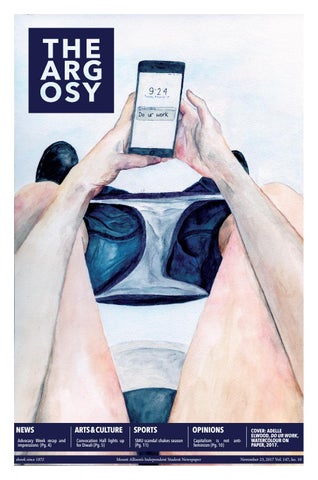
COVER: ADELLE ELWOOD, DO UR WORK, WATERCOLOUR ON PAPER, 2017.
November 23, 2017 Vol. 147, Iss. 10
02 NEWS
EDITORS: EMMA BUSH & MAIA HERRIOT | NOVEMBER 23. 2017 | ARGOSY@MTA.CA
FEATURE
Youth delegate reflects on COP 23
Mt. A student Tina Oh returns to United Nations climate change conference
THURSDAY, NOV. 23 Ten Core Competencies of CFO Sir James Dunn Wu, 5:30-7 p.m. Ramp Up the Volume Gracies, 8-10 p.m. Evening of One Acts Moyter-Fancy Theatre, 8-11 p.m. Conduct Becoming Open Mic Ducky’s, 9-11:59 p.m. OH FIRST ENTERED THE DISCUSSION OF INTERNATIONAL CLIMATE AGREEMENTS LAST YEAR AS A DELEGATE WITH THE CANADIAN YOUTH DELEGATION. TINA OH/SUBMITTED
FRIDAY, NOV. 24 Z Leblanc Recording session Brunton Auditorium, 9-10:30 a.m. Evening of One Acts Moyter-Fancy Theatre, 8-11 p.m.
SATURDAY, NOV. 25 Maritime Tick Map Info Session Avard Dixon GIS Room 115, 2-3 p.m. Evening of One Acts Moyter-Fancy Theatre, 8-11 p.m.
SUNDAY, NOV. 26 Mount Allison Choral Society Brunton Auditorium, 3-5 p.m.
MONDAY, NOV. 27 New Music @ Mount Allison Brunton Auditorium, 8-10 p.m.
TUESDAY, NOV. 28 Indigenous Pedagogy: Exhibition of Maps Tweedie Hall, 9 a.m. - 6 p.m. Summit on Trump Crabtree Auditorium, 6-10 p.m. Maritime Tick Map Info Session Avard Dixon GIS Room 115, 7-8 p.m.
WEDNESDAY, NOV. 29 Indigenous Pedagogy: Exhibition of Maps Tweedie Hall, 9 a.m.-6 p.m. Women in STEM Discussion Sir James Dunn Mini Wu, 6-9 p.m. Erik Edson Artist’s Talk Owens Art Gallery, 7:30-9:30 p.m.
EMMA BUSH News Editor Emma Bush: Can you tell me a little bit about what COP is? Tina Oh: The Conference of Parties is a climate change conference under the United Nations’ Framework Convention for Climate Change (UNFCCC). It is a two week long (often longer) conference where parties all over the world negotiate climate agreements and commitments. In past COPs, countries signed the Kyoto Protocol and the Paris Agreement. It is also a space where countries are able to talk about adaptation, capacitybuilding, climate finance, mitigation and technology in an almost-near universal way. EB: What is significant about COP 23 specifically? TO: COP 23 is also known as the Pacific COP by the Government of Fiji. It is the first time that a Pacific Island nation is presiding over the conference. This is very relevant because these islands are composed of some of the world’s most vulnerable countries to climate change, yet contribute the least. Fiji set the tone for this COP by prioritizing loss and damage (the losses and damages that a developing nation incurs because of climate change) and adaptation. Obviously, this wasn’t well-received by many wealthy nations as it puts responsibility on them as big emitters. While the Fijian Presidency is leading this COP, it was held in Bonn, Germany, because Fiji does not have the infrastructure to accommodate such a large-scale conference. They were also hit terribly by Category 5 Cyclone Winston in 2016, which they are still recovering from. COP 23 is also the second year that the Paris Agreement – an international commitment to keep global temperatures under two degrees, aiming for 1.5 degrees – has entered. It reaches for higher ambition, especially pre-2020 goals. COP 23 has set the stage for COP 24 (in Poland) by use of the Talanoa Dialogue. Talanoa is a Pacific concept of constructive discussion, debate, storytelling and non-state actor involvement. COP 23 was also the first COP
that the United States has attended since its announcement to remove itself from the Paris Agreement… although an official withdrawal is not technically possible until November 2020. The United States spent much of COP 23 promoting the use of “clean” coal and nuclear energy. However, their civil society and local and state governments have committed to the Paris Agreement, independently. Many delegates from the United States were wearing a pin saying “We’re Still In.” EB: Can you tell me about how you were chosen to be a delegate for this conference and where other representation comes from in the country? TO: I was a delegate with the Canadian Youth Delegation (CYD) to COP 22 in Marrakech, Morocco. The CYD is a portfolio under the Canadian Youth Climate Coalition (CYCC) which aims to be a justiceoriented organization. For COP 22, I was encouraged to apply, to which I was successful. Unfortunately, the CYCC has since fizzled out and is taking an indefinite time to restructure the organization. However, it was still felt that youth representation (heavily from a justice standpoint) was needed at COP 23 to keep the Canadian government accountable to their international climate agreements. Through connections with Climate Action Network Canada (CAN-Rac), my name was independently recommended for COP 23. Every year the geographical representation to COPs vary. This year, the CYD delegation composed of two folks from British Columbia, one from Quebec and myself. EB: What was the most exciting thing that happened at the conference (so far)? TO: One of the most exciting things for me was the creation of the first Gender Action Plan (GAP) under the UNFCCC. The GAP was put forward by the Costa Rica government and was 12 years in the making. It seeks to address policies that recognize that femmes are disproportionately impacted by climate change. I followed the negotiations for the informal consultations on gender and climate change quite extensively and the GAP was the product. It is an
incredible document that empower femmes and seeks to address the inequalities they face while highlighting the need to support their resiliency to climate change. While the document was watered-down by other parties (particularly the United States, Australia, New Zealand and Canada), it sets an important precedent for the future. EB: What was the most frustrating thing that happened at the conference (so far)? TO: I have to mention that COP in itself is one of the most frustrating and disappointing spaces that I have ever been in. It is incredibly exhausting to follow negotiations for 12+ hours day for 14 days, especially under a broken eurocentric system like the United Nations. That doesn’t mean the UNFCCC is not relevant. The people whom are negotiating and have immense power backing them are from developed nations that have resources to adapt and mitigate the effects of climate change and/or are not on the frontlines of climate change. Specifically, at COP 23 it was extremely disappointing to see Canada side with the Umbrella Group, composed of some of the world’s wealthiest nations like USA, European Union, Australia, etc., on various negotiations like loss and damage and financing. They had a big part in watering down, deleting references and obscuring in the loss and damage draft-text. EB: What changes do you think this conference will bring about? TO: We have to be realistic that top-to-bottom change is not effective in empowering and creating resiliency in our communities. The UNFCCC and COP 23 is just a fraction of the mechanisms needed to address climate change. Canada and the UK announced a coal phaseout under the name Powering Past Coal Alliance. It bridges the solidarity around nations and cities that plan to end the use and production of coal, which is one of the worst fossil fuels. While this announcement is necessary, we have to recognize that decisions like this are the result of decades of grassroots activism and pressure from civil society. EB: What are you looking forward
to in future COP conferences? TO: Next year is a Global Stocktake year, meaning that COP 24 will analyze how countries are doing collectively in realizing the Paris Agreement aims and ambitions. I am looking forward to seeing how the Polish Presidency (host of COP 24) will work with the Fijian Presidency to implement the Talanoa Dialogue. Interestingly, COP 24 will be hosted in coal country in Katowice, Poland. EB: Coming back to Mt. A, what do you hope to share with the University community from what you have learned at this conference? TO: I am a divestment organizer, and every COP I attend encourages me to see the University commit to divestment. The UNFCCC and COPs are useless without meaningful and tangible concurrent work being done alongside of it by all spheres of civil society, including institutions. Divestment is an act of solidarity, and we can’t forget how important solidarity has been in former divestment campaigns like the antiapartheid South Africa movement. Universities led that movement, and it created real solidarity to the philosophies of what we are learning to action. It’s time that we honour that legacy and build solidarity with those most affected by the fossil fuel industry. EB: Do you have any final thoughts or comments that you’d like to make that I haven’t touched on? TO: Canada is pathetically behind its 2020 and 2030 targets. If Canada is to claim that it is a “climate leader”, it needs to back those words with real action. We cannot continue to make international commitments when it was never our intention to fulfil those promises in the first place. Canada has to move beyond a profitable lens of international negotiations, especially when billions of lives are struggling to survive. The negotiations around Pre-2020 ambitions was a very contentious topic at COP 23. Sitting in these boardrooms and hearing the voices of countries like Antigua and Barbuda saying that they cannot go through two more hurricane seasons was so heartbreaking. Canada cannot continue to maintain the status quo; we need great ambitions, now.
NEWS
THE ARGOSY | WWW.SINCE1872.CA
ACADEMIA
03
Ugandan speaker provides international perspective on post-secondary education Banji Sayid speaks to students about overcoming obstacles on his personal educational journey AMELIA MACDOUGALLFLEMING News Reporter Unfamiliar stories offer new perspectives to the familiar topic of education. On Wednesday, Nov. 15, Banji Sayid, a young Ugandan lawyer and executive member
BANJI SAYID/CONTRIBUTED
of the Commonwealth Students’ Association, offered passionate personal insight on the value of education to the Mount Allison community. Sayid met Mt. A president Robert Campbell last year in Uganda at a conference about student perspectives on modern education. There, Sayid shared his story about overcoming academic obstacles with Campbell, and was invited to come to Mt. A to speak on the topic of access to education as part of International Education Week. Sayid is especially interested in sharing stories and gaining new perspectives on education, saying, “I think humans naturally love to hear other people’s stories.… A narrative is a good way of understanding the world and its people, and you draw some lessons
from that.” Sayid used stories as a way to relay the value of education to a small and engaged crowd in the Crabtree Auditorium. At the talk, Sayid spoke about challenges facing access to education in East Africa. While education is government-funded in Uganda, it is difficult to access because of the conditions of the schools. Sayid told his own story about his struggles to access education, explaining that he had to move from his remote home to a nearby city. Here, he worked in the house of an abusive employer to afford lodging. In one instance, he was found reading the newspapers that were intended to be used as kindling for a fire and was beaten. In another story, he explained that the woman in the household would only agree to let him go to school
during the day if he were to work throughout the night. “What kept me going was the goal to be better,” Sayid said. “Education should, ultimately, change who we are.” After graduating from the public school system, Sayid made his way to the Uganda Christian University, and graduated with a law degree in 2015. Sayid explained that he became a lawyer to help others. “Justice should not be something that is only available to those with money,” he said. “For me, if you acquire an education, it should not be just about you, it should be about helping your community.” The talk left a lasting impression on some of those who attended. Mt. A student Peter Cooke said, “It was very powerful, as a student who sometimes can be distracted,
to be reminded how serious it is to pursue my education and that I have a lot of opportunity here that I really have to take advantage of.” Adam Christie, director of student life and international services, said, “It’s opportunities like this that really give us the opportunity to rethink and learn more about the value of things. When we grow up in a certain context and are surrounded by the familiar, it is often hard to understand what is unfamiliar.… When we have visitors like Banji we have an opportunity to reflect on what’s important to us.” Sayid’s stories delivered the message that education is important and should not be taken lightly. The lessons he shared will continue to inspire students to take advantage of the opportunities provided at the University.
COMMUNITY
Moncton Hospital more equipped than Sackville at responding to sexual assault Lack of nurses trained in SANE reduces choice for survivors at Sackville Memorial Hospital LILY FALK News Reporter If someone wants to have a sexual assault forensic exam at the Sackville hospital, a medical doctor and a police officer need to be present. At the Moncton Hospital, the Sexual Assault Nurse Examiner program (SANE) provides more options for sexual assault survivors, but students must find a ride or contact SHARE for a cab to get there. “That’s the last thing I would want to do, to get in a cab, probably with a strange man,” said Robin Bamber, a fourth-year sociology and women’s and gender studies student. Her sister was an assistant don for two years at Mt. A and brought this issue to her attention. “A sexual assault forensic exam [or rape kit] is a box that contains a checklist, combs, swabs, sheets and instructions – along with envelopes and containers to package any specimens collected during the exam.… A person would go to emergency and say they have experienced sexual assault and would like a kit,” said Melody Petlock, SHARE advisor. At the Sackville Memorial Hospital, with this type of evidence collection, the police need to be involved and the survivor “will be expected to make a statement,” said Petlock. However, at the Moncton Hospital, the SANE program provides more holistic service. There is a specific examination room for the program and a police officer or
doctor does not need to be present for the exam, unless the patient has an injury that requires a doctor’s attention. The SANE nurse will not leave the survivor or be called away to another patient. SANE is especially important as nurses working in this program are trained to find evidence up to 120 hours after an assault, while other
methods require evidence be collected within 24 to 72 hours. Prophylactic medications for STIs and HIV, as well as emergency contraception, are available free of charge with the SANE program, but can be expensive at the Sackville hospital. The issue of rape kits at the Sackville Hospital came to Mt. A student Isabelle Stewart’s attention
when she was accompanying a friend who had a broken foot to the hospital. “It worried me because it seems like something they should have training for, especially in a university town where the hospital is sometimes our only healthcare option,” said Stewart. There is work being done to bring SANE nurses to the Sackville hospital. “The current barrier is the red tape around needing special
refrigeration/freezer units in which to store evidence. Until such a unit is in place, the SANE Program will not collect evidence in Sackville,” said Petlock. Part of the benefit of the SANE program is that they can collect a complete kit and store it for six months upon request. This allows a survivor time to consider their options. In contrast, requesting a kit at Sackville Memorial Hospital means the hospital will call and involve the police. This takes the decision to report to police out of the survivor’s control. SHARE will support any student who chooses to go to SANE and will provide money to pay for a student’s taxi. “All SHARE services are survivor-centred and survivordriven,” said Petlock. “No one is ever forced to do anything and everything is about choice.” Students can contact SHARE 24/7 at 540-7427 or share@ mta.ca.
Amended correction:
SACKVILLE HOSPITAL CANNOT STORE EVIDENCE LONG-TERM DUE TO LACK OF AN EVIDENCE FREEZER. SYLVAN HAMBURGER/ARGOSY
In the Nov. 2 issue, in article ‘No quorum, no problem,’ all references to Laura Snyder are incorrectly attributed and should instead reference professor of politics and international relations Loralea Michaelis. The Argosy apologizes for this, and any other errors.
04
NEWS
STUDENT RESEARCH
NOVEMBER 23, 2017 | ARGOSY@MTA.CA
MASU
Honours student Advocacy week 2017 A student delegates and NBSA board members research profiles Mt. address student issues with provincial politicians
FROM RIGHT TO LEFT: MAGGIE PIPER, MATTHEW ROBERTS, SARA CAMUS, NOAH FRY AND DANICA GARNER. ANY MOUNT ALLISON STUDENT CAN APPLY TO ATTEND ADVOCACY WEEK AS A STUDENT DELEGATE. DANICA GARNER/SUBMITTED
MAIA HERRIOT News Editor
ERIN STEEVES IS A FOURTH-YEAR HONOURS STUDENT IN THE DEPARTMENT OF BIOLOGY WITH A MINOR IN CHEMISTRY.
“My research has been conducted under the supervision of Dr. Karen Crosby, who focuses on the neural regulation of appetite, and how stress can influence appetite regulation in a brain region called the dorsomedial nucleus of the hypothalamus. My study is investigating whether stress hormones affect food intake when administered directly into this brain region in rats. This research is important because it could shed light on the mechanisms that underlie stress-induced eating in rats, with potential implications for obesity in humans.”
ANNA JAMIESON IS A FOURTH-YEAR HONOURS STUDENT IN THE DEPARTMENT OF ENVIRONMENTAL SCIENCE WITH MINORS IN BIOLOGY AND POLITICAL SCIENCE.
“My honours project this year is focused on community awareness and risk assessment of ticks and Lyme disease. I am also looking at the effectiveness of geographic information systems in communicating spatial public health problems and the relationships of environmental variables and hotspots of the Borrelia bacteria (causing Lyme disease) across the province. Most of my work is done through ArcGIS mapping, as well as R and Maxent modelling. I will also be conducting public focus groups to introduce people to the new Maritime Tick Information Portal (maritimetickmaps.ca). The focus groups will be interactive and informative and everyone is welcome! Focus groups will be held Saturday Nov. 25 at 2 p.m., Tuesday Nov. 28 at 7 p.m. and Friday Dec. 1 at 7 p.m. Feel free to contact me at aljamieson@mta.ca if you have any questions about the upcoming sessions!” SAVANNAH MILEEN HARRIS/ARGOSY
This past reading week, 16 students from four New Brunswick universities went to Fredericton to meet with provincial politicians. In those meetings, they advocated for student issues on behalf of their institutions as part of the New Brunswick Student Alliance’s (NBSA) annual Advocacy Week. The NBSA is a student advocacy organization made up of Mount Allison University, St. Thomas University, UNB Fredericton, UNB St. John and the New Brunswick College of Craft and Design. “We had 27 meetings. We had a meeting with the premier, MLAs, ministers and civil servants – every meeting we took was with someone who had some influence over the post-secondary sector,” noted Sara Camus, MASU president and chair of NBSA’s board of directors. The NBSA met several times prior to Advocacy Week to construct a lobby document that they then brought into the week’s meetings. This year, the primary issues outlined in the document addressed developing more effective policies to prevent sexual violence on campus, a yearly event in an effort toward decolonizing the academy, $225,000 to fund evidence-driven and technology-based mental health programs, updates to the NB debt relief program and $2 million to fund 200 situation-specific experiential learning opportunities. Of the document, Camus said, “This year, we have said, ‘Alright we need to start talking about systemic issues.’ These are things that basically all students on our campuses know about, and we really felt that we needed to develop some long-term plans.” In addition to Camus and Danica Garner, MASU’s VP of external affairs and Mt. A’s primary delegate on the NBSA board, MASU sent three student delegates: Noah Fry, Maggie Piper and Matthew Roberts. In past years, MASU primarily brought Students at Large to Advocacy Week. This year, Camus and Garner extended an invitation to all students based on an open application process.
Mt. A brought the most student delegates of all the schools present. “I am a political science student so I participated in Advocacy Week in order to get real-life political experience. These hands-on opportunities are harder to come by in Sackville,” said Piper. Of the preparation process, Roberts recalled, “We came in, as a delegation, very prepared, and I think that affected how well, during the week, the MASU delegation were perceived. We were one of the most prepared delegations at the event.” “The most significant moment for the NBSA as a whole was when Moncton MLA Ernie Steeves came up to us and said, ‘I will be making a motion based on [the NBSA’s] policy for sexual violence,’ ” said Garner. The motion was ultimately tabled until the following week so that there was more time to consider what the motion would entail, but Camus remained hopeful: “We are seeing action, and we started to see action even before we left Fredericton, so we are very pleased.” However, Garner admitted, “The most exciting meetings were the ones we got challenged in.… My personal favourite moment was in a meeting with Minister LePage.” Several of the students cited that last meeting of the week, where they debated their experiential learning with Minister Gilles LePage, as their standout moment. “LePage didn’t let us go easy. Although I found some of his questions may have represented that he didn’t know exactly what we were advocating, it was great to see a politician engaged, and furthermore, it was great to see students push back with really solid arguments,” said Fry. Reflecting on their request for New Brunswick universities to be required to develop “stand-alone sexual violence policies with specific stipulations,” Camus said. “Many schools do have policies but there are inconsistencies and things that could be done better. One big one on the Mount Allison campus, as was brought up in the last year, was that having a goldfish and committing an act of sexual violence were equitable on the demerit system scale – which has since been rectified, but things like that just shouldn’t even happen.”
When asked what kind of immediate changes students can expect as a result of this year’s Advocacy Week, Garner spoke about the NBSA’s decolonising efforts. They requested the government fund the training of one Indigenous staff person on each campus in the KAIROS Blanket Exercise. The exercise is a teaching tool that looks at modern and historical relations between the Indigenous and nonIndigenous peoples of Canada. Every student, faculty and senior administrator on campus would be expected to participate in the event once a year. “For students looking at this and thinking, ‘Oh, I don’t want to have to do that every year,’ it’s important to remember that the impact of the blanket exercise only lasts so long; after that you go back to your everyday life.… You forget. Except, you cannot forget.… It will affect you and you will learn from it in very different ways each year.” “This year is a bit different because not all of our asks are directly financial but what we do expect to see, for instance, in the budget, is $225,000 allocated to mental health for the Association of Atlantic Universities’ mental health strategy,” continued Garner. “The responses to that were very positive; that’s not a very large sum of money to provide a very good suite of mental health programs to an entire province and it’s also not just for the institutions that are members of the NBSA.… It’s for every post-secondary institution in New Brunswick.” Looking to the future, Camus said, “We are hoping to see legislative changes, implementations into the budget, and if we don’t see those two things we are hoping that, bare minimum, some of our asks will make it into party platforms during campaigning for the [September 2018] election.” Camus and Garner will also be attending the Canadian Alliance of Student Association’s (CASA) Advocacy Week to fight for student issues at the federal level at the end of the month. A full copy of NBSA’s Advocacy Week lobby document, Mandating a Better New Brunswick, is available on their website, nbsa-aenb.ca
EDITOR: ALIX MAIN NOVEMBER 23, 2017 | ARGOSY@MTA.CA
MUSIC
ARTS & CULTURE 05
Mt. A Choral Society prepares for a challenging performance
Choir and guest musicians excited to perform Mendelssohn’s Elijah ISAIAH YANKECH Contributor Every year, the Mount Allison Choral Society prepares large scale works such as Mozart’s Organ Solo Mass, excerpts from Saint-Saëns’ Christmas Oratorio and Faure’s Requiem, featuring guest musicians or student soloists. This term’s selection is considered a highlight in comparison to the recent repertoire selections listed above, as the choir looks forward to performing excerpts from Felix Mendelssohn’s Elijah. The audience will quickly discover why Elijah is a choral favourite. The oratorio revolves around the life of the biblical prophet Elijah from the Book of Kings in the Old Testament. In part one, God has vowed to protect the Israelites if they obey his commandments. King Ahab takes the foreign princess Jezebel as the queen and assumes her religion. Ahab then breaks a promise the Israelites made with God by creating idols to Baal and other gods for the people to worship. In part two, conflict arises as the soprano tries to convince the Israelites to follow God’s commandments, but the king and queen continue to worship Baal. Much to the dismay of Elijah, he threatens the Israelites by saying that God will punish Israel. Obadiah tells Elijah to escape to the desert as the Baal worshippers attempt to kill Elijah.
The Mt. A Choral Society consists of a wide range of members, including music students from various disciplines, non-music students and community members from the greater Sackville area. This year’s choir consists of roughly 60 singers, and every singer’s contribution is important in such a grand and intense composition. “My passion for Elijah began when I sang it in my university choir under the fiery direction of Robert Shaw,” said conductor Dr. Gayle h Martin, who is familiar with the work. “I have always yearned to have a choir competent and large enough so I could conduct this masterpiece.” The concert will feature the large chorus, conducted by Martin, accompanied by pianist Sebastien Leclerc, who will fill the role of the orchestra, as well as recent Mt. A music graduates Skylar Cameron (soprano) and Branden Olsen (bassbaritone). The soprano and alto section from the Elliott Chorale will also perform in the concert, singing the well-known Lift Thine Eyes movement in part two. “One of the great things about being able to perform Elijah with my alma mater is that it is the first time I’ll be singing the title role in the work,” said Olsen, who is excited to sing the role of Elijah. “This gives me a little more confidence to take liberties where I might not in a different environment.”
With the end of the fall term quickly approaching, it’s time to buckle down and bundle up. Here are some chill tunes to get you to the other side of cold weather.
Southern Dreaming – The Sheepdogs Snow Plow – Mike Stevens & Matt Andersen Fireworks – The Tragically Hip River – Joni Mitchell Partition Blues – Sam Roberts Band Good Winter – Rah Rah SARAH NOONAN/ARGOSY For some choir members, this is their first time singing in an ensemble larger than a chamber choir. Although the work is demanding, it is still accessible and manageable to learn and perform following roughly ten rehearsals. “Singing in a large choir for my first time is nice,” said first-year saxophone student Owen Switzer. “I don’t feel a lot of stress or pressure; I just get to enjoy singing.” “I hope that I have inspired them
to have a fierce desire to make all of the emotions that Mendelssohn offered them come to life and make an impact on the audience’s ears, to be storytellers of the finest kind,” said Martin. This Sunday, you won’t want to miss the Mt. A Choral Society’s performance of excerpts from Mendelssohn’s Elijah in Brunton auditorium at 3 p.m.
featuring John Lennon’s Imagine and George Ezra’s Blame It On Me. After the performances, the highly anticipated dinner was served. The celebration boasted a variety of delicious Indian dishes, with ample left over for seconds, and dessert. As everyone ate, participants were encouraged to contribute to the rangoli art, traditional Indian art involving the creation of patterns from coloured rice. This was a new and welcome addition to the annual celebration. The organizers had coloured the rice for the rangoli the previous Monday in preparation. While Kundliwal noted that colouring the rice was “a long process,” the result was a beautiful and meaningful collective experience. The celebration ended in a dance circle where attendees followed
“IT’S A TIME OF
CELEBRATION; IT’S A TIME OF FORGIVING AND GIVING.”
Summers Over Interlude – Drake Wintersong – Sarah McLachlan How Late, How Long – The Sheepdogs Snowsuit Sound – Sloan Brick (feat. Gudini) – Rich Kidd Crisis – Alexisonfire Tired As Fuck – The Tragically Hip I Hate Summer – Fucked Up
MOSAIC organizes annual celebration of light in honour of Hindu festival
The Convocation Hall lobby is decorated with dozens of candles and string lights. An unfinished rangoli sits in the corner, inviting attendees to help complete it. By the end of the night, it will be finished: a collaborative effort to create a unique, vibrant design. Organizers are putting the finishing touches on the evening’s meal, a full menu of hearty Indian cuisine including chana masala, raitha and dhal. This is MOSAIC’s Diwali celebration, and it is already bursting with liveliness and cheer. “To me, [Diwali] means home. It makes me feel closer to home,” said Nikky Kundliwal, one of the event’s organizers. “It’s a time of celebration; it’s a time of forgiving and giving.” Diwali is a five-day Hindu festival that celebrates the triumph of light over darkness. Although it originates from
MATT DURNNIAN Contributor
Lightfoot
Citizens of Sackville celebrate Diwali in Convocation Hall India, Diwali is an official holiday in eleven countries. Now, for the third year in a row, Sackville is joining these countries in their celebrations. Dr. Roopen Majithia, a Mount Allison professor of philosophy, opened Sackville’s Diwali celebration with a speech detailing the meaning of the festival with a particular focus on the cycle between light and darkness. The core message was the belief that one must endure the dark and cherish the light. After the speech, the attendees were each given a candle to hold. One candle was lit, and the light was spread from one candle to another to symbolize how anyone can bring light to others’ lives without diminishing their own. The ceremony was followed by two musical performances by students Jaelyn Audette and Tyson Miller,
Canadian Winter Sounds
Song for a Winter’s Night – Gordon
CULTURE
SARAH ZAMPONI Contributor
PLAYLIST
along to Bollywood dance moves with organizers to songs like Gallan Goodiyan and Badri Ki Dulhania. Rangoli art was not the only new feature in this year’s Diwali event. “Previously, students have been the primary body participating in the festivities,” explained MOSAIC president Maddy Bedard, “but this year, our focus was centred on making Diwali not only for students, but also for members of the Sackville community.” Indeed, many of the celebration’s attendees were Sackville residents rather than Mt. A students. Bedard also added, “Festivities and celebrations like Diwali are great opportunities for our community to come together as one so that we can learn and celebrate the many important cultures of the world.” MOSAIC’s festival of light certainly granted Sackville an evening of celebration, learning and fun. Happy Diwali!
Canadian Winter Blues – Mike Stevens & Matt Andersen Salad Days – Mac DeMarco Snowed In/Cruisin’ – Joel Plaskett Emergency Heavy Snow – Julie Doiron
SYLVAN HAMBURGER/ARGOSY
06
ARTS & CULTURE
NOVEMBER 23, 2017 | ARGOSY@MTA.CA
DRAMA
In Justin Green’s world
COLUMN
Motyer Fancy stages a high school drama JENA MCLEAN Arts & Culture Reporter If Justin Green has learned anything from transferring universities, exploring set construction and a post-audition play change, it’s “don’t doubt yourself.” I sat down with the fourth-year drama student last week to learn more about his theatrical experiences and how they’ve shaped his directorial debut In This World. He credits his high school years for his excitement about theatre. “I was doing theatre and I was like, ‘I love this,’ ” he said. This love shaped his post-secondary choice: Dalhousie’s acting program. He moved to Halifax the summer before his program was to begin, but kept wondering “Why am I having so much anxiety about going back to school to study theatre?” The answer, he realized, was the narrow field of the program. Unlike Mt. A’s broad-based drama studies program, Dalhousie students specialize in one discipline, which did not suit him. “It’s tunnel vision,” said Green. “I want to branch out and explore my options in theatre.” Mt. A was a logical transfer because “There’s such a diverse theatre setting, you can do whatever.” In his time at Mt. A, Green has appeared onstage in Motyer-Fancy’s How to Succeed in Business Without Really Trying and Garnet and Gold’s Legally Blonde. He has also been
integral to the set construction of the past two seasons. “I’ve been branching out and doing carpentry a lot more. That’s a side of theatre I never thought I would get into,” Green said. “Last year I helped build a majority of the sets and so this year I’m helping out with the sets even more.” He’s now moved into a new position: director. He is currently helming Hannah Moscovitch’s In This World, which presents two high school girls awaiting punishment after a physical altercation. But this is not the show he presented at the annual season launch. “I originally wanted to do a comedy,” said Green, explaining that he wanted to present a play that revolved around gay characters without the typical dramatic trappings of HIV/AIDS, stigma and ‘society being like ‘that’s wrong.’ ” But the selected play had its problems, particularly “the not-eventasteful offensiveness about it.” His new play is very different. “It does push the envelope: it makes you think, it’s dark, it’s not comfortable,” Green said. At the rehearsal I attended, Maggie Daley and Sertara Wilkinson ran lines surrounding sexual assault and race. The play also touches on class and gender issues. “You can feel how uncomfortable everything is. I want people not to be afraid to speak up. I want people to know that not everything’s hopeless,” he explained. He also hopes that this
discomfort will allow the audience to “reflect back on themselves and think, ‘Wait. Why don’t I do something?’ ” Dana Bidgood, the production’s stage manager, echoed this sentiment in an email. She wants audiences to learn “that words and actions have the capability to effect lives.” The audience are not the only ones who will learn from this play. Green described the creative process of a dramatic independent study program. “You’re supposed to have obstacles and you’re supposed to have things where you need guidance on what to do,” Green explained. “I’ve stumbled a lot and my peers and my mentors have helped me out in that sense.” Maggie Daley, who plays Bijou, has also learned from this experience. “What surprised me the most is how much I’ve grown as an actor during this process; I’ve really learned a lot,” she wrote in an email. This growth has come from “trying to truly get into the mind of Bijou” and “sifting through the play and identifying the underlying meaning of the dialogue.” Green, as director, is fully aware of “how much hard work everyone put into this.” He is looking forward to creating a theatrical experience “that people can see, appreciate, critique, bash, trash, whatever they want to do with it. I’m excited for the response.” Catch In This World during Motyer-Fancy Theatre’s Evening of One-Acts, Nov. 22 to 25.
SERTARA WILKINSON AS NEYSSA, AT LEFT, AND MAGGIE DALEY, AS BIJOU, PERFORM IN IN THIS WORLD, WRITTEN BY HANNAH MOSCOVITCH AND DIRECTED BY JUSTIN GREEN AS HIS DIRECTORIAL DEBUT. LIANG CHAOYI/ARGOSY
TINA OH Columnist At COP 23, I closely followed the Subsidiary Body for Implementation (SBI) informal consultations on gender and climate change. The agenda for the SBI are to establish the “key building blocks” of the United Nations Framework Convention for Climate Change (UNFCCC), Kyoto Protocol and the Paris Agreement. It addresses the subjects of transparency, mitigation, adaptation, technology, capacity-building and financing in operationalizing climate change agreements. For the SBI on gender and climate change, the first-ever Gender Action Plan (GAP) under the UNFCCC framework was brought forth by Costa Rica. The GAP is a product of over 12 years of work and to be in the room when the draft text was finalized was an incredible moment. The impacts of climate change and how it intersects with gender are often misinterpreted. Climate change effects women disproportionately, but generally, white bodies aren’t part of that equation. The demographic for the world’s poor are women of colour, and the cost of adapting and mitigating climate change are not cheap. Canada was involved comprehensively in the GAP in the first week of negotiations. Interestingly, its leadership fell in the last few sessions behind closed-door meetings. A developing nation – supported by other developing nations – put forth the inclusion of language surrounding “just transition” into the draft text, which was strongly watered down by the US, Australia and New Zealand. Canada, sure enough in its middle-power stance, supported these wealthy nations at the expense
of appeals from female negotiators of colour. In an interview with the National Observer, Environment and Climate Change Minister Catherine McKenna flaunted Canada’s leadership on gender and climate change, giving examples of how Canada has an almost all-female negotiating team and had trained female negotiators in Caribbean countries. First of all, when McKenna brags about her mostly women and exclusively white negotiating team as an example for Canada to directly practice gender equality, she is ignoring the intersectionality of race and gender with sexuality and class. If women of colour are left behind, that’s not feminism – it’s feminism for the elite. Second, in the context of Canada’s ongoing and historical failures to stand in solidarity with developing countries, her comment sounds grossly saviour-like. Women of colour are the most resilient to climate change, and the Caribbean nations are one of the most vulnerable to it. Do they need financial support and resources to deal with loss and damage? Yes. Do they need greater skills to build their capacity to negotiate? That’s not for me to say, but I sure don’t think that Canada has the merit to provide it. Ironically, a just transition in gender and climate change is to support communities in their own autonomy to define what it means for them. Especially for Indigenous communities, it is to stand in solidarity with their rights to selfdetermination and sovereignty. It seems rather inconsistent to reject a text on just transition then boast about teaching women of colour from developing nations how to negotiate.
ARTS & CULTURE
THE ARGOSY | WWW.SINCE1872.CA
GEOGRAPHY
Environment Canada visits on GIS Day
07
Technological applications of a down-to-earth minor
MAX CHAPMAN Arts & Culture Reporter The GIS (geographic information system) department held an exhibition on Sackville’s geography on Wed, Nov. 15. Matt Mahoney, a landscape analyst from the Sackville branch of Environment Canada, joined faculty members to speak to the recent population decline in atrisk species in our area. The event was meant to promote interest in GIS courses and to remind us how precious the land we call our home is. Mahoney spoke about his job here in Sackville, especially the growing data-collection aspect of his work. Environment Canada concentrates on recording species populations and conditions in our area. “It’s our job to deliver this data to the public,” said Mahoney. Sackville sits on one of New Brunswick’s most beautiful landmarks, Waterfowl Park. This park is a home to not only interested biology students and pedestrians looking for a calm place to walk, but to many of Canada’s most interesting and at-risk bird species. Mahoney’s main job is cataloguing and recording this area’s migratory bird species. He says that Environment Canada is working hard to protect more and more of Canada’s land through legislature – their goal is that 17 per cent of New Brunswick’s land will be protected by 2020. A big part the work that researchers do is collect data on these species, evaluating the
conditions that are effecting them and publishing these data for other researchers to apply to their own land. “We often don’t do a great job of this,” said Mahoney, “but now we have tools to get this data out the door.” Currently, NB is not on track to meet the 17 per cent mark, as only five per cent of the province’s land mass is protected or conserved. Another part of Mahoney’s job is mapping these protected lands. Some species that are effected by changing weather conditions require more attention. Publishing reliable maps that reflect changing ecosystems, as well as accurate catalogues of their inhabitants can help people brace protected lands for changes of their own. The population of the piping plover, one of New Brunswick’s most iconic birds, has been declining recently. Their native habitat is oceanfront beach, which can be difficult to protect, as much of New Brunswick’s beachfront is privately owned. Lately, however, swells have been pushing rocks and sand up over dunes, creating more area for the piping plover to call home. This situation is being documented and shared so that other piping plover habitats can benefit. “We used to just protect the beach, but that is no longer good enough,” said Mahoney. “Developing ways to share this data is keeping this country going.” There was a hands-on segment presented by social science research technician Christina Tardif. A virtual mapping software was shown to the
group. Each person was given access to a pre-mapped doomsday version of Sackville. Tardif had put together a map of Sackville after a 10-metre flood; Bridge Street was obliterated and most of Main was gone. She went on to show the movement of the water by administering different filters to highlight the damage and said that the software was used to display data in layman’s terms, as much of the collected data is made easily accessible to the public. Jobs in the GIS field are certainly intriguing. Mount Allison offers GIS as a minor with two courses: an introductory class and an advanced class. These classes, along with computer science, geography and a few other courses would earn what Mt. A professor and GIS Day leader Dr. David Lieske calls “a really good overview for GIS. If you are a student and can combine this with a summer job, or as a research assistant, you come out of your undergrad with an excellent background.” Environment Canada sponsors a handful of students to help with research and data collection, according to Mahoney. “Don’t feel you have to do years and years beyond [Mt. A].… Joe Gothrow, for instance, has come out of these GIS classes and ended up doing graduate work at the University of British Columbia studying hydrodynamics.” Mahoney, Lieske and Tardif, seem incredibly proud of their field and are intent on showing what an interesting and practical subject it can be.
LOUIS SOBOL/ARGOSY
REVIEWS
Sharp Reviews: ‘Much Ado About Nothing’
Joss Whedon of Avengers fame grossly misreads Shakespeare in a frustrating adaptation DEREK SHARP Columnist The year was 2012. In between making Avengers flicks, Marvel’s chief creative, Joss Whedon, stole a few weeks of time to direct an adaptation of Shakespeare’s classic comedy Much Ado About Nothing. Filmed over 12 days in Whedon’s own home, the movie likely served as a harried artistic release for Whedon between two major studio blockbuster projects. Unfortunately Much Ado fumbles in adapting Shakespeare’s story to a modern setting and suffers from tonal inconsistencies between the director’s vision and the original story. For all that can be criticized about this movie, it is nothing if not faithful to the source material. The dialogue is relatively untouched, which means that the fun banter and witty dick jokes Shakespeare is known for are here. On the flipside, however, the film also brings with it all the jarring and antiquated principles which were prominent in Shakespeare’s
time. This, in theory, should be fine as there is an argument to be made for presenting Shakespeare’s work honestly. The issue with Whedon’s version lies in its adaptation. It doesn’t give us all five acts, and it is set in a modern context, creating a dissonance between how the film looks and how the film plays out. The actors dress in modern attire and use modern mannerisms, but they espouse a 16th century view of the world. I can’t get into specifics without going into spoiler territory, but suffice to say that it comes across as a poorly thought-out adaption because of this. It’s also clear that the actors aren’t comfortable performing Shakespeare. Maybe if they had been given more time to rehearse they could have breathed more life into their characters. As it is, everyone is overacting to cover their unfamiliarity with the material as they consistently reach for high drama and ignore the inherently silly aspects of the story. Therein lies the biggest criticism of this film: Whedon & Co. refuse to recognize the inherent comedy and
A CONFUSED,
HALF COMEDIC, SPUTTERING DRAMA.
fail to update the dramatic elements, resulting in a confused, half-comedic, sputtering drama which never finds its footing. It relies exclusively on contrived dramatic tension, which is largely unsupported by the narrative, and doesn’t give us the comedy that normally propels the plot. The film goes for the obvious jokes but fails to see the silliness present in situations.
Whedon forces it to play out as a thrilling romance when, in reality, it’s more of a black comedy. Much of the film is trying to walk up a down escalator, and it’s tiring. That being said, they don’t ruin all of Shakespeare’s jokes. The story, while tone deaf and awkwardly told, is still entertaining. The black and white visuals are frequently beautiful,
if self-indulgent, but they don’t help with the issue of it being played too dramatically. If you are completely unfamiliar with the story, this is a fairly inoffensive film – but don’t look under the hood because you won’t find any of the Shakespearean subtleties you’re hoping for. When I saw this movie all I could see was wasted potential.
08
ARTS & CULTURE
NOVEMBER 23, 2017 | ARGOSY@MTA.CA
THEATRE
Composing the silenced female voice in ‘Paradoxes’
Highlighting the lack of representation of women in art
Participants Wanted!
Maritime Tick Map Information Session Saturday, Nov. 25, 2 p.m. Tuesday, Nov. 28, 7 p.m. Friday, Dec. 1, 7 p.m. Location: Avard Dixon 115 For more information contact Anna Jamieson at aljamieson@mta.ca.
FROM LEFT TO RIGHT: AMIE RILEY AS FANNY HENSEL, COLTON O’SHEA AS FELIX MENDELSSOHN AND MARK TURNER AS ABRAHAM MENDELSSOHN. GILLIAN HILL/ARGOSY
REBECCA BUTLER Contributor This past weekend a collaborative project between the music and drama departments amplified the voice of a long silenced artist. Paradoxes: The Life and Music of Fanny Hensel explored the hard reality of women’s experiences in the arts by highlighting the strife and triumphs of censored German musician Fanny Mendelssohn Hensel. Dually known as Fanny Hensel and Fanny Mendelssohn, her identity is often defined by her relationships to the men of her life. As the wife of Wilhelm Hensel she was known as the former, and as the sister of composer Felix Mendelssohn she was known as the latter. Despite outshining her brother in their early years of studies and displaying nearprodigious potential, Fanny lived her professional career in Felix’s shadow. In her youth, her father once wrote to her: “Music will perhaps become [Felix’s] profession, while for you it can and must be only an ornament.” Throughout her life, Fanny composed over 460 pieces of music, but due to the resistance she faced, only a small fraction of these were ever published – most of which under Felix’s name. Paradoxes explores the resistance
Fanny faced as she navigated the connections holding her back. Silenced by her stern father, her sheltering mother and her ambitious brother in the name of love and protection, Fanny experienced, for thirty years, 19th century societal standards about women’s professional abilities. These interpersonal dynamics were depicted in short scenes performed by five actors. Between these, Fanny’s compositions were performed by vocal soloists, pianists, the Elliot Chorale and The Atlantic String Machine. As a multi-space, multi-media play, Paradoxes took place between the Brunton atrium and auditorium. Initially inspired by her research work on Fanny, the project was spearheaded by Dr. Gayle Martin, musical director, with Dr. Glen Nichols as stage director and Jena McLean as the playwright and codirector. As an English and drama student who has shown a marked interest in playwriting, McLean stood out as the right person for the job, and was approached by Nichols to write the script. As a recipient of a JEA Crake Research Grant, McLean spent her summer researching and writing the project. “I’ve been really lucky that the first play I’ve been working on as an actual
playwright is not a normal play, not just one setting in a black box theatre,” McLean said. “I’m very interested in the kind of theatre that makes you move, makes you think, makes you question what theatre is and what we’re doing with it.” McLean expressed gratitude that her work was able to explore the representation of the female voice in art. As an aspiring female artist herself, McLean lamented, “It’s terrifying but we see a lot of censorship and erasure today, and to see it happening in Fanny’s life, in ways it continues to happen today...is very jarring.” Pianist Martine Jomphe echoed McLean’s sentiments. “It was really eye-opening to be a part of a show like this. It makes us realize how difficult it was for women to have their artwork validated,” Jomphe said. Vocal soloist Morgan Reid said, “Paradoxes’ application of the female voice was wonderful with all female soloists, works by a female composer, a female lead choir and a female playwright highlighting a female character.” This collection of women in music and theatre at Mount Allison sharing Fanny Hensel’s story is certainly something that would have made her proud.
Mount Allison University will be hosting a series of public focus groups on the new Maritime Tick Information Portal (maritimetickmaps.ca). These will be interactive sessions which will allow us to talk about ticks in New Brunswick, demonstrate how you can create your own maps, and gather information about community awareness of ticks and Lyme Disease.
A UNIQUE JOB. AN ICONIC LOCATION. AN UNFORGETTABLE SUMMER.
Become a PARLIAMENTARY GUIDE Applications due January 12, 2018 This summer, be part of the action at the Parliament of Canada.
Find out more and apply online at
lop.parl.ca/guides FROM LEFT TO RIGHT: CHRISTELINDA LAUREIJS PLAYS A FRENCH SUITE BY J.S. BACH, BRANDON STEEL AS WILHELM HENSEL. GILLIAN HILL/ARGOSY
EDITOR: ALLISON MACNEILL| NOVEMBER 23, 2017 | ARGOSY@MTA.CA
COLUMN
OPINIONS 09
Charitable acts require compassion Kindness meters enable us to ignore the presence of those in need
THE REV. JOHN C. PERKIN Columnist The city of Saint John recently installed “kindness meters.” The idea is that those who do not want to respond directly to panhandlers can instead make a small donation of a few coins in something resembling a parking meter. The problem is that this allows people to assuage their middle-class guilt by making a paltry gift to a generic service cause without having to actually communicate with a person in need and treat them humanly, by offering alms or a polite declination.
Rainer Maria Rilke, an early 20th century Austrian poet, wrote a poem that haunts me: The shapeless heaps turn out to be beggars. They reveal themselves as you pass by. They are selling the nothing They hold out in their hands. During my summers in India, I was often approached by beggars, alms-seekers, what North Americans call panhandlers. Some were almost invisible, practically disappearing into the dirty stonework against which
they leant, their filthy clothes blending so neatly into the background that, at a glance, one might not even notice them. They were, as Rilke suggests, shapeless heaps. But they were still people, and they held out their hands, selling nothing. Swami Vivekananda, the Hindu mystic of the late 19th century, also held a concern for the poor. He wrote, “Condemn none; if you can stretch out a helping hand, do so; if you cannot, fold your hands, bless your brothers [and sisters], and let them go their own way.” In India, it was an easy thing to stretch out a hand and at least offer alms, ten rupees only (less than 25 cents), which mattered little to me, but which was sometimes a significant sum to those who sought only a rupee or two, often receiving none. So I carried a few ten rupee notes in my shirt pocket where I could access them easily. I gave out ten rupees to those who revealed themselves as I passed by, who held out their hands selling nothing but need. I would see, even briefly, the person in front of me, and realize that they had a story of which I knew nothing; it is not for me to judge what I do not know. And
so I offered ten rupees. Begging, I was told, is illegal. Giving to beggars, I was told, is something I shouldn’t do. But I paused in compassion, and offered a little – perhaps in the hopes that the ten rupee note was less important than the compassion I hoped to convey. The response, always, was gratitude. The note would be received with two outstretched hands (sometimes with fingers gnarled or missing); eyes were closed as though in a brief and silent prayer, and the hands of the beggar would be brought to his or her chest in the sign of the namaskara (the bowing to the divine presence in the other person, the offering of “namaste” or peace), and a smile came to the face of the one receiving alms. It may appear that they were selling “the nothing they hold in their hands,” but I would walk away feeling as though I had just bought a blessing, and at ten rupees, it was a bargain. While there are larger systemic issues to address both in India and Canada, perhaps we can at least be kind to those who present themselves to us in need.
Independent Student Newspaper of Mount Allison University Thursday, November 23, 2017 volume 147, issue 10 Since 1872 Circulation 1,000
on Unceded Mi’kmaq Land 62 York Street W. McCain Student Centre Mount Allison University Sackville, New Brunswick E4L 1H3 THE ARGOSY is published by Argosy Publications, Inc., a student run, autonomous, apolitical not-for-profit organization operated in accordance with the province of New Brunswick.
THE ARGOSY is a member of the Canadian University Press, a national co-operative of student newspapers.
ISSN 0837-1024
The Underbridge Press is a student-run publishing organization at Mount Allison University.
EDITORIAL staff EDITORS-IN-CHIEF | Adrian Kiva, Mirelle Naud MANAGING EDITOR | Mathieu Gallant NEWS EDITORS | Emma Bush, Maia Herriot ARTS & CULTURE EDITOR | Alix Main OPINIONS EDITOR | Allison MacNeill HUMOUR EDITOR | Carly Penrose COPY EDITOR | Charlotte Savage
PRODUCTION staff PRODUCTION MANAGER | Marina Mavridis PHOTO EDITOR | Savannah Harris PHOTOGRAPHERS | Gillian Hill, Chaoyi Liang
ILLUSTRATORS | Sarah Noonan, Louis Sobol
Allegations of sexual violence shatter Hollywood’s glamourous image
When Hollywood is mentioned, we often think of the glitz and glamour that are attached to its image. People often assume that Hollywood is one of the greatest places in the world since it is home to the film and television scene. Growing up, I always wanted to visit Hollywood because it seemed like such a great place where nothing bad could possibly happen. However, recently a light has been shone on the darker side of Hollywood that has not often been talked about. With the recent sexual assault and harassment allegations against Harvey Weinstein and Kevin Spacey, to name a couple, the issue of sexual violence is no longer being hidden away. There seems to be a far more open conversation and a number of celebrities are coming forward to reveal their experiences. Thanks to the people speaking out and the increasing social pressure to act against the perpetrators, we are beginning to see consequences for the people accused. For example,
w w w. s i n c e 1 8 7 2 . c a
ILLUSTRATION EDITOR | Sylvan Hamburger
GENDER EQUALITY
KATARINA BAASNER Contributor
THE ARGOSY
Kevin Spacey, who has played the lead character on the Netflix drama House of Cards for the past several years, is now being removed from the show. According to a statement from Netflix, the streaming service “will not be involved with any further production of House of Cards that includes Kevin Spacey, we will continue to work with MRC [Media Rights Capital Studio] during this hiatus time to evaluate our path forward as it relates to the show.” This action against Spacey demonstrates that someone cannot rely on fame to avoid the consequences of what they are accused of. Although this is not a legal consequence, it is nice to see the industry beginning to hold these men accountable for their actions. In response to the people revealing their experiences of abuse in Hollywood, many celebrities are coming together in solidarity to support each other in this situation. An example of this is the cast and crew of the CW drama One Tree Hill. Mark Schwahn, the showrunner and creator of the series, has been accused of sexual harassment by 18 women who were involved in the series. They spoke about the allegations against him in an open letter which has been widely viewed, while many of the male co-stars on One Tree Hill voiced their support and solidarity for all of these women on Twitter. Sexual violence is such a serious issue, so why has it been ignored for so long? It is sad to realize that so many people have suffered in a place
that seemed so perfect up until now. Many cases of sexual harassment and violence have been revealed, and it is shocking to find out how many people are affected. This situation makes you question if Hollywood was ever a safe place and if people will look at fame the same way again. We need to keep
this conversation going and continue to show solidarity, or else we will not be able to create change. Sexual violence is not something that should be hidden. It is our duty to create a voice for all of the people who have experienced sexual violence and harassment.
VIDEOGRAPHER | Louis Sobol VIDEOGRAPHY PRODUCER | Lily Falk
REPORTING staff NEWS REPORTERS | Amelia Fleming, Lily Falk ARTS & CULTURE REPORTERS | Max Chapman, Jena McLean SPORTS REPORTER | Keifer Bell
OPERATIONS staff BUSINESS MANAGER | Jill MacIntyre DISTRIBUTION MANAGERS | Matthew Hamilton Fyfe, Shannon Power
CONTRIBUTORS David Arsenault, Katarina Baasner, Rebecca Butler, Danica Garner, Anna Hardi, Tina Oh, the Rev. Perkin, Ashley Rose, Banji Sayid, Derek Sharp, Trill Wavves, Isaiah Yankech, Sarah Zamponi COVER | Adelle Elwood
PUBLICATION board Leslie Kern, Owen Griffiths
DISCLAIMERS & COPYRIGHT The Argosy is the official independent student journal of news, opinion and the arts, written, edited and funded by the students of Mount Allison University in Sackville, New Brunswick. The opinions expressed herein do not necessarily represent those of the Argosy’s staff or its Board of Directors. The Argosy is published weekly throughout the academic year by Argosy Publications Inc. Student contributions in the form of letters, articles, photography, graphic designs and comics are welcome. The Argosy reserves the right to edit or refuse all materials deemed sexist, racist, homophobic, transphobic or otherwise unfit for print, as determined by the Editors in Chief. Articles or other contributions can be sent to argosy@mta.ca or directly to a section editor. The Argosy will print unsolicited materials at its own discretion. Letters to the editor must be signed, though names may be withheld at the sender’s request and at the Argosy’s discretion. Anonymous letters will not be printed. Comments , concerns or complaints about the Argosy’s content or operations should be first sent to the Editors in Chief at the address above. If the Editors in Chief are unable to resolve a complaint, it may be taken to the Argosy Publications, Inc. Board of Directors. The chairs of the Board of Directors can be reached at the address above.
SINCE OCTOBER, OVER 50 WOMEN HAVE COME FORWARD WITH ALLEGATIONS OF SEXUAL HARASSMENT AND ASSAULT AGAINST HARVEY WEINSTEIN. LOUIS SOBOL/ARGOSY
All materials appearing in the Argosy bear the copyright of Argosy Publications, Inc. Material cannot be reprinted without the consent of the Editors in Chief.
10
OPINIONS
NOVEMBER 23, 2017 | ARGOSY@MTA.CA
RECONCILIATION
Allies must allow Indigenous peoples to speak for themselves
ASHLEY CUMMINGS Contributor My legal name is Ashley Rose Cummings. My traditional names are prominently Rose and Komangaapik. In the traditional naming system, a name is given to you based on who passes away around the time you’re born. I’m very proud to have these names. They have caused me to symbolically be these people, because Inuit naming allows me to take on the role of a sister, mother, grandmother and so on. It’s an important part of my culture that I appreciate and am surrounded with in my daily life. In my daily life here at Mount Allison, I’m also surrounded by discussions on reconciliation. Being Inuit, I know Canada needs this and I have a pretty firm opinion on how it should happen. However, that’s not something I’m going to focus on. The University has begun doing more for
their Indigenous students and I feel that they are trying. When I speak to upper-year students or alumni on this topic, they talk about how far this university has come, and it makes me appreciate how reconciliation and Indigenization are happening, as well as understand the pace of the process. We have a lot to do for reconciliation and Indigenization. We’ve come far, but we have a lot further to go. In saying that, whenever something does happen, regardless of if it’s positive or negative, non-Indigenous people come to me in outrage over how whatever just happened isn’t enough and it’s bad and things are awful. I get it. Indigenous people are exceedingly oppressed in Canada and elsewhere. I know this; other Indigenous people know this, too, because we all face it. But my advice to anyone reading this is not to get angry without knowing how the demographic is feeling. Indigenous people can speak for themselves and be pissed off for themselves. We all have our voice and most of us use it. If we don’t use it, we learn our own ways to express ourselves and our pain as we deal with centuries of oppression. We appreciate the non-Indigenous allyship and support, but we can speak for ourselves. Please don’t hesitate to ask for our opinions. Please ask me your most uncomfortable questions regarding Indigenous people. I love
them. I love correcting ignorance and I understand. I understand that our previous curriculums, institutions and systems have favoured nonIndigenous knowledge and tried hard to stop others from learning about the cultural genocide, colonization and intergenerational trauma subsequent to these racist acts. Sharing knowledge is integral to Indigenous groups and I love doing my small part to support this. All efforts of Indigenization are appreciated because it’s better than what was previously, which was nothing. We love seeing more and more aspects of Indigenous culture included on campus, in our events and in our classes. It’s starting the long process of reconciliation, for which we have so much to do. We appreciate the baby steps. If you’re non-Indigenous and feel pissed off about something regarding Indigenization, reconsider if it’s your place to be pissed off. You can do this by seeing how Indigenous people feel about it. If your anger truly is founded in the experience of Indigenous people, you’d have consulted us before getting angry on our behalf. Honest allyship happens with knowledge and communication between people. ᖁᔭᓐᓇᒦᒃ wela’lin, thank you.
THE MI’KMAQ FLAG, RAISED ON CAMPUS IN HONOUR OF TREATY DAY, IN OCTOBER 2016. THE ANNUAL FLAG RAISING IS ONE EXAMPLE OF THE UNIVERSITY’S EFFORTS TOWARD RECONCILIATION. THADDEUS HOLOWNIA/ARCHIVES
POLITICS
Positioning capitalism against feminism is not just wrong, it discourages advocates for equality DAVID ARSENAULT Contributor
Among my peers, and more broadly among my generation, capitalism has come to be perceived rather unfavorably. Historical instances of power abuses under the capitalist systems of Western society have created an impression of capitalism as a system of oppression. It is a reputation that is not wholly unjustified; there are serious problems which exist within our current economy, and our past still impedes our present. I believe the problems our generation faces, economic or otherwise, cannot be solved without an honest, open dialogue. However, statements like “Capitalism is incompatible with feminism” are exasperating, and I feel a need to defend capitalism from careless inclusion with undesirable labels of sexism or racism. Simply put, the false equivalence of capitalism to bigotry is dangerous and without merit. Without diverging into an ECON 1001 lecture, just know that capitalism is based on the idea of a free market economy where the market distributes goods based on the laws of supply and demand. The assertion that an economic system, which makes no reference to gender or race, is incompatible with feminism (or equality more broadly speaking) is extraordinary. We can
discuss the limitations of capitalism more generally, but attributing moral intentions to an economic theory is silly (and curiously anthropomorphic). I suspect some of you may think that I am being too literal: “Of course capitalism isn’t sexist in principle!” “But the history of the west is one of sexism, racism and capitalism!” Advocates of this line of thinking often seem to be unaware of the difference between correlation and causation, a misconception that I imagine greatly irritates statistics professors world over. The mere existence of sexism or racism within societies is obviously insufficient to pronounce guilt on capitalism’s behalf. Those attempting to invoke history must account for a myriad of cultural influences while somehow managing to isolate economics in totality. Occasionally, the position is defended without explicit reference to history to show causation, instead contending that a free market could never exist in practice. The argument follows that the free market is not free, but instead is manipulated by the powers that be (read white men), who naturally wish to preserve their own interests. Of course this argument can only exist in a historical (causation fallacy) context if it intends to show incompatibility between capitalism and social equality. Capitalism is principally concerned with what is
produced, not who produces it, a metric that is perfectly indifferent to the race or gender of those on the scale. I hope I am not guilty of assuming the worst of others, but I must acknowledge some disbelief in this position. Perhaps a different explanation could explain the inclusion of capitalism in conversation where it does not seem to belong: political pragmatism. Fortunately, anti-racism and anti-sexism political agendas have very high approval ratings among millennials; anticapitalist sentiment however, does
not enjoy the same degree of support, and the support for communism is sparser still. Associating the fight for equal rights with a fight for an economic revolution is a smart tactic for rallying support, though perhaps disingenuous. I cannot state with any certainty where the opposition to capitalism is rooted, if it be the result of savvy political maneuvering, a romanticized view of communism or simply lazy thinking. I can however state with a good deal of certainty that among millennials there is a significant difference between the
near-unanimous support for gender equality, and those who identify as feminists. This seems, at least in part, due to the unrelenting assertion that only those with the correct economic views are allowed in the club. The choice between capitalism and human rights is a false choice, and so long as it is positioned as such, people who would be allies in the fight for equality will be hesitant to affiliate with social causes that could benefit us all. How’s that saying go? “We should all be feminists.”
PRIVATELY OWNED BUSINESSES AND CONSUMER CHOICE ARE HALLMARKS OF THE CAPITALIST SYSTEM. SARAH NOONAN/ARGOSY
ARGOSY@MTA.CA
FOOTBALL
SPORTS & HEALTH 11
Ineligibility issues arise in AUS football league Loney bowl cancelled and rescheduled by AUS in light of Saint Mary Huskies scandal
SIMPLER TIMES: THE MOUNTIES RAN ROUGHSHOD OVER THE ST. MARY HUSKIES AT HOMECOMING IN 2014. THAT SEASON MT. A CAME OUT EIGHTH-BEST IN THE CIS. SARAH RICHARDSON/ARCHIVES
KEIFER BELL Sports Reporter The AUS football season has faced several complications near its end due to player ineligibility on the Saint Mary’s Huskies football team. With already two forfeited games on record from the start of the season, the Huskies were in boiling water when a second ineligibility violation came up when playoffs began. The violation complicated the final few weeks of the season for all teams in the league. Star wide receiver for the Huskies, Archelaus Jack, was released from
the Saskatchewan Roughriders on Oct. 11, 2016 after failing to make the team’s final roster. By U Sports eligibility rules, he should not have been eligible to play an entire calendar year. However, Jack had played five games between Aug. 25 and Sept. 30 this season for the Saint Mary’s Huskies. The Mounties did not make the playoffs due to a tiebreaker with St. FX in the standings. If Saint Mary’s had an ineligible player for most of the season, it can be argued that the Mounties should have earned a playoff spot. This quickly became a frustrating complication for the entire
league as the ineligibility debate rose. The Mount Allison football team’s coaches and players were unable to comment on the situation. Mounties Athletics agreed to have program director Pierre Arsenault as the sole spokesperson. Arsenault met with The Argosy to discuss details regarding the event. “Saint Mary’s was approached by U Sports for an eligibility violation. The AUS originally cancelled the Loney bowl, but legal action required the rescheduling of it,” Arsenault said. The Loney bowl was rescheduled in the matter of three days.
The final game was played on a Tuesday afternoon on Nov. 14. The rescheduled game was won by the Acadia Axemen, but the timing gave them the disadvantage of having limited time to rest before going into the national semifinal. The Axemen were obligated to play in the national semifinal only four days later against the powerhouse Mustangs of Western University. Despite these complications having a large impact on the league standings, the Mounties kept their heads high in regard to the issue. “I’m very proud of our group and how they’ve handled it,” Arsenault
said. “Our program has been built around doing your job and doing the things that you control; our guys have continued to show that.” Despite Acadia winning the Loney Bowl and becoming the AUS champs, the ineligibility issue is not over. Arsenault explained, “Us and our counterparts in the AUS certainly see this as an unresolved issue in terms of allowing U Sports to finish their eligibility review process. We think that it’s important that it [the review process] still happens.”
HEALTH
Eco tip: Check the ingredients listed in your daily soaps, lotions and cosmetics Identify the harmful sulfates, parabens, and microbeads that harm you and the environment ANNA HARDIE Contributor
BAD SOAP. ADRIAN KIVA/ARGOSY
Have you ever checked the ingredients listed on your shampoo bottle? Well, maybe it’s time to squint your eyes and check out what the small letters say. At first, I was intimidated by ingredients such as retinyl palmitate, isopropylparaben and polyethylene terephthalate. But not to worry! Below are three unhealthy or straight-up toxic ingredients to look out for. 1. Sodium laureth sulfate/sodium lauryl sulfate: This ingredient is often contaminated with measurable amounts of ethylene oxide and 1,4-dioxane, which has been shown in multiple studies to harm the nervous system and interfere with human development. 2. Microbeads (e.g. polyethylene (PE), polypropylene (PP), polyethylene terephthalate (PET), polymethlyl methacrylate (PMMA)): Basically, look for ingredients that start with Poly-. Microbeads are plastic particles so
small that even when they’re filtered through a wastewater plant, they cannot be extracted out of the water. In other words, microbeads end up permanently in our waterways, effecting the health of fish and, consequently, human health, as we eat the fish. Luckily microbeads will be banned in cosmetics sold in Canada starting this coming spring. You can learn more about microbeads on the Story of Stuff Project website. 3. Parabens (e.g. methylparaben, ethylparaben, propylparaben, isobutylparaben, butylparaben and benzylparaben): This toxic chemical easily penetrates the skin and has been linked to interfering with hormone functioning, DNA damage and breast cancer. Luckily, parabens will be banned for use in cosmetics in the EU, but not in other countries such as U.S.A. and Canada. It is estimated that women are exposed to 50 mg of parabens per day. Parabens might be closer than you think and in your daily foundation, shampoo or lotion. Now the question is what do you
do after you’ve read the ingredients in your soap and find a few unhealthy chemicals? Do you throw away your favourite soap or continue to use it? Depending on how many harmful chemicals there are in your bottle or bar, I would suggest using less of it on a daily basis. On the other hand, if you find three or more ingredients listed above, or you just don’t want your bottle of shampoo anymore, there is a blue bucket labelled “Unfinished and Unwanted Soap” on the top floor of the student centre where you can drop off your unfinished soap. The soap will then be brought to a hazardous waste management company in Moncton. (Note: Do not discard unfinished soap down the drain. This will reduce the number of toxins in our waterways) The next time you shop for soap, read the ingredients list and search for these chemicals. There are many more unhealthy, disease-causing chemicals than just those in these three categories, but the ones I’ve listed are the most common chemicals that the average person should know about.
HUMOUR 12
EDITOR: CARLY PENROSE | NOVEMBER 23, 2017 | ARGOSY@MTA.CA 1
2
3
4
5
6
7
8
9
10
11
12
13
14
15
16
17
18
19
20
21
22
23
24
25
26
27
28
29
30
31
32
33
34
35
36
37
38
39
40
41
42
43
44
45
46
47
48
49
50
51
52
53
54
55
56
57
58
59
60
61
62
63
64
65
66
67
68
69
70
71
72
73
74
75
76
77
78
79
80
81
82
83
ACROSS 1. Sleeveless layer 5. Creepy crawly science 12. 2006 movie about a teen mermaid 16. Shorthand for a recollection 17. It’s been around for a long time 19. Important Australian historical figure, with a river named after him 20. A governmental system in which a small group has all the control 23. British company concerned with risk management on a global scale 24. Like Annie 27. A no-bake dessert bar created in Canada 28. What was probably the full name of the blond Scooby Doo character
29. How you might indicate lack of something in your notes 30. Pre-prunes 32. Before anyone else 33. Robot pet line 34. The cord you might ask for in your friend’s car 35. One of the most prestigious professional soccer divisions 36. To give weapons 38. Not i.e. or eg. 39. Ancient Celtic religious officials 40. Term for thousands of dollars 41. Accumulated natural material found in bogs 43. Postal abbreviation for Iowa 45. The stalk of a plant
TRUTH BOMB
What is even real anymore? Definitely not good laptop design at Acer “THE WATCH DESTROYER” & “PEI PI” Contributors Long time no see, dear readers. We’ve been on hiatus for a while now and have finally returned to the harsh reality of being another cog in the great mechanism that is the Argosy newspaper. As the cool kids say, wyd? But as we like to say, how you doin’? Been to any lit parties lately? Of course not, because you were in Sackville, unless you’ve been travelling lately. Maybe poaching elephants in Zimbabwe (PS: congrats on getting rid of Mugabe, guys)? Or partaking in the “rich culture” of Amsterdam’s red light district in a drug-fueled episode you’ll regret for many years to come? Or maybe... paying a visit to the German “city” of Bielefeld? What the heck is Bielefeld you say? Nothing. Actually, that’s not true; it is something, but it’s definitely not an actual town. Many years ago, in 1993, back when a generation of nerds gathered around their CRT TVs to bask in the mediocrity of Star Trek Deep Space Nine and get in some wicked barrel rolls on Star Fox, an extremely woke comp sci student
dropped a serious truth bomb after meeting a fellow “human student” at a party who claimed to be from Bielefeld. After posting online about how this obviously couldn’t be true, the conspiracy began to pick up speed. However, even today, 14 years after the truth was revealed, there are still some people who believe in Bielefeld… But think about it: 1. Do you know anyone from Bielefeld? 2. Have you ever been to Bielefeld? 3. Do you know anyone who has been to Bielefeld? If you answered yes to any of the above questions, either you’ve fallen victim to the illusion, or you’re a part of it. The “Mayor’s Office of Bielefeld” even released a statement on April Fools’ Day about how the whole town is totally real (they’re basically trolling us with the hoax). What forces are behind the phony town? The CIA? KGB? Something even more sinister? The Maple League? Germany sure has some shit to work out, but let’s not get all high and mighty. There’s a Canadian version right on our doorstep, and no, it’s not Labrador – the reason you never hear
47. Scottish pattern that represents a specific family 49. Sometimes used as an abbreviation for “pixel” 52. Hold your breath when you pass one 55. “Read all about it!” 57. Synonym for hooray 59. TNT 61. A short video 63. Duo-Chrome 65. Sticky tree-fluid 67. These fly south in a V pattern 68. The 6ix 70. Un-shrink 72. Adult film 74. Putting in effort
about that place is ’cause the most interesting thing about it is some slightly shiny rocks. It’s none other than the majestic land where potatoes run wild and free, most commonly known as Prince Edward Island. First things first, the Confederation Bridge: the minute you cross over this Canada-joining slab of concrete, you enter the Twilight Zone. Don’t tell us it’s not shady that you have to pay $46.50 upon LEAVING the island. Maybe it’s not about the sweet, sweet toll money. What if, when you go up to the booth, you get neuralized, Men in Black–style, to forget what you’ve witnessed? On top of that, its construction started in 1993, the very same year Bielefeld’s true nature came to light… Perhaps THEY needed somewhere new and more secret. Now let’s talk about CAPITALISM for a second – the nightmare of every member of the Communist Party of Canada. (There are dozens of us! Dozens!) Take the deliciously soul-sucking void that is COWS Ice Cream as an example. For those unaware, COWS was found to be the world’s best ice cream in a 2008 issue of Reader’s Digest, and they’ve been milking it ever since (pun intended). But there are between six and seven of these things on the island, depending on where the ferry is: too many. Who could eat all that ice cream? Why is there enough P.E.I. milk to make it? We all know nine
76. Need _ ___-ing hand? 78. Use this to prove you’re over 19 79. A singular form of 66 Across 80. Rest 81. Where a monkey might live 82. Long black jacket-wearing movie character 83. The artist behind the first ever youtube video to hit 1 billion views DOWN 1. Fancy flower holder 2. Company recently associated with a breach that “compromised” millions of people’s personal information 3. A stitch you might get after a bad cut 4. Tit for ___ 5. Letter that represents nitrogen on the periodic table 6. Adjective to describe really bright colours 7. Foreboding 8. Huge 9. Middle Eastern country bordering Saudi Arabia 10. To turn, like an electric fan 11. Famous cellist 13. Emotional state 14. Singular version of overdue payments that have not been made yet 15. Prevented 18. Crafty people often prefer to do this rather than buy decorations 21. Chance the ______ 22. Give me a call! (In a text) 25. 2018 hybrid car by Toyota 26. The Institution that gives out Oscar awards 29. Like a happy dog’s tale 31. -Lanka or -racha 32. How you might describe a bodybuilder, or strongman 37. Trump’s hat slogan for 2016 41. Find this on your a cheque followed by “the order of” 42. Like a plane touching down on a
out of every 10 hectares are dedicated to the annual potato tribute to the local deity Anne of Green Gables, so how is there enough space to sustain a large population of cows? Doesn’t make sense now, does it? Picture this: P.E.I., the island we’ve all come to know and love, is actually no island, but a disguise for an alien mothership that’s biding its time until Independence Day 3 – except this time, there is no happy ending. You see, just like an onion, this little island has layers: beneath the surface lies our cowmunity, if you will, which supplies milk for use in ice cream that is just a little too good (and expensive) to be true. Consider this: if you needed to bring in some mad cash for spaceship repairs, selling the best ice cream would be a pretty
runway, or a car you might hail 44. Granny Smith’s famous baked good 46. Advised or trained someone 47. The name of Ariel’s father in The Little Mermaid 48. A brain chemical 50. Like a chapter for a TV show 51. Someone with a serious disease, or used as a derogatory term, someone who should be avoided 53. Being a beige-like colour 54. Sad, angry, happy, surprised, disgust and fear are the six basic ones 56. Class that covers the statistics for psychology 58. Can be black, thin, or Vanilla 60. How English courses are represented in the academic calendar 62. To bend down, like a bow 64. To delete 65. To win all the games in a series (sports) 66. What people wear for Remembrance Day 67. To be motivated and unwavering in your desire and completion of a goal 69. If you write a good tweet, you may get a lot of these 71. One of the three major junior hockey leagues in Canada 73. A non-profit organization that does not get their money from political institutions 75. If George was given a famous nickname like Jennifer with the same last name 77. _____ Miserables Find last week’s answers on The Argosy twitter feed: @The_Argosy
innocuous front for it. Beneath the comoonity is the processing plant for raspberry cordial. We won’t go into detail, but what they put in that stuff makes Soylent Green look like Kraft Dinner (the best kind with the underwater shapes). And beneath that are the archives… Little is known about them, but the truth is out there and we want in. So to wrap it up, P.E.I. is just like Bielefeld and Cheryl from high school: fake AF. Keep in mind, sheeple: if you ever meet someone who calls themselves an “Islander,” beware! Also, if any “Islanders” are reading this, we still love you and if you happen to have a key to sub-level 3 of the island we’d love to borrow it. Until next time. Stay safe, sheeple.
ADVICE
TRILL WAVES Contributor
Sorry, no tips this week, got too hammered. -xoxo, Trill