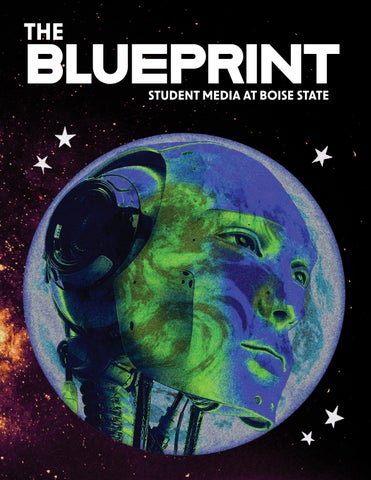
THE
BLUEPRINT STUDENT MEDIA AT BOISE STATE
If you’re reading this, you’re engaging with student-made physical media — so thank you! Over the last few months, our team of writers, graphic designers and illustrators have worked to create something that is wonderfully and imperfectly human. In the wake of what feels like the AI takeover, we wanted to create something that celebrates one of the best parts of being human: creating and engaging with art. In this magazine, you’ll find interactive pages, personal anecdotes about how physical media enriches individuals’ lives and how AI impacts the world around us — both environmentally and artistically. Thank you for supporting us so that we can create meaningful pieces like BluePrint.
“The art of making art, is putting it together.” — Stephen Sondheim
Table of Contents
06 Address book 08 Human spark 10 The future is in your hands 12 AI and the environment 16 Once they’re gone, they’re gone forever 20 The allure of junk journaling 22 Community as a form of resistance 24 Squeak! 26 Corrupt coloring 27 Luke’s theater review 28 Paper dolls 32 Disconnecting art from the artist How does artificial intelligence fit into the world of graphic design?
An inside look into Boise’s most unique house party
Explore an artist’s complex relationship with AI-generated art
Learn to read your palm and what your future holds
Is convenience worth the waste?
A deep dive into how AI data centers are affecting our wildlife
Read on to find out how junk journalers turn trash into treasure
The victories of the past weren’t a coincidence
Play with language and complete our rodent-themed Mad Libs
Color in the portraits of some of Silicon Valley’s most ineligible bachelors
Discover Boise’s local theater gems
Customize your very own paper doll
2026 CONTRIBUTORS MEET THE
Artificial Intelligence disconnects the art from the artist Naomi Brown | Graphics by Naomi Brown
A
s a graphic designer, I’ve been haunted by the same sentiment for the past few years — “Aren’t you afraid AI will take your job?” Artificial intelligence is a divisive piece of technology that began as a chatbot capable of answering random questions and creating uncanny images, clunky yet seemingly helpful. For the world of art and design, however, it’s evolved into something far worse. As time goes on and technology changes, so has graphic design. Art has never been stagnant — it is ever evolving, and people are always finding new ways to visually communicate with each other. The advent of computers created a massive shift in the design world, and as computers and the online world grew and evolved, hand-processed graphic design found itself in an increasingly smaller market. Although some graphic design agencies downsized available positions, they never fully went away. The new technology computers provided made these design tools more accessible to the public, making it easier for people to find new ways to be creative and opening new opportunities for designers to spe-
06 May 2026 | BluePrint Magazine
cialize in the online interface. Ryan Donahue, a graphic design professor at Boise State University, views the introduction of computers as a powerful shift in the design industry. Donahue explained how computers decentralized the industry as the technology became increasingly more available. “That was a big disruptor,” he said in reference to computers infiltrating the graphic design field. “But for me, it was a positive thing, where it allowed more people to have more power.” Although some creators feared a future with computers, many members of the graphic design community embraced the change, reaping the technology’s benefits while still using the hand process practices when needed. The creation of AI, however, has not brought new opportunities to the art world or helped artists expand their creativity. On the contrary, it is a soulless entity that steals from human artistry. When using AI to create art, not only does it take away the true passion an individual has for the artistic process, but it also encourages mediocre work and disconnection from the ideas themselves.
The actual marketing practices of the companies promoting AI are similarly soulless. In March 2024, Adobe hosted an Adobe Summit Conference, presenting new programs and products. Speakers discussed a new AI product, GenStudio, a performance marketing tool. Graphic designer Ryan Donahue claims the work they presented while speaking about GenStudio was actually created by him. “That’s when I really understood the harm, because they got up and claimed it was AI. I just knew it was a completely fabricated lie,” Donahue said. “I shouted about it. I was screaming to the world, this is a lie. Here’s my story. No one cared. That was a real learning lesson of, this is a tidal wave. It’s a tsunami that’s washing over all of us.” AI isn’t able to create its own ideas or thoughts, it simply gathers data and regurgitates it back to the consumer, trying to replicate the pixel patterns of artwork from human artists that have been posted on the internet. “I’m seeing students that literally can’t form the most basic creative thought when you say ‘Come up with a project.’” Donahue said. “‘This is your idea. Tell me about it.’ And their instinct is to go to ChatGPT to tell them what their own idea is. And that’s really scary. That’s happening right at the beginning. What happens 10 years from now?” The creation of art as a whole is based on the artist’s own eyes and perception of the world around them. It’s a culmination of an artist’s ideas, experiences and thoughts. When AI gives someone the idea for their work or creates a visual for
their project, it diminishes the whole point of creation. AI causes a disconnect between the artist and their art. It is no longer their voice being translated, but rather an accumulation of many voices skewed and distorted by the technology’s programming. The art and design world gains little from the extensive use of AI. Companies pour immense amounts of money into this technology that derails us from human connection. When there’s technology that replicates the work of real humans, there’s no need for businesses to spend money on people. It’s a CEO’s fantasy: save money on wages, salaries, benefits and people, but still be able to churn out some kind of product. They don’t care if the product is perfect, they just want it to be good enough. “Just call OpenAI and all of a sudden I don’t have to hire 10 people,” Donahue said in regard to a business’s perspective on AI. “That’s not exactly true, but it’s true enough that they just launch into it and pursue it. That has ramifications where the people who get cut from their jobs, their livelihoods are totally upended for no good reason, just because someone didn’t want to pay them.” Throughout history, art has always been prevalent. As humans, we must express ourselves, we must share our thoughts and feelings with others. There have been countless hardships we have experienced as a country and a world, and art is an integral part of healing together. We make art based on our experiences from our own lives. We find inspiration from memories, the things we see, the things we can
touch and the emotions we have. Art is not the transference of noise patterns but rather the emotions we feel. “It’s almost like [art is] so integral and essential to the human experience. It’s like a breath for us. We have to have it,” Donahue said.
May 2026 | BluePrint Magazine
07
ADDRESS BOOK
THE UNDERGROUND ART PARTY TAKING OVER BOISE Karley Rodriguez | Photos by Omar Saucedo
08 May 2026 | BluePrint Magazine
I
n November 2024, local artist Matt Bunk started Address Book — a project that brings together artists across mediums in a “house party” style environment. With a background in theatre, Bunk knew he wanted to break into Boise’s art scene. “It seems like there is a low ceiling,” he said. “But actually, I keep finding there’s more and more spaces to break into.” Although Boise’s scene is small, its tight-knit nature has a way of pulling people together. Address Book is rooted in that strong sense of community. Describing the initiative as “a pop-up gallery and also a house party,” Bunk explained how he and his old roommate used to throw elaborate themed dinner parties — the kind that kept growing until they couldn’t feed any more people. Bunk started asking attendees to perform
little skits, to contribute something to the parties. It was, as he puts it, a “mini” Address Book. Then a string of contracts fell through, leaving Bunk with a suddenly wide-open calendar. Rather than wait for the next gig, he organized a show in his apartment and hoped people would show up. “It sort of took on a life of its own,” Bunk said. “It was really unintentional.” As for the name, he said, it’s not really that complicated. People come in and out of the project, though there are plenty of repeaters. The answer, Bunk says, is simple: “Me and everyone in my address book.” Address Book is deliberately hard to pin down or categorize. Each gallery-style house party is built around a unique theme. With six events under their belt, they’ve explored themes like “Commercial,” “Teeth” and most recently “Palindrome.”
Bunk shared while he does find trinkets to be delightful, the trinket option isn’t just charming — it’s intentional. If you can’t afford $5, a nice rock will do. “I’ve worked very hard for it to be as accessible to as many people as possible,” Bunk said. At “Palindrome,” someone handed over a punch card — two holes already punched — for a burger place that isn’t even in Boise. Address Book isn’t possible without people willing to show up and do the work. Syd Bergeson, who has helped run Address Book since its first event, said, “It only exists because of the people who are willing to donate all their free time and considerable effort.” At its core, Address Book is about strangers becoming less strange. After the very first event, an audience member pulled Maddy aside and told her they hadn’t realized how much they needed something like this, that they felt lighter than they had in a long time. That kind of impact is what Bunk is after. “I really want strangers to talk to each other at these,” Bunk said. “It’s true blue DIY and it’s not trying to be anything else.”
Elena Maddy, who has helped organize Address Book since its early days, put it plainly: “Artists usually end up in a space that just sees you as one thing. Address Book is a really cool blurring of those lines.” “It’s art for artists,” Bunk added. Anyone can participate in any medium they choose, nothing is stopping them from exploring something completely different each show. Since starting the project, Bunk has kept a list of theme ideas, but the final decision always depends on available venues and who can perform. In January of this year, Address Book hosted its most recent event, “Palindrome.” For that event, his vision included Heidi Kraay’s structural work and Ross Sutherland’s palindrome play, “Party Trap.” For “Commercial,” they took over the Ron and Linda Yanke Family Research Park on Parkcenter, where the venue itself became part of the concept. Bunk is very deliberate about what Address Book is and isn’t. “An art space that is explicitly noncommercial and also very explicitly political,” as he describes it. That ethos extends all the way to the door, with admission being $5 or a trinket.
May 2026 | BluePrint Magazine
09
F
“Null Identity” 2024
10
or Gonzaga University Bachelor of Fine Arts student Audrey Hart, inspiration came from the most unlikely of places. While studying abroad in New Zealand, Hart took a course titled World Making Technology and Material Futures — a class she describes as “kind of kooky.” While rooming with a “kiwi” who was a “tech genius,” Hart found her curiosity about AI technology piqued. In a class surrounded by artists who were constantly pushing boundaries, Hart knew she had to think big. “That was when I was like, well, I need to try something crazy,” she said. The project, simply titled “Downloading Image Data,” is bittersweet for Hart. While she’s proud of her work, she feels mixed emotions about her use of AI in the creative process, knowing now its harmful effects both on the environment and the art world. As she created her original art piece, Hart slowly fed ChatGPT information about her project and eventually told the AI to create an image based on it. “I told it, please create an image of what you envision everything
May 2026 | BluePrint Magazine
I said from a pretty conceptual standpoint — and that was the image it generated, which was really creepy…” “I didn’t even have the computer element until I had a critique with that class, and he told me, something’s missing here,” Hart said in reference to the AI image on the computer. “I was like, ‘Okay, I’ve been talking to ChatGPT a lot to try to understand the way it communicates with me, how it understands me and profiles me.’ I had all that chat history by then, and that’s when I got the idea to ask it to generate an actual image or series of images. Then I added the laptop element.” The result? An uncanny humanoid creature tangled in a sea of wires and debris — not completely unlike Hart’s human-made portrait. Only one crucial element was missing — a human spark. In an almost poetic fashion, what happened in New Zealand had to stay in New Zealand. “I was so bummed that I couldn’t take it home with me, because it’s a big chunk of wood with wires all glued to it, and that wasn’t going to fit in my suitcase.”
Where did the piece end up? Hart gave it to her kiwi “tech genius” roommate, who started it all. After she returned home, her interest in the bounds of AI remained, but she was becoming more wary of engaging with the technology. She created “Null Identity,” a piece with a more eerie and serious feel to it, with wires shooting out from the nose and eye sockets of a humanoid mask. “I became more curious about how the AI itself perceived itself in a physical way,” Hart said. “At this point, I was pretty interested in working with it, but I can see in hindsight there’s a whole ethical debate tied to that, and I fully understand and own that. But at the time I was, I was pretty fascinated, I won’t lie.”
She began asking the technology questions about how it perceived itself. While Hart acknowledged the ethical dilemma of utilizing the technology as part of an experiment for her previous art piece, she believes it’s important to put commentary on the tech out into the art world. “It’s one of those things where it’s such a prevalent part of our society, especially with our generation, you can’t really ignore it. It’s finding balance, where acknowledging it
exists, you can sometimes use it to further a point, like what I like to think I did with my project. As long as you acknowledge that it’s been used and honestly are willing to critique it too, because it’s not as perfect and surface-level as it seems.” Fast forward to present day and Hart described herself as more
right after the Super Bowl, after watching those AI ads — super creepy and weird,” she said in reference to the ads. Hart explained she wanted to create something with an eerie feel and used careful language like the word “activate,” referencing a computer or phone powering on, to create a sense of unease for the viewer. The piece was a labor of love and took Hart two weeks of eight-hour workdays to finish. While Hart and many other artists have experienced a nuanced journey with AI, one fact
“Downloading Image Data” 2024
hesitant to touch AI or give it her ideas in any capacity. This change of heart inspired the creation of a dystopian, uncanny valley-esque poster, created using the technique of woodcut relief printing. “Activate Your Full Potential” is a part of Hart’s senior thesis, which focuses on technology, mass media and digital culture in today’s world. “This piece was assigned in class to make some sort of propaganda poster,” she explained. “I made this
remains: nothing will ever come close to art that is a result of human inspiration and creativity. “It all kind of comes back to the time, the blood sweat and the tears spent. It’s not just the actual making process; it’s the prep, it’s the research, it’s the inspiration. It’s the sketching, the brainstorming, the dialogue, the critiquing. It’s such a long process that no prompt could ever duplicate. Maybe visually it can create something kind of similar but at the end of the day, there’s so much more to artwork than just the aesthetic.”
May 2026 | BluePrint Magazine
11
Amber Jansson | Graphics by Amber Jansson
P
almistry is one of the oldest forms
of fortune telling
in the world, and the only
kind that does not require
any external signifiers such
Reflects physical health, general well-being, and major life changes •
as the stars or cards, all you
•
your hands. While reading
•
need is what’s already in
a palm of yours, a friend, or a stranger (we won’t
judge), keep in mind that the dominant hand represents
outward personality and life path, while the non-dominant hand reveals inner
emotions. The four main lines to read on a palm
include the head, heart, life,
and fate which can easily be interpreted to give insight
into one’s health, relationships, life direction, and mindset.
Now, let the reading begin!
12
LIFE LINE
May 2026 | BluePrint Magazine
•
Straight/close to thumb life line cautious and aware through life Curved/far from thumb life line good physical and mental health Short life line - easily manipulated by others Long life line - great vitality
HEART LINE This line depicts your emotional stability, romantic perspectives and heart health • • • •
Straight heart line - in tune with your emotions, stable Wavy heart line - will experience many romantic relationships Short heart line - minimal interest in romantic relationships Long heart line - expresses emotions freely and clearly
HEAD LINE Represents learning style, communication style, and intellectualism • • • •
Straight head line - thinks realistically Wavy head line - short attention span Short head line - prioritizes athletic achievements over academic ones Long head line - thinks clearly, focused
FATE LINE Indicates the level that a person is affected by external circumstances beyond their control • • • •
Straight fate line - a successful life is ahead Fate line joins life line self-made, aspirational Short fate line - prone to many changes in life No fate line - comfortable, mellow life ahead
May 2026 | BluePrint Magazine
13
Fortune Teller If your palm didn’t give you the answers you were looking for, you will certianly find them here.
14
May 2026 | BluePrint Magazine
1. Cut out the square from the outer most edge 2. Fold diagonally on each side 3. With the design facing down, fold in each corner 4. Flip over and fold each corner into the center again 5. Flip over and fold in half 6. Insert fingers and begin to tell a fortune
TURN YOUR UNWANTED MUSIC/VIDEO INTO CASH! WE ARE BUYING ALL FORMATS: VINYL CDs CASSETTES DVDs/BLU-RAY TURNTABLES CD PLAYERS CASSETTE DECKS AMPS/RECEIVERS
1105 W. Idaho St. Downtown Boise (208) 344-8010 ● therecordexchange.com
May 2026 | BluePrint Magazine
15
The Dry Reality
‘Another coal on the fire’: The importance of educating Gen Z on the environmental impacts of AI Amber Jansson | Graphics by Amber Jansson
F
or the current generation of teens and young adults, a life without reliance on technology seems inconceivable. For Gen Z, technology has been part of daily life since the beginning. Some of our earliest memories include caring for a digital pet on a DS or practicing tennis skills on Wii Sports. Tech use only grew with the introduction of addictive short-term content beginning with Vine and continuing with TikTok and Instagram reels. Over the past 20 years, it’s become routine to escape into digital spaces when real life becomes stressful or boring. This reliance has only increased with the introduction of Artificial Intelligence (AI) tools such as ChatGPT. A study at the University of California showed 65% of their students utilize AI, with 50% using it several times per month. Now, as the 18-25 year old popula-
16
tion enters the workforce, familiarity with AI tools is often expected and encouraged to stay ahead. Not only is AI being used in classrooms and offices, but it is also a part of daily life. Do you need an itinerary for an upcoming road trip? A workout routine? A simple dinner recipe? These are just a few examples of what ChatGPT can provide you with, within seconds — a detailed response and further prompts in case you need any refinements or extra information. A perfectly packaged experience with instantaneous results for someone who does not have time to scroll through Google, scouring articles all day to find what they need, but at what cost? AI has brought a new wave of convenience to a generation of people who have been taught to rely on technology. But for all the convenience the technology brings, the long-term environmental impacts are simply not worth
May 2026 | BluePrint Magazine
the practicality. According to researchers at the University of California, every 100word prompt sent to an AI platform like ChatGPT is equivalent to wasting an entire bottle of water. With millions of people using AI every day, this statistic adds up to unimaginable results. The Environmental and Energy Study Institute has reported as of 2025, there are more than 5,400 artificial intelligence data centers in the United States, consuming a total of 450 million gallons of water daily and 163.7 billion gallons annually. Data centers use this water to cool large warehouses full of computing systems that process AI results by either evaporation or refrigeration techniques. The water used primarily comes from freshwater sources, including surface water, groundwater and purified reclaimed water. The wasting of resources poses an immediate threat to the surrounding
areas of data centers, where water is becoming scarce, and creates long-term effects on our agriculture and meat production in the United States, which requires large amounts of fresh water to raise plants and animals for consumption. As AI’s effects become increasingly apparent, elite tech companies are only pushing for more development and implementation of AI in society. Despite the pushback from environmentalists, it’s safe to say its production is not slowing down anytime soon. Along with the ongoing challenges of climate change and pollution, the lasting effects of data centers will be another focus for environmental scientists to research. Hannah Vink, an Environmental Science student at Boise State University, said AI is predicted to only add to already existing environmental threats Earth faces. “It is impacting our environment on a global level and it’s an issue that environmental scientists have to grapple with. This is just another coal on the fire, so to speak,” Vink said. Despite the varied discourse around the topic of AI, Vink has hope for society’s mass realization of the lasting negative effects. “AI has not been extremely
prevalent for very long, but we are already seeing massive pushback on it,” Vink said. Observing society’s reaction to the surge of AI use, Vink responded, “It’s quantity over quality, and people are starting to get really sick of it.” Owyhee High School student Evelyn Mitchell provided insight into what AI use looks like for Idahoan high schoolers, claiming most students rely on AI to complete homework assignments. Despite select OHS teachers claiming to run AI testing on assignments, Mitchell said, “Some students take advantage of AI and do not even attempt to do their assignments, they just rely on chat.” She also added most
students are not aware of the environmental impacts of AI and the reliance on platforms like ChatGPT would be hard to break. Ignorance towards the environmental outcomes of excessive artificial intelligence use will only lead to irreversible damage to our environment. If AI use continues to increase, and regulations are not met, every form of life on earth will eventually face extreme consequences, from water depletion to environmental damage. Our generation is already susceptible to dependency, so becoming aware of the long-term effects of AI is the most effective way to work towards a cleaner and healthier future.
May 2026 | BluePrint Magazine
17
Ecological Distortions Created by Mia Strand
The Indiana Bat, Birmingham Darter, Massasagua Rattlesnake featured in artwork
Once they’re gone, they’re gone forever: Protect your wildlife in the age of AI data centers Mia Strand | Graphics by Mia Strand and Amber Jansson
N
o matter what walk of life someone is from, imagining a future where the wonders of the natural world have been trampled down is incredibly bleak. Americans across the nation are all united by an enjoyment of nature, whether that’s through pastimes like hunting, fishing, hiking or even just enjoying a warm summer’s day in a local park. Humanity’s past and future have always been intertwined with all other life on Earth. 300,000 years ago, humans emerged in the fossil record alongside the ancestors of all other modern species. Existing not as separate entities, but as neighbors and relatives that fit into the great biological tapestry. Humans are the most globally influential species, for better and for worse. However dismal, a future with irreparable damage done to the natural world that’s so universally beloved is already upon us. In modern society, material wealth and influence go hand in hand. Wealthy companies and False Aster individuals have near-complete authority in decision-making, and those decisions ultimately have dramatic ripple effects on the lives of count-
less everyday people and the planet itself. As this deterioration occurs, companies are lining their pockets with more money than their executives could spend in a lifetime. For the major tech companies that developed modern generative AI, it pays dividends for this technology to be forcefully integrated into every aspect of life. Even if you’re not consciously using it, you can expect to find AI tools integrated into your most frequented applications: in your search engine of choice and in the media you consume — even without intentionally seeking it out. With the technology’s expansion progressing faster than regulations can be made, there are three proposals within the United States for AI data centers. These proposals are energetically and environmentally costly, and are currently catching media attention for pushing federally endangered species to the brink of extinction. Defined in the Endangered Species Act of 1973 by the United States Fish and Wildlife Service, federal endangerment is a label for species on the brink of vanishing, including “any species which is in danger of extinction throughout all or a significant portion of its range.” Too many upsets within ecosystems will make waves through the natural world. With other encroachments on wildlife and untouched lands piling up, these species don’t
Indiana Bat
20 May 2026 | BluePrint Magazine
have time to adapt. Whatever side of the political aisle you’re on, this is an issue that affects you. We owe it to these voiceless creatures that evolved alongside us to stand up and defend them, and to defend the planet that we all call home. The first of these proposals targets Bessemer, Alabama. With a price tag of $14.5 billion dollars, it would create a 4.5 million square foot data center and decimate the habitat of the newly discovered Birmingham Darter, a small, colorful creek-dwelling fish. Thomas Near, a biologist at Yale University, was part of the team that discovered the Birmingham Darter. Near describes the fish as “something wholly unique on the planet — a species and ecosystem that we can’t find anywhere else on Earth.” Residents of all ages in this Alabama city have started protesting the construction of this data center, citing fears for the fate of untouched natural lands, the high energy costs and the now-uncertain future of the Birmingham Darter. In Urbana Ohio, a 460,000 square foot data center costing $1 billion has been proposed to be built in proximity to the famous Cedar Bog Nature Preserve,
which “encompasses Ohio’s greatest number of native plant species ([fourteen] of those being native orchids), several federally threatened and endangered species, and many of Ohio’s threatened and endangered species” according to its website. Due to its conservation efforts, the Nature Preserve is a place of great importance for biodiversity. The creation of this data center could directly impact the nature preserve and decrease the already critically low populations of the Indiana bat. Dr. Jim Belthoff, a professor of biology and zoology at Boise State University, who has worked with this species in the
Eastern Hellbender past, explained the bats “need Shagbark Hickory trees to roost in, as well as specific caves to hibernate in over the winter.” These special requirements and additional factors, like human activity and past infections with a fungal disease called white-nose syndrome, have placed Indiana bats on the federally endangered list. The Indiana bat isn’t standing to be harmed by the Urbana data center alone, but also by another proposed data center in Pacific, Missouri. This proposal would create the largest center discussed so far, encompassing a whopping 21
million square feet and costing $16 billion to construct. In a statement from the Director of the Missouri Department of Conservation (MDC), Jason Summers lists the additional species that risk being impacted by the construction of the data center, including “the federally-listed endangered or proposed endangered Indiana bat… northern long-eared bat… tricolored bat… eastern hellbender… snuffbox… pink mucket… scaleshell… sheepnose… spectaclecase… and federally-listed threatened decurrent false aster.” This project is also currently being protested by community members in Missouri. It might be difficult for some to empathize with the importance of preserving animal life, especially when the alternative is generating revenue. Animals have intrinsic value outside of what humans ascribe to them. Just because we cannot use them in food, keep them as pets or hunt them for sport does not mean they deserve to disappear forever. This is our wildlife on our public lands, and we can no longer claim ignorance of issues that we can actively solve. A future without nature is a future surely few would want, or could, survive in.
False Aster
Birmingham Darter
Massasagua Rattlesnake May 2026 | BluePrint Magazine
21
One man’s trash is a junk journaler’s treasure
I
Olivia Brandon | Graphics by Amber Jansson
n the year of 2026, you’ve probably heard or said the words “Wait, can I have this for my junk journal?” in reference to an artifact that, in decades past, may have merely been thrown away. Junk journaling, a trend that began taking over online spaces in 2024, is about imperfection, memorializing life’s little moments and finding beauty in the everyday. Ruby Evans, a freshman at Boise State, described junk journaling as more “chaotic” than methodical
22
activities like scrapbooking. “Junk journaling is a lot of what’s going on in my life currently, mixed with things I’m picking up, things that I’m inspired by. It’s way more chaotic than a traditional scrapbook would be.” Collecting everyday items like receipts and wrappers, she uses these items to create deeper meaning. One of her favorite spreads features her old ID before she turned 18, a spread she created to represent growing up.
May 2026 | BluePrint Magazine
Last fall, Evans gave a speech on the historical significance of junk journaling for a class and explained that scrapbooking was often viewed as the responsibility of the matriarch of the family to document her children’s or partner’s life. In contrast, the individuality of junk journaling is, in some ways, a rebellion. “Junk journaling is taking that [history] and reclaiming it. Being able to spin it into, ‘No, this is about me, and it’s about my expression,” Evans
said. “It’s artistic and visual poetry. What I’m seeing, what I’m taking and how it’s affecting my life — not really about the family. The elderly women in my family all scrapbook, but it’s always been a way to keep track of other people’s lives.” As an artist, Evans often uses junk journaling to get out of creative ruts. She described it as “therapeutic” and noted the way time flies by as she creates. “As humans in general, we’re so flawed, so imperfect. Especially with social media, we’re so surrounded by [the mindset of] ‘everything needs to be aesthetic, everything needs to be perfect,’” Evans said. “It’s a selfish nature within humans to be like, ‘everything else is perfect. I’m gonna do something that’s against that, even if it is perceived as perfect by somebody else.’ It’s that need to be different and to let go, which really draws me to it.” When Kendra Whaley, an art education graduate from Boise State, first purchased her maroon junk journal, she used it as a way to document her life in a more organized fashion, similar to scrapbooking. However, it now acts as a free-forall where she incorporates birthday cake receipts, scraps from friends and pieces of old artwork. Her journal acts as a mosaic of different items she’s collected throughout her life. “I love creating my art in general, but when I’m junk journaling, it’s like, ‘oh my god, this is so freeing.’ I don’t have an assignment to do, I don’t even have to follow a color theme right now, for a collage assignment,” Whaley said. As an artist, Whaley incorporates scraps of forgotten or cut-up art pieces into her spreads. “I have a whole bin of random scraps of paper and fun things for junk journaling. I have a couple of my old paintings that weren’t even
an assignment — and I just cut them up and put them as background.” Despite its rise in popularity stemming from an online trend, Whaley believes Gen Z gravitates toward junk journaling as it provides an escape from social media. “They [Gen Z] just saw it as something else to do besides going on reels or TikToks and spending hours doing something less productive,” she said. “Going in and working with your hands, using your brain a little bit, but not too much [that] it’s still relaxing.” As a collector of sentimental items for years, Whaley explained journaling was a place for “all her movie tickets she’s had for years,” and that at this point, anything she encounters is fair game. What started as a TikTok trend has quickly evolved into a way to escape the overstimulating world of social media and document one’s life through creativity. This artistic medium is a way to document the big and little moments in life, one scrap of paper or crumpled receipt at a time.
May 2026 | BluePrint Magazine
23
The power of the people: Community’s role in dark times When the world seems bleak, people can find strength and hope in those around them Ella Van Leuven | Staff Writer | Graphics by Naomi Brown
H
istory constantly repeats itself, and one tenet that holds true across time is the power of the people. Hope and community are two of the greatest forms of resistance, and both the past and the present reveal their capacity for massive influence on the world. Administrations’ abuse of control is nothing new. Time and again, populations are exploited by the few in power, and the United States is no exception. The civil rights struggle and the labor rights movement are two primary examples of the government’s reputation for mistreating the very people it is meant to serve. The Civil Rights Movement of the 50’s and 60’s began in opposition to the Jim Crow laws in the American South, which enabled discrimination and segregation against African Americans. Although slavery had
been abolished during the Civil War, prejudice towards Black people had hardly diminished in many areas of the United States. Advances in civil rights were led not only by major historical figures such as Rosa Parks, Martin Luther King Jr. and Malcolm X, but also largely by the voice of the communities who saw injustice around them every day. Movements such as the Montgomery Bus Boycott, the integration crisis within Little Rock’s Central High School and the 1963 March on Washington were all led by citizens who felt passionately about their communities and ideals. Unifying and engaging in mass protests resulted in major changes in legislation and standards regarding Black people in the United States. Both the 1964 Civil Rights Act and the 1965 Voting Rights Act came about through the voice of the
24 May 2026 | BluePrint Magazine
common people and likely would not have succeeded without the action of the many. Morrighan Nyx, an organizer for Idaho’s Party for Socialism and Liberation, spoke on the power that comes with protest and community action as a whole. “Those [movements] were only able to succeed because huge swaths of the community poured out in support of them and because they were organized enough to funnel that popular support into political power and political change,” Nyx said. Similarly, the labor rights movement was driven by community resistance. The earliest events in the Labor Movement began in the late 1700’s with a strike of tailors in New York protesting wage reductions. Strikes and protests against inhumane working conditions and unjust pay continued through the 19th
and 20th centuries, and unions for workers emerged. Groups such as the American Federation of Labor and the Committee for Industrial Organization were direct results of community effort. Standards such as setting maximum hours in a workday, restricting child labor, establishing federal minimum wage and rules against discrimination in the workplace were all accomplished as a result of the common people’s action and voice. Activism has always played a key role in bringing about a new era. Boycotts, protests, strikes and other forms of community resistance are integral to enacting change. When a government disregards the needs and desires of its citizens, action is necessary to bring the power back to where it belongs — with the people. In recent years, millions of U.S. citizens have continued to demonstrate the power of collective action. During the Black Lives Matter movement, communities united across the country to protest police brutality and systemic racism through organizing marches, mutual aid efforts and voter engagement initiatives. Demonstrations calling for a ceasefire in the war between Israel and Palestine have drawn coalitions
of students, faith leaders and local organizers into the streets. Similarly, resistance to the policies of U.S. Immigration and Customs Enforcement has prompted courthouse protests, rapid-response networks and community campaigns. These movements aren’t isolated outbursts of anger. They are organized efforts that stem from neighborhoods, campuses and workplaces, proving once again that continuous pressure from ordinary people can deeply influence national conversations and policy debates. Nyx described the influence that communities hold in circumstances such as these. “Political power, the ability to make change that you want to see, stems from the people,” Nyx stated. “Politics begins and ends where people, not in the hundreds, not in the thousands, but in the millions, are in the streets demanding change.” Community efforts transform individual frustration into collective hope and power. When people come together, it becomes easier to see that their struggles aren’t isolated incidents, but cohesive experiences shaped by the larger systems at work. Paisley Davis, Secretary for the Boise Trans Collective, described
the feelings of hope and solidarity that the act of coming together can bring. “At the end of the day, we are just animals,” Davis stated. “The second worst thing we can feel is scared, the first worst thing is scared and alone. Community shows you that you’re not alone.” History shows us none of what’s happening today is unprecedented. From the bus boycotts and union halls to the marches and mutual aid networks of today, change has always arisen from ordinary people refusing to accept justice as inevitable. Language might change, platforms might shift, but the core message remains that corrupted power can be subverted when communities organize. The victories of the past weren’t a coincidence; they were the result of sustained action, shared sacrifices and a steadfast belief that a better future is possible. If history is any indication, the path forward cannot be driven by a single person or fleeting outrage, but by the common people choosing to unite and stand for the causes they believe in. As Malcolm X succinctly put it in his speech at the Organization of Afro-American Unity’s opening rally: “We’re not outnumbered, we’re out-organized.”
May 2026 | BluePrint Magazine
25
RAVENOUS RODENTS MAD LIBS Naomi Brown and Emily Carmela Nelson | Illustrations by Naomi Brown
After a(n)
ADJECTIVE ENDING IN -ING
day of running on a wheel, the TV lit up with a
Presidential Address to the Nation. President “
GREETING
rodents. I am
TYPE OF RODENT
ADJECTIVE ENDING IN -ED
had a brief message.
to announce that we have entered
a food famine. Ration your goods.” All hell broke loose. Fellow rodents were screaming in the streets and the windows of (the) The next morning, the latest copy of The shattering news. An image of President
TYPE OF CHEESE
SAME RODENT
covered nearly the entire front page with a(n)
ADJECTIVE
ADJECTIVE
surrounded by seeds, grains and
ADJECTIVE ENDING IN -ING
the rodents but flew into a
TYPE OF BIRD OF PREY
NOUN
asked the bird, “Are you okay?” The bird
. The
PLURAL TYPE OF FRUIT
headline — “President
SAME TYPE OF RODENT AS ABOVE
SAME BIRD
and wounded their
ADVERB
DESTRUCTIVE ADJECTIVE
Times hit each doorstep with world-
“ The civilian rodents marched to President swarm of
were
PLACE IN BOISE
‘s burrow but were faced by a
attempted to
BIRD BODY PART
VIOLENT VERB
The rodents scurried over and
responded, “No, I’m so hungry.” After realizing the
ADJECTIVE
President had put both parties in the same situation, they chose friendship. The birds and rodents worked together to create a to lure the President out of his
PAST TENSE VERB
ADJECTIVE
out of town. The rodents
26 May 2026 | BluePrint Magazine
ADJECTIVE
burrow. President
NOUN
SAME RODENT
WAY TO CELEBRATE, PAST TENSE
in the town square.
end of the world hall of fame
Elon Musty
Sammy Psychosis
Zuch Sucks May 2026 | BluePrint Magazine
27
LUKE’S LOCAL THEATER REVIEWS Luke Charlier | Photos by Omar Saucedo
The Flicks
Atmosphere: Popcorn/Snacks: Movie Selection: Technicals: Price: $8 - if a student/senior, $10 otherwise I can’t give the popcorn enough credit here. The Flicks is the only theater in Boise that uses real butter, and it’s guaranteed to hit every time. They also have a full menu of food and drinks, ranging from a soup of the day to Italian sodas to specialty wines. The Flicks prioritizes independent and foreign cinema for its selection, meaning they’re typically playing at least one new movie that no other theater in the valley is playing, allowing them to operate in their own lane. The Flicks may not have the most
impressive theaters from a technical standpoint, but they make up for it with an unforgettable atmosphere, amazing food and playing really cool movies.
Idaho Film Society Atmosphere: Popcorn/Snacks: Movie Selection: Technicals: Price: $11.32
Idaho Film Society’s movie selection is top-tier, as every single showing is handpicked by members and paired with a quick presentation to fill in some context. Selections typically mix renowned classics with niche, overlooked masterpieces. Idaho Film Society is an obvious
passion project, with the experience always feeling incredibly personal. Their seats are unfortunately really uncomfortable and the screen is a bit hard to see if you’re short. I don’t really enjoy their popcorn either, as it is created in a “healthier” way that won’t satisfy your craving for movie theater popcorn. Fortunately, what they lack in snacks they make up for with their “dinner and a movie” events, which feature meals created by professional chefs. These events can be a bit spendy, but worth the splurge as it sets the atmosphere perfectly for the movie you’re about to watch. Idaho Film Society’s technicals aren’t great, which makes it a bit hard to fully sink into the movie compared to an experience at a traditional theater. Despite these issues, the passion from the staff seeps through all its faults and creates a great experience nonetheless.
Regal
Atmosphere: Popcorn/Snacks: Movie Selection: Technicals: Price: $12.99 Regal is a frustrating experience, as the theater used to have one of the best atmospheres in the Treasure Valley. The neon lights, themed theaters and hand-painted murals instantly made going to the theaters feel like a big event. Unfortunately, due to the rise of private equity and the shift to making buildings sellable, this regal looks a lot more like a conference center compared to a movie theater. Regal also closed their old IMAX building, a place that made any big blockbuster feel larger than life. The new IMAX setup isn’t horrible and may have some better technicals, but I’ll forever miss the giant screen they had in that building. But it’s not
all bad — Regal’s biggest strength is its movie selection. They’ll have surprising deep cuts, re-showings of classics, all while never missing out on a big blockbuster. One of the best parts of their movie lineup as of late is their consistency when it comes to showing classics. Every single day, they show a classic film, allowing me to knock so many movies off my watchlist. Their Regal Unlimited service is also a great deal, as long as you see 2 movies per month. Regal is easily the most reliable place to see a movie, even if it lost a lot of the magic and whimsy it once had.
BoDo
Atmosphere: Popcorn/Snacks: Movie Selection: Technicals: Price: $14.72 The BoDo theater opened in 2023, reviving the space that used to be a second Boise Regal location. The old Regal held a lot of cherished memories for me, so I have a bit of a vendetta against this place. But for this review, I will be putting my bias aside as much as possible. BoDo’s biggest strength is its technicals. Their laser projectors and sound system are incredibly high quality and are only matched by Regal’s IMAX theater, but for a lower price. BoDo’s aesthetic and atmosphere are incredibly lifeless and uninteresting, feeling more akin to a hotel lobby than a movie theater. Their movie selection is incredibly standard for a theater, mostly showing big studio movies or indie movies with a significant amount of hype. You’ll rarely see a “deep cut” in their lineup. The BoDo cinema’s biggest strengths definitely lie within the movie-watching experience. On top of the good technicals, their reclining seats are incredibly
comfortable and spacious. In some ways, BoDo might be the optimal place to see a movie, but due to the lackluster atmosphere, there’s not much reason to choose this theater over some of the others.
Overland Park Cinemas Atmosphere: Popcorn/Snacks: Movie Selection: Technicals: Price: $3.00
Overland Park Cinemas is the last of its kind. Being a “value theater” that plays slightly older movies at a big discount, this means its movie selection is usually not too exciting, featuring movies that just got taken out of the big theaters. However, the $3 ticket price point and cheap snacks are enough to make this worth a visit alone. In a world where we’re getting charged a ridiculous amount for movie theater candy, it’s refreshing to get some incredibly cheap snacks. The atmosphere and comfort aren’t anything crazy, but there’s a wholesome local vibe to it that excuses areas the theater is lacking in. The old movie posters hung up are a particularly nice touch. Overland Park Cinemas isn’t the best option for a hardcore movie fan, but it has undeniable charm. It’s also the only theater here that’s truly affordable, so if you’re looking for cheap tickets and snacks, this is the theater for you.
Final Ranking
1. The Flicks 2. Regal 3. Idaho Film Society 4. BoDo 5. Overland Park Cinemas
May 2026 | BluePrint Magazine
29
MY BODY’S MADE OF CRUSHED LITTLE STARS the sermon always makes me cry. provoked by something greater than myself, i squirm in my seat. what would it mean to hold faith by the throat, drown myself with belief E 30 May 2026 | BluePrint Magazine
STUDENT POETRY
May 2026 | BluePrint Magazine
31
Queer Fashion Through History Clara Geise | Illustrations by Clara Geise
Women having fun at the French bar ‘Le Monocle’.
People posing at the nightclub La Vie Parisienne.
32 May 2026 | BluePrint Magazine
Mabel Hampton
Una Troubridge (left) & Radclyfe Hall (Right)
Create Your Own Fashion Icon! Monocule Worn by figures like Lady Una Troubridge, the monocle became a chic symbol of lesbian identity in 1920s Paris. Immortalized in Brassaï’s photos of Le Monocle, it signified sophistication and defiance. Once masculine, it transformed into a bold queer emblem of intellect, visibility, and self-possessed rebellion.
Uni-Sex Suit The suit blurred gender boundaries and redefined power. Marlene Dietrich’s tailored looks in the 1930s and Rudi Gernreich’s unisex designs later turned clothing into liberation. For queer people, the suit embodied self-definition, an elegant uniform for those resisting restrictive gender roles through poise, precision, and unapologetic style.
Sailor Hat Suzy Solidor’s sailor hat became a queer icon in 1930s Paris. Performing bawdy songs at La Vie Parisienne, she reimagined masculine symbols with playful femininity. The tilted hat captured freedom, flirtation, and rebellion, making nautical style a powerful emblem of lesbian visibility and joyfully subversive performance.
Pinky Ring Among working-class lesbians, the pinky ring served as a discreet sign of identity. An act of quiet defiance, pinky rings were personal and proudly worn.
May 2026 | BluePrint Magazine
33
YEARBOOK SIGNING
HAGS!!
FROM THE BLUEPRINT TEAM <3