Independent Student voice of Boise State since 1933
Independent Student voice of Boise State since 1933
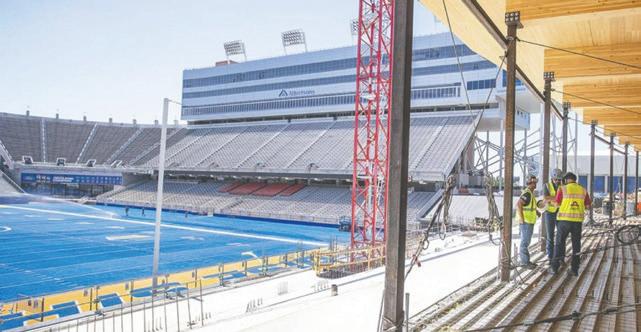
The fan experience at Albertsons Stadium is being taken to ‘the next level.’ The North End Zone project is establishing more opportunity for football fans to get an up-close seat to the action.


13
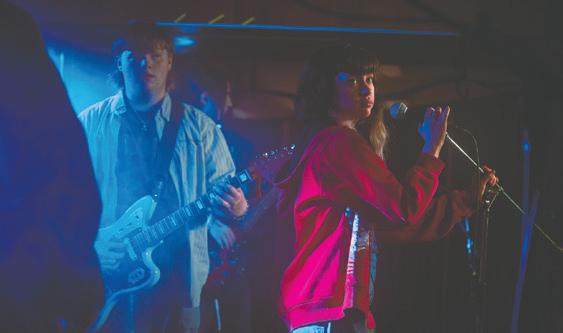
This Nampa-based, student-led band’s story of friendship as they discover their sound is sure to make you ‘Blush!’ Read on to discover band members’ musical inspirations and favorite on-stage memories.
Vol. 38, Issue 15
April 30, 2026
04 Student Union name change
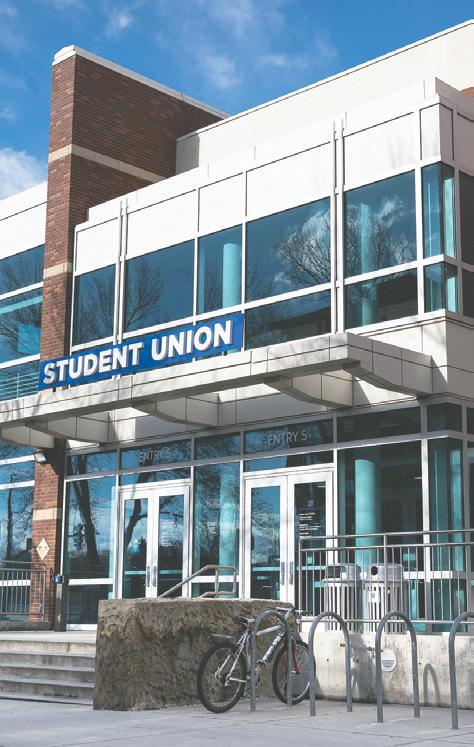
The SUB, one of campus’ most iconic landmarks, is undergoing a rebrand following a sponsorship deal between the university and Westmark Credit Union.
10
Inside the Short Film Lab
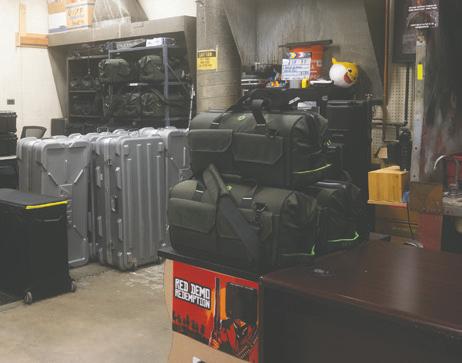
Lights, camera, action! The Film and Television Arts program is providing students with the opportunity to get hands-on experience in professional filmmaking.

Editor-In-Chief
Emily Carmela Nelson
editor@stumedia.boisestate.edu
Managing Editor
Olivia Brandon
editor@stumedia.boisestate.edu
Find new stories online daily at arbiteronline.com
opinion@stumedia.boisestate.edu
Editor -
Opinion Culture
Zaccary Kimes
culture@stumedia.boisestate.edu
Editor -
Julianna Kelsey
Reporter -
Isabella Williams
Sports & Rec
sports@stumedia.boisestate.edu
Editor -
Jake Zamora
Reporter -
Aidan Mattingly
Assignment Desk
ReporterIntern ReporterIntern Photojournalist -
Cole McAdams
Jack McElwee Keara Antonelli
Photo & Design
design@stumedia.boisestate.edu
Design Manager -
Naomi Brown
Graphic Designer -
Amber Jansson Mia Strand


digitalcontent@stumedia.boisestate.edu
Digital Content Manager-
Digital Content ProducerIllustrator -
Omar Saucedo Carter Nash
Marketing & Advertising
Advertising & Sales Manager
Zach Cerepa
ads@stumedia.boisestate.edu
Marketing Manager
Karley Rodriguez
marketing@stumedia.boisestate.edu
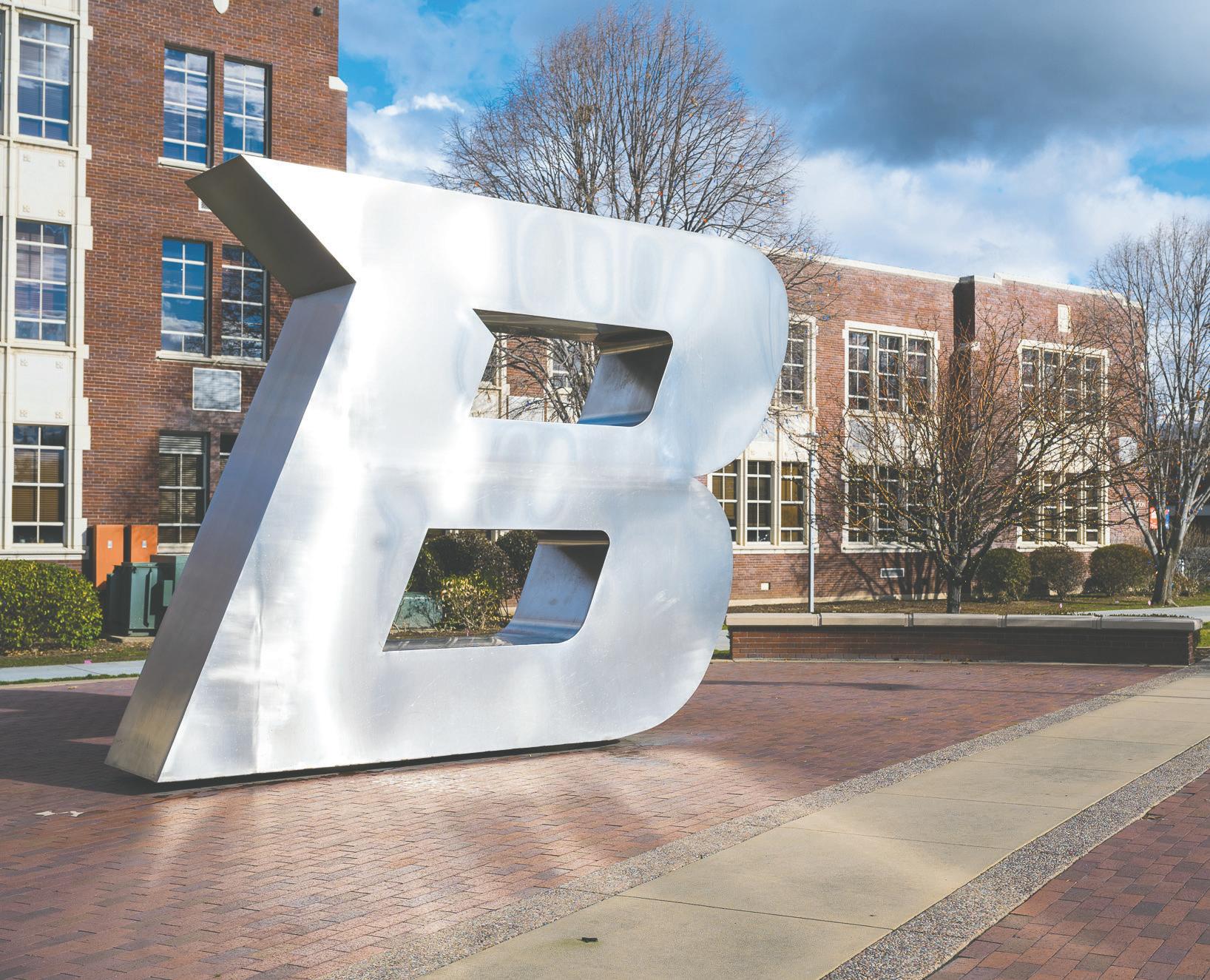
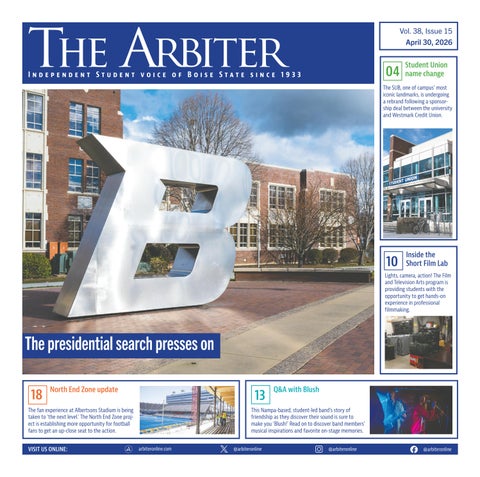
From former President Marlene Tromp’s departure last spring to legislation limiting search transparency, we’re breaking down highlights from the past year and what’s next for the committee. And, maybe most importantly, what students are hoping for in the university’s next leader.
CONTACT US: editor@stumedia.boisestate.edu 208.426.6302
PHYSICAL LOCATION: Located on first floor of Lincoln Avenue Garage Suites
As a student-run organization, we produce accurate and hyper-local information through non-partisan and socially responsible media.
Olivia Brandon | Managing editor
Wthat changed me as a person and a writer — and there were a lot. The incredible sources I’ve met who generously devoted time out of their days to tell me their story.
tunities Student Media brought me, like attending a national media conference in D.C. and touring the NPR Studio.
me wish I could do all of this again.
tographers who are even better humans. The late-night food runs during print nights, sunny days tabling in the Quad and clinging to our Culture Editor as we braved Haunted World — those are the moments that will always stick with me.
have a big piece of my heart. <3




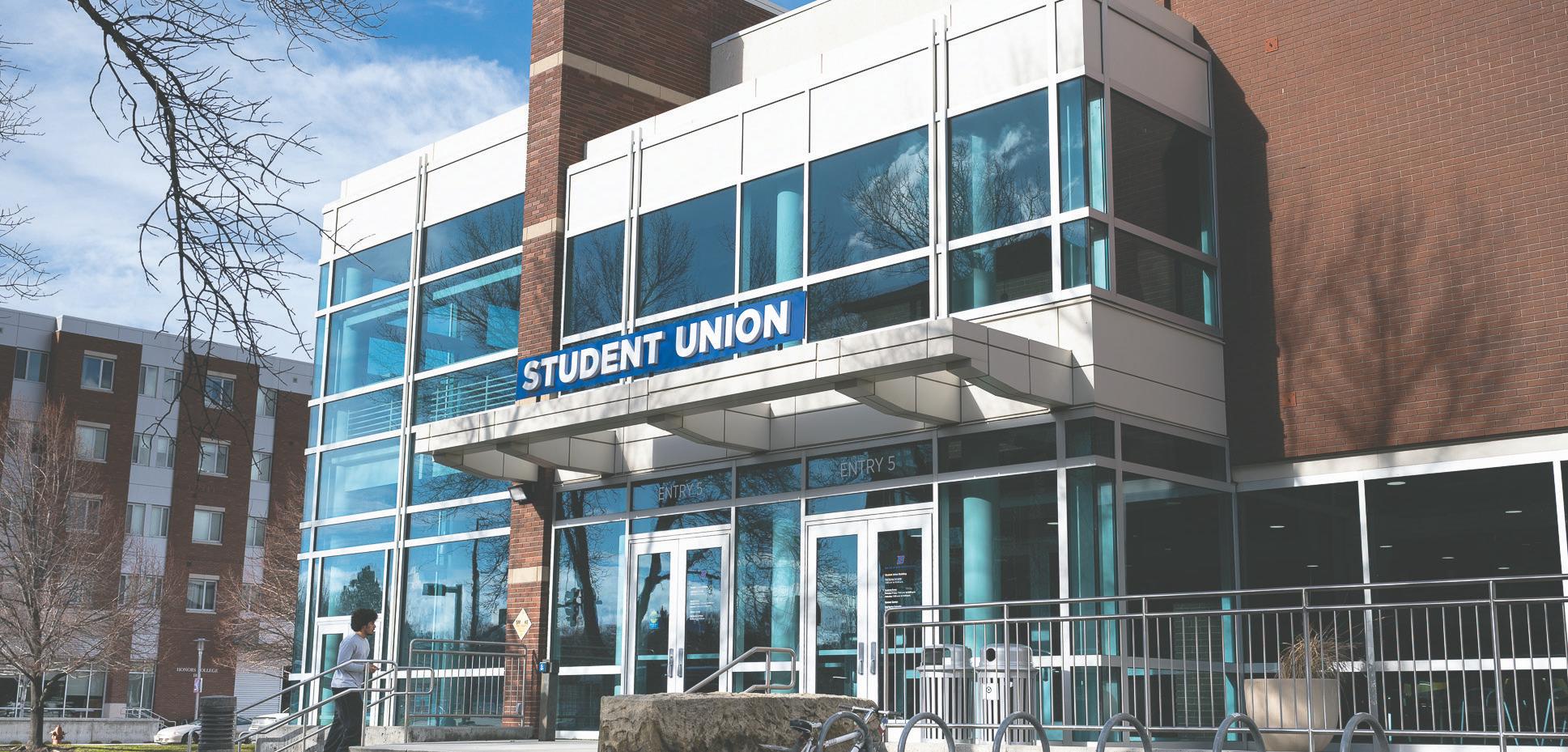
The Student Union Building (SUB) has had a long, rich history on Boise State’s campus. Serving as the hub of the university, the building has provided a space for students to socialize, eat, study and present their art.
In 1942, the first student union was created on campus, residing in what is now the Communications Building. For years, it functioned as a spot to host dances and club meetings. After a record-breaking year for enrollment in 1965, the demand for an expansion of the Student Union only grew. Just two years later, the current student union location opened in 1967, featuring office spaces, a bowling alley, meeting rooms and previously, a barbershop.
With smaller-scale changes like new food options being added and a huge $30,000,000 remodel in 2009, the SUB has undergone many changes, but a recent one has garnered a lot of attention from students.
The changing of the building’s name. Following a sponsorship deal between Westmark Credit Union and Boise State University, the building has been renamed the Boise State University Westmark Student Union Building.
The sponsorship will include the installation of a microbranch in the building. According to Stephany Galbreaith, director of media relations, the university will receive $8.5 million from Westmark over ten years as part of the partnership.
“The funds will be used to improve the Student Union Building, enriching the daily experience of students, and to support high-impact student-serving programs and initiatives,” Galbreaith said in a statement to The Arbiter.
Students have mixed reviews.
Brian Dyer, junior and AV technician at the SUB, sees the benefit of improving spaces within the building. While it hasn’t been specified where the funding is going, Dyer hopes the Special Event Center will reap some of the benefits.
“From what I can tell, there’s a bunch of projects in the works, like improving areas like the Special Events Center — but that [they] just haven’t gotten around to yet because we’ve been busy with other things. Or, some tech issues that have been long-standing, that we’ve been trying to get around to at the Student Union Building.”
Lisa Frisbie, who works at the Game Center, echoed Dryer’s call for improvements, saying the space could “use a nice makeover.”
“We’re trying to run the center on some pretty outdated equipment, so it would be nice to have newer equipment
that doesn’t break every five seconds,” Frisbie said. “In general, it would be cool for the funding to go to places that directly impact students in a positive way.”
Despite both being employees of the building, neither Dyer nor Frisbie were informed of the name change.
“I am a student employee, and usually information as such is very much a needto-know basis. But, I found out through social media, which was a little annoying, especially since I am technically an employee of the SUB,” Frisbie shared.
Some students aren’t as optimistic about the partnership.
Senior, Lark Platts, also found out about the name change via social media and said it brought to mind the name changing of the former Gender Equity Center, which quietly shut its doors during winter break in 2024 and now houses the Student Connections and Support Center.
“There used to be people who would hang out there all the time. This year, it’s completely dead. Nobody goes there because they rebranded it and also got rid of a lot of people working there. It’s just kind of depressing. [Boise State] never said anything about it. I don’t really trust the administration at this point,” Platts said.
Galbreaith said it’s anticipated the exterior signage on the building will be updated to reflect the name change by the end of the year.
“I wouldn’t care if they were renaming, say, the Business building, but to take the one building that is actually specifically for students and is literally called the Student Union Building — unions are very much not associated with being too fond of huge [companies]. It kind of feels insulting,” Platts said.
Emily Carmela Nelson | Editor-in-Chief | Photo by Omar Saucedo
Boise State’s next decade of growth is starting to take shape.
Signed by the State Board of Education on April 15, Boise State’s new 10-Year Master Plan signals a shift in how the university is approaching long-term growth.
By prioritizing a shorter, more practical timeline than the decades-long scope of its 2015 plan, university officials say the updated framework allows for more realistic planning and closer alignment with budget constraints and strategic priorities.
“In a 30 year window, you start shifting directions — majorly or subtly — almost immediately,” Drew Alexander, associate vice president of campus operations, said. “We found that to be the case with the 2015 plan, and that was one of the drivers to condense the timeline to 10 years. That confidence level goes way up when the timeline is a little bit shorter.”
One of the biggest points of contention in the 2015 plan centered on concerns held by residents living between University Drive and Boise Avenue. The proposal suggested academic buildings, parking structures and campus spaces extending into those neighborhoods — a vision Alexander describes as “understandably difficult to digest” for
nearby homeowners.
The new plan pivots away from these proposals, creating a subcommittee made up of board members and members of the Southeast Neighborhood Association to join in on the conversation.
“That was a valuable lesson learned,” he said. “We decided to focus on the campus that we have and increase transparency and collaboration with community partners, neighborhood associations and neighbors instead of creating a vision for an area that really means a lot to them.”
Instead of mapping out exact construction plans decades in advance, the university is now using a “land use” approach. This framework outlines how different areas of campus could be used without locking in specific projects to specific areas.
The goal is to give both the university and the surrounding community a clearer sense of what to expect, all while leaving room for plans to evolve.
“Through a land use approach, you give some predictability to the community of what to expect in those areas, whether that’s an administrative building, an athletic venue or another academic or research space,” Alexander said. “It gives that guidance and framework for the university and the community to have anticipation of what we may do in
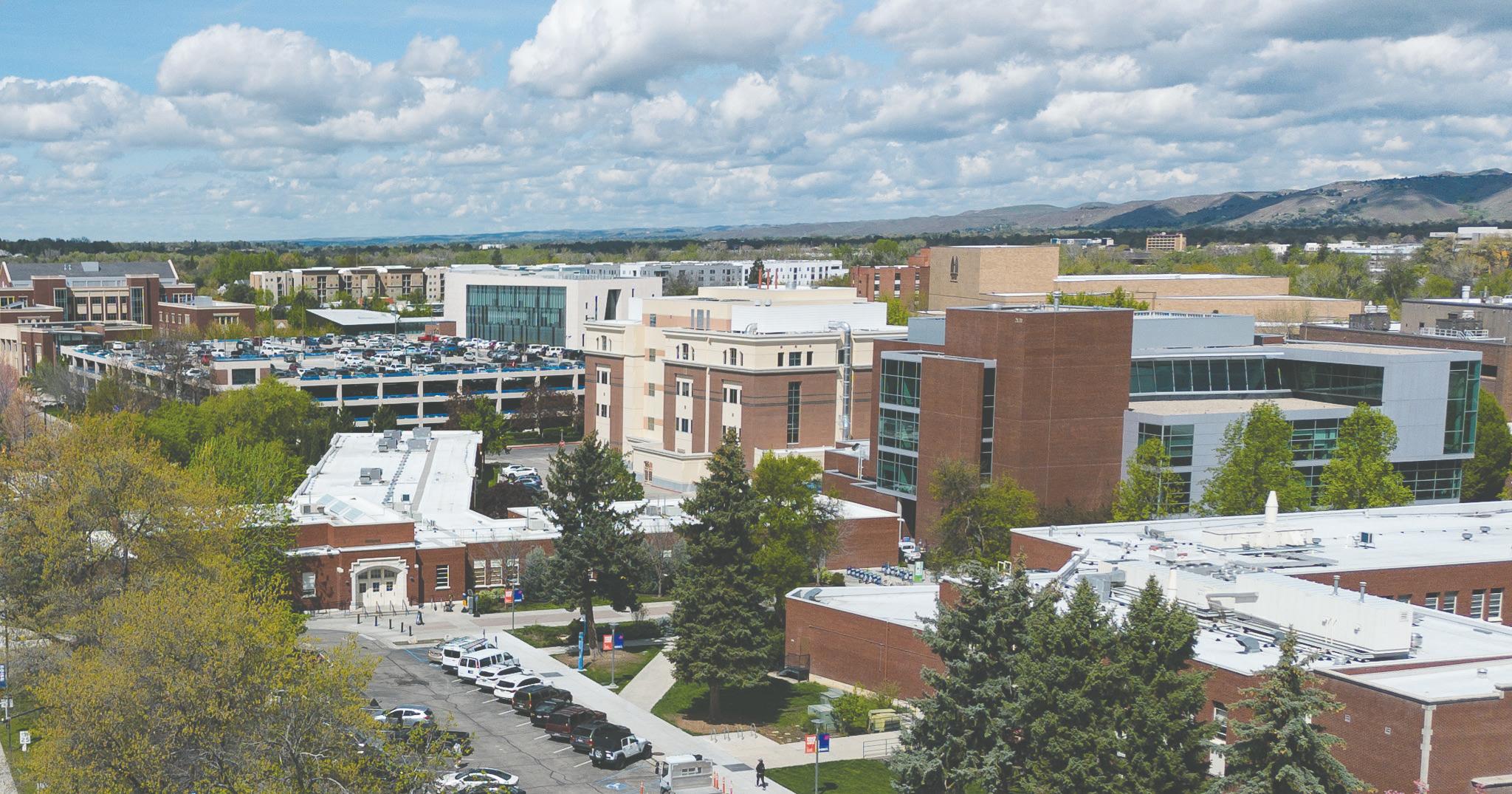
those spaces without us being so hyper prescriptive like we were in 2015.”
The Master Plan is divided into two parts — the Capital Improvement Plan and Concepts for Consideration.
The Capital Improvement Plan outlines projects the university sees as achievable within the next decade, including facility upgrades, infrastructure improvements and other smaller-scale construction efforts.
Concepts for Consideration, by contrast, are longer-term ideas without a set timeline. As Alexander describes them, they are projects that remain “on the shelf,” to be pursued if resources allow.
“If you analyze all of these projects, there’s really only one major capital project that we’re working on in this 10 year timeline, and that’s our new science research building,” Alexander said. “The rest are things we feel confident that we can make headway on, either renewals of buildings, maintenance of buildings or much smaller scope projects.”
For students, that means the most visible changes over the next year will come through renovations and upgrades to existing spaces rather than entirely new construction projects.
By the end of 2026, several projects outlined in the Capital Improvement Plan are expected to take shape across campus.
For academic buildings, the ESI Construction Management Building is projected to be completed. An additional research lab space will be built out on the third floor of the Micron Center for Materials Research and Riverfront Hall is set to undergo a renovation and refresh.
Athletics facilities will also see updates, with the North End Zone expansion expected to be finished in 2026, likely before the start of football season.
Infrastructure improvements are also underway, including renovations to Capital Village 4, also known as the Junc -
tion, and the construction of a detached sidewalk along Beacon Street to improve pedestrian safety.
The plan also includes studies accounting for the university’s future growth. Over the next decade, the university projects a need for over 750 additional student beds and more than 370 new parking spaces.
While all potential housing and parking projects are currently listed as Concepts for Consideration, Alexander says those needs are likely going to drive ongoing conversations about what to prioritize when time and resources allow.
“I think there will be a lot of dialogue around the housing component,” Alexander said. “The plan has at least three concepts of where we could start with that, but if the university and its leadership determine that we want to continue doing more in the housing space, this equips them with the framework to move additional housing initiatives on campus forward.”
A few notable Concepts for Consideration include improvements to the Intramural Field, a second phase of Sawtooth Hall, redevelopment of the sites Chaffee and University Manor sit on and the demolition of Towers Hall.
“From a community standpoint, [Towers] is somewhat isolated from other housing communities and dining,” Alexander said. “If we were to move forward with another project that bolstered our bed count, it would be [a building] we could potentially demolish to make way for something else in that space. Whether it stays or whether it is demolished is very much determined and guided by those more global student housing position decisions we would have to make.”
The 10-Year Master Plan is available for review on Boise State’s website, and students can provide feedback by emailing campusoperations@boisestate.edu.
april 30, 2026
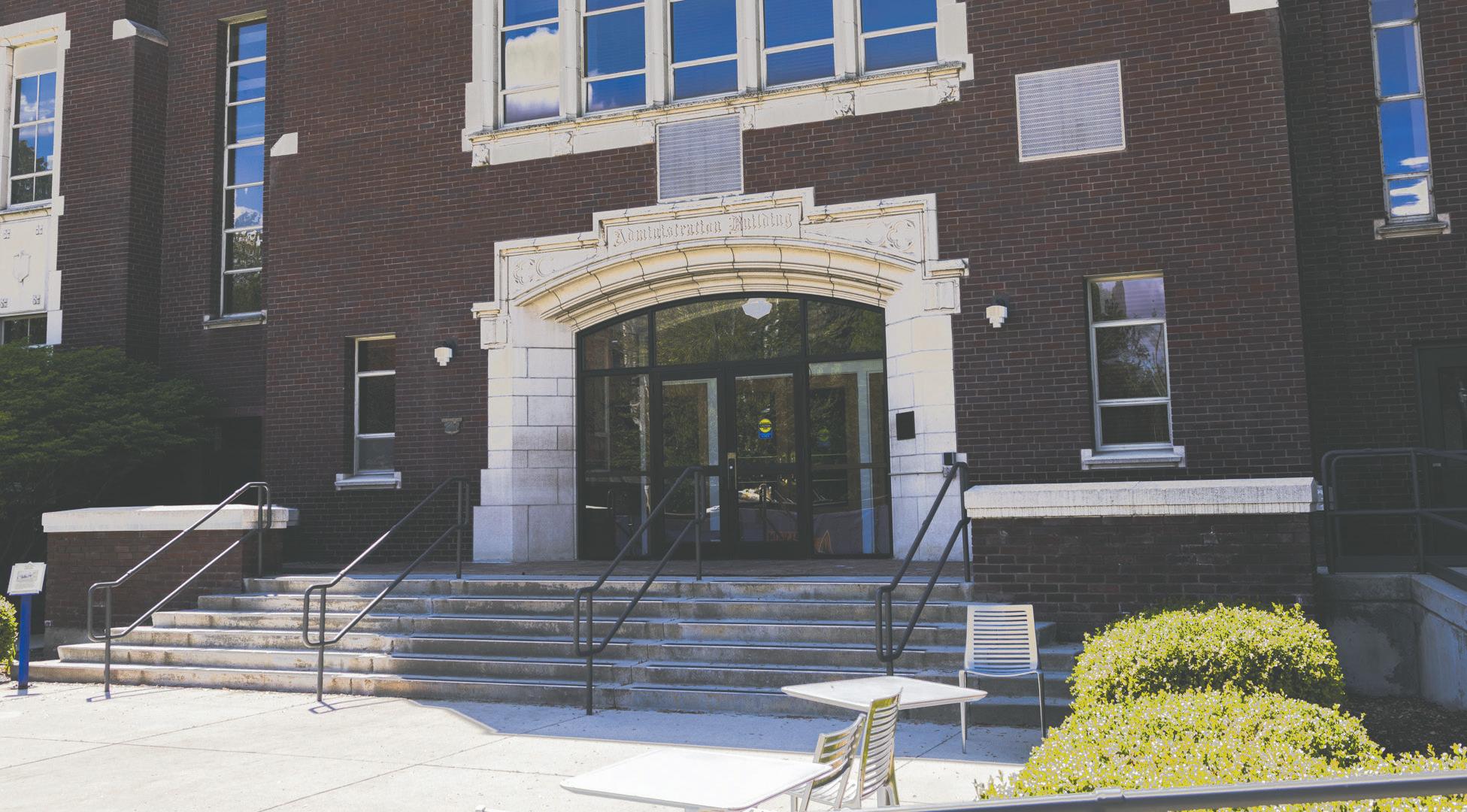
This time last year, The Arbiter provided coverage of the then-recently announced presidential search with a feature titled, “‘What do we want to be known for?: The search for a new Boise State President is now underway.”
Almost a year later, with no president selected and no finalists announced, Boise State is asking a different question: Who is going to lead us?
Tromp announces her departure
On March 20, 2025, at 12:07 p.m., the student body received an email announcing former President Marlene
Tromp was stepping down to pursue the University of Vermont’s presidency.
Several weeks later, it was announced that current Interim President Jeremiah Shinn would temporarily step into the role, beginning May 10.
By July 18, 42 people had applied to be Boise State’s next president.
Behind the scenes, resumes were being forwarded to the search committee by high-profile Idahoans, allegedly including Christian Zimmerman, a spinal neurosurgeon at Saint Alphonsus, Larry Williams, a conservative donor previously involved in the Big City Coffee Lawsuit and Terry Ryan, CEO of Bluum,
according to public records acquired by Idaho Education News.
For students who aren’t following the search closely, it is easy to feel lost in the woods.
“Currently, I feel as though I am not very informed regarding our presidential candidacy,” said Bella Valdez, a freshman nursing student.
“I don’t really know too much about it,” added Cesar Garcia, a sophomore studying electrical engineering. “I know that it’s currently in a state of limbo as Boise State figures out where to go post Marlene Tromp.”
The Arbiter reached out for an updated timeline and was directed to the presidential search website.
With the search reopened to comply with the new guidelines for universities outlined in Senate Bill 1225, the State Board of Education invites new candidates and previous applicants to apply.
SB 1225 outlines that members of the search committee, as well as the State Board of Education, publicly identify a sole finalist ten business days before the final decision is made.
This is a departure from the original process, where five finalists would be
released to the public, allowing students and the media to get to know the candidates.
Representative John Gannon, the only representative who voted in opposition of the bill, believes that the community is entitled to knowing who their university president will be, in the same way judicial candidates are public in nature.
“The application process for [judicial positons] is entirely public, and I wasn’t really seeing why a president of a public university shouldn’t be a public process,” Gannon said. “I just had to side with [this position being a] public office holder in general, and certainly the way we pick our judges. It seemed to me that [this bill] was going overboard.”
In an article from the Idaho Statesman, Sen. Lori Den Hartog confirmed some candidates withdrew their names from the search out of fear of jeopardizing their current position under the previous guidelines.
Updated timeline
According to the website, the application and recruitment period occurred through late March, with first-round interviews happening just weeks ago in early April.
Second-round conversations with semi-finalists are set for late April or early May.
Not unlike the listening sessions from 2025, faculty, staff and student representatives and university leadership will engage in “small-group conversations” with prospective applicants and share their feedback with the committee.
Those participating in those conversations will “sign a confidentiality agreement applicable to the interview process only in order to support a candid exchange of ideas and protect the privacy of candidates who may currently hold leadership positions at other institutions.”
“The president is so far removed generally from the daily greetings of the average college student, we’re not feeling the effects. From the university side, [no president] sends everything into chaos,”
said Oskar Hansen, a first-year student.
The current web page for listening ses sions has not been updated since 2025.
Isaac Celedon explained his responsi bilities as student subcommittee co-chair entail “listening, translating and ad vocating.” Celedon said as co-chair, he identifies themes from student perspectives and communi cates them to the main Search Committee.
“Student input has the most impact in shaping the qualities we’re look ing for in the next president. Students want a president who focuses on things like accessibility, affordabil ity, mental health support and having a leader who is visible and engaged,” Celedon said.
“Student representation in a largely confidential process means being a trust ed voice in the room and making sure student priorities are still influencing decisions even when students can’t see every step.”
Celedon said there’s always room for further transparency efforts with students, but understands the delicate balance of maintaining the integrity of the search.
“It has been a pleasure and honor to represent students and collect their feed back for the next president for the past 13 months,” Celedon said. “The respon sibility to represent students honestly and thoughtfully, knowing this decision will have a lasting impact on Boise State, is something I’ve taken seriously throughout this entire process.”
Despite the not-so-transparent presi dential search, students around campus are buzzing with opinions. Desires such as clear-cut communication from the future president and economic integrity are at the top of wish lists.
“I’d like to see a president who sticks to their word, only to an

students to come next year — then everything crumbles apart,” added Hansen. In search of a figurehead willing to uphold this responsibility, students are passionate about expressing the collective vision of a president serving the campus for years to come, sooner rather than later.
“I’m a student who’s focused on academics and future growth, so those [are] things I value in terms of a president … but at the same time, there are important aspects of community that need to be fostered, whether it be spaces or clubs or other forms of groups that should be incentivized,” Hansen continued. “With this current way that the search is being structured, student decisions are no longer valid.”
Reporting contributed by Jack McEl -
Zaccary Kimes | Opinion Editor | Graphic by Amber Jansson
Public policy is a lot like lawn care.
It takes discipline, attentiveness and effort to balance the needs of not only the grass, but the biodiversity surrounding it to curate a stunning landscape. Right now, Idaho’s front yard is full of weeds and crabgrass with a homeowner who insists on stomping down the blooming flowers instead of addressing the poor conditions.
The 2026 Idaho legislative session ended in early April and with it came flower-stomping bills supporting prejudice towards the queer community in Boise and beyond.
These bills include petty flag restrictions, HB 561, banning Boise’s city hall from flying the pride flag on government property, as well as the infamous bathroom bill, HB 752, criminalizing “knowingly and willingly” entering a restroom that does not correlate with an individual’s sex assigned at birth.
Proposed legislation passed by the house (HB 557) aimed to eliminate discrimination protections for the queer community in Boise by standardizing them for the whole state.
It’s a bit of a headscratcher watching legislation that restricts bathroom usage generate more support than additional funding for public K-12 and university education. That’s like buying a plastic flamingo for a barren front lawn because grass seeds were not as glamorous.
Idaho has several problems in desperate need of attention — the LGBTQ+ community is not one of them. To return to the roots of policy, the legislature must depart from identity politics that only fan the flames of fear and support legislation that addresses the concerns of all Idahoans.
Noah Neumeister, owner of Mullet Proof Hair Co, is a Boise native who witnessed this disconnect grow more prevalent in recent years.
“It was definitely not a surprising thing, unfortunately, but it is a very disappointing thing to see,” said Neumeister in reference to the recent string of anti-LGBTQ+ bills. “Especially with the bathroom bill, knowing that we’ve been arguing about this for years and years, and it’s still something we’re having to fight.”
After being signed into law on Trans Visibility Day, the intent of this bill became even clearer —to generate fear rather than protection.
“I voted against what is yet another bathroom bill based on fear instead of fact,” said Representative Steve Berch in a statement to The Arbiter. “It was opposed by the major state law enforcement organizations as being impractical, if not impossible to reasonably enforce.”
Preposterous as it may be to pass legislation requiring law enforcement personnel to guard every stall like the TSA, supporters of this bill, like Senator Ben
Toews of Coeur d’Alene, argue it ensures the safety of women and children in public and private bathrooms.
“The Legislature has a fundamental duty to protect the bodily privacy and safety of Idaho citizens,” said Sen. Toews, as previously reported by the Idaho Capital Sun.
It seems who deserves this protection is up for interpretation.
If Sen. Toews truly believes in this “fundamental duty,” he should consider that members of the LGBTQ+ community who may experience verbal or physical harassment as a result of this bill are also Idahoans.
The Community Center, a non-profit in Boise, provides a safe space for the LGBTQ+ community. However, some members expressed concern for the effects this bill will have on the transgender community if law enforcement is standing guard.

“It’s just a way of making transgender people afraid they’ll either be harassed or worse, if they go into [the bathroom] the legislature says they should use, or else they face prosecution,” said Nicole Leahy, a board member at The Community Center. “[The legislature’s] entire thinking seems to be, ‘we’re going to paint this small population as predators to create a problem that doesn’t exist.’”
The argument transgender individuals are an inherent risk to the community is baseless and backwards, especially when the opposite is true. A study conducted by the Williams Institute revealed there is no evidence that privacy and public safety are changed by allowing transgender individuals access to restrooms in accordance with their gender identity. Furthermore, if this bill were truly for the public’s protection, it would be accompanied by good-faith efforts to address the very real threats Idahoans face. Ongoing challenges that demand sustained policy attention such as public school funding, expanded mental health services and law enforcement resources fell to the wayside in this session. Instead, legislative energy is disproportionately directed toward regulating a small, vulnerable population, creating the appearance of action while leaving more consequential problems on the table.
“I voted no on all three of those bills [HB 752, HB 557, HB 561] because they burden businesses, overreach the role of state government and unfairly target LGBTQ+ citizens,” said Rep. Megan Egbert in a statement to The Arbiter. “Additionally, none of those bills actually fix a legitimate problem that I’ve heard about from a single constituent.”
This pattern suggests the legislature’s focus is less about comprehensive public safety and more about symbolic policymaking. That same dynamic is evident in other recent efforts, where broadly written bills appear neutral on the surface but functionally target specific communities. Rep. Berch points out how the narrow scope of the recently passed flag bill accomplishes this:
“You know a bill [HB 561] is bad when it tries to ban everything, but its real purpose is to ban only one thing,” said Rep. Berch in a statement to The Arbiter. “That’s the case with this bill, an attempt to ban a city from flying a rainbow flag by prohibiting the flying of any flag except just a few the legislature approves of.”
Berch also noted the “mean-spiritedness” of HB 561, due to the exorbitant $2,000 per day fine that accompanies it. The pettiness this bill originates from perpetuates this kind of rhetoric in Idaho and will result in a state that approves prejudice towards your neighbor because the government made it legal to do so.
“People don’t want to live in a place where it’s spewing hatred and feel embarrassed to be living here,” said Neumeister. “It’s just going to really damage Boise, and if it keeps going like this, Idaho as a whole.”
There’s already an exodus taking root, with one Boise family leaving the state altogether in response to the bathroom bill, but exodus is not a solution — organizing is. Not everyone has the ability or means to leave, so when legislation drifts away from policy to discrimination, it is the duty of the constituents to stand up against it.
Neumeister realized the power of organization firsthand after gathering community members and other small businesses against HB 557. The bill intent on erasing anti-discrimination protections for the LGBTQ+ community died due to community pushback.
“Seeing that things like that can happen with such a small group is really inspiring, and it makes me more confident in the future of Boise,” said Neumesiter. “It’s a place that I do cherish, and I do cherish the people around here, so I choose to stay and fight for that.”
Our legislature insists on stomping down a blossoming community, therefore it’s our role to be the wildlife that defends it. All Idahoans deserve a legislature that addresses the crabgrass and plants grass seeds so we can curate a yard that we are proud to be a part of.
Rebecca Kay | Guest author
My name is Rebecca Kay. I am currently a non-traditional student representative in the Associated Students of Boise State University (ASBSU) and I ran for President of ASBSU and led a team called The Stallions in the last election.
Recently, Carson Cole and Maddy Riley were elected as President and Vice President of BSU’s student government from The Charge team. It is my belief that The Charge lied, cheated and participated in cyber bullying during the election. I believe the student body deserves to know what was happening behind the scenes during elections
There is an overwhelming amount of evidence that The Charge broke election code repeatedly to gain an unfair advantage in the election. They campaigned in classes during class time, in an academic building and before the designated campaigning time. However, none of the matters were handled formally via a review of evidence and a discussion with the person who filed the complaint.
I filed a complaint with the ASBSU Review Board on March 31 after The Charge came into one of my classes and spoke during class time, which is a violation of the Elections Code. I had video evidence of the infraction, along with an appropriate time stamp of class being in session. On April 1, I received communication from the Review Board Chief, Gavin Verandes, which stated that the complaint would be handled informally.
As a candidate for elections myself, I was watching the situation very closely. On the second day of election campaigning, I heard some mean comments against the Trailblazers and the Stallions appearing on the Boise State YikYak. This anonymous forum allows individuals to post comments about their university, and is only available to iPhone
users.
Since I do not have an iPhone, all of my information has come from people on my team and on the Trailblazers. I was told a user commented that myself and my Vice President, David Bru, were ugly. One replier commented with the barf emoji, and someone mentioned that David needed a haircut.
Almost all of the harmful comments were directed at the Trailblazers and the Stallions, with very few negative comments about The Charge. It was abundantly clear The Charge and their affiliates were leading the YikYak barrage of posts. Anything positive related to The Charge often had hundreds of votes, while things against The Charge were down voted.
With YikYak being anonymous, nothing could be done by the University. The commenters could not be held accountable without direct evidence. Still, two members of The Stallions resigned because of the negative comments. It was very disheartening to see motivated individuals who wanted to make a positive change at the University resign for this reason.
The students have a right to know who they elected to represent them.
The Arbiter welcomes guest opinions on issues relevant to the Boise State community. Submissions must be 500 words or fewer and are subject to editing for clarity, length and style.
Guest opinions represent the views of the author and do not reflect those of The Arbiter. Responsibility for the accuracy of claims rests with the author.
To submit, email opinion@stumedia. boisestate.edu
april 30, 2026
Julianna Kelsey | Culture Editor | Photos by Omar Saucedo, Graphics by Naomi Brown
The film industry is notoriously hard to break into. For decades, the belief that making high-brow connections in Hollywood was the only way to establish a film career has discouraged many students from pursuing their passions for film.
In Idaho, it may seem nearly impossible to find opportunities to work on film sets. However, the Film and Television Arts program at Boise State is working to change that.
That’s where the Short Film Lab comes in.
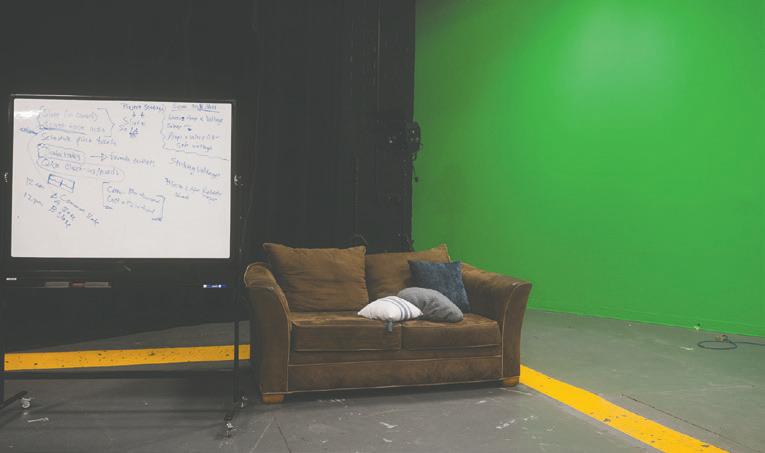
While film students work on several smaller projects throughout their education, the Short Film Lab elevates the student film experience. Over the course of four semesters, students work in teams across all stages of the production process to get immersive, handson experience in a more professional production environment.
“Essentially, we try to imitate what you’d experience in Hollywood,” said Darius Dawson, award-winning director and professor in the film department. “We’re trying to imitate what students will eventually experience in the industry as closely as possible, so when they graduate and go into the industry, they’re prepared.”
The program is an evolution of a previous program where students created television pilots. Film and Television Arts faculty wanted to take the program
a step further, allowing students to create standalone projects and make the most of their film education.
After two years of the Short Film Lab, the inaugural films of the program will premiere at the Spring Student Film Showcase on May 7. As those films near their premiere dates, other students are preparing to shoot the next batch — a continuing cycle allowing each generation of students to get valuable handson experience and create films they are proud of.
The first step in this four-semester process is a course titled “The Writers Room.” In this class, students write original scripts for short films, of which only three are chosen to be produced.
Madeleine Cunningham, a senior studying Narrative Arts, wrote a script in The Writers Room called “Beyond.” Her film centers around an afterlife caseworker whose last case before retirement refuses to cooperate. In the final weeks of The Writers Room, as scripts were narrowed down, other students joined Cunningham to collaborate on the drama-comedy screenplay.
“In this very collaborative project, two other people came on and each had their own different views and ideas to add to it,” Cunningham explained. “It really helped to create a very interesting and dynamic script for us to produce.”
For students like Cunningham whose scripts are chosen for production, the support and validation of their profes -
sors and classmates is rewarding.
“I had a lot of support from the film department, and as we moved forward, it became very exciting and a very big learning process for all of us,” Cunningham said.
The students whose scripts are not chosen don’t miss out on any opportunities. All of the students in the Short Film Lab program get to move on to the next course, where they learn all about pre-production.
There are several departments for students to work in as they prepare and shoot each film. Students can work in directing, producing, cinematography, costuming and art.
Hunter Haubert, a junior studying Film and Television Arts, was asked to be the producer for Cunningham’s short film. As a producer, he worked alongside Cunningham and all the different departments to prepare for when they shoot the film in May.
“I got to see multiple drafts of this come to life, and now seeing [Cinnungham’s] most recent and finalized scripts, it’s fun to see her journey and how she’s brought this to life,” Haubert said.
Haubert secured shooting locations, worked with the budget, helped with casting and more. As the team prepares to go into production over the summer semester, Haubert is looking forward to seeing the vision come to life.
“The most exciting part about making a film is actually seeing the final product,” he said. “Production is probably my favorite part of making a short film. To be honest, I love just being there and seeing everything unfold.”
The next batch of short films from the program will be filmed throughout May, as the production course takes place over the summer. Each of the three films held open casting calls so students interested in acting could also be involved.
Brady Love, a junior studying Film and Television Arts, will direct his short film for the class called “Who’s Gonna Save Steve?”, a drama-comedy about a man who wants to become a local superhero for the city of Boise.

As a director preparing for production, Love has worked in casting, finalizing the story with other departments and ensuring everyone is on the same page.
For Love, the ability to collaborate with peers and the funding and support to really make something great has been exciting.
“Everybody is super dedicated,” he said. “It’s people in the film program who really want to make things, and they don’t really care what it takes to get it done. I could present a really crazy idea to my crew, and everybody’s always like, ‘Yeah, let’s do it.’”
After the three films are shot during the summer production course, students will move on to the post-production class in the fall. There, the films will be edited into their final cuts before they are showcased and students submit them to festivals.
Love explained creating a high-quality short film with a team offers tangible rewards for those looking to break into the industry.
“It’s hard in the industry to get more work, especially [right after college], because a lot of the stuff they see isn’t really your best work because of the circumstances of being a film student — short shoot days or no budget,” he said. “This movie is great because everybody can put their name on it, and if it goes to festivals, it could be an opportunity for us to get more work and work our way up to bigger projects.”
The instruction and support students get from the Short Film Lab professors is also highly valuable to students. While they get creative freedom in a professional setting, they also get to continue learning from those with more experience.
“It was like having the professionals there, the people that have been doing this their entire lives, there to pick you up if you fall down,” said Grace Galvan, a recent graduate who will be working on a Short Film Lab production over the summer. “They’re literally just an email, a text or phone call away.”
Galvan said the program allows students to truly immerse themselves in what working on a film set looks like. She said the experience gives students the knowledge necessary to step into those roles on bigger projects in the future.
“It was a great experience, because you’re taking the student film aspect, and then you’re merging that into a professional area,” Galvan said. “It’s the next step before you leap into full professional filmmaking.”
According to Dawson, teaching in the Short Film Lab program is an opportunity to let students figure out who they want to be as future film professionals.
“Existing in the industry is all about finding where your voice belongs,” Dawson said. “It’s a big task to figure out where exactly your voice should land.”
“In this environment, it’s like you get to experience what it feels like when you do find where your voice belongs,” he continued. “When you have the support of the faculty and feel supported, I think you create better work.”
Dawson said the short films students create in the program can be “calling cards” for those who are looking to break into the industry, reminding future film professionals that they do not need to live in Los Angeles to find success.

“If you’re creating projects and finding out where your place is and where your voice is going to be appreciated, you could be anywhere in the world and have a successful film career.”


From dorm room experiments to a thriving business, this alumna is making her mark with hand-poked tattoos.
Isabella Williams | Culture Reporter | Photo by Keara Antonelli
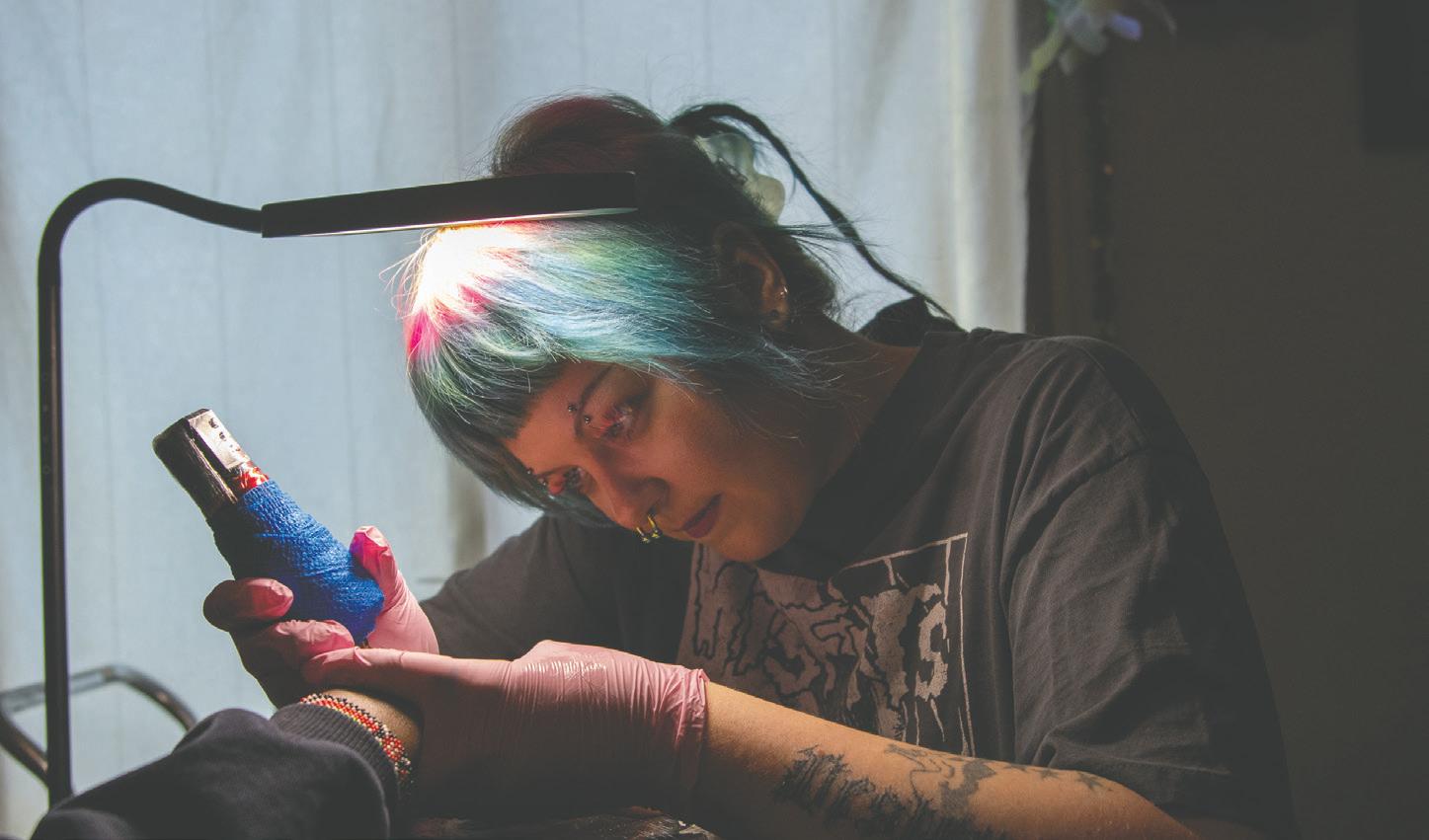
When Ivy Hunter first tried tattooing, it wasn’t part of a long-term plan. It started casually in a Boise State dorm room with a curiosity sparked by a hand-poked tattoo she received from a friend.
Now, the Boise-based tattoo artist and alumna has built a growing business rooted in custom design, collaboration and a style that blends softness with intention. Known for her creative, nature-inspired work and hand-poked designs, Hunter has become a recognizable name in Boise’s ever-evolving tattoo and art community.
“At a certain point, I had to ask myself what I was going to do with my degree,” Hunter said. “Tattooing just made so much sense.”
Originally from Portland, Oregon, Hunter moved to Boise in 2018 to study fine arts. At Boise State, she explored a wide range of mediums, taking classes in
everything from art history to sculpture and time-based media. Hunter said her educational experience shaped the way she approaches tattooing today.
“It gave me a really broad sense of the art world,” Hunter said. “Nothing is set in stone. Art can be anything.”
That openness translates directly into her work. Hunter describes her personal style as “whimsical, feminine and organic,” often featuring plants and animals. Each piece is usually developed in collaboration with her clients and fully customized.
“It’s a lot of back and forth,” she said. “Sometimes people don’t know exactly what they want, and it’s fun to help bring that to life.”
For clients like Audrey Dorosh, a student who has been getting tattooed by Hunter since 2022, the collaborative process is what sets Hunter apart.
“When you share ideas with her, she
adds her own spin in a way that makes it even better,” Dorosh said. “The whole experience is so comfortable. It feels so calm and personal.”
Hunter’s journey into tattooing became more intentional during her junior year at Boise State, when she began thinking about how to turn her art into a career. After practicing on herself, friends and even fruit early on, she decided to take the leap, officially launching her business, Poked to Pieces, in 2022.
Since then, Hunter has steadily built her clientele and continued participating in Boise’s broader creative scene. She’s tattooed at pop-ups, art shows and events, often working in fast-paced environments that demand both precision and adaptability.
That ability quickly stood out to organizers at BNDRY, a local creative collective known for hosting immersive events.
“Working with Ivy at events was always a blast and a breeze,” said Collette Raptosh, BNDRY Director of Operations and Events. “Things in Boise can move really fast, and she was always ready to jump in.”
Beyond her technical ability, Raptosh said Hunter brings a distinct presence to every space she works in.
“I see her involvement as a trustworthy stamp of approval, because she’s genuinely discerning about where she puts her time and effort,” she said.
That same energy carried into other collaborative spaces as well. At a local art show, artist Penelope Frizzell saw firsthand how Hunter balanced technical skill with genuine enthusiasm.
“Ivy tattooed so many people and continually had a smile on her face,”
Frizzell said. “You can tell she loves her craft. She gets genuinely excited about people’s ideas.”
Beyond individual events, Hunter remains closely connected to Boise’s larger creative network. She described the local tattoo scene as supportive and increasingly diverse, with more independent women and queer artists carving out space in the community.
“There’s not really that sense of competition,” she said. “Everyone’s just doing their own thing and supporting each other.”
Still, the work behind the scenes is constant. Running a tattoo business means balancing design, communication, scheduling and promotion, often all at once.
“You’re basically working constantly,” Hunter said. “If I’m not tattooing, I’m drawing, emailing or doing administrative stuff.”
Despite the busy schedules, she said the flexibility and creative freedom make it worthwhile. Working one-on-one allows her to build meaningful connections with clients while creating something permanent and personal.
“I want to be somewhere people can come and feel good,” she said. “A place that’s creative and welcoming.”
Looking ahead, Hunter is focused on growth. After several years in Boise, she plans to eventually return to Portland, where she hopes to expand her business and potentially open her own studio.
For students and aspiring artists, her advice is straightforward.
“Just go for it,” she said. “Even if people doubt you, you never know where it could lead.”
Emily Carmela Nelson | Editor-in-Chief | Photos by Omar Saucedo
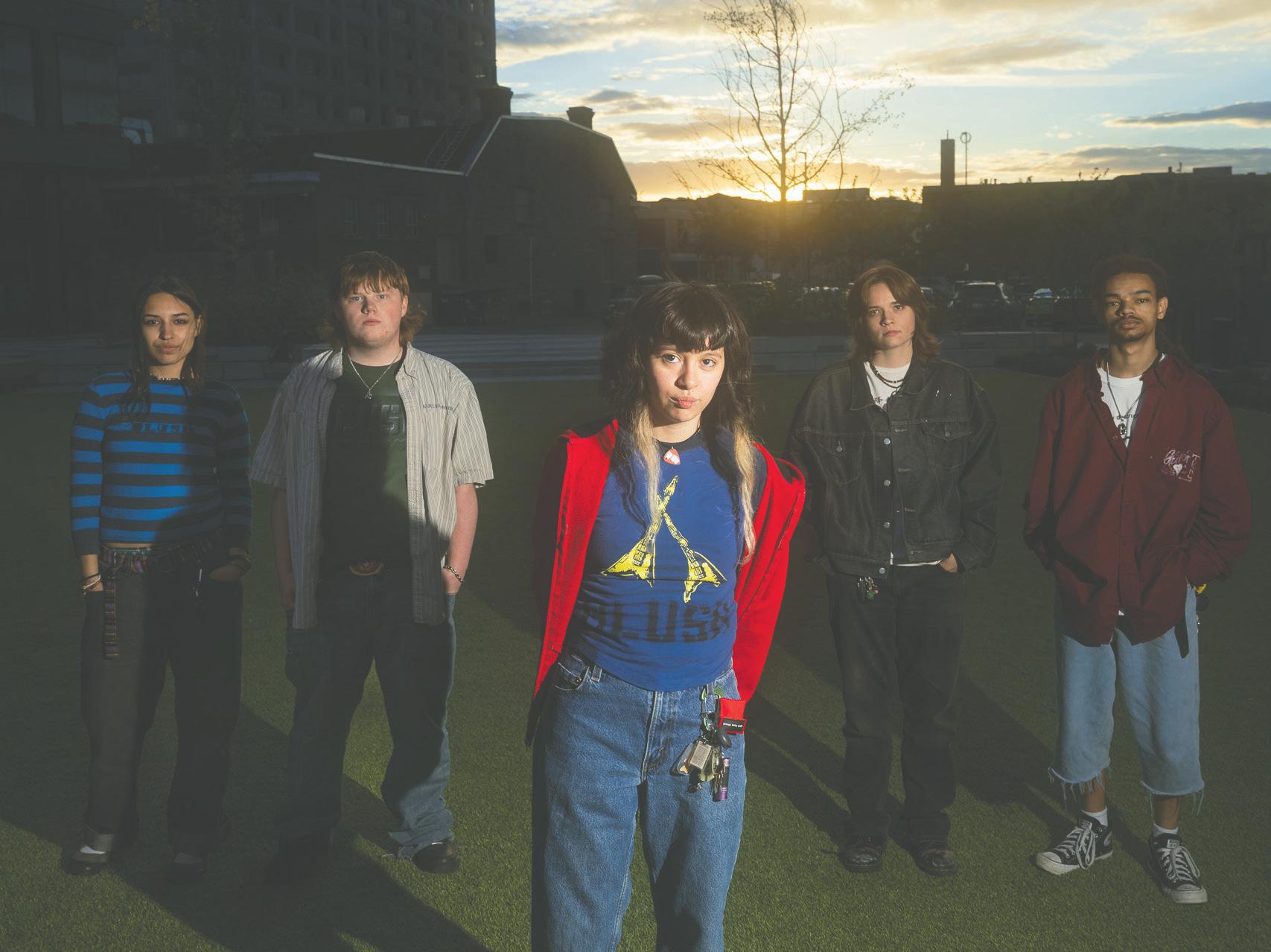
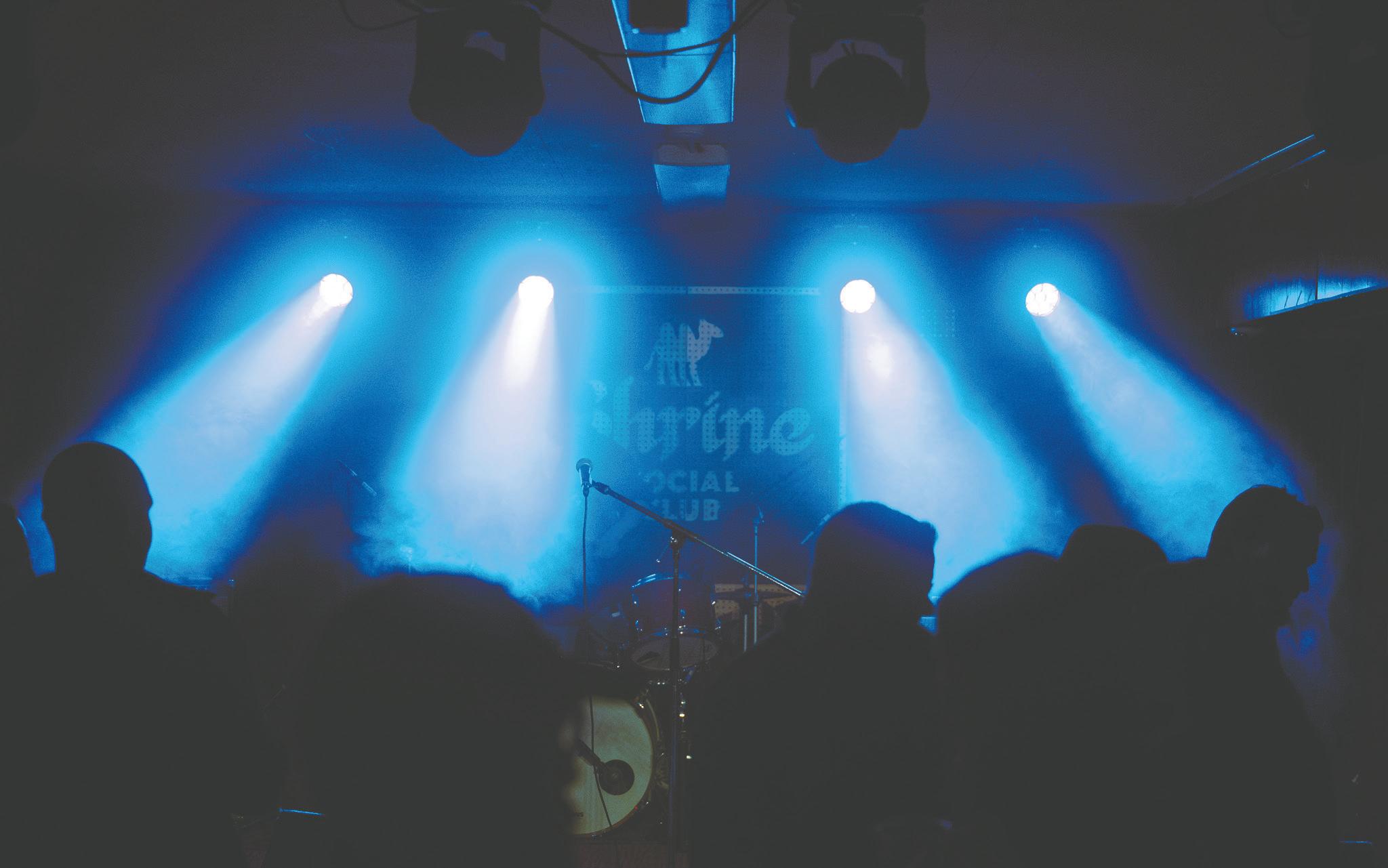
Born out of a high school rock band class and now echoing through the basement of the Shrine Social Club, Blush isn’t interested in sticking to one single sound.
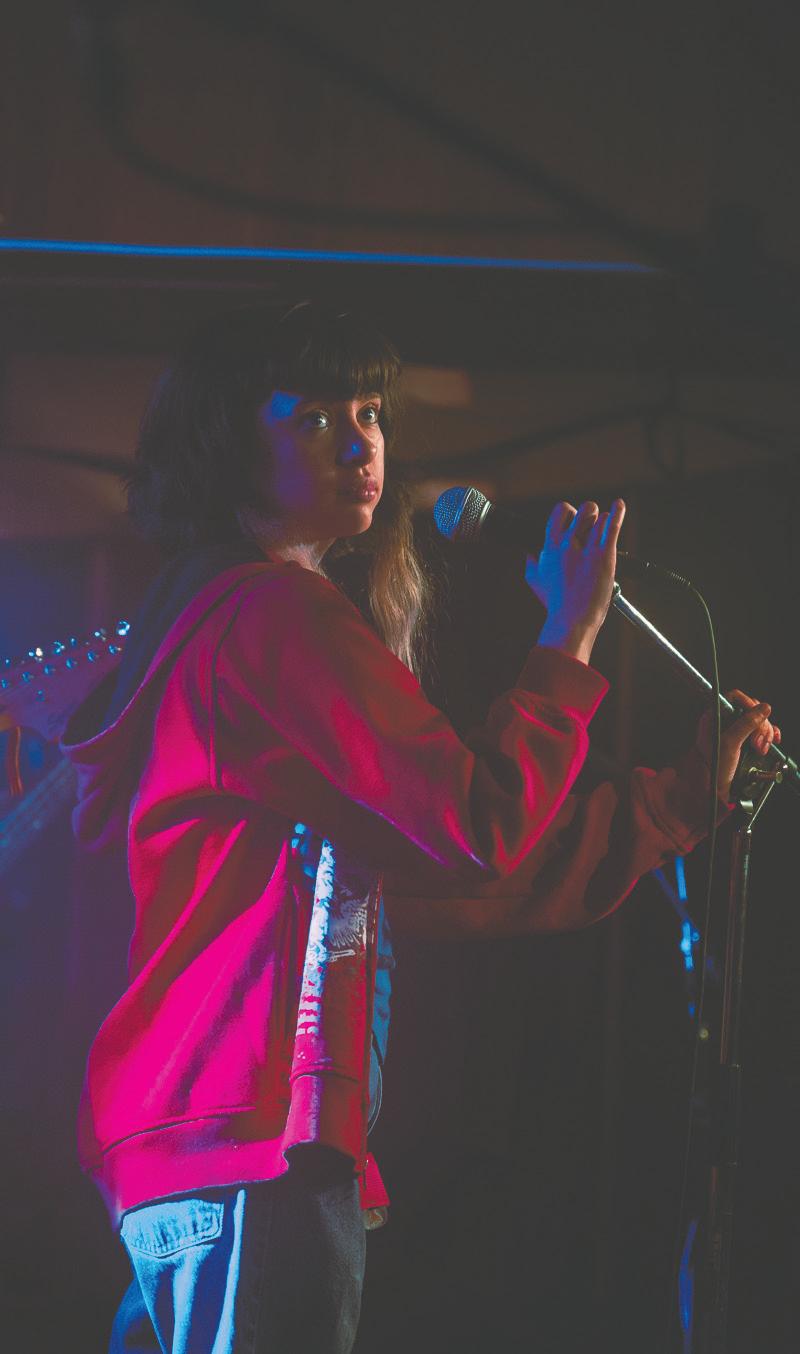
At their latest show, the Nampa-based, student-led group flowed between indie rock, punk and heavier influences with a magnetic stage presence.
Made up of vocalist Emi Cornejo, drummer Tristan Moncrief and guitarists Savannah Trehal, Corbin Ker and Moriya “Momo” Ballantyne, the band has spent the past year growing from house shows to playing stages like The Shredder and even opening Treefort Music Fest.
Blush’s body of work feels like a collection of unique sounds. What would you say is your biggest inspiration when it comes to making music?
MONCRIEF: Any newer bands that are popping up — Midrift, First Day Back, Narrow Head — all those kinds of different, indie or alternative bands coming in. When I’m coming up with ideas, I take bits and pieces from each of those and mix them to bounce between genres.
BALLANTYNE: A lot of my inspiration comes from ‘70s music, specifically for bass parts. It’s more intricate, melodic and rhythmic. I always strive to do that instead of just having root notes for eighth notes.
KER: I pull inspiration from a lot of weird places. I like This Heat a lot, their guitar parts sometimes don’t even sound like guitar, which I really love. That’s definitely seeped into our sound. How would you describe your relationship to one another and how that shows up in your creative process?
BALLANTYNE: Because we didn’t start off as a band first — we were all friends beforehand — I think we’re all pretty chill with each other. Nothing feels too pretentious. Creatively, Corbin or Savannah usually set the bass ground -
work. They or Emi will have lyrics ready, and we all kind of mix it together in the moment.
TREHAL: We have all such unique music tastes and unique ways that we do things. It’s almost like a cake, we just layer it. Someone comes up with a riff, it could be literally any of us and someone else comes up with lyrics, or sometimes we all come up with different parts. In our music you can hear the different layers, because we’ve got such different personalities. Emi has a very unique way of writing lyrics and singing, and Moriya has a completely different approach.
MONCRIEF: When I joined the band, I had no experience with drums whatsoever. I made beats on a drum pad, which is not the same thing. I had some experience composing music and mixing, but one day in 2024, Savannah was like, ‘Do you want to try and jam on drums with us?’ And I was like, ‘Sure, I don’t know what I’m doing, but I’ll give it a shot.’
KER: When we added Tristan and Moriya to the band, it was a really explosive experience. It really came together when we made the song “Pulga.” That was the first song we all wrote together and all had a creative take on. When we heard the baseline, it gave us chills. You’ve played a variety of shows, from the Treefort Trolley to University Pulse’s All Hallows’ Pulse event. What is your favorite part of performing together as a band?
TREHAL: When you have a good performance, that feeling after is just like doing drugs, almost. Experiencing that as a group, and being in a good ass mood laughing together, is my favorite.
CORNEJO: It’s been really cool seeing us gradually improve and almost build a following. I love the connections I’ve made with people through music. I’m not a very social person, but it is really nice to feel like I’ve met a lot of people I would not have had the chance to even talk to through this.
KER: Our first time playing a show in front of people went so bad — the sound guy was messing with our vocals and we were sweating out of pure fear. Going from that to then, pretty much a year later, playing the first show of Treefort is so sick.
BALLANTYNE: Our bond together when we’re on stage is so beautiful. We go through basically the same thing. If we mess up, we all know we mess up, but it’s like a little secret between ourselves. The band makes us even better friends.
MONCRIEF: Seeing the progress we’ve made. We started out playing really small venues, in houses for the most part, and then it turned into a small record shop. Now, we’re playing at the Shredder and the Shrine and we even played Treefort. That is what’s satisfying to me. To do that as a band as well, it’s all the better for me.
Isabella Williams | Culture Reporter | Photo by Omar Saucedo
If you’ve been to a local concert in Boise recently, you’ve probably noticed that the music scene feels bigger than ever. Between packed venues, festivals and more local artists popping up, it’s clear something bigger is happening in Idaho’s music world.
The problem is, no one actually knows how big it is. That’s where the Idaho Music Census comes in.
The census is part of a larger research project called Amplifying Impact, an initiative focused on studying Idaho’s creative industries and using data to understand how to better support them. The project looks at how music and other creative fields contribute to the state’s economy, culture and community development.
“It’s the first kind of project in the state of Idaho to collect data through surveys of businesses and music creatives,” said Shavonne Bostaph, a student researcher involved with the project.
“We’re trying to better understand the economic and cultural impacts of Idaho’s music ecosystem as a whole.”
Compared to many other states, Idaho still lacks a clear, data-driven understanding of its music industry. Without that information, much of the conversation so far has been based on observation rather than evidence.
“There’s no economic data. There’s no demographic data,” said Matthew Wordell, another researcher involved in building the census. “Up until this point, it’s all anecdotal … this is an attempt to create something empirical.”
To change that, the survey asks a wide range of questions designed to capture what is going on behind the scenes in the state’s music community.
Some of those questions get into financial reality, like how much artists are earning and why so many creatives struggle to make a living working in music.
“Why does it seem like music creatives can’t afford to pursue their work full time?” Bostaph emphasized. “Why do they have to work multiple jobs just to support themselves?”
Other questions look at audience behavior, local venues and which parts of the state are seeing growth in their music communities.
Another major goal of the census is to understand what support is needed for music outside of the city, where oppor -
tunities are often limited and less visible.
“We’re trying to figure out how we can stimulate areas like Moscow, Pocatello, Twin Falls,” Bostaph said. “Places that don’t necessarily have the same reach or influence as Boise.”
That gap is something many Idaho musicians already feel. In smaller cities, venues can be incredibly limited, and opportunities can be harder to come by.
The Idaho Music Census reflects that reality by not limiting its focus to musicians.
“Honestly, anybody in Idaho should take the census,” Bostaph said. “If you go to shows, if you’re a business owner, if you teach music … it all impacts the ecosystem.”
Vanessa Fry, a Boise State faculty member and the project’s principal investigator, said the census is built on long-standing collaboration between several key groups in Idaho’s music community.
“We’ve been engaging in some way shape or form in different types of collaboration between Duck Club, Treefort and the university for many years,” Fry said.
She explained that those participants have helped shape many projects like this, bringing together academic research and real-world music industry experience. That mix of perspectives allows the census to move beyond individual stories and into a broader understanding of how Idaho’s music landscape actually functions.
“It’s a way for us to see what’s going well, what the challenges are, the opportunities are to address those challenges and help scale the work that they’re already doing in the state,” she said.
The end goal is simple: turn lived experience into measurable data that can help shape the future of Idaho’s music industry.
Julianna Kelsey | Culture Editor | Photo by Julianna Kelsey
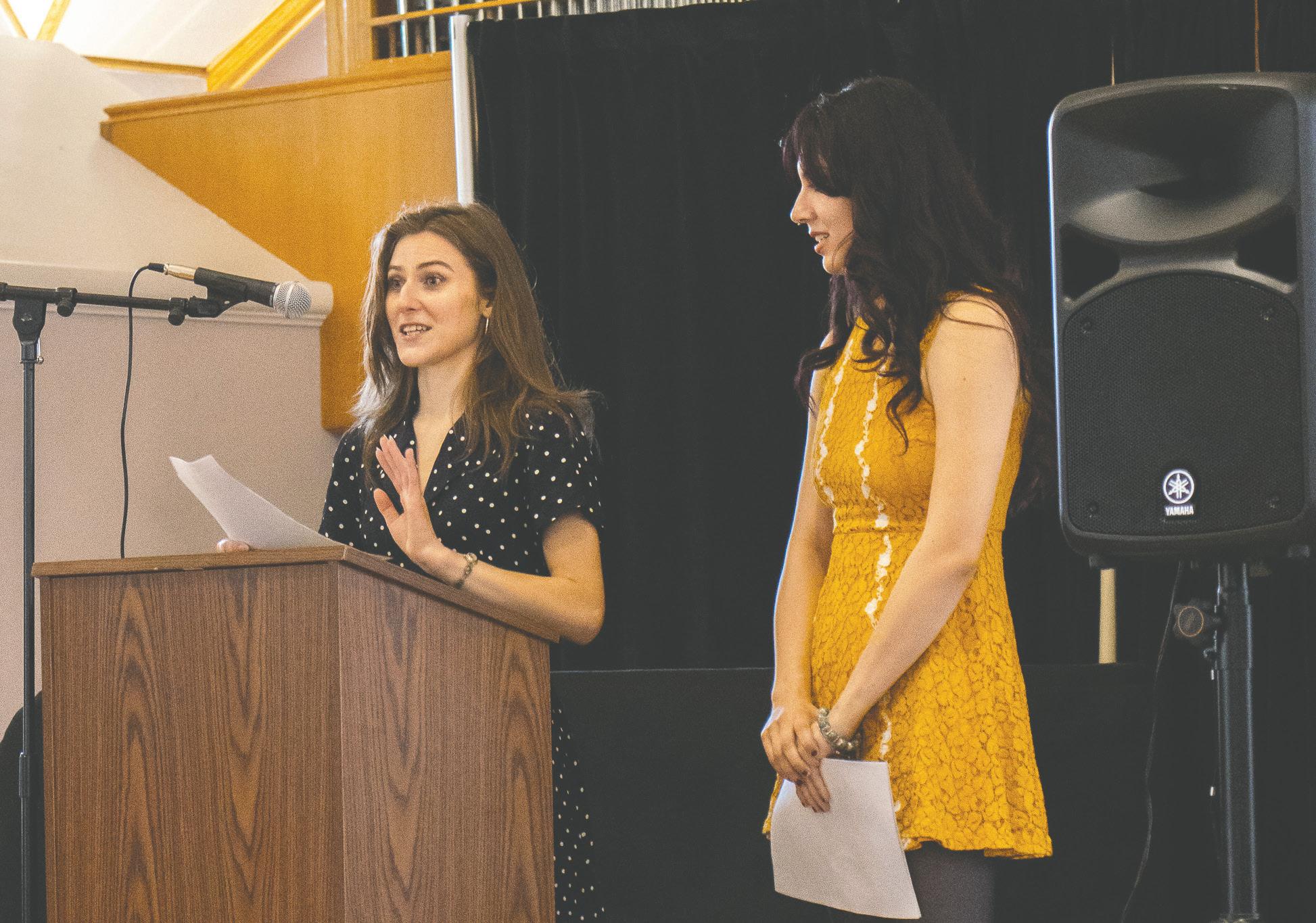
Aquiet reverence echoed through the main hall of the Hemingway Center as a crowd of more than 50 people gathered on the peaceful Sunday afternoon to soak in the works of Boise State’s emerging writers and celebrate the revival of a little-known Boise State literary tradition.
They had gathered to commemorate the release of Bitterbrush, a literary magazine publishing the poetry, fiction and nonfiction works of undergraduate students. At the reading, several of the published writers took to the stage to read their pieces aloud to the audience.
“There are a lot of really talented undergraduate writers at Boise State,” said Grace Nunamaker, a student studying poetry and one of the magazine’s editors. “We wanted to limit [Bitterbrush] to just undergrads to make sure there’s an equal opportunity for everyone in Creative Writing and other majors to demonstrate their talent.”
This year’s edition of Bitterbrush, penned “The Screech Owl” issue, features fifteen undergraduate writers, each of whom submitted unique works ranging from lyrical poems to short stories and personal essays.
The idea of Bitterbrush isn’t exactly new. In fact, according to Nunamaker, this literary magazine was originally started in the late 90s or early 2000s, but information about its origins is hard to find. No remaining copies of the original Bitterbrush magazines can be found, making it a publication lost to time. However, its memory has lived on through those in the Creative Writing scene who remember its existence.
“This has been an activity at Boise State for 20 years now, in a very technical, sputtering on-and-off kind of way,” said Lewis Millholland, another editor of Bitterbrush and graduate student at Boise State.
Decades later, in the spring of 2025, alumna Kira Compton decided it was time to bring the forgotten publication
back to campus. Compton revived the modern Bitterbrush, planning for it to be a one-off project.
In spring 2026, three current students set out to not only continue what Compton had started but also create something more permanent out of it. Nunamaker, Millholland and Adrianna Monsivais, another editor of Bitterbrush studying fiction, aimed to turn the magazine into an annual collection of undergraduate student work for years to come.
“We are trying to really bring it back from the far past for it to be an annual thing again,” Nunamaker said.
The trio began brainstorming the magazine’s logistics back in the fall semester, months before they put out the call for submissions. According to Nunamaker, starting a literary magazine was “challenging,” but the path carved out by Compton and previous generations of “Bitterbrushers” made it easier to navigate.
“It was nice to have the knowledge that there were students, even if I don’t necessarily know them, who did this before and were able to keep this going,” Nunamaker said. “It helped me to feel more confident that the three of us could make this a real thing.”
“It feels very cool that we get to do this as students and build our own door when it comes to opportunities for publication and getting experience,” Monsivais added.
The team opened up submissions to all undergraduate students in February, and works were chosen through an anonymous selection process throughout March. Monsivais said they didn’t want to place strict parameters on what students could submit, so there weren’t any specific themes for submissions — just a word count limit.
The three editors put a great deal of time and energy into the selection process, hoping to make the experience positive for everyone who submitted,
whether their work would be chosen or not.
“I continue to be surprised at how much care I feel and how much responsibility I feel, in a positive way, to treat everything that everyone is submitting to us as a gift and as something they’re opening up to us,” Nunamaker said. “It’s very difficult to do this and to not get emotionally invested in it, because you really do want every piece to be the one to succeed and to thrive.”
After selections had been made, the team focused on generating buzz for the magazine, placing fliers around campus, highlighting their writers on Instagram and preparing for the reading in April. One of the most exciting parts of the process was the creation of the physical copies of Bitterbrush.
The simple title sprawls across the front cover, a colorful swirl of landscape painted behind it. The cover art, created by Shannon Castor, sets the tone for the flowing, dramatic display of written work held within the magazine’s pages. For those who were unable to attend the reading and get their hands on a physical copy of Bitterbrush, all of the works featured inside can be found on the publication’s Substack page, giving the writers the opportunity to reach an even wider audience.
“It takes a lot of vulnerability to take your poetry, your prose, and put it out into the world like that,” Millholland said. “Everyone who has contributed to this magazine has taken that courageous step.”
At the reading, the three editors expressed their gratitude that so many wanted to be involved and encouraged those interested to get involved next year as well.
“This would not exist without everyone that was willing to be courageous enough to put their work out there,” Monsivais said. “It was so rewarding to see what kind of a literary community we have here at BSU.”
Jake Zamora | Sports Editor | Photo by Keara Antonelli
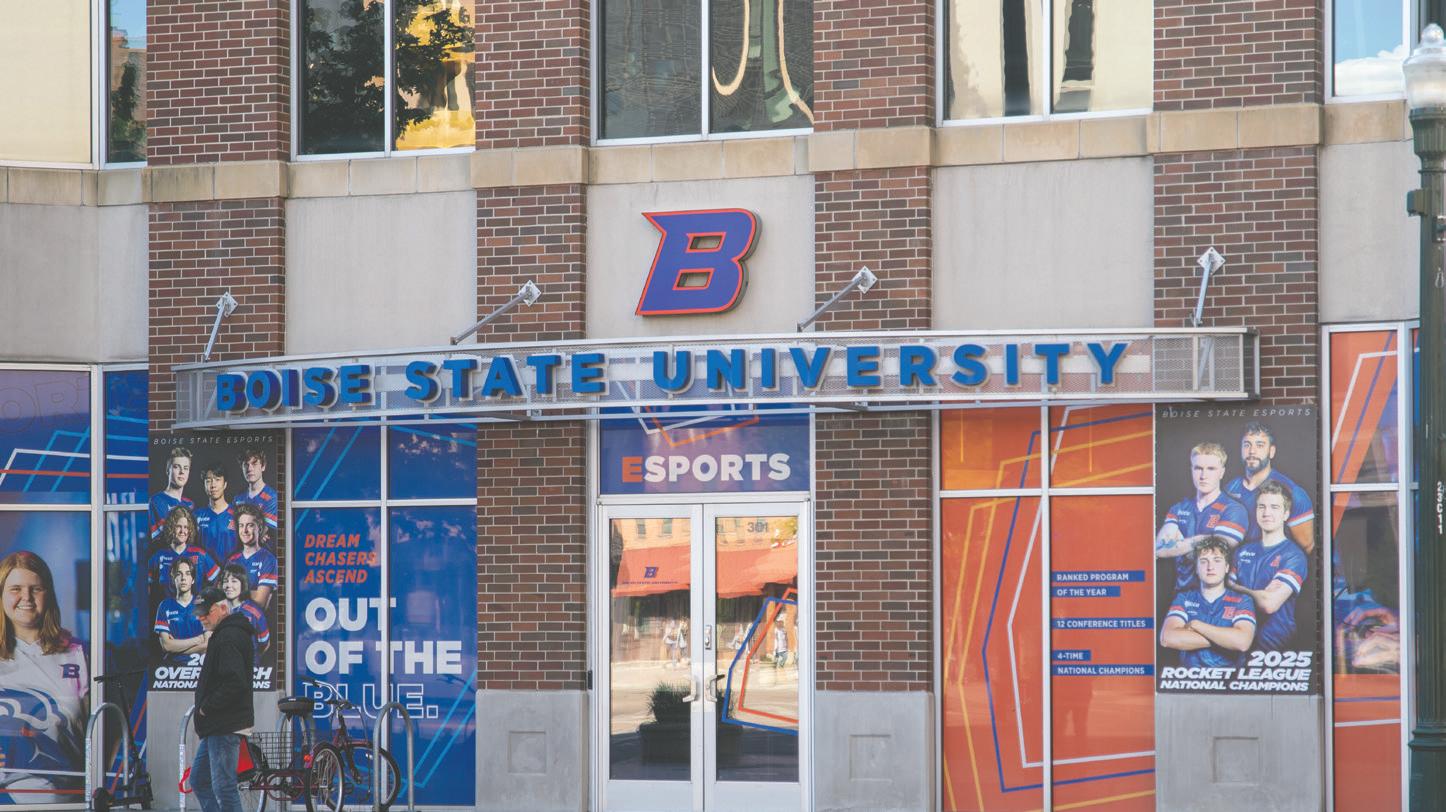
The resume of Boise State’s nine-year-old esports program simply speaks for itself.
15 conference championships, seven national titles, over 1,500 wins, all captured since the program was founded in 2017 by head coach Doc Haskell. Competing across five different titles, the program has established itself as one of the most successful esports programs in the country since its launch.
Now, through the newly announced Champions Club initiative, fans can directly invest in Boise State Esports and contribute to the growth and expansion of the program, all while securing perks and benefits of their own.
The club offers fans and alumni a unique way to support and engage with the team. Through annual philanthropic contributions, donors receive benefits associated with their membership level, which is determined by the amount of their annual contribution. According to the athletic department, the contributions will “support team travel, championship competition, and long-term program growth while creating expanded opportunities for current and future student-athletes.”
The Champions Club represents the first initiative of its kind in college esports. With fan support as a long-standing cornerstone across all Boise State sports, the club now allows supporters to directly impact the program while gaining access to unique experiences and special rewards.
“Champions Club is elite, the first in collegiate esports. But what else do you expect from bar-raisers?” head coach Doc Haskell said. “Fans have always been the difference and now they can help bring even more champions and championships to Boise State. I’m fired up.”
Membership of the Champions Club starts at $25 annually. This entry-level membership, known as the Blue level, includes exclusive Boise State merchandise, a subscription to an esports newsletter and access to unique social events. A $100 contribution, known as the Orange level, or the “Engaged Supporter” level, comes with a player video message and a Boise State esports merchandise pack featuring rare, limited-edition items and collectibles.
The next tier, known as the White, “Committed Supporter” level, requires a $250 annual contribution. This is where the perks begin to stand out. Committed supporters receive access to an exclusive team meet-and-greet, along with a significant discount on rentals of Boise State’s esports facility, which the program offers to anyone looking to experience video games in a state-of-the-art facility.
The $500 Leadership level, which gives members access to the esports “Leadership Circle,” includes pre-game access to the stage that the team plays on, essentially, an on-field pass.
The highest tier, the Elite membership level, requires a $1,000 contribution and brings the most eye-opening perks: A reserved seat at every Boise State Esports home match, along with a cutout of themselves for matches they can’t attend, similar to what Major League Baseball did during the shortened 2020 season when fans couldn’t be at games in person.
The new initiative further establishes the Boise State esports program’s reputation as not only one of the most successful in the country, but one of the most innovative.
“Once again, Boise State Esports is competing and winning on a nation -
al stage,” Boise State athletic director Jermiah Dickey said. “The Champions Club allows Bronco Nation to directly impact that success by expanding access, enhancing their experience, and positioning the program to continue leading the way in collegiate esports.”
Over the last near-decade, leading the way is exactly what Boise State has done.
As esports has evolved over recent years into becoming nationally recognized across many schools in the U.S., the Broncos have been at the forefront. Boise State was among the first universities to embrace competitive gaming and establish a Division I esports program.
They’ve also dominated the playing field, winning seven national championships, with their most recent coming on April 12 when they won their first Valorant national championship in program history at the Power Esports Championship in Las Vegas.
Competing and training in a 7,000 square-foot facility in downtown Boise, the Broncos compete across five titles, including Overwatch 2, Valorant, College Football 26, Rocket League and
Super Smash Bros. The facility features a competition arena, training space, and a high-performance broadcast studio from which the program’s media team produces over 30 hours a week of content.
Riley Boyd, the business development coordinator for the program, holds high praise for the Boise State athletic department and the opportunities they’ve been able to provide for a successful and established, yet still growing, esports program.
“We have some really good support systems here now,” Boyd said. “Our athletic department is phenomenal at making sure that we feel like we’ve got what we need.”
“People like Cody Gougler, who have helped us be able to work with clients to give them really cool experiences. People like the business office, who are making sure that our business ops are streamlined. People like Anthony Travel, who are helping us do really cool things [and] making sure our players are getting where they need to be. All those different things have made our lives a lot easier.”
Aidan Mattingly | Sports Reporter | Photo by Omar Saucedo
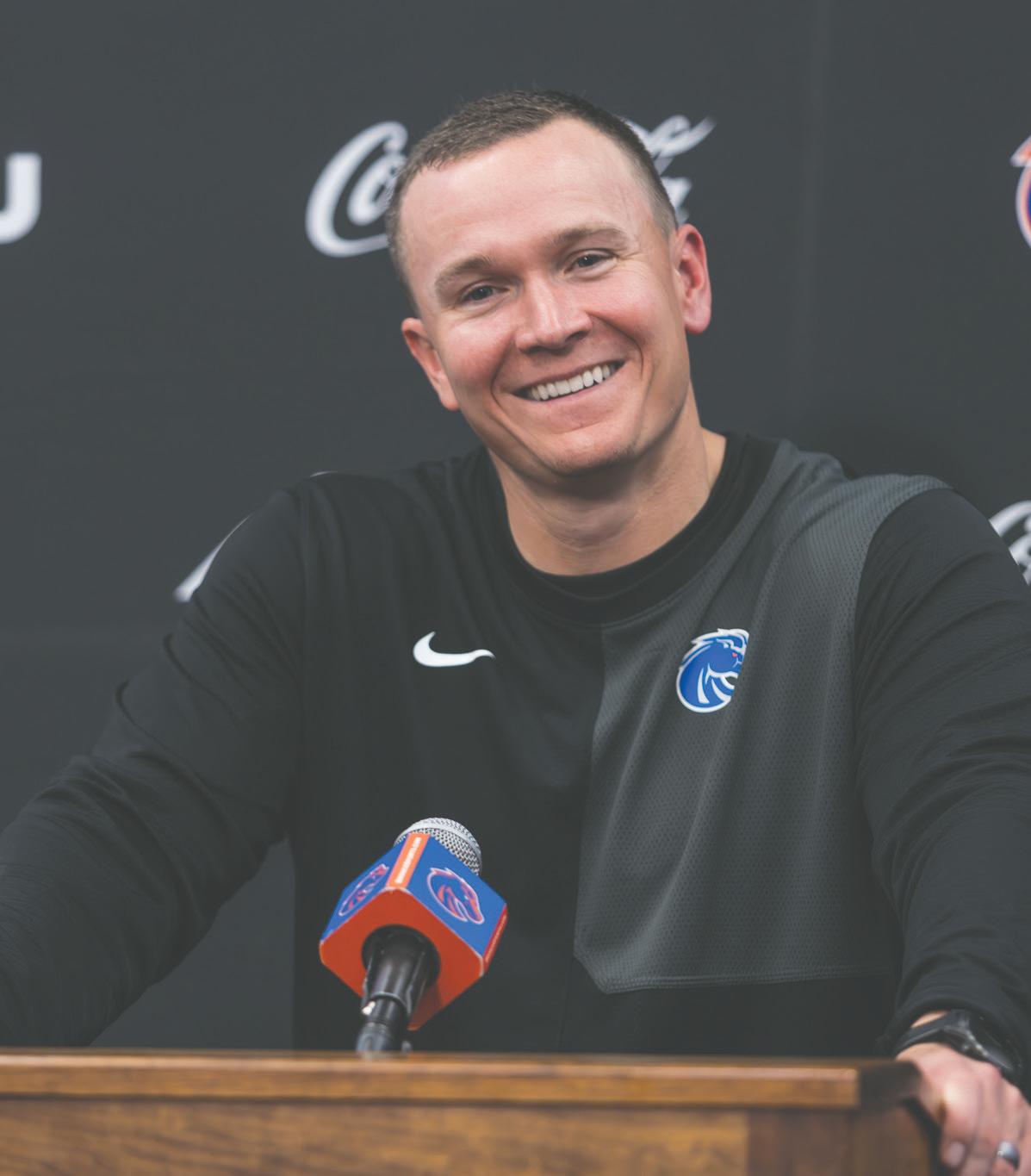
Boise State University and head football coach Spencer Danielson agreed to a contract extension through the 2030 season, the athletic department announced on Monday, April 20.
The move reinforces leadership for a program built on early success and a culture centered on player development and connection.
Danielson took over as interim head coach late in the 2023 season after the firing of Andy Avalos and quickly stabilized the program. Since then, Boise State has gone 24-8, won three consecutive Mountain West champion -
ships and reached the College Football Playoff in 2024 while finishing top-10 in the country.
Boise State athletic director Jeramiah Dickey credited both performance and leadership as reasons behind the extension.
“Spencer is elite, and we’re so happy to have him continuing to serve our football program as its head coach,” Dickey said. “He leads with his heart and cares deeply about our student athletes as young men.”
While on-field success has elevated the program nationally, internal culture and player retention have also shaped Boise
State’s trajectory under Danielson.
Former Boise State running back Ashton Jeanty, who was the Heisman Trophy runner-up in 2024, chose to remain at Boise State for his junior season despite lucrative opportunities presented in the transfer portal. Jeanty pointed to Danielson’s leadership as a factor in that decision.
“Then [after] the new hiring of Coach Spencer Danielson, I knew he was going to be a great coach, the right fit for the program, the person who could lead us the right way and bring us where we need to be,” Jeanty said in an interview with SB Nation.
Danielson has emphasized long-term development during a period when name, image and likeness opportunities and transfer movement have reshaped college football.
“I want our players to focus and place value over currency,” Danielson said. “There’s a lot of value to being on this football team. How we’re going to develop you, how we’re going to grow you mentally, physically, spiritually and emotionally by being a part of this football team.”
Danielson’s demeanor extends beyond football operations and into players’ personal lives.
Danielson officiated the wedding of defensive lineman Braxton Fely in May 2024, a reflection of the relationships built between Danielson and his players. Fely described Danielson as “like family” and said his participation in the ceremony reflected a connection that goes beyond football.
A devout Christian, Danielson has participated in faith-based activities with the team, including baptizing players in the Boise River ahead of the 2024 season. Those events were voluntary and reflected a broader emphasis on personal growth within the program.
Defensive end Ahmed Hassanein described that impact following the 2024 Fiesta Bowl, addressing Danielson
directly during a press conference.
“Coach D, you changed my life,” Hassanein said. “I did not know God until I got to Boise State.”
Danielson said those relationships remain central to his role as head coach, emphasizing the importance of earning players’ trust and staying involved in their lives.
He also addressed the challenges tied to the evolving structure of college football, including how players’ decisions can be affected by outside influence.
“There are a lot of agents out there that do not have these kids’ best interest at heart,” Danielson said. “They get paid if our players leave Boise State and go somewhere else. These kids are getting misinformation from a lot of sources that do not truly care about them 10, 15, 20 years from now.”
Instead of leaning into outside influence and short-term, agent-driven decisions, Boise State has emphasized continuity and long-term growth, both on and off the field.
“Football has given me the platform to do this,” Danielson said. “For me, I can’t miss those moments of teaching them what it looks like to be a husband, a father, a business owner or a professional.”
Danielson began his Boise State career as a graduate assistant in 2017, later coaching the defensive line and serving as defensive coordinator before earning the head coaching role. He worked his way through the program, building trust inside the locker room before taking over.
His early success has positioned Boise State as a consistent contender, both during its time in the Mountain West and as it prepares for its move to the Pac-12.
With the extension now in place, Boise State has committed to maintaining that direction, backing a head coach whose impact continues to extend beyond wins and losses.
Aidan Mattingly | Sports Reporter | Photo Courtesy of Brian Myrick at the Idaho Press
Construction continues to reshape the north end of Albertsons Stadium as Boise State advances a renovation aimed at transforming how fans move, gather and experience game day. Crews work through unfinished corridors, service areas and seating sections as the project enters its final phases ahead of its expected completion before the 2026 football season.
The renovation extends beyond seating upgrades. In addition to 1,600 premium seats along the north side, plans include a redesigned concourse built for ease of movement. Steel framing, newly formed walkways and interior buildouts outline how the space will function once complete.
Boise State senior associate athletic director for operations and governance Nathan Burk said the project builds on the stadium’s original foundation while modernizing the experience for fans on game day.
“It’s evolving what was built in the ’70s and just taking Albertsons Stadium to the next level here in Boise,” Burk said.
Inside the north end, wide corridors stretch beneath the seating structure and connect future club areas, food service locations and gathering spaces. Those pathways, still lined with construction materials and equipment, will serve as primary routes for fans on game days. The design aims to reduce congestion and improve flow in one of the stadium’s busiest sections.
New seating options reflect a shift in how Boise State plans to serve fans. Ledge seating will provide a countertop-style space for food and drinks with a clear view of the field. Loge boxes will create a more private setting for small groups, while club seating will include indoor access, upgraded concessions and added comfort designed for longer stays. Field-level suites will place fans within
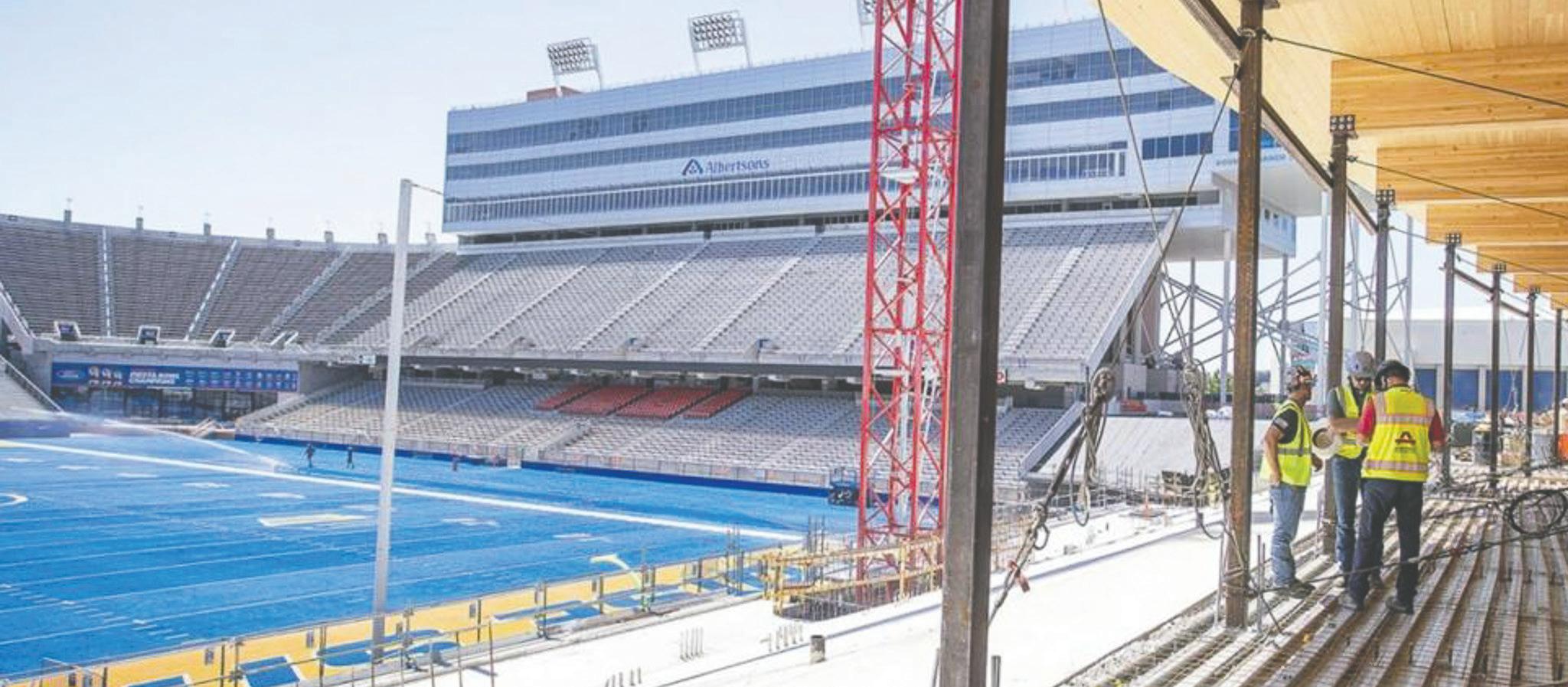
feet of the blue turf, creating one of the closest viewing experiences inside the stadium. Those areas aim to increase energy near the field while giving fans a more direct connection to the game.
“A key part of this project is giving fans multiple ways to watch the game and spend time in the stadium,” Burk said. “It’s not just about where you sit anymore, it’s about how you experience the entire day.”
The construction also highlights how Boise State plans to improve operations behind the scenes. Service hallways and loading zones now take shape beneath the seating bowl, forming a network designed to support concessions, staffing and event logistics. Those areas will allow faster movement between kitchens, storage and service points, leading to shorter lines and more efficient service during games and major events.
Interior commercial build-outs point to expanded food and beverage options. Framed bar areas, kitchen installations and open gathering spaces reflect a broader focus on concessions and social interaction. The layout mirrors a growing trend across college athlet -
ics, where stadiums aim to keep fans engaged throughout the entire game rather than limiting the experience to assigned seating.
The project also introduces a sports garden, an open space designed for fans who want flexibility during the game. The area allows movement while maintaining a view of the field, creating an option for those who prefer a high-energy atmosphere without remaining in one seat.
“We’re creating spaces where people can move around, gather and still feel connected to the game,” Burk said. “The energy is a big part of what we’re trying to build here.”
Boise State’s North End Zone project recently received a major financial boost, with the university announcing a $1 million donation to support the renovation just this month. Most of the gift will go toward the athletic department, including the North End Zone project, with the donor choosing to remain anonymous.
“We’re incredibly thankful for this investment in Bronco Athletics,” Boise State Athletic Director Jeramiah Dickey
said. “Bronco Nation continues to show up in a big way to fuel our momentum and inspire others to be EPIC.”
The contribution connects to the Lyle Smith Society, a philanthropic program launched by the Bronco Athletic Association in 2020 to increase long-term support for Boise State Athletics. The funds raised through the program support operational needs, facility upgrades and student-athlete resources.
“I’m always humbled by the generosity of our donors, whose support continues to create meaningful impact across Boise State,” said Argia Beristain, CEO of the Boise State University Foundation. “For a new Foundation board member to demonstrate this level of philanthropy is especially meaningful.”
While construction remains active, progress has shifted the project from concept to visible reality.
Boise State expects the North End Zone renovation to be ready before the 2026 football season. Once complete, the space will serve as a centerpiece of Albertsons Stadium, providing a design built to reshape the game-day experience in Boise.
Let your heart guide you through these next weeks. Tap into your intuition.
You have been gifted with a surge of creativity and passion.


Your money, self-worth and stability might be shifting in the upcoming weeks. You may have been over-giving and undervaluing yourself. Be better to yourself.
It’s not about the journey, but the friends we’ve made along the way. Your community will carry you through these upcoming weeks.



The moon is calling you to love. Love something, love anyone, love yourself.

You can be more direct with people this week — the truth hurts.

Choose what home means to you. If these upcoming weeks become more self-reflective, that’s okay. It’s the season to be sentimental.
This full moon is your emotional peak and your spiritual reset. Release the old you to embrace the new you. Drink water, it’ll counteract all the crying.
Put all your energy into your career. Big decisions will be happening soon.



2. A millennial’s method to get someone’s attention on Facebook.
6. What knights say before going into battle. 8. Something you might do for a political candidate.
1. “Let’s __ the pros & cons”
3. Ferris Bueller thinks this moves pretty fast…
4. Painters love these.
5. Be so for ____.
7. __ of music.
Communication will be at the forefront of your mind in these upcoming weeks. Speak your truth, but choose your words wisely.
Slow down, pal, there’s been a lot happening for you mentally and a lot of self-reflection. Take a step back and give yourself time to process what’s going on.
All doors and opportunities will be opening up. Explore something new you’ve always wanted to adventure to.