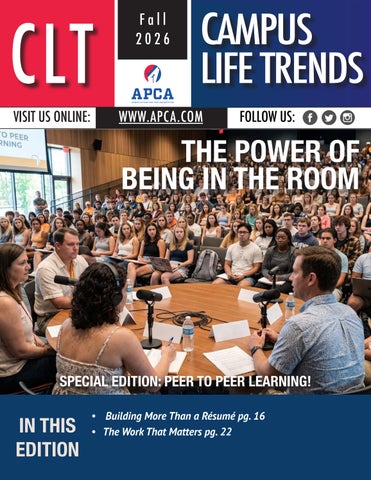
CAMPUS LIFE TRENDS
CLT
Fall 2026
VISIT US ONLINE:
WWW.APCA.COM
FOLLOW US:
THE POWER OF BEING IN THE ROOM
SPECIAL EDITION: PEER TO PEER LEARNING!
IN THIS EDITION
• Building More Than a Résumé pg. 16 • The Work That Matters pg. 22
CLT Magazine | Fall 2026
3
CONTENTS
T H E APCA CA M P US LI FE T R E N D S MAGAZINE IS PUBLISHED EACH
4
FROM THE DESK OF THE EXECUTIVE DIRECTOR Eric Lambert • Executive Director, APCA
6
INTRODUCTION
8
BUILDING MORE ENGAGED CAMPUSES: REIMAGINING STUDENT ENGAGEMENT IN AN ERA OF CHANGING STUDENT EXPECTATIONS
12 DOING MORE WITH SMALLER BUDGETS:
MAXIMIZING RESOURCES THROUGH COLLABORATION, CREATIVITY, AND DATA
SEMESTER. SUBMISSIONS FOR ARTICLES MUST BE EMAILED TO:
MARKETING@APCA.COM
THE
CAMPUS
MAGAZINE OF
THE
LIFE
TRENDS
16
BUILDING MORE THAN A RÉSUMÉ
IS A TRADEMARK A S S O C I AT I O N
FOR
THE PROMOTION OF CAMPUS ACTIVITIES.
ALL
RIGHTS
RESERVED. NO ARTICLES OR
18 STUDENT SUCCESS BEYOND THE CLASSROOM:
HOW ENGAGEMENT, WELLNESS, AND INCLUSION STRENGTHEN STUDENT RETENTION
I M A G E S O F A N Y K I N D M AY B E REPRINTED FROM THIS MAGAZINE WITHOUT
THE
WRITTEN
22 THE WORK THAT MATTERS
PERMISSION OF THE ASSOCIATION FOR THE PROMOTION OF CAMPUS ACTIVITIES. ANYONE SEEKING P E R M I S S I O N S H O U L D F O RWA R D THEIR REQUEST BY EMAIL TO: I N F O @ A P C A . C O M 8
6
5
.
4
2
9
.
9
1
2
3
24 DEVELOPING STUDENT LEADERS FOR LONG-
TERM SUCCESS: CREATING ORGANIZATIONS THAT THRIVE BEYOND A SINGLE SEMESTER
4
CLT Magazine | Fall 2026
FROM THE DESK OF THE EXECUTIVE DIRECTOR, ERIC LAMBERT elambert@apca.com
THE POWER OF BEING IN THE ROOM — Why Peer-to-Peer Learning Still Matters
In higher education, we spend a great deal of time talking about professional development. We attend webinars, read articles, participate in online meetings, watch training videos, and exchange ideas through social media. All of those resources have value. Technology has made it easier than ever to access information, but access to information is not the same thing as building relationships with people who understand the work we do.
An advisor might explain how their campus activities board rebuilt attendance after several poorly attended programs. Someone else might share how partnerships with academic departments allowed them to stretch a limited programming budget. Another professional might describe how giving younger board members small leadership responsibilities created a pipeline of students ready to become officers the following year.
There is still something uniquely powerful about sitting across the table from another campus life professional and simply talking. You hear about a problem they are facing and realize you are dealing with the same thing. Someone describes a program that worked on their campus, and suddenly you have an idea you can adapt for your own students. A conversation that begins over lunch can become a professional relationship that lasts for years.
Before long, one person's experience becomes another person's solution.
That is why this edition of Campus Life Trends is a special Peer-to-Peer Learning Issue. Much of the material in these pages grew directly from the campus life advisor roundtables held during the APCA NYC Leadership on Broadway Experience in July 2026. Rather than simply asking experts to tell advisors what they should be doing, we created an environment where professionals could talk openly with one another about what they are actually experiencing on their campuses. Those conversations covered some of the biggest challenges facing campus life today. Advisors talked about rebuilding attendance at campus events, working with tighter budgets, developing student leaders, creating leadership pipelines, improving student organizations, strengthening partnerships across campus, reaching students through social media, and finding new ways to build a sense of community. What made those discussions valuable was that the answers weren't coming from a textbook. They were coming from people doing the work.
That is peer-to-peer learning at its best. You Don't Know Who You Need to Know Yet One of the greatest benefits of attending a professional conference is something that cannot always be listed neatly on the conference schedule: the people you meet. Your professional network matters. The advisor sitting beside you in an educational session today may become someone you call next year when you are struggling with a programming challenge. The director you meet during lunch might tell you about a future job opening. The presenter whose session you attend may become a mentor. The professional you meet in an advisor roundtable might introduce you to someone who changes the direction of your career. Those relationships rarely develop from exchanging a few comments online. They grow through conversations, shared experiences, meals, educational sessions, roundtables, exhibit halls, showcases, and sometimes simply sitting together between conference events. APCA conferences have always been designed to encourage those connections. In addition to educational sessions and live showcases, APCA events provide opportunities for
CLT Magazine | Fall 2026
advisors and students to network, exchange ideas, meet industry professionals, and learn from one another.
5
you for wherever your career takes you next.
That interaction is not something happening around the conference.
So, as you read this special issue of Campus Life Trends, remember where many of these ideas began: campus professionals sitting together and talking with each other.
It is part of the conference.
That is something worth preserving.
Professional Development Should Be Participatory
I hope the ideas shared in these pages encourage you to try something new on your campus. More importantly, I hope they encourage you to become part of the conversation yourself.
Professional development is most valuable when you participate rather than simply observe. Attend the educational session, but stay afterward and introduce yourself to the presenter. Participate in the advisor roundtable instead of sitting quietly in the back. Ask another school how they solved the problem your campus is currently facing. Talk with colleagues during meals. Meet the professionals working in the exhibit hall. Introduce yourself to someone you don't know.
Come to an APCA conference. Participate in the roundtables. Attend the sessions. Introduce yourself to people you don't know. Share your successes and your failures. Ask questions. Exchange contact information. Build relationships.
Most importantly, share what you know.
It is the name and phone number of someone who says:
Every campus professional has experiences that can help somebody else. You don't need to have worked in higher education for 25 years to contribute something meaningful. If you developed a successful orientation activity, figured out a better way to recruit volunteers, found an inexpensive programming idea, improved your assessment process, or discovered a creative way to increase attendance, someone else can learn from that experience.
“I've dealt with that too. Give me a call.”
Peer-to-peer learning works because everyone in the room can be both a student and a teacher. Your Network Is Part of Your Career I also encourage campus life professionals to think about conferences as an investment in their careers. Knowledge is important, but careers are also built through relationships, visibility, participation, and reputation. People need opportunities to see what you know and what you can contribute. Conferences give professionals the chance to present educational sessions, participate in discussions, serve in leadership roles, meet colleagues from other institutions, and become more connected to the larger campus life profession. APCA specifically encourages advisors to participate in professional development, networking events, roundtables, educational sessions, presentations, and organizational involvement. These experiences can help you return to your campus with new ideas, but they can also help prepare
Because sometimes the most valuable thing you bring home from a conference isn't written in the program book.
That is the power of peer-to-peer learning, and it remains one of the most important reasons for all of us to get together in the same room. Eric Lambert Executive Director Association for the Promotion of Campus Activities (APCA)
6
CLT Magazine | Fall 2026
INTRODUCTION Innovative Ideas. Practical Solutions. Stronger Campus Communities. Over two days, student affairs professionals from colleges and universities across the United States gathered during APCA’s Leadership on Broadway Experience to exchange ideas, share successful programming initiatives, and discuss today’s most pressing challenges in student engagement. These proceedings capture the collective experience of advisors representing community colleges, public universities, private institutions, HBCUs, technical colleges, and regional campuses. Their willingness to openly discuss successes, failures, and lessons learned resulted in one of the most collaborative and solution-focused conversations of the conference. Rather than theoretical discussions, the ideas contained within these pages represent programs that have already been implemented on campuses across the country. Many have demonstrated measurable improvements in student participation, leadership development, retention, wellness, and organizational effectiveness. This publication has been prepared as a practical resource for campus activities professionals seeking proven strategies that can be adapted to institutions of every size. Summary Student affairs professionals are navigating one of the most rapidly evolving periods in higher education. Changes in student expectations, declining campus event attendance, budget limitations, increasing mental health concerns, leadership turnover, and shifting methods of communication continue to reshape how campuses engage students outside the classroom. Recognizing these challenges, APCA convened two Advisor Roundtable discussions during the 2026 Leadership on Broadway Experience in New York City. Advisors from a wide variety of institutions participated in open conversations designed to identify practical, successful approaches that can be replicated by other colleges and universities. Unlike formal conference presentations, the roundtables encouraged candid discussion among peers. Participants shared programs that have worked on their campuses, discussed initiatives that required adjustment, and offered honest insight into the realities of managing campus activities with limited staff and resources. Throughout both days, one theme consistently emerged: student success is built through intentional relationships, meaningful
involvement, and creating a genuine sense of belonging. Several additional themes surfaced repeatedly during the discussions: • Students are significantly more likely to attend programs they have helped design, promote, or evaluate. • Consistent traditions often generate stronger long-term participation than one-time signature events. • Cross-campus collaboration stretches limited budgets while strengthening institutional partnerships. • Leadership development should focus on preparing future leaders, not simply filling officer positions. • Assessment data is increasingly essential for demonstrating the value of student engagement initiatives and securing institutional support. • Building welcoming communities remains one of the most effective strategies for improving both student satisfaction and retention. One of the most valuable aspects of the roundtables was the diversity of participating institutions. Community colleges shared innovative low-cost programming ideas alongside larger universities discussing comprehensive leadership development models. HBCUs, technical colleges, regional institutions, and private colleges each contributed unique perspectives while discovering that many of their challenges—and solutions—were remarkably similar. The conversations also demonstrated that innovation does not always require large budgets. Many of the most frequently praised initiatives centered around creativity, intentional planning, student ownership, and collaboration rather than significant financial investment. Programs such as recurring campus traditions, peer-to-peer promotion, leadership mentoring, family-style organizational cultures, wellness initiatives, and structured officer transitions all illustrated how thoughtful planning can produce meaningful results without substantial new funding. Throughout the publication, readers will find Advisor Spotlights, Campus Best Practices, Implementation Ideas, and Key Takeaways designed to move beyond simple meeting notes and provide practical guidance that can be adapted on virtually any campus. No single strategy discussed during the roundtables represents a universal solution. However, collectively these conversations reinforce an important principle that
CLT Magazine | Fall 2026
continues to shape successful student affairs practice: Students don’t become engaged because we offer programs. They become engaged because they feel connected to people, experiences, and communities that give them a reason to belong. It is our hope that the ideas captured in these proceedings will inspire new conversations, strengthen existing programs, and encourage campus professionals to continue creating environments where every student has the opportunity to connect, lead, and succeed. About These Proceedings The ideas presented in this publication were shared by advisors participating in APCA’s Advisor Roundtables held on July 21–22, 2026, during the Leadership on Broadway Experience in New York City. While every institution has unique needs and resources, the best practices included here reflect successful strategies that advisors have implemented on their own campuses. Readers are encouraged to adapt these concepts to fit their institutional missions, student populations, and campus cultures.
7
8
CLT Magazine | Fall 2026
SECTION BUILDING MORE ENGAGED
1
CAMPUSES: REIMAGINING STUDENT ENGAGEMENT IN AN ERA OF CHANGING STUDENT EXPECTATIONS
Today’s Challenge Across higher education, one concern consistently rises to the top of conversations among student affairs professionals: students simply are not attending campus events at the levels they once did. Whether at community colleges, regional universities, HBCUs, or large public institutions, advisors described similar trends. Students often juggle employment, family responsibilities, athletics, internships, and academic demands while also competing with an endless stream of digital entertainment and social media for their attention. The discussion quickly moved beyond simply asking “How do we get students to come?” Instead, advisors focused on a more meaningful question:
“How do we create experiences students actually want to be part of?” Throughout the session, participants agreed that successful engagement begins long before an event takes place. Students are far more likely to participate when they feel ownership of the experience, see themselves represented in the planning process, and understand how the event contributes to their personal college experience. Rather than relying on larger marketing budgets, advisors repeatedly emphasized listening to students, empowering student leaders, building traditions, and creating authentic campus communities.
One of the most ADVISOR practical ideas shared INSIGHT: during the discussion came Bralyn Simmons from Bralyn McNeese State University Simmons, who Listen First, described how Program Second McNeese State has made continuous assessment an integral part of every campus event.
While the questions themselves are simple, the consistency of collecting this information after every program has allowed staff to identify patterns in student interests, eliminate ineffective practices, and continuously refine future events.
Rather than waiting until the end of the semester to evaluate programming, students complete a brief survey immediately following each event by scanning a QR code linked to Microsoft Forms or Google Forms. The survey asks three straightforward questions:
Every event should produce information—not just attendance.
• What did you enjoy? • What could have been better? • What should we change for next time?
Why This Works Students are much more likely to participate when they believe their opinions influence future programming. By consistently responding to feedback, advisors demonstrate that student voices genuinely matter. Best Practice
Attendance numbers reveal who came. Student feedback explains why they came—and why others may not have.
CLT Magazine | Fall 2026
Traditional campus marketing often speaks to students.
ADVISOR INSIGHT: Steven Edwards Alfred State College
Turn Students into Your Marketing Team
Successful campuses increasingly allow students to speak for the institution.
Steve described Alfred State’s use of student-led Instagram promotion teams that create stories, polls, and interactive content specifically designed for their peers. Instead of simply posting event flyers, students ask questions, gather opinions, and encourage participation through familiar social media interactions. Instagram Stories have become valuable planning tools by measuring student interest before events even occur.
9
Rather than each organization promoting only its own activities, their Student Activities team regularly shares events hosted by every student organization. This collaborative approach increases visibility for all organizations while reinforcing the idea that campus involvement is everyone’s responsibility. Katie also discussed the university’s use of Campus Lush, a centralized engagement platform where organizations maintain profiles, advertise events, categorize programming, and collect participation analytics. Students can quickly browse opportunities based on interests including: • Social Events • Civic Engagement • Leadership • Professional Development • Cultural Programs
• Would you attend?
The platform also provides valuable assessment data that helps staff evaluate participation trends and identify opportunities for improvement.
• Which activity sounds more exciting?
Why This Works
• What time works best?
Students often miss opportunities simply because they never hear about them.
Polls such as:
provide useful engagement data while simultaneously creating anticipation. The marketing itself becomes part of the student experience. Why This Works
Centralizing information reduces confusion while making involvement easier.
Students naturally trust recommendations from fellow students more than institutional messaging.
ADVISOR INSIGHT:
Peer-generated content also feels more authentic than traditional advertising.
Kristin Adams
ADVISOR INSIGHT: Marcus Kennedy Grambling State University
Create One Campus Conversation
Craig and Katie from Grambling State University shared several complementary strategies that have helped strengthen campus-wide engagement.
Sul Ross State University
Market the Experience— Not the Event
One of the most creative marketing examples discussed involved transforming a familiar television game show into an engaging promotional campaign. Instead of advertising another standard Family Feud program, Kristin and her team embraced the theme completely.
10
CLT Magazine | Fall 2026
Staff members dressed as Steve Harvey.
Implementation Ideas
Promotional videos mirrored the show’s style.
Assign students to document every major event.
Social media posts generated curiosity weeks before the event.
Create a shared digital media library.
Students weren’t simply invited to attend.
Record student testimonials.
They became interested in discovering what was happening next. Why This Works
Organize photos by event type. Film 30-second recap videos immediately following successful events.
Building Traditions Students Expect Students respond emotionally to stories and Perhaps the strongest consensus of the entire experiences. discussion centered around one simple idea: They rarely become excited about flyers listing Traditions are IMPORTANT. dates and times. Why Traditions Matter Successful marketing answers one important question:
Campus traditions matter because they reduce decision fatigue and make student life feel more “Why would I want to be there?” accessible. Instead of wondering, "Is anything happening tonight?" students already know what to Marcus expect. When recurring events are tied to specific encouraged ADVISOR days—such as Wellness Wednesday or Friday advisors to Movie Night—they become a familiar part of think beyond INSIGHT: the weekly routine. This predictability makes it individual easier for students to plan ahead, attend events Marcus Kennedy events by consistently, and participate without having to Grambling State University intentionally building search for new opportunities each week. a library of marketing Capture Today’s Event to content throughout the Over time, predictable participation strengthens Market Tomorrow’s year. the campus community. As students return to the same events and see familiar faces, they build Student photographers, relationships, develop a sense of connection, and videographers, and social media become more engaged in campus life. Consistent creators document every event. traditions transform individual attendance into Short recap videos become future advertisements. shared experiences, fostering a stronger sense of Photos become social media posts. community that ultimately helps students feel that they belong. Testimonials become recruiting tools. Instead of beginning every semester with no Traditions outperform one-time events. marketing materials, campuses accumulate an ever- Students develop habits. growing collection of authentic student experiences. Successful campuses intentionally build Cheyenne expanded on this concept by encouraging programming around those habits. advisors to intentionally capture enough content Examples shared included: during recurring events to support future promotions • Free Movie Fridays through: • Costume contests • Throwback Thursday •Motivation Monday Welcome Week campaigns • Next year’s event marketing
• Door prizes
• Community participation
CLT Magazine | Fall 2026
Charleston Fritts St. Petersburg College • Friday Bowling Kelly Hampton Ivy Tech College A semester-long schedule built around recurring themes: • Monday Funday
11
IDEAS YOU CAN IMPLEMENT TOMORROW ✓ Add a QR-code survey to every event. ✓ Recruit student content creators. ✓ Build an Instagram student promotions team.
• Wellness Wednesdays
✓ Focus marketing on the experience—not logistics.
• Thirsty Thursdays
✓ Start one recurring weekly tradition.
Programs occur in the same locations, at the same times, every other week.
✓ Promote every student organization’s events—not only your own.
• Tuesdays at the Tech
Students know exactly what to expect before classes even begin. Catherine Korman Hillsborough College Weekly Game Nights Workout Wednesdays Special surprise events such as Goat Yoga
✓ Capture photos and videos at every program. ✓ Create a shared digital content library. ✓ Schedule next semester’s recurring events before classes begin.
Attendance incentives that reward students for participating throughout an entire series rather Section Summary than attending only one program. The first day’s discussion demonstrated that increasing student engagement is rarely about finding a single “perfect” event. Instead, successful campuses build participation through intentional planning, student ownership, creative storytelling, consistent traditions, and meaningful assessment. Students attend programs when they feel connected—not only to the event itself, but also to the people, traditions, and sense of community that surround it. As the conversation continued, advisors shifted from increasing attendance to another pressing challenge: how to accomplish all of this while facing shrinking budgets and limited resources. That discussion forms the focus of the next chapter.
12
CLT Magazine | Fall 2026
UNFORGETTABLE EVENTS.
REAL EXPERIENCES. Perfect Parties USA delivers 300+ turn-key event rentals, interactive games, photo experiences, and attractions nationwide. From colleges to corporations, we power unforgettable events that bring people together and leave lasting impressions.
INFLATABLES
INTERACTIVE GAMES
PHOTO BOOTHS
AMUSEMENTS
High-energy fun for all ages! From obstacle courses to giant slides, our inflatables bring excitement to any event.
Engage, compete, and celebrate! Our interactive games and attractions create unforgettable moments and big fun.
Capture every moment! Our photo experiences add a personal touch and lasting memories to any occasion.
Big thrills for every crowd! From mechanical rides to classic amusement attractions, our lineup brings excitement and energy to any event.
START PLANNING YOUR NEXT EVENT! www.perfectpartiesusa.com
info@perfectpartiesusa.com
(800) 275-0185
CLT Magazine | Fall 2026
13
14
CLT Magazine | Fall 2026
SECTION DOING MORE WITH SMALLER
2
BUDGETS: MAXIMIZING RESOURCES THROUGH COLLABORATION, CREATIVITY, AND DATA
The New Reality
collaboration, and intentional planning.
Nearly every institution represented at the Advisor Roundtable shared a common concern: doing more with less. Budget reductions, staffing shortages, rising program costs, and increasing expectations have forced student affairs professionals to rethink how they deliver meaningful experiences while maintaining fiscal responsibility.
A recurring message throughout the conversation was simple:
Despite these challenges, the discussion remained remarkably optimistic. Rather than focusing on what they could no longer afford, advisors concentrated on what they could accomplish through strategic partnerships,
ADVISOR INSIGHT: Brooke Gibson Fox Valley Technical College
Transform Academic Programs into Campus Partners
One of the most creative examples of collaboration came from Fox Valley Technical College, where the Student Life office partners with the college’s Massage Therapy program to host a campus wide Destress Day each semester.
Massage therapy students gain valuable hands-on clinical experience by working with real clients, while students across campus benefit from a free wellness activity during one of the most stressful times of the semester. The event accomplishes multiple institutional goals simultaneously: • Supports student wellness • Provides practical experience for academic programs • Creates positive campus engagement • Requires little or no additional programming budget Brooke encouraged advisors to look beyond traditional campus partnerships and explore how academic
The best campus partnerships don’t begin with budgets— they begin with relationships. Whether partnering with another campus department, a local business, or a community organization, successful collaborations allow institutions to expand programming, reduce expenses, and reach new audiences while strengthening connections across campus.
departments can become active contributors to student engagement initiatives. Why This Works The most successful collaborations create mutual benefit. Rather than asking another department to “help” with an event, identify opportunities where both departments achieve their own goals by working together. Best Practice Ask every academic department one question: “How can Student Life help your students gain experience while your department helps us engage the campus?” One of the most important lessons shared by Todd was that successful partnerships are about far more than securing additional funding. While many campus departments may not have extra dollars to contribute, they often possess resources that are just as valuable. Staff volunteers, Todd Strate marketing assistance, event planning expertise, student Ivy Tech Community employees, equipment, facilities, College
ADVISOR INSIGHT:
CLT Magazine | Fall 2026
specialized knowledge, and community connections can all play a significant role in expanding the scope and quality of campus programming. By looking beyond budgets and recognizing the strengths each partner brings to the table, Student Life professionals can dramatically increase both the reach and effectiveness of their events. At Ivy Tech, this collaborative approach has resulted in partnerships with departments such as Career Services, the Learning Resource Center, Enrollment Services, and Tutoring Programs, as well as community organizations including the Boys & Girls Clubs, Girls Inc., Amigos, and numerous local agencies. Each partner contributes unique resources and expertise, enabling Student Life to create larger, more engaging, and more meaningful experiences than could be accomplished independently. Todd emphasized that these partnerships not only multiply available resources but also strengthen relationships across campus and within the surrounding community, creating a lasting network of support that benefits both students and the institution as a whole.
Why This Works Successful partnerships distribute responsibility. Instead of one office organizing every aspect of a program, each partner contributes according to its strengths. The result is better programming with less strain on individual departments Steven encouraged advisors to think beyond institutional boundaries by intentionally developing relationships with local businesses.
ADVISOR INSIGHT:
• Pharmacies
• Small business owners These relationships may lead to: • Door prizes • Event sponsorships • Discount coupons • Food donations • Promotional giveaways • Guest speakers • Internship opportunities More importantly, they strengthen connections between the campus and the surrounding community.
“Businesses are often looking for ways to support students—you simply have to invite them into the conversation.” Tyler described the planning process behind National Hazing Prevention Week, emphasizing that successful awareness programming should never belong to only one office.
Alfred State College
• Greek Life
Building Relationships Beyond Campus
ADVISOR INSIGHT: Tyler Ribble Alfred State College
One Event. Multiple Partners. Greater Impact.
Instead, Alfred State brings together multiple campus partners including: • Title IX
Examples included partnerships with: • Bakeries
• Coffee shops
Steven Edwards
Community partners often appreciate opportunities to become involved with students, particularly when approached with well-defined ideas rather than generic sponsorship requests. • Local pizza restaurants
• Retail businesses
• Student Senate • Hazing Prevention Office • Counseling Services • Wellness Programs Each department contributes its own expertise while sharing responsibilities for planning, promotion, staffing, and assessment. Rather than hosting several smaller awareness events, the campus presents one coordinated initiative with significantly greater visibility and impact.
15
16
CLT Magazine | Fall 2026
Why This Works Students experience one unified campus message rather than several disconnected programs. Departments share both the workload and the recognition. Who Are the Best Campus Partners? As the conversation continued, advisors quickly began identifying the campus departments that consistently lead to successful collaborations. Their responses highlighted the breadth of potential partnerships available across higher education, including Career Services, Orientation Programs, Counseling Services, Title IX Offices, Student Government, Academic Departments, Veterans Services, Institutional Advancement, Diversity and Affinity Groups, Campus Foundations, Cybersecurity Programs, Wellness Offices, and Residence Life. The variety of recommendations underscored that meaningful partnerships can be found well beyond the traditional Student Affairs network. Several advisors emphasized that Career Services is often an overlooked partner despite offering valuable opportunities for professional development programming that benefits students. Others pointed to Counseling Services and Title IX Offices as strong collaborators because they frequently have grant funding available for educational initiatives that Student Life can help implement. Together, these examples demonstrate that building relationships across campus not only expands programming opportunities but can also unlock additional resources, expertise, and funding that strengthen the student experience.
ADVISOR INSIGHT: Nache Jones Cuyahoga Community College
Build Programming Around Identity and Community
Rather than organizing events independently, Cuyahoga Community College intentionally collaborates with campus affinity groups and academic alliances. Examples include:
• Black American Council • Veterans Affairs • Academic Alliances • Student Cultural Organizations These partnerships ensure programming reflects the interests and identities of diverse student
populations while increasing participation among groups that may otherwise remain disconnected from campus activities.Rather than organizing events independently, Cuyahoga Community College intentionally collaborates with campus affinity groups and academic alliances. Why This Works Students are more likely to attend programs that reflect their experiences, interests, and communities. Collaboration also helps eliminate duplicated programming efforts. Perhaps the most important lesson of the budget discussion centered not around spending—but around measurement. Amy explained how assessment data transformed conversations with senior leadership and the Board of Trustees.
ADVISOR INSIGHT: Amy Cotner Mount Aloysius College
Following student Assessment Data Builds trips and major events, Budgets participants completed surveys measuring satisfaction, learning outcomes, and perceived value. Rather than simply reporting attendance numbers, Student Life presented evidence demonstrating: • Student demand • Educational impact • Satisfaction levels • Institutional value The result? The Board of Trustees approved funding for transportation to future student trips because they clearly understood the return on investment.
Best Practice Don’t simply report attendance. Demonstrate impact.
CLT Magazine | Fall 2026
ADVISOR INSIGHT: Dylan Booth Hillsborough College
Dylan described a collaborative effort involving five campuses that systematically collected attendance and engagement data over several years.
Instead of requesting additional funding based on anecdotal success, the campuses presented measurable evidence demonstrating consistent growth in participation.
Data Creates Long-Term Growth
The outcome was significant. Leadership approved an additional $15,000 dedicated specifically to student programming. Why This Works Institutional leaders increasingly expect evidencebased decision making. Data transforms Student Life from a cost center into an investment.
IDEAS YOU CAN IMPLEMENT TOMORROW ✓ Schedule introductory meetings with five campus departments each semester. ✓ Invite one new community business to collaborate on every major event. ✓ Include measurable learning outcomes in post-event surveys. ✓ Present annual assessment reports to senior leadership. ✓ Share attendance trends—not just attendance numbers. ✓ Seek grant opportunities through Counseling, Wellness, and Title IX offices. ✓ Develop programs that satisfy multiple departmental goals. ✓ Explore cooperative buying opportunities whenever possible.
Section Summary The budget discussion demonstrated that innovation is rarely limited by funding alone. Across institutions of every size, advisors repeatedly illustrated how collaboration, assessment, and strategic partnerships can dramatically expand programming opportunities without proportionally increasing expenses. Perhaps the greatest takeaway was that successful student affairs professionals no longer view Student Life as a standalone department. Instead, they position it as a campus connector—bringing together academic programs, administrative offices, community organizations, and local businesses around a shared mission of student success. As the first day’s conversations continued, advisors shifted their attention from financial resources to another equally important topic: how campus engagement influences student retention, mental health, and the creation of welcoming, inclusive communities. These discussions are explored in the next section of the proceedings.
17
18
CLT Magazine | Fall 2026
BUILDING MORE THAN A RÉSUMÉ How a Career in Campus Life Is Really Measured by the Students You Influence If you ask someone in student affairs to describe the best day of their career, chances are they won't begin by talking about a promotion, a new office, or a line they added to their résumé. More often than not, they'll tell you a story about a student. It might be the first-year student who quietly joined the campus activities board and, over the next four years, grew into a confident student body president. It could be the programming chair who discovered a passion for event management and now works in the entertainment industry. Perhaps it's the graduate assistant who became a trusted colleague years later or the student who simply found a place to belong because someone invited them to help plan an event. Those are the moments that keep people in this profession. Ironically, the same professionals who devote so much of their energy to helping students grow often spend very little time thinking intentionally about their own development. Student affairs is a career built on service, and that commitment to students can sometimes make it feel selfish to focus on personal goals. Yet the opposite is true. The more an advisor develops professionally, the greater the impact that advisor ultimately has on students, colleagues, and the institution. The strongest careers in campus life are rarely built through careful pursuit of titles alone. Instead, they develop as professionals consistently say "yes" to opportunities that stretch their abilities. A committee assignment that seems outside your comfort zone, a campus initiative that requires new partnerships, or the chance to present at a conference may not feel significant in the moment. Looking back years later, however, those experiences often become the turning points that shaped an entire career. One reason student affairs offers such remarkable professional growth is that the work itself is incredibly diverse. On any given day, an advisor may coach a student leader through a difficult decision, review a contract for a touring performer, help manage a budget, collaborate with facilities staff, meet with a campus partner, respond to an unexpected challenge, and celebrate the success of a student organization event. Few professions ask people to wear so many different hats, and that variety quietly develops skills that extend far beyond campus programming. The challenge is recognizing those experiences for what they are. Many professionals underestimate the breadth of their own expertise because the work feels routine. Organizing a leadership retreat becomes "just another event." Advising a student organization becomes "part of the
job." Coordinating a campus tradition is viewed as another annual responsibility. In reality, each of those experiences demonstrates competencies in leadership, communication, budgeting, supervision, strategic planning, marketing, assessment, and project management—qualities that colleges and universities consistently seek in future leaders. That is why documenting accomplishments throughout the year is so valuable. Waiting until a job search begins often means trying to remember years of successful projects from memory. Advisors who keep notes about major initiatives, assessment results, collaborative partnerships, student learning outcomes, and measurable successes are not simply preparing for a future interview. They're creating a record of their own professional journey. Over time, those reflections reveal patterns of growth that might otherwise go unnoticed. Equally important is learning how to tell the story behind the work. Search committees are interested in more than event attendance or the number of programs coordinated each semester. They want to understand how those efforts improved the student experience. Did participation increase among commuter students? Did a new leadership initiative strengthen student organizations? Did a campus tradition become more inclusive or accessible? The most compelling professional stories are those that connect everyday responsibilities to meaningful outcomes. Of course, no career develops in isolation. Every experienced student affairs professional can usually identify one or two mentors who changed the trajectory of their career. Sometimes it was a supervisor who encouraged them to apply for a position they didn't think they were ready for. Sometimes it was a colleague who shared an idea at a conference or invited them to present an educational session together. Those relationships remind us that higher education is a profession built on generosity. People who have benefited from good mentors often become exceptional mentors themselves, creating a cycle of professional growth that continues across generations. Professional associations play an important role in nurturing those relationships because they bring together people who share both common challenges and common passions. Stepping away from campus for a conference provides more than new programming ideas; it provides perspective. Advisors discover that the questions keeping them awake at night are often the very same questions colleagues across the country are trying to answer. Conversations over coffee or between educational sessions frequently become the beginning of lasting professional friendships. For campus activities professionals, APCA conferences offer a particularly unique environment because advisors and students learn together. Educational sessions explore
CLT Magazine | Fall 2026
leadership, assessment, student engagement, marketing, budgeting, organizational development, and emerging issues affecting higher education, while live showcases and the exhibit hall provide opportunities to discuss programming directly with artists, agencies, and vendors. Those shared experiences strengthen both professional knowledge and campus programming while helping advisors build networks they can rely on throughout their careers. Many professionals also find that pursuing certification or additional training gives structure to their professional development. Certification is not simply another credential to place after a name. It represents a commitment to continual learning and demonstrates a willingness to stay current in a profession that evolves every year. More importantly, the process of earning certification often introduces advisors to new research, fresh ideas, and practical strategies that immediately improve their work with students. Perhaps the greatest measure of success in student affairs, however, is not the résumé itself. It is the collection of students whose lives have been influenced through years of thoughtful advising, encouragement, and leadership. Long after specific events are forgotten, students remember the
19
advisor who believed in them, challenged them, and helped them recognize abilities they didn't know they possessed. Those relationships become the true legacy of a career devoted to campus life. Looking back after many years in the profession, few advisors wish they had planned one more concert or attended one more committee meeting. Instead, they remember the students who found confidence because someone invested time in their development. They remember colleagues who became lifelong friends and mentors who encouraged them to keep growing. Those memories serve as a reminder that careers in student affairs are built one relationship at a time. In the end, building a successful career is about much more than creating an impressive résumé. It is about becoming the kind of professional whose influence extends well beyond a job description. Advisors who remain curious, continue learning, invest in relationships, and place students at the center of their work often discover that professional advancement follows naturally. More importantly, they leave behind something that no résumé can fully capture—a campus community made stronger because they chose to dedicate their career to helping others succeed.
20
CLT Magazine | Fall 2026
SECTION STUDENT SUCCESS BEYOND THE
3
CLASSROOM: HOW ENGAGEMENT, WELLNESS, AND INCLUSION STRENGTHEN STUDENT RETENTION
More Than Just Activities One of the most meaningful conversations during the Advisor Roundtable centered on a fundamental shift taking place within Student Affairs. While campus activities have traditionally focused on entertainment and involvement, today’s professionals recognize that engagement is directly connected to student success. Students who participate in campus life are more likely to build friendships, develop leadership skills, access campus resources, and feel connected to their institution. Those connections often become the deciding factor in whether a student persists through academic and personal challenges. Throughout the discussion, advisors repeatedly emphasized
ADVISOR INSIGHT: Maren Dewar University of North Dakota
Retention Begins on Day One
The University of North Dakota has taken an intentional approach to introducing students to campus involvement during Orientation. With more than 300 student organizations, the university ensures that incoming students have opportunities to meet organization representatives before classes even begin. Student leaders—not just professional staff—play a central role in welcoming new students and helping them identify organizations that align with their interests. Each organization is represented by student leaders alongside an advisor, allowing new students to hear directly from their peers about the value of getting involved.
that student engagement is no longer simply about attendance numbers—it is about creating an environment where students feel seen, supported, and valued. As one participant noted, “Students stay where they feel like they belong.” This philosophy shaped the conversation around three interconnected priorities: • Student Retention • Mental Health and Wellness • Inclusive Campus Communities Rather than viewing these as separate initiatives, advisors agreed that they work together to create an overall culture of belonging
The institution also tracks participation and compares involvement data with student retention rates. The findings consistently reinforce a familiar principle: Students who become involved are significantly more likely to remain enrolled. Why This Works Orientation should not simply introduce students to campus. It should introduce students to their future community. Early involvement creates friendships, establishes routines, and connects students with mentors before they experience academic or personal challenges. Best Practice Don’t wait until September to recruit students. Begin building connections before the first day of class.
CLT Magazine | Fall 2026
ADVISOR INSIGHT: Todd Strate Ivy Tech Community College
Engagement is an Investment in Retention
Todd emphasized that student involvement data has become increasingly valuable when discussing retention with institutional leadership.
Rather than measuring only attendance at programs, campuses should examine broader questions such as: • Are involved students returning at higher rates? • Which organizations retain members most successfully? • What programs encourage continued participation? • How does engagement influence graduation? When Student Affairs demonstrates these relationships through assessment data, campus programming becomes recognized not simply as entertainment—but as an institutional strategy for improving student success.
“Retention isn’t owned by one office. Every meaningful student interaction contributes to whether someone comes back next semester.” Student mental health continues to be one of the defining challenges facing higher education.
ADVISOR INSIGHT: Kelly Hampton Ivy Tech Community College
Why This Works Students are more likely to participate in wellness activities when they become part of campus culture instead of isolated special events. Routine builds comfort. Comfort builds participation.
ADVISOR INSIGHT: Keely Sapienza Point Park University
Point Park University identified a critical trend: Student withdrawals increase significantly during October.
Rather than waiting for students to seek Meeting Students When help, the institution They Need It Most created Pioneer Pause, a campus wide wellness initiative intentionally scheduled during one of the most stressful points of the semester. Activities included: • Yoga • Pumpkin carving • Slime making • Relaxation activities • Creative expression • “Consent Fries” discussions promoting healthy relationships The purpose was simple: Give students permission to pause, reconnect, and recharge. Why This Works Sometimes students don’t need another workshop.
Rather than offering Wellness Should occasional wellness Be a Year-Round Commitment events during stressful periods, Kelly described the value of creating recurring wellness t raditions that students begin to expect throughout the semester.
They simply need an opportunity to breathe
Programs such as Wellness Wednesdays normalize selfcare while making wellness visible as an ongoing campus priority rather than an emergency response.
• Community Gardening
The consistency of recurring wellness initiatives encourages participation while reducing stigma surrounding conversations about mental health.
21
Best Practice creative approaches that combine wellness with community engagement. Programs included: • Food Pantry • Professional Clothing Closet • Thrifty Thursday Clothing Exchange • Fashion Shows • Crochet projects benefiting local homeless organizations These initiatives addressed both practical student needs and opportunities for community connection.
22
CLT Magazine | Fall 2026
ADVISOR INSIGHT: Leah Mullen State Fair Community College
Build Your Own Essentials Kit
Students assembled personalized wellness kits containing: • Fidget tools • Relaxation items • Counseling information • Stress-management resources The activity combined education with practical support while introducing students to available campus services.
ADVISOR INSIGHT: Dylan Booth
Hillsborough College
Arizona Western University partners closely with its TRIO Nathalia Flores program to celebrate Arizona Western University First Generation Week Celebrating each November. First-Generation Rather than treating Students first-generation students as a population needing assistance, the institution celebrates their achievements while providing networking opportunities, educational programming, and visibility throughout campus.
ADVISOR INSIGHT:
The result is an environment where first-generation students see theirexperiences recognized as strengths rather than obstacles. Partnering with TRIO, Leah described a Thanksgiving-themed luncheon that combines community building with resource Leah Mullen awareness. State Fair Community College Students share a meal together Thanksgiving Resource while learning Luncheon about campus support services available throughout the year.
ADVISOR INSIGHT:
The event strengthens relationships while connecting students with programs they may need later. Collaborating closely with Counseling and Wellness departments has strengthened campus programming while increasing student awareness of available mental health resources. Best Practice Wellness programming becomes significantly more effective when Counseling Services and Student Activities plan together instead of operating independently.
Orientation Scavenger Hunts Several advisors recommended transforming Orientation into an interactive campus exploration experience. Instead of simply touring buildings, students complete a campus-wide scavenger hunt requiring them to visit key offices such as: • Counseling Center • Student Activities
Creating Inclusive Campus Communities
• Career Services
As campuses become increasingly diverse, advisors discussed the importance of creating environments where every student feels welcomed and represented.
• Financial Aid
While many initiatives focused specifically on first-generation students, participants emphasized that successful inclusion benefits the entire campus community.
• Academic Advising • TRIO • Library • Veterans Services
CLT Magazine | Fall 2026
Students meet staff members while learning where to seek help before challenges arise. Why This Works Students cannot use resources they don’t know exist. Creating positive first interactions makes students more comfortable returning later when assistance is needed.
One of the most impactful programs discussed was Ivy Cares, an emergency assistance initiative designed to help students overcome unexpected financial hardships.
ADVISOR INSIGHT: Todd Strate Ivy Tech Community College
Ivy Cares
Students complete a brief application and may receive assistance such as: • Grocery cards • Gas cards •Emergency support following natural disasters • Other basic-needs assistance The goal is straightforward: Remove temporary barriers before they become reasons to leave college.
“Sometimes a student doesn’t leave because they failed a class—they leave because they couldn’t afford the gas to get there.”
23
IDEAS YOU CAN IMPLEMENT TOMORROW ✓ Invite student organizations to participate in Orientation. ✓ Track retention rates for involved students. ✓ Schedule recurring wellness programming throughout the semester. ✓ Partner with Counseling Services for every wellness initiative. ✓ Celebrate First Generation Week. ✓ Host resource-based social events. ✓ Create wellness kits students can build themselves. ✓ Develop an emergency assistance referral process. ✓ Introduce new students to campus resources through interactive activities. ✓ Measure engagement as part of student success—not simply event attendance. Section Summary The conversations surrounding retention, wellness, and inclusion reinforced a simple but powerful idea: student success extends far beyond the classroom. Students persist when they develop meaningful relationships, discover communities where they belong, understand how to access support, and believe that their institution genuinely cares about their well-being. Every event, every conversation, and every campus tradition contributes to that sense of connection. The first day of the Advisor Roundtable concluded with a clear message: effective student engagement is not measured solely by attendance or programming calendars. It is measured by the lasting relationships, personal growth, and sense of belonging that students carry with them throughout their college experience. With this foundation established, the second day of the roundtable shifted its focus from engaging students to developing them as leaders—exploring how campuses can cultivate student organizations that are vibrant, sustainable, and led by students who are genuinely invested in serving their peers.
24
CLT Magazine | Fall 2026
THE WORK THAT MATTERS Why Great Campus Programming Is About More Than Events Toward the end of every academic year, there comes a moment that most campus activities professionals know well. The last major event has concluded, the equipment has been returned, student leaders are preparing for graduation, and offices that were filled with constant activity suddenly become quiet. It's often during those quieter days that advisors begin reflecting on everything the semester contained. They remember the events that exceeded expectations, the programs that required last-minute problem solving, and the conversations with students that never appeared on an event schedule but ultimately proved to be the most meaningful part of the year. Those reflections usually reveal an important truth. While campus activities professionals spend much of their time planning events, their real work has never been about events alone. Programs are simply the vehicle through which relationships are built, confidence is developed, and students discover that they have something valuable to contribute to their campus community. That perspective changes how we evaluate success. Attendance numbers certainly matter, and assessment provides valuable insight into whether programming is meeting institutional goals. Budgets must be managed responsibly, learning outcomes should be intentional, and careful planning remains essential. Yet the true impact of campus programming often becomes visible only months or even years later, when former student leaders describe the experiences that shaped their college journey. Many graduates struggle to remember the exact date of a concert they attended or the title of a leadership workshop. What they remember instead is meeting their closest friends while volunteering at an event, gaining confidence by serving on a programming board, or discovering a passion for leadership because an advisor encouraged them to take on a new responsibility. Those experiences become part of the stories graduates tell about college long after they leave campus. Perhaps that is why experienced advisors rarely define themselves by the size of the events they produce. They understand that a successful campus culture is created through consistency rather than spectacle. A welcoming coffeehouse performance on a Tuesday afternoon, a thoughtful speaker during Financial Literacy Month, or a small leadership retreat may ultimately have just as much influence as a headline concert attended by thousands. Students remember how a campus made them feel far longer than they remember the details of any single event. Building that kind of campus culture requires curiosity as much as creativity. The strongest professionals never stop looking for new ideas, whether those ideas come from another
institution, a conversation with a colleague, a professional publication, or an educational conference. They recognize that student interests evolve, institutional priorities change, and new challenges emerge every year. Remaining effective means remaining willing to learn. One of the most rewarding aspects of working in higher education is the profession's willingness to share knowledge. Campus activities professionals have always demonstrated a remarkable generosity toward one another, exchanging programming ideas, discussing challenges openly, and celebrating one another's successes. That collaborative spirit strengthens individual campuses while advancing the profession as a whole. Every conversation that begins with, "Here's something that worked for us," has the potential to improve the experience of students hundreds of miles away. Professional associations play an important role in sustaining that culture of collaboration. Conferences, educational institutes, and publications provide opportunities to step away from daily responsibilities and consider the larger picture of student engagement. They remind us that while every campus is unique, many of the questions we face are shared by colleagues across the country. How do we create a stronger sense of belonging? How do we encourage involvement among commuter students? How do we balance entertainment with education? Those conversations rarely produce one universal answer, but they often inspire new approaches worth exploring. For campus activities professionals, APCA has long served as one of those places where ideas become conversations and conversations become action. Advisors and student leaders experience live showcases, attend educational sessions, explore cooperative buying opportunities, and meet colleagues who are eager to share what has worked on their own campuses. The value of those experiences extends well beyond booking entertainment. They strengthen leadership, encourage innovation, and reinforce the idea that professional development is an ongoing process rather than an occasional event. Learning also continues long after the conference ends. Publications, webinars, certification programs, and resources such as the Find Talent directory at APCA.com allow advisors to continue exploring new programming ideas throughout the year. Just as importantly, the professional relationships formed through these experiences often become trusted networks that advisors rely on when new challenges arise. A quick phone call or email to a colleague who has faced a similar situation can be just as valuable as any formal presentation. As another academic year approaches, every campus activities office will once again begin filling calendars with
CLT Magazine | Fall 2026
concerts, comedians, leadership programs, speakers, novelty events, cultural celebrations, and campus traditions. Those calendars will look different from one institution to the next, reflecting unique student populations, institutional missions, and campus cultures. Yet they all share a common purpose. They represent a commitment to creating opportunities for students to connect, to grow, and to discover that college is about much more than earning a degree. Perhaps that is the most rewarding aspect of this profession. Campus activities professionals have the privilege of creating environments where students discover friendships, develop leadership skills, and build memories that remain meaningful long after graduation. While individual events eventually fade into history, the confidence, relationships, and sense of belonging they inspire often last a lifetime. That is why this work matters. It matters because every thoughtfully planned program has the potential to change someone's college experience. It matters because leadership is learned through participation, community is built through shared experiences, and students often discover who they are in moments that seem ordinary at the time. Most of all, it matters because behind every successful campus is a group of professionals who understand that their greatest achievement will never be measured by an attendance report. It will be measured by the lives they helped shape. As you begin planning your next semester, we hope the stories and ideas in this issue of Campus Life Trends encourage you to continue asking thoughtful questions, exploring new approaches, and investing in the students who make our campuses extraordinary. The work is demanding, the challenges are real, and the days are often busy. But few professions offer the opportunity to make such a lasting difference in the lives of others. And that is a trend worth continuing.
25
26
CLT Magazine | Fall 2026
SECTION DEVELOPING STUDENT LEADERS FOR
4
LONG-TERM SUCCESS: CREATING ORGANIZATIONS THAT THRIVE BEYOND A SINGLE SEMESTER
Leadership Is More Than Holding an Office The second day of the APCA Advisor Roundtable shifted the conversation from engaging students to preparing them to become leaders. While attendance and programming remain essential components of campus life, advisors agreed that the long-term health of any student organization depends on developing students who can inspire others, navigate challenges, and leave their organizations stronger than they found them. Many participants observed that today’s students often arrive on campus with tremendous passion but limited leadership experience. Some are hesitant to take initiative, while others have never served on committees, managed budgets, or worked through organizational conflict. The responsibility of Student Affairs, therefore, extends beyond planning events—it includes intentionally teaching students how to lead. Throughout the discussion, one idea surfaced repeatedly: Leadership is not a position. It is a process of developing confidence, responsibility, and service to others. Successful advisors create environments where leadership is learned through experience, reflection, mentorship, and meaningful responsibility.
Many advisors described leadership development as a natural progression that unfolds over time. Students first become engaged by attending events, meeting peers, and building relationships before volunteering to assist with programs and serve on committees. As their confidence grows, they begin leading projects, managing small teams, and learning how to solve problems collaboratively. Those experiences prepare them to serve as organization officers, where they can apply their leadership skills while mentoring younger members. Ultimately, the strongest student organizations cultivate a culture in which experienced leaders intentionally prepare the next generation, creating a continuous cycle of mentorship that preserves institutional knowledge, strengthens the organization, and leaves a lasting legacy for future students. Building Leadership Through Conferences Several advisors discussed the lasting impact of regional and national leadership conferences. Students who attend professional experiences often return to campus with:
development
• New programming ideas • Greater confidence
Creating Leadership Pipelines
• Stronger organizational skills
One of the most productive conversations centered around the concept of leadership pipelines.
• Expanded professional networks
A recurring theme throughout the discussion was the importance of creating a sustainable leadership pipeline rather than scrambling to replace graduating officers each spring. The most successful student organizations intentionally identify future leaders early and provide them with meaningful opportunities to grow throughout the academic year. Participants emphasized that leadership development begins with small, manageable responsibilities such as chairing committees, managing social media, planning individual events, coordinating volunteers, leading icebreakers, or facilitating group discussions. These hands-on experiences allow students to build confidence, develop decision-making skills, and gain practical leadership experience long before they step into executive roles.
Conferences also expose students to leadership styles from institutions across the country, encouraging innovation and collaboration.
• Increased motivation
Participants encouraged advisors to prepare students before conferences by establishing learning goals and following up afterward with implementation discussions. Best Practice Conference attendance should never be considered a reward. It should be viewed as an investment in organizational development. Students should return prepared to teach others what they learned.
CLT Magazine | Fall 2026
Kathy emphasized one of the most common mistakes made by student organizations: waiting until elections to begin developing future officers.
ADVISOR INSIGHT: Kathy Matson
Mount Wachusett Community College
Develop Leaders Before You Need Them
Rather than simply directing students, advisors become mentors who guide students through difficult decisions while allowing them to learn from both successes and mistakes.
“Students may forget a meeting agenda, but they’ll remember the advisor who believed they were capable of leading.”
Instead, leadership development should begin during a student’s first semester on campus. Students who are introduced to committees, event planning, budgeting, and decisionmaking early are far more prepared when leadership opportunities become available.
ADVISOR INSIGHT: Connor Fahey
Univ of Maine at Farmington
Her philosophy was simple:
Leadership Should Be Visible
Every committee member should be viewed as a future executive board member. Every volunteer should be viewed as a future committee chair. Every first-year student should be given opportunities to practice leadership in manageable ways. Why This Works Students gain confidence through experience. Leadership becomes less intimidating when responsibilities are introduced gradually instead of all at once. Best Practice “Who wants to run for president?” Instead ask, “Who have we been preparing to become president?”
Norman Lee
Connor discussed the importance of celebrating student leadership publicly. Recognition should extend beyond awards banquets held at the end of the year. Examples included: • Student Leader of the Month • Leadership spotlights on social media • Digital displays across campus
Never ask,
ADVISOR INSIGHT:
27
Norman encouraged advisors to intentionally invest in relationships before focusing on organizational performance.
Students are much more willing to accept Leadership Is Built Through coaching, constructive Relationships criticism, and additional responsibility when they believe their advisor genuinely cares about their personal success. Leadership conversations become easier when trust already exists.
• Recognition during athletic events • Features in campus newsletters Public recognition reinforces positive leadership behaviors while encouraging other students to become involved. Why This Works Students often pursue leadership because they want to make a difference—but public recognition demonstrates that the institution values those contributions. Recognition builds momentum. Momentum builds future leaders.
28
CLT Magazine | Fall 2026
ADVISOR INSIGHT: Jennifer McCune
Western Iowa Tech Community College Teach Reflection, Not Just Responsibility
necessary. This balance encourages students to take ownership of their work, learn from challenges, and remain accountable for outcomes. Over time, this approach not only strengthens campus organizations but also prepares students to become capable, confident leaders well beyond their college years.
“Students learn leadership by leading—not by watching advisors do the work.”
• What worked well?
Keely reminded participants that student organizations succeed when members feel connected to one another—not simply to the organization itself.
• What surprised us?
Simple practices such as:
• What should we improve?
• Celebrating birthdays
• What did we learn about ourselves?
• Welcoming new members personally
Reflection transforms experience into leadership growth.
• Recognizing accomplishments
Students begin recognizing patterns in communication,
• Checking on absent members
delegation, planning, and teamwork.
• Hosting informal social gatherings
Why This Works
help transform organizations into communities.
Experience alone does not create leaders.
Students who develop friendships within organizations are significantly more likely to remain involved throughout college.
Jennifer encouraged advisors to include reflection after every major event. Rather than immediately moving to the next project, leadership teams should ask:
Reflection turns experience into learning.
Marcus emphasized the importance of giving students genuine responsibility rather than assigning symbolic leadership roles Marcus Kennedy with little real authority. Grambling State University Effective student leaders should be empowered Leadership Through to make meaningful Ownership decisions, solve real problems, manage budgets, lead meetings, and coordinate volunteers. By trusting students with authentic responsibilities, institutions create opportunities for them to develop confidence, critical thinking, and practical leadership skills through firsthand experience.
ADVISOR INSIGHT:
Professional staff continue to play an important role by serving as mentors and providing guidance when needed, but they intentionally avoid taking over projects unless
ADVISOR INSIGHT: Keely Sapienza
Point Park University Leadership Means Building Community
CLT Magazine | Fall 2026
IDEAS YOU CAN IMPLEMENT TOMORROW ✓ Begin identifying future officers during students’ first semester. ✓ Assign meaningful leadership responsibilities before elections. ✓ Create monthly leadership recognition programs. ✓ Hold reflection sessions after every major event. ✓ Encourage officers to mentor newer members. ✓ Send student leaders to regional and national conferences. ✓ Publicly celebrate leadership accomplishments. ✓ Focus on relationship-building as much as organizational performance. ✓ Allow students to make real decisions—and learn from them. Section Summary
29
conflict resolution, meaningful recognition, and successful officer transitions. These conversations form the foundation of Building Organizations That Last. Final Summary Looking Ahead: Building Campuses Where Every Student Belongs Over the course of two days, the APCA Advisor Roundtable brought together professionals from colleges and universities representing a broad cross-section of higher education. Although each institution serves a unique student population and operates with different resources, the conversations revealed a strikingly consistent message: the challenges facing Student Affairs today are remarkably similar—and so are many of the solutions. Throughout these discussions, advisors acknowledged the realities of declining event attendance, tighter budgets, increased mental health concerns, evolving student expectations, and the ongoing need to demonstrate the value of student engagement. Yet the tone of the roundtable was never one of discouragement. Instead, it was characterized by collaboration, optimism, and a shared commitment to helping students succeed both inside and outside the classroom. One of the strongest themes to emerge was that successful campuses no longer view programming as simply a calendar of events. Rather, they see every activity, leadership opportunity, and campus tradition as part of a larger strategy to create meaningful connections. Students who develop friendships, build relationships with mentors, and discover opportunities to contribute are far more likely to feel a sense of belonging—and that sense of belonging is one of the strongest predictors of persistence and student success.
The discussions on leadership development made one principle abundantly clear: successful organizations are not sustained by charismatic presidents or exceptional advisors alone. They are sustained by intentional systems that identify, mentor, and prepare The discussions also reinforced that innovation does future leaders long before leadership positions not necessarily require larger budgets. Many of the most impactful ideas shared during the roundtable were become available. Advisors repeatedly emphasized that leadership should be viewed as a continuous developmental journey rather than a title earned through an election. When students are trusted with meaningful responsibility, encouraged to reflect on their experiences, and supported through mentoring relationships, they gain confidence that extends far beyond their involvement in campus organizations. As the roundtable continued, participants turned to another critical topic: how to sustain healthy organizations through positive culture, effective
inexpensive, easily replicated, and rooted in intentional planning rather than additional funding. Whether through partnerships with academic departments, collaborations with community organizations, recurring campus traditions, peer-to-peer marketing, or creative assessment strategies, advisors demonstrated that meaningful engagement often grows from creativity, collaboration, and a willingness to adapt. Leadership development emerged as another defining priority. Participants consistently emphasized that leadership is not created during elections or orientation programs alone. It develops over time through mentorship, responsibility, reflection, and opportunities for students
30
CLT Magazine | Fall 2026
to make meaningful contributions. Organizations that intentionally cultivate future leaders create stronger campus communities, experience smoother leadership transitions, and leave lasting legacies that extend well beyond individual student careers. Equally important was the recognition that student success extends beyond academics. Mental health initiatives, wellness programming, emergency assistance programs, first-generation student support, inclusive traditions, and opportunities for authentic connection all contribute to an environment where students feel welcomed, respected, and valued. Student Affairs professionals play an essential role in shaping these experiences, often serving as the bridge that connects students with the people and resources they need to thrive. Perhaps the greatest strength of this roundtable was the willingness of advisors to openly share both successes and challenges. The conversations reflected a profession built on collaboration rather than competition. Participants exchanged ideas freely, celebrated one another’s accomplishments, and demonstrated the collective spirit that has long defined the APCA community. The willingness to learn from one another ensures that innovative practices developed on one campus can inspire meaningful change at many others. The best practices captured in these proceedings are not intended to serve as a rigid formula. Every institution has its own mission, culture, student demographics, and available resources. Instead, these ideas should be viewed as adaptable strategies—starting points for conversations that can be customized to meet the unique needs of individual campuses. As higher education continues to evolve, so too must the work of Student Affairs professionals. New technologies, changing student expectations, demographic shifts, and emerging societal challenges will undoubtedly reshape the landscape in the years ahead. Yet one principle remains constant: Students thrive when they feel connected. They persist when they feel supported. They become leaders when someone believes in their potential. That simple truth was reflected in every discussion throughout the APCA Advisor Roundtable. The Association for the Promotion of Campus Activities extends its sincere appreciation to every advisor who generously contributed ideas, experiences, and best practices during these sessions. Your willingness to share openly strengthens not only your own institutions, but campuses across the country that will benefit from the
knowledge contained within these pages. It is our hope that these proceedings become more than a record of conversations. May they serve as a practical resource, a source of inspiration, and a reminder that the work of Student Affairs changes lives every day. Every event planned, every student mentored, every partnership created, and every welcoming environment fostered has the potential to shape a student’s college experience— and ultimately, their future. As you return to your campus, we encourage you to select one new idea from these proceedings and put it into action. Share it with your colleagues, empower your student leaders, evaluate its impact, and continue the cycle of innovation by sharing your own successes with the APCA community. Together, we can continue building campuses where every student is welcomed, every voice is valued, every leader is developed, and every student has the opportunity to succeed. About APCA For more than four decades, the Association for the Promotion of Campus Activities (APCA) has been committed to advancing student engagement by connecting campus activities professionals, student leaders, entertainers, speakers, agencies, and vendors through affordable educational conferences, leadership institutes, cooperative buying opportunities, and professional development experiences. Through its regional conferences, national convention, Leadership on Broadway Experience, educational programs, and collaborative network of higher education professionals, APCA continues to support campuses in creating engaging, inclusive, and transformative student experiences. The conversations documented in these proceedings reflect the spirit of that mission: learning from one another so that every campus—and every student— benefits. Association for the Promotion of Campus Activities (APCA) Creating Connections. Developing Leaders. Strengthening Campus Communities.
CLT Magazine | Fall 2026
31
32
CLT Magazine | Fall 2026