cover VERSION
Journal of the Association of Optometrists £9.95
REPRO OP
June/July 2022 Volume 62:03
www.optometry.co.uk
Spotlight 100% Optical: Bringing optics together Page 14
Page xx
ART
June/July 2022 / Volume 62:03
SUBS PRODUCTION
THE COVID-19 AND PATIENT BACKLOG IN OPHTHALMOLOGY EDITION
CLIENT
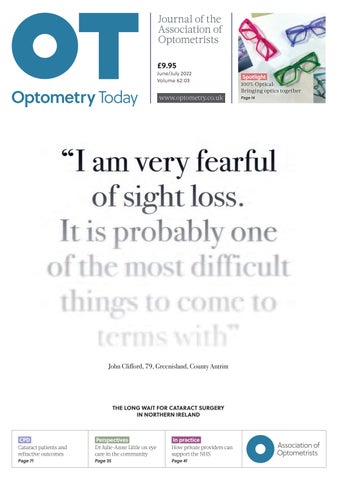
John Clifford, 79, Greenisland, County Antrim
/ www.optometry.co.uk
THE LONG WAIT FOR CATARACT SURGERY IN NORTHERN IRELAND
CPD Cataract patients and refractive outcomes
Perspectives Dr Julie-Anne Little on eye care in the community
In practice How private providers can support the NHS
Page 71
Page 35
Page 41
BLACK YELLOW MAGENTA CYAN
91OPTJUN22183.pgs 30.05.2022 12:55
VERSION REPRO OP
Welcome
SUBS
H
ART PRODUCTION Getty/Yuichiro Chino
CLIENT
aving been in my role at the AOP for around a year now, I am settling into the underlying rhythms of the job. Board meetings, Council, 100% Optical and the AGM – the punctuation marks of my working existence. These columns are another such marker. However, when writing, I forget that someone may read it. So, it came as a slight shock when I got an email regarding my description of local opticians “doing a decent trade” in my last column. My correspondent, an experienced and influential individual, questioned the effect such wording may have on the sector’s drive to extend the clinical reach of their activity. He had a point. One of the key battles over the next few years is to persuade government that optometrists are a key part of the primary, and acute, healthcare system, trained medical professionals to be valued alongside dentists, pharmacists and GPs. As this edition of OT discusses, optometry has a critical part to play in helping the NHS tackle the backlog of need created by the pandemic. Given the shortage of ophthalmologists and the size of waiting lists, it is essential to find ways of channelling clinical work into the community. With optometrists on every High Street, it makes sense that routine cataract follow-ups and the like are done in practice. But – and this is where the word “trade” perhaps does make sense – optometry is predominantly a private sector profession, and the community eye health system is largely paid for by the profit made by optometrists’ retail activity. Much of the clinical work undertaken is either done at cost or subsidised by the sale of spectacles. The vision of optometry moving to a more clinical model is not universally shared; for some, the costs of moving to this model are too high and the potential rewards too low to justify. However, given the rise of online retail and AIenabled refraction, one wonders how long the retail model will hold. It is no surprise to see one multiple moving towards a more clinical model, with senior leaders in the sector also supporting Optometry First’s three test sites. They know that, if the sector is to continue to thrive in the coming years, diversifying income away from a pure dependence on retail will be vital. At the moment, it is still reasonable to talk of opticians “trading.” In years to come, I hope that word may become far less appropriate.
“Optometry has a critical part to play in helping the NHS tackle the backlog of need created by the pandemic”
Adam Sampson, AOP chief executive
June/July 2022
BLACK YELLOW MAGENTA CYAN
www.optometry.co.uk 3
91OPTJUN22145.pgs 27.05.2022 10:50
Welcome
JUNE/JULY 2022
VERSION REPRO OP
Contents 8
25
SUBS ART
41 PRODUCTION CLIENT
Spotlight
CLINICAL NEGLIGENCE ADVICE
The news in digest Picture this Trevor Warburton receives AOP lifetime achievement accolade OT reports Exploring the impact of discrimination within the optical workforce The edit Optics in 15 stories 100% Optical OT shares highlights from the first 100% Optical in two years Supplier insight Preparing for the low vision patients of the future Industry profile Optegra on wait lists, market shifts and the impact of the pandemic, with Dr Peter Byloos AOP round-up A Council report, new clinical negligence guidance and an online safe practice resource
4 www.optometry.co.uk
June/July 2022
BLACK YELLOW MAGENTA CYAN
“Our hope is that the new guidance can reassure members who have received a complaint or a letter of claim” Efa Schmidt, AOP head of clinical negligence, PAGE 23
27-33 HIT LIST
The trends, launches and looks OT focuses on... Children’s frames Me and my glasses Adventurer, Chris Ramsey Get the look // Anatomy of a frame With Lizzy Yeowart The shortlist The June/July selection Behind the brand Scotch & Soda
35-38 PERSPECTIVES
Voices from optics and beyond Perspectives Dr Julie-Anne Little; Birmingham & Midland Eye Centre; Nigel Kirkpatrick My vision Para triathlete, Oliver Gunning
“We were the ones who turned up” Dr Julie-Anne Little, AOP chairman PAGE 35
James Ram; Getty; Jonathan Addie
07-23 SPOTLIGHT
14 50 CPD 65-90 Professional development for the eye care practitioner
18
27
65 CPD welcome 66 Charles Bonnet Syndrome and the patient in practice 71 Cataract surger y: discussing refractive outcomes with patients 74 The emergency assessment and management of chemical injuries to the cornea 79 Scleral lens fitting: where should we start? 86 Interpretation of fundus autofluorescence 88 A day with the orthoptist in urgent care 90 CPD author Q+A: Kathryn Howard
ONLINE
41-55 IN PRACTICE
James Ram; Getty; Jonathan Addie
Business insight and career development The roundtable SpaMedica and OT explore how private providers can support the NHS How I got here Optometrist, Stanley Keys The workshop Using WhatsApp and social media Life as a locum Anil Chander Eyes on wellbeing Trevor Bibic on setting goals and achieving them Pre-reg focus Caroline Mansfield and Thaksha Sritharan Key milestones Developing NHS Education Scotland Glaucoma Award Training Becoming a business owner Karmelo Modina
Cover story
In the dark With cataract surgery waiting times in Northern Ireland measured in years, OT investigates the impact of delays on patients and the optometrists who care for them. Plus insight into the advances taking place in hospital optometry
OT video highlights
OT shares highlights from 100% Optical
PAGE 57-63
Watch the video on
97-98 END NOTES
Contact the OT team with your experiences, observations and lessons from practice today: newsdesk@optometry.co.uk
I could not live without... ”Personal protective equipment,” says optometrist, Tamara Hasan Last word Megan Zabell’s secret life
www.optometry.co.uk
Follow us on Twitter @OptometryToday Like us on Facebook OptometryTodayJournal Follow us on Instagram @optometry_today
June/July 2022
www.optometry.co.uk 5
91OPTJUN22146.pgs 30.05.2022 10:19
Contents
CONTENTS
Picture This VERSION
Spotlight
REPRO OP
08 TIME TO SPEAK
OT profiles how discrimination is affecting eye care professionals
14 THE PROFESSION REUNITES
A round up of the education, eyewear and trends from 100% Optical
22 AOP SUPPORT
New guidance on Managing Risk in Practice and Clinical Negligence Claims
SUBS ART PRODUCTION CLIENT Noah Da Costa
AOP honours Trevor Warburton Optometrist Trevor Warburton has received the AOP’s Lifetime Achievement Award, in recognition of his career, which has spanned five decades. Trevor was presented with the accolade, sponsored by Alcon, at the
All together: an evening with the AOP celebratory event, which was hosted on the Sunborn Yacht, London on 24 April during 100% Optical. On receiving the award, Trevor told OT: “To be awarded feels great. It feels very special – I feel very honoured and
humbled that the AOP should think of me. It’s a recognition of everything that you have spent a large chunk of your career doing.” Learn more about Trevor’s career journey through OT's video interview online: bit.ly/39f9FQt June/July 2022
BLACK YELLOW MAGENTA CYAN
www.optometry.co.uk 7
91OPTJUN22147.pgs 27.05.2022 11:02
VERSION REPRO OP SUBS ART PRODUCTION CLIENT
TIME TO SPEAK OT profiles how discrimination in the workplace is affecting eye care professionals
BLACK YELLOW MAGENTA CYAN
T
he AOP has launched the 100% Respect campaign to promote inclusivity within optometry. The AOP’s latest Voice of Optometry survey, which 1100 members took part in, found that 60% of respondents had experienced racial discrimination, while gender, religious and agerelated discrimination were also reported widely. OT talks with eye care professionals about their experiences of discrimination and their vision for a fairer profession.
James Ram
“At the age of 41, I’ve decided it needs to change”
OPTOMETRIST AKBAR SHAH: I absolutely love the profession, but there are things that go on in the background which can make people feel very uncomfortable. A lot of people don’t want to speak about it for fear of reprisal. There is a massive fear factor, especially among locum optometrists. You can lose your days in a flash. I live in Devon but I was born and raised in Bradford, West Yorkshire. My parents came over from Pakistan before I was born. They were both illiterate and spoke very little English, so from a young age I was filling in forms and making appointments for them. It was a pleasure for me to go into the field of optometry so I could help people like I had helped my parents. During my pre-reg placement, there was a locum optometrist who knew I was from Bradford. A few months in she referred to the community of Bradford as ‘Pakis.’ I had heard that word so many times growing up, I could have mistaken it for my name, but that was the first time I heard it in a professional environment. During an eye examination, the patients would say ‘Where are you from?’ I would say ‘I’m from Bradford.’ They would say ‘No, no – where were you born?’ I could get asked that question once a day. It made me feel like a second-class optometrist. I think the thing that broke my heart was when I was working in Skipton. I had a good friendship with the practice owner – we would go out for meals, I
“I go into work with a spring in my step, but I don’t want to have to deal with this discrimination” Akbar Shah visited him in hospital. I dropped him off one evening at his home after he had retired. His neighbours’ house was for sale. I said ‘Oh, maybe I will come down and have a view.’ As he left the car, this man who had been my friend for so many years, who used to hug me at work, his words were: ‘I don’t think so. I don’t want a Paki for a neighbour.’ Then he shut the door and walked off. It made me question who I could trust. At that moment, I realised that I had always been an outsider looking in. The General Optical Council (GOC) is big on continuing professional development and core competencies – from contact lenses to binocular vision. Why can’t we have a core competency for diversity training? It would not just benefit the staff but the ethnic minority patients who we treat. There are plenty of white optometrists who say, ‘That doesn’t happen.’ But they have never experienced it. I have two young children: a sevenyear-old and a five-year-old. I am hoping they might go into optometry,
because I love this field. I go into work with a spring in my step, but I don’t want to have to deal with this discrimination. For people who have these experiences, don’t let it get you down. These comments can mean that you go home feeling disheartened and alienated, but there is nothing wrong with you. You should be proud of who you are. We’re not going to accept it anymore. At the age of 41, I’ve decided it needs to change.
“I felt like saying ‘Just give me a chance’”
OPTOMETRIST SHAMINA ASIF: As a locum, sometimes I feel I am treated differently if I am working in a new store where the staff are not used to working with people from Black, Asian and minority ethnic (BAME) backgrounds. I have received many comments from patients asking how long I have been in the country or enquiring about my qualifications before I start the sight test. Once, when I went to a small village in the countryside to cover for the day a patient said, ‘What are all these coloured people doing here?’ I have had patients rebook appointments as soon as they see that I am going to be doing their sight test and I felt like June/July 2022
www.optometry.co.uk 9
91OPTJUN22148.pgs 30.05.2022 14:56
OT Reports, 1
SPOTLIGHT
OT Reports, 2
SPOTLIGHT VERSION
- A DIVERSE WORKFORCE -
REPRO OP
33%
of optometrists and dispensing opticians are Asian or British Asian
SUBS ART
“We need to have equality, diversity, and inclusion officers present within organisations” Shamina Asif
PRODUCTION CLIENT
saying ‘Just give me a chance.’ When I work, I just want to be able to do my job competently and need the full support of staff. When I am having to tackle issues like this it makes work more difficult. You are trying to get used to equipment and a new environment so the last thing you want is to be judged by the way you look. If staff can see the behaviour of their colleagues or patients is not appropriate and is discriminatory in nature, then there should be someone in an organisation who they can confidentially speak to, so that issues can be addressed. The organisation needs to have a policy in place. I think all optical staff need to have training around equality and diversity. It is also important to educate staff about the demographics within our workforce. They need to know that a lot more of the optometrists now qualifying are from a BAME background. We need to have equality, diversity, and inclusion officers present within organisations like the AOP, the Local Optical Committee Support Unit, and the College of Optometrists. Large multiples should also think about such appointments. I have had organisations say, ‘Well we have those from BAME backgrounds, and we have a lot of women working for us.’ But what you find is that the boards consist of white women and Asian men, and they think they are doing a 10 www.optometry.co.uk
4%
are from another BAME background
17%
of GOC registrants are Muslim
37%
of student optometrists are Muslim Source: GOC Equality and Diversity Data Monitoring report, 2021
great job in terms of diversity when the Asian women are not represented. This is very important to consider as it is those two characteristics combined, the ‘intersection,’ that needs appropriate representation. Intersectionality can apply to age, religion, sexual orientation, and disability. No one is born discriminatory; this is a learnt behaviour, and, in some cases, it is because we are fearful of the unknown. Eventually, through education, I believe we can tackle this.
“My neurosurgery consultant said the reason there were no female consultants was because our hormones kicked in” OPHTHALMOLOGIST PROFESSOR MARIYA MOOSAJEE: We know that there are equal if not slightly greater numbers of female trainee ophthalmologists, optometrists and post-doctoral research associates within our field.
But the number of women drops off at more senior levels. My first experience of indirect discrimination was when I was a senior house officer. I was having lunch with my neurosurgery consultant, when he said the reason there were no female consultants was because their hormones kicked in and hence left to have children. I recall feeling bewildered by his comments, but it did reflect the attitude of those around me, a very male dominated environment, which was perpetuated by these types of remarks. When my twins were younger, and I was an ophthalmology registrar, I remember some of our clinics would finish around 8pm at night. Then with theatre the next day, it felt like I was just coming home to sleep, hardly seeing my children. That was really hard – especially, for example, if they got ill and then wanted comfort from the person who was around them the most, which wasn’t me. We all make extremely big personal sacrifices for our work, and I would like for that not to be the case in the future. I want to see women have equal opportunities and a career pathway that nurtures their choices. They should be able to have a workplace that supports them if they choose to start a family or have to look after dependants. It would help us so much if our male colleagues call out gender discrimination when they see it. I also think senior women have to keep in mind the struggles they have gone through and try to smooth the road for the future generations. Don’t laugh it off or let it go – call it out.
AOP SUPPORT The 100% Respect campaign calls on all those working in the profession to make a pledge to unite against all forms of discrimination: www.aop.org.uk/respect If you are experiencing discrimination or know someone who is, you can contact the employment team on employment@aop.org.uk, or read its guidance for employees online: www.aop.org.uk/rdemployee
June/July 2022
BLACK YELLOW MAGENTA CYAN
91OPTJUN22149.pgs 30.05.2022 09:40
VERSION PRODUCTION CLIENT
Advertising: Matt Hall 020 3771 7257 matt.hall@thinkpublishing.co.uk Advertising production: aop@ccmediagroup.co.uk Senior designers: Grant Pearce, Juanita Adu Client engagement director: Anna Vassallo Executive director: Jackie Scully Published bimonthly for the Association of Optometrists by Think Media Group 20 Mortimer Street, London, W1T 3JW Printed by Acorn Web, Normanton Ind Estate, Loscoe Close, Normanton, West Yorkshire, WF6 1TW All rights in and relating to this publication are expressly reserved. No part of this publication may be reproduced in any form or by any process without written permission from the AOP or the publisher.
Household incomes could drop by 4% in the coming financial year, according to forecasts by the Resolution Foundation, with rising utility costs and the conflict in Ukraine expected to have an effect. Speaking to OT, the Federation of Small Businesses’ national chair, Martin McTague, said: “The cost of living squeeze will have implications for small businesses as well as for people’s household budgets.”
10 tonnes
Nine solar-powered eye care centres have opened in West Bengal, India, with the aim of treating one million people. The centres have been opened by international charity, Orbis, and local partner, Susrut Eye Foundation and Research Centre. The centres will focus on treating children and babies with sight loss, as well as raising awareness of eye care in local communities.
A decision by the vision arm of Johnson & Johnson MedTech to remove outer plastic pouches from its Acuvue deliveries in Europe and the UK is set to save 10 tonnes of plastic each year. Keeping delivery notes inside orders, and introducing stickers with essential customer information will help reduce plastic use, the company said.
“I think there are exciting opportunities in shared care and advanced practice that are very difficult to harness as a single practice” Optometrist and managing director of Cameron Optometry, Ian Cameron, told OT his reasons for joining Hakim Group and his initial business goals.
12 www.optometry.co.uk
June/July 2022
BLACK YELLOW MAGENTA CYAN
Vision Care for Homeless People (VCHP) has opened a new clinic in Gloucester. It has been in planning for six months and will run out of Gloucester City Mission, which also includes a shelter along with an education and training centre. VCHP volunteers will be providing eye care and glasses to homeless people in the area on Mondays.
Pexels/Kampus Production
ART
Senior reporter: Kimberley Young kimberleyyoung@optometry.co.uk Web content and social media executive: Leah Boyle leahboyle@optometry.co.uk Clinical editor: Dr Ian Beasley ianbeasley@optometry.co.uk Clinical editor for multimedia: Ceri Smith-Jaynes cerismithjaynes@optometry.co.uk Video production editor: Laurence Derbyshire laurencederbyshire@optometry.co.uk CPD enquiries: 020 7549 2076 CPDhelp@optometry.co.uk AOP membership and OT subscription team: subscriptions@aop.org.uk
Christina Olner, CooperVision head of professional services for the UK and Ireland, told OT about a new online tool to support practitioners in offering myopia management, created in collaboration with industry experts.
Getty/Oscar Wong
SUBS
Editor: Emily McCormick emilymccormick@optometry.co.uk Deputy editor: Lucy Miller lucymiller@optometry.co.uk Features editor: Selina Powell selinapowell@optometry.co.uk
Getty/KeithBinns
REPRO OP
June/July 2022 Volume 62:03 Issn 0268-5485 ABC certificate of circulation 1 January 2021–31 December 2021
“There is a recognition that all eye care practitioners (ECPs) will be faced with an increased presentation of myopic children in their practices over the coming years and consequently there is a need for more ECPs to become engaged in myopia management”
Getty/Johner Images
INDUSTRY
THE EDIT 60 DAYS IN 15 STORIES
SCIENCE & VISION Getty/Science Photo Library
Scientists writing in Nature have highlighted the potential of a nasal spray in preventing and treating COVID-19. A study in mice confirmed the spray not only prevented the spread of the virus, but was an effective treatment if administered within 12 hours of infection. The compound, N-0385, has the potential to be used as a broad-spectrum mechanism against other viruses.
“There may be a long window of opportunity in which suppressing retinoic acid with drugs like disulfiram could substantially improve low vision and make a real difference in people’s quality of life” Richard Kramer, professor of molecular and cell biology at the University of California, Berkeley, described a study exploring the potential of disulfiram, also known as Antabuse and originally developed to treat alcoholism, for preventing vision loss.
1 IN 5
The Chinese University of Hong Kong has drawn a link between COVID-19 and dry eye disease. The study in Clinical and Experimental Ophthalmology analysed the experiences of 109 healthy people with 228 people recovering following a hospital stay with COVID-19, finding that one in five of those diagnosed with COVID-19 reported one or more symptom related to dry eye disease.
PROFESSIONAL SUPPORT
Pexels/Wendel Moretti
The AOP and Royal College of Ophthalmologists have joined The Eyes Have It partnership, which aims to raise awareness of the importance of eye health, along with issues of delayed referrals, service capacity and a shortage of specialists. Director of policy at the AOP, Carolyn Ruston, said: “We are excited to be part of a group that is prioritising the importance of good eye health and timely treatment for those who need it.”
“One of the issues that we find causes great concern amongst optometrists is the fear of litigation” Head of clinical negligence for the AOP, Efa Schmidt, and AOP clinical and professional director, Dr Peter Hampson, discussed safe practice in their 100% Optical presentation: The good, the bad and the ugly. Read OT’s summary at: bit.ly/38gGUmv
The AOP is developing a response to the General Optical Council’s call for evidence on the Opticians Act. Topics covered in the consultation include sight testing duties, the protection of title and restricted activities, remote care, and the regulation of businesses. The AOP has been asking members to feedback their thoughts since May, through the AOP forums at community.aop.org.uk or by email at policy@aop.org.uk. The call for evidence runs for 16 weeks and will close on 18 July.
IN PRACTICE Tom Mackley, chair for the Lancashire & South Cumbria Local Eye Health Network, and locum optometrist, Sarah Bentley, told OT about Blackpool Better Start, an initiative that aims to address inequalities by linking vulnerable families with pharmacy, dental and optical practices. Three optometry practices have signed up to an initial pilot of the project, which addresses different areas of social deprivation and connects families into local services. Find out more on OT: bit. ly/3yoT0o8
“If it wasn’t for going to get my eyes tested in the first place, who knows what would have happened”
Pixabay/Esi Grünhagen
To recognise Dementia Action Week (16–22 May), OT spoke to optometrists about the importance of patient-centred care. Vic Khurana, clinical director for Visioncall, explained: “If you are not seeing clearly, and you’re living a blurred life, having dementia is only going to exacerbate that situation. The impact you can have on that person can be huge in terms of their visual quality of life.”
Patient, Malcolm Carroll, and his optometrist, Craig Walker, highlighted the importance of attending routine eye examinations, after a sight test uncovered visual field loss that led to an urgent referral. June/July 2022
www.optometry.co.uk 13
91OPTJUN22150.pgs 27.05.2022 11:16
the edit
SPOTLIGHT
VERSION REPRO OP
Medical Air Sanitisers Clean air has never been so important
SUBS
Is your practice a Safe Air Space?
ART
Stop the spread of viruses PRODUCTION
Reduce allergy symptoms all-year-long Comply with highest hygiene standards Keep staff safe, healthy and at work
BRINGING OPTICS TOGETHER OT presents a snapshot of the launches, trends and education insights from the 2022 show This April saw the return of 100% Optical 2022, with more than 9600 attendees joining the optical trade show at London’s ExCeL and more than 130 education sessions curated by the AOP. Nathan Garnett, event director, said: “Bringing everyone back here has been phenomenal. We’ve had a real buzz in the room and people are happy to be able to see products and all the innovation that’s happened over two years as well.”
Reassure your patients CLIENT
Promote health and raise productivity Reduce sick-leave
6 STAGE FILTRATION TECHNOLOGY AIR8 280 Nano Ideal for the consulting room Effective area up to 24m2
AIR8 720i Edge Ideal for staff area or small front of shop area Effective area up to 64m2
AIR8 1200i Pro Ideal for large front of shop Effective area up to 110m2
01438 740823 sales@bibonline.co.uk bibonline.co.uk
14 www.optometry.co.uk
June/July 2022
BLACK YELLOW MAGENTA CYAN
In brief: education insights Title: Using clinical outcomes to improve quality and demonstrate the value of optometry Focus: Paul Morris, director of professional advancement for Specsavers, and Giles Edmonds, director of clinical services at Specsavers, discussed why optometry needs to continuously evolve as part of primary healthcare, and how data can be used to champion its cause. Takeaway: “We need to maintain and evolve our nationally commissioned NHS contract. Then we need to build on these foundations and high
quality services to get community optometry more involved in treatments for glaucoma, cataract and COVID-19 Urgent Eyecare Schemes that are evolving rapidly.” Title: Community eye care pathways for people with a learning disability: an Optometry First service Focus: Trevor Hunter, SeeAbility’s London Eye Care Pathway for People with Learning Disabilities coordinator, and Grace McGill, SeeAbility expert by experience, shared how the implementation of the refreshed LOCSU Community Learning Disability Pathway can reduce barriers to access. Takeaway: “A lot of us do what we can at our own practices to support people, but we need a pathway that will recognise the work clinicians are doing out there, and their expertise, and reward them. Commissioners need to understand this.”
100
SPOTLIGHT
LIZZY’S TOP THREE IN SUSTAINABILITY Optometrist and lifestyle blogger, Lizzy Yeowart, picked out her top brands using sustainable materials at 100% Optical
The exhibition Johnson & Johnson Vision (JJV) showcased its Acuvue portfolio of products at the event and highlighted the importance of fitting contact lenses correctly. The company also partnered with the AOP to deliver a suite of CPD education with topics covering comfort and how to articulate the benefits of new products to patients. Dr Rachel Hiscox, JJV professional education and development manager, UK & Ireland, said of the show plans: “We really wanted practitioners to be excited about the opportunities contact lenses can provide for their patients and to show them that we are continuing to innovate.”
Optos brought its ultrawidefield retinal imaging technology to the show. Speaking to OT about trends that have emerged from the pandemic, Sharon Ormonde, sales director for Northern Europe at Optos, said: “We’re seeing that patients are a lot more health conscious. Patients seem happier to have extra tests to make sure that everything is as it should be.” A number of employers were at the show this year, sharing information about their models and hosting recruitment drives. Speaking to OT, employers shared how the pandemic has spurred individuals to reassess their career goals, while some suggested that more optometrists are needed to meet growing demand and support extended services.
1 Green Eyewear and 0-Six Eyewear
by Thema: “Everything is made from bioacetate in a process that uses 50% less water and less electricity” 2 Feb31st: “Feb31st is using wood from fallen trees damaged in a storm” 3 Coti Vision: “For Earth Day Coti Vision has made a glasses chain out of a sustainable material: walnut wood.” See more on Instagram: @optometry_today
OT ON EYEWEAR TRENDS FROM THE SHOW Sustainability continues to be a key issue for consumers, practices and brands Frames are brighter and bolder than ever It’s all about the details.
WHAT IS DRIVING EYEWEAR CHOICES? Jason Kirk, co-founder, Kirk & Kirk: “We’re seeing that consumers are afraid of nothing. They are really excited, and they are educated. We’re seeing consumers come along already armed with decisions and some knowledge.”
Tom Wolfenden, managing director, Wolf Eyewear: “People want to make a statement with their frames. It’s not the whole wardrobe, but people see it first.”
Ryan James, export director, Eyespace: “Sustainability is the movement; not just within eyewear but within the optical industry. People are not only wanting to see what the frames are made of, but how they meet those key credentials.”
June/July 2022
www.optometry.co.uk 15
91OPTJUN22176.pgs 27.05.2022 14:57
VERSION SUBS ART
Preparing for the low vision patients of the future
PRODUCTION
Low vision aid suppliers, Eschenbach Optik and Sight and Sound Technology, tell OT about developments in the technology and what patients are looking for
CLIENT
“Dispensing low vision aids needs education and passion,” Matthias Anke, managing director at Eschenbach Optik, told OT. This might not be the most glamorous side to the optical industry, he argues, “but you always meet somebody who is desperate for them, and this is very rewarding, because we help people to see again.” The numbers of people requiring low vision aids are only going to grow in the west, Anke suggested, as society lives longer with the same diseases. “For example, diabetic retinopathy is something we see growing dramatically in most Western countries.” With this in mind, supporting patients who might benefit from low vision aids could become increasingly important, but entering the low vision field need not be overwhelming. Anke emphasised: “You don’t need to have 200 different products on the shelf to be successful with your customers.” The company provides a package comprising six products that offer practices and their patients an entry point into low vision aids. Technology in this field is accelerating rapidly, suggested Glenn Tookey, CEO of Sight and Sound. With the market moving quickly, if practitioners last learnt about low vision 16 www.optometry.co.uk
June/July 2022
BLACK YELLOW MAGENTA CYAN
aids in their university training, “they may be 10 to 15 years out of date, so it’s well worth an update.” The distributor of aids for blind and visually impaired people runs CPD sessions to support practitioners to expand their knowledge of low vision aids, and also operates a referral portal through its website. This enables individuals to self-refer, or eye care professionals to refer patients, and track the progress of the inquiry. What patients want Value for money is a core factor in a patient’s decision when purchasing low vision aids, with some technologies representing a significant investment. The costs of some technologies are coming down, Tookey noted, but explained: “I think people are looking for the ‘wow factor’ when they pick up a piece of technology. That gives them the reason to make such an investment.”
“People are looking for the ‘wow’ factor when they pick up a piece of technology” Glenn Tookey, CEO, Sight and Sound
Going digital Demand for electronic low vision aids is increasing. Anke told OT: “We have seen tremendous growth, not only with us, but worldwide in the field of electronic devices.” While the company began in analogue low vision aids, it extended into digital devices several years ago with the SmartLux Digital. Digital devices are an attractive option, and more transportable than ever. But analogue low vision aids still have a place in the daily lives of the individuals who require that support. Anke said: “If you’re just checking a price tag in the supermarket, or reading the menu in a café, you don’t need an electronic device, illuminated magnifiers are enough.” For extended reading tasks, such as at work or school, however, electronic devices can be a popular solution, “and the development of these is going to become more refined,” Anke added. “We have to bear in mind the expectations of coming generations of visually impaired people,” Anke continued, who will “in 10 years’ time, expect something electronic.” What about the prevalence of smart phones? Could these, and their accessibility features, have an impact on this space?
Getty/ilkercelik
REPRO OP
SUPPLIER INSIGHT
There are two ‘Holy Grails’ in what patients are seeking in low vision aids of the future, Tookey told OT: portability and navigation. While devices are becoming more portable, the full scope of external and internal navigation “has not yet been achieved,” Tookey feels, “but in the next five years I expect to see products that meet those requirements.” Looking at the future for low vision aids, Tookey said: “I think there is convergence in looking for one device to do many things, and there is divergence in people trying to get something that is really very good, and value for money, but that meets a particular need.” Giving the example of the OxSight Onyx, a device aimed at individuals with central vision loss, Tookey noted that products are needed for specific low vision conditions.
Supplier insight
“We have seen tremendous growth in the field of electronic devices” Mattias Anke, managing director, Eschenbach Optik Anke argues that, “the hardware available today does not qualify to be the carrier for low vision applications,” and while they might feature magnifying applications, these may not be suitable for extended tasks. “We believe that this is only half of the answer to the requirements a modern low vision device of the future will have,” Anke said. Eschenbach has been working on a research and development initiative looking into this field. Anke explained: “We are working on a completely new platform for the next generation of Eschenbach low vision devices, which will address all the potential questions the next generation of potential low vision patients might have.” An early route to support Both suppliers emphasised the impact that low vision aids can have for patients, and the role that optometrists can have in signposting individuals to access support.
“Optometry is the ideal profession to successfully take care of the potentially visually impaired,” Anke said. He highlighted that there are a range of devices to support patients who qualify for optical help for small print. “The earlier we start to introduce optical help to those who might need more extensive help at a certain point of time, the better it is,” he emphasised. Tookey also illustrated the benefits patients can have in accessing low vision technology earlier in their journey: “There are many shades of grey between being registered as blind, or in the actual low vision pathway, where a person may benefit from seeing the technology available.” Some patients might not see the technologies that are available until their condition becomes permanent and they are perhaps referred to a charity. Recognising the pressures on practitioners, Tookey shared: “I’m really keen that eye health professionals know that these tools are out there and there is no cost to or time required for them to connect with us for CPD or to direct a patient.” “My key message would be to reach out, engage and get up to speed. Once you know we are out here, you can help yourselves and so many more people,” he added.
Announcing the UK launch f h dv &
w medmont meridia™ dT g h
Trade in your topographer and save £3,500!*
*Available on Professional model
See Clearly, Treat Optimally:
C
M ib g I gi g
h
I i
OT
ASKS
HOW IS THE RNIB SUPPORTING EYE CARE PRACTITIONERS IN LOW VISION?
The Royal National Institute of Blind People (RNIB) has been exploring the current low vision services in England and considering what a future framework could look like, inviting optometrists to provide feedback. Speaking to OT about this work, Preeti Singla, optometry and low vision engagement manager at RNIB, said consultations had been well supported, with a total of 274 responses across two surveys. Singla explained: “Many High Street practitioners, particularly in England, are keen to provide greater support for their patients who are visually impaired, but do not feel they are able to do so effectively due to multiple factors.” RNIB is collaborating with sector partners to develop a low vision framework which will address inequality in service provision, Singla explained, “and we aim to provide a new free-to-access training programme for practitioners, giving them the knowledge and tools to meet their patients’ needs.” Discussing support for practitioners, Singla added: “Our regular peer discussion group, aimed at practitioners providing low vision services, aims to ensure that providers do not work in isolation, and have a platform to share good practice in this specialist field.”
L
i dFu Fi i g I & Vid
i gi g
T
dib h- f-Fi d I gi g & Vid
Li bu Li bu g h -N wi Wid -Fi d C u
01438 740823 sales@bibonline.co.uk www.bibonline.co.uk
June/July 2022
www.optometry.co.uk 17
91OPTJUN22177.pgs 27.05.2022 14:57
industry profile
SPOTLIGHT VERSION
INDUSTRY PROFILE
Supporting care for cataract patients REPRO OP
CEO of Optegra, Dr Peter Byloos, told OT about the trend for outsourcing cataract surgery, and market shifts in independent eye care provision
SUBS
different solutions. On the other hand, how is the current situation in Ukraine, as well as energy prices, going to affect our spendable income, lifestyles, and how much we are going to spend on our eyes?
ART
We won’t be going back to the old days with some of the ways we’ve had to adapt and learn during the pandemic. We hold a virtual clinic for every self-pay and refractive patient, and will continue to. For cataract patients, we have pre-operation assessments with a clinical team once they are booked in. We will continue to do that so the patient is better prepared and so we can triage better.
PRODUCTION CLIENT
The year of 2019–2020 was challenging for Optegra, as for every medical provider. COVID-19 had a big impact on our lives, healthcare, and how we treat our cataract patients. We standardised our pathways and reopened relatively quickly. We started doing a lot of virtual consultations and pre-operation assessments by telephone. The pandemic had a massive impact on the waiting list for cataract procedures. It is the number one elective procedure in terms of patients who have been on the waiting list for more than one year in the UK. There has been a trend of outsourcing to independent service providers, and now there are three or four national chains providing cataract surgery. The NHS has been struggling to cope with the demand and elective cataract surgery can be very easily done in a day care setting. Sometimes, independent service providers like us, who specialise in ophthalmology, are better positioned to do that. There has been a shift in the market. The Royal College of Ophthalmologists has found that almost 50% of the market was outsourced during COVID-19, and in Europe, most elective cataract surgery is outsourced. 18 www.optometry.co.uk
The UK is a large market, the second largest in Europe, and it is now a market that is going to be largely outsourced. I think that is here to stay. A very complex Trust hospital is not built for simple elective surgery. It’s not that we are cherry-picking one cataract and not another, but in general, most cataract surgery can be done with the patient in a day care setting.
It’s important to make sure that the relationship with the optometrists is very good, and that we can refer patients back. We are very good at performing the day care surgery but we are not necessarily best-positioned to have that patient interaction day-to-day afterwards, such as in ordering the prescription for glasses after cataract surgery. That OT toured is where the relationship Optegra’s flagship hospital in Queen with the optometrist is very Anne Street, London. important, and the NHS is Watch the video on facilitating this too. our website:
The private market has been very turbulent with COVID-19. After the closure for six to eight weeks of our sites, we bit.ly/3GhhDoJ saw the younger patients Being able to restore who wanted to have vision people’s sight is a critical correction coming back very opportunity. With the ageing quickly, while we saw that elderly patients population, it’s going to be important to who wanted to have their cataract surgery continue having our patients served well, were very concerned about COVID-19 and and the more we can do that in a local were not coming back as quickly. setting, the better. We will see what happens with the I think that vertical integration between private market in the future. On the one High Street optometrists, as well as hand, you have high waiting lists that ophthalmic providers, specialty providers are going to be influencing the private and community centres, is important, so market, encouraging patients to find the patient gets a really great experience.
“With the ageing population, it’s going to be important to continue having our patients served well, and the more we can do that at a local setting, the better”
June/July 2022
BLACK YELLOW MAGENTA CYAN
91OPTJUN22178.pgs 27.05.2022 14:55
VERSION
MEMBER SUPPORT
AOP Council discusses delegation and PPE use REPRO OP SUBS ART PRODUCTION CLIENT
The March meeting of AOP Council considered the future of regulation and clinical practice in optometry The future of regulation in optometry, and how clinical practice evolves following the relaxation of COVID-19 guidelines, were discussed in the latest AOP Council meeting on 16 March. The meeting was opened by Dr Julie-Anne Little, AOP chairman, who welcomed councillors to the first meeting of 2022 and introduced Carolyn Ruston, who joined the AOP as policy director in January. The AOP is continuing to develop a refreshed strategy, AOP chief executive, Adam Sampson, told Council, which will explore analysis of the “pressures on the profession over the coming years.” The future role of the optometrist AOP Councillors took part in workshops to consider the future of regulation and delegation in the profession, building on work carried out in previous council meetings. Councillors were asked to rank the current role of the optometrist, the likely future role, and the aspirational future role, on a scale from ‘All clinical’ to ‘All retail.’ 22 www.optometry.co.uk
June/July 2022
BLACK YELLOW MAGENTA CYAN
Dr Peter Hampson, AOP clinical and professional director, told OT: “AOP Council members very clearly indiated that they see the future role of an optometrist as becoming increasingly clinical, with an aspiration to move even further in that direction,” adding that this “validates the current work that we are doing in this area.” Regulation and delegation Councillors discussed the advantages and disadvantages of different scenarios in which responsibility is either retained by the optometrist, or responsibility moves to the person to whom activities are delegated to. Hampson outlined: “As we know the GOC has recently launched a call for evidence on the Opticians Act, we were very keen to explore with Council what the risks and benefits of delegation and the increasing use of technology might be.” The perspectives of the practitioner and of the patient were considered, which Hampson said, “enables us to better make our case, but also to consider the counter arguments that might be made by those with differing perspectives and aims.” PPE beyond the pandemic Ruston led a discussion exploring factors to consider in clinical practice
following COVID-19, as the country moves down the Government’s roadmap beyond the pandemic. “This is very much an opportunity for you to feed into the AOP’s policy and guidance,” Ruston said, adding that “personal protective equipment (PPE) is a timely issue to discuss.” Key topics included the appropriate level of PPE to use going forwards, as well as cost and sustainability issues. Councillors agreed on the benefits of continuing to wear face masks, cleaning down surfaces and sanitising. The Council also discussed the importance of balancing what is evidence-based and what makes the practitioner feel safe. With PPE funded through the NHS portal until next spring, councillors discussed the arguments for retaining its use, particularly in keeping infection rates down in practices and reducing the chances of absence.
AOP Council welcomes new councillors Seven councillors join the Council in designated posts The AOP Council has welcomed seven new and re-elected councillors in designated posts representing a variety of practice and career stages. The new councillors were revealed following an appointment process that ran from February and April. Appointed councillors include: Laura Josephs, undergraduate student optometrist Inderpal Ghuman, pre-registration optometrist Summaya Ali, newly-qualified and early career optometrist James Dawson, dispensing optician Adnaan Ahmad, franchisee/joint venture partner Will Holmes, academic optometrist Optometrist, Karen Gennard, joins the Council as a representative for South West England. The terms of office for the new councillors began this month (June). AOP members are able to contact councillors through the online community forums at https://community.aop.org.uk
AOP EXPERT
AOP EXPERT
Policy
Clinical
Kathy Jones, policy adviser What is the AOP’s Managing Risk in Practice guidance? The AOP believes that a working environment can affect an individual optometrist’s ability to meet the highest professional standards. A lot of our guidance is focused on how individuals can meet high standards, but this advice is mainly focused on the systems and procedures in the optical practice and how these can create an environment for excellence. The webpages provide practical advice on how to avoid the risks to patients that can arise in day-to-day practice. The advice focuses on how practices can develop and implement systems to mitigate, or avoid, some of the pressures that can impact on optometrists’ time and attention, and which can lead to clinical mistakes.
Who is the guidance for? The guidance is for all members, whether employers, employees or locums, and includes content tailored to some of the specific challenges faced by these groups, as well as advice for all members of the practice team. We have also outlined ways the AOP will support members facing these issues in practice. What else does the guidance cover? We encourage members to review the guidance as it applies to them. The pages include contact details for the AOP’s legal and regulatory teams that can help members who are concerned about the pressures they work under. The Managing Risk in Practice guidance can be found at: www.aop.org.uk/managingrisk
Efa Schmidt, head of clinical negligence What is the new guidance? AOP members benefit from a dedicated legal team who understand the specifics of an optometry setting. The new Clinical Negligence Claims Guidance informs members of what it means when a patient makes a complaint or instructs a solicitor to bring a claim, the steps they need to take, and the circumstances under which to contact the AOP’s legal team. Our hope is that the new guidance can reassure members by providing advice in a format that is easyto-digest, making it less overwhelming or intimidating. Should members familiarise themselves with the process? People often think that something like this won’t happen to them, but it is an unfortunate reality, and a variety of factors can lead to a
patient complaint or claim. It is well worth members looking through the guidance to familiarise themselves with the processes and the tests that must be met and proved in order for a claim to succeed. What should members do if they receive a complaint? The new guidance outlines in detail the steps that members should take if they have received a letter of complaint or a letter of claim. The advice is broken down into the different steps to take as a locum, employed optometrist, or the practice owner. Members should contact the clinical negligence team if they receive a claim from a solicitor or are notified of an intention to claim. Read the new Clinical Negligence Claims Guidance at: www.aop.org.uk/clinneg
June/July 2022
www.optometry.co.uk 23
91OPTJUN22179.pgs 30.05.2022 10:40
member support
SPOTLIGHT
Focus On VERSION
Bringing back the 90s
REPRO OP
FOCUSES ON... CHILDREN’S FRAMES
Sons + Daughters has launched its new campaign for the spring and summer, inspired by the dance and fashion culture of the 90s and featuring frames from its ‘Classic’ and ‘Studio’ collections, such as the flower-shaped ‘Pixie.’ New for the season, the brand has introduced ‘jelly’ colours in transparent hues. www.wearesonsanddaughters.com
SUBS ART PRODUCTION
Hit list
The trends, launches and looks
CLIENT
An ocean impact
Eyespace has introduced its first sustainable models in its Rock Star collection for children and young people. Each model in the capsule collection is named after an endangered sea animal, such as the ‘Beluga C2,’ which features a navy front with blue sides, and is inspired by “sea and sky.” The frames are made from recycled plastic waste collected from the ocean, including plastic bottles. www.eyespace-eyewear.co.uk
Customer favourites Flexible frames
Dibble Optical has highlighted five new sunglasses from Milo & Me. The frames are made of TR-90, a soft and flexible material, and also feature a hypoallergenic polymer in the sides and nose area. Frames include ‘Janne,’ an aviator available in three colourways, the ‘Dominique,’ which provides a rectangle frame, and the ‘Noel’ – which is available in colours ranging from light blue to dusky pink and peach. The models ‘Chris’ and ‘Lou’ round out the colourful collection. www.dibbleoptical.co.uk
Tomato Glasses has introduced several new styles for the UK market, with models in a new plum shade, and a chocolate colour. The supplier also introduced a clear frame featuring illustrated unicorns, following a customer request. Highlighting the benefits of bespoke frames, Sarah Gillingham, managing director of Tomato Glasses UK, said: “If a young person has been able to create their own frame, then they are more likely to enjoy wearing them and feel proud to wear glasses.” www.tomatoglassesuk.com
June/July 2022
BLACK YELLOW MAGENTA CYAN
www.optometry.co.uk 25
91OPTJUN22141.pgs 27.05.2022 10:39
VERSION
GET THE
REPRO OP
LOOK
Q&A ME & MY GLASSES
Optometrist and lifestyle blogger, Lizzy Yeowart, on a brand-new shade embracing the emotions of the present time
SUBS
‘Veri Peri’ is a new shade created by Pantone to embrace the uncertainty and cautious optimism of the present time. This new, beautiful shade of periwinkle is the result of almost a year’s worth of research, which started last spring.
ART PRODUCTION
Translucent hues
CLIENT
Chris Ramsey
In common with all Stepper eyewear, ‘STS-10075,’ in colour F550 is lightweight and supremely comfortable. The translucent purple shade is easy on the eye and universally flattering. www.steppereyewear.com
OT talks to the world-record breaking adventurer, Chris Ramsey, about eye protection and partnering with Coral Eyewear
1
3
2
4
Jonathan Addie
I currently own three pairs of sunglasses. I have two pairs of Coral Eyewear ‘Albacore’ sunglasses, one with tinted lenses and one with polarised lenses. The other pair are my old aviator sunglasses which are a bit worse for wear and I am looking into ways they can be recycled or reconditioned. Having eyewear that you like and feel comfortable in is hugely important. While it is important that your eyewear provides the correct level of protection, it is also an extension of you and how you express yourself to the world. Eyewear is like your favourite jumper, so I would encourage people to invest in their eyewear like they do in other areas of fashion.
The right eyewear is crucial to the success of my expeditions, as I travel across some of the hottest and harshest environments on the planet. Having polarised lenses, for example, plays a huge role in protecting my eyes from the intense sun when I am driving and filming. I actively encourage everyone to get regular eye checks. 80% of what we perceive comes through our sight, and through my career as an overland adventurer using electric vehicles, it is critical that I make sure that I protect and look after my eyesight the very best that I can, or I would not be able to explore the amazing planet the way that I do.
Like a gem The faceting work on the ‘Aqua 3,’ by François Pinton, brings brightness and lightness to the model for a stunning result. This frame reimagines the round shape with cut angles to give a soft, original look. www.maceyewear.co.uk
Colour pop curves Independent German eyewear brand, Frost, creates handcrafted distinctive eyewear in a variety of unique designs. ‘Curve’ juxtaposes purple with orange in a truly head-turning style. www.pm-frost.de
June/July 2022
BLACK YELLOW MAGENTA CYAN
www.optometry.co.uk 27
91OPTJUN22142.pgs 27.05.2022 10:41
MMG
HIT LIST
VERSION
Sunglasses
Summer sun
Maui Jim has introduced four new sunglasses styles. The frames are made from acetate and feature the brand’s patented PolarizedPlus2 Lens Technology. Styles include the rectangular ‘Two Steps’ (pictured), which has been designed to mimic the shape of the large, flat lava rock formations known by the same name at Pu’uhonua O Honaunau National Historical Park in Hawaii. The style is made from lightweight nylon with embedded rubber nose pads. www.mauijim.com/GB
REPRO OP
SHORTLIST THE LATEST PRODUCT LAUNCHES
SUBS
Spectacles
Fresh faced
ART
JF Rey has launched a new spring/summer collection for Volte Face that features fashionable, elaborate but easy-to-wear styles to appeal to a younger clientele. Available in 12 shapes and 48 colours, the handmade models are worn oversize and in thin acetate, or thickened at the sides. Styles play with translucent and coloured acetate materials, such as in the dualtoned ‘Sara’ (pictured). www.jfrey.fr
PRODUCTION tbc
CLIENT
Dry eye
Relieve and hydrate
Sunglasses
Historical twists
The Vivienne Westwood sun collection, presented by Mondottica, has launched for 2022 with styles that play with exaggerated proportion and asymmetry. Models include ‘Pilot’ sunglasses (pictured), made from two-tone bioacetate and designed with tapered asymmetric lines and gradient lenses. The classic motif is engraved on each side, while the frames are finished with gold-tone etching at the tips of both arms and rounded edges. www.mondottica.com
30 www.optometry.co.uk
June/July 2022
BLACK YELLOW MAGENTA CYAN
Théa Pharmaceuticals has introduced Zaspray to its dry eye range to help relieve symptoms caused by allergies and hayfever. The spray is composed of 0.2% Hyaluronic acid to help keep the ocular surface hydrated, along with 4.5% Per-Lip complex including Liposomes to ease irritation. The preservative-free formula also includes natural plant extract, Perilla Seed, which is an antioxidant. www.theapharmaceuticals.co.uk
To feature in OT’s Hit list, contact kimberleyyoung@ optometry.co.uk
Spectacles
Metallic moments
OWP has introduced ‘8619’ (pictured) to its men’s selection of frames. The new model features a double bridge in a fashionable, sporty square shape and spring hinge. The sides reveal three-dimensional embossed effects with unusual openings and colour accents against the matte metallic tone of the frame. www.owp.de
Accessories
Cool cases
Louis Stone Optical has released 10 new models to its premium hard and soft case collection. The additions to the collection includes the elegant ‘Mosaic’ case (pictured), which also has a flocked texture to aid customers with sight difficulties to find the case in their bag. Other cases include a star-speckled case, a case with an illustrated smile, and children’s cases including ‘Adorable pups.’ www.louisstone.co.uk
Software
New vision assessment
Thomson Software Solutions has developed a new system for near vision assessment to combine the versatility of PC-based software with the display capabilities of mobile devices such as smart phones and tablets. The Thomson Near Chart App can be loaded onto a PC running Windows 10/11. Devices such as phones and tablets can then be linked to the app using a QR code or email link and scaled to the size of the device screen and resolution. The new system means clinicians don’t need to retrieve the device from the patient to select each test. www.thomson-software-solutions.com
June/July 2022
www.optometry.co.uk 31
91OPTJUN22143.pgs 27.05.2022 10:44
Shortlist
HIT LIST
VERSION REPRO OP
Q&A BEHIND THE BRAND SCOTCH & SODA
SUBS
Mondottica brand manager, Avital Kropp, on the UK launch
Clockwise from left: ‘Meent’ and ‘Otto’ sunglasses; bio-acetate frames are new for 2022.
ART
SCOTCH & SODA //
PRODUCTION
1
The Scotch & Soda head office in Amsterdam is in a converted church
2
In September 2020, the brand began a partnership with Plastic Whale, a social enterprise seeking to free waters of plastic worldwide
CLIENT
3
Scotch & Soda’s approach of mixing classic and contemporary styles is referred to as ‘classic with a twist,’ but inside the brand, is known as ‘classic with a fizz.’
What is Scotch & Soda? What makes your eyewear unique? Born and raised in Amsterdam, with a global view on the world, Scotch & Soda is inspired by the liberal outlook of its home city. The brand strives to bring joy through its products, no matter the circumstances, and the eyewear collection is no exception to this, designed for anyone who champions individuality and authenticity. The latest collection includes bespoke, triple layered acetates with strong bevel details and subtle metal accents. Are there any new products in development to be aware of? One of the top priorities for Scotch & Soda is to run the business with greater sensitivity to our planet by making more responsible choices that reduce its environmental impact. 2022 sees the introduction of bio-acetate to the eyewear collection, a natural and renewable material made from cotton and wood pulp. Coloured with plant-oil based pigments, this material is highly durable and flexible. Bio-acetate offers a sustainable option to conventional plastic that can be broken down into non-toxic components at the end of the product life span. What ambitions does the brand have for the next 12 months?
Scotch & Soda
Growth is a key focus in 2022. In August, Scotch & Soda will celebrate the opening of its Covent Garden store, adding a third location to its London portfolio. Launching the eyewear collection at 100% Optical in London fitted well with its 2022 plans.
ANATOMY OF A FRAME
Butterfly shape
Hand-sewn lace by Ermanno Scervino fashion house
Unpicking a standout frame, by OT columnist Lizzy Yeowart
Super-lightweight harmonic steel
In a nutshell Manufacturer // Pugnale Eyewear Frame // ‘Jacquard’ Colour // Red Web // www.pugnaleeyewear.com
Iconic design Unique frame front
June/July 2022
BLACK YELLOW MAGENTA CYAN
www.optometry.co.uk 33
91OPTJUN22144.pgs 27.05.2022 10:45
BTB
HIT LIST
Perspectives VERSION REPRO OP
Perspectives Voices from optics and beyond
SUBS
“We stepped in to try to help, assess and manage those patients”
ART
Dr Julie-Anne Little
PRODUCTION
P
Getty/Malte Mueller
CLIENT
re-pandemic, I felt like secondary care was quite ingrained in what secondary care did, and while there were a lot of pockets of activity within primary care where locally commissioned services were in place, the structure of what was possible felt set. The disruptor that has been COVID-19 has forced both primary and secondary care to get much more comfortable with virtual and digital processes. I don’t just mean teleophthalmology, but also the way in which we send and share information. The pandemic has forced this into reality and created a sense of understanding that we can view this information virtually too. The last two years has helped improve the relationship between optometrists and ophthalmologists. Ophthalmologists appreciated that it wasn’t always possible or easy for patients to go into hospital during the pandemic, but their ability to access eye care in the community and the ability for both professionals to triangulate and work together was important. This also really helped ophthalmologists – a dialogue would be established, enabling them to remain involved in their patients’ care. This has in turn led to more trust in optometrists dealing with a range of eye-related problems, as well as for the sharing of patients between primary and secondary care. We were the ones who turned up, and who still had our practices open. During the pandemic there were many patients who were seeking advice as they were not having their usual outpatient appointments for things like stable glaucoma monitoring, and they began presenting to their optometrist. Despite not formally being part of their care, we didn’t
The future There is still a way to go with the development of this relationship. Ophthalmology needs to better understand how optometry is funded and what they are asking us to do without any means to get paid for it. It is an ongoing issue about being remunerated and one that is not easily solved. Consequently, optometry is vulnerable. When we say, ‘yes we can do that,’ with no appropriate fundng in place, that can set a precedent for doing it and not getting paid. In order to keep progressing, there has to be some central momentum built with the Royal College of Ophthalmologists, as well as at a national level, to formalise some of those informal pathways that have been achieved so successfully over the last two years. We have demonstrated that the delivery of eye care in the community can play an important role in supporting ophthalmology. We also know that patients like and value being managed in the community. Therefore, if we can shift more secondary care services into primary care in order to enable secondary care to target waiting lists for surgeries, for example, we should. Dr Julie-Anne Little is an optometrist , chairman of the AOP Board, and a senior lecturer at Ulster University
December June/July 2022 2017
BLACK YELLOW MAGENTA CYAN
What is your view?
turn them away as that’s not in our nature. We stepped in to try to help, assess and manage those patients.
Email OT with your comments newsdesk@ optometry.co.uk
AOP Council AOP Council has appointed seven new Councillors www.aop.org.uk/ councillors
www.optometry.co.uk 35
91OPTJUN22137.pgs 30.05.2022 15:16
VERSION REPRO OP
“We are acutely aware of the increasing waiting lists”
SUBS
Dr Waheeda Illahi, Rosie Auld, Dr Peter Good and Dr Emma Berrow
ART
A
PRODUCTION CLIENT
s heads of service at the Birmingham & Midland Eye Centre (BMEC), we are acutely aware of the increasing waiting lists and have been planning for the anticipated surge in COVID-19 related demand over the last 12 months. However, the resurgence of COVID-19 due to the highly transmissible omicron variant has placed our services under considerable pressure since the beginning of 2022, with the levels of absence due to sickness in our departments being the highest we have experienced since the start of the pandemic. Regrettably, COVID-19 related sickness has resulted in, and continues to result in, appointment cancellations, and we work hard to “COVID-19 related reschedule these to sickness has resulted minimise disruption to in, and continues our patients. In order to to result in, appointment address these challenges, cancellations, and our Trust is supporting we work hard to our services with premium rate clinics, giving reschedule these” colleagues the opportunity to work evenings and weekends. The impact on the paediatric waiting list has been positive and this model will be extended across the service.
AOP advice Access AOP advice and guideance on coronavirus: www.aop.org.uk/ coronavirus
Adapting and responding The National Eye Care Recovery and Transformation Programme outlines steps towards recovery plans, whilst also recognising that ophthalmology accounts for the highest volume of outpatient specialty, with approximately 10% of the NHS treatment backlog being in eye care. In line with Getting it right first time (GIRFT) guidance, the BMEC is establishing a diagnostic hub to provide staff, equipment and an environment that facilitates high volume, high quality, and comprehensive diagnostics, in line with the need to change the emphasis from face-to-face to virtual review. There is an
36 www.optometry.co.uk
June/July 2022
BLACK YELLOW MAGENTA CYAN
opportunity for optometrists, orthoptists, nurses and vision scientists to develop their skills and support medical colleagues to manage these backlogs, while dealing with growing demand in the big sub-specialties of glaucoma, medical retina and corneal services. Although the initial capital investment is high, this is offset against much greater efficiency as the waiting times for diagnostic tests are reduced and infrastructure is provided for the longer-term recovery. As ophthalmology has transformed in the last few years, advances in diagnostic imaging have led to a much higher level of diagnostic accuracy and timely intervention. Those working in ophthalmology have embraced change as the benefits to patient care have been immense. The BMEC is a supra-regional referral centre for highly specialised services such as paediatric and adult electrophysiology, and rare services such as ultrabiomicroscopy. Whilst funding support is being made available for diagnostic hubs and the focus remains on reducing waiting times for high volume clinics, it is essential that financial support is also provided for services that cater for the needs of the minority of patients with rare and complex disorders. Our optometry and ophthalmology colleagues who work in A&E and urgent care clinics on a regular basis indicate that a significant proportion of patients are presenting directly to the eye hospital for red eye-related conditions, foreign bodies, and flashes and floaters. It appears that patients are not fully utilising the local COVID-19 Urgent Eyecare Service. While we focus on continuing to address our waiting lists and more complex patients, we are reliant on the support of our community optometrists to manage less complex cases and to undertake referral refinement prior to referral to the HES. In summary, the COVID-19 crisis has had massive consequences on ophthalmology service backlogs at the BMEC. We have had to develop strategies for managing with reduced staff and the increasing backlogs, and we have made many changes to how we deliver services. The business continuity plans that we have today are unrecognisable in relation to those used in 2019. Dr Waheeda Illahi is a consultant optometrist and head of optometry services at BMEC, Rosie Auld CBE is head of orthoptic services, Dr Emma Berrow is consultant ophthalmic electrophysiologist and head of visual function, and Dr Peter Good is a consultant neurophysiologist and head of visual function.
“The pandemic has shown us that the optometry and ophthalmology sectors can work together” Nigel Kirkpatrick
O
Getty/Malte Mueller
phthalmology is the largest outpatient specialty in the NHS, with 7.8 million outpatient appointments annually. Even before the pandemic, our hospital eye services were struggling. Follow-up intervals were extending beyond safe levels and the offer to see more patients in the community was making painfully slow progress. Newmedica was born out of these backlogs. We now provide the whole scope of ophthalmology care within our own facilities, and serve more than 120,000 patients per year. This is mainly NHS, with some private care. We joined the Specsavers group in 2016 and are ring-fenced from the optometry business. Pandemic patterns In response to the pandemic, eye care services in the UK were withdrawn, reduced or restricted. This led to millions of missed eye examinations, delays in treatment and extended waiting times for patients. Public dissatisfaction with the NHS is increasing, particularly with the time that it takes to get a GP or hospital appointment. The NHS recovery plan aims to eliminate one year waits by 2025 by recruiting staff from abroad, increasing productivity through digital solutions and using the independent sector to offer more choice to patients. While waiting times are important, the quality of care and providing sufficient capacity are the overriding factors in dealing with the backlog. Staffing is a big concern, yet current NHS plans do not address this workforce issue. Capital equipment in medical facilities also needs long term planning. I strongly support the worthwhile incentive to increase services using the payment by results mechanism. We also need changes in working practices that sustain improvements in productivity. The switch to day surgery has happened over the last 20 years, but COVID-19 has demonstrated our ability to shift rapidly, for example, to
virtual clinics and streamlined pathways that reduce time spent in waiting rooms and enable the management of services using virtual meetings. The pandemic has shown us that the optometry and ophthalmology sectors can work together to support patients with their eye health needs, delivering effective and innovative care pathways in an accessible community-based setting. The future direction As an ophthalmologist, I believe it’s vital that I provide personal patient care and build connections with optometrists as we work in partnership on important aspects of patient care: such as having a clear referral route, high-quality patient outcomes, and “Even before the the management of postpandemic, our hospital operative issues. eye services were There will be a lasting struggling. Followlegacy of COVID-19 and up intervals were there simply are not enough extending beyond safe ophthalmologists in the UK to respond. Optometry remains levels and the offer to the front line for patients see more patients in the with significant eye disease, community was making working with primary painfully slow progress” care ophthalmology in the community. We urgently require an integrated workforce, operating closer to patients’ homes with detailed patient knowledge. I believe ophthalmology and optometry will become fully integrated as we contribute our expertise as skilled clinicians. As optometrists upskill and engage with local consultants for shared CPD, case-based discussions and clinical advice queries, we will develop teams with an unrivalled skillset to diagnose and treat our patients. Nigel Kirkpatrick is a consultant ophthalmologist based in Gloucestershire. He is also medical director of Newmedica.
December June/July 2022 2017
www.optometry.co.uk 37
91OPTJUN22139.pgs 30.05.2022 10:35
Perspectives, 1
PERSPECTIVES
Perspectives, 2
PERSPECTIVES VERSION
MY VISION
Oliver and Stuart Gunning
SUBS ART PRODUCTION CLIENT
saving as much of my eyesight as they could. When I Oliver Gunning: If you put one hand over your left first started taking part in triathlons, I didn’t think too eye and then squint so you can only see the size of a much about it, but now it is basically consuming my two pence piece in front of the right eye, that would entire life. There wouldn’t be 20 minutes in our house be the level of vision I have. I have good core vision where we don’t talk about triathlon. It’s 24–7 but I in my right eye, which I am grateful to have, but the love it. peripheral vision is not good. I’ve been doing triathlons for just over two years. Stuart Gunning (father): Oliver’s eyes were checked Competing in para-triathlons, we race on the same when he was only three or courses as the sighted athletes four months old. Nothing was but my guide acts as my eyes. picked up at that point. As time During the swim, I am tethered went on, we started to notice to my guide by a piece of rope more and more things. My dad or elastic. During the cycling was playing with Oliver by leg, we use a tandem bike – the throwing up a set of keys. He guide steers for me and I sit at noticed that if he threw them the back and pedal. The run is up one side, Oliver would pick like the swim using a tether. them up but if he threw them When I was younger I loved on the other side, he wouldn’t. watching track cycling, but I Oliver’s success in parathought I couldn’t do it because triatholon is a little bit surreal. I was visually impaired. I As a younger child, Oliver was was always told when I was always told that he had to sit younger that I would never ride out of things – ‘You can’t play a bike. Para-sports let athletes football, you can’t play racquet do something that they have sports.’ It was always what he been told they are not allowed couldn’t do. I can remember to do. That anger of being told the day we went to a clinic in that I cannot to do something Belfast – the guy was saying will keep me going no matter ‘Don’t worry, I will break the what happens in a race. bad news to him. I will tell him I am usually fine with nerves he can’t ride a bike.’ on race day. I focus on myself But at that point Oliver and my guide and forget about “Para-sports let athletes do was already riding a bicycle. everyone else. During the end something that they have been He had a helmet on and he of my first race, I remember told they are not allowed to do” had stabilisers – we wanted running down the finish chute him to be safe – but we also and the atmosphere was wanted him to be a normal little boy. Oliver is the most amazing. Valencia, the city we were racing in, went competitive animal on the planet – if you are walking to triathlon mad. You had people shouting at you along the car, he will race you to the car. If you are walking up the whole course. I’m quite lucky – I haven’t had any problems with my the stairs, he will race you up to the top. Seeing that he has an outlet for it and the fact that he is travelling for eyesight for a while. I am really thankful to Moorfields his sport, I am really proud of him. Eye Hospital for everything the staff have done – for
Patient leaflets The AOP has produced a series of downloadable eye condition leaflets www.aop.org.uk/patients
38 www.optometry.co.uk
Moorfields Eye Hospital
REPRO OP
“It’s 24-7 but I love it”
Oliver Gunning, 17, from County Antrim, was the youngest para-
triathlete to compete at the 2021 World Championships in Abu Dhabi. Gunning had a series of surgeries at Moorfields Eye Hospital after he was diagnosed with congenital glaucoma at the age of three.
June/July 2022
BLACK YELLOW MAGENTA CYAN
91OPTJUN22140.pgs 27.05.2022 10:26
Roundtable, 1
VERSION REPRO OP
In practice 45 How I got here
SUBS
Stanley Keys on his career in hospital optometry and why strong links with practices are vital
47 The workshop
Dr Peter Hampson explains why asking for clinical advice online can be a minefield
Business insight and career development
52 Pre-reg focus
How one Specsavers pre-reg is planning her wedding while preparing for Visit 4
54 Key milestones
How NHS Education Scotland is bringing glaucoma care into the community
THE ROUNDTABLE ART
In partnership with:
PRODUCTION
CATARACT SURGERY
CLIENT
Communication, referrals and lifestyle A trio of ECPs came together to discuss how private providers can support the NHS in the delivery of cataract surgery
I
Getty/oxanaart
n partnership with SpaMedica, OT hosted a roundtable discussion with three eye care practitioners (ECPs) on what myths need to be busted when it comes to the use of private providers for NHS cataract care, the impact of referral pathways, and how patient lifestyle plays an increasingly important role. Dispelling myths around non-NHS settings
When it comes to the use of private providers for
NHS cataract care, the panel agreed that the response from patients is overwhelmingly positive. There are recurring questions that are being asked by patients from Cheshire to Chelmsford though, namely, “How much will I have to pay?” The lack of clarity over what it means to receive NHS care in a non-NHS setting is something that is seen regularly, according to optometrist and WOPEC assessor, Hayley Moore.
“Even though I’ve initially said that these are their NHS options, there’s a big myth from patients that they feel they’re going to have to pay,” she said. Optometrist and practice owner, Karen Davies, also finds that the question of payment is one of the first things she is asked – in fact, “that’s probably the biggest thing that people are concerned about,” alongside questions about the cataract surgeons themselves, including why they are
OT ’s panel
June/July 2022
BLACK YELLOW MAGENTA CYAN
Karen Davies, optometrist with two private practices in Oxfordshire Gurj Bhamra, ophthalmic director at Specsavers, with three practices on the Cheshire/Shropshire border Hayley Moore, an optometrist, WOPEC lead assessor and optical consultant in Essex.
www.optometry.co.uk 41
91OPTJUN22166.pgs 27.05.2022 14:40
IN PRACTICE VERSION
THE ROUNDTABLE
REPRO OP SUBS ART PRODUCTION CLIENT
not working in the local hospital, and what level of qualifications they have. Davies answers the latter question with reassurance that SpaMedica’s cataract surgeons, many of whom also work within the NHS, have years of experience and have chosen to specialise, focusing on their key area “day-in and day-out.” The pandemic, Moore said, has helped patients understand the non-NHS hospital option better: “When it was height of the pandemic, but we were still able to refer patients for cataract surgery, I’d say to them, ‘You don’t need to risk going into a hospital at the moment, with sick people. This is giving you the option to go and have a cataract treated in a place where everyone is well, and where they’re able to focus particularly on that specialism’,” she said. Emphasising the clinical focus provided by non-NHS settings helps patients to understand the need further, Moore added, as does the reassurance that the nonNHS option means that they are likely to be waiting to be contacted about their operation for a matter of weeks, rather than months. Local knowledge, too, can be helpful when explaining this pathway to patients. Moore is increasingly finding that patients’ relatives or friends have had treatment at SpaMedica Chelmsford, which provides reassurance. Letting them know about practical aspects, such as their ability to park right outside, also adds confidence and familiarity, she has found.
42 www.optometry.co.uk
Referrals and communication
Patient choice is hugely important when it comes to elective surgeries such as cataracts, so what do our panel members consider the key factors that should be considered when referrals are made to commissioned providers for NHS treatment? Again, practitioners are finding that practicalities are of paramount importance for patients when it comes to where and how they are referred. “For a lot of people, it’s the proximity to where they live,” Davies said. “That’s one of the key factors: can they get transport?” This question has been key for ophthalmic director Gurj Bhamra’s patients, too. He explained that when he initially started referring patients to SpaMedica, the closest facility was in Bolton, over an hour away. “People were quite put off by the distance,” he said. “However, the moment that you tell them SpaMedica will pick them up and drop them off, that quickly persuades them.” Bhamra is positive about the level of communication that he has found from SpaMedica and other private providers. “If we want to get more information about the patient or where they’re up to in terms of referral, they’re very good in terms
Hayley Moore
of communicating with us as to what stage of the process they’re in, what the next step is, and so on,” he said. He also emphasised that going paperless and making all referrals online has aligned with SpaMedica’s referral pathway. Now, his practices use a questionnaire that is sent to the patient via email, allowing them to detail medication and other relevant details before they visit the practice. “That helps a lot on our side,” Bhamra said, “because we can go through the counselling process and what cataract surgery involves when we’ve got the patient in our seat. It frees time for us to go through any concerns or worries that they’ve got.” In terms of referral management, Davies explained that the closure of the local hospital for cataract surgeries during the pandemic was her impetus for upping the number of referrals she made to private providers. Local GPs being unable to refer patients on to the hospital “was one of the turning points for us in making sure that we
“Most people, once they know they have cataracts, do want to get it done as soon as possible” Karen Davies
June/July 2022
BLACK YELLOW MAGENTA CYAN
“The better the relationship and the more you speak to the private provider, the better it’s going to make your referrals”
are opening it up to other providers, where the wait times were much less.” She added: “Most people, once they know they have cataracts, do want to get it done as soon as possible. It took almost a year before the local hospital was able to accept referrals again, which means their backlog is quite long. So, since lockdown we’ve been referring to the other providers more and more.” Moore finds that there are few restrictions on the kinds of patients who can be referred to the group. “Going to continued professional development evenings at SpaMedica, seeing the facilities, and talking to the surgeon and the hospital optometrists, has dispelled a lot of myths for me,” she said. “The better the relationship and the more you speak to the private provider, the better it’s going to make your referrals, and the less chance a patient will not be able to be treated at that setting.” Lifestyle criteria
The panel agrees that lifestyle questions are now appearing more in the conversations they are having around the need for cataract surgery. It is something that is welcome. “Before, it was quite strict in terms of which patients we could send in
Roundtable, 2 Getty/oxanaart
and the visual acuity (VA) requirements,” Bhamra said. “That has been slightly relaxed in our area. They’re now more considerate of the patient’s lifestyle and how it’s affecting them, rather than going by an arbitrary 6/12 figure. They’re more inclusive as to who they include in their referrals. I think it’s a good thing for the patient.” Often in the past, he explained, patients would say that they were struggling to see into the distance or to read, and he was unable to do anything as the NHS was not an option. “Now,” he said, “we can explain the problems that they’re having, and they are more likely to be accepted for cataract surgery.” Davies agreed: “We were always restricted by VA before. If we sent anything in, it was often sent back with a letter saying that we should not have made the referral, which was quite soul destroying when we could see how it was affecting the patient’s lifestyle. The other option was going private.” She added: “Now, it has changed quite a bit. With the different ages of people presenting, and what they’re doing and how it’s affecting them, we’re able to refer much more easily, and they’re having their cataracts done sooner.” Moore emphasised that patients must be looked at holistically. “It’s about looking at the patient’s eyes and their general health as a whole,” she said. “I’ve had patients lately referred by the diabetic screening
service because they’re unable to get clear pictures.” She added: “You’ve also got the consideration of patients with, say, age-related macular degeneration – if there’s a cataract in the way it’s much more difficult to monitor any changes in the vision, particularly if they’re initially subtle, or they’ve only just started to develop.” She references new research that suggests delaying cataract surgery is associated with an increased risk of dementia, and how that has made her think again about a patient she recently saw who was living with both conditions. “We talked it over with her son,” Moore explained, “and he said she’s managing okay. Looking at the VAs, we said we’d leave it another 12 months. But actually, that was a really interesting piece of evidence, and maybe that’s going to change my mind.” She added: “I think it’s important to keep up to date with everything: other ocular conditions and how cataract removal can benefit either the management or your treatment of other ocular conditions.” A fuller picture
With increased screen use during the pandemic, the panel have been seen younger patients coming into practice with suspected cataracts after noticing subtle differences whilst working or driving – but this is not the whole story. Davies is also seeing an older demographic asking for cataract surgery
– including “85- to 90-yearolds.” She explained that a 96-year-old woman recently presented at her practice, stating that they were “fed up and wanted something done about it now.” “I am seeing both ends of the spectrum, in terms of where the cataract is,” Davies said. “I think a lot of it has to do with lifestyle. People are living longer, and they are more active in their lives, and therefore they want better vision.” Moore agreed: “A lot of people’s lifestyles changed because of the pandemic.”
the eye examination, we are discussing these conditions with them. We’re doing more enhanced examinations now, so we’re seeing things much sooner and raising it with them. It comes up in conversation.” Bhamra also believes that patients are more educated, and consequently less worried, about cataracts than they might have been in the past. He puts this down to increased knowledge, gained through smartphones and frequent internet use. “I used to have people not understanding
“The moment you tell them SpaMedica will pick them up and drop them off, that quickly persuades them” Gurj Bhamra
She added: “They’re on screens more; patients who might have been out and about are now much more screen-based, and they’re noticing the glare; they’re not as comfortable on the screens as they used to be. I think that has highlighted it for younger patients.” She added: “With older patients, they’ve had a couple of years where they’ve been sheltered. Now, they want to enjoy doing things again, and have better vision to do those things with.” Davies also believes that advancements in the way eyes are tested, and how practitioners speak to patients, has made people more aware of the potential for cataract surgery. She said: “When we are doing
what a cataract was,” he said. “Now, with Google and other resources, they know what’s involved with cataract surgery. They know what the process is; how quick, easy and pain-free it is. They are more reassured about what’s involved and the success rate. They are not as scared as they used to be. ” Moore added: “For me, the biggest indicator that a patient is ready to be referred for cataract surgery is if they’ve attended sooner than their sight test recall, stating difficulties with their vision. That is such a big indicator. If a patient comes in and they’re really struggling, enough to bring their appointment forward, that’s when I really sit up and listen.”
June/July 2022
www.optometry.co.uk 43
91OPTJUN22167.pgs 27.05.2022 14:40
VERSION REPRO OP
HOW I GOT HERE
SUBS
“I value anything that keeps my work varied”
ART
Inverness optometrist, Stanley Keys, on finding a passion for teaching and why stronger links between hospitals and community optometrists are vital
PRODUCTION
When it came to work experience, I spent a week shadowing the local optometrist. He had set up
CLIENT
his own practice, and I found it really interesting. I saw the clinical side, but also the running of a business. He was very much his own boss. He would take a Tuesday afternoon off to go fishing. I thought: ‘He’s got it sussed.’ I thought optometry seemed like a good balance: working with patients, and developing a business. Not that it’s what I’ve ended up doing – since qualifying I’ve been in hospital optometry. But work experience set me on the path. I studied at Glasgow Caledonian from 1998 to 2002. My brother was there,
so I’d been and thought it was a fun place. It was a positive experience: lots of working and socialising. My pre-reg was with Boots Opticians. It was due to be in
Edinburgh, but there was a change in supervisor, so at the
last minute I was assigned to go to Dundee. This twist of fate served me well. I’d never been to Dundee, but was grateful to have a pre-reg with a really good practice. Once I met my supervisor, I instantly recognised that she was a very experienced optometrist. I saw a broad mix of patients and did a lot of contact lens work. She was an incredibly good teacher and encouraged me to see complex patients to build my experience. I stayed in Dundee after qualification. It changed the direction of the next few years of my life, and the next stage of my career. I hadn’t set out to be a hospital optometrist. I
thought I’d work in practice; maybe set up my own. But during my pre-reg I went to Ninewells Hospital in Dundee once a week, and when I was about to qualify a post came up. I applied, thinking it was an interesting opportunity as hospital optometry work doesn’t come up often.
“The pandemic encouraged closer working with our community colleagues, with increased communication”
As soon as I started, I realised I was detached from the commercial aspect of optometry, which I liked. I also realised I was among a much bigger team of people, who had a lot of knowledge, and from whom I could learn and develop. I enjoyed the feeling of always learning, and was fortunate to be in a positive, friendly department. I did some locum work in practice but felt I was more suited to hospital optometry. I stayed at Ninewells from 2003 until 2016. I started
with core clinics, and that led to glaucoma and macular degeneration clinics. I was also supported in obtaining my independent prescribing qualification in 2010, which has proved invaluable. Ninewells is a university hospital, so we often taught students or pre-regs. I
wasn’t much older than the people I was teaching, so I could relate to them. Teaching in different roles is something I’ve developed and worked on, for example writing CPD for Optometry Today. I value anything that keeps my work varied, so no two years are the same. It’s easy to plod along and day-in, day-out be doing quite similar work. I enjoy having something to work towards. If that helps contribute to the standards of eye care or helps others in their knowledge, so much the better. For the past six years I’ve worked in the main hospital in Inverness, doing glaucoma and eye casualty work, among other clinics.
When the pandemic hit, we were trying to avoid patients having to make a three-hour journey to
“My Plan B?” I was interested in optometry and architecture – two pretty different things. Ultimately, job security and opportunities in optometry seemed more reliable.
the hospital, potentially for something minor. The pandemic encouraged closer working with our community colleagues, with increased communication and more co-management. This has further endorsed the importance of good working relationships between the hospital eye service and community optometry. I’ve recently been made head of our optometry department while a colleague is on secondment.
We’re always learning new things clinically, doing casualty clinics, for example. It’s nice when you feel that you’re learning a new skill and doing something that was traditionally the role of an ophthalmologist. You feel as that there’s progress for us as clinicians, but also for the profession. If we can be seen to be doing these things well, that’s positive. I’ve never been particularly ambitious. I’m more of an
ambler. I go from one thing to the next as it comes up. I don’t know if it’s ambition, or just curiosity. I think being open to change and to progress, whatever it is, is the right approach. Get in touch Share your career journey with OT. Email lucymiller@ optometry.co.uk
June/July 2022
BLACK YELLOW MAGENTA CYAN
www.optometry.co.uk 45
91OPTJUN22168.pgs 27.05.2022 14:43
HIGH
IN PRACTICE
VERSION REPRO OP
THE WORKSHOP
SUBS
Using WhatsApp and social media The AOP’s Dr Peter Hampson advises on what optometrists should be careful of when asking peers for advice online
ART
The scenario
PRODUCTION
Jim, AOP member I am a locum optometrist, often working in practices with one testing room where I am the sole optometrist that day. With no other clinician around to discuss case findings with most of the time, I am thinking about joining a WhatsApp group with my peers for clinical support, allowing me to discuss findings and management options. What should I keep in mind when joining, sharing and using the advice shared in such groups?
CLIENT
The advice Dr Peter Hampson, AOP clinical and professional director
B
efore joining one of the WhatsApp groups or other social platforms that exist for optometrists, there are points to consider.
Getty/OsakaWayne Studios
Patient consent
If you are planning to share information, what information you are sharing and whether you have patient consent to share images needs consideration. Anonymised information should be safe to share, but you should ask the practice owner or manager in advance for their agreement, and you must make sure you don’t provide any patient identifiable information. Even
anonymised information may be traceable to a specific patient if the condition or presentation being discussed is rare. The easiest way to ensure you are permitted to share is to get patient consent and make a note of that on the records. You should then redact the records, before sharing the images. You should also consider how these images are redacted. The AOP has seen complaints where
someone has taken an image of the screen on their phone and then used a markup to obscure patient data. In that complaint, because the markup could be removed afterwards, it was suggested that a locum had removed patient sensitive data from the practice. Trustworthy advice
The next consideration is over who is providing the advice, and how you know whether it is accurate. Forums and WhatsApp groups contain a mix of people. Some are very knowledgeable, and others may sound knowledgeable, but in fact aren’t. The only way to know for certain is to read around the subject yourself, which to some extent defeats the purpose of the interaction that is being sought. Even those who are knowledgeable may not have all the information needed to provide good advice. More importantly, would they be prepared to stand by that advice in the event of a claim or complaint? It’s also worth considering how a defence in front of the General Optical Council or a court of “Someone on WhatsApp said it was…” would look. This is even more magnified
The AOP’s advice for using social media and online forums Be careful what information you share Don’t rely on these platforms for real time advice – instead use official auditable advice and guidance where it is available Don’t take unnecessary risks based on anecdotal advice Remember that they are still your patient, and you will be the one held responsible if anything goes wrong Always manage the patient with the most serious differential diagnosis in mind.
“Even anonymised information may be traceable to a specific patient if the condition or presentation being discussed is rare” in the case of medicine prescribing decisions, and the risk rises further with the severity of the condition. Choosing to prescribe a medicine without clear clinical guidelines, or an established evidence base, because someone else anecdotally reports a successful outcome, is very risky and would also be incredibly difficult to defend if things go wrong. While that might be unlikely for a new ocular lubricant, for any disease where loss of sight is more likely it could be a genuine risk for the patient and practitioner. That doesn’t mean WhatsApp groups, social media and forums don’t present an opportunity for learning, but this is better done in retrospect and by sharing interesting cases, rather than crowd sourcing real-time advice. Reflecting on and sharing an interesting case is a great form of peer learning, but it’s important to ensure that it is helpful and supportive and doesn’t introduce risk. Discussing the case once the patient has been successfully managed and considering where you could potentially do better next time is invaluable, and sharing that learning process with colleagues can help everyone to learn. AOP support Contact the AOP’s clinical and regulatory team at regulation@aop.org.uk
June/July 2022
BLACK YELLOW MAGENTA CYAN
www.optometry.co.uk 47
91OPTJUN22169.pgs 30.05.2022 11:17
Workshop
IN PRACTICE
REPRO OP SUBS
LIFE AS A LOCUM ART PRODUCTION
“Locuming has given me so much experience” Leicester optometrist, Anil Chander, on how locuming has built his confidence over two decades
It takes me 20 minutes to get used to the testing room. A lot of people like having a room where they know where everything is. If you’re going somewhere new, you will find that more difficult. But it’s something you get used to. When you go to different practices, you need to know the referral guidelines and the pathways for the area you’re working in. Their pathways may be different to where you’ve previously worked. I research that beforehand. Go onto the area’s local optical committee website, and find out what their referral guidelines are, how to refer, what the pathways are, whether to use email, and so on. That is quite important.
CLIENT
When I started as a locum, I wish I had known…
The event that made me realise this was…
A lot of people said, “You won’t get work. Locuming is dying down.” That made me hesitant. But, barring the pandemic, in the last 20 years I’ve always had work.
I had a couple of friends in the years above When you go into a me at university different practice, who had already it’s important to MY KITBAG progressed into get to know the ESSENTIAL IS... Patient leaflets from locum work, staff. You have the sector bodies. and they were to rely on them, encouraging. They too – they’re there pushed me, and gave to help you. At the me the confidence to end of the day, they want take that step. If it wasn’t for their patients to be having them, I probably wouldn’t the best service possible. have taken the risk. If you need help, don’t be afraid to ask. Practice staff It has helped me because… are there to help, and they Locuming has given me will. Everyone is on the same so much experience. You side, in terms of always get insight into so many wanting to give the patient different practices, and meet the best experience possible so many different people. and doing what’s best I’ve also worked in for them. domiciliary as a locum. I probably wouldn’t have Practices can make life taken that as a residency easier for locums by… job, but as a locum I was Having a booklet with able to do one or two details on referral pathways days a week, and get that and what to do. It’s helpful, experience. if you do have a problem
I realised this when…
I’d been a resident optometrist, so I had to give three months’ notice. From that point, I started booking my locum days. When I left, I had already booked three months in advance. I knew then that it wasn’t as bad as people were saying. Six months on, I was constantly booking three months ahead.
“Locuming has given me so much experience. You get insight into so many different practices”
48 www.optometry.co.uk
The advice I’d give to new locums is…
LIFE AS A LOCUM
VERSION
My biggest challenge as a locum is…
and you do need to refer someone, to have all the information there. Also having things like referral pads, and all the stationery provided within the room and always stocked up. One change I’ve seen whilst working as a locum is…
We’re doing a lot more. When I started, we didn’t even have fundus cameras in practice. A sight test consisted of looking at the back of the eye, doing the refraction, and that was it. Now, there’s a lot more that we need to assess. We’ve got Minor Eye Conditions Services; we’ve got enhanced services. There are a lot of pathways too. There’s a lot more emphasis on our skills, which I think is a good thing for optometry. My favourite thing about being a locum is…
The variety: flexibility over which days you want to work, and when. If you’re working in one part of the sector, you’re only getting one side of the story. You could leave and work somewhere else, but to actually leave a job is a big jump. If you’re working as a locum you can work in one part of the sector, and think, this is not for me. It gives you the confidence to feel that, no matter where you work, you are happy within yourself. Working in so many different types of practices has given me the confidence that I won’t feel out of place. AOP support If you are thinking about becoming a locum, and want to talk this through in more detail, contact regulation@aop.org.uk
June/July 2022
BLACK YELLOW MAGENTA CYAN
91OPTJUN22170.pgs 27.05.2022 14:43
Wellbeing
IN PRACTICE VERSION
A
SUBS
How would you recommend people start their goalsetting journey?
Building the happiness habit: join the AOP’s new wellbeing webinar series
EYES ON WELLBEING
ART
“The important thing to recognise is that you can’t do everything”
PRODUCTION CLIENT
Sometimes we feel like we need to have huge life goals that we’re working towards. That’s great, if you know what those are. But not all of us do. So, start with something you feel you can identify, whether it’s for today, this week, or next month. Your goal setting doesn’t have to be limited to grand things. Start by thinking, “What do I want to work towards?” Then ask yourself, “Why is that important to me?” so you have a sense of whether this goal is important enough to be worth the effort you will put into it. You are then minimising the chance of committing to things that you don’t want to do, that you’ll ultimately ignore or avoid.
don’t make progress towards it because there’s never enough time. For example, if you want to learn a language, it could feel like quite a daunting task. Whereas you can buy a language book or download an app. That’s a first step you can achieve. You might then give that course 10 minutes of your day, three days a week. If it feels manageable, you continue to add chunks, and it starts to add up towards that bigger goal.
pressure to pick something significant. Write down everything you think you might like to achieve: whether it’s a lifetime goal, or something short-term. This can help you start to try and catch the things that are meaningful to you.
How should people begin working on their goals?
Are there practical ways of identifying goals?
One approach is to write down what you’d like life to look like in the future, maybe in two or 10 years. You don’t have to define it perfectly, but you might have a sense of what you’d like to have in your life; how you’d like work to be. Giving yourself a sense of that can help you to define the goals you’ll need to move towards that vision. Treat it as something you’re going to work hard towards, and allow for the possibility that things might change. Embrace the opportunity to review what your goals look like as a result.
Once you’ve identified what you’re working towards, the next step is breaking that goal down into small chunks. Otherwise, we could feel that the goal is too big, and we
Trevor Bibic, learning and development consultant, explains how setting goals and ultimately achieving them can be a manageable task
Often, we’re hesitant to identify goals because we worry about what they should be or what others might think about them. Don’t put yourself under
Other ways the AOP is supporting your health and wellbeing The AOP’s Peer Support Line is a free, confidential helpline for members and non-members at any stage of their career, and can be accessed 24 hours a day. Volunteers are on duty to return calls between 8am and 8pm, and an external answering service is available outside these hours. Contact the Peer Support Line on 0800 870 8401.
50 www.optometry.co.uk
The AOP’s happiness webinar series aims to equip members with practical skills that will help them reconnect with their happiness. The next webinar (29 June) focuses on achieving happiness. Book the webinar via the AOP’s events page: www.aop.org.uk/events How do you recommend balancing both long and short-term goals?
It’s normal to be working on the short and long-term at the same time. The key is to break down long-term goals into chunks, so you know when they fit into your
“We have to recognise the goals and tasks that are of higher value in moving us towards where we want to be, and be ruthless in letting go of the things that don’t” day-to-day life. Keep track of progress and set yourself a regular progress check-in. The important thing to recognise is that you can’t do everything. You should be assessing regularly. We could think of our goals as tasks, and consider which are the most important. What has the highest value? Which will you not do? We have to recognise the tasks and goals that are of higher value in moving us towards where we want to be, and be ruthless in letting go of the things that don’t. That’s the best way to avoid burnout.
Getty/Malte Mueller
REPRO OP
s the AOP’s happiness webinar series continues, OT spoke with Trevor Bibic, facilitator of this month’s event, which focuses on goal setting, time management, and how to prioritise the tasks that are of real value.
June/July 2022
BLACK YELLOW MAGENTA CYAN
91OPTJUN22171.pgs 27.05.2022 14:44
Pre reg
IN PRACTICE VERSION
PRE-REG FOCUS
REPRO OP
“I’m planning my wedding whilst studying” Specsavers pre-reg Caroline Mansfield on her most important lessons as she prepares for Visit 4
Education Library.
OT ’s Education Library contains CPD and Skills guides on 31 topics www.optometry.co.uk/ cpd/education-library
SUBS
I ART PRODUCTION CLIENT
’m about to sit my fourth visit of Stage 1 of my pre-reg, so I’ve got a long way still to go, but so far I’ve learned a lot. During my pre-reg to date, I’ve had to be very organised. Day-to-day clinics run much more smoothly when I go in early to set-up and print my diary for the day. I know that life happens and sometimes clinics switch or change, but it’s good to get an idea of what I’m working with. Preparing for coming assessments
Knowing what needs to be done, and by when, is not overrated and is absolutely necessary. It’s something that all preregs need to do to stand a chance of becoming fully registered optometrists. I’m constantly reviewing the Scheme for Registration to understand what’s expected of me, double checking
Being adaptable, patient and proactive
Sometimes things don’t work or pan out the way I expected. I’m planning my wedding whilst studying for the pre-reg, and I know I didn’t factor that in at the start. Changing the way that I work to meet the
person and sometimes I need to be patient with myself and my progress. Also, my colleagues are very helpful with this aspect of the job. They always ask what I need and are on the lookout for the patients I require, letting me know through triaging and handovers. I was a bit of a go-getter before I started, and now I’ve learned how important that is. “Get
“My stand-out moment so far is getting my first box of chocolates from a patient after finding and referring them for papilloedema” targets I’m setting or get things done is a weekly task for me. I found waiting for the right patient encounter to walk through the door incredibly frustrating at the start of my pre-reg, but I’ve learned to accept that I can’t magic up the perfect
My favourite part of the pre-reg is… Being able to help people. Although I’m a trainee, it’s humbling to see the impact that I have on patients. For example, in a hospital setting patients often express their gratitude after giving them appropriate low vision aids to help them enjoy hobbies that they had previously given up due to visual difficulties.
Thaksha says… 52 www.optometry.co.uk
everything – and even then, some things slip through. I’ve made a point to triple check my work these days.
the experience, get the confidence,” is the current motto I’ve got going on. Being a good colleague
Haverfordwest Specsavers has always been great for me, and I’m lucky to have a team around to support me and help
My least favourite part of the pre-reg is... Although I find myself to be quite organised, when it comes to assessment time I’m often caught up with extra organisation to make sure the visits are conducted smoothly and efficiently. Pre-reg has positively challenged my organisation. With each assessment I realise how I can improve for the next one.
get me the encounters I need. My day-to-day is not as I expected it to be at the start of the pre-reg because there is a lot of paperwork, alongside the additional courses and revision that is needed to become a competent optometrist. I knew there was going to be a lot to learn, but not this much. These are not things that can be known and then forgotten – they have to be committed to long-term memory, and I have to really graft to do that. My stand-out moment so far is getting my first box of chocolates from a patient after finding and referring them for papilloedema. It was an incredibly nerve-wracking episode, but I was very happy to know that it had a positive outcome. Now that I’m “shedding for a wedding,” I’m not aiming to get too many boxes of chocolates – don’t want to be too greedy.
Before I started my pre-reg I wish I’d known… How fast the time goes by. I first started out my pre-reg journey thinking that I had a long way to go. Now, I’m finding myself wanting to be a pre-reg optometrist for longer due to the training and experience I’m receiving.
Thaksha Sritharan is a pre-reg optometrist at Manchester Royal Eye Hospital
June/July 2022
BLACK YELLOW MAGENTA CYAN
91OPTJUN22172.pgs 30.05.2022 11:17
KEY MILESTONES
VERSION REPRO OP
KEY MILESTONES
SUBS ART
“NES strongly supports development around the pillars of advanced practice”
PRODUCTION
NESGAT project leads, Madeline Harvey-Brown and Dr Alice McTrusty, along with programme director for NHS Education Scotland, Dr Lesley Rousselet, explain how the qualification has developed
01 NHS Education Scotland
CLIENT
Glaucoma Award Training (NESGAT) has been designed to equip independent prescribing optometrists with knowledge and skills to support the shift of appropriate eye care out of hospitals and into the community. The qualification
is delivered within the optometry team at NHS Education for Scotland (NES). The pandemic impacted our pilot year, but we worked to support outcomes being signed off via remote, simulation-based scenarios and community shared care work. While August 2021 saw the return of face-to-face clinics, many of the changes we had introduced proved to work well, so we revised online delivery to better support future cohorts.
02
The pilot ran from 2020– 2021, and the qualification was awarded to 16 practitioners from four health boards. The
second cohort, in 2021–2022,
54 www.optometry.co.uk
consisted of 45 practitioners from across Scotland, seeing NES build relationships with secondary care colleagues in new health boards. Moving from the first to the second cohort involved significant evaluation. We gained feedback from the first cohort of learners, as well as from the educators and supervisors, with feedback guiding improvements. Throughout, NES has benefitted from support from secondary care colleagues: specialist optometrists and consultant ophthalmologists have supported the delivery of placements and learning and assessment material, as well as taking on supervisor and assessor roles. Their involvement has ensured high standards, but also given further opportunity to
“Feedback so far has highlighted wide benefits from NESGAT”
strengthen the relationship between primary and secondary eye care delivery in Scotland. This has added to the confidence around primary care optometry being a safe and efficient place to support care of appropriate cases of ocular hypertension and glaucoma.
03
A change from the pilot was the introduction of an educational supervisor for each learner. These are
experienced (glaucoma) optometrists who guide the NESGAT optometrists’ training and assess their development overall throughout the duration of the training programme. NES strongly supports development around the pillars of advanced practice, which can be categorised as clinical practice, facilitating learning, leadership and evidence, and research and development. This led us to engage with the NESGAT pilot year graduates, encouraging them to support education around glaucoma care. For example, at our 2021 NES Prescribers Conference NESGAT optometrists presented on cases they had managed in the community.
04
2021 saw the introduction of a new workstream: mentoring for NESGAT qualified optometrists. This work
has supported proposals on developing a network of mentors within the community setting. Aside from opening opportunities to practitioners for services that discharge care to community practices, feedback so far has highlighted wide benefits from NESGAT,
Four facts about NESGAT NES is an education and training body and a national health board in Scotland NESGAT is accredited at Scottish Qualifications Authority level 11 The programme supports the achievement of outcomes through a blend of online and face to face training The delivery of NESGAT is currently funded by the Scottish Government.
with practitioners reporting changes to how they approach professional practice. NES will look to continue delivery, perhaps widening the audience for elements of the training. NESGAT has led to glaucoma specific teach and treat clinics, which are proving a further chance to strengthen relationships between primary and secondary care. NES will be looking at ways to continue these clinics, as well as continuing our work on mentoring for NESGAT optometrists and providing them with opportunity to develop their pillars of advanced practice.
05
The NES optometry team has learnt a lot through the delivery of NESGAT. We
are using our learnings to guide the design and delivery of a new education programme to support the care of patients with low vision in the community, as well as a course to support the management of adults with incapacity.
June/July 2022
BLACK YELLOW MAGENTA CYAN
91OPTJUN22173.pgs 27.05.2022 14:48
BBO
IN PRACTICE VERSION
T REPRO OP SUBS ART PRODUCTION CLIENT
aking over any historical business is a challenge – but doing so right before a pandemic, with a child on the way and other business commitments to consider, could offer a bumpier ride than usual. However, that is the situation that Londonbased optometrist, Karmelo Modina, along with his wife, Sifa, recently found himself in. The former H R Breakspear Optometry, now Eyes on Broadway, had been a feature of Muswell Hill since the 1930s (before that, the practice had been in Piccadilly Circus since the 1880s). So, how did the Modinas feel taking over such a long-established business? Modina described feeling “excitement and agitation in equal measure.” “Longevity is only possible,” he said, “if there is a commitment to providing a high level of expertise consistently. Rarely will you find an establishment that has served its community for over a century.” He added: “To step into such a cherished practice means not only taking on its reputation, but having the foresight and ingenuity to take it to the next level.” Modina explained that he and his wife recognised the need to rebrand slowly, initially changing only the clinical services that they were providing – bringing in BlephEx, orthokeratology, visual stress and myopia control clinics – before altering any of the practice aesthetics.
BECOMING A BUSINESS OWNER
“The majority of new patients arrive on recommendation” Karmelo Modina, owner of North London independent Eyes on Broadway, on changing his business mindset and taking on a 130-year-old practice The reasons for this were clear: “Patients feel secure in familiarity,” Modina explained, “and we felt it would be unwise to overstimulate them with a brand new shop-fit on top of the new faces they were being welcomed by.” The practice kept its old name for two years before the pandemic, then, “after working tirelessly to survive the worst of it, we realised that we had earned the selfesteem and belief to step out of the shadow of previous ownership and change the name,” Modina shared. The practice rebrand has been embraced by the Muswell Hill community. Modina said: “With the introduction of new services and modernisation, the response from existing patients has been fantastic.” “The practice has a strong online presence, which has attracted new clientele, but the majority of new patients arrive on recommendation –
“We want every person to feel as if their visit to us was the best thing that happened to them that day”
which gives us confidence that we are doing our best,” he added. Balancing commitments
Modina also runs Out of the Box Optics, which “was born out of the yearning to discover what optics had to offer beyond residency on the High Street.” He described the business, which works primarily with undergraduates and pre-regs and runs the Optoversity Challenge, as “a platform that links others to their dream role, or at the very least supports those who feel uncertain about their future.” It has not all been plain sailing. Modina admits the toll that taking on practice ownership alongside his other commitments had: “I found out I was going to be a father at the same time, and instead of finding balance I developed an unhealthy mindset, believing I could be the best at everything at all times – which only served to spread me too thinly.” Effectiveness vs efficiency
Now, he “aims for effectiveness instead of
efficiency, which offers more time to ‘rest and digest’ and work more sustainably.” With his working mindset improved, what are the aims of the new practice? “We want every person to feel as if their visit to us was the best thing that happened to them that day,” Modina said. For Modina’s wife, a practice manager and lead dispensing optician who also works at Moorfields Eye Hospital, ownership was a long-held ambition. “Owning a practice is her dream,” Modina said, “so it’s best to say that she opened the practice with me, not the other way round.”
Three quick-fire questions on practice ownership How do you want patients to feel when they step into Eyes on Broadway? We want you to feel as relaxed as you are when you sit in your coffee shop, as confident in us as you are in your surgeon, and as fulfilled as you are when you indulge in chocolate cake. What is your top tip for running a practice? When it’s busy, capitalise. When it’s quiet, strategise. How have you built relationships with other healthcare professionals in the community? Local GPs now have a better understanding of our role, following a series of training days we organised with local surgeries. This has certainly helped with referrals to our clinic.
June/July 2022
BLACK YELLOW MAGENTA CYAN
www.optometry.co.uk 55
91OPTJUN22174.pgs 30.05.2022 11:17
VERSION REPRO OP
IN THE DARK
SUBS
With cataract surgery waiting times in Northern Ireland
ART PRODUCTION CLIENT
measured in years, OT investigates the impact of delays
on patients and the optometrists who care for them
Shutterstock
F
or more than three years, John Clifford has waited for cataract surgery. The changes to his vision have been subtle – a sense of unease when driving at night, the purchase of a magnifier with a light attached after he began struggling with small print, the world still in soft-focus even after a new prescription.
Now the 79-year-old retiree has been told by his optometrist that further deterioration in his vision could mean he is no longer fit to drive. Living among a patchwork quilt of fields in Greenisland, County Antrim, Clifford is a mile and a half from the closest railway station. His wife does not drive and Clifford recently had an operation removing a toe from his left foot.
“Walking that distance would be difficult to say the least. If I cease to be able to drive then I think we would become virtually housebound,” he told OT. While the delay in receiving treatment has created anxiety for Clifford, his main source of frustration has been the lack of communication from the hospital trust following his referral from primary care. June/July 2022
BLACK YELLOW MAGENTA CYAN
www.optometry.co.uk 57
91OPTJUN22133.pgs 30.05.2022 11:53
Cover feature, 1
THE BACKLOG
VERSION REPRO OP SUBS ART
“You get the feeling that you don’t really matter. Their priorities are elsewhere” John Clifford
PRODUCTION
“You get the feeling that you don’t really matter. Their priorities are elsewhere,” he shared.
A BROADER ISSUE CLIENT
Long waiting times across all forms of elective surgery have been a persistent issue within Northern Ireland. In January, Northern Ireland’s Commissioner for Older People was given permission to intervene in a High Court action over the length of hospital waiting lists. The case was brought by Belfast woman, May Kitchen, 77, who has been waiting for cataract surgery for over six years. Explaining his decision to support the legal action, Commissioner Eddie Lynch shared that he has received an increasing number of complaints from older people in relation to lengthy hospital waiting lists. “These are people who, very often, have worked and contributed to society their whole lives and whose quality of life in latter years becomes intolerable due to the impact of the wait for medical care,” he emphasised. Clifford highlighted delays for all forms of specialist care within the NHS are commonplace. “When you ask 58 www.optometry.co.uk
June/July 2022
BLACK YELLOW MAGENTA CYAN
how long you’ll have to wait, it’s years,” he said. Following Freedom of Information Act requests by OT, the Belfast Health and Social Care Trust revealed that the average waiting time for routine cataract surgery within the trust is three years and seven months. This extends to an average waiting time of six years and two months for routine cataract surgery at the Western Health and Social Care Trust. A friend of Clifford’s recently paid £2000 for private cataract surgery on one eye after waiting five years. Clifford shared with OT that he is not in a financial position to pay for private treatment. “We have a fixed income. It would be a serious blow to our limited finances should we have to pay for this surgery,” he said.
THE VIEW FROM PRACTICE Fergus Bain is an optometrist and director of Alexander, Bain & Murray Opticians, which has practices in Dungannon, Portadown, Lurgan and Armagh. He recalled seeing an elderly woman in practice with lenses that
had become “almost opaque” due to cataracts. The woman lived in a rural setting by herself and could no longer drive. Following a discussion with the woman and her niece, it was decided that a private referral was the better option. “Unfortunately this patient, who was a young lady when the National Health Service was created, and who had worked and contributed throughout her life to its upkeep, now had to apply for a credit union loan to pay for private ophthalmology care,” he said. Bain said that it is increasingly difficult to give patients estimates of waiting times for NHS procedures. “It’s frustrating as a practitioner to see the dichotomy in waiting times for private and public consultations,” he shared with OT. “If they have to wait for an NHS referral, we see concerned and anxious patients on an annual basis for many years before they eventually get their cataract surgery,” he shared.
By the numbers:
CATARACT SURGERY WAITING TIMES Belfast Health and Social Care Trust ROUTINE:
3 years 7 months URGENT:
2 years 6 months (Royal Victoria Hospital)
1 year 10 months (day case elective centre) Western Health and Social Care Trust ROUTINE:
6 years and 2 months URGENT:
11 months Source: Freedom of Information request submitted by OT, March 2022
THE DEPARTMENT OF HEALTH RESPONDS OT approached the Department of Health for comment on efforts to reduce cataract surgery waiting times in Northern Ireland Patient demand for elective care services continues to exceed capacity across a range of specialties. As a result, even before the pandemic, the number of people waiting longer than the target waiting time was increasing. Following a number of dedicated waiting list initiatives, however, the number of people in Northern Ireland waiting on a cataract surgical procedure is reducing. Strenuous efforts are currently underway across Health and Social Care to address unacceptably long waiting times, including rebuilding activity in cataract day procedure centres and securing additional capacity by working with independent sector providers. These cataract day procedure centres are a resource for the region, working across trust boundaries to ensure equity of access, and are designed to be high volume centres for less complex cataract cases. A Waiting List Management Unit (WLMU) has been established to monitor patient waits and to support trusts in facilitating equitable access to assessments and treatments. In time, data from the WLMU may be used to regularly inform primary care referrers and patients around
Shutterstock
TACKLING THE BACKLOG Clifford emphasised to OT that he thinks the NHS is one of the best health systems in the world and he understands that it has limitations. “It is not a bottomless pit of money. One can understand waiting times,” he said. “But it is getting to the stage where the optician is telling me that the situation is worsening. I am very fearful of sight loss. It is probably one of the most difficult things to come to terms with,” Clifford added. NHS engagement manager for Royal National Institute for Blind People (RNIB) Northern Ireland, Gillian Clifford, highlighted that within Northern Ireland 354,756 people were waiting for their first
waiting times: this will allow referring clinicians to have an informed discussion with patients prior to referral, helping to manage demand and expectations. In addition, cataract mega-clinics have been set up in provider trusts. These facilities offer one-stop diagnosis and assessment clinics, reducing the number of patient outpatient journeys, and outpatient waiting times and lists. These efforts are being complemented by a new scheme which enables patients whose cataracts have been treated to be reviewed by their community optometrist, freeing hospital appointments for those needing hospital care.
“Strenuous efforts are currently underway across Health and Social Care to address unacceptably long waiting times”
appointment with a consultant. This is close to one in five people within the population. Of those who had waited a year or more for treatment, 7% were ophthalmology patients. “It is important to remember that these numbers represent the lives of thousands of people in Northern Ireland at increasing risk of deterioration in their vision,” she said. “In some cases, and for some conditions, delay in accessing treatment can result in long term sight loss. For many, if not all, their quality of life is being negatively impacted on a daily basis.” She added that RNIB understands that the pandemic has placed additional pressures on the health service.
“COVID-19 has served to compound what was already a bleak picture of severe delays for patients accessing care,” she said. RNIB Northern Ireland has welcomed the introduction of ‘mega clinics’ to tackle the cataract surgery backlog as well as the reinstatement of the Cross-Border Healthcare Directive in July 2021. This enables patients to seek routinely commissioned treatment within the private sector in the Republic of Ireland and have costs reimbursed by the Health and Social Care Board. “RNIB hopes that these recent initiatives will be a significant step towards a better outlook for those waiting for treatment,” she shared. June/July 2022
www.optometry.co.uk 59
91OPTJUN22134.pgs 30.05.2022 15:41
Cover feature, 2
THE BACKLOG
VERSION REPRO OP SUBS
The evolving scope of hospital optometry OT explores advances in hospital optometry taking place in England and Wales and gets a view on the application of SLT from the US
ART PRODUCTION CLIENT
ince Paddy Gunn first started working at the Manchester Royal Eye Hospital in 2011, he has seen the optometry department grow both in terms of size and the scope of practice of the team. In 2018, he undertook training to perform laser procedures. After performing more than 1000 procedures himself, Gunn now supervises ophthalmologists and optometrists learning the skill. Gunn’s experience of watching the optometry department grow and expand into new areas of practice is part of a broader trend. “What was considered core optometry has probably changed – back in 2015, areas like glaucoma were considered an extended role. I think glaucoma and age-related macular degeneration monitoring are really seen as breadand-butter hospital optometry now,” Gunn shared with OT. In February this year, Gunn and colleagues published research in Ophthalmic and Physiological Optics examining the scope of hospital optometry in the UK. A survey of 129 hospital eye service leads was conducted in September 2020. The results were compared to findings from the first survey to examine scope of practice among hospital optometrists in the UK – undertaken by Harper et al in 2015.
S
60 www.optometry.co.uk
June/July 2022
BLACK YELLOW MAGENTA CYAN
The latest study revealed an almost 40% increase in the proportion of hospitals with optometry departments – from 79 in 2015 to 129 in 2020. Alongside an increase in the number of hospital optometrists since 2015, hospital optometrists are also taking on extended roles in a range of other clinics, such as neuro ophthalmology, uveitis and vitreoretinal services. The researchers also observed growth in the number of hospital optometrists with prescribing rights and the ability to perform laser procedures. “There is a strengthening within extended roles that have been there for a long time but there is also movement into other areas within ophthalmology,” Gunn shared. “I think that prescribing has been hugely influential within secondary care for both broadening the roles of optometrists and extending their autonomy,” he added. Around one in five hospitals were using independent prescribing (IP) as a method of prescribing in 2015 – compared to 67% of departments in 2020. Gunn expects the role of optometrists within both primary and secondary care to continue to expand. “There is without doubt going to be a shift in the number of optometrists practising new procedures
and managing more complex patients more autonomously. I think that is a really positive step forward for the profession,” he said. As the lead optometrist for education and training at Manchester Royal Eye Hospital, Gunn supports learning for optometrists working within primary and secondary care as well as undergraduate students, pre-registration optometrists and optometrists undergoing IP placements. He told OT that being a preregistration supervisor is the most rewarding part of his role. “It is always really fun getting to work with people at such an exciting part of their training and career,” Gunn said. “I am able to support trainees by sharing what I found useful for
“I have seen a patient punch the air afterwards” Paddy Gunn
Shutterstock
building confidence and developing when I was a pre-reg. To see them progress throughout the year is a really nice part of the job,” he shared. Gunn noted that within his department there is a focus on making training accessible to members of the wider team – such as doctors, orthoptists, nurses and ophthalmic science practitioners, as well as optometrists. “Everyone, no matter what their profession, gets to learn from each other. There are huge amounts that we can take from the other professions,” he noted. Gunn hopes examples of optometrists successfully working within different departments and services will motivate other specialities to consider how optometrists could contribute. “I think the strength of the relationship between optometry and ophthalmology is key. It is something that benefits both professions and without doubt benefits patient care,” he emphasised. In terms of areas to address in the future, Gunn noted that optometrists have faced challenges accessing IP placements during the pandemic. Manchester Royal Eye Hospital is working to re-establish placements after they were paused as a result of social distancing restrictions. Gunn would like to see more funding and support arrangements to encourage more hospitals to deliver IP placements. “I think that instead of a handful of units scrabbling around trying to sort IP placements, something much bigger – on a national basis – needs to be done. There is such demand for IP and there are huge benefits in having more IP optometrists in the community,” he said. Gunn would also like consideration to be given to how and where IP placements are delivered. “We should look at whether IP placements always need to be completed in secondary care. There are so many skilled IP optometrists working in the community. It would be good to see IP placements
How a Welsh health board reduced waiting times during the pandemic OT talks with Gareth Bulpin from NHS Wales about an award-winning project that saw patients treated within primary eye care In April 2020, the percentage of ophthalmology patients at risk of irreversible sight loss within Cardiff and Vale University Health Board who were seen within the target timeframe was similar to the national average of 58%. However, by October 2021 it was a different story. Within Cardiff and the Vale of Glamorgan close to 70% of high-risk ophthalmology patients were seen in a timely manner, compared to 48% of patients nationally. In the intervening period there had been a global pandemic, with many hospitals facing escalating waiting times. But this was not the case for Cardiff and Vale University Health Board, where the decision to harness primary eye care had helped to reduce the backlog. “This is making the impossible, possible,” Gareth Bulpin shared with OT. The NHS Wales national architect for eye care digitisation was recognised alongside Cardiff and Vale University Health Board with an Excellence in Glaucoma Care Award from Glaucoma UK. Bulpin and colleagues developed a new electronic patient record and electronic referral system for eye care in Wales during the pandemic. Following the suspension of routine care in March 2020, unscheduled patients were seen
within optometry practices by optometrists with independent prescribing qualifications. IP optometrists shared patient data and images securely through the electronic patient record platform, OpenEyes, with consultants at the University Hospital of Wales. NHS Wales is continuing to harness technology and primary care optometry in order to ease the burden on secondary care. The NHS Wales University Eye Care Centre enables optometrists to complete higher qualifications while also helping to address the backlog by treating glaucoma and medical retina patients. Bulpin shared with OT that developing the technological solutions to improve care is only part of puzzle. “An IT system is relatively easy to procure but making the cultural change to switch from paper to digital solutions which supports primary care and secondary care working together – that does not happen overnight,” he said.
June/July 2022
www.optometry.co.uk 61
91OPTJUN22135.pgs 30.05.2022 11:53
Cover feature, 3
THE BACKLOG
THE BACKLOG VERSION
Dr Nathan Lighthizer preparing to perform a YAG laser capsulotomy
REPRO OP SUBS ART PRODUCTION CLIENT
delivered in new and innovative ways to try and give better access,” he shared. Gunn is trained to perform several laser procedures used in the treatment of glaucoma – selective laser trabeculoplasty (SLT), YAG peripheral iridotomy and YAG goniopuncture. The procedure he notices the swiftest results in is YAG capsulotomy, a form of laser used in patients with reduced vision following cataract surgery. “Because in some cases that improvement in vision is almost immediate, you get some dramatic responses. I have seen a patient punch the air afterwards,” he shared. Gunn trained for six months with an ophthalmologist giving him feedback on his technique. He described performing his first laser on a patient’s eye as “nerve wracking.” However, Gunn shared that his supervisor gave him full confidence in his ability. “Whilst it is daunting, as long as you have all of the right training and the clinical background to perform that procedure, then it is about having someone encouraging there to give you the confidence to give it a go,” he said.
LASER FOCUS
In January, the National Institute for Health and Care Excellence (NICE) published updated guidance recommending SLT as a first-line therapy for newly diagnosed glaucoma and ocular hypertension patients. The shift in approach follows a three-year UK study involving more than 700 glaucoma and ocular hypertension patients who were treated with either SLT or eye drops. The Laser in Glaucoma and Ocular Hypertension (LiGHT) trial found that in the SLT group there was less need for treatment escalation, for glaucoma surgery and for cataract extractions compared to the group who received 62 www.optometry.co.uk
June/July 2022
BLACK YELLOW MAGENTA CYAN
eye drops. Gunn welcomed the updated guidelines and highlights the potential positive impact for the patients he sees. “Some patients really do feel that they are at the end of their tether in terms of using eye drops. They might be suffering from side effects. When laser can bridge that gap and take away some of those issues, that is something that patients are hugely grateful for,” he said.
THE US PERSPECTIVE
Dr Nathan Lighthizer is associate dean of the Northeastern State University school of optometry in Oklahoma. More than three decades ago, Oklahoma became the first state in the
“The strength of the relationship between optometry and ophthalmology is key” Paddy Gunn
US to permit optometrists to perform SLT. There are now nine states in the US where optometrists perform the procedure. “We have a long track record in Oklahoma. We are doing this on a week in week out basis and optometrists have tremendous success and a great safety profile,” Lighthizer shared with OT. In the US, alongside issues with patient compliance, affordability issues can create challenges in effectively treating patients with eye drops. Lighthizer highlighted that SLT provides “round the clock” coverage in contrast to eye drops. “With a drop you might put it in at 4pm and its effectiveness wears off,” he said. Lighthizer added that SLT is not for every patient. Patients with extremely narrow angles may not be suited to SLT and it would not be indicated in patients with neovascular or inflammatory glaucoma. When the procedure is performed, 80% to 90% of patients receive a treatment effect. When asked about the factors that predict whether SLT will be successful, Lighthizer noted that the higher a patient’s pressures are, the more likely that the procedure will be effective. “The fewer medications they are on, the more likely it is I am going to get a nice effect,” he observed. Lighthizer shared that SLT works best early within the course of therapy. “We have been trained to only consider laser after the use of eye drops has been exhausted. We have to change our mentality now. Laser could be the first option. But it takes time to change our way of thinking,” he said.
Cover feature, 4
Death of the handwritten referral What will evolving technology mean for communication between optometry and secondary care? OT spoke with optometrist Alison Lask about a pioneering initiative in Cambridgeshire ithin optometry practices across the UK, the latest technology with a five-figure price tag is used to carefully examine the depths of the retina. But the decisions that optometrists make are often recorded with an implement invented in the 1930s and with a price tag of less than a pound: the humble ballpoint pen. In Cambridgeshire, the anxiety of deciphering handwritten referrals is a thing of the past following the introduction of a new digital platform that enhances communication between primary and secondary care. The referral system enables optometrists to safely and quickly transfer referrals to secondary care, as well as supporting information such as images, documents, complete optical coherence tomography scans and videos. Optometrists can also seek guidance from ophthalmologists working in secondary care – often receiving a response within a 24hour timeframe. Commissioning lead at Cambridgeshire Local Optical Committee, Alison Lask, explained to OT that there has been much discussion about the need for patients to come out of hospitals as part of the transformation of NHS
W
care. A key challenge within this is the archaic and disjointed systems that are used for communication and referral between primary and secondary care. “The technology wasn’t there – that was really what triggered it,” she shared. “We are in an electronic age. The idea of people still physically writing a referral that then couldn’t be read by the hospital because they couldn’t read the handwriting was a major issue.” The optometrist, who owns A & I Lask Opticians in Cambridge, shared with OT that before the rollout of the Cinapsis SmartReferrals platform there were different referral processes for each of the three hospitals in her area. “It was piecemeal. The idea of the platform is to standardise everything and to provide very
“The idea of the platform is to standardise everything” Alison Lask
specific pathways for referral,” she shared with OT. The issue of outdated equipment within the NHS is not unique to optometry and ophthalmology. In 2019, around 130,000 pagers – equivalent to one in 10 pagers worldwide – were NHS property. The annual cost of the devices to the health service was £6.6 million. The Royal College of Surgeons revealed in 2018 that NHS trusts owned more than 8000 fax machines. The Cinapsis SmartReferrals system provides guidance for practitioners who are unsure whether a patient should be referred to hospital. For each patient referred to hospital, optometrists receive feedback about whether the patient has been accepted into the relevant clinic. “I know exactly what is happening with my patients and when. It gives you the confidence that you know something is being done,” she said, adding that the platform has the potential to improve the quality of referrals. “I think being able to ask questions about individual patients helps to keep people out of the hospital unnecessarily. This ability to deflect patients from the hospital back into the community for treatment and monitoring has to be good for patients, the hospital and practices,” she said. June/July 2022
www.optometry.co.uk 63
91OPTJUN22136.pgs 30.05.2022 11:53
CPD INTRO VERSION REPRO OP
CPD
IN THIS ISSUE
CHARLES BONNET SYNDROME AND THE PATIENT IN PRACTICE
66
SCLERAL LENS FITTING: WHERE SHOULD WE START?
SUBS
C-101798
C-102369
LEARNING OUTCOMES
LEARNING OUTCOME
Practitioners will be able to explain the characteristics of Charles Bonnet syndrome to patients Practitioners will be able to recognise the characteristics of Charles Bonnet syndrome.
79
Practitioners will be informed on the steps required for successful scleral contact lens fitting.
ART
INTERPRETATION OF FUNDUS AUTOFLUORESCENCE IMAGES
PRODUCTION
CATARACT SURGERY: DISCUSSING REFRACTIVE OUTCOMES WITH PATIENTS
86
71 C-101673 LEARNING OUTCOME
Practitioners will be able to interpret a range of fundus autofluorescence images.
C-101912 LEARNING OUTCOMES CLIENT
Practitioners will be able to discuss postoperative refractive expectations with cataract patients Practitioners will be able to refer cataract patients effectively by outlining postoperative refractive expectations.
A DAY WITH THE ORTHOPTIST IN URGENT CARE
THE EMERGENCY ASSESSMENT AND MANAGEMENT OF CHEMICAL INJURIES TO THE CORNEA
88
C-101860
74
LEARNING OUTCOME
Practitioners will be able to assess patients presenting with incomitant deviations.
C-101950 LEARNING OUTCOME
Practitioners will be updated on the emergency assessment, classification and management of chemical injuries.
EXAM QUESTIONS, REFERENCES & DECLARING CPD POINTS MCQs for OT’s CPD appear online at www. optometry.co.uk/CPD. Exams in this issue will be live from 11 June to 2 September, 2022. When taking an exam, the MCQs may require practitioners to apply knowledge that has not been covered in the related
CPD article. Visit www.optometry.co.uk/CPD, and click on ‘Related CPD article’ to view the article and accompanying references in full. In the new CPD cycle, registrants are responsible for declaring their CPD points via their MyGOC account (www.optical.org).
If you pass an exam with OT, you will receive a certificate to use as evidence when declaring your CPD points. Certificates will be available to download in your MyAOP.
June/July 2022
BLACK YELLOW MAGENTA CYAN
CPD
ONLINE FROM 11 JUNE 2022
www.optometry.co.uk 65
91OPTJUN22153.pgs 27.05.2022 12:06
VERSION REPRO OP
CHARLES BONNET SYNDROME AND THE PATIENT IN PRACTICE
1
CPD
POINT SUBS
Dr Elizabeth Bartlam BSc (Hons), DOophsc, FBDO (Hons) LVA IN BRIEF This article covers the role of practitioners in helping patients with Charles Bonnet syndrome.
ART
INTRODUCTION
PRODUCTION CLIENT
Charles Bonnet syndrome (CBS) is the name given to a condition where people experience visual hallucinations caused by vision loss. It was first described in 1769 by a Genevan naturalist and philosopher called Charles Bonnet.1 He started to describe the complex and lifelike visions of birds, people and buildings experienced by his 87-year-old grandfather, Charles Lullin, a Swiss magistrate2 who had advanced cataracts and was deemed as mentally normal.3 Charles Bonnet also experienced visual hallucinations in his old age.2 The name ‘Charles Bonnet syndrome’ was provided by Georges de Morsier in 19364 when noting that visual hallucinations were occurring in elderly people with visual impairment.2
HOW MANY PEOPLE EXPERIENCE CBS? The true prevalence of CBS is currently unknown,5 but the Royal National Institute for Blind People (RNIB) estimated in 2020 that it affects around one in five people with vision loss.6 A review of the literature
➝ Complex visual hallucinations ➝ With damaged/deteriorating vision ➝ With no psychiatric or neurological disorders ➝ With preserved insight.
in 2020, with the aim of establishing the extent of CBS in those with age-related macular degeneration (AMD), found an overall prevalence of 15.8%.3 A similar review in the same year identified that the prevalence of CBS in those with glaucoma was 2.8% when considering those at all stages of the disease.7 In those with glaucoma and reduced visual acuity (VA) it was found to be 13.5% overall, and as high as 20.1% in those visiting low vision rehabilitation clinics, where it was presumed these particular patients had extensive vision loss.6 Although CBS is more common in those with central field loss, it is not exclusive to those with reduced VA, with case reports of patients with advanced glaucomatous visual field loss suffering from the condition, despite VA being preserved.1
REPORTING BY PATIENTS Not everyone will inform others they are experiencing CBS, which is one of the factors that makes it difficult to estimate true prevalence. There are a few reasons for the lack of reporting. A common reason is that the patient may not necessarily link it to their vision
➡ CBS
Preserved insight: Pseudohallucination Figure 1 Most common classification of Charles Bonnet syndrome (CBS)
66 www.optometry.co.uk
June/July 2022
BLACK YELLOW MAGENTA CYAN
CPD1, 1
COMMUNICATION, PATHOLOGY
CBS+
➝ Complex visual hallucinations ➝ With damaged/deteriorating vision ➝ Presence of neuropsychiatric disorder ➝ Not with total insight. Figure 2 CBS plus
loss, which can cause them to be concerned that they are losing their mind, or that other people will think that is the case. A lack of awareness of the condition, even among eye care professionals, was recognised by Judith Potts when her mother Esme was suffering from the condition, spurring a desire to raise awareness of the condition, giving rise to Esme’s Umbrella.8 This charity helps people to understand CBS and actively spreads the word about the condition.9
IS THE PATIENT EXPERIENCING CBS? Once the practitioner is aware that the patient is experiencing visual hallucinations, the next step in managing the patient is to determine whether the visual hallucinations are indeed CBS. The most common classification of CBS is known as classic or true CBS, where patients present with complex visual hallucinations with damaged/deteriorating vision, with no psychiatric or neurological disorders and with preserved insight, that is to say, the individual knows the hallucinations are not real (see Figure 1).10,11 The fact there is preserved insight means that the hallucinations are more correctly termed as
pseudohallucinations. These visual hallucinations are classed as ‘formed’ and can be differentiated from ‘unformed,’ which are due to entopic phenomena, the clinical signs of retinal tears, visual migraines and seizures.12 Another difficulty in determining the true prevalence of CBS, is that there are currently no rigid or specific agreed criteria.5,13 In classic CBS, the patient should not be experiencing another accompanying sensory input,14 such as hearing voices, and there should be no psychiatric or neurological disorders present. This definition of diagnosis is based on Charles Bonnet’s reports about his grandfather. However, some experts consider there are atypical variants of CBS that are not so clearly defined. Here the patient does not fulfil all of the classic criteria, in that there can be accompanying disorders, and this is termed as ‘CBS plus’ (see Figure 2).15,16 Furthermore, as CBS is not present in all those with visual loss, some question whether there might be an underlying brain pathology that could cause the condition to occur. Some support for this may have been found in a study measuring and comparing functional atrest differences in the visual cortex of normal-sighted participants, those with late onset blindness and no CBS, and a person with sight loss experiencing CBS.17 They found a significant difference in the cortical thickness in the participant with CBS compared to the other groups.17 However, it should be noted that these findings only represent one case and, therefore, may not be representative of the general CBS population. There is also a lack of rigid diagnostic criteria in studies recruiting those with CBS.5 Indeed, a review of the diagnostic criteria for CBS used in 33 studies found there was no consistent method, although it was common to exclude a confounding neuropsychiatric disorder.12 There was also variability between studies on what conditions were excluded and the methods used to ascertain the presence of the condition. Only 33% of the studies utilised a test to confirm cognitive function was normal. Looking at the criteria for true
June/July 2022
www.optometry.co.uk 67
91OPTJUN22154.pgs 27.05.2022 12:09
VERSION REPRO OP SUBS ART PRODUCTION CLIENT
Figure 3 Representations of patient experiences with CBS. Images by Marisa Fedee and Emily May-Gordon and courtesy of Esme’s Umbrella via Judith Potts
CBS and CBS plus, it appears that the only common factor is the presence of complex visual hallucinations alongside damaged/deteriorating vision. There are other conditions that can give rise to visual hallucinations, including psychosis, dementia and tumours, as well as certain drugs.13 Therefore, when there is uncertainty if the patient is experiencing CBS, it is wise to refer to a general practitioner (GP) to exclude other causes, in particular if the patient presents with another sensory input, such as hearing voices, which may indicate a mental ailment. However, those patients who do have a baseline neurological disorder with the addition of vision loss should not have the visual aspect overlooked as being a potential cause of the visual hallucinations. An interesting case of a 76-year-old male with Parkinson’s disease who had reduced vision due to posterior subcapsular cataract highlights some of the challenges around managing patients with comorbidity. Parkinson’s disease is another condition that can give rise to ‘formed’ hallucinations.12 The patient in question had their pharmacotherapy adjusted after neurological and psychiatric assessment in an attempt to manage the visual hallucinations. However, the rather highrisk drug that was prescribed failed to reduce or eliminate the hallucinations. He was later referred to
68 www.optometry.co.uk
June/July 2022
BLACK YELLOW MAGENTA CYAN
ophthalmology, who after review, treated his cataract and the visual hallucinations resolved.18
WHAT WILL THE PATIENT EXPERIENCE? There are a variety of visual hallucinations that can be experienced which are usually divided into one of two categories: simple, such as geometric patterns;5 and complex, more elaborate.19 Patients may experience visual hallucinations of faces, some of which can be grotesque, and also report seeing people; these can sometimes be deceased relatives, have deformation or be divine. The people in the images, and other objects, can also sometimes be Lilliputian. Patients can experience images of white light, patterns, animals, landscapes and buildings. Some report seeing visual hallucinations of a memory from childhood whereas others experience scenes that they cannot recollect. The visual hallucinations can be stationary or moving and can also be floating. An interesting case report highlighted the experience of a patient who was able to alter their hallucinations at will, although it was dependent upon on their emotional state.20 When the patient was scared or anxious, they were unable to exert as much control over the images seen. Interestingly, the patient in this case did not want to consider interventions to prevent the visual hallucinations from occurring. The author reported
CPD1, 2
COMMUNICATION, PATHOLOGY
CBS Stress and anxiety Figure 4 The link between stress and anxiety and CBS occurrence
this was because the patient needed the playful experience that allowed some artistic creation.20 Figure 3 represents some of the types of hallucinations that can be experienced in CBS.
FEELINGS ASSOCIATED WITH CBS There are a variety of feelings that are reported by patients who experience CBS – from being intrigued, feeling curious, indifferent, amused and entertained, to feeling terrified, frightened and startled. People also report being irritated if the visual hallucination goes on for a prolonged period.2 Some patients find the experience stressful, which has been linked to the uncertainty of the origin of the visual hallucinations, causing the patient to be concerned about their mental health, or at least worry that others will think they are losing their mind.21 Considering the list of feelings experienced by those experiencing CBS, it is noteworthy that not all reports are negative, with some patients finding the images comforting. However, although figures vary, it is considered that approximately onethird to nearly half of those who experience visual hallucinations report negative feelings.21
ONSET AND DURATION OF CBS Onset and duration of the syndrome as well as duration and frequency of the actual hallucinations varies between individuals. A study looking at CBS characteristics in 10 patients with Leber’s hereditary optic neuropathy found that the duration of the condition varied from a few weeks to 10 years.11 Of these, some experienced hallucinations on a daily basis lasting anywhere between a couple of seconds to an hour. Others reported persistent hallucinations that only ceased when they fell asleep.
WHAT CAUSES CBS? Overall, CBS is thought to be due to a lack of visual sensory input, although the precise mechanisms for the condition are unknown.12 While there are several theories regarding the actual cause, the most
commonly accepted is the deafferentation theory.18 Here it is thought that the neuronal damage in the visual pathway leads to reduced sensory input,1 resulting in cortical excitability in the occipital cortex18 which is considered to be the cause of the brain filling in the sensory input.5 Other proposed theories include the irritative theory, which is likened to epilepsy, along with the neuromatrix theory, which is thought to operate by a similar mechanism to phantom limb syndrome where people experience sensation even after the limb has been amputated.18 Another theory is known as the release theory where it is postulated that the loss of afferent visual stimulation disinhibits the occipital lobe, allowing the release of internally generated visual percepts.12 The way this can be described is to consider that all of the available visual input is not necessarily registered by the individual. For example, while reading, a person may be in a room where there is a door and a window, but they are not paying direct attention to those parts of the visual image. This theory assumes that the irrelevant information is released back into the consciousness when there is no visual input and hence becomes the visual hallucination. What is known for certain, regardless of how these visual hallucinations are formed, is that they occur in patients with vision loss, and hence it is the loss of vision that is the known causative factor.
WHO ARE MORE LIKELY TO SUFFER FROM CBS? Risk factors for patients with vision loss who are most likely to suffer from CBS include advancing age, female gender, bilateral conditions and central field loss,18 as well as those with reduced contrast sensitivity.6 Depression can be a contributing factor. It is noteworthy that there are two confounding factors here: advancing age and female gender, but the increased incidence in the older female population may simply be because there are more older patients with vision loss and there are more female older patients. Although CBS is more common in older patients, it does occur in children8 and younger adults,21 and the practitioner should not overlook these potential cases, particularly as the condition can impact upon education, diet and sleep for those at the lower end of the age scale.22
WHEN ARE PEOPLE MOST LIKELY TO EXPERIENCE CBS? There are certain triggers that give rise to CBS. Visual hallucinations are typically more common when it is late at night, when the patient is tired, where there is poor lighting, if they have been exposed to excess light,23 when they are inactive,24 if they are stressed,
June/July 2022
www.optometry.co.uk 69
91OPTJUN22155.pgs 27.05.2022 12:10
CPD1, 3 VERSION REPRO OP
“INCREASING AWARENESS OF THE CONDITION WILL EMPOWER PEOPLE TO SHARE THEIR EXPERIENCES”
SUBS
or if they are alone. Loneliness and/or environmental factors were demonstrated to significantly exacerbate CBS during the COVID-19 pandemic.25 It is worthwhile asking the patient to try to keep a log of when they experience these hallucinations in order to identify the triggers.
ART
PRACTICAL ADVICE WE CAN GIVE TO THE PATIENT
PRODUCTION CLIENT
Knowing the triggers enables practitioners to provide practical advice that may help to alleviate the symptoms at the time the patient is experiencing them. For instance, putting on a light may help along with blinking and looking elsewhere. The Macular Society commissioned a research project to discover ways to help stop the hallucinations that patients experience; this led to establishing an exercise where eye movements are employed to lessen the impact of CBS.26 This exercise involves the patient imagining and looking at two points on a wall about a metre apart and changing focus from one to the other every second.26 Other practical advice is to advise the patient to change position from sitting to standing, moving to a different room, approaching and interacting with the hallucination, for example, talk to it, hit it and even shout at it. Real ginger in food and drink has been found to be helpful as well as Omega 3 supplements; however, as ginger can have an effect on some medications it is advisable for patients to speak to their GP first where applicable.27 Knowing that being inactive is a potential trigger means that practitioners can advise patients to find something to do and keep mentally active; however, it is important to recognise this can be challenging for patients who find doing certain tasks difficult due to their vision loss.
CONCLUSION
Practitioners can be instrumental in helping patients who are suffering from the effects of CBS. One of the most important things is to talk to every patient with vision loss to let them know that CBS is a possibility. Lack of screening for CBS is considered to be one of
the reasons that contributes to the lack of awareness of the condition.28 For those who are already experiencing CBS, reassurance can be provided to let them know that it is a normal part of their vision loss and this may help to reduce the negative emotions. It may also assist in reducing negative responses for those who have not experienced CBS but do so later on. In addition, these steps will assist the profession in beginning to establish the true prevalence of CBS.5 The following carefully worded approach suggested by Strong should be considered when explaining the condition to patients:5 ‘When people have trouble with their eyes, it frequently affects their vision. It makes it difficult to see things that are there, but sometimes people see things that are really not there or see things that other people don’t see. Has this ever happened to you?’ The strength of this approach is that it focuses CBS as a byproduct of the person’s eye condition and demonstrates its ordinariness.5 An important factor of reassuring the benign nature of the condition is that it has the potential to improve the patient’s experience of it by making them less anxious thereby reducing the trigger of stress (see Figure 4).11 Other ways that the practitioner can assist patients is to help reduce their isolation to mitigate for the triggers of being inactive and alone. Of course, practitioners can also help patients to make the most of their available vision with the use of optical aids; this helps them achieve tasks to prevent them being inactive and also increase the sensory input, which is the very reason why they are experiencing CBS. Practitioners can also direct patients to the Macular Society, which has CBS buddies – these are people who have or have had CBS and can help by talking to the patient about their own experiences. Providing patients with details of other supportive charities, such as Esme’s Umbrella is also helpful. In cases where CBS is particularly disturbing, patients can be referred for counselling and this may be needed to help those with depression as they are at higher risk of suffering from CBS. Nevertheless, it is important to remember that depression is a medical condition in its own right and directing the patient to their GP may be appropriate. If the patient has cataract, then a referral for surgery can increase the sensory input. Increasing awareness of the condition will empower people to share their experiences.
Dr Elizabeth Bartlam is a dispensing optician with professional honours in low vision.
She currently works at Aston University as a teaching fellow where she completed a professional doctorate on the repeatability and reproducibility of visual field screeners in those with established visual field loss. Bartlam is a principal low vision examiner, a practical and theory examiner, and practice visitor for ABDO, in addition to being a practice support visitor and senior tutor for ABDO College.
70 www.optometry.co.uk
June/July 2022
BLACK YELLOW MAGENTA CYAN
91OPTJUN22156.pgs 27.05.2022 12:16
CPD2, 1 VERSION
COMMUNICATION, PATHOLOGY, REFRACTION
REPRO OP
CATARACT SURGERY: DISCUSSING REFRACTIVE OUTCOMES WITH PATIENTS
SUBS
1
CPD
POINT
Kathryn Webber BSc (Hons), MOptom, Higher Cert CL, MCOptom ART
This article considers the discussions that practitioners can have with patients prior to cataract surgery to enable them to be left with the refraction that best suits their lifestyle. IN BRIEF
PRODUCTION
INTRODUCTION
CLIENT
Cataract surgery is the most frequently undertaken surgical procedure in the UK, with over 400,000 surgeries currently performed every year.1 This number is expected to increase a further 50% by 20352 due to the impact of an ageing population. The benefits of surgery are well documented in terms of improved vision and quality of life,3 but recent research suggests that patients are not always left with the refraction that is best suited to their lifestyle.4 Optometrists are in a position to improve the discussions they have with patients, prior to referring them for surgery, to enable them to think about the refractive outcome that would suit them best.
Getty/Morsa Images
TARGETING THE POSTOPERATIVE REFRACTION Most patients who present for cataract surgery are referred in by optometrists. Indeed, those with cataracts account for 27% of all optometry referrals into secondary care.5 The 2017 NICE guidelines on the management of cataract in adults state that the decision to refer for cataract surgery needs to be based on a discussion which includes the effect of the cataract on both vision and quality of life, whether one or both eyes are affected, what the surgery involves, including any risks and benefits, and whether the patient is happy to consent to surgery at this stage.6 There is no mention in the NICE guidelines at the referral stage about a discussion around refractive outcomes. Following referral, as part of the preoperative assessment, ocular biometry is used to determine the power of the intraocular lens (IOL) to be implanted. The power of the IOL selected also depends on the desired refractive outcome and surgeons aim to be within 1D of the target refraction in at least 85% of operated eyes.7
A large-scale study in Glasgow found that this target for postoperative refraction was achieved in 89% of eyes with 62% of eyes within 0.50D.7 This ability to accurately target a postoperative refraction opens up the possibility of being able to leave each patient with a prescription optimal to their lifestyle needs. The 2017 NICE guidelines state that the refractive implications of different IOLs should be discussed with the patient at the preoperative assessment and the choice of IOL based on the person’s chosen refractive outcome.6 The target refraction chosen prior to surgery is almost always to leave the patient emmetropic. In a study of over 17,000 procedures, emmetropia was targeted in 78% of eyes while ‘reading myopia’ (-1.60D to -3.50D) was the aim in 7% of eyes. Just over 11% of eyes had a target of low myopia (-0.50D to -1.50D) or low hyperopia (+0.50 to +1.00D), while higher myopic prescriptions (above
June/July 2022
BLACK YELLOW MAGENTA CYAN
www.optometry.co.uk 71
91OPTJUN22157.pgs 30.05.2022 17:14
VERSION REPRO OP SUBS
-3.50D) or hyperopic prescriptions (above +1.00D) were targeted only 3.5% of the time and this was often in second eye surgery.8 Another study of nearly 9000 eyes which recorded target refractions, showed a roughly normal distribution with plano in the centre of the curve and a mean target refraction of -0.13D.7 Although being left emmetropic has the benefit of not requiring glasses for distance viewing, which some patients may find a real benefit, naturally, it means that glasses will be needed for near work.
FOCUS GROUP OUTCOMES
ART
As part of a recent piece of research, a series of focus groups were conducted with patients who had recently undergone cataract surgery to understand more about their experiences.4 The study found that the majority of participants could not recall having a conversation about their preference for a final prescription. The few that did recall a conversation felt that they did not have enough knowledge or time to make an informed decision and so deferred to the professional.
PRODUCTION
‘They did say to me there’s different types of lenses you can have put in, but I wasn’t sure exactly what to go for and she [the ophthalmologist] sort of made the decision in the end.’ Female patient, age 60
CLIENT
Not having this discussion, or failure to give patients sufficient information and time to make an informed decision, can lead to long-term dissatisfaction for those who may initially appear pleased with the outcome of the surgery. ‘You’re just grateful that it’s better. And then afterwards you think, ‘oh I wish I could do this, that and the other.’ But if it was part of the process, to explain the options and to give options, that would be good.’ Female patient, age 56
Previously myopic patients, who were used to taking their glasses off to read, may find being left emmetropic after surgery to be a real loss. This was demonstrated by some of the comments from members of the focus groups. ‘But my eyes, for reading, are worse, because I could see… I could actually read, before I had the operation, without my glasses.’ Female patient, age 65 ‘Although I could see distance wise, and it was great, I really missed my near vision. Just being able to look at my phone without putting my glasses on, or reading in bed without putting my glasses on, which I could do before.’ Female patient, age 70
72 www.optometry.co.uk
June/July 2022
BLACK YELLOW MAGENTA CYAN
Although patients recognised and appreciated that their vision had improved following the surgery, they regretted not having a conversation about their final prescription and its implications prior to surgery. Participants reported not being offered a choice while others reported not fully understanding the trade-off they were being asked to make between distance and near vision. Some participants reported indicating to the surgeon that their reading vision was good and, therefore, asked for their distance vision to be fixed. They did not appreciate at the time that targeting emmetropia would lead to them needing reading glasses. ‘I didn’t really have a choice; they didn’t tell me I would lose my reading ability.’ Female patient, age 69
Participants’ discussions highlighted that they did not understand the concept of targeting their prescription to best meet their lifestyle. Some had been told that the surgeon would give them the ‘best possible vision’ and they did not appreciate that ‘best’ will vary from patient to patient depending on their lifestyle and how they use their vision. Some patients ended up with a refraction that suited them perfectly, but others felt they had missed an opportunity to tailor the prescription to their needs. ‘I would prefer to read without glasses because I’ve never learned to drive.’ Female patient, age 73 ‘To me, being glasses free is wonderful. I can’t read without glasses but I’m not a big reader anyway.’ Female patient, age 69
PATIENT EXPECTATIONS Other research has looked at what patients’ refractive expectations are following cataract surgery.9 Patients who already wear spectacles expect to still need them following surgery; those who do not wear spectacles do not expect to need them afterwards and so this latter group are most likely to be disappointed following their surgery. They also found, that in general, patients consider the opportunity to be free of glasses as being very important. This marries with the findings of the focus group research which suggests it is patients who could previously read without their glasses who found the loss of this ability particularly surprising and frustrating. NICE guidelines state that patients who have monovision preoperatively and would like to remain with it postoperatively should be given this option.6 However, the guidance does not detail that patients who are myopic prior to surgery should be given the opportunity to retain this prescription or perhaps remain myopic but to a lesser degree than previously. One study looked at 84 previously myopic patients who had undergone cataract surgery and fitted them with varying
CPD2, 2
COMMUNICATION, PATHOLOGY, REFRACTION
“IT IS CLEAR FROM THE FOCUS GROUP RESULTS THAT PATIENTS CAN FIND THE TRADE-OFF THEY ARE ASKED TO MAKE BETWEEN DISTANCE AND NEAR VISION DIFFICULT TO UNDERSTAND” powers of soft contact lenses to give refractions of plano, -3.00D and -5.00D.10 The participants were then asked to move around for half an hour and read a newspaper under each refractive condition before commenting on which they preferred. They found that 44% of the participants preferred the -3.00D refraction, 33% the plano refraction, and 23% the -5.00D refraction. Further analysis was completed with participants divided into subsets depending on their level of best corrected visual acuity (BCVA). In participants with a high level of BCVA, a greater proportion preferred the -3.00D refraction (48% compared to 38% preferring plano and 14% -5.00D), while 80% of patients with a poorer level of BCVA (6/60 or worse), preferred the -5.00D refraction as it allowed them to read unaided with a close working distance.
OUTCOME MEASURES Clinical outcome measures (COM), such as vision and BCVA following surgery, are a useful measure but do not tell the full story of how a patient experiences their vision. Patient reported outcome measures (PROM) can be analysed through the use of validated questionnaires such as the Catquest-9SF.11 Several studies have looked at the relationship between COM and PROM to see if a good clinical outcome correlates with a positive patient reported outcome, with mixed results. One study reported that satisfaction with surgery is related to COM but also associated with patients’ expectations of their improvement in visual function,12 while another found the correlation between visual acuity measures and patient-reported outcome measure questionnaires to be variable and weak at best.13 A Swedish study analysed nearly 10,000 patient episodes and did find COM and PROM to be correlated. In the small number of patients where the clinical outcome of the surgery was rated as good while the patient reported outcome was rated as poor (7.4% of the sample), difficulty with near vision following surgery was the most common factor reported.14 The authors suggested that this may be due to the loss of myopia induced by nuclear sclerosis. Another study looked at the reasons that previously myopic
patients gave for being dissatisfied with their refraction after cataract surgery and found the most common to be poor near vision caused by a postoperative change in focal point.10 A targeted postoperative refraction of -1.50D to -2.00D would allow a patient to remain uncorrected the majority of the time and require use of a distance correction for activities such as watching TV or driving. Many patients may find this to be more convenient than needing a reading correction especially if they are already used to reading without their glasses. Indeed, even some patients who were not myopic before may consider this to be a good outcome if they are given the time and information to come to such a decision. Optometrists are ideally placed to have these discussions with patients prior to referral for cataract surgery. Optometrists know what type of refractive correction a patient wears and whether they take their glasses off to read and can have detailed discussion about how they use their vision and what would work well for their lifestyle. The possibility of using contact lenses to let patients experience differing refractive outcomes could also be considered and this is something practitioners occasionally do in practice to see if a patient can tolerate a monovision refraction following surgery.
CONCLUSION It is clear from the focus group results that patients can find the trade-off they are asked to make between distance and near vision difficult to understand, and that what may be considered ‘perfect vision’ will vary. Clinicians should not assume that a plano prescription is the best refractive outcome for all. Once a decision has been made, this needs to be clearly communicated to the ophthalmologist within the referral. The patient should also be empowered to speak up at the preoperative assessment as to which refraction will suit them and their lifestyle best. Having these discussions could lead to increased long-term satisfaction for hundreds of thousands of patients that undergo cataract surgery in the UK every year, at no increased cost.
Kathryn Webber graduated from the University of Sheffield in 2002 with a degree in neuroscience and then completed a Master’s degree in optometry at the University of Manchester in 2006. Webber has worked in both the hospital eye service and independent
practice, and since 2014, has been working at the University of Bradford where she founded the myopia management clinic. She has completed her higher certificate in contact lens practice and is currently working towards independent prescriber status.
June/July 2022
www.optometry.co.uk 73
91OPTJUN22158.pgs 30.05.2022 17:14
VERSION REPRO OP
THE EMERGENCY ASSESSMENT AND MANAGEMENT OF CHEMICAL INJURIES TO THE CORNEA
1
SUBS
Dr Olivia Cundy BMBCh, BA and Tahmina Pearsall MBCHB, FRCOphth, FRCSEd, MRCOphth, MSc
CPD
POINT
IN BRIEF This article will cover the classification, emergency assessment and management of chemical corneal injuries to equip readers with the knowledge and skills required to optimise outcomes. ART
INTRODUCTION
PRODUCTION CLIENT
Chemical injuries (burns) of the cornea are ophthalmic emergencies that can result in significant ocular morbidity and account for 7–22% of all ocular trauma,1-3 with the majority occurring in young men.4,5 Of these, 90% are accidental and mostly occur in the workplace, for example, construction sites, chemical plants and in the cleaning industry.4 Chemical injury with alkaline agents is more common than acid agents.3 Chemical injuries to the cornea can result in significant long-term visual impairment and ocular complications including severe dry eye disease, corneal neovascularisation and/or opacity, lid abnormalities and glaucoma.5,6 Therefore, rapid action is key in managing these injuries when they occur, to maximise the outcome for the patient.
ACID VERSUS ALKALI Alkaline injuries are generally more serious than acidic ones. Alkalis saponify fatty acid cell membranes, penetrating tissue extremely easily through a process of cell death and hydrolysis.7 A strong alkali splashed on the cornea can reach the anterior chamber in 15 seconds.4 Damaged ocular tissues release proteolytic enzymes, leading to further tissue destruction and disruption in collagen synthesis.7 Ammonia is an alkali commonly found in fertilisers, refrigeration chemicals and cleaning agents, which penetrates tissue almost instantaneously. However, the most common cause of workplace chemical injuries is lime. Found in plaster, mortar, cement and whitewash, lime penetrates tissues more slowly than other alkalis, limiting the severity of injury. Lime exists in a solid state and particles can become lodged in the conjunctival fornices, acting as a reservoir of alkali, continuously releasing the chemical onto the ocular surface.4 Acids are, in the main, less harmful to the ocular surface. This is because acids denature and precipitate tissue proteins, creating a physical barrier to further penetration of the acid into ocular tissues.7 An exception to this rule is hydrofluoric acid, which
74 www.optometry.co.uk
June/July 2022
BLACK YELLOW MAGENTA CYAN
rapidly penetrates corneal tissue because the fluoride ion can pass easily through cell membranes. As a result, hydrofluoric acid can cause severe and extensive anterior segment damage.8
CLASSIFICATION OF CHEMICAL INJURIES
The classification of chemical corneal injuries is useful for guiding management and to predict final outcomes. The two systems most commonly used are the RoperHall (modified Hughes)9,10 (see Table 1) and Dua11 classifications (see Table 2, page 76). The Roper-Hall system focuses on the degree of corneal haze and amount of limbal ischaemia to determine the grade of an ocular chemical burn, whereas the Dua system focuses on the extent of limbal involvement (in clock hours) and bulbar conjunctival involvement. Both are commonly used; however, the Dua classification uses an analogue scale for describing limbal and conjunctival involvement. It is, therefore, a more sensitive system for monitoring subtle day-to-day progress and healing. Sub-division of grade IV Roper-Hall injuries also allows for more accurate prognosticating at the severe end of the spectrum.
PREVENTION IS BETTER THAN CURE
Primary prevention is extremely important in reducing the incidence and severity of corneal chemical injuries. Protective eye wear should be worn by all individuals handling potentially injurious substances, both in the workplace and domestic scenarios. However, it should be noted that even primary preventative measures cannot provide complete protection against some chemicals, especially those under high pressure.
EMERGENCY ASSESSMENT OF CHEMICAL INJURY The main aim of clinical assessment is to establish quickly, four key details: • The exact chemical involved, that is to say, its toxicity • How long it was in contact with the eye for
CPD3, 1
ANTERIOR SEGMENT, CORNEA, PATHOLOGY
• The depth of chemical penetration • The area of corneal involvement. Wherever possible, a thorough history should be taken. Important questions to ask are when the injury occurred and the time frame between injury and eye irrigation (if there was any), how long eye irrigation was performed for, whether or not the chemical was under high pressure, the specific name of the chemical (if known) and whether or not the patient was wearing eye protection. Examination should include bilateral ocular surface pH measurement. If the pH is out of the normal range, then immediate ocular irrigation must be carried out with repeat pH measurement five minutes after irrigation, and re-irrigation until the pH is brought to between 7.0 and 7.4. Further examination of the anterior segment should assess the degree of corneal, limbal and conjunctival damage (as per the classification systems) and look for any other sequelae of the injury, for example, trabecular meshwork damage, retained chemical matter in the fornices. Bilateral intraocular pressure (IOP) measurement must be performed.
MANAGEMENT Management of corneal chemical injury can be categorised into that which should be instigated immediately, by either the patient, bystanders or first responding healthcare professionals, and that performed by ophthalmologists further down the line, which can be either medical or surgical.
Irrigate, irrigate and irrigate some more Prompt and extensive ocular irrigation is the most important element in managing chemical injuries and improving final outcomes. This should be the first priority for the victim of the injury, any bystanders, or the first responding healthcare professional. The aim of irrigation is to limit the duration of chemical exposure by removing the injuring substance and thus restoring the physiological pH of the cornea. Hypertonic solutions are ideal for ocular irrigation and should be used as quickly as possible and in large volumes (in all cases at least one to two litres, and in severe injury, much more than this might be needed) continuously for as long as it takes to return the cornea to a normal pH. Note that pH measurements should be performed five minutes after stopping irrigation to avoid inaccurate readings. Medical treatment Medical treatments for chemical injury include topical and oral options. The aim of medication is to expedite corneal healing, boost collagen synthesis and reduce inflammation and cellular breakdown.4 Less severe injuries can sometimes be treated with medical therapy alone. There are plenty of options for medical management: • Topical antibiotic ointments are used to lubricate and ward off secondary infection • Lubricating eye drops should be used in generous amounts for comfort
Table 1 Roper-Hall classification10
Grade
Corneal appearance
Limbal ischaemia
Prognosis
I
Clear cornea
Nil
Good
II
Hazy cornea: iris details visible
Under one third
Good
III
Total epithelial loss, stromal haze, iris details obscured
One third to one half
Guarded
IV
Opaque cornea: iris and pupil details obscured
Over one half
Poor
June/July 2022
www.optometry.co.uk 75
91OPTJUN22159.pgs 27.05.2022 12:19
VERSION REPRO OP SUBS ART PRODUCTION CLIENT
• Cycloplegia can help with pain secondary to ciliary muscle spasm • Topical steroids reduce inflammation and further corneal destruction. Intensive topical corticosteroid treatment is extremely important in the first seven days after injury and regular dosing should be initiated immediately with a rapid tapering down once the corneal epithelium has healed • Ascorbic acid is a cofactor in collagen synthesis and can be administered topically or orally to improve corneal healing • Oral vitamin C promotes collagen synthesis and can also help with corneal healing • The antibiotic doxycycline also inhibits matrix metalloproteinases, the proteolytic enzymes released from cells during chemical injury. It can, therefore, be used to reduce collagen breakdown and tissue destruction • Citrate has also been shown to inhibit collagenase enzymes, reducing breakdown of corneal tissue • IOP-lowering treatments should be used if raised • High-dose oral painkillers should be used to help with pain in the early stages after injury. An important note regarding topical corticosteroid treatment is that steroid treatment regimens differ for severe injuries (grade II and above) in which full epithelial healing is a longer process. Steroid therapy should be tapered after seven to 10 days, despite the epithelium not yet being fully intact; this
is because the risk of corneal melt increases as there is a shift towards collagen breakdown rather than synthesis. An alternative to corticosteroids is topical medroxyprogesterone, which can be used in place of corticosteroids after 10 days to continue reducing inflammation without increasing the risk of corneal melt. To cut or not to cut? The timing and type of surgical management required varies depending on the severity of the chemical injury. Most injuries of grade II and above require surgical intervention on top of acute irrigation and medical therapy. Table 3 summarises the basic treatment approach for different grades of corneal chemical injury. Surgical techniques employed depend on the severity of injury: • All injuries requiring surgical intervention will need debridement of necrotic corneal/conjunctival tissue, which is pro-inflammatory and inhibits epithelial healing; this should be performed as early as possible, so rapid referral to secondary care is important • In cases where corneal melt/perforation has occurred or is imminent, tissue adhesives are required to close over the cornea. Fibrin glues, or cyanoacrylate with an overlying bandage contact lens can be applied
Table 2 Dua classification11
Grade
Limbal involvement (clock Conjunctival involvement hours) (%)
Prognosis
I
0
0
Very good
II
≤3
≤30
Good
III
>3–6
>30–50
Good
IV
>6–9
>50–75
Good to guarded
V
>9–11
>75–<100
Guarded to poor
VI
12 (total)
100 (total)
Very poor
76 www.optometry.co.uk
June/July 2022
BLACK YELLOW MAGENTA CYAN
CPD3, 2
ANTERIOR SEGMENT, CORNEA, PATHOLOGY
Table 3 Guide to treatment approach for each grade of RH classification
Grade of injury (Roper-Hall)
Recommended treatment Medical
Surgical
I
Topical antibiotic ointment QDS
None usually required
Topical corticosteroid drops QDS for five to seven days then taper (duration of treatment dependent on progress at regular reviews) Preservative-free lubricants PRN Topical cycloplegia (if required for pain)
II
Debridement of necrotic epithelium
Topical antibiotic ointment QDS Topical corticosteroid hourly for seven to 10 days then taper If epithelial defect still present by 10–14 days, consider progestational steroids Topical cycloplegia Oral vitamin C Oral doxycycline (NB avoid in children) Topical sodium ascorbate Preservative-free lubricants
III
As for grade II
Debridement of necrotic epithelium Amniotic membrane transplant within first week of injury if epithelial healing not progressing
IV
As for grade II
Debridement of necrotic epithelium Tenonplasty if significant necrosis Early amniotic membrane transplant often necessary Corneal graft may be necessary at a later stage
• Tenonplasty (a technique in which tissue from Tenon’s capsule is repositioned over the limbus to provide revascularisation and tissue regeneration) can be performed in injuries with limbal ischaemia • Amniotic membrane transplantation (AMT) is the next step up in the surgical management ladder and is used for cases when re-epithelialisation does not occur with medical or the above surgical
interventions. Placement of an amniotic membrane over the damaged cornea reduces eyelid-corneal friction and so helps with pain control, has an antiinflammatory effect on the underlying tissues and acts as a scaffold for new epithelial cell growth • Injuries featuring extensive or total loss of limbal stem cells will likely require autologous limbal stem cell transplantation from the patient’s fellow eye.12
June/July 2022
www.optometry.co.uk 77
91OPTJUN22160.pgs 27.05.2022 12:19
CPD3, 3 VERSION REPRO OP
“PATIENTS AT RISK OF CHEMICAL INJURY SHOULD BE ADVISED TO TAKE APPROPRIATE PRIMARY PREVENTATIVE MEASURES TO AVOID THE RISKS ASSOCIATED WITH EXPOSURE TO THESE AGENTS”
SUBS ART
Replacing this critical population of cells, which are responsible for corneal epithelialisation and the inhibition of conjunctival advancement over the cornea, restores the ability of the injured eye to heal naturally. Limbal stem cell transplantation should ideally be performed only once ocular surface inflammation has ceased. In all cases requiring surgical intervention, postoperative topical antibiotics and steroids are required, as well as immunosuppressants in cases with nonautologous cell or tissue transplantation.
MONITORING AND LONG TERM FOLLOW UP PRODUCTION
Follow-up for chemical injury should be regular after both medical and surgical interventions. Initially, daily review is recommended. Once the corneal surface has been restored, then follow up can be less frequent. Long-term monitoring will be required due to the risk of glaucoma and dry eye disease.
CLIENT
COMPLICATIONS Chemical injuries to the cornea can result in significant long-term visual impairment due to permanent damage to the ocular surface and limbal stem cells, as well as other ocular complications. Both acid and alkali injuries can cause changes in IOP. Acids denature collagen proteins, causing shortening of collagen fibres and an acute increase in IOP. Alkalis can also cause shrinkage and retraction of the cornea and sclera, leading to an acute rise in IOP, which is sometimes followed by a delayed longer term sustained rise in IOP secondary to prostaglandin release.13 The frequency of glaucoma following
chemical burn ranges from 15–55%9 and largely depends on the severity of the burn. The mechanism of glaucoma development is several-fold: contraction of the anterior globe structures secondary to chemical and inflammatory damage, inflammatory debris blocking the trabecular meshwork and structural damage to the meshwork itself. Patients who have undergone corneal chemical injury are highly likely to develop dry eye disease; this is because of the destruction of conjunctival goblet cells that occurs during chemical injury, compromising the eye’s mucus production and thus disrupting the dispersion and function of the tear film. Patients with good outcomes immediately after injury can go on to have significant morbidity later in life due to the discomfort, visual reduction and recurrent damage of the ocular surface that dry eye disease can cause. Limbal stem cell deficiency also predisposes the patient to dry eye disease, corneal neovascularisation and corneal opacities. Conjunctival damage as a result of chemical injury also leads to scarring, contraction of the fornices, symblepharon and cicatricial entropion or ectropion.
CONCLUSION This article highlights the importance of rapid intervention in cases of chemical injury to the eye to help minimise the devastating complications that can occur. Patients at risk of chemical injury should be advised to take appropriate primary preventative measures to avoid the risks associated with exposure to these agents.
Dr Olivia Cundy completed her medical degree at Oxford University along with a BA in medical and physiological sciences during her intercalation year. She is
currently an ST3 ophthalmology trainee in Sussex at Southlands Hospital and St Richard’s Hospital.
Tahmina Pearsall is a consultant ophthalmic surgeon practising at Whipps Cross University Hospital – part of the prestigious Bartshealth Trust. She is UK trained in centres of excellence such as Moorfields Eye Hospital, St Thomas’ and Addenbrooke's, which enables her to provide excellent medical and surgical care across all aspects of ophthalmology.
78 www.optometry.co.uk
June/July 2022
BLACK YELLOW MAGENTA CYAN
91OPTJUN22161.pgs 27.05.2022 12:19
CPD4, 1 VERSION
CONTACT LENSES
REPRO OP
SCLERAL LENS FITTING: WHERE SHOULD WE START?
SUBS
1
Dr Langis Michaud OD, MS, FBCLA, FSLS, FEAOO, FAAO (Dipl) and Daddi Fadel DOptom, FSLS, FBCLA, FAAO, FIACLE
CPD
This article aims to establish a step-by-step approach for practitioners who are new to scleral contact lens fitting or those looking for clinical pearls in this area. IN BRIEF
ART
INTRODUCTION PRODUCTION CLIENT
Modern scleral lenses (SLs) are made of rigid gas permeable materials and designed to vault over the cornea and limbus, landing on the conjunctiva. They are widely prescribed to mainly treat eyes with irregular astigmatism and ocular surface diseases. SLs are also indicated for the correction of refractive errors where other options have failed.1 The interest in SLs continues to grow in practice and research, evidenced by the number of manuscripts, blogs and social media groups
devoted to SL fitting, troubleshooting strategies and to determine the physiological impact of SL wear on the ocular surface. This article aims to establish a step-bystep approach for those interested in starting to fit SLs.
STEP ONE: GET THE BIG PICTURE
The first step to successful fit SLs is to fully understand and document the patient’s condition and define as precisely as possible their needs. Thus, a complete case history is necessary, including the following elements:
IRREGULAR CORNEA
OCULAR SURFACE DISEASES
Post-keratoplasty, dystrophies
Ectasia, scars Elevation diff <350µm
Post refractive surgery
Elevation diff >350µm
Elevation diff <350µm
Elevation diff <350µm
<1000 Endot cell/mm2
Elevation diff >350µm
GP (PB)
Scleral
Scleral
GP (PB)
GP (PB)
Hybrid
GP (PB)
GP (PB)
Hybrid
Soft custom
Scleral
Soft custom
Option 1
Option 2
Hybrid
Soft custom
Oblate
GP (PB)
Scleral
Elevation diff >350µm
>1000 Endot cell/mm2 Prolate
Scleral
POINT
GP oblate (PB)
Soft custom
Prolate Scleral prolate
Hybrid
Oblate Scleral oblate
GP oblate (PB)
Option 3 Bandage lens
Scleral
GP: Gas permeable lenses
Soft custom
Scleral
GP (PB)
Soft custom
PB: Piggy-back system
Figure 1 Criteria for contact lens selection
June/July 2022
BLACK YELLOW MAGENTA CYAN
www.optometry.co.uk 79
91OPTJUN22162.pgs 27.05.2022 12:21
VERSION REPRO OP
• Document medical conditions: certain systemic conditions (such as diabetes) or drugs (such as those affecting the tear film stability) may influence the management of the patient’s oculo-visual issues. As such, it is prudent to obtain this information before establishing the final treatment plan.
SUBS
Figure 2 Difference between sagittal height (applies to the eye) and sagittal depth (applies to the lens) – they are the same measurement, but the direction is the opposite
ART PRODUCTION CLIENT
• Patient’s behaviour and needs: each patient has a unique journey and it is essential to understand it for better management. It is important to assess quality of life and visual issues using validated questionnaires. Understanding the patient’s needs is imperative to help determine what options may be considered • Initial diagnosis and acceptance: it is essential to invest time to understand the patient’s reaction to their diagnosis and be alert to the signs of anxiety and depression, which can often affect people after a diagnosis of a chronic condition. A referral to medical resources may be required in these cases. It is also necessary to answer their questions and sometimes correct their understanding (especially if they have relied on internet searches) and clearly identify the possible options, in order to manage expectations • Past ocular history: practitioners should identify the treatments that have been tried (optical, pharmacological or surgical), the results obtained, and above all, to identify the causes of past failures to avoid repeating them. This allows the practitioner to establish which options remain open or how to correct the problems encountered
STEP TWO: CONSIDER ALL OPTIONS Contact lens selection is based on the patient’s ocular surface status, as illustrated in Figure 1. While SLs may be the preferred option for irregular corneas and ocular surface diseases, the use of corneal, piggyback system, hybrid, or custom soft lenses should also be considered. Understanding the pros and cons of scleral lenses SLs offer many advantages, including better comfort and can deliver improved visual outcomes compared to other modalities. First, SLs vault over the cornea and generate a post-lens fluid layer (reservoir), which compensates for corneal irregularities and helps to restore vision. The large diameter of SLs promote stability on the eye allowing stable vision thereby avoiding fluctuation that can occur with corneal or toric soft lenses fitted on irregular corneas. The large diameter of SLs allows the lens to avoid touching the cornea and rest exclusively on the conjunctiva, which is less sensitive, providing excellent comfort. Reduced interaction between eyelids and lens edges as a result of the large diameter also enhances comfort. However, SLs can be associated with certain limitations. Despite high oxygen permeable (Dk) lens materials (ranging from 88 to 180), the transmission of oxygen to the cornea may be limited because of the post-lens fluid reservoir, which typically has a Dk of 80.2 Another physiological issue related to the reservoir is the limited tear exchange in sealed SLs after lens settlement, reducing the oxygen supply to the cornea;3 this may
Table 1 Lens diameter selection based on some ocular conditions
Overall lens diameter <16mm
Overall lens diameter >16mm
Small corneas less than 12mm
Megalocornea or cornea larger than 12mm
Small palpebral aperture
Ocular surface diseases
Low to high refractive errors in normal and healthy corneas
Moderate to advanced ectasia
Corneal scars or dystrophies
Peripheral primary and secondary ectasia (for example, pellucid marginal degeneration)
Low to moderate post-operative ectasia
Keratoglobus
Conjunctival irregularities (for example, pinguecula, pterygium, blebs) far from the limbus
Conjunctival irregularities (for example, pinguecula, pterygium, blebs) near the limbus
Sports activities
Highly irregular conjunctiva
80 www.optometry.co.uk
June/July 2022
BLACK YELLOW MAGENTA CYAN
CPD4, 2
CONTACT LENSES
trigger corneal oedema especially in compromised corneas.1,4,5 Fenestrations can improve oxygen delivery as well as haptic channels, which also promote tear exchange. Periodic lens removal or reducing wearing time may aid corneal recovery after the onset of oedema. Secondly, because of the variation of refractive indices between the surfaces (air-tears-lens-reservoiranterior and posterior cornea- aqueous humour) optical aberrations are generated which cannot be completely masked especially in eyes with keratoconus.6 In these cases, the posterior corneal irregularity, which is not compensated for, is also a factor in play. In the presence of such aberrations, patients will complain about ghost images, glare and haloes more than with other modes of correction. Adding asphericity to the lens anterior surface may reduce high order aberrations (HOAs) and improve the outcome. SL decentration may also induce HOAs; to minimise this issue, smaller diameter SLs, or larger ones with toric peripheral curves may be beneficial. Lastly, the main problem associated with SL use is often lens handling.7 Some patients may find it difficult to apply and remove large lenses, although the vast majority become accustomed to this process over time. Patient education is fundamental to overcoming handling issues.
STEP THREE: FITTING SCLERAL LENSES
SLs are defined by their sagittal depth (SD) established as the distance from the apex of the back surface of the SL perpendicular at a chord defined by its diameter8 (see Figure 2). This value is determined by the curve of the lens but is mostly influenced by its diameter. Lens diameter The first element to determine in designing a SL is its overall diameter (OAD). It should exceed the total corneal diameter (TCD), including the limbal area, by at least 1.5mm. The TCD can be measured with a slit lamp reticule or using imaging techniques such as a topographer or optical coherence tomography to establish the white-to-white diameter. The extent of the limbal area may be difficult to determine, which is why values are reported of between 0.8 and 2.0mm.9 OAD is also dependent on the goal of fitting a SL, for instance, whether the aim is to restore visual acuity and compensate for the refractive error or to treat an ocular surface disease. Table 1 indicates the preferred lens diameter based on some ocular conditions; this approach does not preclude practitioners from fitting larger lenses on patients showing conditions where a smaller lens is recommended. However, it may be hazardous to fit a smaller lens on an eye needing a larger SL. Lens sagittal depth Ocular sagittal height (SH) is the distance from the chord, which is perpendicular to the axis of rotation of the ocular surface to the corneal apex. This chord should
match with the primary functional lens diameter (where the lens first touches the conjunctiva). Generally, when fitting a corneal contact lens, the base curve is modulated to modify the lens SH. This is not the case with SLs, where the determined lens diameter and SH will dictate the base curve value to generate the vault over the ocular surface. Eye profilers and Scheimpflug tomography can determine the ocular SH up to 22.00mm of diameter. Some corneal topographers measure the corneal SH at a chord of 10.00mm. From this chord, it is estimated that for every 0.50mm of additional chord, SH increases by 200µm.10 For example, if the corneal SH at 10mm is 2400µm, and the sagittal depth of the scleral lenses in the diagnostic is 2600µm at 16.50mm, 2600µm (200µm for each 0.50mm) should be added giving a total of 5000µm. Then it is necessary to consider the vault over the corneal surface. Most lens settling (50%) occurs during the first 30 minutes, but the process takes up to four hours to be completed, regardless of the fluid used in the reservoir.11 Taking lens settlement into account, a further 350µm should be added to the initial vault calculation.12,13 Thus, in this example, the estimated scleral lens SD is 5350µm, for a cornea that exhibits 2400µm at 10mm. The optimal central vault after lens settling may range from 100 to 300µm (see Figure 3). Limbal vault The base curve is followed by a transition zone that allows vaulting over the limbus. This section of the lens can be modified in curvature and width, independent of the base curve, in order to adjust the fluid layer thickness above the peripheral cornea and the limbus. The optimum limbal vault varies between
Figure 3 Excessive lens vault creating an excessive liquid reservoir, which is about 1000µm
June/July 2022
www.optometry.co.uk 81
91OPTJUN22163.pgs 27.05.2022 12:21
VERSION REPRO OP SUBS ART PRODUCTION
Figure 4 Lens edge lifting off from the ocular surface generating a shadow
CLIENT
70 and 100µm.12 Limbal vault should be evaluated at lens application and after lens settling (after 30 minutes of wear).14 Lens bearing on the limbus will induce mechanical stress in that area causing epithelial breakage. Contrary to the general belief, stem cells are not affected by lens mechanical stress over the limbus as they are located in the deep layers and cannot be reached directly.15 As long as there is no hypoxia, their metabolism remains intact. However, any touch on the limbal area will be seen as positive and negative circular staining. This translates as a break in the tight junctions and fluid may accumulate in the space (bullae). Mechanical stress may trigger neovascularisation. It is then necessary to modify the lens to alleviate any touch and to vault properly over the surface during all wearing hours. Lens peripheral curves In the scleral zone, a series of curves are included, the number of which vary based on the lens design and diameter. The SL must have an optimal alignment in all quadrants resting gently on the conjunctiva, without creating too much compression. Likewise, if the peripheral curves are too flat compared to the conjunctival profile, the lens edge will lift off allowing the influx of debris in the reservoir and cause discomfort due to the interaction of the lens edge with the eyelid (see Figure 4).
A study has shown that scleral asymmetry starts at the more symmetrical limbus and increases in toricity and asymmetry towards the extraocular muscles.16 SLs with an OAD of around 15.00mm avoid the interaction with a toric or asymmetrical sclera; thus, they may be spherical.
82 www.optometry.co.uk
June/July 2022
BLACK YELLOW MAGENTA CYAN
Larger lenses (15.5mm and above) may require a toric or asymmetric peripheral design for an appropriate circumferential lens alignment, alleviating compression exerted in all quadrants on the conjunctiva. A study investigating scleral profile (at 16mm chord) showed that only 5.7% were spherical, 28.6% were toricregular, 40.7% had asymmetric high or low points, and 26% had a recognisable toric pattern with elevations and depressions that were irregularly spaced or did not have the customary 180° periodicity.17 These outcomes indicate that the majority of eyes necessitate a lens with toric peripheral curves and optimally designed with a quadrant specific approach. Impression techniques can help when the ocular surface is highly challenging and cannot be well addressed by other SL designs. It should be apparent that measuring scleral shape accurately is a must. The use of advanced technology, such as corneoscleral profilometry and Scheimpflug tomography, helps practitioners to determine the first optimal lens to try empirically, including the profile of the peripheral curves. It eases the process and makes it more accurate. Each manufacturer adopts a different approach for lens fitting and steps in lens toricity. Therefore, it is crucial to work closely with the manufacturer to understand lens design and make the appropriate modifications. Lens power Lens power may be calculated from the manifest spectacle refraction and keratometry values or using keratometry readings and the prescription of the fellow eye. If the SL is well-designed, the lens power will be close to the spectacle refraction. If a patient previously wore a lens, initial lens power may be calculated from that lens. Otherwise, the final power of the lens will be determined after performing a sphero-cylindrical overrefraction over the optimal diagnostic lens. Front surface toric SLs can be ordered if residual astigmatism is found, which are stabilised with toric haptics or with prism. When including toric haptics, it is important to assess the lens rotation on the eye and to adjust the front-toric axis accordingly. Lens order It is important to consult manufacturers’ fitting guides to determine what information they need for the lens order. Some offer to empirically design SLs, but more commonly, SLs are ordered following a diagnostic lens trial on the eye. The main parameters to provide are OAD (mm), lens sagittal depth (µm), peripheral curves (in steps – flat or steep – or in µm/by quadrant), lens material (high DK is recommended), lens thickness (mm). Any other curve modifications from the diagnostic lens design must be explained, for example, ‘vault over the limbus must be increased by 50µm, fluid reservoir must be lowered by 75µm.’
CPD4, 3
CONTACT LENSES
Lens options – specific parameters Any other specifications must also be defined. When a pinguecula or bleb is present, the lens must be notched and its location (axis), length and width, should be detailed, for example, 2 x 2mm @ 45°. Sometimes, an oval-shaped optical zone is needed when the cornea is highly oval-shaped. Oblateness is necessary to address sunken-graft or post-surgery profiles, while it is also used to optimise the minus power. The amount of oblateness, in dioptres, must be specified. Optically, most of the manufacturers offer multifocal options. Practitioners should refer to each fitting guidelines or consult the manufacturer to learn how to add this modality to their armamentarium. Remember of course that keratoconus patients become presbyopic too and will benefit from having a multifocal option.
STEP FOUR: LENS DELIVERY AND PATIENT EDUCATION
SL handling can represent a major cause of drop-out. It is, therefore, important to take the time to explain to patients how to handle their lenses, as well as ensuring in the practice setting that they can apply and remove the lenses safely. There are different methods for lens application. As such, it is useful to refer patients to educational videos which are available on the websites of several manufacturers, and the Scleral Lens Education Society.18 Written instructions should also be provided to the patient regarding the care regimen. It is essential that practitioners establish a strong recommendation for the use of products. Of primary importance is to insist on only using preservative-free products to fill the SL reservoir and never to use tap water to rinse or soak the lenses. The supply of the SL must be completed by establishing the wearing schedule and the agenda of follow-up visits. In general, since the lens does not touch the cornea and there is, therefore, no desensitisation effect, the SL can be worn regularly for 10 to 14 hours from the first day. This wearing time can obviously be adapted according to the individual patient. The first follow-up should be scheduled at two to three weeks after lens supply. It is important to perform the followup after lens wear of at least four to six hours in order to assess the fitting after lens settlement.
Surface deposits and wettability Surface problems mainly arise when the patient is affected by chronic blepharitis or in the presence of a major disorder of the ocular surface such as severe dry eye, or pemphigoid. The underlying condition must be adequately treated before lens fitting. Regular lubrication with preservative-free artificial tears can help. Lens surface treatments can be beneficial, at least while the SL helps to restore ocular surface homeostasis. Switching to a lens material with a reduced wetting angle while maintaining high oxygen permeability is also a valuable option. Midday fogging The deposits that accumulate in the reservoir can have a significant impact on the patient’s overall satisfaction (see Figure 5). Debris may be lipids, mucin or inflammatory cells23 and their formation is multifactorial. Removing the lens, rinsing it and filling it with a fresh solution may worsen the debris formation. In addition, patients do not like having to handle their lenses several times a day, especially if they are working and do not always have the opportunity to do so hygienically. There are effective ways to solve this issue: optimising lens alignment with toric peripheral curves; reducing lens vault (<250µm), especially above the limbus (<100µm);12 using more viscous products in the reservoir, in particular, those containing sodium hyaluronate; or switching to a balanced electrolyte saline solution to fill the lens.
STEP FIVE: ASSESS AND MANAGE COMPLICATIONS
Managing complications that may appear with SLs is crucial. Manufacturer consultants are a great help in improving lens design and behaviour on the eye. Various sources are online for troubleshooting SLs, such as the websites of the Scleral Lens Education Society19 or the GP Lens Institute.20 Scientific publications are also available, sometimes via open access, by searching PubMed.21 A recent book has been devoted to this subject.22 The main issues that may occur with SLs are outlined below.
Figure 5 Debris in the liquid reservoir and surface wettability issues caused by pre-existing ocular surface disorders
June/July 2022
www.optometry.co.uk 83
91OPTJUN22164.pgs 27.05.2022 12:23
CPD4, 4 VERSION REPRO OP SUBS
Figure 6 Blanching due to the lens compressing the conjunctiva in the vertical meridian
Figure 7 Arcuate conjunctival staining shown after lens removal indicating that the lens was indenting the conjunctival tissue
ART PRODUCTION CLIENT
Conjunctival compression/blanching/ redness at removal SLs should be evaluated after lens settlement to verify alignment with the underlying surface. If the lens is compressing the conjunctival vessels, blanching will occur (see Figure 6) and rebound hyperaemia will appear after lens removal, as the compressed vessels are released and blood flow returns in abundance. Impingement is when the lens edge indents into the conjunctiva and upon removal, arcuate staining is obvious (see Figure 7). Compression and indentation are independent of each other, but sometimes arise together especially if the periphery is too steep. When the lens is removed, conjunctival rebound hyperaemia and arcuate staining will be observed. Modifying the lens peripheral curves is the key to resolving this issue. Visual acuity Visual acuity when wearing SLs may be compromised by several factors, including but not limited to decentration, lens flexure and the solution used for filling the lens. Lens flexure and decentration may be managed by adding toricity to the lens periphery. Decentred lens optics may be necessary if decentration persists. The use of front surface toric lenses can be considered but seldom provides a satisfactory solution
to this problem. Including asphericity in the lens anterior surface can improve quality of vision; the amount of asphericity to prescribe varies from patient to patient. Intraocular pressure Recent reports indicate that intraocular pressure (IOP) may be increased during SL wear.24,25 On average, increases of +5mmHg were noted, regardless of the lens design and diameter, with high intrasubject variability. It is difficult to evaluate such variation if IOP is measured just after lens removal as the suction effect which generates the IOP increase is no longer applied. This IOP variation is not considered to be a risk factor except for glaucoma suspects or glaucoma patients. A risk / benefit approach must be observed in such cases before prescribing SLs.
CONCLUSION SLs are gaining popularity among practitioners since they represent an optimal option for various ocular surface conditions. It is important that practitioners deepen their knowledge and master the SL fitting process, be aware of the benefits and risks of these lenses and gain confidence in managing the potential issues and complications that may arise.
Dr Langis Michaud graduated from Université de Montréal with an OD in 1986 and an MS in 1998. He has worked at the university as professor since 2001, and from 2020, as the dean. He is a diplomate of the American Academy of Optometry, fellow of the BCLA, Scleral Lens Education Society and the European Academy of Optometry. Michaud has authored many articles in peer-reviewed journals and been invited to speak around the world. He is an editorial board member of the Journal of Contact Lens Research & Science.
Daddi Fadel is a contact lens designer, pioneer of modern lens designs and a specialist in contact lenses for the irregular cornea, scleral lenses, myopia control and orthokeratology. Fadel is author of the book Scleral Lens Issues: Their Recognition, Etiology, and
Management , co-author of Clinical Guide for Scleral Lens Success and editor-in-chief of the Journal of Contact Lens Research & Science . She is also a fellow of the Scleral Lens Education Society, BCLA and American Academy of Optometry, and the founder of the European School of Scleral Lenses.
84 www.optometry.co.uk
June/July 2022
BLACK YELLOW MAGENTA CYAN
91OPTJUN22165.pgs 27.05.2022 12:26
VERSION REPRO OP
INTERPRETATION OF FUNDUS AUTOFLUORESCENCE IMAGES Prashant Shah MCOptom, PGDipOphth, DipClinOptom
This feature invites readers to assess a series of fundus autofluorescence images and case histories, accessing additional resources where necessary to answer the questions. IN BRIEF
SUBS
IMAGE A
1
CPD
POINT
IMAGE B
ART PRODUCTION CLIENT
A 15-year-old female patient presents for a routine sight test. She reports longstanding intermittent headaches but is otherwise asymptomatic.
A 65-year-old female patient presents with a gradual reduction in vision. She is taking medication for an autoimmune condition.
01 Which of the following statements about the condition shown in the image is true? a) This condition always presents with vision loss b) The findings are bilateral in the majority of cases c) The first line of management is to reduce the intraocular pressure d) Visual field loss progresses quickly
04 Considering the patient history, which of the following risk factors is not associated with increased risk of retinal toxicity? a) Dose greater than 5mg per kg per day b) Concurrent tamoxifen use c) Duration of use less than three years d) Poor renal function
02 Which of the following additional clinical tests is least useful to support the diagnosis in this case? a) B-scan ultrasound b) Optical coherence tomography c) Fluorescein angiography d) Gonioscopy
05 Based on the Royal College of Ophthalmologists’ clinical guidelines, which statement is false? a) Baseline testing for new starters of the medication is still recommended b) Amsler chart, colour vision and fundus photos are too subjective for monitoring purposes c) Initial monitoring should be with SD OCT and widefield fundus autofluorescence d) The aim of monitoring is to detect early retinal toxicity to prevent further vision deterioration
03 Which of the following would not be considered as a differential diagnosis? a) Papilloedema b) Toxic optic neuropathy c) Primary open angle glaucoma d) Compressive optic neuropathy
86 www.optometry.co.uk
June/July 2022
BLACK YELLOW MAGENTA CYAN
06 Which of the following would not be an indicated use for the medication this patient is taking? a) Systemic lupus erythematosus b) Myasthenia gravis c) Rheumatoid arthritis d) Juvenile idiopathic arthritis
II1 IMAGE C
IMAGE D
An 80-year-old male patient presents with best corrected visual acuity of R 6/60 N48 @ 30cm and L 6/6 N5 @ 30cm. He reports gradual deterioration in vision.
A 25-year-old patient presents with gradual vision loss. There is family history of a parent who had reduced vision at a similar age.
07 OCT imaging shows loss of the inner and outer retinal layers at the fovea. Which of the following is the most likely diagnosis? a) Full thickness macular hole b) Epiretinal membrane c) Cystoid macular oedema d) Solar retinopathy
10 Which of the following statements regarding this condition is false? a) There is progressive bilateral vision loss b) Onset is most common in the fifth decade of life c) Most cases are autosomal recessive due to mutations in the ABCA4 gene d) OCT demonstrates thinning and disorganisation of the inner segment-outer segment photoreceptor junction at the macula
08 Considering the patient history, which of the following is least likely to be a potential aetiology? a) Idiopathic b) Myopia greater than 6.00D c) Ocular trauma d) Hyperopia greater than 3.00D 09 Which of the following statements regarding this condition is false? a) Vitrectomy, internal limiting membrane peel and gas bubble insertion is the primary treatment b) The majority of cases present bilaterally c) Vitreomacular adhesion and traction plays an important role in the pathogenesis of this condition d) The Watzke-Allen test is a useful diagnostic test in these cases
11 Which of the following features is not typically noted when using this imaging technique? a) Reduced central autofluorescence b) Increased autofluorescence signal surrounding the centre c) Focal hyper-autofluorescent spots surrounding the macula within the vascular arcades d) Subretinal lipofuscin blocking choroidal fluorescence – ‘dark choroid’ 12 Which of the following clinical tests is least useful to help diagnose the condition? a) OCT b) Electroretinogram and electro-oculogram c) Visual evoked potential d) Fluorescein angiography
Acknowledgement Images courtesy of Heidelberg Engineering.
IMAGE INTERPRETATION
DIAGNOSTICS, INSTRUMENTATION, PATHOLOGY
Prashant Shah completed his degree in optometry at City University in 2004.
He has postgraduate diplomas in ophthalmology and clinical optometry. Shah has worked in a variety of settings, including as a resident optometrist for a multiple, in primary care ophthalmology alongside an ophthalmologist, supervising final year optometry students, and in a refractive surgery clinic.
June/July 2022
www.optometry.co.uk 87
91OPTJUN22151.pgs 27.05.2022 11:55
VERSION REPRO OP
A DAY WITH THE ORTHOPTIST IN URGENT CARE
1
CPD
SUBS
Nabilla Aslam MedSci (Hons), Prof Cert Glauc and Dr Deborah Armstrong PhD, MCOptom, DipTp (IP)
POINT
This feature invites practitioners to assess the Hess plots and case histories, accessing additional resources where required to answer the questions. IN BRIEF
ART
IMAGE A
IMAGE B
FIELD OF LEFT EYE (FIXING WITH RIGHT EYE)
FIELD OF RIGHT EYE (FIXING WITH LEFT EYE)
FIELD OF LEFT EYE (FIXING WITH RIGHT EYE)
FIELD OF RIGHT EYE (FIXING WITH LEFT EYE)
PRODUCTION CLIENT
Sup Rect
Inf Obl
Inf Obl
Sup Rect
Sup Rect
Inf Obl
Inf Obl
Sup Rect
Lat Rect
Med Rect
Med Rect
Lat Rect
Lat Rect
Med Rect
Med Rect
Lat Rect
Inf Rect
Sup Obl
Sup Obl
Inf Rect
Inf Rect
Sup Obl
Sup Obl
Inf Rect
A 60-year-old female patient presents with sudden onset vertical diplopia. There is no history of trauma and her visual acuity is unaffected. 01 What is your diagnosis? a) Superior division III cranial nerve palsy b) Full III cranial nerve palsy c) VI cranial nerve palsy d) Decompensated esophoria 02 Which of the following would you also expect to see? a) Mydriasis b) Nystagmus c) Lymphadenopathy d) Ptosis 03 What is the most likely cause of this condition in this patient? a) Vascular b) Space occupying lesion c) Idiopathic d) Congenital
88 www.optometry.co.uk
June/July 2022
BLACK YELLOW MAGENTA CYAN
A seven-year-old female patient presents at A&E with a history of head trauma sustained during a playground game She complains of vertical diplopia, dizziness, nausea and pain on elevation. Her visual acuity is unaffected. 04 What is your diagnosis? a) Right inferior oblique palsy b) Right superior rectus palsy c) Right orbital blow-out fracture d) Traumatic Brown’s syndrome 05 Which of the following tests would be the least useful to perform when investigating this patient? a) MRI scan b) CT scan c) Pupil reactions d) Visual acuity 06 Which of the following specialities should this patient be urgently referred to from A&E? a) Maxillofacial surgery b) Ophthalmology c) Orthoptics d) Optometry
II2 IMAGE C
IMAGE D
FIELD OF LEFT EYE (FIXING WITH RIGHT EYE)
FIELD OF RIGHT EYE (FIXING WITH LEFT EYE)
FIELD OF LEFT EYE
FIELD OF RIGHT EYE
(FIXING WITH RIGHT EYE)
(FIXING WITH LEFT EYE)
Sup Rect
Inf Obl
Inf Obl
Sup Rect
Sup Rect
Inf Obl
Inf Obl
Sup Rect
Lat Rect
Med Rect
Med Rect
Lat Rect
Lat Rect
Med Rect
Med Rect
Lat Rect
Inf Rect
Sup Obl
Sup Obl
Inf Rect
Inf Rect
Sup Obl
Sup Obl
Inf Rect
A 15-year-old female patient with a history of head tilt to the right attended the orthoptic clinic for assessment. The optometrist referral reported an ‘ocular motor disorder.’ She is asymptomatic, has good visual acuity and reports diplopia on dextroelevation.
A 70-year-old female patient with diabetes presents for a routine sight test and complains of horizontal diplopia. She is unsure of the onset but feels that this is slowly starting to improve and recalls having similar symptoms in the past which spontaneously resolved.
07 What is your diagnosis? a) Brown’s syndrome b) Thyroid eye disease c) Duane’s syndrome d) Myasthenia gravis
10 What is your diagnosis? a) Right VI cranial nerve palsy b) Duane’s syndrome c) Brown’s syndrome d) Right IV cranial nerve palsy
08 Which extraocular muscle is affected? a) Left superior oblique b) Left superior rectus c) Left inferior rectus d) Left inferior oblique
11 Which feature of the Hess plot suggests that this problem is longstanding? a) No overaction of the left lateral rectus b) Right lateral rectus restriction c) No vertical muscles are affected d) Overaction of the left medial rectus
09 Which of the following is not a type of this condition? a) Congenital b) Vascular c) Secondary d) Acquired
12 What is the most likely cause of this condition? a) Vascular b) Space occupying lesion c) Thyroid eye disease d) Myasthenia gravis
Acknowledgement Images courtesy of East Lancashire Teaching Hospitals NHS Trust.
Nabilla Aslam graduated from the University of Sheffield with a degree in orthoptics in 2010 and was awarded the College of Optometrists’ professional certificate in glaucoma by the University of Bradford in 2019. She combines her duties as senior orthoptist in paediatrics,
IMAGE INTERPRETATION
BINOCULAR VISION, PATHOLOGY, SECONDARY CARE
urgent eye care and neurology with her role as a glaucoma practitioner within the East Lancashire Teaching Hospitals NHS Trust.
Dr Deborah Armstrong graduated from Aston University. She worked as an optometrist in both a primary care setting and the hospital eye service before completing the investigative ophthalmology and vision science glaucoma course at the University of Manchester and a PhD at the University of Bradford. Armstrong now combines work as a specialist optometrist in glaucoma for East Lancashire Teaching Hospitals NHS Trust with teaching at the University of Bradford.
June/July 2022
www.optometry.co.uk 89
91OPTJUN22152.pgs 30.05.2022 16:15
CPD EXIT VERSION
CPD AUTHOR SPOTLIGHT
REPRO OP
“IT WAS A HUGE CHALLENGE, BUT WE LEARNT A LOT” KATHRYN’S 10-SECOND CHALLENGE
Kathryn Webber SUBS
OPTOMETRIST
Face-to-face or Teams? Face-to-face Tea or coffee? Tea Cats or dogs? Dogs Early bird or night owl? Early bird Staycation or vacation? Vacation Savoury or sweet? Sweet Bake off or Masterchef? Bake off.
ART
Tell us about your role… I am a clinical teaching fellow at the University of Bradford, where I have worked since 2014. It’s a varied role comprising of teaching, clinical supervision and research. I have a special interest in complex contact lenses and set up the myopia management clinic at the university in 2016.
PRODUCTION
What is the biggest challenge that you have faced in your career to date? When COVID-19 hit we had to very quickly figure out how to transfer clinical teaching and assessing to online formats. It was a huge challenge, but we learnt a lot and some of the changes that we put in place worked so well that we kept them once we got back to face-to-face teaching.
CLIENT
What is the most important change that you have witnessed in optometry during your career? The advent of myopia management, which has changed myopia from a condition that we would simply treat with refractive correction, to something that we can actively manage. These interventions could potentially have a huge impact in reducing ocular disease for patients in the future.
What advice would you give newly-qualified optometrists? I always tell my students to try as many things as possible. There are so many opportunities in the world of optometry now, they need to get out there and find out what they love to do. Who inspires you? Dr Kate Gifford, an Australian optometrist and researcher who developed the Myopia Profile platform and also the website ‘mykidsvision’ for parents of myopic children. It’s a great resource for communicating a complicated topic to parents and children. Tell OT something unexpected about yourself: I completed a 26-mile walk last year to raise money for Macmillan.
OT has a range of CPD available online covering all domains for all practitioner types: n An introduction to intelligent systems in ophthalmology n Low vision first aid n Does my face look good in this?
n Ocular allergic disorders n A day in the hospital clinic n NEW INTERACTIVE FORMAT: Rhegmatogenous retinal detachment.
LIVE CPD
The CPD articles are available at www.optometry.co.uk/CPD
CPDS COMING UP IN AUGUST/SEPTEMBER n Retinal detachment: achieving the best outcome Laura Ford, Gavin Orr, Anwar Zaman • Bifocal lenses: are your standards up to standard? Jim Cox • Microtropia: a practitioner-friendly guide Professor Bruce Evans • Practical tips for the identification of dry eye Megan Zabell • Retinal cases in secondary care Sharita Jhumman and Sonal Amin • All about the eye lids Alan Hawrami.
90 www.optometry.co.uk
Dr Ian Beasley is the clinical editor for OT and head of education for the AOP. He began his career as an optical technician and later went on to train as a dispensing optician before qualifying as an optometrist in 1997. In 2013, Dr Beasley became the first person in the UK to graduate with a doctorate in optometry from Aston University. He is a visiting lecturer at Aston University, and recently completed a PhD which explored the effect of peripheral defocus on axial growth and modulation of refractive error in hyperopes. Do you have an idea or request for a CPD article? Email the clinical editor ianbeasley@optometry.co.uk
June/July 2022
BLACK YELLOW MAGENTA CYAN
91OPTJUN22132.pgs 27.05.2022 10:16
ICLW VERSION REPRO OP
Marketplace Services and products for the practitioner
SUBS
PERSONAL PROTECTIVE EQUIPMENT Tamara Hasan, optometrist at Alder Hey Children’s Hospital, on how PPE will remain a vital part of her working day
ART
I COULD NOT LIVE . WITHOUT..
N
PRODUCTION CLIENT
early all optometry practice involves some form of personal protective equipment (PPE) in 2022 – usually an apron, a surgical face mask, sterile gloves and breath shields on slit lamps. Despite COVID-19 restrictions being scrapped, we are still in a pandemic and are putting the most vulnerable in society, as well as ourselves, at risk. That is why I, personally, cannot live without my PPE.
Increased comfort If I look back over the last three years, it’s hard to imagine a time when optometrists did not wear PPE. I remember the days at university when we did direct ophthalmoscopy ‘maskless’ and a few centimetres away from patients’ faces. I remember feeling a slight level of discomfort around this. As a patient being examined myself, it felt even more uncomfortable – not only having a light shone in the eye but having someone breathe and speak in front of you. I did wonder why we were not wearing gloves when we touched the patient’s eyes at the slit lamp, as was commonplace and expected with other health professions. Yes, we don’t expose ourselves to the same risks, such as blood and air-borne diseases, as other professions in the same way. However, the nature of our job is still working in very close proximity to patients, often in small clinic testing rooms without windows or air filtration.
“A few months of practice in PPE, and it was clear that it was a lifeline” In March 2020, when the World Health Organization declared the COVID-19 pandemic, I wondered how we would continue to work in the way we did. The first day masks were delivered was a strange day. We realised this was a very real disease and that we were about to undergo unprecedented change. These early masks had four strings attached, which needed tying at the back of the head and neck. Simply tying my mask seemed like a challenge.
Prioritising patients However, a few months of practice in PPE, and it was clear that it was a lifeline. It made patients feel safe,
and took the stress off contracting the virus myself and bringing it home to my family. This allowed me to focus solely on meeting the patient’s needs. Because suddenly hygiene standards became much higher, it was not only the trial frame being disinfected, but every surface I touched, including trial lenses that had been used. I class sanitary wipes as part of PPE as they offer further protection. PPE meant urgent cases, that needed to be seen face-to-face, could be seen safely, and this helped reduce the backlog the hospital was facing.
Increased security
Some may find PPE inconvenient, uncomfortable or unnecessary in times where most of the population is now triple-vaccinated against COVID-19. I agree that it can be inconvenient and time-consuming in a fast-paced clinic to have to clean down the room and ‘gown-up’ before bringing in the next patient. It can be uncomfortable to wear a mask for long hours of the day and it can make communication more difficult, particularly for patients who are hardof-hearing and want to lip read. Despite its disadvantages, though, I personally want PPE to stay long after the pandemic as it provides another level of care to our patients and provides both parties more security and comfort. Mask and gloves, anyone?
- PPE ordering portal Optometrists are reminded that the new version of the Department of Health and Social Care’s PPE portal is now up and running. Customers can visit the portal to receive PPE, and benefit from new features including quick ordering, checking order limits and the ability to track orders. PPE ordered through the service remains free of charge: www.ppe-portal.nhs.uk
June/July 2022
BLACK YELLOW MAGENTA CYAN
www.optometry.co.uk 97
91OPTJUN22131.pgs 27.05.2022 10:12
Secret Life
LAST WORD VERSION
My secret life
SUBS ART PRODUCTION
Melbourne optometrist, Megan Zabell, talks with OT about volunteering to provide eye care while hiking in Nepal
CLIENT
“Some people had walked for a day to meet up with us and get their eyes checked. There were people who were in their 60s or 70s getting their first pair of reading glasses” 98 www.optometry.co.uk
E
yes4Everest is a charity that organises group volunteer trips to Nepal. On these trips, the volunteers get to not only provide optometric services to the communities, but they also go on a hike. I did the Annapurna Base Camp trip. At the beginning of the hike, you take a longer way around and stop by some of the more remote villages where people have difficulties accessing eye care. I have done volunteer trips before but what was really special about the Nepal one is that it was helping to connect existing services. We weren’t just dropping in and dropping off these glasses – we were linking people together locally. Glasses were often made by optometrists in Kathmandu and couriered back to the villages by the Sherpas. What really amazed me was how healthy everyone’s eyes were. There were a lot of allergies – we had a stock of allergy eye drops on hand – and a fair bit of dry eye, but generally there was very little pathology. We didn’t see much in terms of diabetes or
Do you have a personal passion to share with readers? Get in touch with selinapowell@ optometry.co.uk
high blood pressure. Most of the kids didn’t need a prescription. There was barely any short-sightedness and if there was, it was very low levels of myopia. The first full day of testing that we did, we set up in the school. We tested school children first and adults the next. There were a few optometrists with us and there was also a dispenser. We were really lucky to have amazing porters with us. They not only helped to carry some of our equipment, but they also helped to translate. The first day, I had one of the porters with me most of the time. We were testing school kids, saying things like ‘Open your eyes, look up, look left.’ After that I got pretty confident. The next day we had the adults and I was giving directions by myself. I was getting a lot of strange looks. Then our Sherpa came in at one point and she asked ‘Why are you speaking like that to them?’ It turns out that this was a language where you have to address younger people and older people with different forms. I had been speaking to them like they were children and they were slightly baffled. Some people had walked for a day to meet up with us and get their eyes checked. There were people who were in their 60s or 70s getting reading glasses for the first time. When they put on glasses, being able to see things up close was amazing for them. There were big smiles.
petegardnerphotography.com
REPRO OP
MY T SECRE ... S LI F E A
June/July 2022
BLACK YELLOW MAGENTA CYAN
91OPTJUN22130.pgs 27.05.2022 10:09