REPRO OP SUBS
We’ve made our one-day contact lenses plastic neutral through our partnership with Plastic Bank®. Get involved.
Page 36
February/March 2022 Volume 62:01
www.optometry.co.uk
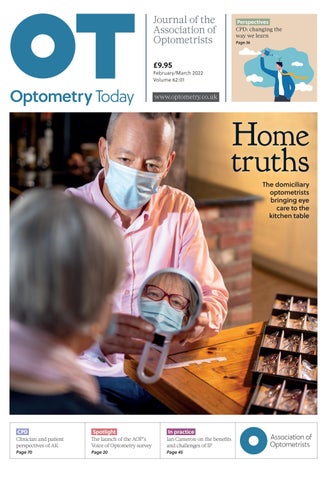
Home truths
PRODUCTION
February/March 2022 / Volume 62:01
ART CLIENT
We’ve partnered with Plastic Bank® to help stop ocean-bound plastic by offsetting our plastic consumption through their Certified Plastic Neutral programme. Here in the UK and Ireland, we purchase credits equal to the weight of plastic used in our one-day contact lenses, the blister and carton2 – and an equal amount of plastic is collected by Plastic Bank.®
Perspectives CPD: changing the way we learn
£9.95
1,2
OUTER COVERS SPREAD
VERSION
Journal of the Association of Optometrists
The domiciliary optometrists bringing eye care to the kitchen table
“One day I’ll take care of animals” Slow their short-sightedness not their ambition INICALLY CL
PRO EN V
THE DOMICILIARY CARE MODEL EDITION
Getting involved is easy. As all CooperVision one-day contact lenses sold in the UK and Ireland are plastic neutral, you will automatically be prescribing plastic neutral too.
1. One-day contact lenses are defined as orders placed by customers for those products and includes product sold and distributed by CooperVision in UK & Ireland. 2. Plastic neutrality is established by purchasing credits from Plastic Bank. A credit represents the collection and conversion of one kilogram of plastic that may reach or be destined for waterways. CooperVision purchases credits equal to the weight of plastic in our one-day contact lens orders in a specified time period. One-day contact lens plastic is determined by the weight of plastic in the blister, the lens and the secondary package (outer carton), including laminates, adhesives, and auxiliary inputs (e.g. ink).
BLACK YELLOW MAGENTA CYAN
/ www.optometry.co.uk
Scan the QR code and get involved.
CPD Clinician and patient perspectives of AK
Spotlight The launch of the AOP’s Voice of Optometry survey
In practice Ian Cameron on the benefits and challenges of IP
Page 70
Page 20
Page 45
FIND OUT MORE
91OPTFEB22100.pgs 01.02.2022 14:22
INNER COVERS SPREAD
VERSION REPRO OP
Ready to take on myopia
SUBS ART
“One day I’ll take care of animals”
Slowing myopia progression can help to significantly reduce the risk of myopia-related complications, such as retinal detachment, myopic maculopathy and vision loss later in life.3 MiSight® 1 day is a daily disposable soft contact lens specifically designed for myopic children.1§ MiSight® 1 day with ActivControl® Technology slow both axial length increase and myopia progression while correcting refractive error.1
Treatment zones creating myopic defocus
PRODUCTION
Slow their short-sightedness not their ambition
Correction zones
CLIENT
We’re looking for members to join our Council
Artist’s rendering
INICALLY CL
The MiSight® 1 day clinical study is the longest continuous soft contact lens study for myopia management with 6 years of data.1,4
PRO EN V
Among MiSight® 1 day wearers (fitted between the ages of 8-12):
41% had no meaningful progression of myopia at 3 years5**† 23% had no meaningful progression of myopia at 6 years.5**† Over a 3 year period, MiSight® 1 day reduced myopia progression by an average of 59% and axial elongation by 52%1**
Child Friendly1 contact lens
59%
90%
Slows Myopia Progression on average by 59%1*
of children surveyed preferred MiSight® 1 day over glasses1
Make a difference to the future of optics
Over a 6 year period, children wearing MiSight® 1 day progressed less than -1.00D5, and less than 0.5mm on average in axial length5. Introducing MiSight® 1 day at the earliest opportunity may result in the most significant impact in the reduction of myopic progression6.
Undergraduate student Pre-registration optometrist Newly qualified & early career optometrist Dispensing optician Franchisee/ Joint Venture Partner Casual vacancy regional representative South West England Academic optometrist If you’re passionate about the profession and representing your peers, we’d like to hear from you. No previous experience required. Applications open 16 February. Find out more www.aop.org.uk/councilappointments
Register for the MiSight® 1 day accreditation programme at coopervision.co.uk MiSight® 1 day contact lenses are clinically proven to significantly reduce the progression of myopia in children1*, which could help reduce future eye health risks2. Help children reach their full potential by improving their vision – now, and for the rest of their lives.
BLACK YELLOW MAGENTA CYAN
*MiSight 1 day contact lenses have been proven to slow down the progression of myopia (short sightedness) in children by 59% on average compared with a single-vision 1-day lens over a 3-year period. Study conducted amongst 144 children aged 8-12 years. **Compared with a standard single-vision one-day lens over a three-year period. † 0.25D or less of change. ‡ Age 8 and 9. § >95% of children were successfully fit with MiSight® 1 day or Proclear® 1 day. References: 1. Chamberlain P et al A 3-year Randomized Clinical Trial of MiSight® Lenses for Myopia Control. Optom Vis Sci 2019;96:556–567. 2. Tideman JW, Snabel MC, Tedja MS, et al. Association of axial length with risk of uncorrectable visual impairment for Europeans with myopia. JAMA Ophthalmol. 2016;134:1355-1363. 3. Flitcroft DI. The complex interactions of retinal, optical and environmental factors in myopia aetiology. Prog Retin Eye Res. 2012;31(6):622660. 4. CVI Data on File 2021. 5. Chamberlain P, Arumugam B, Jones D et al. Myopia Progression in Children wearing Dual-Focus Contact Lenses: 6-year findings. Optom Vis Sci 2020;97(E-abstract): 200038. 6. Arumugam B, Chamberlain P, Bradley A et al. The Effects of Age on Myopia Progression with Dual-Focus and Single Vision Daily Disposable Contact Lenses. Optom Vis Sci 2020;97(E-abstract):205340, AAO 2020 Poster. © 2021 CooperVision. CooperVision®, ActivControl®, MiSight® and Proclear® are registered trademarks of The Cooper Companies, Inc. and its subsidiaries. Brilliant Futures™ is a trademark of Cooper Companies, Inc., and its subsidiaries.
Come join our vibrant AOP council and help shape the conversation for the future of our profession Julie-Anne Little, AOP Chairman
91OPTFEB22101.pgs 01.02.2022 13:06
VERSION REPRO OP
Welcome
SUBS
I
ART PRODUCTION Cover: Will Amlot; This page: Getty/Ranjitsinh Rathod
CLIENT
f having a career which takes you from sector to sector teaches you anything it is this: although we all talk the language of client-centred care, we mean very different things by it. Indeed, I am conscious as I write these very words that in this sector “client-centred” should in fact be “patient-centred” or even “customer-centred,” depending on whether I am talking about clinical services or selling spectacles. When I was an idealistic young probation officer back in the – gulp – 1980s, it was common to voice a strong objection to the word “client,” preferring the less patronising “service-user.” I was struck again by the different way sector professionals treat those we are meant to care for in emails about the difficulties in providing domiciliary care during the current wave of the pandemic. Understandably, many of the emails were expressing frustration about the obstacles being imposed by care organisations which made it difficult for them to get easy access to patients in need of eye examinations and treatment. I truly sympathise. Much of what is going on is not defensible and we are fighting hard alongside members facing illogicality and intransigence. When the first wave of COVID-19 struck, I was running a care organisation myself, dealing with immensely vulnerable residents, many of whom, yes, had eye health needs, but all of whom had many needs beyond that. And, with COVID-19 raging outside and our residents at immediate risk of death (that is not an exaggeration; I had to watch infected residents struggle and die), we could not take the risk of opening our doors to our local domiciliary optometrist. Of course, things have changed since then. Vaccinations, boosters, adequate supplies of PPE and the reduced threat represented by Omicron – all have shifted the risk matrix. But some of the previous challenges remain, including acute staffing shortages and confusion about what regulations apply to what professional dealing with what client base. This is not special pleading for care providers or a coded message to our members providing domiciliary care to stop arguing for change. It is a plea for understanding. We may, for the most part, speak a common language, but we need to match that with the ability to put ourselves in our fellow professionals’ shoes. We need to be able to use that common language to its best effect.
“Vaccinations, boosters, adequate supplies of personal protective equipment and the reduced threat represented by Omicron – all have shifted the risk matrix”
Adam Sampson, AOP chief executive
February/March 2022
BLACK YELLOW MAGENTA CYAN
www.optometry.co.uk 3
91OPTFEB22166.pgs 02.02.2022 12:29
Welcome
FEBRUARY/MARCH 2022
VERSION REPRO OP
Contents 34
SUBS ART PRODUCTION CLIENT
16
14
07-21 SPOTLIGHT
Spotlight
AOP Council elections
The news in digest Picture this Behind the scenes of our front cover photoshoot OT reports Access challenges being faced by domiciliary optometrists The edit Optics in 16 stories Clinical roundup Visual function and AMD Industry profile Optimism Health Group on opportunities in domiciliary eye care, with Henry Pitman Supplier insight The rise of eco-eyewear AOP affinity partner Tax and VAT explored with Markel Tax AOP roundup AOP Council applications open, Don’t swerve a sight test update, and the launch of the Voice of Optometry survey
4 www.optometry.co.uk
“Councillors have told us that being part of the AOP Council is a rewarding experience, with opportunities to develop new skills” Jacqueline May, AOP policy officer, PAGE 20
25-31 HIT LIST
The trends, launches and looks
February/March 2022
BLACK YELLOW MAGENTA CYAN
OT focuses on... New products for 2022 Me and my glasses Optometrist, coach and entrepreneur, Peter Greedy Get the look // Anatomy of a frame With Lizzy Yeowart The shortlist The February/March launches selection Behind the brand Opticabase
33-37 PERSPECTIVES
Voices from optics and beyond Perspectives Dr Julie-Anne Little, Harjinder Sunda, Dr Ian Beasley My vision Patient transport service driver, Dave Martin
“This evolution has been a long time coming” Dr Julie-Anne Little, AOP chairman and optometrist PAGE 33
NEW IP and me:
what the qualification means to Ian Cameron
CPD 65-89 Professional development for the eye care practitioner
97
65 CPD welcome 66 The missing piece of the glaucoma puzzle? 70 Acanthamoeba keratitis: clinician and patient perspectives 75 Nonarteritic ischaemic optic neuropathy 79 Single vision lenses: Are your standards up to standard? 86 The painful red eye 88 Diabetic retinopathy or not?
45 28
ONLINE
41-53 IN PRACTICE
Business insight and career development The discussion Early career optometrists discuss the benefits of working in domiciliary IP and me IP optometrist, Ian Cameron How I got here Director of Home Vision Care Ltd, Chris Gould Pre-reg focus Holly Leitch and Caroline Mansfield Key milestones Setting up an employee wellbeing strategy pilot How do I... ”Speak up about concerns,” by the GOC’s Marie Bunby Life as a locum Priya Morjaria Becoming a business owner Stephanie Lipsey-Liu
Cover story
Home comforts The pandemic has put a spotlight on the value of domiciliary optometry. From those confined to their own homes to children in special schools receiving their first pair of glasses, OT explores the life-changing impact of bringing care to a patient’s doorstep.
NEW INTERACTIVE CPD FORMAT
An interactive CPD video on papilloedema Watch the video on
PAGE 55-61
www.optometry.co.uk/cpd
91-98 END NOTES
Contact the OT team with your experiences, observations and lessons from practice today: newsdesk@optometry.co.uk
Jobs Insight on recruitment by Visioncall professional services director, Vic Khurana I could not live without... ”The keratometer,” says optometrist, Nicholas Rumney Tribute Remembering optometrist and former AOP colleague, Karen Sparrow
Follow us on Twitter @OptometryToday Like us on Facebook OptometryTodayJournal Follow us on Instagram @optometry_today
February/March 2022
www.optometry.co.uk 5
91OPTFEB22167.pgs 02.02.2022 10:37
Contents
CONTENTS
Spotlight, 1 VERSION
Spotlight
REPRO OP
08 OT REPORTS
Domiciliary optometrists face difficulties accessing care homes in the wake of Omicron
12 CLINICAL ROUND-UP
Developing tests for everyday visual function in AMD patients
20 AOP SUPPORT
Applications open for AOP Council and highlighting the role of vision in road safety
SUBS
PICTURE THIS ART PRODUCTION CLIENT Will Amlot
Face time The Domiciliary Care Model edition marks the first edition that OT has showcased photography on its front cover since the beginning of the pandemic. To highlight the personal nature of the role, OT commissioned photographs of domiciliary optometrist, Paul Chapman-Hatchett, with patient, Janet Grant. Read more in OT's cover feature p55–61.
February/March 2022
BLACK YELLOW MAGENTA CYAN
www.optometry.co.uk 7
91OPTFEB22157.pgs 01.02.2022 17:34
VERSION
February/March 2022 Volume 62:01 Issn 0268-5485 ABC certificate of circulation 1 January 2020–31 December 2020
SUBS
Editor: Emily McCormick emilymccormick@optometry.co.uk Deputy editor: Lucy Miller lucymiller@optometry.co.uk Assistant editor: Selina Powell selinapowell@optometry.co.uk
ART PRODUCTION CLIENT
Senior reporter: Kimberley Young kimberleyyoung@optometry.co.uk Web content and social media executive: Leah Boyle leahboyle@optometry.co.uk Clinical editor: Dr Ian Beasley ianbeasley@optometry.co.uk Clinical editor for multimedia: Ceri Smith-Jaynes cerismithjaynes@optometry.co.uk Video production editor: Laurence Derbyshire laurencederbyshire@optometry.co.uk CPD enquiries: 020 7549 2076 CPDhelp@optometry.co.uk AOP membership and OT subscription team: subscriptions@aop.org.uk
Advertising: Matt Hall 020 3771 7257 matt.hall@thinkpublishing.co.uk Advertising production: aop@ccmediagroup.co.uk Senior designers: Grant Pearce, Juanita Adu Client Engagement Director: Anna Vassallo Executive director: Jackie Scully Published bimonthly for the Association of Optometrists by Think Media Group 20 Mortimer Street, London, W1T 3JW Printed by Acorn Web, Normanton Ind Estate, Loscoe Close, Normanton, West Yorkshire, WF6 1TW All rights in and relating to this publication are expressly reserved. No part of this publication may be reproduced in any form or by any process without written permission from the AOP or the publisher.
8 www.optometry.co.uk
February/March 2022
BLACK YELLOW MAGENTA CYAN
Record daily case numbers following the outbreak of the Omicron variant in the UK has had a profound effect on the domiciliary sector The number of English care homes reporting at least one positive case of COVID-19 rose by 40% in the final week of 2021 compared to the week before Christmas. Growing numbers of care homes entering lockdown have resulted in a diminished workload for many practitioners, while inflexible processes for delivering spectacles and rearranging care have created further hurdles for those working in the sector. OT explores the issues facing domiciliary optometrists – and the work being carried out by the Domiciliary Eyecare Committee (DEC) to advocate for the profession.
CARE HOMES IN LOCKDOWN In mid-January, members of the DEC were receiving regular calls from domiciliary providers reporting a drop in activity as growing numbers of care homes locked down. Professional services director at Visioncall, Vic Khurana, shared that in December 2021 there were only three COVID-19 related cancellations of care home clinics recorded by the domiciliary eye care provider. In contrast, the first week of January 2022 saw 45 care home clinics cancelled.
Co-chair of the DEC, Gordon Ilett, shared that many domiciliary optometrists were reporting zero activity on some days and half of normal levels on others. “Some companies are having to go to banks to get extensions on loans so that they can pay staff and continue to trade,” he shared. Aside from the business impact of lockdowns, Ilett emphasised that not having access to eye care affected the quality of life of residents. For example, they may not be able to see family members if they are using video calls to communicate with them or enjoy activities such as reading or watching television. “We are very conscious that we want to maintain people’s mental health,” Ilett emphasised.
Getty/ MilaArt
REPRO OP
THREE CHALLENGES FOR DOMICILIARY OPTOMETRY IN THE WAKE OF OMICRON
RED TAPE TO PROVIDE CARE Requirements for patients to sign for spectacles and for NHS England to receive three weeks’ notice of sight tests conducted in care homes has also created challenges. Domiciliary optometrists have been unable to deliver spectacles to locked down care homes. “Unlike delivering a parcel, where you can leave it at the door, we need to get the patient’s signature on the GOS 3 form. It is only really the patient who can do that unless they have given power of attorney to an individual,”Ilett highlighted. Rearranging appointments if a patient tests positive for COVID-19 is also challenging because of prenotification requirements. “If you have a waiting list of people, unlike in a fixed site practice where you could phone a patient and say ‘Pop in tomorrow – we’ve had a couple of cancellations,’ in domiciliary you have
got to give three weeks’ notice to NHS England,” Ilett highlighted. The DEC is calling for NHS England and the Department of Health and Social Care to temporarily suspend patient signature requirements and also pause the three-week notification requirement on a temporary basis. “What we want is equality of treatment. We want a reduction in the restrictive burdens that are placed on domiciliary services that are not placed on High Street services,” Ilett said.
“What we want is equality of treatment. We want a reduction in the restrictive burdens that are placed on domiciliary services” Gordon Ilett
MISCONCEPTIONS ABOUT THE NECESSITY OF EYE CARE Khurana shared with OT that in some cases domiciliary optometrists have been denied access to care homes because they are seen as a non-essential service and will only be permitted to enter once Omicron cases subside. He emphasised the importance of conveying the broader importance of domiciliary optometry – for example, in picking up systemic disease and reducing the risk of falls. “It’s not just performing an eye test and sorting out spectacles, which I think is what some care homes might think when it comes to sight tests,” Khurana said.
“The message that we are trying to get across is that eye care is a necessary service” Gordon Ilett
other healthcare providers when it comes to being able to access care homes. “What we want is a level playing field. If a district nurse is able to go in, then the optometrist should be able to visit. The message that we are trying to get across is that eye care is a necessary service,” Ilett highlighted.
Ilett said that while he can understand that care home staff are nervous about permitting visitors into care homes, the circumstances are different to the first wave of COVID-19. “Now everyone has learned to work using personal protective equipment, domiciliary optometrists are testing every 72 hours and they are vaccinated,” he shared with OT. The DEC is calling for domiciliary optometrists to be treated in the same way as February/March 2022
www.optometry.co.uk 9
91OPTFEB22158.pgs 01.02.2022 17:34
Spotlight, 2
SPOTLIGHT
VERSION
INDUSTRY
REPRO OP
Medical Air Sanitisers Clean air has never been so important
SUBS
Is your practice a Safe Air Space?
“A start-up practice is a completely new experience for us… it’s all been challenging yet extremely rewarding” Christine Wrenn, head of operations at Valli Opticians, and Moin Valli, managing director, told OT about the opening of the independent practice group’s new location in Slaithwaite, and why this marks a new step for the business. Find out more online: bit.ly/3tc7qW8
£6.175m ART
Stop the spread of viruses PRODUCTION
Reduce allergy symptoms all-year-long Comply with highest hygiene standards Keep staff safe, healthy and at work Reassure your patients
CLIENT
Promote health and raise productivity Reduce sick-leave
6 STAGE FILTRATION TECHNOLOGY AIR8 280 Nano Ideal for the consulting room Effective area up to 24m2
AIR8 720i Edge Ideal for staff area or small front of shop area Effective area up to 64m2
AIR8 1200i Pro Ideal for large front of shop Effective area up to 110m2
01438 740823 sales@bibonline.co.uk bibonline.co.uk
10 www.optometry.co.uk
Inspecs Group has acquired Ego Eyewear and its operating subsidiaries in Sweden and Hong Kong for an initial £6.175m, with the deal also including a deferred consideration partly based on performance over the next three years. Licensed brands in Ego Eyewear’s portfolio include Barbour and Liberty of London. Inspecs suggested the acquisition would add to its Scandinavian offering, “where we believe there are considerable opportunities for us,” the company said.
A survey of 700 industry professionals by the organisers of 100% Optical revealed that 70% have permanently implemented measures first adopted during COVID-19. Nathan Garnett, show director, said the survey reinforces the impact of the pandemic on the sector, a key topic set to be discussed at the event, held from 23 to 25 April. Children’s eye care specialist and practice owner, Jean Kelly, has launched an interactive workbook, Your EyesEyecare Adventures with Op Tish and Ann, to help eye care professionals deliver workshops to children, using augmented reality to bring the story to life. Kelly felt there was a gap in the market for a “comprehensive but exciting product to help catch children’s attention and support eye care professionals with their presentations.” CooperVision has partnered with Plastic Bank to make all of its one-day contact lenses distributed in the UK and Ireland plastic neutral. For every box distributed, CooperVision will purchase credits to fund the collection and processing of plastic waste equal to the weight of the plastic used in its one-day contact lenses and packaging.
February/March 2022
BLACK YELLOW MAGENTA CYAN
Mondottica has joined the corporate sustainability initiative, the United Nations Global Compact and the UN Global Compact Network UK. Supporting the UN’s Sustainable Development Goals, the company plans to operationalise the 10 principles around human rights, labour, environment, and anticorruption.
1021
Essilor has launched Stellest lenses for correcting myopia and slowing its progression. The lenses are designed with Highly Aspherical Lenslet Target (HALT) technology: an arrangement of 1021 invisible aspherical contiguous lenslets over 11 rings on the surface of the lens. The lens can suit a range of frames.
THE EDIT 60 DAYS IN 16 STORIES
Pexels/Victor Freitas
SCIENCE & VISION
98%
Researchers at Newcastle University are using stem cells from the skin of retinitis pigmentosa patients who have mutations in the PRPF31 gene to explore the patients’ genetic make-up. It is hoped the findings of the study could lead to advances in treatment for inherited eye conditions in the future. The first stage of the study was funded by Fight for Sight, and the second by Retina UK.
“If we can intervene at an earlier stage, we are more likely to be able to preserve sight” A large UK study could help to identify those at risk of developing age-related macular degeneration (AMD) before visual symptoms develop. Researchers shared in Scientific Reports that individuals with healthy eyes but no history of AMD had thinner retinas if they carried the genes that put them at a higher risk.
A Moorfields Eye Hospital app enabling patients to monitor retinal conditions at home has received positive feedback. A study, published in JAMA Ophthalmology, found that 98% of patients found the Home Vision Monitor ‘easy’ or ‘very easy’ to use, while 89% would recommend the technology to others. The study involved 417 adults who received intravitreal injections for retinal disease between May 2020 and February 2021.
PROFESSIONAL SUPPORT
Pexels/Karolina Grabowska
The Department of Health and Social Care, and NHS England and NHS Improvement, have confirmed that General Ophthalmic Services (GOS) in England will remain a nationally agreed contract under the new Health and Care Bill in a meeting with optical bodies. A proposal under the Health and Care Bill would see Clinical Commissioning Groups replaced by Integrated Care Boards, though at the time of writing this has been delayed until July due to parliamentary timings.
43%
“We welcome the announcement of a 3% increase to GOS fees and look forward to establishing an annual review process” Chair of Optometry Scotland, David Quigley, commented on the Scottish Government’s decision to increase the fee paid to optometrists delivering NHS-funded eye examinations in the country from February.
The General Optical Council commissioned analysis of its 2021 registrant survey results, which found that 43% of respondents plan to gain additional qualifications or skills in the next 12–24 months, in order to “better understand what the optical workforce in the UK may look like in the future” as well as levels of job satisfaction. Read the full article at: bit.ly/3AN2dpm
IN PRACTICE “I looked into different health care professions but optometry was the one that really stood out for me” AOP student representative and third year student at the University of Plymouth, Sarah Hollyhead, told OT how her mother’s work in dentistry inspired her to work in health care, and why optometry caught her attention: bit.ly/3HHyvEK
“The picture was the kind of thing you get at the end of a university lecture of cases you would probably never see, but that if you did it would be a blue-light situation” OT spoke to four locum optometrists about their kit bag essentials and how this changed following COVID-19. From the ‘must-have’ clinical equipment, face masks and anti-fog wipes, to a midday snack or the latest copy of OT. Take a look online for some tips for a wellstocked kit bag: bit.ly/3Hh5BLQ
Shane Abbas Bhimani, clinical director of Specsavers Hemel Hempstead, described a case study in which an optical coherence tomography scan provided an indication of dangerously high blood pressure for OT’s An optometrist saved my life series. Read more online: bit.ly/3zFBg6J
February/March 2022
www.optometry.co.uk 11
91OPTFEB22159.pgs 02.02.2022 11:23
Spotlight, 3
SPOTLIGHT
Spotlight, 4
SPOTLIGHT VERSION
SIGHT IMPAIRMENT
Clinical round-up
REPRO OP
OT’s Selina Powell reviews the latest clinical news and research papers TESTS FOR EVERYDAY VISUAL FUNCTION IN AMD PATIENTS
SUBS ART CLIENT
Getty/ gpointstudio
PRODUCTION
Researchers at City, University of London’s Crabb Lab have developed a series of assessments aimed at examining everyday visual function among age-related macular degeneration (AMD) patients. Speaking with OT, City, University of London PhD student, Bethany Higgins, explained that the tests provide insight that can be challenging to capture using traditional chart-based assessments for visual acuity and contrast sensitivity. The assessments are offered through a computer platform, with the potential for enabling home monitoring of AMD in the future. Higgins explained that three tests have been developed – a visual search test and two involving road signs. The search test involves identifying an everyday object that appears on the screen for half a second, then finding it among an array of 48 other objects. The two road sign tasks involve identifying approaching road signs, with one test designed to be more challenging than the other. Researchers examined the speed and accuracy of study participants across the
“People with AMD will take longer to find that box of cereal on the shelf, but they can find it” different assessments. They found that while people with AMD were slower in performing the different tasks compared to a control group with healthy vision, there was no significant difference in accuracy. “Overall that means that people with AMD will take longer to find that box of cereal on the shelf, but they can find it,” Higgins explained. The research is described in PLoS ONE (DOI: 10.1371/journal.pone.0243578).
ASTON OPTOMETRY FACILITIES 'FIRST IN EUROPE' Aston University will launch healthcare simulation facilities in 2022 to enhance the training of optometry, medical and pharmacy students. The £1.5 million upgrade includes augmented reality simulation slit lamp biomicroscopes for students to observe a wide range of eye conditions. The university has highlighted that the ocular simulation unit is the only one of its kind in Europe. Aston University’s head of optometry, Professor James Wolffsohn, said that the facilities will enable students to refine their skills. “One of the simulators even allows them to utilise their smartphone to practise at home. They can gain direct feedback and be assessed by the simulators, allowing more flexible, diverse and intensive learning than 12 www.optometry.co.uk
can be achieved with clinical practice placements,” he said. The new facilities are scheduled to open in time for the September 2022 intake of students. Alongside the ocular simulation unit, Aston University received £806,226 from the Office of Students to establish a simulation accident and emergency room. Medical and pharmacy students will be able to practise treating patients in an emergency setting using highfidelity manikins. The acute care simulation room will enable the university to simulate a variety of emergency resuscitation scenarios, such as heart attacks, acute breathlessness and severe allergic reactions. It is hoped that the facilities will provide a valuable resource following a shortage of clinical placements as a result of the pandemic.
Mitigating vision problems in space
CLINICAL
NEWS
Scientists from UT Southwestern in the US have explored the effect of a specialised sleeping bag on the risk of astronauts developing spaceflight-associated neuro-ocular syndrome (SANS). Describing their findings in JAMA Ophthalmology, scientists highlighted that the vacuumequipped bag mitigated changes in the eyeball’s shape while lying down for 72 hours. The sleeping bag is designed to pull down fluids that naturally accumulate in the head while lying horizontally. Hearon et al. DOI: 10.1001/jamaophthalmol.2021.5200 AMD
Prozac lowers AMD risk
Scientists are exploring the potential of the antidepressant medication, fluoxetine (commonly known by the brand name Prozac), as a treatment for dry age-related macular degeneration (AMD). Writing in PNAS, researchers highlighted that analysis of two health insurance data bases revealed that those who had been prescribed fluoxetine at some point in their lives had a 15% lower chance of developing dry AMD. The structural and functional makeup of fluoxetine is similar to the experimental medication, CY-09, which has shown promise in blocking the inflammatory process that drives AMD. Ambati et al. DOI: 10.1073/pnas.2102975118 NEUROSCIENCE
Poor vision to blame for some shark bites
Scientists from the University of Bristol and Macquarie University in Australia have highlighted that some shark bites may be due to the marine mammals mistaking humans for seals. A study, which was published in Journal of the Royal Society Interface, involved creating a virtual white shark visual system and using this to view human and seal movements from below the water’s surface. The researchers determined that from the perspective of a white shark, there was no clear visual distinction between a seal and human – supporting the ‘mistaken identity theory’ behind some shark attacks. Ryan et al. DOI: 10.1098/rsif.2021.0533
February/March 2022
BLACK YELLOW MAGENTA CYAN
91OPTFEB22160.pgs 01.02.2022 17:27
SPOTLIGHT VERSION
INDUSTRY PROFILE
A growing domiciliary demand REPRO OP
Henry Pitman, chairman of Optimism Health Group, behind OutsideClinic and Visioncall, tells OT about the demographic changes creating opportunities for domiciliary
SUBS ART PRODUCTION CLIENT
We started to build our healthcare investment business, Optimism Health Group, at the beginning of 2020, and spent the first six months researching healthcare sectors. We became particularly interested in providing clinical products and services to the older demographic. There will be a very significant increase in the elderly population. The demographic changes are wellarticulated – the baby-boomer generation are now moving into their 60s, 70s and 80s. On top of that, people are living longer, but unfortunately often with long-term conditions that require more medical support and make it difficult to go to the High Street. There is a lot of investment in care homes and live-in care, but some of
“We think the pandemic has shone a spotlight on the provision of healthcare services at home” the periphery, niche services that are essential for people in their own homes, such as the domiciliary sector, have been overlooked. Without question, the domiciliary sector has had a challenging time during COVID-19. Having said that, we think the pandemic has shone a spotlight on the provision of healthcare services at home. Our lives have fundamentally changed during COVID-19. There is a growth in people wanting to be served at home – whether it’s an Amazon parcel, Uber
THE DOMICILIARY EYE CARE MARKET IN NUMBERS
3.5% the proportion of sight tests
provided in a domiciliary setting
460,000 the number of sight tests recorded in a domiciliary environment
2.7 million the number of people in the UK
who might benefit from domiciliary eye care
2% the amount the domiciliary market has been seen to have grown per year over the last decade. Source: OutsideClinic
14 www.optometry.co.uk
February/March 2022
BLACK YELLOW MAGENTA CYAN
Spotlight, 5
Announcing the UK launch f h dv &
w medmont meridia™ dT g h
OutsideClinic optometrist Kiran Matharu
Eats, or having their hairdresser coming around. I think that is particularly the case for the older generation, who have been very fearful of COVID-19. There has been an increased reluctance to go to the High Street and be potentially exposed to the virus. This has increased demand for domiciliary services. We think it is a permanent change and that people will be increasingly demanding health care services at home. The NHS, too, wants to see more healthcare services provided in the community. A constraint on the growth of domiciliary has been a lack of awareness. The idea that you can have a clinician providing one-to-one treatment for an hour in your own home is an extraordinary service. But I think that it is a niche sector that most of the general public haven’t come across. We believe there is an opportunity to significantly grow the size of the domiciliary market. Our research suggests that there are about 2.7 million people in the country who would benefit from domiciliary eye care. The majority of those people either don’t know about domiciliary eye care, or there is not enough provision in their area. The growth in domiciliary has been around 2% a year over the last decade. We think we can be one of the companies that helps to increase that growth to closer to 5% a year. The biggest challenge is recruitment. There is a supply and demand mismatch in the sector, where we see a growing demand for optometry services, but a shortage of optometrists. It is a very challenging recruitment market and this is limiting growth for domiciliary.
“We think that domiciliary is going to be the fastest growing area of optometry over the next five to 10 years” There is an issue with workforce planning in the sector. It doesn’t seem that the Government is thinking far enough ahead in anticipating the future demand for optometrists. We find that optometrists tend to be concentrated in certain parts of the country, which is generally where the universities are. While we find it relatively straightforward to recruit in some of the big metropolitan areas, it is almost impossible to recruit in some of the overlooked rural areas. We would call for much better provision of optometry training and university places in overlooked areas to get a better distribution of optometry skills across the country. I think there are a lot of patients out there simply not being supported at the moment, which has serious repercussions. If people can see and hear well, then they are much less likely to have falls, it will slow down the onset of dementia. There are huge health advantages in having this support, and it takes pressure off the NHS. We expect that domiciliary is going to be the fastest growing area of optometry over the next five to 10 years. Optometrists have the opportunity to engage in their local communities, and to get to know and support some of the most vulnerable people in society.
Trade in your topographer and save £3,500!*
*Available on Professional model
See Clearly, Treat Optimally:
C
M ib g I gi g
h
I i
L
i dFu Fi i g I & Vid
i gi g
T
dib h- f-Fi d I gi g & Vid
Li bu Li bu g h -N wi Wid -Fi d C u
01438 740823 sales@bibonline.co.uk www.bibonline.co.uk
February/March 2022
www.optometry.co.uk 15
91OPTFEB22161.pgs 02.02.2022 11:04
VERSION SUBS ART
The unstoppable rise of eco-eyewear
PRODUCTION
Awareness and demand for more environmentally friendly frames is growing, and as new materials become available, manufacturers are responding to the call
CLIENT
The global conversation around sustainability has filtered into many aspects of everyday life, and eyewear has not escaped the scrutiny of consumers looking for greener options. The pandemic has only accelerated discussions, with researchers at Mintel finding that “COVID-19 has made many consider the impact their habits have on the environment, suggesting it is now a higher priority for many consumers than before the pandemic.” Writing in the Optical Goods Retailing report in 2021, Mintel analysts said: “While there are limited ways opticians can promote sustainability, frames and glasses are areas where a lot of sustainable innovation is happening.” James Conway, CEO of Millmead Optical Group, suggested the push towards sustainability in eyewear is driven by a combination of factors: “It is a hybrid of consumers asking questions and wanting to know how their products are made, what they were made of, and expecting more.” “From the point of view of the manufacturers and suppliers, we also have a responsibility and we have to think about the future impact our businesses are having on the environment for everybody,” he continued. The evolution in materials and manufacturing processes is an additional 16 www.optometry.co.uk
factor accelerating product development. Nicky Clement, head of marketing at Eyespace Eyewear, agreed, “the exponential increase in demand for sustainable product is driven by increased awareness in all directions.” “The increasing prevalence and choice of sustainable materials – and the extensive marketing and education support backing eco-frame innovation – is undoubtedly driving awareness for practice-buyers and consumers,” she said. Changing the agenda An important change in the push for eco-friendly operations is the adoption of sustainability into business goals. Steve Tulba, managing director of Inspecs, noted a transition in business approaches towards more environmental, social and corporate governance. “The ‘single bottom line’ of profit only, is now the ‘triple bottom line’ of profit, people, and the planet,” he said. “More sustainable materials have been available for longer than most think, but how they are applied and scaled is what has changed the landscape more recently,” he added. Alberto Macciani, marketing OCBs and global communication head for Safilo Group, agreed that there has been a shift, telling OT: “A sustainable approach is at the top of all corporate agendas.”
February/March 2022
BLACK YELLOW MAGENTA CYAN
Making the switch There have been hurdles to overcome in the journey to more sustainable eyewear. Recycled materials can have limitations. In creating the new Cameo Sustain range, made from recycled plastic bottles (recycled PET), Millmead found it was difficult to achieve a shiny finish. “Acetate is often used for a shiny frame so we needed something to match that and didn’t really want to compromise too much on the appearance,” Conway said. This was something the team spent more time exploring to find a solution before launching the final products. Creating more eco-friendly ranges has also required a degree of investment. Clement said: “Sustainability cannot be achieved by token gestures, so we are swiftly working towards a future where practices have the ability to offer every patient a sustainable frame option.” The investment required in this, both financially and in workload, has been a challenge, she shared, noting that it requires “extensive research before we can consider bringing a new innovation to market and hold confidence in its performance. We rigorously test new frame materials and components for viability, durability and stability, whilst also auditing the supply chain to understand the social, environmental and sustainability credentials at every stage of its production.” Tulba also felt that cost and traceability were two key challenges, suggesting that having certification for the materials and processes used to make eyewear in a more sustainable way can be difficult. While Inspecs has a vertically integrated supply chain (where the supply chain is incorporated into the company), which
Top left: Millmead Optical Group, Right: Inspecs Group
REPRO OP
SUPPLIER INSIGHT
Elaborating on this, he shared that a sustainable approach has become a ‘must have’ for businesses. “For a company, being sustainable is no longer just the right and convenient choice to make in order to respond to new market demands, but must become the default choice to protect its business and the entire society.” For example, Safilo has incorporated sustainability as one of the pillars of the group’s 2020–2024 business plan, aiming to integrate this into the business strategy, processes and products.
INCREASED INTEREST Mintel’s Global COVID-19 Tracker for 28 October–3 November 2021 found almost three in 10 people (28%) now say the environment is a higher priority for them compared with before COVID-19.
Tulba said allows for “ultra-transparency on all materials and manufacturing processes,” he suggested companies with a different model could find this level of traceability more complex. Safilo, too, sees certification as an important issue, with Macciani suggesting a “lack of shared standard regulations” for products and marketing claims defining sustainability can create complexity. He suggested the “lack of standards generate a multitude of marketing claims that are difficult to channel into a clear value proposition for the consumer and customer.” Supply chain issues resulting from the pandemic have also hit the market, he highlighted, from the availability of materials to longer delivery times and associated costs. Beyond frames “The opportunities to be kinder to our planet by offering more sustainable options are as big as they are complex,” Tulba said. Suggesting that the materials
used for eyewear are “just a part of the equation,” he added: “Sustainable packaging, demo lenses, cases and completing the lifecycle of the frame through recycling or repurposing eyewear, is just as important.” Offsetting the carbon footprint involved in transporting frames is also a consideration. Demonstrating this, the company’s Botaniq Eyewear collection has been designed with consideration for each stage of the product lifecycle. The lifecycle of frames will be increasingly key to improving the sustainability of the eyewear industry. Giving an example, Conway noted that the metal components used in frames can make them more challenging to recycle, but suggested: “That’s going to change in the future, I think. The metal core is needed for adjustability in dispensing, but that makes it more difficult for it to be recycled again, so finding ways to remove or process those is something we are working on.” “Saying something is recyclable is fine, but what you really want is something that can be continuously recycled,” he added. “I see the process moving towards more of a closed loop of manufacturing.” Looking beyond the frames themselves, Conway identified lens waste as an issue, suggesting, “in terms of lens waste, we estimate about 3000 tonnes goes to landfill a year in the UK” – something that Millmead hopes to address. In the meantime, the company has seen a positive reception to Optoplast’s new range of cases, launched in 2021, made in the UK from materials sourced from recycled plastic bottles. With the industry set to see more frames made from sustainable materials, Macciani also expects to see a wider adoption of frames that are made from standard materials but integrated into an open loop of traceable recycling. “In the more distant future, we see the possibility of a cradle-to-cradle approach, but to be successful in this, the retail structure will undoubtedly require significant evolution,” he said. The company has made a number of partnerships in recent years to shake up its materials and processes. This included the introduction of Econyl, a material created through regenerated waste, recyclable and bio-based polymers, as
well as a collaboration with Eastman, a provider of raw materials for chemically recycled acetate, propionate plastic and polyester plastic. Unstoppable growth “I think social responsibility and consumer awareness of what is going on in the environment are absolutely not going away. This is one-way traffic,” Conway told OT. Suggesting that this will become “the new normal,” he added that making changes doesn’t need to be expensive, and can begin with small steps. “There isn’t a magic pill and nobody is going to solve this on their own,” Conway said. “Everyone has a bit of responsibility: as a business, and as a consumer.” The market around more sustainable frames is expected to grow, particularly as improvements are made in materials. Conway explained: “I think at the moment it is probably around 2% to 3% of products. It will grow to five, seven or 10%, but not until the materials are good enough, and easy enough to reliably produce in all the colours required.” “It’s not a matter of ‘if’ but of ‘when’,” he added, pointing to the high demand for sustainable products and transparency in the fashion industry. Clement also sees sustainable frame design and development becoming the ‘norm,’ advising: “The more we integrate sustainable thinking into our everyday behaviours, the easier and more effective we become at taking strides forward.” The launch of the Eco Conscious collection marked the beginning of Eyespace Eyewear’s public-facing sustainability initiatives, with plans to rollout new materials across its portfolio in 2022, in line with its vision for patients to have broad access to eco-friendly options. Education has also been on the cards as the company hosted its first Green Summit in January to provide tools for customers to move towards more sustainable practices. Suggesting ways optical practices can embrace sustainability, Conway said: “Support as much as possible the new products brought to the market, embrace them and explain to the practice team and patients why they are beneficial. It should be a part of every conversation, and I think you would be surprised by the response you will receive.”
February/March 2022
www.optometry.co.uk 17
91OPTFEB22162.pgs 01.02.2022 17:30
Spotlight, 6
SPOTLIGHT
VERSION
MARKEL TAX
REPRO OP
“Members can use us as a second opinion or sounding board” David Marples, underwriting compliance manager at Markel Tax, gives OT an update on key topics in tax and VAT for optometrists
SUBS ART
One of the benefits included in AOP membership relates to cover in respect of a tax or VAT enquiry from HM Revenue & Customs (HMRC) through Markel Tax. The AOP has taken out an insurance policy to provide this automatic cover as a right of membership. The policy covers an enquiry by HMRC into Self Assessment Tax Returns, VAT Returns and PAYE compliance reviews. Under the terms of the policy, an investigation specialist will be appointed by Markel Tax to deal with the enquiry on the member’s behalf. All of the Markel Tax specialists are former inspectors of taxes and so are wellversed in dealing with HMRC enquiries. During the course of the enquiry, the specialist will liaise with the client and accountant where necessary, deal with all correspondence, and attend any meetings required by HMRC until a satisfactory outcome has been achieved.
PRODUCTION Getty/ Rudzhan Nagiev
CLIENT
Protection in enquiries Cover can provide considerable savings and added protection at a time when it is expected that HMRC enquiry activity may be increasing, especially into businesses that made claims under the Government support grants, such as the Coronavirus Job Retention Scheme (furlough), and the Self Employment Income Support Scheme. Over the past 18 months, revenue activity reduced because a lot of compliance staff were moved to processing support grants. Now that the support schemes have ended, those staff will return to their normal work in compliance. The Government has to pay for the COVID-19 support, and they receive their money through taxation. These two factors allied together suggest we are going to see an increase in enquiries. AOP members have protection through their cover, so if they
Say a large company decides to deem do receive an enquiry, they can get in all of the workers they are engaging touch and we will provide support. caught by IR35, getting them off the Another area where HMRC activity hook for any liability, the locum has to is expected to increase relates to decide whether they want to take that the change to the IR35 rules in April contract. Or, they could negotiate: ‘If 2021. Since the change, it is now the you’re saying I’m caught by IR35, I want responsibility of the engager, where to be paid more as a headline because they are a medium or large company, I’m losing out on the tax benefit.’ to determine the IR35 status of We would expect HMRC to a contract. begin to increase compliance This could affect both For more activity on this from the engagers, and workers information on the second quarter of this – in this case, the services available from year. This would enable locums – that provide Markel Tax through its affinity partnership them to see what has services through their with the AOP, visit: happened, and whether own limited company. www.aop.org.uk there has been a significant Where previously /benefits change in the amount of locums would have assessments acknowledging made the decision that IR35 does apply. of whether they felt they were caught by IR35, since April, this Providing support responsibility has been taken out of The answer to a lot of tax-related their hands. Equally, the liability now questions is often: “It depends.” Topics falls on the engager. are not black and white, but grey. Markel Tax provides advice to DAVID’S TOP ACTIONS AOP members through our tax/VAT ON IR35 telephone line from 9am–5pm, Monday to Friday. Calls can be on any areas of Make sure you are aware of the tax, or members can use us as a second rules around IR35 opinion or sounding board. Be aware of the significance of Conversations can even just be: ‘I’m the changes for you. Although going to see my accountant to discuss the engager now makes the something, but I don’t really understand decision, as the worker you can what I’m talking about.’ Our advisers challenge this and they will have 45 can provide support so that when the days to respond person sits in front of their accountant, If you want to discuss IR35, or they have a better sense of the subject understand it better, the Markel matter and feel more informed. Tax free tax/VAT VAT is a common issue that affects telephone advice line is available optometrists in particular, due to during business the mixed supply from the sale of hours to provide spectacles and contact lenses which support. comprises both VAT-able goods (frames and lenses) and exempt services David Marples, underwriting (dispensing), and needing to get that compliance split right. That is something we can talk manager members through.
1 2
3
February/March 2022
BLACK YELLOW MAGENTA CYAN
www.optometry.co.uk 19
91OPTFEB22163.pgs 01.02.2022 17:30
Spotlight, 7
SPOTLIGHT
VERSION
MEMBER SUPPORT
SUBS ART PRODUCTION Pexels/Tara Winstead
CLIENT
Applications to join the AOP Council will open through February and March, as six designated positions and one regional representative position become available. The six designated positions open for application will be: undergraduate student, pre-registration optometrist, newly-qualified and early career optometrist, dispensing optician, franchisee/joint venture partner optometrist and academic optometrist. A casual vacancy has also opened for a regional representative for South West England. The term of office for this position will be held for two years until the next Council elections in 2024. The application window for the Council positions opens on 16 February and closes on 16 March. Results will be announced in May.
Applications can be made through a form that is available on the AOP website and the candidates will be selected by the AOP Appointments Committee. A criteria for the positions can be found in the Council byelaws to confirm eligibility before applying. These can be found at: bit.ly/31t9n4U AOP Councillors represent members and help to ensure their views and the profession are represented in policymaking. Councillors are involved in communicating with members to collate and present their opinions and concerns at three annual Council meetings. Councillors also help to promote and encourage AOP membership, as well as assisting members. Speaking to OT, Jacqueline May, policy officer for the AOP, commented: “Councillors have told us that being part of the AOP Council is a rewarding experience, with opportunities to develop new skills, network and to help bring about positive change to the future of the profession.”
More information on the AOP Council is available on the AOP website at: www.aop.org.uk/council
Raising the views of optometrists The Voice of Optometry survey gathers insight on the challenges highlighted by optometrists This month saw the AOP launch the first Voice of Optometry insight survey of 2022. The Voice of Optometry, now in its sixth year, has acted as a “cornerstone” of the AOP’s media engagement strategy. Serena Box, PR and media manager for the AOP, explained that the Voice of Optometry “allows the AOP, and the industry at large, to understand and gain key insight into the challenges facing optometrist members.” In 2021, results from the AOP’s two Voice of Optometry surveys were translated into national campaigns on UV and eye health, as well as illegal supply of contact lenses. The Voice of Optometry survey results also informed the annual Don’t Swerve a sight test campaign.
20 www.optometry.co.uk
February/March 2022
BLACK YELLOW MAGENTA CYAN
The Don’t swerve a sight test campaign drew on the experiences of more than 1000 members Over winter, the AOP relaunched its Don’t swerve a sight test campaign, to raise awareness of the importance of regular sight tests for road safety. The campaign was covered by trade publications and consumer magazines including Motor Trade News, People’s Friend and NHS Networks and, at the time of writing, continues to be shared extensively on social media. The campaign was backed by a survey of 1127 practising optometrist members of the AOP, which found that many felt the public are unaware of the dangers of driving with poor vision.
85%
of optometrists reported seeing patients whose vision falls below the legal standard
56%
of those surveyed reported that they have seen more patients driving without an up-to-date prescription after delaying their sight test during the pandemic To support the campaign, the AOP released a new collection of resources, along with a series of tips to help promote safe driving during the winter months when driving conditions worsen, and visibility can be limited. The campaign resources can be found at www.aop.org.uk/dontswerve The campaign was first launched in 2017 to encourage all drivers to have regular sight tests and calls for mandatory vision checks at licence application and renewal.
“The results of previous surveys have helped the AOP secure 2000 items of coverage in national and trade publications – making the Voice of Optometry a great tool for engaging the public, and other external audiences, on optical issues,” Box told OT. Coverage highlights have included featuring in national outlets, such as The Times, Daily Express, Daily Mail, and The Sun, as well as consumer press such as Which?, MSN and Yahoo! Links to access the first Voice of Optometry survey of 2022 have been emailed to qualified, practising optometrist members from Survey Monkey. The survey will take no more than three minutes to complete. For more on the Voice of Optometry see: www.aop.org.uk/voice
Getty/appleuzr
REPRO OP
From 16 February, members will be able to apply for a position on the AOP Council as a number of roles become available
AOP HIGHLIGHTS VISION TESTS FOR DRIVING SAFETY
Pixabay/CheskaPoon.png
Council applications open
AOP EXPERT
AOP EXPERT
Education
Events
Dr Ian Beasley, head of education and OT clinical editor
Lise Kroeyer, events manager
Following the introduction of CPD, how is the AOP supporting members in the new scheme? From the very beginning of the new year, the AOP has been supporting our members in meeting their educational requirements by offering Continuing Professional Development (CPD) aligned to the General Optical Council’s (GOC) new scheme. The December/January edition of OT kickstarted our CPD offering with articles and exams covering all domains for each practitioner type. This issue will see a continuation of OT’s education provision with new exams live from 12 February – see more from p65. What will be your focus for the months ahead? Through our extensive education offering, we will continue to work with key strategic partners, such as Johnson & Johnson Vision,
to fulfil the needs of specific What will the AOP’s plans for target groups, including locums, events look like this year? independent practitioners and From the first lockdown in the hospital optometrists, as well UK, we have adapted to run all as ensuring we offer different of our events online. This has modes of delivery to suit proven to work very well with individual learning preferences. most of our events fully booked, Our members should also so we will continue running expect to see some a lot of activity online. innovative changes However, we are also to the way they can introducing some earn points, which face-to-face events The AOP schedule harnesses the of events and webinars around the country flexibility offered throughout the can be found online at: by the GOC’s new year, which we www.aop.org.uk/events CPD scheme. are really looking -and-education forward to. We Would you have held two face-toone piece of advice face events in 2021, for starting off the new one in London and one in education cycle well? Manchester, and it was so nice Planning ahead is key and a to meet our members again. We fundamental component of the will have the 100% Optical event GOC’s new scheme, which will in April at ExCeL London. As require practitioners to take a the education partner, the forward-thinking approach to AOP will be delivering a their professional development programme of exciting sessions, as they embark on the new cycle. providing an opportunity for
our members to come and meet us, and take part in some great education. What will the introduction of CPD mean for AOP events? The most significant change is that members will now be responsible for uploading their own evidence of CPD completion on the GOC portal rather than this being done for them by the provider. The AOP will provide a certificate after each event which can be used as evidence of attendance. What advice would you have for members keen to attend the AOP’s events? Our events always prove to be very popular and bookings go fast, so I would advise members to keep an eye on our webpage. However, we run a series of the same events during the year so if they miss one it is likely it will be running again at a later date.
February/March 2022
www.optometry.co.uk 21
91OPTFEB22164.pgs 02.02.2022 12:33
Spotlight, 8
SPOTLIGHT
Hitlist, 1 VERSION
Tremendous titanium
REPRO OP
FOCUSES ON... NEW PRODUCTS FOR 2022
SUBS
Continental Eyewear has introduced a new range of titanium and acetate eyewear, X-Eyes Lite. The collection includes 21 models in modern and classic styles with a thin and light feel. The titanium frames are hypoallergenic, featuring high density acetate fronts, and nose pads made of silicone. The ‘XEL 13’ metal men’s frame (pictured) presents an extra-thin front and is available in three colours. www.continental-eyewear.com
ART PRODUCTION
Hit list
The trends, launches and looks
CLIENT
Portable power
BiB Ophthalmic Instruments has launched the new CrystalVue NFC-600 Fully Automated Fundus Camera. The device balances portability with the image quality of a desktop camera for increased diagnostic accuracy and efficiency. The device hosts a 3D auto tracking system which provides detailed images of the retina through a 12 million pixel camera sensor with a standard field of view of 45 degrees. Ten internal fixation targets are selectable, and the disc, fovea, macular, or other peripheral retina areas can be captured through specified fixation. www.bibonline.co.uk
The one with it all
Bausch + Lomb is launching a new contact lens that the company describes as “the most complete lens that has it all.” The Bausch + Lomb Ultra One Day unites high Dk/t, low modulus, UV blocking and high definition optics with two “breakthrough” technologies that work in synergy with the tear film. An Advanced MoistureSeal Technology helps to deliver high moisture retention after 16 hours, while ComfortFeel Technology releases ingredients designed to help protect, enrich and stabilise the tear film. www.bausch.co.uk
Shifting scan rates
Heidelberg Engineering has launched Shift technology as part of an upgrade for the Spectralis imaging platform to enable clinicians to switch between OCT scan speeds to enhance image quality. Various A-scan rates are available for different applications (pictured), such as 85 kHz for structural OCT imaging, and a fast scan of 125 kHz for OCT-angiography. It is also possible to slow the scan to 20 kHz when imaging traditionally challenging cases. www.heidelbergengineering.co.uk
February/March 2022
BLACK YELLOW MAGENTA CYAN
www.optometry.co.uk 25
91OPTFEB22153.pgs 01.02.2022 11:14
VERSION
GET THE
REPRO OP
LOOK
Q&A ME & MY GLASSES
Optometrist and lifestyle blogger, Lizzy Yeowart, on this season’s essential pattern
SUBS
Embrace one of the new season’s must-have trends and turn heads with chequered eyewear.
ART
Classical concept PRODUCTION
Burberry’s iconic signature check is reimagined in this unisex vintage-style angular sunglass. Both frame and lenses are produced with bio-materials obtained from renewable sources uk.burberry.com
CLIENT
Peter Greedy The optometrist, personal development coach and entrepreneur on making a statement
1
3
2
4
I own at least 20 pairs of spectacles and sunglasses. The actual number is not known as there is a drawer full in my office, some of which should be recycled. I have a real mix of classic, designer and functional styles. Colours also range from subtle to loud. I like to mix it up and I like to have suitable glasses for certain sports and occasions. My new green Kirk & Kirks really make a statement. They have garnered more comments than any others. I also have a pair of classic golf metal RayBan sunglasses that I got in 1996 when I worked for Bausch + Lomb, before they sold Ray-Ban to Luxottica. My kids are always asking for these when I’m done with them but they are classics.
As a teen I was prescribed bifocals as I figured out how to relax my accommodation so near vision would go blurry in the test. I’m sure I never needed bifocals but I have mild astigmatism and appreciate the improved visual acuity correction provides. Now being presbyopic, I can’t survive without my varifocals. Glasses have always been part of who I am. I would choose Chris Evans, who has also worn glasses all his life, as my style icon. I know he had laser surgery but still wears glasses and feels naked without them. Me too. Like my beard, glasses are a standard feature of my face. I really enjoy how they can be just as much a part of my styling as my clothes.
HD hues ‘Kennedy’ by Barcelona-based Etnia comes in a choice of four chequered colourways. Smart technology makes for high definition colours and an exquisite pearlescent finish. www.etniabarcelona.com
Tweed with a twist Dolce & Gabbana have updated a classic men’s style with a unique tweed print. Featuring gradient lenses with the logo on the side, they are the perfect complement to country attire. www.luxottica.com/en/eyewear-brands
February/March 2022
BLACK YELLOW MAGENTA CYAN
www.optometry.co.uk 27
91OPTFEB22154.pgs 01.02.2022 11:14
Hitlist, 2
HIT LIST
VERSION
Sports
Snow style
REPRO OP
New snow goggles from Adidas Sport are set to offer technical performance with style for any snow setting. The brand highlighted the ‘SP0053,’ described as a “futuristic” snow goggle characterised by a toric lens with a curvature designed to extend the field of vision and improve optic sensibility. The lens is also designed to sit at the ideal distance between the goggles and the wearer’s face to reduce the surface points UV rays can penetrate. www.marcolin.com
SHORTLIST THE LATEST PRODUCT LAUNCHES
SUBS
Sunglasses
Creativity in the spotlight
ART PRODUCTION
Serengeti launched its ‘Chase the light’ campaign, highlighting its sunglasses designed for artists. A standout model from the collection is the ‘Hayworth’ women’s sunglasses (pictured), available in six different colours and handcrafted from an eco-friendly acetate. The frames have a metal eye rim, chamfered edges and fivebarrel hinges. They also feature Serengeti mineral lenses, made from borosilicate optical glass which are created from natural components and are recyclable. www.serengeti-eyewear.com/gb
CLIENT
Solution
Contact lens care
Avizor eye care has introduced the Regard multipurpose contact lens solution as part of its portfolio. The Regard contact lens care solution, compatible with soft contact lenses, features a formula that releases oxygen on the eye. Announcing the addition of Regard and Regard K to the product portfolio, Avizor shared that practices can now purchase the range directly from the company or through preferred suppliers. www.avizor.co.uk
Spectacles
Glamorous gradient
Blackfin has launched a range of optical styles for its New Aura line, made from beta-titanium and with colourful nylon lens rims. The ‘Yates’ frame (pictured) offers a more rounded style. The gradient nylon rims are available in shades from green and blue to silver grey and black gold, while the titanium frames are available in Bordeaux red, vibrant blue, brown and amber gold. www.blackfin.eu
28 www.optometry.co.uk
February/March 2022
BLACK YELLOW MAGENTA CYAN
To feature in OT’s Hit list, contact kimberleyyoung@ optometry.co.uk
Spectacles
Superhero state of mind
Kirk & Kirk is introducing the Centiles Collection, which combines the two-toned colour scheme used in its Kaleidoscope range with the chunky styles used in Centena Collection. The brand aimed to create a collection that “immediately put you in a superhero state of mind.” The collection includes: ‘Elektra,’ ‘Storm,’ ‘Thor’ (pictured), ‘Robin,’ ‘Lotus,’ and ‘Blaze.’ The lightweight models are made from the brand’s signature biodegradable material in five colours. kirkandkirk.com
Equipment
High-speed scans
Haag-Streit UK has launched the Optovue iScan80 in the UK. The new optical coherence tomography (OCT) system provides high-speed 80kHZ OCT at 80,000 A-scans per second, making it three times faster than the original iScan system. The device offers capabilities available on a traditional OCT, but with a more simplified scan acquisition, a wider field of view, and more compact appearance. hsuk.co/iscan
Sunglasses
Understated, oversized
Götti Switzerland has introduced two new sunglasses to the Götti Dimension collection, each with an “understated” style. The eye-catching ‘Sabia’ and ‘Sadry’ (pictured) designs pair an oversized front made from additively manufactured polyamide with ultra-thin filigree metal sides. The frames are available in colours ranging from ash and slate to ruby and denim. gotti.ch/en
February/March 2022
www.optometry.co.uk 29
91OPTFEB22155.pgs 01.02.2022 11:50
Hitlist, 3
HIT LIST
VERSION REPRO OP
Q&A BEHIND THE BRAND OPTICABASE
SUBS
Director, Michael Prais, on practice system support
Clockwise from left: Left, Opticabase Home; Above, the system in action; Below, Michael Prais.
ART
OPTICABASE//
1
Opticabase was developed ‘by opticians for opticians’
PRODUCTION
2
Over 650 practices use Opticabase in the UK and Ireland
3
The company provides three different in-practice packages, along with a system for domiciliary companies.
What is the latest product or solution that Opticabase has released and why does it stand out from the crowd? Around 12 months ago Opticabase released an add-on programme called Opticabase Home. This enables practitioners to visit patients where there may not be a stable or any internet connection. This is proving to be extremely useful in England where NHS forms are mainly electronic and those forms could not be completed with patient signatures without an internet connection. Opticabase also provides a simple electronic solution for pre-visit notifications which is much faster than using the portal for submitting them. Are there any new solutions in development that customers should be aware of?
CLIENT
Opticabase is currently working with NHS England, along with electronic eye care referral systems, to make referrals easier. We are integrating electronic patient referrals into Opticabase so that patients can be referred directly from Opticabase into referral portals without the need for practitioners to duplicate their data input. What do you see as key trends for practice management in the year ahead? Many practices are catching up with a backlog of patients who need recalling for examinations that they have missed, due to not being able to test at usual capacity during the pandemic. A practice management system can make sure practices keep in touch with their patients by SMS, emailing or printed newsletters, so patients feel connected to the practice even though they may not have been recalled for their routine examination.
ANATOMY OF A FRAME
Available in five other vibrant springtime colourways Graphic design with clean lines
Unpicking a standout frame, by OT columnist Lizzy Yeowart
In a nutshell Manufacturer // Face a Face Frame // ‘Cilaos 1’ Colour // 9024 Web // www.faceaface-paris.com/ en/optical/women/cilaos
Machined from a single block of bronze with colour applied to the surface to represent the play of colour, light and time
Resembles the shape of a sundial Intense turquoise paired with a fifties pink
February/March 2022
BLACK YELLOW MAGENTA CYAN
www.optometry.co.uk 31
91OPTFEB22171.pgs 01.02.2022 11:22
BTB
HIT LIST
Perspectives, 1
VERSION REPRO OP
Perspectives Voices from optics and beyond
SUBS
“COVID-19 hasn’t changed domiciliary eye care, but it has changed our perspective of it”
ART
Dr Julie-Anne Little
PRODUCTION
T
Getty/UnitoneVector
CLIENT
he constraints that COVID-19 and repeated national lockdowns have placed on community eye care since March 2020 have really brought the benefits of domiciliary eye care to the fore. During the pandemic, we have come to remember that the domiciliary model needs to serve all of those members of our society who cannot easily access eye care services outside of their own home, regardless of where their home may be. This evolution has been a long time coming. In a way COVID-19 hasn’t changed domiciliary eye care, but it has changed our perspective of it. I think domiciliary eye care will continue to grow as a model in the future. The development of the domiciliary model is based on two key elements. Firstly, it is about the profession supporting the entire community that it serves and meeting people’s eye care requirements in a broad spectrum of locations. Secondly, it is about increasing the profile of domiciliary as a career option for our members. As an educator, I work at Ulster University. Last year, the OutsideClinic delivered an excellent webinar programme to our students that aimed to expose them to the concept of domiciliary eye care. Students got to watch an observation of a domiciliary eye exam, followed by a question-and-answer session. If you have never experienced something, it can easily feel like it is a niche thing that you couldn’t possibly do, but the students now have real-world insight into this rewarding aspect of optometry. Domiciliary optometry can be quite an attractive career path due to the flexibility that it can offer, and as optometrists seek variety to their week, this mode of practice fits well with this.
Technology advancements When I was a child, I remember my grandmother having a domiciliary eye exam and the optometrist lugged in a big test chart to hang on the wall. It did not look like a whole lot of calibration was done, which is so simple nowadays with the array of digital solutions that are available. Domiciliary optometry and the technology used by optometrists in this sector has advanced a lot in the last decade. Gone are the days when it could be considered a sub-standard test. It is most definitely not. Technology is so much more portable than it used to be, which has been embraced by domiciliary optometry. In fact, the domiciliary eye care sector could be considered well ahead of the High Street curve in terms of some technology advancements. It was the first to have electronic case records and those types of systems, and it embraced the benefits that could be brought through portable electronic devices. You can open a laptop and run software to get an appropriate visual acuity test in seconds. There are also portable slit lamps and cameras available today that offer great quality imaging. Changing demographics The spectrum of patients accessing domiciliary eye care is much broader today than it was pre-pandemic. Younger patients are now accessing eye care at home due to a wide
February/March December 2022 2017
BLACK YELLOW MAGENTA CYAN
What is your view?
Email OT with your comments newsdesk@ optometry.co.uk
Join us AOP Council elections open on 16 February for six designated positions www.aop.org.uk/ council appointments
www.optometry.co.uk 33
91OPTFEB22150.pgs 02.02.2022 15:20
VERSION REPRO OP SUBS
range of reasons. These are patients who may have struggled to but were attending practice previously, but it is also those who were not having their eye care needs met at all before the pandemic. Being able to showcase domiciliary eye care as an option for people who cannot access the High Street, those who are shielding or cannot easily go out into their community, is more important than ever before. It used to be that domiciliary equalled old, but that is no longer the case. With people living longer, our needs, including our eye care needs, change. In the future, the delivery of enhanced services such as MECS needs to be easily provided by those working in domiciliary eye care. The challenge for this service delivery currently is the contractual obligations that mean optometrists must notify the NHS 48 hours before they enter a person’s home. This, in my view, is the single
“During the pandemic, we have come to remember that the domiciliary model needs to serve all of those members of our society who cannot easily access eye care services outside of their own home, regardless of where their own home may be”
ART PRODUCTION CLIENT
“Our safety and that of our children and our patients was at the forefront of discussions” Harjinder Sunda
C Business insights Keep up-to-date with the latest news and advice online www.aop.org.uk/ ot/in-practice
asting my mind back, I can clearly remember when and how I felt when Prime Minister Boris Johnson addressed the nation and announced the first national lockdown on 23 March 2020. As the owner of a small domiciliary eye care business, which I run with my wife, we had been closely following developments over the emergence of the virus. We go on domiciliary visits together, and I remember us talking about what changes we should introduce before entering people’s homes. Our safety and that of our children and our patients was at the forefront of these discussions.
34 www.optometry.co.uk
February/March 2022
BLACK YELLOW MAGENTA CYAN
biggest day-to-day challenge for domiciliary optometrists currently. They cannot be flexible in their appointments or respond the same day to see a patient who may require eye care that is non-routine. This poses a real gap in the delivery of care. It is the opposite of equality – by virtue of you being in a home, you cannot access these services in the same way as others. Domiciliary optometrists are one of the few groups that get to interact with patients in their own environment. Entering someone’s home, they get a unique window into that person’s general care and wellbeing. This has benefits for the eye care being provided as the optometrist can observe the challenges that the patient may face that they would have never thought to brought up in practice. Unfortunately, the term domiciliary is not that meaningful to a patient. It’s an old-fashioned type of term. I feel that we should look to make the name more meaningful to the public so they can better understand what they are entitled to. Dr Julie-Anne Little is an optometrist , chairman of the AOP Board, and a senior lecturer at Ulster University
It became apparent in the weeks leading up to 23 March that our patients were beginning to feel uneasy over visits to their home. Whilst we had taken the decision to start cancelling routine appointments, patients were also requesting to postpone. At the time it felt quite surreal, as it was a virus which medical experts and the scientific community were still learning about. When the national lockdown was announced, it partly came as a relief, even though it would impact our business and livelihood. As a mobile business, we do not have premises like a High Street opticians, and were therefore ineligible for grants provided by local authorities. Fortunately NHS England agreed to pay all NHS contractors a monthly payment based on average claims submitted prior to the pandemic. This was a huge relief and helped to keep the business afloat, during uncertain times. During this period we stopped sending out reminders and paused any advertising we had booked. However, whilst we were not offering routine eye care, we were always available for telephone triage and we continued to provide essential and emergency eye care.
Getty/ RobinOlimb
We also repaired and provided replacement spectacles. Repairs would be carried out on the doorstep and we delivered spectacles by hand. When you think about an Amazon delivery driver who puts your package on the doorstep, rings the bell and leaves, we could not do that due to the age and capabilities of our patient base. We had to carefully consider how and where we left things. We would put the spectacles in a carrier bag and tie them to the door at arm height so they were reachable. I would wait to make sure they were collected and then call to make sure the patient was inside safely before I left. This was at the time when we were all queuing outside supermarkets, socially distanced, just to purchase food and essentials. Looking back, we have come a long way since the early days of the pandemic. Vaccines and COVID-19 tests are now available and we understand much more about the virus. It is easy to forget just what it was like during the first lockdown. The one thing I can recall is feeling quite uncertain as to when visits would resume. We also had the challenge, like many families, of homeschooling our two children and looking after my parents, who were shielding in their own home. Business impact The pandemic, and the subsequent restrictions on routine eye care, has meant that over the last two years we have had to adapt. As a small business, we are still recovering. Pre-pandemic, we received new patients through word of mouth, referrals from other health and social care professionals, and advertising. During the pandemic, the frequency of health and social care professionals entering homes either decreased or paused. We stopped advertising for over a year. This did impact on the amount of new referrals we were receiving. The changing nature of local restrictions and the tier system did affect the momentum of our business, and at times it was difficult to get going again. However, I love seeing and supporting our patients. Being a domiciliary optometrist has never felt like a job, and whilst it has been tough, I’m optimistic for the future. We have really turned a positive corner in the last six to 12 months. We have started to advertise again and are receiving calls from new patients. We are sending recalls again, and old patients are getting in touch to request home visits. We are also rebuilding our network with
other health and social care professionals as many past relationships have dissolved as people have moved on. I am confident about the business in 2022. The new normal As a business operating today in the current new normal, we have noticed more requests for eye care at home from younger adults, particularly those with mental health problems. Prior to the pandemic, a lot of these younger adults would have been unaware that they could have their eyes examined at home. We have noticed that public awareness of domiciliary eye care has grown. This is certainly a positive that has come out of the pandemic. We have also seen an increase in referrals from High Street opticians who are perhaps struggling with their own patient backlog due to the pandemic, and can no longer “We had to balance this with offering domiciliary eye care. Furthermore, we have carefully consider observed GP receptionists encouraging how and where patients to contact their local opticians we left things. for eye care-related issues, and that We would put includes domiciliary eye care.
spectacles in a carrier bag and tie them to the door at arm height so they were reachable”
Improving awareness The vast majority of optometrists in the profession will have never experienced domiciliary work before, or perhaps had a bad experience in a care home many years ago. However, the sector has advanced greatly over the last decade and the equipment available to domiciliary optometrists is so much better now. I believe there will be an increase in demand for domiciliary eye care in the future. We are living longer, and we want to stay in our homes for as long as we can. I think domiciliary optometrists have an important role enabling people to do just that and ensuring their ocular health and vision remains the best it can.
Harjinder Sunda is a domiciliary optometrist and owner of Eye Clinic at Home
February/March December 2022 2017
www.optometry.co.uk 35
91OPTFEB22151.pgs 01.02.2022 12:03
Perspectives, 2
PERSPECTIVES
VERSION SUBS
Dr Ian Beasley
ART
O
PRODUCTION CLIENT
ver a month into 2022 and for me the “New year, new me” mentality is now perhaps more accurately, “New year, same me.” I have yet another list of resolutions that lasted hours rather than days. The General Optical Council (GOC) has shown much greater commitment to honouring its New Year’s pledge to overhaul its CET system, with the launch of a shiny new Continuing Professional Development (CPD) scheme on 1 January 2022. While many changes to the scheme will feel quite minimal to most registrants, and in many respects less arduous, “The key there are some aspects that require difference with practitioners to pause for thought the new scheme before diving into this brave new era is to ensure that of professional development.
the PDP reflects the environment the registrant works in”
Your CPD with OT Collect CPD points with OT. Access exams online www. optometry. co.uk/cpd
Responding to change Firstly, the shackles are off with a welcome move away from the ‘tick box’ competency system, allowing registrants greater freedom to exercise judgement and tailor their learning needs in line with their scope of practice. While this is undoubtedly a positive change, practitioners will now have to think more carefully about fulfilling their own professional development needs. Indeed, the first task that registrants face is to complete a scope of practice statement and upload a personal development plan (PDP) within three months of logging in to the new GOC portal. Completing this task at the start of the cycle allows practitioners to take a moment before they start scampering to meet their points tally and consider: how is this CPD relevant to my scope of practice? I stepped away from clinical practice in 2020 to focus on my core roles at the AOP, alongside my teaching and research interests at Aston University. Nevertheless, I am
36 www.optometry.co.uk
February/March 2022
BLACK YELLOW MAGENTA CYAN
keen to retain my name on the GOC register for at least another decade, or maybe three depending upon the appetite of my offspring to spend their inheritance in advance. With my current professional roles in mind, I have scoped out a fairly broad PDP to ensure that I maintain my core skills, but also keep in step with changes to evolving areas of practice such as myopia management and clinical imaging technology. On Optometry Today’s website, you can find a sneak preview of my draft PDP, along with an example learning outcome based on the GOC’s template. You can rate or slate it by visiting: bit.ly/3GihJuA The key difference with the new scheme is to ensure that the PDP reflects the environment the registrant works in. For instance, those working in a primary care setting may need to spread their learning activities to mirror the broad spectrum of clinical scenarios they encounter in practice. In contrast, those working in more niche settings will likely want to skew the bias of their CPD to underpin knowledge in their specialist areas of interest. While the changes brought about by the new scheme will require practitioners to adapt in the short term, having greater control over CPD should translate into benefits for the individual registrant and their patients. Dr Ian Beasley is OT clinical editor and AOP head of education. He is also an optometrist and a visiting lecturer at Aston University
Getty/ Nuthawut Somsuk SpaMedica
REPRO OP
“Having greater control over CPD should translate into benefits for the individual registrant and their patients”
MY VISION
“Every day is an adventure” Dave Martin
M
SpaMedica
Manchester because they had to see a specialist. When I y first day as a driver for SpaMedica’s patient was taking them back home to Liverpool, a gentleman transport service was in November 2019. pointed out a house on the corner. He said: ‘You see Before that I worked for Lancashire Social that house, the second one past the traffic lights with all Services for 15 years. In my job, I pick people up and drive them to the hospital so they are able to attend their the lights on? That is where Wayne Rooney grew up.’ I took one patient from Lancaster to a hospital in eye appointments. I can drive up to 500 miles a day but Preston. She said: ‘We’re not going on the motorway most days, I would be looking at something around are we? I hate driving on the motorway because I get 150 to 200 miles. I cover the entire North West, usually within Lancashire but also Cumbria, the Lake District, or really anxious.’ I said: ‘That’s alright, we will go down the A6.’ We passed through some nice villages and it even further up to Carlisle and Penrith. I will cover the only took about ten Manchester area and minutes longer. I’ve Merseyside as well. got to know some I love driving – I people quite well. I could drive all day talked with one lady long. I just keep going about what we were until my Sat Nav says having for tea one ‘You have arrived at day and now every home.’ I don’t feel time I go to pick her tied down or confined up she has a recipe – even though I am in for me. She says: ‘I my van, you are out think you might like in the world and free. this.’ Especially with It’s very rare that I coronavirus and go to the same place people being on twice. Every day is the vulnerable list an adventure. and having to stay I was furloughed in, I think people for a while – I would are glad to get out have much rather “Knowing that I have played a small part and about again been at work. I would in helping someone to be able to resume these days. It is nice look out my window to chat. and see my van on my something that they have loved all their One patient who I drive and wish that life makes me feel really warm inside” drove to hospital for I could be back out cataract surgery was an artist. She would do landscape driving again. The transport service takes a weight off people’s minds painting and pet portraits but she had to stop because she couldn’t see the colours properly. She was looking because they don’t need to worry about the expense of a taxi or worrying a relative. Some people are on their own forward to being able to pick up her brush again. It’s and don’t have someone they could ask for a lift. It takes not like I am a surgeon, but knowing that I have played a small part in helping someone to be able to resume all that worry away. something that they have loved all their life makes me The best part of the job is meeting people. They all feel really warm inside. I feel privileged and lucky to have stories to tell. The other day I picked some people be doing what I am doing. up from Liverpool and took them to a hospital in
Patient leaflets The AOP has produced a series of downloadable eye condition leaflets www.aop.org.uk/patients
Dave Martin from St Annes in Lancashire is a driver for SpaMedica’s patient transport service. A fleet of 40 mini buses transport around 1000 patients to age-related macular degeneration and cataract appointments each month
February/March 2022
www.optometry.co.uk 37
91OPTFEB22152.pgs 01.02.2022 12:01
Perspectives, 3
PERSPECTIVES
In Practice, 2 VERSION REPRO OP
In practice 45 IP and me
SUBS
Ian Cameron reflects on the importance of independent prescribers in optometry’s future
46 How I got here
Domiciliary optometrist, Chris Gould, on finding his vocation after years in the industry
Business insight and career development
47 Pre-reg focus
52 Life as a locum
Holly Leitch explains how she overcame self-doubt to find her confidence in practice
Priya Morjaria discusses finding a community during the pandemic
THE DISCUSSION ART
Demystifying domiciliary
PRODUCTION
Three early career optometrists tell OT how their experiences of domiciliary care have outshone industry perception
CLIENT
OT ’s panel Tehreem Ali, a domiciliary optometrist with Specsavers Home Visits, who qualified in 2020
Getty/zygotehasnobrain
Rishi Bhogaita, a domiciliary optometrist with OutsideClinic, who qualified in 2019 Grace Frank, who qualified in 2016 and worked on the High Street and then fulltime in domiciliary, before moving to an independent during the pandemic.
W
ith domiciliary optometry rarely being taught at university, it does not come as a huge surprise that those OT spoke to did not have a strong awareness of the work, either whilst they were studying or during their pre-reg years. For Tehreem Ali, a domiciliary optometrist with Specsavers Home Visits, it was a chance meeting, rather than direct teaching, that led her down the domiciliary
path. “During my pre-reg, a patient told me that their husband was a domiciliary optometrist for Specsavers,” she explained. “This was the first time I really thought about exploring domiciliary.” Whilst Ali might have felt domiciliary was the right path for her early on, Grace Frank, who has worked both in domiciliary and on the High Street, had more reservations. “I was aware of the concept, having spoken to a domiciliary
optometrist at a conference during university,” she said. “It wasn’t something I considered doing when first qualified though, as I wanted to get more experience in a High Street practice first. I thought domiciliary may require more advanced clinical skills.” She added: “I felt like it would be a rewarding but challenging job. I was uncertain as to what types of equipment would be available, and I had
February/March 2022
BLACK YELLOW MAGENTA CYAN
www.optometry.co.uk 41
91OPTFEB22143.pgs 02.02.2022 10:45
VERSION REPRO OP SUBS ART PRODUCTION CLIENT
become quite reliant on the modern technology available in my High Street multiple, so I was apprehensive.” Likewise, OutsideClinic domiciliary optometrist, Rishi Bhogaita, had “very minimal awareness” when he qualified in 2019. “When we’re at university it’s not spoken about much, and pre-reg is usually done in a High Street store, so my awareness wasn’t high,” he said. “That’s a shame. In our company we see about 100,000 people a year. It’s a very big market. It came as a shock to me that it isn’t spoken about more.” He believes that the level of learning needed during the pre-reg year means that domiciliary is not a primary focus, but that this lack of attention means missing knowledge when
Motivation for choosing domiciliary
With a lack of awareness of domiciliary amongst those starting out, OT was interested in uncovering our panel’s motivations for taking the leap. For Frank, the demographic of patients and the knowledge that she could help them, once she felt she had a strong enough skillset, was key. “I wanted a job that felt more rewarding, where I could offer help to patients who would not be able to receive it otherwise,” she said. “I felt like I had the necessary patience and compassion needed.” She added: “I also liked the idea of working somewhere different every day to give more variety than being in the test room. Salary and Monday to
“When you’re in domiciliary you’re out and about, in different people’s homes, and you have more time testing” Rishi Bhogaita
it comes to the possibilities available. “They want you to experience all aspects of optometry,” he said. “But branching out from there, there should be more awareness of domiciliary. I think if practitioners are educated about the sector, they realise there’s more they can do with their degree than work on the High Street. It gives practitioners that information, where they can make their own decision.”
42 www.optometry.co.uk
Friday hours were a big appeal too.” The variety that a domiciliary role could offer, on the road rather than in the test room, was important to Bhogaita: “Once I was nearing the end of my pre-reg, I’d started finding it repetitive. I was in the same room, test after test. In the High Street, you see many patients – in my case, up to 25 a day,” he shared. He described feeling like he was on a ‘conveyor
February/March 2022
BLACK YELLOW MAGENTA CYAN
Grace Frank’s three tips for optometrists considering domiciliary 1. Gain some experience in a traditional optometry setting first 2. Consider a trial or shadow day to see if it is the right job for you 3. Complete dementia training, either with a domiciliary company or separately, to give you better insight in how to interact with dementia patients.
belt’ of patients, which wasn’t good for his mental health. “I think this is a big issue with many people, and it’s not spoken about much,” he said. “Seeing so many people in one day, in the same room, is not necessarily good for your mental state.” In domiciliary, he saw a way to break away from this: “I realised that when you’re in domiciliary you’re out and about, in different people’s homes, and you have more time testing,” he explained. “That’s what interested me. I did my pre-reg year, and one year afterwards on the High Street, and then I made the change to domiciliary. I couldn’t be happier.” As was the case with Frank, it was the chance to help vulnerable patients that sparked Ali’s interest in domiciliary. Her previous experiences had made her realise that caring for people in this way was something she was passionate about. “During university my summer job was with the National Citizen Service (NCS) as a practitioner, taking groups of 16-yearolds into care homes,” she explained, “helping them learn more about the
residents and planning activities to entertain them. This meant care homes were an environment I was already comfortable in. She added: “Later, during my pre-reg and my voluntary experience in hospital paediatric clinics, I just couldn’t see myself in a store test room in the long run. I really enjoyed my pre-reg, being in store and working within such a caring team, but I missed working with vulnerable people the way I used to with the NCS and within the hospital clinics. When I realised that, I realised domiciliary was the best fit for me. I could use my new skills as an optometrist, as well as my previous experience.” Myths versus reality
Misconceptions about domiciliary were a recurrent theme brought up by those OT spoke to. “There are a lot of misunderstandings about it,” Bhogaita said, including “that we don’t deliver a good service, or that we might not have the top equipment.” “These are all myths. We have portable cameras, portable slit lamps, I-care tonometers. I’m able to deliver a good service.”
THE DISCUSSION
Starting out in domiciliary, his biggest surprise was that “what people were saying was so far from the truth.” “When I saw the technology the company had and how my test was exactly the same as it was on the High Street, it came as a surprise that I could provide exactly the same level of quality,” he said. “What people had told me was incorrect.” He was also pleasantly surprised by the level of support for domiciliary optometrists employed by OutsideClinic, when the traditional impression might be that those performing home visits are working entirely alone. It’s a worry that he understands. “I work by myself and I can see why, when newly-qualified, the fear may be that you are on your own,” he said. “In your pre-reg you have your supervisor next door so you can knock for help. That might be something, as a newly-qualified optometrist, you are a bit scared of – going off by yourself. “But this is where we need to educate people, because you’re not by yourself. We’ve got an
“You meet people from all walks of life: not just the patients, but so many individuals involved in patient care. You learn a lot from these interactions. It never gets boring” Tehreem Ali
amazing professional service team, and they’re there to help and support anyone at any time. You should never feel like you’re alone.” For Ali, the biggest surprise that domiciliary has afforded is the flexibility within her day. “It’s not your typical workday, as on different days you are in different areas,” she said. “Some days I’m close to home; some days I’m a bit further out.” She added: “Typically, you start and end from your home, which I found quite nice. There is no real commute at the end of the day, and that’s a benefit I didn’t think I’d have as an optometrist.” Making a difference
With any previous misconceptions busted, what are the most enjoyable aspects of working in domiciliary as an early career optometrist? Ali emphasised “helping make one part of a vulnerable person’s daily life easier.” She explained: “Sight is important to everyone, but it is especially important in helping maintain an
individual’s independence if they are vulnerable or elderly. A lot of patients I meet start off anxious. They tell you they wouldn’t have been able to get into a store and are so grateful we can come to them, so that they can still ‘take care of their eyes.’ By the end of the exam, getting them reading what they wanted to, such as a medicines box, or just having a chat with them to alleviate concerns, really is what makes my day.” She added: “There is also the satisfaction of refracting non-verbal and complex needs patients. When you put their prescription in, seeing their face light up or their family or carers noticing they are fixating better, or that the patient is looking around more and interacting more. How can you not enjoy sharing that experience?” Frank agrees, identifying “that sense at the end of a sight test, when you feel like you can really make a difference to a patient’s quality of life with your findings” as the highlight of her time working in domiciliary. Bhogaita noted the independence he is afforded. “The company doesn’t micromanage. They appreciate that you’ve got the degree; you know what you’re doing. You’re your own boss, in that sense. You get given your patients and they trust you to do the job. I feel much more autonomous than I did on the High Street.” Ali added: “I also really enjoy meeting a large variety of people. You meet people from all walks of life:
not just the patients, but so many individuals involved in patient care. You learn a lot from these interactions. It never gets boring.” Words of encouragement
The fact that domiciliary can be challenging is not in doubt, but Frank embraced this challenge and believes it helped build her skills. “I think you need to have good clinical experience first and you need to be a caring, empathetic person with a thick skin,” she said. “Working in domiciliary helped me improve my retinoscopy skills and confidence in completing objective tests where a subjective response isn’t possible.” For those interested in the area, Ali recommends attending a shadow day and speaking to domiciliary optometrists, because “then you can say to yourself it is something you have explored properly. You have nothing to lose, but everything to gain.” Meanwhile, Bhogaita is looking to the future: “We need to think long-term, in terms of our profession,” he said. “We’ve got an ageing population. Many more people want home visits; it’s a growing sector. It’s good to have awareness of where the future is heading.” Domiciliary, he believes, “is on the exponential rise. This is a big area, and your degree offers the opportunity to be part of it.” He added: “A lot of patients don’t feel comfortable going into a High Street store. In terms of the future, this area is definitely growing.”
February/March 2022
www.optometry.co.uk 43
91OPTFEB22144.pgs 02.02.2022 10:44
In Practice, 3
IN PRACTICE
VERSION
ok in the end, but I felt sick for two days worrying about it. REPRO OP
My most memorable case was… An unusual bilateral
IP AND ME
SUBS ART
“We need to keep pushing the frontiers of the profession”
PRODUCTION
Ian Cameron, owner of Edinburgh’s Cameron Optometry, on his biggest challenges as an independent prescriber and how the qualification drives the profession forward I became an IP optometrist because… It’s always been
CLIENT
a big part of our practice at Cameron Optometry. We’ve specialised in complex contact lenses, which exposes you to a lot of anterior segment disease. We also had strong partnerships with local GPs for decades, so spent time managing eye disease with signed orders and Patient Group Directions (PGD). As soon as IP became available we jumped in with both feet – it was the natural step to be able to treat a wider range of conditions. My first prescription was…
10 years ago, so I’m not sure. I do remember my hand quivering a little within the first fortnight of getting my prescription pad, when I had to write my first prescription for steroids for a new presentation of anterior uveitis. My latest case was… Just this
morning, during my turn on triage. I saw a lady with
uveitis. I prescribed steroids, but it didn’t get better. I eventually referred the patient, but it turned out she had acute retinal necrosis and went completely blind in one eye and then subsequently died a week later from an unrelated cause. I nearly fainted when I got the call about this. Her vision was fine when I referred her, but I’m a bit more wary these days. My ambitions for the future of IP are… We need to keep
pushing the frontiers of the profession. IP was a great leap forward, and leads us naturally towards minor surgical procedures, including selective laser trabeculoplasty (SLT) and YAG intravitreal injections. Optometrists are already doing all this, but the goal is to be allowed to carry these out independently in practice rather than at The case that hospital clinics. kept me up at Longer term DID YOU KNOW? night was… I’d like to The Scottish A lady with see some Government will fund a something optometrists new national scheme to allow IP optometrists to treat very mild trained to complex eye conditions, (I can’t perform further reducing referrals remember simple cataract to the Hospital Eye exactly what). surgery. That Service I prescribed might sound fluorometholone outlandish, but my and set follow-up for dad summed up his three days. She didn’t turn career like this: “When I up for a week and then qualified in 1976 I couldn’t came in at 8.30am with her write ‘cataract.’ On the eye swollen shut and the day I retired I wrote anterior chamber in a total ‘RE: g. predforte qds.’“ shambles, with uveitis. I When you look at how far sent her straight to the eye we’ve come, performing hospital, who injected her cataract surgery doesn’t with steroids. It turned out seem too far away. a nasty internal hordeolum. She’s prone to them and had tried heat and massage, which hadn’t helped, and things were getting worse. I prescribed some systemic antibiotics, so hopefully that’ll be job done. It’s a win-win to be able to manage that all as the first port of call.
“As soon as IP became available we jumped in with both feet – it was the next natural step to be able to treat a wider range of conditions more effectively” Being IP qualified has helped the reputation of the practice I own by…
Keeping us at the forefront of clinical optometry. We’ve always wanted to manage the greatest range of conditions in practice, so IP has allowed us to continue doing that. The benefits IP brings the business are… I think
reputation is important. We are well known for being able to deal with complex eye issues, and that’s generated a lot of new patients. For my optometrists, it brings variety and clinical interest. IP helps you learn new things and pick up new skills. If you’re bored in your work as an optometrist, do IP. The implications of IP on other areas of optometry are… If you look at the likely
trajectory of optometry in the next few decades – minor surgery, atropine for myopia, drops for presbyopia, YAG, SLT, increasingly complex shared care – IP is prerequisite for almost everything. If you want to be ready to develop, you are going to need IP. There are benefits to your practice now in doing more, and benefits for the future in that you’ll be ready.
February/March 2022
BLACK YELLOW MAGENTA CYAN
www.optometry.co.uk 45
91OPTFEB22145.pgs 01.02.2022 14:43
In Practice, 4
IN PRACTICE
VERSION
blessed with a wife, children and a big mortgage, so I stuck it out. REPRO OP
I was an early recruit to Specsavers. I started as a joint venture partner in Rhyl in 1992, and then also in Llandudno. It worked
SUBS
HOW I GOT HERE
ART
“I immediately realised I had found my vocation in life”
PRODUCTION
Chris Gould, director of Home Vision Care Ltd, on finding his calling in the world of domiciliary after decades in the industry
CLIENT
I initially wanted to study medicine, but the interview at the London Hospital Medical College in Whitechapel did not go well. In fact, they said I was
immature. In hindsight, they were probably correct. I didn’t know what optometry was, but a friend was studying it and he told me the pay was good, which appealed to me because in my youth I was a keen Alpine climber and needed lots of cash to spend on expeditions. I studied at City, University of London, in the old Cranwood Annexe, under professors Robert Fletcher and Gerald Dunn. I started my pre-reg in Baker Street but it didn’t work out, so I changed to Timmis Opticians, an independent in Putney High Street. I
My first job when I qualifed was at the Peterborough Co-op, but I soon relocated to North Wales and worked at an independent. I hated the
February/March 2022
BLACK YELLOW MAGENTA CYAN
After 12 years I was burned out, and in 2004 I left Specsavers.
I spent a year walking around the the Alps and the Welsh mountains, trying to decide what to do with the rest of my life. It was a time of reflection as I wandered in the wilderness. I dabbled in writing walking guidebooks and also purchased a small
“Being able to examine a patient in their own home enables the practitioner to get a much better picture of their visual situation”
job at the beginning. I found it boring, stressful and quite repetitive, and in those days the public were often rude. I blame this on negative media coverage of opticians. However, I was soon
was homeless during my pre-reg year having been scammed for a nonexistent bedsit, and slept
46 www.optometry.co.uk
on the floor of my testing room. I used to get up and go for a Wimpy and then a shower at the local sports centre, then come back to tackle the day’s work. After work I‘d leave with everyone else, but I had a key and so I would sneak back in after an evening at the pub or the climbing wall. I qualified in 1978.
well: the public image of opticians was improving and the job was enjoyable, but it was a much higher volume setup and I found it extremely stressful. This was at a time of dramatic change in the industry and looking back, they were probably the golden years, before the internet and supermarkets.
woodland; I love working with wood and doing conservation work there. Then I was asked to visit the housebound father of a friend to see if I could make him some glasses.
I immediately realised I had found my vocation in life. I started domiciliary part-time and did some locum work for practitioners who didn’t
“My Plan B?” With hindsight I think I would have liked to have been a barrister. I have always enjoyed public speaking and I enjoy listening to eloquent arguments almost as much as I enjoy listening to Beethoven.
offer domiciliary visits; this was a good way of getting referrals. I found that networking with social services, hospital eye clinics and GP practices as well as High Street practices that didn’t offer domiciliary was an effective way of building a patient base. Around 2008 I stopped locuming, and started working in domiciliary full-time. I find being on the open road more enjoyable than being on the High Street. Being able to examine a patient in their own home enables the practitioner to get a much better picture of their visual situation. Domiciliary work is not for everyone. You need a strong back (there is a lot of bending and carrying heavy bags), a loud voice, and map reading skills – the sat nav is often useless in rural areas. I have been full-time in domiciliary for 12 years now, and I love it. I have
learnt a lot these last few years. I’m 66 and I suppose I should retire, but I cannot bear to contemplate that yet.
Get in touch Share your career journey with OT. Email lucymiller@ optometry.co.uk
PRE-REG FOCUS
“One challenge was finding confidence”
Education Library.
OT's Education Library contains CPD and Skills guides in 31 topics www.optometry.co.uk/ cpd/education-library
Holly Leitch, pre-registration optometrist at Urquhart Opticians in Kilmarnock, on finding her voice in her first few months
M
y pre-registration year began back in August 2021. I was glad to be starting with no delay after graduation. I know the COVID-19 pandemic resulted in a lot of delayed pre-reg placements, but I was lucky enough not to be affected by this. I was very excited to be progressing in my position at Urquhart Opticians and eased myself in gently, testing three days per week. I started with testing times of two hours for a full eye exam, and gradually built up to testing five days in the starting months with occasional days on the practice floor dispensing. As my experience grew, I began to cut down my testing times to one hour.
Overcoming challenges
I feel I have settled into my role as a pre-reg optometrist fairly well. One challenge I did face was finding my confidence and authority with patients. As our
Caroline says…
patient demographic lies in the over 60 range, initially I found it difficult to assertively communicate in a professional way. Switching my attitude and building my confidence has allowed me to instil trust and reassure patients of my ability to provide a highquality eye examination. Another major challenge I faced was, of course, the COVID-19 pandemic. Despite this not affecting my
days of testing. I quickly adapted to this, with the support of my supervisors and the practice’s front of house staff. Highlights so far
The best part of my pre-reg experience so far has to be the feeling of accomplishment after solving my patient’s problems to a satisfying level. Helping people get the treatment and
“Having completed my final year of university in multiple lockdowns led to a very nervous start and massive learning curve in the first couple of weeks” start date, having completed my final year of university in multiple lockdowns led to a very nervous start and massive learning curve in the first couple of weeks. However, this pressure was significantly alleviated as I had the opportunity, ahead of starting my placement, to shadow Urquhart optometrists for a few
outcomes they desire puts my job satisfaction at an all-time high. A standout moment for me has been helping a young astigmatic patient, who was under the impression she was not suitable for contact lens wear, through a successful fit and aftercare. The patient was so grateful
I’m undertaking my prereg year at… Specsavers in Haverfordwest, West Wales.
services and the enhanced equipment used to deliver high quality patient care.
I chose this location because… I grew up in the Haverfordwest area and had worked as an optical assistant at the store before going to university. I liked its commitment to providing NHS
The process of finding a placement was… more straightforward for me than for many of my peers during the pandemic. I had a good pre-existing relationship with the store directors and staff,
to be able to see clearly without her glasses for the first time. I am very much looking forward to the experience I will receive at the hospital placement, and am eagerly anticipating a variety of different advanced conditions and treatments that I will be able to learn about first-hand. I have learned so many different things since beginning my pre-reg in August, but one of the most important lessons is how good note-taking and a thorough history and symptoms can be the most vital part of the eye test. Knowing and noting every detail can make such a difference in forming an accurate diagnosis. A further lesson I learned is the importance of being organised. With the number of specific elements of competence that are required in the pre-reg period, being on the ball from the very beginning is invaluable in ensuring all the areas are met. due to my previous work in the practice. I was informally offered the position before my third year at university, and then had my place confirmed during the Christmas holidays.
Caroline Mansfield is a pre-registration optometrist at Specsavers in Haverfordwest, Wales.
February/March 2022
www.optometry.co.uk 47
91OPTFEB22146.pgs 01.02.2022 14:45
In Practice, 5
IN PRACTICE
VERSION REPRO OP
a more innovative way. I likened it to rising damp in a house: by the time you see it, there’s already a problem. I wanted to make sure I was doing a lot of maintenance work to make sure the problem didn’t arrive. The policy will come at the end, when all the pilots have taken place.
SUBS
04
KEY MILESTONES ART PRODUCTION
“I want great people, who are happy at work”
CLIENT
Lynda Oliver, head of wellbeing and external relationships at OutsideClinic, on the importance of company-wide engagement when prioritising staff mental health
01 I came back into the business after furlough keen that we invest more in supporting our staff’s wellbeing and mental health. The social
enterprise, Tasting Colours, were speaking at an October conference held by the Mindful Employer Network. What they said really resonated with me, both personally and for the business. I believe that if you can use a local resource, you should.
02
We had a Zoom meeting, and Tasting Colours were interested in working with us. They advised that
there was an initial piece of work that would need to be done around our motivation and how our board felt about it. There needed to be buy-in from
senior management. It takes a lot for a business to approach a project like this in a pragmatic way, and to be prepared to learn. First, you’ve got to understand what wellbeing means to people. It can be anything from free tea, coffee, and biscuits, to a 24/7, 365day wraparound personal mental and healthcare offering, and anything in between. I had to find out what it meant to OutsideClinic staff, not as a homogenous group of optometrists or audiologists or back-office staff, but as individuals.
03 We made a decision
not to come up with a policy or try to pre-empt a solution.
Starting with the premise that wellbeing is a strategic issue helped us think in
The first thing we did was our annual employee survey, in January 2021.
We were careful about how we grouped the questions, to get not only a good evaluation of how people felt about the company and their place in it, but also about their wellbeing. The employee survey included some wellbeing questions that had been suggested by Tasting Colours. It was important for us to be able to action suggestions from colleagues quickly, and we did: we had a dress code change, became a living wage employer, and made
“I likened it to rising damp in a house: by the time you see it, there’s already a problem” our packages more family friendly and flexible. I felt that staff understood that we were just making a start, and were bringing them along with us. That’s why I think the wellbeing survey had such a high response. When we’d evaluated those results, we put together a further wellbeing survey alongside Tasting Colours. We had a 70% response rate, which we were delighted with.
05 It’s vitally important
to get buy-in from directors and the board, and there is investment involved.
It helped that Deloitte had written a report called Mental Health and Employers: Refreshing the Case for Investment. I got some time with our finance director, who has now become one of our wellbeing champions in the taskforce, to go over the report. If we wanted to be a great place to work, it just made sense. I want great people, who are happy at work. It’s very simple.
06
At the end of the pilot, there will be an evaluation meeting to decide whether it has been successful, and whether we roll it out to all departments. It’s
about ensuring as good a working environment as possible, so we can encourage, build, manage, and sustain all the positives that we’re able to bring into the lives and the work of our people. The strategy is not committed to policy at the moment. I have a number of reports and evaluations and reviewing them will inform what our wellbeing strategy needs to be. I hope that as a result of this work my staff will gain more self-awareness; increased self-esteem, confidence and resilience, and knowledge of what their purpose is, along with the ability to recognise when they might need to be supported in their working or personal life. If I have happy employees, that means that I have a great place to work.
February/March 2022
BLACK YELLOW MAGENTA CYAN
www.optometry.co.uk 49
91OPTFEB22147.pgs 02.02.2022 12:26
In Practice, 6
IN PRACTICE
VERSION
HOW DO I...
REPRO OP
Speak up about concerns in practice
More information To read more businessrelated news, insight and experiences, visit our website www.aop.org.uk/ot/ in-practice
Head of policy and standards at the GOC, Marie Bunby, explains how registrants should approach raising a concern SUBS
W ART PRODUCTION CLIENT
hen trying to identify whether a situation is serious enough to speak up about, the first questions you should consider are whether you believe patient or public safety is or may be at risk as a result of the thing that you are concerned about, or whether you have propriety concerns. This could be observing something that appears seriously wrong or is not in accordance with accepted standards. If there is concern that patients or the public are at risk of death or serious harm, then you must speak up. Another question to ask yourself is whether resolving the concern is within your control. If it is something that could be put right within the scope of your role as an optical professional, you should take the necessary actions. If that is not the case, you must speak up, even if there is fear of an adverse impact as a result of doing so. It is important, as a registrant, to remember that your professional duty to protect patients and the public must come first.
concerned, a line manager or senior management, or through another organisation where the concern arises If you are unable to resolve the issue, or if the issue is so serious as to merit immediate referral, you should consider escalating your concerns by alerting a Freedom to Speak Up Guardian, your local optical committee, employer, someone within your local NHS trust, or a prescribed person or organisation. Section C of our Speaking up guidance has more detail about dealing with issues at a local level or escalating concerns (bit.ly/3eV8h5m). After speaking up
If you have spoken up to your employer, we advise checking your organisational policy to see what should happen next. The organisation might be able to let you know directly when it has put matters right. In other circumstances (for example, if there are confidential matters relating to another individual) they may not be able to
Escalating issues
There are two options when it comes to speaking to the person or organisation who has authority to take action: The concern can be dealt with at a local level, such as with the person
“We understand that speaking up can be a nervewracking and difficult thing to do”
keep you updated. If the employer does not attempt to put matters right, or they attempt to but patient or public safety is or may still be at risk, registrants should speak up to a prescribed person or organisation. We have listed sources of further advice in section G of the Speaking up guidance (bit.ly/3eV8h5m). Contacting the GOC
If someone has spoken up to the General Optical Council (GOC), we will either investigate or, if we do not have the power to investigate ourselves, we will direct you to the appropriate authority that can do so. We follow similar processes when looking into speaking up concerns as we do when investigating fitness to practise complaints. Whilst the processes may vary slightly depending on the circumstances of the individual case, you can expect that it will broadly look like the process set out in our How to make a complaint leaflet. Support for whistleblowers
We understand that speaking up can be a nervewracking and difficult thing to do, especially due to barriers such as poor organisational culture, structural inequalities, and workplace discrimination.
We are also aware that businesses are not always clear about what their responsibilities are to make the process simple and to act on concerns raised. We have produced the guidance to ensure businesses are clear on our expectations and what the barriers are to speaking up. We would take allegations that anyone was being discouraged from speaking up or discriminated against or vctimised for doing so very seriously. As well as being unlawful, this would amount to a breach of GOC standards. In our guidance for businesses, we have stressed the importance of having a proper process in place for acting upon concerns raised, in line with our Standards for Optical Businesses, and maintaining and promoting awareness of how staff can speak up. If a registrant has a concern, they can get in touch with the GOC by emailing speakingup@ optical.org or calling 020 7307 3466. We have a designated speaking up contact who can listen, advise on our remit, and talk through how concerns would be acted upon if they were raised. The initial discussion would be confidential and there would be no obligation to speak up at that point.
February/March 2022
BLACK YELLOW MAGENTA CYAN
www.optometry.co.uk 51
91OPTFEB22148.pgs 02.02.2022 10:45
In Practice, 7
IN PRACTICE
VERSION
WhatsApp group, but a lot of locums had been on it for a few years. REPRO OP
It has helped me because… As locums,
SUBS ART
LIFE AS A LOCUM
PRODUCTION
“The duty of care ends with you” London optometrist, Priya Morjaria, on triaging as a locum and finding a community during the pandemic
CLIENT
I wish I had known…
What a strong community locum optometry can be. I realised this when…
I joined a WhatsApp group for locum optometrists. I think there are about 250 of us on there. It’s a godsend, because it means we can chat about normal things. As we’re not part of the practice, there are things that sometimes we just don’t know about, or we need help with – more locum related aspects of the job. It really is helpful. An offshoot of that is another WhatsApp group where there’s an ophthalmologist who shares clinical cases with optometrists. If you’re in
practice and you’re not sure what to do about a referral, or you’ve seen an OCT image, you can post it on there. He’s brilliant, and he’ll come back with answers quickly. The person who helped me realise this was…
When you’re a locum, it’s often been extremely difficult to get someone to sign off so that you can get your CET grants. Locums are always disadvantaged when it comes to that. I put a message on the locum Facebook group, and a lady got back to me and said, ‘Have you tried WhatsApp?’ I didn’t even know there was a
“As we’re not part of the practice, there are things that sometimes we just don’t know about, or we need help with”
52 www.optometry.co.uk
February/March 2022
BLACK YELLOW MAGENTA CYAN
we definitely feel a bit more connected to each other. I don’t know if COVID-19 propelled us into this. It almost felt like, if you were a resident during that time, there were things being done for you – financial help and schemes, for example. As locums we felt like we were on our own, wondering how on earth we were going to get through. I feel like we’ve banded together a lot more, and for me the WhatsApp group has really helped. There is a bit more of a community spirit around locums now. I like that. We have more communication, and there are platforms where we can share ideas.
colleague, that is really difficult because often the resident optometrist isn’t there and you’re by yourself. You have to rely on your knowledge. I get the feeling sometimes that as locums we tend to over refer, because we’re worried that we’re not going to be able to follow up. But even though you are a locum, you are an optometrist – the duty of care ends with you. As a locum, I’ve adapted by… Getting there early
in the mornings to understand how the practice works. Often now, I’m finding that staff are asking if I would like to do things a certain way. Things keep changing, especially with COVID-19 restrictions. There has been a need to adapt. That has been hard. When you’ve been practising MY KITBAG for a long time, My biggest ESSENTIAL you pick up locum challenge The ‘Eye Health your own way is… Most locums Handbook’ app of doing things probably have a and you become notebook where a bit set in your they keep a list of all ways. COVID-19 has the patients they refer, made us more adaptable. and try and follow them up if they’re ever back in One change I’ve seen the practice. But it’s so whilst working as a locum difficult, because if you’re is… I think more and not back in the same more that triage systems practice, you’ve really got to rely on the fact that across practices are now a referral is going to get quite similar. When I first posted. You’ve written started, different practices were doing very different the letter; you’ve left it for them to post. You’ve things. I think it was got to have that element very dependent on the particular resources that of trust that someone’s going to pick it up and they had. take it on. Also, if you’re unsure about something AOP Locum Logbook and just need a second Find out more www.aop.org.uk/locumlogbook opinion from another
S
tephanie Lipsey-Liu, an optometrist, children’s book author and now practice owner, realised a childhood dream when she took over a long-standing local independent in Nottingham in late 2021. With business partner, Aarti Assi, Lipsey-Liu became the owner of Mapperley-based practice Charles Lea Opticians Ltd in October. She told OT that since childhood she has “always wanted to own a practice. When I was younger, I used to go to an independent down the road, and it was so friendly. I thought, ‘that is such a good little living to have’.” A known quantity
Lipsey-Liu had previously worked in the practice, and this familiarity has made the transition easier than it might have been otherwise. “A lot of the patients I have seen before,” LipseyLiu said, “and over the last couple of years I’ve built up a rapport with everyone. The staff are amazing; you couldn’t ask for better.” The journey into ownership began at 100% Optical, when LipseyLiu and another business partner, with whom she runs a domiciliary service, first discussed the idea of purchasing a practice together. The idea that they might want to buy was mooted to the practice that Lipsey-Liu is now taking over, and when the owners made the decision to sell two years later she was first in line for the conversation. When her domiciliary business partner decided not to go ahead, LipseyLiu contacted a previous colleague, Aarti Assi, to see
Lipsey-Liu’s advice for new practice owners If you’re starting from scratch, do not expect it to be a quick process. It can be difficult to market, especially when you’re competing with businesses that have got multi-million-pound advertising budgets.
BECOMING A BUSINESS OWNER
“It’s been my dream since I was 14” Nottingham optometrist, Stephanie Lipsey-Liu, on realising a long-standing dream and the value of working with a business partner if she might want to take the leap alongside her. When speaking to OT, Lipsey-Liu and Assi are a fortnight away from getting the keys. The benefits of having a business partner
OT asked Lipsey-Liu about how taking on the challenge of ownership alongside someone else has made the process easier. “Mostly it’s having someone to share the ideas with,” she said. “It’s scary to do something completely on your own.” She added: “There are a number of things I’ve thought of myself, and then she’s suggested, and we’ve ended up going with something in the middle. I can’t imagine doing it
“I can’t imagine doing it by myself. The staff at the practice are really good and I think they would help me out if it was just me, but it’s nice to have another optometrist”
by myself. The staff at the practice are really good and I think they would help me out if it was just me, but it’s nice to have another optometrist.” Of her business partner, Lipsey-Liu says “she’s very good and very careful. She’s going to keep me in check. It is a good balance, because otherwise we’d probably run out of money.”
Work with people you trust. Our accountant recommended the solicitor. I trusted her already, because she’s the accountant we use for the domiciliary business. Having a good solicitor has really helped. Be appreciative of your staff. They’re not replaceable. You’ve got to look after them and pay them what they’re worth. My advice is to run your business like you would have wanted when you were an optical assistant.
Finding a balance
How does Lipsey-Liu plan to balance practice ownership with the demands of her domiciliary business, Freedom Eyecare, which she has been running since 2015? “We get recommendations from opticians who don’t do home visits,” she explained. “We have enough patients at the moment for one day, so I’ll be doing one day for Freedom Eyecare, and then I’ll be doing three days at the new practice.” There is also potential to bring the two businesses together, which is likely to benefit both of them: treating the practice’s domiciliary patients
through Freedom Eyecare, as “we don’t want to be booking a whole clinic to do a home visit when we’ve already got an existing service that we can use.” There’s no doubt that the next few months will be busy, but that’s something Lipsey-Liu is used to – during the pandemic, she also made a foray into publishing children’s picture books. “I have to always be doing something,” she said. “I think because I do domiciliary and I like to change things up, I don’t get bored. I love when I can make someone see better. It makes my day.”
February/March 2022
www.optometry.co.uk 53
91OPTFEB22149.pgs 02.02.2022 10:45
In Practice, 8
IN PRACTICE
Cover feature, 1
VERSION REPRO OP SUBS ART PRODUCTION Will Amlot
CLIENT
Home comforts
The pandemic has put a spotlight on the value of domiciliary optometry. From those confined to their own homes to children in special schools receiving their first pair of glasses, OT explores the life-changing impact of bringing care to a patient’s doorstep
BLACK YELLOW MAGENTA CYAN
91OPTFEB22138.pgs 01.02.2022 14:35
DOMICILIARY EYE CARE VERSION REPRO OP SUBS
A
ART PRODUCTION CLIENT
s strict measures to stem the spread of COVID-19 brought routine sight tests in the UK to a halt, Paul Chapman-Hatchett, AOP Councillor for domiciliary care optometrists, continued to serve patients by cycling around 300 miles each week to replace and repair spectacles. For patients in their own homes, who make up the bulk of the Surrey optometrist’s caseload, having a familiar face appear on their doorstep offered a sense of normality in an otherwise challenging and often lonely time. “I think everyone was very scared. If you broke your glasses, that was pretty debilitating for a lot of people. To be able to go out there and say ‘we can come and sort you out on your doorstep with some new frames or repair your glasses’ – that was immensely satisfying,” Chapman-Hatchett emphasised. While the pandemic brought challenges – such as changing regulations and restrictions on care – it also heightened public awareness of services that can be delivered to a patient’s door. Patients previously unfamiliar with domiciliary care realised that as well as having groceries delivered to their door, they could also get their eyes checked from the comfort of their own home. OutsideClinic optometrist, Steve Clark, shared that the public profile of domiciliary is one of the key challenges for the sector. “The biggest feedback I get is ‘Oh thank goodness I found you – I never knew you existed’.” The latest annual statistics from NHS Digital show that 462,250 domiciliary sight tests were performed between 2019 and 2020 in England – accounting for 3.5% of all NHS-funded sight tests.
56 www.optometry.co.uk
The number of domiciliary sight tests performed in England has close to doubled since 2002, when 254,795 domiciliary tests were performed in total. While the number of domiciliary sight tests performed is substantial, it is significantly smaller than the number of home visits performed by GPs each year in England, at around three million. “If you look at the figures of how many people are unable to leave their own homes without support and then you look at the number of GOS tests done in a person’s home – the two are not the same. There is a huge market out there,” Clark observed. Factors such as an ageing population and people living in their own homes for longer are likely to see the sector continue to expand over the coming decades. Over time, the proportion of domiciliary sight tests performed in care homes has decreased, while the percentage carried out in private homes has increased. GOS statistics indicate that in 2002 there was an even split between the two settings. By 2020, two thirds of domiciliary tests were performed in individual homes. The effects of an ageing population can be seen in Office for National Statistics data that predicts one in four UK residents will be aged 65 or older by 2066. ChapmanHatchett predicts that domiciliary optometry will grow to serve the eye care needs of this population. “We are the future of optometry, in my opinion,” he said.
DOMICILIARY DURING COVID-19 During the pandemic, care home managers would do a double-
February/March 2022
BLACK YELLOW MAGENTA CYAN
take when Chapman-Hatchett turned up on their doorstep after swapping his normal business attire for cycling shorts. “They would ask: ‘Who are you?’,” he shared. “They got used to the idea that this optometrist would turn up on his bike and do whatever needed to be done.” Chapman-Hatchett’s approach of going the extra mile for patients – in this case literally – has been integral to his business since Care Opticians was established 25 years ago. The domiciliary provider now has 11 branches across the UK and employs 15 optometrists. “The Grandmother Test is the cornerstone of our business,” he shared. “It works around the principle that you treat the patient like you would want one of your family members to be cared for,” Chapman-Hatchett said. The first patient ChapmanHatchett saw after a six-week hiatus from sight testing was a man with terminal cancer whose family lived abroad. The patient could no longer see his laptop screen during video calls. After persuading the patient’s care home to allow him to perform a sight test, Chapman-Hatchett dispensed the patient with a new pair of glasses that brought his family members’ faces into focus.
“The first thing I say to almost all of my clients is ‘sit in the chair you would normally sit in’” Paul Chapman-Hatchett
Cover feature, 2 Will Amlot
“He died about three months later but without that sight test he would have lost the opportunity to see his family… he will be with me forever,” Chapman-Hatchett shared with OT. As a domiciliary optometrist, Chapman-Hatchett gains valuable insight into the daily visual needs of his patients that is not necessarily available to optometrists on the High Street. “The first thing I say to almost all of my clients is ‘sit in the chair you would normally sit in. If we set everything up for that chair, you’re happy and I’m happy’,” he said. The solutions that Chapman-Hatchett comes up with are not always refractive in nature. For example, if a patient is struggling to read subtitles on their television, he may recommend moving the television closer. Or if they are experiencing difficulties reading, he will look at how the lighting is set up in the room. “The most important thing is to listen,” Chapman-Hatchett observed. “It is about understanding what the aspirations of the patient are and delivering on those aspirations,” he said. Since Chapman-Hatchett first started working as a domiciliary optometrist, the technology has improved and the kit that he carries has become lighter, while the variety of the role has kept him hooked. “For me personally, and for a lot of people who do domiciliary, the idea of being stuck in a back room testing eyes all day was the thing that put me off working in a practice. Being out in the car and driving around, seeing the world, is what I like. Every patient and every environment is different,” Chapman-Hatchett said. It is a service that is by its nature personal – and one that
patients appreciate, with ChapmanHatchett receiving Christmas cards and the occasional bottle of homemade wine. “A lot of them talk about their families, kids and marriages. When my girls were young, they would ask about my children... We become a part of their life.”
THE DOMICILIARY EYECARE COMMITTEE During the pandemic, one of the challenges facing domiciliary optometrists was making sense of shifting regulations. The Domiciliary Eyecare Committee (DEC) played a key role in developing guidance for the sector on the steps domiciliary optometrists should follow as they returned to work following lockdown. Clark, who is a member of the DEC, shared that as well
as playing an advisory role, the committee represents the interests of the sector. “If something is happening in optics, we use the DEC as a vehicle to make sure that people don’t forget about us,” Clark shared. The DEC meets at least four times a year, convening more frequently during the pandemic in order to respond to rapidly changing Government guidance. Clark shared that the switch from in-person to virtual meetings during the pandemic has increased the accessibility of the committee. “Previously, if you had a company based out of Newcastle you might not think it is worth a whole day to go to London to meet us. Now it only takes an hour on your computer to connect with us,” he said. All domiciliary optometrists are eligible to attend meetings as observers. Those interested in finding out more can email domiciliary@fodo.com. The committee also provides insight to optometrists who are considering a domiciliary role and would like to find out more about what is involved in working in the sector.
February/March 2022
www.optometry.co.uk 57
91OPTFEB22139.pgs 01.02.2022 14:33
VERSION REPRO OP SUBS ART PRODUCTION
RETURNING TO WORK
CLIENT
Domiciliary optometrists returning to work in June 2020 faced a very different professional landscape to the one they had left in March. For Clark, it was his longest break from sight testing in his 31-year career. There were enhanced infection, prevention and control (IPC) procedures – but for many optometrists there was also a degree of trepidation in returning to treat patients in the absence of effective vaccines or rapid testing for COVID-19. “Frankly, I was initially scared about going back to work,” Clark said. Close to two years after the initial outbreak of COVID-19, a vaccinated population, embedded IPC processes and widely available lateral flow tests have provided reassurance to the domiciliary workforce. “We are a lot more confident that we are controlling any risk,” Clark shared with OT. He added that the break from sight testing gave him a newfound appreciation for his role. “On a personal front, I realised that I really liked working as an optometrist, meeting people, delivering the best service that I can and improving people’s lives,” Clark said. 58 www.optometry.co.uk
“At the end of the working week, on a Friday night, that is one of the things that motivates me. I think I have made a difference,” he emphasised. Reflecting on memorable moments over his 17 years of delivering home visits, Clark recalls arriving at a farmhouse in the Yorkshire Dales which was so remote that it bewildered his GPS. After being welcomed into a room with a roaring fire and flagstones on the floor, it became clear over the course of the visit that the retired farmer had Charles Bonnet syndrome. The patient had not spoken to anyone within his family about what he was seeing as he was afraid that he might lose his
“On a personal front, I realised that I really liked working as an optometrist, meeting people, delivering the best service that I can” Steve Clark
February/March 2022
BLACK YELLOW MAGENTA CYAN
independence. “When I talked him through the fact that it was normal for his eyes to see small animals or people walking across the floor, there was massive relief for him and quite a lot of surprise from his son that he hadn’t spoken about it,” Clark said. An aspect of the job that Clark enjoys is that his consulting room is always changing. “When I walk into a room, I’m thinking: ‘They haven’t got any curtains, how am I going to deal with that?’ Or if someone is completely bed-bound – ‘Where am I going to put my chart so they can see it?’,” he said. “I like the fact that you have to be on your toes and you have to be thinking about how to handle a situation in the best interests of the person who you are seeing,” Clark shared. Turning to misconceptions
Will Amlot
about domiciliary optometry, Clark shared that in contrast to the perception that a lot of domiciliary work is in care homes, he mostly conducts home visits for individuals. He also noted that there is potential for a portfolio career within domiciliary optometry – optometrists can continue to work on the High Street alongside home visits. “There is a misconception that we don’t have the latest technology,” Clark added. “I have a tablet sitting in front of me. We have been using electronic records for 15 years. I have a portable slit lamp, an iCare tonometer and I take fundus photographs. I have almost everything that a High Street optometrist has,” he emphasised. Although domiciliary optometrists do not currently have access to a portable optical coherence tomography (OCT) device, research is underway at several universities to develop this technology. For example, in 2019, Ge Song and colleagues at Duke University in the US tested the eyes of 60 patients using their portable, standalone, low-cost OCT system. Describing the results in Translational Vision Science & Technology, the scientists highlighted that the images were of “adequate resolution and allowed for clinical diagnostics.” “It offers comparable performance as a retinal screening tool at a fraction of the cost of current commercial systems,” the authors shared. The cost of the system was $5037 USD (£3722) while its total weight was 2.3 kilograms. Requiring only 12 watts of power to function, the device could be powered solely by batteries.
T
he average patient seen by Clark and Chapman-Hatchett is in their 80s – but domiciliary optometry is also making a life-changing difference for much younger individuals. In April 2021, NHS England commenced the roll out of a comprehensive eye care service for children in special schools – with the aim of providing eye care to 128,000 children at 1000 schools by April 2023. Through the service, an eye care duo of an optometrist and dispensing optician
test the vision of pupils at special schools. If spectacles are needed, then the child is given a pair of glasses funded by the NHS as well as a back-up pair, with the dispensing optician on hand to support the child through the process of getting used to wearing spectacles. “We support them to get used to that refractive correction. The dispensing opticians are absolutely vital to the success of the model,” head of eye care and vision at SeeAbility, Lisa Donaldson, shared with OT. The roots of the service began in 2013, when charitable
THE DIFFERENCE A FRAME MAKES
Case studies
“There was a young boy who was very hard to test – he was the most difficult refraction for our most senior optometrist, who found +7.50. I made him the best pair of glasses I could – the lightest material, the lightest lenses. The spectacles arrived on the last day of term. You would think that those glasses are going to be slung across the room – how can the brain take in all of those changes at once? And yet he just put them on and looked around. It goes against everything that we understand about vision. The next time I saw him he was wearing a completely different pair of glasses, running around making car noises as happy as you like. I think the day that child tried on glasses on for the first time, his life changed forever”
Mitchel Reuben “When we are going into new schools, every week we find a child who is functionally visually impaired. It could be a child who is deemed unable to access eye gaze software for cognitive reasons when a pair of glasses would open up that form of communication for them. Or you might have a child where it is assumed that all their behaviours are down to their autism – the fact that they don’t engage with tasks and are withdrawn – then you discover that they are +6”
Lisa Donaldson “There was a little girl who never really engaged in the classroom. After she got her new pair of glasses, they went to the National Gallery in London for a school trip. This little girl’s jaw dropped and she was just looking around in awe. Stories like that make you think ‘Oh my goodness, what we are doing is so, so worthwhile’”
Malvi Patel
February/March 2022
www.optometry.co.uk 59
91OPTFEB22140.pgs 01.02.2022 14:40
Cover feature, 3
DOMICILIARY EYE CARE
DOMICILIARY EYE CARE VERSION REPRO OP
“Expect the unexpected. We know that something should go one way and then we are dumbfounded”
SUBS
Mitchel Reuben
ART PRODUCTION CLIENT
funding enabled SeeAbility to start testing the vision of children within two special schools. Over time the project grew, culminating in 2019 with the publication of data from eye examinations of 949 special school pupils. The largest global study of its kind revealed stark disparities in the provision of eye care to children with special needs in England. While half of children within the group had an eye health need, 44% had never had their sight tested. Only one in 10 children had accessed a community optometry practice. “Where children were receiving care, it was typically within the hospital. We were finding that once they were leaving hospital care they were not getting followed up,” Donaldson explained.
Now that the Special School Eye Care Service is being rolled out, each week teams are entering new schools and finding children who are functionally visually impaired. “You think of this as something that happens in countries where they don’t have such good health care services – where people are not getting refractive correction or cataract surgery. It is actually happening in our UK special schools,” Donaldson shared. There were false-starts and challenges in the eight years it took to get the service commissioned. “It has seemed like a very long journey. You have convinced one person and then they leave. You have to start again,” she shared. The NHS-funded programme is currently in a proof-of-concept phase with plans to embed it
Head of eye care and vision at SeeAbility, Lisa Donaldson
in permanent provision from April 2023. The success of the programme is supported by the tenacity of many individuals from different organisations, including SeeAbility’s policy manager Donna O’Brien and NHS England programme manager, Richard Everitt. “We are all quite stubborn and until there are services for all 128,000 children, we will be on the case,” Donaldson emphasised.
A TAILORED TEST Optometrist, Malvi Patel, has been working for SeeAbility since April 2021. She shared with OT that the role has given her a newfound passion for optometry. “Now I look forward to going to work. I feel very privileged to be working with these children.” Each sight test Patel performs is tailored to the child who is being seen. She has performed sight tests on classroom floors and in a pop-up tent erected in their testing room, while her colleague, dispensing optician, Mitchel Reuben, has adjusted a child’s spectacles while lying on a trampoline. “One of the beauties of working in the school is that it is a familiar environment for the children,” Patel observed to OT. If a child is resistant to a certain test, then Patel and Reuben can try another approach or reschedule the appointment for a different time. “When I initially started I was desperate to try and get everything for every child,” Patel shared. “It is knowing to let go, and think ‘Fine, let’s try something else.’ You can always try it the following
“Until there are services for all 128,000 children, we will be on the case” Lisa Donaldson 60 www.optometry.co.uk
February/March 2022
BLACK YELLOW MAGENTA CYAN
Cover feature, 4
week,” she observed. A range of specialist testing equipment is on hand, such as tracking toys, illuminated balls, Bradford beads and the vision testing app, Peekaboo. Patel highlighted that the appointments are led by the child. “You start with games – you might do motility with a toy, or near point of convergence test where you say ‘The bumblebees are going to come and kiss you on your nose’,” Patel said. Optometrists and dispensing opticians recruited through the Dispensing optician, Mitchel Reuben, adjusts spectacles
“I feel very privileged to be working with these children” Malvi Patel
service receive three days of paid training, providing insight on how to test the vision of children with special needs. Patel always addresses the child when performing a sight test, even if they are non-verbal, and added that patience is key. “We have the eight second rule. For motility, for example, we show them the toy but then we wait eight seconds before we start moving it. For some children, it takes longer to process information.” THE MAGIC OF SIGHT
Reuben shared with OT that he learns something every day in his job. “The main one is don’t be sure of your outcomes. Expect the unexpected. We know that something should go one way and then we are dumbfounded.” In contrast to High Street dispensing constrained by the value of a GOS voucher, spectacles dispensed through the service are
funded directly by the NHS. “We get to choose the pair of glasses, the frames and the lenses, that the child needs without being encumbered by the price,” Reuben explained. Durable, high-quality frames are featured within the service’s range, with frames by Tomato, Centrostyle, Miraflex, Erin’s World and Swissflex. The first priority is choosing a frame that is safe, while comfort, fit and the child’s preferences are also key. Reuben shared that he rarely has bad days in his job. “People say: ‘Isn’t it depressing working with hundreds of children who have difficulties?’ My answer to that is ‘No, it is depressing trying to sell someone a pair of varifocals for £600 when they might not necessarily need them.’ Making glasses for these lovely children is just fun,” he said. “We have our moments. We have lost children here. It is sad. But we focus on what we can do for the children who can benefit from glasses,” Reuben shared with OT.
The dispensing optician learned a series of magic tricks through online videos as a way of engaging his young patients. Alongside a handkerchief and fake thumb, Reuben carries a repair kit and small notebook so he can fix spectacles on the go. “When you walk around the school you are constantly seeing all the children’s glasses that you have dispensed. You can do a quick spec check in the corridor, maybe, just saying, ‘How are you getting on with your glasses?’ or ‘Can I just tighten those up behind your ear?’,” Reuben said. Asked whether the children see him as a magician or a dispensing optician, Reuben shared: “Some of the non-verbal kids will see me and then just tap their glasses. They know I am the glasses man.”
Optometrists and dispensing opticians interested in becoming involved in the Special Schools Eye Care Service can contact: england. specialschooleyecareservice@nhs. net for more information. February/March 2022
www.optometry.co.uk 61
91OPTFEB22141.pgs 01.02.2022 14:48
VERSION
CPD INTRO
CPD
IN THIS ISSUE
REPRO OP
THE MISSING PIECE OF THE GLAUCOMA PUZZLE?
SINGLE VISION LENSES: ARE YOUR STANDARDS UP TO STANDARD?
66
C-100022
C-100025
LEARNING OUTCOMES
LEARNING OUTCOMES
SUBS
Practitioners will be able to explain to patients about the evidence for adjuvant therapies in glaucoma Practitioners will have an understanding of the evidence base for adjuvant therapies in glaucoma.
79
Practitioners will be able to verify single vision appliances to the relevant standards Practitioners will be able to delegate the task of optical appliance verification to support staff in line with relevant standards.
ART
ACANTHAMOEBA KERATITIS: CLINICIAN AND PATIENT PERSPECTIVES
70
PRODUCTION
C-100023
THE PAINFUL RED EYE
86
C-100277
LEARNING OUTCOMES
CLIENT
Practitioners will be able to highlight risk factors for Acanthamoeba keratitis to contact lens patients Practitioners will be aware of the presenting characteristics of Acanthamoeba keratitis and manage within their scope of practice.
LEARNING OUTCOME
Practitioners will be able to assess a range of red eye cases and determine management within their scope of practice.
DIABETIC RETINOPATHY OR NOT? NONARTERITIC ANTERIOR ISCHAEMIC OPTIC NEUROPATHY
75
88
C-100027 LEARNING OUTCOME
Practitioners will be able to interpret a range of OCT scans and determine management within their scope of practice.
C-100948 LEARNING OUTCOMES
Practitioners will be able to elicit relevant detail from patients with nonarteritic anterior ischaemic optic neuropathy Practitioners will be aware of the presenting characteristics of nonarteritic anterior ischaemic optic neuropathy.
EXAM QUESTIONS, REFERENCES & DECLARING CPD POINTS MCQs for OT’s CPD exams appear online at www.optometry.co.uk/CPD. Exams in this issue will be live from 12 February to 6 May, 2022. When taking an exam, the MCQs may require practitioners to apply knowledge that has not been covered in the related
CPD article. Visit www.optometry.co.uk/CPD, and click on ‘Related CPD article’ to view the article and accompanying references in full. In the new CPD cycle, registrants are responsible for declaring their CPD points via their MyGOC account (www.optical.org).
If you pass an exam with OT, you will receive a certificate to use as evidence when declaring your CPD. Certificates will be available to download in your MyAOP.
February/March 2022
BLACK YELLOW MAGENTA CYAN
CPD
ONLINE FROM 12 FEBRUARY 2022
www.optometry.co.uk 65
91OPTFEB22137.pgs 02.02.2022 10:34
VERSION REPRO OP
THE MISSING PIECE OF THE GLAUCOMA PUZZLE?
1
CPD
POINT
Preeti Singla MCOptom, MSc, DipTp (IP), Prof Cert Glauc SUBS
IN BRIEF This article reviews the potential role for neuroprotective adjuvant therapies in the treatment of glaucoma.
ART PRODUCTION
treatment of glaucoma was mainly focused on reduction of intraocular pressure (IOP) as this can delay the onset and slow the progression of glaucoma, however, this still leaves a number of unanswered questions. Why do some patients with raised IOP not go on to experience nerve damage? What about glaucomatous progression in patients who start off with IOPs within the normal range? And why do some patients achieve a reduction in IOP from glaucoma treatment but still go on to experience RGC loss? Although pressure lowering can be beneficial in some patients, it does not stop the progression in all and, therefore, cannot be the whole answer. These unanswered questions led to the development of a further category of glaucoma – normal tension glaucoma (NTG).
CLIENT
INTRODUCTION Glaucoma is one of the leading causes of visual impairment and irreversible blindness worldwide.1 It is an umbrella term for a heterogenous group of eye conditions which cause progressive optic neuropathy. As animal models cannot fully mimic the course of this human disease, the pathophysiology is not completely understood;1 however, it is likely that retinal ganglion cells (RGC) are the most susceptible cell to glaucomatous damage. RGCs are located in the inner retina; their axons make up the retinal nerve fibre layer (RNFL) and they merge to form the optic nerve.2 Death of RGCs produce characteristic alterations to the optic nerve head and corresponding visual field defects. Until recently, the diagnosis and
66 www.optometry.co.uk
February/March 2022
BLACK YELLOW MAGENTA CYAN
NTG is an exception in the ‘glaucoma family’ where the major risk factor, increased IOP, is missing. Outside of IOP, it demonstrates all the traditional hallmarks of glaucoma, namely glaucomatous optic nerve head damage, progressive RNFL defects that are significantly deeper and closer to fixation than in other types of glaucoma,3 and an open anterior chamber angle, but is differentiated by having a maximum IOP below 21mmHg. Patients with NTG often have lower central corneal thickness (CCT) values than primary open angle glaucoma (POAG) patients, which results in artificially low IOP readings.4 If these IOPs were recalculated using an appropriate corrective factor, a significant number of these patients could be recategorised as having POAG. However, this does not account for all cases and there are still a number of patients who will experience glaucomatous damage with a true low IOP. The Collaborative Normal-Tension Glaucoma Study Group showed that an IOP reduction of 30%, even in NTG patients, did
Getty/ Artemidovna
NORMAL TENSION GLAUCOMA
CPD 1, 1
GLAUCOMA, PATHOLOGY, THERAPEUTICS
slow progression,5 making IOP management still the mainstay of treatment for these patients. Nevertheless, glaucomatous optic nerve damage seems to be multifactorial with suggestions that vascular-ischaemic factors are an important contributory factor. This has led to the investigation of non-IOP lowering treatment options.6 A number of existing IOP lowering drops, such as selective beta-1 receptor blocker, betaxalol,7 and alpha-2 adrenoceptor agonist, brimomidine,8 are able to target these vascular-ischaemic mechanisms as well as reducing the IOP. More recently, research has been directed towards treatment modalities which do not target IOP at all, but instead provide an element of neuroprotection and can be used as an adjuvant therapy with traditional medications. Neuroprotection in glaucoma is defined as any intervention, independent of IOP reduction, that can prevent RGC death. Neuroprotective agents work either by direct protection of the RGCs2 or by neutralising the effects of chemicals and other extracellular substances produced during cell damage.9 This article will focus on two such therapies: Ginkgo biloba and Coenzyme Q10 (CoQ10).
THE PATHOGENESIS OF GLAUCOMA Two main theories can explain the pathogenesis of glaucomatous optic neuropathy. The well-established mechanical theory suggests that IOP causes stretching of the laminar beams and damages the RGC axons.10 However, it is the less-well known vascular theory of glaucoma that is of interest here which considers glaucomatous optic neuropathy to be a result of insufficient ocular blood flow (ocular perfusion). The major cause of this reduction in perfusion is vascular dysregulation, which is when the blood supply is not correctly adapted to the needs of the structures that it supplies and is unable to autoregulate (self-adjust) to meet its requirements.10 This causes unstable ocular blood flow, resulting in ischaemia and optic nerve damage.11 Ocular circulation is particularly complex and needs to be highly regulated in order to adapt to variable
“WITH LARGE SCALE STUDIES UNDERWAY, IT IS IMPORTANT THAT PRACTITIONERS STAY UP-TO-DATE WITH NEW DEVELOPMENTS” metabolic needs during changes in visual function. It must also compensate for varying perfusion pressures and to keep the temperature at the back of the eye constant.10 Blood flow is found to be decreased in glaucoma, especially in NTG and in patients whose glaucoma progresses despite normalised IOP.10 This is partly due to a generalised vascular dysregulation in the body, called vasospastic syndrome, which leads to low systemic blood pressure and thus a decrease in ocular perfusion pressure (OPP). OPP is the pressure at which blood enters the eye and is the difference between arterial and venous blood pressure. Venous pressure in the eye is approximately the same level as IOP which can be used as a surrogate value in the calculation of OPP.12 Working out the arterial pressure requires a slightly more complicated calculation involving averages of systolic and diastolic blood pressure, and there are a number of these calculations that can be applied.13 However, regardless of which calculation is used, OPP will always be reduced in the presence of low blood pressure, high IOP or both. These values also change as a result of circadian rhythms and cardiac cycles, which makes OPP naturally variable and prone to fluctuations, with the most notable being a dip in blood pressure during the night.11,12 If significant nocturnal dips in blood pressure are detected, it may be necessary to reduce antihypertensive medication especially at bedtime.11 The treatment of any cardiovascular abnormality, such as anaemia, hypotension, congestive heart failure, transient ischaemic attacks and cardiac arrythmias, in order to increase optic nerve head perfusion, also plays an important part in managing NTG.
February/March 2022
www.optometry.co.uk 67
91OPTFEB22135.pgs 02.02.2022 11:05
VERSION REPRO OP SUBS ART PRODUCTION CLIENT
Oxidative stress has also been proposed as a third cause in the pathogenesis of glaucoma.6 Oxidative stress refers to an imbalance between the generation of free radicals and the ability of the cell to counteract these harmful molecules and repair the resulting damage. All cells produce free radicals as a natural byproduct of normal cellular function, but additional free radicals can also be generated by environmental stresses and toxins. Free radicals are unstable as they have an incomplete electron shell and constantly look for other molecules to react with in order to steal an electron and stabilise their own structure. Once the electron has been taken by the free radical, the second molecule becomes a free radical, creating a chain reaction which causes damage to cell function. Free radicals are involved in a number of inflammatory and degenerative disease processes such as cancer, memory disorders, age-related macular degeneration, cataract and glaucoma.6 In glaucoma, oxidative stress within cell mitochondria14 has been shown to play a role in RGC death6,15 and in damage to the trabecular meshwork.16 Interventions that target elevated oxidative stress and potential mitochondrial dysfunction may prove to be a beneficial neuroprotective treatment. Antioxidants can stabilise the free radicals by donating an electron to their incomplete structure, thereby reducing the level of damage. However, only reduction of oxidative stress at the level of mitochondria seems to be protective.6
GINKGO BILOBA Ginkgo biloba is an ancient species of plant widely grown in China and has been used in traditional Eastern medicine for centuries to treat disorders such as asthma, fatigue and circulatory problems. In modern medicine, an extract from the ginkgo biloba plant, known as ginkgo biloba extract (GBE) or EGb 761, has been shown to be beneficial for cognitive impairment, dementia, memory loss, depression and anxiety.17 Biological and mechanical similarities between Alzheimer’s disease and glaucoma has stemmed further research into the use of ginkgo biloba in glaucoma. Ginkgo biloba has been found to contain a number of plant-based chemicals, including polyphenolic flavonoids and terpenoids, known for their antioxidant ability to neutralise free radical damage. The extract used has much of the toxic ginkgolic acids removed and is one of the few substances which is able to exert its effects at the level of the inner membrane of the ganglion cell mitochondria.14 GBE has also been shown to improve blood flow,18 through vasodilation and by reducing blood viscosity,19 which could help with vascular components of glaucomatous damage.
68 www.optometry.co.uk
February/March 2022
BLACK YELLOW MAGENTA CYAN
To date, only a small number of randomised controlled studies have been conducted to examine the effect of GBE on glaucoma. The first was a doublemasked crossover study on 27 patients with bilateral visual field damage resulting from NTG. Results showed a significant improvement in visual field indices with the use of GBE; however, it is uncertain whether these results remained over the longer term.20 In contrast, a similar placebo-controlled crossover trial on Chinese patients with NTG was carried out which showed no improvement on visual field damage with the use of GBE.21 Although both studies had a similar treatment sequence and duration, the equivocal outcomes could be explained by differences in patient ethnicity and the extent of pre-existing disease.22 So far, only one study has assessed the effect of ginkgo biloba on patients with high-tension POAG. This Indonesian study assessed the effect of GBE on various oxidative stress markers, visual field damage and RNFL thickness. After six months, they reported an improvement in oxidative stress markers, visual fields, and superior and inferior RNFL thickness.23 Blood flow studies have also been conducted, but these look at imaging and flowmetry rather than glaucoma outcomes, such as visual field performance. Although some improvement in blood flow has been established through use of GBE,18 the results are difficult to translate into clinical practice. Most other studies assessing the effect of GBE on the optic nerve head and RGCs have been in animal models rather than humans. However, results so far have been promising, showing an overall neuroprotective effect and significantly reducing loss of RGCs.24 Studies to date are limited in number and inconclusive, showing that although GBE may prevent or slow down RGC death, there is no evidence yet to suggest that it can alter the course of glaucoma.17,25 Due to economic burden of self-funding, use of GBE is often reserved for patients with NTG or those with POAG who continue to progress despite adequate pressure reduction. In general, GBE is well tolerated and has a low side effect profile if used at recommended levels,17 although it is difficult to ascertain what the recommended dosage is as studies have used a range from 80mg to 160mg GBE per day.18,20,21,23 There is also some concern over its blood thinning effects with case reports of ocular complications such as retinal haemorrhages and hyphema, along with systemic findings of subarachnoid haemorrhages and subdural haematoma from usage.26 Caution should be exercised for those with pre-existing bleeding conditions or those on anticoagulants and it is, therefore, best used under medical supervision.27
CPD 1, 2
GLAUCOMA, PATHOLOGY, THERAPEUTICS
COQ10 CoQ10 is also known as ubiquinone and is present naturally in all cells of the body.28 It can be found in a diverse number of plant and animal sources, such as vegetable oils, avocado, beef, pork, and chicken heart and liver, and is available as an oral and topical supplement. Coenzymes help to enhance the action of enzymes in the body with CoQ10 specifically acting on the inner mitochondrial enzyme complexes and playing an essential role in energy production within the cell. Levels of CoQ10 in the human retina have been shown to decline with age.29 Mitochondrial dysfunction leads to the formation of reactive oxygen species (free radicals), triggering oxidative stress and affecting calcium homeostasis in ocular structures. Together, this produces further mitochondrial damage and causes a cycle of tissue injury in the optic nerve head and potential RGC apoptosis.28 CoQ10 provides strong antioxidant properties and reduces cell damage6 by reducing the harmful action of ischaemia/reperfusion on mitochondrial energy metabolism30 and inhibiting the generation of free radicals.2 CoQ10 also protects RGCs independently of its antioxidant function through mechanical stabilisation of membrane structure, reduced mitochondrial depolarisation, calcium buffering activity, glutamate inhibitory effect, and inhibition of astroglia activation via mitochondrial-mediated effects, as well as direct action on retinal glial cells.28 These other aspects of neuroprotection are beyond the scope of this article but they demonstrate that the unique properties of CoQ10 could potentially be of huge benefit in the search for a neuroprotective agent in glaucoma. An initial study conducted on open angle glaucoma patients showed an improvement in retinal biometric responses and bioelectric cortical responses in patients undergoing treatment with CoQ10 and vitamin E eyedrops (addition of vitamin E improves the bioavailability of CoQ10).31 There are two ongoing randomised controlled trials in patients with POAG already on IOP lowering medications, which compare the addition of CoQ10 as an adjuvant therapy. One trial is looking at how oral supplementation can affect functional and structural OCT changes.15 The second will evaluate the time frame to glaucoma progression
in a large number of open angle glaucoma patients treated with eye drops containing CoQ10 and vitamin E.32 These latest studies are due to be completed in the near future. On the whole, CoQ10 seems to be generally well tolerated, with approximately 1% of patients experiencing minor side effects with the oral supplement. It is suggested that it has some blood thinning and blood pressure lowering effect, so patients with relevant pre-existing conditions should take the supplements under medical supervision.33 There is so far very limited data available on the safety profile of the topical formulation and at the time of print there is some question by the MHRA on the change of its licensing in the UK from a medical device to a prescription only medicine.
CONCLUSION Glaucomatous pathogenesis is still not completely understood but appears to be multifactorial rather than just as a result of high IOP. As we understand more about the disease process it is vital that other treatment options are considered in conjunction with traditional pressure lowering methods, although, to date, this remains the only evidence-based management strategy. Despite the long-standing evidence for a vascular component in glaucoma, additional treatment of blood flow in glaucoma is only just starting to be accepted as a possibility. Alternative therapies should be considered as patients with glaucoma often lose vision despite adequate medical or surgical intervention for pressure control. As many as 5 to 10% of glaucoma patients report the use of complementary and alternative medication therapy specifically for their glaucoma,27 but nearly two-thirds of these patients fail to disclose this to their ophthalmologist.34 Perhaps this should be a target line of questioning during history and symptoms. However, it is likely that many practitioners will refrain from discussing adjuvant glaucoma therapy due to lack of robust evidence thus far. Patients deserve to be informed of the options available, even if they do need to be self-funded. With large scale studies underway, it is important that practitioners stay up-to-date with new developments to ensure they provide the best patient care.
Preeti Singla is an independent prescriber optometrist working for Buckinghamshire Healthcare NHS Trust, and is the optometry and low vision engagement manager for the RNIB. She has a keen interest in glaucoma and low vision rehabilitation, and has a master’s degree in clinical optometry and a professional certificate in glaucoma.
February/March 2022
www.optometry.co.uk 69
91OPTFEB22136.pgs 02.02.2022 11:23
VERSION REPRO OP
ACANTHAMOEBA KERATITIS: CLINICIAN AND PATIENT PERSPECTIVES Dr Nicole Carnt, Dr Parthasarathi Kalaiselvan and Irenie Ekkeshis
SUBS
This article outlines a case of Acanthamoeba keratitis from both a clinician and patient perspective, giving unique insight into the impact of this rare but severe disease. IN BRIEF
1
CPD
POINT
ART
INTRODUCTION
PRODUCTION CLIENT
Acanthamoebae can exist in two forms, trophozoites or cysts, where trophozoites are the infective form, which are able to actively instigate ocular surface damage, causing keratitis. Cysts are inactive, where the Acanthamoebae are enclosed in a double-wall and extremely resistant to eradication, and are reported in some literature to survive up to 20 years.1 Hence, this complicates the treatment process as patients must be continuously monitored and it is not uncommon for initial therapy to fail. In its initial stage, Acanthamoeba keratitis (AK) bears resemblance to herpes simplex keratitis, with diffuse superficial pseudo-dendritiform epitheliopathy. In fact, up to 47% of AK cases were misdiagnosed as a herpetic disease by ophthalmologists in Germany.2,3 A retrospective study based in the UK reported 52.3% of patients were initially misdiagnosed as having herpetic disease.4 This results in inappropriate treatment and subsequent lack of response to antivirals, prolonging the delay in diagnosis. When stromal inflammation occurs in these cases, the patients are placed on corticosteroids, which is associated with a four-fold increased risk of poorer visual outcome.4 As the disease progresses, Acanthamoebae proliferate across the cornea, releasing cytotoxic chemicals that allow them to penetrate through the epithelium into the stroma. Multifocal stromal infiltrates can be observed under slit lamp biomicroscopy, similar to those found in bacterial keratitis such as Pseudomonas aeruginosa.5 Perineural infiltrates may occur in both diseases where the bacteria or amoebae proliferate along the corneal nerves.6 Thus, 2 to 3% of AK cases have been misdiagnosed as bacterial keratitis.2,3 AK may also be misdiagnosed as fungal keratitis2,3 as there are overlapping signs, such as the classic immunity ring and other non-specific clinical findings relating to general keratitis.5 Similarly, fungal keratitis is insidious and difficult to diagnose, where antifungal therapy exhibits ocular toxicity by impinging on corneal wound healing.7
70 www.optometry.co.uk
February/March 2022
BLACK YELLOW MAGENTA CYAN
Classic signs of AK, including a ring infiltrate, also termed the ‘Wessely immune ring,’ do not appear until the advanced stages of the disease, where the prognosis is poor. Even so, this characteristic sign is only seen in 50% of cases and is not restricted to AK, thus cannot be relied on as a diagnostic sign. Many contact lens wearers are also often used to experiencing small ocular irritations and hence may not seek treatment for AK until later stages of the disease, which affects prognosis.5 Although AK is commonly misdiagnosed, secondary or concomitant infections are not uncommon, where virus, bacteria or fungi may be present alongside Acanthamoeba in up to 23% of cases.3 This increases the microbial load in the eye, as bacteria become a food source for Acanthamoeba to multiply even more, proliferating and penetrating further into the cornea. Concurrently, the increased microbial load compromises the integrity of the ocular surface and corneal epithelium, elevating the likelihood of secondary infection as the barrier to infection is suboptimal. Unfortunately, definitive diagnosis of AK is often not found until 2.8± 4 months (range, 0–23 months) after initial clinical findings.2,3 This delay in diagnosis is a significant factor in the visual morbidity of AK. A review outlines that the gold standard for diagnosis is a corneal culture or scrape, which is an invasive procedure.8 There is also the recent emergence of noninvasive techniques, with in vivo confocal microscopy and polymerase chain reaction demonstrating a specificity of 100% and 75%, respectively, when compared with corneal cultures.9 These techniques offer a potential role in future diagnosis of AK.
CASE
A 31-year-old woman from London contracted a serious case of AK in January 2011 and has been managed by Moorfields Eye Hospital to the current date. Since then, a range of treatments, including two penetrating keratoplasties, have been undertaken to preserve her affected eye. Initial symptoms included intense photophobia, excess watering and gritty sensations in
CPD 2, 1
CONTACT LENSES, PATHOLOGY, THERAPEUTICS
her right eye. It was diagnosed promptly as AK from a corneal scrape. The patient could not recall any recent contact with water or any possible causes of infection. Anterior eye signs noted throughout the course of the disease included an epithelial defect up to 6mm in diameter, perineural infiltrates, corneal oedema, stromal thinning, anterior chamber reaction and soon followed with scleritis. The patient had been using contact lenses for over 10 years and reported good compliance and hygiene. Around the time of diagnosis, she had been using daily disposable hydrogel contact lenses (Nelfilcon A) and did not use any cleaning or storage products. The patient did not report extended wear or exceeding the intended daily replacement schedule. Risk factors revealed by the Moorfields Eye Hospital Risk Factors Survey are occasional swimming with contact lenses (underneath swimming goggles) and occasional napping, of under 15 minutes in duration, while wearing contact lenses. Topical antibiotic eye drops, levofloxacin 0.5%, were used initially before AK was confirmed. Antiamoebic treatment commenced nine days after the onset of symptoms with polyhexamethylene biguanide (PHMB), and chlorhexidine was added later. Variations of this regimen continued for over three years, where treatment strength was modified depending on the clinical presentation. Topical steroids, including dexamethasone and Pred Forte, were initiated 20 days after commencing anti-amoebic treatment, and oral prednisolone soon followed. Due to the severity of the presentation, oral antifungal, voriconazole, and an oral immunosuppressant, cyclosporine, were initiated within two months of symptom onset. Oral analgesics were used for pain management while homatropine and zopiclone were used to manage symptoms of photophobia and steroid-induced insomnia, respectively. Associated Acanthamoeba scleritis arose a couple of months following the onset of keratitis. Other signs associated with severe scleritis included cataracts and posterior scleral thickening. The patient experienced pain and was treated aggressively with systemic steroids and immunosuppressants, such as methylprednisolone, mycophenolate and tacrolimus. Chemotherapy was considered in treating the scleritis; however, the patient’s plans for pregnancy contraindicated this procedure. Ultimately, infliximab, an intravenous drug that is commonly used to treat autoimmune conditions, was given to the patient to control the intense scleritis. Infliximab contains chimeric antibodies that bind to pro-inflammatory tumour necrosis factors (TNF-alpha), reducing its effects on the vascular endothelial cells.
Figure 1 Acanthamoeba sclerokeratitis. Image courtesy of Irene Ekkeshis
In May 2013, the patient underwent penetrating keratoplasty due to the risk of perforation associated with corneal thinning and her visual acuity was noted to be hand movements prior to the surgery. AK continued to recur following the graft transplant which was accompanied by continuous anti-amoebic and anti-inflammatory treatment. This included intravenous mycophenolate 1g in the morning and 1.5g in the evening, and oral doxycycline 100mg daily as prophylaxis against corneal melt. Betamethasone ointment four times per day was used to control inflammation, oral moxifloxacin four times per day for prophylaxis of secondary infection, and topical PHMB 0.02% four times per day as the anti-amoebic treatment. Following recovery from inflammation, corneal cross-linking was also performed in October 2013 in an attempt to stabilise the ulcerated cornea and a second tectonic keratoplasty was performed in June 2014. The second procedure involved a deep anterior lamellar keratoplasty as the cornea failed to epithelialise, leading to a high risk of perforation. An episode of graft rejection occurred in September 2014 but was controlled with topical Pred Forte every two hours and prophylactic chlorhexidine six times per day. Ocular hypotony was noted in early 2014 when the patient experienced ocular discomfort in the absence of inflammation and ciliary body detachment was evident on ultrasound. Spontaneous recovery of hypotony was noted two years later in April 2015 when an increase in intraocular pressures from 0mmHg to 7mmHg was observed. In August 2020, intraocular pressure of 28mmHg in the right eye was recorded following an episode of retinal detachment in the right eye and latanoprost was prescribed to reduce the pressure.
February/March 2022
www.optometry.co.uk 71
91OPTFEB22132.pgs 02.02.2022 10:39
VERSION REPRO OP
“THE FINAL BLOW WAS AN UNEXPECTED LOSS OF EYE PRESSURE... THERE WAS NOTHING THAT COULD BE DONE ANYMORE. I’D NEVER SEE IN MY RIGHT EYE AGAIN”
SUBS ART PRODUCTION CLIENT
Botulinum toxin was used to induce ptosis in the right eye to limit eyelid movement over persistent epithelial defects of the right cornea. Other sequelae included a right exotropia, which was reviewed at Moorfields Eye Hospital where no further actions were undertaken. Since 2019, the corneal graft has been stable through careful management, including the use of topical steroids, prophylactic antibiotics and ocular lubricants. Therapeutic management in this case also took into consideration the patient’s pregnancy status which included concurrent oral Prednefrin following IVF treatment and limitations of fluoroquinolone use during pregnancy. A bandage cosmetic contact lens is used by the patient on an extended wear basis (two weeks at a time) to improve cosmesis and symptoms associated with sporadic epithelial defects. A prosthetic shell was also customised for the patient and used on occasions, but not frequently due to associated irritations. On her visit in September 2020, the patient presented with overall stable results and visual acuities of light perception in the right eye and 6/5 in the left eye.
PATIENT PERSPECTIVE I was diagnosed with AK back in 2011, after a week of frightening symptoms in my right eye, including pain, lightsensitivity, excessive watering and a feeling of grittiness. After a battery of tests, including a corneal scrape, I eventually got my confirmed diagnosis – AK. They prescribed PHMB drops hourly day and night in the early stages, tapering after that. I was told that painkillers would help me manage and was advised to dig in for a long journey. After a couple of months, I developed scleritis, believed to be an autoimmune response to the infection, which left me doubled in agony. The doctors prescribed high-dose steroids and that gave relief for a few weeks. But eventually, oral meds just weren’t working at all, so they started infusing steroids directly into my veins. These drugs calmed the pain but made me deliriously hyperactive. I’d lie awake at night, heart thumping, ears ringing, unable to get any peace. And then the infusions stopped working, and the pain returned, taking hold of my right side in a vice-like grip. The doctors explained that we were arriving at the final options: a course of chemotherapy which might help stop the scleritis; or the very last resort – eye removal. The team applied for permission to use a drug never used in the case of an eye infection before. I went on to have nine
72 www.optometry.co.uk
February/March 2022
BLACK YELLOW MAGENTA CYAN
infusions of infliximab, which finally put a stop to the searing pain I was in on a daily basis. The flare ups continued, weakened by the drugs, but still staying for a few days and then passing. On and on it went, flare ups followed by periods of calm, for months on end. Other problems necessitated a whole other treatment protocol including patching, lubricating eye drops and botulinum toxin to induce ptosis in the lid. I got at least two secondary infections – Pseudomonas and Corynebacterium – both thankfully treated with antibiotics. After 18 months of intensive treatment, the eye was ‘quiet,’ but after a few months they detected a leak in my cornea, which necessitated an immediate emergency corneal transplant. Waking up from the anaesthetic, I was told everything had gone well. I blinked through the rawness of my newly transplanted cornea and to my amazement I could see the big ‘A’ at the top of the letter chart. Incredible. Another blink and the next row of letters came into view. ‘Z, N.’ Then, in disbelief I looked at the next row ‘D, O, E.’ I could see. Exactly 14 days later, I woke to discover a section of my eye had become cloudy again. The painful gritty feeling was back with shooting pains and a watery eye, which were textbook symptoms I could not ignore. My consultant confirmed that yes, sadly, he could ‘see evidence of Acanthamoeba cysts at the graft/host junction.’ What devastating, soul-destroying news. We were back to square one again. The next few months are a blur of yet more interventions, different strengths of experimental eye drops, internet research
Figure 2 Acanthamoeba sclerokeratitis and penetrating keratoplasty. Image courtesy of Irene Ekkeshis
CPD 2, 2
CONTACT LENSES, PATHOLOGY, THERAPEUTICS
and desperation. The final blow was an unexpected loss of eye pressure, probably caused by a surge of inflammation at the back of the eye: a sign that – after all the trauma, drops, surgeries and inflammation – the eye had given up. I was told that, this time, there was nothing that could be done any more. I’d never see in my right eye again.
DISCUSSION
Acanthamoeba-associated scleritis Although AK is the primary disease, patients with severe disease commonly experience other ocular complications, including reactive uveitis, scleritis and retinal vasculitis. As a result of these inflammatory conditions, high doses of steroids and other immunosuppressants are required, increasing the risk of developing posterior subcapsular cataracts and other systemic health issues such as hypertension. It should be noted that this list is not restrictive and may be the cause of visual morbidity without the presence of Acanthamoebae.10 Secondary scleritis is estimated to occur in approximately 10% of AK cases.11 Its pathogenesis is not well documented due to the rarity of the disease and a lack of sufficient evidence exists to conclude it is due to invasion of the sclera by the amoeba to trigger an immunological response.11 Scleritis has severe symptoms, where the patients experience a ‘boring’ ocular pain that radiates across the face, with clinical signs of vessel engorgement and inflammation of scleral tissue. Fortunately, scleritis is relatively responsive to treatment in 90% of cases, managed with nonsteroidal anti-inflammatory drugs (NSAIDs), steroids and additional immunosuppressive therapy such as cyclosporine. Chemotherapy can be considered in non-responsive cases.12 In unsuccessful cases, enucleation is a possible outcome. Acanthamoeba attachment in daily disposable contact lenses At the time of infection, the patient had been using daily disposable contact lenses made from Nelfilcon A, a high-water content, non-ionic, hydrogel material (FDA group 2). A study found significant variance between the number of Acanthamoebae attached among the four FDA groups of hydrogel lenses with results suggesting ionicity to be the most important consideration, while high water content also contributed to the adherence of both cyst and trophozoite forms.13 Greatest adhesion was observed in ionic materials with a high water content (FDA group 4).13,14 When comparing non-ionic materials of low (FDA group 1) and high (FDA group 2) water content, a greater attachment was observed in those of
higher water content.13 The risk of microbial keratitis in daily disposable contact lens wearers is similar to that of planned replacement lens wearers; however, there is a reduced severity compared to reusable lenses.15 Compliant usage of daily disposable lenses can also omit the risk of infection associated with contact lens solutions and cases. Contact lens storage cases have been reported to be the most commonly contaminated item in a lens care regime with a microbial contamination rate of above 50% across multiple studies.16,17 While daily disposable lenses eliminate the need for storage cases and solutions, other opportunities for non-compliance can arise. A survey conducted in the US reported that 99% of contact lens wearers engage in activities of misuse, which increases the risk of adverse events.18 Habits of sleeping with lenses and extending the recommended replacement schedule were reported by over half of the participants. Almost 85% of people admitted to showering with contact lenses and 61% for swimming with lenses, posing a great risk for AK.18 Review of similar cases A study based at Moorfields Eye Hospital between January 2010 and January 2011 found that 18.5% of 178 patients who presented with AK experienced associated scleritis.11 Out of all patients with scleritis, 69% had severe forms of the disease and required systemic immunosuppressive therapy. The treatment algorithm for Acanthamoeba sclerokeratitis at Moorfields Eye Hospital follows a ‘stepladder approach’ where initial treatment includes topical steroid and oral NSAIDs, with an oral steroid added in severe cases.11 Cyclosporine and/or mycophenolate is used to avoid long-term steroid use and intravenous methylprednisolone is given in severe cases. 72% of patients with severe scleritis required penetrating keratoplasty compared to 21% of total scleritis patients who had undergone penetrating keratoplasty. 29% required more than one keratoplasty procedure, all of which had severe Acanthamoeba sclerokeratitis.11 Other reports of Acanthamoeba sclerokeratitis in the literature includes a 41-year-old female who was a long-time user of daily disposable soft contact lenses.19 The patient reported a weekly disposal schedule and no extended wear of lenses. Scleritis arose one month after the initial presentation of symptoms and ultimately resulted in enucleation of the affected eye following aggressive immunosuppressive therapy and recurrent Acanthamoeba infection.19 Another study detailing a case of recurrent Acanthamoeba sclerokeratitis in a 30-year-old male soft contact lens user resulted in endophthalmitis which
February/March 2022
www.optometry.co.uk 73
91OPTFEB22133.pgs 02.02.2022 10:39
CPD 2, 3 VERSION REPRO OP SUBS ART PRODUCTION CLIENT
led to enucleation.20 The patient was initiated with anti-amoebic and anti-herpetic treatment and had two penetrating keratoplasty treatments. Stable results were observed one year after onset; however, nodular scleritis soon reoccurred and Acanthamoeba, in cyst and trophozoite forms, were found in all ocular layers.21 Interestingly, there is a very similar case of recalcitrant AK in a 48-year-old daily disposable soft contact lens user who presented with a two week history of photophobia, pain and lacrimation in her left eye.12 Although initial treatment with PHMB and propamidine isethionate (Brolene) was successful, and no signs of keratitis were present, scleritis arose a month later. The scleritis was initially treated with oral NSAIDs and steroids, which was non-responsive. Subsequently, intravenous steroids were administered, combined with another immunosuppressant, cyclosporine A, in the presence of a quiet cornea. However, this was not of adequate efficacy, hence further immunosuppressive agents, cyclophosphamide and adalimumab were introduced. Recurrent keratitis and multiple systemic side effects of systemic steroids and immunosuppressants manifested, leading to increased topical PHMB and Brolene, while decreasing steroid usage, adding oral immunosuppressant tacrolimus and antihypertensives to combat the side effects. Hence, it is evident there exists a delicate balance between treating AK and its secondary side effects of associated scleritis. Ultimately, the patient’s scleritis was managed with four concomitant immunosuppressive agents, prednisolone, tacrolimus, cyclophosphamide and adalimumab. Visual acuity in the affected eye was reduced to counting fingers, due to a combination of posterior subcapsular cataract and stromal haze from recurrent AK. She remains on steroids and immunosuppressants to control the scleritis. The other eye was unaffected.12
CONCLUSION AK is a devastating disease with a poor prognosis, particularly due to its secondary complications of
associated scleritis and side effects from medication used in the management process. Despite the prompt diagnosis in this case report, and successful initial treatment of primary AK, the final visual outcome was poor with light perception. For those who do not experience secondary complications, prognosis remains unfavourable due to difficulty in complete eradication of Acanthamoebae and likelihood of reinfection. Scleritis is a potential secondary sequela which often requires a cocktail of steroids and immunosuppressants over an extended period, resulting in both systemic and ocular side effects. In addition, recurrent AK is not uncommon, even after corneal grafts. This becomes a vicious cycle of treatment and monitoring the side effects of the treatment. Hence, it poses the conundrum of what management is most suitable for a patient. In this case report, the patient’s severe presentation despite no clear risk factors highlights the significant role eye care practitioners play in the education of contact lens hygiene. Although it is impossible to eliminate all probability of infection, the likelihood can be dramatically decreased by stressing the importance of no water contact, and clean, dry hands before handling contact lenses. The patient in this case report devised the concept for a ‘no water’ sticker for contact lens packaging as she was motivated by her experience and the lack of public awareness about the risk of mixing water with contact lenses. She lobbied the British Contact Lens Association (BCLA) who agreed to add the ‘no water’ graphic to its ‘Right’ and ‘Left’ contact lens box stickers. A randomised controlled study testing the effectiveness of the ‘no water’ message on contact lens cases returned a positive result in terms of gramnegative contamination of lens cases and water exposure behaviour.21 The stickers are currently available in the US, Australia and New Zealand, as well as the UK, and the ‘no water’ message has been part of an International Organization for Standardization (ISO) initiative to add symbols to contact lens packaging.
Dr Nicole Carnt is a senior lecturer at the School of Optometry and Vision Science, University of New South Wales, Australia. She completed a PhD on contact lens related keratitis in 2012 and was awarded an Australian Government research fellowship in 2012–2017, spending the first two and a half years at Moorfields Eye Hospital investigating AK in contact lens wearers. She currently leads a multi-disciplined team investigating genomic, environmental and behavioural risk factors for keratitis.
Dr Parthasarathi Kalaiselvan received his bachelor’s and master’s degrees in optometry from India. He completed his PhD at the School of Optometry and Vision Science,
University of New South Wales, Australia where he currently works as a post-doctoral research fellow and associate lecturer. His work centres on investigating, developing and validating novel antimicrobial contact lenses and lens cases to prevent contact lens-related infection and inflammation.
Irenie Ekkeshis is an award-winning campaigner, patient leader and safe contact lens wear advocate. After contracting AK in 2011 and losing all vision in her right eye as a result, she
started a campaign to make change to the way contact lens safety messages are communicated. She developed the ‘No Water’ contact lens sticker which has since been adopted by the BCLA, AAO and CCLSA and continues to lobby the industry and regulators to provide better ‘no water’ messaging on contact lens packaging.
74 www.optometry.co.uk
February/March 2022
BLACK YELLOW MAGENTA CYAN
91OPTFEB22134.pgs 02.02.2022 10:40
CPD 3, 1 VERSION
DIAGNOSTICS, PATHOLOGY, SYSTEMIC DISEASE
REPRO OP
NONARTERITIC ANTERIOR ISCHAEMIC OPTIC NEUROPATHY
1
SUBS
CPD
POINT Dr Tham Nguyen MD, MCOptom
ART
This article reviews the pathogenesis, presentation and diagnosis of nonarteritic anterior ischaemic optic neuropathy (NAION). IN BRIEF
INTRODUCTION PRODUCTION CLIENT
It is important to have a clear distinction and understand the difference between arteritic and nonarteritic ischaemic optic neuropathy. Arteritic ischaemic optic neuropathy (AION) is an event attributed to vasculitis that is usually secondary to giant cell arteritis (GCA), whereas nonarteritic ischaemic optic neuropathy can be considered as idiopathic. The nonarteritic form is subdivided in to nonarteritic anterior ischaemic optic neuropathy (NAION) and nonarteritic posterior ischaemic optic neuropathy (NPION). This article will focus on NAION as it is the most common acute optic neuropathy in the elderly population, with an annual incidence of between 2.3 and 10.2 per 100,000 patients older than 50 years of age and a prevalence of 0.54 per 100,000 for all ages.1
This part of the optic nerve is supplied mainly by the peripapillary choroid and by some direct branches from the short posterior ciliary arteries, with minor and differing contributions from other sources. Thus, posterior ciliary artery circulation is the dominant source of blood supply to this region. Usually there are two or three posterior ciliary arteries arising from the ophthalmic artery, arranged medial and lateral to the optic nerve, and designated as the medial posterior ciliary artery and lateral posterior ciliary artery, respectively. The posterior ciliary arteries in vivo behave physiologically as end-arteries and the watershed zone between the posterior ciliary arteries may be situated anywhere between the fovea and the nasal border of the optic
PATHOGENESIS
Although the pathogenesis of NAION has been investigated and there are a number of proposed theories, there are significant unknown factors at a molecular level. Nevertheless, it has been shown to be an ischaemic process within the optic nerve head and is mainly due to perfusion insufficiency.2 The pathogenesis of NAION may include the following characteristics: ● Structural predisposition, for instance, in the case of crowded optic discs ● Blood flow impairment in the prelaminar optic disc during the acute stage, which suggests vasculopathy in the region of distribution of the paraoptic branches of the posterior ciliary arteries. NAION is due to acute ischaemia of the anterior part of the optic nerve, which consists of the optic nerve head and adjacent retrolaminar optic nerve.
Figure 1 Right optic nerve of a 75-year-old female patient with a three-week history of sudden onset blurred vision showing blurred disc margins
February/March 2022
BLACK YELLOW MAGENTA CYAN
www.optometry.co.uk 75
91OPTFEB22129.pgs 02.02.2022 10:54
VERSION REPRO OP
Thickness map (ILM - RPE/BM)
OCT (horizontal cross)
SUBS ART
Figure 2 OCT of the patient in Figure 1 confirming oedema of the optic disc PRODUCTION CLIENT
disc; the location of the watershed zone plays an important role in determining the site and extent of optic nerve head ischaemia.3 Fundus fluorescein angiographic studies have consistently shown that NAION is almost always due to transient non-perfusion or hypoperfusion of the nutrient vessels in the anterior part of the optic nerve because of a fall in perfusion pressure in the peripapillary choroid, and not due to occlusion of the posterior ciliary arteries.3
RISK FACTORS NAION has been associated with various risk factors, including advancing age, diabetes mellitus, nocturnal arterial hypotension, systemic arterial hypertension and post-cataract surgery.4 It typically presents between the ages of 45 to 65 years. Systemic arterial hypertension has been found in up to 49% of patients and diabetes mellitus has been found in up to 26% of patients with NAION.5 Sleep apnoea syndrome is characterised by recurrent partial or complete upper airway obstruction during sleep. One study showed that 12 of 17 patients (71%) with NAION had sleep apnoea syndrome compared with only three of 17 control patients (18%).6 Acute elevation of intraocular pressure (IOP) may also precipitate NAION. This can be seen during ocular surgery, for example cataract extraction, or in association with angleclosure glaucoma or intravitreal injection of drugs.7 There may also be a link between cataract surgery and increased risk of NAION.8 It has been estimated that upwards of 50% of patients with a history
76 www.optometry.co.uk
February/March 2022
BLACK YELLOW MAGENTA CYAN
of NAION may develop the condition in the fellow eye after cataract extraction.9 Although the risk of NAION after cataract extraction is in decline with the evolution of less traumatic surgical techniques, given the potential devastating consequences of bilateral NAION, proceeding with caution when considering surgery in patients with a history of NAION is prudent.10 The literature with regard to an association between NAION and thrombophilic risk factors, either inherited or acquired, appears to be equivocal with some failing to establish a link between NAION and a wide range of thrombophilic risk factors.11 On the other hand, there are reports suggesting that hyperfibrinogenaemia and Factor V Leiden may contribute to the pathogenesis of NAION.12 Interestingly, smoking does not appear to be an independent risk factor.13 NAION has also not been found to be associated with ipsilateral carotid artery stenosis.14
PRESENTATION
Patients with NAION can present with non-specific visual symptoms but there are specific factors for practitioners to be alert to, such as visual loss on waking, which is highly indicative of nocturnal systemic hypotension, colour vision abnormalities and visual field defects.15,16 During the acute stage of NAION, fundus examination typically shows a pale optic disc with mildly diffused margins and small peripapillary splinter haemorrhages may be present. The optic disc oedema in NAION can have a variety of
CPD 3, 2
CPD
DIAGNOSTICS, PATHOLOGY, SYSTEMIC DISEASE
patterns from pale to hyperaemic and diffuse to segmental (see Figures 1 and 2).17 Focal telangiectasia of the oedematous disc is mainly seen in diabetics, occasionally prominent enough to resemble a vascular mass (pseudohaemangioma).18 These findings may easily be mistaken for proliferative diabetic retinopathy associated with optic disc neovascularisation. The optic disc oedema normally resolves within four to eight weeks of onset. If the oedema persists beyond this time frame, an alternative diagnosis should be pursued. After the oedema resolves, the optic disc develops either segmental or diffuse pallor but rarely develops cupping.19 The optic cup in the contralateral eye can be normal or there may be a small or absent physiological cup.20 The disc appearance of the contralateral eye is considered at risk if there is postulated crowding of the axons at the level of the cribriform plate, associated mild disc elevation and disc margin blurring without overt oedema.21 Various patterns of visual field defects may arise in NAION. One study of 169 patients with NAION included inferior altitudinal (46%), central (20%), superior altitudinal (17%), inferior arcuate and inferior quadrantanopia (8%) defects.22 Another study of 265 patients showed that an absolute inferior nasal visual field defect is much more common (22.4%) than an absolute inferior altitudinal visual field defect (8%) and could be considered the single most characteristic visual field defect in NAION. Overall, the most common visual field presentation observed in NAION is the combination of a relative inferior altitudinal defect with an absolute defect in the inferior nasal quadrant.23 Patients with NAION should exhibit an abnormal pupillary response to light. With unilateral disease, the affected pupil will respond slowly and a relative afferent pupillary defect (RAPD) will be present. In bilateral symmetric disease, both pupils will react slowly and a RAPD may be absent. In the absence of a RAPD with unilateral disease, the diagnosis of NAION is untenable.24 Colour vision can either be normal or very mildly affected depending on severity of the disease. Conversely, in optic neuritis, colour vision may be disproportionately affected when compared with visual acuity.25 Having described the typical presentations of NAION, practitioners need to be aware of atypical features, such as presentation in patients younger
than 40 years of age, an absence of systemic vasculopathic risk factors, vision decreased to no light perception, anterior or posterior vitreous cells, failure of the visual deficit to stabilise, and an absence of optic disc oedema resolution within an appropriate timeframe. Patients thought to have NAION with atypical features should undergo neuroimaging and may require further evaluation.26 It is also important to be aware of symptoms of AION, or GCA, as a differential diagnosis, such as severe headaches, temple tenderness, or jaw claudication.
INVESTIGATIONS Important systemic risk factors of NAION, such as diabetes and hypertension need to be investigated as part of the management process. Significant abnormalities in blood pressure readings could indicate malignant hypertension and an urgent medical referral is prudent, although this is exceedingly rare. In patients who have systemic symptoms that are strongly suspicious of AION, then elevated erythrocyte sedimentation rate and/or C-reactive protein level and temporal artery biopsy should be performed to rule out GCA. Sequential visual field plots, retinal imaging and optical coherence tomography (OCT) scans are recommended to aid initial diagnosis and to monitor the condition over time. The use of magnetic resonance imaging (MRI) scans is not generally undertaken in most cases due to cost as the diagnosis is mainly based on clinical symptoms. Furthermore, MRI is of limited value in the diagnosis of NAION, although it may have predictive value for sequential NAION.3
PROGNOSIS Patients with NAION are inevitably anxious to understand their visual prognosis. The initial course of visual loss in NAION can be static, or progressive, with either episodic or stepwise deterioration over weeks or months before eventual stabilisation. A progressive form has been reported in 22% to 37% of NAION cases.15 Another study has shown that approximately 50% of patients with NAION may present with almost normal visual acuity at the initial visit. Therefore, the presence of normal visual acuity does not rule out the possibility of NAION.14 The recurrence rate of NAION is low with one study reporting that only 3.6% (3/83) of patients
February/March 2022
www.optometry.co.uk 77
91OPTFEB22130.pgs 02.02.2022 10:54
CPD 3, 3 VERSION REPRO OP SUBS
“IT IS NOT A RARE OCULAR CONDITION AND CAN BE DIFFICULT TO DISTINGUISH FROM OTHER SIMILAR OPTIC NERVE CONDITIONS”
ART
who were followed for five years had recurrent NAION.21 A higher rate of 6.4% was found in a larger study of 594 patients who were followed for a mean of 3.1 years.27
PREVENTION
PRODUCTION CLIENT
Given the relative frequency of fellow eye involvement, some investigators have attempted therapeutic intervention aimed at the prevention of sequential NAION. This can be done by the correction of vascular risk factors, treatment of thrombosis (with anticoagulants or antiplatelet agents), vasodilation (with vasodilators), neuroprotection (to limit neuronal and axonal injury), and treatment of the compartment syndrome either by decompression of the optic nerve head or reduction of the oedema in the optic nerve head with glucocorticoids or anti–vascular endothelial growth factor (anti-VEGF) agents.28,29 One study recommended a number of interventions to reduce the risk of progression of incipient to classical NAION, such as switching the blood pressure lowering medicines from evening to morning and stopping any drugs that could cause a decrease in blood pressure during sleep (sleep medications, sedatives, alcohol, pain medications, alpha-1 blockers used for benign prostatic hypertrophy in men and bladder problems in women, and erectile dysfunction drugs). Another consideration is to have an evaluation for sleep apnoea if required. If IOP is high or borderline high, it would also be advisable to try to lower IOP to improve perfusion pressure in the ONH.30 Finally, systemic steroid therapy may be useful. An original pilot study on incipient NAION suggested that
systemic steroid therapy might help to reduce the risk of progression of incipient NAION to classical NAION.31 However, the results of a subsequent study in 60 eyes showed that this therapy did not make any significant difference in the progression.32 Regarding the use of aspirin as a possible treatment, one study conducted a retrospective cohort study of 431 patients with unilateral NAION. Following the development of NAION, 153 patients were prescribed aspirin and mediumterm outcomes were compared to 278 participants without aspirin. The investigators found that the two-year cumulative probability of sequential NAION was 7% in the aspirin group and 15% in the non-aspirin group, and the five-year cumulative probabilities were 17% and 20%, respectively.33 The authors suggested that aspirin may have a shortterm benefit but did not offer long-term protection. However, since this study was retrospective and conducted without a control protocol, the results should be interpreted with this in mind. Another study confirmed that aspirin has no beneficial effect in NAION. The author of this study outlined that unlike ischaemic stroke, NAION is not due to embolism, thrombosis or haematologic disorder but primarily a hypotensive condition precipitated by nocturnal arterial hypotension.34
CONCLUSION
This is a very brief overview of NAION. It is not a rare ocular condition and can be difficult to distinguish from other similar optic nerve conditions. Establishing a full medical history is important, taking into account systemic risk factors, such as diabetes and hypertension is important. Clinical investigation, including visual field examination and careful optic disc assessment can assist with differential diagnosis. It is important for practitioners to refer patients with suspected NAION for management of potential systemic risk factors and neuro-ophthalmological investigation.
Dr Tham Nguyen qualified as an optometrist in 2003 and a medical doctor in 2015, completing the junior foundation programme in 2018. Nguyen is currently working as a locum
optometrist while applying to secure an ophthalmology training post. The author would like to thank Professor Sohan Hayreh for reviewing the article and Robert Stanley Opticians for their financial support with this article.
78 www.optometry.co.uk
February/March 2022
BLACK YELLOW MAGENTA CYAN
91OPTFEB22131.pgs 02.02.2022 10:58
CPD 4, 1 VERSION
DISPENSING
REPRO OP
SINGLE VISION LENSES: ARE YOUR STANDARDS UP TO STANDARD?
1
SUBS
CPD
POINT Jim Cox FBDO
ART
This article provides an overview of the standards that relate to single vision spectacle lenses. IN BRIEF
INTRODUCTION PRODUCTION CLIENT
The International Organization for Standardization (ISO) is a global network of national standards bodies. It was established in 1947 with the simple idea of answering the question: what is the best way of doing this? ISO has developed and published over 23,000 standards since its inception1 but only adopted its first tolerances for mounted spectacle lenses (ISO 21987:2009) in 2009. Prior to this, the standards for spectacle lenses were set by the British Standards Institute (BSI). The first standards for spectacle lenses were produced by the BSI in 19562 to provide quality control for NHS spectacles. The standard, BS 2738 remained in force, with a change in 1998, until BS EN 21987:2009 was published. Quality control remains the reason that the standards exist today. They are created in consultation with industry experts, buyers, sellers, customers, trade associations, users and regulators. The aim is to create a comprehensive framework within which all manufacturers and retailers work so that the end user has confidence that all lenses meet the same criteria: ‘ISO creates documents that provide requirements, specifications, guidelines or characteristics that can be used consistently to ensure that materials, products, processes and services are fit for their purpose.’ In short, standards are applied to ensure that products are fit for purpose and are consistently so. However, a set of standards are only as good as the implementation. Today, there are 27 standards that are applied in the manufacture and dispensing of spectacle lenses (see Table 1, page 80).1 These relate to the manufacturing of frames, the written format of a prescription, while others cover the
manufacture of personal protective eyewear and the manufacture of ophthalmic lenses and spectacles. Fortunately, when checking the powers of a lens in practice, only one standard is needed – BS EN 21987:2017 – although this standard is made up in part of BS EN 8980-2:2017. However, those glazing in store should also have a copy of BS EN 8980-1:2017 to hand. The standards 8980-1, 2,
Figure 1 Manual focimeter
February/March 2022
BLACK YELLOW MAGENTA CYAN
www.optometry.co.uk 79
91OPTFEB22125.pgs 02.02.2022 11:06
VERSION REPRO OP
Table 1 The standards that apply to the manufacture and dispensing of spectacle lenses1
SUBS ART PRODUCTION CLIENT
BS 2738-3:2004+A1:2008
Spectacle lenses. Specification for the presentation of prescriptions and prescription orders for ophthalmic lenses
BS 3521-1:1991
Terms relating to ophthalmic lenses and spectacle frames. Glossary of terms relating to ophthalmic lenses
BS 3521-2:1991
Terms relating to ophthalmic lenses and spectacle frames. Glossary of terms relating to spectacle frames
BS 7930-1:1998
Specification for eye-protectors for racket sports. Squash
BS EN 166:2002
Personal eye protection. Specifications
BS EN 167:2002
Personal eye protection. Optical test methods
BS EN 168:2002
Personal eye-protection. Non-optical test methods
BS EN 169:2002
Personal eye-protection. Filters for welding and related techniques. Transmittance requirements and recommended use
BS EN 170:2002
Personal eye-protection. Ultraviolet filters. Transmittance requirements and recommended use
BS EN 171:2002
Personal eye-protection. Infrared filters. Transmittance requirements and recommended use
BS EN ISO 123121:2013+A1:2015
Eye and face protection. Sunglasses and related eyewear. Sunglasses for general use
BS EN ISO 13666:2019
Ophthalmic optics. Spectacle lenses. Vocabulary
BS EN ISO 14534:2015
Ophthalmic optics. Contact lenses and contact lens care products. Fundamental requirements
BS EN ISO 14889:2013+A1:2017
Ophthalmic optics – Spectacle lenses – Fundamental requirements for uncut finished lenses
BS EN ISO 15253:2000
Ophthalmic optics and instruments. Optical devices for low-vision aids
BS EN ISO 18369-1:2017
Ophthalmic optics. Contact lenses. Vocabulary
BS EN ISO 18369-2:2017
Ophthalmic optics. Contact lenses. Tolerances
BS EN ISO 18369-3:2017
Ophthalmic optics. Contact lenses. Measurement methods
BS EN ISO 21987:2017
Ophthalmic optics. Mounted spectacle lenses
BS EN ISO 4007:2018
Personal protective equipment. Eye and face protection. Vocabulary
BS EN ISO 8624:2011+A1:2015
Ophthalmic optics. Spectacle frames. Measuring system and terminology
BS EN ISO 8980-1:2017
Ophthalmic optics. Uncut finished spectacle lenses. Specifications for single-vision and multifocal lenses
BS EN ISO 8980-2:2017
Ophthalmic optics. Uncut finished spectacle lenses. Specifications for power-variation lenses
BS EN ISO 8980-3:2013
Ophthalmic optics. Uncut finished spectacle lenses. Transmittance specifications and test methods
BS ISO 19979:2018
Ophthalmic optics. Contact lenses. Hygienic management of multi-patient use trial contact lenses
BS EN 8980-4:2017
Specifications and test methods for anti-reflective coatings
BS EN 8980-5:2017
Minimum requirements for spectacles lens surfaces claimed to be abrasion resistant.
80 www.optometry.co.uk
February/March 2022
BLACK YELLOW MAGENTA CYAN
CPD 4, 2
DISPENSING
and 3 are all involved in the manufacturing of uncut spectacles lenses. The tolerances for single vision and multifocal (bifocal and trifocal) lenses are different when uncut or mounted. Therefore, practitioners should check uncut lenses to 8980-1 or 2 according to the lens type. Then, once they have been accepted, edged and mounted, they should be checked again to BS EN 21987:2017. The key take-home message from this article is to ensure that the correct standards are applied for checking the work being undertaken. The remainder of this article will walk the reader through the stages of checking a pair of spectacles appropriately using a combination of standards 21987:2017 and 8980-2:2017.
CHECKING A PAIR OF SPECTACLES In practice, the main method for checking a pair of spectacles is the focimeter, either manual or automatic. Both devices can check a pair of spectacles but there are some points that practitioners should be aware of. The manual focimeter (see Figure 1) needs to be focused correctly by the individual before use, as failure to calibrate this can result in incorrect readings. Focusing involves turning the power wheel all the way until defocused. Then, turning the eye piece fully in an anti-clockwise direction. The user should then look through the eye piece (with both eyes open) and turn the eye piece clockwise until the black reticule lines become focused. Once the black reticule lines are focused, the power wheel should be turned back until the power lines (usually green) become visible. Once clearly focused, the power should read zero dioptres (D), and if not, the process should be repeated. If it still does not read as zero, then the focimeter should be recalibrated. The graduations on the power scale of the manual focimeter have steps of 0.12D (see Figure 2). The manual focimeter is only as accurate as the user and can be no more precise than 0.12D. In an era of testing and manufacturing to 0.01D is this good enough? If the tolerance is ±0.09D, it is not possible to confirm a lens meets the standards using a manual focimeter. However, on a positive note, the manual focimeter requires both principal meridians to be read and the resultant cylinder calculated in line with the process set out in the BS EN 21987:2017. This process was introduced in 19853 in BS 2738. Prior to this, the standard was a sphere/cylinder test. The reasoning was that the tolerances for the sphere and cylinder components could be cumulative. A ±0.12D error on both components could result in the cylinder being 0.25D away from the expected but still be in tolerance whereas the modified approach eliminates this problem.
Figure 2 Power scale on manual focimeter showing steps of 0.12D
Using an auto lensmeter (see Figure 3, page 83) removes the need for individual set up and mitigates for the subjectivity associated with a manual focimeter. The auto lensmeter has the additional advantage that it can be set to different step values, usually 0.01, 0.09, 0.12, 0.18 and 0.25D, allowing for checking to the smallest of margins. However, the auto lensmeter usually displays the measurement in sphere/cyl form and unless the reading is transposed, the power of each principal meridian is not checked. It should also be noted that just because the auto lensmeter is more technologically advanced than a manual focimeter, it does not remove the potential for errors or erroneous readings. According to ANSI Z80.1 2020 Annexe F, when measuring lenses between ±6.00D with an auto lensmeter, there could be an error of up to 0.06D. This error can increase with higher lens powers. The lens, whether mounted or unmounted, should be placed with the back surface on the focimeter stand. The exception to this is when measuring an Add power on a bifocal or progressive and the segment or progression is on the front surface. The lens rest should be lowered
February/March 2022
www.optometry.co.uk 81
91OPTFEB22126.pgs 02.02.2022 11:06
VERSION REPRO OP
Table 2 Tolerance of principal powers and absolute cylinder for glazed and mounted spectacles
SUBS
Power of principle meridian with higher absolute back vertex power
Tolerance on the back vertex power of each principal meridian
≥0.00 and ≤3.00
Tolerance on the absolute cylinder power
ART
≥0.00 and ≤0.75
>0.75 and ≤4.00
>4.00 and ≤6.00
>6.00
±0.12
±0.09
±0.12
±0.18
-
>3.00 and ≤6.00
±0.12
±0.12
±0.12
±0.18
±0.25
>6.00 and ≤9.00
±0.12
±0.12
±0.18
±0.18
±0.25
>9.00 and ≤12.00
±0.18
±0.12
±0.18
±0.25
±0.25
>12.00 and ≤20.00
±0.25
±0.18
±0.25
±0.25
±0.25
>20.00
±0.37
±0.25
±0.25
±0.37
±0.37
Table 3 Tolerance of cylinder axis for glazed and mounted single vision lenses PRODUCTION CLIENT
Absolute cylindrical power (D)
<0.12
≥0.12 and ≤0.25
>0.25 and ≤0.50
>0.50 and ≤0.75
>0.75 and ≤1.50
>1.50 and ≤02.50
>2.50
Tolerance on the direction of the cylinder axis (°)
No requirement
±16
±9
±6
±4
±3
±2
Table 4 Tolerance of prism power for glazed and mounted single vision appliances. Tolerance values in prism dioptres (∆)
Highest ordered prism component
Tolerance (prism dioptres at the ordered centration points) Horizontal component
Vertical component
Powers ≥0.00 to ≤3.37D
Powers >3.37D
Powers ≥0.00 to ≤5.00D
Powers >5.00D
≥0.00 to ≤2.00
± 0.67
±(0.2 x S)
±0.50
±(0.1 x S)
>2.00 to ≤10.00
±1.00
±[0.33 + (0.2 x S)]
±0.75
±[0.25 + (0.1 x S)]
>10.00
±1.25
±[0.58 + (0.2 x S)]
±1.00
±[0.50 + (0.1 x S)]
Note 1: Tolerances are determined by the highest absolute principal power of the pair of lenses Note 2: (0.2 x S) corresponds to the prismatic effect of 2mm displacement, while (0.1 x S) corresponds to the prismatic effect of 1mm displacement
to hold the lens still and flat, and when measuring a mounted pair of lenses, the bar should be pulled forward and the lower edge of the frame placed flat against it. This ensures the frame is set horizontally on the focimeter. Remember that any tilt on the lens
82 www.optometry.co.uk
February/March 2022
BLACK YELLOW MAGENTA CYAN
will result in a change in measured prescription, altering the sphere and inducing cylinder. Once the focimeter is calibrated and the lens is placed correctly, the user can proceed to measuring the lens power.
CPD 4, 3
DISPENSING
R -1.50, -3.50 L -2.75, -3.25 As the highest principal power is -3.50D, column one, row two of Table 2 applies: >3.00 and ≤6.00, which gives a tolerance of ±0.12 on each meridian. For the measured prescription, the principal meridians are: R -1.56, -3.64 L -2.67, -3.21 This gives a difference from the ordered specification of: R 0.06, 0.14 L 0.08, 0.04
Figure 3 An auto lensmeter
CHECKING SINGLE VISION SPECTACLES
Consider the following example prescription and the optical appliance supplied: Ordered prescription R -1.50/-2.00 x 90 OC 32 L -2.75/-0.50 x 180 OC 32 Measured prescription R -1.56/-2.08 x 90 OC 33.5 L -2.67/-0.54 x 180 OC 31 Do they pass the standards? Using BS EN 21987:2017 section 5.3.2 (see Table 2), the standard states: ‘When verified, spectacle lenses shall comply with tolerances on the power of each principal meridian and with the tolerances on the cylindrical power.’ To check against the standard, the practitioner must first identify the principal powers in the ordered prescription, which are:
As there is a difference of 0.14D in a single meridian in the right eye against a tolerance of ±0.12D, this job has failed against the standards on back vertex power. However, it may not be the only failure and prior to returning this to the manufacturer, it is important to check other aspects of the prescription against the standard. The next step is to check the absolute cylinder power for each lens. Again, using Table 2, the verifier should refer to the same row in column one and the fourth column for the right eye, due to a cylinder of 2.00D, and the third column for the left eye, which has a cylinder of 0.50D. So, for the right lens the tolerance for the cylinder is ±0.12D against a 0.08D difference between the ordered and measured powers; this lens has therefore passed this aspect. The tolerance for the left lens is also ±0.12D and the measured cylinder is 0.04DC different for the ordered versus measured power, so again this has passed the standard. The next stage is to check the axis tolerance for the lenses using BS EN 21987:2017 as detailed in Table 3, which is used to determine the axis tolerance for single vision and multifocal lenses (bifocal and trifocal). For a cylinder power of 2.00D in the right eye, a tolerance of ±3° applies. It was ordered at 90° and measured at 90°, so passes the standard. For the left eye, a tolerance of ±9° applies, and it was ordered at 180° and measured at 180°, so once again passes. The final step is to check the prism tolerances as the pair of lenses were ordered without prism, but the optical centres were found to be different to those specified; this will have induced prism by decentration and needs to be checked against the tolerances. As there was
February/March 2022
www.optometry.co.uk 83
91OPTFEB22127.pgs 02.02.2022 11:06
CPD 4, 4 VERSION REPRO OP
Table 5 Comparison of ordered and received prism with tolerances
SUBS
Vertical
Horizontal
Expected
Received
Tolerance
Expected
Received
Tolerance
RE
1.50 UP
1.91 UP
±0.60
2.50 IN
2.39 IN
±1.53
LE
2.00 DN
2.46 DN
±0.60
2.50 IN
2.55 IN
±1.53
ART PRODUCTION CLIENT
no ordered prism, by referring to Table 4, the first row in column one is applicable: ≥0.00 to ≤2.00. Then, the horizontal and vertical prism tolerances in columns two and three are used, respectively. This means that horizontally there is a tolerance of ±0.67 prism dioptres (∆) and vertically a tolerance of ±0.50∆. Remember that prism applies binocularly and so the combined prism is of most relevance. It is, therefore, possible for lenses to fail individually but still pass as a pair. In this case, using Prentice’s rule, where the induced prism is equal to the centration in cm multiplied by the lens power (P=cF), the total prism in the relevant meridians is: R 0.15 x 3.64 = 0.55∆ IN L 0.10 x 2.67 = 0.27∆ OUT The net prism is 0.28∆ IN against a tolerance of ±0.67∆ so it has passed the standard. It should also be noted that there is no centration tolerance for single vision lenses unless they are position specific single vision, that is to say, the tolerance is based entirely upon the induced prism. In summary, the single vision spectacles have failed when checked fully against the standards and should be returned to the manufacturer.
SINGLE VISION LENS WITH ORDERED PRISM
Consider an example of a prescription incorporating prism on the order:
Ordered prescription R +5.50DS 1.5∆ UP 2.50∆ IN. Horizontal OC 33 Vertical OC 24 L +6.00DS 2.0∆ DOWN 2.50∆ IN. Horizontal OC 33 Vertical OC 25 Measured prescription R +5.49DS 1.91∆ UP 2.39∆ IN @ Horizontal OC 33 Vertical OC 24 L +6.02DS 2.46∆ DN 2.55∆ IN @ Horizontal OC 33 Vertical OC 25 Referring to Table 1, the tolerance for the principal meridians is ±0.12D so the powers are well within the standards. The prescription has been measured at the ordered centration points both horizontally and vertically and the values can now be verified against Table 4 to check they are within tolerance. As detailed in Table 5, individually, each lens falls within tolerance but what about as a pair of lenses? The ordered vertical prism combined power is 3.50∆ base down in the left eye. The combined prism in the appliance received is 4.37∆ DOWN in the left eye, a difference of 0.87∆ compared to a tolerance of ±0.25 + (0.1 x S) = ±0.25 + (0.1 x 6) = 0.85∆ and, therefore, fails the standard.
CONCLUSION
This article serves as a reminder to practitioners of the standards and methods that should be taken to carefully ensure that appliances supplied by the manufacturer meet the intended specification.
Jim Cox is a dispensing optician and has worked in both multiple and independent practice as well as the manufacturing industry. During his career, he has been a store manager, area manager and business owner. He currently works as vice president of business support for Eyoto Group Ltd.
84 www.optometry.co.uk
February/March 2022
BLACK YELLOW MAGENTA CYAN
91OPTFEB22128.pgs 02.02.2022 11:06
VERSION REPRO OP
THE PAINFUL RED EYE
1
CPD
Jaspreet Kaur Sajjan BOptom (Hons), MCOptom, Prof Cert Med Ret
POINT
SUBS
This feature presents a series of anterior eye images for practitioners to interpret and answer the accompanying questions on, referring to additional resources where required. IN BRIEF
ART
IMAGE A
IMAGE B
PRODUCTION CLIENT
A patient presents with an acutely painful eye, vomiting and rapidly progressive visual impairment.
A patient presents with a severely painful red eye associated with brow ache and globe tenderness.
01 What is the most likely working diagnosis for this patient? a) Acute angle-closure glaucoma b) Arcus senilis c) Subconjunctival haemorrhage d) Pingueculitis
04 Which of the following would be the most probable working diagnosis? a) Episcleritis b) Scleritis c) Bacterial conjunctivitis d) Keratitis
02 Which of the following signs should be looked for during the examination of this patient? a) Elevated intraocular pressure b) Corneal oedema c) Mid-dilated pupil d) All of these options
05 How should this patient be managed in primary care? a) Reassurance that the condition is self-limiting and arrange a routine review b) Advise the patient to take painkillers and use ocular lubricants and return after one week c) Soon referral (within one month) to ophthalmology outpatient department d) Same day referral to the eye casualty department
03 Which of the following is a least likely risk factor for the condition shown? a) Small corneal diameter b) Short axial length c) Male gender d) Shallow anterior chamber
86 www.optometry.co.uk
February/March 2022
BLACK YELLOW MAGENTA CYAN
06 Which of the following is least likely to be associated with this ocular condition? a) Rheumatoid arthritis b) Osteoarthritis c) Psoriatic arthritis d) Systemic lupus erythematosus
ii1, 1 IMAGE C
IMAGE D
07 What clinical sign is shown in the image? a) Early hyphema b) Early hypopyon c) Vitreous haemorrhage d) Anterior chamber cells
10 What clinical sign is shown in the image? a) Rubeosis iridis b) Corneal neovascularisation c) Hyphema d) Collateral iris vessels
08 Which is the following is the most probable cause of this presentation? a) Ocular trauma/injury b) Anterior uveitis c) Intermediate uveitis d) Vitreous haemorrhage
11 Which of the following complications is known to be associated with this presentation? a) Raised intraocular pressure b) Ocular pain c) Ocular ischaemia d) All of these options
09 Which of the following is least likely to be observed in this case? a) Raised intraocular pressure b) Reduced vision c) Corneal blood staining d) Posterior synechiae
12 Which of the following is least likely to cause this presentation? a) Diabetic retinopathy b) Ocular ischaemic syndrome c) Retinal vasculitis d) Retinal vein occlusion
IMAGE INTERPRETATION
ANTERIOR SEGMENT, PATHOLOGY
Jaspreet Sajjan is a specialist optometrist at Leicester Royal Infirmary.
She has 10 years’ experience in hospital optometry and has a wide range of clinical interests including medical retina and uveitis.
February/March 2022
www.optometry.co.uk 87
91OPTFEB22124.pgs 02.02.2022 11:04
VERSION REPRO OP
DIABETIC RETINOPATHY OR NOT?
1
CPD
POINT
David Bundy BSc (Hons), MCOptom SUBS
This feature presents a series of OCT scans for practitioners to interpret and decide on the management, using additional resources where required to answer the accompanying questions. IN BRIEF
ART
IMAGE A
IMAGE B
PRODUCTION CLIENT
A 68-year-old patient with type 2 diabetes and previous treatment for diabetic macular oedema has noticed a recent deterioration in her vision. 01 The OCT scan shows: a) Subretinal fluid b) Intraretinal fluid c) Exudates d) All of these options 02 The most likely diagnosis is: a) Lamellar hole b) Full thickness macular hole c) Wet age-related macular degeneration d) Central serous retinopathy 03 If seen in primary care, the patient should be referred: a) To the macular service for intravitreal anti-vascular endothelial growth factor (anti-VEGF) treatment within two weeks b) To the diabetic eye screening programme c) Routinely to the hospital eye service (HES) medical retina clinic d) For vitreoretinal surgery
88 www.optometry.co.uk
February/March 2022
BLACK YELLOW MAGENTA CYAN
A 55-year-old female patient with well-controlled type 2 diabetes for 10 years was referred to the HES following community screening with left VA 6/15 and one macular haemorrhage. 04 The OCT scan shows: a) Lamellar hole b) Maculoschisis c) Diabetic macular oedema d) Vitreomacular traction 05 This condition is usually associated with: a) Myopia b) Hyperopia c) High astigmatism d) Diabetes 06 What treatment is most likely to be considered for this condition? a) Intravitreal anti-VEGF b) Vitreoretinal surgery c) Argon laser d) Steroid implant
ii2, 1 IMAGE C
IMAGE D
A 34-year-old female patient with a history of type 2 diabetes for three years presents after noting a drop in vision in the right eye over the past week.
A 35-year-old male patient with type 1 diabetes since the age of 14, noticed a significant worsening in the vision of the right eye one week ago.
07 The OCT image is consistent with: a) Diabetic maculopathy b) Dry macular degeneration c) Central retinal vein occlusion d) Epiretinal membrane
10 The most likely primary diagnosis is: a) Pigment epithelial detachment b) Epiretinal membrane with vitreomacular traction c) Tractional retinal detachment d) Rhegmatogenous retinal detachment
08 Which of the following systemic conditions is most often associated with this clinical finding? a) Hypertension b) High cholesterol c) Diabetes d) Anaemia
11 The most likely cause of this condition is: a) Proliferative diabetic retinopathy b) Ocular trauma c) Choroidal neovascularisation d) Posterior vitreous detachment
09 What other tests should be undertaken in patients with this condition? a) Gonioscopy b) Fundus examination c) Tonometry d) All of these options
12 Which of the following statements is false? a) Pan-retinal photocoagulation may be necessary b) Vitreoretinal surgery is indicated c) Anti-VEGF is the first line treatment d) Tight glycaemic control is essential for the long-term management of this patient
IMAGE INTERPRETATION
DIAGNOSTICS, OCT, PATHOLOGY
David Bundy graduated in optometry from the University of Bradford. He worked in multiple practice and as a grader for the diabetic eye screening service before moving into hospital optometry. He is a specialist optometrist
in diabetes, contact lens and paediatric refraction clinics at East Lancashire Hospitals NHS Trust.
February/March 2022
www.optometry.co.uk 89
91OPTFEB22123.pgs 02.02.2022 10:49
Jobs VERSION REPRO OP
Jobs
www.optometry.co.uk/jobs
SUBS
MY CAREER ADVICE
“DON’T BE AFRAID TO ASK FOR ADVICE” ART
Vic Khurana, professional services director at Visioncall, shares insight into recruitment and how to succeed at the domiciliary eye care provider
PRODUCTION
What is the one piece of advice that you would give to someone who wanted to work for Visioncall?
CLIENT
I’d suggest having a chat with a member of our recruitment team to arrange an experience day. It’ll provide you with an opportunity to observe a clinic and talk to members of our team out in the field, giving you an understanding of why they chose domiciliary and what it’s like to work for the leading eye care provider to the UK care home sector.
When you are shortlisting candidates, what is the very first thing that you look for? We like to understand a practitioner’s reasons for considering domiciliary and, specifically, a role with Visioncall. As a business, our mission is to help people see better and live better and we’re committed to making a real difference to the lives of our patients, many of whom are amongst the most vulnerable in society. With this in mind, we’re looking for passionate optometrists whose values align with our own and who are really driven and motivated by providing highquality eye care to those in society who most need our help.
How important is the cover letter in applications that you receive? The cover letter is important to a certain degree. However, as a people-focused organisation, we like to have an informal conversation with every candidate. This allows us to have an honest and transparent discussion about what motivated them to consider domiciliary.
What is the biggest mistake that someone can make in an interview for Visioncall? Not doing their research. Understanding the patients we look after and the challenges they encounter daily is key. There’s a wealth of information on our website and you can also find out more about us through our Facebook, Twitter and LinkedIn pages.
How do you go about ensuring fairness and equality in your hiring process? Fairness and equality are at the heart of everything we do when it comes to the hiring process. We have an in-house HR department, headed up by our HR director, that oversees the process, and we always consider
“We’re committed to making a real difference to the lives of our patients, many of whom are amongst the most vulnerable in society”
How important is employee wellbeing at Visioncall? It’s crucial. In these challenging times, it’s more important than ever that we provide our staff with all the necessary support and tools to ensure they’re able to operate to the best of their ability in a friendly and supportive environment. We never make assumptions that people are ok. We have support available in all aspects of the business, and regular ‘temperature checks’ happen daily throughout the business.
all candidates who have the right mindset and who feel they can make a real difference to patients living in care.
A new employee is preparing for their first week at Visioncall. What tip would you give them to be successful? Take your time. Don’t feel under pressure to understand everything in week one. Learning and becoming familiar with how to use our patientcentred technology will come with practice. Your focus should be on taking a patient-first approach to everyone you see. Treat every patient as if they are a member of your family and don’t be afraid to ask for advice. We are with you every step of the way.
February/March 2022
BLACK YELLOW MAGENTA CYAN
www.optometry.co.uk 91
91OPTFEB22170.pgs 01.02.2022 10:55
ICLW VERSION REPRO OP
Marketplace Services and products for the practitioner
SUBS
THE KERATOMETER Nicholas Rumney of Hakim Group practice BBR Optometry on why the humble keratometer still proves a vital tool in his arsenal
ART
or the patient to a different room or area. Key equipment I use alongside it includes the Visionix DNE aberrometer and Topcon’s Myah, as well as other topographers.
I COULD NOT LIVE . WITHOUT.. PRODUCTION CLIENT
Uses in practice
A
lthough the keratometer is a relatively traditional piece of kit, I still find it extremely useful in practice. It’s fast, it requires no login, and it gives instant results that are intuitive and easy to understand. I’ve been using my keratometer since 1992. It’s now on its third equipment stand, a standard Bausch + Lomb one-position instrument, made by Topcon. I don’t rate two position instruments. The keratometer is reliably there on every instrument table, and requires no movement of either the optometrist
In terms of the specific parts of the eye exam that the keratometer can help with, I’d say assessing the cornea, whether regular or irregular; anyone with unusual cylinders; identifying refractive error post-cataract operation, and axial length inference (which the keratometer could do for 100 years before measuring axial length became fashionable). In addition, the rapid non-invasive tear breakup time measurement tells me quickly who needs to go to the tear clinic. Take one scenario in practice: a rigid gas permeable (RGP) wearer needing cataract extraction. A 10-year history of identical keratometer readings gives the receiving ophthalmologist a big hint that they may not need weeks without lenses to stabilise the cornea prior to biometry. The keratometer is vital in basic RGP fitting and aftercare. Granted, in
irregular corneas I’ll use topography – but that’s at the next stage; the actual complex fitting. It’s also very helpful when you have toric softs that won’t stabilise, and gives a clear steer on tear film quality. I’ve used it on patients with Down’s syndrome, where high cylinders are not unusual, but sometimes matching the axis is easier than in the subjective refraction. The first keratometer was designed in 1880. Development stopped a few years ago as topographers took over. However, they need IT, logins, and to be shared across rooms. I find them too much of a fuss. The retinoscope is even older than the keratometer, but is equally vital in practice, and an amazing tool in experienced hands.
“I find clinicians have to be reminded to think about using it... I think there is still an important role for the keratometer in practice, though” I think the keratometer has been forgotten in undergraduate teaching. Few of our placement students appear familiar with it, and for those who qualified less than 15 years ago, it seems to be looked at with disdain. I find clinicians have to be reminded to think about using it. There are some people who think they were melted down into spitfires after the war. I do think there is still an important role for the keratometer in optometry practice, though.
February/March 2022
BLACK YELLOW MAGENTA CYAN
www.optometry.co.uk 97
91OPTFEB22169.pgs 01.02.2022 17:19
Obituary
TRIBUTE VERSION REPRO OP SUBS ART
KAREN SPARROW REMEMBERED PRODUCTION
E
CLIENT
ye care professionals have paid tribute to optometrist Karen Sparrow following her death on 4 January 2022, at the age of 53. Karen graduated from the University of Wales in Cardiff in 1989. She worked as a High Street optometrist before progressing into practice management, regional training and pre-registration supervision. Karen became the professional services manager at Vision Express in 1998, overseeing the company’s education, graduate recruitment, and pre-registration training programmes for over nine years. During this time, she completed research placements at St. Thomas’ Hospital and the Kingston Royal Eye Unit. She was the head of professional development at the AOP for eight years,
supporting optometrists at all career stages. Optometrist and clinical editor for multimedia at OT, Ceri Smith-Jaynes, described Karen as a person who set the standard for others to live up to. “She was kind-hearted, generous, interesting, goodhumoured and resourceful,” Smith-Jaynes shared. “When she was working at the AOP, she gave her mobile number to all the optometry students and told them to ring if they were ever in trouble. She had a positive influence on my life and many members of her worldwide ‘optical family,’ as she called us,” SmithJaynes said. Optometrist Andrew Tompkin recalled: “I remember her as a huge bundle of energy, always exuding total enthusiasm in all the activities and tasks she undertook.”
“If we contributed half as much as Karen with even a just a dash of her enthusiasm we would all be proud” Dr Julie-Anne Little 98 www.optometry.co.uk
AOP chairman, Dr JulieAnne Little, remembered Karen as an advocate for the profession, who has touched the lives of many. “At heart, her interest was to help other people and spread the skills of optometry and delivery of eye care. If we contributed half as much as Karen with even a just a dash of her enthusiasm we would all be proud – and I feel honoured to have known her and moved by her positivity and focus on the good things in life right to the end.” Karen became a Freeman of the Worshipful Company of Spectacle Makers (WCSM) in 2001, moving up to the Livery in 2005. A tribute from the WCSM described Karen as a “vital and active force” within the membership committee. The WCSM shared that Karen faced her ovarian cancer diagnosis in 2017 with “the same character, and desire to understand and explain, that she brought to every challenge. Her family have spoken of her awe-inspiring energy and humour and have asked us all to “be more Karen” – to live life to the
full, with kindness.” Master of the WCSM, Ian Davies, described Karen as “one of the most selfless, enthusiastic and positive people I have ever met.” “She made a real difference to vision through many organisations and countries. We will miss her presence, but we know that her spirit will remain with us,” Davies emphasised. After Karen started volunteering for Vision Aid Overseas (VAO) in 2007, she completed 13 overseas assignments. VAO member and former trustee, Peter Mitchell, shared that Karen’s attention to detail and consideration of the ‘onthe-ground’ needs of teams working in countries enabled VAO to develop exemplary training programmes. “On top of that she was a joyful presence to be around, with a resilience to tackle and rise above the challenges of delivering the training programme in a diverse range of venues with a smile on her face,” he recalled. In 2017, Karen joined the start-up, Peek Vision. Chief executive, Dr Andrew Bastawrous, shared that Karen had a “profound effect” in everyone who she worked with. “She was the first to praise others’ achievements but always remained humble about her many well-deserved accolades. Her courage in the face of adversity, her kindness in the midst of pressure and her absolute commitment to improving the lives of others will long live on,” Bastawrous highlighted. A fundraising page has been set up in Karen’s memory with donations supporting VAO and Ovarian Cancer Action: www. justgiving.com/team/KarenSparrow
February/March 2022
BLACK YELLOW MAGENTA CYAN
91OPTFEB22168.pgs 02.02.2022 14:20
INNER COVERS SPREAD
VERSION REPRO OP
Ready to take on myopia
SUBS ART
“One day I’ll take care of animals”
Slowing myopia progression can help to significantly reduce the risk of myopia-related complications, such as retinal detachment, myopic maculopathy and vision loss later in life.3 MiSight® 1 day is a daily disposable soft contact lens specifically designed for myopic children.1§ MiSight® 1 day with ActivControl® Technology slow both axial length increase and myopia progression while correcting refractive error.1
Treatment zones creating myopic defocus
PRODUCTION
Slow their short-sightedness not their ambition
Correction zones
CLIENT
We’re looking for members to join our Council
Artist’s rendering
INICALLY CL
The MiSight® 1 day clinical study is the longest continuous soft contact lens study for myopia management with 6 years of data.1,4
PRO EN V
Among MiSight® 1 day wearers (fitted between the ages of 8-12):
41% had no meaningful progression of myopia at 3 years5**† 23% had no meaningful progression of myopia at 6 years.5**† Over a 3 year period, MiSight® 1 day reduced myopia progression by an average of 59% and axial elongation by 52%1**
Child Friendly1 contact lens
59%
90%
Slows Myopia Progression on average by 59%1*
of children surveyed preferred MiSight® 1 day over glasses1
Make a difference to the future of optics
Over a 6 year period, children wearing MiSight® 1 day progressed less than -1.00D5, and less than 0.5mm on average in axial length5. Introducing MiSight® 1 day at the earliest opportunity may result in the most significant impact in the reduction of myopic progression6.
Undergraduate student Pre-registration optometrist Newly qualified & early career optometrist Dispensing optician Franchisee/ Joint Venture Partner Casual vacancy regional representative South West England Academic optometrist If you’re passionate about the profession and representing your peers, we’d like to hear from you. No previous experience required. Applications open 16 February. Find out more www.aop.org.uk/councilappointments
Register for the MiSight® 1 day accreditation programme at coopervision.co.uk MiSight® 1 day contact lenses are clinically proven to significantly reduce the progression of myopia in children1*, which could help reduce future eye health risks2. Help children reach their full potential by improving their vision – now, and for the rest of their lives.
BLACK YELLOW MAGENTA CYAN
*MiSight 1 day contact lenses have been proven to slow down the progression of myopia (short sightedness) in children by 59% on average compared with a single-vision 1-day lens over a 3-year period. Study conducted amongst 144 children aged 8-12 years. **Compared with a standard single-vision one-day lens over a three-year period. † 0.25D or less of change. ‡ Age 8 and 9. § >95% of children were successfully fit with MiSight® 1 day or Proclear® 1 day. References: 1. Chamberlain P et al A 3-year Randomized Clinical Trial of MiSight® Lenses for Myopia Control. Optom Vis Sci 2019;96:556–567. 2. Tideman JW, Snabel MC, Tedja MS, et al. Association of axial length with risk of uncorrectable visual impairment for Europeans with myopia. JAMA Ophthalmol. 2016;134:1355-1363. 3. Flitcroft DI. The complex interactions of retinal, optical and environmental factors in myopia aetiology. Prog Retin Eye Res. 2012;31(6):622660. 4. CVI Data on File 2021. 5. Chamberlain P, Arumugam B, Jones D et al. Myopia Progression in Children wearing Dual-Focus Contact Lenses: 6-year findings. Optom Vis Sci 2020;97(E-abstract): 200038. 6. Arumugam B, Chamberlain P, Bradley A et al. The Effects of Age on Myopia Progression with Dual-Focus and Single Vision Daily Disposable Contact Lenses. Optom Vis Sci 2020;97(E-abstract):205340, AAO 2020 Poster. © 2021 CooperVision. CooperVision®, ActivControl®, MiSight® and Proclear® are registered trademarks of The Cooper Companies, Inc. and its subsidiaries. Brilliant Futures™ is a trademark of Cooper Companies, Inc., and its subsidiaries.
Come join our vibrant AOP council and help shape the conversation for the future of our profession Julie-Anne Little, AOP Chairman
91OPTFEB22101.pgs 01.02.2022 13:06
REPRO OP SUBS
We’ve made our one-day contact lenses plastic neutral through our partnership with Plastic Bank®. Get involved.
Page 36
February/March 2022 Volume 62:01
www.optometry.co.uk
Home truths
PRODUCTION
February/March 2022 / Volume 62:01
ART CLIENT
We’ve partnered with Plastic Bank® to help stop ocean-bound plastic by offsetting our plastic consumption through their Certified Plastic Neutral programme. Here in the UK and Ireland, we purchase credits equal to the weight of plastic used in our one-day contact lenses, the blister and carton2 – and an equal amount of plastic is collected by Plastic Bank.®
Perspectives CPD: changing the way we learn
£9.95
1,2
OUTER COVERS SPREAD
VERSION
Journal of the Association of Optometrists
The domiciliary optometrists bringing eye care to the kitchen table
“One day I’ll take care of animals” Slow their short-sightedness not their ambition INICALLY CL
PRO EN V
THE DOMICILIARY CARE MODEL EDITION
Getting involved is easy. As all CooperVision one-day contact lenses sold in the UK and Ireland are plastic neutral, you will automatically be prescribing plastic neutral too.
1. One-day contact lenses are defined as orders placed by customers for those products and includes product sold and distributed by CooperVision in UK & Ireland. 2. Plastic neutrality is established by purchasing credits from Plastic Bank. A credit represents the collection and conversion of one kilogram of plastic that may reach or be destined for waterways. CooperVision purchases credits equal to the weight of plastic in our one-day contact lens orders in a specified time period. One-day contact lens plastic is determined by the weight of plastic in the blister, the lens and the secondary package (outer carton), including laminates, adhesives, and auxiliary inputs (e.g. ink).
BLACK YELLOW MAGENTA CYAN
/ www.optometry.co.uk
Scan the QR code and get involved.
CPD Clinician and patient perspectives of AK
Spotlight The launch of the AOP’s Voice of Optometry survey
In practice Ian Cameron on the benefits and challenges of IP
Page 70
Page 20
Page 45
FIND OUT MORE
91OPTFEB22100.pgs 01.02.2022 14:22