

@THECALIFORNIAGAGGIE

@THECALIFORNIAGAGGIE
BY VINCE BASADA campus@theaggie.org
For new students and even those returning, the fve-letter entity ASUCD may prove confusing in its purpose and its logo’s diverse presence on campus: from mental health posters to bus route maps.
With a budget of $22 million in student funds for the 202425 academic year according to their website, it’s worth taking the time to understand both what ASUCD is and what it can do for you.
Firstly, the Associated Students of the University of California Davis (ASUCD) acts as both an employer of and governing body for the student population. It has two sides: the elected and highly appointed student ofcials who allocate funds and oversee the organization as a whole and the individual units that provide events and services for the student population. Its work can also be categorized into four pillars: basic needs/services, advocacy, media and social.
On the government side are the three ASUCD branches: Executive, Legislative and Judicial. Led by ASUCD President Gaius Ilupjeu, the Executive Ofce is the highest representative for all student body afairs. Ilupeju acts as CEO, appointing students to oversee internal and external operations as well as a controller to oversee the budget. Te Executive Ofce also oversees some special units, like the Student Advocate Ofce

which helps represent students accused of academic misconduct.
“With multiple commercial units and numerous advocacy eforts, ASUCD engages with every aspect of the student experience at UC Davis,” Ilupeju wrote in a communication with Te California Aggie. “Tis dynamic among others should prompt all students to inform themselves about what we do because when they provide feedback we can represent their interests and concerns better.”
Te ASUCD Senate is the main student legislative body meeting weekly to allocate student funds to units and pass legislation on behalf of the student body. It consists of 12 senators, two additional voting members and a handful of other student ofcers.
Te Aggie covers these meetings, which are also open to the general public. Additionally, senators host ofce hours and meetings for members of the student body to bring questions to them individually.
Some Davis-specific draws that make our college town and experience special
( Jenna Lee / Aggie)
that take place in downtown Davis.
As a new school year begins, new students are beginning to endure some of the classic UC Davis welcome traditions as their frst weeks take of
Some of these traditions include toiling in the Central Valley heat as you walk through three long days of orientation, meeting the Davis livestock for the frst time and not being allowed into fraternity parties during the frst weekend while thousands of students attempt to squeeze into the tiny houses.
Many students at UC Davis are afrming that these encounters are a crucial part of what makes the Davis experience what it is. No matter which frst-time tradition you’re encountering, there are many Daviscentral experiences that give our college community a truly unique fare.
Kyra Victor, a second-year cellular biology major, shared one of her favorite parts of the Davis culture.
“Biking is one of the biggest parts of our community in Davis,” Victor said. “Locals and students bike to the farmers market on weekends and it’s nice to see familiar faces there, whether it’s friends from school or repeat local vendors that I fnd myself going back to. Biking with friends is really fun — and it allows you to appreciate the diferent landmarks and nature that people don’t really notice while driving.”
Biking is one of Davis’ defning traits. Many at Davis recommend getting a bike before starting at the school — being the biggest UC campus, with 5,300 acres, having some wheels to get you to classes is both a game changer and a massive time saver.
As Victor also mentioned, the Davis Farmers Market is a central part of our community and the events
Traditions like the farmers market, live music and the presence of both students and families throughout the year give the town of Davis a community-centered and wholesome atmosphere.
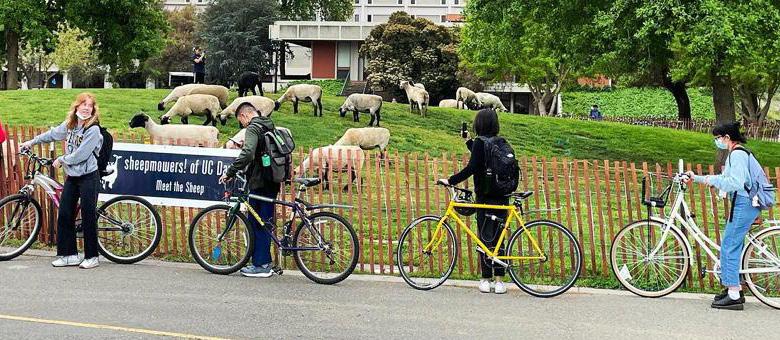
Another defning aspect of the Davis culture is our animal-friendly campus. While many universities also have livestock, Davis hosts programs like the Sheepmowers to include the animals in the day-to-day lives of students. During winter quarter last year, four therapy llamas were brought to the Memorial Union Quad for a day to boost morale at the peak of midterms season. Tis was a kickof event for mental health awareness month by the UC Davis Mental Health Initiative.
Madeline Hass, a second-year environmental management major, shared that the animal involvement on campus is a special part of the Davis day-to-day life.
“I remember when the llamas were on the Quad during winter quarter last year,” Haas said. “Winter quarter can be pretty bleak weather-wise, and it can be hard to stay motivated in classes, so it was such a mood boost to go to the CoHo one day and see that there were llamas outside. I love that Davis is always hosting events like that for students. It’s helping our agriculture-based campus live up to its name by keeping the students and the animals interacting year-round.”
Davis’ campus leaves plenty of room for its nature and agriculture to thrive. Te Livestock Herd Health and Reproduction Service hosts fve types of livestock throughout campus. In addition, our campus’ arboretum is a 100-acre natural reserve, featuring a creek running through it and 22,000 trees and plants that are adapted to a Mediterranean climate. Te campus also features a vineyard, many student farms and various types of fora and fauna.
In addition to our nature-centered campus and a diverse collective of organizations and events for students to partake in, Davis also proudly hosts many programs to beneft students in their respective academic felds.
Terme Arjomand, a second-year biochemistry and molecular biology major, shared a program Davis ofers that has helped her with professional aspirations.
“Davis ofers one of the most comprehensive pre-health advising programs for public schools,” Arjomand said.
“Teir weekly newsletters, express advisors and tailored programs help students interested in pursuing a career in healthcare. HPA, or Health Professions Advising, not only gives students the tools they need to succeed in their future pursuits, but also introduces those unsure of what they’d like to pursue to a breadth of health careers.”
HPA is one of many programs that Davis ofers to help its students get ahead. As a public school that has gone up signifcantly in university rankings over the past few years, Davis has many helpful professional and academic resources for students to take advantage of.
Aside from the quantity of the resources available to students, professors and faculty at UC Davis work to ensure that students are allowed one-on-one attention through advising meetings, ofce hours and with the help of teaching assistants.
No matter what drew you to UC Davis and whether you’re a student, staf member or community member, there are countless programs, organizations and activities that keep Davis students and staf engaged on a day-to-day basis.
Davis has been and will continue to be a campus that prides itself on widespread student involvement, campus and community ties and student success — inside and outside of the classroom.
the fve justices of the Judicial Council, tasked with reviewing legislation to ensure compliance with the ASUCD Constitution. They also occasionally hold hearings when ASUCD ofcials are accused of misconduct and failing to perform their duties, such as during last year’s executive impeachments.
On a daily basis, it is the service-providing units which students interact with the most.
Tese include Unitrans, which is the bus transit system that runs throughout the city of Davis, the CoHo, which is the Cofee House in the Memorial Union that works to sell food at afordable prices, the Pantry, which is the campus food bank, the Entertainment Council, which puts on concerts and music festivals, and Picnic Day, which is a team of organizers of the yearly open house of the same name. Te California Aggie is also an ASUCD unit, though it is managed and organized independently.
Under the Senate are a handful of student commissions and committees that help consult on legislation, including the Environmental and Policy Planning and Gender and Sexuality Commissions.
Senators are elected twice a year: once in week four of fall quarter and again in Week seven of spring quarter. Te spring voting also serves as the election for the ofce of the ASUCD President and top executive ofcials. T e Judicial Branch consists of
Units also make up the bulk of the ASUCD employee population. At the time of publication, the ASUCD vacancy site notes that over 1,000 students are employed at some level in the organization, though that number is certain to rise once the school year gets a running start and units and committees ramp up their operations.
Tose interested in learning more about their student government or working for an ASUCD unit can visit the ASUCD website for more information.
The program takes place during the university’s Summer Session Two and allows first-generation, low-income students to adjust to campus life at no additional cost

BY JORDAN POLTORAK campus@theaggie.org
Te UC Davis Special Transitional Enrichment Program (STEP) began on Aug. 3 and aligns with the university’s Summer Session Two schedule. It allows frst-generation, low-income students to adjust to campus life at no additional cost and is a part of the Educational Opportunity Program (EOP). The program begins with the summer bridge and extends for two years. The bridge portion includes attending one frst-year seminar and one additional course, ofce hours, tutoring and STEP extracurricular activities, according to their website.
River Tuason, a third-year design major and a peer coordinator for STEP, explained the importance and goals of the program.
“It’s really vital for our students,” Tuason said. “We have 179 incoming freshmen. Each freshman has a peer mentor that has been in their shoes before. We’re here to guide them emotionally and academically.”
Some of the academic benefits listed on the program’s website include adjustment to the pace of the quarter system and academic rigor of UC Davis as well as priority registration for the participating students’ f rst year of
undergraduate study.
Tuason shared how the program impacted their experience at UC Davis.
“It was life-changing for me,” Tuason said. “Knowing that there are other first-generation, low-income college students and you’re all in the same boat. Having 20 peer advising counselors having our backs was really supportive.”
Te freshman foundations, or frstyear portion, includes participation in a First-Year Aggie Connection, meetings with a Peer Advising Counselor (PAC) and attendance at STEP and EOP events.
Lastly, the second-year success portion includes meetings with EOP staf, referrals to campus services and attending STEP events.
STEP is invite-only, so eligible students will receive the invitation in their admissions portal. Te EOP center also has resources such as a lending library, career advising and testing supplies such as blue books and scantrons.
Tuason expanded on the benefts of the program.
“We have so many events to make our first-generation students feel welcome,” Tuason said. “We tell all our students that you’re paying to be here and to use your resources. Reach out to EOP, and don’t be afraid to advocate for yourself.”
The suicide prevention training program seeks to educate those interested in proactive mental health solutions for those in crisis
BY MATTHEW MCELDOWNEY city@theaggie.org NATALIE CHENG / AGGIE
In recognition of suicide prevention month, Yolo County hosted a free suicide prevention training on Sep. 5 to recognize and intervene when confronted with the warning signs of a suicide crisis. Yolo County covered the necessary topics to become a certifed gatekeeper, or someone in a position to recognize a crisis and the warning signs that someone may be contemplating suicide. By learning to recognize these warning signs, ways to ofer hope and how to get help for those struggling with suicidal thoughts, anyone over the age of 18 can become certifed.
Question, Persuade and Refer (QRP) suicide prevention training focuses on ways to ofer hope during a crisis by asking questions, persuading them to talk more openly about their suicidal thoughts and referring them to emergency mental health resources. By doing so, QPR Institute aims to save lives and reduce suicidal behaviors by educating others about these proven suicide prevention tactics.
“[Tey] cannot overemphasize the need for early recognition of suicide warning signs,” the ofcial QPR website reads.
Tese signs include but are not limited to expressions of hopelessness, depression, giving away prized possessions, talking of suicide and securing lethal means, according to QPR Institute. Responding to these signs in the correct way earlier on can avert a suicide attempt entirely, preventing the need for a visit to the emergency room or other emergency suicide prevention measures like psychiatric hospitalization.
Te QPR website provides online modules and resources to fnd in-person training nearby to educate oneself on these ways to positively and efectively respond to warning signs. While the courses have a cost for non-students, all UC Davis students have free access to this training program through the Aggie Mental Health website.
By making these resources available to those at Yolo County or students at UC Davis, QPR Institute hopes to reach at least one QPR-trained individual per household, ensuring emergency interventions are able to succeed where they are most prevalent: in families.
“Quality education empowers all people, regardless of their background, to make a positive diference in the life of someone they know,” the QPR Institute’s website states.
An anonymous fourth-year history
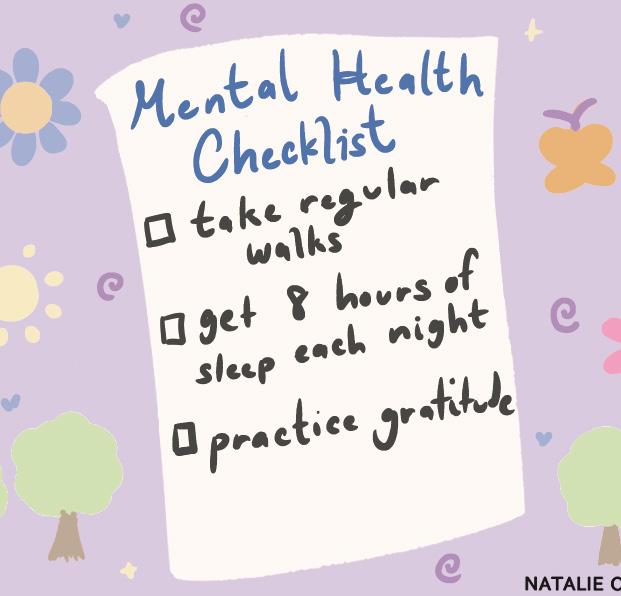
major described her personal mental health journey at UC Davis. From her time at Davis, she felt that it was important for incoming students to be mindful of the pace of college life.
“In high school, there is a lot more structure than in college,” the source said. “With the quarter system, there is also the pressure to keep pace.”
Te need to keep pace with your peers could feel overwhelming and may lead you to overwork yourself for whatever career, internship or college life goal you are striving to achieve,
according to the source. She believes that is why it is so important to monitor yourself in order to avoid these expectations becoming unbearable.
“You can only suppress your problems for so long,” the source said. “Eventually, it will have a real efect on your academics and personal life.” In her second year, she had personally gone to a couple of the free therapy sessions aforded to UC Davis students.
“At the moment, the school employs a lot of student therapists,”
the source said. “Tey may have been inexperienced, but it was nice as my frst ever experience with therapy.”
In hindsight, she could recognize more clearly the things that did not work for her. However, she was glad that she had taken that initiative to process her issues and better her mental health.
“It made it clearer for me that I needed to keep closer tabs on my mental health and encouraged me to fnd a therapist that’s right for me,” the source said.
Aggie Mental Health as a student
resource for mental health and suicide prevention awareness embodies the discovery and selfhood of many students alike.
“We bring together students, scholars, staff, faculty and campus afliates to collectively raise mental health awareness at UC Davis,” the Aggie Mental Health mission reads. “We promote mental health that centers the lived experiences of our diverse student population.”
The UC Davis Police Department invited attendees to climb 110 flights of stairs in the UC Davis Health Stadium to honor victims
BY RORY CONLON rhconlon@ucdavis.edu
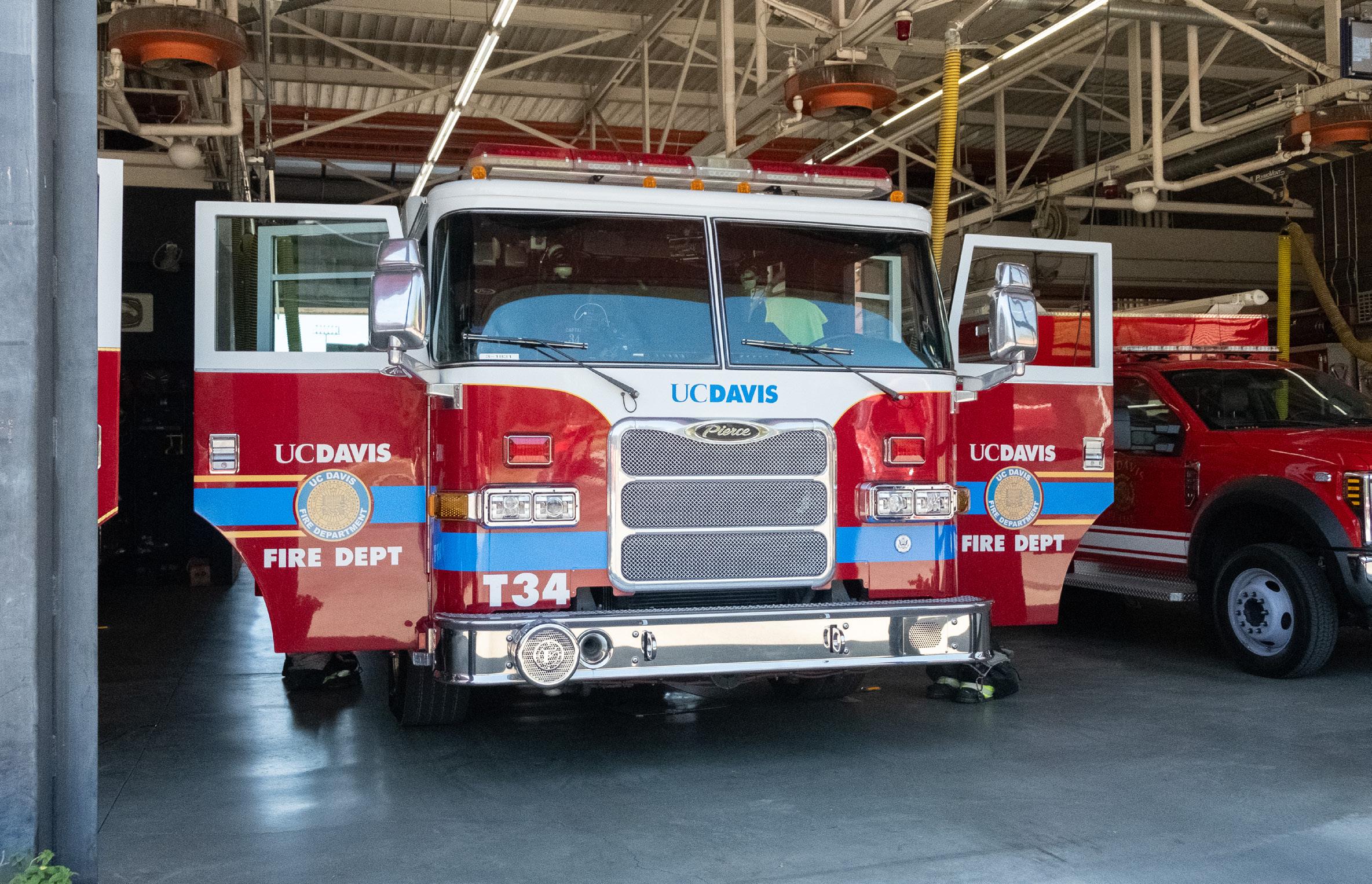
On Sept. 8, the UC Davis Police Department invited the Davis community to climb 110 fights of stairs in honor of frst responders who lost their lives on 9/11. Te event raised funds for the 9/11 Memorial and Museum in New York.
Attendees were asked to arrive at 7 a.m. to climb the stairs of the UC Davis Health Stadium. Before they started, UC Davis Police Chief Joseph A. Farrow spoke to the crowd about the signifcance of the event.
“I was in Washington D.C. at the Pentagon on that day, and it’s something I’ll personally never forget,” Farrow said.
“Tis [stair climb] is for us to remember and look back on the challenges those men and women [faced] on that day in New York City.” Robert Sotelo, a member of the Community Outreach and Engagement (CORE) Ofcer Program, said that 9/11 still heavily impacts the world today, 23 years later. He explained that the stair climb, which the department started hosting in 2021, is meant to be a positive tribute to lives lost.
“[9/11] changed how everything is done — how law enforcement and fre respond, and how we can bring our country together [after] such a tragic event,” Sotelo said. “It’s empowering to people to mourn together. We don’t have to make mourning into a sad event.”
Chanmorokoth Tiv, a member
of the 321st medical detachment in the U.S. Army Reserve, said that acknowledging the sacrifces made by frst responders on that day empowered her to persevere.
“The grit and motivation they had to do their duty in such difcult conditions pushes me [to do] this stair challenge for them,” Tiv said. “If they did it and they sacrifced their lives, time and everything to save people, then I can do the same.”
Vincent Nguyen, a member of UC Davis Police Department, said that in addition to enduring the physical toll of climbing stairs in full gear, frst responders would have had to block out emotional stress to stay calm in a crisis.
“As a regular civilian, your brain goes into your fght-or-fight response,” Nguyen said. “But as a frst responder,
we train not to have a fight response [so we can] run into danger.”
For Austin Kline, an employee at McCarthy Building Companies, the stair climb brought back vivid memories of watching that day unfold.
“My mother came into the living room crying, and I remember watching the second plane hit the tower on CNN,” Kline said. “My dad was supposed to be traveling that day, and my mother couldn’t get a hold of him. Tankfully, he was alright, but it was quite a shock.”
Other attendees of the event were too young to have lived through that day. Ahna Meyers, a Winters Police Department cadet, was not yet born when it happened, but she participated in the climb to understand what the frst responders went through.
“I was trying to keep up and run, because I was thinking about frefghters and police ofcers trying to save people’s lives,” Meyers said. “I think it’s inspiring to get to [follow] in their footsteps.” In addition to bringing together the past and the present, the event built a bridge between frst responders and the community.
Irie Nguyen, the wife of a UC Davis police recruit, said the American public doesn’t respect the contributions of law enforcement and the military enough. She said the stair climb could combat this through raising awareness and making connections.
“Recently, a lot of law enforcement agencies have been doing a lot of community outreach, which I think is important,” Irie Nguyen said. “If you don’t interact, you get people who think [about] ofcers and frefghters in our military based on what they see in movies and the news.”
Robert Sotelo said the UC Davis Police Department has been making eforts to reach out and draw more of their members from Davis residents and alumni. He estimated that the amount of people registered for the stair climb event doubled from last year.
“We can’t do it without our community’s involvement,” Sotelo said. “We don’t want people to think it’s just the police department, and we’re only here to take care of ourselves. Te university community is a lot more dynamic than that, and I think we can all be more inclusive of each other and work better together if there’s a little bit more understanding of that.”
Ofcer David Barillas, a UC Davis alum, said he came from a place where law enforcement and members of the community had a difcult relationship. Barillas said the stair climb reminded him of his new place in the Davis community.
“When you put on a badge, you’re given a privilege to serve a community — you can’t lose that vision,” Barillas said.
“[Students] may be going through a hard time, whether it be fnancial, related to school or just feeling like [they] don’t belong here. Having a conversation and seeing their eyes light up and their smile come alive — that’s why I do this job.”
BY OLIVIA HOKR city@theaggie.org
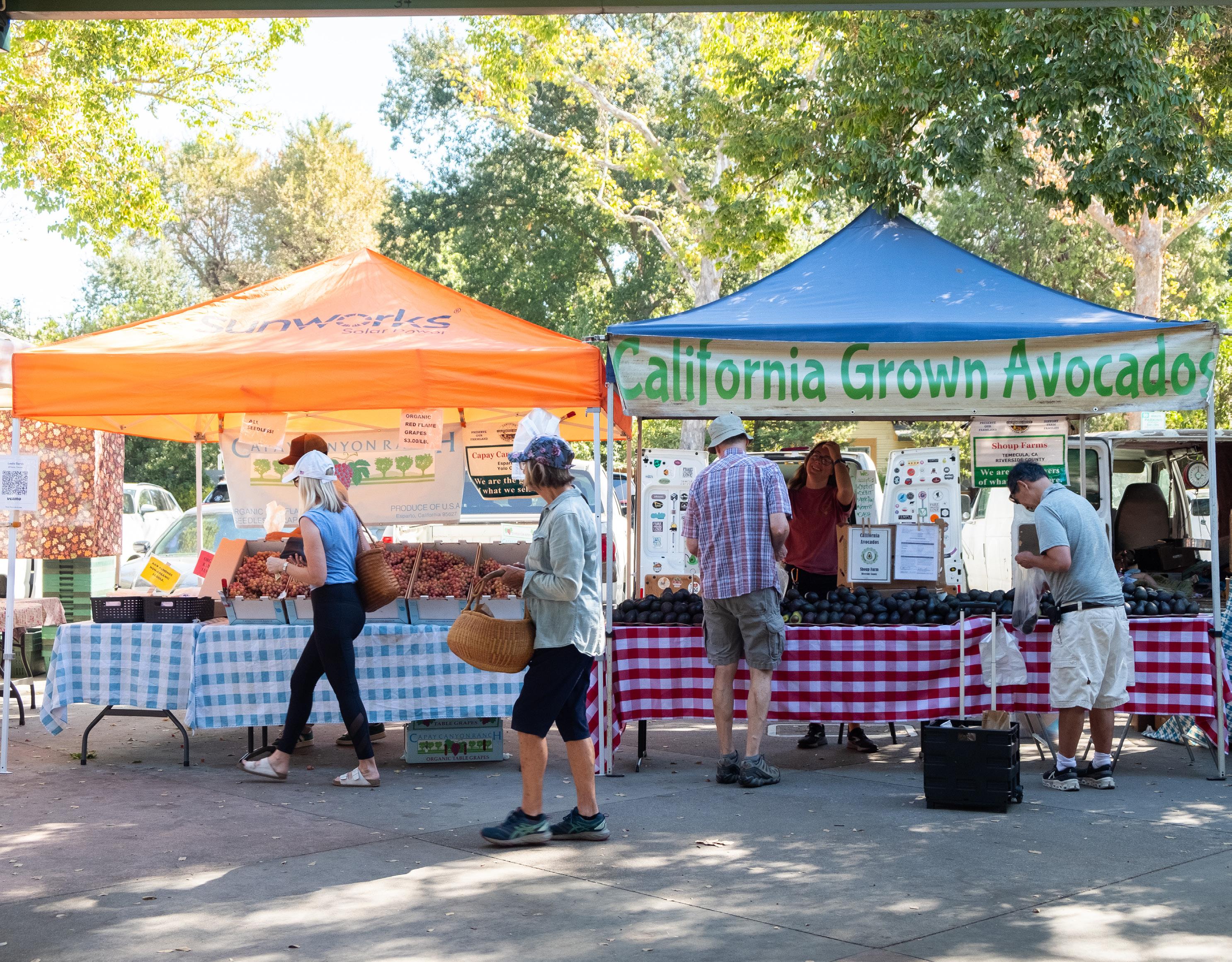
T e Davis Farmers Market is a college town staple that has been around for over 50 years. Year-round, rain or shine, students and families gather in Central Park to enjoy a variety of vendors. From fresh produce to food from local restaurants to handmade accessories, the Davis Farmers Market has it all.
Te farmers market takes place at 301 C Street every Saturday from 8 a.m. to 1 p.m. From October through April it takes place on Wednesdays from 3 to 6 p.m. in addition to the Saturday hours. The weekly market has been recognized and awarded with more than 10 achievements since its establishment by diferent newspapers and magazines.
Recently, three local restaurants who sell
at the farmers market were featured in the premiere of Food Network’s “Best Bite in Town.” Tese include Handheld Sweet & Savory Pies, Te Hotdogger and Zumapoke.
“The Davis Farmers Market Cookbook,” written by Ann M. Evans, a former mayor of Davis and a co-founder of the market, includes details of the inspiring history and development. Te farmers market’s website shares excerpts that describe the prevalence of community and support of local businesses.
“Te market in Davis could be a market in any town where the public good is put to the use of the people, where the surrounding soil is fertile and worked,” Evans wrote. “And where people of diferent faiths and purposes on the planet are willing to slow down, gather together and shop while they swap the news.”
Randii MacNear has been involved with the farmers market since 1978. After graduating college, she moved to Davis and quickly became devoted to the little market in Central Park. What began as her weekly Saturday activity turned into a career of dedication to healthy food, local businesses and building community. As one of the frst few established farmers markets in California, the Davis Farmers Market has evolved into something so iconic to the city of Davis. At its start, the market was merely a handful of farmers selling their produce in an underdeveloped park. Tere are now 90 diferent sellers each week, 65 of which are farmers. It is estimated that over 500,000 people now come through the market every year. Te farmers market brings a special sense of community and comfort to this small town for both the families and
the college students.
“It nourishes people, it gets people outside, it creates community, it gives people hope, it makes them feel happy, it smells delicious [and] kids love coming to the market,” MacNear said. “It’s just all the right things. It’s really remarkable when you think about it. It’s so simple and it’s not a new concept. We’re the only ones who are fnally catching on here in the United States. All over the world the marketplace is the hub of civilization.”
MacNear is now the executive director of the market. She continues to spend her time ensuring the Davis Farmers Market remains an enjoyable and memorable experience and is committed to creating a welcoming environment that people desire to return to each week. MacNear has had the pleasure of engaging with UC Davis students weekly and hearing about their
involvement with the market.
“We love having the students there,” MacNear said. “Tey love the fruit, and they love to meet the farmers and the sellers. Many, many students come up to me to say, ‘I was so lonely when I came to Davis. I didn’t know anybody and I come here to the farmer’s market and I feel like I have family here.’”
The Davis Farmers Market continues to be a favorite among students who are learning to navigate their new town. It has become one of the most popular places to spend a Saturday morning with fellow Aggies. Katie Borgeson, a third-year linguistics and sociology double major, shared her loyalty for her Saturday tradition.
Te Davis Farmers Market is my favorite place on Earth,” Borgeson said. “Everywhere else I go is merely a waste of my time. I could’ve been at the Davis Farmers Market.”
Directors of the group discuss their work in bringing live entertainment to the school community
BY GRACIELA TIU
features@theaggie.org
It’s a cool Friday night, mid-spring quarter, and you weave through the packed Memorial Union (MU) Quad while the pre-show music booms at the perfect volume to invigorate the already buzzing crowd. You and your friends claim a spot on the lawn, surrounded by more students than you thought could ever ft on the grass.
Everyone around you is dancing, jumping and singing at the top of their lungs, and you begin to feel the infectious energy and anticipation spreading throughout the audience. You take in the lights, the sound, the visuals of the set — and for a moment, you wonder how all of it came together. As the music stops, the lights dim and the crowd roars in unison. A new beat starts, the excitement swelling as you catch a glimpse of Aminé stepping onto the stage.
If you went to Lawntopia last year, chances are you have had a very similar experience, thanks to the Entertainment Council (EC) here at Davis. A branch of the Associated Students, University of California, Davis (ASUCD), the EC works to bring captivating music and media experiences to students at Davis.
Binh Do, a fourth-year economics and history double major as well as the council’s assistant director, describes his defnition of the group’s mission.
“The Entertainment Council’s mission in a more general sense is, within the name, bringing entertainment onto campus,” Do said. “When it comes to school spirit, there’s not a lot of energy within campus. [Our mission is] to change that, make the campus feel more lively, get people connected together [and] give people those core memories.”
To make this mission a reality, members of the Entertainment Council work year-round.
Abby Wong, a third-year design major and co-productions director of
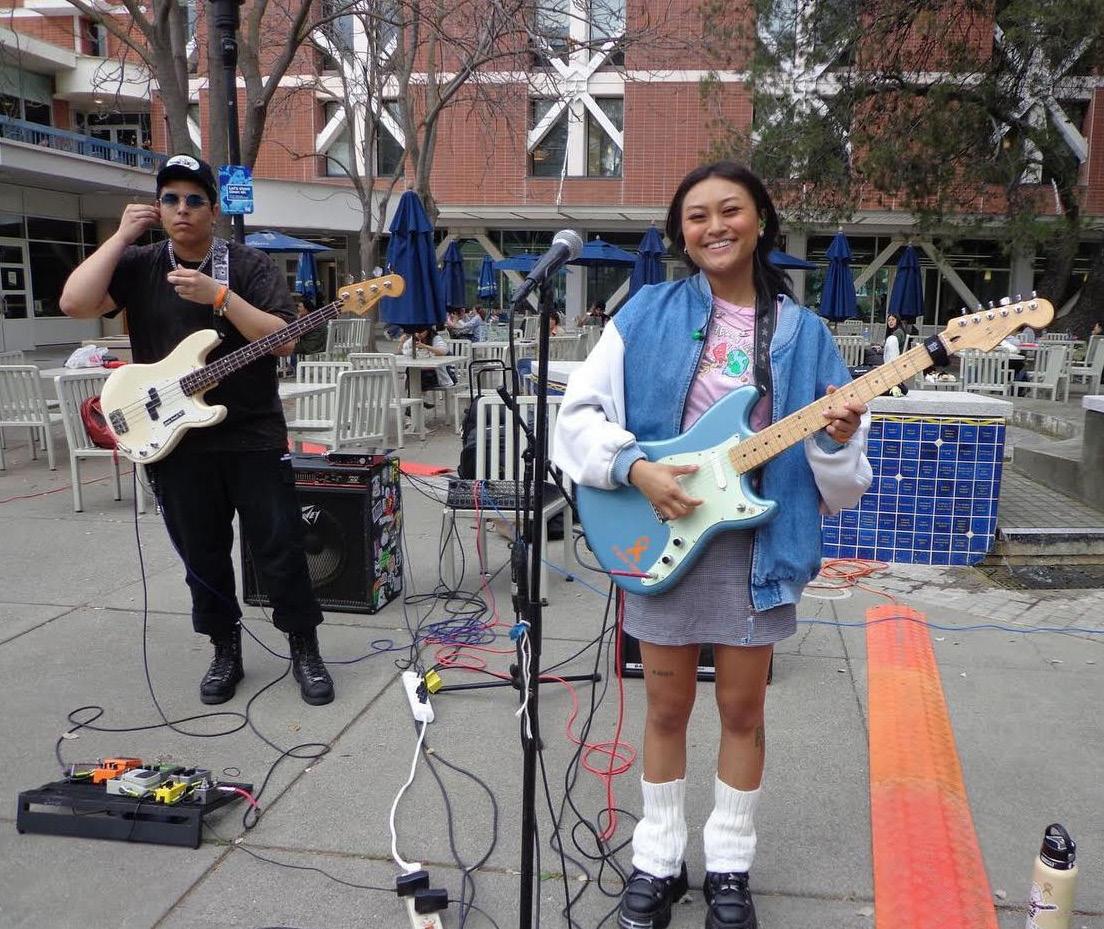
the EC, described the main events the group works on. Tere are three concerts: Sunset Fest, BrainFreeze and Lawntopia. Tose happen annually,” Wong said. “Tose are going to continue to happen. We’re also going to continue to have our Local Limelights, a lot of local artists and student artists being shown around campus. On top of that, we are going to continue with our movie screenings.” Te EC recently announced that Sunset Fest, the biggest concert of fall quarter, will be coming back this
year and taking place on Friday, Oct. 4, 2024. Although it was unable to happen last year, members such as EC Co-Productions Director Eddie Kim, a third-year human biology major, are excited to bring back the tradition.
“It’s something that we haven’t had in Davis for a long time,” Kim said. “It’s defnitely going to be a fun experience with greater visual representation, production and some great music as well.”
Most students around campus know about the main three concerts, but the
Local Limelights also bring live music and spread spirit across campus.
“[We bring] a local band from around Davis or the Bay Area to play a one-hour set, [and] we usually host them on the MU patio, by the fountain where people eat lunch,” Wong said.
“We also had a jazz study night in the CoHo (Cofee House) where we got a DJ, Ccoties, and we also got a bunch of vinyls that people could paint.”
In addition to hosting their own live music events, the EC also has production packages available for
purchase if other groups want to host an event.
“A UC Davis organization who wants to have their own event will reach out to us and ask for our diferent plans,” Wong said. “We have a basic plan, which is just sound equipment and we do like a little handof, or we have our deluxe plan, which is sound equipment plus set up [and] take down. We [also] have an in-house audio engineer who will run the sound for the event. We basically coordinate with the renting organization about their schedule, their run of show, all of their equipment needs and [the] day of, we go there to help out with their event and make sure it goes smoothly.”
Whether it be through big or small events, working with others helps members feel fulflled by their experience working with the EC.
Te most rewarding part about it is meeting a lot of new people that are also interested in building this team, [creating] this project for the whole school [and] watching it develop step by step,” Kim said.
EC members work to bring joy, love and school spirit back to campus. Tis is made possible through members recognizing how impactful music and live events can be on the school community.
“Life is hard for college students in general, and what you see is [us] trying to give everyone a break,” Do said.
“Making sure that at the end of the day, we’re not just students, and that everyone is able to remember their college experience in a positive way.”
After all of their hard work, members of the Davis Entertainment Council can look back and appreciate the thrill and enjoyment their live events bring to campus.
“All this planning doesn’t really feel real when you’re just sending emails, and it’s all kind of up in your head,” Wong said. “But once you’re there and you see this entire audience of people [with] no grass visible on the Quad, it’s amazing.”
Collegiate culture can be too demanding

BY MOLLY THOMPSON mmtthompson@ucdavis.edu
Te beginning of college is really exciting — so many new people, new opportunities and new freedom. Your whole life is new, and the sky’s the limit. But there’s also a lot about the beginning of college that can be extremely difcult to navigate. You suddenly have a lot less guidance and a lot more new infuences; that can be really amazing, but it can also be really damaging.
Collegiate culture facilitates unhealthy and unsustainable behaviors in a lot of ways. Tat’s not a novel concept; everyone knows that, for example, frequent heavy drinking is just a common aspect of many students’ lifestyles. But it goes beyond that in ways that can be harder to recognize. I had a professor once who refused to post slideshows, record lectures or provide any other way for students to access the material if they were absent. Presumably this was to encourage attendance, which is of course a good thing, but it’s also a throughline for expediting burnout. By and large, I’ve found it to be true that going to class is crucial to academic success. But that doesn’t mean that missing a class needs to be punitive. If you’re sick you should stay home — that should be the norm, but because it’s so commonly accepted to value productivity over health and wellness, it isn’t.
It’s so easy to provide accommodations (especially in the age of technology) for students who may not be able to come to class, and if education is truly the priority, we should utilize them. Tat practice of prioritizing work over self-care unnecessarily punishes students who are trying to be responsible; instead of helping people when they’re sick or in need of a break, we force them to either
harm themselves further by coming to class or be at a disadvantage by missing a lesson.
Tis phenomenon shows up time and time again in diferent avenues of collegiate life. Tere’s so much pressure to get better grades, to add more to your resume, to take harder classes, to achieve more and more and more —which often comes at the cost of physical and mental health. What do I do if I don’t have enough time to get my homework done? Sleep less. What happens if I have too much on my plate to take real breaks?
I get burnt out. What happens if I get sick and I keep going to class because I’ll fall behind if I don’t? I get sicker.
But that’s just part of life in your early twenties, right? Tat’s just how college works? It doesn’t have to be, and it really shouldn’t be. Of course, it’s a result of how our society as a whole functions. And that’s a problem in and of itself, but it doesn’t mean that we shouldn’t address it at this level.
It’s really hard, in the face of peers and infrastructure that celebrate sacrifcing personal wellbeing for noseto-the-grindstone work, to actually take care of yourself. We’re told that healthy self-care is lazy, easy, unproductive and unnecessary. But that couldn’t be farther from the truth. Taking care of yourself, allowing yourself breaks and easy days, not overloading your schedule, prioritizing sleep and physical wellness, etc. is all really hard in the face of so much demand for productivity. But no one should ever feel bad or selfsh for being human. We should never feel like our schoolwork is more important than our mental or physical health.
Disclaimer: Te views and opinions expressed by individual columnists belong to the columnists alone and do not necessarily indicate the views and opinions held by Te California Aggie
BY MAYA KORNYEYEVA mkornyeyeva@ucdavis.edu
Starbucks launched their famous “Pumpkin Spice Latte” (or PSL, for short) on Aug. 22, marking the beginning of the transition period away from hot, blazing summer and towards a moody, pumpkin-flled fall.
Pumpkins — whether in their plump harvest mode or hollowed out and decorated for Halloween — have been a classic symbol of fall for centuries. Teir ripeness season spans from late August to late October, which makes them a perfect fall ingredient for a wide range of recipes: from soups to cakes to syrups in cofee.
While pumpkins are typically associated with a savory rather than sweet taste, they are scientifically categorized as fruit. Te seeds found on the inside of the gourd and the fact that pumpkins grow from big yellow and orange blooms are markers of their non-vegetable nature; similar to other squashes, avocados and even tomatoes.
Pumpkins are also packed to the brim with nutrients, including Vitamin
A (great for supporting your immune system) and Vitamin C (for eye health). Te fesh of the pumpkin also contains plenty of antioxidants, as well as fber that aids in regulating cholesterol and blood pressure levels. Additionally, munching on just half a cup of pumpkin seeds supplies your body with 20 grams of protein.
There’s something extremely comforting about cooking and baking with pumpkin. Te sharp tang of spices mingling with the smell of pumpkin sauce and the creamy, sugary notes in pumpkin bread urge me to wrap up in a blanket, light some candles and read a good book. Te simple yet inviting flavor profile present in pumpkin recipes is reason enough to try it out as a new ingredient in your pantry this fall season.
One of my favorite ways to use pumpkin in the fall is roasting the pumpkin seeds from the guts of my Jack-O-Lantern; washing, drying and seasoning them to taste. I love adding a little paprika and garlic powder, then tossing everything with olive oil. A quick bake in the oven and you have a crispy, healthy snack to satisfy your
midday cravings. Another way to utilize pumpkin is by making a homemade pumpkin syrup, which may not be as bright and colorful as the Starbucks version, but tastes remarkably similar. All you need is some pumpkin puree, brown sugar, vanilla extract, fall spices (an even mix of cinnamon, nutmeg, cloves, allspice and ginger) and a stovetop to simmer your syrup on. Trust me: this one turns out delicious.
Lastly, you can’t go wrong with a pumpkin pastry. Whether it’s pumpkin pie, a loaf of pumpkin bread, pumpkin spice mufns or pumpkin cheesecake, any recipe is bound to bring the welcoming feel of fall a little bit closer. Grab some friends, head out to the pumpkin patch and pick your champion. As they say: “go big or gourd home.”
Disclaimer: Te views and opinions expressed by individual columnists belong to the columnists alone and do not necessarily indicate the views and opinions held by Te California Aggie.

MAYA KORNYEYEVA / AGGIE
BY ALLISON KELEHER adkeleher@ucdavis.edu
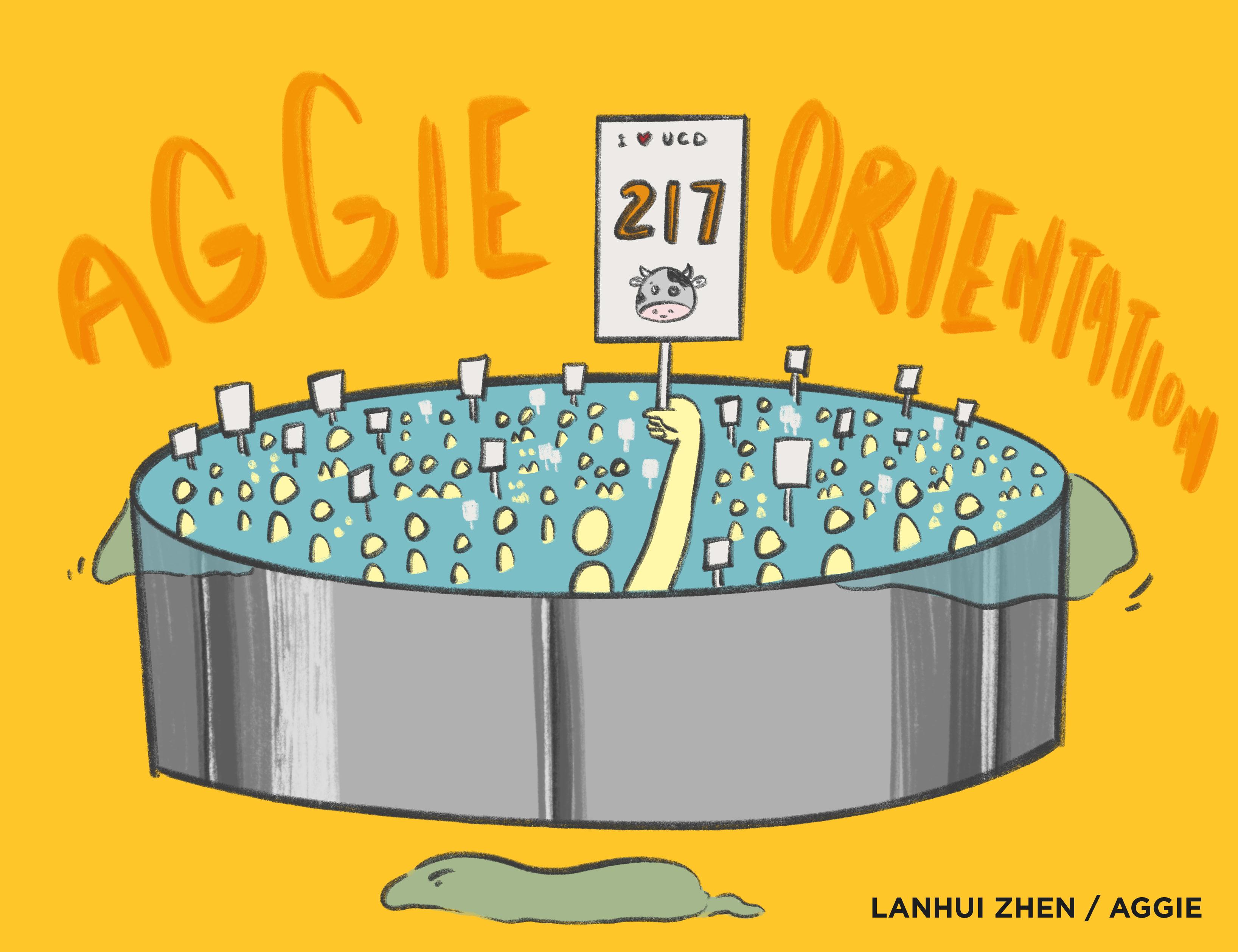
I don’t know about you, but personally I can’t wait for classes to start again. Only because that means that Aggie Orientation is over. Tose Orientation Leaders are starting to scare me. I don’t wish to frighten our new Aggies, but I have a responsibility to report the news. I think the Orientation Leaders are robots and here’s my proof. Does anyone remember the 2022 Aggie Orientation? Tere was a thunderstorm with pouring rain which completely derailed the Aggie Orientation program. Te orientation administration was suspiciously quick to tell people to shelter in place. Why? Tey didn’t want us to see the Orientation Leaders glitching out in the rain. After this year, the administration cleaned up their act so we haven’t been able to catch them. Until now. I went undercover as one of their Program Assistants, and I’ve been gathering evidence for months. I have a feeling that they are onto me, because sometimes the administration will whisper to each other and close their ofce doors. Additionally, there’s a door that’s supposedly a closet that I haven’t seen anyone open in my entire time here. My theory is that is where they keep the preservation tanks for the Orientation Leaders. Additionally, have you seen that these Orientation Leaders will walk around with the same power bank? Tat’s because they need a quick recharge during the day when they can’t go back to their preservation tank. My very reliable source, Gabe, informed me that they have had issues with Orientation Leaders being reliable. Some will quit, not show up or even brainwash their frst-years into thinking that
Get to know some of the people who help bring this paper together
WRITTEN BY THE EDITORIAL BOARD
Te California Aggie is the ofcial student-run newspaper for the UC Davis community. Our paper is also the best way for students to get involved in journalism and reporting experience on campus.
Every week we provide hardhitting news, in-depth features and diverse opinions about the campus and local community. We publish online every day and weekly on Tursday. You can fnd many of our newsstands on campus and downtown for your convenience.
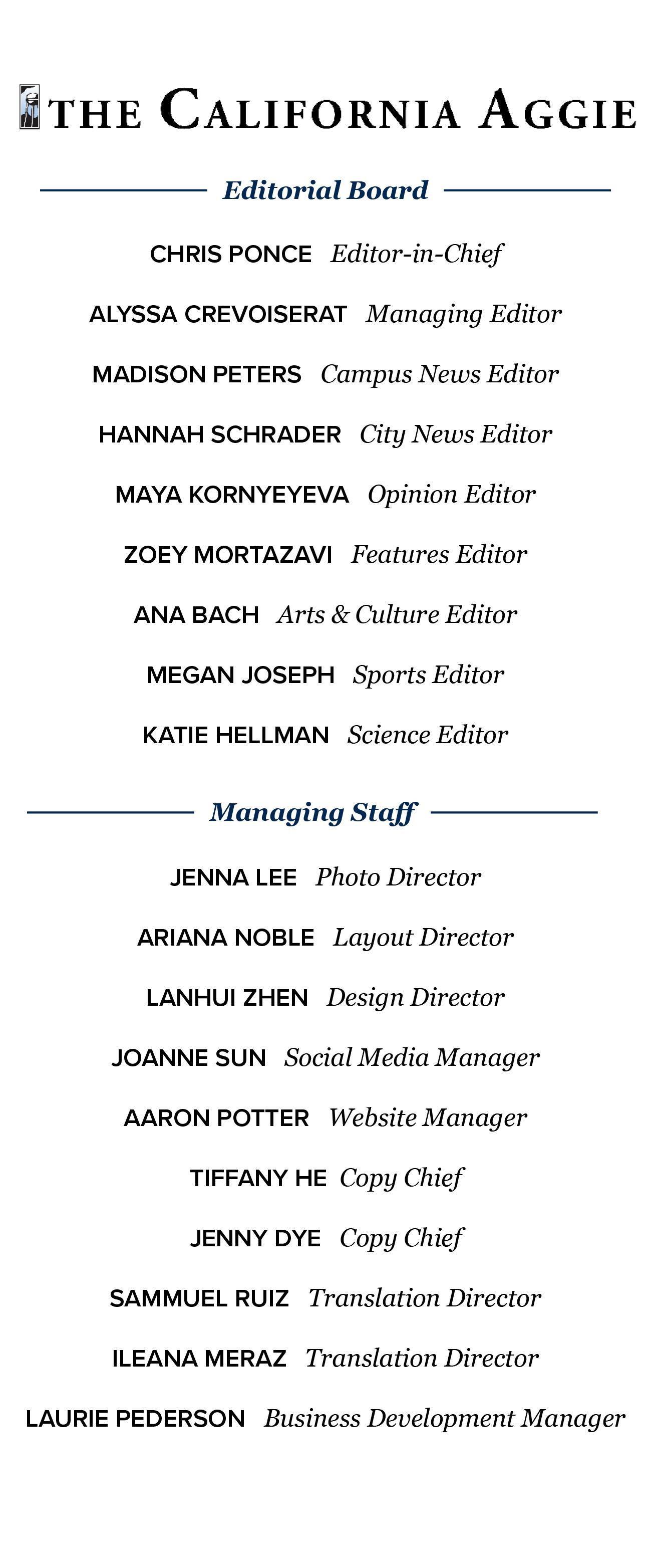
We have seven diferent desks managed by diferent editors that each provide unique content for our paper. Te Editorial Board is also responsible for two weekly editorials that share our student opinions on important issues. Since you will be hearing our rants fairly often, here is a brief introduction to get to know us better.
Chris Ponce, Editor-in-Chief
Tis is my third time writing a bio for our “Meet the Editorial Board” piece and I’m still at a loss for how quick the time has passed by. Tis year I fnd myself in a new role that I am navigating with hope and excitement. During one of the frst stories I covered three years ago an Aggie photographer joked that I was on my way to be Editor-in-Chief by my fourth-year. I told him that I was happy where I was.
Since then I served as city news editor for two years, providing the campus and local community with news about crime, politics and city updates. I oversaw and wrote stories about bomb threats, the serial stabbings and local activism. In that role I understood the vital purpose Te Aggie provides. In the summers I have worked for political campaigns, taking a diferent perspective on the issues we cover. In these roles I have learned that the voices of local communities are essential. I have learned the need for local journalism.
We write stories that otherwise would have gone unnoticed, we provide a platform for student and professor opinions and we provide safety and crime alerts that help keep our community safe.
Tis is why I decided to become Editor-in-Chief, to help our paper expand and make sure that we are here to stay for years to come. I fell in love with journalism frst, then I fell in love with this city and campus. As my fnal year moves forward, I will do what I can to do the best that I can.
for writing and storytelling but no journalism experience. I wondered if this was good enough to join such an impressive publication. However, with Lily’s reassurance (and a bit of begging), I was writing for Te Aggie in a few weeks. What I didn’t know was how much it would change my life. With every article I wrote, something exciting sparked within me. Being able to talk to diferent students, faculty and campus organizations opened my eyes to a whole new world I was unaware of. I felt so connected to the campus community, and being able to see my name on issues and talk about important campus events gave me an unmatched sense of pride (and being able to show these articles to my mom helped my ego greatly).
Going into my second year with Te Aggie and taking on the role of campus news editor is everything I would have wished for. I love seeing the passion in my fellow writers’ eyes when they pitch a new story, and being able to help them use their voices is an exceptional thing. Tis year, in addition to improving my journalism skills, I have a goal to make Te Aggie more sustainable in terms of paper waste (woohoo!). I can’t wait to continue shining a light on all the diverse stories on campus and working with my fellow Aggies, since they are the best and kindest people I have had the pleasure of meeting!
Hannah Schrader, City News Editor
A new school year is a time for new beginnings, and of those new beginnings I am most excited to continue my time at Te California Aggie but now as the editor of the city news desk. As a brief introduction, my name is Hannah Schrader and I am starting my third year here at Davis. I love reading, baking and traveling. Tis year I hope to produce high quality coverage of local politics, events and community afairs.
high school after one of my English teachers said she thought it would be a perfect ft for me. She was right — I fell in love with it immediately and climbed the ladder of staf positions as quickly as I could, from senior staf writer to news editor to editor-inchief by my senior year. Journalism has taught me about leadership, the importance of properly representing a campus’ population and all (way too much, actually) about meeting deadlines. Finding a shared passion for writing, discussing a community we’re all a part of and learning more about one another in the process has been one of the most rewarding experiences of being a student journalist.
Joining Te Aggie was one of my main goals going into my freshman year at Davis. I applied for a writing position for features and was able to become the assistant features editor by my third quarter. Yasmeen, last year’s features editor, taught me to appreciate and love the human perspective of feature writing. I applied to the features editor position after a year writing for the desk, hoping but not at all expecting to get it. It’s a huge privilege to be able to shine a spotlight on the diverse corners of the community that we have on our campus. Trough features I have been able explore Davis on a much deeper level while covering topics like fnancial education, college language courses and even the importance of studying outdoors. I’m so excited to be joining the Aggie staf ofcially and for a year full of showcasing the people and communities that make UC Davis all that it is!
Ana Bach, Arts and Culture Editor
Welcome to UC Davis!
WRITTEN BY THE EDITORIAL BOARD
Dear Reader,
Welcome to UC Davis! I hope you are having a decent time navigating your way through orientation and this lovely place we call home. Getting to this point in your life is something to take pride in, higher education is both a privilege and an honor.
Maybe it feels like all of your friends left their hometowns and went of to college, with some going to schools that are more “esteemed.”
But, let me assure you that going to any college, let alone UC Davis, is the chance of a lifetime.
I’m approaching my fnal year at Davis and I can say I am beyond sad to leave. When I frst came here, I felt scared and alone until I found my place. If this resembles how you are feeling right now then let me promise you that things will get better. You will make friends. You will fnd your people. You will call this place home. It just takes time.
It wasn’t until I got involved with Te Aggie, the ofcial student paper of UC Davis, that I learned to love Davis. Tere is a lot to ofer in this small cowtown, from the farmers market to our local cafes, Davis is beautiful. I am
lucky to call this place home. Reader, you will be too.
As you settle in I encourage you to put yourself out there; join a club, talk to the person you sit next to in your classes and try something new. Tere is also more to explore outside of campus. Te city of Davis is always hosting an array of welcoming events. I also want to say, Davis might be a culture shock for many of you the way it was for me. I come from a small town in Southern California that couldn’t be more diferent from Davis. Tere are plenty of clubs that celebrate culture and diversity. It’s diferent from home, but you will fnd your place. Davis is for everyone.
As you explore campus, our newspaper is here to provide you with trusted local news and an outlet to express your student opinion.
I’m wishing you the best of luck. Welcome to your new home and community.
Sincerely,
Chris Ponce Editor-in-Chief
If you ever wish to reach out to me, please send me an email at editor@theaggie.org
Alyssa
Crevoiserat, Managing Editor
It’s hard to pinpoint exactly when I became an editor. I’ve always been a bit of a nutcase when it comes to grammar — arguing about the Oxford comma is still my favorite pastime — but I think it all really began when I became a copy reader for Te California Aggie as a frst-year. Sitting in my dorm in the dark, editing the articles in suggestion mode and painstakingly awaiting the acceptance or rejection of my edits became my life’s work (on Saturdays). During my one-year tenure as a copy chief, I saw a diferent side of our publication: pizza trivia nights, the copy team’s attic and a which-deskwould-survive-the-hunger-games simulation. Now, I’ve graduated from suggestion mode — phew — and I can safely say that this has been the most rewarding experience of my life.
Even after all of this, I still can’t fgure out how to tell you what this role means to me. From campus events to medical innovations to city council updates, I have had the opportunity to remain educated on local current events and connect with UC Davis behind the scenes. Going into this year as the managing editor is equal parts terrifying and exciting, and I hope this year is flled with team-bonding events, long nights in the ofce and, most importantly, incredible journalism. I can’t wait to work with some of the most talented and passionate people I’ve ever met that make this paper all that it is and will be. And if you’re thinking about joining Te California Aggie, I can’t wait to meet you, too.
Madison Peters, Campus News Editor
Te Trader Joe’s crew memberto-campus news editor pipeline is real, and I am living proof. It was my former coworker and campus news editor, Lily Freeman, who frst introduced me to the wonderful world of the Cal Aggie. One day during the summer before my third year, while we were stocking the fruit and nut section, Lily approached me like a car salesman pitching the newest and fastest car on the market: “How would you like to be a volunteer writer for the school’s newspaper?” she said. At this point in my life, I had a passion
I started working for Te Aggie my frst year here at Davis after fervently committing to being as involved on campus as possible. It was nerve racking to start college but even more so because a very brazen 18 year old Hannah decided to attend college 2,800 miles from home. After much experimentation with clubs and programs, I had a stroke of luck when I applied to work for the California Aggie. I worked for the city news desk for a year and a half before getting the privilege of now working as the editor of the desk. Trough my time at the city desk, I not only grew my knowledge of journalism but the love I had for the feld at large. I must also give a big thanks to our current EIC and former city desk editor, Chris Ponce for recognizing the important role the city news desk plays in the Davis local journalism scene and his commitment to providing critical political and city coverage. Te city desk taught me what it means to be a part of the Davis community, and more importantly what it means to tell the stories of the people in it. I hope to continue Chris’ legacy of providing high quality coverage and keeping the Davis community informed.
Maya Kornyeyeva, Opinion Editor
From the very beginning — and by the beginning, I mean the fourth grade — I have been in the opinion biz. Tat fateful year, I published a hand-printed newspaper featuring a story about ghosts (note: it was actually just heat shimmer) hiding in the fake grass of my elementary school’s soccer feld, putting my evidence down on paper and proclaiming my albeit fanatical theories to the world. From that moment on, I embraced the lifestyle of a reporter, creating articles and political cartoons for my high school’s newspaper, Scot Scoop. Upon arriving at UC Davis (even before petting the cows!) I applied for the Opinion Desk at Te CA Aggie, and, by some miracle, I got in. Two years and countless opinion columns about cofee later, I am here before you as the Opinion Editor for this academic school year.
From my two years at Te Aggie, I feel it is safe to say that this is one of the most passionate student hubs on campus. While at Te Aggie Ofce, I learned trivia tidbits about the most bizarre, random stuf you can imagine. I met people with ground-breaking ideas and shared my thoughts in a judge-free space. Every meeting was flled with laughter, jokes that did (and didn’t) make sense and rants about everything from Doctor Who to surviving the apocalypse. I wouldn’t have made it here without my outstanding editors, Owen and Annabel, and I hope to lead the Opinion desk with the same dedication to free speech as they had. Oh, and of course, whip together a few more articles about cofee.
Zoey Mortazavi, Features Editor I unexpectedly found myself in a journalism class my junior year of
I never quite knew when and the exact reason why I wanted to become a writer. I’ve always had a bit of a knack for writing, keeping extensive journal entries about my day-to-day experiences even before I knew how to spell correctly. When I went to middle school, I vividly remember bonding with my seventh-grade English teacher, staying during lunchtime to debrief the books we were reading in class. My interest and love for writing were never questioned, which is why I was so easily convinced to join Te Aggie by a member of my sorority, who also happened to be the Managing Editor at the time, shoutout Ms. Katie Debenedetti. From there, everything seemed to come naturally, aside from getting into the habit of rejecting the use of the Oxford comma.
As I refect on how I started at the Aggie, it’s been weird to think about ending my experience with something that has been such a prominent part of my life for the past three years. Te countless Couch Concert planning, Culture Corner brainstorming and Lit mag layouts will never fail to impress me with the undeniable talent from Aggie and local Davis writers alike. While this fnal year seems so scary to confront head-on, I want my writers and fellow editors to really cherish all the time we spend together. Meetings can be long and typos are inevitable, so welcome the things that don’t go according to plan because that’s what makes up our perfectly imperfect publication. As always, I hope you all enjoy reading!
Megan Joseph, Sports Editor
Wow, has it already been three months? I cannot believe that summer is ofcially ending and a new school year is starting! For those of you who don’t know me, my name is Megan Joseph. I am just now starting my third-year here at UC Davis and could not be more excited to also start my second year as the sports editor. Over the course of last year, I have learned so much—whether it’s the inner workings of collegiate sports, handling deadline crises, or fguring out the best way to hand out newspapers. I am incredibly grateful for the experiences I have had and will continue to have here at Te Aggie.
I began here just like everyone else, as a new volunteer writer for my desk. After writing and seeing my frst few articles in print, I knew I had found my place. I’ve always had a love for sports, whether it’s playing as an athlete or being a fan on the sidelines; it is one of my biggest passions. I am beyond thrilled to continue pursuing this passion and continuing to make entertaining content for everyone this year! With my incredible team of writers, I am confdent that we will make this year just as amazing if not better than last year. So, stay tuned for everything sports this year on the backside of the newspaper.
Katie Hellman, Science and Technology Editor
I accredit my deep-seated love for writing to two things: spelling bees and the elementary school book fair. I could say that spelling bees helped me cultivate a fascination for the intricacies of the English vocabulary and the nuances of language, but in reality, I just realized that 1. I liked
to spell, 2. It won me money and 3. I should perhaps try stringing together some words of my own. Tose book fairs yielded a similar insight; I developed a particular (and thankfully short-lived) fondness for books revolving around talking dogs, and this reading passion quickly gave way to a desire to write.
Fast forward a decade or so, and I found myself inclined to experiment with diferent types of writing. In high school, I loved switching between serious and satirical writing topics when given the creative liberty to do so (to the grief of my teachers), but once I entered college I fgured it was time to pursue a journalistic position
related to my STEM major. I thought science writing sounded cool – and so alas, I applied to be a science writer. After two quarters of that, I realized that the only thing better than writing would be telling other people what to write (kidding… mostly), and thus began my time as the Science Desk Editor during my second year. Here I am now entering my third year, and I can’t wait to return to the position and work alongside an amazingly talented group of editors, writers and artists. If you’re interested in topics like advancements in healthcare, astronomy and the environment, then keep on reading – and if you couldn’t care less, now’s the time to change that.

BY ANA BACH arts@theaggie.org
Movie: “Te Whale” dir. Darren Aronofsky (2022)


If you easily cry during movies, this one might be hard to stomach. Both of my parents recommended this movie and heavily sobbed throughout it. Brendan Fraser and Sadie Sink elevated this flm to a whole new level, with a father-daughter dynamic that leaves you in shambles. Fraser’s character, Charlie, is a reclusive and unhealthy English teacher who teaches students online while he binge-eats himself to death. Troughout the flm, he makes a valiant efort to reconnect with his teenage daughter, Ellie (Sink), as his health increasingly worsens for one last chance at redemption. Ellie continuously tries to push him away, while he tries to be a part of her life in any way he can. While I didn’t cry, I walked away from the flm thinking about it for days after. As an audience member, you really feel the weight of Charlie’s journey, as a food-addicted man who is still seeking self-improvement, even when it feels too late. I would recommend this movie to anyone looking for a great flm to watch, but with that, prepare yourself to be an emotional wreck for several days after.
Song: “Les Gout” by Rampa (2022)
A quintessential house song to keep the summer beats uplifted into fall, Rampa creates a song uplifted by Afrobeats. Te producer uses a very limited lyrical base but consistent beats intertwined with bongo drums to give the song a somewhat Reggae feel. I found myself circling back to this little tune over the summer, trying to pretend I was of somewhere in the south of France when I was really just going for a drive in my neighborhood. Whether you are a fan of this type of music or not, it’s hard to resist dancing along to the beat. So don’t fght it, and let the music guide you.
TV Show: “My Lady Jane” dir. by Jamie Babbit and Stefan Schwartz (2024)

I was absolutely shattered when I heard rumors of a second season no longer being in the picture after I binge-watched the show in less than 24 hours — so let’s hope that it just stays speculation. Te Amazon Original, based on the novel of the same name by Cynthia Hand, Brodi Ashton and Jodi Meadows, is a fantasy retelling of the life of Lady Jane Grey, the former Queen of England and Ireland, in her arranged marriage with Guilford Dudley during the reign of King Edward, son to Henry VIII. She is unexpectedly forced to take the crown overnight and is targeted by people who are envious of her power, inside and outside of the kingdom. Te characters range from royal fgures to humans that shapeshift into animals called Ethians. While the show sounds like an intense period piece, the humorous dialogue and modern spin sets it apart from the other Bridgerton-esque shows and makes it an easy binge-watch.
Book: “Yellowface” by R.F. Kuang (2023)

Taking place in my hometown of Washington D.C., “Yellowface” ofers readers a unique story about the life of two long-time college friends who are both aspiring writers, Athena and Juniper. Athena Lu is a successful author and fashion mogul while Juniper stays out of the limelight. Te book is a critique of the publishing world — shining a light on how cyberbullying reveals biases that writers make conscious choices to either sweep under the rug or confront head on for the sake of their book.
events and author readings in the first week of fall quarter
BY ELIZABETH BUNT arts@theaggie.org
When fall quarter begins, Davis is overrun with new and returning students, overwhelmed with the hundreds of campus and town-wide events that all seem to be happening at the same time. Tis article will provide an overview of local events during the frst week of classes that will be the perfect ft for book lovers, humanities students or anyone wanting to be introduced to the Davis art scene.
Te Avid Reader bookstore located downtown is a staple of the Davis literary sphere. With a huge collection of bestsellers and new releases, and being located only half a mile from campus, nearly every humanities student has passed through its doors at least once. In addition to bookselling, the Avid Reader also hosts monthly author visits and readings. Tis September, two such events are set for the frst week of fall quarter.
Michael Silver will introduce his latest book “Te Why is Everything” at the Avid Reader storefront on Tuesday, Sept. 24, from 6:30 to 7:30 p.m. Silver is an award-winning sports
journalist and author of fve books. “Te Why is Everything” tells the story of Kyle Shanahan, an National Football League (NFL) ofensive coordinator, and how he brought about a new age of innovation in football strategy. In describing how a few men changed the game of football, Silver also tells a tale of friendship and the never-ending pursuit of athletic excellence. Tis event will be a hit for book lovers and sports bufs alike.
Vicki Valosik will also be discussing her debut novel “Swimming Pretty: Te Untold Story of Women in Water” at the Avid Reader on Friday, Sept. 27, from 6:30 to 7:30 p.m. “Swimming Pretty” tells the complete history of synchronized swimming and how it earned its place in the Olympic Games. Valosik not only tells the story of the sport itself, but the many generations of female athletes who propelled underwater athletics into prominence. “Swimming Pretty” gives an inside look at a sport and a feminist battle that still remains unknown to most.
Another arts-related destination in Davis, the John Natsoulas gallery, is a great place to dive more into the local cultural scene. Te gallery is located on the corner of 1st and E Street. With ever-changing gallery exhibitions and
events every week, the Natsoulas is a fantastic place for students and Davis residents alike to get a dose of art. As many returning humanities students are aware, the Natsoulas is also a regular host of poetry readings that are open to any writer brave enough to share their work. Te poetry series kicks of once again during the frst week of fall quarter, but this time with a new twist. Looking for something similar to open mic nights? Look no further, because the Jazz Beat Poetry Night will be held at the John Natsoulas Gallery on Friday, Sept. 27 at 7 p.m. Tis event is open to the public, and attendees are encouraged to bring a favorite poem or some of their own work to read. As poems are being read, a trio of jazz musicians will bring the words to life with their instruments. Tis event promises to be the perfect blend of art, music and good writing. Te open mic portion of the event will begin at 7:30 p.m. If you have never picked up a book before or wouldn’t necessarily consider yourself the most avid of readers, don’t feel like these events are of-limits. Try something new to start of the school year!

The rich poetic heritage is a less-celebrated but significant contribution of AAPI communities in the United States

BY INDRANIL BASU arts@theaggie.org
May was Asian American, Native Hawaiian and Pacifc Islander (AANHPI) Heritage Month in the United States, and following April’s National Poetry Month, what better way to celebrate Asian American Pacifc Islander (AAPI) voices than engaging with poetry by AAPI poets? While these recognized months have passed, the importance of appreciating AAPI poets remains just as important year-round.
AANHPI Month recognizes the contributions and infuence of API Americans to the history, culture and achievements of the United States. However, creative and artistic contributions are often overlooked. Poetry is one such area of art and literature that these communities have contributed to heavily, bringing their “unique perspectives and narratives rooted in their rich cultural heritage” to American poetry, according to Read Poetry. Although stereotyped as the “model minority” in the US, AAPI communities have faced extreme adversities in this country: from anti-Asian immigration
laws (like the Chinese Exclusion Act) to colonialism and its violent aftermaths to acute racism and xenophobia to specifc targeting like forced incarceration (World War II’s “internment camps” for Japanese Americans) or to the rise in Asian American hate crimes during the peak of the COVID-19 pandemic.
Poetry has been a way for individuals of these communities to voice their experiences and protests while exploring themes of identity, diaspora and social justice. Their poetry challenges stereotypes, breaks boundaries and forges connections, ofering a glimpse into the vast tapestry of AAPI experiences, according to Read Poetry. Contemporary poets have focused on more intersectional issues like feminism, queerness and environmental degradation, among others, alongside their AAPI identities.
AAPI poetry started gaining public attention in the US around the ‘70s and ‘80s with pioneers like Mitsuye Yamada and Li-Young Lee writing about themes from their own experiences, instrumentalizing the English language to speak to a diverse American audience. Today, AAPI poetry is further popularized by contemporary poets like Ocean Vuong, Alok Vaid-
Menon and Cathy Park Hong. Here are three contemporary AAPI poets to read, who write about themes through their own unique experiences.
“If Tey Should Come for Us” by Fatimah Asghar
“our names this country’s wood/ for the fre my people my people the long years we’ve survived the long/ years yet to come I see you map my sky the light your lantern long/ ahead & I follow I follow”
Fatima Asghar is a Pakistani American poet, director and screenwriter, who rose to fame with their debut poetry collection “If Tey Come for Us” and published their debut lyrical novel “When We Were Sisters” in 2022. Tey are the co-creator and writer for the Emmy-nominated web series “Brown Girls.” Te themes of their poetry refect their intersectional identities as a brown, queer and Muslim person in America and the history of the Partition of India.
“Self-Portrait as Exit Wounds” by Ocean Vuong
“through/ the refugee camp sick with smoke & half-sung/ hymns, [...] furnished only with laughter, Wonder Bread/ & mayonnaise, [...] another/ brown gook crumbles under John Wayne’s M16, Vietnam burning on the screen”
One of the most prominent contemporary writers of poetry and prose, Vuong is a Vietnamese American poet, essayist and novelist. He is known for his poetry collections “Time is a Mother” and “Night Sky with Exit Wounds” and his American Book Award-winning novel “On Earth We’re Briefy Gorgeous.” His queerness is also an important theme in his poetry, refecting his own intersectional experiences and longings while voicing that of the community.
“Kumulipo” by Dr. Jamaica Heolimeleikalani Osorio
“I have forgotten my father’s own grandparents’ middle names, [..] But there’s a culture, a people, somewhere beneath my skin.
Tat I have been searching for since I landed here [...]
Our tongues feel too foreign in our own mouth.”
Dr. Jamaica Heolimeleikalani Osorio is a Kanaka Maoli (Native Hawaiian) artist, activist and scholar whose Pacific Islander community has a rich tradition of oral poetry. Heolimeleikalani Osorio is a three-time national poetry champion and author of “Remembering our Intimacies: Mo olelo, Aloha Ā ina, and Ea” (2021). Teir poetry is often at the intersection of Native Hawaiian issues including loss of culture due to forced assimilation into the US empire and their queerness: another indigenous identity the US tried to erase.
You can support these poets and their communities by reading their poetry online or in print, following them on social media like Instagram, buying their poetry books, attending AAPI poetry events or engaging with their socio-political or cultural contexts. As we enter the rest of the year, it is important to continue celebrating AAPI heritage and talking about AAPI issues, and poetry is a great way to do so.
The diverse 1968 fantasy novel that still resonates with this generation of readers BY SAVANNAH BURGER arts@theaggie.org
Are you looking for a new wizardfocused fantasy book to satiate your magic desires? What if I told you there was a book on par with that of J.R.R. Tolkien and C.S. Lewis that featured a cast of ethnic diversity? Tis novel is the amazing “A Wizard of Earthsea,” written by the late, famous feminist author Ursula K. Le Guin. In her lifetime, she wrote 23 novels and many other volumes of short stories and poetry. Le Guin was lauded for her science fction and fantasy work, with “A Wizard of Earthsea” being one of her most popular.
“A Wizard of Earthsea” is the frst book of what is called the “Earthsea Cycle,” which consists of fve other sequels. Te world of the novels is set in the fictional archipelago of Earthsea, which has countless islandbased, non-industrial civilizations. It follows the story of a boy named Ged and the journey he takes across the islands of the archipelago of Earthsea to eventually become history’s most wise and powerful wizard.
At the beginning of his story, he’s sent to a wizarding school on the Island of Roke to unlock his magic potential. Immature, bold and brash, he accidentally unleashes an unspeakable evil unto the world and leaves the school to escape the darkness he created. During his journey, he ages, matures and faces dark sorcerers, shape-shifters, dragons and even purgatory. Eventually, he faces the monster that hunts him in a cathartic battle defned by selfacceptance.
One of the most notable elements of this book is its nearly unheard-of ethnically diverse cast of characters. Especially because the book was written in the ‘60s, it is astonishing that a book in which all of the residents of Earthsea, besides those residing on one small chain of islands called the Kargad Lands, are people of color. Every newly introduced character, aside from those belonging to the Kargad Lands, are depicted as shades of brown, including Ged himself, who is described as reddish-brown.
Even to this day, media has had a history of caucasian people dominating casts and leaving those of color to make the minority, if that. Because of this,
the fact that Le Guin chose to fip this dynamic on its head only four years after segregation was abolished in the United States is revolutionary. Even popular fantasy books that are modern, such as the “Harry Potter” franchise, do not refect anything close to this kind of diverse representation.
Additionally, “A Wizard of Earthsea” is a beautiful representation of closeness with the natural world and nature’s part in self-acceptance. Le Guin herself had a deep interest in Taoism, which is refected in her novel. Magic in Earthsea has an intimate relationship with the balance of the environment.
Te name of the archipelago itself, Earthsea, represents the balance of nature with opposite elements, earth and sea. Everything is centered on embracing both darkness and light of the self along with cherishing that of the natural world.
All magical power is based on the visceral knowledge of the true names of the organic environment and only calling upon those names when necessary, out of respect. In the book, Ged must learn not to force nature to do his bidding — although he has the power to blow a rainstorm away, he only fnds with maturity that he should allow the rain to fall where it desires, as is the order of nature. He must let Earthsea live and breathe without human intervention, be it magical or not. Because of this, the whole book is an encouragement to form a symbiotic relationship with the natural world and the soul.
Despite Le Guin being a staunch feminist in her lifetime, “A Wizard of Earthsea” doesn’t do very well in means of positive representation of female characters and their magical abilities compared to that of males. Although this makes the book less inclusive, the defcit in gender equality greatly evolves throughout the book series. By the fourth book, “Tehanu,” written in 1990, women and their sorcery are depicted equally, and there is an emphasis on the magic’s beauty, which is positively linked with female sexuality.
Te characters, setting, imagery and message of self-loving this novel has to ofer makes “A Wizard of Earthsea” just as relevant today as it was in 1968.

Members of the organization share their experiences and the impact of the group
BY GRACIELA TIU features@theaggie.org
While reproductive health issues have remained one of the most prominent topics of national political conversation throughout the last several years, students at UC Davis have been working to expand reproductive rights and promote discussion surrounding the subject.
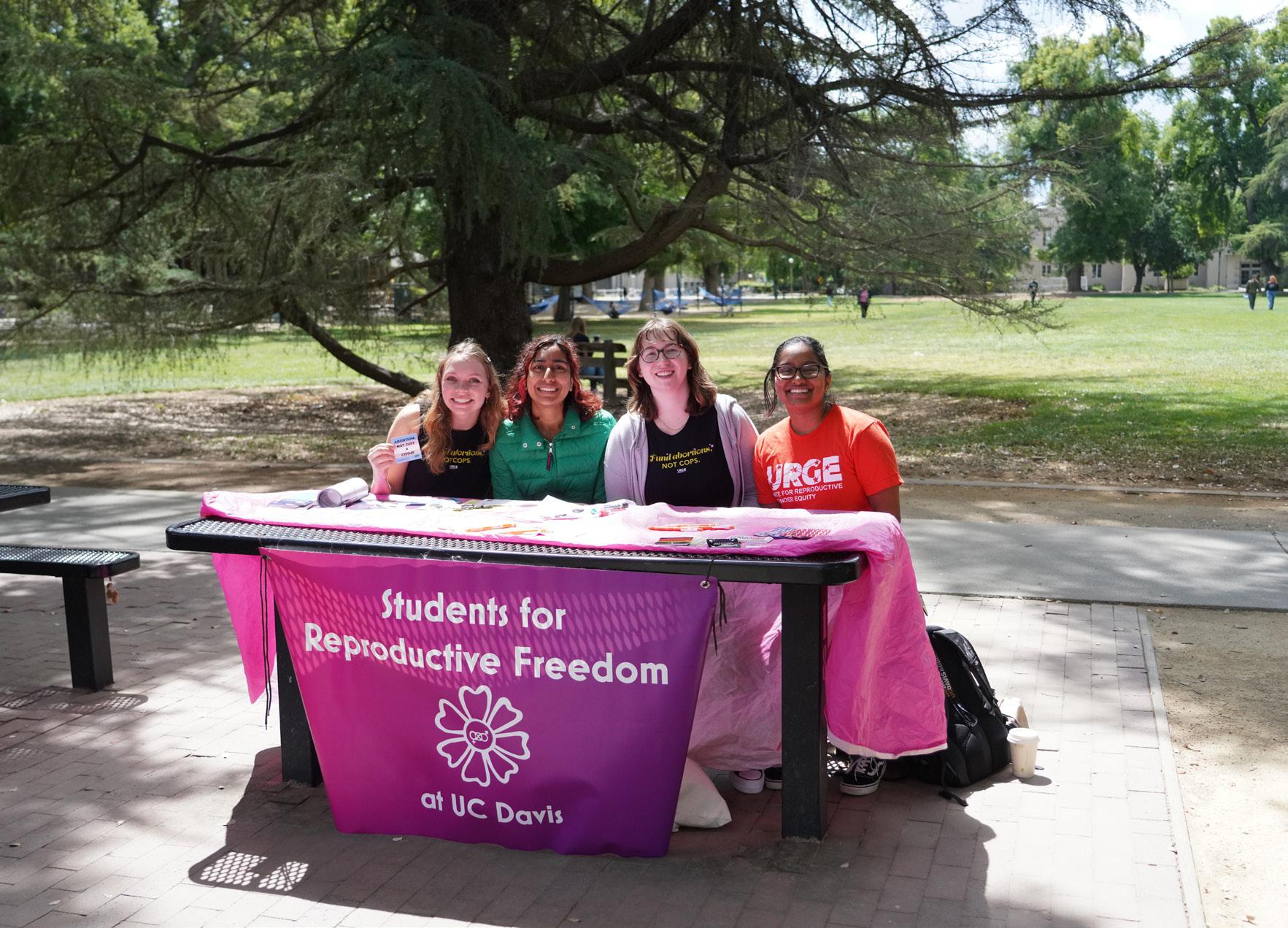
One student-run organization, Students for Reproductive Freedom (SRF), aims to increase campus education and awareness about reproductive health while collaborating with outside initiatives supporting reproductive rights. With these goals in mind, members have the opportunity to create and beneft from meaningful learning environments.
Aditi Hariharan, a fourth-year political science and nutrition science double-major, and Maren Butler, a third-year human development major, are the current co-presidents of SRF. Tey described some of the benefts and unique aspects of their club, as well as their level of campus involvement.
“I think the unique experience of working in reproductive justice (RJ) is creating safe spaces on campus for folks to share vulnerable stories,” Hariharan said. “In terms of the community, we’ve been in constant presence with other students; we’re always tabling at pride and other campus events.”
Adyasha Padhi, a fourth-year biochemistry and molecular biology and anthropology double-major, announced that alongside fostering collaboration between groups, the club will be organizing multiple events in the coming quarter, with plans to canvas in Reno in October and table individually on campus.
“Especially with elections coming up, we’ll also be tabling to increase awareness of voting and also reproductive rights and reproductive
resources on campus,” Padhi said.
Members also participate in specifc activities that help promote reproductive justice. Butler described one of the projects the group has previously worked on where members wrote to voters through a letter-writing program.
“One of my favorite activities was letter writing,” Butler said. “We wrote in support of menstrual equity bills in California, for education in public schools and access in prisons.”
In addition to hosting future letterwriting events, SRF at UC Davis often works with other groups to make perceptible changes on campus.
“One thing that we’ve been working on for a while is making sure that everyone has access to menstrual products, and that all the pad and tampon dispensers around campus actually have pads and tampons,” Padhi said.
Te group also encourages members to identify prominent issues that students are facing and how they can relate to reproductive health.
“There are so many time and fnancial barriers that prevent students from taking the best care of themselves that they can,” Butler said. “Whether that’s within something like RJ or more on the outskirts like housing, food, healthcare-related or even just fnding a community, I’ve noticed that’s a big issue for a lot of students on campus.”
Being a part of the organization and sharing the value of reproductive justice has also deepened connections between students. Hariharan also described that being a part of the group has infuenced her individual journey with student activism, giving her the confdence to speak her opinion against global policies.
Te [main] impact on myself has been becoming closer to the activists of the community,” Hariharan said. Tis type of work is only possible due to being in community with and respecting all the activists who came
before me and all of the members of the club; it’s made us more aligned with the true vision of reproductive justice and its intersectionality.”
SRF leaders have also begun noticing what motivates young people into involvement with civic engagement, keeping these motivators in mind when planning activities for the group.
“I think young people are really excited about holding campus administrators accountable right now, especially in light of recent restrictions on [a] free speech campus climate,” Harihan said. “I think that can translate to RJ in terms of holding administrators accountable to make medication abortion easily accessible or making contraception use also easily accessible. I
think that people are just excited about local issues more in the current climate of campus.”
So, if the topic of reproductive justice interests you, how can you get involved? SRF will welcome your involvement any time of year, according to Padhi.
“We typically are not a club that you have to join at the beginning of the quarter,” Padhi said. “Generally, people are free to come to our meetings whenever, and they’re pretty fun.”
Once you join, you’ll have the chance to participate in educational and action-driven biweekly meetings, usually held in the evening.
“Typically there’ll be some updates about what’s happening in
the reproductive world, so this can be news about diferent laws that are being passed, or updates about projects that we’re working on, on campus or outside of campus,” Padhi said. “Ten, usually we’ll transition into some sort of activity, so that could be something like letter writing [or] creating medical care kits. It could also be a panel of diferent professionals in the reproductive feld, so they can look very diferent.”
With the help of its student leaders, members and outside collaborators, SRF at UC Davis has become a dynamic driver of reproductive justice, fostering learning, growth and inspiration in Davis and outside communities.
Exploring the resilience of farmar participants throughout the summer months
BY NOAH HARRIS features@theaggie.org
In a university town, the summer is a transition period. Whether it be to work, travel or be with family, most students will leave before returning months later for a new school year. Despite this loss of trafc, the institutions, buildings and businesses stay in place. In a town like Davis, the temperature spikes, and many stay inside as much as possible to avoid it. Tis can be a problem for many outdoor-based merchants.
However, the Davis Farmers Market is able to remain virtually unchanged, despite facing obstacles like the weather and the annual student migration away from campus.
Te Davis Farmers Market features vendors, farmers and other sellers in downtown’s Central Park. Te market takes place every Saturday throughout the year, rain or shine, from 8 a.m. to 1 p.m. Tere are also weekly events held on Wednesdays throughout the year.
A typical Davis Saturday boasts the farmers market, with options of locally sourced farm products, crafts, meals and much more. In addition, live music is often a central part of the weekly events.
Te intense heat can be a major issue for outdoor events in Davis. Te average high temperature between June and September is 86 degrees, and temperatures can easily reach into triple digits. Tis heat can also lead to community-wide issues, such as a recent event in which 1,800 Pacifc Gas & Electric (PG&E) customers lost power amidst a heat wave.
Te Davis Farmers Market has had to face its own share of issues regarding the heat. On July 3, Picnic in the Park, a farmers market held every Wednesday during the summer, was cancelled due to high temperatures. In addition, the farmers market the following Saturday closed an hour earlier, at 12 p.m. On July 4, the temperature reached a high of 107 degrees. An excessive heat warning is usually given for an area whose temperature high for a two day period is 105 degrees, according to the National Weather Service. Another related incident occurred in 2022, when the farmers market had to be canceled due to excessive heat.
Other farmers markets in California have had similar issues. In a Chico farmers market, farmers have noticed a signifcant decrease in foot trafc, which has impacted profts. Holding
these outdoor events during the summer months can also lead to many types of produce going bad more quickly than normal.
Heat is not the only issue the Davis Farmers Market faces. In total, there are around 40,000 UC Davis undergraduate students. During the summer, the number of student residents decreases significantly. In the summer of 2022, the number of students taking at least one class was around 11,000, including virtual classes. In a town of 65,000 people, this is a signifcant loss of general foot trafc that the market would normally receive.
Randii MacNear, the executive director of the farmers market, was surprised by the lack of students this summer.
“It seemed like there were less students in town than I have seen in the past,” MacNear said.
Both the heat and the loss of students can be a signifcant hurdle to overcome for vendors and organizers. However, the Davis Farmers Market does not see a dropof in proft during the summertime, according to MacNear.
“We don’t see a decrease in sales, ever. Tere isn’t an on-season or ofseason at the Davis Farmers Market,” MacNear said. “We work hard to
orchestrate that.”
Tis is a sentiment that the farmers share as well. Andrew Walker, a coowner of Farmboy Organics, has been selling his produce at the farmers market for the past three years. He said that summer is consistently busier than the winter, due to diferences in seasonal crops.
“Summer’s busier than the winter,” Walker said. “People buy more tomatoes and eggplants and basil than they do kale and things like that.”
One advantage that the Davis Farmers Market has during the summer is its sizable pavilion. A permanent structure in Central Park, it is equipped for rain and shine, allowing both sellers and attendees respite from climate conditions. Other popular farmers markets, such as the Midtown Farmers Market in Sacramento, do not have infrastructure built and instead solely rely on tents for farmers that do not cover customers.
MacNear was grateful to the city of Davis for this feature.
“People know they can get some shade, and they know farmers will be under the shade,” MacNear said. “So, while people definitely don’t hang around, if they are diehard customers, they come and shop to support the
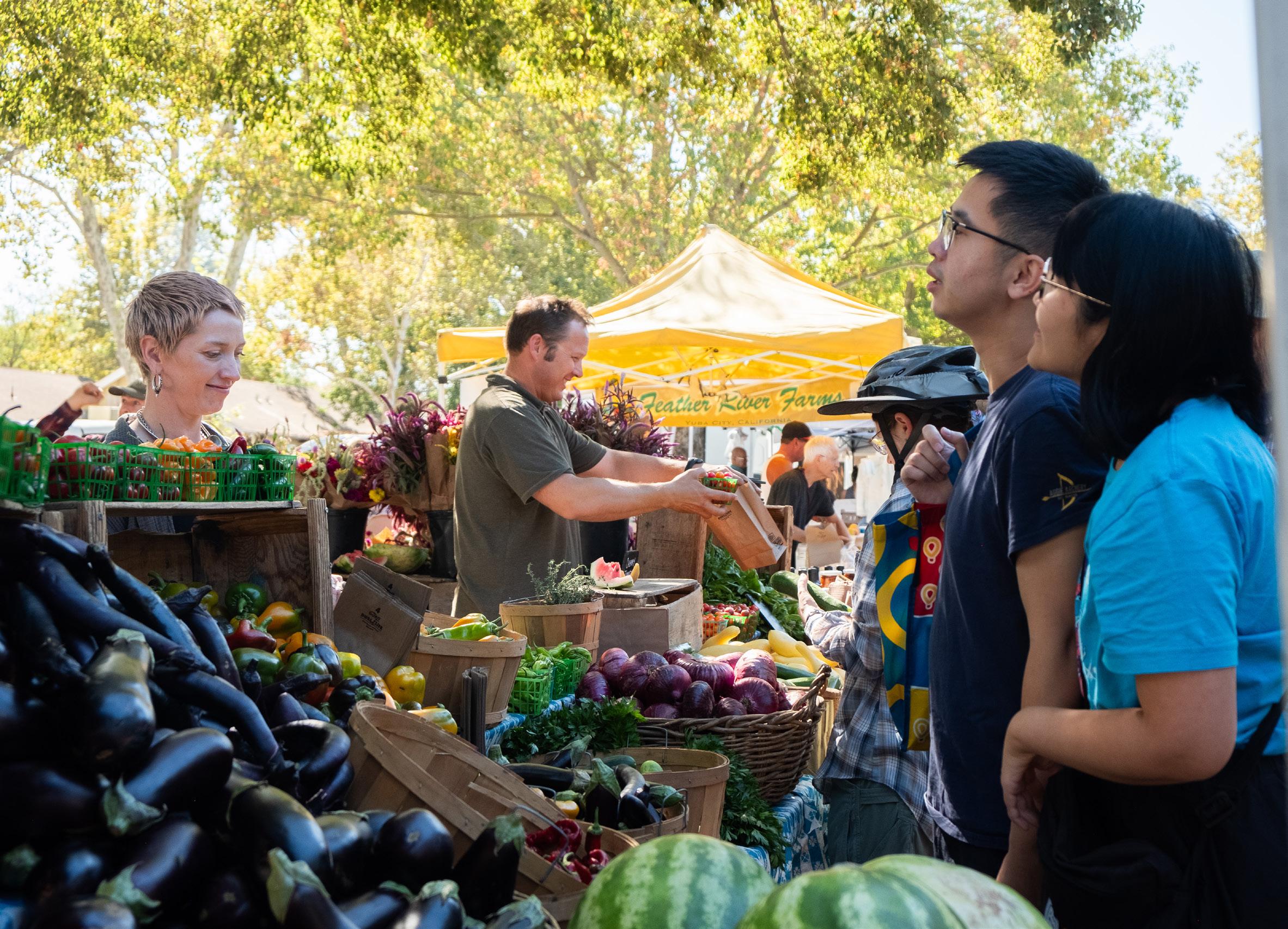
farmers. I really feel sorry for the markets that are out in parking lots.”
Te market is also a reliable source for the community, operating every week unless extreme circumstances occur. Te farmers market was able to continue in 2020, even during the height of COVID-19. Tey are able to stay open throughout the year due to preparation and planning by vendors. Walker, who exclusively sells through the Davis Farmers Market, loves the connection it establishes with regular customers.
“It becomes kind of where they do their shopping, whether [or not] they only get a few things,” Walker said. Tey come back and buy from us every week. It’s like going to the grocery store, but you get it fresh from the farm.” Doris Kim, a fourth-year ___,who attends the farmers market almost every week, praised the quality of products.
“It’s also nice that there’s no middle man, so even though it’s higher quality, it tends not to be that much more expensive and sometimes is even cheaper [than grocery stores],” Kim said.
Tere is more planning in the works for Central Park that will cool residents during the summer months. Te city of Davis was given a $2.784 million grant in 2021 to renovate Central Park. Tere will be a new interactive water feature called a splash pad — which will be named after Natalie Corona, a Davis police ofcer who was killed in the line of duty. Additions to Central Park will also include two shade structures and the planting of more trees. MacNear was excited about the changes taking place.
“Next year at this time, we will have a beautiful, free splash pad,” MacNear said.
Another factor drawing customers and students into the Davis Farmers Market is CalFresh. They have a program that provides $15 worth of fruits, vegetables and other farmers market items for the frst $15 that you withdraw from your account.
Walker, who provided his interview whilst picking tomatoes on his farm, talked about the program from both a business and community perspective.
“We see a good amount of it every week, and I think it’s an important thing for more food access,” Walker said.
For Kim, it was one of her favorite features of the market. Many UC Davis students beneft from the CalFresh program; it has become a primary appeal for students to attend the farmers market in recent years.
“It’s a really cool program, because it helps students save money, and it also supports local businesses,” Kim said.
Obstacles have to be overcome to keep events like these running smoothly, whether it be from the heat or students leaving for the summer. Regardless, every Saturday morning, the Davis Farmers Market continues to be a defning institution of our downtown.
Enter digits from 1 to 9 into the blank spaces. Every row, column and 3x3 square must contain each digit. Each Sudoku has a unique solution that can be reached logically without guessing.
Answer to previous puzzle 08/15/24
Te lead scorers of the game were Utterbeck and Jade Light, a third-year aeronautical engineering major, who led the Aggies with eight kills. Additionally, Utterbeck hit a solid 0.400 in the match, fnished with one block, earned eight and one-half points and had eight digs. Ally Chandler, a second-year undeclared major, also had accomplishments in the game by hitting a strong 0.667 with nine attacks, six kills, one block and two digs. Lastly, Mia Starr, a second-year undeclared major, fnished the game with 26 assists and fve digs — recording only one error in the match.
Tis is only the start of the season for our UC Davis women’s volleyball team, with this loss hopefully being just a bump in the road. Tey showed tenacity as they continuously entered each set ready to win, and many of our players had their own success within the game, helping them continue to grow throughout the season. Head Coach Dan Conners continues to look forward to future matches, noting that the team made a quality efort.
“[It was] a great experience for our team to go into a hostile gym against a very good team and battle with them,” Conners said.
Conners also stated that the UC Davis Aggies will learn from the match and continue to grow from this loss against the Boilermakers — becoming stronger as they prepare for their upcoming opponents.


This past summer the environmentally friendly frozen yogurt shop opened its doors
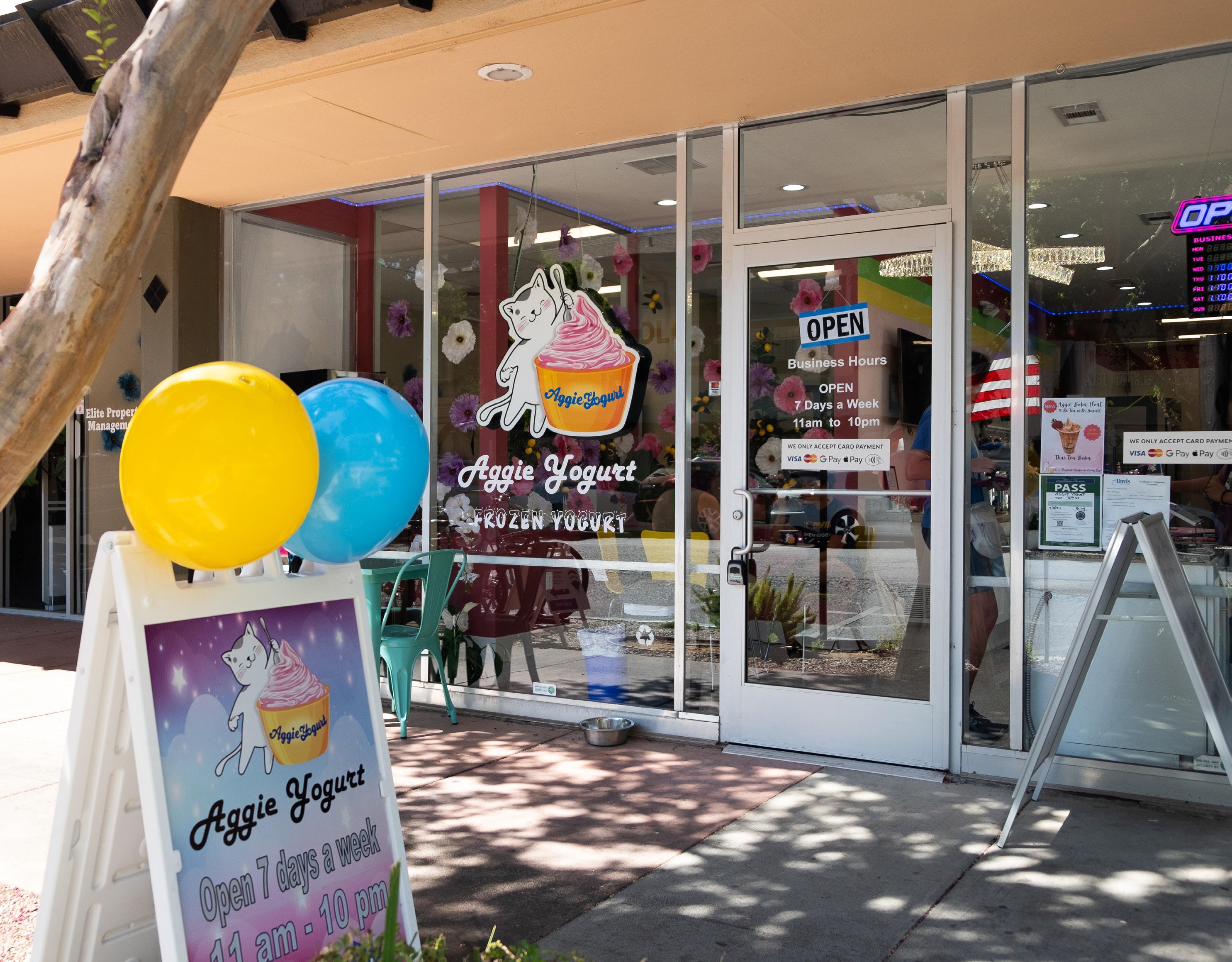
BY ALMA CULVERWELL city@theaggie.org
Tis June, Aggie Yogurt, a new frozen yogurt shop, opened its doors to the Davis community with a celebration at 425 2nd St. Te store, which promises a fresh take on frozen yogurt, has gained attention for its combination of unique favors and a strong commitment to sustainability.
Aggie Yogurt aims to be “your ultimate destination for fresh, creamy and delicious yogurt creations,” according to their website. Tis tagline
refects the shop’s approach of ofering customers a highly customizable experience. “Te vibrant and inviting shop ofers a delightful array of new favors, from Cookie Monster to Wild Strawberry, all made with the fnest ingredients,” their description reads. Te store, which prides itself on catering to a broad spectrum of dietary needs, features options for every preference. From dairy-free and glutenfree selections to low-sugar alternatives, Aggie Yogurt ensures that anyone can enjoy its frozen treats. Customers can personalize their yogurt with a wide variety of over 32 toppings, including
granola, berries, nuts and sauces. Aggie Yogurt also sets itself apart by emphasizing eco-friendly practices. Te shop uses compostable cups and utensils, and it offers discounts to customers who bring their own reusable containers, helping reduce single-use plastic waste.
Aggie Yogurt is the third frozen yogurt store to open in downtown Davis, joining longtime favorites Cultivé and Yoloberry. The frozen yogurt scene has been popular in Davis for over a decade, with both Cultivé and Yoloberry establishing themselves as staples for local families, students
and visitors. Aggie Yogurt hopes to stand out by ofering not only new favor combinations but also a modern, sustainability-focused business model that resonates with the environmentally conscious population of Davis.
Te shop’s opening also marks the ffth addition to the downtown area’s growing list of ice cream and novelty dessert shops, which includes BaskinRobbins, Davis Creamery and Sweet and Shavery. With increased competition in the frozen dessert market, Aggie Yogurt is banking on its unique and eco-friendly mission to attract a loyal customer base.
Construction on the G Street activation project set to start soon
BY ALMA CULVERWELL
city@theaggie.org
The city of Davis recently announced that construction on the highly anticipated G Street Project will begin in the coming weeks. Te G Street Project, also referred to as the G Street Activation, was made with the goal of providing a vibrant hub of activity that ofers benefts to everyone in Davis. Tis includes businesses, residents, families and students, as described by the city in an announcement on their website.
“The project is a community investment in the vitality of downtown Davis,” the city’s statement stated. “We hope the updated space on G Street will enhance the community and provide socializing opportunities, cultural
enrichment and economic growth.”
T e G Street activation project was originally launched by the city of Davis in June 2020 in response to COVID-19, aiming to support local businesses and safely bring the community together. With construction nearing, city ofcials addressed several common misconceptions surrounding the project.
Contrary to some rumors, outdoor dining and alcohol sales will still be permitted on G Street after construction concludes. Tese activities will continue in compliance with current State Alcoholic Beverage Control (ABC) rules, the city’s Municipal Code and other relevant regulations. Businesses on this block of G Street will need to enter into license agreements with the city to continue these services. Te new G Street area will include
city-provided outdoor seating that will be available for public use. Te city has ordered a variety of seating options, including moveable seating blocks, round cafe tables and bar-height seating with tabletop space. T is furniture will be installed to ensure the space is ready for community use as soon as construction is complete.
Businesses interested in using specifc areas of the newly developed space exclusively will be able to do so under a license agreement with the city. Tese businesses will be able to implement their own furnishings, such as tables, chairs, umbrellas, supplemental lights and heaters, provided they meet the city’s guidelines, which are currently being drafted. Jenny Tan, director of community engagement for the city of Davis, explained the collaborative process
between the city and local businesses that ensures the plan runs smoothly.
“Te city has created an interest form for businesses that want to license a space,” Tan said. “We are continuing to work with businesses in person, by email and in meetings on this process and their needs. When businesses do well, so does the city. Our objective is a civic space that is a vibrant hub of activity ofering attractions, amenities and benefts to everyone who lives in or visits Davis, including businesses, residents, families and students.”
Te city is also planning to install string lights along the edge of the platform to enhance the area’s ambiance. Furthermore, the city will assess existing street lighting to ensure its functionality and will coordinate with the city’s Urban Forestry division to address any street views that may be obscured by tree
Aggie Yogurt plans to continue its community outreach with special events and promotions throughout the year. Te store has already announced plans to host a series of themed yogurt nights, where customers can try limitedtime seasonal favors and participate in yogurt-making workshops. To celebrate its opening, the shop has also scheduled various promotions for the month of September, ofering discounts and free toppings for loyalty members.
branches.
Ofcials emphasized that the inner 20 feet of G Street between the bollards will remain an emergency vehicle access corridor and must be kept clear at all times. No furnishings will be permitted in this area to ensure the safety and accessibility for emergency personnel.
As the G Street Project moves forward, the city of Davis remains committed to engaging with local businesses and seeking additional funding sources to enhance the space further in the future.
Construction is anticipated to wrap up around December 2024 to be followed by amenity installations and opening soon after. For more detailed information and answers to frequently asked questions, community members are encouraged to visit the G Street Project web page.
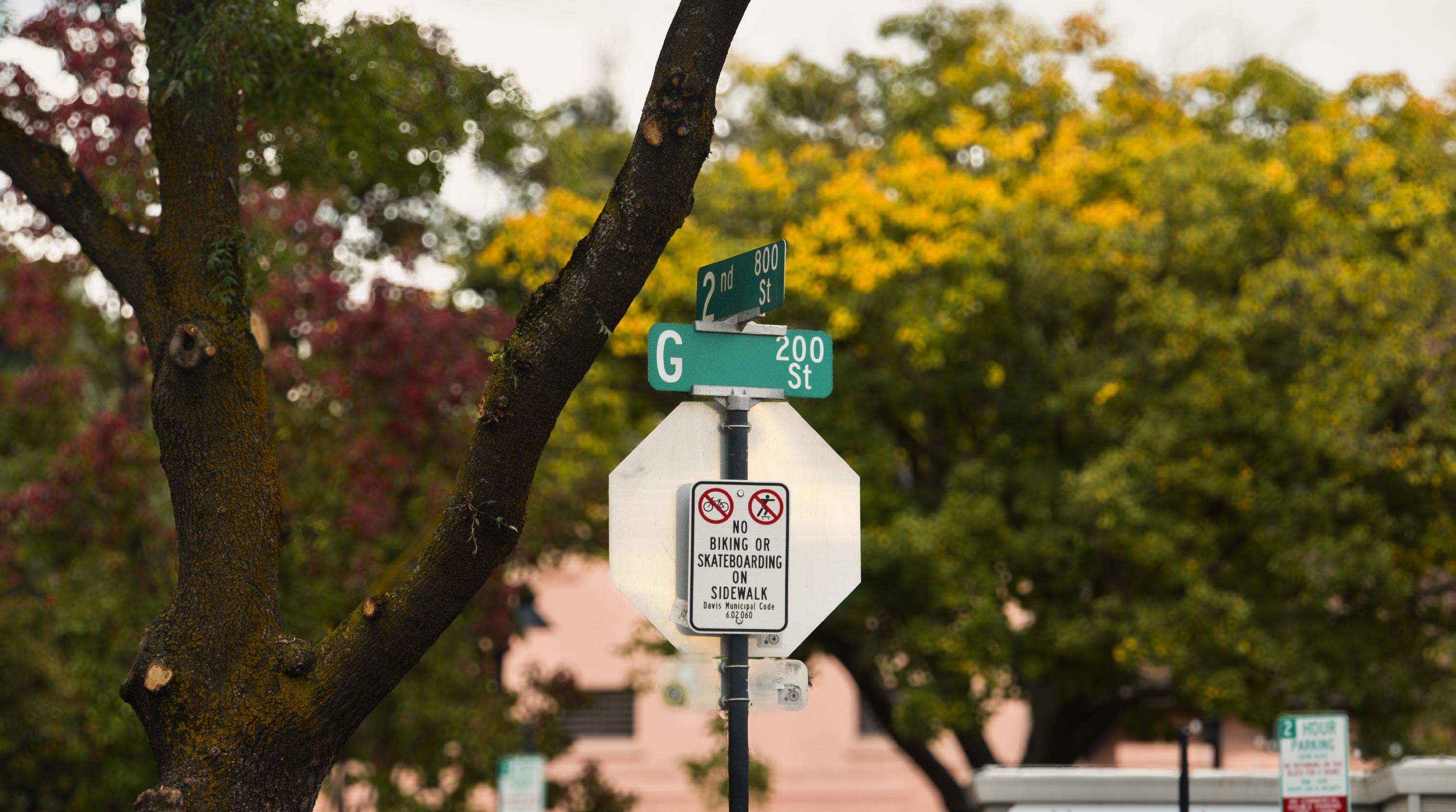
The test calculates a risk score using proteins that indicate decline in lung function
BY KATIE HELLMAN science@theaggie.org
A simple blood test might be able to play a key role in assessing an individual’s risk of developing respiratory diseases.
“A proteomic signature of increased respiratory susceptibility identifies people at risk of respiratory death, incident COPD [chronic obstructive pulmonary disease], and respiratory exacerbations,” a study published in the American Journal of Respiratory and Critical Care Medicine states.
Te study is taking place at UC Davis Health and is funded by the
National Institutes of Health. Te goal of the blood test is to alert patients of lung conditions and to assess their risk of having a serious respiratory event, which consequently leads to prevention and earlier treatment.
T e blood test calculates a risk score that is based on data collected over the past 30 years from 2,500 U.S. adults. Te score is created from 32 proteins that were the best indicators of rapid decline in lung function in the participants.
“This susceptibility score is comprised of proteins with well-known and novel associations with lung health and holds promise for the early detection
of lung disease without requiring years of spirometry measurements,” the study reads. A high score means that adults have a 17% increased chance of hospitalization for a respiratory event, an 84% increased risk of developing Chronic Obstructive Pulmonary Disease (COPD), an 81% increased chance of death by a respiratory illness and a 10% increased chance of experiencing breathing-related symptoms requiring medical care.
To assess the competency of the risk scores, 40,000 adults from earlier studies were monitored for respiratory illness. Te prediction model took body
weight, race, sex, history of smoking and a diagnosis of asthma into consideration.
Te study’s co-author, Gabrielle Y. Liu, who is also assistant professor of pulmonology at UC Davis Health and a KL2 scholar with the Clinical and Translational Science Center, explained the implications of these fndings in an interview with UC Davis Health.
“Similar to using cholesterol levels to gauge a patient’s risk for having a heart attack, we’re looking at biological pathways to predict a person’s risk for having a chronic respiratory condition and severe complications from it,” Liu said.
Although the blood test needs to
frst be evaluated in clinical trials and approved for use by the U.S. Food and Drug Administration, it would be an efective screening tool and an important advancement in the medical feld.
“Our findings that captured patients’ lung function trajectory could potentially be a game changer,” Liu said.
“Early detection allows for prompt intervention, potentially preventing the progression of respiratory issues. Timely medical attention can help manage symptoms, improve lung function and enhance overall quality of life.”


As the NWSL season comes to a close, several teams fight for coveted spots in the postseason tournament
BY LUCIENNE BROOKE sports@theaggie.org
With seven matches left in the National Women’s Soccer League (NWSL) season, the San Jose-based club, Bay Football Club (FC), is looking to hold on to a playof spot. Although the top eight teams will qualify for the quarterfnals, Bay FC is currently in seventh place, leaving a slim margin for error. There are only seven points separating the sixth-ranked team, the Portland Torns, from the eleventhplaced team, Racing Louisville FC. Bay FC sits right in the middle of the pack, with every team vying for a place in the playofs. However, it won’t be an easy
road to get there for any team. Despite this being their frst season in the league, Bay FC has found success both on and off the field with an impressive record and energetic fans. Having had success with their last two games, the team will look to continue their momentum into the last stretch.
Teir recent acquisition of California native Penelope Hocking has delivered a much needed team boost. Hocking provided an assist in her Bay FC debut and looks to expand her impact even further.
Hot on Bay FC’s heels is Hocking’s former team, the Chicago Red Stars, who sit only one point behind. Nonetheless, three losses in a row have fans worried that the team may be losing steam after a long season. Te return of Olympic star Mallory Swanson didn’t
quite give the team the boost they had hoped, but if the Red Stars can turn their luck around they may still be playof contenders.
Just ahead of Bay FC sits the Portland Torns, also winless in their last three matches. However, in contrast with the Red Stars, the Torns looked strong in a Concacaf W Champions Cup match against Club America. With a 3-1 win, the Torns will be hoping to apply their lessons from that game to their regular season contests.
On the other end of the spectrum, the Orlando Pride sits undefeated at the top of the list, with an undisputed playof spot — and experiencing a fairytale of a season. After fnishing in seventh during the 2023 season and failing to qualify for the fnals, their ofseason adjustments have led the Pride
329 events, 184 countries and 10,500 athletes later

BY DIEGO CERNA sports@theaggie.org
On July 26, 2024, the 30th Summer Olympic Games were hosted in Paris, France. Te games marked the 100th year anniversary from when the coveted “City of Lights” held the Olympics back in 1924.
Tis was the frst Olympics where the Opening Ceremony was held in a river instead of a stadium. On July 26, 2024, all 184 countries and 10,500 athletes took their designated boats across the Seine River, crossing through the center of the city with fans greeting them all around. Te event was broadcasted to 28.6 million viewers, making it the most viewed Olympics since the 2012 Olympics held in London, England.
After all boats went through the river, Céline Dion delivered one of the most stunning Olympic Opening Ceremony performances. On top of the Eifel Tower, she sang “Hymne à l’amour” by Edith Piaf, making it her frst public performance since being diagnosed with stif-person syndrome.
The events themselves proved challenging for the athletes, with many new world records and close calls. Nonetheless, with such tough competition, the United States led all countries with 126 total medals. Te U.S. also led in bronze medals (42), silver medals (44) and tied with China for most gold medals (40).
Olympic Highlights
Te Olympics were full of incredible storylines and upsets.
Julian Alfred from Saint Lucia made history by securing the victory in the Women’s 100m Final in Stade
de France. Not only did she secure the gold medal in her frst Olympic trial, but she also secured Saint Lucia’s frst ever medal in a stunning fashion with a time of 10.72 seconds, beating out favorite Sha’carri Richardson from the U.S. who placed second. USA men’s and women’s basketball also won gold medals in the basketball bracket, with both defeating the French men’s and women’s teams in the fnal.
United States’ men’s basketball was led by the strong trio Stephen Curry, Lebron James and Kevin Durant. Many fans are coining the team as “Te Avengers,” which are comparable with other notable Olympic basketball teams such as “Te Dream Team” and “Te Redeem Team.” Te women’s team was led by A’ja Wilson, Breanna Stewart and Jackie Young. Te fnal against France was a tight one, with a fnal score of 67-66 and the USA winning by only one point. Tis victory makes it the eighth consecutive gold medal for the women’s team and their incredible feat of 61 consecutive Olympic contest wins.
Serbia’s Novak Djokovic also secured his frst Olympic gold medal in his 21-year career over Spain’s Carlos Alcaraz in the men’s tennis singles match. Te stadium erupted in joy for the Serbian native following his longawaited win.
Te Filipino gymnast Carlos Yulo won two gold medals in both men’s foor and vault routines within the span of 24 hours. Since this was only the second and third gold medals won by the Philippines throughout their Olympic history, the incentive prizes were abundant. Yulos was ofered rewards including millions in cash (Philippine pesos), highly valued, fully furnished condos, free meals and a food supply from diferent local establishments, and an iPhone 16. Aside from the games, there also
seemed to be romance in the air of the “City of Love.” Badminton players
Liu Yuchen and her boyfriend Huang Yaqiong from China stole the spotlight, with Yaqiong proposing right after Yuchen’s gold medal victory in the women’s singles. Olympic couple Tara Davis-Woodhall and Hunter Woodhall also represent another star couple as Tara won gold in the women’s long jump, while Hunter won gold in the men’s Paralympic 400m dash. Both were present for each other’s events and had very endearing celebrations. Perhaps the most emotionally inducing moment was when the ex-loving tennis duo of Kateřina Siniaková and Tomas Machac from Chezia won gold in the mixed doubles in the Roland Garros Stadium. Many rumors wait for news of their reunion.
Te Olympics also held controversy among competitors.
After Australia’s breakdancer Rachel Gunn, going by “Raygun,” was in headlines for her performance in the breakdancing event, many viewers questioned how Raygun qualifed for the competition. People quickly found out that Gunn’s husband was a part of the judging panel for Olympic qualification, which raised much uncertainty as to whether Gunn should have participated in the Games at all.
Many athletes complained about the Olympic Village housing that the committee provided for the athletes this year. Tennis player and USA fag bearer Coco Gauf shared her experience on social media, stating that 10 of her other Olympic roommates had to share a cramped living space that supplied only two bathrooms. Not unlike many other athletes, Gauf and her roommates ended up staying at hotels for the remainder of the games.
Swimming in the Seine was also a major concern before and during the Olympic Games. Although Paris spent $1.4 billion to clean the Seine before the Games, the waters were still considered heavily unsanitary for swimming standards. Nonetheless, the Seine was used as racing waters for fve diferent events.
Regardless, the 2024 Summer Olympics will go down in history as one of the most memorable in recent Olympic history. Te Games drew in an average of 30.6 million spectators across NBCU platforms, making it the most streamed Olympics of all time. Viewership also rose by 82% from the previous Olympics in Tokyo during the pandemic. The Games will be remembered for its intriguing narratives, exhilarating events and the spirit of worldwide togetherness that they instilled in the “City of Lights.”
to dominate this year. Most notably, Barbra Banda of Zambia has provided an electric spark by scoring 11 goals in 11 appearances for the Pride. Te San Diego Wave, well-known for having some of the biggest names in the women’s soccer world, are likely out of playof contention. With soccer legend Alex Morgan ofcially retiring on Sept. 8, 2024, the team will have to adjust to playing without the star. Tis change casts another blow on the already struggling team that hasn’t won a single game since May 9, 2024. Looking north of San Diego, Angel City FC has been performing well ofensively during this season but are lacking defensively. Te team has proven strong at scoring goals but then at conceding even more. Te prolifc front-line of Sydney Leroux and Alyssa
Tompson has proven a bit complicated with the long awaited return of Christen Press. Press is yet another household name in the league, however, she has missed over two years of play with injury. Angel City will be looking to connect the dots in their fnal matches and try to sneak their way into the playofs.
The final weeks of the NWSL regular season always promise to be full of drama and excitement for fans as teams scramble to separate themselves from the pack and make their playof bids. Final matches can be viewed on a variety of streaming services including ION, ESPN+, CBS and Paramount+.
The start to the 2024 UC Davis football season is finally here
BY MI’ZAUNI REESE sports@theaggie.org
In the past few weeks, the UC Davis football team has begun this year’s season, starting with their opening game against UC Berkeley. Te rivalry between the two teams has never been more prominent as the UC Davis Aggies made their way down to Berkeley for the game on Aug. 31. Te beginning of the game proved to be challenging for the Aggies as they were unable to obtain the lead in the frst quarter and for the majority of the game. Still, the Aggies played well for their frst ofcial game of the season, with two touchdowns and impressive plays. In the breezy Bay Area, the Aggies were of to a great start and maintained a close score with the California Golden Bears. A few minutes after UC Berkeley scored their frst touchdown, Porter Connors was able to recover a fumble at the Aggies’ six-yard line, making for an easy touchdown. Te Bears were able to keep hold of a one-point lead for the remainder of the frst quarter.
As the second quarter progressed, Team Captain Lan Larison was able to score a second touchdown followed by a successful feld goal by Hunter Ridley,
giving UC Davis the lead against UC Berkeley. However, the Bears were able to make a quick comeback with an 80yard touchdown on the kickof return and a well-kicked feld goal, leaving the Aggies to again trail by one point. By the third quarter, the game was close at 13-14, making for an intense start to the second half and leaving Davis fans to watch in anticipation. Unfortunately, the half-time huddle did not give the Aggies the push they needed, as UC Berkeley was able to add 10 points to their one-point lead in the third quarter, the Aggie score remaining at 13 points. Te Aggies gave a similar performance in the fourth and fnal quarter, allowing the Bears to score another touchdown and increase the lead. With a fnal score of 31-13, the Bears secured their 12th consecutive win against Davis. Although this game was a rough start to the season for the Aggies, it will hopefully be used as a building block to improve their gameplay and come back prepared for future matches. Te Aggies’ season is far from over with the team still getting back into the groove of playing on the feld and the strong performances by many players on the team. If the rest of the season continues in this way, it should prove to be an exciting one for both the fans and players.

The Aggies look forward to their next match and win
BY KRISTA HAJJAR sports@theaggie.org
Starting just before the frst day of school, the UC Davis women’s volleyball team has ofcially begun their season. Coming of of two victories in the last two games, the UC Davis Aggies were looking to extend their winning streak. Unfortunately, the Purdue Boilermakers also came ready to play and shut out the Aggies in all three sets. Te Aggies fought hard as they faced the harsh environment of Purdue University’s gym and put up a tough battle — but ultimately fell short of a victory. Te frst set started of steadily with the Aggies keeping up with the Boilermakers. Tere was yet to be a clear lead at the beginning as each team battled it out for the set point until the Aggies turned the tide. UC Davis gained a three-point lead over Purdue
by hitting three consecutive unanswered points within their frst set, giving them a good distance from Purdue. UC Davis managed to keep the points on their side as they continued to push through the game, but Purdue wouldn’t let them keep the lead for too long. While the Aggies gave it their all to stay ahead, it wasn’t enough as the Boilermakers came back stronger with many unanswered points, stripping the Aggies of their lead and turning the game in their favor. Te Boilermakers gained a strong lead after hitting four consecutive points, eventually taking the frst set of the game with a fnal score of 18-25. The loss of the first set didn’t deter the Aggies, and they entered the second set with renewed energy. Te Boilermakers continued to try and shake the Aggies by scoring the frst point of the set, but the Aggies didn’t let the point faze them as they struck back by

scoring two back-to-back points. The teams continued to duke it out on court, maintaining a small score gap throughout the set. Reese Diersbock, a second-year undeclared major, was one of the stars in this set as her gameplay was a key note throughout the points. Diersbock’s kills helped the Aggies maintain a close lead with the Boilermakers, keeping the score between 13-16 and 14-17. Although the Aggies fought hard to narrow the point gap and gain the lead, the Boilermakers managed to pull away. Purdue swiftly took the lead in the second set of the game with a fnal score of 19-25. Even after losing the frst two sets, the Aggies still entered the third set with hope and determination. UC Davis secured the frst point of the set with a kill from Diersbock, beginning the set in their favor. Te Aggies showed their willingness to fght for every point in
the third set and persistence to extend the game into a fourth set.
However, Purdue wouldn’t let them rest in their point win as they struck back and scored their own point. Purdue turned the tides yet again as they maintained a point gap throughout the majority of the third set, never letting the Aggies catch up. Olivia Utterback, a fourth-year human development major, shined during this set as she scored back-to-back kills and narrowed the score to a two-point diference. Still, the Boilermakers fought back, and the set ended with a loss for the Aggies with a score of 18-25.
After losing in three straight sets, the match was called and the Aggies faced defeat. Nonetheless, the Aggies braved a tough away game in an unknown environment and came out with strong player performances.