


The Jackson siblings, who attended Davis between 1969 and 1978, compare contemporary university culture to their own experiences
BY ZOEY MORTAZAVI features@theaggie.org
Three siblings — John Jackson (73), Linda Jackson Becker (71) and Rob Jackson (68) — moved from Philadelphia to Santa Rosa, California when they were growing up in the 1950s. UC Davis seemed like the natural choice for university for John, the eldest brother. Te other two siblings followed suit, with Linda and Rob’s Davis careers overlapping by two years, while John and Linda’s overlapped by one year.
Te Jacksons revisited UC Davis on Nov. 14, 2024 — 55 years after John began his education at the university in 1969. Te siblings noticed dramatic changes compared to when they attended the school: general facilities, studentto-faculty relations, student population and diversitycentered differences, just to name a few. Te Jackson siblings expressed that they all enjoyed their college experiences at Davis, noting modern similarities in on-campus discourse.
To get a more established sense of how academic operations have changed, Rob and Linda both attended courses just last week that they took during their own Davis careers. After their experiences
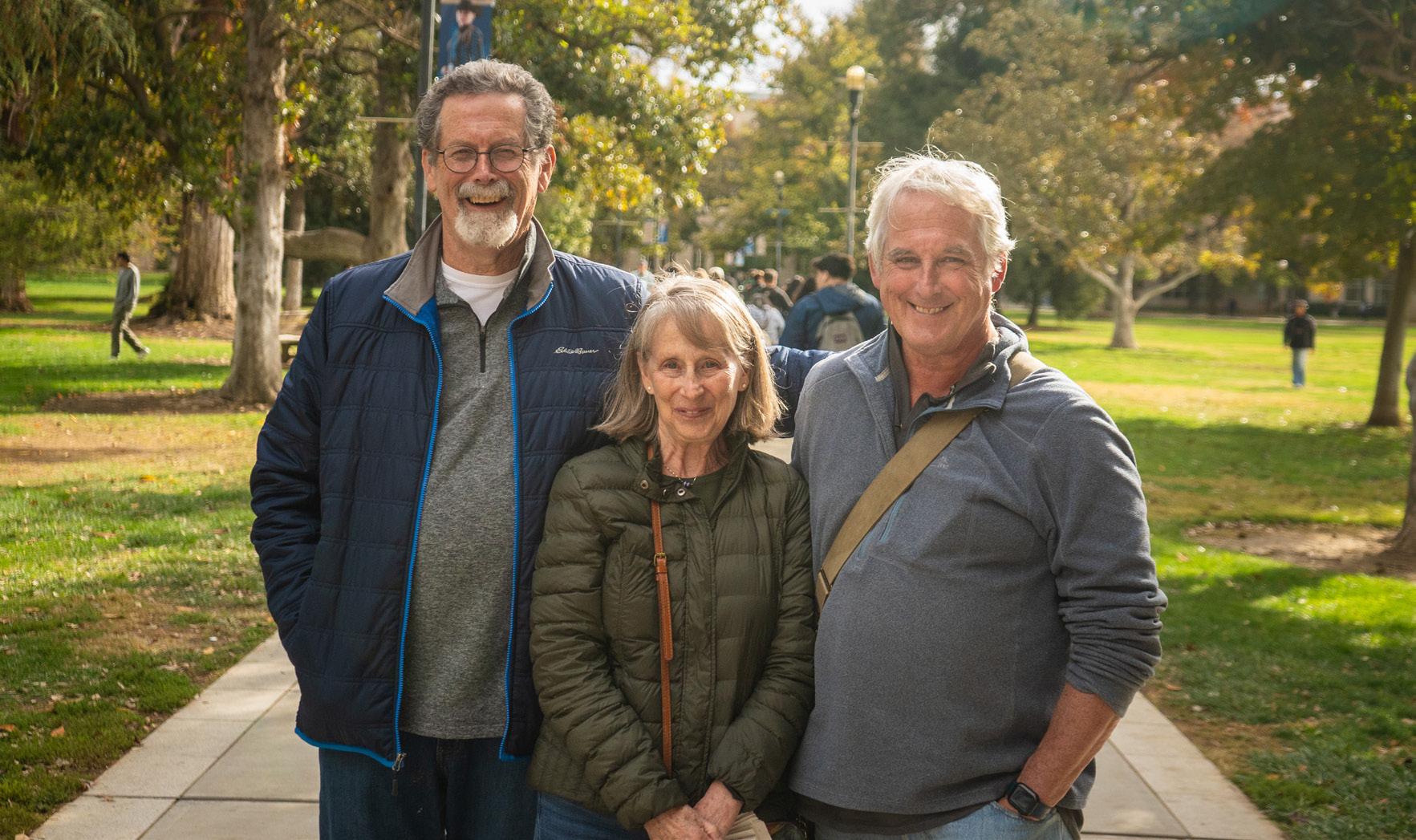
watching the lectures, Te California Aggie sat down with Rob, Linda and John to discuss some of their takeaways about how Davis has — and has not — changed throughout the 46 years that have passed since the last Jackson sibling graduated. Rob, who attended Davis as an English major and later graduated from the UC Davis School of Law, attended ENG 117, which focuses predominantly on Shakespearean literature. John, though he was unable to find a lecture to attend that day, graduated
from Davis in 1973 with a degree in mathematics and later attended the UC Irvine School of Medicine. Linda, who graduated from UCD with a degree in cognitive development and child education, attended EDU 110, a course in educational psychology — which, she noted, was her favorite class as a Davis student. In addition to general classroom structure, class participation and overall technological advances, Linda also commented on how much on-campus diversity has changed since the 1970s.
On Oct. 24, the multimedia performance lecture explored the portrayal of Asian culture and presence of Asian individuals in science fiction
BY JESSICA YUNG campus@theaggie.org
On Oct. 24, the Mondavi Center hosted a multimedia performance lecture of Astria Suparak’s “Asian futures, without Asians” in Vanderhoef Studio Teatre from 7:30 to 9:30 p.m. Te performance demonstrated the prevalence of Asian themes in science fction without the presence of Asian individuals.
Suparak is an Oakland-based artist and curator, according to the bio on her website.
“Her cross-disciplinary projects address complex and urgent issues (like institutionalized racism, feminisms and colonialism) made accessible through a popular culture lens, such as science fction movies, rock music and

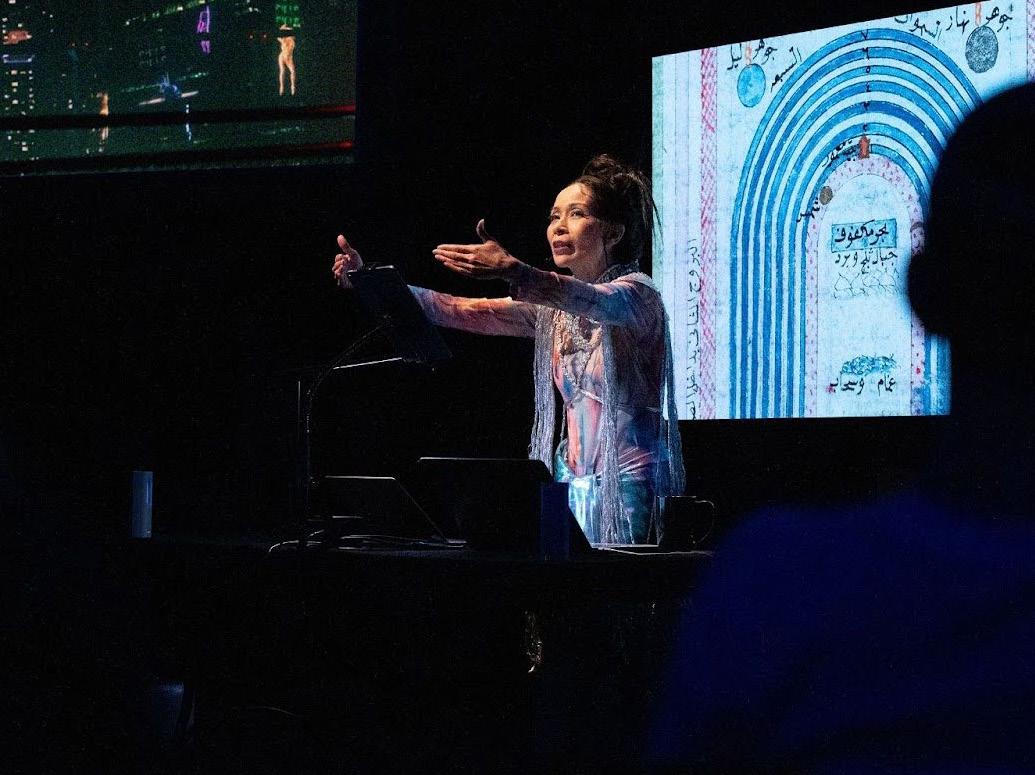
Astria Suparak performs at her multimedia performance lecture, “Asian futures, without Asians.” (Ronald Davis / Courtesy) working class,” Suparak said. “Japanese food is high end, [which] makes zero sense.”
sports,” her website reads. Te program was sponsored by UC Davis Asian American Studies, Mellon Foundation Afrming Multivocal Humanities Grant and the Mondavi Center for the Performing Arts. Suparak’s lecture examined flms and TV shows such as “Firefy,” “Star Wars,” “Ghost in the Shell,” “Doctor Strange” and “Black Mirror.”
Tere are certain tropes that science fction typically uses and certain Asian aesthetics are used over others and presented in a diferent light. For example, the Chinese food stall in “Firefy” (2002) is seen as being dirty, but the use of Japanese tea sets is seen as being high class in the same show.
Suparak explained this concept in her performance.
“All food in China is cheap [and]
Te Mondavi Center’s website further elaborates on the repercussions of this bias.
“Asian cultures have been mixed and matched, contrasted against and confated with each other, often creating a fungible ‘Asianness’ in futuristic sci-f,” the website reads.
Aneka Torgrimson, a secondyear Asian American studies and political science double major and Asian American studies peer advisor, explained this misconception as presented by Suparak.
“It was just really inspiring to see the diversity in the classroom,” Linda said after sitting in on the lecture. Linda also noted that it was a bit of a shock to see the amount of students taking notes on laptops, rather than using pen and paper, to which Rob agreed.
“The makeup of the class was roughly the same — I counted 32 students, two guys,” Rob said. “What stood out to me with the technology [was] that the professor could give visuals that we never had.”
Rob proceeded to compare the convenience of having visual aids to his own process of trying to make sense of Shakespearean plays during his college years. Tis process consisted of him going to the much-smaller Shields Library to check out LP tapes of the plays, which you couldn’t rewind, and listening to them on repeat until some level of understanding was reached.
One of the concepts the Jacksons were the most curious about was AI in the modern university setting. After it was explained that many professors at Davis and beyond are taking measures to shift the use of AI to being more benefcial than harmful, the three siblings agreed that it seems that students today have the ability to understand content more expeditiously due to not just the technology, but also the expanded number of resources being ofered.
Tey proceeded to share that academic and other resources for students were very minimal in the 1970s compared to today. When disclosing some of the campus groups, student research options and mental health resources offered at Davis, they seemed surprised to realize the amount of resources that students have today.
DAVISACROSS50YEARS on 9
Davis families gathered on Nov. 11 to recognize the service and sacrifices made by the veterans in their lives
BY MATTHEW MCELDOWNEY city@theaggie.org
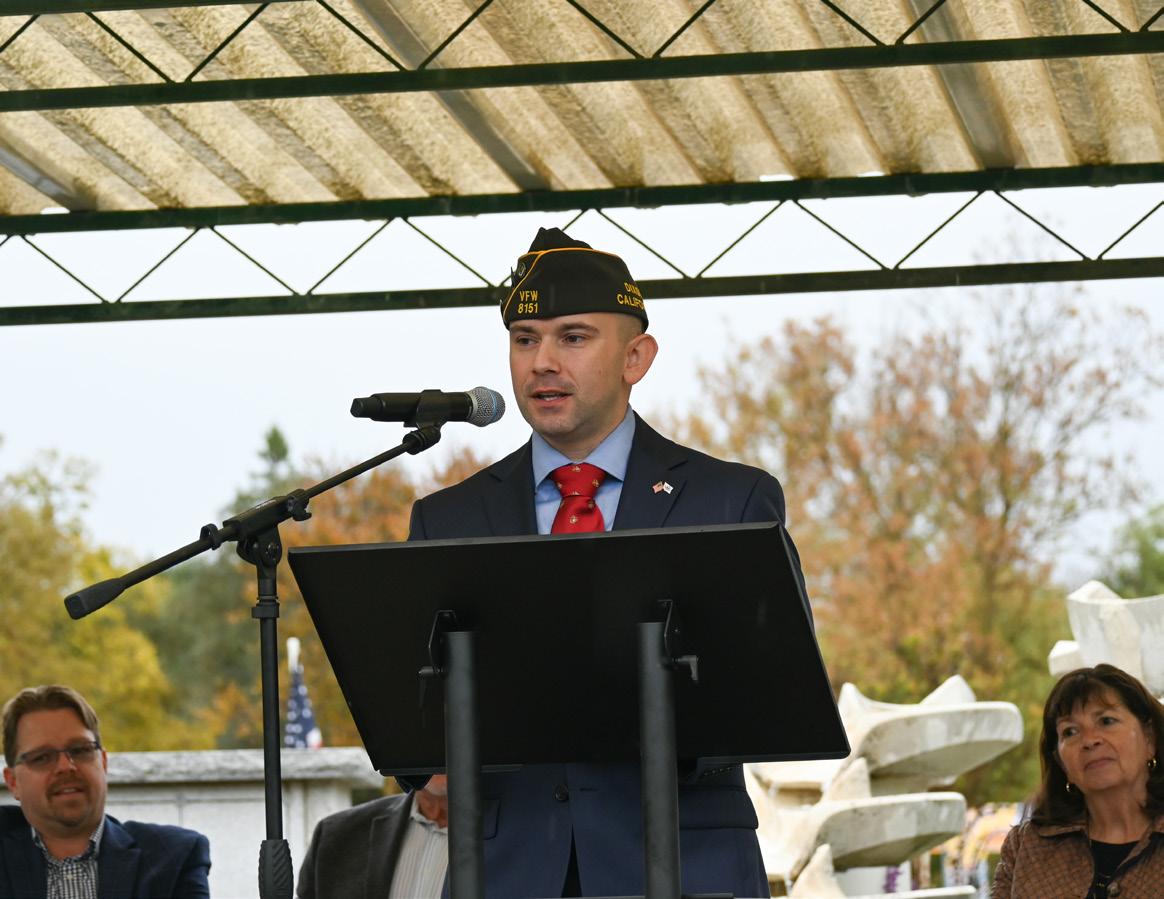
On the 11th hour of the 11th day of the 11th month, the Davis Cemetery District & Arboretum hosted the city’s annual Veterans Day celebration, featuring performances by the Davis Odd Fellows and Davis high school vocal groups — Davis Local Vocals and Davis Madrigals.
To highlight the greater meaning of this holiday, the ceremony also had speakers refecting on the personal and broader impact that United States military veterans have made in their lives. Many of those in attendance have loved ones who are serving or have served in the past, so the cemetery was an accommodating space for these individuals to honor family members and friends.
Kate Bowen, a member of the Davis Cemetery Board of Trustees as well as the daughter of a Marine Corps major
and sister of a Marine Corps sergeant, shared the personal impact that the military had on her household.
“Veterans Day has special meaning for me,” Bowen said. “Our family would celebrate frst on Nov. 10 — which is the Marine Corps birthday — with a nutritious breakfast of S.O.S.” Te Marine Corps dish Bowen refers to traces back to the frst World War and was traditionally made with dried meat and a sauce of evaporated milk, butter, broth and four, served on a slice of toast.
“I’m so happy to have had those experiences as a family, and I am so pleased to see so many families here today,” Bowen said.
During the ceremony, these shared experiences bonded the families in Davis as all had come to commemorate this personal side of their lives. Jessica Smithers, the district superintendent of the Davis Cemetery, organized and set up this year’s Veterans Day ceremony.

Henry “Harry” Stanley was found guilty of domestic violence months after Davis Police found his former wife, Megan Duncanson, dead in their home
BY HANNAH SCHRADER city@theaggie.org
Note: For the purposes of this article, Megan Duncanson will be referred to by her maiden name out of respect for her family’s wishes.
On Oct. 27, Davis resident Henry “Harry” Stanley was convicted of two felonies. These felonies were communicating a threat that could result in great bodily harm and a domestic violence charge. Tese charges come three months after his former wife was found deceased in their home on J Street just days after she was hospitalized for injuries Stanley inficted upon her.
On July 9, 2024, Megan Duncanson called the Davis Police Department, saying her husband was going to kill her. When police arrived on the scene at the individuals’ J Street house, Duncanson was found bruised and then hospitalized for her injuries.
“Megan called 911 and whispered into the phone her husband was going to kill her,” a press release from the Yolo County District Attorney’s Ofce reads. Troughout the 911 call, Megan speaks in a low volume providing information regarding her husband assaulting her and threatening to kill her. Eventually, the 911 dispatcher used a text messaging option so Megan could communicate without fear that Mr. Stanley would hear her words. Megan described having injuries and wanted the 911 Dispatcher to say that the neighbors called 911 and did not want Mr. Stanley to know she called 911.”
The press release also describes Stanley’s history of abuse and the nature of the scene police arrived at on July 9.
“Megan stated the Defendant had ‘beaten her for days’ and had told her she ‘deserved to die because [she] was a vile worm,’” the press release reads. “Megan believed she had a concussion. Ofcers from the Davis Police Department responded and found Megan behind a side gate, in a
fetal position, and crying. Megan shared with the ofcer the physical abuse had started approximately a year prior.”
Two days later, Duncanson was found dead in the backyard of the couple’s home, and the death was ruled a suicide by hanging. However,
As part of a new effort to address housing concerns for their employees, Davis Joint Unified School District joined an initiative focused on the development of affordable workforce housing
BY ALYSSA TORRES city@theaggie.org
On Nov. 1, the Davis Joint Unifed School District (DJUSD) announced its selection as a participant in the Education Workforce Housing Cohort, a program led by the California School Boards Association (CSBA). Tis cohort supports California school districts in creating below-market-rate housing options for employees, addressing an urgent need for afordable housing in the education sector.
DJUSD has been working to assess housing solutions for its educators in a community where costs are rising and student enrollment is declining.
Te average rent for all units in Davis reached $2,372 per month, a 6.6% increase from 2022, according to the 2023 Apartment Vacancy and Rental Rate Survey. As one of the largest employers in Davis, DJUSD has struggled to retain staf due to the high cost of living.
Victor Lagunes, a teacher at Da Vinci Charter Academy Junior High School and president of the Davis Teachers Association, discussed this problem.
“Very close neighboring areas ofer more, either because their bene fts are covered more or the actual salary is higher,” Lagunes said. “When you think of what makes really strong communities, you build the best community when you have the educators that teach at schools living in that community.”
Maria Clayton, DJUSD’s chief
strategy ofcer, shared her hopes for the initiative’s impact on retention.
“It’s getting more and more difcult to have the funding to sustain all of the priorities of programs and compensation,” Clayton said. “Helping teachers and staf fnd housing would be another way that would make our district attractive to future and current employees.”
In a survey conducted by DJUSD in May, 40% of respondents reported having moved due to increasing housing costs during their employment, and 76% expressed interest in afordable workforce housing options provided through the district.
Following these survey results, the DJUSD Board of Education approved a resolution on Aug. 15, 2024, supporting the DJUSD Workforce Housing Plan. Tis led to the district’s application to the Workforce Housing Cohort.
As part of the cohort, DJUSD will participate in workshops and tours of successful workforce housing projects organized by CSBA.
“We are going to learn a lot in a very practical setting,” Clayton said.
Both Lagunes and Clayton emphasized the importance of involving the community throughout the project.
“It is a community-wide conversation, for sure,” Clayton said.
“Any kind of housing development is something that afects a lot of people.”
Lagunes also stressed the need for a comprehensive understanding of educators’ needs to ensure the initiative’s success.
“You have to do the work of engaging with [educators] to fnd out what are the things that are going to be
most efective,” Lagunes said. “What I mean is, what are the reasons that people left?”
Workforce housing initiatives are gaining momentum across California. CSBA’s Education Workforce Housing Handbook states that 83 sites owned by educational agencies are already under consideration for workforce housing development. Several Southern California districts, such as those in Santa Clara and Los Angeles, have implemented education workforce housing with positive impacts on job retention and satisfaction.
While DJUSD is committed to progressing on workforce housing, Clayton acknowledged the project will take time.
“I think you’ll see from DJUSD probably some short-term solutions in the next year or so, and then something more long-term that will have more of an impact,” Clayton said. “But it’s going to depend on what we learn and what gets decided by the board”.
When asked about the broader significance of workforce housing, Lagunes responded.
“Everyone deserves a place to live,” Lagunes said. “For educators, we believe that the way to build community is for them to have the ability, if they so choose, to live in the community in which they teach. We also believe that any community has to be able to welcome families that want to be there in order to join their school systems. Addressing housing, even through workforce housing as a small piece of it, is critical to doing that.”

an individual who had been reported missing earlier in the afternoon by a friend,” the Davis Police Department said in a Facebook post. “While checking the reported residence, ofcers located a 29-year-old female who was found to be deceased.”
Te Yolo County District Attorney’s Ofce press release then outlined the charges Stanley was convicted of and the mistrial that occurred on the third felony charge Stanley was tried for.
“On October 29, 2024, Henry “Harry” Stanley, a 37-year-old resident of Davis, was convicted of violating California Penal Code section 422 –Criminal Treats and section 273.5 – Infliction of Injury Domestic Violence,” the press release reads. “Te jury could not reach a decision on a third felony charge. Te jury also found true aggravating circumstances of the victim being particularly vulnerable, great violence, and that Mr. Stanley took advantage of a position of trust.” Yolo County District Attorney Jef Reisig then commented on the case and emphasized the ongoing domestic violence crisis.
the Yolo County Coroner’s Ofce has not formally announced Duncanson’s cause of death.
“On July 11, 2024, at approximately 4:40 pm, the Davis Police Department conducted a welfare check at a residence on the 900 block of J Street related to
“Mr. Stanley’s conviction serves as a stark reminder of the continuing and ongoing crisis of domestic violence and, in particular, its impact on Megan and her family,” Reisig said. “Even without Megan available to testify, where the law permits, the Yolo County District Attorney’s Ofce used every tool the law provides to present evidence and achieve justice. As October is Domestic Violence Awareness Month, we hope this conviction brings some measure of justice for Megan and to her family.”
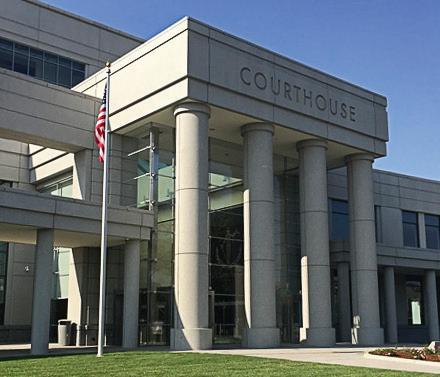
Sentencing for Stanley is set for Dec. 2, 2024, at 9 a.m. in Department 7 of the Yolo County Superior Court.
A local, non-partisan media center highlighted candidates and propositions on the ballot that don’t reach mainstream media
BY OLIVIA HOKR city@theaggie.org
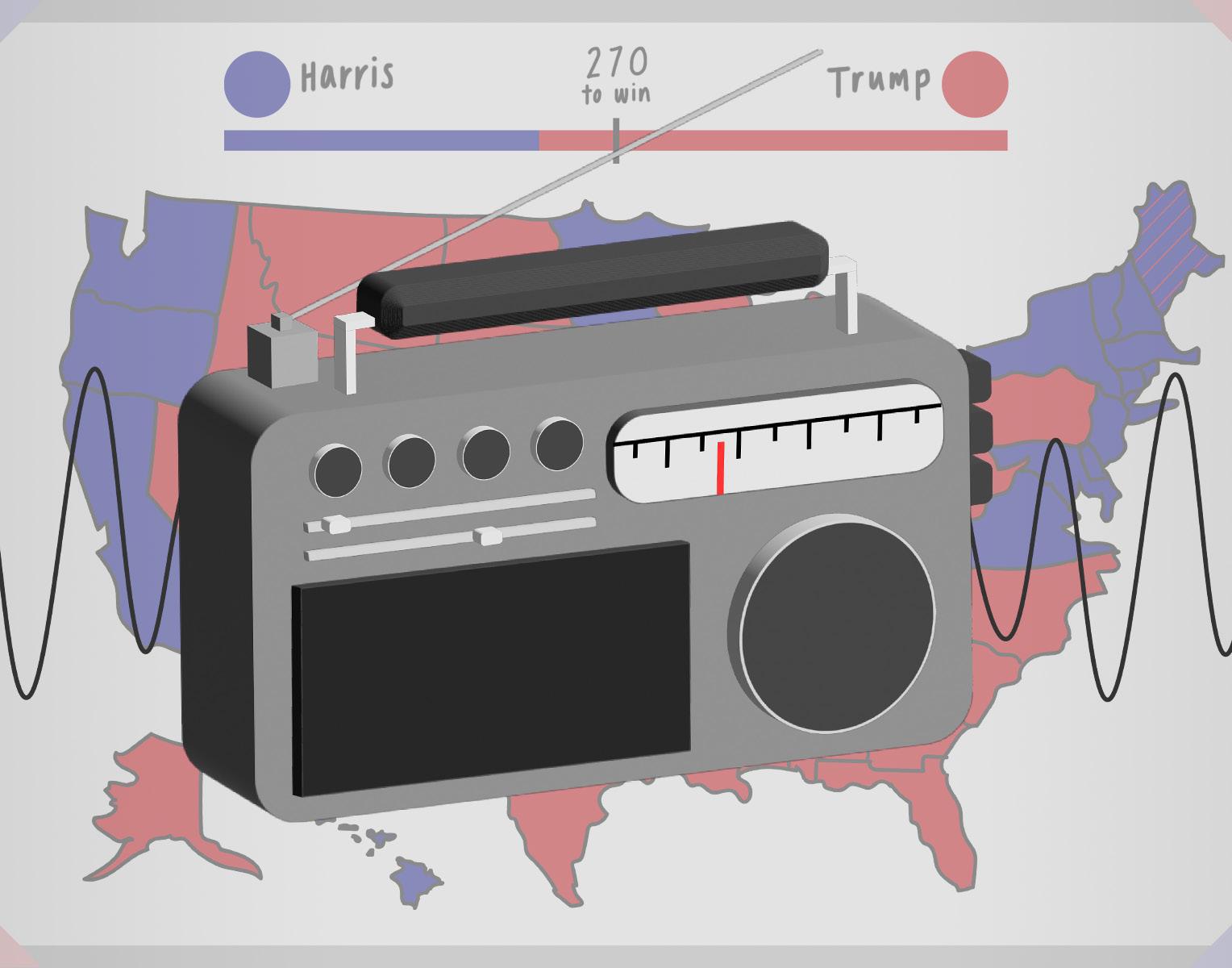
On Nov. 5, a date you might recognize as Election Day, Davis Media Access (DMA) created a program to discuss the local aspects of the election. Tey hosted interviews with various candidates for local positions, such as the Davis Joint Unifed School District (DJUSD) School Board Trustees and Davis City Council, and they discussed the pros and cons of local ballot measures.
DMA is a non-proft community media center that has been around for over 30 years. Tey have incorporated projects such as Davis Community Television (DCTV) as well as a lowpower FM radio station, KDRT, which just celebrated its 20th anniversary.
DMA has always placed an emphasis on strengthening the community and keeping Davis residents informed. As part of this mission, they used this Election Day to highlight the various aspects of the election that wouldn’t be covered by mainstream media. Tis year’s election night programming was co-hosted by Don Shor and Autumn Labbe-Renault on KDRT.
Labbe-Renault has been the executive director of DMA since 2007 and has worked as the executive producer on election coverage ever since. She emphasized DMA’s discussion of local elections and the importance of community media.
In her position as executive producer, Labbe-Renault executes the “Meet the Candidates” portion of the program where she plans and helps record various candidates’ statements for their campaigns. These brief videos allow candidates to address the community without a host and simply speak to the people.
“Election night provides an opportunity to hear from candidates and others about the tenor of the season and to ask questions about their campaign priorities and experiences, and sometimes to tease out issues that have arisen in weeks leading up to the election,” Labbe-Renault said. “It’s also a moment for them to thank everyone who supported them.”
One of the positions on Davis residents’ ballots this year was the DJUSD Governing Board Member Trustee Area 2, with Elizabeth (Lizzy) Grifth running against incumbent Lea Darrah. Darrah has been re-elected to the board, according to the unofcial results uploaded by the Yolo County Elections Ofce. Darrah took part in DMA’s “Meet the Candidates” and shared a video with voters discussing her platform.
“It’s my job as a trustee to listen to my constituents,” Darrah said in her video for DCTV. “It’s important to me that people feel heard, acknowledged and validated. When people come to me seeking help, I either direct them to the appropriate resource or I take action myself if appropriate. I want them to know that I understand their desire to help their students [and] I do too.”
“National elections get the attention, but typically most smaller communities lack coverage of local races,” LabbeRenault said. “DMA has prioritized this kind of civic information for more than 35 years. Te service is always free. Each election season, we cover contested races for Davis, for county-wide ofces, and also for Assembly, State, Senate and House of Representatives. If there are enough local races to warrant a show on election night, we will do that.”
Cleanup effort balances wildfire risk reduction with habitat preservation in North Putah Creek area

BY ALMA CULVERWELL city@theaggie.org
From Nov. 5 to 7 and Nov. 12 to 14 from 8 a.m. to 4 p.m., the city of Davis conducted a vegetation cleanup on 10 acres of the North Putah Creek area in partnership with the California Conservation Corps (CCC). During the cleanup, dead trees, vegetation, down woody debris, ladder fuels and dense dry strands of shrubbery were removed to reduce wildlife fre risk and maintain the dual functions of stormwater conveyance and habitat.
Te project area, located along the southern border of Davis’ Willowcreek subdivision and near the Willowbank and old Willowbank neighborhoods in Yolo County, was managed with specifc attention to environmental concerns.
Adrienne Heinig, the deputy director of public works for the city of Davis, explained the key objectives of the project.
Te goals of this project and other fuel management projects around the city are to protect public safety and preserve the overall health and longevity of available habitat,” Heinig said. “Te key objectives to achieve these goals are to reduce fre fuels along the drainage channel to prevent the rapid lateral or horizontal spread of fre, remove hanging [or] hazard limbs and remove invasive species.”
The city of Davis assured residents that no wildlife would be harmed through this process in an announcement on Oct. 31.
“Mature, healthy trees will not be afected by this project and wildlife specialists have inspected the area,” the announcement reads. “Te work is occurring outside of nesting season for birds or other wildlife, and there will be no negative impacts to wildlife. All reasonable eforts will be made to prune trees and preserve their overall health and integrity.”
Heinig elaborated on this,
explaining that the several measures in place ensure the protection of wildlife and biological resources.
“Every efort is made to plan such disturbance outside of the breeding season for most wildlife species,” Heinig said. “Te city’s wildlife biologist advises on prescriptive vegetation removal, conducts impact avoidance surveys and provides training to maintenance crews about resource protections and impact avoidance.”
Tis work was last done in March 2023 and aligns with the city’s ongoing commitment to wildfre prevention and ecological management. Timing the work to take place outside of nesting season guaranteed minimal disruption to wildlife habitats.
Heinig also went into more detail on the specifc area selected for the cleanup.
“Overgrowth of vegetation in the channel necessitated this project,” Heinig said. “While it is no longer hydrologically connected to Putah Creek, the segment serves to convey stormwater runof from portions of South Davis out to the Yolo Bypass. Te channel is a multi-use utility serving primarily as stormwater conveyance that also provides valuable wildlife habitat and a naturalistic amenity to the community.”
City staf, in collaboration with the CCC, implemented a detailed Incident Action Plan to oversee the project’s execution in a safe and appropriate manner. Urban Forestry and Ecological Resources Program staf along with the fre marshal worked together on this maintenance efort.
During the cleanup, the public experienced minor disturbances including noise from machinery and temporarily limited access to the bike path. Te city of Davis continues to prioritize environmental stewardship and community safety in managing the North Putah Creek area, balancing habitat preservation with wildlife preservation.
The proceeds funded service animals for veterans with PTSD
BY RORY CONLON city@theaggie.org
Sudwerk Brewery hosted a Veterans Day dog fashion show in partnership with Dogtopia of Davis, an organization that funds service animals for veterans, on Nov. 10.
On the way into the fashion show, attendees could give information about their dogs, including their breed, age and personality. Amy Leslie, a ffth-year Ph.D. student on the plant biology track, entered Bean, their fve-year-old German Shepherd, into the show.
“I dressed him up in a tuxedo,” Leslie said. “I’m actually reusing it from my engagement party earlier this year.”
Leslie said that the name “Bean” came right after they brought him home from the shelter.
“He looked like a little bean when I got him from the shelter,” Leslie said. “He was 10 pounds then. He’s 110 pounds now.”
Bean was 1 in 10 dogs who competed in the fashion show, showing of their outfts for a panel of three judges and an audience of 50. Other costumes included: a Doberman Pinscher dressed as a Christmas dinosaur; an English Springer Spaniel wearing a checkered detective coat and hat and a husky wearing a red fower neck scarf.
Caitlin McSorley, the assistant general manager of Sudwerk, said she organized the fashion show in collaboration with members of Dogtopia, a local dog daycare with a non-proft foundation attached to it.
“We’ve done previous events with local dog charities and animal groups,” McSorley said. “Last year, we did an event with the [American Society for the Prevention of Cruelty to Animals] ASPCA that was really similar. I thought the tie-in of Dogtopia providing service
dogs for veterans was the perfect crossover.”
McSorley also recognized the positive impact service dogs can have on veterans in need of support.
“If people have physical disabilities, that’s defnitely a help,” McSorley said.
“Also, if people have PTSD, it can be super helpful to have a dog that can comfort and provide them with security by smelling for explosives or clearing rooms for them to make sure that’s safe.
Tere’s that psychological aspect to it as well.”
While another organization purchases the dogs, Dogtopia pays $6,000 to train them so that they can assist veterans. Since its opening in July 2023, they have successfully trained one service dog for a veteran living in Santa Rosa.
At the event, Dogtopia owner Cindy Hespe rafed of tickets to raise money to train a second dog for a veteran in need. Hespe said she wanted to use the
non-proft branch of her organization to support veterans after seeing how they struggled to readjust to civilian life.
“My husband and I met one veteran who had been a ranger for fve years, where he was going out in Afghanistan and Iraq to make sure the path was clear before they went out,” Hespe said. “For fve years, he was wired to look for danger, and then when he came home, he couldn’t get that out of his brain. It was driving him crazy — he was suicidal.”
Hespe said that getting a service dog helped support that veteran in his recovery.
“He said that the dog saved his life because he didn’t have to worry about what happened behind him anymore,” Hespe said. “He just had to worry about what was in front of him. Dogs sense when [people] start to panic, and they warn them — it’s amazing what they can do.”

Award-winning poets Julia Levine and Murray Silverstein show off the power of poetry at the event
BY YUENJO FAN city@theaggie.org
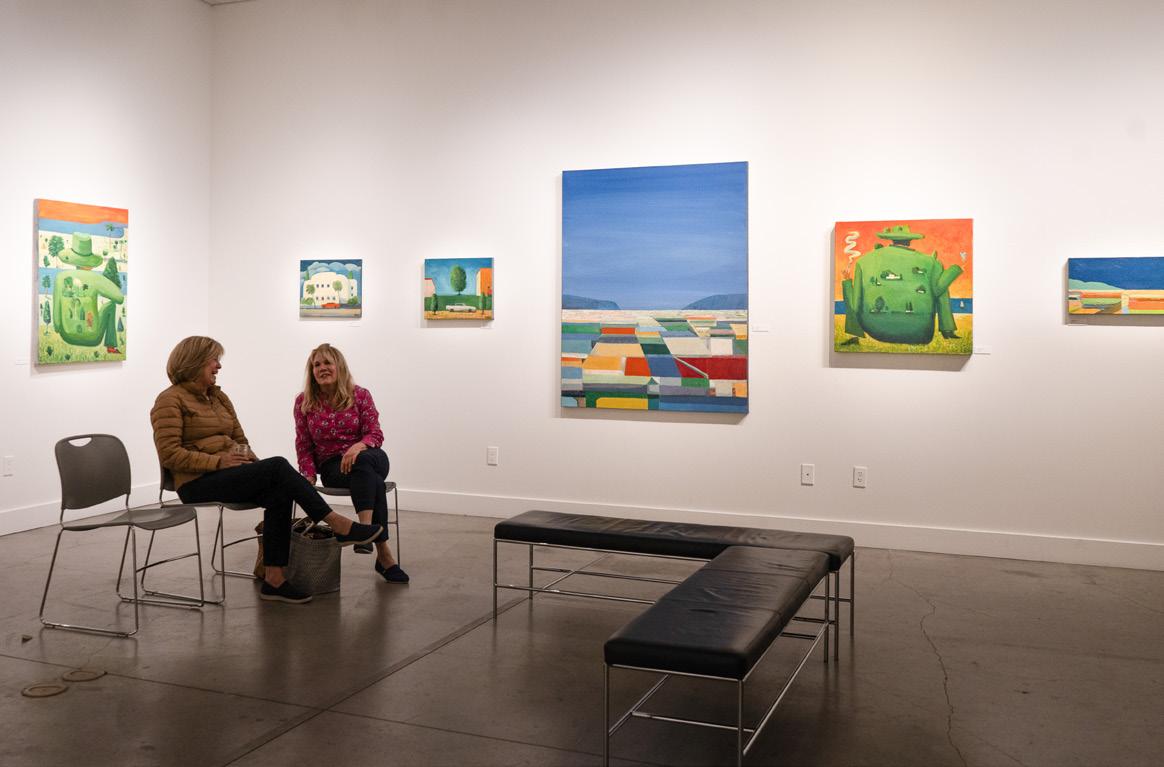
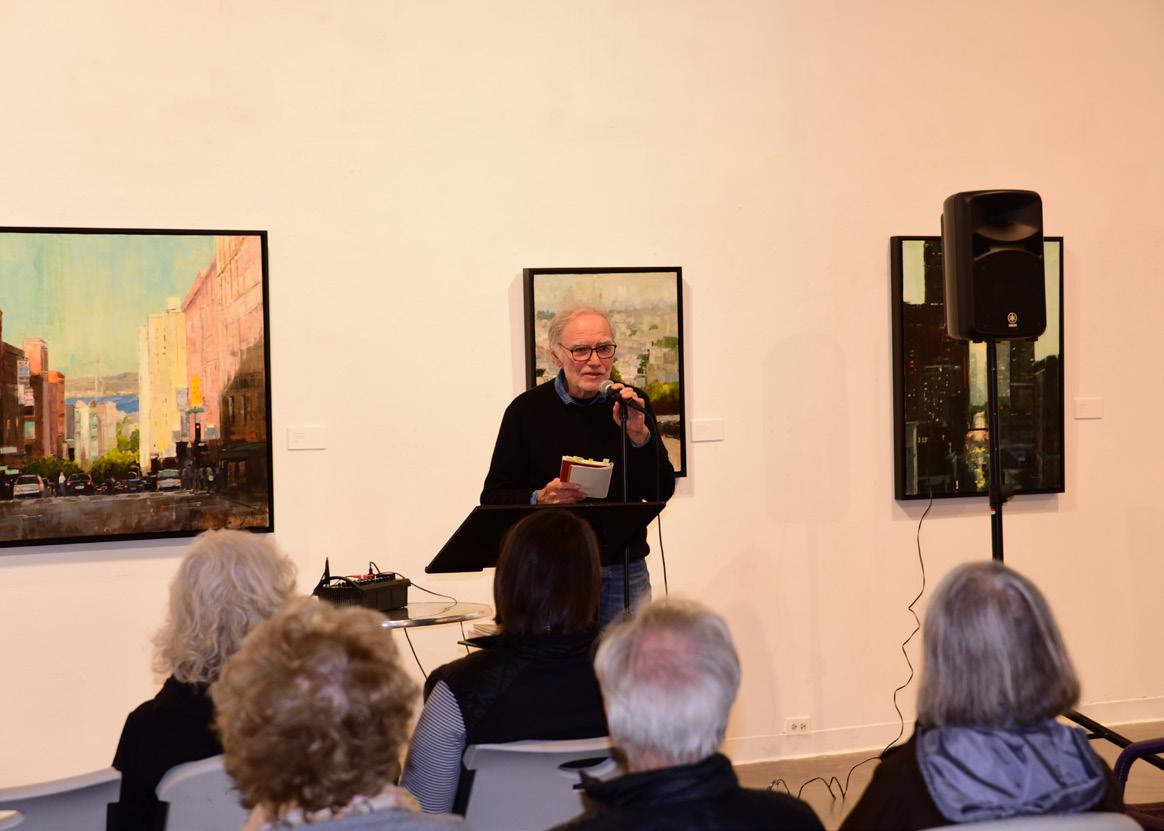
Te John Natsoulas Gallery featured its Poetry Night Reading Series on Tursday, Nov. 7 with special guests Julia Levine and Murray Silverstein.
An event for local poets hosted by Dr. Andy Jones, the Poetry Night Reading Series allows a platform for expression and creativity through poetry. Tursday’s reading commenced with the works of both Levine and Silverstein and ended with an open mic for audience members to share their poems.
Levine, the poet laureate emerita of the city of Davis, and Silverstein, an Independent Publisher Bronze Medal for Poetry winner, both shared their works, providing a strong demonstration of poetry’s role in expressing oneself.
“[Poetry] gives a home for people who are sort of on the march and don’t feel that anyone’s listening to them, and here’s a place where people listen,” Levine said. “For some people, this is one of the places where they might feel heard [when] they don’t otherwise.”
To a room full of avid listeners, Levine used her poetry to discuss passionate and personal topics like the painful cancer diagnosis of her infant grandson to broader topics such as the recent election results.
BY GIA LOOMIS
live
Levine’s poem “Te Dove” recalled her observations of a lone dove and drew metaphors from its characteristics and movements to life, its problems and her relationship with her father. Her poem “Variations on Rupture and Repair: Horse” drew on the importance of sticking to the feelings in one’s heart and embracing those emotions instead of running from them.
“It’s a powerful tool for helping you make sense of painful, emotional realities, and that has a lot of beauty,” Levine said. “[Tere’s] a lot of beauty in poetry. Te problem is, people don’t trust themselves. If you read something you don’t like, don’t read any more of it. Find something that speaks to you. I went through an entire high school education and college education
the event as participants shopped and viewed these special collections centering around woodworks, pottery and glass-blown art. After their frst stop, many attendees explored the varying stops on the ArtAbout map at their own pace and discretion. One of the most popular stops occurred at stop six at Pence Gallery. As a co-host of the event, Pence Gallery held a lively event framed by live music, unique exhibits and their Holiday Market. A highlight of ArtAbout took place at stop four, the Davis Craft and Vintage Fair.
in the E
and onlookers. It
and never wrote a poem [...] When I graduated college, I was literally sweeping my porch and I heard Sylvia Plath on a radio station, and I felt like I was lifted out of my body. It was such a phenomenally powerful experience.”
For Silverstein, the road of a poet also presented itself later on in life. Only when he was in his 60s did Silverstein begin trying his hand at writing. Prior to this, it had never occurred to him that any serious attempt at literature would warrant success.
“I turned to poetry after my career as an architect was pretty much coming to an end,” Silverstein said. “I started writing in my 60s, and I found my way into some writing groups where poets meet to sort of share their work and critique each other.” While reading his notable poem “Any Old Wolf,” a piece partly inspired by the nursery rhyme “Old MacDonald Had a Farm,” the witty wordplay drew smiles from the audience and, eventually, a strong applause. Other poems from Silverstein drew a more melancholic tone such as a dream with his deceased father or love as a difcult instrument to learn, in need of constant practice.
Silverstein revealed how a large motivation for his poetry was to simply make his mother laugh as she sufered
from lifelong depression. Te other part of his motivation was writing his life’s story.
“When writing poems you fnd yourself writing about your own life story,” Silverstein said. “But you’re trying to fnd things that make you understand humanity better by plumbing your own life story. And actually, it’s taken me a long time to understand that.”
The poems from the open mic followed suit with Silverstein’s observation. Audience members read poetry or haiku about past love, assimilation to a new country, generational curses or even frustration with the judicial branch. Each one drew from a unique life story, and each took a small step forward in understanding humanity better.
Michael Gallowglas was an open mic speaker and emphasized the importance of writing poetry.
“Keep writing poems, because even if one person sees it, it can make the diference in believing that you can keep going on,” Gallowglas said.
Te Poetry Night Reading Series is hosted biweekly at the John Natsoulas Gallery on the frst and third Tursday of the month and starts at 7 p.m., beginning with the featured reader and closing with an open mic session.
micro-business booths selling a variety of goods including jewelry, handcrafted products and vintage clothing along with a background of ambient live music. Local vendor Sofa Wildvine runs a small art business and has participated in the ArtAbout events on and of for around two years. Wildvine’s business includes many varying art forms and styles as she enjoys exploring diferent mediums. “I love painting with acrylic, gouache and watercolor,” Wildvine said. “I also do printmaking, such as woodblock carvings, screenprints and some intaglio prints.” Community-based events, like the
ArtAbout, can be invaluable to a starting artist as it gives them a boost into the local art scene. As a long-term vendor of these events, Wildvine explained how ArtAbout has helped to support her small business and art career. “Te ArtAbout, and other events in Davis, were the launching point and starting ground for my small art business,” Wildvine said. “I was extremely nervous to start, but thanks to the support of this wonderful community and my own perseverance, I have been able to succeed in supporting myself solely through my artwork.” FINISH READING ONLINE AT THEAGGIE.ORG
Cast members and the director reflect on how they brought the production to life
BY GRACIELA TIU features@theaggie.org
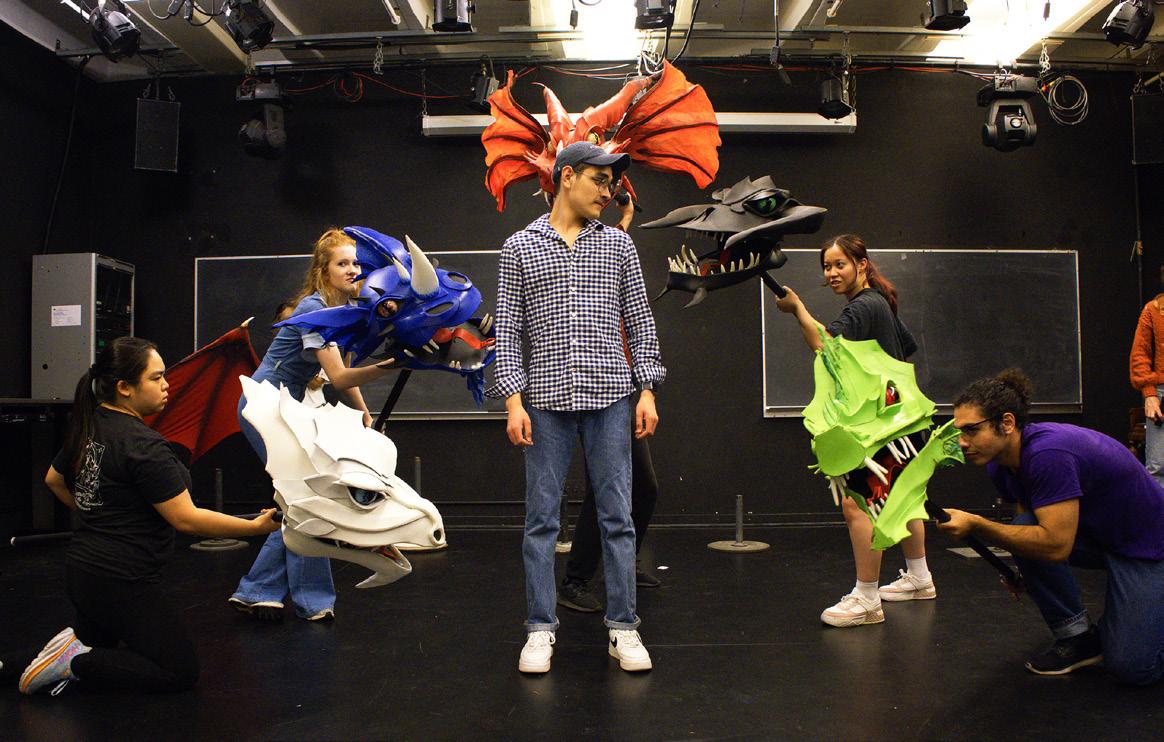
Presented by the UC Davis Department of Teatre and Dance, the play “She Kills Monsters” will have its opening night on Tursday, Nov. 21. Directed by Lucas Hatton, who received a Master of Fine Arts (MFA) degree in the dramatic arts in 2017, the production dives into topics of grief, bullying and the connection between siblings through fantasy games and the use of humor.
“[Te show] has been produced frequently in colleges and universities in particular,” Hatton said. “[We] wanted a show that students would be excited about and that would be a fun theatergoing experience, but not shy away from some of the more serious or important themes.”
With initial discussions about the play taking place in early 2024, auditions in April and rehearsals beginning in the fall, the cast and crew have been working hard to bring the unique show to life.
Te show is a story of two sisters and the depth of their relationship. After the untimely death of the younger sister, Tilly Evans, Agnes Evans fnds her sister’s notebook and discovers that her love for the game Dungeons and Dragons has brought her to a fantasy world inspired by the game.
Te play is so rich,” Hatton said.
“Every night [that] I watch a runthrough, there [are] new things that pop out of it. While the play has a lot of fanciful elements and some silliness, there is also an emotional truth in it in terms of the challenges and difculties that the characters face. Te way to have that resonate is to approach it with respect and honesty — allow[ing] for a journey that the characters take scene by scene and moment by moment
— rather than hinting at it or doing something stylistic where it feels less sincere.”
Melanie Garcia, a second-year theatre and dance major who plays Tilly, said she hopes the show’s relatable and emotional themes will resonate with audiences.
“I hope that they take something away from it,” Garcia said. “I think it shows a lot of real topics that a lot of people shy away from because they’re just so out there and vulgar, but they are true stories [that] need to be told. So I hope that if [people] have been through those kinds of things, it’ll help them see that they’re not alone, and that other people and even fctional characters have been through things that they have also been through.”
Lana Lindley, a fourth-year theatre and dance major who plays Agnes, said the production spotlights two sisters and their meaningful connection to each other, which even traverses life and death as they journey between realms.
“She’s a very smart and independent woman; She’s 24 in the show, and she is dealing with a lot of grief after her family died,” Lindley said. “She’s a really thoughtful and considerate sister, friend and girlfriend — but because she’s dealing with the death of her family, she has a lot of grief that she’s sufering with at the same time, so her relationships are very complex.”
Lindley refected on how exploring her character’s traits, personality and past experiences strengthened her acting.
“Playing Agnes has really challenged me as an actor,” Lindley said. “She has so many complexities [in] her personality, and it’s difcult to play on stage but in the best way possible. She’s not a simple, static character — she’s very dynamic, so it’s really fun to play.”
Garcia described how she feels the audience might relate to her character.
“I play Tilly Evans, Agnes’ little
sister, and she’s very unique in her own way, but [I] also feel like a lot of people can relate to her,” Garcia said. “She’s just this little teenager that is obsessed with Dungeons and Dragons — she’s very silly and confdent in herself but also has moments where you see through her facade of [being] this strong person and see who she actually is on the inside.”
Starting at the beginning of the quarter, rehearsals were from 6 to 10 p.m. on weekdays and 11 a.m. to 3 p.m. on Saturdays, with tech week — the fnal week before opening night — taking place from Nov. 14 to 20 and bringing additional hours to their rehearsals.
“A lot of my days, dare I say every day, have become super busy, and it’s hard, but you fnd ways to work around it,” Lindley said. “But it’s so exciting and rewarding, especially now that it’s almost here.”
Along with student cast members and professional technical designers, the production also features the work of assistant student crew members.
“We have faculty, who are the primary designers, and then there’s a head of the scene shop as well,” Hatton said. “Each of those areas: lighting, sound, projection and scenic, each has at least one assistant designer who is a student, and I also have a student assistant director.”
Students also had the opportunity to work with an outside professional to refne the fght scenes in the show.
“We got to work with a fight choreographer who came in from New York and that was super cool,” Lindley said. “His name is Dan, and he was so much fun to work with. It was also really cool getting to learn how to do fght scenes and how to not hurt someone.”
Lindley said spending hours working and collaborating on set brought many student cast members closer together.
“Te cast has been extremely nice and friendly,” Lindley said. “We’re all super outgoing and very extroverted. I would say times in the green room, [where we] hang out either before rehearsal or during a quick break, are always fun.
We’re all just on our phones but also telling each other funny things that happened during our days, and it’s a little bit of time to just debrief with each other.”
Te show will run from Nov. 21 to 23 and Dec. 5 to 7, with tickets available for purchase on the UC Davis Department of Teatre and Dance website.
“Watching the run last night, I think we’ve created a really inviting and exciting world and experience,” Hatton said. “I hope that as many people come to see and enjoy this play as possible.”
Some 7 to 9% of the eligible student population voted on student senators and a constitutional privacy amendment
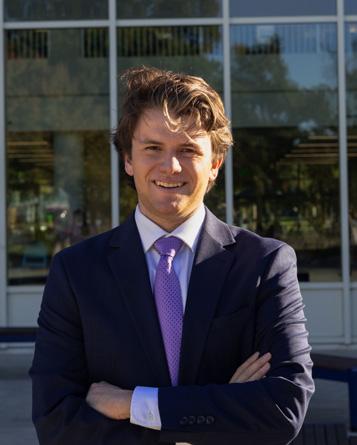
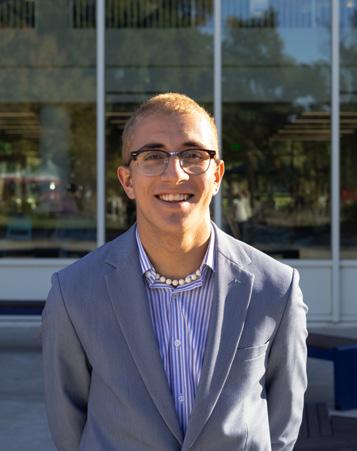
BY VINCE BASADA campus@theaggie.org
Six of 10 ASUCD Senate candidates were elected to the student government’s highest legislative body and a constitutional amendment protecting privacy rights was passed in the fall 2024 ASUCD elections.
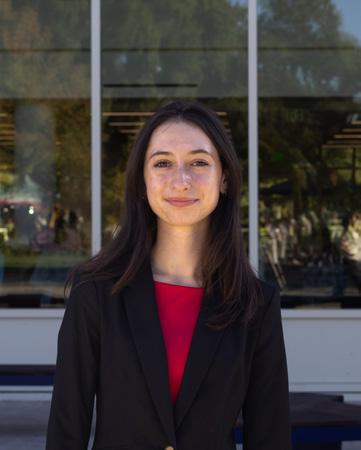
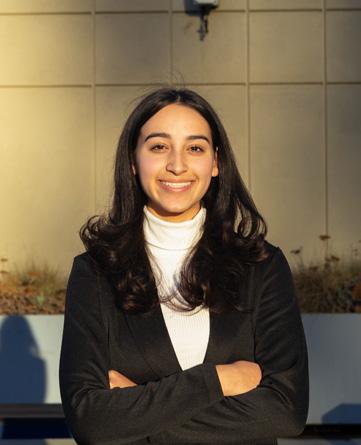
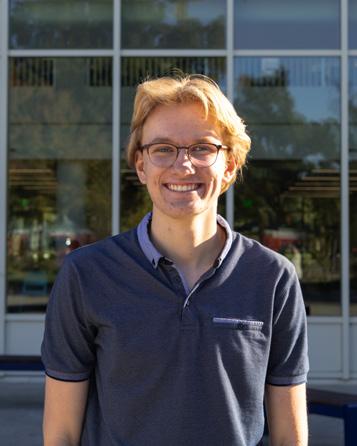
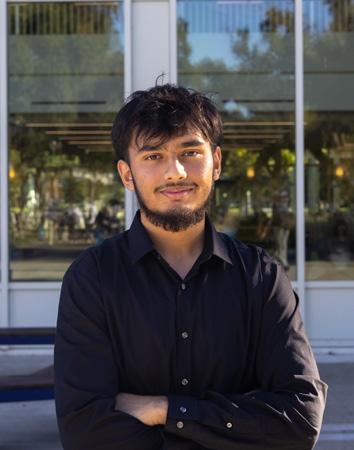
Elected as senators, in order of ranked vote share, were:
Nanki
Slate
4. Solana Rodriguez, a secondyear political science — public service major, Independent candidate
5. Lexi Raben, a frst-year environmental sciences and
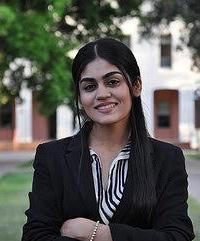
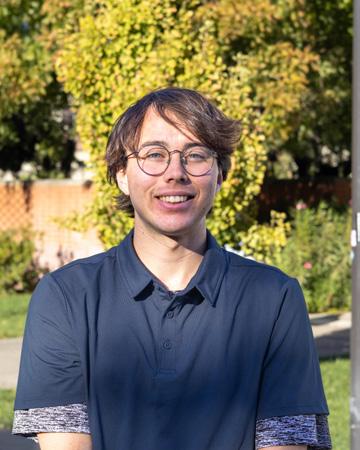
management major, of the Elevate Slate 6. Umar Shaikh, a second-year political science major, of the Zaytuna Slate
All six are scheduled to be sworn in at the fnal senate meeting of the quarter on Dec. 5. Constitutional Amendment #92, which enshrines the right to privacy in the ASUCD Constitution, also passed with 97.2% of the vote share.
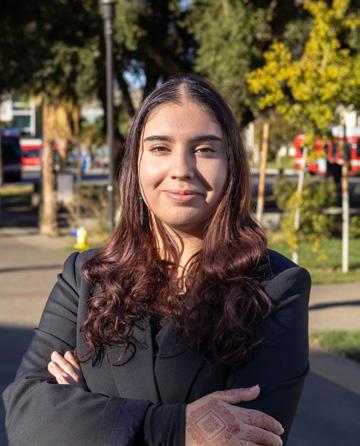
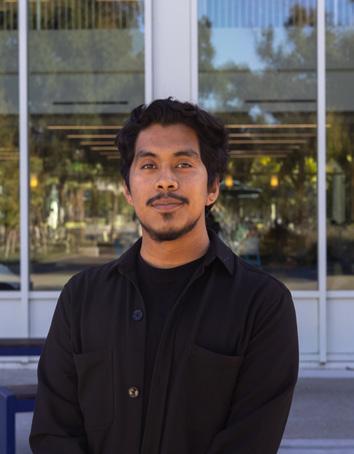
ASUCD Elections Chair Sriya Batchu, a third-year environmental policy and planning major, said that the election went well overall.
“I would say it went very smoothly,” Batchu said. “[But] there were a few bumps when it came to actually marketing the election.”
Te election faced some difculties that were specifc to this cycle; Veterans Day pushed the voting period into the weekend and the United States presidential election the week before may have confused some students, according to Batchu. 2,407 people voted in this
Senators also heard quarterly, special reports and confirmed several commissioners
BY VINCE BASADA campus@theaggie.org
ASUCD Internal Vice President
Aaminah Mohammad called the Nov. 14 senate meeting to order at 6:12 p.m. before reading the UC Davis Land Acknowledgement. Te table then heard a brief presentation on UC Davis’ Moving Forward Together plan, which is seeking input to improve travel infrastructure, safety and environmental impact on campus.
Jefrey Bruchez of Transportation Services and Robert Pattison of the Ofce of Campus Planning, informed the senate that $30 million will be allocated over the next 10 years for campus transportation improvements. In that time, research and student surveying will be done to support grant applications and prioritize ways to spend available grant money.
Housing Advising for Undergraduate Students (HAUS) Director Sam Hopwood, a fourthyear political science major, then gave his unit’s quarterly report. Hopwood said that the ASUCD Housing Fair, held on Nov. 13, had been successful with good turnout. He also reafrmed HAUS’ commitment to bolster and advertise existing ASUCD housing resources, while also expressing hopes to expand the unit’s advocacy and services.
“If even one student is without a bed — that is something I cannot [accept] on my campus,” Hopwood said.
Te senate then confrmed three members of the Disability Justice Committee: Adam Price, a third-year neurobiology, physiology and behavior major; Anisteicia Kinsey, a frst-year biochemistry and molecular biology major, and Nhy Duong, a third-year nutrition science major. Duong was also confrmed as a commissioner to the Gender and Sexuality Committee (GASC), alongside Sophie Abrea, a frst-year evolution, ecology and biodiversity major, and Caroline Wagner, a second-year political science major.
Later that meeting, the senate confrmed two members to the Sexual Assault Awareness Advocacy Commission: Emily Setubudi, a third-year clinical nutrition major, and Sanjana Gudivada, a fourth-year psychology major.
election cycle.
quarter’s election, which accounts for 7 to 9% of the eligible voting student population, according to Batchu. Turnout was similar to last year’s fall election which was 8.87%. Turnout in the spring is generally higher; the spring elections earlier this year saw 23.7% of eligible voters participate.
“I’m really hopeful that spring elections will again be really good,” Batchu said.
Batchu, who also serves as the vice chair of the Environmental Policy and Planning Commission, noted that in the fall election, immediately before the creation of the elections chair (fall 2023), voter turnout was 4.75%. She will be stepping down from her position before the next election cycle to give someone else the opportunity to be the elections chair.
Results for the election, which closed on Nov. 16, were released on Nov. 18. Full election results and statistics can be found at elections. ucdavis.edu.
Te senate then heard fve other quarterly reports. First was KDVS Radio’s report delivered by General Manager Fritzi Kornstaedt. Ten, the Whole Earth Festival’s report was delivered by Co-Directors Jaye Duckhart, a fourth-year neurobiology, physiology and behavior major, and Katherine Krinsky, a fourth-year English major. Te Environmental Policy and Planning Commission then gave their report presented by Chair Annie Kanjamala.
After a break, the senate heard from Picnic Day’s Unit Director Mina Sarmah, a fourth-year statistics major. Finally, Transfer Student Representative Safa Mohammad gave her ofce’s quarterly report.
After ex-ofcio reports, the senate briefy discussed old legislation before moving onto new legislation. Tey swiftly passed the consent calendar, including SB#14, amending ASUCD bylaws to reduce the required number of applicant interviews and improve efciency in the hiring process, and SB#16 which allocated $2,796.50 to GASC for the bulk purchase of Plan B for an upcoming event. In discussing new legislation, the senate also unanimously passed SB#10, giving the Whole Earth Festival $6,500 to repair one of their solar light towers, and SB#17 to allocate $1,195.48 for a Raices Fuertes event to be held on Dec. 7, organized by Senator Luis Garcia. Te senate then discussed emergency legislation SB#18 to “redefne ASUCD Units and limit the jurisdiction of Executive Directives in alignment with UC Davis and [UC Ofce of the President, UCOP] policies.”
Te bill also clarifes that ASUCD units are directly governed by the ASUCD Management Team through delegated authority from the Chancellor and that the policies of Te California Aggie and KDVS are under the purview of Media Board, and not the ASUCD Executive Ofce and Management Team or the ASUCD Senate.
Te bill was written by Senator Noblejot Singh at the behest of ASUCD President Gaius Ilupeju. Ilupeju said that conversations with
his counterparts at UC Irvine and UC Riverside, whose student governments are “facing threats from admin” for going ahead with ethical spending and other initiatives, prompted him to clarify ASUCD policy.
“I want everyone to know that the stuf we have in our own bylaws aligns with university policy,” Ilupeju said. “Tat’s what this [bill] does. As far as things that are in our bylaws that might cause confusion that are pretty serious, I would say that this is at the top of the list. Financially speaking for us, this is the most important thing to clarify.”
Ilupeju did note that unlike some other student governments in the UC system, ASUCD shares a productive and good relationship with UC Davis administration and SB#18 passed unanimously.
Open forum
Moving to open forum, the senate, prompted by Ilupeju, discussed the need to ensure that STEM representation within ASUCD included majors aside from computer science.
“We love our engineers, we love our computer scientists,” economics major and External Afairs Commission (EAC) Chair Henry Rosenbach said. “And we’re here to support you. But we’re also here to support our agronomists, our psychologists. Everyone in STEM is very loved.”
Several senators then discussed Te California Aggie’s coverage of their own quarterly report given to the senate the previous week.
Senator Dhilena Wickramasinghe expressed her belief that the article’s headline, “Senate hears quarterly reports and expresses concerns over student journalism at Nov. 7 meeting,” did not match the excerpt in the article on Te Aggie’s quarterly report. She also expressed an issue with the lack of quotes from the interaction.
“A good bulk of the concerns that were brought up were concerning students’ privacy and education,” Wickramasinghe said. “I do fnd it extremely disingenuous that Te Aggie would misconstrue what those conversations and concerns that were discussed were about. I generally don’t really care about what Te Aggie has to say about us as senators, but I do hope that they would be courteous enough to recognize our concerns about their journalism when it’s in the print. Without the full story, without quotes that depict the back and forth, it is not a positive indication of their respect for students’ privacy.”
Senator Siddharth Jasthi also took issue with Te Aggie’s stance on Constitutional Amendment #92, which enshrines students’ right to privacy in the ASUCD Constitution. Te Editorial Board wants legislation passed that protects the privacy and security of all students on campus,” Te Aggie’s editorial endorsement reads. “Especially given the University Ofce of Te President’s new policies with regards to protesting, an amendment protecting student privacy is more important than ever. However, due to vague language in the proposed amendment, the Editorial Board does not ofer Constitutional Amendment #92 a full endorsement. Instead, we recommend students read the full legislation and use their best judgment.”
Jasthi expressed his concerns with the Editorial Board’s reasoning.
“I think that Te Aggie being opposed to a piece of legislation that in no way mentioned them and only talks about student privacy as it relates to ASUCD and the university is rather silly just because they think it is maybe targeting student journalism,” Jasthi said. “I don’t think that’s a fair assertion to make.”
“Framing [it] like, ‘it wasn’t complete because they didn’t have an enforcement mechanism,’ isn’t a good ascertation of [the amendment] when it’s not supposed to have one in the frst place,” Jasthi said. “I would have hoped they would have recognized that it’s meant for a bill of rights and not a fully fedged bill.”
Senator Amrita Julka also expressed her dissatisfaction with Te Aggie’s coverage.
“I mentioned a specifc example that related to a student representative who brought up something related to her health and then this was fully disclosed in Te Aggie,” Julka said. “I just want to reiterate how dangerous this piece of information was to include in Te Aggie [and] how it was not related to her role in any capacity.”
Our pursuits for connection in all of its obscurity
LANHUI ZHEN/ AGGIE
BY NEVAEH KARRAKER nakarraker@ucdavis.edu
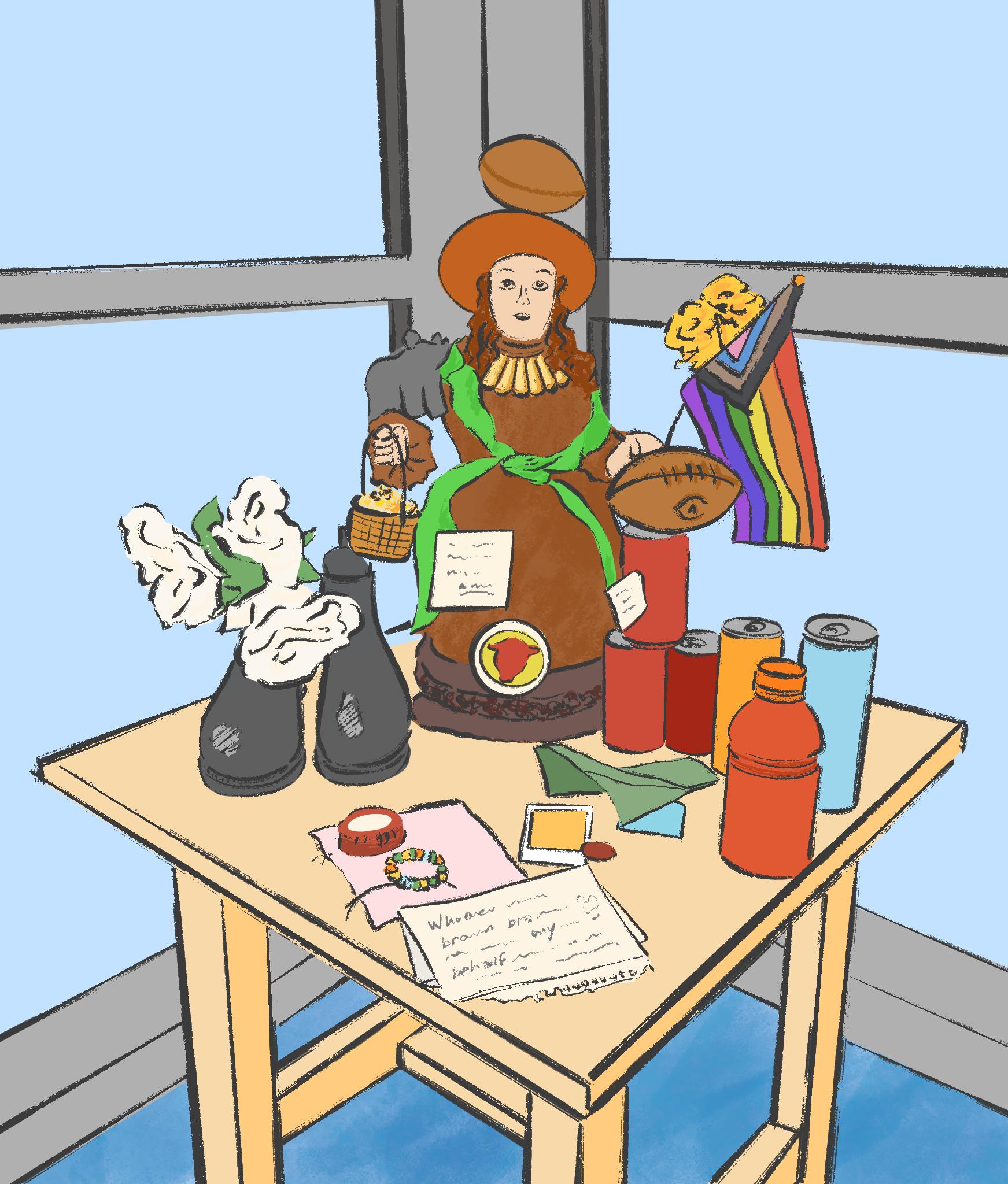
Constantine, a Roman emperor, sheathed by dull ceramic. As remarkably as the passing of the Edict of Milan, the statuette materialized on the Cuarto dormitory steps amidst a foggy morning. The news of a gnome-sized brunette girl in a strawberry-colored hat spread through the halls faster than the swift evolution of autumn.
Almost overnight, small offerings of flags, soda cans, plastic footballs and other knick knacks encircled her blue dress. Like these offerings, student homesickness only seems to increase as the quarter progresses. Living in the dorms and moving to Davis, it’s generally the first time students have fully experienced adulthood. And with this change comes the immersion into a new culture and people.
Unfortunately, as much as starting college is an exciting change, it is, in the end, change. No matter how good or beneficial it can be, we are inescapably resistant to it.
This is partially because we never truly realize what we have lost until it is gone. Further, we find ourselves reminiscing on the people we miss, the silly events we actually cherished and the dissipating feeling of belonging. Undoubtedly, as humans we are linked by the simple desire to connect — being social is
a fundamental, psychological need we crave. However, when everything gets thrown up in the air due to the inevitable change we call life, we often find ourselves resorting to extreme measures. In our humble yearning for connection, it can transgress into unhealthy obsessions and idolizations. Constantine is thus a temporary symbol of what we all want: a way students can generate laughter and conversation. To an extent, it is a direct reflection of interactions at a lively family dinner.
Yet, we cannot replicate what we once had. One friendship is unfortunately not going to resemble another. Similarly, Constantine cannot replicate the community first-years had in their hometown. A new one will instead unfold; It will be different, possibly unfamiliar, but it will be fulfilling.
The reality is that it takes time to accept this. And, before we do, we might make numerous, futile attempts. For instance, while it could be an insignificant joke to give offerings to a ceramic doll, should students really be sacrificing to false idols as a way to induce friendships? Or are there more authentic methods?
The answer is clearly ambiguous. Absolutely continue to joke and discuss the influence of Constantine; after all, our dear friend does elicit an important aspect of culture — unification. However, it is important to take
into account that he conversely represents our desperation and ignorance while we search for those we have the privilege to call “our people.” It demonstrates the dangers of assimilation and conformity. Thus, our endeavors of pursuing something can sometimes end up diminishing it, or worse, decreasing its inherent value.
Nevertheless, the students in Cuarto have simultaneously demonstrated a unique phenomenon. We have the power to befriend others. The only thing that’s required of us is boldness. Someone had to decide to put Constantine on those steps, and someone had to choose to sacrifice the first offering. Hence, not only does everyone have this desire for connection, but anyone has the capability to follow through on it.
In theory, we could patiently wait for a figurative Constantine to be placed in front of us, but sitting back and doing nothing is certainly not equivalent to faith. In fact, that is borderline indolence. Rather, we need to take initiative to generate our own opportunities. Perhaps it is up to us to courageously utter the first “hello,” for we truly may never know what will result from it.
Disclaimer: The views and opinions expressed by individual columnists belong to the columnists alone and do not necessarily indicate the views and opinions held by The California Aggie.
Understanding the importance of sidewalk etiquette is pertinent to creating a safe and courteous sidewalk environment
BY JHANA RHODES jsrho@ucdavis.edu
I was walking mindlessly on the winding path toward the Activities and Recreation Center (ARC) when a biker almost hit me. A frantic cyclist had emerged through the trees, cutting right through the sidewalk and narrowly missing a sea of pedestrians. I could feel the gust of wind as the bike brushed past me, like bristles on a canvas. By the time I turned around, the biker was long gone, and I realized I narrowly avoided becoming roadkill. Regardless, that cyclist sounds like a grade-A jerk, right? Well, to give them the beneft of the doubt, they were probably running late for their audition for “Fast and Furious 11: Bikes Rule!” Oh, how I wish there were a list of rules to make the sidewalk a safe and courteous place. All right, I’ll stop with the dad jokes because you’re probably tired of it, but hold your horses because I have one more. Te real kicker is that sidewalk safety rules do exist — it’s called sidewalk etiquette. Sidewalk etiquette isn’t just for cyclists. It applies to pedestrians too. Yes, I’m talking to you. If you’re a couple that likes to walk side by side, gazing lovingly at each other, hand in hand at a snail’s pace — kindly move out of the way. And, if you’re single, the rules remain. Single and double riders alike, sidewalk etiquette is something everyone who uses the sidewalk should follow. Now you’re probably thinking, who am I to lecture you about the sidewalk? You see, I’m just a fed-up pedestrian trying to get to class. But, enough complaining. Here is my two cents on sidewalk etiquette. Let’s start with a scenario. You are walking down a sidewalk with two friends, Jane and John. While showing your friends your favorite Nicholas Alexander Chavez edit, you notice a pedestrian trying to pass you in your peripheral vision. Do you: A, continue walking side by side, preventing the pedestrian from passing; B, walk slower or C, yield to the pedestrian, moving to the right. If you chose C, you get a gold star!
If you’ve chosen any option other than C, don’t feel too bad. I too have been a sidewalk menace — headphones on, engrossed in a midterm study cram, too oblivious to realize that I had been forcing others to trek through dirt and sticky tree sap to get past me. Don’t make the same rookie mistakes I did: Follow these basic rules, and you’ll become a grandmaster at sidewalk etiquette rizz:
1. Stay to your right.
2. “Please,” “thank you” and “excuse me” go a long way. If you’re having trouble getting past someone on the sidewalk, refrain from the passiveaggressive comments. Politely excuse yourself when passing them.
3. On the sidewalk, two heads aren’t always better than one. If you’re with a group of people, stagger yourselves to let others pass.
4. Not all vehicles are cars. Bikes, scooters, roller skates and especially hoverboards are considered vehicles. Tere are more protected bike lanes (and roads) in Davis than there are sidewalks, so please ride your vehicle in the designated lane and of of the sidewalk.
Tere are countless unspoken rules and requirements others are going to want you to follow. But, to keep it simple, just be considerate. From the girl with crutches who broke her leg during soccer practice to two friends riding their bikes to grab lunch in Downtown Davis to the grandfather taking a leisurely morning stroll with his grandson, we all deserve a safe place to walk on. You don’t have to remember all of them, but being aware of at least a few of the sidewalk rules can make things easier for everyone. Remember, sharing is caring. Lastly, just know this: If you’re on the sidewalk riding your bike and almost hit me with it, beware because, like Taylor Swift, I will write about it.
Disclaimer: Te views and opinions expressed by individual columnists belong to the columnists alone and do not necessarily indicate the views and opinions held by Te California Aggie.

They’ll get back together in a week
BY ALLISON KELEHER
Just when I thought the Unitrans bus lines were in harmony again, there appears to be more drama. One of my sources in the bus garage informed me that the M bus has been seen sobbing in the corner at night instead of resting. Apparently, it is normal for buses to cry at night after transporting smelly students all day long. However, the M’s cries have been consistent enough to get some attention. When she
leaves in the morning, there’s a puddle of windshield wiper fluid where she rested. This excessive crying has resulted in the M line being consistently late due to her fatigue.
On the other hand, the W has been seen mingling with other Silo bus lines during their breaks. One of my sources reported that he was driving down Hutchison Drive with the V and VX on either side of him. Apparently, he likes their company.
To those of you who aren’t up to date with Unitrans bus line romance, this is breaking news

— the M and the W are typically in a relationship. I say “typically” because they are together about 80% of the time. The M and the W are notoriously on-again, offagain; Sometimes they are on the same route, and sometimes they will split apart. However, when they are apart, both are seen pining for the other, resulting in their reunion soon after.
Interestingly, this doesn’t seem to be the case this time. The M is a wreck, and the W is consorting with other ladies. So, it’s time for a good old-fashioned investigation.
I secured an interview with both parties by pulling some strings with my Unitrans contacts, starting with the W. When asked about the status of his relationship with the M, he informed me that she’s “doing too much.”
Unfortunately, this was extremely vague, and I didn’t get much information out of him for the rest of the interview. However, to summarize, I think the W is in the wrong since he’s leaving out so much information.
When I met up with M, I brought some tissues, which were very helpful since she couldn’t stop tearing up during our interview. However, this interview was much more lucrative. In other words,
she spilled the tea. It took a while to get to the meat of the drama, as she was very scattered. It started out with her statement that he “doesn’t put her first” and that she’s “over it.”
Between each statement was several moments of tissues and crying, which I handled with a lot of care, given that I needed the drama. After patting her on the side (I can’t reach her back) and consoling her for many hours, she was able to calm herself down.
If you weren’t aware, this is peak investigative journalism.
Here’s the drama: The M caught the W scrolling through Instagram model bus accounts with their tailpipes out. In the past, the M has made it clear that she feels uncomfortable with him looking at other buses in that way because she feels like he doesn’t respect her. When she confronted him, the W started gaslighting her into thinking that he had never done anything. However, she saw it with her own two headlights. The W is sticking to his story that he didn’t do anything wrong and that the M is off her rocker.
So, he’s filling the void with other Unitrans bus lines. However, his best friend, the J, claims that this is “all a front” and he’s “hiding his
true feelings.” I decided to investigate further and snuck into the bus garage late one night. Most of the buses were sleeping, some of them snoring, except for one. It was the W-EX, the W’s twin. The W-EX was hiding in the corner giggling over his phone, and, lo and behold, he was looking at Instagram bus baddies. Case closed.
Once this information was revealed that the M had actually caught the W’s twin brother looking at other buses, the M and the W rushed into each other’s windshield wipers.
“I’m sorry I ever doubted you!” the M said.
The W was equally as emotional.
“It’s okay, I love you my M&M!” the W said.
Now, they can be seen cuddling at night in the bus garage, but we’ll see how long that lasts.
Disclaimer: (This article is humor and/or satire, and its content is purely fictional. The story and the names of “sources” are fictionalized.)
With Thanksgiving approaching, take some time to reflect on where you can find gratitude in your life
UC Davis Land Acknowledgement
Statement:
We should take a moment to acknowledge the land on which we are gathered. For thousands of years, this land has been the home of Patwin people. Today, there are three federally recognized Patwin tribes: Cachil DeHe Band of Wintun Indians of the Colusa Indian Community, Kletsel Dehe Wintun Nation, and Yocha Dehe Wintun Nation.
Te Patwin people have remained committed to the stewardship of this land over many centuries. It has been cherished and protected, as elders have instructed the young through generations. We are honored and grateful to be here today on their traditional lands.
With training for Turkey Trots, hosting family dinners and shopping Black Friday deals just around the corner, now is a better time than ever to slow down and take a moment to acknowledge all we have to be grateful for. Yes, we are living in challenging and stressful times, and there is a lot to be worried about. But despite this, it’s healthy to be grateful for what we do have and the small things that make life special. Tis Tanksgiving, look to your community, friends and family — they are some of the most important things in your lives.
Chris Ponce, Editor-in-Chief: My community
Being a Chicano in Davis, a town that is predominately white, I am grateful for places that remind me of home and that remind me of my community.
The Editorial Board’s budgeting guide for dummies!

I’m grateful for whenever a professor or stranger pronounces my last name right without me having to correct them. I’m grateful for the restaurants in Woodland that remind me of my family’s cooking. Diferent folklórico groups who put shows on at the Mondavi Center or in Woodland remind me of my beautiful culture and people. Tis quarter I took my frst Chicanx studies class and it has one of the strongest senses of community I think I’ve felt in a classroom. I’m even grateful for the random student groups at the MU who sell pan dulce. I’ve spent the last three years in Davis, fnding my footing and my place — I don’t know if I’ve ever perfectly escaped the culture shock in Davis. But, I have found people who come from similar backgrounds as me, with families that look like mine. To those people, my loyal friends, my lovely partner and all of my loved ones, thank you. You all help make Davis feel like it’s my home too.
Alyssa Crevoiserat, Managing Editor: Reading
Earlier this year, I found myself revisiting an old hobby from my middle school and early high school days: reading. Yes, like most people, my love for reading fzzled out with age, and I became hyper-focused on reading “correctly.” I thought that in order to read, I had to read classic literature that would mold me into an educated and scholarly member of society. However, instead of creating a scholar, elitist reading culture created a girl who didn’t pick up a book for years. Gone were the days when I would shamelessly peruse the aisles of a bookstore looking for my next fantasy read, sharing favorite books with friends and organizing fan art on Pinterest. Reading became a chore — to the point where I would barely skim required readings for class. I’m not sure when it happened, but I realized that preventing myself from reading what I want was more embarrassing than any book I could buy.
And while I do think I should pick up a classic or two, reading fantasy novels has been the highlight of my year. Reading has felt like having a conversation with a younger version of me — where I was reading for an escape and not to intellectualize my hobbies. Despite the haters — I’m not naming names — my poorly decorated Kindle and I have spent the year joined at the Popsocket for 45 books.
PS: Follow me on Goodreads.
Madison Peters, Campus News Editor: Self-care
As cliche as it sounds, it really is hard to be positive in times like these. If you have kept up with our weekly issues, you know that there has been a lot of darkness in the world as of late, and being surrounded by these frightening headlines can be overwhelming. With that being said, I urge you all to do your best to be thankful for the moments you have to ground yourself and appreciate the little things that make you happy.
One aspect of my life that I am thankful for is being able to take walks in the arboretum while I watch the fall colors change around me. Despite the cold weather, these moments where I can reconnect with nature and just take a second to think about anything and everything have really kept me going. I am thankful for the way that my house is turning into a home with every thrift fnd I decorate with and every game night my roommates and I host. Having a space where I can completely let my guard down and get cozy for the cold season ahead of us is something I will always be grateful for. On that note, I am extremely grateful to the rest of the editorial staf for supporting my journalistic endeavors through all of the breaking news and crazy scoops. As fall quarter comes to an end, I encourage everyone to do a bit of refecting and, more than anything, enjoy the necessary break that we all deserve.
Ana Bach, Arts & Culture Editor: Simple pleasures and going the distance
Wow, I don’t think I have truly taken the time to refect on how rewarding this year has been until now.

I am haunted and so are you
Understanding how we deal with the past BY TARA
ROMERO
tcrome@ucdavis.edu
Halloween and the time of ghost stories has come and gone, but why do I still feel haunted?
When we think of the word “haunted,” we tend to imagine some sort of Victorian poltergeist moving objects around an old dark mansion or some kind of spirit terrorizing a family like in “Te Conjuring.”
Similarly, the concept of hauntings appears throughout our culture in movies and literature. We use the idea of ghosts to represent the physical embodiments of the past who haunt and torment people in the present. Something about the idea of fgures from the past lingering with unfnished business fascinates us — perhaps because this is something we can relate to all too well.
I believe that hauntings are more than ghost stories; to understand hauntings is to understand ourselves and how we deal with our pasts. Te way we experience and think about memories is through a sort of
“haunting.” Existing outside of our daily consciousness, our past looms over us. Every once in a while, like a ghost manifesting itself in front of us, a past memory suddenly appears in our thoughts. We all know the feeling of going to sleep and suddenly shooting awake remembering the embarrassing thing we did eight years ago. No matter how much we try to repress it, our mind cannot help but bring back that godforsaken memory from the vault.
In this way, memories from our past continuously haunt us as they reappear again and again. Te worst thing that someone has done to us. Te worst thing we’ve ever done. Te feeling of an unwanted touch still lingering on our skin, no matter how many hundreds of showers we’ve taken since. Like ghosts, our past memories eternally walk alongside us, not allowing themselves to be forgotten. We are all haunted.
Memories torment us — constantly reminding us of our guilt, shame and fear. So how do we exorcize our ghosts?
One way in which we try to escape these ghosts is through repression, which is the urge to ignore our pasts

in order to make them go away. Out of sight, out of mind, right? However, ignoring our pasts only makes the hauntings worse. Te feelings of guilt, shame, fear and anger all continue to grow and fester. Trough repression, we give our pasts the power to truly hurt us.
Te past will always resurface, no matter how much we try to ignore it. With the way our memories work, the smallest detail can force us to remember something we tried so hard to forget. Whether it’s when you eat a certain food, smell a specifc smell or hear the name of someone you once knew — something will inevitably remind you of your past.
It’s impossible to escape what haunts us; the thing about these ghosts is that they never truly go away. I do not believe there is any way to get rid of our pasts, and that the past is not something that we can change. We have no way of controlling our past selves or the things that happened to us, so we must live with the memories that we have.
Understanding our pasts through the lens of haunting makes our worst moments feel inescapable. How are we supposed to live if we are eternally plagued by our memories?
Te answer is that we must learn to live alongside our ghosts. Tis looks diferent for everyone, but the frst step is always the same. We need to let our ghosts show themselves. Memories can be painful, but we cannot let them hold so much power over us. By confronting the difcult times in our lives, we begin the process of coming to terms with them — the process of healing. Our memories will always haunt us, but we do not have to feel haunted.
Disclaimer: Te views and opinions expressed by individual columnists belong to the columnists alone and do not necessarily indicate the views and opinions held by Te California Aggie.
Editorial Board
CHRIS PONCE Editor-in-Chief
ALYSSA CREVOISERAT Managing Editor
MADISON PETERS Campus News Editor
HANNAH SCHRADER City News Editor
MAYA KORNYEYEVA Opinion Editor
ZOEY MORTAZAVI Features Editor
ANA BACH Arts & Culture Editor
MEGAN JOSEPH Sports Editor
KATIE HELLMAN Science Editor
JENNA LEE Photo Director
ARIANA NOBLE Layout Director
LANHUI ZHEN Design Director
JOANNE SUN Social Media Manager
AARON POTTER Website Manager
CASSIDY GILLIS Distribution & Outreach Director
TIFFANY HE Copy Chief
JENNY DYE Copy Chief
SAMUEL RUIZ Translation Director
ILEANA MERAZ Translation Director
LAURIE PEDERSON Business Development Manager
It’s time we stop making introverts feel like being quiet is wrong
/ AGGIE

BY SABRINA FIGUEROA sfigueroaavila@ucdavis.edu
“Don’t you ever talk?” Tis is one of the many dreadful questions that almost every introverted person has been asked by peers, family members or even people they barely know.
As a fellow “quiet” person myself, I’ve been asked these questions since I was a little kid —- not only by other kids, but by adults I had only met for about fve minutes. I learned the hard way that silence is actually very loud to others. People examine our quietness and mold it to ft aspects of our personalities that aren’t necessarily true. For example, some of my teachers thought that because I was quiet, I was a good and responsible kid, which at frst seems like a compliment, right? Wrong. At the age of seven, nothing was more stressful than being placed with a bunch of extroverted kids simply because the teacher thought your quiet, responsible and good-natured character would rub of on them.
Even those kids thought that silence was odd, and they’d try to make up reasons to explain why some kids were quieter than others. To them, being quiet meant that we were weird, we had a secret crush on them or that we were basically Albert Einstein. Either way, it results in a lot of teasing, condescension and, in some cases, bullying. I will never forget when a peer — who I was not close to — would repeatedly call me “cute” in the tone of voice you would use to talk to a puppy. It was not fun: it was almost humiliating.
Te worst part is that there is almost no way to stand up for yourself without being called rude or sensitive. It’s not socially acceptable to ask an extrovert why they never shut up because, yes,
it is rude! So, why is it acceptable to ask people why they never talk? More importantly, why do we allow this behavior to happen to children? I grew up thinking that being introverted and enjoying silence was bad, and that there was something inherently wrong with it. I tried to change that, but once people deemed you quiet, it was difcult to make them perceive you diferently. Silence is also — unfortunately — something that is unsettling to many; perhaps this is why some people think being quiet is weird. However, sitting in silence is possibly one of the most beautiful things humans can do. It means that there is some kind of shared understanding and that the uncertainty in the silence is something we are open to. Humans are social beings, but it doesn’t mean we have to be verbally communicating all the time. Tis is a gift that people can learn from introverts. If anything, I think both introverts and extroverts can learn from each other. But that can’t happen unless we stop treating each other as though we are less than each other and unworthy of basic kindness.
If there is one thing I have learned about being quiet, it’s that many people would speak more often if they were not asked or told such condescending things about their nature. Because as much as it is dreadful, it’s also discouraging. It’s unwelcoming and intimidating to talk to people that see you as weird or treat you like you’re diferent. It’s worse when that behavior becomes so normalized that you anticipate for others to react in the same way. We should work to destigmatize introversion and help create a better sense of connection, community and empathy among people.
Why we must reprioritize kindness
BY ABHINAYA KASAGANI opinion@theaggie.org
When I frst moved to college, I was uncomfortable with the urgency at which most things moved. When I got to something, everyone was already onto the next thing; friendships were feeting, kindness was limited and, worst of all, none of this was bafing to most. Making friends in college requires you to lay your own groundwork, dig your own pit and hope the climb out isn’t too embarrassing. Sometimes, it can feel as if it is more sensible not to try. When I fnally made friends, so much of the initial risk dissipated. Four walls enclosed me like a soft hug. Gratitude erupted amidst all of the smoke.
Recently, I was talking to a friend about how kindness has been scarce lately and how I was losing my inclination for it too. Te consensus nowadays seems to be that compassion is fatiguing and that this dearth of kindness — caused by an increasingly polarized world — is oftentimes warranted and self-sustaining.
Altruistic instincts are frequently undermined by societal and psychological passivity, making it so that the more we’re exposed to sufering, the less inclined we are to be kind. As counterproductive as that is, tendencies like difusion of responsibility and
compassion fatigue fuel a cycle of further disconnection, tricking us into viewing kindness as secondary rather than essential. What we fail to remember is that the act of kindness is inherently reciprocal.
When I chose to title this piece “Space for sweetness in a dog-eat-dog world,” I had to remind myself of the goodness that sustained me throughout my time here. I am a product of such kindness — of my best friend coming over to help me with laundry when I was sick, of a friend showing up at my door with tomatoes and burrata that we happily devoured in silence, of my old roommate brushing the knots out of my hair simply because it occurred to her, to them, in that moment to ask and to concern themselves with someone other than themselves.
Kindness is so easy to muster, yet we still shy away from it because it is easier not to care. Tis rhetoric of dog-eat-dog has permeated the social sphere and led to a gradual erosion of our altruistic instincts. We are now more inclined than ever to internalize the notion that personal achievements precede all, and so we deprioritize kindness. Tis sets of a chain reaction: with deprioritized kindness, people are worse of and the consumption of negative media exhausts us and worsens our anxiety, leading us to continue disregarding kindness. Te cyclicality of our passivity is inescapable. Tere is such loss amidst all the

trafc and ambition — a desire to compete against rather than alongside — and so we grab onto multiple threads and lose track of them all. I would implore one to ask themselves if, and why, kindness to them is superfuous and no longer a priority.
Te environments we inhabit are only becoming further divided, making it necessary for us to consciously embrace it. It has been observed that people in large groups, those accustomed to kindness within their circles, feel less inclined to take individual responsibility (a phenomenon known as difusion of responsibility) and often ignore opportunities to ofer support.
Challenging this dog-eat-dog mindset that we have acclimated ourselves to scrutinizes how one’s passivity only further feeds into this unkindness.
More often than not, this desire for goodness is fueled by the expectation of a reward. Te lack of reward has made it so that one is less willing to embrace it naturally. People often assume that the smallness of their kindness won’t truly contribute or that someone else will do it instead (someone might, but you always could!).
What I’ve found to be true during my time here is that you make a series of patient, conscious acts of kindness, and whether or not they amount to anything, only time will tell. What matters more is that you pay attention to the defant, celebratory quality of the act itself. Again, altruism is not the goal — it has never been. Tere is no need to be grandiose or self-sacrifcial; small is big.
Kindness is easy to forget but just as easy to remember. If you call to mind this doggedness, of once breaking of a piece of your lunch, of once sharing plastic tools in a sandbox, you urge the dog-eat-dog of it all to become undesirable. Tenderness is in the air. Hold each other’s hands. Tere is space for everyone and for sweetness.
Disclaimer: Te views and opinions expressed by individual columnists belong to the columnists alone and do not necessarily indicate the views and opinions held by Te California Aggie.
is a real killjoy

BY MOLLY THOMPSON mmtthompson@ucdavis.edu
“Would you say that, overall, you’re happy?” came the voice over the phone from 380 miles away, just 20 minutes into our just-to-catch-up conversation.
“Yeah, I think so. I mean, there are defnitely days where I’d say I’m not, but for the most part, yes.”
I started to think about it more: am I happy right now? Tere’s no reason for me not to be, so I guess so. But shouldn’t true happiness be more than an “I guess so?” Does that mean I’m not happy?
50 minutes later, when I hung up the phone, I was still thinking about it. I remembered a book I read for my 11th grade English class: “Te Geography of Bliss,” by Eric Weiner. It follows a journalist as he visits 10 countries in search of the happiest place on Earth and the elusive secret to true happiness. His journey takes him to not only commonly cited paradises and places that are known for their happy populations but also to their antitheses: places wreaked with corruption and desperation.
He discovers that the Swiss are very content, but is that the same as happiness? Te Netherlands is very equitable, but does that create joy? Bhutan is poor fnancially but rich spiritually and has a self-imposed Gross National Happiness (GNH) index that
they pride themselves on — are they onto something?
A lot of Qatar is wealthy but stifed and unsatisfed with life. Iceland values failure as a necessary part of success: is that the key to creativity? Moldova is overrun with poverty and oppression, so does democracy play a part in a happy population? Tai culture encourages dropping your problems instead of worrying about them, but does forgetting about worries equate to bliss or is that just ignorance?
Happiness isn’t seen as an inherent goal in England, so do we need to actively seek it out in order to achieve it? India believes that seeking out happiness is counterproductive, so what should we be looking for? In the United States, material success is synonymous with personal fulfllment, but we report increasing levels of unhappiness every year. So what’s the answer?
In a predictably trite and still deeply unsatisfying ending, Weiner concludes that there is no secret to happiness. But what he does fnd to be true is that nobody actually fnds happiness when they’re looking for it.
Tat kind of makes sense — the happiest moments of our lives are usually unplanned and spontaneous. True joy can’t be orchestrated, it has to be organic. By that logic, seeking happiness really is futile.
The UC Davis Design Museum’s November exhibit offers students a space to decompress through sensory immersion
BY SAVANNAH ANNO
arts@theaggie.org
On view from Nov. 1 to 22, the UC Davis Design Museum debuted “Sonic Horizons: A Sensory Immersive Video Installation,” created by Master of Fine Arts (MFA) design graduate student Maral Salehian. Tis quarter marking her last at UC Davis, “Sonic Horizons” serves as an accumulation of everything the artist has learned over the last two years studying spatial and exhibition design.
“I’ve been working on this concept of bringing nature into a built-in environment since the pandemic,” Salehian said. “During lockdown, spending so much time indoors, I started to question the impact that being in our homes can have on us.”
“Sonic Horizons” consists of three diferent projected screens, inviting visitors to sit on benches placed in the middle of the room while each screen shifts through videos of various scenery. A melodic music track plays while visitors are shown a shifting sunset, the early morning view of a lake, grazing horses and the sun peeking through the trees all at once.
Each clip was flmed by Salehian herself, who spent at least a full day at each location collecting footage. Te hardest part of creating the installation was editing down hours-long videos into clips that last just under two minutes, according to Salehian. Combining the clips together, two of the “Sonic Horizons” screens project loops of about 10 minutes, while the third screen is a shorter, singular shot of trees.
“It’s pretty hyper-local,” Salehian said. “One screen shows the view from my window, another one I flmed just outside of my house with a drone and the rest are locations still very near to Davis like Napa, Winters and Lake Berryessa.”
Stepping into the installation, visitors are met with scenery all too familiar. Te landscapes are the same ones students see on walks to and from class, the view from apartment balconies or drives between Davis and the Bay Area. Everything important about California’s landscapes is summed up into three projections: the hills are
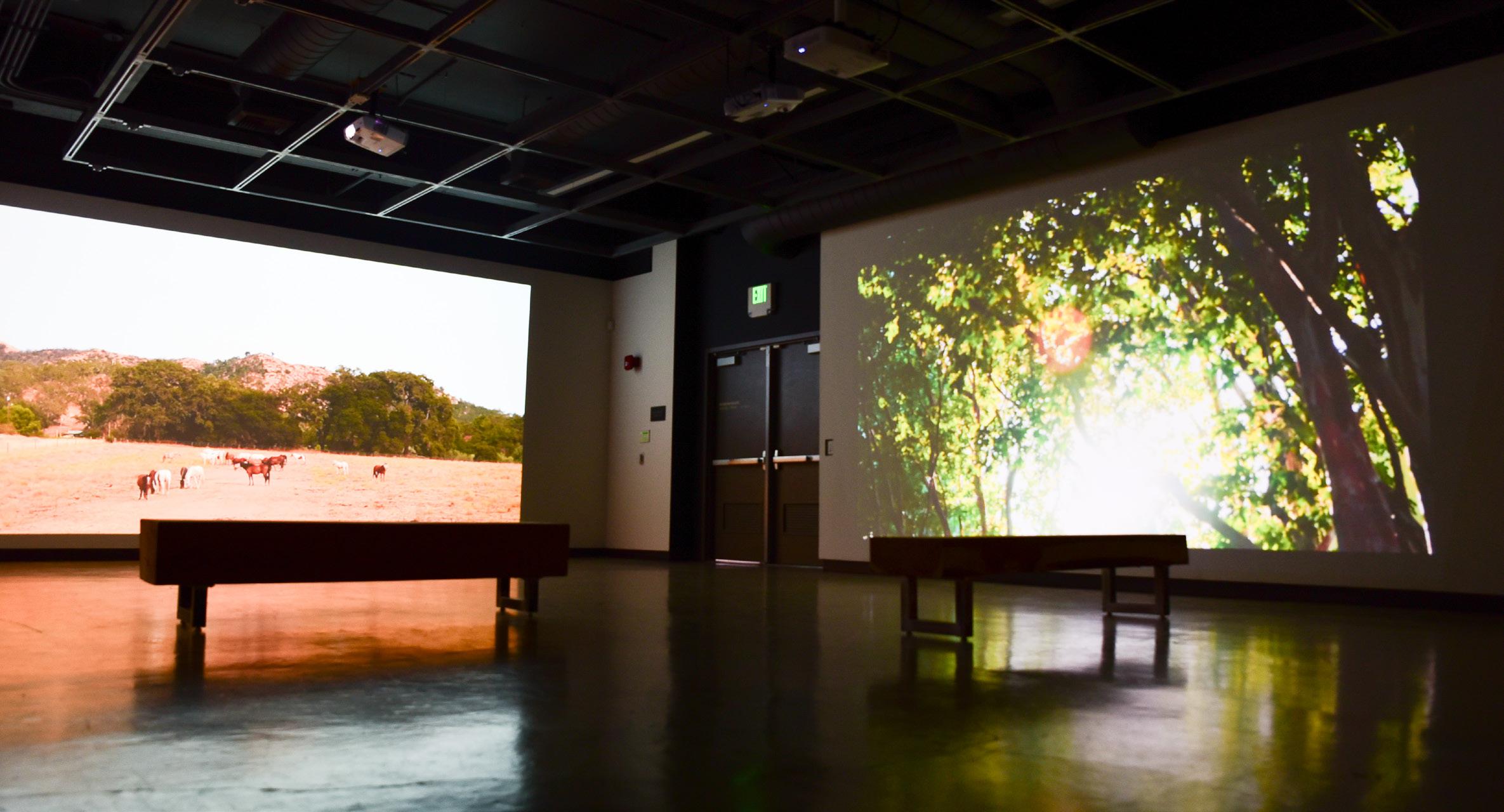
golden, the water is clear and the sunset is its usual perfect mix of pink and orange.
“My purpose was to try and reconnect people with their surroundings,” Salehian said. “We often overlook the beauty of the nature that we’re so used to. We forget how healing it is.”
While the visuals are familiar, the presentation is new. With almost every clip shot through a drone positioned 100 feet above ground, Salehian ofers visitors a new point of view. Te choice also speaks to Salehian’s strategic process of blending the natural world with the artifcial.
Tere are at least three diferent times of day shown all at once, so it’s not how we naturally experience nature,” Salehian said. “Even the landscapes you’re seeing, like Lake Berryessa, are entirely man-made. Every single element within the exhibit is artifcial.”
But in the end, artifcial elements evoke natural sensations, according to Salehian. With its dreamy atmosphere
and melodic music composed by Belgian artist Gert Stockmans, “Sonic Horizons” is refreshing. Te installation brings back feelings of simple awe, like walking down a tree-lined street and looking up instead of down at the sidewalk, or reaching the end of a long hiking trail and fnally seeing the view from its highest point.
“I see nature as the most beautiful thing in the world,” Salehian said.
“Whether it’s a furniture piece or an installation, I love integrating natural elements into my design process.”
Outside of the video clips and backing soundtrack, the exhibition also includes two large benches, both made by Salehian herself. With a natural wood top and more industrial metal legs, Salehian continued to blend nature with design down to the smallest of details.
Earning her Master of Arts (MA) degree in industrial design from the University of Tehran in 2022, Salehian initially focused on furniture design in Iran before moving to Davis. Being
so far from home and placed in a new environment, Salehian’s outside perspective also infuenced the selection of footage for the installation.
“I came to the states two years ago, and the sky here is pretty diferent from where I used to live,” Salehian said. “I wanted to integrate my own unique fascination with the sky in the project as well.”
Beyond her own love for nature and desire to reconnect others with their environment is Salehian’s dedication to promoting mental well-being. In this ever-advancing, rapidly urbanizing world, Salehian aimed to create a space that could ofer viewers a respite from it all. While visitors may not have had the time for an early hike or a trip to Lake Berryessa, they were able to slip into Cruess Hall in between lectures and get that same feeling.
“I got this comment from one of my friends, she said, ‘I was so stressed out about being late to your opening, but the moment that I stepped into the space I felt at ease,’” Salehian said. “I was
so happy it worked. Tat was my goal, to make people feel calm.”
Coming to a close on Nov. 22, Salehian was also able to refect on the installation’s month-long run and what she observed about visitors.
“Since I designed and created it myself, I never get to sit inside and truly see it,” Salehian said. “I know everything about it, so I never could have imagined that people would spend so much time in the space, maybe half an hour or more sitting and watching the loops over and over again.”
Rethinking the relationship between the digital world and the physical one, Salehian’s work harmonized the otherwise rocky relationship between nature and technology. A multi-sensory experience, “Sonic Horizons” works to create a moving depiction of our environment, reminding us to take a breath and appreciate what’s all around us.

BY AALIYAH ESPAÑOL-RIVAS arts@theaggie.org
Movie: “Eternal Sunshine of the Spotless Mind”
dir. Michel Gondry (2004)


Have you ever wanted to erase one person from your memory? Well the flm “Eternal Sunshine of the Spotless Mind” can give you a glimpse of what it entails. Te flm centers around Joel (Jim Carrey) when he fnds out his ex, Clementine (Kate Winslet), is undergoing a medical procedure to erase him from her memory. Out of spite, he decides to undergo the same procedure and is brought through the good and ugly of their relationship as each memory gets erased. From memories of falling in love, hurtful arguments and childhood insecurities, the flm brings you inside the psyche of a man who just wants to be loved and included. And while heartbroken by the end of the relationship, Joel soon realizes that to forget everything would be incredibly ignorant. To forget what brought you happiness at the cost of not wanting to remember the pain impedes self-growth, and a spotless mind is one without the experiences that shape you into who you are. Te flm is thought provoking to watch after a breakup, prompting you to ask yourself: was I the problem?
Album: “Sour” by Olivia Rodrigo (2021) “Sour” is the quintessential break-up album. Despite Olivia Rodrigo only being 17 years old when writing the album, the overall sentiment of each song transcends the bounds of age. Te album follows Rodrigo as she goes through the ups and downs of emotionally draining relationships with the selfdoubt, angst and growth that comes with it. “Sour” has a song for every type of situation, with “traitor” for the cheating exes, “enough for you” for the nonchalant and apathetic exes and “1 step forward, 3 steps back” for the emotionally unintelligent, uncommunicative exes. Whether it’s one or all songs on the album that embody your ex, there’s a song on “Sour” for everyone. Regardless of the duration of the relationship, or how long ago it was, “Sour” is an album you can turn to for comfort. Much akin to other songwriters such as Taylor Swift, Gracie Abrams and Lizzy McAlpine, Rodrigo draws listeners in with the emotional vulnerability in each song, validating all listeners’ experiences. And when you’re healing, you can graduate to Rodrigo’s sophomore album, “Guts,” for the forthcoming revenge era.
TV Show: “New Girl” by Elizabeth Meriwether (2011 to 2018)

Arguably one of the funniest sitcoms in recent years, “New Girl” follows Jessica Day (Zooey Deschanel) as she moves in with three guys, Nick Miller, Winston Bishop and Schmidt, following a rough breakup. With conficting personalities, Jess enters the house and shakes up the lives of the guys around her. Tere’s Nick, an unmotivated bartender who can’t seem to keep a girl for more than one date; Winston, an oblivious athlete who’s trying to fgure out what he wants to do in life after failing to go pro in basketball and Schmidt, the “all-knower” of everything woman. Perhaps a bit too bubbly and overly optimistic, Jess learns over the course of the show that maybe she can’t change the guys, but she can help them see life diferently. “New Girl” is the perfect show to bingewatch when you’re feeling heartbroken — it’s full of laughs, double-take moments and cringeworthy situations. I can’t imagine living with guys, but if it’s living with Nick, Winston and Schmidt, sign me up.
Song: “I Hate Boston” by Reneé Rapp (2023)
Being haunted by a place is the worst, especially when it’s an entire city. “I Hate Boston” by Reneé Rapp perfectly encapsulates this feeling of disdain for a location throughout the song, describing how her ex-boyfriend made her hate the entire city of Boston. Te song follows Rapp as she has fashbacks to her ex taking her around the city during their relationship, before dumping her and leaving her with nothing but haunting memories of the city. Lyrics such as, “As far as I’m concerned, they should just burn the whole city down,” and “Te whole thing is haunted, how do you sleep?” describe Rapp’s building hatred toward the city despite the “charm” it used to have. Te song, which can be labeled as a ballad, is an outcry and plea to her former lover for his lack of empathy toward their breakup, “holding her hostage” and “casually” leaving her. Rapp’s vocals give the song the raw emotional depth that left me wanting to burn down a city…watch out Boston.
BY ELIZABETH BUNT arts@theaggie.org
The John Natsoulas Gallery, with its iconic cat statue over the front door, is a staple of the Davis art scene. Te gallery always has new exhibits in rotation, hosts weekly poetry readings and artist talks and participates annually in the California Conference for the Advancement of Ceramic Art. All of these features make the Natsoulas an incredibly valuable addition to Downtown Davis. Students, in particular, should make a habit of stopping by the gallery at least once a quarter to see new artwork or study in the lounge upstairs while looking out over the sculptures on the frst foor. Currently, the Natsoulas Gallery is hosting three exhibits. Tese shows are only in Davis from Nov. 6 to 30, so the window to see them is short and sweet.
Michelle Gregor: “Self-Titled”
Michelle Gregor is an American sculptor and painter based out of San Francisco. Her exhibit at the Natsoulas is a collection of her recent sculptural work, which takes the form of abstracted female bodies. For this collection, she has worked primarily in ceramics to give an abstract expressionist take on the human fgure. What makes
Gregor’s work unique is the coloring and texturing added to the ceramic forms. In these sculptures, she has added layer upon layer of watercolor paint to the clay’s surface to create a sense of time worn liveliness. In much of this collection, the forms and colors of the women are recognizable as features of the natural world. Several of the pieces are named after varieties of trees, many others have names that reference mythology, adding another layer to Gregor’s already multi-faceted work.
Philippe Gandiol: “Time and Place” Philippe Gandiol’s exhibit, “Time and Place,” showcases his latest oil paintings which depict cityscapes from San Francisco to Paris and beyond. Gandiol is an awardwinning painter born in France and is currently based in Northern California. This collection offers glimpses of recognizable city views, like the Golden Gate Bridge peeking through San Francisco streets and captured by Gandiol’s unique style. They are familiar scenes but subdued somehow by Gandiol’s brush. The harshness of city life is hidden in his work; instead there is a subtle sense of nostalgia and longing that infuses his paintings and causes the viewer to imagine themselves walking the streets of Gandiol’s world.
Ted Fontaine: “Chance Encounters in Other Worlds”
Ted Fontaine is no stranger to the Natsoulas Gallery. Over the past few years, the Natsoulas has hosted many exhibitions of his work, making Fontaine a consistent feature in the Davis art scene. Fontaine’s current exhibit, “Chance Encounters in Other Worlds,” is a collection of oil fgure paintings. His most interesting work in this collection is his series of collage paintings. Some of these, like his 2024 work “Blindfold,” feature as many as 30 fgures interspersed across the canvas but tied together by a common theme. It is in these collage pieces that Fontaine’s imagination shines through the canvas. Te sheer scope and detail of each painting takes a long time to unpack; it’s entirely possible for viewers to stare at his paintings for an hour and still not catch every nuance of the greater portrait, but that is the beauty of it.
Tese three exhibits complement each other well and offer visitors a wide variety of artistic styles to browse through. Anyone stopping by the Natsoulas in the next two weeks is sure to fnd something that strikes their fancy, whether their taste lies in abstract fgure sculptures, colorful surrealist paintings or charming
The fascinating history of daylight savings time
BY IQRA AHMAD arts@theaggie.org
Twice a year, millions of people across the world partake in a curious ritual of adjusting their clocks, either gaining or losing an hour. For some, like on Nov. 3, it’s a welcomed extra hour of sleep or, for others, an unwelcome disruption. Tis practice, otherwise known as daylight savings time (DST), alters our perception of time twice a year. But where did this odd custom come from, and what in f uence does it have on time today? Historically, clocks did far more than simply tick away the hours like they do now. In ancient Rome, for instance, timekeepers manipulated their hours relative to the seasons. A “summer hour” could span up to 75 minutes, while a “winter hour” might f y by in only 44 minutes.
The idea of “saving” daylight isn’t unique to just the Romans. For centuries, humans have sought ways to capture sunlight to most efciently serve them throughout the day as well as the duration of history. In 1784, Benjamin Franklin famously proposed adjusting schedules to save on candle usage in a satirical letter to a Parisian newspaper, according to Te Franklin Institute. His suggestion was meant to
be humorous, but the concept would ultimately take root just a century later.
T e concept of DST surfaced in 1895 when New Zealand entomologist George Hudson presented his proposal to the Wellington Philosophical Society to re-adjust a two hour shift in clocks in order to optimize daylight for leisure, as reported by the National Conference of State Legislatures. It wasn’t until 1907, when a man from Southeast London, William Willet, published a pamphlet, “Waste of Daylight,” to call for actual changes in time, though he was initially unsuccessful.
In the throes of the f rst world war, daylight savings time reappeared as a strategic instrument, as opposed to solely a clock change. T e idea of longer, sunlit evenings and less strain on coal supply for lamps supported Willet’s advocacy to rewind the clocks. When Germany jumped on the daylight savings bandwagon on April 30, 1916, Britain did not want to be left in the dark. Just weeks later, on May 17, they launched their own “Summer Time Act” to soak up on those extra daylight hours, according to BBC.
In the United States, only
during World War II was DST adopted. While it was not completely embedded into daily life or legally implemented, di f erent states began using the system. Therefore, the Uniform Time Act of 1966 sought to restore order, setting a national DST policy. T is was furthered by Nixon, who in January 1974, signed a law establishing year-round DST to reduce gas consumption amid a national energy crisis, according to Smithsonian Magazine. While it was initially popular, President Gerald Ford changed the policy after a U.S. Senate report noted public dislike during the winter months. Now, in recent years, the Sunshine Protection Act was introduced to make DST permanent, passing through the Senate in 2022.
As we continue to adjust our clocks, the debate over daylight savings time remains far from settled. From its origins in ancient civilizations to its f uctuating status in modern society, DST has had a lasting impact on our relationship with time. While the future of daylight savings time remains uncertain, one thing is clear: the way we measure and manage time will continue to change, whether we spring forward, fall back or leave the clock ticking without change.
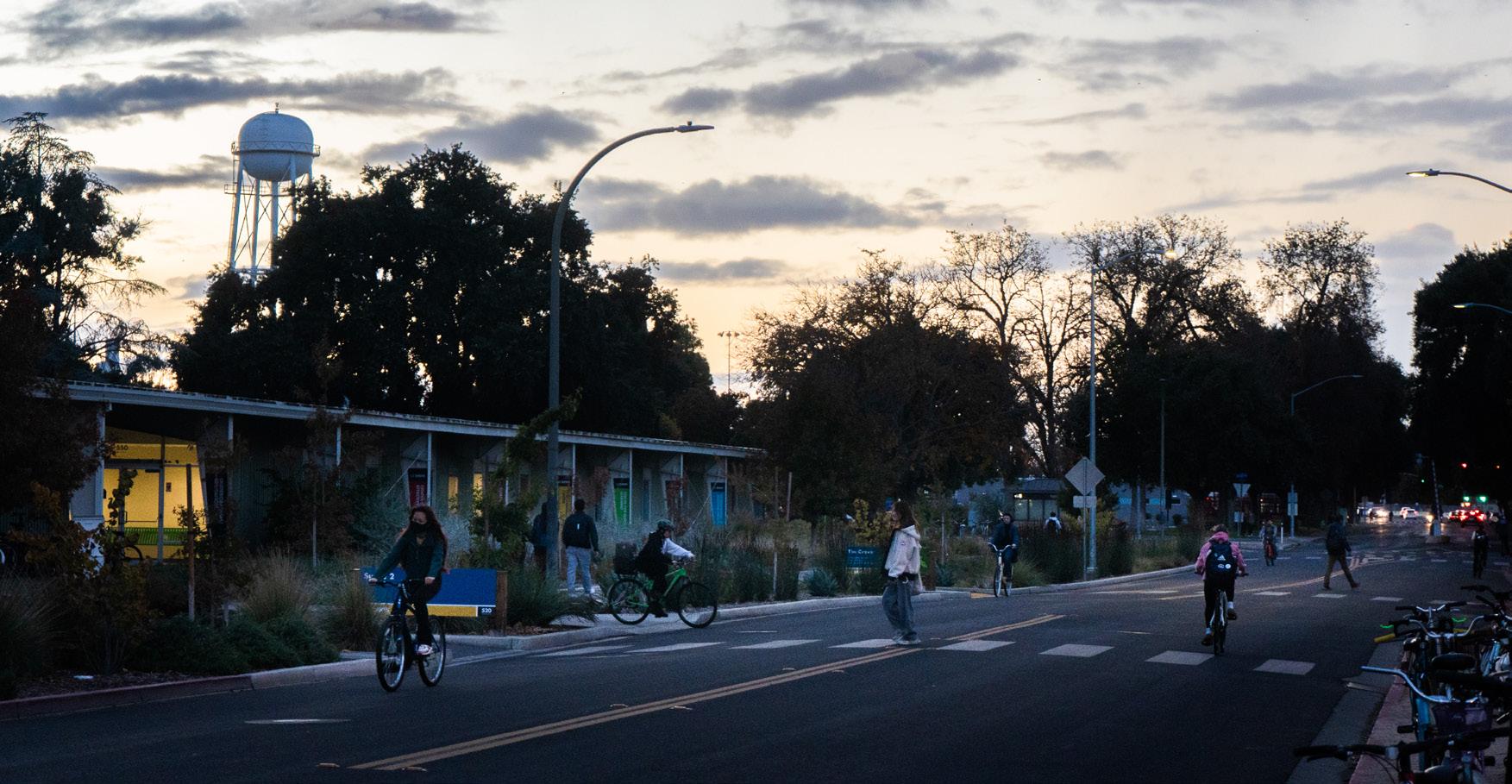
Microtrends promote overconsumption in the name of encouraging individuality
BY JULIE HUANG arts@theaggie.org
With the arrival of the holiday season comes Black Friday and other coveted end-of-year sales. In recent years, these traditional shopping events have been increasingly infuenced by the rise of social media microtrends, which concern anything from clothing to wall hangings to meal choices. Referring to accelerated trends that revolve around specifc items meant to promote the stylishness of certain niches, aesthetics and attitudes, microtrends are relevant for a couple of weeks to months at most. Ten, they quietly fade into obscurity, to be forgotten and replaced by the trend cycle until they are revived for another couple of weeks by yet another microtrend with similar aesthetics. Due to their fast-paced nature, microtrends in their inception are often perceived as fresh and fun, ofering widespread appeal to social media users who are searching for inspiration and an easy way to make a small change in their life. Some
T e driving mechanism of these microtrends lies in how they pair certain, more accessible items with idealized imaginings of wider aesthetics and lifestyles — for example, being a “tomato girl” means feeling carefree with f ushed cheeks, ideally lounging somewhere o f the coast of Italy. However, if a trip to the Mediterranean is out of reach, then buying a new red blush might be a worthwhile substitute. Microtrends thus grant people feelings of excitement and a sense of belonging to an exclusive group that is in the know, which reinforces a sense of individuality without requiring much personal e f ort.
Picturesque visuals are presented through TikToks and other shortform content, enticing viewers to buy the associated items that will supposedly bring the vision boards on their phone screens into their real lives. T e appeal of microtrends lies in their promise of bringing certain desired lifestyles into a consumer’s reality without them having to do any personal work apart from buying new things. Many microtrends also repackage
items that are otherwise plain or commonplace by giving them aesthetic names and accompanying visuals, making them newly stylish and trendy. When wearing blue nail polish can be transformed into having cutesy “blueberry nails” and doing eyeshadow in warm brown tones can be given the cozy label of “latte makeup,” it becomes clear that anything can become trend-worthy through imagination and a new rebrand.
T is movement toward romanticizing everyday activities, objects and colors can be viewed positively, as it has the potential to bring a renewed sense of joy and whimsy to more mundane objects and qualities. However, overromanticization of the mundane can also slide into a false sense of abundance. Overexposure to microtrends can lead to the belief that nothing is completely unattainable, feeding the desire to have access to everything trending on social media.
Large corporations have become increasingly aware of microtrends and their potential to encourage
popular aesthetic that switches every month. Fueled by these di f erent factors, microtrends now support overconsumption, under the guise of promoting inspirational aesthetics that serve social media users and enrich their personal lives.
Brands like Urban Outftters, Zara and H&M often reference current microtrends in their marketing, which appear on the banners of online storefronts and subject lines of promotional emails, all to direct their popularity toward the prospect of proft. Tis utilization of microtrends in marketing reveals the relationship between the aesthetics found on social media and the mass production of goods for sale, where the latter takes direction from the former in order to assess what consumers will purchase. However, the short lifespan of microtrends ensures that the fast fashion items made to f ll demand will undeniably become waste in a matter of weeks. As microtrends rise rapidly in popularity and then fall just as quickly, the items that are produced to sell alongside those microtrends become popular and then obsolete just as quickly as the trends they
originate from. Thus, the fleeting nature of microtrends and the ensuing mass production of cheaply made goods promote unsustainable practices that lead to excessive amounts of waste, f lling land f lls that pollute the environment. In continually keeping up with microtrends without considering the limits of consumption, individuals ignore their impact on the environment and send the message that sustainability is less of a priority than the short-term pleasure gained from short-term trends. Microtrends are unsustainable on a personal and emotional level as well.
California Aggie hosts its fall Couch Concert on Nov. 15
Local band “Your Tax Dollars at Work” rocked The Aggie basement
BY AALIYAH ESPAÑOL-RIVAS arts@theaggie.org
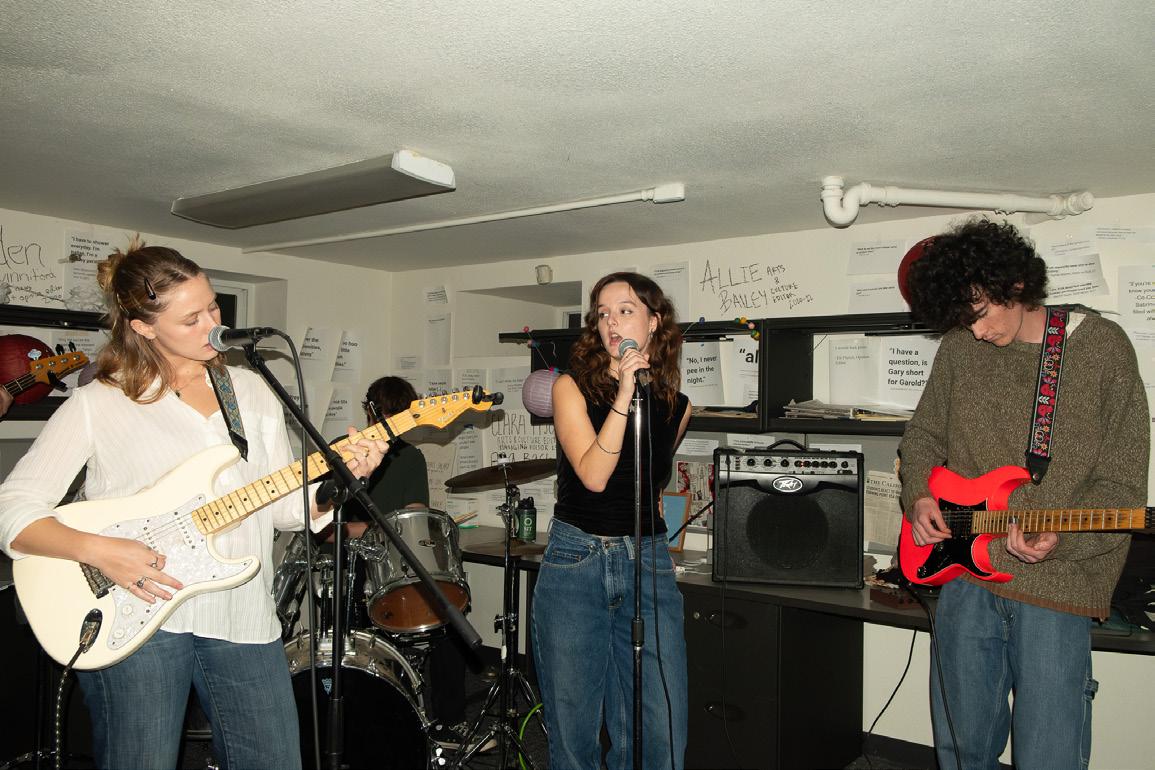
On Nov. 15, Te California Aggie hosted its quarterly Couch Concert, which aims to spotlight local bands in the Davis area and put on a free event for students and community members to attend. Members of the Davis community gathered to hear the music from the featured band, “Your Tax Dollars at Work.” Te Aggie sat down with several attendees from the concert, as they shared their experiences at the show.
Chris Crocker, a second-year political science major, heard about the concert from Te California Aggie’s Instagram page and decided to check it out for the frst time.
“I saw [the post] on Instagram, and I was like, ‘I should totally check that out,’” Crocker said. “I thought it was super cool, I love live music.”
Katie Lee, a fourth-year community and regional development major, also attended the Couch Concert for the frst time and was pleasantly surprised to see the amount of people she knew at the event.
“My friend brought me to the [Couch Concert], and I [saw] my other friend [was] playing the guitar, and I just thought, ‘Tis is so Davis, this is so college,’” Lee said. “I’m in the basement of Te California Aggie, listening to an indie band where I know people playing.”
Te band’s setlist included numerous songs — some original,
including “Hey Baby,” and some covers, including “Fade Into You” by Mazzy Star, “All Your’n” by Tyler Childers and “Kyoto” by Phoebe Bridgers.
“I liked their originals, they were really good, and I liked their cover of ‘All Your’n’ by Tyler Childers,” Crocker said.
Nicole Lara, a second-year international relations major, also enjoyed the overall environment of the concert and the setlist.
“I really liked the harmonies, and it was a really fun and casual environment,” Lara said. “I really liked their last song, the energy was really good.”
Overall, the concert was able to foster a relaxing but entertaining atmosphere and highlighted the Davis music scene for students who may not have engaged otherwise.
“Being able to come and check out some live music from a local band this accessibly was really amazing, it was a ton of fun,” Crocker said.
If you have yet to attend a Couch Concert, Te Aggie’s Arts & Culture desk hosts them every quarter, so be on the lookout for who will be featured in our winter quarter show. For more on “Your Tax Dollars at Work,” check out their Instagram and our pre-concert interview with the band on our website.
Davis-based jewelry brand has a furry friend behind
Jewelry by Dozer creates unique pieces for any occasion
BY SHREYA KUMAR arts@theaggie.org
Amid the vibrant buzz of the Davis Craft and Vintage Fair, one booth stands out — not just for its dazzling handmade jewelry but for the warmth and personality it brings. Jewelry by Dozer, a small business known for its eclectic handmade jewelry and fuzzy mascot, has quickly become a favorite among Davis locals.
Lo Chappell, an artist and fourthyear aerospace science and engineering major, is often joined at the fair by Dozer, a cuddly, sweater-sporting beagle and the name behind the brand.
Chappell’s journey into jewelry making began during their frst year as a way to handle academic stress. Tey started by simply making gifts for friends and family, but as their skills improved, they decided that they wanted to try and take their hobby to the next level.
Te anxiety I felt when selling for the frst time was why my emotional support animal Dozer came with me,” Chappell said. “Turns out, people love cuddly dogs in sweaters and they also
loved my jewelry. Te more I sold, the more recognition I got for my art and eventually it needed a name. It felt right to name it after Dozer because of the courage he gave me to start this business in the frst place.”
Balancing their studies with Jewelry by Dozer isn’t always easy. Chappell juggles rigorous coursework, a part-time job and the many responsibilities of running a business. Between getting permits and licenses, organizing markets, advertising and communicating with customers, it’s easy to start feeling stretched thin. Chappell admitted that there are moments when the demands of balancing a small business with being a full-time student can feel overwhelming but fnds that the community they have built through their craft makes it all worth it (along with the extra pocket change).
To get a unique piece tailored to your style or as a meaningful gift for a loved once, you can request a custom order by flling out a Google Form on their Instagram page. Each piece from Jewelry by Dozer is crafted with care and Chappell ensures each order is packaged carefully and thoughtfully,
always including a little bag with hand-drawn stickers of Dozer that are sure to brighten up anyone’s day.
“I want people to know that every piece is unique and handmade with so much love,” Chappell said.
Despite being in their fnal year of college, Chappell hopes to continue Jewelry by Dozer and jewelry making as a hobby well past graduation.
For those eager to see Chappell’s work in person and grab a special sparkle for yourself, Jewelry by Dozer will have a booth at the Davis Craft and Vintage Fair on Nov. 24. It’s the perfect opportunity to pick up a piece of jewelry infused with creativity, passion and a little inspiration from Dozer himself. If you get lucky enough, you may even see Dozer’s best friend and Lo’s newest dog, Kurtis, as well!
To learn more about Jewelry by Dozer and browse their wares, be sure to visit their Instagram or online store. Whether you’re looking for a statement piece or a meaningful gift, Chappell’s creations ofer something truly special — jewelry with a story and a heart.
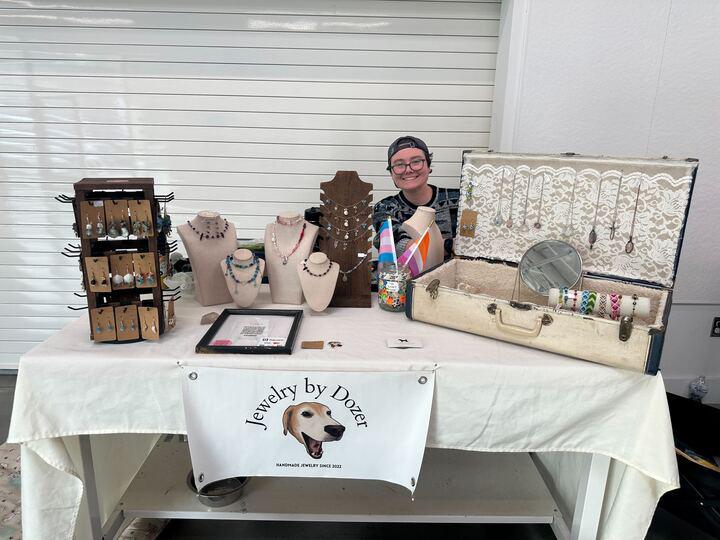
A reflection on Taylor Swift’s worldwide tour before it comes to an end this December

BY NATALIE SALTER arts@theaggie.org
It’s impossible to ignore how much singer-songwriter Taylor Swift’s popularity and fame has grown over the course of the nearly two decades she has been on the music scene. Swift is undoubtedly one of the most popular musical artists worldwide, with a massive fanbase and 11 albums under her belt. Perhaps one of the most major moments of her career as of late, however, has been her expansive global tour — “Te Eras Tour.” With 149 shows across fve continents, the tour is easily one of her most important accomplishments, and with the last show of the tour set for this December, it’s the perfect time to look back at what the “Te Eras Tour” has done not just for Swift but for the industry as a whole. Each night of “Te Eras Tour” — all of them in packed stadiums — comes out to a total of nearly 3.5 hours of Swift performing on stage. For those three hours, she goes through numerous outft changes and entire set transformations. One moment she dons a fowing white dress while
lounging on a moss-covered rooftop in the woods, singing to the audience the poetic and fowery lyrics of “folklore”; the next, she’s all sparkles and short skirts, dancing to the infectious pop tunes of “1989.” Te “Eras” part of the tour’s name is taken very seriously — almost every one of her 11 albums, with their own unique aesthetics and sounds, are given the chance to shine.
Te performances themselves are carefully crafted to enhance the stories each song tells. For example, “the last great american dynasty” — a song chronicling the life of Rebekah Harkness, the previous owner of Swift’s Rhode Island mansion — is choreographed with spinning dancers in old-fashioned gowns and suits. A mournful ode to feeling unwanted and unappreciated in a relationship, “tolerate it” is portrayed on stage by Swift carefully setting a table and then destroying it while her disinterested lover looks coldly on. Tis level of cinematic storytelling that she pours into her performances brings them to life and makes each one unforgettable.
Another standout part of the tour is the surprise song set. Each night, Swift performs two unique acoustic songs from her catalog, giving every show a moment special to them alone. As the
tour dates progressed, Swift shifted to singing mashups, combining diferent songs from multiple albums to create entirely singular performances.
During certain shows, Swift brought guests on stage to sing alongside her. Tis star-studded list of cameos includes Sabrina Carpenter, Gracie Abrams and Florence Welch of “Florence + Te Machine,” as well as her long-time co-producers, Jack Antonof from “Bleachers” and Aaron Dessner from “Te National.” Given that the tour has been running for nearly two years, many achievements have been claimed by Swift during her time touring. She announced and released two re-recordings of previous albums — “Speak Now” and “1989” — during the United States leg of “Te Eras Tour” and released 31 new songs with her latest album, “Te Tortured Poets Department,” in early 2024. Te latter of these events resulted in Swift shaking up her already extensive set list by adding an entirely new section of the concert devoted to the album.
Te economic impact of “Te Eras Tour” is not to be underestimated. It has earned itself the title of the highest grossing tour of all time. Local economies felt Swift’s impact
— wherever her tour landed, business boomed thanks to the infux of fans and the massive social media coverage that followed. Swift herself made a fnancial impact at each stop, sending massive donations to food banks in each city she visited. Fan collaboration has also been celebrated throughout the course of the tour’s run. Following a lyric on “You’re On Your Own, Kid” — “Make the friendship bracelets / Take the moment and taste it” — fans started a tour-long trend of making handmade friendship bracelets themed after Swift’s various songs and albums. Bracelet making and trading has remained a crucial part of every “Te Eras Tour” date from the very frst. Tough the tour has generally been a triumph, it has not been without its hardships. In Vienna, the three scheduled concerts had to be cancelled after local authorities intercepted a plan to bomb and attack the shows. Tis resulted in heightened security at the following shows and a greater fear presented for fans.
“Te reason for the cancellations flled me with a new sense of fear, and a tremendous amount of guilt because so many people had planned on coming to those shows,” Swift
said on her Instagram after ending the European leg of the tour. “I was heartened by the love and unity I saw in the fans who banded together.”
For those who grew up with her music and those new to her fanbase alike, “Te Eras Tour” has provided a safe space to express their love of her music and fnd community. Every concert serves as a sort of love letter from Swift to the people who made her success possible. In no moment is this better seen than in her nightly “22” performance, in which a fan is selected from the audience and taken to the edge of the stage for a special interaction with Swift. Each time, after putting her signed hat on their head, Swift shares a tender moment with the fan, hugging them and exchanging friendship bracelets. Tis sweet moment carries in itself a clear message: Taylor Swift loves what she does and pours that love into every song and every performance. If “Te Eras Tour” shows us what happens when she’s doing what she loves, it’s obvious how she has stayed a prominent aspect of the music industry for so long — a trend that fans hope she will continue in the years to come.
The café’s owner shares sentiments about love and fostering community
BY RACHEL GAUER features@theaggie.org
A typical college town café does not often include live music shows, funky wall colors and extensive art exhibitions. Downtown’s Delta of Venus, however, is far from typical.
Situated just a short distance from campus at the intersection of Rice Lane and B Street, Delta of Venus appears to be a quaint, homey cafe with an abundance of outdoor seating for conversing with others or perhaps working in solitude.
A step inside the space, however, reveals its uniqueness: brightly multicolored walls are lined with various art installations from local artists, bringing an immediate feeling of being in someone’s carefully curated living room. It’s this very sentiment that owner Lee Walthall fnds customers saying over and over.
“I think a lot of people who say that this feels like home to them is not because their home has diferently colored walls or because it has bamboo growing in the front — it’s more about a feeling,” Walthall said. “We sell food and cofee here, but what I am mostly interested in is people: how people feel and how people engage with each
other.” Walthall, a Davis native, has owned Delta of Venus since 2001. He aimed to utilize the space to support the arts in Davis, a community he has been a part of since his youth.
“I grew up in the arts community and was really fortunate to be able to play music for a living,” Walthall said. “It was very much supported by the Davis community — both by the people who live here and the city itself; Everyone was very embracing of me and my career. I wanted to do something as I got older that would allow me to provide the same support for the community that I received when I was younger.”
In addition to installations by local artists, Delta of Venus hosts a variety of music events in the evenings, ranging from live music to DJ sets, as well as other arts and cultural-based events such as Paint and Sips and art receptions. A recent event, hosted at the cafe on Nov. 1, was “Bomba en Delta,” featuring local band Bomba Fried Rice and DJ Novela.
Despite the array of activities that are hosted in the space, the food and cofee itself is not something to be overlooked. Te café boasts an extensive breakfast menu featuring a variety of scrambles and breakfast
burritos, as well as both brewed cofee and espresso. Frequenters of the business believe that the prices are reasonable compared to other local options.
Katherine Krinsky, a fourth-year English major and a regular at Delta of Venus, highlighted how the pricing aligns with the café’s welcoming atmosphere.
“I think it’s probably one of the most community-centered spaces that exist in Davis that’s open to the public,” Krinsky said. “It’s really decently priced, which refects that they are not trying to rake in money; they just have a space where people can meet and eat and do whatever they need to do.”
Beyond afordability, community is also fostered by the interactions between staf members and patrons. Walthall emphasized the importance of interacting with each customer on a more personal level.
“We’re just trying to create something here that feels friendly and opening and that appreciates people for who they are,” Walthall said. “All of the staf here, we try to engage with the public on that level and let people know that we see them and that we care about them.”
Te sentiment seems to be received well among customers; just spend a few minutes in the café on any weekday, and you will notice
The ducks are a symbol of community to students around campus
BY AMBER WARNKE features@theaggie.org
Te ducks living in the Arboretum on campus have captured the hearts of students for decades, contributing to the beauty of the UC Davis campus. Tey also beneft the local ecology, according to John Veon, an ecology Ph.D. student with an emphasis on waterfowl and wetland ecology.
Tey’re gonna be eating a lot of foods, like invertebrates and plants, but also they cycle a lot of those foods,” Veon said. “So all the nitrogen and phosphorus from the waste that they have, they’re gonna put that back in the environment and that’s positive for plant growth. Tey can also participate in seed dispersal, so they can eat plant seeds and move them to other locations.”
When describing the types of ducks students can spot in the Arboretum, Veon said that the ducks are “a mix.”
“A lot of them are mallards, which is one of the most common ducks in North America,” Veon said. “But they’re also crossbred. Tere [are] other ducks, like wood ducks, [that] I’ve seen in there. You’ll see a lot of those. And it’s not uncommon to see a few diver ducks, like ringnecks, and things that might be swimming around looking for fsh.”
Jacqueline Satter, a sixth-year Ph.D. student in the ecology graduate group, commented on the origins of the Arboretum ducks.
Te Arboretum ducks are a pretty good mix of [non]-wild ducks, what I assume are released farm ducks and some companions that have joined them along the way, but we still love them,” Satter said. “Tey’re probably farm-infuenced and genetically not really wild. Tey still endure a lot; ducks are ridiculously adaptable.”
Kevin Ringelman, an assistant professor in the Department of Wildlife, Fish and Conservation Biology, also discussed the Arboretum’s mix of farm and hybrid ducks.
Te ducks that you see in the Arb are mostly resident,” Ringelman said. “Tey live there all year round.”
Veon also shed light on how UC Davis students can help protect and support the Arboretum ducks.
“What you can do is the big one, not littering or feeding them,” Veon said. “When you start to feed them seeds, they start to associate with the fact that, ‘Oh humans are friends,’ and we don’t want to do that — because there may be context, whether it be roadways or out there in other environments where our disturbances may lead to their mortality.”
Veon says that feeding can also bring the ducks in close proximity to one another, which can transmit diseases among the population. It’s also against state law, as it can lead to duck overpopulation and pollution.
Veon suggests that students can protect the ducks by giving the wildlife space.
“Whenever you try to chase a duck or you try to handle a wild duck, they’re burning a bunch of precious energetic resources,” Veon said.
“So they need that for all their little ducklings, their egg development and they need that for growing feathers every year.”
Veon continued by ofering suggestions for people to do their part

staf greeting patrons by name, asking if they will have “the regular” that morning. Jackie Allen, a fourth-year linguistics major, also highlighted the friendliness of the staf as one of the things that brings her continuously back to the café.
“I go there for the company,” Allen said. “Te baristas are so nice, and no stranger has ever made me feel so included in a space than Lee, the owner. He asks personal questions and cares about you as a human.”
When asked about his favorite part of owning the café, Walthall did not select live music or even the ability to open doors for young artists. Instead, he highlighted something rather unexpected — love.
“People fall in love here,” Walthall said. “It’s a common date place, and it’s a common place to go for music

in enabling the ducks to happily exist in their environments for years to come.
“If you ever want to get involved in waterfowl conservation that would tangentially beneft your Arboretum ducks, [buy] a duck stamp,” Veon said. Tey’re beautiful [and] there’s a whole duck art competition that happens every year. You can go to your post ofce and purchase one, and that goes straight to waterfowl conservation.”
Veon also shared another interesting aspect of ducks: they help form communities, especially for nature lovers.
“Ducks are really good at bringing people together,” Veon said. “People love to watch ducks. You know, people come from a variety of backgrounds, whether you’re a hunter, you’re a birder or a park goer or a hiker.”
Students often spend time relaxing in the Arboretum, which covers 100 acres and was established in 1936. Te popular spot on campus gives students a chance to interact with nature and wildlife, including the ducks. Veon explains why he thinks humans connect so much to ducks.
“I think we fnd them so endearing because frst of, aside from being cute and fufy and quirky, they tend to have a level of afection towards each other,” Veon said. “Tey’re social groups, so [they] actually rely on each other to protect each other from predators. [It] kind of gets at the social context of how we like to be, for the
most part. But also, you know, there’s a sense of protection and love that they give to their ofspring.”
To Hannah Clements, a fourthyear biochemistry and molecular biology major, the ducks have a special meaning due to her involvement with the UC Davis Marching Band.
“I am a member of the alto saxophone section, and each of the sections in the band have a mascot, which is usually an animal,” Clements said. “Te alto mascot is a duck because when you’re bad at the alto, which most of us were at one point, it sounds like a duck quacking.”
Clements feels that the mascot of the duck serves as a reminder of the importance of the relationships she has built in Davis.
“Whenever I see a duck I think of my friends and [the] community that I built,” Clements said. “So, it’s kind of something that brings us together, and I’d say it’s just a symbol of keeping the whimsy in college, which can be hard sometimes. You realize it’s nice to be silly sometimes.”
Tis afection for ducks is nearly universal, according to Veon.
“Tey’re just so deeply attached to each other, until they’re big enough to leave the nest, as we often say about many [kids] going of to college,” Veon said.
Everything that must be said about ducks can be summarized by Clements: “Quack!”
or art which are kind of inherently romantic situations. A lot of times young couples come in with their babies to show them where Mommy and Daddy met for the frst time. I don’t get tired of seeing and hearing that.”
Walthall said his experience witnessing these love stories extends beyond just being a perk of working with people.
“You become part of somebody’s life in a way that is deeper than a meal or a show,” Walthall said. “We love serving meals here and we love throwing shows here, but when you start to become part of somebody’s real, ongoing life, [their] future and their family, it’s a very deep thing and a wonderful experience [...] To be involved with love is really the most amazing thing that I’ve experienced in life.”
Both undergraduate and graduate programs in coffee engineering and research spark interest among students
BY RACHEL GAUER features@theaggie.org
UC Davis’ Cofee Lab, whose large windows ofer a view of the intriguing setup inside, catches the eye of any passerby of Everson Hall crossing Hutchison Drive. If the large blue sign reading “Cofee Lab” isn’t enticing enough, inside desks are lined with various cofee makers, contrasting with the typical features of any other STEM laboratory.
Te space is the home of ECH 001: Design of Cofee, an introductory course ofered in the Chemical Engineering department. Te course itself ofers an approach to chemical engineering that is more hands-on as opposed to “mathematical,” according to the course description.
Toulik Maitra, a Ph.D. candidate in the Chemical Engineering department, currently serves as a teaching assistant for ECH 001. Tough cofee research is not his speciality, he commented on the benefts of being involved in the research behind it.
“We always drink cofee, but we never know how much engineering and science is behind that cofee,” Maitra said. “It’s a fun course in the sense that students are making a lot of cofee and drinking a lot of cofee, but it also gives an overall view of what chemical engineering actually looks like.”
Zoe Tong, a transfer student and managerial economics major, is currently enrolled in ECH 001 and refected on her experience thus far in the course.
“It’s really hands-on and you get to learn about all of the diferent favors and how diferent elements can change them,” Tong said. “Tere’s a lot to learn, and it’s good for anyone who needs a good chemistry course.”
Like many other undergraduate students enrolled in the course, Tong selected ECH 001 simply to fulfll unit requirements. In addition to ECH 001, PLS 007: Just Cofee: Te Biology, Ecology & Socioeconomic Impacts of the World’s Favorite Drink, a course found in the Plant Sciences department, attracts cofee lovers who perhaps prefer an online course format that can satisfy a broad category of
general education requirements.
While these two undergraduate courses fourish in popularity amongst undergraduate students, they represent just the tip of the iceberg of UC Davis’ involvement with cofee research. Nestled in the Arboretum, away from the busy atmosphere of the central campus lies the Cofee Center: a building dedicated solely to cofee research on campus. Te center celebrated its opening in early May of this year and is the only one of its kind on a university campus in the United States. Rooms within the facility vary from a traditional classroom and ofce settings to a brewing room lined with several cofee machines to an experimental room with booths set up for double-blinded tasting.
Timothy Styczynski, who serves as the manager of the Cofee Center, briefy explained just one of the many procedures of cofee research that occurs within the building.
“We can brew diferent cofees, give them a generic three digit label and then pass them through the [window] so that the people in the next room don’t have a clue what’s in the containers,” Styczunski said. One room consists of cofee brewing equipment, whereas the adjacent room, connected by a small window, serves as a room to taste the product.
Styczunski also noted that the center is entirely philanthropy-based; that is, they’ve relied heavily on donations from larger corporations to fund the building, such as Peet’s Cofee and J.M. Smuker/Folgers, as well as private donors. Styczynski noted, however, that several rooms and operations within the center still are seeking funding in order to fully operate.
“We’ve been real estate rich but funding poor,” Styczynski said. Tere’s never been something like this all under one roof in the United States so as the frst, it’s challenging to educate the industry that this space even is available.” Eventually with sufcient funding, the program hopes to create a graduate program centering specifcally around cofee research.
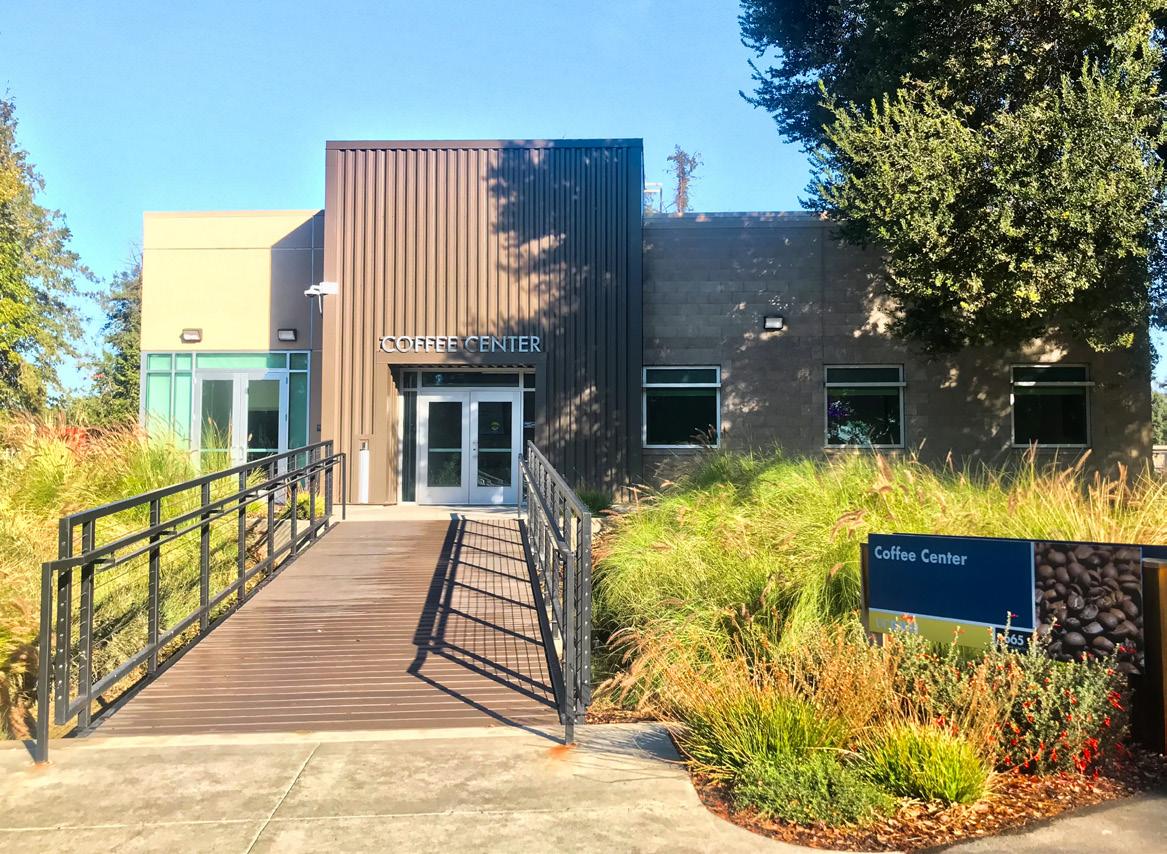
Enter digits from 1 to 9 into the blank spaces. Every row, column and 3x3 square must contain each digit. Each Sudoku has a unique solution that can be reached logically without guessing.
Answer to previous puzzle 11/14/24
occurred.
With these modern advantages, though, come modern disadvantages.
For the three, the thought of contemporary tuition rates, rent and even food was almost unfathomable.
During their time at Davis, the three paid $212 per quarter for their tuition; John even commented that he paid $50 per month for his rent living in a Davis apartment, while averages now extend far beyond what they used to pay. Tey seemed a bit disturbed to fnd that many students now work and provide for themselves in order to aford basic food and living expenses — something that was much less of a concern during their own college years.
“We all had side jobs for spending money, but we were talking around 12-15 hours a week,” Linda said. “My daughter worked 36 hours a week, alongside a full load. What I’ve noticed is that kids now are just surviving; their focus is not solely on school, it’s about survival, and about paying the bills.”
When asked what some of their preferred extracurricular activities were as Aggies, Rob remarked that he drove Unitrans buses when he attended Davis. Te three were happy to hear that the old school double-decker buses have not gone completely extinct from the community, and now even ofer service to and from the Davis Farmers Market on Saturdays.
John shared that he often participated in intramural or recreational sports, which remain very popular at Davis for students — though sport and exercise-based resources, including the development of the Activities and Recreation Center (ARC) have since
It was also revealed that during the 1970s, Greek life at Davis was viewed as being an elitist institution that most students avoided. Linda, who described that theirs was the hippie generation, commented that Greek life was often seen as very exclusionary and even classist. This system has changed significantly, with philanthropic eforts often being at the forefront of contemporary fraternity and sorority life in universities today.
“My take is that it was kind of the anti-’50s,” John said. “We were considered kind of ‘awakened.’”
Tey also described that student protests were present during their time as students. John said that protests associated with the Vietnam War “really died down in the late ‘60s,” though Linda commented that her father was worried that she would be hurt on campus in the face of protests associated with the war, which concluded during her third year at Davis.
While they expressed that Davis held fewer protests than other campuses, there has been a long-existing presence of college protesters responding to global political issues and human rights violations. Tese acts of student expression and political commentary have been an integral part of university life, with Davis and other UCs serving as examples.
Despite the overall positive memories that the siblings associate with their college experiences, John remarked that he wishes Davis conducted more outreach to establish a more active alumni network. As the Jacksons expressed, a public university system like the UCs could likely do more to reach out and invite back past students and staf to engage with current campus life.
“The university could encourage [inviting] the alumni back,” John said. “Just to make it easier — you know, like [Rob and Linda] were able to do today. Reach out to them and say, ‘Hey, come sit in on this event or this class, or anything like that.’”
UC Davis has come a long way over the last several decades, as this conversation with Rob, John and Linda seemed to afrm. Davis has transformed from just Berkeley’s agricultural school into a diverse, expansive research institution that is not only academically renowned and competitive for applicants, but also seeks to supply its students with as much hands-on experience as possible.
To conclude the interview, the Jacksons and Jackson Becker shared some advice for current students attending Davis.
“Walking around here, I wanted to get up on a park bench and scream: this is going to be the best time of your life!” Rob said. “Right now. It will truly never be better than this. Lord knows there’s enough pressure on college kids, and to characterize college as [being] stress-free is not right [...] I remember, my dad told me the same thing when he dropped me of here.”
John continued by disclosing his own advice for current Aggies.
“Take this opportunity to grow,” John said. “I mean you don’t have the weight of the world on your shoulders, you don’t have to take care of your family and you just hope that no one’s trying to step on each other to get to some other place — so just enjoy the opportunity that this is.”
Finally, Linda shared advice about stepping outside of your comfort zone and past experiences during college.
“Think outside of your family, outside of the way you were raised and
entertain other ways of looking at the world,” Linda said. “You can learn a lot from people. Get out of your bubble. It’s so important — especially the way things are right now.”
“[Suparak] not only highlighted the historical and spiritual signifcance of the Asian elements scattered across sci-f worlds but also explored how they contribute to the ongoing erasure of Asian bodies from the genre while keeping their cultural aesthetics,” Torgrimson said. “She touched on concepts like ‘Commodity Orientalism,’ or the way objects and cultural markers from Asia are exploited as symbols of wealth and global exchange, and ‘TechnoOrientalism,’ which racializes Asia as both a producer and symbol of futuristic technology.”
In a statement following the results of the presidential election, Suparak said that her performance has taken new meaning.
“My focus on the histories and consequences of anti-immigrant, anti-Asian and anti-Arab rhetoric, visual culture and legislation in “Asian futures, without Asians” feels even more urgent in light of Trump’s reelection, with his promises to massdeport immigrants and his decadeslong targeting of people of color,” Suparak said.
Additionally, the event included a 15-minute intermission with electronic music performed by Tammy Lakkis.
“[Lakkis is a] songwriter, singer, producer, poet and DJ,” the event’s program read. “Lakkis made a name for herself performing playful, all hardware live sets and singing bilingually in English and Arabic.”
Tis was followed by a conversation between Suparak and Mark Jerng, the chair of African American Studies and a professor of English and Asian American Studies.
Jerng asked questions around topics that were discussed in Suparak’s lecture, such as the durability of Asian aesthetic tropes within the media.
“Tere are artists and writers doing work that is reimagining and resetting the entire set of tropes,” Suparak said.
Christy Vong, a fourth-year Asian American studies and community and regional development double major, said she was moved by Suparak’s performance.
“My perceptions about science fction have defnitely changed since the performance,” Vong said. “I think I’m more able to be critical of them now. Once she pointed it out, I can’t unsee the way there are backgrounds of Asian culture yet the main characters on screen are white people. I wish more white people could
watch and listen to this performance. People studying abroad in Asia or involved with Asian culture somehow, I think would be a great audience to have. Because I feel these ideas are in peoples’ subconscious.”
Torgrimson expressed her thoughts about the impact of Suparak’s lecture.
“Suparak’s performance brought these issues to the forefront in a way that was both engaging and accessible, using sound and lighting to make the experience immersive,” Torgrimson said. “I appreciated how it opened space for deeper conversations about the genre’s cultural implications, making me think critically about how sci-f can both inspire and exclude.”
DMA plays a signifcant role in shining a spotlight on local politics and ensuring unbiased production. To help keep citizens fully informed, they provide a platform for candidates to share the goals of their campaign and for diferent local organizations to discuss the possible impacts of ballot measures.
“We’re completely non-partisan, and our staf doesn’t endorse or take positions on local issues,” LabbeRenault said. “I’ve had candidates tell me they didn’t think they’d be treated fairly at DMA because ‘it’s Davis,’ and they’ve been pleasantly surprised by our even-handed treatment. Our job isn’t to play a role in politics, but to use media tools and infrastructure to help illuminate local issues.”
FROM PAGE 5
We should be able to welcome different kinds of people into our communities and social circles without making a big deal out of it or pointing out their diferences.
Most of the time, “quiet” people are not shy nor do they hate talking to others. Some simply speak when they have something to say and others are just waiting for someone friendly to talk to them normally.
Disclaimer: Te views and opinions expressed by individual columnists belong to the columnists alone and do not necessarily indicate the views and opinions held by Te California Aggie.
Social media influencers like Nara Smith and Ballerina Farms reflect traditional domestic practices and aesthetics
BY JENEVAH HARRISON features@theaggie.org
Te modern tradwife narrative has become popularized on social media platforms, showcasing women practicing traditional roles of mothers and homemakers. Popular infuencers such as Nara Smith and Ballerina Farms are examples of this tradition and have inspired a generation of women to crave the simplicity of a lifestyle which celebrates traditional gender roles, according to some students.
Violet Ichel, a second-year design major, described what she has seen on social media.
“I’ve seen a lot of Instagram Reels of women cooking for their husbands, which seems normal; however, certain creators such as Nara Smith exaggerate this practice,” Ichel said.
“Her appearance is sort of uncanny, in that it is almost too perfect.”
Some say this resurgence of a 1950s-style vision of womanhood represents a personal embrace of femininity, simplicity or family life. For others, it’s a troubling return to out
particularly among younger feminists who see it as a pushback against hardwon strides toward gender equality.
One feminist-identifying student Melissa Caltacci, a second-year nutrition science major, said that it is extremely harmful to young girls who
per-traditional mold. It’s not about homemaking being wrong; it’s about the pressure to conform to a single vision of what womanhood should be.”
Te tradwife movement appeals to some as a refuge from the stress and burnout associated with modern life.

In light of the recent election, third-party voters share their thoughts
BY LAILA AZHAR
features@theaggie.org
Since 1853, the president of the United States — with the exception of Andrew Johnson, who became an Independent after becoming unpopular within his party — has been either a Democrat or a Republican.
For many people, voting for a presidential candidate outside of the two major parties is unthinkable.
UC Los Angeles student Hamza Khan understands why his decision to vote third party was surprising to others.
“A lot of people just see it as: why would you vote for a candidate who has no chance at winning?” Khan said. “But I think there’s more to consider than just that.”
In the recent 2024 election, NBC News reported a total of just under 2.7 million third-party votes, in comparison to president-elect Donald Trump’s 75.9 million and current Vice President Kamala Harris’ 72.9 million.
For voters such as 2024 UC Davis graduate Noorulain Ali, the decision to vote third party was heavily infuenced by the confict in Palestine.
“I defnitely stopped supporting the Democratic party after the way the situation in Palestine was handled by [President Joe] Biden,” Ali said.
It’s no coincidence that a signifcant percentage of Muslims in the United States voted third party this year. 53% of Muslim voters voted for Green party candidate Jill Stein, and only 20% voted for Kamala Harris, according to an exit poll conducted by the Council on American-Islamic Relations (CAIR).
This marks a major shift in Muslim voters turning away from the Democratic party. In 2020, 65% of Muslim voters voted for Biden.
“Although Muslims constitute roughly 1% of the American population, they are an important voting bloc because they are concentrated in swing states, which are often narrowly won in elections,” an Al Jazeera op-ed by Dalia Mogahed and Saher Selod reads.
In 2020, for example, over 60,000 Muslims voted in the state of Georgia — a state which Biden won by a margin of only 12,000 votes. In Pennsylvania, which he won by 81,000 votes, 125,000 Muslims voted. Four years ago, Biden won Michigan — a state with 240,000 Muslim voters — by 155,000 votes.
Tis year, the state was home to the Uncommitted Movement, which protested Biden’s nomination.
Tis election has left Muslim voters feeling abandoned by both major parties.
“On one hand, the Democrats are facilitating a genocide abroad,” Khan said. “But on the other hand, Trump has sparked a lot of inflammatory rhetoric about immigrants, notably from Muslim-majority countries, which makes things dangerous for those of us here. It’s a lose-lose situation.”
Some view third-party voting as a step toward a more equitable form of election.
“We deserve better than a twoparty system,” Khan said. “If we’re stuck between the same two options every time, it means politicians aren’t ever incentivized to be better, or to be actually good. People just vote along party lines.”
Following the results of the recent election, many took to social media to express their frustration with third-party voters.
“Generally...what was Tird party voters thought process,” a tweet with over 79,000 likes reads. To some, this sentiment feels unfair.
“I don’t understand how people can see the images that have come out of Gaza and fault others for not voting for someone who served under the administration in charge while all of this is going on,” Khan said.
The vote of every third-party voter wouldn’t have alone changed the outcome for Harris — not the popular or electoral vote. Especially for voters in California, a state which is called for the Democratic party as soon as polls close, third-party voters likely didn’t impact the results of the election.
“It’s not right to blame us for the way things turned out,” Khan said.
Parties are eligible for public funding if they receive 5% of the popular vote in a presidential election, a fact that some cite as infuencing their decision to vote third party.
“Even if a candidate doesn’t win, if they can just reach that 5%, it’ll impact the amount of resources they get,” Ali said.
Megan Le, a third-year economics major, is not a third-party voter, but she doesn’t agree with the outrage that has been directed at them. For her, the onus is on politicians to appeal to voters.
“I think it’s better to be a third-party voter than to be completely disengaged from politics. At least you’re making a decision and doing what you think is best for the country, instead of just apathy,” Le said. “I don’t think voters should have to vote for a candidate they fnd legitimately appalling. I think politicians have a responsibility to create platforms that resonate with the people they’re trying to serve.”
Regardless of who one voted for in the recent election, it’s likely that everyone has something they’d like to change about the system.
“At the end of the day, it’s all about what someone thinks is best,” Khan

uencers like Ballerina Farms depict a serene, family-centered life in an idyllic rural setting away from the hustle of cities and careers.
“I understand why it’s alluring,” Anna Petruzzi, a second-year psychology major, said. “Everyone’s exhausted by societal pressures to succeed, so this alternative looks peaceful. But I wonder if it’s romanticizing a time when women didn’t have a choice but to stay
Critics such as Petruzzi argue that the movement’s glorifcation of domesticity risks setting back decades of progress in gender equality. In their view, these images often ignore the harsh reality of the 1950s, when women faced limited choices, fnancial dependence and a lack of career opportunities.
For many critics, the tradwife trend reveals a deeper issue with how social media shapes identity and aspirations. By presenting a highly curated and aesthetically pleasing portrayal of domestic life, infuencers like Smith and Ballerina Farms may be setting unrealistic standards. Rather than simply refecting a lifestyle, the movement often promotes an idealized, fltered version of it that hides the mundane or difcult aspects.
“We see images of perfect, magazine-worthy homes, but the reality of domestic life isn’t always that pretty or fulflling,”
Caltacci said. It’s also worth noting the econom-
ic reality behind many of these “tradwife” infuencers, who have substantial means. Tey often exceed the average person’s fnancial means, portraying unrealistic and unattainable lifestyles.
Despite the criticism, some supporters argue that the tradwife movement isn’t about pushing all women to stay home but instead about giving women the option to choose homemaking without stigma.
For many women, returning to a simpler lifestyle is empowering in a world that often equates worth with career achievements. Tey argue that modern feminism should allow space for all women to make choices about their lives — whether that means pursuing a career, becoming a stayat-home mother or fnding a balance between the two.
Yet, the tradwife trend reveals how complex and divisive these issues remain. Te choice to embrace traditional roles may feel liberating to some, but it’s also laden with implications and expectations that can shape younger generations’ perceptions of womanhood.
Te tradwife movement underscores the diversity of the feminist conversation in modern society. While some fnd peace in a return to traditional gender roles, others feel it risks reviving outdated practices.
As social media continues to shape lifestyles and ideals, the debate over the tradwife narrative serves as a reminder of the power — and responsibility — infuencers wield over their audiences.
Whether for or against, there’s no denying that the movement has sparked meaningful conversations about gender, choice and the evolving defnitions of freedom and femininity in the 21st century.
Local students and business owners share thoughts on lights throughout downtown and campus
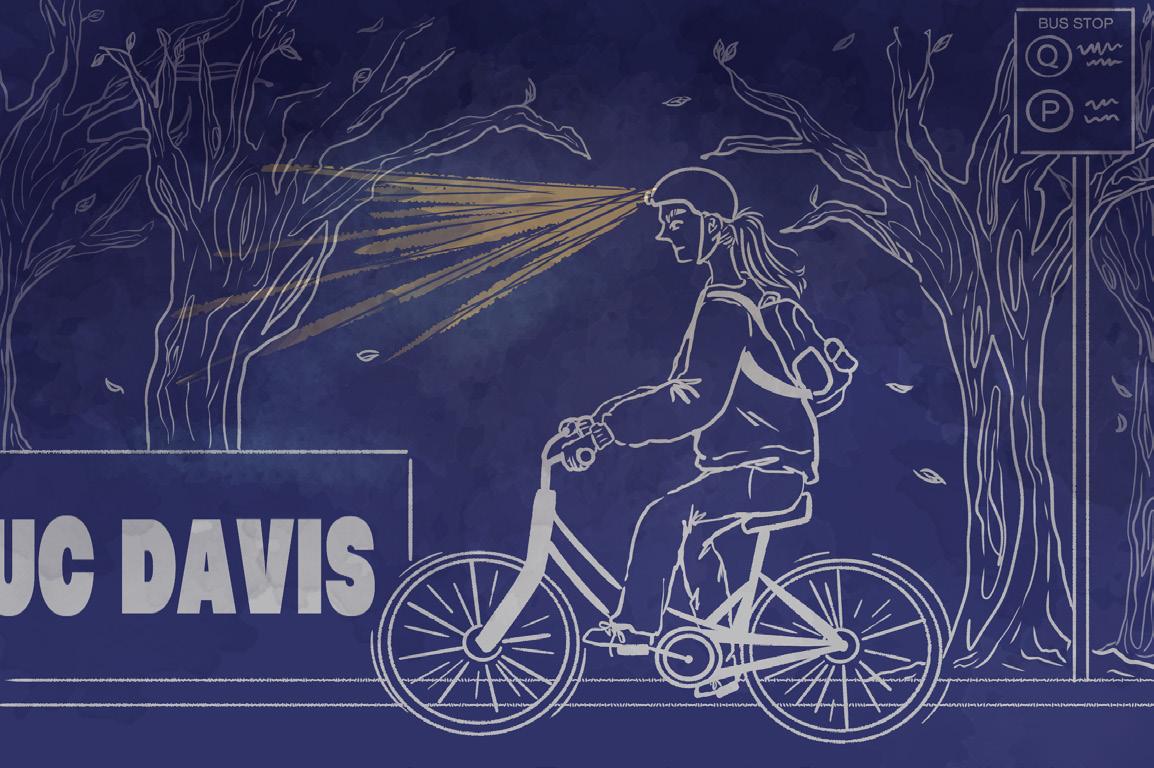
BY NOAH HARRIS features@theaggie.org
Daylight savings recently made its biannual appearance into our lives. As we fall back one hour, darkness begins to fall at a much earlier time and lighting becomes more necessary throughout the community.
In January, the city of Davis released a survey for residents ofering three options for residents to choose from to light up Downtown Davis. “[Tere are] three diferent lighting options [...] to replace the decorative ‘twinkle’ lights that previously adorned trees along downtown sidewalks,” the city of Davis said on their website. “These previous lights historically provided an enhanced downtown ambiance and improved lighting for safety, however were experiencing wear and tear.”
Te three options they gave were: a laser unit affixed to the ground projecting small, moving lights toward tree canopies, LED lights strung between installed poles and LED lights strung between trees.
Te city of Davis used to have 650 LED lights, which were installed in May 2014. By October of the same year, they were taken out and replaced with warmer lights due to negative resident views. Tis operation cost 350,000 dollars.
Even though the survey was taken in January, there does not seem to be any progress with this project. However, Brett Lee, the executive director of the Davis Downtown Business Association (DDBA), believes that the city has diferent plans to install more lighting in Downtown Davis. Te city is looking at replacing lighting that most people would call decorative lighting,” Lee said. “In Winters or San Francisco, they’ll have decorative lights strung up 20 feet above the street. I think the city plans to do that, which will add to the atmosphere.”
Lee continued by explaining other renovations currently underway in Davis.
“In addition, the G Sreet redesign
where there’s sort of a car-free zone, with outdoor dining as part of that project, there’s going to be lighting added,” Lee
said. “Tere’s been a little bit of a delay and I have heard from shopkeepers that they missed that decorative lighting and they’re sort of waiting for the city to replace it.”
Kelsey Meyer, a fourth-year environmental policy and planning and managerial economics double major, decided to conduct a group report on the issue. For her, downtown lighting has not proven to be as big of an issue as it is where she lives.
“I live in North Davis, and I bike to and from campus on Oak Street — it’s a beautiful street during the day,” Meyer said. “But at night, anywhere that’s not on the stretch that’s right next to the high school, it’s almost completely pitch black.”
Meyer wrote a report for a class last year that looked at improving lighting in Davis. Her group proposed three options.
“We looked into retroftting the current lights with brighter lights, which we decided would help a little bit, but probably wouldn’t be too much of an impact on the current situation,” Meyer said.
Te report proposed for Davis to build new adaptive lighting systems across the city. Tere was already a roadmap for this, according to Meyer.
“As some other cities that had implemented [similar] programs such as San Jose, they actually saved money long-term because of the energy savings from the adaptive lighting,” Meyer said.
Te city of Davis is not the only place students have issues with lighting. Tvesa Medh, a third-year psychology and cognitive science double major, and Molly Mac Farland, a fourth-year psychology major, both see lighting as something to improve on the UC Davis campus alongside downtown.
Mac Farland took a University Writing Program (UWP) class at UC Davis and was told to report about something she viewed as an inconvenience.
“I decided I would interview my mutual friend who works at a women’s committee on campus,” Medh said via email in a joint statement with Mac Farland.
Gene therapy research from UCSF may one day cure glioblastoma multiforme, the deadliest form of brain cancer
BY NAREN KRISHNA JEGAN science@theaggie.org
Immunology is the study of the body’s various defense mechanisms. One main focus in this area of research is how to create defense mechanisms against malignant tumors, such as glioblastoma multiforme (GBM), one of the most aggressive forms of brain cancer. With recent advances through a new form of cell therapy, researchers aim to mitigate the deadly impact of GBMs — which could potentially lead to a long-awaited cure.
Te University of California, San Francisco (UCSF) researchers Hideho Okada and Wendell Lim have developed a novel treatment platform that may have successful implications in curing brain cancer.
One of the many types of immune cells in the body is the T cell, a white blood cell whose job is to destroy harmful pathogens. T cells originate in the bone marrow and then move to the thymus, where they undergo a “training camp” to naturally select the strongest and most efective cells. Tis is determined by their ability to bind onto specifc antigens while recognizing and not attacking endogenous antigens. Tey are critical for the regulation of pathogens and have been studied extensively over the past few decades.
CAR-T therapy is a new form of treatment that utilizes this behavior of T
cells. To administer this treatment, frst a patient’s blood is drawn to separate the T cells from other immune cells and blood components. Tese cells are then treated with a deactivated, harmless virus that carries genetic code for the cell to develop a new receptor.
Tis receptor, called a chimeric antigen receptor (CAR), is used to train the modifed CAR-T cells to recognize tumor cells, markers and pathogens. In comparison to traditional immunotherapeutic methods, CAR-Tcell therapy provides treatment over a longer period of time. Furthermore, the treatment is highly specifc to the patient; the endogenous cells provide a higher degree of safety, as they will not interfere with other cellular and metabolic processes.
The researchers have created a treatment platform called E-SYNC, allowing them to control the activity of CAR-T cells by adding an “on” and “of” switch using SynNotch technology.
“A synNotch receptor that recognizes a specifc priming antigen [...] can be used to locally induce expression of a CAR,” the article, published in PubMed, reads.
Because some healthy cells in the body exhibit certain markers or proteins that are similar to those found in tumor cells, having the CAR-T cells act on all of these cells would damage healthy, viable cells. Instead, Okada and Lim inject the cells while they’re in an “of”
broader scenario and not only what is going to break a headline or what is going to make people read, but the individual protection of a person and the efects that can have in a lifelong career.”

state. When they are close to a target tumor cell, E-SYNC activates the cell, initiating an attack on the tumor cell. After the attack, the CAR-T cell is deactivated to protect healthy cells from being attacked until it is near another
cofee beans afect the quality and taste of the fnal product. Klippel Huber, who is from Brazil, attributes his interest in cofee research to a lifelong involvement in its production.
“I would like to remind Te Aggie that we are students before we are student government ofcials and so our personal privacy outside of our roles deserves to be respected as much as any other students,” Julka said. “I’d also just like to mention that when I did bring this up to Te Aggie during their quarterly report, I felt like the answers that [Editor-in-Chief Chris Ponce] gave me were not adequate, and I felt like they truly did not care about the privacy of students coupled with the fact that they are not endorsing [Constitutional Amendment #92].”
“I really feel that Te Aggie needs to include privacy into their [Code of Ethics] and that they need to really start valuing the humanity of these students and not just the fact that it’s something interesting to read in the papers,” Julka said.
Te Aggie’s current Code of Ethics includes a passage on privacy which states “that private people have greater personal privacy than public ofcials. Only an overriding public need can justify digging into someone’s private life.”
Rosenbach also took issue with Te Aggie’s usage of the names of public ofcials and students in articles.
“I think it’s most important to talk about sensitive issues being exposed in the press, especially in the times that are coming,” Rosenbach said. “We’re talking about health issues that might be coming with a nationwide ban and that could end up in criminal charges for certain people. Let’s remind you that these kinds of things are not only granted privacy by ASUCD bylaws or not only by a Code of Ethics, but sometimes the 14th Amendment. You have the right to privacy by federal law.”
“We understand that, as was mentioned by Te Aggie, ‘In journalism names are everything,’” Rosenbach said. “But in here we’re all students. Our position is the same. So [writing] student A [or] student B is not going to change anything in a narrative because we all have the same title. We understand the idea of the names. But we also really ask Te Aggie and plead that when putting those things into account, consider a
Te Aggie, as per editorial guidelines, views names as essential to holding public and elected ofcials accountable so that their actions and quotes are clearly attributed to specifc individuals. Anonymity is only granted to sources on rare and special cases, as mentioned in the Code of Ethics.
Te meeting was adjourned at 10:28 p.m.
6
Although they seem to promise enjoyment and excitement at f rst, the transient nature of microtrends and the constant replacement of each trend with something new makes it hard to maintain the personal feelings of connection that require repeated use and time to develop.
Instead of engaging with trends that consist of making purchases in order to participate, there are alternatives that can encourage the exploration of new activities without spending money. Some microtrends, such as those involving food and meal prep, can transform necessary daily tasks into a new experience, while others, such as silent walking, highlight new experiences as a possibility for making small positive changes.
While social media engagement and mass production of cheaply manufactured goods grow increasingly intertwined, yielding disastrous e f ects on the environment, f nding and engaging with trends that do not require spending money can be a crucial way to combat the negative e f ects of microtrends.
“I grew up on a cofee farm,” Kippel Huber said. “I was into my cofee my whole life.”
His interest in pursuing research stemmed not only from his personal involvement in the practice but also the hands-on experience he gained working with cofee growers in Brazil following his undergraduate studies. Troughout his experience, he noted several issues in the process of harvesting and began to explore alternative methods to combat these problems.
“I was always intrigued by how to build solutions for cofee growers and how to make their lives easier and produce better, more sustainable cofee,” Klippel Huber said. “Harvesting is very difcult and the defects with cofee is a really big problem, which made me wonder how I could help [growers] better. UC Davis seemed like a good place to study and research these problems.”
“[The friend] explained to me that her committee actually has a set aside budget to fund projects like this to increase safety on campus, so we decided to push this project further and try and get more lights installed not only around that building, but other places on campus that aren’t well-lit.”
Dark sky legislation is an important part of this issue. Davis has had a light ordinance since 1998; it was established to minimize the amount of lighting at night, which creates less light pollution and allows for a more visible night sky.
For Meyer, adaptive lighting would not go against this ordinance, though it would mean adding more lampposts.
“A solution like adaptive lighting can help solve that because it’s only [going to] be turned on when it’s needed by travelers,” Meyer said.
As opposed to lights that stay on all night, adaptive lighting would only turn on occasionally. Mac Farland understood the city ordinance but expressed concern about what it meant

tumor cell.
Laura López González, a science correspondent from UCSF, commented on the impact and applications of this new research.
“All of this, we hope, will make
for students’ safety.
“It’s important for campuses to have plenty of light not only for women but anyone who walks or travels in dark areas,” Mac Farland said. “Especially where there’s a ton of young people who can be considered vulnerable at times.”
Lighting is something that has caused much debate in Davis. Te hope for students like Meyer, Lee, Mac Farland and Medh who have concerns on student safety is that ongoing problems will be resolved in a timely manner. Student safety is a community-wide concern as we enter the year’s winter months and experience earlier sunsets and darker nights.
“What goes well about this event every year is just the amount of community that comes out and participates,” Smithers said. “So, you’ll notice people start helping us pick up the chairs and pull down the tents — it really is a community-driven event.”
Smithers hopes that this ceremony reminds the community that this holiday is more than a three-day weekend but a day for acknowledging the military.
“Because the military do what they do, we are able to hold events like this,” Smithers said.
For this reason, Smithers and the Davis Cemetery selected veterans who could intimately convey this meaning.
Secretary of Veteran Afairs for the California Department of Veteran Afairs and Director of Veteran Services for Solano County Ted Puntillo helped over 20,000 veterans in his 20 years as a veterans advocate. On this Veterans Day, Puntillo was the master of ceremonies.
Puntillo said that it is honorable to speak for Davis, a city whose rich history, commitment and support for its veterans is dearly felt.
“It is deeply meaningful to be here with all of you as we gather to pay tribute to the brave men and women who served our country with unwavering courage and conviction,” Puntillo said.
Sterling Koliba is a Marine, Air Force and California National Guard veteran, a junior vice commander of the Dixon Veterans of Foreign Wars post and a founding member of the Yolo and
E-SYNC more efective than traditional CAR-T therapy and with less side efects,” González said. “I think there’s a reasonable chance we can apply similar approaches to other cancers, like HER2positive breast cancer.”
Solano County chapter of the Veterans Beer Club. Koliba reafrmed the sense of community felt by veterans who connected over their shared experiences — he described these personal bonds that he formed during his service.
“At boot camp, we would hydrate each night in preparation for the next day,” Koliba said. “What that meant was taking a 32 oz canteen and drinking it as fast as possible while the drill instructor counted down from 10 to zero [...] and if any signifcant amount of water [was left], we would do it again.”
While Koliba reflected on his rackmate’s capability in other respects, such as disassembling and reassembling their service rifes blindfolded, this rackmate could not fnish all that water quickly enough.
“So, every night, to protect the platoon and take that burden of his shoulders, I would fnish mine, and we would swap canteens while the drill instructors weren’t paying attention,” Koliba said. “Tat’s where it begins — in basic training with the canteens [or] the helping hand to help a buddy study for a test the next day.”
From this story, Koliba described how this community starts early but never truly ends. After 10 years of service in the Marine Corps, he was in a position of uncertainty, but it was through veterans resources, such as the Student Veterans of America, that he could rekindle that network and gain the guidance to be the person he is today.
“What I learned then was that the call to serve does not simply leave because we no longer wear the uniform,” Koliba said. “It is for them and all those that have honorably served that we celebrate today. Because Veterans Day is about reminding the people of this great nation that this freedom isn’t free, and [it is important] to remind each other, to acknowledge and to show our support for all those, past and present, who have served this great nation and donned this uniform with the willingness to put themselves in harm’s way to protect others.”

UC Davis football pushed winning streak to nine games
BY LUCIENNE BROOKER sports@theaggie.org
Washington-Grizzly Stadium in Missoula, Montana is a notorious environment for college football teams. Te home team, the University of Montana Grizzlies, packs the stands with thousands of loud and passionate fans for every single game and Saturday, Nov. 9 was no exception. A packed crowd gathered despite the chill in the air to watch their team take on the UC Davis Aggies, where they were treated to an unusual sight. For the frst time since 2018, the Montana Grizzlies were defeated at home, as the Aggies extended their winning streak to nine straight games.
Although UC Davis started of the 2024 season on a low note, losing to UC Berkeley, the Aggies quickly bounced back and hadn’t lost a game since. Coming into the intimidating environment in Missoula, the team and new Head Coach Tim Plough knew they needed a win to keep their momentum alive as they approached the postseason.
It was a rough start for the Aggies as the Grizzlies quickly took the lead, scoring a touchdown on their opening sequence of plays. However, Trent Tompkins, a fourthyear communications major and wide receiver, had a quick answer, responding with a touchdown of his own three minutes later.
Te second quarter was the least climactic of the game, but the Aggies did fnd an opportunity to pull ahead, pushing the score to 13-9. Hunter Ridley, a third-year communications major and kicker, converted feld goals in not only the 40 and 41-yard mark but also the 42-yard mark throughout the game. Ridley was one of two to earn Big Sky Weekly Honors for his performance in this match.
However, this lead didn’t last as long as they had hoped. Nine minutes into the third quarter, the Grizzlies’ quarterback Keali’i Ah Yat scored, which reinvigorated the home team

crowd. With a tight one-point lead, the Montana fans were feeling optimistic, but their lead only lasted a few minutes.
UC Davis’ Ian Simpson, a third-year sociology major and tight end, caught a 22-yard pass from Miles Hastings, a ffth-year communications major and quarterback, to send the Aggies back into the lead going into the fourth quarter. While the game had been very close up until this point, thanks to stellar defensive work from both teams, the fourth quarter presented the Aggies with
several scoring opportunities, most of which they managed to convert.
Lan Larison, a fourth-year managerial economics major and running back captain, scored a touchdown early in the quarter. Ridley then converted his second feld goal, increasing the lead to 13 points. Although the Aggies failed to score another touchdown, they did earn another three points from Ridley’s fnal feld goal, making the fnal score 3014. While Montana fought hard until the end, they were unable to get past
a tough Davis defense, who held the Grizzlies to their lowest total ofensive yards so far this season.
Tis decisive and unexpected victory has propelled the Aggies to a new level of national attention. Tey hadn’t beaten Montana since 2018 and had only won two of 11 matchups. By not only beating the Grizzlies but also beating them in their home environment, the Aggies showed football fans across the country that they are a serious threat.
Following this game, UC Davis took on Montana State on Nov. 16 at the UC Davis Health Stadium and lost 30-28. Te home match against Montana State, ranked No. 2 in the Big Sky Conference, was the deciding game for the conference championship. Te Aggies are set to go against Sacramento State in their fnal game of the regular season on Nov. 23 at Hornet Stadium in Sacramento. Finally, the Aggies close out their season in the Causeway Classic and will then set their sights on the post-season tournament, where they’re hoping to break program records.
Aficionados de los Yankees y Los Dodgers describen sus experiencias durante la serie mundial de béisbol
Traducido por Ileana Meraz, Escrito por Diego Cerna sports@theaggie.org
El 30 de Octubre marcó el día cuando Los Dodgers de Los Ángeles ganaron la serie mundial contra los Yankees de Nueva York fnalmente poniendo un fn a la competencia nacional y anual de la liga Nacional y la liga Americana. El campeonato, el cual determina el equipo ganador a base de cual equipo gana la mayoría de siete juegos, terminó con el quinto juego en el estadio de los Yankees con una victoria de 7-6 para los Dodgers.
Aunque están lejos de Los Ángeles y de Nueva York, los afcionados de UC Davis igualmente compartieron la emoción durante toda la temporada especialmente después del último partido.
“Estuve en la biblioteca cuando ganaron, y me dio felicidad al ver a tanta gente saltando de sus asientos para celebrar” nos contó Carlos Gonzalez, un estudiante en segundo año de Universidad en la facultad de desarrollo humano.
“En el momento que ganaron, llamé a mis padres por videollamada para ver sus reacciones. Es increíble pensar que un juego pueda desarrollar tanta emoción.”
Aunque los apasionados Dodgers y los Yankees estuvieron especialmente emocionados este año dado que estos dos equipos clásicos estuvieron compitiendo, Roman Kuznetsov un estudiante de la facultad de Ingeniería Aeroespacial, nos describió cómo ha mantenido su pasión por sus equipos preferidos por años.
“Hace años, cuando tenía aproximadamente tres años, vi una cachucha de los Yankees que me compró mi mamá en mi armario” nos describió Kuznetsov.
“Cuando caminaba por las calles de mi barrio en Te Bronx vi muchísima gente que se ponían sus cachuchas de los Yankees. De una manera u otra me convertí en un fanatico de los Yankees.
Gonzales también nos confesó que sus conexiones con los Dodgers tiene sus raíces con su familia.
“Siempre he sido un fanatico de los Dodgers pero como mi padre vive en Los Ángeles, tiene una historia más personal para mí” nos confesó Gonzalez. “Crecí viendo todo los

equipos que prefería mi padre y por esa asociación se convirtieron en mis equipos también.”
Como un apasionado de los Yankees, Kuznetsov también recordó la triste pero emocionalmente transformativa experiencia que trajo el estar en Davis cuando perdieron los Yankees. “La mayoría de los fanáticos que yo conozco están en Te Bronx, no aquí en Davis” nos confesó Kuznetsov. “Cuando perdimos fue un momento que nos quebró el corazón. Los otros apasionados como yo de los Yankees se sintieron deprimidos después del partido. Pero, aunque perdimos, encontramos unidad en nuestra melancolía.”
Daksh Shekar, un estudiante también de la facultad de Desarollo Humano, nos dijo cómo noto que un juego tiene la habilidad de unir a su familia y sus amigos. “Viendo el béisbol me ha dado la oportunidad de acercarme más a mis compañeros de casa porque todos queremos que gane el mismo equipo”
El modo de ver cualquier partido consta de una gran variedad, como Shekar, algunos preferen ver un partido en un grupo de amigos, y otros
preferen verlos solos.
“La mayoría del tiempo yo soy el que está viendo un partido solo. Mis otros compañeros de casa no ven el béisbol y tengo la tendencia de ponerme muy tenso y gritarle a la televisión” nos explica Gonzalez.
“Unas de las pocas veces que veo un partido en grupo fue en San Diego con mis amigos” Kuznetsov también nos explico sobre los diferentes lugares donde él vio los juegos de la serie mundial
“Hay veces que veo un partido en mi computadora o en mi teléfono.” nos explicó Kuznetsov. “Algunas veces voy a casa de mi amigo para verlo en su televisión. Él es afcionado de los Dodgers y cuando vimos los partidos juntos creó una dinámica muy interesante” bromeó Kuznetsov.
Aunque hubo mucha emoción durante la competencia, los estudiantes de las dos ciudades que vieron la serie de partidos en Davis comparten el querer de estar en sus respectivas ciudades durante el partido.
La gente se altera en Nueva York” nos dijo Kuznetsov. “Todos están saltando de emoción y si pudiera regresar a Nueva York para tener la oportunidad de verlo, lo haría”
Además de que la serie ya es un evento importante para toda la afción, el hecho de que fue un partido entre dos equipos clásicos en el mundo de béisbol trajo un sentimiento de entusiasmo para los fanáticos del deporte.
“Creo que el simple hecho de que son dos equipos de dos ciudades tan importantes como Los Ángeles y Nueva York fue algo impactante” describió Kuznetsov. “Con que no sean fanáticos del béisbol se puede encontrar un compromiso con la importancia de un partido tan histórico entre dos rivales.” Los dos equipos continuaron estrenando estrellas en el mundo de béisbol quien aumentaron el entusiasmo de los afcionados. “La cantidad de estrellas en los dos equipos durante la serie mundial y la temporada regular hizo que esta serie fuese tan atractiva en la posición de la audiencia” contempló Shekar. “Amo ver a Freddie Freeman, Shohei Ohtani, Mookie Betts y a Kike Hernandez de los Dodger e igualmente me encanto ver Juan Soto y a Gian carlo Staton de los Yankees.” Durante la serie entera muchos fanáticos gozaron de ver sus
jugadores preferidos en cada partido y aprendiendo de sus inspirantes historias.
“Mi jugador favorito debe ser Mookie Betts”, contempló Gonzalez. “El es uno de mis favoritos simplemente porque enseña que gente de diferentes razas e identidades pueden sobresalir y desempeñarse en lo que hacen. Betts tuvo una infancia difícil y en toda su carrera le dijeron que nunca podría llegar a ser un jugador profesional por su altura. Honestamente me encanto su perseverancia y su historia de cómo llegó a la serie mundial.”
En fn, ver béisbol puede ser una experiencia electrifcante sin importar cómo has percibido el deporte.
“Creo que el béisbol es un juego inestable pero divertido” explica Gonzalez. “No hay un guión y puede cambiar de la nada como ha sucedido antes. Puedes estar ganando 5-0 y como sucedió en el último juego de esta serie, todo puede cambiar y el otro equipo sale ganando. Lo disfruto mucho por su falta de estabilidad y las emociones que trae cuando vez a la gente que está en el escenario quienes están tan emocionados como tu que su equipo está ganando.”