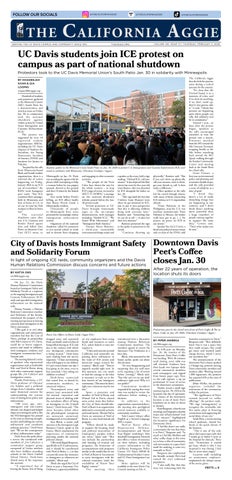
Protestors took to the UC Davis Memorial Union’s South Patio Jan. 30 in solidarity with Minneapolis
BY KHADEEJAH KHAN & GIA LOOMIS campus@theaggie.org
Hundreds of students and protestors gathered at the Memorial Union’s (MU) South Patio for a demonstration and march at noon on Friday, Jan. 30, in conjunction with the national shutdown against violent actions by United States Immigration and Customs Enforcement (ICE).
The protest was organized by over 18 registered student organizations (RSOs), including the UC Davis chapters of Students for Socialism, the Young Democratic Socialists of America (YDSA) and Students for Justice in Palestine.
“Inspired by the calls from Minnesota-based Black and Somali student organizations, there is a national day of action happening on Friday, January 30th to say ICE out of everywhere,” the RSOs’ joint Instagram post reads. “But ICE continues their rampage, both in Minnesota and here at home in CA, so we say it’s time for Yolo students to Shut It Down too!”
The national shutdown came after two U.S. Customs and Border Patrol agents shot and killed Alex Pretti, an Intensive Care Unit (ICU) nurse, in
Minneapolis on Jan. 24. Pretti was recording the agents with his phone while attempting to help a woman before he was pepper sprayed, shoved to the ground and shot 10 times by the federal agents. Two weeks before Pretti’s killing, an ICE officer fatally shot Renee Nicole Good, a Minneapolis resident. Thousands of people in Minneapolis have since protested the increasingly violent immigration enforcement actions.
Organizers of the national shutdown called for protestors to not attend school or work and to abstain from shopping
and engaging in other economic activities.
“The people of the Twin Cities have shown the way for the whole country – to stop ICE’s reign of terror, we need to SHUT IT DOWN,” a message on the national shutdown website posted before the Jan. 30 protest reads.
Several protesters at UC Davis brought homemade signs to the on-campus demonstration, with messages including “Abolish ICE,” “We Stand With Minnesota” and “Immigrants Built America.”
Dayana Horta Ramirez, a third-year sustainable environmental design major and
a speaker at the event, held a sign reading: “Defund ICE, call your senator.” It also depicted the blue winter hat worn by five-year-old Liam Ramos, who was detained by ICE alongside his father on Jan. 20.
“[My sign had] the hat that I believe Liam [Ramos] wore when he got detained by ICE, just to put it into perspective that this is affecting children along with everyone here,” Ramirez said. “Something that we can do is call — it takes less than two minutes.”
Ramirez presented the sign as she spoke to protestors in the crowd.
“Continue showing up
In light of ongoing ICE raids, community organizers and the Davis Human Relations Commission discuss concerns and future actions
BY KATYA OKS city@theaggie.org
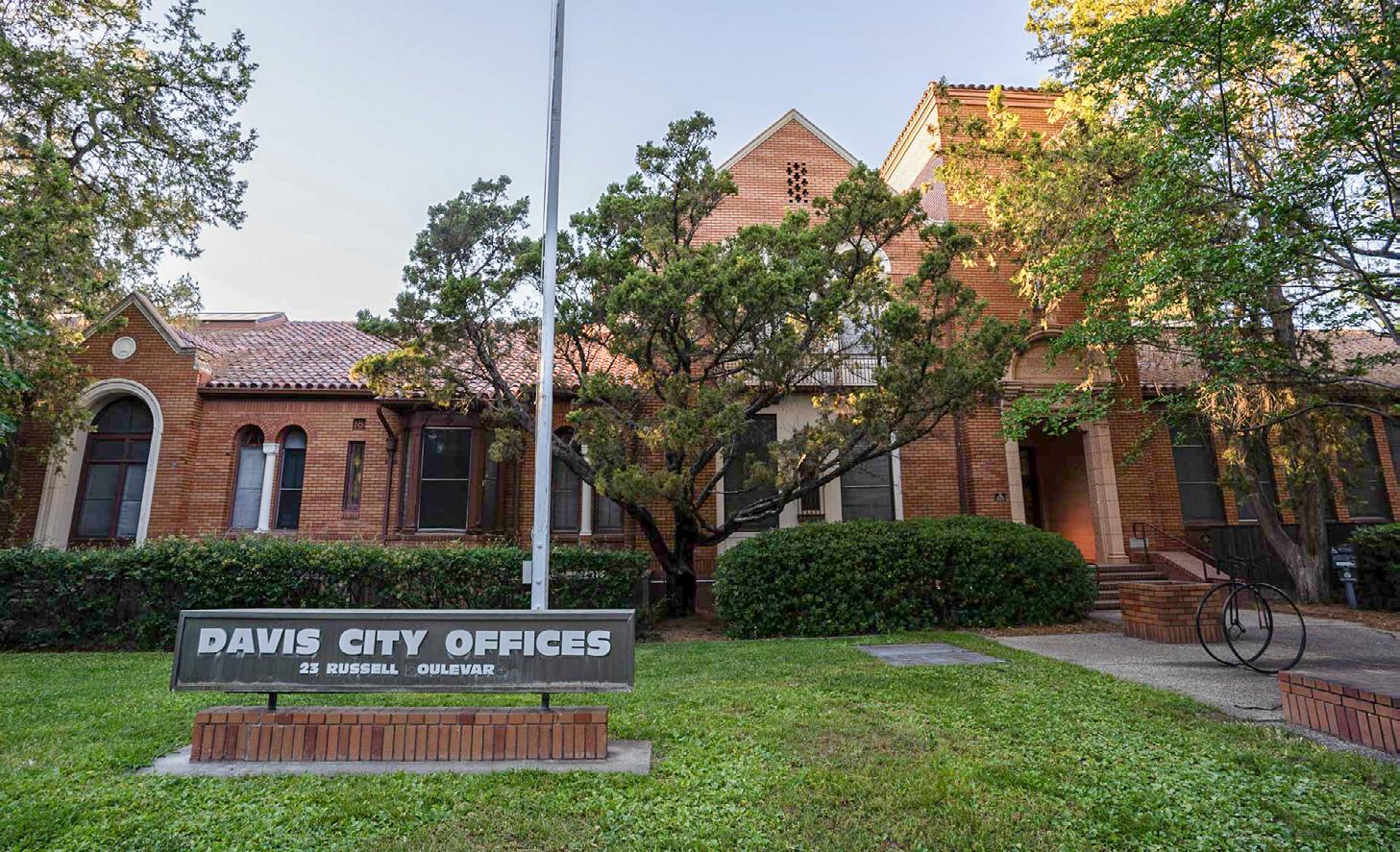
On Jan. 22, the Davis Human Relations Commission hosted an Immigrant Safety and Solidarity Forum as a response to the ongoing Immigration and Customs Enforcement (ICE) raids and upscaled immigration enforcement on the national scale.
Deema Tamimi, a Human Relations Commission member and facilitator of the forum, introduced the purpose of the meeting and openness to hearing concerns from immigrants in the Davis community.
“[The goal is to see] what organizations and community members feel that the City of Davis, perhaps in partnership with Yolo County or UC Davis, could do to better support, protect and stand in solidarity with immigrant residents and immigrant communities here,” Tamimi said.
The meeting featured a series of speakers who represented organizations such as Indivisible Yolo and NorCal Resist, along with other community support groups like ¿Un Cafecito? and immigration centers.
Natalia Deeb-Sossa, a UC Davis professor of Chicana/ o/x Studies and a political refugee from Columbia, shared some historical context for understanding the current state of immigration policy and enforcement.
“100 years ago, antiimmigrant and anti-Latinx rhetoric was shaped and helped shape anti-immigrant policy, like the 1924 Immigrant Act, praised at the time as showing strength, security and building our current militarized and racialized policing practices,” Deeb-Sossa said. “We see the consequences of [that] militarization today.”
Deeb-Sossa also spoke about a survey she conducted with members of ¿Un Cafecito?, a community support group composed of Latina mothers who have children attending schools in the Davis Unified School District. Deeb-Sossa shared some of the responses she received.
“‘[I experience] fear of leaving the house, fear of being
dragged away and separated from our family and even fear of being killed during an ICE raid due to the violence with which our immigrant community is being treated,’” Deeb-Sossa said, reading from the survey responses. “‘[I fear] not knowing what will happen to my children if I can’t return home one day. I fear going to the store, even to buy essentials. I fear taking my children to school.’”
Deeb-Sossa connected this stated fear, as shared by community members, to structural violence.
“Accumulated stress and anxiety [are] associated with the mental, emotional and physical strain of dealing with the cumulative effects of being an immigrant in the [United States],” Deeb-Sossa said. “This stress becomes lethal when the physiological symptoms are untreated, unnoticed, misdiagnosed or even dismissed.”
Ann Block, a senior staff attorney at the Immigrant Legal Resource Center, spoke at the forum. Block emphasized the importance of community planning amidst the national political climate.
“[We need] Rapid Response, specifically to ICE enforcement, and it should be coordinated with NorCal Resist, [...] as they can provide same-day assistance to immigrants as volunteers are available,” Block said.
Block also urged the City of Davis to pass a Sanctuary City Ordinance, a general prohibition
on city employees from using funds and resources to assist ICE, unless federal or state law requires it.
“Cities and counties around California and nationally are passing these ordinances in the wake of ICE arrests and detention surges around the country,” Block said. “They’re urgently needed right now. In this moment, our city needs to find the courage to do what is necessary, to truly act in the best interest of our immigrant community. [This must be done] right now; tomorrow may be too late.”
Speer, a presenter and member of NorCal Resist and Mutual Aid in Davis, shared some action items they believe the City of Davis should take. NorCal Resist is an organization dedicated to community activism and social justice. Mutual Aid in Davis, an extension of NorCal Resist, is a non-food mutual aid program.
“Efforts should be made to support the housing, food and political insecurities of [immigrant] peoples within our town,” Speer said. “This can include the partnership and funding of mutual aid programs, the formation of accompaniment-style programs similar to the model that we use at NorCal Resist in Sacramento to assist immigrants with the cultural transition [and] the availability of ‘Know Your Rights’ content.”
The meeting then
transitioned into a discussion among Human Relations Commission members. The members agreed to review the Sanctuary City Ordinance at a later date.
Block, who presented at the forum earlier, spoke out about this decision.
“It’s very disappointing and surprising that city staff seem to be requiring a lot of review before [voting],” Block said. “But why can’t we see any draft ordinance right now? Why is it not public?”
Commission members responded by stating that more time was needed to review the ordinance before making a decision.
In addition to the organizations mentioned above, the meeting also spotlighted several resources available to community members.
Yolo County Library offers English as a Second Language (ESL) courses.
NorCal Resist offers Deportation Defense, Accompaniment and ‘Know Your Rights’ workshops. Yolo Interfaith Immigration Network also offers a variety of resources on their website, including contact information to the California Immigrant Policy Center, UC Davis AB540 & Undocumented Student Center and UC Davis Immigration Law Clinic.
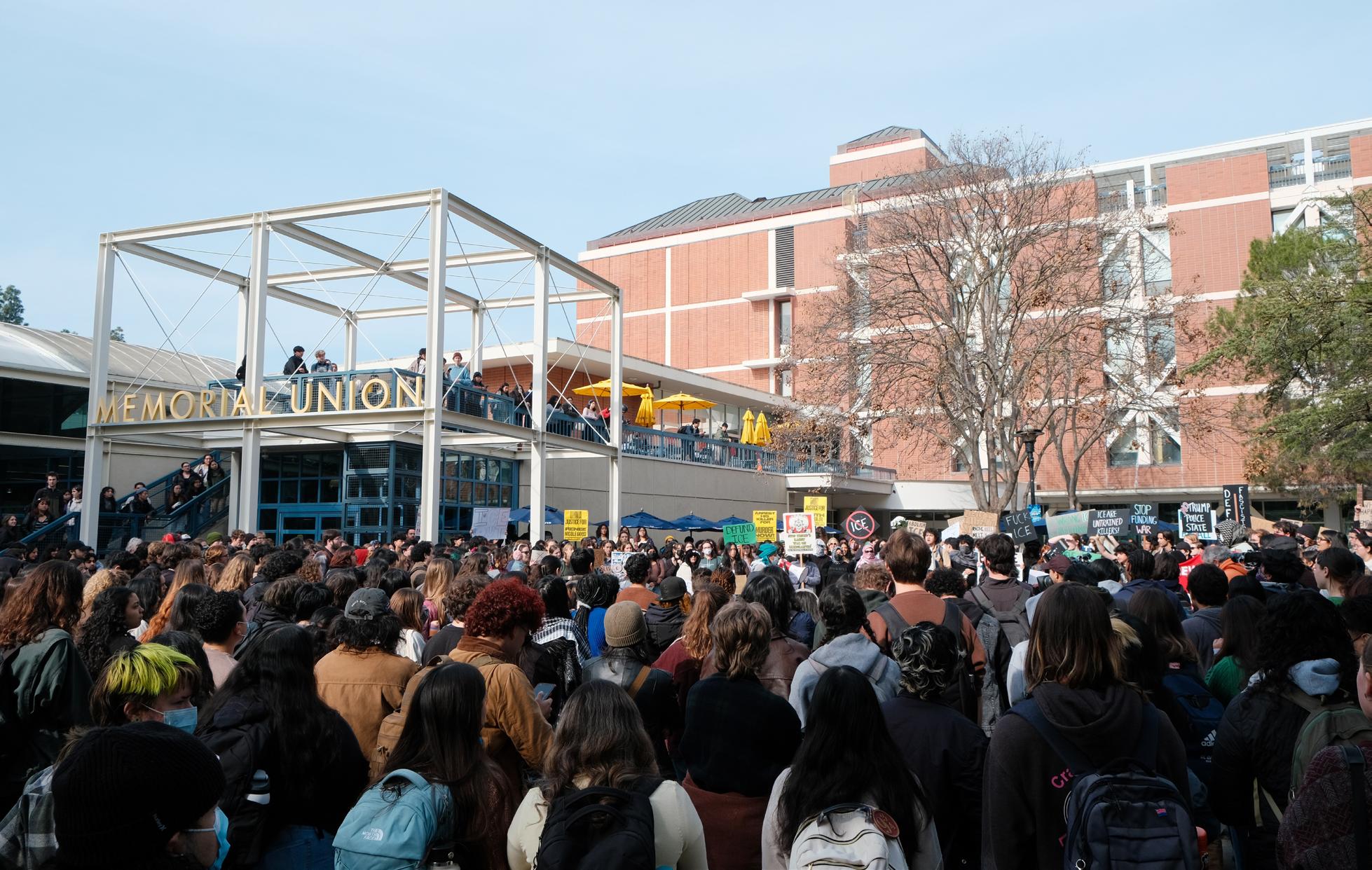
More updates will be available at the next Davis City Council meeting on Feb. 6.
The California Aggie that she feels the protests came during a critical juncture for the country.
“It’s clear that the [United States] is in a moment of crisis, and if we don’t do anything, if we don’t stand up, they’re just gonna take it,” Li said. “I think that protests are beginning spots where people can rally, feel solidarity and be in community.”
physically,” Ramirez said. “But if you can’t show up physically, call your senators, write to them, get your friends to call. It does make a difference.”
Other speakers at the rally led the crowd through chants, with many of them connecting ICE violence to U.S. imperialism abroad.
“From Palestine to the Philippines, stop the U.S. war machine,” protestors said. “From Palestine to Mexico, the border walls have got to go. [...] No justice, no peace, no ICE in our streets.”
Speaker Yao An Li Cortés, a third-year political science major and co-chair of the YDSA, told
Around 1 p.m., an hour after the protest began, speakers at the rally encouraged attendees to turn the protest into a march. Protestors marched from the MU toward the Silo Unitrans Terminal, stopping briefly at the Silo before marching back toward the MU Quad, walking through the Student Community Center and meeting back at the South Patio for a final rally. Grace Cowart, a first-year environmental policy and planning and economics double major, said the rally provided a sense of solidarity at a time of grief.
“I think that there’s a lot of really disturbing things that are happening in our country, and I don’t think there’s anything more powerful than a huge [number] of people coming together to support the same idea,” Cowart said. “That’s what makes you be seen.”
After 22 years of operation, the location shuts its doors
BY PIPER AWEEKA city@theaggie.org
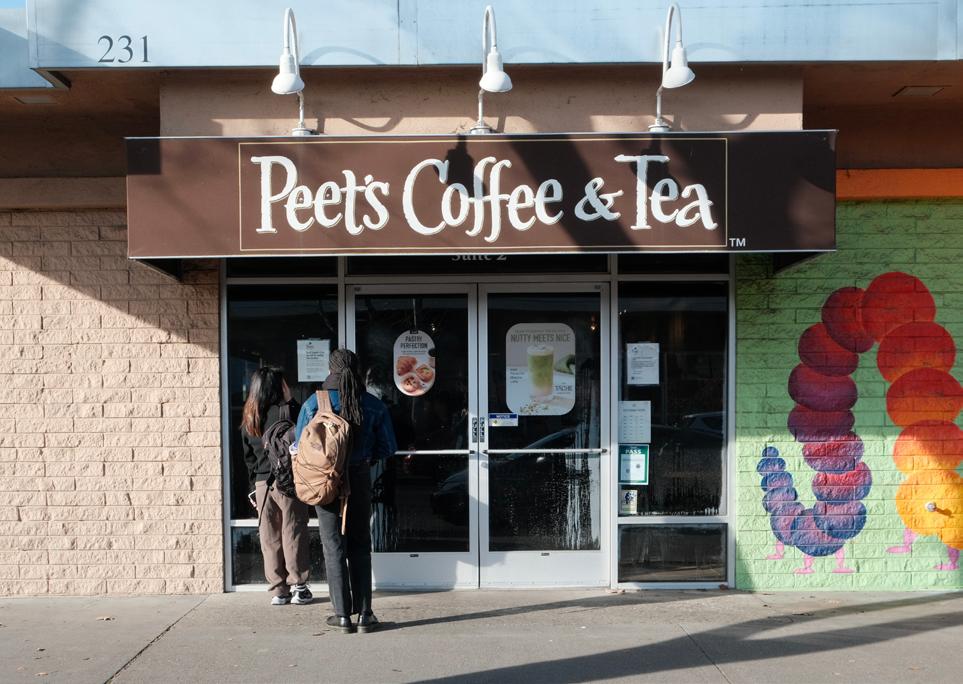
At 4:30 p.m. on Monday, Jan. 26, the interior of the Downtown Davis Peet’s Coffee was bustling. With 30 minutes until closing, every table was still claimed. Students bent their heads over laptops while several community members read newspapers and sipped from brown paper cups. Next to the cash register, a tip jar proclaimed 22 years of service to the downtown community.
Nearby stood a small sign announcing Jan. 30, 2026 as the location’s last day of operation. The closure of the downtown location is one of many Peet’s franchises set to shut its doors in January.
Katie Borgeson, a fourth-year sociology and linguistics double major and self-proclaimed “avid Peet’s enjoyer,” highlighted the location’s significance for Downtown Davis.
“I feel like there’s not really a community the way that there is at Peet’s,” Borgeson said. “As much as I feel like Mishka’s and other coffee shops in this town try to force a vibe of community and conversation in a space that’s made for studying, it came very naturally at Peet’s.”
Borgeson also emphasized the friendly attitude Peet’s had toward the city’s unhoused population.
“I also really like that they were very welcoming with the
homeless community in Davis,” Borgeson said. “They definitely knew that it was a space that they could occupy, they could get water and warmth [and] charge devices, which I never saw anywhere else.”
The announcement of the downtown Peet’s closure sparked a Change.org petition among Davis community members and students alike. Working toward 1,000 signatures, the petition has acquired 658 at the time of publication.
Jillian McKie, the petition organizer, included the sentiments of the community within the petition.
“The significance of Peet’s extends beyond its coffee offerings,” the petition reads. “We urge [management] to recognize the invaluable role this outlet plays in fostering connections and supporting the social fabric of our city.” Sarah Perez, a recent nursing school graduate, shared her shock at the quick closure of the location.
“This is one of the only places that’s open super early that I would go to before I went to the hospital for clinicals,” Perez said. “Sometimes it would get busy, which is why I was surprised it was closing. I feel like it’s never been empty.” Location staff, including an anonymous employee, emphasized the abrupt nature of the notice given.
The bill is set to increase the county’s share of administrative costs and adds restrictions on recipient eligibility for CalFresh benefits

BY MADELYN SEVIGNY city@theaggie.org
On Jan. 13, Director of Yolo County Health and Human Services Mónica Morales gave a presentation to the Yolo County Board of Supervisors on the impacts of H.R.1, or the “One Big Beautiful Bill Act,” on the county’s Health and Human Services Agency (HHSA) operations and to CalFresh administration.
The “One Big Beautiful Bill” was passed by congress and signed into law by President Donald Trump on July 4, 2025. The bill mainly affects tax credits and reductions, Medicaid, the Supplemental Nutrition Assistance Program (SNAP), student loan repayment and immigration enforcement.
In terms of SNAP, referred to as CalFresh in California, the bill affects eligibility requirements and cuts federal funding of the program. For example, recipients of SNAP between the ages 18 to 64 are now required to work at least 80 hours per month; the age limit was extended from age 54 under previous legislation. The legislation is set to reduce SNAP federal funding by approximately $186 billion over 10 years and shift administrative costs to the states.
During their staff presentation, Yolo County HHSA Deputy Director Soua
Moua gave an overview of the current CalFresh administrative cost sharing between the federal government, states and counties. Under current legislation, the federal government covers 50%, states cover 35% and counties cover 15%.
In October 2026, when these H.R.1 changes go into effect, the federal government will only cover 25% of the administrative costs. States then have to cover 52.5% and counties have to cover 22.5%.
Therefore, in order to keep their level of services flat, Yolo County would have to increase their share by $950,000. If the county keeps giving the same amount, which is currently $1.9 million, the reduction in the total overall SNAP budget is $4.2 million, according to Yolo County HHSA. This shift “could translate into a reduction of [one-third] of our caseload, approx. 8,400 individuals.,” according to Moua’s slideshow presentation on the impact of these shifting costs.
After the presentation, Moua received questions and comments from the Board of Supervisors. District 1 Supervisor Oscar Villegas asked Moua to clarify who will be most-impacted by the eligibility changes from H.R.1.
“I think that major impacts are to the able-bodied adults without dependents […] and also our non-citizens or immigrant population,”
Moua said. “We have received confirmation from the state that certain immigrant groups: including refugees, asylees, noncitizens [...] are no longer going to be eligible for CalFresh benefits under H.R.1.”
This change does not affect undocumented individuals, as they are currently ineligible for CalFresh. Moua then explained how H.R.1 changes the way HHSA can calculate CalFresh benefits.
“[They’re] taking away certain deductions that our clients can get [in order to] make them eligible for the highest amount they can [receive] under CalFresh,” Moua said.
Morales also emphasized the ripple effect of losing HHSA services such as CalFresh.
“When these programs go away, [...] it creates a lot of impacts in our community,” Morales said. “You will see more poverty, you’ll see more people not getting care, you’ll see more homelessness, you’ll see more food insecurity and these are real impacts to real people.”
The Aggie Compass Basic Needs Center supports students through the process of applying for CalFresh on the UC Davis campus, spreading awareness about resources and offering prescreening to determine likely eligibility for CalFresh.

The event aimed to spark conversation and invite feedback from Davis community members
BY ALMA CULVERWELL city@theaggie.org
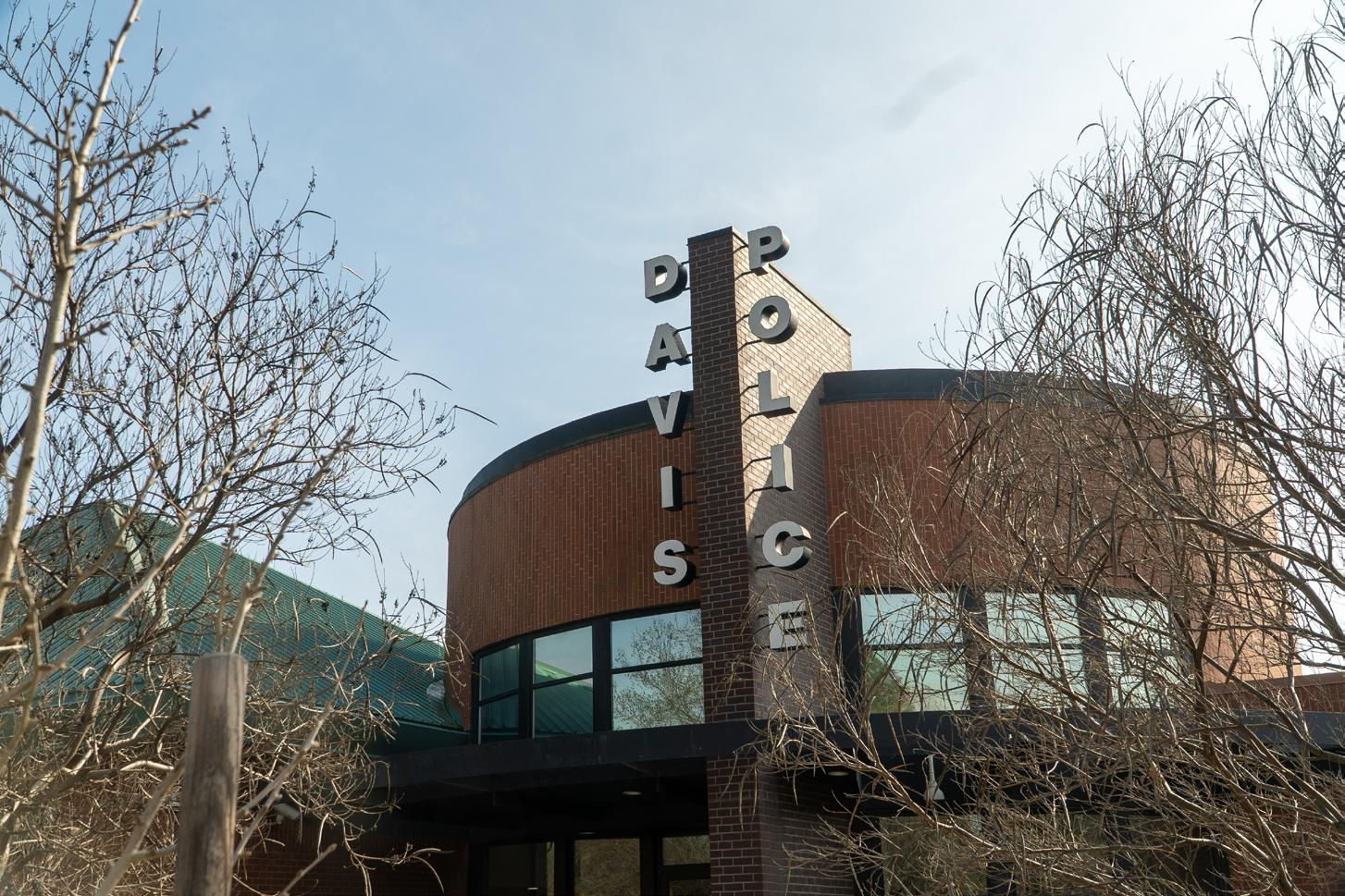
The City of Davis Police Department recently hosted a Coffee with a Cop event on Jan. 20, from 9 a.m. to 10:30 a.m. outside of Dresbach-Hunt-Boyer House on 604 2nd St.
Community members were invited to attend to share their ideas and concerns, ask questions about public safety issues and learn more about the Community-Oriented Policing and Problem-Solving Team, which works to address public safety concerns. Attendees were also encouraged to meet officers and enjoy coffee in one of Davis’ historic downtown spots.
Lieutenant John Evans, public information officer for the Davis Police Department, explained the background of the event and what the department hoped to accomplish.
“In general, I would say that the [Davis Police] Department hosts various ‘Coffee with a Cop’ events around town on a pretty regular basis,” Evans said. “It’s really just an opportunity to gather with community members to build rapport and make connections with folks around town. We don’t usually have a very specific set of topics
or updates that we are trying to push out. [… ] We’re just trying to get out there to be available for community members to have conversation and build partnership.”
Lieutenant Matt Muscardini, one of the main planners of the event, explained some of the logistics surrounding the Jan. 20 gathering.
“There were approximately a dozen people who showed up during the event,” Muscardini said. “The numbers that attend always vary. The next Coffee with a Cop will be at a downtown business, in the hope that it is not just a place for people to go and interact with department members, but some [people] will already be there if they wish to interact.”
Muscardini explained a few of the various concerns that came up at the meeting and what the typical discussion looks like.
“The concerns vary from the community members,” Muscardini said. “There were questions about the unhoused community and what [the] Davis Police Department is doing in that regard. There were questions for our Social Services Homeless Outreach team that were present at the event. We try to have personnel from our Community Oriented Policing
and Problem-Solving unit, patrol officers, detectives, Traffic unit and also other non-sworn members of the department.” Muscardini shared what he finds valuable from the event and what he hopes attendees walk away with.
“I think it provides great value for both officers and the community,” Muscardini said. “It gives us a chance to answer questions from the public about what is important to them and gives us the opportunity to make changes or assist the public. I believe it creates a better partnership [and] relationship in the community, and we serve the community. I think people sometimes think we are not approachable, whether that’s the uniform, previous interactions etc. […] and getting a chance to just get together and talk about issues can be a great benefit to the community and to us.” The Davis Police Department plans to host two additional Coffee with a Cop events in July, which are set to be advertised on the Davis Police Department’s Facebook and Instagram later this year, according to Muscardini. For more information on the Davis Police Department, visit their page on the City of Davis website.
This is the second time UC Davis has received the Carnegie Elective Classification for Community Engagement
BY CARLO FALLA campus@theaggie.org
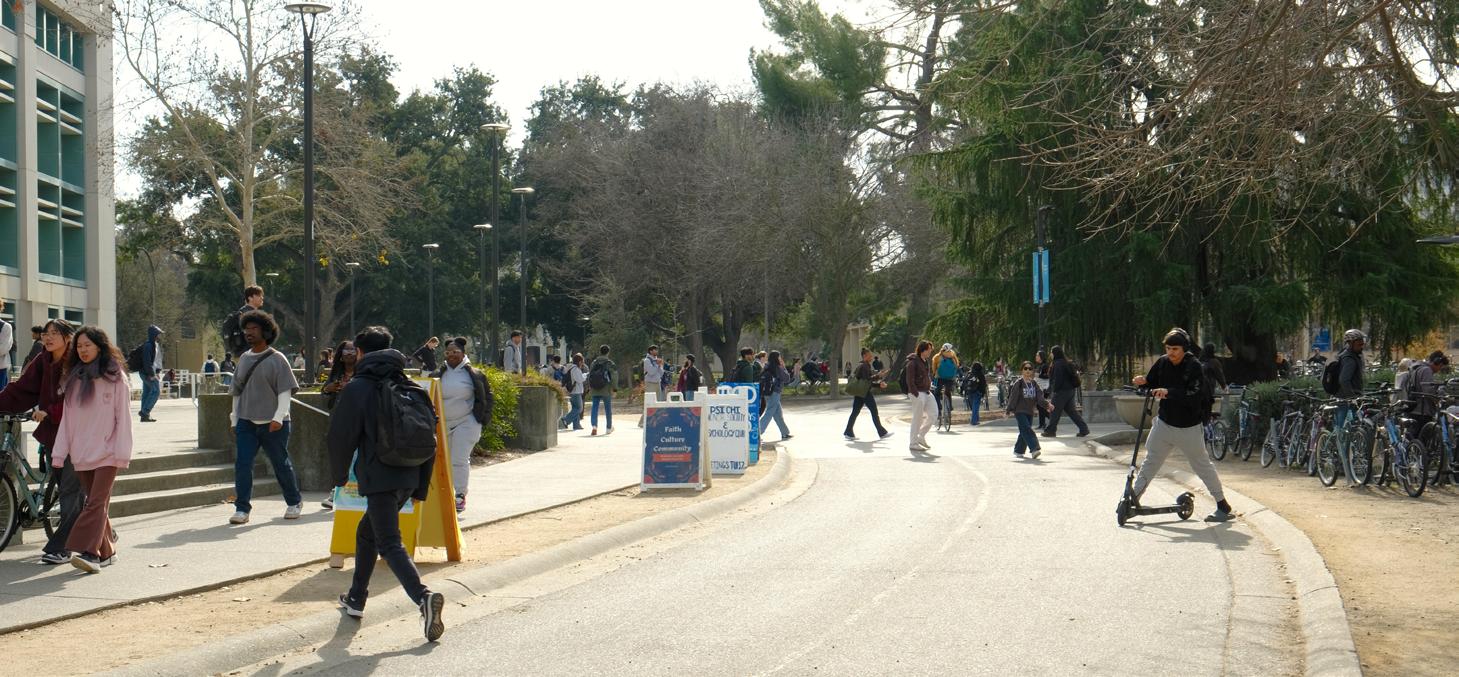
UC Davis recently received a renewal of the Carnegie Elective Classification for Community Engagement, which highlights the university’s efforts to build engagement with the surrounding Davis community and beyond.
The classification is the result of a partnership between the Carnegie Foundation for the Advancement of Teaching and the American Council on Education. This designation is given to American universities based on self-reported merit in community engagement, requiring institutions to identify their institutional mission, commitments and evidence of participation in public outreach.
Community Engagement classifications were first given 20 years ago in 2006, with new cycles of cohorts occurring every two to five years. The classification is not an award, but rather an elective designation indicating a school’s commitment to working with communities.
“Community engagement describes collaboration between institutions of higher education and their larger communities (local, regional/
state, national, global) for the
mutually beneficial exchange of knowledge and resources in a context of partnership and reciprocity,” according to the Elective Classification for Community Engagement website.
Some notable UC Davis community engagement efforts include: the Anchor Institution Mission, which aims to improve health equity in Sacramento; the Center for Regional Change, which works with community and government partners to generate more sustainable regions in California; and Quarter at Aggie Square in Sacramento, which allows undergraduate students to take specialized classes with research opportunities to challenge societal issues.
This is the second time UC Davis has received this recognition, with the first being in 2015. The classification will be valid until the year 2032, after which UC Davis would need to reapply for renewal.
UC Davis Chancellor Gary May acknowledged the significance of the classification and highlighted the impact of UC Davis’ collaboration with community members and other universities.
“By fostering meaningful relationships and collaborating
with partners worldwide, we amplify our impact — whether improving public health, feeding a growing population, or protecting our planet — for generations to come,” May said in a press release. Provost and Executive Vice Chancellor of UC Davis Mary Croughan also shared her sentiment on achieving this classification.
“We received this recognition because our faculty, students and staff are sincerely dedicated to making a difference in the world,” Croughan said. “UC Davis is known for its culture of collaboration and commitment to service that benefits society. I am delighted that members of our campus community are being honored for their exceptional efforts and I am very proud to be an Aggie.” Alongside UC Davis, 236 other American universities received the classification as part of the 2026 class of designees. They join the 40 recipients from 2024 for a total of 277 current classification holders, which include California State University (CSU) Sacramento, CSU Fresno and CSU Chico, as well as UC Los Angeles and UC Merced. UC Davis was one of 187 colleges in the cohort who received this honor for a second time this cycle.
The independent practice aims to increase healthcare accessibility and space inclusivity
BY SONJA WOOLEY city@theaggie.org
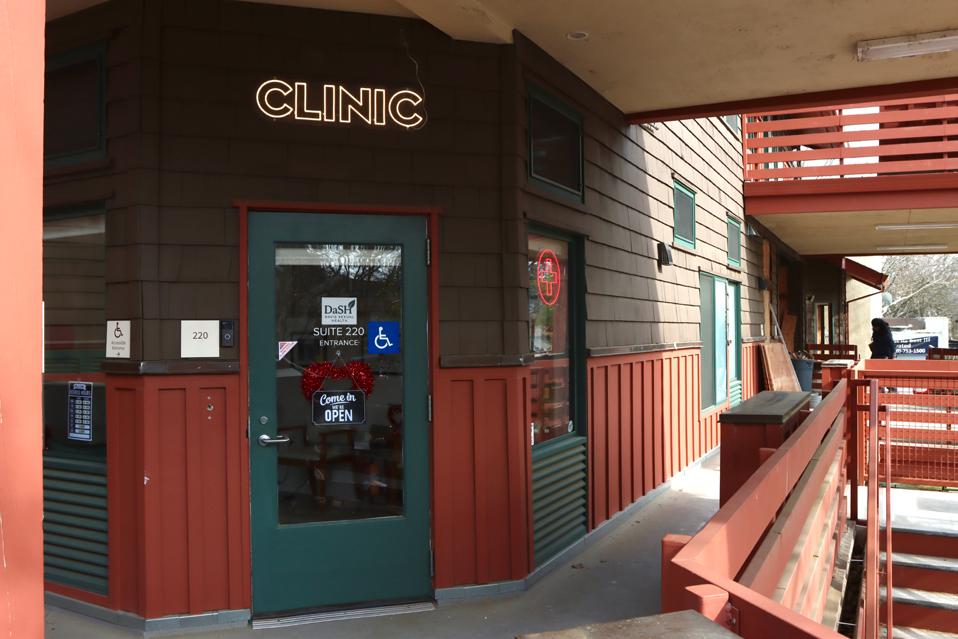
The Davis Sexual Health Clinic (DaSH) opened its doors on the corner of 3rd and A St. in November 2025. They offer services like contraceptives, infection testing, gynecological exams, menopause hormone therapy and gender-affirming care to UC Davis students and community members alike.
Founder of DaSH Liz Oleson worked as a nurse practitioner at UC Davis Student Health for five years before she was inspired to start her own clinic because of barriers to access she noticed at the university.
“Student Health is an amazing facility, but it means that if you’re not a student [or] if you don’t have the UC SHIP [Student Health Insurance Plan], it’s a little bit trickier to seek care,” Oleson said. “So I always had this dream that we could provide an acute care clinic more focused on sexual and reproductive health [where] we can see uninsured folks and we can see students and nonstudents.”
Dr. Brenden Tu, DaSH’s supervising physician, worked for UC Davis Student Health and Counseling Services for 10 years. He also experienced barriers to providing care at the university.
“The Student Health center has been understaffed for years [...] due to people’s lack of leadership,” Tu said. “But it’s multifactorial — the hiring process is complicated and the budget is complicated, but the big thing is limits on access. As the campus population grew, the demand grew, so inaccessibility became worse.”
Tu expanded on their commitment to accessibility.
“I know that [...] the driving force behind what [Oleson] is doing is that [for] anyone who walks in the door or calls for an appointment, she wants to find a way to see them as opposed to ‘Oh, we don’t take your insurance sorry, go somewhere else,’” Tu said. “That’s not the way we function. We might end
intersection of 3rd and A Streets.
up spending more time trying to figure out how to see someone than we might actually spend seeing them.”
DaSH’s centrally positioned location between campus and Downtown Davis has given its growth a headstart.
“Our numbers are increasing each week, and we have seen lots of support from campus and students, which has been wonderful,” Oleson said.
The clinic is also actively present on social media, where they repost awareness videos — including information regarding the importance of cervical cancer screenings and myths about sexually transmitted infections (STIs).
“When trying to appeal to and reach young folks, we have to be creative, and that is potentially easier to do on a small-scale, independent level,” Oleson said. “We want to provide education as much as we want to provide services because that feels like such an important part of providing health care — allowing the patients to make informed decisions about when [they] want to seek care and for what.”
Tu reiterated the importance of sexual health education.
“Sexual health is generally a weakness in a lot of people’s knowledge,” Tu said. “It’s not taught well. In classes they talk about, ‘You can be on the pill, you can be on IUD,’ but what are those things actually? A lot of people know the name, but that’s all: [not] how you access
The passing of SR#9 came after a debate over the precedence of making political statements
BY LILY KENROW campus@theaggie.org
At their Jan. 29 meeting, the Associated Students, University of California, Davis (ASUCD) Senate passed Senate Resolution (SR) #9, offering their support to the Iranian people and a call for action at UC Davis. This included denouncing violence against student protesters and pushing university administrators to commit to a public statement protecting protestors’ rights.
The resolution also noted that UC Irvine and their associated student body have already taken steps to offer support to Iranian students, and calls for ASUCD to collaborate more with the Iranian Student Organization, among other clubs and registered student organizations who represent students affected by authoritarian regimes.
[the medicine], how you take [it] [or] how it actually affects the body.”
Oleson also emphasized the importance of making DaSH an inclusive, safe space for all patients.
“The trauma that health care institutions can cause [...] or trigger in folks cannot be overemphasized,” Oleson said. “So, if we can create a safe space where people can ask questions and learn about what’s available and then opt in or opt out in an informed way, that to me is the actual service that we can do. Rather than the patriarchal approach of saying, ‘This is what you need. This is the power dynamic. I’m telling you what you should do, and you should listen,’ [we’re] kind of turning that on its head.”
Oleson focuses on this approach with her transgender patients in particular.
“One of the things that providing gender-affirming care has taught me is that it’s so important to just consider the language that we use,” Oleson said. “That’s part of why we say ‘sexual health,’ because ‘reproductive health’ is actually biased towards reproduction, which is kind of a cis-heteronormative word. We can say ‘sexual health’ and be much broader and much more inclusive. So, I feel very proud to always be thinking about that and always taking cues from the folks I’m fortunate to work with.”
Senator Ezra Rubin began the debate by admitting that he was conflicted over the resolution. Rubin clarified that he supported the resolution’s stance and what it called for but took issue over the precedent the resolution would set for the table.
“I have concerns regarding the precedent that it sets in terms of commenting on political issues, especially ones with humanitarian implications,”
Rubin said. “The first question that arises to me is why are we commenting on this issue, and not others right now? For example, things going in Sudan with the Uyghurs, and Myanmar and Syria, for instance. We don’t really have a precedent of often making resolutions based primarily just on political issues.”
Rubin added that if the Senate continued to make resolutions with political commentary, they could run into the issue of bandwidth within
While SR#9 passed, it raised discussion over the Association’s role and precedence in taking stances on politics and human rights.
Bill # Description Vote
SB#42 Allocates $500.05 to the Offices of Senator Jaliah Payne and Senator Luis Garcia for Study Break Event during midterm week
SR#9 A resolution offering support to the Iranian people under an authoritarian regime and a call for action at UC Davis.
SB#45 Reestablishes special committee to continue ASUCD 530 Night Market.
SB#47 Allocates $975 to Aggie Arts Committee to rent out the Pence Gallery for their Pence Senior Show.
CA #96 Constitutional Amendment to change the ASUCD Student Advocate from an elected position to an appointed position.
Passed (9 yes, 3 abstain, 2 no)
Passed (10 yes, 4 abstain)
Passed unanimously
Passed unanimously
Passed unanimously (to be placed on the 2026 spring ballot for student approval)
the Senate. “There are a lot of issues that could be commented on that affect students here and have political connotations,” Rubin said. “I would be concerned that would grow infeasible to a point that we would have to focus on that, as opposed to other duties that have more direct implications on students.” He also brought up a concern that continuing to write resolutions with political commentary, or that are controversial, could alienate students, when the point of resolution is to build solidarity.
Senator Aaron Heth, the bill’s author, responded to Rubin’s concerns. He stated that resolutions should be passed when the table comes to a consensus on the issue, and not based solely on precedence. “I think that, when we have a significant student community that is on campus, it’s reasonable for the Senate to offer a resolution,” Heth said. “In terms of concerns about the precedent it sets with political issues in general, I’m in favor of ensuring that you go based on consensus.”
Ethnic and Cultural Affairs Commission Chairperson Mālie Nee added that setting a precedent for the table would be a good thing.


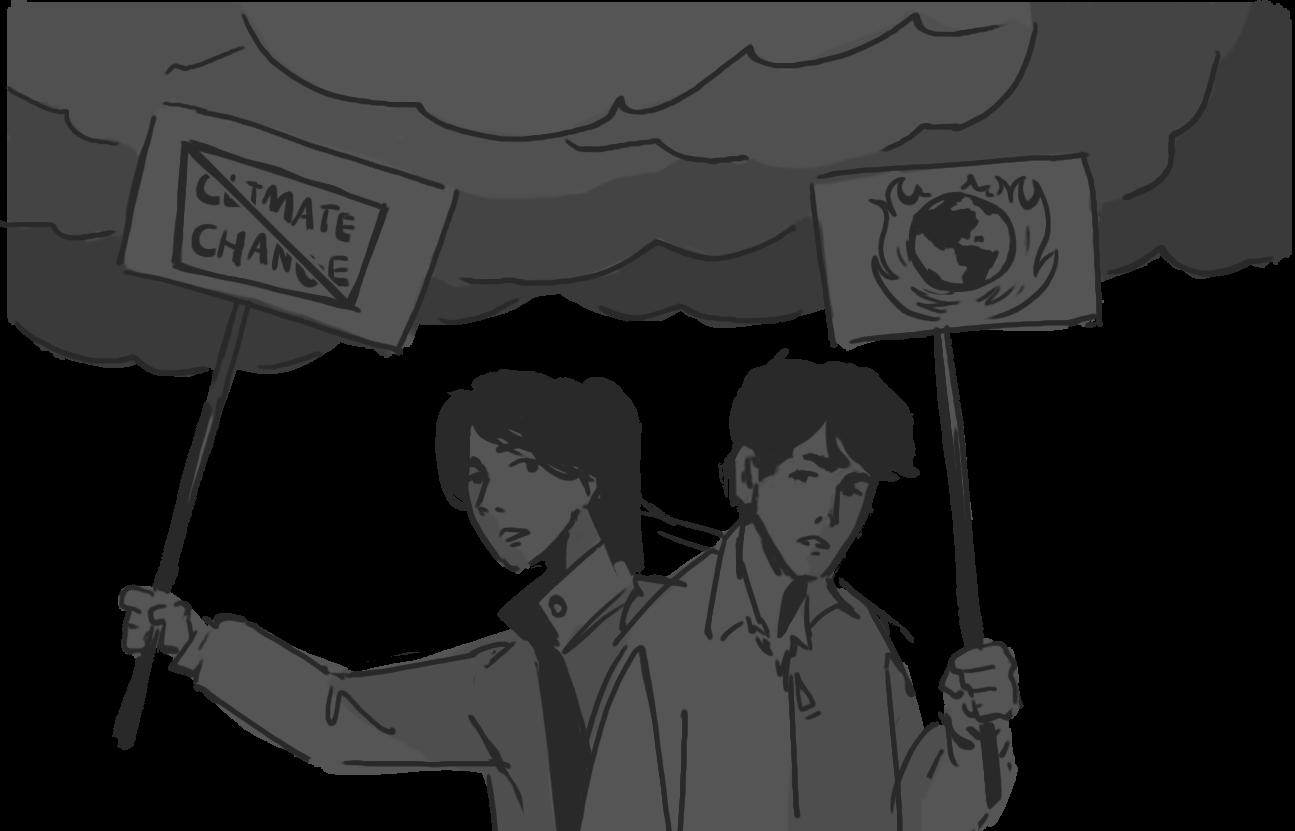
As protests go mainstream, their messages become more diluted
BY SAGE KAMOCSAY skamocsay@ucdavis.edu
Protest movements have grown in frequency and popularity over the last several years. Whether it’s Black Lives Matter, climate change activism, pro- and anti-abortion movements, Palestine protests or No Kings, millions of Americans participated in a protest for one cause or another over the past several years.
The problem is these movements have achieved next to nothing. For example, an article praising the No Kings movement proudly boasted that their greatest achievements included organizing a large number of people (a bare minimum for a successful protest) and making President Donald Trump nervous and slightly more reactive on social media — in other words, they barely made a dent in Washington politics.
Climate change protests have made slightly better progress — if only because of their lengthy presence in modern politics — but most of it
consists of unfulfilled promises. America has not been on track to meet its proposed climate goal of zero carbon emissions by 2050. What’s worse is that emissions will only rise under the Trump administration — which aims to boost fossil fuel production — and with the use of energy-intensive products like generative artificial intelligence (AI). Any progress that was made by protests will be reversed — while they may have scared the Democrats into weakly complying, they were not strong enough to scare the Republican Party.
Ultimately, these movements are failing to achieve their goals because participants have too much of a “play-nice” attitude. Their organizers fail to realize the importance of agitation and disturbing the peace — they seem to believe that a sheer amount of supporters will show politicians who’s in charge. Politicians were only elected because their constituents voted for them; if those constituents begin to protest against their actions and threaten not to reelect them, that’s a threat to their job security. Such
demonstrations put no real pressure on Washington to change anything; if they don’t meet the demands of protest groups, the worst that could happen is a crowd of “voteblue-no-matter-who” Democrats overtaking local town parks. Without a direct material threat, politicians have nothing to lose.
Many movements also lack concrete policy objectives. While flashy slogans, pretty graphics and well-written “about” pages on initiative websites are good at attracting potential protestors, they do little to explain to policy makers what they’re actually trying to achieve. But then again, that’s exactly the problem — these protestors have no idea what they actually want from officials, and unfortunately, politicians won’t spend time trying to figure it out for them. A final problem is that large, mainstream movements like these are too respectful and sympathetic to politicians — No Kings is supported by House Minority Leader Hakeem Jeffries, for example, despite being part of the problem.
PROTEST on 9
Learning pop culture as a Third Culture Kid
BY ABHINAYA KASAGANI akasagani@ucdavis.edu
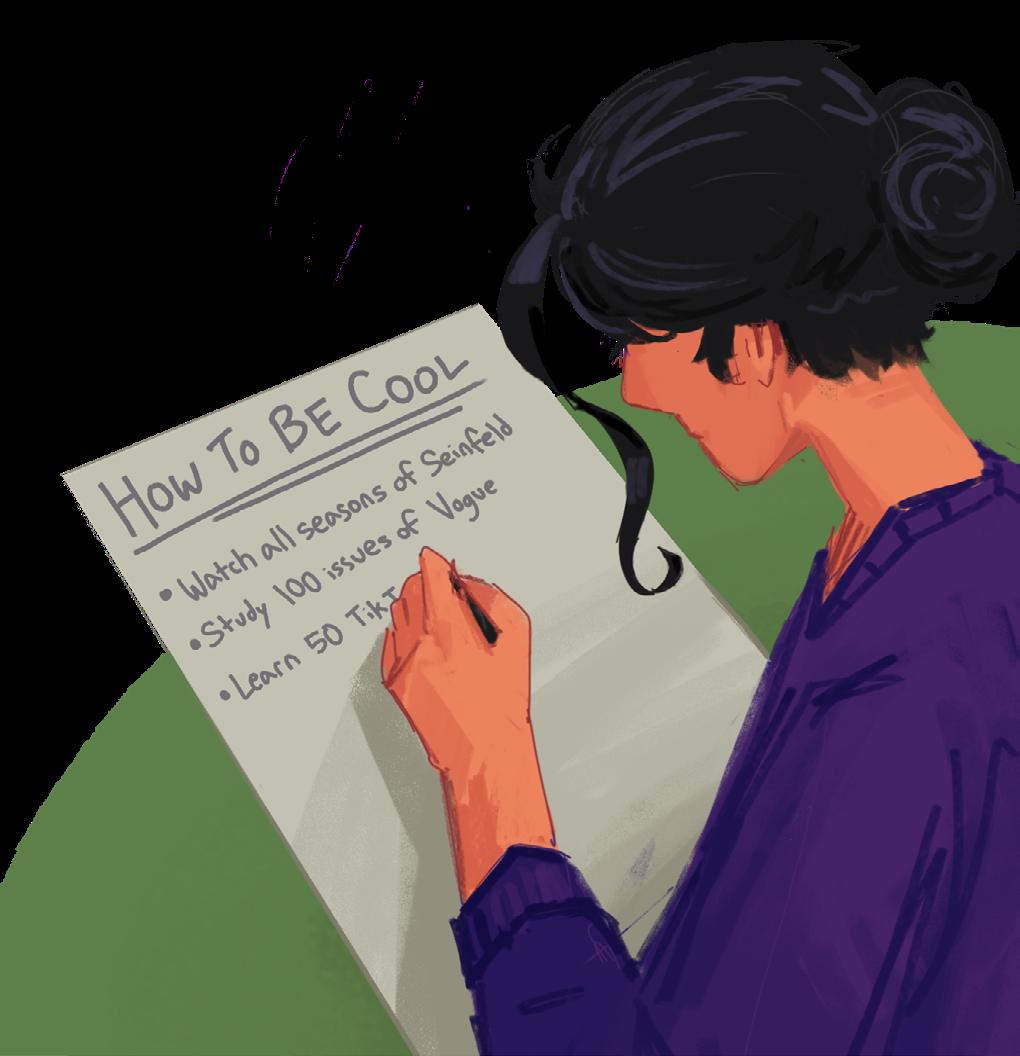
For as long as I can remember, the joke always went over my head. Growing up as a second-generation child automatically disqualified me from getting most references, and my parents had differing beliefs that there were bigger priorities than catching the season finale of “Seinfeld.” Whoever “cool” was, I was not allowed to befriend her. While I no longer fault my parents for this mode of operation, I deeply resented it growing up.
Despite having emigrated from India long before I came into the picture, my parents were far less concerned about being perceived as “cool,” and more preoccupied with building a life that was sustainable and freeing. While the emancipatory possibilities of their immigration brought them joy, I remained antsy about the very ways in which I walked through the world. Being second-generation meant that I had to parent myself (and occasionally them) in order to ensure that I never forsook any cultural capital I was offered.
“Cultural capital,” a term coined by sociologist Pierre Bourdieu, refers to the nonfinancial assets that influence one’s social mobility. For instance, working to acquire things like education, language, style or cultural knowledge allows you not only to assimilate for survival, but to successfully integrate yourself within a society.
As I was growing up, it was clear to me that my parents understood American systems quite instinctively. I, however, came to nothing easily. Like how a child learning a language translates a sentence word-byword in order to understand, I, metaphorically speaking, began to do the same. My inability to speak anything other than English for the first 10 years of my life kept me from being entirely of any place — my identity is an amalgamation of a myriad of different influential cultures and elements.
This idea of being citizens of “everywhere and
nowhere” is a popular rhetoric that comes up when one discusses their experience as an immigrant. Known as Third Culture Kids (or TCKs), a term coined by sociologist Ruth Hill Useem, these children tied their identities to people rather than places. While some argue that TCKs possess a broader worldview and awareness of social systems and institutions, others suggest that their frequent displacement leaves them questioning where “home” really is.
Most immigrants speak of an experience similar to mine, where the goal is often to be resilient as one engineers conditions within which they can survive. It has rarely occurred to them that the early onset of such imposter syndrome — brought about more evidently by the idea of an invisible cultural inheritance — makes certain references or ways of speaking feel inaccessible.
What was framed for years as something you either got or didn’t now reveals itself as a form of social currency that widens the gap instead of bridging it. Shielded from the American TV canon, music periods, celebrity gossip and fashion cycles, second-gen immigrants find themselves in what they believe to be a coolness deficit until they work to learn it themselves. My home life remained unburdened by the dominant culture as my parents remained unfazed.
were expecting to be quizzed at any moment. Consuming various forms of media was often laborious, especially when you are more focused on “getting it” than caring about it. Over time, I learned how to consciously absorb the culture around me. I became more aware of how “cultural capital” worked to exclude those who cannot afford their social position. The paradox of learning what is meant to be inherited is that it moves you away from intentional tastemaking. In bridging the acculturation gap, one widens the space between who they are and who they used to be. The good news is that you can learn to get the joke; the bad news is that you might not even find it funny. There’s no use in fluency if you can’t say your piece.
Don’t get me wrong: I birthed my “cool,” and I am beyond proud of her. I am instinctive about her in ways that I wasn’t ever previously. She no longer laughs on cue or puppeteers for those who “get it.” In writing this, I am recognizing the death of the perpetual translator. I am now equipped with the language to orient myself in a world that my parents offered to me, without forsaking my identity as a TCK.
Disclaimer: The views and opinions expressed by individual columnists belong to the columnists alone and do not necessarily indicate the views and opinions held by The California
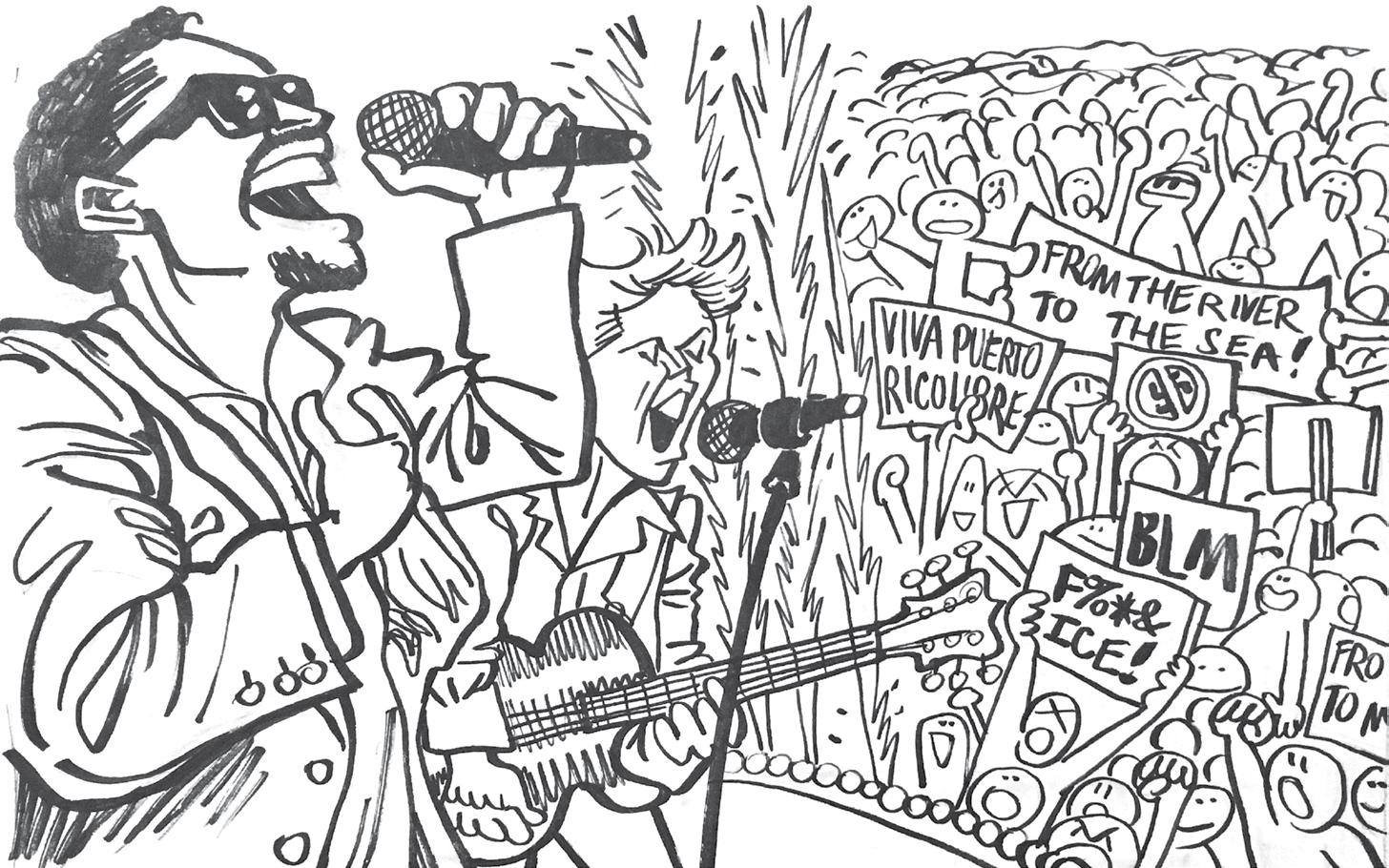
Recent memorable and political performances make the show an emerging stage for free speech
BY SABRINA FIGUEROA sfigueroaavila@ucdavis.edu
While I’m not the biggest football fan, I do watch the Super Bowl for the performances — especially the Apple Music Halftime Show. In the past, they’ve had performances by Katy Perry, Beyoncé, Rihanna and more, which are now fun, nostalgic memories for me and many of those who tuned in.
In 2025, Kendrick Lamar took the halftime stage for a memorable show. Taking place at the beginning of President Donald Trump’s second term, the political messaging that characterised the performance was intentional. Lamar took his powerful music, which captures modern African American life and earned him a Pulitzer Prize for his fourth studio album “DAMN.,” to critique the current state of American politics and race relations. The message was practically screaming at you. This was also the first time a sitting president had ever attended the Super Bowl, making the statement all
the more direct.
Music has always been connected to social movements as well as historical change. The Super Bowl halftime show is now catching up to this standard, as Bad Bunny is set to perform at the 2026 Apple Music Halftime Show, and Green Day is also confirmed to perform at the special opening ceremony.
The choice of Green Day — a pop-punk rock band who created the song “American Idiot” and recently changed the lyrics from “I’m not a part of a redneck agenda” to “I’m not a part of a MAGA agenda” — is a more obvious political choice than Bad Bunny is. The rock band has made it clear many times throughout their career that they are anti-fascist, antiracist, anti-war and, inevitably, anti-Trump.
But, Bad Bunny — a Puerto Rican artist who just made a Spanish album about the gentrification of Puerto Rico — is the more controversial of the two, and is still a blatant statement in the current political climate.
With Immigration and Customs Enforcement (ICE)
doing full-scale deportation operations, targeting anyone who simply “looks” Latino, Bad Bunny originally planned to leave cities in the United States out of his new tour completely. He also made multiple antiTrump comments, causing some to question whether it makes sense for him to perform at one of the most patriotic American events. So, when he announced that he would be performing at the Super Bowl, it left many conservatives — including rightwing group Turning Point USA (TPUSA) — angry, arguing that he was an anti-American artist. TPUSA even announced it was throwing its own “AllAmerican Halftime Show” with performances from Christian rock artists in protest, though they have yet to release the performers’ names. Whether criticisms of Bad Bunny stem from the fact that he was born in Puerto Rico, speaks and sings in Spanish most of the time or is outwardly anti-Trump, this is the same rhetoric used to justify these inhumane ICE operations.
SUPERBOWL on 9
The organizations at UC Davis who have been accused of heresy and abuse
BY NEVAEH KARRAKER nakarraker@ucdavis.edu
“That’s a cult.”
When an anonymous UC Davis student was in her first year, this was what her Bible study leader told her about a fellow UC Davis campus-based Christian ministry. The leader recollected how a trusted friend allegedly became deeply — and wrongly — rooted in this organization and refused to return to the truth.
The student was intrigued by the claim, as she was considering attending the second ministry. When she attended the following Sunday, she asked about the first after brief interactions with students and inquiries about their core values.
“It’s a cult,” seemed to be the consensus among the ministry community.
“I think it’s definitely confusing,” the student said. “Each ministry accused one another of being cults, when really, I think it’s just because they have different cultural norms in their church. It’s not reflective or accurate at all.”
It’s rare that people hear of the good that comes from religiously affiliated organizations, whereas the failures — sexual assault, financial exploitation and mental abuse — are widely publicized.
Discourse between former dissatisfied members often snowballs into negative connotations, extreme assumptions and labeling Christian fellowship groups as “cults.” This term has been largely misconstrued by society: so, let’s break down what a cult is and isn’t.
Kenneth J. Garrett discusses his experience in an abusive church in his novel “In the House of Friends.” He provides three main definitions of a cult: one by the media (a group that deviates from societal norm or connotes weirdness), one by those religiously affiliated (a group that commits heresy) and one by mental health professionals (a group using manipulative tactics to subdue members to a leader).
The term “cult” blurs the line between blatant pagan ritual sacrifice and subtle manipulation; a more accurate
“Each ministry accused one another of being cults, when really, I think it’s just becuase they have different cultural norms.“
description would be that a group exhibits cultish tendencies in the form of abuse.
Garrett goes on to identify seven main behaviors that fulfill the definition he gave: deception, loss, isolation, elitism, fear, disclosure and trauma. The common thread between all these is the leader or pastor — one who seeks to gain profit and glorification from members through speech, their most powerful weapon.
It’s important to acknowledge that people don’t willingly join cults (or abusive groups); they are recruited. Today, college students are the most susceptible for recruitment — in particular, first-years and international students — who passionately seek to find community and growth as they explore a new life stage.
On-campus organizations often promise that students will acquire these things if they join, or that they would please God by making certain decisions — spiritual gaslighting, if you will.
And for a while, it seems true — until questionable behaviors reveal this was simply a deceptive tactic. Receiving daily texts is one such example: The initial excitement to be immersed in a like-minded community slowly evolves into an expectation of constant participation.
The time, money, friendships or opportunities one gives up to participate is the second aspect
Anonymous UC Davis Student
— always giving to the group and never the group giving to its members. These abusive groups discourage friendships with nonmembers, which heavily isolates members. If the community is close-knit, it becomes much harder to leave; walking away would mean leaving everything and everyone behind.
Part of this derives from elitism — the idea that this group and its leader are superior — which leads members to actively derogate other groups. As a result, a fear settles among the members about displeasing their leaders. This fear can also be associated with disclosure or forced confession, especially pressuring members to reveal secrets or sins.
These six previous points, as laid out by Garrett, equate to trauma when someone eventually decides to leave. They become so emotionally and spiritually involved, only to be abused to the point of unrecognition. Group participation shouldn’t result in repression of our authentic selves.
Now, some people who were raised in these abusive churches see nothing wrong with these familiar behaviors. The accessibility of the personal denomination they align with — like calvinistic or charismatic — seems like an exclusive offer. However, the way campus ministries have begun to change evangelism to advertisement — CULTS on 9

When corruption runs rampant in the world, be a part of a movement for good
Protests have been a powerful act of public dissent in America for as long as the country has existed. A successful protest is one that mobilizes political action — it prompts new legislation, it’s a catalyst for rights to be codified into law or it sends a symbolic message to those in power. In a time of so much social unrest, we’ve recently seen many protests of many forms; it’s inevitable that more will come.
Historically, protests have been an extremely effective method of enabling social and political change. Countless examples — from the Boston Tea Party in 1773 to the #MeToo movement in 2017 — prove the enduring power of assembly. Yet there have been other attempts to enact tangible progress that weren’t so conducive to action: So, what makes a successful protest? How can we effectively use our collective voice?
Erica Chenoweth, academic dean for Faculty Development and Frank Stanton professor of the First Amendment at the Harvard Kennedy School of Government, developed a 3.5% rule: A protest must comprise at least that much of a given population in order to send a lucrative message. Once that metric is reached, she notes that it’s difficult for such a force to be ignored. Among other factors Chenoweth
cites (including momentum, strategic leadership and organization), she also found that nonviolent movements are twice as likely to be successful compared to violent campaigns.
College campuses tend to be hubs for social demonstrations. The tale of young adults demanding change from higher institutions is as old as time, but not without good reason: Student protests work. Throughout the 20th and into the 21st century, examples of successful campus protests — like the Velvet Revolution in 1989, the March for Our Lives movement in 2018 and the Global Climate Strikes in 2019 — show us just how compelling collegiate social demonstrations can be, a fact we continue to witness today.
The University of California (UC) system has its own proud history of actionable protest. In December 1984, students at UC Berkeley expressed their objection to the UC Regents investing billions of dollars in the government of an apartheid-rampent South Africa. Over the course of two years, they staged walk-outs, held sit-ins at the very central Sproul Hall and attracted celebrity attention (authors and activists Kurt Vonnegut and Alice Walker visited to show their support), until the UC Regents divested $3.1 billion in 1986.
In the spring of 2024, Davis Popular University for the Liberation of Palestine
(PULP) set up an encampment in the Memorial Union Quad, expressing opposition for the UC Davis administration’s complacency amid the ongoing genocide in Palestine and Chancellor Gary May’s investment in Leidos — an American technology company known to invest in Israeli weaponry and surveillance equipment. Students remained on the Quad for 40 days, following other universities across the country (including Columbia University and UC Los Angeles, among other UC campuses) which organized similar efforts. Despite the fact that the demands put forth by the encampment were unmet by the administration, this was a massive nationwide symbolic movement that garnered mainstream media attention. Beyond some tangible successes, the students involved were able to start a widespread conversation. They spotlighted issues that had previously been overshadowed and took a stance in solidarity against them — all through peaceful protest.
On Jan. 30, UC Davis students joined a nationwide protest and strike against Immigration and Customs Enforcement (ICE), which included walking out of or refusing to attend work or school, assembling or marching as a group and boycotting commerce, among other actions. Students at UC Berkeley also joined the
BY VIOLET ZANZOT
vmzanzot@ucdavis.edu
My first year at UC Davis coincided with Joey Graziadei’s season on “The Bachelor,” which meant big things for the world of reality TV and potentially bigger things for the foundation of my personal theory on media literacy: You can learn a lot about someone by how they interpret the culture built into a movie, show, book or play. I wouldn’t say the discovery of my appreciation for reality TV was the most novel transformation of my first year of college, but at the very least, I could connect it to my anthropological studies later on. At the time, I would join my roommate and her friends to watch “The Bachelor;” I remember feeling like I knew right away who was hot, who was not, who was the psychotic instigator and what tropes each girl was destined to fulfill. You can imagine my surprise
when my friends didn’t seem to pick up on the unspoken roles that had seemed so obvious to me. While I was deeply annoyed it had taken them five more episodes than me to realize which contestants were more irrational than others, I was tickled by my new kind of game. It was simple; nothing more than a conversation. Ask people what they thought about the show, see how they analyze it and then dissect. Over the years, this game has developed. It was born from the realization that fiction provides us a rare chance to pick apart a social situation unbiasedly and without confounding influence. Movies, shows, books and plays offer an opportunity for people to practice being a therapist or anthropologist — like a test drive for real life. They allow the viewer to measure how good they are at understanding social networks and the human experience. This happens for a myriad of reasons, one of which is framing.
demonstration started by students at the University of Minnesota. While there have yet to be any notable effects from this movement at a federal level, it has unequivocally garnered national media attention (and the hope is that its momentum will only continue to grow).
It’s easy, in the face of so much mutual anxiety and a perpetual newsfeed of disparaging stories, to feel powerless. But let this serve as a reminder that you are more capable than you might think. We as a collective people have a greater capacity for actualizing reform than we do as the sum of our parts. The Editorial Board encourages you to use your voice — and your First Amendment right to peaceful assembly — to take action and be a part of community efforts to push back against immoral federal operations.
Help your local social movements reach that 3.5% quota; show up and make the statement that you are not content to stay home and be quiet while the country falls apart around you; show them that their injustices cannot continue.
If you can’t attend a demonstration in person, consider donating to help fund their efforts. The ambitious goals that most protests aim to achieve cannot be accomplished in isolation — it really does take a village. Be a part of yours.
BY MILES BARRY maberry@ucdavis.edu
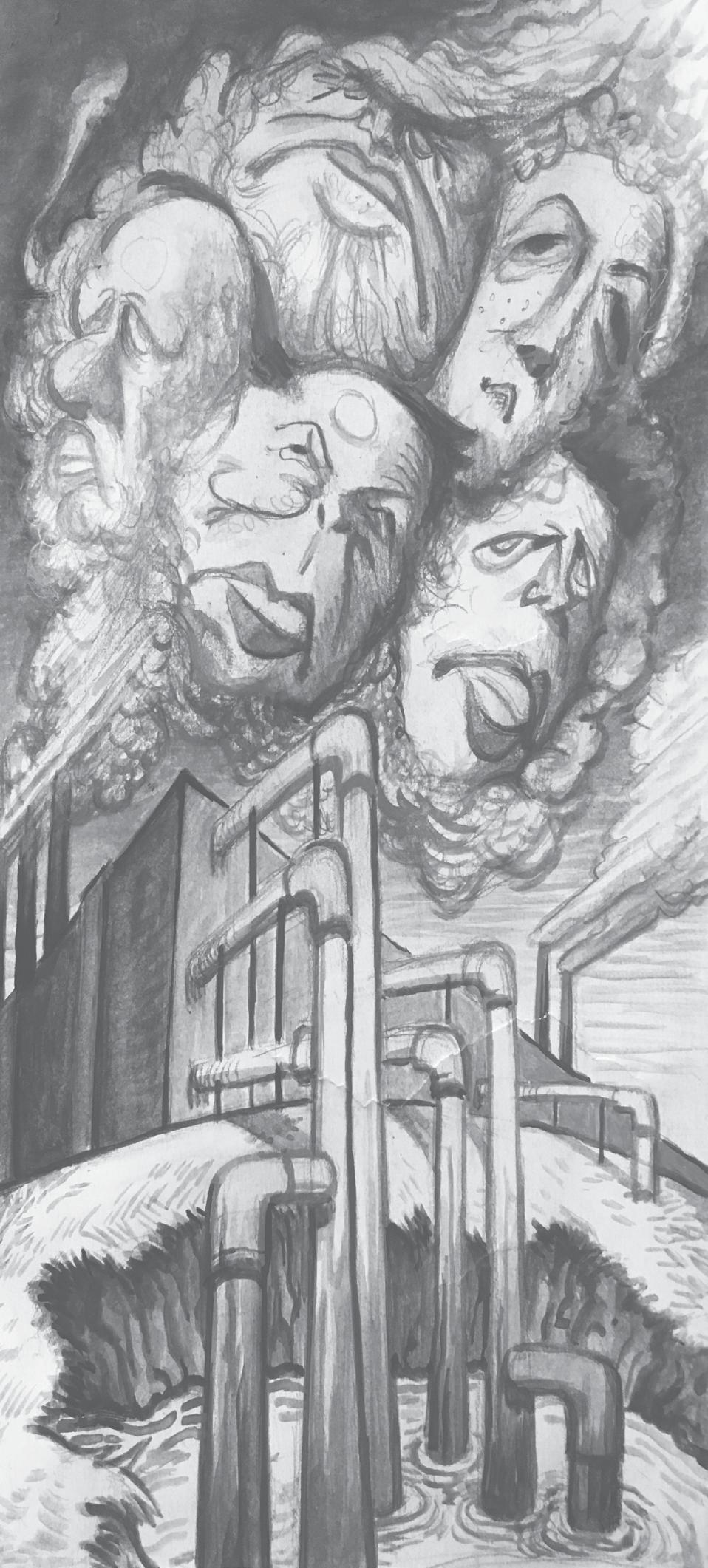
Two days before the 2023 Slovak parliamentary election, an audio recording of Michal Šimečka, a Western liberalleaning candidate, was widely shared online. The video depicted him bragging about rigging the vote, and, to make matters worse, a separate recording of him discussing raising the price of beer also went viral. The problem? Both recordings were fake.
Whether or not these recordings played a significant role in the Slovakian election results, they represent a growing issue: the use of artificial intelligence (AI) to create and spread misinformation that can interfere in the democratic process.
This has already impacted voters in the United States. In January 2024, Steve Kramer, a political consultant, reached thousands of New Hampshire voters with a robotic call impersonating Joe Biden with AI. The call, which was distributed before the Democratic presidential primary, discouraged people from voting and urged them to “save” their vote for the general election. Kramer was charged a $6 million fine for voter suppression and impersonating a candidate.
Many states have responded to this threat with legislation targeting “deepfakes” — images, audio or videos created or altered by AI which depict an individual performing actions that didn’t actually occur. As technology improves and this false media becomes increasingly
authentic, deepfakes may have profound consequences for future elections. They could depict candidates accepting bribes, rigging votes, engaging in adultery or performing lewd acts — information that would fundamentally alter their public perception. This harm becomes more potent when it’s published directly before Election Day — a beleaguered, deep-faked candidate wouldn’t even be able to clarify that it’s false.
As of January 2026, 46 states have passed legislation targeting deepfakes. While some of the laws seek to curb other horrific uses of this technology — like using AI to generate pornographic images of an individual without their consent — many target electionrelated misinformation. In the process, many of these laws go too far: to the point where they may potentially infringe upon the publisher’s First Amendment rights.
For example, New Mexico House Bill 182 (2024) criminalizes the distribution of “materially deceptive media” (deepfakes) without a disclaimer within 90 days of an election.
To be convicted, the accused individual must understand that the media is false, with the intention to alter voting behavior. In fairness, it contains carve outs for parody and for deepfakes that are appropriately labelled. But despite these limits, New Mexico’s ethics commission is concerned that the bill is unenforceable, as it will likely violate the First Amendment.
The law’s intent requirement — proving that someone both knew the content was false and intended to alter voting behavior —is difficult to establish
Every work of fiction has exactly two components: a narrator and an audience. Can the audience place how the storyteller is able to shape the story itself? If “How I Met Your Mother” were to be “How I Met Your Father,” we would think a lot differently about each component of the story. Even without a narrator explicitly telling us, can we understand what the story is and that the story is shaped by who says it? When developing an idea, decisions are made strategically to tell that story with a certain objective. The ability of the viewer to identify the inherent objective indicates their capacity to perceive the narrative independently of their own implicit biases. Once we accept what we are told the story is, we can find out how people choose to analyze characters. The first time I heard that “Sex and the City” star Carrie Bradshaw was a “bad” person, I jumped out of my metaphorical Manolo Blahniks (some of Carrie’s favorite
heels). Carrie is undoubtedly an imperfect person, but that’s the point — no one is. We judge relationships between characters and individual characters alike, often forgetting they are meant to be human beings — flaws, complexities and all. Michael Scott from “The Office” might annoy me constantly, but I’m not sure I have the authority to decide if he’s a “bad” guy. This feeds into the idea of context. As viewers, being able to contextualize people, decisions and scenarios says a lot about how we do so in our everyday lives. Understanding nuance is a skill, in both looking down at a screen and up at the world around you. Is a relationship toxic, or are they just two gay hockey players battling internal and external
Editorial Board
ALYSSA CREVOISERAT Editor-in-Chief
MAYA KORNYEYEVA Managing Editor
VINCE BASADA Campus News Editor
JORDAN POLTORAK City News Editor
MOLLY THOMPSON Opinion Editor
ZOEY MORTAZAVI Features Editor
SAVANNAH ANNO Arts & Culture Editor
MEGAN JOSEPH Sports Editor
KATIE HELLMAN Science & Tech Editor Managing Staff
JENNA LEE Photo Director
NOELLE ESCALANTE Layout Director
SAVANNAH BURGER Design Director
SAM RUIZ New Media Manager
KAYLIE HUANG Social Media Manager
JULIAN MONTANA Website Manager
JULIA CROSSAN Distribution & Outreach Director
YILAN LI Translation Director
CARMEN RODRIGUEZ-ZARATE Translation Director
JENNY DYE Copy Chief
ALYSSA PULIDO Copy Chief
LAURIE PEDERSON Business Development Manager
without mind-reading, and the broad definition of ‘materially deceptive’ could sweep in legitimate political commentary. California has gone even further. In late 2024, California Governor Gavin Newsom signed a suite of aggressive bills targeting AI-generated political speech. One of these bills, the Defending Democracy from Deepfake Deception Act (Assembly Bill (AB) 2655), required social media platforms to block or label AI generated content. It was later struck down by judges for violating Section 230 of the Communications Decency Act, with the court ruling that federal law prohibits states from treating online platforms as publishers of user-provided content. Another, AB 2839, prohibited the distribution of “materially deceptive” content within 120 days of an election.
The law was so broad that it initially required even satirical deepfakes to carry a disclaimer and allowed any citizen to sue for damages. This bill was also struck down because it failed “strict scrutiny” under the First Amendment; the court found that the law was a “blunt tool” that unconstitutionally stifled the free exchange of ideas.
California’s bills were struck down for good reason. The U.S. hasn’t historically restricted speech solely because it is false or deceptive — regardless of whether it’s created by AI. Doing so would require the government to establish facts as “true” or “false.” There is longstanding legal precedent for this, rooted in the Supreme Court case United States vs. Alvarez. In that 2012 decision, the Court ruled that “falsity alone may not suffice to
bring the speech outside the First Amendment.” Additionally, the U.S. has a longstanding tradition of combatting misinformation with more speech, not outlawing it. Deepfakes represent a shift in efficiency, not a fundamental change in the nature of deceptive media. They’re faster and cheaper to produce than traditional digital manipulation, but their capacity for harm is identical to that of a doctored video or photo. Creators of doctored videos or photos are only held responsible if their creation breaks existing speech laws — against libel, fraud, voter suppression and voter intimidation, for example. Therefore, while deepfakes provide a new tool to produce certain types of speech, we shouldn’t be creating new categories of crime for “materially deceptive” content just because it’s made by AI. We already have robust laws in place to prevent criminal speech. When Douglass Mackey tricked thousands of voters into “texting” their ballots in 2016, or when Steve Kramer used an AI-generated Joe Biden voice to discourage primary voters in 2024, the legal system was already equipped to respond. By identifying these actions as criminal conduct — specifically voter suppression, we can protect the ballot box without giving the government license to establish “true speech.”
TOM VINEY / AGGIE
struggles (because obviously we can use “Heated Rivalry” as an ethnographic text about the social fabric surrounding us)? Whatever the story is, we can use it to learn about how proficient people are at reading the culture and psychology of
others. Are we able to empathize and contextualize the storyteller, the story itself and the character dynamics within it? Your Netflix account may say more than you know. It’s not just what you watch, but how you watch it. Appreciation for what you consume will force you to change your intake. If you learn about ingredients, if you know how to taste ingredients, you will change how you eat. You will consume media differently if you can appreciate the sum of its parts. Disclaimer:

BY NOELLE ESCALANTE arts@theaggie.org


Song: “Who Gives a Funk!?” by CUBE (2026)
CUBE is by far one of my favorite underground artists to listen to. Originally posting videos on Instagram and TikTok, this soundcloud R&B producer now works with artists overseas in Korea, along with making his own music. With this most recent release, CUBE explores a funk groove that differs from his slower Lo-Fi pop beats, bringing the same energy from his covers into his original music. A growing favorite of mine this new year, “Who Gives a Funk!?” is the perfect listen on your way to the gym or walking around campus.
Book: “Panenka” by Rónán Hession (2021)
“Panenka” is a beautifully haunting book that I had the pleasure of reading during the summer of my senior year in high school. With “Panenka” being the nickname for the main character, ex-soccer player Joseph is forced to reckon with his current relationships, plagued by his past mistakes that suddenly come under the spotlight. Attempting to re-knit his connection with his children and deal with disability struggles, the term “The Iron Mask” is something that is prevalent throughout the novel, describing a type of disability that often goes unseen within modern media. “Panenka” left me in shock, and Hession’s writing style left me with lines after lines highlighted throughout my copy. If you’re looking for a weekend read that’ll tug on your heart strings, don’t miss out on this novel.

TV Show: “Arrested Development” by Mitchell Hurwitz (2003-2019)
“Arrested Development” is the epitome of a classic American sitcom. Based in Orange County, the show revolves around a family trying to get their dad out of prison. A perplexed main character, Michael Bluth (Jason Bateman), navigates his wife’s passing with his son, George Michael (Michael Cera). From sibling rivalries to complex cousin relationships, the antics-full structure of the show ensures ongoing jokes jump from episode to episode, rewarding bingers and casual watchers alike. This show is easily a comfort piece of media for me, always giving me a good giggle.
Album: “Choose Your Weapon” by Hiatus Kiayote (2015) Hiatus Kiayote is one of the most innovative neo-jazz/funk bands on the scene right now. Coming out of Australia, this band brings an eclectic mix of music theory integration and groove to each song they release, making their music texturally interesting to listen to. Their album, “Choose Your Weapon,” is a favorite of mine — with “Fingerprints,” “Atari,” “Building a Ladder,” and “Shaolin Monk Motherfunk” always on repeat.
The Gorman Museum’s latest exhibition, ‘Shelley Nirox,’ is not one to miss
Niro’s works stun with multimedia and photographic approaches to representing Indigenous women
BY BELLA PETERSON arts@theaggie.org
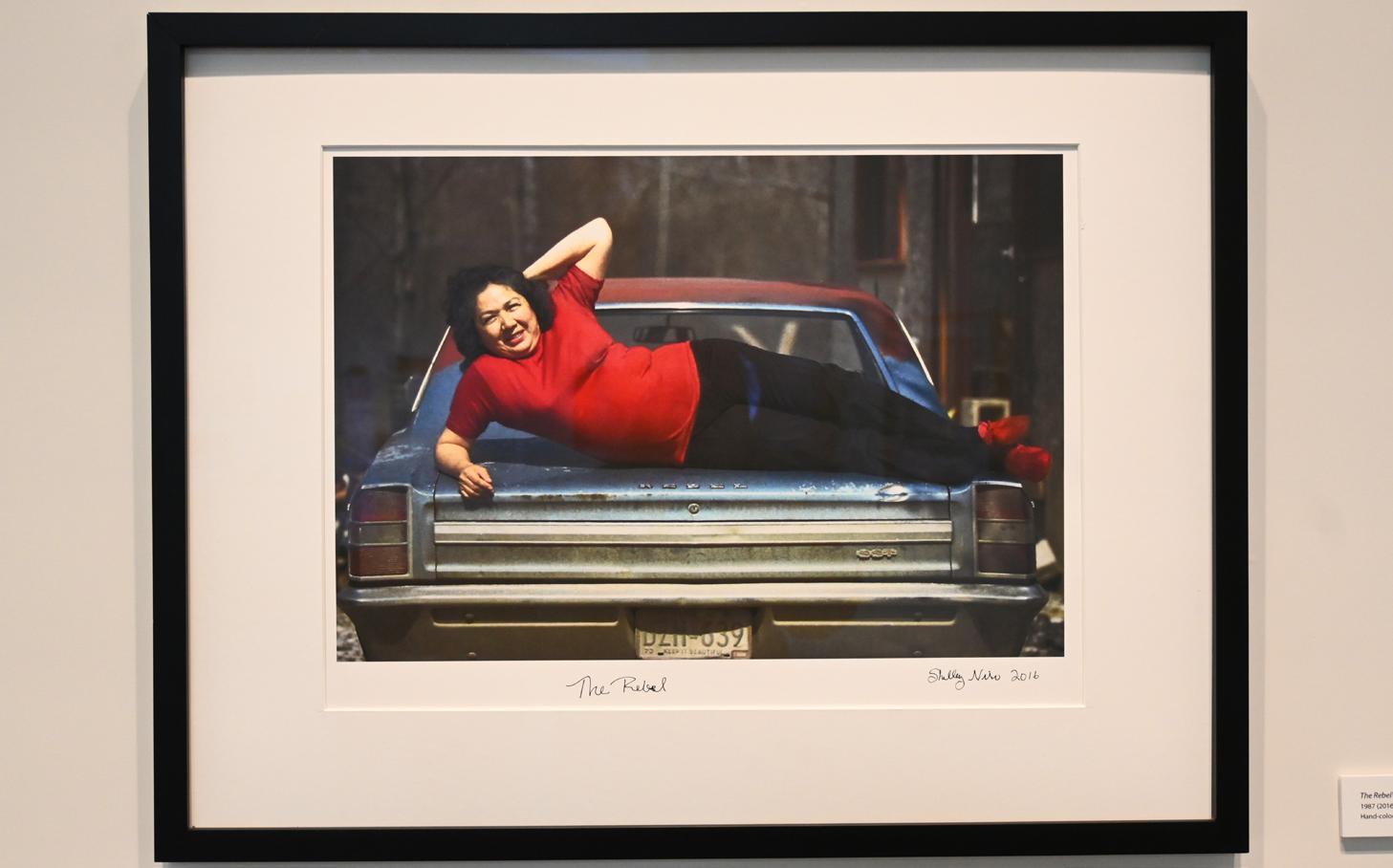
The Gorman Museum of Native American Art has officially made way for its newest exhibit, highlighting longtime Indigenous artist Shelley Niro. A Bay of Quinte Kanyen’kehá:ka (Mohawk) and member of the Six Nations of the Grand River, Turtle Clan, Niro’s work centers on Indigenous women, familial ties and ancestral homages. Most notably, she creates these visual works through photography and mixed-media methods.
With her unique abilities and artistic eye, Niro described her photography as “a mirror to [herself] and to those around [her],” according to the exhibition’s wall text. Niro possesses a range of artistic talents, featured in the variety of methods used to create the pieces on display in the Gorman Museum.
for all Indigenous artists to be recognized.
“A lot of her subject matter is to project more of what the contemporary, Native American woman experiences in the world,” Dueñas said. “It brings a feminine perspective and increased diversity, not only to a Native American art institution but in general — most displays in museums are by men, for men.”
Niro’s work also has a particular focus on the women who primarily surround her in real life. One of Niro’s standout pieces in the exhibition captures her own mother and daughters in two mixed-media portraits, “My Girls” and “Chiquita” (2002).
culture.”
Schermer shared her perspective on the different kinds of beauty to be found within Niro’s exhibition and how it may challenge the viewer to slowly analyze each work.
“You could spend so much time looking at each piece,” Schermer said. “You see something new each time. I would call it multifaceted.”
“The main difference between Niro’s work and others is that it combines a lot of different mediums,” Museum Assistant Sofia Dueñas, a second-year anthropology and art history double major, said. “It provides a different kind of experience to viewers. It’s not necessarily just photography [or] just painting, but a mixture.” Dueñas emphasized the importance of the Gorman as a museum that aims to amplify underrepresented voices like that of Shelley Niro, providing an intersectional space UC
This work magnificently captures Niro’s admiration for the women in her life, her photographs demonstrating the passage of time and the depths of her relationships. Mixing mediums to present each portrait — using her own handmade and delicately crafted fabric frames — Niro is able to present photography in an entirely new way.
Museum Assistant Natalie Schermer, a second-year anthropology major, also noted the soft material seen in the frame, adorned with beads and lace work commonly seen in Mohawk culture.
“It’s unexpected — the mixed media — it’s something I haven’t seen before,” Schermer said. “It’s very striking; it incorporates different elements of traditional frames in Mohawk

BY JULIE HUANG arts@theaggie.org
“Heated
with a friend, who was unable to finish the series.
“We had watched the first five episodes together, just her and I, but then her boyfriend actually got mad at her for
watching it,” Dill-Cruz said. “I was sending her the TikTok edits anyway, because whatever.”
Social media platforms have become a common introduction for many to “Heated Rivalry.” Apps like Twitter, Instagram and TikTok feature clips from the series, interviews from its actors and fan-made edits that encourage users of these platforms to watch the show and see for themselves what the hype is about.
Kayla Tran, a third-year cinema and digital media and communication double major, has not yet seen the show, but
knows the gist of its narrative arc due to exposure from social media.
“I have been incredibly spoiled on Twitter and Tiktok,” Tran said. “I thought, ‘This actually looks like a really good show,’ so I will come to it at some point, especially because all the edits that I’m getting on Tiktok and Twitter are phenomenal.”
The queer nature of “Heated Rivalry” cannot be sidelined, either. At its core, the show is a love story between two men, and its handling of this topic has become the catalyst of much discussion.
“To my surprise, everyone else has been super open about talking about it and educating themselves,” Dill-Cruz said. “It hasn’t been stigmatized in my friend group. We all love the show.”
It is inevitable that a series like “Heated Rivalry,” which is rapidly becoming known among those who engage in popular culture, receives a diverse range of audience reactions.
Keisha de la Cruz, a secondyear English major, cited the short runtime — six episodes in total — as a reason why she may not have been as invested in the show as she thought she would be.
“I know everyone really likes it, but I was expecting something more life-changing,” de la Cruz said. “The story doesn’t feel like it’s monumental, but rather just another story that’s following a trope. I just don’t understand why it’s blowing up.”
Mads Sagita, a third-year cinema and digital media and psychology double major, noted that whatever people’s individual reactions may be, the topic of “Heated Rivalry” is ubiquitous among demographics.
“It’s really permeated throughout campus — but not just on campus, literally everywhere,” Sagita said. “It’s not just popular in our age group either, but among all sorts of people.”
In addition to social media, the inculcating of the show’s two lead stars, Connor Storrie and Hudson Williams, into general celebrity culture, has played a considerable role in increasing
The exhibition also features Niro’s “Flying Woman” collection, which further exemplifies her interpretation of the female experience. Featuring 10 different pieces, the collection is loosely based on the Mohawk myth of the Sky Woman. The collection was developed over time, and reflects the evolution in Niro’s abilities. The pictures found in the “Flying Woman” series each feature a monochrome theme and an abstract, horizontal reflection of images across each photo’s center. The focal point of these photographs are the flying figures that span across the tops.
On April 25, those interested in learning more about Niro’s techniques and inspirations can join her for an artist talk at The Gorman Museum from 1 to 3 p.m. Schermer shared that the event will be free, open to everyone and will include refreshments.
Closing on Aug. 30, those interested have plenty of time to view “Shelly Niro” and gain a unique insight into the contemporary lives of Indigenous women.
invited some backlash.
“I would go so far as to say that I’ve seen people express shame about having watched it, and that’s so weird to me,” Sagita said. “If you didn’t like it, why are you tuning in every week? There’s a weird urge in people to be contrarian, because it’s so new and popular that they feel the need to balance the scales a little.”
One notably controversial
“The story doesn’t feel like it’s monumental, but rather just another story that’s following a trope. I just don’t understand why it’s blowing up.“
the show’s visibility. “Hudson and Connor were on award shows, which probably helped increase the show’s popularity as well, but I think it also has cemented itself as a TV show that resonates with many different audiences,” Tran said.
“You have the queer community, and you also have sports fans — especially hockey fans.”
Notably, neither Storrie nor Williams were high-profile names before the success of “Heated Rivalry.”
“I am a little surprised by it, because it’s very rare now to have a project with mostly unknown actors blow up so much,” Sagita said.
“When was the last time that this has happened and actually left an impact on pop culture at large?”
The immense popularity of the show, however, has also
point of discussion are the sexually explicit scenes interspersed throughout the narrative.

Davis students anticipate the Seahawks versus Patriots match-up and Bad Bunny performance in Super Bowl LX
BY GRACIELA TIU features@theaggie.org
On Sunday, Feb. 8, at 3:30 p.m. Pacific Standard Time (PST), the Seattle Seahawks and the New England Patriots will match off in Super Bowl LX. The game will take place at Levi’s Stadium in Santa Clara, California, home of the San Francisco 49ers. Airing on NBC and Telemundo and streaming on Peacock, the Super Bowl will also include a halftime performance by music artist Bad Bunny.
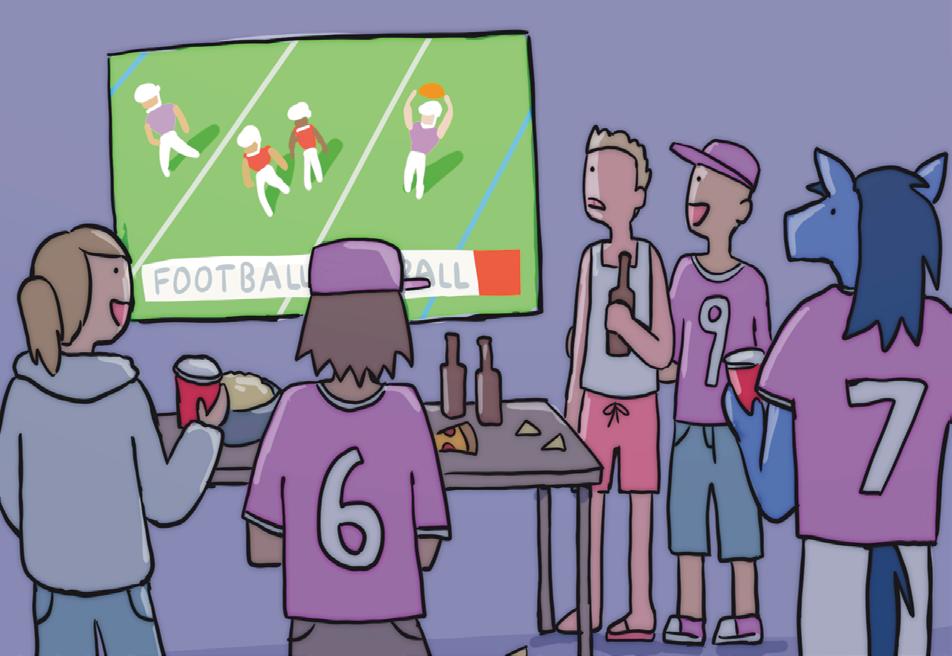
UC Davis students from various backgrounds are anticipating the event, planning get-togethers and watchparties with friends and family.
Although the closest National Football League (NFL) team to Davis, the San Francisco 49ers, was eliminated by the Seahawks in the National Football Conference (NFC) divisional round, many UC Davis students are still enthusiastic about the upcoming game, with some even being fans of the two competing teams. “I’m very excited about the game, and I’m looking forward to seeing the Seahawks back at the Super Bowl again after over a decade,” Daksh Shekar, a third-year human development major, said. “I am rooting for the Seahawks because I have been a fan of the team since I was about 7 or 8 years old.”
After defeating the Los Angeles Rams in the NFC championship, the Seahawks are reaching the Super Bowl for the first time since 2015. Noting that he had been a fan since 2012 — former Seahawks Quarterback Russell Wilson’s rookie season — Shekar described how impactful it was to see his favorite team advance once again.
“I was ecstatic and relieved when I found out the Seahawks were going to the Super Bowl because the game leading up to it was really close and nerveracking,” Shekar said. Super Bowl Sunday
remains famous for prompting gatherings, where family members and friends often get together to eat American-style snacks and watch the football game — and the high-profile advertisements that come along with it. UC Davis students are no different, with many looking forward to preparing for their Super Bowl parties.
“I’m probably going to make hot dogs and burgers and get snacks to watch the Super Bowl game with my housemates and friends,” Shekar said.
Though Davis does have some Seahawks fans, a common sentiment on campus surrounds the disappointment over the 49ers losing in the playoffs.
“The Seahawks have eliminated my team from the playoffs, and I’ve been heartbroken,” Adi Srivastava, a third-year psychology major, said.
“It stems from when I was a kid. That was the first time I saw the Niners lose to the Seahawks in the NFC Championship game. I cried, and I wrote an essay about it in third grade. I want to see them lose, but they’re probably going to win.”
UC Davis students also have their own predictions surrounding the game, noting how they’ll be keeping an eye out for specific players.
“I think the Seahawks are probably going to blow [the Patriots] out,” Srivastava said. “They’re a way better team. I’m hoping there’s a small possibility of luck for the Patriots, but I think the Seahawks wide receiver Jaxon Smith-Njigba is going to go crazy.”
Despite being a 49ers fan at heart, Srivastava — along with other 49ers fans at Davis — has now decided to root for the Patriots, hoping for a Seahawks defeat.
“I need the Patriots to save my heart, save our state and keep our stadium away from Seattle winning,” Srivastava said. “I want them to cry in our stadium.”
Besides the football game itself, many are also looking
forward to the halftime show, with Puerto Rican rapper and singer Bad Bunny, born Benito Antonio Martínez Ocasio, taking the center stage. His fanbase in particular has expressed profound excitement about his performance.
“I like Bad Bunny because he touches a lot of different parts of my life,” Samuel Aguilar, a thirdyear psychology major, said. “If I’m feeling sad, I can listen to Bad Bunny. If I’m feeling happy, I can listen to Bad Bunny. If I’m feeling hype, I can listen to Bad Bunny. He’s just been a part of certain stages of my life.”
The musician has won 17 Latin Grammys and six U.S. Grammys and has also ranked as Spotify’s top global artist from 2020-22 as well as in
different is that even though he’s mainly a Latino artist, a lot of people still seem to enjoy his music,” Aguilar said. “I have a roommate who speaks no Spanish, but he’s been getting into Bad Bunny and he enjoys listening to the songs and everything. I think that’s what makes him different. He’s kind of a universal artist.”
The NFL announced Bad Bunny, who has openly criticized the Donald Trump administration, as the Super Bowl halftime show performer in late September, prompting pushback from the Trump administration and its supporters. For his current world tour, the music artist has intentionally avoided performing in the United States, citing concerns about
“I need the Patriots to save my heart, save our state and keep our stadium away from Seattle winning. I want them to cry in our stadium.“
2025. Just this week, he won the Grammy for Best Album for his project “Debí Tirar Más Fotos,” the first fully Spanishlanguage album to receive this award. Aguilar described how Bad Bunny’s music can resonate with all people, regardless of their cultural backgrounds.
“I think what makes him

How a series of friendship advertisements led to the creation of a community
BY AMBER DUHS features@theaggie.org
It’s no secret that in college, especially on a big campus like UC Davis, it can be difficult to make friends and build community. From student clubs to sports to classes, it can feel like we’re constantly surrounded by people, but at the same time still lonely. Ershad Forghany, a thirdyear mechanical and aerospace engineering Ph.D candidate, took these feelings into his own hands, advertising his friendship by hanging up posters on campus. The result? Over 300 responses and a growing online community of over 400 UC Davis students. In fall quarter 2025, Forghany created posters with the slogan: “Attention! I’m looking for a friend group.”
The poster also included some written descriptors — “rich (in heart and spirit)” being just one — and contact information. It wasn’t much, and he wasn’t sure what response it would elicit, but he decided it was worth a shot.
“I put [the posters] up [during] first-year orientation and got 120 responses within the first two weeks,” Forghany said. “I adjusted the poster [afterwards], putting my age and that I’m a Ph.D student […] I got an additional 200 responses.”
Adi Srivastava
Third-year psychology student
Immigration and Customs Enforcement (ICE) raids that could potentially occur if he were to perform here.
As Bad Bunny has been a lifelong advocate for Puerto Rico and the Latinx community, many are expecting Bad Bunny’s
SUPERBOWLPREVIEW on 9
Forghany originally sought to find some friends and build a small community on campus. Instead, he was confronted with hundreds of individuals ready to meet new people. Looking for next steps and a way to connect everyone, Forghany created a Discord server for those interested and posted it on social media. What started as a small idea is now a server with hundreds of students and various channels dedicated to finding others with similar tastes in music, games, events and even finding study buddies. The server attracted all types of students, from
undergraduate to graduate to those living on and off campus.
“I’m a commuter student, I don’t have a dorm to live in [and] I’m not around a lot of students like people who live on campus usually are, so I feel less connected to the people around me,” Gliana Olaes, a first-year biological sciences major, said.
Within Olaes’ first week on the server, she connected with multiple students over shared past experiences and hobbies.
“The server is a great place to start to make that connection because you can actually talk to these people, know what they like, what they’re like and see what you have in common,” Olaes said.
The pursuit for ease of connection and friendship in a university setting doesn’t just stop at servers and posters, however. Forghani has connected with others with the same goal: namely, a student-development team who has created an app — Linkkup — to connect Davis students to local communities and allow them to build easier connections and friendships.
“The whole idea is basically [that] social media has turned into more of a platform for entertainment versus community connection,” Forghany said. “This is the reverse of that […] It’s the same thing that I’m doing in terms of trying to get people connected.”
Students on the server engage in meet-ups, from group bowling at the Memorial Union to meeting and creating study groups. The end goal of the server isn’t to find someone you can text once in a while — it’s to foster meaningful relationships and a real, tangible community.
“It’s really nice to have a place that’s just dedicated to making friends and meeting people,” Nohar Mesika-Tarsi, a first-year biological sciences major, said.
Why is everyone so nostalgic for 2016?
A decade later, 2026 sees a return of trends from 2016

BY VRITI SHAH features@theaggie.org
As the clock struck midnight on Jan. 1, the world celebrated the new year of 2026. Prior years had been filled with usual celebrations and New Year’s resolutions, often sparking hopeful feelings associated with a fresh start. This year, however, has been marked with an increasingly popular internet trend posing the question: “Is 2026 the new 2016?”
The Internet quickly flooded with a series of throwback posts featuring images of users from 2016. Many images showed throwbacks to recognizable viral trends from 2016, including but not limited to the Snapchat dog filter, choker fashion trend, pop musical hits, “Mannequin Challenge” and more.
Celebrities and companies have also joined in on this new wave of nostalgia. For example, Kylie Jenner hopped on this trend by bringing back her 2014-2016 look, colloquially
known as “King Kylie.” This look featured the mark of many distinguishable mid-2010s trends, such as ombre hair, matte lipstick, defined eyebrows and bright colors. Kylie Cosmetics — Jenner’s makeup brand — has even relaunched the “King Kylie” collection for their 10year anniversary so that fans can revisit 2016 fashion trends. With such widespread participation in this trend, many have been left wondering why the world seems to be so nostalgic for 2016.
“Today’s yearning for 2016 also plays into a recent cultural obsession with socalled millennial optimism, the presumed mind-set of those who came of age in the 2010s, when indie music reigned, social media platforms like Instagram and Twitter were novelties and the words ‘novel coronavirus’ were a glint in no one’s eye,” Madison Malone Kircher wrote in an article for the New York Times. While Kircher suggested that the recent trend is due to “millenial optimism,” UC Davis
students have their own varying opinions on the sweeping trend of longing for 2016.
“Culture is consuming itself, right?” Kelly Lam, a fourth-year psychology major, said. “We’re just going in cycles. Before it was Y2K, now I guess it’s 2016. You run out of content, so you reuse content from the past [...] it’s all just kind of [a] manufactured pipe around old things, because you don’t want to focus on what’s happening now.”
The Y2K comeback, as Lam noted, is another example of recycled, nostalgia-based trends. The aesthetic from the 2000s infiltrated clothing stores, social media and even cell-phone downgrades last year.
“So, from what I gather and what I remember, core memories from 2016 [were] Jake Paul, Logan Paul, fun music [and] drama[tic] controversy going on between YouTubers,” Makenah Greenlee, a thirdyear English major, said. “So, I think that [nostalgia for 2016] could possibly be a longing for a time when there wasn’t so much awareness of everything.”
Students also pointed out significant leaps in technological progress over the past 10 years; namely, the introduction of artificial intelligence (AI) and its impact on imaginative thinking and expression.
“We have so much access to other people’s lives — more than ever — [and with] artificial intelligence, there’s not really a lot of imagination and creativity,” Greenlee said. “I think that could potentially be the reason why so many people look to that period [2016], because — despite there being stupid, little petty instances like the Logan Paul versus Jake Paul thing — there was still so much imagination around it.”
Others suggested that the reasoning for the 2016 nostalgia rests in the effects of the COVID-19 pandemic. In fact, a 2025 poll showed that 45% of parents of school-age children believe the COVID-19 pandemic had a negative impact on their child’s social activity and skills.
The student-run art gallery showcased student experiences with the Internet
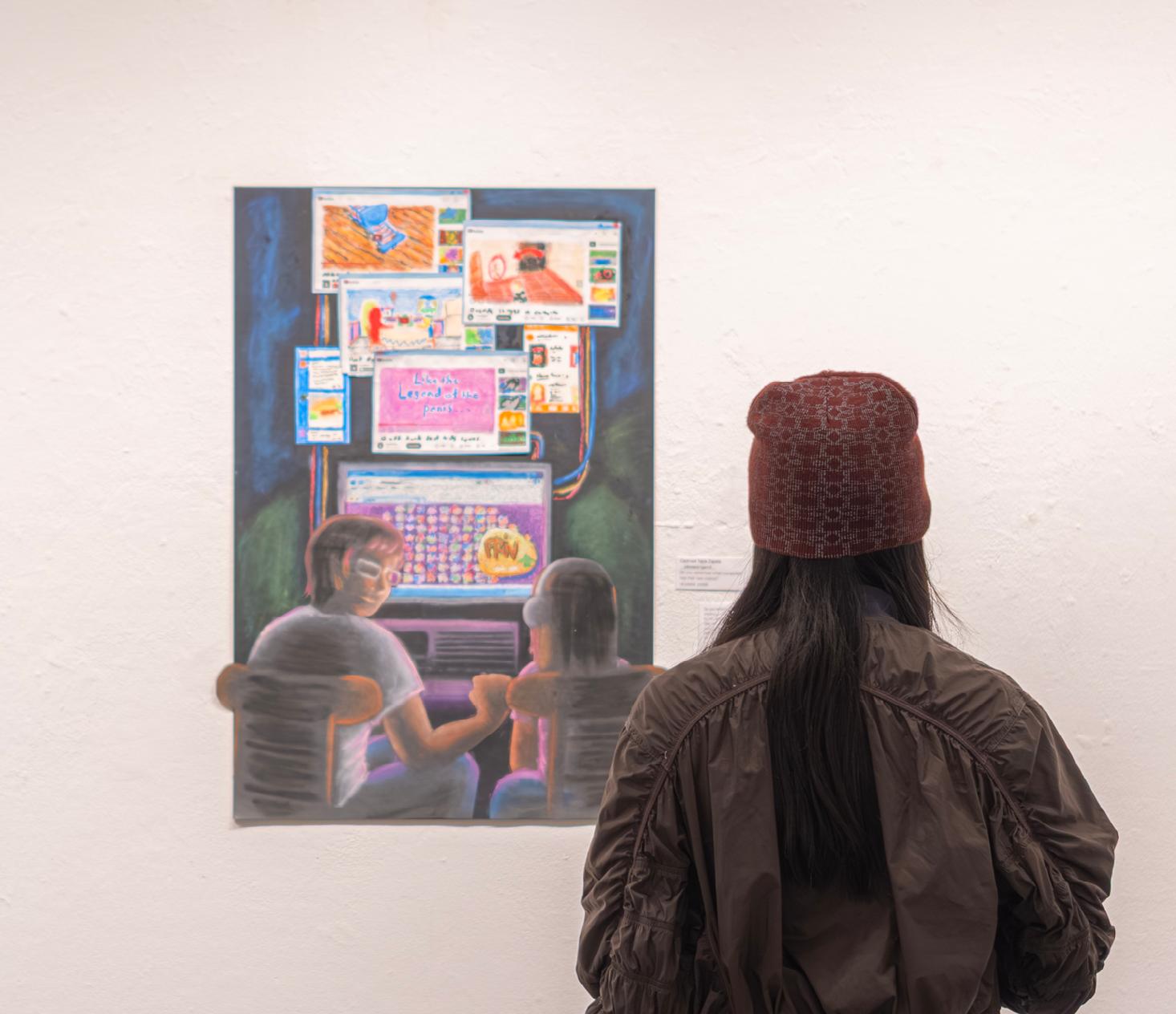
BY LAILA AZHAR features@theaggie.org
On Jan. 30, the UC Davis Basement Gallery, a student-run art gallery located in the Art Building basement hosted “user/ name,” an exhibition exploring the impact that the Internet has played in the formation of peoples’ lives and identities.
Cassie Ngo, a fourth-year design major and the group’s public relations and design director, was inspired by online anime art for this exhibition.
“I was thinking about older anime art, like the style with the big eyes,” Ngo said. “I wanted to include that in a show, and that’s how we got to ‘user/name.’”
Across the various artworks showcased in the exhibition, common iconographies of the early Internet were present across artworks, from animal jam to early memes to Hatsune Miku.
The show also featured pieces created in a wide variety of mediums.
Cadmael Tapia Zapata, a third-year art history major, displayed a painting titled “Do You Remember When Computers Had Their Own Rooms?” The piece depicts a present-day Zapata using a computer with a younger version of herself. Several web pages that she recalls from her early days of web exploration — such as “Don’t Hug Me I’m Scared” — hover above the monitor.
“I wanted to represent the fondness and brightness of these memories with chalk pastels for softness and oil pastels for vibrancy,” Zapata said. “With the collage aspect, I wanted
to represent the mishmash of periods, genre and sites I have taken to heart.”
Fittingly, Zapata’s earliest artistic inspiration came from the Internet.
“Almost embarrassingly, it was manga and animation memes on YouTube that made me say, ‘I want to make something too,’” Zapata said.
With this piece, Zapata reminisced on “creepypastas” and online horror stories.
“These stories were unique [and enthralling] in their presentation, and who was to say it wasn’t true?” Zapata said. “I was a gullible kid, and even after I got smarter, I adored how these stories [could seem] true to the viewer. They led me to seek community, hoping to connect with others who would theorize with me, marking my integration into the Internet. I believe this abstract journey fits the bill with the Basement Gallery’s theme, as I try to articulate how the Internet has molded me — much like how we as people have molded it.”
Davion Mack, a second-year Masters of Fine Arts (MFA) in sculpture graduate student, showcased “Cold Archives.”
Made using an old iMac G3, the sculpture is simultaneously nostalgic and futuristic, inviting guests to consider the perspectives people may have on technology many years into the future.
“The piece looks at how identity and memory are stored, become outdated and preserved through technology, as well as the material residue produced as the way we access the Internet evolves,” Mack said. “I wanted to
look at the relationship between humans and the Internet. By encasing the iMac G3 in plaster, it becomes this excavated time capsule that asks people to think about the devices we leave behind as technology evolves, and how they may one day be buried and dug up in the future.”
Ainsley Alsbury, a thirdyear cell biology and art history double major, displayed a photograph of her and her camera’s reflection in a mirror. The photograph is her profile picture that she uses across her social media accounts.
“I thought it was a very interesting piece to submit to the gallery, since ‘user/name’ is the theme and it represents my online presence — when people look at my profiles [that’s] what they see,” Alsbury said.
Alsbury also emphasized the welcoming nature of Basement Gallery shows.
“It’s a really cool platform for Davis art students and nonart students,” Alsbury said. “My major is in [science, technology, mathematics, engineering (STEM)], I’m not an art studio major at all [so] this is just something I like to do on the side. [The Basement Gallery] is very welcoming to everyone in the Davis community. They’re very friendly. I’ve done other galleries in the area, and the people running it are always older and their viewpoints can be very different. It’s nice to be in a room of your peers.”
Those interested in attending or showcasing their art in upcoming Basement Gallery shows can stay in the loop by following their Instagram @ ucd_basement_gallery.
The student-led theatre organization is set to premiere its winter musical at the Wyatt Pavilion Theatre on Feb. 27
BY IQRA AHMAD arts@theaggie.org
Studio 301 Productions, a student-run, on-campus theatre organization, is bringing students a rendition of the 2009 musical “Ride The Cyclone” this winter quarter.
“We are a theatre for the students, by the students,” Eli Gunn, a second-year communication and sociology double major and director of “Ride The Cyclone,” said. “As a completely non-profit, studentrun organization, there’s no adult coordinators or directors in charge of the company. Our goal is to establish a fun, nonpressure environment where students can explore theatre as a creative outlet.”
Garnering a community of students interested in all aspects of theatre, students participate in Studio 301 as actors, stage hands, music coordinators and in other roles to learn more about the behind-the-scenes of producing plays and musicals.
“We started out performing in lecture halls and producing our own little student productions,” Gunn said. “The club is still growing and we get more people every quarter. It’s really great to see the club grow so much more into a fully established community on campus.”
This winter’s production, “Ride The Cyclone,” showcases six Canadian teenagers who die in a roller coaster accident and afterward find themselves in a limbo-like space. Guided by a fortune teller named The Amazing Karnak, the teens are told that one of them will be granted a second chance at life, but only if they can convince Karnak why they deserve it the most.
What follows is a series of musical numbers, in which each character reveals their dreams, stories and hopes they once had for their unfinished lives.
“‘Ride The Cyclone’ is definitely a unique musical,” Gunn said. “It’s out of this world, and it embraces this creative craziness of life in a way where it becomes a big celebration of what life could have been.”
For the cast, the small ensemble size of the musical has created a close-knit rehearsal space.
“Everyone gets along so well,” Kalena Dawson, a fourth-year psychology and communication double major who plays Ocean O’Connell Rosenberg, said. “The creative team and cast are really close, so it feels like time to socialize while still working hard. We’re able to communicate clearly and deliver on realistic expectations.” Dawson explained that playing Rosenberg has pushed her outside her usual comfort zone as a performer.
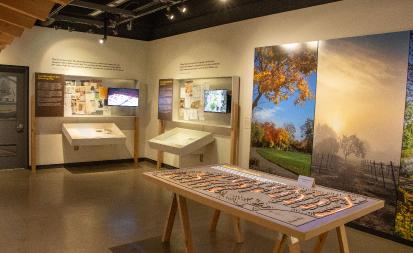
BY HANNAH OSBORN arts@theaggie.org
and hit [the water tanks], warm them up and that then warms the house,” McNeil said. “We’re very keen to demonstrate this passive solar technique as the first thing people experience, because it’s kind of wacky.”
The unique design element underscores the innovative and expansive goals of the community, as the exhibition moves into a partially constructed home that becomes increasingly furnished as visitors progress through the space. The area highlights inspirations for Village Homes Founders Michael and Judy Corbett, including magazines,
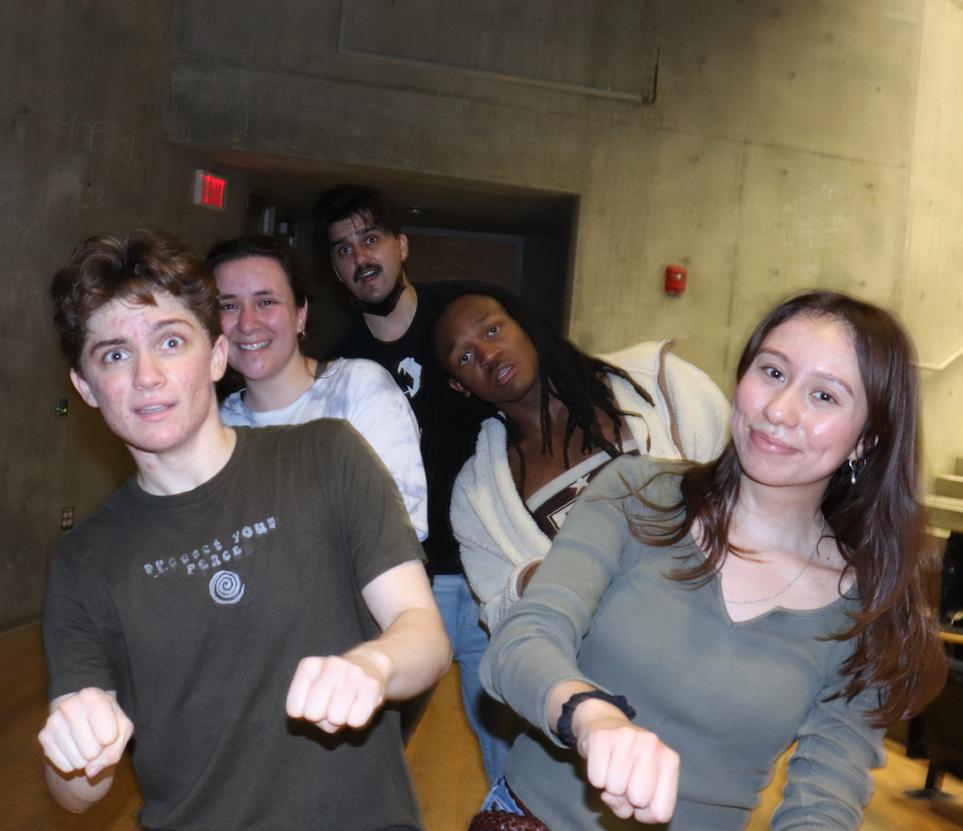
“She’s a little more bossy and kind of a mean girl, which isn’t usually what I play or is like myself at all,” Dawson said.
“It’s been really fun to explore something outside my typecast.”
Daylen Clowers, a secondyear political science major who plays Noel Gruber, described a similar experience connecting with his character.
“When I’m doing scenes or songs, I have to think about how Noel would do it while mixing in how I would,” Clowers said. “It can be conflicting, but that’s the process of figuring it out. Everyday is about developing the character, and I push to reveal my talents in ways that I haven’t done before.” Clowers noted that one of the show’s most important messages is embracing authenticity and making the most of the time you have.
“Life can end in such absurd, sudden ways,” Clowers said. “It’s important to express yourself in the way that feels comfortable to you, and to really maximize every day that you have to live. For example, we’re all here for the primary purpose of attaining an education, but we often forget to prioritize our creative needs and actually live.”
Much of the cast emphasized the strong sense of camaraderie that has formed during rehearsals — something they believe will translate directly to the stage.
“Because it’s such a small cast, we’re learning everything together,” Clowers said. “That collaboration mirrors the story, these characters are also learning how to navigate their new, collective reality together.”
For Gunn, “Ride The Cyclone” marks his first time directing a full production. While he explains the role was initially intimidating, he described the experience as both exciting and rewarding. Studio 301’s emphasis on uplifting new directors allows this experience to be possible.
“Studio 301 really encourages people to try,” Gunn said. “It felt like a safe space to take on this role. When I was told I was going to direct it, I
started immediately because I was just so excited. I spent the summer pre-planning over the time blocking, potential sets, character choices and how a typical rehearsal would run.”
Working with a limited budget also inspired innovative problem-solving, particularly since the show will be staged in a thrush configuration at the Wyatt Pavilion Theatre, with audience members on three sides.
“It allows for a really immersive experience,” Gunn said. “We had to get creative with blocking, projections and set design to make sure every angle works and can be seen by the audience.”
Ultimately, Gunn and the cast hope that the audience will leave their production with a newfound appreciation for life’s impermanence.
“The show starts off fun, quirky and ridiculous,” Gunn said. “But by the end, it becomes really emotional. I hope the audience walks away with an appreciation for the finiteness of life and the importance of finding meaning in the little things outside of a monotonous routine.”
Studio 301 is premiering “Ride The Cyclone” on Feb. 27, Feb. 28 and March 3 at the Wyatt Pavilion Theatre. For those interested in securing tickets, or getting involved with Studio 301 as they prepare to begin auditions for their spring quarter production of “Chicago” in March, regular updates can be found through their website and Instagram, @ studio301productions. For the cast and creative team, the production represents exactly what student-run theatre is meant to be: a creative outlet and welcoming community.
“I encourage everyone to try and join, whether it be on the technical side behind the scenes or auditioning for an upcoming show,” Gunn said. “Taking that first step can be scary, but I was so welcomed by this team and am grateful to be part of Studio 301. It’s a really special community.”
environmental reports and books.
The deconstructed nature of the house allows visitors to see into structural elements, such as a flat plate collector and the placement of roof tiles directly against battens, all labeled by plaques to draw attention to the important and often experimental features found within the neighborhood’s original 245 homes. McNeil explained the purpose behind these exhibition choices.
“This idea that the house is getting built as you’re going through it is a great way of communicating architecture, and then putting [furniture] where we want to see things,” McNeil said. “The model, the fireplace, the tile flooring — everything had a role.”
The house exits into an alcove where sections of a documentary about Village Homes can be viewed, next to a presentation on the oral histories of residents who grew up in the community, a project headed by UC Davis graduate and undergraduate students.
The extensive and detailed planning of the neighborhood is displayed in a three-dimensional, scaled model map in the center of the exhibition, which uses lights to illuminate different aspects that Village Homes founders wanted to incorporate in the development. Such features include pathways, orchards,
water channels, green spaces and common areas, all intended to make the community as selfsufficient and connected as possible.
“The common areas are pretty unique, and a lot of people say about Village Homes: ‘It’s the place with no fences,’” McNeil said. “Which, conceptually, means that everyone that lives here pretty much knows their neighbors, because they can’t avoid them.”
McNeil also explained the features used in designing the community that have become fixtures in developments since.
“There are swales and basins throughout the site,” McNeil said. “They capture all the rainwater whenever it rains. These are these innovations that were not typical of a neighborhood at that time. We’ve integrated some of them now into new developments […], but back then it was not the case, so they were really ahead of their time in what they were thinking. We kind of say we’re living in [Michael] and Judy Corbett’s future.”
The exhibit makes use of screens to showcase interactive diagrams, news reports and home videos from the construction of the neighborhood. Technology is blended with documentation of Village Homes’ history in the form of articles, newsletters and photos, many sourced from the archives at Shields Library.
The curation was mindful of bringing in as many mediums as possible to convey the encompassing experience of living at Village Homes in the last 50 years, with recreations of the iconic “Lord of the Rings”themed street signs and clothing from the mid ‘70s on display.
“When it comes to the exhibition — and this is really part of my philosophy in exhibition making — I want to do things that [are multimedia],” McNeil said. “You’ve got film, you’ve got photography, you’ve got fashion, you’ve got three-dimensional maps, you’ve got the built house.” By using multiple modes of storytelling, McNeil aimed for the exhibition to be as accessible to as many people as possible. Whether they’re interested in landscape design, architecture, construction, water storage or fashion, visitors will be able to find at least one aspect of the Village Homes history that engages them.
“Village Homes: A Radical Plan” will be on display at the UC Davis Design Museum in 124 Cruess Hall from Jan. 20 to April 26, 2026. The museum is open Monday through Friday, and will be holding special open hours from noon to 4 p.m. on both Biodiversity Museum Day on Feb. 21, and Picnic Day on April 12.
Enter digits from 1 to 9 into the blank spaces. Every row, column and 3x3 square must contain each digit. Each Sudoku has a unique solution that can be reached logically without guessing.

PAGE 1
“They gave us just around three weeks of time,” the employee said. “We found out pretty late, it was sudden and they didn’t give us much information.”
The notice of closure for the Downtown Davis location is just one of many across Peet’s locations in California. Stephanie O’Brien, a spokesperson for Peet’s, explained the upcoming changes for the company.
“These closures reflect a broader effort to align our business with long-term growth priorities and current market conditions,” O’Brien said in an official statement to CBS.
The Downtown Davis Peet’s employee shared their perspective on the loss of the community atmosphere that Borgeson described.
“I feel like everyone that spends time in Downtown Davis, to some extent, [...has] some connection to this store, or at least someone else who comes here,” the employee said. “I feel like we were very involved with the community. We have community planners who come here regularly, and it seems like everyone’s sad. It’s not just us working here. At the same time, it’s kind of exciting. At least I’m trying to stay positive even though the job market [isn’t] great right now.”
When asked about how
H.R.1 would impact UC Davis students who are currently eligible for CalFresh, Leslie Kemp, director of the Basic Needs Department and Aggie Compass Basic Needs Center, said that they are working with campus and county partners to understand what the changes presented by H.R.1 may mean
for students.
“Here’s what we know so far: H.R.1 has stricter work requirements for adults who don’t have dependent children, but because the CalFresh student requirement is already very strict, the impact to students will be minimal,” Kemp said via email. “H.R. 1 tightens the rules about which immigration statuses can get CalFresh. [...] The bottom-line for students is, if you currently get CalFresh, you will likely stay eligible, but you may need to meet extra documentation requirements.” Kemp also explained that UC Davis is working with Yolo County to coordinate responses to the changes to come from H.R.1.
“The University of California has basic needs representatives working with the state Department of Social Services on student eligibility issues, and UC Davis continues to work closely with Yolo County Health and Human Services,” Kemp said. “We have a strong partnership in place, and are actively coordinating to anticipate impacts to students and maintain an efficient, student-centered application process.”
This classification aligns with the university’s 10-year plan — titled “To Boldly Go” — which aims to increase UC Davis’ education excellence, research impact, accessibility and other key goals by 2027. The application for the Carnegie Classification was filed by the Office of Public Scholarship and Engagement (PSE), a UC Davis entity responsible for coordinating and strengthening community engagement, teaching and public impact projects with external communities. In addition to overseeing the Community Engagement Classification, the Carnegie Foundation offers
other elective classifications recognizing commitment toward public purpose, including sustainability and leadership. UC Davis has yet to be recognized for these other elective classifications.
The next cycle of Carnegie Community Engagement Classifications will occur in 2029, with the University of San Diego taking over the American Council of Education’s role in overseeing the designation process. The cohort will consist primarily of new recipients.
They believe their representatives (or at least the ones on their side of the partisan line) have their best interests at heart — but, if that were truly the case, there wouldn’t be cause for a protest in the first place. By treating policy makers as allies rather than as adversaries, protest movements become weak and ineffective. Instead, it is always best to assume that no politician will defend you and that no promise will be kept. Without constant pressure, our representatives will forget that they are supposed to represent us, the people, rather than focus on lining their pockets.
A successful protest is one that has defined goals and agitates until they’re accomplished. It views public peace as separate from its more important objectives. It fights all politicians — not just the ones who actively oppose it. It has a spine. The pro-Palestine protests that began in late 2023 are examples of more successful movements. Through disruption and noise alone, they completely shifted public opinion and moved the world in the direction of pursuing peace rather than continued genocide, and Israel has been put on the defensive on the global stage. Even so, the amount of real policy

change has been less than the movement hoped for, and it took an incredible amount of work to even get this far. In order to make real change, we need real protests. If you want to see progress, find movements that advocate for real, concrete improvements. If they’re supported by mainstream news outlets, they likely are not doing enough to achieve their goals. Large media conglomerates are more representative of the elites than they are of the people, and a protest viewed positively by elites is not disturbing the peace enough to scare politicians. We need more substantial protests — and more protestors to participate in them. So, go out and agitate: for the sake of the people.
Disclaimer: The views and opinions expressed by individual columnists belong to the columnists alone and do not necessarily indicate the views and opinions held by The California Aggie.
They believe their representatives (or at least the ones on their side of the partisan line) have their best interests at heart — but, if that were truly the case, there wouldn’t be cause for a protest in the first place. By treating policy makers as allies rather than as adversaries, protest movements become weak and ineffective. Instead, it is always best to assume that no politician will defend you and that no promise will be kept. Without constant pressure, our representatives will forget that they are supposed to represent us, the people, rather than focus on lining their pockets.
A successful protest is one that has defined goals and agitates until they’re accomplished. It views public peace as separate from its more important objectives. It fights all politicians — not just the ones who actively oppose it. It has a spine. The pro-Palestine protests that began in late 2023 are examples of more successful movements. Through disruption and noise alone, they completely shifted public opinion and moved the world in the direction of pursuing peace rather than continued genocide, and Israel has been put on the defensive on the global stage. Even so, the amount of real policy change has been less than the movement hoped for, and it took an incredible amount of work to even get this far.
In order to make real change, we need real protests. If you want to see progress, find movements that advocate for real, concrete improvements. If they’re supported by mainstream news
outlets, they likely are not doing enough to achieve their goals. Large media conglomerates are more representative of the elites than they are of the people, and a protest viewed positively by elites is not disturbing the peace enough to scare politicians. We need more substantial protests — and more protestors to participate in them. So, go out and agitate: for the sake of the people.
Disclaimer: The views and opinions expressed by individual columnists belong to the columnists alone and do not necessarily indicate the views and opinions held by The California Aggie.
unintentionally or not — waves a huge red flag.
Taking all of this into consideration, joining any group (religious or not) seems terrifying. So, what are some proactive ways to discern whether one is abusive or healthy? The main way is to look at the fruits the group and members produce: Are they fulfilling their promises and displaying healthy practices of honesty, independent thinking and respect for other groups as well as members’ time? Communities are a human necessity, but they have powerful influence over us, so it’s imperative to do background research before committing. This can include talking with former members, looking into what corporations they’re affiliated with and analyzing their stance on financial support and time commitment. Since humans aren’t perfect, neither are affiliations; groups will make mistakes. We just need to be open-minded to the process of finding a healthy one and develop discernment to do that.
halftime performance to come at just the right time.
“With all the controversy that’s going on with the president and everything, just the fact that a Latino person is performing at such a big event makes me feel proud, because I’m Latino myself,” Aguilar said. “I feel like he’s representing not just Puerto Rico, but all Latino people in general in this moment. The fact
that he’s going to sing in Spanish and not in English is a big part for me because it’s my language, and I think it should be heard, not just by a certain group of people.”
Having shared communities like Forghany’s server and actively creating ways to connect with each other is an indispensable aspect of many student’s college experiences, according to Olaes.
“A lot of people feel like they’re alone, or like they don’t have anybody to reach out to, but everybody thinks that way,” Olaes said. “We think that we don’t have [a lot] in common, but the fact that we all feel this way is the one thing we do have in common.”
“2016 was the peak of social media, and people started to get really connected through online media sources,” Dronkers said. “And [now], post-COVID-19, people don’t really know how to interact in person anymore and are yearning for that same sense of connectedness.” These UC Davis students have pointed out the different factors that may have contributed to the societal craving for 2016. With the combination of media reconsumption, artificial intelligence and lack of human connectivity, the nostalgia for a “better time” can feel inevitable to many. The widespread longing for 2016 seems to be a signal — not necessarily that that was the perfect year, but at least that it felt like a simpler, more optimistic time.
Galal also highlighted government resources, namely the Environmental Quality Incentives Program (EQIP), which incentivizes applicable residents to aid ecological health.
“What those grants do is fund landowners, usually with a Resource Conservation District — which there’s usually one in every county — to plant a native hedgerow on the border of their property,” Galal said. “What that does is it increases diversity for the overall health of the wildlife and invites the wildlife and pollinators to the agricultural sites for the benefit of agriculture.”
Currently, Putah Creek Council has a Memorandum of Understanding (MOU) work order contract with the City of Davis to host five community stewardship events through July 2026. Saturday’s event was the first of these five cleanups, with the next event scheduled for Saturday, Feb. 14, at Mockingbird Park. More information about Putah Creek Council can be found on their website or through their social media.

BY NAREN KRISHNA JEGAN science@theaggie.org
“That’s one small step for man, one giant leap for mankind.”
This line, spoken by astronaut Neil Armstrong as he took the first steps of any human on the moon in 1969, could be heard at Houston’s Mission Control Center and through the TV screens of over 650 million viewers internationally. Since then, subsequent missions have initiated further lunar exploration, experimentation and documentation, with Apollo 17 in 1972 marking our last endeavor.
This year, NASA has scheduled a return mission to the moon, which they dubbed Artemis II after the Greek goddess of the moon. This mission would be the first time humans have journeyed back to the moon in over 50 years.
Led by Commander Reid Wiseman, Pilot Victor Glover and Mission Specialists Christina Koch and Jeremy Hansen, Artemis II is set to launch on Feb. 6, 2026 for a 10-day crewed flight on a free-return trajectory around the moon and back to Earth. The astronauts will be on board the Orion spacecraft, propelled into space using the recently developed Space Launch System (SLS). The SLS is a super heavy-lift rocket that enables astronauts to venture further within our solar system while
also carrying multiple astronauts and large amounts of cargo.
Introduced in the Artemis I mission, the SLS with an Orion spacecraft performed an unmanned 25-day mission that served as a starting point for further space exploration. The successful results and data collected were foundational to the development of the Artemis II mission and the start of manned missions back into deep space.
Max He, a second-year neurobiology, physiology and behavior major, shared what most excited him about this upcoming launch.
“There’s a lot of resources that we can get from our analysis of this mission,” He said. “Although we’re not going to the surface of the moon again, it would be super cool to see this come back to life soon. From this mission, NASA could gain a lot of insight about the new SLS rocket system. Not only could this help power future missions to the moon and potentially its surface, but maybe even [to] Mars.”
Parinitha Balaji, a secondyear human biology major, was interested in the biological aspects of the mission.
“Spaceflight has been shown to affect human health due to increased radiation exposure, temperature/pressure differences and obviously, zero gravity,” Balaji said. “What would be cool is if NASA could collect the biometrics from each astronaut; that could inform them further for longer missions like we did
in the 1900s.”
While there are skeptics about the multi-billion dollar budget used for this launch, He and Balaji offered their reasons as to why these projects are useful for humanity.
“We are exploring areas that might affect us in the future: Who knows if we’re going to start recolonizing the moon or even moving further into space?” He said. “There’s so much to learn about our natural world; the funding not only would help increase our understanding of spaceflight and the moon, but also our own skills as engineers, scientists and leaders.”
Balaji continued, focusing on the research performed on the astronauts’ health while in space.
“A lot of the budget doesn’t just go into the rocket; there’s biology, chemistry and physiology of the astronauts that is crucial to study,” Balaji said. “This mission marks the first major manned spaceflight that the [United States] has accomplished in the 21st century. As we develop smarter technology that can make our lives easier, we should also invest into pushing what we observe to its deepest limits.”
With Artemis II, NASA is pushing beyond to new horizons that can enable further exploration. With this mission, we may someday — in the not-so-distant future — have hundreds of millions of viewers glued to YouTube or social media to witness a long-anticipated return to the surface of the moon.

Local efforts by Putah Creek Council aim to address the rise in non-native plant species
BY YUENJO FAN city@theaggie.org
On Jan. 24, Putah Creek Council hosted the Putah Creek Parkway Beautification event from 9 a.m to 12 p.m. in partnership with the City of Davis Open Space Program and UC Davis American Academy of Environmental Engineers and Scientists (AAEES).
“Some of the species we worked on [preserving] were California Poppy, California Pipeline, Deer Grass and Lipine, so we weeded around them,” Galal said. “Then, what we did at the very end was add some fresh wood chips. The wood chips help us keep the weeds from growing back up, and it also controls temperature and moisture.”
Pulling the non-native weeds provides the native plant species with more room for growth, while the wood chips help water slowly trickle down, preventing moisture accumulation in the soil, according to Galal.
Furthermore, this cleanup was aided by a combination of UC Davis students and Davis community members, totaling 17 volunteers.
the doom and gloom these days.
I have never been to one of these and not come out with a better attitude and feel like I’m part of something.”
Goodwin further explained how partnerships with UC Davis student organizations are the backbone of the Putah Creek Council’s community engagement, and she encouraged more UC Davis student organizations to reach out.
Peihong Long, a third-year environmental science and management major, attended the cleanup with the Davis AAEES chapter and cited the importance and satisfaction of contributing.
is invasive plant removal,” Galal said. “The way that the California hills turn green for just a few months and then turn brown — that’s all non-native grasses. Unfortunately, when you go out into the landscape, most of what you’re seeing is non-natives and it’s actually harder to find a native species. [The non-native species] come in and they outcompete the native [species] really quickly.”
Goodwin characterized historical factors as a major catalyst for the increased amount of non-native plant species.
Putah Creek Council is a Davis-based nonprofit focused on environmental stewardship, education and advocacy of ecological protection. Founded in 1988, the organization was originally focused on the renewal of water flow into Putah Creek following a two-year drought. Now, the organization has expanded to ecological protection throughout Southern Yolo County and Northern Solano County. Saturday’s cleanup event concentrated on removing non-native plants in the Putah Creek area stretching from the Arboretum GATEway Garden to West Chiles Road.
Peyton Goodwin, Putah Creek Council’s community engagement & outreach coordinator, touched on the importance of Putah Creek Council’s engagement with the local community.
Maddie Galal, the stewardship coordinator for Putah Creek Council, expanded on the cleanup objectives.
“That’s been one of the great ways that we’ve been able to build event volunteers, when a group reaches out,” Goodwin said. “They’re a really joyful, community-based time, [especially] when UC Davis kids come. It feels fun, uplifting and a really powerful antidote to all
The surgery was performed on Viggo, a three-month-old kitten
BY JOANNA ABRAHAM science@theaggie.org
A recent partnership between the neurosurgery departments of the UC Davis Veterinary School of Medicine and the UC Davis Children’s Hospital has led to a hybrid surgical treatment for hydrocephalus that is the “firstof-its-kind,” according to a UC Davis Health press release. It all started when Viggo, a 3-month-old kitten, was brought into a UC Davis-affiliated veterinary clinic by his owner, Erin Cooper, who, according to an interview with UC Davis Health, was “curious about the [abnormally large] size of his head.” After a series of magnetic resonance imaging (MRI) scans, Viggo was diagnosed with hydrocephalus, a disease where cerebrospinal fluid (CSF) builds up in the brain, “placing harmful pressure on the brain’s tissues.” This can be deadly, according to the National Institute of Neurological Disorders and Stroke.
Most kittens who receive this diagnosis are euthanized, according to veterinarian Michael Kearley in an article
published by PetMD. Karen M Vernau, clinical professor of neurology and neurosurgery at the UC Davis Veterinary School of Medicine, commented on this prognosis in an interview with UC Davis Health.
“[Kitten hydrocephalus] is something for [which] we’ve never had a successful treatment,” Vernau said. “[But] I never say never.”
Effective surgical treatments for hydrocephalus do, on the other hand, exist for humans, an insight that sparked a collaboration between the veterinary hospital and Cameron Sadegh, fellowship-trained pediatric neurosurgeon at the UC Davis Children’s Hospital.
Treatment strategies for human and animal hydrocephalus turned out to be surprisingly similar.
“In human medicine, and increasingly in veterinary medicine, [...] treatment centers around diverting CSF out of the ventricular system to an alternate location for absorption,” veterinary neurologist Philip Schissler said in a research paper. Sadegh, in an interview
with UC Davis Health, described these techniques as “replumbing.”
For humans with hydrocephalus, there are currently two treatment options: shunts or the use of an endoscopic third ventriculostomy (ETV). Shunts can either be ventriculoperitoneal (VP) or ventriculosubgaleal (VSGS). These terms simply indicate the path CSF takes as it is rerouted.
For a VP shunt, CSF is rerouted from the ventricles (cavities in the brain) to the peritoneal cavity in the abdomen, according to the Memorial Sloan Kettering Cancer Center.
On the other hand, for a VSGS shunt, CSF is rerouted from the ventricles in the brain to the subgaleal space, according to Koksal et al. in an article published by the National Library of Medicine (NIH). The subgaleal space is an area between the skin of the scalp and the skull. This technique is most commonly used in infants, who may not have “an adequate absorption capacity of the abdomen.” Additionally, certain traits of cerebrospinal fluid itself may not be compatible for VP
shunting in infants. The VSGS is then later surgically replaced with a VP shunt once the infant has further developed.
Sadegh described the aforementioned process as a “bridging technique” in an interview with UC Davis Health. Several complications, however, are associated with the use of VP shunts. These include obstruction and infection, according to Paff et al. in an article published by Science Direct.
Rather than using shunts, the second option is an ETV, where the neurosurgeon passes an endoscope through a series of ventricles and punctures a membrane to create a small opening. Ultimately, this opening allows for “CSF to exit the ventricle system and flow in and around the brain as it would under normal circumstances,” according to the Hydrocephalus Association.
Sadegh referred to ETV as the “most minimally invasive and most natural of the treatment options.”
However, ETV often fails in young human infants, because their arachnoid villi
“I signed up because I thought it was a good opportunity,” Long said. “It’s important to consider that when we have these native spaces or natural preserves, management and preservation is a big part of that. [...] I think [Putah Creek Council] organized it really well, and I would definitely do it again.”
In accordance with the organization’s mission, Putah Creek Council has also kept a keen eye on issues that the local environment faces. When asked about the most significant hurdle to ecological health, Galal noted invasive plant species as a major issue.
“The biggest challenge
“There’s a ton of eucalyptus trees that you’ll notice around here, and those were all planted through colonization for paper and wood,” Goodwin said. Whereas native plants once dominated California’s ecosystem, invasive species have begun to overwhelm the natural landscape. Largely brought by foreign settlers, these invasive species ultimately compromise ecological health by degrading biodiversity and harming native habitats that were previously unexposed to non-native species. Thus, cleanup events like the one held by Putah Creek Council on Saturday help combat these non-native plants and restore a balanced and healthy ecosystem.
PUTAHCREEK on 9
— structures that aid the flow of CSF by acting as one-way valves — are poorly developed, according to Damaty et al. in an article published by the NIH. Like infants, the brains of kittens, although anatomically similar to those of a human, are much smaller, according to Edwards et al. in an article published by the NIH; roughly a quarter or a third of the size of an infant’s, according to Sadegh. Thus, if an ETV were used directly on Viggo, it would likely fail for the same reason it often does in human infants.
While the neurosurgery team could have used the risky VSGSto-VP shunt technique, Sadegh experimented by combining a VSGS with an ETV.
Sadegh commented on the reasoning behind this decision.
“[The VSGS] may just bridge the brain long enough for the brain to further develop the ‘biomechanical changes where the ETV is favorable,’” Sadegh said. “[By then], the ETV is already open, and will keep working for the long term.”
For the next several months after the surgery, doctors documented Viggo’s recovery
through a series of MRI scans. Recovery was slow, and, eventually, doctors found the following signs of meaningful recovery: thicker outer-brain tissue, inward relaxation of the skull and an intact catheter, according to the UC Davis press release. As the “first-of-its-kind,” the success of Sadegh’s surgical technique is groundbreaking in terms of its potential to reshape existing surgical treatments for hydrocephalus in humans and animals alike. More broadly, it speaks to the general trend of animal research informing the development of treatments and surgical techniques in humans. The first coronary artery bypass, for example, was successfully performed on a dog. Sadegh was optimistic about the future implications of the procedure, but emphasized the need for further long-term research.
“If this surgical technique continues to be successful in the long term, across several more [trials] […] then [we can] eventually, confidently provide that as a new option to some human patients,” Sadegh said.
basketball
to
The Aggies’ Big West record is now 5-4, putting them in the middle of the conference standings
BY COLINA HARVEY sports@theaggie.org
On Jan. 22, UC Davis
men’s basketball faced off against the UC San Diego Tritons, a competitive Big West opponent.
In the week prior, the Aggies had won the first two games of a four-game homestand against California State University, Fullerton and UC Irvine. In their match against Fullerton, the Aggies led by as much as 16 points; while Fullerton came within three points of them at the end, the Aggies were able to close out and get the victory.
The Aggies were wellmatched against the UC Irvine Anteaters in their next game. Despite only holding a small lead over the Anteaters, the Aggies were able to defeat Irvine with a final score of 75-72. This was no small feat for the Aggies, as this was only UC Irvine’s second conference loss of the season.
Going into their game against UC San Diego, the Aggies had the opportunity to build a winning streak. Last season, UC San Diego was a formidable opponent in the Big West, going 18-2 in conference before becoming Big West champions. They made it to the first round of the National Collegiate Athletic Association (NCAA) championship tournament,
where they nearly beat the fifthseeded University of Michigan. This season, they have not been as strong, with a conference record of 4-3 at the time of the game.
UC San Diego built up a small lead early on, opening the game with a 3-pointer and leading 8-2. The Aggies struggled to shoot from behind the arc, going 1-10 in the first 14 minutes of the game. However, the Aggies never let the Tritons get too far ahead, tying the game up with just over four minutes left in the half. A pair of back-to-back 3-pointers from Isaiah Chappell, a second-year economics major, and Carl Daughtery Jr., a fourthyear communication major, gave the Aggies good momentum as they approached halftime. A final 3-pointer from Marcus Wilson, a second-year human development major, gave the Aggies a fivepoint lead at the half. The second half saw even more back-and-forth scoring between the teams up until the very end. The game was tied at 59-59 — with less than five minutes left — when the Tritons started pulling ahead. Connor Sevilla, a third-year managerial economics major, tried to stall UC San Diego’s momentum with a fastbreak 3-pointer, but they continued to forge ahead. The Aggies could not match the Tritons scoring in crunch time, and lost 74-80.
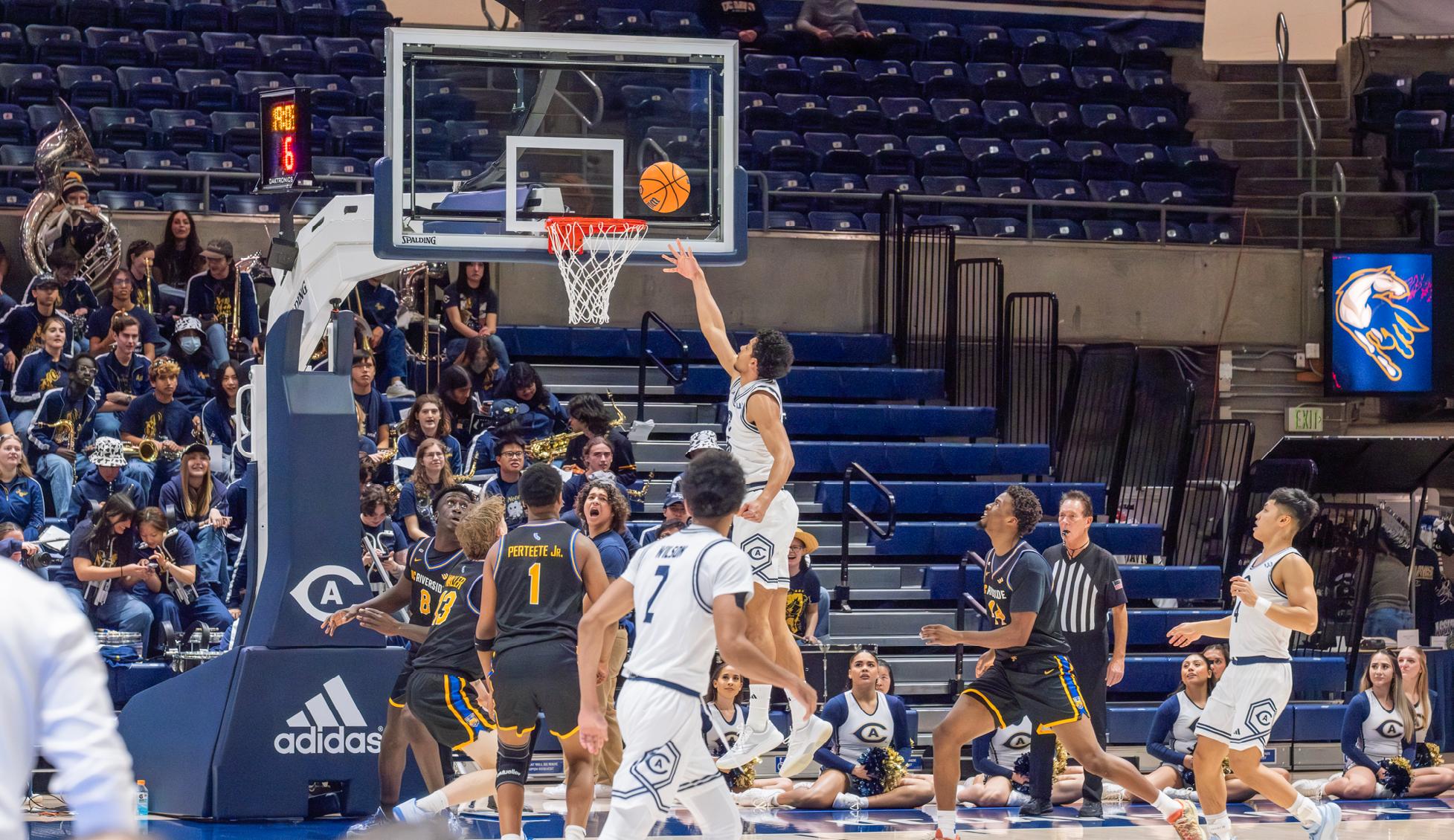
going into the match.
Despite the loss, Wilson put up 17 points and Daughtery Jr. recorded 16, going 4-7 on 3-point shooting. Niko Rocak, a business administration (MBA) student, recorded a doubledouble with 11 rebounds and 11 points.




On Jan. 24, the Aggies played the UC Riverside Highlanders. The game was an opportunity for the Aggies to put another score in the win column, as UC Riverside had a 2-6 conference record


UC Davis immediately came out in front, leading 10-2 in the first few minutes thanks to backto-back 3-pointers by Wilson and Chappell. The Aggies led by as much as 17 in the first half, and were up by 11 going into halftime. In the second half, the Aggies’ lead peaked at 16 points before the Highlanders started to slowly creep back. Midway through the half, UC Riverside was able to cut
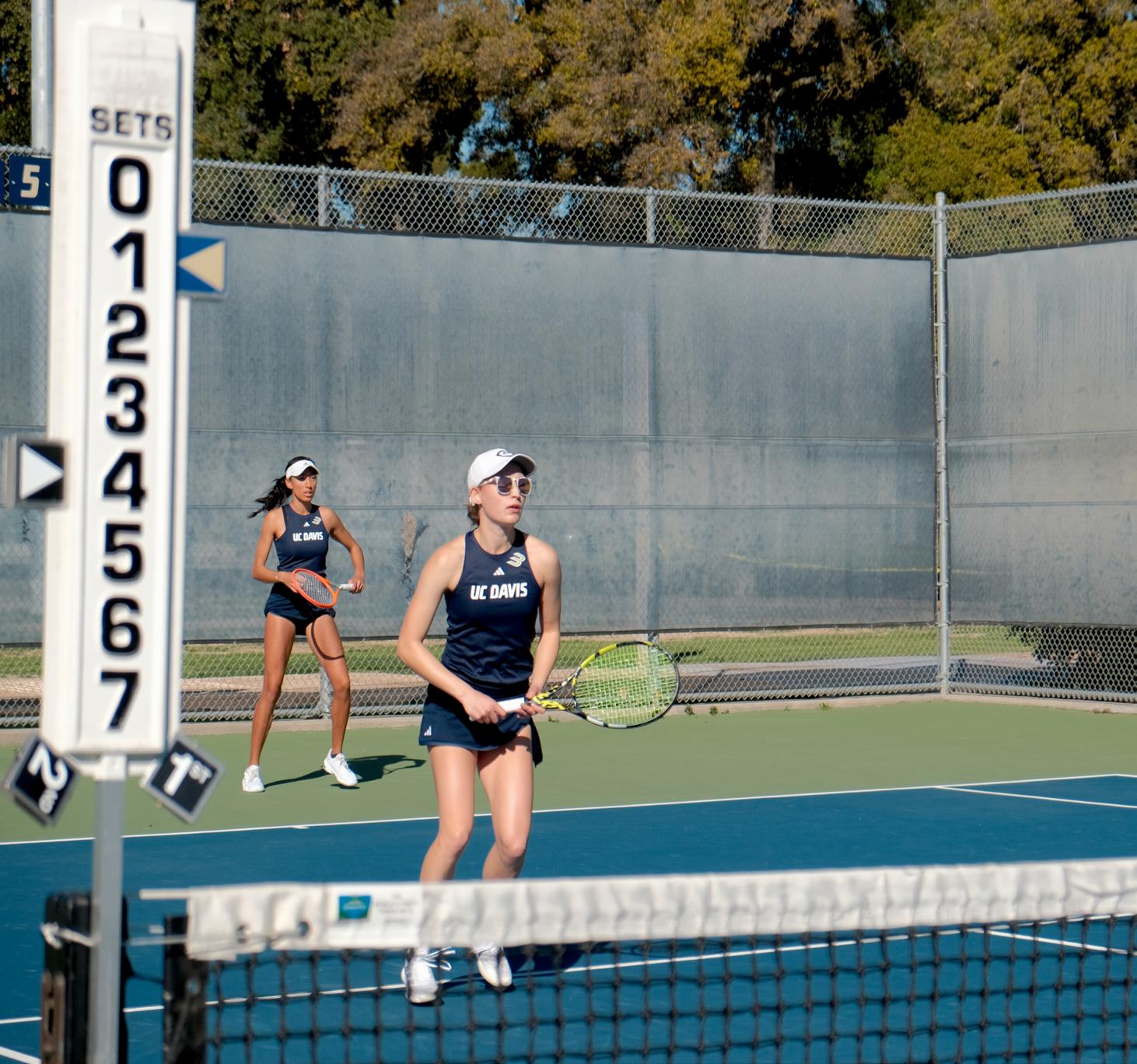
The Aggies win 4-0 against the University of the Pacific and Jessup University
BY DANIELLE WIRNOWSKI sports@theaggie.org
On Jan. 24, UC Davis played against the University of the Pacific and Jessup University for their first home games of the spring season. In an exceptional start to 2026, the Aggies beat the University of the Pacific 4-0 and Jessup University 7-0.
The Aggies went up against the University of the Pacific at 11 a.m., followed by matches against Jessup University at 3 p.m. There were a total of 18 matches across the day, split into nine matches per school; these consisted of six singles matches and three doubles matches.
UC Davis started the morning off by securing wins for doubles teams one and two. Doubles team one, consisting of Polina Marakhtanova, a second-year cognitive science major, and Mika Ikemori, a third-year psychology major, won their set with a score of 6-1. “I just enjoy the sport, but also, my team just inspires me to do well,” Ikemori said. “I love my teammates, and I know they always have my back, win or lose, so I wanna
win for them, not just myself. So, whenever I play, I kind of have them not just side-byside, but always in the back of my mind.”
Doubles team two, consisting of Maya Youssef, a fourth-year political science major, and Isabella Bringas, a second-year neurobiology, physiology and behavior major, won their set with a score of 6-2.
Ikemori and Youssef went on to win their singles matches, with scores of 6-1 in the first set and 6-4 in the second set, and 6-0 in the first and 6-0 in the second set, respectively. Three of the six doubles matches went unfinished by the Aggies, and with only one loss in the singles matches, the Aggies came away with a victory of 4-0.
“The team was really excited, [and] the coaches were also really excited,” Ikemori said. “Especially, I think the fact that [the score] was 4-0 and 7-0 [showed that] we worked really hard for it, and we’re just so very happy.”
The Aggies brought the same fighting attitude into the match against Jessup, with UC Davis sweeping all three doubles matches. However, one victory was by default, as Jessup did not provide a third doubles team.
Wolfe, a fourth-year aerospace and mechanical engineering major, and Vivian Gallaway, a first-year business major, won their doubles match with a score of 6-0. Penelope Wong, a second-year environmental engineering major and Sophia Sappa, a third-year neurobiology, physiology and behavior major, followed suit, with the same score.
UC Davis proceeded to win all six of the singles matches. Four of the singles matches saw a score of 6-0 in the first match and 6-1 in the second match. One singles match saw the inverse score, with 6-1 in the first match and 6-0 in the second match. These victories allowed the Aggies to come away with an overall score of 7-0 against Jessup University. With both wins for the Aggies, it sets up their record for the 2025-2026 seasonal 2-3.
“The team dynamic this year is so fun,” Ikemori said. “We’re a very open and supportive team. We push each other, and we have a really good atmosphere, especially during matches.”
The Aggies will host Washington State University on Feb. 7 at 11 a.m. for another home meet.