

BY VIOLET ZANZOT features@theaggie.org
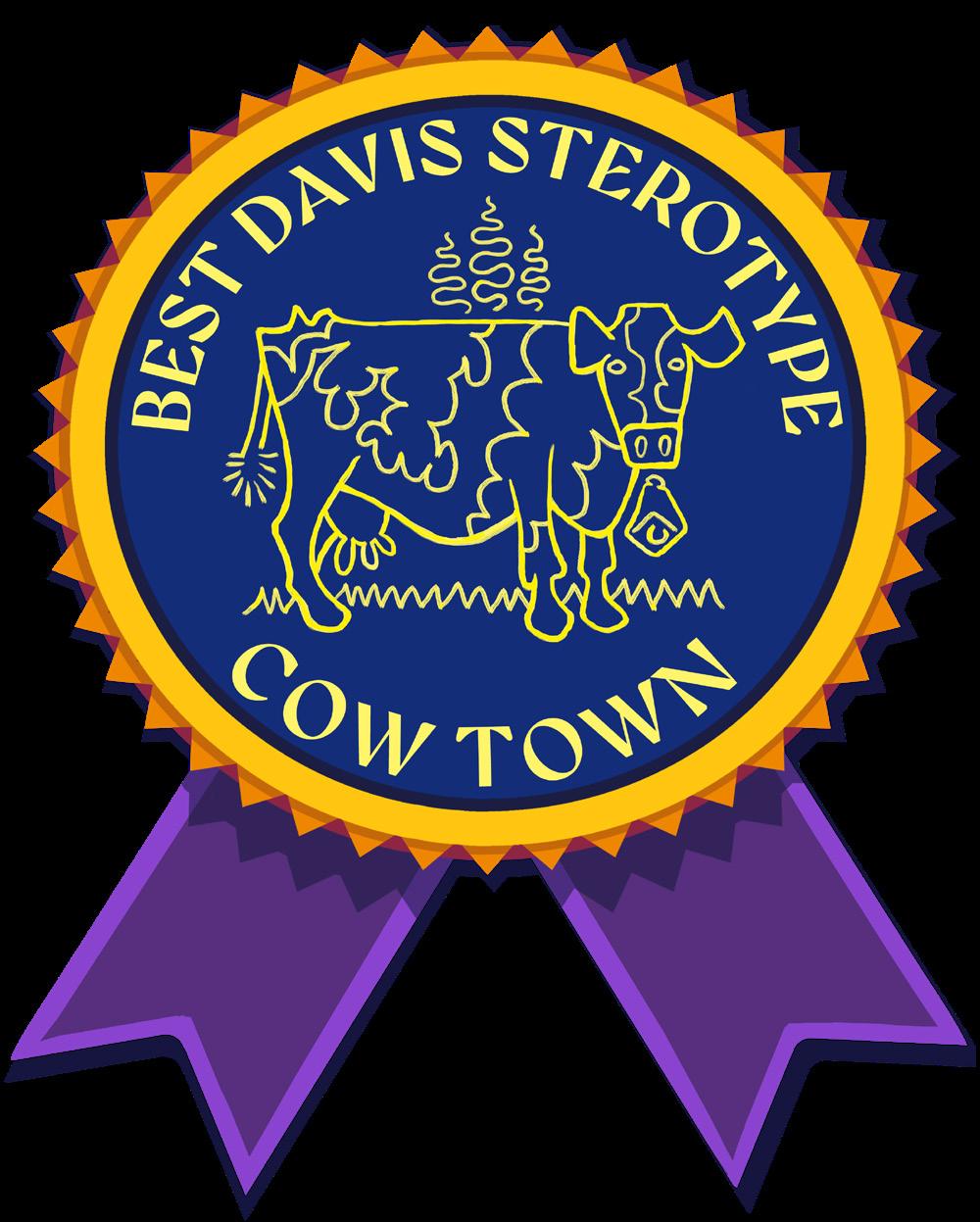
The City of Davis is home to UC Davis, a top institution known for its agriculture, veterinary science, sustainability, diversity, wide variety of groundbreaking initiatives and, notably, for being a “cow town.”
One may not have heard of our Coffee Center or extensive network of student and community resources, but they are sure to have heard that the students are bored and repulsed by a neverending stench of manure.
“For guests, [Davis is] cow town,” Olivia Shaw, a secondyear managerial economics major, said.
Nootan Thangellapalli, a third-year managerial economics major, echoed this sentiment, explaining how college applicants often recognize the university for its famous cows.
“When you’re applying to college, you look at all [the] UCs and you see Davis and you’re like ‘Oh my god cows,’” Thangellapalli said.
UC Davis frequently advertises itself as a “cow town” — if you enter the Student Store, you are sure to see lots of cow plushies and merchandise covered in black and white patterns.
But, unless you’re living in the Tercero dorms right next to one of the cow farms, you may go your whole time at the university without ever laying your eyes on our spotted friends; you will likely see their likeness
Students selected one of Davis’ newest additions
BY DANIELLE WIRNOWSKI features@theaggie.org
around campus than you will in-person.
Sure, if the wind blows the wrong way, you may notice, but oftentimes the general blanket stereotype misrepresents this college town. It’s a town that has football games, farmers markets and a bar scene. From the freeway, many people seem to miss the charm the cows are guarding — all that lies beyond the pastures and between mountains and valleys.
This is not to say that the cows are not beloved. Though they are not the UC Davis mascot, you can find them all around.
“I like cows,” Abinaya
neurobiology, physiology and behavior major, said. She likes that they’re on UC Davis merchandise; she likes that they’re there.
The cute, mostly friendly — albeit a little smelly — cows themselves are not the problem most students have with the stereotype. The misconception overlooks all the other joys Davis has to offer.
The cow spots can cover the reputation, not giving room for all the other valuable elements of the Davis community.
Loving Davis until the cows come home is not the same as loving Davis because it’s the cows’ home.
Ike’s has become a student favorite for its student discount and loyalty program
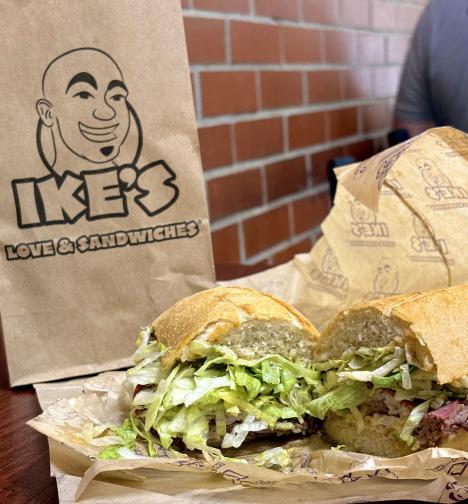
Love and Sandwiches. The shop offers a student discount on
with a valid school ID. (Christian Cendejas
BY KHADEEJAH
Ike’s Love & Sandwiches, located on F Street in Downtown Davis, was voted by students as the restaurant offering the best student discount. The deli sells a variety of sandwiches, including vegan options.
Ike’s offers a student discount between 3 and 9 p.m., which can drop the price of sandwiches to about $9.89; sandwiches typically cost anywhere from $12 to $23. To be eligible for the discount, students must show a valid student ID, whether they attend UC Davis or a local community college.
To use the discount, Ike’s also requires students to set up a loyalty account. The Davis location’s manager, Melinda Velazquez, has worked at the location since 2022.
KHAN features@theaggie.org in with a college card,” Velazquez said. “I really just enjoy seeing people coming in, bringing their families and then seeing their families enjoy it, coming back every time they are in town. I’ve noticed that our staff has a lot of good relationships with some of our regular customers, especially because we do get regulars and people [who] come in for the student discount.” Ike’s also offers a variety of options for people with dietary restrictions, aiming to make their selection more accessible for every customer.
She said that the loyalty account has an array of benefits beyond the discount, including half-off sandwiches on birthdays, a free sandwich after spending $10 for the first time and other rewards based on the number of points a customer accumulates.
“The student discount really applies to anybody [who] comes
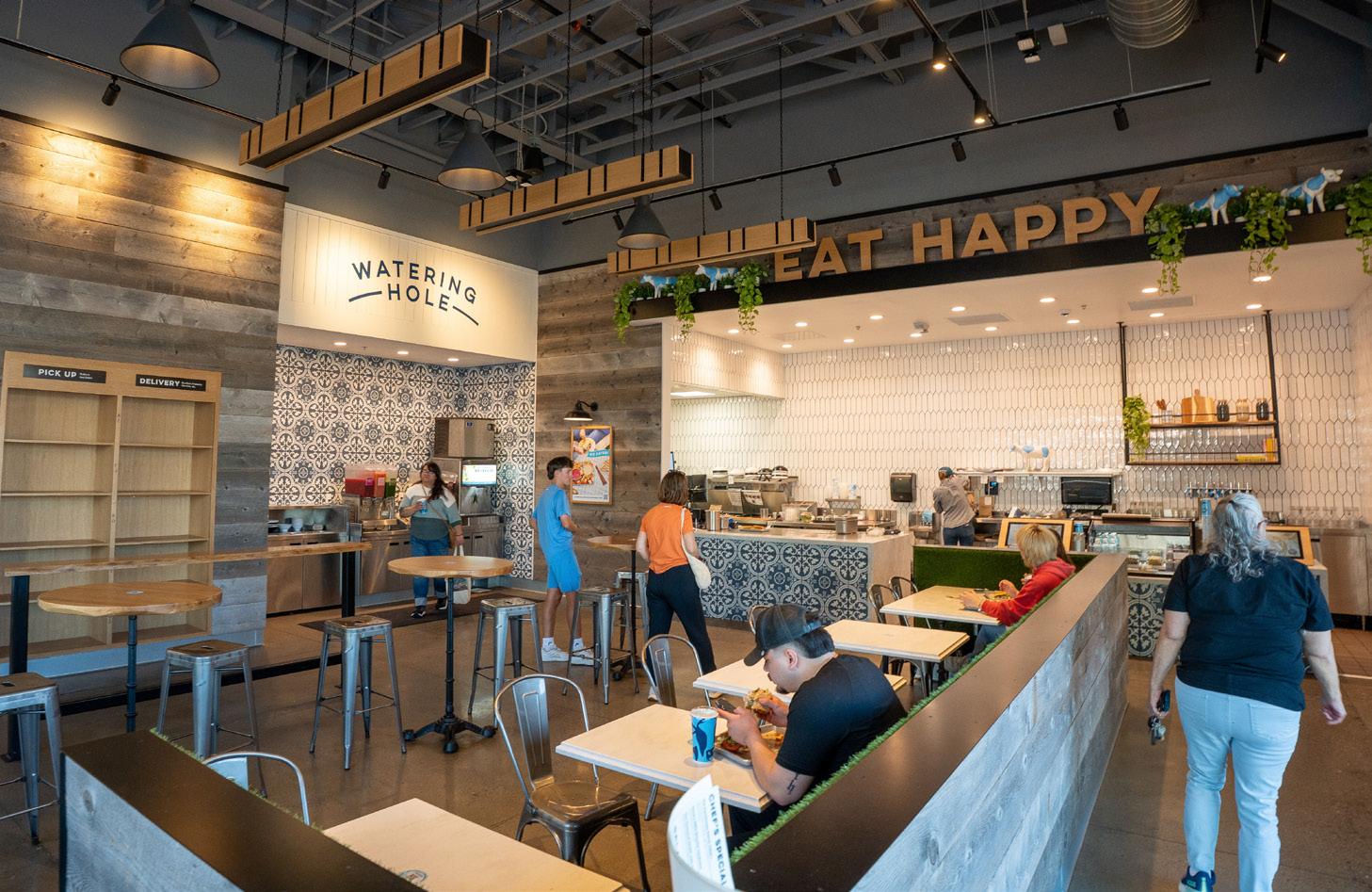
The Aggies have spoken, and the best new business to open in Davis in the last year is Mendocino Farms. The City of Davis welcomed Mendocino Farms on Aug. 26, 2025, located centrally within The Davis Collection. Placed right across from La Rue field and in the same shopping center as Trader Joe’s, it is the prime location for hungry college students any day of the week.
While Mendocino Farms originated in Los Angeles, Calif. in 2005, it quickly expanded all over California, Texas, Colorado and Washington. It currently has more than 80 locations across those five states.
Mendocino Farms’ tagline, “Eat Happy,” can be seen through their menu, which highlights farm-fresh chef specialties, sandwiches, salads, soups and drinks, as well as the wellbeing of workers and the welcoming atmosphere of the
restaurant.
Mendocino Farms provides plenty of healthier choices for those who want a quick meal, while also offering selections packed with protein; its menu has something for everyone.
“Mendocino Farms is da bomb.com; the avocado and quinoa superfood ensalada is definitely a favorite of mine,” Rachel Larson, a third-year chemistry major, said. The franchise includes a “Fan of the Day” program, which allows the company to give back to the community and those who continually support Mendocino Farms. The regulars who get to know the staff have the chance for their name to be placed on the chalkboard to receive a free meal that day.
Mendocino Farms also participates in plenty of fundraisers and givebacks, with student clubs — including The California Aggie — partnering with the location to help support their cause.
UC Davis students discuss their favorite not-so-local hike

Blue Ridge Trailhead, overlooking Lake Berryessa and the Sacramento Valley, has been reported as one of the most rewarding hikes by UC Davis students, offering scenic views just 30 minutes away from campus. Located in Stebbins Cold Canyon Reserve, the hike is doable but challenging, with a moderately intense incline and sometimes rocky paths. Most students do the Homestead to Blue Ridge Loop, which is approximately 4.9 miles. However, Annie’s Trail via

or just anybody with following their flavor profile.”
“We accommodate everybody,” Velazquez said. “We have halal chicken, we have gluten-free bread. I feel like our variety is just so wide that we can accommodate anybody with any allergies, any dietary restrictions
Located just minutes away from campus, students make up most of Ike’s customer base. Velazquez shared that what she likes most about working in a college town is the range of backgrounds students come from and the chance to connect with a diverse array of people.
“I enjoy seeing people that come in from here, from different areas out of state, out of the country,” Velazquez said. “The diversity here, it’s great.”
way to feel like you’re far from Davis without actually being too far,” Breanna Garman, a junior specialist in the UC Davis Department of Viticulture and Enology, said. “It feels very far from campus because the scenery is so different, so it’s a nice break from things.”
The hike may be less ideal for beginners or those who struggle with the elevation gain, but students still recommend the hike to those who feel comfortable. One of the most rewarding parts of the hike, students noted, is the payoff that comes when you arrive at the top, having treaded through the incline.
“A moment that stood out to me the most was the view at the
however, that it still feels “very rewarding to get to the peak though, and see the views of the lake.”
The trail features greenery, wildflowers, rocks, valley views and other natural scenes. Some students noted having to climb over rocky water to get to certain sides of the trail, which, for some, adds to the fun. Depending on where you start, the beginning or end of the trail will feature some tunnels that you have to make your way through before progressing.
“There is a ditch-like tunnel you have to go through that was kind of cool, but can be flooded,” Matatyaou said. Though UC Davis is located near various lakes, students don’t often get the chance to see them every day. For many students, one of the best parts of the experience is the view of Lake Berryessa.
“It has similar scenery to other hikes in the Sacramento Valley, but with the added bonus of really great lake views,” Garman said. “It’s also nice to have uninterrupted views of the hills — no billboards, houses or any sort of manmade structure when you look over them.”
Given its proximity to Davis, students who have gone on this hike often report going multiple times, traveling with different friends and loved ones to get the full hiking experience.
“It’s a hike that a lot of UC Davis students do because it’s very close,” Garman said. “I probably heard of it initially from a friend of a friend and have done it a couple of times every year since.”
BY VRITI SHAH features@theaggie.org
Cheeto, UC Davis’ orange feline friend, can usually be found strolling through or “loafing” around the Physics Building.
His popularity on campus has grown over the last several years, with his Instagram, @ cheetodaily, currently boasting over 40,000 followers. Cheeto even has his own High Performance Computing (HPC) page dedicated to “Dr. Cheeto Cat” and the maintenance of a 5-star rating on Rate My Professors.
UC Davis students reflect on Cheeto’s influence on
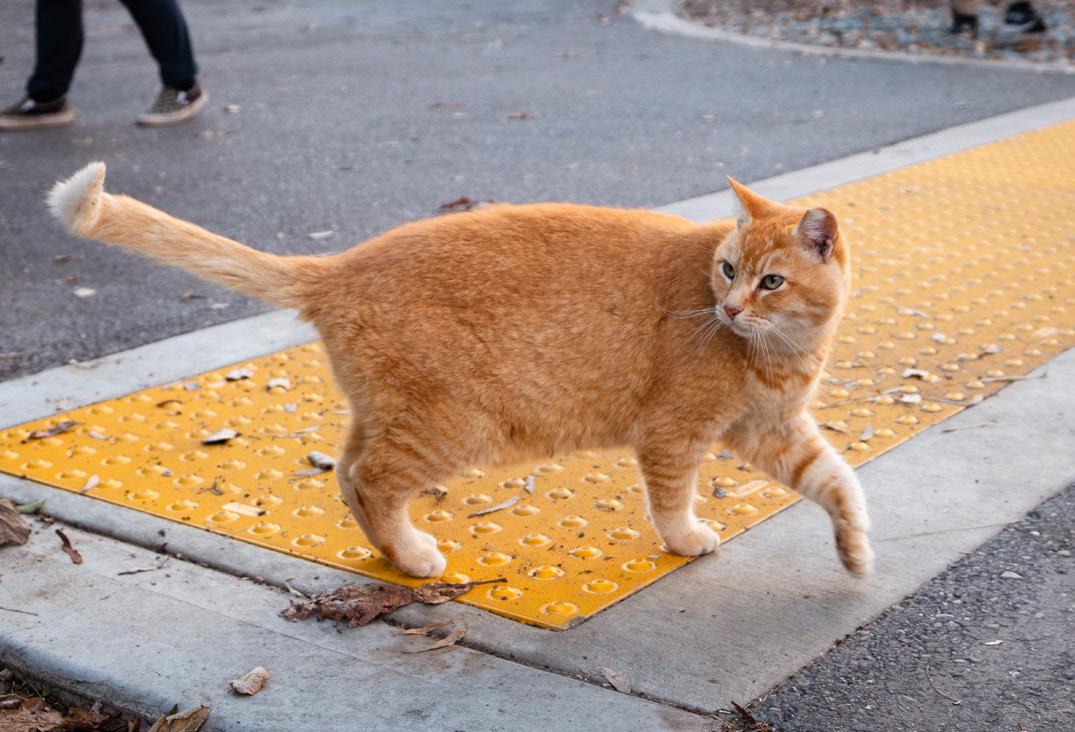
This year, UC Davis has voted Cheeto as the “Best of Davis” campus animal, signifying his beloved presence on campus. Students have shared stories on how Cheeto has influenced their lives, the UC Davis campus and the student body.
“Cheeto has been an integral part of my mental health over my past two years here [at] UC Davis,” Daniel Alvarenga, a second-year physics major, said. “I constantly find myself looking for a therapy session of petting Cheeto after I bomb a physics midterm or after crying over Tom Weideman’s Problem Analysis [Physics 9A]. Overall, [Cheeto] has gotten me through my roughest winter quarters and roughest physics lectures by just existing.”
The anonymous account owner of Cheeto’s Instagram page shared their perspective on Cheeto’s calming nature.
“Honestly, Cheeto just brings comfort,” @cheetodaily’s admin said. “After bombing my physics final or when I needed to destress, I’d stop by, and being around him made everything feel better. Him letting me pet him, jumping on my lap. It sounds small, but it really isn’t, especially for students who have pets at home and miss them while they’re away at college.”
As UC Davis brings in students from all around the world, Cheeto’s fluffy and

friendly personality creates a sense of connection to pets left behind at home. Alvarenga continued to discuss Cheeto’s significance to broader campus culture.
“[Cheeto is] such an important piece of UC Davis culture,” Alvarenga said. “It’s hard to imagine a universe where Cheeto isn’t our ‘university cat.’ He is the perfect merch cat — I own three Cheeto shirts, [a] mug [and] stickers, and I am currently in need of a Cheeto tote bag. Everyone loves Cheeto for the same reason I do: He’s a loveable cat that brightens up your day like the sunball that he is.”
Student admiration for Cheeto has developed into merchandise sold by the Physics & Astro Club, as noted by Alvarenga. The admin for @ cheetodaily continued to discuss how they have seen a growth in the widespread adoration for Cheeto, emphasizing the influence of having a campus cat.
“He makes campus feel more like home,” @cheetodaily said.
“What’s really cool is that feeling has spread way beyond campus too. Over 40,000 people follow him on social media, including people far outside of Davis — all bonding over one chonky orange cat. I think that says a lot about the kind of impact he has.”
Cheeto’s positive impact on the student body and campus is irreplaceable; Alvarenga continued to discuss how Cheeto has become an influential part of his time at UC Davis.
“From the moment I
heard that there was an orange tabby cat that hung out near the Physics Department, I knew I had chosen the right school,” Alvarenga said. “He is everyone’s best friend, as long as you provide the food needed to keep him around. I want Cheeto to be memorialized long after I leave UC Davis [...] we all love the idea of spending a mental break with Cheeto.”
In fact, Cheeto loves to be greeted with a treat or two. His office hours include the message “By appointment or opening of a tuna can,” according to his HPC page.
Due to his love for tuna and cat treats, many have affectionately nicknamed Cheeto “Chonker,” nodding to his wellfed shape and size.
The admin for @cheetodaily continued to discuss the root of their own affection for Cheeto, accentuating how other students share this bond with him.
“Personally, coming from a background without much support, I see a lot of myself in stray cats, that feeling of just needing someone to show up for you” @cheetodaily said.
“But, Cheeto is definitely no longer a stray, with all the love he gets from this campus — huge shoutout to the Physics Department for taking care of him too! I think that’s exactly why so many people connect with him. He’s become part of what makes Davis feel like Davis. Long live Cheeto the Orange King!”

BY JULIE HUANG features@theaggie.org
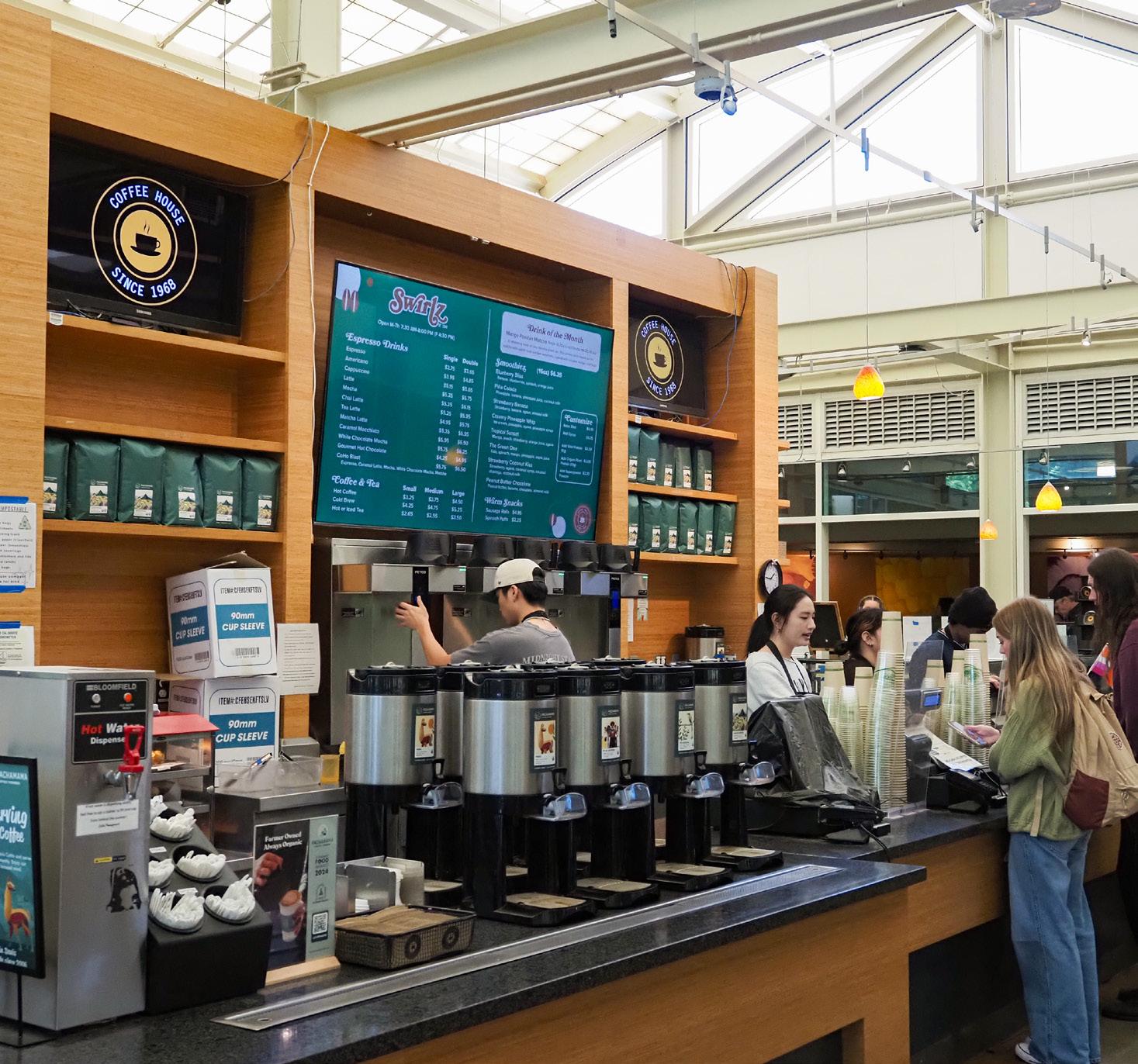
Voted “Best ASUCD Unit” once again, the Coffee House (CoHo), is a beloved space within the Memorial Union, located in the heart of UC Davis. Originally established in 1968, the CoHo began as an eatery that aimed to provide inexpensive, high-quality and convenient food and drinks to students on campus.
Today, the reliable establishment continues to serve drinks to thousands of students every day. However, the CoHo offers more than simply coffee; Malaika Dewar, a third-year communication and English double major, explained the enjoyable variety of options that the CoHo menu makes available to students.
“I like their smoothies,” Dewar said. “My favorite is the blueberry, but I also like the peanut butter banana.”
Vanya Malhotra, a second-
year animal sciences major, noted that the ever-changing selection of seasonal drinks helps keep the menu fresh and engaging.
“Every time I go to the CoHo, there’s something new,” Malhotra said. “The drinks are diverse but also flavorful.”
The CoHo has been a goto spot for students for more than six decades because of its reliability.
“It’s a relatively cheap place to get food on campus, and it’s centrally located,” Dewar said.
In addition to offering students food and drinks, the CoHo also serves as an accessible gathering place, atmospheric study spot and a tangible demonstration of the thriving Davis student culture and community.
“It’s busy, it’s bustling, it’s active,” Dewar said. “I work in the kitchen, so I’m there a lot. Most of the time I’m just hanging out.”
In a space where students so often choose to congregate and stay in for prolonged periods of
time, running into people one knows is not uncommon.
“I see a lot of people there, and if I’m doing work there, I’m always going to see someone I know [who] I could meet up with,” Dewar said. “It’s kind of nice.”
Thanh Nguyen, a third-year English major, observed that the CoHo’s lively atmosphere, though cheerful, creates some difficulties at times.
“Sometimes at noon when I need a good snack, everyone’s there crowding around and taking up all the tables, so I have to find somewhere else to go,” Nguyen said.
Still, the hustle and bustle of the CoHo is its signature, and it speaks to just how much the CoHo is a central part of student life at UC Davis.
“Every time I go there, it’s magically really packed,” Malhotra said. “It’s where we went for my first-year orientation, so it was my first impression of UC Davis. Even then, I could really see and feel the welcoming vibes.”
A community with a cause: inside SJP’s third year as UC Davis’ top club
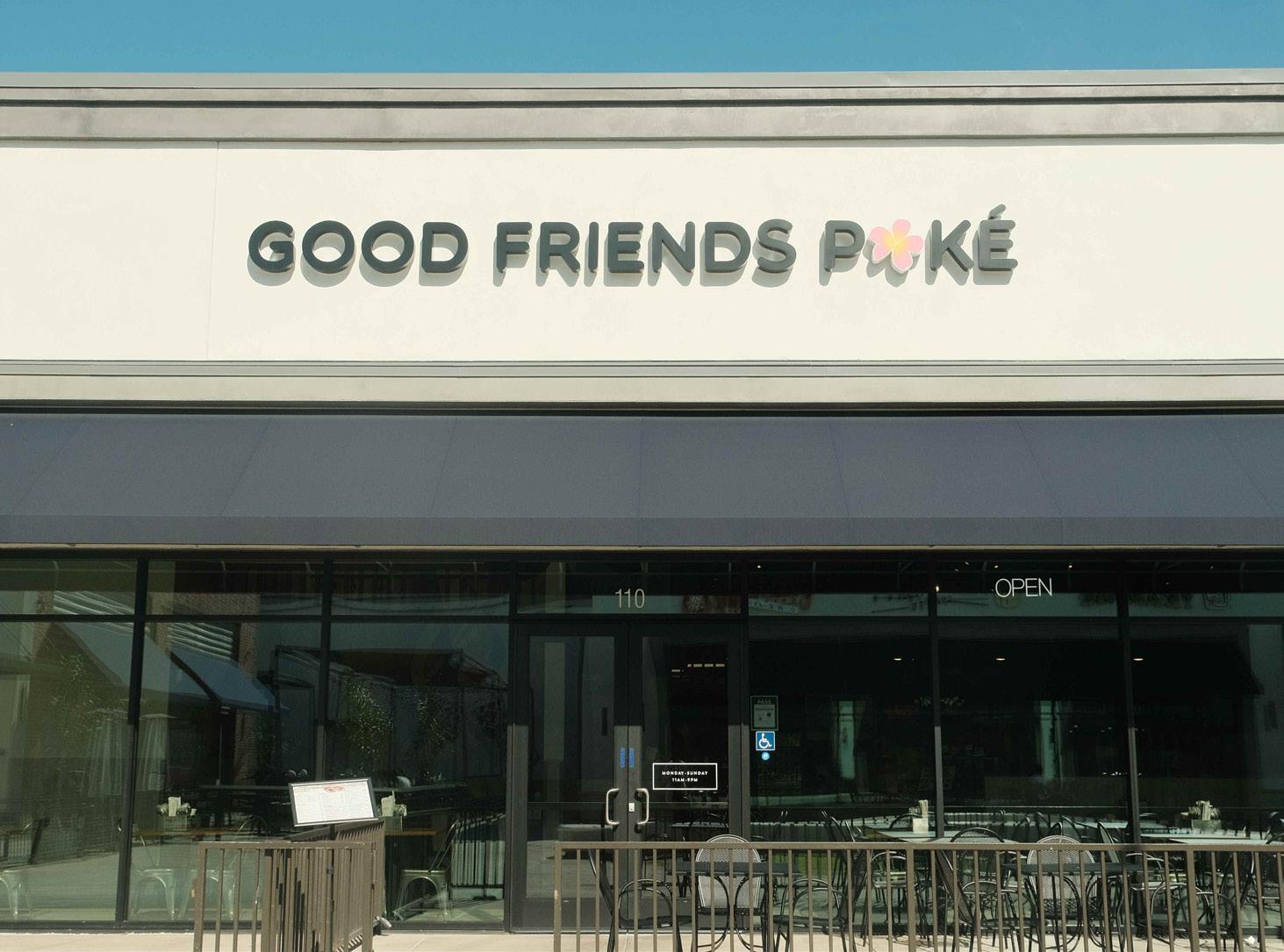
Good Friends Hawaiian Poké at The Davis Collection shopping center. This is their second restaurant, following the original G Street. (Bowen Song / Aggie)
BY ALMA CULVERWELL features@theaggie.org
Good Friends Hawaiian Poke was recently voted Best Restaurant by UC Davis students. Good Friends, a staple in the downtown Davis food scene, is known for its extensive selection of poke bowls, wraps and other unique dishes, including poke nachos. Alongside its menu, the restaurant is also well known for its welcoming customer service. Good Friends is owned by Monica Dui, who opened the downtown location in 2019 and recently expanded to a second site at The Davis Collection.
Emmy Patterson, a fourthyear neurobiology, physiology and behavior major, attributed the restaurant’s atmosphere and variety to keep her coming back.
“Good Friends is my favorite place to grab food with
friends because of the inviting atmosphere and wide range of options,” Patterson said. “Their food is always super fresh and definitely worth the fair prices.”
The menu offers a wide range of options, with fish choices ranging from traditional salmon to sweet chili salmon and bowl styles ranging from Delilah style (which includes seaweed salad, cucumbers, surimi crab, mango and edamame) to Fire style (which includes seaweed salad, cucumbers, surimi crab, jalapenos and wasabi).
Customers can sample flavors before committing to an order, and the restaurant accommodates dietary restrictions, making it a go-to for groups with varied preferences.
For Sofia Lauricella, a third-year environmental policy analysis and planning major, Good Friends stands out for its reliability.
“I love how convenient and consistent it is,” Lauricella said.
“I always know what I’m getting will be good. I also love how inviting and friendly the people that work there are.”
Merin Ovelil, a fourth-year nutrition science major, echoed a similar sentiment, mentioning both the food quality and staff as reasons she returns.
“I like Good Friends because their food is always fresh and it always tastes good,” Ovelil said.
“They also always have good service, which I appreciate.”
Good Friends Hawaiian
Poke’s original location is at
400 G St. in Downtown Davis.
With a second location now open, Good Friends continues to grow its presence in Davis while maintaining the quality and welcoming atmosphere that earned it top recognition among students.
As the restaurant expands, it remains a go-to spot for fresh, customizable meals and a reliable favorite in the local dining scene.

BY SANIYA SYED features@theaggie.org
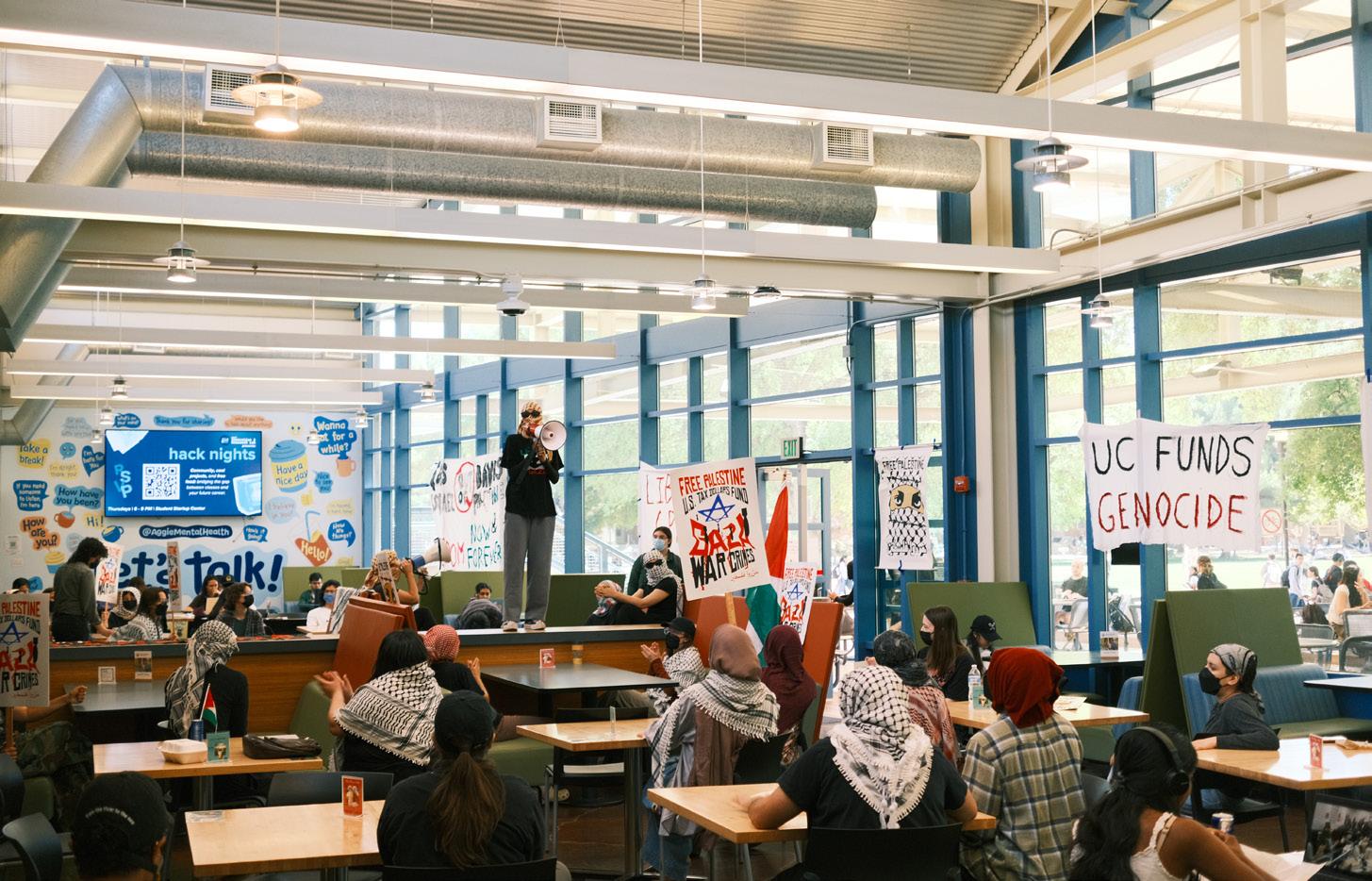
For a third year in a row, Students for Justice in Palestine (SJP) has been named the best student-run club by the Davis community. As Israel’s violence against and displacement of the Palestinian people that began in October 2023 continues today, members of this political advocacy group have persistently shown solidarity with the Palestinian cause of freedom and advocated for an end of violence against Palestinians. In an effort to achieve their objective of Palestinian liberation, SJP has organized protests, fundraisers, teach-ins and cultural events. In 2024, the club protested against University of California investment in companies with ties to the state of Israel, made demands for full disclosure and divestment of these funds and called for an end to repression of pro-Palestinian speech, as well as for Chancellor Gary May’s resignation from Leidos’ Board of Directors, an authorized supplier for the Israeli Ministry of Defense. SJP channelled community support
by setting up encampments on the UC Davis campus. The club also pushed for more investment in Palestine and Arab American ethnic studies courses.
“Although trying to force the UC Davis administration’s hand wasn’t fully accomplished, because they gave up control of their investments to the overall UC System, ANT 142 [Peoples of the Middle East] was added as a new course as part of the agreements,” SJP’s treasurer, who prefers to stay anonymous, said.
They also shared that the ability to make a meaningful impact is one of their favorite aspects of the club.
“I like that we aren’t just a social club, but an organization that politically advocates for people who need it, for Palestine,” the SJP treasurer said, emphasizing the club’s goal of informing the public. “There are many people who don’t know about what’s happening in Palestine and Gaza, and educating people on the reality of the situation, right now more than anything, is important.”
The president of SJP, who wishes to remain anonymous, also emphasized the integral
role of education in cultivating empathy and awareness for Palestine.
“When we teach people about the traditional stitching, clothing, music and poetry of Palestinian culture, they can more deeply connect with the cause and implement their dedication to it in their lives,” SJP’s president said.
Another unique feature of the club is its uplifting and supportive community of people. United by their cause, members have an intuitive understanding of each other’s values, according to SJP’s treasurer.
“Often, you can meet people who seem nice, but they don’t have empathy for people across the world,” SJP’s treasurer said. Between its welcoming community and continuous dedication to the meaningful cause of fighting for the liberation of a struggling people, SJP has once again won the votes of the Davis community for the best club on campus. Not just a student-run organization, SJP encompasses the hope, solidarity and compassion members of the Davis community feel toward the Palestinian people.
This year’s show brought nine bands to the Picnic Day celebration
BY COLINA HARVEY features@theaggie.org
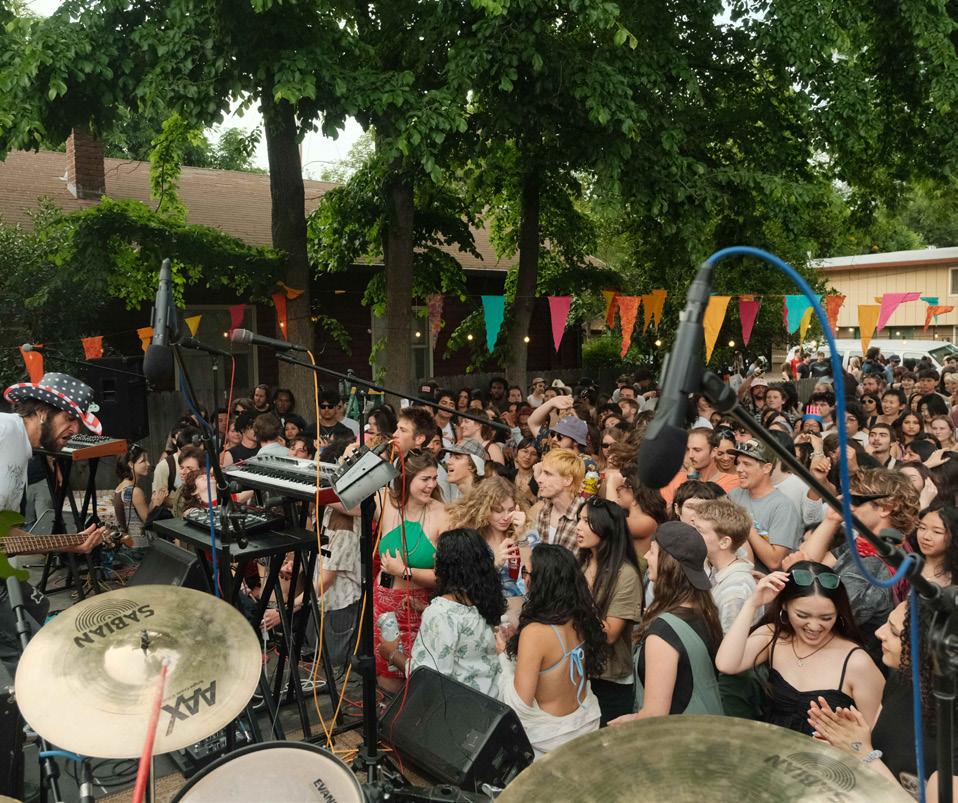
Eclectic Collective is a Davisbased organization established in 2021 that hosts live music events for the community. Since 2024, their biggest show of the year has been in celebration of picnic day. In collaboration with Velvet Red Productions, another organization that frequently hosts house shows around Davis, Eclectic Collective gathered nine bands to play a show in the heart of downtown Davis.
The lineup included local and student bands who often play around Davis, such as Paddy on the Binge and In Bloom. It also included bands who traveled from other cities
Mosaic Coyote, based in Los Angeles. Other bands who played at the show were First Name Basis, Lovejane, Corn Smut, Rainbow City Park and the Snares. These bands offered a varietyvaried selection of musical styles, ranging from Paddy on the Binge’s traditional Irish folk to the Snares’ garage rock. This allows listeners of many genres to enjoy the music the event has to offer.
One big draw of the event is its impressive long run time. This year, the show spanned from noon to past 8 p.m., allowing attendees to come and go as they pleased without worrying about missing too much of the music. Although house shows are common in Davis, a show this long with this many bands only occurs for a special occasion like Picnic Day.
Picnic Day offers many activities, including the parade, the Doxie Derby, and other fun on campus. The Eclectic Collective house show is offers an event for those who are not interested in on-campus events. Scenes from the show included crowdsurfers, bubble guns, and even a limbo competition. If Eclectic Collective brings back the show back for a fourth year in 2027, it will surely be a picnic day hit.
GSW 050 professors discuss the significance of gender studies at UC Davis
BY LAILA AZHAR features@theaggie.org
This year, UC Davis students voted “GSW 050: Introduction to Critical Gender Studies” as the 2026 Best General Education (GE) Course. Professor Julietta Hua, who teaches in the UC Davis Gender, Sexuality and Women’s Studies Department and will be teaching GSW 050 in fall 2026, described the academic field and its importance.
“Gender studies is about understanding how gender and sexuality come to have meaning,” Hua said. “Not just individual meaning, but social, political meaning that is also intersecting with meanings around citizenship, race, religion, ethnicity, ability.”
GSW 050 covers both historical and contemporary issues, according to Hua.
“I would say the main point is to think about how to think outside of the gender binary and then also how to think about gender as something that’s always making meaning alongside race and ability and nationality in the United States,” Hua said. “So it’s a little bit historical, a little bit topical.”
Professor in the Women’s Studies Department Sarah Thompson, who is teaching the class this quarter, echoed this sentiment.
“We look at some stuff from the 1800s and we also look at stuff that was published much more recently,” Thompson said. “We look at things that are really personal pieces — people just speaking about their own experience — and we also look at sociological data that we can point to and bring all together as a way to think about how we live and how we live together.”
Each instructor adds their own flair to the course. Professor Christoph Hanssmann, for example, has taught classes about the “manosphere”: a term referring to a collection of online communities promoting male-supremacist ideologies. Hua has focused on how sex is constructed within sports. Thompson cited disability studies and discussions of sex and sexuality as two of her favorite topics within the course.
“I always love bringing in disability studies in feminism, because for people who don’t experience discrimination based
Check off that shopping list at the low price of nothing
BY ABHINAYA
KASAGANI features@theaggie.org
If you’re ever in a pinch and unable to balance the grocery expenses of being a student, The Pantry is here to help.
The ASUCD Pantry at UC Davis functions as a “studentrun, student-led organization that provides food and other essentials to students and staff who would like support in acquiring food and other necessities,” according to their website. Students claim that The Pantry is truly one of the greatest — if not the greatest — Davis student resources on campus.
“The fact that I can get not just fresh fruits and vegetables, but also hygiene products like toothpaste, brushes, along with contraceptives, all in a one-stop-shop makes the experience extremely wonderful and convenient,” Kaden Tam, a third-year biotechnology major, said. “The Pantry has been there for my lows when I needed ingredients, particularly onions — I love the fact that they pretty much have onions every day — because I wasn’t strapped for cash and needed to hit my protein goals.” Tam not only spoke of The Pantry’s versatility, but also
described that the ease and convenience of it all could not be overstated — students can enter without appointments, and its location at the east side of the Memorial Union makes The Pantry a convenient spot for dropping by in between classes. Lastly, Tam mentioned that The Pantry has its own recipe book tailored to ingredients you can find in-store and may have never thought to try.
While some appreciate the resources The Pantry offers, others simply note how wonderful the community is.
“The Pantry is not only an incredible resource — with new items releasing every week — but it is also one of my favorite places I’ve ever worked,” Maya Leonard, a third-year design and communication double major, said.
“As a student-run organization, everyone is very kind and welcoming, and I enjoy that every day.”
The mission of The
on ability, there’s often a lot of misconceptions,” Thompson said. “I also always really enjoy conversations about sex and sexuality [...] We internalize [cultural ideas] to the degree that we’re taking these [concepts] into intimate situations where just us and one other person are in a room, but so are all of the cultural ideas.”
Other topics the course has covered include labor politics and reproductive justice.
“Right now, we’re in a section of the syllabus I think of as the standpoints section,” Thompson said. “It’s about this idea that all knowledge comes from somewhere, and it’s shaped by who you are, your social existence and how you move through the world — the way you move through the world shapes how you perceive the world. Part of the idea is that nobody has a totally objective view of reality and that in order to have fuller conversations, we need to listen to people who are coming from different places.”
This emphasis on a lack of a single, objective reality is at odds with a common misconception about gender studies. As Hua noted, gender studies and related fields reject the notion that there is one correct objective reality.
“I definitely think there’s a mainstream perception that it’s a space of indoctrination — that we only teach one way of understanding the world — and I would say that’s very not true,” Hua said. “Gender studies, ethnic studies: where they started was the problem of a singular view.
And so, it’s really committed
to having very nuanced, complex viewpoints on how to understand what’s going on around us.”
Hua continued, emphasizing critical thinking over shared opinions.
“Even if you’re not reading the assigned reading in the way that I would read it, that’s not how I grade,” Hua said. “I think gender studies is really about cultivating critical thinking skills. It’s not about whether we agree or disagree on how we read a text. It’s a very open project, but I think it’s perceived sometimes as a very narrow project.”

Thompson addressed another stereotype surrounding the field — that it exists solely to scold others.
“This is not about, ‘Here’s why you’re bad and you should feel bad, and if you liked this thing, well, that thing’s problematic and you should feel guilty about it,’” Thompson said.
“Like, love a problematic fave. That’s fine. But it’s more like, ‘Okay, let’s take a look at what is happening culturally? What is happening socially? Let’s break things down.’”
Notably, GSW 050’s selection as the “Best GE Course” comes in the midst of a national backdrop of increased hostility toward the field of gender and women’s studies.
Earlier this year, Texas A&M University disbanded its women and gender studies program. Tommy Williams, the university’s interim president,
the new system policies” — likely a reference to the Trump administration’s “Defending Women from Gender Ideology Extremism and Restoring Biological Truth to the Federal Government” executive order — as a reason for the department’s closure. This order states, among other provisions, that “Agencies shall take all necessary steps, as permitted by law, to end the Federal funding of gender ideology” and “Federal funds shall not be used to promote gender ideology,” according to the White House. Terms including “feminism,” “gender,” “female” and “genderbased violence” have been purged from government websites. Research grants for topics related to gender identity, Diversity, Equity and Inclusion (DEI) and women’s health have also been cut.
Verbitsky discusses how his approach to teaching plays a part in his fashion choices
BY AMRA ABID features@theaggie.org
Often spotted in a plaid
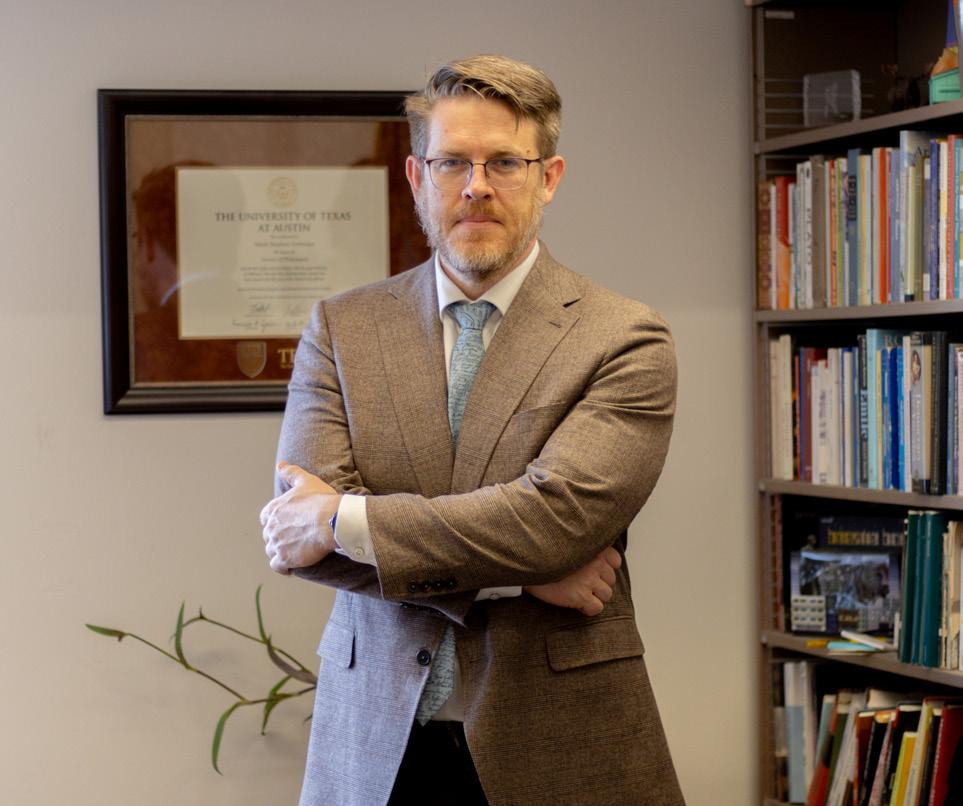
sports coat, pleated slacks and leather monk-strap shoes, Assistant Professor in UC Davis’ Political Science Department Mark Verbitsky has a signature look — one that is sharp, chic and, according to students, unparalleled.
around food insecurity, which, especially considering the current administrative cuts in food assistance programs, has become all the more important for students at UC Davis.
Students and staff members with a valid UC Davis ID are able to order their groceries, food and toiletries both in-person and online (while in-person is during store hours, online ordering runs 24/7). In facilitating a supportive student community that raises awareness about food
“I think he’s the only professor I have who comes in a suit every single day,” Simona Forster, a fourth-year political science and American studies double major who works as a learning assistant for Verbitsky, said. “Every time he talks about a case involving Maryland, he wears [these] socks. And I just think that really speaks to his dedication to the ‘fits every single day.”
Although Verbitsky is far from ostentatious about his wardrobe himself, the lecturer of constitutional law, American political theory and numerous pedagogy classes was voted “Best-Dressed Professor” in this year’s Best of Davis poll. Although his sharp style is evidently remarkable to his students, he described it himself in humbler terms.
“I guess I do wear an outfit,” Verbitsky said. “I don’t know, [my style is] academic: I wear a sports jacket, [and] I have some nice shoes and stuff.” Verbitsky started tailoring his wardrobe in graduate school, when he first began teaching students not much younger than himself. Dressing up helped clear the line between instructor and peer, according to Verbitsky.
“When I arrived here, actually, as a grad student, I would dress up because then, if I was teaching when I wasn’t that much older than students, it helped to […] separate out,”
Verbitsky said.
As Verbitsky developed his interest in pedagogy, his approach to clothing became aligned with the way he approached the classroom.
“I think it’s just to have a uniform, because to lecture is kind of very artificial,” Verbitsky said. “And so to get into that performance, wearing a costume helps. [For] teaching, even if you’re an introvert, which I am, you have to be extroverted. And so, you have to take on that sort of personality. Wearing something different makes it easier.”
Verbitsky explained that not only does it help to present yourself in a certain way, but thinking about presentation to begin with is imperative for being an effective educator.
“It’s not just presenting, reading information or presenting information, it’s about thinking about students,” Verbitsky said. “So, in a lecture, it’s not just
talking, but like when you slow down, what do you emphasize? What kind of examples do you use? If you think of rhetoric, there’s logos [which] is the argument, there’s the pathos of if you get some sort of emotional thing, but then there’s the ethos, the character. And so sometimes, it helps to be dressed up and to get people taking [class] more seriously.”
At the end of the day, for Verbitsky, his clothes are ultimately in service of the ideas
Davis’ favorite spot for caffeine and a warm atmosphere
BY MOLLY THOMPSON features@theaggie.org
Sitting on the corner of 3rd and G Street, Temple Coffee Roasters has been a Downtown Davis staple since it opened in 2015. Its iconic woodgrain tables and stools give it a calm and grounded ambiance; the shop is flooded with daylight as the sun filters through expansive windows that line its walls, adding to the open, airy atmosphere.
“I like how modern it feels,” Nolan Trout, a second-year cinema and digital media major, said. “I like the large windows.” Trout, among many others, can often be found sitting at the countertops, latte in hand, people-watching through the glass.
The menu is minimalistic, but everything is expertly crafted, according to the company’s founders. The care they put into making each beverage is evident: the flavors are balanced and creative, many ingredients and pastries are artisan and locally sourced and the drinks are often topped with a ring of whipped cream or a milk foam swan. They
also incorporate a rotating menu of seasonal specials, currently featuring flavor combinations like strawberry, coconut and matcha or apricot, basil and espresso for spring.
Temple is also dedicated to sustainability, using a “Farm to Cup” sourcing model for their coffee beans and choosing to work with producers who prioritize water conservation and minimal environmental impact (along with quality) as they grow and process coffee. Additionally, they offer reusable dishware for customers who want to sit as they sip and snack.
For UC Davis students, Temple is a favorite study spot — you’d be hard pressed to walk in without seeing any open laptops or notebooks.
“Whenever I have to get work done, Temple is always my go-to spot,” Makayla Garrett, a third-year animal science major, said. “I absolutely love the calming environment, music and their delicious iced chai [lattes].”
Pattarin Khajornchaikul, a second-year economics and communication double major, echoed this sentiment, adding her appreciation for their cozy vibes.

BY EMILIA ROSE features@theaggie.org
This year, the Arboretum has been voted Davis’ best date spot. Whether it’s lying down on the grass with your favorite person, watching the ducks waddle by or seeing bands of light stretching across the water, the Arboretum, for many, holds a profound and peaceful beauty.
Cast in golden light each day and a serene chill at night, the Arboretum has a distinct atmosphere like no other. Sel Bahy, a first-year political science — public service major, shared his appreciation for the wonder this natural haven provides.
“I think the horizon is really beautiful at night,” Bahy said. “Something about the quiet ambience combined with the boundless amounts of nature moves me a lot.”
This place is not just a safe space for the flora and fauna; students, visitors and Davis community members alike find genuine calm and peace after a long stroll in the Arboretum. Lily Bailey, a first-year animal science major, is one of the many students who use the Arboretum to ground themselves.
“I feel happier and less stressed when I am in the Arboretum,” Bailey said. Bahy also mentioned that
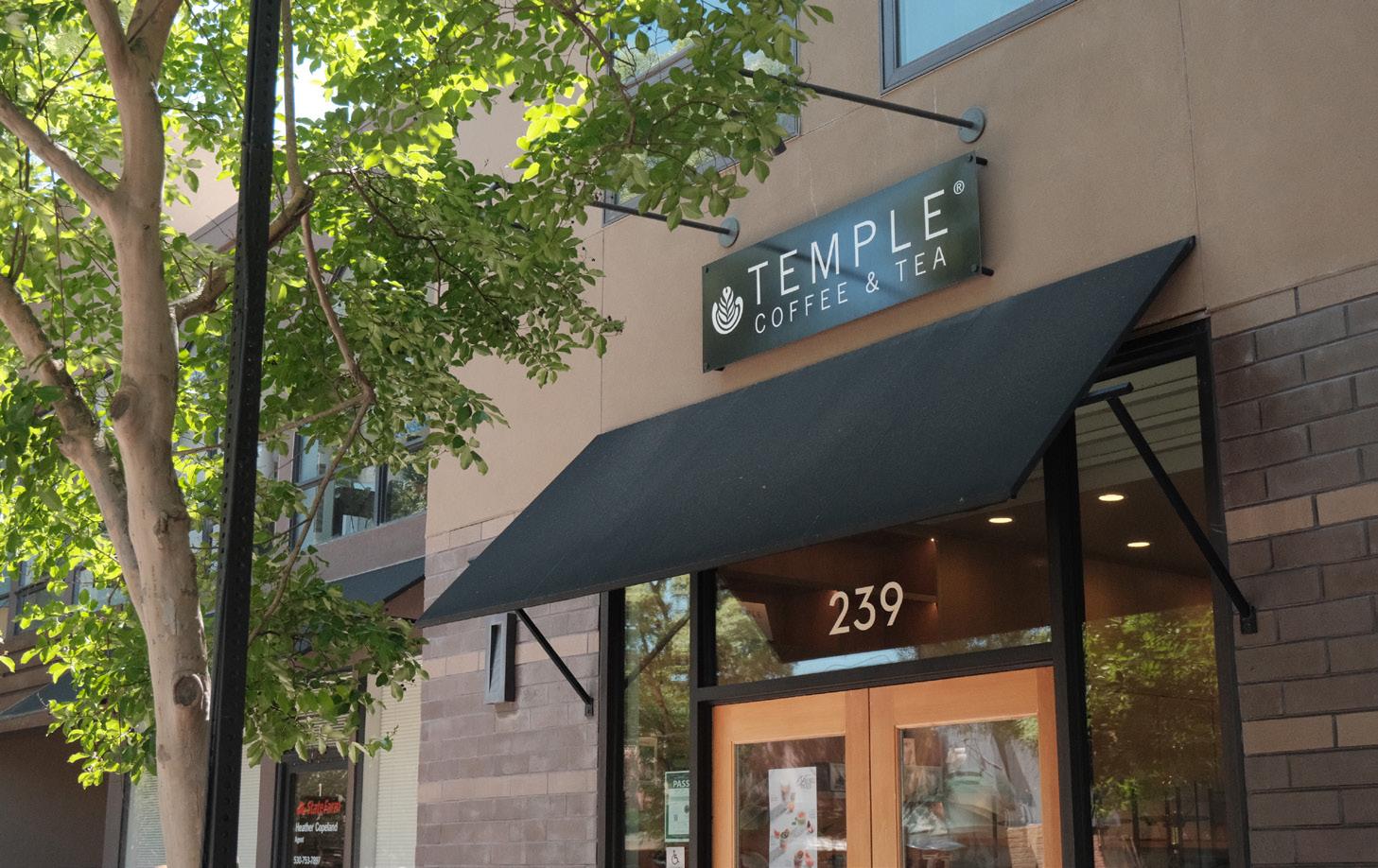
Temple Coffee
sustainably
“I love how Temple both has great WiFi and serves their drinks in glass or ceramic cups,” Khajornchaikul said. “It really adds to the ambiance, especially when it’s winter quarter and nobody wants to go outside.”
Beyond just the atmosphere, staff and patrons alike love Temple for its welcoming
The romantic beauty of Davis’ resident nature spot and why students love it
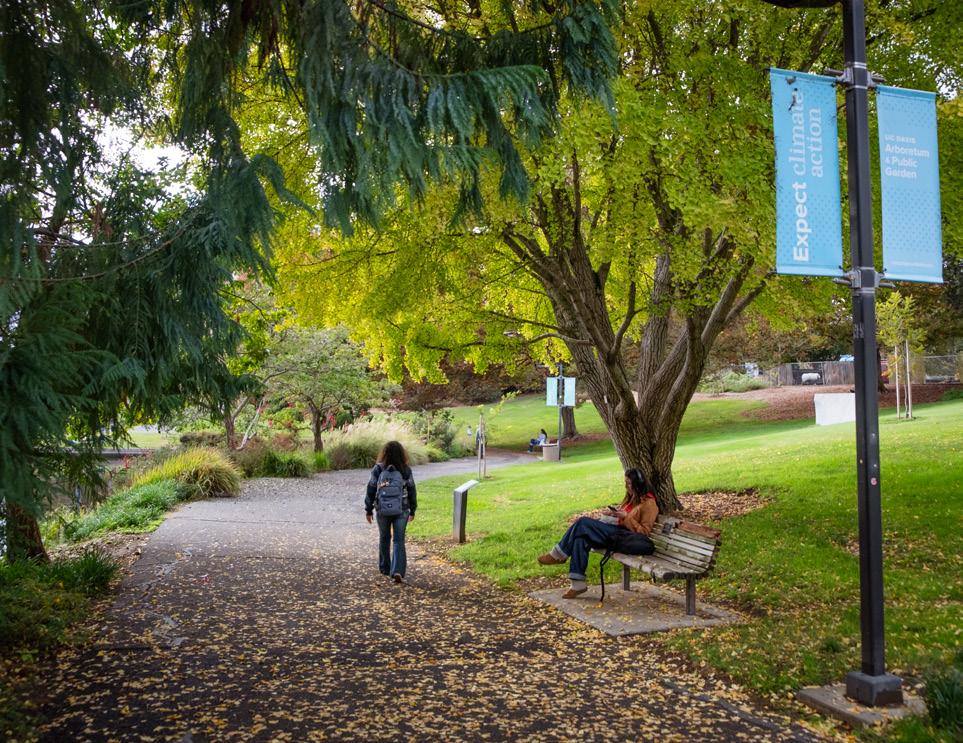
Students hang out in the UC Davis Arboretum on Nov. 14, 2025.
(Jenna Lee / Aggie)
he feels more creative and introspective after a visit to the Arboretum.
“While being there during the night makes me more reflective, I do enjoy being there during the day as well,” Bahy said. “It is super lively, and it always puts me in a good mood to see everyone else enjoying the sun.”
However, the Arboretum doesn’t just provide an endless supply of peace and beauty for individual visitors; when you go there with your special someone, the rewards multiply. Sophia Najera, a first-year political science major, described why she finds the Arboretum a premier date spot.
“I consider it romantic due to the fact that it allows for some privacy, and it is a really good place to have contemplative conversations to get to know
someone better,” Najera said. Bahy also commented on the romantic atmosphere of the Arboretum.
“I think the Arboretum is inherently romantic,” Bahy said. “Maybe not a specific part of it, but the general idea of bringing someone you love there amongst all the trees, ducks, grasses and bridges seems really intimate. It is like a place [where] you can have a moment with someone and only them.”
Regardless of whether the love of your life comes to town for a visit or if you’re just asking someone new out on a date, don’t bring them to your dorm or apartment. Instead, you can take in the beauty of the world by touching some grass — and not just any grass, but the greenery graced by the warm light of the sun as it stretches across the Arboretum.
environment and community.
“It’s so epic to work here,” Taylor Davis, a barista at Temple, said. “The clientele is a compatible demographic with me. My coworkers and the customers are my homies.”
Each member of the staff is friendly, charismatic and goes above and beyond to make the
for
experience of each customer special.
“The staff are always super friendly, and the coffee is delicious,” Jada Langley, a second-year applied chemistry and forensics double major, said.
Temple’s process is so efficient that there’s rarely any wait time — by the time you finish
‘It’s a full time job’: The jazzy 8-person group discusses their classroom origins and newfound fame
BY MIRIAM RAMADRISHNAN features@theaggie.org
The sight of people twirling each other around and laughing at a show, more often than not, means that In Bloom is playing. The local house show mainstays have quickly become a draw for any show in this college town, with people flocking to whatever house will host them and now winning Best of Davis’ Best Local Band title.
Zoey Mortazavi, a third-year international relations major and lead vocalist, described the impact of the band’s recent success, having been booked almost every weekend this past month.
“I got recognized at Trader Joe’s yesterday,” Mortazavi said. “It just doesn’t feel real because it’s been a relatively short time, but I’m so grateful because I think we have a lot of fun when we play together.”

Student band “In Bloom” performs at The California Aggie Couch Concert on April 24, 2026. (Jenna Lee / Aggie) In Bloom was born through the UC Davis Jazz Combo program, where students audition to play in four- to five-person groups every week. Violinist and vocalist Vedi Iyer, a third-year civil engineering major, explained how shortlived the six-week program felt, and how that motivated her to pursue that feeling beyond its

“Two years ago, The California Aggie Couch Concert was coming up and I asked the other members if we could just play [the show] as combos, and they said yes,” Iyer said. “We formed a group, and we only had two rehearsals to learn five or six songs. It was just really fun and something that [Mortazavi] and I have always wanted to do.”
After their first performance, Mortazavi realized that there may be a
demand for a band with a sound like In Bloom’s in Davis — one bright with jazz, R&B influences and catchy covers.
“When we played at the Couch Concert, I realized it’s been so long since there’s been music we can actually dance to,” Mortazavi said. “We haven’t heard this kind of music in Davis in forever.”
Bassist Paul Zhu, a fifth-year psychology major, grew up in China and didn’t speak English until the age of 13. Zhu noted that playing with In Bloom has made him think about music differently.
“I don’t really listen to music for the lyrics,” Zhu said. “I listened to a lot of American music and didn’t understand English, so it was always just someone making sound with their mouths. Playing in a band with two vocalists has really helped me step back and remember that I’m playing for them too.”
The two Davis mainstays each provide their own approach to the event
BY JONAH BERMAN features@theaggie.org
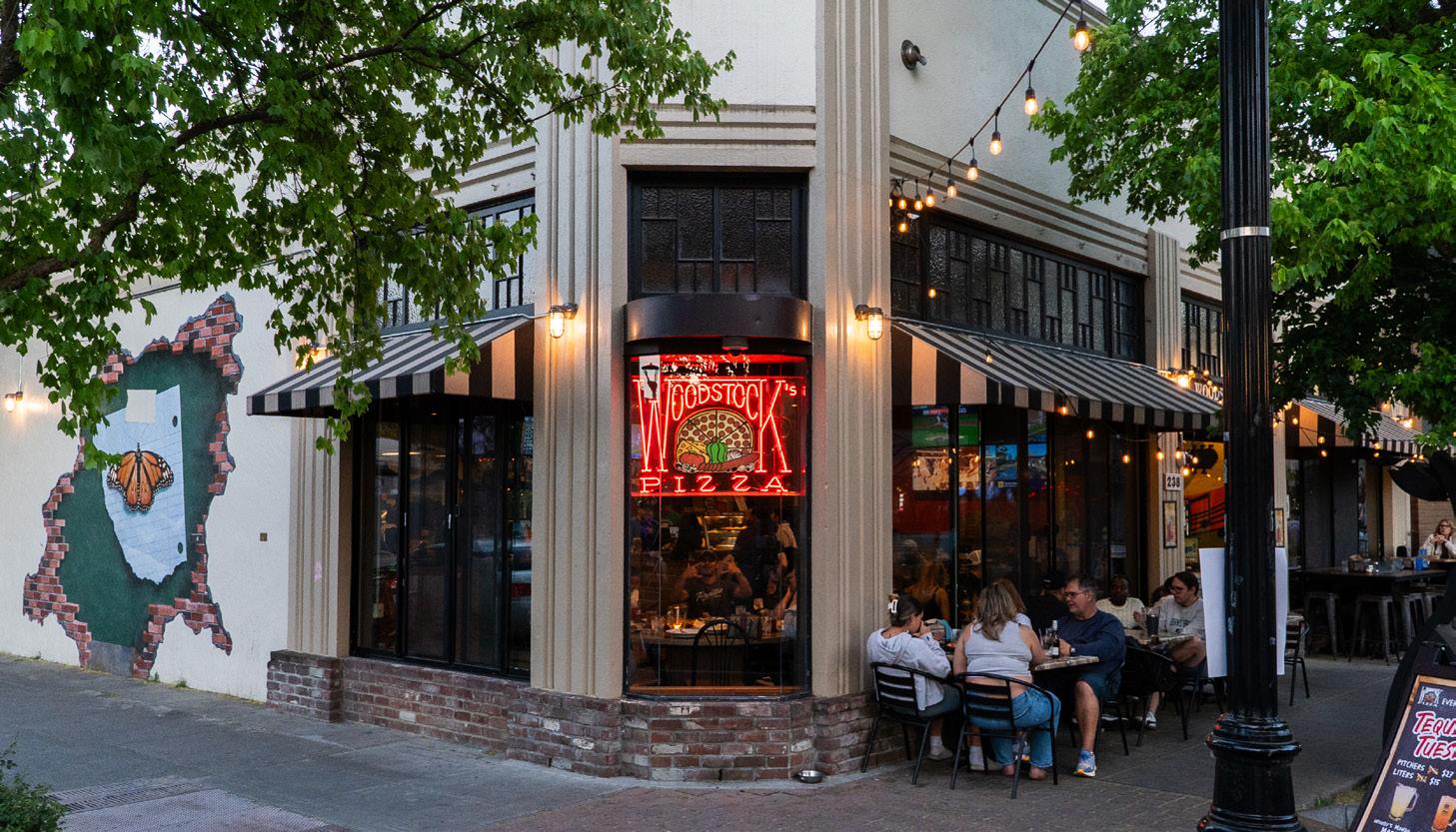
Each week, Davis students and locals descend on a variety of venues to participate in trivia night, with businesses around the town offering unique spins on the classic event. This year, UC Davis students felt two establishments in particular stood out for their versions of this iconic competition: Sophia’s Thai Kitchen and Woodstock’s Pizza. Talia Levi, a fourth-year sustainable environmental design and design double major, shared her appreciation for trivia nights at Sophia’s.
“My first time was with [my friend] Gracie [Paterson] during the spring quarter of my third year,” Levi said. “I went with her and her coworkers, and it was just such a fun experience.”
Now, both Levi and Paterson, a fourth-year design and psychology major, consider themselves regulars.
“We’re such repeats now that the bouncer doesn’t even have to check our ID, he just stamps our hand, which is the greatest honor,” Paterson said.
always gonna run into people you know, all your friends who go every week.”
said. “I’ve done trivia in other cities as well, and I always prefer the ones that are pen and paper. It feels more authentic that way.” Both students return weekly not only for the unique questions, but also for the community the venue fosters.
“The atmosphere of Sophia’s is just really nice,” Levi said. “It’s crowded in a fun way. You’re
Paterson concurred on the ability to build connections at Sophia’s.
“We have this rotating group of like 30 people who are interested,” Paterson said. “I think I’ve definitely gotten closer with [Levi’s] friends through it. It’s just a merging of so many different groups of people, which is really fun.”

Meanwhile, trivia at Woodstock’s Pizza attracts a mix of undergraduate students along with graduate students and older residents. Unlike Sophia’s, Woodstock’s trivia is online and is run by the King Trivia company. Rounds can take longer to complete, with some consistent themed categories every week. Quizmaster Kayla Reckon leads the often boisterous Thursday evening crowd; she works diligently to build a humorous, fun and vibrant environment.
“I have a lot of people come up to me and say that usually they do not find trivia that fun, but whenever I’m there running it, it really makes their experience,” Reckon said.
After running trivia at Woodstock’s for nearly five years, Reckon said her favorite part of the job is the frequent attendees.
“The part that I like the most about being a quizmaster is having regulars,” Reckon said. “There are a couple of teams that have been with me more or less since the very beginning, and they’re there almost every week.”
However, each iteration also attracts first-time attendees, such as Davis graduate student
GURNOOR KAUR / AGGIE
Antonio Guillen.
“It’s electric,” Guillen said. The incredibly energetic and lively environment is second to none, as Reckon also emphasized.
“The venue is constantly bumping,” Reckon said. “King Trivia is a national company, and I’m pretty sure Woodstocks is the biggest venue. I have hosted at other venues where I’ve had to really work to get people to play. That’s never been the case at Woodstocks. I would describe the environment as, and I say this affectionately, really chaotic.”
The nearly 5,000 square-foot space allows for massive levels of participation, with most editions of the event including over 30 teams. The trivia night brings together individuals from around the Davis community and beyond, offering a space to meet new people and reconnect with old friends.
Upper Crust
BY NEVAEH KARRAKER
features@theaggie.org
The Davis Farmers Market, located at Central Park in Downtown Davis, is celebrating its 50th anniversary after half a century of consistently showing up for the community every Saturday and Wednesday. “Davis’ soul,” as the market proclaims, features locally sourced, fresh produce yearround, with craft stands and farm good displays serving as the hub of family and community interaction.
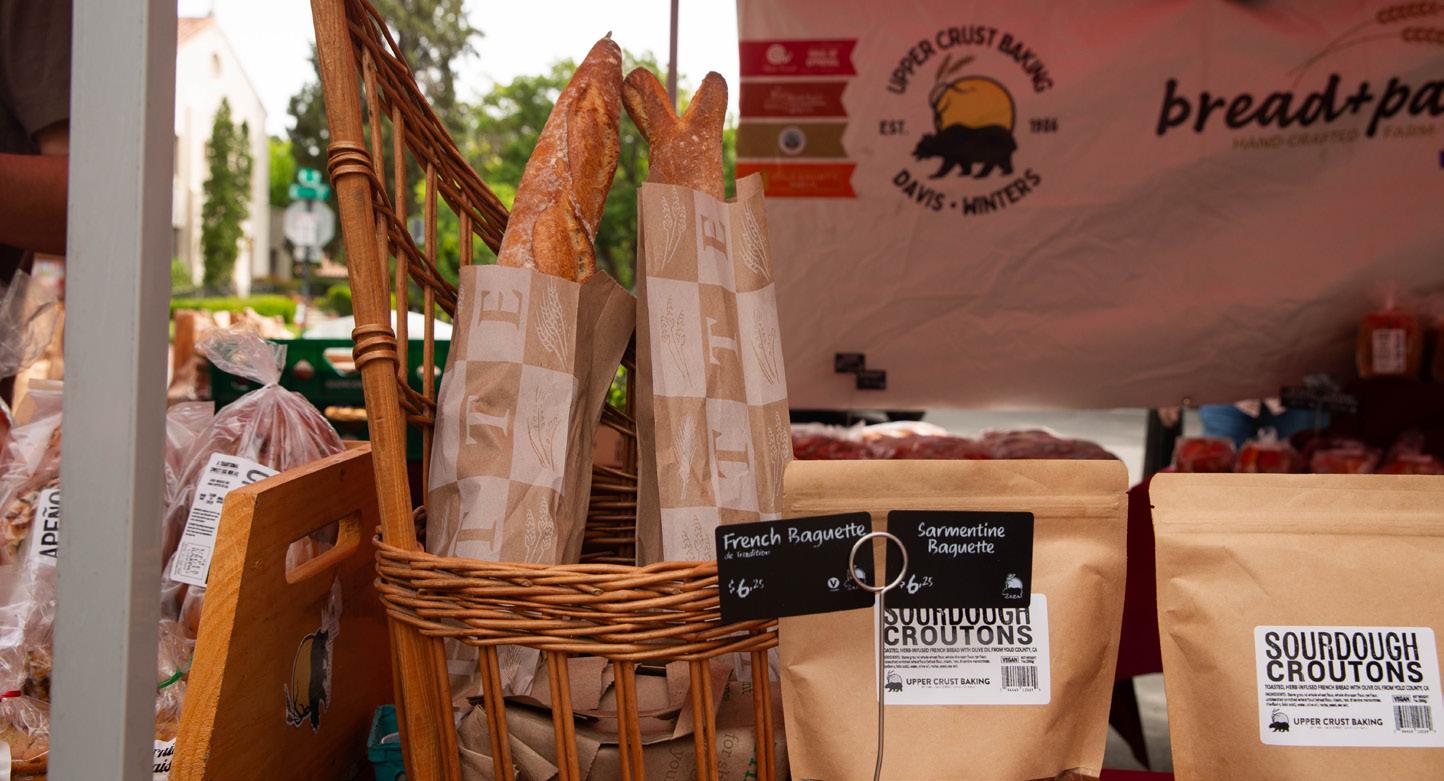
Among the many vendors, Upper Crust Bakery has earned the title as the “Best Farmers Market Stall” for 2026, a worthy achievement as the establishment celebrates its
40th anniversary. The bakery, located at 634 G Street, has previously won The California Aggie’s “Best Bakery” and “Best Pastries” awards. From warm baguettes and sourdough loaves to sweet pastries like scones and cookies, Upper Crust provides a wide selection of farm-to-fork, quality goodies for everyone.
Upper Crust was established in 1986 by Mo and Trudy Kalisky, who, after moving from Paris, refined their artisanal menu with French baking traditions and whole ingredients. Lorin Kalisky, the owners’ son, inherited the bakery in 2016, effectively making Upper Crust the only second-generation owned business in Davis, according to their website. The emphasis on family and connection is folded into the workplace, both in the commercial kitchen and at the farmers market. Gabby Leugero, an Upper Crust staff member who grew up in Davis, was captivated by the kind management and comforting atmosphere.

“It’s different [from other bakeries] since it’s not commercialized, or stiff — it makes you want to come back,” Leugero said. “One of my favorite things is working on pizza nights on Wednesdays, since it’s so lively and being in an environment
where everyone is happy is motivating and inspiring.”
Rachel Harris, a fourth-year evolution, ecology and biodiversity major, also shared her appreciation for the friendly staff, reliable ingredients and the plethora of snacks.
“I was drawn in because of the wide variety,” Harris said. “It’s good quality and [gives] large desserts. The chocolate croissant is enlightening.”
The chocolate croissants and pretzels are fan favorites; Joaquin Lemieux, a second-year environmental science major, professed Wednesdays as his “pretzel day,” and touched on the welcoming environment of the Davis Farmers Market.
“It brings the community together,” Lemieux said. “It feels like a Hallmark movie in the best way possible, especially in the winter. It’s nice to support small businesses and get a treat.”
Whether you’re a student, visitor or a member of the Davis community, the Davis Farmers Market is a cherished attraction that’s an integral part of the agriculture-based town and university.
The Upper Crust Bakery stand is open on Saturdays at the Davis Farmers Market from 8 a.m. to 1 p.m. — if you visit, you just may bump into the Kalisky family as they enjoy the company of the community they’ve fostered.
A Kraken, a captain and the best cocktails downtown
BY MILES BARRY features@theaggie.org
“As you step through those doors, you’re no longer in Davis, Calif.,” Nadia Iwach, a fourthyear political science major, said. “You’re somewhere much more magical.”
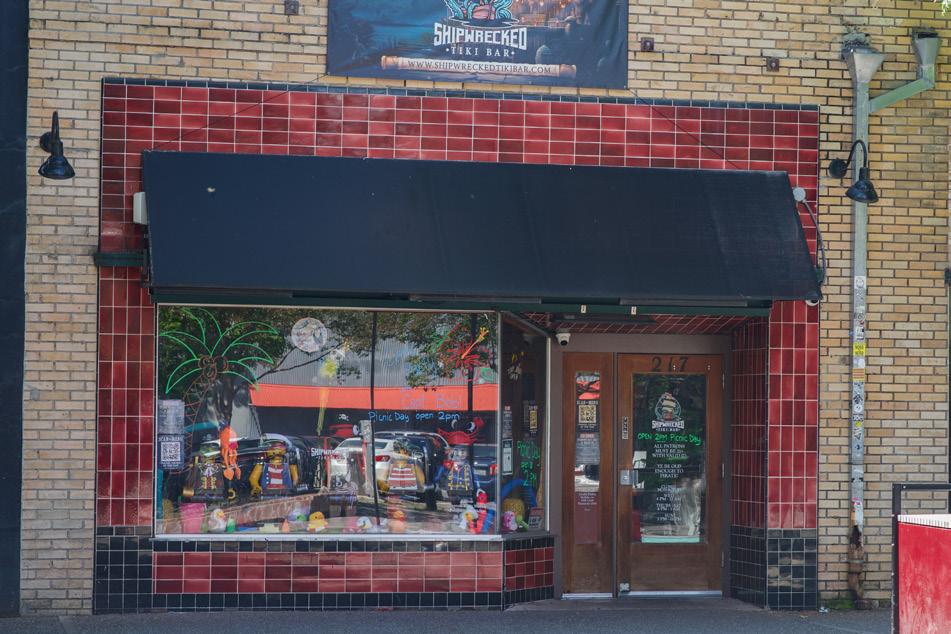
Indeed, as soon as you enter Shipwrecked Tiki Bar, you’ll be greeted by a palm frond canopy, beechwood paneled walls, wicker chairs and a healthy crowd milling around the DJ. At first glance, they appear to be drinking potions — beverages range from electric blue to deep, royal purple to bright green; all served in glassware that any island-based alchemist would envy. The drinks reflect a deliberate philosophy.
“We’re not the cheapest cocktail in town,” Co-owner Nate Yungvanitsait said. “I’m going for the highest quality drinks in town.”
That commitment shows up in the minute details: staff handsqueeze up to six cases of limes a week for fresh juice, and the almond syrup in the 1944 Mai Tai is made in-house. The Mai Tai itself blends four different rums, modeled after Trader Vic’s original 1944 recipe rather than the sweeter, grenadine-topped version most people encounter in Hawaii.
Katy Lawlor, a third year design and psychology double major, shared her love for the Lychee Green Tea Shooter.
“Even though it’s a shooter, you could sip on that,” Lawlor
downtown: that’s why I like Shipwrecked.”
On busy nights, the crowd becomes so dense that you’re in danger of losing your drink to a misplaced elbow. Still, Iwach explained that the Ube Espresso Martini is worth the risk.
“Someone bumped into me, I didn’t even care that I was wearing half the drink: It was so good,” Iwach said.
To many students, Shipwrecked’s Zombie Jet Cocktail is one out of the three drinks in Davis’ holy trinity: the booziest drinks at three different Downtown Davis bars. Drink all of them in one night, and you’ll win both glory and a throbbing hangover the following morning.
As you forge past the sardine-dense crowd in the entrance and begin to find your sea-legs, you’ll reach a dark corridor. Here, the longer you stare at the walls and ceilings, the more you’ll notice: doubloons scattered around ancient pirate skeletons, preserved deep-sea fish, octopus tentacles creeping along the ceiling and hanging fishing nets casting purple shadows against the dark ceiling.

“The decorations are definitely the best in Davis,” Lawlor said. “It feels like you really are a mermaid at a real Tiki bar. It transports you to a beach, but What most patrons don’t realize is that the decor follows a deliberate storyline.
Yungvanitsait and Melissa Yungvanitsait, his wife and co-founder, flew to Thailand three times before opening the
A look at the store transporting Davis bookworms to other worlds BY AMBER WARNKE features@theaggie.org
Bookshelves circle the walls of the quaint shop, as bookworms can be found burying their heads in mysteries, nonfiction, bibliographies, romance and more at Avid Reader. Voted as Aggies’ favorite non-food store downtown, the small business stands on 617 2nd St., where it has reliably operated from 10 a.m. to 8 p.m. seven days a week since 1987.
Tyler Cross, a first-year nursing major at Sacramento City College, has lived in Davis his whole life, and started working for Avid Reader as a book clerk five years ago. Cross said that one of his favorite things about the store is the local level at which it operates, which contributes to its community feel.
“We are an independent bookstore, which is nice,” Cross said. “We don’t really have some big corporate agenda. Every single person [who works] here is on a first name basis with the owner and most of the owner’s family, who are very involved in the bookstore.”
Delaney Garland, a UC Davis alumna with a Bachelor of Science (B.S.) degree in psychology, has frequented the bookstore on a regular basis for the past several years. Garland has also noticed the friendly climate of the bookstore, and said it encourages her to keep coming back.
“I can tell that the people who work there enjoy working there and are passionate about keeping the business alive and up-to-date with what’s happening in society,” Garland said. “I feel like they always have very relevant displays up, and they change their signs and they keep it fresh […] I think it’s very quirky and bubbly and fun and on-topic.”
Avid Reader showcases books that bring attention to important topics, and correlates their displays to observances held
throughout the year. Currently, the store features a section of books relating to Autism Visibility Month for April, and will display collections of books for Asian American and Pacific Islander Heritage Month, Jewish American Heritage Month, Disability Pride Month and many more.
The store changes their book displays as frequently as they like, allowing them to bring attention to various identities and societal topics.

As a business managed by locals, Avid Reader is better able to meet the needs of Davis residents, according to Cross.
“We have a bit more of a personalized taste for the community,” Cross said. “Normally, we go off [purchasing books based on] what’s popular in California and the surrounding area, and also just the United States in general. And then, a lot of times it is just local authors or recommendations.”
Avid Reader is a unique space for many local authors to share their stories with the Davis community, which also allows Davis residents to be frequently exposed to published authors.
In the month of May alone, the shop will be hosting three author events for the public, most of which are free to attend.
Avid Reader to be helpful even when they don’t have something she wants.
“I’ve had multiple books that I went in, asked if they had it and if they didn’t have it, they would immediately offer to order it,” Garland said. Ultimately, no matter what type of book Aggies are craving, Avid Reader has something for everyone, according to Cross. In a world where screentime keeps going up and literacy rates are declining, Avid Reader helps keep reading exciting by fostering an environment that celebrates books and encourages everyone to find inspiration in the world of literature.
“[Reading] can help you learn stories and fit in the shoes of other people that you wouldn’t have normally been able to,” Cross said.
For the second year in a row, the title goes to the two content creators
bar in order to source custom decorations built around a narrative: Captain Bad Luck Bob’s unfortunate, deadly encounter with the Kraken, a large monstrous squid. The first room is the beach where Captain Bob set sail — note the brown, sandlike floor tiles fading into blue. The second room, with floor-to-ceiling tiles and tentacles snaking along the walls and ceiling, is the Kraken’s underwater lair.
Aside from the decor and drinks, many students shared their appreciation for the atmosphere inside Shipwrecked, which is far from the stickyfloors and beer-branded lamps characteristic of college-town bars.
“I really admire Shipwrecked’s refusal to [adhere to classic expectations of a college bar]” Iwach said. “They always talk about art being resistance, and I think [the tiki bar] is a prime example. There isn’t a single television or billiards table within Shipwrecked — just palm fronds and leis.” N. Yungvanitsait moved to Davis when he was 14 years old. After graduating early from Davis High School, he worked full-time in his mother’s Thai restaurant before opening his first bar — University of Beer — in Davis at the age of 24. To some, starting a business at 24 may sound like a massive leap, but N. Yungvanitsait credits much of his success to watching his mom work.
“By 24, I wasn’t new to the bar or the restaurant world,” N. Yungvanitsait said.
Now, he and his wife operate six University of Beer locations. Shipwrecked, which they opened in 2023, has since expanded to a second location in Sacramento. Its success is proof that a collegetown bar doesn’t have to look like one.
BY RIVERS STOUT features@theaggie.org
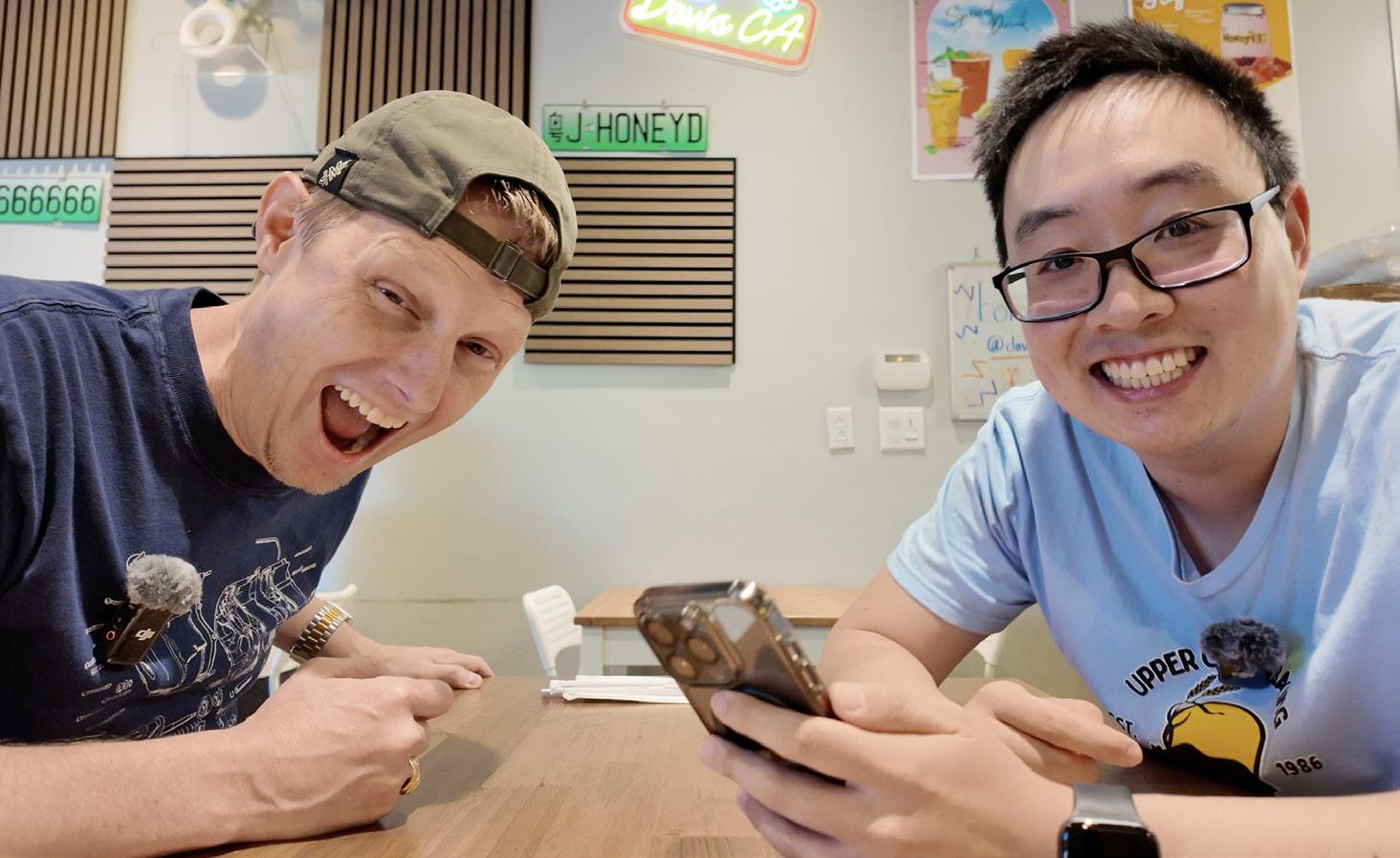
Students often complain that Davis is boring or lacks activities to do. But co-creators Richard Jia and Gray Eby of @mydaviscalifornia prove this idea wrong with their Instagram account dedicated to exploring all that our college town has to offer. From visiting restaurants downtown to flying a plane, the duo has well earned their status as this year’s best Davis-specific Instagram account.
“I want to say thank you,” Eby said. “Thank you for following us, for knowing we exist. We’re not going anywhere; we’re going to keep cranking it out as long as we can.”
This year’s win marks the second time in a row the pair have topped the Best of Davis category.
“Pretty awesome, back-toback two-time champ,” Jia said. “Just kidding.”
The account has worked to fill the niche of Davis-specific content, featuring affordable food recommendations, interesting and lesser-known spots around campus and skits or jokes about life in Davis.
“Meeting and seeing all the awesome things that people have going on — whether it be a local restaurant or a person doing something crazy — we
have just been exposed to a lot of unique situations and experiences,” Jia said. “We interviewed the chancellor [of UC Davis], I never thought I would ever have a moment to talk to the chancellor. I thought that was really cool — the wide range of things the page lets us cover is cool.”
Somewhat surprisingly, neither Jia nor Eby grew up in community they felt. They acknowledge that without the community’s support, their account wouldn’t have grown the way it has these past few years.
“We wish we knew ourselves better, but the feedback we hear from the community all the time is, ‘You guys help us know what there is to do around town,’ [or] ‘We like this account because we know about a new restaurant
BY AMBER DUHS features@theaggie.org
Whether it be a late-night study session, an evening shift at your part-time job or a night of binge-watching your favorite show, every college student knows the feeling of heavy eyes and brain fog that follows you through your school day. Eventually, many students succumb to the midday nap: a euphoric and semi-forbidden activity that has you rolling the dice on whether you’ll actually feel more rested or be forced to thug out the tiredness.
While the seemingly obvious choice for a nap may be one’s bed, house or even a friend’s couch, oftentimes students don’t have time to leave (and come back to) campus before their next class.
“I tend to have an awkward gap in between classes [...] [it’s] not enough time to lock in or really feel productive,” Catarina Kenat, a first-year sustainable environmental design major, said.
“Being productive, to me, is taking a nap or listening to an
A sunny hideaway perfect for a quick snooze
DARIXA VARELA MEDRANO / AGGIE

audiobook while laying down.”
With this, many students may set out in search of the best nap spot on campus, considering the criteria of what makes a napping area “good.” From the amount of outside noise or foot-traffic you’ll encounter to the availability of sun or shade
your chosen spot has, there’s a lot of factors to take into account.
“I like to have privacy in my place to nap, and a quiet space,” Kenat said. “[I nap] usually where there’s some sun, but not a big crowd of people.”
As a nap spot, the hammocks at the Memorial Union Quad
have many positive features, making them the perfect place to catch up on some sleep or rest your eyes for just a moment.
“The hammocks rock you back and forth and it’s very calming,” Kaylee Pope, a firstyear biological sciences major, said.
Why cry in your bed if you can cry in public?
BY ANJALI IYER features@theaggie.org
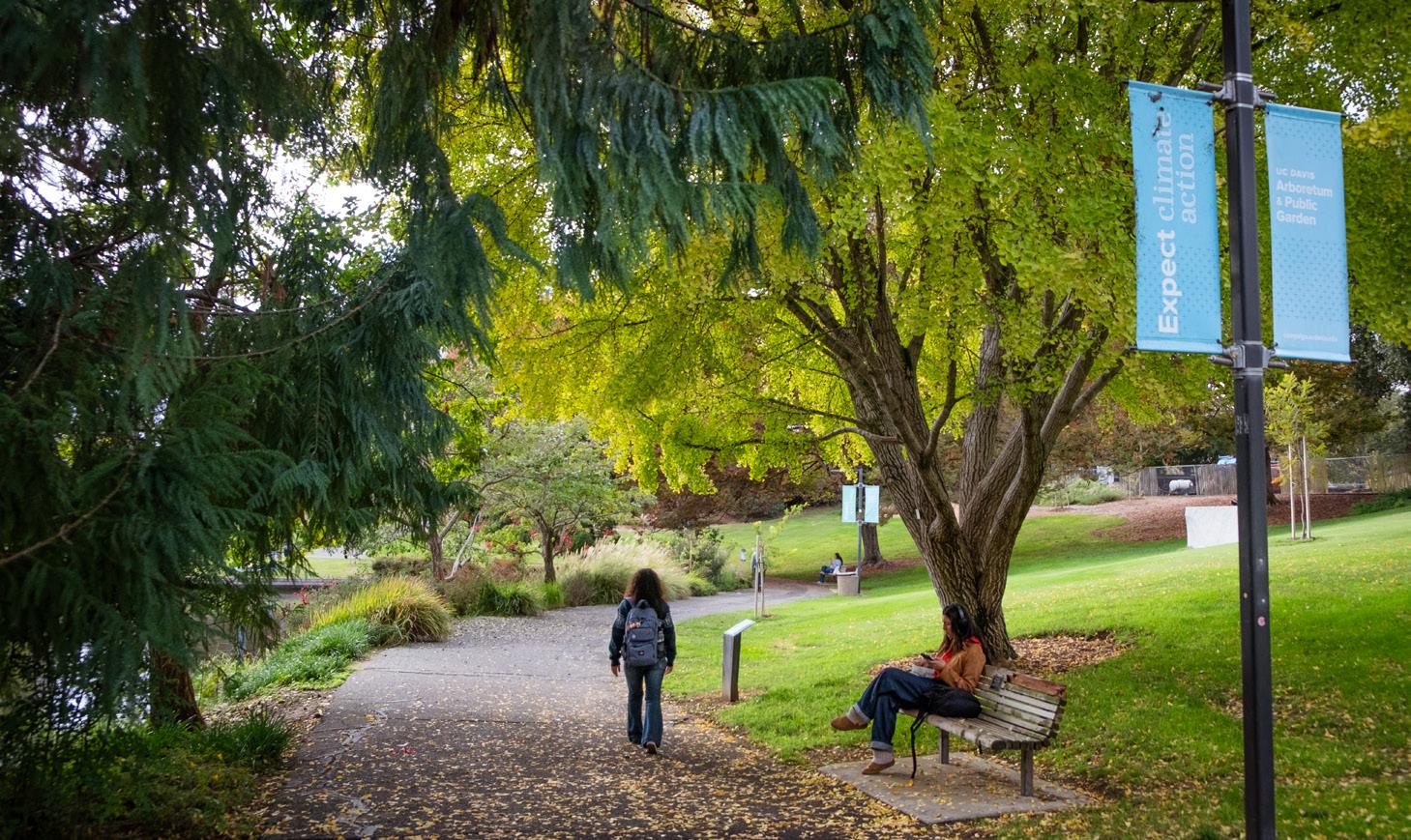
Do you ever wish you had somewhere better to cry other than in the comfort of your own home? Well, you’re in luck, because the search for the best cry spot in Davis is over — The Arboretum and Public Gardens has emerged as the uncontested top location for sad Davis residents.
Colloquially and fondly known as “The Arb,” the garden is a part of the greater UC Davis Arboretum and Public Gardens program. The entire project spans the length of the campus, consisting of over 5,300 acres of unique Californian ecosystems. The Arboretum in particular occupies around 100 acres of land, consisting of various gardens, scientific collections and a stream that runs through the length of the reserve. The Arboretum is home to 22,000 trees and a plethora of wildlife, like ducks, squirrels and a diverse range of native bugs.
Since its founding in 1936,
The Arboretum has grown from its role as a teaching and research tool and has become an immersive living laboratory. A common stop for tour groups and first-years alike, The Arboretum has truly cemented itself as a Davis staple. The gentle rustling of the leaves and babbling of the stream helps evoke an emotional
response. As one of the quietest locations in all of Davis, the tranquility of The Arboretum makes it the perfect place to plop down on the grassy hill and have a good cry.
The ecological and architectural diversity of The Arboretum allows it to cater to any type of crier. If you’re the type to sit and cry, you can use
The downtown location offers completely customizable frozen yogurt with 101 toppings to choose from
BY MADELYN SEVIGNY features@theaggie.org
Yoloberry Yogurt has been named “Best Dessert” in our 2026 Best of Davis. Its downtown location offers completely customizable frozen yogurt with 101 toppings to choose from, including gummy frogs, apple pie filling and more.
Yoloberry has been a beloved community dessert shop since 2008, winning the “Best Dessert” category in The California Aggie’s Best of Davis in 2017, 2020 and now 2026. For those who love the establishment, a new Yoloberry location has just opened at the Silo on campus, combined with Acai Fresh. This location has the same owners as the downtown Yoloberry Yogurt location, and serves custom acai bowls. The Silo location will have their grand opening May 7. Isabel Muga, a fifth-year animal science major, said the convenient location downtown
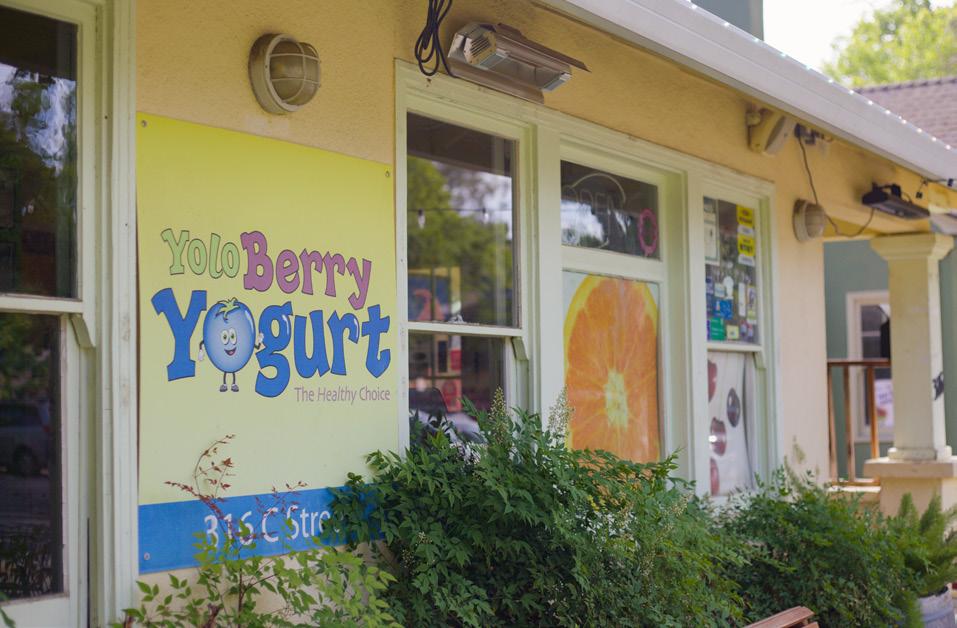
YoloBerry Yogurt in Davis, Calif., April 24, 2026. YoloBerry has been serving frozen yogurt in Davis since 2008, and recently opened a location at the Silo on the UC Davis campus. (Andrew Huynh / Aggie) makes Yoloberry a frequent stop for her and her friends.
“I just love how it’s so close to campus,” Muga said. “This is [...] our go-to spot.” Muga added that Yoloberry is also a popular spot for student groups.

“[For] the line dancing club here at Davis [...] a lot of us come here to dance, exercise [and then] snack,” Muga said. “And I know that they do a lot of fundraisers, which is nice.” Ezra Morford, a second-year gender studies major and Yoloberry employee, attributed Yoloberry’s win to its involvement in the Davis community, noting the pictures hung up on the walls of the store featuring community groups that Yoloberry supports.
“It’s a Davis staple,” Morford said. “We’re always doing things for the community, which I think makes people
want to come back in.”
Morford added that the strong sense of community starts with the owners.
“Laura [Winton] and Lee [Pflugrath] are amazing,” Morford said. “They’re like Davis community staples [...] But I think mostly [it is] Laura and Lee showing that they actually care about Davis.”
Yoloberry owners and husband and wife Lee Pflugrath and Laura Winton both grew up in Davis. Pflugrath has a background in the Sonoma restaurant business and decided to use his experience to start his own food establishment in 2008. Winton joined the team in 2014.
Yoloberry is located downtown at 316 C St. It is open Sunday to Thursday from 11 a.m. to 11 p.m., and from 11 a.m. to 11:30 p.m. on Fridays and Saturdays.
one of the numerous benches lining the garden. Alternatively, if you like to walk and cry, you have miles of pathways to solemnly bask in self-pity. Lastly, if you like to stare longingly at animals and let the tears run down your face, you can do so standing on one of the many bridges overlooking the stream — the perfect vantage point to
The hammocks were first implemented in 2014, with the intention of encouraging students to rest and relax on campus. Since then they’ve become a coveted rest spot, with students often prowling the Quad while waiting for a comfy spot to open up. Beyond the success of the
observe the ducks glide across the water.
“As someone who has cried at The Arb quite a few times, I can say confidently that it’s the best place to cry in all of Davis,” Sophia Aran, a thirdyear political science major, said. She noted that the vastness of The Arboretum makes it easy to find a quiet spot to cry.
initiative, the hammocks are positioned in a perfectly central and accessible location, near lecture halls and conveniently adjacent to the Coffee House — allowing students to grab a quick bite and then relax. The Quad also tends to get great weather, and yet the hammocks themselves rest in a shaded spot just beneath the oak trees on either side of the grass.
“[When] it’s sunny or when I have a weird gap between classes [...] I just bike to the hammocks and clock out,” Pope said. “When the weather is nice, it gets peak sun.”
Despite their location in a more grassy area, the leverage of the hammocks allows students to be within nature, but resting just above the dirt and bugs.
“The hammocks are so comfy and I feel like I can be flat with support and not overthinking bugs crawling on me,” Kenat said. All in all, the hammocks in the Quad seem to be the perfect nap spot for students, with their access to sunlight, a slight breeze and lots of people-watching opportunities. Students’ only complaint? The fact that we only have eight of them.
“There should be more hammocks on campus.” Kenat said. “People need to nap during the day.”
“No one is really looking at each other so you can get away with shedding a few tears,” Aran said. Aran explained how the natural beauty of The Arboretum helps enhance a good cry session.
“It’s so beautiful, and there’s so much life happening around you,” Aran said. “It makes me really overwhelmed with emotion.”
The tear-evoking biodiversity of The Arboretum cannot be understated. Home to over 135 species of birds, it provides an optimal environment to observe an avian mating ritual and cry about your situationship.
Many students also appreciate The Arboretum’s proximity to campus.
“The Arb is really close to campus, so if you end up failing a test, you can just walk to The Arb and cry,” Asia Davis, a fourth-year psychology major, said. “If you can’t hold it in, you don’t have to do the walk of shame downtown as you cry on your way back home; just go to The Arb.”
The Arboretum is undeniably the best place in all of Davis to have a good cry. It provides a peaceful environment and the cover of native Californian fauna to let go of social convention and sob your eyes out in public. So, the next time you’re feeling down, put your headphones on, press play on that Mitski song and walk down to The Arb.
photography philosophy
BY JENNA LEE features@theaggie.org
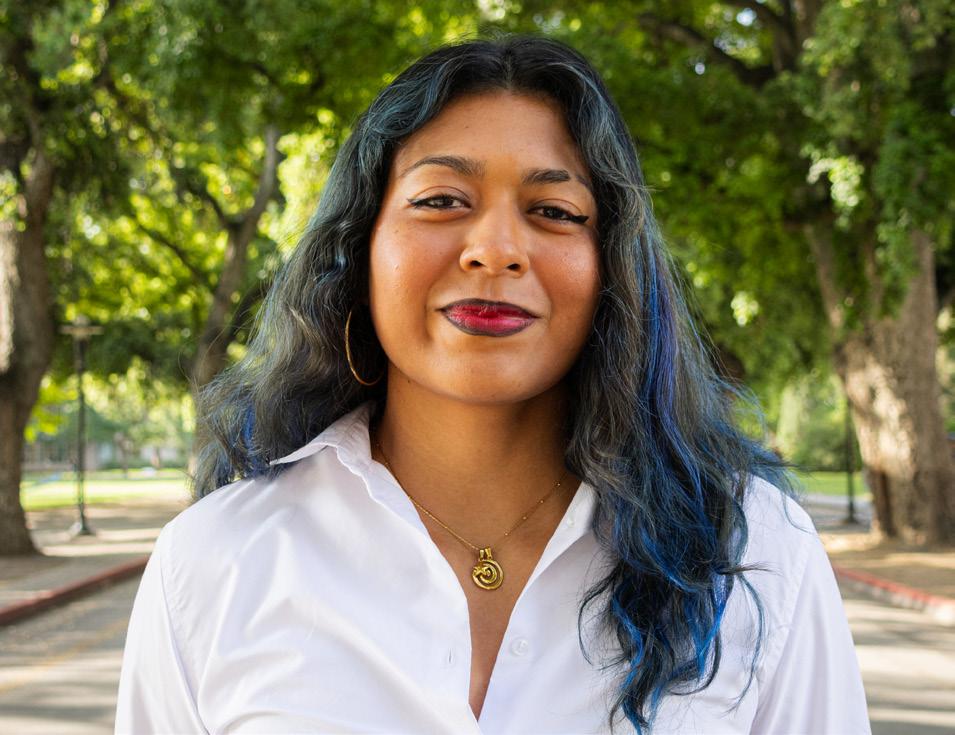
Isabel Reyes, a fourth-year Chicano studies and cinema and digital media double major, started taking graduation photos last spring and quickly gained experience photographing graduates — the majority of them being first-generation students.
“I think it’s a rewarding thing to do,” Reyes said. “There’s a lot that goes into graduating and commemorating [a student’s] efforts, and it’s something I like to take part of.”
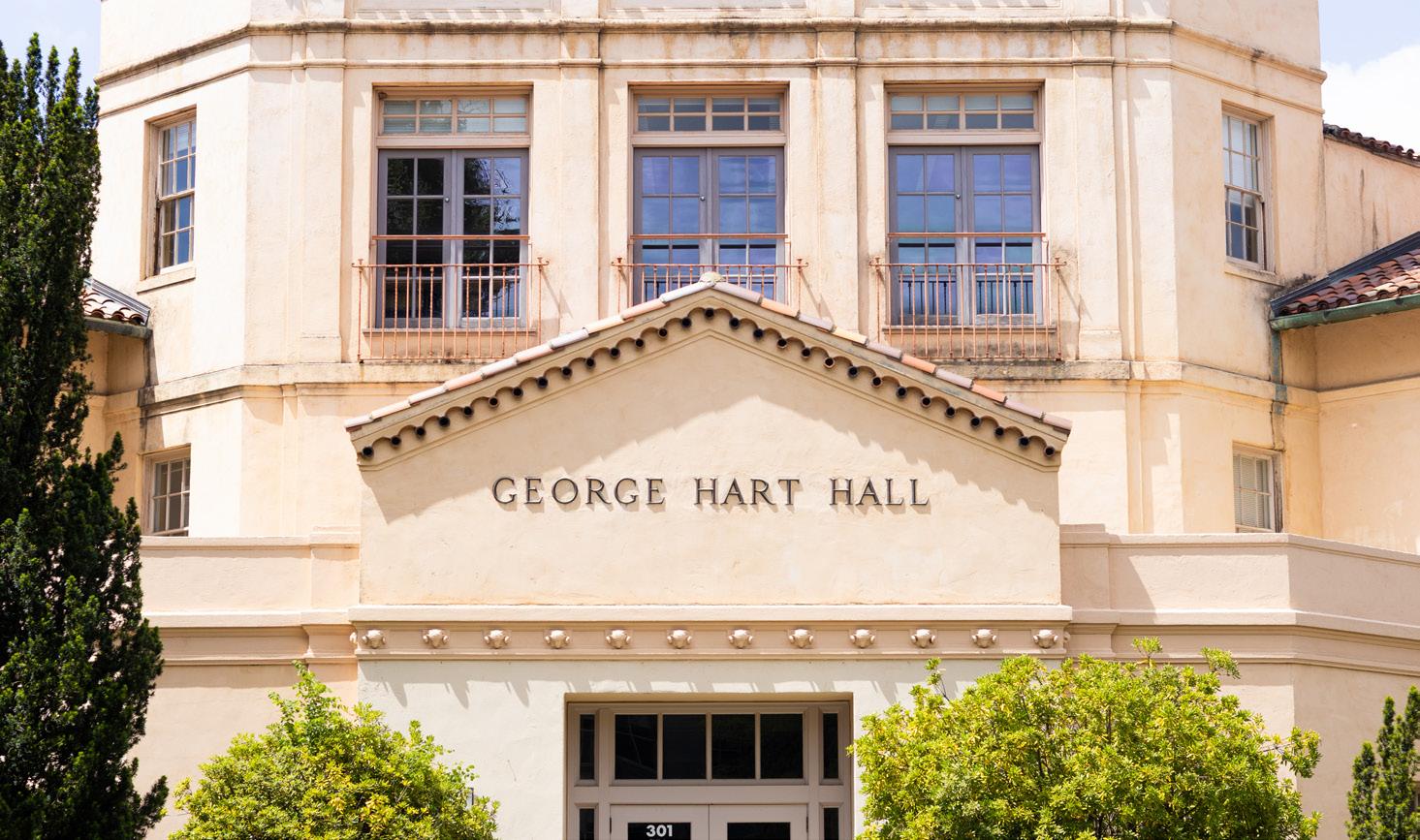
Reyes recently completed her first parent co-session with a Mexican family in front of Hart Hall, home to the Chicana/o/x Studies Department. The photoshoot drew emotional reactions of joy and pride.
“When people have a connection to the location, that’s when you get the best results,” Reyes said. “It all came naturally because everyone in that shoot knew that they had a role in that one graduate. I think in Mexican culture, the father is more shutoff and putting them in these
moments reveals the pride they don’t often verbally share. Vulnerable moments definitely bring out a lot of the unspoken feelings.”
For many students, including Reyes, stepping in front of a camera can feel intimidating. To ensure that her clients feel at ease, Reyes asks students about poses they feel confident performing and observes personality and body language during the session, which helps her avoid awkward and unnatural-looking poses. By prioritizing comfort, Reyes is able to create images that truly reflect the personality of the graduate.
One of her clients, Oskar Hua, a first-generation student and 2025 sustainable environmental design graduate, wore Vietnamese traditional clothing, áo dài, for his photoshoot.
“Being able to take photos in áo dài made me feel proud to represent my parents,” Hua said.
“While [Reyes] photographed me, she hyped me up all the time and made me feel extremely comfortable in my clothes.”
Beyond honoring his heritage, Hua envisioned taking graduation photos at locations that were part of his Davis experience, such as Hunt Hall’s courtyard and the Arboretum. To cater to his requests, Reyes made sure to stop by those locations during the session.
“The final photos definitely were beyond my expectations,” Hua said. Reyes hopes Hua and other soon-to-be graduates still feel satisfied with the photos in the years following graduation.
“I hope they feel happy with the product and they think back to how they were feeling in that moment,” Reyes said. “I hope it captured the emotion of the moment.”
Those interested in viewing Reyes’ work or booking a session with her can visit her Instagram account @camioncarpintero.
The Bookhead remains a quirky emblem of the Davis Funk Art Movement
BY SONJA WOOLEY features@theaggie.org
The library Bookhead has once again been voted “Best Egghead” at UC Davis, maintaining its distinguished position among other works of public art in the city.
The iconic egghead statues were among the final art pieces made by Davis sculptor Robert Arneson before his death in 1992. Arneson, who taught at the UC Davis Art Department for nearly 30 years, is considered the originator of the ceramic Funk Art Movement and is known for elevating ceramics to an art form worthy of serious consideration.
Funk Art emerged from the beat generation of the 1960s and 1970s in the San Francisco Bay Area and Davis, Calif., as a response to and rejection of the New York Minimalist Art Movement. Funk Art tends to be playful, colorful and bizarre; sometimes purposely ugly and, for lack of a better word, funky. Many pieces from the Funk Art Movement are currently on display at the John Natsoulas Gallery in Davis.
The Eggheads are particularly tongue-in-cheek, named after the epithet used to describe overly-intellectual
academics who may be a bit out of touch with the outside world. Bookhead, placed conspicuously in front of the UC Davis Library with his nose buried dramatically inside a book, is the most obvious example of this joke, and perhaps this is why he has remained so popular among members of the student body.
Seona Sherman, a fourth-year English major, expressed her enjoyment of the Eggheads.
The downtown dispensary is a convenient choice for many students
BY LAILA AZHAR features@theaggie.org
The Artist Tree, located aptly at 420 F St., is this year’s “Best Dispensary,” according to The California Aggie’s Best of Davis survey of UC Davis students.
The cannabis dispensary, which first opened its doors in 2018, was originally known as F Street Dispensary before being renamed Club 420 and most recently rebranding to The Artist Tree.
federally in the United States as a Schedule I substance under the Controlled Substances Act, California became the first state to legalize medical cannabis use in 1996, with recreational use legal since 2016.
The Davis location of the Artist Tree has several characteristics which makes it appeal to students. As one anonymous student, a third-year managerial economics major, noted, its location is convenient.
Penny, year art
UC Davis
tour guide, has incorporated

“[The other Eggheads] are just not as fun as this guy,” Sherman said. “Cause he’s a book. Is that not college? Is that not the epitome of the college experience? When I first toured [Davis], that was the first egghead I saw and I actually took a selfie with it. I was just so enraptured by his face and lack of it.” It was Arneson’s intention that the Egghead statues remain at eye level to students, instead of on a pedestal like traditional sculptures, so that students could interact with them.
“Sometimes on the group tours with high schoolers and middle schoolers, I’ll be like ‘A lot of students will rub the top of its head for good luck on exams, so if you want to try that you can,’” Penny said. “But I think it’s pretty great. I took my senior photos on it, 10 out of 10.”
The Bookhead remains an iconic fixture on the UC Davis campus. It’s a comforting sight when rushing into the library to finish another assignment, because whatever academic woes you might find yourself in, it seems like the Bookhead might have it worse.
The Artist Tree is a chain of dispensaries in California, with stores in Los Angeles, Riverside, Fresno and West Hollywood, among other cities.
They describe themselves as a “dispensary that blends premium cannabis with curated local art and creative community spaces.” Locations feature a rotating gallery of local art and often serve as community hubs.
“By fusing art with cannabis culture, we’re defining a new standard for art, learning, shopping, events and experiences,” their website reads.
Dispensaries are a cornerstone of Californian culture, as the state has been at the forefront of the movement to legalize cannabis use. While the use of cannabis is criminalized
“Since it’s right in downtown, it’s really easy to stop by and grab something without having to go too out of your way,” the student said.
Another anonymous student, a thirdyear cognitive science major, added that the store contains a wide variety of products and often features deals.
“They have tons of different things, pretty much whatever you’re looking for,” the student said. “And


International Student Representative Robi Castaneda spoke out about violation reports allegedly submitted by Senator Aaron Heth
BY AALIYAH ESPAÑOL-RIVAS campus@theaggie.org
At the April 23 ASUCD Senate meeting, election committee divulgence was brought into question after International Student Representative (ISR) Robi Castaneda commented on an alleged violation report submitted by Senator Aaron Heth against an undisclosed candidate.
The interaction began after a public comment regarding the elections was read by Internal Vice President Dhilena Wickramasinghe, alleging Heth had harassed candidates. Heth was running for president of ASUCD before dropping out of the race after The California Aggie reported that he attended a retreat funded by Turning Point USA.
“My friends have reported that Aaron Heth has been harassing candidates who are still running, and getting his friends to harass them too,” the comment read. “I had a friend tell me that someone who selfidentified as his friend shouted profanities at them when trying to campaign such as, ‘F you, F your slate, F ASUCD,’ after the
candidate simply asked them whether or not they voted. I had other friends tell me that he waited and watched them near the place that they were campaigning just to watch them, making them all extremely uncomfortable. He’s also been mass reporting candidates.”
Heth responded to the comment, commenting on the individual’s behavior and denying that they were his friend.
“I am appalled at the behavior that someone is engaging in,” Heth said. “I do not know who that is, but I have suspicions. Yesterday, Senator [Jenna] Younes actually brought it to my attention, and I have attempted to contact the individual who I believe has been harassing people. I’ve tried three times, and I have not gotten a response yet, so I’m still working on it. It’s absolutely horrible, and I sympathize with the candidates.”
In addition to the public comment, Castaneda directly called-out Heth about an alleged election violation report Heth made against a candidate for making a video with student performer Thai T., widely known for his internet persona performing birthday serenades.
“[Heth], I understand that
you want to distance yourself, but we also have been noticing that you’ve been making [violation] reports,” Castaneda said. “Some of us have seen the report you made against one of the candidates for collaborating with Thai T. At the same time, didn’t one of your candidates also appear next to Thai T. as well? I know that you were the one that made that report specifically, because I saw your little icon right in the corner with your private Instagram account.”
Later, during open forum, Senator Ezra Rubin responded to Castaneda’s accusation, citing election committee divulgence. ASUCD Bylaws require that records on the deliberations of election violations be kept confidential within the Elections Committee, of which Castaneda is not a member.
“It is very problematic that members of the Election Committee are divulging confidential information about violation reports that are now being discussed on the Senate table,” Rubin said. “When I asked Castaneda where he heard about the aforementioned confidential election complaint, all I received was an ambiguous response that said, ‘Through the grapevine.’ When I stressed that
ISR Robi Castaneda spoke out about violation reports allegedly submitted by Senator Heth
BY LILY KENROW campus@theaggie.org
The ASUCD spring 2026 election results are out, with members of the Viva slate emerging victorious. Luis L. Garcia, a third-year political science and Chicanx studies major, and Rosa Linda Martinez, a third-year sociology — organizational studies major, of the Viva slate have been elected to serve as the ASUCD president and internal vice president for the 202627 school year. Both currently serve as senators.
“We will continue being committed to cultivating the trust given us by the student body,” Garcia said in a statement. “Our work will center students, their voices, their identities, and their lived experiences. They will be at the forefront of every action and decision we make.”
The pair ran uncontested after Senator Aaron Heth, a third-year political science major, dropped his bid for the executive seat following reporting by The California Aggie detailing his attendance to a Turning Point USA-affiliated conference in December 2025. Heth’s slate, Vision, was also dissolved in light of his attendance.
Viva candidates Maretta Ardelia, a third-year managerial economics major, and Livreet Kaur Sandhu, a third-year political science major, were elected as international student representative (ISR) and transfer student representative (TSR), respectively.

Of the six candidates elected to the ASUCD Senate, the top two were also Viva slate members: Caleb Swaby-Pierce, a second-year economics and political science double major, and Frida Sol Alvarez, a second-year Chicanx studies and political science double major.
The remaining four seats were taken by: Lucia Holmboe, a third-year political science major (Bitchier slate); Helena Awwad, a first-year Middle East/ South Asian studies and international relations double major (Sawt slate); Afra Sadeghi, a first-year international relations major (Sawt slate); and Madeline Nadel, a first-year political science major, who ran independent after the dissolution of the Vision slate.
Last week’s election marks the first time all candidates of a slate have won their respective races since the creation of the TSR and ISR roles in 2021. Also elected for the role of student advocate was Salma Mahmodi, a first-year political science — public ser-
vice major.
No candidates for external affairs vice president (EAVP) were on the ballot, and the position remains unfilled for next school year.
Vision slate candidate Abigail Solorzano, a first-year human biology major, dropped out of the race following the report on Heth. Viva slate candidate Simrit Singh, a thirdyear psychology major, was left off the ballot due to an administrative eligibility issue stemming from extenuating circumstances.
Regarding the ballot measures up for a vote, Constitutional Amendment (CA) #96, which would have changed the student advocate position from an elected role to an appointed role, failed with a 57.45% majority. 1,426 votes were cast for the measure, 1,056 against and 881 abstained; the amendment required a 60% majority to pass.
it is a problem that the Elections Committee is divulging sensitive information and asked him if he knows where this originated, I was simply left on read.”
Rubin then went on to directly ask Castaneda in front of the table where he heard the confidential information.
“I’d like to ask [Castaneda] now: Will you share where you heard about this confidential election complaint that was shared in breach of our elections code — or are you just willing to support corruption in our election process?”
Castaneda stated he had heard about it from a conversation taking place outside his office,
“Basically what happened was that I’m a little nosy, man,” Castaneda said. “I just happened to be sitting in my office on Sunday, listening to the outside. I was working, and I happened to hear a little conversation outside of two people talking about that issue.”
Rubin then asked if he could identify the two individuals talking outside. Castaneda said he could not and proceeded to ask why the report was even made in the first place.
“I think the elephant in the room here is why the report was made to the person,” Castaneda
said. “It’s literally some people going up to someone, to Thai T. mind you, out of all people. I mean, he’s one of the UC Davis icons — let’s be so for real. Like why do you consider that to be an issue in the first place? Like honestly, genuinely, so petty Aaron. The fact that you’re going around being like, ‘Oh I’m gonna report this, I’m gonna report that,’ because people clock your tea and you don’t like that. I’m gonna be so real, your tea got clocked.”
Lawntopia Prices During open forum, Senator Pattarin Khajornchaikul spoke about the increase in pricing of the upcoming Lawntopia concert, hosted by the Entertainment Council (EC) unit. This year, Lawntopia tickets are priced at $31 presale and $36 general sale. Last year’s presale was priced at $16 for general upper level tickets and $31 for general floor tickets. General sale prices were $21 and $36, for upper level and general floor tickets, respectively.
Khajornchaikul began her speech by reading various YikYak comments from upset students in regard to the event and its pricing, before moving on to the Senate’s role in EC’s pricing decisions.
“I want to point out that this [backlash] is a direct effect of the decisions that the Senate has been making year after year to defund our arts programs,” Khajornchaikul said. “This is what happens when we don’t take the time to understand and talk to the people whose budgets we are slashing. Not only have income expectations for EC gone up from $25,000 to about $240,000 in the span of four years, but funding has been going down disproportionately as well. Just because something isn’t needed for survival doesn’t make it any less important.” Khajornchaikul continued, citing the privilege of arts for students who may not be able to access them.
“I don’t know how many times I have to repeat myself, but arts accessibility is a privilege that many do not have,” Khajornchaikul said. “We should be doing what we can to make our events as accessible as we can, regardless of our students’ economic level. This situation reflects on us as a whole, and while it is important for us to be representing the communities we were elected to, we should also be representing the best interests of the student body as a whole.”
SENATE4SQ26 on 13
by
These findings are the culmination of over a decade of research into the augmin protein complex
BY JOANNA ABRAHAM science@theaggie.org
In December 2025, UC Davis researchers published cryo-electron microscopy (cryoEM) structures of augmin, a protein complex that helps organize the microtubules that comprise the mitotic spindle, which helps sister chromatids separate during mitosis. The team, whose findings were published in Nature, was led by Dr. Bo Liu, a professor of plant
biology, and Dr. Jawdat Al-Bassam, an associate professor in the Department of Molecular and Cellular Biology.
division, according to the National Institutes of Health. Microtubules are tube-like proteins that attach to the centrosomes to form the mitotic spindle. During anaphase, spindle fibers pull sister chromatids to opposite poles of the cell. Plant

These findings are the culmination of over a decade of research into this protein complex in plant cells. Augmin was first discovered in Drosophila melanogaster, the fruit fly, in 2008.
“Most people did not think augmin was also in plants,” Liu said in a UC Davis press release.
However, in 2011, a team led by Liu found the complex to exist in plants with a key function: centrosome-independent spindle microtubule organization.
Centrosomes, or microtubule organizing centers, are structures that move to opposite ends of an animal cell prior to the start of cell
cells do not possess centrosomes. How then, are microtubules organized to form the mitotic spindle?
The answer involves augmin, according to the 2011 paper co-authored by Liu.
Researchers disrupted AUG3, a gene that codes for a subunit of the augmin complex in Arabidopsis thaliana, a plant in the mustard family. Compared to the bipolar arrangement of mitotic spindles in the control, plant cells with an AUG3 disruption exhibited abnormally shaped mitotic spindles (half spindles and elongated spindles). As a result, defects were observed in cell division.
Therefore, researchers concluded that augmin is involved in microtubule organization during plant cell division.
In 2014, a paper co-authored by Liu found that augmin helps maintain cell structure
and controls patterns of cytoskeletal expansion during interphase in plant cells.
In other words, its role is not exclusively limited to the mitotic spindle during cell division. The 2025 findings — a three-dimensional (3D) reconstruction of augmin — continue to build on the repository of research on the protein complex.
Researchers used cyroEM to create their models. Cyro-EM is a type of electron microscopy, according to the SLAC National Accelerator Laboratory. First, a sample is frozen into a “glassy state” and placed under a transmission electron microscope (TEM). Then, a 3D model of the sample is reconstructed by stringing together thousands of the twodimensional images obtained from the TEM. The cryo-EM structures revealed that augmin is a fork-shaped eight-subunit protein complex that exhibits antiparallel dimerization, among other structural features.
Al-Bassam, whose lab group led the several-monthlong process of reconstruction, commented on the publication of these findings in a UC Davis press release.
“It was a real labor of love that required a lot of people working together,” Al-Bassam said.

The program utilizes an education-first approach to promote a 15 mph speed limit and pedestrian safety
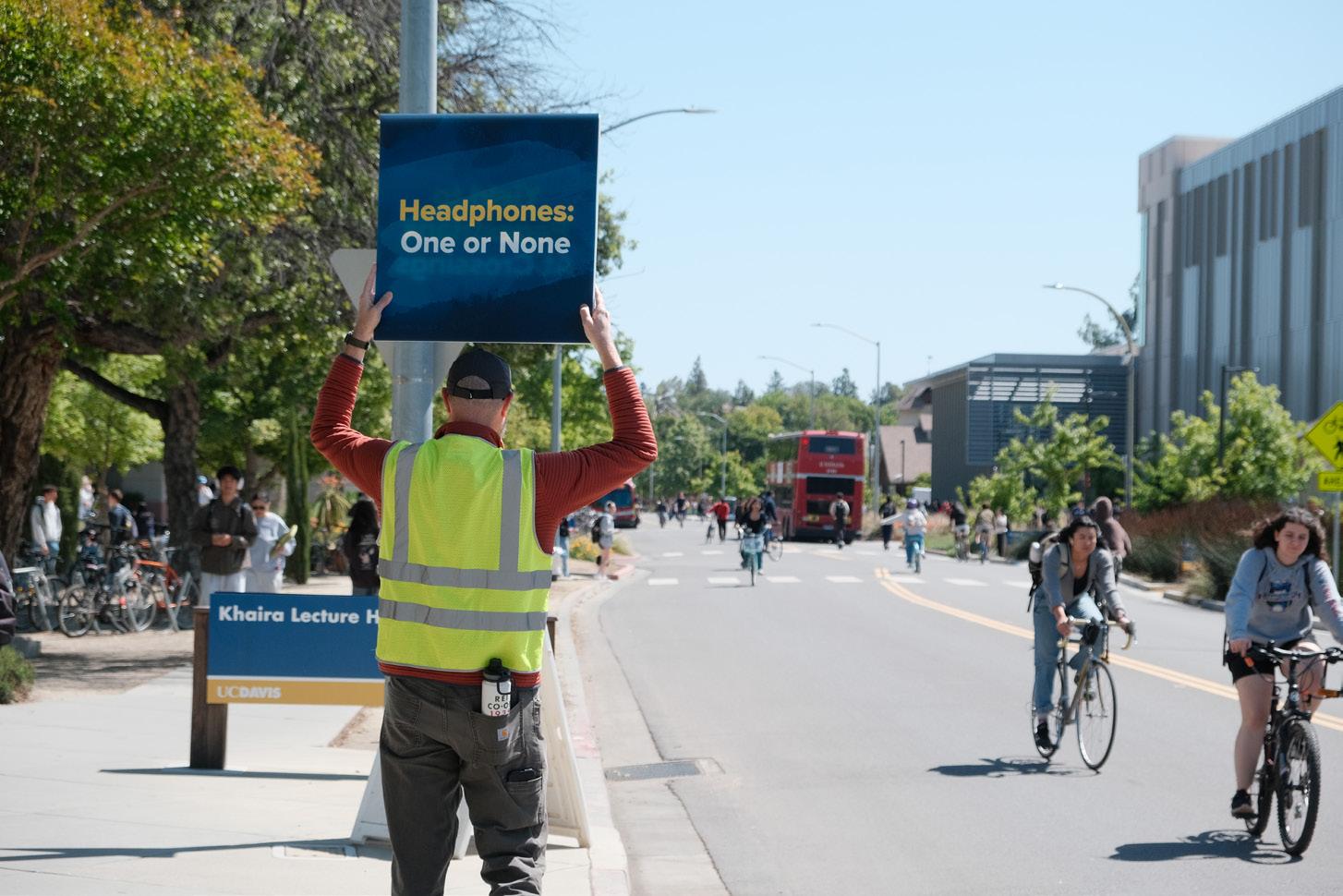
BY MICHELLE BEKHTEL campus@theaggie.org
This month, UC Davis Transportation Services and the UC Davis Police Department began stationing safety teams along campus pathways to address a dramatic increase in e-scooter and e-bike accidents.
The pilot program, known as Safety Corridors, deploys two-person units to high-traffic areas every Thursday in April to engage in conversational safety reminders with students and commuters.
The initiative follows a 15-month trend of rising incidents involving e-scooters and e-bikes, according to Transportation Services, and was launched before the fatal April 13 bike collision which led to the death of UC Davis student Lincoln Sabini.
UC Davis Police Department Sergeant Carl Walter noted that the issue extends beyond the City of Davis, and that the surge in accidents is not unique to the campus.
“California cities throughout
the state have seen 200% to 300% increases in micromobility crashes,” Walter said. “These devices are inexpensive and easy to get on and go, but not everybody is driving them with the same care they might drive a motor vehicle.”
The safety teams focus on addressing eight prohibited behaviors, including exceeding the 15 mph speed limit, failing to yield to pedestrians and improper earbud use. Jeffrey Bruchez, active modality manager for Transportation Services, described the rule for the latter as “one or none.”
“We want people to have at least one ear open to the environment,” Bruchez said.
Bruchez, deployed to the April 16 Safety Corridor at the Hutchison Drive and Bioletti Way intersection, noted that the physical presence of the team created an immediate shift in behavior.
“Today, we were here for about 30 minutes before we deployed, and there were a lot of people cutting through the roundabout the wrong way,” Bruchez said. “Since we
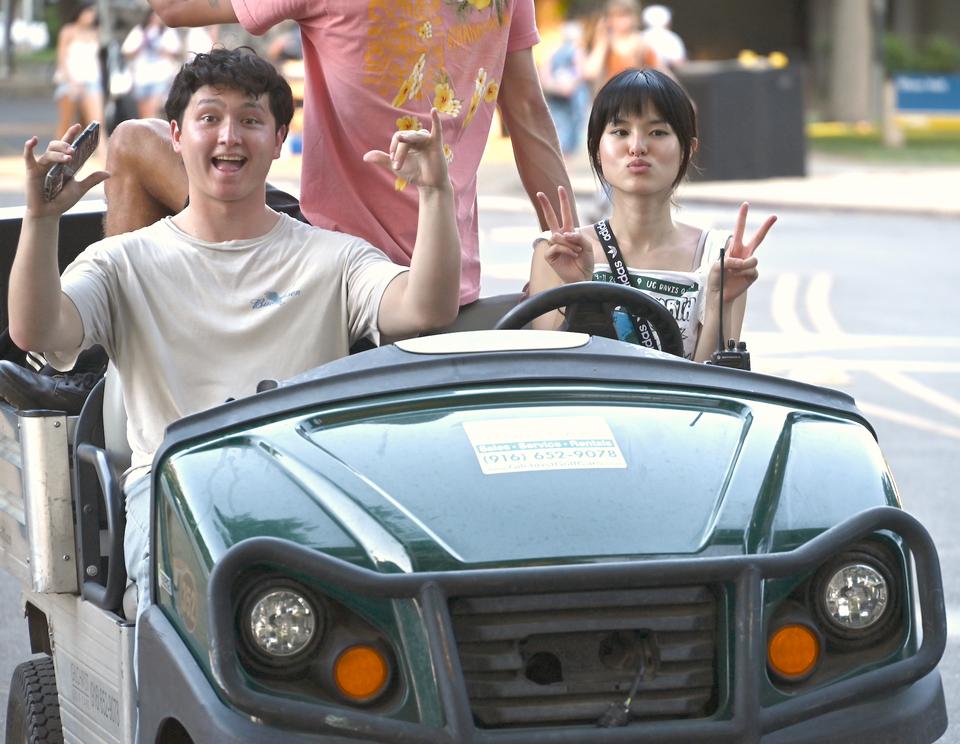
activated, we’ve only had one.
We’ve generally gotten really positive reception.”
However, Bruchez acknowledged that the challenge lies in making those habits stick.
“The moment we remove ourselves from the intersection, the behavior goes right back to what it was before,” Bruchez said. University officials are currently in a data-gathering phase, and while the team is currently using high-visibility vests and signs rather than ticket books, the university is evaluating other measures of enforcement.
“We’re looking at what happens once we’re done with this quarter’s evaluation,” Bruchez said. “Should there be some kind of enforcement, especially when someone is told to stop at a sign and still decides to run it?”
James Nash, a university spokesperson, said that while the current focus is on “shared responsibility,” UC Davis has not ruled out more stringent measures if accident rates do not decline.
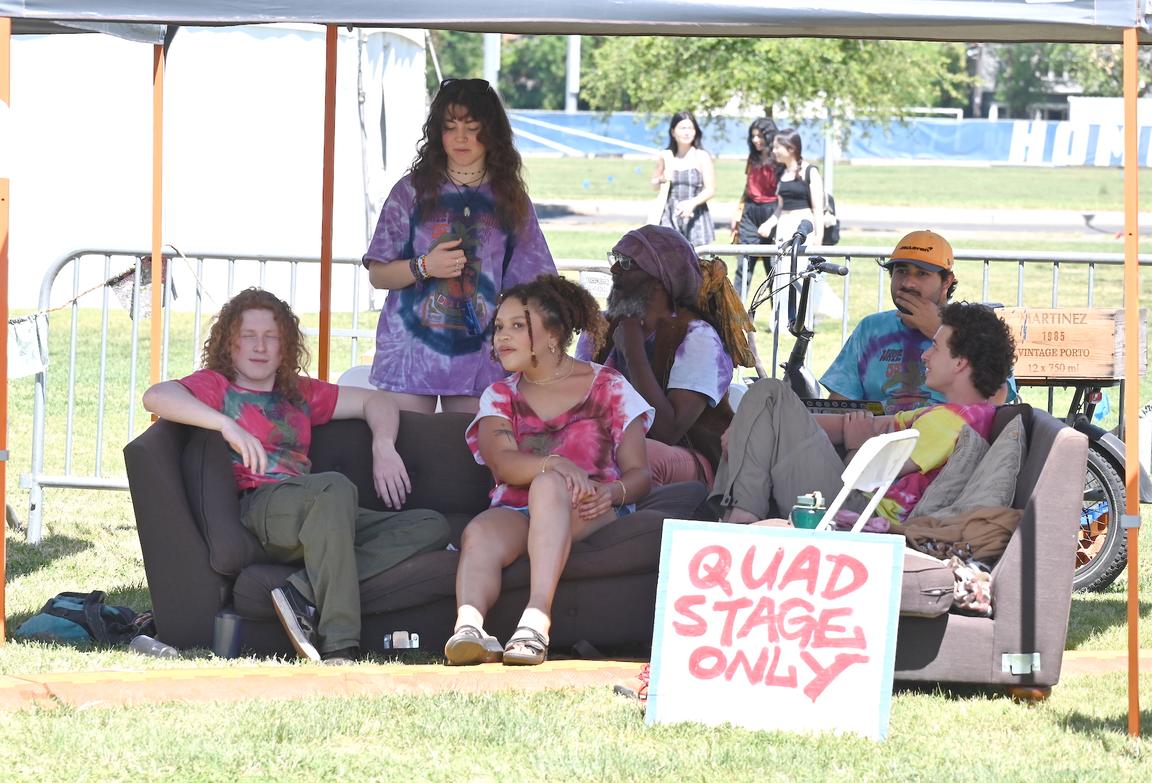

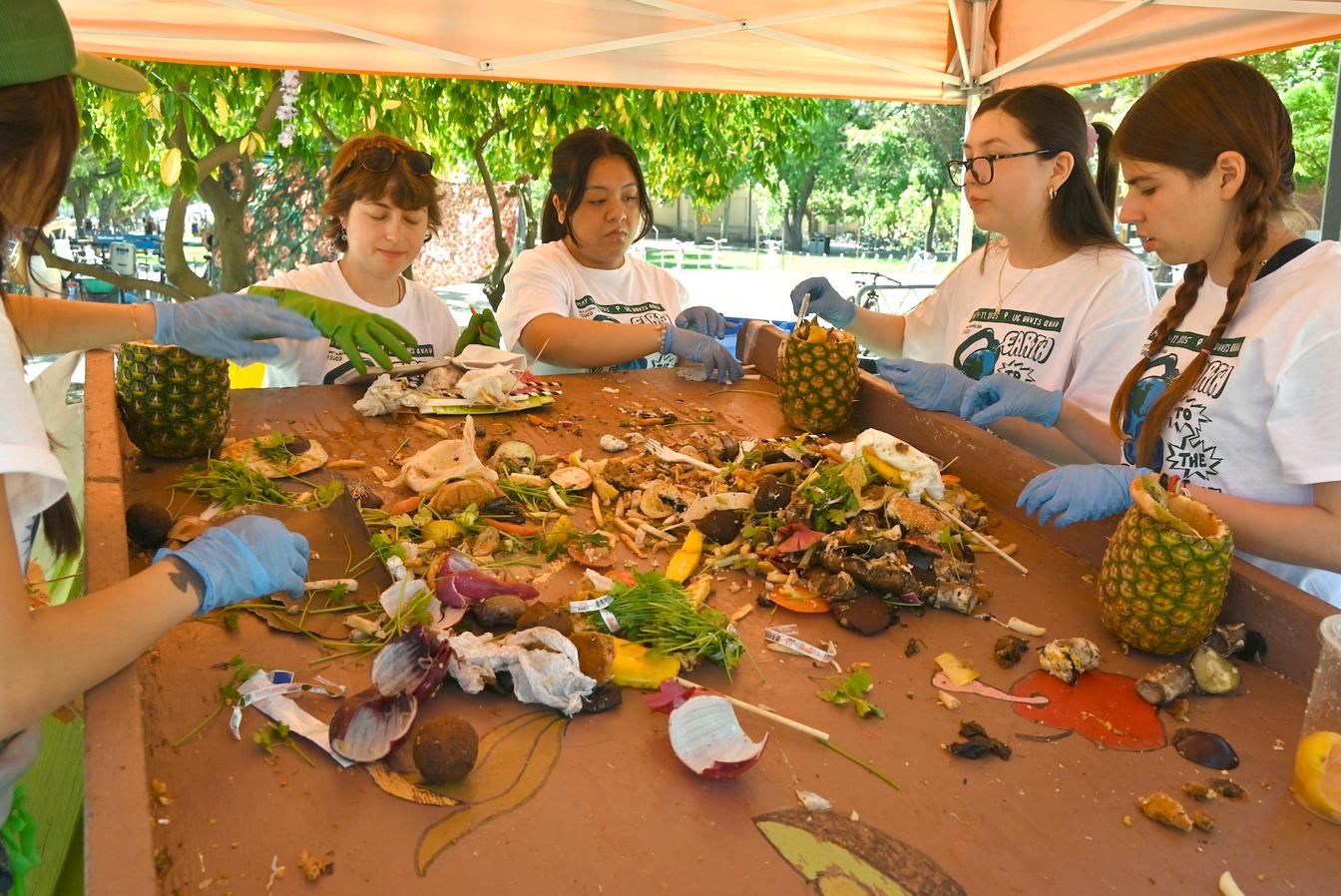
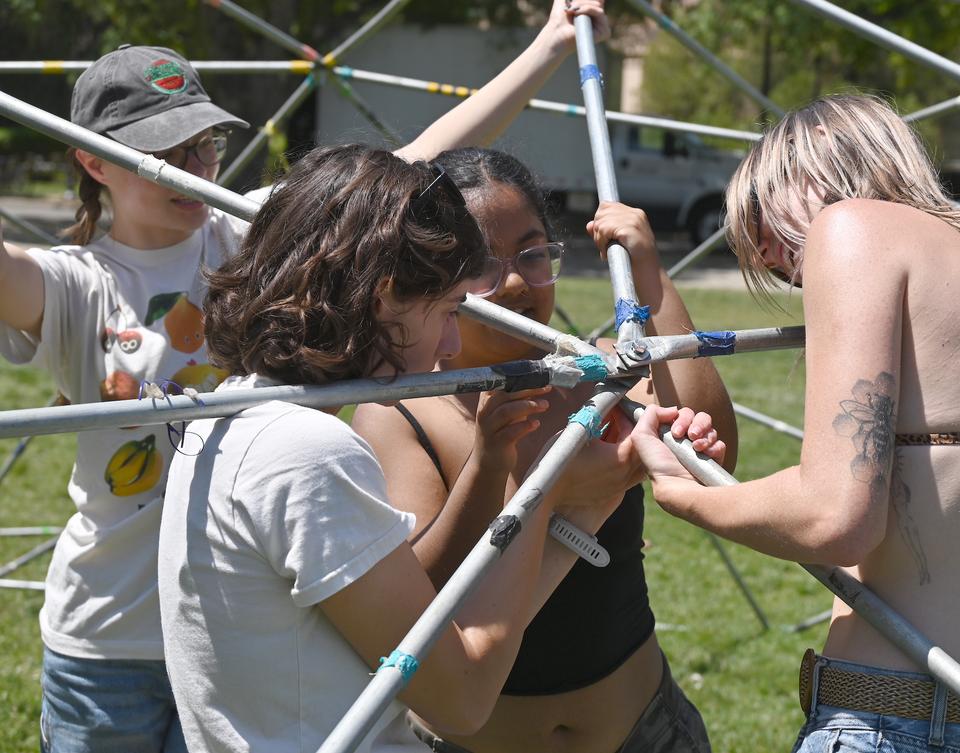
Davis just falls short of first place
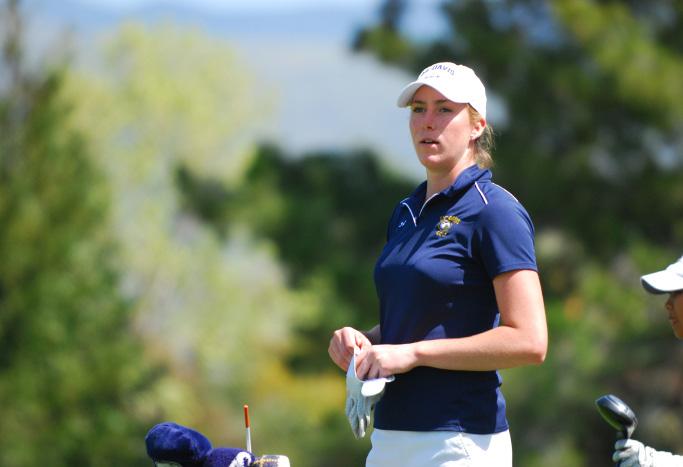
BY ALEXIA NAVARRO sports@theaggie.org
After a solid sixth place finish at the Chevron Silverado Showdown, the Aggies traveled to Maui, Hawai’i, for the Big West Championships, held from April 19 to 21.
In the first round of the tournament, the Aggies opened with a score of 285, their best opening score ever in a Big West women’s golf championship to date.
Vani Karimanal, a third-year managerial economics major, led the Aggies in scoring, shooting three under par and ending her day at a score of 69. With five birdies in her first round, she was tied for second place on the leaderboard.
Lauren Calderon, a fourthyear design major, tied fifth overall with an opening score of 71. Second-year Yu “Yoyo” Bai opened her round with an even par of 72, tying in 10th place. Elina Kuang, a fourth-year neurobiology major, shot a 73 to place 12th. Michelle Ho, a firstyear computer science major, came in 27th on the leaderboard with a score of 76.
The Aggies finished their first round under three par and
with a combined 16 birdies to place them at the top of the leaderboard, alongside California Polytechnic State University San Luis Obispo (Cal Poly SLO).
The Aggies fought to stay within the top two in the second round, with a combined score of 298.
Kuang performed well with three birdies at holes six, seven and 12 to lead the team in scoring and help keep them in championship contention. With a better performance in the second round, she was able to jump eight spots and into a fourth place tie.
Despite shooting a 75, Karimanal was able to remain in the top five with her previous score of 69, helping her tie in a fourth-place position. Calderon placed ninth with a score of 75, giving the Aggies a third player within the Top 10. Ho finished her Monday with a score of 80, while Bai posted a 77 to contribute to the overall team’s score.
The stage was set for Tuesday’s final round of the tournament, with the Aggies trailing their division rival, Cal Poly SLO. In the third round of the tournament, the Aggies attempted to rally. Calderon gave
with a score of
Ho finished the final round with a
of
sixteen above her total par. Despite their consistency and persistence throughout the tournament, the Aggies fell short of first place. They finished second overall for the second year in a row, behind the backto-back champions Cal Poly SLO.
Calderon, Karimanal and Kuang tied in fifth place, giving Davis three Top 5 tournament players in the All-Tournament team for a third year in a row. Despite not achieving the outcome they wanted, the Aggies finished the tournament with the best score on the par5 holes. Calderon achieved a tournament-high of 40 pars, and Karimanal tied for the best score on the par-5 holes. The Aggies ended their season just short of the top spot, but with nevertheless outstanding performances throughout the tournament.
Fluffy Fluffy Dessert Cafe, Good Friends Hawaiian Poke and Cold Stone Creamery opened this year

place for the Davis community while delivering a compelling merchandising mix tailored to the local market.”
Over the past year, several new businesses have opened in the Davis Collection. As part of development efforts, the shopping center on Russell Boulevard has expanded to include several local and chain businesses such as Nordstrom Rack, Ulta Beauty, Mendocino Farms, Shah’s Halal and more. This spring, new businesses opened to the public in the Davis Collection, including Fluffy Fluffy Dessert Cafe, Good Friends Poke, and most recently, Cold Stone Creamery.
Proposed in 2023, the Davis Collection aims to redevelop the parking lot around the existing Trader Joe’s to create over 100,000 square feet of new commercial space. The owner of the shopping mall, Brixmor Property Group, said that the Davis Collection is being reimagined to merge local and chain businesses in a walkable location.
“These upgrades have repositioned The Davis Collection as a modern, walkable destination,” Brixmor said via a statement. “That serves as a dynamic gathering
Now two years after the original proposal, The Davis Collection has grown to include over 15 businesses, including restaurants, retail and more.
Additionally, The Collection has also been developed to include a pedestrian plaza, more walkways and additional landscaping to increase walkability.
Isabelle Sabsovich, a secondyear managerial economics major, explains how the new updates to The Davis Collection make it more accessible for students.
“The new design of The Collection has made it way more helpful for students,” Sabsovich said. “Having all of the new businesses so close to campus is great. Especially the mix of restaurants and stores being so nearby is really good for students, especially without having cars on campus.”
As the development of The Davis Collection continues, several new businesses have opened this spring alone.
In February of this year, the Collection welcomed Fluffy Fluffy Dessert Cafe which has
become a
with
and
that month, the Collection welcomed the second location of a popular local business, Good Friends Poke.
This April, the Davis Collection welcomed its 19th business with a Cold Stone Creamery. The ice cream shop had a soft opening on April 4 at 835 Russell Blvd. Ste. 190. Cold Stone Creamery is a unique build-your-own ice cream shop where customers can create their own mix of ice cream and toppings. Since its opening, Cold Stone Creamery has been a popular hit with students and Davis residents alike. Morgan Thompson, a second-year psychology major, explained what’s great about having a Cold Stone Creamery open so close to campus.
“I’m really happy about the new Coldstone in Davis because I love grabbing a sweet treat after a long day,” Thompson said. “I especially appreciate the fact that I can create something to fit my exact craving.”
The Davis Collection is still growing, but check out current businesses’ websites for more information.

BY HANNAH OSBORN
arts@theaggie.org




Album: “Jubilee” by Japanese Breakfast (2021)
Made to be a project in joy, this album is just the indie pop pick-me-up for an inconsistent spring. A development in frontwoman Michelle Zauner’s multi-instrumental form, the music takes on a chamber-like quality as streams of melody blend into an uplifting, bright sound. Reaching the heights of its energy at the beginning of the album in songs like “Paprika” and lead single “Be Sweet,” the album progressively moves into more relaxed arrangements that are no less entrancing. The breezy orchestration and Zauner’s vocals create a finely balanced contrast to the lyrics, which often opine the course of relationships through crafting narratives around observations of strangers, billionaire antics and the death of a loved one. An ambitious project populated by stories, “Jubilee” rides its ebbs and flows to create an album that allows for both easy listening and analysis — perfect for the waking spring season.
Book: “Dracula” by Bram Stoker (1897), in the form of “Dracula Daily” by Matt Kirkland (2021)
Count Dracula is a ubiquitous pop culture character that stems from an epistolary novel. After being adapted and interpreted in so many mediums, it only feels a return to form to read the book as a newsletter. Created by web developer Matt Kirkland, “Dracula Daily” sends the entirety of the text of “Dracula” to subscribers (free of charge) on the date the letters, newspaper articles and journal entries are addressed. While not actually daily, the newsletter allows subscribers to follow along with the narrative, reading and considering the text at a slower, more deliberate pace. Running from May 3 to Nov. 7, now is the perfect time to subscribe to “Dracula Daily” and enjoy a classic piece of literature.
Multimedia: “17776” by Jon Bois (2017)
On April 7, 2026, humans stop dying and aging, choosing insted to spend their new immortal lives playing football. From the mind of sports writer Jon Bois, “17776” is a project presented under the guise of a news article that turns into a series of videos, GIFs and text blocks. The narrative jumps from human stasis to the titular year, where a newly awakened space probe joins their kind in watching a world consumed by “football.” Employing GPS, 3D-imaging and historical facts to underscore the world we leave behind, the work examines human motivation and legacy. For those who wonder about the purpose of sports, “17776” is a captivating experience like no other.
Movie: “Dark Star” dir. John Carpenter (1974)
In John Carpenter’s feature directorial debut, crewmates are isolated on a decaying spaceship in an age of near-future interstellar exploration. If this sounds at all familiar, the film was co-written by Carpenter and Dan O’Bannon, who penned the screenplay for “Alien” (1979). Originally created as a student film at the University of Southern California (USC), it follows four astronauts two decades into their mission to destroy unstable planets and further human space colonization. Their work is tedious and thankless; they are denied repairs to the ship, even as broken instruments necessitate the death and cryogenic freezing of their commanding officer. The remaining crew bides their time in deep space, recording video diaries, caring for stowaway aliens and debating philosophy with bombs. The allure of space is derided by the bureaucratic treatment of the crew, begging the question: What does human exploration mean if the systems facilitating it remain the same?
Five films are celebrating 10
years in 2026
A handful of 2016’s best films, which are just as delightful a decade later
BY NATALIE SALTER arts@theaggie.org
Recently, it seems like everyone online has become obsessed with 2016, looking back with fascination at the way things were 10 years ago. But among all the bygone fashion trends and radio hits, it is not to be forgotten that 2016 also gave us a number of exceptional films, from iconic animated family fare to mind-bending science fiction.
As the 10-year anniversaries of 2016’s films approach, it’s perhaps the best time to reflect upon some of the finest releases of the year and appreciate how deeply they continue to resonate with us even a decade later.
“La La Land” dir. Damien Chazelle
When aspiring actress Mia (Emma Stone), who works as a barista on the Warner Bros. lot between a string of failed auditions, crosses paths with the pianist Sebastian (Ryan Gosling), who dreams of opening his own jazz club, it’s almost inevitable that their shared identities as starving artists sends them tumbling into a starry love affair. Mia and Seb take part in and encourage each others’ dreams, their respective passions inspiring each other and the audience alike — and grapple with what making those dreams come true might ultimately cost.
Filled with sensational musical numbers, vibrant colors that practically burst off of the screen, a pair of stellar performances from Stone and Gosling and an emotionally poignant narrative that will leave its viewer just as affected on their 10th watch as on their first, “La La Land” is a marvelous tribute to the arts and the dreams that brought them to life in the first place. If the film intends to leave you with anything by the time its credits roll, it is perhaps a reinvigorated belief in the importance of daring to turn your wildest fantasies into reality,
for — as Mia herself asserts via song — it is “the fools who dream” who bring wonder, imagination and light into the world and into the hearts of all those who behold what they create.
“Moonlight” dir. Barry Jenkins
“Moonlight” follows the coming-of-age of Chiron (Alex Hibbert, Ashton Sanders and Trevante Rhodes), through three snapshots of his life — childhood, adolescence and adulthood — during which he grapples with his identity as a gay, Black man and the aftereffects of the abuse he suffered in his youth. The film is based on Tarell Alvin McCraney’s unpublished play, “In Moonlight Black Boys Look Blue.”
Thoughtfully crafted and stunningly shot, every scene in “Moonlight” feels deliberately, delicately made, resulting in an entirely wondrous viewing experience. Likewise, its emotional musings on identity and belonging leave the viewer’s heart aching, brought to life even more profoundly by an exceptionally talented cast of leading and supporting actors. It is tender, captivating and entirely breathtaking: a dazzlingly designed film that continues to shine 10 years after its release.
“The Nice Guys” dir. Shane Black In 1970s Los Angeles, struggling private eye — and single father to the precocious 13-year-old Holly (Angourie Rice) — Holland March (Ryan Gosling) becomes the accidental detective partner of enforcerfor-hire Jackson Healy (Russell Crowe) when the pair end up involved in the same missing persons case.
Third annual event aims to bring together Asian, Pacific Islander, Middle Eastern, North African and South Asian communities through performance, art and intentionality
BY IQRA AHMAD arts@theaggie.org
On May 2 from 2 to 8 p.m., the Cross Cultural Center (CCC), in collaboration with the Middle Eastern, North African and South Asian (MENASA) Resource Center, Lotus Mana Center and the Middle East and South Asia (ME/SA) Studies Department, will host UC Davis’ third annual Light Festival under the theme of “Bridges of Light: A Celebration of Resilience.”
Free and open to the public, the event aims to feature the voices of Asian and Pacific Islander, Middle Eastern, North African and South Asian communities, bringing them together in a shared space of culture and solidarity.
The festival traces its roots back to 2015, when the Taiwanese American Organization hosted its first Asian Pacific Islander Community Night Market (APCNM). What began as a late-night event featuring food vendors, crafts and performances has since expanded into a crosscultural celebration. In 2023, the event transformed into the Light Festival, a celebration aimed at uplifting Southwest Asian and North African (SWANA), MENASA and Asian and Pacific Islander (A&PI) communities.
“We are conscious of the fact that this type of event is cross-cultural and intentionally so,” Ava Jabbari, a fourth-year environmental policy analysis and planning and international relations double major, said.
“Born out of The Asian Pacific
Islander Community Night Market, which began in 2015, it has since evolved into an event that highlights the A&PI communities as well as the MENASA communities.”
This intentional evolution is reflected not only in the event planning and coordination, but also in its marketing. Organizers carefully designed this year’s flyer to reflect unity and celebrate cultural diversity.
“The idea [of the Light Festival and theme] is really to encourage unity and solidarity between the different Asian diasporas, more importantly to encourage pan-Asian and MENASA unity,” Johannah Seah, a third-year Asian American studies and sociology major, said. “We had to have multiple discussions about how we can make it broad so it’s inclusive, but not too broad that it’s nothing.”
Seah explained some of the choices behind selecting the motifs for the flyer design.
“We intentionally did not want to put flags or countries or borders,” Seah said. “We decided to add motifs, such as the glowing ball of light with hands, to show the community aspect of it. The background [pattern] was taken from Pacific Islander graduation flyers, and constellations that are part of multiple different Asian cultures. The motifs on the side are meant to represent South Asian culture as well.”
The same ideas shaped the shirt and two exclusive sticker designs created by the CCC team in collaboration with Chloe Wang, UC Davis alumna and creator of @the_aggie_baggie on
Instagram. Attendees can look forward to getting these items at the festival while supplies last, or enter a giveaway on the CCC Instagram, @ucd_ccc, for a chance to win the 2026 Light Festival shirt, two Light Festival stickers and seven additional Aggie Baggie stickers.
“One thing that we asked was, ‘How are we going to represent our diasporas in a way that is intentional, inclusive and borderless?’” Seah said. “We decided to have different animals representing the different diasporas. We chose a red panda for East Asia — and they’re also native to Nepal and Tibetan area — a cheetah to represent Southwest Asia and different parts of the Middle East, an elephant to represent South Asia and Southeast Asia, a manatee to represent Oceana and Pacific Islands and a horse to also highlight Southwest Asia and North Africa.”
The designs also incorporate food imagery, lanterns and textiles from across cultures, reinforcing the festival’s emphasis on connection through everyday cultural practices.
In addition to the stickers, attendees can expect a range of interactive and visual elements, including a polaroid photobooth with handcrafted props and backdrops.
“All of these elements are going to be beautifully decorated and include motifs from MENASA and A&PI culture, such as pomegranates, evil eyes and lanterns from across Asia — both East and West Asia — North Africa and Oceana, plus so much more,” Jabbari said. For organizers, these
artistic choices are not merely decorative: They are central to the event’s mission. That mission extends beyond representation toward a greater goal of collective understanding.
“For me, planning an event celebrating these various communities at UC Davis means bringing to life what the mission of the Cross Cultural Center is: working toward a more just and liberated world,” Jabbari said. “The CCC is inherently meant to work together, bridging gaps and bringing people together; not in spite of our differences, but because we are all proud of our heritage and we see what unites us over what divides us.”
Jabbari also noted that the event planning process involves constant conversation about how to balance inclusivity with specificity, ensuring that underrepresented communities are meaningfully represented.
“Our planning committee is also diverse with people who also do not identify as within these communities,” Jabbari said. “We try our best every year to get people to join the committee and give their perspective on how we can make Light Fest[ival] bigger and better and more inclusive every year.” The festival will also feature a lineup of different performers that reflect the breadth of the diasporas represented. A handful of student and community groups will take the stage to perform cultural dances, songs and event martial arts: Nā Keiki O Hawai’i, Jhankaar A Capella, Davis Wushu, SoNE1, the UCD Rasleela, UCD Belly Dance Club, UC Davis Taekwondo
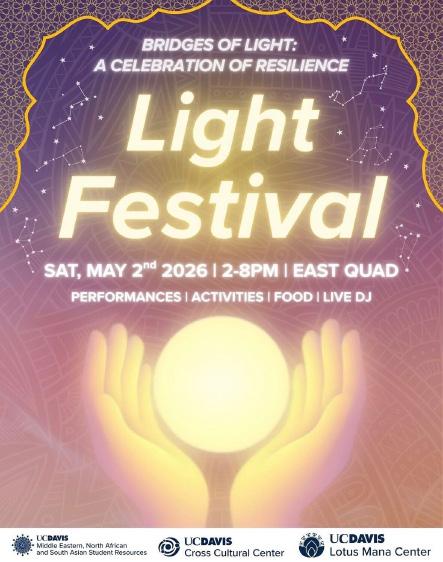
Sports Club, Davis Karate Club, the Blooming Lotus Lion Dance and the MK Vintage Troupe. Musical performances by the Davis Chinese Orchestra, Komolika Basu, Anais Park and Hannah Lee will also be highlighted, and a DJ set will close out the festival. As the Light Festival celebrates its third year, organizers hope attendees walk away not only with food, performances and keepsakes from the many student organizations and vendors, but also with a deeper understanding of the shared cultures between
diverse diasporas.
“A core responsibility we have [as organizers] is intersectionality, cross-racial and cross-diaspora solidarity — representation as resistance and solidarity, not just inclusion,” Seah said.
The Light Festival is part of the CCC’s signature events hosted in spring quarter. For those interested in attending other upcoming events such as La Gran Tardeada on May 16 and Black Family Day on May 23, event information can be found through their website and Instagram at @ucd_ccc.
Misinformation and sensationalism shift our attention away from a solution and toward further polarization
WRITTEN BY THE EDITORIAL BOARD
At the White House Correspondents’ Association
Dinner on April 25, chaos erupted as shots were fired, sending attendees fleeing the venue in panic. Among those in attendance were President Donald Trump, Vice President JD Vance and other senior White House officials, who were rushed out of the hotel. With Trump’s third public assassination attempt, many were left wondering what was going on.
Almost immediately following the shooting, information became available to the public, with the suspect reportedly being in custody, but the chaos only continued with a wave of misinformation.
On X, there were conflicting posts, with some insinuating the attack was staged by the administration and others blaming “the other side,” or their counter-political group.
CNN reporter Kaitlan Collins posted on X that she was informed by a Secret Service agent that the shooter was “confirmed dead” and then, 10 minutes later, said the shooter was apprehended.
In the hours following the attack, it was clear the suspect was apprehended by the police and taken into custody; however, a different narrative had already been disseminated. Instead of focusing on the act as political

violence, many news sources and posts on social media immediately jumped to blame, turning the assassination attempt into an ideological issue.
Some news reports and posts focused on the attacker’s background, identifying him as being from California. While this detail may be factual, its emphasis shifts individuals’ attention toward political ideology. Since California and its political leaders have often been targets of Trump’s right-wing rhetoric, the weight placed on the suspect’s residence has only fueled further political polarization.
Pushing his background as a Californian — and therefore the associated political ideology of the state as traditionally liberal — shifts the focus away from the act committed and toward its weaponization in an already-polarized political environment.
The event was also dramatized online, with clips and photos of the shooting circulating on social media. This sensationalization is not new; after the previous assassination attempt, Trump was viewed as a heroic figure by his followers, with many Republicans strengthening their devotion and viewing it symbolically instead of politically. Rather than focusing on policy, leadership direction or even political violence as a whole, many turned to quasi-religious and emotional inferences.
The issue became less about the truth of the actual attack and more about reinforcing personal narratives and beliefs.
Violence in any capacity is unjustifiable and should not be used as a tool for individuals to advance their political agendas; rather, political issues should be handled through peaceful discussion. As the United States witnesses increased
acts of gun violence — and the current administration continues to dismiss calls for stricter gun control — the latest assassination attempt demonstrates the need for societal reevaluation of firearm access.
In a political landscape where the media is focused on fast coverage and attention, rather than accurate information, reality is traded for immediacy. The chaos and confusion that ensued after the event were not isolated, but rather highlighted the broader, ongoing issue of how information is shared.
The focus must shift back to accountability and informed reporting, or misinformation and polarization will be the deciding factor in the reaction to incidents such as this one. The media and the public alike must work to break the current trend of dramatized and false narratives.
Editorial Board
ALYSSA CREVOISERAT Editor-in-Chief
MAYA KORNYEYEVA Managing Editor
VINCE BASADA Campus News Editor
JORDAN POLTORAK City News Editor
MOLLY THOMPSON Opinion Editor
ZOEY MORTAZAVI Features Editor
SAVANNAH ANNO Arts & Culture Editor
MEGAN JOSEPH Sports Editor
KATIE HELLMAN Science & Tech Editor
Managing Staff
JENNA LEE Photo Director
NOELLE ESCALANTE Layout Director
SAVANNAH BURGER Design Director
SAM RUIZ New Media Manager
KAYLIE HUANG Social Media Manager
JULIAN MONTANA Website Manager
JULIA CROSSAN Distribution & Outreach Director
YILAN LI Translation Director
CARMEN RODRIGUEZ-ZARATE Translation Director
JENNY DYE Copy Chief
ALYSSA PULIDO Copy Chief
LAURIE PEDERSON Business Development Manager
America’s tightened conscription laws may raise questions about their necessity
BY YUENJO FAN opinion@theaaggie.org
In early April, Congress announced a new conscription law to be implemented nationwide by December 2026. It requires all males, ages 18 to 25, to be automatically registered for the Selective Service and considered for conscription in the event of a draft. Before this change, states’ registration laws were either enforced through self-registration or via adjacent registration during driver’s license application. By the end of the year, the Selective Service System (SSS) will start crossreferencing federal data sources to identify all men eligible for conscription. It will not be limited to U.S. citizens, but will also include male green card holders, refugees and undocumented immigrants.
Wartime conscription has been a longstanding part of American military and social culture since the nation’s creation. It has been utilized in six prominent American conflicts: the American Revolution, the American Civil War, World War I, World War II, the Korean War and the Vietnam War. On a grander scale, public opinion about the draft has differed over time. Traditionally, the idea of enlisting was viewed as a civic duty for young men
and attracted little controversy.
During World War II and the Korean War, public opinion polls hovered between 60% and 80% approval, indicating that most surveyed Americans were relatively tolerant of the military draft.
Yet, in the 1960s and 1970s, the Vietnam War sparked a mass departure from the age-old idea of duty and service, as Americans began to question the reasons for military intervention. From racial inequalities in conscription to the lack of military success, Americans began seeing holes in a system that had not been previously questioned. Draft dodging methods, such as draft-card burnings, medical exemptions and fleeing the country, significantly increased during the Vietnam era. The implementation of the draft became so controversial that within a generation, the sentiment surrounding conscription completely flipped.
Throughout some of America’s most grueling and toughest hours, we’ve never implemented an automatic registration system for conscription until now. It is likely that these unprecedented changes are no coincidence, and that the new conscription law was passed with specific intent. As the United States continues its intervention in Iran, the American war machine has
geared up in preparation for further conflict, whether in the Middle East or beyond. Earlier this month, the administration proposed a historically high defense budget of $1.5 trillion, and Pacific bases that have been unused since World War II have recently been revived and refurbished for further use. Even the Department of Defense has rebranded to the Department of War, signaling the military’s shift toward a more hawkish, war-prone stance. If the nation were faced with another existential crisis, such as fascism in World War II, it would be legitimate to use the Selective Service System to recruit soldiers for the sake of national freedom. Take Ukraine, for instance, whose sovereignty is still surviving in part due to conscription of young men in defense of their country. South Korea also provides a prime example of how conscription has helped protect its way of life by deterring aggression with the presence of a large, able-bodied military. In times of crisis, young men have a responsibility to defend their country. But in America’s case, its conflicts today are less about defense than offensive intervention. The recent expansion of Selective Service registration shows the dark side of conscription, serving to support aggressive U.S. foreign policy rather than
protecting America from a direct threat.
Hence, the justification for widening conscription laws depends on a case-by-case basis. Whereas one may have supported the World War II draft, it is equally reasonable to have opposed the Vietnam draft. Only the situation at hand can determine its legitimacy, as compulsory service can be utilized for both good and bad causes. Thus, advances in the military’s ability to conscript young men must be proportionate to the threat faced by the country. A defensive war to protect a nation’s way of life is a justifiable cause; an offensive war that lacks such substance is not.
The new automatic registration for the Selective Service System risks putting a generation of young men at the forefront of wars that are widely dissimilar from the arguably heroic triumphs of the past. Gone are the days of valiantly fighting for freedom against existential threats of evil. Instead, the rationale behind new conscription laws and warfare has continued to drift away from impartial reason and toward ambiguous motives.
Disclaimer: The views and opinions expressed by individual columnists belong to the columnists alone and do not necessarily indicate the views and opinions held by The California Aggie.

In an increasingly digital age, young people are reconnecting with generations-old crafts
BY SAGE KAMOCSAY skamocsay@ucdavis.edu
Knitting isn’t exactly what you would associate with a generation-and-a-half of screenagers: neither is crochet, embroidery or sewing. And yet, fiber arts are more popular now than they have been in decades. Now, more than ever, young people are choosing to pick up a ball of yarn and struggle through their first knitting project, probably ending up with a ragged, hole-filled mess. But that’s okay, because those abominations of first scarves give way to beautiful and complex shawls, sweaters, cardigans, hats and (my personal favorite) socks. It should come as no surprise that the COVID-19 pandemic is largely to blame for the popularity of these crafts. When almost everyone was forced inside, the Internet became the primary window to the world. It was only natural that many would try to disconnect from their personal lives as a brief respite from the online hellscape we have all collectively created. And thus, low-tech hobbies experienced a major resurgence all over the world. Pandemic baking is a prime example of this — I’m sure we all know someone who has (or had) a sourdough starter from 2020. Of course, it wouldn’t be a 2020 trend without it taking over TikTok, Instagram, YouTube and Reddit. There’s even a fiber arts-specific social media site called Ravelry that allows users to share patterns, yarns and discuss their craft. This modern
form of community-building has given new life to what some previously considered to be dying arts. Young people have brought back crafts that may have died with our grandparents, preserving generations of techniques, patterns and history that we may otherwise have lost. This isn’t to say that our grandparents (primarily, grandmothers) play no part in this process. Aside from the passing down of craft within individual families, older women have been pillars of their communities since the early 2000s. Most of my favorite online knitting and crochet tutorials are made by women who are probably grandmothers at this point. With few exceptions, they are indepth, well-paced and imbued with incredible patience and
kindness. Watching them feels like sitting down with your grandma as a young child, as she guides you through the often discouraging phase of learning a craft. The dissemination of craft has been incredibly important in preserving cultural traditions. The popularity of fiber arts has invited people to reconnect with their roots and keep their practices alive. As it becomes increasingly difficult to preserve physical cultural traditions in a digital world, the online fiber arts community can offer a shield from cultural colonialism — by engaging in these older crafts, we are resisting the domination of more modern cultural norms.
Enter digits from 1 to 9 into the blank spaces. Every row, column and 3x3 square must contain each digit. Each Sudoku has a unique solution that can be reached logically without guessing.
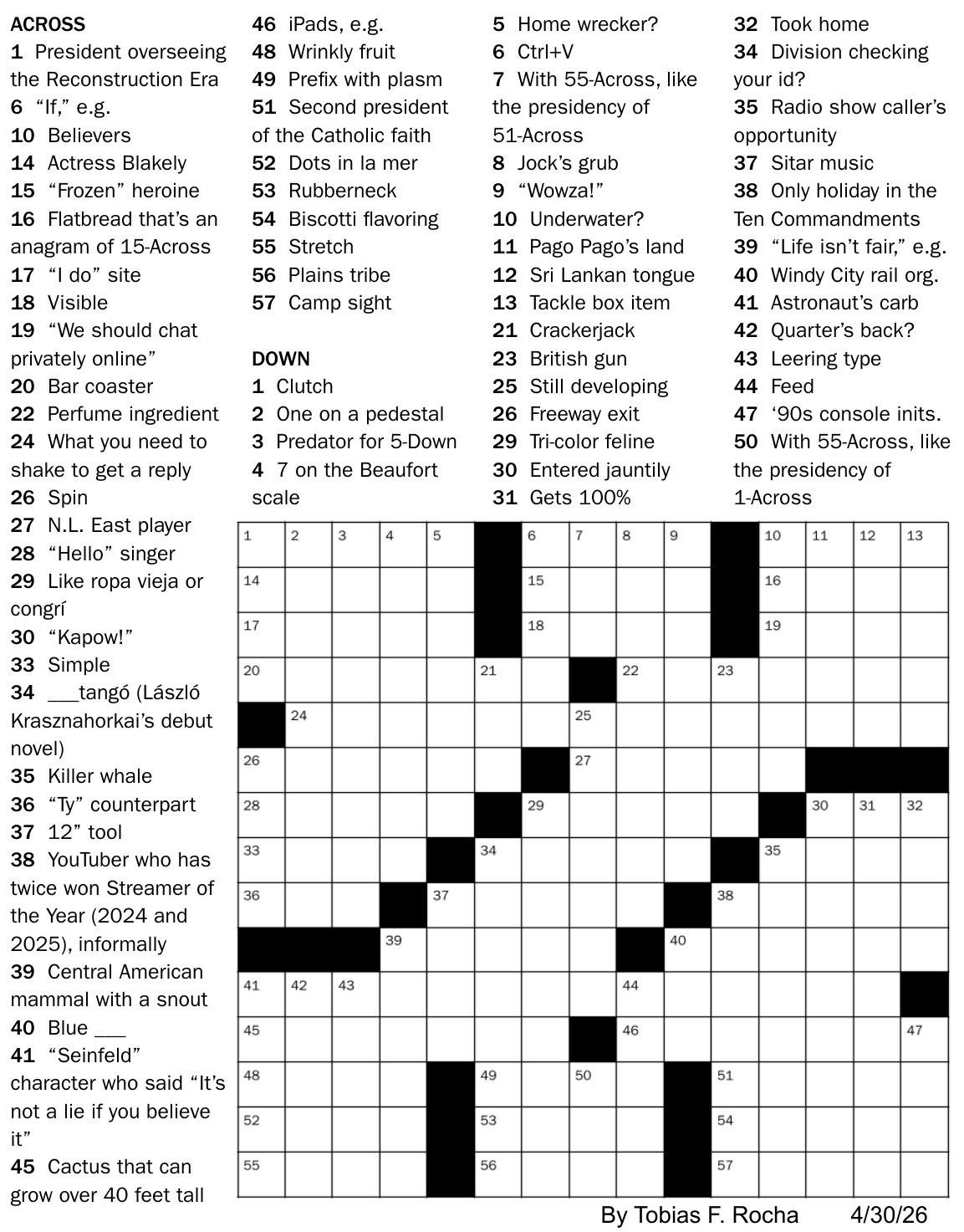
PAGE 4
Hua noted that contemporary attitudes toward gender, particularly in the political sphere, may contribute to increased attention to GSW 050.
“It’s in the news,” Hua said.
“If you are just reading about your high school sports team, you might encounter stuff about the ‘threat’ to women athletes, or anything like that. Gender and women are both banned words by the Trump administration, so I feel like there’s a lot of attention being placed on the idea of gender, women as a word and a category. I can see how, then, it would help people notice that we also exist on campus as an intellectual and political project and maybe call people in — people who might not in other times necessarily feel like they need a class on this.”
GSW 050 will be offered as a virtual class taught by Hanssmann this summer, as well as in-person by Hua in fall 2026. Interested students can find more information about taking the course on Schedule Builder.
He shared his hope that students leave his courses understanding one thing in particular: the need to understand the rights and approach learning history and American politics with a critical eye.
“When I teach students, I guess the thing I want to emphasize to them is that we
cover the Constitution, but the Constitution doesn’t protect itself. It’s just a piece of paper,” Verbitsky said. “The government violates the Constitution all the time, but that’s why people need to understand their rights and to support litigation groups, litigate, protest and other things. I guess if there’s one thing to distill from the classes, like the various ones that I cover, that would be the point. Not the style, but hopefully if that helps them listen, then good. Otherwise, that’s just for me.”
The band recently performed for their largest audience yet at Eclectic Collective’s annual Picnic Day house show on April 18. In the middle of In Bloom’s set, police officers showed up to shut the event down due to overcrowding.
“My initial reaction was ‘Okay, this might take 20 minutes to clear everyone out,’” Iyer said. “‘Let’s just keep going.’”
The band continued to play while the Eclectic Collective’s founder Grace Lawlor spoke to the police officers. After about 15 minutes, the officers left, and the show was allowed to continue. There was a renewed vigor in the crowd after the incident; the amount of dancing and singing turned up a few notches.
“People were pissed,” Mortazavi said. “It was a big deal, but I feel like it added a lot of energy when we were able to keep going. We’d been hyping up the Picnic Day show for months, so it was a little scary for a second.”
One of the unique things about In Bloom is their setlist — composed of artists like Stevie Wonder, Amy Winehouse,
Steely Dan and many more. The group debuted their cover of “Nakamarra” by Hiatus Kaiyote at The Aggie’s Spring Quarter Couch Concert house show on April 24.
“It’s not just jazz,” Zhu said. “There’s a lot of funk and R&B. Even though we all met in the jazz ensemble, that isn’t quite reflected in what we play.”
Grace Eastlake, the band’s trumpet player and a UC Davis alumna, works as a physical therapy aide and tells her patients about In Bloom’s performances.
“I can’t talk about this band without smiling at this point,” Eastlake said. “One of my patients on Monday told me that I was living my rockstar life, and I kind of agree.”
In Bloom is one of the most innovative and fresh bands in the Davis scene, combining a myriad of genres with classically trained talent to create an unbelievably lively atmosphere. Watch them blossom on Instagram at @ inbloom_theband and stay tuned for future performances.
Reckon also noted that no matter where one chooses to go for trivia night, showing support for quizmasters is a kind gesture.
“I say this on behalf of all quizmasters: if someone is performing, which is what being an MC is, it’s for you, it’s for the audience,” Reckon said. “It’s wonderful to know I’m appreciated as a performer through tips or through recommendations.”
Regardless of which location Davis’ trivia enthusiasts prefer, all can agree on the power of the activity to connect people and build community, whether it’s
with old friends or new.
“I think everybody likes others to know that they know things,” Reckon said. “We may not say it all the time, but it does feel good. I also think that [trivia] is in every sense a team effort. Being able to collaboratively work toward a goal, be that winning trivia or just not losing or even just having fun, is the foundation of what brings people together.”
CA#98, which changes the ASUCD election timeline to add a week dedicated for campaigning, passed with a 95.58% majority — 2,530 votes in favor, 117 against and 716 abstaining.
2,892 students participated in the spring elections — approximately 9% of the undergraduate population, according to elections data.
The candidates are set to take office at the ASUCD Senate meeting on June 4.
CA#98, which changes the ASUCD election timeline to add a week dedicated for campaigning, passed with a 95.58% majority — 2,530 votes in favor, 117 against and 716 abstaining.
2,892 students participated in the spring elections — approximately 9% of the undergraduate population, according to elections data.
The candidates are set to take office at the ASUCD Senate meeting on June 4.
“Enforcement tools, including citations, continue to be issued when appropriate,” Nash said. “Our approach is to lead with awareness, while reserving accountability measures if unsafe behaviors continue.”
During the single 40-minute window the Safety Corridor was active at the intersection of Hutchison and Bioletti, Walter estimated that over 400 bikes and scooters passed through, along with double that many pedestrians. He emphasized the physical stakes of these collisions.
“A bike hitting someone at 15 miles per hour can do serious injury,” Walter said. “Be aware of what you’re doing. Be considerate and pay attention.”
Transportation Services suggests that riders who are uncertain of their speed should not travel faster than rentable SPIN scooters, which are programmed with a 15 mph speed limit. Additionally, Student Health and Counseling Services offers free helmets under their “Helmet Hair Don’t Care!” program following the completion of a survey and safety training.
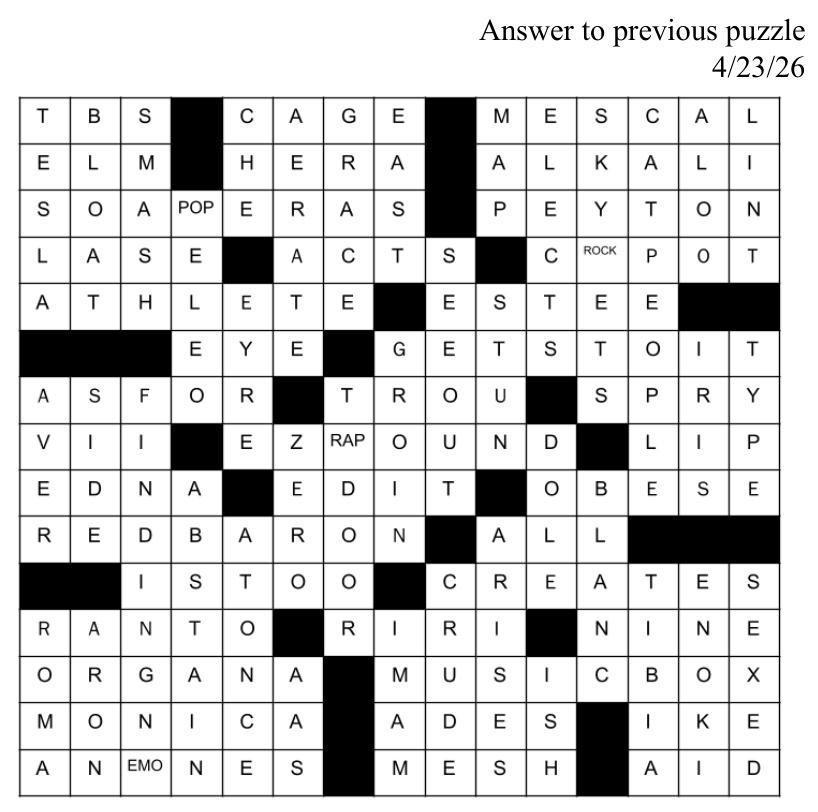
With little professional experience and the stubborn Holly at their heels, March and Healy find themselves caught in a series of misadventures as they try to get to the bottom of the ever-complexifying case.
“The Nice Guys” is made both a comedic masterpiece and a surprisingly heartwarming film thanks to Gosling and Crowe’s on-screen chemistry, as an unlikely yet entirely charming crime-solving duo. The film’s brilliant use of physical comedy and verbal witticisms secures its comedic success, whilst the genuine bonds the characters develop elevates it from merely funny to a story worthy of emotional investment.
“Moana” dir. Ron Clements and John Musker
2016 saw a number of major animated movie releases from Disney and its competitors alike, but perhaps the finest among them is “Moana.” The film’s titular hero, a precocious Polynesian chief’s daughter, is tasked with restoring the heart of the goddess of nature Te Fiti. With the help of the arrogant demigod Maui — whose own hubris in stealing the heart began the slow infection of the sea and its islands — Moana is finally given the chance to pursue her lifelong dream of sailing the ocean and discovering what lies beyond the familiar waters of her home.
“Moana” is a wholly vibrant film, its every frame bursting with color and its infectious soundtrack laced with a palpable feeling of joy and wonder. Moana herself makes for a strong role model for the film’s young target audience — with her courageous determination and insatiable curiosity for what she has yet to discover — but the film’s thoughtfully crafted narrative is nonetheless enjoyable for adult viewers as well. Aside from its approaching 10-year anniversary this November, and a sequel that came out in 2024, “Moana” has re-entered contemporary pop culture conversation due to its upcoming live-action adaptation. The trailer for this remake was met with skepticism, with viewers criticizing its visual blandness compared to the vividly colorful original. Remake notwithstanding, however, the
original “Moana” remains, 10 years later, as a deeply enjoyable and inspiring work of animated cinema. If you’re a fan of any of these films, or are hoping to watch them for the first time, keep an eye out for any potential theater re-releases to celebrate their 10th anniversaries. There are plenty of other films worth watching from 2016 as well, and a decade of existence is the perfect opportunity to explore them all and discover a new favorite you’d never have found before.
It, for the most part, is a community of people who understand the importance and beauty of connecting with past generations. There is also a feminist element to the resurgence of fiber arts. The fiber arts space is primarily female, meaning that traditionally marginalized voices are supported, respected and amplified. It is a community of women supporting women, building solidarity and friendship in the absence of patriarchal hegemony. This is doubly true for older women, who are often treated as absentminded old biddies by broader society. Here, instead, they are elevated to the position of matriarchs, guiding and supporting younger generations of artists. Women, especially older women, are given the respect they are denied by the rest of the world.
Participating in fiber arts is a deeply personal experience. It is an opportunity to learn about your family, your culture and yourself. I learned how to knit and crochet from my father, who learned from his mother, who probably learned from generations of mothers before her. I know I will continue this cycle as well, teaching future generations this beautiful act of creation and imparting the craft I love onto people I love.
Knitting and crocheting provide a break in the day to reflect on my life and myself without outside distractions. I put parts of my soul in everything I make through this process of reflection and art. I invite you to participate in this art, this introspection and all that comes with it — whether you learn from your grandmother, a friend or a stranger on the Internet, you won’t regret it.






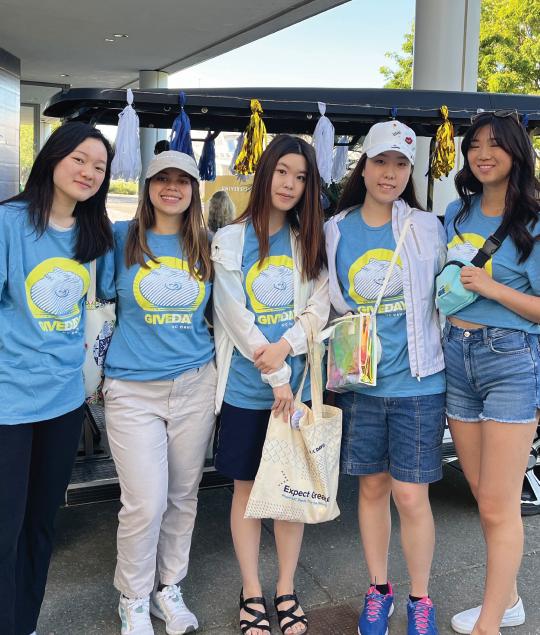
•
•
•
•
•
•
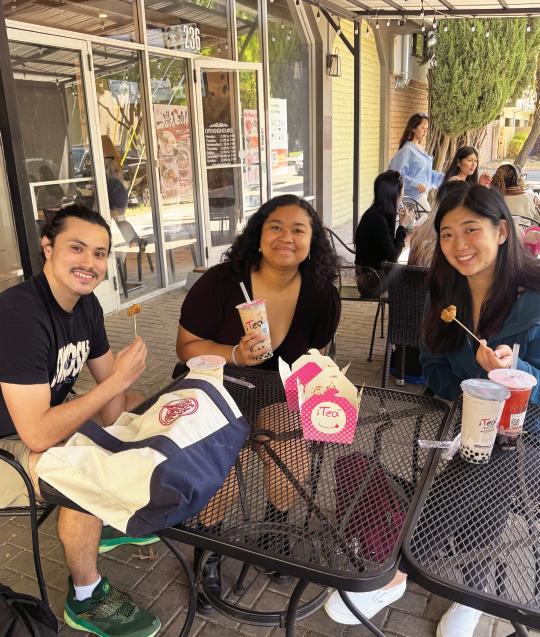

•
•
•



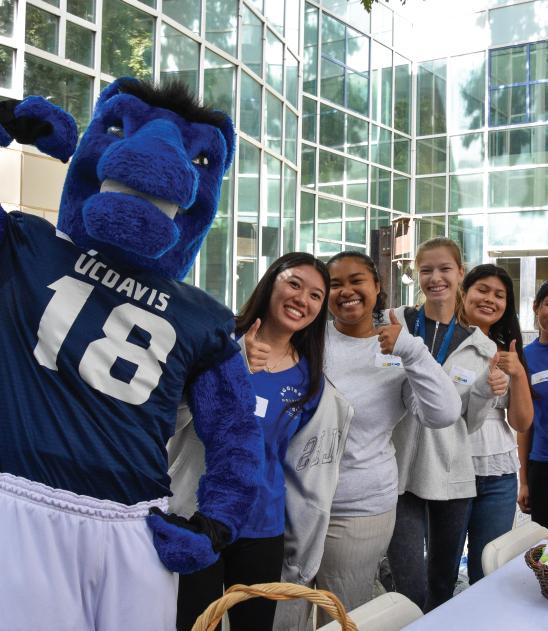
•
•
•