The lawsuit comes after the DOJ withdrew an appeal to an injunction heavily in the University of California’s favor
BY RIVERS STOUT campus@theaggie.org
The Department of Justice (DOJ) opened a lawsuit against UC Los Angeles (UCLA). Filed Feb. 24, the lawsuit alleges that the university failed to address claims of antisemitism toward UCLA employees following the Oct. 7 Hamas attacks on Israel, claiming that the university facilitated pro-Palestine protesters in antisemetic acts.
A DOJ press release on the suit alleged that the university repeatedly violated Title VII of the Civil Rights Act of 1964.
“After the Hamasled massacre in Israel on October 7, 2023, antisemitic acts pervaded UCLA,” the release reads. “The suit alleges the university engaged in a pattern or practice of discrimination in violation of Title VII against Jewish and Israeli employees at UCLA by failing to prevent and correct discriminatory and harassing conduct.
The lawsuit further alleges the university negligently permitted a hostile work environment against two charging parties and other aggrieved Jewish and Israeli employees.”
The 81-page complaint purported several violations of federal law, from a Jewish faculty member being denied a promotion
because they reported antisemitism to the university failing to uphold its own time, place and manner (TPM) rules regarding protests that were in place at the time. TPM rules restrict and regulate how protests, protected by the First Amendment, can function in order to comply with local and federal laws.“The encampment featured antisemitic chants, visual images, and posters, as well as physical barriers designed to explicitly block Jews from accessing parts of UCLA’s campus — in open violation of the University’s TPM rules and federal law,” the complaint reads.
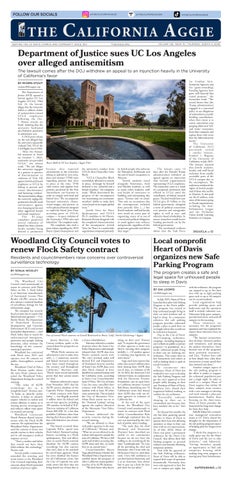
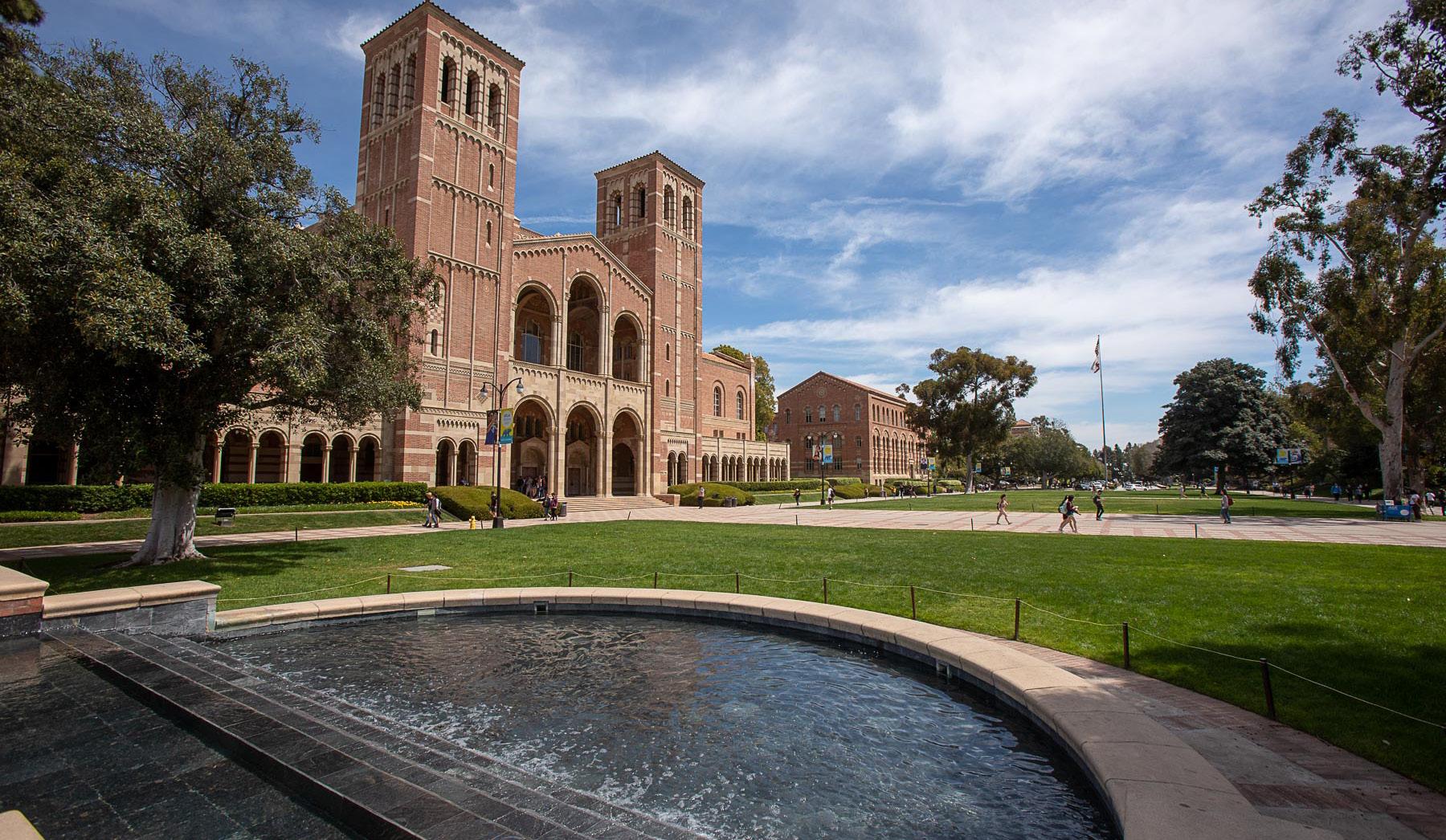
The complaint also cited a press release regarding the 2024 Royce Quad encampment and
the university’s conduct from UCLA’s then-Chancellor Gene Block.
“UCLA Chancellor Block nevertheless ‘allowed it to remain in place,’ although he himself declared it was ‘unlawful and a breach of policy,’” the complaint reads. “Block determined the purpose of the encampment was ‘maximizing our community members’ ability to make their voices heard on an urgent global issue.’”
Jewish Voice for Peace Spokesperson and UCLA Ph.D. candidate in Art History Benjamin Kersten disagreed with the complaint’s characterization of the encampment. Jewish Voice for Peace is a nationwide organization composed primarily
by Jewish people who advocate for Palestinian livelihoods and the end of Israel’s occupation in Palestine.
“Jewish students stood alongside Palestinian, Arab and Muslim students, as well as many other students, staff and faculty of conscience in building and maintaining this space,” Kersten said via email.
“Not only are accusations that the encampments excluded Jews patently false […] but Jewish students, staff and faculty were much an active part of organizing, many of us out of a moral and political obligation to stand against state violence and genocide, regardless of who perpetrates genocide and whom they target.”
Residents and councilmembers raise concerns over controversial surveillance technology
BY SONJA WOOLEY city@theaggie.org
The Woodland City Council voted unanimously to renew its contract with Flock Safety on Feb. 3. Flock Safety is an American manufacturer of Automated License Plate Reader (ALPR) cameras that also operate a national database of surveillance footage for law enforcement usage.
The company has recently faced scrutiny due to reports that federal and state agencies — U.S. Border Patrol, The Department of Homeland Security, Immigration and Customs Enforcement (ICE) and certain local police departments — used Flock Safety data to search for undocumented immigrants, protestors and people seeking abortions, often without the knowledge of the cameras’ municipal operators.
Woodland has contracted with Flock since 2021 and operates over 40 cameras on public thoroughfares around the city.
Woodland Chief of Police Ryan Kinnan spoke about the ways Flock cameras have aided the Woodland Police Department during the council meeting.
“The value of ALPR technology for us is straightforward,” Kinnan said.
“It helps us identify stolen vehicles, it helps us identify suspect vehicles in violent and serious offenses, it assists us in missing person investigations and reduces officer time spent on manual canvassing.”
Woodland Lieutenant Heath Parsons shared success stories with the Flock ALPR cameras. He explained how the Woodland Police Department used the cameras to locate two suicide victims in their vehicles and to call emergency medical response services.
“That’s a mother and father that would not have their child without this technology,” Parsons said.
Several public commenters attended the meeting and wrote letters to the Woodland City Council expressing their concerns about Flock’s potential violation of privacy rights.

Jessica Martinez, a Yolo County resident, spoke to the council about her perspective on Flock Safety.
“While Flock cameras are advertised as a way to make cities safer, [...] numerous security and federal overreach concerns have been raised throughout the country and throughout California,” Martinez said. “Flock’s track record repeatedly proves that they cannot secure our data.”
Martinez referenced a report from November 2025 that the ALPR camera database of the Capitola Police Department — which contracts with Flock Safety — was illegally searched 3 million times by federal and out-of-state agencies, including 190 searches on behalf of ICE.
This is in violation of California Senate Bill (SB) 34, a law that prohibits California cities from sharing their license plate reader data with federal or out-of-state agencies.
This breach occurred when Capitola Police opted into Flock Safety’s National Lookup feature, according to a Flock spokesperson. This tool allows cities to search Flock’s national database for ALPR camera recordings but also exposes that city’s data to be searched by out-of-state agencies. Flock has since disabled this feature for all Californian cities, but the City of Capitola was only made aware that their data was being shared out of state due to
a citizen whistleblower. Martinez referred to a similar situation where the Santa Cruz Police Department unknowingly released their ALPR data into Flock’s national search tool.
The city’s internal audit still showed ICE and Department of Homeland Security searches of Santa Cruz ALPR data, even after Flock claimed to have disabled its national lookup tool for California cities, according to Santa Cruz Councilmember Susie O’Hara. The City of Santa Cruz has since cancelled their contract with Flock Safety, in tandem with at least 30 other cities nationwide. This included the City of Mountain View, whose Flock system was set to the “National Lookup” setting against the explicit direction of the Mountain View Police Department.
Kinnan addressed the security concerns during the council meeting.
“We are allowed to share with police agencies in the state of California,” Kinnan said. “What we are not allowed to do is share with agencies outside the state of California. We have a full audit trail of who’s accessing [the ALPR data] and why, we audit that on an annual basis.”
Councilmember Mayra Vega asked Kinnan whether the Woodland Police Department is notified about the purposes of other California municipalities’ searches of its ALPR database.
“We don’t know what they’re
doing on their end,” Kinnan said. “It requires the governance of other agencies to make sure they’re running their program lawfully. [...] If another agency is violating state legislation, we won’t know.”
Vega cited news reports that other cities across California have been sharing their ALPR data out of state, in violation of SB 34. In 2024, the American Civil Liberties Union, in conjunction with the Electronic Frontier Foundation, sent an open letter to California Attorney General Rob Bonta, identifying over 70 Californian cities that shared their ALPR data with out-ofstate agencies in violation of California law.
At the end of the open forum, the Woodland City Council voted unanimously to renew its contract with Flock Safety. Councilmember Rich Lansburgh explained that his vote was motivated by the city’s lack of public safety funding.
“The tools that the chief [Kinnan] and lieutenant [Parsons] have described are useful to our community because we do not have the staffing to do everything all the time,” Lansburgh said. “So, I am all for providing the chief and lieutenant, who I trust with my life because I have to, with these tools. I have full confidence in our chief and our lieutenant, and I, as an American, have always had to give up a little bit here and there for my safety.”
The lawsuit came 13 days after the Donald Trump administration withdrew an appeal against an injunction that favored organizations representing UCLA employees. The injunction came as a result of a proposed settlement deal offered to UCLA amid the cancellation of federal research grants. The deal would have seen UCLA give $1 billion to the federal government, alongside a series of political concessions over protests and transgender rights, as well as race- and ethnicity-based scholarships. In return, researchers would receive funding previously cut by the federal government.
“The unrebutted evidence shows that the Task Force
[to Combat AntiSemitism] Agencies and the [grant-awarding] Funding Agencies have gone well beyond that stated purpose,” the injunction reads. “The record shows that [the Trump administration] engaged in a concerted policy to use allegations of antisemitism to justify funding cancellations, when their intent is to coerce universities into purging disfavored ‘left’ and ‘woke’ viewpoints from their campuses and replace them with views that the Administration favors.”
The University of California (UC) previously settled a similar lawsuit, Frankel v. Regents of the University of California, in July 2025. The lawsuit claimed that Jewish students, faculty and staff faced exclusion from usually accessible parts of the UCLA campus due to the encampment. The settlement reinforced the rights of Jewish people and of those who ascribe to Zionism. It also paid out $6.45 million, with some of the money going to Zionist organizations, including the AntiDefamation League and the Orthodox Union Jewish Learning Initiative on Campus.
The program creates a safe and legal space for unhoused people to sleep in Davis
BY GIA LOOMIS city@theaggie.org
In July 2025, Heart of Davis launched their pilot Safe Parking Program to the Davis public. The program was created to help unhoused people living in their car with nowhere safe or legal to sleep. As a temporary solution, the safe parking program provides unhoused people a place to park their car overnight where they would not be ticketed or harassed.
Due to the City of Davis’ Anti-Camping ordinance, camping—including sleeping in one’s vehicle on public or private property—is prohibited. As a result, unhoused people living in their cars are violating city ordinance. This causes them to face harassment and tickets as well as leading them to park in unsafe locations.
To circumvent this ordinance, Heart of Davis has worked for over a year to develop the Safe Parking Program and get the city’s approval to host people safely sleeping in their cars. President of Heart of Davis, Shoshana Zatz, shared their inspiration behind working to combat the city ordinance.
“Essentially, someone sleeping in their car is criminalized just because they have nowhere else to be,” Zatz said.
For the past few months, the city has been granting special permits to Heart of Davis to operate their host sites allowing attendees to sleep in their cars there with no city repercussions. As of Feb. 2026, Heart of Davis was given a permanent ordinance by the Davis City Council that allows their Safe Parking program to proceed without continuously obtaining temporary permits.
Now with the approval of the Safe Parking ordinance, Heart of Davis will be able to expand their scope of operation dramatically. Previously, they were only approved to host five cars or campers per night, but
with the ordinance, the program can expand to up to five host sites with up to eight parking spots each so up to 40 campers can be accommodated. Local organizations help provide parking spots and bathrooms and the operation itself is entirely volunteer run. Volunteers help greet campers, provide food items, and send off campers in the morning. These volunteers are necessary for the program’s operation and Zatz explained the impact these volunteers have on campers.
“The human connections that develop—between parkers and volunteers, and among the parkers themselves—have become one of the program’s most powerful outcomes,” said Zatz. “Parkers have told us how deeply they value these interactions, as many spend their days isolated and alone.”
Another unique aspect of the safe parking program is the effort it makes to support the unhoused population past just a single night. In order to enroll as a camper, Heart of Davis requires that within 30 days, campers must connect with a case manager to develop and work towards a plan past homelessness. Rather than focusing on the short-term, Heart of Davis provides the framework for long-term change for those they help.
Isabelle Sabsovich, a secondyear managerial economics major at UC Davis, shared her thoughts on the importance of the safe parking program’s aspect of helping plan for longer-term change.
“I think this program is a really great way for the Heart of Davis and the city to take initiative,” said Sabsovich. “Giving homeless people an opportunity to find safe temporary housing while making long term progress in moving away from homelessness.
The group is leveraging student advocacy, alongside other UC chapters, to expand California’s Marine Protected Areas
BY THOMAS WU campus@theaggie.org
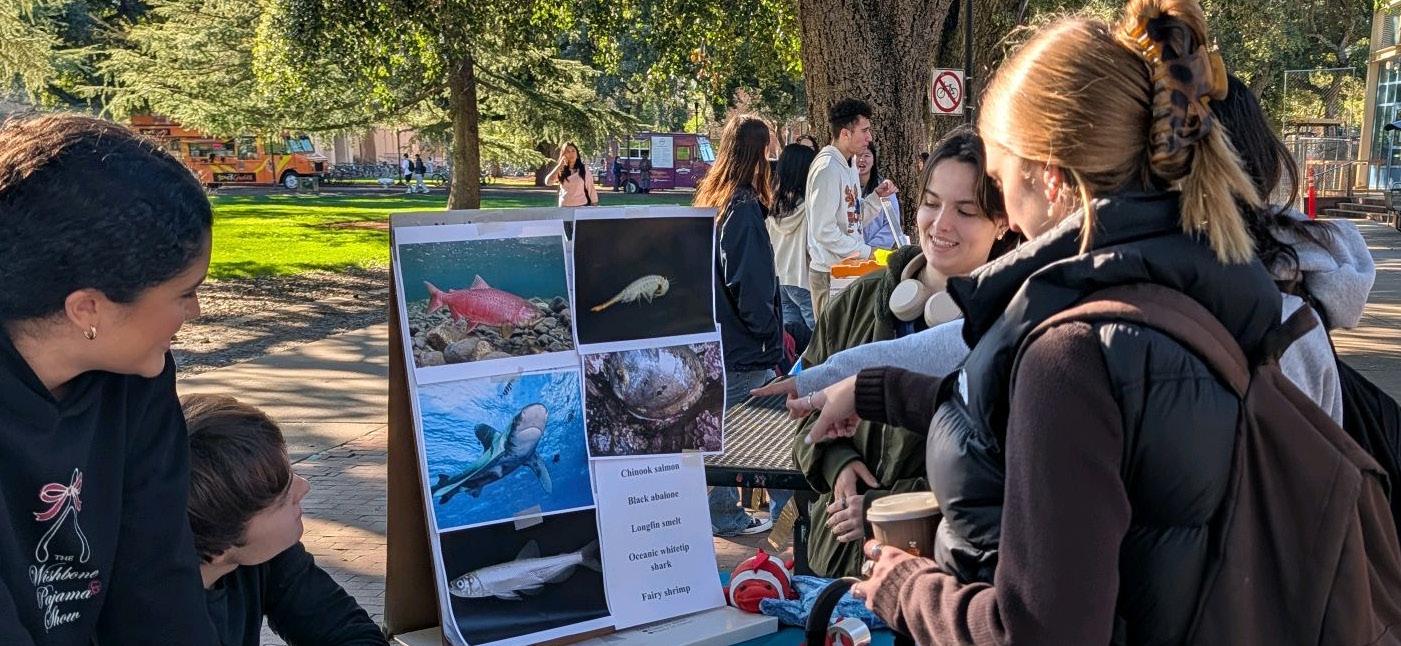
Of the many student groups who canvas outside of the Memorial Union, CALPIRG has been a frequent tabler. In recent weeks, CALPIRG, or The California Public Interest Group, has spearheaded oncampus student mobilization to protect California’s coast and marine life.
Their latest project, the Protect Our Oceans Campaign, hopes to bring awareness to coastal conservation and protection efforts. The group is asking students to sign a petition to that effect and CALPIRG has prompted students to give public comments at upcoming planning meetings on the issue.
The project reflects a broader mission; CALPIRG serves as a student public interest activism group educating students across the state and promoting civic engagement. They also organize advocacy for environmental protection, hunger relief and other initiatives. Their chapters’ presence extends to every UC campus, except UC Merced.
In 2020, Governor Gavin Newsom issued an executive order committing to conserving 30% of California’s coastal waters by 2030, also known as the 30x30 target. CALPIRG is now pushing the California Fish
conservation
the
and Game Commission (FGC) to continue MPA expansion through the end of the decade.
MPAs — especially “no take” MPAs which prohibit removal and destruction of natural resources — are designed to create a richness and diversity of species among coastal reserves. They serve as a key way of conserving coastal waters, prohibiting extractive marine activities such as fishing, drilling and mining.
In April and May, CALPIRG chapters across the state will attend hearings in Half Moon Bay, Santa Barbara and San Clemente. The FGC evaluates pending petitions based on urgency, and CALPIRG hopes their efforts will make sure the expansion of no-take MPAs are placed at the highest priority categorization.
UC Davis CALPIRG Chapter Chair Neha Janz, a second-year political science major, is optimistic about the potential impact CALPIRG students will have when facing the Commission.
“I think that we have a really good chance under Newsom right now because he’s shown that he cares about the environment,” Janz said. “I think that if we show enough support, we will win and get them implemented.”
CALPIRG says that its public comments intend
to contextualize evaluation considerations, offering further insight on MPAs’ impacts on diverse communities as well as the value of environmental stability for young generations.
“I think people might not really understand the weight of what’s happening and how important what we’re doing is,” Janz said. “[That’s] until you have a conversation with them, then they are more willing to help.”
Since its founding, CALPIRG’s contributions to policy changemaking at a state level have depended on their oncampus interactions, beginning with student connections through tabling. For 50 years, the group has initiated quarterly voluntary pledge drives to sustain their operations.
CALPIRG requires 10% of a campus’ student body to pledge to support their organization before billing students through student fees. Student pledges have been able to fund campaign operations, similar to the Protect Our Oceans Campaign, in addition to lobbying training and conferences.
CALPIRG Grassroots Coordinator Quinn Alarcon, a first-year linguistics and art studio double major, highlights the flexibility with how a student chooses to get involved, beginning with pledging. CALPIRG on 12
“UC Move Your Money” aims to divest from companies complicit in state violence, targeting the UC Retirement Savings Program
BY KHADEEJAH KHAN campus@theaggie.org
Across the UC system, several faculty have begun work towards divesting their retirement accounts from companies that enable state violence to work towards creating more ethical investments in the UC system.
The campaign, called “UC Move Your Money,” was formed in Fall 2025 and targets companies included in the UC Retirement Savings Program (UCRSP) that enable or facilitate military violence, prisons, militarization of migration and borders, apartheid and genocide. They include GE Aerospace (a division of General Electric) and Raytheon, both of which are weapons manufacturers.
UC Investments manages the UC Retirement Plan (UCRP) and the UC Retirement Savings Plan (UCRSP). UCRP is a pension fund that provides retirement income for eligible employees, while UCRSP is a retirement plan component providing supplemental benefits. UCRSP is a defined contribution plan for current and former employees.
“We do this because our comfort in retirement is invested in state violence, so we [faculty] are complicit, but we also have the power to change that by getting organized,” Hannah Appel, an anthropology professor at UC Los Angeles and member of the Move Your Money faculty steering committee, said.
A white paper written by members of UCLA Graduate Students for Justice in Palestine estimates that the two largest index funds in the UC Retirement Plan portfolio are valued to have over $10.4 billion dollars in investments complicit in state violence, including investments in weapons manufacturers, the military industrial complex and information technology companies.
Move Your Money is a multi-step divestment strategy. The first step of the campaign aims to have at least 10% of UC faculty move at least 10%

of their UCRSP investments into the UC Social Equity Fund, which the UC says is screened for social and environmental criteria and is fossil fuel free.
Seeta Chaganti, an English professor at UC Davis, is a faculty member participating in the campaign. She wants to remind faculty worried about their retirement security that this option predates the divestment campaign.
“The UC’s pension fund is actually a significant reason why a lot of instructional workers take this job in the first place because it has a reputation for being a good pension fund,” Chaganti said. “The faculty, the people who are paying into it, the workers who it directly affects, don’t have a lot of say in how it’s run and how it’s managed. It would benefit the faculty as well as instructional workers to feel like they are getting in there and having more control over what’s going on.”
Move Your Money faculty note that the Social Equity Fund still has many limitations when it comes to divestment from state violence. One of the largest categories of holdings in the fund are information technology companies, which include Microsoft, Amazon and Google. All three have been connected with deals with Israel.
Microsoft participated in a $35 million deal to provide the Israeli military with unlimited
access to products and software services in 2002. After the events of October 2023, the company provided computing and storage services worth at least $10 million in deals to the Israeli military. In May 2021, Google and Amazon signed a joint $1.2 billion contract called Project Nimbus, which would provide cloud computing infrastructure, AI and other technology services to the Israeli military.
To divest from those companies currently included in the Social Equity Fund, the second step of the campaign is to create a “No State Violence Fund,” having at least 10% of faculty demand a new UCRSP fund option.
“Moving our money into social equity is a major improvement, but we need a better option that is more fully divested from state violence,” Appel said. “Step Two would actually create an off-the-shelf divestment option for retirement funds and other investors across the United States and beyond. There is no such thing as a nostate-violence fund anywhere.”
Faculty hope a No State Violence Fund will create a ripple effect beyond the UC — the campaign’s third and final step. With the UC one of the largest university systems in the country, their goal is that the campaign will inspire similar faculty-led divestment strategies.
The ‘Sunshine Proposal’ aims to revise salary, benefits and class size for the 2025-26 academic year
BY YUENJO FAN city@theaggie.org
On Feb. 19, the Davis Joint Unified School District (DJUSD) Board of Education met to discuss ongoing negotiations between the Davis Teachers Association (DTA) and the school district.
The current DTA-DJUSD negotiations, named the Sunshine Proposal, aim to build upon the existing collective bargaining agreement between the two parties. The current agreement, ratified in 2024 and updated in 2025, is now being amended for 2026 with revisions meant for the four remaining months of the school year.
These revisions include increased prep time during the workday, increased work year (longer contracts), manageable class sizes, improved salary and benefits, association rights, developmental programs for special education students and Davis School for
Independent Study caseloads, according to DJUSD Associate Superintendent Laura Juanitas.
In addition, the DTA also requested an update to an existing Memorandum of Understanding (MOU) regarding teachers’ extended time and an additional appendix to provide more consistent procedures in the instance of staff discipline. The DTA intends for these updates to help strengthen the working relationship between teachers and the district.
President of the DTA Amanda Rayls spoke on the importance of having these negotiations.
“Contract negotiations are sometimes framed as a process about dollars and percentages, but at their core, they are about people,” Rayls said. “They are about stability, respect and most importantly, our students.
Educators show up early, stay late, respond to emails at night, plan lessons on weekends and carry the emotional weight of supporting children through
their academic, social and personal challenges. Our commitment does not fluctuate with budget cycles or enrollment trends. It is constant.”
A full-time teacher at the Robert E. Willett Elementary School, Rayls emphasized to the school board how a consensus on the negotiations will benefit the school district as a whole. Rayls highlighted that reaching an agreement was not just for the betterment of the teachers, but ultimately to preserve a quality environment and faculty for DJUSD students.
“A healthy district depends on a strong relationship between its educators and leadership,” Rayls said. “Negotiations should not feel adversarial; they should feel collaborative. When teachers feel heard, respected and valued, our schools are stronger. [...] We cannot negotiate simply to get through the next year. We must negotiate to build a district where talented educators want to stay. Competitive compensation and health
benefits, manageable workloads and meaningful professional respect are not luxuries; they are investments. When we fail to invest in educators, we pay the price in turnover, burnout and instability. And our students feel that impact most deeply.”
Hiram Jackson, president of the DJUSD Board of Education, concurred with the importance of the district and the teacher unions’ continued efforts to amend the agreement.
“I look forward to ongoing dialogue,” Jackson said. “No action is required for this item [at the moment, since] a lot of the conversation [will] happen in closed sessions.”
Updates to the negotiations are set to be provided at future meetings. The meeting also briefly touched on DJUSD’s recent announcement of employee terminations.
Classified under Resolution No. 36-26, two positions — Administrative Assistant and Facilities Specialist — will be affected after the current school
year. The school board noted that this decision was made due to the termination of funding and reduction of need due to low enrollment, respectively.
Juanitas spoke about the school board’s actions prior to notifying employees of the layoffs.
“We connected with the employees impacted by the reduction enforced resolution so that they did not find out
With a 10% cut across all units, ASUCD officials debated and finalized next year’s operating budget
By LILY KENROW & AALIYAH ESPAÑOL-RIVAS campus@theaggie.org
Associated Students, University of California Davis (ASUCD) wrapped up its annual budget hearings, finalizing the budgets of its numerous units, commissions and committees for the 2026-2027 school year.
Held Friday, Feb. 20 through Monday, Feb. 23, senior student government officials — including the 12 student senators and the international student and transfer student representatives — voted on suggestions and adjustments.
The overriding concern was a $400,000 deficit left
at the end of the 2025-2026 budget hearings and a projected decrease in student funds. By the hearings’ end, ASUCD had balanced their budget, but not without widespread cuts.
On Feb. 13, one week ahead of the budget hearings, the ASUCD management team — consisting of the ASUCD president, internal vice president, business manager, controller (the Association’s chief financial officer) and vice controllers — released the President’s Proposed Budget along with a report detailing some changes. The proposed budget served as a suggested outline for how to distribute ASUCD’s $25 million budget. In prior years, budget hearings have proved host to
contention among the voting body. At the Feb. 12 Senate meeting, ASUCD President Amrita Julka reminded the table to maintain professionalism throughout the hearings.
“I highly suggest you keep professional disagreements just that: Keep it professional,” Julka said. “Not every hill is worth dying on.”
In the proposed budget, the deficit was largely addressed through a downward adjustment of wages — lowering the hourly pay for some positions — and by employing a tiered hour system that varied the number of hours some student employees work from week to week. ASUCD also implemented a new curtailment of hours, restricting the number of paid weeks in December and
introducing a compulsory break for staff and employees during the last two weeks of the calendar year.
ASUCD currently employs some 1,600 student employees over 30 student units. They are the largest student employer on campus and are partially funded through student fees. All units were expected to make efforts to achieve a 10% cut from their current budgets.
The two biggest ASUCD commercial units — Unitrans and the Coffee House (CoHo) — are slated to break even with their income covering their projected expenses, $10.1 million and $6.9 million, respectively.
A major topic of debate at the hearings included the budget
of the student government itself, which encompasses the salaries of senators, executive officers, commissioners and other program expenses. The student government was originally allocated $460,514 in the proposed budget and was allocated $463,010 by the hearings’ end. Senator hours were reduced from 14 to 12 hours a week, while maintaining their hourly wage of $19.50. Meanwhile, Judicial Council staff pay was increased to match the wages of those in the Executive Branch.
The Senate’s food budget was also decreased from a proposed $5,400 to $4,000, pushed by Senator Nate Little. The current budget for student government food and entertainment is
$7,000. Little, who ran his fall quarter campaign partly on decreasing administrative spending, made multiple attempts to completely eliminate the food budget.

The city and local organizations co-hosted a film screening of ‘Kintsukuroi’ and a poster contest for youth in the community
By ALMA CULVERWELL city@theaggie.org
The City of Davis recently co-hosted its third annual Day of Remembrance event on Feb. 19 at the Veterans Memorial Theatre. Other cosponsors for the event included the Davis Phoenix Coalition, Davis Asians for Racial Equity, UC Davis Asian American Studies, Ethnic Studies Youth Organizing and Leadership Opportunity (YOLO) Academy and Historical Society of Winters.
The event offered a free screening of the film “Kintsukuroi,” as well as highlights from Rachel Maddow’s Burn Order podcast. The event also included a poster competition for younger children.
Pattie Fong, long-time community activist and thirdtime organizer of the event, described the significance of this year’s movie screening.

“This year’s Day of Remembrance is even more important because we’re seeing history being replayed,” Fong said. “The demonization and vilification of Japanese Americans during World War II is exactly the same as what refugees, immigrants and undocumented people are getting now. They’re being blamed for everything and being called criminals and drug dealers. It’s exactly the same sort of hysteria that was taking place back then. At that time, it was a ratio of prejudices against the Japanese. We need to keep on learning this stuff because it’s just repeating.”
Fong provided backstory on the film and highlighted the unique perspective it offered attendees.
“The movie was produced by a filmmaker out of San Francisco who wanted to pull together all the stories he heard [throughout] his upbringing,” Fong said. “The cast is all volunteers, only three or four of them have any
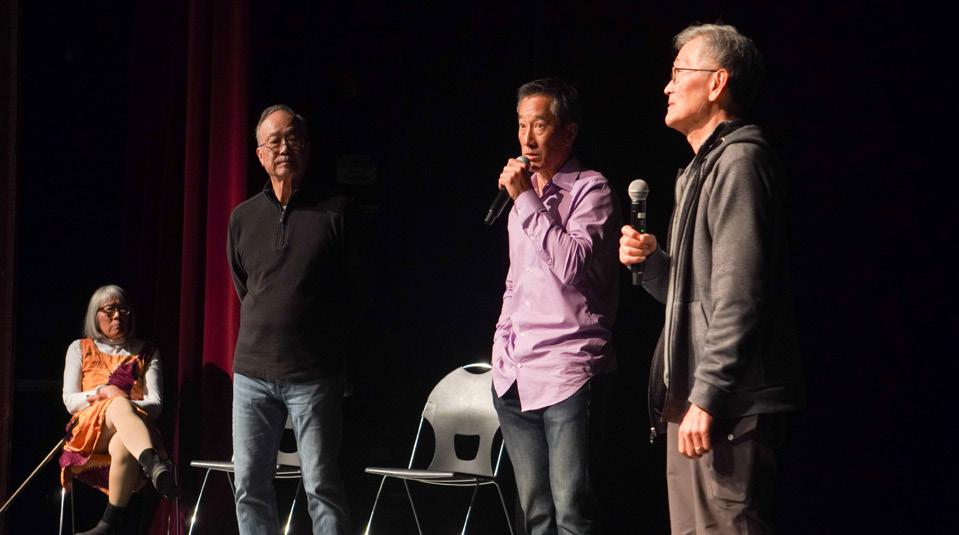
professional acting experience. So everyone’s a volunteer and everyone’s [an] amateur. It’s a story of a San Francisco family.”
Fong also emphasized the importance of continuing to recognize the experiences of Japanese Americans who lived in internment.
“A lot of people went to their graves not sharing their stories, and we need to make sure that doesn’t happen anymore,” Fong said. “That these injustices are communicated and shared and appreciated and acknowledged. That’s the only way we’re going to learn to stop it in its tracks early.” Floyd Shimomura, local community member and expert at Winters Museum, explained the longstanding history of Japanese internment within Yolo County.
“Before Pearl Harbor, the Japanese community of Winters comprised about 300 of the 1,200 residents of the area — about a quarter of the total population,” Shimomura said. “They were the primary labor force supporting the Winters’ agricultural community. Of the 300 who were incarcerated, only about 45, or 15%, returned.”
Shimomura continued to explain the significant impact the internment camps had on Winter’s Japanese community.
“Therefore, the issuance of Executive Order 9066 signifies the beginning of the death of the
Winters’ Japanese community,” Shimomura said. “It is a sad day and a day of mourning. It is a way of respecting the hardships and sacrifices of our elders.” Shimomura expressed what he hoped attendees would take away from the event.
“The Constitution is not self-executing,” Shimomura said. “Occasionally democracy, when it is scared, can overwhelm all three branches of government and do horrible things. I hope they learn that freedom and personal liberty must be fought for by every generation of Americans. If we don’t, then the Constitution is just a piece of paper.”
Fong also echoed her hopeful outlook on future generations.
“I hope that people feel empowered,” Fong said. “I want to keep on empowering them. That’s actually why we added in the poster contest, so that we can get kids to start thinking that they have a voice and they can add to the protest.”
Fong continued, describing how her neighbor became involved in the poster contest.
“Our one entry was really amazing, because I asked one of my neighbor’s kids, ‘You want to submit a poster?’” Fong said. “And, in 24 hours, she dug something up. She’s only in fourth grade, but she already knew about the camps.

I’m stuck on my ex
Dear Aggie,
I’m having a difficult time in the dating world after a recent breakup. It’s been a couple months, but I still feel like I’m comparing every new person I meet to my ex. I’ve had a few connections that I fumbled because I was scared or overthinking too much or just so stuck on my ex that I couldn’t give them my genuine commitment, but I regret it. I’ve recently formed a friendship with someone that I really like, and I think it could turn romantic, but I’m really nervous about ruining it again. Am I just not ready? How can I make sure that I don’t let my past get in the way of something that could be really special?
— Haunted
Dear Haunted, I feel you on that. It’s so odd reinserting yourself in the dating scene after a breakup — after all this time being loyal to this person, being single and talking to someone new feels like betrayal. And worse, you still feel like you belong to that person. Truth be told, I still ask myself the same questions. There are a couple things I’ve learned in this post-breakup era, and I’m going to hold your hand when I tell you this: Grief never disappears, it just dulls. Rather than trying to forget the past, you have to learn to live with it. And that means accepting a future without them, which feels impossible. It’s the potential that gnaws at us.
It feels counterintuitive, but I suggest writing a list of everything you disliked about your ex and being in that relationship. Oftentimes, you’ll find it was more harmful than you thought, reinforces your standards and reminds you there’s someone better in store for you. Reflecting on whether you’re content with your life can help determine whether you’re ready for a new relationship. This includes creating a strong circle of friends and indulging in your hobbies — you have more free time, after all. The more comfortable we feel living our own lives, the more we understand that a partner can simply enhance them, not give them significance.
Ask yourself, did you have fun with your ex or are you just a fun person? Coming from an adventurous person who was dating someone lazy, it’s rejuvenating (and slightly satisfying) to know I’m doing things that they would never even want to or think to do — traveling, backpacking, focusing on my career. Become more addicted to the things that you love, and whoever this new person is, I hope they’re more supportive of you than your ex.
So don’t be nervous about ruining this new friendship or not; if it doesn’t work out, then it wasn’t meant to be, regardless of how special it may feel. For now, invest in yourself and whoever you’re supposed to be with will join you on your path. Stay strong, A fellow haunted
Disclaimer: The views and opinions expressed by individual columnists belong to the columnists alone and do not necessarily indicate the views and opinions held by The California Aggie.
Toxic relationships with social media can work to our advantage, depending on the app itself
BY VIOLET ZANZOT vmzanzot@ucdavis.edu
During my first year at UC Davis, I ran a half marathon. And I did it for this moment right now — so that I can tell you all about it and be able to say that I did it. A mix of my affinity for praise and my love for attention created the perfect mentality for one of the least impressive half marathons ever run. Flash forward: I graduate this June, but come May, I will be running my second half marathon (which must be shocking to those closest to me, considering that after my last, I vowed to never run again). It’s interesting how my relationship with the sport has changed as my college experience has carried on.
As I logged my run this morning on Strava, my preferred run-tracking app, I thought about this change. Two years ago, I was never one to measure time or distance; I just ran slowly and prayed we were near the end before we even began. Today, I paused my tracker, checked my time, cooked up a caption (it was perfectly witty) and added two very exciting pictures from the run itself. The post, in-and-of-itself, might speak to my need for social media more than some newfound sense of pride in my (still) terrible running ability. When I deleted TikTok, Snapchat and Instagram, I realized what they had done to my brain: I had become reliant, and that dependency had to shift to something else. This is where the idea of becoming addicted to self-improvement came into play; 2026 has unofficially become the year I learn to crave success. This is, in part, why I started running again, and how I realized that social media has evolved — taking on new forms in a potentially very positive way (gasp). In the absence of traditional social media, I found myself drawn to alternative forms. I’m no longer overwhelmed that the girls from high school are running faster and having cute date nights (and doing all the other things that make them feel like they’re better than me). On Instagram, those things feel
like they’re a person’s whole life. On Strava, it feels different. On Goodreads, it feels different. On Letterboxd, it feels different. They are not meant to encapsulate your entire life. Ambiguous “lifestyle” media is distinct from dedicated platforms for running, music or reading. When you post a picture of yourself reading on Instagram, you’re being performative to show me that 1) you think you’re better than me, and 2) reading is a part of your life. When you post a book review on Goodreads, you’re telling me you read a book and had nuanced or ridiculous opinions about it, and I’m seeing your post because I’m interested and seeking it out. It is the specificity that removes the jealousy or hurt feelings — I intend to see your mile time or your playlist. As I found joy in curated social media, I discovered that everything I once found toxic could push me to be better.
by making the app operational without a user being actively “on” their phone, like Spotify or

These apps, using the same features of traditional social media, produce a different effect. They have demonstrated that it’s not necessarily a bad thing to be addicted to social media, as long as it reinforces positive habits. So, maybe it isn’t the healthiest thing to need a run tracking app to exercise, but at least I’m running. Even the addiction isn’t quite the same. When apps have a buy-in service, you have to engage with the activity, not just the app. The activity forces your mind and body to process something external, by either making you want to participate in an activity for the sake of the app — like watching a movie to post on Letterboxd — or
BY MILES BARRY mabarry@ucdavis.edu
Clavicular is the online moniker of Braden Peters — a 20-year-old from New Jersey who live-streams for eight hours a day. Clavicular had a relatively normal childhood. Then, at age 14, he discovered Looksmax. org, an online men’s group dedicated to “looksmaxxing,” or the attempt to become more conventionally attractive through extreme tactics.
Clavicular began posting on this forum so frequently that he was made a site moderator. At the same time, his looksmaxxing techniques became more and more grotesque: He took steroids to gain muscle, abused methamphetamine to stay lean and routinely tapped his face with a hammer to produce sharper cheekbones. These measures led to his eventual expulsion from college for
steroid possession and, by his own admission, his likely infertility due to experiments with testosterone ingestion. Clavicular’s popularity has been primarily driven by the absurd language that he and his community use. His content features “mogging” — in which another man stands next to Clavicular and they both preen, trying to look more attractive for the camera. It also involves talking to “normie foids” (lessonline women) at bars and “jester gooning,” a term for joking around. Clips of these encounters go viral because the vocabulary is memorable — terms like “mogging” and “jester gooning” are funny, strange and shareable in a way that Clavicular himself is not.
In interviews and live-streams, he actually seems quite boring. He isn’t funny, he has edgy, halfbaked political beliefs and he isn’t particularly personable. His fame is a linguistic phenomenon
more than a personal one. Growing popularity has made Clavicular a walking, hollow-cheekboned gestalt. Writers have tried to understand him by comparing him to a medieval monk (extremely ascetic), a fig wasp (singlemindedly devoted to a cause), a World Wrestling Entertainment (WWE) wrestler (performing combative masculinity), a performance artist (producing extreme public-facing content), a male version of a drag queen (using campy techniques to perform male beauty) and a radical submissive (completely shaped by social media algorithms). He’s graced the pages of the New York Times, GQ, the Atlantic, Vice, Playboy, Complex and New York Magazine, but was practically unheard of until December 2025, when his content gained traction on TikTok and Instagram.
Strava. Integrating the app into everyday life, rather than making it an escape from reality, allows the focus of the platform (i.e., running or reading) to manifest into your real life. In other words, Instagram works if you become addicted to Instagram, and Strava works if it can get you addicted to running. Learning how to differentiate between the technology that makes me feel bad and the technology that makes me want to be more athletic, more creative and eat more healthy has been invaluable. I no longer think the problem is social media. I thought I was giving it up for good, but getting it back in these different ways has shown me how it can be a tool; fighting fire with fire, if you will.
Disclaimer: The views and opinions expressed by individual columnists belong to the columnists alone and do not necessarily indicate the views and opinions held by The California Aggie.

CALEB CHEN / AGGIE
I can’t help but think that Clavicular might be closer to suffering from mental illness than being a “performance artist.” The more I read, the worse I feel for him — his teen years were spent chatting with anonymous men who encouraged him to irreversibly modify his body. Despite my sympathy for him, very specific cultural tides have carried this injured young man to our screens and our newspapers. Examining his rise allows us to measure these evolutions, and to discuss how an individual can embody larger cultural forces.

Geopolitical cherry blossoms — don’t let your guard down for one optimistic headline
BY NEVAEH KARRAKER nakarraker@ucdavis.edu
Downtown Davis has always been a diluted reflection of Stars Hollow to me; in the fall, a haze of ochre leaves coats the cozy buildings, and in the spring, a blizzard of cherry blossoms floats past the doors of the Avid Reader. Yet in less than a week, the lucid color dissolves into ordinary — although beautiful — greenery, and sunlight mutates into rainfall.
Seasons in college pass swiftly; as we become invested in our education, we forget to take in the things materializing around us. Misled by a bipolar forecast, we become subjected to a “fool’s spring” — noteworthily unique to Davis. The blooming foliage and hot weather manipulate us into seeing light at the end of the barren winter tunnel, and the whole campus participates with picnics on the Memorial Union Quad, summer outfits and outdoor club events.
In the same way, we’re misled by our classes and the lightening of workloads as winter quarter comes to a close. Yet it’s this exact optimism, although well intended, that reveals a deep flaw in society; we’re horribly impatient, impulsive and heavily dependent on temporary feelings.
The small teases of summer raise our spirits, only to be crushed by a second winter mere days after the sun makes its momentary appearance — one that seems to be worse than the first. The pageantry makes us forget that finals, the climax of the quarter, have yet to occur. And part of what makes it so challenging is the oblivion that our peers sunbathe in.
During this time, we’re mostly subjected to pessimism as we battle the margins of burnout. We’re either spiteful of others’ carefreeness as they prematurely enjoy the brief sun, or envious of their surplus of time as we watch the festivities from the basement of the library. Either the observer is still in the winter mindset or holding their breath as they brace for the next one — it’s this very comparison that intensifies the stress and frigidity of winter. We tend to base our emotions on short-term circumstances, like the quick vanishing of

cherry blossoms, whether we’re aware of it or not. An upcoming test consumes our thoughts, and our mood is heavily impacted by resentment toward people living how we wish we could, causing us to never truly appreciate what’s transpiring in front of us. The pressure we feel is a privilege because we have the opportunity to gain something valuable, and conversely, lose something valuable.
Just as we’re seduced by a fool’s spring on campus, the world enters a similar state of temporary celebration with global events like the Super Bowl and the 2026 Winter Olympics in Milan. These events have accumulated intense media coverage, especially with figures such as Bad Bunny and Alysa Liu shining in the spotlight with their impressive success stories. These figures are a testament to hard work, dedication and perseverance, inspiring a new generation to pursue their dreams.
But in light of this, we also cannot naively think that the political state of the world will improve as we relish in warming weather. Just as workload sneaks up on college students, the government will move in silence as we become distracted by this fraudulent spring.
Just two days after the end of the Olympics, President Donald Trump delivered the 2026 State of the Union address in Washington, D.C., with members of the gold-winning United States men’s hockey team present. The women’s hockey team — who also won gold — politely declined the invitation after comments from Trump and the men’s team revealed the deep misogyny still present in our nation. The address sparked controversy as Democrats boycotted applause for Iryna Zarutska, a Ukrainian refugee murdered by a repeated felon, and WWII veteran Royce Williams. It’s almost as if some people would rather see their opponent fail than see America succeed, like how some professors would rather prove their teaching method is right than help students pass. As finals quickly approach for students, a negative shift in the political state of the world looms ahead. We cannot pretend that winter is over simply because we’re excited at the change of scenery — whether it is real sun or ground-breaking achievements. We cannot allow ourselves to become subjected to “fool’s spring,” for the future depends on how we fare in the true test of a second winter.
Disclaimer: The views and opinions expressed by individual columnists belong to the columnists alone and do not necessarily indicate the views and opinions held by The California Aggie.
Trump’s horrifying hypocrisy becomes all the more apparent
BY
On the morning of Feb. 28, United States and Israeli forces launched a joint missile attack on Tehran, effectively killing Iranian Supreme Leader Ayatollah Ali Khamenei and various other high-ranking officials.
This operation, called “Rising Lion” by Israel and “Epic Fury” by the U.S., was formulated shortly after Israel’s 12-day war on Iran in June 2025, which resulted in the deaths of at least 610 Iranians — though Israel decided they would attempt to assassinate Khamenei soon after Oct. 7, 2023, according to USA Today.
Outside of the direct strike on Khamenei’s compound, Israel and the U.S. have continued a violent assault on Iranian civilians over the past week, directly contradicting claims that they are solely attempting to dismantle the country’s alleged nuclear developments.
On March 1, missiles effectively demolished a girls’ primary school in Southern Iran. Despite denial from Israel and the U.S.’ refusal to comment, it is undeniably apparent that an estimated 180 children between the ages of 7 and 12 were killed as a direct result of their imperial power grab.
As the Iranian death toll climbs above 700, there has been no conversation surrounding de-escalation from either antagonising country — President Donald Trump has stated that the assault is set to continue for four to five weeks and took to Truth Social to comment that “Wars can be fought ‘forever,’ and very successfully.”
While the conflict continues, it is essential to understand that the current U.S.-Israel-Iran War does not exist in a vacuum; the U.S. has been involved in Iranian affairs since at least 1953 when the CIA partnered with the United Kingdom to overthrow Iranian Prime Minister Mohammed Mossadeq. In order to assert Western power and control over Iran’s oil supply, U.S. support for Shah Mohammed Reza Pahlavi enabled a 1954 Consortium Agreement, which gave European oil companies 40% ownership of the nationalized Iranian oil company.
1979 marked the beginning of the Iranian Revolution when civil unrest caused the Shah to flee Iran for the U.S. With his departure came the return of exiled Shiite Cleric Ayatollah Ruhollah Khomeinei, who took power and began to shift Iran’s goals away from westernization. Following Ruhollah Khomeinei’s death,
Ali Khamenei took over rule of the Islamic Republic of Iran — a governing state characterized as a repressive theocracy ridden with economic instability.
Since its inception, the Islamic Republic of Iran has existed in constant tension with the U.S. Fighting for control over Iranian oil and the right to develop nuclear weapons, the conflict we are currently seeing unfold is not simply a product of the large public protests that began in Iran in late December. Rather, the U.S.-Israel-Iran War is an extension of a larger plot to continue expanding Western influence in the Middle East and ensure Israel remains a global power amid the genocide they continue to inflict upon Palestine.
These protests do, however, demonstrate the unrest and frustration the Iranian people have been experiencing for decades. Iranians deserve the power and autonomy to determine the kind of government they would like to see — instead, their livelihoods are once again trampled over in favor of Western economic and military advancement.
While Trump has voiced his support of the Iranian protests, using their struggle as an excuse to wage war on the country and make the executive decision to assassinate Khamenei, the U.S.-Israeli missile attacks across Tehran, Isfahan, Minab
and several other cities show their blatant disregard for civilian lives.
Trump’s attempts to defend his attack on Iran, under the guise of protecting protestors from lethal Iranian force, are also contradicted by his indifference over how the country will now move forward following the death of their leader and multiple senior officials. In the Oval Office on March 3, Trump stated that he doesn’t know who will now lead Iran, and that “most of the people [they] had in mind” are now dead as a result of the attacks, according to USA Today.

Editorial Board
ALYSSA CREVOISERAT Editor-in-Chief
MAYA KORNYEYEVA Managing Editor
VINCE BASADA Campus News Editor
JORDAN POLTORAK City News Editor
MOLLY THOMPSON Opinion Editor
ZOEY MORTAZAVI Features Editor
SAVANNAH ANNO Arts & Culture Editor
MEGAN JOSEPH Sports Editor
KATIE HELLMAN Science & Tech Editor
Managing Staff
JENNA LEE Photo Director
NOELLE ESCALANTE Layout Director
SAVANNAH BURGER Design Director
SAM RUIZ New Media Manager
KAYLIE HUANG Social Media Manager
JULIAN MONTANA Website Manager
JULIA CROSSAN Distribution & Outreach Director
YILAN LI Translation Director
CARMEN RODRIGUEZ-ZARATE Translation Director
JENNY DYE Copy Chief
ALYSSA PULIDO Copy Chief
LAURIE PEDERSON Business Development Manager
We speed down the highway and shovel food like its our last meal, racing to the next thing without truly getting through the last
BY AMBER DUHS alduhs@ucdavis.edu
We all seem to be in a constant race. No matter what we’re doing, we’re in it for the thrill of making the cut at the last millisecond — the rush of a perfect finish.
Unfortunately, I’m not describing some quasi-utopian (or dystopian) society where we’ve all become track stars; I’m describing the constant, everlasting and enduring battle of our inability to slow down. It seems more and more that we’re all fighting this internal clock. I find myself

scarfing down my food at the dinner table, even when it’s my own dinner table, where I’m all alone and not late for anything. I don’t have any outstanding deadlines, and maybe, for once in my life, I don’t have an assignment, essay or midterm hanging over me. Yet I eat with the same fervor and the same disposition of a child gnawing at their plate. Alongside the growth of our quick and ever-changing society grows the incessant need for us to match that rapid speed within our everyday tasks. I stand in the grocery store, at times, looking at the produce section in contemplation of which fruit I should choose. A somewhat humorous image, I know. The longer I stand, the more aware I become of those rushing around me, of customers almost running around the grocery
BY SEBASTIAN RUIZ seruiz@ucdavis.edu
store in fear of the time slipping away from them. The cashiers race to throw each item in the bag, in fear the customer may get impatient, impeding their ability to have a conversation or enjoy the small interpersonal interaction.
We cram all of these tasks into rigid time blocks, never truly finishing any of them and never allowing ourselves to relish in the moment. What good is a dinner that took four hours to cook if it’s eaten in 15 minutes? What good is a trip that took months to plan, if the entire time you’re rushing between each picturesque spot or activity?
Even if we want our quickness to be isolated to solely our work or the seemingly mundane chores we want to get over with, it seeps into every aspect of our being.
The rush is sometimes minimal: it’s difficult to catch and difficult to train yourself out of. zBut ask yourself why you’re vacuuming as if there’s an inspector on the way. Why are you speed walking down
the street when there are sights to take in? Tasks that were once meant to be restorative or calls for reflection become boxes on a to-do list and time slots on our calendars; a hurdle in the race toward the end of the day. We’re all busy — trust me, I get it. There are arguments to be made regarding the necessity of quickness and no “wasted moments” in this world of rapid consumption. But beyond arguments like “I have three jobs and kids at home to feed” (which are extremely valid), are those of people who don’t have anything, per se, to rush toward.
A constant feeling of panic, of falling behind, seeps into our minds and into how we carry ourselves — along with an insurmountable amount of anxiety.
We brush it off, simply saying “I have no idea why I’m so anxious,” but it’s because we’re constantly in fight-orflight mode. When we’ve convinced ourselves that everything we do is a response to stress, we
start acting like it. Our ability to slow down and relish in the details dissolves, slowly morphing us into speedobsessed people who can’t find a minute to take a breath. We remove the small acts of gratitude that accompany slowing down, disallowing ourselves to be grateful for a meal we can be present at or the opportunity to calmly clean the table that just hosted all of our friends.
Slowing down and learning to not treat life as a race doesn’t discount the value of productivity or efficiency; it’s a way to practice gratitude and presentness. It’s hard to “stop and smell the roses” when you’re walking so fast you didn’t even notice the roses were there.
Disclaimer: The views and opinions expressed by individual columnists belong to the columnists alone and do not necessarily indicate the views and opinions held by The California Aggie.
Studio 301’s sold-out production delivered a momentous, dark comedy at the Wyatt Pavilion Theatre

By IQRA AHMAD arts@theaggie.org
Studio 301’s rendition of “Ride the Cyclone” premiered this past weekend on Feb. 27, Feb. 28 and Mar. 1, selling out every seat at the Wyatt Pavilion Theatre. The studentrun company took on a show that’s equal parts dark comedy, pop concert and existential gut punch, delivering a fastmoving production that felt both polished and daring in its simplicity.
“Ride the Cyclone,” directed by Eli Gunn, a second-year communication and sociology double major, centers around a group of six St. Cassian High School students from the small town of Uranium, Saskatchewan, who died in a roller coaster accident on “The Cyclone” and entered a surreal limbo state.
The group: Ocean O’Connell Rosenberg, the fiercely ambitious overachiever; Constance Blackwood, the warm and loyal optimist; Mischa Bachinski, a tough-talking Ukrainian adoptee with a hidden vulnerability; Noel Gruber, a melodramatic romantic longing for more beyond his hometown; Ricky Potts, a quiet and misunderstood dreamer; and Jane Doe, a mysterious girl with no memory, no family and no name, are greeted by a mechanical fortune teller, Karnak, who offers one of them a chance to return to life.
Staged in a thrust configuration, a stage that projects and extends into the audience on three sides, Studio 301 treated the space like a feature, not a limitation.
“I’ve never seen any musical or play performed on a thrust stage, and I’ve always wondered how it really works,” Ezra Kotovsky, a second-year mechanical engineering major,
said. “I’ve done theater in the past and a big part of theatre is ‘cheating out,’ which is when you’re always facing the crowd even in dialogue. But, inevitably, when you have a crowd that wraps around, your back can sometimes be facing the crowd, so there were points when I was like, ‘Is this a bad place to be sitting?’ But they used the stage really intentionally, especially with the choreography, so that there really was no bad place to sit.”
The momentum matched the structure of the musical itself. “Ride the Cyclone” doesn’t offer the audience much time to breathe, and Studio 301 leaned into that relentlessness.
“You felt like you were really in the musical the whole time,” Kotovsky said. “They really harnessed the fact that it was only a two-hour play and built so much momentum. There were no breaks and I think something that made the show really fun was that all of the characters were involved pretty much in every scene.”
One of the biggest surprises of the night were the minimal but effective props. Studio 301 relied on lighting, projection and performance to build the limbo state that the characters were placed in.

BY MAYA KORNYEYEVA managing@theaggie.org

“The Shire” by Howard Shore (2001)
If you are ever lost in the world and feeling hopeless, purposeless or weighed down, “The Shire” is sure to lift your spirits in every way. The carefree, airy violins float dreamily through the score and the flute carries you forth, as light as a feather — so much so that, when the joyous melody finally starts, you feel like getting up and frolicking. “The Shire,” created by award-winning composer Howard Shore for the end credits of “The Fellowship of the Ring,” is a token of gratitude for the beauty of J.R.R Tolkien’s shire. The shire — the expansive, cozy home of the hobbits — is in many ways my ideal mental getaway: no commitments, no worries, just second breakfasts and running through the grass. “The Shire” reminds me to appreciate the little moments in life and to take in the beauty of the world around me: there is still hope, light and laughter, even when life gets hard.
“Frieren: Beyond Journey’s End” dir. Keiichirô Saitô (2023)
“Frieren” is a poetic and magnificently-animated love letter to the memories of the ones we hold dear. The show centers on Frieren, an elf mage that freed the land from evil together with the heroes from her party, Himmel, Heiter and Eisen. However, the anime takes an unconventional approach to storytelling; rather than starting at the beginning and following their journey to victory, the first episode finds Frieren departing from the group, spending years away and reuniting when all the members have aged, and she — as a creature with a lifespan far beyond humans or dwarves — unchanged. The rest of the series depicts Frieren as she deals with the deaths of her closest friends, learns to recognize the fragility of life and comes to terms with the deep feelings she had for Himmel. Through her journey to Aureole, the “land where souls rest,” Frieren traces the steps that she took and the memories she once created alongside new companions Fern and Stark, slowly beginning to recognize how much she learned in what seemed — to her — a mere moment of her life. This show is infinitely whimsical: a heartwarming and magical slice-of-life.
“Hunter X Hunter” dir. Hiroshi Kōjina (2011)



It’s safe to say that this is my favorite anime of all time. The story follows Gon, a tenacious and spirited 12-year-old, as he journeys in his father Ging’s footsteps to gain the lucrative hunter certification. Along the way, Gon finds company in his fellow exam-takers, Kurapika, Leorio and Killua, the son of an assassin family and Gon’s best friend throughout the series. Gon and Killua’s yin-and-yang dynamic, which allows each to learn and grow from the other, is a testament to great writing and to the creator Yoshihiro Togashi’s character-building abilities. The main musical theme of the show, “departure!” by Masatoshi Ono is expressive and powerful, reminding viewers of the joys, wonder and hardships of adventure that form the anime’s core. Throughout the show’s six arcs — and 148 total episodes — the characters deal with the trauma of their past and the darkest of enemies, ultimately emerging stronger for it. It is a tale of resilience and unbreakable bonds: one that I cannot stop rewatching.
“The Color Violet” by Tory Lanez (2021)
I’ve been obsessed with this song lately; I’m not quite sure if its the rhythmic ebb and flow of the synth beats, artist Tory Lanez’s melancholic voice, the saxophone solo that comes in during the third minute or the flow of the lyrics as he sings “Speedin’ car going 90 in the rain, She took my heart and filled it with nothing but pain.” It’s resonant, retrospective, idealistic — a song that truly evokes both the warmth of the color purple and the cold individualism of violet. Similar to one of my current favorite artists Don Toliver’s catchy and seductive beats, this song is about the simultaneous emotion of feeling both free and stuck in love; so much so that it bleeds into recklessness. In any case, it’s perfect to blast in the car and reconnect with your emotions.

Dr. Emily Meineke led the project, which enlisted the help of both students and volunteers
By JONAH BERMAN arts@theaggie.org
On Feb. 21, the UC Davis Arboretum Teaching Nursery unveiled a new artwork: a pair of panoramic murals depicting coastal California and the Central Valley, intended to represent the biodiversity of both regions. The unveiling took place on Biodiversity Museum Day, an annual celebration of the university’s many nature-centered museums and collections.
The creation of the murals was led by Emily Meineke, an assistant professor of Urban Landscape Entomology. Within the nursery, the artwork can be found behind another of Meineke’s projects: the Climate Adaptation Living Lab (CALL) Garden, which seeks to examine how different flora will react to decreasing water levels as climate change accelerates. She worked to create the piece with the assistance of volunteers and students in the entomology (ENT) 001 course, aptly titled “Art, Science & the World of Insects.”
“If you imagine a traditional entomology lab, you might learn
what a butterfly is versus a beetle versus a fly,” Meineke said. “And those are really important things for people who are going into entomology. But this is a nonmajor class, so really the goal we have is to have students appreciate insects and find ways to interact with them positively.”
For the murals, students were assigned to work on specific insect species, with an emphasis on species studied at UC Davis. One of these students was Yaretzi Arias-Luna, a second-year sociology and psychology double major. Her assigned species was Triops longicaudatus, also known as the tadpole shrimp.
“I wanted to find a class that would help me get in touch with my creativity again,” Arias-Luna said. “When I found the class, it seemed interesting because it incorporated insects, and I had never really learned about insects before. Honestly, I felt like it was a really good time for everyone to get in tune with themselves and their creative skills.”
The students used the lab portion of the class to learn techniques for working with clay materials. The introduction of artistic skills was deliberately paired with education about these unique species that are emblematic of California’s rich
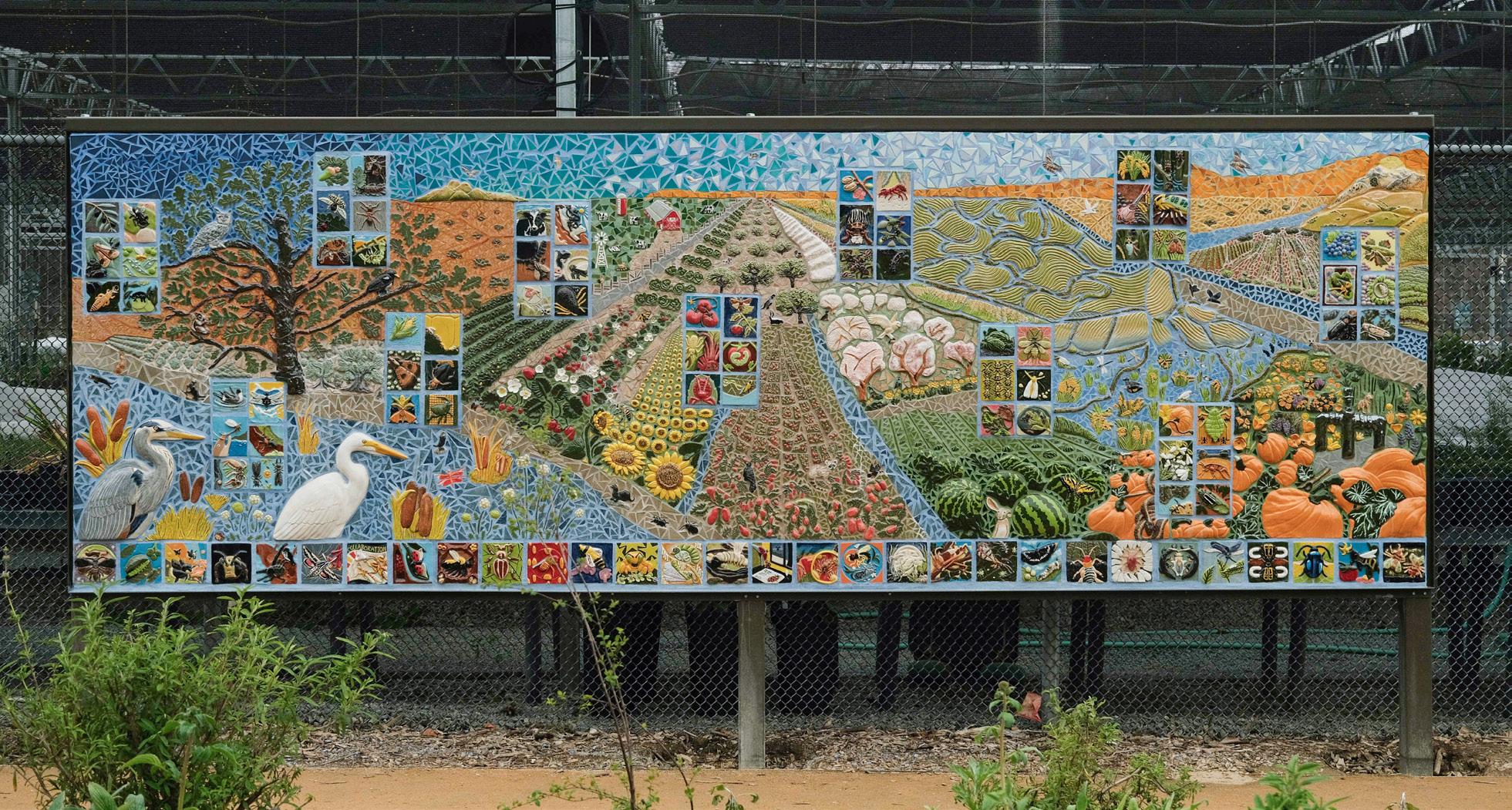
biodiversity.
“Those students are teaching each other about their insects,” Meineke said. “And then they use that knowledge to create some sort of design.”
The students finished their designs by adding underglaze to color their 5-by-5 inch
square tiles, which
intersection of entomology
with
“We believe these art projects help to teach students the science in a way we’re not going to get in a traditional science lab,” Meineke said.

‘It’s out of all of our comfort zones in one way or another’: the Davis indie-rock staple spills all on their musical history

BY MIRIAM RAMAKRISHNAN arts@theaggie.org
As The California Aggie’s quarterly Couch Concert approaches on March 12, performing band Love, Georgie gave a sneak preview of what they’re planning and where they started.
The band is composed of three members: lead guitarist and vocalist Ezra Chabon, a second-year psychology and music double major; bassist George Harris, a second-year music major; and drummer Miguel Huhndorf-Lima, a second-year history and Native American studies double major.
The band has deep roots in the indie-rock genre, their sound made recognizable by clear-cut vocals and crisp instrumentation. Love, Georgie first formed in November of 2024, when Chabon and Harris jammed together at Cottonwood Hall in the Tercero dorms.
“Our band started initially when [Chabon] asked me and another person if we could play in his dorm room,” Harris said.
“We just came up with our song, ‘Triple Blues,’ and that was that.”
Huhndorf-Lima, who joined the band subsequent to its creation, also spoke about his personal Love, Georgie origins.
“The first time we all ended up playing together was the soundcheck for a show,”
Huhndorf-Lima said. “One of the previous band members came to my window when I was practicing drums, and he had a connection to [Chabon and Harris]. That was where it started.”
The band’s musical inspirations vary stylistically, their favorite artists compiled of both 1970s and present-day stars.
“I’m the biggest Bob Dylanhead ever,” Harris said. “I love Sun Kil Moon, Mount Eerie and Neutral Milk Hotel. I like the classics too: The Beatles, King Crimson, all those good guys [from] back in the day.”
The other two members gave distinctly contrasting answers, with Huhndorf-Lima naming post-punk artists like Sonic Youth and the Yeah Yeah Yeahs, while Chabon’s favorites included folk singers like Lizzy McAlpine. Chabon explained that this diverse blend is intrinsic to the band’s style.
“I think kind of what makes our band sound special is that all of us have very different musical backgrounds,” Chabon said.
The band’s EP, “Aftermath,” released on March 1: It combines classic songs from Love, Georgie’s discography with fresh tracks that listeners haven’t heard before. Their most recent single, “Home to You,” evokes the sound of alternative artists such as West 22nd and Briston Maroney.
‘A sort of supergroup’: local band Budget Cut talks origins, influences
Opening for The California Aggie’s Winter Couch Concert, Budget Cut’s trio is making the Davis music scene their own
BY SAVANNAH ANNO
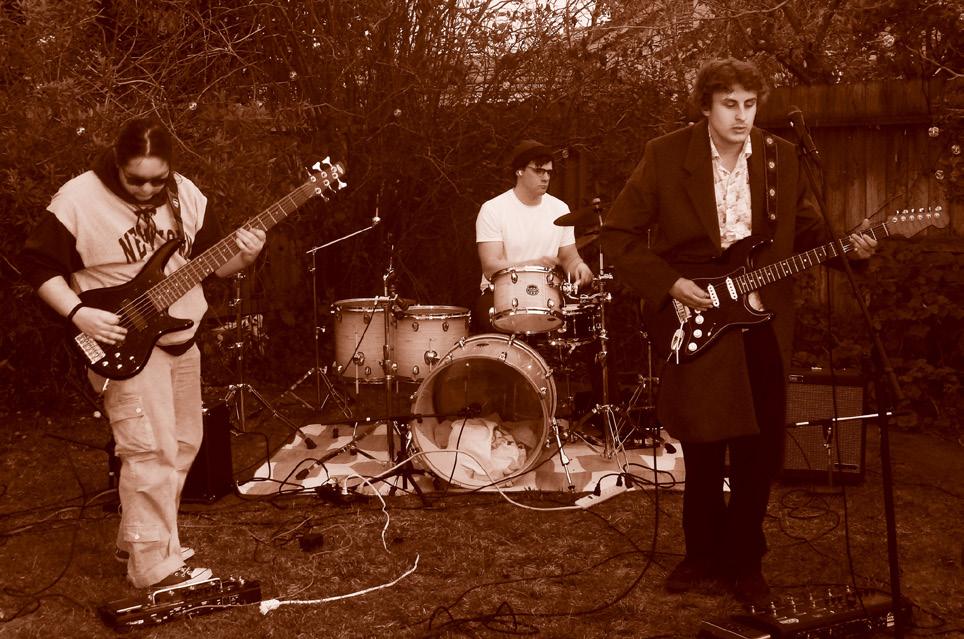
Lead guitarist and vocalist Brandon Ramirez, a fourth-year electrical engineering major, drummer Johnny Moeller, a fourth-year chemistry major and bassist Em Gollnick, a third-year microbiology major, make up Budget Cut, a budding trio band in the Davis music scene.
“None of us ever said ‘We wanna be in a band together’ until [Ramirez] came along,” Moeller said. Ramirez, who first sought out Moeller and the band’s original bassist, Paul Zhu, spoke to the process of forming the band last year.
“I started performing as a kind of solo act with backing musicians,” Ramirez said. “Towards the end of summer, I

The duo discussed creative partnership, pushing musical boundaries and the multimedia aspects of the sonic project

BY HANNAH OSBORN arts@theaggie.org
On March 12, Davis duo
Nineteenth Operator will grace the basement of The California Aggie with their layered pop music and intentional style.
Nineteenth Operator is an experimental pop project created by Bernadette Albano, a fifthyear biological sciences major, and Rosie Mendoza, a recent UC Davis graduate. Meeting as students at the university, they began playing music together as part of local band Cowboys After Dark.
“We met playing in a cover band our freshman year,” Albano said. “We were like, ‘We should make pop music, we should do this.’ We got together a bunch of songs and started playing shows.”
Part of the name of the duo, “Nineteenth Operator,” originated from their former employment at UC Davis. The other was forged by shared personal experiences.

“‘Operator’ is because we both worked as operators for the campus phone before they shut it down,” Albano said. “Nineteenth is from this time we were 19 and wanted to buy a lighter [at] a 7-Eleven — turns out, you have to be 21.” Albano and Mendoza both provide vocals and play guitar, but are often supported in live shows with a backing band that includes keyboard, bass, drums, trumpet, saxophone and euphonium.
“At first we had a friend helping us, just playing all the other instruments on demos,” Mendoza said. “But then we
started producing songs at a quicker rate, so [now] we just show them the song and see what they’ll do with it. We’ve been lucky enough to have mostly the same band, so the sound has been curated over time.
The duo also shared their various points of entry for music and how it informed their styles within the project.
For Albano, it was a musical theatre background.
“[Theater] provided a really solid technical base for singing especially, and performing on a stage,” Albano said. “If you listen to the tracks, and you’re like, ‘Why does one of them have a crazy vibrato and musical theatre belt?’ it’s because that’s what I spent so many years doing.”
For Mendoza, on the other hand, marching band informed her interaction with music and how she writes the band’s songs.
“I was a band kid,” Mendoza said. “That’s how I learned how to play trumpet. When I was in eighth grade, I saw a video of Grace VanderWaal and I was obsessed with it. I was like, ‘I need a ukulele right now.’ Then I started writing my own songs, and that’s how I learned to sing.”
When it comes to their creative process, Albano and Mendoza align in their focus on the auditory and visual experience of their audience.
“We have similar goals and our motivations are very similar,” Mendoza said. “We bounce off each other, and we like pushing each other. We work really well together.”
As best friends and roommates, Albano expanded on how her and Mendoza’s personalities delegate their responsibilities and roles within
developing the band’s direction.
“We’re both people who need a creative project,” Albano said. “[Mendoza’s] just spewing out creativity at all times, and I have the type of brain where I’m like, ‘How do we make it bigger? How do we make it more multifaceted?’ Our skills just click.”
As Nineteenth Operator, the duo is focused on how their sound and image is able to break away from easy genre definition and typical auditory experience.
“When I’m listening to music, I’m focused on the concept of the album and how it fits into the larger sense of the music industry at the time,” Albano said. “[Mendoza’s] very into the technique of the songwriting and the stuff being literally recorded on the tracks.
So it’s genreless in terms of what we’re interested in, and I think that translates into what our music sounds like.”
Nineteenth Operator’s ability to invigorate both themselves and their audience through the soundmaking process is another cornerstone of the band’s creative expression.
Mendoza shared how it feels for her to engage in musical experimentation and lyricism in her songs.
“I need to sit there and write a song in order to feel better,” Mendoza said. “I get energy. It feels like I’m resting when I’m writing a song. It’s a personal thing, and I just so happen to be able to share it.”
Heavily featuring narratives and experimental sound, their music seeks to push the boundaries of the conventional pop genre. “I like exploring different
mediums and vessels of storytelling,” Albano said.
“I think we’re both very storytelling-focused in terms of our creativity. We look at the music like: ‘How do we use it to tell the story? How do we change the genre? How do we change the instrumentation and technique?’”
When playing live, their musical style is combined with not just a distinct and deliberate costuming, but also physical media like magazines, which are distributed at their shows.
“We’ve been curating our visual vibe a little bit more with the outfits, the zines, the flyer making,” Mendoza said. “If you scroll to the bottom of our Instagram and then back up, you can see us get cooler.”
The zines, stemming from Mendoza’s work in an American studies class, feature collages, future dates for shows and community events, among other tidbits.
“It’s just really fun for people to have something physical at shows,” Mendoza said. “We have seven [different zines] now, which is so fun. People have come up to us being like, ‘I’m collecting all of them.’” Making their mark on the Davis scene through the distribution of zines connects to their larger aspirations for Nineteenth Operator: to constantly expand their presence in Northern California.
“In this past month, we started really touring around different places, playing more shows and recording our music,” Albano said.
UC Davis content creator Mia Hildebrand detailed her rise to Internet fame and entrepreneurial success
BY DOMENICA PELOSO features@theaggie.org
While most freshmen are rendered defenseless against the dreaded first-year jitters, UC Davis students are uniquely prepared to transition into college life thanks to social media content creator Mia Hildebrand — colloquially known by her online persona, Mishkerzzz.
22-year-old Hildebrand is finishing up her fifth and final year at UC Davis, where she is a candidate for her master’s degree in professional accounting.
In addition to maintaining a social media following and studying as a graduate student, Hildebrand is also a small business owner, teacher’s assistant (TA), PLASMA program entrepreneur, MPAc ambassador and social butterfly.
“You can see her balancing; she’s a gym rat, she has a boyfriend and she goes home to see her family,” Jackie Aleksandrovich, a third-year managerial economics major, said. “And with so much going on in her daily life, she still finds the time to share her experiences with us, and I think that’s so cool.”
On TikTok, Hildebrand currently has 16,600 followers and has amassed over 2.4 million likes.
“I was searching for Davis content creators right after I committed just to see what it’s
like,” Grace Petoyan, a firstyear history major, said. “Then, I found her account, and I asked her about your standard dorm things. She answered within a couple hours and was so receptive. It just seemed like she really loved what she was doing. She’s definitely welcoming, kind and uplifting. Like, she’s the kind of video you’d want to pop up after you failed your midterm.”
However, this online persona took immense time and self-reflection to materialize, according to Hildebrand. In fact, it only took shape after Hildebrand quit Division 1 softball during her third year as an undergraduate at UC Davis.
“After I quit softball, I was so painfully alone,” Hildebrand said. “I didn’t have any friends. My mental health was at an alltime low. It was probably the worst year of my life.”
Hildebrand, who first picked up the sport in kindergarten, was now faced with the daunting task of rediscovering her personal identity without the security of her team. After a year of therapy, a renewed love for fitness and a newfound relationship, Hildebrand regained her selfworth — and in turn, felt emboldened to pursue content creation.
In January of 2025, Hildebrand began regularly posting multiple times a day on TikTok. Most notably, her videos on Davis food recommendations, relatable
“storytimes,” tips for UC Davis students and “Day in my life” vlogs garnered a large viewer base.
“Once people started to say ‘Hi’ to me in person and talk about me on YikYak, I was pretty amazed,” Hildebrand said. “But also, I was like, ‘Damn right, we did that.’ It was just cool connecting with the whole community. I finally felt like myself again.”
As her following grew, Hildebrand eventually received a modest revenue from TikTok — with the largest amount being $80 in one month. For her, however, the most thrilling monetary benefit for Hildebrand was her paid partnership with Hinge.
“They saw one of my videos about meeting my boyfriend on Hinge and reached out,” Hildebrand said. “Long story short, they paid me $3,000 for a six-second video, which lowkey changed my life.”
With this generous sum of money, Hildebrand invested in her long-term passion project, Mia’s Craft Kits. Initially conceptualized in a business writing class during her third year at UC Davis, the compact craft kits contain everything needed to create beaded keychains, necklaces, phone charms and bracelets on the go.
In December of 2025, Hildebrand officially launched her small business at the Davis Craft and Vintage Fair.
‘Time cast a spell on you’
The ‘right person, wrong time’ arc in the media
BY VRITI SHAH features@theaggie.org
The “right person, wrong time” trope is the concept of meeting someone — who is seemingly the perfect match — but through unfavorable life circumstances, the romance must come to an end.
The popular arc can commonly be found in films, TV shows, books and music. While it often features devastating concepts and storylines, why is the “right person, wrong time” trope so heavily depicted in the media?
Students shared their own perspectives about the trope.
“I feel like people are always obsessed with these kinds of things,” Ema Maeda, a secondyear civil engineering major, said. “I feel like they’re just very relatable.”
There seems to be a relatability aspect to the concept of right person, wrong time. Some speculate that people take comfort in the idea; Others suggest that there’s also a fantastical effect that viewers like to watch on screen.
“It reflects a lot in other people’s lives,” Regina Vargas, a second-year communication major, said. “I guess I had a personal experience [...] it’s like a fantasy, in a sense. It’s like, you wish that was you. You want that to be you.”
Often, what is portrayed on film is romanticized: an example is the Oscar award-winning film La La Land that illustrates the “right person, wrong time” trope. The story follows Mia, a young starlet, and Sebastian, an aspiring jazz club owner, who bond over their shared struggles reaching for their dreams in Hollywood. After growing closer and then drifting apart, they realize they must choose between staying together or achieving their dreams. In the end, Mia becomes a famous actress and Sebastian owns his own jazz club, but they are no longer together.
“A lot of the time, [it’s] the way that society is structured,” Sylvia Steiner, a second-year English and Japanese double major, said. “We have all these emotions and these desires, but we feel like we have to give them up for the sake of the more reasonable causes or logical things — and I think that’s a common feeling in life.”
Steiner went on to discuss the relatability of the trope and the impact of life’s circumstances on a relationship.
“I think [it’s] something that happens to a lot of people in real life, too,” Steiner said. “Also, I think it’s something that a lot of people think about because, a lot of the time, I feel like emotions [...] sort of come in contrast with [...] rationality.”

The battle between emotions and rationality seems to be a common theme in the right person, wrong time arc. This is also recognized in Normal People by Sally Rooney, a novelturned-TV show.
The critically-acclaimed book follows the complex relationship between characters Marianne and Connell — from high school to adulthood — who steer through conflicts of social class, power imbalances and internal insecurities. They realized they must let each other go to focus on their own personal growth.
Steiner proceeded to explain the emotional connection that audience members often feel when watching the “right person, wrong time” trope in the media.
really work out in the long run, like what you want to achieve for yourself.”
Outside of film, Fleetwood Mac’s song “Silver Springs” is widely known as a breakup anthem. Written by Stevie Nicks, the song is about her breakup with her on-again, offagain romantic relationship with bandmate Lindsey Buckingham.
Many fans claim that Nicks’ and Buckingham’s relationship exemplifies the right person, wrong time arc in real life; in “Silver Springs,” the lyrics depict the life Nicks believes she could have had with Buckingham, if he would let her love him. Fans also expressed how the song resonates with the selfish desire for an old partner to be reminded of you in their new life.

In light of her project proposal coming to life, Hildebrand began transitioning her small business content to Instagram. Soon after, a reel of Hildebrand promoting her kits as a TA went viral — resulting in her first flood of hate comments.
“I was showing my kids my craft kits, because I try to have relationships with all my students, and I just tell them about myself because why not?” Hildebrand said. “After I said they were $30, this girl was like, ‘Damn.’ And I posted it because I just thought it was funny.”
At the time of publication, the video currently has over 2 million views, 42,000 likes, 361 comments and 1,000 shares. Despite Hildebrand’s harsh comment section, she gained over 2,000 followers from that one video.
“They always say, you haven’t made it until they’re hating on you,” Hildebrand said. “So I think this is a good sign.” In terms of the future of Mishkerzzz and Mia’s Craft Kits, Hildebrand plans to expand upon both endeavors while also working as a KPMG audit associate post-graduation.
“I just want to bring screenfree activities back,” Hildebrand said. “Every person needs to know how to craft. I just think there [are] so many benefits that I am able to spread, especially with my social media platform. So I see the future as, instead of Michael’s, it’s Mia’s.”
As Hildebrand prepares to enter the next stage of her life, UC Davis students look forward to tagging along.
“She should continue to take us along her journey through
life, even after she leaves UC Davis,” Aleksandrovich said. “I know that her content is Davisspecific and school-specific, and I know how much she loves this school, and I want to see what she does — especially as somebody who has the same interests.”
With graduation just four months away, Hildebrand reflected on her time as an Aggie.
“Growing up, I definitely think I had a hard time fitting in,” Hildebrand said. “But I feel like at UC Davis, a lot of us were misfits growing up, and that’s lowkey why we’re at UC Davis: because we’re smart, and we’re nice and we’re just good humans. It’s just important to be a good human and be yourself, no matter what that is — even if that’s posting silly videos on TikTok.”
Aggie Skate Club discussed city council’s recent decision to revisit language in the municipal code
BY LAILA AZHAR features@theaggie.org
Katherine Peay, a third-year biotechnology major and current president of the Aggie Skate Club, originally named the Aggie Hurricane Skate Club, wasn’t a skater when she first joined the club. Her first-year roommates — both rollerskaters — heard about the group and brought Peay along for a meeting.
“I went and I didn’t even have a skateboard,” Peay said. “They got me on a board and they were helping me skate around the top of Hutchinson Parking garage, and ever since, we’ve just been addicted; we’ve been continuing to go. And this year, those two girls and I are the leaders of the club.”
For Sonya Black, a third-year wildlife fish and conservation major and the club’s treasurer, the club’s openness to newcomers is a notable highlight.
“I really like that [Aggie] Skate Club provides a community for all skill levels to come together and enjoy the sport,” Black said. “We get beginners, people who have been roller skating or skateboarding for years and others who skated as kids and want to get back into it. It’s a cool environment.”
The club meets regularly to provide opportunities for students to skate.

Recently, as the City of Davis was undergoing a “municipal code cleanup,” Section 27.02.060 was amended to read: “Skateboarding is prohibited in all city parks, except within designated skatepark facilities expressly approved and maintained by the city for that purpose or on a shared use path for the purpose of transportation.”
This sparked immediate concern for some community members, including Peay.
“We, as a skate club, kind of had an issue with [the code] because it really changed the way that skating was defined in the City of Davis,” Peay said. “It made it seem like it was not welcome in our public parks. We were concerned by that language.”
pleasantly surprised to hear that it seemed like it was just a simple miscommunication. The City of Davis was not, in fact, trying to ban skateboarding in a malicious way. It really was just a lack of communication for what language is needed for our skating community.” Section 27.02.060 did not pass, and the City of Davis agreed to revise the code, alongside revisiting previous regulations which prohibited skating on hard courts.
Mobilizing to impact local policy was a unique experience for the club.
“It’s just having to give up something that you cherish emotionally for some other more prudent reasoning,” Steiner said. “I think people can connect to that — not just in love, but in any sort of [relationship]. It just feels very close to home, having to give up emotional ties to things because [...] of the way that life works out.”
“I’ll follow you down til’ the sound of my voice will haunt you,” Nicks sings in “Silver Springs.”
While the “right person, wrong time” trope is a popular choice in art across many genres, Steiner argues that the arc may not be so common in real-life
“When you go to college, you — a lot of the time — have to leave things behind, even things that are really important to you.”
Sylvia Steiner
Second-year English & Japanese double-major
situations; rather, many fitting romantic partners may cross our paths during our lifetimes.
Steiner proceeded to explain that the “right person, wrong time” experience is a common circumstance for many.
“Even just college is an example,” Steiner said. “When you go to college, you — a lot of the time — have to leave things behind, even things that are really important to you because [...] you recognize it doesn’t
“I think that the stars are going to align for that [the right person],” Steiner said. “But I think realistically, we might have different people that we meet in our lives that feel like they’re absolutely perfect. And, maybe it will feel forever — like you always kind of wish that things could have worked out with everything.”
“It’s been a big part of our mission to try and create a space where people can come out and try something new if they’ve never skated before,” Peay said. “We include all types of wheels, so we do roller skates, roller blades, skateboarding, rip sticks, everything in between. I, for one, was not a super skater before coming to college, so when I found out about Aggie Skate Club they were very welcoming to me, and I hope to continue that.”
Peay fondly recalled the memory of falling off her skateboard for the first time.
“I fell pretty hard, and I scratched up both elbows and knees pretty bad,” Peay said. “I was kind of hobbling around for a couple of days. But in the moment that I fell off my skateboard, I saw everyone kind of run in my direction. Now that I work as an [emergency medical technician], and I’ve been working as a lifeguard for three years, I’m just happy whenever I can go and help people in my community because it gives me a full circle moment of like, ‘Oh I was there too.’” The memory has since come to symbolize her approach to skating.
“It sounds cliche, but I think a big part of skateboarding is the falling and getting back up,” Peay said.
After being alerted to the change by the former mayor of Davis, The Aggie Skate Club immediately organized, providing information about the changes through the group’s Instagram account. The group wrote to the Davis City Council and prepared to make public comments at the council meeting in which the section would be discussed, urging their followers to do the same.
At the Davis City Council meeting on Feb. 17, Peay recalled seeing a variety of people involved in skating voice their opinions.
“We had a lot of community members come out and talk about skateboarding, including people who were not part of UC Davis,” Peay said. “They were either [...] UC Davis alumni or, you know, just dads in the community who wanted to come and speak. So it was cool to be able to stand up and be given two minutes of their time to talk and say what’s important to you and be a face of this.”
Ultimately, the Davis City Council was receptive to skaters’ input.
“Considering the times that we live in, we were kind of holding our breaths during that meeting,” Peay said. “Then, we attended the city council meeting and we were
“We’re just skaters,” Peay said. “We have no idea how to run a city council meeting. We barely even knew how to make public comments. So this was sort of an interesting project for us to find out as students how you participate in your local government and how local government is affecting students.”
Peay hopes that the skate club’s story encourages other students to pay closer attention to local policy.
“This was all sort of homespin YouTube University kind of thing, just trying to figure out how to get involved,” Peay said. “And so what I hope is that people who were following along can see that if they ever see an issue within their community that they can stand up too, and to have a conversation.” Peay continued, noting her appreciation for the local community.
“A lot of the time that these things are happening, it’s often a miscommunication,” Peay said. “And so speaking in a calm and respectful way to the people that are trying to benefit your community is something that we are going to try and advocate for more: for students to get involved and know what’s happening in Davis. Because Davis rocks.”
Students interested in getting involved with Aggie Skate Club can follow the page’s Instagram, @aggieskateclub, to stay up-to-date with meetings and events.
annual OWN IT festival offers a self-care
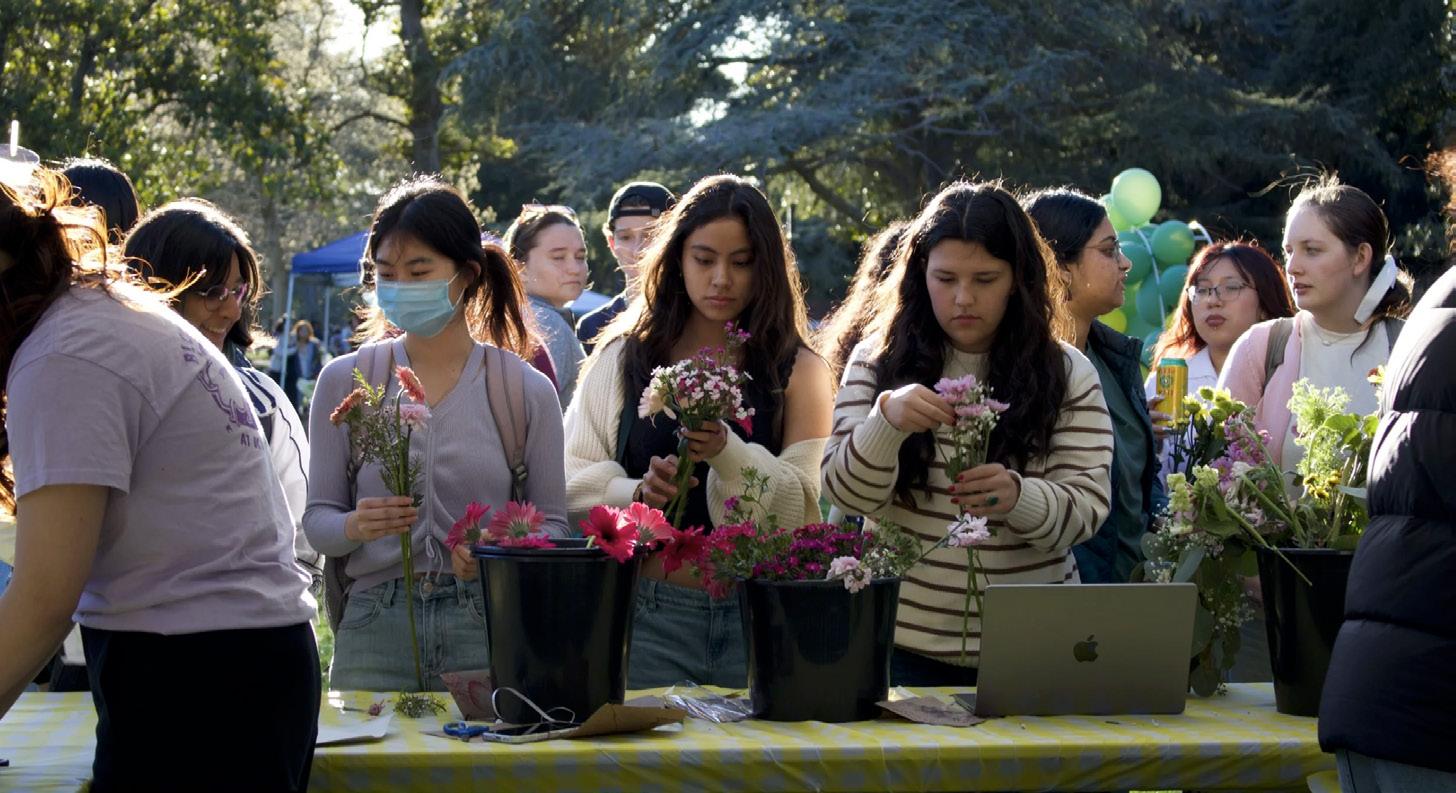
BY CARLO FALLA campus@theaggie.org
Davis Women in Business
(DWIB) is holding their annual OWN IT festival this Friday, March 6. This event offers a wide variety of activities and resources to empower women and nonbinary individuals to pursue their goals, while simultaneously highlighting the importance of self-care and well-being.
OWN IT was created at Georgetown University in 2013 to bring attention to the underrepresentation of women in science, technology, engineering and mathematics (STEM) fields, holding conferences to bridge this gap. While OWN IT business conferences for women exist across many institutions, the mental-health-focused festival is unique to Davis and has occurred annually on-campus since its inception in 2023.
DWIB was founded in 2016 and has since become one of the largest professional organizations within UC Davis. They later expanded to create their own chapter of OWN IT, holding their first conference in 2017.
“OWN IT strives to empower the next generation of women and nonbinary individuals to go out and pursue their aspirations to the fullest of their abilities — regardless of race, background, experience
or personal struggles,” OWN IT External Affairs Director for DWIB Arianna Kim, a thirdyear managerial economics major, said.
While targeted toward women and non-binary individuals, this free festival is open to all regardless of gender identity. It will take place from 3 to 7 p.m. on the Memorial Union’s East Quad. Kim explained that the festival will offer students some reprieve from the quarter system.
“OWN IT Festival is an event that specifically focuses on prioritizing mental health and bringing awareness to wellness,” Kim said. “This is a great opportunity for students to take a break from studying and the stress of week nine and roam the different activities at the East Quad.”
OWN IT Internal Affairs Director Grace Kuang, a thirdyear managerial economics and communication double major, said that both OWN IT and DWIB have helped her make connections in Davis.
“The OWN IT Festival was created for students by students with the goal of fostering a safe and welcome space on campus,” Kuang said. “When I first joined, I wanted to find a community of like minded individuals and opportunities to grow professionally. DWIB has given exactly that: a supportive, empowering
network of incredible women and countless opportunities that have significantly shaped my professional development.”
Some noticeable features of the festival include women-led live entertainment, a marketplace featuring women- and nonbinary-owned businesses and workshops including charmmaking, bouquet crafting and yoga. There will also be resource booths in which students can learn about wellness programs offered on campus.
UC Davis’ K-9 Unit and Lend a Heart, Lend a Hand therapy dogs will also make a guest appearance for attendees to interact with.
“I am really excited to see the dogs and get to pet them,” Kim said. “But ultimately, I look forward to everything coming together. We have worked so hard to put on this festival so it will just be great to see everything to play out.”
Performances include the UC Davis Goldennetes, a Majorette dance team, The Spokes acapella group and the debut of local band Lovejane. Lovejane vocalist Katya Fomin, a first-year master of professional accountancy candidate, said that the OWN IT festival is a cross of her interests.
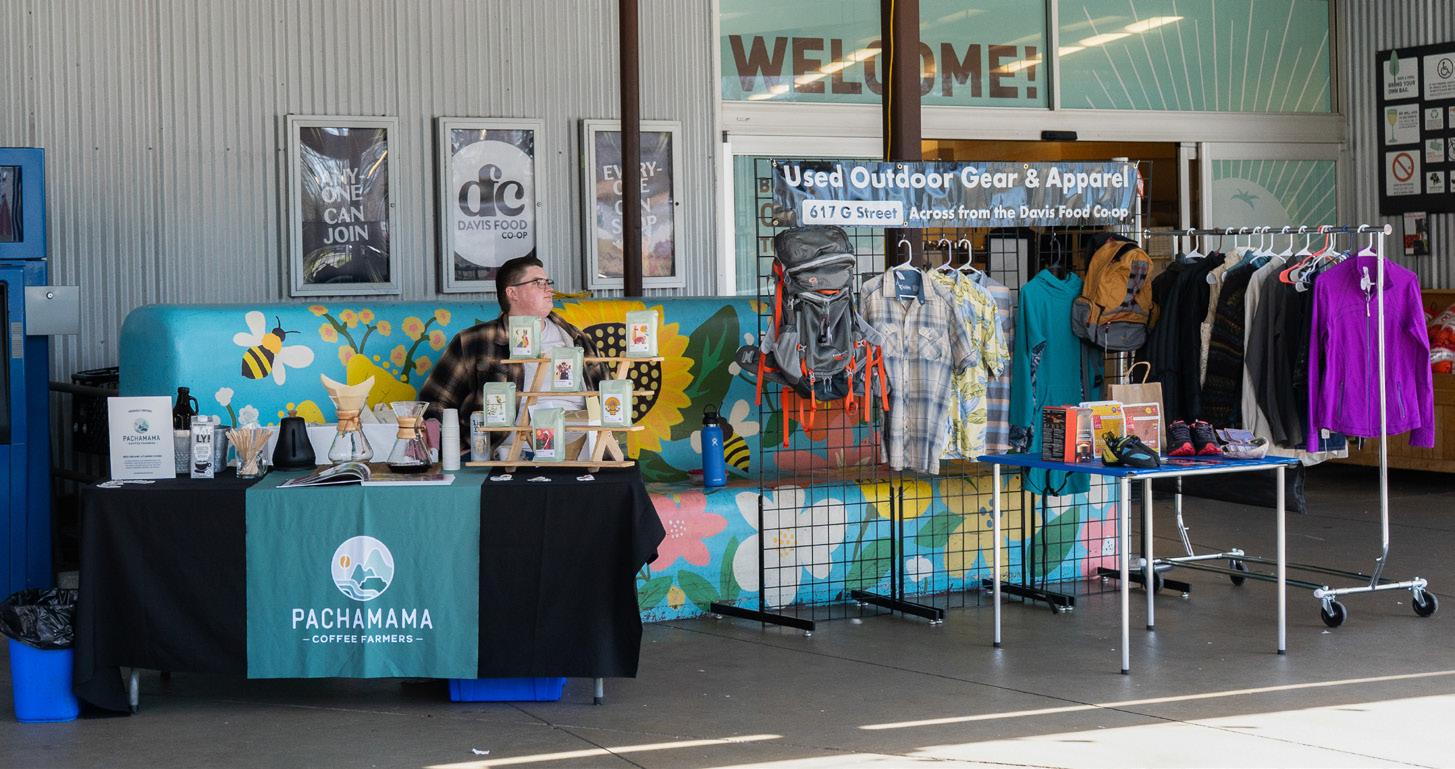
Local vendors Pachamama Coffee and Easy Wind Gear outside Davis Food Co-op for Local Love Fair on Feb. 21, 2026.
BY ALMA CULVERWELL
city@theaggie.org
The Davis Food Co-op hosted its Local Love Fair on Saturday, Feb. 21. The annual event marks a celebration of local farms, producers and artisans, offering free samples and other ways to support local businesses and organizations.
Among the local businesses hosted at the event was Kurtural Family Vineyards, owned by the Kurtural family. The Kurtural family has a long history of tending grapevines in the eastern Mediterranean since the late 1700s. Kaan Kurtural, who has a background in plant physiology, was a professor at Fresno State and UC Davis for 18 years. He worked specifically with wine grape growers in California, focusing on a range of topics from vineyard efficiency to irrigation and climate change mitigation.
Carrie Kurtural, Attorney and Founder of Kurtural Family Wines described their journey of getting to where they are now.
“My husband used to be a UC Davis viticulture professor for years,” C. Kurtural said.
“We worked out of the [...] heart of Napa Valley. We were
working on innovations and climate innovations, and were in it for years [...] revitalizing the laboratory there.”
C. Kurtural explained some of the misconceptions about the wine industry.
“I was like [...] you’ve been doing all of this work for your 18-year academic career [...]. Why don’t we just create our own wine brand?” C. Kurtural said.
“Because there are a lot of myths in the wine industry that just aren’t true, like stressing the berry, and it has to come from a certain terroir. And sometimes terroir matters, like the climate is obviously most important. But some of it is myths too. And it’s purely based on farming.”
C. Kurtural described how 2024 was their first production year, detailing the products they first released.
“We came out with two different types of Chardonnay,” C. Kurtural said. “One is a no-oak, which we like to call a Chablis-style, where it’s pure vineyard talking, and the other one that came out is our Vintner’s Reserve Chardonnay.”
C. Kurtural emphasized the importance of local pride and transparency in their winemaking process.
“It can only be grapes farmed by us,” C. Kurtural said. “Just
because I think consumers have a lot of questions. They want to know what was sprayed on it? What are your farming practices? If you buy grapes from other places, you can’t answer those questions.”
C. Kurtural explained what she hopes people will take away from the Co-op’s Local Love Fair.
“I hope that they walk away realizing that Davis can make just as good wine as the Napa Valley,” C. Kurtural said. “We have a focus on research and farming here, and that’s a little bit of an unfair advantage; we should run with it and be known for that in my personal opinion.
[I have such a] sense of pride in the community that we do things well here.”
Other local vendors at the event include Masala Blends, Rostam36 Brewing, Real Mojo Foods Pickles, Yumbini, Great Bear Vineyards, Pachamama Coffee, Real Organic Project, Ocean Fern and Easy Wind Gear Shop. Mamta Gupta, Founder of Masala Blends, commented on her excitement for the event.
“Masala Blend has been a dream come true to be an entrepreneur,” Gupta said.

A Feb. 17 annular solar eclipse darkened the surface of Antarctica
BY EMILIA ROSE science@theaggie.org
On Feb. 17, 2026, a glowing ring of fire passed over Antarctica, casting the frozen continent into a slight darkness. On that day, penguins and scientists alike witnessed the moon passing in front of the sun, which created a bright ring of light around the circumference of our lunar neighbor — an annular eclipse. A total solar eclipse, in contrast, is when the moon completely blocks the sun.
With regards to a total solar eclipse, how can the moon completely block our sight of the sun, despite the vast differences in the size of these astronomical bodies? The answer lies in the fact that apparent size — the size that an object appears to be — negatively scales with distance, meaning that the farther away an object is, the smaller it seems to us.
Andrew Wetzel, an astrophysicist at the Department of Physics and Astronomy, explained the relationship between the apparent sizes of these celestial objects.
“It’s a bit of a cosmic coincidence that even though the moon is much, much smaller than the sun, at their relative distances, the apparent size of the moon is just the same as the apparent size of the sun in the sky,” Wetzel said. The sun may be 400 times
wider than the moon, but it’s also 400 times farther away. As for the moon, even though it may appear to be the same distance away from Earth every night, it is, in fact, getting farther and farther away. The moon revolves around the Earth due to the gravity between them, like an invisible rope tying them together. You may have heard that this same gravitational force is what causes the ocean’s tides to move up and down. However, Earth rotates faster than the moon orbits Earth. This consequently causes the tides to bulge ahead of the moon by a small margin. These tides tug on the moon, pushing it outwards into a further orbit. At the current rate, the moon is leaving us at around three centimeters per year. What does this mean for total solar eclipses? Dawn Y. Sumner, a geobiologist in the Department of Earth and Planetary Sciences, offered an answer.
“As it gets farther away, [the moon] will appear smaller in the sky, and it makes it less likely, over long periods of time, to have full eclipses,” Sumner said. “I think it’s of the order of a few hundred million years; [only then] it’ll be very noticeable that the moon no longer blocks out the sun.”
To be born at a time when our moon can compete with the light of our sun is truly a scientific coincidence; something

current generations are lucky to experience before it becomes completely impossible.
A common saying is that we were born “too late to explore Earth and too early to explore the stars.” Yet, we currently have total solar eclipses — an
astronomical phenomenon that is so perfect, it will certainly be missed. This cosmic coincidence reminds us how meaningful it is to experience the rare combination of sun and moon.
Students share their stories about the bioinnovation club
BY NAREN JAGEN science@theaggie.org
The International Genetically Engineered Machine (iGEM) is the world’s premier international synthetic biology research competition, drawing over 11,000 student researchers from high-school, college and post-graduate levels to design
seven undergraduate students and mentored by one faculty member, the team is hoping to expand and dive head-first into meaningful research.
Ava Arasan, a third-year biomedical engineering major, alongside Varun Poojary, a second-year biomedical engineering major, and Jael Santos, a second-year biochemistry and back into existence.
“We started the iGEM team to give students an opportunity to take initiative and explore their personal research interests,” Arasan said. “iGEM is a great opportunity to become further connected with the scientific community through presentation and review, and with our local community through Human Practices.”
according to iGEM Director of Judging Peter Carr, “is the study of how your work affects the world, and how the world affects your work.” Research in iGEM can span across interdisciplinary fields, and ranges from cancer therapeutics, food and nutrition, agriculture and biomanufacturing.

However, unlike standard research labs, iGEM teams are entirely student-led and independent of the university. Alex Liu, a second-year biochemistry major and iGEM team member, commented on some of the characteristics of
“A major difference is that iGEM is a highly multidisciplinary competition,” Liu said.
“iGem is fully student-led and project-based. We design and execute the entire project ourselves, instead of just contributing a small part to a larger lab.“
Diya Rajaram
we need more people in this field, and the major difference from other research labs.”
First-year Biotechnology Major and iGem Member eloquence and organization are incredibly important for a researcher.”
Diya Rajaram, a first-year biotechnology major, elaborated further on the student-run component of iGEM teams.
“iGEM is fully student-led and project-based,” Rajaram said. “We design and execute the entire project ourselves, instead of just contributing a small part to a larger lab.”
Rajaram shared what initially drew her to join the iGEM team.
“Although wet labs might still be the main part, dry labs, human practices and many more activities and groups are also important aspects in this
competition […] This is why
“I joined iGEM because I’m really interested in synthetic biology and interdisciplinary problemsolving,” Rajaram said. “I got involved after actively looking for ways to work in synthetic biology at UC Davis. iGEM is valuable because it combines lab work, design, ethics and communication.”
Poojary expanded on the benefits of being involved with iGEM.
“iGEM gives you a broad range of skills that you’ll need for every aspect of research, not just the experimental design or practice at the bench,” Poojary said. “Qualities like teamwork,
iGEM teams are mostly financially independent from their institutions. Currently, the team is in the early stages of fundraising — a vital component to the success of any iGEM team, according to Arasan.
“Funding goes towards competition fees, wet lab expenses and travel,” Arasan said. “iGEM offers a very unique opportunity for students to initiate and pursue novel research, as well as build industry and community connections. Supporting iGEM supports the next generation of researchers and professionals.” The resurrection of the iGEM team at UC Davis marks another milestone in studentdriven research. While early in the iGEM competition cycle, the team is hopeful to assemble a team of undergraduates and revive a legacy of representing UC Davis and winning at the international scale. For more information on how to donate, join or simply support the team, visit the UC Davis iGEM Instagram account (@ igematucdavis).

The U.S. defeated Canada, the defending gold Olympic champions, in a thrilling 2-1 overtime victory
BY ALEXIA NAVARRO sports@theaggie.org
One week after the United State’s women’s ice hockey team shut out Canada 5-0, they met again in the gold medal final match-up on Feb. 19.
After an undefeated six games and five shutouts, Team USA came in as the favorite to win. However, Canada made the U.S. work for the gold medal.
The first period of the game was physical, with both national teams playing a great defensive game and neither allowing the other a chance to score. The Canadian team had two powerplays and many scoring opportunities, but were denied by the U.S.’s strong defensive lines.
The first period ended scoreless and in a U.S. power play, with six shots on goal (SOG) for the U.S. and eight for Canada. This was the first time in the tournament that the U.S. was outshot in a period.
The second period began with the continuation of the U.S. power play and a Canadian penalty kill, where a team must utilize a stronger defensive strategy while down a player due to a penalty. With nearly one minute into the second period, the Canadians scored on the penalty kill. Canadian forward Kristin
O’Neill scored a short-handed

goal, assisted by forwards Laura Stacy and Renata Fast. This was the first goal the U.S. allowed in 16 consecutive periods and in five games. This period also saw a match-up between goalies
Ann-Renee Desbiens (Canada) and Aerin Frankel (U.S.). Both made huge saves and stops to slow the other teams down and keep the momentum going.
The second period ended 1-0, with Canada in the lead. Again, the U.S. was outshot 21-20.
The third period began
with the U.S. trailing behind Canada. Canada started off with a strong defensive period, denying every U.S. scoring opportunity. The U.S. kept pushing, staying with the puck, waiting for an opening, but Canada kept up with them, slowing them down.
In an act of desperation, the U.S. pulled Frankel from the net for an extra forward in the last 2 minutes and 23 seconds of the game.
Just when all hope seemed lost, five-time Olympian and





Team USA Captain Hilary Knight (the extra forward on ice) tipped in the puck just in front of the net, off a pass from defender Laila Edwards, evening the score with just over two minutes left in the third.
With this goal, Knight became the leading goalscorer (with 15 goals) and pointscorer (33 points) in American Olympic competition for both the men’s and women’s teams. The third quarter ended 1-1 and sent the game into a sudden-death overtime: the
third overtime in the last four Olympic finals between the U.S. and Canada. The 20 minutes of 3-on-3 overtime began with the U.S. winning the faceoff, forcing Canada to start the period defensively. Both teams were fighting and hounding each other for puck possession, not leaving any open ice and making great defensive plays. Both teams were fighting hard to prevent the gold medal from slipping through their hands. Four minutes into overtime,
basketball picks up wins against UC
In addition to the team’s dominance, center Megan Norris recently broke multiple
records
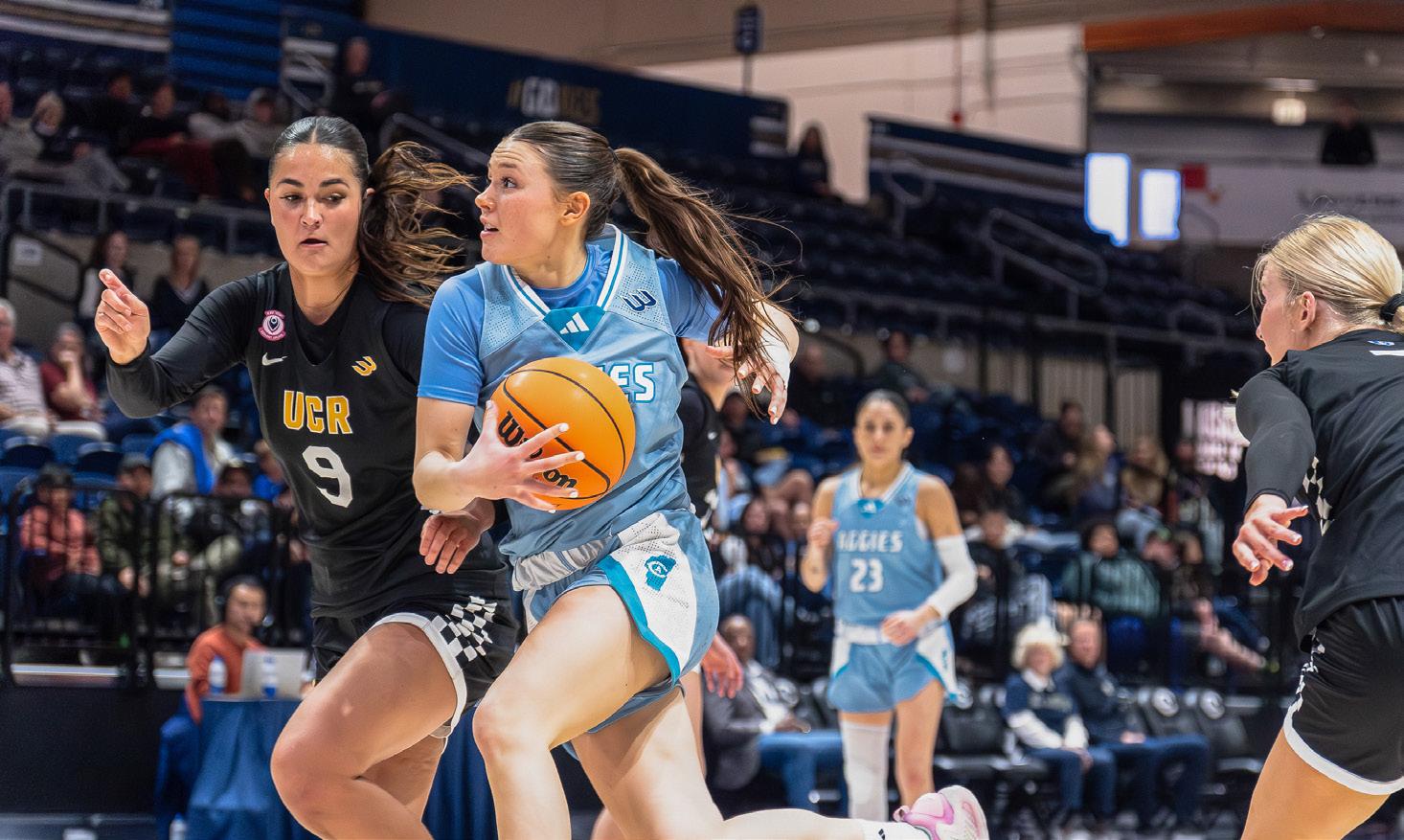
BY COLINA HARVEY sports@theaggie.org
The season for the UC Davis women’s basketball team is winding down, with only one more regular season game remaining. The team just recently earned its 20th win, marking three seasons in a row where they have won 20 or more games. They currently hold the second-best conference record in the Big West and are on a fivegame winning streak. The Aggies are aiming to finish the season strong and make a statement in the postseason.
On Feb. 12, the Aggies played UC San Diego (UCSD) Tritons at home. At the time, UCSD held the top spot in the Big West, boasting a 12-1 conference record. Their only conference loss was on Jan. 22 against the Aggies.
“We had a little bit of pressure on us,” Sahana Kanagasabay, a third-year human development major, said. “You know, we’re the team that was able to beat [UCSD]. So I think coming in, we all were just super hyping ourselves up and really focusing on what exactly led us to success the first time.”
In the first quarter, the Tritons came out strong, leading by seven points. However, the Aggies did not let them run away with the lead, lowering the deficit to one point by the end of the quarter. In the second quarter, the Aggies stayed tight with the Tritons until UCSD went on a six-point run in the last two minutes, ending the half with a six-point lead.
The Tritons built on their
lead in the third quarter, scoring a lot of points in the paint and creating a 13-point lead — the largest of the game.
The Aggies fought to come back, with Avery Sussex, a second-year undeclared program major, leading the effort. A layup followed by back-to-back 3-pointers by Sussex reduced the Triton lead to seven points. A buzzer-beating 3-pointer from Nya Epps, a fourth-year communication major, closed out the quarter, leaving the Aggies trailing by five points.
In the fourth quarter, a layup by Victoria Baker, a fifth-year sociology major, and a 3-pointer by Sussex tied the game up at 5050. The two teams traded baskets to tie the game again at 57-57, with 38 seconds to go. Epps attempted a layup for the lead with seven seconds to go, but was blocked. UCSD tried to go for a layup to win the game, but also missed, sending the game to overtime. The start of overtime was looking bleak for the Aggies; they turned over the ball on their first possession and then allowed the Tritons to go on a 6-point run. However, UCSD started missing shots, and a layup by Baker — followed by a 3-pointer by Epps — tied the game up once again. With the game tied at 65-65, Megan Norris, a fifthyear political science major, had the chance to lay it in and win the game. However, she was not able to capitalize, sending the game to double overtime.
In double overtime, both teams were playing aggressively and making shots. With less than a minute to go, the Aggies held a one-point lead. However, a
foul by UC Davis — with 14 seconds left — allowed UCSD to tie the game up by making one out of two free throws. The Aggies had the last possession, but were unable to get a shot off, sending the game to triple overtime for the first time in program history.
“Fatigue was coming into play, but I think we just had so much drive as a team,” Kanagasabay said. “Every time we kept going into overtime, it was kind of the mentality of like, ‘We’ve gotten this far, this is kind of our win. We’re not losing this now,’ and that’s what our Coach [Jennifer Gross] kept reiterating during the time outs.” In triple overtime, the score stayed close once again. With less than a minute to go, Sussex made a stellar 3-pointer to put the Aggies ahead by three. With 34 seconds left, UCSD missed a 3-pointer and Norris secured the rebound. The Tritons resorted to fouling the Aggies for a chance to catch up, but Ryann Bennett, a second-year psychology major, netted both free throws, sealing the win for the Aggies. The final score was 88-80, and the game was one of the Aggies’ biggest wins of the season.

Enter digits from 1 to 9 into the blank spaces. Every row, column and 3x3 square must contain each digit. Each Sudoku has a unique solution that can be reached logically without guessing.
Answer to previous

PAGE 1
The settlement reinforced the rights of Jews and of those who ascribe to Zionism. It also paid out $6.45 million, with some of the money going to Zionist organisations, including the Anti-Defamation League and the Orthodox Union Jewish Learning Initiative on Campus.
UCLA Vice Chancellor for strategic communications Mary Osako said in a statement that the school is committed to combatting antisemitism and has implemented new measures and policies to that effect. They include a new Initiative to Combat Antisemitism, the hiring of an Associate Vice Chancellor for Campus and Community Safety and reorganizations to their Civil Rights Office.
“As Chancellor [Julio] Frenk has made clear: Antisemitism is abhorrent and has no place at UCLA or anywhere,” Osako said. “Under his leadership, UCLA has taken concrete and significant steps to strengthen campus safety, enforce policies, and combat antisemitism in a systemic and sustained manner.”
The statement continued, reasserting that UCLA will stand by and defend its work against antisemitism.
“We stand firmly by the decisive actions we have taken to combat antisemitism in all its forms, and we will vigorously defend our efforts and our unwavering commitment to providing a safe, inclusive environment for all members of our community,” Osako said
FROM PAGE 12
ordinance which allows for up to five safe parking sites to be operated, the organization has big plans to keep growing the program.
Heart of Davis president, Zatz, explained their upcoming plans to expand.
“We are currently developing plans to open a second site,” said Zatz. “Potentially targeting students who, due to financial or other reasons, are living in their vehicles for all or part of the week in order to attend classes.”
Providing resources for students that allow them to have a place to sleep while still prioritizing school can aid in removing tremendous stress from those students’ lives.
UC Davis fourth-year and political science major, William Ryder, explains his take on the importance of this program.
“I think this safe parking program is an important step to finding permanent housing solutions for Davis residents and UC Davis students that need it,” said Ryder. “Housing should be a basic right so I’m happy to see a Davis organization implement a program that keeps people from being criminalized for being homeless.”
The safe parking program has plans to continue to grow and expand to help more of the unhoused population in the Davis community. To find resources, volunteer opportunities or more check out Heart of Davis’ website.
“There are a lot of students who just want to kind of pledge so that they can continue to support us,” Alarcon said. “But we do have a good handful of people who do get involved and start volunteering and interning with us.
Alarcon also emphasized the significance of smaller-scale education in advocacy.
“A large portion of it is a win, just being able to help educate people and let them
know that there are issues, there are solutions, there are people who care and that there is some way to work towards a solution,” Alarcon said.
“The UC is so large that if a message gets sent to the UC administration, in this gigantic system, that actually shows that faculty can express their preference to divest from state violence,” Chaganti said.
Two years after the Palestine solidarity encampment, faculty involved in the campaign want to carry on the work of students by getting faculty organized.
“I am really, really dedicated to the idea of students and instructional worker solidarity on campus,” Chaganti said. “The more faculty do it, the more they have to start thinking about where the concept of the divestment campaign comes from. Where does that sit in relation to other movements that have happened on campus and other ways that students and other populations on campus have expressed the need for the campus to reflect their ethics as appropriately as possible?”
Senator Luis Garcia also advocated for the funding of the ASUCD Awards Ceremony, recognizing outstanding volunteers and ASUCD employees for their work. Award funding was excluded from the prospective budget and debated over until the very end of budget hearings, at which point it was added.
Garcia also proposed funding for the associate director of communications, a position in the Executive Office. The role currently exists in the Executive Office but is unfilled and was thus not included in the 20262027 prospective budget.

The role was not kept after discussion, with Julka expressing concerns over the optics of paying for additional student government staffers amid cuts to units and other services.
“We saw some units yesterday that we were very, very critical of, who provide basic needs services, and it’s all over money,” Julka said of approving budget cuts. “But then here we are adding a position, and this isn’t even something the Executive Office wanted, but this is now how this makes us look.”
Garcia’s continued advocacy for the position also drew questions from fellow members of the table about his future plans for office and a possible campaign for ASUCD President.
“Luis, for full transparency, do you have any intention to be in the Executive Office in the next term?” Senator Aaron Heth said.
Garcia declined to answer the question.
In non-student government matters, The Pantry requested more funding and received an additional $3,900 to go toward funding repair and maintenance, services rendered and supplies and materials. Those line items were originally allocated $300, $400 and $151,000, respectively.
Disclaimer: The California Aggie is a unit of ASUCD but is managed independently and retains editorial control. It was subject to the same 10% cut affecting other units in the Association and had its budget approved during the hearings.
She drew something with barbed wire and a flag. It’s pretty impressive that her parents or school taught her something about the Japanese internment because they didn’t have to. She actually already had some of the basic facts in her brain, and she made a poster for me.”
Fong concluded by emphasizing the importance of community.
“We did the poster contest to encourage kids to think that they have a role in this whole thing, and also to encourage them to come attend,” Fong said. “We want to continue to develop a sense of community and show that the protest is broad-based and that people are not going to let this country go under [Donald] Trump.”
“I’d say it’s [the band’s] most core stuff, honestly,” Chabon said. “It’s just four songs, and
we’re really proud of them.” Chabon added that it took a while for the band to get to their distinct sound, describing it as “[The] Backseat Lovers meets Franz Ferdinand.”
“The band is a compromise between everything that [the three of us] do, and the product is something that is as unique to us as it is strange,” HuhndorfLima said.
Regarding The California Aggie’s upcoming Couch Concert, all three band members emphasized how critical it is that the music scene interacts with ASUCD institutions and campus groups.
“I think any opportunity for UC Davis to collaborate with local bands is very important to keeping that culture alive here in Davis,” Harris said.
The Couch Concert is set for March 12, with doors opening at 6 p.m. and music starting at 6:30 p.m. Local bands Budget Cut and Nineteenth Operator will also be performing before and after Love, Georgie’s set, respectively.
“Not only are people coming together to play at concerts and listen to music, but UC Davis is backing that kind of community and supporting the arts in a time where it’s easy not to do so,” Chabon said.
Located in The California Aggie’s office at 116 A St., guests are asked to donate $8 to $15 at the door, but no one will be turned away for lack of funds — anyone is welcome to attend the show and let the performances stir up some motivation for finals week.
Nineteenth Operator’s complex and elastic sound is something they hope to continue to pursue and expand upon as an ever-evolving project.
“This is what we want to do,” Albano said. “It’s a multifaceted creative work and the music community is really lovely. We’re just trying to take it bigger and see how far we can take it.”
For more information on the duo’s upcoming performances, you can find updates via their Instagram, @ nineteenthoperator. If you want to see Nineteenth Operator live, alongside local bands Budget Cut and Love, Georgie, visit The California Aggie’s Couch Concert on March 12 at 6 p.m.
Guests are asked to donate $8 to $15 at the door, but no one will be turned away for lack of funds.
“I was fortunate to be reached out to about performing, and once I learned more about the mission behind the festival I felt very connected to it,” Fomin said. “As someone currently pursuing a degree through the Graduate School of Management while also being involved in the local music scene for many years, this event feels like a beautiful intersection of communities I care about.” The Davis OWN IT chapter has an upcoming conference this spring quarter. These conferences differ from the annual festival, offering more career-oriented networking for students to learn about leadership and intersectionality through workshops and discussion.
“[The conference] strives to encourage the young women and nonbinary individuals in our community to learn from role models, cultivate new skills and network with fellow peers,” Kim said.
OWN IT Sponsor Board Associate Aashreeti Deo, a first-year economics and computer science double major, encouraged those interested in the festival to look into DWIB, regardless of their background.
“I think it’s important to mention that the range of majors in DWIB is huge, and it’s not only for women who are business or business-adjacent,” Deo said. “I would really recommend giving it a try and being open to something new, even if your major is completely different, because you never know — you might end up enjoying it more than you think.”
“In 2019 when we decided to make and bring our family spice recipes to the market, we didn’t know how and what to do. Slowly and gradually the way became visible and we rolled.” Gupta also expressed her gratitude in being part of the Davis community.
“Being part of the Davis Food Co-op gave us the opportunity to be local, stay local.” Gupta said. In addition to the free samples given out at the event, Co-op members received 10x rewards points on local items from Feb. 15 to Feb. 21, the week prior to the event.
little as five minutes, according to the Anxiety & Depression Association of America. Students looking to try out new ways of exercising outdoors have a host of clubs and sport groups to choose from. UC Davis offers over 40 sports clubs, including archery, baseball, softball, crew, cross country and track, cycling, rugby and more. Davis also offers a variety of recreational sports leagues, including beach and grass volleyball, soccer, tube polo and flag football. For students looking to try hiking, another activity with a host of physical and mental benefits, Outdoor Adventures and the Outdoor Crew provide students with opportunities to get into the great outdoors. Ultimately, exercising outdoors can provide great benefits, and the sunny weather can motivate students to take advantage of the ample opportunities at UC Davis to get active, according to Hill. “I think almost everybody feels more motivated to go outside when it’s warmer and sunnier out, [...] getting that vitamin D from the
said.
At an event supporting children’s literature, the writer shared poems and novel excerpts
By NATALIE SALTER arts@theaggie.org
On the morning of Feb. 24, the UC Davis Mondavi Center was filled to the brim with elementary and middle school students. As they disembarked from their school buses and left the chill of the winter morning for the theater’s interior, each student was handed a journal and pen to write their thoughts about the speaker they had come down to listen to.
That speaker was Children’s Book Author Renée Watson. Watson’s novels focus on issues of race, gender, identity and hope, drawing upon her own childhood and her experiences as an educator and community activist.
Watson’s books have been the subject of immense critical acclaim. Her novel “Piecing Me Together” received a Coretta Scott King Award and a Newbery Honor; likewise, her poetry collection “Black Girl You are Atlas” won a Coretta Scott King Honor.
Her latest middle-grade novel, “All The Blues in the Sky,” received the John Newbery Medal for “the most outstanding contribution to children’s literature.” The novel tells the story of 13-year-old Sage, whose life is struck with grief when her best friend passes away. A story about loss and healing, “All The Blues in the Sky” aims to make difficult conversations surrounding grief and community accessible to a middle-grade audience.
Watson was the star of this year’s “Words Take Wing: Honoring Diversity in Children’s Literature” event, an annual celebration that began in 2005 with the intention of introducing young audiences to a diverse range of stories and perspectives through reading.
The theater was abuzz as the event began. When the lights dimmed, the many groups of young students from
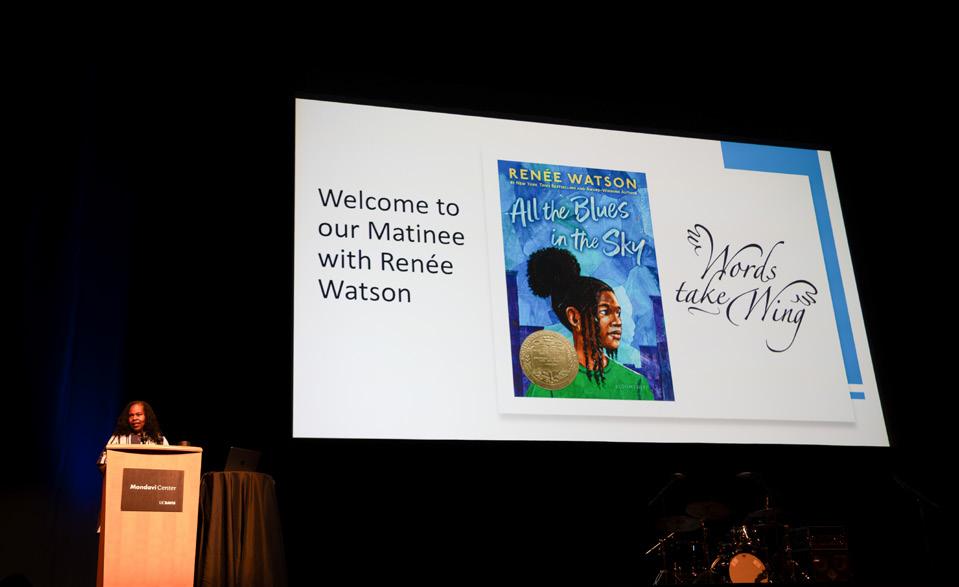
various schools cheered and clapped enthusiastically. Their anticipation was further riled up by an activity in which each school had to cheer for an image of their mascot, a task which they carried out with boisterous energy.
Once she had taken the stage, Watson began the event by reading one of her own poems: a tribute to the different sides of her cultural identity and a reconciliation of the joys and pains alike of each.
“It’s important to hold all of our truths,” Watson said.
Watson then read to the audience selected passages from her novels, beginning with her “Ryan Hart” series and then a segment of “All The Blues in the Sky.” These passages allowed students in the audience to relate Watson’s characters to their own lives and experiences.
The passage Watson read aloud from “All The Blues in the Sky” focused on the ways in which life is often full of highs and lows, which we persevere through nonetheless. The protagonist Sage reflects on the fact that “for all the blues in the sky, there are as many blues in the heart.”
“How do I remain whole in a world that seems like it means to break me?” Watson said.
Her selected passages seemed to answer her question — hope, resilience, community and kindness are ways through which
characters and readers alike can keep going in spite of challenges like loss and self-doubt.
After finishing reading the excerpts of her novels, Watson turned to answering questions from the students in the audience. One fourthgrade student asked how young Watson was when she knew that writing was the passion she wanted to pursue.
“I knew I was going to be an artist when I was in the second grade,” Watson said. “I wrote a 21-page story.”
Though she got her start at a young age, Watson emphasized to the audience that it is not too early or too late to begin chasing their creative dreams.
“You are an artist now,” Watson said. “I want you to own your voice.”
After reading one more of her poems, Watson closed the event with a call-and-response with the audience.
“I have a voice,” Watson said. “My voice is powerful. My voice can change the world.”
It was an impactful note to leave on, reflecting everything Watson imparted to her audience through the event and her writing. For both the children and the adults in the audience alike, the event was a profound reminder that through our hope and creativity, each of us have the power to better ourselves and the world around us.
Employees describe their experiences working in the new shopping center
By GRACIELA TIU features@theaggie.org
Over the past year, the Davis Collection shopping mall on Russell Blvd. has continued expanding, featuring restaurants such as Mendocino Farms, Urban Plates and Shah’s Halal, along with retailers such as Ulta Beauty, Nordstrom Rack and many others. While the UC Davis community has witnessed the shopping center’s progression, student workers have had a unique experience in the center, as many were involved in the opening of the stores themselves.
“I feel like the Davis Collection has more of a community compared to others,” Tiffany Liebelt, a fourthyear human biology major who works at L&L Hawaiian Barbecue, said. “Since we have a small shopping area, I’ve been able to get to know people who work in the other franchises. It’s nice to see a lot of familiar faces while working as well, since our location is right in the center of Davis.”
The Davis Collection offers a diverse blend of shopping and dining opportunities, featuring large and familiar franchises along with smaller, lesser-known locations. Student workers have noticed how this shopping hub feels different from the other communal areas of Davis.
“Working in the Davis Collection feels unique compared to other shopping areas in town because it has a more modern, upscale and community-oriented vibe,” Gabriella Smith, a second-year biological sciences major who works at Fluffy Fluffy Dessert Cafe, said. “The layout is open and walkable, which makes it feel less crowded and more relaxed than downtown.”
The start of 2026 has brought along several new store openings, including places like Paris Banh Mi, Good Friends Hawaiian Poke, Fluffy Fluffy Dessert Cafe and The Old Teahouse. Each grand opening has created a sense of excitement within the Davis community, particularly for the workers in the mall.
Swanson’s promotion follows the retirement of outgoing Fire Chief Joe Tenney
By MADELYN SEVIGNY city@theaggie.org
On Feb. 17, Paul Swanson was sworn in by the Davis City Council as the City of Davis’ new fire chief. Before the ceremony began, Davis Mayor Donna Neville invited outgoing Fire Chief Joe Tenney up to the podium to recognize the work he has done for the Davis Fire Department and to thank him for his 26 years of service to the City of Davis.
Tenney thanked the city council and the community for their support during his 38 total years of service to the city, and noted what he felt was special about being a firefighter.
“There really [aren’t] too many jobs like the firefighter, where they live together, spend a lot of time together,” Tenney said. “They go on the most difficult calls and they go on the most rewarding calls as they help other people. [...] It’s not about us, it’s about how we serve those in the community.”
Tenney joined the Davis Fire Department in 2000 and was promoted to chief in 2019. During his time as fire chief, Tenney responded to multiple major incidents across California, including the 2020 Sonoma-Lake-Napa Unit (LNU) Complex fires in Yolo and Solano counties and the 2021 Caldor Fire.
Later in the meeting, Swanson was brought up to the podium to be sworn in, with his son, Evan Swanson, performing the ceremony.
Swanson was appointed Fire Chief by City Manager Daryel Dunston, who explained why he chose Swanson to take over.
“I’ve worked closely with [Swanson] since arriving in Davis, and, truth be told, he was ready to be a fire chief 10 years ago,” Dunston said in a City of Davis press release.
“For [Swanson] to place our community and this department above his professional goals is not only admirable — it is the type of person that I want leading the Davis Fire Department into the next generation.”
Swanson has spent his entire

“I like all the buzz we’ve been getting — especially with all of our grand openings happening around the same time — so it’s been really busy lately,” Liebelt said. “It’s also nice to try a lot of the new food that I’ve never had before.”
The close proximity of the Davis Collection to campus brings a familiar crowd of customers to the plaza, as students of all grade levels come together to study, eat, shop and socialize. Student workers discussed the lighthearted dynamic of seeing people they know while at work.
“I do run into some of my friends while working,” Madison Fontanilla, a secondyear neurobiology, physiology and behavior major who works at The Old Teahouse, said.
“Because the plaza is super close to campus, I often encourage some of my friends to stop by to grab a sweet treat or snack and study in our store. I like how this plaza is close to campus because it creates a very lively environment.” Liebelt had a similarly positive experience of loved ones stopping by her store, explaining how seeing friends and classmates can blur the line between work and social life.
“I honestly see someone I know or a friend at least once every shift I have,” Liebelt said.
“It’s honestly so nice because it’s a relief, and I forget that I’m actually at work. I also get sort of a dopamine boost and have more energy once I see familiar faces step into my workplace.”
The Davis Collection’s opening has created a noticeable number of job opportunities for students. Instead of working downtown or on campus,
students have noted seeing more options available for work.
“I definitely think it has created a lot of job opportunities for students,” Liebelt said. “I believe about 75% of people I’ve met at all the new shops are students, and it’s honestly refreshing to see many familiar faces.”
Some of the most rewarding experiences in the workplace can be the relationships one builds with their coworkers, according to Smith. Because many employees at the Davis Collection are students, she described how they already have baseline similarities that help foster work connections.
“Most of my coworkers also go to UC Davis, which makes the workplace dynamic feel really comfortable and relatable,” Smith said. “Since we’re all balancing classes, assignments and work shifts, there’s a shared understanding of what everyone is going through. We’ll talk about our majors, difficult exams, registration stress or even just complain about midterms together.”
The benefits of the community within the plaza continue beyond each individual store. Students note how working in the Davis Collection allows them special discounts, not only for their location but also for the rest of the center’s retailers.
“One of the biggest perks of working at my store is that we get employee discounts at not only my store, but the other restaurants and stores also provide plaza discounts,” Fontanilla said. “That way, I save money while also still fulfilling my cravings.”
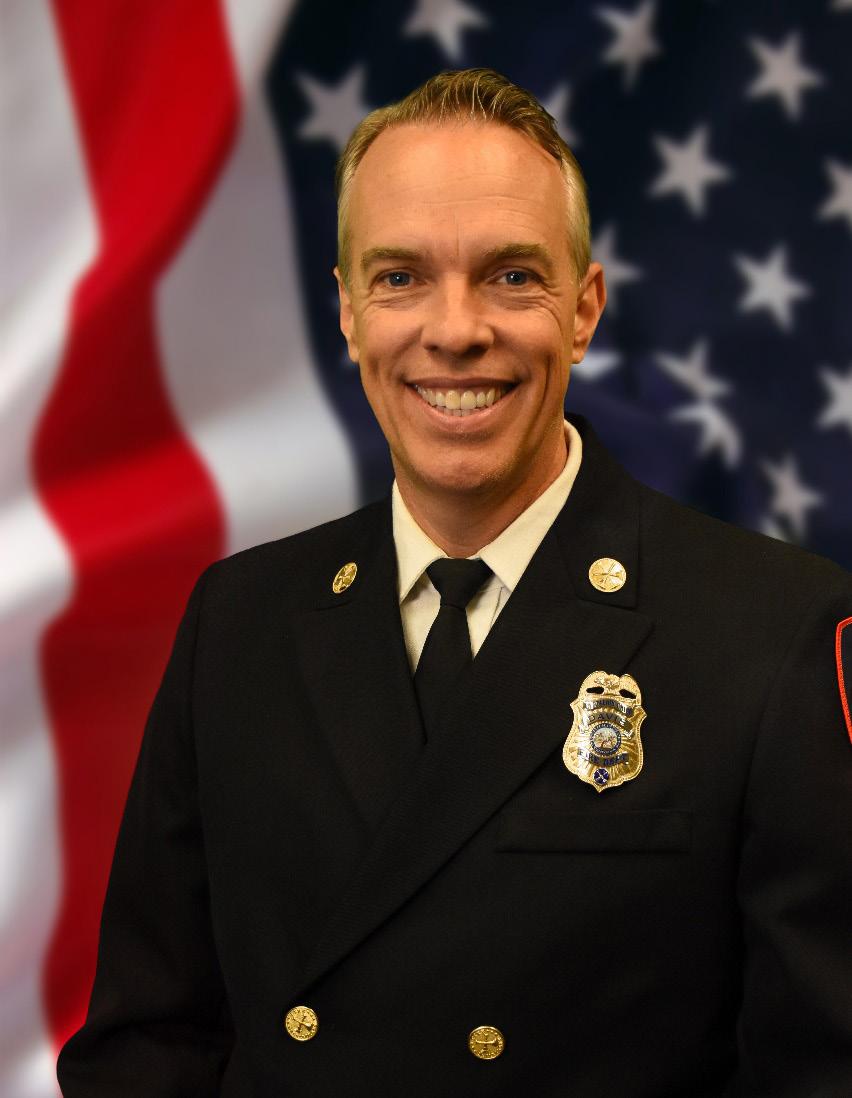
service career within the Davis
Fire Department. He began as a volunteer firefighter in 1993 and became full-time in 1996.
He was promoted to captain in 2007 and division chief in 2012, according to the City of Davis website.
Swanson grew up in Davis and noted how his time spent in the community will assist him in his new role.
“Knowing where everything is here, having experienced a lot, having family here and friends, and a lot of connections to people in town I think definitely helps,” Swanson said. “Especially with planning for things and having a lot of experience dealing with emergencies actually in town helps with the next one that happens.”
Bob Dunning, a Davis journalist, expressed support for Swanson being chosen for the fire chief position in his column on Substack.
“Paul Swanson grew up in Davis, went to Davis schools and is raising his family here,” Dunning wrote in his column. “He knows the people of our
unique and sometimes crazy town and understands where Davis has been and how it has evolved over the years. His knowledge of Davis, along with his intellect, his kindness, his concern for the safety of every Davis resident and his handson approach to everything that comes his way, not to mention his firefighting skills, will serve us well.”
Swanson noted his gratitude for the community’s support at his swearing in ceremony.
“I had my family there and a lot of support,” Swanson said. “My son was able to do the swearing in, which was a neat experience. [...] So just having a lot of family but also community support meant a lot to me.” Swanson also spoke about his eagerness to take on the new role and his passion for serving the City of Davis.
“[I am] excited about the new role and everything that’s gonna come,” Swanson said. “I love Davis. I’ve been here all my life, and can’t wait to serve in this new capacity.”
Students recommend recreational sports and time outdoors, emphasize the health benefits of exercise
BY AMBER WARNKE features@theaggie.org
With the recent turn from rainy, cold weather to days of sunshine and blue skies, many students have taken advantage of the warmth to engage in more outdoor exercise. While all forms of exercise have substantial benefits, outdoor exercise can be particularly impactful; “Green exercise,” or any exercise activity done outside, not only benefits the body physically, but also lowers cortisol levels, a common stress hormone. Green exercise also leads to improvements in self-esteem and mood, with even brief exercises having beneficial effects, according to a study conducted by the University of Essex.
Hunter Boyenga, a fourthyear design and history double major, experienced these effects firsthand, having been a part of the Cross Country / Track and Field Club at UC Davis since his first year. Boyenga is now the club president; he noted that spending time exercising outdoors has helped him find balance as a busy college student.
“[Outdoor exercise] serves as a vital reset button in the middle of a hectic academic schedule,” Boyenga said. “Last week, one of our members, Edward Phillippi, spontaneously led us to go see some goats during our run. It was a fun, lighthearted break from the pressure of classes and a perfect example of how the club keeps us grounded.”
Boyenga also explained that the change in weather has made a major difference in the club’s turnout, encouraging members to get more active.
“The last few months have been tough, with many of our track workouts taking place in the rain and biting cold,” Boyenga said. “Now that the weather is turning, we’re seeing a surge in attendance. It’s definitely easier to find that spark of motivation when it’s sunny, and it feels like the perfect time for everyone to get active again.”
Derrick Lapurga, a fourthyear design major, has similarly found the rainy weather to be
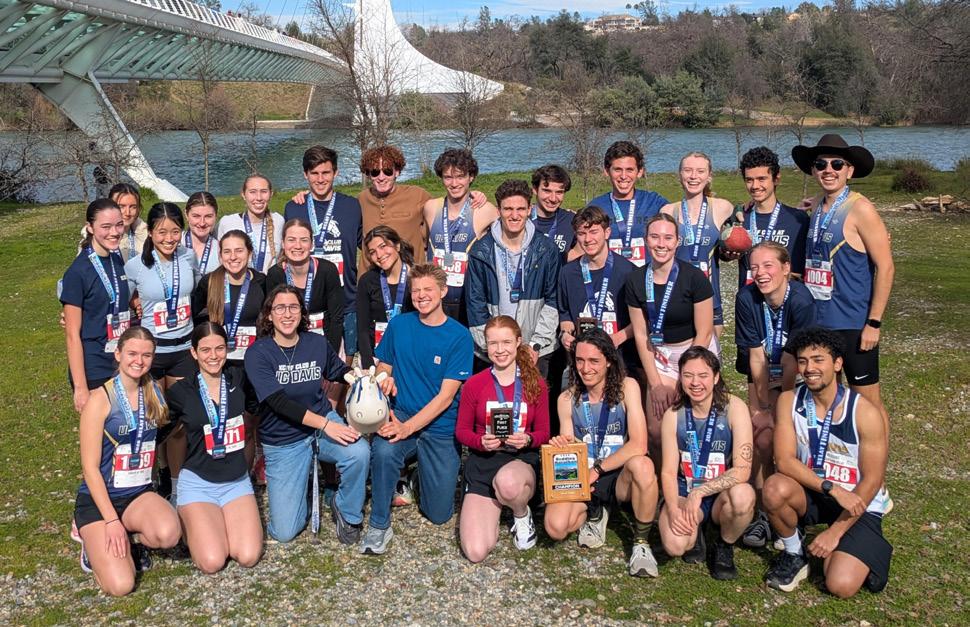
a hurdle to his tennis practices.
“When it rains, the wet court floors make it so that the balls won’t bounce,” Lapurga said. “Strong winds also can affect the play. While the ball is in the air, the wind can carry the ball in one direction or another.”
For these reasons, Lapurga looks forward to the sunny months ahead.
“The warmer weather and sunnier days does give me more energy and more pep in my step,” Lapurga said. Sunlight, clear skies and warm weather correlate to higher mood, energy levels and attentiveness, according to Healthline. Cold weather, on the other hand, can signal your body to rest; thus, it is no wonder that students feel an increase in their
vivacity as the rain has turned to sun in the past few weeks. Taking advantage of the weather as a natural motivator to go outside can be a great way to regulate mental health, and doesn’t have to be as intensive for everyone as joining a high-commitment club, according to Clarissa Hill, a fourth-year art studio and psychology major. “I think going outside, especially being active outside — not even necessarily running but walking, biking — is really important to your mental health,” Hill said. Even just a 10-minute walk, or one passing period, can increase mood, with antianxiety effects appearing in as

Attendees are invited to explore the gallery’s history through a variety of works
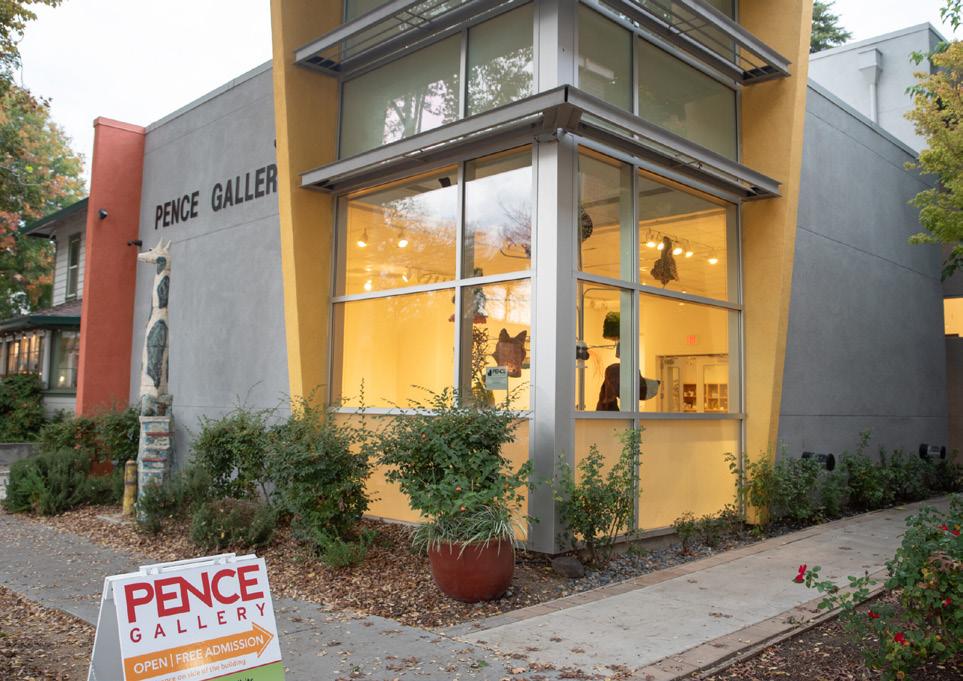
BY JONAH BERMAN arts@ucdavis.edu
On Feb. 21, the Pence Gallery opened its exhibit, “50 Years at the Pence: A Visual History.” Running until March 1, the exhibit commemorates
five decades of the Pence’s development, from a small and fledgling gallery to the community mainstay it is today.
Always free to the public, the Pence opened in 1976 in the former dental office of Dr. Joseph Pence, who donated both the land and the building on 212 D St. to the City of Davis in 1968. Natalie Nelson, director of the Pence Gallery, remarked on the institution’s humble origins.
“The original building was one-sixth of the size of what we’re currently at,” Nelson said. “It was old, World War II-era. It was a temporary structure, really.”
After multiple fundraising periods, the gallery’s main building was rebuilt and
expanded at the same location in 2004. Nelson joined one year later.
“It’s changed a lot since then, obviously,” Nelson said. “It’s grown tremendously.”
The exhibition spans a wide array of media, tracing the history of the Pence Gallery through decades of donated works and archived artifacts.
“I want to show how we connect to people through art,” Nelson said. “I hope [attendees] have an appreciation for how far we’ve come.”
The show explores the full history of the Pence, and even includes artwork from its very first exhibit, such as a lithograph of a dentist who resembles Dr. Pence himself. The show is not the first to
celebrate a milestone in the Pence’s history; it includes a colored pencil drawing of a reception from the Pence’s 10th anniversary, in addition to “birthday cards” crafted by local artists in 1996 to commemorate the Pence’s 20th anniversary.
Within the wide range of represented artists, the illustrations of Davis locals such as Pete Scully, Yan Nascimbene and Heidi Bekebrede are also prominently featured.
Throughout its years, the Pence has cultivated a flourishing and symbiotic relationship with a variety of local artists, highlighted by Davis Resident Janice Purnell.
“It’s a vibrant place — it’s a go-to place on the second Friday of each month,” Purnell
said. “I’m so glad that it’s lasted 50 years. They’ve got the community’s support and they’ve got the artists’ support.”
The show also includes work from UC Davis arts faculty, such as the late Wayne Thiebaud and Seymour Howard, who both taught in the Arts Department for multiple decades.

‘Backstory: Digitizing the Museum Collection’ explores the relationship between the Manetti Shrem Museum and its audience
The museum’s newest exhibition details the digitization process that aims to make the museum’s collection more accessible
BY JULIE HUANG arts@theaggie.org
On view from Jan. 21 to May 2, “Backstory: Digitizing the Museum Collection” will be open to the public at the Jan Shrem and Maria Manetti Shrem Museum of Art this winter quarter.
Co-curated and developed by Manetti Shrem’s Deputy Director Randy Roberts and Associate Curator for Collection
Digitization Jez Flores-García, the exhibition aims to open a window for the viewing public to observe the essential processes of collections management.
“Backstory” is a behindthe-scenes look into how the Manetti Shrem maintains and organizes its extensive collection of fine art, including pieces that were previously kept out of the public eye.
“We are in the process of digitizing our collection to make it more accessible, so you’ll be
able to access all the information and images online,” Roberts said.
“We thought that while we were doing that, we could make the process transparent for people to see how it all works.”
The exhibition is designed to both engage the public and spread awareness of the Manetti Shrem’s digitization project as the museum approaches its 10th anniversary.
Roberts and Flores-García worked with UC Davis students enrolled in the Fall 2025

Exhibition Practicum course.
This partnership brought a new perspective to the creation of the exhibition through student involvement.
Students in the course suggested that Flores-García and Roberts integrate collection circles — originally a private system of categorization — into the public structure of the exhibition. Consisting of five different categories, collection circles mark how closely a piece of art is tied to UC Davis and guide audience members on how to think about their experience.
Circle one pertains to artworks made by past or current UC Davis faculty — notable examples include Robert Arneson, the creator of the UC Davis Eggheads, and still-life painter Wayne Thiebaud. The Manetti Shrem’s ability to house pieces with direct ties to the history of the UC Davis Art Department sets it apart from other museums.
“This is not common to museums, but something very special to Davis,” Flores-García said. “When you think about
our first generation faculty, you’re thinking about the first professors who taught in the Art Department.”
The second circle consists of artworks made by current or past Master of Fine Arts students at UC Davis, while the third circle contains artworks made by visiting artists who taught on the campus.
Furthest from the nucleus of UC Davis activity, the fourth and fifth circles contain art made by 20th, 21st and pre20th century artists, creating a collection that spans hundreds of years.
“This is a whole conversation across time and place,” FloresGarcía said.
Farther into the exhibition is the designated staging and working area, where visitors are invited to peer into the process of documenting and photographing the museum’s artworks as they are transferred in and out of storage from the exhibition area to the digitization laboratory.
Full of filing cabinets — with one central cabinet in
the middle of the room
the working area is structured in the same fashion as museum storage areas that normally go unseen by visitors.
“This part of the exhibition is what the word ‘Backstory’ in the exhibit’s title is referencing,” Roberts said. “This is where we’re circulating art that we’re going to be photographing. Everything here will be switched out every two weeks.”
The hanging artwork on the walls serves a dual purpose. Visually captivating, they hold aesthetic appeal for visitors, while also serving as a convenient method of storage as they wait their turn to be photographed and documented, according to Roberts.



— including the half marathon, 10K and 5K race.
businesses opportunities to come out and get some exposure,”
The artist discussed her solo-show — rich with natural forms and personal imagery

BY BELLA PETERSON arts@theaggie.org BY PIPER AWEEKA
On Sunday, Feb. 22, bystanders and race participants alike flocked to Playfields Park by Pole Line Road for the 2026 Davis Stampede run. The air was chilly as volunteers began corralling racers beneath a black and red banner that read “Start” and “Finish.” As the clock struck
8 a.m., the first round of racers took off for the 43rd annual event.
Courtney Cardenas, the resident announcer for each race — owned by A Change of Pace, the management company — took a break from the microphone to highlight his role as announcer for the yearly event.
“I’m a professional race announcer,” Cardenas said. “I’ve been doing it for probably 12 to 14 years. I’m comfortable in front of a camera [and] in front of a crowd. People will see me, hear me, and they’re like, ‘All right, we like this guy.’” Cardenas remarked on the community support for the Stampede.
“It’s gradually grown over and over again each year,” Cardenas said. “I want to say there’s over 4,000 people racing here today.”
Each year since 1983, the Stampede run, held in Davis, has consisted of various divisions
Dave Miramontes, the director, owner and founder of A Change of Pace, discussed the origins of his company.
“We started A Change of Pace back in 1988,” Miramontes said. “We moved it from Southern California over here because my father was sick. We brought everything and planted it in Davis [...] We started with the Turkey Trot, and then we took this race over probably about eight years in.”
Maya Miramontes, site manager and daughter of the company’s founder, illustrated how the family-run business has expanded over the years.
“Me, my siblings and extended family have been volunteering at these events probably since I was about 10 or 12,” Maya Miramontes said. “We now actually own five Davis events. This includes the Davis Stampede, The Lucky Run, the Davis Moonlight Run, the Labor Day Run and the Davis Turkey Trot, which is the biggest one of the year.”
Each Davis race managed by A Change of Pace prioritizes promoting community health as the company’s goal, as advertised on their website.
Maya Miramontes described the vital role of volunteers and vendors in contributing to the event’s continued success.
“We try to really offer local
Maya Miramontes said. “A lot of our volunteers are fundraising groups [...] They get to be on the course, cheer people along and bring a lot of energy. It’s a lot of positivity.”
Adjacent to a blue photo backdrop was one such vendor at this year’s Stampede, with lettering across the top of a tent that read “Cancer Champions.”
Founded by Jen Miramontes, wife of Dave Miramontes, Cancer Champions supports patients and survivors at all points of their journeys.
Nancy Ledesma, the nonprofit’s chief people officer, described the ongoing healthoriented partnership between Cancer Champions and A Change of Pace.


John Natsoulas Gallery’s newest exhibition “Migration” incorporates the personal experiences of Sacramento-based artist Laurelin Gilmore with organic imagery found in nature.
“I’ve always felt we can learn most of what we need by paying close attention to the natural world,” Laurelin Gilmore said, as noted in the exhibition’s wall text. “Our seasons stretch over the course of a life, and those too dictate our movements.”
A standout trait of the exhibition, which opened on Feb. 13, is the personal relationships depicted in each of Gilmore’s paintings. The exhibition utilizes imagery of birds, which came from Gilmore’s complex emotions surrounding her daughter’s passage through life and into college.
“I was working through the feelings of empty nesting with my kid having left for college; it can be deeply painful, terrifying and hopeful all at once, but it’s a natural part of life,” Gilmore said. “I started to paint her as this bird off on her own finding her
place in the world, envisioning her on the adventure of life as something beautiful. It got me thinking about the natural instinct to move that so many animals on the planet share.”
Gilmore’s piece, “Regrown” (2025), encapsulates the thematic approach she took to the exhibition as a whole. The painting depicts her daughter in youth, adorned by a pair of feathered wings, sitting atop a log with surrounding vegetation that further emphasizes the painting’s focal figure: that her daughter is a hybrid creature — simultaneously a bird and a human child.
“Birds obviously migrate, but so do elephants, butterflies, whales and lots of other species, including people,” Gilmore said. “Like anything else, we move from scarcity toward abundance, from fear toward safety, sometimes just from a small pond to a bigger pond, and usually in the hope that we’re met with some grace when we arrive. Nature would tell us to get in rhythm with our instinct. I wanted to honor that.”
Gilmore’s oil on wood piece, “See Jay” (2026), presents beautifully amongst the other works of art. With the bird’s human-like eye staring right