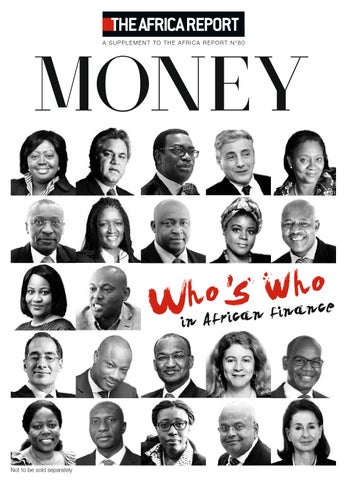
A S U P P LE ME NT TO THE AFR I CA R E PO R T N째80
MONEY
Not to be sold separately
Rooted in Africa, Driven by diversity Our multicultural character, diverse expertise and strategic location make us a key partner in your growth story. Rated among Africa’s best banks, we have over 175 years of experience that will help you go places.
Together, let's shape our continent’s future. CORPORATE & INSTITUTIONAL BANKING • PRIVATE BANKING & WEALTH MANAGEMENT • INVESTMENT BANKING • PRIVATE EQUITY • CONSULTING
mcbgroup g p.com
COVER CREDITS: ALL RIGHTS RESERVED; SI.SIVA/CORBIS; V.FOURNIER/JA; M.SHOUL FOR JA; D.HUTTON/GETTY IMAGES; G.OLAMIKAN FOR TAR; H. KROG/GETTY IMAGES; KY CHUNG PHOTO; S.DAWSON/GETTY IMAGES; S.CHERKAOUI FOR J.A; L; BONAVENTURE/AFP
editorial
THE AFRICA REPORT | MONEY SUPPLEMENT MAY 2016
BY NIC CHOLAS NORBROOK
CONTENTS
Th he long, hard slo og ahead
03 EDITORIAL The long, hard slog ahead 04 INTERVIEW Akinwumi Adesina The AfDB president tells The Africa Report about the continental bank’s priorities, from agriculture to electricity and infrastructure
W
elcome to a new editorial project from The Africa Report: Money. From the global migrations of bulge-bracket investors to the modest contributions of microfinance, the publication will follow finance as it strengthens Africa’s economies. Marvel, as long-tenor finance builds cities out of mortgages in Nigeria. Wonder, as East African bankers transform cyber dreams into realworld businesses. But understanding the provenance of money, as highlighted by the Panama Papers scandal, can be as critical as seeing what it is used for. Witness South African bankers drop the controversy-hit Gupta family’s accounts like they are hot. Witness Kenyan regulators squirm as the third bank in eight months – Chase Bank – is placed into receivership. This is not an idle, liberal utopia of greater transparency driving better behaviour. Better corporate governance is not just an end in itself – although the moral dimension is there and unarguable. Improved governance will also drive better results, allowing the financial system to do what it should do best, the alchemy of intermediation – taking long-term savings to fund today’s opportunities. As Karim Sadek, a managing director at Egyptian investment fund Qalaa Holdings, tells us, this is where African banks are failing. Having to raise more than $150m to refit a railway, Sadek soon discovered that he had to turn to foreign funders, where he was charged
08 WHO’S WHO Fifty influential African financiers Our run-down of a new generation of bankers and innovators who are staking their claims to Africa’s burgeoning financial markets 20 TOP 100 Africa’s bigest banks and bosses The CEOs and MDs driving change in Africa’s financial institutions 22 VENTURE CAPITAL Waiting for lift-off in Kenya’s ‘Silicon Savannah’ 26 INTERVIEW James Mworia The CEO of Centum Investment on growth potential in Kenya’s health, education and agribusiness sectors
MONEY 5
1
2
3
4
6
7
8
9 10
11 12 13 14 15 16 17 18 19 20 21 22 1 Abiola Bawuah 2 Arif Naqvi 3 Akinwumi Adesina 4 Ahmed Ghazali 5 Arunma Oteh 6 Charles Kié 7 Tshepidi Moremong
8 Clergy Simatyaba 9 Viola Llewellyn 10 Daniel Matjila 11 Chinelo AnohuAmazu 12 Hannington Namara 13 Hisham El Khazindar 14 Segun Agbaje 15 Patrick Njoroge 16 Hela Cheikhrouhou 17 Joshua Oigara 18 Sipho Moyo 19 Oscar Onyema 20 Vera Songwe 21 Pravin Gordhan 22 Zeinab Hashim
a 6% interest rate. “If I had gone to get this money from Kenya, I would have found a 15-year loan in local currency […] but it would have cost me anywhere from 14% to 16%.” African economies need their banks to step up now more than ever. The years ahead will be a tough slog. Though African oil exporters were not the only ones caught out by the fall in commodity prices – witness the recent credit downgrade of Saudi Arabia – many administrations face a serious fiscal crunch. With governments being such large spenders, this downturn will remove a large proportion of the cash circulating in these economies, to say nothing of local banks exposed to the sector. Already, the World Bank reduced its sub-Saharan growth forecast to 3.3%, largely driven by China’s withdrawal from commodity markets. In the last quarter of 2015, China grew at its slowest pace for 25 years. The International Monetary Fund warns of a couple of bumpy years ahead. In January Elmer Funke Kupper, then head of the stock exchange in Australia – a country exposed to China’s commodity appetites – sounded the alarm that the world’s $200trn debt burden risked hurting emerging markets. So it was refreshing to hear such positive thinking, fresh ideas and enthusiasm for African opportunity at the Africa CEO Forum in Abidjan on 21-22 March: Turn inward for growth, use domestic savings and learn to be agile. These are all lessons the delegates exhorted in private and public. We will track their successes and their near misses, right here, in Money. ●
A GROUPE JEUNE AFRIQUE PUBLICATION - 57-BIS, RUE D’AUTEUIL – 75016 PARIS – FRANCE - TEL: (33) 1 44 30 19 60 – FAX: (33) 1 44 30 19 30 - WWW.THEAFRICAREPORT. COM ● CHAIRMAN AND FOUNDER BÉCHIR BEN YAHMED PUBLISHER DANIELLE BEN YAHMED EXECUTIVE PUBLISHER JÉRÔME MILLAN PUBLISHER@THEAFRICAREPORT. COM MARKETING AND DEVELOPMENT ALISON KINGSLEY-HALL ● EDITOR IN CHIEF PATRICK SMITH MANAGING EDITOR NICHOLAS NORBROOK EDITORIAL@ THEAFRICAREPORT.COM ASSISTANT EDITOR CHARLIE HAMILTON ASSOCIATE EDITOR MARSHALL VAN VALEN EDITORIAL ASSISTANT OHENEBA AMA NTI OSEI SUBEDITORS ALISON CULLIFORD, PERRY LEOPARD PROOFREADING KATHLEEN GRAY ● ART DIRECTOR MARC TRENSON DESIGN VALÉRIE OLIVIER (LEAD DESIGNER), CHRISTOPHE CHAUVIN (INFOGRAPHICS) PRODUCTION PHILIPPE MARTIN, CHRISTIAN KASONGO PHOTOGRAPHY PIERANGELIQUE SCHOULER ● SALES SANDRA DROUET TEL: (33) 1 44 30 18 07 – FAX: (33) 1 45 20 09 67 SALES@THEAFRICAREPORT.COM ● ADVERTISING DIFCOM INTERNATIONAL ADVERTISING AND COMMUNICATION AGENCY ADVERTISING@THEAFRICAREPORT.COM ● ADVERTISING DIRECTOR NATHALIE GUILLERY • PRINTER SIEP 77 – FRANCE S U P P L E M E N T TO T H E A F R I C A R E P O R T
●
N° 80
●
M AY 2 0 1 6
3
4
M ONEY
PEOPLE
INTERVIEW
Akinwumi Adesina
President, African Development Bank
We’re tired of being in the dark AfDB president Adesina wants to use the bank to de-risk investments in electricity and agriculture and so help transform the continent’s economies
A
kinwumi Adesina has r is en from being a developmental economist specialised in agricultural finance to agriculture minister of Nigeria, and then to president of the African Development Bank (AfDB) in September 2015. His signature policy as minister was the reform of a fertiliser subsidy, and he injected fresh energy into Nigeria’s green revolution. He is a strategic ally for those who believe Africa’s competitive advantage lies in boosting its agricultural output, given his mantra of “agriculture is a business.” Insiders within the AfDB welcome the new man at the helm. According to one source, who requested anonymity: “He says he wants to be surrounded by the smartest people so that they can shoot down his bad ideas and makehis goodones great.” Adesina has also wielded the axe faster than previous AfDB presidents, and three vice-presidents stepped down at the end of January. Whetherhewillprovetheshotin the arm that the institution needs remains to be seen. What is certain is that many African countries are facing a tough year: from currency collapses to drought and rock-bottom commodity prices.
TAR: How do you think El Niño is going to affect the farmers of Africa? What can the bank do to mitigate those effects? AKINWUMIADESINA:Therehas to be rapidly disbursed funds to allow Africa to adapt very quickly. Climate change impact for us is not in the future, it’s now. I think there are two ways in which this can be done. First and foremost is for the Green Climate Fund and the Global Environmental Facility to actually put aside some money rapidly to allow countries to insure themselves against this kind of environmental shock. The problem is: who pays for insurance? The global community needs to rally around African countries and help them to pay for the insurance through the African Risk Capacity. That will then pay out massive amounts of money to deal with [the effects of El Niño]. The second [way] is [through] individual insurance for farmers, both in terms of livestock insurance and crop insurance – weather index insurance. The Ethiopian government says it is not opening up markets to foreign banks because they are not interested in financing small and medium-sized enterprises (SMEs). Are they right?
CONTINENTAL BANKER 6 February 1960 Born in Nigeria 1998 Began working at the Rockefeller Foundation 2008 Vice-president for the Alliance for a Green Revolution in Africa 2011 Appointed as Nigeria’s agriculture minister 1 September 2015 Took office as president of the AfDB
The point I want to make out of that [concerns] what [Prime Minister Hailemariam Desalegn] says about the SMEs. Today, roughly about 90% of all the businesses you find in Africa are SMEs. For African economies to be more robust, we need to get a lot more financing to them. That is why, at the AfDB, we have continued to make a lot of financing available to them. We provided $1bn of financing to SMEs for trade finance in the last two years. We’ve provided a lot of money to intermediary financial institutions in various countries to be able to on-lend at a lower rate of interest to SMEs. Themainchallengefacingmany SMEs – I would not even put finance at the top of [the list] of their challenges – is a lack of electricity, a lack of energy. Most of them are running on diesel generators, and thereforethecostofdoingbusiness for them is high. We are launching this new deal on energy for Africa to allow Africa to be able to electrify itself completely within 10 years. It makes no sense that Africa continues to be in the dark, and we’ve said we’re tired of being in the dark. That’s why as a bank we are going to invest $12bn in the next five years in the energy sector. We also hope to use different types of instruments to de-risk the energy sector, to be able to leverage anything between $45bn and $50bn into the sector. There is this ongoing conversationabouthowopenaneconomy should be at a particular point in its development... Countries and regions at different stages of development use a different mix of trade policy, financial policy and industrial policy. There’snoonecookie-cuttermodel to development. If you take a look
S U P P L E M E N T TO T H E A F R I C A R E P O R T
●
N° 80
●
M AY 2 0 1 6
PEOPLE
at Asia, all of [the countries] did different mixes of those policies based on what they wanted to do. At the AfDB, our focus is really onanopenAfricanmarketwithout borders. It’s the best that can happen to this continent. If you take a look at the Common Market for EasternandSouthernAfrica,the East African Community and the Southern African Development Community – which plan to open up their markets to each other – it’s about 630 or so million people, right? We’re talking about a trillion-dollar gross domestic product among the 26 countries that are involved. You can imagine if you do that at a wider scale. What that means is that you will have industrial growth engines in different parts of Africa that will produce and specialise and be able to sell in different parts of Africa. Secondly, you will also see that Africa’s exposure to global volatilities on the commodity markets will fall because you are trading a lot more within yourself than you are trading on the outside. Thirdly, it will speed up the financial market integration of Africa because they have to actually sell goods and services all across the continent.
M ONEY
5
ect budget support to provide counter-cyclical financial support to countries. The bank is also supporting countries with balance of payments deficits to be able to smooth that [out]. In addition, the bank will continue to provide technical assistance for countries in terms of better macroeconomic management but also fiscal consolidation. When you are subjected to external shocks, you require a bank like us to actually be with [you] and support [you]. But, as I said, a crisis is always a terrible opportunity to miss. We must look in there and see what needs to change. And what needs to change is more rapid diversification of African economies. ● Interview by Nicholas Norbrook in Sharm el-Sheikh
VINCENT FOURNIER/JA
With weak commodity prices and African currencies losing value, will the bank play a countercyclical role? The bank is already doing that in two ways. First, we are p r o v i d i n g d i r-
CORPORATE AND INVESTMENT BANKING
Only Ecobank gives you The Network Advantage Translate | Transact | Transform
Translating our local knowledge into business opportunity. Transacting swiftly and securely across 36 countries. Transforming Africa’s trade corridors with landmark deals. That’s what we call THE NETWORK ADVANTAGE. For a corporate and investment bank that gives you the network advantage, talk to Ecobank.
ecobank.com
8
M ONEY
WHO’S WHO A
By Mark Anderson, Charlie Hamilton, Nicholas Norbrook, Oheneba Ama Nti Osei, Crystal Orderson and Marshall Van Valen
new generation of bank managers, government officials and tech innovators are shaping Africa’s finance landscape. With rising interest rates in the United States pulling global investors back towards Wall Street and global commodity prices falling, it is ever harder to raise the finance needed to drive development. In these pages, The Africa Report profiles the rising stars and troubled technocrats working on the continent’s opportunities and challenges: from consummate dealmakers like South Africa’s Dennis Tucker to the corporate titans like Ecobank Nigeria’s Charles Kié. We look at pension regulators like Kenya’s Edward Odundo, who are calling for a revolution in the raising of domestic resources. And we turn to those re-jigging Africa’s financial technology, including Mitchell Elegbe: a Nigerian who has created a payments platform that may soon be worth $1bn. There are signs of change coming. With United Kingdom-based Barclays bank having announced its intention to sell off its stake in its Africa group, there is the chance for African banking institutions to steal a march on the competition and take the lead in building more pan-African champions. A new group of African representatives – be they Arunma Oteh at the World Bank or Leslie Maasdorp at the BRICS-backed New Development Bank – are fighting for the continent’s economic development at the world’s premier development finance institutions. With the impact of the commodities crunch in countries like Angola, Mozambique and Zambia, the World Bank and International Monetary Fund are again in high demand. In Nigeria, the newish government in Abuja and finance minister Kemi Adeosun are taking their own advice and launching a massive investment programme while refusing to devalue the naira in order to give the economy a jump start. Watch these pages to see which side of the fight comes out on top and what that means for African countries and their place in the global financial marketplace. ● S U P P L E M E N T TO T H E A F R I C A R E P O R T
●
N° 80
●
M AY 2 0 1 6
FINANCE MINISTRY SOUTH AFRICA
Pravin Gordhan
Protected by pedigree
JASON ALDEN/BLOOMBERG VIA GETTY IMAGES
During Gordhan’s first spell as finance minister, from 2009-2014, The Africa Report asked him whether it was confusing for investors to have so many ministers in charge of the economy. He replied tartly: “Well, when I want to pick up the phone and call the market, can I get through to any one person?” This combative common sense is a hallmark of the chemist turned freedom fighter. He ran the tax office with great aplomb, forcing tax avoiders in the corporate world to pay up. That heritage and credibility is sword and shield in his new fight, trying to force fiscal rectitude on a government keen on appointing cronies into positions of power.
M ONEY
WHO’S WHO
BRVM TOGO
Edoh Kossi Amenounve
ALL RIGHTS RESERVED
Building a better bourse
HARITH GENERAL PARTNERS, SOUTH AFRICA
Tshepo Mahloele Hard work for hard assets
The CEO of South African private-equity fund Harith is currently raising $1.2bn for infrastructure projects. Harith and Mahloele are focusing on attracting funds from Middle Eastern institutional investors. The fund has invested in more than 70 projects across the continent. In 2009, it pumped $30m into Nigeria’s MainOne fibre-optic cable, which is a key infrastructure element for the country's telecoms backbone. Mahloele’s experience at Rand Merchant Bank, the Development Bank of Southern Africa and South Africa’s Public Investment Corporation provide him with the understanding of private and public sector concerns about the large infrastructure projects that the firm backs.
ALL RIGHTS RESERVED
10
ADIB CAPITAL EGYPT
Zeinab Hashim Gulf state conduit
Hashim is at the heart of financing the new Egypt, and the need for cash has rarely been more acute. The post-revolutionary landscape saw an economy in free fall, but it has since stabilised. Now, the watchword is infrastructure, with a large public works programme ordered by President Abdel Fattah al-Sisi. Cairo has turned to the Gulf states to plug budget deficits and to finance projects. Hashim runs ADIB Capital, the investment banking wing of the Abu Dhabi Islamic Bank in Egypt, and is focused on energy and transportation schemes. Previously, she was at the National Bank of Egypt.
ECOBANK NIGERIA CÔTE D'IVOIRE
Charles Kié
From one regional giant to another Kié is aiming to make Ecobank Nigeria one of the country’s top financial institutions. He took over as managing director in January after heading Ecobank’s investment and business banking departments since 2012. AR RT FO The former Citibank employee also ran AD A S Abidjan-based Groupe Banque Atlantique. He plans to use technology to tap into the massive unbanked population.
This Togolese banker has spent his career making regional integration a reality – first as secretary general of the ECOWAS financial regulator and now as the head of the Abidjan-based regional bourse. Growth in Côte d’Ivoire helped the Bourse Régionale des Valeurs Mobilières (BRVM) finish 2015 as the continent’s top stock market performer, with its composite index rising 17.7%. Amenounve has been attracting investors from the region and further afield over the past three years. The listing of NSIA Banque and a round of Ivorian privatisations could boost the bourse and raise the value of transactions towards the goal of €600m ($684m) this year.
10000000 2012
African Guarantee Fund established amongst the Economic Development Stakeholders.
2014
Supported 1000 SMEs. 24,000 jobs created.
2017 Plan
Support 7,000 SMEs. Help create 170,000 jobs.
2019 Plan
Support 8,000 SMEs. Help create 253,000 jobs.
Africa始s growth is our growth. Africa stands as the world始s fastest growing economy and for us to be part of this growth, we work with financial institutions across the continent to support the remarkable efforts of Small and Medium-Sized Enterprises.
WHO’S WHO
PUBLIC INVESTMENT CORPORATION SOUTH AFRICA
ALL RIGHTS RESERVED
M ONEY
Daniel Matjila Enricher of pensions
BANCABC ZAMBIA, ZAMBIA
Clergy Simatyaba
“We’re not going to nickel-anddime it if we really want to eliminate extreme poverty” The former head of Nigeria’s Securities and Exchange Commission Arunma Oteh took up her role as treasurer and vice-president of the World Bank in July 2015. She is taking her experience fighting against Nigerian market abuses and work at the Harvard Institute for International Development to help the World Bank fight poverty.
GTBANK NIGERIA
Segun Agbaje
Creating a pathway to profit So far, Nigeria's economic troubles have not hurt the performance of GTBank. Managing director Segun Agbaje predicts that the bank’s growing loan book and cost-cutting measures at its subsidiaries will deliver a pre-tax profit of N125bn ($627.5m) this year, which would make it one of the country’s most profitable banks. Agbaje is a career GTBank man and has been managing director since 2011. Under Nigeria’s banking regulations, he could take another five years to shape his legacy. D FOR TAR SAA
Group BancABC owes Simatyaba a thing or two. Not only has he worked for the bank in Tanzania and Zambia, but he is also credited with preserving its capital during Zimbabwe’s hyperinflationary period in the 2000s. BancABC Zambia has been pushing modern funding models for mortgages, signing a long-term funding deal in December 2015 with the National Pensions Scheme Authority. When Bob Diamond-backed Atlas Mara bought BancABC Group in 2014, a new chapter opened up for Simatyaba.
DEAN HUTTON/BLOOMBERG VIA GETTY IMAGES
A diamond for Bob ALL RIGHTS RESERVED
12
With more than R1.8trn ($120.2bn) in assets, South Africa’s Public Investment Corporation (PIC) is a major investment force at home and abroad. Chief executive Daniel Matjila already has his eye on a larger stake now that Barclays bank has committed to selling off its shares in its African holdings. While other stateowned enterprises in South Africa are plagued by troubles, the PIC – which invests government pension money – just gets stronger. Matjila has been pushing the fund to invest more in other African countries.
CASABLANCA FINANCE CITY MOROCCO
Najwa El Iraki Building the hub
Charged with heading the business development division of Casablanca Finance City (CFC) – King Mohammed VI’s flagship project to transform Morocco’s commercial capital into one of the continent’s financial centres – the European-educated chartered accountant is helping to draw international investors. She joined CFC in 2010 as a principal adviser, having previously worked for KPMG, Lehman Brothers and Mazars Group. With her help, the CFC is using financial and tax incentives to attract international investors. S U P P L E M E N T TO T H E A F R I C A R E P O R T
●
N° 80
●
M AY 2 0 1 6
WHO’S WHO
M ONEY
On the up
Financiers with a nose for opportunity
Leslie Maasdorp ALLAN GRAY SOUTH AFRICA
Andrew Lapping
Contrary countings 38-year-old Lapping became the chief investment officer of the Allan Gray investment management group last year. The largest such firm in South Africa, it controls more than $35bn in assets. The commodities slump has turned many investors negative on Africa, but Lapping says now is the time to invest while prices of stocks outside of South Africa are lower. The University of Cape Towneducated investment adviser employs a contrarian perspective at Allan Gray, but says he will not rush blindly to invest in mining stocks, for example.
BRICS banker
The South African banker is now vice-president of the New Development Bank.
Mohamed Benchaâboun
Expansionary visions
The president of Morocco’s Banque Centrale Populaire has his eye on Central Africa.
Joshua Oigara
Young, gifted and Kenyan The chief executive of KCB is looking to acquire smaller rivals.
Kayode Akinola Long-term view
The Nigerian leads the Africa team of US private-equity firm KKR.
Patrick Chinamasa Let’s make a deal
Zimbabwe’s finance minister is leading a rapprochement with the IMF and other lenders.
Abdourahmane Cissé A minister who counts
Côte d’Ivoire’s 34-year-old budget minister is overseeing a huge infrastructure spend.
OVAMBA SOLUTIONS CAMEROON
Funeka Montjane
Viola Llewellyn
Standard, but not ordinary
Financial innovator
ALL RIGHTS RESERVED
Cameroonian consultant Llewellyn launched Ovamba Solutions in 2013 as a means to get finance to under-served small and medium-sized enterprises in Francophone countries. Ovamba offers a platform to match lenders and clients, and provides credit rankings for financiers looking to offer loans with a duration of three to six months. It can issue loans of up to 350m CFA francs ($608,000) within seven days of receiving a loan request. Cameroon was the company’s first target, and Ovamba is developing a launch programme for the other countries of Central Africa. US-based chief operating officer Llewellyn is using her skills as a consultant and experience at KPMG and Praxis Management to get money into the hands of growing small companies that face difficulties getting loans from local banks. Ovamba is looking for investors to scale up its operations, and London-based investor GLI Finance bought a 20% stake in the firm for $1.3m in 2014. S U P P L E M E N T TO T H E A F R I C A R E P O R T
●
N° 80
●
M AY 2 0 1 6
Standard Bank’s personal and business banking division chief is rapidly climbing the ranks.
Sanjiv Bhasin Place in the sun
The chief executive of Mauritiusbased AfrAsia Bank is bringing growth to the bank’s bottom line.
Yemi Lalude
Nigerian diaspora ahoy Managing partner Lalude has helped one of the latest US funds TPG – to invest in Africa.
Mark Barnes Delivery service
The former banker is overhauling the Post Office in South Africa.
13
M ONEY
WHO’S WHO
CENTRAL BANK KENYA
Patrick Njoroge President Uhuru Kenyatta appointed Njoroge as governor of the Kenyan central bank in October. Since then, Njorege has not been shy in his efforts to clean up the banking sector. He temporarily banned new banking licences and shut down two lenders for mismanagement. Much has been written in the Kenyan media about the 54 year old, a bachelor who is committed to the Roman Catholic organisation Opus Dei. He lives in a modest communal house in Nairobi’s Loresho Estate and has said that he “doesn’t have a single asset here in Kenya”.
AL AMANA MICROFINANCE MOROCCO
Ahmed Ghazali Man of many hats
Ahmed Ghazali is a lawyer, president of the Moroccan audiovisual regulator, and runs one of the continent’s most dynamic microfinance institutions. Starting out as an association to help small businesses in 1997, Al Amana has become the country’s largest smallscale lender, accounting for nearly 40% of Morocco’s microfinance customers and loans. Al Amana has just scored a €6m IFC loan to expand its activities.
OR
DF
SAA
TAR
INTERSWITCH NIGERIA
Mitchell Elegbe Cashing in on cashless
Big things are in the air at InterSwitch, a Nigerian payment processing platform created in 2002 by Mitchell Elegbe. InterSwitch already operates in five countries and owns debit card brand Verve. In mid2015, Elegbe, who had previously worked at Nigerian IT firm Telnet, announced his intention for an IPO in London and Lagos to allow the company to launch in other African countries. However, Bloomberg reported in February that South African private-equity firm Helios Investment Partners is also preparing to sell its 52% stake in InterSwitch – which it bought for $92m in 2010 – in a deal that would value the company at around $1bn. The deals keep on coming for InterSwitch, and it purchased Nigerian mobile-payments company VANSO in late March. With the central bank pushing for more cashless transactions, InterSwitch is well placed to pick up business.
ALL RIGHTS RESERVED
Pious protector of assets
HALDEN KROG/BLOOMBERG VIA GETTY IMAGES
14
UBA GHANA, GHANA
Abiola Bawuah A profitable presence
With Bawuah’s appointment as managing director of United Bank for Africa (UBA) Ghana in January 2014, she joined three other women who are changing the country’s financial landscape at the helm of banking institutions. At the end of her first year in office, she recorded a stellar 30% increase in profit before tax over the previous year’s ¢125m ($32m), an impressive feat given the cedi’s depreciation. She is also the first Ghanaian and first female to head UBA Ghana, joining in 2013 as deputy managing director. The seasoned banker – who boasts diplomas from Harvard, Columbia, INSEAD and Villa Pierrefeu – previously held management positions at Zenith Bank, Standard Chartered Bank and CAL Bank.
Subscribe online:
theafricareportstore.com
Print edition IS Murderous utopia comes to Africa
• Nigeria The Buhari gamble • South Africa Asleep at the wheel • Tanzania 100 days of rectitude
Rwanda Focus Stepping out of the neighbours’ shadows
• Nigeria: Can Buhari put out Delta blaze? • Kenyatta/Ruto: End of the Bromance • Power: Green energy is the real deal
Digital edition
N ° 7 7 • f e b r u a r y 2 016
w w w.the a f ri c a r e p or t. co m
N ° 7 9 • a p r i l 2 016
w w w.t heaf r ica r ep or t .c om
COMPANIES
2016 EDITION
EXCLUSIVE RANKING
How to thrive in 2016 • Market share up for grabs in great shake-out • Oil companies double down on costs • Cash injection into telecoms infrastructure
GROUPE JEUNE AFRIQUE INTERNATIONAL EDITION
Algeria 550 DA • Angola 600 Kwanza • Austria 4.90 € • Belgium 4.90 € • Canada 6.95 CAN$ • Denmark 60 DK • Ethiopia 75 Birr • France 4.90 € Germany 4.90 € • Ghana 7 GH¢ • Italy 4.90 € • Kenya 410 shillings • Liberia $LD 300 • Morocco 40 DH • Netherlands 4.90 € • Nigeria 600 naira Norway 60 NK • Portugal 4.90 € • Sierra Leone LE 12,000 • South Africa 35 rand (tax incl.) • Spain 4.90 € • Switzerland 9.90 FS • Tanzania 9,000 shillings Tunisia 5.4 DT • Uganda 9,000 shillings • UK £ 4.50 • United States US$ 6.95 • Zambia 30 ZMW • Zimbabwe US$ 4 • CFA Countries 3,000 F CFA
• Ghana/Côte d’Ivoire Growth engines • Lagos Maximum City • African Union Candidate games
Africans investing in Africa
N ° 7 8 • M A R C H 2 016
w w w.t he a f r i c a r e po r t . c o m
The CEOs
who bring it home Think global, invest local: backing continental projects
Growth
After the crash,
the fightback African leaders try economic nationalism to beat the commodity trap
From left to right: Gavin Dalgleish, MD of SA agribusiness ILLOVO Ismaïl Douiri, Co-CEO ATTIJARIWAFA Bank Ade Ayeyemi, Group CEO ECOBANK Tabitha Karanja, Kenyan CEO of Keroche Breweries
GROUPE JEUNE AFRIQUE
INTERNATIONAL EDITION
Algeria 550 DA • Angola 600 Kwanza • Austria 4.90 € • Belgium 4.90 € • Canada 6.95 CAN$ • Denmark 60 DK • Ethiopia 75 Birr • France 4.90 € Germany 4.90 € • Ghana 8 GH¢ • Italy 4.90 € • Kenya 410 shillings • Liberia $LD 300 • Morocco 40 DH • Netherlands 4.90 € • Nigeria 600 naira Norway 60 NK • Portugal 4.90 € • Sierra Leone LE 12,000 • South Africa 40 rand (tax incl.) • Spain 4.90 € • Switzerland 9.90 FS • Tanzania 9,000 shillings Tunisia 5.4 DT • Uganda 9,000 shillings • UK £ 4.50 • United States US$ 6.95 • Zambia 30 ZMW • Zimbabwe US$ 4 • CFA Countries 3,000 F CFA
GROUPE JEUNE AFRIQUE INTERNATIONAL EDITION
Algeria 550 DA • Angola 600 Kwanza • Austria 4.90 € • Belgium 4.90 € • Canada 6.95 CAN$ • Denmark 60 DK • Ethiopia 75 Birr • France 4.90 € Germany 4.90 € • Ghana 8 GH¢ • Italy 4.90 € • Kenya 410 shillings • Liberia $LD 300 • Morocco 40 DH • Netherlands 4.90 € • Nigeria 600 naira Norway 60 NK • Portugal 4.90 € • Sierra Leone LE 12,000 • South Africa 35 rand (tax incl.) • Spain 4.90 € • Switzerland 9.90 FS• Tanzania 9,000 shillings Tunisia 5.4 DT • Uganda 9,000 shillings • UK £ 4.50 • United States US$ 6.95 • Zambia 30 ZMW • Zimbabwe US$ 4 • CFA Countries 3,000 F CFA
Subscribe now!
and understand Africa’s tomorrow…today
YES, I would like to subscribe to THE AFRICA REPORT PAYMENT IN
SUBSCRIPTION ORDER FORM SEND TO: Webscribe Ltd: Unit 8, The Old Silk Mill, Brook Street,
Tring, HP23 5EF United Kingdom Email: subs@webscribe.co.uk - Tel: +44 (0) 1442 820580
! 1 year
Print edition
! 1 year
(10 issues + 1 special issue) Digital edition
(10 issues + 1 special issue)
! 2 years
Print edition
(20 issues + 2 special issues)
! 2 years
Digital edition
(20 issues + 2 special issues)
Euro Zone
UK only
Other countries
€53.90
£49.50
$76.45
€92.07
£79.64
$124.63
€107.80
£99.00
$152.90
€39 €49 €72
€184.14
€99
£35 £43
£65
£159.28
£86
$60 $73
$107
$249.26
$145
! US Dollars ! £ Sterling ! Euros ! Cheque enclosed payable to THE AFRICA REPORT ! Visa ! Mastercard ! Amex N° Expires Last 3 numbers on back ! Send me a receipt of payment PLEASE COMPLETE
! Mr
! Ms
! Mrs
Name..........................................................................................Surname.................................................................................. Address............................................................................................................................................................................................... Zip code...................................................................................City................................................................................................ State ..........................................................................................Country ..................................................................................... Tel. ................................................................................................E-mail ......................................................................................... Date and signature:
Offer valid until 30/06/2016. In accordance with Article 34 of the Information Technology and Freedom law, you have the right to access, modify or delete data concerning you by contacting The Africa Report.
Q2-TAR16
!
M ONEY
WHO’S WHO
Hard times
Bankers and ministers facing a tide of problems
Maria Ramos Pulling out
With Barclays selling off its stake in its Africa group Ramos may be out of work.
Valentina da Luz Guebuza No love lost
Dad, the former Mozambique president, has relinquished power; the family businesses could suffer.
Kornelio Koryom Mayik Weathering a storm
There is little that South Sudan’s finance minister can do to cushion the economy’s collapse.
Philip Mpango
Fighting bossy barons Tanzania’s finance minister faces a backlash from the government’s anti-corruption campaign.
ABRA AJ PAKISTAN
Arif Naqvi Patient capitalist
One of the most aggressive privateequity funds investing in Africa, Dubai-based Abraaj raised $1.4bn last year for its African endeavours. Pakistani-born Arif Naqvi is dismissive of the view that Africa is too risky for investment, preferring to rely on local knowledge to develop opportunities. Recent deals include funding a mortgage company in Ghana, exiting panAfrican insurer UAP and investments in Kenyan companies Brookside Dairy and Athi River Cement. Abraaj’s investments in Egypt cemented Naqvi’s reputation: he held on to Integrated Diagnostics Holdings throughout troubled times until the company listed in London in May 2015.
SIDDHARTH SIVA/ARABIANEYE/CORBIS
16
Kemi Adeosun Balancing act
Nigeria’s finance minister must fill a budget deficit and fend off calls for a naira depreciation.
Margaret Mwanakatwe In search of friends
Zambia’s trade minister is looking for new investment to battle low copper prices.
Nazaire Tindjou Falling fast
Tindjou’s CCEI Bank GE (Equatorial Guinea) is haemorrhaging money.
Tabu Abdallah Manirakiza Till’s empty
Falling tax revenue and the suspension of aid complicate things for Burundi’s finance minister.
Mohamed Adan Ibrahim Keeping the country afloat
The Soma oil scandal and the lack of aid are worrying Somalia’s finance minister.
Ridha Zerzeri Tough terrain
The CEO of Arab Tunisian Bank has a difficult task ahead.
“A Green Climate Fund that devotes just a little percentage to Africa would be a failure” Former African Development Bank director for energy and the environment Hela Cheikhrouhou became the executive director of the United Nations-backed Green Climate Fund in 2013. The Tunisian banker will step down from her post this year after raising $10bn and paving the way for the fund’s first green energy projects in Africa. S U P P L E M E N T TO T H E A F R I C A R E P O R T
●
N° 80
●
M AY 2 0 1 6
WHO’S WHO
M ONEY
QINISELE RESOURCES, SOUTH AFRICA
Dennis Tucker Bekalu Zeleke
GBEMIGA OLAMIKAN FOR TAR
Cleaning up after the crash
COMMERCIAL BANK OF ETHIOPIA ETHIOPIA
Dennis Tucker, who founded South African mining advisory company Qinisele Resources in 2007, has been orchestrating deals in the wake of the commodities crash. In 2015 he brokered Sibanye Gold’s purchase of Amplats's Rustenburg operations for $102m plus 35% of distributable free cash flow over six years, and of Aquarius Platinum for $294m. The mines are adjacent and will lead to efficiencies when consolidated.
Addis’s alpha banker
Bekalu Zeleke, who has been president of the stateowned Commercial Bank of Ethiopia (CBE) since 2009, is overseeing its merger with the state-run Construction and Business Bank. The move was completed in April, and the CBE now has 1,170 branches. The bank, which has assets of about $15bn, says it will expand into the UAE and the US. If Ethiopia eventually opens up to foreign banks, Belaku will be kept on his toes at home.
NATIONAL PENSION COMMISSION NIGERIA
Chinelo Anohu-Amazu Fraud-buster for seniors
How to get pension money into infrastructure is keeping Nigeria’s regulator up at nights – a mixture of strict investment guidelines and insurance might be the solution. As the pension commission’s director general since 2012, Anohu-Amazu has been fighting fraud and waste. The country now uses biometrics to stop ‘ghost workers’ from collecting pensions. A lawyer by training, she has been on the pension commission since it was founded in 2004. She still has her work cut out to get a larger share of the $26bn in Nigerian pension money invested in safe but productive sectors of the economy to benefit Nigerians young and old.
EQUITY BANK RWANDA RWANDA
Hannington Namara
PRESIDENCE DE LA REPUBLIQUE FRANÇAISE
Business booster
S U P P L E M E N T TO T H E A F R I C A R E P O R T
●
N° 80
●
M AY 2 0 1 6
Building up business seems to be the watchword for Namara. As head of Rwanda’s Private Sector Federation he created a public-private dialogue that helps mediate conflicts between the two sides. As head of Trade Mark East Africa, he helped connect Rwandan markets to the wider East African Community. Now in charge of Equity Bank Rwanda, a subsidiary of the Kenyan bank, he assumes command of one of Rwanda’s fastest-growing banks, which recorded a 66% rise in pre-tax profits last year. Innovation and customer service will be his calling card, Namara said on taking on the role. SA A
DF
OR
TA R
17
TOM STOCKILL
18
GLOBAL INFRASTRUCTURE PARTNERS NIGERIA
Dollars in the diaspora
One of the top financiers in the diaspora, Ogunlesi is chairman of Global Infrastructure Partners (GIP), – a private-equity fund with more than $15bn in assets – and a lead director of Goldman Sachs. A former law clerk to US Supreme Court justice Thurgood Marshall, he uses his honed analytical skills when scouting for investments, mainly in the US, Europe and Australia.
RAND MERCHANT BANK BOTSWANA
Tshepidi Moremong Investing in Africa
SAAD FO
R TAR
After stints at Goldman Sachs, Aureos Capital, RenCap and Bob Geldof’s 8 Miles Fund, this Botswana-born Columbia Business School graduate was snapped up by Rand Merchant Bank (RMB) to lead its push outside South Africa in 2012. Recently RMB raised financing for a $900m power plant in Ghana and a $800m capex facility for phone towers in Nigeria.
QALA A HOLDINGS EGYPT
Hisham El-Khazindar
Patience wins the prize The only Egyptian in the World Economic Forum’s 2013 class of Young Leaders, El-Khazinder is best known for co-founding Citadel Capital in 2004, a privateequity fund that became Qalaa Holdings. He helped engineer its shift away from private equity towards more long-term bets. Qalaa’s holdings include a stake in Rift Valley Railways, connecting Uganda to the Kenyan coast at Mombasa. It also has invested in Egypt’s largest oil refinery, which is due to come on stream in early 2017. El-Khazindar made his start as an intern at EFG-Hermes.
ALL RIGHTS RESERVED
Adebayo Ogunlesi
AfDB, ZIMBABWE
Sipho Moyo
Making money grow Moyo has vaulted up the leadership of lending institutions and is now chief of staff to AfDB president Akinwumi Adesina. She worked on a US government commission on affordable housing, and led a campaign in 2014 to push African leaders to take agriculture seriously – something that must have endeared her to the new AfDB boss.
WHO’S WHO
M ONEY
INTERNATIONAL FINANCE CORPORATION CAMEROON
Vera Songwe Finance to develop
This United States and Belgium-trained Cameroonian economist is a rising star in the World Bank universe. To reach the next level, she will be criss-crossing 23 African countries. She was named the International Finance Corporation’s director for West and Central Africa in 2015. Prior to that, she was a lead economist, served as the World Bank’s country director for a group of West African countries including Senegal and Mauritania, and worked as an adviser to World Bank managing director Ngozi Okonjo-Iweala. With a doctorate in mathematical economics, she is a fellow at the Brookings Institution’s Africa Growth Initiative. In her new post at the IFC, she will focus on boosting the private sector with targeted investments and she is set to put her experience in agriculture projects to good use.
S U P P L E M E N T TO T H E A F R I C A R E P O R T
●
N° 80
●
M AY 2 0 1 6
Edward Odundo
“One of the things we are looking at is for government to privatise some of its enterprises so that government can easily free up cash”
Investing for the future The long-serving CEO of Kenya’s Retirement Benefits Authority (RBA) has been leading a charge for Africans to save more so that more can be invested locally and reliance on foreign capital reduced. Odundo has led the RBA since 2001 and is also director of the Insurance Regulatory Authority, a post he has held since 2005. Pension contributions only represent about 20% of Kenya’s GDP, whereas they can be more than 100% in countries in the West.
NATIONAL BANK OF EGYPT EGYPT
Hisham Okasha
Growing power
Nigerian Stock Exchange chief executive Oscar Onyema is using the skills learned at the American Stock Exchange and the New York Mercantile Exchange to strengthen his market’s profile and performance. He took up the post in 2011 and had his five-year contract renewed in February. His plans to turn the bourse into a trillion-dollar market have fallen flat due to the drop in oil prices, but Onyema is working on listing depository receipts so that Nigerians can buy international stocks in local currency, and has launched the Alternative Securities Market Board for small companies.
BRUNO LEVY THE AFRICA CEO FORUM
SYLVAIN CHERKAOUI FOR JA
RETIREMENT BENEFITS AUTHORITY KENYA
Under the watch of Hisham Okasha, state-owned National Bank of Egypt (NBE) continues to grow and grow. His goal is to increase all of the bank's major indicators by 10% per year for the next few years through a programme that includes building more data centres and expanding its network of cashpoints. To grow its loan book, the NBE has increased its lending to small businesses more than sixfold from 2008 to reach E£18.5bn ($2bn) in 2015. With experience at the central bank, Okasha says he remains committed to the domestic market. Reaching out to the unbanked population could take the NBE to the next level.
19
20
M ONEY
RANKINGS
Top 100 Africa’s biggest banks and bosses Rank 2015
Rank 2014
CEO or Managing Director
Company
Country
Total assets ($ thousands)
Net profits ($ thousands)
7 249 983
1
1
Sim Tshabalala
Standard Bank Group
South Africa
163 815 926
2
2
Sim Tshabalala & Ben Kruger
Standard Bank of South Africa
South Africa
97 380 704
4 925 812
3
3
Maria Ramos
Barclays Africa Group
South Africa
85 350 831
3 064 890
4
4
Sizwe Nxasana
FirstRand Banking Group
South Africa
81 401 108
2 572 197
5
5
Mike Brown
Nedbank Group
South Africa
69 673 756
3 337 451
6
6
Hisham Okasha
National Bank of Egypt
Egypt
65 649 096
1 171 401
7
7
Mohamed El Kettani
Attijariwafa Bank
Morocco
44 371 575
2 147 642
8
-
Stephen Koseff
Investec Limited
South Africa
40 775 065
471 773
9
9
Mohamed El Etreby
Banque Misr
Egypt
38 262 785
1 242 917
10
8
Mohamed Benchaaboun
Banque Centrale Populaire
Morocco
34 189 345
1 628 364
11
-
James Formby
Rand Merchant Bank
South Africa
33 593 007
ND
12
11
Achour Abboud
Banque Nationale d’Algérie
Algeria
29 691 617
1 009 578
29 366 000
701 000
27 273 740
1 269 499 2 279 881
13
13
Mohamed Loukal
Banque Extérieure d’Algérie
Algeria
14
10
Othman Benjelloun
Banque Marocaine du Commerce Extérieur
Morocco
15
15
Ade Ayeyemi
Ecobank Transnational Incorporated
Togo
24 243 562
16
14
Adesola Kazeem Adeduntan
First Bank of Nigeria
Nigeria
23 580 676
1 324 127
17
12
Jacques Celliers
First National Bank
South Africa
23 387 295
2 609 044
18
16
Peter Amangbo
Zenith Bank
Nigeria
20 391 084
1 121 311
19
19
Hisham Abdul Hafez
Commercial International Bank
Egypt
20 056 206
872 327
20
17
Peter Amangbo
Zenith Bank Nigeria
Nigeria
18 591 337
ND
21
18
Omar Boudieb
Crédit Populaire d’Algérie
Algeria
17 131 560
499 914
22
20
Phillips Oduoza
United Bank for Africa Group
Nigeria
15 000 771
1 045 031
23
22
Mohamed Osman El-Dib
Qatar National Bank Alahli
Egypt
14 688 758
515 561
24
21
Segun Agbaje
Guaranty Trust Bank
Nigeria
12 792 410
773 189
25
-
Phillips Oduoza
United Bank for Africa Nigeria
Nigeria
12 699 999
818 431
26
27
Ato Bekalu Zeleke
Commercial Bank of Ethiopia
Ethiopia
11 874 156
586 893 543 093
27
24
Herbert Wigwe
Access Bank Group
Nigeria
11 426 678
28
23
Sanjay Bhasin*
Banco Económico (Ex-BESA)
Angola
11 328 924
308 012
29
31
Hassan E. Abdalla
Arab African International Bank
Egypt
11 021 198
253 633
30
25
Mário Alberto Barber
Banco Angolano de Investimentos
Angola
10 691 408
359 406
31
29
Uzoma Dozie
Diamond Bank
Nigeria
10 442 560
594 999
32
33
Emídio Pinheiro
Banco de Fomento de Angola
Angola
10 419 378
ND
33
26
Paixão António Júnior*
Banco de Poupança e Crédito
Angola
10 099 214
453 780
Charles Kié
Ecobank Nigeria
Nigeria
9 547 752
965 486
Tariq Sijilmassi
Crédit Agricole du Maroc
Morocco
9 328 136
336 902
9 318 896
455 814
9 312 193
488 648
34
32
35
-
36
28
Khalid Chami
Société Générale Maroc
Morocco
37
30
Mounir El Zahid*
Banque du Caire
Egypt
38
36
Fernando Teles
Banco BIC
Angola
8 116 808
310 547
39
37
Timothy Oguntayo
Skye Bank
Nigeria
7 716 638
343 583
40
40
Brahim Benjelloun-Touimi
Groupe BOA
Senegal
7 369 632
472 373
41
35
Laurent Dupuch
Banque Marocaine p/l Comm. et l’Industrie
Morocco
7 318 051
361 424
42
39
Abdel Hamid Abu Mousa
Faisal Islamic Bank of Egypt
Egypt
6 987 889
240 812
43
41
Antony Withers
The Mauritius Commercial Bank
Mauritius
6 587 779
317 742
44
38
Nnamdi Okonkwo
Fidelity Bank
Nigeria
6 445 546
265 125 394 400
45
42
Ladi Balogun
First City Monument Bank
Nigeria
6 349 651
46
47
Dante Campioni
Bank of Alexandria
Egypt
6 197 894
317 430
47
45
Henri-Claude Oyima
BGFIBank Holding Corp.
Gabon
5 691 799
344 722
48
43
Emeka Emuwa
Union Bank of Nigeria
Nigeria
5 479 723
281 681
49
58
Benedict Oramah
African Export-Import Bank
Egypt
5 452 886
204 000
50
44
Baldoméro Valverde
Crédit du Maroc
5 417 418
230 740
Morocco
2014 RESULTS IN THOUSANDS OF US DOLLARS; *IN ITALICS 2013 RESULTS
S U P P L E M E N T TO T H E A F R I C A R E P O R T
●
N° 80
●
M AY 2 0 1 6
RANKINGS
M ONEY
Each year, The Africa Report publishes an exclusive ranking and analysis of Africa’s top 200 banks – watch out for our next edition due out in September 2016. Rank 2015
Rank 2014
51
55
Joshua Oigara
Kenya Commercial Bank Group
Kenya
5 315 267
628 176
52
53
Yinka Sanni
Stanbic IBTC Bank
Nigeria
5 128 863
253 353 203 947
CEO or Managing Director
Company
Country
Total assets ($ thousands)
Net profits ($ thousands)
53
51
Jaafar Khattech*
Banque Nationale Agricole
Tunisia
4 804 733
54
50
Ahmed Rahhou
Crédit Immobilier et Hôtelier
Morocco
4 763 383
187 821
55
52
Redouane Najm-Eddine
Al Barid Bank
Morocco
4 745 266
169 986 260 878
56
48
Mohamed Agrebi
Banque Internationale Arabe de Tunisie
Tunisia
4 685 165
57
90
M. Ibrahim & H. Meguid
Société Arabe Internationale de Banque
Egypt
4 655 475
ND
58
59
Adeyemi Adeola
Sterling Bank
Nigeria
4 477 249
373 388
59
56
Alastair J. Bryce
HSBC Mauritius
Mauritius
4 424 007
60 839
60
60
François-Edouard Drion
Crédit Agricole Egypt
Egypt
4 348 767
173 782
61
54
Ahmed El Karm
Amen Bank
Tunisia
4 279 258
135 249
62
73
Hatem Sadek
Bank Audi Egypt
Egypt
4 263 543
143 806 1 261 305
63
46
Brian Riley
African Bank Limited
South Africa
4 261 627
64
61
Abdelaziz Khelef
BADEA
Sudan
4 154 512
ND
65
65
Joshua Oigara
Kenya Commercial Bank
Kenya
4 096 068
349 184 205 043
66
70
Souleymane Diarrassouba
Atlantic Business International
Côte d’Ivoire
4 075 902
67
49
Abdelwaheb Nachi
Société Tunisienne de Banque
Tunisia
3 929 163
140 396
68
78
Yasser Ismail Hassan
NBK – Egypt (Ex-Alwatany Bank of Egypt)
Egypt
3 861 797
105 282
69
75
James Ndung’u Mwangi
Equity Bank Group
Kenya
3 735 157
516 512
70
66
Carlos José da Silva*
Banco Privado Atlântico
Angola
3 648 100
157 881
71
71
Sridhar Nagarajan
Standard Chartered Bank Mauritius
Mauritius
3 547 689
66 482
72
91
Admassu Tadesse
PTA Bank
Burundi
3 538 555
121 722
73
67
Jairaj Sonoo
SBM Bank Mauritius (Ex-State Bank of M)
Mauritius
3 491 330
178 055
74
68
Tshokolo Petrus Nchocho
Land Bank
South Africa
3 490 825
92 439
75
79
Nevine El-Messeery
Ahli United Bank Egypt
Egypt
3 484 249
ND
76
69
Bola Adesola
Standard Chartered Bank Nigeria
Nigeria
3 394 381
277 797
77
62
Ahmed Rjiba
Banque de l’Habitat de Tunisie
Tunisia
3 345 901
131 618
78
63
Albert Nigri
Afriland First Group
Cameroon
3 287 445
232 098 94 581
79
64
Ravin Dajee
Barclays Bank of Mauritius
Mauritius
3 234 447
80
95
Lakshman Bheenick
Standard Bank Mauritius
Mauritius
3 230 923
32 216
81
74
Mohamed Ozalp*
Blom Bank Egypt
Egypt
3 180 902
54 150
Atef Mohamed Ebeid
Arab International Bank
Egypt
3 143 263
63 942
José Reino da Costa
Millennium bim
Mozambique
3 129 650
288 012
82
-
83
81
84
89
Mohamed Isa Al Mutaweh
AlBaraka Bank Egypt
Egypt
3 107 161
51 727
85
87
Gideon M. Muriuki
Co-operative Bank of Kenya
Kenya
3 093 693
347 810
Christian Adovelande
BOAD
Togo
3 069 150
55 073
Paulo Sousa
Banco Comercial e de Investimentos
Mozambique
2 970 176
203 775
Fathy El-Sebai Mansour
Housing & Development Bank
Egypt
2 963 525
246 844
Pascal Fevre
BNP Paribas El Djazair
Algeria
2 881 053
141 304
Yemane Tesfay
Commercial Bank of Eritrea
Eritrea
2 850 168
13 770 140 610
86
-
87
83
88
109
89
77
90
102
91
72
Hicham Seffa
Attijari Bank Tunisie
Tunisia
2 838 966
92
88
Tarek Fathi Kandil
Suez Canal Bank
Egypt
2 830 469
74 206
93
101
Manuel Neto da Costa
Banco de Desenvolvimento de Angola
Angola
2 773 575
34 465
94
82
Edgard Théophile Anon*
BGFI Bank Gabon
Gabon
2 758 251
154 422
95
80
Eric Wormser
Société Générale Algérie
Algeria
2 757 023
150 796
96
98
Nevine Loutfy
Abu Dhabi Islamic Bank – Egypt
Egypt
2 736 973
86 491
97
84
James Ndung’u Mwangi*
Equity Bank Kenya
Kenya
2 713 030
269 829
98
85
David A. Polkinghorne*
Grindrod Bank
South Africa
2 705 786
ND
99
76
Mohamed Férid Ben Tanfous
Arab Tunisian Bank
Tunisia
2 695 665
92 957
100
96
Mohamed Ismail El Sherif
Export Development Bank of Egypt
Egypt
2 685 915
76 526
2014 RESULTS IN THOUSANDS OF US DOLLARS; *IN ITALICS 2013 RESULTS
S U P P L E M E N T TO T H E A F R I C A R E P O R T
●
N° 80
●
M AY 2 0 1 6
21
VENTURE CAPITAL
Waiting for lift-off E A lack of financing is holding back Kenya’s potential as a tech hub. But with more venture capital and private-equity firms moving in, that could soon change
By Abigail Higgins in Nairobi
very day, a fleet of motorcycle couriers whisks tubs of pad thai, business contracts and laptop chargers forgotten in the office through Nairobi’s notoriously congested streets. Smartphone users across the city beckon delivery men using a new-age solution to an old-school problem: these drivers are part of Sendy, a mobile delivery app. It was founded by Meshack Alloys, who is one of Kenya’s promising young entrepreneurs attracting local and international investors eager to get a slice of Nairobi’s start-up cake. Kenya’s tech industry has gone from strength to strength with the enormous success of mobile-money platform
M-Pesa, which is now the world’s largest mobile payment system, and Ushahidi, an open-source crowdsourcing system developed during Kenya’s 2007-2008 post-election crisis. The hype machine even dubbed Nairobi the ‘Silicon Savannah’ because of its potential for tech innovation. That might be overstating it, but the sector is set to contribute up to 8% of the country’s gross domestic product (GDP) next year, according to the government. Much of this success can be put down to Kenya’s highly entrepreneurial culture: 78% of young entrepreneurs say their families are supportive of the idea of starting their own business. “It’s just a hustler culture. People want
S U P P L E M E N T TO T H E A F R I C A R E P O R T
●
N° 80
●
M AY 2 0 1 6
M ONEY
spectrum there are few funding options. This could change, however, as more venture capital funds open up shop in Nairobi. Mbwana Alliy, the founder and managing partner of the Savannah Fund, a venture capital outfit, says his company’s goal is “for local entrepreneurs to know what venture capital is and to prefer that model of investment”. Alliy started out with a strong focus on Kenya, but he quickly set his sights on the rest of the continent. Today, Savannah has funded 22 companies in six African countries. With a strategy of investing in early-stage, high-growth technology start-ups and specialising in $25,000 to $500,000 investments, it has pumped money into start-ups such as Sendy and Eneza Education. Since 2012, investors have committed about $93m of venture capital to Kenyan companies, according to estimates from the East Africa Venture Capital Association (EAVCA).
MANY START-UPS FIND THEMSELVES PIGGY IN THE MIDDLE – THEY ARE TOO BIG FOR MICROFINANCE, TOO SMALL FOR BANKS
to make money; they want to have a business,” says Toni Maraviglia, the co-founder and chief executive officer of Eneza Education, a mobile-based education platform.
panies that employ 5 to 250 people and need between $20,000 and $2m to grow their operations – provide close to 80% of jobs in Kenya, but they only contribute 20% to the country’s GDP, suggesting the industry is not reaching its full potential. The country’s tech start-ups are caught in an unwelcoming financial landscape. The ‘missing middle’ of the financial spectrum means that many of Kenya’s SMEs are unable to find the funding they need to grow. Microfinance options are plentiful – there are 32 institutions with $586m in assets lending to small businesses, according to Intellecap. And medium to large companies have access to funding from 43 banks with an asset size of $28bn. But in the middle of the
CASH FOR IDEAS
Kenyan tech entrepreneurs are struggling, however, to find the cash to grow their businesses. In a 2015 poll by research outfit Intellecap, 68% of Kenyan business leaders said access to finance is a challenge. With few funding options, 40% of the same entrepreneurs said they were forced to self-finance their business, and 23% said they turned to friends and family for help. Small and medium-sized enterprises (SMEs) – defined as comS U P P L E M E N T TO T H E A F R I C A R E P O R T
●
N° 80
●
M AY 2 0 1 6
WALDO SWIEGERS/BLOOMBERG VIA GETTY IMAGES
FIRST STOP NAIROBI
Last year, Hong Kong-based venture capital firm Nest opened an office in Nairobi. Founded six years ago, Nest is launching operations in Nairobi with an eye towards expanding across the continent and connecting African entrepreneurs to Asian capital. It is not just venture capital getting in on the action. Of the 100 private-equity firms active in sub-Saharan Africa, 35 have an office in Nairobi, the EAVCA says. In the past two years, they estimate that 10 new firms have set up shop in Nairobi. Some of Kenya’s start-up funders are local firms. James Mworia, chief executive of Centum Investment (see page 26), says his company has invested in Bunifu, asoftwarestart-up,aswellasElimuTV,an education-focused start-up. “We are supporting start-ups that do not have access to capital at all, and the majority of them are technology start-ups. There are a lot of brilliant ideas coming up, particularly around financial technology,” he says. Impact investment, a form of finance meant to generate both a profit and a social good, has been touted as another solution to the funding problems of Kenya’s start-ups. Nonnie Wanjihia, one of the founders of the EAVCA, explains: “It contributes positively because there is obviously the problem of the missing middle investment. […] So an increase of impact investors who do have a capacity to invest smaller amounts is definitely a good thing and will improve the pipeline towards larger growth-capital investors.”
23
M ONEY
V E N T U R E C A P I TA L
One of these impact investment companies is Novastar Ventures, launched in 2014 to assist early-stage and highgrowth businesses in East Africa. So far, it has raised $75m and invested in eight companies across Kenya and Uganda. For many, impact investment is an ideal melding of Nairobi’s aid industry and its growing start-up scene. But other entrepreneurs have quickly grown frustrated with the emphasis on social good, sometimes over profit and scalability. Alliy says: “I believe strongly in local private-equity ecosystems being built and not coming in with ‘Aid 2.0’. I just want to find entrepreneurs who want to make a lot of money, and impact will come from that, like job creation.”
FOREIGNERS GET THE FUNDS
Industry insiders are also concerned that the solutions for bridging tech funding gaps have propped up foreign investors rather than building a new generation of Kenya’s business elite. “Foreigners dominate,” says Alliy of Nairobi’s venture capital scene. “Maybe 90% of the venture capital is foreigners investing in foreigners. That’s just the reality.” Many of the Kenyan start-ups that have been doing well were founded by Westerners. British entrepreneur Nick Hughes founded M-Kopa, which provides solar power equipment to poor Kenyans. It received more than $31m in seed funding last year, making up the bulk of investment in Kenyan start-ups. Americans Dylan Higgins and Benjamin Lyon set up Kopo Kopo, a payments platform that received $2.1m last year. BitPesa, which uses the digital currency Bitcoin to conduct remittance transfers, received $1.1m infundingandisalsoAmerican-founded. Rodgers Muhadi, the co-founder of Paykind, a mobile-phone platform used to distribute vouchers from remittances or aid earmarked for things such as education, healthcare and food, shares the sentiment: “There are Kenyans who are born and bred here and they’ve been able to raise funding, but those success stories are few.” Muhadi, who was forced to travel to the US to raise funding for his business, says: “It’s a frustrating reality for us. We need Kenyans to be the ones leading [the industry]. As Africa grows, as Kenya grows, we need to have more good stories to tell and create the kind of success to inspire other people to invest in this market.” ● Additional reporting by Mark Anderson
SENDY DRIVERS DELIVER – AND SO DID THE START-UP’S INVESTORS
CASE STUDY
The strings attached Kenya’s young tech start-ups have to negotiate hard-to-find funding that does take large bites out of their equity
F
or a Kenyan start-up like courier app Sendy, successful fundraising meant rejecting money as often as accepting it. Malaika Judd, one of its co-founders, explains: “When I joined Sendy, the first thing I did was say ‘Don’t take Savannah Fund’s money.’” This was striking, as Judd had just quit Savannah Fund, a seed capital fund, to work at Sendy. The mobile delivery app went on to win East Africa’s Pivot East startup competition in 2014, but Meshack Alloys, a Sendy co-founder and its chief executive, rejected the prize money because it required the firm to part with a large amount of Sendy’s equity. Sendy has avoided impactinvestment money, though Judd says they would consider it if it did not pose a risk to scale and profitability. In conversations with impact investors, Judd saw Sendy being pushed in a direction that prioritised hiring drivers who were supporting families or sending drivers to rural villages. “It can be distracting,” says Judd. Receiving grant funding can often involve report writing and providing deliverables that can stray far from a company’s stated goals. Instead of jumping at these offers, Sendy began by bootstrapping, relying on savings and money from family and friends. Alloys worked hard to attract angel investors who gave them the freedom to build the company the way they wanted. In the end, Sendy accepted Savannah Fund’s money but
only after a long negotiation. Because Kenya is still a nascent market, young companies are often given relatively small amounts of money. For example, Savannah Fund awards funding in the range of $25,000 to $30,000 but only in exchange for a 12% equity stake.
A SLOW BUILD
Sendy raised around $600,000, half of that money from local angel investors. Judd says this will come as a surprise to many Kenyan entrepreneurs, most of whom believe angel investment is an unlikely pathway to success. “But it took us nine months, so we had to scramble for nine months figuring out how to live,” she says. The rest of the fundingcamefromtheSavannahFund, the Kernel Fund and Safaricom’s Spark Fund. Hello Media, a Spanish marketing firm, also invested. But for Judd and Alloys, these sacrifices were well worth the control they eventually retained over Sendy. “The ability to have some savings to burn through allowed us to go from what would have been a typical Kenya earlystage start-up, to where we are now with people saying you’re an international-looking start-up.” In April, Sendy launched operations in the city of Kisumu. This will be the first step to seeing whether they will be able to cash in on ambitions to expand outside of Nairobi and, eventually, beyond Kenya. ● Abigail Higgins in Nairobi
S U P P L E M E N T TO T H E A F R I C A R E P O R T
●
N° 80
●
M AY 2 0 1 6
ALL RIGHTS RESERVED
24
M ONEY
V E N T U R E C A P I TA L
INTERVIEW
James Mworia Chief executive, Centum Investment
There are still huge unmet needs In Kenya, education, healthcare and agribusiness are just three of the rapidly expanding sectors where opportunity abounds, says Mworia, who runs one of the country’s leading investment firms
Where do you see the best investment opportunities? We are finding very interesting opportunities in basic sectors like education. We are working on rollingoutschools,andthere’s huge appetite for that. It’s still a huge unmet need, especially among the middle class. Healthcare is another area, agribusiness as well. Wehavesecuredlarge orders from Germany for exports of
I
TAR: Who will be the biggest winners and losers in Kenya’s business world this year? JAMES MWORIA: Businesses that are focused on filling domestic consumer demand will continue to do well. Our economy is very consumer oriented. Manufacturing companies like Coca-Cola, companies that are assembling motor vehicles – particularly commercial motor vehicles – we’ve seen significant growth there. Companies that are doing microfinance credit will do well […]. We have invested incompanieslikePlatinum Credit, and we’ve seen growth in the demand for credit. The losers might be resource-oriented companies that are doing exploration for export of resources that are
tied to global commodity prices. I think they will get caught up with what’s happening globally in the commodities cycle.
MUL
K
enya is home to a surging consumer base that is hungry for more products. The World Bank expects the country’s economy to grow by 5.9% this year and 6% next year, faster than it had initially expected. The gains areattributedtoadropinspending on oil due to lower prices, higher agricultural output and more investment in infrastructure. James Mworia,chiefexecutiveofCentum Investment, is seeking to cash in on this growth. His firm signed a $63m deal with Old Mutual to build the Two Rivers Development, a commercial real estate project, in January of this year.
LEON
26
agricultural products, herbs, fruits and vegetables. In retail, we are seeing more demand for formal retail spaces. In power development, there is still huge unmet demand. For manufacturing, there is demand. The domestic economy continues to chug along, and there are still huge unmet needs. Whoever fulfils them, and those who provide the platform for investors to come in, will do well. Do you see a closer political or monetary union any time soon in East Africa? In the near future, no. Maybe in the medium to longer term, but I don’t see it as imminent. Each of the countries in the East African Community has its own internal politics, and the domestic politics are more important to each of the countries than the regional politics. Uganda has its own issues, Tanzania has its own issues and Kenya has its own issues. From a monetary point of view, I think they are totally different. Therefore, for me as a businessman, what I think is more helpful is the strengthening of the economic and trade union even more than the political federation. Is it fair to say that Kenya’s banks and businesses would reap more benefits from a single currency than others in the region? I recently saw some numbers that suggested that the growth of exports from Tanzania to Kenya was larger than the growth of exports from Kenya to Tanzania. I don’t think it’s necessarily the case when you look at what the experience has been over the past three to four years. How do you think low oil prices will affect the development of Kenya’s nascent energy sector? Our largest imports are oil and oil-related products, so the low price should ease the currentaccount deficit, and, by extension, perhaps put less pressure on the shilling. In the sector, I see Tullow cutting back. There has definitely been a reduction in the intensity of exploration activities. ● Interview by Mark Anderson
TO T H E A F R I C A R E P O R T
●
N° 80
●
M AY 2 0 1 6
“How can we create more opportunities in trade finance?”
“With Africa’s leading trade finance bank.”
Lead Sponsor of the ICC Banking Commission Annual Meeting 2016
Standard Bank’s expertise in all forms of trade services, supply chain and commodity finance partnerships, in over 20 African countries, gives your business the opportunity to capitalize on Africa’s growth. Let us be your partner for growth on this continent we call home. standardbank.com/CIB
Corporate and Investment Banking
Authorised financial services and registered credit provider (NCRCP15). The Standard Bank of South Africa Limited (Reg. No. 1962/000738/06). Moving Forward is a trademark of The Standard Bank of South Africa Limited. SBSA 233502.