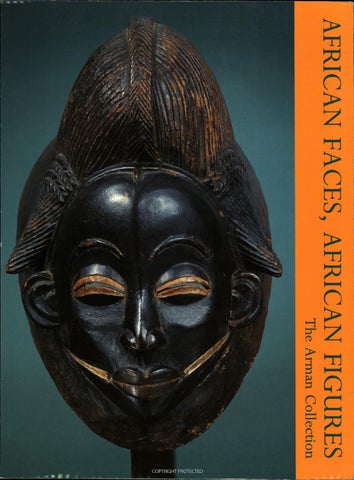
African Faces, African Figures
COPYRIGHT PROTECTED
COPYRIGHT PROTECTED
African Faces, African Figures The Arman
Collection
Articles by Alain Nicolas, Jean-Hubert Martin, and Jacques Kerchache Interviews by Alain Nicolas and Monique Barbier-Mueller Notes on Objects by Anne-Marie Boutiaux-Ndiaye, Luc De Heusch, Els De Palmenaer, Helene Joubert, Jacques Lombard, Alain Nicolas, Louis Perrois, Christopher Roy, Gustaaf Versvvijver. History and bibliography of objects by Marianne Sourrieu.
COPYRIGHT PROTECTED
African Faces, African Figures: The Arman Collection is published in conjunction with the exhibition of the same title presented at the Museum for African Art, New York, as an English version of the exhibition catalogue originally published as Arman & l'Art Africain for the exhibition of the same name, conceived by the Musee d'Arts Africains, Oceaniens, Amerindiens, Marseille. The exhibition opened there on June 23 and was on view until October 30, 1996. It subsequently traveled to the Musee National des Arts d'Afrique et d'Oceanie, Paris, December 3, 1996 to February 17, 1997 and to the Rautenstrauch-Joest-Museum, Museum far Volkerkunde, Cologne, March to August 1997 before coming to New York. The New York exhibition has been funded by The Arman Foundation for Traditional Art.
Text editor Frank Herreman with the assistance of the Education and Curatorial Department staff Translator from French by Pia Nkoduga Copyright 1997 0 Museum for African Art. All rights reserved. No part of this publication may be reproduced without written permission from the Museum for African Art, 593 Broadway, New York, NY 10012. Library of Congress catalogue card no. 97-069790 Clothbound ISBN 0-945802-21-8 Paperbound ISBN 0-945802-20-X Cover: Face mask; Punu, Gabon; wood, polychrome; h. 30.5 cm. Back cover: Five Figures: kafigeledio. Senufo, Cote d'Ivoire, Mali. Wood, fabric, feathers, fiber. H.: various.
Designed, printed and bound in Belgium by Snoeck, Ducaju & Zoon.
COPYRIGHT PROTECTED
4- 5
Executive Director's Statement An exceptional collection of art can be defined by two qualities: the mastery of the artist who produced the objects and by the honed eye, aesthetic vision and perspective of the collector. The Arman collection of African art is such a collection. Armand Arman, has married in his process of collecting an educated, even scholarly, appreciation for the aesthetics of the objects and the unique sensibility of a world renowned artist. In the mid-1950s when the collection began, Arman described himself artistically as an assemblagist. As such he appreciated in African masks and figures the rich overlay and multiplicity of forms and meanings. He also recognized that in the process of acquiring several objects of the same type he essentially followed his sensibility as an assemblagist. In the end, this way of collecting provides the public an opportunity to make cultural and regional comparisons of style and form which a single object on display does not permit. With such a superlative collection of objects from West, East, and Central Africa, over one hundred and eighty of which were selected for presentation in this exhibition African Faces, African Figures: The Arman Collection, the artist publicly acknowledges the mastery of African artists and defines the unique nature of his vision and taste as an artist and collector. We acknowledge and thank Alain Nicolas, Director, Musee d'Arts Africains, Oceaniens, Amerindiens, Marseille, for taking on the most enjoyable and challenging task of selecting a representative group of objects from such an incredible body of masterpieces. In addition, his fine interview with Arman and the fascinating CD-ROM are complements to the exhibition that deepens the texture and context of the show. Originally organized for the Musee d'Arts Africains, Ocianiens, Amerindiens, Marseille and titled, Arman &I'Art Africain, the exhibition was presented at the Musee National des Arts d'Afrique et d'Oceanie, Paris, and the Rautenstrauch-Joest-Museum, Museum fur Volkerktmde, Cologne, before coming to the Museum for African Art. At this Museum, it was re-titled, the catalogue was reprinted in English for the American public and exhibition layout was re-organized under the direction of Frank Heffernan, Director of Exhibitions. Frank has assumed the project with great scholarly and aesthetic appreciation for the significance and quality of the collection. We acknowledge Maria Reilly, Registrar, Mark D'Amato, Assistant Curator, Katherine Mesirow, Intern, and Carol Braide, Curatorial Assistant/Publications Coordinator who, with the usual attention to detail, worked closely with Frank to ensure that the catalogue re-printing and re-organization went smoothly. Leon Waller, Director of Education, and the Education Department staff deserves thanks for organizing an interesting and broadbased schedule of education and public programs to accompany the exhibition and for training an engaged group of volunteer educators who make the exhibition more comprehensible to our audiences. Thanks to Danielle Amato Milligan, Director of Development, for her unflagging effort to bring the necessary financial resources to the project. To the Board of Trustees of the Museum, we extend our grateful acknowledgment for their passionate work on behalf of the Museum, its exhibitions and programs. Finally, we warmly acknowledge and thank Armand Arman and Corice Canton Arman for their commitment and passion as collectors and for their support of the exhibition through The Arman Foundation for Traditional Art. Grace C. Stanislaus
COPYRIGHT PROTECTED
CURRENT DONORS (Individual Donors) Corice Canton Arman Mr. and Mrs. Charles Benenson Dr. and Mrs. Sidney Clyman Mr. and Mrs. Richard Faletti Jane and Gerald Katcher Marian and Daniel Malcolm Kathryn McAuliffe and Jay Kriegel Robert and Lock Neimeth Don Nelson Lynne and Robert Rubin Cecilia and Irwin Smiley Jason H. Wright Agnes Gund and Daniel Shapiro Lawrence Gussman Peg Alston Jerry Blickman Sherry B. Bronfman Patti Birch James Cash Dorothy and Lewis B. Cullman Ms. Irene Diamond Gail and George Feher Denyse and Marc Ginzberg Irwin Ginsburg Llura and Gordon Gund Lesley and Evan Heller Mr. Lofton B Holder, Jr. Marilyn HoMeld and Marvin Holloway A. Eugene Kohn Steven Kossak Alice and Arthur Kramer Nancy Lane Dorothy and Roy Lichtenstein Loretta S. Lifton William Lynch, Jr. John A. Mayer, Jr. Rodney M.Miller David Rockefeller Michael Smiley Jeff Soref Ann and Paul Sperry Francesca and Peter Tufo Mr. Jerry Vogel Regina and Stephen Humanitzki Elsa and Marvin Ross-Greifinger Ronnie Livia S. Thomas Alexander, III Roland and Lois P Betts Samuel Berkowitz Lisa Bradley and David Solomon Paula and Michael Gold Mr. Robert Nooter Peter Norton Mrs. Harry Rubin Marsha and Saul Stanoff Ellen and Jerome Stern Andrea Taylor Henry Van Ameringen Patricia and Bernard Wagner Maureen and Harold Zarember Ann and William Ziff
Joan Barist Dr. Michael Berger William Berkman Alan Brandt Damon Brandt Sherry and Roy deCarava Joseph Curry Mary Cronson Kent and Charles Davis Nicole and John Dintenfas Bernard de Grunne Drs. Jean and Noble Endicott Viana Finch Rods and Gilbert Graham Essie Green Rita and John Grunwald David Holbrook Michael M. Kaiser Mr. and Mrs. Martin Kimmel Kathy Lacey Luciano Lanfranchi Roxanne and Guy Languetot Cars] and Joe Lebworth Diane and Brian Leyden Carolyn McClair Jason McCoy John Morning Florence and Donald Morris George R. NiNamdi Michael Oliver Patricia Pepper Rita and Fred Richman Eric Robertson Louis F. Rosenthal Barbara Sahhnan Mr. and Mrs. Edwin Silver Merton D. Simpson Patricia Sweeney Jean and Mark Tansey Dr. Martin Trepel Ms. Kathy van der Pas and Mr. Steven van de Raadt Lucien Van de Velde Joyce and George Wein Tom Wheelock
(Institutional Donors) National Endowment for the Humanities National Endowment for the Arts New York State Council on the Arts City of New York Department of Cultural Affairs New York Council for the Humanities Office of the Manhattan Borough President The Council of the City of New York Institute of Museum and Library Services Frances & Benjamin Benenson Foundation Booth Ferris Foundation Dade Community Foundation Puget Sound Fund of the Tides Foundation Gulton Foundation, Inc. The Rockefeller Foundation Noah-Sadie K. Watchel Foundation, Inc. The Irene Diamond Fund, Inc.
COPYRIGHT PROTECTED
LEF Foundation Silverman Charitable Trust The Robert 8c Phyllis Tishman Speyer Family Foundation, Inc The Xerox Foundation The Bernhill Fund Buhl Family Foundation The Charles E. Culpeper Foundation DeCoizart Perpetual Charitable Trust The Max & Victoria Dreyfus Foundation Peter B. Lewis Philanthropic Foundation Robert E. & Judith 0. Rubin Foundation The Laura S. 8c Jonathan M.Tisch Foundation, Inc. H. van Ameringen Foundation Steven Rattner & B Maureen White Foundation, Inc.
(Corporate Donors) The Chase Manhattan Corporation Cravath, Swain & Moore Donaldson, Lufkin & Jenrette Securities Corporation Goldman Sachs & Co. PepsiCo, Inc. Revlon Group, Inc. RJR Nabisco Simpson,Thacher 8c Bartlett Time Warner, Inc. American Express Company C. S. First Boston Consolidated Edison Company of New York, Inc. Davis, Polk & Wardwell Davis, Scott, Weber 8c Edwards, PC. Dime Savings Bank European American Bank Kohn Pederson Fox Associates PC Merrill Lynch 8c Co., Inc. National Broadcasting Company IBM Corporation Johnson & Johnson NYNEX J.B Morgan & Co., Inc. Pfizer Inc Philip Morris Companies, Inc. Salomon Brothers Inc. Joseph E. Seagrams & Sons, Inc. Sotheby's Well, Gotshal & Manges LLP Abernathy; MacGregor and Scanlon Jerry Blickman, Inc. Bloomberg Financial Markets Bozell, Sawyer, Miller Boston Properties Duracell International Inc. Capital Cities, Inc./ABC CBS Inc. Cerussi & Spring Chelsea Piers Management Christieis Duracell Inc. Edelman Public Relations Worldwide The Equitable Evercore Partners Inc. Fletcher Asset Management, Inc.
6-7
'General Electric Corporation Hallmark Entertainment, Inc. The Hearst Corporation Holland & Knight Island Trading Company, Inc. Local 372 McGraw-Hill Marsh & McLennan, Inc. Morgan Stanley Group Inc. Northern Trust North General Pace Primitive Prodigy The Prudential The Readeris Digest Association, Inc. Sony Music Entertainment Inc. United Technologies Corporation Viacom International, Inc.
Maria Reilly Registrar
Retail and Admissions
Mark D'Amato Assistant Curator Carol Braide Curatorial Assistant/Publication Coordinator
Raquel Billings Carolyn Evans Frank Lewis Admissions
Katherine Mesirow Intern
VOLUNTEERS
Development
Marjorie Ransom Coordinator of Volunteers
Danielle Amato Milligan Director ofDevelopment
Current as cfAugust 19, 1997
Yvonne Balbin Development Associate
BOARD OF TRUSTEES
Maryellen Klein Membership Coordinator
Robert Rubin Jason Wright Co-Chairs Barry Lites Secretary Richard Faktti Assistant Secretary Lofton P Holder, Jr. Treasurer Corice Canton Arman Charles B. Benenson Sherry Bronfman Lawrence Gussman Jane Frank Katcher Irwin Smiley A. Eugene Kohn Lee Lorenz William Lynch, Jr. Kathryn McAuliffe Rodney Miller John Morning Robert Neimeth Don H. Nelson James J. Ross
STAFF Executive Grace C. Stanislaus Executive Director Shakira Ferrell Executive Assistant
Education Leon Waller Director ofEducation Muniania Lubangi Education Assistant
Finance Andrei Nadler Controller Mohibur Rob Assistant Bookkeeper
Operations Evelyn Diaz Reception Bernard Saunders Chij4Securiry, Lawrence Ekechi Fitz Caesar Tammy Farmer Lawrence Kendle Ivan Moffitt Winston Rodney Securiry Francisco Ramos Building Manager Johanna Cooper Events Coordinator
Curatorial Frank Herrman Director ofExhibitions
Tamela Allen Museum Store Manager
Public Relations Victoria Benitez Director ofPublic Relations
COPYRIGHT PROTECTED
Anthony Cooper Bibi Gajraj Myrna Kanter Museum Store Volunteers Anna Lents Curatorial/Public Relations/ Registrarial Volunteer Joan Banbury Claude DeBacker Janet Dees Lois Henderson Wendi Jackson Christopher Logan Xavier Rivera Aielianna Ross Mary Roth Volunteer Educators
COPYRIGHT PROTECTED
Contents African Art: Stance and Circumstance Alain Nicolas The Sagacity of the Artist Jean-Hubert Martin 19
3
41
Amateur, Accumulator, Collector, Connoisseur Jacques Kerchache Interview Annan / Alain Nicolas An Encounter :11onique
31
Catalogue of Objects
193
Notes on the Objects
/ Arman
Texts by Anne-Marie Bowiaux-Ndiaye, Luc De Heusch, Els De Palmenaer, Merle Joubert,Jacques Lombard, Alain Nicolas, Louis Perrois, Christopher Roy, Gustaaf Verswijver. History and bibliography ofobjects by Marianne Sourrieu. 267
Appendices Bibliography Biography ofArman List of Objects
COPYRIGHT PRO-ft
Accumulation of reliquary figures Kota, Gabon New York Photo: Gerard Bonnet
African Art: Stance and Circumstance by Alain Nicolas Director, Music d'Arts africains, ocianiens, amerindiens—Marseilk
Everyone who is to some extent familiar with the still so-called "primitive" arts, knows that Arman possesses a collection of African art. Indeed, numerous exhibitions the world over have shown one or more of his objects, and many specialized publications have drawn on his collection for their iconographic use. But today, we have something else, because for the first time his collection has been brought together for exhibition in our museums... the most significant portion of it, at any rate. What makes it that such a collection could only belong to an individual like Arman, to the exclusion of all others, while in fact many others (with equal or superior financial means) had access to the majority of these pieces on the international art market? The answer is, of course, not a simple one, even if Arman has his own views on this question. This introductory note will attempt an analysis. A sort of myth has grown up around Arman's collection... First off, who knows exactly what he's collecting today? Knives, Japanese armor, Oceanic objects, pistols, pens, Aboriginal objects, radios from the 1950s, objects from Easter Island, automobiles, rare books, African art... Recently, he's broken up his Easter Island and Oceanic collections, but not without offering to the Musee d'Arts Africains, Oceaniens et Amerindiens de Marseille a large and beautiful Papuan from the low-valley of the Sepik River. I mention this merely to demonstrate his extremely generous nature. The figure of Arman is complex, and thus it's necessary to get to know him a little in order to better understand the tenets of his collection. We'll cast a simple, but attentive, glance at what Arman has shown me. Let's say right off—with his consent, we won't be returning to his own oeuvre—that he is known in the world of art principally for his "accumulations" of objects, a brilliant concept enriched with many strong works, and that this word "accumulation" is one of the keys that open his doors. Arman is a diva of contemporary Western art, always busy between six exhibitions, ten sculptures, three books, four paintings, three inaugurations, two interviews, from one end of the planet to the other. Always in motion. Seemingly elusive.
COPYRIGHT PROTECTED
But for him his collections represent a sort of floating anchor, something stable and permanent amidst all this apparent Brownian agitation, so much does the Armanian practice of time and space astonish one at first sight. Arman is a blackbelt in judo—and he's taught the martial arts, with Klein. He is a venerable adept, semi-professional, of the Japanese game of go. He holds a diploma from the Ecole du Louvre. He's passionate about boxing, and never misses a contest on television. He loves opera and sports. He adores New York, which he describes as one gigantic accumulation, that he signs at the bottom, on the left and on the right. He is a devotee of the cult of good food and wine. He evidently has, at least, two homes: one in New York, the other in Vence (AlpesMaritimes). The material life of Arman is that of an artist who's made it. And made it with, according to the artist, a collection of debts as well! But Arman is intelligent: this is the second dominant aspect of his personality. He manages to explain to us that his life is multiple, that he lives about twenty of them at a time, and that these twenty lives are his life. He collects lives, and everything then comes down to a question of organization. His life is his most perfect accumulation. He has no doubt come to understand much about the stuff of life, and that one must manage this short space of time given to all. The number one problem for Arman is, thus, this life-time. He is extremely combative. Even when playing ping-pong—it's the same way for everything he takes on—it's to win; he runs with death to win. That's why he runs so fast, everyday, everywhere. To outrun death, even... The presence of his works in the museums of the world, these places where things are conserved for a theoretical eternity, is already an admirable victory. He is known and renowned. He is celebrated. He will go down in history. But to here, nothing fundamentally original. Arman, like any other collector, does not collect merely anything. It all has a sense to it. He would like, of course, to have the MOST the BEST. After having accumulated all sorts of things, within a quite organized discourse, he accumulates collections of objects which are, by definition, out of the ordinary, being works of art and, if possible, masterpieces: the most beautiful knives (not inevitably the most expensive), or else the rarest, the most beautiful pens, the most beautiful cars (or the most something), the most beautiful Japanese armor (they are unique), the rarest pistols. The words "very" or "many" hold no interest for Arman: they are aren't enough. He has the need for still more. At the same time as accumulating collections and objects, he has accumulated specialized knowledge as well. He has been, is, or will become the best specialist in the field of his respective collections. And he's managed to pull it off. Thus, there's evidently a question of pride involved here. His collection of African art, in its ensemble, raises some echoes of these character traits. To begin with, he possesses many objects, but he doesn't know exactly how many: four hundred or five hundred, if one counts the "small ones"... In any case, it is not the largest collection in the world, or in history—and he knows it. And yet...
COPYRIGHT PROTECTED
African Art: Stance and Circumstance. 12 - 13
Considered by him or by us as an accumulation, his collection has something of the Russian doll about it. Indeed, the exhibition includes two veritable accumulations, and Arman claims as much: that of the Kota reliquaries, and that of the Mende masks. He has made accumulations of them, and considers them as accumulations. The Kota are in his dining room in New York, while the Mende are in his Connecticut bedroom. He signs them below and to the right. Or to the left. After the accumulations come the groups, certain of which surpass fifteen individual members: the Fang reliquaries, the Mahongwe, the "fetiches a clous," the Punu masks... The group from Gabon is stylistically extraordinary. The Arman known and renowned is there, in these accumulations and these groups, and his collection of African art is one of his most beautiful works. This is certainly true, but incomplete. For we also have the "individuals" to complete the portrait: some masterpieces, and many major pieces. When they are not universally applauded as the most beautiful, they have a "detail" or a particularity such that these objects could only have wound up with Arman—perhaps an exceptional "pedigree," an atypical construction, a special size, a story, a material, an extreme rarity ... That is to say, in what I call the "individuals" may reside a certain aleatory value. A particular dose. But homeopathic, for if one knows something about Arman one can almost predict his next acquisitions. At least—there are many factors that come into play, including the financial—one may say that logically speaking a certain object should one day enter the Arman Collection, and not another object, and not in another collection. A matter of attraction, or determinism? As to the financial aspect, Arman has always managed to acquire the objects he's wanted, even during the darkest and least prosperous days: though this too must be factored in to the equation, as the statisticians say. He is not free from notorious and sometimes irritating pride found in all collectors, but he is also capable of saying what he recently told me in an interview given in conjunction with the Batcham exhibition: "Andre (Fourquet) has more masterpieces than I do." Have we answered the question posed at the outset, namely that of whether the Arman Collection of African art could not be anything other than the Arman Collection of African art? First, on reflection, I am not sure that this question is not "hackneyed". Not completely sure. Indeed, in frequenting collectors and seeing their collections—the problem is identical when they're in the public domain—I know and see that there exists something of the very intimate connecting the collectors and their collections. And not only the pathologic side of "wanting to possess." That is banal. What is less so, and rarely seen, is the presentation of a collection belonging to someone of renown and still very much alive, and to examine the discrepancies that might exist between that which one knows of this person and that which he shows us through his manner of collecting. This exhibition is all that. A veritable passage between a contemporary Western artist and African art.
COPYRIGHT PROTECTED
110121:01:1111antellit
14-15
The Sagacity of the Artist by Jean-Hubert Martin Conservator General in Charge, Musee national des Arts d'Afrique et d'Ocianie, Paris
It is a truism to state that an exhibition can only be evaluated after being seen. One may well imagine that for Arman, as well, the joint presentation of a large number of his works will constitute a sort of litmus test. It goes without saying that he has a through knowledge of the works in his collection. Some among them have been long coveted. Others go to form groups, like the Kota pieces in his New York dining room, to which he no longer deigns any modification. Nonetheless, the display of some two hundred objects and the way in which they are mounted will give rise to considerations which one may not prejudge. I am, for my part, curious to gauge the erudite expertise as compared to the artistic intuition brought to bear here. Arman has recounted how he had to rein in his passion as expert and connoisseur in African art. It had come to devour practically all his time, and at a given moment he found himself obliged to choose between his vocation as artist and what might have become a new profession. Having become an excellent connoisseur, he revolts against the tendency of some dealers to categorize certain singular or not wholly trustworthy works as "artist's pieces," aimed for sale to them. Arman is here no doubt referring to some particular instances where dealers were mockingly disdainful of the artists' judgment. This topic is nevertheless worthy of our scrutiny, for it leads to an inquiry regarding the evolution of taste in the matter of African art, and on the role played by artists past and present in this respect. The question as it is posed implies a judgment of authenticity, and is one of the most delicate points for collectors of African art. For the postulate according to which it is only the object made by a local artist for local use that is authentic, comprises many twists and turns. Frank Willet has set out a classification of nine intermediary categories of authenticity before arriving at those fakes made by and for non- Africans with the deliberate aim of deception. Present day consideration of that famous Fang mask belonging to Vlaminck and to Derain (M.N.A.M., Centre Georges Pompidou) and produced in bronze by Vollard Paris)—which had never danced and had been made for some foreign client—does not much detract from its aesthetic and historic value. The pedigree of the work, which in this domain is said to be worth a signature, can thus singularly amend this rigid postulate of authenticity.
COPYRIGHT PROTECTED •
* Musee National des Arts d'Afrique et d'Oceanie, Paris
One has the tendency to consider that the history of the discovery of African art by Western artists has already been definitively written, that his story is open and shut. But Arman is one of many artists in the ranks of collectors of African art. And as our concept of art has much evolved since the beginning of the century, contemporary artists do not collect the same works as did their predecessors. Arman belongs to that generation of artists who provoked a considerable rupture with respect to our notion of art. He has, moreover, been one of the major actors in this transformation: abandoning the traditional registers and materials considered as noble, he introduced scrap and waste materials into the artistic domain. Then, with his "accumulations," he initiated a new interpretation of seriality. His collection reflects in large part his taste as "enlightened amateur." One sees this in his much prized Fang and Kota objects, which reveal a taste that one may qualify as the classical in African art. To this is added a rather expected ensemble, owing to its concordance with his own accumulations: namely, the Congo nailed power figure. A fourth ensemble is more surprising and reveals a personal bent: these are the Mende masks—objects which have not engendered covetousness among collectors. The inscription of the face within the geometry of a flattened lozenge, sometimes under exuberant hairdos, has not to present been accorded sufficient attention to be granted true authority among the polyphony of African styles. This exhibition may, in this regard, serve to evolve our appreciation and reorient our view. One hopes that other individual pieces will also play that role. In any event, most of these pieces derive from a conception of African art inherited form the taste of Arman's forerunners at the beginning of this century. It is above all a question of sculptural invention, handling of volumes, and ingenious formal solutions in the treatment of the face or the body. Now, for artist of Arman's generation as well as the following me, because they work from already existing objects which they then combine in their assemblages and installations, the interest is much more in the "charge" or "load" of African objects. It is not the beautiful formal solution which interests them, but rather the evocatory force of the object, its visual impact, its capacity to give a sense to all it reveals of the strangeness of societies that recall submerged parts of our civilization. One will find magical objects, vestiges of rituals, shamanical instruments in which horns, bones, and skulls are components of their making. We have recently seen Sarkis and Spoerri integrate into their works a type of object that, not long ago, could have been treated as ethnological by collectors. It is not immaterial that one find this same type of object among the works of two great contemporary collectors of acute insight. To its great benefit, the history of the evolution of taste in the matter of African art is an ongoing one. By virtue of a familiar progression, objects not long ago still: "invisible" have passed from being scrap, out of action and old-fashioned, to the stage of being a curiosity, then interesting, before finally being deemed beautiful. The extraordinary expansion of artistic creation where nothing is proscribed with respect to materials, techniques and processes, has brought about an enlargement of the visual aesthetic field. A demonstration of this could be seen in the recent Africa exhibition mounted in London by the Royal Academy, conceived by the artist Tom Phillips. A certain number of objects considered masterpieces by a consensus of experts and amateurs were omitted here, particularly those series of Kota and Fang reliquaries which have been celebrated and valued since the beginning of this
COPYRIGHT PROTECTED
The Sagacity of the Artist. 16 - 17
century. The curator oriented his choice toward pieces that might be termed singular and "atypical" from these ranks. Likewise, he often mixed works endowed with a certain importance in social and religious life, together with everyday objects embellished by an elaborate decor. If one holds to the postulate of pedigree equaling signature, then odds are that many works now in the hands of artists will be highly valued by the generation to come. The principal appeal of the so-called primitive arts is their provision of an enormous quantity of works whose corpus is far from being set in stone. On the other hand, archeological discoveries and collectors' researches are unendingly making new objects known to us. On the other hand, evolution in Western aesthetic thinking continues concomitantly with the current of artistic creation, with objects re-emerging from neglect to be seen in a new light. Thus, perhaps we are not on so firm ground when denigrating those objects termed as "artist's pieces." What is undeniably disagreeable, is when dealers substitute themselves for the artists in rendering this judgment. And one would be wrong to neglect a category of bizarre objects, singular, sometimes violent, charged to the point of having a quite unsettling effect, but nevertheless revealing beliefs that fascinate the Western spirit—at the risk of once again being labeled as exoticism. Objects of this type, sometimes not belonging to well identified series, are often found in the homes and studios of contemporary artists. Perhaps these are the masterpieces of tomorrow.
COPYRIGHT PROTECTED
Power figure NIcanu, Zaire Collection Arman and Corice Arman Photo: Gerard Bonnet
18- 19
Amateur, Accumulator, Collector, Connoisseur byJacques Kerchache
My dialogue with African art derivesfrom the conviction that artistic creation arisesfrom a commonfund of humanity and that in the discovery of aesthetic solutions the making of masterpieces supersedes regions, cultures, and becomes part of the treasuresfrom all places and all times of human creation. Arman It was on an evening in 1962, in Iris Clert's old gallery, at the closing of one of my first exhibitions, bringing together works from Pol Bury, Sotto, Cruz Diez and Kramer, Arman walked in, and caressed the walls. He told me that it was very good to have kept them as they were, painted in white by Yves Klein, his best friend who had just died tragically. While Klein figured "the empty," in the same space Arman was a little later to echo a reply in "the full," saturating the space with an accumulation of refuse. I spoke to him of my projects: a presentation of white foodstuffs from Malaval which was to precede an exhibition devoted to Sepik objects from New Guinea. The immediate current of fellow-feeling that was established between us has evolved over thirty-five years of friendship—one peppered with rows, dialogues, breaks, exchanges and "competition." In 1955, the year when I bought my first object at the flea market, Arman discovered two exhibitions that were to mark him deeply: the one, organized by Ratton and Kramer, the other, Analogies, at the Arnaud Gallery. In 1956 or 1957, he made his first purchase, a Dan mask. Shortly after our encounter, I left on military service to Frejus. Arman invited me to his home, on the Cote d'Azur, and let me see his atelier where I was impressed and enthused by his work. In the years that followed, we had our first exchange of works: one of his shattered violins in plastic for a Mahongwe reliquary. When Andre Breton later paid me a visit, on seeing the violin he remarked: "That's the way I like music!" This was also the start of a long series of trades and reciprocal purchases. Between Arman and myself, there is a mutual respect, and I have too much admiration for artists to propose to him that which he calls in his Mgmoires accumulies "artist's pieces": "The dealers in Black art are all collectors of modern art. Living
COPYRIGHT PROTECTED
surrounded by somber objects, they long for color. So, in Paris, a certain X. and Y. wish to trade. Each time I arrive, they receive me with joy and show me, they say, their most interesting pieces. 'Look, a curious Cameroun mask!—Are you kidding me, it's not even from Cameroon, I say—You think so? Well anyway, come and take a look at this Dogon.—Me: It's poorly sculpted, it's no Dogon.— After awhile Y. gets upset:—We can't do business with you. You denigrate everything.—Because you show me crap! (yours truly retorts).—But not at all (he protests), we've put these pieces aside especially for you, they're artist's pieces. —Well bravo! That's fine. All the junk, the unclassifiable, the problem objects, the murky ones: these are your artist's pieces!' So many of my fellow painters have fallen for this line, and wound up with what otherwise are unsaleable specimens, somewhat belated, barely or poorly sculpted. I never fell for it." Here Arman cites the case of one of our mutual friends, the painter Jean-Claude Fahri. I well remember that at the inauguration of his atelier, he showed us a Senufo sculpture. Arman and I looked at each other. Without having to exchange a word, but with common purpose, we threw the object into the fire. After a few seconds, we pulled it out, saying: "It's better like this." From Gauguin, Derain, Vlaminck, Picasso and up to Baselitz, Arman is without doubt the artist who has accorded the most of his time, effort and energy to the constituting of his remarkable collections, and his collection of African art in particular. There was not a single important exhibition in a museum or at a dealer's, or private collection, that he did not visit. He might get a call in New York about an object of possible interest, and next thing he was on the plane. This frenzy reached its height between 1975 and 1980. I spent some time at Arman's during this period. He met everyday with a great number of dealers, collectors, museum directors, not to show his own work, but to evaluate, buy, sell, or render his expert opinion on objects of African art. I was able to make the observation that the time he devoted to this part of his life had a negative effect on his creative activities. He well understood this, and once remarked to his wife: "Am I a sculptor, or a specialist in African art? I suppose one should know, right?" Arman more shares the detached point of view that Picasso proclaimed with irony: "L'art negre, connais pas!", than that of Brancusi, conscious of a hold that he defended himself against in writing to Epstein in 1932: "One must not be influenced by African art." Arman's oeuvre precedes his encounter with African art, and if there's a similarity, then it's in the manner of a "play on words, play on forms." We can cite an example of this in his accumulation of revolvers entitled "Fetiche a clous," which I placed face to face with a real fetiche a c/ous, for the Primitivism exhibition in Munich in 1972, to which I was consultant. The relationship that exists between the oeuvre of Arman and African art is based only on what Appolinaire called "the aesthetic of the banal object" when discussing the guitar (1911) or the glass of absinthe (1914) of Picasso, and the act of appropriation/reincorporation, a common practice among African artists. The accumulation of appropriations: Arman's identity may be so summarized. But I no longer agree with him when he amuses himself by leading African objects astray by encasing them in plastic, even if in these cases he uses only minor objects. Neither can I say that I'm particularly touched by the result, though I well understanding that it has to do with a pretext, and treated with much humor. On the other hand, I what I do find extremely interesting, is the presentation of
COPYRIGHT PROTECTED
Amateur, Accumulator, Collector, Connoisseur.
them at Arman's home—series of object from the same family (Kota, Fang, etc.)—for these accumulation then permit one to appreciate the value of the notion of competition, something dear to African artists. The spirit of competition is also not found lacking in Arman. And he has practiced it in disciplines as varied as judo, ping-pong, chess and go. He's proved it, too, in his accumulation of other collections, always of great quality: Japanese weapons and armor, Oceanic objects, knives, pens, watches, guns, cars, contemporary art... Nonetheless, over the past few years he has understood that by breaking them up, he could acquire works of true importance. It required a choice on his part, and he decided to concentrate his attention and financial means on African art. Arman has never tipped over into primitivism, he's never been a speculator. He is an Amateur, in the noble sense of the term. Today, his collection figures among the most beautiful in the world. It is not encyclopedic, and even less exotic. It is impregnated with a strong identity. It has a history because it has been made with love, passion and generosity.
COPYRIGHT PROTECTED
20 - 21
22 - 2
Interview New York, December 2nd, 1995 kvAlain Nicolas
Main Nicolas: In 1993 we had a long interview in Marseille concerning the exhibition Batcham, sculptures du Cameroun, during which you talked mainly about Bamileke sculpture. I would like to center this interview more on your collection and your manner of collecting. My first question is very simple: how many objects do you have today? Arman: I don't know exactly, I haven't counted the objects-300, 400?... It depends if one also counts the small objects. Because my collection is composed of several parts: those I just fell for, that's to say the pieces that interested me aesthetically, ones I desired; but also the sorts of systematic gestures, of accumulations. With the idea of putting things of the same type together, always following this design, which is mine in many of my works, that of the accumulation. What's more, because I'm a little bit... ambitious by nature, I've always tried to do things which aren't easy, to collect objects that are difficult to acquire, or of high quality. Not possessing the fortune that I merit—that's a phrase I like, because no one ever has the fortune he deserves—I find a way, I retrade things, I resell, I rebuy, wheeling and dealing until I get the piece that I want. Sometimes it works, sometimes it doesn't. A.N.: Can you envision that one day your collection will befinished? A.: No, not really. I will always have longings, like to buy back an object that I used to have and now miss, or something like that. I can't really say. I've the impression that this sort of collection and this sort of collector, will only be finished when I'm finished. A.N.: Don't you think that !I-you could answer this question about the end ofyour collection, you would be able to answer the question of why you collect? A.: I collect because collecting is a part of my make-up. I've always done it. I've always accumulated, much more than I've collected. And by accumulating, I've always been surrounded by objects. I've collected African art for such a long time
COPYRIGHT PROTECTED
now, at a really heavy tempo, and with such study, that I've become my own expert advisor! In general, I rarely consult someone when buying an object. But for this collection, I had my encounter with African art at a time when there were few collectors around. Gradually, in a few years, we'll perhaps come to see fewer and fewer masterpieces on the market. Everything always ends up in museums. And that's all right. A.N.: You started your collection in the 1950s? A.: Yes. I'd seen an exhibition in Paris (I think it was in a large hotel), and then two or three years later, another one in Cannes. These two exhibitions made a big impression on me: I didn't know anything, I had no notion of the quality to be seen in African art or Oceanic art—the so-called primitive arts. And it reinforced a very important idea in me: the realization that every culture, that every ethnic group can produce masterpieces. This reinforced the idea, that I already held, that man is the same all over. And the discovery of this idea was a great source of pleasure to be, while I was still quite young. A.N.: So, in the 1950s you went and saw these two exhibitions. You were already starting to buy yourfirst objects around this time? A.: At the flea market in Nice, I think in '55. A Dan mask. A.N.: Do you recall the exact circumstances of this purchase? A.: I'd often go to the flea market, on the Paillon. There were a lot of boutiques there, with objects from all over. One of these was the shop of Bertrand Bottet, himself a collector. Primarily, he was the buyer in the South of France for Charles Ratton. He kept him informed about everything that was going on. One day, walking around the market, I saw this Dan mask that I thought was quite beautiful. I bought it. At that time, we're talking about really ridiculous amounts. Small sums—minuscule! A.N.: Have you kept all the objects you've bought in this period? A.: Only from after 1959. I hadn't come across, or couldn't acquire, quality objects before then. A.N.: What is the oldest object in your collection today? A.: The oldest object? A.N.: 1 mean the one you've had longest. A.: There are three or four: the small Fang byiri, on the very long baton; the large komo elephant mask; the small Kongo mirrored fetish; and the grand Dan mask, with tarboosh felt. All these objects date from that period. A.N.: You've never let them go?
COPYRIGHT PROTECTED
Interview. 24 - 25
A.: No. A.N.: Why have you kept them? A.: I don't know. For that matter these objects are reproduced, except for the komo mask, in Arts primitffs dans les ateliers d'artistes, an exhibition that was at the Musee de l'Homme. I've always considered these four objects a bit like fetish objects, I've always loved them. They are still of a quite fine quality: they've never varied, not in their attractiveness, not in the appreciation I have of them. AN.: There is the problem offakes,from which veryfew people escape... One might say that no one escapesfrom it. A.: No one escapes, no. A.N.: Have you ever bought afake? A.: Yes, it's happened. It's quite humbling, because I'm usually very sure of myself. It's happened two or three times, when I really wanted something, and didn't listen to that little voice inside. I let myself be taken by objects that were not genuine. I especially remember a Kota. This Kota was curious. It was very domed, and very old. But there was something that bothered me. Consulting a friend, who also knows the Kota quite well, we discovered that it was a very old Kota, but very simple, to which one had artificially domed the forehead to give it more interest. Naturally, I'd found that the wood on the back side was very fine, with the ancient "lozenge," etc. I had a good look at it. It had a very interesting price, but I was had, because it had been "improved." Also, when there are things that I know less well—Africa is so immense, that to say "I know African art" is a bit much: I know parts of African art. Sometimes, for certain ethnic groups or for certain regions, I've been obliged to take advice. I'm not such a connoisseur when it comes to the art of East or South Africa. I've had a false ivory, for example, because it's not my habit to collect ivory. In the profession of dealers of African art you have all types. There are some very honest individuals who take extreme care to sell perfect objects, objects to which there's no problem attached, but there are others who don't give a damn, who would sell you simply anything, and they're usually excellent salesmen. It often happens that I'm left certain objects "on approval." I've been tempted by several of these. I remember a sort of helmet mask, the top of a bete box. The broker hadn't been gone five minutes, and I was already dissatisfied. Well, I started by sniffing it all over, holding it, picking it up, measuring it, breathing it, searching my references for corresponding objects and, of course, I became more and more dissatisfied. The next day I call this guy and tell him: "Come pick up your object—I don't want to hear about it." That's happened to me two or three times. So, it just might be—I humbly admit it—that there are still a few fakes in my collection, but then not to my knowledge. Certainly not a large proportion, because I know these objects as well as any other specialist or dealer, but one can always be mistaken. There is a certain consensus. There are several levels of false objects. There is the
COPYRIGHT PROTECTED
replacement object, which I don't want in my collection, that's to say an object which has been rapidly made to stand in for another that's been hidden away. There is also the more commercial object, made for sale or as a gift: the "ambassadorial" object... Next, there are the downright fakes, expressly made to fool. In general, the best fakes, very sophisticated in the working of the wood, the patina, the aesthetic details, are made by restorers. And it's very disturbing, because one sees more and more fakes, mostly in the "rare" ethnic groups, or "expensive" ones like the Fang, the Chokwe, etc. The worse thing about the whole affair, is that there are writers, specialists in African art who are conversant with African ethnology and the history of African art, but who have no sense of Antiquities and who endorse these fakes. There are fakes in some widely reputed books. One day maybe they'll end up in museums, all the more so because they have certificates signed by these so-called "experts." Everyone's in agreement nonetheless: all those who have some knowledge, be they collectors or dealers, never had any desire to acquire these pieces. And today these pieces very nearly have authentic status! It's very disturbing. So, does this mean that every writer or museum expert should have an antiques dealer at his elbow? It's an important question, no? A.N.: Precisely. When one is named Arman and one collects, many eyes must be on you when you set out to buy. A.: Yes. A.N.: There's a sort of pressure brought to bear, led by the journalists, the specialists, other collectors, dealers, museums... When an important piece is presented at public sale, and when one says that Arman is interested in it, then this pressure mounts. A.: That can happen. But quite often I don't attend the auction myself. I buy through another person. For several reasons. First, out of fear that sometimes the price will be padded, if you'll forgive the expression. There are auctioneers very good at that: they can feel more or less were you're prepared to go. But I am very strict, I give a price for a piece and I don't go beyond it. A.N.: Do you maintain good relations with other collectors? Are there any, for example, that you count asfriends? A.: Yes, I have many friends in this milieu. For a while, I saw only them. Before 1980, my wife would complain: we only see these African art people, collectors, museum people, writers... We frequented no other circles, even to do with my professional activities. Rather strange... A.N.: There had to come a moment when you said: "Enough! I'm stopping." A.: Yes. At a given moment, I stopped. For four years I didn't buy a single object, and I didn't go to any exhibition of African art. I had the feeling that it was taking precedence over my life as an artist, eating up too much of my time and energy. I've even had the offer of writing the encyclopedia of African art. So I had to ask myself: "Who am I? What do I want to do in life? Become a big specialist in African art, or remain a sculptor?" I made the choice.
COPYRIGHT PROTECTED
Interview. 26 - 27
Masks: bundu Mende, Sierra Leone Photo: Girard Bonnet
A.N.: Because it's the one or the other? A.: Yes, and seeing the evolution of this collection, it would not have been good for my work as a sculptor. It would have even been quite a nuisance. I made the right choice. A.N.: But many ofyourfellow artists also collect. You're not the sole example! A.: Not like that. Many artists collect, yes. But even those who have fine collections—take an artist like Baselitz—collect pieces that have something to do with their own work. These are not objective collections. Traditionally, artists have always had objects. From the time of the Cubists, the Fauvists and others. That confirms a sort of exotic taste... I've always known artists, often a bit older than myself, with objects around them, even if they didn't really collect. It was part of the artist's bric-a-brac. The same as there have always been artists who have had objects in their studios, but these weren't fantastic objects. I remember some of my dealer-friends who made trades with artists. One thus arrives at the "artist's objects," which may be rather spectacular, but aren't always the best. A.N.: But what's special about these objects? A.: They're a bit spectacular, a bit large. This goes well in an artist's atelier. It even became a generic term: "objet d'artiste." A.N.: Do you trade with your collector-friends? A.: Sometimes, yes. Particularly with Jacques Kerchache, and with just about all the dealers. A.N.: I've tried to get a global view of your collection, and to see y there's some constant running through it, ethnically or formally. And I must admit, I haven't really
COPYRIGHT PROTECTED
found it yet. A.: There is a preference in my collection: it's for Gabon. I am very easily attracted by certain objects from Gabon, like those of the Fang, the Kota, the Punu, and even up to the region of Cabinda, that's to say objects of the Kongo, Yombe... This has been a preference. Next, there have been objects that I've simply fallen for: certain objects that I've desired, or others considered as extremely rare, like the Mbole. I've always dreamed of having an Mbole. When I was younger, objects circulated less. There have been mythic objects like, for instance, the Mbole in the Schindler Collection. Me, I have a small one. A.N.: But this region of Africa, around Gabon, must correspond to something more or less conscious inside you? A.: Yes. There's something of the need to dominate in me, to have better pieces than the others. That's a trait often seen among collectors. A.N.: No, I mean in thisformal constancy, around Gabon. A.: First of all, in this region you have the Fang, with their objects of interiority. They are so charged, so strong, so concentrated as sculptures! One also finds more "aesthetic" objects there, like those of the Punu, the Lumbo, or the Yombe. These objects have an aesthetic that for me is near immutable, universal. In Gabon one finds many of these heart-shaped faces. A.N.: Also among the Lega of Zaire,for example? A.: Yes, one finds them among the Lega, among the Mbole, etc. I've always been very attracted visually and instinctively by these heart-shaped faces, these heavy domed foreheads. And indeed, that's what I often encountered in Gabon. A.N.: It's aform that somewhat reminds one of the curves of a violin,for instance... A.: ... No, not at all. For the curves of a violin one would sooner have to go to the Cyclades. A violin, that's an object so modern and sophisticated, so technical an object! A.N.: And also sofinished? A.: Finished, yes, termini. An object that undergoes no further change. While for the human figure, and traditional renderings... In all these "basic" arts, instead of granting pride of place to naturalism, the artists opted to give the symbol precedence. The fact that they found sculptural solutions between the symbol and the representation is fascinating. There are some perfect successes. A.N.: Do you know how many Fang objects you possess? A.: I must have a dozen of them. A.N.: A dozen: what exactly does that number mean? And why don't you have more?
COPYRIGHT PROTECTED
Interviem
A.: At one time I had more, but as other objects caught my interest, I traded the Fang in order to get them. Just recently, for example, I've exchanged two Fang for important Nok objects. A.N.: ifyou like, let's talk a little about Nok sculpture and African archeology—an always current topic. What do you think of these objects that come to leave African soil, in an inevitably "artyicial" manner, to quickly arrive... A.: ... Clandestinely, you mean... A.N.: ... Yes, clandestinely. A.: I have an opinion about that. All of the geographic and cultural areas do not have the same problems. The conditions in which these clandestine exits occur are not all alike, nor are the intents. There's one thing about which I'm pretty clear: if there was not this interest on the part of collectors, of Western museology, of the dealers—then a large segment of the history of African art would have disappeared. Because, in the lands where one finds these objects, there hasn't been and there never will be a very deep interest for certain archeological objects, neither for their conservation and protection, nor for the exploration of these sites. From time to time they wake up. One has the impression that this matter of clandestine removals is in large measure driven by institutions and international entities, sometimes out of purely financial motives. For example, some objects, which have been unearthed in certain countries accompanied by much publicity, find themselves on the market a year later. They did not wind up in the museums of the countries in question. They ended up in the hands of ministers, or other important locals, who hurried to sell them on. As for archeology, I'll make a distinction between the object from the surface and those found in excavations. It's clear that where excavations have been carried out with care—like in Mali, for instance—there should be no competition between the official excavations and the clandestine. I am in favor of official excavations. But we found ourselves, in Nigeria, face to face with a pretty curious case, concerning the Nok, the Sekoto. Objects were found on large industrial mining-sites, and there wasn't much feeling to alert the Department of Antiquities. For around a dozen years it was preferred to just smash them up. There were cubic meters of Nok sculpture and cubic meters more of Sekoto that were crushed. It was only with the realization that they were worth money that these Nok objects were able to leave clandestinely. If not, they'd continue to be destroyed. So I feel, up to a point, that these pieces have been saved. They've made it this far and will one day wind up in a museum. The day when there will be serious institutions in these lands, we will see... But at the same time, one mustn't blindly indict these counties, only having emerged some forty years ago from long periods of colonization, for lack of management when it comes to these relics. Forty years is young! The feeling, the current climate, is against this evolution towards having serious museums. This is clear for Africa. I'm not speaking of South America, about which there could be much to say, nor about southeast Asia. But in Africa there's been a strong degree of Islamization, which more corresponds to the intrinsic character and the mode of life of these people. I am not denigrating Islam, but Islam is not for in favor of a barbaric, savage iconography. It favors the destruction of this
COPYRIGHT PROTECTED
28 - 29
New York and Vence, winter 1995 Photo: Eric Laporte
COPYRIGHT PROTECTED
Interviews..
COPYRIGHT PROTECTED
30 - 31
iconography. During the Biafran War, in 1961, to take a recent example, the village of the Oron clan was taken by the Muslim Assouan, and was burned to the ground. It was one of the rare intact villages. So, you'll understand that with all these considerations, I do not think—though I could be wrong—that compensation has been made available to farmers who find something in their fields. This would be more of a curse for them. If it wasn't for the interest shown by collectors and dealers, a large percentage of the history of African art would have been destroyed by the natural elements, but more so by man. Well, I'm proud enough that some examples have been able to be saved and that we can show them; they'll finish in museums and thus be enjoyed by everyone. I strongly hope that one day they will figure in the collections of African museums. You know, all collectors, even those who are the most miserly with their objects, say: "If you have a serious museum in Africa, we'll contribute, and we'll contribute masterpieces." A.N.: I believe that you have given several objects to an African museum. A.: Yes, that was in Senegal. President Senghor wanted to create a Museum of African Arts in Dakar, not only Senegalese arts. He hoped to turn Dakar into the cultural capital of central Africa, its Athens, and thus, to show the arts of Africa from the south of the continent to the west. He had the project for the museum designed by Oscar Niemeyer. The plans were already made. I asked him, "What are you going to put in this museum?" "The collection of the I.F.A.N. (the Institut franfais de l'Afrique noire, later to become the Institutfondamental de l'Afrique noire)." " I know this collection very well. I've been through it in detail. It is not sufficient for your project. It contains some very important ethnological objects, but you don't have enough masterpieces, and a museum worthy of this name must base itself around masterpieces. The non-specialist leaves a museum and recalls only four or five objects, always the same ones. So, for your museum of African art, you have need of the Venusfrom Milo of African art, the Victoryfrom Samothrace, the Mona Lisa. You need a dozen major objects, big-guns, from the different ethnic groups, which will serve as focal points. Then you'll need some fifty or a hundred very beautiful objects to support them, and then ethnological objects of fine quality, etc. But you cannot have a museum with only the I.F.A.N. collection. You have to go further if want to make a museum of world quality." He agreed with me. We started to do the research, and he told me: "Thinking along these lines, don't you think that the Musee de la Porte doree and the Musee de l'Homme will give me some very beautiful objects?" I answered him, "They'll never give you their masterpieces. Maybe a few objects, but not the chef-d'oeuvre. Don't count on it." Then he said, "We will find them in Africa." So, I told him, "It's very difficult, because the few objects still to be found in Africa pass through a network, runners in the bush who know the dealers. Right now—at that time—there is no African expert in African art. There are ethnologists, there are anthropologists, and certainly, in Senegal, there are excellent specialists, but no experts in African art." He answered me, "But that's terrible!" Well, we took a tour of the horizon to see who could take charge of the museum project. After having mentioned various specialists and experts, we finished by
COPYRIGHT PROTECTED
Interview. 32 - 33
agreeing on one name: Jacques Kerchache. He accepted to become the "sheriff," that's to say, to preside over the purchases and the organization of the collection, traveling two or three times a year to Senegal. Then came the problem of the budget. The museum was going to cost something like ten million dollars. A.N.: Ten million dollars. A.: It takes money to make a nice museum! We were working over the figures for obligatory purchases. Just then, Jacky said, "Me, I'll give such-and-such a masterpiece." "Me too," I responded, "I will give such-and-such a masterpiece. For this, we'll create an association for the Dakar Museum in New York and Paris, and people will contribute to it. But nonetheless, you have to buy; Senegal had to take the first step by buying a few masterpieces on the art market." We drew up a budget of around two million dollars at the time, to buy five or six major pieces. Everyone was in agreement, and the museum project passed to the Council of Ministers. The ministers—only Senghor was not Muslim—told us, "This is abominable.., you want us to spend all this money on these ignoble and barbarous objects? We accept, but only if there is also a museum for Islamic art. The project got lost in all the talk. In the end, Senghor did not stand for re-election, and the project was totally abandoned." So that's the story of my near collaboration with an African museum. A.N.: Are you especially sensitive to the materials used by African sculptors, particularly their use of wood. I've recently seen on Arte television, a program with Jacques Kerchache expounding on the Mumuye sculptors. His whole presentation attempted to explain the work of these Mumuye sculptors who, in practicing their incredible virtuosity, must have smashed an enormous number of working models before arriving at the final realization of a piece which is a cliff-d'oeuvre. Is there not, in your way of collecting, a measure of nostalgia for a certain practice of sculpture and wood carving? I know that you haven't worked in woodfor quite some time now. A.: Yes, it's been awhile. But I'm not particularly bothered. If I was going to carve directly, then I'd use stone or marble, much more than wood. It's not my temperament. But you're right, in the materials of my collection, you can see that I don't have many bronzes and practically no ivories. As for the terracotta, those are fairly recent additions. I am interested in statuary in wood—mask or statue. Certain of the objects are indeed works of virtuosity. What's the most interesting, is that this virtuosity is not apparent at first glance; it's not "lacework" like seen in Oriental virtuosity, for instance. It's virtuosity related to the grain of the wood, related to the cut. Risks are indeed taken, and one wonders if there's not a certain percentage of abortive attempts. I agree with Jacky about this. A.N.: So, my question is the following: don't you have a certain nostalgia for this way of working, and the inevitable wastage it produces? A.: No, no nostalgia for sculpting in wood. I've done some, but it's not my work. A.N.: But my question applies equally to stone, orfor another material.
COPYRIGHT PROTECTED
A.: Yes, if you're talking about direct carving. There's always a kind of physical struggle between the direct attack upon a material and the result. And thanks to the systems I use in my work, I've been able to attain this pleasure of the direct clash. Especially in the "para-paintings" that I do with objects and brushes, because from the point of view of sculpture and statuary, aside from cutting, rewelding, remixing and remaking certain things, I have no further very direct impact on the material itself. But, in my manner of collecting, in my choice between two pieces, I don't especially favor one over the other just on grounds of virtuosity. To me, the expressivity of the piece is more important. So, perhaps certain Mumuye sculptors have more virtuosity than the Senufo sculptor who made the deble statue in my collection, but I am much more taken by the result of the deble, which is a perfect piece of sculpture. Perfect according to my canons, of course, but perfect. Vence Photo: Alain Nicolas
A.N.: And what are your canons? A.: I think they are those of a modern art education by way of classical art. I start modern art from the Quattrocento: from then on, there was no more traditional art. Traditional art is that which is embedded in social, cultural or religious principles, with obligatory objects, observing defined form and with preferential subjects followed over generations. A.N.: And youfind this in Africa? A.: Modern art? Sometimes, but not always... that often remains traditional art. That which is interesting, I find among today's young African artists, and some of them are wonderful. The transition has been made, without slavishly copying what's done in the West, without being prisoner to tradition. Certain artists have been able to undergo this transmutation and are modern artists of today. A.N.: Do you have a special eyefor contemporary African artists? A.: Of course. I watch what they're doing. A.N.: But you don't collect what they make? A.: I have. I have done so and I'm still on the lookout. In fact, right now I'd like to have a sculpture of Mustafa Dene, a quite interesting artist. I have two Ouatara and three of four other African artists. A.N.: You've bought them because they are artists, because they are African, or
COPYRIGHT PROTECTED
interview.
because youfind something of African art in their paintings? A.: No, I don't buy these works for their folldoric side. I buy them because they are good works, the same as I'd do for a Basquiat, a Warhol or a Toni Grand. A.N.: Has it happened that you've had missed chances on the market in acquiring one piece or the other? When you've said to yourself "How could I have let that one slip by?" A.: Yes, but that really doesn't matter so much. I've had enough experience to tell myself that one day or another there will be a comparable piece on the market. But I've had quite a few misses, yes. For a time, I was so strapped that I couldn't acquire an important object without having to sell another important piece that belonged to me. That's how it is. You could make another collection from what's slipped through my fingers... A.N.: Can you give me an example of these "misses'? One of those objects that you regret not having been able to acquire. A.: Well, there have been many, but usually it was a question of means. Sometimes, I wasn't fast enough... Missed objects? The missed ones are the very beautiful objects that I've had and then let go of. A.N.: In your collection of radios, you've told me that you're only one piece away from completing it? A.: One model, yes. I don't have all the various colors, but as for the model, I'm missing only one. A.N.: What price are you willing to put onfinishing this collection of radios? lfyou were able to acquire the model you need, your collection would be complete. A.: No, because then there are all the colors for each model. A.N.: So there is no end? A.: No end, only in the number of models. In fact, this is a question of price: the person who possesses this model wants a ridiculously high price, so I won't buy it. Sometimes, something in my character just stops me. A.N.: Is there one objectfor which you'd be ready to sell your whole collection for, or a part of it? A.: No, let's be serious. The whole collection—that includes a lot of things! I have sold certain entire collections to obtain an object of African art. But, all my African art collection, my God, why? For another object of African art? No. There's not an object of African art in the world that's worth my entire collection. To my mind, at any rate. Perhaps an object from another culture. But that object is already in a museum. Why have it leave there? It's quite fine as it is. It belongs as much to me as to everyone else. No, the question doesn't arise.
COPYRIGHT PROTECTED
34 - 35
Opposite page Reliquary figure Janus Kota, Gabon Photo: Gerard Bonnet
A.N.: Isn't there one work that awakens a strong desire in you to obtain it? A.: There are some objects I know can't have: a beautiful caryatid from the Master of Boli, I don't think will ever come my way; a sublime Fang head like that in the Metropolitan Museum, or some from the former Monzino Collection that are now in the Musee Dapper, I would always like to have. But even for a head like that, or even for a caryatid, I wouldn't give my entire collection. I would perhaps be capable of sacrificing certain pieces, but not my collection. A.N.: Yesterday I went to the Metropolitan Museum. I've gone there I don't know how many times before, but I still managed to see some piecesfor thefirst time: they bring out objectsfrom their reservesfairly often. A.: To begin with, there's the Rockefeller Collection. A.N.: Yes, there are many objects in that collection, some of them only recently put on exhibition. Still, when one goes into this large museum, one of the largest in the world, one passesfrom Persia to Medieval Europe, and one arrives at Africa and Oceania. While today in France the question again arises of allowing so-called "primitive" or "primordial" arts into the Louvre—where do you stand in this debate? A.: You have to draw a distinction. The aim of the Louvre, like that of the Metropolitan Museum, must be to show the excellence that humanity has produced. For, in its creations, humanity is one whole, with all its variety. Unfortunately, the Louvre, by virtue of its collections, by its structure, has excluded three fourths of humanity. I don't think this can be a good thing. There is a certain arrogance in the favoring of a "royal route" that leads to French art. I think that this approach is arrogant. Heaps of excuses are wheeled out. For instance, I've been told: "Yes, but there's the Musee de la Porte doree, there's the Musee Guimet..." That's not what we asked them. When I go to the Louvre, it doesn't interest me to visit a side hall with Roman heads of indifferent quality, nor to see the 50 square meters of painting turned out by the atelier of Rubens. I don't get anything out of this from an artistic point of view. The Louvre is so large in itself!... I would like them to present some chefs-d'oeuvre from other artistic traditions. And, of course, we can leave out many useless things from the Louvre, which are repetitions, redundancies. Then, they tell me that we have the Musee de Cluny for the medieval, Versailles for tapestries, etc. No. When someone comes to Paris for three or four days, if there's one museum to see, then it's the Louvre. The same way that one would visit the Metropolitan Museum in New York or the British Museum in London. People who aren't specialists don't have the time to visit all the museums. I think it's important that we abandon some of this arrogance, not to be afraid of showing some masterpieces from preColombian to African to southeast Asian. This wouldn't cost the Louvre so much; they would get many donations. We would all be only too proud to do something like that. I admit that I don't understand it, or only too well. And it bothers me. When I analyze the fundamental reason for this rejection on the part of the current team at the Louvre, I feel embarrassed. It seems to me that this fundamental reason runs in the same vein as Catholic fundamentalism. The Louvre shows only one route, the "royal route": the Mediterranean basin, Egypt included, Arabia,
COPYRIGHT PROTECTED
Interview. 36 - 37
then the plains, the steppes, the North a bit, then Europe and France. The rest of the world doesn't exist—they're savages. And so this division, which I don't accept. I find it arrogant and racist. A.N.: Would it be indiscrete to ask you what future awaits your collection? Have you decided, or will you one day decide, to make a gft of a part of it to a French or American museum? A.: Before anything else, I want to give a structure to my collection: together with my wife I'm creating a foundation. It won't manage the complete collection, only the best pieces: maybe thirty or forty exceptional pieces. Perhaps later we might distribute them to museums, but it's clear that I'm going to give my collection a legal framework, one with a future. Because the best way of possessing something is by giving it. That way we have it for always. A.N.: But f you create a foundation, the collection will remain private... A.: It will stay private to begin with, but that's just a first step. It won't be American, for there is simply no fiscal advantage in establishing a foundation in the United States. I have many children, a family, and I have to take them into account. In France, in the eventuality that, on my death, I would be considered famous, perhaps something could be negotiated in the way of a bequest. Perhaps the African collection would go this way, so freeing the rest for my children. A.N.: What has been, and what is the role of your mfe in the story of your collection of African art? Does she herself collect. Do you encourage her to buy? A.: No, she possesses her own collection of Cycladic art, as well as Chinese antiques. She is extremely fond of African objects. She knows them a bit, but doesn't choose them. She has attachments to objects, but doesn't take part in their acquisition, nor in their "de-acquisition." She has the tendency of wanting to keep every-
COPYRIGHT PROTECTED
thing. A.N.: Bowing to tradition: is there a question that I should still ask you? A.: It's evident that I see the differences in all the arts, from all cultures, and I love them deeply. I've collected Oceanic art, with many objects from Easter Island, which I once visited. I've had exquisite Polynesian objects. I have some knowledge of Asian art, because my thesis at the Ecole du Louvre was on the birth of the sign of Tao Tse in China. I know art history, and I'm fascinated to see just how important it is to learn all of art's facets, all these expressions that at once translate adaptation to environments, ways of life, difficulties, visions of the world, cosmogonies—and that we can hear their echoes inside us.
COPYRIGHT PROTECTED
A rman, 1987 Cavaleria Heroica Photo: Raph Gatti
40 - 41
An Encounter by Monique Barbier-Mueller
With his international reputation, Arman certainly needs no introduction. But perhaps what is less well-known is the multiplicity of his activities, the extent and diversity of his interests. In this vein, he's put together several collections, celebrated by connoisseurs. These are as disparate as a collection of watches, of radio sets from the 1950s (in catalin, a kind of dianolite in bright colors with a marbling that one shouldn't confuse with common bakelite, as I, in my ignorance, once did!), not forgetting an incursion that pushed him towards traditional Japanese martial arts. But he's above all impassioned by African art, which he's studied to the point that he's now an expert whose erudition is universally recognized and appreciated, and whose personal collection, very carefully selected, includes a number of veritable masterpieces. Despite an extremely packed schedule, with incessant travel from one continent to another, Arman showed his great kindness in making a few hours available to me, to together choose an object from our collection to which he feels particularly attracted, and to share his thoughts on what this object inspires in him. Like for many aficionados, Arman's first encounter with African art was disappointing, the artist not finding the least interest in the mediocre objects habitually brought back by ex-colonials, or tourists, nostalgic for exoticism. The shock that he later felt when visiting an exhibition in a luxury hotel in Cannes by the great antiquary Charles Ratton—encouraged to do so by some eclectically-minded friends, like Dr. Poujol—could not have been greater. He still recalls today his discovery of Zairian sculpture, of some Fang pieces, or a very beautiful Punu mask. The impact was sufficient that, from 1959 or 1960, he began to seriously apply himself to collecting, within the limits of his means at the time. But as soon as his fame was better established, he was able to pursue fruitful exchanges, like with the Galerie Larcade, for example. The relationship that Arman has with African objects is maintained on several levels. The connoisseur in him appreciates them and analyzes them in the light of his flawless erudition, nourished by endless reading and a faultless memory (concerning this, Arman confided to me that he could envisage selling a part or even all of his collection of African art, but he would never accept being parted from his reference library, so infinitely precious is it to him). But it is as a
COPYRIGHT PROTECTED
colleague, and as an artist faced with finding solutions to the same formal problems, that he analyzes the invention, the daring, the savoire-faire that has gone into producing an object like a particular Dan mask, shown at the M.O.M.A. in the Primitivism &Modern Art exhibition. "Its modernity," he said, "throws light on an inevitable fact: at each working moment, the artist is confronted by choices, and the creative dimension—be the artist Black or White—comes down to the decisions made."(Tr. from Arman, Memoires Accumulies, Edition Belfond). With respect to a Fang head (plate no. 32, in Art Ancestral du Gabon, Musee Barbier-Mueller), it is "the solution of figuring the eyes with tacks, as one calls these upholsterer's nails, utilized in threes," that seems of interest. "This head fascinates me first of all because it is beautiful—it is proud, just as are all beautiful things from Africa. When they are perfect, they have this attitude of pride which adds a sort of extra dimension to them. The gaze is not wholly fixed, not on a place, not on another, and provides it with a kind of double, triple field-of-vision, and I am very, very sensitive to this. There is at once an interiority and exteriority in this gaze, while usually there's either the one or the other. Truly, this is a Fang head that I like very much." M.B.M.: What is it that particularly interests you in African art? A.: Two or three things. First, it's more sculptural than the art of Oceania, perhaps more surrealistic, more imaginative. The forms are understated. There's a kind of improbable latency; one feels an energy ready to explode. If one thinks about certain Fang, it's like a chrysalis just before the butterfly emerges. There is an interiority here, a spirituality that always poses the same question, like Gauguin's painting: "Where do we come from, what are we, where are we going?". It is not at all an art which is aesthetically gratuitous, decorative. There's something going on there, and this disquiet, which is metaphysical, and found at the origin of numerous artistic approaches, I find sensibly present in African art. M.B.M.: Tell me about these solutions that the African artist invents to express his feeling? A.: There have been artists who've worked according to precise givens, within theoretical frameworks which hardly permitted anything but the faithful reproduction of archetypes, and these constraints gave rise to groups. Nonetheless, despite these constraints, one finds original and personal solutions, like, for example, the enormous eyes of a Kota reliquary in your collection (plate no. 7, in Art Ancestral du Gabon), which, to me, is fascinating. The pieces that have interested me the most, have impressed me by the rendering of the eyes. What fascinated me was that this Kota artist went beyond the canonic script, and introduced his own personal innovation. M.B.M.: It's a kind of genius, this sort of work? A.: Of course! I think that at the beginning of the century, many artists were sensitive to it, because they themselves were ready to bring these revolutionary solutions to bear upon certain artistic problems. African art and Oceanic art had been on show long before that in curiosity cabinets. But it wasn't until Impressionism and Fauvism that one was prepared to recognize these astonishing
COPYRIGHT PROTECTED
An Encounter.
inventions. You can term it a quite a find, when, faced with forms of traditional art that had been fixed for years, for centuries, like a Crucifixion or a Woman-and-Child from the Middle Ages, or in our case a guardian of ancestral bones or a Kota protecting-figure reliquary in tribal art, an artist suddenly makes a small change. This decision makes all the difference with regard to a production that perpetuates a tradition and might be interesting, but doesn't bring us anything that we didn't already know. This decision makes itself felt as an enrichment, an addition, like a change in the volume or in the relationship between the elements. Sometimes this decision goes to create a masterpiece. M.B.M.: Put another way, when youfind yourselfface toface with a work by a good African sculptor, you are looking at a sculpture, a work, as you would do for any other artist, no matter where on this earth? A.: Absolutely! Indeed, any artist of my generation, myself included, and any other traditional artist from the past, are called upon to make such decisions. My own forms are not unchangeable, but in the end they come to set within my own stylistic canon. One is not constantly in the process of reinventing. Thus, there are a number of givens that characterize me, just like for many artists. And there, from time to time, I am obliged to take decisions, to stop with something, to start with something else, and it's in this entire creative process that I feel very close to the African sculptor, to the Oceanic sculptor—in this particular case where one is confronted with what one must do, to change or not to change, to exaggerate something. A.M.B.: I suppose that you've unsurprisingly discovered that among these so-called "primitive" artists there was the same consciousness, the same creative capacity, as felt by yourself: A.: You're right, this didn't come as a surprise. Since my youth, I've had the conviction that man is the same everywhere, strictly the same, with the same proportion, in any particular group, of people who are intelligent, stupid, generous, egotistical, good folks and bad. That's to say that, unfortunately, human groups produce around the same proportion of geniuses or imbeciles. And when I discovered masterpieces from other cultures, so-called "primitive" cultures, I was relieved to have confirmation of this notion that man is the same all over. A baby born in a certain culture but raised in another absorbs it like a sponge, and it belongs to the new culture where it grows up. Thus we all have more or less the same starting materials, whether in painting or in sculpture, the fact that—if you'll excuse the expression—"he eyes have it." This because we belong to one of those species of higher mammals that accords primacy to the sense of sight, instead of to smell as is the case with many others. With us, it's the seeing, a fixed gaze. When people get together, they don't go around sniffing each another like dogs and cats. But they look at each other, and this look carries many things, changes, nuances. I think that it's the most important of the social senses, the sense of contact between people. In certain works, whether they come from African art or the Quattrocento, or even in more recent works, this "perception" is pushed and extended. It's these works that I find particularly interesting, and to which I'm very much drawn.
COPYRIGHT PROTECTED
42 - 43
M.B.M.: I'm thinking of those statuesfrom Oceania where the eyes are in a way sffaced, but where their gaze nonetheless persists... A.: Yes, it's just this absent stare that attracts out gaze. That exists in many art forms. One sees a sort of depression where the eyes should be, but this reconstruction is of our own making, it takes account of the form and orientation of the whole face, or even the body, to evoke a missing gaze. M.B.M.: This vague or sifaced gaze provokes us. This sort of timidity is really audacious, because it challenges you... A.: And everything that challenges us is infinitely important to us. We ask to be provoked: Astonish me!, Astonish me! M.B.M.: It's quite clear that you've long been fascinated by African art, and yet it hasn't influenced you. A.: Maybe if I'd gotten to known it at an earlier age. But in 1954-1955, I was already 26-27 years-old. I already had a vision and, what's more, I'm not a sculptor, a real sculptor. But I'd been attracted, for example, to the "fetiches a dous," because they have their accumulative side—to certain of the very charged fetishes like those of the Teke, with little ends of string. But for me, back then, this accumulative side was more of an encounter than an influence. If I had been more a "sculptor," than perhaps the influence would have been more determinative. But I'm more a mounter of objects, an "assemblagist." M.B.M.: In a way, you make collages. A.: Yes, collages in three dimensions, in two dimensions. I've always done them, and there are African works that are collages: they've interested me because of this kinship, to such an extent that when I made an accumulation of revolvers, welded together into a kind of vertical form, in 1960, I called it the "Fetiche dous"! M.B.M.: Really? A.: The revolvers were pointed in an intentional manner, to give it a menacing appearance. So, you see, between my work and African art, there's been an "encounter," not an influence. M.B.M.: The visit to your apartment in New York (with, by the way, a breathtaking view over the Hudson) gave me the chance to see that some ofyour African objects are arranged so that they constitute a conscious grouping. On entering, we're met by the collection of radiosfrom the 1950s and a large installation, quite beaugful, of green-shaded desklamps, like onesfound in newspaper offices in the U.S.A. in the 1930s,filling an entire wall. But I noticed, in the composition of the group of Kota reliquaries, a studied balance in the quality of the objects chosen, that Ifound striking. One can distinguish three 'levels" of accumulation, ff I may pat it that way: the collection itself which can expand or contract, like that of pre-war radios; then the work of art, that inscribes itself in the chro-
COPYRIGHT PROTECTED
An Encounter. 44 - 45
New-York Photo: P.-L. Jordan
nology of your artistic creativity—with the sculpture of desklamps against the wall—and finally, a kind of re-creation with the group of Kota, whose juxtaposition serves to highlight the quality of each object, while at the same time expressing the will, your will, which led to the grouping you've assembled them into. It's impossible not to see that this involved a deliberate choice, a model of equilibrium, but also something that initiates a dialogue between the dyferent sculptures. I presume that you bought all of these objects out of love, without the idea, a priori, of constituting a collection. Everything probably accumulated a little by chance. A.: Everything becomes collection for me. M.B.M.: Yes, but concerning African art, despite your book knowledge, you didn't envisage making a collection from the start? A.: Of course, I always wanted to. I like to make groups. Even as a kid, with marbles or leadsoldiers, I would regroup objects by category—and it's a little like that I collect. I should add that with African art, I can manage without having to call on an expert, just like for Japanese art. M.B.M.: I know, you're the expert! A.: I'm very ambitious: when I do something, I aim for the top right from the start. Nevertheless, I'd rather own fifty pieces of first quality than a thousand runof-the-mill objects. M.B.M.: The common denominator, thus, of all these diverse objects is quality. At your home I was struck by the beaugful series of Kota thatforms such a well equilibrated group. Is an installation like this subject to modgication?
COPYRIGHT PROTECTED
A.: Very good question. In fact, when the arrangement is successful, I no longer feel like changing it. M.B.M.: It's become an oeuvre—one senses the hand of the artist. And !!fyoufind a new Kota? A.: I wouldn't put it there. Concerning that group, I've created an entity that I have no desire to modify.
M.B.M.: In this group, the objects are related to each other, they speak to each other and they answer. Immediately, each of them gains in readability, each is in a way completed by its neighbor, even y- the latter is of lesser quality. A.: Let's say that there are a multiplicity of dialogues. In fact, I have two attitudes. That which determines what I call my taste for objects, and that which predisposes me to possess only a limited number, originating from many different cultures. For example, I was looking for a beautiful Cycladic sculpture and a quite handsome Fang. In choosing them for their quality, one accedes to the notion of universality, because for me the masterpiece is universal. At this level, I don't draw a distinction between cultures. But I also have the taste of accumulation, a taste for demonstration that pushes me to make groups, plethoric collections. M.B.M.: And then you also use African objects in your work as an artist. I recall that in an exhibition on the Cote d'Azur, at the Galerie Nahon, you made assemblages of Mende masks (there was even one that camefrom myfather's collection). Hadn't you also cut others into slices like with your violins? What were you getting at here? A.: It was to just to make the interior of things visible. My father used to like to take me along to expositions in Nice, in Marseille, Lyon. In those days, a manufacturer, of anything from cars to cameras, would exhibit a sectioned model or example of his product. This revelation of the insides of a car, of all technical objects that are sliced in two, fascinated me, and one day I felt like doing the same thing with objects one doesn't usually slice—like a violin or an antique statue. This enabled me to sometimes come up with some extraordinary finds with regard to form, a bit like anatomical plates. You see how it goes. I've had this liking all my life. And so, I've cut poor Makonde masks in half (I only do this with poor objects), and by revealing the interior, they became quite beautiful. M.B.M.: Did that enable you to find out something about how these masks were made? A.: Not really, even though I could notice that there was a difference of volume in the mask, thinner to the back, above the face which for it's part was thicker, with more material. These very white slices were revealing, very beautiful, in the end much more beautiful than the ugly Makonde from which they derived. M.B.M.: Was this strictly an exercise in curiosity? No hint of cunning vandalism? A.: No, and I should have done it more often. There's so much bad African and
COPYRIGHT PROTECTED
An Encounter. 46 - 47
Oceanic art. That would soothe the eye. M.B.M.: Still, this manner of detailing these objects in thin slices like delicatessen cold-cuts is not overly respectful. A.: How can one respect things which aren't respectable! M.B.M.: That's true. A.: And then, we can show these slices on hinges, which will make these sculptures transformable. One can spread these slices out a bit. For instance, this way one could make a head up to a meter on each side: I've had a lot of fun with that! M.B.M.: You've cut up violins. Why violins? Do you play? A.: No. My father played the cello, I play a little piano. That's all. But the first violin that I cut up came from the flea market, and each slice, each level of cut rendered a slightly different vision. That fascinated me—and then afterwards, by smashing them, I intervened with another act. Just like, in 1958, I inadvertently broke a coffeepot with two cups and saucers, that later I re-glued onto a white background. That's called Teafor Two. M.B.M.: Teafor Two? A.: I think I wanted to recall the disaster. Maybe it's only on the ground that the break revealed something (I don't remember)? Or else I'd been interested by the fact that the object broke in a certain way (there's a dynamic of the break), and perhaps it was at that particular moment, in looking at the ground with curiosity, that I got the idea of freezing the disaster, gluing it. Like I remember that when I was a kid we were short of everything in France, especially in Nice where there weren't even rations, and one day I broke a bottle of milk. M.B.M.: That must have been terrible. A.: It was terrible. And that puddle of milk, those pieces of glass, fascinated me like a major catastrophe. It's remained in my memory, I wanted to prolong the image, and so I've gone on to break things. M.B.M.: So your activities reach back a very long way? A.: Always! I believe that we're the product of our experiences. M.B.M.: In a more or less conscious way. A.: Have you seen the archeological museum in Beirut? Have I told you the story of the concrete blocks? M.B.M.: Tell me about the concrete blocks.
COPYRIGHT PROTECTED
A.: When I visited there two years ago, I was asked, "What is it that interests you?' I said, "Archeology." And as I was part of a charitable mission for the museums, I was invited one early morning, around nine o'clock, to take coffee with the director. He asked me if I'd like to see the museum rooms that I knew from before the war, and all of a sudden I found myself standing in front of three consecutive rooms large like that, and filled with volumes in concrete: cubes, rectangles. I realized that when the rectangles were layed out, they had a sarcophagus there; there, where another piece was upright, there had been a sculpture of Tyr with upraised arms. Well, I went up closer and said to myself, "This is crazy; they have a conceptual artist here who, when the sculptures were taken away, replaced them by these 'modules.' And I asked the director, "Who did this?" He answered, "Monsieur Arman, you very well know that these things are between two- and four-thousand years old, we don't know the name." So, I said to him, "But do you mean to say that they're inside there, in the concrete?" He answered in the affirmative. And then I asked him, "You poured the concrete directly on top of them?' He said yes, and so I told him, "But you can't save them this way, it's insane! Why did you do it?" The director replied to me as follows, "We just did the same as everybody else! In 1975, we started by surrounding them with bags of sand. But then the militias came with machine guns and trucks and stole our sandbags, instead of making their own. So, we patiently started again, and after fifteen days when we were about to again cover our sculptures with sandbags, another militia showed up and took the bags away. And just like that, they start to open fire. Some objects were hit, and because they were a bit damaged we started to wrap them in cloth, nylon, in all kinds of fabric. We made frameworked forms and then poured the concrete right over them." I was dumbfounded. This story of hidden treasures inspired me in the works I made this summer. Because I've always worked in concrete, I told myself that I'd make accumulations that one would no longer see, drowned in concrete. But then the idea just dangled, and I started to make drawings with faucets, with this and with that. And then I gave it up. In the particular case I told you about, the only important thing was the fact that these were treasures that were hidden, cultural treasures. M.B.M.: Indeed, that gives it another meaning. A.: One doesn't hide just anything. For this, it's not faucets that are required. If I have to hide something, then it must be a treasure. Like the arrangement that I've just concluded with the French postal service. They commissioned a work from me, and I received two cubic-meters of new stamps, representing a value of 40 million new francs, given to me on the understanding that I use them in my work and that they're not re-sold. There are plates of 100 stamps and 100 sheets of 100 stamps in a plastic pochette—a total of 10,000 stamps at 2.5 francs, or 5,000 new francs. So I made a bag representing one-million new francs, and I prepared a sort of basket in metal with a framework, into which I put the stamps
COPYRIGHT PROTECTED
An Encounter.
suspended in concrete. Today, you no longer see anything; they're in there. This accumulation was done under a bailiff's supervision, who attested to the operation, and thus I liquidated all these stamps in the making of these volumes, like in the museum, volumes of concrete containing hidden treasures, that I used to make an exhibition. M.B.M.: To conclude this interview, I would like to briefly bring up your last major work, which is the tower—also in concrete—whose inauguration I was able to attend in Beirut. This tower is called "Espoir de Paix." It includesfifty three tanks, each a dfferent model, immobilized in concrete. Around thirty meters high, it bristles with all it's gun turrets aiming outwards, but there's something reassuring in the thought that these can never again function. It's also quite satisfying to think that the army that commissioned this monument to peace, symbolized by arms made harmless, and which, to top everything, this monument is erected in a space that is inaccessible to mere mortals, for it is in an enclosure that surrounds the Army Ministry. I would like to think of it as a symbol. I would like to think that these military men had finally decided to saclice their own weapons on the altar of peace. In any case, it was up to an artist to do it, contentious and provocative like all his colleagues, to propose this simple solution for the use of arms. That such might be universally adopted!
COPYRIGHT PROTECTED
48 - 49
COPYRIGHT PROTECTED
Face Mask: syenkele Bobo Burkina Faso Wood, polychrome H: 116.5 cm
COPYRIGHT PROTECTED
Bobo / Nuno 52 - 53
Face Mask Nuna Burkina Faso Wood, fibers, bone H: 80 cm
COPYRIGHT PROTECTED
3
Plank Mask: nwantantay Bwa Burkina Faso Wood, polychrome, fiber H: 235 cm
COPYRIGHT PROTECTED
Bwa / Mossi
54 - 55
Headcrest Mask Mossi Burkina Faso Wood, polychrome H: 25 cm
COPYRIGHT PROTECTED
3
Headcrest Mask: chiwara Bamana Mali Wood H: 54 cm
COPYRIGHT PROTECTED
7 _
Cap Mask: komo Bamana Mali Wood, fibers H: 89 cm
COPYRIGHT PROTECTED
Bamana
8
Female Figure Bamana Mali Wood, metal H: 37.5 cm
COPYRIGHT PROTECTED
58 - 59
9
Male Figure: niongom Dogon Mali Wood I-I: 130 cm
COPYRIGHT PROTECTED
Dogon / Lobi 60 - 61
Female Figure Lobi Burkina Faso \\nod II: 9
COPYRIGHT PROTECTED
Female Figure Kulango Cote d'Ivoire Wood H: SS cm
COPYRIGHT PROTECTED
Kutango / Senufo
62 - 63
12
Female Figure: deble Sena() Cote d'Ivoire, Mali Wood H: 91 cm
COPYRIGHT PROTECTED
13
Five Figures: kafigeledio Senufo Cote d'Ivoire, Mali Wood, fabric, feathers, fiber H: various
COPYRIGHT PROTECTED
Senufo 64 - 65
14
Helmet Mask: kponiugo Senufo Cote d'Ivoire, Mali Wood L: 114 cm
COPYRIGHT PROTECTED
15
Fieadcrest Mask Toma Liberia Wood,leather, packets of power substances H:76 cm
COPYRIGHT PROTECTED
Tome / Baga 66 - 67
16
Shoulder Mask: nimba or d'mba Baga Guinea Wood H: 129 cm
COPYRIGHT PROTECTED
sum*
17
Half Figure: iran Bijogo Guinea Bissau Wood, metal H: 47 cm
COPYRIGHT PROTECTED
Bijogo / Mende
18
Helmet Mask: bundu Mende Sierra Leone Wood H: 42 cm
COPYRIGHT PROTECTED
68 - 69
19
Helmet Mask: bundu Mende
Sierra Leone Wood H: 40 cm
COPYRIGHT PROTECTED
mend, 70 - 71
20
Helmet Mask: bundu Mende Sierra Leone Wood H: 36 cm
COPYRIGHT PROTECTED
21
Helmet Mask: bundu Mende Sierra Leone Wood H: 35 cm
•:-•••
••••
,-." ,•••••"_,
• ,
••1•••et's".',", • •k\ ‘.•,•••1, \
••••
•••.,
.-•
a
i ft
'' 't •"
"-AA./
COPYRIGHT PROTECTED
•
:)
•-•re'" . .
Mende
22
Helmet Mask: bundu Mende Sierra Leone Wood H: 42 cm 23
Helmet Mask: bundu Mende Sierra Leone Wood H: 37 cm
Ts _ Helmet Mask: bundu Mende Sierra Leone Wood H: 42 cm 25
Helmet Mask: bundu Mende Sierra Leone Wood H: 42 cm
COPYRIGHT PROTECTED
72 - 73
26
Helmet Mask: bundu Mende Sierra Leone Wood H: 45 cm 27
Helmet Mask: bundu Mende N.•
Sierra Leone
• 411r.-
1410', 0 -
Wood H: 41.5 cm
28
Helmet Mask: bundu Mende Sierra Leone Wood H: 40 cm 29
Helmet Mask: bundu Mende Sierra Leone Wood H: 45 cm
30
Helmet Mask: bundu Mende Sierra Leone Wood H: 39 cm 31
Helmet Mask: bundu Mende Sierra Leone Wood H: 39 cm
COPYRIGHT PROTECTED
Mende 74 - 75
32
Helmet Mask: bundu Mende Sierra Leone Wood H: 40 cm 33
Helmet Mask: bundu Mende Sierra Leone Wood H: 43 cm
34
Helmet Mask: bundu Mende Sierra Leone Wood H: 38 cm 35
Helmet Mask: bundu Mende Sierra Leone, Liberia Wood H: 40 cm
COPYRIGHT PROTECTED
36 Helmet Mask: bundu Mende Sierra Leone Wood, metal H: 43 cm 37 _
Helmet Mask: bundu Mende Sierra Leone Wood H: 38 cm
ii Helmet Mask: bundu Mende Sierra Leone Wood H: 38 cm 39
Helmet Mask: bundu Mende Sierra Leone Wood, metal H: 34 cm
,) Helmet Mask: bundu Mende Sierra Leone Wood, metal, bamboo, fibers H: 41 cm , 1 _
Helmet Mask: bundu Mende Sierra Leone Wood H: 40 cm
COPYRIGHT PROTECTED
,51ende I Mau
76 - 77
42
Hand-held Mask: koma ba Mau Cote d'Ivoire Wood, brass H: 118 cm
COPYRIGHT PROTECTED
43
Face Mask Dan Cote d'Ivoire Wood H: 23 cm
COPYRIGHT PROTECTED
Dan 78-79
44
Face Mask Dan Cote d'Ivoire Wood H: 25 cm
COPYRIGHT PROTECTED
45
Face Mask Dan COte d'Ivoire Wood, fabric H: 20.5 cm
COPYRIGHT PROTECTED
Guro Cote d'Ivoire Wood, hair H: 28 cm
Gar° / Your
48 —
Face Mask Yaure Cote d'Ivoire Wood H: 29 cm
COPYRIGHT PROTECTED
82 - 83
49
Face Mask Baule Cote d'Ivoire Wood H: 31 cm
COPYRIGHT PROTECTED
Rauh. 84 - 85
t
50
Seated Figure Baule Cote d'Ivoire Wood, metal H: 42.5 cm
COPYRIGHT PROTECTED .
ii Monkey Figure: gbekre Baule Cote d'Ivoire Wood, fiber H: 63 cm
COPYRIGHT PROTECTED
Baule / Yoruba
86 - 87
>2
Female Figure: Ose Sango Yoruba Nigeria Wood, metal H: 61 cm
COPYRIGHT PROTECTED
53
Male and Female Staff Figures: Eshu/Elegba Yoruba Nigeria Wood, leather H: 38 cm
COPYRIGHT PROTECTED
Yoruba
Helmet Mask: Epa/Elefon Yoruba Nigeria Wood H: 96 cm
COPYRIGHT PROTECTED
88 - 89
55
Materity Figure Yoruba Nigeria Wood H: 100 cm
COPYRIGHT PROTECTED
Yoruba 90 - 91
_ i, Bowl Figure: arugba Yoruba Nigeria Wood H: 87.5 cm, D: 40 cm
COPYRIGHT PROTECTED
57
Cap Mask: gelede Yoruba Benin, Nigeria Wood, kaolin H: 25 cm
COPYRIGHT PROTECTED
Yoruba / Urhobo
58
Face Mask Urhobo Nigeria Wood, kaolin, fiber H: 53 cm
COPYRIGHT PROTECTED
92 - 93
59 _
Face Mask: Agbogho monnwu Igbo Nigeria Wood, polychrome H: 33.5 cm
COPYRIGHT PROTECTED
igbo 94 - 95
_ E7) Face Mask: Agbogho monnwu Igbo Nigeria Wood, kaolin, skin, fiber, fabric, metal H: 32.5 cm
COPYRIGHT PROTECTED
61
Face Mask ibibio Nigeria Wood, kaolin, metal H: 35 cm
COPYRIGHT PROTECTED
63 _
Helmet Mask Anang Nigeria Wood, skin H: 38 cm
COPYRIGHT PROTECTED
Anang / Mama
98 - 99
64
Fleadcrest Mask Mama Nigeria Wood H: 40 cm
COPYRIGHT PROTECTED
65
Human Figure Muminc Nigeria Wood H: 133 cm
COPYRIGHT PROTECTED
Mumuye / Alboye 100- 101
66
Human Figure: kpaniya Mboye Nigeria Wood H: 133 cm
COPYRIGHT PROTECTED
67
Slit Drum Fragment Nlbembe Nigeria Wood II: 77 cm
COPYRIGHT PROTECTED
Mbembe / Mombila 102 - 103
68
Human Figure Mambila Cameroun Wood, fibers, horn, cowrie shells, fabric H: 45 cm
COPYRIGHT PROTECTED
69 a
Female Figure Bamileke, Western Bangwa Cameroun Wood H: 106 cm
69 b
Male Figure Bamidleke, Western Bangwa Cameroun Wood H: 101 cm
COPYRIGHT PROTECTED
Bangwo / Bamileke 104 - 105
70
Headcrest Mask Bamileke Cameroun Wood, metal H: 70 cm
COPYRIGHT PROTECTED
4
71
Reliquary Figure: byeri Fang-Mabea South Cameroun Wood, mirror, metal H: 43.8 cm
COPYRIGHT PROTECTED
Fang-Mabea / Fong-Ntumu 106 - 107
72
Reliquary Figure: byeri Fang-Ntumu Gabon Wood H: 52 cm
COPYRIGHT PROTECTED
73
Reliquary Figure: byeri Fang-Ntumu Gabon Wood, metal H: 42.5 cm
COPYRIGHT PROTECTED
Fang-Mum째
108. 109
74
Reliquary Figure: byeri Fang-Ntumu Gabon Wood, metal H: 48.5 cm
COPYRIGHT PROTECTED
1,
Reliquary Figure: byeri Fang-Ntumu Gabon Wood H: 42.5 cm
COPYRIGHT PROTECTED
Fang-Ntumu 110- 111
76
Reliquary Figure: byeri Fang-Ntumu Gabon Wood H: 39.5 cm
COPYRIGHT PROTECTED
77
Six-Headed Reliquary Figure Fang-Ntumu Gabon Wood H: 27 cm
COPYRIGHT PROTECTED
78
Reliquary Head Fang-Ntumu Gabon Wood, metal H: 26 cm
COPYRIGHT PROTECTED
1.glmELt
lzmwm
Arcamireiniatotouu
Fang•Betsi
114- 115
80
Reliquary Figure: byeri Fang-Betsi Gabon Wood, copped, fiber H: 41 cm
COPYRIGHT PROTECTED
qfPo 81
Reliquary Figure: byeri Fang-Betsi Gabon Wood, metal H: 53 cm
COPYRIGHT PROTECTED
Fang-Betsi 116 - 117
82
Reliquary Figure: byeri Fang-Betsi Gabon Wood H: 38 cm
COPYRIGHT PROTECTED
83 _
Reliquary Figure: byeri Fang-Betsi Gabon Wood, metal H: 42 cm
COPYRIGHT PROTECTED
Fang-Betsi / Fang 118- 119
84
Reliquary Head Fang (school of the Okano Valley) Gabon Wood H: 20.5 cm
COPYRIGHT PROTECTED
83 Reliquary Head Fang Gabon Wood, metal H: 25 cm
COPYRIGHT PROTECTED
87
Face Mask: ngo ntang Fang Gabon Wood, polychrome H: 63 cm
COPYRIGHT PROTECTED
Fong / Fang-Goola 122- 123
88
Face Mask Fang-Gaola Gabon Wood, polychrome, fiber, metal H: 64 cm
COPYRIGHT PROTECTED
89 Face Mask Fang Gabon Wood, polychrome, fiber H: 73 cm (including fiber beard)
COPYRIGHT PROTECTED
91
Reliquary Figure Mahongwe Gabon Wood, copper H: 25 cm
COPYRIGHT PROTECTED
Afahongwe 126- 127
92 _
Reliquary Figure Mahongwe Gabon (Mekambo Region) Wood, copper H: 45 cm
93
Reliquary Figure Mahongwe Gabon Wood, copper H: 36 cm
94 _
Reliquary Figure Mahongwe Gabon Wood, copper H: 28 cm
95
Reliquary Figure Mahongwe Gabon Wood, copper, iron H: 15 cm
96
Reliquary Figure Mahongwe Gabon Wood, copper H: 43.5 cm
COPYRIGHT PROTECTED
97
Reliquary Figure Mahongwe Gabon Wood, copper H: 50 cm
98
Reliquary Figure Mahongwe Gabon Wood, copper H: 37 cm
99
Reliquary Figure Mahongwe Gabon Wood, copper H: 33 cm
ioo Reliquary Figure Mahongwe Gabon Wood, copper H: 41 cm
•
COPYRIGHT PROTECTED
Mahongwe / Kota 128 - 129
lot
Reliquary Figure Kota Gabon (Upper Ogowe) Wood,copper H: 49 cm
COPYRIGHT PROTECTED
102
Reliquary Janus Figure Kota Gabon /1/
Wood, copper H: 56.2 cm
)1W
111
II 1
'
/L 1,4 SSW
e'FA.
1
COPYRIGHT PROTECTED
Kota / Southern Kota
130 - 131
_ 103
Reliquary Janus Figure Southern Kota Gabon/Congo Wood, copper H: 61.8 cm
COPYRIGHT PROTECTED
104
Reliquary Figure Southern Kota Gabon/Congo Wood, copper H: 69.3 cm
COPYRIGHT PROTECTED
!Cosa 132- 133
los Reliquary Figure Southern Kota Gabon Wood, copper H: 46.5 cm
106
Reliquary Janus Figure Southern Kota Gabon Wood, copper H: 58.5 cm
107
Reliquary Figure Southern Kota Gabon Wood, copper H: 48 cm
108
Reliquary Figure Southern Kota Gabon Wood, copper H: 46 cm
109
Reliquary Figure Southern Kota Gabon/Congo Wood, copper H: 46.5 cm
110
Reliquary Figure Kota Gabon/Congo Wood, copper H: 37 cm
COPYRIGHT PROTECTED
ill
Reliquary Figure Fragment Kota-Shamaye Gabon (North of Okoudja) Wood, copper H: 24 cm 112
Reliquary Figure Kota Gabon Wood, copper H: 54 cm
113
Reliquary Figure KotaMindumu/Ondumbo Gabon (Upper Ogowe) Wood, copper H: 39.8 cm 114
Reliquary Figure KotaMindumu/Ondumbo Gabon (Upper Ogowe) Wood, copper H: 33.7 cm
115 Reliquary Figure KotaMindumu/Ondumbo Gabon (Upper Ogowe) Wood, copper H: 42.6 cm 116
Reliquary Figure KotaMindumu/Ondumbo Gabon (Upper Ogowe) Wood, copper H: 42 cm
COPYRIGHT PROTECTED
Kota 134- 135
117
Reliquary Figure Kota Gabon (Upper Ogowe) Wood, copper H: 58.9 cm
118
Reliquary Figure Kota Gabon (Upper Ogowe) Wood, copper H: 62 cm
119 Reliquary Figure Kota Gabon (Upper Ogowe) Wood, copper H: 44.5 cm
120
Reliquary Figure Kota Gabon (Upper Ogowe) Wood, copper H: 68.5 cm
121
Reliquary Figure Kota Gabon (Upper Ogowe) Wood, copper H: 45.7 cm
COPYRIGHT PROTECTED
122
Reliquary Figure Kota Gabon (Upper Ogowc) Wood, copper H: 54 cm
123
Reliquary Figure Kota Gabon Wood, copper H: 64.2 cm
124
Reliquary Figure Kota Gabon (Upper Ogowc) Wood, copper H: 58 cm
125
Reliquary Figure Kota Gabon Wood, copper H: 42.7 cm
COPYRIGHT PROTECTED
Kota/ Tsogho 136. 137
126 b
Female Pole Figure: ebandza Tsogho Gabon Wood, polychrome, glass H: 120 cm
126 a
Male Pole Figure: ebandza Tsogho Gabon Wood, polychrome, glass H: 113 cm
COPYRIGHT PROTECTED
127
Face Mask Punu Gabon Wood, kaolin H: 29.5 cm
COPYRIGHT PROTECTED
Punu
138- 139
128
Face Mask Pun u Gabon Wood, polychrome H: 30.5 cm
COPYRIGHT PROTECTED
129
Face Mask Punu Gabon Wood, polychrome H: 30 cm
COPYRIGHT PROTECTED
P41 MI
I 30
Face Mask Punu/Lumbo Gabon Wood, kaolin H: 32 cm
COPYRIGHT PROTECTED
140- 141
131 _
Face Mask Punu/Lumbo Gabon Wood, kaolin H: 45 cm
COPYRIGHT PROTECTED
Punu/Lumbo / Tsangui/Ndjabi 142 - 143
132
Face Mask Tsangui/Ndjabi Gabon Wood H: 29 cm
COPYRIGHT PROTECTED
Face Mask Tsangui/Ndjabi Gabon
Tsangui/Ndjabi / Kuyu 144 - 145
1 34
Female Figure Kuyu
Congo Wood, polychrome H: 83 cm
COPYRIGHT PROTECTED
135 _
Male Figure: kiteki Bembe Congo Wood, power substances, fiber H: 21 cm
COPYRIGHT PROTECTED
Bembe / Teke 146 - 147
136
Male Power Figure Teke Democratic Republic of Congo Wood, power substances H: 80 cm
COPYRIGHT PROTECTED
I 37
Face Mask Kongo Democratic Republic of Congo Wood, polychrome, fiber H: 40 cm (including fiber)
COPYRIGHT PROTECTED
krqr
1o
hr
1 4S - I 49
138
Maternity Figure: pfemba Kongo-Mayombe Democratic Republic of Congo Wood, leather, metal, mirror H: 31 cm
COPYRIGHT PROTECTED
139
Power Figure Kongo-Mayombe Democratic Republic of Congo Wood, copper, mirror H: 34 cm
COPYRIGHT PROTECTED
Kongo 150- 151
_ 140
Power Figure: nkisi Kongo Democratic Republic of Congo Wood, copper, mirror, power substances, glass H: 25 cm
COPYRIGHT PROTECTED
141
Power Figure: nkisi Kongo Democratic Republic of Congo Wood, metal, glass, fabric, cowries shells, fiber H: 42 cm
COPYRIGHT PROTECTED
Kongo
132 - 133
142
Power Figure: nkondi Kongo Democratic Republic of Congo Wood, metal, etc. H: 42 cm
COPYRIGHT PROTECTED
143
Power Figure: nkondi Kongo Democratic Republic of Congo Wood, metal, glass, fabric, organic material H: 46 cm
COPYRIGHT PROTECTED
Kongo 154- 155
_ 144
Power Figure: nkondi Kongo Democratic Republic of Congo Wood, metal H: 63 cm
COPYRIGHT PROTECTED
143
Power Figure: nkondi Kongo Democratic Republic of Congo
Wood, metal, glass, fabrics, fibers, etc. H:65 cm
COPYRIGHT PROTECTED
Kongo
156- 157
146
Power Figure: nkondi Kongo Democratic Republic of Congo Wood, metal, fabric, fibers, glass, metal, etc. ii: 67 cm
COPYRIGHT PROTECTED
147
Power Figure: nkondi Kongo Democratic Republic of Congo
Wood, metal, glass, fabric, metal, fibers, cowrie shells H: 72 cm
COPYRIGHT PROTECTED
Kongo
158 - 159
148
Power Figure: nkondi Kongo Democratic Republic of Congo Wood, metal, glass, fabric, cowrie shells, etc. H: 75 cm
COPYRIGHT PROTECTED
149
Power Figure Yaka Democratic Republic of Congo Wood H: 27.5 cm
COPYRIGHT PROTECTED
Yoke 160- 161
130
Mask: kholuka Yaka Democratic Republic of Congo Wood, polychrome, fiber H:60 cm (including fibers)
COPYRIGHT PROTECTED
IS'
Face Mask Pende Democratic Republic of Congo Wood,fiber H: 38 cm
COPYRIGHT PROTECTED
Pende / Mbala
162- 163
_ 152
Maternity Figure Mbala Democratic Republic of Congo Wood H: 30 cm
COPYRIGHT PROTECTED
_ 153 Cup
Wongo(?) Democratic Republic of Congo Wood H: 26.5 cm
COPYRIGHT PROTECTED
hokt
N4
Janus-faced Scepter Chokwe Angola Wood H: 46 cm
COPYRIGHT PROTECTED
164 - 163
155 Stool
Chokwe Angola Wood, metal H: 23 cm
COPYRIGHT PROTECTED
chawe 166- 167
_ 156
Face Mask: cihongo Chokwe Angola Wood H: 20 cm
COPYRIGHT PROTECTED
I 37
Face Mask: p'wo Chokwe Angola Wood,fibers, metal H: 21 cm
COPYRIGHT PROTECTED
Chokwe 168 - 169
158
Face Mask: p'wo Chokwe Angola Wood, fibers, metal H: 23 cm (without coiffure)
COPYRIGHT PROTECTED
159
Face Mask Ovimbundu Angola Wood H: 21 cm
COPYRIGHT PROTECTED
Orimbundu / Salarnpasu
170 - 171
160
Face Mask Salampasu Democratic Republic of Congo Wood, pigments, fiber H: 30 cm (without fibers)
COPYRIGHT PROTECTED
161
Helmet Mask Kuba Democratic Republic of Congo Wood, polychrome, fibers, fabric, copper, metal H: 46 cm
COPYRIGHT PROTECTED
Kuba 172- 173
162
Helmet Mask Kuba-Kete Democratic Republic of Congo Wood, polychrome H: 50 cm
COPYRIGHT PROTECTED
163
Power Figure Songye Democratic Republic of Congo Wood, nails, leather H: 71 cm
COPYRIGHT PROTECTED
so.gye 174- 175
164
Power Figure Songye Democratic Republic of Congo Wood H: 20 cm
COPYRIGHT PROTECTED
_ 165
Power Figure Songye Democratic Republic of Congo Wood, metal H: 48 cm
COPYRIGHT PROTECTED
Songye 176- 177
166
Face Mask: kifrebe Songye Democratic Republic of Congo Wood, kaolin H: 34.5 cm
COPYRIGHT PROTECTED
167
Face Mask Tetela Democratic Republic of Congo Wood, polychrome, feathers, fur, fiber H: 79 cm
COPYRIGHT PROTECTED
Teak / Lulua 178 - 179
168
Male Figure Lulua Democratic Republic of Congo Wood H: 37 cm
COPYRIGHT PROTECTED
169 _
Headrest Luba-Shankadi Democratic Republic of Congo Wood, beads, fiber H: 16 cm
COPYRIGHT PROTECTED
Luba-Shankadi / Luba-ilemba
I 80 - 181
170
Stool Fragment Luba-Hemba Democratic Republic of Congo Wood H: 36 cm
COPYRIGHT PROTECTED
171
Male Figure Hemba-Bembe Democratic Republic of Congo Wood H: 83 cm
COPYRIGHT PROTECTED
flernba-Bernbe / Hemba
182 - 183
172
Human Figure Hemba Democratic Republic of Congo Wood, copper H: 26.2 cm
COPYRIGHT PROTECTED
173 _
Male Figure Basikasingo Democratic Republic of Congo Wood H: 71 cm
COPYRIGHT PROTECTED
Bosikosingo / Tobwo
184 - 185
174
Double Figure Tabwa Democratic Republic of Congo Wood H: 20.5 cm
COPYRIGHT PROTECTED
175
Male Figure Mbole Democratic Republic of Congo Wood, polychrome H: 44 cm
COPYRIGHT PROTECTED
Amok/ ow, 186- 187
176
Male Figure Owe (?) East Africa, Tanzania(?) Wood, metal H: 73.5 cm
COPYRIGHT PROTECTED
_ 177
Face Mask Makonde(?) Tanzania Wood, teeth, fiber H: 32 cm
COPYRIGHT PROTECTED
m.kone, 188 - 189
178
Helmet Mask Makondc Tanzania Wood,skin H: 26.7 cm
COPYRIGHT PROTECTED
179
Headrest Zulu South Africa Wood H: 18 cm, L: 31 cm
COPYRIGHT PROTECTED
F
Zulu / Sakalava 190 - 191
_ 180
Maternity Figure Sakalava Madagascar Wood H: 94 cm
COPYRIGHT PROTECTED
181
Male Figure Konso-Gato Ethiopia Wood H: 176 cm
COPYRIGHT PROTECTED
Konso-G, 192 - 193
COPYRIGHT PROTECTED
COPYRIGHT PROTECTED
Notes on the Objects
COPYRIGHT PROTECTED
Anang Established to the south of the Cross River,
63
Anang that one finds the most theatrical
the Anang have often seen their works
Helmet Mask
staging of the masks, with the interven-
attributed to the Western lbibio. This
Anang, Nigeria
tion of a high number of persons.
situation is in large part attributable to the
Wood, skin; H: 38 cm.
colonial era, when all lbibio-speaking this
This helmet mask was made utilizing a
appellation. Living in the region oftropical
technique widespread among the peo-
forest where the oil palm and the raffia palm
ples of southern Nigeria, especially in
flourish, they have the Ibibio, the Efik, the
the region of the Cross River: namely,
Eket and the Oron as nearest neighbors. In
that of wood covered by animal skin. Of
thisforest region, secret societies producing
impressive size, it comprises a head,
masks are very widespread and, for that
covered with scarifications and lines
matter, masks ofthis stylistic appearance are
radiating from a point situated at the
quite renowned: indeed, they have been
eyebrows' juncture, extending into a
produced and copied in great quantity by
massive neck. The eyes are given by
neighboring
Social
almond-shaped clefts, the mouth by a
organization is marked, as elsewhere in this
wide horizontal opening. It was during
region, by an independence and political
the 1830s that Anang sculptors devel-
integriry maintained in theface ofpressure
oped a production of masks covered
from neighboring peoples. A council ofelders
with antelope skin, closely akin to those
assists the influential man who assumes the
found in Ejagham country. This natural-
functions of chief of the group. Road and
istic style enjoyed great popularity in the
river provided the primary routes for
colonial period, among Europeans as
commerce, and was the way by which
well as Africans. This output may be
techniques and know-how were also
seen in relation to the male society of
conveyed. In the nineteenth century, a
hunters, admission to which necessitat-
period of relative peacefollowing upon the
ed the applicant's supplying the proof of
disasters produced by the slave trade, there
his skill in killing a feared animal of the
was a noteworthy expansion ofthese societies
bush—wildcat, leopard, or buffalo.
which then experienced veritable prosperity
Such societies, extremely widespread in
up to the twentieth century when more
the Cross River region, use these skin-
extensive roads and railroads came into
covered masks during the initiation and
operation. It was in 1884 that the British
funerals of their members. The art of
government established a protectorate over
eastern Nigerian ethnic groups is in fact
the region of the Oil Rivers. Most of the
characterized by its absence of unifor-
objects todayfound in our museums were
mity In the same community, one may
collected during this period.
encounter different styles employing an
groups
were subsumed
ethnic
under
groups.
Helene Joubert
identical technique. It is among the
COPYRIGHT PROTECTED
H.J.
Anang / Baga.
196- 197
Baga Just like the Nalu and the Landuman, with
enjoined: a most spectacular ped-ormance
in the role of a goddess and even less so
whom they share certain cultural and lin-
between two spirits, the one male and the
in the context of a hypothetical simo soci-
guistic traits, the Baga occupy the northern
otherfemale, in theform of two immense
ety, simo merely being the Susu term for
coast of Guinea and the southern coast of
wooden serpents. This ritual is a literal
things sacred. D'mba stands for the Baga
Guinea-Bissau. The region represents a
expression of the complementarity and
woman who has given birth to many chil-
"r6firge zone" ofmarshlands, settled by var-
antagonism that characterizes the two
dren. She symbolizes fecundity and,
ious waves of population originatingfrom
halves ofthe village.
therefore, presides at feasts ofsowing and
the mountains of Rita Djalon, and this
Anne-Marie Bouttiaux-Ndiaye
harvest. D'mba also dances at marriages,
apparentlyfrom the nineteenth century on.
and at funerals favors the passage of the
The Baga population, thus constituted by
deceased to the realm of the ancestors
successive migratory streams, on many occa-
16
who protect the village and assure its
sionsfound themselves infringed upon and
Shoulder Mask: nimba or
continuity. By her elaborate coiffure and
invaded by the Fulbe, the Mandingo and,
d'mba
scarifications, she also conveys the idea of
above all, the Susu, to whom they became in
Baga, Guinea
the woman proud of her ethnic member-
large measure assimilated. Subsequent
Wood; H. 129 cm.
ship, displaying with dignity the external
French colonization and the extension of
Formerly in the Jay C. Lef Collection.
signs of this identity The wearer of the d'mba sees by way ofthe opening between
Islam, came close to getting the better of what remained of Baga social cohesion.
The d'mba mask, better known by the
the two breasts, maintaining the mask in
Acculturation imparted by the Susu was the
name nimba(a Susu distortion ofthe Baga
balance by holding the two frontal sup-
source ofsome profound misunderstanding,
term), is one of the grand sculptural cre-
ports with the hands. The mask's weight
one example of which may befound, among
ations ofAfrican art. In Baga country,this
restricts the wearer to a slow dance, one
the Baga, in the supposed simo secret soci-
type of mask has not been seen in this
that nonetheless includes some acrobatic
ety. Infact, the term simo is merely the Susu
form since 1950,and all known examples
movements. The circular outgrowth of
word designating all which is sacred, name-
ofthis monumental sculpture had already
the neck serves as a point of attachment
ly their masks, cult objects, and everything
become part of Western collections by
for a hoop, this to bear the abundant
that relates to their rituals, such as initia-
that date. Today, vividly painted d'mba are
amalgam of plant fiber that goes to form
tion. Oddly enough, it is through the device
still produced in Guinea, but then in a
the masks costume. This plant material
ofthe plastic arts and musical instruments,
more secular context or even for the
reaches all the way to the ground,so total-
associated with their religious practices, that
tourist market. In former times this mask
ly preserving the anonymity of the wear-
the Baga arrived at dOning an ethnic iden-
represented the very essence of Baga dig-
er. A skirt offabric posed upon the shoul-
tity which has still eluded them politically.
nity and culture. It was the illustration of
ders, completes the figure's ensemble.
Among the rituals fully celebrating this
the concept of female fecundity, guaran-
identity, it is initiation — the indispensable
tor of that society's future and carrier of
introductory step to marriage and the adult
its cultural values. Long presented, inac-
world — that allows male and female
curately, as a fertility goddess bound to
youngsters to accede to the various stages of
the rituals of the simo male association,
knowledge. The Baga village is composed of
d'mba allows itselfto be defined less exot-
two exogamous halves, each itsey divided
ically. It has more than something of an
into several sections. At the dose ofthe ini-
abstract nature. And though its field of
tiation (each twenryfouryears) a combat is
action is certainly that of fertility, it is not
COPYRIGHT PROTECTED
A.M.B.
Bamana There are about 1.5 million Bamana living
5
called chi wara or "farming wild animal"
in southeastern Mali. They arefarmers, who
Headcrest Mask: chiwara
for his ability to work rapidly and hard
grow millet, sorghum and maize. Their com-
Bamana, Mali
for hours in the hot sun. The crest was
munities were governed by a priest rfthe land,
Wood, H. 54 cm.
worn attached to a basketry cap that
and by a political drif who is responsiblefor
Formerly in the F.H. Lem collection
could be held in place by a strap around
social order They believe in a supreme being
Formerly in the H. Rubinstein collec-
the performer's chin. A thick costume
named Ngala, as well as spiritual beings that
tion
of hemp fibers conceals the body of the
take theform cftwins. There is a primordial
Sale of the Rubinstein collection April
dancer. Such crests are worn in
couple named Pemba (male) and Mousso
21-29 1966 at the Park Bernet
male/female couples in celebrations held
Koroni (female). The spirit Faro, who ordered
Galleries, New York, cat. No. 75.
in the fields at the beginning of the
the universe, is androgynous. The Bamana,
Publications:
farming season, when the refuse and
like most African peoples, honor their ancestors
— F.H. Lem, Sculptures soudanaise, Paris
stubble from the previous years harvest
and depend on the ancestral spiritsfor their
1948, no. 24.
is burned off, and small animals and
blessings. They have also organized their lives
— D. Zahan,Antilopes du soled, arts et rites
even occasionally antelope are to be seen
into a series cfinitiation societies which pro-
agraires d'Afrique noire, 1980.
fleeing in panic ahead of the flames.
vide instruction in all aspects tyBamana
C.R.
These indude n'domo, komo, nama, kono,
Among the most important of all of the
chiwara and kore. There is debate about
Bamana initiation societies is Chiwara, to
whether these comprise separate groups or
which both men and women may
Female Figure
whether they are a sequence qflevels or grades
belong. The society commemorates a
Bamana, Mali
through which the Bamana pass. It is dear
mythical being, Chi Wara, born of the
Vlbod, metal; a 37.5 cm
that each is concerned with very dfièrent prin-
union between old mother earth,
ciples that are each essential to the conduct of
Mousso Koroni, and a serpent, and so
Although much of the early literature
hfe. N'domo is concerned with circumcision
part human,part antelope, part anteater,
from the colonial period emphasizes the
and prepares boysfor their roles as adults. It
which taught the Bamana to cultivate
use of figures by the Bamana in the con-
instructs boys in the origins of humankind.
the earth. It trains men to be skillful
text of fertility ceremonies, it turns out
Komo is judicial and provides instruction in
farmers, and teaches them the funda-
that very few are ever used as such.
Bamana cosmology. It is the society cfblack-
mental relationship between sun and
Among the Bamana carved wooden
smiths. Nyama takes action against sorcery
soil that yields abundant crops.
human figures are called yin mogoniw or
and malevolent sprits. Kono teaches the dual-
This Chiwara kun is of the abstract style
"little person of wood." Some of these
iy
as both a spirit and a body
found most commonly in Wasaluka, a
figures may be associated with deceased
Chiwara celebrates the mythical being who
southern region near the town of
family members, especially of twins.
taught the Bamana agriculture. Kore teaches
Bougouni. It is composed out of two
When a twin dies a figure calledfani-
moral instruction and the importance of
animals, the aardvark that serves as a
tokde is carved. The figure is cared for by
humankind in a world ordet It instructs
metaphor for the earth, and the ante-
the mother until the surviving twin is
about death and resurrection ofthe individu-
lope that serves as a metaphor for the
circumcised or excised. When the living
al. Kore includes eight separate levels that cor-
sun. Both, when combined with water,
twin marries another small carved figure
respond to the celestial and terrestrial de-
cause seeds to sprout and grow. The
may represent the deceased twins
ments.
antelope and the aardvark serve as mod-
spouse. Smaller figures carved at the end
els for the ideal farmer, who is also
of staffs (sohma bere) are carried by
Christopher Roy
COPYRIGHT PROTECTED
198 - 199
young women during the period when
the performer so that he could see
the events that are associated with komo
they are healing from excision. In the
through the large open jaws. Such masks
meetings.
Bamana area west of the city of
are used by the komo society of the
Bougouni a figure decorated with beads
Bamana, in southern Mali. Dominique
is carried by young boys who sing the
Zahan, a student of Marcel Griaule,
praises of the blacksmiths and the best
placed komo second in rank just above
Face Mask
farmers in the community Figures are
n'domo, the society for young boys, but
Bamana, Mali
also displayed during initiations, when
Patrick McNaughton, whose research is
Wood; H: 48 cm
the leader of the Kore, the kore duga, dis-
devoted to komo,states that the society is
plays small human figures he uses to
for blacksmiths and is thus the most
mimic sexual intercourse. If a man who
powerful and important of all of the
has not been circumcised (because he is
Bamana associations.
not Bamana) seeks entry to the Komo
The Komo is the most feared of Bamana
society, a carved figure is "circumcised"
societies, for it is concerned with the
rather than subject an adult man to such
use of supernatural power, especially to
a painful procedure. When the head of
destroy anti-social sorcerers. "The
Komo dies a figure called komotigi maani
[Bamana] cannot speak about the Komo
or "little person of the chief of Komo" is
without a feeling of awe, or even terror.
placed next to the corpse. Finally,figures
That is why he generally speaks of it in a
are used in the Jo society when per-
low voice, when he cannot be overheard
formers carry them to help them win
by his fellow villagers. The fear inspired
prizes and receive gifts. The figures are
by the komo is caused by its association
washed and rubbed with shea nut butter
with human knowledge" (Zahan 1974
to make their surfaces glisten. They are
The Bambara, p. 17). Among the other
called jonyeleni, or "little Nyele" tradi-
objects used by komo are the famous
tionally the name of a first born daugh-
boliw (sing. boll) animal, or sometime
ter. The most useful source on Bamana
human figures that are composed of
figures is the catalog A Human Ideal in
combinations of magical materials and
African Art: Bamana Figurative Sculpture, by
clay over a framework of sticks, most
Kate Ezra
commonly to represent what looks like a C.R.
headless buffalo. Many Komo masks include the tusks of bush pigs, the horns of antelope, the quills of porcupine, and
7
the feathers of great birds of prey in
Cap Mask: komo
accumulations that are impressive for
Bamana, Mali
their visual power.
Wood, fibers; H. 89 cm
Because komo is also the most secretive of all Bamana associations very little is
This type of large, composite, animal-
known to this day about the way the
headed mask was worn horizontally by
masks are used, or what role they play in
COPYRIGHT PROTECTED
C.R.
6 -
Bamileke The term "bamileke" is a distortion of the
wad-are, agricultural work or tasks to do
power handed down to the chiefs could
expression mba lekeo, signifying "those
with the public domain, such as the surveil-
only be maintained by them via the
below;" the phrase used by the interpreter to
lance of the royal cemetery, etc. Every two
mediation of certain symbols, of which
one ofthefirst explorers of Grassland in the
years the regeneration rites of the Ke allow
many are sculpted creations: thrones of
Cameroun when,from the heights ofMount
the group to reactivate their customs
investiture (or simple chairs), figures of
Bambouto, he indicated the villages of
through the initiation of the young. Each
ancestors (ancientfo and mafo — the lat-
Babadjou and Batcham.
mourning ceremonyfor a chid.(funerals and
ter being the queens and princesses),
This term came to serve as a generic desig-
the termination of the mourning period),
posts and sculpted architectural ele-
nationfor all the peoples ofchi4doms in the
and especially the enthronement of new
ments bearing the effigy of kings, so
east ofCameroun, a region ofvolcanic high
kings, constitute occasions that go to rein-
legitimating the dynasty or recalling
force ties among the chiffdom's citizens. It is
symbolically important episodes of tra-
Bamileke designates, above all, the people
within such contexts that the masks and
dition (wars, conquests, mastery of the
dwelling in villages ofthe southern plateau,
other ritualfigures appear, accompanied by
natural elements, etc.).
between Mbouda to the north, Foumban to
the powe011y rhythmic music of the large
This activity of "royal" sculpture,
the east, Bangwa/Fontem to the west and
sacred drums.
encompassed all those objects of kingly
plateaus,fertile and often very grassy.
Louis Perrois
Tonga to the south. Over a million people
holders, couches, a variety of recipients
are distributed among around sixy of the more important kingdoms or chiefdoms. The
domain: chairs, staffs, fly-whisks, gourd
Ancestral Couple
(plates,cups and goblets, pots for tobacco or unguents, kola containers, coffers,
"chiefdom" is, according to custom, the 69 a
etc.), pipes for smoking or ceremony. All
unit ofGrassland (Perrois 1993).
Female Figure
of this regalia is marked by signs of the
The chiefdom (guns) is a sort of small
Bamileke, Western Bangwa,
king: panther, elephant, mygale spiders,
nation-state which is grouped together over
Cameroun
buffalo, cowries, etc., whose construc-
a well-dffined area and organizes an
Wood; H. 106 cm.
tion recalls that seen notably in the
fundamental political, social and religious
masks.
ensemble ofpeople of diverse origins, upon
L.R
whom the sole demand is to meticulously
69 b
respect the traditions and to unreservedly
Male Figure
subscribe to the dominant symbolism (the
Bamileke, Western Bangwa,
70
chief(thefo), the queens, the dignitaries,
Cameroun
Headcrest Mask
the councils, the secret societies).
Wood; H. 101 cm.
Bamileke, Cameroun Wood, metal; H.70 cm.
Each kingdom has its traditions and genealogies ofreference, which have punctu-
In all the chiefdoms of Grassland, in the
ated the group's history since the primordial
west as in the northwest, and among the
It is astonishing to see during, for exam-
epoch of the founding "hunter-king."
Bamun,sculpture in wood is given gen-
ple, the mourning for a chief, the "com-
Supporting the fo, the dignitaries of the
erous expression both with respect to
ing out" ofthe bamileke (thejuju) by the
Council of Nine and Council of Seven, as
the quantity ofobjects produced and the
dozen,for the rule in Black Africa is that
well as the secret societies (mkem) closely
diversity of types of representation. The
such objects are exhibited rather parsi-
oversee the harmoniousfunctioning of the
anthropomorphic statuary is directly
moniously. On archival documents dat-
community. Certain secret societies are
tied to the ritual life of the kingdoms
ing from 1907 and 1915, one may
charged with the training ofyoungstersfor
and the existence of the chiefs. The
equally see impressive processions of
COPYRIGHT PROTECTED
Bamileke / Baoule
200 - 201
Baule masks, that is to say, masked characters
accurately identify the animal: horse,
The present-day Baule represent a complex
or dancers, entirely clothed in hoods
hippopotamus or dog; elephant with
mixture ofpopulations that has arisen over
and costumes, the head surmounted by
bird's beak or buffalo with elephant's
the course ofcenturies. Texts too often oblit-
figurations in wood,generally worn hor-
trunk (Harter 1986).
erate the ancient autodrtonal substrate and
izontally and not in front of the face.
From a stylistic point of view, certain of
the Agni influence, while emphasizing the
Masks are one of the major expressions
these masks are masterpieces of aston-
Baule's assimilation to Akan groups which,
of the secret societies which, at regular
ishing creativity while others are more
during the nineteenth century, swept into
intervals, must show their power, their
stereotypical, taking into account a size-
the central region of Cote divoire. This
cohesion and the force of their symbols.
able output in response to an ever pre-
migration, often presented asfounding ele-
The masks — the majority in wood, but
sent unflagging demand.
ment ofthe Baule population, above all per-
some in beaded and embroidered fabric —
L.E
mitted groups issuingfrom Akan lineage to
are always figurative, though according
legitimize their political superiority and to
to often stylized forms. They are either
modify, though only partially so and in a
anthropomorphic (notably, masks of
manner quite limited in time and space, the
princes), zoomorphic, or sometimes
structure ofautochtonal groups which up to
hybrid.
then were practically leaderless. Indeed,
The portTaitive anthropomorphic masks
Baule villages remained essentially under the
are more common in the south of
presidency of an elder whose authoriry was
Grassland: face masks with pierced eyes,
that conferred by great age and experience of
they may be worn before the face.
lye. Moreover, the Baule system of thought
Other masks, be they helmet masks or
can only be understood!fonetakes account
crested styles, are made to be bran-
ofthe pre-Akan cultural complex: a number
dished above the head (the batcham, for
of rituals indicate a relationship to an
example),the dancer being dissimulated
autochtonal background that the Baule
by an open worked hood and grass
share with other neighboring ethnic
skirts.
groups—Guru, Senufo, Yaure and Mwan.
The zoomorphic masks are also quite
The use of masks, cults devoted to spirits
numerous, seen as much among the
and initiations, are expressions of these
Bamileke of the plateau as in Bamum
ancient traditions. The ancestor cult, on the
country, and throughout the whole of
other hand, very significant among the
the northwest.
Akan and introduced by them, remains of
The animals represented, whose strong
secondary importance to the Baule, who are
symbolism is tied to the power of the
content to invoke or solicit theirforerunners
chief and the leaders of the secret initi-
without ever making representations of
ation societies, are bovines (buffalo,
them. It is through the materialization of
sometimes zebu), elephants (masks in
diverse spirits of the earth, water or the
wood or fabric, simple masks or articu-
supernatural world in the form offigures
lated representations), birds, monkeys,
and masks, that the Baule artists have
rams and, more rarely, panthers and
acquired their extraordinary mastery. In
crocodiles. At times it is difficult to
their care to idealize the traits of their
COPYRIGHT PROTECTED
anthropomorphic statuettes, they have sur-
natural world: a man (blob bian) for a
called ndoma (double), are essentially
passed their ambitions and achieved works of
woman, and a woman (blob bla) for a
inspired on female models, but it is not
international renown.
man — in a way, the lover from the
rare that men are represented, as is the
beyond. By way of satisfying the
case in this example. Ideally, when the
demands of this partner, a figure serving
mask is produced, the person that it
as a receptacle of the spirit is dedicated
evokes must hold it close and perform a
50
to it. This sculpture will be the object of
dance. The masks oftwins also belong to
Seated Figure
very special attention, receiving offer-
this same category. The Baule consider
Baule, Cote d'Ivoire
ings, unctions, invocations, etc.
that the birth of twins is a propitious
A.M.B.
Wood, metal; H. 42.5 cm.
A.M.B.
event that augurs well; if they attain adult age, a mask is sculpted in their
Among the Baule, the waka sran, fig-
49
honor, and this only appears in their
urettes sculpted after the human form,
Face Mask
presence. Most often the two faces,
may be divided into two categories:
Baule, Cote d'Ivoire
which are of course identical, bear scar-
those which are representations of
Wood; H. 31 cm.
ifications or have coiffures that distin-
nature spirits (asie usu), and those
guish them.
embodying spirits belonging to a parallel
Among the Baule, masks are subsumed
world (blob). They are indistinguishable
under the generic term ngblo, and the
from a morphologic point of view; only
example presented here belongs to
51
a knowledge of the context in which
those masks of entertainment that
Monkey Figure: gbekre
they are used offers us a clue. An asie usu
appear during the course of dance
Baule, Cote d'Ivoire
can integrate into the village, that is to
events known as gban gban. These festiv-
Wood, fiber; H.63 cm.
say the world of culture, after having
ities, associated with women,in the past
chosen a human being; the person so
would take place several times per week,
designated becomes "ridden" by the
as well as at funerals of persons impor-
spirit during fits of possession, and is
tant within the framework of the gban
transformed into a diviner by grace of
gban; today, the funerary context pre-
the clairvoyant gifts that ensue from the
dominates. Contrary to ngblo ritual
special relationship that this individual
masks which are conserved in the sacred
maintains with the spirit. Generally, the
forest, the gban gban dance masks may
diviner has an effigy sculpted that har-
come into contact with women and are
bors the spirit with which he works. The
kept in a hut in the village. They are
spirits of the parallel world, for their
borne , however, exclusively by men.
part, first appear to man by the various
The dances unfold in a precise manner,
pains that they inflict to gain the per-
with the masks appearing in ascending
son's attention. A dream very often
order of importance: the animal repre-
completes the picture, and permits the
sentations first, then the human. The
targeted individual to identify the
latter are sculpted in the image of per-
harassing spirit. This is always the per-
sons admired for their beauty and their
son's double, who inhabits the super-
quality as dancers. These portrait masks,
COPYRIGHT PROTECTED
A.M.B.
Baule / Basikasingo.
202 - 203
Basikasingo It was Daniel Biebuyck who unraveled the
173
attribute their ancestors with a power of
tangled ethnic web of this region, one
Male Figure
intervention that has both a beneficial
marked by numerous migrations consequent
Basikasingo, Democratic Republic
side (good hunts, many children), and
to the upheavals brought on by raids tofur-
of Congo
an equally malevolent aspect (sickness,
nish the slave trade in the second-halfofthe
Wood; H. 71 cm.
famine). Thus, communication that is
nineteenth century. Biebuyck proposed, by
vigilant and ongoing is a necessity, and
way ofexplaining the great degree ofhomo-
Publications:
this is carried out by means of divina-
geneiry seen in the statuary style of this
— Neyt, F., La Grande Statuaire hemba du
tion.
region, the presence of pre-Bembe hunting
Zake, Louvain, 1977, p. 359, nos. 13,
sub-groups settled on both sides ef the
14, 15.
Lualaba River. Indeed, they have long been taken for their Bembe neighborsfrom the
This large male figure has torso and
banks ofLake Tanganyika. The large Bernbe
arms strangely animated by a sinuous
statuary has recently been reattributed to
movement that deliberately distances
the Basikasingo. They nonetheless have the
itself from normal anatomy. His face,
bwami association in common, which they,
broad and triangular, and framed by a
too, acquiredfrom Lega neighbors.
small, finely carved beard, is divided
Open to all, the bwamiframes the society
along the median line of the long and
within a hierarchical system of ranks and
narrow nose. The eyes, apparently
subdivisions, whose objective is the attain-
closed, are marked by the eyelid line, as
ment ofsupreme wisdom. Each rank entails
among the Luba. His small oval mouth,
its own initiation ritefor which objects are
open, merges with the tip of the chin.
sculpted, also allowingfor the redistribution
The torso, very elongated and bearing
offood and goods.
nodules in relieffor breasts and navel, is
Equally, they have been influenced by the
posed upon the practically circular vol-
religious beli0 of the Lega and Bembe,
ume of the lower abdomen,from where
from whom they acquired the cult of the
the genitals discretely append. A pair of
nature spirits, so induding the aquatic
short and sturdy legs, ending in feet
world which is projected through a bifaced
forming the socle, completes the
figurette. Their panilineal and segmentary
ensemble. The arms,turned to the front
system of lineage is based on the bwami
and decorated with bracelets superim-
hierarchyfor determining social status. The
posed at the wrists, are held tight to the
chi4; whose power is balanced by that ofa
body and so give the figure a strange,
council of elders, is always descendedfrom
almost introverted, attitude. Assuming
one ofthe three dominant lineages.
the intermediary's role in the cult, celebrated by the living in homage to distinguished ancestors of the group, this figure has a cavity atop the head to receive offerings. It is housed in a special small dynastic sanctuary. The Basikasingo
COPYRIGHT PROTECTED
H.J.
Bembe Settled on the plateaus of Angola, the
135
worship, similarly to the case with nkisi,
Bembe are in close contact with the Teke
Male Figure: kiteki
power figures from the area of the
(Congo) and the Kongo (Democratic
Bembe, Congo
Kongo, around the mouth of the Zaire
Republic ofCongo), and thisfact has influ-
Wood, power substances, fiber; H. 21
River. This entire region lives in the
enced Bembe traditions. Nonetheless, they
omnipresent remembrance of these
have translated the same underlying con-
forerunners, whose power can protect
cepts in their own original way. Mainly con-
Publications:
their descendants from the plagues that
centrated in the district ofMouyoundzi, they
— Raoul Lehuard, An bakongo — Les cen-
are mankind's continual menace.
are distributed more widely alongside
tres du style, p. 176.
Stanley-Pool and in the large cities, like Brazzaville. This region was traveled up and
A representation of a standing ancestor,
down by Pierre Savorgnan de Brazza in
coiffed with a bonnet and sporting a
1882. The Bembe would have originated
small beard, the name of this statuette is
from a region situatedfather to the north,
kiteki, or bimbi, among the Bembe.
probably in Gabon, as we are told in oral
Sculpted with the utmost care, as we see
tradition. However, their language is a
in the torso and chest covered with geo-
Kikongo dialect, which argues in favor of
metric scarifications, this figure is an
their earlier links to the Kongo Kingdom.
idealistic rendering of an ancestor. As
Numbering around 70,000 individuals,
with most Bembe statuary, this example
their social organization is based on the
too is of small size. Their work is also
kanda, the matrimonial dan whose mem-
recognized by the habit of encrusting
bers may be spread over different villages. It
the eyes with shells or fragments of
is up to the village chid- to establish com-
imported earthenware. The man pre-
munication between the worlds ofthe living
sented here is adorned with an ankle
and the dead. At the summit of their pan-
band, and carries the magical load —
theon is the god/creator Nzambi, never rep-
composed ofvarious ingredients — in his
resented in sculpture, who is master of the
back. This is consecrated by the ritual
forces oflife and death. The ancestors occu-
specialist, the nganga. The magical
py a special position, one that is reflected in
charge may contain different elements
the statuary and religious practices. The
taken directly from the deceased ances-
muziri is an anthropomorphic powerfigure,
tor. Such might include relics like hair,
composed of plant material covered in red
nail trimmings, bone fragments — all
fabric, which contains relics of the ancestor
going to complement the ancestor's
and receives, under a small purpose-built
presence through the sculpted effigy.
shelter, regular libations ofpalm wine and
This assures his ongoing participation in
food offerings.
the life of the group from beyond death, H.J.
so keeping in close contact with the world just quit. The figurette was invoked by the nganga. Offerings were given to her in the context of her cult
COPYRIGHT PROTECTED
H.J.
Bembe / Bete
204 - 205
Bete speak, and it seems that the Bete con-
ofthe region between the Bandama and the
,. _ Face Mask
Sassandra, around the cities of Gagnoa,
Bete, Cote d'Ivoire
a sign of authenticity. For that matter,
Daloa and Soubre. Like the We, the Bete
Wood, metal; H :40 cm
the performances are so highly appreci-
belong to the Kw linguistic group and are
Formerly in the C. Ratton Collection.
ated that the best troops of dancers and
culturally very dose to the Nyabwa (located
Formerly in the Vlaminck Collection.
musicians frequently tour from one vil-
to the northeast, and ofthe same Km com-
Formerly in the Tristan Tzara
lage to another, taking part in funerals
plex). They, however, have been strongly
Collection.
and other specific rituals.
influenced by their Akan neighbors, to the
Sale at Loudmer, 24 Nov. 1988, P. 93,
east, and the Gum to the north. In the past,
no. 213.
Bete country corresponds to the western part
the Bete livedfrom products ofthe hunt and subsistence agriculture. Today, they have
The majority of Bete masks appear dur-
linked to the market economy and much of
ing dances that play in any particular
their effort is devoted to the cultivation of
secret society and the fact that their
cacao and coffee. Patrilinear, the Bete live —
coming out coincides with a dance event
under the ancestors' authoriry — in small
in no sense takes away from the impor-
"headless" villages that comprise many lin-
tance oftheir intervention, nor from the
eages. Control of the natural elements and
harrowing impression engendered by
the spirits is an essential preoccupation, as
their physiognomy. Even if certain of
much for concerns related to agricultural
their ritual attributions have disap-
work asfor the community's social and reli-
peared or diminished, they nonetheless
gious organization. Each ritualfocuses on
remain effective mediators between the
the maintenance and care ofgood relations
supernatural world and that of man.Just
with the world of the ancestors, so as to
as for the We and many other neighbor-
assure the protection ofthe various lineages.
ing ethnic groups, the bellicose context
The religious cults give rise to numerous
of the masks' appearances no longer
mask ped-ormances, during the course of
exists: they neither encourage nor lead
which the music assumes fundamental
men into battle; nonetheless, they are
importance. The apprenticeship of male
always catalogued as war dance masks.
youngsters particularly concentrates on the
Above all, they intervene to ritually
mastery of these arts. Infact, within a vil-
cleanse the village, detect and chase
lage context the men form into veritable
away sorcerers, or preside over funerals.
dance societies, membership in which is
From a stylistic viewpoint, considering
indispensable. Though extremely rigorous
their expressionism, the Bete examples
and complex, these intensive musical and
are quite close to those that we find with
choreographicformations do not appear at
their Nyabwa neighbors. In addition to
actual initiation ceremonies, where individ-
this similarity, it is common for wearers
uals are grouped according to age.
of war masks to acquire their training A.M.B.
with these same Nyabwa. During its interventions the mask is brought to
COPYRIGHT PROTECTED
sider a mastery of the Nyabwa dialect as
A.M.B.
Bijogo The Bijogo occupy a mere twenty or so
recuperative initiation, pefformed by women
the Bijogo could provide this informa-
islands in the Bissagos Archipelago.
who are possessed by the spirit of the
tion. They are of the same essence, but
Mentioned as early as thefifteenth century
deceased.
less condensed than the Great Spirit that A.M.B.
in Portuguese travel accounts, they are said
delegated to them very specific activities: agriculture, initiation, divination,
to have become islanders after Fulbe and Mandingo invasionsfrom Guinea. Moreover,
17
funerals, fecundity, sorcery. They all
they share still other cultural characteristics
Half Figure: iran
have a name, male or female, and their
with various mainland populations who
Bijogo, Guinea Bissau
gender determines their sphere of activ-
were exposed to like demographic pressures.
Wood, metal; H. 47 cm.
ity. The female iran are associated with work in the fields, fertility, with religious
Bijogo society, whose economy relies onfishing and agriculture (mainly rice), includes a
Sale at Sotheby's New York, May 1991,
practices and death, thus paralleling
series of matrilinear dans, in theory exoga-
no. 41.
women's domains of activity in the vil-
mous, andfunctions according to an elabo-
Sale at Christie's New York, 11 Nov.
lage. This example of a truncated iran
rate system ofage-dasses. Over time, evolu-
1993, no. 1.
shows all the stylistic characteristics of this category of objects among the
tion of political institutions has brought change at the religious level in its wake.
Among the Bijogo, figures of this type
Bijogo, notably the form of the face and
Originally, a council of elders would direct
are called iran, after a Creole name for
the ringed neck that evokes neck creas-
the village's temporal affairs, while spiritual
all that is sacred. The iran conserved in
es—highly valued signs of beauty
aspects were in the hands ofa priestess. At
the sanctuary belong to the chief of the
the end ofthe nineteenth century, the influ-
clan or the king, and are confided to the
ence of mainland kingdoms—probably com-
care and keeping ofthe priestess,ocquin-
bined with pressurefrom Portuguese colo-
ca. These objects, in a diversity offorms
nizers (who wished to place their "pawns"
(abstract or anthropomorphic) accord-
and exercise some means ofcontrol)—led to
ing to their location, their importance
the enthronement ofkings. The king would
and their function, only become effec-
also have say over some religious matters,
tive once charged with sacred sub-
thus reducing the powers of the priestess.
stances. At the summit of the hierarchy
This system endures up to today: the villages
of the sanctuary's objects: the iran
are led by a chief/king, whose authoriry is
grande, abstract or figurative—there is no
lessened by the presence of party officials.
rule. He represents the Great Spirit,
And while submitting to a weighty central
owner of the Earth, direct emanation of
authority not overly sensitive to the impor-
the supreme being, Nindu. Through his
tance oftraditional institutions, Bijogo soci-
intermediary, man can enter into con-
ety continues to practice its many religious
tact with Nindu and all the mythic
rituals. Among these, male initiations,
ancestors that he encompasses, but does
which today may not exceed two months,
not represent. Then come the iran, filial
butformerly ran over several years, and the
spirits; their morphological characteris-
women's, which characteristically consist of
tics do not allow one to distinguish them
offering access to adult statusfor boys who
from their "father", iran grande. Only a
have died before being initiated. This is a
knowledge of the use made of them by
COPYRIGHT PROTECTED
A.M.B.
Bijogo / Bobo 206 - 207
Bobo The Bobo are a Mande speaking people
central Bobo area, north of Bobo-
Face Mask: syenkele
Dioulasso, but has spread to the south,
neighbors. to the northwest, the Bamana
Bobo, Burkina Faso
where this mask probably originated.
and Minianka. In the literature on African
Wood, polychrome, H. 116.5 cm.
Such masks appear to this day in great
related linguistically and culturally to their
art they are often called the Bobo-Fing, but
numbers on many occasions during the
they call themselves Bobo. They number
Formerly in the EH. Lem collection,
long periods of men's initiations (vele
about 130,000 and live in Burkina Faso
Paris
danga), when they beat the young initi-
and Mali. They arefarmers (seseme, sing.
Formerly in the Helena Rubinstein col-
ates as they attempt to return to the vil-
sasama), and infact to be Bobo is to be a
lection
lage from the wilderness, and to trans-
farmez The major food crops are red
Sale of the Rubinstein collection April
mit knowledge and understanding of
sorghum, and pearl millet, which are the
21-29 1966 at Park Bernet Galleries,
Dwo from one generation to the next.
ancient crops ofthe traditional Bobofarmer,
New York, cat. no. 91,P. 78.
In the south such masks are also worn at
as well asyams, and maize. They grow cot-
Sale at Christie's 12 May 1993, no. 73.
funerals, especially of those who have
ton and peanuts as cash crops. Their largest
been killed by lightning and road acci-
communiry is Bobo-Dioulasso, the second
Publications:
dents. The performance consists of a
dry ofBurkina Faso, and smaller important
— Lem,F.H.,Sculptures soudanaises, 1949,
wild leaping spinning dance in which the
communities indude Fo, and Kouka in
pl. 58.
mask may soar across the performance
Burkina and Boura in Mali. The Bobo live
— Wingert, EL, The Sculpture of Negro
area, climaxing when the performer
in compact concentrated village communities
Africa, Columbia University Press, New
plants his feet and spins the wooden
ofpuddled adobe houses. Although they tra-
York, 1948, p. 17.
ditionally lived in two stony houses, with
— Elisofon, Eliot, La Sculpture afiicaine,
"head" of the mask in such a way that it makes a 3600 rotation. These rapid and
the upperjloor reservedfor the patriarch,few
Thames and Hudson, London, 1958, pl.
athletic movements recreate the actions
such houses remain as a result of the
47, p. 51.
of Wuro when he molded the universe
destruction of many Bobo communities by
from a ball of mud.
French artillery directed by Senegalese mer-
This mask was made by the smiths ofthe
cenaries in 1914 during the Bobo uprising
Bobo to be used by farmers to represent
against conscription into the French army
Dwo,the son ofthe creator God Wuro.
Like other peoples in Burkina Faso, the
The type is called ryenkele (ryekele) and
Bobo are allergic to centralized political
was worn with a thick fiber costume
authoriry, and all decisions were made on
made of hemp and dyed with bright red,
behayofthe community by councils ofcom-
yellow or green dye. The ryenkele type
muniry elders. The Bobo creator god is
includes a round helmet with a long
Wuro, whoformed the worldfrom a ball of
trapezoidal face bisected by a thin,
mud. He Ifft behind his three sons, Kwere,
straight nose. Above the helmet projects
Soxo and Dwo, of whom Dwo is represented
a thin plank and, if the mask represents
by masks ofboth leaves and wood. The prin-
the character tu, the buffalo, it has a pair
cipalfunction of masks is in the context of
of broad curving horns. Another type is
men's initiation. In the southern Bobo area
kuma, the hornbill, with an enormous
masks also appear atfunerals.
curving beak that projects from the face. C.R.
The ryenkele type is most common in the
COPYRIGHT PROTECTED
C.R.
Bwa The Bwa people are related linguistically
and which provide their blessings over each
circles are the two sacred wells in one
and culturally to other Voltaic speakers in
Bwa
town that are said never to run dry. The C.R.
Mali and Burkina Faso, including the
masks are used in initiations of age-
Dogon, Gurunsi, Mossi, Senufo and Lobi.
grades, at market day entertainment
They number over 300,000 in both
dances, at funerals, and at renewals of
Burkina Faso and Mali, and occupy a large
Plank Mask: nwantantay
the annual ritual cycle. The plank masks
area that extendsfrom the Niger River in
Bwa, Burkina Faso
appear with other types, including the
the north to the Lobi area in the south.
Wood, polychrome, fibers; H. 235 cm.
bush-pig, hyena, antelope, bush buffalo
They are referred to in the older literature on
Collected from the Hounde region
and many others, all wearing thick costumes of brightly dyed hemp fiber.
African art as the Bobo-Oule, because they resemble the Bobo culturally, but they call
This great plank mask named nwantantay
themselves Bwa or Bwaba. Like most Voltaic
is made and used by the southern Bwa
peoples they are politically decentralized,
people, south of Dedougou in Burkina
without chifft, although the French colo-
Faso. The southern Bwa are called
nialists appointed chi0 to help in indirect
nyanegay, or "scarred Bwa" because their
rule and the families of those men retain
faces and torsos are heavily scarred by
some status into the post-independence
patterns applied during initiation. These
period. Like the Bobo, the Bwa resisted
southern Bwa abandoned the use of leaf
inscription into the French army in 1914
masks to honor Dwo and adopted the
and many of their communities were
use of wooden masks from their
destroyed by artillery and machine guns.
Gurunsi neighbors sometime within the
The Bwa arefarmers who grow grain, espe-
past 150 years in response to serious
cially millet, sorghum and maize. They have
affliction, including the arrival of French
grown very large amounts ofcotton since the
colonial officers and mercenaries at the
colonial period, and the growing ofthis cash
end ofthe 19th century. The masks rep-
crop has contributed to the destruction of
resent nature spirits that family elders
their traditional patterns of cooperative
encountered in the wilderness and
farming. They have been confused with the
which watch over their families. Both
Bobo because, like the Bobo they worship
the scars on peoples faces and the pat-
Dwo, the god of the wilderness, represented
terns on the masks represent the moral
by masks of leaves. Unlike the Bobo, the
code or religious laws that the followers
Bwa are very open and receptive to change,
of these spirits must obey if they are to
and are quick to adopt and adaptforeign
receive the blessings of the spirit. The
ideas that theyfeel are useful. In the south-
great cross on the front of the mask is
ern area the Bwa have acquired the use of
identical to a cross worn on the fore-
large, spectacular wooden masks covered
head of most older Bwa in this area. The
with red, white and black geometric patterns
four rows ofzig-zag lines above the hook
from their neighbors the Gurunsi. These
represent the path of the ancestors that
masks represent the spirits of nature with
all Bwa must follow if they are to over-
which the ancestors have had encounters
come adversity The double concentric
COPYRIGHT PROTECTED
C.R.
Bwa / Chokwe
208 - 209
Chokwe The Chokwe, a matrilinear Bantu popula-
prince; aforeigner honored as hero/hunter)
able influence on the fecundity of her
tion, originally lived in the Serra de
or of deceased leaders (mwanangana).
descendants. P'wo is the idealized image
Muzamba, in central Angola. Particularly
Other sculptures evoke women, and are
of the woman,source of life. The wear-
renowned for their fine sculpture, the
sometimes kept in memory of the female
er, clothed "coquette", performs an ele-
Chokwe owe the refinement and wealth of
anonymous ancestor who also inspired the
gant dance for the assembled public.
their art to a very stable society,and a very
figure ofthe p'wo mask. Most ofthesefemale
The male cihongo mask (no. 156) repre-
sophisticated court culture. They strongly
figures recall the woman's important posi-
sents power and wealth. In fact, he is the
influenced the art of neighboring ethnic
tion: wife, mother or sister of a monarch,
male counterpart of p'wo. Both are of
groups. From thefifteenth century up to the
and pay devotion to a domestic cult. It is
noble stock. They belong to the impor-
middle of the nineteenth, the Chokwe lived
not in thefacial expression that the woman
tant group of dance masks (akishi a
in independent chiefdoms ruled by a
is evoked, but rather by the combination of
kuhangana). Each of the masks is distin-
monarch ofdivine right. Realism and atten-
scarifications and details ofthe coiffure. This
guished by its coiffure, accessories and
tion to detail characterize these sculpted
last-mentioned item appears to have most
comportment. The dancers go from vil-
representations that one finds on chairs,
often been the principal element in icono-
lage to village and are recompensed for
combs, snuffmortars, scepters and pipes. In
graphic idenrification.
the favorable influence that their perforG.V
around 1860, the Chokwe started a move of
mances bring. Women also take part in
expansion toward the north. This was cer-
the spectacle, but must keep their dis-
tainly consequent to a serious epidemic
tance. In no case may they touch the
which provokedfamine, so dispersing them
wearer; this is a sacrilege punishable by
as far afield as in the south of the
malediction.
Democratic Republic of Congo and western
158
G.V.
Zambia in search of a promised land.
Face Mask: p'wo
During this migration, they progressively
Chokwe, Angola
abandoned their traditional settled mode of
Wood, fiber, metal; H. 23 cm.(without
lye (with an economy based on agriculture
coiffure)
15-7
and hunting)for a semi-nomadic existence.
Publications:
Face Mask: p'wo
The rich artistic production ofa prosperous
— Arts d'yyrique Noire, n° 56, 1985.
Chokwe,Angola Wood, fiber, metal (earring); H. 21 cm.
court became less elaborate, and acquired more robust and static tendencies.
Professional sculptors fabricate their
(without coiffure)
The Chokwe draw a distinction between
masks from wood, resin, or a combina-
Publications:
"ancestral" spirits, and' foreign" spirits.
tion of the two materials. P'wo
— F. Neyt, Arts traditionnels et histoire du
Thefirst group watches over the well-being
("woman") or mwana p'wo ("young
Zaire, 1981, p. 223, fig. XII.2.
of their descendants, while the second
woman") comprise two of the several
engendersfear. Indeed, the 'foreign" spirits
figure-archetypes that belong to the
can exert a negative influence on the com-
large variety of masks (worn exclusively
munity. They can,for example, induce seri-
by men). She represents an ancestor
ous illness or possess an individual. Chokwe
who had died young.P'wo symbolizes the
156
figurative art includes a considerable series
eminent position of the woman in this
Face Mask: cihongo
ofancestorfigures. The majority,are repre-
matrilinear society, and evokes the
Chokwe,Angola
sentations of Tshibinda Ilunga (a Luba
female ancestor who exercises a favor-
Wood; H. 20 cm.
COPYRIGHT PROTECTED
154
royal bracelet (lukano), the two-edged
female figures, with head held in the
Janus-faced Scepter
sword (mukwale), the cikungu mask,sym-
hands as a sign oflamentation. These are
Chokwe, Angola
bol of the ancestors of the mwanangana,
ancestors regretful that their descen-
Wood; H. 46 cm.
and the curved-bladed hatchet, cim-
dants are negligent in their devotion to
buya—all these are parts of the official
their cult, which must be regularly hon-
Formerly in the Morris Pinto Collection
regalia. Moreover, they also possess
ored. Indeed, in such cases of non-
(Geneva).
scepters, a throne or a chair, and other
respect, descendants run the risk of
Sale at Sotheby's, 9 May 1977, lot no.
accoutrements such as a pipe, fly-whisk
being struck with misfortune or illness.
122.
and double-cup. The sculpture present-
Imported since the eighteenth century,
Sale at Sotheby's, 3 July 1989, no. 182,
ed here is crowned with a Janus-form
brass was considered like gold by the
p. 105.
head that evokes two ancestral chiefs.
Chokwe, and this explains why brass
Exhibition:
The deceased sovereigns (considered as
wire or nails often decorate objects of
African An in American Collections, survey
ancestors worthy of honor) are also
prestige, such as chairs.
1989, New York.
often represented by means of cihongo,
Publications:
the male mask with characteristically
— M.L. Bastin, La sculpture tshokwe, 1982,
prominent disk-shaped chin. G.V
p. 192, no. 111. — W.M. Robbins, African Art in American
155
Collections, survey 1989, 1989,no.998, p.
Stool
393.
Chokwe,Angola Wood, metal; H. 23 cm.
The Chokwe never had one,single ruler. Their leaders are the descendants of
The caryatid is a recurrent motif in
Lunda noblemen who handed down
Chokwe artistic tradition. Originally, the
their system of leadership. Until the
traditional throne of the chief or
middle of the nineteenth century, the
sovereign was a simple round stool in
Chokwe lived in independent chiefdoms
anvil shape, whose uprights were deco-
ruled by a monarch of divine right,
rated with geometric designs. In the
named lord ofthe land (mwanangana) or
nineteenth century, the Chokwe did not
supreme leaders (mwata munene). They
fabricate caryatid seats, though such was
had the say of life and death over their
frequently seen among the Luba and, in
subjects. Following matrilineal tradition,
lesser measure, with the Pende. The
upon enthronement the new sovereign,
Chokwe probably adopted this type of
protected by the spirit of his ancestors,
object during the course of northward
inherits the function and name of his
migrations, when they came into contact
maternal uncle. During the course of
with peoples who were to become their
the official ceremonies, the chiefs make
neighbors. Consequently, sculpted fig-
their appearance, surrounded by a
ures often replace the original supports
whole series of symbols indicating their
on seats of more recent manufacture.
high status vis-a-vis their subjects. The
These frequently take the form ofseated
COPYRIGHT PROTECTED
G.V
Chokwe / Dan 210 - 211
Dan The Dan (also called Yacuba) belong to the
44
large domed forehead, a fine nose, a
south Mande linguistic group. For the most
Face Mask
mouth designed with precision and a
part they occupy the wooded savanna region
Dan, Cote d'Ivoire
bright patina. Examples from the
of western Cote d'Ivoire and, to a lesser
Wood; H. 25 cm.
regions bordering territory of We
degree, the east of Liberia; one alsofinds a
groups are more expressionistic, with
few Dan villages in Guinea (southeast).
All Dan masks, be they "great" or of
pronounced—sometimes disproportion-
Traditionally cultivators ofrice and manioc,
lesser importance, are sacred; they do
ate—features, monstrous appendices,
the Dan also work immense cacao and cof-
not represent spirits of the wilderness,
eyes and mouth protuberant. Example
fee plantations. Organized in exogamous,
they are these spirits. Over time, many
no. 45 could be a runner's mask from
virilocal patrilinear lineages,from a cultur-
among them have lost their original
the north, associated with amusements
al viewpoint they are dose to the We popu-
function and have been recycled into
for the young where he participates in
lations (ofthe Kru linguistic group) situat-
contexts related to entertainment,
the races: the large round eyes free the
ed inforest regions ofthe south, and against
emerging only for festivals or events
view of the wearer and might go to sup-
whom they have waged innumerable wars.
organized for tourists. Nonetheless, the
port this hypothesis with regards to its
The village is under the authority ofa chid
great masks live on, their ever more rare
use.
and a council cfelders. Since the end ofthe
appearances being reserved for times of
nineteenth century, the secret go leopard
tension, when it is important they may
association represents the most centralized of
exercise their role of social control and
45
village institutions, until then without a
their faculty to reduce conflict or settle
Face Mask
very stable political structure. For the Dan,
legal wrangles. Since the end of the
Dan, Cote d'Ivoire
the village and the wilderness, opposite and
nineteenth century, it is the go master,
Wood,cloth; H. 20.5 cm.
complimentary, constitute the world within
the head of the like-named society, who
Exhibitions:
which they must evolve. In order to attain
possesses these masks (the go ge) and
Arts primitifi dans les ateliers d'artistes,
adult status, all the boys and girls of the
who guards them in a sacred hut. These
Musee de l'Homme, Paris, 1967.
same age-group undergo an initiation that
go ge masks may be old masks of lesser
Secrecy: African Art that Conceals and Reveals,
indudes, in addition to specific teaching,
importance promoted to a higher rank,
The Museum for African Art, New York,
circumcisionfor theformer and ditoridecto-
or perhaps had always assumed high
1993.
myfor the latter To underline the transi-
offices. It is practically impossible to
Publications:
tional aspect of this trial, it takes place in
define the function of a go Be solely on
—Arts priminfi dans its ateliers d'artistes,
the world (beyond norms) of the bush—the
the basis of stylistic characteristics. In
Musee de l'Homme, Paris, 1967, no.
realm inhabited by spirits who, like the
the same way, one may encounter, dur-
64.
ancestors, can play an mediating role
ing entertainment events, powerful war
—Secrecy: African Art that Conceals and
between humans and the supreme being
masks reutilized in this secular context,
Reveals, The Museum for African Art,
Zran.
now that armed conflicts between vil-
New York, 1993, pl. 49, no. 67.
lages ofenemy clans or neighboring eth-
—African Arts, 1993, vol.-XXVI, no. 1.
A.M.B.
nic groups no longer take place. At the most, one may conjecture upon the localization
of certain
examples.
Northern Dan masks have a sober style, very well-known and now classic, with a
COPYRIGHT PROTECTED
A.M.B.
Dogon past two decades.
43
The Dogon live in the spectacular clffft of
Face Mask
the Bandiagara escarpment east ofthe Niger
Dan, C8te d'Ivoire
River, 100 milesfrom the commercial ciry of
Wood; H. 23 cm.
Djenne, in eastern Mali. There are about
Male Figure: niongom
Exhibition:
250,000 Dogon in 700 villages which are
Dogon, Mali
Fragments ofthe Sublime, New York 1980.
built ofmud brick and stone with day mor-
Wood, H. 130 cm.
Publications:
tar The villages are situated on the tops or
Exhibition: African Art — Kimbell Art
— Fragments of the Sublime, New York,
at the base of the dgi, and on the talus
Museum, Texas
1980, no. 13.
slopes that line the cltffi. There is ample evi-
Publications:
dence from the oral histories of both the
— African Art, Kimbell Art Museum,
Dogon and their neighbors, especially the
Texas.
Mossi, that the Dogonfed to the area in
— H. Leloup, Statuaire dogon, 1994, no.
the early 1500's because ofattacks by the
33.
C.R.
Mossi. The region they now inhabit is rocky and unaccessible to Mossi cavalry, and so
Wooden figures called dege are found in
the Dogon were styefrom attack.
two important contexts in Dogon com-
The Dogon are farmers who grow millet,
munities: each lineage has a shrine
sorghum, maize and onions. The land is
(vageu) to the founding collective ances-
dyficultforfanning, and so the Dogon have
tors. The family shrine is located in the
created small rectangularfields edged with
ginna, or house of ancestors. Sacrifices
stone which are fertilized with donkey
are offered on these altars at both plant-
manure and carefully watered and tended.
ing and harvest time, and throughout
The principle religious leaders ofthe Dogon
the year by anyone who has special need
are the hogon, priests ofthe lebe cult, dedi-
of the ancestor's protection from dis-
cated to agriculture. One ofthe major cere-
ease, accident, or help conceiving chil-
monies ofthe lebe is called bulu, to renew or
dren. Binu shrines are more public than
return to lye, which is celebrated each
the vageu, and include wooden figures
spring. The ancestors are honored through
that commemorate the beings (binu) of
the binu cult, and the ancestors in turn pro-
the mythic period when humans were
vide their blessings over their living descen-
immortal. Binu shrines are built in the
dants. It is primarily in the context offuner-
courtyard of the ginna house, and con-
als and the binu cult that the masksfor
tain altars on which are placed both sim-
which the Dogon arefamous appear The
ple and more elaborate and anthropo-
Dogon are among the most heavily studied
morphic figures that represent the binu.
ofAfrican peoples, having been the subject of
or perhaps the nommos, the first beings
intensive research by Marcel Griaule, Michel
created by Amma,the creator god.
Leiris, Genevieve Calame-Griaule, Germaine
This large figure shows numerous signs
Dieterlen and many others in the 1940's to
of the offering of millet porridge in
1960's, and by Roger Bedaux, Kate Ezra,
prayer to the ancestral spirits. Its angu-
Rachel Hoffman, and many others in the
lar shoulders, arms parallel to the torso,
COPYRIGHT PROTECTED
Dan / Dogon / Fang 212 - 213
Fang semi-circular head, and protuberant
The peoples that are called "Fang" in the
African Republic—who have become people
mouth are all characteristics of the
geographic or ethnographic literature con-
oftheforest under the various pressures ofa
Dogon carving style.
stitute a vast mosaic ofvillage communities,
social or historical order. Poorly settled
established for many centuries in a large
nomads, the Fang were "initiated" to the
zone ofAtlantic equatorial Africa comprising
forest by the Pygmies, who onefinds still
south Cameroun, continental equatorial
today,farfrom Bantu tracks and villages.
Guinea and nearly the whole north of
The Fang, also called the Pangwe, Pahouins
Gabon, on the right bank of the Ogowe
or Pamues, according to the nationality of
River. This great rain forest region is a
the travelers (German, French, Spanish)
plateau ofmiddle altitude, cut by innumer-
who proffered these names, are known as
able waters with falls and rapids rendering
Bed in Cameroun. The different peoples
navigationfor the most part impossible, and
constitute an ensemble of dans whose
with a climate rypically equatorial. The
importance is primordial in social, political
dense forest covered highlands, little
andfamilial relations, mainly owing to the
C.R.
have
strict rules of kinship and matrimonial
nonetheless been the setting for multiple
exchanges. We count around 300 different
gradual displacements of the villages, small
nicyong (dans)among the Fang peoples. All
group by small group, over the whole course
these groups have more or less related
of the last two centuries, in a generally
dialects. Three sub-ensembles may be differ-
northeast to southwest direction, but also
entiated: the Bed (Ewondo, Bane, Eton),
accompanied by many smaller ventures into
Bulu, Ngumba and Mabea of south
all directions depending on contacts made
Cameroun; the Ntumu who occupy the cen-
and the difficulties ofthe terrain.
ter ofthe Fang area,from south Cameroun
Many explorers and other missionaries who
to the eastern part ofequatorial Guinea and
"discovered" the Fang overestimated their
to the north of Gabon; the Nzaman-Betsi
numerical importance, this due to the con-
(Mvai) and the Okak who, more to the
centration of certain villages in the rare
south, inhabit the right bank ofthe Ogowe
zones of passage, with numerous dwelling
and the southwest ofequatorial Guinea.
amenable
to
communications,
L.R
huts and other "barracks", the men's ritual meeting houses. On analysis it appears that the Fang peoples numbered around
79
800,000 individuals at the beginning of
Reliquary Figure: byeri
the twentieth century.
Fang-Betsi, Gabon
The habitat is very dispersed, in groups of
Wood; H: 45.5 cm.
dwellings that most often include members ofa single lineage, thefindamental element
80
ofthe patriarchalfamily.
Reliquary Figure: byeri
Infact, all Fang groups are probably people
Fang-Betsi, Gabon
ofthe savanna—the eastern regions ofmid-
Wood, copper, fiber; H. 41 cm.
Cameroun and confines of the Central
COPYRIGHT PROTECTED
81
d'ancitres en Afrique, Musee de Marseille-
73
Reliquary Figure: byeri
Reunion des musees nationaux, 1992,
Reliquary Figure: byeri
Fang-Betsi, Gabon
p. 196-197.
Fang-Ntumu, Gabon
Wood, metal; H: 53 cm.
— Willett, Frank, L'Art africain, Thames
Wood, metal; H. 42.5 cm.
Formerly in the John Graham Collection.
and Hudson, Paris, 1990, no. 153, p.
Formerly in the Croninshield Collection.
162.
74
Formerly in the Paul Rabut Collection.
— L. Perrois, La Statuairefan du Gabon,
Reliquary Figure: byeri
Exhibition:
ORSTOM,Paris 1972, p. 81.
Fang-Ntumu, Gabon
Western Artists/African Art, Crocker Art
Wood, metal; H. 48.5 cm.
Museum, Sacramento 1995.
71
Cf. photo of the Fang with Rabut in,
Reliquary Figure: byeri
73
Primitivisme dans l'art du XXe slick, p. 616.
Fang-Mabea, South Cameroun
Reliquary Figure: byeri
Wood, mirror, metal; H. 43.8 cm.
Fang-Ntumu, Gabon
82
Formerly in the Schesca Kotchouko
Wood; H: 42.5 cm.
Reliquary Figure: byeri
Collection.
Formerly in the Paul Guillaume
Fang-Betsi, Gabon
Exhibition:
Collection (?).
Wood; H. 38 cm.
Byerifang, MAAOA, Marseille 1992.
Exhibitions:
Formerly in the Paul Rabut Collection.
Publications:
Exhibited at Durand-Ruel in 1931-32,
Publications:
— African Arts, 1978, vol. XI, no. 4.
no. 14.
— W Robbins, L'Art africain dans les collec-
— Byeri fang — Sculptures d'ancitres en
The Art of Collecting African Art, New York
tions amiricaines, Ed. Praeger, 1966, no.
Afrique, MAAOA, 1992,P. 108-109.
1988.
— L. Perrois, La Statuairefan du Gabon,
72
76
ORSTOM,Paris, 1972, P. 279.
Reliquary Figure: byeri
Reliquary Figure: byeri
Fang-Ntumu, Gabon
Fang-Ntumu, Gabon
83
Wood; H. 52 cm.
Wood; H. 39.5 cm.
Reliquary Figure: byeri
Purchased during the sale of the
Formerly in the Paul Guillaume
Fang-Betsi, Gabon
Rubinstein Collection at Park-Bernet
Collection.
Wood, metal; H. 42 cm.
Galleries, New York, 21-29 April 1966,
Exhibitions:
catalogue no. 210, P. 184.
African Negro Art, Museum of Modern
Collection.
Purchased from at Gaston de Havenon,
Art, New York 1935.
Exhibitions:
around 1978.
The Art of Collecting African Art, New York
Arts primitifi dans les ateliers d'artistes,
Numerous exhibitions, including The Art
1988.
Musee de l'Hortune, Paris 1967.
ofCollecting African Art, New York 1988.
Publications:
Byerifang, MAAOA,Marseille 1992.
Publications:
— L'art vivant review, 1935.
Publications:
— The Art of Collecting African Art, New
— James J. Sweeney, Actium Negro Art,
— Arts primicifi dans les ateliers d'artistes, Societe des Amis du musee de
York 1988.
WW Norton and Co., New York, March
— African Arts, Feb. 1989(vol 22, no. 2),
1935, no.57.
l'Homme, Paris 1967, no. 60, p. 59.
article by Christine Muller !Creamer.
— The Art of Collecting *icon Art, New
227.
Formerly
in
the
Jean
Larcade
— L. Perrois, Byeri fang — Sculptures
York 1988.
COPYRIGHT PROTECTED
Fang 214 - 215
The ensemble of Fang peoples practice a
jawbones, teeth and small bones. They
Styles of the Northern Fang
cult devoted to ancestor lineages, the
were the object of an "ordinary" cult
• nsumba sub-style (south Cameroun,
byeri, whose aim is to both protect them-
consisting of regular libations by way of
towards Lolodorf) with slender but
selves from the deceased and to recruit
appeasement, and to protect the living.
angular forms, with systematic utiliza-
their aid in matters of daily life. This
The byeri also serve for therapeutic ritu-
tion of metallic plaquettes (in iron or
familial cult of intimist character does
als and, above all, for the initiation of
brass) as decorative elements on the
not monopolize the Fang's religious uni-
young males during the great so festival.
face, thorax and shoulders.
verse, for it coexists with other beliefs
The figurettes were then separated from
• mabea sub-style (south Cameroun,
and rituals of a more collective charac-
the relics, to serve as ritual marionettes
towards ICribi, near the coast) of more
ter, like the ngi, the so, the ngo ntang, the
during the quasi-theatrical events when
realistic design, especially with regards
bokung, the dons, the schok, etc.
the candidates—duly drugged and pre-
to the face and upper-body (wood
It is, however, the byeri which has most
pared—have to "die" as children to then
with clear patina).
obviously given rise to the making of
be "reborn" as adult men. It is by way of
• ntumu sub-style (extreme south
remarkable wooden sculpture. The other
a hallucination that they are able to see
Cameroun, northeast of equatorial
rituals, like the ngi and the so, have pro-
their ancestors and, above all, come to
Guinea, north of Gabon) with very
duced monumental anthropomorphic
learn their new names. Through this
elongated forms, spindly limbs, a thin
representations in day, but—given the
revelation, the candidates come to know
trunk which is more or less cylindri-
difficulties involved in their transporta-
the role of the reliquary figurettes.
cal, widening at the generally well-
tion or conservation—these only remain
These secret rituals and complexes have
rounded abdomen provided with a
to us in some rare archive photographs.
gradually disappeared since the 1920s,
navel in marked relief, conveyed in a
Each lineage or lineage fragment pos-
except in equatorial Guinea where they
quite sober technique, head with an
sessed, at the beginning of the twentieth
could continue to be practiced until the
amply domed forehead surmounting a
century, one or more figurettes in wood
1960s, this owing to the particular inac-
characteristic heart-shaped face, deter-
representing the deceased ancestors in a
cessibility of these areas.
mining a wide mouth, thin and pout-
symbolic and generic manner, these
The byeri ritual statuary of the Fang may
ing, without chin. The coiffure with
being physically present at the heart of
be divided along two major stylistic
central comb,sometimes very elongat-
the patriarchal family through relics
lines, now differentiated by morpholog-
ed into a sort oflow bun at the nape of
piously conserved in boxes of beaten
ical traits and quite specific and vouched
the neck, is particularly typical.
bark. These reliquaries are sorts of por-
for settings.
Styles of the Southern Fang
traitive monuments. They were guarded
In the north, sub-styles have volumes
• betsi (nzaman) sub-style, with squat
in a dark corner of the main room,
that tend toward the elongated; in the
and rounded volumes in a massive
where one lived alongside them.
south, several others fashion volumes
overall design, with a proportionally
Sometimes, deceased members of the
which are more rounded and massive.
enormous head, short trunk and legs
lineage were buried in the same hut
The sub-styles which have been able to
(thighs and calves) in powerful muscu-
space or in that of some close relative,
be determined by ethno-morpholologic
lar relief. The patina is always very
this to prevent someone making off with
and historical analysis ofseveral hundred
deep.
any osseous remains, to be used in sor-
figurettes from a great variety of public
Betsi works have a notable variant, that
cery against family members.
and private collections, in both Western
of the Mvii, with a sizeable head hav-
The relics were essentially skull frag-
countries and in Africa itself, are the fol-
ing a coiffure in three combs,forming
ments, or sometimes complete skulls,
lowing:
an ensemble where the curved sur-
COPYRIGHT PROTECTED
faces and full volumes dominate. This
and the types of objects they produced
87
design stands in contrast to ntumu
within a chronological perspective,
Face Mask: ngo ntang
examples, more fine and slender,
notably when it comes to solitary heads.
Fang, Gabon
though not different in any radical way.
Given the present state of our knowl-
Wood, polychrome; H.63 cm.
• okak sub-style (equatorial Guinea),
edge, this is a most hazardous exercise.
massive with curvilinear forms, but of
The historical precedence presumed for
more naturalistic design, notably with
these heads as compared to whole !yeti
88
regard to the face and upper-body
figurettes, is unfounded. One has simply
Face Mask
(shoulders, chest).
noted that the majority of such heads
Fang-Gaola (region of
that are known and documented, come
Lambarene/Najole), Gabon
from the right bank of the Ogowe River,
Wood, polychrome, fiber, metal; H. 64
77
in its middle course, in the regions of
CM.
Six-headed Reliquary Figure
Abanga, Okano and the Gabon estuary.
Fang-Ntumu, Gabon
No head has been localized further to
89
Wood; H. 27 cm.
the north, that is, in south Cameroun.
Face Mask
L.E
One may suppose that at least in the
Fang, Gabon
78
nineteenth century, solitary heads coex-
Wood, polychrome, fiber; H. 73 cm.
Reliquary Head
isted with full-size statuettes in many
(with fiber beard)
Fang-Ntumu, Gabon
Betsi and Nzaman villages of Woleu-
Wood, metal; H. 26 cm.
Ntem.
The Fang have fabricated numerous
Formerly in the Charles Ratton
Certain of these heads have a very char-
masks for ritual use, but contrary to
Collection.
acteristic coiffure, with a "helmet of
other peoples of the region, there
tresses" of geometric design, framing
remain but few specimens in museum
85
the face with a markedly domed fore-
collections. Two reasons for this scarci-
Reliquary Head
head, very precisely recalling the hair-
ty: the secret character of these objects
Fang, Gabon
pieces always worn by both men and
during the nineteenth century with their
Wood, metal; H. 25 cm.
women, made from rattan and vegetal
important connection with initiation
wadding, and decorated with cowries,
rites; and the lack of interest accorded
86
glass beads, and often with shirt buttons
them by travelers through the region. All
Reliquary Head
of European making (afakh or nlo o ngo).
these objects were considered to be
Fang, Gabon
The Fang heads, certain of them impor-
gross in form and satanic in significance,
Wood, copper; H. 18.5 cm.
tant masterpieces, are often particularly
and thus little worthy of attention, let
finely sculpted works, in contrast to the
alone collection.
84
figurettes whose subsidiary parts(hands,
Few ancient ngi masks are known, the
Reliquary Head
feet, sometimes limbs) are often left in
most having probably disappeared under
Fang (Okano Valley school), Gabon
an sketchy state, with only the upper-
Christian missionary influence in these
Wood; H. 20.5 cm.
body occupying much of the sculptor's
regions since the beginning of the twen-
concern.
tieth century. Some specimens, refer-
It is tempting for historians of African
L.R
art to place the various Fang sub-styles
ence examples, were collected by G. Tessmann between 1904 and 1907
COPYRIGHT PROTECTED
Fang / Guro / Hemba
216.217
Guro (Lubeck Collection). Other forms have
Among the Guro, masks are general!),the
shaped points, on both sides of a medi-
lived on,gradually transformed.
property ofdignitaries or persons possessing
an part consisting of successive small
The ngo ntang masks, too, are of rather
magical powers. They only appear on rare
rectangles. The face's jaw is of triangular
ancient pedigree, with one or multiple
occasions, such as for the funeral or
form underlined by a collar of beard.
flat, circular faces, decorated with
enthronement ofa chid:
The high domed forehead is surmount-
kaolin. N,go ntang means "the young
A.N.
ed by a diadem finely carved to the hair
white woman", and is associated with
47
certain mythic elements evoking beings
Face Mask
sculpted pyramids that are reminiscent
from the beyond.
Guro, Cote d'Ivoire
of diadem models in metal. The almond
After the 1930s, some Fang groups
Wood, hair; H. 28 cm.
eyes, sculpted in relief,join at the center
roots, continuing into a fan of small
replaced these masks with others, like
of a depression, to each side of the rect-
the ekekek (the ogre) or bikeghe (a mon-
angular bridge ofthe prismatic nose that
ster both human and gorilla), interven-
overhangs the rectangular, protruding
ing in anti-sorcery ceremonies. Other
Hemba
mouth. The rounded arms are separated
masks, of more geometric form, recall
(See Luba)
from the trunk and end in fingers indi-
types attested to south of the Ogowe
cating the figure's lower abdomen. This
among the Bandzabi, such as the mvudi
171
position immediately draws attention to
masks, with an overhanging forehead
Male Figure
a part of the body, around the bulbous
above a prismatic nose.
Hemba-Bembe, Democratic
and tattooed navel, which evokes the
It appears that forms of masks circulat-
Republic of Congo
transmission of life through procreation.
ed to a far greater degree than did figure
Wood; H. 83 cm.
The singiti ancestor figures express equi-
forms, due to their operationally "use-
Formerly in the Jacques Kerchache
librium,symmetry and refinement in an
ful" role against baleful powers—a major
Collection.
infinity of models whose sculptural
preoccupation of all these peoples
Publications:
beauty reveals the highest moral quali-
between the 1920s and 1960s.
—J. Kerchache, J.L. Paudrat & L.
ties. They are called upon by the chiefof
Stephan, L'An africain, Mazenod, Paris
the clan who is in charge of them, in a
1988, no. 673, p. 442.
dialogue recalling the valiant deeds of
—F. Neyt, La Grande Statuaire hemba du
the ancestor in return for his benevo-
Zaire, 1977, p. 56, 332, 333.
lence.
L.R
—Art d'Afrique noire, no. 1, 1971, p. 14.
Hemba statuary generally takes as model
172
the standing representation of the male
Human Figure
ancestor. This specimen illustrates a lit-
Hemba,Democratic Republic of
tle-known style, no doubt from the
Congo
northwest of the region, as related by F.
Wood, copper; H. 26.2 cm
Neyt who has made a study of Hemba styles. He characterizes them by their
This stern faced figure has a body with
very original skullcap coiffure, formed
angular shoulders, amphoral torso
by parallel rows of small diamond-
marked by scarifications radiating from
COPYRIGHT PROTECTED
Ibibio the navel, framed by thin arms and rest-
Numbering some two million individuals,
Publications:
ing on very short legs of rounded vol-
the Ibibio live in the state ofAkwa lbom, in
— Rencontre du Ciel et de la Terre, Cannes
umes which link the ensemble to objects
southwest Nigeria. To the north and east
1990, p. 21, no. 44.
of Hemba production. The head, quite
they have the Igbofor neighbors, to the east
voluminous, nonetheless possesses traits
the yk, and to the northeast the Ogoja.
Endowed with an extraordinary face, this
more attributable to the Buyu of Kivu
They traditionally cultivate yams, plantains
mask has a quite emaciated appearance,
Province, given the circular and globular
and maize, and harvests depend on protec-
nearly just skin and bone. The maxillary
aspect of the eyes, seemingly deprived of
tion accorded by the ancestors, once properly
line follows the contour of the bone and
sight. On the one hand, this is certainly
appeased via sacnfices and libations. The
seems absolutely fleshless. The extremely
related to the migrations that brought
structure of their sociery tends to give every-
hollow orbits, the depression serving as
other peoples into Buyu territory, such
one his chance: social ascent is thus based on
nose,and the rictus ofthe slightly opened
as the Lega, and on the other hand
a person's own virtues. The title ofthe chid:
mouth, are obviously indicative of the
betrays their great assimilative capacity
dom passes, injunction ofthis criterion,from
image of death. But it may be, in this
with regard to Tabwa and Luba art
one family to another. One distinguishes
case, a reference to diseases which afflict
which are of most notable influence.
among them two groups that nevertheless
the area, like leprosy or tropical ulcers,
This influence may have been two-way,
share the same cultural traits, resultant to
that disfigure the face and which the
as this original work testifies. The
frequent intermarriage: the Ibibio themselves
Ibibio have the habit of representing
straight nose, the angular jaw, the eyes
and the Anang, who speak appreciably dose
through pathological masks.
encircled by scarifications, that one fur-
dialects. Authority at thefamily level is in the
The Ibibio possess a number of impor-
ther sees at collar bone level in chevron
hands of the senior elder of the lineage.
tant masks belonging to the ekpo mask-
shape, are quite close to Buyu art, oth-
Above him is the village chid; who supervis-
ing society, an institution widely dis-
erwise called Basikasingo. Their statu-
es the proper observance ofthe laws and tra-
tributed among the cities of southeast
ary, objects of great care, exclusively
ditions. Decisions are made in common dur-
Nigeria. With the Ibibio there exist, in
represent ancestral kings. Perhaps this is
ing the councils that bring together the vil-
fact, three secret societies that use
also to be seen in the thick necklace of
lage elders. Their history is bound up with
masks comprising a face in wood, to
copper, a sought after and precious
that of the slave trade, as they were great
which is attached a costume of raffia
material, which entirely surrounds the
providers ofslaves during the eighteenth cen-
fiber that extends down to the wearer's
figure's neck—a mark of high social
tury. Embarkingfrom the Rio Real and the
waist. Ekpo means "ancestor," and
status.
port offfic of Old Calabar, thirty thousand
through the masking institution one
The Hemba practice an ancestor cult
slaves were taken eachyear In the nineteenth
again sees the widespread concept of
which preserves the memory of their
century this commerce would make wayfor
spirits' beneficial involvement in human
great men,and maintains the seat of the
trade in palm oil.
affairs. They serve as relays between the
chief's authority that may never be called into question.
world of the living and that of the ances61
tors, whose striking deeds during their
Face Mask
earthly existence go to justify their priv-
Ibibio, Nigeria
ileged position as intermediaries. Of
Wood, kaolin, metal; H. 35 cm.
course, only called upon are the positive
Exhibition:
ancestors who have rejoined the earth
Rencontre du Gel et de la Tare, Cannes
spirits. From their position, they oversee
1990.
the well-being of man, particularly those who are related to them by blood.
COPYRIGHT PROTECTED
Ilemba / lbibio / Igbo.
218 - 219
Igbo Living mainly in theforested areas ofsouth-
59
continues to take an interest in the
west Nigeria, the Igbo number some ten
Face Mask: Agbogho monnwu
affairs of his descendants and relatives.
million individuals. They are surrounded by
Igbo, Nigeria
Their appearance at festivals and at
the Edo ofthe kingdom ofBenin to the west;
Wood, polychrome; H. 33.5 cm.
other junctures in the agricultural calen-
the peoples ofthe Cross River, the Ejagham,
Sale at Loudmer, 27 June 1991, no. 75,
dar is a manifestation of the communi-
Ibibio and Anang, to the east; and by the
p. 63.
ty's prosperity.
Ijo who live in the Niger Delta to the south. Mainlyfarmers and merchants, they also
This mask exhibits like characteristics:
hunt andfish. Their political?stem is com-
fine facial features, particularly the nose,
60
plex and little known. It is based on the
coiffure with crested summit,and curvi-
Face Mask: Agbogho monnwu
concept ofa dualistic world which allowsfor
linear covering scarifications over the
Igbo, Nigeria
relative disorder It curiously combines a
face's ensemble. The coiffure presented
Wood, kaolin, skin, fiber, fabric, metal;
quite developed sense ofindividualiry, with a
here is a style that one often sees repro-
H. 32.5 cm.
feelingfor the group which is equally strong.
duced,and exactly mirrors that worn by
The village is the most important social
young girls as shown in a photograph
Belonging to the same category as the
unit, and the extendedfamily, the umunna,
published by G. Basden and dating from
previous example, this finely featured
the smallest social unit. Each village has a
the 1920s (Among the Igbos of Nigeria,
face mask with crested coiffure is tradi-
large degree ofautonomy, placed under the
1921). The face's expression remains
tionally described as the head of a young
authoriry ofthe eldest lineage chid With a
something of an enigma: the mouth,
girl. It celebrates and emphasizes her
system which is both egalitarian and decen-
with corners slightly turned down,
qualities of physical and moral beauty:
tralized, the Igbo value their individual lib-
opens to a row of kaolin-treated teeth.
lightly shaded, thin lips, uli facial tattoos,
erty too highly to submit to a permanent
The ears are stylized in semi-circles; the
straight nose, high and sophisticated
chief This notwithstanding, it also bean
eyes are fashioned by simple clefts. The
coiffure. Igbo art is very representative
mentioning that the power ofthe king ofthe
surface of the hair is entirely carved in
ofa marked taste for complex forms and
Nri, the Eze Nri, indeed extends throughout
parallel lines whose dynamic plays off
complicated covering designs. The coif-
the whole of Igbo country. A relationship
that of the facial scarifications. The
fure of each mask, in fact, corresponds
has been established between them and the
whole goes to express sophistication,
to the age of the subject represented,
remainsfound by T Shaw on the celebrated
elegance and beauty, as transmitted
the status and the class of the spirit to
site of Igbo Ukwu datingfrom the ninth
through the sculptor's talent, inspiration
which it belongs.
and tenth century A.D. Contrary to the
and imagination. This mask sometimes
The costume that accompanies the mask
Yoruba, the Igbo have no pantheon ofsupe-
appears in the company of the mask of
is in black fabric decorated with bright-
rior divinities. They draw a distinction
an old man, ugly and potbellied, who
ly colored designs. Small bells, cowries
between, on the one hand, a supreme
makes advances to the young girl. In
and pearls embellish it, and at the same
god/creator, Chuku, considered as omnipo-
contrast to the elegance of the female
time bears witness to the accentuated
tent, omniscient and omnipresent, and on
mask, the old man's mask incarnates
idea of beauty and those of riches, fertil-
the other hand, the spirit ofthe earth, Ala.
male power. Essentially for amusement,
ity and creativity The wearing of the
H.J.
this mask may also intervene as an
mask goes together with a dance that,
instrument of social regulation. The
with acute powers of observation, very
Igbo see this mask as the incarnation of
accurately mimics feminine comport-
a deceased group member, one who
ment: it is not rare for viewers to actual-
COPYRIGHT PROTECTED
Idoma ly believe that they are in a woman's
Established in the center of Benue State,
62
presence. Very popular in Igbo country,
which is a crossroads of traditions and a
Face Mask
its incarnation by a man is also a humor-
communications junction between Nigeria's
Idoma, Nigeria
ous point that does not go lost on the
dfferent geographical regions, the Idoma
Wood; H. 27 cm.
assembled audience.
share a habitat consisting offorests and
The dance offemale spirits illustrated an
savanna, and have come under the influence
Anthropomorphic in design, this Idoma
important aesthetic intention, one that
oftheir Chamba and Tiv neighbors. Farmers
face mask is closely similar to that pro-
permitted the artists and dancers to
ofyams, like their Igbo neighbors to the
duced by the northern Igbo. The broad
communicate sentiments and ideas
south, the Idoma also grow millet and
face is symmetrically constructed along
without recourse to speech, through the
sorghum in the north oftheir territory, and
each side of the median line extending
means of repetitions, variations and
place these cultivations at the heart oftheir
from the forehead to the level of the
contrasts. The masks intervene as a
festivals. Counting around one million indi-
short, upturned nose. The hollowed
group on the occasion of the festival
viduals, it is thought that they came to the
out, almond-shaped eyes are placed
given in honor of the young girls, under
region they currently occupy somefive cen-
close to the bridge of the nose, giving it
the leadership of the mother of the spir-
turies ago, consequent to theJukun invasion
a somewhat simian appearance. The
its who dances with moderation.
in I53S. Infact, other streams have also
empty area between the tip of the nose
made their contributions: Igbo hunters who
and the mouth (open and toothed) is
seeded here during their migrations, as well
large, and serves to bear a transverse
as refugees of diverse origins who came to
scarification line. Indeed, the entire face
flee Islam or wan between the Igala and the
is marked by such lines. The temples are
Kingdom of Benin. Peoples speaking the
decorated at eye level by two carved
Idoma language have a great variery of
lozenges.
political ?stems, organizedfrom the level of
The Idoma sculpt masks of various
village unit to the kingdom. They would
forms which relate, be it in this world or
also have been influenced by the poweOul
in that of the beyond, to the exercise of
Jukun Kingdom to the northeast and the
justice. As in other societies, the mani-
Isola to the west. Moreover, the pretender to
festation of masked ancestors signifies
the Idoma throne receives instruction at the
their presence into the world of the liv-
court of King Igala ofIdah. If to this one
ing. The spirits' return is, thus, the key
adds the influence ofpeoplesfrom the Cross
element underlying Idoma religious
River, as seen through their ungulali crested
thought. Occupying an eminent position
masks, it becomes dear that the Idoma have
at the society's very heart, the ancestors
over the course of centuries been broadly
are special mediators of relations
receptive to outsideforms and customs, and
between the Idoma and the supernatu-
that they have appropriated these with
ral forces that surround them. They also
imagination.
incarnate the memory of the Idoma
H.J.
people, for their apparition serves as pretext for the public recital of their genealogies and history. It is possible that this ancestor cult tradition originat-
COPYRIGHT PROTECTED
lab° / Idoma / Kongo.
220- 221
Kongo ed from peoples located far more to the
Present in three countries—The
their sacred powers. The cult objects
west, as has been noted by F. Neyt.
Democratic Republic of Congo,
also participate in this process of the
Angola and the Congo Republic—the
recapture, mastery and employment of magical forces. These rituals of
H.J.
Kongo occupy the region at the mouth of the Zaire River. Numerous subgroups go to form the vast Kongo cul-
intervention where such sculpted
tural complex, among which the Vii,
and capable ofinterceding on human's
the Woyo and the Yombe are the best
behalf are, still practiced today, albeit
known. When the Portuguese arrived
in a less showy manner.
objects filled with supernatural forces
in the fifteenth century, the Kongo
A.M.B.
population already constituted an
140
immense kingdom with a centralized
Power Figure: nkisi
system of power. Christian missionar-
Kongo, Democratic Republic of
ies began their blind proselytizing at
Congo
once, and the Kongo kings were
Wood, copper, mirror, power sub-
among the first African converts to go
stances substances, glass; H. 25 cm.
to Europe in order to receive a "civilized"
education.
Nonetheless,
141
Portuguese presence, combined with
Power Figure: nkisi
internal power struggles, led to the fall
Kongo, Democratic Republic of
of the kingdom. By the eighteenth
Congo
century it had dissolved into a multi-
Wood, metal, glass, fabric, cowrie shells,
tude of small chiefdoms. Oral tradi-
fiber; H. 42 cm.
tion relates that the Kongo originated
Publications:
from nine founding matrilinear clans,
—African arts, vol. 10(3:8) April 1977.
whose spiritual energ is retransmitted
The nkisi (pl. minkisi) is a spirit from the
at each investiture in the person ofthe
world of the dead. By extension, it is the
chief or the king. The ritual enthrone-
name given to the sculpted receptacles
ment of the holder of power is thus of
anticipated for use by man to gain hold
capital importance, for it transforms
of a spirit from the beyond, then
the king into a veritable receptacle for
employing it for terrestrial aims. In
the spirits ofthe ancestors. The recap-
order to face certain trials (illness, con-
turing and channeling of spiritual
flict, sterility, sorcery, etc.), the Kongo
forces is, for that matter, a constant in
take recourse in this type ofobject. Thus
Kongo thought and religious ritual.
supported by a supernatural spirit from
This mastery of the supernatural
the beyond,they attempt to resolve their
allows the religious and political
problem, or to intimidate or punish the
authorities to conduct ambiguous acts
individual
of protection and control, their hold
Anthropomorphic minkisi such as these
being based on the fear engendered by
are the result ofcombined efforts on the
COPYRIGHT PROTECTED
responsible
for
it.
142
145
part of the sculptor and the nganga ritu-
Power Figure: nkondi
Power Figure: nkondi
al specialist, the former being responsi-
Kongo, Democratic Republic of
Kongo, Democratic Republic of
ble for the general form of the object,
Congo
Congo
the latter seeing to its activation and effi-
Wood, metal, etc.; H. 42 cm.
Wood, metal, glass, fabric, fiber, etc.; H. 65 cm.
cacy The sculpture only becomes nkisi once the nganga has complemented it
148
with the charge of power substances
Power Figure: nkondi
147
(bilon,go). Usually located on the belly, on
Kongo, Democratic Republic of
Power Figure: nkondi
the head or between the legs, these
Congo
Kongo, Democratic Republic of
power packets are composed of a pre-
Wood, metal, glass, fabric, cowrie shells,
Congo
cise mixture of diverse natural ingredi-
etc.; H.75 cm.
Wood,glass, fabric, metal, fiber, cowrie
ents: white clay, animal or plant frag-
Exhibition:
shells, etc.; H. 72 cm.
ments chosen in function of the sphere
Western Arts/Africain Art, Crocker Art
Publications:
of action of the nkisi. The bilongo are
Museum,Sacramento 1995.
—R. Lehuard, Arts bakongo, les centres de
contained within a resinous structure
s0e, p. 220.
that, when situated on the belly, is often
146
—African Arts, 1971, vol. IV, no. 2,p. 61.
sealed by a mirror. This forms part of
Power Figure: nkondi
—W.B. Robbins, African Art in American
the arsenal for detecting sorcerers via
Kongo, Demo(ratic Republic of
Collections, survey 1989, Smithsonian
the capturing of their image. The result
Congo
Institution Press, no. 954.
is an object with latent powers. To be
Wood, metal, fabric, fiber, glass, etc.; H.
activated, the potential active force
67 cm.
144
awaits the requests of its client as inter-
Publications:
Power Figure: nkondi
preted by the nganga who, as a last
—R. Lehuard, An bakongo, les centres de
Kongo, Democratic Republic of
resort, supplies the necessary impetus
s9,1e, p. 259.
Congo
and injunctions. There are two cate-
Wood, metal; H. 63 cm.
gories of zninkisi: the benevolent ones
143
Exhibition:
who work to favor wealth and fertility,
Power Figure: nkondi
Fragments ofthe Sublime, New York 1980.
and the violent ones who punish and
Kongo, Democratic Republic of
Publications:
avenge. The avenger minkisi are far from
Congo
—African Arts, 1980, vol. XIII, no. 3.
being malevolent, although this notion
Wood, metal, glass, fabric, organic
—Fragments of the Sublime, New York,
continues to circulate. They only use
material; H. 46 cm.
1980, no. 4.
destructive means for positive ends.
Sale at Loudmer(Arman Collection), 18
They are charged with wiping out com-
Dec. 1972, no. 91.
The nkondi (pl. minkondi) is a particular
mitters of misdeads, which if not benev-
Sale at Christie's, 13 Oct. 1978, no.
type of nkisi. Long designated as "fetich-
olent in itself, is beneficial for the Kongo
335,p. 133. Sale at Sotheby's,20 Jan. 1982, no. 258.
es a clous," a name no doubt full of
society whose equilibrium was placed in danger.
imagery, but one whose pejorative connotation does disservice to these
A.M.B.
anthropomorphic or zoomorphic sculp-
COPYRIGHT PROTECTED
Kongo.
222 - 223
tures spiked with nails, iron blades and
no way evil powers that may be wielded
context in which it was used, or the
diverse knots—all testifying to the pacts
in order to sort out matters of petty per-
location of its collection, could permit
and promises exchanged between the
sonal vengeance. Of course, here we are
us to place this object in the one catego-
nganga and his client. The minkondi of
in rather ambiguous territory: when
ry or the other. The ndunga masks of the
large size are often associated with the
things start to get out of hand, the ngan-
Woyo are agents of social control that
chief's or king's power, and support
ga is in a prime position to become a
operate like secret police. The other
them in their role as dispensers of jus-
sorcerer. The sorcerer is nothing more
type of mask is directly related to the
tice charged with the elimination ofsor-
than an individual who, like the nganga,
work of the nganga, the mediator who is
cerers and criminals. As guardians and
masters supernatural forces, with the
in such a privileged position vis-a-vis the
protectors of the village, these objects
difference being that he does so for evil
nkisi that he is sometimes associated
belong to the category of violent or
ends.
with them. When he wears this mask,
avenging minkisi. They are also the result
A.M.B.
the nganga literally abandons his person-
of the combined efforts of the sculptor
1 37
ality to take on that the nkisi and, there-
and the nganga ritualist, who applies
Face Mask
fore, is able to profit from its supernat-
them with their sacred charge. It is also
Kongo, Democratic Republic of
ural powers. Masks of the nganga are
the nganga who plants the nails in the
Congo
experienced as extremely terrifying
figure to seal his pact with the client. In
Wood, polychrome, fiber; H. 40 cm.
apparitions—the incarnation of a spirit
this way he also stimulates the destruc-
(with fiber beard)
coming from the world of the dead can
tive powers of the nkondi. From an aes-
hardly pass off as an innocuous
thetic point of view, the ritualist is
This example has affinities with two cat-
event—and certain examples are, more-
directly involved in the elaboration of
egories: that of the ndunga masks of the
over, covered in white, a color associat-
the object, whose appearance he contin-
Kongo Woyo,and that of the nganga rit-
ed with death. In some texts we are told
ually modifies through the addition of
ualist masks of the Yombe. Certain
that nganga who possess this type of
more and more nails. Examples con-
stylistic characteristics sometime allow
object are particularly reputed for their
served in museums and private collec-
us to easily differentiate the two types,
ability to search the world of the dead
tions thus give a snapshot of an inter-
notably the more expressionistic traits
for the souls of sick persons who are on
rupted creative process. When a con-
seen with the ndunga and, on the other
the brink of death. This well corre-
tract has been concluded and the matter
hand, the realism and great finesse
sponds to the same paradox evoked for
resolved, it may occur that a nail is with-
found in the features of nganga masks.
the nkondi, where a very powerful and
drawn, a sign that judgement has been
Here we are in the presence of an object
potentially dangerous supernatural force
delivered. The minkondi with accumula-
that has something of the nature of both
is put to use for aims beneficial to
tions of nails correspond to another
these tendencies: the bichromy, the cir-
society.
process: here, the object's efficacy is
cular incisions on the forehead, and the
highlighted, with the accumulation of
coiffure recall certain ndunga character-
nails offering proof of the great number
istics, while the treatment of the eyes,
of cases handled. For long interpreted as
the nose, and the general feeling of inte-
malific figures, the minkondi are in fact
rior tension that emanates from the
objects used to positive ends by those
ensemble refer more to the examples of
skilled persons who track down the evil,
masks held by the ritual specialists. Only
flush it out and eliminate it. They are in
more precise information regarding the
COPYRIGHT PROTECTED
A.M.B.
Kota
Konso Information concerning this people is very
According to oral tradition, an entire com-
Nzambe and a terrestrial Nzambe, reflects
scarce. They were made note ofat the end of
plex of related peoples—speaking Mbede or
thefusion oftwo religious universes and two
the nineteenth century by Dr. Schweinfirrth.
Mbete, and today occupying the region of
cultures. The god of heaven being "the
In his article "In the Heart ofAfrica,"some
the Sangho toward present-day Central
ancient god ofa hunting people living under
illustrations show a cemetery surrounded by
African Republic and in the north of the
a patriarchal system and comingfrom the
large sculptures in painted wood, accompa-
Democratic Republic of Congo—began pro-
east, in all likelihood with a Hamitic com-
nied by bones of animals killed by the
gressive migrations to the south beginning
ponent." The god of earth would be "the
hunter
in the eighteenth century. Many such waves
god—or the goddess—fertiliry ofan agrarian
The Konso live in Ethiopia, dose to the
made their way to the valleys ofa vast zone
people; ofmatriarchal law, a people encoun-
Kenyan border. They are farmers and
bordering Congo and Gabon, toward the
tered by the ancestors during the course of
hunters. Their villages arefortified.
upper Ogowe and the Zanaga region. These
their migrations." It is true that today one
peoples, designated by the term Kota,from
again finds the two types of organization,
the name of one of the groups (the Kota-
patriarchal in the north, matriarchal in the
181
Kota or, from the area near the Ivindo),
south.
Male Figure
were
Konso-Gato, Ethiopia
Bawoumbou, on the one hand, and the
Wood; H. 176 cm.
Mahongwe, Shake, Shamaye, on the other,
Alain Nicolas
the
Obamba, Mindassa
and
Funerary sculptures, carved in a very
demographic importance.
101 Reliquary Figure
hard wood, were made during the life-
In times gone by, the Kota did not bury
Kota, Gabon (Upper Ogowe)
time of an individual. Certain sculptures
their dead, but "exposed" them in the dis-
Wood,copper; H.49 cm.
represent masculine figures, arms along-
tance of theforest. Only the chiffi of lin-
Sale of the H. Rubinstein Collection,
side the body, with heads topped by tra-
eages were interred. Gradually, contact was
21-29 April 1966 at Park-Bernet
ditional crested coiffures. It would
entered into with other peoples (the Fang?)
Galleries, New York, catalogue no 203.
appear that certain women who had
and the custom of burying important per-
Publications:
killed a man were also represented by
sons, then "treating" their remains, was
—F. Chaffin, L'Art kota, p. 140, no. 2.
such sculptures.
begun. It is worth noting that, until rela-
Objects for the open-air, the rare
tively recently, persons dying in special cir-
104
Konso-Gato sculptures that
have
cumstances—accident, suicide, execution for
reached public or private collections are
crimes or sorcery, etc.—would not have been
Reliquary Figure Southern Kota, Gabon/Congo
quite furrowed and grooved, but one
allowed a normal burial. Kota rituals allied
Wood,copper; H. 69.3 cm.
can distinguish the facial features, with
to ancestor cults aimed to honor illustrious
Publications:
the pupils underlined in red and the ears
deceased members of the lineage, but also
—Werner Gillon, Collecting African Art,
figured by two circles.
would carjully keep them out ofthe reach of
1979.
other villagers.
—F. Chaffin, L'art kota, p. 204, no. 104.
as well as some other small groups oflesser
A.N.
E. Andersson has shown, in a very erudite analysis ofKota religious beliffi, that::for
103
the Kota, the concept of'good' has its basis
Reliquary Janus Figure
in thefusion oftwo rather dissimilar notions
Southern Kota, Gabon/Congo
of the divine." The belij in a celestial
Wood, copper; H.61.8 cm.
COPYRIGHT PROTECTED
Konso / Kota.
102
111
116
Reliquary Janus Figure
Reliquary Figure Fragment
Reliquary Figure
Kota, Gabon
224 - 225
Kota-Shamaye
Kota-Mindumu/Ondumu
Wood,copper; H. 56.2 cm.
Gabon (north of Okoudja)
Gabon (Upper Ogowe)
Sale of the De Mire Collection, Dec.
Wood,copper; H. 24 cm.
Wood, copper; H. 42 cm.
1931, Paris.
Formerly in the Jacques Kerchache
Publications:
Collection.
窶認. Chaffin, L'Art kota, p. 98, no. 21.
Reliquary Figure
112
117
Southern Kota, Gabon
Reliquary Figure
Reliquary Figure
Wood, copper; H. 46.5 cm.
Kota, Gabon
Kota, Gabon(Upper Ogowe)
Wood,copper; H. 54 cm.
Wood, copper; H. 58.9 cm.
105
106
Sale at Loudmer and Poulain, Paris, 14
Reliquary Janus Figure
June 1979, lot 166.
118
Southern Kota, Gabon
Sale at Sotheby's, London, 3 July 1989.
Reliquary Figure
Wood,copper; H. 58.5 cm.
Kota, Gabon (Upper Ogowe)
Sale of the H. Rubinstein Collection,
113
21-29 April 1966 at Park-Bernet
Reliquary Figure
Galleries, New York, catalogue nツー 200.
Kota-Mindumu/Ondumbo
119
Gabon (Upper Ogowe)
Reliquary Figure
Wood, copper; H. 39.8 cm.
Kota, Gabon (Upper Ogowe)
107
Wood, copper; H. 62 cm.
Reliquary Figure
Wood, copper; H. 44.5 cm.
Southern Kota, Gabon
114
Wood, copper; H. 48 cm.
Reliquary Figure
120
Kota-Mindumu/Ondumbo
Reliquary Figure
109
Gabon (Upper Ogowe)
Kota, Gabon (Upper Ogowe)
Reliquary Figure
Wood,copper; H. 33.7 cm.
Wood, copper; H. 68.5 cm.
115
121
Reliquary Figure
Reliquary Figure
108
Kota-Mindumu/Ondumu
Kota, Gabon (Upper Ogowe)
Reliquary Figure
Gabon (Upper Ogowe)
Wood, copper; H. 45.7 cm.
Southern Kota, Gabon
Wood, copper; H. 42.6 cm.
Wood,copper; H. 46.5 cm.
Sale at Sotheby's, New York, 15 April
122
1988, no. 115.
Reliquary Figure
Southern Kota, Gabon/Congo Wood, copper; H. 46 cm.
lo
Kota, Gabon
Reliquary Figure
Wood,copper; H. 54 cm.
Kota, Gabon/Congo Wood,copper; H. 37 cm.
COPYRIGHT PROTECTED
123
embellish the museums of Berlin and
morphic stylization, the blossoming of
Reliquary Figure
Paris(Musee de l'Homme).
sub-styles and "schools" in villages. Our
Kota, Gabon
Kota sculpture reflects "a decorative
inquiry inevitably leads once again to the
Wood,copper; If. 64.2 cm.
sense and a freedom of expression gen-
matter of the actual degree of freedom
erally unsuspected in African art" (Bolz
possessed by artists and artisans within
Collection.
1966). In fact, the entire ensemble of
the supposedly constraining context of
Publications:
Kota production—from the Mahongwe
representations for ritual aims in the
—L Perrois, Arts du Gabon, Arts d'iyrique
in the north to the Bawoumbou in the
arts of Africa.
noire, Arnouville, 1979, no. 221 a and b,
south—is a representation in two dimen-
The glistening panorama of Kota forms,
p. 216.
sions, most often flat, made to be seen
all very elaborated, most certainly
—W.M. Robbins & N.I. Nooter, African
straight on.
reflects a centuries-old tradition which
Art in American Collections, Smithsonian
The reliquary figures decorated the reli-
has been able to survive and even pros-
Institution Press, Washington, 1989,
quary baskets of the ancestor cult; they
per under the influence of diverse cul-
nos. 913-914.
were sometimes used as ritual mari-
tural contacts during the migratory age.
—F. Chaffin, L'Art kota, p. 306, no. 189.
onettes.
Formerly
in
the
R.
Duperrier
The variety of their forms is astonishing for such a limited territory. Kota figures 124
represent an extremely stylized human
Reliquary Figure
body, reduced to shoulders and "arms,"
Kota, Gabon (Upper Ogowe)
in emptied lozenge shape, surmounted
Wood, copper; H. 58 cm.
by an enormous face framed by an ample coiffure with hanging tresses. The
125
face, always oval, may be either concave,
Reliquary Figure
convex or often concavo-convex, with a
Kota, Gabon
forehead in quarter-sphere.
Wood, copper; H. 42.7 cm.
At the interior ofthe general design, one
Sale at Loudmer and Poulain (Druot),8
may spot a significant series of variants
June 1978, no 320, under the heading
whose formal criteria, silhouette, deco-
"Collection Pinto."
rative motifs and construction (brass
Publications:
plaquettes) are constant features
—E Chaffin, L'Art kota, p. 224, no. 125.
(Perrois 1985). For I. Bolz, the famous transverse cres-
The first Kota reliquaries brought to
cent coiffure of the Kota might be a
Europe were discovered by explorers in
transformed reproduction of animal
the second-halfofthe nineteenth centu-
horns (probably antelope), comparable
ry: Oscar Lenz and Pierre Savorgnan de
to similar motifs seen notably on masks
Brazza crossed the middle and high val-
of the Kwele and Fang.
leys of the Ogowe with their teams
Kota art raises many questions related to
between 1877 and 1885, and collected
the exact meaning of the figures and
several exceptional specimens which still
motifs, the extreme degree of anthropo-
COPYRIGHT PROTECTED
L.E
Kota / Kota-Mahongtve 226 - 227
Kota-Mahongwe The Mahongwe constitute the northern
successors).
Exhibition:
branch of the Kota peoples. Numbering
These rehquaryfigures were exhibited during
Le m'boueti des Mahongoul, Jacques
between 3,000 and 5,000 individuals,
the course of public dances associated with
Kerchache 1967.
distributed over several groups in two can-
the initiation ceremonies and rituals involv-
Publications:
tons near Mekambo and the region border-
ing magical therapy. All such objects disap-
— C. Roy, J. Kerchache, Le m'boueti des
ing Congo-Brazzaville up to Kelle, they
pearedfiom the villages between 1940 and
Mahongoui, 1967, p. 63.
have long remained apart owing to their
1960. Confiscated by missionaries or
obstinate resistance to the penetration of
destroyed by prophets of new syncretic reli-
93
French administration.
gions (the "Mademoiselle" cult,for exam-
Reliquary Figure
The Mahongwe practice an ancestor cult
ple), others were sometimes merely hidden in
Mahongwe,Gabon
(bwete) that was at the center ofa system of
ancient cemeteries, deep in theforest, where,
Wood,copper; H. 36 cm.
beliefs and rites. Fea01 of the deceased,
accidendy, some are still been recovered.
above all the phantoms that wander thefor-
L.R
est (menkuku), but also the living-dead
94
Reliquary Figure
(elolongo)—beings who have been rejected by
91
Mahongwe, Gabon
the world of the dead—the Mahongwe
Reliquary Figure
Wood,copper; H. 28 cm.
showed particular devotion to relics of
Mahongwe,Gabon
important ancestors ofthe lineage, guaran-
Wood, copper; H. 25 cm.
95
torsfor the protection and survival of the
Formerly in the Jacques Kerchache
Reliquary Figure
group.
Collection.
Mahongwe, Gabon
These relics, augmented by some "charms"
Dated: late 19th/early 20th century.
Wood,copper, iron; H. 15 cm.
and other power substances, were kept in
Exhibition:
Formerly in the Jacques Kerchache
woven rattan baskets upon which were
Le m'boueti des Mahongoue, Jacques
Collection.
arranged reliquary figures in wood plated
Kerchache 1967.
Exhibition:
with thin brass strips, plates or wire. Copper
Publications:
Le m'boueti des Mahongoue, Jacques
originally camefrom the mines of Niari,
— J. Kerchache, J.L. Paudrat & L.
Kerchache 1967.
and later from recycling. Even some old
Stephan, L'Art africain, Mazenod, Paris
Publications:
ancestor skulls were themselves covered with
1988, no. 591, p. 427.
— C. Roy, J. Kerchache, Le m'boueti des
brass plates as well.
— C. Roy, J. Kerchache, Le m'boueti des
Mahongoue, 1967, p. 36-37, specimen
The sub-sryle of the Mahongwe,formerly
Mahongoue, 1967, p. 67, no. 22.
8.
exhibited as Ossyeba, was not properly iden-
— F. Chaffin, L'Art kota, p. 92, no. 15.
— F. Chaffin, L'Art kota, p. 88, no. 12.
tified until 1966, afierfield research in east
— Arts d'Afrique noire, nos. 5 and 20.
Gabon. The Libreville Museum conserves the first boho-na-bwete discovered in situ close
96 92
Reliquary Figure
to Mekambo: these are the reference exam-
Reliquary Figure
Mahongwe,Gabon
ples which have allowed us to more accu-
Mahongwe, Gabon (Mekambo
Wood, copper; H. 43.5 cm.
rately characterize Mahongwe art and, more
region)
particularly, to be able to discern two types
Wood, copper; H. 45 cm.
of related objects, the large bwete (the
Formerly in the Jacques Kerchache
founders ofthe lineage) and the small (their
Collection.
COPYRIGHT PROTECTED
Kuba 97
Situated in the province of West Kasai, the
161
Reliquary Figure
Kuba have created a kingdom centered
Helmet Mask
Mahongwe, Gabon
around the royal tribe, the Bashi Bushong,
Kuba, Democratic Republic of
Wood, copper; H. SO cm.
established in the capital of Mushenge.
Congo
Formerly in the Jacques Kerchache
Kuba legend describes the world at the dawn
Wood, polychrome, fiber, fabric, cop-
Collection.
of time as a space covered by waters. The
per, metal; H. 46 cm.
Sale at Sotheby's, London, 30 March
indisposed demiurge belchedforth the sun
Publications:
1987.
and the stars, followed by human beings
J. Kerchache, J.L. Paudrat & L. Stephan,
Exhibition:
and the animals once the waters had evap-
L'Art africain, Mazenod, Paris, 1988, no.
Le m'boueti des Mahongoue, Jacques
orated. Blacks and whites then definitively
743, p. 456.
Kerchache 1967.
separated. The Bushong dan dominated
Publications:
that of the Kubafollowing a migration to
The design of this mask's face is more or
— C. Roy, J. Kerchache, Le m'boueti des
the east. The last king of thisfirst dynasry
less shield-shaped, surmounted by a
Mahongoue, 1967, p. 26,specimen 23.
died without direct issue in the sixteenth
curvilinear motif of a pair of coiled
— F. Chaffm, L'Art kota, p. 87, no. 10.
century. A son ofa royal slave then seized his
horns. The very large eyes with multiple
chance and overthrew the reigning king
eyelids show no openings, nor orbits, as
98
whose tenure was unpopular It is with this
is generally the case for Kuba masks.
Reliquary Figure
second dynasty that the Kuba Kingdom
They come together at the base of the
Mahongwe, Gabon
extended its reputation and established
nose, with its broad, flat nostrils, and a
Wood, copper; H. 37 cm.
structures which permitted the blossoming of
volume that exceeds that of the small,
a particularly refined court art which,
bean-shaped mouth. Large zones of tri-
99
beyond the person ofthe king, attests to the
angular scarifications painted in black
Reliquary Figure
wealth and prosperity of the nation as a
and white invade the forehead and tem-
Mahongwe,Gabon
whole. The Kuba kings are monarchs dis-
ples, standing out from the background
Wood,copper; H. 33 cm.
tinguished by their practice of the metal-
red, most likely attained from tukula
Exhibition:
smith's art. The fourteenth king, Kot a
powder. The lower portion of the face
Le m'boueti des Mahongoue, Jacques
Mweeky II, received the visit of a Black
ends in a point, and has several holes
Kerchache 1967.
American missionary, Sheppard, in 1892,
allowing for the attachment of a cos-
Publications:
while earlier sovereigns had always mfirsed
tume in fiber or fabric. This type of
— C. Roy, J. Kerchache, Le m'boueti des
contact with the whites who had infiltrated
mask originates from a border area
Mahongoue, 1967.
the continent's interior In 1902, King Kot
between the Bushong, another name for
a Pg, with whom the Hungarian ethnolo-
the Southern Kuba, and the Northern
100 Reliquary Figure
gist Emil Tordayformed afriendship, had to
Kete of Kasai Province. The example
come to terms with the European presence.
here is perhaps the mask called inuba,
Mahongwe, Gabon
Hi.
Wood,copper; H. 41 cm.
which intervenes for initiations as well as during funerary rites for village chiefs and dignitaries. It is preceded by a mask of lesser importance in the form of a warrior, who serves to announce his arrival. When he appears, the women
COPYRIGHT PROTECTED
Kota-Mahongnt /Kuba / Kulango
228 - 229
Kulango run off home in haste. The mask is the
face's smooth surface. The eyes are
Speaking a language ofthe Guro linguistic
sign of the presence of the ancestors,
globe-shaped and marked by a trans-
group, the Kulango occupy a region in the
who will attempt to pit themselves
verse slit, the very high placed ears are
northwest Cote d'Ivoire that borders
against him during the long and bitter
figured by an inverse spiral, the nose is
Burkina Faso (to the north) and Ghana (to
palavers. Thus, the mask's mission is to
straight, broad, marked by two nostrils
the east). The vast expanse ofthis territory,
negotiate the protection of the village,
in semi-circle at the base, and the pro-
which includes the three established com-
shielding it from the aggressive acts of
truding oval mouth is highlighted with
mercial centers of Kong, Bouna and
spirits.
kaolin. The long parallel oblique lines
Bondoukou, explains the dialectic variations
cover the cheeks between the lower bor-
of the language. The Kulango, culturally
der of the eye and a frieze seeded with
very close to the Lohron ethnic group (cele-
162
points at the base of the face, that
brated for their metalsmith's guilds, often
Helmet Mask
mounts to the level of the lower nose.
commissioned by the Kulango), are matri-
Kuba-Kete, Democratic Republic
The sculptor's work is entirely animated
linear. They live in villages where family
of Congo
by this play of colors which character-
property is set according to lineage lines.
Wood, polychrome; H. SO cm.
izes, albeit with other means (the addi-
The elders direct community life, based
Exhibition:
tion of various precious materials such
around the agricultural calendar. In the
The Art ofCollecting African An, Center for
as multicolored pearls, cowries, fabric,
past,from the seventeenth century until the
African Art, New York 1988.
fur, etc.), the art of royal Kuba masks.
Mandingo invasions organized by Samory
Publications:
This mask, however, does not belong to
(1896), a Kulango king, installed at
— J. Kerchache, L'Art africain, no. 744, p.
the category ofroyal masks: it signals the
Bouna, ruled the kingdomfor better orfor
456.
opening of important rituals that aim to
worse through the mediation of princely
— Arts d'Afrique noire, no. 67, Autumn
honor and appease the ancestors, in
families. His power was primarily felt in
1988, p. 35.
expectation of their reincarnation.
H.J.
— The Art of Collecting African Art, Center
Bouna, a booming center ofcommerce domH.J.
for African Art, New York 1988.
inated by Diula merchants. Following the conquest ofSamory, the monarchy was significant!),diminished, rebounding in afinal
This helmet mask has some affinities
gasp as a tool of French colonial adminis-
with the Kuba mask: it is a model with
tration. Large migrations of Akan (seven-
an anthropomorphic face coiffed with a
teenth century) and Lobi (nineteenth cen-
pair of horns that indicate, here too,
tury), comingfrom the east and north, also
provenance to a level superior to that of
destabilized Kulango cultural uniry. At pre-
man. The Biombo, close neighbors of
sent, the Kulango share numerous institu-
the Kuba, living in the Kasai around the
tions and characteristics with ethnic groups
mouth of the Lulua River, possess hel-
which, in search of arable ground, have
met masks very comparable to the
gradually come to settle in the region.
example here, but are quite rare
A.M.B.
nonetheless. Relatively tall, it is distinguished by a form that widens slightly toward the base, and has a balanced composition of features in relief on the
COPYRIGHT PROTECTED
Kuyu Ii
The Kuyu live in the Congo, on the banks
(tetep) played an important role in collective
Female Figure
ofthe like-named river Two clans comprised
to the extent that the social dynamic
Kulango, Cote d'Ivoire
Kuyu
Wood; H. 55 cm.
of the snake. Chiefs were named under the
Kwele religious belijs were structured by the
control ofa secret male sociery, ottote.
ensemble ofbeete rites, adopted during cul-
that of the panther and that
A.N.
Unfortunately, we possess but scant
was based on lineage rivalry.
tural contacts with the Kota, Mahongwe or Nepryes peoples. One may consider that the
information on this type of object. Kulango statuary is rare, and often pre-
134
bwete rites of the Mahongwe and those of
sented as derived from and strongly
Female Figure
the Kwele are related: the same importance
influenced by Lobi art. Only characteri-
Kuyu, Congo
accorded to the relics ofdeceased dignitaries
zations of the stylistic order allow such a
Wood, polychrome; H. 83 cm.
of the lineage; the same type ofdance with
hypothesis to be advanced, as informa-
spears or throwing-knives (osele); the same
tion pertaining to the context of its use
intervention of masks symbolizing the rap-
is wanting. The object here, nonethe-
port with nature (gorilla masks); the same
less, may have originated from the south
Kwele
importance given to ceremonies and initiations related to the circumcision ofyoung
of Kulango country, an area of contact
men.
with the Baule and the Senufo, and thus
The Kwele, whose true name is Beknyel,
being also influenced by the artistic tra-
occupy a greatforest region on the borders of
ditions of these two peoples. The gener-
Gabon, Cameroun and Congo, principally
al attitude of the figure is reminiscent of
in the Dja and Ivindo valleys.
90
Baule representations of spirits (asie usu)
According to oral tradition, the Kwele orig-
Face Mask: gon
or spouses from the beyond (blob bla).
inate from a region more to the north,
Kwele, Gabon
Tatuder, who was a colonial administra-
beyond the sources ofthe Ivindo. Their dis-
Wood; H. 37 cm.
tor, very briefly makes mention of this
persion into three now distinct groups, is
Sale at Loudmer, 27 June 1991, no. 25,
statuary, and relates it to the Kulango
said to be consequent to the so-called
p. 20.
divinities (spirits). It evokes, moreover,
"Poupou" war in the nineteenth century,
the existence ofcoupled representations
during the course of which the Nzem them-
The Kwele are said to have "borrowed"
(male/female), something which also
selves, disrupted by the migration of Fang
the masks that we know of from neigh-
suggests a point in common with Baule
groups, would have pushed the Kwele to
boring peoples they encountered in the
spirit figures. From a stylistic point of
both the northwest and the south—into
confines of present day Gabon during
view, this female figurette well corre-
regions traversed only by Pygmies.
their migrations in the eighteenth and
sponds to some known Kulango exam-
These village communities comprised a
nineteenth centuries. These masks
ples: eyes in the form of coffee beans,
number oflineages and were governed in the
intervene during particular sequences of
long neck, and waffled scarifications fig-
usual wayfor "headless" equatorial soci-
the bate rites and circumcision cere-
ured on hips or neck.
eties, that is in a dthruse and more or less
monies. One may divide them into two
informal manner. Ofcourse, certainfamilies
main groups: anthropomorphic masks
could, through various strategies, exercise
with antelope horns (kuk), which at the
power over the others: the warriors (gen),
same time symbolize "the spirits of the
the religious dignitaries and traditional
forest" and "the beete intitiates"(compa-
healers (gaa), the judges or "mediators"
rable to the pangwe and bulu masks, as
A.M.B.
COPYRIGHT PROTECTED
L.R
Kulongo / Kuyu / Kwele / Lobi
et
230 - 231
Lobi
also with so antelope horns, allied to the
The Lobi are a largefarming people who
ngi cult and collected in the nearby
live in southwestern Burkina Faso, northern
Tcs Female Figure
regions of the Kwele in South
Cote d'Ivoire and northwestern Ghana.
Lobi, Burkina Faso
Cameroun by Zenker between 1901 and
Their current population can be estimated
Wood, H.93 cm.
1903— in the collection of the Berlin
to be about 300,000. Their land is well
Formerly in the Rasmussen collection
Museum); second, there are zoomor-
watered and sparselyforested, with enough
phic masks portraying the head of a
seasonal rainfall to grow grain such as
Lobi communities are formed around
gorilla, gon, whose terrifying counte-
sorghum, millet and maize, and root crops
nature spirits called thil (pl. wathil). If
nance corresponds to the violent role
such asyams. The agricultural season corre-
honored these thil provide their bless-
that he played as representation of the
sponds to the rainy season from April
ings in the form of abundant rainfall,
battles for power between the different
though October Lobi men clear the fields
good health, and numerous children, or
lineages.
and break up the soilfor planting. Sowing
if ignored can withdraw their blessings
One will note that the Kota and
and harvest are done by the women. Men
leading to devastating disease, drought
Mahongwe also have emboli masks evok-
carve wooden objects,forge iron, and cast
and suffering. The spirits provide,
ing the gorilla's might, but the sculptural
brass, while women are famous for their
through the diviner (thildar) the rules
design is more stylized. Among the
beautifiil pottery. In the past the Lobi did
that its followers must obey to receive its
Kwele near Mekambo, in the Djaddie
not weave textiles. The Lobi are well-known
blessings, and these religious laws pro-
Valley, a mask known as pazoku or mwesa
for their total lack of centralized political
vide the social glue of the community
is a stylistic combination of gon and
authority. They have no system ofchi0 or
These spirits are represented by figures
emboli masks. It plays a determinant role
other rulers whatsoever The community is
made of wood or brass called boteba. The
in the pursuit of sorcerers and the neu-
formed around a spirit or thil, rather than a
boteba may be large or small, naturalistic
tralization of evil powers of the wilder-
political leader. These thil communicate reli-
or abstract, and assume a number of dis-
ness.
gious laws (zoser) to the community
tinctive poses, which reflect the particu-
through diviners (thildar), and these laws
lar power or skill the spirit uses to pro-
govern the community. Veryfew Lobi have
tect its owners. A figure such as this one,
converted to either Christianity or Islam.
standing frontal and symmetrical may be
Lobi architecture is spectacular They live in
a boteba phuwe or ordinary person. Its
large houses ofpuddled mud or adobe (not
function may be to provide for the fer-
mud brick), in which each course ofabout 1
tility of the owners wives and livestock
meter in height is completed around the
and fields and for the general well-being
entire circumference of the building before
of the community The figure has a
the next course is added. The roofs areflat
rather grim, determined expression,
and are used for sleeping and for drying
indicating that it is angry and about to
crops. Each Lobi home (tyor) is composed of
strike out at a supernatural enemy, a
a senior male tyordarkun who has complete
witch. It is large, indicating that it is
authority over all of the members of the
probably fairly old, dating from a time
household.
when powerful diviners demanded large
L.R
C.R.
figures of "hard," or "tough" thil. Such figures are placed on shrines in a dark corner of the owners house along with
COPYRIGHT PROTECTED
Luba many other figures that embody other
Historically, the Luba Empire is said to
170
thil, for it requires many thil to deal with
have developedfrom a migration led by the
Stool, Fragment
the numerous threats of life in rural
Songye king Nkongolo. Rapidly turning
Luba-Hemba, Democratic
West Africa. The extensive damage to
ryrant, he was killed by his nephew Kalala
Republic of Congo
the legs was the result of its placement
Ilunga. His direct successor, Ilunga Lui,
Wood; H. 36 cm.
on an earthen shrine where it was
had as brother the famous Tshibinda
Exhibition:
attacked by termites.
Ilunga, who was himselffounder of the
Chfft-d'oeuvres inedits de l'Afrique noire,
Chokwe Empire. This illustriousfamily is, in
Fondation Dapper 1987.
myths, at the origin ofkingdoms covering a
Publications:
vast region. In the eighteenth century, the
— Chefi-d'oeuvres inedits de Pgrique noire,
Luba Empire—established in the savannas of
Bordas 1987, no. 232.
C.R.
Shaba, in the southeast of the Democratic Republic of Congo—was geographically very
Magnificent, though fragmentary, this
extensive and induded numerous provinces
stool comprises a feminine figure sup-
governed by members of the royal lineage.
porting the slightly curved circular seat
They were subject to attack by the Chokwe
upon the ends of her long, extended fin-
and the Yeke at the end of the nineteenth
gers. Unfortunately, the entire lower
century, attacks which in the end succeeded
part of the figure is missing below the
in dismantling Luba power. Thus the
hips, no doubt due to the ravages of ter-
Hemba, located in the northern region of
mites. The meditative face is totally clas-
the Luba Empire,for long came under this
sic of Luba-Hemba style: its broad fore-
yoke as well. They are primarilyfarmers and
head is marked by a band retaining the
hunters, and have kept their cultural and
elaborate coiffure, probably in a cross at
religious identify intact over several cen-
the back, all carved in chevrons and
turies. The Hemba chiO, holders ofauthor-
upon which rests the seat proper. The
over all members of their dan, are also
facial features are pure and resolute, and
the efficiants in charge of the ancestor cult
are highlighted by the wood's lovely dark
that relies on the use of these magnificent
patina that makes it shimmer like well-
hierarchicalfigures. These works, noted by
oiled, smooth skin. The head rests on a
their meditative appearance, have made the
long tubular neck. The entire body of
reputation of their art. Certain families of
the figure expresses the vigor of youth:
the royal lineage possess a great number of
round arms, thin torso and firm breasts,
these funerary effigies, which convey the
which appear small beneath well-devel-
legitimacy and venerabik of their origins.
oped shoulders, spread by the position
This painstakingly conserved ensemble sig-
of the arms. The prominent navel is a
nifies, moreover, the right to possession of
sign of fecundity and is emphasized by
the arable lands.
the large scarifications in relief that surH.J.
round it. Each wrist is adorned with a wide bracelet of different design, something that indicates a high social rank.
COPYRIGHT PROTECTED
Lobi / Luba. 232 - 233
Here we certainly do not have a repre-
442, no. 1140.
sentation of a slave, reduced to the humiliating status of caryatid. To the
This small object, destined to support
contrary, this is an honored ancestress
the neck and to protect the sleeper's
who metaphorically supports the power
very sophisticated coiffure, comprises
above her head, and this with an assur-
the unexpected figure of a rider mount-
ance, a lightness and an elegance which
ed on what appears to be a long-horned
we can only admire.
antelope, or even a goat with curiously H.J.
angled legs. Both are decorated at the waist, and ankles and neck are bedecked
_ 169
with rows of multicolored glass beads.
Headrest
The slightly curved rectangular rest
Luba-Shan kadi, Democratic
proper, poses directly on the head of the
Republic of Congo
figure. He stretches out his arms far
Wood, beads, fiber; H. 16 cm.
before him,to grasp a supplemental ele-
Exhibitions:
ment of support implanted in the ani-
Support de rives, Fondation Dapper 1989.
mal's neck, also sporting a carved neck-
Icons — Ideals and Power in the Art ofgrica,
lace. The ensemble presents an extraor-
National Museum of African Art
dinary refinement which is expressed
1989-1990.
through detail, like the pedestal which is
Luba — Aux sources du Zaire, Musee
fully carved at the base. The art of the
Dapper 1993-1994.
Luba-Shankadi particularly differenti-
The Art of Collecting African An, New York
ates itself from that of the Luba proper
1988.
by the form of the split coffee-bean
African Art in American Collections, survey
eyes, the scarification motifs (largely
1989, New York 1989.
inspired by their ceramic decorative
Publications:
arts) and, above all, by the very original
— J. Kerchache, J.L. Paudrat & L.
style of the coiffure— unfurling to the
Stephan, L'Art africain, Mazenod, Paris,
neck in successive waves on both sides of
1988, no. 710, p. 449.
the face. William Fagg was one of the
— C. Falgayrettes, Support de rives,
first to isolate this sub-style, which sub-
Fondation Dapper, 1989, p. 68.
tly plays on the geometry of oblique and
— M. Cole, Icons—Ideals and Power in the
horizontal lines. This type of "pagoda"
Art of Africa, Smithsonian Institution
coiffure is a reflection of the Luba art of
Press, Washington, 1989.
hairstyling: supported by a structure in
— F. Neyt, Luba—Aux sources du Zaire,
bamboo, this complex coiffure requires
Dapper, 1993, p. 186.
some fifty hours of work,and can last up
— W.M. Robbins & N.I. Nooter, African
to three months if the proper precau-
Art in American Collections, Smithsonian
tions are taken.
Institution Press, Washington, 1989, p.
H.J.
COPYRIGHT PROTECTED
Makonde
Lulua They were called "Lulua" by the explorer
ties clearly apparent in this masculine
A population ofBantufarmers, the Makonde
Von Wissman at the end of the nineteenth
figurette. The head, comprising a third
live on the plateaus ofsouthern Tanzania and
century, after the name of the tributary of
of the figure's height, received the sculp-
northern Mozambique. They are said to have
the Kasai River that runs near their territo-
tor's utmost attention. The refined coif-
originatedfrom a region located to the south
ry. They emigrated more to the south in the
fure ends in a point at the head's sum-
of Lake Nyassa. Up until 1917, the year
eighteenth century, under pressurefrom the
mit and in a small tress at the level of the
when Portuguese colonial troops occupied the
Luba, andfound themselves in contact with
neck. The face is literally covered with
territory, the Makonde had been able to
peoples who dealt in products of European
elaborately designed scarifications, just
remain alooffrom practically all outside influ-
import. The Lulua did not organize into
as is the neck, embellished with a seed-
ence. At that time the Makonde originating
strong, well-structured states, but rather
like pattern carved in relief. This
from Mozambique migrated toward the north,
into relatively independent chiefdoms. Their
ensemble ofdesigns testifies to the many
in order tofind work on the sisal plantations
primary activities are centered around hunt-
migrations and cultural influences to
and clove treefarms of Tanzania. They made
ing, a pretextfor rituals where thefigurettes
which these populations—who trace
this movefirst as seasonal workers, and later
of hunters intervene. Theirfemale fertiliry
themselves back to the Luba— were sub-
as a permanent work force. Those who
figures, the mbulenga, covered with delicate-
mitted. The figure here stands firmly on
remained in Mozambique settled on the avail-
ly sculpted scarifications, are celebrated.
the wide, prominently toed feet of a
able arable land. Whatever their place ofset-
Worn by the pregnant woman, they protect
trekker through the bush, a feature that
tlement, the Makonde continued to practice
herfuture ?ffipring and facilitate delivery.
lends stability to the rangy body. The
their initiatory rites, among which figure
This body art, particularly developed among
navel juts out from the nude, erect
impressive masquerades. The Makonde are,for
the Lulua, is probably the sign ofa person-
torso. The hand of his right arm, with
this reason, mainly reputed for their face
aliry seeking to set itself apart, after too
biceps emphasized by its close position
masks, helmet masks and, to a lesser extent,
many contacts and inputsfrom outside. We
to the body, holds a short sword. The
for their ancestorfigures as well asfor their
should remark, however, that by the time of
angled position of the arms is a sign of
staffi and ritual axes. The traditional taste of
Wissman's visit, this tradition had already
virile force. This is the image of the war-
the Makondefor the aesthetic dimension of
died out. The numerousfigurettes that the
rior, weapon in hand, and striking a
their artistic production may be seen in the
Lulua sculpted would have essentially served
determined attitude that is nearly con-
way the more secular objects are often decorat-
to protect themfrom evil-doers and wicked
tradicted by the sad expression of the
ed with geometric mot* or sculptedfigures. In
spells.
half-closed eyes. An expression of har-
Tanzania, during the 1950s, interest shown
mony and delicacy emanates from this
by merchants, missionaries and British civil
small propitiatory object. This tradition
servantsfor Makonde wooden sculptures grew.
168
of sculpture died out at the end of the
This accountsfor the corresponding sizeable
Male Figure
nineteenth century, when a Lulua chief
increase in production oftheir sculptedfigures
Lulua, Democratic Republic of
tried to impose the hemp cult and
(particularly the "colonials"). This wasfol-
Congo
ordered the destruction of figurettes
lowed by the development of a newform of
Wood; H. 37 cm.
that used to bring luck, health and pros-
artistic expression for which ebony was used
perity.
instead of the traditional lighter and softer
H.J.
H.J.
Lulua statuary is astonishing in its qual-
woods. The Makonde owe a large measure of
ities of finesse, extreme sophistication,
their reputation in the West to this new ten-
and the complexity of the scarification
denry. Gustaaf Verswijver
designs that animate its surface—quali-
COPYRIGHT PROTECTED
Lulua / Makonde / Mama. 234 - 235
Mama 178
very much insistence—that it is essential
Renamed as Katana, the Mama live on the
Helmet mask
that they respect this traditional secret,
plateaus of northern Nigeria, extending
Makonde, Tanzania
and that they maintain a strict silence
from the present-day state ofEbbi to those
Wood,skin; H. 26.7 cm.
about it in the presence of women and
of Taraba and Adamawa, on the Cameroun
Exposition:
the non-initiated. The initiation is also
Primitivism, New York 1984.
the occasion for the boys to wear their
border. Difficultly accessible, this extremely varied regionfrom an ethnic and linguistic
Publications:
first masks. The identity of the wearer
point ofview, has in the past been the site of
Le Primitivisme dans l'art du XXe siede,
may never be divulged. The dancer
numerous migrations and invasions, indud-
1987, Flammarion, p. 39.
wears the lipiko helmet mask on the
ing those ofthe Fulani nomads in the nine-
head, and sees through the hole of the
teenth century which much disrupted many
177
mouth. Five large fabric skirts cover the
populated settlements. Still, this area has
Face Mask
body entirely, such that one can barely
also retained a large portion ofits traditions
Makonde (?), Tanzania
see the fingers and toes. The masks rep-
from the colonial era. The plateau region
Wood, teeth, fiber
resent both male and female figures and,
has a long artistic tradition behind it,for it
H. 32 cm.
with the latter, the traditional labret that
is here that the Nok civilization blos-
Sale at Rupalley, 18 March 1930, no.
the women wear in the upper lip is
somed—one that has given us the most
135.
clearly reproduced. It is primarily the
ancient evidence of terracotta figuartive
Formerly in the Tristan Tzara Collection
Makonde of Mozambique who use the
sculpturefrom West Africa.
Sale at Loudmer (T Tzara Collection),
lipiko helmet mask, and up to the early
Geographically isolated, the peoples of the
24 Nov. 1988, no. 212, p. 92.
1950s the makomba (sing. likomba) face
northeast—Montol, Jukun, Koro, Goemai,
Exhibition:
masks imported by the Makonde of
Kantana, etc.—have up to present been rel-
African Negro Art, New York 1935.
Tanzania were unknown to them. The
atively litde studied. Nonetheless, among
Publications:
face masks appear in the same contexts
the majority ofthese peoples we dofind the
— African Negro Art, New York 1935, no.
as the helmet masks. There is a great
institution of a chiyipriest invested with
47, p. 33.
variety of these masks, since each cos-
sacred authoriry, one responsible for the
— W Fagg & M. Plass, African Sculpture,
tame refers to a particular person or
well-being of the entire communiry The
London, 1964, p. 133.
animal. In recent times the sacred char-
political organization of the Katana, how-
acter of these masks has fallen by the
ever, was quite varied. From an artistic view-
The midimu dances (sing. n'dimu) mainly
wayside, with—in certain regions—the
point, all are producers of rather abstract
take place when the young boys and girls
masks' appearances having become part
statuary, as well as masks that are associat-
leave their respective initiation camps.
of organized commercial events.
ed with the world of the ancestral
Both sexes undergo initiation during the
G.V
spirits—spirits who exercise an important
same period. During the course of this
function of social control. One finds the
rite of passage,the boys are circumcised,
image of the buffalo and the antelope
and instructed in the diverse dances,
throughout the whole valley of the
songs, tasks, traditions and customs.
Shemankar, among the Kantana as among
This is also the time when the secret of
the Goemai and the Jukun. These animals
the lipico (pl. mapiko) helmet mask is
are dosdy related to the material prosperiry
unveiled to them. Concerning this sub-
provided by good harvests.
ject, they are repeatedly told—and with
H.J.
COPYRIGHT PROTECTED
Mambila 64
lage occurs in connection with rites of
The Mambila,farmers and stockbreeders,
Headcrest Mask
passage, particularly funerals, and events
occupy the region bordering Cameroun and
Mama, Nigeria
of an exceptional nature, such as the
Nigeria, to the north of Grassland.
Wood; H. 40 cm.
enthronement of a chief.
Organized into villages without a centralH.J.
ized hierarchical structure, the Mambila
This zoomorphic mask represents the
practice the ancestor cult that gives rise to
stylized image of a buffalo, whose horns
sculptures in wood and terracotta. At regu-
form a circle that joins together atop the
lar intervals, they also practice agrarian rites
head. The wide-open muzzle of the ani-
with the intervention of masksfrom secret
mal is punctuated with a geometric dec-
societies, but in limited numbers. The chi0
oration that is repeated at the base of
of the lineage were buried in granaries,for
the horns. Buffalo masks are very
they are representative ofprosperity andlife,
widespread in West Africa and are seen
just as the grains ofmillet.
in an infinite variety of forms. The for-
Sculpture, in contrast to work of theforge,
mal audacity and spare style of Mama
was a commonplace aaiviry and devoid of
masks are renowned. Inspired on the
much customary importance. Thefigures of
living model of a dwarf buffalo, it
ancestors, generally ofsmall size, were oftwo
belongs to the exclusively male associa-
rypes: simple pieces of wood tied together by
tions which have inherited their power
fiber, or anthropomorphic figurettes (the
directly from the ancestors, and whose
tadep).
purpose is to maintain social order and
These stylized representations, of resolutely
agricultural productivity. An animal of
geometric design, present an enormous head
the bush with a most dangerous reputa-
with heart-shapedface, a coiffure with tress-
tion, the buffalo is often the image for
es of minuscule tenons of wood—sculpted
potency and occult power. In this region
from the block, or attached—and a very mas-
of Nigeria, the horn motif—particularly
sive body. Certain of these works have an
developed in this sculpture—is generally
uncommon expressiveforce, issuingfrom a
interpreted as a reference to fertility
contrast offorms and volumes. Many, how-
The dances where the buffalo intervenes
ever, are relatively mediocre.
are often related to human and agricul-
L.R
tural fecundity Worn by a dancer whose 68
entire body is hidden beneath a costume
Human Figure
of raw fiber, the mask was supposed to
Mambila, Cameroun
spring right out of the bush when mak-
Wood, fiber, horn, cowrie shells, fabric;
ing an appearance. Kept well away from
H. 45 cm.
the village, it belonged to the world of the spirits and untamed natural forces incarnated by the bush, where only the diviner, the sorceror or the hunter roam with assurance. Its presence in the vil-
COPYRIGHT PROTECTED
Mama / Mambila / Mau / Mayombe.
Mau
236 - 237
Mayombe (See Kongo)
The Mau, northern neighbors of the Dan,
mask appears, with the aim of tracking
138
are the southernmost of the Malinke; they
down and eliminating sorcerers who
Maternity Figure: pfemba
belong to the north Mande linguistic group.
disrupt village life. Hidden in their
Kongo-Mayombe, Democratic
According to oral tradition, they descend
houses, the women and children pru-
Republic of Congo
from the Diomande who migratedfrom Mali
dently keep well away from these pow-
Wood,leather, metal, mirror; H. 31 cm.
to ate d'Ivoire, pushing the Dan more to
erful and destructive manifestations of
Exhibitions:
the south. The koma, a poweOl sociery that
the spirit ofkoma. With a graceful dance,
Arts primitifi dans les ateliers d'artistes,
combats sorcery, is the institution around
the koma ba sings to attract the wicked
Musee de l'Hotrune, Paris 1967.
which all village life revolves. Probably stem-
spirits. During this time, the koma su
Masterpieces of the People's Republic of the
mingfrom the Bambara komo, this koma
encircles the village while launching stri-
Congo, Denver 1981.
association is also related to the poro ofthe
dent cries; its speed is so great that it
Publications:
Senufo. Each male individual must at least
gives the impression of being every-
— Am priminft dans les ateliers d'artistes,
accede to thefirst echelon of the initiation
where at once; its screams coming from
Musee l'Homme, Paris, no. 103.
which includes two periods of instruction
seemingly all directions simultaneously.
— J. Kerchache, L'An afiicain, Mazenod,
directed by the master cfthe association, the
Armed with a spear and sword, in the
no. 236.
koma tiki. For the rest, the Mau lead a life
bush it hunts down and eliminates the
— Masterpieces ofthe People's Republic ofthe
quite similar to that ofDan and, like them,
spirits attracted by koma ba and
Congo, Denver 1981, no. 9.
practice slash-and-burn agriculture.
bewitched by its song. These two masks
— R. Lehuard, Le phemba du Mayombe,
are kept in secret in the sacred house of
1977, no. 26.
the koma initiates, where many sacrifices
— F. Willet,ffiican Art, 1971, no. 241, p.
42
are made to them. It is not rare that they
245.
Hand-held Mask: koma ba
are covered with a thick coating of sac-
Mau, Cote d'Noire
rificial material. Especially in the case of
The Kongo maternity figures are some
Wood, brass; H. 118 cm.
koma su, this gives it a more rugged and
of the best known works of African art,
Sale at Sotheby's, New York, 20 Nov.
forbidding aspect. Koma ba is character-
and certainly among the most appreciat-
1991, no. 18.
ized more by its imposing and elegant
ed, no doubt because they correspond
comportment. The dog is the favorite
to a theme that finds recognition in the
Contrary to other masks from this
animal ofthese mask spirits; the initiates
West. The influence of Western mater-
region,the koma ba is not attached to the
ritually sacrifice and then eat them.
nity figures is, for that matter, probably
A.M.B.
head of the wearer. Its considerable
A.M.B.
at the origin of this nineteenth-century
weight and size necessitates its being
sculptural production seen among the
held in the hand, by the "beak," in front
Kongo of Mayombe and the coastal
of the face. The koma tiki, master of the
regions. Named pfemba, these sculptures
secret koma society and teacher of the
were covered with a red coating, a color
initiates, keeps charge of this mask as
that the Kongo associate with transitions
well as the koma su, its masculine equiv-
such as birth and death. Maternity fig-
alent also provided with an enormous
ures do not generally harbor power sub-
hornbill beak, with which he effectuates
stances, so one may thus not classify
all his appearances. It is in the presence
them in the category of minkisi; rather,
of the initiated males that this pair of
they are objects related to fertility cults,
COPYRIGHT PROTECTED
\-A716'
Mbala
and perhaps also to the powerful lemba
139
The Mbala live in the region of Kwango-
association. The highpoint of this soci-
Power Figure
Kwilu in the southwest of the Democratic
ety, which practiced the cult oflemba, an
Kongo-Mayombe, Democratic
Republic of Congo. Neighbors of the Yaka,
important nkisi, was between the eigh-
Republic of Congo
they have the same concept ofchidly power,
teenth and nineteenth century. It func-
Wood, copper, mirror; H. 34 cm.
associated with procreation. Provided with
tioned as an elite institution reuniting all
Formerly in the Jacques Kerchache
many wives to assure him plentiful offipring,
people with power and money, and con-
Collection.
the chidis the guarantor ofthe prosperity of
cerned itself with the regulation of
Publications:
his subjects and the natural environment.
problems inherent to their spheres of
— R. Lehuard, Art bakongo, les centres de
He is also the favored mediator through
activity: commerce, healing, conflicts.
style, p. 469.
whom passes thefrui0.11force ofthe ances-
Celebrating the continuity ofsociety, the
— J. Kerchache, Art africain, Mazenod, p.
tors. The sculpture is the subject ofinvoca-
representation of the woman—and most
429, no. 601.
tions by the ritual specialist, the ngoombo
especially, the mother—is dear to the
diviner, destined to assure maternal prosper-
Kongo, and for that matter is found on
ity and the health of all, as well as to dis-
the emblematic staffs of the matrilinear
cover the cause ofcalamity, sickness and ill-
clans' foundation. The mother-and-
fortune. The mother-and-childfigurettes no
child image is familiar to us, but on the
doubt allude to thefertile wives ofthe chid:
other hand, the sculptural treatment of
C realist construction, it shows an attention
the infant and the vague gaze of the
to detail in the rendering of the coffure, a
mother do not correspond to our
hairstyle observed and photographed by E.
notions of maternal bliss. This incom-
Torday during his passage among the Mbala
prehension and lack of knowledge that
in 1907. Thefirst wife, upon the death of
underlies such statuary has led a number
her spouse, was sometimes buried alive at
of investigators to see these objects as
the bottom of the grave, holding her hus-
representing a mother with her dead
band's body on her knees. Nonetheless, it is
child, forgetting that in some examples
unlikely that the statuary is a direct reflec-
the infant is presented as nursing!
tion ofthis practice, even ffit does evoke it.
Moreover, according to kongo criteria of
This sculptural tradition died out in the
stylistic representation, legs bent at the
1920s when the Mbala, imitating their
knee clearly indicate that we are in the
neighbors, voluntarily destroyed their fig-
presence of a living person. The mitred
urettes to which they attributed an evilfunc-
hat and the scarification motifs are typi-
don during the great epidemics that deci-
cal for Yombe.
mated the population in this decade. H.J.
A.M.B.
COPYRIGHT PROTECTED
Mayornbe / Mbala / Mbembe. 238 - 239
Mbembe 152
name of gihalu
she was con-
In a region ofdry savanna situated between
Maternity Figure
served in the company of another fig-
the Cross River and the Ewayon River, the
Mbala, Democratic Republic of
urette, representing a musician. This
Mbembe live in and around their capital,
Congo
pair, called pindi, was solicited and con-
Obubra. They werefor long in conflict with
Wood; H. 30 cm.
sulted by the chief in times of difficul-
Sale at Sotheby's, New York, 10 May
ty—war, epidemic, conflicts, natural dis-
their Kalabari neighbors, a group established in a completely dfferent sort ofnatu-
1988, no. 98.
asters. Their precious nature kept them
ral environment, namely the marshy delta of
Exhibition:
well away from general view and secular
the River Niger During the sixteenth centu-
Exposition universelle, Brussels 1958.
contacts. The chief alone had the right
ry this region was the settingfor incessant
Publications:
to touch it and make the requisite offer-
raids tofirrnish slaves destinedfor the coast,
— Exposition universelle, Brussels 1958,fig.
ings to it, although this right could be
and then the New World. Comprising some
6.
delegated by him to another. We might
40,000 individuals, this ethnic group is
— A.P Bourgeois, "La joueuse de tam-
also note that these figurettes could have
divided intofive sub-groups. Their political
bour mbala de Jerome L Joss, les oeu-
quite varied names and functions: cura-
structure has a chief/priest, the avat, at its
vres apparentees et leur signification",
tive charm, hunting charm, fertility
head, and he is responsiblefor the sanctuary
Arts d'Afrique noire, no. 65, Spring 1988,
charm.
and social order He oversees the agricultur-
giwenyi,
p. 13-25, fig. 5.
H.J.
al work and rendersjustice. Nonetheless, his power is counterbalanced by that of the
Holding her infant on her knees, she
men's associations which apportion the soci-
possesses the classic features delineated
ery's tasks, this according to the seasons and
by A.P Bourgeois, who studied Mbala
prescribed events. Their concept of the uni-
statuary through their representations of
verse is based on three spheres ofaction: that
maternity figures and drummers. She
ofthe creator-god who, as generally the case
wears a tri-lobate coiffure, that termi-
in Africa, is inaccessible to and disinterested
nates at the level of neck and shoulders.
in his creation; that of the all-poweul
The general body proportions are rangy,
ancestors, close to the diviniry, and who serve
including those of the infant who raises
as intercessor's; andfinally, that ofthe spir-
its head toward her and clings to her
its, who play an important role in Mbembe
elongated breast, stretched by numerous
magic. Their very spectacular drums were
previous offspring. She holds the baby's
related to men's role as warriors. Warriors
leg with a gesture very natural to keep-
could only approach them after having made
ing it on her knees. The long fingers of
a human sacrifice, andfor this reason the
her hands are clearly defined. She is pre-
drums were destroyed during the colonial
sented sitting on a base assembled from
period.
overlapping pieces of wood, the model of which may often be found in Mbala statuary. She was the property of the chief of one of the principal lineages who possessed the land-rights, at times spread over several villages. Having the
COPYRIGHT PROTECTED
Mbole 67
Volkerkunde. A certain number of
People of the forest of the east of the
Slit Drum, Fragment ikoro
sculptures, today in museums or private
Democratic Republic of Congo, the Mbole
Mbembe, Nigeria
European collections, were collected in
get their namefrom their position vis-a-vis
Wood; H. 77 cm.
the 1970s during the Biafran War.
the river In ffect, "mbole" means "the peo-
Appeared in a sale at Champin,
Unfortunately, they have frequently
plefrom downstream", as opposed to those
Lombrail, Gautier (Enghien), 23 June
been separated from the body of the
from upriver. They belong to a larger ethnic
1984, cover and no. 92.
drum to which it was attached.
ensemble that indudes the Lengola, the H.J.
Metoko and the Yela. The organization of
Incomplete though it is, this work is
the lineages is veryfragmented, something
remarkable by virtue of the quite eroded
that does notfacilitate attempts to sat4ic-
aspect of its wood—attesting to its great
torily dass6,them within an ethnic dOni-
antiquity—and the fullness of the vol-
don. The same problem occurs with regard
umes of this seated figure. Despite this
to objects of artistic production, with attri-
erosion, the fluidity of the arms'dynam-
bution given to one or another group based
ic describes an open movement,and the
on the place ofcollection, even though the
naturalism of the body as well as the
work sometimes presentsfeatures distinctive
roundness ofthe volumes are still appar-
ofexamplesfrom a neighboring group. One
ent. The oval face, whose features
must also admit the possibiliry of regional
remain a mystery, is coiffed with a sort
variants which are the reflection ofa culti-
of crest. Made from the wood of the apa
vated autonomy. However, the Mbole do
tree, it is sculpted in an unusual manner:
have certain widespread institutions, such as
transversely instead of longitudinally, as
the lilwa, and the bwami as well, which
the growth-rings attest to. This figure
dominate social and ritual life. The lilwa
might have decorated one of the ends of
initiation is accompanied by circumcision,
the large split drum,ikoro.
an operation carried out by the metalsmith.
With a length ofthree to five meters, the
Initiates receivefurther instruction in tech-
drum assumes the function of a sacrifi-
niques related tofishing andfarming, activ-
cial altar for one or a group of villages. It
ities that they have assimilatedfrom child-
may also have belonged to a men's asso-
hood. Furthermore, especially insisted upon
ciation, like that of the leopard spirit.
is the acquisition ofmoral qualities, such as
The instrument's exceptional size allows
virik, courage, discipline, respectfor the
its sound to be heard over a circumfer-
elders, and initiates are informed of the
ence ofseveral kilometers. It thus serves
inevitablefate reservedfor thieves, liars and
as a means of communication for
adulterers. At the condusion ofseveral weeks
imparting important news. In fact, we
of trials, the initiates are ritually purified:
know but little concerning these works
the ashes and paints that cover their bodies
partially destroyed through the action of
are then washed cif
time,or man. The only known complete surviving examples, are the two specimens
in
Berlin's
Museum
fur
COPYRIGHT PROTECTED
Mbenthe / Mbole / Mboye.
240 - 241
Mboye 175
Located on the Bauchi Plateau, in northeast
66
Male Figure
Nigeria between Shani and Gombe, the
Human Figure: kpaniya
Mbole, Democratic Republic of
Mboye remain quite enigmatic. They belong
Mboye, Nigeria
Congo
to one of the thirteen sub-groups of the
Wood; H. 133 cm.
Wood, polychrome; H. 44 cm.
Yungur ethnic group, and have a population
Exhibition:
ofaround 25,000 individuals settled to the
Fragments ofthe Sublime, New York 1980.
The geometrized body ofthis figure lends
north of the Benue Rivet This steep region
Publications:
it a sagging air, with hands at the hips and
has yielded findings of human occupation
— Fragments of the Sublime, New York
dangling, bent-kneed legs. This position
going back 37,000 B.C.E.. Known for
1980, no. S.
reflects that of the hanged criminal. It is
their portrait art in terracotta pottery, the
not, however, a portrait representing any
Yungur speak an Adamawa language which
Very slender, but nonetheless with full,
villain in particular. The kaolin-treated
connects them to the Benue-Congo group.
rounded volumes, this figure is attribut-
face in the shape of a heart—traced by the
They live in scattered villages, but all sub-
ed to the Mboye, a group living in the
arch of the eyebrows extending to the
sume to the greater authority of the larger
region of Bauchi on the Nigerian Middle
chin—is a form widely seen throughout
settlements. Here power rests with a chief
Belt plateau. The head does not con-
the area. Relatively inexpressive, it is
responsible for the cults upon which the
form to the usual canons of African stat-
topped by a sort of comb which repre-
prosperity ofthe entire group depends. He is
uary: one will note that the general pro-
sents a traditional hairstyle. Mbole statu-
assisted by a council ofelders that handles
portions are naturalistic. If the features
ary deals exclusively with this theme of
secular *firs. The cult place of the village
of the face remain schematic at the end
hanging, tied to various transgressions.
harbors a large number ofaltars consecrat-
of a long neck, the handling of the torso
These include crime, adultery, betraying
ed to the spirits ofdeceased chi0 and dig-
and the legs is completely different, and
the secret of the initiation led by the
nitaries. It is here that the relationship
testifies to a certain sensibility The right
powerful lilwa association, sorcery, trans-
between the living and the ancestors is cen-
arm and feet of the figure have vanished
gression of dietary prohibitions imposed
tered. Guardians ofsocial order and guar-
and the wood's surface attests to great
by lilwa, etc. It is during the initiation of
antors oftheir descendants' weyare, they are
age. As to dimensions and style, there
the young boys(aged between 7 and 12),
the mediators specially designated to inter-
are echoes here of Igbo ceremonial fig-
when they are taught the mastery oftech-
vene with the creator-god, Leura. In Yungur
ures. At present, we know of only very
niques, history, customs and the rules of
belief thefact ofhaving attained advanced
few examples worldwide of this power-
comportment in society that these fig-
age is in a way recompensefor correct con-
ful statuary. One such example has been
ures of the hanged are exhibited—to dis-
duct and a balanced lye. Ritual and social
dated to the fifteenth century, by Dr.
suade them from telling the secret of the
authority is a precondition for potentially
Bonani's team at Zurich University.
initiatory instruction, passed on in a
being able to act to help descendants ofthe
Thus, here we are in the presence ofone
secret language. During this period, the
same patrilineage in the world of the here-
ofthe oldest sculptural traditions known
initiates are the object of numerous mor-
after
to us. B. de Grunne, basing himself on
tifications, are whipped,forced to eat dis-
H.J.
the scarce writings of L. Siroto, C.
gusting food—all to harden them and
Murdock and C. K. Meek, relates the
forge their character. Public hangings are
following information: these figurettes,
led by a member of the lilwa association,
named kpaniya, are the receptacle for
the yekama or lokulama, and are the ulti-
Yungar priests. They were kept in a
mate sanction for breaches of the peace
funerary grotto together with the chiefs'
and social order.
COPYRIGHT PROTECTED
Mende osseous remains, only brought out for
The Mende have lived in Liberia, Sierra
20
ceremonies marking the passage of a
Leone and on the Guinea coast since the
Helmet Mask: bundu
leader into the ranks of venerated ances-
sixteenth or seventeenth century. Arriving
Mende, Sierra Leone
tors. Here, they would be clothed and
from the east, they speak a language of
would receive offerings from the whole
Mende root. Settling there, they came
village—a rite related to that rendered by
between the Sherbro and Kissi peoples.
21
the Igbo to their large figures.
Mende societyfunctions within theframe-
Helmet Mask: bundu
work ofa monarchy with exclusively political
Mende, Sierra Leone
power. Other powers, notably including the
Wood; H. 35 cm.
H.J.
Wood; H. 36 cm.
allocation ofland, are held by the elders of the different lineages.
22
They are cultivators ofrice, cacao, palm oil,
Helmet Mask: bundu
peanuts, yams, etc.
Mende, Sierra Leone
The Mende believe in a creator-god, Ngewo,
Wood; H. 42 cm.
the representation ofwhose image is prohibited. Religious Iffe is directed by the societies
23
or associations. The men's poro society
Helmet Mask: bundu
(women are only exceptionally admitted),
Mende, Sierra Leone
that onefinds throughout this region, is the
Wood; H. 37 cm.
best known and responsiblefor the initiations. The principal women's society is the
24
sande.
Helmet Mask: bundu
Mende artists work in wood: the bundu
Mende, Sierra Leone
masks and thefemalefigures are connected
Wood; H. 42 cm.
to rites of divination and healing. Other Mende masks, in leather and fir, and
25
belonging to the poro, have been noted.
Helmet Mask: bundu
A.N.
Mende, Sierra Leone Wood; H. 42 cm.
Is
26
Helmet Mask: bundu
Helmet Mask: bundu
Mende, Sierra Leone
Mende, Sierra Leone
Wood; H. 42 cm.
Wood; H. 45 cm.
19
27
Helmet Mask: bundu
Helmet Mask: bundu
Mende, Sierra Leone
Mende, Sierra Leone
Wood; H. 40 cm.
Wood; H. 41.5 cm.
COPYRIGHT PROTECTED
Mboye / Mende. 242 - 243
the mask must hide the body complete-
2S36
Helmet Mask: bundu
Helmet Mask: bundu
ly. These masks represent the spirits of
Mende, Sierra Leone
Mende, Sierra Leone
fecundity
Wood; H. 40 cm.
Wood, metal; H. 43 cm.
The masks here, all of the same type, are differentiated by their individual coif-
29
37
Helmet Mask: bundu
Helmet Mask: bundu
Mende, Sierra Leone
Mende, Sierra Leone
Wood; H. 45 cm.
Wood; H. 43 cm.
Helmet Mask: bundu
Helmet Mask: bundu
Mende, Sierra Leone
Mende, Sierra Leone
Wood; H. 39 cm.
Wood; H. 38 cm.
31
39
Helmet Mask: bundu
Helmet Mask: bundu
Mende, Sierra Leone
Mende, Sierra Leone
Wood; H. 39 cm.
Wood, metal; H. 34 cm.
fures.
47) Helmet Mask: bundu
Helmet Mask: bundu
Mende, Sierra Leone
Mende, Sierra Leone
Wood; H. 40 cm.
Wood, metal, bamboo, fiber; H. 41 cm.
33
41
Helmet Mask: bundu
Helmet Mask: bundu
Mende, Sierra Leone
Mende, Sierra Leone
Wood; H. 43 cm.
Wood; H. 40 cm.
34
The sowei helmet masks described here,
Helmet Mask: bundu
according to Marie-Louise Bastin belong
Mende, Sierra Leone
to the women's bundu society, some-
Wood; H. 38 cm.
times also called sande. Sculpted by men, they are worn by female dancers who have attained a certain rank in the sod-
Helmet Mask: bundu
ety. They appear during ceremonies
Mende, Sierra Leone-Liberia
involving the young girls who have
Wood; H. 40 cm.
undergone three months of seclusion in the forest. The costume that goes with
COPYRIGHT PROTECTED
A.N.
M ossi former's face. The red, white and black
The Mossi are the lone example in Burkina Faso of a people who were politically cen-
Headcrest Mask
geometric patterns are visual represen-
tralized, with extensive bureaucracy and a
Mossi, Burkina Faso
tations of the rules for the ethical and
well-organized system of chiefs and kings,
Wood, polychrome; H. 25 cm.
moral conduct of life passed down from
before the arrival ofthe French colonial army
Publications: P Guillaume & T Munro,La
the nature spirits that control peoples
in 1897. At the apex ofthe political system
Sculpture negre primitive, no. 38.
lives, through the diviner or ritual specialist, to the people of the community
is the Moro Naba, or Emperor ofthe Mossi, whose palace is in Ouagadougou. Beneath
This is the type of crest made by the
him are various officials in charge ofthe cav-
northern Mossi and called zazaigo (pl.
alry, the royal tombs, and otherjunctions,
zazaido). Such crests are carved in
as well as regional chid's, in which each
Burkina Faso, in the region between
local chijship is a microcosm ofthe court in
Yako northward into Yatenga near the
Ouagadougou. The Mossi are an amalga-
city of Ouahigouya and Kongoussi. The
mation of several peoples who were con-
largest and most active carving center is
quered in about 1500 by bands ofinvading
the town of Kwaltangen, west of Yako.
horsemenfrom what is now northern Ghana
The crests are worn to this day by
who imposed political power on those they
groups of young men who have joined
conquered, allowing them to continue to
cooperative associations based on age
farm the land and to honor nature spirits
that do good works in the community
through the use of masks, as they hadfor
and organize community development
centuries. The invaders didforce their sub-
efforts. They are very similar in concep-
jects to learn their language, to serve in the
tion to the chiwara kun crests of the
army, and to pay taxes. The result was a
Bamana, who live just to the west, and it
hierarchical system with the descendants of
is quite possible that their origin is the
the invaders serving as rulers or nakomse,
result of Bamana influence. This crest
while the descendants of the conquered
includes a small antelope Gazella rufifrons
farmers are in charge of the land, practice
on the front and a bush buffalo on the
their ancient religion, and are called
back. The animal may represent spirits
nyonyose. The rulers use woodenfigures to
of the wilderness that watch over the
validate political power, while the common-
group of young men and provide their
ers use masks to honor the spirits of the
supernatural protection. Among other
wilderness. The several Mossi mask styles
Mossi groups these same animal spirits
reflect the ancient origins ofthe many peo-
are represented by different masks. This
ples who were conquered in 1500 and uni-
crest mask was worn on top of the head by men who perform in groups ofsix to
fied under the rule ofthe nakomse. C.R.
a dozen men. They are put on in the community during the dry season which extends from October to May. The crest was worn with a thin veil oftwisted fiber that only partially covered the per-
COPYRIGHT PROTECTED
C.R.
Mossi / Mumuye. 244 - 245
Mumuye Situated in the region southeast of the
65
roundings and to welcome visitors.
Benue River, in the mountainous north
Human Figure
Used in divination, spreading her with
Nigerian province of Adamawa, the
Mumuye, Nigeria
the sap of a plant was said to enable her
Mumuye are growers ofyams and sorghum.
Wood; H. 133 cm.
to speak. Depository of truth and jus-
They have remained relatively isolated until
Publications:
tice, she would be consulted during suits
recent times. Their statuary was long
— J. Kerchache, J.L. Paudrat & L.
with opposing litigants. But she would
ignored, and then confused with that of
Stephan, L'Art afrio9in, Mazenod, Paris
also stand as guarantor of the communi-
their Chamba neighbors. They speak an
1988, no. 940,P. 547.
ty's well-being and health, and thus
Adamawa language, which belongs to the
— Welt Kulturen und moderne Kunst,
intervene during curative rites.
Niger-Congo linguistic group. Also close to
Munich 1972, p. 431.
the Mambila and the Cameroun border, the Mumuye have undoubtedly undergone great
The sculptural construction of these fig-
movements ofpopulation brought on by the
ures issuing from the cylindrical volume
Fulanijihads at the beginning ofthe nine-
of a log of Wood is the mark of their
teenth century. To the north of the Benue,
originality. Seemingly static, they are
however, there exist many small population
animated in the upper plane by the
groups that have managed to avoid
dynamic play of their fluidly carved
Islamization, this owing to the mountain-
arms that hug the volume of the long,
ous nature of the terrain to which they
thin torso. The sculptor always places
retreated. Very isolated, the Mumuye have
the emphasis on the body's rangy line,
remained relatively aloof from either
with the lower portion of the figure
Christian or Islamic influence. Numbering
being often rendered in schematic vol-
some 400,000 individuals, they recognize
umes: short legs, whose articulations are
the pre-eminence of the village of Yoro,
marked by notches, feet rough-hewn,
home to the Master of the Rain. But it is
and no genitals. This remark also applies
possible that they originally camefrom a
to the summary treatment of the face,
region more to the south. The religion and
proportionally quite small and hidden
magic give rise to a varied production of
beneath a sizeable coiffure marked by a
objects: masks which intervene in initiation
small sagittal crest. The enormous ears
rites, andfigures that play a role in rituals
with lobes distending on both sides of
related to rain, healing and divination.
the neck, indicate that the individual
They acknowledge the existence of a sole
represented is female. Figured standing
god, La, who is identffied with the sun.
and with the arms close alongside the
Moreover, the Mumuye practice two essential
body, these objects first express order
cults, one ofwhich is symbolized by a horned
and stability The hardwood's surface is
mask.
not excessively polished and reveals H.J.
traces of the sculptor's adze. Tutelary guardian of the lineage, it might sometimes stand on the threshold of a house in order to keep an eye on the sur-
COPYRIGHT PROTECTED
H.J.
Nuna days and other public events. These
the Mossi call "Gurunsi": the others are the
i_ Face Mask
Winiama (Ko), the Lela, Sisala, and others
Nuna, Burkina Faso
sent spirits that took the form of wild
who live principally in Ghana. The word
Wood, fibers, bone; H. 80 cm.
animals that appeared to the elders. The
"gurunsi" is a Mossi word, which these peo-
Formerly in the Kerbourc'h collection
performance is intended to recreate and
ple consider a pejorative, and much prefer to
Exhibitions: Collection Kerbourc'h — Galerie
interpret the unique character of the
be called by their proper names. All ofthese
de Monbrison 1994.
spirit represented. The bush pig and
peoples speak Voltaic languages like the lan-
Publications: Collection Kerbourc'h, Galerie
hyena always perform in a cloud of dust
guages ofthe Bwa, Dogon, and Mossi. Like
de Monbrison, 1994, P. 38.
and filth, while the antelope and bush
The Nuna are one ofseveral people whom
the Bwa and most other Voltaic peoples the
buffalo toss their great horns in wild,
Nuna live in village communities in which a
This very fine old mask was made by the
large number ofdwellings are clustered close
southern Nuna in the region between
together, with the village surrounded byfarm
Leo, on the border with Ghana, and
fields.
They
may
be
described
a
Sapouy to the northeast. This is an old
"acephalous" or politically non-centralized,
mask, probably of the sacred type called
in that they have no 9/stem ofchiefs or other
wankr, which are revealed to their own-
political leaders, but each community is
ers as a result of encounters in the
instead organized by a council of the eldest
wilderness with supernatural beings.
representatives of each family who meet
They represent nature spirits that may
when need arises to make decisions on behalf
be ferocious and very effective in bat-
ofthe communi9/. These people are descen-
tling the forces of witchcraft and in cur-
dants of the ancient peoples who inhabited
ing affliction. These masks perform only
the area before the arrival of the Mossi
on sacred occasions, especially initia-
invadersfrom the south in the 15th centu-
tions, funerals, and annual purification
ry. They were able to resist the invasion of
of the community and never appear for
the Mossi cavalry through recourse to magic
public entertainment. When they are
tofight their enemies, especially with sleep-
not being worn they become altars to
ing sickness which killed the horses of the
the spirit they embody and sacrifices
invaders when they penetrated the brushy,
may be made directly on the masks. The
lightly forested areas in which the Nuna
masks are very abstract because they
live. The Nuna believe in a creator god
represent abstract ideas, the invisible,
named Yi, and in spirits of the wilderness
intangible supernatural spirits, and do
which are represented by masks, and which
not take forms that can be recognized by
have the power to provide supernatural pro-
humankind. They are covered with geo-
tection over theirfollowers.
metric patterns in red, white and black C.R.
masks are more naturalistic, and repre-
that, just like Bwa masks, communicate the religious laws by which their followers conduct their lives. Much less sacred masks are called wamu and may perform in large numbers to entertain on market
COPYRIGHT PROTECTED
threatening gestures. C.R.
Nuna / Ovimbundu / Owe / Pende / Punu.
Ovimbundu
246. 247
Punu
Owe
Speakers of the Umbundu language, the
176
To the south ofLambarene, several popula-
Ovimbundu live in the west of Angola, on
Male Figure
tions—known by the name of the "Sira
the Benguela Plateau that overlooks the
Owe (?), East Africa ,Tanzania (?)
group," occupy the whole of southwest
ocean. Their social structures (chiefdoms
Wood, metal; H. 73.5 cm.
Gabon, along the left bank of the Ngounie
with sacred power) were influenced by those
and in the coastal zone up to Mayoumba.
of Lunda conquerors, who camefrom the
These peoples comprise the Eshira, Punu,
Democratic Republic ofCongo to this region
Lombo, Vili and Voungou. Oral tradition
around the beginning of the sixteenth cen-
has it that all these groups camefrom the
tury. Contact with Europeans occurred quite
south, from present-day Congo, Cabinda
Pende
early on.
and northern Angola, well prior to the nine-
The an of the Ovimbundu (figures, staffs, figurines, masks) has traits in common with
teenth century. The Lumbo, notably, menOfAngolan origin, the Pende have since the
tion an ancient settlement toward Pointe-
the art ofthe Chokwe.
eighteenth century lived in the Democratic
Noire. It appears that the majority ofthese
The Ovimbundu possess a sacred treasure
Republic of Congo, in the Kwango and the
peoples were part of the Loango Kingdom
composed of "untouchable" objects which
Kasai, after a migration that we might have
when, during the sixteenth and seventeenth
are in the keeping ofa young girl, the nana
occurred in thefifteenth century.
centuries, theyformed the outposts of the
yakama, who is also guardian ofthe sacred
Their kinship system is matrilineal. Social
kingdom. These relatively recent displace-
fire.
organization is not centralized; the clan and
ments should not overshadow the more
the chiefdom are the basic units. The chijs
ancient sh!fts ofpopulationsfrom southern
(around sixty in number) have primarily a
Gabon. Archeological research carried out
religious authority. They are the mediators
over the last decade have succeeded in prov-
between the ancestors (fertility, fecundity)
ing ancient Neolithic migrations,from the
and the living.
west of Cameroun towards the southeast
The Pendefabricate many objects, and here
(between 3000 and 500 B.C.E.), contin-
I 39
Marie-Louise Bastin has dgerentiated three
uing during the iron age. Hypotheses con-
Face Mask
stylistic areas (10 bank of the Kwilu,
cerning the ancient chronology ofthe dffer-
Ovinibundu, Angola
Gatundo, Kasai). They mainly ;vork with
entiation
Wood; H. 21 cm.
ivory and wood, sculpting masks,figurines,
cultures—based on lexico-statistical analy-
Formerly in the Shesca Kotchouko
staffs, seats, whistles, pendants, boxes, etc.
sis—indicate that the Shira language
Collection (Hamburg).
The sculptors transmit their artfromfather
appeared around 100(that is, at the debut
Exhibition:
to son.
of the Christian era) and the Punu around
A.N.
African Art in American Collections, survey
A.N.
1989, New York. Publications:
of
the
languages
and
900. (B. Chst, Gabon: 10 000 ans d'hiswire, Ed. Sepia, 1995). The culture that we today see among the
— W.M. Robbins & N.I. Nooter, African
151 Face Mask
Punu and Lumbo peoples is the result ofa
An in American Collections, Smithsonian
Pende, Democratic Republic of
series ofacquisitions made over the course of
Institution Press, Washington 1989, no.
Congo
history, all ofBantu origin. Episodes main-
983, p. 385.
Wood,fiber; H. 38 cm.
tained in oral tradition do not contradict this, yone applies a long-term perspective. Organized into villages, clans and lineages,
COPYRIGHT PROTECTED
with neither a centralized power structure
130
rattan fly-whisk with which he menaces
nor a strict political hierarchy, the Punu and
Face Mask
the spectators. The mukuji must perform
Lumbo groups have a culture based on the
Punu/Lumbo, Gabon
acrobatic movements across the village
cult of the ancestors, a general respectfor
Wood, kaolin; H. 32 cm.
courtyard, this accompanied by drums and the singing of its acolytes. The
the deceased, and afear ofthe spirits ofthe wilderness. The principal traditional sociery,
131
assembled public mimes apparent fear
ofinitiatory character, widespread through-
Face Mask
of the mask, throwing pebbles and
out the entire region, is called moukoudji or
Punu/Lumbo, Gabon
pieces of wood at it to chase it from the
moukouyi. It regulates communiry lye with
Wood, kaolin; H. 45 cm.
village.
regards to social and judicial matters, and
Formerly in the A. Fourquet Collection.
From the stylistic viewpoint, these
mainly applies itseyto the neutralization of
Publications:
"white" masks, all provided with a
evilforces and sorcerers. To this end, cifi-
— A. Fourquet, "Chefs-d'oeuvre de
serene and hieratic face, large eyes with
ciants of moukouyi utilize a cult kit that
l'Afrique: les masques pounou," L'Oeil,
lids half-closed and an ample coiffure
includes figurettes, human relics and
April 1982.
with quite elaborate crests, present a harmony of tones combining white, red
"white" masks, coated with kaolin. 132
and black. Though of similar general
Face Mask
form, each mukuji mask is nonetheless
127
Tsangui/Ndjabi, Gabon
different. Some ofthem rank among the
Face Mask
Wood; H. 29 cm.
masterpieces of African art.
Punu, Gabon
Sale at Francois de Ricqles, 5 Dec.
Several well-characterized sub-styles are
Wood, kaolin; H. 29.5 cm.
1994, no. 79.
known, and some are of relatively great
L.R
antiquity The oldest known white masks 128 Face
are bi-colored—ocher and white—with a
133
Mask
Face
Mask
curious "visor" coiffure; some have a
Punu, Gabon
Tsangui/Ndjabi, Gabon
sort of collaret below the chin, serving
Wood, polychrome; H. 30.5 cm.
Wood, polychrome; H. 33 cm.
as a griphold. The "classic" white masks are those whose faces are whitened with
Formerly in the Tranpisch Collection. Formerly in the A. Fourquet Collection.
The most spectacular sculptural output
kaolin, with well-delineated reddened
Publications:
of the southern region of Gabon, the
lips, a decorative motif in relief at the
— L Perrois, Arts du Gabon, 1979, no.
Ngunie and Nyanga valleys, from
middle of the forehead, and a high,
264.
Fougamou to Tchibanga and Mayoumba,
combed coiffure (a central comb com-
— A. Fourquet, "Chefs-d'oeuvres de
are the masks of the traditional mukuji
plemented by two lateral "tresses" or
l'Afrique: les masques pounou," L'Oeil,
society Such masks are usually seen in
two combs in parallel).
April 1982.
connection with funerals and other cer-
The Ndjabi, a bit further to the east,
emonies of a funerary nature, including
have produced well-recognizable small
129
that to mark the lifting of the mourning
masks with a parted coiffure, full-lipped
Face Mask
period.
mouth and streamlined chin. The
Punu, Gabon
These wooden masks are idealized por-
Tsangui, for their part, decorated their
Wood, polychrome; H. 30 cm.
traits ofancestors, male and female. The
masks with scarifications in light relief,
masked dancer conceals his body
forming horizontal bands on the cheeks
beneath a costume made of raffia or fab-
and forehead.
ric; he is mounted on stilts and holds a
COPYRIGHT PROTECTED
L.R
Puna;/ Sokalard.
248 - 249
Sa kalava Sakalava-Menabe country extends along the
the nineteenth century toward a more elab-
camphor, a material that resists rotting
west coast of Madagascar, bordered to the
oratedform: a pallisade oflogs in rectangu-
and is not prone to termite attack. A
east by the high plateaus, to the south by
lar alignment, topped at each corner byfig-
woman is carrying an infant on her back
the Mangoky River, and to the north by the
urettes representing men, women or birds.
in the quite classic manner, and is
Manambolo River. It is a region offorested
The border of each pallisade was usually
coiffed
savanna and has a dry tropical dimate. The
decorated byfriezes evoking elementsfrom
dokodoko—small balls obtained by rolling
Menabe Kingdom was founded at the
daily-lye—couples, houses, canoes, cattle,
pre-plaited strands of hair. Right on the
beginning of the seventeenth century, pro-
crocodiles, etc. Finally, afimerary post rises
top of the head, we see the remaining
gressively enlarging its territory toward the
from the long side ofthe rectangle to recall
base. This refers to one of the women's
north. They come into trading contact with
the lineage's power and wealth. This type of
principal tasks, the fetching of water.
the Europeans, primarily to obtainfirearms
architecture is specc to the Menabe
The slightly flexed legs, with arms hang-
with which to pursuefurther conquests. This
Kingdom.
ing close to the body, are characteristic
territorial expansion, which lasted up to the
In this rectangle is also a representation of
for this type of sculpture. This figurette,
end of the nineteenth century, was accom-
principles of Madagascan astrology, which
still in good condition and not too
plished in five stages. These correspond to
locates the deceased in the cosmos at the
weather eroded, must be around sixty
five kingdoms, atfive points in the history of frontier ofthe visible and invisible worlds, so the dynasty in its alliances with the
also describing an impassable symbolic bor-
autochtonal populations, and to the five
der The man and the woman are opposed in
royalfimerary sites that symbolically orga-
the diagonal of the rectangle, and in the
nize the territory.
same way represent a barrier to separate the
Sakalava funerary architecture underwent
deceased from his living relatives. Usually
constant evolution. It was based on a royal
these sculptures are nude, with the man dis-
model instituted around the doublefunerals
playing an erect penis—signs exalting the
ofthe king and thefabrication ofreliquar-
love andfecundiry that will secure the lin-
ies which were thefocus ofa dynastic cult.
eage's survival in theface offorces that are
The coffin ofthe monarch was placed inside
a threat to its continuation.
the tomb, the trano vinta or "house ofdes-
Jacques Lombard
tiny", a sculpted wooden structure which represented his divine nature.
1 80
For common mortals there was burial in
Maternity Figure
necropolises. Aboutforty ofthem were spread
Sa kalava, Madagascar
over the territory ofthe ancient kingdom.
Wood; H.94 cm.
The tombs are organized into several paral-
Exhibition:
lel rows. They run from east and west,
Fragments ofthe Sublime, New York 1980.
depending upon the place the deceased
Publications:
occupied in the lineage. For those who were
— Fragments of the Sublime, New York
from a lineage related to the dynasty, the
1980, no. 7.
tombs runfrom north to south. The tombs, which originally were simple parellelepiped
This 94 cm.-high figure is carved from
ofpiled stones, evolved during the course of
the wood of the hazomalagny, or false
COPYRIGHT PROTECTED
in
the
old
style
with
years old. J.L.
Salampasu The Salampasu live in Shaba Province
iii _
tax by each of the association's mem-
between the rivers Lulua and Lueta, tribu-
Face Mask
bers.
taries ofthe Kasai. Said to be Luba in ori-
Salampasu, Democratic Republic
gin, they would have originated from
of Congo
Kasongo Nyembo. Surrounded by the
Wood, polychrome, kaolin, fiber; H. 30
neighboring Lundu, Kete, Lwalwa and
cm.(excluding fibers)
Mbala, they have obstinately maintained their independence. Their name is said to
The Salampasu have many types of
mean "hunters of locusts," but they were
mask. This human-faced model is char-
widely viewed with terror by adjacent groups.
acterized by its large domed forehead,
At the beginning of the thirteenth century,
sizeable slit eyes, short broad nose with
the southern Lunda monarchs tried to make
rounded nostril openings, as well as the
them submit and pay tribute, but encoun-
aggressive open mouth, teeth sharpened
tered valiant resistance. In the nineteenth
and treated with kaolin, and fringe of
century, it would be the Chokwe's turn to
fiber tresses hanging like a beard from
infiltrate the territory and wage war. The
the jaw line and pointed chin. These
Salampasu, thus, allied themselves with the
examples differ according to the poly-
Lunda, and accepted to pay them tribute.
chromy applied to the surface of the
This brought an end to the isolation which
wood, passed through red powder. The
had been the mark oftheir individualism up
costume accompanying this type of
to that date. They are constituted by inde-
mask consists of a fiber net adapted to
pendent lineages, without a centralized sys-
the body, and a skirt of fiber or animal
tem of power. It is a person's own worth
fur. The wearer holds antelope horns or
which makes him eligible to attain the
a two-edged sword. Named mukinka,
highest rank: the chiefs are chosen from
these wooden masks are the particular
among those who have shown the most apti-
prerogative of two associations, who
tudefor leadership. They have developed a
reserve membership to those of certain
veritable ideology of murder through, for
favored lineages: the ibuku association,
example, a sociery ofassassins whose highest
who also possess a copper-covered
rank was obtained only after the commission
mask,and the idangani association. From
offour abominable and symbolic mur-
the latter group come masks made of
ders—often the killing of a close relative.
fiber, currently designated by the names
Moreover, killing is not considered a repre-
of "husband" and "wife". In the ibuku,
hensible act, but rather a particularly valued
an initiate advances to the heart of the
proofofone's courage. The masks dance on
association by performing various tasks
the occasion of a bereavement or an
in the service of a chief. Only the most
enthronement, as well as to pay homage to
capable warriors attain the upper ranks.
headhunters.
This mask, of impressive appearance, is H.J.
situated within this warrior hierarchy. Its acquisition requires the payment of a
COPYRIGHT PROTECTED
H.J.
Salomposu / Senufo. 250- 251
Senufo The Senufo have a population of around
13
monies. Entirely covered by a costume
one-and-a-haymillion, and they are divid-
Five Figures: kafigeledio
of fabric and a triangular hood, like the
ed over three countries: Mali, G5te d'Ivoire
Senufo, Cote d'Ivoire/Mali
kafigeledio, the duty of this mask is to
and, to a lesser extent, in Burkina Faso.
Wood, fabric, feathers, fiber; H: various
maintain order. With the small batons
They speak a language of the Gur group.
Exhibition:
that they hold in hand, the kajigeledio
Constituted in matrilinear lineages, Senufo
African Sculpture: The Shade of Surprise,
may at any moment designate the per-
villages are under the authoriry of a chid'
New York 1980.
son who will fall victim to these terrible
descendedfrom the lineage'sfounder on the
Publications:
occult powers.
maternal side. The poro secret men's sociery,
— African Sculpture: The Shade of Surprise,
based on age-classes and induding an ini-
New York 1980, p. 14, no. 26-28.
tiation and several echelons, is the link that
A.M.B.
14
mutually unites the villages, sometimes even
This type of object is kept only by the
Helmet Mask: kponiugo
beyond the bounds of the Senufo cultural
kulebele sculptors, and represents a par-
Senufo, Cote d'Ivoire/Mali
area (since the nineteenth century, this soci-
ticularly powerful supernatural spirit.
Wood; L. 114 cm., W. 85 cm.
ery has spread through the entire region,
This spirit is capable of rendering a ver-
Exhibition:
adopted with some variations by various eth-
dict, practicing divination, applying
Wild Spirits, Strong Medidnes—African Art
nic groups). The sandango, a women's
sanctions, and the setting in motion of
and the Wilderness, Center for African
association, assures—through divination—
the violent occult powers that range
Arts, New York 1989.
contact with the spirits ofthe wilderness, the
from positive magic to destructive sor-
Publications:
ndabele. The sculptors and metalsmiths,
cery. The kafigeledio once again place us
— J. Kerchache, L'Art africain, Mazenod,
endogamous groups responsiblefor making
at the borderline between good and evil,
p. 512, no. 853.
the cult objects, are obliged to live on their
the effect depending on how they are
— Wild Spirits, Strong Medicine—African Art
own in a separate part of the village. The
employed and, above all, on the person-
and the Wilderness, Center for African
attitude shown toward them by other Senufo
al ethics of their possessors. Like any
Arts, New York 1989, p. 83, no. 5.
is ambiguous: a mixture offear and respect,
weapon, they can defend, avenge and
owing to their privileged relationship with
protect, but also may be used to attack,
The zoomorphic helmet masks belong
the supematuralforces that they are capable
from which follows their capacity to
to the kponiugo category, which includes
of channeling in a sculpture. The Senufo
generate disquiet and anxiety The per-
a number of different types: korobla,
system ofthought acknowledges a supernat-
sons, male or female, capable of using
waniugo, gbeligeniugu, gbodiugu, etc. The
ural world dominated by a supreme being,
them are the elders who have acquired
attribution ofa mask to any one or other
Koulotiolo, around whom gravitate the spir-
the most complex poro esoteric knowl-
of these types is particularly complex. In
its (ancestors and beings ofthe bush), inter-
edge of the kulebele. Without the mas-
some cases, the Senufo themselves must
mediaries between man and the supreme
tery of this secret science whose acqui-
know the context in which it is used
being. Indeed, the main religious preoccu-
sition requires years of training, no kule-
before being able to tell us with certain-
pations of the Senufo center around insur-
bele is capable of mobilizing the power
ty Some wanyugo, as the specimen pre-
ing thefavor and the benevolence of these
of the kafigeledio in his possession. These
sented here, are equipped with horns,
spirits ofchangeable moods.
small sculptures faithfully reproduce the
wart hog's tusks, and a jaw with sharp-
costume and equipment of the nyam-
ened teeth. These attributes may be
belege mask, the agent of social control
associated with the beneficial activities
used within the framework ofporo cere-
of the secret poro society or, on the other
A.M.B.
COPYRIGHT PROTECTED
hand, their supernatural power may be
12
this type of object according to the par-
used in the service of sorcery practiced
Female Figure: deble
ticular ethnic sub-group in question.
by individuals or smaller associations.
Senufo, Cate d'Ivoire/Mali
The central Senufo simply expose them
Wanyugo is the term applied to the
Wood; H. 91 cm.
in a static manner, while southern
wooden mask alone, while waho (pl.
Collected in the district of Sikasso by
groups have them participate in a ritual
wubele) refers to the entirety of the
EH. Lem.
march, during the course of which they
masked apparition, that is to say, the
Formerly in the Werner Muensterberger
are raised up, promenaded, rocked, and
wearer,
Collection (London).
struck on the ground to the beat of
music—all the details that make the mask
Exhibitions:
drums and blare of horns. The partici-
a living and personalized manifestation.
Senufo—Sculpturefrom West Africa, Museum
pation of the sculpted figures in the
The hornbill, symbol of fecundity posi-
of Primitive Arts, New York 1964.
dynamic offuneral rituals, indeed,led to
tioned between the horns, and the small
Senoefo, Afrika Museum, Berg en Dal
the name of"rhythm pounder" that the
animal (a chameleon?) on the forehead,
1980.
ethnographic literature attributes to
are nonetheless elements that allow us
Publications:
them. The young initiates, the "children
to suppose that here we have a wanyugo,
— R. Goldwater, Senufo—Sculpture from
of poro," are charged with this ritual
whose violent powers are put at the dis-
West Africa, Museum of Primitive Arts,
promenade with their homonyms, the
posal ofporo to the positive end of main-
New York 1964, no. 88.
representation of the spirits. This walk
taining social order. If such is the case,
— J. Kerchache, L'Art africain, Mazenod,
conducts them from the sacred enclo-
then this mask is certainly associated
no. 34.
sure where they are kept to the
with funerary rites; here, it would aid
— Senoefo, iyrika Museum, Berg en Dal
deceased's home. Often presented in a
the soul of the deceased to leave the
1980, p. 30, no. 40.
male/female couple, the pombibele refer
world of the living, and to attain the
— W Gillon, Collecting African Art, 1979,
directly to the primordial pair who were
realm of the ancestors. On the other
no. 38.
the originators of the founding poro lin-
costume,
instruments,
hand, the wanyugo whose aggressive
eages, as well as the ancestral protectors
powers are associated with sorcery are
Deble is the generic name for the anthro-
of the society. The status of ancestor will
usually found placed in front of the
pomorphic sculptures which represent
only be acquired by the deceased if the
small receptacles intended to receive
the spirits of the wilderness (madebele).
funerary ceremonies and the interven-
magical,
substances.
These figures, associated with the ritual
tion of the pombibele succeed in guiding
Without these magical substances, for
practices of the poro secret association,
his soul on the correct path.
that matter, these masks are rendered
are the work of thefonobele metalsmiths.
ineffective. Here we have a system of
More precisely, the example here
thought which considers that all super-
belongs to the category of the pombibele
natural powers may be used for good or
(sing. pombia), the "children of poro," a
evil aims. In any case, viewing a mask of
term that makes reference to the soci-
this type engenders terror and fear, for,
ety's young initiates, as well as to the
beneficial or not, its means of action are
sculpted figures which intervene during
violent.
the course of the rituals. The pombibele
plant-based
A.M.B.
primarily appear for the funerals of important poro members. One notes a marked difference in the use made of
COPYRIGHT PROTECTED
A.M.B.
Senufo / Songye. 252 - 253
Songye The Songye, who in the Democratic
163
depends on the ingredients (bishima),
Republic of Congo occupy a territory span-
Power Figure
most often hidden in the stomach or
ning the borders between the provinces of
Songye, Democratic Republic of
within a horn affixed to the head. The
Kasai, Shaba and Kivu, are culturally and
Congo
ritual specialist prepares these ingredi-
linguistically related to the Luba. These two
Wood, nails, leather; H. 71 cm.
ents from animal, vegetable and mineral
populations both localize the origin oftheir
Sale at Sotheby's, London, 3 July 1989,
material, then integrates them within
culture to the lake region ofShaba Province.
no. 171, p. 98.
the sculpted image. Only he is fit to add
The Kalebwe, today the most important
these substances, and he is the only one
group, in all probability comprise the socio-
164
privy to their secret composition.
political core of the Songye cultural area.
Power Figure
Generally the figures are decorated with
Although never having a large united king-
Songye, Democratic Republic of
a series of composite ornaments and
dom endowed with a ruling monarch, as the
Congo
objects, whose purpose is to augment
casefor the Luba, the Songye have chiffr
Wood; H. 20 cm.
their power. The frequent utilization of
who undergo a ritual investiture and must
Formerly in the J. Hautelet Collection
metal nails suggests the penetrating
observe a series ofprohibitions that endows
(Brussels).
effect of the nkishi's magical force. The
them with a status homologous to that of
Exhibition:
bands of copper often covering the face
sacred king. One oftheir creation myths tells
Wild Spirits, Strong Medicine, Center for
are attributed with the faculty of con-
that the primordial ancestor, Mukungu,
African Art, New York 1989.
centrating the energy of lightning bolts,
gave birth to the sun, the moon, the wind
Publications:
in order to then direct them against a
and the rain, as well as to Mukulu, who in
— Wild Spirits, Strong Medicine—African Art
malevolent aggressor. The magical fig-
turn brought forth human beings. The
and the Wilderness, Center for African Art,
ures of smallest size are destined a priori
Songye distinguish two ryes ofevil powers:
New York 1989, p. 128, no. 94.
for individual or family use. The large
buci, innate sorcery (witchcraft) is an inter-
— F. Neyt, Arts traditionnels et histoire du
examples, on the other hand, often
nalforce, localized in the heart or the stom-
Zaire, 1981, p. 260, fig. XIV.2, New
remain for generations in the service of
ach, and transmissible through mother's
York.
village society as a whole. They are not removed from the small case in which
milk; and masende, an external power which is acquired through the appropriation of
Songe figures are personal aides related
they are conserved until the beneficial
supematuralforcesfrom the ancestors or the
to protection, healing and therapy.
force of the spirits is solicited. When it
deceased. These twoforms ofevil magic are
These power objects, called minkishi
is bestowed with its magical potential,
theforces made use of by members of the
(sing. nkishi), are thought of as protec-
the sculpture,intended for society's use,
bwadi bwa kifwebe association. Political
tors against physical ailments and
may only be manipulated with the use of
power resides with this association which, by
aggression from outside. They are
long batons stuck under its arms.
way of thefear engendered by the masked
notably venerated at the appearance of
initiates, exercises a coercivefunction, one of
the new moon. The sculptor is respon-
163
social control. Moreover, this duahry allows
sible only for the making of the figura-
Power Figure
the chijs to preserve their benevolent image
tive receptacle, and this will then be
Songye, Democratic Republic of
in the eyes oftheir people.
activated by the ritual specialist (ngan-
Congo
ga). The sculptures are not appreciated
Wood, metal, copper; H. 48 cm.
G.V
for their outward appearance, but rather for their magical potential, which
COPYRIGHT PROTECTED
G.V
Ta bwa 166
The Tabwa are located in the southeast of
Boldly constructed, this double figurette
Face Mask: kifwebe
the Democratic Republic of Congo and the
presents a male figure in an almost seat-
Songye, Democratic Republic of
northeast ofZambia. They live on the west-
ed position, on his shoulders carrying
Congo
ern banks of Lake Tanganyika and the
another person who grips him by the
Wood, kaolin; H. 34.5 cm.
north bank of Lake Mweru, and are orga-
ears. Both are coiffed with the same sort
nized in independent chijdoms. During the
of skullcap, distinctly delimiting the oval
Among the Songye, the bwadi bwo lrifwebe
second-ha,of the nineteenth century these
face with protruding, almond-shaped
society functions as the organ of control
small political units enjoyed a period of
eyes, encircled by the line of the eyelids
in the service of the ruling elite. It helps
commercial prosperiry, this largely based on
in relief. The open mouth with seeming-
the authorities maintain their economic
the slave trade and ivory dealing. An indi-
ly blunted teeth are similarly carved.
and political power. The rulers have no
rect consequence of this was the blossoming
The figures' bodies, thin and naturalis-
scruples when it comes to calling on
ofa ioned sculptural art, marking afresh-
tic, are maintained in equilibrium
supernatural forces in the form of magic
ly acquired royal legitimary. Colonial con-
through the angle formed by the promi-
or sorcery. The bifivebe masks (sing.
quest brought a sudden end to this creative
nently kneecapped legs, extending to the
kifwebe) count as some of this society's
ardor: the corpus of Tabwa art today
feet founded on independent socles.
most powerful collaborators. The faces
remains limited to afew pieces ofvery great
The figure quite certainly represents a
of these masks are covered with parallel
qualiry. The northern and western Tabwa
particular episode in a legend concern-
striae inspired by the coats of certain
groups were in contact with Luba groups,
ing an ancestor. Noted by the first
animals, for example, the zebra or the
borrowing elements of culture from them,
European explorers for the care taken
bushbuck, to which the Songye accord
like circumcision. For that matter, their
with their body adornment, the Tabwa
great mythological importance. It is said
model and hero, Kakenda, isfounder ofthe
wear their hair long. They practice a
of the bifwebe masks that their place is
Luba Kingdom. The study of Tabwa art,
complex art of hairstyling, including
beyond the normal order of the uni-
that we owe to Allen E Roberts, is recent
motifs that are related to philosophical
verse. Male examples are distinguished
(1985). Roberts studied their methods of
beliefs. Like their scarifications, this
from female by the crest that surmounts
body adornment and embellishment, and
ensemble of signs is in fact a form of
the face. The size of this projection has
clarified the capillary motif constituted by
language, beyond the aesthetic aspect
hierarchical significance: the larger it is,
bands ofplaited bark consolidated by a mix-
which serves to augment the power of
the greater the magical potential and
ture ofoil and padouk-wood sawdust, and
seduction. The northern Tabwa sharpen
mystical power of the masked figure.
takes the name of"rising ofthe new moon."
their upper incisors, giving them a nee-
During their dances (in circumcision
Formedfrom isosceles triangles, it expresses
dle-like quality. This custom expresses
rites, for example), the male masks
courage and renewal. Beyond this, it also
their attachment to the errant hero,
adopt a capricious comportment and
remains a metaphorical image of the male
Kakenda,founder of the Luba Kingdom.
assume a role of social control. The
human condition, where the husband is
Lip, nose and ear piercing were com-
female masks, on the other hand, are
continually tugged between his many wives.
mon: this did not, however, prevent the
more associated with the physical world
G.V
Tabwa from being caught up—by thou-
and reproduction. Their movements are
sands—in the Swahili slave traffic at the
calmer,for they must activate the benev-
end of the nineteenth century.
olent spirits, guarantors of many off-
G.1!
spring. They are also related to the
174
moon and appear during monthly ritu-
Double Figure
als, funerals and name-giving cere-
Tabwa, Democratic Republic of
monies.
Congo G.V.
Wood; H. 20.5 cm. COPYRIGHT PROTECTED
Songye / Tabwa / Teke / Tetela / Tome.
Teke
254 - 255
Tetela
The Teke have lived in the Democratic
The Tetela-Hamba of northern Kasai,
167
Republic ofCongo since the eighth century,
among whom I visited in 1953 and
Face Mask
on the right bank ofthe Congo River. Their
1954, do not possess masks. This per-
Tetela, Democratic Republic of
social structures are based on an elected king
tains both to the forest groups and
Congo
of a non-centralized state. His power is
those of the savanna, contrary to the
Wood, polychrome, feathers, fur, fiber;
essentially religious and he retains the
received opinion of historians of art. I
H. 79 cm.
emblems of dice including sacred objects,
have explained at some length, in
such as a cock-feathered headdress, a sheath
Objets-Signes d'Afrique (Luc de Heusch
dress, a necklace and a std: He is sur-
1995), the reasons leading to the
rounded by three dignitaries and priest-
belief that the so-called Tetela objects
physicians. Each village has a religious
collected at the beginning of the cen-
chief guardian ofthe sacred objects.
tury by Torday among the Sungu—to
Familial structure rests on the chid"of the
the south of the Lubefu River, in the
The Toma live in theforests thatform the
extreme southern part of Tetela-
border between Guinea, Liberia and Sierra
The Teke believe in a god, creator of the
Hamba country—must be attributed to
Leone. Their social organization is based on
universe, and der devotion to the spirits of
their neighbors, the Songye. Dunja
the large poro association, which directs
nature.
Hersak has carried out field research
political and religious life. The masks repre-
among the central Songye, and A. P
sent the ancestors, and are their terrestrial
Merriam has visited the small north-
places ofresidence.
136
ern sub-group, the Bala. But no work
The Toma artists work
Male Power Figure
has yet been undertaken among the
and wood.
Teke, Democratic Republic of
Tempa, the Songye group bordering
Congo
the Sungu, in the northwest confines
Wood, power substances; H. 80 cm.
of this area. Three masks, registered at
family, whose power is very extensive.
A.N.
Formerly in
the
Barbier-Mueller
the Tervuren Museum in 1910, were
Collection.
formally attributed to the Tempa by
Formerly in the A. Fourquet Collection.
the territorial administrator, Muller,
Generally of small size, the mussassi
who collected them. They differ visibly
power figures were used to protect or
from those of the Arman Collection,
grant favor to certain activities, like
whose structure more recalls that of
hunting. Other power objects were
the celebrated three-horned mask in
kept by the chiefs in baskets, together
the British Museum, collected by
with the bones of ancestors. They carry
Torday. But in a recent study Dunja
a magical charge, the bongo (medicine),
Hersak has well demonstrated that
made from a varied plant, mineral and
Songye art is very variable according to
animal mixture.
date and place of manufacture (D. A.N.
Hersak 1995). Luc de Heusch
COPYRIGHT PROTECTED
Toma
primarily in stone
A.N. 15
Headcrest Mask Toma, Liberia Wood, leather, packets of power substances; H. 76 cm.
Tsogho The Mitsogho are a small population of
ing with politics, social affairs, the law, reli-
Collections, survey 1989, Smithsonian
central Gabon and live in the high valley of
gion, medicine and artistic pursuits.
Institution Press, no. 914.
the Ngounie River, a mountainous andfor-
Each ofthese societies, more or less secret in
est covered terrain. A region criss-crossed
character, controls a particular aspect oftra-
Tsogho caryatids (movenga) decorate the
with rivers, and cut with many deep-sided
ditional knowledge, the transmission of
bwete ritual hut, the temple called
valleys and dfficultly accessible ridges,
which was, and remains, very confidential.
ebandza. Male and female, these posts
Tsogho country is also knownfor its humid-
The Tsogho's seven initiatory societies devel-
represent
ity and its tenacious mists in the dry season.
op their activities in ongoing interrelation-
ancestors, Nzambe-Kana, the father, and
Counting some 13,000 to 15,000 indi-
ship. The foremost among them is the
Disumba, the mother. Made from okuka
viduals, the Mitsogho live in autonomous
bwete. The women participate in the rites of
wood, these sculptures were painted
village communities, and practice a rudi-
boo (charged with enforcing public order
with white kaolin clay (pemba), charcoal
mentary slash-and-burn agriculture which
and respectfor customs) and omboudi (a
(mbii) and ocher-red (mondo).
they today supplement with hunting and
possession cult ofdivinatory nature).
In the anthropomorphic conception of
fishing as well.
L.R
According to oral tradition, linguistic cross-
humankind's
primordial
the ebandza, each architectural element corresponds to a part of the human
referencing and noted cultural concordances,
126 a
body: the central pillar at the front of
the Mitsogho are said to have come long ago
Male Pole Figure: ebandza
the edifice represents the neck, the
from the eastern regions of Gabon, along
Tsogho, Gabon
small side columns (movenga) are the
the Invindo up to the Ogowe, before spread-
Wood, polychrome, glass; H. 113 cm.
arms, the ridgepole decorated with
ing into the valleys of the Ofowe, the Ika,
(woman)
canoe motif, also symbolizing female
and finally of the upper Ngounie. Recent
Formerly in
linguistic and archeological studies tend to
Collection.
ture is gendered, either directly through
show that the Mitsogho form part of the
Publications:
the representation of genitalia, or via
more extensive Myene-Galwa ensemble,
— L. Perrois, Arts du Gabon, 1979, no.
allusion and location in the temple: male
whose antiquity in the Atlantic equatorial
221 a.
pillars on the right of the entrance,
region dates back to 4000 BP The Tsogho
— W.M. Robbins, African Art in American
female pillars on the left.
language is thought to have become distinct
Collections, survey 1989, Smithsonian
The ebandza is the venue for the princi-
from the Myene around 3200 BR From the
Institution Press, no. 913.
pal bwete ceremonies. Completely deco-
the
Herbert Baker
cultural viewpoint, these present ethnic
genitalia, is the backbone. Each sculp-
rated, it contains an ensemble of ritual
groups trace theirfoundations to the late
126 b
furnishings, of which many are sculpted
Neolithic and then the Iron Age (3200
Female Pole Figure: ebandza
and embellished: seats, musical instru-
B.P. to the end cy thefifteenth century).
Tsogho, Gabon
ments, staffs and fly-whisks, recipients,
The Mitsogho are organized into six exoga-
Wood, polychrome, glass; H. 120 cm.
etc.
mous and matrilineal dans. Each individu-
(man)
From a stylistic point of view, Tsogho
al is envolved within a very complex socio-
Formerly in
religious system comprised ofa whole series
Collection.
defined, with a volumetric scheme of
oftraditional initiatory societies.
Publications:
the human body that forward projects
These societies, separate for males and
— L. Perrois, Arts du Gabon, 1979, no.
the mass of the shoulders with respect
221 b.
to the chest and trunk.
— W. M. Robbins, African Art in American
As for the face, it is concave, ofan angu-
females, concern themselves with the education ofthe young, as well as activities deal-
the
Herbert Baker
COPYRIGHT PROTECTED
sculpted works are quite typically
Tsogho / Urhobo. 256 - 257
Urhobo lar, geometric design, with a recurring
Settled in the eastern region of the Niger
With a fine-featured face, apparently
inverted-omega motif, and a stylization
Delta, the Urhobo speak an Edo language,
surmounted by an elegant pair of horns,
of the eyebrows' arch and the nose.
just like their Bini neighbors in the
this mask possesses stylistic characteris-
The art of the Tsogho is essential sym-
Kingdom of Benin. Diverse population
tics of Urhobo sculpture. The domed
bolist, with respect both to its forms and
groups in this area practicefishing and salt
forehead is divided by a median ridge
volumes, always stylized, as well as to its
production. Geographically situated between
extending to the bridge of the nose. The
use of colors.
the Kwale and the Warn Rivers, they also
small, open mouth bulges forward, and
share certain features of culture with the
teeth as well as the wide almond-shaped
Igbo (from whom they take themselves to be
eyes are treated with kaolin. Its heart-
originated), notably the absence of a cen-
shaped coiffure, set off from the large
tralized political structure. They also have
forehead, is completed by a small pyra-
the ekepo men's association, very widespread
midal outgrowth between the two
among the Ibibio. One's position in the
"horns." Among southern Urhobo vil-
membership ofthis socieg is indicative ofan
lage groups, this type of mask is a repre-
individual's hierarchical status. Having the
sentation of the descendants of the
name ekpeko among the Urhobo, this soci-
aquatic spirit, Ohworu. It has been bor-
eg's highest echelons participate in common
rowed from the western Ijo by the fish-
decision making together with the elders and
ing families of this delta region, who in
the war chiO. The ancestor cult is practiced
turn transmitted it northwards. It is
on two levels: the village level, where it is
considered as one of the children of the
conducted by a designated priest, and on the
water spirits who brings the village
individual level, within the domesticfamily
blessings from the great depths, when
setting. In both cases, mediation occurs
the Niger River's tributaries attain their
through a sacred figure in wood. The
highest level. Certain groups also relate
Urhobo also have a masking institution,
it to the young girls who are placed
closely connected with the poweOrl spirits of
under the benevolent and protective
earth and water. It is utilized in masquer-
surveillance of Ohworu, and from which
ades to appease the spirits ofthe waters and
derive the mask's feminine and delicate
forests which may be dangerous. Ifproperly
features. According to one interpreta-
honored, on the other hand, they can act to
tion, the emblems on the forehead and
man's benOt by(lording their protection.
the curved accessories above the face of
L.E
H.J.
the mask are not at all the representation of antelope horns, but rather the
58
painstakenly elaborated hairpieces fash-
Face Mask
ioned by the unmarried girls of the vil-
Urhobo, Nigeria
lage for appearances at public festivities.
Wood, kaolin, fiber; H. 53 cm. Formerly in the Schesca Kotchouko Collection.
COPYRIGHT PROTECTED
H.J.
Wongo
Yaka
153
Established in the region ofKwango-Kwilu,
149
Cup
the Yaka number some 300,000 individu-
Power Figure
Wongo (?), Democratic Republic
als. They find their roots in the ancient
Yaka, Democratic Republic of
of Congo
Kongo Kingdom,just like the Suku, whose
Congo
Wood; H. 26.5 cm.
dialect and culture are quite closely related.
Wood; H. 27.5 cm.
Originally lacking political cohesion, the conquest by the Luwa, a branch of the
The Yaka power objects have the name
Lunda, in the eighteenth century, influenced
biteki, and are generally small in size. As
their political organization, although cer-
is the case for other peoples of this vast
tain ancient groups were able to retain their
region of the Zaire Basin, the Yaka too
matrilinear structure and their status as
employ a magical kit, comprising a
chiefi of the land. The men traditionally
sculpture to which has been added a
practiced hunting with bow or ryle, while
magical "charge," composed from
the women cultivated manioc, yams, peas,
diverse ingredients, which serves to acti-
pineapples and peanuts. It is through the
vate its protective or aggressive powers.
ritual activities of the n'khanda, that the
This small figure, solidly planted on
male youngsters attain the status of adult
geometrized legs and wide notch-toed
men. Organized by the village elders, the
feet, belongs to this category of magical
nakhanda brings together a number ofado-
charms. Its sizeable head and well-delin-
lescents to receive instruction, within the
eated forehead show typical traits of
seclusion of the initiation enclosure, that
Yaka statuary, especially seen with the
may last up to threeyears. At the condusion
quite voluminous, caricatural upturned
of this period, the initiates wear the masks
nose of the male initiation kholuka
and passfrom village to village to dance and
masks. Its prognathous mouth termi-
receive recompense for their pey-ormance.
nates in a small beard,indicating the fig-
The masks divide intofive main categories:
ure's male gender. The trunk, widening
large wooden masks with bloatedfaces, hel-
to a line at the waist before then nar-
met masks, zoomorphic masks, masks with a
rowing, is another stylistic feature
painted raffia superstructure and, finally,
shared by both Yaka and Suku statuary.
anthropomorphic masks. The majority
The small, thin arms—here unfortunate-
intervene before, during or after the male
ly broken off—sketch a movement that
initiation. The masks are the work of a
would have them come together at the
sculptor who carries out his art well away
chin, so expressing meditation or even
from the initiation endosure, also separated
sadness. Bereft of its magical charge, it
from the view ofother villagers.
no longer possesses any value in the eyes H.J.
of its user. This charge may be affixed directly to the figure's body, or hung within a small packet. Certain of these objects, called phuungu, are enveloped in
COPYRIGHT PROTECTED
Wongo / Yaka / Yaoure 258 - 259
Yaure a sack of magical ingredients ofspherical
satyrical songs which mark the conclu-
Located in the center of Cote d'Ivoire, the
form,others are loaded with many small
sion of male initiation. Here, the com-
Yaure inhabit the zone between the White
packets.
plementarity of the sexes is exalted, and
and Red Bandama Rivers, to the east ofthe
asocial behavior condemned. The dance
dry of Bouafie. Practically absorbed by the
of kholuka is a signal marking the end of
Baule (to the east), they have often been
the series of performances, carried out
confined with this population, with whom
in succession from the time that the
they nonetheless share less traditional ties
Yaka, Democratic Republic of
newly circumcised leave their enclosure.
than with the Guro (to the west). One dis-
Congo
The ensemble ofactivities finds its refer-
tinguishes three Yaure groups: the Maman,
Wood, polychrome, fiber; H. 60 cm.
ence in the powers transferred by the
who seem to be the oldest residents of the
(including fibers)
ancestors through the stages of human
region and whose language belongs, as that
Formerly in the Baltimore Museum of
life, one of those being procreation. The
of the Guro, to the south Mande linguistic
Art.
colors of the mask, the white of kaolin
group; the Yaure-Baule, who speak Baule;
Sale at Sotheby's, New York, 29 Nov.
and the red of tukula powder, are the
and the Asanfwe, who express themselves
1984, no. 580.
colors of the rites of passage, while the
equally well in Baule and Guro. The history
Publications:
raffia fiber connotes the palm's fertility
ofthe population ofthis region is very*-
H.J.
150 Mask:
kholuka
— U. Klever, Bruckmann's Handbuch der
H.J.
Afrikanischen Kunst, Munich 1975, p. 65.
cult to trace. This region was the site of numerous mixtures of various groups, attracted by the environment cf hills and
Its kaolin whitened face is inscribed
forested savanna, as well as by the presence of
within a border decorated with a geo-
gold. The Maman are probably not
metric, polychromed frieze. The sculp-
autoduhonous—as mentioned above, their
tural composition of the wooden face of
language is dose to that of the Guro, and
this mask is very typical of Yaka works.
this makes us suppose that they both com-
The eyes are fashioned by two project-
prised parts of the same migratory waves.
ing cylinders on either side of the large
This said, they do live in a region where there
upturned nose, exaggeratedly curved
have been many vestiges ofancient Neolithic
atop a realistic, toothed mouth. This
populations which they "incorporated" into
nose is perhaps representative of an ele-
their mythology, presenting them as benevo-
phant's trunk, or even a phallic allusion.
lent half-pygmy/hay-spirits. The Yaure thus
The eyebrows, cheeks, teeth and eyes
conserve these ancient polished stones with
are painted with bright colors. The
particular attention. They arefound in their
ensemble is framed by the sizeable mass
fields and are used during the course ofritu-
of a coiffure in raffia fiber, this sur-
als related to healing or protection. Villages
mounted by a double-leveled hat made
are generally associated with one dan. They
from an armature of branches covered
are governed by a leader who is assisted by a
with a resin-coated tissue of raffia. The
council of elders who represent each family
coiffures of the kholuka mask are often
holding. Each family lineage of the village
topped by figures depicting animals or
traces his roots to a particular ancestor
scenes from daily life that illustrate the
A.M.B.
COPYRIGHT PROTECTED
c\Yo Yoruba 48
lage's purification rituals related to a
The Yoruba, a people ofaround 25 million
Face Mask
death, for prudence sake the women are
individuals, live mainly in the southwest of
Yaure, Cote d'Ivoire
gotten out of the way. In addition to this
Nigeria and the south of Benin. Moreover,
Wood; H. 29 cm.
purifying function, the masks are also
Yoruba traditions live on asfar ?field as
used to guide the deceased's soul to the
Brazil, Cuba, Haiti and the Americas in the
If indeed Yaure, then this mask, some-
world of the dead,and to assure him the
descendants of Yoruba slaves. The term
what troubling in its style (notably in the
status as an ancestor protective of his
"Yoruba" is said to derivefrom "Yarbanci,"
angular treatment of the face and scari-
descendants. This is of the utmost
a nickname given by the Hausa or the
fications), must belong to the category
importance, for there is nothing as dan-
Fulani to the inhabitants of the Oyo
of the lo masks which appear during
gerous or disquieting as an errant soul
Kingdom. This name was in turn intro-
funeral ceremonies. Among the Yaure,
loose in the village.
duced by missionariesfrom the middle ofthe A.M.B.
the masks are representations of the yu
nineteenth century, who were the first to
spirits, intermediators between Bali, the
study the Yoruba language. Prior to that,
supreme creator, and humankind.
the Yoruba-speaking peoples referred to itseff
Although there are some rare, more sec-
by the names oftheir different sub-groups.
ular examples (but sacred, nonetheless),
Earlier, the Yoruba organized themselves
the majority of Yaure masks play a fun-
into a large number ofcity-states, tradition-
damental role in restoring order to a
ally administered by kings (oba), who held
society deeply distressed by a bereave-
political as well as religious power Among
ment. Indeed, a death throws the village
the various autonomous city-stater, the
out of balance and, moveover, is an
leading place was primarily occupied by Ile-
indelible stain that only the intervention
ffe and Old Oyo. The city of ffe, probably
of the yu—by way of their lo masks—can
founded around 800, expanded between the
counter. In order for theyu to be able to
eleventh andfifteenth century into a blos-
liberate their purifying powers, it is nec-
soming metropolis and is described as the
essary for man to court their favor. The
cradle of the Yoruba culture. According to
yu are ambiguous and versatile spirits.
oral tradition, the city is the center of the
They belong to two worlds: that of
world, the place where the deity Odudua
humans and that of the bush—a duality
descended to earth from the supernatural
evoked in the masks by the addition of
world, to impart civilization. The creation
zoomorphic elements to a human face.
myth tells that Odudua was thefirst sacred
Their powers may be benevolent or,
king (oba) offfe, and that his descendants
conversely, extremely dangerous; thus, it
established the different dynasties of the
is necessary to appease them via sacri-
other Yoruba kingdoms. Although the spiri-
fices offered to their masks. Women
tual power position of ffe was maintained,
may not participate in funeral cere-
the city's political power began to wanefiom
monies, neither may they look at the
the start ofthefifteenth century, under pres-
masks, for fear that this encounter with
sure from the northwards lying Oyo
death might jeopardize their fecundity.
Kingdom, the mightiest kingdom in Yoruba
This means that before starting the vil-
history.
COPYRIGHT PROTECTED
Yaoure / Yoruba
260 - 261
The Yoruba conceive the cosmos as con-
The Epa/Eljon mask types of the north-
This difference possibly explains why a
structed of two realms, symbolized in the
eastern Yoruba sub-groups are helmet-
functional element such as the broad,
upper and lower halves ofa spherical gourd:
shaped masks which completely cover
rectangular opening of the mouth
Own, the supernatural, invisible world
whole of the wearer's head. They are
(through which the wearer sees) that
inhabited by spirits, ancestors and deities,
commissioned by a particular lineage to
one has in Epa masks from the northern
and Aye, the visible, tangible world that is
commemorate important events and
region, has been replaced, as in this
tantamount to the orderly administrated
persons of their community, and are
example from the southern region by an
city-state, lands surrounding the city
kept in the shrine of a family patriarch
only slightly opened mouth groove.
included. The Yoruba have an elaborate
or town chief. Although Epa/Elefon
Additionally, the difference in style
pantheon of orisa (gods, exalted powers
masks show a variety of form, they are
between the abstract helmet portion and
which human beings call upon for protec-
usually composed oftwo parts: ikoko, the
the rather naturalistic superstructure is
tion and blessing) whose hierarchical struc-
mask proper with a stereotypically
less pronounced in Epa masks from
ture dthrersfrom region to region.
abstracted face with bulging eyes, and
north Ekiti.
Yoruba economy is based on sedentary agri-
igi, the superstructure with fully sculpt-
Epa/Eldan masks with a mother-and-
culture (maize, beans, yams, cassava,
ed anthropomorphic or zoomorphic
child figure honor the deities that pro-
peanuts, coffee and bananas). Their craft
figures.
mote fertility and assure a safe delivery.
specialties—making use of textiles, leather,
The highpoint of an Epa festival is always
The threefold connection between the
beads, gourds, metal and day—have led to
the appearance of masqueraders during
ancestral world, the mother, and her
the development ofintensive commerce and
a parade through the city and/or during
child, is reflected by the same sculptural
the creation ofan extensive market economy.
dance performances at a predetermined
treatment accorded the eyes. The mask
Els De Palmenaer
venue. During their rituals, the ikoko
is an idealization ofthe essential role ful-
refer to the supernatural and ancestral
filled by women in Yoruba society. As is
world. The igi, on the other hand, sum-
the habitual custom, here too the
mon up humankind's tangible world,
woman carries her child on her back, in
and is a reflection of the various role
a sling that is knotted around her
34
patterns upon which Yoruba society is
abdomen. She has a plug affixed to the
Helmet Mask: Epa/Elefon
based. An anthropomorphic superstruc-
lower lip, and her high status is indicat-
Yoruba, Nigeria
ture may bear the representation of a
ed by the necklace of tubular coral beads
Wood, pigment; H.96 cm.
king, medicine man, warrior, or moth-
and the handgrip of a fly-whisk held in
Exhibitions:
er-and-child sculpted in the typical
her right hand.
Icons: Ideals and Power in the Art of Africa,
Yoruba style. The presented figures are
National Museum of African Art,
often historical personages or putative
Washington 1989.
ancestors who serve as examples for the
Mother and Child in African Sculpture, New
community. In contrast to the spectacu-
York 1987.
lar festivals of northern Ekiti region
Publications:
where the masqueraders jump on to a
— H. M. Cole, Icons: Ideals and Power in
flat-topped mound that stand for "the
the Art ofAfrica, 1989, fig. 92.
land of the ancestors," in southern Ekiti
— Mother and Child in
African
New York, 1987, no. 26.
Sculpture,
region the festivals have died out and the masks are conserved as "shrine figures."
COPYRIGHT PROTECTED
E.D.E
57 Cap Mask: ge/ede
tive manifestation, women such as these
56 _
are termed aye ("witches"). They are
Bowl Figure: arugba
Yoruba, Benin/Nigeria
particularly feared, for they can engen-
Yoruba, Nigeria
Wood,kaolin; H. 25 cm.
der sterility, impotence and infant mor-
Wood; H. 87.5 cm., W. 40 cm.
Formerly in the Jacques Kerchache
tality The "mothers" who apply their
Collection.
powers positively are seen as procreators
In Yoruba sculpture, the woman is pre-
Sale at Sotheby's New York, 29 Nov.
and providers of protection. During the
sented in various positions: kneeling,
1984, no. 261.
Gelede festival, the masqueraders' song
sitting, standing, and also—exceptional-
Exhibitions:
and dance is intended to placate the
ly—stride a horse. Oftentimes the
Masquesyorouba,iyrique, Paris, May 1973.
"mothers", and to encourage them to
woman is nude, but even when wearing
Secrecy: African Art that Conceals and Reveals,
use their hidden powers-of-life for the
clothing, the breasts are left exposed.
The Museum for African Art, New York
community's well-being.
Abiodun (1975:446) writes,"The nudi-
1993.
A Gelede costume consists ofa mask worn
ty of a kneeling woman is proof of the
Publications:
flat on top of the head, a cloth veil and
solemnity and sacredness ofthe moment
— J. ICerchache, Masques yorouba, fyrique,
leg rattles (iku), which protect the mas-
of creation. For nudity among adult
Paris, May 1973. Cover and p. 35.
querader from the negative forces of the
Yoruba is not normal except on very rare
— Secrecy: African Art that Conceals and
negatively
"mothers."
occasions." Thompson (1974:70, 80)
Reveals, The Museum for African Art,
Membership in the Gelede society is open
notes that a kneeling position evokes a
New York, 1993, cat. no. 45.
to both men and women. Traditionally,
relationship to higher powers and indi-
the masks that appear in couples are
cates a greeting and respect. Similarly,
The Gelede society exists among Yoruba
worn exclusively by men, who borrow
young people kneel before their elders,
sub-groups living in the southwest of
women's clothing for the occasion. The
as do subjects before their king. A per-
Nigeria and the border area of Benin. It
composition ofthe costume makes refer-
son bringing an offering also kneels in
probably arose during the eighteenth
ence to the women's contribution during
the presence of the invisible ancestors
century in Ketu. The masquerades of
the Gelede festival and to the complemen-
and deities. The Yoruba designate a
Eft/Gelede are held annually between
tarity of the two sexes in community.
kneeling figure holding a ceremonial
March and May. Additional festivals are
In addition to its aesthetic value, the
bowl on her head with her hands, as
held when the community is affected by
painting of a Gelede mask also has a sym-
arugba—"he who carries a bowl."
disease and drought. The primary pur-
bolic significance, making particular ref-
The amgba may refer to rituals for Osun,
pose of the Efe/Gelede festival is to pay
erence to orisa. The white kaolin of this
the kind orisa of the medicinal waters.
homage to the life bestowing powers of
weather beaten Gelede mask with serene
The initiates would collect water from
women (those now alive, ancestors and
facial features, suggests that it once had
the river using a ceremonial bowl which
orisa), who are known collectively as
danced in honor of one of the cool,
is decorated with leaves and carried on
"our mothers"(awon iya wa).
moderate and symbolically "white"
the head. Standing or kneeling arugba
These "mothers" possess ase, a spiritual
deities (orisafiznfim).
figures are also found in Sango shrines,
disposed
force which in itself is neither positive
E.D.R.
where they serve as recipients for offer-
nor negative, but which can be activated
ings and the so-called thunder stones
in both directions. The women can,
(dun ara)—in reality, neolithic celts that
thus, use their powers to the society's
the farmers find in their fields. Likewise,
betterment or detriment. In their nega-
the example is known ofan arugba figure
COPYRIGHT PROTECTED
Yoruba.
262 - 263
within which were kept the tools of the
evenly divided. The child on her back
Esu/Elegba sculptures are placed in a
artist Areogun of Osi (1880-1954).
has its face turned to the side. The head,
shrine, and the devotees wear them
Before commencing work on an object,
with conical coiffure, eye detail and
around the neck with a leather belt, or
the artist would anoint the arugba—found
scarifications, is sculpted in more detail
utilize them as dance wands.
in the shrine of Ogun, deity of warfare
than the rest of the body.
and metal—with blood and feathers of a sacrificed chicken.
E.D.R EAR
52
53
Female Figure: ose Sango
Male and Female Staff
Yoruba, Nigeria
_ i .
Figures: Esu/Elegba
Wood, metal; H.61 cm.
Maternity Figure
Yoruba, Nigeria
Yoruba, Nigeria
Wood,leather; H. 38 cm.
The Sango dance wand (ose Sango) is
Wood; H. 100 cm.
Sale at Sotheby's New York, 14 Nov.
one ofthe ritual objects used in the wor-
The mother-and-child motif is popular
1980, n° 163.
ship of the thunder-and-lightning deity,
in Yoruba art, and symbolizes the wish
Although Esu/Elegba is a male deity in
Sango. The Sango cult is thought to have
for many offspring. Children are neces-
Yoruba sculpture he is often represented
been founded in Old Oyo, the former
sary because they help determine the
as a couple. Here, the male and female
capital city of the Oyo Kingdom, and
status of the parents and participate in
figures are placed next to each other,
extended over large areas of Yoruba
domestic and agricultural chores.
both provided with a typical phallic
country during the period of the king-
Moreover, children are charged with
hairstyle. The phallic coiffure symbolizes
dom's expansion. Additionally, the cult
conducting the funerary rites of parents.
the relationship between the visible and
spread to the former Dahomey and the
According to Drewal (1977:5), Yoruba
invisible worlds, and likewise also refers
American continent consequent to the
mother-and-child figures are not only
to the medicines (oogun ase) hidden in
involvement of Oyo rulers in the slave
associated with fertility, but also refer to
the head. The phallic coiffure or point-
trade. As legendary figure, Sango is said
the ritual purity of the woman. While
ed bonnet are a frequently seen motif in
have been the fourth king of Oyo. A
the mother carries her child on her back
Yoruba art and, more particularly, is the
myth recounts how he discovered a
during the long nursing period (two to
fundamental sign of Esu/EJegba. Esu is
magical mixture (oogun ase), with which
three years), she abstains from sexual
the orisa who takes pleasure in brewing
he was able to influence the force of
intercourse and her menstruations are
trouble. He is the spoilsport, the trick-
lightning. In testing out of this magical
suppressed. For the Yoruba, menstrua-
ster god, and is described as the force
force, he inadvertently caused a great
tion cleanses the body, but the blood
that destabilizes the world's harmony.
storm that destroyed the entire city
itself is seen as impure. During this peri-
Despite his unpredictable nature, he is
along with the royal family. When the
od, women may neither take part in rit-
nevertheless of essential importance.
anger of this deity is aroused, he inflicts
uals
shrines.
His worshippers see him as a friend who
man with a rain of thunder bolts (edun
Consequently, mother-and-child figures
protects them and bestows them with
ara), and further punishes them with
are more than simply fertility symbols.
children. Moreover, above all he is the
lightning strikes on their houses. With
They are also the expression of sexual
messenger between humankind and the
his temperamental character, Sango
abstinence, inner and ritual purity,
supernatural world. By creating chaos,
belongs to the fiery orisa gbigbona. These
female power and spirituality As is the
Esu generates the need among humans
are the uncontrollable, demanding
case for most freestanding Yoruba sculp-
to communicate with the other deities
deities, who are distinguished from the
tures, she stands upright with weight
by way of the !fa divination system. The
orisa fiznfizn, the rather calm "white
E.D.P
nor
enter
ritual
COPYRIGHT PROTECTED
Zulu deities" of reassuring nature. The
The term "Zulu" comesfrom the name ofa
emblem of Sango is the stylized double
small human group originatingfrom Natal
axe that this sculpted female figure car-
who, at the beginning of the nineteenth
ries on her head. The devotees of Sango
century, federated several other southern
receive the dance staff after their initia-
African groups under the authority of a
tion. They dance with it during the
chief Chaka, nicknamed "the African
annual festivals in honor of their Master,
Napoleon" by Westerners. Chaka organized
who—despite his very demanding char-
the Zulu into a paramilitary state composed
acter—is well-disposed toward his fol-
of "regiments", its ranks filled with boys
lowers and blesses them with many chil-
who received three years training. Each clan
dren.
had its chid; pledged to the king/priest, E.D.R
whose power was counterbalanced by the guild ofmagicians. The Zulu were djeated in 1884 by the English and the Boers, in a battle that remains celebrated. The art ofthe Zulu is employed infrom tanning, metalwork and earthenware, to the making ofarms, jewelry and other domestic objects. They alsofabricatefecundity dolls. The large statuary is rare. A.N. 179
Headrest Zulu, South Africa Wood; H. 18 cm., L. 31 cm. Exhibitions: Supports de rives, Fondation Dapper 1989. African Art in American Collections, survey 1989, New York; Publications: — C. Falgayrettes, Supports de dyes, Fondation Dapper, 1989, p. 62. — W M. Robbins, African Art in American Collections, survey 1989, New York, no. 1370.
COPYRIGHT PROTECTED
COPYRIGHT PROTECTED
COPYRIGHT PROTECTED
266-267
Bibliography ANNE-MARIE BOUTTIALIX-NDIAYE Attaché, Ethnography Section, Music Royal de l'Afrique Centrale, Tervuren AusTIN, R., 1995, "Notices d'objets kongo." In Trisors d'Afrique, pp. 292298. BARRIER, J.P., 1993, Art of Cate d'Ivoire, 2 vol., The Barbier-Mueller Museum, Geneva. BOCHET, G., 1965, "Les masques senoufo, de la forme a la signification," Bulletin de l'IFAN, XXVII, ser. B, 3-4, pp. 636-677. - 1993,"The Poro of the Senufo." In Art of ate d'Ivoire, vol. I, 54/85; vol. II, p. 20-21, The Barbier-Mueller Museum, Geneva. BOUTILLIER, J.L., 1971, "La cite marthande de Bouna dans l'ensemble economique ouest-africain pre-colonial." In The Development of Indigenous Trade & Markets in West Africa, pp. 240-252. BOYER, A.M., 1993, "Art of the Yohure." In Art of ate d'Ivoire, vol. I, pp. 246-289; vol. II, pp. 106-112. - 1993, "Art of the Baule." In Art of ate d'Ivoire, vol. I, pp. 302-367; vol. II, pp. 128-129, 132. BRAVMANN, R.A., I971,Development (The) ofIndigenous Trade &Markets in West Africa, Studies presented at the Tenth International African Seminar at Fourah Bay College, Freetown, December 1968, International African Institute, Oxford University Press, Oxford. - 1974, "Islam and Tribal Art in West Africa." In African Studies Series, Cambridge University Press, Cambridge, 1.11. 1989, "Corps sculptes, corps pares, corps masques." In Chjs d'oeuvre de Cate d'Ivoire, Association fransaise d'action artistique, Paris. 1993, "Bondouka: the Artistry of a City and Countryside." In Art of ate d'Ivoire, vol. I, pp. 116-127. DORSINVILLE, R. & MENEGHINI, M., 1973, "The Bassa Mask - A Stranger in
the House." Ethnologische Zeitschrift Zurich, I. FISCHER, E. & HIMMELHEBER, H., 1976, Die Kunst der Dan, Museum Rietberg, Zurich. FORsTER, T., 1988,Die Kunst der Senufo, Museum Rietberg, Zurich. GALLOIS DUQUErrE, D., 1976, "Informations sur les arts plastiques bidyogo." In Arts d'Afrique noire, n_ 18, pp. 26-43. - 1983, "Dynamique de l'art bidyogo (Guinee-Bissau) - Contribution a une anthropologie de l'art des societes africaines," Institut° de Investigacao Cientifica Tropical, Lisbon. GARRARD, T.F., 1993, "The Baule: an Introduction." In Art of ate d'Ivoire, vol. I, pp. 290-301. GLAZE, A., 1981, Art and Death in a Senufo Village, Indiana University Press, Bloomington. - 1993, "The Senufo." In Art of ate d'Ivoire, vol. I, pp. 30-53; vol. II, pp. 19, 22, 30. GORDIS, A., 1976, "La statuaire traditionelle bijago," Arts d'Afrique noire, n° 18, pp. 6-21. HARTER, P., 1993, "We masks." In Art of Cate d'Ivoire, vol. I, pp. 184-221; vol. II, 82. KOLOSS, H.-J., 1990, Die Kunst der Senufo, Elfenbeinkiiste Museum fiir Volkerkunde, Berlin. LAMP, F., 1986, "The Art of the 13aga: a Preliminary Inquiry," Adican Arts XIX, 2, pp. 64-67, 92. - 1991, "La Guinee et ses heritages culturels," United States Information Service, Embassy of the United States, Conakry. LEHUARD, R., 1980, "Fetiches a clous du Bas-ZaIre." In Arts d'Afrique noire, Arnouville. - 1989, "Art bakongo. Les centres de style." In Arts d'Afrique noire, 2 vol., Arriouville. Loucou, J.N., 1993, "Peoples and Cultures of C8te d'Ivoire." In Art of ate
COPYRIGHT PROTECTED
divoire, vol. I. MACGAFFEY, W., 1994, "The Eyes of Understanding." In Astonishment &Power, pp. 21-103. - 1995, "Notices d'objets kongo." In Tresors d'Afrique, pp. 285-292. MENEGHINI, M., 1972, "The Bassa Mask," Africa Arts 6(1):44-48. MULINDA HARI BUGANZA, 1995, "Notices d'objets kongo." In Trisors d'Afrique, pp. 283-284. PAULME, D., 1956, "Structures sociales en pays baga," Bulletin de l'IFAN, XVII, serie B, 1-2, pp. 98-116. RAVENHILL, P.L., 1994, "The Self and the Other. Personhood and Images among the Baule, C8te d'Ivoire," Monograph Series, n° 28, Fowler Museum, Los Angeles. RICHTER, D., 1980, Art, Economics and Change. The Kulabele of Northern Ivory Coast, Psych/Graphic Publishers, La Jolla. ROOD, A.P., 1969, "Bete Masked Dance. A View from Within," African Arts 2(3)36-43, 76. TAUXIER, L., 1921, Le Noir de Bondoukou. Koulangos, Dyoulas, Abrons, etc., (ed.) Ernest Leroux, Paris. 1995,Tresors d'Afrique. Musk de Tervuren, (ed.) G. Verswijver, E. De Palmenaer, V. Baeke, A.-M. Bouttiaux-Ndiaye, Musee Royal de l'Afrique Centrale, Tervuren. VERGER-FEVRE, M.N., 1993, "Masks in the Dan Area of Cote d'Ivoire." In Art of ate (Moire, vol. I, 144/183; vol. II, pp. 59-65. - 1993, "'Me Peoples of Western Cate d'Ivoire." In Art of ate d'Ivoire, vol. 1, PP. 128-143; vol. II, pp. 81-83, 89-90. VOGEL, S.M., 1977, Baule Art as the Expression of a World View, Institute of Fine Arts, New York. 1993, "Notices d'objets baule." Art of ate d'Ivoire, vol. II, pp. 117-118, 127134.
ELS DE PALMENAER Attachie, Ethnogaphy Section, Musee Royal de l'Afrique Centrale, Tervuren. ABIODUN, W., 1975, "The Ifa Art Objects: An Interpretation based on Oral Tradition." African Languages and Literates, University of Ife, pp. 421-468. CARROLL, K., 1967, Yoruba Religious Carving. Pagan and Christian Sculpture in Nigeria and Dahomey. London, Dublin, Melbourne: Geoffrey Chapman. COLE, H.M., 1989, Icons: Ideals and Power in the Art of Africa. National Museum of African Art, Smithsonian Institution Press, Washington, D.C. DREWAL, H.J., 1977,Traditional Art of the Nigerian Peoples: The Ratner Collection. National Museum of African Art, Washington, D.C. DREWAL, M.T. & H.J. DREWAL, 1983, Gelede: A Study of Art and Feminine Power among the Yoruba. Indiana University Press, Bloomington. DREWAL, H.J., J. PEMBERTON HI & R. ABIODUN, 1989, Yoruba: Nine Centuries of African Art and Thought. The Center for African Art, A. Wardwell (ed.), New York. FAGG, W. & PEMBERTON HI, 1982, Yoruba: Sculpture of West Africa. The Center for African Art, B. Hollcombe (ed.), A.A. Knopf, New York. KERCHACHE, J., 1973, Masques Yorouba, Afrique. Paris. IAw, R., 1977, The Oyo Empire c. 1600 c. 1836. A West African Imperialism in the Era of the Atlantic Slave Trade. Clarendon Press, Oxford. PICrON, J., 1981, In: For Spirits and Kings: African Artfrom the Paul and Ruth Tishman Collection (ed). S. Vogel, p. 125, The Metropolitan Museum of Art, New York. J.R.O., 1978, "The Symbolism and Significance of Epa-type Masquerade Headpieces," Man 13(3)455470.
THONIPSON, R.F., 1971, Black Gods and Kings: Yoruba Art at the UCLA. University of California Press, Los Angeles, Berkely, London. - 1974, African Art in Motion. Icon and Act in the Collection of Katherine Coryton White. University of California Press, Los Angeles, Berkely, London. Luc
DE HEUSCH
Professor emeritus, Universite Libre de Bruxelles HERSAK, D., 1995, "Couleurs, stries et saillies: reflexions sur le travail de terrain et certaines enigmes du monde." In Objets-Signes d'Afrique, (ed.) Luc de Heusch, Snoeck-Ducaju, Ghent and Tervuren. HEUSCH, L. DE, 1995, "La beaute est ailleurs: pour en fmir avec les masques tetela (notices d'histoire et ethnographie nkutshu, Zaire)." In Objets-Signes d'Afrique, (ed.) Luc de Heusch, SnoeckDucaju, Ghent and Tervuren. Helene Joubert Conservateur du Patrimonie AKPAN, J.-J., 1994, "Ekpo Society Masks," African Arts 27(4), Autumn. BASDEN, G., 1966, Among the lbos of Nigeria, F. Cass and Co., London. BASSING, A., 1972, "Masques ancestraux chez les Idoma," Arts Afrique noire, n째 5, printemps. BIEBUYCIC, D., 1972, "Bembe Art," African Arts 5(3). - 1976, "Sculpture from the Eastern Zaire Forest Regions, Mbole, Yela and Pere," African Arts 10(1), October. - 1981, Statuary of the pre-Bembe Hunters, Tervuren. BOURGEOIS, A.P., 1984, Art of the Yaka and Suku, A. et F. Chaffin, Paris. - 1988, "La joueuse de tambour mbala de Jerame L. Joss - Les oeuvres apparenties et leur signification," Arts d'Afrique noire.
COPYRIGHT PROTECTED
BRINCARD, M.T. (ed)., 1990, Afrique, formes sonores, The American Federation of Arts, M.A.A.O., Marseille. CAMERON, E, 1992, Reclusive Rebels. An Approach of the Sala Mpasu and their Masks, Mesa College Art Gallery. COLE, H.M. & C.C. ANIAKOR, 1984, Igbo Arts: Community and Cosmos, Museum of Cultural History, UCLA, Los Angeles. CORNET, J., 1972, Arts de l'Afrique noire au pays dufleuve Zaire, Arcades, Brussels. - 1982, Art royal kuba, (ed.) Sipiel, Milan. DIAMBIIA, L., 1990, "La sage-femme et le couple mere-enfant chez les Beena Luluwa," Journal de la Societi des Africanistes 60(2). DUPRE, G., 1985, Naissance d'une soda& espace et historicite chez lez Beembe du Congo, Memoires de l'ORSTOM, 101, Paris. 1993,Face of the Spirits: Masks from the Zaire Basin, (ed.) F. Herreman, Antwerp. FORDE, C.D., 1950, The lbo and Ibibio Speaking Peoples of South Eastern Nigeria, International African Institute, Oxford University Press, London. Foss, P., 1984, "Urhobo Statuary for Spirits and Ancestors," African Arts, 18(1). FRY, P., 1970, "Essai sur la statuaire mumuye," Objets et Mondes, t. X, fasc. 1, pp. 3-28. GRUNNE, B. DE & R.F. THOMPSON, 1987, Chefs-d'oeuvre inedits de l'Afrique noire, (ed.) Bordas, Fondation Dapper. GUIMIOT, P., 1977, Arts premiers d'Afrique noire, Brussels. HARRIS, R., 1965, The Political Organization of the Mbembe, Nigeria. HM Stationary Office, London. JONES, G.I., 1984, Art of the Eastern Nigeria, Cambridge University Press, London, New York. 1989,1gbo Arts, Shire Publications, Ltd. ICAmER, H., 1974, Figures d'ancetres Mbembe. MAES, J., 1929, "Les appuie-tete du
Bibliography
Congo beige," Annales du Music royal du Congo beige, ser. VI, 1, Tervuren. MARET, P. DE, N. DERY & C. MURDOCH, 1973, "The Luba Shankadi Style," African Arts, 7(1). MEECK, C.K., 1931, Tribal Studies in Northern Nigeria. Kegan Paul Trench Trubner and Co. London. MUKOBO, M., 1986, "La statuaire mbala - quelques considerations," Pines et recherches, 1(2). NETT, F., 1978, La grande statuaire hemba du Zaire, Institut superieur d'archeologie et d'histoire de l'art, Louvain-la-Neuve. - 1981,Arts traditionnels et histoire au Zorn. Cultures forestieres et royaumes de la savane, Louvain-la-Neuve. NErr, F. & A. DESIRANT, 1975, Les Arts de la Benue. Aux racines des traditions, (ed.) Hawalan Agronomics, Tielt (Belgium). NErr, F. & L. DE STRYKER, 1974, "Approche des arts hemba," Arts d'Afrique noire, suppl. au t II, Autumn. NICKUN, K. & J. SALMONS, 1984, "Cross River Art Styles," African Arts 18(1). PETRIDIS, C., 1995, Tresors d'Afrique, Musee de Tervuren. PICTON, J., 1991, "On Artifact and Identity Niger of the Benue Confluence," African Arts 24(3), July. Purr, W., 1973, An Independent People: a History of the Sala Mpasu of Zaire and their Neighbors, Northwestern University Press, Evanston. ROBERTS, A.F., 1986, "Les arts du corps chez les Tabwa," Arts d'Afrique noire, no 59, Autumn. - 1986, "Duality in Tabwa Art," African Arts 19(4), August. ROBERTS, A.F. & E. MAURER , 1985, The Rising of the New Moon: a Century of Tabwa Art, University of Washington Press for the University of Michigan Museum of Art, Seattle. SIEBER, R., 1961, Sculptures of Northern Nigeria, The Museum of Primitive Art, New York.
SIEBER, R. & T. VERVEFtS, 1974, Interaction. The Art Styles of the Benue River Valley and East Nigeria, Indianapolis. SIROTO, L., 1984, La rime et la raison, Les Collections Menil, Grand Palais, Paris. SODERBERG, B., 1975, "Les figures d'ancetres chez les Babembe," Arts d'Afrique noire, 10 partie, printemps 1975, n째 13; 2째 partie, ete 1975, no 14. 1982,Sura dji, Visages et racines du Zaire, Musee des Arts decoratifs, Paris. Timmermans, P., 1966, Essai de la typologic de la sculpture des Bena Luluwa du Kasai', Africa, Tervuren 7(1). TORDAY, E. & T.A. JOYCE, 1910, "Notes ethnographiques sur les peuples communement appeles Bakuba ainsi que sur les peuplades apparentees," Annales Ethnographic-Anthropologic, serie III, II, 1, Brussels. WrrrmER, M.K. & W. ARNEIT, 1978, Three Rivers of Nigeria, Art of the Lower Niger, Cross and Benue,from the Collection of William and Robert Arnett, Atlanta. ZWERNEMANN, J. & W. LOHSE, 1985, Aus Afrika: Ahnen, Geister, Gotter, Hamburg. jACQUES LOMBARD Anthropologist, Director 0.R.S.T 0.M.
of Research,
LOMBARD, J., 1988, "Le royaume saklava du Menabe. Essai d'analyse d'un systeme politique a Madagascar, XVIIe. XXe," Travaux et Documents, n째 214, ORSTOM. - 1989, "L'Art et les ancetres," in "Madagascar. Arts de la vie et de la survie," Cahier du Musie des Arts Africain et Ocianiens, 8, PP. 16-21. - Lombard, J. in collaboration with S. GOEDEFRO1T, 1991, "Sepultures et necropoles des Sakalava du Menabe," in Is petit journal du Musee de l'Homme, Madagascar, Fenetres sur la vie October. - 1991, "Royaute et arts funeraires chez
COPYRIGHT PROTECTED
268 - 269
les Sakalava," in Crier en Afrique. Deuxieme colloque europeen sur les arts d'Afrique noire, Arts d'Afrique noire, pp. 62-72, Paris.
LOUIS PERROIS Ethnologist, Director O.R.S.T.O.M.
of
Research,
ANDERSSON, E., 1953 & 1974, "Contribution a l'ethnographie des Kuta," I and II, Uppsala. BOurz, I., 1996,"Zur Kunst in Gabon," in Ethnologica, Cologne. Cusr, B., 1995, "Gabon: 100 000 ans d'histoire," Centre culturel francais de Libreville et Sepia. GOLLNHOFER, 0., SALEE, P., SIUANS, R., 1975, "Arts et artisinat tsogho," ORSTOM. HARTER, P., 1986, "Arts anciens du Cameroun," Arts d'Afrique noire, Annouville. KERCHACHE, J., PAUDRAT, J.L., STEPHAN, L., 1988, L'Art africain, Mazenod, Paris PERROIS, L, 1966, "Redecouverte d'un style africain: le bwete des MaHongwe du Gabon," ORSTOM, (repro.) Libreville. - 1968, "La circoncision bakota (Gabon)," ORSTOM, Paris. - 1970, "Chronique du pays kota (Gabon)," ORSTOM, Paris. - 1979, "Arts du Gabon," Libreville. - 1985, L'Art ancestral du Gabon, Nathan, Paris. - 1992, Byerifang - Sculptures d'ancitres en Afrique, Reunion des musees nationaux Music de Marseille. - 1993, Les rois sculpteurs, Reunion des musics nationaux, Paris. CHRISTOPHER ROY Professor, University of Iowa BEDAIDC, ROGIER M.A., "Tellem and Dogon Material Culture," African Arts 21(4)38-45.
CAIAME-GRIAULE, G., 1965, Ethnologie et language: la parole chez les Dogon, Gallimard, Paris. - 1968, Dictionnaire dogon dialecte toro. Longues et civilisation, Klinc.ksieck, Paris. DIETERLEN, G., 1951, Essai sur la religion bambara, P.U.F., Paris. EZRA, K., 1986, A Human Ideal in African Art: Bamana Figurative Sculpture, National Museum of African Art, Washington. GRIAULE, M., 1938, (repub. 1963) Masques dogon, Institut d'Ethnologie, Paris. LEIRIS, M., 1948, La langue secrete des Dogon de Sanga, Institut d'Ethnologie, Paris. MACNAUGHTON, P.R., 1979, "Secret Structures of Komo: Art and Power in (Bambara) Initiation Bamana Associations," Working Papers in the Traditional Arts, n째 4, Institute for the Study of Human Issues, Philadelphia. ROY, C., 1987, Art of the Upper Volta Rivers, Chaffin, Meudon. ZAHAN, D., 1974, The Bambara, E.J.
Brill, Leiden. - 1980, Antilopa du Soleil. Arts et rites agraire d'Afrique noire, A. Schendl, Vienna. GUSTAAF VERSWIJVER Head of the Ethnography Section, Musk Royal de l'Afrique Centrale, Tervuren GUSTAAF VERSWIJVER, 1988, Arts et Mythologie. Figures tshokwe, (ed.) C. Falgayrettes, Dapper, Paris. 1989,Art makonde, Tradition et modernite, Association fransaise d'action artistique, Paris. BASTIN, M.L., 1982, La Sculpture tshokwe, A. & F. Chaffin, Meudon, France. - 1988, "Les Tshokwe du pays d'origine," in Art et Mythologie, pp. 49-93. - 1993, "The Aldshi Spirits of the Cholcwe," in Face of the Spirits, pp. 4993. - 1994, Escultura Angolana, Memorial de culturas, Elects, Lisbon. CORNET, J., 1978, A Survey of Zairian Art: the Bronson Collection, North Carolina
COPYRIGHT PROTECTED
Museum of Art, Raleigh, North Carolina. DIAS, J. & M., 1964, Os Macondes de Mocambique, 3 vols., Junta de Investigacoes do Ultramar, Lisbon. 1993,Face of the Spirits. Masks from the Zaire Basin (Annales du Musee royal de l'Afrique centrale. Serie Sciences humaines, 140)(eds.) F. Herreman & C. Petridius, Etmografisch Museum, Antwerp. HERSA.K, D., 1985, "Songe Masks and Sculpture," Ethnographica, Figure London. - 1995, "Notices des objets songye," in Tresors d'Afriques, pp. 319-326. KUBIK, G., 1995, "Notices des objets tshokwe," in Tresors d'Afrique, pp. 345350. MEsrAcH, J.W., 1985, Etudes songye. Formes et symbolique, Essai d'analyse, Galerie Jahn, Munich. Tresors d'Afrique WEMBAH-RASHID, 1971, "Isinyago and Midimu. Masked dancers of Tanzania and Mozambique," African Arts 4(2)3844.
270 - 271
Biography of Arman 1928 Armand Fernandez is born the 17th of November in Nice. 1934-1940 Studies at a private school for young girls, in Nice. 1936 Arman discovers chess, the start of a long passion. He begins to paint and play the cello under his father's tutelage. 1940-1946 Secondary studies in various schools in Nice; after the Baccalaureat, he enrolls in the Ecole nationale d'Arts decoratifs in Nice. 1947 After meeting Yves Klein and Claude Pascal in Paris, all three decide to leave on a long hitchhiking trip across Europe. 1949 Arman leaves school in Nice to enroll at the Ecole du Louvre, where he studies archeology and Oriental arts for two years. He then wished to become an auctioneer. 1951 Leaves the Ecole du Louvre to become a judo teacher in Madrid. 1952 French military service in the marines. Short tour of duty in Indochina.
1953 Arman begins his interest in abstract painting: he participates in a series of happenings with Yves Klein.
1959 Makes his first and „poubelles".
accumulations"
Among his collections, he develops his purchases of African art.
Participates in several exhibitions, notably „Le Plein", Galerie Iris Clert in Paris, counterpoint to Klein's exhibition on „Le Vide".
He marries Eliane Radigue, with whom he is to have three children.
Establishment of the Nouveaux Realistes group, with Pierre Restany, Klein, Tinguely...
1954 After having visited the Kurt Schwitters exhibition in Paris, Arman commences his first cachets": prints made with tampons of inked or painted rubber. He lives in Nice, doing some underwater fishing to break up his day and to earn a little extra.
1961 First one-man show in New York.
1956 First one-man show in Paris, Galerie du Haut-Pave. 1957 Arman undertakes a long journey together with his wife, participating in an archeological mission to Iran, Turkey, Afghanistan, and discovers cuneiform writing. Second one-man show in Paris, Galerie La Roue. Start of his „allures d'objets" period. 1958 Arman definitively opts for the name of Arman, without the „d".
COPYRIGHT PROTECTED
Arman makes his first „Coupes" and „Coleres". 1962 The sudden death of Yves Klein. 1963 Arman travels more and more frequently to New York and exhibits widely. 1964 Appearance of Arman's first inclusions"; polyester takes on a growing importance in his work. First exhibition of Arman in a museum setting: Minneapolis. First retrospective: Stedelijk Museum, Amsterdam. 1965 Arman retrospective at Krefeld (Germany).
1966 Arman retrospective: Palais des Beaux-Arts, Brussels. 1967 Arman collaborates with Renault for „Art-Industrie": „accumulations" of automobiles. 1968 Arman is one of France's four representatives at the Venice Biennial. In this period, he is living and teaching in Los Angeles. 1969 Traveling exhibition of his Renault automobile „accumulations". Arman divides his life between France (Paris, Vence) and the U.S.A. (Soho, in New York). He exhibits around the world. 1971 Arman receives the „Ordre national du Write". On July 13th, he marries Corice Canton, in Nice. They devote much time to practicing the art of kung-fu. 1972 Arman obtains American citizenship, as a second nationality. 1973 First large American retrospective at the Andrew Crispo Gallery, New York.
1975 Exhibition „Objets armee", at the Musee d'Art Moderne in Paris. Retrospective in Arles (France). For two months Arman stays in Vence practicing the game of go with the Japanese master Isamu Haruyama, and will again later play host to him in New York. Large Arman retrospectives in American museums: La Jolla, Seattle, Buffalo, Fort Worth. 1979 Arman undertakes a long studytrip to archeological sites in China, later to Moscow. Several international exhibitions of his new bronze sculptures. 1980 Arman works in Japan and Germany. 1982 Large retrospective: La Parade des Objets" (1955-1982), appearing successively in Hanover, Tel Aviv, Tubingen, Antibes, Dunkirk. 2nd December: birth of his daughter Yasmine. Arman makes a series of monumental pieces, notably an accumulation of sixty automobiles in concrete, eighteen meters high, for the park of the Fondation Cartier (Jouy-en-Josas), entitled Long Term Parking." Various museum commissions.
COPYRIGHT PROTECTED
Commissioned for a monument to commemorate the bicentennial of the French Revolution. 1984 Arman is named „Commandeur des Arts et Lettres". 1984-1996 Numerous travels, exhibitions and retrospectives around the world. Numerous public commissions, notably for the Gare Saint-I -27-are in Paris: accumulations of valises - „Consigne a vie" - and watches - „L'Heure de tous." Arman works on the slicing up and reassembly of many statues. 1987 Start of his „trans-sculptures." President Francois Mitterand decorates Arman with the „Legion d'honneur." 1988 „Colere d'instruments de musique" (first happening in China, in the Palace of the People, Peking. 1989 Large sculpture (20 meters) in Korea (Arrirang). 1991 Publication of the first volume of the catalogue raisonne of Arman's oeuvre, by Durand-Ruel, (Ed. de la Difference).
Biography 271 - 273
1991-1992 Retrospectives in Houston, Detroit and New York. 1993-1996 Exhibitions: Ileana Sonnabend Gallery, Sidney Janis, Marisa Del Re. Beaubourg. Slali Foundation. 1994 Armand is named officer in the Ordre national de Write. 1995 "Espoir de Paix", monument thirty-two meters high and weighing six-thousand tons, erected in Beirut. Arman is decorated with the "Merite libanais". 1996 "Captain Nemo" accumulation of stills on the Champs-Elysee in Paris.
COPYRIGHT PROTECTED
COPYRIGHT PROTECTED
274-275
List of Objects Face Mask: genkele Bobo Burkina Faso Wood, polydwome H: 116.5 cm Collection of Armand and Corice Annan Cat. 1, p. 52, 207
Male Figure: niongom Dogon Mali Wood H: 130 cm Arman Foundationfor Traditional Art Cat. 9, p. 60, 212
Half Figure: iran Bijogo Guinea Bissau Wood, metal H: 47 cm Collection cf Armand and Corice Amman Cat. 17, p. 68, 206
Helmet Mask: bundu Mende Sierra Leone Wood H: 42 cm Collection of Armand and Corice Arman Cat. 25, p. 73, 242
Helmet Mask: bundu Mende Sierra Leone Wood H: 43 cm Collection of Armand and Corice Arman Cat. 33, p. 75, 243
Helmet Mask: bundu Mende Sierra Leone Wood H: 40 cm Collection of Armand and Corice Amman Cat. 41, p. 76, 243
Face Mask Nuna Burkina Faso Wood, fiber, bone H: 80 cm Arman Foundationfor Traditional Art Cat. 2, p. 53, 246
Female Figure Lobi Burkina Faso Wood H: 93 cm Collection of Armand and Corice Arman Cat. 10, P. 61, 231
Helmet Mask: bundu Mende Sierra Leone Wood H: 42 cm Collection of Armand and Corice Arman Cat. 18, p. 69, 242
Helmet Mask: bundu Mende Sierra Leone Wood H: 45 cm Collection of Armand and Corice Arman Cat. 26, P. 74, 242
Helmet Mask: bundu Mende Sierra Leone Wood H: 38 cm Collection of Armand and Corke Arman Cat. 34, p. 75, 243
Hand-held Mask: koma ha Mau Cote d'Ivoire Wood, brass H: 118 cm Collection of Annand and Corice Arman Cat. 42, P. 77, 237
Plank Mask: nwantantay Bwa Burkina Faso Wood, polychrome, fiber H: 235 an Collection of Armand and Corice Arman Cat. 3, p. 54, 208
Female Figure Kulango Cote d'Ivoire Wood H: 55 cm Collection of Armand and Corice Arman Cat. 11, p. 62, 230
Helmet Mask: bundu Mende Sierra Leone Wood H: 40 an Collection of Armond and Conte Amman Cat. 19, P. 70, 242
Helmet Mask: bundu Mende Sierra Leone Wood H: 41.5 cm Collection of Armand and Corice Arman Cat. 27, P. 74, 242
Helmet Mask: bundu Mende Sierra Leone, Liberia Wood H: 40 cm Collection of Armand and Corice Amman Cat. 35, p. 75, 243
Female Figure: debk Senufo C,Ote d'Ivoire, Mali Wood H: 91 an Collection of Armand and Corice Armin Cat. 12, p. 63, 252
Helmet Mask: bundu Mende Sierra Leone Wood H: 36 cm Collection of Armand and Corice Arman Cat. 20, p. 71, 242
Helmet Mask: bundu Mende Sierra Leone Wood H: 40 cm Collection of Annand and Corice Arman Cat. 28, p. 74, 243
Helmet Mask: bundu Mende Sierra Leone Wood, metal H: 43 cm Collection of Armand and Corice Armin Cat. 36, p. 76, 243
Headcrest Mask: chiwara Barnana Mali Wood H: 54 cm Collection of Armand and Corice Arman Cat. 5, p. 56, 198
Five Figures: kafigeledio Senufo COte d'Ivoire, Mali Wood, fabric, feathers, fiber H: various Collection of Armand and Corice Arman Cat. 13, p. 64, 251
Helmet Mask: bundu Mende Sierra Leone Wood H: 35 cm Collection of Armand and Corke Armen Cat. 21, P. 72, 242
Helmet Mask: bundu Mende Sierra Leone Wood H: 45 cm Collection of Armand and Corky Arman Cat. 29, p. 74, 243
Helmet Mask: bundu Mende Sierra Leone Wood H: 38 cm Collection of Armand and Corice Annan Cat. 37, p. 76, 243
Face Mask Bamana Mali Wood H: 48 cm Collection of Armand and Corice Arm= Cat. 6, p. 57, 199
Helmet Mask: kponiugo Senufo Ccite d'Ivoire, Mali Wood L: 114 cm Arman Foundationfor Traditional Art Cat. 14, P. 65, 251
Helmet Mask: bundu Mende Sierra Leone Wood H: 42 an Collection of Armand and Corice Arman Cat. 22, p. 73, 242
Helmet Mask: bundu Mende Sierra Leone Wood H: 39 cm Collection of Armand and Corice Arman Cat. 30, p. 74, 243
Helmet Mask: bundu Mende Sierra Leone Wood H: 38 cm Collection of Armand and Corice Arman Cat. 38, p. 76, 243
Cap Mask: komo Samaria Mali Wood, fibers H: 89 an Armin Foundationfor Traditional Art Cat. 7, p. 58, 199
Headcrest Mask Toma Liberia Wood, leather, packets of power substances H: 76 cm Collection of Armand and Corice Arman Cat. IS, p. 66, 255
Helmet Mask: bundu Mende Sierra Leone Wood H: 37 cm Collection of Armand and Corice Arman Cat. 23, p. 73, 242
Helmet Mask: bundu Mende Sierra Leone Wood H: 39 cm Collection of Armand and Conte Arman Cat. 31, p. 74, 243
Helmet Mask: bundu Mende Sierra Leone Wood, metal H: 34 an Collection of Armand and Corky Arman Cat. 39, p. 76, 243
Helmet Mask: bundu Mende Sierra Leone Wood H: 42 cm Collection of Armand and Corice Arman Cat. 24, p. 73, 242
Helmet Mask: bundu Mende Sierra Leone Wood H: 40 cm Collection of Armand and Corice Armin Cat. 32, p. 75, 243
Helmet Mask: bundu Mende Sierra Leone Wood, metal, bamboo, fiber H: 41 cm Collection of Armand and Corice Amman Cat. 40, p. 76, 243
Headcrest Mask Mossi Burkina Faso Wood, polychrome H: 25 an Collection of Armand and Corice Arman Cat. 4, p. SS, 244
Female Figure Bamana Mali Wood, metal H: 37.5 cm Arman Foundationfor Traditional Art Cat. 8, p. 59, 198
Shoulder Mask: nimba or d'inba Baga Guinea Wood H: 129 cm Arman Foundationfor Traditional An Cat. 16, P. 67, 197
COPYRIGHT PROTECTED
Face Mask Dan C,Ote d'Ivoire Wood 1-1: 23 cm Collection of Armand and Corice Amman Cat. 43, p. 78, 212 Face Mask Dan Cote d'Ivoire Wood H: 25 cm Collection of Armand and Corice Amman Cat. 44, p. 79, 211 Face Mask Dan Cote d'Ivoire Wood, fabric H: 20.5 cm Arman Foundationfor Traditional Art Cat. 45, p. 80, 211 Face Mask Bete Cote d'Ivoire Wood, metal H: 40 cm Collection of Armand and Cortex Arman Cat. 46, P. 81, 205 Face Mask Guro Cate d'Ivoire Wood, hair H: 28 cm Arman Foundationfor Traditional Art Cat. 47, p. 82, 217 Face Mask Yaure Cote d'Ivoire Wood H: 29 cm Collection of Armand and Corice Amman Cat. 48, P. 83, 260
Face Mask Baule Cate d'Ivoire Wood H: 31 cm Arman Foundation for Traditional An Cat. 49, p. 84, 202
Cap Mask: gekde Yoruba Benin, Nigeria Wood, kaolin H: 25 cm Collection of Armand and Come Arman Cat. 57, p. 92, 262
Human Figure Mumuyc Nigeria Wood H: 133 cm Arman Foundationfor Traditional Art Cat. 65, p. 100, 245
Reliquary Figure: bym Fang•Ntumu Gabon Wood H: S2 cm Collection of Armand and Corice Arman Cat. 72, p. 107, 214
Reliquary Figure: byen Fang-Betsi Gabon Wood, copper, fiber H: 41 cm Collection of Armand and Corice Arman Cat. 80, p. 115, 213
Seated Figure Baule Cate d'Ivoire Wood, metal H: 42.5 cm Arman Foundationfor Traditional An Cat. SO, p. 85, 202
Face Mask Urhobo Nigeria Wood, pigment, fiber H: 53 cm Arman Foundation for Traditional An Cat. 58, p. 93, 257
Human Figure: kpaniya Mboye Nigeria Wood H: 133 cm Collection of Armand and Corice Arman Cat. 66, p. 101, 241
Reliquary Figure: byeri Fang-Ntumu Gabon Wood, metal H: 42.5 cm Collection of Armand and Corice Arman Cat. 73, p. 108, 214
Reliquary Figure: byeri Fang-Betsi Gabon Wood, metal H: 53 cm Arman Foundation for Traditional An Cat. 81, p. 116, 214
Monkey Figure: gbekre Baule Cate d'Ivoire Wood, fiber H: 63 cm Collection of Armand and Corice Arman Cat. SI, p. 86, 202
Face Mask: Agbogho monnwu Igbo Nigeria Wood, polychrome H: 33.5 cm Arman Foundation for Traditional Art Cat. 59, p. 94, 219
Slit Drum, Fragment: ikoro Mbembe Nigeria Wood H: 77 cm Arman Foundation for Traditional An Cat. 67, p. 102, 240
Reliquary Figure: byeri Fang-Ntumu Gabon Wood, metal H: 48.5 cm Collection of Armand and Corice Arman Cat. 74, p. 109, 214
Reliquary Figure: byeri Fang-Betsi Gabon Wood H: 38 cm Collection of Armand and Corice Arman Cat. 82, p. 117, 214
Face Mask: Agbogho monnwu Igbo Nigeria Wood, kaolin, skin, fiber, fabric, metal H: 32.5 cm Arman Foundationfor Traditional An Cat. 60, p. 95, 219
Human Figure Mambila Cameroun Wood, fiber, horn, cowrie shells, fabric H: 45 cm Arman Foundationfor Traditional An Cat. 68, p. 103, 236
Reliquary Figure: byeri Fang-Ntumu Gabon Wood H: 42.5 cm Arman Foundationfor Traditional An Cat. 75, p. 110, 214
Reliquary Figure: byeri Fang-Betsi Gabon Wood, metal H: 42 cm Arman Foundationfor Traditional An Cat. 83, p. 118, 214
Reliquary Figure: byeri Fang-Ntumu Gabon Wood H: 39.5 cm Arman Foundation for Traditional An Cat. 76, p. III, 214
Reliquary Head Fang (Okano Valley school) Gabon Wood H: 20.5 cm Collection of Armand and Corice Arman Cat. 84, p. 119, 216
Female Figure: ate Sango Yoruba Nigeria Wood, metal H: 61 cm Arman Foundationfor Traditional An Cat. 52 , p. 87, 263 Male and Female Staff Figures: EsulElegba Yoruba Nigeria Wood, leather H: 38 cm Collection of Armand and Corice Arman Cat. 53, p. 88, 263
Face Mask lbibio Nigeria Wood, kaolin, metal H: 35 cm Arman Foundationfor Traditional An Cat. 61, p. 96, 218
Helmet Mask: Epa/Elcion Yoruba Nigeria Wood H: 96 cm Collection of Armand and Corice Arman Cat. 54, p. 89, 261
Face Mask ldoma Nigeria Wood H: 27 cm Collection of Armand and Omer Arman Cat. 62, p. 97, 220
Materity Figure Yoruba Nigeria Wood H: 100 cm Arman Foundation for Traditional Art Cat. SS, p. 90, 263
Helmet Mask Anang Nigeria Wood, skin H: 38 cm Collection of Armond and Corice Arman Cat. 63, p. 98, 196
Bowl Figure: arugba Yoruba Nigeria Wood H: 87.5 cm, D: 40 cm Arman Foundationfor Traditional An Cat. 56, p. 91, 262
Headcrest Mask Mama Nigeria Wood H: 40 cm Collection of Armand and Come Arman Cat. 64, p. 99, 236
Female Figure Bamileke, Western Bangwa Cameroun Wood H: 106 cm Collection of Armand and Corice Arman Cat. 69a, p. 104, 200 Male Figure Bamileke, Western Bangwa Cameroun Wood H: 101 cm Collection of Armand and Corice Arman Cat. 6913, p. 104, 200 Headcrest Mask Bamileke Cameroun Wood, metal H: 70 cm Arman Foundation for Traditional An Cat. 70, p. 105, 200 Reliquary Figure: byeri Fang-Mabea South Cameroun Wood, mirror, metal H: 43.8 cm Arman Foundationfor Traditional An Cat. 71, p. 106, 214
Six-Headed Reliquary Figure Fang-Ntumu Gabon Wood H: 27 cm Collection of Armand and Corice Arman Cat. 77, p. 112, 216
Reliquary Head Fang Gabon Wood, metal H: 25 cm Collection of Armand and Corice Arman Cat. 85, p. 120, 216
Reliquary Head Fang-Ntumu Gabon Wood, metal H: 26 cm Arman Foundationfor Traditional An Cat. 78, p. 113, 216
Reliquary Head Fang Gabon Wood, copper H: 18.5 cm Collection of Armand and Conte Arman Cat. 86, p. 121, 216
Reliquary Figure: byeri Fang-Betsi Gabon Wood H: 45.5 cm Arman Foundationfor Traditional An Cat. 79, p. 114, 213
Face Mask: ngo mans Fang Gabon Wood, polychrome H: 63 cm Collection of Armand and Corice Arman Cat. 87, p. 122, 216
COPYRIGHT PROTECTED
Face Mask Fang-Gaola Gabon Wood, polychrome, fiber, metal H: 64 cm Collection of Armand and Corice Arman Cat. 88, p. 123, 216 Face Mask Fang Gabon Wood, polychrome, fiber H: 73 cm (including fiber beard) Collection of Armond and Corice Arman Cat. 89, p. 124, 216 Face Mask: gon Kvvele Gabon Wood H: 37 cm Arman Foundationfor Traditional An Cat. 90, p. 125, 230 Reliquary Figure Mahongwe Gabon Wood, copper H: 25 cm Collection of Armand and Corice Arman Cat. 91, p. 126, 227 Reliquary Figure Mahongwe Gabon (Mckambo Region) Wood, copper H: 45 cm Collection of Armand and Conce Arman Cat. 92, p. 127, 227 Reliquary Figure Mahongwe Gabon Wood, copper H: 36 cm Collection of Armand and Corice Arman Cat. 93, p. 127, 227 Reliquary Figure Mahongwe Gabon Wood, copper H: 28 cm Collection of Armand and Corice Arman Cat. 94, p. 127, 227 Reliquary Figure Mahongwe Gabon Wood, copper, iron H: I S cm Collection of Armand and Conte Amman Cat. 95, p. 127, 227
List of Objects 276 - 277
Reliquary Figure Mahongwe Gabon Wood, copper H: 43.5 cm Collection of Armand and Corice Arman Cat. 96, p. 127, 227
Reliquary Figure Southern Kota Gabon, Congo Wood, copper H: 69.3 cm Arman Foundation for Traditional Art Cat. 104, p. 132, 224
Reliquary Figure Kota Gabon Wood, copper H: 54 cm Arman Foundationfor Traditional Art Cat. 112, p. 134, 225
Reliquary Figure Kota Gabon (Upper Ogowe) Wood, copper H: 68.5 cm Collection of Armand and Corice Arman Cat. 120, p. 135, 225
Face Mask Punu Gabon Wood, kaolin H: 29.5 cm Collection of Armand and Corice Arman Cat. 127, p. 138, 248
Reliquary Figure Mahongwe Gabon Wood, copper H: 50 cm Arman Foundation for Traditional Art Cat. 97, p. 128, 228
Reliquary Figure Southern Kota Gabon Wood, copper H: 46.5 cm Collection of Armand and Corice Arman Cat. 105, p. 133, 225
Reliquary Figure Kota. Mindumu/Ondumbo Gabon (Upper Ogowe) Wood, copper H: 39.8 cm Collection of Armand and Corice Arman Cat. 113, p. 134, 225
Reliquary Figure Kota Gabon (Upper Ogowe) Wood, copper H: 45.7 cm Collection of Armand and Corice Arman Cat. 121, p. 135, 225
Face Mask Punu Gabon Wood, polychrome H: 30.5 cm Arman Foundation for Traditional Art Cat. 128, p. 139, 248
Reliquary Figure Mahongwe Gabon Wood, copper H: 37 cm Collection of Armand and Corice Arman Cat. 98, p. 128, 228
Reliquary Janus Figure Southern Kota Gabon Wood, copper H: 58.5 cm Collection of Armand and Corice Arman Cat. 106, p. 133, 225
Reliquary Figure Kota Gabon (Upper Ogowe) Wood, copper H: S4 cm Collection of Armand and Corice Arman Cat. 122, p. 136, 225
Face Mask Punu Gabon Wood, polychrome H: 30 cm Arman Foundation for Traditional Art Cat. 129, p. 140, 248
Reliquary Figure Mahongwe Gabon Wood, copper H: 33 cm Collection of Armand and Corice Arman Cat. 99, p. 128, 228
Reliquary Figure Southern Kota Gabon Wood, copper H: 48 cm Collection of Armand and Corice Artisan Cat. 107, p. 133, 225
Reliquary Figure Kota Gabon Wood, copper H: 64.2 cm Arman Foundation for Traditional An Cat. 123, p. 136, 226
Face Mask Pi.mu/Lumbo Gabon Wood, kaolin H: 32 cm Arman Foundationfor Traditional An Cat. 130, p. 141, 248
Reliquary Figure Mahongwe Gabon Wood, copper H: 41 cm Collection of Armand and Corice Artisan Cat. 100, p. 128, 228
Reliquary Figure Southern Kota Gabon, Congo Wood, copper H: 46 cm Collection of Armand and Corice Arman Cat. 108, p. 133, 225
Reliquary Figure Kota Gabon (Upper Ogowe) Wood, copper H: 58 cm Collection of Annand and Conte Amon Cat. 124, p. 136, 226
Face Mask Punu/Lumbo Gabon Wood, kaolin H: 45 cm Arman Foundation for Traditional Art Cat. 131, p. 142, 248
Reliquary Figure Kota Gabon (Upper Ogowe) Wood, copper, bone H: 49 cm Arman Foundation for Traditional Art Cat. 101, p. 129, 224
Reliquary Figure Southern Kota Gabon Wood, copper H: 46.5 cm Collection of Armand and Corice Arman Cat. 109, p. 133, 225
Reliquary Figure Kota Gabon Wood, copper H: 42.7 cm Collection of Armand and Corice Arman Cat. 125, p. 136, 226
Face Mask Tsangui/Ndjabi Gabon Wood H: 29 cm Collection of Armand and Corice Arman Cat. 132, p. 143, 248
Reliquary Janus Figure Kota Gabon Wood, copper H: 56.2 cm Collection of Armand and Corice Artisan Cat. 102, p. 130, 225
Reliquary Figure Kota Gabon, Congo Wood, copper H: 37 cm Collection of Armand and Corice Arman Cat. 110, p. 133, 225
Face Mask Tsangui/Ndjabi Gabon Wood, polychrome H: 33 cm Collection of Armand and Corice Arman Cat. 133, P. 144, 248
Reliquary Janus Figure Southern Kota Gabon, Congo Wood, copper H: 61.8 cm Artisan Foundationfor Traditional Art Cat. 103, p. 131, 224
Reliquary Figure Fragment Kota-Shamaye Gabon (North of Okoudja) Wood, copper H: 24 cm Collection of Armand and Corice Arman Cat. Ill, p. 134, 225
Male Pole Figure: ebandza Tsogho Gabon Wood, polychrome, glass H: 113 cm Arman Foundation for Traditional Art Cat. 126a, p. 137, 256
Reliquary Figure KotaMindumu/Ondumbo Gabon (Upper Ogowe) Wood, copper H: 33.7 cm Collection of Armand and Conte Arman Cat. 114, p. 134, 225 Reliquary Figure KotaMindumu/Ondumbo Gabon (Upper Ogowe) Wood, copper H: 42.6 cm Collection of Armand and Corice Arman Cat. 115, p. 134, 225 Reliquary Figure KotaMindumu/Ondumbo Gabon (Upper Ogowe) Wood, copper H: 42 cm Collection of Armand and Conce Artisan Cat. 116, p. 134, 225 Reliquary Figure Kota Gabon (Upper Ogowe) Wood, copper H: 58.9 cm Collection of Armand and Corice Arman Cat. 117, p. /35, 225 Reliquary Figure Kota Gabon (Upper Ogowe) Wood, copper H: 62 cm Collection of Armand and Corice Arman Cat. 118, p. 135, 225 Reliquary Figure Kota Gabon (Upper Ogowe) Wood, copper H: 44.5 cm Arman Foundation for Traditional Art Cat. 119, P. 135, 225
Female Pole Figure: ebandza Tsogho Gabon Wood, polychrome, glass H: 120 cm Artisan Foundation for Traditional Art Cat. 126b, p. 137, 256
COPYRIGHT PROTECTED
Female Figure Kuyu Congo Wood, polychrome H: 83 cm Collection of Armand and Corice Arman Cat. 134, p. 145, 230
Male Figure: kiteki Bembe Congo Wood, power substances, fiber H: 21 cm Collection of Armand and Corice Arman Cat. 135, p. 146, 204 Male Power Figure Teke Democratic Republic of Congo Wood, power substances H: 80 cm Arman Foundation for Traditional Art Cat. 136, p. 147, 255 Face Mask Kongo Democratic Republic of Congo Wood, polychrome, fiber H: 40 cm (including fiber) Collection of Armand and Corice Arman Cat. 137, p. 148, 223 Maternity Figure: Efernba Kongo-Mayombe Democratic Republic of Congo Wood, leather, metal, mirror H: 31 cm Arman Foundation for Traditional Art Cat. 138, p. 149, 237 Power Figure Kongo-Mayombe Democratic Republic of Congo Wood, copper, mirror H: 34 cm Collection of Armand and Corice Arman Cat. 139, p. ISO, 238 Power Figure: nisi Kongo Democratic Republic of Congo Wood, copper, mirror, power substances, glass H: 25 cm Collection of Armand and Corice Arman Cat. 140, p. 151, 221
Power Figure: nkin Kongo Democratic Republic of Congo Wood, metal, glass, fabric, cowries shells, fiber H: 42 an Collection of Armand and Corice Arman Cat. 141, p. 152, 221
Power Figure: nkondi Kongo Democratic Republic of Congo Wood, metal, glass, fabric, cowrie shells, etc. H: 75 cm Arman Foundationfor Traditional Art Cat. 148, p. 159, 222
Power Figure: nkondi Kongo Democratic Republic of Congo Wood, metal, etc. H: 42 cm Collection of Armand and Corke Annan Cat. 142, p. 153, 222
Power Figure Yalta Democratic Republic of Congo Wood H: 27.5 cm Collection of Armand and Corice Arman Cat. 149, p. 160, 258
Power Figure: nkondi Kongo Democratic Republic of Congo Wood, metal, glass, fabric, organic material H: 46 cm Collection of Armand and Corice Arman Cat. 143, p. 154, 222
Mask: kholuka Yalta Democratic Republic of Congo Wood, polydsrome, fiber H: 60 cm (including fibers) Collection of Armand and Corice Arman Cat. 150, p. 161, 259
Power Figure: nkondi Kongo Democratic Republic of Congo Wood, metal H: 63 cm Collection of Armand and Corke Annan Cat. 144, P. /55, 222 Power Figure: nkondi Kongo Democratic Republic of Congo Wood, metal, glass, fabric, fiber, etc. H: 65 cm Collection of Armand and Corice Arman Cat. 145, p. 156, 222 Power Figure: nkondi Kongo Democratic Republic of Congo Wood, metal, fabric, fiber, glass, etc. H: 67 cm Arman Foundationfor Traditional Art Cat. 146, p. 157, 222 Power Figure: nkondi Kongo Democratic Republic of Congo Wood, metal, glass, fabric, fiber, cowrie shells H: 72 cm Collection of Armand and Cork, Arman Cat. 147, p. 158, 222
Face Mask Pende Democratic Republic of Congo Wood, fiber H: 38 cm Collection of Armand and Corice Arman Cat. 151, p. 162, 247 Maternity Figure Mbala Democratic Republic of Congo Wood H: 30 cm Collection of Armand and Cork, Arman Cat. 152, P. 163, 239 Cup Wongo(?) Democratic Republic of Congo Wood H: 26.5 cm Collection of Armand and Corice Ammo Cat. 153, p. 164, 258 Janus-faced Scepter Chokwe Angola Wood H: 46 cm Collection of Armand and Corice Arman Cat. 154, p. 165, 210
Stool Chokwe Angola Wood, metal H: 23 cm Collection of Armand and Corice Arman Cat. 155, p. /66, 210 Face Mask: cihongo Chokwe Angola Wood H: 20 cm Collection of Armand and Corice Arman Cat. 156, p. 167, 209 Face Mask: p'wo Chokwe Angola Wood, fibers, metal H: 21 an Collection of Armand and Cork. Arman Cat. 157, p. 168, 209 Face Mask: p'wo Chokwe Angola Wood, fibers, metal H: 23 cm (without coiffure) Arman Foundationfor Traditional Art Cat. 158, p. /69, 209 Face Mask Ovimbundu Angola Wood H: 21 cm Collection of Armand and Conte Arman Cat. 159, p. /70, 247 Face Mask Salampasu Democratic Republic of Congo Wood, pigments, fiber H: 30 an (without fiber) Collection af Armand and Cork, Annan Cat. 160, p. 171, 250 Helmet Mask Kuba Democratic Republic of Congo Wood, polychrome, fiber, fabric, copper, metal H: 46 an Arman Foundationfor Traditional An Cat. 161, p. 172, 228
Helmet Mask Kuba-Kete Democratic Republic of Congo Wood, polychrome H: 50 an Collection of Armand and Corice Arman Cat. 162, p. 173, 229
Headrest Luba-Shankadi Democratic Republic of Congo Wood, beads, fiber H: 16 cm Arman Foundationfor Traditional An Cat. 169, p. 180, 233
Power Figure Songye Democratic Republic of Congo Wood, metal, leather H: 71 cm Arman Foundationfor Traditional Art Cat. 163, p. 174, 253
Stool, Fragment Luba-Hemba Democratic Republic of Congo Wood H: 36 cm Annan Foundationfor Traditional An Cat. 170, P. 181, 232
Power Figure Songye Democratic Republic of Congo Wood H: 20 cm Collection of Armand and Corice kman Cat. 164, p. 175, 253
Male Figure Hemba-Bembe Democratic Republic of Congo Wood H: 83 cm Collection of Armand and Ceram Arman Cat. 171, p. 182, 217
Power Figure Songye Democratic Republic of Congo Wood, metal H: 48 cm Collection of Armand and Corice Annan Cat. 165, P. 176, 253
Human Figure Hemba Democratic Republic of Congo Wood, copper H: 26.2 cm Collection of Armand and Corice Almon Cat. 172, p. 183, 217
Face Mask: kifirebe Songye Democratic Republic of Congo Wood, kaolin H: 34.5 cm Collection of Armand and Corice Arman Cat. 166, P. 177, 254
Male Figure Basikasingo Democratic Republic of Congo Wood H: 71 an Arman Foundationfor Traditional Art Cat. 173, P. 184, 203
Face Mask Tetela Democratic Republic of Congo Wood, polychrome, feathers, fur, fiber H: 79 cm Arman Foundationfor Traditional Art Cat. 167, p. 178, 255
Double Figure Tabwa Democratic Republic of Congo Wood H: 20.5 an Collection of Armand and Corice Arman Cat. 174, P. 185, 254
Male Figure Lulua Democratic Republic of Congo Wood H: 37 cm Collection of Armand and Corice Annan Cat. 168, p. 179, 234
COPYRIGHT PROTECTED
Male Figure Mbole Democratic Republic of Congo Wood, polydsrome H: 44 cm Collection of Armand and Corice Arman Cat. 175, p. /86, 241
Male Figure Owe (?) East Africa, Tanzania(?) Wood, metal H: 73.5 cm Collection of Armand and Corice Arman Cat. 176, p. 187, 247 Face Mask Makonde(?) Tanzania Wood, teeth, fiber H: 32 cm Arman Foundationfor Traditional Art Cat. 177, P. 188, 235 Helmet Mask Makonde Tanzania Wood, skin H: 26.7 an Collection of Armand and Corice Arman Cat. 178, P. /89, 235 Headrest Zulu South Africa Wood H: 18 cm, L: 31 an Collection of Armand and Corice Arman Cat. 179, P. 190, 264 Maternity Figure Sakalava Madagascar Wood H: 94 cm Arman Foundationfor Traditional Art Cat. 180, p. 191, 249 Male Figure Konso-Gato Ethiopia Wood H: 176 cm Collection af Armand and Corice Arman Cat. 181, P. 192, 224
278 - 279
Objects not catalogued Helmet Mask: bundu Mende, Sierra Leone Wood Collection Armand and Corice Annan p. 27 Helmet Mask: bundu Mende, Sierra Loene Wood Collection Armand and Corice Arman p. 27 Reliquary Janus Figure Kota, Gabon Wood, copper H: 62.5 cm Collection Armand and Corice Arman p. 37 Mask Kwelc, Democratic Republic of Congo (Kinshasa) Wood, polychrome H. 30.5 cm Annan Foundationfor Traditional Art p. 39
,ocilkwt 444e-Zuf.4,, CD-ROM Conceived and directed by Pierre-L. Jordan in collaboration with Bo Valsted, Eric Laporte, Francois Landriot, Patrice Afanou, Carine Couton. Co-production HyperVision - ARTE Editions - MAAOA Office Regional de la Culture Region Provence-Alpes-C8te d'Azur. With the support of The Traditional Art Foundation, New York Centre Europeen de Recherche et Developpement Multimedia, Marseille
Documentary Film Arman, Portrait of the Artist, Collector of African Art Length : 26 minutes Director : Benedicte Sire Co-production : Paris-Premiere, HyperVision, Les Films d'ici. With the participation of CNC, de la Procirep, du MAAOA and the Ministry of Cooperation
COPYRIGHT PROTECTED
.,
COPYRIGHT PROTECTED