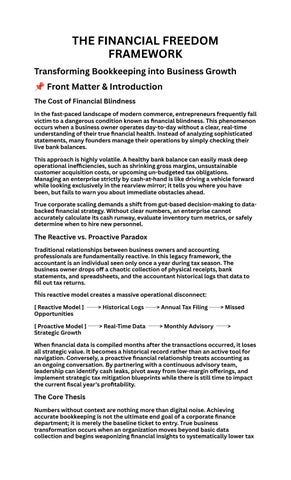
THE FINANCIAL FREEDOM FRAMEWORK
Transforming Bookkeeping into Business Growth
�� Front Matter & Introduction
The Cost of Financial Blindness
In the fast-paced landscape of modern commerce, entrepreneurs frequently fall victim to a dangerous condition known as financial blindness. This phenomenon occurs when a business owner operates day-to-day without a clear, real-time understanding of their true financial health. Instead of analyzing sophisticated statements, many founders manage their operations by simply checking their live bank balances.
This approach is highly volatile. A healthy bank balance can easily mask deep operational inefficiencies, such as shrinking gross margins, unsustainable customer acquisition costs, or upcoming un-budgeted tax obligations. Managing an enterprise strictly by cash-at-hand is like driving a vehicle forward while looking exclusively in the rearview mirror; it tells you where you have been, but fails to warn you about immediate obstacles ahead.
True corporate scaling demands a shift from gut-based decision-making to databacked financial strategy. Without clear numbers, an enterprise cannot accurately calculate its cash runway, evaluate inventory turn metrics, or safely determine when to hire new personnel.
The Reactive vs. Proactive Paradox
Traditional relationships between business owners and accounting professionals are fundamentally reactive. In this legacy framework, the accountant is an individual seen only once a year during tax season. The business owner drops off a chaotic collection of physical receipts, bank statements, and spreadsheets, and the accountant historical logs that data to fill out tax returns.
This reactive model creates a massive operational disconnect:
[ Reactive Model ] > Historical Logs > Annual Tax Filing > Missed Opportunities
[ Proactive Model ] > Real-Time Data > Monthly Advisory > Strategic Growth
When financial data is compiled months after the transactions occurred, it loses all strategic value. It becomes a historical record rather than an active tool for navigation. Conversely, a proactive financial relationship treats accounting as an ongoing conversation. By partnering with a continuous advisory team, leadership can identify cash leaks, pivot away from low-margin offerings, and implement strategic tax mitigation blueprints while there is still time to impact the current fiscal year's profitability.
The Core Thesis
Numbers without context are nothing more than digital noise. Achieving accurate bookkeeping is not the ultimate end goal of a corporate finance department; it is merely the baseline ticket to entry. True business transformation occurs when an organization moves beyond basic data collection and begins weaponizing financial insights to systematically lower tax
liabilities, maximize operational margins, and safely fund long-term expansions.
To help businesses successfully navigate this paradigm shift, The Acctax Company provides an integrated framework that unifies cutting-edge financial technology with fractional, high-level advisory expertise, ensuring that every financial metric serves your long-term corporate vision.
�� Chapter 1: Building a Modern Cloud Accounting Foundation
The Death of Paper Receipts
For decades, the standard corporate accounting workflow was defined by physical paper. Shoeboxes filled with fading thermal receipts, manual paper ledgers, and physical file cabinets dominated back-office administrative spaces. This manual architecture is incredibly inefficient, prone to human error, and represents a massive compliance vulnerability. Physical paper records can easily be lost, damaged by environmental elements, or incorrectly filed, leaving a company highly exposed during regulatory audits.
Transitioning to a modern, paperless environment is the first step toward building an agile business. By leveraging digital ledger capture applications, frontline team members can instantly photograph and digitize receipts at the exact point of purchase. Optical Character Recognition (OCR) engines automatically extract crucial transaction metadata such as the vendor name, date, currency, and tax amounts—and match it against corporate credit card feeds, eliminating manual entry.
Ecosystem Integrations
The cornerstone of modern operational control is a centralized cloud accounting core. Rather than allowing distinct business units to run on fragmented tracking platforms, enterprise systems utilize deep software integrations to construct an absolute ecosystem:
By connecting cloud accounting systems like Xero or QuickBooks Online directly with corporate banking feeds, point-of-sale (POS) software, inventory tools, and payroll applications, information flows securely across the entire enterprise. Bank transactions are automatically imported and matched against outstanding invoices every 24 hours, dramatically cutting down processing times and ensuring your core ledger is always accurate.
The Daily Flow of Data Visibility
When cloud systems are correctly implemented, accounting moves from a monthly chore to a continuous flow. This immediate visibility gives leadership teams access to updated, accurate financial statements whenever they need them.
Instead of waiting weeks for a previous month's books to close, executives can monitor key health indicators such as daily cash-at-hand, accounts receivable aging metrics, and immediate gross margin fluctuations at a single glance. This transparency allows management to confidently make critical pivots, handle vendor negotiations, and manage short-term capital allocations with complete certainty.
�� Chapter 2: Tactical Tax Planning vs. Reactive Tax Filing
The Tax Optimization Strategy
There is a profound operational difference between tax preparation and tax planning. Tax preparation is the mechanical act of filling out historical government forms at the end of the year. Tax planning, on the other hand, is the strategic arrangement of financial activities to ensure a company pays the absolute legal minimum in taxes.
High-performing enterprises focus their energy on year-round proactive tax planning. By analyzing corporate activities through an analytical lens, businesses can strategically time asset acquisitions, restructure internal debt, optimize executive compensation, and utilize specific corporate codes well before the fiscal year ends. This eliminates unexpected tax liabilities and ensures more capital stays within the business to fund future growth.
Entity Selection Mechanics
A fundamental structural choice for any business owner is selecting the legal entity type under which they operate. The initial corporate structure selected during startup operations rarely remains optimal as revenue grows. Choosing incorrectly can leave founders exposed to unnecessary personal liability and high self-employment or corporate tax rates.
Continuously evaluating this corporate matrix against changing revenue levels is critical. Transitioning a business from a simple pass-through setup to an optimized corporate structure can save business owners thousands of dollars annually in unnecessary income taxes.
Hidden Deductions & Legislative Updates
The tax code is continuously evolving. Federal, state, and local governments frequently update tax laws to introduce new research and development credits, adjusted capital depreciation rules, and regional employment incentives.
Keeping up with these changes internally is nearly impossible for busy corporate leaders. Working with a dedicated advisory firm ensures your business stays ahead of these legislative shifts. Analysts systematically examine your operations to discover overlooked deductions such as specific
vehicle use writes-offs, energy-efficiency equipment incentives, or home office write-offs safeguarding your hard-earned revenue.
⚙ Chapter 3: Compliance, Payroll, and Protecting the Core Business
Navigating Complex Sales Taxes
The modern marketplace has eliminated traditional geographic barriers, allowing small businesses to sell to consumers worldwide. However, this expansive reach brings significant regulatory friction in the form of multijurisdictional sales taxes. Whether managing state-level sales tax economic nexus rules in the United States, Value Added Tax (VAT) in Europe, or Harmonized Sales Tax (HST/GST) across Canada, businesses must monitor complex, localized transaction thresholds.
Failing to register, collect, and accurately remit sales taxes across different regions can result in severe retroactive financial penalties. Organizations require automated geographical tracking pipelines that link directly with digital sales platforms to compute correct tax rates at check-out, ensuring compliance across every market served.
Automated Payroll & Government Remittances
Managing workforce compensation is a high-risk operational task. Enterprise compliance teams must precisely calculate employee wages, handle independent contractor reporting, track shifting worker classification rules, and manage accurate benefits deductions.
[ Inbound Time Data ] > [ Automated Engine ] > [ Direct Deposit to Staff ]
└ > [ Direct Remittance to Government ]
To avoid costly administrative errors, businesses utilize automated cloud payroll platforms that handle calculations and filing automatically. These setups execute direct deposits for staff while simultaneously routing precise tax deductions directly to government revenue collectors on time, eliminating the risk of late-filing fines and keeping your workforce running smoothly.
Audit Defense
Receiving an official audit or review notification from agencies like the IRS, CRA, or HMRC can cause significant operational disruption. If a company's internal files are messy and disorganized, an audit can drain executive time for months, resulting in massive legal fees and expensive back-tax penalties.
The best audit defense is continuous preparedness. By utilizing robust digital document matching practices, every single ledger entry is permanently tied to its corresponding digital invoice and proof-of-payment record. This disciplined approach allows you to generate transparent, audit-ready financial data rooms instantly, turning a stressful government review into a routine administrative check.
�� Chapter 4: The Remote Comptroller Model & Strategic Scale
Moving Beyond Basic Bookkeeping
As a business grows, its financial needs change significantly. Many founders mistakenly assume that a general bookkeeper can handle the strategic financial demands of an expanding mid-sized corporation. In reality, scaling businesses
require distinct layers of financial expertise:
Bookkeepers: Focus exclusively on daily administrative tasks, processing data entry, recording receipts, and logging transactions.
Corporate Accountants: Focus on historical analysis, verifying ledger accuracy, reconciling multi-currency accounts, and preparing official tax filings.
Comptrollers (Controllers): Oversee all internal accounting workflows, enforce strict data controls, analyze complex operational trends, and deliver forward-looking financial insights to executive leadership.
Deploying a full-time, internal comptroller is often cost-prohibitive for growing mid-market enterprises. To bridge this structural gap, businesses can leverage an outsourced approach, utilizing premium outsourced bookkeeping services and remote comptroller solutions to access elite financial oversight at a fraction of the cost of a full-time executive hire.
Financial Trend Analysis & Forecasting
To scale a business safely, executives must look past historical metrics and build dynamic, forward-looking financial forecasts. This requires transforming standard balance sheets into advanced predictive tools:
[ Historical Ledger Data ] > [ Predictive Forecasting Models ] > [ Cash Runway & Burn Calculations ]
By tracking monthly cash burn rates, evaluating inventory turnaround trends, and projecting seasonal revenue dips, leadership can model complex corporate scenarios with complete accuracy. This predictive foresight allows you to answer critical growth questions with certainty: Can the business withstand a 15% jump in raw material costs? Do we have enough cash runway to support a new product launch without outside funding?
Data-Driven Strategic Advisory
A professional financial advisor is a critical asset for strategic corporate planning. When evaluating major capital choices such as investing in warehouse equipment, purchasing commercial real estate, or acquiring a competitor an objective analysis of the numbers is essential. Your financial partner acts as a trusted sounding board, analyzing debt-service coverage metrics, calculating precise payback periods, and determining the true return on investment (ROI) of your initiatives to protect your capital
�� Chapter 5: Vertical-Specific Financial Management
E-Commerce Platforms & Cross-Border
Retail
The e-commerce sector operates on high transaction volumes, complex merchant processing structures, and multi-currency sales funnels. Traditional accounting models struggle to track real-world e-commerce metrics due to complications like platform processing fees, returns, and inventory adjustments.
Managing an online retail business effectively requires specialized accounting configurations that map gross sales directly against merchant processing costs (such as Stripe, Shopify Payments, or PayPal cut-offs). Additionally, tracking automated landing costs is essential for calculating true gross profitability per SKU across various fulfillment centers.
Real Estate & Property Portfolios
Property investment, commercial leasing, and real estate development demand highly specialized accounting frameworks. Successful portfolio management relies on maximizing unique legal tax privileges, such as cost-segregation studies, structural depreciation schedules, and 1031 tax-deferred exchanges.
By structuring real estate accounts correctly, property owners can offset rental incomes against calculated structural depreciation assets, keeping taxable net incomes low while preserving long-term equity growth.
Startups & Venture Capital Readiness
Fast-growing tech startups operate in a high-intensity environment focused on monitoring cash burn rates, optimizing user acquisition costs, and extending cash runways. Startups looking to raise outside capital or secure institutional lines of credit must maintain clear, verifiable financial records from day one.
Implementing a institutional-grade accounting system ensures your cap tables are clean, your stock compensation programs are accurately tracked, and your investor packets are ready for due diligence audits at a moment's notice.
❓ Chapter 6: Comprehensive FAQ Section
1. What is the practical difference between a bookkeeper and a CPA/Chartered Accountant?
Bookkeepers focus on daily tactical data capture, entry tasks, and matching receipts against banking feeds. CPAs and Chartered Accountants take that foundational data and apply high-level strategic analysis to design taxmitigation strategies, ensure compliance with complex legal codes, and provide advanced corporate financial planning.
2. How often should a healthy business review its financial statements?
Reviewing financial statements only once a year is an operational risk. A healthy, growing enterprise should cross-examine its profit and loss statements, balance sheets, and cash flow reports at least once a month. This regular cadence allows management to spot slipping margins, catch bill errors, and identify cash flow issues before they threaten the business.
3. How can we safely migrate from manual legacy files to cloud accounting platforms?
Migrating to the cloud demands a secure, multi-stage transition pipeline to prevent data corruption or double-entry errors:
[ Extract Legacy Files ] > [ Clean & Audit Data ] > [ Map Chart of Accounts ] > [ Go-Live Cloud Sync ]
First, historical transaction data is safely extracted from legacy systems. Next, the chart of accounts is cleaned and mapped to match current operational workflows. Finally, banking balances are reconciled to ensure the new cloud environment is accurate and error-free on launch day.
4. What criteria dictates whether a business should incorporate or stay a sole proprietor?
The decision to incorporate depends on several key variables: your net business income, the inherent liability risks of your industry, and your long-term scaling plans. When your net income exceeds your personal living costs, incorporating allows you to retain surplus capital inside the business at a lower corporate tax rate, while adding a vital layer of personal asset protection.
5. How do multi-state or international sales taxes (like VAT/GST) affect my profit margins?
If your sales funnels are not configured to automatically track geographic nexus rules and compute correct tax rates at checkout, your business may end up absorbing those local tax costs retroactively. This can rapidly erode your net profit margins across international orders, highlighting the importance of integrated tax automation software.
6. What are the primary indicators that our company needs a fractional Controller or CFO?
Clear signs include: experiencing strong revenue growth but never having enough cash in the bank, struggling with inventory forecasting errors, facing complex multi-state tax issues, or needing investor-ready financial reports to secure capital but lacking the budget for a full-time financial executive.
7. How do proactive tax mitigation strategies differ from tax evasion?
Tax evasion is an illegal practice where an entity intentionally hides income or falsifies documents to avoid paying taxes. Proactive tax mitigation is a fully legal strategy that utilizes existing tax laws, entity structures, and government incentives to arrange your business operations so that you pay the absolute minimum required by law.
�� Chapter 7: Conclusion & Execution Plan
The Cost of Inaction
Sticking with outdated accounting methods, messy spreadsheets, and once-ayear financial tracking is an expensive operational drag. It drains hours of valuable administrative time every week, leaves lucrative tax write-offs on the table, and keeps executive teams completely blind to emerging operational risks. Every month you delay modernizing your financial workflows, your business loses money through operational inefficiencies and unnecessary tax expenses.
Call to Action
Don't let financial blind spots limit your company's growth potential. Turn your accounting from a stressful administrative chore into a powerful driver of business scale. Contact the specialized financial consulting team at The Acctax Company today to schedule a comprehensive data and workflow audit. Let our team modernize your financial operations, optimize your corporate tax strategy, and provide the real-time financial clarity you need to scale your business with absolute confidence.