
I hope you all had a wonderful Global Clinical Engineering (CE) Day on October 21! This international celebration highlighted the crucial work clinical engineers do every day to ensure patient safety and effective healthcare delivery. In recognition of CE Day, the American College of Clinical Engineering (ACCE), in partnership with the Healthcare Technology Certification Commission (HTCC), released a special video message detailing exciting changes to the Certification in Clinical Engineering Program. To get the full update on how the certification process is evolving to meet modern challenges, you can watch the video here and read the related article on page 3.
As we move toward a new year, the ACCE is committed to two strategic goals designed to strengthen our profession and expand our influence within the broader healthcare ecosystem.
Certification remains the cornerstone of professional excellence in clinical engineering. This year, we are placing a strong emphasis on promoting the three certifications that will be offered by HTCC: Clinical Technology Professional (CTP), Associate Clinical Engineer (ACE), and Certified Clinical Engineer (CCE). This initiative will leverage the collective power of all ACCE committees to highlight the value of certification to both individual professionals and their employers. To kick off this goal, our Body of Knowledge (BOK) Committee has organized the ACE/CCE Written Exam Review Webinar series to begin January 7, 2026. If you are looking to become certified this year, please register for this valuable course! By championing these certifications, we are ensuring that ACCE members are recognized as leaders in the Clinical Engineering field.
The challenges facing modern clinical engineering often overlap with those of other disciplines.
foster a more integrated and effective approach to managing healthcare technology,
with other key industry
(Continued from page 1)
professional organizations. We will be actively pursuing or revitalizing collaborative opportunities with:
• AAMI (Association for the Advancement of Medical Instrumentation): Continuing our long-standing partnership to shape industry standards and best practices.
• HIMSS (Healthcare Information and Management Systems Society): Bridging the gap between clinical engineering and health information technology, particularly in areas like medical device integration and cybersecurity.
• AIMBE (American Institute for Medical and Biological Engineering), ASHE (American Society for Health Care Engineering), IFMBE (International Federation for Medical and Biological Engineering), and BMES (Biomedical Engineering Society): Exploring synergies related to facilities management, research, and education to offer a more holistic view of the healthcare environment.
These partnerships will enhance our collective voice, improve knowledge sharing, and create new opportunities for our members to collaborate and lead in a multidisciplinary environment.
As we look forward to the opportunities 2026 will bring, we wish all our members and partners a very happy holiday season and a prosperous New Year! Your continued dedication makes the ACCE community strong.
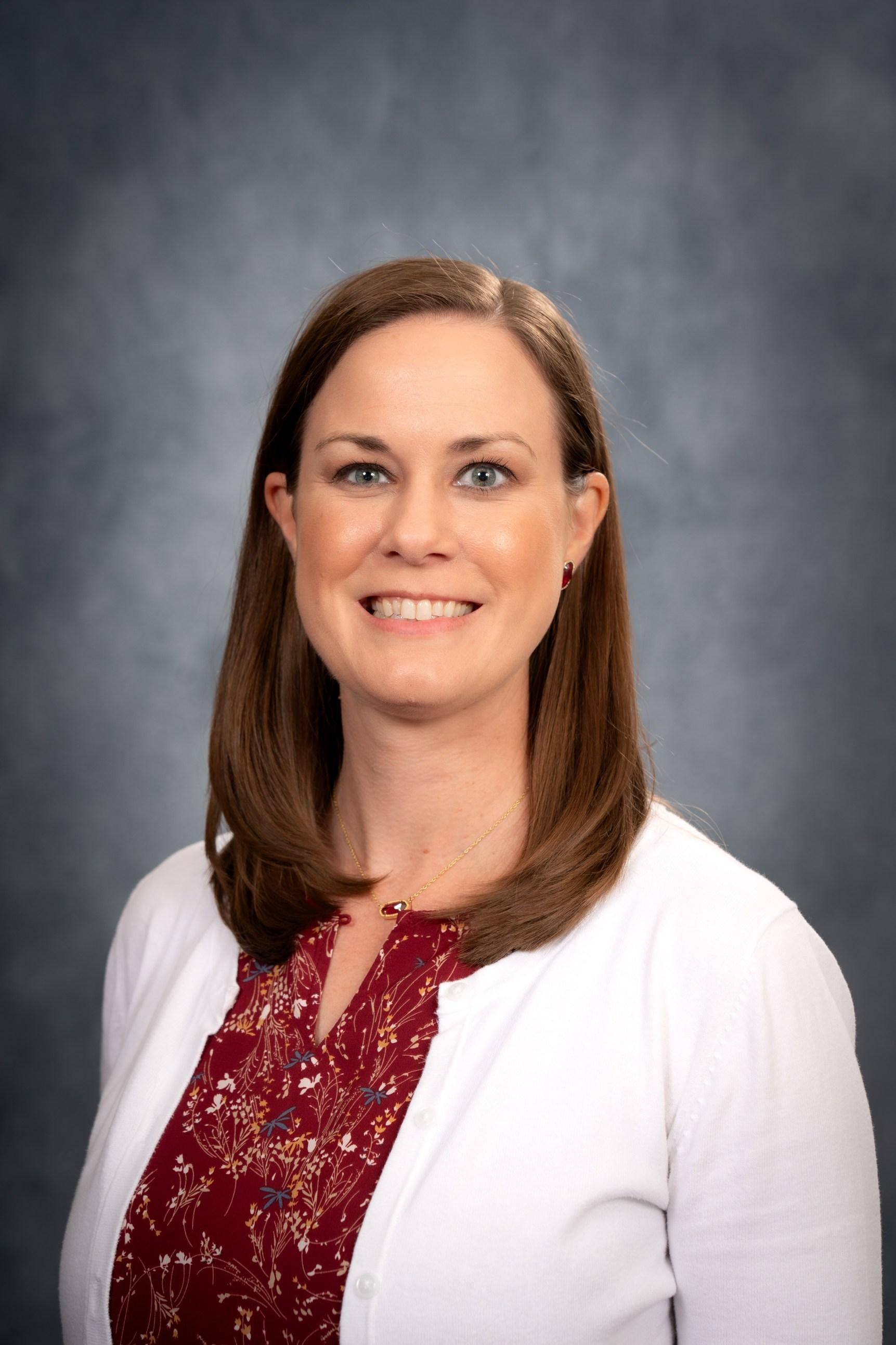
Katherine Navarro, ACCE President katherineb.navarro@gmail.com
ACCE News is the official newsletter of the American College of Clinical Engineering (ACCE).
Managing Editor
Ted Cohen tedcohen@pacbell.net
Co-Editors
Sonja Markez Jason Launders editor@accenet.org
Circulation & Address Corrections
Suly Chi, ACCE Secretariat secretariat@accenet.org
Advertising
Dave Smith advertising@accenet.org
ACCE News is a benefit of ACCE membership; non-members may subscribe for $100 per year.
To subscribe e-mail: secretariat@accenet.org
Copyright © 2025 by ACCE
Expanding access, embracing technology, and redefining professional recognition for the next generation of healthcare technology leaders.
The Healthcare Technology Certification Commission (HTCC) has launched a sweeping modernization effort that redefines how clinical engineers and healthcare technology professionals demonstrate competence, grow their careers, and connect to a global professional standard. After decades of administering the Certified Clinical Engineer (CCE) program, HTCC is expanding access with two new credentials the Associate Clinical Engineer (ACE) and the Clinical Technology Professional (CTP) along with a fully virtual exam platform. These changes mark the most significant evolution of the HTCC program in its history. Our goal is to make certification more accessible, more relevant, and more sustainable. We’re modernizing the program without compromising what has always defined HTCC fairness, rigor, and credibility.
For the first time, clinical engineers and technology professionals can complete their certification exams remotely, using a secure, identity-verified, proctored testing system. The new format removes barriers related to travel and cost while maintaining the integrity and standards HTCC is known for.
“This shift reflects how the profession itself is changing,” said Arleen Thukral, HTCC Vice Chair. “Technology professionals expect flexible, secure, and digital experiences and certification should be no different.”
Applications for the CCE, ACE and CTP certifications will open in December 2025 through HTCC’s new online application system. Those interested can visit our website to sign up for launch alerts and be notified when applications go live.
In 2026, HTCC will launch a new online platform that enables certified professionals to manage their credentials entirely online including renewals, payments, and verification. The system will give members secure access to their digital certificates, renewal history, and credential status in one convenient location. This digital transformation is about value. We’re giving certified professionals the tools to manage their credentials easily, stay engaged with the ACCE/HTCC community, and take advantage of new opportunities to learn and contribute.
The ACE and CTP certifications reflect the evolving, interdisciplinary nature of healthcare technology management. These new credentials are:
• ACE (Associate Clinical Engineer): For early-career engineers, typically with one to two years of experience, validating readiness for independent practice.
• CTP (Clinical Technology Professional): For experienced professionals overseeing technology projects, system integration, and data-driven program management.
These credentials complement the flagship CCE, creating a clear pathway from entry-level competence to advanced professional recognition.
(Continued on page 4)
(Continued from page 3)
Clinical engineering has evolved beyond the hospital basement. Today’s professionals manage cybersecurity, data analytics, and interoperability across complex health systems. HTCC’s framework reflects that evolution.
The Healthcare Technology Certification Commission (HTCC) is an independent, volunteer-led body dedicated to advancing patient safety and professional excellence through certification of clinical engineers and healthcare technology professionals. Supported by the American College of Clinical Engineering (ACCE), HTCC establishes and maintains internationally recognized standards for professional competence, ethics, and continuing education.
Thank you for being an ACCE member! ACCE Membership renewal for period January through December 2026 is due now.
To renew your 2026 membership online with PayPal, please click here to login to your member's account and renew via PayPal
To renew by postal mail, please remit your renewal check (payable to ACCE) to:
ACCE/Secretariat
Jacob Johnson
HTCC Chair jacob.b.johnson@kp.org
2880 Bicentennial Pkwy, Ste 100#249 Henderson, NV 89044
If you need an e-invoice for online payment with QuickBooks or check, please contact ACCE Secretariat at secretariat@accenet.org
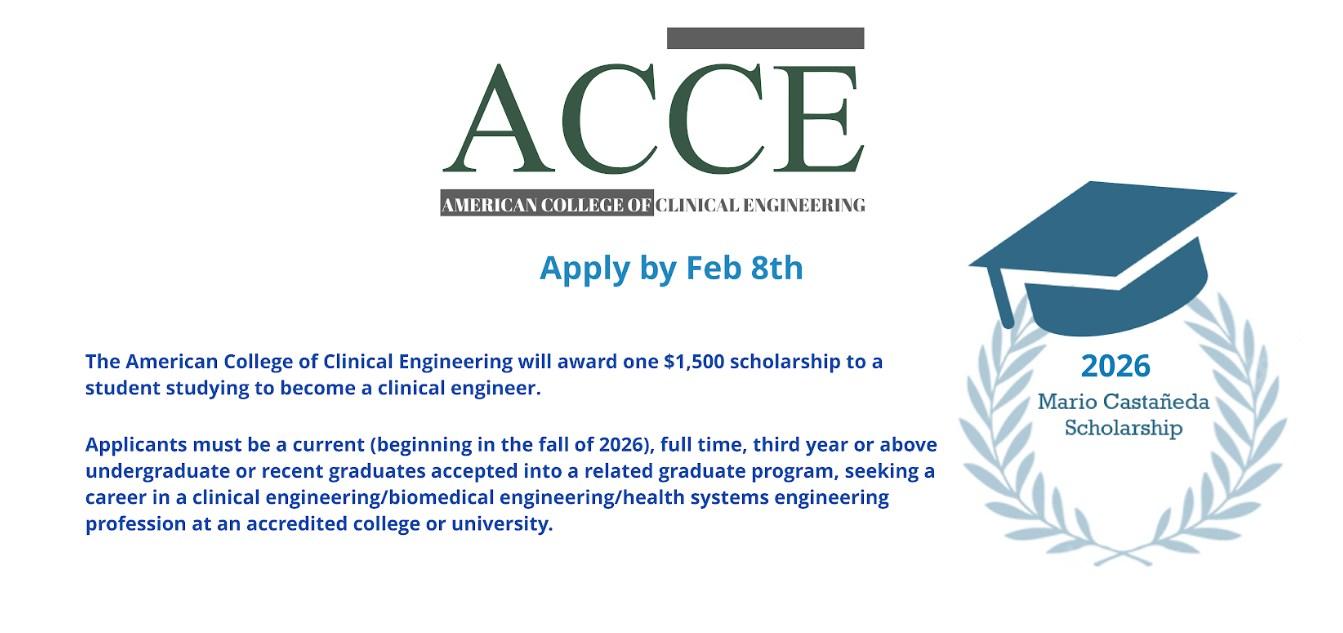
The Clinical Engineering Certification (ACE/CCE) Study Guide V14.0 was prepared by the American College of Clinical Engineering Body of Knowledge Committee. It reflects the collective knowledge of a group of senior clinical engineers about the current body of clinical engineering knowledge. As such, this Guide should help gauge the depth and breadth of your working knowledge in the clinical engineering field and point you in the right direction as you study for the ACE/CCE exam.
ACCE thanks all our volunteers who have contributed over the past 29 years (1996-2025) to updating the CCE Study Guide.
You may order your copy here.
The following volunteers have shared their expertise over the years:
• V14.0 (August 2025): Kim Greenwood, Board Member; Jenn Nichols, BOK Committee Chair; Chris Riha, Daisha King, Ishtar Al-Tahir, Kajal Madhusudan, Kindall Drucker, Michele Manzoli.
• V13.0 (June 2024): Kim Greenwood, Board Member; Jenn Nichols, BOK Committee Chair; Chris Riha, Daisha King, Ishtar Al-Tahir, Kajal Madhusudan.
• V12.0 (June 2023): Kim Greenwood, Board Member; Katherine Navarro, Board Member; Jenn Nichols, BOK Committee Chair; Alan Lipschultz, Chris Riha, Daisha King, Ishtar Al-Tahir, Kajal Madhusudan.
• V11.0 (June 2022): Kim Greenwood, Board Member; Katherine Navarro, Board Member; Jenn Nichols, BOK Committee Chair; Alan Lipschultz, Chris Riha, Jason Howard, Parisa Bahrami.
• V10.0 (July 2021): Kim Greenwood, Board Member; Bhaskar Iduri, BOK Committee Chair; Katherine Navarro, Alan Lipschultz, Jenn Nichols.
• V9.0 (May 2020): Kim Greenwood, Bhaskar Iduri, Steph Liddle, Alan Lipschultz, Chris Riha.
• V8.0 (Jul 2019): Katherine Navarro, Lucio Brito, Sarah Brockway, Mark Bruley, Jennifer DeFrancesco, Murat Firat, Dave Gretzinger, Renee Huval, Bhaskar Iduri, Scott Kopp, Nicholas Muhlenbruch, Bhavesh Patel, Sara Salari, Rehman Syed, Binseng Wang, Rachel Zhang.
• V7.0 (May 2018): Katherine Navarro, Sarah Brockway, Renee Huval, Bhaskar Iduri, Jeanine Maier, Meet Patel, Rehman Syed, Arleen Thukral, Tony Tai.
• V6.0 (August 2016): Matthew Baretich, Tobey Clark.
• V5.0 (May 2016): Christopher Falkner, Jennifer DeFrancesco, Austin Hampton.
• V4.0 (July 2014): Jacob Johnson, Jennifer DeFrancesco.
• V3.0 (August 2012): Ilir Kullolli, Kindall Druker, Frank Painter.
• V2.0 (July 2007): Arif Subhan, Ismael Cordero, Evelyn Fan, Robyn Frick, Jennifer Jackson, Jeff May, Frank Painter, Bokang Rapoo.
• V1.0 (1996): Jerry Anderson, Salil Balar, Ted Cohen, Vinnie DeFrancesco, Izabella Gieras, Stephen L. Grimes, Frank Painter, Christine Ruther, Marv Shepherd.
Jenn Nichols CE-BOK Chair jennie_nichols@yahoo.com
Dr. Joan Brown Vega has built a career at the intersection of medicine and technology a path defined by curiosity, innovation, and a commitment to improving patient care. Today, Joan serves as Head of Operations for the Rapid Development Studio for AI/ML at Fortrea, where she leads efforts to design practical, scalable artificial intelligence solutions that help clinicians deliver smarter, faster care. Her story began with two passions: medicine and technology. Growing up, Joan imagined contributing to healthcare while tinkering with gadgets and electronics. Discovering biomedical engineering while applying to colleges was a turning point it showed her she didn’t have to choose between science and technology. She could combine both to make a real difference. While earning her degree in Biomedical Engineering from Boston University, Jennifer Jackson, a Clinical Engineer and leader at Brigham & Women’s hospital gave a talk to students in the biomedical engineering program about clinical engineering. The practical application of engineering in the care delivery setting was exactly what Joan had been looking for.
Following graduation Joan’s career took her from the Veterans Affairs Medical Center to Massachusetts General Hospital to global health work with Orbis International. At Orbis, she helped advance telemedicine through the Flying Eye Hospital a surgical clinic on a plane connecting surgeons in the US, UK and Canada with physicians in remote regions to restore sight.

“Watching technology bridge continents and change lives was unforgettable,” Joan recalls. Her journey continued at University of Southern California (USC), where she held leadership roles in Care Transformation, Business Intelligence, and Data Strategy. As Chief Data Officer and later Associate Administrator, Joan became a bridge between clinicians, IT teams, and administrators developing predictive analytics dashboards for ICU surges and enabling secure health information exchange across hospitals. These projects reinforced her belief that engineering isn’t just about devices or code it’s about people. Along the way, Joan pursued advanced degrees an MBA from Boston College and an EdD in Organizational Change and Leadership from USC equipping her to lead teams and drive innovation. She also earned Certification as a Clinical Engineer and completed training in Global Health Delivery at Harvard, reflecting her passion for improving healthcare worldwide.
Today, at Fortrea, Joan is at the forefront of applying AI to clinical data, exploring how machine learning can predict disease and personalize treatment. “It’s exciting to think that the tools we build could help clinicians make decisions that save lives,” she says. Her work has earned recognition, including the IAPB (International Agency for the Prevention of Blindness) Eye Health Leaders Award for expanding eye care through telemedicine and the ACCE Professional Achievement in Technology Award for pioneering multi-site data collection and health information exchange.
Joan’s advice for future engineers and innovators is simple. Blend disciplines: Innovation often happens at the intersection of fields. Stay curious: Technology and healthcare evolve quickly keep learning. Find mentors: They’ll help you
(Continued on page 7)
(Continued from page 6)
navigate and grow. Focus on impact: Behind every algorithm or device is a patient whose life you can improve. Looking back, Joan describes her path as anything but linear but every step was guided by curiosity and a desire to make healthcare better. Her story is a reminder that if you love something or even two things you can bring them together to create meaningful change.
How long have you been involved with ACCE?
Over a decade, dare I say 2 decades? As member, committee member, and Board member.
What do you think of being female in engineering?
It’s a challenging road there’s no denying that. Engineering has traditionally been a male-dominated field, and that can make the journey feel isolating at times. You may find yourself as the only woman in the room, and that comes with its own pressures. But here’s the truth: it’s absolutely worth the effort.
Being a woman in engineering gives you a unique perspective, and that perspective matters. It brings diversity of thought to problem-solving, which is critical in fields like healthcare technology where innovation impacts lives. The challenges you face whether it’s proving your expertise or navigating bias can become strengths because they teach resilience, adaptability, and confidence.
For me, every hurdle reinforced why I chose this path: to make healthcare smarter and more accessible through technology. The sense of accomplishment when you see your work improving patient care far outweighs the obstacles. And over time, you become a role model for others, showing that women belong in engineering and can lead at the highest levels. My advice? Don’t let difficulty deter you. Seek mentors, build your network, and remember that your voice and skills are valuable. The road may be tough, but the impact you can make and the doors you open for others make it all worthwhile.
Honestly, Jennifer Jackson’s talk to the young biomedical engineering class was the influence that propelled me into the field. I had no idea the discipline existed, and when she spoke about it, I knew that’s what I wanted to do. Many years later, when I crossed paths with Jennifer once again, I credited her for helping me find my passion.
The applicability to many different arenas. I haven’t been in a biomedical engineering department or a formal clinical engineering role for more than a decade, but my early career learnings are the foundation of my success. Clinical engineering teaches you problem solving in a complex space, with many pressures. I’ve applied this training and learning in every role I’ve ever had.
As above, network, stay dedicated, show others that diverse perspectives add value to the discipline.
Suly Chi ACCE Secretariat secretariat@accenet.org
The following ACCE awards were presented after the ACCE annual awards reception:
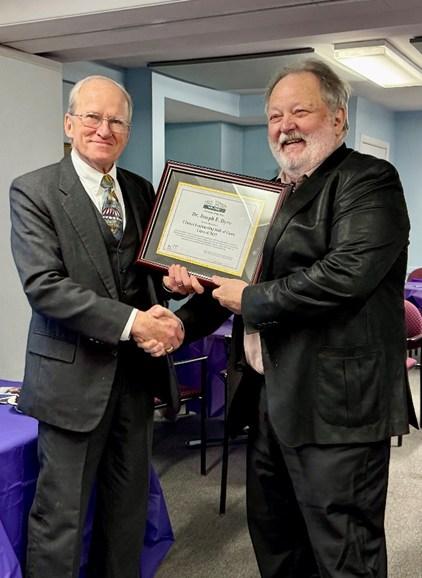
Joe Dyro inducted into ACCE Hall of Fame
The 2025 Clinical Engineering Hall of Fame certificate was presented to Joseph Dyro, PhD, FACCE (CE Hall of Fame, class of 2025), on November 7, 2025 in Portland, Maine, by ACCE CE-HOF Committee member, Steve Grimes.
Congratulations Dr. Joe Dyro!
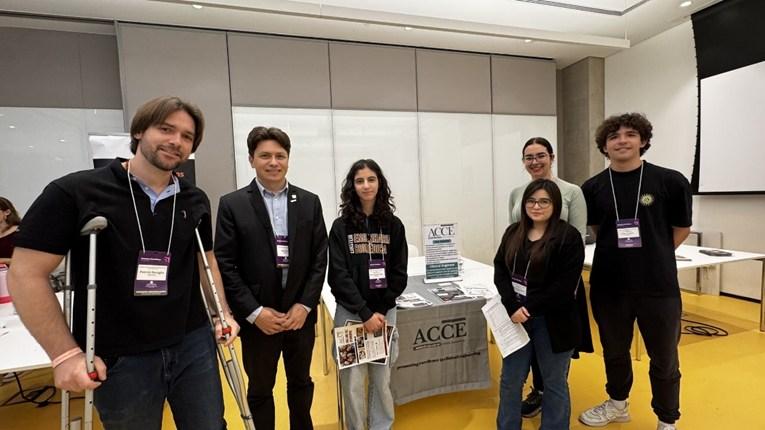
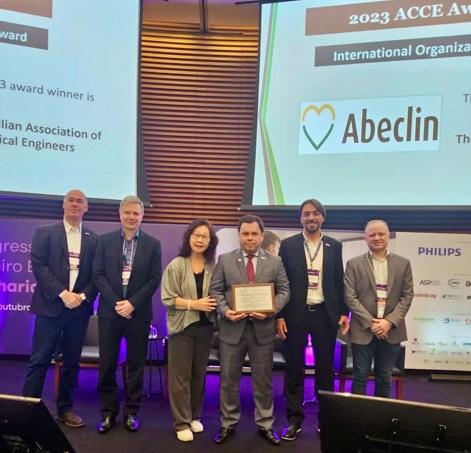
On October 15-17, 2025 Suly Chi attended the 2nd Einstein Clinical Engineering Conference (hosted by our Institutional Member Einstein Hospital Israelita) in Sao Paulo, Brazil. She presented the 2023 ACCE International Organizational Award to Abeclin - Associação Brasileira de Engenharia Clínica (represented by its current President Ricardo Alcoforado Maranhão Sá and VP Luís Fernando Cristo and past presidents Antonio Gibertoni and Alexandre Hermini, and past VP Bruno Roma). ACCE also hosted a table where we shared the ACCE’s mission and outreach to the Clinical Engineers and students at the conference.
Suly Chi ACCE Secretariat secretariat@accenet.org
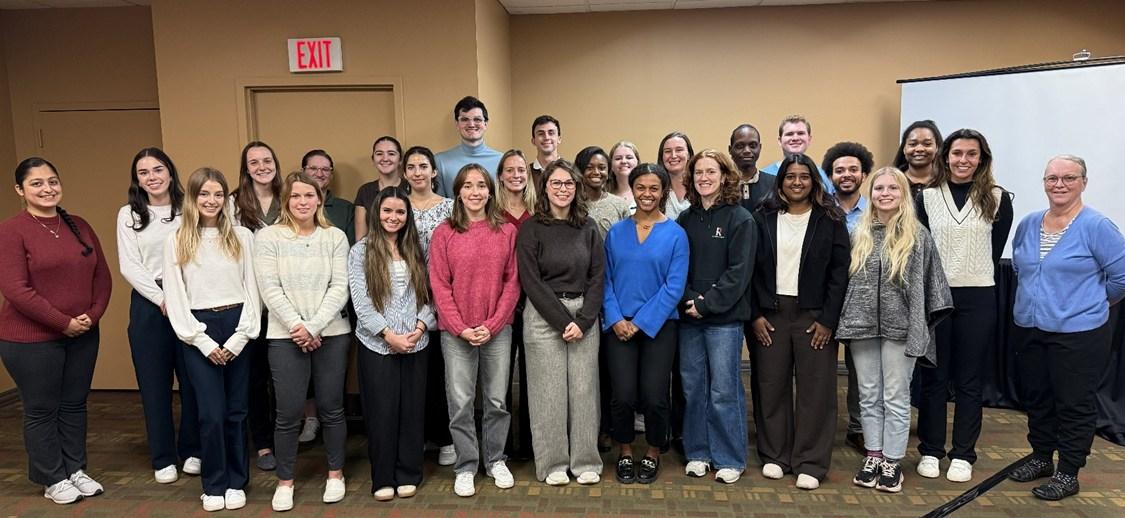
The beginning of a new academic year always brings me joy along with a bit of “game day” nerves. As a former studentathlete, I’m familiar with the start of a new season along with the comings and goings of teammates. Now as a “coach” it’s a whole new feeling of responsibility. Fortunately, as history confirms, the students in the Clinical Engineering Internship Program are self-motivated and eager to take on the challenges of this program and their future careers!
The 2025 fall Clinical Engineering week coincided with the New England Society of Clinical Engineering (NESCE) Symposium. A huge “thank you” to Dr. David Kaputa and the NESCE symposium committee for making it possible for us to convene in Manchester, NH for a week of amazing learning and networking.
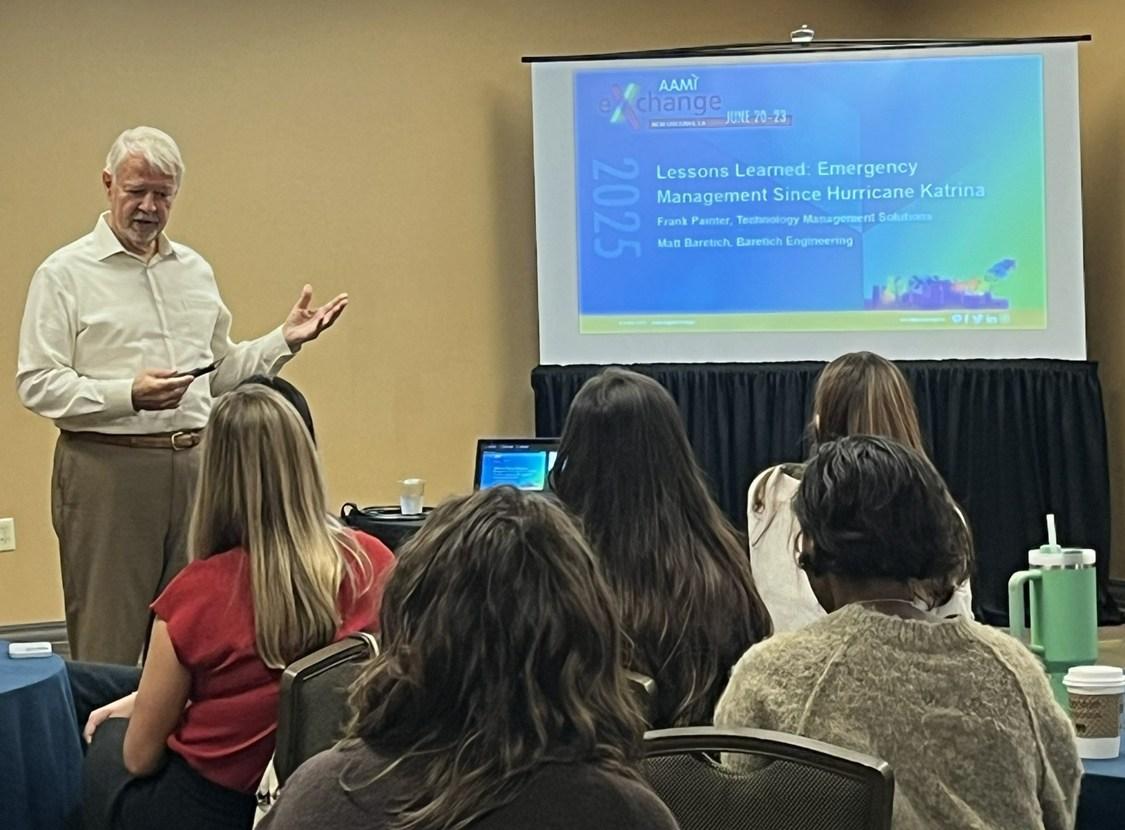
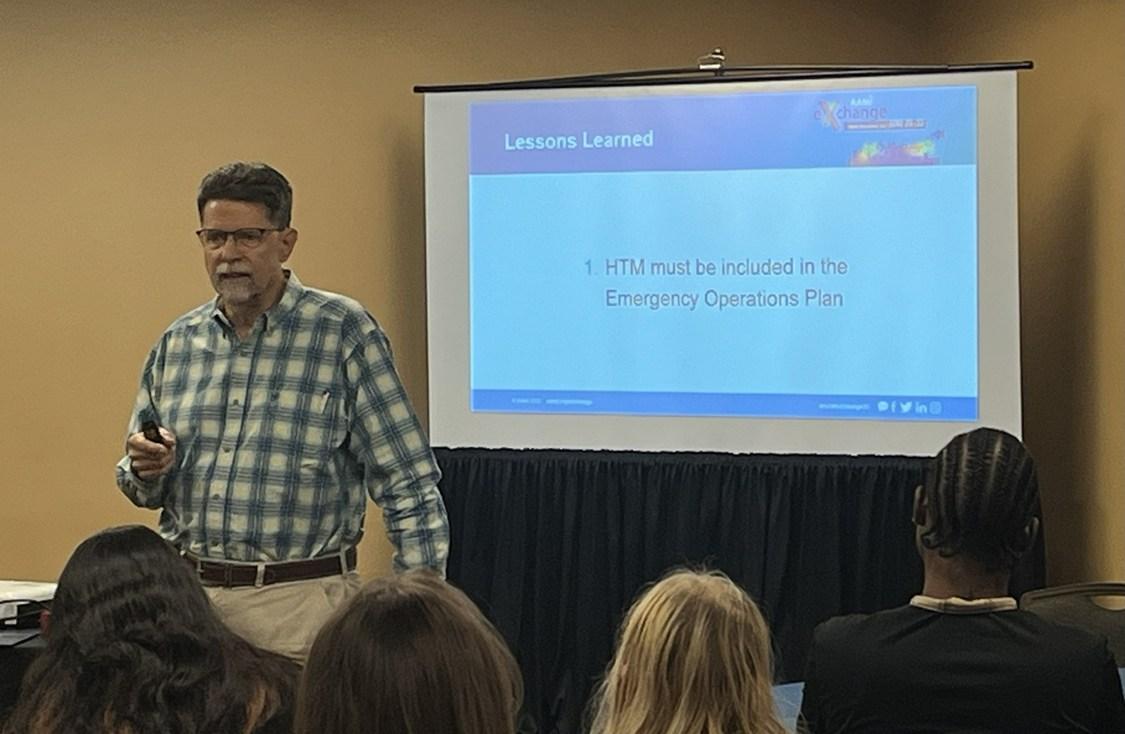
On our first day, we were joined by Frank Painter and Matt Baretich who shared their Hazard Vulnerability Analysis (HVA) knowledge and experiences. Matt began the morning by explaining the concepts within HVA along with its relationship to emergency operations and regulatory compliance. He also shared three very important lessons learned over the course of his career: HTM must be included in the Emergency Operations Plan, standards compliance is not enough, and think outside the basement. The importance of these three principles became immediately apparent when Frank shared his experience as the forensic investigator after the historic Katrina hurricane in New Orleans. After walking us through the horrific scenario and his investigation in the aftermath of the storm, Frank facilitated a workshop that allowed us to put the HVA concepts into practice. We broke into small groups each with a distinct geographic area. Each group was asked to identify
(Continued
the hazards, assess the level of risks associated with each, and then present their work to the group. It’s safe to say, we all learned a lot!
We spent the afternoon reviewing the NESCE educational courses. After sharing our initial thoughts about which sessions we each planned to attend, we discussed WHY we chose those sessions and WHAT we hoped to gain from them. Because the symposium brochure did not include descriptions of the sessions, we had to rely on the titles. It was fascinating to hear how each of us interpreted the titles and made our decisions. As you might have guessed, this exercise was a way to learn how to get the most out of a conference.
We wrapped up the day with a discussion about the volunteer assignments I had coordinated with the NESCE Symposium committee. The 2nd year interns supported the Registration Desk which provided an opportunity to meet and introduce themselves to attendees. All of the interns provided support to the educational sessions by introducing the speakers. Again, this was an opportunity for them to introduce themselves and meet influential CE professionals in the field. To bring it all home to the UCONN CE Internship Program, the interns were instructed to collect business cards (or other means of contact information) and send follow-up emails to begin building their network. The fruits of their labor will be revealed as homework submissions and potentially job search leads for the 2nd year interns.
The next two days were filled with amazing speakers. Ashley O’Mara opened the NESCE Symposium and Andrea Bordenca delivered a keynote that set the tone for learning and belonging within our CE/HTM community.
We wrapped up the week with our standard Keep-Add-Stop debrief. This is an opportunity for the interns to provide me with feedback as I plan future Clinical Engineering Week agendas. Then it was time for us to return to our workplaces and, hopefully, apply at least a few of the lessons learned during our fall 2025 CE Week.
As always, a huge Thank You to our host hospitals and health systems for providing the real-world experience so valuable to our interns. I would love to hear from you if you’re interested in learning more about the UCONN Clinical Engineering Internship program or if you would like to hire one of our talented students!
Carol Davis-Smith, MS CCE FACCE AAMIF Program Director – UCONN BME Clinical Engineering Internship Program UCONN email: Carol.Davis-Smith@uconn.edu
In this AAMI Update we review the career of AAMI member, Mary Vater.
Mary Vater is the current Director of Regulatory Affairs at Innolitics LLC. She has taught with AAMI since 2019, and helps develop courses in quality systems and regulatory compliance. Vater has served as a consultant through roles with several organizations, gaining expertise in software, diagnostics, electromechanical devices, implants, and surgical tools. She has led over 30 companies through FDA 510(k) clearance and advises clients on FDA- and ISO 13485-compliant quality management systems, design controls, risk management, and post-market surveillance.
When Vater graduated from Wichita State University with a bachelor’s degree in biomedical engineering, she wasn’t planning on working in quality and regulatory management. In fact, she had already secured a position as a Biomedical Engineer at Biomedical Devices of Kansas. But through her work in research and development, Vater quickly discovered that her interests went beyond engineering.
The company advised startups through the entire lifecycle of medical devices, from the product requirements phase to validation and regulation. As a result, her duties soon expanded to include regulatory work, where she helped to fill in the gaps on FDA documentation for products like laser therapy systems and electronic stethoscopes.
The more she saw of the regulatory process, the more her interest in the subject grew. “I actually had one of the other engineers tell me, ‘Be very careful, because if you start moving into quality and regulatory, you might not find your way back to an engineering role very easily.’ But it actually ended up being exactly where I was meant to be,” she said.
After less than a year in that role, she was promoted to a position as the Head of Quality Assurance. “That’s when I really made my transition from engineering and R&D to quality and regulatory,” she recalled.
Following several years at the company, she undertook a consulting apprenticeship at the Medical Device Academy to gain experience with 510(k) submissions. There, she continued her quality and regulatory work, taking on additional roles as the interim Quality Manager for several small start-ups. “[I was doing] the legwork of the quality system, writing their CAPAs (Corrective and Preventative Actions), hosting their FDA inspections, doing their supplier audits,” she said.
It was also there that she began working with software companies, at a time when Artificial Intelligence and Machine Learning (AI/ML) was beginning to be implemented in medtech. “I worked on a device very early on that was doing organ contouring in the AI/ML space. [A]fter that was cleared, I started getting a lot of calls from AI/ML companies. So that somewhat became my niche while I was there,” she said.
Last year, Vater moved into a directorial position at Innolitics, where she continues to consult on quality systems and FDA compliance – adding her current focus on software to the long list of devices she has worked with.
“I’ve had broad exposure to anything that you could possibly encounter in a regulatory submission or in a quality system. Everything from cybersecurity to clean room validations to sterilization validations and electrical safety testing,” she remarked.
This wide range of experience has equipped Vater with a unique perspective. “There’s a framework for FDA expectations,”
(Continued on page 12)
she explained. “So even if somebody were to send me an email with a device I’ve never heard of, in an area I’ve never worked in, [because I understand] the framework, the principles, and the best practices, it’s really just a matter of then understanding the new regulation for that specific product type."
As a professional in the AI/ML space, Vater has first-hand experience with the application of AI in the medical device field. “I think the biggest thing that’s going to be changing in the next five years is the use of AI/ML, and not only on the developer side, but also on the regulatory side,” she said.
“For example, in risk management, it’s very easy to put a description of your device into ChatGPT and have it spit out a million risks that you should be considering,” she added. “And the FDA is going to be doing that too to make their jobs easier.”
Though not all professionals use AI platforms to aid in their work, she believes that the majority will soon. “You have to keep up with the latest tools that are available to you,” she underscored. “Not only because it will make you more efficient, but because other people are going to be using those tools too, and you’re quickly going to be left behind.”
These are topics she addresses in her teaching. Vater encourages her students to use chatbots to learn material, but not at the expense of acquiring knowledge. “Knowing the boundaries…is something I’ve been trying to incorporate,” she said.
Vater began her journey with AAMI six years ago, when she took a software course taught by Brian Pate. He took notice of Vater’s expertise in the 510(k) process, and recommended her to help teach and develop AAMI’s new course on the subject. Today, Vater also teaches Lead Auditor for Management Systems & Processes and Post-Market Surveillance for Medical Devices, both of which she assisted in developing.
“I’ve found [AAMI’s] resources and community incredibly valuable for staying current with industry best practices and emerging trends, which has definitely shaped my perspective and expertise in regulatory affairs,” Vater shared.
Vater recently taught AAMI’s Post-Market Surveillance for Medical Devices course. Attendees learned how to comply with the latest US and international regulations on products approved for distribution. “Only [about] 10% of the effort is getting to clearance. The regulatory compliance work really starts once you have been cleared,” she pointed out.
And regulations are changing all the time. For Vater, a professional’s ability to keep up with these changes is the greatest predictor of their success in the field. “I was just out for two months, and I feel like I’ve already missed a year’s worth of changes,” she said.
For that reason, it’s extra important for regulatory professionals to constantly check in on updates to 510(k) databases and, above all, to pay attention to what other experts are doing to stay ahead. “Because everything is always evolving,” she emphasized.
AAMI Staff
Daniel Visnovsky Media Relations Manager dvisnovsky@aami.org
The Education Committee is excited to announce the continuation of the 2025-2026 Education Webinar Series!
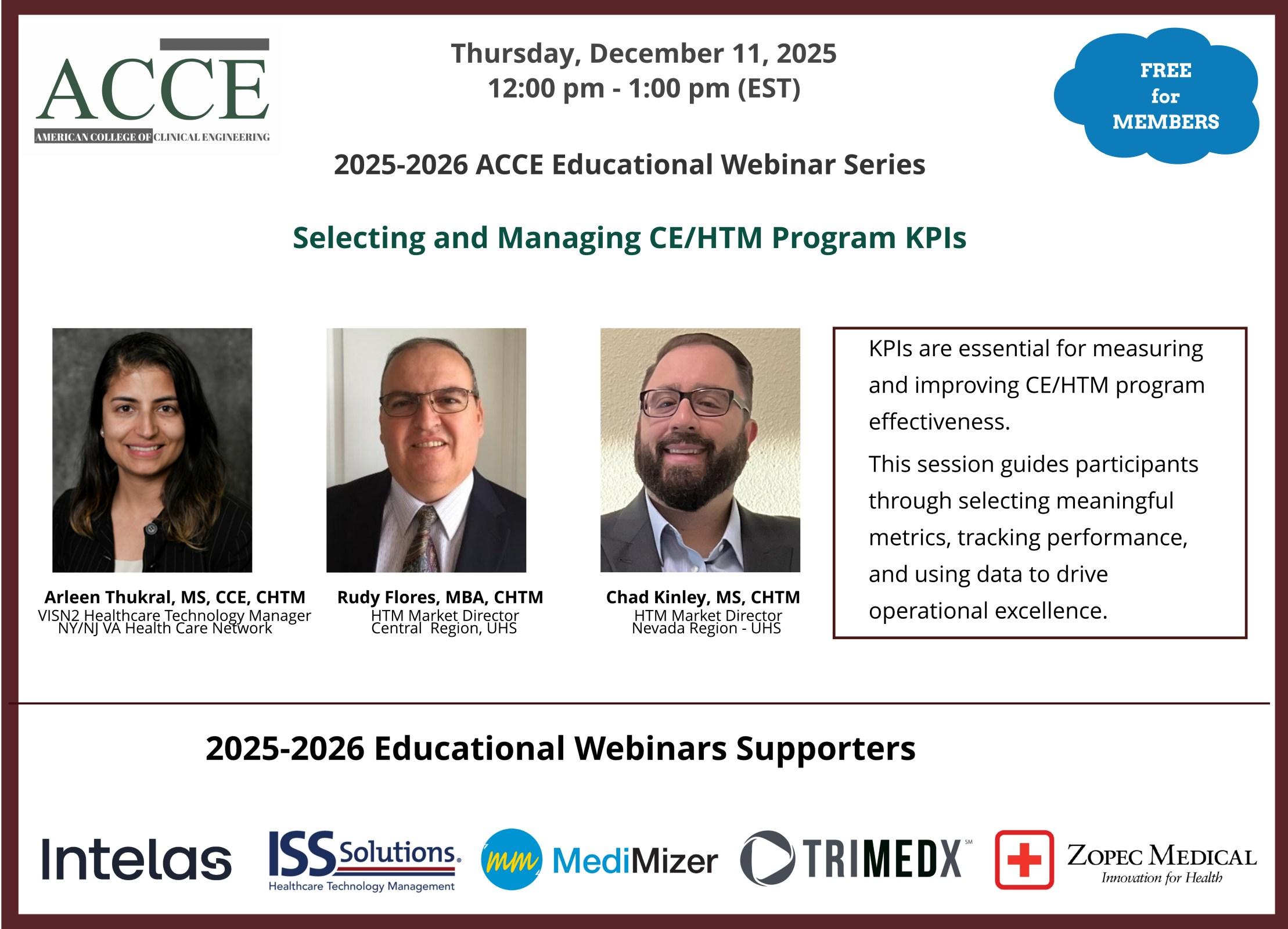
Session #4 – Selecting and Managing CE/HTM Program KPIs
KPIs (Key Performance Indicators) are the backbone of quality and efficiency in Clinical Engineering and Healthcare Technology Management. This session will guide participants through selecting meaningful metrics, tracking performance, and using data to drive operational excellence
Speakers: Arleen Thukral, Rudy Flores, and Chad Kinley
Date/Time: December 11, 2025, 12pm-1pm (EST)
Registration: Free to ACCE members in good standing: Session #4 Registration. Non members: Click here to register as non-members.
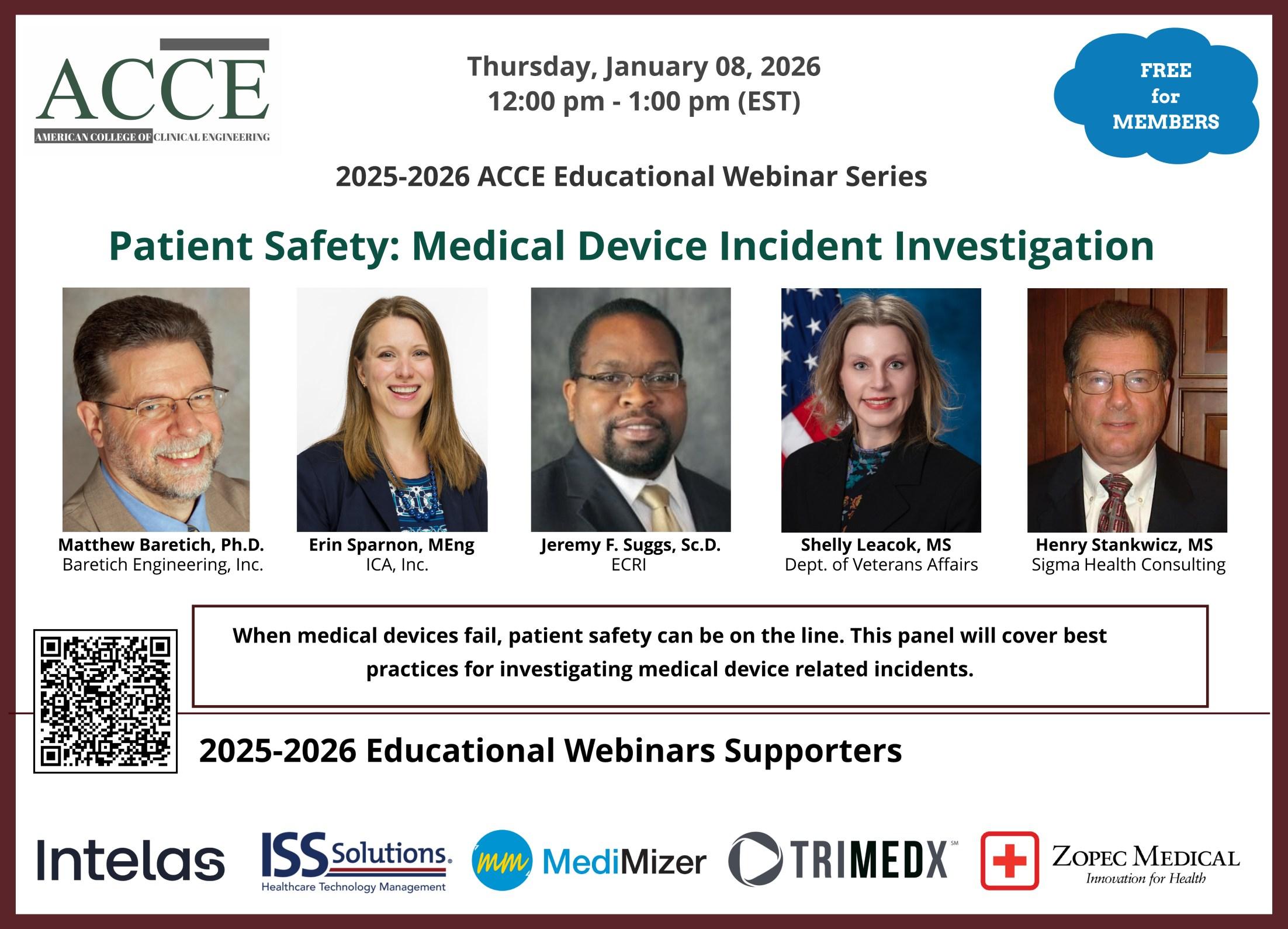
When medical devices fail, patient safety can be on the line. This webinar covers best practices for investigating medical device related incidents.
Speakers: Matthew Baretich, Erin Sparnon, Jeremy F. Suggs, Shelly Leacok, Henry Stankiewicz
Date/Time: January 8, 2026, 12pm-1pm (EST)
Registration: ACCE Members and collaborators in good standing: Session#5 registration. Non members: Click here to register as non-members
ACCE Education webinars are free to members. If you have not renewed your 2025 membership yet, please renew it via PayPal here, or contact us at secretariat@accenet.org to request an e-invoice for online payment via QuickBooks.
If you are not an ACCE member yet, please join us today! Just complete the membership application form and submit it to secretariat@accenet.org. Or if you prefer to register for a webinar as a non-member, please complete registration here.
Elizabeth Sayles and Mike Powers
Education Committee Co-chairs esayles@mgb.org r.michael.powers@sluhn.org
Suly Chi
Webinar Coordinator secretariat@accenet.org
To review the recordings of November’s Webinar, Capital Equipment Planning – Managing TCO and Best Practices for Medical Device Evaluation, and other past ACCE education programs, login to your ACCE account and go to ACCE Webinars.


What if we could deliver advanced hospital-level care to every rural county in the USA? That’s the question that PARADIGM set out to answer.
The Platform Accelerating Rural Access to Distributed and InteGrated Medical Care (PARADIGM) program aims to improve rural health by creating a scalable vehicle platform that can provide advanced medical services outside of a hospital setting. This new mobile care platform will allow healthcare providers to meet rural patients where they are, leveraging technological advancements in satellite communication and medical device miniaturization.
PARADIGM is led by Advanced Research Projects Agency for Health (ARPA-H), an agency within the U.S. Department of Health and Human Services (HHS). Massachusetts General Hospital numbers among the PARADIGM awardees contributing to the mobile care platform, adding interoperable medical devices and ensuring security and scalability across care settings.
ECRI is working with Massachusetts General Hospital on this groundbreaking initiative to design and deploy mobile medical vehicles to bring advanced diagnostic and treatment capabilities to underserved areas.
The PARADIGM team will create a multi-functional, rugged electric vehicle platform capable of providing cutting-edge services, including multi-cancer screenings, perinatal care, and hemodialysis.
“Selecting the right medical devices for this innovative care environment is crucial for delivering safe, advanced care and ensuring secure, seamless data sharing,” said Julian M. Goldman, MD, Principal Investigator of the Massachusetts General Hospital team developing a Medical Internet-of-Things (MIoT) platform for PARADIGM.
ECRI is supporting the Massachusetts General Hospital on the selection of medical devices for the mobile medical unit being designed by the PARADIGM technical and clinical partners. This effort is focused on essential technologies such as vital sign monitors, ultrasound systems, point of care lab testing, and many others.
Drawing on its expertise evaluating the safety and efficacy of healthcare technologies and the safe integration of tech in clinical environments, ECRI will advise on which medical devices to integrate. Factors being considered include
security, safety, interoperability, and capabilities in remote environments to ensure the platform is built on a digital ecosystem that allows medical devices, software, and clinical systems to work seamlessly together outside of the hospital setting.
This framework could serve as a scalable model for future mobile healthcare delivery systems, enabling rapid deployment of specialized services in remote areas.
“As rural hospitals continue to reduce services or close at an alarming rate, this project represents a novel approach to bringing care where it’s most needed,” said Scott Lucas, PhD, Vice President of Device Safety at ECRI. “As we integrate cybersecurity and real-time data exchange capabilities into the foundation of these mobile care platforms, we can ensure they are as safe and secure as the best hospitals in the nation.”
“When rural healthcare is under threat, our efforts to improve access to care must grow stronger,” said Marcus Schabacker, MD, PhD, President and CEO at ECRI. “Every patient, no matter their zip code, deserves safe, highquality care close to home. Every mile we bridge between patients and healthcare providers saves lives and strengthens communities. We’re proud to play a part in this innovative program.”
Please keep in touch. We would love to hear your thoughts about how the ACCE community can help improve rural health.
Ismael Cordero, Senior Project Engineer, Device Safety, ECRI icordero@ecri.org

The ACCE CE-IT Symposium task force is organizing its annual Clinical Engineering and IT Symposium, to be held at HIMSS in March 2026. This event historically brings together professionals from various disciplines to explore the opportunities and challenges at the intersection of IT and Clinical Engineering.
This year, the symposium will focus on the ongoing transformation in healthcare technology management. Rather than just exploring technology solutions, the event will highlight the crucial role of clinical engineering, IT, and clinical applications teams. Clinical engineering manages the full medical-device lifecycle from needs assessment and acquisition through validation, system integration, maintenance, incident investigation, asset management, decommissioning, and user training. By combining biomedical, IT, and clinical expertise (electronics, interoperability, cybersecurity, regulatory standards, risk and vendor management, workflow optimization, and communication), supported by analytics and CMMS, clinical engineering enables the safe, effective adoption and sustained use of complex technologies.
The symposium will explore how these teams work together to ensure successful implementation, integration, and clinical adoption of AI, cybersecurity solutions, and integrated medical equipment.
The task force is finalizing the full-day agenda and will release details soon. Mark your calendars for “Future-Ready Healthcare: From Evolution to Revolution” on the HIMSS pre-conference day, March 9, 2026, from 8:30 AM to 4:00 PM in Las Vegas, NV.
Don’t miss this opportunity to learn about the rapidly evolving healthcare technology landscape!
Juuso Leinonen, Peter Dziedzic Co-chairs, ACCE HIMSS26 CE-IT Symposium Task Force juuso.leinonen@intelashealth.com phd@jhu.edu
The ACCE Secretariat is a critical position that serves as the backbone of the organization’s daily operations. You will wear many hats, providing comprehensive administrative and logistical support across various departments. This role offers a dynamic and fastpaced environment where you can contribute significantly to the success of ACCE.
Responsibilities:
• Membership management
• Support Board and Committees
• Coordinate educational webinars and ACCE News
• Manage collaborations & social media
• Support webmaster with website content, ensuring accuracy and functionality
Qualifications:
• Bachelor’s degree in relevant field (e.g., Business Administration, Communications) or equivalent experience preferred
• Proficiency in MS Office Suite, Intuit, Acrobat, Zoom
• Working knowledge of accounting software (QuickBooks preferred)
• Ability to work independently with minimal supervision, demonstrating initiative and problem-solving skills
• If you are interested, or know someone that would be willing to help the ACCE, please contact Bhaskar Iduri at: contact@accenet.org
Nominations for the Clinical Engineering Hall of Fame (CE-HOF) are open until January 31, 2026. If you want to nominate someone for this prestigious honor, check the eligibility criteria and complete the online Nomination Form
The Clinical Engineering Hall of Fame was established by ACCE to help the wider healthcare profession and general public better understand the clinical engineering profession. It is an outward-facing virtual museum that tells the story of clinical engineering, from its beginnings in the late 1960s to the present day, by honoring the visionaries, leaders, and luminaries who have contributed to the creation, evolution, and advancement of the profession. Additionally, the CE-HOF allows students and others who are interested in exploring clinical engineering as a profession to understand and appreciate the challenges and rewards in pursuing this career.
The rules governing nomination to the CE-HOF are straightforward. Any person, alive or deceased, can be nominated for induction into the CE-HOF, regardless of age, sex, race, nationality, residency, education level, years of experience, or membership within ACCE (i.e., non-ACCE members are acceptable).
The essential requirement for induction into the CE-HOF is that the individual has contributed in a meaningful way to the initiation, evolution or advancement of the profession. Awards, honors, leadership positions, certifications, publications, presentations, etc. are not sufficient by themselves to warrant induction, although they may be cited as supporting evidence of the nominee’s contributions. A more complete description of the requirements is contained in the Nomination Form Instructions.
In addition to the completed Nominations Form, at least three letters of support from well-known clinical engineering professionals are required; extensive evidence to support the nomination is expected.
Self-nomination is not acceptable.
All nominations will be reviewed by the CE-HOF Nominations Review Committee for completeness and adherence to the essential requirements and qualifications for nomination. Up to three Nominees, selected by the CEHOF Nominations Review Committee, will be submitted for an affirmation vote by the individual, fellow, and emeritus members of ACCE. Those receiving at least 75% of the votes cast will be submitted to the ACCE Board for ratification.
The 2026 Class of Inductees will be announced at the ACCE annual assembly/awards ceremony and via official ACCE publications and website. A summary of the Inductees’ contributions along with a biography, pictures, etc. will be posted on the ACCE website so that the general public, clinical engineering professionals, and aspiring students can learn about the extraordinary contributions made by these pioneers.
Arif Subhan
Chair, CE-HOF Nominations Review Committee arif.subhan@va.org
We welcome our newest members, approved by the Membership Committee and supported by the Board of Directors:
Name Class
Andrew DellaValle Inst/Associate Clinical Engineering Supervisor Middlesex Health CT/USA
Annye Notman Inst/Associate Senior Director, Data & Analytics Intelas NC/USA
Enrique Ortega Individual Director, Clinical Engineering –Imaging and IoMT Services University of Miami Health System FL/USA
Amy Klemm, MS, CCE
Membership Committee Chair
Amy.s.klemm@gmail.com
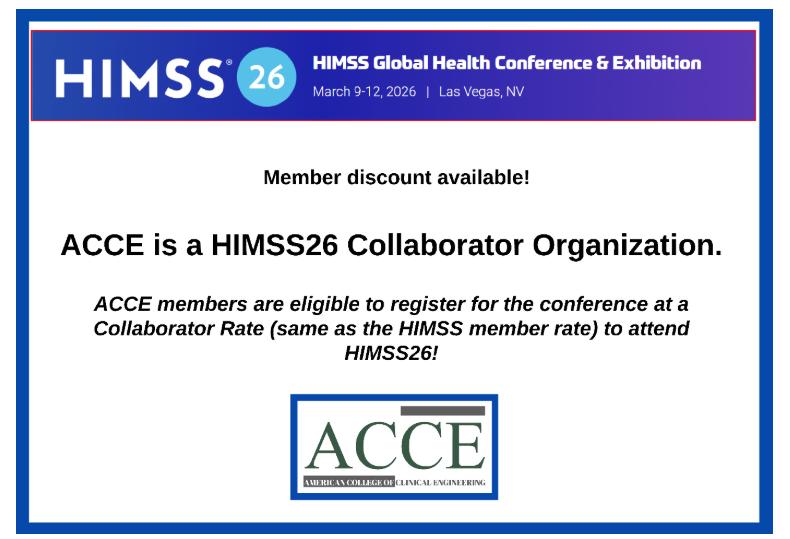
ACCE is excited to be a part of the HIMSS26 Global Health Conference & Exhibition as a Conference Collaborator. The countdown to healthcare’s transformative event has begun secure your spot now. HIMSS26 isn’t just a conference, it’s the epicenter of healthcare technology where groundbreaking solutions meet visionary minds. Our members receive the HIMSS Collaborator Rate (member rate) to attend HIMSS26. To get the savings enter the following code when prompted: ACCE26. Register today and save!
2026 ACCE CE-IT Symposium: Future-Ready Healthcare From Evolution to Revolution
Date/Time: March 09, 2026, 8:30 AM - 4:00 PM
Location: Venetian Las Vegas/Level 3/LIDO 3103
Healthcare technologies continue their rapid evolution. From new AI applications to the latest cybersecurity tools, these new technologies are reshaping the healthcare delivery environment. These disruptors have the potential to solve complex healthcare technology challenges and provide new innovative solutions. This Symposium will attempt to answer several questions. How to best implement and manage the adoption of these new technologies? How to integrate the solutions with your existing environment and tools? How to ensure cybersecurity risks are addressed?
Join this annual ACCE CE-IT Symposium “Future-Ready Healthcare: From Evolution to Revolution” to learn more!
During this symposium we will explore: Roles and responsibilities for Managing Emerging Technologies, AI and its Applications in Healthcare Technology, Cybersecurity Tools, Integrated Medical Technologies and Solutions, and Implementation and Management Best Practices.
Join us in examining the crucial role of Clinical Engineering, IT, and clinical application teams in managing the implementation and successful adoption of these complex technology solutions. Our line-up of industry experts will share their latest insights and first-hand experiences in leading successful implementation of these technology solutions and tools! Don’t miss this opportunity to learn about the rapidly evolving healthcare technology landscape!
Click here to register
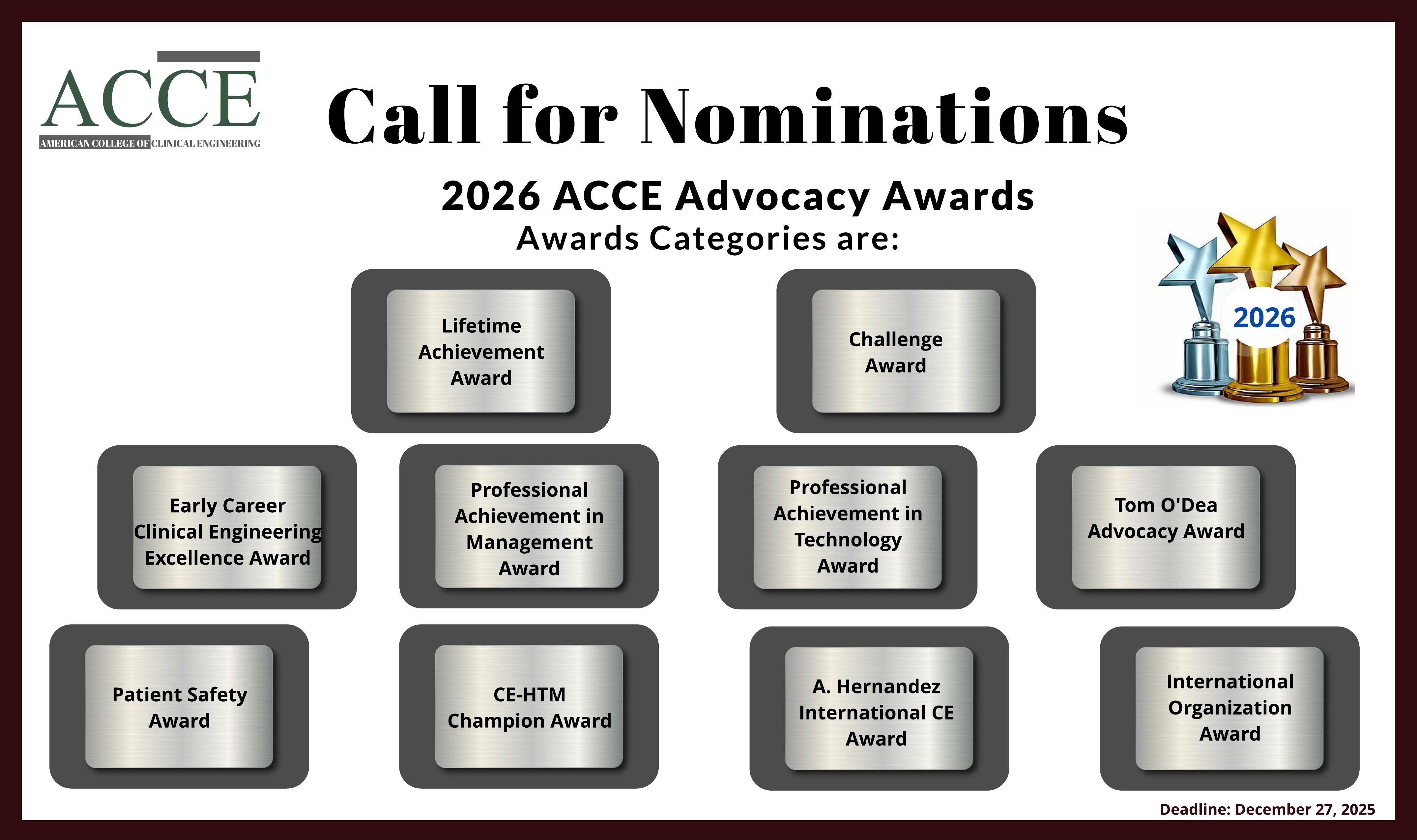
Click here to place your nomination for any of these awards.


The Journal of Clinical Engineering is a compilation of articles, papers, and extensive manuscripts relevant to clinical/biomedical engineering or biomedical technology. Subject matter directly relates to the engineering or technology involved in patient care and treatment or technology in the broad field of health care delivery.
ACCE members receive a discounted subscription to the Journal of Clinical Engineering for only $99! (Originally $378). You must login to the ACCE website to view the code. Then visit LWW.com to enter code.
Faculty: Arleen Thukral, Rudy Flores & Chad Kinley
Pre-registration required. ACCE members, click here to register 14 Dec
day to submit your nomination for the 2026
Jan 2026 12:00-1:30
ACE/CCE Written Exam Review Webinar Series, Session 1: Technology Management 1
Faculty: Jenn Nichols, CCE Click here to register 08 Jan2026
-1:00
14 Jan 2026
12:00-1:30 PM
2025-2026 Educational Webinar Series, Session 5: Patient Safety: Medical Device Incident Investigation
Faculty: Matt Baretich, Erin Sparnon, Jeremy Suggs, Shelly Leacock, Hank Stankiewicz
Members in good standing: Click here to register
ACE/CCE Written Exam Review Webinar Series, Session 2: Technology Management 2
Faculty: Kindall Druker, CCE
15 Jan 2026 Last day to submit your nomination for 2026
AAMI Foundation/ACCE Robert Morris Humanitarian Award
Click here for Criteria & Nomination Form
21 Jan 2026
12:00-1:30
28 Jan 2026
12:00-1:30 PM
31 January 2026
ACE/CCE Written Exam Review Webinar Series, Session 3: Technology Management 3
Faculty: Arif Subhan, CCE
ACE/CCE Written Exam Review Webinar Series, Session 4: Service Delivery Management 1
Faculty: Jenn Nichols, CCE
Last day to nominate a candidate for the 2026
CE-Hall of Fame
click here for Criteria & Nomination Form

The ACCE Board and Committee Chairs
President Katherine Navarro
President Elect Bhaskar Iduri
Vice President Juuso Leinonen
Secretary Michele Manzoli
Treasurer Jennifer Nichols
Member-at-Large Jim Panella
Member-at-Large Kevin Kreitzman
Member-at-Large Erin Sparnon
Member-at-Large ............................................... Ashley O’Mara
Immediate Past President...................................Kim Greenwood
Advocacy Committee Chair.............. Francisco Rodriguez-Campos
CE Body of Knowledge/CCE Promo Chair ..........Christopher Riha
Education Committee Co-Chairs.. Mike Powers, Elizabeth Sayles
Membership Committee Chair ................................. Amy Klemm
Nominations Committee Chair.............................Kim Greenwood
CE-HOF Nominations Review Committee Chair ................Arif Subhan
Secretariat .................................................................. Suly Chi