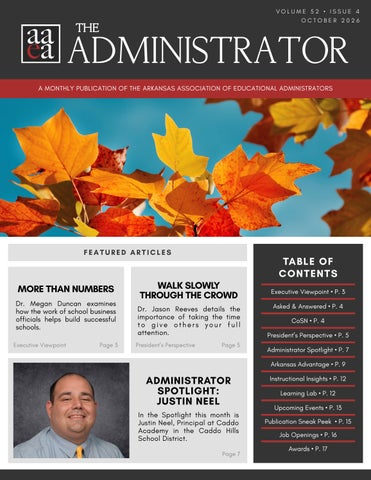
VOLUME 52 • ISSUE 4 OCTOBER 2026
THE
ADMINISTRATOR
MORE THAN NUMBERS Dr. Megan Duncan examines how the work of school business officials helps build successful schools. Executive Viewpoint
Page 3
WALK SLOWLY THROUGH THE CROWD Dr. Jason Reeves details the importance of taking the time to give others your full attention. President’s Perspective
Page 5
TABLE OF CONTENTS Executive Viewpoint • P. 3 Asked & Answered • P. 4 CoSN • P. 4 President’s Perspective • P. 5 Administrator Spotlight • P. 7 Arkansas Advantage • P. 9
ADMINISTRATOR SPOTLIGHT: JUSTIN NEEL In the Spotlight this month is Justin Neel, Principal at Caddo Academy in the Caddo Hills School District. Page 7
Instructional Insights • P. 12 Learning Lab • P. 12 Upcoming Events • P. 13 Publication Sneak Peek • P. 15 Job Openings • P. 16 Awards • P. 17
AAEA Staff
2026-2027 Calendar of Events
Dr. Megan Duncan Executive Director m.duncan@theaaea.org
October
Dr. Karla Neathery Assistant Executive Director k.neathery@theaaea.org Sarah Jerry Director of Professional Development s.jerry@theaaea.org Siri Briggler Professional Development Coordinator s.briggler@theaaea.org Sharon Chuculate Fiscal Services Coordinator s.chuculate@theaaea.org Sheila White Bookkeeper s.white@theaaea.org
November AAEA Fall Conference, November 10, 2026 Benton Event Center
December ConnectED Communications Academy, December 10-11, 2026 Solution Tree, Little Rock
January AASA Superintendent Symposium, January 13-14, 2027 DoubleTree Hotel, Little Rock CFD Classes, January 26, 2027 Southeast AR Education Service Coop, Monticello
February AASBO Conference, February 10-11, 2027 Hot Springs Convention Center ArkASPA Spring Conference, February 23, 2027 Wyndham Riverfront, North Little Rock TEL-AR Conference, February 24-25, 2027 Hot Springs Convention Center
March
Alyse Mattox Communications & Technology Specialist a.mattox@theaaea.org
AACIA Conference, March, 2027 Benton Event Center
Melanie Thrasher Business Analyst m.thrasher@theaaea.org
CFD Classes, April 20, 2027 Location TBD CASBO Certification Classes, April 21-22, 2027 UCA Brewer-Hegeman Conference Center AAFC Spring Conference, April 28-30, 2027 Hot Springs Convention Center
Molly Franxman Administrative Assistant m.franxman@theaaea.org Mike Mertens Consultant m.mertens@theaaea.org Lenett Thrasher Consultant l.thrasher@theaaea.org
1
AAGEA New Coordinator Workshop, October 7, 2026 Benton Event Center AAGEA Conference, October 8, 2026 Benton Event Center CASBO Certification Classes, October 21-22, 2026 UCA Brewer-Hegeman Conference Center AACTEA Fall Conference, October 29, 2026 UACCM, Morrilton
April
May ASBA/AAEA Joint Conference, May 4, 2027 Wyndham Riverfront, North Little Rock
June AAEA School Law & Finance Conference, June 8, 2027 Location TBD ASPMA Custodial Conference, June 10, 2027 Siloam Springs High School AASEA Conference, June 15-16, 2027 Benton Event Center
For more information, visit theaaea.org/events.
2026-2027 AAEA Board of Directors Dr. Jason Reeves AAEA President Assistant Superintendent, Alma
Dr. Jared Cleveland AAEA President-Elect Superintendent, Springdale
Stephanie DeFoor AAEA Secretary Elementary Principal, Greenbrier
Dr. Jeremy Owoh AASA President Superintendent, Jacksonville North Pulaski
Dr. Karen Walters AASA President-Elect Superintendent, Bryant
Gary Williams AASA Secretary Superintendent, White Hall
Carise Echols AAESP President-Elect Elementary Principal, Conway Jason Selig AASSP Past President Director of Instruction, Lake Hamilton Pam McCammon AASBO Past President Chief Financial Officer, Greenbrier Crystal Fluker AAMLA President Junior High School Assistant Principal, Brookland Shawn Burgess ArkASPA President Chief of HR/Compliance Officer, Little Rock
Charles Nelson AASSP President Junior High School Principal, Greene County Tech Jennifer Turner Amy Robson AACTEA President AAFC President CTE Coordinator, Guy Fenter Federal Program Coordinator, Educational Cooperative Flippin Kelli Gordon Dr. Kelli Martin AASEA President AACIA President Special Education Director, Deputy Superintendent, Conway Greenbrier Raymond Reynolds Cedric Hawkins ASPMA President (until Sept) ASPMA President (begin Sept) Maintenance/Facilities Deputy Superintendent, West Supervisor, Searcy Memphis Betsy Laughter AAESP Past President Elementary Principal, Marion
Charles Warren AAEA Past President Chief Financial Officer, Fort Smith Shavon Jackson AAESP President Elementary Principal, Russellville Pam Dean AASSP President-Elect High School Principal, Stuttgart Carol Longino AASBO President Chief Financial Officer, Magnolia Valerie King AAGEA President Director of Gifted Programs, Siloam Springs Darrell Parks TEL-AR President Technology Director, Hoxie
Dr. Megan Duncan AAEA Executive Director
2026 AAEA Corporate Sponsors Elite
American Fidelity Assurance Co. Coryell Roofing and Construction NIET - National Institute for Excellence in Teaching TIPS The Interlocal Purchasing System
Presidential
Curriculum Associates Educational Benefits Solution Tree
Prestigious
Renaissance Learning Stephens
Distinguished
ABCover Arkansas Army National Guard Apptegy Bailey Education Group Bark Capturing Kids’ Hearts Colleges of Education & Health Professions - UofA Goblins Lifetouch National School Studios
Distinguished (continued)
Modern Classrooms Project Nabholz | Entegrity Energy Partners Red Rover
Diamond
Baldwin & Shell First Security Beardsley Imagine Learning Lexia Learning OnToCollege The Kirkland Group
Platinum
AAMSCO Architecture Plus C.R. Crawford Construction Goalbook Hight Jackson Associates PA HMH | NWEA Just Right Reader Legacy Construction Management Phoenix Contractors Polk Stanley Wilcox Architects Powers of Arkansas Pro Service Builders Progressive Technologies
Platinum (continued) SEAS Education
Gold
CDI Contractors Cromwell Architects Engineers Cynergy Rehab Group ESS IXL Learning Kids First Education Kinco Constructors Middleton Heat and Air Paragon Architecture Pearson Reach University Sibme WER Architects White River Services and Solutions
Silver
American Bus Sales EDT Solutions LLC French Architects, PA K12 Tutoring Staying Home Corporation Strategos Group
2
Executive Viewpoint Dr. Megan Duncan, AAEA Executive Director
MORE THAN NUMBERS When a child walks into one of our schools each morning, they probably do not think about the budget that helped make their day possible. They see their teacher, their friends, a classroom ready for learning, and opportunities waiting for them. Behind that experience are decisions about people, transportation, technology, facilities, programs, and resources. Behind many of those decisions is a school business professional making sure our resources reach the places where they matter most. Anyone who has worked through a school budget knows how quickly the numbers become about people. A position on a spreadsheet is a person who serves a child. A transportation expense means a child has a safe way to get to school. An investment in technology can mean access to an opportunity a child did not have before. The numbers matter because of what they make possible. Our budgets tell a story about what we value. When we invest in our teachers, improve facilities, update a bus, purchase instructional materials, strengthen school safety, or add a program, we are making choices about the experiences we want our children to have. Our school business officials help us connect those priorities to the resources we have available. That work has never been simple. Our Arkansas Association of School Business Officials (AASBO) members navigate funding formulas, audits, payroll, purchasing, compliance, rising costs, and changing requirements while trying to plan for needs that may be years away. At the same time, they understand that an unexpected repair, a change in enrollment, or a new requirement can quickly change even the best plan. Some of our most important conversations as school leaders happen around a budget table. Sometimes the conversation is about how we can make something work. Other times, it is about understanding that we cannot do everything at once. We learn quickly how valuable it is to have someone at that table who knows the numbers, understands school business, and is willing to help us find the best path forward. These relationships require trust. Superintendents, boards, administrators, and communities depend on our school business officials to give us accurate information and help us understand the impact of our decisions. Their work provides stability for our schools and allows the rest of us to focus on the work happening with children each day. Through AASBO, our school business officials also have colleagues across Arkansas who understand the responsibility that comes with managing public resources. They share ideas, help one another navigate changes, and often answer the phone when another school business official has a question that cannot wait until tomorrow. That willingness to help one another is one of the things I appreciate most about our AAEA community. As we recognize and thank our AASBO members, children may never know who processed the purchase order for their new classroom materials, made sure their teacher was paid, prepared for an audit, found funding for a new program, or spent countless hours working through a budget so our children could be ready for another year. Children do not need to know all of those details. They simply need to walk through our doors and find what they need to learn, grow, and succeed. That is why the work of our school business officials will always be about more than numbers. It is about what those numbers make possible for our children.
3
Asked & Answered Dr. Karla Neathery, AAEA Assistant Executive Director
Our district is in need of asking two junior high school teachers to teach during their planning period. What steps do we need to take in order to compensate these teachers? As your district works to cover operational needs by asking two junior high school teachers to teach during their planning periods, please review the required steps and policy guidelines under ASBA Policy 3.54 and 3.54 F: • Written Agreement Required First: Teachers must sign a formal agreement with the District prior to teaching the extra class or exceeding student load limits. Compensation cannot be issued for any time worked before the contract is signed. • Compensation Structure: Teachers who teach during their planning period will receive compensation based on their standard hourly rate of pay. (Teachers exceeding 150 students per day receive a prorated rate based on their basic contract.) • Agreement Duration: Contracts are valid for a maximum of one semester. • Voluntary Basis: Neither the District nor the teacher is obligated to enter into, renew, or extend an agreement beyond the current semester. For complete details, please refer to ASBA Policy 3.54 and Form 3.54 F.
If you have questions for Dr. Neathery, email her at k.neathery@theaaea.org.
CoSN: Support for Technology Administrators CoSN is a great resource for school technology administrators. Check this page monthly for links to articles to assist technology leaders as they navigate through digital learning transformations.
Click Here to Read About This Month’s Topics • CoSN Blog Posts - Open to All • Season 9 of the CoSN/AASA EmpowerED Superintendents edLeader Panel Broadcasts • Support for Continuing the E-Rate Program • CoSN Membership 4
President’s Perspective Dr. Jason Reeves, AAEA Board President
WALK SLOWLY THROUGH THE CROWD By September, the excitement of opening school has settled into the rhythm of the year. Teachers have established routines. Students know what is expected of them. Administrators have worked through the opening challenges, solved problems, responded to parents, attended meetings, answered what seems like a never-ending stream of emails, and started working through the priorities that will carry us through the rest of the school year. And then October arrives. The stretch from Labor Day to Thanksgiving break can feel long and difficult at times. For many of us in school leadership, this is when the pace can really begin to pick up. There is always another meeting, another problem to solve, another decision to make, another email waiting for a response, and another place we need to be. Our calendars fill quickly, and before long, we can find ourselves moving from one responsibility to the next without ever really slowing down. The need to slow down and really see the people on the front lines reminds me of two leadership principles. John Maxwell calls this “walking slowly through the crowd.” Admiral William McRaven refers to it as “trooping the lines.” Ultimately, both are describing the way we interact with our people. Both remind us that leadership requires us to get out from behind our desks and into the places where the work is actually happening. A leader who is always in a hurry can move through an entire building and never really see the people in it. That is an easy trap for school leaders. We can convince ourselves that being busy means we are being productive. We can spend an entire day solving problems and checking things off a list and still miss some of the most important leadership opportunities that were right in front of us. Sometimes the most important thing we do all day isn't something that appears on our calendar. It is stopping in the hallway to ask a teacher how things are going. It is sitting down beside a secretary for a few minutes and asking about thier family. It is thanking a custodian for the work students may never notice. It is asking a bus driver how the morning route is going. It is walking into a classroom without an agenda and simply watching students learn. It is seeing a student in the hallway, knowing his or her name, and asking how the day is going. Those moments can feel small. In leadership, however, small moments often have a much bigger impact than we realize. People experience leadership through the way we treat them. They may not remember every email we send or every meeting we conduct, but they remember whether we noticed them. They remember whether we listened. They remember whether we made them feel like they mattered. That is why I believe there is an important difference between being available and being present. Most school leaders are available. We have open doors, answer emails, return phone calls, attend meetings, and respond when someone needs us. But being available doesn't necessarily mean we are present. Being present means that when we are with someone, we are actually with them. That can be difficult in a profession where our attention is constantly being pulled in different directions. We can be talking to a teacher while thinking about the email we still need to answer. We can be sitting in a meeting while thinking about the discipline issue waiting for us down the hall. We can be walking through a school while mentally running through everything we need to accomplish before the end of the day. Our bodies may be in the room, but our minds are somewhere else. People can tell the difference. One of the greatest gifts we can give the people we lead is our attention. Not because every conversation continued 5
needs to be deep or every interaction needs to become a lengthy discussion about feelings. Sometimes leadership is simply taking a few minutes to talk about what is happening in someone's classroom, how the football team is doing, how their child is doing, or what they are looking forward to this weekend. Relationships are not always built through profound conversations. More often, they are built through hundreds of ordinary moments where the other person feels seen. This can be especially difficult, and important, for those of us serving in district-level roles removed from the day-to-day work of the buildings. Our positions can place us one or more steps removed from the daily work of teaching and learning. We can spend much of our time in meetings, offices, board rooms, and district-level conversations and still go through an entire day without seeing the work we are ultimately responsible for supporting. That is why we have to intentionally get out into our schools. We need to walk the halls, visit classrooms, talk with principals and teachers, spend time with support staff, and see our students in the environments where they learn and grow. We cannot effectively lead what we are unwilling to see and understand. If we are moving too quickly, we can miss all of it. Walking slowly through the crowd does not mean becoming less productive. Trooping the lines does not mean abandoning our responsibilities or our decision making. It means understanding that people are part of the work, not interruptions to the work. There will always be emails. There will always be meetings. There will always be another problem waiting to be solved. But we don't get unlimited opportunities to connect with the people we lead. Our calendars are one of the clearest expressions of our priorities. As school leaders, we should look at our calendars and ask ourselves a difficult question: Does the way I spend my time reflect what I say matters most? If relationships matter, our calendars should show it. If teachers matter, they should see us in their classrooms. If students matter, they should see us in their hallways, cafeterias, buses, classrooms, and activities. If our support staff matter, they should hear us say thank you and know that we recognize the importance of their work. Being present doesn't mean being everywhere. It means being fully present wherever you are. That may require us to slow down. Slow down enough to notice the teacher who seems to be having a difficult week. Slow down enough to celebrate the custodian who takes pride in making the building look its best. Slow down enough to ask a principal what is keeping them awake at night. Slow down enough to listen when someone brings us a problem instead of immediately trying to solve it. Slow down enough to know our students beyond their names and test scores. There is a practical reason for doing this beyond simply making people feel good. When we know our people, we understand our schools better. When we understand our schools better, we make better decisions. And when we make better decisions, we create stronger conditions for teaching and learning. That brings us back to the main thing. We have talked about keeping the main thing the main thing, building a culture that protects the main thing, and supporting the teachers who are closest to the work of teaching and learning. This month, we add one more piece. Don't be so busy leading the school that you miss the people who make the school what it is. October is a good month to slow down. Walk through the building without an agenda. Stop and talk. Ask another question. Listen a little longer. Look people in the eye. Notice the things that normally go unnoticed. We spend a great deal of time in education talking about what we need to accomplish. Sometimes we need to remind ourselves that how we accomplish those things matters too. The work of education is ultimately about people. And sometimes the best way to lead those people is simply to slow down long enough to walk with them. Walk slowly through the crowd. Troop the lines. Be where your feet are. Because when we slow down enough to see our people, we are better able to lead them. And when we lead our people well, we create the conditions for the main thing to happen: high levels of teaching and learning within our schools.
6
Administrator Spotlight:
Justin Neel
Principal, Caddo Academy, Caddo Hills School District
Growing up, Justin Neel, Principal of the Caddo Academy in the Caddo Hills School District, attended five high schools in three states and two countries. "At each new school, I met amazing people who helped shape my worldview and my belief in myself," he says. "I was fortunate to have incredible teachers who created in me a passion for learning." While he initially intended to pursue a career outside education, Justin wanted to keep his options open. "Dr. Jim Shuff welcomed me off the elevator at Henderson State University’s Teachers College. I told him I wanted to be able to teach business as a backup plan in case I couldn’t find a job in business after graduation," he recalls. Dr. Shuff introduced Justin to Don Benton and Dr. Stallings, who, along with many others, helped him recognize the value of education and the impact educators can have on students. After graduating, he landed a job with a title company doing post-closing work. "I lasted a week," he says. "Then I called Don Benton and told him I really needed his help finding a teaching job." As he interviewed in other districts, he received an invitation to interview at Caddo Hills, where he is now entering his 12th year. Justin says his favorite part of the job is being able to bring people, programs, and opportunities together. "I get most excited when we launch a new community partnership or create a new opportunity for students to connect with their passion," he says. "This year, we have more seniors participating in workbased learning experiences on and off campus. I love hearing students excitedly tell me about something that happened in an elementary classroom where they were assisting or about a new concept they learned during their real estate course through one of our local community partnerships." For Justin, one of the greatest challenges of the principalship is finding balance. "As we work to individualize so much of our high school students’ experiences, it can become challenging to develop workable solutions within policy and law," he states. "We have to make sure the letter and the spirit of both stay connected. If we don’t, we run the risk of creating systems that may technically work but ultimately harm the student." For those considering a career in school leadership, Justin emphasizes both the rewards and the responsibilities of the role. "While it is the greatest job you could ever imagine, it’s also going to be the hardest job you could ever imagine," he says. "It takes total dedication to do it well. The principalship relies on strong relationships with students, staff, families, and the community. Each needs strong leadership that proactively casts a vision and builds systems that produce excellence." 7
! Q&A ?
with Justin Neel
What is the best advice you have ever received? Do what is best for kids, and everything else will work out.
What major changes have you seen in education during your career?
I have been fortunate to see purpose become a driving force within our field. The shift from “college is for everyone” and the era of No Child Left Behind to ensuring that each student graduates prepared to enroll, enlist, or enter employment has been a major and positive change. I think we have developed stronger key performance indicators that allow school and district leaders to become much more intentional about staffing, funding, programs, and student supports.
What might other administrators be surprised to know about you?
I have taken five school trips to Washington, D.C., and four to New York City on a Blue Bird school bus. Pro tip: Park in Jersey City and take the ferry into the city! Also, make sure you’re back before dark.
What do you feel is your greatest professional accomplishment?
To date—Caddo Academy. It has been an honor and a privilege to have the opportunity to lead this school. To see our progress, watch our students grow, and have the opportunity to share our story with others has been transformational for both my life and my career.
What do you enjoy doing during your time off?
Travel! My wife and I try to take as many trips as we can each year.
What are the goals you are still working toward?
To have fun every day. To strengthen our school system so that it becomes a producer of world changers. And to help everyone I meet know that they are valuable and needed.
What do you see as the biggest benefit of AAEA membership?
Connections. I love getting to see all the wonderful things happening throughout K–12 education in Arkansas in one place. Through AAEA, I have been able to meet, learn from, and network with amazing people who share a common goal: seeing the very best for Arkansas students. Those connections remind us that while we may serve different schools, districts, and communities, we are all working toward something much bigger than ourselves. 8
At the Heart of Arkansas Schools A Look Across the Past Arkansas Advantage Articles Across Arkansas, public schools are filled with people doing deeply important work for children every day. School leaders, educators, support staff, families, and community partners are working together to create new opportunities. Each district has its own priorities, and the stories they share through Arkansas Advantage reveal something remarkably consistent about Arkansas schools. Children are at the center. That commitment is visible in strong instructional systems, carefully designed interventions, professional learning, career pathways, community partnerships, leadership development, family engagement, and the many other structures that help districts serve children well. Those systems matter. Alignment matters. Consistency matters. Systems only make a difference because people help bring them to life for children. The heart of the work is found in educators who study how children learn and adjust instruction. It is found in support staff who know children by name, administrators who keep asking what children need next, families who partner with schools, and community members who open doors to opportunities beyond the classroom. Across it all are people willing to keep learning, improving, and showing up for children. Keeping Children at the Center Throughout Arkansas, district and building leaders are creating a clear sense of purpose and a commitment to doing what children need to grow and succeed. At Ouachita River School District, led by Superintendent Jerry Strasner, that purpose is grounded in the belief that every child can grow. Teachers study progress together, adjust when learning slows, and help children understand their own growth and next steps. At Huntsville School District, led by Superintendent Jay Chalk, decisions return to a straightforward question: What is best for our children? That focus shapes instruction, relationships, partnerships, and the work to ensure children feel known, valued, and supported. At Lakeside School District, led by Superintendent Bruce Orr, the same student-centered commitment is visible through coordinated intervention. Teams use multiple sources of data to identify needs and adjust supports, while classroom teachers, specialty teachers, retired educators, interns, instructional leaders, and others contribute to smaller groups and more individualized attention during What I Need (WIN) time. The structures may look different from one district to another, yet the purpose remains the same. Adults are organizing time, expertise, resources, and attention around what children need next. continued 9
Investing in the People Who Serve Children Strong schools depend on people who care deeply about children and have opportunities to continue strengthening their practice. At Searcy Public Schools, led by Superintendent Dr. Bobby Hart, professional learning is treated as a strategic investment in children and educators. Teachers are supported in pursuing advanced licensure, deepening instructional knowledge, and developing leadership skills through opportunities such as the Searcy Educators Aspiring to be Leaders (SEALS) program, where previous participants now help mentor the next cohort. That same investment extends to co-teaching teams, where general and special education teachers teach together, apply strategies, receive coaching and feedback, and refine their practice around student needs. The same commitment to continuous learning is visible at Alpena Public Schools, where former Superintendent Anthony Dowdy helped lead the work highlighted in the district’s Arkansas Advantage story and Matt Ferguson now serves as superintendent. Alpena educators engage in data conversations, classroom walkthroughs, coaching, model lessons, collaboration, and follow-up support as they implement, reflect, and adjust their practice. At Magnolia Public Schools, led by Superintendent John Skipper Ward, teachers, literacy facilitators, administrators, and interventionists are working together to strengthen literacy through evidence-based instruction, high-quality instructional materials, and targeted support. Strategic Reading at Magnolia Middle School provides additional instruction for children while keeping them connected to core English language arts. The district’s literacy work reflects the importance of giving educators both the tools and the support needed to respond effectively to children’s needs. Supporting children also means supporting the adults who serve them. Educators need time to collaborate, opportunities to strengthen their practice, meaningful feedback, strong leadership, and the tools necessary to respond to the children in front of them. When schools invest in people, that investment reaches children. Expanding Opportunity Through Relationships and Partnerships Partnerships with families, businesses, higher education, community organizations, and local leaders are also expanding what is possible for Arkansas children. At Springdale Public Schools, led by Superintendent Dr. Jared Cleveland, those connections stretch from hands-on learning, family engagement, service, and enrichment at Walker Elementary to college credit, industry certifications, technical pathways, and personalized career exploration at the Don Tyson School of Innovation. Children are encouraged to discover their interests, explore different possibilities, and build confidence in what comes next. At Hope Public Schools, led by Superintendent Dr. Jonathan Crossley, partnerships range from early literacy and magnet programming to postsecondary opportunities. Families are included in early learning experiences, children engage in programs connected to literacy, STEAM, and public service, and higher education partnerships support both children and educators. Through Hope Collegiate Academy, children can graduate with both a high school diploma and an associate degree from the University of Arkansas Hope-Texarkana at no cost to their families. At Jacksonville North Pulaski School District, led by Superintendent Dr. Jeremy Owoh, college and career academies connect student interests with mentorship, internships, industry credentials, concurrent credit, and real-world learning shaped in partnership with local businesses, healthcare providers, and continued 10
community organizations. Children begin exploring pathways early so they can make informed choices about the opportunities available to them after graduation. Across these districts, partnerships do more than create programs. They surround children with people invested in their learning, opportunities, and future. Doing Whatever It Takes for Children Perhaps the strongest thread connecting these stories cannot be reduced to one initiative, program, or strategy. It is the willingness of people to do the work necessary to meet the needs of children. The work also extends far beyond any single program or role. Across these stories, educators, administrators, instructional specialists, support staff, families, and community partners all contribute to the environments in which children learn and grow. Educators collaborate and adjust instruction. Leaders organize people and resources around student needs. Families reinforce learning and partner with schools, while community organizations, businesses, and higher education partners expand the opportunities available to children. Every role matters because every role ultimately impacts children. At the Heart of Arkansas Schools Strong systems provide the structure for student success. Clear expectations, quality curriculum, professional learning, family support, and community partnerships help districts align their work around children. Arkansas schools are filled with educators and support staff who put tremendous effort into helping children learn, grow, belong, and prepare for what comes next. School leaders work alongside them to strengthen instruction, develop people, and build partnerships. Families and communities add another essential layer of support. There is much to celebrate in Arkansas public schools because people across the state continue to show up for children, work hard on their behalf, and ask what more can be done to help them succeed. AAEA member superintendents who would like their district to be considered for a future Arkansas Advantage feature are invited to contact Sarah Jerry, AAEA Director of Professional Development, at s.jerry@theaaea.org. 11
Instructional Insights Starting with the End in Mind: Backward Planning for Student Success Submitted by the National Institute for Excellence in Teaching At Hope Public Schools, preparing students for life after graduation begins in pre-kindergarten. Hope educators start with a vision for what students should achieve by graduation—such as earning an associate’s degree or a specialized workforce certification—then work backward to plan the instruction and support needed at every grade level. Still, Superintendent Dr. Jonathan Crossley believes a strong strategy only succeeds through the educators carrying it out. “None of that matters if you don’t have the principals and the teachers in the classrooms that are doing the work,” Crossley said. “The biggest part of this is the teacher in the classroom understanding grade-level instruction, having the strategies to couple with the expectation to see those results.” Over the past several years, the National Institute for Excellence in Teaching (NIET) has worked alongside Hope’s district and school leaders to build their capacity to support teachers. That work has included strengthening Instructional Leadership Teams and refining weekly collaborative meetings where educators analyze evidence and plan stronger instruction. On the 2026 ATLAS state exams, every Hope campus outpaced the state and achieved more than 5% growth. “Our schools are doing the hard work, and we are doing it with NIET,” said Crossley. “I’m just so proud of where we’re going. Keep your eyes peeled. We’re not done yet.”
Learning Lab AI for Educators: Building Confidence, Clarity, and Responsible Practice Submitted by Dr. Gene Kerns, Chief Academic Officer, Renaissance Artificial intelligence is becoming an increasingly important part of education, creating new opportunities and questions for school and district leaders across Arkansas. As educators explore how AI can support instruction, communication, and efficiency, practical guidance is essential. Renaissance's AI for Educators professional learning series helps educators build foundational AI knowledge and skills while keeping professional expertise, student needs, and responsible decision-making at the center. Designed specifically for K-12 educators, this four-session series explores what generative AI is, how it works, and how it can be used to support teaching and learning. Participants learn about responsible AI use, effective prompting, evaluating AI-generated content, and applying AI to tasks such as lesson planning, communication, and instructional resource development. Throughout the series, educators gain hands-on experience using AI thoughtfully while maintaining appropriate safeguards around accuracy, context, and student trust. Available in both onsite and virtual formats, AI for Educators can be customized to meet the goals of Arkansas schools and districts. Renaissance Professional Learning delivers flexible, personalized learning experiences that build confidence, strengthen instructional practice, and support lasting impact. Districts do not need to be Renaissance customers to participate. If your district is preparing educators for the future of AI in education, connect with your local Renaissance representative to learn more: Debra Simpson (debra.simpson@renaissance.com) 870-489-1798. 12
UPCOMING EVENTS | OCT - NOV
School Business Officials!
13
Register Now! Career & Technical Admins! Register Now! All Administrators! Register Now!
Register Now! SAVE THE DATE! More Info Coming Soon! SAVE THE DATE! More Info Coming Soon!
UPCOMING EVENTS | DEC - JAN
All Administrators!
14
Publication Sneak Peek: School Law Review This segment features content from other AAEA publications. School Law Review is a quarterly publication available to subscribing districts. The following excerpt comes from the September 2026 issue.
Significant U.S. Supreme Court Education Law Decisions from the 2025-2026 Term Transgender Athlete Restrictions Little v. Hecox (Decided June 30, 2026) The Supreme Court ruled in a 5-4 majority decision that publicly funded schools and universities can separate sports teams based on biological sex, effectively upholding state-level bans preventing transgender girls and women from competing on female athletic teams. The case arose after the State of Idaho enacted the Fairness in Women’s Sports Act in March 2020, which categorically barred transgender women and girls from participating on female athletic teams in public schools and colleges. The law defines sex based on reproductive biology and genetics rather than gender identity and allows any individual to challenge a student athlete’s sex, triggering a medical verification process that could include analysis of reproductive anatomy, testosterone levels, or genetic makeup. A transgender woman and Boise State University student and a cisgender high school athlete filed suit arguing that the law violated the Equal Protection Clause of the 14th Amendment and Title IX. The transgender woman had undergone hormone therapy to lower testosterone but was still excluded under the law. In August 2020, the federal district court issued a preliminary injunction blocking enforcement of the law, finding it likely unconstitutional because it discriminated based on sex and transgender status without sufficient justification. 15
In 2023, the Ninth Circuit affirmed the injunction as applied to the transgender woman but remanded to clarify the scope of relief for other athletes. On June 30, 2026, the Supreme Court ruled that states can exclude transgender athletes from women’s and girls’ sports teams. The justices ruled unanimously that laws enacted by Idaho and West Virginia do not violate federal civil rights laws. In his 29-page opinion, Justice Brett Kavanaugh wrote that “[c]onsistent with Title IX and the Equal Protection Clause, we hold that the States may maintain women’s and girls’ sports for biological females. They may determine eligibility for women’s and girls’ sports based on biological sex. The Constitution and Title IX do not require an overhaul of women’s and girls’ sports throughout America.
Interested in more from School Law Review? Contact our office at 501-372-1691.
Visit arjobsined.schoolspring.com The AAEA Job Board is a calendar-year subscription that assists districts with the ever-increasing challenge of recruiting quality staff. It is a significant resource for educators, both in-state and out-of-state, seeking employment in Arkansas schools. More than 165 school districts are participating in the program, which has been extremely helpful to schools and educators over the years. The site is used year-round and is accessed extensively during the second semester. It is not unusual to see over 400 jobs posted on the Job Board at one time. With an account, school districts may post unlimited job vacancies throughout the year. To subscribe (by district) or to post job openings, contact our office at 501-372-1691.
Job Openings District
Position
Riverview School District
Superintendent
Watson Chapel School District
Director of Human Resources/ Payroll Coordinator
Watson Chapel School District
Chief Finance Officer/ Business Manager
Wynne School District
High School Assistant Principal
16
Awards Superintendent of the Year Dr. Jeremy Owoh, Superintendent of the Jacksonville North Pulaski School District, was recently presented with the 2027 Arkansas Superintendent of the Year Award. This award is sponsored by Educational Benefits, Inc. Dr. Megan Duncan, Executive Director of the Arkansas Association of Educational Administrators (AAEA), presented Dr. Owoh with the award at the Jacksonville North Pulaski School District board meeting on September 14. Each state's association of school administrators selects a State Superintendent of the Year. These superintendents are then in the running for the National Superintendent of the Year award and will be recognized and honored at the AASA National Conference in February. Congratulations, Dr. Owoh!
ASPMA Blue Ribbon Award
Aliza Jones was presented the Blue Ribbon Award at the ASPMA annual conference at the Hot Springs Convention Center on September 15. This annual award is given to Arkansas School Plant Management Association members who have demonstrated quality leadership and have contributed their talents, efforts, and abilities for the betterment of Arkansas school facilities. Aliza, a facilities consortium coordinator for numerous districts state-wide, has served on the ASPMA board of directors and various committees over the years. She was Association president in 2021-2022. Congratulations to Aliza on a recognition well deserved!
17