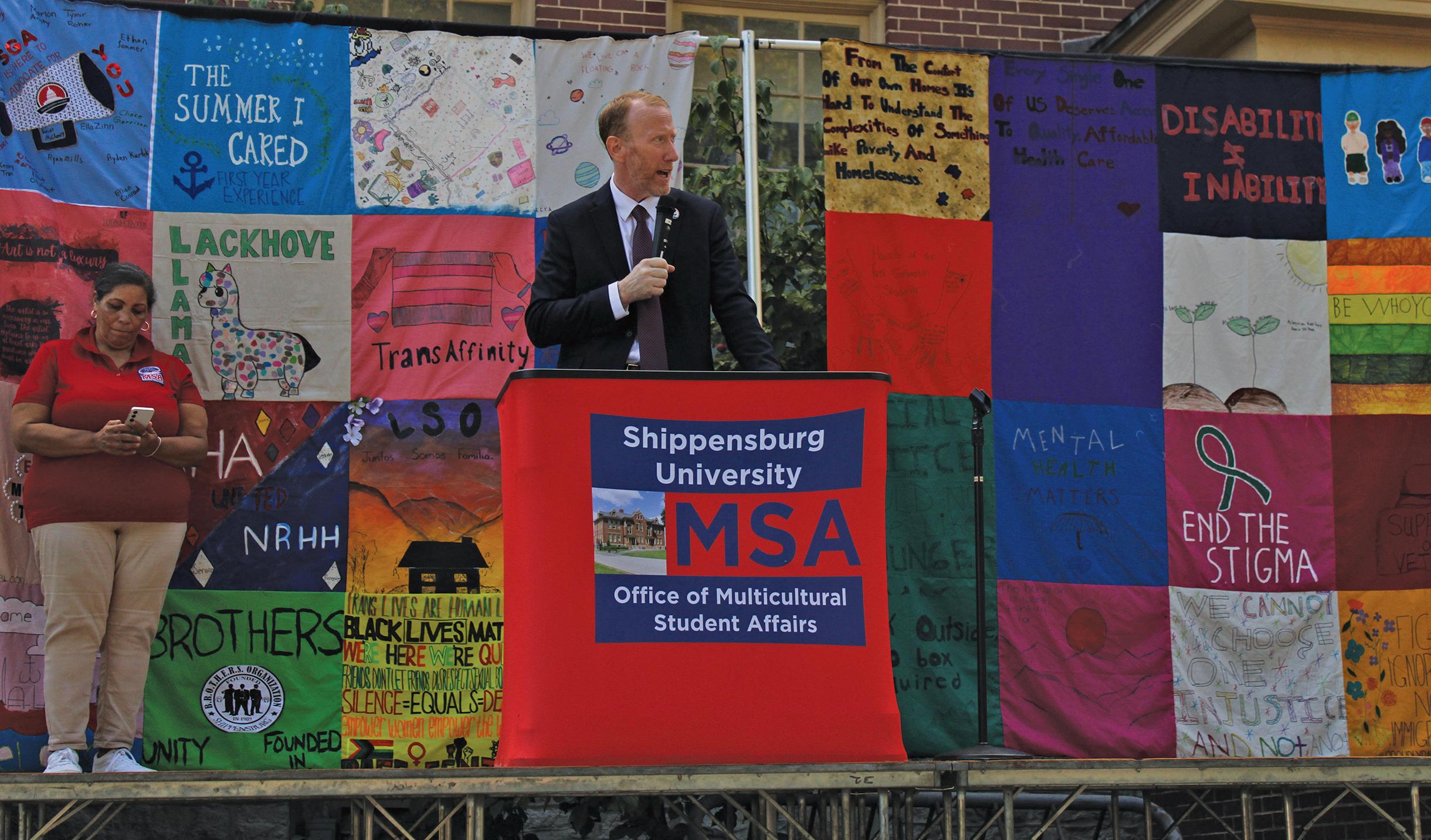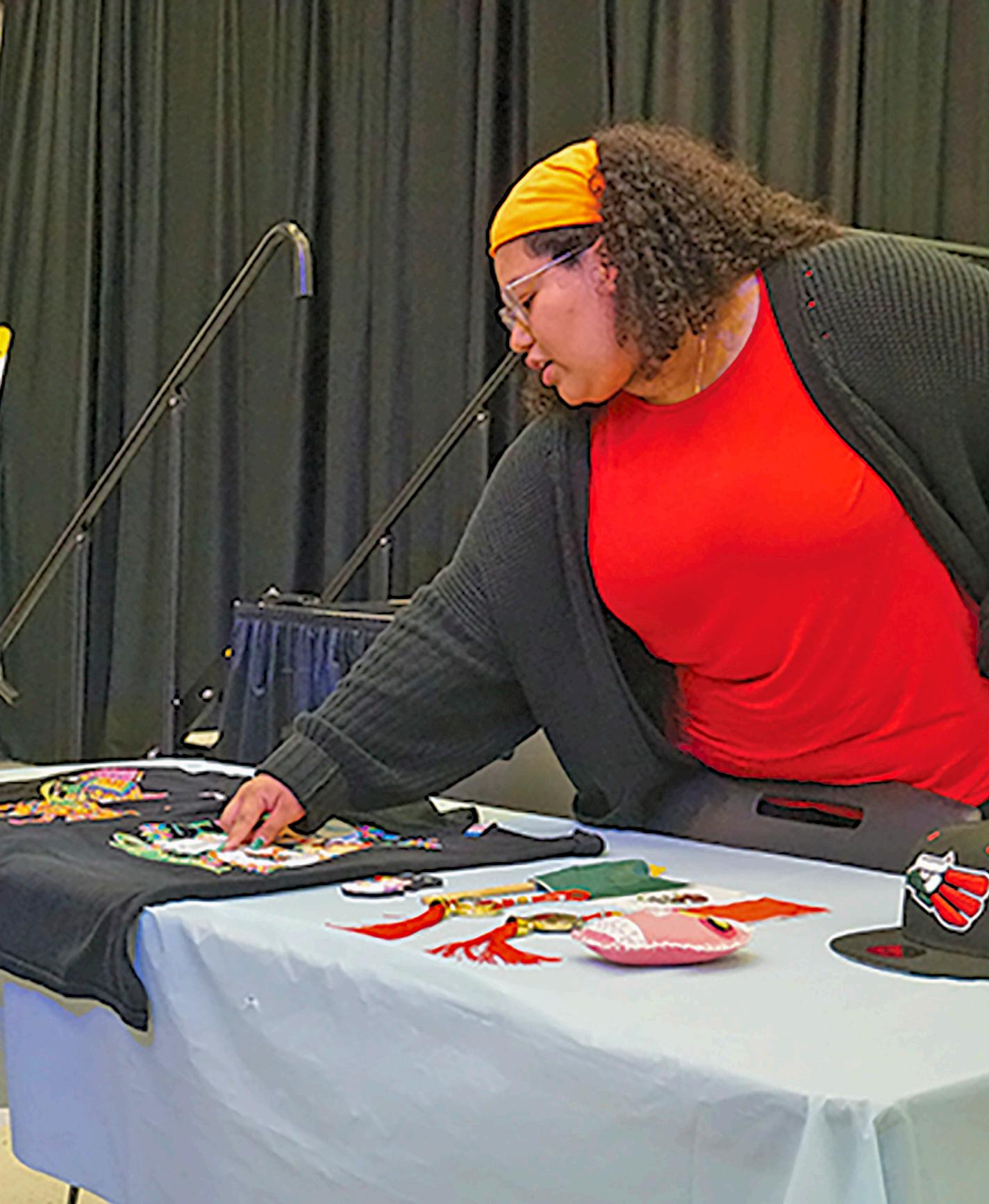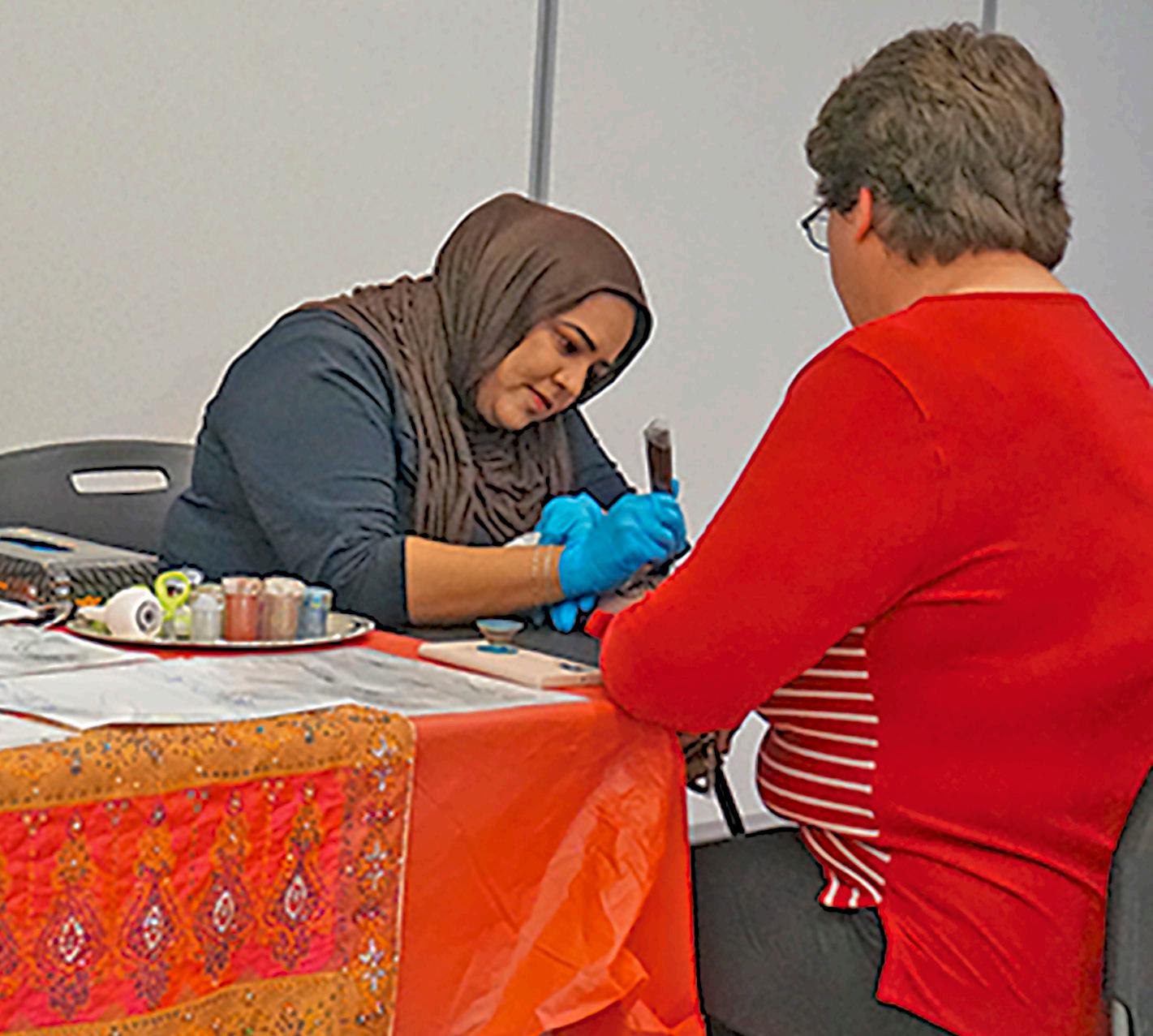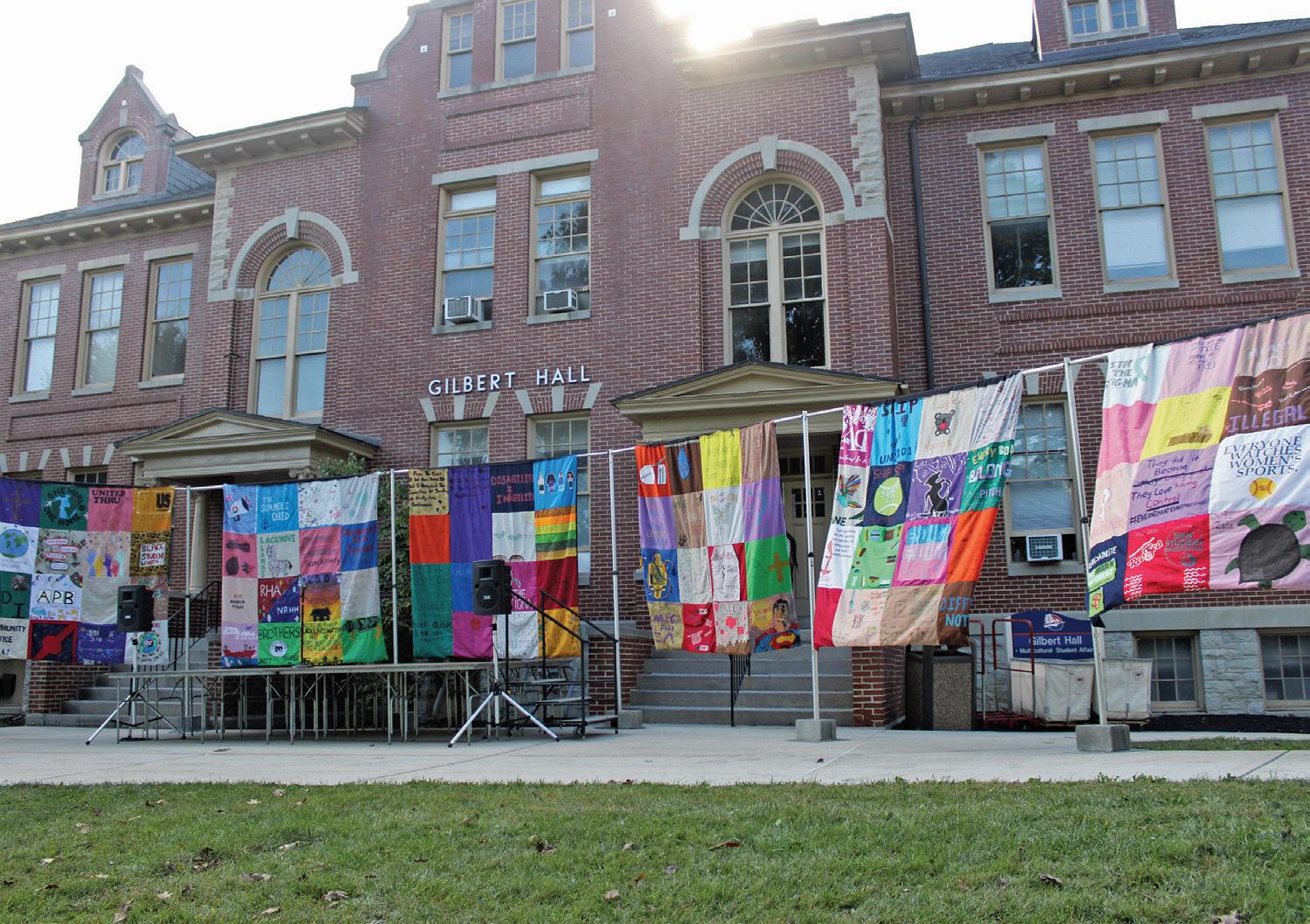







is displayed at the end of SUnity Week.
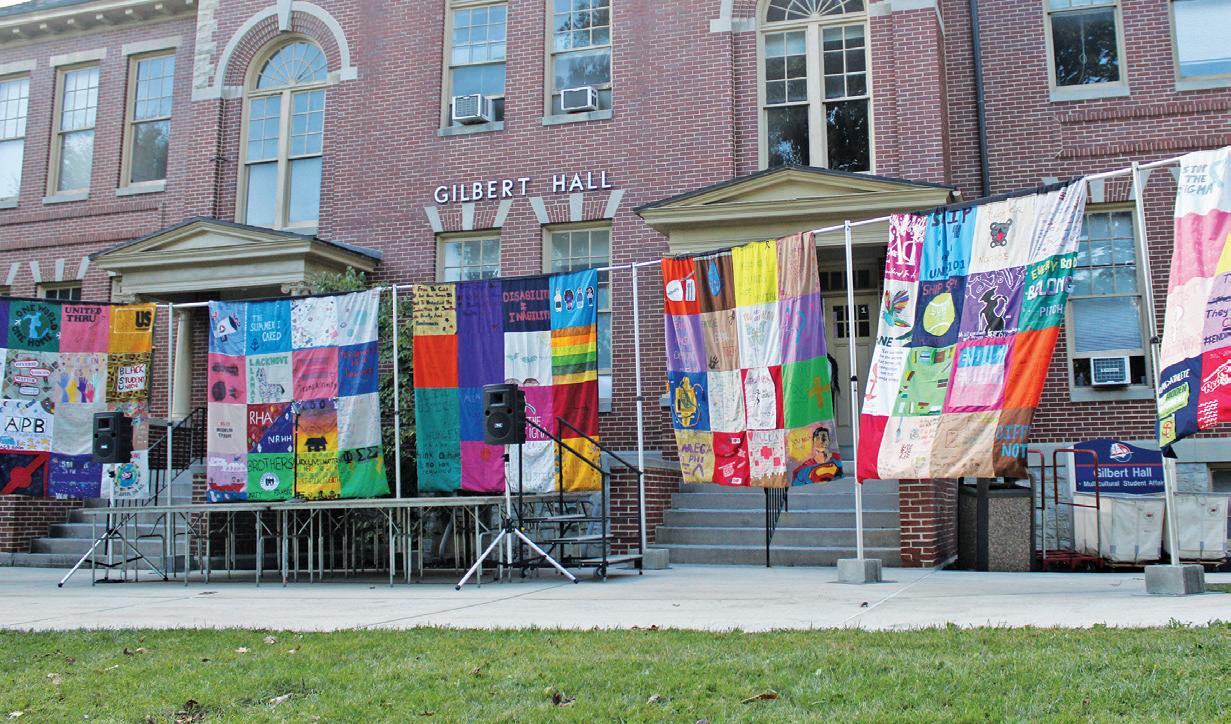
Shippensburg University’s Office of Multicultural Student Affairs (MSA) hosted its annual “A Quilt to Cover Us All Event” on Friday outside of Gilbert Hall to wrap-up SUnity Week.
Formerly known as Diversity Week, SUnity Week ran from Sept. 22-26 and featured several events, including the quilt reveal. Each event emphasized respecting differences in cultural backgrounds across campus and highlighted the aspects of working together with various types of individuals.
More specifically, the quilt acts as a symbol of the different groups on campus coming together and uniting as one larger collegiate community.
The quilt is assembled as groups and individuals on campus submit a panel to MSA that artfully captures a message about their organization or personality. The panels then are sewn together into the quilt that
This year, the reveal started off with remembering former MSA Director Diane Jefferson who passed away this summer. Also acknowledged was the recent death of Professor Robert Lesman, who was the department chair of the Global Languages and Culture Department on campus. A moment of silence was held for both.
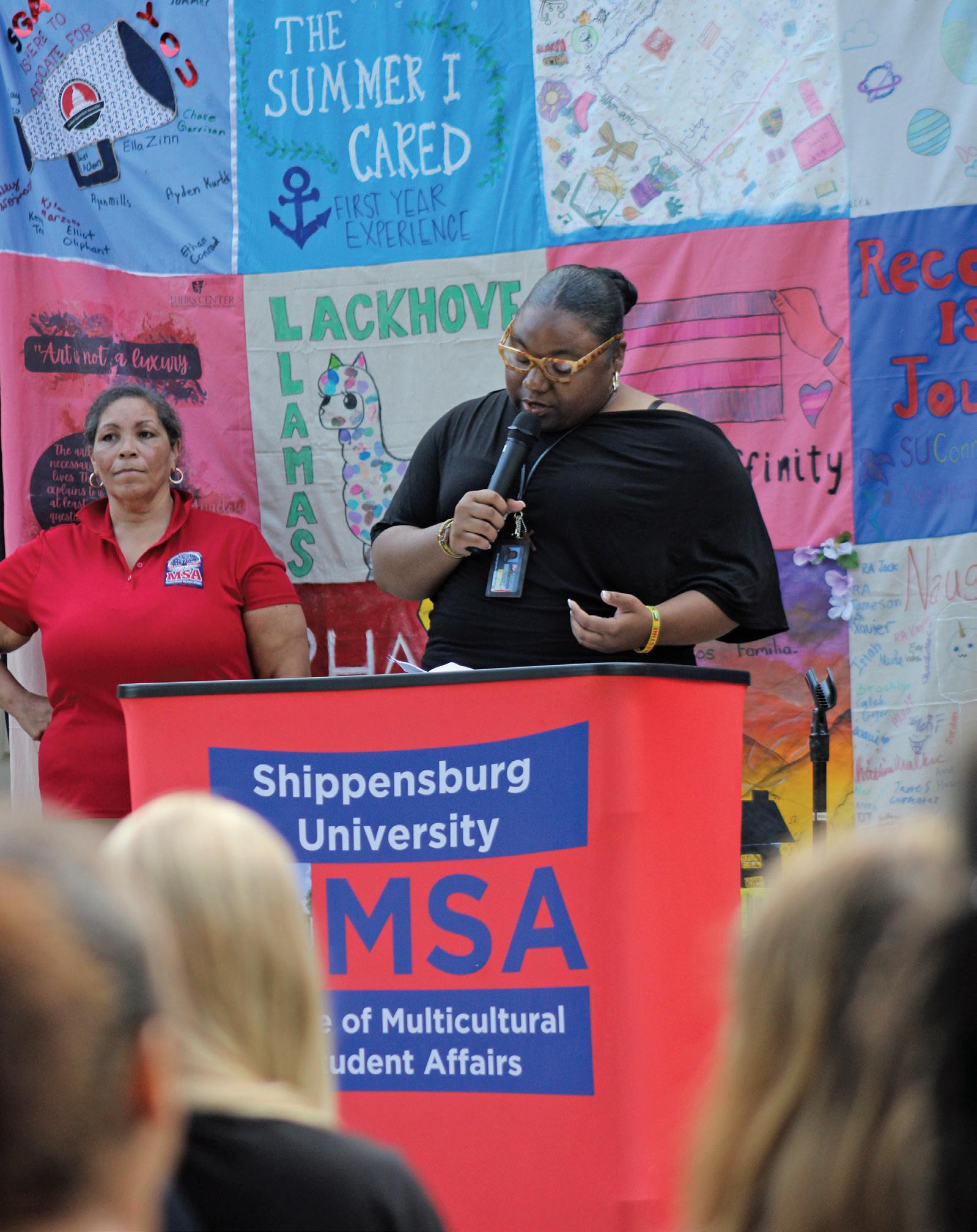
After the moment of silence, Assistant Vice President for Inclusion and Belonging Manuel Ruiz, introduced and provided the context of the event. He even shared some of Jefferson’s legacy with the crowd.
Ruiz said Jefferson believed “it’s a human thing.” That no matter a person’s background, at the end of the day, everybody is human.
Following Ruiz, SU President Charles Patterson spoke about why unity is important.
“This quilt reminds us that we all matter…. [and that] we agree to hold space for one another,”
said.
Student trustee Colin Arnold shared a similar message about coming together. He also encouraged individuals to limit their screen time and engage in more in-person discussions about the world around them and the diversity within it.
Student representatives from multiple clubs and organizations were welcomed to share their panels with the audience following the opening remarks. Most also described the thought process behind their design.
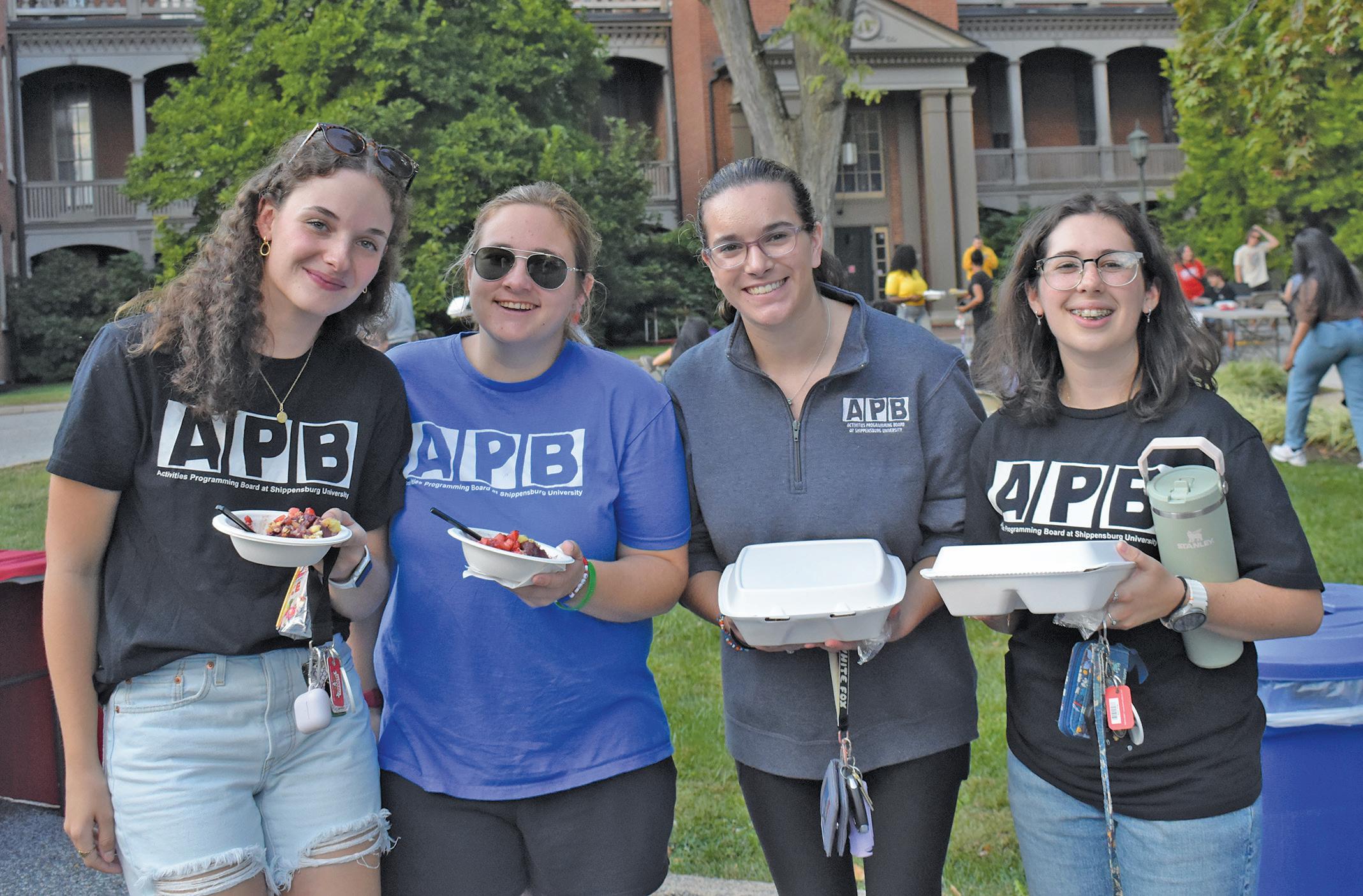
Groups that spoke about their panels were the Women’s Rugby Club, African American Organization and the Activities Programming Board (APB).
The square for the Women’s Rugby Club included the phrase “Every Body Belongs on the Pitch,” further adding to the idea that everyone deserves the opportunity to enjoy the same sport.
On the APB panel, the group changed the wording in its acronym
Caroline Cooper Staff Contributor
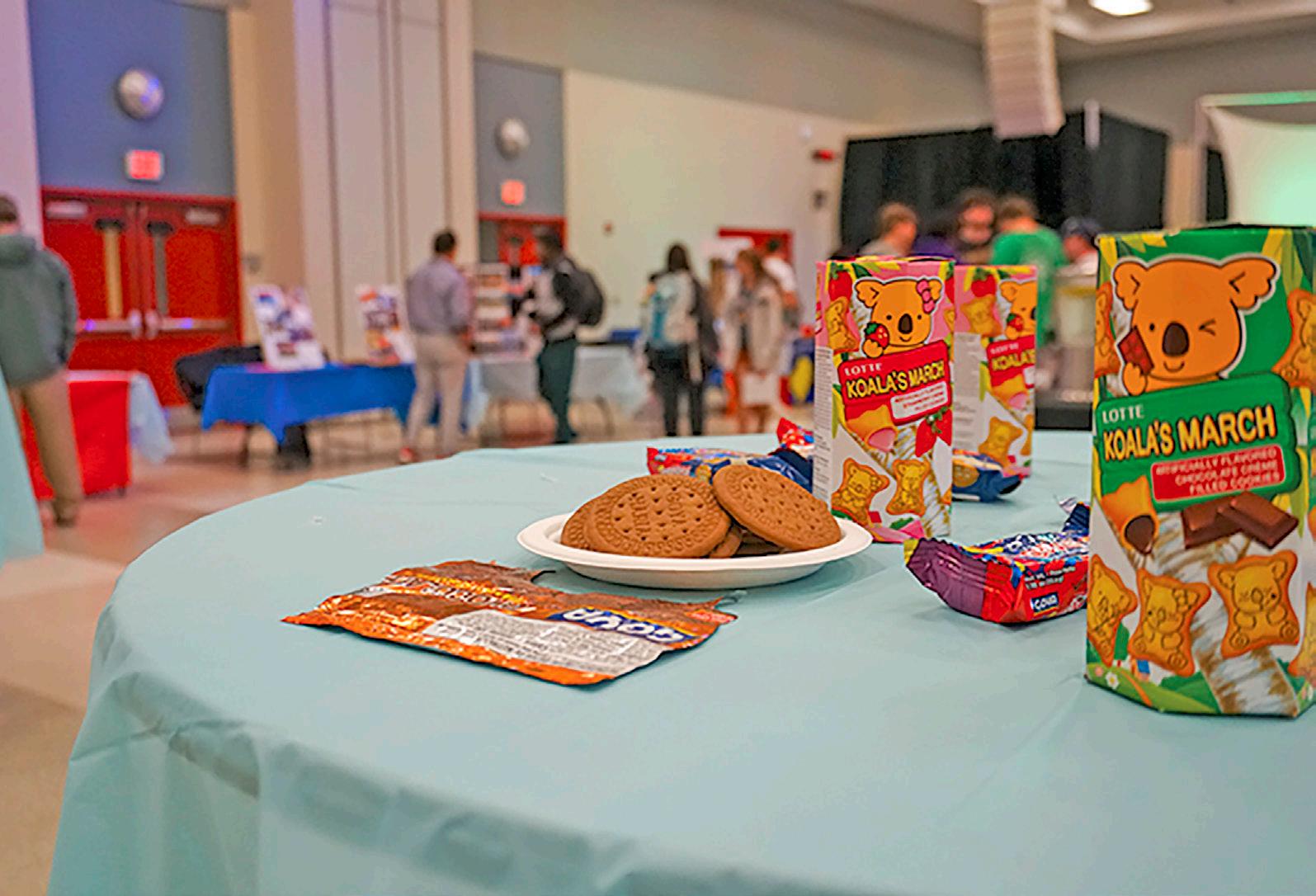
SU’s Major-Minor Fair was held in the CUB MPR on Thursday, Sept. 25, hosting over 250 students at the event. Organized by the Shippensburg University Department of Academic Engagement and Exploratory Studies and the Career Center, the MajorMinor Fair gave students the opportunity to explore various majors, minors and certificates offered by departments across campus.
Over 25 academic departments tabled at the event, from Communication, Journalism & Media to Exercise Science.
Josalyn Nelligan, president of the Exercise Science Honors Society, represented the Exercise Science Department at the Major-Minor Fair.
“I love this program. It is very unique in the way that it is a hands-on program, different from more traditional majors,” Nelligan said. “The fair is not only a way to get connected with students in certain majors, but the professors who teach
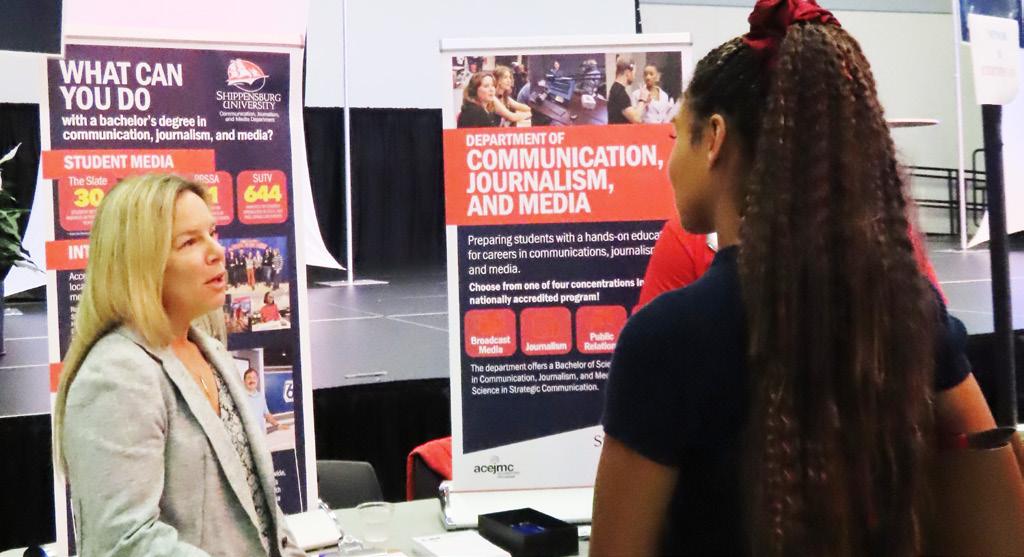
Caroline Cooper / The Slate Communication, Journalism and Media Chair Carrie Sipes speaks to a student about the department.
them as well.”
Associate Professor and Director of Exploratory Advising and Advisor Development at Shippensburg University Michael Levinstein, spoke fondly of the event.
“The Major-Minor Fair is so special. It’s a great opportunity for students to get in contact with professors, because emails and opposite schedules make it hard to discuss and plan ahead for their futures,” said Levinstein.
The Major-Minor Fair gave students the chance to connect with faculty and staff and have one-on-one conversations about their potential studies. Students
got to explore what majors and minors were offered by certain departments, if there were course requirements to apply and graduate on time, and the chance to work with associated campus groups and get certifications related to their field.
As stated in Shippensburg University’s mission statement, the Major-Minor Fair was “driven by purpose and truly collaborative engagement,” working to bring together students, faculty and staff, alumni and community mentors for the “betterment of our communities,” while providing clarity and guidance to students in their future career paths.
to reflect the idea of unity with the words “All People Belong.”
Along with groups, individuals were allowed to submit panels. A student representative of Samuel Benbow’s class shared two of her designs. Before discussing her designs, she voiced her experience as a person of mixed race along with some of the content taught in Benbow’s class, which inspired
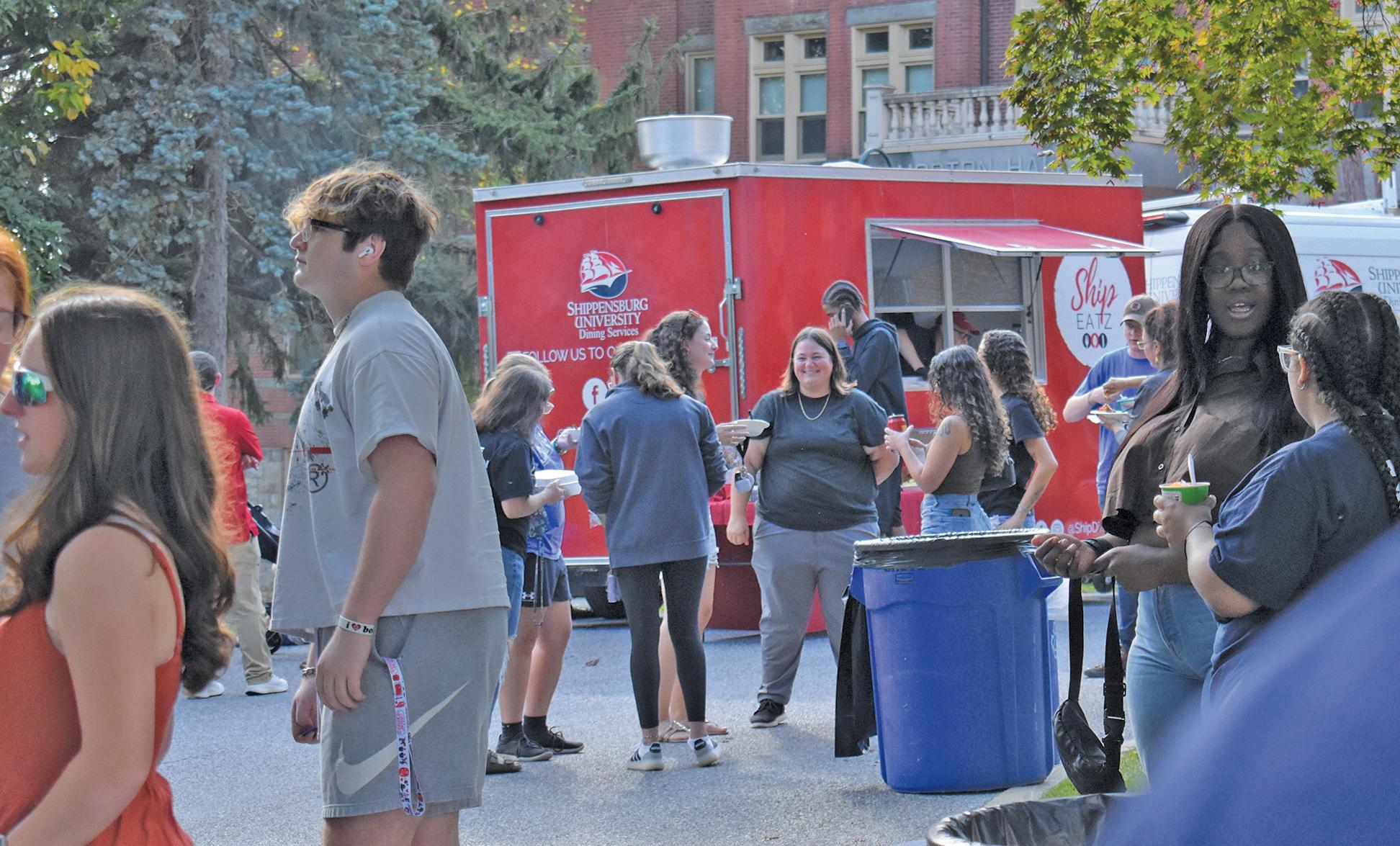
of people of different racial backgrounds. After presenting the quilt, attendees were encouraged to take a closer look at the decorative panels and then head to the Old Main Fountain for a food truck festival.
hear,” Shade said. “But I guarantee it’s something you need to hear.”
SU’s Pride and Gender Equity (PAGE) Center hosted speaker Bonny Shade for its “But What Can I Do” talk in Memorial Auditorium on Sept. 24. Shade held a conversation on how to collectively stop sexual violence on campus.
Shade travels the country and speaks to thousands of college students every year, intermixing humor and a personable tone while informing audiences on the seriousness of the reality of sexual violence in our society and how to put an end to it.
During her speech, Shade highlighted how heartbreakingly common sexual violence is on college campuses, and she explained how crucial it is for students to challenge their current way of thinking about the topic and learn something new, even though it may be uncomfortable.
“It might not be something you want to
While including different stories and interactive questions, Shade structured her speech into four key ideas surrounding recognizing what sexual violence is and how students can do their part in ensuring it is stopped.
The first essential part highlighted by Shade was knowing how to identify everything that constitutes sexual violence.
As defined by the Justice Department, sexual violence is “any type of sexual contact or behavior that occurs without the explicit consent of the recipient.”
Shade highlighted how many people may tend to minimize certain behaviors as not being sexual violence, when it is.
“The minimization of some of these smaller things only cosigns small behaviors and then escalates into larger ones,” Shade said.
After defining some key terms and ideas on the topic, Shade talked about how individuals can learn to step up and step in when they notice something is off in a situation. She pointed out that while direct action is crucial, it is also important to cause distractions and change the environment when noticing someone is in an unsafe situation, as to not escalate things.
“If you shift attention,” Shade said. “You can shift an outcome.”
The next topic of conversation Shade brought attention to was consent, and what it looks and feels like. As defined on one of her slides, “consent is active, conscious, eager and ongoing.” She also mentioned how the consumption of alcohol plays a role, and the difference between being under the influence of alcohol, and being incapacitated by it, in relation to being able to give consent or not.
The final topic covered during Shade’s speech was about how to respond to victims and survivors of sexual violence. The most important question to ask them, as noted by Shade, is “How can I support you?”
This gives them the choice about what happens next. She noted how important it is to show up, listen and
show support. “What you say in these moments matters,” Shade said. “You can literally be someone’s superhero.”
Following Shade’s speech, members of the PAGE Center handed out a slip of paper with two action steps for audience members to complete. It included videos to watch and questions to answer concerning the topic of sexual violence.
Participants were then entered into a raffle to win a free bicycle and helmet.
The PAGE Center has multiple events coming up in October for Domestic Violence Awareness Month, including a tulip planting ceremony and a bystander engagement workshop. For more information, check out its Instagram @ shippagecenter.
Commentary:
is not a bad thing
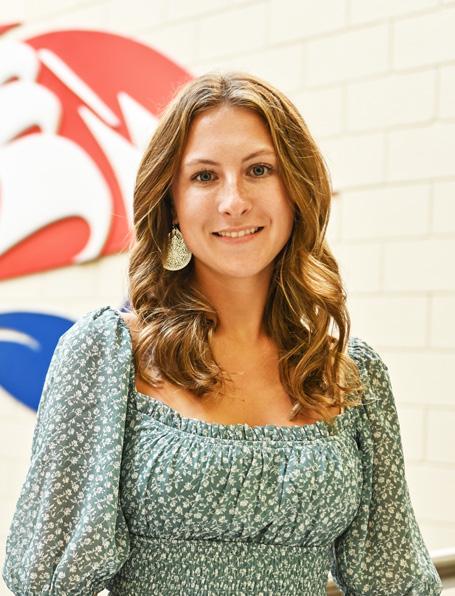
I can still recall the exact moment I read the email.
I was in The Slate office overseeing the first print edition of the semester alongside Megan Sawka, the managing editor. It was the first day of classes, my first production as editor-inchief and my first time using a beach waver — which I will never be doing again. It is safe to say that all of these “firsts” put my stress level through the roof.
was that a thing?
I turned to Megan and announced what I had just read, and her confusion mirrored my own. We both began to question the change and decided to reach out to the university for an official statement.
SU Director of Communications and Marketing Megan Silverstrim said, “The transition to SUnity Week was because [we] wanted to bring some university specific branding to the week, but that the goals remain the same.”
SU loves a good play on words in their branding, so the change makes sense in that respect. But I must admit, the timing is a little ironic.
v. President and Fellows of Harvard College, 600 U.S. 181 (2023). But surely the change to SUnity Week has nothing to do with any of this. After all, “Ship Happens.”
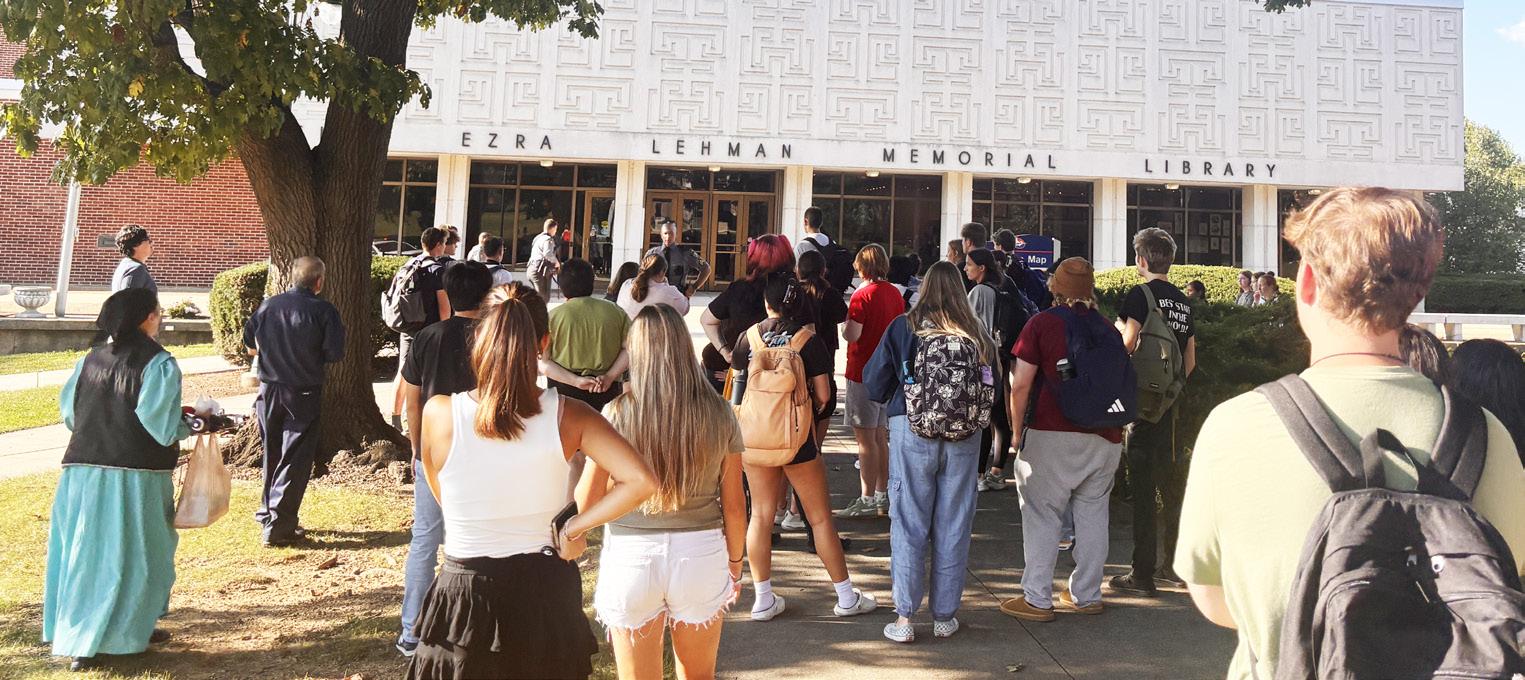
Multiple calls were made to local law enforcement agencies which led to the evacuation of the Ezra Lehman Memorial Library on Sunday afternoon, according to Shippensburg University News (SU News).
The threat was from two false calls with vague details that prompted an immediate response by local police.
About 4:20 p.m., several Pennsylvania State Police responded to the library. They began evacuating students and library staff
while checking the building, even asking individuals if they were carrying weapons, according to Angel Ball, a student employee at the library circulation desk.
About 40 students waited outside the library as the building was cleared, and by 4:30 p.m., the building was safe to reenter. A state trooper said that the calls were “[from] somewhere overseas,” and that they are working on tracing the source.
SU News notified campus via email 20 minutes later, confirming SUPD received a call that they “believed to
Evan
Shippensburg University
President Charles Patterson announced the passing of Robert Lesman on Friday, Sept. 26.
Lesman served as a professor and chair of the Global Languages and Cultures Department.
Lesman began teaching at Shippensburg University in 2006 and was promoted to professor of Spanish in 2023.
Over his lengthy career, Lesman’s research brought Cuban culture and media to greater public spotlight. His book “Translating Cuba: Literature, Music, Film, Politics,” published by Routledge in 2021, joins his numerous articles, talks and media appearances that showed his dedication to his field.
In the classroom, Lesman was a staple of Spanish education at Shippensburg University. He instructed students on the Spanish language, Latin American culture and Latin American literature.

“Dr. Lesman led with care in the classroom and the department,” SU President Charles Patterson said in an email that announced his passing. “His teaching and mentorship were recognized with campus awards, including the Teaching Innovations in Pedagogy and Scholarship Award and the Academic Mentorship Award from Athletics.” Patterson encouraged students, faculty and members of the community to come together to mourn his loss and find comfort together. Service arrangements are being prepared by his family and will be shared by Shippensburg University when they are made available. This is a developing story.


be a non-credible threat to campus.”
In addition, there were other universities in Pennsylvania, including Dickinson College, Millersville University and West Chester University, that received “similar calls” on Sunday afternoon, and identified them as swatting, which are false calls sent in to emergency responders. There will be additional law enforcement presence on the Shippensburg University campus and further updates will be released. There is no immediate threat to campus, according to authorities.
Around noon, I got an email from SU Assistant Vice President for Inclusion, Belonging and Social Equity Manuel Ruiz, that included information about MSA’s annual “A Quilt To Cover Us All” event. I was thrilled because this event is one of my favorites and serves as The Slate’s front cover story for the Diversity Week print edition.
When I reached the fourth line of the email, I paused. The first six words of the sentence read, “We will be celebrating SUnity Week...” SUnity Week? Since when
At the beginning of the year, the Trump administration issued Executive Order 14173, which aims to dismantle DEI initiatives within federal government agencies and contractors.
The administration justified the order with its argument that DEI violates American civil rights laws and undermines the importance of individual merit.
A common theme throughout the order is the command to “cease promoting diversity.”
Furthermore, Section 5 of the article specifically targets higher education agencies and institutions by recommending they adhere to the verdict of Students for Fair Admissions, Inc.
In all seriousness, this attack on DEI makes me question: when did diversity become a bad thing? I have always believed that our differences deserve to be celebrated, not weaponized. DEI was designed to ensure fair treatment, equal access and a sense of belonging for all people in the workplace. It ensures that a work application cannot be cast aside based on an individual’s race, gender, sexuality, etc. It does not permit companies to choose unqualified candidates just because they are a minority; rather, it prevents discrimination. Celebrating diversity is not about exclusion, and it certainly is not a threat to America. It is about expanding the conversation so more voices are heard and valued in a society where they are suppressed. The politicization of this concept only benefits people with the most privilege. At the end of the day, it is not just about what we call a week of campus activities. It is about whether our campus is truly committed to the values of promoting diversity, equity and inclusion.
SUnity week without accountability is not just a rebrand. It is compliance.
The Shippensburg University chapter of Turning Point USA held a vigil for founder Charlie Kirk on Thursday, Sept. 18. The vigil featured speeches from three state congressmen and garnered a large turnout.
The vigil filled Old Main to capacity, with the overflow crowd being ushered into Stewart Hall. Inside Stewart, there was additional seating that set up to watch a livestream of the event.
When there still were not enough seats, attendees were left to gather around phone screens to watch the event outside, and other attendees stood holding trans and Palestinian flags in protest. Police officers from Pennsylvania State Police, the Cumberland County Sheriff’s Department and Shippensburg University Police Department stood by patrolling with the help of drones.
“I decided to come out and protest this vigil because of some of the things that Charlie Kirk has said, some of the things that he stood for,” said Karmen Alasana. “He has advocated for the deaths of trans people like me; he’s advocated for the deaths of many people.”

Also among the group protesting the vigil, was Kara Wilson of the Young Democratic Socialists of America, a new campus group that formed this semester in response to the changing nature of politics.
“In light of the election and a lot of events politically, like ICE kidnapping people and taking them from their homes, and the government ignoring,” said Wilson, who explained the reasons behind the group’s founding and her attending the protest tonight.
Inside, the vigil was opened with words and prayers for Kirk that were presided over by Joel Gillman of Mission Hill Church of Chambersburg before the featured speakers took to the podium.
The first speaker of the night was Sen, Greg Rothman (R-34), who recounted the first time he ever met Kirk.
“Well, I met Charlie Kirk when he was 18 years old in Tampa at the Republican National Convention,” said Rothman. “When he approached a youthful friend of ours who had become a friend of his and asked him for a large sum of money to support his cause and told him that he was not going to go to college, but he said he was going to go and change
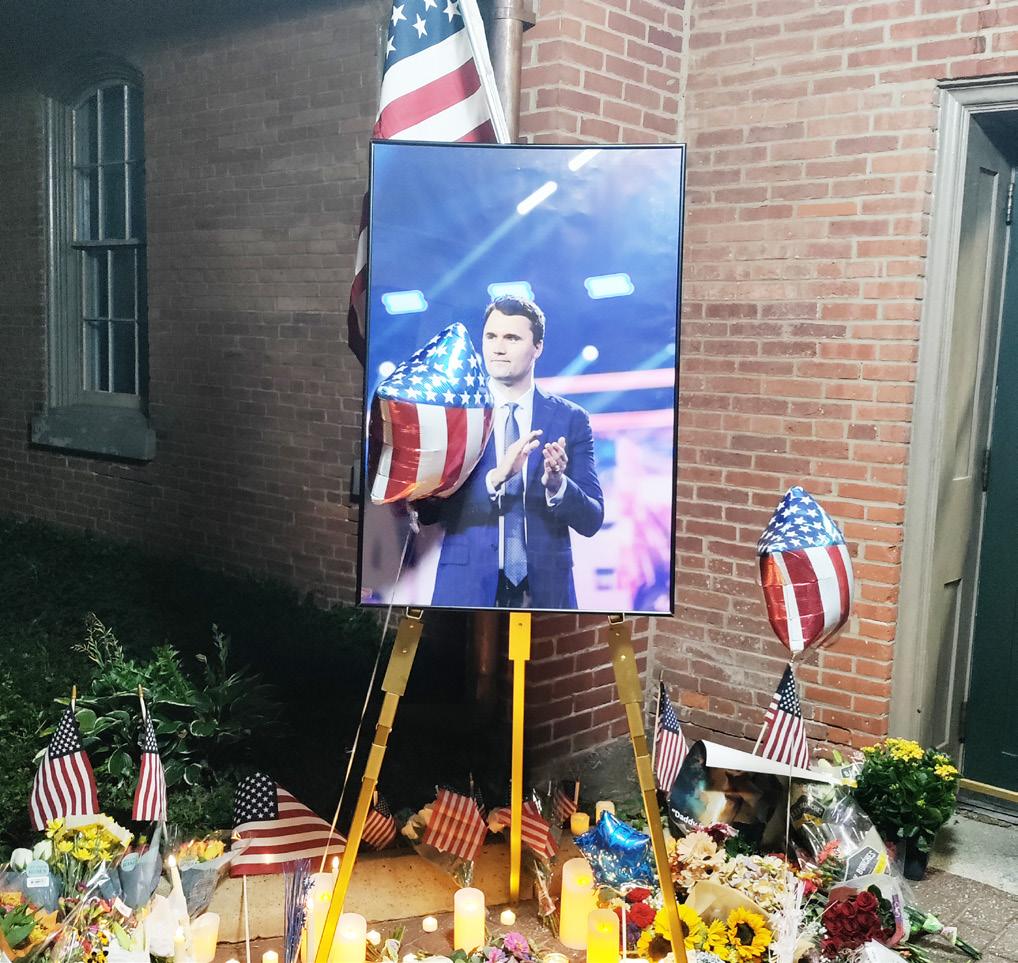
the college campus and change the college.”
There is a “theological principle that if you have a soul, then you should also have a voice,” said Rothman.
“And if you should have a voice, then you should be allowed to express that voice, speak out loud. And that’s why our Founding Fathers created the First Amendment to our Bill of Rights.”
Rothman, like many who have paid respects to Kirk since his murder on Sept. 10 at the campus of Utah Valley University, honored Kirk for his Christian faith and dedication to free speech and debate.

“[The Founding Fathers] understood how important it was to recognize not that we need debate, which we do,” said Rothman. “Not that we need to be allowed to worship and live out our faiths and our daily lives, which we do, not that we need a free press, which of course we do, but that all that came back to the fact that your rights in terms of God, your rights to speak, to debate, to be heard, I always agree with, come from God, and that’s proof of your soul.”


The Slate Speaks: Diversity is still an
The name may have changed, but diversity week is still important
It is SUnity week at Shippensburg University. For those who are confused by the title, join the club, as this is the week that was formerly known as Diversity Week until this semester.
However, in keeping with the tradition, the staff at The Slate have come together to describe what diversity means to us and how important it is for the campus.
At a time when we seem to be at our most divided, celebrating diversity is more important than ever. This week is about recognizing the beauty in our diversity and unifying us on the fact that although we share differences, we are all human at the end of the day.
This is especially true for the college campus, where you meet people of different backgrounds and stories every day, and may serve as the first time in your life that you are placed in that situation.
To embrace diversity is to embrace those differences, though. All people have aspects about them that make them unique and should be celebrated. To write that off as trivial or “woke” is sheer ignorance.
Examples of diversity shaping campus can be found everywhere. From the clubs, events, sculptures and sundry other art pieces around
campus are just some everyday examples you may see.
But diversity is a dynamic process to take in and appreciate. And every day is a new opportunity for students, faculty and guests on our campus to do so. An example of this is the Ceddia Union Building which frequently features tables from campus clubs that bring light to various cultures, religions and ideas.
But, the word diversity has been under attack more now than perhaps any other time in recent years. The administration of President Donald Trump has been attempting to purge its existence from government webpages and federally owned museums. He has also threatened to pull funding from schools that defy his views on diversity initiatives.
With such threats, it is understandable that the university would rename the week SUnity week. It may be a capitulation, but sometimes it makes sense to re-title something and live to fight another day.
Fundamentally, the week remains the same. What is more important is that the willingness to promote diversity is within all of us waiting to be embraced.
Dale Crowley Guest Contributer
It is a strange measure of American priorities that some lawmakers have floated the idea of restricting Tylenol while guns remain practically a birthright.
Think about that.
A bottle of acetaminophen — something most of us reach for after a rough night’s sleep or a stubborn headache — now poses more legislative concern than weapons explicitly designed to kill.
One can almost picture the irony: a country where you might have to think twice before buying medicine for the common cold, yet you can stroll into a store and walk out with an AR-15.
Yes, overdosing on Tylenol is dangerous. But so is walking into a school or grocery store in America where “active shooter drill” is now part of the national vocabulary. The logic feels upside down. We are told personal responsibility is sacred when it comes to firearms, yet somehow that principle evaporates when
it comes to a pain reliever in nearly every medicine cabinet.
The truth is, banning or restricting Tylenol is a symbolic distraction. It makes politicians look like they are addressing safety while sidestepping the elephant in the room. Guns kill tens of thousands of Americans each year, and Tylenol helps tens of millions function. Whether or not it deserves more serious debate is not a difficult question. Pretending otherwise is not just nonsensical — it is an insult to common sense. Only in America could politicians talk about banning Tylenol while treating guns like sacred objects. Wrap your head around that — a pill for headaches gets more scrutiny than a machine built for killing. It is the kind of logic that would be funny if it were not so pathetic. Yes, Tylenol can be harmful in large doses, but so can water, caffeine or half the things in your kitchen. We do not see daily news about mass drownings at Starbucks; meanwhile, guns kill tens of
Shippensburg University students, staff, faculty, administrators and affiliated people are welcome to submit letters to the editor for publication.
• Letters must be no more than 500 words and may not contain derogatory language or messages of hate or discrimination. The Slate may reject letters for any reason.
• Letters become property of The Slate. Letters without a name and title (affiliation to SU) will not be accepted.
• Letters should be sent to The Slate one week prior to the day of publication. Late letters may be accepted but published the next week.
• The unsigned staff

Matthew Scalia Opinion Editor
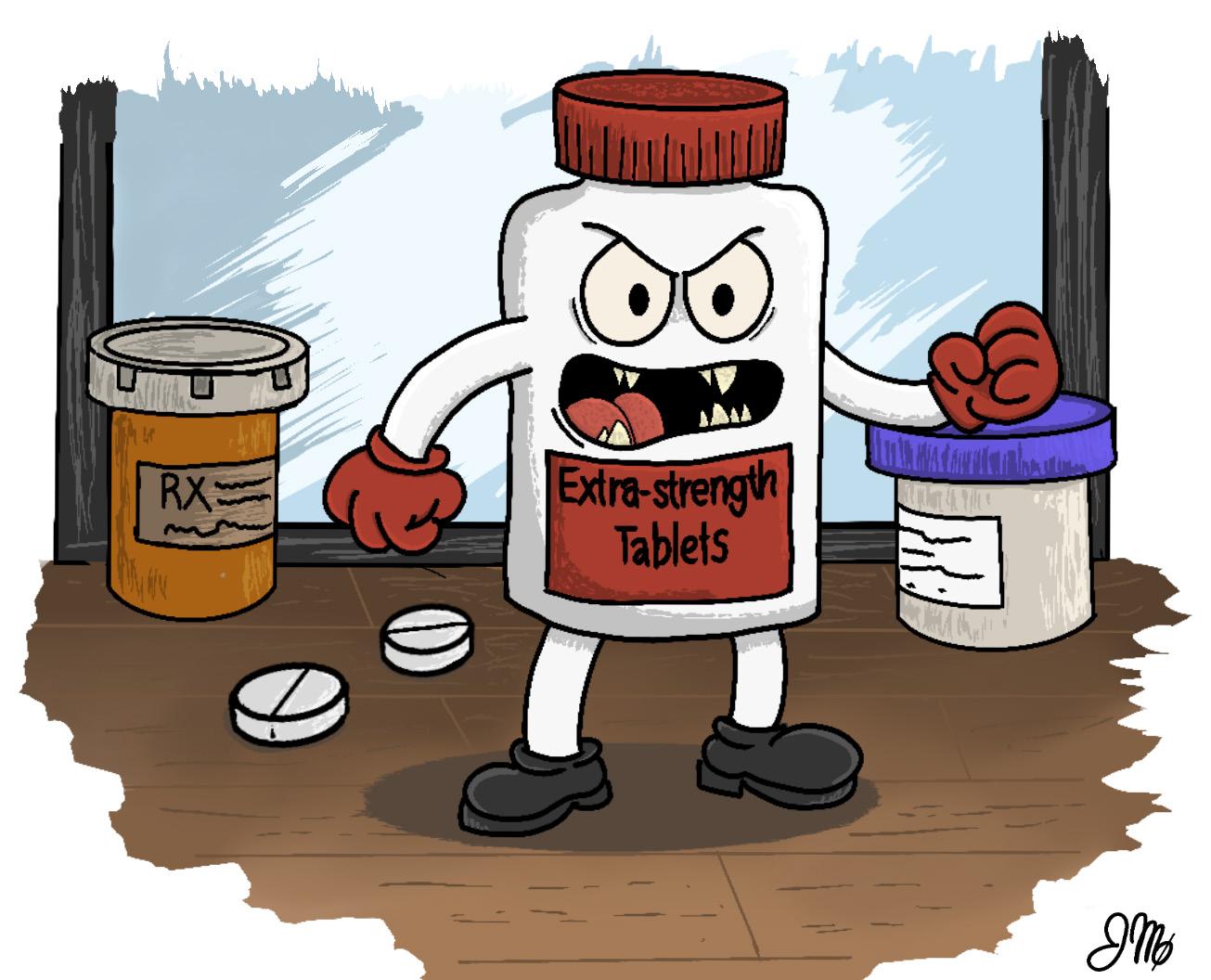
Tylenol-maker Kenvue got a headache last week that its signature product cannot cure after Health and Human Services (HSS) Secretary Robert F. Kennedy Jr. accused acetaminophen, Tylenol’s active ingredient, of causing autism.
thousands every year, turn classrooms into war zones and keep “active shooter drill” on every parent’s calendar. Yet somehow, the national conversation lands on pain relievers.
This is not about public safety. It is political theater. Lawmakers know guns are the issue, but touching that third rail risks campaign checks and angry lobbyists. Instead, they tilt at aspirin bottles and call it leadership. It is cowardice dressed up as concern.
Americans deserve better than this charade. Tylenol helps millions of people function through the day. Guns rip through families, neighborhoods and communities. If we cannot tell which deserves tighter control, then we have abandoned not just logic but basic decency.
Banning Tylenol while shrugging at gun violence is not just nonsensical. It is a dark reminder of how deeply broken our priorities really are.
Kennedy announced in April that he would find a cause for autism, and it became a signature promise of his “Make America Healthy Again” movement. He was not about to let annoyances such as time or evidence stop him.
He and the administration went full speed at a White House news conference last week, where President Trump, who in his first term waxed philosophical about bringing light into the body and injecting bleach as methods to cure, warned that pregnant women should not take acetaminophen.
Pregnant women should avoid a multitude of things. But acetaminophen was, until the announcement, one of the simplest and only options to treat pain while pregnant, and it was the firstline treatment for fevers.
Nothing has changed since Kennedy took his post at the head of HHS to change those treatment guidelines.
The study in which the Trump administration has been clinging to the most was published in the journal “JAMA Psychiatry” in 2020.
That study analyzed 1,000 mothers with differing levels

of acetaminophen drawn from the umbilical cord, and they were split into three groups from low to high levels. This study did show a risk of up to 262% increased odds that a child born to a mother with the highest levels of acetaminophen use would have autism.
But correlation does not mean causation, and science works best when theories are further tested, which was the case with acetaminophen in pregnancies.
A follow-up study published in the “Journal of the American Medical Association” in 2024 analyzed 2 million children born over two decades in Sweden, tossing water on its predecessor.
The Swedish study used sibling pairs in an attempt to create a control group, where one was exposed to acetaminophen and one was not. The findings erased the association between autism and acetaminophen that was found in the earlier study.
So, how did the doctors at HHS conclude that Trump should go on stage and tell febrile mothers not to take Tylenol? They didn’t.
According to The Wall Street Journal, the Food and Drug Administration, which falls under the purview of HHS, only went as far to say that they “consider minimizing the use of acetaminophen during pregnancy for routine low-grade fevers.”
It was Trump and Kennedy that decided to zero in on acetaminophen, the Journal says, and the FDA was left to
play cleanup via a follow-up notification.
“To be clear, while an association between acetaminophen and autism has been described in many studies, a causal relationship has not been established, and there are contrary studies in the scientific literature,” the official notice said after the White House conference.
The FDA’s primary goal for the presser was to suggest that it found a potential treatment for autism. That treatment — a medication called leucovorin — is a treatment for chemotherapy side-effects, and it is derived from folate, a common vitamin taken in prenatal care.
This sounds promising, but it requires more study as far as the professional recommendations go. But now is not the time for studies. Rather than conduct further studies on leucovorin, the administration wants to approve its use for autism, saying they can analyze the results as a form of immediate feedback.
If this sounds familiar to you, it should. The COVID-19 vaccines were approved for emergency use and were expected to have their treatment data studied in real-time. Kennedy’s opposition to that “experiment” is what propelled him back into the spotlight. Now he wants to make a monster out of acetaminophen and launch an experimental treatment. It is hypocrisy.


George Hogan & Kyra McClister Staff Contributer & Copy Editor
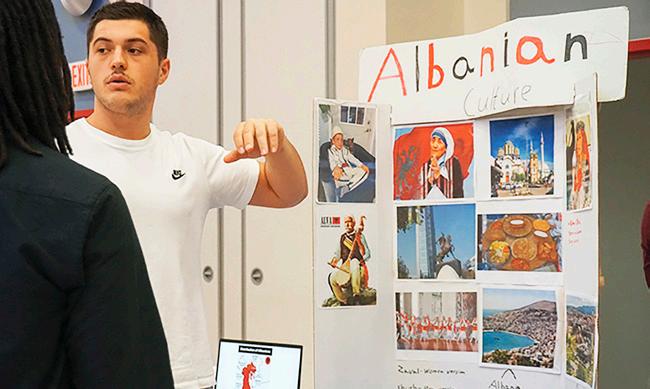
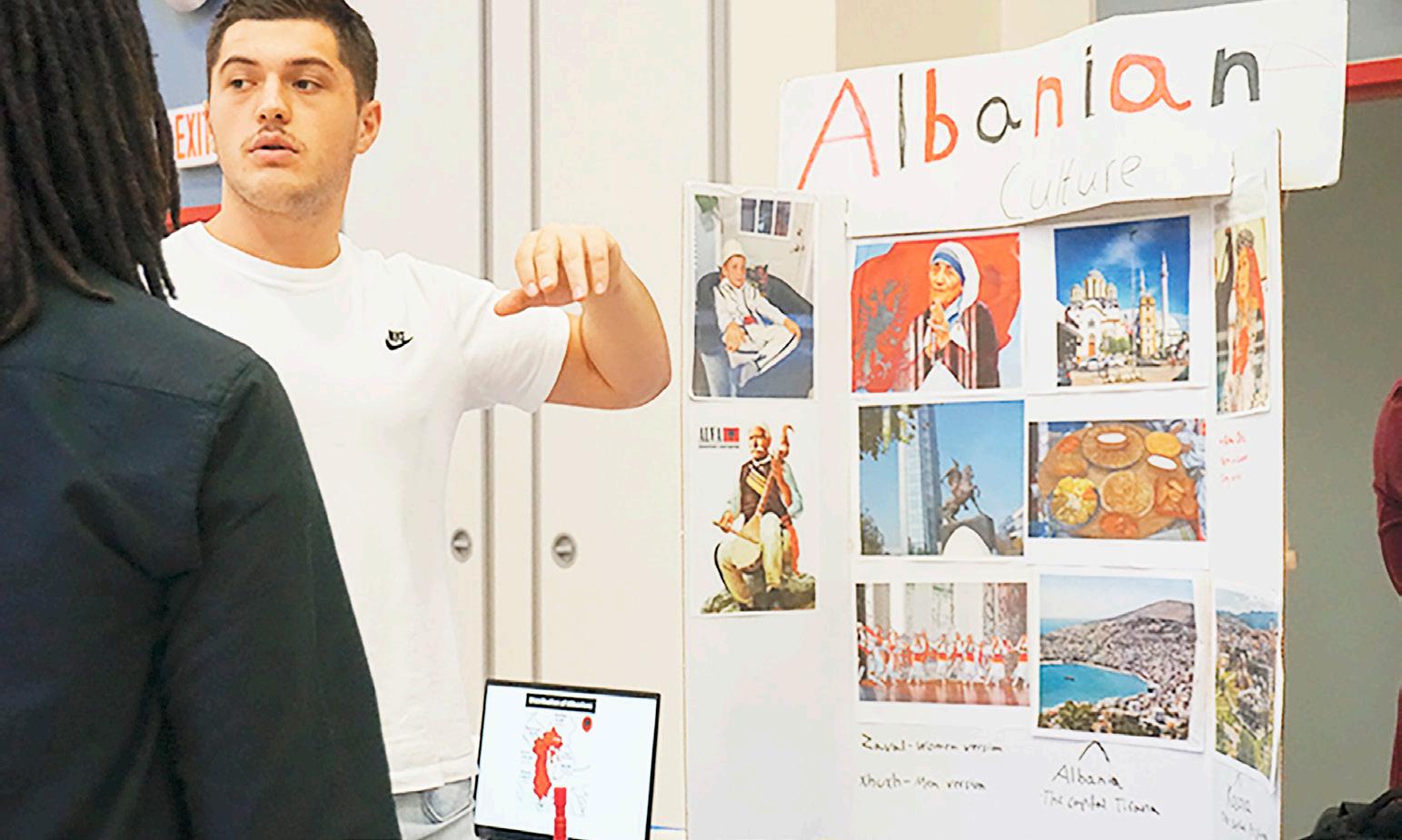
As a part of SUnity Week, “All Around the World” was an event for students to learn more about diverse cultures through music, food and more. The event allowed students to learn about the diverse community
Shippensburg celebrates, as well as groups students can join to expand their connections and learn new languages.
The presentations introduced a global wealth of knowledge.
The Fredrick Douglass Institute gave students a chance to debate important topics with conversational discussions. At the Peace
SU organizations offered a broad array of discussions with students including the Fredrick Douglass Institute, Student Wellness, Student Government Association, the Peace Corps and the International Student Organization.
Corps booth, students were told about the travel opportunities the organization offers that allow people to teach languages and assist individuals to obtain scholarships.
Each booth displayed the details of students’ culture, history and even food. Students shared dishes
of empanadas, Thai beef skewers, pot stickers and fruit platters.
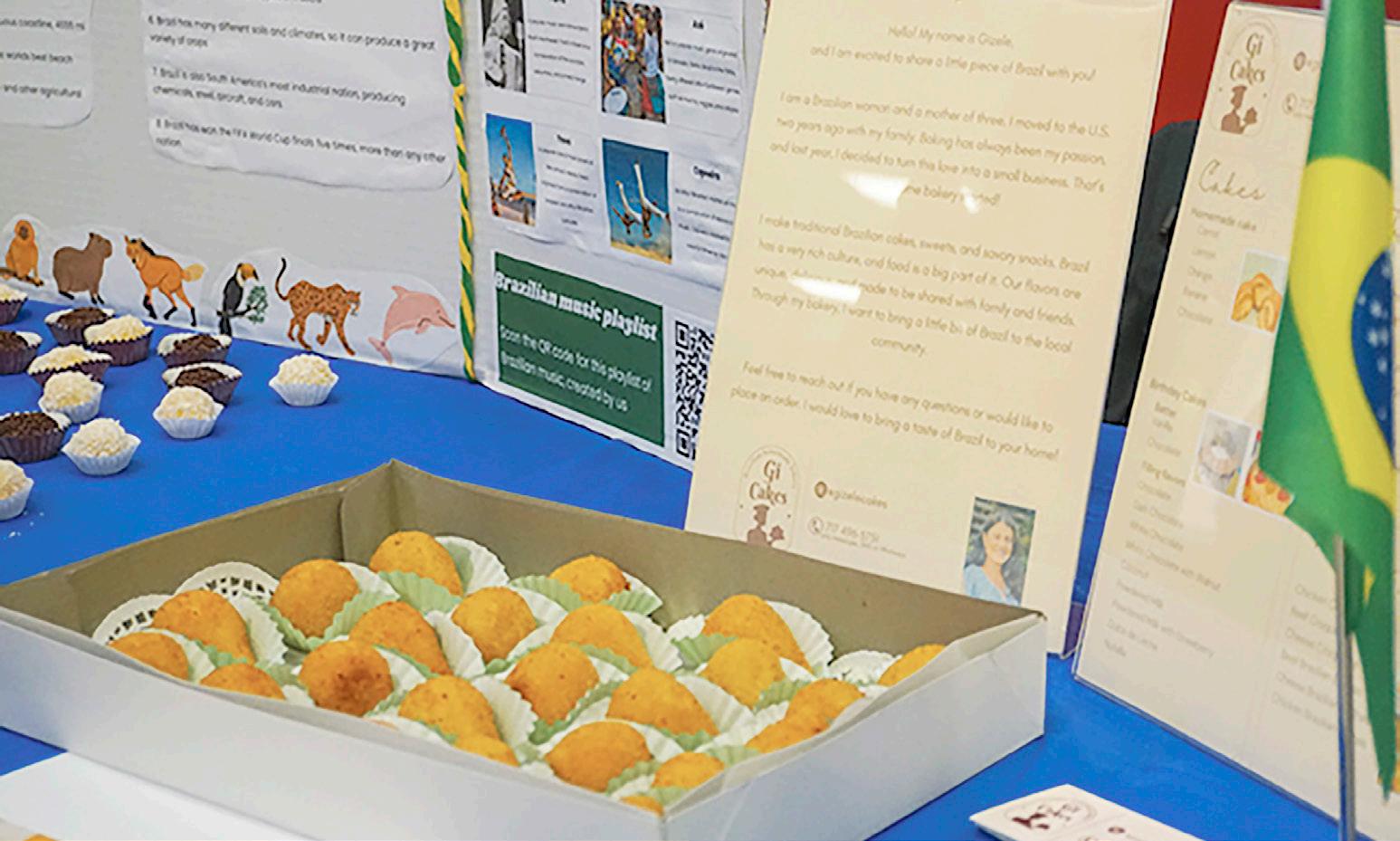
Albania and Kosovo, and Brazil’s presenters shared desserts while teaching about their culture and history, and SU student Davi Alfonso de Goes offered desserts from his mother’s bakery.
Many clubs and organizations have weekly meetings for students to attend, including SU’s French Club, which meets on Fridays at 3 p.m. and allows students to learn more about the language.
All Around the World brought conversation and cultural experiences to SU students during SUnity week.
Comedian Gina Brillon brought a mix of humor, heart and heritage to Shippensburg University on Sept. 22 at 6:30 p.m. in the CUB MPR, performing for a packed audience as part of SUnity Week and Hispanic Heritage Month.
Brillon, the first Puerto Rican comedian to be named a finalist on Season 16 of “America’s Got Talent” (AGT), delivered a highenergy set filled with jokes about being a native New Yorker, growing up in a Latin household and her parenting journey. She also touched on deeper topics like the stigma around emotions in Latino communities and raising boys in today’s world.
“I came because they paid me,” she joked. “No, but seriously–right now, college students deserve to laugh.”
After her set, Brillon offered a Q&A portion and connected with students. She answered questions about her start in comedy, what inspires her work and her memories from AGT. Shortly
after the questions, Brillon held a meet and greet, which allowed fans to talk to her and take pictures. This event was a part of SUnity week and was co-sponsored by the SU’s Activities Programming Board (APB). SU’s Vice President for Inclusion and Belonging Manuel Ruiz, Ph.D., touched on the importance of events like this one.
“This was a great way to bring some comic release at a time in our nation where we do need just that,” Ruiz said. “We need to celebrate all forms of art.”
Brillon’s latest comedy special, “Mind Your Business,” premiered on YouTube earlier this year and has already garnered over 600,000 views.
“Laughter has always been an important part of healing to me,” she said. “Whenever I get to share that with people, I think that’s a special thing.”
For more events like this, follow @ship_belonging and @shipapb on Instagram. To learn more about the other SUnity Week events, follow @ship_msa.
SU students brought their friends and families to play bingo in celebration of Family Day on Sept. 26 at p.m.
The CUB MPR was filled with neon lights, glow-in-the-dark accessories and the squeaks of dry erase markers as students and families attended the Activities Programming Board’s (APB) annual Family Weekend Bingo.
The event kicked off with a few rounds of “normal,” or traditional,
George Hogan & Kyra McClister Staff Contributer & Copy Editor
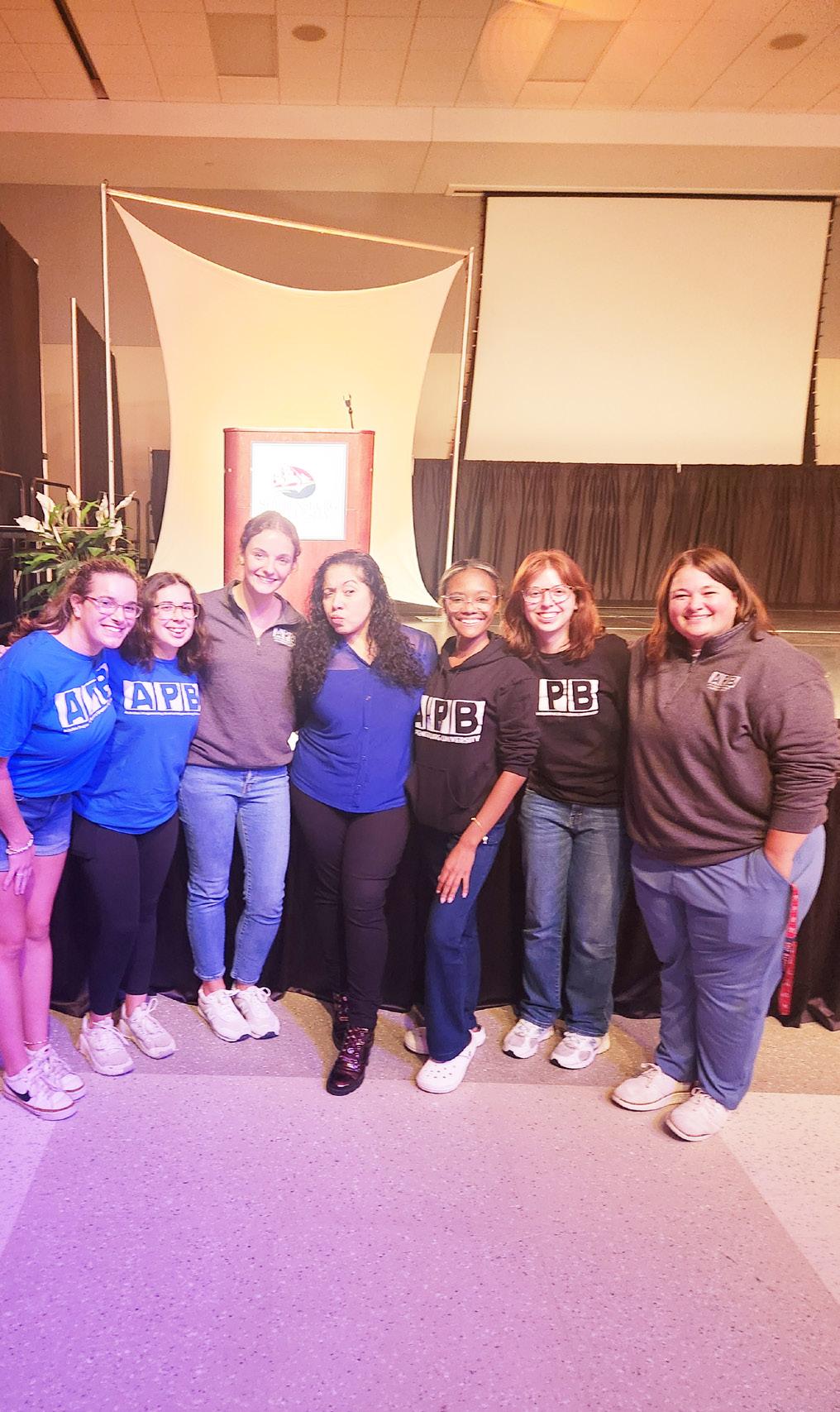
bingo. Soon, “special rounds” were introduced. These rounds would have different configurations of what counted as bingo, rather than the tradition five in a row. These configurations included the entire perimeter of the board or an X shape.
The event featured several prizes, including an ice maker, a Nintendo Switch and a Lego bouquet of flowers.
“We want people to come out and make friends and just be with the community,” said APB Senior Vice President Victoria Sutherland.
The games quickly became intense, with the attendees shouting or cheering when someone called, “Bingo!”
“[It was] super fun and competitive,” said SU student Gabby Lovett.
Beyond the game of bingo, there was a large piece of black paper where attendees could sign their names in glow-in-the-dark markers.
This event was one of the many events hosted by APB this semester. For more information on APB’s upcoming events, check out their Instagram at @shipapb.
The Food Truck Festival was a great way for students on campus to try a variety food with their friends. After trying the different types of food from the food trucks, students will be awaiting next year’s Food Truck Festival event.
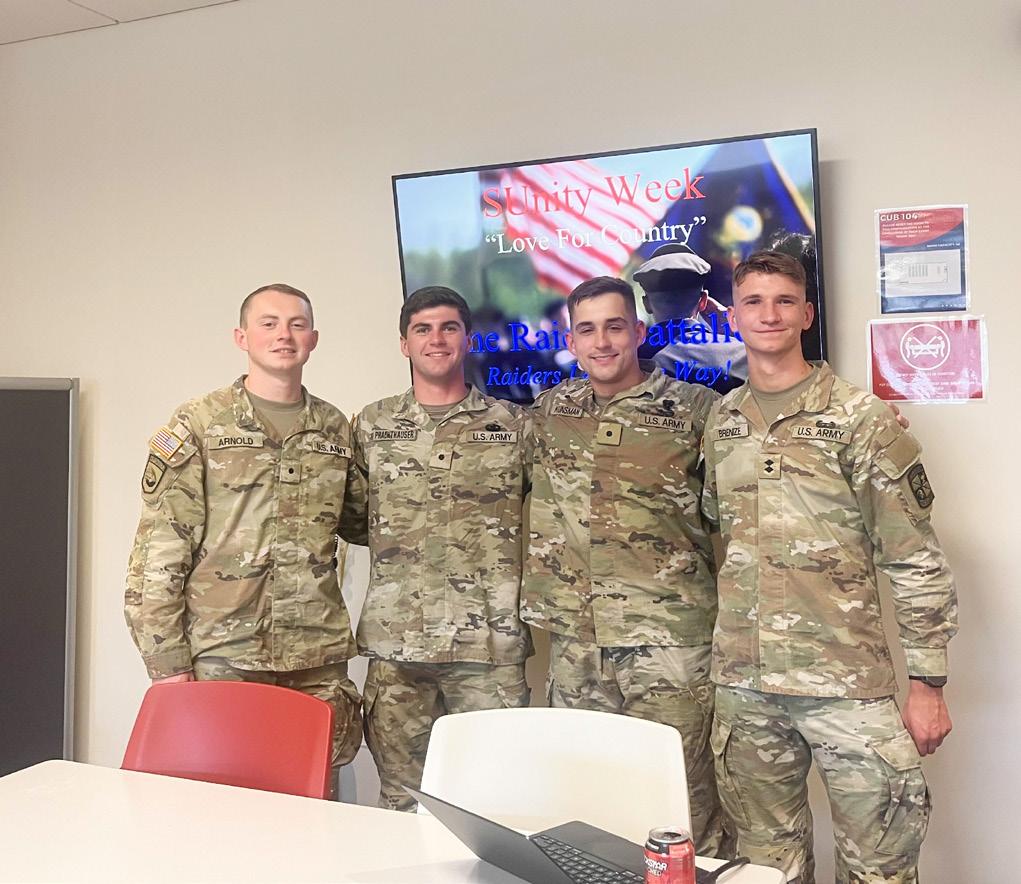
Four cadets from Shippensburg University’s ROTC gathered to give a presentation on how the program has impacted their lives as students on Sept. 23 in the CUB as a part of SUnity Week.
SU’s Army ROTC hosted “Love for County,” which featured cadets Aidan Brenize, Daniel Prachthauser, Colin Arnold and Joseph Kunsman. Past the presentation itself, these cadets are pursuing the Army’s mission and their own ambitions as Shippensburg University students. It can be an intense weight on their shoulders attempting to balance both ROTC and being a college student.
The cadets can be commissioned anywhere, ranging from San Diego to Georgia, or in places beyond the United States.
None of the cadets came from a military family background, which is a large factor for most people who join. The cadets have a variety of reasons for joining, such as the fulfillment that ROTC offers.
“You’re getting fulfilled by it in your own way, but the comfort is that forethought of me as a freshman, I came in with no experience in a wide-open mind, and then I guzzled from the fire hose,” said Brenize.
Each cadet conveyed that ROTC had given back experiences, opportunities and connections to making their sacrifices to the university’s battalion worth it.
“I’ve made some of the best buddies with my travels and everything else, and at the same time, I’ve lost some of those best buddies. It’s pretty awesome to know that you’re still honoring everything that they taught you,” said Brenize.
“We’re not super freak athletes or like geniuses,” said Prachthauser. “It’s just we show up, we want to do it, and we have the mind that we want to do it, we will do it. That’s it.”
One final takeaway from Arnold is that outside of the positive accomplishments, their own failures have also given them opportunities and life lessons.
“One of the greatest things for me that I’ve experienced is my failures within the program. We are challenged, we did accomplish all these great things but I failed Army school. I fell short, I let people down, I didn’t do the best work ever, but within that failure, we’ve been able to become better leaders and better people,” said Arnold.
“Love for Country” was one of the many SUnity Week events focused on celebrating differences within our community and bringing people together.


The long-awaited return of “The Summer I Turned Pretty,” an Amazon Prime Video original series, captivated audiences starting in mid-July with episodes for the final season dropping on the streaming service every Wednesday until Sept. 17.
There was a two-year gap in the release of Seasons 2 and 3 because the writer’s strike delayed the start of production. Despite the gap, the final season was still a hit for fans with 25 million global viewers in its first week, according to Amazon.
Even though it is filled with cringey lines and subpar acting, the show draws in a large audience because of its dramatic plot and fun summer vibes. At this point, if you have not heard about this show, you have probably been living under a rock. It is all over social media and everybody is talking about it.
The story is based on a book trilogy of the same name by Jenny Han. Isabel “Belly” Conklin, her mother and brother, travel to the fictional Cousins Beach in Massachusetts every summer, along with
her mother’s best friend, Suzannah Fisher, and her two sons. All of them stay in the Fisher’s luxurious vacation home. Conrad, played by Christopher Briney, and Jeremiah Fisher, played by Gavin Casalegno, fight for Belly’s love and attention the summer she turns pretty. The third and final season starts off with a four-year time-jump from the end of Season 2. Jeremiah and Belly have been in a long-term, committed relationship throughout those four years. However, things change when it is revealed that Jeremiah cheated on her in Cabo during spring break.
To save their relationship, Jeremiah proposes and she says yes. This leads to Belly spending the summer in Cousins planning her wedding while her fiancé works in Boston. With Jeremiah not there for her, his older brother Conrad steps in to help. Conrad and Belly had a brief relationship, but he has not been able to move on and throughout the season we see him yearning for her. At times during the wedding planning, Belly begins to question whether or not she is marrying the



right brother. Spoiler alert, she was not.
Although blood related, the brothers have very different personalities.
Jeremiah is a goofball frat guy with very little maturity and responsibility. Throughout the series, he comes off as whiny, annoying and occasionally manipulative. He is only seen as reliable to Belly because he has not run from his feelings like Conrad has
done in the past.
On the other hand, Conrad is always putting others before himself. He constantly puts his own feelings for Belly aside because of his brother, at least until he finds out about Cabo. Once he knows Jeremiah has mistreated her, he tells her how he feels.
In the scenes where Jeremiah and Belly are together, it feels like Belly is
acting as his mother, filling a void in his life because his mom died. You can also see that Jeremiah brings Belly down to his level of maturity whereas Conrad does not drag her down, he lifts her up and lets her shine all on her own.
Jeremiah simply cannot live without Belly and does not truly care about how she feels or what she wants.
For example, Belly wanted to study abroad in Paris in the fall but told him she was rethinking it because of the wedding. Jeremiah’s response was “Good, because I don’t want you to go either.”
Jeremiah also sees Belly as an object or a prize rather than as another person, and he only wanted her as a way to one-up his brother.
Fortunately, Belly and Jeremiah call off the wedding, and she runs off to Paris to find herself again.
When Conrad visits her in Paris, he again declares his love for her, reassuring her his feelings are real by saying, “Because I’ve changed everything about myself, and the one thing that never changes is that I love you.”
Finally, Belly chooses Conrad in the end and puts the infinity necklace she
received from him in Season 1 back on.
Infinity acts as a symbol of their love, and unfortunately it also feels like how long this series has been going on. The story will continue in a movie depicting “another big milestone left in Belly’s journey,” according to Han. The milestone she is most likely referring to would be a wedding between Belly and Conrad, but making the movie feels like an unnecessary cash-grab. Although rushed, the series finale wrapped up each character’s storyline with a happy ending, and the future of Conrad and Belly’s relationship can be inferred.
Other problems within the show are the music and the pacing. At times the music overpowers the rest of the scene that a song is in and little variety in the artists featured. Pacing is off as there were subplots this season that felt like they took away from the main storyline and then felt like they were incomplete when finally wrapped up.
Despite these critiques, the show is an easy and enjoyable watch because of the cozy beach backdrop and the intriguing plot.
After an emotional, vicious fight between long-time Japanese professional fighter Iyo Sky and highly regarded Chilean fighter Stephanie Vaquer, there is a new Women’s World Champion of WWE (World Wrestling Entertainment).
Vaquer debuted on WWE’s NXT network, a developmental brand used to promote the next generation of wrestlers, on Oct. 15, 2024, and has since held championships across a multitude of different Wrestling networks. Known as “The Dark Angel” and “La Primera,” Vaquer has been destined for success since the beginning.
Upon recent news of her pregnancy,
former Women’s World Champion Naomi Fatu’s reign officially ended after 35 days, resulting in the search for a new champion. On the Sept. 16 episode of Monday Night Raw, Vaquer and Sky signed the contract for the infamous championship match, which was set to play out on WWE’s debut partner event with ESPN Network, Wrestlepalooza.
Though this was not an easy feat, only about five minutes is all it took for Vaquer to fight her way to the title and win the Women’s World Championship.
As a huge fan of Sky as well, this was a great win overall as a viewer. Sky, Genius of the Sky, put up a tough fight. She pulled out her signature high-flying maneuvers such as the Spanish Fly and Over the Moonsault, and submission moves such as the Crossface, which
Vaquer was able to escape with a foot to the bottom rope.
Vaquer stunned the Indianapolis crowd with her staple Devil’s Kiss move before absolutely obliterating Sky’s knees hers Devil’s Screw move. Finally securing the 1-2-3, Vaquer finished Sky with a Corkscrew Moonsault from the top rope — a well-deserved win for Vaquer.
Visibly emotional after the match, Vaquer obtained her first Women’s World Championship. Fans, including myself, cannot wait to see her defend this title soon.
Find this match, along with more WWE Saturday Night Main Event matches to come, on the ESPN Network.
Abbygale Hockenberry
A&E Editor
By far, this book is the craziest and goriest I have ever read. At times, I was squealing and crinkling my toes during the disgusting — yet enjoyable — scenes I had to read.
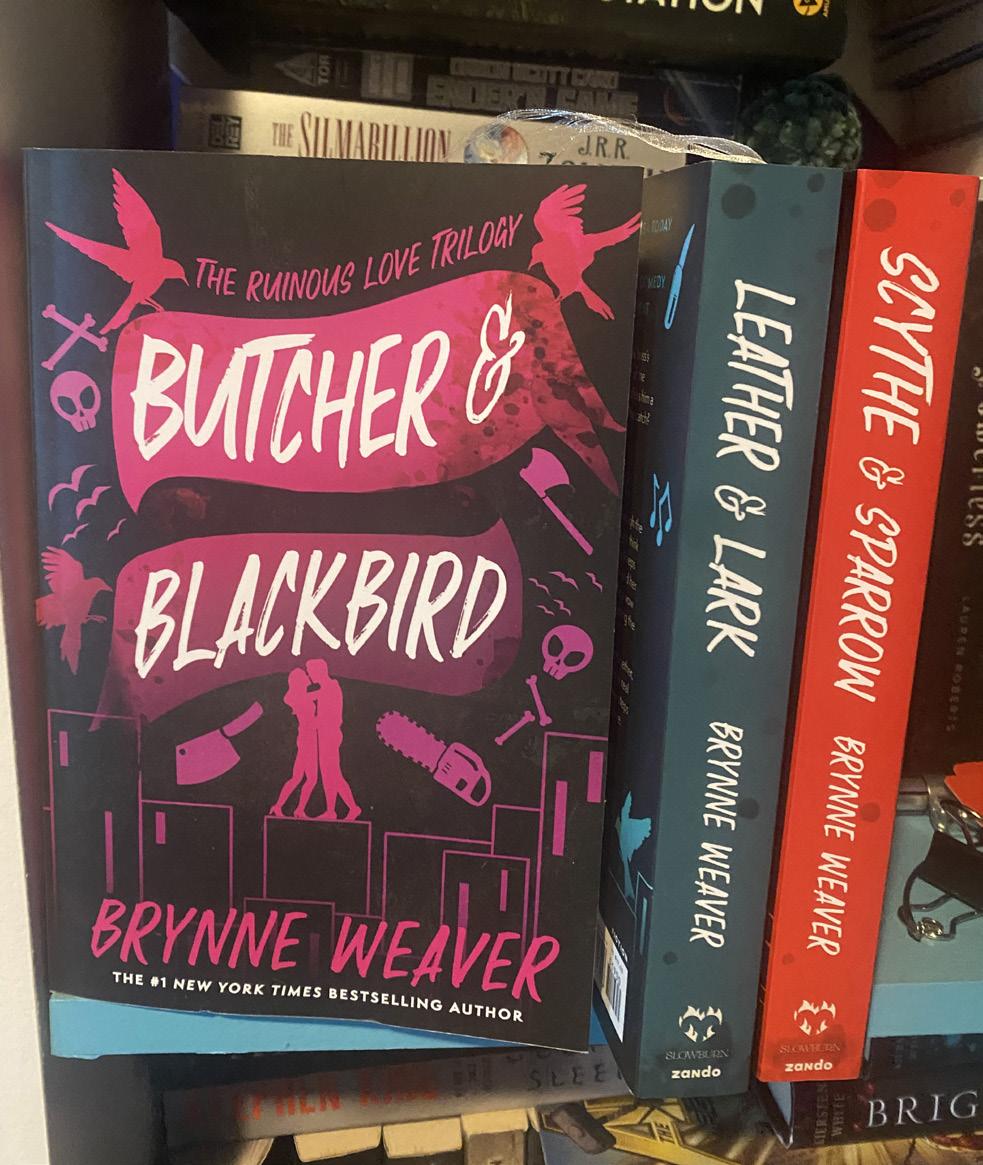
“Butcher & Blackbird’”by Brynne Weaver is about a woman named Sloane, who is known as Blackbird, who is a serial killer…who kills serial killers. I love the moral dilemma that goes through the readers’ mind. Is it wrong what she does?
Sloane is saving peoples’ lives, but she’s also taking lives, too.
Sloane meets a guy named Rowan, also known as the “Boston Butcher”, who is also a serial killing
psychopath, and they have this annual competition where they find a target and see who can kill them first. It is this twisted game that they both love and look forward to every year. Sloane has a reputation of killing her victims by plucking their eyeballs out of their sockets. The description Weaver uses here is where I say I was squeamish.
The first night they meet, they happened to be after the same killer, but Sloane got to him first. She is locked in a cage and Rowan lets her out; he calls her a “blackbird in a cage.”
My main issue with this book is the romance.
Sloane and Rowan live in two different states and only see each other once a year. At times they go a few years
without speaking. Rowan has an obsessive connection to Sloane because she is the only person who understands him and vice versa.
Once they become romantically involved, the sex seems like it is pretty much the entire plot. Scene after scene with nothing other than that, it gets a bit annoying. I prefer romance to be the sub-plot of a bigger and more complex story. It drives the passion and emotion of the characters to where the romance does not feel as forced.
I try to understand that this book is different than other romances because Sloane and Rowan are not normal people. They are killers. The obsessiveness makes sense because of who
they are.
For example, my favorite scene is the first kill. They are given a location by Rowan’s brother Lachlan, and they try to find out who they are after. They stay at an inn in West Virginia. Sloane and Rowan are given connecting rooms, and while Sloane is changing, Rowan hears movement coming from behind a painting. There he discovers the innkeeper, Francis, peeping in on Sloane. He runs away and the two of them go after him.
Rowan goes to Francis’ house and is so angry for what he was doing. This is where we see the Butcher side of him.


Mason Flowers Sports Editor
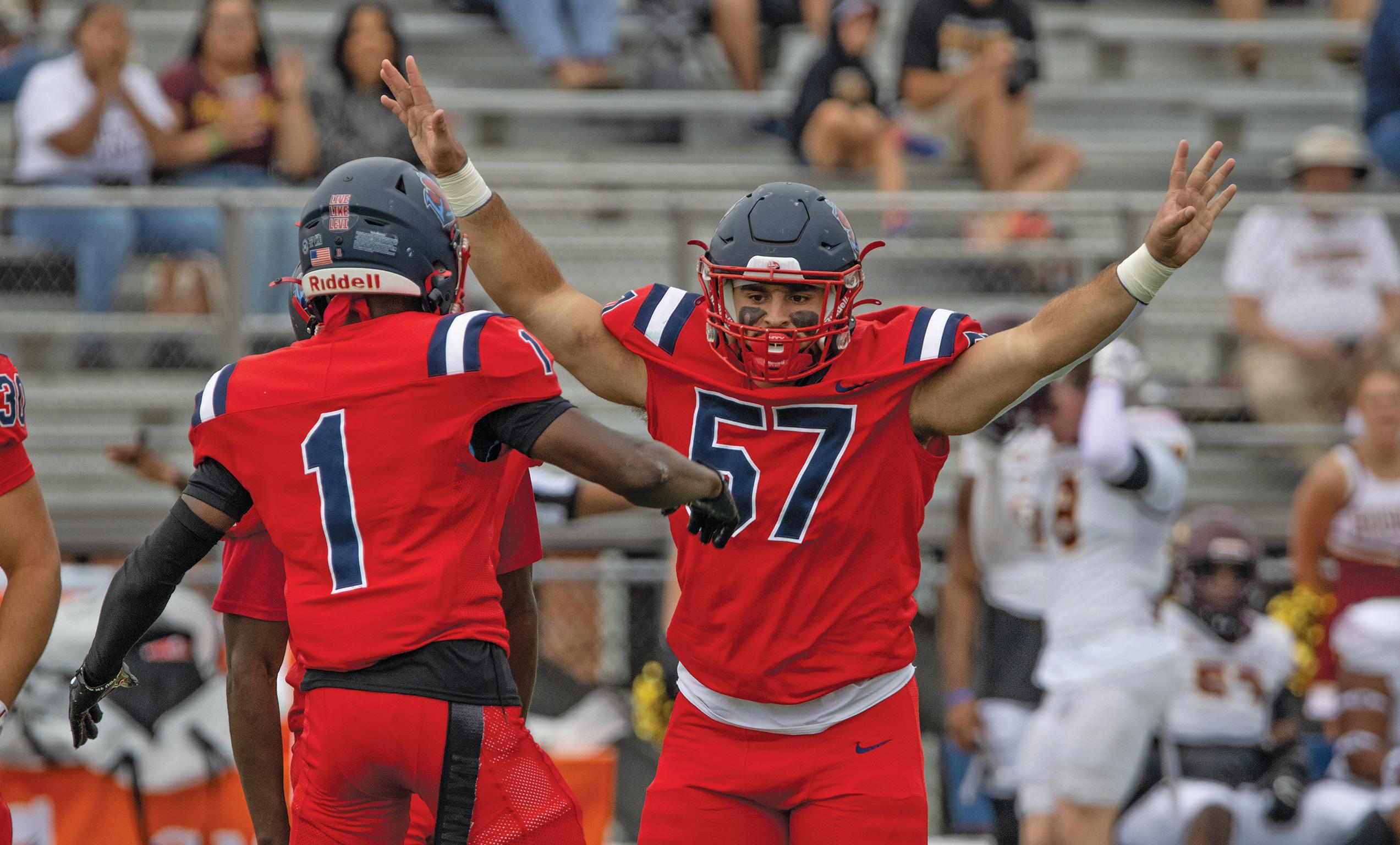
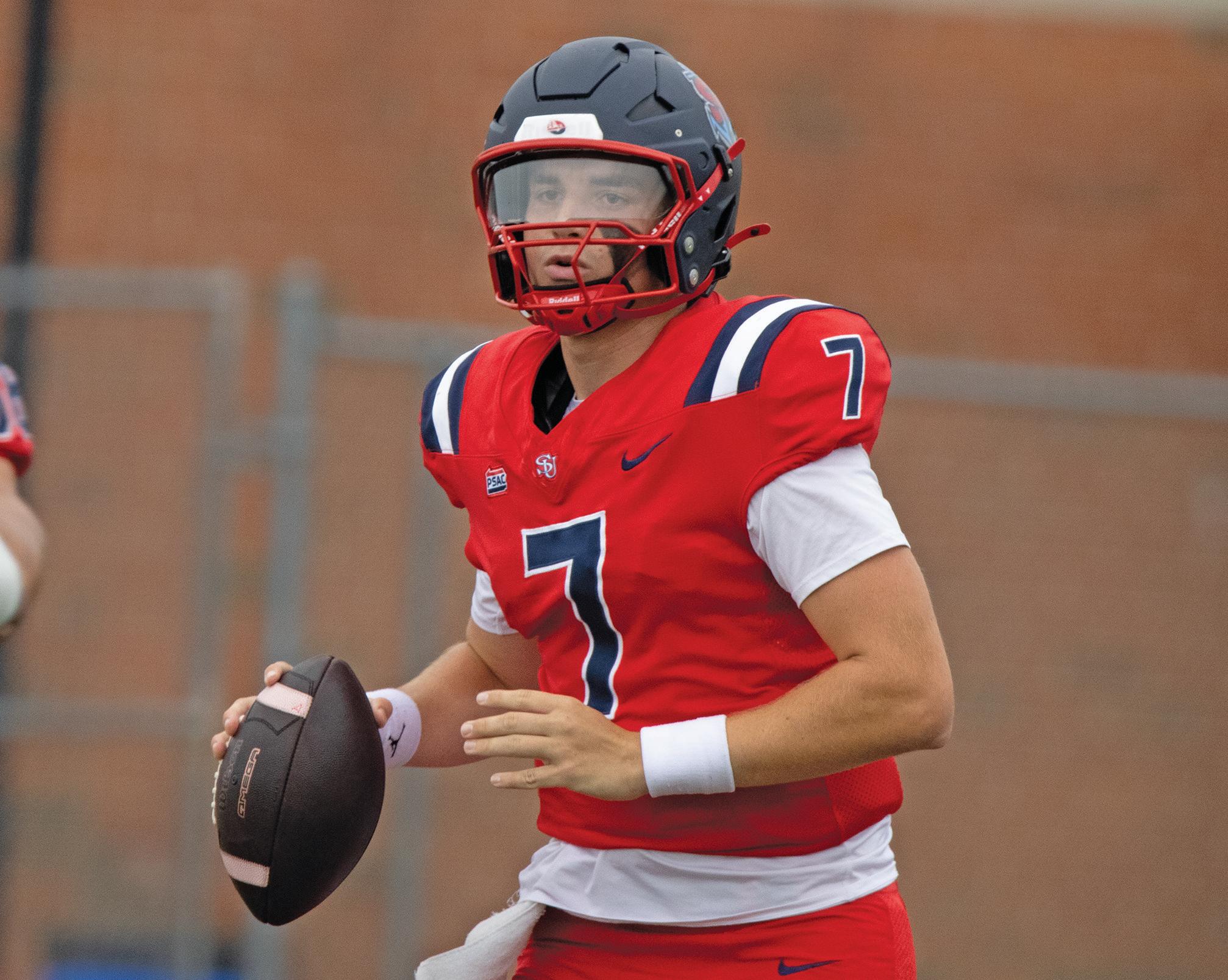
Shippensburg football earned its first win of the season and moved to 1-0 in conference play on Saturday, defeating the Huskies 10-7 in the second half. SU moves to 1-3 on the year.
The Raider defense held Bloomsburg to its lowest point total of the season, earning three takeaways in the second half to control the momentum after taking the lead at the start of the half.
SU started the game on offense, reaching the redzone on its first possession. The Raiders could not score though, as redshirt freshman Derek Witmer missed a 34yard field goal try wide. The teams then traded punts on the next four possessions.
After a punt from sophomore Wilson Ingerski was downed at the oneyard line, Bloomsburg put together the most impressive drive of the game, going 99 yards in 11 plays to take a 7-0 lead early in the second quarter.
Shippensburg responded nicely, with redshirt sophomore quarterback Riley Gunnels leading a 12-play, 50-yard drive that ended with a 39-yard field goal, making it 7-3. It was the first points of Witmer’s collegiate career.
Bloomsburg got the ball back with 4:53 left, but missed a 30-yard field goal attempt with 28 seconds left, leaving the game at 7-3 at halftime.
The Raiders began the second half on an aggressive note, opting to do a surprise onside kick coming out of the locker room. It was successful, with freshman Grady Snyder recovering the ball in his collegiate debut to give SU great field position.
The offense used the field position to its advantage,
with Gunnels throwing a 16-yard touchdown pass to redshirt sophomore Jaevon Parker, giving SU a 10-7 lead.
After a couple more traded punts, Bloomsburg began putting a drive together, but it ended abruptly thanks to senior DJ Jackson snagging an interception to give SU the ball near midfield. It was the first interception for the SU defense this season.
Jackson spoke postgame about getting the first interception, saying, “We had a little bet in the DB room, who was going to be the first to get an interception… those turnovers really make a difference.”
Still down three with 4:30 remaining, the Huskies looked to begin a go-ahead drive. It went nowhere though, as the Raider’s pass rush caused Bloomsburg quarterback KJ Riley to make an ill-advised throw. It was intercepted by sophomore Alex Sauve, putting SU in the redzone.
Bloomsburg forced a turnover on downs, getting the ball back with 2:29 left. SU’s defense continued to shine, as another strong pass rush helped redshirt sophomore Gabe Benjamin secure a diving interception, sealing the victory for the Raiders.
Benjamin spoke on the secondary’s mindset postgame, saying, “Our mindset was to focus on the keys, and if you focus on the keys, the ball’s going to come to us. We had everything planned out today, a big key was communication.”
Both teams ended the game with 269 yards of offense. SU had over 35 minutes of possession, going 6/16 on the third down, holding the Huskies to 4/9. The Raiders committed zero turnovers.
Gunnels finished the day 24/33 passing, throwing for
169 yards and a touchdown. Redshirt junior Josiah Leonard had his best rushing performance of the season, going for 97 yards on 27 carries. Sophomore wide receiver Ty Neal led the team with a career-high seven catches, going for 59 yards.
Leonard spoke on how nice it was to get in the win column, saying, “It feels good… our coach has been preaching that the East starts today, all our goals are still in front of us… so getting a win in the East right now just feels really good.”
The SU defense was led by Sauve and senior Ely Ghameshlougy with eight tackles each. Redshirt sophomore Nate Myers was close behind at seven, putting him at 43 tackles on the year, tied for first in the Pennsylvania State Athletic Conference. Sophomore Peyton Stadler also earned the first solo sack of his college career.
SU football will return to
Shippensburg men’s and women’s swimming teams opened their seasons with a dual meet against Kutztown at Keystone Natatorium on Wednesday, Sept. 24, after not being able to swim in their home pool for a week
The team could not practice due to there being no one to inspect the campus facility pool, leaving the swim teams high and dry, and unable to practice.
When asked what the team did for training, junior Michelle Kubiak and sophomore Kaitlyn Tannenhaus responded saying, “All we could do was lift weights. Some of the team went to the YMCA pool in Chambersburg.”
The teams were able to return to their home pool on Tuesday, the day before the meet. Despite not being able to practice for a week, the men’s team displayed a strong showing, winning 10 of 13 events to defeat Kutztown by a 161-97 score.
The women’s team fell by a score of 164.5 to 95.5, winning two events on the night.
On the men’s side, six of Shippensburg’s 10 victories
were won by a Raider making their team debut.
Graduate transfer Josh Wall secured three victories for the team, winning the 200-yard freestyle in 1:46.60, the 100-yard freestyle in 48.09 seconds and the 200yard individual medley in 2:01.30.
Wall’s times in the 200 and 100 freestyle were two of the team’s five performances on the night that satisfied the PSAC Championships qualifying standards.
First-year swimmers Mason Hockenberry and Joe Herman combined for three event victories. Hockenberry won the 100-yard butterfly in 54.04 seconds and the 50-yard butterfly in 24.14 seconds. Herman took the 50-yard backstroke in 25.84 seconds.
Sophomore Kiran George was the fastest in the 50-yeard breaststroke with a time of 27.69 seconds, and Junior Mason Koeth won the 100-yard backstroke in 55.65 seconds.
Wall and Koeth followed a 1-2 finish in the 200-yard freestyle while satisfying the PSAC cut. Juniors Robbie Ferlick and Connor Ludwig went 2-3 in the 50-yard freestyle with respective PSAC cuts of 21.44 seconds and 22.46 seconds.
The men also claimed victories in both the 200yard medley relay and the 200-yard freestyle relay, with times of 1:37.02 and 1:28.76, respectively.
For the women’s team, sophomore Olivia Carver claimed gold in the 1,000yard freestyle in a time of 11:11.13, and junior Charlee Shaw won the 50-yard breaststroke with a time of 32.77 seconds.
Freshman Ella Nick met the PSAC qualifying standard in the 50-yard freestyle swimming a time of 25.33 seconds.
Carver placed second in the 200-yard freestyle in 2:03.82 and the 500-yard freestyle in 5:32.50. Sophomore Paige Bensinger was the runnerup to Shaw in the 50-yard breaststroke after swimming 33.07 seconds.
Senior Hannah Hudson swam 1:03.33 in the 100yard backstroke, narrowly missing first place by just .01 seconds. Hudson also was runner-up in the 50yard backstroke with a time of 29.36 seconds. Freshman Bria Burkholder completed the 100-yard butterfly with a second-place time of 1:02.10.
Both teams will be back in competition in 10 days with a dual meet at Bloomsburg on Saturday, Oct. 4.
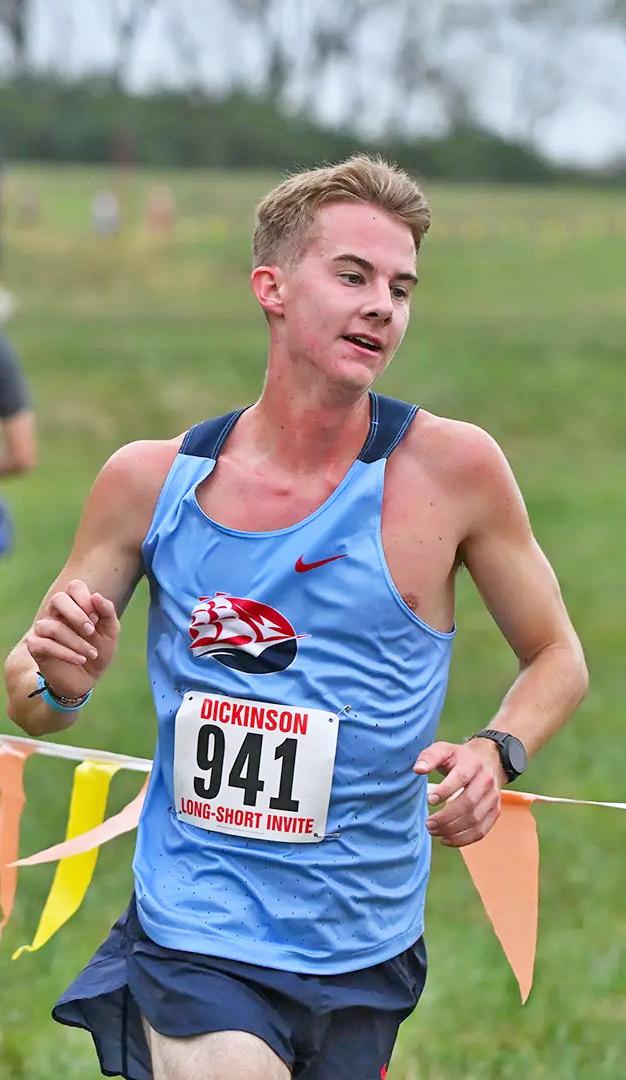
Men’s cross country wins 1st, women’s in 3rd at Dickinson ‘Short’ Invitational
Shippensburg University’s men’s and women’s cross country teams attended the Dickinson Long/Short invitational on Saturday at Big Spring High School.
The men’s cross-country team won with six points at the short invitational. The team had a 1-2-3 finish with a perfect score.
Redshirt sophomore Tommy Crum Jr. finished in first place at 11:46.6, senior Garrett Quinan finished in second place just 0.9 seconds behind and senior Ryan Wolfe finished in third place at 11:51.3
Four runners finished consecutively in 11th through 14th place: junior
Ben Devine, junior Brennan Wellock, graduate Brayden Boyd and freshman Daniel Naylor, respectively.
Redshirt sophomore Kyle Baker was two spots behind Naylor, while sophomore Owen Shrader and junior Jackson Gutekunst placed in the Top 20.
Freshmen Ben Hummel and Davey Johnson completed the men’s lineup in 21st and 25th place.
All 12 runners finished in the Top 25. The women’s crosscountry team had a thirdplace finish in the short invitational.
Five runners finished in the Top 20 and eight runners finished in the Top 30.

Freshman Mya Trotty was Shippensburg’s No. 1 runner, coming in 12th place overall with a time of 15:13.6. Sophomore Victoria Bartholomew finished in 15th place overall. She gained approximately 13 spots over the final 2,500 meters.
Senior Livi Rieck finished in 17th place. Sophomore Kira Logiovine, freshman Anna Schaeffer and sophomore Caleigh Vincent finished consecutively from 19th to 21st place. Sophomore Brooke Miller placed two spots behind Vincent in 23rd place.
SU’s men’s and women’s team will compete in the Paul Short Run at Lehigh on Friday.

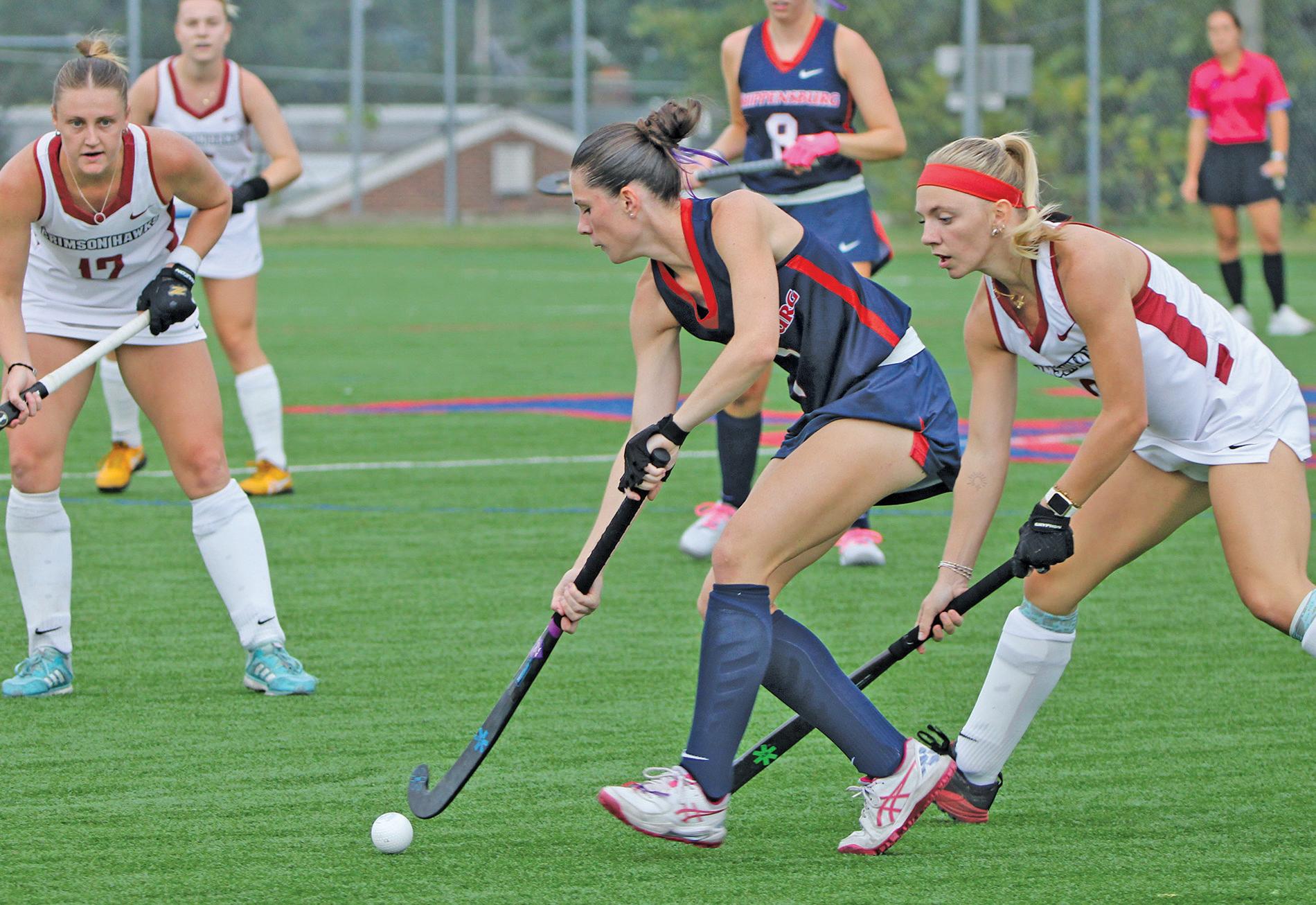
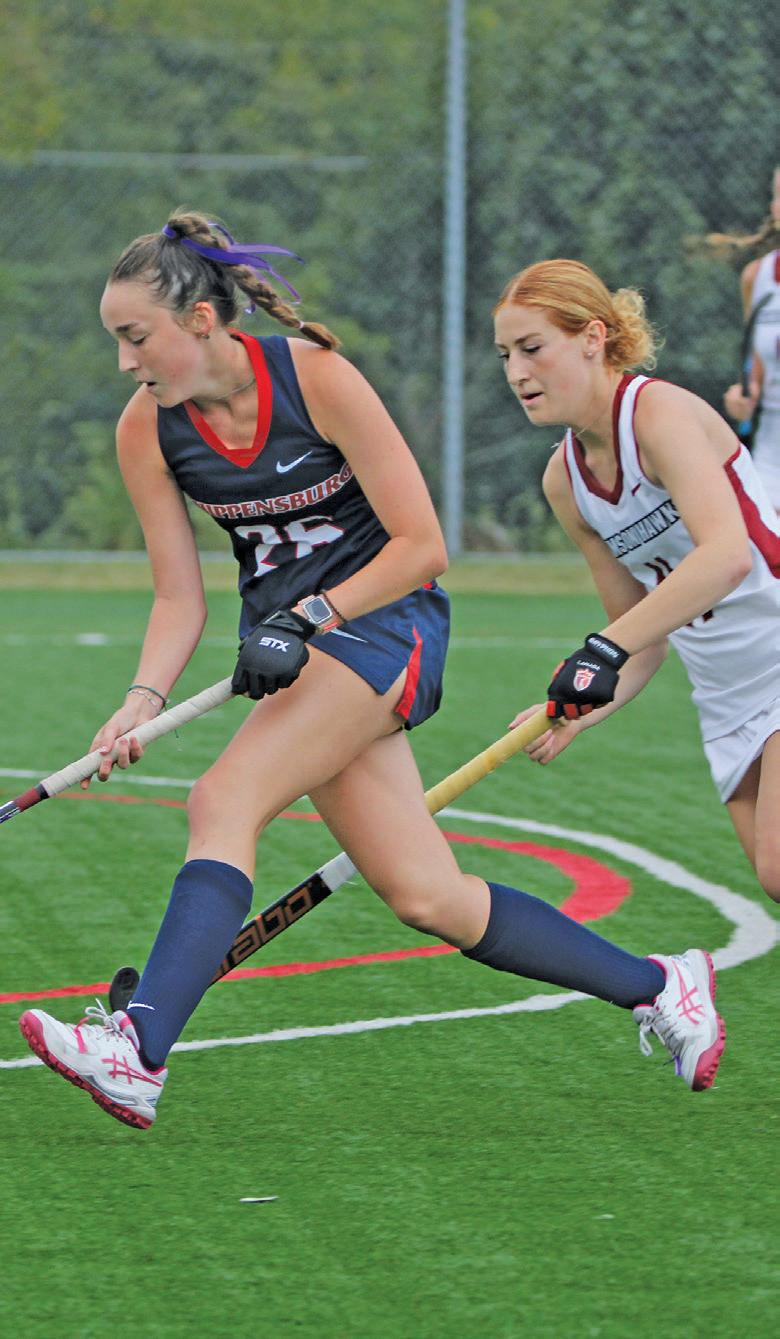
Hannah White fights off a pair of IUP defenders in Saturday’s victory.
sophomore midfielder Kweizy Omondi, extending the lead to 3-1.
Shippensburg University’s field hockey team remained undefeated on the season and moved to 1-0 in conference play with a 3-0 home win over IUP on Saturday. It was a special win for the team, as the Raiders were also celebrating Alumni Day and hosted the Live, Laugh, Love 5K before the game to honor the Amanda Strous FlyHigh22 Foundation, an annual event to remember Strous, a beloved former player and assistant coach for SU.
The Raiders controlled the game from the start, as sophomore Elaina Fragassi forced a pair of penalty
corners in the first quarter. SU converted the second one with senior Lilly Cantabene, wearing Strous’ #22 this season, scoring to put Shippensburg ahead.
SU would score again off a Fragassi corner later in the first, as senior Kelly Naudé scored her fifth goal of the year to make the score 2-0.
It was a milestone goal for senior Agus Garibaldi, as she earned the 30th assist of her college career. She is the fifth Raider all time to reach that mark.
Both defenses settled into a rhythm from there, with the game remaining 2-0 until the beginning of the fourth quarter.
The game woke up in the fourth quarter, as the teams
combined for 11 penalty corners and 15 shots on goal. Cantabene was able to take advantage, scoring her second goal of the day with 2:47 remaining, making it 3-0 Raiders.
Shippensburg outshot the Crimson Hawks 23-8, holding IUP to just two shots on goal. Graduate goalkeeper Emma Albee saved both, earning her sixth shutout in eight games this season.
A pair of conference games are on the schedule this week for SU field hockey, beginning with a road matchup with Frostburg State at 4 p.m. Wednesday. They will then return home to Robb Sports Complex on Saturday to face West Chester at 1 p.m.
Friday, Oct. 3
Shippensburg University’s men’s soccer team wrapped up non-conference play with a 0–0 draw at California (Pa.) on Wednesday and a 4–2 home win over No. 18 Seton Hill on Saturday.
On Wednesday, the Raiders faced California in a scoreless game.
The Vulcan’s best opportunities appeared within the first half, with three shots on goal out of seven shots.
Junior Ryan Krumenacker played the entire game as goalkeeper for the Raiders, recording three saves. He made a crucial game-saving stop at minute 38, turning away a one-on-one chance after a quick breakaway that had split the Raiders’ defense.
The Raiders’ strongest scoring opportunities came from senior forward Ethan Paulukow. He led the team with two shots and collaborated with the front line on creating dangerous attacking chances that were well defended by the Vulcans.
On Saturday, the team was back at David See Field to face No. 18 Seton Hill in an exciting matchup.
The Griffins’ attack quickly opened the scoring at the third minute with James Aubrey collecting the first goal of the game.
SU responded fast with a strong offense. Sophomore forward Anthony Weekley capitalized on a blocked pass, evaded his defender and placed a precise shot into the far corner of the goal.
In minute 17, sophomore defender Tanner Horvath assisted Weekley on his second goal, giving Shippensburg the lead.
At minute 54, sophomore defender Nate Herb scored a header off a corner kick from
Seton Hill made things tense late when Julian Marker converted a penalty kick at minute 86 putting the Raiders’ lead under pressure.
Shippensburg responded immediately with sophomore midfielder Nat Thompson delivering an assist after eluding three Griffin defenders. Weekley was able to convert it into a goal, completing his first collegiate hat trick.
Redshirt junior Jack McCann played the entire game in goal for the Raiders, recording five saves.
After the game, Weekley and Herb shared what it felt like for the team to comeback and secure a win.
“Honestly it feels great as a team. Last year was rough starting out, so I think this year, going into conference play we are all very positive,” Weekley said.
“This was a big win for us. Hopefully we can get some wins in conference play and give us a shot to head in the playoffs this year,” Herb said. Both players discussed their takeaways from the game and how they plan to build on them moving forward.
“I think we just have to stay true to what we do and we just keep doing it at the highest level we can,” Weekly said.
“I think that what we’re really carrying forward is the energy” Herb said. “We need the energy, we need to take this energy into the two days of practice that we have before our next game and into the game.”
The team will be back in action on Wednesday for their first PSAC conference matchup at Shepherd at 3:30 pm, and they will face Millersville on Saturday at home at 4:30 pm.
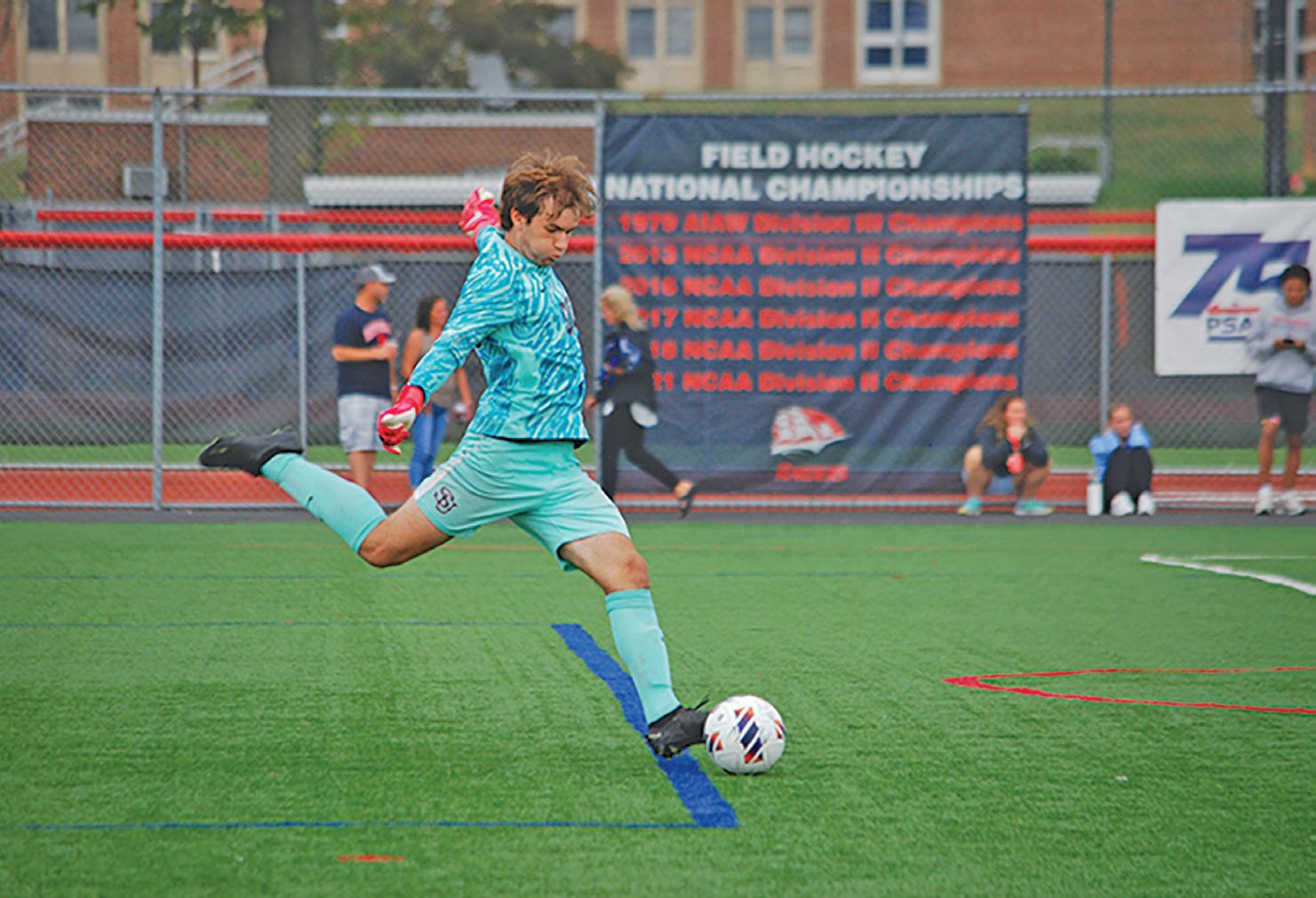
Sydney Ott / The Slate
Goalie Jack McCann prepares to kick the ball to a teammate.
Hannah Stoner Asst. Sports Editor
Shippensburg University’s women’s soccer team fought hard in a 1-0 loss to East Stroudsburg on Saturday, Sept. 27.
The Raiders dominated offensively with 16 shots total and nine shots on goal.
The ESU Warriors had half as many shots and only put three towards the goal. Leading the SU offense was senior Ryleigh Cook with five shots total, three of which were on goal.
The only scoring of the game occurred in the second half and was from ESU sophomore Jade Wiley off an assist from sophomore Megan Cairns.
Cross Country: Paul Short Run (at Lehigh), 9:30 a.m.
Volleyball: at Lock Haven, 6:00 p.m.
Saturday, Oct. 4
Volleyball: at Bloomsburg, 11 a.m.
Football: at Kutztown, noon
Swimming: at Bloomsburg, 1 p.m.
Women’s Soccer: at Lock Haven, 1 p.m.
Field Hockey: vs West Chester, 1 p.m.
Men’s Soccer: vs Millersville, 4:30 p.m.
Tuesday, Oct. 7
Swimming: vs IUP, 5 p.m.
Wednesday, Oct. 8
Men’s Soccer: vs Bloomsburg, 4:30 p.m.
Field Hockey: at Millersville, 6 p.m.
Women’s Soccer: at Bloomsburg, 6 p.m.
Volleyball: vs Chestnut Hill, 7 p.m.
Friday, Oct. 10
Volleyball: vs East Stroudsburg, 6 p.m.
Shippensburg University’s women’s volleyball split away matches at Clarion and Slippery Rock this past week. The team’s record moves to 7-6 overall.
petitive, with the Raiders falling by only a couple of points, scoring 23-25 and 22-25.
Freshman Elise Bragg had a team-high 13 kills, and senior Kearstin Davis led the team in assists with 37.
Moving to Set 3, however, the Raiders pushed themselves into a comfortable lead to take a win for their side.
SU also only had five fouls compared to the Warriors’ 13. The Raiders were awarded 12 corner kicks while ESU had two. In goal, redshirt junior Kirstin Brown earned two saves, and ESU’s senior goalie Emmy Clarkson tallied nine.
The PSAC Eastern Division matchup places Shippensburg 0-3-2 within the conference and 1-3-2 overall.
SU currently sits in seventh place in the Eastern Division standings.
The Raiders have two upcoming PSAC East matches. They face Kutztown Wednesday at David See Field, and on Saturday, the team travels to Lock Haven.
After ESU scored, the Raiders picked up momentum and fired seven of their nine shots on goal. However, they failed to score, and ESU secured their second shutout in a row.
On Friday, the Raiders faced off against Clarion for the second time this season. In its first matchup, SU brought away a close win, 3-2, but Clarion came back for revenge.
The Golden Eagles started hot with a six-point lead in the first set. The Raiders attempted to challenge, but they could not get close enough to make a big threat and fell 25-15.
Shippensburg made a comeback in the second set and earned a hard-fought set win with a kill from junior Gracen Nutt and an ace from junior Hailey Cappleman.
The last two sets were com-
Moving to Saturday, the Raiders looked to bounce back at Slippery Rock, and they achieved that goal with a fiveset victory. The set scores were 25-22, 9-25, 25-13, 18-25, and 18-16.
The first set was very closely matched, with neither team leading by more than two until a 5-0 run from the Raiders put the team ahead by three points. After exchanging back and forth runs, junior Natalya Montague recorded a kill, and Bragg slammed an ace for the win.
In Set 2, the Rock took a big lead to start in the second set that the Raiders could not work themselves back from.
Sets 4 and 5 were very back and forth. Both teams gave valiant efforts, but sophomore Clara Wildermuth closed the final set with a big block, giving SU the win overall. Standouts for the Raiders included senior Isabelle Bombas, who led the Raider offense with 13 kills and committed only one error on 25 swings, and junior Shay Kolivoski, who led the defense with 25 digs. Kolivoski recorded her 1,000th career dig during the match.
Wildermuth and Bragg added 10 kills each. Bragg also earned a career-high 18 digs. The Raiders will continue on the road next week with matches against Shepherd, Lock Haven and Bloomsburg.