The Fordham Ram Serving The Fordham University Community Since 1918 Volume 108, Issue 15
October 7, 2026
TheFordhamRam.com
Multimillion Dollar Donation Expands Fordham’s Purpose
Inside Fordham’s In-Person Class Cancellation Process
By NORA MALONE
By CAYDENCE JONES
EDITOR-IN-CHIEF EMERITA
FEATURES EDITOR
Fordham University has received a historic $9.2 million gift to expand the offerings of the Graduate School of Social Service (GSS), the Serving the City Program and a Gabelli School of Business (GSB) professor’s entrepreneurship initiative. “We ended up with resources that are beyond what we would ever use,” said Board of Trustees member Rose DiMartino, ’79 MA, who made the donation alongside her spouse, Karen Sue Smith. “So we said, ‘Well, what matters to us?’ And what matters to us are social justice issues, and places that are encouraging people to live lives that are meaningful.” While DiMartino did attend Fordham, it wasn’t her experience here that caused her to donate. She made her first contribution after Rev. Joseph M. McShane, S.J., president emeritus, provided the Voice of the Faithful, a lay group dedicated to speaking about clerical sexual abuse, with a place to meet. Several years later, when Father James Martin, S.J., an outspoken advocate for the LGBTQ+ community, was removed from several speaking engagements, Fordham gave him an opportunity to speak and DiMartino made her second donation. “I just thought, this school believes in what I do,” DiMartino said. “It believes in inclusiveness. It believes in giving people an opportunity to hear other points of view. It welcomes lay people.” DiMartino’s busy schedule as a corporate lawyer kept her from being very involved in the university. But after she retired, she joined the Center for Community Engaged Learning (CCEL) advisory board and contributed to the Bronx Research Institute
Despite significant rainfall and flooding that disrupted travel across the New York region, Fordham University maintained its usual class schedule on Sept. 29, 2023 The Commuting Students Association (CSA) heard from students who encountered flooded or damaged cars, downed branches and injuries associated with flooding and slippery subway stations. One student even arrived on campus without receiving an email about a class cancellation, only to find a notice posted on the classroom door. For commuter students, getting to Fordham safely can depend on conditions far beyond the university’s gates. Students travel to campus from across the Bronx, Queens, Brooklyn, Staten Island, Manhattan, Westchester, Long Island, New Jersey and Connecticut. What students see as a simple cancellation alert is the end of a much longer process. Decisions about whether to cancel classes, transition to remote learning or remain open involve the university’s Emergency Management Team, which brings together representatives from Public Safety, Facilities Operations, Student Affairs, the Provost’s Office, Marketing and Communications, Information Technologies and Aramark, the school’s dining partner. This process begins days before students ever receive a cancellation notification. According to Robert Dineen, assistant vice president of Fordham’s Department of Public Safety, Public Safety begins monitoring an approaching storm approximately 72 hours before its expected arrival in New York City. The department monitors “snow, ice, flooding, extreme temperatures, high winds and other weather-related hazards that could affect the safety
SEE DONATION, PAGE 4
3 News HumanitiesFest HumanitiesFest Celebrates Students
TRAVIS PROULX FOR THE FORDHAM RAM
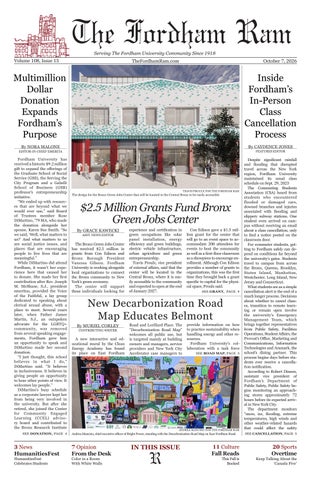
The design for the Bronx Green Jobs Center that will be located in the Central Bronx to be easily accessible.
$2.5 Million Grants Fund Bronx Green Jobs Center By GRACE KAWECKI ASST. NEWS EDITOR
The Bronx Green Jobs Center has received $2.5 million in grants from Con Edison and Bronx Borough President Vanessa Gibson. Fordham University is working alongside local organizations to connect the Bronx community to New York’s green economy. The center will support those individuals looking for
experience and certification in green occupations like solar panel installation, energy efficiency and green buildings, electric vehicle infrastructure, urban agriculture and green entrepreneurship. Travis Proulx, vice president of external affairs, said that the center will be located in the Central Bronx, where it is easily accessible to the community and expected to open at the end of January 2027.
Con Edison gave a $1.5 million grant for the center that will go to an event space to accommodate 200 attendees for events to host the community as well as a first-floor classroom as a showpiece to encourage enrollment. Although Con Edison provides a number of grants to organizations, this was the first time they brought back a grant specific to capital for the physical space, Proulx said. SEE GRANT, PAGE 4
New Decarbonization Road Map Educates Belmont
By MURIEL CORLEY CONTRIBUTING WRITER
A new interactive and educational mural by the Clean Energy Academy has found its place on East Fordham
Road and Lorillard Place. The “Decarbonization Road Map” welcomes all public use, but is targeted mainly at building owners and managers, service providers and New York City Accelerator case managers to
provide information on how to practice sustainability when handling energy and other resources. Fordham University’s collaboration with a task force SEE ROAD MAP, PAGE 5
ANDREA MANCINO FOR THE FORDHAM RAM
Andrea Mancino, chief executive officer of Bright Power, standing with the Decarbonization Road Map on Easr Fordham Road.
7 Opinion From the Desk Color in a Room With White Walls
IN THIS ISSUE
R
11 Culture Fall Reads This Fall is Booked
SEE CANCELLATION, PAGE 5
20 Sports Overtime
Keep Talking About the ‘Canada Five’
NEWS Fordham Celebrates Hispanic Heritage
October 7, 2026
Page 2
PUBLIC SAFETY BRIEFS Murray Weigel Hall Oct. 2 9:16 p.m.
On Saturday, Oct. 2, at 9:16 p.m., there was a stuck occupied elevator in Murray Weigel Hall. The supervisor responded and notified the elevator company. A technician responded. As the technician was working on the elevator there was a smoke condition resulting in the FDNY responding. The occupant was freed without incident. The supervisor then ventilated the area.
Arthur II House Oct. 3 1:34 a.m.
On Saturday Oct. 3, at 1:34 a.m., there was a fire alarm at Arthur 2 House. The supervisor and FDNY responded. The investigation revealed a student cooking foodtriggered the alarm. The supervisor ventilated the area and reset the alarm panel.
Faber Hall Oct. 3 10:44 p.m.
On Saturday, Oct. 3, at 10:44 p.m., there was a stuck occupied elevator in Faber Hall. The supervisor responded and notified the FDNY. The FDNY responded and freed the occupant. The supervisor placed the elevator out of service and then notified the elevator company to respond.
Finlay Hall Oct. 4 1:38 p.m.
On Sunday, Oct. 4, at 1:38 p.m., there was a stuck occupied elevator in Finlay Hall. The supervisor responded and notified FDNY to respond. The FDNY responded and freed the occupant. The supervisor placed the elevator out of service and notified the elevator company to respond.
Follow The Fordham Ram on Instagram, Facebook, TikTok and X @TheFordhamRam
Wednesday Oct. 7
MARIE CASTRO FOR THE FORDHAM RAM
El Grito hosted an excursion to a New York Yankees game in honor of Hispanic Heritage Month.
By JUSTIN MARTE CONTRIBUTING WRITER
September has rolled around again and along with the pumpkin-spiced lattes, the change of the seasons and the looming threat of midterms, Fordham University is once again celebrating Hispanic Heritage Month. Nationally, the celebrations extend from Sept. 15 to Oct. 15. The month commemorates the contributions and histories of members of the Hispanic community. Within the university, the month serves much of the same purpose. “The importance of Hispanic/ Latine Heritage Month is to remember the unique challenges faced by the Latin community throughout history and today,” said Marie Castro, assistant director of the Office of Multicultural Affairs (OMA). “It is also a time to celebrate the diaspora and all the beautiful similarities and differences that exist across Latin American communities in North America, Central America, South America and the Caribbean.” The month also serves as a way for Hispanic students to feel seen and to be celebrated within the university. “This month gives us the chance to see ourselves and others from our community represented and celebrated,” exclaimed Jeferly
Morillo, FCRH ’28, president of the Caribbean and African Student Association (CASA). “Especially in today’s climate, it’s a different feeling that comes with being able to see our culture as something beautiful and something to be proud of, and seeing others take part in that as well.” According to Castro, the month allows students across the Hispanic community to engage with their native culture while being away from home. “For those in the diaspora who may feel like they are missing their families or certain nostalgic traditions, honoring the month allows them to experience a piece of home here at Fordham,” Castro said. “This month is always a reminder for me that Latinidad is deeper than my birth certificate. No matter where you’re located, you can carry and exude your culture wherever you are.” Although the month celebrates the past and present lived experiences of the Hispanic community, it is not just for Hispanic students. “It’s an opportunity for all of the Latinos in the Fordham community to show their pride and educate the broader Fordham community through programs, conversations and gatherings,” Castro said. Through events offered by
OMA and student-run organizations, there was a wide array of opportunities for this transcultural sharing and dialogue to take place. The Fordham community engaged in Sabor de Café hosted by OMA, Campus Ministry and Counseling and Psychological Services (CPS). Sabor de Café took place Sept. 29, at Lowenstein-Law Plaza and Sept. 30, in the McShane Campus Center. The event offered both caffeinated and non-caffeinated beverages in order to accommodate as many students as possible. “Sharing coffee in Latin households has deep roots of community, and for many, the smell, taste and experience can evoke a sense of nostalgia and home,” Castro said. Fordham also participated in the Student Organization of Latines’ annual Mucho Gusto, a celebration of culture, food and dance. The welcome event took place on Oct. 2, at the Lincoln Center campus. The celebrations do not stop there, as many campus organizations, from clubs like El Grito, CASA, VIVA and Dominican Students Association, will be hosting events during the month. “I hope the Fordham community gets to experience the sense of family and community that is cultivated at these
This Week at Fordham
Thursday Oct. 8
Friday Oct. 9
Saturday Oct. 10
events. I hope there is a willingness and openness to learn about and embrace all that the Latino community has to offer,” Castro said. “I also hope that people enjoy themselves when choosing to participate in these events — smile, laugh, eat, dance and stick around for a while, because you never know what you might learn and gain from these experiences.” Fordham has celebrated Hispanic Heritage Month since 2016, and many hope that this tradition continues on. However, there is a question of balancing tradition and traditionalism. “I hope that this month evolves into a collaborative and cohesive month of programs,” Castro said. “I believe that with all of the wonderful clubs we have at Fordham, there are opportunities to build consistent and intentional programs that help highlight the many great attributes of Latino communities.” Currently, the month is a source of pride and dialogue within the greater Fordham community. “Our stories, traditions and experiences are beautiful,” Morillo said. “Culture itself is beautiful, and this month gives us the opportunity to be proud of that and share that beauty with others.”
Sunday Oct. 11
Conversations with Humanitarians
Fordham Theatre Presents “Sweat”
Neighborhood Kid’s Storytime
Fordham Football vs. Richmond
Fordham Soccer vs. Rhode Island
...
...
...
...
...
Lincoln Center, LL206 4 - 5:30 p.m.
Pope Auditorium, Lowenstein Center 8 - 10:30 p.m.
Lowenstein Lobby 3:30 - 5 p.m.
Moglia Stadium at Jack Coffey Field 12 - 2 p.m.
Moglia Stadium at Jack Coffey Field 10 a.m. - 4:30 p.m.
Eileen McCarthy, will discuss humanitarian advocacy, CARE’s work and careers involving the United Nations, as a CARE International’s UN Representative in New York.
Fordham Theatre opens its season with Lynn Nottage’s “Sweat,” a drama about struggling factory workers in Reading, Pennsylvania, who face economic struggles.
The event brings together Fordham students and members of the community together for a storytime program with local neighborhood children.
Fordham Football hosts Richmond in a Patriot League matchup at Jack Coffey Field. A pregame tailgate will also take place at Parking Lot A from 1–3:30 p.m.
The Fordham Men’s Soccer program hosts the Rhode Island Rams for a special Atlantic 10 Conference Alumni Day and Senior Day celebration.
October 7, 2026
NEWS HumanitiesFest Celebrates Students
By GABRIEL CAPELLAN ASST. NEWS EDITOR
HumanitiesFest celebrates the work of students who are majoring in the humanities. This year, the event was hosted by Associate Professor of Music Nathan LincolnDeCusatis. The event was held in McShane 112 on Oct. 1, at 1 p.m. The event featured three students: Cara Bordwell, FCRH ’27, who presented “The Celestial Harp: Representations of the Harp in Literature,” Sig Stevens, FCRH ’28, who presented “Zhu Xi’s Practical Philosophy” and Wilson Speller, FCRH ’28, who presented “Freeze Frame: Sports and Documentary Photography.” “The coolest stuff is in the humanities,” LincolnDeCusatis said. “We have so many great scholars, musicians, artists and I just want to give them a platform to go a little more in depth on their research, their work, their artistry, their music.” This is the third time this event has been hosted, with each iteration having one scholar, one artist and one performer. This time around the event had around 40 people in attendance, including other students, professors and parents of the presenters. Speller spoke first about his journey in photography,
from taking photos on walks around campus to where he is today, taking photos for Fordham Athletics. “My parents took notice of my interest in photography, and that Christmas they bought me the Canon R50,” Speller said. “I was now consciously thinking about taking photos rather than taking secondary thoughts.” His interest led him to explore a different avenue of photography besides scenic photography. He chose to try his hand at sports photography with Fordham Athletics. “At first I wasn’t very good at sports photography; In fact, I was pretty terrible,” Speller said. “It took me a while, but once I got the hang of it, I began to love it. I think capturing moments of deep action and celebrations of emotion are like super cool. And I think that the endless possibilities that is inherent in sports photography is one of the main reasons I love it so much.” In his showcase, Speller included some photos he took while abroad in Rome over the summer studying photography. From this course, he realized what makes a good photo and a good photographer. “A good photograph is one that tells a story from a singular moment in time,” Speller
stated. “A good photographer knows that their practice is inherently reductive, but uses that fact to their advantage to make good photos.” Following Speller’s speech was Stevens. His presentation focused on the two schools of thought in Chinese Philosophy, the School of Principle and the School of Mind. Zhu Xi represented the School of Principle and Wang Yangming represented the School of Mind. Stevens argued how the two are similar to each other, contrary to popular belief in academic discussions. At the end of his presentation, Stevens highlighted why this research is important. “We’re seeing movements from schools of thought, and we see how we see like a universality of human thought,” Stevens said. “We see how they’ve grown with each other, like ethical theories, therapeutic vagueness and thinking about image.” The final presenter was Bordwell. She explained how the connotation of the harp developed over time and ended with a performance. “During the summer, I had the opportunity to study how and why the harp is used as a literary symbol,” she said in her introduction. She explained how the harp went from a military symbol to a symbol of faith,
and then a symbol of materialism and status. “The harp is symbolizing female accomplishment, but also materialism and status in society,” Bordwell said. “We see now a departure from the harp’s celestial duties, which represented divine and the goodness of the universe.” This transformation of the harp’s meaning throughout history was represented in her performance at the end of her presentation. It was called “Song in the Night” by
Page 3
Carlos Salzedo, a modernist composer. The room fell silent as she played, with Bordwell’s harp commanding the room as the piece transitioned between dramatic climaxes and passive verses. She included chromatic scales that gave the piece tones of whimsy and dissonance at multiple points. The event came to an end after Bordwell’s performance, with some students staying behind to offer congratulations to their peers who presented.
GABRIEL CAPELLAN/THE FORDHAM RAM
Wilson Speller presenting “Sports and Documentary Photography.”
Erin Collinson on Current U.S. Foreign Aid By MARY LUND CONTRIBUTING WRITER
Erin Collinson spoke about current United States foreign aid in a lecture with the department of international political economy and development on Thursday, Oct. 4. According to Fordham Now, Collinson graduated from the University of Minnesota with a Master’s in development practice. She is currently the director of the U.S. Development Policy Program. She has also worked in the Senate and is now a senior fellow at the Center for Global Development. The lecture covered the recent history of international
aid from a U.S. perspective, went into the most recent statistics on aid and the main areas for change that Collinson and the greater community see opening up in the realm of international development. Collinson began by stating that U.S. foreign aid has done a lot of good in the past, but that it has also been in need of reform. The U.S. Agency for International Development (USAID) had budgets of over $30 million before 2025. Total economic aid given by the U.S. peaked in 2022-23. Collinson stated that the USAID no longer exists, but when it did, it was a bilateral
MARY LUND FOR THE FORDHAM RAM
Erin Collinson gave a lecture on current United States foreign aid.
agency programming humanitarian and development aid with about 10,000 staff members. After dismantling, about 700 employees moved into the state department, to which international affairs was moved. Collinson emphasized that even before the dismantling of USAID that came with the Trump administration, USAID never operated alone. Collinson mentioned agencies such as the U.S. President’s Plan for Emergency AIDS Relief (PEPFAR), the U.S. International Development Finance Organization (DFC), the Millennium Challenge Corporation (MCC) and others were also at work. Attendees were told that in the 2026 fiscal year (FY26), the 40-day shutdown followed by the bipartisan foreign aid appropriations bill in early February led to revamped bureaus for health and humanitarian responses within the state department. Collinson continued by showing a graph of total obligations that the budget affords compared with the outlays that have actually occured. “What this has meant for topline spending on foreign aid is hard to estimate … We don’t have a full picture yet,”
Collinson stated. The largest cuts have occurred in development assistance and contributions to international organizations’ accounts. Collinson noted that Germany may be headed on its way towards becoming the largest donor, overtaking the U.S. Conversely, global health accounts have fared better. “The U.S. has long been dominant, in fact the largest in bilateral support for health and humanitarian assistance,” Collinson stated. “Lifesaving aid is what has maintained the most support.” HIV and AIDS treatment and vaccine delivery make up large portions of the aid. However, testing and outreach for AIDS have decreased. Pediatric treatment fell about 15% between 2024 and 2025, and Collinson said “humanitarian settings are just much murkier” in terms of how many people can be reached. Collinson also pointed out that “absence of evidence isn’t evidence of absence.” Collinson finds confidence in the Project Resources Optimization, which funds about 80 projects and has raised about $110 million to connect private donors with the highest impact programs
that have lost U.S. funding. Collinson overviewed what FY27 may look like: Trump has requested $35.1 billion, a 13% increase from his FY26 request, which includes funding for diplomacy, development and humanitarian aid. The House has proposed $48.1 billion and the Senate has yet to propose. According to Collinson, an emphasis has been placed on government-to-government assistance in global health. Collinson believes that “it is sort of the right direction to travel,” but that “it leaves a lot of questions.” As of mid-September, the U.S. has signed memorandums of understanding with over 30 countries to provide assistance towards six core areas of health. Working with more local faith leaders and funding innovation have been other areas that the current administration has shown interest in. Collinson said that the dismantling of USAID has left an opening to fix issues such as foreign aid being spread too thin, hard to track, non-conducive to innovation or fragmented. “U.S. foreign aid has saved lives and it would benefit from constructive reforms,” Collinson also phrased.
NEWS Board of Trustees Member Makes $9.2 Million Donation
Page 4
October 7, 2026
FROM DONATION PAGE 1
for Community Solutions (BRICS) program. “A lot of schools have always been these kinds of ivory towers, and they only kind of looked inward,” DiMartino said. “I love that Fordham was living a social justice message of the church by looking outward into their community and saying, ‘How can we help?’” The donation to the GSS will provide stipends to students, establish the Academy for Suicide Prevention and Education and appoint a Distinguished Scholar for Human Rights and Global Justice. The $6 million dedicated to the GSS is the largest gift in the school’s history. “It significantly enhances our ability to support students and expand our mission of providing high-quality education and service deeply rooted in human rights and social justice,” Debra McPhee, Ph.D., dean of the GSS, said in an email statement. “By providing student stipends, the gift will help to alleviate some of the increased financial burden on students while encouraging MSW students to explore practicum opportunities in service areas they might not otherwise have considered.” DiMartino’s goal for the money she donated is not just to help Fordham, but to benefit as many people as possible. “Every social worker that graduates from Fordham is going to affect hundreds of lives, thousands of lives, even, in the course of their career, and we wanna facilitate that,” DiMartino said. The remainder of the gift will be split between two programs, the Serving the City internship program and a GSB entrepreneurship program. According to Stephan
Apicella-Hitchcock, the associate dean for Undergraduate Education and the head of the Serving the City program, the donation will enable the program to double its internship offerings. Serving the City offers Fordham students internships at nonprofit organizations through partner programs. With DiMartino’s gift, the program wants to expand into new sectors, including science, healthcare, dance and business. It also plans to increase stipend amounts and offer some organizations the option to have two Fordham interns rather than one. “As we thoughtfully expand, we’re trying to target organizations that are going to be in alignment with our donors’ objectives, which fortunately are superimposed on top of Fordham’s objectives,” Apicella-Hitchcock said. DiMartino and her spouse have sponsored internships at St. John’s University School of Law and at Commonweal Magazine, so once she learned about the Serving the City program she was immediately interested. “That’s exactly what we want to do,” DiMartino said. “We want to give students an opportunity to work for a nonprofit and learn about what they do. And maybe be motivated to do something in a non for profit area.” Beyond the Serving the City program, DiMartino’s gift will expand GSB Professor Dennis Hanno’s entrepreneurship program, which offers Fordham students the opportunity to help develop small businesses in the local community and in multiple African countries. Last year, Hanno gave a presentation on his program, which DiMartino attended.
TAYLOR HA FOR THE FORDHAM RAM
Fordham Board of Trustees member Rose DiMartino, ’79 MA, and her spouse Karen Sue Smith who made the donation.
He’s been working with entrepreneurs around the world for over 25 years, with a focus on fostering communitycentered entrepreneurship. “It’s not going over and saying, this is what you should do,” Hanno said. “It’s working with people, no matter where we go, to help them understand how they can take charge, how they can take control and create some ventures that do have an impact on their communities.” With DiMartino’s donation, Hanno will be able to work with 75 local entrepreneurs this year, up from 25 last year, offer them seed funding to jumpstart their businesses and hire a part-time staff member to help organize the program. It will also allow Hanno to financially support students on a trip to Liberia this semester.“So, it is gonna open up all kinds of
possibilities for students to take advantage of programs like this without having to worry about financial costs,” Hanno said. For all the programs that received the donation, DiMartino’s dedication to having the biggest impact and helping the largest number of people is something they’re very excited about. “I think what is really special about the gift is that when a donor doesn’t really need to have a building with a name on it, or a wing, or a room or a physical embodiment of their generosity,” Apicella-Hitchcock said. “But their investment is in something more important, perhaps, but less tangible, which is the ephemeral student experience.” DiMartino and her spouse both come from working-class backgrounds, and they want to offer educational opportunities to as many people as possible.
“Education changed the trajectory of our lives. We were first-gen college students and the scholarships and work programs and financial aid we got made it possible for us to learn and grow and expand our world views,” DiMartino said. “And we want to help Fordham make possible learning opportunities that we are sure will be life-changing and will help students lead lives of meaning.” DiMartino considers her donation to be paying it forward rather than paying it back. She hopes that her gift allows both Fordham students and Fordham itself to continue contributing to the world around it. “The way I think about it is, money in the bank is very inert. It doesn’t do anything. It’s just dead,” DiMartino said. “But once it’s put into a program, it comes to life.”
Green Jobs Center Receives $2.5 Million Grants FROM GRANT PAGE 1
Gibson provided a $1 million grant, some of which will be used for a community-facing cafe in the center. “We knew propping up a cafe that will, over time, focus on locally grown, locally produced products, is a great way to make sure that the community feels welcome and is coming through the door,” Proulx said. The grant will also fund renovations to help complete the green entrepreneurship center, according to Proulx. The entrepreneurship center will also be the country’s first community-facing green entrepreneurship center for those who want to start their own green business. “They’re going to actually be able to go and meet for free with business consultants who will help them create LLCs, create business plans, figure out how to access those initial loans and
grants to launch their small own business,” Proulx said. The Assistant Provost for Corporate Relations Holly Curtis said Santander Bank awarded a $200,000 grant for the entrepreneurship center to go to entrepreneurs for their “first check.” This grant will be given to entrepreneurs as microgrants to help them start their businesses. Proulx explained how crucial these grants were, citing a lost federal grant and federal tariff policies that increased the price of construction supplies, which would have slowed construction. Proulx explained that the center is in the Bronx, where high rates of poverty and previously incarcerated individuals have led to long-term economic disadvantages. “We have very unique hurdles within the Bronx and to overcome this, this is where our partnerships really matter with
the community-based organizations who are trusted in the community,” Proulx said. Proulx explained that the concept for the center came from the community and Fordham pinpointing where there is a void and working with partners to bring people together. A center like this has been in discussion since 2007, when former Mayor Michael Bloomberg created PlaNYC to increase climate action, which led to the growth of green jobs and businesses. The center is intended to be free or as low-cost as possible, which is achievable through Fordham’s partnerships with organizations that are the leaders in their green occupations, setting the center up to compete for external workforce development grants to fund the initiative. Proulx credited University President Tania Tetlow’s leadership; he quoted her, saying, “a university doesn’t have the
power to solve all the problems in the world, but we do have the power to convene like-minded stakeholders around a shared vision, and we have an obligation to do that.” For Fordham students, Proulx said that they will have opportunities to be fellows and support the work being done with the partners. Fellows will gain hands-on experience to help trainees with services like childcare, food security and public transit. Curtis explained the vital role that partnerships play in the center by informing the curriculum, providing opportunities for engagement through block interviews, mentoring or bringing individuals on-site to a typical workday of a certain company. Curtis said the center is uniquely Fordham, while also allowing for a broader conversation amongst partners about the
best way to prepare individuals in the green economy. “It is a really unique engagement between higher ed, the public sector and the private sector … that is one of its kind across the country and is serving a really important need to engage individuals who are unemployed or underemployed in the Bronx to move into wagesustaining, family-sustaining careers,” Curtis said. Proulx said the center expects to train a few hundred individuals in the first year and several thousand yearly. Additional programming will come as New York’s green economy continues to grow. “So we’re really being intentional and thoughtful about how we put this work into motion, and there’s a lot of excitement for what Fordham is doing because people have wanted to see something like this for decades,” Proulx said.
NEWS Decarbonization Road Map Put Up on Fordham Road
October 7, 2026
FROM ROAD MAP PAGE 1
to create the mural began in 2025. The Office of Community Affairs Assistant Vice President Surey MirandaAlarcón and Assistant Director Amanda Caputo shared the background and details of the project. “We initially started working with the task force because we had Fordham’s grant-making entity that was going to do small grants for environmental justice projects,” MirandaAlarcón said. The grants were eventually terminated, but Fordham continued the partnerships that were created during the process, which ultimately led to the mural collaboration. The many sponsors of the mural are listed below the illustrations, which includes Fordham, the NYC Mayor’s Office of Climate & Environmental Justice, Bright Power and more. MirandaAlarcón emphasized the fact that the mural was brought to life by a task force effort of
Page 5
sponsors who were engaged in the project from the very beginning. “The mural has been very inclusive in incorporating what people think,” MirandaAlarcón said. “The different pathways into decarbonization have been informed by those conversations held during brainstorming sessions.” Even at first glance, the Decarbonization mural speaks volumes on how the Bronx has expanded resources toward an environmentally sound future. The mural’s vision and illustrations were designed by artist Tijay Mohammed, who has created numerous murals at Harlem Hospital, the Bronx Charter School for Better Learning II and other public schools in the northern NYC area. Many of his pieces follow themes of community, inclusivity, positivity and environmental friendliness. “[Mohammed] had a really beautiful vision … a visual representation of what decarbonization in the Bronx could look
like,” Caputo said. The mural depicts the early environmental issues in the Bronx with illustrations on the leftmost section of the 1970s building fires, factory smoke and a boy using an inhaler. The middle section of the piece displays various Bronx institutions, including the Bronx Zoo and Fordham’s centerpiece: Keating Hall. The rightmost section illustrates the Bronx’s journey toward sustainability and community growth with images of windmills, public transportation, solar power and citizens of the Bronx. Caputo also shared how Fordham student volunteers participated in the project. The mural was brought to the McShane Campus Center at Rose Hill, where students helped to paint Mohammed’s illustrations. “[The project] was really concurrent with the launch of our new Fordham Volunteers program that’s operating out of External Affairs,” Caputo said. “It was a really beautiful
way to promote the launch of the program, but also show students how important [it] is to not only learn about your local community, but put what you’re learning into action and actually give back.” Throughout 2027, the External Affairs division of the Office of Community Affairs will be hosting many volunteer efforts similar to the mural project that students will be able to participate in. The Decarbonization mural features ten “stops,” possibly alluding to the New York City Subway system, which are paired with QR codes that direct users to a website containing information about how to manage building sustainably. Service providers are listed along with rebates, incentives and finance resources that may be able to assist with the specific tasks of each stop. The 10 stops (steps) toward sustainability are Measure & Map (M&M), Low-Hanging Fruit, Weatherize, Electric Ready, Electrify the HVAC,
Electrify DHW, Electrify Everything Else, Implement Deep Measures, Consider Storage & Load Shifting and Consider Other DERs & Carbon Credits. Weatherize (step 3), for example, involves reducing heating and cooling loads through the building envelope before sizing new equipment. This stop lists service providers such as AMA Architects PC and Bright Energy Services in addition to financial resources such as the Department of Environmental Protection Green Infrastructure Grant Program. These resources are indicated to be potential matches for assisting in tasks of pre-production HVAC load calculations, building insulation, window treatments and more. The Decarbonization Road Map mural was installed on East Fordham Road and Lorillard Place on Sept. 19. On Sept. 23, during Climate Week NYC, Lorillard Place was closed down for the celebration of the mural.
How Does Fordham Decide to Cancel In-Person Classes? FROM CANCELLATION PAGE 1
and operation of the campus,” Dineen said. During severe weather and other emergencies, Public Safety, Facilities Operations and Aramark personnel remain on campus around the clock as essential staff. They continuously monitor conditions on the ground, assess potential impacts and coordinate with university departments. But Public Safety does not make the final decision about whether classes are canceled. For serious emergencies affecting the university, Public Safety activates the Emergency Management Team (EMT). This group “brings together representatives from across Fordham,” including the Provost’s Office and Public Safety. The team meets throughout the emergency and until the situation is resolved. According to Dineen, the EMT uses “collaboration and objective analysis” to assess the situation, coordinate Fordham’s response and make decisions focused on the safety of the university community. Public Safety’s role is to provide information that helps inform those decisions. “Public Safety’s observations and real-time assessments of weather, transportation and campus conditions are an important part of the information considered by the Emergency Management Team,” Dineen said. If conditions make it unsafe for students to travel around campus during an active storm, Public Safety may also direct the community to shelter in place until conditions improve. According to Ellen T.
Fahey-Smith, vice provost for administration in Fordham’s Office of the Provost, the university does not rely on a certain amount of inches of snow or rain when deciding to cancel in-person classes. “Rather than relying on a specific threshold, such as a certain amount of snowfall or a particular temperature, decisions regarding campus closures or modifications to operations would depend on the overall severity of the weather and its impact on the safety of students, faculty, and staff, as well as campus accessibility, staffing, transportation, and essential services,” Fahey-Smith said. Transportation is especially important when determining whether students can safely reach campus, according to Fahey-Smith. “If severe weather or another emergency could jeopardize students’ ability to safely reach campus — via public transport or otherwise — the EMT assesses the situation, considers available information and potential impacts and may recommend canceling classes and events or transitioning to remote learning,” FaheySmith said. That assessment also continues after the university decides to remain open. If conditions change significantly, Public Safety, academic units and other departments continue monitoring the situation and coordinating with university partners. The EMT continues to meet throughout the emergency and can reassess the decision as conditions develop. The weather can also look very different between Rose Hill and Lincoln Center. A storm affecting the Bronx may not have the same
impact in Manhattan, but that does not necessarily mean one campus will close while the other remains open. The Provost’s Office said Fordham considers itself “One Fordham” when making closure decisions. Students may live at Lincoln Center while having classes or other commitments at Rose Hill, or vice versa. “Closing one campus while keeping the other open could create significant challenges for students, faculty and staff traveling between locations,” the office said. The university does assess differences between the campuses, including “unique differences, events and services,” and may tailor guidance accordingly. But the overall impact on the university community remains a factor in the decision. For commuter students, however, the conditions around Fordham may not be the conditions they experience when deciding whether to leave home. “Commuter students are worried about their safety during severe weather while juggling the stress of being late to class due to circumstances beyond their control,” CSA said. A commuter from New Jersey, for example, may face an entirely different set of conditions from a student living near Rose Hill. Even students who live in the Bronx can face significant delays when their route depends on a single bus. “Any approach to attendance during transit disruptions should account for these differences in students’ commutes,” CSA said. The timing of a cancellation can therefore be just as important as the cancellation itself. CSA said it would ideally like commuters to receive at least one
MARY HAWTHORN FOR THE FORDHAM RAM
In-person classes at Fordham University may be canceled due to weather.
day of notice when possible. But the association acknowledged that emergencies can develop quickly and that “professors are human and have their own lives as well.” Still, late announcements can create problems. “Commuter students often need to make travel decisions well before arriving on campus, so the timing of an announcement matters as much as the announcement itself,” CSA said. When updates come late, or when students receive different information from the university and individual professors, “it can be difficult to know whether to begin a long commute,” according to CSA. The uncertainty does not end when Fordham decides to remain open. According to the Provost’s Office, professors receive guidance when considering whether to cancel classes or move them online during severe weather. However, the university’s decision to remain open does
not necessarily mean every class will meet in person. Individual professors may still make decisions about their classes within that guidance, meaning students can receive different instructions about whether they are expected to attend in person, remotely or be excused from class. Attendance has been a particular concern for CSA. During the 2023-24 academic year, the organization proposed an inclement-weather absence policy for commuter students. The proposal did not move forward because attendance decisions remained with individual professors and CSA did not receive the support needed to establish a consistent policy. CSA plans to revisit the proposal. As CSA put it, commuters “shouldn’t have to pick between their safety and an absence penalty.” And by the time Fordham makes its decision, some students may already be on their way.
NEWS Fordham Campus Ministry, Unity in Diversity
October 7, 2026
By ROBERT NWADIARU CONTRIBUTING WRITER
The light shone in through the stained-glass windows as the hymn “Holy Spirit, Truth Divine, Alleluia!” echoed through the University Church. “Voice of God, and inward Light, wake my spirit, clear my sight,” sang the choir. The pews were filled as Fordham celebrated the Mass of the Holy Spirit on Sept. 2 to mark the start of the 202627 academic year. There as a con-celebrant of the first major religious ceremony of the semester was Director of Campus Ministry (CM) Father Philip Judge, S.J., alongside University President Tania Tetlow, and hundreds of students, faculty and staff. Year-round, CM takes care of the spiritual needs of the students, faculty and staff of the university community. Judge, who is in his third year as the executive director of Fordham’s CM, said during an interview with The Ram that CM helps students, faculty and staff practice their religion and connect to the community. According to its website, the Ministry’s purpose is to foster the integral growth of the entire university community, but especially focuses on the personal spiritual, ethical and moral development of its students. These goals are in fulfillment of Saint Ignatius’ motto of cura personalis, care for the whole person. But what does CM actually do? Addressing the Moral and Ethical Issues Judge said that CM plays an important role in the lives of many Fordham students. “They will come to understand what cura personalis means, the care of the individual person in all parts,” Judge explained. “That’s what they experience as they go through Fordham.” Fordham is a Jesuit institution, rooted in Catholic tradition but also embracing religious diversity. According to its website, only 60 percent of Fordham students identify as Catholic. A walk on campus shows the university’s religious diversity with women in hijabs walking side by side with men in yarmulkes, the Jewish skull cap worn by men. On its website, the Ministry writes that “one’s faith is a great gift of God that must be respected and nourished,” and so it creates community for other faiths besides Christianity. Sister Eileen Mary Fagan, Ph.D. ’79, is a member of the Sisters of Charity of New York and a professor of religious studies at the University of Mount St. Vincent in Riverdale in the Bronx. She said she has been on the university campus for 25 years and knows Campus Ministry inside out. “Students who are part of campus ministry seem more
responsive and participative in my classes, especially when discussing moral and ethical issues,” Fagan said. “Students are more participative in the rituals of their religions.” Fagan also explained why she thinks students seek out involvement with CM. “Our young people are looking for meaning and belonging in life, and for some, they do not have that from home or churches,” Fagan said. Judge agreed that CM performs meaningful work with students. “Fordham’s Campus Ministry carries out several responsibilities to the students to give them a sense of belonging,” Judge said. “And make them feel at home to perform their academic duties with minimal stress.” CM welcomes new students to the university with formal and informal orientation. It liaises with the faithbased student clubs such as the Fordham Christian Fellowship, Jewish Student Organization, Muslim Student Association and Orthodox Christian Fellowship. The department also organizes retreats for students of different religious backgrounds at Fordham’s retreat house in Goshen, New York. This spiritual exercise runs during specific weekends throughout the year with special retreat preachers and student leaders presiding. CM has a special group that creates relationships among members of the Ministry and the entire campus community. This group, called Justice and Service, engages directly with the host community. “In accordance with the mission of Fordham University, Campus Ministry offers programs that invite students to step outside of their familiar university lives, walk with people at the margins of society, and in doing so, open their minds and hearts to personal transformation,” the Ministry’s website said about the group. This group also acts as a forerunner for the university community in community and neighborhood services. “Justice and Service challenges the campus community of solidarity and activism as they continuously work for common good through reciprocal partnerships and accompaniment with the local New York City neighbors,” the website explained. The work of CM stretches far outside New York as well. Global Outreach (¡GO!) is a service and cultural immersion program at Fordham that promotes social justice and community connection. It allows students to participate with communities globally to explore inequality and advance society to be free of oppression and racism. ¡GO! has annual projects
in many U.S. states, including Arizona, Mississippi, Philadelphia, New Jersey and New York. They also partner internationally with countries such as Mexico, El Salvador, Honduras, the U.S. Virgin Islands, Kenya, South Africa and Rwanda. Since Fordham’s population is not solely Catholic, CM strives to represent a range of religions. This principle has brought about the creation of a new space by recognizing others, and through it, the university has enabled the establishment of chaplaincies for other religions. The university now has Jewish and Muslim chaplaincies and prayer groups for other Asian religions. The reduction in the number of clergy on campus has created the need to fill positions with lay people in specific areas that do not require sacerdotal skills. “As the clergy’s numbers declined on campus, we’ve hired more people in campus ministry,” Judge explained. “And they cover a lot more of pastoral counseling and things [that] used to be done by the Jesuit priests.” Additional Catholics at Fordham Kathryn Anderson Kuo is the director of Catholic Life at Fordham. Kuo’s department is responsible for the Catholic sacraments and for preparing adult converts for reception into the Church through the process of Rite of Christian Initiation for Adults (RCIA). Kuo runs a busy schedule from Sunday to Thursday. “We have Masses on Sundays and during the week, and for special occasions,” Kuo said. “I coordinate the clergy, schedule them, create memos for them, that give them information they need.” This is the largest group in CM. But unlike the other big groups, it is not a chaplaincy, since the executive director of the Ministry takes care of the group’s clerical and sacramental duties. The size of Catholic Life is large because Fordham is a Jesuit university. Judge indicated that about 60% of the student population is baptized Catholics and 30% is active. CM has around 20 staff members and 14 interns, Kuo said. Catholic Life, on its own, has about 130 volunteers and student lay workers spread across different groups. Kuo explained that this includes 15 Global Outreach Leaders per year, a Global Outreach Board, the Pedro Arrupe Council of student leaders for local service programs and a pro-life group among many youth leadership formation groups. RCIA is one of the responsibilities of Kuo’s department. Through this process, adults who show interest in the Catholic faith are
prepared for reception into the Church through Baptism, Holy Communion and then Confirmation. “We don’t engage in going from hall to hall, room to room, campus crusade,” Kuo explained. “They see what the Catholic Church has to offer, and then, they make their own decision about whether that’s what’s right for them or that’s something they want to pursue.” Since minor seminary, the equivalent of religious secondary school, is no longer popular in this part of the world, Kuo said that Fordham’s CM has become an effective instrument for priestly vocations within the Jesuit order. The number of converts may not be great, said Kuo, but from time to time they have people who, like Judge, are also an alumnus of Fordham, want to join the Society of Jesus after their academic programs here. While Kuo is responsible for the sacraments and scheduling of the priests in the community for Masses and other celebrations, Jonathan Fong, FCRH ’25, one of the heads in Catholic Life and the prefect of the university church, oversees liturgical functions. Fong, a Sacramento native, and a Fordham alumnus, has been in his position since July 2025, following his graduation. He said his main responsibility as a prefect is to take care of all the sacred places on campus. “Most importantly, that means our University Church, making sure that the Blessed Sacrament is honored and treated appropriately, and the chapel space is appropriately cleaned as well as all other chapels on campus,” Fong said. Fong said there are also six chapels in different residential and academic halls. Each of the chapels has a tabernacle with the Blessed Sacrament. Masses are frequently celebrated in them, he explained. Fong works with a group of volunteers that comprises students, faculty and staff for the smooth operation of liturgical duties at different
Page 6
masses and schedules. He has known Jesuit campus ministry well since his secondary school days. “I went to a Jesuit high school in California, so the job of a campus minister in a Jesuit campus has always been apparent to me,” Fong said. Grace Baur, FCRH ’29, from New Jersey, is double majoring in philosophy and psychology. She is a very active member of the Catholic Life Ministry. “I do daily Mass here at Dealy Hall (Sacred Heart Chapel) and I sing at 11 a.m. Mass on Sundays,” Baur said. “I’m also part of the praise and worship band, which sings during adoration.” Baur also noted that CM offers students many opportunities to grow in faith. She said she participates in several faith formation groups in Catholic Life, including Jazz Net. This group helps volunteer students connect with retired Jesuits in the campus community. Baur’s position at Fordham’s Campus Ministry aligns with Fagan’s statement that campus ministry fosters a sense of belonging. “Students who come from Catholic high schools and were active in the high school’s campus ministry are usually active members in the university campus ministry,” Fagan explained. Lucas Viscoso, FCRH ’26, is a volunteer in the office of CM and an active member in the Catholic Life department, where he participates in many events, including liturgical duties. He said CM is a great place for all students, regardless of their faith background. “Catholic, Muslim, Jewish, all in alliance to build a community and get to know each other,” Viscoso said. “Before working for Campus Ministry, I was an active participant in Campus Ministry events, specifically, Catholic Life, where the goal was to unite the Catholic community through Ignatian spirituality programs.” The rest of this article can be found on thefordhamram.com.
COURTESY OF FORDHAM UNIVERSITY
Students gathered for a Muslim prayer.
OPINION
October 7, 2026
R
Serving the Fordham University campus and community since 1918 The Fordham Ram is the university journal of record. The mission of The Fordham Ram is to provide a forum for the free and open exchange of ideas in service to the community and to act as a student advocate. The Fordham Ram is published every Wednesday during the academic year to all campuses.
Website TheFordhamRam.com Email Address theram@fordham.edu Editor-in-Chief Sienna Reinders Managing Editor Ian Nelson Production Editor Sarah Verrastro Editorial Director Molly O’Connor Multimedia Director Hannah Sullivan Business Director Nishanth Aduma News Editor Emma Leonardi Features Editor Caydence Jones Assistant News Editors Gabriel Capellan Grace Kawecki Opinion Editor Loresa Zeqiraj Assistant Opinion Editors Erynn Sweeney Elaina Gibson Culture Editors Lara Ejzak Makenzie Smith Assistant Culture Editor Kelly Buban Sports Editor James Nelson Assistant Sports Editors Molly Friedman Ethan Bess Copy Chief Indigo Towers Executive Copy Editors Emma Kelner Amelia Stricherz Hannah Michalowski Mia Smith Photo/Graphics Editor Emily McCall Wilson Speller Digital Producers Han Le Haniyyah Usmani Social Media Director Marisa House Advertising Directors Violet Wallace Juan-Pablo Valencia Rishika Lingamdinne Faculty Advisor Beth Knobel Editorial Policy The Fordham Ram’s editorial reflects the editorial board’s opinions or views. Opinion Policy The opinions expressed in this publication are those of the authors. They do not necessarily reflect the opinions or views of The Fordham Ram. Submission Policy The Fordham Ram Reserves the right to reject or edit any submission for any reason, without notice. Submissions become the exclusive property of The Fordham Ram. No part of The Fordham Ram may be reproduced without written consent. Correction Policy The Fordham Ram is committed to fair and accurate reporting. If you are aware of an error, please contact us at fordhamramonline@gmail.com.
Page 7
From the Desk | Ian Nelson
Color in a Room With White Walls
With Halloween just around the corner, it couldn’t be a better time to take a look at fear and, more specifically, what deserves to be feared. It is the season to remember that we live in a country where fear is entrenched in the hearts of many and nothing highlights that more than the existence of the annual Banned Books Week in the U.S. According to the American Library Association’s (ALA) Office for Intellectual Freedom, 4,235 unique titles were challenged in 2025, the second-highest number ever documented by the ALA. On Sept. 30, Utah banned seven more books from all public schools — the most it has ever banned at one time since the state’s sensitive materials law went into effect. One of these new additions is “The Invisible Life of Addie LaRue” by V.E. Schwab, which was banned for its sexual content, LGBTQ+ representation and themes involving a deal with the devil. But the book also deals with themes such as hope, art, legacy and what it means to be human. The additions bring the total number of books now prohibited in Utah public schools to 44. Personally, I’m afraid of more
things than I’d care to admit. Off the top of my head, heights, spiders bigger than my thumb, needles, the idea that I’m trapped in an “Inception”-like dreamscape from which I’ll never escape and bears. But I don’t think it has ever occurred to me to be afraid of a book. Unless, that is, you count when I was five or six and reading for school sounded like the worst waste of time. Why read when there are Lego sets to be built? So, although it hasn’t been a lifelong romance, I now love to read. It is a pastime that often leaves me feeling better about the world and myself. Is it escapism? Probably. But the ability to bring worlds to life is something I find inspiring, and I hope that the joy I get from reading will never fade. Reading is important to me because it is a place of comfort, but sometimes the value of a book lies in how it takes that comfort away. While I love a lighthearted story, oftentimes the best books address real-world problems in a fictional form. Take one of my favorite banned books, “Slaughterhouse-Five” by Kurt Vonnegut Jr., which warns that stories and movies often make war look noble or exciting, tricking society into repeating past
mistakes. It is a book that proves that a message doesn’t have to be comfortable to be valuable. There is one moment in the novel that I believe speaks to the importance of books and reading. In it, a master of ceremonies asks people to explain the function of the novel in modern society and one person replies: “To provide touches of color in rooms with all-white walls.” The metaphor is perfect. A novel, or more precisely, a story, is a touch of color on an otherwise white wall. A room devoid of color isn’t necessarily bad. It can be clean, orderly and perfectly functional. But it demands nothing from the person standing inside of it. But add a little color, add a story, and suddenly the walls demand attention. The colors can be bright and beautiful like love and adventure or they can
be dark and unsettling like loss and grief. A library is supposed to be a room full of colors. Every shelf should be full of possibilities. The real issue isn’t whether every book will be right for every reader. The danger is deciding that because one person or group doesn’t want a particular color on the wall, nobody else should be allowed to see it. That’s what scares me most about banning books. It isn’t that someone might read a story and disagree with it; it’s the idea of a room where someone has decided that certain colors are simply too dangerous to be seen. I’d rather live in a room with too much color than one painted white for my own protection. Because a white wall may be safe, but a life without color isn’t much of a life at all.
Editorial | College Sexual Assault
On Dismantling Rape Culture
TRIGGER WARNING: The following article contains content about violence, sexual assault, drugging and rape. No language will be diluted or censored to maintain the integrity of subjects. Please use discretion before reading. Men. Not monsters, not dogs, not pigs. Men doing what men have always done. The seven men accused of drugging and gang rape at Cornell University’s chapter of Chi Phi in 2024 are not some mystical once-in-a-bluemoon case, they are just some of the few to actually be called out for their alleged crimes. On Sept. 18, 2026, The Cornell Sun, Cornell’s student newspaper, broke the story of a lawsuit by a former Cornell student, referred to as Jane Doe, against several members of the Chi Phi fraternity, alleging that she was drugged and gang raped on Oct. 19, 2024, in the fraternity house. According to the article, she arrived at the fraternity house alone, severely inebriated, to meet her friend, defendant Matthew Ingalls. Ingalls proposed a threesome with himself and another fraternity brother, defendant Johnathon Newell, which she agreed to, but according to the lawsuit, her condition rendered her incapable of consenting. From here, Jane Doe was subjected to horrifying assaults, including being pressured into snorting a white powder, claimed to be ketamine, multiple times, including off of one of the defendant’s genitalia, as well as forced oral and vaginal sex. Defendant Gillio Lopes
later joined, forcefully kissing Doe and initiating sex without her consent. At around 1:42 a.m., Newell allegedly sent a message in a fraternity Snapchat group, alerting members of “free pussy” upstairs. From here, she endured four more hours of brutal sexual violence and forced drug consumption from seven men. After the university’s initial investigation, only Ingalls and Newell were expelled. Two other defendants faced suspensions, one was banned from campus for three years, and two simply had to write reflection essays, complete educational modules and not contact Doe. If after hearing this story, your immediate reaction is to find a way to blame the victim or assume she is lying instead of thinking “That is unbelievably horrifying and this woman deserves justice,” you need to do some real introspection as to why that is. The punishments in no way fit the crime, and Cornell’s Title IX Office failed the victim. Title IX of the Education Amendments of 1972 states that “No person in the United States shall, on the basis of sex, be excluded from participation in, be denied the benefits of, or be subjected to discrimination under any education program or activity receiving Federal financial assistance[.]” Under this law, any federally funded college or university must have systems in place to protect students from sexual violence. In the wake of the Cornell story breaking, the Trump administration did not choose to strengthen protections against college sexual
assault or offer a statement of support for the victim, but instead announced rollbacks on Bidenera Title IX rules. By rescinding these policies, LGBTQ+ students lost protections, and the range of sexual harassment complaints that schools are responsible for investigating has decreased. Additionally, President Donald Trump himself said that he pities the accused men because they “won’t get a fair shake” with New York Attorney General Letitia James assigned to the investigation. These men do not deserve pity, and having our president minimize the severity of the allegations because of his own political conflicts sets the tone for the general public’s response. Rape culture is alive and well on most college campuses, though it can be easy to pretend it isn’t. The reality is that one in five women in college experience sexual assault, and that only accounts for the estimated 20% of cases that are reported, according to the Office on Women’s Health. Every time a friend makes a rape joke and you stay silent, you are upholding rape culture. It doesn’t matter if you didn’t laugh, it matters that you didn’t shut it down. To those of you reading this thinking “Chill, it’s not that serious,” yes, it actually is. How would you feel if somebody turned the worst day of your life, one that will physically, mentally and emotionally impact you forever, into a mockery simply to get a few laughs from the boys? You do not need to be a rapist, or even think that your friends would actually commit such heinous acts, to contribute to rape
culture. None of the other 50 men in the Chi Phi group chat spoke up against their friends, nor did any of them attempt to intervene or call the police. Be the person to call your friends out. Sometimes you have to jeopardize your friendships to do what’s right. Rape should not be an inevitability, but for many women, it’s not an if but a when. Many women keep their guard up at all times because they have to. Because the second they let them down, the second they trust someone they consider to be a friend while under the influence, they are in immediate danger of sexual violence. The intimacy of sex cannot be overstated, and that is important to acknowledge in order to understand the trauma caused when that intimacy is stolen and abused through rape. Especially in young adulthood, when our brains are constantly developing, a trauma like sexual assault can entirely change the trajectory of one’s life and well-being. If you are a Fordham student who has experienced sexual violence and would like to seek justice and/or support, there are resources here for you to use. To report, you can call, email or go in person to the Office of Public Safety, the Dean of Students Kevin Williams, Title IX Coordinator Liz Fanelli or Human Resources. To get confidential support, contact Counseling and Psychological Services, a pastoral counselor in Campus Ministry or University Health Services. No matter the situation, it is not your fault. You are not alone.
OPINION
Page 8
October 7, 2026
Reality Check | China Summit
Xi’s State Visit Was Pointless
By DOMENICK FEDELE COLUMNIST
As President Donald Trump welcomed Chinese President Xi Jinping to Washington, D.C., in his first visit to the United States in over a decade, the pomp and circumstance was impossible to ignore. Trump greeted Xi on the tarmac at Joint Base Andrews, a rare gesture not extended to Trump on his last visit to China. The U.S. literally rolled out the red carpet — a 100-foot one at that — for a ceremony that included cannon salutes, a 21-person honor cordon and color guards carrying American and Chinese flags. Two B-1s performed a flyover, joined by fighter jets the next day over the White House. The lavish welcome was a
preview of the three-day summit that included an opulent state dinner, during which Trump gifted Xi a custom bald eagle statue, a formal tea ceremony and a visit to the National Archives for America’s 250th anniversary. In a particularly viral moment, Trump proudly showed off the new South Lawn helipad to Xi while declaring that the Chinese leader is “an expert on stone, aside from many other things, and he loves good granite.” It seems as if the title “granite connoisseur” can be added to a resume highlighted by brutal, unelected and oppressive dictator. That resume is actually the assessment of Xi made by Senator Roger Wicker (R-Miss.), chairman of the Senate Armed Services Committee. Wicker’s
COURTESY OF FOREIGN AFFAIRS
Chinese President Xi made a recent state visit to the United States.
assessment came as part of a warning to Trump to remember Xi’s character and China’s desire for regional and global domination at the expense of the U.S. Unsurprisingly, Democratic critics piled on, criticizing Trump for rolling out the red carpet for the Chinese dictator while Americans are suffering from a domestic economic crisis. If anyone should be angry about Trump’s ostentatious efforts to woo Xi and China, it should be Trump himself. Attacking China was a focal point of his first campaign, in which he slammed the country as a “menace” to America’s economy and for destroying the middle class. This “tough on China” rhetoric quickly translated into a high-profile trade war. Trump infamously labeled COVID-19 as the “Chinese Virus.” Earlier in his second term, Trump implemented 130% tariffs on goods from China and threatened to call off a meeting with Xi in South Korea, while accusing China of interference in U.S. elections. What exactly is behind the drastic change in heart is unclear, but Trump does have a long-documented infatuation with dictators. Moreover, his signature “tough on China” policies never really worked, and in fact, backfired in many instances, as most tariffs were struck down by the Supreme
Court. Perhaps he is looking to add Xi to his list of favorite authoritarian idols. Or, it could be as simple as Trump getting bored of failing politics, as was infamously reported to be the case in his disastrous Iran War. Whatever the reason, the optics of the state visit were incredibly striking. Even more striking, however, was the utter pointlessness of the meticulous three day production. Despite all the photo-ops and media attention, the U.S. accomplished essentially nothing. The entire summit was held in the shadow of widespread AI scares, and the state dinner featured numerous industry leaders. All the two leaders managed to announce was a vague joint dialogue to share information on AI (or as Trump would childishly insist, Super Intelligence), with zero concrete commitments and little differentiation from a similar stance taken after Trump visited Xi in May. This theme played out across the rest of the summit. The uneasy trade truce between the two nations was extended by a mere two months. Tariff reductions will be pursued on around $30 billion in goods, a tiny fraction of trade between the world’s largest economies. Trump claimed China would buy 10 million tons of U.S.
coal in the next two years, but China offered no confirmation of this agreement. Geopolitical discussions led to no news on Russia, Iran or North Korea and unsettling ambiguity on Taiwan. The White House announcement of the conclusion of the summit documented the pageantry in extensive detail, yet made almost no mention of any results from the “productive” bilateral discussions. There was simply nothing to report beyond generic political boilerplate: The state visit “showcased the strength of the United States [and] advanced American economic interests.” As soon as Xi left the U.S., the state visit was quickly forgotten — there was simply nothing to remember. While it is certainly disappointing to spend three days of taxpayer-funded pageantry courting a dictator only to accomplish nothing, it is far from surprising. “Overpromise, drastically underdeliver” might as well be one of the slogans of the second Trump administration. Xi flew home with a custom bald eagle and a compliment on his granite expertise. The U.S. got a two-month extension and a coal deal that China never confirmed.
Domenick Fedele, FCRH ’29, is a political science major from Yorktown, New York.
Being in Your Own World Isn’t a Bad Thing By HANNA DIETTE CONTRIBUTING WRITER
Walk across any college campus or borough in New York City and you will probably see the same thing: earbuds everywhere. Students walk to class with AirPods in and listen to music on the subway, while studying, etc. In a world full of constant digital media and declining social interaction, it’s hard to find personal connections when most of us try to tune out the world. But that’s not necessarily a bad thing. Listening to music can be one of the few times people get to decide exactly what they want to pay attention to when the media and life try endlessly to pull us away. Earbuds are often criticized for contributing to the decline of spontaneous social interaction, but I don’t think wearing headphones automatically means that someone doesn’t want to connect with other people. Sometimes, it simply means they want five minutes to themselves. I personally love listening to music on the way to class or whenever I am traveling. A walk that would otherwise be nothing more than getting from one place to another suddenly becomes something I actually enjoy. It can make a long walk feel shorter, give me something to look forward to or simply provide a few
minutes of peace before I get to wherever I am going. Music can serve as a break from the constant stimulation of everyday life. It can help people relax and improve their mood, which is especially valuable for college students who are constantly moving between classes, studying, working, socializing and trying to figure out what they are doing with their lives. So why has putting in a pair of earbuds become a symbol of social isolation? Headphones can send an obvious message that people don’t want to be talked to. On a college campus where students are constantly surrounded by strangers who could potentially become friends, it can make spontaneous interactions less likely. Research and commentary about headphone use have raised concerns that people are becoming less open to those small, unexpected conversations that used to happen naturally. But I think we are attributing headphones to the wrong problems. The existence of earbuds does not mean people have suddenly forgotten how to talk to one another. If you need to get someone’s attention, you can simply tap them on the shoulder. If someone takes out an earbud when you start talking to them, you can have a conversation. If you see someone wearing a cute shirt, you can compliment
them. If you are curious about what song someone is listening to, all you have to do is ask. The fact that someone has headphones in does not make them inaccessible. It just means you may have to make your presence known. I always think of the scene in “500 Days of Summer,” in which Summer steps into an elevator with Tom, hears him listening to The Smiths and says, “I love The Smiths,” striking up a conversation that ultimately changes the course of the movie. The scene is a perfect example of how listening to music can bring people together rather than keeping them apart. However, it can reach a point where earbuds start to become a social crutch. If someone puts headphones in every time they leave their room because they are afraid of talking to people or appearing alone, this is a different case altogether. If you automatically turn music on every time there is an opportunity for conversation because you would rather avoid interacting with anyone, you might be missing out. Some of the best friendships can come from the most ordinary interaction: sitting next to someone in class, talking while waiting for the train or making a random comment to the person standing next to you. But that doesn’t mean we have to be available for conversation every second of our day.
COURTESY OF THE PROTOCOL SCHOOL OF TEXAS
Music can serve as a break from the constant stimulation of everyday life.
We all lead busy lives. Sometimes you don’t want to talk. Sometimes you have been around people all day and just want a moment of silence —or, more accurately, a moment with your own music. Sometimes you are walking to class at 8 a.m., and the last thing you want is a stranger asking you about your weekend. And sometimes putting in your earbuds isn’t an attempt to avoid the world. It is simply a way to enjoy being in it. The bigger issue, in my opinion, is not that people are wearing earbuds. It is that we seem to expect constant social interaction from one another. We act as if every quiet moment is an opportunity that must be filled and every person we pass should be available for conversation. Maybe we should be comfortable with both. There is nothing wrong with putting in your earbuds and
enjoying a song by yourself. There is also nothing weird about taking them out when someone wants to talk to you. Being connected to other people does not require being socially available every second of the day. If spontaneous interactions really are disappearing, I don’t think the solution is to blame earbuds. Maybe the solution is much simpler: We should be comfortable starting conversations again. So if you see someone with earbuds in and you genuinely want to talk to them, go ahead. Listening to music doesn’t have to be a barrier we have to overcome to talk to people. Until then, let people have their music.
Hanna Diette, FCRH ’30, is a political science major from Redondo Beach, California.
October 7, 2026
By LEILA CARSON STAFF WRITER
As a bisexual girl with a boyfriend, I’ve found myself having to “come out” to various people on different occasions. Trying to justify my existence and my sexuality to people has become quite tiring over the years, and a part of me has come to resent the notion of “coming out.” While I am proud of who I am and comfortable in my identity, it feels as though I simply put my sexuality on display for the satisfaction of others, not for my own liberation. Coming out has become less about LGBTQ+ individuals feeling comfortable with who they are and more about succumbing to the pressure that society puts on us to explain who we are to them. Growing up attending a small Christian school, I was always taught that being gay was wrong. In middle school, I realized that I liked girls and continued to push myself further and further into the closet. I had a few openly queer friends, and the bullying that they dealt with was relentless. The idea of coming out to anyone paralyzed me. When I finally did share my “secret” with some of my friends, I knew why. I was met with a parade of “I don’t understand” and “Why didn’t you
OPINION Deconstructing ‘the Closet’
tell us sooner?” which made me regret it even more. They thought that they were owed that information simply because they knew me; my coming out became less about me being comfortable with who I am and more about them feeling entitled to my sexuality. As I’ve gotten older, I’ve realized that my experience is not entirely unique within the LGBTQ+ community. Many of my friends or people I have seen online have shared stories about feeling pressured to come out or even being outed by someone that they had originally trusted with their sexuality. While I agree that coming out can help an individual live a more freeing and happy lifestyle, society has horribly twisted this notion and turned coming out into an obligation. This idea goes far beyond the fact that being out can increase an individual’s happiness and better one’s life; it has transformed into a belief that queer people have a responsibility to come out in order to increase visibility or end discrimination. It should not be the obligation or responsibility of any queer person to come out just for the “betterment” of society. In fact, no LGBTQ+ individual is required to come out at all. If the overarching goal of coming out is to normalize LGBTQ+
identities so that being queer is not viewed differently from being heterosexual or cisgender, then the societal obsession with coming out creates a paradox that needs to end. People who identify as straight or cisgender are never expected to announce their identities or declare their sexual attraction to anybody — their identity is simply accepted as the default. By treating coming out as a big ritual or a grand event, it continually reinforces the idea that being queer is a deviation from the societal “norms,” and that it requires a formal explanation or justification. If we want to pave the way for a more inclusive and tolerant society, we need to stop treating queer people as if their existence needs to be explained or justified. With that being said, none of this is meant to diminish the power or absolute necessity of pride. Recognizing the immense hardship, systemic oppression and historical struggles that the LGBTQ+ community has endured (and continue to endure) is vital. Celebrating pride and honoring those who have fought for our basic rights is essential, and being proud of who you are is something that should always be encouraged and celebrated. If and when someone decides to come out should be entirely
in their hands and on their own timeline; it should not be determined by societal expectations to do so. The essence of queer liberation is not just about the right to be out, it is about having complete control over your own narrative. When society makes coming out seem like a duty or something that they are entitled to, it strips away that individual agency and replaces it with performative expectations. These expectations can be especially harmful to people who are still closeted. Remaining closeted is often painted as a lack of courage, but for many it is an act of self-preservation. Some individuals live in circumstances that discourage them from being open about who they are. For example, some may live in unsafe households or areas, or are still coming to terms with their identity and are not ready to share that part of them with the world yet. No matter the reason, the negative connotation surrounding being closeted forces people into vulnerable situations before they are ready, which prioritizes societal expectations over personal security. As National Coming Out day approaches on Oct. 11, the need for a cultural shift feels particularly relevant. The day was created to promote
Page 9
visibility and power among the LGBTQ+ community. It should not serve as pressure or a deadline for anybody to come out. It should be a celebration of personal agency that supports those who have chosen to share their stories, yet simultaneously respects those who have not. The day should be recognized as a reminder to treat all queer voices, stories and experiences with love and respect. Being proud of who you are does not require you to hand over your personal life for public review. Whether someone chooses to share their identity with millions online, mention it casually to their loved ones or keep it entirely private, that decision remains their own, and their validity as a queer person remains completely untouched. True celebration and liberation for the LGBTQ+ community will not come from societal expectations or force from others for queer people to come out. It comes from a world where everyone is able to take ownership of their own narrative. Coming out was meant to be, and should remain, an act of personal empowerment that belongs solely to the individual who decides whether or not to take that action on their own terms. Leila Carson, FCRH ’30, is a political science major from Waipahu, Hawaii.
Crazy, Stupid, Situationships By YULIA UVAROVA CONTRIBUTING WRITER
From what I’ve gathered, in our parents’ time, “dating” didn’t always necessitate the labels of “boyfriend” and “girlfriend.” It meant something more along the lines of “trying out” the other person, just to see if they suited you. It was normal for someone to be “dating” (going on dates with) multiple people at the same time. This is sort of what “situationship” now means in current culture, but a situationship holds both more and fewer expectations at the same time. There are fewer expectations that both parties are going to clearly communicate but greater expectations for these parties to be exclusive, talking frequently and hanging out together, creating this confusing dynamic. Although I do not believe that situationships have fully “ruined” dating culture, I believe that the negative impacts they have wrought on our generation thoroughly outweigh the positives. Relationships hold a certain level of clarity; when someone explicitly asks another person to be their girlfriend or boyfriend, the standard is set. They are officially “dating,” which in current society means an official, exclusive relationship. When this is the
connection two people have, boundaries are easier to discern and mutual care and respect are usually present. Situationships are fine if both people are on the same page, but this is not always the case. Typically, a situationship occurs, and is labeled accordingly, if one person genuinely wants a relationship, while the other doesn’t want to commit to one. The person unable to commit, in this case, is getting everything they desire from the other person: a lowto-no level of obligation, no label, but someone to spend time with. The person who actually does want a relationship, but is settling for a situationship, usually lacks a certain level of self-worth: vulnerable people are often prone to situationships. A person with low self-esteem and an anxious attachment style is guaranteed to face the negative impacts of a situationship, however, this can look different depending on the actual dynamic between this person and their so-called “partner.” Overthinking was a common negative side effect I noticed among my interviewees. Furthermore, I’ve noticed that people can develop an entirely altered self-image based on their experiences in a situationship. Due to these experiences, typically consisting of uncertainty,
confusion and insecurity, this new self-image can negatively affect one’s self-esteem. Noncommitment is code for an easy escape. Ghosting is a popular term used by Gen Z to describe completely cutting off communication with someone, usually of importance. This happens in situationships when things get too difficult. If an argument arises or a real problem comes about, it isn’t atypical for one party to ghost the other. Ultimately, this speaks more to our current society: Many people do not know how to handle genuine challenges, choosing to ignore them instead. Obviously, the easy way out — not getting deeply involved with a problem — will always sound appealing. But it is not realistic to always take shortcuts, and people still need to learn how to solve complex problems within their relationships. Despite these negatives, there are a few upsides to situationships. Benicio Ortiz, a junior at Temple University, is an outspoken critic of situationships. His point of view consists of the fact that situationships ruin the true perspective of love for the younger generation, and that people often go into them with malintentions. However, even Ortiz stated that “situationships can work if both parties
have emotional intelligence and are willing to cooperate. There is always a way to make things happen with a proper awareness and plan of action.” Lilyanna Bickley, FCRH ’28, also finds a benefit to noncommitment. “If you don’t have time for a real relationship, or if you’re not ready for one yet, you can get what you could want from one without being fully committed mentally,” she said. “It also allows you to leave your options open.” Since we are young, and in college, I could see the appeal of being more “experimental.” As a lot of people are focused on schoolwork, extracurriculars and future careers, maybe it can be beneficial to have something deemed as low
commitment in relationships. Although situationships are not all bad, I stand by the fact that they do not help the dating culture in our generation. They allow people to avoid the difficult parts of relationships, while simultaneously allowing them to benefit off of another person. Instead of learning how to build healthy relationships and bringing this knowledge to future endeavors, a lot of people are, in a sense, bailing on true responsibility and hurting themselves and others in the long run.
Yulia Uvarova, FCRH ’28, is an economics major from New Canaan, Connecticut.
COURTESY OF LA TIMES
“Situationship” is the new term for dating without exclusivity or labels.
OPINION For Shame!
Page 10
By EMMA KELNER EXEC. COPY EDITOR
Imagine you’re on a packed downtown D train and about to get off at Columbus Circle. You push through the masses to stand by the door as the train slows, but right as the doors open, you’re pushed further inside by people shoving their way onto the train. Though you manage to get off, you’re still annoyed that no one waited for passengers to get off before getting on themselves. That, my friends, is what happens when we stop applying the right kind of shame. In our quest to make everyone feel comfortable, we have stopped shaming those deserving around us and instead aim at distant targets. We need to
stop shaming strangers behind screens and begin shaming people face-to-face. Today, shame carries a negative connotation and is often targeted as an enemy of mental health. For example, we see cultural shifts toward gentle parenting — or parenting without yelling, shaming and punishment — to combat the negative emotions associated with shame. But these modern understandings of shame don’t address all kinds of shame. They typically only deal with toxic, or characterological, shame, which is the feeling that you’re worthless. Toxic shame can lead to withdrawal, defensiveness and anger, and is not effective in changing ones’ social behavior. A lot of the public shaming of the
COURTESY OF GOOD THERAPY
In some cases, shame can be beneficial in producing change.
21st century is toxic. Take, for instance, cancel culture. By reducing an entire person’s identity to a single offensive action or mistake, cancel culture makes it almost impossible for people to atone and ostracizes the accused from society. To make matters worse, cancel culture doesn’t pay heed to facts and rarely spurs real social change. Sometimes it even backfires, generating sympathy for the supposed offender. This toxic shame is not what I think our society needs, and I would say we subject others to this kind of shame far too often. Healthy shame, however, works differently from toxic shame. It helps you to measure the impact of your actions on others, understand and correct previous behavior and can motivate people to change. In “Nicomachean Ethics,” Aristotle wrote that young people “live by their feelings, and hence often go astray, but are restrained by shame… we praise young people who are prone to shame.” I am inclined to agree. Young people need shame to learn right from wrong. As young people ourselves, we need shame to show us how to interact with others within our communities. We should not be shielded from the negative
feelings associated with shame just because they make us uncomfortable — we must embrace them as chances to learn and grow. Even today, thousands of years after Aristotle put pen to paper, shame acts as a moral compass, keeping us accountable to ourselves and others. How many times have you seen someone act in a particular way and thought, “Well, isn’t that rude?” Maybe someone rams into you because they’re walking with their eyes glued to their phone? Or someone using the Lowenstein elevators to go up to the second floor.? Or someone vaping in the library? Shame! Shame! And more shame! If you prefer scientific evidence to moral arguments, new research demonstrates the positive effects of constructive shame. In a 2022 study analyzing 120 study participants, researchers Saiqi Li and Liusheng Wang found that shame increased people’s willingness to help strangers by making selfish behavior seem less appealing. In a 2014 study, researchers found that those who felt shame reported strong motivations to make amends and also improve themselves. All this is well and good, but how do we make sure the shame we send into society is healthy?
October 7, 2026
I propose we start by applying shame face-to-face. The ease of shaming people from behind a computer screen has eroded one of the most valuable aspects of the shaming process: a personal interaction between the shamer and the shamed. When shaming online, it’s easy to forget the target of your shame is a real person. It’s also important to avoid piling shame onto the same person, which can create a mob-like mentality. Lastly, we should reserve shaming for breaches of consideration, not for people’s identities or lives. If we consider these factors while applying shame to society, we should be able to bring back a considerate America, one where people hold doors for others and say “bless you” after someone sneezes. So, the next time someone gets on the subway before letting people off, consider saying, “Excuse me, but we haven’t finished getting off the train yet.” The statement doesn’t need to be rude; it just needs to make people realize that their actions affect others. Maybe that one sentence will begin a new movement. Emma Kelner, FCLC ’29, is an economics and history double major from Staten Island, New York.
Understand the Supreme Court is Worth Saving By MELISA BUJAJ CONTRIBUTING WRITER
Understanding the Supreme Court has always been entangled in partisanship is the first step toward correcting the unjustifiable legal mess that has accumulated. The Supreme Court of the United States (SCOTUS) is the branch of our country’s establishment that was meant to remain unbiased and neutral in its function. However, in practice, the Supreme Court has rarely ever been a nonpartisan structure. The terrifying reality that the current 6-3 majority represents is not a sudden break from an apolitical past; rather, the intensifying partisan division within the SCOTUS is what causes concern. The taut “partisan sorting” that we see now, where party alignment essentially dictates a judge’s voting, did not exist so severely in years past. Now that it does, it causes serious legal loopholes and undeserving allowances that further the interests of one party while deepening the mistrust that citizens have developed in the court. Dobbs v. Jackson Women’s Health Organization (2022) infamously overturned Roe v. Wade (1973), which endangered abortion rights and women’s control over their own reproductive health. Overturning the Chevron doctrine in Loper Bright Enterprises v. Raimondo (2014) shifted control away from specialized federal agencies and back to traditional
courts, ending a 40-year-old practice. In the unforgettable Trump v. United States (2024), the SCOTUS ruled that, amongst other allowances, “former presidents are entitled to absolute immunity from criminal prosecution for actions within the exclusive sphere of their constitutional authority while in office.” This immunity “prevents a jury from considering official acts as evidence even when pursuing allegations of ‘unofficial criminal wrongdoing.’” The results of what this superconservative majority has actually done so far are saddening, from overturning well-accepted precedent to implementing dangerous legislative immunity. Previously, the SCOTUS featured individualized political beliefs born beyond the bench, as many of the justices were or would become congressmen, senators and governors. Justices also maintained alltoo-friendly relationships with presidents themselves; the close relationship former Chief Justice Abe Fortas had with former President Lyndon B. Johnson is a glaring example. Currently, political influence adopts a new mask through the understanding and realization that a president who appoints a new Supreme Court justice can, and will, expect the justice to vote consistently liberal or conservative across cases. In years past, unexpected belief switches and party crossings were real and frequent possibilities for the SCOTUS.
For example, Justices Earl Warren and John Paul Stevens would come to be known for their progressive and liberal ideologies despite having been appointed by Republican presidents. Such fluid stances are nearly impossible to imagine today because they were specifically filtered out. The creation of organizations such as the Federalist Society and the American Constitution Society fundamentally changed the vetting or approval process of potential justices, unofficially enabling the easy cherry-picking of highly resolute candidates. Their continued existence provides a massive network of ideologically conservative or liberal students, professors and lawyers, often scouted from their sponsored debates, panels and networking events. Specifically, the Federalist Society’s focus on strict originalists and textualists has frequently “provided guidance to Republican presidents on judicial appointments.” Similarly, the confirmation process for a potential justice serves as yet another opportunity for Republican or Democratic control. Beginning in 2013 and culminating in 2017, the previous 60-vote filibuster for judicial confirmation was reduced to a 51-vote majority. This change informally allows whichever side holds a majority in the Senate to present an unrelenting nominee, likely to further specific political interests, without needing the opposing party’s votes of support.
It is absolutely no secret that the Supreme Court is solidifying Republican influence across the political landscape. This unapologetic behavior is naturally being met with public judgment. According to an article in Gallup, “Americans’ approval of the job the U.S. Supreme Court is doing has fallen to a record low of 33%.” Compared to the 65% of Americans who had a positive view of the SCOTUS in April 2021, today that number has fallen to 45%. Again, these are all indubitable facts, but the uncertainty lies in the question we must ask moving forward: How can the Supreme Court become a trustworthy legal structure? Several possible answers to this question are circulating, such as 18-year term limits and allowing cameras in courtrooms to accompany already broadcast audio of hearings. The Brennan Center for Justice in particular suggests that 18-year term limits will create “two vacancies per four year presidential term,” effectively lessening the power vacuum that an empty seat creates. Personally, I think increasing the number of votes required in the Senate for candidate approval is a necessary step. When the filibuster was still in effect, it forced presidents to suggest more moderate candidates that both sides could agree on. This may be a threat to administrations, as it reintroduces the possibility of swing voters and sharp perspective shifts, but simultaneously
brings back the fluidity and flexibility in decision-making that the SCOTUS should have. Additionally, holding justice to the highest ethical standards should go without saying, but the voluntary code of ethics created in 2023 is simply a hollow attempt at public appeasement. Given the evidence of some justices accepting expensive gifts, taking secret luxury trips and participating in cases with potential conflicts of interest, the current voluntary and self-enforced code with no formal method of filing complaints or launching investigations is clearly in need of tightening. The code states that “Congress should require a binding and enforceable code of ethics for Supreme Court justices,” binding the SCOTUS in the same way that the lower court judges are bound. The Supreme Court began as a concept within a country that did not intend such intense party divisions. If we are allowing the one branch of our government meant to be an organic source of reason and rationale to decay, where does that leave us as a nation? There is no shame in admitting that we have outgrown the founders’ vision of the SCOTUS and are in need of amending our standards. It is rather disappointing, though, that it has taken so long for this conversation to happen. Melisa Bujaj, FCRH ’28, is a political science major from Westchester, New York.
October 7, 2026
By SARAH VERRASTRO PRODUCTION EDITOR
Coming to you live from my dim-lit cave of blankets, tea, my brand-new Snoopy pajama set and my copy of “Monstrilio” (shout out Professor Gerardo) on my nightstand, I’ve got some perfect fall reads for your next self-care night. I refuse to rate books because you can’t place a numerical value on love, but nevertheless, these would all be in the 4.5-5 star range. So grab a hot chai latte and a crocheted pumpkin, and let’s get down to business. First up, “Writers & Lovers” by Lily King. I’ve become obsessed with King since reading this book, and for good reason. This Goodreads Choice Award-winning novel tells the story of Casey Peabody, who’s coming to terms with her inevitable adulthood following the sudden and tragic death of her mother and the end of a long-term love affair. She’s a bit of a mess, understandably, and still holding on to her dream of publishing the novel she’s been working on for six years, while working as a waitress at a lavish restaurant. After falling in love with two different men at
CULTURE This Fall is Booked the same time, Casey struggles to stay afloat in a world constantly striving to drown her. In essence, perfect for a fall depressive episode that ends on a hopeful note. This is a cozy contemporary fiction that will have you wishing for more of King’s humorous yet heartfelt prose. Let’s take things in a completely different direction. “Tender Is the Flesh” by Agustina Bazterrica is a chilling dystopian horror novel that is sure to give you the heebie jeebies on a dark October night. Marcos works at his local processing plant, only it’s not just any facility — this one slaughters humans. In a world where animal meat is poisonous to humans due to an infectious disease, people start to breed certain humans for their meat. Marcos lives alone, dealing with the grief of his infant son, his wife who left and his father fallen victim to dementia, not to mention the brutality of his occupation. One day he’s given a live specimen, whom he’s forbidden to have any personal contact with under penalty of death. However, day-by-day he becomes more intrigued by what once was a woman and starts to treat her like a human. Tortured by the
world he lives in, Marcos loses touch with reality and himself, forced to confront the nature of his desensitized capitalist society. The best way to describe this book is disturbing, but if you’ve got a strong stomach, the spooky atmosphere and monstrous themes are great for Halloweekend coming up. If you’re more into historical fiction, fear not, there’s more. “The Great Alone” by No. 1 New York Times bestselling author Kristin Hannah takes place in a remote corner of Alaska after the Vietnam War. At 13 years old, Leni moves to “the last frontier” at the behest of her father, a returned POW with a volatile case of PTSD. The community they find there is tight-knit but welcoming, and despite their lack of preparation, the Allbrights feel right at home. But as winter approaches and their supplies dwindle, the family fractures and Leni must do whatever it takes to survive in the cold 18 hours of night. As the days start to get colder and the nights longer, “The Great Alone” will keep you occupied with its heavy 450 pages of wild resilience. Across the world, in the Netherlands of 1887, “Blood on Her Tongue” follows twin
sisters Lucy and Sarah grappling with a strange corpse discovered on Sarah’s husband’s land. Sarah falls ill and becomes obsessed with the mystery of the dead woman, diagnosed with temporary insanity. To keep her sister from a horrible fate in a lunatic asylum, Lucy endeavors to solve the murder and mystery of her sister’s illness, which takes on a … peculiar form. Caught between explanations of madness or possession to explain her sister’s bloodlust, Lucy must confront her own fears as Sarah deteriorates. This fantasy-horror novel held me in its bony grip from start to finish and had me searching for skeletons in my own closet during spooky season. I’ve given you four of my
Page 11
own recommendations from years of fall to-be-read (TBR) lists, but now I think I’ll give you one that I’m hoping to get to this season. “The Ending Writes Itself” by Evelyn Clarke (the pseudonym for author V.E. Schwab and screenwriter Cat Clarke) is a thriller novel that was published earlier this year. Following a famous novelist who invites six struggling authors to his private island in Scotland, this “Knives Out”esque book has been on my TBR since it was announced. Ghost-writing and murder — sounds like a killer fall read! All in all, you have to decide for yourself what the right ingredients are for your fall reads, but I hope I gave you some inspiration to start your own list and get cozy with a good book.
SARAH VERRASTRO/THE FORDHAM RAM
These fall reads are great options for a cozy night-in.
Neighborhood Guide: The Financial District By ANNA GAYTON CONTRIBUTING WRITER
The Financial District, or FiDi for short, may be best known for its many skyscrapers, the infamous Wall Street and waterfront views, but it’s hard to cram everything the neighborhood has to offer into just one day. Between the office buildings are cobblestone streets, tons of history and a lot of charm. When visiting from Rose Hill, the fastest way to get there is by taking Metro-North to Grand Central Terminal. From Grand Central, take the 4 or 5 train downtown and get off at Wall Street. To start your day, head to Ten Thousand Coffee, located at 14 Wall Street, just steps away from the station. This is hands-down my favorite cafe in the city. I recommend the iced tiramisu einspanner. Make sure you don’t forget to turn around and admire Trinity Church, right at the intersection of Broadway and Wall Street. I don’t get breakfast out often but there are plenty of bagel spots around, and I really like the Ess-aBagel location right around the corner. Continue down Wall Street and you’ll be greeted by the New York Stock Exchange. While admiring its columns, take a minute to look at the Fearless Girl statue standing
outside. If you’re looking for more statues to admire, around the block is the Charging Bull. Although the area is currently surrounded by scaffolding, there is also a statue of President George Washington nearby to visit. From there, make your way toward the 9/11 Memorial and Museum, where you can take a moment to reflect at the memorial pools and learn more at the museum. Nearby is the One World Trade Center. I recommend booking tickets in advance and visiting the observatory deck for a stunning view of the city. The Oculus, with its white, winglike structure, is also nearby and makes for one of the most recognizable buildings in Lower Manhattan. Even if you’ve seen it before, walking through the Oculus is worth the stop, with plenty of stores to check out as well. After exploring the World Trade Center, you can slow things down with a visit to the National Museum of the American Indian. Located near Bowling Green, the museum is part of the Smithsonian collection and is completely free! It offers a chance to learn about Native American history and culture. If you’re looking for something more directly connected to the city around you, the Skyscraper Museum is another option. Its exhibits focus on
the architecture and history of skyscrapers, making it especially fitting for a day spent surrounded by some of New York’s tallest buildings. Your next stop has to be the Financial District McNally Jackson. This amazing bookstore has plenty of new and upcoming novels, as well as stationery. From there, head toward Pier 17. This hidden gem has stunning waterfront views of the Brooklyn Bridge on the other side of the event venue. It’s beautiful and tucked away, making it one of my favorite lesser-known places to take a break. If you need a snack along the way, Funny Face Bakery is an
easy stop for something sweet, or Aoko Matcha is another option if you’re looking for a quick pick-me-up. From there, I recommend walking along Stone Street for some appetizers and conversation. It’s a good place to wander before dinner, especially as the buildings and streets begin to light up in the evening. If you’re getting hungry, Delmonico’s is an excellent choice for a fine dining experience and is a historical spot known for celebrity sightings. If you want something more casual, Squire’s Diner is another great choice. If you’re not ready to head home just yet, continue your night with a visit to City Hall
and the adjoining park, which is beautifully lit after sundown. For a late-night snack, there’s Rosella’s Pizza for a classic New York slice just a block away. You can also take a nighttime walk toward the Battery and look out at the Statue of Liberty. FiDi may be known for being a worldwide business hub, but this relatively small neighborhood is much more than office buildings. I have been interning on Wall Street at the New York Stock Exchange since the summer, and I can confidently say, after many work strolls, that it has a ton of hidden gems and is worth the trip down!
ANNA GAYTON FOR THE FORDHAM RAM
Pictured is the New York Stock Exchange located in the Financial District.
CULTURE
Page 12
October 7, 2026
Editor’s Pick | Film
Why We Keep Returning to Panem By CAYDENCE JONES FEATURES EDITOR
There is something strange about the way we keep returning to Panem. Nearly two decades after Suzanne Collins published “The Hunger Games,” the series is still being read, discussed and adapted. The new installment, “Sunrise on the Reaping,” was released in 2025 and will become the franchise’s second prequel film this November. But the reason people keep coming back to this world is bigger than nostalgia. As someone studying journalism, I find myself especially drawn to the way Collins uses media as a weapon. “The Hunger Games” series has always been political, but it has also always been about who gets to tell the story. When “The Hunger Games”
was published in 2008, Collins invented a world that felt impossible. A government selected and stole children from impoverished districts, forced them to fight to the death and broadcast the violence as entertainment for the rest of the country. Nearly two decades later, it is difficult to look at Panem as simply impossible. That is what makes “The Hunger Games” so meaningful to me. Beneath the romance, action and dystopian world-building, Collins created a story about power: Who has it, how they keep it and how easily people can be convinced to accept it. The Hunger Games are presented as entertainment, but they are really a demonstration of power. Every year, the Capitol reminds the districts that it can take their children and make
them kill one another. The tributes are dressed, interviewed and given carefully constructed identities before they enter the arena. Their suffering now becomes televised. The Capitol controls what people see, but it also controls how they understand what they see. That is what makes the Games so effective as a political tool — the violence is not hidden, it is broadcast, packaged and turned into something people are expected to watch. Katniss becomes dangerous, not simply because she survived the Games, but because she begins to understand how images can be used against the government that created them. The Mockingjay becomes a symbol, and her relationship with Peeta becomes a political message. Even one simple
CAYDENCE JONES/THE FORDHAM RAM
Suzanne Collins’ famous book franshise “The Hunger Games” holds a fictional mirror to our own society.
gesture of defiance can become something much larger when enough people see it. Collins’ world understands something that feels particularly relevant to journalism: Controlling the story can be almost as powerful as controlling the people in it. What is left out matters. What is emphasized matters. Who gets to speak matters. In Panem, the Capitol understands this completely. That is also what makes “Sunrise on the Reaping” more interesting than just another prequel. The novel takes place during the 50th Hunger Games, when Haymitch Abernathy is 16 years old. We already know Haymitch as the bitter mentor who helps Katniss and Peeta survive. We know he won the Games and we know something happened to him afterward. Now Collins asks us to watch that transformation happen. The story returns to the political machinery that created Haymitch in the first place. In the Second Quarter Quell, the Capitol changes the rules to make the event even more brutal, proving that the Games can be redesigned whenever those in power need to remind the districts who are in control. Collins has said that “Sunrise on the Reaping” was inspired by David Hume’s writing about how easily “the many” can be governed by “the few.” She has also described the novel as an exploration of propaganda and who controls the narrative. That helps explain why the series has lasted. It does not tell readers exactly what political beliefs they should have. Instead, it makes them uncomfortable with how easily power can become normal. The books ask what happens when people stop questioning what they are shown, when inequality becomes ordinary and when suffering
is packaged as entertainment, tradition or necessity. They also ask what happens when someone finally refuses to play along. That is why I am excited for “Sunrise on the Reaping.” The upcoming film has an entirely new cast, including Joseph Zada as Haymitch, McKenna Grace as Maysilee, Elle Fanning as a young Effie Trinket and Kieran Culkin as Caesar Flickerman. Like the previous films, it is also using a major artist to help create a cultural moment around its release, with Noah Kahan contributing “Draw You Out” to the soundtrack. Those details make the movie feel like an event, but they are not what make me want to return to Panem. What interests me is that we are once again watching a story about people being watched. We are sitting outside the arena, consuming the same kind of spectacle that Collins built her world around, while knowing that the real story is happening underneath it. Perhaps that is why “The Hunger Games” has remained relevant to me as a journalism student. The series is a reminder that journalism and media are about deciding what the audience sees, what context it receives and whose version of events becomes the story. Panem may be fictional, but its central question is not: Who controls the narrative, and what happens when everyone else starts believing it? That is what makes “The Hunger Games” more than a dystopian series to me. It is a reminder that stories have power, and that the people who control them have power as well. Panem may be fictional, but the questions it asks are not.
‘Fruit Fly’ is a Masterclass in the Art of Deception By ELLIE BEAUGRIS CONTRIBUTING WRITER
“Always remember: gay is in. Go gay.” These are words that appear as Mallory, the protagonist of Josh Silver’s new novel “Fruit Fly,” scours the internet in search of the formula for writing a hit book. A former best-selling author, Mallory is out of inspiration and willing to take any help she can get. The only problem is, she isn’t gay. Nor does she seem to know anyone who is. In a desperate attempt to salvage her career, Mallory makes a fake profile on the gay dating app Grindr, catfishing her way into stalking a young man named Leo. As a washedup, drug-addicted 22-year-old, Leo makes the perfect main character for Mallory’s new novel: “Slay.” A New York Times Bestseller,
“Fruit Fly” is a satirical tale of the pitfalls of appropriation. An immediate hit, the book sold out online and across many major retailers following its Aug. 4 release in the U.S. The novel was also optioned for a TV adaptation with A24 UK in late July, before it was even released in the U.S. With Silver’s skilled wit and an absurd plot, the book balances hilarious moments with real social commentary. These moments of levity also help endear the reader to its characters, whose deep flaws might otherwise be hard to ignore. In pushing discussions of informed-consent, exploitation and societal norms, “Fruit Fly” ultimately becomes an exploration of deception. How do the characters deceive each other? The people around them? And, most importantly, how do they deceive themselves?
Even the reader is deceived by the novel’s whiplash-inducing twists and turns, adding to the chaos of the story. Formatted in the style of dual-perspectives, with Mallory and Leo respectively narrating alternating chapters, the book explores both characters in this complicated scheme. Readers see how these two characters each find ways of engineering elaborate justifications behind their actions, blurring the lines between right and wrong. Even with its over-the-top nature, “Fruit Fly” never becomes detractingly unrealistic. The characters feel relatable and familiar, and their motivations seem plausible. Ultimately, the believability is what makes the book so strong. Instead of just serving as a fantastical tale, the book holds up a mirror to our society, asking us to examine the ways in which we may unknowingly be claiming
stories or language that are not truly our own. In its willingness to explore dark and uncomfortable themes
through a humorous lens, “Fruit Fly” makes for one of the most entertaining and compelling new stories in popular culture.
EMILY MCCALL/THE FORDHAM RAM
Josh Silver’s novel “Fruit Fly” dives into the appropriation of gay culture.
CULTURE
October 7, 2026
Page 13
Who’s That Kid | Warren Langton, GSB ’28
A Testament to Resilience
By MARISA HOUSE SOCIAL MEDIA DIRECTOR
Our college years are essential in shaping what our interests are, forming relationships and, most importantly, figuring out who we are. Choosing a career path is rarely linear and can be one of the most challenging decisions we make for ourselves. For Warren Langton, GSB ’28, an unexpected injury became an opportunity for reflection. His experience at
Fordham is a testament to resilience, showing that, even through some of life’s toughest challenges, we can still find the courage to move forward. During Langton’s first two years at Fordham, he studied integrative neuroscience at the Lincoln Center campus. “My first two years at LC were honestly great,” Langton said. “I loved living in the city, exploring New York and experiencing a lifestyle that was completely new to me coming from LA. I joined a soccer league my
MARISA HOUSE/THE FORDHAM RAM
Langton bounced back from his injury stronger and more driven than ever.
freshman year and met people I never would have otherwise, and sophomore year, I even CitiBiked through Central Park every morning to get to class.” Despite loving the city and the independence it offered, Langton felt he was “missing the traditional college experience everyone always talks about.” While at Lincoln Center, Langton attended class at Rose Hill every Monday and Thursday, giving him a feel for the campus-life he felt he was missing. Before starting his junior year, Langton decided to make the transition to Rose Hill, where he would pursue a degree in biology and join the club soccer team. Langton moved in with two of his closest friends from high school, who were also on the club soccer team. At Rose Hill, he admires that he can “spend time with friends whenever he wants.” In 2025, Langton’s love for playing club soccer and spending time at the gym with his friends came to a jarring halt when a serious injury forced him to take medical leave from Fordham. At a charity fundraiser for Fordham’s club sports teams, Langton suffered a compound tibia and fibula fracture, breaking both bones in his leg. He spent three weeks in the hospital, an experience that, despite the circumstances, gave him the time to slow down and reflect. “It was the first time in my life that I had the opportunity
to slow down and look at things from a new perspective,” Langton shared. “I had countless hours to think about my past and how it could shape my future.” Langton returned home early for his winter break, but his recovery quickly got more complicated. An infection in his leg required another surgery and an additional week in the hospital. Then, on Jan. 6, four days before he was scheduled to return to Fordham, he was hit by a car, causing his leg to break again. After undergoing another surgery on Jan. 7, he flew back to Fordham just three days later, on Jan. 10. During this period, Langton made the decision to transfer to the Gabelli School of Business (GSB), where he is now pursuing a degree in business administration. Though the decision may have seemed drastic, for Langton, it was the right one. Today, he is a member of Fordham’s Investment Banking Society and Alternative Investments Club while also balancing his studies with his role as a wealth management intern at Wells Fargo. While his recovery was not easy, Langton returned to campus stronger than ever, and eager to embrace the college experience he had worked so hard to regain. His roommate and friend, Leo Martini, GSB ’28, said that even throughout his injury, he “never saw anything less than a smile on Warren’s face.”
Martini recalls being heartened by Langton’s “perseverance and determination to make the fastest recovery.” Reflecting on his best friend’s journey and the strength he witnessed along the way, Martini said Langton “truly showed [him] how strong we all are when we dig deep and believe in ourselves.” Langton said he “wouldn’t trade [his] life for anything” and is happy with where he is now. He describes his switch to GSB as one of the best decisions he could have made, a decision he believes never would have happened if it weren’t for his injury. “It took me a long time to realize this, but everything happens for a reason. It was extremely hard to stay positive at times, but one of the most important things I learned was to always believe in yourself,” Langston said. “There were times when I thought I was never going to heal, but I pushed through those hard times and got back on my feet.” Since his return, Langton has been doing the things he loves most and is currently training for a half Ironman. He also coaches the club soccer teams and is excited to return to the field this spring. After everything he has endured, Langton’s return to campus represents more than a physical recovery. It is a reminder that sometimes, the paths we never expected to take can lead us exactly where we are supposed to be.
‘The Addams Family’ is Spooky With a Heart of Gold By OWEN THEBERGE CONTRIBUTING WRITER
“The Addams Family” has rooted itself within the hearts of many since its debut in 1938, so it was no surprise that the comic series turned movie and television franchise would eventually get a Broadway musical. In 2024, “The Addams Family” became the most performed musical in high schools, including my own high school back in Connecticut. Does Fordham’s theater group The Mimes and Mummers stack up to all of the other performances? I was able to see the show on Friday, Oct. 3, and in short, The Mimes absolutely killed it. The cast, led by Greg Dalietos, FCRH ’28, as Gomez Addams, and Georgia Guinn, FCRH ’27 as Morticia Addams was utterly fantastic. Sofia Shorter, FCRH ’29, smashed it as Wednesday, with the show-stopping “Pulled.” Everyone put their all into their performances, and I was shocked by the talent that fueled the production. “The Addams Family” follows Gomez and Morticia Addams as they discover that their daughter, Wednesday, is in love with a boy named Lucas Beineke. Conflict peaks when
the Beinekes are invited to the Addams’ abode, where secrets are uncovered, acromonium is spilled and a bald headed, sexually ambiguous man played by Graham Lamboley, FCRH ’28, declares his love for the moon. Relationships are tested, skeletons are hidden in closets and trust is fragmented. The Beineke family was my favorite part of the show. Patrick Driscoll, FCRH ’28, and Ella Addy, FCRH ’29, play Mal and Alice Beineke, a troubled couple who rekindle their love through the influence of Gomez and Morticia’s love, and they play the roles perfectly. Quinn O’Brien, FCRH ’30, plays their son Lucas, and he plays a great love interest, committing to the bit with his stellar acting. I was thoroughly impressed by the set and lighting, as both added so much to the story. The set, which portrayed the Addams family house, opened up to present two staircases and an ornately decorated foyer. This reveal pulls the viewers into the world of the Addams family without a single piece of dialogue being spoken. When it comes to the lighting, there are specific moments such as Alice’s stunner “Waiting” and Gomez and Morticia’s Tango de Amor that were enhanced greatly
through the special effects of the lighting, and wouldn’t have been as impactful if not for the strobe lights and dual stage lighting. There were issues with the sound throughout, however, with microphones constantly cutting out during significant scenes, and the band often over-powering the actors on stage, which made it difficult to hear lyrics and notes at some
point. It was also sometimes difficult to hear the ensemble, which was a shame because they were all performing well while on stage, and when you could hear them, they sounded amazing. They all had unique characters and roles, and it was fun to watch a different ghostly Addams ancestor with each new scene. Overall, The Mimes and Mummers blew my expectations
out of the water. I had seen last year’s “Alice By Heart” and “Eurydice,” and I can confidently say that “The Addams Family” is by far my favorite. It was witty, incredibly acted and sung and had me giggling from start to finish. I want to congratulate The Mimes actors and crew for their amazing hard work in such a short amount of time, from auditions back in early September to now.
OWEN THEBERGE FOR THE FORDHAM RAM
Fordham’s rendition of “The Addams Family” won over the crowd with their musical and production prowess.
CULTURE
Page 14
October 7, 2026
‘Crew Girl’: Rowing Through the Challenges of a New Environment By TANISHA MAITI PATRA CONTRIBUTING WRITER
Instead of actually finishing my homework like I had been telling myself I would, I was instead scrolling through my phone. Then I came across an edit for Netflix’s new series “Crew Girl.” It immediately caught my attention, so I opened my laptop and started watching. This new Netflix limited series follows 16-yearold rower Teagan Tao, played by Miku Martineau, as she deals with the challenges of starting over in a completely new environment. At first glance, “Crew Girl” sounds like it could be another predictable teen TV show. It involves complicated secrets, intense competition and, naturally, a love triangle. However, creator Vivian Lin takes the familiar formula in an unexpected direction.
After her father’s financial scandal completely changes her family’s life, Teagan and her mother move to her mother’s hometown, Eagles Cove. Teagan transfers to Easton Prep, where she quickly discovers one major problem: There is no girls rowing team. Her only option to stay involved in the sport she loves is to become the coxswain for the school’s boys’ varsity team. The show is at its best when it focuses on Teagan’s role on the team. As the coxswain, she isn’t one of the athletes rowing the boat, but she is responsible for keeping eight vastly different personalities working together. She quickly realizes that getting the team to listen to her is easier said than done. She develops a unique relationship with each of the boys, learning what motivates them, how to earn their trust and how to
get through to them when tensions rise. With so many different personalities and constant clashes within the boat, Teagan has to find ways to keep everyone focused on the same goal rather than letting their personal conflicts tear the team apart. This gives her relationships with the boys more depth, while also making the team’s success feel connected to Teagan’s ability to bring everyone together. Teagan isn’t portrayed as someone who immediately walks onto the team and earns everyone’s respect. She makes mistakes, loses her temper, questions her decisions and struggles with the embarrassment surrounding her family’s downfall. Martineau balances Teagan’s determination with her insecurity, making her journey to earn the team’s trust feel believable. Watching
COURTESY OF NETFLIX
The three main characters featured in the short series, “Crew Girl.”
her slowly find confidence and rhythm is much more satisfying than seeing her become an instant star. That team dynamic also plays a major role in the rivalry between Josh Regis, played by Sam Braun, and Cam Dillinger, played by Kyle Clark. Josh is the school’s longtime golden boy and comes from an established family, while Cam is an outsider. Their conflict isn’t only about Teagan: Both are competing for the coveted stroke seat, which plays an important role in setting the boat’s pace. Since their rivalry is connected to rowing, the romantic tension feels more connected to the larger story instead of simply being added for drama. Their personal conflicts can actually affect the entire team, making their rivalry feel like more than just another love-triangle. Outside of the team, the relationship between Teagan and her mother Ella, played by Jessica Paré, gives the series some of its strongest emotional moments. After her husband’s scandal, Ella is forced to deal with the loss of their affluent lifestyle while also living with the embarrassment surrounding his actions. She is stressed, frustrated and often caught between protecting Teagan and understanding her daughter’s desire to prove herself. Their disagreements make the relationship feel much more realistic, especially as both are trying to adjust to a life that looks completely
different from the one they expected. “Crew Girl” does, however, play into some familiar TV show archetypes. Storylines involving queen bee Britney, played by Sage Linder, showcase a classic mean-girl dynamic, while other familiar tropes also make appearances. Even the central conflict in the boathouse relies on recognizable archetypes: Josh, the wealthy star athlete carrying the weight of family tradition, and Cam, the outsider fighting for his place on the water. The dynamic between Teagan and her mother also hits familiar beats, with a stressed parent clashing with her teenage daughter while the family deals with turmoil. While these wellworn elements give the series a comfortable structure, they occasionally make certain plot elements easy to predict. Still, those familiar moments do not take away from what makes “Crew Girl” so entertaining. The first season manages to combine family drama, friendship, romance and competitive rowing without losing sight of Teagan’s journey. The team placing second at the Haverford Cup, along with the arrival of a new girls’ team at Easton Prep, leaves plenty of questions for the confirmed second season of “Crew Girl.” More than anything, the show is about how finding your footing in a new environment can push you to grow in ways you never expected.
Taking a Trip to Little Yemen By BLAISE VAYDA CONTRIBUTING WRITER
Did you know that if you catch the Bx22 bus on East Fordham Road and hop off at Rhinelander Avenue, you will be transported to Yemen? Well, Little Yemen, that is, located in Morris Park, about 20 minutes from the Rose Hill campus. I first discovered this little enclave last year when I was exploring the Bronx and stumbled upon this up-andcoming part of the borough. It was also on that day that I happened to stop in at a little neighborhood restaurant whose food would linger in my mind and taste buds for months to come. And that is why, last week I had to make my second pilgrimage to the taste sensation that is the Yemeni restaurant Arth Aljanatain. The minute you step through the doors, you get the distinct impression that this is a local spot not frequented by the average tourist or college kid. The ambiance and decor is simple and understated. The walls are decorated with traditional Islamic motifs
and placards of important landmarks in Yemen. The service is what I would call cafe-style, where you order and pay at the front register and then the food is brought to you at the table. My friend and I went during lunchtime and just missed the midday rush, though a few regulars were still eating next to us. You can tell that Arth Aljanatain is a community staple, with every local walking in being greeted with a “salam alaykum” from the owners. To be perfectly candid, I felt like a fish out of water entering this very obviously Yemeni community and didn’t want to intrude. However, the owners and staff were very friendly, and soon enough I no longer felt like a lost tourist and could focus on the most important aspect of this journey: the food. We ordered lamb and rice, hummus and flatbread. Every order comes with soup and salad, plus a generous serving size that comfortably feeds two people. The food came out quickly, and everything was hot and steaming. The hummus was creamy and had a strong, nutty tahini flavor
that was deliciously drowned in bright olive oil. The flatbread came in a large circle, hot and sporting nicely charred pockets of goodness. This round, glutinous circle was one of my favorite parts of the meal because no matter the cuisine, nothing beats freshly-made bread. The lamb was tender and fell off the bone easily. It was seasoned simply, which let the pure umami flavor of the lamb shine through. It paired perfectly with the side of stewed pumpkin and seasoned rice. One thing to note is that they do not give you forks and knives, so be ready to dig in with a piece of that soft flatbread and taste with your fingers first. The other star of the show was the soup. Though simple and unassuming at first glance, don’t let it fool you, because it packs a punch. The rich turmeric and chicken broth has a beautifully layered taste with strong aromatics and a hint of creaminess that balances the spicy kick. I loved this soup, and it would be absolutely perfect to sip on a cold winter day. The food presentation was
humble but charming, and after you take the first bite, you’ll realize that the flavors speak for themselves with bold, warm and comforting aromas that don’t need frills and bows to make it delicious.
I recommend going here not just to diversify your food options, but also to experience a new cultural community that is fun to explore and steep your senses in for a few hours.
BLAISE VAYDA FOR THE FORDHAM RAM
An array of authentic Yemen cuisine from lamb to hummus and flatbread.
CULTURE Luke’s-Level Coffee Shops in the City
October 7, 2026
By ADRIENNE WOLFRAM CONTRIBUTING WRITER
How do you like your coffee? Personally, I like mine “with my oxygen,” as the famous Lorelai Gilmore would say. Whether it’s a latte, cappuccino, cold brew or a regular coffee, I’ll take it. Whether you like it or not, coffee is a major facilitator for socializing and cafes are a frequent destination for work sessions, study-dates or casual meet-ups. While I haven’t found a Luke’s coffee in New York City (yet), there are still plenty of coffee shops in the area that would make even the Gilmore Girls reconsider their favorite Java Joint. So, in the spirit of National Coffee Day, which took place on Sept. 29, I have created a list of some “Luke’sLevel” coffee shops in the city. Le Gaz For having been open less than three years, Le Gaz has definitely made itself known throughout the city. Located at 55 Canal Street just on the border of Chinatown and the Lower East Side, this tiny cafe has a vibe that is completely unmatched. Le Gaz has a very minimalist atmosphere with bold red colors throughout the shop. The crowd at Le Gaz is primarily young people and the cafe reflects that in their trendy marketing. Besides the fact that the
vibes are outstanding, the coffee is great. I got the Vani muoi, which is an iced vanilla latte with salted cold foam. It was heavenly — the perfect combination of sweet and savory. Le Gaz also has a variety of other Vietnamese drinks, so don’t worry if you aren’t a major latte-lover. Noa, A Bakery Located at 92 Greenwich Avenue, this small PersianScandinavian coffee shop is the perfect place to catch up with friends or grab-and-go. They have plenty of different types of coffee to choose from but are best known for the Noa’s Latte, which is a honey and cardamom latte with a vanilla bean Maldon cold foam. I tried this drink the last time I was in Greenwich Village, and it was phenomenal. Aside from the fact that the cups were nicely shaped and very sturdy, the drink itself was a perfect pairing of spice with the vanilla cold foam. Next on my to-try list is their french toast iced latte, which I have heard great reviews about. Noa was first founded in April 2023 by a woman named Nicki Dehghani, who took inspiration from her Middle Eastern and Swedish roots. Despite the fact that this cafe is less than five years old, it has definitely become quite the hot spot in the West Village. Due to the high volume of customers and limited space,
I would definitely recommend taking the coffee to go. Overall, Noa is a must-try and definitely worth the hype. The Elk I have never been to the West Coast, but after stepping foot into The Elk, I no longer felt the bustle of New York City and immediately felt reconnected with nature. This is another woman-owned cafe that is on the newer side, founded in 2014. The owner, Claire Chan, brought a taste of her home in the Pacific Northwest to the city, and for that I thank her. The Elk has two locations, one at 128 Charles Street and another at 228 Mott Street. I visited their Nolita location, and the Pacific Northwest atmosphere really shines through in the woodsy and pine-themed decor. The Elk has all types of coffee, but is known for their “Iced Cloud Cappuccino,” which is a cappuccino with the fluffiest cold foam known to man. I got an iced maple latte with the cloud cold foam. I really do dream about this coffee once a week. The drink was perfectly smooth with a sweet cream taste. The hints of maple can’t be described in any other way but like a cozy Sunday morning. Honorable Mention: Croft Alley While Croft Alley isn’t a coffee shop but rather a sitdown cafe, I have to restrain
myself from going into SoHo for it approximately every three days. Croft Alley is located at 210 6th Avenue on the corner of Prince Street, and the atmosphere is truly like no other. The music is always a cozy, welcoming and warm vibe which perfectly pairs with the homey decorations throughout the restaurant. When I go, I usually get the breakfast burrito (which is absolutely amazing) and get an iced latte with Okinawa brown sugar syrup. This iced latte is one of the best lattes I have ever had. Besides the fact that the ice is the perfect type of crunchy nugget ice, the coffee is perfectly smooth and has just the right amount
of syrup, adding a subtle sweetness to the drink. Croft Alley was founded in 2014 and since then has become a trendy must-try place in the city. Since it is so trendy, expect to wait in somewhat of a line, but I would say it is definitely worth the wait. Just thinking about all of these amazing drinks makes me thirsty. Personally, I am so excited to continue exploring new coffee shops and highly encourage everyone to try a new coffee shop this week. In New York, every day is National Coffee Day! So go get yourself some “coffee, coffee, coffee” as Lorelai Gilmore would say. You deserve it!
EMILY MCCALL/THE FORDHAM RAM
A hot cup of coffee is what gets people through most of their days.
The Fordham Ram Crossword - Reality TV Edition 1
2
3 5
4
6
7
8
9
10 11
Across 5. These celebrities are killing each other!! Do something!! 8. Can Ryan Seacrest even sing? 9. Glamour. Wealth. Fabulousness. (Are they even married?) 11. I hate you Tom Sandoval!!!
Page 15
Down 1. Boogying with the celebrities. 2. Millions commit five evenings a week to this dating show in the summer. 3. Gentlemen, start your engines, and may the best "woman" win! 4. The not-so-godly secret lives of these women are exposed in this show. 6. The tribe has spoken. 7. Nationally televised verbal abuse against young dancers and their matriarchs. 10. Should I drop out and work on a yacht?
SPORTS
Page 16
October 7, 2026
Capitals’ Alexander Ovechkin Announces Retirement By EMMA LEONARDI NEWS EDITOR
The night of Saturday, Oct. 3, I was sitting in UBS Arena on Long Island crying to a video of Washington Capitals’ captain Alexander Ovechkin and former longtime teammate (and now defenseman for the Tampa Bay Lightning) John Carlson coming together again on the ice for a ceremonial puck drop. As a Capitals fan, I hadn’t expected to cry this season until I made the journey back to Washington, D.C., to see the home opener. On the morning of Monday, Oct. 5, I brought my 2026-27 NHL season cry count up to two as I read the NHL notification that Ovechkin had
announced his retirement following the end of the season, his 22nd. His official statement, provided by the Capitals on NHL. com, is as follows: “‘My family and I decided this summer that this will be my final year in the NHL,’ said Ovechkin. ‘I love this game so much, but I know in my heart it’s the right decision. It was important for me to make this announcement before our first home game, so I have the chance to thank all the people around the game, everyone who has been so important to me and my family and helped me through good times and tough losses. I wouldn’t have been able to achieve everything I have in my life without them.
I am excited about this season with my teammates, and we will do everything we can to make this year special. I am going to enjoy every moment with my family, my boys, our fans and everyone who has been part of my hockey career. See you Wednesday, babes!’” This was not a surprise by any means for Capitals fans, or even the majority of NHL fans. Ovechkin is 41 years old and has been rapidly deteriorating as a player ever since his 895th career regular-season goal at (ironically) UBS Arena on April 5, 2025, when he broke Wayne Gretzky’s record for the most career regular-season goals of any NHL player. Maybe even before then. It was, however, a shock
COURTESY OF NHL.COM
Alexander Ovechkin announced his retirement following the end of his 22nd season on Monday, Oct. 5.
to see it announced before Ovechkin even stepped on the regular-season ice in Capital One Arena. This makes one wonder: Is this just a farewell tour, or an indication of a potentially major push for the playoffs? Could it be both? During his tenure in the NHL and with the Capitals, Ovechkin has led his team to a Stanley Cup only once, in 2018. This is often considered unfathomable, given his goal record. How has Washington prepared to potentially make this season a winner for their retiring legend? In the offseason, the Capitals added forward Alex Tuch (via trade with the Buffalo Sabres), forward Jordan Kyrou (via trade with the St. Louis Blues) and forward Boone Jenner (via free agent signing), among others. They also have rookies Cole Hutson (brother to Montreal Canadiens star Lane Hutson) and Ilya Protas (brother to Capitals forward Aliaksei Protas), rounding out an already decent roster (I’m looking at you, Tom Wilson/Dylan Strome/Jakob Chychrun). And on top of all that skater talent, Logan Thompson, a candidate for the Vezina Trophy, is in net for Washington. On paper, the Capitals should be a playoff team. With the additional motivation of
performing for Ovechkin in his last season, they could even be in Stanley Cup considerations. As a Capitals fan, this makes me hopeful for this season. There’s something to work for, a Cup that would mean more than just another championship. So far, they have won their first game of the season against defending Cup champions the Carolina Hurricanes, in North Carolina as well. In their second game, in Tampa, Florida, they lost. However, given they had backup goalie Charlie Lindgren in net, it was the second of backto-back games on the road and they were only down by one goal (until they took Lindgren out to add an extra skater at the end of the third), I wouldn’t put too much weight on the loss. Their next game is their home opener, against Sidney Crosby, a longtime “rival” of Ovechkin, and the Pittsburgh Penguins, today at 7:30 p.m. It’s definitely going to be an emotional game. Only time will tell if the team can show up for their soon-to-depart captain. One thing is for sure though: It’s going to be a one-of-a-kind season for the Washington Capitals, and a very special one for “The Great 8.”
Analyzing the Collapse of the 2026 New York Mets By KURT SIPPEL STAFF WRITER
October is the time for pumpkin spice lattes, trees changing to rich orange and yellow colors and carving jack-o’-lanterns in anticipation of Halloween. But October is also known for postseason baseball, and if you are a fan of the New York Mets, you haven’t had playoff baseball to look forward to for the last two years. Why is this? Fingers can be pointed in all directions, whether at President of Baseball Operations David Stearns for the roster moves he made in the offseason, or poor play made on the field by those same players. Plenty of fans are also pointing fingers at Mets owner Steve Cohen for his choice to keep Stearns after another disappointing season. Fans’ anger is justified, as the Mets have the highest payroll in the MLB at $357 million. Despite this, fans watched as the team went 14 games under .500 and finished dead-last in the National League (NL) East. On paper, the Mets’ offseason additions looked like the right moves. Key acquisitions included Bo Bichette from the Toronto Blue Jays, along with an effort to bolster the pitching staff with an established ace in Freddy Peralta from the Milwaukee Brewers. One of the biggest decisions was allowing first baseman Pete Alonso to walk to the Baltimore Orioles,
The Mets once again missed the playoffs, leaving fans disappointed.
planning instead to replace him with Jorge Polanco. That experiment turned out to be one of the biggest failures of the season. Polanco played in only 37 games, hitting .148 with two home runs and six RBIs. First base was played by a committee of several different players, but the diamond in the rough turned out to be Jared Young. Young had brief stints with the Chicago Cubs and played a few games with the Mets last season. Across those three years, he appeared in only 45 games total. This season, however, he played 103 games, hitting .266 and proving to be far and away their best option at first base. Injuries were commonplace across the Mets roster all year. Early in the season, Mike
Tauchman tore the meniscus in his left knee, forcing New York to pivot. Their answer in right field was rookie Carson Benge, who was called up from the Syracuse Mets, their Triple-A affiliate. Benge went on to put together one of the best rookie seasons in Mets history. He broke Pete Alonso’s single-season rookie hits record, finishing the year with 168 total hits while posting a 20-20 season with 22 stolen bases and 20 home runs. Benge also showcased a cannon for an arm, throwing out runners from the outfield at over 100 miles-perhour, putting him squarely in the running for L Rookie of the Year. His former minor league teammate A.J. Ewing also got his chance in the big leagues due to the Mets’ struggles.
COURTESY OF WALL STREET JOURNAL
Off-season acquisition and starting center fielder Luis Robert Jr. went down with an injury while the Mets’ offense stumbled, leaving the team sitting at 15-25. Ewing proceeded to have one of the most impressive debuts in MLB history. He became the first Major Leaguer since at least 1900 to record three walks, a triple, a stolen base and multiple RBIs in his debut. He capped off his season by breaking the Mets’ rookie stolen base record, previously set by Mookie Wilson in 1981, at 21 years old by swiping 25 bases to go along with 11 home runs. As for the veterans expected to lead the team, Peralta was dealt at the deadline to the Tampa Bay Rays, while Bichette picked up his production after
the All-Star break, following a very slow start. Luke Weaver was traded to the Pittsburgh Pirates, Robert was placed on waivers at the end of August and Marcus Semien experienced a major regression after being acquired from the Texas Rangers. The Mets also made a managerial change, firing Carlos Mendoza after a 34-47 start. Finding a quality midseason replacement can be difficult, but New York stayed in-house by promoting Andy Green, former senior vice president of player development. Green managed to engineer a slight turnaround, leading the Mets to a 37-38 record down the stretch and earning a three-year contract extension through 2029. Much of his success stemmed from his familiarity with players like Ewing and Benge, whom he personally oversaw and helped develop during his tenure in the front office. In the short term, it feels like the same old Mets, spending massive amounts of money for a massive disappointment. Looking long-term, however, the team’s struggles created the exact circumstances needed to clear space and accelerate the development of their young talent. While it wasn’t the season fans had hoped for, it may ultimately be remembered as the turning point toward a brighter future.
SPORTS
October 7, 2026
Page 17
F1 Recap: Bahrain Grand Prix By CAROLINE KORBA CONTRIBUTING WRITER
High temperatures, excessive humidity and heavy precipitation are characteristic of the Asian country of Malaysia, the temporary home of the Bahrain Grand Prix (GP). This certainly makes for an interesting — and dangerous — combination of track conditions, and this past weekend at the Sepang International Circuit was no exception. Formula 1 (F1) fans’ anticipation over the 16th round of the 2026 season accumulated just as the rain did on Sunday, Oct. 4. But once the intensity of the elements and competition had run their course, a calm after the storm emerged, along with three winners and one champion. Back in 1999, the Sepang International Circuit, with a length of 5.543 kilometers and a total distance of 310.417 kilometers across 56 laps, was inaugurated. Before this weekend, the most recent F1 race held here was the 2017 Malaysian GP, won by a young Max Verstappen. But due to ongoing security concerns in the modern-day Middle East, the Bahrain GP, typically occurring at the Bahrain International Circuit, was canceled, rescheduled and relocated to Malaysia. Its layout rewards driver commitment — that is, late braking, bold overtake attempts and aggressive racing lines. Commentators warned about Turns 1, 7, 8, 9 and 11, where water pooled and the track was wettest. These messy curves proved tricky throughout Free Practice (FP) sessions 1, 2 and 3, Qualifying and the GP itself. From the drivers’ first days in Malaysia, there were many complaints of climate-related
led his teammate George Russell as they surged ahead on the restart. Hamilton and Leclerc’s slicks could not find grip and, having dropped to P18 and P22, respectively, the drivers were, in the technical terms of the broadcast’s commentators, “absolutely toast.” Leclerc went on to pit and swap to intermediates on Lap 4. By Lap 9, the slick tires were COURTESY OF FORMULA 1 working far better on the drier Red Bull driver Max Verstappen finished first in the Bahrain Grand Prix. circuit. When Valtteri Bottas’ hazards, tire traction and the including a track temperature Cadillac went off course at Turn dangers of taking a slightly wide of over 93 degrees Fahrenheit 13 and a full SC was issued, racing line. Such nuances left and 90% humidity, was stand- drivers using intermediate tires some teams in better positions ard for Malaysia. However, — notably, Verstappen (who than others. Entering the week- these conditions forced a delay, had made his way into P2), end, Ferrari and Aston Martin, with the showers truly putting Leclerc (P17) and Antonelli surprisingly enough, were slat- the rain in Bahrain. After an (P1) — had the perfect opportued to do well with their empha- hour and 10 minutes of post- nity to switch to slicks and save sis on downforce and cornering ponement, the race finally be- time. Hamilton (P15) kept his ability over straight-line speed. gan under a two-lap Safety Car current tires, continuing his inFP1 and FP2 on Oct. 2 saw the (SC) start. Tire strategy was up itial gamble and hoping for betfastest times from Verstappen in the air, and the majority of ter luck, which he would soon in his Red Bull and Charles the grid started on intermedi- find. Lap 13 brought the end Leclerc in his Ferrari. Coming ate tires to grip the wet surface of the SC and a restart, during out on top of FP3 the following instead of slick tires; Ferrari, which Verstappen took off and left Mercedes to fight it out. day was current World Drivers’ crucially, did the opposite. Normal race conditions and Championship (WDC) leader Then, at Turn 3, Hadjar and Kimi Antonelli of Mercedes. McLaren’s Lando Norris were overtake mode were restored With Qualifying came more in the gravel; Hamilton and by Lap 15. In the laps that folaction at Sepang. Q1 saw a stel- Verstappen, like nearly half of lowed, drivers including Russell lar showing by Aston Martin: the field, possessed no acceler- and Hamilton began questionFernando Alonso and Lance ation ability, struggling to drive ing tire and pit stop strategies. Stroll both made it through to and facing software issues. In The action lulled for a few laps Q2, their best Qualifying all an unprecedented decision, — that was, until Lap 43. In a massive turn of events, season. In Q2, Antonelli went race control suspended the over track limits and was penal- starting procedure, effectively Alex Albon and his Williams ized with a single-lap maximum rendering a red flag and halting stopped on the track, triggering a Virtual Safety Car during Q3. His efforts were not the Bahrain GP once more. enough — nor those of Red Twenty minutes later, a new (VSC), a vehicle recovery misBull’s Isack Hadjar, Leclerc or software update had been in- sion and, ultimately, a full SC. Ferrari driver Lewis Hamilton stalled and the track had dried Verstappen and Antonelli pit— to keep Verstappen from up before the eyes of the F1 ted and swapped the lead back clinching pole position. Taking world. An SC standing start and forth, with the former seta five-place penalty for car up- enabled the GP’s resumption tling into P1. As the slower cars grades, Hadjar was bumped on Lap 3, and just like that, unlapped themselves under the from P3, meaning the start- the racing had finally begun. SC, a heartbreaking scene uning lineup was set: Verstappen Hamilton’s near-instant reflex- folded: George Russell, suffering in P1, Hamilton in P2 and es were overshadowed by the a mechanical issue, had come to Antonelli in P3. difference in tire strategy. On a halt and pulled out of the GP. The race-morning weather, their intermediates, Antonelli The defining moment caused
Varsity Calendar
Athletes of the Week Each week, The Fordham Ram’s Sports section honors two athletes for their on-field performances as “Athletes of the Week.”
Liam Howard Junior Golf
Junior Liam Howard built on his successful season on sunday. At Lake Placid Club, Howard tied for 27th overall. Howard scored 219, shooting 76 in the first round and 73 in the second, good for just six over par. Howard also managed four birdies.
Riley Carroll Senior Soccer
HOME AWAY
Wednesday Thursday Oct. 7 Oct. 8
Friday Oct. 9
Men’s Soccer
Sunday Oct. 11
3:30 p.m.
URI 5 p.m.
ST. LOUIS 7 p.m.
ST. JOES 1 p.m.
VCU 7 p.m.
Women’s Soccer
Water Polo
Saturday Oct. 10 RICHMOND
Football
Volleyball Senior forward Riley Carroll’s play made a substantial impact in the Rams’ impressive 5-0 victory over St. Bonaventure University. In only 53 minutes of play, Carroll notched a hat trick, scoring three goals all in the second half.
traffic; Norris had to swerve into the gravel, but the real damage was done to Russell, with commentators explaining that “[Russell’s] hopes of winning the World Championship are parked up at the first turn of the racetrack.” Third restart’s a charm, right? When the SC departed at the end of Lap 51, a champion still needed to be crowned in Malaysia. Verstappen had his eye on the prize and seized a sizable lead, while Hamilton, dreaming of a comeback all race, continued his efforts and pressured Hadjar in P3. He and Leclerc soon went by, despite Hadjar’s aggressive weaving. In a podium order of VerstappenAntonelli-Hamilton, the drivers sailed smoothly towards the finish line on Lap 56. The Sepang International Circuit had waited nine years to hold a GP, wasting no time to deliver all the action for a 2026 race to remember. With a great result, Kimi Antonelli had grown his advantage in the WDC to 84 points. But as for the three real winners of the weekend? Hamilton was behind by 57 seconds at one point yet battled back beautifully to P3. “El Padre” Fernando Alonso, on the grid since 2001, dragged his Aston Martin to their best finish this season, P8 — a feat which perhaps made F1 fans =universally the happiest. Max Verstappen, with his third consecutive podium, had achieved pole position, clocked the fastest lap and risen to the top step for the first time in the 2026 season. The powerhouse Red Bull man claimed the first Ford win in F1 since 2008 and a stunning first victory for the team this year, his performance begs the question: What will he du-du-du-du next?
URI 5 p.m.
WAGNER 6 p.m.
GEORGE MASON 2 p.m.
GEORGE MASON 2:30 p.m.
PRINCETON
10:30 a.m.
GW 10 a.m.
FALL INVITATIONAL TBA
FALL INVITATIONAL TBA
Cross Country Women’s Tennis
Men’s Tennis
Monday Oct. 12
Tuesday Oct. 13
Page 18
SPORTS Justin Verlander: An Era-Defining Career
By JACK WARD CONTRIBUTING WRITER
On Sept. 26, 43-year-old Justin Verlander threw the last pitch of his major league career. After 5 1/3 innings of battle against the Pittsburgh Pirates, A.J. Hinch decided it was time to take him out of the game and go to the bullpen. Verlander’s daughter, Genevieve, ran out to him and hugged him while he stood on the mound for the very last time as a professional. The emotion of the moment overwhelmed Verlander, so as he finished his career, he wept with his daughter in his arms. Verlander finished his start with a stat line of five hits, two earned runs, a walk and six strikeouts. He finished his career a three-time Cy Young winner, a two-time World Series champion, an American League (AL) Most Valuable Player, eighth on the all time strikeouts list and a legacy that most players could only dream of. His career ended with the same team it started: the Detroit Tigers. Verlander was drafted by Detroit with the second overall pick in 2004, and made his debut on the team in 2005 when he was just 22 years old. Despite debuting in 2005 though, his official rookie season was his 2006 run, in which he
COURTESY OF USA TODAY
Justin Verlander was greeted by his daughter after his final start.
received the AL Rookie of the Year award. It is within these first 11-and-a-half years of his career that he first established himself as a true great of the era. In his time with Detroit, Verlander pitched to the tune of a 3.46 earned run average (ERA) with over 2,500 innings pitched, accumulating nearly 60 wins above replacement (WAR). He won his first Cy Young, the only one he won with the Tigers, in 2011. That same year, he became one of the few pitchers to ever win the AL MVP. He also threw two no-hitters, one in 2007 against the Milwaukee Brewers and one in 2011 against the Toronto Blue Jays. Halfway through his 12th year with Detroit, the Tigers traded Verlander due to how much money they owed him, deciding to focus on building
a new young core. In the final minute before the trade deadline ended, Verlander waived his no-trade clause, so he could be sent to the contending Houston Astros for a package of top minor leaguers. In his time with Houston, Verlander graduated from being known as one of the best pitchers in the league to one of the most dominant players in MLB history. It was during his tenure with the Astros that Verlander won the other two of his career Cy Young Awards (2019 & 2022), and where he won both of his World Series championship rings (2017 & 2022). The 2022 World Series ring and Cy Young award exemplify one of Verlander’s greatest strengths: his longevity. In 2022, Verlander was 39: he was not only pitching great for his age, but he was
the best pitcher in his league. In his 21-year career, his only full missed season due to injury was in 2021, as he was recovering from Tommy John surgery. This is particularly impressive for a high volume pitcher like Verlander in this modern era of baseball. Now more than ever top pitchers are missing full seasons at a time with injuries. Fresh off his monster year in 2022, Verlander was becoming a true free agent for the first time in his career entering his age-40 season. That offseason he signed a two-year, $86 million contract with the New York Mets. Verlander pitched like himself with his new team, with a 3.15 ERA over 94.1 innings, but due to the team underperforming, he was traded back to the Astros before he could even spend one season in Queens. In 2024, Verlander had the worst season of his career. He finished the year with an ERA over five and many thought his career was over, but he chose to continue and entered into free agency anyway. He signed a one-year, $15 million contract with the San Francisco Giants for the 2025 season. With San Francisco, he returned a little closer to the form that baseball fans knew, with a much stronger performance than
October 7, 2026
the year before. It was known that 2026 was going to be Verlander’s last dance in The Show before he even signed the contract that made the puzzle pieces all fit. For his final season, Verlander signed a one-year, $13 million contract with the team that started it all: the Tigers. His last year was a little spotty with injury, but he still finished strongly with a season he could be proud to cap off his career with. One of the most common debates surrounding Verlander and his career is what hat he will be wearing on his Hall of Fame plaque. Some argue that it should be the Tigers’, since he started there, spent the most years there, won his MVP and chose to finish his career there. Some believe it should be the Astros’, since he won two Cy Young awards and two championships there. There is no question if he will make it to the hall; almost everyone who watches baseball understands that he is going to be inducted. Justin Verlander is one of the defining players of the last 25 years of MLB history. With his ability to command the baseball, attack the strike zone and overwhelm batters, he was able to be a truly one-of-a-kind player. Hitters were afraid to face Verlander for over 20 years, as despite his age, he never stopped being scary to those who tried to challenge him.
Manchester City Convicted of Financial Integrity Violations By AARYAN SAMA CONTRIBUTING WRITER
Not many soccer teams can say they have had a better decade than Manchester City. Manchester City has truly won it all, with six Premier League titles in the last nine seasons, several domestic trophies, including FA Cups and Carabao Cups and their first-ever Union of European Football Associations (UEFA) Champions League title in 2023. However, through these massive triumphs, there has always been an underlying accusation of foul play. In February 2023, the club were accused of 115 breaches of Financial Fair Play rules. This includes 54 charges of failing to provide accurate information, 14 charges of failing to provide accurate financial reports regarding compensation, five charges of failing to comply with UEFA regulations and seven breaches of Premier League Profitability and Sustainability regulations from 2009-2018. The remaining charges are 35 breaches for failure to cooperate with Premier League investigations from 2018-2023. Recently, an independent tribunal has found Manchester City guilty on all but one of the alleged breaches. This case originated in 2018
Manchester City was found guilty of violating the Premier League’s financial integrity rules.
after Portuguese hacker Rui Pinto discovered emails that were later published in articles worldwide, leading to investigations by UEFA and the Premier League. UEFA found Manchester City guilty and imposed a hefty €30 million fine, which was reduced to €10 million and a two-year European ban, which was lifted after intervention by the Court of Arbitration for Sport. However, the Premier League investigations continued, uncovering breaches dating back to 2009, with the hearing taking place between 2023 and 2024. Although the investigation covers only the period between 2009 and 2018, many believe Manchester City’s failure to comply with financial rules has persisted to this
day. This summer, Manchester City signed Elliot Anderson and Enzo Fernández for a combined amount of around $306 million, making them the fourth and first most expensive signings in Premier League history. Moreover, it was reported that Manchester City knew about the verdict before signing players such as Fernández, signing seven players for around $597 million in this window, before the verdict was publicly revealed. As the Premier League has just officially commented on the verdict, many are speculating about what the punishments could be. Clubs such as Leicester City and Everton have received point deductions in recent years for far less severe charges, meaning that Manchester City could
COURTESY OF NST
face larger point deductions or even relegation. There is also debate about whether Manchester City should be stripped of their titles, and whether those titles should be void or awarded to the runner-ups. If the Premier League titles won by Manchester City between 2009 and 2018 were to be awarded to the second-place finishing teams, it would certainly be good news for local rivals Manchester United, as they would be awarded two of the three titles that Manchester City won in that time frame. Manchester United finished second in 2011-2012 after one of the most iconic moments in soccer history, where Sergio Agüero scored a winner in the 93rd minute to snatch the league title from
their Manchester rivals. They would also be awarded the 2017-2018 title, widening the gap between the teams, as Manchester United finished with 81 points — 19 points behind the hundred-point City team. Liverpool would also be awarded the 2013-2014 Premier League title, which was the year Luis Suárez won Player of the Year, and legend Steven Gerrard infamously “slipped” to drop points against Chelsea. Many fans and critics also argue that breaches of financial rules affected the years after the investigation, which is arguably when the Manchester City dynasty truly began. If runner-up teams were to be awarded, Liverpool and Arsenal would each win two Premier League titles. However, many argue that the titles should just be stripped instead of awarded to the runners-up, as it doesn’t feel authentic. Another realistic possibility is that Manchester City will receive a long-term transfer ban, or a points deduction that could lead them to be relegated from the Premier League. As the world of soccer awaits City’s punishment, rival fans will be hoping that they, for the first time, pay for their antics over the last few decades.
SPORTS One More Run: Curry Stays with the Warriors
Page 19
October 7, 2026
Varsity Scores & Stats
By COLLIN WYMA CONTRIBUTING WRITER
Football Fordham Lehigh
0 34
Men’s Soccer Fordham St. Bonaventure
2 2
Women’s Soccer Fordham St. Bonaventure
5 0
Volleyball Dayton Fordham
0 3
Dayton Fordham
0 3
Men’s Swim & Dive Fordham 97.5 Seton Hall 201.5 Women’s Swim & Dive Fordham 183 Seton Hall 113 Cross Country Fordham Men
20/35
Fordham Women
33/37
In 2009, the Golden State Warriors drafted a skinny point guard by the name of Stephen Curry with numerous questions regarding his slight frame, physical strength and ability to defend at the highest level. The Warriors franchise had rarely tasted the playoffs, with their last championship in 1975, led by Rick Barry. In the immediate season before Curry was drafted, the Warriors finished with a record of 29-53, a .354 winning percentage. They finished 10th out of 15 in the Western Conference and were awarded the seventh pick in the 2009 NBA Draft. The front office was looking for backcourt help alongside their young star, Monta Ellis, whom they drafted in 2005. Analysts noted that they needed a true playmaker and a better decision-maker so they could shift Monta Ellis to his natural position at shooting guard. On draft night, the move looked like a simple fix for a roster that needed a ball handler and decisive player. No one could have known it then, but the Warriors hadn’t just found a backcourt partner. They found the face of the franchise for the next two decades and a true icon in the Bay Area. That risky draft pick has proven to be worth the value and
exponentially more 17 years later. Curry has secured four championships, two MVP awards (one being the only unanimous MVP in NBA history), finals MVP and, of course, the all-time three-point record. Beyond his accolades, he changed how basketball is played, stretching defenses to the logo and inspiring a generation of shooters. Now, he has agreed to a twoyear, $116 million extension that could keep him in Golden State for 20 seasons, a true rarity in the modern NBA. Despite the enormous extension, Curry took a pay cut of roughly $20 million, since he was up for an extension worth up to $136 million. The extension carries weight far beyond the court. For the franchise, Curry is not only a great player but also the foundation of everything it has become in recent years. The soldout Chase Center, the global brand, the string of finals appearances and the dynasty that defined the 2010’s all started from a scrawny 6’ 2” kid raised in Charlotte, North Carolina. With the bulk of the 2010 dynasty warriors team gone, this is Steve Kerr, Draymond Green and Curry’s last chance at capturing titles for themselves. The extension gives them one more window, and it shows the front office believes the window is
COURTESY OF NBA.COM
Steph Curry decided to remain a Golden State Warrior during the offseason.
still open. The supporting cast has been rebuilt with Jimmy Butler and Kristaps Porzingis giving the Warriors great size, defense and scoring, which they have lacked in recent seasons. Curry’s pay-cut also gives the Warriors more room to add players around him. The pieces are in place for one more run to add on to Curry’s extensive resume. So was this deal about letting Curry retire a Warrior for life? There is a strong case that says it was. Curry has said before that he wants to finish his career at Golden State, and a 20-season run with one franchise would put him alongside legends such as Kobe Bryant, Tim Duncan and Dirk Nowitzki. He could
have chased a bigger check or a more complete championship-ready roster, but stayed with the only franchise that he has known as a pro. At the same time, the two-year length illustrates that this may not be a farewell tour. Curry remains one of the league’s best players, and staying home means he does not have to choose between loyalty and winning. Many fans see a legend who wants both, and the Warriors look set to chase a fifth ring. Whether this is a farewell or just another chapter, Stephen Curry has already earned the right to write the ending the way he sees fit, in the only jersey he has ever worn as a pro.
MLB Postseason Update: Who is Headed to the Fall Classic? By DEREK BEAULIEU STAFF WRITER
The 2026 MLB Playoffs are finally here, so we can look back on our preseason predictions, shred them without sharing them with a soul and tell all our friends we knew that the Chicago White Sox would win their first playoff series since 2005 after three straight 100plus loss seasons. Let’s recap the four Wild Card series and the starts of the Division Series. Three of the four Wild Card best-of-threes ended in a sweep. The New York Yankees blasted the Boston Red Sox back to Fenway with the offensive firepower of Ben Rice and company, outscoring the Sox 18-2, and quality starting pitching from Max Fried and Cam Schlittler. The White Sox ended their regular season cold, spoiling their chance at a playoff bye, dropping the two seed in exchange for the six seed and final playoff spot. Although I’m sure most White Sox fans didn’t mind because of their poor last few seasons and their opponent possibly being the worst playoff team in MLB history, the 8181 Houston Astros. The White Sox took care of business and turned Houston errors into Chicago runs. While the Southside had a good time hitting home, the offense went cold up north. The Chicago Cubs and likely National League (NL) MVP Pete Crow-Armstrong only
COURTESY OF NBC 4 NEW YORK
Eight teams remain after the conclusion of the Wild Card round.
managed one run in two games against the San Diego Padres, and did not record a hit in his seven at-bats, drawing one walk and four strikeouts. The San Diego Padres came into the playoffs as the hottest team in baseball and continued their success with Fernando Tatis Jr. homering on the very first pitch. Finally, in another eastern series, the Atlanta Braves took the Philadelphia Phillies the distance. Kyle Schwarber and Bryce Harper gave the Phillies their only win in game two , but the Braves’ pitching outlasted the Phillies long enough to start clicking on offense. Now that we’re caught up, Division Series time. Due to the new schedule, the American League Division Series (ALDS) has a break between the first two games without moving stadiums, which I believe gives the Yankees and White Sox an
advantage by providing more rest after their two extra games. The Yankees will use this to allow Schlittler to start in game two of the series at Tropicana Field, which, naturally, is a huge boost to have the almost guaranteed American League (AL) Cy Young winner go out quickly after 117 pitches against the Red Sox. However, the Yankees already got excellent pitching from Gerrit Cole, who allowed the one and only run in the Yankees’ game one loss. Meanwhile, the Rays’ Drew Rasmussen pushed a no-hitter through 7 2/3 innings, only giving up an Austin Wells double, who was then thrown out trying to make it a triple. With another righty on the mound for the Rays in Freddy Peralta, the Yankees will likely push out a similar lineup, so it’s up to the same guys to make the adjustments. This series will go long, but with Rasmussen looming
and waiting to pitch later on in the series, the Yankees will need to make their moves quickly and take games when they can. I believe they will, and the Yankees will advance after taking the next three games. Not to disappoint Cleveland Guardians or White Sox fans, but whoever wins the YankeesRays ALDS is likely going to the World Series. Cleveland and Chicago do not have enough to take down an AL East juggernaut, but I do love the story behind the White Sox, who seem to have spiritual intervention from the Windy City Pope. I predict the White Sox will win in four after shutting down the opposing offense in Cleveland, but the Yankees will take them down immediately in five. To the NL, the Los Angeles Dodgers and Atlanta Braves have split the first two games, which is a huge boost for Atlanta, who were playing with a heavily depleted pitching staff after taking down Philly. Pushing Chris Sale down the road for game three at home and still winning a big bullpen game on the road is massive for the NL East Champs. This is a massive first step to taking down a Dodgers team that is looking for the first three-peat since the 1998-2000 Yankees. Tarik Skubal was excellent in his Dodgers playoff debut, but Blake Snell struggled and forced LA to use much of their bullpen. However, you can never doubt the Dodgers given their depth, and I think the teams will split in front of
the Chop House and have a close game five back in Los Angeles that the Dodgers will take. The most exciting series of the year so far has been the Milwaukee Brewers versus the Padres. Ty France has had a resurgence in the best year of his career for the Padres, and only the roof of American Family Field could stop him. A potential home run banged off the ceiling and into Jackson Chourio’s glove for the second out of the ninth. Fans went crazy, but the rules have always been clearly stated to the teams before games (and the ball was tracked at a 49-degree launch angle, so way too high for a home run). The Padres went into game two frustrated, but they entered the eighth inning with a lead, handing the ball to the best closer in baseball, Mason Miller, for a six-out save. The Milwaukee Brewers had other ideas. With the bases loaded and two outs, Chourio stepped up to bat, and drove a 101 mileper-hour fastball up the middle for a walk-off win. The victory forced a must-win game five at Petco Park against the Padres, the hottest team in baseball. The Brewers are real, and while Slam Diegoans might argue they don’t have a roof to save them, they certainly won’t need it. I predict the Brewers will take game three, then a long but victorious series against the Dodgers to make their second World Series since 1982 and to take on the Yankees.
SPORTS
Page 20
October 7, 2026
Volleyball Suffers Defeat at the Hands of Dayton By DEREK BEAULIEU STAFF WRITER
The University of Dayton Flyers continued their dominance in Atlantic 10 (A-10) volleyball play in the Bronx, taking all six sets they played against the Fordham Rams, only allowing Fordham to hit the 20-point mark once. Dayton continues their perfect conference season at 4-0, while Fordham stays winless at 0-4. Match one started well for the home squad, as they were the first to hit 15 points. However, the game quickly took a turn as Dayton found their groove. Long rallies and even longer sets turned in the Flyers’ favor, as a 15-13 Fordham lead became a 25-18 set one loss. Set two was not much better, as the highlight of the entire weekend came when Dayton scored 13 points in a row, making an 8-9 deficit into a 21-9 blowout. All this came on the back of star sophomore libero Morgan Asleson, who excelled at the service line, ending the match with three service aces. Match two was much of the same, as Fordham came out with quick starts, but they faltered just as quickly at the hands of a strong Dayton attack and an unexpectedly
Injuries and tough opposition have derailed the Rams’ volleyball season.
strong Dayton service. Fifth-year setter Rylee Sloss became the star in match two, notching 15 assists and adding five service aces, the most in her career. The 16 total service aces against Fordham demonstrated a large weakness in the big hitters on the young squad: their receives. Notably, junior outside hitter Mila Micunovic was removed from match two during set one because she was being heavily targeted from the Dayton service line, as was the freshman hitter Johanna Franzen. Opposite from Micunovic, Franzen made up for her mistakes with her attack, specifically in match two, when she accounted for nine of the Rams’ kills with
some of the most brilliant swings of her young collegiate career. The Rams have struggled to stay healthy. Freshman Andrea Stanojevic will be out for the rest of the season, having last played in Fordham’s win against Bryant University on Sept. 12. The outside hitter was a vital piece of a young attack for the Rams, and she was also a big piece in a service game that is near the top of the nation. Senior Tatum Holderied also continues to miss time in her career. After playing in both games against Duquesne University, she missed both matches this past weekend, with the first of those being the A-10 home
COURTESY OF FORDHAM ATHLETICS
opener. The middle blocker helped set Fordham’s new single-season blocking record even with her missed time, and was second in the NCAA in blocks herself. Fordham’s blocking has struggled without her, and the senior also delivers much experience to a very young lineup. On the Dayton side, three players tied for most team kills with 14: fifth-year Kaleigh Merritt, junior Abigail Cresse and senior Kamryn Hunt. Cresse had a quiet, but productive tournament, while Hunt, after going four for 12 on swings to create her lowest marks in kills and swings in a conference game in her career, made up for it with a
10-kill performance in match two. While Dayton took every set by at least five points, Rams junior Bridget Woodruff led the weekend with 18 kills while swinging at about a .400 clip, as her lefty swing made trouble for the Flyers. She was a bright spot in a tough weekend in the Bronx. Dayton continues their historic stretch of play. They have won 60 regular season A-10 games in a row, with their last loss at Loyola University Chicago on Nov. 5, 2022. At the same time, they took down Fordham for the 48th time in a row, dating back to 1997, when Fordham took their one and only match against the Flyers in program history. Fordham will travel to Rhode Island next to play their fellow Rams at the University of Rhode Island (URI) as both teams look for their first conference wins of the season. URI and Fordham were ranked in the bottom two spots of the A-10 preseason poll, as both teams have struggled to stabilize in a volatile A-10 scene. With seven and six-game losing streaks for the Rams and URI, respectively, it seems that the fifth conference game of the season could decide a lot more than expected. Game time is set for 5 p.m. on Wednesday, Oct. 7.
Overtime: Keep Talking About the ‘Canada 5’ By MOLLY FRIEDMAN ASST. SPORTS EDITOR
In July 2018, five members of the Canadian Junior Hockey team, colloquially termed the “Canada 5,” were attending the Hockey Canada gala in Ontario, where they found themselves in hot water over actions they took that night. Over eight years later, the hockey world is still struggling to grapple with the alleged acts of sexual misconduct by those players. Alex Formenton, Carter Hart, Dillon Dubé, Cal Foote and Michael McLeod were members of the 2018 World Junior Ice Hockey Championships team, and in June of that year, the players were invited to celebrate their achievements with the Hockey Canada Foundation in London, Ontario. Shortly after the festivities, five members of this junior gold-medal-winning team allegedly took part in the sexual assault of an intoxicated woman, identified as “E.M.,” at a nearby hotel. In 2022, four years after the incident, E.M. filed a statement of claim with the Ontario Superior Court of Justice, seeking $3.55 million in damages from Hockey Canada and the Canadian Hockey League. E.M. claims that Hockey Canada originally refused her request for an investigation in 2019 and maintained that they did not know what players were involved in the alleged
Five former hockey players were accused of sexual assault.
assault. The local police also closed their investigation without laying any formal charges in 2019. The case was then reopened in 2022 when local police found that Hockey Canada paid an undisclosed settlement to the victim. In E.M.’s statement, she recounted the events of the night. She claimed that she became intoxicated and went home with a man she called John Doe 1 (later identified as Michael McLeod) to his hotel room, where they “engaged in sex acts.” McLeod then proceeded to invite his teammates into the room without the victim’s consent. The other players proceeded to coerce E.M. into sexual acts without her consent, and she claimed in her statement that she began to fear for her safety. Before she was able to leave, the players coaxed her into filming two videos, claiming the acts performed were completely consensual. In the wake of these allegations, 2022 became an incredibly turbulent year for Hockey
COURTESY OF BBC
Canada. When people became aware of this scandal, public and parliamentary scrutiny drove the federal government to freeze Hockey Canada’s funding. Soon after, Hockey Canada’s CEO and the entire board of directors resigned from their posts. Then, in 2024, all five players identified in E.M.’s statement stepped away from their respective professional teams and were instructed to report to London, Ontario. That February, each player in the group was charged with sexual assault. In 2025, the long-awaited trial took place in Ontario. E.M. testified for nine days and described the events that took place. In a disappointing verdict for many, Justice Maria Carroccia acquitted all five players of all charges, claiming that she “did not find the evidence of E.M. to be credible or reliable.” Following the conclusion of this scandal, the National Hockey League (NHL) reached an agreement allowing all five players to sign with a team beginning in
October 2025. The matter was closed internally as the players agreed to surrender their rights to appeal. Hockey Canada handled its players’ suspensions very differently. In August, Hockey Canada’s independent three-member appeal board issued a final ruling regarding player suspensions. Formenton was reinstated immediately; Foote is suspended through November 2026; Hart is suspended through November 2027; Dubé is suspended through November 2028 and, lastly, McLeod is suspended through November 2030. While this dark period in Canadian hockey might feel like old news, seeing these players back in the national spotlight is reopening old wounds for a resentful public. Regardless of these allegations on their record, league suspensions and the trials’ publicity, many of these players have gone on to find success in professional hockey. Most well-known is Hart, who recently appeared in the 2026 NHL Stanley Cup Finals with the Vegas Golden Knights. Formenton just signed a oneyear deal with the Edmonton Oilers and Dubé signed with the St. Louis Blues in July 2026. Foote recently signed with a team in the Swedish Hockey League, but his contract was ultimately rescinded due to public pushback.
McLeod also went overseas and now plays in Russia’s Kontinental Hockey League. These allegations were thrust back into the spotlight during the 2026 Stanley Cup Finals, leaving many fans frustrated to see Hart achieve so much success. During the playoffs, “No means no” chants reigned down on Hart as he took on the Carolina Hurricanes in the final series. Opposing teams brought signs to the games with nods to Hart’s controversial, alleged abuser history. It is some comfort that fans and activists are not letting the world forget about the heinous alleged crimes committed by these men. As a hockey fan, this has been a difficult time to keep loving the game. Unfortunately, abuse and assault are not new trends in professional sports; one Google search can yield countless examples. Regardless of the newest breaking headlines, E.M.’s courageous decision to stand up and not let her story be forgotten in the flow of time is a step forward for advocacy of violence against women in the sports industry. Keeping this scandal in the public eye forces the sports world to address the undeniably prevalent issue of sexual harassment against women. If we wish not to live in a world of fear, keep talking about the case of the “Canada 5.”