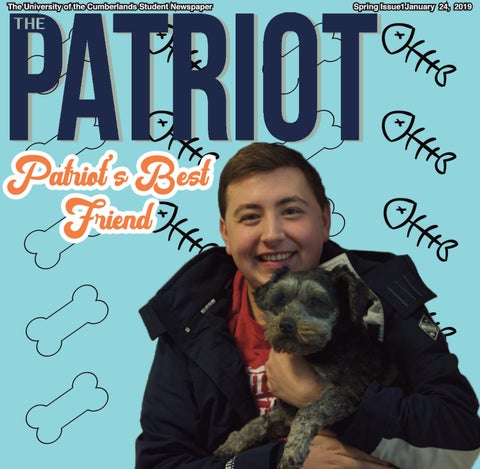
The University of the Cumberlands Student Newspaper
Spring Issue1January 24, 2019
January 24, 2019
Letter from the Editor Editor-In-Chief Mike Krzyston Faculty Adviser Jeremiah Massengale
Dear Patriots, Happy (late) New Year! I remember in 2009 I wondered what sort of change would come to the world in the next decade. I was 11, and realizing how much I had changed in such a short amount of time, the world was sure to drastically change as well, right? I dreamt of flying cars, sentient houses and the cure for cancer. Fast forward a decade: the most popular picture on the internet is a photo of an egg, and Soulja Boy is relevant again. Regardless if you abide by “new year’s resolutions” or not, the turn of the calendar year brings along changes. Changing of classes, of weather, of goals, and yes, of editors. I’m excited to join my staff after a restful break to bring you all quality, impactful and timely content. As we challenge ourselves to create something great every week, I challenge you, the readers, to heed some of my advice. With classes now in full swing, it is important to remember to take time to take care of yourself. Personally, I tend to overwork myself, so this year I am making it a priority to take more time away from the business of daily life. Selfcare should be a priority, so drink some tea, read a book, listen to some music or just take a nap. The spring semester always brings a strange, yet joyful spirit along with it. For freshmen, you are almost done with your first full year of college. For seniors, many of you are only a couple of months away from being thrown out into the “real world.” With only about four months left in the academic year, it is important to take time every day to be fully present in the moment you are in. Whether it is a hike, a night out, or a movie with your friends, make a mental note on the things that make you truly happy. We will never get these days back, truly, so enjoy every passing moment, especially the little ones. With that being said, I’m happy to bring you the first issue of The Patriot of 2019. The work of my staff is something I am beyond proud of and I hope you take a little piece of all of us in this and every issue. Go Patriots! Fire it up,
Mike Krzyston, Editor-in-Chief
Staff Emilee Agee Taylor Duke Haley Bullock Leanne Gregory Tyler Kohn Mike Krzyston Rebecca Lewter Jessica McFerron Nichole Nantz Alex Nunn Jenna Rose Tara Todd Hunter West Dan Williams Maranda Young
Front cover by Taylor Duke Back cover by Taylor Duke Email comments, concerns or tips to: thepatriot@ucumberlands.edu or call us at 606-539-4172 7000 College Station Drive Williamsburg, Kentucky 40769
The Patriot is the student publication of the University of the Cumberlands. Our goal is to provide timely and original content by highlighting campus news and views. Award-winning member of the Associated Collegiate Press and Kentucky Press Association.
Page 3 News
Dorm programs: bringing UC together Weekly activities provided by the campus RAs
BY JESSICA MCFERRON AND HALEY BULLOCK Staff Writers
Movie nights, coffee chats, and many other events occur across the University of the Cumberlands dormitory halls each week. These programs are put together and ran by each dorm hall’s resident assistants, RAs, to try to create bonds and friendships in the building, and to get more students involved in campus activities and events. Community is important at UC, and these programs are stepping stones that are intended to help everyone work closer to achieving a more unified community. Resident hall directors are at the top of hierarchy in terms of Resident Life staff at each building. Erik Willis, the RHD of Mahan, said, “Our UC RESLife Mission Statement is ‘Create an atmosphere conducive to healthy living and academic pursuits’. This is the goal that the dorm programs work to achieve each week.” Willis also said he thinks that the dorm programs now are very different from in the past. The previous events were scheduled by an organization called House Council, which consisted of resident assistants and residents within the dorm. This only consisted of four to five events per semester. Willis added, “Now, RAs from each dorm schedule events during the beginning of each semester. Events also tend to be more intentional to allow more students to participate and enjoy something to do each and every weekend.” RAs are a part of Resident Life staff that try to keep life in the dorms as smooth as possible. Rejoice Olaolorun, an RA at Gillespie, said, “For the dorms, we have events every weekend. As a ResLife staff, I know for Gillespie
we planned for those events before the semester started, and it was helpful to do that so we can plan ahead.” Attendance is crucial for events because as the saying goes “The more, the merrier.” Promoting the programs that they have planned is an important job for the RAs. Olaolorun said, “We get the word around by printing out colorful memos and put them on bulletin boards around the dorm.” These events serve a purpose to bring everyone together at UC, and it allows the RAs to have a closer bond with the students that they are assisting. Megan Spainhower, a UC freshman, said, “I love the weekend dorm activities. I usually go to them so I can hang out with my friends while doing something different than we would normally do on the weekend.” Spainhower added, “My favorite dorm activity was probably when we painted canvases. If we brought in canned goods we were given a canvas and paint. It was something I’d never done before, but it was actually really fun. There were a bunch of people there too. It was one of our most attended events.” Dorm programs are responsible for making the atmosphere around the dorm halls more positive and friendlier. These programs take the effort of many people to create the finished product. The variety of the activities and the common occurrence of them makes them accessible to most students on campus. Without these programs, the bond of community at UC would not nearly be as strong as it is now.
Page 4 Features
A world of support
The rise of emotional support animals on campus
BY M AR ANDA YOUNG
Photo by Emily O’Dell
Staff Writer
There are more than just students and teachers walking around campus. Sometimes you might spot a four-legged, furry friend. In fact, you might know a few people around campus who brought a different kind of friend of their own to stay with them in their dorm. Many of these animals are called ESAs or emotional support animals. Emotional support animals, which typically have not had special training, can be deemed by medical professionals to be helpful to individuals with mental health issues like stress, anxiety and depression. These animals can range from dogs and cats to fish and geckos. Bringing an animal to campus is a long process and a big responsibility, but it can well be worth it. Although the requirements of an individual university or college may differ, as a part of federal law, any student at any type of college can be allowed to have an ESA. ESAs help students out quite a bit just by being around. Kendrick Dezarn, a UC sophomore, said, “I have a mini Schnauzer; his name is Thor. He helps me with my anxiety. My dog has literally saved my life some days.” Being able to have animals around can help people like Dezarn have lower stress levels. Nikki Paterson, a UC senior, says her miniature Aussiedoodle has helped her with anxiety. Paterson said, “He is just over a year old and he helps me with anxiety and a heart condition that causes more anxiety. Having him helps me by being my companion. He depends on me as much as I depend on him.” To have an animal with you on campus it must be approved by Andrew Underwood, the dean of students at UC, in the Student Services Office. When asked what would happen if a person doesn’t have their animal approved and they are caught with it in their room Underwood said, “This is a violation of the handbook, that would go through a conduct case.”
Jacob Ratliff, a UC student success coordinator, commented on some of the rules of having an ESA, saying, “A student who is approved for an emotional support animal, or a service animal, is solely responsible for taking care of all of the animals needs; feeding, taking care of waste and supervision. Those sorts of things.” You must have any and all medications given to the animal on document, are responsible for caring for the animal if it is to ever be sick and must make sure the animal is not affecting others. In the housing area of this subject Ratliff, added, “The student is financially responsible for any damage to the resident’s hall and responsible for behavior of animals.” Kyler Searles, a UC freshman, may have the most unusual ESA on UC’s campus. She said, “I have leopard gecko named Athena. She helps me with my depression and anxiety. I have had her for four years. She is as sweet as can be and is blind in one eye. She needs me as much as I need her.” Some advice given by Jacob Ratliff, Andrew Underwood and students with their own ESA’s was to be genuine with your need for an ESA. Make sure if you are going to bring an ESA, you go about having the animal the right way. Before you bring the animal make sure you are prepared to take care of all its needs. Remember, there is nothing wrong with having ESA.
Page 5 Features
Beneficial buddies The psychological benefits of emotional support animals
Photo courtesy of A nnie Spratt
BYLEANNE GREGORY Staff Writer
From family reunions to taking extra shifts at work there are times when life can be overwhelming and unpredictable. For many individuals, these events are easily managed with time and patience. For individuals who are diagnosed with mental health issues, however, these events can be sources of unimaginable anxiety and pain that cannot be alleviated without the assistance of their ESA, or emotional support animal. Though they are utilized therapeutically in medical treatments, according to the Americans with Disabilities Act, an emotional support animal is categorized differently from a service animal. A service animal is an animal that has been specifically trained to aid an individual with disabilities through performing tasks such as operating a wheelchair, alerting an individual about an oncoming psychiatric episode, or helping them navigate around their home. An emotional support animal, however, is an animal whose primary task is to alleviate the severity of their handler’s disabilities by providing consistent companionship. In a study by Helen Louise Brook that focused on compiling the knowledge surrounding the benefits of animal ownership in individuals with mental health problems, it was found that animals were able to intuitively respond to their handler’s emotional states and provide instantaneous comfort from their current symptoms. The animals accomplished this by distracting their handlers from, or grounding them in, reality against the troubling phenomenon. The animals were also instrumental in reducing the feelings of isolation and loneliness their handlers experienced through their unconditional acceptance and affection. The study further explained that the animals were able to both help their handlers regulate their stress and integrate themselves into social
situations they otherwise may have been unable to handle on their own. It was also shown that the presence of animals contributed to their handlers having a sense of control over their disabilities and a stable concept of self through their meaningful relationships with their animals. This included being able to better handle the negative social aspects that arose from being diagnosed with a mental disability such as the loss of friend and family relationships or social status. vtIn order for an animal to be recognized as a service animal, according to Counseling Today, they must be accompanied by proper documentation from a licensed medical professional. An emotional support animal may be any animal the handler chooses, however, there are some caveats to emotional support animal ownership that an individual seeking to acquire an emotional support animal should consider. Because emotional support animals are not defined as service dogs by the Americans with Disabilities Act, they do not receive the same protections under federal law that allow service animals to accompany their handlers into businesses and other public establishments. Furthermore, because federal law does not require training for emotional support animals, as it does for service animals, it is the sole responsibility of the handler to ensure that their companion receives any type of formal training the handler might desire and is of the proper temperament for becoming an emotional support animal.
Page 6 Entertainment
Duet dangers Spotlight returns next week with the notorious ‘duets night’
BY MIKE KR Z YSTON Editor-in-Chief
With season seven of Spotlight, the premiere singing competition on campus, arriving next week, fans of the show are geared up to watch their friends and peers perform for the chance to win the $1,500 grand prize. The show takes place over several weeks, spanning from late-January all the way to the beginning of April, with each week having a certain theme for the singers to abide by. While the themes change from year to year, there is one theme that remains the same, and is notorious for doing so: the opening night duet. “I think duets week is actually the most challenging of all of them. You get paired with someone completely at random. Different styles, personalities, and schedules are thrown together, which can just go wrong for so many people,” says senior competitor Savanah Frost. Duets week can be a blessing or a curse for any pair competing those nights. The name of the game is teamwork, as both singers need to choose a song that suits both of their voices perfectly. On top of that, while some contestants may have performed on stage before, few competitors have shared a stage with another person, making the compromise of stage space another challenge. Simply put, the opening week of the competition is somewhat of a weeding-out process for the fans and judges. “At the beginning of the show, we have to eliminate a certain amount of singers right off the bat. We chose to do duets because it keeps the attentionspan of the audience and you get to see who can really perform under pressure,” says Lisa Bartram, the director of the Campus Activities Board, the organization that hosts Spotlight.
Sophomore Clara A rnold and Senior Nikki Paterson sing “R ise Up” by A ndra Day in last season’s opening week
Photo by Mike Krzyston
And the pressure is really on for some contenders. Some of the biggest performance flops come from the notorious duets week. This all comes from either a lack of experience of singing with a single partner, or the failure to compromise on a song that fits both singers’ voices respectively. “You really see who is versatile and who can be a serious contender through this challenge. It’s all about getting the singers out of their comfort zone,” says Bartram. Through all the setbacks some performers truly thrive in the opening week of the competition. A fan favorite from last year was senior Nikki Patterson and sophomore Clara Arnold’s duet of “Rise Up” by Andra Day, leading to a deep run in the competition for both of them. “The competition is amazing this year,” says Nikki Patterson, a senior contestant, “I’m so excited to get this competition going.”
Page 7 Entertainment
The Kidd can do it all UC student writes and acts in new play
BY EMILEE AGEE
Photo by Mike Krzyston
Sta ff Writer
“The Horror at Center Stage,” a play written by UC senior Nick Kidd, is a murder mystery set to take the stage Jan. 24-26 at 7:30 p.m. and at 2 p.m. on Jan. 27 in the Kohn Theatre on campus. When asked to give a brief description of his play, Kidd said, “College intern Charlie begins his summer assuming his hardest task will be teaching acting to local teenagers, but he learns this quiet community theater sets the stage for a life and death performance and Charlie is scheduled to star in its next show.” Kidd describes the story of a summer he taught a drama camp and had to find a play he wanted to incorporate, but nothing stood out to him. Knowing he had to show up with something, he wrote an original play himself. Afterward, he sat down to what he thought would be a really good horror movie, but it was not what he expected, he said, “I was so disappointed, and I thought, you know what? I’m going to write a horror play.” It took him four months. Kidd said he never thought anyone would read it, so seeing it on stage is going to be the best part of this experience for him. He said, “That’s honestly one of the biggest reasons why I act. Not for the rehearsals, but to actually get in front of people and perform it.” His goal is to make the audience experience a genuine feeling of suspense. Kidd said, “I thought, I am going to write something that’s actually suspenseful for other people. Something that kind of weirds people out a little bit. That’s my goal, to creep people out.” The play is free for UC students when they show their ID. For adults it’s $10, kindergarten through grade 12 is $5 and non-UC students with an ID are also $5. For more information, call (606) 539-4535.
Songs to pawty to