Spring Issue 6 | May 1, 2017
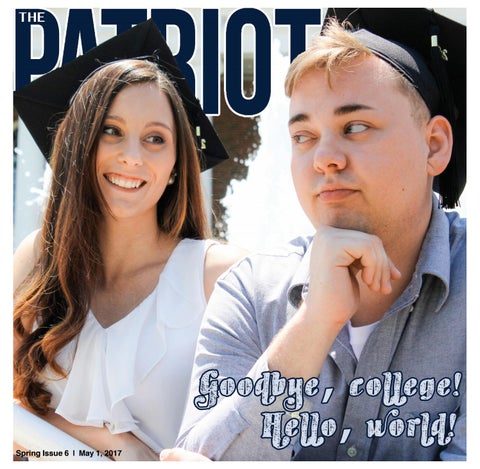
May 1, 2017 Dear readers, We have made it to the final issue of The Patriot for the 2016-2017 school year. I hope that you have found our content engaging, captivating, and, most of all, catering to your interests. As your student publication, we take pride in covering events and issues that may concern or excite you. Most importantly, we will continue to uphold your interests as we pursue good journalism and report with accuracy and the credibility you, the readers, trust. Many of you, including our assistant editor Trenton Canada, and myself will be making our exit from the University of the Cumberlands on May 6. As times of transition do, I have felt the flows of nostalgia as I recount the past years of my life from a high school graduate to now a college graduate. It’s cliché, but so much has changed. I have gained and I have lost, but most importantly I grew through it all, which has made me the person I am today. Though God is not finished molding me into the person I’m meant to be yet, I’m content in knowing it will take a lifetime to get there. When I first started my work at The Patriot, I did not realize how my job here would shape the life that I lead. I applied for this job online and hoped I would receive some feedback, because I needed a work-study job and was a little behind the curve in finding one. When I was accepted for the job, I thought “Great, another check off the list,” though I would soon find my predetermined judgment to be false. Of course, I expected my role at The Patriot to be a day-to-day job, but I didn’t realize it would reveal some of my greatest career motivations to me also. My time at The Patriot has taught me how to fearlessly seek out those stories that matter to me. Journalism is an art, but it can create tangible change when it is done well. The Patriot has taught me to build relationships with coworkers and friends as we travel to conferences and compete for awards with universities across the nation. Most importantly, The Patriot has been my niche the past three years I have been on campus. I have found a friend and mentor alike in our faculty advisor, Jeremiah Massengale. I would like to take this time to thank you for instilling endless amounts of knowledge and wisdom in not only me, but also our entire staff. You taught me all the basics of journalism and so much more that I can never provide a proper thank you for introducing me to the work I know and love. I also speak for us all when I say we appreciate your time and effort that keeps our publication growing and thriving. From providing ice cream on those endless nights of layout, or taking us across the country to national media conferences, we are grateful for you and your dedication to our publication. The memories I have made alongside my friends in our tiny newspaper office are irreplaceable, and I would choose to complete hours of layout nights with them in our compact space over a sizable office with my name on the door alone. Thank you readers for trusting our publication and allowing us to be your voices on the pages inside. I will cherish and miss my time here as editor-in-chief dearly, but I wish my successor Eric Ford Edwards all the luck in the world. I have confidence that you’ll do great. For the final time, Trenton and I would like to introduce you to this issue of The Patriot. Yours, Ashton Rector
Editor-In-Chief Ashton Rector Assistant Editor Trenton Canada Faculty Advisor Jeremiah Massengale
Staff Hope Austin Eric Ford Edwards Leanne Gregory DJ Hite Zane Ross Taylor Duke Jay Sanksakulchai
Editorial Review Board Lisa Bartram Marianne Worthington
The Patriot is the biweekly student publication of the University of the Cumberlands. Our goal is to provide timely and original content by highlighting campus news and views. Award-winning member of the Associated Collegiate Press and Kentucky Press Association.
Page 3 News
All in Good Taste
The University of the Cumberlands welcomes new meal options for UC students
BY ZANE ROSS Staff Writer
The University of the Cumberlands welcomes change to its campus with the confirmation of brand new meal options to be taking place in the fall semester of 2017. Current students are familiar with the Grill located in the Boswell Campus Center, as well as the Papa John’s pizzas they provide, the Patriot Steakhouse and the TJ Roberts Dining Hall. However, starting in the fall things will not be the same. The contract for Chartwells, the University of the Cumberlands current food provider, is coming to an end and the university has decided to sign on with Pioneer College Caterers. Pioneer is a private organization that provides their services to faith-based schools. Currently Pioneer provides for over 45 colleges, such as Asbury University, Campbellsville University and Indiana Wesleyan. It is no secret that Chartwells has been the provider for the university for many years now. So what has brought on this change? Chief Financial Officer and Vice President for Finance Chris Rolph said, “The University thought that we could better improve the quality of food service by switching food service companies. I have known Pioneer for about 25 years in different capacities and we have been impressed with their professionalism, their integrity and their understanding of faith-based missions as well as the quality of food that they put out.” By switching food service providers to Pioneer College Caterers, UC has been able to bring in new franchises such as Chik-Fil-A and Starbucks, both of which will be located in the Boswell Campus Center next fall. ChikFil-A will be open to students for meal exchange; alongside of that there will
Photo contributed
be a salad/wrap bar located in the Grill. Papa John’s pizza will no longer be served as a grab-and-go item, but instead will be replaced with Pioneer’s brand of personal pizzas. The Starbucks that will be included in the mid-BCC will not be a part of the meal exchange program. Instead students will either pay money as normal or can purchase a prepaid card that they can use. Rolph says that after purchasing a card students should be able to get an additional 20 percent of whatever they have loaded to the card that they can spend at the establishment. UC officials have also decided not to include the Patriot Steakhouse as a part of the meal exchange program for the fall 2017 semester. “The Patriot Steakhouse hasn’t really been used,” says Vice President of Student Services Dr. Emily Coleman, “Some students don’t have cars so it isn’t really convenient for them if they want to eat there. We want to give students more options that are easily accessible on campus.” UC junior Ethan Osborne says, “For me it really is just a matter of convenience. It’s easier to go to the Caf or the Grill so I don’t eat at the Steakhouse often. Mostly it’s when I want slightly better food or when I want to get together with my friends. Coleman has expressed her excitement for the new changes to the meal program and says that renovations on the Grill and mid-BCC will begin as soon as the summer break begins. When students return to campus this fall they will be able to judge for themselves on what they think of the new meal options and the quality of food that will be offered.
Page 4 Features
Addressing accessibility: UC students and staff speak about challenges on campus BY TRENTON CANADA Assistant Editor
Among the many things that the University of the Cumberlands claims as a part of its pride, UC boasts a large number of student athletes. In fact, a majority of the students who attend UC participate in some type of sport. Dr. Emily Coleman, vice president of student services, estimates that UC has between 50 to 55 percent of its students involved in athletics. With such a high percentage of students being athletes, the number of injuries incurred by students is high, which calls into question the accessibility of UC’s campus in regards to students with injuries and other disabilities. UC women’s wrestler Clarc Walker was injured during practice last October and had to have surgery to repair the damages to her knee, and in regards to UC’s accessibility, Walker states, “It was harder than you could ever imagine. Getting from class to class was difficult in that there are hills and stairs every where, but there aren’t really any railings or anything to help you balance, so I didn’t go to classes for a while because I was too scared to fall.” Walker further explains that due to her injuries, she wasn’t able to attend classes that were located in buildings without handicap accessibility to the second floor. Walker states, “I reached out to Nate Clouse, and he got some of my classes moved to the first floor.” Nate Clouse serves as UC’s Disability Service Coordinator. In an effort to make classes more accessible to handicapped and injured students, Clouse states, “You will see some classes shuffling around. We may have to move those students down to a lower level or to a more accessible building.” Yet, the notion of a “more accessible building” brings about a question of why aren’t all buildings on campus accessible for all students? In particular, Walker states of access to elevators on campus, “It’s no longer just a luxury. It’s become a necessity.” Ryan Creech, a 2007 graduate of UC, seems to agree. The summer following his graduation, Creech was involved in an ATV accident that left him paralyzed from the bottom ribcage down.
Photo by Ashton Rector
“I came back to Cumberland in December of 2008, working for Business Services in the Bock building,” Creech says. According to Creech, during his time as a UC employee he aided in motor pool services and helped coordinate security and parking, yet found his duties very difficult given his position in a wheelchair. “When I started at Bock, there was no accessible entrance or restroom,” Creech states. “Within a week or two of the security guards carrying me in and out of the building, they added a door and a ramp at the back and remodeled the bathroom.” In addition, Creech states, “The library is an especially bad place. I used to guest lecture in a friend’s basic psychology class every year in the Distance Learning Lab in the basement, but I couldn’t get to the teaching area unless I brought along a ramp.” There are several federal laws that mandate the accessibility of buildings on university campuses and include the Fair Housing Act and Rehabilitation Act, which are both cited in UC’s handbook and in online references available to students. Both of these laws fall under the umbrella of the American’s with Disabilities Act, which is much broader in scope and lists several requirements. This law is applied to postsecondary schools, and because UC is a private institution, it is categorized under Title III of this provision. In addition, Section 504 or the Rehabilitation Act, which is referenced on the UC online portal, is applied to UC due to the fact that it receives federal financial assistance. It remains, however, that a majority of the buildings on campus do not have elevators. “By law, they’re ‘grandfathered’ in,” Clouse offers. “At the time, they were built to code, but now if we build a new building, it has to have an elevator. That’s why when we did the Wellness Center, we installed an elevator to make the campus center more accessible as well.” The term “grandfathered” is used to describe buildings that were built before the law was put into effect, meaning that they would be exempt from being brought to code.
Page 5 Features
However, the National Network for Information, Guidance, and Training on the Americans with Disabilities Act states that “the ADA does not have a provision to ‘grandfather’ a facility.” Yet, the ADA does provide that a building can be deemed a “safe harbor” under the revised regulations, meaning that modifications would not be required if the building existed before the compliance laws were changed. Clouse continues, “The act and some of the newer laws state that any new buildings have to have an elevator, which is why our newer dorm buildings, like Harth, has an elevator. Hutton School of Business has an elevator; Correll Science has an elevator.” The Rehabilitation Act was amended in 1998 to include the information about accessibility and elevators and is the current version followed by UC, yet the Grace Crum Rollins building on UC’s campus finished construction in 2000. There currently exists no elevator in this building. Further, the Americans with Disabilities Act provides that if a building that is classified as a “safe harbor” is renovated to a certain degree, the building must then be brought up to code to allow accessibility. “When it comes to accessibility, I’m just going to have to ask about Grace Crum Rollins and how elevators come into play in other buildings,” Coleman stated. Coleman adds, “There’s a lot of things that go into play to be able to put an elevator into a residence hall or a building. You have to look at wiring, you have to look at building structure, you just have to look at a lot of different things. Can your wiring accommodate that? Do you have the support structure in place that can take an elevator?” In regards to accessibility of campus buildings from an external standpoint, Clouse states, “To my knowledge, all of the buildings have ramps to get at least on the first floor. It may take a little bit of work, but they all do have first-floor accessibility.” Coleman seems to support this in stating, “I can’t think of a building that doesn’t have a ramp for someone to be able to access. Now, if they can
access the whole building, that’s a different story. But that’s where we work with Nate Clouse and we work with academic affairs to make adjustments to classes.” Creech, whose job at UC required him to maneuver around campus, states, “It was extremely hard for me to go visit Business Services in the basement of Gatliff. I had to either roll down and back up the steep hill or fight heavy narrow doors upstairs to access the elevator.” He continues, “There were a few times I missed work. There was no way to get to the post office or bookstore in a wheelchair.” During the time that Creech worked at UC, the addition of the Wellness Center had not been made to the Boswell Campus Center, meaning that there existed no elevator in that building at the time. “When it comes to dealing with guidelines and providing accessibility in our housing, we work with students on a case-by-case basis,” Coleman states. “Students will apply for an accommodation, and they’ll let us know what building and what they’ve request, and then we work within that and to the best of our ability to accommodate.” Clouse continues, “Feel free to come by Student Services and talk to us. If you’re an athlete, we work closely with the athletic department to figure out what would work best for you. It is a case-by-case management system, so what worked for someone else may not work for you. We’re willing to take care of you in that sense. We’re willing to work with students, and we want to be here for them within reasonable accommodations.” In addressing student concerns, Coleman states, “I think we’ve got a good track record of working with students to help provide them with as many accommodations as we can. We might change their residence hall temporarily so they don’t have to walk up flights of stairs. We might put a seat in a shower stall. We can even bring meals to people. I feel we work very well and very hard to accommodate students on this campus, so let us know. Don’t let it go to the point that you’re frustrated. When you have that injury or need an accommodation, let us know. Let us help you.”
Page 6 Features
Last words & final thoughts
COMPILED & TR ANSCRIBED BY LEANNE GREGORY & HOPE AUSTIN Staff Writers
The week before finals, The Patriot’s faculty advisor Jeremiah Massengale sat down with editor-in-chief Ashton Rector and assistant editor Trenton Canada to discuss their time spent as leaders of the award-winning college newspaper staff. In this interview they reflect on their experiences with The Patriot and share their thoughts about leadership, the importance of college media, the power of journalism to influence change, and, of course, their upcoming graduation from the University of the Cumberlands.
Jeremiah Massengale: How do you feel as graduation approaches? Ashton Rector: It’s bittersweet. I feel like I’ve grown up a lot. It’s just really kind of weird to look back and see all of the memories that I’ve made here and to know that this chapter of my life has come to an end, and I have to pursue something else now. But I feel like I’m ready for the next step; it’s just kind of scary to go somewhere else. Trenton Canada: I kind of feel the same way. It is bittersweet, I hate to see it end but at the same time I am very excited to see it end. People, professors, friends and family members, keep asking me what I’m going to do once graduation gets here and I’ve always looked at them and said “I’m going to sleep for three months because I haven’t been able to do any of that in college.” And I’ve been at it a little longer than Ashton; I’ve been in college for five years with my transfer from UK and so I’m just mentally exhausted but I feel very uplifted in spirit that I’ve met such great people and had such great times here. Jeremiah: How would you say campus has changed while you’ve been a student here? Ashton: I think campus has definitely grown. I would say that like just in size of people, I feel like there are more people here. I think some policies have changed; some that I’m proud to say that Trenton and I have been a part of together like the convocation piece. I thought that was really cool. It was just really awesome to see that we could work hard on something and actually see a change from that and we could actually have people to listen to what we were saying. So, I feel like there has been a different, more like an attitude change overall. I mean, I guess others are more apt to listen to
(A Q&A with our editors) what people have to say and just be there for the students. Trenton: I’ve always tried to not measure change in physical structural things. It’s more so that the people and the ideas that change. I think we have seen great progress in the past four years or so of people changing. New people taking positions within the administration and ushering in a new wave of ideas and a culture on campus. I feel like that’s changing too so I’m really proud of that for this college. Jeremiah: What about here at The Patriot? How is the newspaper different than it was during your first semester? Trenton: Well, I mean just opening up the paper and looking at it, we’ve gone through a lot of redesigns and we are doing more things with graphics, photos, making some things bigger, some things smaller, introducing new things, and phasing some things out, and so that is a process all of its own. It has been changing. It was changing before we got here and its continuing to change and will change after we leave. But again I go back to the people and the ideas and I think that as a staff we have more strength in ourselves because of our experiences and our time here. You know coming into this you’re thinking, “Oh I can’t make a difference and I can’t do this and I can’t write about that and there are so many things against me” but just getting your voice out there really encourages and strengthens you. Ashton: I would definitely say like Trenton said with we went through a redesign of our paper and that was a result from, I guess that was the conference, our first time in New York, at least the first time I went. We decided, “Okay, I want to switch to InDesign” and I mean we had a little bit of a learning curve with it just because you were doing new software for the layout. And I think it’s just like our staff; there’s a learning curve with everything. I think that we have all grown together. And that I think its really important especially in just the reporting that we do that we do that you have to be a strong staff and you have to be willing to work together. Jeremiah: What do you hope that your legacy will be here at The Patriot?
Trenton: It’s a tough question and it’s so weird being on this side of the recorder. It’s usually us asking the questions and waiting on someone to respond. I go back to my application for the newspaper, though, when I said that my role model as a child was Lois Lane. And thinking about her legacy, she always stood up for the underdog and was an advocate for those who didn’t have a voice. And I would love for that to be my legacy and what I’m known for. The pieces that I’ve written here have always tried to focus on those people who didn’t feel like they had a voice on campus or who were misunderstood or weren’t heard and I’ve tried to really get that information out there. I think it’s all about story telling, that everyone has a story to tell and that you just have to be willing to listen. I’ve always wanted to be the person that listens not for the sake of responding but for the sake of understanding. So I would love for that to be my legacy and for that to be carried on. Jeremiah: What’s one story that you’re especially proud of that you have published and why? Ashton: I would probably say the security article and then the “no threat” follow-up piece, those two together. I was really proud of that because there’s no way we could have known what was going to happen with that situation. I don’t know, I just wanted a little more information, no, I wanted an answer to this issue that is important to me, and this issue that I am concerned about. I got those answers and then we had an incident that happened on campus, and those stories were great for me because I could see that my work mattered. Even in just a short informational piece like that it served as a great precedent for what was to come. So that was probably my favorite piece to work on. If I have a legacy to leave here I guess it would be that print media is not dying and that writing is very valued and not boring like some other people might think. But print isn’t dying and even though we have all these resources with digital media. Those are great, but sometimes you need to just get back to basics with a pencil and piece of paper and just write down you’re thoughts, write down your questions and get answers to those and stay curious as you pursue your journalism more and more.
Page 7 Features
Trenton: So my favorite piece, I have a couple. I would say as a team the convocation piece because Ashton and I worked on that together. We did the interviews together. We wrote the story together. We doubled-checked and triple-checked all the facts together. I feel like that’s really how Ashton and I bonded. We’ve grown stronger in friendship because of that. The criticism that we faced over that made us grow stronger but then it was also powerful in showing that the student voice is heard on campus and that you can produce change if you do it with ethics and with dignity and integrity. Personally, I think my favorite piece was the Rose Marlowe piece because she was a student here way back when this was the Williamsburg Institute, and she grew up in Williamsburg. She walked these hills on campus. And after she left the college she went over seas as a missionary and became a prisoner of war under the Japanese and had this great legacy and story to tell but it was just buried in the history. No one really knew about it or found it and I stumbled upon it by accident. And I was able to tell her story. Even though she passed on years ago, now her story is alive today and other people get to know about it because of the power of journalism. Jeremiah: What is the secret to working well together with someone who is maybe a little bit different from you? Trenton: I would say that you have more in common with someone than you do different. And build on those aspects. Ashton and I both love journalism. We love to joke and have a good time, and with that I would say don’t be so easily offended by other people. I mean really open up and see that they see life a little differently than you and that’s okay. I know here in the office we kind of throw shade back and forth at one another and it’s all in good humor. So, don’t be so ready to be turned off by people. Find something that you connect with them and build on that. Ashton: To go on with that, I would say you should always respect their work because just as much as what you do is valuable so is their work. I think that’s key in a working relationship. That you need to respect what they’re doing and that you’re there to support them and cheer them on. Jeremiah: What’s one piece of advice you would give a college student about becoming a leader? Ashton: I would say learn to listen well. When you listen well you’re going to learn how to, well with us, when you listen well you’re going to have a
you do. And I don’t think that it’s overstepping or being cocky or anything like that and saying, “Hey, I’m really good at this and I know I’m good at it.” But it’s just being confident so that you can produce talented work that falls along with that. I think that’s important for a leader to show that they are confident in what they do and I think that it leaks over into other people’s lives as well. If they see that someone is really confident and really passionate about what they do then they are going to take that and do the same with whatever field that they’re in. Whether that’s journalism or if it’s art or if it’s anything. Jeremiah: What’s one of your favorite memories, or places, or experiences, while traveling? Ashton: I would definitely say speaking at CMA’s National College Media Convention conference was really cool because it was almost like a coming of age kind of thing. It’s like “we’re still students” but we were stepping into a new role of “this is our career and we’re in a really cool kind of transition period.” And it was a really cool way to do that. lead to a story or hear about something you might not have heard of otherwise. If you listen to what people have to say, you can find out those things. It also just makes you a good friend, a good coworker. Trenton: I would say to trust your instincts. I think that coming to a university as deeply rooted in tradition and values as the University of the Cumberlands is, it is really easy for a student and for a young person to become overshadowed on campus by someone who has been here 40, 50 or 60 years. And in saying that I always go back to a verse in the Bible, and it’s 1 Timothy 4:12 where it states, “Let no man despise thy youth” and I think that’s really important for a young leader on campus to hear. Building off of that one of my favorite verses in the Bible is Isaiah 41:10 that says, “Fear thou not for I am with thee. Be not dismayed for I am thy God; I will help thee; I will strengthen thee; I will uplift thee with the right hand of my righteousness.” And so just following your instincts and not being afraid, being of good courage that you do matter on campus and that you can make a difference. You have precedents throughout history of young people stepping up into leadership roles and taking charge and making a positive difference. Ashton: Also, along with that you have to have confidence in yourself. Confidence in your abilities. If I didn’t have confidence in my writing, then my stuff wouldn’t be published and I wouldn’t write at all. You have to know that you’re good at what
Trenton: There are definitely a couple. I would say I enjoyed the road trips that I have gotten to have with you all. Just being in the car together and listening to the music and to the stories in the vehicle we tell as we travel, that really sticks with me. I’ve always felt that it’s not the place that makes it memorable; it’s the people that you’re with. So being able to share those experiences with Ashton and Jeremiah and the rest of the newspaper staff has really left an impression on me. Saying that, two instances come to mind. The first was in Washington D.C. this past October. We got to go into the Supreme Court. The Supreme Court just means so much to me because as a child and going into high school and then going into college, I wanted to go to law school. I wanted to be a lawyer and my aspiration was to one day sit on the Supreme Court, and unlikely as that was to happen, it was still a dream. And though my dreams have changed since then, it was so very powerful to step into a building that has meant so much to me. Another favorite memory occurred this last trip to New York. Ashton and I got to speak at the conference in New York and just being among all the great journalists from across the country and across the world and to see our names listed on a piece of paper next to all of them was just so powerful to me. It really boosted our confidence and not in a bragging way, but in a validating way, to say our work mattered. We worked hard and we were rewarded for that. Then we got to share our story and our experiences with other college students from around the country.
Page 8 Features
Living whole-heartedly A senior profile of Kristen Swords
BYSAR AH R AINOUS
Photo by Kannsas Michaels Third
Guest Writer
An easy southern drawl echoes through a University of the Cumberlands dorm room. Down the suite’s hallway, inside the back room, sits UC senior Kristen Swords, a freckled brunette from Mississippi, wearing her typical combination of black athletic shorts and a loose-fitting T-shirt. Tonight, Swords sits cross-legged on the carpet of a friend’s room, explaining how to shoot an arrow properly. She should know; she’s earned 24 titles for archery in just four years. Right now, everything about Swords exudes comfort and confidence. Her arms seem to raise by themselves, one stretching forward holding an imaginary bow, the other pulling back its phantom arrow toward her jawline. “You can’t think about your shot,” Swords states. “You’ve just gotta let your muscles do it.” She lets the ghost arrow fly, staring straight ahead for just a moment, then drops her arms, resting her hands on her knees. People on UC’s campus may recognize Swords as the girl who sings hard in Cumberland Singers, works hard for the Campus Activities Board, and laughs hard with her friends in the cafeteria. No matter what she’s doing, Kristen Swords gives it all she’s got. Take archery, for instance. Swords intentionally chose the sport because her older brother didn’t do it; it would be her very own sport, something she could do independently. Archery requires a high amount of stamina, since it’s often held outside from morning until sunset, like track meets. That means archers must
handle pounding sunlight, blustering winds, or pouring rain, depending on the day, for hours on end. Besides that, pulling back a bowstring 144 times per tournament is no picnic, especially for your abdominal muscles, shoulders, and arms. “If you do the math, we’re lifting more than an Olympic weightlifter,” Swords nods. You heard that right: an Olympic weightlifter. Yet, a lot of UC athletes look down on the archery team. Sometimes they’ll even poke fun at it, laughing about how easy it is compared to their own sport. Swords shrugs. “I’d like to see them try. I mean, no, we’re not running up and down a field or court. You know. But it plays a lot into mental, because archery’s a mental game. So yeah, I’d like to see them do what we do.” Doing what Swords has done would be a feat indeed, considering that she is a seven-time All-American, a Women’s Bowhunter National Champion, and a four-time Overall Team Champion. UC archery coach Kris Strebeck notes her drive to compete, saying, “She attacks everything head-on. When she puts her mind to something, she’s gonna try to achieve it with all her might. That’s a trait that you don’t see in everybody.” Swords knows she is competitive. “I live off of adrenalin, sportswise,” she declares, her chestnut eyes gleaming. The adrenalin carries over when she’s on the sidelines at archery tournaments.
Page 9 Features
Photo by USCA A rcher y
Teammate and roommate Haley Haygood asserts, “She is the motivator. We have a ‘Aww, P-A-T-S, Pats, Pats, Pats!’ cheer, and she’ll usually lead it. Her voice carries…so she’ll yell, ‘Aww,’ and we’ll all join in.” Haygood jokes that Swords has a bit too aggressive of a personality to be the mom of the team. That’s Haygood’s role. “She can be the cool aunt, I guess,” Haygood laughs. Swords never tries to fill any specific role in her friendships. She says, “I have nobody to impress! If they’re gonna like me, they’re gonna like me how I am.” Outside of sports, Swords has that same upbeat, energizing personality. Albert Jones, the youth pastor at Main Street Baptist Church in Williamsburg, met Swords at a church worship night a few years ago. “I love her laugh! Have you heard her laugh?” Jones asks. “She enjoys life.” This year, Jones’s family has unofficially adopted Swords, Haygood, and their teammate nicknamed “JD.” Jones chuckles, “My wife has a little family photo, and they’re in our photo. It’s in the dining room.” “They’ve opened their house up to us,” Swords says. “I mean, I know that’s not a big ordeal, but to us it is.” A part of Swords wishes she had initiated a relationship with the family earlier. “Me and Roomie [Haygood], we always talk like, ‘Why didn’t we get involved earlier?’” Don’t be too fooled by Swords’s heartfelt gratitude; her competitive spirit never dulls at the Jones house. She visits regularly and plays card games
with the family, including Slapjack, a game in which players literally slap the table at certain points to win cards. With the competitive drive and arm strength of a national champion archer, Swords is an intimidating Slapjack opponent. Jones says, “We’re getting a new dining room table right after graduation.” It’s hard to tell if he’s being sarcastic. One of the most defining characteristics about Swords is her relationship with Jesus Christ. Haley Haygood has noticed that Swords intentionally eats lunch with the same person once a week, so she can invest in their life. Swords says that a lot of her growth in faith this year has been in part due to the inspiration of the Jones family. “You see Christ in them,” Swords states. “That’s the kind of person I want to be.” From what Albert Jones has observed, Swords is already that kind of person. “She is committed her Lord,” Jones smiles. “She loves her Lord with all of her heart, and she will passionately pursue him through whatever doors are available.” Right now, the doors available have led Swords back home to Mississippi, where she will take some GPA-booster classes at Ole Miss. “It’s really just to defer student loans!” Swords laughs. After that, she aspires to earn her master’s degree from an athletic training program in Chattanooga, Tennessee. But no matter whether that plan happens or God opens different doors, one thing is certain: Kristen Swords will face each day wholeheartedly.
Page 10 Features
Danny Enge: A man of dedication A senior profile of Danny Enge BY BRETT BIR NBERG Guest Writer
A group of four students are sitting in the lobby of Mahan Hall, one of the University of the Cumberlands’ oldest dorms on campus, as they study for an upcoming exam for one of their classes. Two of them start laughing at a joke one of the others said in passing. One of the two laughing, Danny Enge, is a graduating senior here UC. You can sense that he’s taking time to have fun but still steers his focus back onto his work. Enge is a double major in biology and mathematics with two minors in chemistry and physics from St. Paul, Minnesota. When asked why he wanted to come to UC to pursue his higher education he pondered for a moment. “The merit-based scholarships were great here. I knew that I wanted to go to a smaller school so I could build relationships with the professors and students around campus. Plus, I love the mountains here, and then there was the bonus of having a chance to play football at the college for two years,” he says while looking out the window toward the scenery of southeastern Kentucky. The youngest of six children, Enge was also the first to attend an outof-state four-year college. This gave him the drive to go out and prove he could manage all his hard work in the science field while balancing between being an athlete and eventually as a resident assistant as well. “I want to cure type one diabetes because I too suffer from it. That keeps me focused, but I also don’t like to waste time so I’ll schedule my time management well so that I can make time for friends to keep me sane as well as school,” Enge stated while working on an assignment for one of his classes. Enge’s significant other, Whitney Johnson, elaborated further saying, “Danny is one of the most dedicated students I’ve met. He is constantly studying, working on stuff, or researching... even when he’s with me! He strives for excellence and does his best to exceed expectations.” A renaissance man of sorts, Enge manages to work as an RA while also
being a teaching assistant for the physics department under Dr. Larry Newquist and Dr. James Manning this year, while also working in the chemistry department for Dr. Julie Tan last year. This all occurs as he is part of the honors societies of all four departments relating to his majors and minors: biology, mathematics, chemistry and physics. One of the most interesting things that Enge managed to do was obtain a job with Mississippi State University in their biological engineering department last summer as part of a REU program, which stands for “Research Experience for Undergraduates.” Enge worked under the physical properties of materials and focused on fetal pig heart tissue. He laughed, “I used to think pigs were cute…until I had to hold them down while still alive for ultrasounds and then go on to dissect more than a few of them.” His time in Mississippi helped him learn how a scientific society functioned while also showing like-minded, hard-working individuals who were there to work together towards a good cause. Enge will be attending University of Colorado-Denver for their bioengineering master’s graduate program this fall and hopes to go on and earn his Ph.D. in this field afterwards. Luckily, he’ll get this opportunity while also rooming with his brother. When asked about the difficulty of applying for graduate programs he stated, “It’s a lot of work, and you might feel like you don’t know what the college wants, but you have to talk yourself up. You’ve got to highlight everything you can.” If there’s one thing that he doesn’t have to worry about, that would be making sure the higher ups looking at his application know how qualified he is. His overarching story of a man from St. Paul who got to be where he is by working harder than anyone around him is enough to go on and become somewhat of a legend; let alone a way to state your case for graduate school.
Page 11 Features
Aiming beyond the green A senior profile of Annabeth McKay BY MEGAN WILLOUGHBY Guest Writer
She stands behind the green confidently, imagining the outcome she desires to achieve. As she steps up to the line, she carefully lines up the putter with the ball while eying the hole that stands before her. She takes a deep breath, making a skillful move, and “clink,” she hears the sound of success rattle as the ball falls perfectly into the hole. Annabeth McKay is a senior from Amarillo, Texas. Traveling far from home, she came to the University of the Cumberlands seeking a golf career and a thriving social environment in the small town of Williamsburg. What most people do not know is that her determination to play collegiate golf reached a fork in the road her sophomore year at UC. “Surprisingly, I almost quit golf completely. I was going to peruse screenwriting at the University of Texas, but then I decided that if I quit golf, I would regret it. I would always wonder what I could have done in the sport,” McKay explains. Her decision to remain in the sport has affected many people around her. Including teammates who have watched her grow throughout the four years of her career. After McKay’s told her teammates that she would be staying beside them her junior year, the atmosphere changed. Her determination was ignited and set through the roof. McKay’s concentration radiates the golf course, sending a positive vibe to her teammates who look up to her. Sadie Martinez, another senior on the UC women’s golf team, expresses her gratitude for sharing the past four years as McKay’s teammate. “She tends to have a positive mindset after any round of golf. I’ll get off the course after a bad round and I can always count on her to lift my spirits,” Martinez says. “Ten years from now, I’ll remember Annabeth by her uplifting personality and most importantly her rubber ducky shirt,” she adds jokingly. Not only do her teammates appreciate her uplifting character, but also her coach, Taylor Riggs, shows his deep appreciation for her work ethic and unconditional love for the game. “Annabeth is a very technically sound player, who does a lot of great things with her golf swing. Physically there are not a lot of players better with their golf swing in the NAIA. She always brings a great mindset to practice and in tournament play, and it has been a joy to coach her this year,” Riggs says with confidence. McKay’s character extends off the golf course into the classroom where she has found to take pride in her studies. With a major in communication arts and a minor in journalism, she has grown to love the field of journalism, taking many opportunities in the field. She even worked for the campus radio station, WCCR 94.5 FM, during her freshman and sophomore year. “This past summer I had an internship with the news department with KTAL in Shreveport, Louisiana. I would basically write content for the 5:30 and 6:00 broadcasts. I would go out with reporters, interview people, and shoot
footage of b-roll. Then I got to produce a couple of the broadcasts in the control booth while running the show,” McKay says proudly. Her dedication in the classroom has sparked growth throughout her time on campus. UC journalism professor Jeremiah Massengale describes his view of her transformation in the communication arts department. “I know, at least one point, she had aspirations to be a screenwriter and she has all the skills she needs to make that dream a reality. She has an especially strong sense of story.” Massengale reflects. “She has the tenacity to accomplish whatever she wants to do with her life. And that is a rare thing.” McKay’s derive for success will not stop at the bachelor’s degree level. “I want to take a year off to enjoy being young and having the entire world ahead of me,” McKay says. “Then I will apply for internships with the US Olympic Committee and the NCAA in their marketing and broadcasting departments. Hopefully I can attend grad school for sports marketing after. ” She extends her future above the undergraduate level, seeking a career that fits not only her confidence and concentration on the golf course, but also her determination and passion in the classroom.
Page 12 Features
Painter of
Words
A senior profile of Lydia Huggins
BY GR ACE UEBEL Guest Writer
Photos submitted
UC senior Lydia Huggins sits perched on a stool working on her senior art project, which includes different forms self-portraits covered in words that she has been told about herself through her life. A refection of who she is according to the voices in her life. In this studio, working on her art is her element. One can clearly see the skill she possesses and know that this young woman has a lot of wisdom behind her art. Huggins, a double major in art and journalism from Erwin, Tennessee, says college life has been one of adjustments and learning. Huggins said, “I was homeschooled so I had never really been in the classroom setting. It was always my mom was my teacher and I had my books and I just learned that way. So when I got to college it was different with lecture halls and more students but it did not take much time to adjust because I was used to other things. I did 4H growing up and attended lots of church events so I was used to the atmosphere of learning with other people.” She is quite obviously a people person and loves helping and mentoring others.
“Looking back, the hardest thing about college has been balancing the social and the academic life. Grades are important and I want to do well in my schooling, because that’s what I’m here for. For me, school has been more about people. Before I came to UC I felt God was leading me here. I didn’t know what for. I came knowing Cumberlands was a Christian school but quickly realized that most people are not Christians. So I felt very lead to love and minister to people and I would say that is the most important thing I’ve done here.” She shows her priorities and where her heart is at in every day life in tangible ways. She actively cares and pours into people in her life, not just by saying, but by doing. “I drop and homework assignments to be someone’s shoulder to cry on because people are more important. They last longer than grades. Twenty years down the road I’m not going to remember that really bad test grade, I’m going to remember that friend who I helped through a hard time.”
Page 13 Features
significant other and feeling crushed when they leave them. Realize your self worth outside of other people. I’ve had to find my self worth in Jesus Christ because He is the only one who will never leave you. If you’re struggling with something know that you’re not alone because there is probably someone else struggling with the exact same thing.” Huggins adds, “Seek out the people who care. The best part of college by far are the people you meet. Find the good ones. Be mentored.” Huggins will graduate in May having touched many people’s lives, learned much, and grown more in her relationship with others and with Christ. Looking back she says that college was worth all the difficulties she faced because of the skills and the friendships gained. She will continue on in life, looking forward to continuing to expand her skills and her love for people more every day.
Through her time here at UC, Lydia has gained a plethora of skills, and is thankful for the majors that she chose to specify in. “I have learned so much through my majors that I will be able to hold on to the creative things I’ve learned and use them later in life in any way. Whether writing freelance or hosting a community art class. I just want to follow God’s path and see what He wants for me. I am not positive about career plans but I know that He will provide.” A word of advice and wisdom that she has for all in coming freshman, and anyone else needing a break it to step back every once and a while. “I did not expect that in college my time would be filled so fully that I would be burnt out always. I realized the need to just take a moment and breath and take care of yourself.” Another note of advice Huggins has for newcomers to a small college like UC is to remember who your friends are, but to not put your entire worth and happiness in them. “On the social side I’ve seen people struggle with the friends aspect, such as feeling alone or left out, such as putting all their worth in their
Page 14 Features
Summertime, fun time UC students plan their summer journeys
Photo by David Lezcano
BY HOPE AUSTIN Staff Writer
It is finally near the time all students and faculty have been waiting for since the beginning of the year: Summer. This season entails no homework, no grading, and lots of free time. However, with no school you may be thinking, “I have no clue what to do,” or maybe need some ideas. Thankfully, summer always provides something for everyone. UC freshman Emily O’Dell has planned a jam-packed summer full of fun ranging from road trips and camp to missionary work. “It makes me very excited to have such a busy summer because I have many opportunities to work for the Lord, and there is nothing I would rather be doing,” said O’Dell. O’Dell is going to start her summer working for a camp that her church organizes in Blaine, Tennessee, Camp Hope. The camp will contain teams that counselors will oversee. Campers will compete in all kinds of games and all will spend their evenings learning about God. O’Dell will also be going on a family road trip to see the Grand Canyon. While there, her family plans to have a sunset service. Toward the end of O’Dell’s summer, she, along with her sister, will be going to Bethany Village in Uganda for a month. There they will be participating in missionary work for the village. UC freshman Savannah Frost also plans to spend her summer working in ministry at a church
camp, Camp Ba-Yo-Ca, for the fifth year this summer. The camp is a Christian camp in Townsend, TN, where hundreds of kids attend. During the camp, the campers will learn games, sing songs, and make friends. “Our ultimate goal at camp is to form relationships with kids and guide them in forming the most important relationship with Jesus Christ,” said Frost. Also, UC student Taylor Duke has planned a fun way to go home and begin her summer. Duke is from California, and has decided to road trip instead of flying home. Duke plans to leave after she finishes final exams to begin her journey. Duke wants to see sights that she hasn’t before, so she will be traveling through more southern states such as Alabama, Louisiana, and Texas. “I plan to take a week and a half so that I can take my time and explore as much as I can!” said Duke. When she reaches California, she plans to drive north through San Diego and Los Angeles to visit friends before finally heading home. While she doesn’t have any specific sightseeing locations, she is very excited about her journey across the United States. UC senior Maggie Ballou has a summer plan at Crossings, a camp she has been involved in for many years. The camp is a Christian camp open for all kids involved with a Baptist church.
According to Ballou, the camp made their name by presenting the Gospel and “helping kids cross over from death to life.” Camp staffers hold positions of all kinds from indoor and outdoor activities, Bible studies, and other points of interest such as crafts and kitchen work. Overall, the camp tries to connect everything back to Jesus. A big part of camp is that all counselors get one-on-one time with their students to help them along their path of faith and other parts of their life. “This camp has allowed me to be the hands and feet of Jesus,” said Ballou. Ballou will also be spending her summer working for the admissions office at UC. There she will help with giving tours and helping people decide where to go to college. Ballou sees this job as a way to minister in a different way than at summer camp. Giving tours, she is able to give students their first impression of UC. While helping with admissions, Ballou will be taking courses for her degree in childhood education. Many students have busy summers planned, and others just plan to relax as much as possible. If you are looking for something to do, look around your town, and ones near you to see what they have that you can partake in. Make each summer an enjoyable and memorable one by using your talents.
Page 15 Features
Don’t sleep. Finals week means that you need to be reviewing every second of the day. There is absolutely no time for sleeping or taking breaks to get dinner at the caf. For this short period of time you are eating, sleeping, and breathing knowledge. No exceptions! The most longed-for break, summer break, is right around the corner! You can sleep all you want then. Do everything all at once. There’s nothing worse like feeling unprepared for everything. So work on everything all at the same time! You can’t feel unprepared if you’re working on everything! Don’t even worry about mixing up all the work from different classes. During finals week, the impossible is possible, and you’re basically a master multi-tasker. In an article written about multitasking for Slate by Annie Murphy Paul, she wrote “Evidence from psychology, cognitive science, and neuroscience suggests that when students multitask while doing schoolwork, their learning is far spottier and shallower than if the work had their full attention.” You already know everything so you don’t need to give studying your all. Prioritize. College is a constant balance between academics and having a social life. What we all really need to do is prioritize, especially during finals week. Do you really need that extra hour of study time when you could go out to watch a movie or see a live band at “You and Me” in Corbin? Like I said earlier, you should just procrastinate. Positive thoughts are all you need when thinking about your tests. If you think positive, then you will be positive! The young basketball star, Troy Bolton, of the East High Wildcats once asked, “What time is it?” With the end of school year approaching quickly, we can all answer that question with, “Summertime!” The excitement of summer can overshadow the fact that finals provide a barrier to our beloved break. With that, finals week is coming sooner than later and there is no stopping it. In hopes of making studying for finals less painful, here are five tips to help you along!
Lastly, keep the Facebook, Twitter and Instagram tabs open! Distractions. Distractions. Distractions. There is no better way to be distracted than to be on social media! Finals is temporary, but social media is forever! Sending a quick chat to your “homies” most certainly will not turn into a Buzzfeed video binge. Shia Labeouf once said, “Just do it!” That, my friends, is my advice to you when you question yourself about opening up that notification.
Procrastinate. By procrastinating there is less to worry about because you don’t have enough time to worry about it. Pull that all-nighter, chug that Red Bull and start studying for that final at 8 a.m. Cramming a semester’s worth of information will definitely work this time, right?
I hope I am able to sprinkle some knowledge on you! I wish you all the best of luck during finals week. Don’t forget what time is coming up. Summertime!