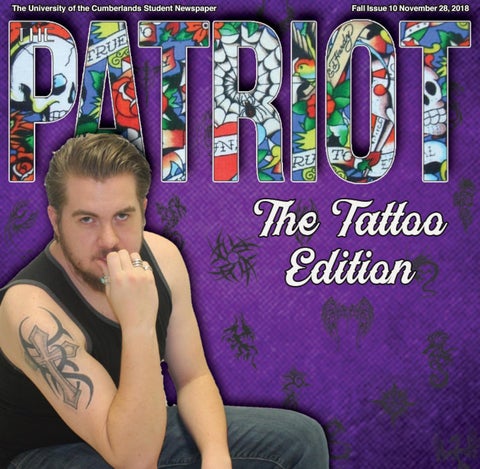
The University of the Cumberlands Student Newspaper
Fall Issue 10 November 28, 2018
November 28, 2018
Letter from the Editor Editor-In-Chief Zane Ross Managing Editor Emilee Agee Faculty Adviser Jeremiah Massengale
Dear Patriots, As this issue is published, there are only 16 days left of the fall semester and for some, like myself, there are only 16 days left of being an undergrad. In previous letters I’ve mentioned how it doesn’t feel real that I am at this point in my life. It feels like only a short time ago that I was a freshman who had no clue what I was going to do, but I persevered. I’ve met so many friends, mentors and acquaintances in the last four years, some who have gone on to become graduates and some who have seemingly disappeared from the face of the earth. Since this issue is all about tattoos, and having one myself, I thought it would be best to talk about a word that a lot of people seem to dislike: commitment. College, tattoos, marriage, jobs. All these things require us to settle and I think that settling is a fear a lot of students have. We sometimes struggle to settle on a major, who we should date and even what we want to eat for dinner. I’ve seen people who exhibit no ability to change their indecisive nature whether that nature is determined by fear or apathy I can’t really say. I’ve seen people who have dropped out of college because they couldn’t settle on a major, couldn’t choose their class for the next semester or couldn’t decide whether they wanted to go to class or not. I think that these are extreme cases, but they do happen, and people suffer for it. I’m not saying to rush out and get a tattoo that you think you might want, but don’t let fear rule you. Indecisiveness can keep us from making big mistakes, but it can also stop us from making the best decisions of our lives. This issue, we have focus on one of the biggest commitments someone can make: a tattoo. While you’re flipping through the issue, I encourage you to think about some of the things that you’ve been putting off for fear of settling. Maybe you’ll find that whatever your indecisive about is actually one of the best choices you could make. Always weigh your options, but don’t let fear and apathy be the deciding factor in making big decisions. Sincerely,
Zane Ross, Editor-in-Chief
Staff Haley Bullock Leanne Gregory Tyler Kohn Mike Krzyston Rebecca Lewter Jessica McFerron Nichole Nantz Alex Nunn Jenna Rose Tara Todd Hunter West Dan Williams Maranda Young
Front cover by Zane Ross Back cover by Zane Ross Email comments, concerns or tips to: thepatriot@ucumberlands.edu or call us at 606-539-4172 7000 College Station Drive Williamsburg, Kentucky 40769
The Patriot is the student publication of the University of the Cumberlands. Our goal is to provide timely and original content by highlighting campus news and views. Award-winning member of the Associated Collegiate Press and Kentucky Press Association.
Page 3 Features
Culture beyond the skin
To ink or not to ink?
Some UC students explain why they don’t have tattoos
BY HALEY BULLOCK AND JESSICA MCFERRON
Illustration by Zane Ross
Staff Writers
Photo by Nichole Nantz
BY ALEX NUNN Staff Writer
For many people nowadays, tattoos are extensions of one’s self, both endowed with spiritual significance, and emotional strength. It’s not hard to understand why the industry stays strong, even in times of economic hardship. With such a deeply sewed relationship between people and art, and a bond that goes beyond the skin and into the culture, the tattoo industry has stayed one of the most genuine as far as the work and artistry, always staying consistent and in the market for more artists to pave new paths into the lifelong culture. So will tattoos continue to hold strong in their foundation and history, as well as branch, or will tattoos die out as yet another trend? Well, the practice of tattooing can be traced back to as far as 3100 BC, on caveman, so safe to say that tattoos are far more than a trend, they’re a branch of history that has followed man through time. A 2018 article by Vox’s Lexie Schapitl states “In 2015, nearly one in three Americans had at least one tattoo.” The world has spent very little time without these permanent works of art painted within the skin of its’ inhabitants, but it has never been a static fad, or fading trend, no. Tattoos are constantly changing, evolving to the newest generation, always finding it’s place on the skin, but tattoos are popular for more than just fashion. Tattoos go deeper than skin. For example, Keithen Harris, a UC sophomore, has a tattoo of Kratos from “The God Of War,” Harris said, “My tattoo’s inspired by the video game, but it’s because my uncle and I used to spend time together playing the game. It reminds me of my good memories with him.” Sentiment is an important part of the practice of tattoo artistry. Remembering pieces of our past help us remember the strength we need to overcome the future. The future of tattoos is unpredictable due to its ever changing nature. It’s always finding a way to come back into the trends. The concept of tattoos can’t change alone, it takes the preceding generations of artists willing to make the strides and continue to construct the path towards the next fad in tattoos to keep the art and practice alive. Artists are constantly shifting their focus towards the future, as are those who are most likely getting a tattoo. With such a ever-changing shift, it’s no wonder this “trend” has been around so long.
For one reason or another, tattoos are something that everyone has an opinion on. It seems that people either love them or hate them. Tattoos are pieces of art that are a part of one’s body for the rest of their life, unless they decide to undergo laser removal. Some people don’t want to have tattoos because they say it goes against their religion. However, some people argue that tattoos are not works of art and refuse to have anything to do with them. Then there are people who just plainly do not want to have a tattoo done. Some people just don’t want to get a tattoo for faith-based reasons. They take the “your body is a temple” verse to a whole new level. Taylor Daniels, a UC freshman, says, “I’m not against people that do have tattoos. But I do not feel like that is what God wants me to do personally. Leviticus 19:28 talks about not making cuts or marks on your body, and that is what I view tattoos as. Tattoos are marks on your body that God didn’t create, therefore I do not want for myself.” Other people wouldn’t get tattoos because they hate the thought of the commitment that comes with getting a tattoo. Many people are indecisive when it comes to something being permanent on their body, but some people also choose not to get tatted up because of family member approval. Hallie Brackett, a UC freshman, says, “My mom isn’t particularly a fan of tattoos, so that’s
why I haven’t gotten one. I was just brought up like that. I would like to have one, but I just know she wouldn’t like it. Mom has always said ‘If the Lord wanted you to have it, then you would have been born with it.’” Tattoos are a lifetime commitment, so not knowing what to get and not wanting to start a family feud for the rest of your life are valid reasons for staying away from a tattoo parlor. Another reason people don’t get a tattoo is the hefty price tag. Jarred Brown, a UC freshman, says, “I don’t have tattoos because I’m too cheap, plus I need to have permission from my mom. I don’t want to disappoint her because she pays a lot of my bills, and I was taught ‘You live in my house, you go by my rules’ and I respect that. Plus, for a decent tattoo they’ll charge $75 an hour on average.” The cost of small tattoos can be anywhere from $50-$100. Most larger tattoos are even more expensive, especially if they are significantly detailed, so the cost could range above $100-$500, again, all depending on the design, size and detail. The price also depends on the prestige of the tattoo artist. Tattoos artists that are more renown than others can get away with charging a heftier price for the same tattoo as another artist with less publicity. Being frugal can be useful, especially with all those student loans piling up, so thinking twice about the price tag, even on a tattoo, could be helpful.
Page 4 Features
Can’t be erased
The science behind the art of the tattoo
BY LEANNE GREGORY
Courtesy of flickr’s socialmediasl444
Staff Writer
Figuring out how to express oneself has been one of the most important facets of human culture since the beginning of time. One of the ways humanity has sought to individualize themselves from their fellow man is to paint pictures on their skin that represent that individual’s personality. This artform, formally known as Tattooing, has a long and varied history, but what is equally as important to understanding how tattoos have impacted human culture are the scientific processes behind the techniques that have enabled tattooing to become a permanent fixture of human ingenuity. The tattoo process can be simplified into several steps How Stuff Works elucidates. After the design for the tattoo has been finalized the artist will properly sterilize and shave the client’s skin, so that the chances of infection are lowered, before stenciling the tattoo. The tattoo machinery, which has likewise been sterilized, is carefully assembled, and the needles are placed into an ink well. The artist will then begin to outline, shade, and color the design, making sure to clean the affected area after each step. After the tattoo is complete and carefully bandaged, the body’s immunization process takes over to ensure that the tattoo will permanently remain in the skin. The body achieves this feat by working with the unique puncture wounds left by the tattoo needles. Modern tattoo needles in of themselves, Tattoo Machine Equipment clarifies, are made in such a way that the tip of the needle contains multiple split ends of varying thicknesses, lengths, and taper styles. The needles are programmed to move at a rate of fifty to three thousand times per minute, according to Ted-Ed, which helps them to, with the expertise of the tattoo artist, puncture through the upper layers of the skin. The goal is to ensure the needle makes it to the layer of skin known as the dermis, which is comprised of, according to the American Academy of Dermatology, collagen, the protein substance that is responsible for replenishing the bodies skin cells, blood vessels, nerves, glands, and follicles for hair. Once the needle deposits the ink into the dermis through capillary action, which, according to the United States Geological Survey Water Science School, is a adhesive force acting upon liquid so that it will stick to another surface instead of itself, the body will react to the invader. According to Dr. Joan Hembree, an associate professor of biology at UC, who found the information in a paper published by PJ Lea and A Pawlowski, “The foreign dye substances, as well as damage done to skin tissue by the needle, trigger an acute inflammatory response within the body. Phagocytic immune defense cells remove damaged and dead cells and most of the ink particles. Over time virtually all the dye is removed from the superficial skin
cells.” Hembree states. These cells, also known as macrophages will, Ted-Ed explains, begin to devour the ink particles and transport them to the lymph nodes of the body where the ink can be properly disposed of while others will remain in the dermis unable to remove the ink. Allowing the tattoo to be seen through the skin. The particles of ink that are not dealt with by the macrophages are absorbed by dermal cells called fibroblasts, which are responsible for creating collagen and other substances. This absorption process, which lasts throughout a person’s life, allows the ink to stay in the area of the skin where it was injected. This process, however, does not deter the ink from deteriorating. “If the inflammatory reaction is too severe the dyes can travel away from their original site,” Hembree says, “This will cause the tattoo to ‘blur’, losing the sharp edges of the image. So, it is imperative that a new tattoo is protected from sunlight, irritants, or anything that can worsen the inflammation or injure the tattoo site,” Hembree concluded. Likewise, the tattooing process, while heavily regulated by the CDC and state law, carries several risks that, if not properly addressed, can cause injury or disease in the client or the artist. Because, as the CDC specifies, tattoo artists come into contact with their client’s blood there is the possibility that illnesses found in blood, such as Hepatitis, HIV, or tuberculosis, could be spread to the artist or the client if proper sterilization and sanitization procedures are not utilized. These procedures include cleaning the affected area and tools, disposing of used machine parts, using fresh machine parts, tools, and ink for every client and maintaining a sterile work environment. For clients specifically, there is the potential that the tattooed area may become infected without proper care and cleaning. Clients may also experience, according to The New England Journal of Medicine, an allergic reaction to the ink, which, although regulated by the FDA, can contain dangerous chemicals that are not approved for use in the human body. These risks, however, are quite small. Many tattoo studios will publish their services, and credentials online, and research has been conducted into the potential benefits tattoos can have. A study published in the American Journal of Human Biology in 2016 revealed that receiving multiple tattoos over the course of a life time could help to raise the body’s immune response. Similarly, according a study published in the National Center for Biotechnology Information in 2008, tattooing DNA vaccinations into the body of mice produced better resistance to the diseases than immunizations delivered via other techniques.
Page 5 Photos
A photo essay by Mike Krzyston
Page 6 Features
Tattoo time travel A brief look at tattoo history
Illustration by Zane Ross
BY ZANE ROSS Editor-in-Chief
Tattoos are more popular than ever, with the variety of styles, colors and themes, there seems to be no limit to how people can express themselves. In a way, our bodies become canvases that depict who we are and what we love. Throughout the existence of tattooing the variety of style and color wasn’t openly available to the cultures who utilize it today, even the tattoo process is more simplified and convenient as opposed to its early iterations. The process is so openly available to modern society that sometimes we get tattoos just because we want to. We forget that there are people who once utilized the art as a part of their everyday lives. The oldest documented human mummy to be discovered to date with tattoo markings on his body is the remains of the European ancestor known as Otzi, or the Iceman. Otzi was discovered frozen in ice in 1991 in the Otztal Alps near Italy. The incredible thing is that Otzi has been carbon dated to have lived somewhere between 3400 and 3100 BCE and is covered in approximately 61 unique tattoos, consisting of dots and lines, across his body with the ink being created from campfire soot and ash. There are theories as to why Otzi was so heavily tattooed, such as an early form of acupuncture, but there has yet to be concrete reasoning for the meaning of Otzi’s markings. Although there is little known about Otzi and his tattoo origins, there are plenty of cultures who have utilized tattoos for various purposes and functions that we know quite a bit about today such as the Samoans. If you have ever been under the needle of a tattoo gun, then you know it can either be excruciating or just a little unpleasant depending on where you’re being tattooed. Imagine having intricate patterns tattooed over the entirety of your body and then imagine it is done with sharp boar’s teeth tied to a stick. This instrument is called a tattooing comb and it is the way that the Samoan people once used to adorn their body with their traditional tattoos. The Samoan culture is one of the longest dated people to practice the art although given the appearance of Otzi, it seems that tattooing may have originated in
Europe. Samoan tattoos were used as part of their religious practice, warfare and determining one’s place in social hierarchy. For men, they began at their waist and extended to just below their knees and women typically had smaller, more intricate designs. Polynesian cultures, in general, shared similar traditions with one another and so the tattoo style and process of the Samoans would have been fairly like islanders from Tahiti and New Zealand, for example. In fact, there was a European captain by the name of James Cook who had the goal of exploring the Polynesian triangle of islands and while on his journey he met many tattooed Polynesian cultures. According to the website, Zeal and Tattoo, around the time Cook returned to Europe in 1771 the word tattoo spread quickly, reintroducing the concept to the continent. This reintroduction of the art was so popular that it led industrialized Europeans to eventually create the first rotary tattoo machine that was so heavy it had to be suspended from the ceiling to operate. Tattoo tool innovations have made getting a tattoo much simpler, whereas with a tattooing comb a design could take days or weeks depending on the intricacy of the design, but now takes only a couple of hours. The art of tattooing has come a long way and despite the usage of modern tools, inks and sterilization techniques there is still a bit of history in every design. Anyone in the world can get a tattoo with its own significant meaning with a design from any known culture. Tattoos aren’t a major part of our culture today and are more for decoration and personal means, but in some ways modern tattoo culture still mirrors cultures like the Samoans. A tattoo doesn’t necessarily correlate to social status, but to some it is a sign of being a delinquent. A tattoo doesn’t represent religious beliefs inherently but can if we want them to. A tattoo doesn’t show our feats in war but can reflect the feats we accomplish throughout our lives and to some that may in fact be war. The more things change it seems the more they stay the same.
Page 7 Entertainment
Tattoons
How popular media influences tattoo designs
M AR ANDA YOUNG Staff Writer Touka Kirishima’s eye from “Tokyo Ghoul”
Photo by Maranda Young
On campus, you might see variety of tattoo pieces representing all shapes, sizes, styles and meanings. Tattoos have been a way to showcase what’s importatnt to you. These types of tattoos can include anime, comic book, and Disney characters, as well as a variety of other cartoons. There are many students who have these tattoos as well. These tattoos are usually purchased in remembrance of someone or something, or are intended to represent childhood memories and emotions. Matthew Wallace, an employee of the University of the Cumberlands, has 12 tattoos, five of them being a cartoon symbol or character. Wallace has a “Dragon Ball Z” tattoo, a White and Yellow Lantern tattoo from DC Comics, a Heisenberg caricature from “Breaking Bad” and a very special one to him is his Tweety Bird tattoo in honor of his grandmother. Wallace said, “She was a real big Tweety Bird fan. I remember growing up with her house interior decor Tweety Bird based; it was one of the big things that stuck out about her.” Growing up, people be molded by several different activities, including watching television shows. These TV shows may influence some people so much did they will have it tattooed on their bodies. Rebecca Hamilton, Director of Graduate Advising, has four tattoos based on cartoons, “I have one that is Ariel from ‘The Little Mermaid,’ one on my back that is Snow White, and one is themed for ‘Alice in Wonderland,’” Hamilton said. She said her favorite tattoo is her “Harry Potter” tattoo because it introduced her to the “hardcore literature” which spurred her addiction. “Right now, I am focused on finishing up a sleeve of Disney-themed tattoos, I plan to move forward and get Genie next.” For Hamilton, it’s a testament to some of the things that she was closest with growing up. She adds, “Although I could never love these characters as much as I love the real people in life, they were definitely there for me when real people couldn’t be.” Chase Brown, a UC freshman, has an anime tattoo from “Tokyo Ghoul,” it is Touka Kirshima’s eye. Brown has the eye on his ribs to represent fighting. Brown says, “I got it because of the meaning it has and I enjoy the show it is from, ‘Tokyo Ghoul.’ In the anime, the character changes to the way it is tattooed on my ribs when they are about to fight and protect there well on you. As wrestling means a lot to me.” With getting a tattoo, there will be many reactions; some reactions are more negative than others and vice versa. For Wallace, his friends at first found the tattoo to be somewhat odd, but he didn’t mind. Wallace says, “As long as the sentiments stays same, I feel no matter how the tattoos look, it will still be a good tattoo.” Hamilton adds, “People tend to view others with tattoos as uneducated, which I think is a stigma that is changing. I hope we’re finally in a day and time where that’s not the point.” One piece of advice that Wallace, Hamilton and Brown agreed upon was to make sure you know the artist is amazing at their job and will do well with you. Remember once you get a tattoo, it’s a forever kind of thing.
As if a tattoo wasn’t enough, these artists had to also write songs about them.
Song Artist The Woman with Tattooed Hands
Atmosphere
New Tattoo Saving Abel Rose Tattoo Dropkick Murphys Beat the Devil’s Tattoo
Black Rebel Motorcycle Club
Closer The Chainsmokers, Halsey Red Dragon Tattoo
Fountains of Wayne
Bad Tattoo Franke Tattoo Jordin Sparks Anchor Tattoo Chase Atlantic Ink Coldplay Tattoo Hillary Duff Tattooed Heart Ariana Grande Heart Tattoo Joyce Manor Tattoo Van Halen